EP2838861B1 - Matériau composite à couche de revêtement décorative et procédé de fabrication dudit matériau - Google Patents
Matériau composite à couche de revêtement décorative et procédé de fabrication dudit matériau Download PDFInfo
- Publication number
- EP2838861B1 EP2838861B1 EP13719061.7A EP13719061A EP2838861B1 EP 2838861 B1 EP2838861 B1 EP 2838861B1 EP 13719061 A EP13719061 A EP 13719061A EP 2838861 B1 EP2838861 B1 EP 2838861B1
- Authority
- EP
- European Patent Office
- Prior art keywords
- layer
- composite material
- sol
- gel
- composite
- Prior art date
- Legal status (The legal status is an assumption and is not a legal conclusion. Google has not performed a legal analysis and makes no representation as to the accuracy of the status listed.)
- Active
Links
Images



Classifications
-
- C—CHEMISTRY; METALLURGY
- C03—GLASS; MINERAL OR SLAG WOOL
- C03C—CHEMICAL COMPOSITION OF GLASSES, GLAZES OR VITREOUS ENAMELS; SURFACE TREATMENT OF GLASS; SURFACE TREATMENT OF FIBRES OR FILAMENTS MADE FROM GLASS, MINERALS OR SLAGS; JOINING GLASS TO GLASS OR OTHER MATERIALS
- C03C17/00—Surface treatment of glass, not in the form of fibres or filaments, by coating
- C03C17/34—Surface treatment of glass, not in the form of fibres or filaments, by coating with at least two coatings having different compositions
- C03C17/42—Surface treatment of glass, not in the form of fibres or filaments, by coating with at least two coatings having different compositions at least one coating of an organic material and at least one non-metal coating
-
- B—PERFORMING OPERATIONS; TRANSPORTING
- B05—SPRAYING OR ATOMISING IN GENERAL; APPLYING FLUENT MATERIALS TO SURFACES, IN GENERAL
- B05D—PROCESSES FOR APPLYING FLUENT MATERIALS TO SURFACES, IN GENERAL
- B05D1/00—Processes for applying liquids or other fluent materials
- B05D1/36—Successively applying liquids or other fluent materials, e.g. without intermediate treatment
-
- B—PERFORMING OPERATIONS; TRANSPORTING
- B05—SPRAYING OR ATOMISING IN GENERAL; APPLYING FLUENT MATERIALS TO SURFACES, IN GENERAL
- B05D—PROCESSES FOR APPLYING FLUENT MATERIALS TO SURFACES, IN GENERAL
- B05D5/00—Processes for applying liquids or other fluent materials to surfaces to obtain special surface effects, finishes or structures
- B05D5/06—Processes for applying liquids or other fluent materials to surfaces to obtain special surface effects, finishes or structures to obtain multicolour or other optical effects
-
- B—PERFORMING OPERATIONS; TRANSPORTING
- B05—SPRAYING OR ATOMISING IN GENERAL; APPLYING FLUENT MATERIALS TO SURFACES, IN GENERAL
- B05D—PROCESSES FOR APPLYING FLUENT MATERIALS TO SURFACES, IN GENERAL
- B05D7/00—Processes, other than flocking, specially adapted for applying liquids or other fluent materials to particular surfaces or for applying particular liquids or other fluent materials
- B05D7/50—Multilayers
- B05D7/52—Two layers
-
- C—CHEMISTRY; METALLURGY
- C03—GLASS; MINERAL OR SLAG WOOL
- C03C—CHEMICAL COMPOSITION OF GLASSES, GLAZES OR VITREOUS ENAMELS; SURFACE TREATMENT OF GLASS; SURFACE TREATMENT OF FIBRES OR FILAMENTS MADE FROM GLASS, MINERALS OR SLAGS; JOINING GLASS TO GLASS OR OTHER MATERIALS
- C03C17/00—Surface treatment of glass, not in the form of fibres or filaments, by coating
- C03C17/006—Surface treatment of glass, not in the form of fibres or filaments, by coating with materials of composite character
- C03C17/008—Surface treatment of glass, not in the form of fibres or filaments, by coating with materials of composite character comprising a mixture of materials covered by two or more of the groups C03C17/02, C03C17/06, C03C17/22 and C03C17/28
-
- C—CHEMISTRY; METALLURGY
- C03—GLASS; MINERAL OR SLAG WOOL
- C03C—CHEMICAL COMPOSITION OF GLASSES, GLAZES OR VITREOUS ENAMELS; SURFACE TREATMENT OF GLASS; SURFACE TREATMENT OF FIBRES OR FILAMENTS MADE FROM GLASS, MINERALS OR SLAGS; JOINING GLASS TO GLASS OR OTHER MATERIALS
- C03C17/00—Surface treatment of glass, not in the form of fibres or filaments, by coating
- C03C17/28—Surface treatment of glass, not in the form of fibres or filaments, by coating with organic material
- C03C17/32—Surface treatment of glass, not in the form of fibres or filaments, by coating with organic material with synthetic or natural resins
-
- C—CHEMISTRY; METALLURGY
- C03—GLASS; MINERAL OR SLAG WOOL
- C03C—CHEMICAL COMPOSITION OF GLASSES, GLAZES OR VITREOUS ENAMELS; SURFACE TREATMENT OF GLASS; SURFACE TREATMENT OF FIBRES OR FILAMENTS MADE FROM GLASS, MINERALS OR SLAGS; JOINING GLASS TO GLASS OR OTHER MATERIALS
- C03C3/00—Glass compositions
- C03C3/04—Glass compositions containing silica
- C03C3/076—Glass compositions containing silica with 40% to 90% silica, by weight
- C03C3/089—Glass compositions containing silica with 40% to 90% silica, by weight containing boron
- C03C3/091—Glass compositions containing silica with 40% to 90% silica, by weight containing boron containing aluminium
-
- C—CHEMISTRY; METALLURGY
- C03—GLASS; MINERAL OR SLAG WOOL
- C03C—CHEMICAL COMPOSITION OF GLASSES, GLAZES OR VITREOUS ENAMELS; SURFACE TREATMENT OF GLASS; SURFACE TREATMENT OF FIBRES OR FILAMENTS MADE FROM GLASS, MINERALS OR SLAGS; JOINING GLASS TO GLASS OR OTHER MATERIALS
- C03C3/00—Glass compositions
- C03C3/04—Glass compositions containing silica
- C03C3/076—Glass compositions containing silica with 40% to 90% silica, by weight
- C03C3/089—Glass compositions containing silica with 40% to 90% silica, by weight containing boron
- C03C3/091—Glass compositions containing silica with 40% to 90% silica, by weight containing boron containing aluminium
- C03C3/093—Glass compositions containing silica with 40% to 90% silica, by weight containing boron containing aluminium containing zinc or zirconium
-
- C—CHEMISTRY; METALLURGY
- C03—GLASS; MINERAL OR SLAG WOOL
- C03C—CHEMICAL COMPOSITION OF GLASSES, GLAZES OR VITREOUS ENAMELS; SURFACE TREATMENT OF GLASS; SURFACE TREATMENT OF FIBRES OR FILAMENTS MADE FROM GLASS, MINERALS OR SLAGS; JOINING GLASS TO GLASS OR OTHER MATERIALS
- C03C2201/00—Glass compositions
- C03C2201/06—Doped silica-based glasses
- C03C2201/08—Doped silica-based glasses containing boron or halide
- C03C2201/10—Doped silica-based glasses containing boron or halide containing boron
-
- C—CHEMISTRY; METALLURGY
- C03—GLASS; MINERAL OR SLAG WOOL
- C03C—CHEMICAL COMPOSITION OF GLASSES, GLAZES OR VITREOUS ENAMELS; SURFACE TREATMENT OF GLASS; SURFACE TREATMENT OF FIBRES OR FILAMENTS MADE FROM GLASS, MINERALS OR SLAGS; JOINING GLASS TO GLASS OR OTHER MATERIALS
- C03C2201/00—Glass compositions
- C03C2201/06—Doped silica-based glasses
- C03C2201/30—Doped silica-based glasses containing metals
- C03C2201/34—Doped silica-based glasses containing metals containing rare earth metals
- C03C2201/36—Doped silica-based glasses containing metals containing rare earth metals containing rare earth metals and aluminium, e.g. Er-Al co-doped
-
- C—CHEMISTRY; METALLURGY
- C03—GLASS; MINERAL OR SLAG WOOL
- C03C—CHEMICAL COMPOSITION OF GLASSES, GLAZES OR VITREOUS ENAMELS; SURFACE TREATMENT OF GLASS; SURFACE TREATMENT OF FIBRES OR FILAMENTS MADE FROM GLASS, MINERALS OR SLAGS; JOINING GLASS TO GLASS OR OTHER MATERIALS
- C03C2201/00—Glass compositions
- C03C2201/06—Doped silica-based glasses
- C03C2201/30—Doped silica-based glasses containing metals
- C03C2201/40—Doped silica-based glasses containing metals containing transition metals other than rare earth metals, e.g. Zr, Nb, Ta or Zn
-
- C—CHEMISTRY; METALLURGY
- C03—GLASS; MINERAL OR SLAG WOOL
- C03C—CHEMICAL COMPOSITION OF GLASSES, GLAZES OR VITREOUS ENAMELS; SURFACE TREATMENT OF GLASS; SURFACE TREATMENT OF FIBRES OR FILAMENTS MADE FROM GLASS, MINERALS OR SLAGS; JOINING GLASS TO GLASS OR OTHER MATERIALS
- C03C2201/00—Glass compositions
- C03C2201/06—Doped silica-based glasses
- C03C2201/30—Doped silica-based glasses containing metals
- C03C2201/40—Doped silica-based glasses containing metals containing transition metals other than rare earth metals, e.g. Zr, Nb, Ta or Zn
- C03C2201/42—Doped silica-based glasses containing metals containing transition metals other than rare earth metals, e.g. Zr, Nb, Ta or Zn containing titanium
-
- C—CHEMISTRY; METALLURGY
- C03—GLASS; MINERAL OR SLAG WOOL
- C03C—CHEMICAL COMPOSITION OF GLASSES, GLAZES OR VITREOUS ENAMELS; SURFACE TREATMENT OF GLASS; SURFACE TREATMENT OF FIBRES OR FILAMENTS MADE FROM GLASS, MINERALS OR SLAGS; JOINING GLASS TO GLASS OR OTHER MATERIALS
- C03C2201/00—Glass compositions
- C03C2201/06—Doped silica-based glasses
- C03C2201/30—Doped silica-based glasses containing metals
- C03C2201/50—Doped silica-based glasses containing metals containing alkali metals
-
- C—CHEMISTRY; METALLURGY
- C03—GLASS; MINERAL OR SLAG WOOL
- C03C—CHEMICAL COMPOSITION OF GLASSES, GLAZES OR VITREOUS ENAMELS; SURFACE TREATMENT OF GLASS; SURFACE TREATMENT OF FIBRES OR FILAMENTS MADE FROM GLASS, MINERALS OR SLAGS; JOINING GLASS TO GLASS OR OTHER MATERIALS
- C03C2201/00—Glass compositions
- C03C2201/06—Doped silica-based glasses
- C03C2201/30—Doped silica-based glasses containing metals
- C03C2201/54—Doped silica-based glasses containing metals containing beryllium, magnesium or alkaline earth metals
-
- C—CHEMISTRY; METALLURGY
- C03—GLASS; MINERAL OR SLAG WOOL
- C03C—CHEMICAL COMPOSITION OF GLASSES, GLAZES OR VITREOUS ENAMELS; SURFACE TREATMENT OF GLASS; SURFACE TREATMENT OF FIBRES OR FILAMENTS MADE FROM GLASS, MINERALS OR SLAGS; JOINING GLASS TO GLASS OR OTHER MATERIALS
- C03C2217/00—Coatings on glass
- C03C2217/40—Coatings comprising at least one inhomogeneous layer
- C03C2217/425—Coatings comprising at least one inhomogeneous layer consisting of a porous layer
-
- C—CHEMISTRY; METALLURGY
- C03—GLASS; MINERAL OR SLAG WOOL
- C03C—CHEMICAL COMPOSITION OF GLASSES, GLAZES OR VITREOUS ENAMELS; SURFACE TREATMENT OF GLASS; SURFACE TREATMENT OF FIBRES OR FILAMENTS MADE FROM GLASS, MINERALS OR SLAGS; JOINING GLASS TO GLASS OR OTHER MATERIALS
- C03C2217/00—Coatings on glass
- C03C2217/40—Coatings comprising at least one inhomogeneous layer
- C03C2217/43—Coatings comprising at least one inhomogeneous layer consisting of a dispersed phase in a continuous phase
- C03C2217/46—Coatings comprising at least one inhomogeneous layer consisting of a dispersed phase in a continuous phase characterized by the dispersed phase
- C03C2217/48—Coatings comprising at least one inhomogeneous layer consisting of a dispersed phase in a continuous phase characterized by the dispersed phase having a specific function
- C03C2217/485—Pigments
-
- C—CHEMISTRY; METALLURGY
- C03—GLASS; MINERAL OR SLAG WOOL
- C03C—CHEMICAL COMPOSITION OF GLASSES, GLAZES OR VITREOUS ENAMELS; SURFACE TREATMENT OF GLASS; SURFACE TREATMENT OF FIBRES OR FILAMENTS MADE FROM GLASS, MINERALS OR SLAGS; JOINING GLASS TO GLASS OR OTHER MATERIALS
- C03C2217/00—Coatings on glass
- C03C2217/70—Properties of coatings
- C03C2217/72—Decorative coatings
-
- C—CHEMISTRY; METALLURGY
- C03—GLASS; MINERAL OR SLAG WOOL
- C03C—CHEMICAL COMPOSITION OF GLASSES, GLAZES OR VITREOUS ENAMELS; SURFACE TREATMENT OF GLASS; SURFACE TREATMENT OF FIBRES OR FILAMENTS MADE FROM GLASS, MINERALS OR SLAGS; JOINING GLASS TO GLASS OR OTHER MATERIALS
- C03C2218/00—Methods for coating glass
- C03C2218/30—Aspects of methods for coating glass not covered above
- C03C2218/36—Underside coating of a glass sheet
-
- F—MECHANICAL ENGINEERING; LIGHTING; HEATING; WEAPONS; BLASTING
- F24—HEATING; RANGES; VENTILATING
- F24C—DOMESTIC STOVES OR RANGES ; DETAILS OF DOMESTIC STOVES OR RANGES, OF GENERAL APPLICATION
- F24C15/00—Details
- F24C15/02—Doors specially adapted for stoves or ranges
-
- F—MECHANICAL ENGINEERING; LIGHTING; HEATING; WEAPONS; BLASTING
- F24—HEATING; RANGES; VENTILATING
- F24C—DOMESTIC STOVES OR RANGES ; DETAILS OF DOMESTIC STOVES OR RANGES, OF GENERAL APPLICATION
- F24C15/00—Details
- F24C15/10—Tops, e.g. hot plates; Rings
-
- Y—GENERAL TAGGING OF NEW TECHNOLOGICAL DEVELOPMENTS; GENERAL TAGGING OF CROSS-SECTIONAL TECHNOLOGIES SPANNING OVER SEVERAL SECTIONS OF THE IPC; TECHNICAL SUBJECTS COVERED BY FORMER USPC CROSS-REFERENCE ART COLLECTIONS [XRACs] AND DIGESTS
- Y10—TECHNICAL SUBJECTS COVERED BY FORMER USPC
- Y10T—TECHNICAL SUBJECTS COVERED BY FORMER US CLASSIFICATION
- Y10T428/00—Stock material or miscellaneous articles
- Y10T428/24—Structurally defined web or sheet [e.g., overall dimension, etc.]
- Y10T428/24355—Continuous and nonuniform or irregular surface on layer or component [e.g., roofing, etc.]
- Y10T428/24364—Continuous and nonuniform or irregular surface on layer or component [e.g., roofing, etc.] with transparent or protective coating
Definitions
- the invention relates to a method for producing a composite material with decorative coating and a corresponding decorative composite material.
- the invention relates to a glass-ceramic substrate, such as used for cooking surfaces, with a decorative bottom coating.
- Glass or glass ceramic substrates provided with a decorative coating are known.
- at least partially transparent glass-ceramic substrates, such as those used for cooking surfaces, are provided with a bottom-side coating.
- the decorative coating may be applied for functional reasons, for example for cooking hobs. Further, a decorative coating can only serve to create a special visual impression, for example to provide a hob in a particular color.
- silicone coatings are known. These have the advantage that they can easily be applied over a silicone ink, for example by means of screen printing, but usually have a non-optimal mechanical resistance and can discolor at high temperature load.
- glass flow-based layers so-called enamel layers.
- Such pigmented glass flux-based layers have the disadvantage that they put the glass-ceramic substrate under tension and thus reduce its strength. This disadvantage can be reduced by the application of porous layers, but this is accompanied by a dull appearance of the composite material produced in this way.
- the document WO 2012/010302 A1 shows a decorative layer of a sol-gel material, on which a silicone-based sealing layer with inorganic solid particles is applied.
- the invention is the object of the invention to provide a simple method for applying a high-temperature-resistant decorative layer with good visual appearance.
- the object of the invention is already achieved by a method for producing a composite material with decorative coating and by a composite material with decorative coating according to one of the independent claims.
- the invention relates to a method for producing a composite material with a decorative coating, wherein a decorative coating is also understood to mean a coating which is at least partially applied for functional reasons, such as, for example, a marking of cooking surfaces, an applied inscription etc.
- the coating is applied to a heat-resistant glass or glass-ceramic substrate.
- heat-resistant glass ceramic substrates are used for cooking surfaces.
- heat-resistant glass ceramic substrates are used for other sites with high temperature load, so in particular with a temperature load of more than 200 ° C, but also some special heat-resistant glasses can be used.
- the glass or glass ceramic substrate is preferably planar and at least partially transparent in the visible region.
- a sol-gel layer containing at least pigment particles is applied to the glass-ceramic substrate.
- a hybrid polymer is used for the sol-gel layer, so that after drying, a partially inorganic, partially organic layer formed.
- particles as provided in a preferred embodiment of the invention, other fillers, in particular inorganic, skeleton-forming material may be added.
- fillers in particular inorganic, skeleton-forming material
- metal or Halbmetalloxydp be used.
- the particles preferably have a size of from 0.5 to 200 nm, particularly preferably from 4 to 150 nm. It is also conceivable to add particles having an average particle size of from 10 to 50 nm. These can also be generated in particular via the sol-gel precursor.
- the coating material comprises particles having a chain and / or fibrous morphology.
- a chain or fibrous morphology refers to particles whose size along their main extension direction is at least twice, preferably three times, the size along the smallest dimension of the particle, which in turn applies on average to the particles used.
- particles with a chain-like morphology they are secondary particles which consist of a multiplicity of smaller primary particles arranged next to each other. It is understood that the particles may be at least partially branched.
- nanoparticles having an average length of 50 to 150 nm and an average size of 5 to 25 nm may be used.
- the Size can be determined by means of scanning electronical recordings, as will be described in detail below.
- the particle size of preferably used chain-shaped nanoparticles in a 0.05% by mass dispersion is determined by the dynamic light scattering method (apparatus: Deltanano HC, evaluation according to the method of Conten), the particle size is about 91 nm a very broad distribution and a standard deviation of about 70 nm.
- the diameter of the primary particles is in the SEM (scanning electron microscope) the measured chain-shaped particles at about 15 nm.
- the filler particles are of non-colorant material, such as silica, zirconia or alumina.
- the mass ratio of color-forming constituents to non-color-providing constituents is 0.02 to 5, preferably 0.3 to 2, particularly preferably 0.6 to 1.2.
- the volume ratio of color-giving scaffolding-forming constituents to non-color-providing framework-forming constituents are from 0.01 to 3.5, preferably from 0.2 to 1.5 and particularly preferably from 0.4 to 1.0.
- the density of the scaffold-forming material, in particular of the scaffold-forming material composed of nanoscale particles, in a preferred embodiment of the invention is between 2.0 and 6 g / cm 3 , preferably between 3 and 4 g / cm 3 .
- Skeletal density can be determined by He-pycnometry.
- the skeleton-forming material that is to say the material via which the porosity is provided, consists at least partially of oxides which have been formed as decomposition products of molecular-disperse sol-gel precursors.
- decomposition products of alkoxysilanes or Alkoxyzirkonaten be (GPTES: glycidyloxypropyltriethoxysilane, TEOS: tetraethoxysilane, MTEOS: methyltriethoxysilane, PhTEOS: Phenyltrithoxysilan, MPTES: methacryloxypropyltriethoxysilane, MPTMS: methacryloxypropyltrimethoxysilane, VTES: Venyltriethoxysilan, ATES: Allytriethoxysilan, zirconium tetrapropylate, titanium tetraethylate, Aluminiumsecundmaschinebutylat).
- GPTES glycidyloxypropyltriethoxysilane
- TEOS tetraethoxysilane
- MTEOS methyltriethoxysilane
- PhTEOS Phenyltrithoxysilan
- MPTES me
- the skeleton-forming matrix material used is preferably crystalline and / or glassy inorganic materials.
- the sol-gel layer is preferably applied by screen printing.
- a polymer layer is applied to the sol-gel layer, which is first baked to form a skeleton, whereby the sol-gel layer is infiltrated by the material of the polymer layer. It has surprisingly been found that a sol-gel layer with an average pore diameter of less than 100 nm, which appears as a dense layer in particular in the case of measurements of porosity by nitrogen adsorption, is penetrated by a polymer material, so that a dense composite layer is formed.
- the polymer layer preferably has a heat resistance at 1 hour loading time of over 200 ° C, preferably above 300 ° C, most preferably above 400 ° C.
- Polysiloxanes especially silicone inks such as methyl or phenyl silicone resins, are used. It is also conceivable to use a different sol-gel material for the polymer layer.
- the inventors have found that a combination of a partially inorganically formed layer which is filled with a polymer material can provide a homogeneous dense layer composite which can be of high gloss and far less prone to cracking under temperature stress than known sol-gel layers ,
- the color location before and after thermal stress is high-gloss, in particular with a gloss level of G1 according to EN ISO 2813.
- black layers in particular having a value L in the Lab color space of less than 28.0, are provided, more preferably of less than 27.5 and most preferably of less than 27.0.
- the skeletal density of the pigmented polymer layer in the homogeneous composite material according to the invention is in a preferred embodiment 1.3 to 5 g / cm 3 , preferably 1.5 to 4.0 g / cm 3 and more preferably 1.8 to 3.0 g / cm 3 .
- the material of the polymer layer penetrates the skeleton-forming material of the sol-gel layer almost homogeneously and on a nanoscale dimension.
- the skeletal density of the penetrating polymeric material in one preferred embodiment is 1.0 to 2.5 g / cm 3 , preferably 1.3 to 2.2 g / cm 3, and more preferably 1.5 to 1.9 g / cm 3 .
- Fluorinated polymers and / or polysiloxanes or sol-gel-derived hybrid polymers are also used in particular as polymer material.
- methyl- or phenyl-substituted sol-gel materials or polysiloxanes can be used.
- a high-temperature resistant methylphenylpolysiloxane resin and a silica-containing methylsiloxane resin are also conceivable.
- the volume ratio of the material of the first layer to the material of the polymer layer in a preferred embodiment of the invention is 10 to 0.5, preferably 4 to 1, particularly preferably 3 to 1.5, of the composite material produced.
- the material of the polymer layer is also mixed with fillers and / or pigments.
- fillers and / or pigments Preferably, fillers and / or pigments have an average particle size of 100 nm to 2 microns. Pure fillers can assume particle sizes between 1 nm and 300 ⁇ m.
- Silica particles, alumina particles, fumed silicas, soda lime, alkali aluminosilicate and / or borosilicate glass spheres and / or glass hollow spheres can be used in particular as fillers.
- Pigments which can be used in particular are: platelet- or rod-shaped pigments, coated effect pigments and absorption pigments (cobalt oxides / spinels, cobalt-aluminum spinels, cobalt-titanium spinels, cobalt-chorm spinels, cobalt-nickel-manganese-iron Chromium oxide / spinel, cobalt-nickel-zinc-titanium-aluminum oxide / spinel, iron oxide, iron-chromium oxide, iron-chromium-zinc-titanium oxide, copper-chromium spinel, nickel Chromium-antimony-titanium oxides, titanium oxides, zirconium-silicon-iron oxides / spinels, etc.).
- coated effect pigments and absorption pigments cobalt oxides / spinels, cobalt-aluminum spinels, cobalt-titanium spinels, cobalt-chorm spinels, cobalt-nickel-manganese
- platelet-shaped pigments in the material of the polymer layer can lead to particles and fillers of the material of the porous layer being at least partially covered.
- the porous layer after a thermal treatment of 400 ° C in a preferred embodiment of the invention has an open porosity of more than 10%, preferably more than 20%, more preferably more than 25%.
- the layer structure of the non-infiltrated layer after thermal treatment at 400 ° C has both micro and mesopores with an average pore diameter of 1-6 nm.
- the mean pore diameter is determined from the adsorption curves according to the BJH method from the N2 sorption.
- the open porosity is determined on scraped layers which have not been infiltrated but processed with identical parameters by means of the N2 sorption and He pycnometry methods. From the pore volume (N2 sorption) and the skeletal density (He pycnometry), the open porosity is then calculated.
- the composite material produced according to the invention which comprises a composite layer comprising a predominantly inorganic framework with pigment particles, which in turn comprises nanoscale pores filled with a polymer, preferably has a closed one Porosity of less than 20% by volume, more preferably less than 5% by volume.
- the open porosity is determined on scratched composite layers using the method of N 2 sorption and He-pycnometry. From the pore volume and skeletal density, the open porosity is then calculated.
- Open porosity refers to the porosity, which is calculated from the pore volumes, which can be measured by N 2 sorption.
- the composite layer produced is covered by further layers.
- pigmented sol-gel layers or polysiloxane layers can be used.
- the invention is also suitable for Glasinnbetikung, for example, for oven panes and fireplace viewing windows.
- Fig. 1 shows a schematically illustrated for illustration composite material 1 with a composite layer applied according to the invention.
- a Composite layer applied which consists of a porous layer which has been filled with a polymer layer.
- the composite layer comprises coloring pigment particles 3.
- the pigment particles 3 simultaneously serve to form a porous skeleton.
- a manganese ferrite spinel having an average particle size of less than 100 nm can be used.
- the material of the first layer applied initially as a sol-gel layer comprises non-coloring filler particles, in this embodiment filler particles 4 having a mean diameter between 15 and 150 nm.
- Further particles 5 are also non-coloring skeletal particles from a molecular sol-gel precursor
- silica of granular structure having an average particle size of less than 5 nm from pyrolyzed and previously hydrolyzed hybrid polymers e.g., GPTES, TEOS.
- the particles 3, 4, 5 of the first applied layer are filled with a polymer material 6, in this embodiment, with a high-temperature-resistant polysiloxane, so that a dense composite material 8 is formed.
- the polymer material 6 has been applied in such a large amount that a sealing layer 9 has formed over the composite material 8 which contains no filler particles 4, 5 and pigment particles 3 of the material of the first porous layer.
- Fig. 2a and Fig. 2b show on the basis of a flow chart, the essential steps of an embodiment of the invention.
- a glass-ceramic substrate is provided.
- the sol-gel layer is dried or hardened and optionally ( Fig. 2b ) baked at a temperature above 350 ° C, thereby forming a infiltratable by the silicone paint partially nanoscale-porous, partially inorganic scaffold.
- a pigmented silicone paint is applied and the resulting composite layer in which the silicone ink fills the nanoscale pores of the sol-gel layer is baked at a temperature of about 300 ° C. It goes without saying that it is also possible to remove organic constituents, in particular the sol-gel layer. However, the silicone paint used should have a temperature stability for baking the layer composite.
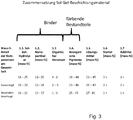
- Fig. 3 shows a table with a composition of the sol-gel coating material used in one simple and in preferred and particularly preferred embodiments.
- the hybrid polymer lacquer has, on the one hand, binder components which comprise a sol-gel hydrolyzate, nanoparticles.
- the hybrid polymer varnish comprises a high-boiling solvent.
- starters, organic crosslinkers and additives in the stated amount can be added.
- Fig. 4 shows a scanning electron micrograph of an embodiment of a dried hybrid polymer layer, which was applied as a first layer, but has not been infiltrated by a polymer.
- an infiltratable layer has formed.
- Fig. 5 shows this layer after the application of a polysiloxane.
- the structure of the first layer is still easy to recognize.
- the first layer was infiltrated by the polysiloxane, creating a dense composite layer.
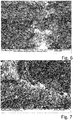
- Fig. 6 shows the in Fig. 5 shown composite layer after a temperature load of about 500 ° C. In the Fig. 5 to recognize structure has largely been preserved. The layer is therefore thermally stable up to over 500 ° C.
- Fig. 7 shows the in Fig. 4 shown layer without Silikoninfiltri für a thermal treatment after 400 ° C. It is a porous layer without infiltrated silicone resin.
- a composite material according to the invention can be produced as follows:
- MPTES methacryloxypropyltriethoxysilane
- the color is stirred homogeneously by means of a dissolver disc.
- the color is then printed on a transparent glass ceramic by means of a 140 sieve and then dried at 170 ° C. for 1 hour.
- the later a nanoscale scaffolding forming component is now applied.
- a second layer with the infiltrating component is also applied to the first layer by screen printing.
- a silicone ink based on a methyl / phenylsilicone resin is dissolved in xylene used.
- the silicone paint is 22% by mass of mica pigments with an average particle size of 15 microns admit.
- a sieve of 77 is used for the screen printing of the infiltrating component.
- the entire layer package is baked at 380 ° C for 1 hour.
- GPTES glycidoxypropyltriethoxysilane
- the color is stirred homogeneously by means of a dissolver disc.
- the color is then printed on a transparent glass ceramic by means of a 140 sieve and then dried at 170 ° C. for 1 hour and the layer is baked at 400 ° C.
- the later forming the nanoscale framework component is applied with it.
- a second layer with the infiltrating component is also applied to the first layer by screen printing.
- a silicone ink based on a methyl / phenylsilicone resin, dissolved in xylene, is used (DC 805 from Dow Corning).
- the silicone paint is thereby 30% by mass of mica pigments with an average particle size of 15 microns admit.
- a sieve of 77 is used for the screen printing of the infiltrating component.
- the entire layer package is baked at 420 ° C for 1 hour.
Landscapes
- Chemical & Material Sciences (AREA)
- Engineering & Computer Science (AREA)
- Life Sciences & Earth Sciences (AREA)
- Chemical Kinetics & Catalysis (AREA)
- General Chemical & Material Sciences (AREA)
- Geochemistry & Mineralogy (AREA)
- Materials Engineering (AREA)
- Organic Chemistry (AREA)
- Composite Materials (AREA)
- Wood Science & Technology (AREA)
- Combustion & Propulsion (AREA)
- Mechanical Engineering (AREA)
- General Engineering & Computer Science (AREA)
- Surface Treatment Of Glass (AREA)
- Laminated Bodies (AREA)
- Application Of Or Painting With Fluid Materials (AREA)
- Paints Or Removers (AREA)
- Other Surface Treatments For Metallic Materials (AREA)
- Induction Heating Cooking Devices (AREA)
Claims (12)
- Procédé de fabrication d'un matériau composite pourvu d'un revêtement décoratif, comprenant les étapes de :- mise à disposition d'un substrat en verre ou en vitrocéramique,- dépôt d'une couche sol-gel, à laquelle sont ajoutées au moins des particules de pigment et des particules d'oxyde,- dépôt d'une couche de polymère sur la couche sol-gel, la couche sol-gel étant infiltrée par la matière de la couche de polymère, un polysiloxane étant utilisé comme matière pour la couche de polymère,- des pigments étant ajoutés à la matière de la couche de polymère,caractérisé en ce que des particules d'oxyde ayant une morphologie de type fibre et/ou chaîne sont ajoutées au sol-gel.
- Procédé de fabrication d'un matériau composite pourvu d'un revêtement décoratif selon la revendication précédente, caractérisé en ce que des nanoparticules, en particulier des nanoparticules de SiO2, sont utilisées comme particules d'oxyde.
- Procédé de fabrication d'un matériau composite pourvu d'un revêtement décoratif selon l'une des revendications précédentes, caractérisé en ce qu'une couche sol-gel ayant un diamètre moyen de pores inférieur à 10 nm, de préférence inférieur à 5 nm, est déposée, et/ou en ce que la couche sol-gel présente un diamètre moyen de pores compris entre 0,5 et 500 nm, de préférence entre 1 et 200 nm, de manière particulièrement préférée entre 5 et 100 nm.
- Procédé de fabrication d'un matériau composite pourvu d'un revêtement décoratif selon l'une des revendications précédentes, caractérisé en ce que la couche de polymère est déposée avant une pénétration de la couche sol-gel.
- Procédé de fabrication d'un matériau composite pourvu d'un revêtement décoratif selon l'une des revendications précédentes, caractérisé en ce qu'une résine de silicone méthylique ou phénylique est déposée comme matière pour la couche de polymère.
- Procédé de fabrication d'un matériau composite pourvu d'un revêtement décoratif selon l'une des revendications précédentes, caractérisé en ce que des pigments lamellaires sont ajoutés à la matière de la couche de polymère.
- Procédé de fabrication d'un matériau composite pourvu d'un revêtement décoratif selon l'une des revendications précédentes, caractérisé en ce que la couche poreuse et/ou la couche de polymère sont déposées par sérigraphie.
- Procédé de fabrication d'un matériau composite pourvu d'un revêtement décoratif selon l'une des revendications précédentes, caractérisé en ce que le composite résultant de la couche de polymère et de la couche sol-gel est durci thermiquement, notamment à une température supérieure à 200°C.
- Matériau composite, fabriqué par un procédé selon l'une des revendications précédentes, comprenant un substrat en vitrocéramique, où une couche composite comprenant un squelette principalement inorganique, pourvu de particules de pigment et de particules d'oxyde ayant une morphologie de type fibre et/ou chaîne et présentant des pores nanométriques remplis d'un polysiloxane, est disposée sur le substrat en vitrocéramique.
- Matériau composite selon l'une des revendications précédentes, caractérisé en ce que la couche de composite présente une porosité fermée inférieure à 20 %, de préférence inférieure à 5 %.
- Matériau composite selon l'une des revendications précédentes, caractérisé en ce que le revêtement brille, notamment à un degré de brillance G1 d'après la norme EN ISO 2813.
- Utilisation d'un matériau composite selon l'une des revendications précédentes en tant que partie d'un plan de cuisson, en tant que vitre d'insert de foyer ou partie d'une porte de four de cuisson.
Applications Claiming Priority (3)
| Application Number | Priority Date | Filing Date | Title |
|---|---|---|---|
| DE102012103507.5A DE102012103507B4 (de) | 2012-04-20 | 2012-04-20 | Verfahren zum Aufbringen einer dekorativen Beschichtung auf ein Glas- oder Glaskeramiksubstrat, beschichtetes Glas- oder Glaskeramiksubstrat und Kochfläche |
| DE201210109808 DE102012109808A1 (de) | 2012-10-15 | 2012-10-15 | Verbundmaterial mit dekorativer Beschichtung sowie Verfahren zu dessen Herstellung |
| PCT/EP2013/058218 WO2013156617A1 (fr) | 2012-04-20 | 2013-04-19 | Matériau composite à couche de revêtement décorative et procédé de fabrication dudit matériau |
Publications (2)
| Publication Number | Publication Date |
|---|---|
| EP2838861A1 EP2838861A1 (fr) | 2015-02-25 |
| EP2838861B1 true EP2838861B1 (fr) | 2018-12-05 |
Family
ID=48143292
Family Applications (2)
| Application Number | Title | Priority Date | Filing Date |
|---|---|---|---|
| EP13719061.7A Active EP2838861B1 (fr) | 2012-04-20 | 2013-04-19 | Matériau composite à couche de revêtement décorative et procédé de fabrication dudit matériau |
| EP13717776.2A Active EP2838860B1 (fr) | 2012-04-20 | 2013-04-19 | Substrat de verre ou de vitrocéramique doté d'un revêtement décoratif et son procédé de réalisation |
Family Applications After (1)
| Application Number | Title | Priority Date | Filing Date |
|---|---|---|---|
| EP13717776.2A Active EP2838860B1 (fr) | 2012-04-20 | 2013-04-19 | Substrat de verre ou de vitrocéramique doté d'un revêtement décoratif et son procédé de réalisation |
Country Status (5)
| Country | Link |
|---|---|
| US (3) | US10308548B2 (fr) |
| EP (2) | EP2838861B1 (fr) |
| JP (2) | JP6333237B2 (fr) |
| CN (2) | CN104395258B (fr) |
| WO (2) | WO2013156617A1 (fr) |
Families Citing this family (26)
| Publication number | Priority date | Publication date | Assignee | Title |
|---|---|---|---|---|
| KR101885255B1 (ko) * | 2012-03-30 | 2018-08-03 | 코오롱인더스트리 주식회사 | 다공성 막 및 그 제조방법 |
| US9505051B2 (en) * | 2014-07-09 | 2016-11-29 | The Boeing Company | Mobile platforms for performing operations along an exterior of a fuselage assembly |
| DE102014218300B3 (de) | 2014-09-12 | 2016-01-07 | Evonik Degussa Gmbh | Verfahren zur Herstellung strukturierter Beschichtungen, strukturierte Beschichtung und ihre Verwendung |
| KR101642120B1 (ko) * | 2014-12-24 | 2016-07-22 | 코닝정밀소재 주식회사 | 유기발광소자용 광추출 기판 제조방법, 유기발광소자용 광추출 기판 및 이를 포함하는 유기발광소자 |
| JP6805127B2 (ja) * | 2015-03-06 | 2020-12-23 | 日本板硝子株式会社 | コーティング膜付きガラス板及びその製造方法 |
| JP2017145168A (ja) * | 2016-02-17 | 2017-08-24 | 日本電気硝子株式会社 | 耐熱ガラス |
| FR3052770B1 (fr) * | 2016-06-17 | 2018-07-13 | Eurokera S.N.C. | Article verrier de type vitroceramique et procede d'obtention |
| US10081164B1 (en) * | 2017-03-24 | 2018-09-25 | Ford Motor Company | Glass substrate with pigmented ceramic enamel layer |
| DE102017127624A1 (de) | 2017-11-22 | 2019-05-23 | Schott Ag | Beschichtetes Glas- oder Glaskeramik-Substrat, Beschichtung umfassend geschlossene Poren sowie Verfahren zur Beschichtung eines Substrats |
| KR101912129B1 (ko) * | 2018-03-06 | 2018-10-29 | (주)팍스메디 | 원적외선 방출이 가능한 주얼리 |
| EP3564200A1 (fr) | 2018-05-04 | 2019-11-06 | Merck Patent GmbH | Couleurs céramiques |
| EP3564197A1 (fr) | 2018-05-04 | 2019-11-06 | Merck Patent GmbH | Couleurs céramiques |
| JP2020094799A (ja) * | 2018-12-12 | 2020-06-18 | 日本電気硝子株式会社 | 調理器用トッププレート |
| WO2020130064A1 (fr) * | 2018-12-21 | 2020-06-25 | 日本電気硝子株式会社 | Plaque supérieure pour dispositif de cuisson |
| JP7113358B2 (ja) * | 2019-03-26 | 2022-08-05 | パナソニックIpマネジメント株式会社 | 複合部材、並びにそれを用いた色調制御装置、発熱装置、建築部材、水廻り部材及び発光装置 |
| WO2020195182A1 (fr) * | 2019-03-26 | 2020-10-01 | パナソニックIpマネジメント株式会社 | Élément composite, et élément de construction et élément de décoration l'utilisant |
| CN113924278A (zh) * | 2019-04-16 | 2022-01-11 | 康宁公司 | 用于离子交换和汽车玻璃的填充孔装饰层 |
| DE102021202222A1 (de) | 2021-03-08 | 2022-09-08 | Schott Ag | Verbundmaterial |
| EP4112587A1 (fr) * | 2021-06-29 | 2023-01-04 | Heraeus Deutschland GmbH & Co. KG | Procédé de fabrication d'un substrat métal-céramique par chauffage rapide |
| JP7796363B2 (ja) * | 2021-08-30 | 2026-01-09 | パナソニックIpマネジメント株式会社 | 加熱調理器用トッププレート |
| CN113854719B (zh) * | 2021-09-17 | 2023-07-28 | 广东顺德周大福珠宝制造有限公司 | 首饰及其表面处理方法 |
| US12584636B2 (en) * | 2021-12-21 | 2026-03-24 | Whirlpool Corporation | Sol-gel coated glass ceramic induction cooktop |
| CN114605087A (zh) * | 2022-03-21 | 2022-06-10 | 杭州杰奇玻璃材料有限公司 | 采用釉印技术制造柔视节能玻璃的加工方法 |
| CN115872631B (zh) * | 2022-10-26 | 2024-10-11 | 福耀玻璃工业集团股份有限公司 | 镀膜玻璃及其制备方法和夹层玻璃 |
| WO2024247927A1 (fr) * | 2023-05-30 | 2024-12-05 | Toppanホールディングス株式会社 | Module de cellules solaires |
| CN116511010B (zh) * | 2023-07-03 | 2023-09-05 | 中国建筑西南设计研究院有限公司 | 一种用于多孔材料的陶瓷涂料及其制备和应用方法 |
Citations (2)
| Publication number | Priority date | Publication date | Assignee | Title |
|---|---|---|---|---|
| EP2141134A1 (fr) * | 2008-07-04 | 2010-01-06 | Schott AG | Film d'étanchéité pour couches décoratives sur des articles en verre ou en vitrocéramique |
| WO2012010302A1 (fr) * | 2010-07-21 | 2012-01-26 | Schott Ag | Revêtement de silicone en tant que couche de vitrification pour un revêtement décoratif |
Family Cites Families (33)
| Publication number | Priority date | Publication date | Assignee | Title |
|---|---|---|---|---|
| US2357399A (en) * | 1942-01-13 | 1944-09-05 | Waylande C Gregory | Composite glass and ceramic article and method of making |
| US3956558A (en) * | 1972-11-03 | 1976-05-11 | Commercial Decal, Inc. | Ceramic decalcomania and method |
| GB9012533D0 (en) * | 1990-06-05 | 1990-07-25 | Johnson Matthey Plc | Glass composition |
| JP3426284B2 (ja) * | 1993-05-31 | 2003-07-14 | セントラル硝子株式会社 | 撥水性ガラスおよびその製造方法 |
| WO1996019300A1 (fr) | 1994-12-22 | 1996-06-27 | E.I. Du Pont De Nemours And Company | Article de cuisson presentant une configuration lisse et rugueuse |
| JPH09208266A (ja) | 1996-01-29 | 1997-08-12 | Du Pont Kk | ガラス表面への有機系ポリマコーティング方法および有機系ポリマをコーティングしたガラス |
| JP3823431B2 (ja) * | 1997-03-27 | 2006-09-20 | 鳴海製陶株式会社 | 遮光性ガラスプレート |
| DE10063739B4 (de) * | 2000-12-21 | 2009-04-02 | Ferro Gmbh | Substrate mit selbstreinigender Oberfläche, Verfahren zu deren Herstellung und deren Verwendung |
| US6660980B2 (en) * | 2001-06-12 | 2003-12-09 | Nippon Electric Glass Co., Ltd. | Top plate for cooking device having electromagnetic-induction heating unit |
| DE10134374B4 (de) | 2001-07-14 | 2008-07-24 | Schott Ag | Kochfeld mit einer Glaskeramikplatte als Kochfläche und Verfahren zur Herstellung der Glaskeramikplatte |
| DE10163646A1 (de) | 2001-12-21 | 2003-07-03 | Hermsdorfer Inst Tech Keramik | Oberflächenmodifizierter Werkstoffverbund und Verfahren zu seiner Herstellung |
| DE10243500A1 (de) * | 2002-09-19 | 2004-04-01 | Schott Glas | Glas-/Glaskeramik-Kochfläche |
| CN100349999C (zh) * | 2003-02-28 | 2007-11-21 | 皇家飞利浦电子股份有限公司 | 含有含氟聚合物的溶胶凝胶涂料 |
| DE10338165B4 (de) * | 2003-08-20 | 2011-04-28 | Schott Ag | Glaskeramik-Kochfläche mit schwarz anmutender Dekorierung mittels einer Dekorfarbe |
| DE10355160B4 (de) | 2003-11-26 | 2008-04-03 | Schott Ag | Beschichtete Glaskeramikplatte, Verfahren zu ihrer Herstellung und Kochfeld mit einer solchen Glaskeramikplatte |
| DE202004015925U1 (de) | 2004-10-13 | 2005-11-24 | Schott Ag | Druckaufbau zur Erzeugung einer metallischen Anmutung für Vorsatzscheiben von Hausgeräten |
| DE102004053707B8 (de) * | 2004-11-03 | 2008-08-28 | Schott Ag | Verfahren zur Herstellung eines Glaskeramik-Artikels mit Diffusionsbarriere und Verwendung eines verfahrensgemäß hergestellten Glaskeramik-Artikels |
| DE102005018246A1 (de) * | 2005-04-19 | 2006-10-26 | Schott Ag | Glas- oder Glaskeramik-Artikel mit dekorativer Beschichtung |
| EP1715669A1 (fr) | 2005-04-19 | 2006-10-25 | Ecole Polytechnique Federale De Lausanne (Epfl) | Un procédé pour supprimer un écho dans un signal audio |
| FR2894328B1 (fr) * | 2005-12-05 | 2017-10-06 | Eurokera | Plaque vitroceramique transparente ou translucide et son procede de fabrication |
| RU2457188C2 (ru) * | 2006-03-13 | 2012-07-27 | Агк Гласс Юроп | Стеклянный лист с покрытием |
| CN101415653A (zh) * | 2006-03-13 | 2009-04-22 | 旭硝子欧洲平板玻璃股份有限公司 | 涂覆玻璃板 |
| JP4311417B2 (ja) * | 2006-07-06 | 2009-08-12 | 鳴海製陶株式会社 | 電磁調理器用ガラストッププレート及びその製造方法 |
| JP2010009958A (ja) * | 2008-06-27 | 2010-01-14 | Nippon Electric Glass Co Ltd | 調理器用トッププレート |
| DE102008031428A1 (de) * | 2008-07-04 | 2010-01-07 | Schott Ag | Dekorative Beschichtung von Glas- oder Glaskeramik-Artikeln |
| DE102008058318B3 (de) | 2008-11-21 | 2010-06-17 | Schott Ag | Kratzfeste Silikonbeschichtung für Kochflächen aus Glas oder Glaskeramik |
| DE102009004784B4 (de) | 2009-01-13 | 2017-02-16 | Schott Ag | Verfahren zur Herstellung eines Glas- oder Glaskeramik- Artikels mit Dekorbeschichtung, Glas- oder Glaskeramik- Artikel und deren Verwendung |
| DE102009010952A1 (de) * | 2009-02-27 | 2010-09-09 | Schott Ag | Beschichtung für den Anzeigebereich von Glas- oder Glaskeramik-Scheiben, Verfahren zur Herstellung einer solchen Beschichtung und deren Verwendung |
| DE102009013127C5 (de) * | 2009-03-13 | 2024-12-19 | Schott Ag | Transparente, eingefärbte Kochfläche und Verfahren zum Anzeigen eines Betriebszustandes einer solchen |
| DE102010004741B4 (de) * | 2010-01-14 | 2023-02-23 | Schott Ag | Verfahren zur Herstellung eines Verbundmaterials sowie Küchengerät |
| CN102741358B (zh) * | 2010-02-04 | 2015-11-25 | 巴斯夫欧洲公司 | 具有改进闪光效应的颜料组合物 |
| JP5621121B2 (ja) * | 2010-03-15 | 2014-11-05 | 日本電気硝子株式会社 | 電磁加熱調理器用トッププレート |
| BE1019413A3 (fr) | 2010-07-09 | 2012-07-03 | Agc Glass Europe | Article en verre revetu d'une couche a base d'email. |
-
2013
- 2013-04-19 CN CN201380032640.4A patent/CN104395258B/zh active Active
- 2013-04-19 EP EP13719061.7A patent/EP2838861B1/fr active Active
- 2013-04-19 WO PCT/EP2013/058218 patent/WO2013156617A1/fr not_active Ceased
- 2013-04-19 JP JP2015506260A patent/JP6333237B2/ja active Active
- 2013-04-19 JP JP2015506259A patent/JP6257586B2/ja active Active
- 2013-04-19 WO PCT/EP2013/058224 patent/WO2013156622A1/fr not_active Ceased
- 2013-04-19 CN CN201380032644.2A patent/CN104395259A/zh active Pending
- 2013-04-19 EP EP13717776.2A patent/EP2838860B1/fr active Active
-
2014
- 2014-10-20 US US14/518,456 patent/US10308548B2/en active Active
- 2014-10-20 US US14/518,471 patent/US10590036B2/en not_active Expired - Fee Related
-
2019
- 2019-04-18 US US16/388,126 patent/US11713277B2/en active Active
Patent Citations (2)
| Publication number | Priority date | Publication date | Assignee | Title |
|---|---|---|---|---|
| EP2141134A1 (fr) * | 2008-07-04 | 2010-01-06 | Schott AG | Film d'étanchéité pour couches décoratives sur des articles en verre ou en vitrocéramique |
| WO2012010302A1 (fr) * | 2010-07-21 | 2012-01-26 | Schott Ag | Revêtement de silicone en tant que couche de vitrification pour un revêtement décoratif |
Also Published As
| Publication number | Publication date |
|---|---|
| CN104395259A (zh) | 2015-03-04 |
| US10308548B2 (en) | 2019-06-04 |
| US11713277B2 (en) | 2023-08-01 |
| EP2838860A1 (fr) | 2015-02-25 |
| WO2013156622A1 (fr) | 2013-10-24 |
| US20150037539A1 (en) | 2015-02-05 |
| JP2015523945A (ja) | 2015-08-20 |
| JP2015514668A (ja) | 2015-05-21 |
| EP2838860B1 (fr) | 2020-02-12 |
| CN104395258B (zh) | 2018-10-12 |
| JP6333237B2 (ja) | 2018-05-30 |
| JP6257586B2 (ja) | 2018-01-10 |
| CN104395258A (zh) | 2015-03-04 |
| WO2013156617A1 (fr) | 2013-10-24 |
| EP2838861A1 (fr) | 2015-02-25 |
| US10590036B2 (en) | 2020-03-17 |
| US20150037507A1 (en) | 2015-02-05 |
| US20190241467A1 (en) | 2019-08-08 |
Similar Documents
| Publication | Publication Date | Title |
|---|---|---|
| EP2838861B1 (fr) | Matériau composite à couche de revêtement décorative et procédé de fabrication dudit matériau | |
| DE102012109808A1 (de) | Verbundmaterial mit dekorativer Beschichtung sowie Verfahren zu dessen Herstellung | |
| EP1871719B1 (fr) | Article en verre ou vitroceramique dote d'un revetement decoratif | |
| DE102008031426B4 (de) | Verfahren zur Herstellung einer Versiegelungsschicht für Dekorschichten, Glas- oder Glaskeramik-Artikel und dessen Verwendung | |
| EP2141133B1 (fr) | Revêtement décoratif d'articles en verre ou en vitrocéramique | |
| EP2523915B1 (fr) | Procédé de fabrication d'une vitre à surface texturée et vitre à surface texturée | |
| EP2595933B1 (fr) | Revêtement de silicone en tant que couche de vitrification pour un revêtement décoratif | |
| EP2718240A1 (fr) | Matériau de revêtement pour un substrat en verre ou en vitrocéramique ainsi que substrat en verre ou en vitrocéramique enduit | |
| WO2019101880A1 (fr) | Substrat en verre ou vitrocéramique revêtu, revêtement comprenant des pores fermés et procédé de revêtement d'un substrat | |
| EP1272442A1 (fr) | Substrats en verre, en ceramique et en metal pourvus d'une surface auto-nettoyante, leur procede de production et leur utilisation | |
| DE102009004784A1 (de) | Glimmerreduzierte dekorative Beschichtung von Glas- oder Glaskeramik | |
| DE102004063428B4 (de) | Keramischer Formkörper mit photokatalytisch-aktiver Beschichtung und Verfahren zur Herstellung desselben | |
| WO2005063645A1 (fr) | Substrats presentant un revetement partiel d'oxyde metallique reflechissant, transparent, fabrication et utilisation | |
| DE102009004783B4 (de) | Verfahren zur Herstellung einer glimmerreduzierten Versiegelungsschicht für Dekorschichten von Glas- oder Glaskeramik-Artikeln, mit diesem Verfahren hergestelltes Produkt sowie dessen Verwendung | |
| EP4455102A1 (fr) | Vitrage comprenant un revêtement appliqué dans au moins une zone d'au moins un côté du vitrage, composite comprenant un tel vitrage et pâte pour la fabrication d'un tel vitrage | |
| DE102008012891A1 (de) | Glaskeramikartikel mit einer anorganischen lichtstreuenden Beschichtung, Verfahren zu seiner Herstellung und Beschichtungszusammensetzung | |
| DE68917288T2 (de) | Verfahren zur Herstellung von gefärbten Gegenständen aus Glas oder Glaskeramik mit einer nichthaftenden Beschichtung, verwendete Zusammensetzungen in diesen Verfahren und so erhaltene Gegenstände. | |
| EP2292878A2 (fr) | Poignée avec un revêtement de surface et sa procédé de fabrication | |
| DE102024106445A1 (de) | Scheibenförmiges Glaselement sowie Paste und Verfahren zu dessen Herstellung sowie dessen Verwendung und Hausgerät umfassend ein solches Glaselement | |
| DE112023003990T5 (de) | Kochgerät-oberplatte |
Legal Events
| Date | Code | Title | Description |
|---|---|---|---|
| PUAI | Public reference made under article 153(3) epc to a published international application that has entered the european phase |
Free format text: ORIGINAL CODE: 0009012 |
|
| 17P | Request for examination filed |
Effective date: 20141110 |
|
| AK | Designated contracting states |
Kind code of ref document: A1 Designated state(s): AL AT BE BG CH CY CZ DE DK EE ES FI FR GB GR HR HU IE IS IT LI LT LU LV MC MK MT NL NO PL PT RO RS SE SI SK SM TR |
|
| AX | Request for extension of the european patent |
Extension state: BA ME |
|
| DAX | Request for extension of the european patent (deleted) | ||
| STAA | Information on the status of an ep patent application or granted ep patent |
Free format text: STATUS: EXAMINATION IS IN PROGRESS |
|
| 17Q | First examination report despatched |
Effective date: 20170704 |
|
| GRAP | Despatch of communication of intention to grant a patent |
Free format text: ORIGINAL CODE: EPIDOSNIGR1 |
|
| STAA | Information on the status of an ep patent application or granted ep patent |
Free format text: STATUS: GRANT OF PATENT IS INTENDED |
|
| INTG | Intention to grant announced |
Effective date: 20180827 |
|
| GRAS | Grant fee paid |
Free format text: ORIGINAL CODE: EPIDOSNIGR3 |
|
| GRAA | (expected) grant |
Free format text: ORIGINAL CODE: 0009210 |
|
| STAA | Information on the status of an ep patent application or granted ep patent |
Free format text: STATUS: THE PATENT HAS BEEN GRANTED |
|
| AK | Designated contracting states |
Kind code of ref document: B1 Designated state(s): AL AT BE BG CH CY CZ DE DK EE ES FI FR GB GR HR HU IE IS IT LI LT LU LV MC MK MT NL NO PL PT RO RS SE SI SK SM TR |
|
| REG | Reference to a national code |
Ref country code: GB Ref legal event code: FG4D Free format text: NOT ENGLISH |
|
| REG | Reference to a national code |
Ref country code: CH Ref legal event code: EP |
|
| REG | Reference to a national code |
Ref country code: AT Ref legal event code: REF Ref document number: 1072835 Country of ref document: AT Kind code of ref document: T Effective date: 20181215 |
|
| REG | Reference to a national code |
Ref country code: IE Ref legal event code: FG4D Free format text: LANGUAGE OF EP DOCUMENT: GERMAN |
|
| REG | Reference to a national code |
Ref country code: DE Ref legal event code: R096 Ref document number: 502013011758 Country of ref document: DE |
|
| REG | Reference to a national code |
Ref country code: NL Ref legal event code: MP Effective date: 20181205 |
|
| REG | Reference to a national code |
Ref country code: LT Ref legal event code: MG4D |
|
| PG25 | Lapsed in a contracting state [announced via postgrant information from national office to epo] |
Ref country code: HR Free format text: LAPSE BECAUSE OF FAILURE TO SUBMIT A TRANSLATION OF THE DESCRIPTION OR TO PAY THE FEE WITHIN THE PRESCRIBED TIME-LIMIT Effective date: 20181205 Ref country code: LV Free format text: LAPSE BECAUSE OF FAILURE TO SUBMIT A TRANSLATION OF THE DESCRIPTION OR TO PAY THE FEE WITHIN THE PRESCRIBED TIME-LIMIT Effective date: 20181205 Ref country code: NO Free format text: LAPSE BECAUSE OF FAILURE TO SUBMIT A TRANSLATION OF THE DESCRIPTION OR TO PAY THE FEE WITHIN THE PRESCRIBED TIME-LIMIT Effective date: 20190305 Ref country code: ES Free format text: LAPSE BECAUSE OF FAILURE TO SUBMIT A TRANSLATION OF THE DESCRIPTION OR TO PAY THE FEE WITHIN THE PRESCRIBED TIME-LIMIT Effective date: 20181205 Ref country code: BG Free format text: LAPSE BECAUSE OF FAILURE TO SUBMIT A TRANSLATION OF THE DESCRIPTION OR TO PAY THE FEE WITHIN THE PRESCRIBED TIME-LIMIT Effective date: 20190305 Ref country code: LT Free format text: LAPSE BECAUSE OF FAILURE TO SUBMIT A TRANSLATION OF THE DESCRIPTION OR TO PAY THE FEE WITHIN THE PRESCRIBED TIME-LIMIT Effective date: 20181205 Ref country code: FI Free format text: LAPSE BECAUSE OF FAILURE TO SUBMIT A TRANSLATION OF THE DESCRIPTION OR TO PAY THE FEE WITHIN THE PRESCRIBED TIME-LIMIT Effective date: 20181205 |
|
| PG25 | Lapsed in a contracting state [announced via postgrant information from national office to epo] |
Ref country code: GR Free format text: LAPSE BECAUSE OF FAILURE TO SUBMIT A TRANSLATION OF THE DESCRIPTION OR TO PAY THE FEE WITHIN THE PRESCRIBED TIME-LIMIT Effective date: 20190306 Ref country code: RS Free format text: LAPSE BECAUSE OF FAILURE TO SUBMIT A TRANSLATION OF THE DESCRIPTION OR TO PAY THE FEE WITHIN THE PRESCRIBED TIME-LIMIT Effective date: 20181205 Ref country code: AL Free format text: LAPSE BECAUSE OF FAILURE TO SUBMIT A TRANSLATION OF THE DESCRIPTION OR TO PAY THE FEE WITHIN THE PRESCRIBED TIME-LIMIT Effective date: 20181205 Ref country code: SE Free format text: LAPSE BECAUSE OF FAILURE TO SUBMIT A TRANSLATION OF THE DESCRIPTION OR TO PAY THE FEE WITHIN THE PRESCRIBED TIME-LIMIT Effective date: 20181205 |
|
| PG25 | Lapsed in a contracting state [announced via postgrant information from national office to epo] |
Ref country code: NL Free format text: LAPSE BECAUSE OF FAILURE TO SUBMIT A TRANSLATION OF THE DESCRIPTION OR TO PAY THE FEE WITHIN THE PRESCRIBED TIME-LIMIT Effective date: 20181205 |
|
| PG25 | Lapsed in a contracting state [announced via postgrant information from national office to epo] |
Ref country code: PL Free format text: LAPSE BECAUSE OF FAILURE TO SUBMIT A TRANSLATION OF THE DESCRIPTION OR TO PAY THE FEE WITHIN THE PRESCRIBED TIME-LIMIT Effective date: 20181205 Ref country code: IT Free format text: LAPSE BECAUSE OF FAILURE TO SUBMIT A TRANSLATION OF THE DESCRIPTION OR TO PAY THE FEE WITHIN THE PRESCRIBED TIME-LIMIT Effective date: 20181205 Ref country code: PT Free format text: LAPSE BECAUSE OF FAILURE TO SUBMIT A TRANSLATION OF THE DESCRIPTION OR TO PAY THE FEE WITHIN THE PRESCRIBED TIME-LIMIT Effective date: 20190405 Ref country code: CZ Free format text: LAPSE BECAUSE OF FAILURE TO SUBMIT A TRANSLATION OF THE DESCRIPTION OR TO PAY THE FEE WITHIN THE PRESCRIBED TIME-LIMIT Effective date: 20181205 |
|
| PG25 | Lapsed in a contracting state [announced via postgrant information from national office to epo] |
Ref country code: RO Free format text: LAPSE BECAUSE OF FAILURE TO SUBMIT A TRANSLATION OF THE DESCRIPTION OR TO PAY THE FEE WITHIN THE PRESCRIBED TIME-LIMIT Effective date: 20181205 Ref country code: SM Free format text: LAPSE BECAUSE OF FAILURE TO SUBMIT A TRANSLATION OF THE DESCRIPTION OR TO PAY THE FEE WITHIN THE PRESCRIBED TIME-LIMIT Effective date: 20181205 Ref country code: EE Free format text: LAPSE BECAUSE OF FAILURE TO SUBMIT A TRANSLATION OF THE DESCRIPTION OR TO PAY THE FEE WITHIN THE PRESCRIBED TIME-LIMIT Effective date: 20181205 Ref country code: IS Free format text: LAPSE BECAUSE OF FAILURE TO SUBMIT A TRANSLATION OF THE DESCRIPTION OR TO PAY THE FEE WITHIN THE PRESCRIBED TIME-LIMIT Effective date: 20190405 Ref country code: SK Free format text: LAPSE BECAUSE OF FAILURE TO SUBMIT A TRANSLATION OF THE DESCRIPTION OR TO PAY THE FEE WITHIN THE PRESCRIBED TIME-LIMIT Effective date: 20181205 |
|
| REG | Reference to a national code |
Ref country code: DE Ref legal event code: R097 Ref document number: 502013011758 Country of ref document: DE |
|
| PLBE | No opposition filed within time limit |
Free format text: ORIGINAL CODE: 0009261 |
|
| STAA | Information on the status of an ep patent application or granted ep patent |
Free format text: STATUS: NO OPPOSITION FILED WITHIN TIME LIMIT |
|
| PG25 | Lapsed in a contracting state [announced via postgrant information from national office to epo] |
Ref country code: DK Free format text: LAPSE BECAUSE OF FAILURE TO SUBMIT A TRANSLATION OF THE DESCRIPTION OR TO PAY THE FEE WITHIN THE PRESCRIBED TIME-LIMIT Effective date: 20181205 Ref country code: SI Free format text: LAPSE BECAUSE OF FAILURE TO SUBMIT A TRANSLATION OF THE DESCRIPTION OR TO PAY THE FEE WITHIN THE PRESCRIBED TIME-LIMIT Effective date: 20181205 |
|
| 26N | No opposition filed |
Effective date: 20190906 |
|
| REG | Reference to a national code |
Ref country code: CH Ref legal event code: PL |
|
| REG | Reference to a national code |
Ref country code: BE Ref legal event code: MM Effective date: 20190430 |
|
| GBPC | Gb: european patent ceased through non-payment of renewal fee |
Effective date: 20190419 |
|
| PG25 | Lapsed in a contracting state [announced via postgrant information from national office to epo] |
Ref country code: LU Free format text: LAPSE BECAUSE OF NON-PAYMENT OF DUE FEES Effective date: 20190419 Ref country code: MC Free format text: LAPSE BECAUSE OF FAILURE TO SUBMIT A TRANSLATION OF THE DESCRIPTION OR TO PAY THE FEE WITHIN THE PRESCRIBED TIME-LIMIT Effective date: 20181205 |
|
| PG25 | Lapsed in a contracting state [announced via postgrant information from national office to epo] |
Ref country code: GB Free format text: LAPSE BECAUSE OF NON-PAYMENT OF DUE FEES Effective date: 20190419 Ref country code: CH Free format text: LAPSE BECAUSE OF NON-PAYMENT OF DUE FEES Effective date: 20190430 Ref country code: LI Free format text: LAPSE BECAUSE OF NON-PAYMENT OF DUE FEES Effective date: 20190430 |
|
| PG25 | Lapsed in a contracting state [announced via postgrant information from national office to epo] |
Ref country code: BE Free format text: LAPSE BECAUSE OF NON-PAYMENT OF DUE FEES Effective date: 20190430 |
|
| PG25 | Lapsed in a contracting state [announced via postgrant information from national office to epo] |
Ref country code: TR Free format text: LAPSE BECAUSE OF FAILURE TO SUBMIT A TRANSLATION OF THE DESCRIPTION OR TO PAY THE FEE WITHIN THE PRESCRIBED TIME-LIMIT Effective date: 20181205 |
|
| PG25 | Lapsed in a contracting state [announced via postgrant information from national office to epo] |
Ref country code: IE Free format text: LAPSE BECAUSE OF NON-PAYMENT OF DUE FEES Effective date: 20190419 |
|
| REG | Reference to a national code |
Ref country code: AT Ref legal event code: MM01 Ref document number: 1072835 Country of ref document: AT Kind code of ref document: T Effective date: 20190419 |
|
| PG25 | Lapsed in a contracting state [announced via postgrant information from national office to epo] |
Ref country code: AT Free format text: LAPSE BECAUSE OF NON-PAYMENT OF DUE FEES Effective date: 20190419 |
|
| PG25 | Lapsed in a contracting state [announced via postgrant information from national office to epo] |
Ref country code: CY Free format text: LAPSE BECAUSE OF FAILURE TO SUBMIT A TRANSLATION OF THE DESCRIPTION OR TO PAY THE FEE WITHIN THE PRESCRIBED TIME-LIMIT Effective date: 20181205 |
|
| PG25 | Lapsed in a contracting state [announced via postgrant information from national office to epo] |
Ref country code: HU Free format text: LAPSE BECAUSE OF FAILURE TO SUBMIT A TRANSLATION OF THE DESCRIPTION OR TO PAY THE FEE WITHIN THE PRESCRIBED TIME-LIMIT; INVALID AB INITIO Effective date: 20130419 Ref country code: MT Free format text: LAPSE BECAUSE OF FAILURE TO SUBMIT A TRANSLATION OF THE DESCRIPTION OR TO PAY THE FEE WITHIN THE PRESCRIBED TIME-LIMIT Effective date: 20181205 |
|
| PG25 | Lapsed in a contracting state [announced via postgrant information from national office to epo] |
Ref country code: MK Free format text: LAPSE BECAUSE OF FAILURE TO SUBMIT A TRANSLATION OF THE DESCRIPTION OR TO PAY THE FEE WITHIN THE PRESCRIBED TIME-LIMIT Effective date: 20181205 |
|
| P01 | Opt-out of the competence of the unified patent court (upc) registered |
Effective date: 20230516 |
|
| PGFP | Annual fee paid to national office [announced via postgrant information from national office to epo] |
Ref country code: DE Payment date: 20250422 Year of fee payment: 13 |
|
| PGFP | Annual fee paid to national office [announced via postgrant information from national office to epo] |
Ref country code: FR Payment date: 20250425 Year of fee payment: 13 |