EP2842481A1 - Implant en hydrogel pour technique sensorielle de métabolites dans des tissus corporels - Google Patents
Implant en hydrogel pour technique sensorielle de métabolites dans des tissus corporels Download PDFInfo
- Publication number
- EP2842481A1 EP2842481A1 EP14186223.5A EP14186223A EP2842481A1 EP 2842481 A1 EP2842481 A1 EP 2842481A1 EP 14186223 A EP14186223 A EP 14186223A EP 2842481 A1 EP2842481 A1 EP 2842481A1
- Authority
- EP
- European Patent Office
- Prior art keywords
- hydrogel
- implant
- sensor
- matrix
- analyte
- Prior art date
- Legal status (The legal status is an assumption and is not a legal conclusion. Google has not performed a legal analysis and makes no representation as to the accuracy of the status listed.)
- Granted
Links
Images


Classifications
-
- A—HUMAN NECESSITIES
- A61—MEDICAL OR VETERINARY SCIENCE; HYGIENE
- A61K—PREPARATIONS FOR MEDICAL, DENTAL OR TOILETRY PURPOSES
- A61K9/00—Medicinal preparations characterised by special physical form
- A61K9/48—Preparations in capsules, e.g. of gelatin, of chocolate
- A61K9/50—Microcapsules having a gas, liquid or semi-solid filling; Solid microparticles or pellets surrounded by a distinct coating layer, e.g. coated microspheres, coated drug crystals
-
- A—HUMAN NECESSITIES
- A61—MEDICAL OR VETERINARY SCIENCE; HYGIENE
- A61B—DIAGNOSIS; SURGERY; IDENTIFICATION
- A61B5/00—Measuring for diagnostic purposes; Identification of persons
- A61B5/145—Measuring characteristics of blood in vivo, e.g. gas concentration or pH-value ; Measuring characteristics of body fluids or tissues, e.g. interstitial fluid or cerebral tissue
- A61B5/1455—Measuring characteristics of blood in vivo, e.g. gas concentration or pH-value ; Measuring characteristics of body fluids or tissues, e.g. interstitial fluid or cerebral tissue using optical sensors, e.g. spectral photometrical oximeters
- A61B5/1459—Measuring characteristics of blood in vivo, e.g. gas concentration or pH-value ; Measuring characteristics of body fluids or tissues, e.g. interstitial fluid or cerebral tissue using optical sensors, e.g. spectral photometrical oximeters invasive, e.g. introduced into the body by a catheter
-
- A—HUMAN NECESSITIES
- A61—MEDICAL OR VETERINARY SCIENCE; HYGIENE
- A61B—DIAGNOSIS; SURGERY; IDENTIFICATION
- A61B5/00—Measuring for diagnostic purposes; Identification of persons
-
- A—HUMAN NECESSITIES
- A61—MEDICAL OR VETERINARY SCIENCE; HYGIENE
- A61B—DIAGNOSIS; SURGERY; IDENTIFICATION
- A61B5/00—Measuring for diagnostic purposes; Identification of persons
- A61B5/145—Measuring characteristics of blood in vivo, e.g. gas concentration or pH-value ; Measuring characteristics of body fluids or tissues, e.g. interstitial fluid or cerebral tissue
- A61B5/14532—Measuring characteristics of blood in vivo, e.g. gas concentration or pH-value ; Measuring characteristics of body fluids or tissues, e.g. interstitial fluid or cerebral tissue for measuring glucose, e.g. by tissue impedance measurement
-
- G—PHYSICS
- G01—MEASURING; TESTING
- G01N—INVESTIGATING OR ANALYSING MATERIALS BY DETERMINING THEIR CHEMICAL OR PHYSICAL PROPERTIES
- G01N21/00—Investigating or analysing materials by the use of optical means, i.e. using sub-millimetre waves, infrared, visible or ultraviolet light
- G01N21/62—Systems in which the material investigated is excited whereby it emits light or causes a change in wavelength of the incident light
- G01N21/63—Systems in which the material investigated is excited whereby it emits light or causes a change in wavelength of the incident light optically excited
- G01N21/64—Fluorescence; Phosphorescence
-
- G—PHYSICS
- G01—MEASURING; TESTING
- G01N—INVESTIGATING OR ANALYSING MATERIALS BY DETERMINING THEIR CHEMICAL OR PHYSICAL PROPERTIES
- G01N21/00—Investigating or analysing materials by the use of optical means, i.e. using sub-millimetre waves, infrared, visible or ultraviolet light
- G01N21/75—Systems in which material is subjected to a chemical reaction, the progress or the result of the reaction being investigated
- G01N21/77—Systems in which material is subjected to a chemical reaction, the progress or the result of the reaction being investigated by observing the effect on a chemical indicator
-
- G—PHYSICS
- G01—MEASURING; TESTING
- G01N—INVESTIGATING OR ANALYSING MATERIALS BY DETERMINING THEIR CHEMICAL OR PHYSICAL PROPERTIES
- G01N21/00—Investigating or analysing materials by the use of optical means, i.e. using sub-millimetre waves, infrared, visible or ultraviolet light
- G01N21/75—Systems in which material is subjected to a chemical reaction, the progress or the result of the reaction being investigated
- G01N21/77—Systems in which material is subjected to a chemical reaction, the progress or the result of the reaction being investigated by observing the effect on a chemical indicator
- G01N21/7703—Systems in which material is subjected to a chemical reaction, the progress or the result of the reaction being investigated by observing the effect on a chemical indicator using reagent-clad optical fibres or optical waveguides
- G01N2021/7706—Reagent provision
- G01N2021/773—Porous polymer jacket; Polymer matrix with indicator
-
- G—PHYSICS
- G01—MEASURING; TESTING
- G01N—INVESTIGATING OR ANALYSING MATERIALS BY DETERMINING THEIR CHEMICAL OR PHYSICAL PROPERTIES
- G01N21/00—Investigating or analysing materials by the use of optical means, i.e. using sub-millimetre waves, infrared, visible or ultraviolet light
- G01N21/75—Systems in which material is subjected to a chemical reaction, the progress or the result of the reaction being investigated
- G01N21/77—Systems in which material is subjected to a chemical reaction, the progress or the result of the reaction being investigated by observing the effect on a chemical indicator
- G01N2021/7769—Measurement method of reaction-produced change in sensor
- G01N2021/7786—Fluorescence
Definitions
- the invention relates to hydrogel molded bodies which are constructed such that an analyte to be determined in the aqueous phase of a hydrogel network can freely diffuse, but the chemical or biochemical sensor components are immobilized in the network.
- the external shape and the mechanical properties of the hydrogel molded body are optimized for the implantation and the implantation site.
- Such hydrogel moldings can be used, for example, to detect analytes, in particular certain metabolites, in a body tissue, in particular a body fluid.
- the body tissue may be a body tissue of an eye and the body fluid may be an eye fluid (e.g., aqueous humor, tear fluid, or interstitial fluid).
- the proposed hydrogel molded body is basically usable.
- the detection of the at least one analyte to be determined can range from a purely qualitative detection to a quantitative detection. Such detection methods can be used, for example, to determine a glucose concentration in the body tissue, for example in the eye fluid. From this analyte or glucose concentration it is then possible to conclude, for example, with reference to known correlations, for example, to a concentration of the analyte, in particular glucose, in other body fluids, for example in blood. Besides glucose, the present invention, alternatively or additionally, is also applicable to other types of analytes.
- analyte or metabolite concentrations in particular the blood glucose concentration
- Conventional systems for the determination of analyte or metabolite concentrations, in particular the blood glucose concentration are usually based on the fact that the patient or a doctor, for example by means of a suitable lancet system, perforates a skin area and thereby generates a blood sample.
- This sample is subsequently analyzed for its analyte content by means of suitable measuring methods, for example optical and / or electrochemical measuring methods.
- suitable measuring methods for example optical and / or electrochemical measuring methods.
- detection in other body fluids, such as urine can be done.
- a blood glucose concentration determination technology is based on the measurement of glucose in body tissue and body fluids, particularly in ocular fluids such as tear fluid, aqueous humor or interstitial fluid.
- ocular fluids such as tear fluid, aqueous humor or interstitial fluid.
- the ocular sensor comprises a glucose receptor labeled with a first fluorescent label and a glucose competitor labeled with a second fluorescent label ("donor").
- the two fluorescent labels are selected so that when the competitor is bound to the receptor, the fluorescence of the second fluorescent label is quenched due to resonant fluorescence energy transfer.
- the proportion of the fluorescently-labeled competitor which has been displaced by the glucose can be measured.
- the glucose concentration in the eye fluid can be determined.
- This measurement can in turn be used to deduce the blood glucose concentration.
- Other types of detection are also conceivable and familiar to the person skilled in the art, for example a fluorescence detection of the first fluorescent label.
- WO 02/087429 describes a fluorescence photometer by means of which blood glucose concentrations can be determined by measuring the glucose concentration in an ocular fluid.
- the illustrated device is capable of simultaneously measuring two fluorescence intensities at two different wavelengths.
- Hydrogels have proven to be a suitable matrix material for such implants.
- Hydrogels are water-containing, but at least largely water-insoluble polymers whose molecules are chemically, z. By covalent or ionic bonds, or physically, e.g. B. by looping the polymer chains are linked to a three-dimensional network.
- Hydrogels typically have hydrophilic polymer components which cause the hydrogels to swell in water with a substantial increase in volume, but at least substantially retain their material cohesiveness. Hydrogels have high biocompatibility and mostly have tissue-like mechanical properties.
- Hydrogel moldings with certain additives embedded in the hydrogel network are known in the art, where a hydrogel network is understood to be a water-containing network composed of a polymer which is either insoluble in water itself or by appropriate means made insoluble in water has been.
- suitable measures may include, in particular, the generation of covalent or ionic bonds between the polymer building blocks of the network; Physical measures such as entangling the polymer blocks are known.
- hydrogel molded bodies described in the prior art include, for.
- implants for the eye that are either externally applied to the surface of the eye (eg, contact lenses) or implanted in a layer or chamber of the eye (eg, intraocular lenses). Examples of these are the moldings described in the patent documents listed below.
- the ophthalmic implant for controlling cataract from the US 5,127,901 is inserted between the sclera (dermis) and the conjunctiva (conjunctiva) and has a suitable shape.
- Ethylene-vinyl acetate copolymers are considered to be a particularly suitable polymer for the implant, which also provides a suitable diffusion barrier for the targeted drug release, e.g. B. is located in an inner matrix of this polymer.
- the membrane with the active substance enveloping membrane is constructed of this polymer.
- these implants contain an additive that indicates the consumption of the drug.
- these implants may also have coatings or portions at particular locations of the shaped body which are not permeable, even temporarily, to the active ingredient, if so desired at certain locations on the eye.
- the implants of US 6,416,777 and US 6,986,900 are placed in the eye such that the medically active agent is located above the macula (yellow spot of the retina) and the implant is outside the sclera.
- Their geometries have F-, C- or L-shape.
- the interior containing the active ingredient may, for. B. tablet form and the polymer may - depending on the application - be more or less permeable to the active ingredient.
- the polymer should be biocompatible and not biodegradable. Acrylates and silicones are listed as preferred.
- the active ingredient is dissolved in a liquid, so that it must be ensured for a targeted delivery from the implant.
- the object of the present invention is therefore to provide a hydrogel molded article which makes it possible to detect one or more analytes in a body fluid, for example an ocular fluid, and which at least largely avoids the disadvantages of known hydrogel shaped bodies.
- a hydrogel molded body is to be provided whose outer shape and its further construction make it possible for at least one sensor component and optionally at least one reference component to be present in the hydrogel in addition to an analyte (eg glucose) to be determined.
- an analyte eg glucose
- a basic idea of the present invention is to immobilize a sensor component in the implant by encapsulating the components in micro- or nanoparticles which are distributed, in particular dispersed, in a hydrogel matrix. Particularly preferred is an at least substantially homogeneous distribution.
- an implant for detecting at least one analyte in a body fluid, in particular an ocular fluid is proposed, which is set up to be implanted in a body tissue of a patient, in particular a tissue layer and / or a chamber of the patient's eye.
- the term "patient” generally includes living beings, in particular humans, whereby the term does not necessarily imply a disease. For example, it is also possible to make measurements on healthy humans or animals in order to measure a metabolite concentration in order to be able to recognize diseases in good time if necessary.
- the term implant is also intended to include the case where no implantation is actually performed, i. E.
- the implant has a hydrogel matrix with at least one hydrogel, wherein the implant further comprises sensor particles dispersed in the hydrogel matrix, the sensor particles having at least one sensor matrix with a sensor matrix material (122) and at least one sensor material.
- the sensor particles are preferably configured as micro- or nanoparticles, preferably with a particle diameter in the range of a few micrometers (eg ⁇ 100 micrometers, preferably ⁇ 20 micrometers) up to several 100 nanometers.
- micro- or nanoparticles are preferably permeable to the analyte either due to their structure or due to a semipermeable shell.
- the interior of the particles is designed so that the sensor components have optimal activity.
- the sensor material is designed such that it reacts sensitively to the analyte to be detected.
- this sensor property is specific for the analyte to be detected.
- various detection principles can be used.
- the analyte may chemically react with the sensor material (eg, form a covalent bond, a complex bond, or a similar compound), such binding being detected, for example, by changing fluorescence properties of the analyte and / or the sensor material and / or the sensor material analyte compound can.
- Loose bonds are also possible, for example physical bonds and / or approximations of sensor material and analyte, which in turn can be detected, for example, spectroscopically.
- the senor material is designed such that at least one detectable physical and / or chemical property of the implant changes when the analyte concentration in the body fluid, in particular the ocular fluid, changes or when analyte is present in the body fluid.
- An essential aspect and advantage of the invention is the fact that the properties of hydrogel matrix and sensor particles can be optimized separately. Thus, one needs implants with a good mechanical strength, which can be achieved in hydrogels essentially by higher network density and relatively low water content.
- the sensor material for example, relatively large biomolecules such as Con A (104 kD), glucose oxidase (63 kD), glucose dehydrogenase, hexokinase or glucose galactose binding protein (GGBP) are used, whose functionality depends on the presence of the native configuration and the mobility of the biomolecules
- GGBP glucose galactose binding protein
- the environmental conditions for such proteins and / or other sensor components can be optimized regardless of the requirements of the implant.
- the sensor material may also comprise a protein and / or a functionally equivalent fragment, mutants of hexokinase and / or GGBP and / or boric acid ester derivatives.
- hydrogels can also be used for the microparticles or sensor particles whose water content is more than 90%. Since in such cases the proteins could partially diffuse out of the particles due to the low network density, the sensor particles are preferably coated with a semipermeable layer.
- LBL layer-by-layer
- cross-linked proteins, polysaccharides or other polymers which form a second, denser hydrogel layer around the interior of the particle.
- LBL also refers to the sequential deposition of oppositely charged polyelectrolytes. For example, a sensor particle can first be charged with a negative or positive charge Coat polyelectrolytes and then with a correspondingly oppositely charged polyelectrolyte. This process can be repeated until the desired layer thickness and permeability is achieved.
- partially uncharged polymer layers are introduced between two oppositely charged layers.
- the "LBL” layer not stepwise but by a step by complexes in the coating solution of the two oppositely charged polyelectrolytes are formed, which deposit under certain conditions on the surface of the particles. If the sensor components are very large or if the hydrogel matrix surrounding the microparticles is particularly dense, microparticles without a membrane can also be used.
- Suitable solutions for such special sensor particles, in particular in the construction of the LBL layers, are disclosed, for example, in the following patent documents: WO 2005/089727 . WO 2004/014540 . WO 02/017888 . WO 00/077281 . WO 00/003797 . EP-A 1 116 516 . WO 99/047252 . WO 99/047253 . US 6,451,871 . US 6,896,926 . US 7,022,379 and US 6,926,965 ,
- Suitable materials for sensor particles are e.g. ionically crosslinked alginates and mixtures of alginates and polysaccharides or polysaccharide derivatives such as carboxymethylcellulose or else also synthetic polymers or copolymers such as polyhydroxyethyl methacrylate (P-HEMA), polyacrylamides and copolymers of acrylic acid and / or acrylic acid and methacrylic acid derivatives such as dimethylacrylamide, hydroxyethyl acrylate, methacrylic acid.
- P-HEMA polyhydroxyethyl methacrylate
- polyacrylamides and copolymers of acrylic acid and / or acrylic acid and methacrylic acid derivatives such as dimethylacrylamide, hydroxyethyl acrylate, methacrylic acid.
- all polymers are conceivable which are water-soluble and crosslinked or crosslinkable. It is also possible to use the same polymer for the sensor particles as for the hydrogel matrix, but in general the polymers should differ in their degree of crosslinking.
- Suitable hydrogels for the sensor particles and / or for the hydrogel matrix are z. As disclosed in the following patent documents: EP-B 0 641 806 . EP-B 0 790 258 . EP-B 0 807 265 and EP 0 637 490 ,
- the implant preferably further comprises at least one at least largely analyte-invariant reference component.
- the reference component may in particular have at least one luminescent component, in particular a fluorescence component.
- the luminescent properties of the luminescent component should be at least largely analyte-invariant.
- the reference component can in principle be introduced into the implant in various ways.
- the reference component can be introduced into the hydrogel or sensor matrix in any desired manner, for example dispersed in the matrix, dissolved, emulsified or suspended.
- a chemical bond for example a covalent bond, an ionic bond or a complex bond, to one or more components of the implant, for example to the hydrogel matrix, is also possible.
- reference particles can be embedded in the hydrogel matrix containing one or more reference components.
- a reference matrix material may be included.
- these reference particles may preferably comprise microparticles or nanoparticles, preferably having a particle diameter in the range of a few microns (e.g., ⁇ 100 microns, preferably ⁇ 10 microns) to a few hundreds of nanometers.
- the hydrogel matrix can apply correspondingly to the reference matrix material.
- one or more of the materials described above may also be used for the reference matrix material.
- the use of a shell around the reference particles is again possible, with respect to the materials and other properties can also be referenced analogously to the above to the shell of the sensor particles.
- the sensor and / or reference particles should be relatively small in relation to the thickness of the hydrogel molding, so that a homogeneous distribution in the hydrogel or reference matrix material is possible.
- the diameter should preferably not be greater than about 10% of the thickness of the hydrogel or of the hydrogel molding.
- the reference components can, for. As fluorescent dyes or high molecular weight derivatives of fluorescent dyes or are chemically or physically bound either on the surface of the hydrogel, the sensor particles and / or the reference particles or in the matrix (matrix material) of the reference or sensor particles.
- the reference components are at least substantially analyte-invariant, i. their detectable physical and / or chemical properties (e.g., again fluorescence and / or luminescence properties) will not change, or only slightly, in the presence of the analyte to be detected (e.g., not more than 5%, preferably less).
- covalent bonds can serve or strong complex bonds such as biotin-avidin.
- functional groups on the surface of the particles are reacted with functional groups on the dye molecule.
- Appropriate synthetic procedures for coupling e.g. Amino groups, thiol groups and carboxy groups are known from the literature.
- the dyes may be embedded in LBL layers or other layers applied to inert particles. In these cases, the dye may either be due to its e.g. Charge properties are deposited together with the polyelectrolyte, or the dye is directly covalently bonded to one of the polyelectrolytes.
- the reference components (hereinafter also referred to simply as "dyes” or “dyeinolecule” or “dye group” without restricting the general design possibilities) can for example be polymerized directly with monomers and shaped as particles.
- the network formed by the polymerization of the monomers is preferably so narrow that the dye molecule can no longer diffuse out.
- Such a physical Immobilization can also be achieved by swelling the particles in suitable solvents and incubating the swollen particles in a dye solution.
- the network in good solvents increases its pore size (eg polystyrene in toluene) and after diffusing the Farbstoffinoleküle in the application solvent (water or physiological solution) reduces the pore size again.
- This is particularly advantageous in the case of sensitive dyes since the conditions for the polymerization are thus bypassed for the dye.
- the dye molecule itself contains polymerizable functional groups and is copolymerized together with the monomer.
- the reference particles are characterized in that their measurement parameters are e.g. Fluorescence does not change with the concentration of the analyte.
- the implant can have a hydrogel shaped body.
- the hydrogel molding itself is then preferably made of a water-soluble crosslinkable prepolymer and the sensor and reference particles.
- the particles are homogeneously dispersed in an aqueous solution of the prepolymers and the aqueous dispersion is then crosslinked (radically, for example, photochemically or thermally or in 2 + 2 cycloaddition).
- the shaped body preferably has a maximum diameter of 10 mm and a surface to volume ratio of at least 8. This development of the invention has the effect that the response speed of the implant to changes in the analyte concentration in the eye fluid typically does not exceed a value of a few minutes, preferably not more than 3-4 minutes.
- the molding does not necessarily have to be a round disk. Rather, any shapes are possible as long as the circle circumscribing the shape is not greater than 10 mm.
- the edge of the shaped body may be substantially rectangular, but "substantially" also deviations of up to 60 °, but preferably not more than 20 ° and especially not more than 5 ° can be tolerated.
- the thickness of the shaped body preferably decreases towards the edge.
- the edge has a preferred angle of 0 ° to 60 °.
- the edges may preferably be rounded.
- the shaped body can be planar or curved.
- the curvature preferably has a radius of curvature of 14 mm to 8 mm. The radius of curvature of the curvature should not be less than 8 mm in particular.
- a hydrogel matrix 110 of an implant 112 (the implant is shown only symbolically) is shown.
- the hydrogel matrix 110 of the implant 112 has a hydrogel 114 in each case as a basic component.
- the water content, network density, and shape of the hydrogel matrix 110 may each be optimized for the particular implantation application.
- sensor particles 116 are distributed in the hydrogel matrix 110.
- the embodiments in the Figures 1A and 1B differ in that in Figure 1A the sensor particles 116 have a membrane 118, in the embodiment in FIG. 1B not.
- embodiments are also conceivable in which both sensor particles 116 with membrane 118 and those without membrane are present next to one another.
- the sensor particles 116 each have a sensor matrix 120 with a sensor matrix material 122 and a sensor material 124 received in the sensor matrix material.
- the sensor material 124 is sensitive to an analyte 126 which is incorporated in the Figures 1A and 1B symbolically denoted by the reference numeral 126 and which can diffuse through the hydrogel matrix 110 and preferably also through the sensor matrix 120.
- reference particles 128 are distributed in the hydrogel matrix 110 in the illustrated embodiments. These include a reference matrix material 130 and a reference component 132, wherein the reference component 132 in this embodiment is physically and / or chemically bonded to the surface and / or interior of the reference matrix material 130.
- a copolymerized fluorescent dye and / or a fluorescent dye attached to the surface of the reference matrix material 130 and / or the reference particle 128 may be used as the reference component 132.
- FIG. 2 an embodiment of a shaped body 210 of an implant 112 is shown in different views.
- the top view shows a top view, the middle view a sectional view from the side without curvature and the bottom view a sectional view from the side with a curvature.
- the diameter D is preferably not more than 10 mm, and the thickness d is preferably about 250 microns.
- the radius of curvature R (lowermost representation) is preferably between 8 mm and 14 mm.
- edge shape 212 shows a substantially rectangular edge, such as may be created by means of a mold
- edge shape 214 shows a tapered shape.
- the edges of the edge shape 214 are perpendicular to a disc plane of the shaped body 210.
- Such an edge profile 214 may arise, for example, by a lithographic manufacturing process, in which for curing the shaped body 210 is irradiation perpendicularly from above.
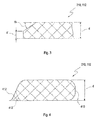
- FIGS. 3 and 4 Further embodiments of edge shapes of a shaped body 210 are shown. So shows FIG. 3 a partially oblique edge shape.
- the thickness of the molded body 210 decreases from the initial thickness d towards the edge to the thickness d '.
- the edge thickness d ' may be 15 microns to 250 microns. This results, for example, a contact angle, which in FIG. 3 is denoted by ⁇ , from 0 ° to 60 °.
- FIG. 4 two possible edge courses 410, 412 of a shaped body 210 are superimposed, which can be used in further exemplary embodiments.
- This is with the reference numeral 410 designates an edge geometry which (for example by using a corresponding casting mold) has a rounded (eg circular or elliptical profile).
- Reference numeral 412 denotes an edge geometry which has a curved course, for example by using a laser ablation method. This curved course 412 may be provided on one side (solid line 412) or on both sides (in FIG. 4 shown in dashed lines).
- the shape of the hydrogel article 210 can be defined, for example, by a corresponding casting mold.
- the mold is preferably made to account for shrinkage or swelling upon curing of the initial molding formulation.
- the casting mold can be wholly or partly made of a plastic such as polypropylene (PP), polymethylmethacrylate (PMMA), polycarbonate (PC), polyoxymethylene (POM) or polyetheresterketone (PEEK) or glass (UV-translucent).
- PP polypropylene
- PMMA polymethylmethacrylate
- PC polycarbonate
- POM polyoxymethylene
- PEEK polyetheresterketone
- the edge geometry is defined by the closed mold.
- the rim can be photolithographically defined by UV crosslinking or by the surface tension between prepolymer solution and mold material.
- the edge can be defined by cutting.
- a mechanical cutting results in a largely rectangular edge geometry.
- a "rounded" edge can be achieved using a Gaussian intensity profile.
- Alginic acid sodium salt is dissolved in deionized water at 55 ° C with stirring.
- the alginate solution is sprayed by means of a two-component atomizing nozzle (Spraying Systems Co.) into an ultrasonic bath filled with calcium chloride solution, where the alginate drops harden.
- the hardened alginate particles are filtered through a 30 ⁇ m filter cloth and the filtrate is concentrated by settling in a separating funnel. Subsequently, the alginate particles are autoclaved as a 10% solution. Depending on the desired water content of the alginate particles, the concentration of the alginate solution can be varied between 0.2% and 10%.
- Alginattyps molecular weight, ratio guluronic acid to manuronic acid
- the alginate particles are centrifuged off and mixed in the ratio 1: 1 (w / v) with polyallylamine hydrochloride in 10 mM acetate buffer, pH 5.5 and incubated for 5 min. The mixture will centrifuged, the supernatant was removed and the alginate particles were washed twice in the ratio 1: 2 (w / v) with 10 mM acetate buffer, pH 5.5 for 2 min each time and centrifuged off. This procedure is repeated with polystyrenesulfonate in 10 mM acetate buffer, pH 5.5 as the second layer. The process is repeated until the desired number of layers has been applied. The number of layers as well as the concentration of the polyelectrolytes determines the density of the precoat. Typical concentrations are between 0.05% and 1%, typical layer numbers between 1 and 6.
- the (optionally precoated) alginate particles are centrifuged off, washed once with deionized water and again centrifuged off.
- the required amount of dextran is weighed and dissolved in water.
- 1 ml of the dextran solution is added to 1 g of centrifuged alginate particle pellet, mixed by shaking, homogenized in an ultrasonic bath and incubated overnight at 2-8 ° C.
- the alginate beads are then centrifuged off and separated from the supernatant.
- the amount of dextran absorbed is calculated by subtraction of the specific absorptions of supernatant before and after loading. Typical loadings are between 0.01 and 10 mg dextran per g alginate particle.
- ConA is dissolved in a concentration of 5-15 mg / ml in TRIS buffer, pH 7.4. The required amount of ConA is added to the dextran-filled alginate particle pellet, mixed by shaking, homogenized in an ultrasonic bath and incubated overnight at 2-8 ° C. The alginate beads are then centrifuged off and separated from the supernatant. The absorbed amount of ConA is calculated by subtraction of the protein-specific absorptions of supernatant before and after loading.
- the loaded (optionally precoated) alginate beads are mixed in the ratio 1: 1 (w / v) with polystyrene sulfonate in 10 mM acetate buffer, pH 5.5 and incubated for 5 min.
- the mixture is centrifuged, the supernatant is removed and the alginate beads are washed twice in the ratio 1: 2 (w / v) with 10 mM acetate buffer, pH 5.5, for 2 minutes each time and centrifuged off.
- This procedure is repeated alternately with polyallylamine hydrochloride in 10 mM acetate buffer, pH 5.5, and polystyrene sulfonate in 10 mM acetate buffer, pH 5.5, until the desired number of layers are applied.
- the number of layers as well as the concentration of the polyelectrolytes determines the density of the precoat. Typical concentrations are between 0.05% and 1%, typical layer numbers between 10 and 60.
- a 10% reference particle suspension is homogenized in an ultrasonic bath. 990 mg of coated sensor particles are mixed with 8.415 g of a 20 to 40% solution of acrylamidoacetaldehyde-1,3-acetal of polyvinyl alcohol by stirring. 495 ⁇ l of 10% reference particle suspension are pipetted and the mixture is homogenized in an ultrasonic bath. Thereafter, the formulation is rolled for about 3 hours on a roller block.
- the formulation is filled into a syringe and dosed by means of a compressed air-operated dosing unit into a shaped body (female side BK7 glass, male side quartz glass).
- a shaped body female side BK7 glass, male side quartz glass.
- the molding is closed and irradiated under UV light (Hamamatzu Mercury Xenon lamp) for about 5 sec.
- UV light Hamatzu Mercury Xenon lamp
- Implants are already made with 2 and 4 mm diameter and a thickness of about 140 to 250 microns and implanted into the human eye. Implants with radii of curvature of 12 mm, 8.6 mm and planar implants are used. The edges are defined by punching or by positive locking.
Landscapes
- Health & Medical Sciences (AREA)
- Life Sciences & Earth Sciences (AREA)
- Physics & Mathematics (AREA)
- General Health & Medical Sciences (AREA)
- Pathology (AREA)
- Engineering & Computer Science (AREA)
- Animal Behavior & Ethology (AREA)
- Chemical & Material Sciences (AREA)
- Veterinary Medicine (AREA)
- Public Health (AREA)
- Biomedical Technology (AREA)
- Molecular Biology (AREA)
- Surgery (AREA)
- Medical Informatics (AREA)
- Heart & Thoracic Surgery (AREA)
- Biophysics (AREA)
- Optics & Photonics (AREA)
- Analytical Chemistry (AREA)
- Biochemistry (AREA)
- General Physics & Mathematics (AREA)
- Immunology (AREA)
- Emergency Medicine (AREA)
- Chemical Kinetics & Catalysis (AREA)
- Plasma & Fusion (AREA)
- Spectroscopy & Molecular Physics (AREA)
- Bioinformatics & Cheminformatics (AREA)
- Nuclear Medicine, Radiotherapy & Molecular Imaging (AREA)
- Medicinal Chemistry (AREA)
- Pharmacology & Pharmacy (AREA)
- Epidemiology (AREA)
- Measurement Of The Respiration, Hearing Ability, Form, And Blood Characteristics Of Living Organisms (AREA)
- Investigating, Analyzing Materials By Fluorescence Or Luminescence (AREA)
- Prostheses (AREA)
- Materials For Medical Uses (AREA)
Applications Claiming Priority (3)
| Application Number | Priority Date | Filing Date | Title |
|---|---|---|---|
| DE102007024642A DE102007024642A1 (de) | 2007-05-24 | 2007-05-24 | Hydrogel-Implantat für Sensorik von Metaboliten am Auge |
| US92466907P | 2007-05-25 | 2007-05-25 | |
| EP08759965A EP2164384A2 (fr) | 2007-05-24 | 2008-05-23 | Implant d'hydrogel pour la détection par capteurs de métabolites dans des tissus corporels |
Related Parent Applications (1)
| Application Number | Title | Priority Date | Filing Date |
|---|---|---|---|
| EP08759965A Division EP2164384A2 (fr) | 2007-05-24 | 2008-05-23 | Implant d'hydrogel pour la détection par capteurs de métabolites dans des tissus corporels |
Publications (2)
| Publication Number | Publication Date |
|---|---|
| EP2842481A1 true EP2842481A1 (fr) | 2015-03-04 |
| EP2842481B1 EP2842481B1 (fr) | 2017-07-12 |
Family
ID=39877224
Family Applications (2)
| Application Number | Title | Priority Date | Filing Date |
|---|---|---|---|
| EP08759965A Withdrawn EP2164384A2 (fr) | 2007-05-24 | 2008-05-23 | Implant d'hydrogel pour la détection par capteurs de métabolites dans des tissus corporels |
| EP14186223.5A Active EP2842481B1 (fr) | 2007-05-24 | 2008-05-23 | Implant en hydrogel pour technique sensorielle de métabolites dans des tissus corporels |
Family Applications Before (1)
| Application Number | Title | Priority Date | Filing Date |
|---|---|---|---|
| EP08759965A Withdrawn EP2164384A2 (fr) | 2007-05-24 | 2008-05-23 | Implant d'hydrogel pour la détection par capteurs de métabolites dans des tissus corporels |
Country Status (11)
| Country | Link |
|---|---|
| US (1) | US8647271B2 (fr) |
| EP (2) | EP2164384A2 (fr) |
| KR (1) | KR101510488B1 (fr) |
| CN (1) | CN101707931B (fr) |
| AU (1) | AU2008252936B2 (fr) |
| CA (1) | CA2688011C (fr) |
| DE (1) | DE102007024642A1 (fr) |
| ES (1) | ES2643055T3 (fr) |
| MX (1) | MX2009012540A (fr) |
| TW (1) | TWI459977B (fr) |
| WO (1) | WO2008142158A2 (fr) |
Families Citing this family (35)
| Publication number | Priority date | Publication date | Assignee | Title |
|---|---|---|---|---|
| ES2314793T3 (es) * | 2006-07-24 | 2009-03-16 | Eyesense Ag | Dispositivo para medir un analito en un fluido ocular. |
| US9517023B2 (en) | 2009-06-01 | 2016-12-13 | Profusa, Inc. | Method and system for directing a localized biological response to an implant |
| US9415215B2 (en) | 2009-10-20 | 2016-08-16 | Nyxoah SA | Methods for treatment of sleep apnea |
| US9409013B2 (en) | 2009-10-20 | 2016-08-09 | Nyxoah SA | Method for controlling energy delivery as a function of degree of coupling |
| US10010272B2 (en) | 2010-05-27 | 2018-07-03 | Profusa, Inc. | Tissue-integrating electronic apparatus |
| WO2012048150A1 (fr) * | 2010-10-06 | 2012-04-12 | Profusa, Inc. | Capteurs d'intégration de tissu |
| JP5881730B2 (ja) * | 2010-12-17 | 2016-03-09 | アイセンス アーゲー | 高感度を有するバイオセンサーのためのヒドロゲルの使用 |
| US10429380B2 (en) | 2010-12-17 | 2019-10-01 | Eyesense Ag | Device comprising a hydrogel having a glucose-binding protein and a ligand of the glucose-binding protein incorporated therein |
| WO2013046040A2 (fr) | 2011-09-30 | 2013-04-04 | Adi Mashiach | Appareil et procédé de commande d'un apport d'énergie en fonction d'un degré de couplage |
| DE102012201892A1 (de) * | 2012-02-09 | 2013-08-14 | Robert Bosch Gmbh | Bestimmung des Blutzuckerspiegels eines Patienten unter Verwendung eines implantierbaren Sensors und eines elektrischen Funktionspflasters |
| WO2013148957A1 (fr) * | 2012-03-28 | 2013-10-03 | Becton, Dickinson And Company | Collage d'hydrogel à des polymères moulés |
| US9084530B2 (en) | 2012-04-12 | 2015-07-21 | Elwha Llc | Computational methods and systems for reporting information regarding appurtenances to wound dressings |
| US10226212B2 (en) | 2012-04-12 | 2019-03-12 | Elwha Llc | Appurtenances to cavity wound dressings |
| US10130518B2 (en) | 2012-04-12 | 2018-11-20 | Elwha Llc | Appurtenances including sensors for reporting information regarding wound dressings |
| US10158928B2 (en) | 2012-04-12 | 2018-12-18 | Elwha Llc | Appurtenances for reporting information regarding wound dressings |
| US10265219B2 (en) | 2012-04-12 | 2019-04-23 | Elwha Llc | Wound dressing monitoring systems including appurtenances for wound dressings |
| US9024751B2 (en) | 2012-04-12 | 2015-05-05 | Elwha Llc | Dormant to active appurtenances for reporting information regarding wound dressings |
| US9144488B2 (en) | 2012-06-13 | 2015-09-29 | Elwha Llc | Breast implant with analyte sensors responsive to external power source |
| US9211185B2 (en) | 2012-06-13 | 2015-12-15 | Elwha Llc | Breast implant with analyte sensors and internal power source |
| US8795359B2 (en) | 2012-06-13 | 2014-08-05 | Elwha Llc | Breast implant with regionalized analyte sensors and internal power source |
| US9144489B2 (en) | 2012-06-13 | 2015-09-29 | Elwha Llc | Breast implant with covering, analyte sensors and internal power source |
| US8790400B2 (en) | 2012-06-13 | 2014-07-29 | Elwha Llc | Breast implant with covering and analyte sensors responsive to external power source |
| US8808373B2 (en) | 2012-06-13 | 2014-08-19 | Elwha Llc | Breast implant with regionalized analyte sensors responsive to external power source |
| WO2014158988A1 (fr) | 2013-03-14 | 2014-10-02 | Profusa, Inc. | Procédé et dispositif pour corriger des signaux optiques |
| US9161712B2 (en) | 2013-03-26 | 2015-10-20 | Google Inc. | Systems and methods for encapsulating electronics in a mountable device |
| US10219729B2 (en) | 2013-06-06 | 2019-03-05 | Profusa, Inc. | Apparatus and methods for detecting optical signals from implanted sensors |
| WO2017100680A1 (fr) * | 2015-12-09 | 2017-06-15 | The Texas A&M University System | Biocapteurs implantables |
| US9983185B2 (en) * | 2016-02-01 | 2018-05-29 | City University Of Hong Kong | Chemosensing hydrogel for the detection of biogenic amines |
| WO2018039652A1 (fr) * | 2016-08-26 | 2018-03-01 | Cardiac Pacemakers, Inc. | Systèmes et procédés pour déterminer un événement glycémique anormal à l'aide de substituts de glucose |
| WO2018119400A1 (fr) | 2016-12-22 | 2018-06-28 | Profusa, Inc. | Système et capteur luminescent à canal unique et procédé de détermination de valeur d'analyte |
| WO2018160696A1 (fr) * | 2017-03-01 | 2018-09-07 | Metronom Health, Inc. | Capteurs d'analyte et procédés de fabrication de capteurs d'analyte |
| EP3740525B1 (fr) | 2018-01-18 | 2024-05-01 | Hy2Care B.V. | Particules d'hydrogel à affinité poreuse permettant de réduire la biodisponibilité de molécules biologiques sélectionnées |
| WO2021097274A1 (fr) * | 2019-11-13 | 2021-05-20 | Senseonics, Incorporated | Identification d'espèces de dégradation |
| CN111543961B (zh) * | 2020-05-11 | 2021-03-09 | 清华大学 | 无线柔性贴片式温度传感器及其制备方法 |
| EP4567050A1 (fr) | 2023-12-04 | 2025-06-11 | Quantum Beauty Cosmetics Joint Stock Company | Procédé de préparation d'un gel réticulé d'acide hyaluronique |
Citations (24)
| Publication number | Priority date | Publication date | Assignee | Title |
|---|---|---|---|---|
| US5127901A (en) | 1990-05-18 | 1992-07-07 | Odrich Ronald B | Implant with subconjunctival arch |
| US5300114A (en) | 1992-05-04 | 1994-04-05 | Allergan, Inc. | Subconjunctival implants for ocular drug delivery |
| EP0637490A1 (fr) | 1993-07-19 | 1995-02-08 | Ciba-Geigy Ag | Procédé et dispositif pour la fabrication des objets moulés ainsi que les objets moulés |
| EP0641806B1 (fr) | 1993-08-06 | 1998-01-28 | Novartis AG | Procédé de préparation d'un article façonné |
| WO1999047253A1 (fr) | 1998-03-19 | 1999-09-23 | MAX-PLANCK-Gesellschaft zur Förderung der Wissenschaften e.V. | Fabrication de particules et de coques creuses enduites multicouches par assemblage automatique de multicouches de nanocomposites sur des gabarits colloidaux decomposables |
| WO1999047252A2 (fr) | 1998-03-19 | 1999-09-23 | MAX-PLANCK-Gesellschaft zur Förderung der Wissenschaften e.V. | Production de nanogelules et de microgelules par auto-assemblage stratiforme de polyelectrolytes |
| WO2000003797A1 (fr) | 1998-07-15 | 2000-01-27 | MAX-PLANCK-Gesellschaft zur Förderung der Wissenschaften e.V. | Revetement polyelectrolytique de specimens biologiques |
| EP0807265B1 (fr) | 1995-02-03 | 2000-04-12 | Novartis AG | Polymeres reticules |
| WO2000077281A1 (fr) | 1999-06-10 | 2000-12-21 | MAX-PLANCK-Gesellschaft zur Förderung der Wissenschaften e.V. | Encapsulation de cristaux par le biais de revetements multicouches |
| WO2001013783A1 (fr) | 1999-08-26 | 2001-03-01 | Novartis Ag | Detecteur d'analyte dans un liquide oculaire |
| EP1116516A1 (fr) | 2000-01-13 | 2001-07-18 | Max-Planck-Gesellschaft zur Förderung der Wissenschaften e.V. | Couchage de particules solides par multicouches polymériques |
| WO2002017888A2 (fr) | 2000-08-28 | 2002-03-07 | MAX-PLANCK-Gesellschaft zur Förderung der Wissenschaften e.V. | Gestion et support de proprietes de liberation de capsules multicouches polyelectrolytiques |
| US6416777B1 (en) | 1999-10-21 | 2002-07-09 | Alcon Universal Ltd. | Ophthalmic drug delivery device |
| US6451871B1 (en) | 1998-11-25 | 2002-09-17 | Novartis Ag | Methods of modifying surface characteristics |
| WO2002087429A1 (fr) | 2001-04-27 | 2002-11-07 | Novartis Ag | Appareil destiné à mesurer les concentrations de glucose sanguin |
| WO2004014540A1 (fr) | 2002-08-02 | 2004-02-19 | Capsulution Nanoscience Ag | Microcapsules couche par couche a codes de couleurs servant de bibliotheques d'analyse combinatoires et de capteurs optiques specifiques |
| US20040180391A1 (en) * | 2002-10-11 | 2004-09-16 | Miklos Gratzl | Sliver type autonomous biosensors |
| US20050095174A1 (en) * | 2003-10-31 | 2005-05-05 | Wolf David E. | Semipermeable sensors for detecting analyte |
| US6896926B2 (en) | 2002-09-11 | 2005-05-24 | Novartis Ag | Method for applying an LbL coating onto a medical device |
| US6926965B2 (en) | 2002-09-11 | 2005-08-09 | Novartis Ag | LbL-coated medical device and method for making the same |
| WO2005089727A1 (fr) | 2004-03-19 | 2005-09-29 | Capsulution Nanoscience Ag | Procede pour produire des particules de type coeur-ecorce et des microcapsules au moyen de matrices microporeuses, particules de type coeur-ecorce et microcapsules, et leur utilisation |
| US6986900B2 (en) | 2001-07-23 | 2006-01-17 | Alcon, Inc. | Ophthalmic drug delivery device |
| US7022379B2 (en) | 2000-02-04 | 2006-04-04 | Novartis Ag | Single-dip process for achieving a layer-by-layer-like coating |
| US20070105176A1 (en) * | 2005-09-28 | 2007-05-10 | Ibey Bennett L | Method and apparatus for glucose monitoring |
Family Cites Families (20)
| Publication number | Priority date | Publication date | Assignee | Title |
|---|---|---|---|---|
| US4180308A (en) * | 1972-10-02 | 1979-12-25 | Syntex (Usa) Inc. | Contact lens |
| US5545423A (en) | 1991-11-25 | 1996-08-13 | Vivorx, Inc. | Cytoprotective, biocompatible, retrievable macrocapsule containment systems for biologically active materials |
| US5404951A (en) * | 1993-07-07 | 1995-04-11 | Atlantic Richfield Company | Well treatment with artificial matrix and gel composition |
| US5705780A (en) * | 1995-06-02 | 1998-01-06 | Howmedica Inc. | Dehydration of hydrogels |
| ATE278801T1 (de) | 1995-11-22 | 2004-10-15 | Medtronic Minimed Inc | Detektion von biologischen molekülen unter verwendung von chemischer amplifikation und optischem sensor |
| US6485703B1 (en) * | 1998-07-31 | 2002-11-26 | The Texas A&M University System | Compositions and methods for analyte detection |
| US6259518B1 (en) * | 1999-08-10 | 2001-07-10 | Novartis Ag | Wetcell device for inspection |
| WO2000029206A1 (fr) * | 1998-11-13 | 2000-05-25 | Sensor Technologies Inc. | Preparations monodispersees utiles pour des protheses |
| US6329485B1 (en) * | 1998-12-11 | 2001-12-11 | Bausch & Lomb Incorporated | High refractive index hydrogel compositions for ophthalmic implants |
| FR2810552B1 (fr) * | 2000-06-26 | 2004-11-19 | Univ Paris Curie | Polymere biocompatible a structure tridimensionnelle a cellules communicantes, procede de preparation et application en medecine et en chirurgie |
| GB0116853D0 (en) * | 2001-07-10 | 2001-09-05 | Torsana Diabetes Diagnostics A | Optical sensor containing particles for in SITU measurement of analytes |
| US6719699B2 (en) * | 2002-02-07 | 2004-04-13 | Sonotech, Inc. | Adhesive hydrophilic membranes as couplants in ultrasound imaging applications |
| US8216854B2 (en) * | 2003-01-07 | 2012-07-10 | Biotex, Inc. | Device and method for measuring analytes |
| WO2004064629A1 (fr) * | 2003-01-21 | 2004-08-05 | Ehrfeld Miktotechnik Ag | Systeme detecteur servant a detecter des substances a analyser dans un liquide lacrymal |
| US20070184222A1 (en) * | 2004-04-20 | 2007-08-09 | University Of Rochester | Hydrogel-supported porous semiconductor devices |
| CN101238403A (zh) * | 2005-08-11 | 2008-08-06 | 库柏维景公司 | 隐形眼镜和降低隐形眼镜配戴者的结膜压力的方法 |
| WO2007062414A1 (fr) * | 2005-11-26 | 2007-05-31 | Grinrx | Feuilles et formes d'hydrogel pour soins oraux |
| US7809441B2 (en) * | 2006-05-17 | 2010-10-05 | Cardiac Pacemakers, Inc. | Implantable medical device with chemical sensor and related methods |
| US7572841B2 (en) * | 2006-06-15 | 2009-08-11 | Coopervision International Holding Company, Lp | Wettable silicone hydrogel contact lenses and related compositions and methods |
| DE102007003341B4 (de) * | 2007-01-17 | 2018-01-04 | Eyesense Ag | Okularsensor und Messsystem zum Nachweis eines Analyten in einer Augenflüssigkeit |
-
2007
- 2007-05-24 DE DE102007024642A patent/DE102007024642A1/de not_active Ceased
-
2008
- 2008-05-21 TW TW097118764A patent/TWI459977B/zh active
- 2008-05-23 US US12/601,524 patent/US8647271B2/en active Active
- 2008-05-23 CN CN2008800173179A patent/CN101707931B/zh active Active
- 2008-05-23 AU AU2008252936A patent/AU2008252936B2/en active Active
- 2008-05-23 MX MX2009012540A patent/MX2009012540A/es active IP Right Grant
- 2008-05-23 KR KR1020097026884A patent/KR101510488B1/ko active Active
- 2008-05-23 EP EP08759965A patent/EP2164384A2/fr not_active Withdrawn
- 2008-05-23 CA CA2688011A patent/CA2688011C/fr active Active
- 2008-05-23 ES ES14186223.5T patent/ES2643055T3/es active Active
- 2008-05-23 WO PCT/EP2008/056364 patent/WO2008142158A2/fr not_active Ceased
- 2008-05-23 EP EP14186223.5A patent/EP2842481B1/fr active Active
Patent Citations (26)
| Publication number | Priority date | Publication date | Assignee | Title |
|---|---|---|---|---|
| US5127901A (en) | 1990-05-18 | 1992-07-07 | Odrich Ronald B | Implant with subconjunctival arch |
| US5300114A (en) | 1992-05-04 | 1994-04-05 | Allergan, Inc. | Subconjunctival implants for ocular drug delivery |
| US5476511A (en) | 1992-05-04 | 1995-12-19 | Allergan, Inc. | Subconjunctival implants for ocular drug delivery |
| EP0637490A1 (fr) | 1993-07-19 | 1995-02-08 | Ciba-Geigy Ag | Procédé et dispositif pour la fabrication des objets moulés ainsi que les objets moulés |
| EP0641806B1 (fr) | 1993-08-06 | 1998-01-28 | Novartis AG | Procédé de préparation d'un article façonné |
| EP0790258B1 (fr) | 1993-08-06 | 2003-10-01 | Novartis AG | Polymères photoréticulés |
| EP0807265B1 (fr) | 1995-02-03 | 2000-04-12 | Novartis AG | Polymeres reticules |
| WO1999047253A1 (fr) | 1998-03-19 | 1999-09-23 | MAX-PLANCK-Gesellschaft zur Förderung der Wissenschaften e.V. | Fabrication de particules et de coques creuses enduites multicouches par assemblage automatique de multicouches de nanocomposites sur des gabarits colloidaux decomposables |
| WO1999047252A2 (fr) | 1998-03-19 | 1999-09-23 | MAX-PLANCK-Gesellschaft zur Förderung der Wissenschaften e.V. | Production de nanogelules et de microgelules par auto-assemblage stratiforme de polyelectrolytes |
| WO2000003797A1 (fr) | 1998-07-15 | 2000-01-27 | MAX-PLANCK-Gesellschaft zur Förderung der Wissenschaften e.V. | Revetement polyelectrolytique de specimens biologiques |
| US6451871B1 (en) | 1998-11-25 | 2002-09-17 | Novartis Ag | Methods of modifying surface characteristics |
| WO2000077281A1 (fr) | 1999-06-10 | 2000-12-21 | MAX-PLANCK-Gesellschaft zur Förderung der Wissenschaften e.V. | Encapsulation de cristaux par le biais de revetements multicouches |
| WO2001013783A1 (fr) | 1999-08-26 | 2001-03-01 | Novartis Ag | Detecteur d'analyte dans un liquide oculaire |
| US6416777B1 (en) | 1999-10-21 | 2002-07-09 | Alcon Universal Ltd. | Ophthalmic drug delivery device |
| EP1116516A1 (fr) | 2000-01-13 | 2001-07-18 | Max-Planck-Gesellschaft zur Förderung der Wissenschaften e.V. | Couchage de particules solides par multicouches polymériques |
| US7022379B2 (en) | 2000-02-04 | 2006-04-04 | Novartis Ag | Single-dip process for achieving a layer-by-layer-like coating |
| WO2002017888A2 (fr) | 2000-08-28 | 2002-03-07 | MAX-PLANCK-Gesellschaft zur Förderung der Wissenschaften e.V. | Gestion et support de proprietes de liberation de capsules multicouches polyelectrolytiques |
| WO2002087429A1 (fr) | 2001-04-27 | 2002-11-07 | Novartis Ag | Appareil destiné à mesurer les concentrations de glucose sanguin |
| US6986900B2 (en) | 2001-07-23 | 2006-01-17 | Alcon, Inc. | Ophthalmic drug delivery device |
| WO2004014540A1 (fr) | 2002-08-02 | 2004-02-19 | Capsulution Nanoscience Ag | Microcapsules couche par couche a codes de couleurs servant de bibliotheques d'analyse combinatoires et de capteurs optiques specifiques |
| US6896926B2 (en) | 2002-09-11 | 2005-05-24 | Novartis Ag | Method for applying an LbL coating onto a medical device |
| US6926965B2 (en) | 2002-09-11 | 2005-08-09 | Novartis Ag | LbL-coated medical device and method for making the same |
| US20040180391A1 (en) * | 2002-10-11 | 2004-09-16 | Miklos Gratzl | Sliver type autonomous biosensors |
| US20050095174A1 (en) * | 2003-10-31 | 2005-05-05 | Wolf David E. | Semipermeable sensors for detecting analyte |
| WO2005089727A1 (fr) | 2004-03-19 | 2005-09-29 | Capsulution Nanoscience Ag | Procede pour produire des particules de type coeur-ecorce et des microcapsules au moyen de matrices microporeuses, particules de type coeur-ecorce et microcapsules, et leur utilisation |
| US20070105176A1 (en) * | 2005-09-28 | 2007-05-10 | Ibey Bennett L | Method and apparatus for glucose monitoring |
Non-Patent Citations (1)
| Title |
|---|
| HUIGUANG ZHU ET AL: "Combined Physical and Chemical Immobilization of Glucose Oxidase in Alginate Microspheres Improves Stability of Encapsulation and Activity", BIOCONJUGATE CHEMISTRY, vol. 16, no. 6, 1 November 2005 (2005-11-01), XP055161595, ISSN: 1043-1802, DOI: 10.1021/bc050171z * |
Also Published As
| Publication number | Publication date |
|---|---|
| HK1143727A1 (en) | 2011-01-14 |
| AU2008252936A1 (en) | 2008-11-27 |
| EP2842481B1 (fr) | 2017-07-12 |
| TWI459977B (zh) | 2014-11-11 |
| DE102007024642A1 (de) | 2008-11-27 |
| CA2688011C (fr) | 2016-08-30 |
| CA2688011A1 (fr) | 2008-11-27 |
| WO2008142158A2 (fr) | 2008-11-27 |
| WO2008142158A3 (fr) | 2009-05-28 |
| ES2643055T3 (es) | 2017-11-21 |
| US20100331634A1 (en) | 2010-12-30 |
| US8647271B2 (en) | 2014-02-11 |
| KR101510488B1 (ko) | 2015-04-08 |
| CN101707931A (zh) | 2010-05-12 |
| KR20100033382A (ko) | 2010-03-29 |
| EP2164384A2 (fr) | 2010-03-24 |
| CN101707931B (zh) | 2012-12-05 |
| TW200911305A (en) | 2009-03-16 |
| AU2008252936B2 (en) | 2013-11-07 |
| MX2009012540A (es) | 2010-02-12 |
Similar Documents
| Publication | Publication Date | Title |
|---|---|---|
| EP2842481B1 (fr) | Implant en hydrogel pour technique sensorielle de métabolites dans des tissus corporels | |
| DE69918159T2 (de) | Verfahren und vorrichtung zur steuerung der gewebeimplantat-interaktionen | |
| Gomaa et al. | Laser-engineered dissolving microneedles for active transdermal delivery of nadroparin calcium | |
| DE60209056T2 (de) | Element mit variabler Struktur für implantierbare Artikel, dazugehörige implantierbare Artikel und deren Herstellung | |
| DE69731223T2 (de) | Beschichtung mit gasenthaltenden hohlräumen zur verstärkung von ultraschall-echos | |
| DE60119556T2 (de) | Optischer sensor zur in-situ messung von analyten | |
| DE60110809T2 (de) | Mehrschichtige Polyelektrolytkapseln mit kontrollierter und verzögerter Freisetzung | |
| EP2652500B1 (fr) | Biocapteur compétitif à sensibilité accrue | |
| EP2334236B1 (fr) | Elément de capteur implantable | |
| EP2438861B1 (fr) | Système de capteur médical pour contrôler au moins une caractéristique dans au moins un corps animal et/ou humain | |
| EP2438860A1 (fr) | Système de détection médical | |
| WO2012080258A1 (fr) | Utilisation d'hydrogels pour des biocapteurs à sensibilité accrue | |
| Jang et al. | Three-dimensionally-patterned submicrometer-scale hydrogel/air networks that offer a new platform for biomedical applications | |
| EP2268264B1 (fr) | Matrice polymère réticulée, en particulier pour l'administration de principes actifs | |
| DE102009027151A1 (de) | Partikel mit induzierbarer Formänderung | |
| Bomortino | DELIVERY OF NEUREGULIN-1 THROUGH AN OSMOTIC TRANSPORT DEVICE (OTD) | |
| US20250276164A1 (en) | Bio-inspired needle for controlled release | |
| HK1143727B (en) | Hydrogel implant for sensing metabolites in body tissue | |
| WO2018141555A1 (fr) | Système de libération sélective pour médicaments antitumoraux et agents de diagnostic de tumeur et biocapteur pour tissus tumoraux | |
| WO2024074271A1 (fr) | Procédé de concentration d'au moins une substance cible anthropogène dans un liquide échantillon | |
| EP4598511A1 (fr) | Procédé de fabrication d'une substance cible anthropique | |
| DE102020134302A1 (de) | Molekularer Sensor | |
| Domschke | Ophthalmic Glucose Nanosensors for Diabetes Management | |
| McDermott | Thin-Film Drug Delivery Coatings to Mitigate the Reactive Tissue Response Associated with Neuroprosthetic Micro-Electrode Implantation | |
| Gayathri et al. | A Comprehensive Review on Microbeads as a Targeted Drug Delivery system |
Legal Events
| Date | Code | Title | Description |
|---|---|---|---|
| 17P | Request for examination filed |
Effective date: 20140924 |
|
| AC | Divisional application: reference to earlier application |
Ref document number: 2164384 Country of ref document: EP Kind code of ref document: P |
|
| AK | Designated contracting states |
Kind code of ref document: A1 Designated state(s): AT BE BG CH CY CZ DE DK EE ES FI FR GB GR HR HU IE IS IT LI LT LU LV MC MT NL NO PL PT RO SE SI SK TR |
|
| PUAI | Public reference made under article 153(3) epc to a published international application that has entered the european phase |
Free format text: ORIGINAL CODE: 0009012 |
|
| RIN1 | Information on inventor provided before grant (corrected) |
Inventor name: MUELLER, ACHIM Inventor name: NIKOLAUS, KATHARINA Inventor name: HERBRECHTSMEIER, PETER Inventor name: KNUTH, MONIKA |
|
| GRAP | Despatch of communication of intention to grant a patent |
Free format text: ORIGINAL CODE: EPIDOSNIGR1 |
|
| STAA | Information on the status of an ep patent application or granted ep patent |
Free format text: STATUS: GRANT OF PATENT IS INTENDED |
|
| INTG | Intention to grant announced |
Effective date: 20170216 |
|
| GRAS | Grant fee paid |
Free format text: ORIGINAL CODE: EPIDOSNIGR3 |
|
| GRAA | (expected) grant |
Free format text: ORIGINAL CODE: 0009210 |
|
| STAA | Information on the status of an ep patent application or granted ep patent |
Free format text: STATUS: THE PATENT HAS BEEN GRANTED |
|
| AC | Divisional application: reference to earlier application |
Ref document number: 2164384 Country of ref document: EP Kind code of ref document: P |
|
| AK | Designated contracting states |
Kind code of ref document: B1 Designated state(s): AT BE BG CH CY CZ DE DK EE ES FI FR GB GR HR HU IE IS IT LI LT LU LV MC MT NL NO PL PT RO SE SI SK TR |
|
| REG | Reference to a national code |
Ref country code: GB Ref legal event code: FG4D Free format text: NOT ENGLISH |
|
| REG | Reference to a national code |
Ref country code: CH Ref legal event code: EP |
|
| REG | Reference to a national code |
Ref country code: AT Ref legal event code: REF Ref document number: 907559 Country of ref document: AT Kind code of ref document: T Effective date: 20170715 |
|
| REG | Reference to a national code |
Ref country code: IE Ref legal event code: FG4D Free format text: LANGUAGE OF EP DOCUMENT: GERMAN |
|
| REG | Reference to a national code |
Ref country code: DE Ref legal event code: R096 Ref document number: 502008015461 Country of ref document: DE |
|
| REG | Reference to a national code |
Ref country code: NL Ref legal event code: MP Effective date: 20170712 |
|
| REG | Reference to a national code |
Ref country code: ES Ref legal event code: FG2A Ref document number: 2643055 Country of ref document: ES Kind code of ref document: T3 Effective date: 20171121 |
|
| REG | Reference to a national code |
Ref country code: LT Ref legal event code: MG4D |
|
| PG25 | Lapsed in a contracting state [announced via postgrant information from national office to epo] |
Ref country code: HR Free format text: LAPSE BECAUSE OF FAILURE TO SUBMIT A TRANSLATION OF THE DESCRIPTION OR TO PAY THE FEE WITHIN THE PRESCRIBED TIME-LIMIT Effective date: 20170712 Ref country code: SE Free format text: LAPSE BECAUSE OF FAILURE TO SUBMIT A TRANSLATION OF THE DESCRIPTION OR TO PAY THE FEE WITHIN THE PRESCRIBED TIME-LIMIT Effective date: 20170712 Ref country code: NO Free format text: LAPSE BECAUSE OF FAILURE TO SUBMIT A TRANSLATION OF THE DESCRIPTION OR TO PAY THE FEE WITHIN THE PRESCRIBED TIME-LIMIT Effective date: 20171012 Ref country code: FI Free format text: LAPSE BECAUSE OF FAILURE TO SUBMIT A TRANSLATION OF THE DESCRIPTION OR TO PAY THE FEE WITHIN THE PRESCRIBED TIME-LIMIT Effective date: 20170712 Ref country code: LT Free format text: LAPSE BECAUSE OF FAILURE TO SUBMIT A TRANSLATION OF THE DESCRIPTION OR TO PAY THE FEE WITHIN THE PRESCRIBED TIME-LIMIT Effective date: 20170712 Ref country code: NL Free format text: LAPSE BECAUSE OF FAILURE TO SUBMIT A TRANSLATION OF THE DESCRIPTION OR TO PAY THE FEE WITHIN THE PRESCRIBED TIME-LIMIT Effective date: 20170712 |
|
| PG25 | Lapsed in a contracting state [announced via postgrant information from national office to epo] |
Ref country code: GR Free format text: LAPSE BECAUSE OF FAILURE TO SUBMIT A TRANSLATION OF THE DESCRIPTION OR TO PAY THE FEE WITHIN THE PRESCRIBED TIME-LIMIT Effective date: 20171013 Ref country code: IS Free format text: LAPSE BECAUSE OF FAILURE TO SUBMIT A TRANSLATION OF THE DESCRIPTION OR TO PAY THE FEE WITHIN THE PRESCRIBED TIME-LIMIT Effective date: 20171112 Ref country code: BG Free format text: LAPSE BECAUSE OF FAILURE TO SUBMIT A TRANSLATION OF THE DESCRIPTION OR TO PAY THE FEE WITHIN THE PRESCRIBED TIME-LIMIT Effective date: 20171012 Ref country code: LV Free format text: LAPSE BECAUSE OF FAILURE TO SUBMIT A TRANSLATION OF THE DESCRIPTION OR TO PAY THE FEE WITHIN THE PRESCRIBED TIME-LIMIT Effective date: 20170712 Ref country code: PL Free format text: LAPSE BECAUSE OF FAILURE TO SUBMIT A TRANSLATION OF THE DESCRIPTION OR TO PAY THE FEE WITHIN THE PRESCRIBED TIME-LIMIT Effective date: 20170712 |
|
| REG | Reference to a national code |
Ref country code: DE Ref legal event code: R097 Ref document number: 502008015461 Country of ref document: DE |
|
| PG25 | Lapsed in a contracting state [announced via postgrant information from national office to epo] |
Ref country code: RO Free format text: LAPSE BECAUSE OF FAILURE TO SUBMIT A TRANSLATION OF THE DESCRIPTION OR TO PAY THE FEE WITHIN THE PRESCRIBED TIME-LIMIT Effective date: 20170712 Ref country code: CZ Free format text: LAPSE BECAUSE OF FAILURE TO SUBMIT A TRANSLATION OF THE DESCRIPTION OR TO PAY THE FEE WITHIN THE PRESCRIBED TIME-LIMIT Effective date: 20170712 Ref country code: DK Free format text: LAPSE BECAUSE OF FAILURE TO SUBMIT A TRANSLATION OF THE DESCRIPTION OR TO PAY THE FEE WITHIN THE PRESCRIBED TIME-LIMIT Effective date: 20170712 |
|
| PLBE | No opposition filed within time limit |
Free format text: ORIGINAL CODE: 0009261 |
|
| STAA | Information on the status of an ep patent application or granted ep patent |
Free format text: STATUS: NO OPPOSITION FILED WITHIN TIME LIMIT |
|
| REG | Reference to a national code |
Ref country code: FR Ref legal event code: PLFP Year of fee payment: 11 |
|
| PG25 | Lapsed in a contracting state [announced via postgrant information from national office to epo] |
Ref country code: EE Free format text: LAPSE BECAUSE OF FAILURE TO SUBMIT A TRANSLATION OF THE DESCRIPTION OR TO PAY THE FEE WITHIN THE PRESCRIBED TIME-LIMIT Effective date: 20170712 Ref country code: SK Free format text: LAPSE BECAUSE OF FAILURE TO SUBMIT A TRANSLATION OF THE DESCRIPTION OR TO PAY THE FEE WITHIN THE PRESCRIBED TIME-LIMIT Effective date: 20170712 |
|
| 26N | No opposition filed |
Effective date: 20180413 |
|
| PG25 | Lapsed in a contracting state [announced via postgrant information from national office to epo] |
Ref country code: SI Free format text: LAPSE BECAUSE OF FAILURE TO SUBMIT A TRANSLATION OF THE DESCRIPTION OR TO PAY THE FEE WITHIN THE PRESCRIBED TIME-LIMIT Effective date: 20170712 |
|
| PG25 | Lapsed in a contracting state [announced via postgrant information from national office to epo] |
Ref country code: MT Free format text: LAPSE BECAUSE OF FAILURE TO SUBMIT A TRANSLATION OF THE DESCRIPTION OR TO PAY THE FEE WITHIN THE PRESCRIBED TIME-LIMIT Effective date: 20170712 |
|
| REG | Reference to a national code |
Ref country code: CH Ref legal event code: PL |
|
| REG | Reference to a national code |
Ref country code: BE Ref legal event code: MM Effective date: 20180531 |
|
| PG25 | Lapsed in a contracting state [announced via postgrant information from national office to epo] |
Ref country code: MC Free format text: LAPSE BECAUSE OF FAILURE TO SUBMIT A TRANSLATION OF THE DESCRIPTION OR TO PAY THE FEE WITHIN THE PRESCRIBED TIME-LIMIT Effective date: 20170712 |
|
| REG | Reference to a national code |
Ref country code: IE Ref legal event code: MM4A |
|
| PG25 | Lapsed in a contracting state [announced via postgrant information from national office to epo] |
Ref country code: CH Free format text: LAPSE BECAUSE OF NON-PAYMENT OF DUE FEES Effective date: 20180531 Ref country code: LI Free format text: LAPSE BECAUSE OF NON-PAYMENT OF DUE FEES Effective date: 20180531 |
|
| PG25 | Lapsed in a contracting state [announced via postgrant information from national office to epo] |
Ref country code: LU Free format text: LAPSE BECAUSE OF NON-PAYMENT OF DUE FEES Effective date: 20180523 |
|
| PG25 | Lapsed in a contracting state [announced via postgrant information from national office to epo] |
Ref country code: IE Free format text: LAPSE BECAUSE OF NON-PAYMENT OF DUE FEES Effective date: 20180523 |
|
| PG25 | Lapsed in a contracting state [announced via postgrant information from national office to epo] |
Ref country code: BE Free format text: LAPSE BECAUSE OF NON-PAYMENT OF DUE FEES Effective date: 20180531 |
|
| REG | Reference to a national code |
Ref country code: AT Ref legal event code: MM01 Ref document number: 907559 Country of ref document: AT Kind code of ref document: T Effective date: 20180523 |
|
| PG25 | Lapsed in a contracting state [announced via postgrant information from national office to epo] |
Ref country code: AT Free format text: LAPSE BECAUSE OF NON-PAYMENT OF DUE FEES Effective date: 20180523 |
|
| PG25 | Lapsed in a contracting state [announced via postgrant information from national office to epo] |
Ref country code: TR Free format text: LAPSE BECAUSE OF FAILURE TO SUBMIT A TRANSLATION OF THE DESCRIPTION OR TO PAY THE FEE WITHIN THE PRESCRIBED TIME-LIMIT Effective date: 20170712 |
|
| PG25 | Lapsed in a contracting state [announced via postgrant information from national office to epo] |
Ref country code: PT Free format text: LAPSE BECAUSE OF FAILURE TO SUBMIT A TRANSLATION OF THE DESCRIPTION OR TO PAY THE FEE WITHIN THE PRESCRIBED TIME-LIMIT Effective date: 20170712 Ref country code: HU Free format text: LAPSE BECAUSE OF FAILURE TO SUBMIT A TRANSLATION OF THE DESCRIPTION OR TO PAY THE FEE WITHIN THE PRESCRIBED TIME-LIMIT; INVALID AB INITIO Effective date: 20080523 |
|
| PG25 | Lapsed in a contracting state [announced via postgrant information from national office to epo] |
Ref country code: CY Free format text: LAPSE BECAUSE OF FAILURE TO SUBMIT A TRANSLATION OF THE DESCRIPTION OR TO PAY THE FEE WITHIN THE PRESCRIBED TIME-LIMIT Effective date: 20170712 |
|
| PGFP | Annual fee paid to national office [announced via postgrant information from national office to epo] |
Ref country code: DE Payment date: 20250519 Year of fee payment: 18 |
|
| PGFP | Annual fee paid to national office [announced via postgrant information from national office to epo] |
Ref country code: GB Payment date: 20250522 Year of fee payment: 18 Ref country code: ES Payment date: 20250616 Year of fee payment: 18 |
|
| PGFP | Annual fee paid to national office [announced via postgrant information from national office to epo] |
Ref country code: IT Payment date: 20250530 Year of fee payment: 18 |
|
| PGFP | Annual fee paid to national office [announced via postgrant information from national office to epo] |
Ref country code: FR Payment date: 20250523 Year of fee payment: 18 |