EP2872590B1 - Complexes metalliques - Google Patents
Complexes metalliques Download PDFInfo
- Publication number
- EP2872590B1 EP2872590B1 EP13730492.9A EP13730492A EP2872590B1 EP 2872590 B1 EP2872590 B1 EP 2872590B1 EP 13730492 A EP13730492 A EP 13730492A EP 2872590 B1 EP2872590 B1 EP 2872590B1
- Authority
- EP
- European Patent Office
- Prior art keywords
- group
- atoms
- mmol
- radicals
- formula
- Prior art date
- Legal status (The legal status is an assumption and is not a legal conclusion. Google has not performed a legal analysis and makes no representation as to the accuracy of the status listed.)
- Active
Links
- 0 *c1ccc2nc(c3ccccc3cc3)[n]3c2c1* Chemical compound *c1ccc2nc(c3ccccc3cc3)[n]3c2c1* 0.000 description 28
- AYRPIESFOLAVMD-UHFFFAOYSA-N CC1(C)C=CCC1(C)C(Nc1ccccc1C=O)=O Chemical compound CC1(C)C=CCC1(C)C(Nc1ccccc1C=O)=O AYRPIESFOLAVMD-UHFFFAOYSA-N 0.000 description 3
- MICWFONKQCWHSD-UHFFFAOYSA-N BrC(C1CC2CC1)=C2Br Chemical compound BrC(C1CC2CC1)=C2Br MICWFONKQCWHSD-UHFFFAOYSA-N 0.000 description 2
- SHEAFWLCXQBEBT-UHFFFAOYSA-N Brc(cc(C1CC2CC1)c2c1)c1Br Chemical compound Brc(cc(C1CC2CC1)c2c1)c1Br SHEAFWLCXQBEBT-UHFFFAOYSA-N 0.000 description 2
- KMPJWIVAQFBCPB-UHFFFAOYSA-N CC(C)(C(C)(C)c1c2)C(C)(C)c1cc(Br)c2N Chemical compound CC(C)(C(C)(C)c1c2)C(C)(C)c1cc(Br)c2N KMPJWIVAQFBCPB-UHFFFAOYSA-N 0.000 description 2
- XIPFMBOWZXULIA-UHFFFAOYSA-N CC(C)(C)C(N)=O Chemical compound CC(C)(C)C(N)=O XIPFMBOWZXULIA-UHFFFAOYSA-N 0.000 description 2
- SXMBGWQABYTVAR-UHFFFAOYSA-N CC(C)(C)C(Nc1c(c2ccccc2[o]2)c2ccc1C=O)=O Chemical compound CC(C)(C)C(Nc1c(c2ccccc2[o]2)c2ccc1C=O)=O SXMBGWQABYTVAR-UHFFFAOYSA-N 0.000 description 2
- AFMWNDCUXANUMK-UHFFFAOYSA-N CC(C)(C)c(cc1)nc(N)c1N Chemical compound CC(C)(C)c(cc1)nc(N)c1N AFMWNDCUXANUMK-UHFFFAOYSA-N 0.000 description 2
- FQUKOHSYAUCSRD-UHFFFAOYSA-N CC(C)(C)c(nccc1C=O)c1NC(C)=O Chemical compound CC(C)(C)c(nccc1C=O)c1NC(C)=O FQUKOHSYAUCSRD-UHFFFAOYSA-N 0.000 description 2
- ZFYWKAOSFPSCLU-UHFFFAOYSA-N CC(C)(C1(C)C)C(C)(C)c(cc2N)c1cc2N Chemical compound CC(C)(C1(C)C)C(C)(C)c(cc2N)c1cc2N ZFYWKAOSFPSCLU-UHFFFAOYSA-N 0.000 description 2
- MMEFULJTKRQAFP-UHFFFAOYSA-N CC(C)(CC(C)(C)c1c2N)c1ccc2N Chemical compound CC(C)(CC(C)(C)c1c2N)c1ccc2N MMEFULJTKRQAFP-UHFFFAOYSA-N 0.000 description 2
- GEYOCULIXLDCMW-UHFFFAOYSA-N Nc(cccc1)c1N Chemical compound Nc(cccc1)c1N GEYOCULIXLDCMW-UHFFFAOYSA-N 0.000 description 2
- NDOPHXWIAZIXPR-UHFFFAOYSA-N O=Cc1ccccc1Br Chemical compound O=Cc1ccccc1Br NDOPHXWIAZIXPR-UHFFFAOYSA-N 0.000 description 2
- ROFSWUCLZSEGKY-UHFFFAOYSA-N C#Cc(c(C=O)c1)ccc1F Chemical compound C#Cc(c(C=O)c1)ccc1F ROFSWUCLZSEGKY-UHFFFAOYSA-N 0.000 description 1
- BETZUEMHLPFWAV-UHFFFAOYSA-N CC(C)(C(C)(C)c1c2)C(C)(C(C)(C)C3(C)C)c1c3c(N)c2N Chemical compound CC(C)(C(C)(C)c1c2)C(C)(C(C)(C)C3(C)C)c1c3c(N)c2N BETZUEMHLPFWAV-UHFFFAOYSA-N 0.000 description 1
- HMUPNQKUCUUATL-UHFFFAOYSA-N CC(C)(C(C)(C)c1c2)C(C)(C)c1cc1c2[n](ccc2c3cc(CCC4)c4c2)c3n1 Chemical compound CC(C)(C(C)(C)c1c2)C(C)(C)c1cc1c2[n](ccc2c3cc(CCC4)c4c2)c3n1 HMUPNQKUCUUATL-UHFFFAOYSA-N 0.000 description 1
- IQXHRFWFPBHERK-UHFFFAOYSA-N CC(C)(C(C)(C)c1ccc2N)C(C)(C)c1c2N Chemical compound CC(C)(C(C)(C)c1ccc2N)C(C)(C)c1c2N IQXHRFWFPBHERK-UHFFFAOYSA-N 0.000 description 1
- WGZFUAVVERXXKP-UHFFFAOYSA-N CC(C)(C(C1(C)C)=O)c(cc2N)c1cc2N Chemical compound CC(C)(C(C1(C)C)=O)c(cc2N)c1cc2N WGZFUAVVERXXKP-UHFFFAOYSA-N 0.000 description 1
- GHNYKUOEOFYHQC-UHFFFAOYSA-N CC(C)(C)C(Nc1c(C=O)cc(C)c(F)c1)=O Chemical compound CC(C)(C)C(Nc1c(C=O)cc(C)c(F)c1)=O GHNYKUOEOFYHQC-UHFFFAOYSA-N 0.000 description 1
- SFICMDNHUVCOJB-UHFFFAOYSA-N CC(C)(C)C(Nc1c(C=O)cc(C2CC3CC2)c3c1)=O Chemical compound CC(C)(C)C(Nc1c(C=O)cc(C2CC3CC2)c3c1)=O SFICMDNHUVCOJB-UHFFFAOYSA-N 0.000 description 1
- SEYJXCRZABCCJW-UHFFFAOYSA-N CC(C)(C)C(Nc1c(C=O)cc(CCO2)c2c1)=O Chemical compound CC(C)(C)C(Nc1c(C=O)cc(CCO2)c2c1)=O SEYJXCRZABCCJW-UHFFFAOYSA-N 0.000 description 1
- YCGNTGLAMPIOEF-UHFFFAOYSA-N CC(C)(C)C(Nc1c(C=O)ccc2c1cccc2)=O Chemical compound CC(C)(C)C(Nc1c(C=O)ccc2c1cccc2)=O YCGNTGLAMPIOEF-UHFFFAOYSA-N 0.000 description 1
- SBPQECJWCDKDRD-UHFFFAOYSA-N CC(C)(C)C(Nc1cc(C(C)(C)C)ncc1C#N)=O Chemical compound CC(C)(C)C(Nc1cc(C(C)(C)C)ncc1C#N)=O SBPQECJWCDKDRD-UHFFFAOYSA-N 0.000 description 1
- IEJUWXVPFQCIJX-UHFFFAOYSA-N CC(C)(C)Cc(cc1c2c3cccc2)ccc1[n]1c3nc2c1cc(C(C)(C)C(C)(C)C1(C)C)c1c2 Chemical compound CC(C)(C)Cc(cc1c2c3cccc2)ccc1[n]1c3nc2c1cc(C(C)(C)C(C)(C)C1(C)C)c1c2 IEJUWXVPFQCIJX-UHFFFAOYSA-N 0.000 description 1
- RTJUJWJJXFHKCN-UHFFFAOYSA-N CC(C)(C)c([n]1c(c2ccc3)nc4cc(C5(C)CC6(C)CC5)c6cc14)nc2c3C#N Chemical compound CC(C)(C)c([n]1c(c2ccc3)nc4cc(C5(C)CC6(C)CC5)c6cc14)nc2c3C#N RTJUJWJJXFHKCN-UHFFFAOYSA-N 0.000 description 1
- XDHJPLGTDFHFBU-UHFFFAOYSA-N CC(C)(C)c(cc1)cc2c1nc1[n]2c(C(C)(C)CC2(C)C)c2c2c1cccn2 Chemical compound CC(C)(C)c(cc1)cc2c1nc1[n]2c(C(C)(C)CC2(C)C)c2c2c1cccn2 XDHJPLGTDFHFBU-UHFFFAOYSA-N 0.000 description 1
- VJRAAZFUCCKTAC-UHFFFAOYSA-N CC(C)(C)c(cc1)nc2c1c1nc3cc(C(C)(C)OC4(C)C)c4cc3[n]1c(-c1c(C)cc(C)cc1C)c2 Chemical compound CC(C)(C)c(cc1)nc2c1c1nc3cc(C(C)(C)OC4(C)C)c4cc3[n]1c(-c1c(C)cc(C)cc1C)c2 VJRAAZFUCCKTAC-UHFFFAOYSA-N 0.000 description 1
- PAUANJFGIIPDMG-UHFFFAOYSA-N CC(C)(C)c(cc1)nc2c1c1nc3ccc(C(C)(C)CC4(C)C)c4c3[n]1cc2 Chemical compound CC(C)(C)c(cc1)nc2c1c1nc3ccc(C(C)(C)CC4(C)C)c4c3[n]1cc2 PAUANJFGIIPDMG-UHFFFAOYSA-N 0.000 description 1
- PRKZIRVQQPQWIJ-UHFFFAOYSA-N CC(C)(C)c(cccc1C=O)c1Br Chemical compound CC(C)(C)c(cccc1C=O)c1Br PRKZIRVQQPQWIJ-UHFFFAOYSA-N 0.000 description 1
- YWJNKSUQPZWZBE-UHFFFAOYSA-N CC(C)(C)c(cccc1C=O)c1NC(C)=O Chemical compound CC(C)(C)c(cccc1C=O)c1NC(C)=O YWJNKSUQPZWZBE-UHFFFAOYSA-N 0.000 description 1
- GYFRUYCVBXQWFR-UHFFFAOYSA-N CC(C)(C)c(nc1)cc2c1c1nc(ccc3c4C(C)(C)C(C)(C)C3(C)C)c4[n]1cc2 Chemical compound CC(C)(C)c(nc1)cc2c1c1nc(ccc3c4C(C)(C)C(C)(C)C3(C)C)c4[n]1cc2 GYFRUYCVBXQWFR-UHFFFAOYSA-N 0.000 description 1
- MAJBTLDSAVPDTC-UHFFFAOYSA-N CC(C)(C)c1c(cc[n]2c3nc4cc(C(C)(C)C(C)(C)C5(C)C(C)(C)C6(C)C)c5c6c24)c3ccn1 Chemical compound CC(C)(C)c1c(cc[n]2c3nc4cc(C(C)(C)C(C)(C)C5(C)C(C)(C)C6(C)C)c5c6c24)c3ccn1 MAJBTLDSAVPDTC-UHFFFAOYSA-N 0.000 description 1
- KHUDKGHXLGKLMC-UHFFFAOYSA-N CC(C)(C)c1cc(C#C[Si+](C)(C)C)c(C=O)cn1 Chemical compound CC(C)(C)c1cc(C#C[Si+](C)(C)C)c(C=O)cn1 KHUDKGHXLGKLMC-UHFFFAOYSA-N 0.000 description 1
- KNOIIJIWIZJWHN-UHFFFAOYSA-N CC(C)(C)c1cc(cc(C2CC3CC2)c3c2)c2c2nc(cc3OC(C)(C)C(C)(C)c3c3)c3[n]12 Chemical compound CC(C)(C)c1cc(cc(C2CC3CC2)c3c2)c2c2nc(cc3OC(C)(C)C(C)(C)c3c3)c3[n]12 KNOIIJIWIZJWHN-UHFFFAOYSA-N 0.000 description 1
- IFPKTAQJOTWEBQ-UHFFFAOYSA-N CC(C)(C)c1nc(C#C[Si+](C)(C)C)c(C=O)cc1 Chemical compound CC(C)(C)c1nc(C#C[Si+](C)(C)C)c(C=O)cc1 IFPKTAQJOTWEBQ-UHFFFAOYSA-N 0.000 description 1
- UAJXYVXMYQLQOY-UHFFFAOYSA-N CC(C)(C)c1nc(cc(C2CC3CC2)c3c2)c2c2nc(cc(C(C)(C)CC3(C)C)c3c3)c3[n]12 Chemical compound CC(C)(C)c1nc(cc(C2CC3CC2)c3c2)c2c2nc(cc(C(C)(C)CC3(C)C)c3c3)c3[n]12 UAJXYVXMYQLQOY-UHFFFAOYSA-N 0.000 description 1
- SUPCSPUYPGNPNJ-UHFFFAOYSA-N CC(C)(C)c1nc(cccc2)c2c2nc3cc(C4CC5CC4)c5cc3[n]12 Chemical compound CC(C)(C)c1nc(cccc2)c2c2nc3cc(C4CC5CC4)c5cc3[n]12 SUPCSPUYPGNPNJ-UHFFFAOYSA-N 0.000 description 1
- LMVMONSHNOHQQY-UHFFFAOYSA-N CC(C)(C)c1nc2ccccc2c2nc3nc(C(C)(C)CC4(C)C)c4nc3[n]12 Chemical compound CC(C)(C)c1nc2ccccc2c2nc3nc(C(C)(C)CC4(C)C)c4nc3[n]12 LMVMONSHNOHQQY-UHFFFAOYSA-N 0.000 description 1
- MJUDJQCWZJLRRJ-UHFFFAOYSA-N CC(C)(C)c1nccc(C=O)c1C#C[Si+](C)(C)C Chemical compound CC(C)(C)c1nccc(C=O)c1C#C[Si+](C)(C)C MJUDJQCWZJLRRJ-UHFFFAOYSA-N 0.000 description 1
- WUMPWWZWJOWMDD-UHFFFAOYSA-N CC(C)(C1(C)C)C(C)(C)c2c1cc1[n](ccc3ccccc33)c3nc1c2 Chemical compound CC(C)(C1(C)C)C(C)(C)c2c1cc1[n](ccc3ccccc33)c3nc1c2 WUMPWWZWJOWMDD-UHFFFAOYSA-N 0.000 description 1
- SIOCUVJLEFCINO-UHFFFAOYSA-N CC(C)(CC(C)(C)c1c2N)c1c(C)cc2N Chemical compound CC(C)(CC(C)(C)c1c2N)c1c(C)cc2N SIOCUVJLEFCINO-UHFFFAOYSA-N 0.000 description 1
- VCGRCYMCXIUGLR-UHFFFAOYSA-N CC(C)(CC1(C)C)C(c2c3cccc2)=C1OC3=O Chemical compound CC(C)(CC1(C)C)C(c2c3cccc2)=C1OC3=O VCGRCYMCXIUGLR-UHFFFAOYSA-N 0.000 description 1
- DVBPVIAKWQSNAP-UHFFFAOYSA-N CC(C)(CC1(C)C)c(c2c3cccc2)c1[n]1c3nc2cc(C)c(C)cc12 Chemical compound CC(C)(CC1(C)C)c(c2c3cccc2)c1[n]1c3nc2cc(C)c(C)cc12 DVBPVIAKWQSNAP-UHFFFAOYSA-N 0.000 description 1
- BOTQBPZYJZAVNJ-UHFFFAOYSA-N CC(C)(CC1(C)C)c(nc2N)c1nc2N Chemical compound CC(C)(CC1(C)C)c(nc2N)c1nc2N BOTQBPZYJZAVNJ-UHFFFAOYSA-N 0.000 description 1
- PRVJNKSKTYMWRU-UHFFFAOYSA-N CC(C)(c1c2)N(C)C(C)(C)c1cc(N)c2N Chemical compound CC(C)(c1c2)N(C)C(C)(C)c1cc(N)c2N PRVJNKSKTYMWRU-UHFFFAOYSA-N 0.000 description 1
- NLUSYBJPYSUPMT-UHFFFAOYSA-N CC(C1(C)C)C(C)(C)c(cc2N)c1cc2N Chemical compound CC(C1(C)C)C(C)(C)c(cc2N)c1cc2N NLUSYBJPYSUPMT-UHFFFAOYSA-N 0.000 description 1
- YOCKGPLBMDONDJ-UHFFFAOYSA-N CC(CC1)(CC1(C)c1c2)c1cc1c2nc2[n]1c(-c1c(C)cccc1C)cc1ccc(C)cc21 Chemical compound CC(CC1)(CC1(C)c1c2)c1cc1c2nc2[n]1c(-c1c(C)cccc1C)cc1ccc(C)cc21 YOCKGPLBMDONDJ-UHFFFAOYSA-N 0.000 description 1
- TWCDAJNYGQLPJL-UHFFFAOYSA-N CC(CC1CC2C3CC2C1)C3O[O-]#[IH]C Chemical compound CC(CC1CC2C3CC2C1)C3O[O-]#[IH]C TWCDAJNYGQLPJL-UHFFFAOYSA-N 0.000 description 1
- BMKVLWGCSCKZTD-UHFFFAOYSA-N CC1(C)OB(c(cc2)cc(c3cc(B4OC(C)(C)C(C)(C)O4)ccc33)c2[n]3-c2ccccc2)OC1(C)C Chemical compound CC1(C)OB(c(cc2)cc(c3cc(B4OC(C)(C)C(C)(C)O4)ccc33)c2[n]3-c2ccccc2)OC1(C)C BMKVLWGCSCKZTD-UHFFFAOYSA-N 0.000 description 1
- UUMDSELMDKINPL-UHFFFAOYSA-N CC1(C)OB(c2cc(-c3ccccc3)ccc2)OC1(C)C Chemical compound CC1(C)OB(c2cc(-c3ccccc3)ccc2)OC1(C)C UUMDSELMDKINPL-UHFFFAOYSA-N 0.000 description 1
- SEFHLURFFKIPBZ-UHFFFAOYSA-N CC1(C)OC(C)(C)C([IH]I)=C1C Chemical compound CC1(C)OC(C)(C)C([IH]I)=C1C SEFHLURFFKIPBZ-UHFFFAOYSA-N 0.000 description 1
- INDORAOLZUYASV-UHFFFAOYSA-N CC1(C)OC(C)(C)c(cc2N)c1cc2N Chemical compound CC1(C)OC(C)(C)c(cc2N)c1cc2N INDORAOLZUYASV-UHFFFAOYSA-N 0.000 description 1
- KUOIEYMPYQPJEH-UHFFFAOYSA-N CC1(C)SC(C)(C)C(I)=C1C Chemical compound CC1(C)SC(C)(C)C(I)=C1C KUOIEYMPYQPJEH-UHFFFAOYSA-N 0.000 description 1
- WHKXLDLTMHXNDC-UHFFFAOYSA-N CC1(C)c(cc(c(c2ccccc22)c3)[n]2-c2nc(-c4cc(-c5ccccc5)ccc4)cc(-c4cc(-c5ccccc5)ccc4)n2)c3-c2ccccc12 Chemical compound CC1(C)c(cc(c(c2ccccc22)c3)[n]2-c2nc(-c4cc(-c5ccccc5)ccc4)cc(-c4cc(-c5ccccc5)ccc4)n2)c3-c2ccccc12 WHKXLDLTMHXNDC-UHFFFAOYSA-N 0.000 description 1
- YBGZJWQUUPLMQL-UHFFFAOYSA-N CC1(CC2(C)CC1)c(cc1Br)c2cc1Br Chemical compound CC1(CC2(C)CC1)c(cc1Br)c2cc1Br YBGZJWQUUPLMQL-UHFFFAOYSA-N 0.000 description 1
- ZSTSFWYUJSCDEB-UHFFFAOYSA-N CC1(CC2(C)CC1)c(cc1N)c2cc1N Chemical compound CC1(CC2(C)CC1)c(cc1N)c2cc1N ZSTSFWYUJSCDEB-UHFFFAOYSA-N 0.000 description 1
- OEUVXGHGNCRROP-UHFFFAOYSA-N CC1=C(C)PPPC1 Chemical compound CC1=C(C)PPPC1 OEUVXGHGNCRROP-UHFFFAOYSA-N 0.000 description 1
- OXJCFSMBGSWBJW-UHFFFAOYSA-N CC1c(cc(c(N)c2)N)c2OC1(C)C Chemical compound CC1c(cc(c(N)c2)N)c2OC1(C)C OXJCFSMBGSWBJW-UHFFFAOYSA-N 0.000 description 1
- GWOFTNHEYXZIAI-UHFFFAOYSA-N C[IH]#[O-]OC1(CC2)CCC2CC1 Chemical compound C[IH]#[O-]OC1(CC2)CCC2CC1 GWOFTNHEYXZIAI-UHFFFAOYSA-N 0.000 description 1
- VKXIPWKDGMJGAQ-UHFFFAOYSA-N C[I](OC1C(CC2)CC2C1)#[O-] Chemical compound C[I](OC1C(CC2)CC2C1)#[O-] VKXIPWKDGMJGAQ-UHFFFAOYSA-N 0.000 description 1
- JGXOTQRJUBBTIH-UHFFFAOYSA-N Cc(c(C1CC2CC1)c2cc1N)c1N Chemical compound Cc(c(C1CC2CC1)c2cc1N)c1N JGXOTQRJUBBTIH-UHFFFAOYSA-N 0.000 description 1
- SMIGICYHCZUSHY-UHFFFAOYSA-N Clc(nc1)c(cccc2)c2c1-c1ccccc1 Chemical compound Clc(nc1)c(cccc2)c2c1-c1ccccc1 SMIGICYHCZUSHY-UHFFFAOYSA-N 0.000 description 1
- SHQLTRRYZVBEMR-UHFFFAOYSA-N Clc1nccc2c(cccc3)c3ccc12 Chemical compound Clc1nccc2c(cccc3)c3ccc12 SHQLTRRYZVBEMR-UHFFFAOYSA-N 0.000 description 1
- UNLKUVFYIMSXFZ-UHFFFAOYSA-N FC(Oc1cc2ccn3)(Oc1cc2c3Cl)F Chemical compound FC(Oc1cc2ccn3)(Oc1cc2c3Cl)F UNLKUVFYIMSXFZ-UHFFFAOYSA-N 0.000 description 1
- VNWJEERKGSWQCR-UHFFFAOYSA-N Fc(cc1)c(c2ccc3[o]2)c3c1F Chemical compound Fc(cc1)c(c2ccc3[o]2)c3c1F VNWJEERKGSWQCR-UHFFFAOYSA-N 0.000 description 1
- XMGHENZWNBSMHP-UHFFFAOYSA-N NC(C1=O)(c2ccccc2C1(O)O)N Chemical compound NC(C1=O)(c2ccccc2C1(O)O)N XMGHENZWNBSMHP-UHFFFAOYSA-N 0.000 description 1
- QCTNLEHQLSLKKU-UHFFFAOYSA-N Nc(cc(c1c2)c3c(cccc4)c4c1[o]3)c2N Chemical compound Nc(cc(c1c2)c3c(cccc4)c4c1[o]3)c2N QCTNLEHQLSLKKU-UHFFFAOYSA-N 0.000 description 1
- ZZYXNRREDYWPLN-UHFFFAOYSA-N Nc1cccnc1N Chemical compound Nc1cccnc1N ZZYXNRREDYWPLN-UHFFFAOYSA-N 0.000 description 1
- OYTKINVCDFNREN-UHFFFAOYSA-N Nc1ccncc1N Chemical compound Nc1ccncc1N OYTKINVCDFNREN-UHFFFAOYSA-N 0.000 description 1
- OROGFFQNTMLYHI-UHFFFAOYSA-N [O-]=[I]OC1C(CC2)CCC2C1 Chemical compound [O-]=[I]OC1C(CC2)CCC2C1 OROGFFQNTMLYHI-UHFFFAOYSA-N 0.000 description 1
- ILMOXOZPTVWJBK-UHFFFAOYSA-N [O-][N+](c1ccc(C2CC3CC2)c3c1[N+]([O-])=O)=O Chemical compound [O-][N+](c1ccc(C2CC3CC2)c3c1[N+]([O-])=O)=O ILMOXOZPTVWJBK-UHFFFAOYSA-N 0.000 description 1
- MZYDBGLUVPLRKR-UHFFFAOYSA-N c(cc1)cc(c2c3cccc2)c1[n]3-c1cccc(-[n]2c3ccccc3c3c2cccc3)c1 Chemical compound c(cc1)cc(c2c3cccc2)c1[n]3-c1cccc(-[n]2c3ccccc3c3c2cccc3)c1 MZYDBGLUVPLRKR-UHFFFAOYSA-N 0.000 description 1
- RQPNVPMLKOFDDV-UHFFFAOYSA-N c(cc12)ccc1nc1[n]2c(cccc2)c2c2c1cccc2 Chemical compound c(cc12)ccc1nc1[n]2c(cccc2)c2c2c1cccc2 RQPNVPMLKOFDDV-UHFFFAOYSA-N 0.000 description 1
- SYUVJSJBRJSPLV-UHFFFAOYSA-N c1ccc2nc(c3ccccc3cc3)[n]3c2c1 Chemical compound c1ccc2nc(c3ccccc3cc3)[n]3c2c1 SYUVJSJBRJSPLV-UHFFFAOYSA-N 0.000 description 1
Classifications
-
- C—CHEMISTRY; METALLURGY
- C09—DYES; PAINTS; POLISHES; NATURAL RESINS; ADHESIVES; COMPOSITIONS NOT OTHERWISE PROVIDED FOR; APPLICATIONS OF MATERIALS NOT OTHERWISE PROVIDED FOR
- C09K—MATERIALS FOR MISCELLANEOUS APPLICATIONS, NOT PROVIDED FOR ELSEWHERE
- C09K11/00—Luminescent materials, e.g. electroluminescent or chemiluminescent
- C09K11/06—Luminescent materials, e.g. electroluminescent or chemiluminescent containing organic luminescent materials
-
- C—CHEMISTRY; METALLURGY
- C07—ORGANIC CHEMISTRY
- C07D—HETEROCYCLIC COMPOUNDS
- C07D471/00—Heterocyclic compounds containing nitrogen atoms as the only ring hetero atoms in the condensed system, at least one ring being a six-membered ring with one nitrogen atom, not provided for by groups C07D451/00 - C07D463/00
- C07D471/02—Heterocyclic compounds containing nitrogen atoms as the only ring hetero atoms in the condensed system, at least one ring being a six-membered ring with one nitrogen atom, not provided for by groups C07D451/00 - C07D463/00 in which the condensed system contains two hetero rings
- C07D471/04—Ortho-condensed systems
-
- C—CHEMISTRY; METALLURGY
- C07—ORGANIC CHEMISTRY
- C07D—HETEROCYCLIC COMPOUNDS
- C07D471/00—Heterocyclic compounds containing nitrogen atoms as the only ring hetero atoms in the condensed system, at least one ring being a six-membered ring with one nitrogen atom, not provided for by groups C07D451/00 - C07D463/00
- C07D471/12—Heterocyclic compounds containing nitrogen atoms as the only ring hetero atoms in the condensed system, at least one ring being a six-membered ring with one nitrogen atom, not provided for by groups C07D451/00 - C07D463/00 in which the condensed system contains three hetero rings
- C07D471/14—Ortho-condensed systems
-
- C—CHEMISTRY; METALLURGY
- C07—ORGANIC CHEMISTRY
- C07D—HETEROCYCLIC COMPOUNDS
- C07D471/00—Heterocyclic compounds containing nitrogen atoms as the only ring hetero atoms in the condensed system, at least one ring being a six-membered ring with one nitrogen atom, not provided for by groups C07D451/00 - C07D463/00
- C07D471/22—Heterocyclic compounds containing nitrogen atoms as the only ring hetero atoms in the condensed system, at least one ring being a six-membered ring with one nitrogen atom, not provided for by groups C07D451/00 - C07D463/00 in which the condensed systems contains four or more hetero rings
-
- C—CHEMISTRY; METALLURGY
- C07—ORGANIC CHEMISTRY
- C07D—HETEROCYCLIC COMPOUNDS
- C07D491/00—Heterocyclic compounds containing in the condensed ring system both one or more rings having oxygen atoms as the only ring hetero atoms and one or more rings having nitrogen atoms as the only ring hetero atoms, not provided for by groups C07D451/00 - C07D459/00, C07D463/00, C07D477/00 or C07D489/00
- C07D491/12—Heterocyclic compounds containing in the condensed ring system both one or more rings having oxygen atoms as the only ring hetero atoms and one or more rings having nitrogen atoms as the only ring hetero atoms, not provided for by groups C07D451/00 - C07D459/00, C07D463/00, C07D477/00 or C07D489/00 in which the condensed system contains three hetero rings
- C07D491/14—Ortho-condensed systems
- C07D491/147—Ortho-condensed systems the condensed system containing one ring with oxygen as ring hetero atom and two rings with nitrogen as ring hetero atom
-
- C—CHEMISTRY; METALLURGY
- C07—ORGANIC CHEMISTRY
- C07D—HETEROCYCLIC COMPOUNDS
- C07D519/00—Heterocyclic compounds containing more than one system of two or more relevant hetero rings condensed among themselves or condensed with a common carbocyclic ring system not provided for in groups C07D453/00 or C07D455/00
-
- C—CHEMISTRY; METALLURGY
- C07—ORGANIC CHEMISTRY
- C07F—ACYCLIC, CARBOCYCLIC OR HETEROCYCLIC COMPOUNDS CONTAINING ELEMENTS OTHER THAN CARBON, HYDROGEN, HALOGEN, OXYGEN, NITROGEN, SULFUR, SELENIUM OR TELLURIUM
- C07F15/00—Compounds containing elements of Groups 8, 9, 10 or 18 of the Periodic Table
- C07F15/0006—Compounds containing elements of Groups 8, 9, 10 or 18 of the Periodic Table compounds of the platinum group
- C07F15/0033—Iridium compounds
-
- C—CHEMISTRY; METALLURGY
- C07—ORGANIC CHEMISTRY
- C07F—ACYCLIC, CARBOCYCLIC OR HETEROCYCLIC COMPOUNDS CONTAINING ELEMENTS OTHER THAN CARBON, HYDROGEN, HALOGEN, OXYGEN, NITROGEN, SULFUR, SELENIUM OR TELLURIUM
- C07F15/00—Compounds containing elements of Groups 8, 9, 10 or 18 of the Periodic Table
- C07F15/0006—Compounds containing elements of Groups 8, 9, 10 or 18 of the Periodic Table compounds of the platinum group
- C07F15/0086—Platinum compounds
-
- C—CHEMISTRY; METALLURGY
- C07—ORGANIC CHEMISTRY
- C07F—ACYCLIC, CARBOCYCLIC OR HETEROCYCLIC COMPOUNDS CONTAINING ELEMENTS OTHER THAN CARBON, HYDROGEN, HALOGEN, OXYGEN, NITROGEN, SULFUR, SELENIUM OR TELLURIUM
- C07F5/00—Compounds containing elements of Groups 3 or 13 of the Periodic Table
- C07F5/02—Boron compounds
- C07F5/025—Boronic and borinic acid compounds
-
- C—CHEMISTRY; METALLURGY
- C07—ORGANIC CHEMISTRY
- C07F—ACYCLIC, CARBOCYCLIC OR HETEROCYCLIC COMPOUNDS CONTAINING ELEMENTS OTHER THAN CARBON, HYDROGEN, HALOGEN, OXYGEN, NITROGEN, SULFUR, SELENIUM OR TELLURIUM
- C07F7/00—Compounds containing elements of Groups 4 or 14 of the Periodic Table
- C07F7/02—Silicon compounds
- C07F7/08—Compounds having one or more C—Si linkages
- C07F7/0803—Compounds with Si-C or Si-Si linkages
- C07F7/081—Compounds with Si-C or Si-Si linkages comprising at least one atom selected from the elements N, O, halogen, S, Se or Te
-
- C—CHEMISTRY; METALLURGY
- C07—ORGANIC CHEMISTRY
- C07F—ACYCLIC, CARBOCYCLIC OR HETEROCYCLIC COMPOUNDS CONTAINING ELEMENTS OTHER THAN CARBON, HYDROGEN, HALOGEN, OXYGEN, NITROGEN, SULFUR, SELENIUM OR TELLURIUM
- C07F7/00—Compounds containing elements of Groups 4 or 14 of the Periodic Table
- C07F7/02—Silicon compounds
- C07F7/08—Compounds having one or more C—Si linkages
- C07F7/0803—Compounds with Si-C or Si-Si linkages
- C07F7/081—Compounds with Si-C or Si-Si linkages comprising at least one atom selected from the elements N, O, halogen, S, Se or Te
- C07F7/0812—Compounds with Si-C or Si-Si linkages comprising at least one atom selected from the elements N, O, halogen, S, Se or Te comprising a heterocyclic ring
-
- C—CHEMISTRY; METALLURGY
- C08—ORGANIC MACROMOLECULAR COMPOUNDS; THEIR PREPARATION OR CHEMICAL WORKING-UP; COMPOSITIONS BASED THEREON
- C08G—MACROMOLECULAR COMPOUNDS OBTAINED OTHERWISE THAN BY REACTIONS ONLY INVOLVING UNSATURATED CARBON-TO-CARBON BONDS
- C08G73/00—Macromolecular compounds obtained by reactions forming a linkage containing nitrogen with or without oxygen or carbon in the main chain of the macromolecule, not provided for in groups C08G12/00 - C08G71/00
- C08G73/06—Polycondensates having nitrogen-containing heterocyclic rings in the main chain of the macromolecule
- C08G73/0683—Polycondensates containing six-membered rings, condensed with other rings, with nitrogen atoms as the only ring hetero atoms
- C08G73/0688—Polycondensates containing six-membered rings, condensed with other rings, with nitrogen atoms as the only ring hetero atoms with only one nitrogen atom in the ring, e.g. polyquinolines
-
- C—CHEMISTRY; METALLURGY
- C08—ORGANIC MACROMOLECULAR COMPOUNDS; THEIR PREPARATION OR CHEMICAL WORKING-UP; COMPOSITIONS BASED THEREON
- C08G—MACROMOLECULAR COMPOUNDS OBTAINED OTHERWISE THAN BY REACTIONS ONLY INVOLVING UNSATURATED CARBON-TO-CARBON BONDS
- C08G73/00—Macromolecular compounds obtained by reactions forming a linkage containing nitrogen with or without oxygen or carbon in the main chain of the macromolecule, not provided for in groups C08G12/00 - C08G71/00
- C08G73/06—Polycondensates having nitrogen-containing heterocyclic rings in the main chain of the macromolecule
- C08G73/0683—Polycondensates containing six-membered rings, condensed with other rings, with nitrogen atoms as the only ring hetero atoms
- C08G73/0694—Polycondensates containing six-membered rings, condensed with other rings, with nitrogen atoms as the only ring hetero atoms with only two nitrogen atoms in the ring, e.g. polyquinoxalines
-
- H—ELECTRICITY
- H05—ELECTRIC TECHNIQUES NOT OTHERWISE PROVIDED FOR
- H05B—ELECTRIC HEATING; ELECTRIC LIGHT SOURCES NOT OTHERWISE PROVIDED FOR; CIRCUIT ARRANGEMENTS FOR ELECTRIC LIGHT SOURCES, IN GENERAL
- H05B33/00—Electroluminescent light sources
- H05B33/10—Apparatus or processes specially adapted to the manufacture of electroluminescent light sources
-
- H—ELECTRICITY
- H10—SEMICONDUCTOR DEVICES; ELECTRIC SOLID-STATE DEVICES NOT OTHERWISE PROVIDED FOR
- H10K—ORGANIC ELECTRIC SOLID-STATE DEVICES
- H10K50/00—Organic light-emitting devices
- H10K50/10—OLEDs or polymer light-emitting diodes [PLED]
- H10K50/11—OLEDs or polymer light-emitting diodes [PLED] characterised by the electroluminescent [EL] layers
-
- H—ELECTRICITY
- H10—SEMICONDUCTOR DEVICES; ELECTRIC SOLID-STATE DEVICES NOT OTHERWISE PROVIDED FOR
- H10K—ORGANIC ELECTRIC SOLID-STATE DEVICES
- H10K85/00—Organic materials used in the body or electrodes of devices covered by this subclass
- H10K85/10—Organic polymers or oligomers
- H10K85/111—Organic polymers or oligomers comprising aromatic, heteroaromatic, or aryl chains, e.g. polyaniline, polyphenylene or polyphenylene vinylene
-
- H—ELECTRICITY
- H10—SEMICONDUCTOR DEVICES; ELECTRIC SOLID-STATE DEVICES NOT OTHERWISE PROVIDED FOR
- H10K—ORGANIC ELECTRIC SOLID-STATE DEVICES
- H10K85/00—Organic materials used in the body or electrodes of devices covered by this subclass
- H10K85/10—Organic polymers or oligomers
- H10K85/151—Copolymers
-
- H—ELECTRICITY
- H10—SEMICONDUCTOR DEVICES; ELECTRIC SOLID-STATE DEVICES NOT OTHERWISE PROVIDED FOR
- H10K—ORGANIC ELECTRIC SOLID-STATE DEVICES
- H10K85/00—Organic materials used in the body or electrodes of devices covered by this subclass
- H10K85/30—Coordination compounds
- H10K85/341—Transition metal complexes, e.g. Ru(II)polypyridine complexes
- H10K85/342—Transition metal complexes, e.g. Ru(II)polypyridine complexes comprising iridium
-
- H—ELECTRICITY
- H10—SEMICONDUCTOR DEVICES; ELECTRIC SOLID-STATE DEVICES NOT OTHERWISE PROVIDED FOR
- H10K—ORGANIC ELECTRIC SOLID-STATE DEVICES
- H10K85/00—Organic materials used in the body or electrodes of devices covered by this subclass
- H10K85/30—Coordination compounds
- H10K85/341—Transition metal complexes, e.g. Ru(II)polypyridine complexes
- H10K85/346—Transition metal complexes, e.g. Ru(II)polypyridine complexes comprising platinum
-
- C—CHEMISTRY; METALLURGY
- C09—DYES; PAINTS; POLISHES; NATURAL RESINS; ADHESIVES; COMPOSITIONS NOT OTHERWISE PROVIDED FOR; APPLICATIONS OF MATERIALS NOT OTHERWISE PROVIDED FOR
- C09K—MATERIALS FOR MISCELLANEOUS APPLICATIONS, NOT PROVIDED FOR ELSEWHERE
- C09K2211/00—Chemical nature of organic luminescent or tenebrescent compounds
- C09K2211/10—Non-macromolecular compounds
- C09K2211/1003—Carbocyclic compounds
- C09K2211/1007—Non-condensed systems
-
- C—CHEMISTRY; METALLURGY
- C09—DYES; PAINTS; POLISHES; NATURAL RESINS; ADHESIVES; COMPOSITIONS NOT OTHERWISE PROVIDED FOR; APPLICATIONS OF MATERIALS NOT OTHERWISE PROVIDED FOR
- C09K—MATERIALS FOR MISCELLANEOUS APPLICATIONS, NOT PROVIDED FOR ELSEWHERE
- C09K2211/00—Chemical nature of organic luminescent or tenebrescent compounds
- C09K2211/10—Non-macromolecular compounds
- C09K2211/1003—Carbocyclic compounds
- C09K2211/1011—Condensed systems
-
- C—CHEMISTRY; METALLURGY
- C09—DYES; PAINTS; POLISHES; NATURAL RESINS; ADHESIVES; COMPOSITIONS NOT OTHERWISE PROVIDED FOR; APPLICATIONS OF MATERIALS NOT OTHERWISE PROVIDED FOR
- C09K—MATERIALS FOR MISCELLANEOUS APPLICATIONS, NOT PROVIDED FOR ELSEWHERE
- C09K2211/00—Chemical nature of organic luminescent or tenebrescent compounds
- C09K2211/10—Non-macromolecular compounds
- C09K2211/1018—Heterocyclic compounds
- C09K2211/1025—Heterocyclic compounds characterised by ligands
- C09K2211/1029—Heterocyclic compounds characterised by ligands containing one nitrogen atom as the heteroatom
-
- C—CHEMISTRY; METALLURGY
- C09—DYES; PAINTS; POLISHES; NATURAL RESINS; ADHESIVES; COMPOSITIONS NOT OTHERWISE PROVIDED FOR; APPLICATIONS OF MATERIALS NOT OTHERWISE PROVIDED FOR
- C09K—MATERIALS FOR MISCELLANEOUS APPLICATIONS, NOT PROVIDED FOR ELSEWHERE
- C09K2211/00—Chemical nature of organic luminescent or tenebrescent compounds
- C09K2211/10—Non-macromolecular compounds
- C09K2211/1018—Heterocyclic compounds
- C09K2211/1025—Heterocyclic compounds characterised by ligands
- C09K2211/1044—Heterocyclic compounds characterised by ligands containing two nitrogen atoms as heteroatoms
-
- C—CHEMISTRY; METALLURGY
- C09—DYES; PAINTS; POLISHES; NATURAL RESINS; ADHESIVES; COMPOSITIONS NOT OTHERWISE PROVIDED FOR; APPLICATIONS OF MATERIALS NOT OTHERWISE PROVIDED FOR
- C09K—MATERIALS FOR MISCELLANEOUS APPLICATIONS, NOT PROVIDED FOR ELSEWHERE
- C09K2211/00—Chemical nature of organic luminescent or tenebrescent compounds
- C09K2211/10—Non-macromolecular compounds
- C09K2211/1018—Heterocyclic compounds
- C09K2211/1025—Heterocyclic compounds characterised by ligands
- C09K2211/1088—Heterocyclic compounds characterised by ligands containing oxygen as the only heteroatom
-
- C—CHEMISTRY; METALLURGY
- C09—DYES; PAINTS; POLISHES; NATURAL RESINS; ADHESIVES; COMPOSITIONS NOT OTHERWISE PROVIDED FOR; APPLICATIONS OF MATERIALS NOT OTHERWISE PROVIDED FOR
- C09K—MATERIALS FOR MISCELLANEOUS APPLICATIONS, NOT PROVIDED FOR ELSEWHERE
- C09K2211/00—Chemical nature of organic luminescent or tenebrescent compounds
- C09K2211/10—Non-macromolecular compounds
- C09K2211/1018—Heterocyclic compounds
- C09K2211/1025—Heterocyclic compounds characterised by ligands
- C09K2211/1092—Heterocyclic compounds characterised by ligands containing sulfur as the only heteroatom
-
- C—CHEMISTRY; METALLURGY
- C09—DYES; PAINTS; POLISHES; NATURAL RESINS; ADHESIVES; COMPOSITIONS NOT OTHERWISE PROVIDED FOR; APPLICATIONS OF MATERIALS NOT OTHERWISE PROVIDED FOR
- C09K—MATERIALS FOR MISCELLANEOUS APPLICATIONS, NOT PROVIDED FOR ELSEWHERE
- C09K2211/00—Chemical nature of organic luminescent or tenebrescent compounds
- C09K2211/14—Macromolecular compounds
- C09K2211/1441—Heterocyclic
- C09K2211/1466—Heterocyclic containing nitrogen as the only heteroatom
-
- C—CHEMISTRY; METALLURGY
- C09—DYES; PAINTS; POLISHES; NATURAL RESINS; ADHESIVES; COMPOSITIONS NOT OTHERWISE PROVIDED FOR; APPLICATIONS OF MATERIALS NOT OTHERWISE PROVIDED FOR
- C09K—MATERIALS FOR MISCELLANEOUS APPLICATIONS, NOT PROVIDED FOR ELSEWHERE
- C09K2211/00—Chemical nature of organic luminescent or tenebrescent compounds
- C09K2211/18—Metal complexes
- C09K2211/185—Metal complexes of the platinum group, i.e. Os, Ir, Pt, Ru, Rh or Pd
-
- H—ELECTRICITY
- H10—SEMICONDUCTOR DEVICES; ELECTRIC SOLID-STATE DEVICES NOT OTHERWISE PROVIDED FOR
- H10K—ORGANIC ELECTRIC SOLID-STATE DEVICES
- H10K2101/00—Properties of the organic materials covered by group H10K85/00
- H10K2101/10—Triplet emission
-
- H—ELECTRICITY
- H10—SEMICONDUCTOR DEVICES; ELECTRIC SOLID-STATE DEVICES NOT OTHERWISE PROVIDED FOR
- H10K—ORGANIC ELECTRIC SOLID-STATE DEVICES
- H10K2102/00—Constructional details relating to the organic devices covered by this subclass
-
- H—ELECTRICITY
- H10—SEMICONDUCTOR DEVICES; ELECTRIC SOLID-STATE DEVICES NOT OTHERWISE PROVIDED FOR
- H10K—ORGANIC ELECTRIC SOLID-STATE DEVICES
- H10K2102/00—Constructional details relating to the organic devices covered by this subclass
- H10K2102/10—Transparent electrodes, e.g. using graphene
- H10K2102/101—Transparent electrodes, e.g. using graphene comprising transparent conductive oxides [TCO]
- H10K2102/103—Transparent electrodes, e.g. using graphene comprising transparent conductive oxides [TCO] comprising indium oxides, e.g. ITO
-
- H—ELECTRICITY
- H10—SEMICONDUCTOR DEVICES; ELECTRIC SOLID-STATE DEVICES NOT OTHERWISE PROVIDED FOR
- H10K—ORGANIC ELECTRIC SOLID-STATE DEVICES
- H10K50/00—Organic light-emitting devices
- H10K50/10—OLEDs or polymer light-emitting diodes [PLED]
- H10K50/14—Carrier transporting layers
- H10K50/15—Hole transporting layers
- H10K50/155—Hole transporting layers comprising dopants
-
- H—ELECTRICITY
- H10—SEMICONDUCTOR DEVICES; ELECTRIC SOLID-STATE DEVICES NOT OTHERWISE PROVIDED FOR
- H10K—ORGANIC ELECTRIC SOLID-STATE DEVICES
- H10K50/00—Organic light-emitting devices
- H10K50/10—OLEDs or polymer light-emitting diodes [PLED]
- H10K50/14—Carrier transporting layers
- H10K50/15—Hole transporting layers
- H10K50/156—Hole transporting layers comprising a multilayered structure
-
- H—ELECTRICITY
- H10—SEMICONDUCTOR DEVICES; ELECTRIC SOLID-STATE DEVICES NOT OTHERWISE PROVIDED FOR
- H10K—ORGANIC ELECTRIC SOLID-STATE DEVICES
- H10K50/00—Organic light-emitting devices
- H10K50/10—OLEDs or polymer light-emitting diodes [PLED]
- H10K50/14—Carrier transporting layers
- H10K50/16—Electron transporting layers
-
- H—ELECTRICITY
- H10—SEMICONDUCTOR DEVICES; ELECTRIC SOLID-STATE DEVICES NOT OTHERWISE PROVIDED FOR
- H10K—ORGANIC ELECTRIC SOLID-STATE DEVICES
- H10K50/00—Organic light-emitting devices
- H10K50/10—OLEDs or polymer light-emitting diodes [PLED]
- H10K50/17—Carrier injection layers
- H10K50/171—Electron injection layers
-
- H—ELECTRICITY
- H10—SEMICONDUCTOR DEVICES; ELECTRIC SOLID-STATE DEVICES NOT OTHERWISE PROVIDED FOR
- H10K—ORGANIC ELECTRIC SOLID-STATE DEVICES
- H10K50/00—Organic light-emitting devices
- H10K50/10—OLEDs or polymer light-emitting diodes [PLED]
- H10K50/18—Carrier blocking layers
-
- H—ELECTRICITY
- H10—SEMICONDUCTOR DEVICES; ELECTRIC SOLID-STATE DEVICES NOT OTHERWISE PROVIDED FOR
- H10K—ORGANIC ELECTRIC SOLID-STATE DEVICES
- H10K50/00—Organic light-emitting devices
- H10K50/80—Constructional details
- H10K50/805—Electrodes
- H10K50/82—Cathodes
-
- H—ELECTRICITY
- H10—SEMICONDUCTOR DEVICES; ELECTRIC SOLID-STATE DEVICES NOT OTHERWISE PROVIDED FOR
- H10K—ORGANIC ELECTRIC SOLID-STATE DEVICES
- H10K50/00—Organic light-emitting devices
- H10K50/80—Constructional details
- H10K50/805—Electrodes
- H10K50/82—Cathodes
- H10K50/826—Multilayers, e.g. opaque multilayers
-
- Y—GENERAL TAGGING OF NEW TECHNOLOGICAL DEVELOPMENTS; GENERAL TAGGING OF CROSS-SECTIONAL TECHNOLOGIES SPANNING OVER SEVERAL SECTIONS OF THE IPC; TECHNICAL SUBJECTS COVERED BY FORMER USPC CROSS-REFERENCE ART COLLECTIONS [XRACs] AND DIGESTS
- Y02—TECHNOLOGIES OR APPLICATIONS FOR MITIGATION OR ADAPTATION AGAINST CLIMATE CHANGE
- Y02E—REDUCTION OF GREENHOUSE GAS [GHG] EMISSIONS, RELATED TO ENERGY GENERATION, TRANSMISSION OR DISTRIBUTION
- Y02E10/00—Energy generation through renewable energy sources
- Y02E10/50—Photovoltaic [PV] energy
- Y02E10/549—Organic PV cells
-
- Y—GENERAL TAGGING OF NEW TECHNOLOGICAL DEVELOPMENTS; GENERAL TAGGING OF CROSS-SECTIONAL TECHNOLOGIES SPANNING OVER SEVERAL SECTIONS OF THE IPC; TECHNICAL SUBJECTS COVERED BY FORMER USPC CROSS-REFERENCE ART COLLECTIONS [XRACs] AND DIGESTS
- Y02—TECHNOLOGIES OR APPLICATIONS FOR MITIGATION OR ADAPTATION AGAINST CLIMATE CHANGE
- Y02P—CLIMATE CHANGE MITIGATION TECHNOLOGIES IN THE PRODUCTION OR PROCESSING OF GOODS
- Y02P70/00—Climate change mitigation technologies in the production process for final industrial or consumer products
- Y02P70/50—Manufacturing or production processes characterised by the final manufactured product
Definitions
- the present invention relates to metal complexes which are suitable for use as emitters in organic electroluminescent devices.
- OLEDs organic electroluminescent devices
- OLEDs organic electroluminescent devices
- US Pat US 4539507 US 5151629 .
- EP 0676461 and WO 98/27136 described.
- organometallic complexes that show phosphorescence instead of fluorescence ( MA Baldo et al., Appl. Phys. Lett. 1999, 75, 4-6 ).
- organometallic compounds as phosphorescence emitters.
- there are still room for improvement in OLEDs that show triplet emission especially with regard to efficiency, operating voltage and service life. This applies in particular to OLEDs which emit in the shorter-wave range, that is to say green and in particular blue.
- iridium and platinum complexes are used in phosphorescent OLEDs as triplet emitters in particular.
- An improvement of these OLEDs could be achieved by using metal complexes with polypodal ligands or cryptates, whereby the complexes have a higher thermal stability, which leads to a longer lifetime of the OLEDs ( WO 2004/081017 . WO 2005/113563 . WO 2006/008069 ).
- further improvements especially with regard to the efficiency and the lifetime of the complexes, are desirable.
- Iridium complexes are furthermore known from the prior art which contain imidazophenanthridine derivatives or diimidazoquinazoline derivatives as ligands ( WO 2007/095118 ). These complexes, when used in organic electroluminescent devices, can lead to blue phosphorescence, depending on the exact structure of the ligand. Also Here further improvements in terms of efficiency, operating voltage and life are desirable. Furthermore, there is still room for improvement in terms of color coordinates in order to achieve deep blue emission.
- the object of the present invention is therefore to provide new metal complexes which are suitable as emitters for use in OLEDs.
- the object is to provide emitters, which are also suitable for blue or green phosphorescent OLEDs, and which thereby improved properties in terms of efficiency, operating voltage, life, color coordinates and / or color purity, d. H. Width of the emission band, show.
- adjacent groups X means that the groups X in the structure are directly bonded to one another.
- adjacent radicals in the definition of the radicals means that these radicals are bonded to the same or to directly bonded C atoms or, if they are not bound to directly bonded C atoms, that is the closest possible position, in which a substituent may be bonded. This is explained again with reference to a specific ligand in the following schematic representation:
- the indices n and m are chosen such that the coordination number on the metal M in total, depending on the metal, corresponds to the usual coordination number for this metal. This is usually the coordination number 4, 5 or 6 for transition metals depending on the metal. It is generally known that metal coordination compounds have different coordination numbers depending on the metal and on the oxidation state of the metal, ie bind a different number of ligands.
- An aryl group for the purposes of this invention contains 6 to 40 carbon atoms;
- a heteroaryl group contains 2 to 40 C atoms and at least one heteroatom, with the proviso that the sum of C atoms and heteroatoms gives at least 5.
- the heteroatoms are preferably selected from N, O and / or S.
- aryl group or heteroaryl either a simple aromatic cycle, ie benzene, or a simple heteroaromatic cycle, for example pyridine, pyrimidine, thiophene, etc., or a fused aryl or heteroaryl group, for example naphthalene, anthracene, phenanthrene, quinoline, isoquinoline, etc., understood.
- An aromatic ring system in the sense of this invention contains 6 to 60 carbon atoms in the ring system.
- a heteroaromatic ring system in the sense of this invention contains 1 to 60 C atoms and at least one heteroatom in the ring system, with the proviso that the sum of C atoms and heteroatoms gives at least 5.
- the heteroatoms are preferably selected from N, O and / or S.
- An aromatic or heteroaromatic ring system in the sense of this invention is to be understood as meaning a system which does not necessarily contain only aryl or heteroaryl groups but in which also several aryl or heteroaryl groups a non-aromatic moiety (preferably less than 10% of the atoms other than H), such as e.g.
- N or O atom or a carbonyl group may be interrupted.
- systems such as 9,9'-spirobifluorene, 9,9-diarylfluorene, triarylamine, diaryl ethers, stilbene, etc. are to be understood as aromatic ring systems in the context of this invention, and also systems in which two or more aryl groups, for example by a linear or cyclic alkyl group or interrupted by a silyl group.
- systems in which two or more aryl or heteroaryl groups are bound directly to each other, such.
- biphenyl or terphenyl also be understood as an aromatic or heteroaromatic ring system.
- a cyclic alkyl, alkoxy or thioalkoxy group is understood as meaning a monocyclic, a bicyclic or a polycyclic group.
- a C 1 - to C 40 -alkyl group in which individual H atoms or CH 2 groups may be substituted by the abovementioned groups, for example the radicals methyl, ethyl, n-propyl, i Propyl, cyclopropyl, n -butyl, i -butyl, s -butyl, t -butyl, cyclobutyl, 2-methylbutyl, n -pentyl, s -pentyl, t -pentyl, 2-pentyl, neo -pentyl, cyclopentyl, n Hexyl, s -hexyl, t -hexyl, 2-hexyl, 3-hexyl, neo-hexyl, cyclohexyl, 1-methylcyclopentyl, 2-methylpentyl, n-heptyl,
- alkenyl group is understood as meaning, for example, ethenyl, propenyl, butenyl, pentenyl, cyclopentenyl, hexenyl, cyclohexenyl, heptenyl, cycloheptenyl, octenyl, cyclooctenyl or cyclooctadienyl.
- alkynyl group is meant, for example, ethynyl, propynyl, butynyl, pentynyl, hexynyl, heptynyl or octynyl.
- a C 1 - to C 40 -alkoxy group is understood as meaning, for example, methoxy, trifluoromethoxy, ethoxy, n-propoxy, i-propoxy, n-butoxy, i-butoxy, s-butoxy, t-butoxy or 2-methylbutoxy.
- aromatic or heteroaromatic ring system having 5-60 aromatic ring atoms, which may be substituted in each case with the abovementioned radicals R and which may be linked via any position on the aromatic or heteroaromatic, are understood, for example, groups which are derived from benzene, Naphthalene, anthracene, benzanthracene, phenanthrene, benzophenanthrene, pyrene, chrysene, perylene, fluoranthene, benzfluoranthene, naphthacene, pentacene, benzpyrene, biphenyl, biphenylene, terphenyl, terphenylene, fluorene, spirobifluorene, dihydrophenanthrene, dihydropyrene, tetrahydropyrene, cis- or trans-indenofluorene , cis or trans monobenzoindenofluorene, cis or trans dibenzo
- M is a transition metal selected from Ir (III) and Pt (II), in particular Ir (III).
- M Pt (II), ie a tetracoordinate metal, and the subscript n is 1 or 2.
- n 1
- M Ir (III), ie a hexacoordinated metal, and the subscript n stands for 1, 2 or 3, preferably for 2 or 3.
- n 1, there are still four monodentates or two bidentates or a bidentate and two monodentates or a tridentater and a monodentate or a tetradentate ligand L ', preferably two bidentate ligands L', coordinated to the metal.
- the index n 2
- one more bidentate or two monodentate ligand L ' preferably a bidentate ligand L', is coordinated to the metal.
- the index m 0.
- ligand L are preferably no, one, two, three or four groups X, more preferably none, one, two or three groups X, most preferably none, one or two groups X for N.
- Preferred embodiments of the partial structures of the formula (2) are the partial structures of the following formulas (2-A) to (2-Q), wherein the symbols and indices used have the meanings given above.
- Preferred embodiments of the partial structures of the formula (3) are the partial structures of the following formulas (3-A) to (3-F), wherein the symbols and indices used have the meanings given above.
- Preferred embodiments of the partial structures of formula (4) are the partial structures of the following formulas (4-A) to (4-F), wherein the symbols and indices used have the meanings given above.
- Preferred positions for adjacent groups X, which represent CR, wherein the respective radicals R together with the C atoms to which they are attached, span a ring of the above-mentioned formula (5) or (6) are in the following formulas (2-1) to (2-5), (3-1) to (3-3) and (4-1) to (4-4), where the symbols and indices used have the abovementioned meanings and each denotes the positions which stand for CR, where the respective radicals R together with the carbon atoms to which they are bonded form a ring of the abovementioned formula (5) or span (6).
- benzylic protons are meant protons which bind to a carbon atom which are bonded directly to the heteroaromatic ligand.
- the absence of acidic benzylic protons is achieved in formula (5) by defining A 1 and A 3 , when they stand for C (R 3 ) 2 , such that R 3 is other than hydrogen.
- the absence of acidic benzylic protons in formula (6) is automatically achieved by being a bicyclic structure. Due to the rigid spatial arrangement, R 1 , if it is H, is significantly less acidic than benzylic protons, since the corresponding anion of the bicyclic structure is not mesomerically stabilized. Even if R 1 in formula (6) is H, this is a non-acidic proton in the sense of the present application.
- At most one of the groups A 1 , A 2 and A 3 is a heteroatom, in particular O or NR 3 , and the other two groups are C (R 3 ) 2 or C (R 1 ) 2 or A 1 and A 3 are the same or different at each occurrence as O or NR 3 and A 2 is C (R 1 ) 2 .
- a 1 and A 3 are identical or different at each occurrence for C (R 3 ) 2 and A 2 is C (R 1 ) 2 and particularly preferably for C (R 3 ) 2 .
- Preferred embodiments of the formula (5) are thus the structures of the formula (5-A), (5-B), (5-C) and (5-D), and a particularly preferred embodiment of the formula (5-A) the structure of the formula (5-E), where R 1 and R 3 have the abovementioned meanings and A 1 , A 2 and A 3 are the same or different at each occurrence as O or NR 3 .
- the radicals R 1 which are bonded to the bridgehead are H, D, F or CH 3 .
- a 2 is preferably C (R 1 ) 2 or O, and particularly preferably C (R 3 ) 2 .
- Preferred embodiments of the formula (6) are thus a structures of the formula (6-A) and (6-B), and a particularly preferred embodiment of the formula (6-A) is a structure of the formula (6-C), wherein the symbols used have the meanings given above.
- the group G in the formulas (6), (6-A), (6-B) and (6-C) is an ethylene group which may be substituted by one or more radicals R 2 , wherein R 2 is preferred is identical or different at each occurrence is H or an alkyl group having 1 to 4 carbon atoms, or an ortho-arylene group having 6 to 10 carbon atoms, which may be substituted by one or more radicals R 2 , but is preferably unsubstituted, in particular an ortho-phenylene group which may be substituted by eniem or more radicals R 2 , but is preferably unsubstituted.
- two radicals R 3 which are bonded to the same carbon atom, together form an aliphatic or aromatic ring system and thus form a spiro system;
- R 3 can form an aliphatic ring system with an adjacent radical R or R 1 .
- R 3 in the groups of the formulas (5) and (6) and in the preferred embodiments is identical or different at each occurrence for F, a straight-chain alkyl group having 1 to 3 C atoms, in particular methyl, or an aromatic or heteroaromatic ring system having 5 to 12 aromatic ring atoms, each of which may be substituted by one or more radicals R 2 , but is preferably unsubstituted;
- two radicals R 3 which are bonded to the same carbon atom, together form an aliphatic or aromatic ring system and thus form a spiro system;
- R 3 can form an aliphatic ring system with an adjacent radical R or R 1 .
- one or more groups X in the partial structures of the formula (2), (3) or (4) is nitrogen, it is furthermore preferred in the compounds according to the invention if, adjacent to this nitrogen atom, a group R is bonded as a substituent which is not hydrogen or deuterium.
- this R is preferably a group selected from CF 3 , OCF 3 , alkyl or alkoxy groups having 1 to 10 carbon atoms, in particular branched or cyclic alkyl or alkoxy groups having 3 to 10 C atoms, aromatic or heteroaromatic ring systems or aralkyl or heteroaralkyl groups. These groups are sterically demanding groups.
- this radical R can also form, with an adjacent radical R, a cycle of the formula (5) or (6).
- this alkyl group preferably has 4 to 10 carbon atoms. It is furthermore preferably a secondary or tertiary alkyl group in which the secondary or tertiary carbon atom is either bonded directly to the ligand or is bonded to the ligand via a CH 2 group.
- This alkyl group is particularly preferably selected from the structures of the following formulas (R-1) to (R-33), wherein in each case the attachment of these groups to the ligand is also shown: wherein Lig denotes the attachment of the alkyl group to the ligand.
- this alkoxy group preferably has 3 to 10 carbon atoms.
- this alkoxy group is selected from the structures of the following formulas (R-34) to (R-47), wherein in each case the attachment of these groups to the ligand is also shown: wherein Lig denotes the attachment of the alkyl group to the ligand.
- each of these alkyl groups preferably has 1 to 8 C atoms, more preferably 1 to 6 C atoms.
- suitable alkyl groups are methyl, ethyl or the structures listed above as groups (R-1) to (R-33).
- the dialkylamino group is particularly preferably selected from the structures of the following formulas (R-48) to (R-55), wherein in each case the attachment of these groups to the ligand is also shown: wherein Lig denotes the attachment of the alkyl group to the ligand.
- this aralkyl group is preferably selected from the structures of the following formulas (R-56) to (R-69), each of which is also linked to the ligand is located: wherein Lig denotes the attachment of the aralkyl group to the ligand and the phenyl groups may each be substituted by one or more radicals R 1 .
- this aromatic or heteroaromatic ring system preferably has 5 to 30 aromatic ring atoms, more preferably 5 to 24 aromatic ring atoms. Furthermore, this aromatic or heteroaromatic ring system preferably contains no aryl or heteroaryl groups in which more than two aromatic six-membered rings are condensed directly to one another. Particularly preferably, the aromatic or heteroaromatic ring system contains no condensed aryl or heteroaryl groups at all, and most preferably it contains only phenyl groups.
- aromatic ring system is preferably selected from the structures of the following formulas (R-70) to (R-84), wherein in each case the attachment of these groups to the ligand is also shown: wherein Lig denotes the attachment of the aromatic or heteroaromatic ring system to the ligand and the phenyl groups may each be substituted by one or more radicals R 1 .
- heteroaromatic ring system is preferably selected from the structures of the following formulas (R-85) to (R-112), wherein in each case the attachment of these groups to the ligand is also shown: wherein Lig denotes the attachment of the aromatic or heteroaromatic ring system to the ligand and the aromatic and heteroaromatic groups may each be substituted by one or more radicals R 1 .
- radicals R are identical or different at each occurrence selected from the group consisting of H, D, F, N (R 1 ) 2 , a straight-chain alkyl group having 1 to 6 C atoms or a branched or cyclic alkyl group having 3 to 10 C atoms, wherein one or more H atoms may be replaced by D or F, or an aromatic or heteroaromatic ring system having 5 to 24 aromatic ring atoms, each of which may be substituted by one or more radicals R 1 ; in this case, two adjacent radicals R or R with R 1 can also form a mono- or polycyclic, aliphatic or aromatic ring system with one another.
- the substituent R which is bonded in the ortho position to the metal coordination, represents a group which also coordinates or binds to the metal M.
- Preferred coordinating groups R are aryl or heteroaryl groups, for example phenyl or pyridyl, aryl or alkyl cyanides, aryl or alkyl isocyanides, amines or amides, alcohols or alcoholates, thio alcohols or thioalcoholates, phosphines, phosphites, carbonyl functions, carboxylates, carbamides or aryl or alkyl acetylides.
- Examples of partial structures ML of the formula (2) are the structures of the following formulas (7) to (12): wherein the symbols and indices used have the same meanings as described above, X 1 is the same or different at each occurrence is C or N and W is the same or different at each occurrence for S, O or NR 1 .
- a bridging unit may be present which links this ligand L with one or more further ligands L and L '.
- a bridging unit is present, so that the ligands have tridentate or polydentate or polypodalen character. There may also be two such bridging units. This leads to the formation of macrocyclic ligands or to the formation of cryptates.
- Preferred structures with polydentate ligands or with polydentate ligands are the metal complexes of the following formulas (13) to (18), wherein the symbols and indices used have the meanings given above.
- the ligands may be bridged together via the cyclic group of the formula (5) or (6).
- This is shown schematically for a ligand of formula (2) in the following formula (19): wherein the symbols and indices used have the abovementioned meanings and V is preferably CR 1 , a cyclopropyl group which may be substituted by one or more radicals R 1 , or a group of the formula R 1 -C (CH 2 ) 2 .
- V preferably represents a single bond or a bridging unit containing 1 to 80 atoms from the third, fourth, fifth and / or sixth main group (group 13, 14, 15 or 16 according to IUPAC) or a 3- to 6-membered homo or heterocycle covalently linking the partial ligands L together or L with each other.
- the bridging unit V can also be constructed asymmetrically, ie the combination of V to L or L 'does not have to be identical.
- the bridging unit V may be neutral, single, double or triple negative or single, double or triple positively charged.
- V is preferably neutral or simply negative or simply positively charged, more preferably neutral.
- the charge of V is preferably so chosen that a total of a neutral complex arises.
- the preferences mentioned above for the substructure ML n apply to the ligands and n is preferably at least 2.
- group V has no significant influence on the electronic properties of the complex, since the task of this group is essentially to increase the chemical and thermal stability of the complexes by bridging L with each other or with L ' ,
- V is a trivalent group, ie three ligands L are bridged with one another or two ligands L with L 'or one ligand L with two ligands L'
- V is preferably the same or different at each occurrence selected from the group consisting of B, B ( R 1 ) - , B (C (R 1 ) 2 ) 3 , (R 1 ) B (C (R 1 ) 2 ) 3 - , B (O) 3 , (R 1 ) B (O) 3 - , B (C (R 1 ) 2 C (R 1 ) 2 ) 3 , (R 1 ) B (C (R 1 ) 2 C (R 1 ) 2 ) 3 - , B (C (R 1 ) 2 O) 3 , (R 1 ) B (C (R 1 ) 2 O) 3 - , B (OC (R 1 ) 2 ) 3 , (R 1 ) B (OC (R 1 ) 2 ) 3 -
- V stands for a group CR 2
- the two radicals R can also be linked to one another so that structures such as, for example, 9,9-fluorene are suitable groups V.
- V is a divalent group, ie two ligands L linked to one another or a ligand L bridged by L '
- ligand groups L ' are described as they occur in formula (1).
- the ligand groups L ' can also be selected if they are bonded to L via a bridging unit V, as indicated in formulas (13), (15) and (17).
- the ligands L ' are preferably neutral, monoanionic, dianionic or trianionic ligands, particularly preferably neutral or monoanionic ligands. They may be monodentate, bidentate, tridentate or tetradentate and are preferably bidentate, so preferably have two coordination sites. As described above, the ligands L 'may also be bonded to L via a bridging group V.
- Preferred neutral, monodentate ligands L ' are selected from the group consisting of carbon monoxide, nitrogen monoxide, alkyl cyanides, such as.
- alkyl cyanides such as.
- amines such as.
- Trifluorophosphine trimethylphosphine, tricyclohexylphosphine, Tri- tert- butylphosphine, triphenylphosphine, tris (pentafluorophenyl) phosphine, dimethylphenylphosphine, methyldiphenylphosphine, bis (tert-butyl) phenylphosphine, phosphites, such as. For example, trimethyl phosphite, triethyl phosphite, arsines, such as.
- Trifluorarsin trimethylarsine, tricyclohexylarsine, tri- tert -butylarsine, triphenylarsine, tris (pentafluorophenyl) arsine, stibines, such as. Trifluorostibine, trimethylstibine, tricyclohexylstibine, tri- tert- butylstibine, triphenylstibin, tris (pentafluorophenyl) stibine, nitrogen-containing heterocycles, such as. As pyridine, pyridazine, pyrazine, pyrimidine, triazine, and carbenes, in particular Arduengo carbenes.
- Preferred monoanionic monodentate ligands L ' are selected from hydride, deuteride, the halides F - , Cl - , Br - and I - , alkyl acetylides, such as. As methyl-C ⁇ C - , tert-butyl-C ⁇ C - , arylacetylidene, such as. As phenyl-C ⁇ C - , cyanide, cyanate, isocyanate, thiocyanate, isothiocyanate, aliphatic or aromatic alcoholates, such as.
- dimethylamide, diethylamide, di-iso-propyl amide, morpholide, carboxylates such.
- Phenyl, naphthyl, and anionic nitrogen-containing heterocycles such as pyrrolidine, imidazolide, pyrazolide.
- the alkyl groups in these groups are preferably C 1 -C 20 -alkyl groups, particularly preferably C 1 -C 10 -alkyl groups, very particularly preferably C 1 -C 4 -alkyl groups.
- An aryl group is also understood to mean heteroaryl groups. These groups are as defined above.
- Preferred neutral or mono- or dianionic, bidentate or higher dendrate ligands L ' are selected from diamines, such as.
- diamines such as.
- ethylenediamine N, N, N ', N'-tetramethylethylenediamine
- propylenediamine N, N, N', N'-tetramethylpropylenediamine
- cis- or trans-diaminocyclohexane cis- or trans-N, N, N ', N'-tetramethyldiaminocyclohexane
- imines such as.
- B. 2,2'-bipyridine, o-phenanthroline, diphosphines such as. Bis (diphenylphosphino) methane, bis (diphenylphosphino) ethane, bis (diphenylphosphino) propane, bis (diphenylphosphino) butane, bis (dimethylphosphino) methane, bis (dimethylphosphino) ethane, bis (dimethylphosphino) propane, bis (diethylphosphino) methane , Bis (diethylphosphino) ethane, bis (diethylphosphino) propane, bis (di- tert- butylphosphino) methane, bis (di- tert- butylphosphino) ethane, bis ( tert- butylphosphino) propane, 1,3-diketonates derived from 1 , 3-diketones, such.
- acetylacetone For example, acetylacetone, benzoylacetone, 1,5-diphenylacetylacetone, dibenzoylmethane, bis (1,1,1-trifluoroacetyl) methane, 3-ketonates derived from 3-keto esters, such as.
- ethyl acetoacetate carboxylates derived from aminocarboxylic acids, such as.
- pyridine-2-carboxylic acid quinoline-2-carboxylic acid, glycine, N, N-dimethylglycine, alanine, N, N-dimethylaminoalanine, salicyliminates derived from salicylimines, such as.
- dialcoholates derived from dialcohols, such as.
- dialcohols such as.
- Preferred tridentate ligands are borates of nitrogen-containing heterocycles, such as. As tetrakis (1-imidazolyl) borate and tetrakis (1-pyrazolyl) borate.
- bidentate monoanionic, neutral or dianionic ligands L ' in particular monoanionic ligands which have with the metal a cyclometallated five-membered ring or six-membered ring with at least one metal-carbon bond, in particular a cyclometallated five-membered ring.
- ligands such as are generally used in the field of phosphorescent metal complexes for organic electroluminescent devices, ie, phenylpyridine, naphthylpyridine, phenylquinoline, phenylisoquinoline, etc. ligands, each of which may be substituted by one or more R radicals.
- ligands L 'for compounds according to formula (1) select.
- the combination of two groups is particularly suitable, as represented by the following formulas (35) to (66), one group preferably bonding via a neutral nitrogen atom or a carbene carbon atom and the other group preferably via a negatively charged carbon atom or a negatively charged nitrogen atom binds.
- the ligand L 'can then be formed from the groups of formulas (35) to (66) by each of these groups bonding to each other at the position indicated by #. The position at which the groups coordinate to the metal are indicated by *.
- These groups can also be bound to the ligand L via one or two bridging units V.
- X stands for each occurrence the same or different for CR or N, whereby here the abovementioned limitation that at least two adjacent groups X are CR and the radicals R is a ring of the formula (5) or (6) does not apply; and R has the same meaning as described above.
- a maximum of three symbols X in each group represent N, more preferably, at most two symbols X in each group represent N, most preferably, at most one symbol X in each group represents N. More preferably, all symbols X stand for CR.
- formulas (46) to (50), (61) and (62) may also contain oxygen instead of sulfur.
- ligands L ' are ⁇ 5 -cyclopentadienyl, ⁇ 5 -pentamethylcyclopentadienyl, ⁇ 6 -benzene or ⁇ 7 -cycloheptatrienyl, which in each case may be substituted by one or more radicals R.
- Also preferred ligands L ' are 1,3,5-cis, cis-cyclohexane derivatives, in particular of the formula (67), 1,1,1-tri (methylene) methane derivatives, in particular of the formula (68) and 1,1,1 - trisubstituted methanes, in particular of the formula (69) and (70), where in each case the coordination to the metal M is shown in the formulas, R has the abovementioned meaning and A, identical or different at each occurrence, stands for O - , S - , COO - , PR 2 or NR 2 .
- radicals R are the same or different at each occurrence selected from the group consisting of H, D, F, Br, CN, B (OR 1 ) 2 , a straight-chain alkyl group having 1 to 5 carbon atoms, in particular methyl, or a branched or cyclic alkyl group having 3 to 5 C-atoms, in particular iso-propyl or tert-butyl, wherein one or more H atoms may be replaced by D or F, or an aromatic or heteroaromatic ring system having 5 to 12 aromatic ring atoms, the each may be substituted by one or more radicals R 1 ; two or more radicals R may also together form a mono- or polycyclic, aliphatic, aromatic and / or benzoannulated ring system.
- the complexes according to the invention can be facial or pseudofacial, or they can be meridional or pseudomeridional.
- the ligands L may also be chiral depending on the structure. This is particularly the case when they contain a bicyclic group of the formula (6) or when they contain substituents, for example alkyl, alkoxy, dialkylamino or aralkyl groups, which have one or more stereocenters. Since the basic structure of the complex can also be a chiral structure, the formation of diastereomers and several pairs of enantiomers is possible.
- the complexes according to the invention then comprise both the mixtures of the different diastereomers or the corresponding racemates as well as the individual isolated diastereomers or enantiomers.
- the metal complexes according to the invention can in principle be prepared by various methods. However, the methods described below have been found to be particularly suitable.
- metal compounds in particular iridium compounds, which carry both alcoholate and / or halide and / or hydroxyl and also ketoketonate radicals. These connections can also be loaded.
- iridium compounds which are particularly suitable as starting materials are known in WO 2004/085449 disclosed.
- [IrCl 2 (acac) 2 ] - for example Na [IrCl 2 (acac) 2 ], metal complexes with acetylacetonate derivatives as a ligand, for example Ir (acac) 3 or tris (2,2,6,6-tetramethylheptane-3,5-dionato) iridium, and IrCl 3 .xH 2 O, where x is usually a number between 2 and 4.
- Suitable platinum starting materials are, for example, PtCl 2 , K 2 [PtCl 4 ], PtCl 2 (DMSO) 2 , Pt (Me) 2 (DMSO) 2 or PtCl 2 (benzonitrile) 2 .
- the synthesis of the complexes is preferably carried out as in WO 2002/060910 .
- Heteroleptic complexes can, for example, also according to WO 2005/042548 be synthesized.
- the synthesis can be activated, for example, thermally, photochemically and / or by microwave radiation.
- the reaction is carried out without the use of an additional solvent in the melt.
- “melt” means that the ligand is melted and the metal precursor is dissolved or suspended in this melt.
- a Lewis acid for example a silver salt or AlCl 3 .
- the compounds of the invention according to formula (1) can be obtained in high purity, preferably more than 99% (determined by means of 1 H-NMR and / or HPLC).
- the compounds according to the invention can also be made soluble by suitable substitution, for example by longer alkyl groups (about 4 to 20 C atoms), in particular branched alkyl groups, or optionally substituted aryl groups, for example xylyl, mesityl or branched terphenyl or quaterphenyl groups.
- suitable substitution for example by longer alkyl groups (about 4 to 20 C atoms), in particular branched alkyl groups, or optionally substituted aryl groups, for example xylyl, mesityl or branched terphenyl or quaterphenyl groups.
- Such compounds are then soluble in common organic solvents, such as toluene or xylene at room temperature in sufficient concentration to process the complexes from solution can.
- These soluble compounds are particularly suitable for processing from solution, for example by printing processes.
- the compounds of the invention may also be mixed with a polymer. It is also possible to incorporate these compounds covalently into a polymer. This is particularly possible with compounds which are substituted with reactive leaving groups, such as bromine, iodine, chlorine, boronic acid or boronic acid esters, or with reactive, polymerizable groups, such as olefins or oxetanes. These can be used as monomers for the production of corresponding polymers.
- the polymerization is preferably carried out via the halogen functionality or the boronic acid functionality or via the polymerizable group. It is also possible to crosslink the polymers via such groups.
- the compounds of the invention and polymers can be used as a crosslinked or uncrosslinked layer.
- the invention therefore further provides polymers containing one or more of the compounds according to the invention listed above, where one or more bonds of the compound according to the invention to the polymer are present. Depending on the linkage of the compound according to the invention, this therefore forms a side chain of the polymer or is linked in the main chain.
- the polymers may be conjugated, partially conjugated or non-conjugated.
- the polymers may be linear, branched or dendritic. For the repeating units of the compounds according to the invention in polymers, the same preferences apply as described above.
- the monomers according to the invention are homopolymerized or copolymerized with further monomers. Preference is given to copolymers in which the units of the formula (1) or the preferred embodiments described above are present at 0.01 to 99.9 mol%, preferably 5 to 90 mol%, particularly preferably 20 to 80 mol%.
- Suitable and preferred comonomers which form the polymer backbone are selected from fluorene (e.g. EP 842208 or WO 2000/022026 ), Spirobifluorenes (eg according to EP 707020 . EP 894107 or WO 2006/061181 ), Para-phenylenes (e.g.
- WO 92/18552 Carbazoles (eg according to WO 2004/070772 or WO 2004/113468 ), Thiophenes (eg according to EP 1028136 ), Dihydrophenanthrenes (eg according to WO 2005/014689 ), cis and trans indenofluorenes (eg according to WO 2004/041901 or WO 2004/113412 ), Ketones (eg according to WO 2005/040302 ), Phenanthrenes (eg according to WO 2005/104264 or WO 2007/017066 ) or several of these units.
- the polymers may contain further units, for example hole transport units, in particular those based on triarylamines, and / or electron transport units.
- Yet another object of the present invention is a formulation comprising a compound of the invention or a polymer of the invention and at least one further compound.
- the further compound may for example be a solvent.
- the further compound can also be a further organic or inorganic compound which is likewise used in the electronic device, for example a matrix material.
- This further compound may also be polymeric.
- An electronic device is understood to mean a device which contains anode, cathode and at least one layer, this layer containing at least one organic or organometallic compound.
- the electronic device according to the invention thus contains anode, cathode and at least one layer which contains at least one compound of the above-mentioned formula (1).
- preferred electronic devices are selected from the group consisting of organic electroluminescent devices (OLEDs, PLEDs), organic integrated circuits (O-ICs), organic field effect transistors (O-FETs), organic thin film transistors (O-TFTs), organic light-emitting Transistors (O-LETs), organic solar cells (O-SCs), organic optical detectors, organic photoreceptors, organic field quench devices (O-FQDs), light-emitting electrochemical cells (LECs) or organic laser diodes (O-lasers) in at least one layer at least one compound according to the above-mentioned formula (1). Particularly preferred organic electroluminescent devices.
- Active components are generally the organic or inorganic materials incorporated between the anode and cathode, for example, charge injection, charge transport or charge blocking materials, but especially emission materials and matrix materials.
- the compounds according to the invention exhibit particularly good properties as emission material in organic electroluminescent devices. A preferred embodiment of the invention are therefore organic electroluminescent devices.
- the compounds according to the invention can be used for the production of singlet oxygen or in photocatalysis.
- the organic electroluminescent device includes cathode, anode and at least one emitting layer.
- they may also contain further layers, for example one or more hole injection layers, hole transport layers, hole blocking layers, electron transport layers, electron injection layers, exciton blocking layers, electron blocking layers, charge generation layers and / or organic or inorganic p / n junctions.
- one or more hole transport layers are p-doped, for example, with metal oxides such as MoO 3 or WO 3 or with (per) fluorinated low-electron aromatics, and / or that one or more electron-transport layers are n-doped.
- interlayers may be introduced between two emitting layers which, for example, have an exciton-blocking function and / or control the charge balance in the electroluminescent device. It should be noted, however, that not necessarily each of these layers must be present.
- the organic electroluminescent device may contain an emitting layer, or it may contain a plurality of emitting layers. If a plurality of emission layers are present, they preferably have a total of a plurality of emission maxima between 380 nm and 750 nm, so that overall white emission results, ie in the emitting layers different emitting compounds are used which fluoresce or phosphoresce can. Particular preference is given to three-layer systems, the three layers showing blue, green and orange or red emission (for the basic structure see, for example, US Pat. WO 2005/011013 ) or systems which have more than three emitting layers. It may also be a hybrid system wherein one or more layers fluoresce and one or more other layers phosphoresce.
- the organic electroluminescent device contains the compound of the formula (1) or the preferred embodiments listed above as the emitting compound in one or more emitting layers.
- the compound of the formula (1) When the compound of the formula (1) is used as an emitting compound in an emitting layer, it is preferably used in combination with one or more matrix materials.
- the mixture of the compound according to formula (1) and the matrix material contains between 0.1 and 99% by volume, preferably between 1 and 90% by volume, more preferably between 3 and 40% by volume, in particular between 5 and 15% by volume .-% of the compound according to formula (1) based on the total mixture of emitter and matrix material. Accordingly, the mixture contains between 99.9 and 1% by volume, preferably between 99 and 10% by volume, more preferably between 97 and 60% by volume, in particular between 95 and 85% by volume of the matrix material, based on the total mixture Emitter and matrix material.
- the triplet level of the matrix material is higher than the triplet level of the emitter.
- Suitable matrix materials for the compounds according to the invention are ketones, phosphine oxides, sulfoxides and sulfones, for. B. according to WO 2004/013080 . WO 2004/093207 . WO 2006/005627 or WO 2010/006680 , Triarylamines, carbazole derivatives, e.g. B. CBP (N, N-Biscarbazolylbiphenyl), m-CBP or in WO 2005/039246 . US 2005/0069729 . JP 2004/288381 . EP 1205527 .
- WO 2008/086851 or US 2009/0134784 revealed Carbazole derivatives, indolocarbazole derivatives, e.g. B. according to WO 2007/063754 or WO 2008/056746 , Indenocarbazole derivatives, e.g. B. according to WO 2010/136109 or WO 2011/000455 , Azacarbazoles, e.g. B. according to EP 1617710 . EP 1617711 . EP 1731584 . JP 2005/347160 , bipolar matrix materials, e.g. B. according to WO 2007/137725 , Silane, z. B. according to WO 2005/111172 , Azaborole or Boronester, z. B.
- a plurality of different matrix materials as a mixture, in particular at least one electron-conducting matrix material and at least one hole-conducting matrix material.
- a preferred combination is, for example, the use of an aromatic ketone, a triazine derivative or a phosphine oxide derivative with a triarylamine derivative or a carbazole derivative as a mixed matrix for the metal complex according to the invention.
- Also preferred is the use of a mixture of a charge-transporting matrix material and an electrically inert matrix material, which is not or not significantly involved in charge transport, such.
- WO 2010/108579 described.
- the triplet emitter with the shorter-wave emission spectrum serves as a co-matrix for the triplet emitter with the longer-wave emission spectrum.
- the complexes according to the invention of formula (1) can be used as a co-matrix for longer-wave emitting triplet emitters, for example for green or red emitting triplet emitters.
- the compounds according to the invention can also be used in other functions in the electronic device, for example as Hole transport material in a hole injection or transport layer, as a charge generation material or as an electron blocking material.
- the complexes according to the invention can be used as matrix material for other phosphorescent metal complexes in an emitting layer.
- low work function metals, metal alloys or multilayer structures of various metals are preferable, such as alkaline earth metals, alkali metals, main group metals or lanthanides (eg, Ca, Ba, Mg, Al, In, Mg, Yb, Sm, etc.).
- alkaline earth metals alkali metals, main group metals or lanthanides (eg, Ca, Ba, Mg, Al, In, Mg, Yb, Sm, etc.).
- alloys of an alkali or alkaline earth metal and silver for example an alloy of magnesium and silver.
- further metals which have a relatively high work function such as, for example, B. Ag, which then usually combinations of metals, such as Mg / Ag, Ca / Ag or Ba / Ag are used.
- a metallic cathode and the organic semiconductor may also be preferred to introduce between a metallic cathode and the organic semiconductor a thin intermediate layer of a material with a high dielectric constant.
- Suitable examples of these are alkali metal or alkaline earth metal fluorides, but also the corresponding oxides or carbonates (eg LiF, Li 2 O, BaF 2 , MgO, NaF, CsF, Cs 2 CO 3 , etc.).
- organic alkali metal complexes for.
- Liq lithium quinolinate
- the layer thickness of this layer is preferably between 0.5 and 5 nm.
- the anode high workfunction materials are preferred.
- the anode has a work function greater than 4.5 eV. Vacuum up.
- metals with a high redox potential such as Ag, Pt or Au, are suitable for this purpose.
- metal / metal oxide electrodes for example Al / Ni / NiO x , Al / PtO x ) may also be preferred.
- at least one of the electrodes must be transparent or partially transparent to allow either the irradiation of the organic material (O-SC) or the outcoupling of light (OLED / PLED, O-LASER).
- Preferred anode materials here are conductive mixed metal oxides.
- ITO indium tin oxide
- IZO indium zinc oxide
- conductive, doped organic materials in particular conductive doped polymers, eg. B. PEDOT, PANI or derivatives of these polymers.
- a p-doped hole transport material is applied to the anode as a hole injection layer, wherein suitable p-dopants are metal oxides, for example MoO 3 or WO 3 , or (per) fluorinated electron-poor aromatics.
- suitable p-dopants are HAT-CN (hexacyanohexaazatriphenylene) or the compound NPD9 from Novaled.
- HAT-CN hexacyanohexaazatriphenylene
- the device is structured accordingly (depending on the application), contacted and finally hermetically sealed because the life of such devices drastically shortened in the presence of water and / or air.
- an organic electroluminescent device characterized in that one or more layers are coated with a sublimation process.
- the materials are vapor-deposited in vacuum sublimation systems at an initial pressure of usually less than 10 -5 mbar, preferably less than 10 -6 mbar. It is also possible that the initial pressure is even lower or even higher, for example less than 10 -7 mbar.
- an organic electroluminescent device characterized in that one or more layers are coated with the OVPD (Organic Vapor Phase Deposition) method or with the aid of a carrier gas sublimation.
- the materials are applied at a pressure between 10 -5 mbar and 1 bar.
- OVJP Organic Vapor Jet Printing
- the materials are applied directly through a nozzle and so on be structured (z. BMS Arnold et al., Appl. Phys. Lett. 2008, 92, 053301 ).
- an organic electroluminescent device characterized in that one or more layers of solution, such. B. by spin coating, or with any printing process, such.
- any printing process such as screen printing, flexographic printing, offset printing or Nozzle printing, but more preferably LITI (Light Induced Thermal Imaging, thermal transfer printing) or ink-jet printing (ink jet printing) can be produced.
- LITI Light Induced Thermal Imaging, thermal transfer printing
- ink-jet printing ink jet printing
- the organic electroluminescent device may also be prepared as a hybrid system by applying one or more layers of solution and depositing one or more other layers.
- a hybrid system by applying one or more layers of solution and depositing one or more other layers.
- the following syntheses are carried out under an inert gas atmosphere in dried solvents.
- the metal complexes are additionally handled in the absence of light or under yellow light.
- the solvents and reagents may, for. B. from Sigma-ALDRICH or ABCR.
- the respective information in square brackets or the numbers given for individual compounds refer to the CAS numbers of the compounds known from the literature.
- S16 x 2HCl can be obtained from S16 by dissolving in dichloromethane and introducing gaseous HCl to saturation and then removing the dichloromethane.
- 6-bromo-7-formyl-1,2,3,4-tetrahydro-1,4-epoxynaphthalene, S68 can be prepared.
- Example S110 2- (2-tert-Butyl-pyrimidin-5-yl) -5,5,7,7-tetramethyl-1,5,6,7-tetrahydro-indeno [5,6-d] -imidazole
- the reaction mixture is stirred into a solution of 40 g of potassium carbonate solution in 1000 ml of water, stirred for 15 min. after, sucks off the solid formed, washed three times with 100 ml of water and dried in vacuo.
- the crude product is recrystallized from ethyl acetate / cyclohexane. Yield: 20.2 g (58 mmol), 58%. Purity:> 95% after 1 H NMR.
- a solution of 500 mmol of 2-alkynyl-aryl-aldehyde and 550 mmol of 1,2-diaminobenzene in 1000 ml of nitrobenzene is placed in an apparatus consisting of a 2000 ml one-necked flask with tap piece and attached distillation bridge and slowly with stirring to 200 ° C. (Oil bath temperature), the water formed distilling off.
- the mixture is stirred for 2 h at 200 ° C, then raises the temperature to about 230 ° C and distilled from the nitrobenzene in the argon stream.
- a vacuum of about 100 mbar is applied to remove the last residues of nitrobenzene, then the reaction mixture is allowed to cool.
- the glass is mechanically comminuted, oils are mixed directly with 200 - 400 ml of methanol or acetonitrile and the mixture heated under reflux, whereby the glass or oil dissolves and the product crystallized.
- the crude products thus obtained are already of high purity ( 1 H-NMR typically 97-99% pure). If appropriate, they are recrystallized again and then freed of low-boiling components and non-volatile secondary components by fractional Kugelrohr distillation or sublimation (p ca. 10 -4 - 10 -5 mbar, T ca. 160-240 ° C.).
- the reaction mixture is refluxed again for 2-4 hours until the secondary amine is consumed. After cooling, it is filtered through a Celite bed, washed with 1500 ml of dioxane and the filtrate is concentrated to dryness. The residue is dissolved in 200 ml of dichloromethane and filtered through a silica gel bed. It is washed with a mixture of 2000 ml of dichloromethane and 150 ml of ethyl acetate and the filtrate is concentrated to dryness. The residue is recrystallized and dried in vacuo.
- the benzo [4,5] imidazo [2,1-a] isoquinoline thus obtained is purified by Kugelrohr distillation or fractionated Sublimation (p about 10 -4 - 10 -5 mbar, T about 160 - 240 ° C) of low boilers and nonvolatile secondary components freed.
- Compounds having aliphatic radicals having more than 6 C atoms, or those having aralkyl groups having more than 9 C atoms, are typically purified by chromatography and then dried in vacuo to remove low-boiling components. Purity by 1 H-NMR typically> 99.5%.
- a solution of 100 mmol of 2-amido-arylaldehyde and 110 mmol of 1,2-diaminobenzene in 70 ml of ethanol is placed in a 500 ml round-bottomed flask with a water separator and 30 min. stirred at 50 ° C ge. Then, 70 ml of nitrobenzene are added and the temperature is gradually increased to a slight reflux of the nitrobenzene, wherein distilling off the ethanol and water formed during heating.
- a well-stirred mixture (KPG stirrer) from 100 mmol of 2- (2-amido-phenyl) benzimidazole and 150 ml of dioxane or diethylene glycol dimethyl ether is mixed with 350 mmol of the corresponding carboxylic acid chloride and 50 mmol of the corresponding carboxylic acid and (4 Refluxed for 48 hours until the 2- (2-amido-phenyl) -benzimidazole is reacted.
- Corresponding carboxylic acid chlorides and carboxylic acids are those which form the respective amide radical.
- the product precipitates as a solid, it is filtered off with suction, washed with water and sucked dry. If the product precipitates as an oil, this is extracted with three portions of 300 ml of ethyl acetate or dichloromethane. The organic phase is separated off, with 500 ml of water washed and concentrated in vacuo. The crude product is taken up in ethyl acetate or dichloromethane, filtered through a short column of Alox, basic, activity grade 1 or silica gel to remove brown impurities.
- Ligand synthesis variant B L105 23% S71 S17 Chromatographic separation of the regioisomer L106 15% S69 S19 Chromatographic separation of the regioisomer L107 43% S72 S22 L108 57% S74 S23 L109 55% S69 S24 L110 56% S73 S24 L111 50% S75 S24 L112 58% S77 S24 L113 58% S79 S24 L114 47% S80 S24 L115 44% S81 S24 L116 53% S84 S24 L117 49% S89 S24 L118 39% S91 S24 L119 50% S73 S25 L120 54% S74 S26 L121 26% S78 S27 Chromatographic separation of the regioisomer L122 20% S83 S28 Chromatographic separation of the regioisomer L123 51% S82 S29 L124 33% S85 S30 L125 30% S86 S31 L126 56% S69 S32 L127 53% S88 S32 L128 41% S93 S32 L129 53% S94 S32 L130 4
- Ligand synthesis variant B 100 ° C Chromatographic separation of the diastereomers L133 13% S101 S32 Gen.
- Ligand synthesis variant B, T 100 ° C Chromatographic separation of the diastereomers L134 14% S102 S32 Gen.
- a solution of 500 mmol of 4-alkynyl-3-formyl-pyridine and 550 mmol of 1,2-diaminobenzene in 1000 ml of nitrobenzene is placed in an apparatus consisting of a 2000 ml one-necked flask with tap piece and attached distillation bridge and slowly with stirring to 200 ° C (oil bath temperature) heated, the water formed distilled off.
- the mixture is stirred for 2 h at 200 ° C, then raises the temperature to about 230 ° C and distilled from the nitrobenzene in the argon stream.
- a vacuum of about 100 mbar is applied to remove the last residues of nitrobenzene, then the reaction mixture is allowed to cool.
- the glass is mechanically comminuted, oils are mixed directly with 200 - 400 ml of methanol or acetonitrile and the mixture heated under reflux, with the glass or the oil dissolves and the product crystallizes out.
- the crude products thus obtained often already have a high purity ( 1 H-NMR typically 97-99% pure).
- they are recrystallized again and then freed of low boilers and non-volatile secondary components by fractional Kugelrohr distillation or sublimation (p about 10 -4 - 10 -5 mbar, T about 160 - 250 ° C).
- a mixture of 100 mmol of 4-amido-3-cyano-pyridine, 210 mmol of 1,2-diaminobenzene and 100 ml of nitrobenzene is gradually heated to low reflux and stirred until the 4-amido-3-cyano-pyridine is consumed (typically 6-16 h). Then, the nitrobenzene is first distilled off in argon stream and towards the end by applying a vacuum (about 100 mbar). The resulting crude product contains in addition to the 3- (1H-benzimidazol-2-yl) -pyridin-4-ylamine for 1 eq 2-R- 1 H-benzimidazole. This mixture is without further purification implemented.
- the product precipitates as a solid, it is filtered off with suction, washed with water and sucked dry. If the product precipitates as an oil, this is extracted with three portions of 300 ml of ethyl acetate or dichloromethane. The organic phase is separated, washed with 500 ml of water and concentrated in vacuo. The crude product is taken up in ethyl acetate or dichloromethane, filtered through a short column of Alox, basic, activity grade 1 or silica gel to remove brown impurities.
- a homogenized in a mortar mixture of 100 mmol of 4-amido-3-cyano-pyridine and 300 mmol of 1,2-diaminobenzene dihydrochloride is set in an oil bath preheated to 240 ° C and d left for 3.5 h at this temperature.
- the deep blue melt is dissolved in a mixture of 150 ml of ethanol and 300 ml of water while warm and then treated dropwise with good stirring with a solution of 40 g of sodium carbonate in 200 ml of water (attention: foaming, carbon dioxide evolution).
- stirring is continued for 30 min. after, then sucks from the gray FS, washed three times with 100 ml of water and dried in vacuo.
- step A Use of 32.1 g (77 mmol) of N- [7- (5-tert-butyl-3H-imidazo [4,5-b] pyridin-2-yl) 1,2,3,4-tetrahydro-1,4- methano-naphthalen-6-yl] -2,2-dimethylpropanamide (step A), 100 ml of dioxane, 31.4 g (260 mmol) of pivaloyl chloride [3282-30-2] and 3.8 g (37 mmol) of pivalic acid [75-98] 9], reaction time 18 h, the crude product is neutralized as a solid.
- Step A Use of 28.8 g (69 mmol) of N- [7- (6-tert-butyl-3H-imidazo [4,5-c] pyridin-2-yl) 1,2,3,4-tetrahydro-1,4- methano-naphthalen-6-yl] -2,2-dimethylpropanamide (Step A), 100 ml of dioxane, 27.9 g (230 mmol) of pivaloyl chloride [3282-30-2] and 3.4 g (33 mmol) of pivalic acid [75-98] 9], reaction time 18 h, the crude product is neutralized as a solid.
- a mixture of 100 mmol of the 6-aminophenanthridine derivative, 300 mmol of the haloketone, 300 mmol of sodium bicarbonate, 300 ml of ethylene glycol and 30 ml of water is stirred at 130 ° C. for 24 h. Then another 300 mmol of 2-halo ketone and 300 mmol of sodium bicarbonate are added, and the mixture is stirred for a further 24 h at 130.degree. After cooling, the reaction mixture is diluted with 1000 ml of water, extracted three times with 300 ml of ethyl acetate or dichloromethane, the washed combined organic phases with 500 ml of water, with 500 ml of saturated saline, the org.
- o-xylene is refluxed (typically 6-24 h) until the 6-aminophenanthridine is consumed.
- the crystal pulp is mixed with 200 ml of methanol, filtered off with suction, the crystals are washed once with 50 ml of methanol and dried in vacuo. Yield: 13.5 g (35 mmol), 70%. Purity: 95% after 1 H NMR.
- Variant A tris-acetylacetonato-iridium (III) as iridium starting material
- a mixture of 10 mmol of tris-acetylacetonato-iridium (III) [15635-87-7] and 60 mmol of the ligand L and a glass-coated magnetic stirrer core are melted under vacuum (10 -5 mbar) into a thick-walled 50 ml glass ampoule.
- the ampoule is tempered for the specified time at the indicated temperature, the molten mixture is stirred by means of a magnetic stirrer.
- the entire ampoule must have the indicated temperature.
- the synthesis can be carried out in a stirred autoclave with glass insert.
- the ampoules are usually under pressure!
- the ampoule is opened, the sinter cake is mixed with 100 g glass beads (3 mm diameter) in 100 ml of a suspension medium (the suspension medium is chosen so that the ligand is good, the metal complex poorly soluble in it, typical suspending agents are methanol, ethanol, dichloromethane, acetone, THF, ethyl acetate, toluene, etc.) stirred for 3 h and thereby mechanically digested.
- the fine suspension is decanted from the glass beads, the solid is filtered off with suction, washed with 50 ml of the suspending agent, and this is dried in vacuo.
- extractant original amount about 500 ml, the extractant is chosen so that the complex is in the heat good and sparingly soluble in the cold, particularly suitable extractants are hydrocarbons such as toluene, xylenes, mesitylene, naphthalene, o-dichlorobenzene, halogenated aliphatic hydrocarbons are generally unsuitable, since they optionally halogenate or decompose the complexes) extracted. After completion of the extraction, the extractant is concentrated in vacuo to about 100 ml.
- Metal complexes which have too good solubility in the extractant are brought to crystallization by the dropwise addition of 200 ml of methanol.
- the solid of the suspensions thus obtained is filtered off with suction, washed once with about 50 ml of methanol and dried. After drying, the purity of the metal complex is determined by NMR and / or HPLC. If the purity is below 99.5%, the hot extraction step is repeated, omitting the Alox bed from the 2nd extraction. If a purity of 99.5 - 99.9% is reached, the metal complex is tempered or sublimated. Annealing is carried out under high vacuum (p approx. 10 -6 mbar) in the temperature range of approx. 200 - 300 ° C.
- the sublimation takes place in high vacuum (p about 10 -6 mbar) in the temperature range of about 300 -400 ° C, wherein the sublimation is preferably carried out in the form of a fractional sublimation.
- the derived fac metal complexes are obtained as a mixture of diastereomers.
- the enantiomeric pair ⁇ , ⁇ of the point group C3 generally has a significantly lower solubility in the extractant than that of the point group C1, which consequently accumulates in the mother liquor. Separation of the diastereomers in this way is often possible. In addition, the diastereomers can also be separated by chromatography. If ligands of the point group C1 are used enantiomerically pure, the enantiomer pair ⁇ , ⁇ of the point group C3 arises.
- Variant B tris (2,2,6,6-tetramethyl-3,5-heptanedionato) iridium (III) as iridium starting material
- a mixture of 10 mmol of sodium bis-acetylacetonato-dichloro-iridate (III) [770720-50-8] and 24 mmol of ligand L and a glass-coated magnetic stirrer core are sealed under vacuum (10 -5 mbar) into a thick-walled 50 ml glass ampoule , The ampoule is tempered for the specified time at the indicated temperature, the molten mixture is stirred by means of a magnetic stirrer. After cooling down - WARNING: the ampoules are usually under pressure!
- the sinter cake is mixed with 100 g glass beads (3 mm diameter) in 100 ml of the specified suspension agent (the Suspending agent is chosen so that the ligand is well, the chloro-dimer of the formula [Ir (L) 2 Cl] 2 but poorly soluble in it, typical suspending agents are DCM, acetone, ethyl acetate, toluene, etc.) for 3 h and stirred mechanically unlocked.
- the fine suspension is decanted from the glass beads, the solid is filtered off with suction (Ir (L) 2 Cl] 2 , which still contains about 2 eq of NaCl, hereinafter called the crude chloro-dimer) and dried in vacuo.
- the resulting crude chloro-dimer of the formula [Ir (L) 2 Cl] 2 is suspended in a mixture of 75 ml of 2-ethoxyethanol and 25 ml of water, with 13 mmol of the co-ligand CL or of the co-ligand compound CL and 15 mmol of sodium carbonate. After 20 h under reflux, another 75 ml of water are added dropwise, filtered off with suction from the solid, washed three times with 50 ml of water and three times with 50 ml of methanol and dried in vacuo.
- the dry solid is placed in a continuous hot extractor on a 3-5 cm high Alox bed (Alox, basic activity level 1) and then with the indicated extractant (initial amount about 500 ml, the extractant is chosen so that the complex therein in the heat is good and sparingly soluble in the cold, particularly suitable extractants are hydrocarbons such as toluene, xylenes, mesitylene, naphthalene, o-dichlorobenzene, halogenated aliphatic hydrocarbons are generally unsuitable, since they optionally halogenate or decompose the complexes) extracted. After completion of the extraction, the extractant is concentrated in vacuo to about 100 ml.
- Alox basic activity level 1
- Metal complexes which have too good solubility in the extractant are brought to crystallization by the dropwise addition of 200 ml of methanol.
- the solid of the suspensions thus obtained is filtered off with suction, washed once with about 50 ml of methanol and dried. After drying, the purity of the metal complex is determined by NMR and / or HPLC. If the purity is below 99.5%, the hot extraction step is repeated, if a purity of 99.5 - 99.9% is reached, the metal complex is tempered or sublimed.
- the purification can also be carried out by chromatography on silica gel or Alox.
- Annealing is carried out in a high vacuum (p about 10 -6 mbar) in the temperature range of about 200-300 ° C.
- the sublimation takes place in a high vacuum (p about 10 -6 mbar) in the temperature range of about 300-400 ° C, wherein the sublimation is preferably carried out in the form of a fractional sublimation.
- Ligand L Co-ligand CL Ir complex Step 1 Reaction temp.
- Step 2 Extracting agent Yield Ir (L3) 2 (CL1) L3 48% 123-54-6 CL1 260 ° C / 60 h / acetone xylene Ir (L16) 2 (CL1) L16 CL1 45% 270 ° C / 80 h / acetone xylene Ir (L32) 2 (CL1) L32 CL1 56% as example Ir (L16) 2 (CL1) Ir (L79) 2 (CL2) L79 39% 1118-71-4 CL2 280 ° C / 80 h / ethyl acetate xylene Ir (L98) 2 (CL2) L98 CL2 54% 290 ° C / 60 h / acetone xylene Ir (L113) 2 (CL2) L113 CL2 60% as example Ir (L98) 2 (CL2) Ir (L127) 2 (CL3) L127 47% 98-98-6 CL3 for example, Ir (L98)
- the resulting crude chloro-dimer of the formula [Ir (L) 2 Cl] 2 is suspended in 200 ml of THF, the suspension is mixed with 20 mmol of the co-ligand CL, 20 mmol of silver (I) trifluoroacetate and 30 mmol of potassium carbonate and Heated under reflux for 24 h. After cooling, the THF is removed in vacuo. The residue is dissolved in 200 ml of a mixture of ethanol and conc. Ammonia solution (1: 1, vv) was added. The suspension is stirred for 1 h at room temperature, the solid is filtered off with suction, twice with 50 ml of a mixture of ethanol and conc.
- Step 2 Extracting agent yield Ir (L99) 2 (CL7) L99 39% 391604-55-0 CL7 as example Ir (L98) 2 (CL2) Ir (L110) 2 (CL8) L110 31% 4350-51-0 CL8 as example Ir (L98) 2 (CL2) Ir (L158) 2 (CL8) L158 39% 1093072-00-4 290 ° C / 70 h / acetone CL9 xylene Ir (L195) 2 (CL10) L195 38% 152536-39-5 CL10 300 ° C / 80 h / acetone xylene
- the resulting crude chloro-dimer of the formula [Ir (L) 2 Cl] 2 is suspended in 1000 ml of dichloromethane and 150 ml of ethanol, the suspension is mixed with 20 mmol of silver (I) trifluoromethanesulfonate and stirred at room temperature for 24 h. It sucks from the precipitated solid (AgCl) over a short bed of Celite and the filtrate concentrated to dryness in vacuo. The solid thus obtained is taken up in 100 ml of ethylene glycol, treated with 20 mmol of the co-ligand CL and then stirred at 130 ° C for 30 h.
- Step 2 Extracting agent yield Ir (L191) 2 (CL11) L191 46% 914306-48-2 CL11 290 ° C / 80 h / acetone xylene Ir (L201) 2 (CL11) L201 CL11 39% 290 ° C / 80 h / acetone xylene Ir (L220) 2 (CL12) L220 44% 39696-58-7 CL12 300 ° C / 80 h / acetone xylene
- Step 2 Extracting agent yield Ir (L3) 2 (L9) Ir (L3) 2 (CL1) L9 39% 280 ° C / 80 h / DCM mesitylene Ir (L98) 2 (L53) Ir (L98) 2 (CL2) L53 43% 300 ° C / 70 h / DCM mesitylene Ir (L113) 2 (L109) Ir (L113) 2 (CL2) L109 44% 300 ° C / 70 h / DCM mesitylene Ir (L113) 2 (L204) Ir (L113) 2 (CL2) L204 36% 305 ° C / 70 h / DCM mesitylene
- the ampoule is tempered for the specified time at the indicated temperature, the molten mixture is stirred by means of a magnetic stirrer. After cooling down - WARNING: the ampoules are usually under pressure!
- the sinter cake is with 100 g glass beads (3 mm diameter) in 100 ml of the specified suspension agent (the suspending agent is chosen so that the ligand is well, the chloro-dimer of the formula [Pt (L) Cl] 2 but poorly soluble in it, typical suspending agents are DCM, acetone, THF, ethyl acetate, toluene, etc.) for 3 h and thereby mechanically digested.
- the fine suspension is decanted from the glass beads, the solid is filtered off with suction and dried in vacuo.
- the crude chloro-dimer of the formula [Pt (L) Cl] 2 thus obtained is suspended in a mixture of 60 ml of 2-ethoxyethanol and 20 ml of water and treated with 20 mmol of the co-ligand CL or of the co-ligand compound CL and 20 mmol of sodium carbonate added. After 20 h under reflux, another 100 ml of water are added dropwise, filtered off with suction from the solid, washed three times with 50 ml of water and three times with 50 ml of methanol and dried in vacuo. The resulting solid is placed in a hot extractor on a 3-5 cm high bed of celite and then with the specified extractant (amount of template about 500 ml) extracted.
- the extractant is concentrated in vacuo to about 100 ml.
- Metal complexes which have too good solubility in the extraction medium are brought to crystallization by dropwise addition of 200 ml of methanol.
- the solid of the suspensions thus obtained is filtered off with suction, washed once with about 50 ml of methanol and dried. After drying, the purity of the metal complex is determined by NMR and / or HPLC. If the purity is below 99.5%, the hot extraction step is repeated, if a purity of 99.5 - 99.9% is reached, the metal complex is tempered or sublimed. Annealing is carried out under high vacuum (p approx. 10 -6 mbar) in the temperature range of approx. 200 - 300 ° C.
- the sublimation is carried out in a high vacuum (p about 10 -6 mbar) in the temperature range of about 250-350 ° C, the sublimation is preferably carried out in the form of a fractional sublimation.
- Ligand L Co-ligand CL Pt complex yield Pt (L3) (CL1) L3 CL1 270 ° C / 60 h / acetone xylene 20% Pt (L126) (CL2) L126 CL2 23% 280 ° C / 50 h / acetone xylene
- Metal complexes which have too good solubility in the extractant are brought to crystallization by the dropwise addition of 200 ml of methanol.
- the solid of the suspensions thus obtained is filtered off with suction, washed once with about 50 ml of methanol and dried. After drying, the purity of the metal complex is determined by NMR and / or HPLC. If the purity is below 99.5%, the hot extraction step is repeated, when a purity of 99.5 - 99.9% is reached, the Pt complex is sublimed.
- the sublimation is carried out in a high vacuum (p about 10 -6 mbar) in the temperature range of about 350 to about 390 ° C, the sublimation is preferably carried out in the form of a fr actional sublimation.
- each anhydrous) and 100 g of glass beads (3 mm diameter) in 100 ml - 500 ml of an aprotic solvent (THF, dioxane, xylene, mesitylene, dimethylacetamide, NMP, DMSO, etc.) is treated with 0.6 mmol of tri-o-tolylphosphine and then with 0.1 mmol of palladium (II) acetate and 1 - 24 h heated to reflux.
- phosphines such as tri-tert-butylphosphine, di-tert-butylphosphine, S-phos, xanthphos, etc.
- phosphines can be used, wherein in these phosphines the preferred phosphine: palladium ratio is 2: 1 to 1.2: 1.
- the solvent is removed in vacuo, the product is taken up in a suitable solvent (toluene, dichloromethane, ethyl acetate, etc.) and purified as described under A.
- the residue is taken up in 300 ml of dichloromethane, THF or ethyl acetate, filtered through a bed of Celite, the filtrate is concentrated in vacuo until incipient crystallization and then treated dropwise with about 100 ml of methanol to to complete the crystallization.
- the compounds can be recrystallized from dichloromethane, ethyl acetate or THF with the addition of methanol or alternatively cyclohexane.
- the monomers are dissolved in the stated composition in a total concentration of about 1 mol / L in toluene 80 ° C. Subsequently, 60 mg of AIBN are added and the mixture is stirred at 80 ° C. for a further 2 h. After cooling to room temperature, the polymer is obtained by precipitation (dropwise addition) in 100 ml of methanol. The precipitate is filtered off with suction and then dissolved again in a little toluene and precipitated again in methanol, filtered off with suction and dried in vacuo. The process of repossession is carried out three more times.
- composition of the polymers mol%: polymer M1 [%] M2 [%] M3 [%] M4 [%] Ir complex / [%] P1 80 --- --- Ir (L283) 3/20 P2 60 --- 30 --- Ir (L283) 3/10 P3 50 10 30 --- Ir (L283) 3/10 P4 50 10 20 10 Ir (L283) 3/10 P5 60 --- 30 --- Ir (L284) 3/10
- the monomers (bromides and boronic acids or boronic acid esters, purity according to HPLC> 99.8% strength) are in the composition shown in Table in a total concentration of about 100 mmol / L in a mixture of 2 volumes of toluene: 6 volumes of dioxane: 1 volume of water solved or suspended. Then 2 mol equivalents of tripotassium phosphate per Br-functionality used, stirred for 5 min.
- the monomers (bromides and boronic acids or boronic acid esters, purity according to HPLC> 99.8% strength) are in the composition shown in Table in a total concentration of about 100 mmol / L in a solvent (THF, dioxane, xylyl, mesitylene, dimethylacetamide, NMP , DMSO, etc.) dissolved or suspended.
- a solvent THF, dioxane, xylyl, mesitylene, dimethylacetamide, NMP , DMSO, etc.
- base potassium fluoride, tripotassium phosphate, potassium carbonate, cesium carbonate, etc., each anhydrous
- glass beads 3 mm diameter
- composition of the polymers mol%: polymer M1 [%] M2 [%] M3 [%] M4 [%] Ir complex / [%] P6 --- 30 --- 45 Ir (L1-Br) 3/10 P7 10 10 --- 35 Ir (L96-Br) 3/10 P8 50 --- 20 45 Ir (L96-Br) 3/10 P9 30 30 --- 67.5 Ir (L126-Br) 3/5
- inventive OLEDs and OLEDs according to the prior art is carried out according to a general method according to WO 2004/058911 , which is adapted to the conditions described here (layer thickness variation, materials used).
- the following examples introduce the results of different OLEDs.
- Glass plates with structured ITO indium tin oxide form the substrates to which the OLEDs are applied.
- the OLEDs have in principle the following layer structure: Substrate / hole transport layer 1 (HTL1) consisting of HTM doped with 3% NDP-9 (commercially available from Novaled), 20 nm / hole transport layer 2 (HTL2) / electron block layer (EBL) / emission layer ( EML) / optional hole blocking layer (HBL) / electron transport layer (ETL) / optional electron injection layer (EIL) and finally a cathode.
- the cathode is formed by a 100 nm thick aluminum layer.
- the emission layer always consists of at least one matrix material (host material, host material) and an emitting dopant (dopant, emitter), which is admixed to the matrix material or the matrix materials by co-evaporation in a specific volume fraction.
- the electron transport layer may consist of a mixture of two materials.
- Table 1 The exact structure of the OLEDs is shown in Table 1.
- the materials used to make the OLEDs are shown in Table 6.
- the OLEDs are characterized by default.
- the electroluminescence spectra, the current efficiency (measured in cd / A) and the voltage (measured at 1000 cd / m 2 in V) are determined from current-voltage-brightness characteristic curves (IUL characteristic curves).
- IUL characteristic curves current-voltage-brightness characteristic curves
- the service life is determined.
- the lifetime is defined as the time after which the luminance has dropped to a certain level from a certain starting luminance.
- the term LD50 means that the stated lifetime is the time at which the luminance has fallen to 50% of the starting luminance, ie from 1000 cd / m 2 to 500 cd / m 2 .
- the values for the lifetime can be converted to an indication for other starting luminous densities with the aid of conversion formulas known to the person skilled in the art.
- the life for a starting luminous flux of 1000 cd / m 2 is a common statement.
- the compounds according to the invention can be used inter alia as phosphorescent emitter materials in the emission layer in OLEDs.
- the compounds Ir (Ref) 3 are used.
- the results of the OLEDs are summarized in Table 2. Table 1: Structure of the OLED Ex.
- the iridium complexes according to the invention can also be processed from solution and lead there to process technology significantly simpler OLEDs, in comparison to the vacuum-processed OLEDs, with nevertheless good properties.
- the production of such components is based on the production of polymeric light-emitting diodes (PLEDs), which has already been described many times in the literature (eg in US Pat WO 2004/037887 ).
- the structure is composed of substrate / ITO / PEDOT (80 nm) / interlayer (80 nm) / emission layer (80 nm) / cathode.
- substrates from Technoprint Sodalimeglas
- ITO structure indium tin oxide, a transparent, conductive anode
- the substrates are in the clean room with DI water and a detergent (Deconex 15 PF) and then activated by a UV / ozone plasma treatment.
- an 80 nm layer of PEDOT PEDOT is a polythiophene derivative (Baytron P VAI 4083sp.) From HC Starck, Goslar, which is supplied as aqueous dispersion) is also applied by spin coating in the clean room as buffer layer.
- the required spin rate depends on the degree of dilution and the specific spin coater geometry (typically 80 nm: 4500 rpm).
- the substrates are baked for 10 minutes at 180 ° C on a hot plate.
- the interlayer used is for hole injection, in this case HIL-012 is used by Merck.
- the interlayer can also be replaced by one or more layers, which merely have to fulfill the condition that they are not replaced by the downstream processing step of the EML deposition from solution.
- the emitters according to the invention are dissolved together with the matrix materials in toluene.
- the typical solids content of such solutions is between 16 and 25 g / L, if, as here, the typical for a device layer thickness of 80 nm is to be achieved by spin coating.
- the solution-processed devices contain an emission layer of (polystyrene): M5: M6: Ir (L) 3 (25%: 25%: 40%: 10%).
- the emission layer is spin-coated in an inert gas atmosphere, in this case argon, and baked at 130 ° C. for 30 minutes.
- a cathode of barium (5 nm) and then aluminum (100 nm) high-purity metals from Aldrich, especially barium 99.99% (Order No.
- PLED polymeric organic light-emitting diode
- the substrates are prepared as described under A: From soluble functional materials, then under inert gas atmosphere (nitrogen or argon) first 20 nm of an interlayer (typically a hole-dominated polymer, here HIL-012 from Merck) and then 65 nm of the polymer layers Toluene solution (concentration interlayer 5 g / l) applied. Both layers are baked at 180 ° C at least ns 10 minutes. Thereafter, the cathode is vapor-deposited from barium (5 nm) and then aluminum (100 nm). To protect the device from air and humidity, the device is finally encapsulated and then characterized.
- Table 3 summarizes the data obtained.
- a white-emitting OLED with the following layer structure is produced: Table 4: Structure of white OLEDs Ex. HTL2 EML EML EML HBL ETL red blue green thickness thickness thickness thickness thickness thickness thickness thickness thickness thickness thickness thickness D-W1 HTM EBM: Ir-R M1: M3: Ir (L109) 3 M3: Ir-G M3 ETM1: ETM2 (97%: 3%) (45%: 50%: 5%) (90%: 10%) (50%: 50%) 230 nm 9 nm 8 nm 7 nm 10 nm 30 nm Ex.
Landscapes
- Chemical & Material Sciences (AREA)
- Organic Chemistry (AREA)
- Engineering & Computer Science (AREA)
- Materials Engineering (AREA)
- Inorganic Chemistry (AREA)
- Crystallography & Structural Chemistry (AREA)
- Polymers & Plastics (AREA)
- Medicinal Chemistry (AREA)
- Chemical Kinetics & Catalysis (AREA)
- Health & Medical Sciences (AREA)
- Manufacturing & Machinery (AREA)
- Physics & Mathematics (AREA)
- Optics & Photonics (AREA)
- Electroluminescent Light Sources (AREA)
- Photovoltaic Devices (AREA)
Claims (16)
- Composé de la formule (1):
M(L)n(L')m formule (1)
contenant une moitié M(L)n de la formule (2), de la formule (3) ou de la formule (4) : M est iridium ou platine ;X est sélectionné pour chaque occurrence, de manière identique ou différente, parmi le groupe qui est constitué par CR et N ;R est pour chaque occurrence, de manière identique ou différente, H, D, F, Cl, Br, I, N(R1)2, CN, NO2, OH, COOH, C(=O)N(R1)2, Si(R1)3, B(OR1)2, C(=O)R1, P(=O)(R1)2, S(=O)R1, S(=O)2R1, OSO2R1, un groupe alkyle, alcoxy ou thioalcoxy en chaîne droite qui comporte de 1 à 20 atome(s) de C ou un groupe alkényle ou alkynyle qui comporte de 2 à 20 atomes de C ou un groupe alkyle, alcoxy ou thioalcoxy ramifié ou cyclique qui comporte de 3 à 20 atomes de C, lequel peut dans chaque cas être substitué par un radical ou par plusieurs radicaux R1, où un ou plusieurs groupe(s) CH2 non adjacents peut/peuvent être remplacé(s) par R1C=CR1, C=C, Si(R1)2, C=O, NR1, O, S ou CONR1 et où un ou plusieurs atome(s) de H peut/peuvent être remplacé(s) par D, F, Cl, Br, I ou CN, ou un système de cycle aromatique ou hétéroaromatique qui comporte de 5 à 60 atomes de cycle aromatique, lequel peut dans chaque cas être substitué par un radical ou par plusieurs radicaux R1, ou un groupe aryloxy ou hétéroaryloxy qui comporte de 5 à 40 atomes de cycle aromatique, lequel peut être substitué par un radical ou par plusieurs radicaux R1, ou un groupe aralkyle ou hétéroaralkyle qui comporte de 5 à 40 atomes de cycle aromatique, lequel peut être substitué par un radical ou par plusieurs radicaux R1, ou un groupe diarylamino, un groupe dihétéroarylamino ou un groupe arylhétéroarylamino qui comporte de 10 à 40 atomes de cycle aromatique, lequel peut être substitué par un radical ou par plusieurs radicaux R1 ; deux radicaux R adjacents peuvent également former un système de cycle aliphatique, aromatique ou hétéroaromatique mono- ou polycyclique l'un avec l'autre ;R1 est pour chaque occurrence, de manière identique ou différente, H, D, F, Cl, Br, I, N(R2)2, CN, NO2, Si(R2)3, B(OR2)2, C(=O)R2, P(=O)(R2)2, S(=O)R2, S(=O)2R2, OSO2R2, un groupe alkyle, alcoxy ou thioalkoxy en chaîne droite qui comporte de 1 à 20 atome(s) de C ou un groupe alkényle ou alkynyle qui comporte de 2 à 20 atomes de C ou un groupe alkyle, alcoxy ou thioalcoxy ramifié ou cyclique qui comporte de 3 à 20 atomes de C, lequel peut dans chaque cas être substitué par un radical ou par plusieurs radicaux R2, où un ou plusieurs groupe(s) CH2 non adjacents peut/peuvent être remplacés par R2C=CR2, C=C, Si(R2)2, C=O, NR2, O, S ou CONR2 et où un ou plusieurs atome(s) de H peut/peuvent être remplacé(s) par D, F, Cl, Br, I, CN ou NO2, ou un système de cycle aromatique ou hétéroaromatique qui comporte de 5 à 60 atomes de cycle aromatique, lequel peut dans chaque cas être substitué par un radical ou par plusieurs radicaux R2, ou un groupe aryloxy ou hétéroaryloxy qui comporte de 5 à 40 atomes de cycle aromatique, lequel peut être substitué par un radical ou par plusieurs radicaux R2, ou un groupe aralkyle ou hétéroaralkyle qui comporte de 5 à 40 atomes de cycle aromatique, lequel peut être substitué par un radical ou par plusieurs radicaux R2, ou un groupe diarylamino, un groupe dihétéroarylamino ou un groupe arylhétéroarylamino qui comporte de 10 à 40 atomes de cycle aromatique, lequel peut être substitué par un radical ou par plusieurs radicaux R2 ; deux radicaux R1 adjacents ou plus peuvent former l'un avec l'autre ou les uns avec les autres ou R1 avec R un système de cycle aliphatique, aromatique ou hétéroaromatique mono- ou polycyclique ;R2 est pour chaque occurrence, de manière identique ou différente, H, D, F ou un radical hydrocarbone aliphatique, aromatique et/ou hétéroaromatique qui comporte de 1 à 20 atome(s) de C, où, en outre, un ou plusieurs atome(s) de H peut/peuvent être remplacé(s) par F ; deux substituants R2 ou plus peuvent également former un système de cycle aliphatique mono- ou polycyclique l'un avec l'autre ou les uns avec les autres ;L' est, de manière identique ou différente pour chaque occurrence, un quelconque co-ligand souhaité ;n est 1, 2 ou 3 ;m est 0, 1, 2, 3 ou 4 ;une pluralité de ligands L peuvent également être liés les uns aux autres ou L peut être lié à L' via une liaison simple ou un pont divalent ou trivalent et peuvent ainsi former un système de ligand tridenté, tétradenté, pentadenté ou hexadenté ;
un substituant R peut également de façon additionnelle être coordonné au métal ;
caractérisé en ce que deux groupes X adjacents représentent CR et les radicaux respectifs R, en association avec les atomes de C, forment un cycle de la formule (5) ou de la formule (6) qui suit : A1, A3 sont, de manière identique ou différente pour chaque occurrence, C(R3)2, O, S, NR3 ou C(=O) ;A2 est C(R1)2, O, S, NR3 ou C(=O) ;G est un groupe alkylène qui comporte 1, 2 ou 3 atome(s) de C, lequel peut être substitué par un radical ou par plusieurs radicaux R2, ou est -CR2=CR2- ou un groupe arylène ou hétéroarylène ortho-lié qui comporte de 5 à 14 atomes de cycle aromatique, lequel peut être substitué par un radical ou par plusieurs radicaux R2 ;R3 est, de manière identique ou différente pour chaque occurrence, F, un groupe alkyle ou alcoxy en chaîne droite qui comporte de 1 à 20 atome(s) de C, un groupe alkyle ou alcoxy ramifié ou cyclique qui comporte de 3 à 20 atomes de C, lequel peut dans chaque cas être substitué par un radical ou par plusieurs radicaux R2, où un ou plusieurs groupe(s) CH2 non adjacents peut/peuvent être remplacé(s) par R2C=CR2, C≡C, Si(R2)2, C=O, NR2, O, S ou CONR2 et où un ou plusieurs atome(s) de H peut/peuvent être remplacé(s) par D ou F, ou un système de cycle aromatique ou hétéroaromatique qui comporte de 5 à 24 atomes de cycle aromatique, lequel peut dans chaque cas être substitué par un radical ou par plusieurs radicaux R2, ou un groupe aryloxy ou hétéroaryloxy qui comporte de 5 à 24 atomes de cycle aromatique, lequel peut être substitué par un radical ou par plusieurs radicaux R2, ou un groupe aralkyle ou hétéroaralkyle qui comporte de 5 à 24 atomes de cycle aromatique, lequel peut être substitué par un radical ou par plusieurs radicaux R2 ; deux radicaux R3 qui sont liés au même atome de carbone peuvent former un système de cycle aliphatique ou aromatique l'un avec l'autre et peuvent ainsi former un système spiro ; en outre, R3 peut former un système de cycle aliphatique avec un radical adjacent R ou R1 ;étant entendu que deux hétéroatomes dans A1-A2-A3 ne sont pas liés directement l'un à l'autre.
 - Composé selon la revendication 1, caractérisé en ce que les moitiés de la formule (2) sont sélectionnées parmi les formules (2-A) à (2-Q), en ce que les moitiés de la formule (3) sont sélectionnées parmi les formules (3-A) à (3-F) et en ce que les moitiés de la formule (4) sont sélectionnées parmi les formules (4-A) à (4-F) :


- Composé selon la revendication 1 ou 2, caractérisé en ce que les moitiés de la formule (2) sont sélectionnées parmi les formules (2-1) à (2-5), les moitiés de la formule (3) sont sélectionnées parmi les formules (3-1) à (3-3) et les moitiés de la formule (4) sont sélectionnées parmi les formules (4-1) à (4-4) :
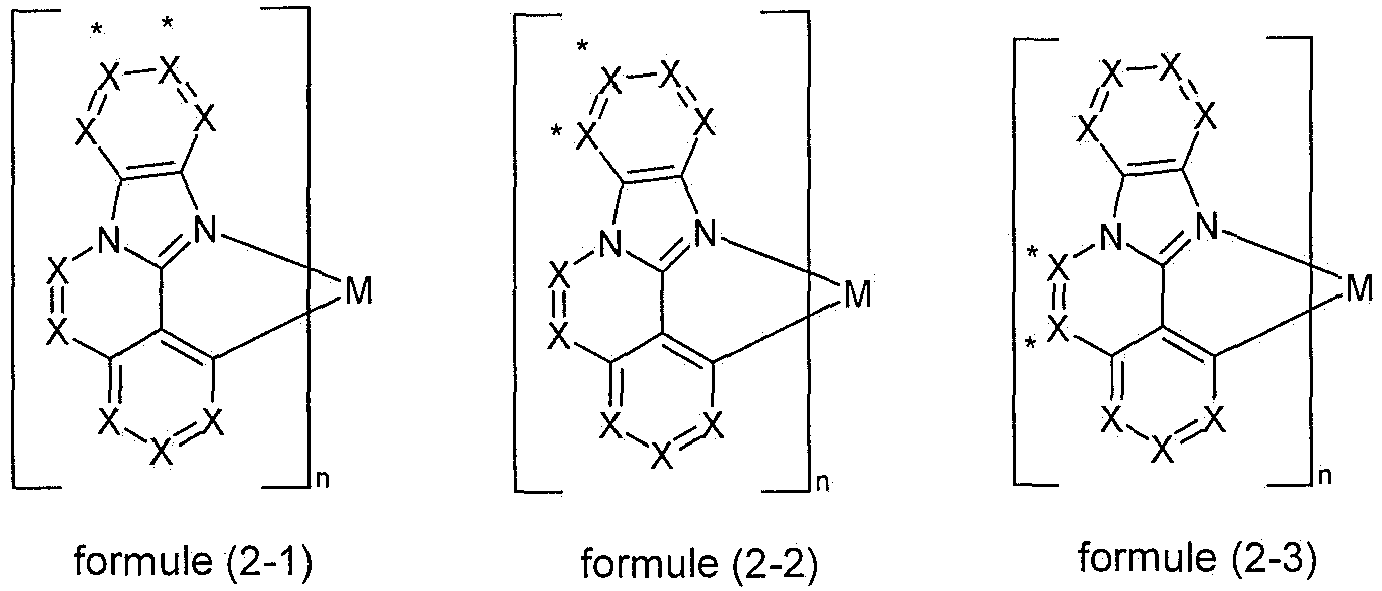


- Composé selon une ou plusieurs des revendications 1 à 3, caractérisé en ce que la structure de la formule (5) est sélectionnée parmi les formules (5-A), (5-B), (5-C) et (5-D) et la structure de la formule (6) est sélectionnée parmi les formules (6-A) et (6-B) :


- Composé selon une ou plusieurs des revendications 1 à 4, caractérisé en ce que le groupe G représente un groupe éthylène, lequel peut être substitué par un radical ou par plusieurs radicaux R2, où R2 représente de préférence, de manière identique ou différente pour chaque occurrence, H ou un groupe alkyle qui comporte de 1 à 4 atome(s) de C, ou un groupe ortho-arylène qui comporte de 6 à 10 atomes de C, lequel peut être substitué par un radical ou par plusieurs radicaux R2, mais est de préférence non substitué.
- Composé selon une ou plusieurs des revendications 1 à 5, caractérisé en ce que, si un ou plusieurs groupe(s) X représente(nt) azote, un groupe R qui est sélectionné parmi le groupe qui est constitué par CF3, OCF3, un groupe alkyle ou alcoxy qui comporte de 1 à 10 atome(s) de C, un système de cycle aromatique ou hétéroaromatique ou un groupe aralkyle ou hétéroaralkyle est lié en tant que substituant adjacent à cet atome d'azote ou en ce que ce radical R forme un cycle de la formule (5) ou (6) avec un radical R adjacent.
- Composé selon une ou plusieurs des revendications 1 à 6, caractérisé en ce que le substituant R qui est lié au niveau de la position ortho à la coordination de métal représente un groupe, pareillement coordonné au métal M, qui est sélectionné parmi les groupes aryle ou hétéroaryle, les cyanures d'aryle ou d'alkyle, les isocyanures d'aryle ou d'alkyle, les aminés, les amides, les alcools, les alcoolates, les thioalcools, les thioalcoolates, les phosphines, les phosphites, les fonctions carbonyle, les carboxylates, les carbamides ou les aryl- ou alkylacétylures.
- Composé selon une ou plusieurs des revendications 1 à 7, sélectionné parmi les structures des formules (13) à (18) :


- Composé selon une ou plusieurs des revendications 1 à 8, caractérisé en ce que L' est sélectionné parmi le groupe qui est constitué par le monoxyde de carbone, le monoxyde d'azote, les cyanures d'alkyle, les cyanures d'aryle, les isocyanures d'alkyle, les isocyanures d'aryle, les aminés, les phosphines, les phosphites, les arsines, les stibines, les hétérocycles contenant de l'azote, les carbènes, l'hydrure, le deutérure, les halogénures F-, Cl-, Br et I-, les alkylacétylures, les arylacétylures, le cyanure, le cyanate, l'isocyanate, le thiocyanate, l'isothiocyanate, les alcoolates aliphatiques ou aromatiques, les thioalcoolates aliphatiques ou aromatiques, les amides, les carboxylates, les groupes aryle, O2-, S2-, les carbures, lesquels conduisent à une coordination sous la forme R-C≡M, les nitrènes, lesquels conduisent à une coordination sous la forme R-N=M, où R représente de façon générale un substituant, N3-, les diamines, les imines, les diimines, les hétérocycles qui contiennent deux atomes d'azote, les diphosphines, les 1,3-dicétonates qui sont dérivés à partir des 1,3-dicétones, les 3-cétonates qui sont dérivés à partir des 3-cétoesters, les carboxylates qui sont dérivés à partir des acides aminocarboxyliques, les salicyliminates qui sont dérivés à partir des salicylimines, les dialcoolates, les dithiolates, les 3-(2-pyridyl)diazoles, les 3-(2-pyridyl)triazoles, les borates d'hétérocycles qui contiennent de l'azote et les ligands monoanioniques, neutres ou dianioniques bidentés L', lesquels, avec le métal, forment un cycle à 5 éléments ou un cycle à 6 éléments cyclométallaté qui comporte au moins une liaison métal-carbone.
- Procédé pour la préparation d'un composé selon une ou plusieurs des revendications 1 à 9 par réaction du ligand libre correspondant avec des alcoolates de métal/métaux de la formule (71), avec des cétocétonates de métal/métaux de la formule (72), avec des halogénures de métal/métaux de la formule (73), avec des complexes de métal/métaux dimériques de la formule (74) ou avec des complexes de métal/métaux de la formule (75) :


- Polymère contenant un ou plusieurs des composés selon une ou plusieurs des revendications 1 à 9, où une ou plusieurs liaison(s) est/sont présente(s) depuis le composé jusqu'au polymère.
- Formulation comprenant au moins un composé selon une ou plusieurs des revendications 1 à 9 ou un polymère selon la revendication 11 et au moins un autre composé.
- Utilisation d'un composé selon une ou plusieurs des revendications 1 à 9 ou d'un polymère selon la revendication 11 dans un dispositif électronique, en particulier qui est sélectionné parmi le groupe qui est constitué par les dispositifs électroluminescents organiques, les circuits intégrés organiques, les transistors à effet de champ organiques, les transistors à film mince organiques, les transistors à émission de lumière organiques, les cellules solaires organiques, les détecteurs optiques organiques, les photorécepteurs organiques, les dispositifs à extinction de champ organiques, les cellules électrochimiques à émission de lumière ou les diodes laser organiques, ou utilisation pour la génération d'oxygène singlet ou lors d'une photocatalyse.
- Dispositif électronique contenant un ou plusieurs composé(s) selon une ou plusieurs des revendications 1 à 9 et/ou un ou plusieurs polymère(s) selon la revendication 11.
- Dispositif électronique selon la revendication 14, lequel est un dispositif électroluminescent organique, caractérisé en ce que le composé selon une ou plusieurs des revendications 1 à 9 est utilisé en tant que composé d'émission dans une ou plusieurs couche(s) d'émission.
- Dispositif électronique selon la revendication 15, caractérisé en ce que le matériau de matrice qui est utilisé dans au moins l'une des couches d'émission est un cétone, de l'oxyde de phosphine, du sulfoxyde, du sulfone, du triarylamine, un dérivé de carbazole, un dérivé d'indolocarbazole, un dérivé d'indénocarbazole, de l'azacarbazole, un matériau de matrice bipolaire, du silane, de l'azaborole, de l'ester boronique, un dérivé de diazasilole, un dérivé de diazaphosphole, un dérivé de triazine, un complexe de zinc, un dérivé de dibenzofurane ou un dérivé de carbazole ponté ou un mélange de deux ou plus de ces matériaux.
Priority Applications (1)
| Application Number | Priority Date | Filing Date | Title |
|---|---|---|---|
| EP13730492.9A EP2872590B1 (fr) | 2012-07-13 | 2013-06-21 | Complexes metalliques |
Applications Claiming Priority (3)
| Application Number | Priority Date | Filing Date | Title |
|---|---|---|---|
| EP12005187 | 2012-07-13 | ||
| EP13730492.9A EP2872590B1 (fr) | 2012-07-13 | 2013-06-21 | Complexes metalliques |
| PCT/EP2013/001844 WO2014008982A1 (fr) | 2012-07-13 | 2013-06-21 | Complexes metalliques |
Publications (2)
| Publication Number | Publication Date |
|---|---|
| EP2872590A1 EP2872590A1 (fr) | 2015-05-20 |
| EP2872590B1 true EP2872590B1 (fr) | 2018-11-14 |
Family
ID=48670492
Family Applications (1)
| Application Number | Title | Priority Date | Filing Date |
|---|---|---|---|
| EP13730492.9A Active EP2872590B1 (fr) | 2012-07-13 | 2013-06-21 | Complexes metalliques |
Country Status (7)
| Country | Link |
|---|---|
| US (1) | US9837622B2 (fr) |
| EP (1) | EP2872590B1 (fr) |
| JP (1) | JP2015529637A (fr) |
| KR (1) | KR102076481B1 (fr) |
| CN (1) | CN104428392B (fr) |
| TW (1) | TWI671305B (fr) |
| WO (1) | WO2014008982A1 (fr) |
Families Citing this family (275)
| Publication number | Priority date | Publication date | Assignee | Title |
|---|---|---|---|---|
| JP4551480B1 (ja) | 2009-08-31 | 2010-09-29 | 富士フイルム株式会社 | 有機電界発光素子 |
| GB2520738B (en) * | 2013-11-29 | 2018-08-08 | Cambridge Display Tech Ltd | Phosphorescent metal complex dendrimers containing an imidazo[1,2-f]phenanthridine ligand |
| JP6531386B2 (ja) * | 2013-12-26 | 2019-06-19 | 住友化学株式会社 | 発光素子およびそれに用いる高分子化合物 |
| CN105980519B (zh) * | 2014-02-05 | 2019-06-14 | 默克专利有限公司 | 金属络合物 |
| CN106164083A (zh) * | 2014-04-04 | 2016-11-23 | 柯尼卡美能达株式会社 | 有机金属配合物的合成方法和使用通过该合成方法合成的化合物的有机电致发光元件 |
| DE102014105885A1 (de) * | 2014-04-25 | 2015-10-29 | Universität Stuttgart | N-Heterozyklische Carbenkomplexe von Metallimidoalkylidenen und Metalloxoalkylidenen und deren Verwendung |
| EP3140302B1 (fr) | 2014-05-05 | 2019-08-21 | Merck Patent GmbH | Matières pour des dispositifs organiques électroluminescents |
| EP3160954B1 (fr) | 2014-06-25 | 2020-09-23 | Merck Patent GmbH | Matériaux pour dispositifs électroluminescents organiques |
| CN106661055B (zh) * | 2014-06-27 | 2019-09-13 | 喜星素材株式会社 | 杂环化合物以及使用该杂环化合物的有机发光器件 |
| WO2016034262A1 (fr) * | 2014-09-05 | 2016-03-10 | Merck Patent Gmbh | Formulations et dispositifs électroniques |
| WO2016068640A2 (fr) * | 2014-10-31 | 2016-05-06 | 희성소재(주) | Composé hétérocyclique et élément électroluminescent organique l'utilisant |
| JP6595752B2 (ja) * | 2014-11-04 | 2019-10-23 | 株式会社半導体エネルギー研究所 | 発光素子、発光装置、電子機器、及び照明装置 |
| US9929361B2 (en) | 2015-02-16 | 2018-03-27 | Universal Display Corporation | Organic electroluminescent materials and devices |
| US11056657B2 (en) | 2015-02-27 | 2021-07-06 | University Display Corporation | Organic electroluminescent materials and devices |
| US9859510B2 (en) | 2015-05-15 | 2018-01-02 | Universal Display Corporation | Organic electroluminescent materials and devices |
| US10418568B2 (en) | 2015-06-01 | 2019-09-17 | Universal Display Corporation | Organic electroluminescent materials and devices |
| US11127905B2 (en) | 2015-07-29 | 2021-09-21 | Universal Display Corporation | Organic electroluminescent materials and devices |
| CN107922359A (zh) | 2015-07-30 | 2018-04-17 | 默克专利有限公司 | 用于有机电致发光器件的材料 |
| US11018309B2 (en) * | 2015-08-03 | 2021-05-25 | Universal Display Corporation | Organic electroluminescent materials and devices |
| CN107922335B (zh) * | 2015-08-13 | 2021-06-04 | 默克专利有限公司 | 六甲基二氢化茚 |
| EP3133664A1 (fr) * | 2015-08-18 | 2017-02-22 | Novaled GmbH | Couche épaisse d'amine-triaryle dopée avec des amides métalliques pour utilisation comme une couche d'injection de trous pour une diode électroluminescente organique (oled) |
| US10361381B2 (en) | 2015-09-03 | 2019-07-23 | Universal Display Corporation | Organic electroluminescent materials and devices |
| CN108349932A (zh) | 2015-10-27 | 2018-07-31 | 默克专利有限公司 | 用于有机电致发光器件的材料 |
| KR20180079328A (ko) * | 2015-11-04 | 2018-07-10 | 이데미쓰 고산 가부시키가이샤 | 벤즈이미다졸 축합 헤테로아릴 |
| US20170229663A1 (en) | 2016-02-09 | 2017-08-10 | Universal Display Corporation | Organic electroluminescent materials and devices |
| KR102740106B1 (ko) | 2016-03-03 | 2024-12-09 | 메르크 파텐트 게엠베하 | 유기 전계 발광 장치용 재료 |
| TWI821807B (zh) | 2016-03-17 | 2023-11-11 | 德商麥克專利有限公司 | 具有螺聯茀結構之化合物 |
| US10236456B2 (en) | 2016-04-11 | 2019-03-19 | Universal Display Corporation | Organic electroluminescent materials and devices |
| KR20180133376A (ko) | 2016-04-11 | 2018-12-14 | 메르크 파텐트 게엠베하 | 디벤조푸란 및/또는 디벤조티오펜 구조를 포함하는 헤테로시클릭 화합물 |
| CN109071580B (zh) | 2016-04-29 | 2022-05-24 | 默克专利有限公司 | 用于有机电致发光器件的材料 |
| US11482683B2 (en) | 2016-06-20 | 2022-10-25 | Universal Display Corporation | Organic electroluminescent materials and devices |
| US10862054B2 (en) | 2016-06-20 | 2020-12-08 | Universal Display Corporation | Organic electroluminescent materials and devices |
| US10672997B2 (en) | 2016-06-20 | 2020-06-02 | Universal Display Corporation | Organic electroluminescent materials and devices |
| KR101836041B1 (ko) * | 2016-08-30 | 2018-03-07 | 메르크 파텐트 게엠베하 | 금속 착물 |
| JP2019530676A (ja) | 2016-09-14 | 2019-10-24 | メルク パテント ゲーエムベーハー | カルバゾール構造を有する化合物 |
| US10608186B2 (en) | 2016-09-14 | 2020-03-31 | Universal Display Corporation | Organic electroluminescent materials and devices |
| WO2018050584A1 (fr) | 2016-09-14 | 2018-03-22 | Merck Patent Gmbh | Composés à structures spirobifluorène |
| US10680187B2 (en) | 2016-09-23 | 2020-06-09 | Universal Display Corporation | Organic electroluminescent materials and devices |
| US10916714B2 (en) * | 2016-09-27 | 2021-02-09 | Samsung Display Co., Ltd. | Organometallic compound and organic light-emitting device including the same |
| JP7051832B2 (ja) | 2016-09-30 | 2022-04-11 | メルク パテント ゲゼルシャフト ミット ベシュレンクテル ハフツング | ジアザジベンゾフランまたはジアザジベンゾチオフェン構造を有するカルバゾール |
| TWI766884B (zh) | 2016-09-30 | 2022-06-11 | 德商麥克專利有限公司 | 具有二氮雜二苯并呋喃或二氮雜二苯并噻吩結構的化合物、其製法及其用途 |
| US11196010B2 (en) | 2016-10-03 | 2021-12-07 | Universal Display Corporation | Organic electroluminescent materials and devices |
| US11011709B2 (en) | 2016-10-07 | 2021-05-18 | Universal Display Corporation | Organic electroluminescent materials and devices |
| US11345687B2 (en) | 2016-11-09 | 2022-05-31 | Merck Patent Gmbh | Materials for organic electroluminescent devices |
| US12317745B2 (en) | 2016-11-09 | 2025-05-27 | Universal Display Corporation | Organic electroluminescent materials and devices |
| US10680188B2 (en) | 2016-11-11 | 2020-06-09 | Universal Display Corporation | Organic electroluminescent materials and devices |
| TWI756292B (zh) | 2016-11-14 | 2022-03-01 | 德商麥克專利有限公司 | 具有受體基團與供體基團之化合物 |
| KR102580980B1 (ko) | 2016-11-17 | 2023-09-20 | 메르크 파텐트 게엠베하 | 유기 전계발광 소자용 재료 |
| KR102539246B1 (ko) | 2016-11-30 | 2023-06-01 | 메르크 파텐트 게엠베하 | 발레로락탐 구조를 갖는 화합물 |
| US11466021B2 (en) | 2016-12-05 | 2022-10-11 | Merck Patent Gmbh | Materials for organic electroluminescent devices |
| TW201831468A (zh) | 2016-12-05 | 2018-09-01 | 德商麥克專利有限公司 | 含氮的雜環化合物 |
| KR20190086028A (ko) | 2016-12-05 | 2019-07-19 | 메르크 파텐트 게엠베하 | 유기 전계발광 디바이스용 재료 |
| KR102504432B1 (ko) | 2016-12-22 | 2023-02-27 | 메르크 파텐트 게엠베하 | 적어도 2종의 유기-기능성 화합물을 포함하는 혼합물 |
| US11495751B2 (en) | 2017-01-04 | 2022-11-08 | Merck Patent Gmbh | Materials for organic electroluminescent devices |
| US11780865B2 (en) | 2017-01-09 | 2023-10-10 | Universal Display Corporation | Organic electroluminescent materials and devices |
| EP3573973B1 (fr) | 2017-01-25 | 2023-12-06 | Merck Patent GmbH | Dérivés de carbazole |
| KR102559144B1 (ko) | 2017-01-30 | 2023-07-24 | 메르크 파텐트 게엠베하 | 유기 전계발광 디바이스용 재료 |
| WO2018149793A1 (fr) * | 2017-02-14 | 2018-08-23 | Merck Patent Gmbh | Procédé de production de composés métalliques ortho-metallés |
| TW201835075A (zh) | 2017-02-14 | 2018-10-01 | 德商麥克專利有限公司 | 用於有機電致發光裝置之材料 |
| TW201843143A (zh) | 2017-03-13 | 2018-12-16 | 德商麥克專利有限公司 | 含有芳基胺結構之化合物 |
| JP7155142B2 (ja) | 2017-03-15 | 2022-10-18 | メルク パテント ゲーエムベーハー | 有機エレクトロルミネッセントデバイス用の材料 |
| US10844085B2 (en) | 2017-03-29 | 2020-11-24 | Universal Display Corporation | Organic electroluminescent materials and devices |
| US11778907B2 (en) | 2017-04-13 | 2023-10-03 | Merck Patent Gmbh | Composition for organic electronic devices |
| US10944060B2 (en) | 2017-05-11 | 2021-03-09 | Universal Display Corporation | Organic electroluminescent materials and devices |
| WO2018206526A1 (fr) | 2017-05-11 | 2018-11-15 | Merck Patent Gmbh | Complexes organoborés pour dispositifs électroluminescents organiques |
| KR102592390B1 (ko) | 2017-05-11 | 2023-10-20 | 메르크 파텐트 게엠베하 | 유기 전계발광 디바이스용 카르바졸계 바디피스 |
| CN110637017A (zh) | 2017-05-22 | 2019-12-31 | 默克专利有限公司 | 用于电子器件的六环杂芳族化合物 |
| US12098157B2 (en) | 2017-06-23 | 2024-09-24 | Universal Display Corporation | Organic electroluminescent materials and devices |
| CN110753685A (zh) | 2017-06-23 | 2020-02-04 | 默克专利有限公司 | 用于有机电致发光器件的材料 |
| CN110785415A (zh) | 2017-07-05 | 2020-02-11 | 默克专利有限公司 | 用于有机电子器件的组合物 |
| KR102653984B1 (ko) | 2017-07-05 | 2024-04-02 | 메르크 파텐트 게엠베하 | 유기 전자 디바이스용 조성물 |
| US11228010B2 (en) | 2017-07-26 | 2022-01-18 | Universal Display Corporation | Organic electroluminescent materials and devices |
| US11744142B2 (en) | 2017-08-10 | 2023-08-29 | Universal Display Corporation | Organic electroluminescent materials and devices |
| WO2019052933A1 (fr) | 2017-09-12 | 2019-03-21 | Merck Patent Gmbh | Matériaux pour dispositifs électroluminescents organiques |
| EP3692043B1 (fr) | 2017-10-06 | 2022-11-02 | Merck Patent GmbH | Matériaux pour dispositifs électroluminescents organiques |
| US11437588B2 (en) | 2017-10-24 | 2022-09-06 | Merck Patent Gmbh | Materials for organic electroluminescent devices |
| TWI785142B (zh) | 2017-11-14 | 2022-12-01 | 德商麥克專利有限公司 | 用於有機電子裝置之組成物 |
| US12180230B2 (en) | 2017-11-28 | 2024-12-31 | University Of Southern California | Carbene compounds and organic electroluminescent devices |
| EP3492480B1 (fr) | 2017-11-29 | 2021-10-20 | Universal Display Corporation | Matériaux et dispositifs électroluminescents organiques |
| US11937503B2 (en) | 2017-11-30 | 2024-03-19 | Universal Display Corporation | Organic electroluminescent materials and devices |
| CN111247658B (zh) | 2017-12-14 | 2023-04-04 | 广州华睿光电材料有限公司 | 过渡金属配合物、聚合物、混合物、组合物及其应用 |
| WO2019114764A1 (fr) | 2017-12-14 | 2019-06-20 | 广州华睿光电材料有限公司 | Complexe organométallique, polymère, mélange, composition le comprenant et leur utilisation dans un dispositif électronique |
| US11404651B2 (en) | 2017-12-14 | 2022-08-02 | Guangzhou Chinaray Optoelectronic Materials Ltd. | Transition metal complex material and application thereof in electronic devices |
| TW201938562A (zh) | 2017-12-19 | 2019-10-01 | 德商麥克專利有限公司 | 雜環化合物 |
| WO2019120263A1 (fr) | 2017-12-21 | 2019-06-27 | 广州华睿光电材料有限公司 | Mélange organique et application de celui-ci dans des dispositifs électroniques organiques |
| TWI811290B (zh) | 2018-01-25 | 2023-08-11 | 德商麥克專利有限公司 | 用於有機電致發光裝置的材料 |
| US11542289B2 (en) | 2018-01-26 | 2023-01-03 | Universal Display Corporation | Organic electroluminescent materials and devices |
| US11165028B2 (en) | 2018-03-12 | 2021-11-02 | Universal Display Corporation | Organic electroluminescent materials and devices |
| KR20200132912A (ko) | 2018-03-16 | 2020-11-25 | 메르크 파텐트 게엠베하 | 유기 전계발광 디바이스용 재료 |
| KR102804818B1 (ko) | 2018-05-30 | 2025-05-09 | 메르크 파텐트 게엠베하 | 유기 전자 디바이스용 조성물 |
| US11925103B2 (en) * | 2018-06-05 | 2024-03-05 | Universal Display Corporation | Organic electroluminescent materials and devices |
| KR102890506B1 (ko) | 2018-06-07 | 2025-11-25 | 메르크 파텐트 게엠베하 | 유기 전계 발광 디바이스 |
| WO2020011686A1 (fr) | 2018-07-09 | 2020-01-16 | Merck Patent Gmbh | Matériaux pour dispositifs électroluminescents organiques |
| US20220069231A1 (en) | 2018-07-20 | 2022-03-03 | Merck Patent Gmbh | Materials for organic electroluminescent devices |
| US12453279B2 (en) | 2018-08-22 | 2025-10-21 | Universal Display Corporation | Organic electroluminescent materials and devices |
| TWI826522B (zh) | 2018-09-12 | 2023-12-21 | 德商麥克專利有限公司 | 電致發光裝置 |
| TW202030902A (zh) | 2018-09-12 | 2020-08-16 | 德商麥克專利有限公司 | 電致發光裝置 |
| JP7459065B2 (ja) | 2018-09-12 | 2024-04-01 | メルク パテント ゲーエムベーハー | 有機エレクトロルミネッセンスデバイス用の材料 |
| JP2022501400A (ja) | 2018-09-27 | 2022-01-06 | メルク パテント ゲゼルシャフト ミット ベシュレンクテル ハフツングMerck Patent Gesellschaft mit beschraenkter Haftung | 立体障害窒素含有ヘテロ芳香族化合物を製造する方法 |
| EP3856868B1 (fr) | 2018-09-27 | 2023-01-25 | Merck Patent GmbH | Composés utilisables comme composés actifs dans un dispositif électronique organique |
| JP2021514931A (ja) * | 2018-09-28 | 2021-06-17 | エルティー・マテリアルズ・カンパニー・リミテッドLT Materials Co., Ltd. | ヘテロ環化合物およびこれを含む有機発光素子 |
| CN112955437A (zh) | 2018-11-05 | 2021-06-11 | 默克专利有限公司 | 可用于有机电子器件中的化合物 |
| CN112867709A (zh) | 2018-11-06 | 2021-05-28 | 默克专利有限公司 | 作为用于oled的有机电致发光材料的5,6-二苯基-5,6-二氢-二苯并[c,e][1,2]氮杂磷杂苯和6-苯基-6h-二苯并[c,e][1,2]噻嗪-5,5-二氧化物衍生物及类似化合物 |
| EP3880657A1 (fr) | 2018-11-14 | 2021-09-22 | Merck Patent GmbH | Composés pouvant être utilisés pour la fabrication d'un dispositif électronique organique |
| WO2020099307A1 (fr) | 2018-11-15 | 2020-05-22 | Merck Patent Gmbh | Matériaux pour dispositifs électroluminescents organiques |
| US11737349B2 (en) | 2018-12-12 | 2023-08-22 | Universal Display Corporation | Organic electroluminescent materials and devices |
| TW202039493A (zh) | 2018-12-19 | 2020-11-01 | 德商麥克專利有限公司 | 用於有機電致發光裝置之材料 |
| WO2020148243A1 (fr) | 2019-01-16 | 2020-07-23 | Merck Patent Gmbh | Matériaux pour dispositifs électroluminescents organiques |
| TW202035345A (zh) | 2019-01-17 | 2020-10-01 | 德商麥克專利有限公司 | 用於有機電致發光裝置之材料 |
| US11780829B2 (en) | 2019-01-30 | 2023-10-10 | The University Of Southern California | Organic electroluminescent materials and devices |
| US12477890B2 (en) | 2019-02-01 | 2025-11-18 | Universal Display Corporation | Organic electroluminescent materials and devices |
| JP7621955B2 (ja) | 2019-02-18 | 2025-01-27 | メルク パテント ゲーエムベーハー | 有機電子デバイス用の組成物 |
| US20220127286A1 (en) | 2019-03-04 | 2022-04-28 | Merck Patent Gmbh | Ligands for nano-sized materials |
| EP3938367A1 (fr) | 2019-03-12 | 2022-01-19 | Merck Patent GmbH | Matériaux pour dispositifs électroluminescents organiques |
| WO2020187865A1 (fr) | 2019-03-20 | 2020-09-24 | Merck Patent Gmbh | Matériaux pour dispositifs électroluminescents organiques |
| KR20210143247A (ko) | 2019-03-25 | 2021-11-26 | 메르크 파텐트 게엠베하 | 유기 전계 발광 디바이스용 재료 |
| JP2020158491A (ja) | 2019-03-26 | 2020-10-01 | ユニバーサル ディスプレイ コーポレイション | 有機エレクトロルミネセンス材料及びデバイス |
| CN113646315A (zh) | 2019-04-11 | 2021-11-12 | 默克专利有限公司 | 用于有机电致发光器件的材料 |
| EP3956338A1 (fr) | 2019-04-15 | 2022-02-23 | Merck Patent GmbH | Complexes métalliques |
| JP7625573B2 (ja) | 2019-07-22 | 2025-02-03 | ユー・ディー・シー アイルランド リミテッド | オルトメタル化金属化合物の調製方法 |
| US12281128B2 (en) | 2019-07-30 | 2025-04-22 | Universal Display Corporation | Organic electroluminescent materials and devices |
| US12139501B2 (en) | 2019-08-16 | 2024-11-12 | Universal Display Corporation | Organic electroluminescent materials and devices |
| CN114222738B (zh) | 2019-08-26 | 2024-05-17 | 默克专利有限公司 | 用于有机电致发光器件的材料 |
| WO2021043703A1 (fr) | 2019-09-02 | 2021-03-11 | Merck Patent Gmbh | Matériaux pour dispositifs électroluminescents organiques |
| TW202122558A (zh) | 2019-09-03 | 2021-06-16 | 德商麥克專利有限公司 | 用於有機電致發光裝置之材料 |
| US12388004B2 (en) | 2019-09-12 | 2025-08-12 | Ormet Circuits, Inc. | Lithographically defined electrical interconnects from conductive pastes |
| WO2021052924A1 (fr) | 2019-09-16 | 2021-03-25 | Merck Patent Gmbh | Matériaux pour dispositifs électroluminescents organiques |
| WO2021052921A1 (fr) | 2019-09-19 | 2021-03-25 | Merck Patent Gmbh | Mélange de deux matériaux hôtes et dispositif électroluminescent organique l'utilisant |
| KR20220066324A (ko) | 2019-09-20 | 2022-05-24 | 메르크 파텐트 게엠베하 | 전자 디바이스용 재료 |
| US20220416172A1 (en) | 2019-10-22 | 2022-12-29 | Merck Patent Gmbh | Materials for organic electroluminescent devices |
| CN114630831A (zh) | 2019-10-25 | 2022-06-14 | 默克专利有限公司 | 可用于有机电子器件中的化合物 |
| TW202130783A (zh) | 2019-11-04 | 2021-08-16 | 德商麥克專利有限公司 | 有機電致發光裝置 |
| CN114641482A (zh) | 2019-11-04 | 2022-06-17 | 默克专利有限公司 | 用于有机电致发光器件的材料 |
| US20210135130A1 (en) | 2019-11-04 | 2021-05-06 | Universal Display Corporation | Organic electroluminescent materials and devices |
| TW202134252A (zh) | 2019-11-12 | 2021-09-16 | 德商麥克專利有限公司 | 有機電致發光裝置用材料 |
| CN112851530B (zh) * | 2019-11-28 | 2023-08-08 | 南京高光半导体材料有限公司 | 一种空穴传输材料及含有该材料的有机电致发光器件 |
| TW202136181A (zh) | 2019-12-04 | 2021-10-01 | 德商麥克專利有限公司 | 有機電致發光裝置用的材料 |
| TW202136471A (zh) | 2019-12-17 | 2021-10-01 | 德商麥克專利有限公司 | 有機電致發光裝置用的材料 |
| EP4077335A1 (fr) | 2019-12-18 | 2022-10-26 | Merck Patent GmbH | Composés aromatiques pour dispositifs électroluminescents organiques |
| EP4077336A1 (fr) | 2019-12-19 | 2022-10-26 | Merck Patent GmbH | Composés polycycliques pour dispositifs électroluminescents organiques |
| US12538698B2 (en) | 2020-01-06 | 2026-01-27 | Universal Display Corporation | Organic electroluminescent materials and devices |
| US12426495B2 (en) | 2020-01-28 | 2025-09-23 | Universal Display Corporation | Organic electroluminescent materials and devices |
| EP4097090A1 (fr) | 2020-01-29 | 2022-12-07 | Merck Patent GmbH | Dérivés de benzimidazole |
| CN115135741A (zh) | 2020-02-25 | 2022-09-30 | 默克专利有限公司 | 杂环化合物在有机电子器件中的用途 |
| CN115244728B (zh) | 2020-03-02 | 2026-01-16 | 默克专利有限公司 | 砜化合物在有机电子器件中的用途 |
| TW202200753A (zh) | 2020-03-11 | 2022-01-01 | 德商麥克專利有限公司 | 有機電致發光裝置 |
| KR102943498B1 (ko) | 2020-03-11 | 2026-03-24 | 메르크 파텐트 게엠베하 | 유기 전계 발광 장치 |
| US20230147279A1 (en) | 2020-03-17 | 2023-05-11 | Merck Patent Gmbh | Heterocyclic compounds for organic electroluminescent devices |
| KR20220154774A (ko) | 2020-03-17 | 2022-11-22 | 메르크 파텐트 게엠베하 | 유기 전계 발광 디바이스용 헤테로방향족 화합물 |
| WO2021191058A1 (fr) | 2020-03-23 | 2021-09-30 | Merck Patent Gmbh | Matériaux pour dispositifs électroluminescents organiques |
| EP4126868A1 (fr) | 2020-03-24 | 2023-02-08 | Merck Patent GmbH | Matériaux pour dispositifs électroniques |
| EP4126880A1 (fr) | 2020-03-26 | 2023-02-08 | Merck Patent GmbH | Composés cycliques pour dispositifs électroluminescents organiques |
| US20230151026A1 (en) | 2020-04-02 | 2023-05-18 | Merck Patent Gmbh | Multi-layer body for diffuse transillumination |
| KR20220164541A (ko) | 2020-04-06 | 2022-12-13 | 메르크 파텐트 게엠베하 | 유기 전계 발광 디바이스용 다환 화합물 |
| EP4158704B1 (fr) | 2020-05-29 | 2024-12-25 | Merck Patent GmbH | Appareil électroluminescent organique |
| WO2021254984A1 (fr) | 2020-06-18 | 2021-12-23 | Merck Patent Gmbh | Indénoazanaphtalènes |
| KR102914927B1 (ko) | 2020-06-23 | 2026-01-19 | 메르크 파텐트 게엠베하 | 혼합물의 제조 방법 |
| CN115916794A (zh) | 2020-06-29 | 2023-04-04 | 默克专利有限公司 | 用于有机电致发光器件的杂环化合物 |
| US20230312612A1 (en) | 2020-06-29 | 2023-10-05 | Merck Patent Gmbh | Heteroaromatic compounds for organic electroluminescent devices |
| EP3937268B1 (fr) | 2020-07-10 | 2025-05-07 | Universal Display Corporation | Delo plasmoniques et émetteurs à dipôle vertical |
| EP4192832A1 (fr) | 2020-08-06 | 2023-06-14 | Merck Patent GmbH | Matériaux destinés à des dispositifs électroluminescents organiques |
| US20230271989A1 (en) | 2020-08-13 | 2023-08-31 | Merck Patent Gmbh | Metal complexes |
| KR20230053629A (ko) | 2020-08-18 | 2023-04-21 | 메르크 파텐트 게엠베하 | 유기 전계 발광 디바이스용 재료 |
| KR20230053633A (ko) | 2020-08-19 | 2023-04-21 | 메르크 파텐트 게엠베하 | 유기 전계 발광 디바이스용 재료 |
| TW202222748A (zh) | 2020-09-30 | 2022-06-16 | 德商麥克專利有限公司 | 用於結構化有機電致發光裝置的功能層之化合物 |
| TW202229215A (zh) | 2020-09-30 | 2022-08-01 | 德商麥克專利有限公司 | 用於有機電致發光裝置功能層之結構化的化合物 |
| EP4229064A1 (fr) | 2020-10-16 | 2023-08-23 | Merck Patent GmbH | Composés hétérocycliques pour dispositifs électroluminescents organiques |
| CN116406414A (zh) | 2020-10-16 | 2023-07-07 | 默克专利有限公司 | 用于有机电致发光器件的包含杂原子的化合物 |
| CN114437072B (zh) * | 2020-10-30 | 2023-03-31 | 中国科学院大连化学物理研究所 | 一种6-甲基异吲哚并[2,1-a]喹喔啉类化合物的合成方法 |
| US12187748B2 (en) | 2020-11-02 | 2025-01-07 | Universal Display Corporation | Organic electroluminescent materials and devices |
| WO2022101171A1 (fr) | 2020-11-10 | 2022-05-19 | Merck Patent Gmbh | Composés sulfureux pour dispositifs électroluminescents organiques |
| US20220158096A1 (en) | 2020-11-16 | 2022-05-19 | Universal Display Corporation | Organic electroluminescent materials and devices |
| US20220165967A1 (en) | 2020-11-24 | 2022-05-26 | Universal Display Corporation | Organic electroluminescent materials and devices |
| US12325717B2 (en) | 2020-11-24 | 2025-06-10 | Universal Display Corporation | Organic electroluminescent materials and devices |
| US20230416264A1 (en) | 2020-12-02 | 2023-12-28 | Merck Patent Gmbh | Heterocyclic compounds for organic electroluminescent devices |
| KR20230118615A (ko) | 2020-12-10 | 2023-08-11 | 메르크 파텐트 게엠베하 | 유기 전계발광 디바이스용 재료 |
| CN116583522A (zh) | 2020-12-18 | 2023-08-11 | 默克专利有限公司 | 作为蓝色荧光发光体用于oled中的吲哚并[3.2.1-jk]咔唑-6-腈衍生物 |
| CN116649013A (zh) | 2020-12-18 | 2023-08-25 | 默克专利有限公司 | 用于有机电致发光器件的含氮杂芳族化合物 |
| KR20230122093A (ko) | 2020-12-18 | 2023-08-22 | 메르크 파텐트 게엠베하 | 유기 전계 발광 디바이스용 질소 함유 화합물 |
| CN116745287A (zh) | 2021-01-05 | 2023-09-12 | 默克专利有限公司 | 用于有机电致发光器件的材料 |
| WO2022152213A1 (fr) | 2021-01-13 | 2022-07-21 | 浙江光昊光电科技有限公司 | Composé organique, son utilisation dans un dispositif électronique organique et composition |
| EP4281455A1 (fr) | 2021-01-25 | 2023-11-29 | Merck Patent GmbH | Composés azotés pour dispositifs électroluminescents organiques |
| US12459966B2 (en) * | 2021-02-02 | 2025-11-04 | Universal Display Corporation | Organic electroluminescent materials and devices |
| US12575316B2 (en) | 2021-02-03 | 2026-03-10 | Universal Display Corporation | Organic electroluminescent materials and devices |
| EP4059915B1 (fr) | 2021-02-26 | 2025-12-24 | Universal Display Corporation | Matériaux et dispositifs électroluminescents organiques |
| EP4060758A3 (fr) | 2021-02-26 | 2023-03-29 | Universal Display Corporation | Matériaux et dispositifs électroluminescents organiques |
| US12624055B2 (en) | 2021-03-01 | 2026-05-12 | Universal Display Corporation | Organic electroluminescent materials and devices |
| EP4301757A1 (fr) | 2021-03-02 | 2024-01-10 | Merck Patent GmbH | Composés pour dispositifs électroluminescents organiques |
| US12606582B2 (en) | 2021-03-05 | 2026-04-21 | Universal Display Corporation | Organic electroluminescent materials and devices |
| US12428599B2 (en) | 2021-03-09 | 2025-09-30 | Universal Display Corporation | Organic electroluminescent materials and devices |
| US20220298190A1 (en) | 2021-03-12 | 2022-09-22 | Universal Display Corporation | Organic electroluminescent materials and devices |
| US12421262B2 (en) | 2021-03-15 | 2025-09-23 | Universal Display Corporation | Organic electroluminescent materials and devices |
| KR20230158657A (ko) | 2021-03-18 | 2023-11-21 | 메르크 파텐트 게엠베하 | 유기 전계 발광 디바이스용 헤테로방향족 화합물 |
| US20220340607A1 (en) | 2021-04-05 | 2022-10-27 | Universal Display Corporation | Organic electroluminescent materials and devices |
| US12480042B2 (en) | 2021-04-09 | 2025-11-25 | Universal Display Corporation | Organic electroluminescent materials and devices |
| EP4075531A1 (fr) | 2021-04-13 | 2022-10-19 | Universal Display Corporation | Delo plasmoniques et émetteurs à dipôle vertical |
| US20220352478A1 (en) | 2021-04-14 | 2022-11-03 | Universal Display Corporation | Organic eletroluminescent materials and devices |
| US20230006149A1 (en) | 2021-04-23 | 2023-01-05 | Universal Display Corporation | Organic electroluminescent materials and devices |
| US20220407020A1 (en) | 2021-04-23 | 2022-12-22 | Universal Display Corporation | Organic electroluminescent materials and devices |
| CN117203191A (zh) | 2021-04-29 | 2023-12-08 | 默克专利有限公司 | 用于有机电致发光器件的材料 |
| KR20240005806A (ko) | 2021-04-29 | 2024-01-12 | 메르크 파텐트 게엠베하 | 유기 전계발광 디바이스용 재료 |
| CN117425655A (zh) | 2021-04-30 | 2024-01-19 | 默克专利有限公司 | 用于有机电致发光器件的含氮杂环化合物 |
| CN115304643B (zh) * | 2021-05-06 | 2024-06-25 | 广东阿格蕾雅光电材料有限公司 | 一种有机金属化合物及其应用 |
| WO2022243403A1 (fr) | 2021-05-21 | 2022-11-24 | Merck Patent Gmbh | Procédé de purification continue d'au moins un matériau fonctionnel et dispositif de purification continue d'au moins un matériau fonctionnel |
| US20230133787A1 (en) | 2021-06-08 | 2023-05-04 | University Of Southern California | Molecular Alignment of Homoleptic Iridium Phosphors |
| WO2022200638A1 (fr) | 2021-07-06 | 2022-09-29 | Merck Patent Gmbh | Matériaux pour dispositifs électroluminescents organiques |
| US12550611B2 (en) | 2021-08-03 | 2026-02-10 | Universal Display Corporation | Organic electroluminescent materials and devices |
| EP4402141A1 (fr) | 2021-09-13 | 2024-07-24 | Merck Patent GmbH | Matériaux pour dispositifs électroluminescents organiques |
| KR20240064697A (ko) | 2021-09-14 | 2024-05-13 | 메르크 파텐트 게엠베하 | 유기 전계 발광 디바이스용 붕소 복소환 화합물 |
| EP4151699A1 (fr) | 2021-09-17 | 2023-03-22 | Universal Display Corporation | Matériaux et dispositifs électroluminescents organiques |
| WO2023052275A1 (fr) | 2021-09-28 | 2023-04-06 | Merck Patent Gmbh | Matériaux pour dispositifs électroniques |
| KR20240075888A (ko) | 2021-09-28 | 2024-05-29 | 메르크 파텐트 게엠베하 | 전자 디바이스용 재료 |
| WO2023052313A1 (fr) | 2021-09-28 | 2023-04-06 | Merck Patent Gmbh | Matériaux pour dispositifs électroniques |
| KR20240075872A (ko) | 2021-09-28 | 2024-05-29 | 메르크 파텐트 게엠베하 | 전자 디바이스용 재료 |
| US12473318B2 (en) | 2021-10-08 | 2025-11-18 | Universal Display Corporation | Organic electroluminescent materials and devices |
| KR20240091021A (ko) | 2021-10-27 | 2024-06-21 | 메르크 파텐트 게엠베하 | 유기 전계발광 디바이스용 붕소 및 질소 복소환 화합물 |
| WO2023094412A1 (fr) | 2021-11-25 | 2023-06-01 | Merck Patent Gmbh | Matériaux pour dispositifs électroniques |
| CN118303151A (zh) | 2021-11-30 | 2024-07-05 | 默克专利有限公司 | 具有芴结构的化合物 |
| CN118401524A (zh) | 2021-12-13 | 2024-07-26 | 默克专利有限公司 | 用于有机电致发光器件的材料 |
| US12509628B2 (en) | 2021-12-16 | 2025-12-30 | Universal Display Corporation | Organic electroluminescent materials and devices |
| KR20240128020A (ko) | 2021-12-21 | 2024-08-23 | 메르크 파텐트 게엠베하 | 중수소화 유기 화합물의 제조 방법 |
| CN118660882A (zh) | 2022-02-09 | 2024-09-17 | 默克专利有限公司 | 用于有机电致发光器件的材料 |
| KR20240150795A (ko) | 2022-02-14 | 2024-10-16 | 메르크 파텐트 게엠베하 | 전자 디바이스용 재료 |
| EP4231804A3 (fr) | 2022-02-16 | 2023-09-20 | Universal Display Corporation | Matériaux et dispositifs électroluminescents organiques |
| EP4719022A3 (fr) | 2022-02-23 | 2026-04-15 | UDC Ireland Limited | Hétérocycles contenant de l'azote pour dispositifs électroluminescents organiques |
| EP4482843A1 (fr) | 2022-02-23 | 2025-01-01 | Merck Patent GmbH | Hétérocycles aromatiques pour dispositifs électroluminescents organiques |
| US20230292592A1 (en) | 2022-03-09 | 2023-09-14 | Universal Display Corporation | Organic electroluminescent materials and devices |
| US20230337516A1 (en) | 2022-04-18 | 2023-10-19 | Universal Display Corporation | Organic electroluminescent materials and devices |
| KR20250008768A (ko) | 2022-05-06 | 2025-01-15 | 메르크 파텐트 게엠베하 | 유기 전계 발광 디바이스용 환형 화합물 |
| WO2023222559A1 (fr) | 2022-05-18 | 2023-11-23 | Merck Patent Gmbh | Procédé de préparation de composés organiques deutérés |
| US20230389421A1 (en) | 2022-05-24 | 2023-11-30 | Universal Display Corporation | Organic electroluminescent materials and devices |
| EP4293001A1 (fr) | 2022-06-08 | 2023-12-20 | Universal Display Corporation | Matériaux électroluminescents organiques et dispositifs |
| CN118235543A (zh) | 2022-06-24 | 2024-06-21 | 默克专利有限公司 | 用于有机电子器件的组合物 |
| CN118202815A (zh) | 2022-06-24 | 2024-06-14 | 默克专利有限公司 | 用于有机电子器件的组合物 |
| US20240016051A1 (en) | 2022-06-28 | 2024-01-11 | Universal Display Corporation | Organic electroluminescent materials and devices |
| WO2024013004A1 (fr) | 2022-07-11 | 2024-01-18 | Merck Patent Gmbh | Matériaux pour dispositifs électroniques |
| CN120379993A (zh) | 2022-08-09 | 2025-07-25 | 默克专利有限公司 | 用于有机电致发光器件的材料 |
| US20240107880A1 (en) | 2022-08-17 | 2024-03-28 | Universal Display Corporation | Organic electroluminescent materials and devices |
| KR20250075641A (ko) | 2022-09-22 | 2025-05-28 | 메르크 파텐트 게엠베하 | 유기 전계발광 디바이스용 질소 함유 헤테로사이클 |
| EP4590652A1 (fr) | 2022-09-22 | 2025-07-30 | Merck Patent GmbH | Composés contenant de l'azote pour dispositifs électroluminescents organiques |
| CN115651193B (zh) * | 2022-10-27 | 2023-12-01 | 深圳大学 | 一种多取代聚喹啉及其制备方法、应用 |
| US20240180025A1 (en) | 2022-10-27 | 2024-05-30 | Universal Display Corporation | Organic electroluminescent materials and devices |
| US20240188316A1 (en) | 2022-10-27 | 2024-06-06 | Universal Display Corporation | Organic electroluminescent materials and devices |
| US20240196730A1 (en) | 2022-10-27 | 2024-06-13 | Universal Display Corporation | Organic electroluminescent materials and devices |
| US20240188319A1 (en) | 2022-10-27 | 2024-06-06 | Universal Display Corporation | Organic electroluminescent materials and devices |
| US20240188419A1 (en) | 2022-10-27 | 2024-06-06 | Universal Display Corporation | Organic electroluminescent materials and devices |
| CN120152954A (zh) | 2022-11-01 | 2025-06-13 | 默克专利有限公司 | 用于有机电致发光器件的含氮杂环化合物 |
| KR20250110873A (ko) | 2022-11-17 | 2025-07-21 | 메르크 파텐트 게엠베하 | 유기 전계발광 디바이스용 재료 |
| US20240247017A1 (en) | 2022-12-14 | 2024-07-25 | Universal Display Corporation | Organic electroluminescent materials and devices |
| TW202438505A (zh) | 2022-12-19 | 2024-10-01 | 德商麥克專利有限公司 | 有機電致發光裝置之材料 |
| KR20250124370A (ko) | 2022-12-19 | 2025-08-19 | 메르크 파텐트 게엠베하 | 전자 디바이스용 재료 |
| CN120379953A (zh) | 2022-12-20 | 2025-07-25 | 默克专利有限公司 | 用于制备氘化芳族化合物的方法 |
| EP4649084A1 (fr) | 2023-01-10 | 2025-11-19 | Merck Patent GmbH | Hétérocycles azotés pour dispositifs électroluminescents organiques |
| EP4652169A1 (fr) | 2023-01-17 | 2025-11-26 | Merck Patent GmbH | Hétérocycles pour dispositifs électroluminescents organiques |
| KR20250156170A (ko) | 2023-03-07 | 2025-10-31 | 메르크 파텐트 게엠베하 | 유기 전계 발광 디바이스용 환형 질소 화합물 |
| CN120826409A (zh) | 2023-03-20 | 2025-10-21 | 默克专利有限公司 | 用于有机电致发光器件的材料 |
| KR20260015809A (ko) | 2023-04-20 | 2026-02-03 | 메르크 파텐트 게엠베하 | 전자 디바이스들을 위한 재료들 |
| WO2024240725A1 (fr) | 2023-05-25 | 2024-11-28 | Merck Patent Gmbh | Dérivés de tris[1,2,4]triazolo[1,5-a:1',5'-c:1'',5''-e][1,3,5]triazine destinés à être utilisés dans des dispositifs électroluminescents organiques |
| EP4486099B1 (fr) | 2023-06-30 | 2026-04-29 | UDC Ireland Limited | Composés pour dispositifs électroluminescents organiques |
| KR20260044229A (ko) | 2023-07-27 | 2026-04-01 | 메르크 파텐트 게엠베하 | 유기 발광 디바이스 및 유기 센서를 위한 재료 |
| CN121753521A (zh) | 2023-08-30 | 2026-03-27 | 默克专利有限公司 | 用于有机发光器件的材料 |
| CN121753522A (zh) | 2023-08-30 | 2026-03-27 | 默克专利有限公司 | 用于有机发光器件的材料 |
| CN121773745A (zh) | 2023-08-30 | 2026-03-31 | 默克专利有限公司 | 用于有机发光器件的材料 |
| WO2025109056A1 (fr) | 2023-11-24 | 2025-05-30 | Merck Patent Gmbh | Hétérocycles contenant de l'oxygène pour dispositifs électroluminescents organiques |
| US20250204238A1 (en) | 2023-12-15 | 2025-06-19 | Universal Display Corporation | Organic electroluminscent materials and devices |
| US20250204239A1 (en) | 2023-12-15 | 2025-06-19 | Universal Display Corporation | Organic electroluminescent materials and devices |
| WO2025132551A1 (fr) | 2023-12-22 | 2025-06-26 | Merck Patent Gmbh | Matériaux pour dispositifs électroniques |
| WO2025181097A1 (fr) | 2024-02-29 | 2025-09-04 | Merck Patent Gmbh | Hétérocycles contenant de l'azote pour dispositifs électroluminescents organiques |
| WO2025181044A1 (fr) | 2024-02-29 | 2025-09-04 | Merck Patent Gmbh | Composés contenant de l'azote pour dispositifs électroluminescents organiques |
| WO2025181124A1 (fr) | 2024-03-01 | 2025-09-04 | Merck Patent Gmbh | Matériaux pour dispositifs électroluminescents organiques |
| WO2025210013A1 (fr) | 2024-04-04 | 2025-10-09 | Merck Patent Gmbh | Composés pour dispositifs électroniques, en particulier composés pour oled |
| WO2026008710A1 (fr) | 2024-07-05 | 2026-01-08 | Merck Patent Gmbh | Composés de silicium cyclique pour dispositifs électroluminescents organiques |
| WO2026022016A1 (fr) | 2024-07-22 | 2026-01-29 | Merck Patent Gmbh | Matériaux pour dispositifs électroluminescents organiques |
| WO2026041632A1 (fr) | 2024-08-21 | 2026-02-26 | Merck Patent Gmbh | Matériaux hétérocycliques pour dispositifs électroluminescents organiques |
| WO2026073855A1 (fr) | 2024-10-01 | 2026-04-09 | Merck Patent Gmbh | Composés de silicium pour dispositifs électroluminescents organiques |
Family Cites Families (72)
| Publication number | Priority date | Publication date | Assignee | Title |
|---|---|---|---|---|
| US4539507A (en) | 1983-03-25 | 1985-09-03 | Eastman Kodak Company | Organic electroluminescent devices having improved power conversion efficiencies |
| DE4111878A1 (de) | 1991-04-11 | 1992-10-15 | Wacker Chemie Gmbh | Leiterpolymere mit konjugierten doppelbindungen |
| US5151629A (en) | 1991-08-01 | 1992-09-29 | Eastman Kodak Company | Blue emitting internal junction organic electroluminescent device (I) |
| JPH07133483A (ja) | 1993-11-09 | 1995-05-23 | Shinko Electric Ind Co Ltd | El素子用有機発光材料及びel素子 |
| EP0676461B1 (fr) | 1994-04-07 | 2002-08-14 | Covion Organic Semiconductors GmbH | Composés spiro et leur application comme matières électroluminescentes |
| DE4436773A1 (de) | 1994-10-14 | 1996-04-18 | Hoechst Ag | Konjugierte Polymere mit Spirozentren und ihre Verwendung als Elektrolumineszenzmaterialien |
| JP3865406B2 (ja) | 1995-07-28 | 2007-01-10 | 住友化学株式会社 | 2,7−アリール−9−置換フルオレン及び9−置換フルオレンオリゴマー及びポリマー |
| DE19614971A1 (de) | 1996-04-17 | 1997-10-23 | Hoechst Ag | Polymere mit Spiroatomen und ihre Verwendung als Elektrolumineszenzmaterialien |
| DE19652261A1 (de) | 1996-12-16 | 1998-06-18 | Hoechst Ag | Arylsubstituierte Poly(p-arylenvinylene), Verfahren zur Herstellung und deren Verwendung in Elektroluminszenzbauelementen |
| DE19846766A1 (de) | 1998-10-10 | 2000-04-20 | Aventis Res & Tech Gmbh & Co | Konjugierte Polymere, enthaltend spezielle Fluorenbausteine mit verbesserten Eigenschaften |
| US6166172A (en) | 1999-02-10 | 2000-12-26 | Carnegie Mellon University | Method of forming poly-(3-substituted) thiophenes |
| TW532048B (en) | 2000-03-27 | 2003-05-11 | Idemitsu Kosan Co | Organic electroluminescence element |
| DE10104426A1 (de) | 2001-02-01 | 2002-08-08 | Covion Organic Semiconductors | Verfahren zur Herstellung von hochreinen, tris-ortho-metallierten Organo-Iridium-Verbindungen |
| ITRM20020411A1 (it) | 2002-08-01 | 2004-02-02 | Univ Roma La Sapienza | Derivati dello spirobifluorene, loro preparazione e loro uso. |
| DE10249723A1 (de) | 2002-10-25 | 2004-05-06 | Covion Organic Semiconductors Gmbh | Arylamin-Einheiten enthaltende konjugierte Polymere, deren Darstellung und Verwendung |
| GB0226010D0 (en) | 2002-11-08 | 2002-12-18 | Cambridge Display Tech Ltd | Polymers for use in organic electroluminescent devices |
| KR101030158B1 (ko) | 2002-12-23 | 2011-04-18 | 메르크 파텐트 게엠베하 | 유기 전자발광 부품 |
| DE10304819A1 (de) | 2003-02-06 | 2004-08-19 | Covion Organic Semiconductors Gmbh | Carbazol-enthaltende konjugierte Polymere und Blends, deren Darstellung und Verwendung |
| DE10310887A1 (de) | 2003-03-11 | 2004-09-30 | Covion Organic Semiconductors Gmbh | Matallkomplexe |
| JP4411851B2 (ja) | 2003-03-19 | 2010-02-10 | コニカミノルタホールディングス株式会社 | 有機エレクトロルミネッセンス素子 |
| DE10314102A1 (de) | 2003-03-27 | 2004-10-14 | Covion Organic Semiconductors Gmbh | Verfahren zur Herstellung von hochreinen Organo-Iridium-Verbindungen |
| US7345301B2 (en) | 2003-04-15 | 2008-03-18 | Merck Patent Gmbh | Mixtures of matrix materials and organic semiconductors capable of emission, use of the same and electronic components containing said mixtures |
| JP4635870B2 (ja) | 2003-04-23 | 2011-02-23 | コニカミノルタホールディングス株式会社 | 有機エレクトロルミネッセンス素子、照明装置及び表示装置 |
| EP1491568A1 (fr) | 2003-06-23 | 2004-12-29 | Covion Organic Semiconductors GmbH | Polymères semi-conducteurs |
| DE10328627A1 (de) | 2003-06-26 | 2005-02-17 | Covion Organic Semiconductors Gmbh | Neue Materialien für die Elektrolumineszenz |
| DE10333232A1 (de) | 2003-07-21 | 2007-10-11 | Merck Patent Gmbh | Organisches Elektrolumineszenzelement |
| DE10337346A1 (de) | 2003-08-12 | 2005-03-31 | Covion Organic Semiconductors Gmbh | Konjugierte Polymere enthaltend Dihydrophenanthren-Einheiten und deren Verwendung |
| US7795801B2 (en) | 2003-09-30 | 2010-09-14 | Konica Minolta Holdings, Inc. | Organic electroluminescent element, illuminator, display and compound |
| EP2366752B1 (fr) | 2003-10-22 | 2016-07-20 | Merck Patent GmbH | Nouveaux matériaux pour l'électroluminescence et leur utilisation |
| DE10350606A1 (de) | 2003-10-30 | 2005-06-09 | Covion Organic Semiconductors Gmbh | Verfahren zur Herstellung heteroleptischer, ortho-metallierter Organometall-Verbindungen |
| US7790890B2 (en) | 2004-03-31 | 2010-09-07 | Konica Minolta Holdings, Inc. | Organic electroluminescence element material, organic electroluminescence element, display device and illumination device |
| DE102004020298A1 (de) | 2004-04-26 | 2005-11-10 | Covion Organic Semiconductors Gmbh | Elektrolumineszierende Polymere und deren Verwendung |
| DE102004023277A1 (de) | 2004-05-11 | 2005-12-01 | Covion Organic Semiconductors Gmbh | Neue Materialmischungen für die Elektrolumineszenz |
| JP5198856B2 (ja) | 2004-05-19 | 2013-05-15 | メルク パテント ゲーエムベーハー | 金属錯体 |
| JP4862248B2 (ja) | 2004-06-04 | 2012-01-25 | コニカミノルタホールディングス株式会社 | 有機エレクトロルミネッセンス素子、照明装置及び表示装置 |
| ITRM20040352A1 (it) | 2004-07-15 | 2004-10-15 | Univ Roma La Sapienza | Derivati oligomerici dello spirobifluorene, loro preparazione e loro uso. |
| DE102004034517A1 (de) | 2004-07-16 | 2006-02-16 | Covion Organic Semiconductors Gmbh | Metallkomplexe |
| EP1669386A1 (fr) | 2004-12-06 | 2006-06-14 | Covion Organic Semiconductors GmbH | Polymères conjugués, leur représentation et utilisation |
| WO2006117052A1 (fr) | 2005-05-03 | 2006-11-09 | Merck Patent Gmbh | Dispositif electroluminescent organique, et derives d'acide boronique et d'acide borinique utilises pour produire ce dispositif electroluminescent organique |
| DE102005037734B4 (de) | 2005-08-10 | 2018-02-08 | Merck Patent Gmbh | Elektrolumineszierende Polymere, ihre Verwendung und bifunktionelle monomere Verbindungen |
| EP1956022B1 (fr) | 2005-12-01 | 2012-07-25 | Nippon Steel Chemical Co., Ltd. | Compose pour element electroluminescent organique et element electroluminescent organique |
| DE102005057963A1 (de) | 2005-12-05 | 2007-06-06 | Merck Patent Gmbh | Verfahren zur Herstellung ortho-metallierter Metallverbindungen |
| US20070166566A1 (en) * | 2006-01-18 | 2007-07-19 | Eastman Kodak Company | Electroluminescent device including a gallium complex |
| CN101415718B (zh) | 2006-02-10 | 2013-05-29 | 通用显示公司 | 环金属化的咪唑并[1,2-f]菲啶和二咪唑并[1,2-a:1',2'-c]喹唑啉配位体和其等电子和苯并环化类似物的金属络合物 |
| DE102006025777A1 (de) | 2006-05-31 | 2007-12-06 | Merck Patent Gmbh | Neue Materialien für organische Elektrolumineszenzvorrichtungen |
| EP2080762B1 (fr) | 2006-11-09 | 2016-09-14 | Nippon Steel & Sumikin Chemical Co., Ltd. | Composé pour un dispositif électroluminescent organique et dispositif électroluminescent organique |
| TWI327148B (en) * | 2006-12-28 | 2010-07-11 | Ind Tech Res Inst | Organic metal complexes |
| DE102007002714A1 (de) | 2007-01-18 | 2008-07-31 | Merck Patent Gmbh | Neue Materialien für organische Elektrolumineszenzvorrichtungen |
| DE102007053771A1 (de) | 2007-11-12 | 2009-05-14 | Merck Patent Gmbh | Organische Elektrolumineszenzvorrichtungen |
| US7862908B2 (en) | 2007-11-26 | 2011-01-04 | National Tsing Hua University | Conjugated compounds containing hydroindoloacridine structural elements, and their use |
| US8221905B2 (en) | 2007-12-28 | 2012-07-17 | Universal Display Corporation | Carbazole-containing materials in phosphorescent light emitting diodes |
| KR101523124B1 (ko) | 2008-06-05 | 2015-05-26 | 이데미쓰 고산 가부시키가이샤 | 할로젠 화합물, 다환계 화합물 및 그것을 사용한 유기 전기발광 소자 |
| DE102008033943A1 (de) | 2008-07-18 | 2010-01-21 | Merck Patent Gmbh | Neue Materialien für organische Elektrolumineszenzvorrichtungen |
| DE102008036982A1 (de) | 2008-08-08 | 2010-02-11 | Merck Patent Gmbh | Organische Elektrolumineszenzvorrichtung |
| KR101506919B1 (ko) | 2008-10-31 | 2015-03-30 | 롬엔드하스전자재료코리아유한회사 | 신규한 유기 전자재료용 화합물 및 이를 포함하는 유기 전자 소자 |
| DE102008056688A1 (de) | 2008-11-11 | 2010-05-12 | Merck Patent Gmbh | Materialien für organische Elektrolumineszenzvorrichtungen |
| JP5701766B2 (ja) | 2008-11-11 | 2015-04-15 | メルク パテント ゲーエムベーハー | 有機エレクトロルミネセント素子 |
| DE102009007038A1 (de) * | 2009-02-02 | 2010-08-05 | Merck Patent Gmbh | Metallkomplexe |
| DE102009014513A1 (de) | 2009-03-23 | 2010-09-30 | Merck Patent Gmbh | Organische Elektrolumineszenzvorrichtung |
| DE102009023155A1 (de) | 2009-05-29 | 2010-12-02 | Merck Patent Gmbh | Materialien für organische Elektrolumineszenzvorrichtungen |
| DE102009031021A1 (de) | 2009-06-30 | 2011-01-05 | Merck Patent Gmbh | Materialien für organische Elektrolumineszenzvorrichtungen |
| JP4564588B1 (ja) | 2009-08-31 | 2010-10-20 | 富士フイルム株式会社 | 有機電界発光素子用材料、及び有機電界発光素子 |
| DE102009048791A1 (de) | 2009-10-08 | 2011-04-14 | Merck Patent Gmbh | Materialien für organische Elektrolumineszenzvorrichtungen |
| DE102010005697A1 (de) | 2010-01-25 | 2011-07-28 | Merck Patent GmbH, 64293 | Verbindungen für elektronische Vorrichtungen |
| US8691401B2 (en) * | 2010-04-16 | 2014-04-08 | Basf Se | Bridged benzimidazole-carbene complexes and use thereof in OLEDS |
| DE112011102008B4 (de) * | 2010-06-15 | 2022-04-21 | Merck Patent Gmbh | Metallkomplexe |
| DE102010027316A1 (de) * | 2010-07-16 | 2012-01-19 | Merck Patent Gmbh | Metallkomplexe |
| DE102010046512A1 (de) * | 2010-09-24 | 2012-03-29 | Merck Patent Gmbh | Phosphorhaltige Metallkomplexe |
| JP2012092047A (ja) | 2010-10-27 | 2012-05-17 | Canon Inc | ピラゾロインドール化合物及びこれを用いた有機発光素子 |
| KR20120055998A (ko) | 2010-11-24 | 2012-06-01 | 엘지디스플레이 주식회사 | 청색 인광 물질 및 이를 이용한 유기전계발광소자 |
| JP5771965B2 (ja) | 2010-12-09 | 2015-09-02 | コニカミノルタ株式会社 | 多色燐光発光有機エレクトロルミネッセンス素子及び照明装置 |
| US9444059B2 (en) * | 2013-02-21 | 2016-09-13 | Semiconductor Energy Laboratory Co., Ltd. | Organometallic complex, light-emitting element, light-emitting device, electronic device, and lighting device |
-
2013
- 2013-06-21 WO PCT/EP2013/001844 patent/WO2014008982A1/fr not_active Ceased
- 2013-06-21 CN CN201380037499.7A patent/CN104428392B/zh active Active
- 2013-06-21 EP EP13730492.9A patent/EP2872590B1/fr active Active
- 2013-06-21 KR KR1020157003886A patent/KR102076481B1/ko active Active
- 2013-06-21 JP JP2015520839A patent/JP2015529637A/ja active Pending
- 2013-06-21 US US14/414,298 patent/US9837622B2/en active Active
- 2013-07-10 TW TW102124747A patent/TWI671305B/zh active
Non-Patent Citations (1)
| Title |
|---|
| None * |
Also Published As
| Publication number | Publication date |
|---|---|
| US20150263297A1 (en) | 2015-09-17 |
| WO2014008982A1 (fr) | 2014-01-16 |
| TWI671305B (zh) | 2019-09-11 |
| CN104428392B (zh) | 2017-05-31 |
| JP2015529637A (ja) | 2015-10-08 |
| TW201420589A (zh) | 2014-06-01 |
| US9837622B2 (en) | 2017-12-05 |
| KR20150036612A (ko) | 2015-04-07 |
| KR102076481B1 (ko) | 2020-02-12 |
| EP2872590A1 (fr) | 2015-05-20 |
| CN104428392A (zh) | 2015-03-18 |
Similar Documents
| Publication | Publication Date | Title |
|---|---|---|
| EP2882763B1 (fr) | Complexes métalliques | |
| DE112011102008B4 (de) | Metallkomplexe | |
| EP3752512B1 (fr) | Complexes métalliques | |
| EP3174890B1 (fr) | Complexes métalliques | |
| EP3094638B1 (fr) | Complexes métalliques | |
| EP3484868B1 (fr) | Complexes métalliques | |
| DE102010019306B4 (de) | Organische Elektrolumineszenzvorrichtungen | |
| EP2742054B1 (fr) | Complexes métalliques | |
| DE112011102366B4 (de) | Metallkomplexe | |
| DE112010000747B4 (de) | Metallkomplexe | |
| EP2906575B1 (fr) | Complexes métalliques | |
| EP2726490B1 (fr) | Complexes metalliques | |
| US9837622B2 (en) | Metal complexes | |
| EP3526228A1 (fr) | Complexes métalliques | |
| EP3526226A1 (fr) | Complexes métalliques | |
| EP3519417A1 (fr) | Composés comprenant des structures diazadibenzofurane ou diazadibenzothiophène | |
| EP3341385A1 (fr) | Complexes métalliques | |
| WO2011066898A1 (fr) | Dispositif électronique contenant des complexes métalliques | |
| WO2010102709A1 (fr) | Matériaux pour dispositifs électroluminescents organiques | |
| WO2011160757A1 (fr) | Matériaux pour dispositifs électroniques | |
| EP3512848B1 (fr) | Composés à structures carbazole | |
| DE102012000064A1 (de) | Materialien für organische Elektrolumineszenzvorrichtungen | |
| WO2017016667A1 (fr) | Composés à structures fluorène | |
| EP2697226B1 (fr) | Composés pour dispositifs électroniques |
Legal Events
| Date | Code | Title | Description |
|---|---|---|---|
| PUAI | Public reference made under article 153(3) epc to a published international application that has entered the european phase |
Free format text: ORIGINAL CODE: 0009012 |
|
| 17P | Request for examination filed |
Effective date: 20141203 |
|
| AK | Designated contracting states |
Kind code of ref document: A1 Designated state(s): AL AT BE BG CH CY CZ DE DK EE ES FI FR GB GR HR HU IE IS IT LI LT LU LV MC MK MT NL NO PL PT RO RS SE SI SK SM TR |
|
| AX | Request for extension of the european patent |
Extension state: BA ME |
|
| DAX | Request for extension of the european patent (deleted) | ||
| STAA | Information on the status of an ep patent application or granted ep patent |
Free format text: STATUS: EXAMINATION IS IN PROGRESS |
|
| 17Q | First examination report despatched |
Effective date: 20180309 |
|
| GRAP | Despatch of communication of intention to grant a patent |
Free format text: ORIGINAL CODE: EPIDOSNIGR1 |
|
| STAA | Information on the status of an ep patent application or granted ep patent |
Free format text: STATUS: GRANT OF PATENT IS INTENDED |
|
| INTG | Intention to grant announced |
Effective date: 20180706 |
|
| GRAS | Grant fee paid |
Free format text: ORIGINAL CODE: EPIDOSNIGR3 |
|
| GRAA | (expected) grant |
Free format text: ORIGINAL CODE: 0009210 |
|
| STAA | Information on the status of an ep patent application or granted ep patent |
Free format text: STATUS: THE PATENT HAS BEEN GRANTED |
|
| AK | Designated contracting states |
Kind code of ref document: B1 Designated state(s): AL AT BE BG CH CY CZ DE DK EE ES FI FR GB GR HR HU IE IS IT LI LT LU LV MC MK MT NL NO PL PT RO RS SE SI SK SM TR |
|
| REG | Reference to a national code |
Ref country code: CH Ref legal event code: EP Ref country code: AT Ref legal event code: REF Ref document number: 1064795 Country of ref document: AT Kind code of ref document: T Effective date: 20181115 |
|
| REG | Reference to a national code |
Ref country code: DE Ref legal event code: R096 Ref document number: 502013011611 Country of ref document: DE |
|
| REG | Reference to a national code |
Ref country code: IE Ref legal event code: FG4D Free format text: LANGUAGE OF EP DOCUMENT: GERMAN |
|
| REG | Reference to a national code |
Ref country code: NL Ref legal event code: MP Effective date: 20181114 |
|
| REG | Reference to a national code |
Ref country code: LT Ref legal event code: MG4D |
|
| PG25 | Lapsed in a contracting state [announced via postgrant information from national office to epo] |
Ref country code: IS Free format text: LAPSE BECAUSE OF FAILURE TO SUBMIT A TRANSLATION OF THE DESCRIPTION OR TO PAY THE FEE WITHIN THE PRESCRIBED TIME-LIMIT Effective date: 20190314 Ref country code: FI Free format text: LAPSE BECAUSE OF FAILURE TO SUBMIT A TRANSLATION OF THE DESCRIPTION OR TO PAY THE FEE WITHIN THE PRESCRIBED TIME-LIMIT Effective date: 20181114 Ref country code: BG Free format text: LAPSE BECAUSE OF FAILURE TO SUBMIT A TRANSLATION OF THE DESCRIPTION OR TO PAY THE FEE WITHIN THE PRESCRIBED TIME-LIMIT Effective date: 20190214 Ref country code: HR Free format text: LAPSE BECAUSE OF FAILURE TO SUBMIT A TRANSLATION OF THE DESCRIPTION OR TO PAY THE FEE WITHIN THE PRESCRIBED TIME-LIMIT Effective date: 20181114 Ref country code: LV Free format text: LAPSE BECAUSE OF FAILURE TO SUBMIT A TRANSLATION OF THE DESCRIPTION OR TO PAY THE FEE WITHIN THE PRESCRIBED TIME-LIMIT Effective date: 20181114 Ref country code: ES Free format text: LAPSE BECAUSE OF FAILURE TO SUBMIT A TRANSLATION OF THE DESCRIPTION OR TO PAY THE FEE WITHIN THE PRESCRIBED TIME-LIMIT Effective date: 20181114 Ref country code: LT Free format text: LAPSE BECAUSE OF FAILURE TO SUBMIT A TRANSLATION OF THE DESCRIPTION OR TO PAY THE FEE WITHIN THE PRESCRIBED TIME-LIMIT Effective date: 20181114 Ref country code: NO Free format text: LAPSE BECAUSE OF FAILURE TO SUBMIT A TRANSLATION OF THE DESCRIPTION OR TO PAY THE FEE WITHIN THE PRESCRIBED TIME-LIMIT Effective date: 20190214 |
|
| PG25 | Lapsed in a contracting state [announced via postgrant information from national office to epo] |
Ref country code: PT Free format text: LAPSE BECAUSE OF FAILURE TO SUBMIT A TRANSLATION OF THE DESCRIPTION OR TO PAY THE FEE WITHIN THE PRESCRIBED TIME-LIMIT Effective date: 20190314 Ref country code: GR Free format text: LAPSE BECAUSE OF FAILURE TO SUBMIT A TRANSLATION OF THE DESCRIPTION OR TO PAY THE FEE WITHIN THE PRESCRIBED TIME-LIMIT Effective date: 20190215 Ref country code: RS Free format text: LAPSE BECAUSE OF FAILURE TO SUBMIT A TRANSLATION OF THE DESCRIPTION OR TO PAY THE FEE WITHIN THE PRESCRIBED TIME-LIMIT Effective date: 20181114 Ref country code: NL Free format text: LAPSE BECAUSE OF FAILURE TO SUBMIT A TRANSLATION OF THE DESCRIPTION OR TO PAY THE FEE WITHIN THE PRESCRIBED TIME-LIMIT Effective date: 20181114 Ref country code: SE Free format text: LAPSE BECAUSE OF FAILURE TO SUBMIT A TRANSLATION OF THE DESCRIPTION OR TO PAY THE FEE WITHIN THE PRESCRIBED TIME-LIMIT Effective date: 20181114 Ref country code: AL Free format text: LAPSE BECAUSE OF FAILURE TO SUBMIT A TRANSLATION OF THE DESCRIPTION OR TO PAY THE FEE WITHIN THE PRESCRIBED TIME-LIMIT Effective date: 20181114 |
|
| PG25 | Lapsed in a contracting state [announced via postgrant information from national office to epo] |
Ref country code: IT Free format text: LAPSE BECAUSE OF FAILURE TO SUBMIT A TRANSLATION OF THE DESCRIPTION OR TO PAY THE FEE WITHIN THE PRESCRIBED TIME-LIMIT Effective date: 20181114 Ref country code: CZ Free format text: LAPSE BECAUSE OF FAILURE TO SUBMIT A TRANSLATION OF THE DESCRIPTION OR TO PAY THE FEE WITHIN THE PRESCRIBED TIME-LIMIT Effective date: 20181114 Ref country code: DK Free format text: LAPSE BECAUSE OF FAILURE TO SUBMIT A TRANSLATION OF THE DESCRIPTION OR TO PAY THE FEE WITHIN THE PRESCRIBED TIME-LIMIT Effective date: 20181114 Ref country code: PL Free format text: LAPSE BECAUSE OF FAILURE TO SUBMIT A TRANSLATION OF THE DESCRIPTION OR TO PAY THE FEE WITHIN THE PRESCRIBED TIME-LIMIT Effective date: 20181114 |
|
| REG | Reference to a national code |
Ref country code: DE Ref legal event code: R097 Ref document number: 502013011611 Country of ref document: DE |
|
| PG25 | Lapsed in a contracting state [announced via postgrant information from national office to epo] |
Ref country code: EE Free format text: LAPSE BECAUSE OF FAILURE TO SUBMIT A TRANSLATION OF THE DESCRIPTION OR TO PAY THE FEE WITHIN THE PRESCRIBED TIME-LIMIT Effective date: 20181114 Ref country code: SK Free format text: LAPSE BECAUSE OF FAILURE TO SUBMIT A TRANSLATION OF THE DESCRIPTION OR TO PAY THE FEE WITHIN THE PRESCRIBED TIME-LIMIT Effective date: 20181114 Ref country code: RO Free format text: LAPSE BECAUSE OF FAILURE TO SUBMIT A TRANSLATION OF THE DESCRIPTION OR TO PAY THE FEE WITHIN THE PRESCRIBED TIME-LIMIT Effective date: 20181114 Ref country code: SM Free format text: LAPSE BECAUSE OF FAILURE TO SUBMIT A TRANSLATION OF THE DESCRIPTION OR TO PAY THE FEE WITHIN THE PRESCRIBED TIME-LIMIT Effective date: 20181114 |
|
| PLBE | No opposition filed within time limit |
Free format text: ORIGINAL CODE: 0009261 |
|
| STAA | Information on the status of an ep patent application or granted ep patent |
Free format text: STATUS: NO OPPOSITION FILED WITHIN TIME LIMIT |
|
| 26N | No opposition filed |
Effective date: 20190815 |
|
| PG25 | Lapsed in a contracting state [announced via postgrant information from national office to epo] |
Ref country code: SI Free format text: LAPSE BECAUSE OF FAILURE TO SUBMIT A TRANSLATION OF THE DESCRIPTION OR TO PAY THE FEE WITHIN THE PRESCRIBED TIME-LIMIT Effective date: 20181114 |
|
| PG25 | Lapsed in a contracting state [announced via postgrant information from national office to epo] |
Ref country code: MC Free format text: LAPSE BECAUSE OF FAILURE TO SUBMIT A TRANSLATION OF THE DESCRIPTION OR TO PAY THE FEE WITHIN THE PRESCRIBED TIME-LIMIT Effective date: 20181114 |
|
| REG | Reference to a national code |
Ref country code: CH Ref legal event code: PL |
|
| GBPC | Gb: european patent ceased through non-payment of renewal fee |
Effective date: 20190621 |
|
| REG | Reference to a national code |
Ref country code: BE Ref legal event code: MM Effective date: 20190630 |
|
| PG25 | Lapsed in a contracting state [announced via postgrant information from national office to epo] |
Ref country code: TR Free format text: LAPSE BECAUSE OF FAILURE TO SUBMIT A TRANSLATION OF THE DESCRIPTION OR TO PAY THE FEE WITHIN THE PRESCRIBED TIME-LIMIT Effective date: 20181114 |
|
| PG25 | Lapsed in a contracting state [announced via postgrant information from national office to epo] |
Ref country code: IE Free format text: LAPSE BECAUSE OF NON-PAYMENT OF DUE FEES Effective date: 20190621 Ref country code: GB Free format text: LAPSE BECAUSE OF NON-PAYMENT OF DUE FEES Effective date: 20190621 |
|
| PG25 | Lapsed in a contracting state [announced via postgrant information from national office to epo] |
Ref country code: BE Free format text: LAPSE BECAUSE OF NON-PAYMENT OF DUE FEES Effective date: 20190630 Ref country code: LU Free format text: LAPSE BECAUSE OF NON-PAYMENT OF DUE FEES Effective date: 20190621 Ref country code: LI Free format text: LAPSE BECAUSE OF NON-PAYMENT OF DUE FEES Effective date: 20190630 Ref country code: CH Free format text: LAPSE BECAUSE OF NON-PAYMENT OF DUE FEES Effective date: 20190630 |
|
| PG25 | Lapsed in a contracting state [announced via postgrant information from national office to epo] |
Ref country code: FR Free format text: LAPSE BECAUSE OF NON-PAYMENT OF DUE FEES Effective date: 20190630 |
|
| REG | Reference to a national code |
Ref country code: AT Ref legal event code: MM01 Ref document number: 1064795 Country of ref document: AT Kind code of ref document: T Effective date: 20190621 |
|
| PG25 | Lapsed in a contracting state [announced via postgrant information from national office to epo] |
Ref country code: AT Free format text: LAPSE BECAUSE OF NON-PAYMENT OF DUE FEES Effective date: 20190621 |
|
| PG25 | Lapsed in a contracting state [announced via postgrant information from national office to epo] |
Ref country code: CY Free format text: LAPSE BECAUSE OF FAILURE TO SUBMIT A TRANSLATION OF THE DESCRIPTION OR TO PAY THE FEE WITHIN THE PRESCRIBED TIME-LIMIT Effective date: 20181114 |
|
| PG25 | Lapsed in a contracting state [announced via postgrant information from national office to epo] |
Ref country code: HU Free format text: LAPSE BECAUSE OF FAILURE TO SUBMIT A TRANSLATION OF THE DESCRIPTION OR TO PAY THE FEE WITHIN THE PRESCRIBED TIME-LIMIT; INVALID AB INITIO Effective date: 20130621 Ref country code: MT Free format text: LAPSE BECAUSE OF FAILURE TO SUBMIT A TRANSLATION OF THE DESCRIPTION OR TO PAY THE FEE WITHIN THE PRESCRIBED TIME-LIMIT Effective date: 20181114 |
|
| PG25 | Lapsed in a contracting state [announced via postgrant information from national office to epo] |
Ref country code: MK Free format text: LAPSE BECAUSE OF FAILURE TO SUBMIT A TRANSLATION OF THE DESCRIPTION OR TO PAY THE FEE WITHIN THE PRESCRIBED TIME-LIMIT Effective date: 20181114 |
|
| P01 | Opt-out of the competence of the unified patent court (upc) registered |
Effective date: 20230518 |
|
| REG | Reference to a national code |
Ref country code: DE Ref legal event code: R081 Ref document number: 502013011611 Country of ref document: DE Owner name: UDC IRELAND LTD., IE Free format text: FORMER OWNER: MERCK PATENT GMBH, 64293 DARMSTADT, DE |
|
| P03 | Opt-out of the competence of the unified patent court (upc) deleted | ||
| P01 | Opt-out of the competence of the unified patent court (upc) registered |
Effective date: 20240207 |
|
| PGFP | Annual fee paid to national office [announced via postgrant information from national office to epo] |
Ref country code: DE Payment date: 20250627 Year of fee payment: 13 |