EP2876426A2 - Verfahren zur Bewertung der Alterung von Harz mittels thermischer Analyse - Google Patents
Verfahren zur Bewertung der Alterung von Harz mittels thermischer Analyse Download PDFInfo
- Publication number
- EP2876426A2 EP2876426A2 EP14194025.4A EP14194025A EP2876426A2 EP 2876426 A2 EP2876426 A2 EP 2876426A2 EP 14194025 A EP14194025 A EP 14194025A EP 2876426 A2 EP2876426 A2 EP 2876426A2
- Authority
- EP
- European Patent Office
- Prior art keywords
- resin
- peak
- temperature
- evaluating
- main chain
- Prior art date
- Legal status (The legal status is an assumption and is not a legal conclusion. Google has not performed a legal analysis and makes no representation as to the accuracy of the status listed.)
- Granted
Links
- 239000011347 resin Substances 0.000 title claims abstract description 236
- 229920005989 resin Polymers 0.000 title claims abstract description 236
- 238000000034 method Methods 0.000 title claims abstract description 37
- 238000002076 thermal analysis method Methods 0.000 title claims abstract description 24
- 230000015556 catabolic process Effects 0.000 title 1
- 238000006731 degradation reaction Methods 0.000 title 1
- 230000006866 deterioration Effects 0.000 claims abstract description 36
- QTBSBXVTEAMEQO-UHFFFAOYSA-N Acetic acid Chemical compound CC(O)=O QTBSBXVTEAMEQO-UHFFFAOYSA-N 0.000 claims description 107
- OKKJLVBELUTLKV-UHFFFAOYSA-N Methanol Chemical compound OC OKKJLVBELUTLKV-UHFFFAOYSA-N 0.000 claims description 57
- 230000007017 scission Effects 0.000 claims description 43
- 238000010504 bond cleavage reaction Methods 0.000 claims description 38
- KGIGUEBEKRSTEW-UHFFFAOYSA-N 2-vinylpyridine Chemical compound C=CC1=CC=CC=N1 KGIGUEBEKRSTEW-UHFFFAOYSA-N 0.000 claims description 34
- 239000003054 catalyst Substances 0.000 claims description 29
- 238000004132 cross linking Methods 0.000 claims description 28
- 238000005810 carbonylation reaction Methods 0.000 claims description 24
- 239000010948 rhodium Substances 0.000 claims description 17
- QJGQUHMNIGDVPM-UHFFFAOYSA-N nitrogen group Chemical group [N] QJGQUHMNIGDVPM-UHFFFAOYSA-N 0.000 claims description 16
- 229910052703 rhodium Inorganic materials 0.000 claims description 15
- MHOVAHRLVXNVSD-UHFFFAOYSA-N rhodium atom Chemical compound [Rh] MHOVAHRLVXNVSD-UHFFFAOYSA-N 0.000 claims description 13
- 238000010438 heat treatment Methods 0.000 claims description 11
- 125000003118 aryl group Chemical group 0.000 claims description 9
- 238000000354 decomposition reaction Methods 0.000 description 62
- 239000000178 monomer Substances 0.000 description 23
- 238000006243 chemical reaction Methods 0.000 description 22
- MPMBRWOOISTHJV-UHFFFAOYSA-N but-1-enylbenzene Chemical compound CCC=CC1=CC=CC=C1 MPMBRWOOISTHJV-UHFFFAOYSA-N 0.000 description 20
- 238000004821 distillation Methods 0.000 description 18
- JUJWROOIHBZHMG-UHFFFAOYSA-N Pyridine Chemical group C1=CC=NC=C1 JUJWROOIHBZHMG-UHFFFAOYSA-N 0.000 description 17
- 230000006315 carbonylation Effects 0.000 description 17
- 239000000047 product Substances 0.000 description 17
- IJGRMHOSHXDMSA-UHFFFAOYSA-N Atomic nitrogen Chemical compound N#N IJGRMHOSHXDMSA-UHFFFAOYSA-N 0.000 description 16
- 238000003795 desorption Methods 0.000 description 16
- 238000011156 evaluation Methods 0.000 description 15
- INQOMBQAUSQDDS-UHFFFAOYSA-N iodomethane Chemical compound IC INQOMBQAUSQDDS-UHFFFAOYSA-N 0.000 description 14
- 239000007788 liquid Substances 0.000 description 14
- MYRTYDVEIRVNKP-UHFFFAOYSA-N 1,2-Divinylbenzene Chemical compound C=CC1=CC=CC=C1C=C MYRTYDVEIRVNKP-UHFFFAOYSA-N 0.000 description 12
- 229910052757 nitrogen Inorganic materials 0.000 description 11
- 229920000642 polymer Polymers 0.000 description 11
- 238000009826 distribution Methods 0.000 description 10
- 239000010970 precious metal Substances 0.000 description 10
- UGFAIRIUMAVXCW-UHFFFAOYSA-N Carbon monoxide Chemical compound [O+]#[C-] UGFAIRIUMAVXCW-UHFFFAOYSA-N 0.000 description 9
- 229910002091 carbon monoxide Inorganic materials 0.000 description 9
- 238000003873 derivative thermogravimetry Methods 0.000 description 9
- 238000004519 manufacturing process Methods 0.000 description 9
- 239000000203 mixture Substances 0.000 description 9
- 238000004458 analytical method Methods 0.000 description 8
- 150000004696 coordination complex Chemical class 0.000 description 8
- 239000007791 liquid phase Substances 0.000 description 8
- 239000011949 solid catalyst Substances 0.000 description 8
- KFDVPJUYSDEJTH-UHFFFAOYSA-N 4-ethenylpyridine Chemical compound C=CC1=CC=NC=C1 KFDVPJUYSDEJTH-UHFFFAOYSA-N 0.000 description 7
- 239000012808 vapor phase Substances 0.000 description 7
- YXFVVABEGXRONW-UHFFFAOYSA-N Toluene Chemical compound CC1=CC=CC=C1 YXFVVABEGXRONW-UHFFFAOYSA-N 0.000 description 6
- 239000012295 chemical reaction liquid Substances 0.000 description 6
- 239000002994 raw material Substances 0.000 description 6
- 230000008859 change Effects 0.000 description 5
- 239000007795 chemical reaction product Substances 0.000 description 5
- 238000003776 cleavage reaction Methods 0.000 description 5
- 238000005342 ion exchange Methods 0.000 description 5
- 239000003921 oil Substances 0.000 description 5
- -1 rhodium halide Chemical class 0.000 description 5
- 238000000926 separation method Methods 0.000 description 5
- 238000002411 thermogravimetry Methods 0.000 description 5
- XLYOFNOQVPJJNP-UHFFFAOYSA-N water Substances O XLYOFNOQVPJJNP-UHFFFAOYSA-N 0.000 description 5
- BAPJBEWLBFYGME-UHFFFAOYSA-N Methyl acrylate Chemical compound COC(=O)C=C BAPJBEWLBFYGME-UHFFFAOYSA-N 0.000 description 4
- PPBRXRYQALVLMV-UHFFFAOYSA-N Styrene Chemical compound C=CC1=CC=CC=C1 PPBRXRYQALVLMV-UHFFFAOYSA-N 0.000 description 4
- 239000012071 phase Substances 0.000 description 4
- 230000008569 process Effects 0.000 description 4
- UMJSCPRVCHMLSP-UHFFFAOYSA-N pyridine Natural products COC1=CC=CN=C1 UMJSCPRVCHMLSP-UHFFFAOYSA-N 0.000 description 4
- 238000005979 thermal decomposition reaction Methods 0.000 description 4
- NWUYHJFMYQTDRP-UHFFFAOYSA-N 1,2-bis(ethenyl)benzene;1-ethenyl-2-ethylbenzene;styrene Chemical compound C=CC1=CC=CC=C1.CCC1=CC=CC=C1C=C.C=CC1=CC=CC=C1C=C NWUYHJFMYQTDRP-UHFFFAOYSA-N 0.000 description 3
- RWRDLPDLKQPQOW-UHFFFAOYSA-N Pyrrolidine Chemical compound C1CCNC1 RWRDLPDLKQPQOW-UHFFFAOYSA-N 0.000 description 3
- 239000008346 aqueous phase Substances 0.000 description 3
- 150000001728 carbonyl compounds Chemical class 0.000 description 3
- 239000007810 chemical reaction solvent Substances 0.000 description 3
- 239000003795 chemical substances by application Substances 0.000 description 3
- 239000007789 gas Substances 0.000 description 3
- 239000003456 ion exchange resin Substances 0.000 description 3
- 229920003303 ion-exchange polymer Polymers 0.000 description 3
- 125000004433 nitrogen atom Chemical group N* 0.000 description 3
- SVOOVMQUISJERI-UHFFFAOYSA-K rhodium(3+);triacetate Chemical compound [Rh+3].CC([O-])=O.CC([O-])=O.CC([O-])=O SVOOVMQUISJERI-UHFFFAOYSA-K 0.000 description 3
- 239000000126 substance Substances 0.000 description 3
- XUGNJOCQALIQFG-UHFFFAOYSA-N 2-ethenylquinoline Chemical class C1=CC=CC2=NC(C=C)=CC=C21 XUGNJOCQALIQFG-UHFFFAOYSA-N 0.000 description 2
- ZXWNFKKVGPYFRR-UHFFFAOYSA-N 3-ethenyl-2-methylpyridine Chemical compound CC1=NC=CC=C1C=C ZXWNFKKVGPYFRR-UHFFFAOYSA-N 0.000 description 2
- LCGLNKUTAGEVQW-UHFFFAOYSA-N Dimethyl ether Chemical compound COC LCGLNKUTAGEVQW-UHFFFAOYSA-N 0.000 description 2
- YNQLUTRBYVCPMQ-UHFFFAOYSA-N Ethylbenzene Chemical compound CCC1=CC=CC=C1 YNQLUTRBYVCPMQ-UHFFFAOYSA-N 0.000 description 2
- XBDQKXXYIPTUBI-UHFFFAOYSA-M Propionate Chemical compound CCC([O-])=O XBDQKXXYIPTUBI-UHFFFAOYSA-M 0.000 description 2
- KAESVJOAVNADME-UHFFFAOYSA-N Pyrrole Chemical compound C=1C=CNC=1 KAESVJOAVNADME-UHFFFAOYSA-N 0.000 description 2
- FAPWRFPIFSIZLT-UHFFFAOYSA-M Sodium chloride Chemical compound [Na+].[Cl-] FAPWRFPIFSIZLT-UHFFFAOYSA-M 0.000 description 2
- KKEYFWRCBNTPAC-UHFFFAOYSA-N Terephthalic acid Chemical compound OC(=O)C1=CC=C(C(O)=O)C=C1 KKEYFWRCBNTPAC-UHFFFAOYSA-N 0.000 description 2
- KXKVLQRXCPHEJC-UHFFFAOYSA-N acetic acid trimethyl ester Natural products COC(C)=O KXKVLQRXCPHEJC-UHFFFAOYSA-N 0.000 description 2
- 238000013459 approach Methods 0.000 description 2
- 239000006227 byproduct Substances 0.000 description 2
- 229910052799 carbon Inorganic materials 0.000 description 2
- 229920001577 copolymer Polymers 0.000 description 2
- 239000003431 cross linking reagent Substances 0.000 description 2
- 238000001704 evaporation Methods 0.000 description 2
- 230000008020 evaporation Effects 0.000 description 2
- 238000001225 nuclear magnetic resonance method Methods 0.000 description 2
- TVMXDCGIABBOFY-UHFFFAOYSA-N octane Chemical compound CCCCCCCC TVMXDCGIABBOFY-UHFFFAOYSA-N 0.000 description 2
- 239000003505 polymerization initiator Substances 0.000 description 2
- 238000002360 preparation method Methods 0.000 description 2
- LPXPTNMVRIOKMN-UHFFFAOYSA-M sodium nitrite Chemical compound [Na+].[O-]N=O LPXPTNMVRIOKMN-UHFFFAOYSA-M 0.000 description 2
- 239000002904 solvent Substances 0.000 description 2
- 238000012360 testing method Methods 0.000 description 2
- 125000000391 vinyl group Chemical group [H]C([*])=C([H])[H] 0.000 description 2
- WYGWHHGCAGTUCH-UHFFFAOYSA-N 2-[(2-cyano-4-methylpentan-2-yl)diazenyl]-2,4-dimethylpentanenitrile Chemical compound CC(C)CC(C)(C#N)N=NC(C)(C#N)CC(C)C WYGWHHGCAGTUCH-UHFFFAOYSA-N 0.000 description 1
- 239000004342 Benzoyl peroxide Substances 0.000 description 1
- OMPJBNCRMGITSC-UHFFFAOYSA-N Benzoylperoxide Chemical compound C=1C=CC=CC=1C(=O)OOC(=O)C1=CC=CC=C1 OMPJBNCRMGITSC-UHFFFAOYSA-N 0.000 description 1
- 0 C[C@](C1)C1=CC=BrC* Chemical compound C[C@](C1)C1=CC=BrC* 0.000 description 1
- 108010010803 Gelatin Proteins 0.000 description 1
- 125000000815 N-oxide group Chemical group 0.000 description 1
- 238000001069 Raman spectroscopy Methods 0.000 description 1
- 229910006069 SO3H Inorganic materials 0.000 description 1
- SMEGJBVQLJJKKX-HOTMZDKISA-N [(2R,3S,4S,5R,6R)-5-acetyloxy-3,4,6-trihydroxyoxan-2-yl]methyl acetate Chemical compound CC(=O)OC[C@@H]1[C@H]([C@@H]([C@H]([C@@H](O1)O)OC(=O)C)O)O SMEGJBVQLJJKKX-HOTMZDKISA-N 0.000 description 1
- 238000000862 absorption spectrum Methods 0.000 description 1
- 150000001242 acetic acid derivatives Chemical class 0.000 description 1
- 229940081735 acetylcellulose Drugs 0.000 description 1
- 230000009471 action Effects 0.000 description 1
- 125000004429 atom Chemical group 0.000 description 1
- 235000019400 benzoyl peroxide Nutrition 0.000 description 1
- 238000007664 blowing Methods 0.000 description 1
- 230000003197 catalytic effect Effects 0.000 description 1
- 229920002301 cellulose acetate Polymers 0.000 description 1
- 239000007809 chemical reaction catalyst Substances 0.000 description 1
- 150000001875 compounds Chemical class 0.000 description 1
- 230000008602 contraction Effects 0.000 description 1
- 238000001816 cooling Methods 0.000 description 1
- 230000008878 coupling Effects 0.000 description 1
- 238000010168 coupling process Methods 0.000 description 1
- 238000005859 coupling reaction Methods 0.000 description 1
- 238000005520 cutting process Methods 0.000 description 1
- GVGUFUZHNYFZLC-UHFFFAOYSA-N dodecyl benzenesulfonate;sodium Chemical compound [Na].CCCCCCCCCCCCOS(=O)(=O)C1=CC=CC=C1 GVGUFUZHNYFZLC-UHFFFAOYSA-N 0.000 description 1
- 230000000694 effects Effects 0.000 description 1
- 238000001914 filtration Methods 0.000 description 1
- 239000012458 free base Substances 0.000 description 1
- 239000000295 fuel oil Substances 0.000 description 1
- 229920000159 gelatin Polymers 0.000 description 1
- 239000008273 gelatin Substances 0.000 description 1
- 235000019322 gelatine Nutrition 0.000 description 1
- 235000011852 gelatine desserts Nutrition 0.000 description 1
- 230000005484 gravity Effects 0.000 description 1
- 150000004820 halides Chemical class 0.000 description 1
- 125000004435 hydrogen atom Chemical group [H]* 0.000 description 1
- 239000012535 impurity Substances 0.000 description 1
- 150000002500 ions Chemical class 0.000 description 1
- 229910052741 iridium Inorganic materials 0.000 description 1
- GKOZUEZYRPOHIO-UHFFFAOYSA-N iridium atom Chemical compound [Ir] GKOZUEZYRPOHIO-UHFFFAOYSA-N 0.000 description 1
- 238000004949 mass spectrometry Methods 0.000 description 1
- 238000000691 measurement method Methods 0.000 description 1
- 229910052751 metal Inorganic materials 0.000 description 1
- 239000002184 metal Substances 0.000 description 1
- 230000004048 modification Effects 0.000 description 1
- 238000012986 modification Methods 0.000 description 1
- 239000012299 nitrogen atmosphere Substances 0.000 description 1
- 239000002245 particle Substances 0.000 description 1
- 238000006116 polymerization reaction Methods 0.000 description 1
- 229920002689 polyvinyl acetate Polymers 0.000 description 1
- 239000011118 polyvinyl acetate Substances 0.000 description 1
- 239000004800 polyvinyl chloride Substances 0.000 description 1
- 229920002717 polyvinylpyridine Polymers 0.000 description 1
- 239000011148 porous material Substances 0.000 description 1
- 239000000843 powder Substances 0.000 description 1
- 238000000746 purification Methods 0.000 description 1
- 238000005956 quaternization reaction Methods 0.000 description 1
- 239000002516 radical scavenger Substances 0.000 description 1
- 230000009467 reduction Effects 0.000 description 1
- 150000003283 rhodium Chemical class 0.000 description 1
- 150000003839 salts Chemical group 0.000 description 1
- 239000011780 sodium chloride Substances 0.000 description 1
- 229940080264 sodium dodecylbenzenesulfonate Drugs 0.000 description 1
- 239000012798 spherical particle Substances 0.000 description 1
- 239000003381 stabilizer Substances 0.000 description 1
- 238000003756 stirring Methods 0.000 description 1
- 125000000020 sulfo group Chemical group O=S(=O)([*])O[H] 0.000 description 1
- 239000004094 surface-active agent Substances 0.000 description 1
- 238000010558 suspension polymerization method Methods 0.000 description 1
- 238000010557 suspension polymerization reaction Methods 0.000 description 1
- 230000002522 swelling effect Effects 0.000 description 1
- 230000008016 vaporization Effects 0.000 description 1
- 229920002554 vinyl polymer Polymers 0.000 description 1
Images



Classifications
-
- G—PHYSICS
- G01—MEASURING; TESTING
- G01N—INVESTIGATING OR ANALYSING MATERIALS BY DETERMINING THEIR CHEMICAL OR PHYSICAL PROPERTIES
- G01N33/00—Investigating or analysing materials by specific methods not covered by groups G01N1/00 - G01N31/00
- G01N33/44—Resins; Plastics; Rubber; Leather
- G01N33/442—Resins; Plastics
-
- B—PERFORMING OPERATIONS; TRANSPORTING
- B01—PHYSICAL OR CHEMICAL PROCESSES OR APPARATUS IN GENERAL
- B01J—CHEMICAL OR PHYSICAL PROCESSES, e.g. CATALYSIS OR COLLOID CHEMISTRY; THEIR RELEVANT APPARATUS
- B01J23/00—Catalysts comprising metals or metal oxides or hydroxides, not provided for in group B01J21/00
- B01J23/38—Catalysts comprising metals or metal oxides or hydroxides, not provided for in group B01J21/00 of noble metals
- B01J23/40—Catalysts comprising metals or metal oxides or hydroxides, not provided for in group B01J21/00 of noble metals of the platinum group metals
- B01J23/46—Ruthenium, rhodium, osmium or iridium
- B01J23/464—Rhodium
-
- G—PHYSICS
- G01—MEASURING; TESTING
- G01N—INVESTIGATING OR ANALYSING MATERIALS BY DETERMINING THEIR CHEMICAL OR PHYSICAL PROPERTIES
- G01N17/00—Investigating resistance of materials to the weather, to corrosion, or to light
-
- G—PHYSICS
- G01—MEASURING; TESTING
- G01N—INVESTIGATING OR ANALYSING MATERIALS BY DETERMINING THEIR CHEMICAL OR PHYSICAL PROPERTIES
- G01N25/00—Investigating or analyzing materials by the use of thermal means
- G01N25/02—Investigating or analyzing materials by the use of thermal means by investigating changes of state or changes of phase; by investigating sintering
- G01N25/12—Investigating or analyzing materials by the use of thermal means by investigating changes of state or changes of phase; by investigating sintering of critical point; of other phase change
-
- G—PHYSICS
- G01—MEASURING; TESTING
- G01N—INVESTIGATING OR ANALYSING MATERIALS BY DETERMINING THEIR CHEMICAL OR PHYSICAL PROPERTIES
- G01N5/00—Analysing materials by weighing, e.g. weighing small particles separated from a gas or liquid
- G01N5/04—Analysing materials by weighing, e.g. weighing small particles separated from a gas or liquid by removing a component, e.g. by evaporation, and weighing the remainder
Definitions
- the present invention relates to a method of evaluating a resin, including evaluating a deterioration degree of the resin.
- Acetic acid is a basic chemical that finds use in a wide variety of applications such as raw materials for polyvinyl acetate, acetylcellulose, and acetates, and a solvent for a terephthalic acid-producing plant.
- a methanol carbonylation method involving carbonylating methanol with carbon monoxide in the presence of a catalyst to produce acetic acid has been known as a method of producing acetic acid.
- methanol carbonylation method is a method involving using, as a catalyst, a solid catalyst obtained by causing a resin as a carrier to carry a precious metal complex on itself such as a catalyst obtained by causing a resin, which has a side chain having a nitrogen-containing aromatic ring group such as a pyridine group and a crosslinking portion, to carry a rhodium complex (see Japanese Patent Application Laid-Open No. H6-315637 and Japanese Patent Application Laid-Open No. 2012-81440 ).
- the methanol carbonylation reaction is performed under heat or pressure (e.g., a condition of a temperature of from 130°C to 190°C or a pressure of from 3 to 5 MPa), and hence the resin as a carrier decomposes to deteriorate.
- heat or pressure e.g., a condition of a temperature of from 130°C to 190°C or a pressure of from 3 to 5 MPa
- the particulate carrier resin is reduced in its average size to clog, for example, a screen to be placed at an outlet of a reactor for the carbonylation reaction, a problem in that the carrier resin is liable to powder owing to a reduction in its crosslinking degree, or a problem in that an amount of the nitrogen-containing aromatic ring group such as a pyridine group on the carrier resin reduces, and hence an ability of the resin to immobilize the precious metal complex made of rhodium or the like reduces, and by extension, an ability of the catalyst reduces.
- the deteriorated carrier resin needs to be exchanged before any such problem arises.
- a timing at which the carrier resin is exchanged may be determined, a method of quantitatively evaluating a deterioration degree of the carrier resin with high accuracy and ease has been desired.
- an object of the present invention is to provide a method of evaluating a resin capable of quantitatively evaluating a deterioration degree of the resin with high accuracy and ease.
- a method of evaluating a resin including evaluating the resin based on a shift of a characteristic peak representing a deterioration degree of the resin, the peak being observed in thermal analysis of the resin by a temperature increase, to lower temperatures.
- the evaluating the resin be performed based on a temperature difference between the characteristic peak and a peak except the characteristic peak.
- the resin may be a resin having a side chain having a nitrogen-containing aromatic ring group and a crosslinking portion.
- the resin may be a catalyst obtained by causing a crosslinked vinylpyridine resin to carry a rhodium complex, the catalyst being used as a catalyst in a method of producing acetic acid through a methanol carbonylation reaction.
- a method of evaluating a resin including: heating the resin to cause depolymerization resulting from random scission of a main chain of the resin; measuring a temperature of the resin at which the depolymerization occurs; and evaluating a deterioration degree of the resin based on the measured temperature.
- a method of evaluating a resin of the present invention includes evaluating the resin based on the shift of a characteristic peak representing the deterioration degree of the resin, the peak being observed in the thermal analysis of the resin by a temperature increase, to lower temperatures.
- the resin to be evaluated is, for example, a resin having aside chain having a nitrogen-containing aromatic ring group and a crosslinking portion.
- the resin having aside chain having the nitrogen-containing aromatic ring group and the crosslinking portion is a resin that causes main chain cleavage-type thermal decomposition.
- the nitrogen-containing aromatic ring group include a group formed of a nitrogen-containing six-membered ring such as pyridine, a group formed of a nitrogen-containing five-membered ring such as pyrrole, and a group formed of a nitrogen-containing fused ring such as pyrrolidine.
- examples of the crosslinking portion include structures derived from various crosslinkable monomers each having two or more groups including ethylenically unsaturated bonds.
- the structure of the main chain which is not particularly limited, is, for example, a polyvinyl.
- the resin having aside chain having the nitrogen-containing aromatic ring group and the crosslinking portion is specifically, for example, a polymer of a crosslinked pyridine resin such as a copolymer of 4-vinylpyridine including a pyridine ring whose nitrogen atom can be quaternized in its structure and divinylbenzene.
- polymers including, instead of 4-vinylpyridine described above, various basic nitrogen-containing monomers, e.g., 2-vinylpyridine the position of the vinyl group of which is different from that of 4-vinylpyridine, substituted vinylpyridines such as vinyl methyl pyridine, and vinylquinolines, and polymers including, instead of divinylbenzene, various crosslinkable monomers each having two or more groups including ethylenically unsaturated bonds can each be used.
- polymers including other polymerizable comonomers such as styrene and methyl acrylate in addition to the basic nitrogen-containing monomers and the crosslinkable monomers can each be used.
- thermal analysis examples include thermogravimetry (TG), thermogravimetry-mass spectrometry (TG-MS), and derivative thermogravimetry (DTG).
- TG thermogravimetry
- TG-MS thermogravimetry-mass spectrometry
- TCG derivative thermogravimetry
- the characteristic peak representing the deterioration degree of the resin (hereinafter sometimes simply referred to as "characteristic peak"), which is described in detail later, is a peak except a peak to be finally observed out of the peaks representing depolymerization resulting from the random scission of the main chain to be observed in a temperature increase process. Therefore, a peak representing the depolymerization of a main chain terminal to be observed at a temperature lower than those of the peaks representing the depolymerization resulting from the random scission of the main chain in the temperature increase process is not the characteristic peak.
- the characteristic peak has such a characteristic that as the decomposition (deterioration) of the resin progresses, its peak top temperature moves, i.e., shifts to lower temperatures, and the shift to lower temperatures correlates with the decomposition ratio of the resin.
- the inventors have found that a difference between the peak top temperature of a certain characteristic peak and the peak top temperature of a peak that shifts to lower temperatures to a smaller extent than that of the characteristic peak does or hardly shifts correlates with the decomposition ratio of the resin.
- the decomposition ratio of the resin can be quantitatively determined with ease and high accuracy as described below.
- Resins having various decomposition ratios are produced by using the same resin (e.g., the same product) as the object of evaluation, and a relationship between information based on the shift of the characteristic peak to lower temperatures (e.g., the peak top temperature of the characteristic peak or a difference in peak top temperature between the characteristic peak and any other peak) and a decomposition ratio is determined in advance by subjecting the resins to thermal analysis by a temperature increase.
- Information about the characteristic peak is acquired by subjecting the resin to be evaluated to thermal analysis by a temperature increase, and the decomposition ratio is determined by using the relationship between the information based on the shift of the characteristic peak to lower temperatures and the decomposition ratio determined in advance.
- the following threshold control can be performed: the resin is exchanged or recycled when the information based on the characteristic peak of the resin to be evaluated exceeds, or falls short of, a predetermined value judging from the relationship between the information based on the characteristic peak and the decomposition ratio determined in advance.
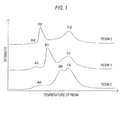
- FIG. 1 is a graph showing the outline of a peak to be observed in the thermal analysis.
- the axis of abscissa of FIG. 1 indicates the temperature of the resin, and an intensity indicated by the axis of ordinate of FIG.
- FIG. 1 corresponds to the amount of released vinylpyridine and ethylbenzene.
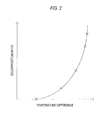
- FIG. 2 is a graph showing a relationship between: a difference in peak top temperature between two predetermined peaks as information based the shift of the characteristic peak to lower temperatures; and the decomposition ratio of the resin.
- the depolymerization is the reverse reaction of polymerization and means that a polymerized substance decomposes by virtue of the action of heat or the like to turn into a monomer.
- the peak top temperature of the peak B1 at which vinylpyridine and ethyl vinyl benzene start to desorb in the depolymerization resulting from the random scission of the main chain shifts to lower temperatures as compared to the peak B0 of the unused resin 0.
- the peak top temperature of the peak C1 at which the desorption of vinylpyridine and ethyl vinyl benzene ends in the depolymerization resulting from the random scission of the main chain is substantially equal to that of the peak C0 of the unused resin 0.
- the peak top temperature of the peak B2 at which vinylpyridine and ethyl vinyl benzene start to desorb in the depolymerization resulting from the random scission of the main chain shifts to additionally lower temperatures as compared to the peak B1 of the resin 1.
- the peak top temperature of the peak C2 at which the desorption of vinylpyridine and ethyl vinyl benzene ends in the depolymerization resulting from the random scission of the main chain is substantially equal to that of the peak C1 of the resin 1.
- a difference in peak top temperature between the peak at which vinylpyridine and ethyl vinyl benzene start to desorb in the depolymerization resulting from the random scission of the main chain, and the peak at which the desorption of vinylpyridine and ethyl vinyl benzene ends in the depolymerization resulting from the random scission of the main chain enlarges as the deterioration and decomposition progress.
- the peak B0, B1, or B2 that represents the depolymerization resulting from the random scission of the main chain and shifts to lower temperatures as the resin decomposes as described above is the characteristic peak representing the deterioration degree of the resin.
- the peak A0, A1, or A2 representing the depolymerization of the main chain terminal not resulting from the random scission of the main chain, and the peak C0, C1, or C2 at which the desorption ends in the depolymerization resulting from the random scission of the main chain are not characteristic peaks.
- the depolymerization of the main chain terminal occurs only from the main chain terminal. Accordingly, the intensity of the peak A0, A1, or A2 representing the depolymerization of the main chain terminal is extremely weak as compared to that of the peak B0, B1, or B2 representing the depolymerization resulting from the random scission of the main chain, and hence the peaks can be clearly distinguished from each other.
- a cause for the appearance of the plurality of peaks representing the depolymerization is the fact that the resin itself has a molecular weight distribution and a crosslinking degree distribution, and a portion having a relatively strong bond and a portion having a relatively weak bond are present in the resin, and hence the portion having a relatively weak bond desorbs at low temperature and the portion having a relatively strong bond desorbs at high temperature.
- the crosslinking portion is, for example, cut, and hence the crosslinked structure of the resin loosens, the nonuniformity of the structure rises, the number of thermally unstable terminal unsaturated bonds or branches increases, and the desorption is likely to occur. Accordingly, the structure of the portion having a relatively weak bond is additionally likely to loosen and the desorption is extremely likely to occur. Therefore, the desorption of the portion having a relatively weak bond is assumed to shift to even lower temperatures.
- the shift of the characteristic peak to lower temperatures that occurs as the decomposition of the resin progresses correlates with the decomposition ratio of the resin.
- the characteristic peak (B0, B1, B2, or the like) as a peak at which desorption starts in depolymerization resulting from the random scission of the main chain of each of resins having different decomposition ratios and the peak (C0, C1, C2, or the like) at which the desorption ends in the depolymerization resulting from the random scission of the main chain
- the peaks C0, C1, C2, and the like having substantially the same peak top temperature is plotted against the decomposition ratio of the resin as shown in FIG. 2 , a graph in which the difference and the decomposition ratio extremely correlate with each other can be obtained.
- Resin samples having different decomposition ratios are produced by using the same resin (e.g., the same product resin) as the object of evaluation, and a relationship between information based on the shift of the characteristic peak to lower temperatures (e.g., the peak top temperature of the characteristic peak or a difference in peak top temperature between the characteristic peak and any other peak) and a decomposition ratio is determined in advance by subjecting the samples to thermal analysis by a temperature increase.
- the same resin e.g., the same product resin
- a relationship between information based on the shift of the characteristic peak to lower temperatures e.g., the peak top temperature of the characteristic peak or a difference in peak top temperature between the characteristic peak and any other peak
- a decomposition ratio is determined in advance by subjecting the samples to thermal analysis by a temperature increase.
- Information about the characteristic peak is acquired by subjecting the resin to be evaluated to thermal analysis, and the deterioration degree is determined by using the relationship between the information based on the shift of the characteristic peak to lower temperatures and the decomposition ratio determined in advance.
- a method involving evaluating the deterioration degree of the resin based on a change in chemical structure of the resin through an infrared absorption spectrum (IR), a nuclear magnetic resonance method (NMR), Raman spectroscopy, or the like or a method involving evaluating the deterioration degree of the resin based on changes in physical characteristics such as a tension test is conceivable as a method of evaluating the deterioration degree of the resin, the evaluation method of the present invention has higher accuracy and higher facility than those of any such evaluation method.
- the resin can also be evaluated, for example, as described below.
- the resin is heated to cause depolymerization resulting from the random scission of the main chain of the resin, the temperature of the resin at which the depolymerization occurs is measured, and the evaluation is performed based on the measured temperature.
- the deterioration degree of the resin there is a correlation between the deterioration degree of the resin and the temperature of the resin at which the depolymerization resulting from the random scission of the main chain of the resin, the depolymerization being caused by the heating, occurs.
- the decomposition ratio of the resin can be quantitatively determined with ease and high accuracy as described below.
- Resins having different deterioration degrees are produced by using the same resin as the object of evaluation, each of the resins is heated to cause depolymerization resulting from the random scission of the main chain of the resin, and a relationship between the temperature of the resin at which the depolymerization resulting from the random scission of the main chain of the resin occurs and a decomposition ratio is determined in advance.
- the resin to be evaluated is heated, the temperature of the resin at which depolymerization resulting from the random scission of its main chain occurs is measured, and the decomposition ratio is determined by using the relationship between the temperature of the resin at which the depolymerization resulting from the random scission of the main chain of the resin occurs and the decomposition ratio determined in advance.
- the deterioration degree of the resin can be evaluated with ease and high accuracy by: observing the external appearance of the resin with a microscope or the like; judging the depolymerization resulting from the random scission of the main chain of the resin; and determining the temperature of the resin at which the depolymerization resulting from the random scission of the main chain of the resin occurs.
- the temperature at which the depolymerization resulting from the random scission of the main chain to be measured occurs only needs to be appropriately specified depending on a change in the resin caused by the depolymerization resulting from the random scission of the main chain of the resin and a measurement method or an observation method.
- the temperature of the resin at which the color becomes a predetermined color is measured through external appearance observation.
- the starting temperature of the characteristic peak, the peak top temperature of the characteristic peak, or the like may be defined as the temperature at which the depolymerization occurs.
- an exchange group such as a sulfo group (-SO 3 H) desorbs from the resin, and hence the performance of the ion exchange resin deteriorates, and the resin needs to be exchanged or recycled. Therefore, the application of the evaluation method of the present invention, which is an evaluation method based on the decomposition phenomenon of a resin that occurs at a temperature higher than that of the desorption of the exchange group, to the ion exchange resin has little significance.
- the evaluation method of the present invention be applied to a resin to be used until the cutting or cleavage of the main chain or crosslinking portion thereof occurs.
- a resin that can be suitably evaluated by the method of evaluating a resin of the present invention is applied to, for example, a catalyst for a production method for acetic acid through the carbonylation of methanol.
- a method of carbonylating methanol in the presence of the catalyst includes, for example, a reaction step of causing methanol (carbonylation raw material) to react with carbon monoxide in a liquid phase including a solid catalyst, which is obtained by causing a resin carrier containing quaternized nitrogen to carry a precious metal complex on itself, to produce acetic acid (carbonyl compound), a distillation step of distilling a reaction product liquid coming from the reaction step to recover a vapor phase fraction including acetic acid (carbonyl compound), and a circulation step of circulating a bottom product coming from the distillation step to the reaction step.
- FIG. 3 is a schematic view of an acetic acid-producing apparatus capable of performing the production of acetic acid through the carbonylation of methanol.
- the acetic acid-producing apparatus mainly includes: a carbonylation reactor 1 as the reaction step; a flasher 2 for performing a flash evaporation step and a light end distillation column 4 for performing a light end separation step as the distillation step; and a decanter 5 as a standing step.
- Methanol as a carbonylation raw material and carbon monoxide are introduced into the carbonylation reactor 1.
- Acetic acid as a reaction solvent circulates between the carbonylation reactor 1 and the flasher 2.
- the bottom product of the flasher 2 formed mainly of acetic acid is adapted to return to the carbonylation reactor 1.
- a vapor phase fraction coming from the flasher 2 flows into the light end distillation column 4 and is separated in the light end distillation column 4.
- Acetic acid is separated and recovered from the lower portion of the light end distillation column 4, and a component except acetic acid and a portion that has not been recovered out of acetic acid are distilled out of the apex portion thereof.
- Present in the carbonylation reactor 1 is a solid catalyst formed of a resin carrier containing quaternized nitrogen and a precious metal complex carried by the resin carrier through ion exchange, the solid catalyst being dispersed in a liquid phase.
- the resin carrier constituting the solid catalyst is a resin to be evaluated by the method of evaluating a resin of the present invention.
- the resin carrier containing the quaternized nitrogen is typically a pyridine resin, i.e., a resin including a pyridine ring whose nitrogen atom can be quaternized in its structure, and a representative example thereof is a copolymer of 4-vinylpyridine and divinylbenzene. It should be noted that the resin carrier is not limited to the specific resin and is meant to comprehensively include a resin containing basic nitrogen that can be quaternized to adsorb and carry the precious metal complex.
- polymers including, instead of 4-vinylpyridine described above, various basic nitrogen-containing monomers, e.g., 2-vinylpyridine the position of the vinyl group of which is different from that of 4-vinylpyridine, substituted vinylpyridines such as vinyl methyl pyridine, and vinylquinolines, and polymers including, instead of divinylbenzene, various crosslinkable monomers each having two or more groups including ethylenically unsaturated bonds can each be used. Further, polymers including other polymerizable comonomers such as styrene and methyl acrylate in addition to the basic nitrogen-containing monomers and the crosslinkable monomers can each be used.
- various basic nitrogen-containing monomers e.g., 2-vinylpyridine the position of the vinyl group of which is different from that of 4-vinylpyridine, substituted vinylpyridines such as vinyl methyl pyridine, and vinylquinolines
- the crosslinking degree of the resin carrier (determined by representing the content of a crosslinkable monomer in a wt% unit) is preferably 10% or more, more preferably from 15 to 40%.
- the content of the basic nitrogen in the resin only needs to be from about 2 to 10 milliequivalents per gram in terms of a basic equivalent, and is more preferably from 3.5 to 6.5 milliequivalents per gram.
- the basic nitrogen which can be generally present in a form such as a free base form, an acid-added salt form, or an N-oxide form, adsorbs and carries the precious metal complex in an ion exchange manner in a state of being quaternized.
- the resin carrier is typically used in the form of a spherical particle, and its particle diameter is generally from 0.01 to 2 mm, preferably from 0.1 to 1 mm, more preferably from 0.25 to 0.7 mm.
- the precious metal complex to be carried by the resin carrier is a complex of a precious metal showing a catalytic action on a carbonylation reaction, and is adsorbed by the quaternized nitrogen of the resin carrier in an ion exchange manner.
- rhodium and iridium have each been known as such precious metal, in general, rhodium is suitably used.
- the resin carrier and a halide of rhodium or a rhodium salt such as rhodium acetate are brought into contact with each other in a solution containing methyl iodide under pressure of carbon monoxide (0.7 to 3 MPa), the resin carrier can be caused to carry rhodium.
- a nitrogen atom in the resin carrier is quaternized, and a rhodium complex ion produced by a reaction among the rhodium halide, methyl iodide, and carbon monoxide, i.e., a rhodium carbonyl complex [Rh(CO) 2 I 2 ] - adsorbs to the atom in an ion exchange manner.
- a rhodium complex ion produced by a reaction among the rhodium halide, methyl iodide, and carbon monoxide i.e., a rhodium carbonyl complex [Rh(CO) 2 I 2 ] -
- Methanol reacts with carbon monoxide to produce acetic acid.
- a reaction accelerator such as methyl iodide is suitably added.
- acetic acid serves not only as the reaction product but also as the reaction solvent.
- a carbon monoxide gas is blown into a reaction liquid in the carbonylation reactor 1 having dispersed therein the solid catalyst, and methanol reacts with carbon monoxide in the presence of the rhodium complex-carrying solid catalyst under the conditions of a reaction temperature of from 100°C to 200°C and a reaction pressure of from about 1 to 5 MPa to produce acetic acid.
- the reaction methyl acetate, dimethyl ether, water, and the like are produced as reaction byproducts, and these byproducts are returned as a residual liquid from which acetic acid has been separated and recovered as a product to the reaction step together with the solvent, the reaction accelerator, and an unreacted raw material. Accordingly, the liquid phase in the reaction step is formed of a mixture of all of those components.
- reaction product liquid produced in the reaction step is subjected to a separation operation in the subsequent distillation step, produced acetic acid is separated and recovered as a product, and part of the residual liquid except the product is returned to the reaction step and the remainder proceeds to the standing step.
- the reaction liquid is taken out of the carbonylation reactor 1 as the reaction step through a screen or the like and flows into the flasher 2.
- the following approach is adopted: first, part of the reaction liquid is vaporized in the flasher 2 to be separated into a vapor phase and a liquid phase (flash evaporation step), and then the vapor phase fraction is introduced from the upper portion of the flasher 2 into the light end distillation column 4, and acetic acid is separated and recovered from the lower portion thereof (light end separation step).
- the reaction product liquid is a mixture of various components as described above and acetic acid is a component having a small degree of volatility out of the components, but in actuality, an impurity that has a smaller degree of volatility (or is nonvolatile) is included and hence acetic acid cannot be recovered as the product from the bottom product.
- the flasher 2 and the light end distillation column 4 can be configured as separate towers as illustrated in FIG. 3 , or can be integrally provided in the bottom portion and upper portion of a single column. It should be noted that the carbonylation reaction is generally an exothermic reaction, and hence vaporizing the part in the flasher 2 exhibits a cooling effect on the liquid phase fraction to be returned to the reaction step and introducing the heated reaction product liquid into the flasher 2 can cause the flasher to function as an evaporator for the light end distillation column 4.
- the vapor phase fraction is separated.
- all other vapor phase components can be adapted to be incorporated into an overhead fraction.
- Acetic acid is taken out of the lower portion of the light end distillation column 4 and subjected to necessary purification treatment, and is then separated and recovered as a product.
- an effluent from the overhead is introduced into the decanter 5.
- the overhead effluent of the light end distillation column 4 to be introduced into the decanter 5 after the separation of acetic acid in the distillation step contains methyl iodide, methyl acetate, and water as main components.
- methyl iodide in the effluent is separated as a heavy oil phase and an aqueous phase is obtained.
- Methyl iodide thus separated is adapted to return to the carbonylation reactor 1.
- a portion that has not been vaporized in the flasher 2 accumulates as a liquid phase fraction in the bottom portion of the flasher 2 and is returned as a bottom product coming from the distillation step (i.e., a liquid phase fraction coming from the flasher 2) to the carbonylation reactor 1 for performing the reaction step.
- the catalyst resin to be used in the production method for acetic acid is evaluated by employing the method of evaluating a resin of the present invention, its deterioration degree can be quantitatively evaluated with high accuracy and ease, and hence the timing at which the resin is exchanged or recycled can be identified. Therefore, acetic acid can be efficiently produced.
- a carbonyl compound except acetic acid can also be produced by replacing methanol with any other carbonylation raw material.
- a crosslinked vinylpyridine resin carrier was produced by a suspension polymerization method. Specifically, first, a liquid obtained by dissolving 625 g of NaCl (specific gravity adjustor), 18.8 g of NaNO 2 (radical scavenger), 4.2 g of gelatin (oil droplet stabilizer), and 0.5 g of sodium dodecylbenzenesulfonate (surfactant) in 5,241 g of ion-exchanged water was prepared as an aqueous phase.
- NaCl specific gravity adjustor
- NaNO 2 radical scavenger
- gelatin oil droplet stabilizer
- surfactant sodium dodecylbenzenesulfonate
- 1,364 g of 4-vinylpyridine (vinylpyridine-based monomer) and 1,636 g (such an amount that a crosslinking degree became 30%) of divinylbenzene (purity: 56 to 57 wt%, with the balance being ethyl vinyl benzene) (crosslinking agent) were mixed, and 562 g of toluene (pore-forming agent), 188 g of octane (pore-forming agent), 25.2 g of benzoyl peroxide (polymerization initiator), and 10.2 g of 2,2'-azobis(2,4-dimethylvaleronitrile) (auxiliary polymerization initiator) were dissolved in the mixture to prepare an oil phase.
- the crosslinking degree is determined by the following equation.
- Crosslinking degree % A / B ⁇ 100
- the prepared oil phase was charged into a 10-L suspension polymerization reactor with a jacket.
- the prepared aqueous phase was supplied from the lower portion of the reactor to the oil phase and the mixture was gently stirred. After the mixture had been stirred until oil droplets were uniformly dispersed, warm water at 65°C was flowed through the jacket of the reactor to increase the temperature of the liquid in the reactor and the monomers were polymerized in the reactor. After the temperature of the liquid in the reactor had increased to 60°C, its increase rate increased, and after the temperature had increased to 80°C, the temperature gradually reduced. After it had been confirmed that the temperature of the liquid in the reactor had reduced to 60°C, the temperature of the liquid in the reactor was further increased to 90°C and held as it was for 4 hours.
- the liquid in the reactor was cooled to normal temperature and subjected to solid-liquid separation by filtration to provide a spherical resin.
- the pore-forming agents toluene and octane
- the resultant spherical resin was classified into a product having a diameter of from 0.2 to 0.8 mm with a sieve.
- a porous vinylpyridine resin crosslinked vinylpyridine resin carrier
- the resultant crosslinked vinylpyridine resin has a crosslinking degree of 30%.
- a predetermined amount of rhodium acetate was loaded into the reactor, and rhodium was turned into a complex [Rh(CO) 2 I 2 ] - by heating rhodium acetate to a temperature of from 130°C to 180°C while blowing carbon monoxide into the reactor.
- the complex was immobilized to a quaternized pyridine group through an ion exchange reaction to provide a rhodium-carrying catalyst.
- the carrying amount of rhodium was 0.85 wt% with respect to the carrier before the quaternization (crosslinked vinylpyridine resin carrier).
- the autoclave was cooled to room temperature, a reaction liquid and the decomposed rhodium-carrying catalyst were separated from each other, the concentration of a nitrogen-containing compound in the reaction liquid was measured, and the decomposition ratio of the resin as a carrier for the rhodium-carrying catalyst was determined by the following equation. As a result, the decomposition ratio was 0.7%.
- the decomposed rhodium-carrying catalyst separated from the reaction liquid was washed with methanol and fractionated from methanol. After that, methanol taken in the pores of the resin of the rhodium-carrying catalyst was volatilized by leaving the catalyst to stand overnight. After that, the residue was dried at 105°C for 48 hours to provide a sample for TG analysis (sample 1).
- Decomposition ratio (%) amount (g) of nitrogen-containing compound produced by decomposition/amount (g) of raw material pyridine group ⁇ 100
- sample 2 had a decomposition ratio of 9.2%
- sample 3 had a decomposition ratio of 10.3%
- the sample 4 had a decomposition ratio of 23.0%
- the sample 5 had a decomposition ratio of 28.0%.
- the resultant samples 1 to 5 and the rhodium-carrying catalyst (sample 0) obtained in the section ⁇ Production of rhodium-carrying catalyst> were each subjected to TG-MS analysis with a TG-MS apparatus (obtained by directly coupling a TG apparatus with an MS apparatus). Specifically, about 3.5 mg of each sample were weighed and mounted on a TG cell, and its temperature was increased from 25°C to 600°C at a rate of 20°C/min while a He gas was flowed at 100 mL/min. A decomposition product produced in the temperature increase process was introduced from a TG-MS interface portion into the ionization chamber of the MS together with the He gas.
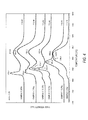
- FIG. 4 shows the resultant TG-MS profiles at an m/z of 105.
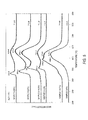
- FIG. 5 shows the resultant TG-MS profiles at an m/z of 132.
- Temperatures indicated by the axes of abscissa of FIG. 4 and FIG. 5 are the temperatures of resins.
- the profiles shown in FIG. 4 and FIG. 5 are multiplied by certain magnifications in order that their intensities (mass intensities) may be uniformized, and a multiplied magnification is represented by " ⁇ numerical value".
- an m/z of 105 is the peak of a vinylpyridine molecular ion
- an m/z of 132 is the peak of an ethyl vinyl benzene molecular ion.
- the random scission of the polymer main chain that can occur in a deterioration process is not involved in the depolymerization at the temperature. Further, when the sample was heated to 330°C or more, the polymer main chain randomly cleaved, and such depolymerization that the monomers were released from the respective end portions produced by the random scission started and continued until the temperature reached 500°C. It is assumed that the sample 0 as the carrier resin that had not decomposed contained a polymer molecule having a molecular weight distribution and a crosslinking degree distribution, and hence the temperature range of the decomposition involving the release of the monomers became wide.
- the peak top temperature of the peak at the lower temperature was 396.6°C and the peak top temperature of the peak at the higher temperature was 419.0°C.
- the peak observed at 396.6°C is the peak at which vinylpyridine and ethyl vinyl benzene start to desorb, and the peak observed at 419.0°C is the peak at which the desorption of vinylpyridine and ethyl vinyl benzene ends.
- FIG. 6 shows a relationship between the difference in peak top temperature between the peaks and the decomposition ratio of the resin in the profiles at an m/z of 105.
- FIG. 7 shows a relationship between the difference in peak top temperature between the peaks and the decomposition ratio of the resin in the profiles at an m/z of 132.
- the deterioration degree of the resin can be determined as described below.
- a relationship between the decomposition ratio of the same resin as the resin to be evaluated, and the temperature difference between the characteristic peak and reference peak of the TG-MS analysis is determined in advance, the resin to be evaluated is subjected to the TG-MS analysis by a temperature increase, and the temperature difference between the characteristic peak and the reference peak is determined. That is, the difference in peak top temperature can be an indicator for the evaluation of the deterioration degree of the resin.
- FIG. 8 shows DTG profiles obtained in the TG-MS analysis.
- a temperature indicated by the axis of abscissa of FIG. 8 is the temperature of the resin.
- the following peaks were observed: a peak (reference peak) that was observed at around 414°C to 428°C and whose peak top temperature was hardly changed by the decomposition ratio, and a peak (characteristic peak) that was observed at a temperature lower than that of the reference peak and whose peak top shifted to lower temperatures from around 392°C to 328°C as the decomposition ratio increased.
- FIG. 9 shows a relationship between the difference in peak top temperature and the decomposition ratio of the resin in the DTG profiles of the samples 0 to 5.
- the temperature difference between the characteristic peak and the reference peak has an extremely high correlation with the decomposition ratio of the resin.
- the deterioration degree of a resin can be evaluated with ease and high accuracy by using a characteristic peak that shifts to lower temperatures depending on a decomposition ratio (deterioration degree), the peak being observed in thermal analysis such as TG-MS or DTG.
- the deterioration of the resin can be evaluated with higher accuracy by determining a difference in peak top temperature between the peak and a peak (reference peak) whose peak top positon is hardly changed by the decomposition of the resin.
- the deterioration degree of a resin can be evaluated with high accuracy and ease by using information based on the shift of a characteristic peak representing the deterioration degree of the resin, the peak being observed in thermal analysis by a temperature increase, to lower temperatures. Further, the deterioration degree of the resin can be evaluated with high accuracy and ease by heating the resin to cause depolymerization resulting from random scission of a main chain of the resin, measuring a temperature of the resin at which the depolymerization occurs and evaluating a deterioration degree of the resin based on the measured temperature. The evaluation can be quantitatively performed.
Landscapes
- Chemical & Material Sciences (AREA)
- Life Sciences & Earth Sciences (AREA)
- Health & Medical Sciences (AREA)
- Physics & Mathematics (AREA)
- Analytical Chemistry (AREA)
- Biochemistry (AREA)
- General Health & Medical Sciences (AREA)
- General Physics & Mathematics (AREA)
- Immunology (AREA)
- Pathology (AREA)
- Engineering & Computer Science (AREA)
- Food Science & Technology (AREA)
- Medicinal Chemistry (AREA)
- Organic Chemistry (AREA)
- Chemical Kinetics & Catalysis (AREA)
- Materials Engineering (AREA)
- Biodiversity & Conservation Biology (AREA)
- Ecology (AREA)
- Environmental & Geological Engineering (AREA)
- Environmental Sciences (AREA)
- Catalysts (AREA)
- Investigating Or Analyzing Materials Using Thermal Means (AREA)
- Polymerisation Methods In General (AREA)
- Investigating Or Analyzing Non-Biological Materials By The Use Of Chemical Means (AREA)
Applications Claiming Priority (1)
| Application Number | Priority Date | Filing Date | Title |
|---|---|---|---|
| JP2013241927A JP6292839B2 (ja) | 2013-11-22 | 2013-11-22 | 樹脂の評価方法 |
Publications (3)
| Publication Number | Publication Date |
|---|---|
| EP2876426A2 true EP2876426A2 (de) | 2015-05-27 |
| EP2876426A3 EP2876426A3 (de) | 2015-07-15 |
| EP2876426B1 EP2876426B1 (de) | 2017-07-05 |
Family
ID=51999241
Family Applications (1)
| Application Number | Title | Priority Date | Filing Date |
|---|---|---|---|
| EP14194025.4A Active EP2876426B1 (de) | 2013-11-22 | 2014-11-20 | Verfahren zur Bewertung der Alterung von Harz mittels thermischer Analyse |
Country Status (3)
| Country | Link |
|---|---|
| US (1) | US9638684B2 (de) |
| EP (1) | EP2876426B1 (de) |
| JP (1) | JP6292839B2 (de) |
Families Citing this family (4)
| Publication number | Priority date | Publication date | Assignee | Title |
|---|---|---|---|---|
| KR102028018B1 (ko) * | 2017-03-27 | 2019-10-02 | 주식회사 엘지화학 | 고무 보강용 유-무기 복합체의 고무 보강 효과를 예측하는 방법 |
| CN107490526B (zh) * | 2017-09-06 | 2023-08-22 | 中国工程物理研究院核物理与化学研究所 | 高分子材料老化效应无损检测装置及其检测方法 |
| CN113075253A (zh) * | 2021-03-08 | 2021-07-06 | 江苏斯尔邦石化有限公司 | 一种检测聚烯烃中残留过氧化物的方法 |
| CN115876714B (zh) * | 2022-12-14 | 2025-10-31 | 青岛科技大学 | 一种裂解固相产物的tg-ftir评价方法 |
Citations (2)
| Publication number | Priority date | Publication date | Assignee | Title |
|---|---|---|---|---|
| JPH06315637A (ja) | 1993-04-30 | 1994-11-15 | Chiyoda Corp | カルボニル化反応用固体触媒及びそれを用いる酢酸の製造方法 |
| JP2012081440A (ja) | 2010-10-14 | 2012-04-26 | Chiyoda Kako Kensetsu Kk | 触媒担体用ビニルピリジン樹脂及びその製造方法 |
Family Cites Families (11)
| Publication number | Priority date | Publication date | Assignee | Title |
|---|---|---|---|---|
| US4692371A (en) * | 1985-07-30 | 1987-09-08 | Kimberly-Clark Corporation | High temperature method of making elastomeric materials and materials obtained thereby |
| US4663220A (en) * | 1985-07-30 | 1987-05-05 | Kimberly-Clark Corporation | Polyolefin-containing extrudable compositions and methods for their formation into elastomeric products including microfibers |
| JPH068793B2 (ja) * | 1986-01-14 | 1994-02-02 | 株式会社安川電機 | 熱劣化検出方法 |
| JP2794596B2 (ja) * | 1989-07-03 | 1998-09-10 | 株式会社安川電機 | 温度履歴推定法 |
| JP2003344262A (ja) * | 2002-05-28 | 2003-12-03 | Mitsubishi Electric Corp | 高分子材料の劣化度診断方法 |
| JP2005265492A (ja) * | 2004-03-17 | 2005-09-29 | Meidensha Corp | 電気機器の絶縁劣化診断方法と診断後の電気機器運転方法 |
| US8580914B2 (en) * | 2006-01-30 | 2013-11-12 | Kureha Corporation | Process for producing aliphatic polyester |
| WO2008047468A1 (en) | 2006-10-17 | 2008-04-24 | Mitsui Chemicals, Inc. | Resin composition and molded article produced from the composition |
| JP5437831B2 (ja) * | 2010-01-22 | 2014-03-12 | 旭化成ホームズ株式会社 | ポリエーテル含有高分子の劣化度評価方法 |
| JP5505291B2 (ja) * | 2010-12-20 | 2014-05-28 | 住友電装株式会社 | 樹脂製品の熱安定性及び劣化度の評価方法 |
| US9926397B2 (en) | 2012-02-10 | 2018-03-27 | Chiyoda Corporation | Vinylpyridine resin for catalyst carriers and method of manufacturing the same |
-
2013
- 2013-11-22 JP JP2013241927A patent/JP6292839B2/ja not_active Expired - Fee Related
-
2014
- 2014-11-19 US US14/547,989 patent/US9638684B2/en active Active
- 2014-11-20 EP EP14194025.4A patent/EP2876426B1/de active Active
Patent Citations (2)
| Publication number | Priority date | Publication date | Assignee | Title |
|---|---|---|---|---|
| JPH06315637A (ja) | 1993-04-30 | 1994-11-15 | Chiyoda Corp | カルボニル化反応用固体触媒及びそれを用いる酢酸の製造方法 |
| JP2012081440A (ja) | 2010-10-14 | 2012-04-26 | Chiyoda Kako Kensetsu Kk | 触媒担体用ビニルピリジン樹脂及びその製造方法 |
Also Published As
| Publication number | Publication date |
|---|---|
| EP2876426A3 (de) | 2015-07-15 |
| US20150147816A1 (en) | 2015-05-28 |
| EP2876426B1 (de) | 2017-07-05 |
| JP2015102377A (ja) | 2015-06-04 |
| JP6292839B2 (ja) | 2018-03-14 |
| US9638684B2 (en) | 2017-05-02 |
Similar Documents
| Publication | Publication Date | Title |
|---|---|---|
| EP2876426B1 (de) | Verfahren zur Bewertung der Alterung von Harz mittels thermischer Analyse | |
| CA2324454C (en) | Polymer formulations for gettering hydrogen | |
| JP2015513545A (ja) | クロロトリフルオロエチレンからのトリフルオロエチレンの合成方法 | |
| CN101797523A (zh) | 除去碘化物的方法 | |
| EP2606973A1 (de) | Thiolgruppenhaltiges Acrylatharz | |
| EP2066614A1 (de) | Verfahren zum entfernen einer iodidverbindung aus einer organischen säure | |
| JP2000507603A (ja) | ラクタムの精製方法 | |
| US8242304B2 (en) | Process for production of isophthalic acid | |
| EP2259875A1 (de) | Picolylaminharze | |
| US7488859B2 (en) | Method for producing adamantane | |
| JP5658643B2 (ja) | 多孔質ポリマー粒子およびそれを用いたイオン交換樹脂粒子並びにそれらの製造方法 | |
| CN1068873C (zh) | 二甲亚砜(dmso)纯化方法 | |
| CN114787128A (zh) | 十二内酰胺的制备方法及其合成装置、通过其制备的十二内酰胺组合物及利用十二内酰胺组合物的聚十二内酰胺的制备方法 | |
| WO2006008738A1 (en) | Synthesis of aromatic polyhalogenated halomethyl compounds | |
| CN107722145B (zh) | 一种氢化丁腈橡胶的制备方法 | |
| EP0042877B1 (de) | Verfahren zur trennung von kohlenstoffisotopen durch chemischen austausch | |
| JP4077253B2 (ja) | カルボニル化合物の製造方法 | |
| CN107722147B (zh) | 一种极性聚合物的选择性加氢方法 | |
| JPS603083B2 (ja) | 重金属吸着剤の製造方法 | |
| JP2014234383A (ja) | カルボニル化合物の製造方法 | |
| EP3237464A1 (de) | Verfahren zur herstellung von aminomethylierten perlpolymerisaten aus n-carbonsäuremethylphthalimidestern | |
| KR102719142B1 (ko) | 촉진제와 산화방지제를 함유한 수지 | |
| YONEZAWA et al. | Kogyo Kagaku Zasshi | |
| JPS6152164B2 (de) | ||
| EP3277627B1 (de) | Sulfonierungsverfahren |
Legal Events
| Date | Code | Title | Description |
|---|---|---|---|
| PUAI | Public reference made under article 153(3) epc to a published international application that has entered the european phase |
Free format text: ORIGINAL CODE: 0009012 |
|
| 17P | Request for examination filed |
Effective date: 20141120 |
|
| AK | Designated contracting states |
Kind code of ref document: A2 Designated state(s): AL AT BE BG CH CY CZ DE DK EE ES FI FR GB GR HR HU IE IS IT LI LT LU LV MC MK MT NL NO PL PT RO RS SE SI SK SM TR |
|
| AX | Request for extension of the european patent |
Extension state: BA ME |
|
| PUAL | Search report despatched |
Free format text: ORIGINAL CODE: 0009013 |
|
| AK | Designated contracting states |
Kind code of ref document: A3 Designated state(s): AL AT BE BG CH CY CZ DE DK EE ES FI FR GB GR HR HU IE IS IT LI LT LU LV MC MK MT NL NO PL PT RO RS SE SI SK SM TR |
|
| AX | Request for extension of the european patent |
Extension state: BA ME |
|
| RIC1 | Information provided on ipc code assigned before grant |
Ipc: G01N 5/04 20060101AFI20150608BHEP Ipc: G01N 33/44 20060101ALI20150608BHEP |
|
| R17P | Request for examination filed (corrected) |
Effective date: 20160115 |
|
| RBV | Designated contracting states (corrected) |
Designated state(s): AL AT BE BG CH CY CZ DE DK EE ES FI FR GB GR HR HU IE IS IT LI LT LU LV MC MK MT NL NO PL PT RO RS SE SI SK SM TR |
|
| GRAP | Despatch of communication of intention to grant a patent |
Free format text: ORIGINAL CODE: EPIDOSNIGR1 |
|
| INTG | Intention to grant announced |
Effective date: 20170323 |
|
| GRAS | Grant fee paid |
Free format text: ORIGINAL CODE: EPIDOSNIGR3 |
|
| GRAA | (expected) grant |
Free format text: ORIGINAL CODE: 0009210 |
|
| AK | Designated contracting states |
Kind code of ref document: B1 Designated state(s): AL AT BE BG CH CY CZ DE DK EE ES FI FR GB GR HR HU IE IS IT LI LT LU LV MC MK MT NL NO PL PT RO RS SE SI SK SM TR |
|
| REG | Reference to a national code |
Ref country code: GB Ref legal event code: FG4D |
|
| REG | Reference to a national code |
Ref country code: CH Ref legal event code: EP |
|
| REG | Reference to a national code |
Ref country code: AT Ref legal event code: REF Ref document number: 906938 Country of ref document: AT Kind code of ref document: T Effective date: 20170715 |
|
| REG | Reference to a national code |
Ref country code: IE Ref legal event code: FG4D |
|
| REG | Reference to a national code |
Ref country code: DE Ref legal event code: R096 Ref document number: 602014011447 Country of ref document: DE |
|
| REG | Reference to a national code |
Ref country code: NL Ref legal event code: MP Effective date: 20170705 |
|
| REG | Reference to a national code |
Ref country code: AT Ref legal event code: MK05 Ref document number: 906938 Country of ref document: AT Kind code of ref document: T Effective date: 20170705 |
|
| REG | Reference to a national code |
Ref country code: FR Ref legal event code: PLFP Year of fee payment: 4 |
|
| REG | Reference to a national code |
Ref country code: LT Ref legal event code: MG4D |
|
| PG25 | Lapsed in a contracting state [announced via postgrant information from national office to epo] |
Ref country code: FI Free format text: LAPSE BECAUSE OF FAILURE TO SUBMIT A TRANSLATION OF THE DESCRIPTION OR TO PAY THE FEE WITHIN THE PRESCRIBED TIME-LIMIT Effective date: 20170705 Ref country code: NL Free format text: LAPSE BECAUSE OF FAILURE TO SUBMIT A TRANSLATION OF THE DESCRIPTION OR TO PAY THE FEE WITHIN THE PRESCRIBED TIME-LIMIT Effective date: 20170705 Ref country code: SE Free format text: LAPSE BECAUSE OF FAILURE TO SUBMIT A TRANSLATION OF THE DESCRIPTION OR TO PAY THE FEE WITHIN THE PRESCRIBED TIME-LIMIT Effective date: 20170705 Ref country code: AT Free format text: LAPSE BECAUSE OF FAILURE TO SUBMIT A TRANSLATION OF THE DESCRIPTION OR TO PAY THE FEE WITHIN THE PRESCRIBED TIME-LIMIT Effective date: 20170705 Ref country code: LT Free format text: LAPSE BECAUSE OF FAILURE TO SUBMIT A TRANSLATION OF THE DESCRIPTION OR TO PAY THE FEE WITHIN THE PRESCRIBED TIME-LIMIT Effective date: 20170705 Ref country code: HR Free format text: LAPSE BECAUSE OF FAILURE TO SUBMIT A TRANSLATION OF THE DESCRIPTION OR TO PAY THE FEE WITHIN THE PRESCRIBED TIME-LIMIT Effective date: 20170705 Ref country code: NO Free format text: LAPSE BECAUSE OF FAILURE TO SUBMIT A TRANSLATION OF THE DESCRIPTION OR TO PAY THE FEE WITHIN THE PRESCRIBED TIME-LIMIT Effective date: 20171005 |
|
| PG25 | Lapsed in a contracting state [announced via postgrant information from national office to epo] |
Ref country code: ES Free format text: LAPSE BECAUSE OF FAILURE TO SUBMIT A TRANSLATION OF THE DESCRIPTION OR TO PAY THE FEE WITHIN THE PRESCRIBED TIME-LIMIT Effective date: 20170705 Ref country code: LV Free format text: LAPSE BECAUSE OF FAILURE TO SUBMIT A TRANSLATION OF THE DESCRIPTION OR TO PAY THE FEE WITHIN THE PRESCRIBED TIME-LIMIT Effective date: 20170705 Ref country code: PL Free format text: LAPSE BECAUSE OF FAILURE TO SUBMIT A TRANSLATION OF THE DESCRIPTION OR TO PAY THE FEE WITHIN THE PRESCRIBED TIME-LIMIT Effective date: 20170705 Ref country code: IS Free format text: LAPSE BECAUSE OF FAILURE TO SUBMIT A TRANSLATION OF THE DESCRIPTION OR TO PAY THE FEE WITHIN THE PRESCRIBED TIME-LIMIT Effective date: 20171105 Ref country code: GR Free format text: LAPSE BECAUSE OF FAILURE TO SUBMIT A TRANSLATION OF THE DESCRIPTION OR TO PAY THE FEE WITHIN THE PRESCRIBED TIME-LIMIT Effective date: 20171006 Ref country code: RS Free format text: LAPSE BECAUSE OF FAILURE TO SUBMIT A TRANSLATION OF THE DESCRIPTION OR TO PAY THE FEE WITHIN THE PRESCRIBED TIME-LIMIT Effective date: 20170705 Ref country code: BG Free format text: LAPSE BECAUSE OF FAILURE TO SUBMIT A TRANSLATION OF THE DESCRIPTION OR TO PAY THE FEE WITHIN THE PRESCRIBED TIME-LIMIT Effective date: 20171005 |
|
| REG | Reference to a national code |
Ref country code: DE Ref legal event code: R097 Ref document number: 602014011447 Country of ref document: DE |
|
| PG25 | Lapsed in a contracting state [announced via postgrant information from national office to epo] |
Ref country code: DK Free format text: LAPSE BECAUSE OF FAILURE TO SUBMIT A TRANSLATION OF THE DESCRIPTION OR TO PAY THE FEE WITHIN THE PRESCRIBED TIME-LIMIT Effective date: 20170705 Ref country code: CZ Free format text: LAPSE BECAUSE OF FAILURE TO SUBMIT A TRANSLATION OF THE DESCRIPTION OR TO PAY THE FEE WITHIN THE PRESCRIBED TIME-LIMIT Effective date: 20170705 Ref country code: RO Free format text: LAPSE BECAUSE OF FAILURE TO SUBMIT A TRANSLATION OF THE DESCRIPTION OR TO PAY THE FEE WITHIN THE PRESCRIBED TIME-LIMIT Effective date: 20170705 |
|
| PLBE | No opposition filed within time limit |
Free format text: ORIGINAL CODE: 0009261 |
|
| STAA | Information on the status of an ep patent application or granted ep patent |
Free format text: STATUS: NO OPPOSITION FILED WITHIN TIME LIMIT |
|
| PG25 | Lapsed in a contracting state [announced via postgrant information from national office to epo] |
Ref country code: EE Free format text: LAPSE BECAUSE OF FAILURE TO SUBMIT A TRANSLATION OF THE DESCRIPTION OR TO PAY THE FEE WITHIN THE PRESCRIBED TIME-LIMIT Effective date: 20170705 Ref country code: IT Free format text: LAPSE BECAUSE OF FAILURE TO SUBMIT A TRANSLATION OF THE DESCRIPTION OR TO PAY THE FEE WITHIN THE PRESCRIBED TIME-LIMIT Effective date: 20170705 Ref country code: SK Free format text: LAPSE BECAUSE OF FAILURE TO SUBMIT A TRANSLATION OF THE DESCRIPTION OR TO PAY THE FEE WITHIN THE PRESCRIBED TIME-LIMIT Effective date: 20170705 Ref country code: SM Free format text: LAPSE BECAUSE OF FAILURE TO SUBMIT A TRANSLATION OF THE DESCRIPTION OR TO PAY THE FEE WITHIN THE PRESCRIBED TIME-LIMIT Effective date: 20170705 |
|
| 26N | No opposition filed |
Effective date: 20180406 |
|
| PG25 | Lapsed in a contracting state [announced via postgrant information from national office to epo] |
Ref country code: MC Free format text: LAPSE BECAUSE OF FAILURE TO SUBMIT A TRANSLATION OF THE DESCRIPTION OR TO PAY THE FEE WITHIN THE PRESCRIBED TIME-LIMIT Effective date: 20170705 |
|
| PG25 | Lapsed in a contracting state [announced via postgrant information from national office to epo] |
Ref country code: LI Free format text: LAPSE BECAUSE OF NON-PAYMENT OF DUE FEES Effective date: 20171130 Ref country code: CH Free format text: LAPSE BECAUSE OF NON-PAYMENT OF DUE FEES Effective date: 20171130 |
|
| PG25 | Lapsed in a contracting state [announced via postgrant information from national office to epo] |
Ref country code: SI Free format text: LAPSE BECAUSE OF FAILURE TO SUBMIT A TRANSLATION OF THE DESCRIPTION OR TO PAY THE FEE WITHIN THE PRESCRIBED TIME-LIMIT Effective date: 20170705 Ref country code: LU Free format text: LAPSE BECAUSE OF NON-PAYMENT OF DUE FEES Effective date: 20171120 |
|
| REG | Reference to a national code |
Ref country code: BE Ref legal event code: MM Effective date: 20171130 |
|
| REG | Reference to a national code |
Ref country code: IE Ref legal event code: MM4A |
|
| PG25 | Lapsed in a contracting state [announced via postgrant information from national office to epo] |
Ref country code: MT Free format text: LAPSE BECAUSE OF NON-PAYMENT OF DUE FEES Effective date: 20171120 |
|
| REG | Reference to a national code |
Ref country code: FR Ref legal event code: PLFP Year of fee payment: 5 |
|
| PG25 | Lapsed in a contracting state [announced via postgrant information from national office to epo] |
Ref country code: IE Free format text: LAPSE BECAUSE OF NON-PAYMENT OF DUE FEES Effective date: 20171120 |
|
| PG25 | Lapsed in a contracting state [announced via postgrant information from national office to epo] |
Ref country code: BE Free format text: LAPSE BECAUSE OF NON-PAYMENT OF DUE FEES Effective date: 20171130 |
|
| PG25 | Lapsed in a contracting state [announced via postgrant information from national office to epo] |
Ref country code: HU Free format text: LAPSE BECAUSE OF FAILURE TO SUBMIT A TRANSLATION OF THE DESCRIPTION OR TO PAY THE FEE WITHIN THE PRESCRIBED TIME-LIMIT; INVALID AB INITIO Effective date: 20141120 |
|
| PG25 | Lapsed in a contracting state [announced via postgrant information from national office to epo] |
Ref country code: CY Free format text: LAPSE BECAUSE OF FAILURE TO SUBMIT A TRANSLATION OF THE DESCRIPTION OR TO PAY THE FEE WITHIN THE PRESCRIBED TIME-LIMIT Effective date: 20170705 |
|
| PG25 | Lapsed in a contracting state [announced via postgrant information from national office to epo] |
Ref country code: MK Free format text: LAPSE BECAUSE OF FAILURE TO SUBMIT A TRANSLATION OF THE DESCRIPTION OR TO PAY THE FEE WITHIN THE PRESCRIBED TIME-LIMIT Effective date: 20170705 |
|
| PG25 | Lapsed in a contracting state [announced via postgrant information from national office to epo] |
Ref country code: PT Free format text: LAPSE BECAUSE OF FAILURE TO SUBMIT A TRANSLATION OF THE DESCRIPTION OR TO PAY THE FEE WITHIN THE PRESCRIBED TIME-LIMIT Effective date: 20170705 |
|
| PG25 | Lapsed in a contracting state [announced via postgrant information from national office to epo] |
Ref country code: AL Free format text: LAPSE BECAUSE OF FAILURE TO SUBMIT A TRANSLATION OF THE DESCRIPTION OR TO PAY THE FEE WITHIN THE PRESCRIBED TIME-LIMIT Effective date: 20170705 |
|
| PGFP | Annual fee paid to national office [announced via postgrant information from national office to epo] |
Ref country code: TR Payment date: 20201119 Year of fee payment: 7 |
|
| PGFP | Annual fee paid to national office [announced via postgrant information from national office to epo] |
Ref country code: FR Payment date: 20201013 Year of fee payment: 7 Ref country code: GB Payment date: 20201112 Year of fee payment: 7 Ref country code: DE Payment date: 20201110 Year of fee payment: 7 |
|
| REG | Reference to a national code |
Ref country code: DE Ref legal event code: R119 Ref document number: 602014011447 Country of ref document: DE |
|
| GBPC | Gb: european patent ceased through non-payment of renewal fee |
Effective date: 20211120 |
|
| PG25 | Lapsed in a contracting state [announced via postgrant information from national office to epo] |
Ref country code: GB Free format text: LAPSE BECAUSE OF NON-PAYMENT OF DUE FEES Effective date: 20211120 Ref country code: DE Free format text: LAPSE BECAUSE OF NON-PAYMENT OF DUE FEES Effective date: 20220601 |
|
| PG25 | Lapsed in a contracting state [announced via postgrant information from national office to epo] |
Ref country code: FR Free format text: LAPSE BECAUSE OF NON-PAYMENT OF DUE FEES Effective date: 20211130 |