EP2878599B1 - Carbazolverbindung und organische lichtemittierende Vorrichtung damit - Google Patents
Carbazolverbindung und organische lichtemittierende Vorrichtung damit Download PDFInfo
- Publication number
- EP2878599B1 EP2878599B1 EP14195105.3A EP14195105A EP2878599B1 EP 2878599 B1 EP2878599 B1 EP 2878599B1 EP 14195105 A EP14195105 A EP 14195105A EP 2878599 B1 EP2878599 B1 EP 2878599B1
- Authority
- EP
- European Patent Office
- Prior art keywords
- group
- substituted
- unsubstituted
- salt
- deuterium
- Prior art date
- Legal status (The legal status is an assumption and is not a legal conclusion. Google has not performed a legal analysis and makes no representation as to the accuracy of the status listed.)
- Active
Links
- 0 C**1=CC=CC=C(N)N1 Chemical compound C**1=CC=CC=C(N)N1 0.000 description 61
- SDFLTYHTFPTIGX-UHFFFAOYSA-N C[n]1c(cccc2)c2c2c1cccc2 Chemical compound C[n]1c(cccc2)c2c2c1cccc2 SDFLTYHTFPTIGX-UHFFFAOYSA-N 0.000 description 3
- NVTHRATUICQJQQ-UHFFFAOYSA-N Brc(cc1)ccc1-c1c(c(cccc2)c2[o]2)c2ccc1 Chemical compound Brc(cc1)ccc1-c1c(c(cccc2)c2[o]2)c2ccc1 NVTHRATUICQJQQ-UHFFFAOYSA-N 0.000 description 1
- SASGPMFRNNPUBK-UHFFFAOYSA-N C(C1)C=CC(C2=CCC3)=C1SC2=C3c(cccc1)c1-[n]1c(ccc(-c(cc2)ccc2C2=NC(C3=CC=CCC3)=NC(c3ccccc3)N2)c2)c2c2ccccc12 Chemical compound C(C1)C=CC(C2=CCC3)=C1SC2=C3c(cccc1)c1-[n]1c(ccc(-c(cc2)ccc2C2=NC(C3=CC=CCC3)=NC(c3ccccc3)N2)c2)c2c2ccccc12 SASGPMFRNNPUBK-UHFFFAOYSA-N 0.000 description 1
- WREGAJOERVZGTK-UHFFFAOYSA-N C(C1)C=CC=C1c1cc(-c2ccccc2)nc(-c(cc2)ccc2-c(cc2)cc(c3c4cccc3)c2[n]4-c(cc2)ccc2-c2c(c3ccccc3[o]3)c3ccc2)n1 Chemical compound C(C1)C=CC=C1c1cc(-c2ccccc2)nc(-c(cc2)ccc2-c(cc2)cc(c3c4cccc3)c2[n]4-c(cc2)ccc2-c2c(c3ccccc3[o]3)c3ccc2)n1 WREGAJOERVZGTK-UHFFFAOYSA-N 0.000 description 1
- AZQAENOTSHPATA-UHFFFAOYSA-N C(C1)C=CC=C1c1nc(-c(cc2)ccc2-c(cc2)cc(c3ccccc33)c2[n]3-c2cccc(-c(cc34)ccc3-c3ccccc3C4(c3ccccc3)c3ccccc3)c2)cc(-c2ccccc2)c1 Chemical compound C(C1)C=CC=C1c1nc(-c(cc2)ccc2-c(cc2)cc(c3ccccc33)c2[n]3-c2cccc(-c(cc34)ccc3-c3ccccc3C4(c3ccccc3)c3ccccc3)c2)cc(-c2ccccc2)c1 AZQAENOTSHPATA-UHFFFAOYSA-N 0.000 description 1
- GFMSIIQURIXBIE-UHFFFAOYSA-N C(C1)C=Cc2c1[o]c1c2cccc1 Chemical compound C(C1)C=Cc2c1[o]c1c2cccc1 GFMSIIQURIXBIE-UHFFFAOYSA-N 0.000 description 1
- RSZXTWSIQWWCEC-UHFFFAOYSA-N C(C1)C=Cc2c1[s]c1c2cccc1-c(cc1)ccc1-[n]1c(ccc(C2=CCCC(c3nc(-c4ccccc4)cc(C4C=CC=CC4)n3)=C2)c2)c2c2ccccc12 Chemical compound C(C1)C=Cc2c1[s]c1c2cccc1-c(cc1)ccc1-[n]1c(ccc(C2=CCCC(c3nc(-c4ccccc4)cc(C4C=CC=CC4)n3)=C2)c2)c2c2ccccc12 RSZXTWSIQWWCEC-UHFFFAOYSA-N 0.000 description 1
- ZNJFMTBZIORMJV-FMMKXHLHSA-N C(C1C=C2)[C@H]1C=C2[n](c(cccc1)c1c1ccc2)c1c2-c(cc1)ccc1-[n]1c(ccc(-c2ccccc2-c2nc(-c3ccccc3)cc(-c3ccccc3)n2)c2)c2c2c1cccc2 Chemical compound C(C1C=C2)[C@H]1C=C2[n](c(cccc1)c1c1ccc2)c1c2-c(cc1)ccc1-[n]1c(ccc(-c2ccccc2-c2nc(-c3ccccc3)cc(-c3ccccc3)n2)c2)c2c2c1cccc2 ZNJFMTBZIORMJV-FMMKXHLHSA-N 0.000 description 1
- GBOZOYKFVGJZEO-UHFFFAOYSA-N C(C1[U]c2ccccc2[IH]1)/C=[I]/C1CC=CCC1 Chemical compound C(C1[U]c2ccccc2[IH]1)/C=[I]/C1CC=CCC1 GBOZOYKFVGJZEO-UHFFFAOYSA-N 0.000 description 1
- PUECXYVZOXOVDR-TUQVONSKSA-N C(CC(N(C1C=CC=CC1c1c2)c1ccc2-c1ccc(C2C=CN=C3C=CC=C[C@H]23)cc1)=C1)C=C1c1c(c2ccccc2[n]2-c3ccccc3)c2ccc1 Chemical compound C(CC(N(C1C=CC=CC1c1c2)c1ccc2-c1ccc(C2C=CN=C3C=CC=C[C@H]23)cc1)=C1)C=C1c1c(c2ccccc2[n]2-c3ccccc3)c2ccc1 PUECXYVZOXOVDR-TUQVONSKSA-N 0.000 description 1
- RCCHTRHSVWFLAP-QSCHNALKSA-N C(CC(c1[n-]c(-c2ccccc2)nc(C2=C3C=CC=C[C@@H]23)n1)=C1)C=C1c1cccc(c2c3cccc2)c1[n]3-c(cccc1)c1-c1cc(-c2ccccc2Nc2ccccc2)ccc1 Chemical compound C(CC(c1[n-]c(-c2ccccc2)nc(C2=C3C=CC=C[C@@H]23)n1)=C1)C=C1c1cccc(c2c3cccc2)c1[n]3-c(cccc1)c1-c1cc(-c2ccccc2Nc2ccccc2)ccc1 RCCHTRHSVWFLAP-QSCHNALKSA-N 0.000 description 1
- ZKMLXXKBJYHXDI-UHFFFAOYSA-N C(CC=C1)Cc(c2c3ccc(-c4cccc(-c5nc(-c6ccccc6)nc(-c6ccccc6)n5)c4)c2)c1[n]3-c(cc1)ccc1-c1c(c2ccccc2[o]2)c2ccc1 Chemical compound C(CC=C1)Cc(c2c3ccc(-c4cccc(-c5nc(-c6ccccc6)nc(-c6ccccc6)n5)c4)c2)c1[n]3-c(cc1)ccc1-c1c(c2ccccc2[o]2)c2ccc1 ZKMLXXKBJYHXDI-UHFFFAOYSA-N 0.000 description 1
- LCFOUMGNZPBCMN-KJSHOOASSA-N C([C@@H](C1C=CC=CC1S1)C1=C1)C=C1c1cccc(-[n]2c(C=CC(C3)c4cc(-c5nccc6c5cccc6)ccc4)c3c3ccccc23)c1 Chemical compound C([C@@H](C1C=CC=CC1S1)C1=C1)C=C1c1cccc(-[n]2c(C=CC(C3)c4cc(-c5nccc6c5cccc6)ccc4)c3c3ccccc23)c1 LCFOUMGNZPBCMN-KJSHOOASSA-N 0.000 description 1
- TYOHDPQXJLMKFR-GBJCUHOTSA-N C/C=C\c(c1cccc(-c(cc2)ccc2-[n](c2ccccc2c2c3)c2ccc3-c2ccccc2-c2nc(-c3ccccc3)cc(C3=CC=CC4=C[C@H]34)c2)c11)c(C)[n]1C1=CCCC=C1 Chemical compound C/C=C\c(c1cccc(-c(cc2)ccc2-[n](c2ccccc2c2c3)c2ccc3-c2ccccc2-c2nc(-c3ccccc3)cc(C3=CC=CC4=C[C@H]34)c2)c11)c(C)[n]1C1=CCCC=C1 TYOHDPQXJLMKFR-GBJCUHOTSA-N 0.000 description 1
- KOTFNGYKOFKWRM-UHFFFAOYSA-N C1=CC=CC2=NC(c3cc(-c(cc4)cc(c5ccccc55)c4[n]5-c4cccc(-c5ccc(c(cccc6)c6[o]6)c6c5)c4)ccc3)=CNC12 Chemical compound C1=CC=CC2=NC(c3cc(-c(cc4)cc(c5ccccc55)c4[n]5-c4cccc(-c5ccc(c(cccc6)c6[o]6)c6c5)c4)ccc3)=CNC12 KOTFNGYKOFKWRM-UHFFFAOYSA-N 0.000 description 1
- YBYJJZMZMHLQLV-UHFFFAOYSA-N C1C(c(cc2)ccc2N(c2ccccc2)c(cc2)ccc2-c2cccc(-c3nc(-c4ccccc4)nc(-c4ccccc4)n3)c2)=CC=C2c3ccccc3SC12 Chemical compound C1C(c(cc2)ccc2N(c2ccccc2)c(cc2)ccc2-c2cccc(-c3nc(-c4ccccc4)nc(-c4ccccc4)n3)c2)=CC=C2c3ccccc3SC12 YBYJJZMZMHLQLV-UHFFFAOYSA-N 0.000 description 1
- MFSLUWCXGLZISO-UHFFFAOYSA-N C1C=C(C(CC2)=Cc(c3ccccc33)c2[n]3-c(cc2)ccc2-c2c3[s]c(cccc4)c4c3ccc2)C(c2nc(-c3ccccc3)cc(-c3ccccc3)c2)=CC1 Chemical compound C1C=C(C(CC2)=Cc(c3ccccc33)c2[n]3-c(cc2)ccc2-c2c3[s]c(cccc4)c4c3ccc2)C(c2nc(-c3ccccc3)cc(-c3ccccc3)c2)=CC1 MFSLUWCXGLZISO-UHFFFAOYSA-N 0.000 description 1
- UCATUBNTXIGBPF-UHFFFAOYSA-N C1C=CC([n](c2c3cccc2)c2c3c(-c3cccc(-[n]4c(cc(cc5)-c6cc(-c7nc(-c8ccccc8)nc(-c8ccccc8)n7)ccc6)c5c5ccccc45)c3)ccc2)=CC1 Chemical compound C1C=CC([n](c2c3cccc2)c2c3c(-c3cccc(-[n]4c(cc(cc5)-c6cc(-c7nc(-c8ccccc8)nc(-c8ccccc8)n7)ccc6)c5c5ccccc45)c3)ccc2)=CC1 UCATUBNTXIGBPF-UHFFFAOYSA-N 0.000 description 1
- NTMFPVOAPGFPTL-UHFFFAOYSA-N C=C(C1)C([Ar])=NC=C1N Chemical compound C=C(C1)C([Ar])=NC=C1N NTMFPVOAPGFPTL-UHFFFAOYSA-N 0.000 description 1
- YBKLNKZUVJPRQF-REIHZSKNSA-N C=C/C=C1/c2ccccc2S/C1=C\c(cccc1)c1-[n]1c(ccc(-c2ccccc2C(CC(C2=CC=CCC=C2)=C2)N=C2c2ccccc2)c2)c2c2ccccc12 Chemical compound C=C/C=C1/c2ccccc2S/C1=C\c(cccc1)c1-[n]1c(ccc(-c2ccccc2C(CC(C2=CC=CCC=C2)=C2)N=C2c2ccccc2)c2)c2c2ccccc12 YBKLNKZUVJPRQF-REIHZSKNSA-N 0.000 description 1
- YVPOGNNZUVNIKV-VCXQDLAWSA-N C=Cc(c1cc([C@H](CC2)C=CC2/C=N/Cc2ccccc2)ccc11)c(C=C)[n]1-c1cccc(-c2c3[s]c(cccc4)c4c3ccc2)c1 Chemical compound C=Cc(c1cc([C@H](CC2)C=CC2/C=N/Cc2ccccc2)ccc11)c(C=C)[n]1-c1cccc(-c2c3[s]c(cccc4)c4c3ccc2)c1 YVPOGNNZUVNIKV-VCXQDLAWSA-N 0.000 description 1
- HNWTWCWLJOTETE-UHFFFAOYSA-N CC(C)C1=[O]=CCC1 Chemical compound CC(C)C1=[O]=CCC1 HNWTWCWLJOTETE-UHFFFAOYSA-N 0.000 description 1
- SHRLBVIAGDSDFL-UHFFFAOYSA-N CC(CCC=C1)=C1Oc1ccccc1-c(cc1)ccc1-[n]1c(ccc(-c2cc(-c3nc(-c4ccccc4)nc(C4=CCCC=C4)c3)ccc2)c2)c2c2ccccc12 Chemical compound CC(CCC=C1)=C1Oc1ccccc1-c(cc1)ccc1-[n]1c(ccc(-c2cc(-c3nc(-c4ccccc4)nc(C4=CCCC=C4)c3)ccc2)c2)c2c2ccccc12 SHRLBVIAGDSDFL-UHFFFAOYSA-N 0.000 description 1
- OVKCRFIHDLIASG-AOCBLSTMSA-N CC(c1ccccc1)/N=C(/c1cccc(C(CC2)Cc(c3ccccc33)c2[n]3-c(cc2)ccc2-c2cccc3c2[s]c2ccccc32)c1)\N=C(\C(\C)=C\C=C/C)/N Chemical compound CC(c1ccccc1)/N=C(/c1cccc(C(CC2)Cc(c3ccccc33)c2[n]3-c(cc2)ccc2-c2cccc3c2[s]c2ccccc32)c1)\N=C(\C(\C)=C\C=C/C)/N OVKCRFIHDLIASG-AOCBLSTMSA-N 0.000 description 1
- DSVWRVILTNHOJV-UHFFFAOYSA-N CC1=C(CF)C1 Chemical compound CC1=C(CF)C1 DSVWRVILTNHOJV-UHFFFAOYSA-N 0.000 description 1
- ATQUFXWBVZUTKO-UHFFFAOYSA-N CC1=CCCC1 Chemical compound CC1=CCCC1 ATQUFXWBVZUTKO-UHFFFAOYSA-N 0.000 description 1
- NJCTWGZMMCZRPZ-UHFFFAOYSA-N CC1=CN=C(C=CC=C2)[IH]C2=N1 Chemical compound CC1=CN=C(C=CC=C2)[IH]C2=N1 NJCTWGZMMCZRPZ-UHFFFAOYSA-N 0.000 description 1
- LOJPNFPXCSPVNM-UHFFFAOYSA-N CCC1SCCC(C)C1 Chemical compound CCC1SCCC(C)C1 LOJPNFPXCSPVNM-UHFFFAOYSA-N 0.000 description 1
- PKMHNYQPZRLLQJ-XKRCVHPFSA-N C[SiH-]1(C)c2cc(C(CC=C3)C=C3[n]3c(ccc(-c(cc4)ccc4C4=NC=C5C=CC=C[C@H]5N4)c4)c4c4ccccc34)ccc2-c2ccccc12 Chemical compound C[SiH-]1(C)c2cc(C(CC=C3)C=C3[n]3c(ccc(-c(cc4)ccc4C4=NC=C5C=CC=C[C@H]5N4)c4)c4c4ccccc34)ccc2-c2ccccc12 PKMHNYQPZRLLQJ-XKRCVHPFSA-N 0.000 description 1
- UJCAYIOPIOVKQI-IQPNEKBMSA-N Cc1c(CC(C=C)c2cccc(C(N(C)C(C3=CCCC=C3)=C3)N=C3c3ccccc3)c2)c2ccccc2[n]1C1=CC(C/C=C\C=C(/CS2=O)\C3=C2[I]=CC=C3)CC=C1 Chemical compound Cc1c(CC(C=C)c2cccc(C(N(C)C(C3=CCCC=C3)=C3)N=C3c3ccccc3)c2)c2ccccc2[n]1C1=CC(C/C=C\C=C(/CS2=O)\C3=C2[I]=CC=C3)CC=C1 UJCAYIOPIOVKQI-IQPNEKBMSA-N 0.000 description 1
- TZWDSQCTTKKNEW-UHFFFAOYSA-N Cc1cccc2c1[n](C)c1ccccc21 Chemical compound Cc1cccc2c1[n](C)c1ccccc21 TZWDSQCTTKKNEW-UHFFFAOYSA-N 0.000 description 1
- ITQTTZVARXURQS-UHFFFAOYSA-N Cc1cccnc1 Chemical compound Cc1cccnc1 ITQTTZVARXURQS-UHFFFAOYSA-N 0.000 description 1
- NQHVLELACZLXSN-UHFFFAOYSA-N FC(c(cc1)ccc1-c1c(c2ccccc2[o]2)c2ccc1)(F)F Chemical compound FC(c(cc1)ccc1-c1c(c2ccccc2[o]2)c2ccc1)(F)F NQHVLELACZLXSN-UHFFFAOYSA-N 0.000 description 1
- WMDFZUJSZLBHJG-JIZKTWSOSA-N N/C(/c1ccccc1)=C\C(\c(cccc1)c1-c(cc1)cc(c2ccccc22)c1[n]2-c1cccc(-c2cccc3c2[o]c2ccccc32)c1)=C/[IH]C1=CC=[I]CC1 Chemical compound N/C(/c1ccccc1)=C\C(\c(cccc1)c1-c(cc1)cc(c2ccccc22)c1[n]2-c1cccc(-c2cccc3c2[o]c2ccccc32)c1)=C/[IH]C1=CC=[I]CC1 WMDFZUJSZLBHJG-JIZKTWSOSA-N 0.000 description 1
- VNNKWUZQSOZNQF-UHFFFAOYSA-N NC(C=CC1)=CC1c1c(c2ccccc2[o]2)c2ccc1 Chemical compound NC(C=CC1)=CC1c1c(c2ccccc2[o]2)c2ccc1 VNNKWUZQSOZNQF-UHFFFAOYSA-N 0.000 description 1
- ZMKJWKCVEZOSQS-UHFFFAOYSA-N NC1=CN=CC2=CC=CC=C1[IH]2 Chemical compound NC1=CN=CC2=CC=CC=C1[IH]2 ZMKJWKCVEZOSQS-UHFFFAOYSA-N 0.000 description 1
- DSDRAVMBKAEVIR-UHFFFAOYSA-N O=S(c1c2)(C(C=CCC3)=C3c1ccc2-c1cccc(N(c2ccccc2)c(cc2)ccc2C(C=C2)=CCC2c2nc(-c3ccccc3)cc(-c3ccccc3)n2)c1)=O Chemical compound O=S(c1c2)(C(C=CCC3)=C3c1ccc2-c1cccc(N(c2ccccc2)c(cc2)ccc2C(C=C2)=CCC2c2nc(-c3ccccc3)cc(-c3ccccc3)n2)c1)=O DSDRAVMBKAEVIR-UHFFFAOYSA-N 0.000 description 1
- NSMDFAMNKFSSQF-UHFFFAOYSA-N c(cc1)ccc1-c1cc(-c2ccccc2)nc(-c(cc2)ccc2-c(cc2)cc(c3ccccc33)c2[n]3-c(cc2)ccc2-c2cccc3c2[o]c2ccccc32)n1 Chemical compound c(cc1)ccc1-c1cc(-c2ccccc2)nc(-c(cc2)ccc2-c(cc2)cc(c3ccccc33)c2[n]3-c(cc2)ccc2-c2cccc3c2[o]c2ccccc32)n1 NSMDFAMNKFSSQF-UHFFFAOYSA-N 0.000 description 1
Images


Classifications
-
- H—ELECTRICITY
- H10—SEMICONDUCTOR DEVICES; ELECTRIC SOLID-STATE DEVICES NOT OTHERWISE PROVIDED FOR
- H10K—ORGANIC ELECTRIC SOLID-STATE DEVICES
- H10K85/00—Organic materials used in the body or electrodes of devices covered by this subclass
- H10K85/60—Organic compounds having low molecular weight
- H10K85/649—Aromatic compounds comprising a hetero atom
- H10K85/657—Polycyclic condensed heteroaromatic hydrocarbons
-
- C—CHEMISTRY; METALLURGY
- C07—ORGANIC CHEMISTRY
- C07D—HETEROCYCLIC COMPOUNDS
- C07D401/00—Heterocyclic compounds containing two or more hetero rings, having nitrogen atoms as the only ring hetero atoms, at least one ring being a six-membered ring with only one nitrogen atom
- C07D401/14—Heterocyclic compounds containing two or more hetero rings, having nitrogen atoms as the only ring hetero atoms, at least one ring being a six-membered ring with only one nitrogen atom containing three or more hetero rings
-
- C—CHEMISTRY; METALLURGY
- C07—ORGANIC CHEMISTRY
- C07D—HETEROCYCLIC COMPOUNDS
- C07D405/00—Heterocyclic compounds containing both one or more hetero rings having oxygen atoms as the only ring hetero atoms, and one or more rings having nitrogen as the only ring hetero atom
- C07D405/14—Heterocyclic compounds containing both one or more hetero rings having oxygen atoms as the only ring hetero atoms, and one or more rings having nitrogen as the only ring hetero atom containing three or more hetero rings
-
- C—CHEMISTRY; METALLURGY
- C07—ORGANIC CHEMISTRY
- C07D—HETEROCYCLIC COMPOUNDS
- C07D209/00—Heterocyclic compounds containing five-membered rings, condensed with other rings, with one nitrogen atom as the only ring hetero atom
- C07D209/56—Ring systems containing three or more rings
- C07D209/80—[b, c]- or [b, d]-condensed
- C07D209/82—Carbazoles; Hydrogenated carbazoles
-
- C—CHEMISTRY; METALLURGY
- C07—ORGANIC CHEMISTRY
- C07D—HETEROCYCLIC COMPOUNDS
- C07D403/00—Heterocyclic compounds containing two or more hetero rings, having nitrogen atoms as the only ring hetero atoms, not provided for by group C07D401/00
- C07D403/02—Heterocyclic compounds containing two or more hetero rings, having nitrogen atoms as the only ring hetero atoms, not provided for by group C07D401/00 containing two hetero rings
- C07D403/10—Heterocyclic compounds containing two or more hetero rings, having nitrogen atoms as the only ring hetero atoms, not provided for by group C07D401/00 containing two hetero rings linked by a carbon chain containing aromatic rings
-
- C—CHEMISTRY; METALLURGY
- C07—ORGANIC CHEMISTRY
- C07D—HETEROCYCLIC COMPOUNDS
- C07D403/00—Heterocyclic compounds containing two or more hetero rings, having nitrogen atoms as the only ring hetero atoms, not provided for by group C07D401/00
- C07D403/14—Heterocyclic compounds containing two or more hetero rings, having nitrogen atoms as the only ring hetero atoms, not provided for by group C07D401/00 containing three or more hetero rings
-
- C—CHEMISTRY; METALLURGY
- C07—ORGANIC CHEMISTRY
- C07D—HETEROCYCLIC COMPOUNDS
- C07D409/00—Heterocyclic compounds containing two or more hetero rings, at least one ring having sulfur atoms as the only ring hetero atoms
- C07D409/14—Heterocyclic compounds containing two or more hetero rings, at least one ring having sulfur atoms as the only ring hetero atoms containing three or more hetero rings
-
- C—CHEMISTRY; METALLURGY
- C07—ORGANIC CHEMISTRY
- C07F—ACYCLIC, CARBOCYCLIC OR HETEROCYCLIC COMPOUNDS CONTAINING ELEMENTS OTHER THAN CARBON, HYDROGEN, HALOGEN, OXYGEN, NITROGEN, SULFUR, SELENIUM OR TELLURIUM
- C07F5/00—Compounds containing elements of Groups 3 or 13 of the Periodic Table
- C07F5/02—Boron compounds
- C07F5/025—Boronic and borinic acid compounds
-
- C—CHEMISTRY; METALLURGY
- C07—ORGANIC CHEMISTRY
- C07F—ACYCLIC, CARBOCYCLIC OR HETEROCYCLIC COMPOUNDS CONTAINING ELEMENTS OTHER THAN CARBON, HYDROGEN, HALOGEN, OXYGEN, NITROGEN, SULFUR, SELENIUM OR TELLURIUM
- C07F7/00—Compounds containing elements of Groups 4 or 14 of the Periodic Table
- C07F7/02—Silicon compounds
- C07F7/08—Compounds having one or more C—Si linkages
- C07F7/0803—Compounds with Si-C or Si-Si linkages
- C07F7/081—Compounds with Si-C or Si-Si linkages comprising at least one atom selected from the elements N, O, halogen, S, Se or Te
- C07F7/0812—Compounds with Si-C or Si-Si linkages comprising at least one atom selected from the elements N, O, halogen, S, Se or Te comprising a heterocyclic ring
-
- C—CHEMISTRY; METALLURGY
- C09—DYES; PAINTS; POLISHES; NATURAL RESINS; ADHESIVES; COMPOSITIONS NOT OTHERWISE PROVIDED FOR; APPLICATIONS OF MATERIALS NOT OTHERWISE PROVIDED FOR
- C09K—MATERIALS FOR MISCELLANEOUS APPLICATIONS, NOT PROVIDED FOR ELSEWHERE
- C09K11/00—Luminescent materials, e.g. electroluminescent or chemiluminescent
- C09K11/06—Luminescent materials, e.g. electroluminescent or chemiluminescent containing organic luminescent materials
-
- H—ELECTRICITY
- H10—SEMICONDUCTOR DEVICES; ELECTRIC SOLID-STATE DEVICES NOT OTHERWISE PROVIDED FOR
- H10K—ORGANIC ELECTRIC SOLID-STATE DEVICES
- H10K50/00—Organic light-emitting devices
-
- C—CHEMISTRY; METALLURGY
- C09—DYES; PAINTS; POLISHES; NATURAL RESINS; ADHESIVES; COMPOSITIONS NOT OTHERWISE PROVIDED FOR; APPLICATIONS OF MATERIALS NOT OTHERWISE PROVIDED FOR
- C09K—MATERIALS FOR MISCELLANEOUS APPLICATIONS, NOT PROVIDED FOR ELSEWHERE
- C09K2211/00—Chemical nature of organic luminescent or tenebrescent compounds
- C09K2211/14—Macromolecular compounds
- C09K2211/1408—Carbocyclic compounds
- C09K2211/1416—Condensed systems
-
- C—CHEMISTRY; METALLURGY
- C09—DYES; PAINTS; POLISHES; NATURAL RESINS; ADHESIVES; COMPOSITIONS NOT OTHERWISE PROVIDED FOR; APPLICATIONS OF MATERIALS NOT OTHERWISE PROVIDED FOR
- C09K—MATERIALS FOR MISCELLANEOUS APPLICATIONS, NOT PROVIDED FOR ELSEWHERE
- C09K2211/00—Chemical nature of organic luminescent or tenebrescent compounds
- C09K2211/14—Macromolecular compounds
- C09K2211/1441—Heterocyclic
- C09K2211/1466—Heterocyclic containing nitrogen as the only heteroatom
-
- C—CHEMISTRY; METALLURGY
- C09—DYES; PAINTS; POLISHES; NATURAL RESINS; ADHESIVES; COMPOSITIONS NOT OTHERWISE PROVIDED FOR; APPLICATIONS OF MATERIALS NOT OTHERWISE PROVIDED FOR
- C09K—MATERIALS FOR MISCELLANEOUS APPLICATIONS, NOT PROVIDED FOR ELSEWHERE
- C09K2211/00—Chemical nature of organic luminescent or tenebrescent compounds
- C09K2211/14—Macromolecular compounds
- C09K2211/1441—Heterocyclic
- C09K2211/1475—Heterocyclic containing nitrogen and oxygen as heteroatoms
-
- C—CHEMISTRY; METALLURGY
- C09—DYES; PAINTS; POLISHES; NATURAL RESINS; ADHESIVES; COMPOSITIONS NOT OTHERWISE PROVIDED FOR; APPLICATIONS OF MATERIALS NOT OTHERWISE PROVIDED FOR
- C09K—MATERIALS FOR MISCELLANEOUS APPLICATIONS, NOT PROVIDED FOR ELSEWHERE
- C09K2211/00—Chemical nature of organic luminescent or tenebrescent compounds
- C09K2211/14—Macromolecular compounds
- C09K2211/1441—Heterocyclic
- C09K2211/1483—Heterocyclic containing nitrogen and sulfur as heteroatoms
-
- C—CHEMISTRY; METALLURGY
- C09—DYES; PAINTS; POLISHES; NATURAL RESINS; ADHESIVES; COMPOSITIONS NOT OTHERWISE PROVIDED FOR; APPLICATIONS OF MATERIALS NOT OTHERWISE PROVIDED FOR
- C09K—MATERIALS FOR MISCELLANEOUS APPLICATIONS, NOT PROVIDED FOR ELSEWHERE
- C09K2211/00—Chemical nature of organic luminescent or tenebrescent compounds
- C09K2211/14—Macromolecular compounds
- C09K2211/1441—Heterocyclic
- C09K2211/1491—Heterocyclic containing other combinations of heteroatoms
-
- H—ELECTRICITY
- H10—SEMICONDUCTOR DEVICES; ELECTRIC SOLID-STATE DEVICES NOT OTHERWISE PROVIDED FOR
- H10K—ORGANIC ELECTRIC SOLID-STATE DEVICES
- H10K2101/00—Properties of the organic materials covered by group H10K85/00
- H10K2101/10—Triplet emission
-
- H—ELECTRICITY
- H10—SEMICONDUCTOR DEVICES; ELECTRIC SOLID-STATE DEVICES NOT OTHERWISE PROVIDED FOR
- H10K—ORGANIC ELECTRIC SOLID-STATE DEVICES
- H10K50/00—Organic light-emitting devices
- H10K50/10—OLEDs or polymer light-emitting diodes [PLED]
- H10K50/11—OLEDs or polymer light-emitting diodes [PLED] characterised by the electroluminescent [EL] layers
Definitions
- One or more embodiments relate to a carbazole compound and an organic light-emitting device including the same.
- OLEDs Organic light emitting devices
- OLEDs are self-emission devices that have wide viewing angles, high contrast ratios, and short response times.
- OLEDs have excellent brightness, driving voltage, and response speed characteristics, and produce full-color images.
- a typical organic light-emitting device includes an anode, a cathode, and an emission layer that is disposed between the anode and the cathode.
- a hole transport region may be disposed between the anode and the emission layer, and an electron transport region may be disposed between the emission layer and the cathode.
- Holes provided from the anode may move toward the emission layer through the hole transport region, and electrons provided from the cathode may move toward the emission layer through the electron transport region.
- Carriers, such as holes and electrons are recombined in the emission layer to produce excitons. These excitons change from an excited state to a ground state, thereby generating light.
- One or more embodiments relate to a novel carbazole compound and an organic light-emitting device including the same.
- an organic light-emitting device including: a first electrode; a second electrode; and an organic layer disposed between the first electrode and the second electrode, wherein the organic layer includes an emission layer and at least one of the carbazole compounds represented by Formula 1.
- the carbazole compound may be included in the emission layer, and the emission layer may further include a dopant, and the carbazole compound included in the emission layer may be a host.
- first, second, third etc. may be used herein to describe various elements, components, regions, layers, and/or sections, these elements, components, regions, layers, and/or sections should not be limited by these terms. These terms are only used to distinguish one element, component, region, layer, or section from another element, component, region, layer, or section. Thus, a first element, component, region, layer, or section discussed below could be termed a second element, component, region, layer, or section without departing from the teachings of the present embodiments.
- Exemplary embodiments are described herein with reference to cross section illustrations that are schematic illustrations of idealized embodiments. As such, variations from the shapes of the illustrations as a result, for example, of manufacturing techniques and/or tolerances, are to be expected. Thus, embodiments described herein should not be construed as limited to the particular shapes of regions as illustrated herein but are to include deviations in shapes that result, for example, from manufacturing. For example, a region illustrated or described as flat may, typically, have rough and/or nonlinear features. Moreover, sharp angles that are illustrated may be rounded. Thus, the regions illustrated in the figures are schematic in nature and their shapes are not intended to illustrate the precise shape of a region and are not intended to limit the scope of the present claims.
- substituted refers to a group or compound substituted with at least one substituent including a halogen (F, Br, Cl, or I), a hydroxyl group, a nitro group, a cyano group, an amino group (NH2, NH(R100) or N(R101)(R102), wherein R100, R101, and R102 are the same or different, and are each independently a C1 to C10 alkyl group, an amidino group, a hydrazine group, a hydrazone group, a carboxyl group, an ester group, a ketone group, a substituted or unsubstituted alkyl group, a substituted or unsubstituted alicyclic organic group, a substituted or unsubstituted aryl group, a substituted or unsubstituted alkenyl group, a substituted or unsubstituted alkyny
- a carbazole compound according to an embodiment is represented by Formula 1 below:
- L 11 , a11, R 11 , b11, R 12 , and R 13 may be understood by referring to corresponding description presented herein.
- X 1 in Formula 1 may be N-[(L 11 ) a11 -(R 11 ) b11 ], S, O, or C(R 12 )(R 13 ), but is not limited thereto.
- Groups L 1 , L 2 , and L 11 in Formula 1 may be each independently a substituted or unsubstituted C 1 -C 60 alkylene group, a substituted or unsubstituted C 2 -C 60 alkenylene group, a substituted or unsubstituted C 2 -C 60 alkynylene group, a substituted or unsubstituted C 3 -C 10 cycloalkylene group, a substituted or unsubstituted C 2 -C 10 heterocycloalkylene group, a substituted or unsubstituted C 3 -C 10 cycloalkenylene group, a substituted or unsubstituted C 2 -C 10 heterocycloalkenylene group, a substituted or unsubstituted C 6 -C 60 arylene group, a substituted or unsubstituted C 2 -C 60 heteroarylene group, a substituted or unsubstituted divalent non-aromatic con
- L 1 , L 2 , and L 11 may be each independently selected from a C 1 -C 20 alkylene group, a C 2 -C 20 alkenylene group, and a C 2 -C 20 alkynylene group; a C 1 -C 20 alkylene group, a C 2 -C 20 alkenylene group, and a C 2 -C 20 alkynylene group, each substituted with at least one group selected from a deuterium, -F, -Cl, -Br, -I, a hydroxyl group, a cyano group, a nitro group, an amino group, an amidino group, a hydrazine group, a hydrazone group, a carboxylic acid group or a salt thereof, a sulfonic acid group or a salt thereof, and a phosphoric acid group or a salt thereof; a phenylene group, a pentalenylene group, an indenylene group,
- L 1 , L 2 , and L 11 in Formula 1 may be each independently selected from a C 1 -C 20 alkylene group, a C 2 -C 20 alkenylene group, and a C 2 -C 20 alkynylene group; a C 1 -C 20 alkylene group, a C 2 -C 20 alkenylene group, and a C 2 -C 20 alkynylene group, each substituted with at least one group selected from a deuterium, -F, -Cl, -Br, -I, a hydroxyl group, a cyano group, a nitro group, an amino group, an amidino group, a hydrazine group, a hydrazone group, a carboxylic acid group or a salt thereof, a sulfonic acid group or a salt thereof, and a phosphoric acid group or a salt thereof; a phenylene group, a naphthylene group, a phenylene group,
- L 1 , L 2 , and L 11 in Formula 1 may be each independently a C 1 -C 10 alkylene group, a C 2 -C 10 alkenylene group, a C 2 -C 10 alkynylene group, and one of Formulae 2-1 to 2-45, but are not limited thereto: wherein in Formulae 2-1 to 2-45,
- Z 1 to Z 7 in Formula 2-1 to 2-45 may be each independently selected from a hydrogen, a deuterium, -F, -Cl, -Br, -I, a hydroxyl group, a cyano group, a nitro group, an amino group, an amidino group, a hydrazine group, a hydrazone group, a carboxylic acid group or a salt thereof, a sulfonic acid group or a salt thereof, a phosphoric acid group or a salt thereof, a C 1 -C 20 alkyl group, a C 1 -C 20 alkoxy group, a phenyl group, a naphthyl group, an anthracenyl group, a pyrenyl group, a phenanthrenyl group, a fluorenyl group, a carbazolyl group, a benzocarbazolyl group, a dibenzocarbazolyl group, a pyridiny
- Variable a1 in Formula 1 indicates the number of L 1 , and may be 1, 2, 3, 4, or 5, for example, 1 or 2, or for example, 1. That is, Formula 1 has at least one L 1 . When a1 is 2 or more, a plurality of L 1 may be identical or different.
- Variable a2 in Formula 1 indicates the number of L 2 , and may be 1, 2, 3, 4, or 5, for example, 1 or 2, or for example, 1. That is, Formula 1 has at least one L 1 . When a2 is 2 or more, groups L 2 may be identical or different.
- Variable a11 in Formula 1 indicates the number of L 11 , and may be 0, 1, 2, 3, 4 or 5, for example, 0, 1 or 2, or for example, 0 or 1.
- R 11 in N-[(L 11 ) a11 -(R 11 ) b11 ] may directly link to N.
- groups L 11 may be identical or different.
- a1 and a2 in Formula 1 may both be 1.
- R 1 to R 4 in Formula 1 may be each independently selected from a hydrogen, a deuterium, -F, -Cl, -Br, -I, a hydroxyl group, a cyano group, a nitro group, an amino group, an amidino group, a hydrazine group, a hydrazone group, a carboxylic acid or a salt thereof, a sulfonic acid or a salt thereof, a phosphoric acid or a salt thereof, a C 1 -C 20 alkyl group, and a C 1 -C 20 alkoxy group.
- R 1 and R 4 in Formula 1 may both be a hydrogen.
- Variable b1 in Formula 1 indicates the number of R 1 , and may be an integer of 1 to 4, for example, an integer of 1 or 2. When b1 is 2 or more, groups R 1 may be identical or different.
- Variable b2 in Formula 1 indicates the number of R 2 , and may be an integer of 1 to 3, for example, an integer of 1 or 2. When b2 is 2 or more, groups R 2 may be identical or different.
- Variable b3 in Formula 1 indicates the number of R 3 , and may be an integer of 1 to 4, for example, an integer of 1 or 2. When b3 is 2 or more, groups R 3 may be identical or different.
- Variable b4 in Formula 1 indicates the number of R 4 , and may be an integer of 1 to 3, for example, an integer of 1 or 2. When b4 is 2 or more, groups R 4 may be identical or different.
- Variable b11 in Formula 1 indicates the number of R 11 , and may be an integer of 1 to 3, for example, an integer of 1 or 2. When b11 is 2 or more, groups R 11 may be identical or different.
- Group E 1 in Formula 1 is an electron transporting-cyclic group containing at least one nitrogen (N) as a ring-forming atom and substituted with at least one Ar 1 . That is, E 1 includes at least one Ar 1 as a substituent thereof. E 1 may include as a substituent, in addition to at least one Ar 1 , optionally, any substituent described herein. However, E 1 cannot be "a substituted or unsubstituted carbazole", "a substituted or unsubstituted dibenzofuran,” and "a substituted or unsubstituted dibenzothiophene.”
- E 1 in Formula 1 is an electron transporting-cyclic group containing at least one N as a ring-forming atom and substituted with at least one Ar 1 , wherein the electron transporting-cyclic group may be a 6-membered-cyclic group (for example, see Formulae 11-1 to 11-8), a 10-membered-cyclic group (for example, see Formulae 11-9 to 11-17) in which two 6-membered rings are condensed to each other, or a 9-membered-cyclic group (for example, see Formulae 11-18 to 11-21) in which one 5-membered ring is condensed to one 6-membered ring.
- the electron transporting-cyclic group may be a 6-membered-cyclic group (for example, see Formulae 11-1 to 11-8), a 10-membered-cyclic group (for example, see Formulae 11-9 to 11-17) in which two 6-membered rings are condensed to each other, or a 9-membered-cyclic group (for example, see Formulae
- Ar 1 may be selected from a substituted or unsubstituted C 3 -C 10 cycloalkyl group, a substituted or unsubstituted C 2 -C 10 heterocycloalkyl group, a substituted or unsubstituted C 3 -C 10 cycloalkenyl group, a substituted or unsubstituted C 2 -C 10 heterocycloalkenyl group, a substituted or unsubstituted C 6 -C 60 aryl group, a substituted or unsubstituted C 6 -C 60 aryloxy group, a substituted or unsubstituted C 6 -C 60 arylthio group, a substituted or unsubstituted C 7 -C 60 arylalkyl group, a substituted or unsubstituted C 2 -C 60 heteroaryl group, a substituted or unsubstituted C 2 -C 60 heteroaryloxy group, a substituted or unsub
- E 1 in Formula 1 may be selected from a pyrrolyl group, an imidazolyl group, a pyrazolyl group, a pyridinyl group, a pyrazinyl group, a pyrimidinyl group, a pyridazinyl group, an isoindolyl group, an indolyl group, an indazolyl group, a purinyl group, a quinolinyl group, an isoquinolinyl group, a benzoquinolinyl group, a phthalazinyl group, a naphthyridinyl group, a quinoxalinyl group, a quinazolinyl group, a cynolinyl group, a phenanthridinyl group, an acridinyl group, a phenanthrolinyl group, a phenazinyl group, a benzoimidazolyl group, an isoind
- E 1 in Formula 1 may be selected from Formulae 11-1 to 11-21 below, but are not limited thereto: wherein in Formulae 11-1 to 11-21,
- E 1 in Formula 1 may be selected from Formulae 11-1 to 11-8 below, but are not limited thereto.
- Groups L 1 and L 2 in Formula 1 may be each independently linked to 1 st , 2 nd , 3 rd , or 4 th carbon of a benzo group. Accordingly, the carbazole compound represented by Formula 1 may be represented by any one of Formulae 1(1) to 1(4), 2(1) to 2(4), 3(1) to 3(4), and 4(1) to 4(4).
- Groups X 1 , L 1 , L 2 , L 11 , R 1 to R 4 , R 11 to R 13 , a1, a2, a11, b1, b2, b3, b4, b11, and E 1 in Formulae 1(1) to 1(4), 2(1) to 2(4), 3(1) to 3(4), and 4(1) to 4(4) may be understood by referring to description provided herein.
- the carbazole compound represented by Formula 1 may be represented by any one of Formulae 1A, 1 B, 1C, and 1 D below:
- Groups X 1 , L 1 , L 2 , L 11 , R 1 to R 4 , R 11 to R 13 , a1, a2, a11, b1, b2, b3, b4, and b11 in Formulae 1A, 1B, 1C, and 1D may be understood by referring to description provided herein.
- X 11 may be N or C(R 21 ), X 12 may be N or C(R 22 ), and X 13 may be N or C(R 23 ), and at least one of X 11 to X 13 may be N.
- Groups Ar 1a and Ar 1b may be selected from a substituted or unsubstituted C 3 -C 10 cycloalkyl group, a substituted or unsubstituted C 2 -C 10 heterocycloalkyl group, a substituted or unsubstituted C 3 -C 10 cycloalkenyl group, a substituted or unsubstituted C 2 -C 10 heterocycloalkenyl group, a substituted or unsubstituted C 6 -C 60 aryl group, a substituted or unsubstituted C 6 -C 60 aryloxy group, a substituted or unsubstituted C 6 -C 60 arylthio group, a substituted or unsubstituted C 7 -C 60 arylalkyl group, a substituted or unsubstituted C 2 -C 60 heteroaryl group, a substituted or unsubstituted C 2 -C 60 heteroaryloxy group,
- L 1 , L 2 , and L 11 may be each independently selected from a C 1 -C 20 alkylene group, a C 2 -C 20 alkenylene group, and a C 2 -C 20 alkynylene group; a C 1 -C 20 alkylene group, a C 2 -C 20 alkenylene group, and a C 2 -C 20 alkynylene group, each substituted with at least one group selected from a deuterium, -F, -Cl, -Br, -I, a hydroxyl group, a cyano group, a nitro group, an amino group, an amidino group, a hydrazine group, a hydrazone group, a carboxylic acid group or a salt thereof, a sulfonic acid group or a salt thereof, and a phosphoric acid group or a salt thereof; a phenylene group,
- the carbazole compound represented by Formula 1 may be represented by any one of Formulae 1A-1, 1B-1, 1C-1, and 1D-1 below:
- Groups X 1 , L 1 , L 2 , L 11 , R 1 to R 4 , R 11 to R 13 , a1, a2, a11, b1, b2, b3, b4, and b11 in Formulae 1A-1, 1B-1, 1C-1, and 1D-1 may be understood by referring to description provided herein.
- L 1 , L 2 , and L 11 may be each independently selected from a C 1 -C 20 alkylene group, a C 2 -C 20 alkenylene group, and a C 2 -C 20 alkynylene group; a C 1 -C 20 alkylene group, a C 2 -C 20 alkenylene group, and a C 2 -C 20 alkynylene group, each substituted with at least one group selected from a deuterium, -F, -Cl, -Br, -I, a hydroxyl group, a cyano group, a nitro group, an amino group, an amidino group, a hydrazine group, a hydrazone group, a carboxylic acid group or a salt thereof, a sulfonic acid group or a salt thereof, and a phosphoric acid group or a salt thereof; a phenylene
- the carbazole compound represented by Formula 1 may be one of Compounds 1 to 351 below, but is not limited thereto.
- Group E 1 in Formula 1 may be substituted with at least one Ar 1 , and Ar 1 may be selected from "a substituted or unsubstituted C 3 -C 10 cycloalkyl group, a substituted or unsubstituted C 2 -C 10 heterocycloalkyl group, a substituted or unsubstituted C 3 -C 10 cycloalkenyl group, a substituted or unsubstituted C 2 -C 10 heterocycloalkenyl group, a substituted or unsubstituted C 6 -C 60 aryl group, a substituted or unsubstituted C 6 -C 60 aryloxy group, a substituted or unsubstituted C 6 -C 60 arylthio group, a substituted or unsubstituted C 7 -C 60 arylalkyl group, a substituted or unsubstituted C 2 -C 60 heteroaryl group, a substituted or unsubstituted
- a "nitrogen” of a “carbazole” in Formula 1 may be linked to a "carbon” of the benzo group of the a “carbazole ring” with -(L 1 ) a1 - located therebetween (see Formula 1' below).
- the carbazole compound represented by Formula 1 has, as represented by Formula 1', a bipolar structure having a hole-transporting unit and an electron-transporting unit. Due to the bipolar structure, the carbazole compound may have excellent electric characteristics.
- the carbazole compound represented by Formula 1 includes two linking groups represented by -(L 1 ) a1 - and -(L 2 ) a2 -, and R 1 in Formula 1 is not a cyclic group, as described above. These two linking groups and R 1 may provide the carbazole compound represented by Formula 1 with a molecular structure that enables the carbazole compound to have high decomposition temperature. Thus, the carbazole compound represented by Formula 1 may have excellent thermal stability. For example, the carbazole compound represented by Formula 1 may have a decomposition temperature that is higher than a sublimation temperature thereof at a vacuum degree of about 10 -8 torr to about 10 -3 torr.
- the decomposition temperature of the carbazole compound represented by Formula 1 may be higher than the sublimation temperature of the carbazole compound represented by Formula 1 at the vacuum degree of about 10 -8 torr to about 10 -3 torr by 30°C or more. Accordingly, the carbazole compound represented by Formula 1 may have excellent process stability, excellent film-formation characteristics, and when included in an organic light-emitting device (OLED), improvement in stability and longer lifespan of the OLED may be achieved.
- OLED organic light-emitting device
- the carbazole compound represented by Formula 1 has an electron-transporting cyclic group E 1 as defined herein.
- the electron-transporting cyclic group E 1 has at least one Ar 1 defined herein as a substituent, and two linking groups represented by -(L 1 ) a1 - and -(L 2 ) a2 -.
- the carbazole compound represented by Formula 1 may have a HOMO energy level, a LUMO energy level, and a triplet energy level, suitable for use as a material for an emission layer of an organic light-emitting device.
- a synthesis method of the carbazole compound represented by Formula 1 may be apparent to one of ordinary skill in the art by referring to Synthesis Examples 1 to 17.
- the carbazole compound represented by Formula 1 is suitable for use in an organic layer of an organic light-emitting device, for example, for use as a host in an emission layer of the organic layer.
- an organic light-emitting device that includes: a first electrode; a second electrode; and an organic layer disposed between the first electrode and the second electrode, wherein the organic layer includes an emission layer and at least one of the carbazole compounds represented by Formula 1.
- the organic light-emitting device may have, due to the inclusion of an organic layer including the carbazole compound represented by Formula 1, low driving voltage, high efficiency, high brightness, and long lifespan.
- the carbazole compound of Formula 1 may be used between a pair of electrodes of an organic light-emitting device.
- the carbazole compound may be included in at least one group selected from i) the emission layer, ii) a hole transport region (including, for example, at least one layer selected from a hole injection layer, a hole transport layer, a buffer layer, and an electron blocking layer) disposed between the first electrode and the emission layer, and iii) an electron transport region (including, for example, at least one layer selected from a hole blocking layer, an electron transport layer, and an electron injection layer) disposed between the emission layer and the second electrode.
- the carbazole compound represented by Formula 1 may be included in the emission layer.
- the carbazole compound may further include a dopant, and the carbazole compound included in the emission layer may act as a host.
- the emission layer may be a blue emission layer emitting blue light or a green emission layer emitting green light
- the dopant may be a phosphorescent dopant.
- (an organic layer) includes at least one of the carbazole compounds used herein may be applicable when (an organic layer) includes one carbazole compound of Formula 1 and when (an organic layer) includes two or more different carbazole compounds of Formula 1.
- the organic layer may include, as the carbazole compound, only Compound 1.
- Compound 1 may exist in an emission layer of the organic light-emitting device.
- the organic layer may include, as the carbazole compound, Compound 1 and Compound 2.
- Compound 1 and Compound 2 may be situated in either an identical layer (for example, Compound 1 and Compound 2 all may exist in an emission layer), or different layers.
- the first electrode may be an anode, which is a hole injection electrode
- the second electrode may be a cathode, which is an electron injection electrode
- the first electrode may be a cathode, which is an electron injection electrode
- the second electrode may be an anode, which is a hole injection electrode.
- the first electrode is an anode
- the second electrode is a cathode
- the organic layer includes i) a hole transport region disposed between the first electrode and the emission layer, wherein the hole transport region includes at least one of a hole injection layer, a hole transport layer, and an electron blocking layer, and ii) an electron transport region disposed between the emission layer and the second electrode, wherein the electron transport region includes at least one layer selected from a hole blocking layer, an electron transport layer, and an electron injection layer.
- organic layer refers to a single layer and/or a plurality of layers disposed between the first electrode and the second electrode of an organic light-emitting device.
- the "organic layer” may include, in addition to an organic compound, an organometallic complex including metal.
- FIG. 1 is a schematic view of an organic light-emitting device 10 according to an embodiment.
- the organic light-emitting device 10 includes a first electrode 11, an organic layer 15, and a second electrode 19, which are sequentially stacked.
- a substrate may be additionally disposed under the first electrode 11 or above the second electrode 19.
- the substrate any substrate that is used in general organic light-emitting devices may be used, and the substrate may be a glass substrate or transparent plastic substrate, each with excellent mechanical strength, thermal stability, transparency, surface smoothness, ease of handling, and water repellency.
- the first electrode 11 may be formed by depositing or sputtering a material for forming the first electrode on the substrate.
- the first electrode 11 may be an anode.
- the material for the first electrode 11 may be selected from materials with a high work function to make holes be easily injected.
- the first electrode 13 may be a reflective electrode or a transmissive electrode.
- the material for the first electrode 11 may be an indium tin oxide (ITO), indium zinc oxide (IZO), tin oxide (SnO 2 ), or zinc oxide (ZnO).
- the material for the first electrode 11 may be metal, such as magnesium (Mg), aluminum (Al), aluminum-lithium (Al-Li), calcium (Ca), magnesium-indium (Mg-In), or magnesium-silver (Mg-Ag).
- Mg magnesium
- Al aluminum
- Al-Li aluminum-lithium
- Ca calcium
- Mg-In magnesium-indium
- Mg-Ag magnesium-silver
- the first electrode 11 may have a single-layer structure or a multi-layer structure including two or more layers.
- An organic layer 15 is disposed on the first electrode 11.
- the organic layer 15 may include a hole transport region, an emission layer, and an electron transport region.
- the hole transport region may be disposed between the first electrode 11 and the emission layer.
- the hole transport region may include at least one of a hole injection layer, a hole transport layer, an electron blocking layer, and a buffer layer.
- the hole transport region may include only either a hole injection layer or a hole transport layer. According to another embodiment, the hole transport region may have a structure of hole injection layer/hole transport layer or hole injection layer/hole transport layer/electron blocking layer, which are sequentially stacked in this stated order from the first electrode 11.
- the hole injection layer may be formed on the first electrode 11 by using any one of various methods, for example, vacuum deposition, spin coating, casting, or Langmuir-Blodgett (LB) deposition.
- the deposition conditions may vary according to a material that is used to form the hole injection layer, and the structure and thermal characteristics of the hole injection layer.
- the deposition conditions may include a deposition temperature of about 100 to about 500 °C, for example about 100 to about 350 °C, a vacuum pressure of about 10 -8 to about 10 -3 torr, and a deposition rate of about 1 pm to 10 nm per second (i.e. 0.01 to about 100 Angstrom per second (A/sec)), for example about 10 pm to 10 nm per second (0.1 to about 100 Angstrom per second ( ⁇ /sec)).
- the deposition conditions are not limited thereto.
- coating conditions may vary according to the material used to form the hole injection layer, and the structure and thermal properties of the hole injection layer.
- a coating speed may be from about 2,000 rpm to about 5,000 rpm
- a temperature at which a heat treatment is performed to remove a solvent after coating may be from about 80°C to about 200°C, for example about 130°C to about 200°C.
- the coating conditions are not limited thereto.
- Conditions for a hole transport layer and an electron blocking layer may be understood by referring to conditions for forming the hole injection layer.
- the hole transport region may include at least one compound selected from m-MTDATA, TDATA, 2-TNATA, NPB, ⁇ -NPB, TPD, Spiro-TPD, Spiro-NPB, ⁇ -NPB, TAPC, HMTPD, 4,4',4"-tris(N-carbazolyl)triphenylamine (TCTA), polyaniline/dodecylbenzenesulfonic acid (Pani/DBSA), poly(3,4-ethylenedioxythiophene)/poly(4-styrenesulfonate) (PEDOT/PSS), polyaniline/camphor sulfonic acid (Pani/CSA), (polyaniline)/poly(4-styrenesulfonate) (PANI/PSS), a compound represented by Formula 201 below, and a compound represented by Formula 202 below:
- Groups Ar 101 to Ar 102 in Formula 201 may be each independently selected from a phenylene group, a pentalenylene group, an indenylene group, a naphthylene group, an azulenylene group, a heptalenylene group, an acenaphthylene group, a fluorenylene group, a phenalenylene group, a phenanthrenylene group, an anthracenylene group, a fluoranthrenylene group, a triphenylenylene group, a pyrenylene group, a chrysenylenylene group, a naphthacenylene group, a picenylene group, a perylenylene group, and a pentacenylene group; and a phenylene group, a pentalenylene group, an indenylene group, a naphthylene group, an azulenylene group, a hep
- xa and xb in Formula 201 may be each independently an integer of 0 to 5, or 0, 1 or 2.
- xa may be 1 and xb may be 0, but xa and xb are not limited thereto.
- Groups R 101 to R 108 , R 111 to R 119 , and R 121 to R 124 in Formulae 201 and 202 may be each independently selected from a hydrogen, a deuterium, -F, -Cl, -Br, -I, a hydroxyl group, a cyano group, a nitro group, an amino group, an amidino group, a hydrazine group, a hydrazone group, a carboxylic acid group or a salt thereof, a sulfonic acid group or a salt thereof, a phosphoric acid group or a salt thereof, a C 1 -C 10 alkyl group (for example, a methyl group, an ethyl group, a propyl group, a
- Group R 109 in Formula 201 may be selected from a phenyl group, a naphthyl group, an anthracenyl group, and a pyridinyl group, each substituted with at least one group selected from a phenyl group, a naphthyl group, an anthracenyl group and a pyridinyl group; and a deuterium, -F, -Cl, -Br, -I, a hydroxyl group, a cyano group, a nitro group, an amino group, an amidino group, a hydrazine group, a hydrazone group, a carboxylic acid group or a salt thereof, a sulfonic acid group or a salt thereof, a phosphoric acid group or a salt thereof, a C 1 -C 20 alkyl group, and a C 1 -C 20 alkoxy group.
- the compound represented by Formula 201 may be represented by Formula 201A below, but is not limited thereto:
- the compound represented by Formula 201 and the compound represented by Formula 202 may include compounds HT1 to HT20 illustrated below, but are not limited thereto.
- a thickness of the hole transport region may be in a range of about 10 nm to about 1 ⁇ m, i.e. about 100 Angstrom (A) to about 10,000 ⁇ , for example, about 10 nm to about 100 nm, i.e. about 100 ⁇ to about 1,000 ⁇ .
- a thickness of the hole injection layer may be in a range of about 10 nm to about 1 ⁇ m, i.e. about 100 ⁇ to about 10,000 ⁇ , for example, about 10 nm to about 100 nm, i.e.
- a thickness of the hole transport layer may be in a range of about 5 nm to about 200 nm, i.e. about 50 ⁇ to about 2,000 ⁇ , for example about 10 nm to about 150 nm, i.e. about 100 ⁇ to about 1,500 ⁇ .
- the thicknesses of the hole transport region, the hole injection layer, and the hole transport layer are within these ranges, satisfactory hole transporting characteristics may be obtained without a substantial increase in driving voltage.
- the hole transport region may further include, in addition to these materials, a charge-generation material for the improvement of conductive properties.
- the charge-generation material may be homogeneously or non-homogeneously dispersed in the hole transport region.
- the charge-generation material may be, for example, a p-dopant.
- the p-dopant may be one of a quinone derivative, a metal oxide, and a cyano group-containing compound, but is not limited thereto.
- Non-limiting examples of the p-dopant are a quinone derivative, such as tetracyanoquinonedimethane (TCNQ) or 2,3,5,6-tetrafluoro-tetracyano-1,4-benzoquinonedimethane (F4-TCNQ); a metal oxide, such as a tungsten oxide or a molybdenium oxide; and a cyano group-containing compound, such as Compound HT-D1 below, but are not limited thereto.
- TCNQ tetracyanoquinonedimethane
- F4-TCNQ 2,3,5,6-tetrafluoro-tetracyano-1,4-benzoquinonedimethan
- the hole transport region may include a buffer layer.
- the buffer layer may compensate for an optical resonance distance according to a wavelength of light emitted from the emission layer, and thus, efficiency of a formed organic light-emitting device may be improved.
- an emission layer may be formed on the hole transport region by vacuum deposition, spin coating, casting, LB deposition, or the like.
- the deposition or coating conditions may be similar to those applied to form the hole injection layer although the deposition or coating conditions may vary according to the material that is used to form the emission layer.
- the emission layer may include a host and a dopant.
- the host may include at least one carbazole compound represented by Formula 1.
- the host may further include, in addition to the carbazole compound represented by Formula 1, at least one of TPBi, TBADN, AND (also referred to as "DNA”), CBP, CDBP, and TCP.
- the host may further include, the carbazole compound represented by Formula 1, a compound represented by Formula 301 below:
- Ar 111 and Ar 112 in Formula 301 may be each independently selected from a phenylene group, a naphthylene group, a phenanthrenylene group, a fluorenyl group, and a pirenylene group, each substituted with at least one group selected from a phenylene group, a naphthylene group, a phenanthrenylene group, and a pirenylene group; and a phenyl group, a naphthyl group and an anthracenyl group.
- Ar 113 to Ar 116 in Formula 301 may be each independently selected from a C1-C10 alkyl group; a phenyl group, a naphthyl group, a phenanthrenyl group and a pyrenyl group; and a phenyl group, a naphthyl group, a phenanthrenyl group, a fluorenyl group and a pyrenyl group, each substituted with at least one group selected from a phenyl group, a naphthyl group, and an anthracenyl group.
- Variables g, h, I, and j in Formula 301 may be each independently an integer of 0 to 4, for example, an integer of 0, 1, or 2.
- Groups Ar 113 to Ar 116 in Formula 301 may be each independently selected from a C 1 -C 10 alkyl group substituted with at least one group selected from a phenyl group, a naphthyl group, and an anthracenyl group; a phenyl group, a naphthyl group, an anthracenyl group, a pyrenyl, a phenanthrenyl group, and a fluorenyl group; a phenyl group, a naphthyl group, an anthracenyl group, a pyrenyl group, a phenanthrenyl group, and a fluorenyl group, each substituted with at least one group selected from deuterium, -F, -Cl, -Br, -I, a hydroxyl group, a cyano group, a nitro group, an amino group, an amidino group, a hydrazine group, a hydrazone group
- the host may further include, in addition to the carbazole compound represented by Formula 1, a compound represented by Formula 302 below:
- Groups Ar 122 to Ar 125 in Formula 302 are the same as described in detail in connection with Ar 113 in Formula 301.
- Groups Ar 126 and Ar 127 in Formula 302 may be each independently a C 1 -C 10 alkyl group (for example, a methyl group, an ethyl group, or a propyl group).
- Variables k and l in Formula 302 may be each independently an integer of 0 to 4.
- k and l may be 0, 1, or 2.
- the compound represented by Formula 301 and the compound represented by Formula 302 may include Compounds H1 to H42 illustrated below, but are not limited thereto.
- the host may include, in addition to the carbazole compound represented by Formula 1, at least one of Compounds H43 to H49 below, but is not limited thereto:
- the emission layer may be patterned into a red emission layer, a green emission layer, and a blue emission layer.
- the emission layer may emit white light.
- a host in the red emission layer, the green emission layer, and the blue emission layer may include the carbazole compound represented by Formula 1.
- the host in the green emission layer may include the carbazole compound represented by Formula 1.
- a dopant in the emission layer may be a fluorescent dopant that emits light according to a fluorescent emission mechanism or a phosphorescent dopant that emits light according to a phosphorescent emission mechanism.
- the emission layer may include a host including the carbazole compound represented by Formula 1 and a phosphorescent dopant.
- the phosphorescent dopant may include an organometallic complex including a transition metal (for example, iridium (Ir), platinum (Pt), osmium (Os), or rhodium (Rh)).
- the phosphorescent dopant may include an organometallic complex represented by Formula 81 below: wherein in Formula 81,
- the phosphorescent dopant may include at least one of Compounds PD1 to PD74 below, but is not limited thereto (Compound PD1 below is Ir(ppy) 3 ):
- the phosphorescent dopant may include PtOEP or Compound PhGD illustrated below:
- the fluorescent dopant may include at least one compound selected from DPAVBi, BDAVBi, TBPe, DCM, DCJTB, Coumarin 6, and C545T.
- an amount of the dopant may be in a range of about 0.01 to about 15 parts by weight based on 100 parts by weight of the host, but is not limited thereto.
- a thickness of the emission layer may be in a range of about 10 nm to about 100 nm, i.e. about 100 ⁇ to about 1,000 ⁇ , for example, about 20 nm to about 60 nm, i.e. about 200 ⁇ to about 600 ⁇ . When the thickness of the emission layer is within this range, excellent light-emission characteristics may be obtained without a substantial increase in driving voltage.
- an electron transport region may be disposed on the emission layer.
- the electron transport region may include at least one layer selected from a hole blocking layer, an electron transport layer, and an electron injection layer.
- the electron transport region may have a structure of hole blocking layer/electron transport layer/electron injection layer or electron transport layer/electron injection layer, but the structure of the electron transport region is not limited thereto.
- the electron transport layer may have a single-layered structure or a multi-layer structure including two or more different materials.
- Conditions for forming the hole blocking layer, the electron transport layer, and the electron injection layer which constitute the electron transport region may be understood by referring to the conditions for forming the hole injection layer.
- the hole blocking layer may include, for example, at least one of BCP, Bphen, and BAlq but is not limited thereto.
- a thickness of the hole blocking layer may be in a range of about 2 nm to about 100 nm, i.e. about 20 ⁇ to about 1,000 ⁇ , for example, about 3 nm to about 30 nm, i.e. about 30 ⁇ to about 300 ⁇ . When the thickness of the hole blocking layer is within these ranges, the hole blocking layer may have excellent hole blocking characteristics without a substantial increase in driving voltage.
- the electron transport layer may further include at least one compound selected from BCP, Bphen, Alq 3 , Balq, TAZ, and NTAZ.
- the electron transport layer may include at least one of ET1 and ET2, but are not limited thereto:
- a thickness of the electron transport layer may be in a range of about 100 ⁇ to about 1,000 ⁇ , for example, about 150 ⁇ to about 500 ⁇ . When the thickness of the electron transport layer is within the range described above, the electron transport layer may have satisfactory electron transport characteristics without a substantial increase in driving voltage.
- the electron transport layer may further include, in addition to the materials described above, a metal-containing material.
- the metal-containing material may include a Li complex.
- the Li complex may include, for example, Compound ET-D1 (lithium quinolate, LiQ) or ET-D2.
- the electron transport region may include an electron injection layer (EIL) that allows electrons to be easily provided from a second electrode 19.
- EIL electron injection layer
- the electron injection layer may include at least one compound selected from, LiF, NaCl, CsF, Li 2 O, BaO, and LiQ.
- a thickness of the electron injection layer may be in a range of about 0.1 nm to about 10 nm, i.e. about 1 ⁇ to about 100 ⁇ , for example, about 0.3 nm to about 9 nm, i.e. about 3 ⁇ to about 90 ⁇ .
- the electron injection layer may have satisfactory electron injection characteristics without a substantial increase in driving voltage.
- the second electrode 19 is disposed on the organic layer 15.
- the second electrode 19 may be a cathode.
- a material for forming the second electrode 19 may be metal, an alloy, an electrically conductive compound, and a combination thereof, which have a relatively low work function.
- lithium (Li), magnesium (Mg), aluminum (Al), aluminum-lithium (Al-Li), calcium (Ca), magnesium-indium (Mg-In), or magnesium-silver (Mg-Ag) may be formed as the material for forming the second electrode 19.
- a transmissive electrode formed using ITO or IZO may be used as the second electrode 19.
- the organic light-emitting device has been described with reference to FIG. 1 , but is not limited thereto.
- a C 1 -C 60 alkyl group used herein refers to a linear or branched aliphatic hydrocarbon monovalent group having 1 to 60 carbon atoms. Detailed examples thereof are a methyl group, an ethyl group, a propyl group, an isobutyl group, a sec-butyl group, a tert-butyl group, a pentyl group, an iso-amyl group, and a hexyl group.
- a C 1 -C 60 alkylene group used herein refers to a divalent group having the same structure as the C 1 -C 60 alkyl group.
- a C 1 -C 60 alkoxy group used herein refers to a monovalent group represented by - OA 101 (wherein A 101 is the C 1 -C 60 alkyl group). Detailed examples thereof are a methoxy group, an ethoxy group, and an isopropyloxy group.
- a C 2 -C 60 alkenyl group used herein refers to a hydrocarbon group formed by substituting at least one carbon double bond in the middle or at the terminal of the C 2 -C 60 alkyl group. Detailed examples thereof are an ethenyl group, a propenyl group, and a butenyl group.
- a C 2 -C 60 alkenylene group used herein refers to a divalent group having the same structure as the C 2 -C 60 alkenyl group.
- a C 2 -C 60 alkynyl group used herein refers to a hydrocarbon group formed by substituting at least one carbon trip bond in the middle or at the terminal of the C 2 -C 60 alkyl group. Detailed examples thereof are an ethynyl group, and a propynyl group.
- a C 2 -C 60 alkynylene group used herein refers to a divalent group having the same structure as the C 2 -C 60 alkynyl group.
- a C 3 -C 10 cycloalkyl group used herein refers to a monovalent hydrocarbon monocyclic group having 3 to 10 carbon atoms. Detailed examples thereof are a cyclopropyl group, a cyclobutyl group, a cyclopentyl group, a cyclohexyl group, and a cycloheptyl group.
- a C 3 -C 10 cycloalkylene group used herein refers to a divalent group having the same structure as the C 3 -C 10 cycloalkyl group.
- a C 2 -C 10 heterocycloalkyl group used herein refers to a monovalent monocyclic group having at least one hetero atom selected from N, O, P, and S as a ring-forming atom and 2 to 10 carbon atoms. Detailed examples thereof are a tetrahydrofuranyl group, and a tetrahydrothiophenyl group.
- a C 2 -C 10 heterocycloalkylene group used herein refers to a divalent group having the same structure as the C 2 -C 10 heterocycloalkyl group.
- a C 3 -C 10 cycloalkenyl group used herein refers to a monovalent monocyclic group that has 3 to 10 carbon atoms and at least one double bond in the ring thereof and does not have aromaticity. Detailed examples thereof are a cyclopentenyl group, a cyclohexenyl group, and a cycloheptenyl group.
- a C 3 -C 10 cycloalkenylene group used herein refers to a divalent group having the same structure as the C 3 -C 10 cycloalkenyl group.
- a C 2 -C 10 heterocycloalkenyl group used herein refers to a monovalent monocyclic group that has at least one hetero atom selected from N, O, P, and S as a ring-forming atom, 2 to 10 carbon atoms, and at least one double bond in its ring.
- Detailed examples of the C 2 -C 10 heterocycloalkenyl group are a 2,3-dihydrofuranyl group and a 2,3-dihydrothiophenyl group.
- a C 2 -C 10 heterocycloalkenylene group used herein refers to a divalent group having the same structure as the C 2 -C 10 heterocycloalkenyl group.
- a C 6 -C 60 aryl group used herein refers to a monovalent group having a carbocyclic aromatic system having 6 to 60 carbon atoms
- a C 6 -C 60 arylene group used herein refers to a divalent group having a carbocyclic aromatic system having 6 to 60 carbon atoms.
- the C 6 -C 60 aryl group are a phenyl group, a naphthyl group, an anthracenyl group, a phenanthrenyl group, a pyrenyl group, and a chrysenyl group.
- the C 6 -C 60 aryl group and the C 6 -C 60 arylene group each include two or more rings, the rings may be fused to each other.
- a C 2 -C 60 heteroaryl group used herein refers to a monovalent group having a carbocyclic aromatic system that has at least one hetero atom selected from N, O, P, and S as a ring-forming atom, and 2 to 60 carbon atoms.
- a C 2 -C 60 heteroarylene group used herein refers to a divalent group having a carbocyclic aromatic system that has at least one hetero atom selected from N, O, P, and S as a ring-forming atom, and 2 to 60 carbon atoms.
- Examples of the C 2 -C 60 heteroaryl group are a pyridinyl group, a pyrimidinyl group, a pyrazinyl group, a pyridazinyl group, a triazinyl group, a quinolinyl group, and an isoquinolinyl group.
- the C 2 -C 60 heteroaryl group and the C 2 -C 60 heteroarylene group each include two or more rings, the rings may be fused to each other.
- a C 6 -C 60 aryloxy group used herein indicates -OA 102 (wherein A 102 is the C 6 -C 60 aryl group), and a C 6 -C 60 arylthio group used herein indicates -SA 103 (wherein A 103 is the C 6 -C 60 aryl group), and the C 7 -C 60 arylalkyl indicates -A 104 A 105 (wherein A 104 is the C 6 -C 60 aryl group and A 105 is the C 1 -C 60 alkyl group).
- the C 2 -C 60 heteroaryloxy used herein indicates -OA 106 (wherein A 106 is the C 2 -C 60 heteroaryl group), the C 2 -C 60 heteroarylthio indicates -SA 107 (wherein A 107 is the C 2 -C 60 heteroaryl group), and the C 3 -C 60 heteroarylalkyl indicates -A 108 A 109 (wherein A 108 is the C 2 -C 60 heteroaryl group and A 109 is the C 1 -C 60 alkyl group).
- a monovalent non-aromatic condensed polycyclic group used herein refers to a monovalent group that has two or more rings condensed to each other, only carbon atoms (for example, the number of carbon atoms may be in a range of 8 to 60) as a ring forming atom, wherein the molecular structure as a whole is non-aromatic.
- An example of the monovalent non-aromatic condensed polycyclic group is a fluorenyl group.
- a divalent non-aromatic condensed polycyclic group used herein refers to a divalent group having the same structure as the monovalent non-aromatic condensed polycyclic group.
- a monovalent non-aromatic condensed heteropolycyclic group used herein refers to a monovalent group that has two or more rings condensed to each other, has a heteroatom selected from N, O P, and S, other than carbon atoms (for example, the number of carbon atoms may be in a range of 2 to 60), as a ring forming atom, wherein the molecular structure as a whole is non-aromatic.
- An example of the monovalent non-aromatic condensed heteropolycyclic group is a carbazolyl group.
- a divalent non-aromatic condensed heteropolycyclic group used herein refers to a divalent group having the same structure as the monovalent non-aromatic condensed heteropolycyclic group.
- Evaluation Example 1 HOMO, LUMO and triplet (T1) energy level evaluations of Compounds 1 to 4, 22, 91, 95, 130, 151, 152, 158, 166, 173, 186, 191, 196, and 262, and Compound C
- HOMO, LUMO and T1 energy levels of Compounds 1 to 4, 22, 91, 95, 130, 151, 152, 158, 166, 173, 186, 191, 196 and 262 and Compound C below were evaluated according to the methods shown in Table 1 below, and results thereof are shown in Table 2.
- Table 1 HOMO energy level evaluation method Each compound was diluted in toluene to a concentration of 1x10 -5 M, and then, UV absorption spectrum thereof was measured at room temperature by using Varian Cary 5000 UV-Vis-NIR spectrophotometer.
- a HOMO energy level of the compound was calculated by using an optical band gap (Eg) measured using the edge of the absorption spectrum.
- LUMO energy Cyclic voltammetry (CV) electrospray vapor deposition (electrolyte: 0.1 M Bu 4 NClO 4 / solvent: THF level evaluation method / electrode: 3 electrode system (working electrode: GC, reference electrode: Ag/AgCl, auxiliary electrode: Pt)
- CV LUMO energy Cyclic voltammetry
- T1 energy level evaluation method A mixture (each compound was dissolved in an amount of 1 mg in 3 cc of toluene) of 2-MeTHF and each compound was loaded into a quartz cell, and then, the resultant quartz cell was loaded into liquid nitrogen (77K) and a photoluminescence spectrum thereof was measured by using a device for measuring photoluminescence, and the obtained spectrum was compared with a photoluminescence spectrum measured at room temperature, and peaks appearing only at low temperature were analyzed to calculate T1 energy levels.
- Table 2 Compound No.
- Evaluation Example 2 Thermal characteristics evaluation on Compounds 1 and 4 and Compounds A and B
- ITO glass substrate ITO layer acts as an anode
- ITO layer acts as an anode
- ⁇ /cm 2 surface resistance of 15 ohms per square centimeter
- N,N'-di(1-naphthyl)-N,N'-diphenylbenzidine was deposited at a vacuum degree of 650 ⁇ 10 -7 pascals (Pa) and at a deposition speed of 0.1 to 0.3 nanometers per second (nm/s) to form a hole injection layer having a thickness of 70 nm.
- 4,4',4"-tri(N-carbazolyl)triphenylamine (TCTA) was deposited on the hole injection layer to form a hole transport layer having a thickness of 10 nanometers (nm), thereby forming a hole transport region having a total thickness of 80 nm.
- Compound 1 (host) and Ir(ppyy) 3 (dopant) were co-deposited on the hole transport layer at a weight ratio of 90: 10 to form an emission layer having a thickness of 30 nm (300 ⁇ ), and then, bis(8-hydroxy-2-methylquinolinato)-aluminumbiphenoxide BAlq) was deposited on the emission layer to form a hole blocking layer having a thickness of 5 nm (50 ⁇ ).
- Alq 3 was deposited on the hole blocking layer to from an electron transport layer having a thickness of 20 nm (200 ⁇ ), and LiF was deposited on the electron transport layer to form an electron injection layer having a thickness of 1 nm, and an Al layer having a thickness of 100 nm was formed on the electron injection layer to form a cathode, thereby completing manufacturing of an organic light-emitting device having a structure of ITO/ NPB (70 nm)/ TCTA (10 nm)/ EML (Compound 1 (90 weight%):Ir(ppy) 3 (10 wt.%), 30 nm)/ Balq (5 nm)/ Alq 3 (20 nm)/ LiF (1 nm) / Al (100 nm).
- An organic light-emitting device was manufactured in the same manner as in Example 1, except that in forming an emission layer, as a host, Compound 2 was used instead of Compound 1.
- An organic light-emitting device was manufactured in the same manner as in Example 1, except that in forming an emission layer, as a host, Compound 3 was used instead of Compound 1.
- An organic light-emitting device was manufactured in the same manner as in Example 1, except that in forming an emission layer, as a host, Compound 4 was used instead of Compound 1.
- An organic light-emitting device was manufactured in the same manner as in Example 1, except that in forming an emission layer, as a host, Compound 22 was used instead of Compound 1.
- An organic light-emitting device was manufactured in the same manner as in Example 1, except that in forming an emission layer, as a host, Compound 91 was used instead of Compound 1.
- An organic light-emitting device was manufactured in the same manner as in Example 1, except that in forming an emission layer, as a host, Compound 95 was used instead of Compound 1.
- An organic light-emitting device was manufactured in the same manner as in Example 1, except that in forming an emission layer, as a host, Compound 130 was used instead of Compound 1.
- An organic light-emitting device was manufactured in the same manner as in Example 1, except that in forming an emission layer, as a host, Compound 151 was used instead of Compound 1.
- An organic light-emitting device was manufactured in the same manner as in Example 1, except that in forming an emission layer, as a host, Compound 152 was used instead of Compound 1.
- An organic light-emitting device was manufactured in the same manner as in Example 1, except that in forming an emission layer, as a host, Compound 158 was used instead of Compound 1.
- An organic light-emitting device was manufactured in the same manner as in Example 1, except that in forming an emission layer, as a host, Compound 166 was used instead of Compound 1.
- An organic light-emitting device was manufactured in the same manner as in Example 1, except that in forming an emission layer, as a host, Compound 173 was used instead of Compound 1.
- An organic light-emitting device was manufactured in the same manner as in Example 1, except that in forming an emission layer, as a host, Compound 186 was used instead of Compound 1.
- An organic light-emitting device was manufactured in the same manner as in Example 1, except that in forming an emission layer, as a host, Compound 191 was used instead of Compound 1.
- An organic light-emitting device was manufactured in the same manner as in Example 1, except that in forming an emission layer, as a host, Compound 196 was used instead of Compound 1.
- An organic light-emitting device was manufactured in the same manner as in Example 1, except that in forming an emission layer, as a host, Compound 262 was used instead of Compound 1.
- An organic light-emitting device was manufactured in the same manner as in Example 1, except that in forming an emission layer, as a host, Compound A was used instead of Compound 1.
- An organic light-emitting device was manufactured in the same manner as in Example 1, except that in forming an emission layer, as a host, Compound B was used instead of Compound 1.
- An organic light-emitting device was manufactured in the same manner as in Example 1, except that in forming an emission layer, as a host, Compound C was used instead of Compound 1.
- Evaluation Example 3 Evaluation on characteristics of an organic light-emitting device.
- FIG. 6 shows a brightness-efficiency graph of the organic light-emitting devices of Examples 1 to 4.
- a current flowing in a unit device was measured by using a current-voltage meter while a voltage was raised from 0 volts (V) to 10 V, and the measured current value was divided by an area
- the carbazole compound according to embodiments has excellent electric characteristics and thermal stability. Accordingly, an organic light-emitting device including the carbazole compound may have a low driving voltage, high efficiency, high brightness, and a long lifespan.
Landscapes
- Chemical & Material Sciences (AREA)
- Organic Chemistry (AREA)
- Engineering & Computer Science (AREA)
- Materials Engineering (AREA)
- Physics & Mathematics (AREA)
- Optics & Photonics (AREA)
- Spectroscopy & Molecular Physics (AREA)
- Electroluminescent Light Sources (AREA)
- Plural Heterocyclic Compounds (AREA)
Claims (15)
- Eine Carbazolverbindung, dargestellt durch Formel 1: Formel 1
 X1 ausgewählt ist aus N-[(L11)a11-(R11)b11], S, O, S(=O), S(=O)2, C(R12)(R13) und Si(R12)(R13),L1, L2 und L11 einzeln unabhängig voneinander ausgewählt sind aus einer substituierten oder unsubstituierten C1-C60 Alkylengruppe, einer substituierten oder unsubstituierten C2-C60 Alkenylengruppe, einer substituierten oder unsubstituierten C2-C60 Alkynylengruppe, einer substituierten oder unsubstituierten C3-C10 Cycloalkylengruppe, einer substituierten oder unsubstituierten C2-C10 Heterocycloalkylengruppe, einer substituierten oder unsubstituierten C3-C10 Cycloalkenylengruppe, einer substituierten oder unsubstituierten C2-C10 Heterocycloalkenylengruppe, einer substituierten oder unsubstituierten C6-C60 Arylengruppe, einer substituierten oder unsubstituierten C2-C60 Heteroarylengruppe, einer substituierten oder unsubstituierten bivalenten, nicht-aromatischen, kondensierten polycyclischen Gruppe und einer substituierten oder unsubstituierten bivalenten, nicht-aromatischen, heterokondensierten polycyclischen Gruppe;a1 und a2 einzeln unabhängig voneinander eine aus 1 bis 5 ausgewählte Ganzzahl sind;a11 eine aus 0 bis 5 ausgewählte Ganzzahl ist;R1 ausgewählt ist auseinem Wasserstoff, einem Deuterium, aus -F, -Cl, -Br, -I, aus einer Hydroxylgruppe, einer Cyangruppe, einer Nitrogruppe, einer Aminogruppe, einer Amidinogruppe, einer Hydrazingruppe, einer Hydrazongruppe, einer Carbonsäuregruppe, -C(=O)-O-Q1, -C(=O)-Q2, einer Sulfonsäuregruppe oder einem Salz derselben, einer Phosphorsäuregruppe oder einem Salz derselben, einer C1-C60 Alkylgruppe, einer C2-C60 Alkenylgruppe, einer C2-C60 Alkynylgruppe und einer C1-C60 Alkoxygruppe, sowieeiner C1-C60 Alkylgruppe, einer C2-C60 Alkenylgruppe, einer C2-C60 Alkynylgruppe und einer C1-C60 Alkoxygruppe, jede einzelne substituiert mit mindestens einer Gruppe ausgewählt aus einem Deuterium, aus -F, -Cl, - Br, -I, aus einer Hydroxylgruppe, einer Cyangruppe, einer Nitrogruppe, einer Aminogruppe, einer Amidinogruppe, einer Hydrazingruppe, einer Hydrazongruppe, einer Carbonsäuregruppe, -C(=O)-O-Q3, -C(=O)-Q4, einer Sulfonsäuregruppe oder einem Salz derselben und einer Phosphorsäuregruppe oder einem Salz derselben;R2 bis R4 und R11 bis R13 einzeln unabhängig voneinander ausgewählt sind aus einem Wasserstoff, einem Deuterium, aus -F, -Cl, -Br, -I, aus einer Hydroxylgruppe, einer Cyangruppe, einer Nitrogruppe, einer Aminogruppe, einer Amidinogruppe, einer Hydrazingruppe, einer Hydrazongruppe, einer Carbonsäuregruppe, -C(=O)-O-Q11, -C(=O)-Q12, einer Sulfonsäuregruppe oder einem Salz derselben, einer Phosphorsäuregruppe oder einem Salz derselben, einer substituierten oder unsubstituierten C1-C60 Alkylgruppe, einer substituierten oder unsubstituierten C2-C60 Alkenylgruppe, einer substituierten oder unsubstituierten C2-C60 Alkynylgruppe, einer substituierten oder unsubstituierten C3-C10 Cycloalkylgruppe, einer substituierten oder unsubstituierten C2-C10 Heterocycloalkylgruppe, einer substituierten oder unsubstituierten C3-C10 Cycloalkenylgruppe, einer substituierten oder unsubstituierten C2-C10 Heterocycloalkenylgruppe, einer substituierten oder unsubstituierten C6-C60 Arylgruppe, einer substituierten oder unsubstituierten C6-C60 Aryloxygruppe, einer substituierten oder unsubstituierten C6-C60 Arylthiogruppe, einer substituierten oder unsubstituierten C7-C60 Arylalkylgruppe, einer substituierten oder unsubstituierten C2-C60 Heteroarylgruppe, einer substituierten oder unsubstituierten C2-C60 Heteroaryloxygruppe, einer substituierten oder unsubstituierten C2-C60 Heteroarylthiogruppe, einer substituierten oder unsubstituierten C3-C60 Heteroarylalkylgruppe, einer substituierten oder unsubstituierten monovalenten, nicht-aromatischen, kondensierten, polycyclischen Gruppe und einer substituierten oder unsubstituierten monovalenten, nicht-aromatischen, heterokondensierten, polycyclischen Gruppe, -N(Q13)(Q14), -Si(Q15)(Q16)(Q17) und -B(Q18)(Q19),b1 und b3 einzeln unabhängig voneinander eine aus 1 bis 4 ausgewählte Ganzzahl sind;b2, b4 und b11 einzeln unabhängig voneinander eine aus 1 bis 3 ausgewählte Ganzzahl sind;E1 eine Elektronen transportierende zyklische Gruppe ist, welche mindestens ein (1) Stickstoffatom als ringbildendes Atom enthält und mit mindestens einem (1) Ar1 substituiert ist, wobei E1 kein substituiertes oder unsubstituiertes Carbazol, kein substituiertes oder unsubstituiertes Dibenzofuran und kein substituiertes oder unsubstituiertes Dibenzothiophen ist,wobei Ar1 ausgewählt ist aus einer substituierten oder unsubstituierten C3-C10 Cycloalkylgruppe, einer substituierten oder unsubstituierten C2-C10 Heterocycloalkylgruppe, einer substituierten oder unsubstituierten C3-C10 Cycloalkenylgruppe, einer substituierten oder unsubstituierten C2-C10 Heterocycloalkenylgruppe, einer substituierten oder unsubstituierten C6-C60 Arylgruppe, einer substituierten oder unsubstituierten C6-C60 Aryloxygruppe, einer substituierten oder unsubstituierten C6-C60 Arylthiogruppe, einer substituierten oder unsubstituierten C7-C60 Arylalkylgruppe, einer substituierten oder unsubstituierten C2-C60 Heteroarylgruppe, einer substituierten oder unsubstituierten C2-C60 Heteroaryloxygruppe, einer substituierten oder unsubstituierten C2-C60 Heteroarylthiogruppe, einer substituierten oder unsubstituierten C3-C60 Heteroarylalkylgruppe, einer substituierten oder unsubstituierten monovalenten, nicht-aromatischen, kondensierten, polycyclischen Gruppe und einer substituierten oder unsubstituierten monovalenten, nicht-aromatischen, heterokondensierten, polycyclischen Gruppe, undmindestens ein Substituent der substituierten C1-C60 Alkylengruppe, der substituierten C2-C60 Alkenylengruppe, der substituierten C2-C60 Alkynylengruppe, der substituierten C3-C10 Cycloalkylengruppe, der substituierten C2-C10 Heterocycloalkylengruppe, der substituierten C3-C10 Cycloalkenylengruppe, der substituierten C2-C10 Heterocycloalkenylengruppe, der substituierten C6-C60 Arylengruppe, der substituierten C2-C60 Heteroarylengruppe, der substituierten bivalenten, nicht-aromatischen, kondensierten, polycyclischen Gruppe, der substituierten bivalenten, nicht-aromatischen, heterokondensierten, polycyclischen Gruppe, der substituierten C1-C60 Alkylgruppe, der substituierten C2-C60 Alkenylgruppe, der substituierten C2-C60 Alkynylgruppe, der substituierten C3-C10 Cycloalkylgruppe, der substituierten C2-C10 Heterocycloalkylgruppe, der substituierten C3-C10 Cycloalkenylgruppe, der substituierten C2-C10 Heterocycloalkenylgruppe, der substituierten C6-C60 Arylgruppe, der substituierten C6-C60 Aryloxygruppe, der substituierten C6-C60 Arylthiogruppe, einer substituierten oder unsubstituierten C7-C60 Arylalkylgruppe, der substituierten C2-C60 Heteroarylgruppe, einer substituierten oder unsubstituierten C2-C60 Heteroaryloxygruppe, einer substituierten oder unsubstituierten C2-C60 Heteroarylthiogruppe, einer substituierten oder unsubstituierten C3-C60 Heteroarylalkylgruppe, der substituierten monovalenten, nicht-aromatischen, kondensierten, polycyclischen Gruppe und der substituierten monovalenten, nicht-aromatischen, heterokondensierten, polycyclischen Gruppe ausgewählt ist auseinem Deuterium, aus -F, -Cl, -Br, -I, aus einer Hydroxylgruppe, einer Cyangruppe, einer Nitrogruppe, einer Aminogruppe, einer Amidinogruppe, einer Hydrazingruppe, einer Hydrazongruppe, einer Carbonsäuregruppe oder einem Salz derselben, einer Sulfonsäuregruppe oder einem Salz derselben, einer Phosphorsäuregruppe oder einem Salz derselben, einer C1-C60 Alkylgruppe, einer C2-C60 Alkenylgruppe, einer C2-C60 Alkynylgruppe und einer C1-C60 Alkoxygruppe;einer C1-C60 Alkylgruppe, einer C2-C60 Alkenylgruppe, einer C2-C60 Alkynylgruppe und einer C1-C60 Alkoxygruppe, jede einzelne substituiert mit mindestens einer Gruppe ausgewählt aus einem Deuterium, aus -F, -Cl, - Br, -I, aus einer Hydroxylgruppe, einer Cyangruppe, einer Nitrogruppe, einer Aminogruppe, einer Amidinogruppe, einer Hydrazingruppe, einer Hydrazongruppe, einer Carbonsäuregruppe oder einem Salz derselben, einer Sulfonsäuregruppe oder einem Salz derselben, einer Phosphorsäuregruppe oder einem Salz derselben, einer C3-C10 Cycloalkylgruppe, einer C2-C10 Heterocycloalkylgruppe, einer C3-C10 Cycloalkenylgruppe, einer C2-C10 Heterocycloalkenylgruppe, einer C6-C60 Arylgruppe, einer C6-C60 Aryloxygruppe, einer C6-C60 Arylthiogruppe, einer substituierten oder unsubstituierten C7-C60 Arylalkylgruppe, einer C2-C60 Heteroarylgruppe, einer substituierten oder unsubstituierten C2-C60 Heteroaryloxygruppe, einer substituierten oder unsubstituierten C2-C60 Heteroarylthiogruppe, einer substituierten oder unsubstituierten C3-C60 Heteroarylalkylgruppe, einer monovalenten, nicht-aromatischen, kondensierten, polycyclischen Gruppe, einer monovalenten, nicht-aromatischen, heterokondensierten, polycyclischen Gruppe, -N(Q21)(Q22), -Si(Q23)(Q24)(Q25) und -B(Q26)(Q27);einer C3-C10 Cycloalkylgruppe, einer C2-C10 Heterocycloalkylgruppe, einer C3-C10 Cycloalkenylgruppe, einer C2-C10 Heterocycloalkenylgruppe, einer C6-C60 Arylgruppe, einer C6-C60 Aryloxygruppe, einer C6-C60 Arylthiogruppe, einer substituierten oder unsubstituierten C7-C60 Arylalkylgruppe, einer C2-C60 Heteroarylgruppe, einer substituierten oder unsubstituierten C2-C60 Heteroaryloxygruppe, einer substituierten oder unsubstituierten C2-C60 Heteroarylthiogruppe, einer substituierten oder unsubstituierten C3-C60 Heteroarylalkylgruppe, einer monovalenten, nicht-aromatischen, kondensierten, polycyclischen Gruppe und einer monovalenten, nicht-aromatischen, heterokondensierten, polycyclischen Gruppe;einer C3-C10 Cycloalkylgruppe, einer C2-C10 Heterocycloalkylgruppe, einer C3-C10 Cycloalkenylgruppe, einer C2-C10 Heterocycloalkenylgruppe, einer C6-C60 Arylgruppe, einer C6-C60 Aryloxygruppe, einer C6-C60 Arylthiogruppe, einer substituierten oder unsubstituierten C7-C60 Arylalkylgruppe, einer C2-C60 Heteroarylgruppe, einer substituierten oder unsubstituierten C2-C60 Heteroaryloxygruppe, einer substituierten oder unsubstituierten C2-C60 Heteroarylthiogruppe, einer substituierten oder unsubstituierten C3-C60 Heteroarylalkylgruppe, einer monovalenten, nicht-aromatischen, kondensierten, polycyclischen Gruppe und einer monovalenten, nicht-aromatischen, heterokondensierten, polycyclischen Gruppe, jede einzelne substituiert mit mindestens einer Gruppe ausgewählt aus einem Deuterium, -F, -Cl, -Br, -I, einer Hydroxylgruppe, einer Cyangruppe, einer Nitrogruppe, einer Aminogruppe, einer Amidinogruppe, einer Hydrazingruppe, einer Hydrazongruppe, einer Carbonsäuregruppe oder einem Salz derselben, einer Sulfonsäuregruppe oder einem Salz derselben, einer Phosphorsäuregruppe oder einem Salz derselben, einer C1-C60 Alkylgruppe, einer C2-C60 Alkenylgruppe, einer C2-C60 Alkynylgruppe, einer C1-C60 Alkoxygruppe, einer C3-C10 Cycloalkylgruppe, einer C2-C10 Heterocycloalkylgruppe, einer C3-C10 Cycloalkenylgruppe, einer C2-C10 Heterocycloalkenylgruppe, einer C6-C60 Arylgruppe, einer C6-C60 Aryloxygruppe, einer C6-C60 Arylthiogruppe, einer substituierten oder unsubstituierten C7-C60 Arylalkylgruppe, einer C2-C60 Heteroarylgruppe, einer substituierten oder unsubstituierten C2-C60 Heteroaryloxygruppe, einer substituierten oder unsubstituierten C2-C60 Heteroarylthiogruppe, einer substituierten oder unsubstituierten C3-C60 Heteroarylalkylgruppe, einer monovalenten, nicht-aromatischen, kondensierten, polycyclischen Gruppe, einer monovalenten, nicht-aromatischen, heterokondensierten, polycyclischen Gruppe, -N(Q31)(Q32), -Si(Q33)(Q34)(Q35) und -B(Q36)(Q37), und- N(Q41)(Q42), -Si(Q43)(Q44)(Q45), und -B(Q46)(Q47), wobeiQ1 bis Q4 einzeln unabhängig voneinander ausgewählt sind aus einem Wasserstoff, einer C1-C60 Alkylgruppe, einer C2-C60 Alkenylgruppe und einer C2-C60 Alkynylgruppe, undQ11 bis Q19, Q21 bis Q27, Q31 bis Q37, und Q41 bis Q47 einzeln unabhängig voneinander ausgewählt sind aus einem Wasserstoff, einer C1-C60 Alkylgruppe, einer C2-C60 Alkenylgruppe, einer C2-C60 Alkynylgruppe, einer C1-C60 Alkoxygruppe, einer C3-C10 Cycloalkylgruppe, einer C2-C10 Heterocycloalkylgruppe, einer C3-C10 Cycloalkenylgruppe, einer C2-C10 Heterocycloalkenylgruppe, einer C6-C60 Arylgruppe, einer C2-C60 Heteroarylgruppe, einer substituierten oder unsubstituierten C2-C60 Heteroaryloxygruppe, einer substituierten oder unsubstituierten C2-C60 Heteroarylthiogruppe, einer substituierten oder unsubstituierten C3-C60 Heteroarylalkylgruppe, einer monovalenten, nicht-aromatischen, kondensierten, polycyclischen Gruppe und einer monovalenten, nicht-aromatischen, heterokondensierten, polycyclischen Gruppe.
 - Carbazolverbindung von Anspruch 1, wobei
X1 gleich N-[(L11)a11-(R11)b11], S, O oder C(R12)(R13) ist. - Carbazolverbindung von Anspruch 1 oder 2, wobei
L1, L2 und L11 einzeln unabhängig voneinander ausgewählt sind aus
einer C1-C20 Alkylengruppe, einer C2-C20 Alkenylengruppe und einer C2-C20 Alkynylengruppe;
einer C1-C20 Alkylengruppe, einer C2-C20 Alkenylengruppe und einer C2-C20 Alkynylengruppe, jede einzelne substituiert mit mindestens einer Gruppe ausgewählt aus einem Deuterium, aus -F, -Cl, -Br, -I, aus einer Hydroxylgruppe, einer Cyangruppe, einer Nitrogruppe, einer Aminogruppe, einer Amidinogruppe, einer Hydrazingruppe, einer Hydrazongruppe, einer Carbonsäuregruppe oder einem Salz derselben, einer Sulfonsäuregruppe oder einem Salz derselben und einer Phosphorsäuregruppe oder einem Salz derselben;
einer Phenylengruppe, einer Pentalenylengruppe, einer Indenylengruppe, einer Naphthylengruppe, einer Azulenylengruppe, einer Heptalenylengruppe, einer Indacenylengruppe, einer Acenaphthylengruppe, einer Fluorenylengruppe, einer Spiro-Fluorenylengruppe, einer Phenalenylengruppe, einer Phenanthrenylengruppe, einer Anthracenylengruppe, einer Fluoranthrenylengruppe, einer Triphenylenylengruppe, einer Pyrenylengruppe, einer Chrysenylengruppe, einer Naphthacenylengruppe, einer Picenylengruppe, einer Perylenylengruppe, einer Pentaphenylengruppe, einer Hexacenylengruppe, einer Pyrrolylengruppe, einer Imidazolylengruppe, einer Pyrazolylengruppe, einer Pyridinylengruppe, einer Pyrazinylengruppe, einer Pyrimidinylengruppe, einer Pyridazinylengruppe, einer Isoindolylengruppe, einer Indolylengruppe, einer Indazolylengruppe, einer Purinylengruppe, einer Quinolinylengruppe, einer Isoquinolinylengruppe, einer Benzoquinolinylengruppe, einer Phthalazinylengruppe, einer Naphthyridinylengruppe, einer Quinoxalinylengruppe, einer Quinazolinylengruppe, einer Cinnolinylengruppe, einer Carbazolylengruppe, einer Phenanthridinylengruppe, einer Acridinylengruppe, einer Phenanthrolinylengruppe, einer Phenazinylengruppe, einer Benzooxazolylengruppe, einer Benzolmidazolylengruppe, einer Furanylengruppe, einer Benzofuranylengruppe, einer Thiophenylengruppe, einer Benzothiophenylengruppe, einer Thiazolylengruppe, einer Isothiazolylengruppe, einer Benzothiazolylengruppe, einer Isoxazolylengruppe, einer Oxazolylengruppe, einer Triazolylengruppe, einer Tetrazolylengruppe, einer Oxadiazolylengruppe, einer Triazinylengruppe, einer Dibenzofuranylengruppe, einer Dibenzothiophenylengruppe, einer Benzocarbazolylgruppe, einer Dibenzocarbazolylgruppe, einer Imidazopyrimidinylengruppe und einer Imidazopyridinylengruppe, und
einer Phenylengruppe, einer Pentalenylengruppe, einer Indenylengruppe, einer Naphthylengruppe, einer Azulenylengruppe, einer Heptalenylengruppe, einer Indacenylengruppe, einer Acenaphthylengruppe, einer Fluorenylengruppe, einer Spiro-Fluorenylengruppe, einer Phenalenylengruppe, einer Phenanthrenylengruppe, einer Anthracenylengruppe, einer Fluoranthrenylengruppe, einer Triphenylenylengruppe, einer Pyrenylengruppe, einer Chrysenylengruppe, einer Naphthacenylengruppe, einer Picenylengruppe, einer Perylenylengruppe, einer Pentaphenylengruppe, einer Hexacenylengruppe, einer Pyrrolylengruppe, einer Imidazolylengruppe, einer Pyrazolylengruppe, einer Pyridinylengruppe, einer Pyrazinylengruppe, einer Pyrimidinylengruppe, einer Pyridazinylengruppe, einer Isoindolylengruppe, einer Indolylengruppe, einer Indazolylengruppe, einer Purinylengruppe, einer Quinolinylengruppe, einer Isoquinolinylengruppe, einer Benzoquinolinylengruppe, einer Phthalazinylengruppe, einer Naphthyridinylengruppe, einer Quinoxalinylengruppe, einer Quinazolinylengruppe, einer Cinnolinylengruppe, einer Carbazolylengruppe, einer Phenanthridinylengruppe, einer Acridinylengruppe, einer Phenanthrolinylengruppe, einer Phenazinylengruppe, einer Benzooxazolylengruppe, einer Benzolmidazolylengruppe, einer Furanylengruppe, einer Benzofuranylengruppe, einer Thiophenylengruppe, einer Benzothiophenylengruppe, einer Thiazolylengruppe, einer Isothiazolylengruppe, einer Benzothiazolylengruppe, einer Isoxazolylengruppe, einer Oxazolylengruppe, einer Triazolylengruppe, einer Tetrazolylengruppe, einer Oxadiazolylengruppe, einer Triazinylengruppe, einer Dibenzofuranylengruppe, einer Dibenzothiophenylengruppe, einer Benzocarbazolylgruppe, einer Dibenzocarbazolylgruppe, einer Imidazopyrimidinylengruppe und einer Imidazopyridinylengruppe, jede einzelne substituiert mit mindestens einer Gruppe ausgewählt aus einem Deuterium, aus -F, -Cl, -Br, -I, aus einer Hydroxylgruppe, einer Cyangruppe, einer Nitrogruppe, einer Aminogruppe, einer Amidinogruppe, einer Hydrazingruppe, einer Hydrazongruppe, einer Carbonsäuregruppe oder einem Salz derselben, einer Sulfonsäuregruppe oder einem Salz derselben, einer Phosphorsäuregruppe oder einem Salz derselben, einer C1-C20 Alkylgruppe, einer C1-C20 Alkoxygruppe, einer C6-C20 Arylgruppe und einer C2-C60 Heteroarylgruppe,
wobei vorzugsweise
L1, L2 und L11 einzeln unabhängig voneinander ausgewählt sind aus
einer C1-C20 Alkylengruppe, einer C2-C20 Alkenylengruppe und einer C2-C20 Alkynylengruppe;
einer C1-C20 Alkylengruppe, einer C2-C20 Alkenylengruppe und einer C2-C20 Alkynylengruppe, jede einzelne substituiert mit mindestens einer Gruppe ausgewählt aus einem Deuterium, aus -F, -Cl, -Br, -I, aus einer Hydroxylgruppe, einer Cyangruppe, einer Nitrogruppe, einer Aminogruppe, einer Amidinogruppe, einer Hydrazingruppe, einer Hydrazongruppe, einer Carbonsäuregruppe oder einem Salz derselben, einer Sulfonsäuregruppe oder einem Salz derselben und einer Phosphorsäuregruppe oder einem Salz derselben;
einer Phenylengruppe, einer Naphthylengruppe, einer Phenalenylengruppe, einer Phenanthrenylengruppe, einer Anthracenylengruppe, einer Pyrrolylengruppe, einer Pyridinylengruppe, einer Pyrazinylengruppe, einer Pyrimidinylengruppe, einer Pyridazinylengruppe, einer Isoindolylengruppe, einer Indolylengruppe, einer Furanylengruppe, einer Benzofuranylengruppe, einer Thiophenylengruppe, einer Benzothiophenylengruppe und einer Triazinylengruppe, und
einer Phenylengruppe, einer Naphthylengruppe, einer Phenalenylengruppe, einer Phenanthrenylengruppe, einer Anthracenylengruppe, einer Pyrrolylengruppe, einer Pyridinylengruppe, einer Pyrazinylengruppe, einer Pyrimidinylengruppe, einer Pyridazinylengruppe, einer Isoindolylengruppe, einer Indolylengruppe, einer Furanylengruppe, einer Benzofuranylengruppe, einer Thiophenylengruppe, einer Benzothiophenylengruppe und einer Triazinylengruppe, jede einzelne substituiert mit mindestens einer Gruppe ausgewählt aus einem Deuterium, aus -F, -Cl, -Br, -I, aus einer Hydroxylgruppe, einer Cyangruppe, einer Nitrogruppe, einer Aminogruppe, einer Amidinogruppe, einer Hydrazingruppe, einer Hydrazongruppe, einer Carbonsäuregruppe oder einem Salz derselben, einer Sulfonsäuregruppe oder einem Salz derselben, einer Phosphorsäuregruppe oder einem Salz derselben, einer C1-C20 Alkylgruppe, einer C1-C20 Alkoxygruppe, einer Phenylgruppe, einer Naphthylgruppe, einer Anthracenylgruppe, einer Pyrenylgruppe, einer Phenanthrenylgruppe, einer Fluorenylgruppe, einer Carbazolylgruppe, einer Benzocarbazolylgruppe, einer Dibenzocarbazolylgruppe, einer Pyridinylgruppe, einer Pyrimidinylgruppe, einer Pyrazinylgruppe, einer Pyridazinylgruppe, einer Triazinylgruppe, einer Quinolinylgruppe, einer Isoquinolinylgruppe, einer Phthalazinylgruppe, einer Quinoxalinylgruppe, einer Cynolinylgruppe und einer Quinazolinylgruppe. - Carbazolverbindung von Anspruch 1 oder 2, wobei
L1, L2 und L11 in Formel 1 einzeln unabhängig voneinander ausgewählt sind aus einer C1-C10 Alkylengruppe, einer C2-C10 Alkenylengruppe, einer C2-C10 Alkynylengruppe und einer von Formeln 2-1 bis 2-45:





 Y1 gleich O, S, C(Z2)(Z3), N(Z5) oder Si(Z6)(Z7) ist;Z1 bis Z7 in Formel 2-1 bis 2-45 einzeln unabhängig voneinander ausgewählt sind aus einem Wasserstoff, einem Deuterium, aus -F, -Cl, -Br, -I, aus einer Hydroxylgruppe, einer Cyangruppe, einer Nitrogruppe, einer Aminogruppe, einer Amidinogruppe, einer Hydrazingruppe, einer Hydrazongruppe, einer Carbonsäuregruppe oder einem Salz derselben, einer Sulfonsäuregruppe oder einem Salz derselben, einer Phosphorsäuregruppe oder einem Salz derselben, einer C1-C20 Alkylgruppe, einer C1-C20 Alkoxygruppe, einer Phenylgruppe, einer Naphthylgruppe, einer Anthracenylgruppe, einer Pyrenylgruppe, einer Phenanthrenylgruppe, einer Fluorenylgruppe, einer Carbazolylgruppe, einer Benzocarbazolylgruppe, einer Dibenzocarbazolylgruppe, einer Pyridinylgruppe, einer Pyrimidinylgruppe, einer Pyrazinylgruppe, einer Pyridazinylgruppe, einer Triazinylgruppe, einer Quinolinylgruppe, einer Isoquinolinylgruppe, einer Phthalazinylgruppe, einer Quinoxalinylgruppe, einer Cynolinylgruppe und einer Quinazolinylgruppe;d1 eine Ganzzahl von 1 bis 4 ist;d2 eine Ganzzahl von 1 bis 3 ist;d3 eine Ganzzahl von 1 bis 6 ist;d4 eine Ganzzahl von 1 bis 8 ist;d5 gleich 1 oder 2 ist;d6 eine Ganzzahl von 1 bis 5 ist, undwobei * und *' jeweils einen Bindungsort an ein benachbartes Atom anzeigen.
 - Carbazolverbindung eines beliebigen der Ansprüche 1 -4, wobei a1 und a2 jede für sich 1 sind.
- Carbazolverbindung eines beliebigen der Ansprüche 1 -5, wobei
R1 ausgewählt ist aus einem Wasserstoff, einem Deuterium, aus -F, -Cl, -Br, -I, aus einer Hydroxylgruppe, einer Cyangruppe, einer Nitrogruppe, einer Aminogruppe, einer Amidinogruppe, einer Hydrazingruppe, einer Hydrazongruppe, einer Carbonsäuregruppe, -C(=O)-O-Q1, -C(=O)-Q2, einer Sulfonsäuregruppe oder einem Salz derselben, einer Phosphorsäuregruppe oder einem Salz derselben, einer C1-C20 Alkylgruppe und einer C1-C20 Alkoxygruppe, und
Q1 und Q2 einzeln unabhängig voneinander ausgewählt sind aus einem Wasserstoff und einer C1-C20 Alkylgruppe. - Carbazolverbindung eines beliebigen der Ansprüche 1 -6, wobei R2 bis R4 und R11 bis R13 einzeln unabhängig voneinander ausgewählt sind aus einem Wasserstoff, einem Deuterium, aus -F, -Cl, -Br, -I, aus einer Hydroxylgruppe, einer Cyangruppe, einer Nitrogruppe, einer Aminogruppe, einer Amidinogruppe, einer Hydrazingruppe, einer Hydrazongruppe, einer Carbonsäuregruppe, -C(=O)-O-Q11, -C(=O)-Q12, einer Sulfonsäuregruppe oder einem Salz derselben, einer Phosphorsäuregruppe oder einem Salz derselben, einer C1-C20 Alkylgruppe, einer C2-C20 Alkenylgruppe, einer C2- C20 Alkynylgruppe und einer C1-C20 Alkoxygruppe;
einer C1-C20 Alkylgruppe, einer C2-C20 Alkenylgruppe, einer C2-C20 Alkynylgruppe und einer C1-C20 Alkoxygruppe, jede einzelne substituiert mit mindestens einer Gruppe ausgewählt aus einem Deuterium, aus -F, -Cl, - Br, -I, aus einer Hydroxylgruppe, einer Cyangruppe, einer Nitrogruppe, einer Aminogruppe, einer Amidinogruppe, einer Hydrazingruppe, einer Hydrazongruppe, einer Carbonsäuregruppe oder einem Salz derselben, einer Sulfonsäuregruppe oder einem Salz derselben, einer Phosphorsäuregruppe oder einem Salz derselben, einer Phenylgruppe, einer Naphthylgruppe, einer Anthracenylgruppe, einer Pyrenylgruppe, einer Phenanthrenylgruppe, einer Fluorenylgruppe, einer Carbazolylgruppe, einer Benzocarbazolylgruppe, einer Dibenzocarbazolylgruppe, einer Pyridinylgruppe, einer Pyrimidinylgruppe, einer Triazinylgruppe, einer Quinolinylgruppe, einer Isoquinolinylgruppe und einer Quinazolinylgruppe;
einer Phenylgruppe, einer Pentalenylgruppe, einer Indenylgruppe, einer Naphthylgruppe, einer Azulenylgruppe, einer Heptalenylgruppe, einer Indacenylgruppe, einer Acenaphthylgruppe, einer Fluorenylgruppe, einer Spiro-Fluorenylgruppe, einer Phenalenylgruppe, einer Phenanthrenylgruppe, einer Anthracenylgruppe, einer Anthracenylgruppe, einer Fluoranthrenylgruppe, einer Triphenylenylgruppe, einer Pyrenylgruppe, einer Chrysenylgruppe, einer Naphthacenylgruppe, einer Picenylgruppe, einer Perylenylgruppe, einer Pentaphenylgruppe, einer Hexacenylgruppe, einer Pyrrolylgruppe, einer Imidazolylgruppe, einer Pyrazolylgruppe, einer Pyridinylgruppe, einer Pyrazinylgruppe, einer Pyrimidinylgruppe, einer Pyridazinylgruppe, einer Isoindolylgruppe, einer Indolylgruppe, einer Indazolylgruppe, einer Purinylgruppe, einer Quinolinylgruppe, einer Isoquinolinylgruppe, einer Benzoquinolinylgruppe, einer Phthalazinylgruppe, einer Naphthyridinylgruppe, einer Quinoxalinylgruppe, einer Quinazolinylgruppe, einer Cinnolinylgruppe, einer Carbazolylgruppe, einer Phenanthridinylgruppe, einer Acridinylgruppe, einer Phenanthrolinylgruppe, einer Phenazinylgruppe, einer Benzooxazolylgruppe, einer Benzoimidazolylgruppe, einer Furanylgruppe, einer Benzofuranylgruppe, einer Thiophenylgruppe, einer Benzothiophenylgruppe, einer Thiazolylgruppe, einer Isothiazolylgruppe, einer Benzothiazolylgruppe, einer Isoxazolylgruppe, einer Oxazolylgruppe, einer Triazolylgruppe, einer Tetrazolylgruppe, einer Oxadiazolylengruppe, einer Triazinylgruppe, einer Dibenzofuranylgruppe, einer Dibenzothiophenylgruppe, einer Benzocarbazolylgruppe, einer Dibenzocarbazolylgruppe, einer Imidazopyridimidinylgruppe und einer Imidazopyridinylgruppe;
einer Phenylgruppe, einer Pentalenylgruppe, einer Indenylgruppe, einer Naphthylgruppe, einer Azulenylgruppe, einer Heptalenylgruppe, einer Indacenylgruppe, einer Acenaphthylgruppe, einer Fluorenylgruppe, einer Spiro-Fluorenylgruppe, einer Phenalenylgruppe, einer Phenanthrenylgruppe, einer Anthracenylgruppe, einer Anthracenylgruppe, einer Fluoranthrenylgruppe, einer Triphenylenylgruppe, einer Pyrenylgruppe, einer Chrysenylgruppe, einer Naphthacenylgruppe, einer Picenylgruppe, einer Perylenylgruppe, einer Pentaphenylgruppe, einer Hexacenylgruppe, einer Pyrrolylgruppe, einer Imidazolylgruppe, einer Pyrazolylgruppe, einer Pyridinylgruppe, einer Pyrazinylgruppe, einer Pyrimidinylgruppe, einer Pyridazinylgruppe, einer Isoindolylgruppe, einer Indolylgruppe, einer Indazolylgruppe, einer Purinylgruppe, einer Quinolinylgruppe, einer Isoquinolinylgruppe, einer Benzoquinolinylgruppe, einer Phthalazinylgruppe, einer Naphthyridinylgruppe, einer Quinoxalinylgruppe, einer Quinazolinylgruppe, einer Cinnolinylgruppe, einer Carbazolylgruppe, einer Phenanthridinylgruppe, einer Acridinylgruppe, einer Phenanthrolinylgruppe, einer Phenazinylgruppe, einer Benzooxazolylgruppe, einer Benzoimidazolylgruppe, einer Furanylgruppe, einer Benzofuranylgruppe, einer Thiophenylgruppe, einer Benzothiophenylgruppe, einer Thiazolylgruppe, einer Isothiazolylgruppe, einer Benzothiazolylgruppe, einer Isoxazolylgruppe, einer Oxazolylgruppe, einer Triazolylgruppe, einer Tetrazolylgruppe, einer Oxadiazolylengruppe, einer Triazinylgruppe, einer Dibenzofuranylgruppe, einer Dibenzothiophenylgruppe, einer Benzocarbazolylgruppe, einer Dibenzocarbazolylgruppe, einer Imidazopyridimidinylgruppe und einer Imidazopyridinylgruppe, jede einzelne substituiert mit mindestens einer Gruppe ausgewählt aus einem Deuterium, aus -F, -Cl, -Br, -I, aus einer Hydroxylgruppe, einer Cyangruppe, einer Nitrogruppe, einer Aminogruppe, einer Amidinogruppe, einer Hydrazingruppe, einer Hydrazongruppe, einer Carbonsäuregruppe oder einem Salz derselben, einer Sulfonsäuregruppe oder einem Salz derselben, einer Phosphorsäuregruppe oder einem Salz derselben, einer C1-C20 Alkylgruppe, einer C2-C20 Alkenylgruppe, einer C2-C20 Alkynylgruppe, einer C1-C20 Alkoxygruppe, einer Phenylgruppe, einer Naphthylgruppe, einer Anthracenylgruppe, einer Pyrenylgruppe, einer Phenanthrenylgruppe, einer Fluorenylgruppe, einer Carbazolylgruppe, einer Benzocarbazolylgruppe, einer Dibenzocarbazolylgruppe, einer Pyridinylgruppe, einer Pyrimidinylgruppe, einer Pyrazinylgruppe, einer Pyridazinylgruppe, einer Triazinylgruppe, einer Quinolinylgruppe, einer Isoquinolinylgruppe, einer Phthalazinylgruppe, einer Quinoxalinylgruppe, einer Cynolinylgruppe und einer Quinazolinylgruppe;- N(Q13)(Q14) und -Si(Q15)(Q16)(Q17); wobeiQ11 bis Q17 einzeln unabhängig voneinander ausgewählt sind aus einem Wasserstoff, einer C1-C20 Alkylgruppe, einer C1-C20 Alkoxygruppe, einer Phenylgruppe, einer Naphthylgruppe, einer Anthracenylgruppe, einer Pyrenylgruppe, einer Phenanthrenylgruppe, einer Fluorenylgruppe, einer Carbazolylgruppe, einer Benzocarbazolylgruppe, einer Dibenzocarbazolylgruppe, einer Pyridinylgruppe, einer Pyrimidinylgruppe, einer Pyrazinylgruppe, einer Pyridazinylgruppe, einer Triazinylgruppe, einer Quinolinylgruppe, einer Isoquinolinylgruppe, einer Phthalazinylgruppe, einer Quinoxalinylgruppe, einer Cynolinylgruppe und einer Quinazolinylgruppe,
wobei vorzugsweise
R2 bis R4 und R11 bis R13 einzeln unabhängig voneinander ausgewählt sind aus
einem Wasserstoff, einem Deuterium, aus -F, -Cl, -Br, -I, aus einer Hydroxylgruppe, einer Cyangruppe, einer Nitrogruppe, einer Aminogruppe, einer Amidinogruppe, einer Hydrazingruppe, einer Hydrazongruppe, einer Carbonsäuregruppe, -C(=O)-O-Q11, -C(=O)-Q12, einer Sulfonsäuregruppe oder einem Salz derselben, einer Phosphorsäuregruppe oder einem Salz derselben, einer C1-C20 Alkylgruppe, einer C2-C20 Alkenylgruppe, einer C2- C20 Alkynylgruppe und einer C1-C20 Alkoxygruppe;
einer Phenylgruppe, einer Naphthylgruppe, einer Pyridinylgruppe und einer Naphthyridinylgruppe; einer Phenylgruppe, einer Naphthylgruppe, einer Pyridinylgruppe und einer Naphthyridinylgruppe, jede einzelne substituiert mit mindestens einer Gruppe ausgewählt aus einem Deuterium, aus -F, -Cl, -Br, -I, aus einer Hydroxylgruppe, einer Cyangruppe, einer Nitrogruppe, einer Aminogruppe, einer Amidinogruppe, einer Hydrazingruppe, einer Hydrazongruppe, einer Carbonsäuregruppe oder einem Salz derselben, einer Sulfonsäuregruppe oder einem Salz derselben, einer Phosphorsäuregruppe oder einem Salz derselben, einer C1-C20 Alkylgruppe, einer C2-C20 Alkenylgruppe, einer C2-C20 Alkynylgruppe, einer C1-C20 Alkoxygruppe, einer Phenylgruppe, einer Naphthylgruppe, einer Anthracenylgruppe, einer Pyrenylgruppe, einer Phenanthrenylgruppe, einer Fluorenylgruppe, einer Carbazolylgruppe, einer Benzocarbazolylgruppe, einer Dibenzocarbazolylgruppe, einer Pyridinylgruppe, einer Pyrimidinylgruppe, einer Pyrazinylgruppe, einer Pyridazinylgruppe, einer Triazinylgruppe, einer Quinolinylgruppe, einer Isoquinolinylgruppe, einer Phthalazinylgruppe, einer Quinoxalinylgruppe, einer Cynolinylgruppe und einer Quinazolinylgruppe; und- Si(Q15)(Q16)(Q17),wobei Q11, Q12, und Q15 bis Q17 einzeln unabhängig voneinander ausgewählt sind aus einem Wasserstoff, einer C1-C20 Alkylgruppe, einer C1-C20 Alkoxygruppe, einer Phenylgruppe, einer Naphthylgruppe, einer Anthracenylgruppe, einer Pyrenylgruppe, einer Phenanthrenylgruppe, einer Fluorenylgruppe, einer Carbazolylgruppe, einer Benzocarbazolylgruppe, einer Dibenzocarbazolylgruppe, einer Pyridinylgruppe, einer Pyrimidinylgruppe, einer Pyrazinylgruppe, einer Pyridazinylgruppe, einer Triazinylgruppe, einer Quinolinylgruppe, einer Isoquinolinylgruppe einer Phthalazinylgruppe, einer Quinoxalinylgruppe, einer Cynolinylgruppe und einer Quinazolinylgruppe. - Carbazolverbindung eines beliebigen der Ansprüche 1-7, wobei
R1 bis R4 jedes einzeln ein Wasserstoff ist. - Carbazolverbindung eines beliebigen der Ansprüche 1-8, wobei
E1 ausgewählt ist aus
einer Pyrrolylgruppe, einer Imidazolylgruppe, einer Pyrazolylgruppe, einer Pyridinylgruppe, einer Pyrazinylgruppe, einer Pyrimidinylgruppe, einer Pyridazinylgruppe, einer Isoindolylgruppe, einer Indolylgruppe, einer Indazolylgruppe, einer Purinylgruppe, einer Quinolinylgruppe, einer Isoquinolinylgruppe, einer Benzoquinolinylgruppe, einer Phthalazinylgruppe, einer Naphthyridinylgruppe, einer Quinoxalinylgruppe, einer Quinazolinylgruppe, einer Cynolinylgruppe, einer Phenanthridinylgruppe, einer Acridinylgruppe, einer Phenanthrolinylgruppe, einer Phenazinylgruppe, einer Benzoimidazolylgruppe, einer Thiazolylgruppe, einer Isothiazolylgruppe, einer Benzothiazolylgruppe, einer Isooxazolylgruppe, einer Oxazolylgruppe, einer Triazolylgruppe, einer Tetrazolylgruppe, einer Oxadiazolylgruppe, einer Triazinylgruppe, einer Imidazopyrimidinylgruppe und einer Imidazopyridinylgruppe, und
einer Pyrrolylgruppe, einer Imidazolylgruppe, einer Pyrazolylgruppe, einer Pyridinylgruppe, einer Pyrazinylgruppe, einer Pyrimidinylgruppe, einer Pyridazinylgruppe, einer Isoindolylgruppe, einer Indolylgruppe, einer Indazolylgruppe, einer Purinylgruppe, einer Quinolinylgruppe, einer Isoquinolinylgruppe, einer Benzoquinolinylgruppe, einer Phthalazinylgruppe, einer Naphthyridinylgruppe, einer Quinoxalinylgruppe, einer Quinazolinylgruppe, einer Cynolinylgruppe, einer Phenanthridinylgruppe, einer Acridinylgruppe, einer Phenanthrolinylgruppe, einer Phenazinylgruppe, einer Benzoimidazolylgruppe, einer Thiazolylgruppe, einer Isothiazolylgruppe, einer Benzothiazolylgruppe, einer Isooxazolylgruppe, einer Oxazolylgruppe, einer Triazolylgruppe, einer Tetrazolylgruppe, einer Oxadiazolylgruppe, einer Triazinylgruppe, einer Imidazopyrimidinylgruppe und einer Imidazopyridinylgruppe, jede von ihnen substituiert mit mindestens einem Ar1,
wobei Ar1 ausgewählt ist aus
einer Phenylgruppe, einer Pentalenylgruppe, einer Indenylgruppe, einer Naphthylgruppe, einer Azulenylgruppe, einer Heptalenylgruppe, einer Indacenylgruppe, einer Acenaphthylgruppe, einer Fluorenylgruppe, einer Spiro-Fluorenylgruppe, einer Phenalenylgruppe, einer Phenanthrenylgruppe, einer Anthracenylgruppe, einer Fluoranthrenylgruppe, einer Triphenylenylgruppe, einer Pyrenylgruppe, einer Chrysenylgruppe, einer Naphthacenylgruppe, einer Picenylgruppe, einer Perylenylgruppe, einer Pentaphenylgruppe, einer Hexacenylgruppe, einer Pyrrolylgruppe, einer Imidazolylgruppe, einer Pyrazolylgruppe, einer Pyridinylgruppe, einer Pyrazinylgruppe, einer Pyrimidinylgruppe, einer Pyridazinylgruppe, einer Isoindolylgruppe, einer Indolylgruppe, einer Indazolylgruppe, einer Purinylgruppe, einer Quinolinylgruppe, einer Isoquinolinylgruppe, einer Benzoquinolinylgruppe, einer Phthalazinylgruppe, einer Naphthyridinylgruppe, einer Quinoxalinylgruppe, einer Quinazolinylgruppe, einer Cynolinylgruppe, einer Carbazolylgruppe, einer Phenanthridinylgruppe, einer Acridinylgruppe, einer Phenanthrolinylgruppe, einer Phenazinylgruppe, einer Benzooxazolylgruppe, einer Benzoimidazolylgruppe, einer Furanylgruppe, einer Benzofuranylgruppe, einer Thiophenylgruppe, einer Benzothiophenylgruppe, einer Thiazolylgruppe, einer Isothiazolylgruppe, einer Benzothiazolylgruppe, einer Isooxazolylgruppe, einer Oxazolylgruppe, einer Triazolylgruppe, einer Tetrazolylgruppe, einer Oxadiazolylgruppe, einer Triazinylgruppe, einer Dibenzofuranylgruppe, einer Dibenzothiophenylgruppe, einer Benzocarbazolylgruppe, einer Dibenzocarbazolylgruppe, einer Imidazopyrimidinylgruppe und einer Imidazopyridinylgruppe, und
einer Phenylgruppe, einer Pentalenylgruppe, einer Indenylgruppe, einer Naphthylgruppe, einer Azulenylgruppe, einer Heptalenylgruppe, einer Indacenylgruppe, einer Acenaphthylgruppe, einer Fluorenylgruppe, einer Spiro-Fluorenylgruppe, einer Phenalenylgruppe, einer Phenanthrenylgruppe, einer Anthracenylgruppe, einer Anthracenylgruppe, einer Fluoranthrenylgruppe, einer Triphenylenylgruppe, einer Pyrenylgruppe, einer Chrysenylgruppe, einer Naphthacenylgruppe, einer Picenylgruppe, einer Perylenylgruppe, einer Pentaphenylgruppe, einer Hexacenylgruppe, einer Pyrrolylgruppe, einer Imidazolylgruppe, einer Pyrazolylgruppe, einer Pyridinylgruppe, einer Pyrazinylgruppe, einer Pyrimidinylgruppe, einer Pyridazinylgruppe, einer Isoindolylgruppe, einer Indolylgruppe, einer Indazolylgruppe, einer Purinylgruppe, einer Quinolinylgruppe, einer Isoquinolinylgruppe, einer Benzoquinolinylgruppe, einer Phthalazinylgruppe, einer Naphthyridinylgruppe, einer Quinoxalinylgruppe, einer Quinazolinylgruppe, einer Cinnolinylgruppe, einer Carbazolylgruppe, einer Phenanthridinylgruppe, einer Acridinylgruppe, einer Phenanthrolinylgruppe, einer Phenazinylgruppe, einer Benzooxazolylgruppe, einer Benzoimidazolylgruppe, einer Furanylgruppe, einer Benzofuranylgruppe, einer Thiophenylgruppe, einer Benzothiophenylgruppe, einer Thiazolylgruppe, einer Isothiazolylgruppe, einer Benzothiazolylgruppe, einer Isoxazolylgruppe, einer Oxazolylgruppe, einer Triazolylgruppe, einer Tetrazolylgruppe, einer Oxadiazolylengruppe, einer Triazinylgruppe, einer Dibenzofuranylgruppe, einer Dibenzothiophenylgruppe, einer Benzocarbazolylgruppe, einer Dibenzocarbazolylgruppe, einer Imidazopyridimidinylgruppe und einer Imidazopyridinylgruppe, jede einzelne substituiert mit mindestens einer Gruppe ausgewählt aus einem Deuterium, aus -F, -Cl, -Br, -I, aus einer Hydroxylgruppe, einer Cyangruppe, einer Nitrogruppe, einer Aminogruppe, einer Amidinogruppe, einer Hydrazingruppe, einer Hydrazongruppe, einer Carbonsäuregruppe oder einem Salz derselben, einer Sulfonsäuregruppe oder einem Salz derselben, einer Phosphorsäuregruppe oder einem Salz derselben, einer C1-C20 Alkylgruppe, einer C2-C20 Alkenylgruppe, einer C2-C20 Alkynylgruppe, einer C1-C20 Alkoxygruppe, einer Phenylgruppe, einer Naphthylgruppe, einer Anthracenylgruppe, einer Pyrenylgruppe, einer Phenanthrenylgruppe, einer Fluorenylgruppe, einer Carbazolylgruppe, einer Benzocarbazolylgruppe, einer Dibenzocarbazolylgruppe, einer Pyridinylgruppe, einer Pyrimidinylgruppe, einer Pyrazinylgruppe, einer Pyridazinylgruppe, einer Triazinylgruppe, einer Quinolinylgruppe, einer Isoquinolinylgruppe, einer Phthalazinylgruppe, einer Quinoxalinylgruppe, einer Cynolinylgruppe und einer Quinazolinylgruppe, wobei vorzugsweise
E1 ausgewählt ist aus Formeln 11-1 bis 11-21:


 Z41 und Z42 einzeln unabhängig voneinander ausgewählt sind aus einem Wasserstoff, einem Deuterium, aus -F, -Cl, -Br, -I, aus einer Hydroxylgruppe, einer Cyangruppe, einer Nitrogruppe, einer Aminogruppe, einer Amidinogruppe, einer Hydrazingruppe, einer Hydrazongruppe, einer Carbonsäuregruppe oder einem Salz derselben, einer Sulfonsäuregruppe oder einem Salz derselben, einer Phosphorsäuregruppe oder einem Salz derselben, einer C1-C20 Alkylgruppe, einer C2-C20 Alkenylgruppe, einer C2-C20 Alkynylgruppe, einer C1-C20 Alkoxygruppe, einer Phenylgruppe, einer Naphthylgruppe, einer Anthracenylgruppe, einer Pyrenylgruppe, einer Phenanthrenylgruppe, einer Fluorenylgruppe, einer Carbazolylgruppe, einer Benzocarbazolylgruppe, einer Dibenzocarbazolylgruppe, einer Pyridinylgruppe, einer Pyrimidinylgruppe, einer Pyrazinylgruppe, einer Pyridazinylgruppe, einer Triazinylgruppe, einer Quinolinylgruppe, einer Isoquinolinylgruppe, einer Phthalazinylgruppe, einer Quinoxalinylgruppe, einer Cynolinylgruppe und einer Quinazolinylgruppe;f1 eine Ganzzahl von 1 bis 4 ist;f2 eine Ganzzahl von 1 bis 3 ist;f3 gleich 1 oder 2 ist;f4 eine Ganzzahl von 1 bis 6 ist;f5 eine Ganzzahl von 1 bis 5 ist;Ar1 ausgewählt ist aus einer Phenylgruppe, einer Naphthylgruppe, einer Anthracenylgruppe, einer Pyrenylgruppe, einer Phenanthrenylgruppe, einer Fluorenylgruppe, einer Carbazolylgruppe, einer Benzocarbazolylgruppe, einer Dibenzocarbazolylgruppe, einer Pyridinylgruppe, einer Pyrimidinylgruppe, einer Pyrazinylgruppe, einer Pyridazinylgruppe, einer Triazinylgruppe, einer Quinolinylgruppe, einer Isoquinolinylgruppe, einer Phthalazinylgruppe, einer Quinoxalinylgruppe, einer Cynolinylgruppe und einer Quinazolinylgruppe.
 - Carbazolverbindung eines beliebigen der Ansprüche 1-9, wobei die durch Formel 1 dargestellte Carbazolverbindung dargestellt ist durch eine beliebige von Formeln 1 (1) bis 1 (4), 2(1) bis 2(4), 3(1) bis 3(4) und 4(1) bis 4(4) unten:

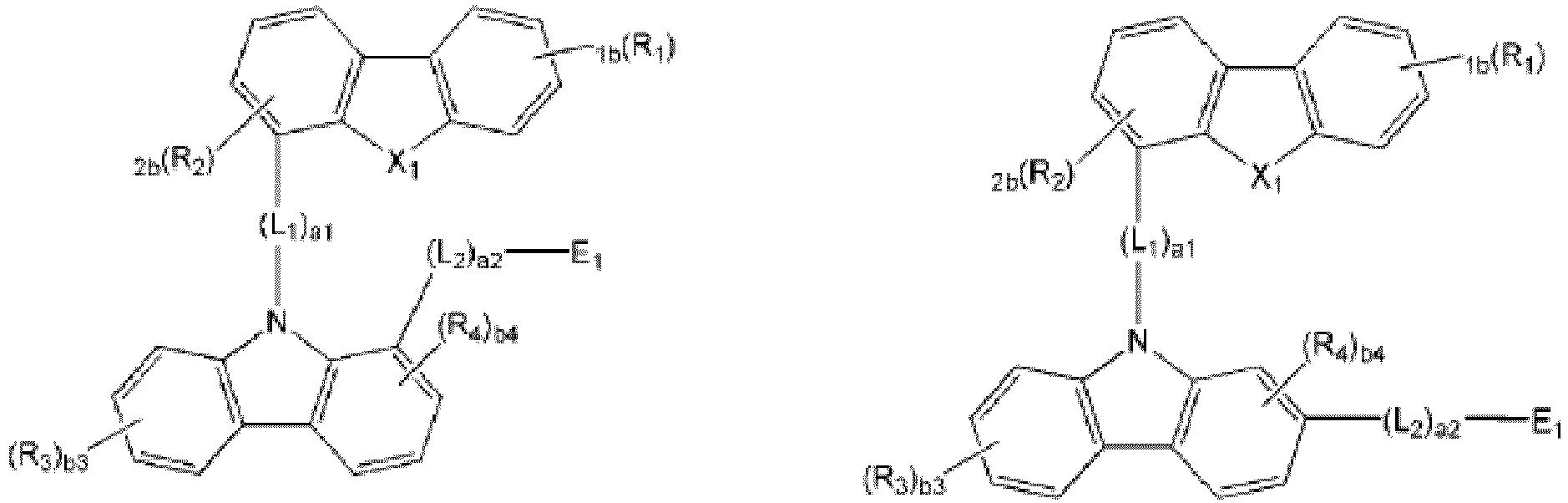


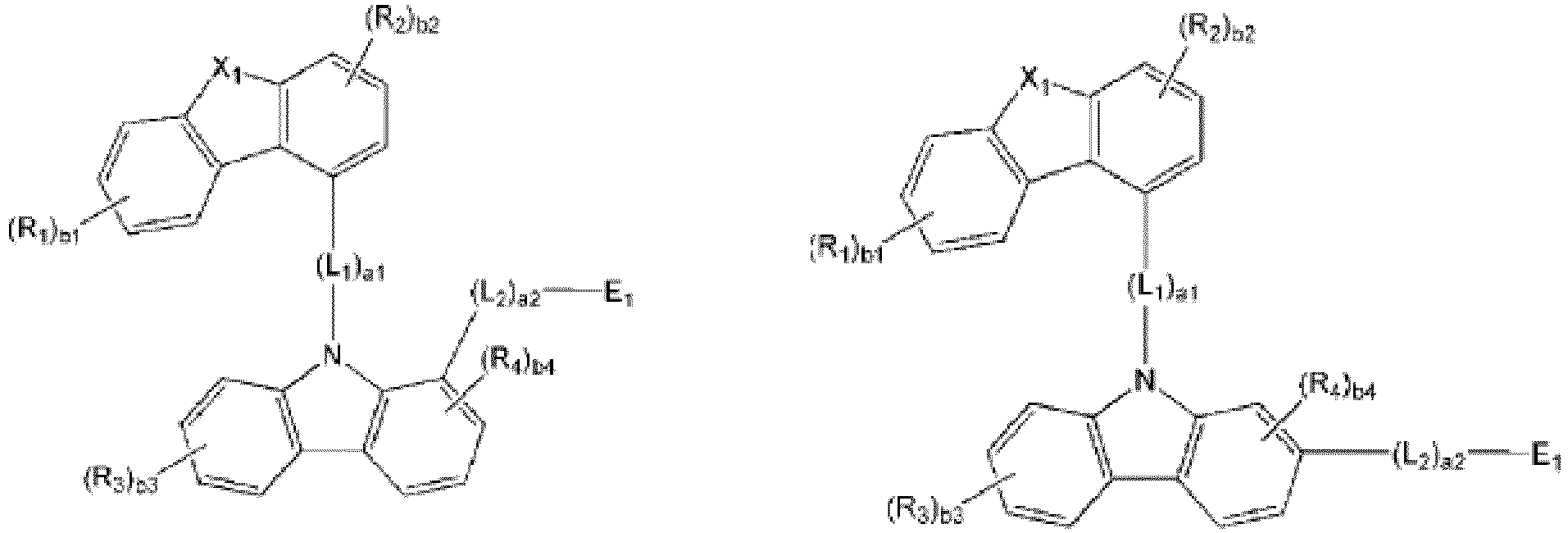

- Carbazolverbindung eines beliebigen der Ansprüche 1 -10, wobei the Carbazolverbindung dargestellt ist durch eine von Formeln 1A, 1B, 1C und 1D unten:
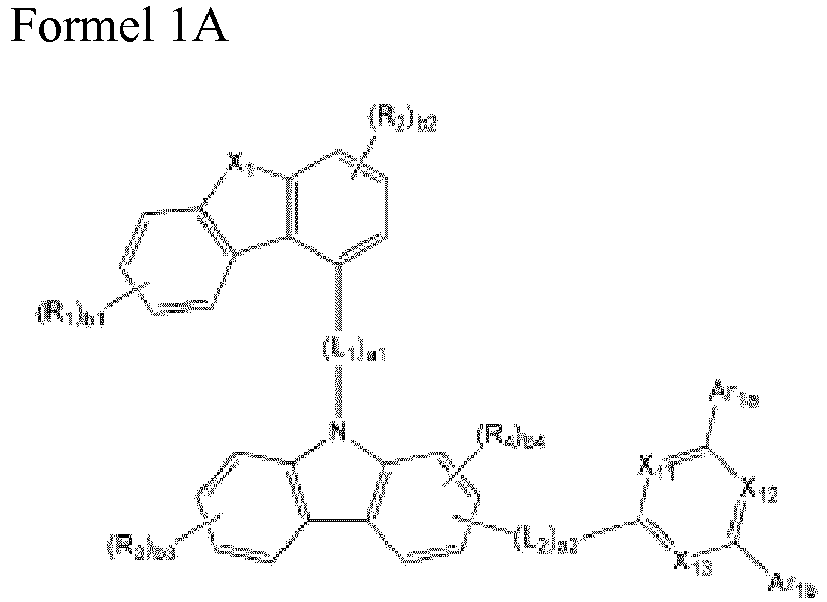

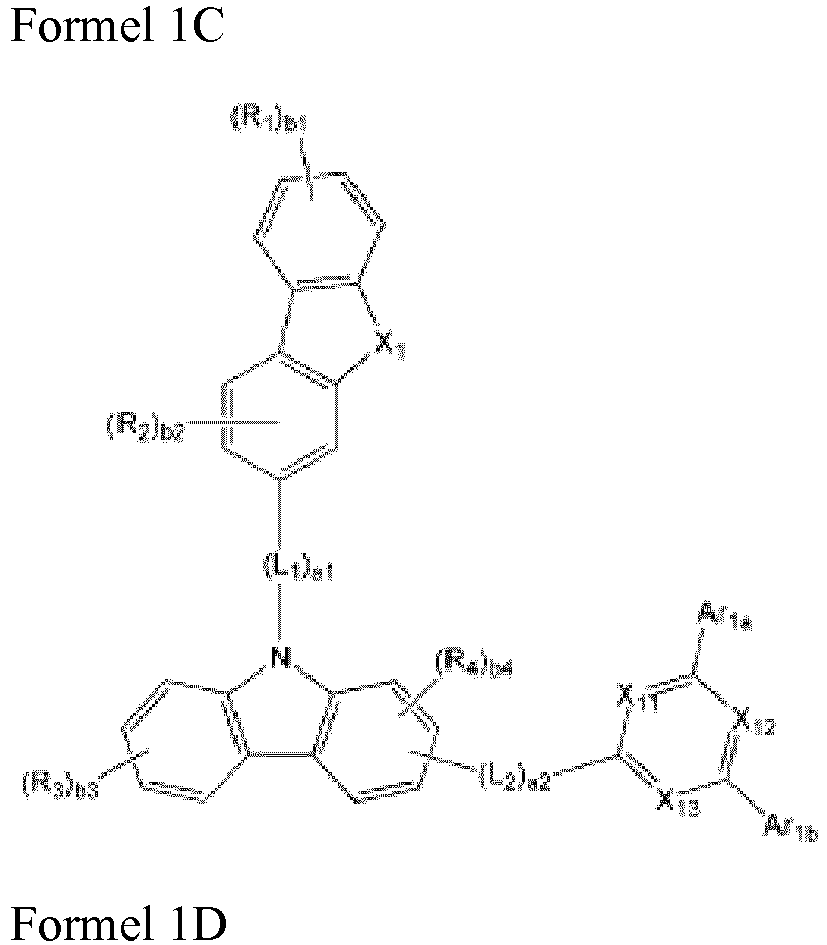
 X1, L1, L2, L11, R1 bis R4, R11 bis R13, a1, a2, a11, b1, b2, b3, b4 und b11 der Definition in Anspruch 1 entsprechen,X11 gleich N oder C(R21) ist,X12 gleich N oder C(R22) ist,X13 gleich N oder C(R23) ist, undmindestens eines von X11 bis X13 gleich N ist;R21 bis R23 einzeln unabhängig voneinander ausgewählt sind aus einem Wasserstoff, einem Deuterium, aus -F, -Cl, - Br, -I, aus einer Hydroxylgruppe, einer Cyangruppe, einer Nitrogruppe, einer Aminogruppe, einer Amidinogruppe, einer Hydrazingruppe, einer Hydrazongruppe, einer Carbonsäuregruppe, -C(=O)-O-Q11, -C(=O)-Q12, einer Sulfonsäuregruppe oder einem Salz derselben, einer Phosphorsäuregruppe oder einem Salz derselben, einer substituierten oder unsubstituierten C1-C60 Alkylgruppe, einer substituierten oder unsubstituierten C2-C60 Alkenylgruppe, einer substituierten oder unsubstituierten C2-C60 Alkynylgruppe, einer substituierten oder unsubstituierten C3-C10 Cycloalkylgruppe, einer substituierten oder unsubstituierten C2-C10 Heterocycloalkylgruppe, einer substituierten oder unsubstituierten C3-C10 Cycloalkenylgruppe, einer substituierten oder unsubstituierten C2-C10 Heterocycloalkenylgruppe, einer substituierten oder unsubstituierten C6-C60 Arylgruppe, einer substituierten oder unsubstituierten C6-C60 Aryloxygruppe, einer substituierten oder unsubstituierten C6-C60 Arylthiogruppe, einer substituierten oder unsubstituierten C7-C60 Arylalkylgruppe, einer substituierten oder unsubstituierten C2-C60 Heteroarylgruppe, einer substituierten oder unsubstituierten C2-C60 Heteroaryloxygruppe, einer substituierten oder unsubstituierten C2-C60 Heteroarylthiogruppe, einer substituierten oder unsubstituierten C3-C60 Heteroarylalkylgruppe, einer substituierten oder unsubstituierten monovalenten, nicht-aromatischen, kondensierten, polycyclischen Gruppe und einer substituierten oder unsubstituierten monovalenten, nicht-aromatischen, heterokondensierten, polycyclischen Gruppe, -N(Q13)(Q14), -Si(Q15)(Q16)(Q17) und -B(Q18)(Q19), undAr1a und Ar1b ausgewählt sind aus einer substituierten oder unsubstituierten C3-C10 Cycloalkylgruppe, einer substituierten oder unsubstituierten C2-C10 Heterocycloalkylgruppe, einer substituierten oder unsubstituierten C3-C10 Cycloalkenylgruppe, einer substituierten oder unsubstituierten C2-C10 Heterocycloalkenylgruppe, einer substituierten oder unsubstituierten C6-C60 Arylgruppe, einer substituierten oder unsubstituierten C6-C60 Aryloxygruppe, einer substituierten oder unsubstituierten C6-C60 Arylthiogruppe, einer substituierten oder unsubstituierten C7-C60 Arylalkylgruppe, einer substituierten oder unsubstituierten C2-C60 Heteroarylgruppe, einer substituierten oder unsubstituierten C2-C60 Heteroaryloxygruppe, einer substituierten oder unsubstituierten C2-C60 Heteroarylthiogruppe, einer substituierten oder unsubstituierten C3-C60 Heteroarylalkylgruppe, einer substituierten oder unsubstituierten monovalenten, nicht-aromatischen, kondensierten, polycyclischen Gruppe und einer substituierten oder unsubstituierten monovalenten, nicht-aromatischen, heterokondensierten, polycyclischen Gruppe.
 - Carbazolverbindung eines beliebigen der Ansprüche 1-11, wobei
die Carbazolverbindung dargestellt ist durch eine von Formeln 1A-1, 1B-1, 1C-1 und 1D-1:
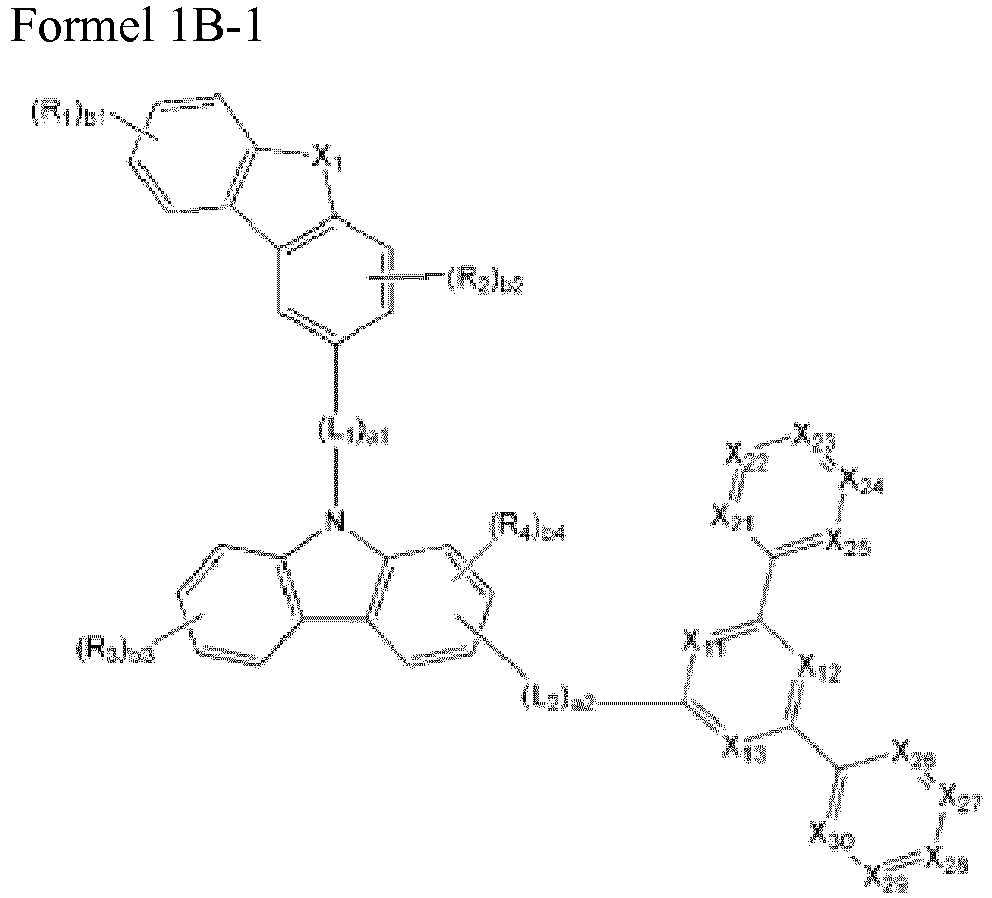


 X1, L1, L1, L11, R1 bis R4, R11 bis R13, a1, a2, a11, b1, b2, b3, b4 und b11 der Definition in Anspruch 1 entsprechen,X11 gleich N oder C(R21) ist, X12 gleich N oder C(R22) ist, X13 gleich N oder C(R23) ist, X21 gleich N oder CXR31) ist, X22 gleich N oder C(R32) ist, X23 gleich N oder C(R33) ist, X24 gleich N oder C(R34) ist, X25 gleich N oder C(R35) ist, X26 gleich N oder C(R36) ist, X27 gleich N oder C(R37) ist, X28 gleich N oder C(R38) ist, X29 gleich N oder C(R39) ist und X30 gleich N oder C(R40) ist, wobei mindestens eines von X11 bis X13 gleich N ist,R21 bis R23 und R31 bis R40 einzeln unabhängig voneinander ausgewählt sind aus einem Wasserstoff, einem Deuterium, aus -F, -Cl, -Br, -I, aus einer Hydroxylgruppe, einer Cyangruppe, einer Nitrogruppe, einer Aminogruppe, einer Amidinogruppe, einer Hydrazingruppe, einer Hydrazongruppe, einer Carbonsäuregruppe, -C(=O)- O-Q11, -C(=O)-Q12, einer Sulfonsäuregruppe oder einem Salz derselben, einer Phosphorsäuregruppe oder einem Salz derselben, einer substituierten oder unsubstituierten C1-C60 Alkylgruppe, einer substituierten oder unsubstituierten C2-C60 Alkenylgruppe, einer substituierten oder unsubstituierten C2-C60 Alkynylgruppe, einer substituierten oder unsubstituierten C3-C10 Cycloalkylgruppe, einer substituierten oder unsubstituierten C2-C10 Heterocycloalkylgruppe, einer substituierten oder unsubstituierten C3-C10 Cycloalkenylgruppe, einer substituierten oder unsubstituierten C2-C10 Heterocycloalkenylgruppe, einer substituierten oder unsubstituierten C6-C60 Arylgruppe, einer substituierten oder unsubstituierten C6-C60 Aryloxygruppe, einer substituierten oder unsubstituierten C6-C60 Arylthiogruppe, einer substituierten oder unsubstituierten C7-C60 Arylalkylgruppe, einer substituierten oder unsubstituierten C2-C60 Heteroarylgruppe, einer substituierten oder unsubstituierten C2-C60 Heteroaryloxygruppe, einer substituierten oder unsubstituierten C2-C60 Heteroarylthiogruppe, einer substituierten oder unsubstituierten C3-C60 Heteroarylalkylgruppe, einer substituierten oder unsubstituierten monovalenten, nicht-aromatischen, kondensierten, polycyclischen Gruppe und einer substituierten oder unsubstituierten monovalenten, nicht-aromatischen, heterokondensierten, polycyclischen Gruppe, -N(Q13)(Q14), -Si(Q15)(Q16)(Q17) und -B(Q18)(Q19).
 - Carbazolverbindung von Anspruch 1, wobei
die Carbazolverbindung eine der Verbindungen 1 bis 351 ist:


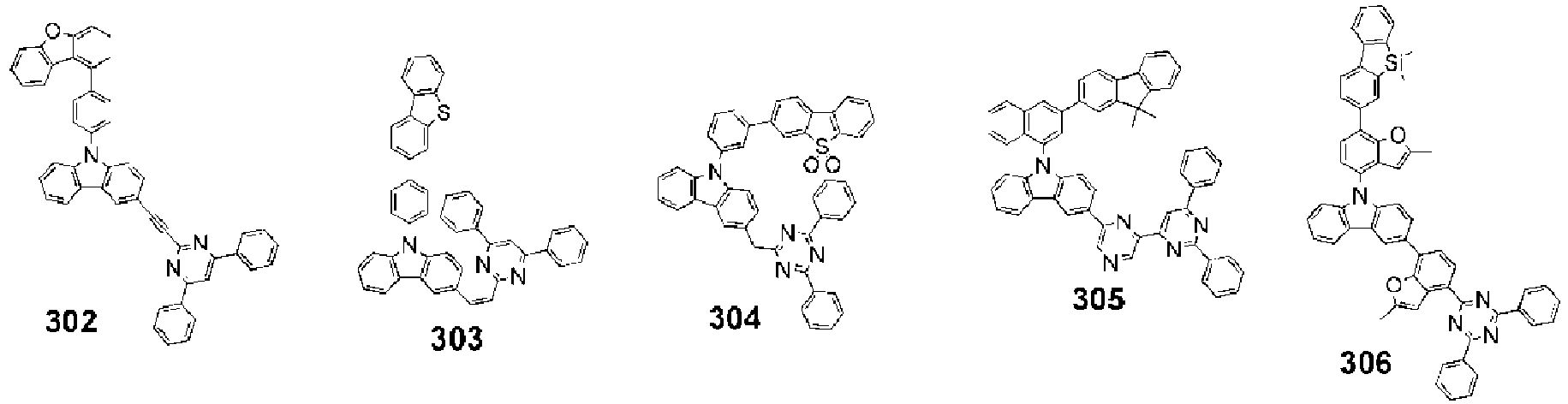


- Eine organische Leuchtdiode (Organic Light-Emitting Device), umfassend:eine erste Elektrode;eine zweite Elektrode, undeine zwischen der ersten Elektrode und der zweiten Elektrode angeordnete organische Schicht, wobei die organische Schicht eine Emissionsschicht und mindestens eine der Carbazolverbindungen eines beliebigen der Ansprüche 1 -13 umfasst.
- Organische Leuchtdiode von Anspruch 14, wobei die Emissionsschicht die Carbazolverbindung umfasst.
Applications Claiming Priority (1)
| Application Number | Priority Date | Filing Date | Title |
|---|---|---|---|
| KR1020130146413A KR102153039B1 (ko) | 2013-11-28 | 2013-11-28 | 카바졸계 화합물 및 이를 포함한 유기 발광 소자 |
Publications (2)
| Publication Number | Publication Date |
|---|---|
| EP2878599A1 EP2878599A1 (de) | 2015-06-03 |
| EP2878599B1 true EP2878599B1 (de) | 2016-10-05 |
Family
ID=52013845
Family Applications (1)
| Application Number | Title | Priority Date | Filing Date |
|---|---|---|---|
| EP14195105.3A Active EP2878599B1 (de) | 2013-11-28 | 2014-11-27 | Carbazolverbindung und organische lichtemittierende Vorrichtung damit |
Country Status (3)
| Country | Link |
|---|---|
| US (1) | US9812653B2 (de) |
| EP (1) | EP2878599B1 (de) |
| KR (1) | KR102153039B1 (de) |
Families Citing this family (24)
| Publication number | Priority date | Publication date | Assignee | Title |
|---|---|---|---|---|
| KR101547065B1 (ko) * | 2013-07-29 | 2015-08-25 | 주식회사 엘지화학 | 헤테로 고리 화합물 및 이를 포함하는 유기 발광 소자 |
| JP6827808B2 (ja) * | 2014-07-31 | 2021-02-10 | コニカミノルタ株式会社 | 有機エレクトロルミネッセンス素子、発光性薄膜、表示装置及び照明装置 |
| KR102369595B1 (ko) * | 2014-12-08 | 2022-03-04 | 삼성디스플레이 주식회사 | 유기 발광 소자 및 이를 포함하는 표시 장치 |
| EP3034507A1 (de) | 2014-12-15 | 2016-06-22 | Idemitsu Kosan Co., Ltd | 1-funktionalisierte Dibenzofurane und Dibenzothiophene für organische Leuchtdioden (OLEDS) |
| JP5831654B1 (ja) * | 2015-02-13 | 2015-12-09 | コニカミノルタ株式会社 | 芳香族複素環誘導体、それを用いた有機エレクトロルミネッセンス素子、照明装置及び表示装置 |
| KR102343572B1 (ko) * | 2015-03-06 | 2021-12-28 | 삼성디스플레이 주식회사 | 유기 발광 소자 |
| JPWO2016143589A1 (ja) * | 2015-03-09 | 2017-12-28 | 保土谷化学工業株式会社 | 発光材料および有機エレクトロルミネッセンス素子 |
| KR102486381B1 (ko) | 2015-08-13 | 2023-01-09 | 삼성전자주식회사 | 축합환 화합물 및 이를 포함한 유기 발광 소자 |
| JP6641947B2 (ja) * | 2015-12-04 | 2020-02-05 | コニカミノルタ株式会社 | 有機エレクトロルミネッセンス素子、表示装置、照明装置及び芳香族複素環誘導体 |
| WO2017115608A1 (ja) * | 2015-12-28 | 2017-07-06 | コニカミノルタ株式会社 | π共役系化合物、有機エレクトロルミネッセンス素子材料、発光材料、電荷輸送材料、発光性薄膜、有機エレクトロルミネッセンス素子、表示装置及び照明装置 |
| KR101693744B1 (ko) | 2016-05-11 | 2017-02-06 | 희성소재 (주) | 헤테로고리 화합물 및 이를 이용한 유기 발광 소자 |
| KR102654859B1 (ko) * | 2016-06-16 | 2024-04-05 | 삼성전자주식회사 | 축합환 화합물 및 이를 포함한 유기 발광 소자 |
| JP6977330B2 (ja) * | 2016-07-28 | 2021-12-08 | 東ソー株式会社 | 新規なカルバゾール化合物及びその用途 |
| JP7073388B2 (ja) * | 2016-11-08 | 2022-05-23 | メルク パテント ゲーエムベーハー | 電子デバイスのための化合物 |
| KR102407540B1 (ko) * | 2017-12-01 | 2022-06-10 | 엘지디스플레이 주식회사 | 유기 화합물과 이를 포함하는 유기발광다이오드 및 유기발광 표시장치 |
| JP7402800B2 (ja) * | 2017-12-20 | 2023-12-21 | メルク パテント ゲゼルシャフト ミット ベシュレンクテル ハフツング | ヘテロ芳香族化合物 |
| CN108358891A (zh) * | 2018-02-11 | 2018-08-03 | 上海升翕光电科技有限公司 | 一种有机发光化合物及其制备方法和应用 |
| CN108373463A (zh) * | 2018-02-11 | 2018-08-07 | 上海升翕光电科技有限公司 | 有机发光化合物及其制备方法和有机电致发光器件 |
| CN111183139B (zh) * | 2018-03-28 | 2023-05-19 | 株式会社Lg化学 | 化合物及包含其的有机发光装置 |
| CN108864068B (zh) * | 2018-07-27 | 2021-12-28 | 武汉天马微电子有限公司 | 一种化合物以及有机发光显示装置 |
| EP3689888B1 (de) | 2019-01-31 | 2021-09-22 | Samsung Electronics Co., Ltd. | Organometallische verbindung und organische lichtemittierende vorrichtung damit |
| KR102896847B1 (ko) | 2019-01-31 | 2025-12-05 | 삼성전자주식회사 | 유기금속 화합물 및 이를 포함한 유기 발광 소자 |
| CN113429402A (zh) * | 2021-06-21 | 2021-09-24 | 西安交通大学 | 基于二苯并噻吩砜的热活化延迟荧光材料 |
| KR20250064579A (ko) | 2023-11-02 | 2025-05-09 | 듀폰스페셜티머터리얼스코리아 유한회사 | 화합물, 및 이를 포함하는 유기 전계 발광 재료 및 유기 전계 발광 소자 |
Family Cites Families (23)
| Publication number | Priority date | Publication date | Assignee | Title |
|---|---|---|---|---|
| US20020121638A1 (en) | 2000-06-30 | 2002-09-05 | Vladimir Grushin | Electroluminescent iridium compounds with fluorinated phenylpyridines, phenylpyrimidines, and phenylquinolines and devices made with such compounds |
| DE10338550A1 (de) | 2003-08-19 | 2005-03-31 | Basf Ag | Übergangsmetallkomplexe mit Carbenliganden als Emitter für organische Licht-emittierende Dioden (OLEDs) |
| KR100537621B1 (ko) | 2004-02-02 | 2005-12-19 | 삼성에스디아이 주식회사 | 이리듐 화합물 및 이를 이용한 유기 전계 발광 소자 |
| WO2005123873A1 (ja) | 2004-06-17 | 2005-12-29 | Konica Minolta Holdings, Inc. | 有機エレクトロルミネッセンス素子材料、有機エレクトロルミネッセンス素子、表示装置及び照明装置 |
| BRPI0707552B8 (pt) | 2006-02-10 | 2020-05-05 | Universal Display Corp | complexos metálicos de ligantes imidazo [1,2-f] fenantridina e diimizado [1,2-a:1', 2'-c] quinazolina ciclometalados e análogos isoeletrônicos e benzanulados dos mesmos e dispositivos oled que os englobam |
| US7915414B2 (en) | 2006-11-24 | 2011-03-29 | Yun Chi | Blue-emitting organometallic complexes and their application |
| JP5359869B2 (ja) * | 2007-05-30 | 2013-12-04 | コニカミノルタ株式会社 | 有機エレクトロルミネッセンス素子、有機エレクトロルミネッセンス素子の製造方法、表示装置及び照明装置 |
| EP2479234B1 (de) | 2008-05-13 | 2017-06-21 | Konica Minolta Holdings, Inc. | Organisches elektrolumineszentes element, anzeigevorrichtung und beleuchtungsvorrichtung |
| JP5338184B2 (ja) | 2008-08-06 | 2013-11-13 | コニカミノルタ株式会社 | 有機エレクトロルミネッセンス素子、表示装置、照明装置 |
| JP5707665B2 (ja) | 2008-12-03 | 2015-04-30 | コニカミノルタ株式会社 | 有機エレクトロルミネッセンス素子、該素子を備えた照明装置及び表示装置 |
| WO2010079051A1 (de) | 2009-01-07 | 2010-07-15 | Basf Se | Silyl- und heteroatom-substituierte verbindungen ausgewählt aus carbazolen, dibenzofuranen, dibenzothiophenen und dibenzophospholen und ihre anwendung in der organischen elektronik |
| EP2453496B1 (de) | 2009-07-07 | 2018-11-14 | Konica Minolta Holdings, Inc. | Organisches elektrolumineszentes element, neuartige verbindung, beleuchtungsvorrichtung und anzeigevorrichtung |
| KR101233380B1 (ko) | 2009-10-21 | 2013-02-15 | 제일모직주식회사 | 신규한 유기광전소자용 화합물 및 이를 포함하는 유기광전소자 |
| KR101212669B1 (ko) | 2009-12-28 | 2012-12-14 | 제일모직주식회사 | 신규한 유기광전소자용 화합물 및 이를 포함하는 유기광전소자 |
| KR101867115B1 (ko) * | 2010-12-28 | 2018-07-19 | 이데미쓰 고산 가부시키가이샤 | 유기 전기발광 소자용 재료 및 그것을 이용한 유기 전기발광 소자 |
| JP5900351B2 (ja) | 2011-02-02 | 2016-04-06 | コニカミノルタ株式会社 | 有機エレクトロルミネッセンス素子の製造方法 |
| KR20120116269A (ko) | 2011-04-12 | 2012-10-22 | 롬엔드하스전자재료코리아유한회사 | 신규한 유기 전자재료용 화합물 및 이를 포함하는 유기 전계 발광 소자 |
| KR101937259B1 (ko) | 2011-11-10 | 2019-01-11 | 삼성디스플레이 주식회사 | 스티릴계 화합물, 스티릴계 화합물-함유 조성물 및 이를 포함한 유기 발광 소자 |
| JP6070567B2 (ja) | 2011-11-17 | 2017-02-01 | コニカミノルタ株式会社 | 透明電極、および電子デバイス |
| JP6003144B2 (ja) | 2012-03-28 | 2016-10-05 | コニカミノルタ株式会社 | 透明電極の製造方法 |
| KR102191022B1 (ko) * | 2012-04-18 | 2020-12-14 | 에스에프씨 주식회사 | 이형고리 화합물 및 이를 포함하는 유기전계발광소자 |
| TW201425527A (zh) | 2012-10-04 | 2014-07-01 | 羅門哈斯電子材料韓國公司 | 有機電場發光化合物及包含該化合物之有機電場發光裝置 |
| KR101547065B1 (ko) * | 2013-07-29 | 2015-08-25 | 주식회사 엘지화학 | 헤테로 고리 화합물 및 이를 포함하는 유기 발광 소자 |
-
2013
- 2013-11-28 KR KR1020130146413A patent/KR102153039B1/ko active Active
-
2014
- 2014-11-21 US US14/550,518 patent/US9812653B2/en active Active
- 2014-11-27 EP EP14195105.3A patent/EP2878599B1/de active Active
Also Published As
| Publication number | Publication date |
|---|---|
| KR20150061975A (ko) | 2015-06-05 |
| KR102153039B1 (ko) | 2020-09-07 |
| EP2878599A1 (de) | 2015-06-03 |
| US9812653B2 (en) | 2017-11-07 |
| US20150171342A1 (en) | 2015-06-18 |
Similar Documents
| Publication | Publication Date | Title |
|---|---|---|
| EP2878599B1 (de) | Carbazolverbindung und organische lichtemittierende Vorrichtung damit | |
| EP2894157B1 (de) | Kondensierte zyklische Verbindung und organische lichtemittierende Vorrichtung damit | |
| KR102140018B1 (ko) | 축합환 화합물 및 이를 포함한 유기 발광 소자 | |
| KR102280686B1 (ko) | 카바졸계 화합물 및 이를 포함한 유기 발광 소자 | |
| KR102287345B1 (ko) | 카바졸계 화합물 및 이를 포함한 유기 발광 소자 | |
| KR102250186B1 (ko) | 축합환 화합물 및 이를 포함한 유기 발광 소자 | |
| EP2907815B1 (de) | Kondensierte zyklische Verbindung und organische lichtemittierende Vorrichtung damit | |
| KR102693420B1 (ko) | 유기 발광 소자 | |
| EP3133666B1 (de) | Organische lichtemittierende vorrichtung | |
| KR102308117B1 (ko) | 카바졸계 화합물 및 이를 포함한 유기 발광 소자 | |
| KR102227973B1 (ko) | 축합환 화합물 및 이를 포함한 유기 발광 소자 | |
| KR102163721B1 (ko) | 축합환 화합물 및 이를 포함한 유기 발광 소자 | |
| EP2991128A1 (de) | Organische lichtemittierende vorrichtung | |
| KR102153040B1 (ko) | 축합환 화합물 및 이를 포함한 유기 발광 소자 | |
| KR102263057B1 (ko) | 축합환 화합물 및 이를 포함한 유기 발광 소자 | |
| EP2977378A1 (de) | Kondensierte cyclische verbindung und organische lichtemittierende vorrichtung damit | |
| KR102552274B1 (ko) | 축합환 화합물 및 이를 포함한 유기 발광 소자 | |
| KR102308118B1 (ko) | 축합환 화합물 및 이를 포함한 유기 발광 소자 | |
| EP3135673A2 (de) | Kondensierte cyclische verbindung und diese enthaltende organische leuchtdiode | |
| KR102100929B1 (ko) | 축합환 화합물 및 이를 포함한 유기 발광 소자 | |
| KR102572715B1 (ko) | 축합환 화합물 및 이를 포함한 유기 발광 소자 | |
| KR102155600B1 (ko) | 축합환 화합물 및 이를 포함한 유기 발광 소자 | |
| EP3644385A1 (de) | Kondensierte cyclische verbindung, zusammensetzung damit und organische lichtemittierende vorrichtung damit | |
| KR102208958B1 (ko) | 축합환 화합물 및 이를 포함한 유기 발광 소자 | |
| KR20210084775A (ko) | 축합환 화합물 및 이를 포함한 유기 발광 소자 |
Legal Events
| Date | Code | Title | Description |
|---|---|---|---|
| PUAI | Public reference made under article 153(3) epc to a published international application that has entered the european phase |
Free format text: ORIGINAL CODE: 0009012 |
|
| 17P | Request for examination filed |
Effective date: 20141127 |
|
| AK | Designated contracting states |
Kind code of ref document: A1 Designated state(s): AL AT BE BG CH CY CZ DE DK EE ES FI FR GB GR HR HU IE IS IT LI LT LU LV MC MK MT NL NO PL PT RO RS SE SI SK SM TR |
|
| AX | Request for extension of the european patent |
Extension state: BA ME |
|
| R17P | Request for examination filed (corrected) |
Effective date: 20151203 |
|
| RBV | Designated contracting states (corrected) |
Designated state(s): AL AT BE BG CH CY CZ DE DK EE ES FI FR GB GR HR HU IE IS IT LI LT LU LV MC MK MT NL NO PL PT RO RS SE SI SK SM TR |
|
| GRAP | Despatch of communication of intention to grant a patent |
Free format text: ORIGINAL CODE: EPIDOSNIGR1 |
|
| GRAJ | Information related to disapproval of communication of intention to grant by the applicant or resumption of examination proceedings by the epo deleted |
Free format text: ORIGINAL CODE: EPIDOSDIGR1 |
|
| GRAP | Despatch of communication of intention to grant a patent |
Free format text: ORIGINAL CODE: EPIDOSNIGR1 |
|
| INTG | Intention to grant announced |
Effective date: 20160404 |
|
| INTG | Intention to grant announced |
Effective date: 20160414 |
|
| GRAS | Grant fee paid |
Free format text: ORIGINAL CODE: EPIDOSNIGR3 |
|
| GRAA | (expected) grant |
Free format text: ORIGINAL CODE: 0009210 |
|
| AK | Designated contracting states |
Kind code of ref document: B1 Designated state(s): AL AT BE BG CH CY CZ DE DK EE ES FI FR GB GR HR HU IE IS IT LI LT LU LV MC MK MT NL NO PL PT RO RS SE SI SK SM TR |
|
| REG | Reference to a national code |
Ref country code: GB Ref legal event code: FG4D |
|
| REG | Reference to a national code |
Ref country code: CH Ref legal event code: EP |
|
| REG | Reference to a national code |
Ref country code: AT Ref legal event code: REF Ref document number: 834535 Country of ref document: AT Kind code of ref document: T Effective date: 20161015 |
|
| REG | Reference to a national code |
Ref country code: IE Ref legal event code: FG4D |
|
| REG | Reference to a national code |
Ref country code: DE Ref legal event code: R096 Ref document number: 602014004086 Country of ref document: DE |
|
| REG | Reference to a national code |
Ref country code: FR Ref legal event code: PLFP Year of fee payment: 3 |
|
| REG | Reference to a national code |
Ref country code: NL Ref legal event code: MP Effective date: 20161005 |
|
| REG | Reference to a national code |
Ref country code: LT Ref legal event code: MG4D |
|
| PG25 | Lapsed in a contracting state [announced via postgrant information from national office to epo] |
Ref country code: BE Free format text: LAPSE BECAUSE OF NON-PAYMENT OF DUE FEES Effective date: 20161130 Ref country code: LV Free format text: LAPSE BECAUSE OF FAILURE TO SUBMIT A TRANSLATION OF THE DESCRIPTION OR TO PAY THE FEE WITHIN THE PRESCRIBED TIME-LIMIT Effective date: 20161005 |
|
| REG | Reference to a national code |
Ref country code: AT Ref legal event code: MK05 Ref document number: 834535 Country of ref document: AT Kind code of ref document: T Effective date: 20161005 |
|
| PG25 | Lapsed in a contracting state [announced via postgrant information from national office to epo] |
Ref country code: SE Free format text: LAPSE BECAUSE OF FAILURE TO SUBMIT A TRANSLATION OF THE DESCRIPTION OR TO PAY THE FEE WITHIN THE PRESCRIBED TIME-LIMIT Effective date: 20161005 Ref country code: NO Free format text: LAPSE BECAUSE OF FAILURE TO SUBMIT A TRANSLATION OF THE DESCRIPTION OR TO PAY THE FEE WITHIN THE PRESCRIBED TIME-LIMIT Effective date: 20170105 Ref country code: LT Free format text: LAPSE BECAUSE OF FAILURE TO SUBMIT A TRANSLATION OF THE DESCRIPTION OR TO PAY THE FEE WITHIN THE PRESCRIBED TIME-LIMIT Effective date: 20161005 Ref country code: GR Free format text: LAPSE BECAUSE OF FAILURE TO SUBMIT A TRANSLATION OF THE DESCRIPTION OR TO PAY THE FEE WITHIN THE PRESCRIBED TIME-LIMIT Effective date: 20170106 |
|
| PG25 | Lapsed in a contracting state [announced via postgrant information from national office to epo] |
Ref country code: BE Free format text: LAPSE BECAUSE OF FAILURE TO SUBMIT A TRANSLATION OF THE DESCRIPTION OR TO PAY THE FEE WITHIN THE PRESCRIBED TIME-LIMIT Effective date: 20161005 Ref country code: ES Free format text: LAPSE BECAUSE OF FAILURE TO SUBMIT A TRANSLATION OF THE DESCRIPTION OR TO PAY THE FEE WITHIN THE PRESCRIBED TIME-LIMIT Effective date: 20161005 Ref country code: NL Free format text: LAPSE BECAUSE OF FAILURE TO SUBMIT A TRANSLATION OF THE DESCRIPTION OR TO PAY THE FEE WITHIN THE PRESCRIBED TIME-LIMIT Effective date: 20161005 Ref country code: PT Free format text: LAPSE BECAUSE OF FAILURE TO SUBMIT A TRANSLATION OF THE DESCRIPTION OR TO PAY THE FEE WITHIN THE PRESCRIBED TIME-LIMIT Effective date: 20170206 Ref country code: PL Free format text: LAPSE BECAUSE OF FAILURE TO SUBMIT A TRANSLATION OF THE DESCRIPTION OR TO PAY THE FEE WITHIN THE PRESCRIBED TIME-LIMIT Effective date: 20161005 Ref country code: RS Free format text: LAPSE BECAUSE OF FAILURE TO SUBMIT A TRANSLATION OF THE DESCRIPTION OR TO PAY THE FEE WITHIN THE PRESCRIBED TIME-LIMIT Effective date: 20161005 Ref country code: IS Free format text: LAPSE BECAUSE OF FAILURE TO SUBMIT A TRANSLATION OF THE DESCRIPTION OR TO PAY THE FEE WITHIN THE PRESCRIBED TIME-LIMIT Effective date: 20170205 Ref country code: FI Free format text: LAPSE BECAUSE OF FAILURE TO SUBMIT A TRANSLATION OF THE DESCRIPTION OR TO PAY THE FEE WITHIN THE PRESCRIBED TIME-LIMIT Effective date: 20161005 Ref country code: HR Free format text: LAPSE BECAUSE OF FAILURE TO SUBMIT A TRANSLATION OF THE DESCRIPTION OR TO PAY THE FEE WITHIN THE PRESCRIBED TIME-LIMIT Effective date: 20161005 Ref country code: AT Free format text: LAPSE BECAUSE OF FAILURE TO SUBMIT A TRANSLATION OF THE DESCRIPTION OR TO PAY THE FEE WITHIN THE PRESCRIBED TIME-LIMIT Effective date: 20161005 |
|
| REG | Reference to a national code |
Ref country code: DE Ref legal event code: R097 Ref document number: 602014004086 Country of ref document: DE |
|
| PG25 | Lapsed in a contracting state [announced via postgrant information from national office to epo] |
Ref country code: CZ Free format text: LAPSE BECAUSE OF FAILURE TO SUBMIT A TRANSLATION OF THE DESCRIPTION OR TO PAY THE FEE WITHIN THE PRESCRIBED TIME-LIMIT Effective date: 20161005 Ref country code: MC Free format text: LAPSE BECAUSE OF FAILURE TO SUBMIT A TRANSLATION OF THE DESCRIPTION OR TO PAY THE FEE WITHIN THE PRESCRIBED TIME-LIMIT Effective date: 20161005 Ref country code: RO Free format text: LAPSE BECAUSE OF FAILURE TO SUBMIT A TRANSLATION OF THE DESCRIPTION OR TO PAY THE FEE WITHIN THE PRESCRIBED TIME-LIMIT Effective date: 20161005 Ref country code: SK Free format text: LAPSE BECAUSE OF FAILURE TO SUBMIT A TRANSLATION OF THE DESCRIPTION OR TO PAY THE FEE WITHIN THE PRESCRIBED TIME-LIMIT Effective date: 20161005 Ref country code: EE Free format text: LAPSE BECAUSE OF FAILURE TO SUBMIT A TRANSLATION OF THE DESCRIPTION OR TO PAY THE FEE WITHIN THE PRESCRIBED TIME-LIMIT Effective date: 20161005 Ref country code: DK Free format text: LAPSE BECAUSE OF FAILURE TO SUBMIT A TRANSLATION OF THE DESCRIPTION OR TO PAY THE FEE WITHIN THE PRESCRIBED TIME-LIMIT Effective date: 20161005 |
|
| PLBE | No opposition filed within time limit |
Free format text: ORIGINAL CODE: 0009261 |
|
| STAA | Information on the status of an ep patent application or granted ep patent |
Free format text: STATUS: NO OPPOSITION FILED WITHIN TIME LIMIT |
|
| REG | Reference to a national code |
Ref country code: IE Ref legal event code: MM4A |
|
| PG25 | Lapsed in a contracting state [announced via postgrant information from national office to epo] |
Ref country code: SM Free format text: LAPSE BECAUSE OF FAILURE TO SUBMIT A TRANSLATION OF THE DESCRIPTION OR TO PAY THE FEE WITHIN THE PRESCRIBED TIME-LIMIT Effective date: 20161005 Ref country code: IT Free format text: LAPSE BECAUSE OF FAILURE TO SUBMIT A TRANSLATION OF THE DESCRIPTION OR TO PAY THE FEE WITHIN THE PRESCRIBED TIME-LIMIT Effective date: 20161005 Ref country code: BG Free format text: LAPSE BECAUSE OF FAILURE TO SUBMIT A TRANSLATION OF THE DESCRIPTION OR TO PAY THE FEE WITHIN THE PRESCRIBED TIME-LIMIT Effective date: 20170105 |
|
| 26N | No opposition filed |
Effective date: 20170706 |
|
| PG25 | Lapsed in a contracting state [announced via postgrant information from national office to epo] |
Ref country code: LU Free format text: LAPSE BECAUSE OF NON-PAYMENT OF DUE FEES Effective date: 20161130 |
|
| REG | Reference to a national code |
Ref country code: FR Ref legal event code: PLFP Year of fee payment: 4 |
|
| PG25 | Lapsed in a contracting state [announced via postgrant information from national office to epo] |
Ref country code: IE Free format text: LAPSE BECAUSE OF NON-PAYMENT OF DUE FEES Effective date: 20161127 Ref country code: SI Free format text: LAPSE BECAUSE OF FAILURE TO SUBMIT A TRANSLATION OF THE DESCRIPTION OR TO PAY THE FEE WITHIN THE PRESCRIBED TIME-LIMIT Effective date: 20161005 |
|
| PG25 | Lapsed in a contracting state [announced via postgrant information from national office to epo] |
Ref country code: HU Free format text: LAPSE BECAUSE OF FAILURE TO SUBMIT A TRANSLATION OF THE DESCRIPTION OR TO PAY THE FEE WITHIN THE PRESCRIBED TIME-LIMIT; INVALID AB INITIO Effective date: 20141127 |
|
| PG25 | Lapsed in a contracting state [announced via postgrant information from national office to epo] |
Ref country code: MK Free format text: LAPSE BECAUSE OF FAILURE TO SUBMIT A TRANSLATION OF THE DESCRIPTION OR TO PAY THE FEE WITHIN THE PRESCRIBED TIME-LIMIT Effective date: 20161005 Ref country code: CY Free format text: LAPSE BECAUSE OF FAILURE TO SUBMIT A TRANSLATION OF THE DESCRIPTION OR TO PAY THE FEE WITHIN THE PRESCRIBED TIME-LIMIT Effective date: 20161005 |
|
| PG25 | Lapsed in a contracting state [announced via postgrant information from national office to epo] |
Ref country code: CH Free format text: LAPSE BECAUSE OF NON-PAYMENT OF DUE FEES Effective date: 20171130 Ref country code: LI Free format text: LAPSE BECAUSE OF NON-PAYMENT OF DUE FEES Effective date: 20171130 |
|
| PG25 | Lapsed in a contracting state [announced via postgrant information from national office to epo] |
Ref country code: MT Free format text: LAPSE BECAUSE OF NON-PAYMENT OF DUE FEES Effective date: 20161127 |
|
| REG | Reference to a national code |
Ref country code: FR Ref legal event code: PLFP Year of fee payment: 5 |
|
| PG25 | Lapsed in a contracting state [announced via postgrant information from national office to epo] |
Ref country code: TR Free format text: LAPSE BECAUSE OF FAILURE TO SUBMIT A TRANSLATION OF THE DESCRIPTION OR TO PAY THE FEE WITHIN THE PRESCRIBED TIME-LIMIT Effective date: 20161005 |
|
| PG25 | Lapsed in a contracting state [announced via postgrant information from national office to epo] |
Ref country code: AL Free format text: LAPSE BECAUSE OF FAILURE TO SUBMIT A TRANSLATION OF THE DESCRIPTION OR TO PAY THE FEE WITHIN THE PRESCRIBED TIME-LIMIT Effective date: 20161005 |
|
| P01 | Opt-out of the competence of the unified patent court (upc) registered |
Effective date: 20230530 |
|
| PGFP | Annual fee paid to national office [announced via postgrant information from national office to epo] |
Ref country code: DE Payment date: 20251022 Year of fee payment: 12 |
|
| PGFP | Annual fee paid to national office [announced via postgrant information from national office to epo] |
Ref country code: GB Payment date: 20251016 Year of fee payment: 12 |
|
| PGFP | Annual fee paid to national office [announced via postgrant information from national office to epo] |
Ref country code: FR Payment date: 20251023 Year of fee payment: 12 |