EP3133666B1 - Organische lichtemittierende vorrichtung - Google Patents
Organische lichtemittierende vorrichtung Download PDFInfo
- Publication number
- EP3133666B1 EP3133666B1 EP16184809.8A EP16184809A EP3133666B1 EP 3133666 B1 EP3133666 B1 EP 3133666B1 EP 16184809 A EP16184809 A EP 16184809A EP 3133666 B1 EP3133666 B1 EP 3133666B1
- Authority
- EP
- European Patent Office
- Prior art keywords
- group
- unsubstituted
- substituted
- formulae
- compound
- Prior art date
- Legal status (The legal status is an assumption and is not a legal conclusion. Google has not performed a legal analysis and makes no representation as to the accuracy of the status listed.)
- Active
Links
- 0 Cc(c1c2[o]c3c(*)c(*)c(*)nc13)c(**)c(*=I)c2N Chemical compound Cc(c1c2[o]c3c(*)c(*)c(*)nc13)c(**)c(*=I)c2N 0.000 description 17
- GNTGVTDRSZWJTN-HWKANZROSA-N CC(C/C=C/NC)N1CC1 Chemical compound CC(C/C=C/NC)N1CC1 GNTGVTDRSZWJTN-HWKANZROSA-N 0.000 description 1
- UHOVQNZJYSORNB-UHFFFAOYSA-N c1ccccc1 Chemical compound c1ccccc1 UHOVQNZJYSORNB-UHFFFAOYSA-N 0.000 description 1
Images
Classifications
-
- C—CHEMISTRY; METALLURGY
- C09—DYES; PAINTS; POLISHES; NATURAL RESINS; ADHESIVES; COMPOSITIONS NOT OTHERWISE PROVIDED FOR; APPLICATIONS OF MATERIALS NOT OTHERWISE PROVIDED FOR
- C09K—MATERIALS FOR MISCELLANEOUS APPLICATIONS, NOT PROVIDED FOR ELSEWHERE
- C09K11/00—Luminescent materials, e.g. electroluminescent or chemiluminescent
- C09K11/02—Use of particular materials as binders, particle coatings or suspension media therefor
- C09K11/025—Use of particular materials as binders, particle coatings or suspension media therefor non-luminescent particle coatings or suspension media
-
- H—ELECTRICITY
- H10—SEMICONDUCTOR DEVICES; ELECTRIC SOLID-STATE DEVICES NOT OTHERWISE PROVIDED FOR
- H10K—ORGANIC ELECTRIC SOLID-STATE DEVICES
- H10K85/00—Organic materials used in the body or electrodes of devices covered by this subclass
- H10K85/60—Organic compounds having low molecular weight
- H10K85/649—Aromatic compounds comprising a hetero atom
- H10K85/657—Polycyclic condensed heteroaromatic hydrocarbons
- H10K85/6572—Polycyclic condensed heteroaromatic hydrocarbons comprising only nitrogen in the heteroaromatic polycondensed ring system, e.g. phenanthroline or carbazole
-
- C—CHEMISTRY; METALLURGY
- C09—DYES; PAINTS; POLISHES; NATURAL RESINS; ADHESIVES; COMPOSITIONS NOT OTHERWISE PROVIDED FOR; APPLICATIONS OF MATERIALS NOT OTHERWISE PROVIDED FOR
- C09K—MATERIALS FOR MISCELLANEOUS APPLICATIONS, NOT PROVIDED FOR ELSEWHERE
- C09K11/00—Luminescent materials, e.g. electroluminescent or chemiluminescent
- C09K11/06—Luminescent materials, e.g. electroluminescent or chemiluminescent containing organic luminescent materials
-
- H—ELECTRICITY
- H10—SEMICONDUCTOR DEVICES; ELECTRIC SOLID-STATE DEVICES NOT OTHERWISE PROVIDED FOR
- H10K—ORGANIC ELECTRIC SOLID-STATE DEVICES
- H10K50/00—Organic light-emitting devices
- H10K50/10—OLEDs or polymer light-emitting diodes [PLED]
- H10K50/11—OLEDs or polymer light-emitting diodes [PLED] characterised by the electroluminescent [EL] layers
- H10K50/12—OLEDs or polymer light-emitting diodes [PLED] characterised by the electroluminescent [EL] layers comprising dopants
-
- H—ELECTRICITY
- H10—SEMICONDUCTOR DEVICES; ELECTRIC SOLID-STATE DEVICES NOT OTHERWISE PROVIDED FOR
- H10K—ORGANIC ELECTRIC SOLID-STATE DEVICES
- H10K50/00—Organic light-emitting devices
- H10K50/10—OLEDs or polymer light-emitting diodes [PLED]
- H10K50/14—Carrier transporting layers
- H10K50/15—Hole transporting layers
-
- H—ELECTRICITY
- H10—SEMICONDUCTOR DEVICES; ELECTRIC SOLID-STATE DEVICES NOT OTHERWISE PROVIDED FOR
- H10K—ORGANIC ELECTRIC SOLID-STATE DEVICES
- H10K50/00—Organic light-emitting devices
- H10K50/10—OLEDs or polymer light-emitting diodes [PLED]
- H10K50/14—Carrier transporting layers
- H10K50/16—Electron transporting layers
-
- H—ELECTRICITY
- H10—SEMICONDUCTOR DEVICES; ELECTRIC SOLID-STATE DEVICES NOT OTHERWISE PROVIDED FOR
- H10K—ORGANIC ELECTRIC SOLID-STATE DEVICES
- H10K50/00—Organic light-emitting devices
- H10K50/10—OLEDs or polymer light-emitting diodes [PLED]
- H10K50/17—Carrier injection layers
-
- H—ELECTRICITY
- H10—SEMICONDUCTOR DEVICES; ELECTRIC SOLID-STATE DEVICES NOT OTHERWISE PROVIDED FOR
- H10K—ORGANIC ELECTRIC SOLID-STATE DEVICES
- H10K50/00—Organic light-emitting devices
- H10K50/80—Constructional details
-
- H—ELECTRICITY
- H10—SEMICONDUCTOR DEVICES; ELECTRIC SOLID-STATE DEVICES NOT OTHERWISE PROVIDED FOR
- H10K—ORGANIC ELECTRIC SOLID-STATE DEVICES
- H10K50/00—Organic light-emitting devices
- H10K50/80—Constructional details
- H10K50/85—Arrangements for extracting light from the devices
- H10K50/856—Arrangements for extracting light from the devices comprising reflective means
-
- H—ELECTRICITY
- H10—SEMICONDUCTOR DEVICES; ELECTRIC SOLID-STATE DEVICES NOT OTHERWISE PROVIDED FOR
- H10K—ORGANIC ELECTRIC SOLID-STATE DEVICES
- H10K59/00—Integrated devices, or assemblies of multiple devices, comprising at least one organic light-emitting element covered by group H10K50/00
- H10K59/80—Constructional details
-
- H—ELECTRICITY
- H10—SEMICONDUCTOR DEVICES; ELECTRIC SOLID-STATE DEVICES NOT OTHERWISE PROVIDED FOR
- H10K—ORGANIC ELECTRIC SOLID-STATE DEVICES
- H10K85/00—Organic materials used in the body or electrodes of devices covered by this subclass
- H10K85/60—Organic compounds having low molecular weight
- H10K85/615—Polycyclic condensed aromatic hydrocarbons, e.g. anthracene
- H10K85/622—Polycyclic condensed aromatic hydrocarbons, e.g. anthracene containing four rings, e.g. pyrene
-
- H—ELECTRICITY
- H10—SEMICONDUCTOR DEVICES; ELECTRIC SOLID-STATE DEVICES NOT OTHERWISE PROVIDED FOR
- H10K—ORGANIC ELECTRIC SOLID-STATE DEVICES
- H10K85/00—Organic materials used in the body or electrodes of devices covered by this subclass
- H10K85/60—Organic compounds having low molecular weight
- H10K85/631—Amine compounds having at least two aryl rest on at least one amine-nitrogen atom, e.g. triphenylamine
-
- H—ELECTRICITY
- H10—SEMICONDUCTOR DEVICES; ELECTRIC SOLID-STATE DEVICES NOT OTHERWISE PROVIDED FOR
- H10K—ORGANIC ELECTRIC SOLID-STATE DEVICES
- H10K85/00—Organic materials used in the body or electrodes of devices covered by this subclass
- H10K85/60—Organic compounds having low molecular weight
- H10K85/631—Amine compounds having at least two aryl rest on at least one amine-nitrogen atom, e.g. triphenylamine
- H10K85/633—Amine compounds having at least two aryl rest on at least one amine-nitrogen atom, e.g. triphenylamine comprising polycyclic condensed aromatic hydrocarbons as substituents on the nitrogen atom
-
- H—ELECTRICITY
- H10—SEMICONDUCTOR DEVICES; ELECTRIC SOLID-STATE DEVICES NOT OTHERWISE PROVIDED FOR
- H10K—ORGANIC ELECTRIC SOLID-STATE DEVICES
- H10K85/00—Organic materials used in the body or electrodes of devices covered by this subclass
- H10K85/60—Organic compounds having low molecular weight
- H10K85/631—Amine compounds having at least two aryl rest on at least one amine-nitrogen atom, e.g. triphenylamine
- H10K85/636—Amine compounds having at least two aryl rest on at least one amine-nitrogen atom, e.g. triphenylamine comprising heteroaromatic hydrocarbons as substituents on the nitrogen atom
-
- H—ELECTRICITY
- H10—SEMICONDUCTOR DEVICES; ELECTRIC SOLID-STATE DEVICES NOT OTHERWISE PROVIDED FOR
- H10K—ORGANIC ELECTRIC SOLID-STATE DEVICES
- H10K85/00—Organic materials used in the body or electrodes of devices covered by this subclass
- H10K85/60—Organic compounds having low molecular weight
- H10K85/649—Aromatic compounds comprising a hetero atom
- H10K85/654—Aromatic compounds comprising a hetero atom comprising only nitrogen as heteroatom
-
- H—ELECTRICITY
- H10—SEMICONDUCTOR DEVICES; ELECTRIC SOLID-STATE DEVICES NOT OTHERWISE PROVIDED FOR
- H10K—ORGANIC ELECTRIC SOLID-STATE DEVICES
- H10K85/00—Organic materials used in the body or electrodes of devices covered by this subclass
- H10K85/60—Organic compounds having low molecular weight
- H10K85/649—Aromatic compounds comprising a hetero atom
- H10K85/657—Polycyclic condensed heteroaromatic hydrocarbons
-
- H—ELECTRICITY
- H10—SEMICONDUCTOR DEVICES; ELECTRIC SOLID-STATE DEVICES NOT OTHERWISE PROVIDED FOR
- H10K—ORGANIC ELECTRIC SOLID-STATE DEVICES
- H10K85/00—Organic materials used in the body or electrodes of devices covered by this subclass
- H10K85/60—Organic compounds having low molecular weight
- H10K85/649—Aromatic compounds comprising a hetero atom
- H10K85/657—Polycyclic condensed heteroaromatic hydrocarbons
- H10K85/6574—Polycyclic condensed heteroaromatic hydrocarbons comprising only oxygen in the heteroaromatic polycondensed ring system, e.g. cumarine dyes
-
- C—CHEMISTRY; METALLURGY
- C09—DYES; PAINTS; POLISHES; NATURAL RESINS; ADHESIVES; COMPOSITIONS NOT OTHERWISE PROVIDED FOR; APPLICATIONS OF MATERIALS NOT OTHERWISE PROVIDED FOR
- C09K—MATERIALS FOR MISCELLANEOUS APPLICATIONS, NOT PROVIDED FOR ELSEWHERE
- C09K2211/00—Chemical nature of organic luminescent or tenebrescent compounds
- C09K2211/18—Metal complexes
- C09K2211/185—Metal complexes of the platinum group, i.e. Os, Ir, Pt, Ru, Rh or Pd
-
- H—ELECTRICITY
- H10—SEMICONDUCTOR DEVICES; ELECTRIC SOLID-STATE DEVICES NOT OTHERWISE PROVIDED FOR
- H10K—ORGANIC ELECTRIC SOLID-STATE DEVICES
- H10K2101/00—Properties of the organic materials covered by group H10K85/00
- H10K2101/10—Triplet emission
-
- H—ELECTRICITY
- H10—SEMICONDUCTOR DEVICES; ELECTRIC SOLID-STATE DEVICES NOT OTHERWISE PROVIDED FOR
- H10K—ORGANIC ELECTRIC SOLID-STATE DEVICES
- H10K2102/00—Constructional details relating to the organic devices covered by this subclass
- H10K2102/301—Details of OLEDs
-
- H—ELECTRICITY
- H10—SEMICONDUCTOR DEVICES; ELECTRIC SOLID-STATE DEVICES NOT OTHERWISE PROVIDED FOR
- H10K—ORGANIC ELECTRIC SOLID-STATE DEVICES
- H10K50/00—Organic light-emitting devices
- H10K50/10—OLEDs or polymer light-emitting diodes [PLED]
- H10K50/11—OLEDs or polymer light-emitting diodes [PLED] characterised by the electroluminescent [EL] layers
-
- H—ELECTRICITY
- H10—SEMICONDUCTOR DEVICES; ELECTRIC SOLID-STATE DEVICES NOT OTHERWISE PROVIDED FOR
- H10K—ORGANIC ELECTRIC SOLID-STATE DEVICES
- H10K50/00—Organic light-emitting devices
- H10K50/10—OLEDs or polymer light-emitting diodes [PLED]
- H10K50/17—Carrier injection layers
- H10K50/171—Electron injection layers
-
- H—ELECTRICITY
- H10—SEMICONDUCTOR DEVICES; ELECTRIC SOLID-STATE DEVICES NOT OTHERWISE PROVIDED FOR
- H10K—ORGANIC ELECTRIC SOLID-STATE DEVICES
- H10K85/00—Organic materials used in the body or electrodes of devices covered by this subclass
- H10K85/30—Coordination compounds
- H10K85/341—Transition metal complexes, e.g. Ru(II)polypyridine complexes
- H10K85/342—Transition metal complexes, e.g. Ru(II)polypyridine complexes comprising iridium
-
- H—ELECTRICITY
- H10—SEMICONDUCTOR DEVICES; ELECTRIC SOLID-STATE DEVICES NOT OTHERWISE PROVIDED FOR
- H10K—ORGANIC ELECTRIC SOLID-STATE DEVICES
- H10K85/00—Organic materials used in the body or electrodes of devices covered by this subclass
- H10K85/60—Organic compounds having low molecular weight
- H10K85/615—Polycyclic condensed aromatic hydrocarbons, e.g. anthracene
-
- H—ELECTRICITY
- H10—SEMICONDUCTOR DEVICES; ELECTRIC SOLID-STATE DEVICES NOT OTHERWISE PROVIDED FOR
- H10K—ORGANIC ELECTRIC SOLID-STATE DEVICES
- H10K85/00—Organic materials used in the body or electrodes of devices covered by this subclass
- H10K85/60—Organic compounds having low molecular weight
- H10K85/615—Polycyclic condensed aromatic hydrocarbons, e.g. anthracene
- H10K85/626—Polycyclic condensed aromatic hydrocarbons, e.g. anthracene containing more than one polycyclic condensed aromatic rings, e.g. bis-anthracene
Definitions
- the present invention relates to an organic light-emitting device.
- OLEDs Organic light-emitting devices
- OLEDs are self-emission devices that have wide viewing angles, high contrast ratios, and short response times.
- the OLEDs exhibit excellent luminance, driving voltage, and response speed characteristics.
- An OLED may comprise a first electrode disposed (e.g., positioned) on a substrate, and a hole transport region, an emission layer, an electron transport region, and a second electrode, which are sequentially disposed on the first electrode. Holes provided from the first electrode may move toward the emission layer through the hole transport region, and electrons provided from the second electrode may move toward the emission layer through the electron transport region. The holes and the electrons may then recombine in the emission layer to produce excitons. These excitons change from an excited state to a ground state to thereby generate light.
- the present invention provides an organic light-emitting device having low driving voltage, high efficiency, and long lifespan.
- the present invention provides an organic light-emitting device according to claims 1 and 10.
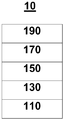
- Figure 1 illustrates a schematic view of an organic light-emitting device according to an embodiment of the present invention.
- the term “and/or” includes any and all combinations of one or more of the associated listed items. Expressions such as “at least one of,” “one of,” “at least one selected from,” and “one selected from,” when preceding a list of elements, modify the entire list of elements and do not modify the individual elements of the list. Further, the use of “may” when describing embodiments of the present invention refers to “one or more embodiments of the present invention.”
- the organic light-emitting device of the present invention comprises: a first electrode; a second electrode facing the first electrode; a first layer between the first electrode and the second electrode and comprising a first compound; a second layer between the first layer and the second electrode and comprising a second compound; and a third layer between the second layer and the second electrode and comprising a third compound.
- the first electrode may be an anode.
- the second electrode may be a cathode. Descriptions of the first electrode and the second electrode are as provided herein.
- * and *' each indicate a binding site to a corresponding adjacent atom.
- ring A 1 , ring A 11 , and ring A 12 are each independently selected from a C 5 -C 30 carbocyclic group and a C 2 -C 30 heterocyclic group.
- ring A 1 , ring A 11 , and ring A 12 may be each independently selected from a benzene group, a naphthalene group, a fluorene group, a benzofluorene group, a pyridine group, a pyrimidine group, a carbazole group, a benzocarbazole group, and a dibenzothiophene group.
- R 1 , R 2 , R 11 , and R 12 are each independently selected from:
- R 1 , R 2 , R 11 , and R 12 may be each independently selected from hydrogen, deuterium, -F, -Cl, -Br, -I, a hydroxyl group, a cyano group, a nitro group, an amino group, an amidino group, a hydrazine group, a hydrazone group, a carboxylic acid group or a salt thereof, a sulfonic acid group or a salt thereof, a phosphoric acid group or a salt thereof, an unsubstituted C 1 -C 20 alkyl group, and an unsubstituted C 1 -C 20 alkoxy group; a C 1 -C 20 alkyl group and a C 1 -C 20 alkoxy group, each substituted with at least one selected from deuterium, -F, -Cl, -Br, -I, a hydroxyl group, a cyano group, a
- R 1 , R 2 , R 11 , and R 12 may be each independently selected from hydrogen, deuterium, -F, -Cl, -Br, -I, a hydroxyl group, a cyano group, a nitro group, an amino group, an amidino group, a hydrazine group, a hydrazone group, a carboxylic acid group or a salt thereof, a sulfonic acid group or a salt thereof, a phosphoric acid group or a salt thereof, an unsubstituted C 1 -C 20 alkyl group, and an unsubstituted C 1 -C 20 alkoxy group; a C 1 -C 20 alkyl group and a C 1 -C 20 alkoxy group, each substituted with at least one selected from deuterium, -F, -Cl, -Br, -I, a hydroxyl group, a cyano group, a
- a1, a11, and a12 are each independently an integer selected from 0 to 10, and a2 may be an integer selected from 0 to 2.
- a1 in Formula A indicates the number of R 1 (s). When a1 is 2 or more, a plurality of R 1 (s) may be identical to or different from each other.
- a11, and a12 may be each independently understood by referring to the description of a1 and the structures of corresponding Formulae B and C.
- a1, a11, and a12 may be each independently an integer selected from 0 to 8, and a2 may be an integer selected from 0 to 2.
- * indicates a binding site to an adjacent atom.
- a group represented by Formula A may be a group represented by Formula A(1) or A(2).
- a group represented by Formula B may be a group represented by one of Formulae B(1) to B(4).
- a group represented by Formula C may be a group represented by one of Formulae C(1) to C(16).
- the first compound, the second compound, and the third compound may each independently comprise at least one group represented by Formulae A(1), A(2), B(1) to B(4), and C(1) to C(i6): wherein, in Formulae A(1), A(2), B(1) to B(4), and C(1) to C(i6),
- R 1a to R 1d , R 2a , R 2b , R 11a to R 11h , and R 12a to R 12d may be each independently selected from:
- the first compound is selected from compounds represented by Formulae 1-1 to 1-3
- the second compound is selected from compounds represented by Formulae 2H-1, 2D-1, and 2D-2
- X 1 may be C(R 41 ), X 2 may be C(R 42 ), and X 3 may be C(R 43 ).
- At least one of X 1 to X 3 may be nitrogen (N).
- X 1 to X 3 may each be N.
- L 21 to L 24 , L 31 to L 34 , and L 41 to L 43 may be each independently selected from a substituted or unsubstituted C 3 -C 10 cycloalkylene group, a substituted or unsubstituted C 1 -C 10 heterocycloalkylene group, a substituted or unsubstituted C 3 -C 10 cycloalkenylene group, a substituted or unsubstituted C 1 -C 10 heterocycloalkenylene group, a substituted or unsubstituted C 6 -C 60 arylene group, a substituted or unsubstituted C 1 -C 60 heteroarylene group, a substituted or unsubstituted divalent non-aromatic condensed polycyclic group, and a substituted or unsubstituted divalent non-aromatic condensed heteropolycyclic group.
- L 25 may be selected from a substituted or unsubstituted C 3 -C 10 cycloalkylene group, a substituted or unsubstituted C 1 -C 10 heterocycloalkylene group, a substituted or unsubstituted C 3 -C 10 cycloalkenylene group, a substituted or unsubstituted C 1 -C 10 heterocycloalkenylene group, a substituted or unsubstituted C 6 -C 60 non-condensed arylene group, and a substituted or unsubstituted C 1 -C 60 non-condensed heteroarylene group.
- L 25 may be selected from:
- L 35 may be selected from a substituted or unsubstituted C 6 -C 60 condensed polycyclic arylene group, a substituted or unsubstituted C 1 -C 60 condensed polycyclic heteroarylene group, a substituted or unsubstituted divalent non-aromatic condensed polycyclic group, and a substituted or unsubstituted divalent non-aromatic condensed heteropolycyclic group.
- L 35 may be selected from:
- b1 to b5, d1 to d5, and g1 to g3 may be each independently an integer selected from 0 to 3.
- Ar 21 to Ar 24 , Ar 31 to Ar 34 , and Ar 41 to Ar 43 may be each independently:
- R 21 to R 24 , R 31 , and R 41 to R 44 may be each independently selected from hydrogen, deuterium, -F, -Cl, -Br, -I, a hydroxyl group, a cyano group, a nitro group, an amino group, an amidino group, a hydrazine group, a hydrazone group, a carboxylic acid group or a salt thereof, a sulfonic acid group or a salt thereof, a phosphoric acid group or a salt thereof, a substituted or unsubstituted C 1 -C 60 alkyl group, a substituted or unsubstituted C 2 -C 60 alkenyl group, a substituted or unsubstituted C 2 -C 60 alkynyl group, a substituted or unsubstituted C 1 -C 60 alkoxy group, a substituted or unsubstituted C
- R 21 to R 24 , R 31 , and R 41 to R 44 may be each independently selected from:
- At least one of Ar 21 to Ar 23 may be a group selected from groups represented by Formulae A to C,
- the compounds represented by Formulae 1-1, 1-2, 1-3, 2H-1, 2D-1, 2D-2, 3-1, and 3-2 further comprise a group selected from groups represented by Formulae A to C.
- the first compound may be selected from compounds represented by Formulae 1-1(1) to 1-1(4), 1-2(1), and 1-3(1)
- the second compound may be selected from compounds represented by Formulae 2H-1(1) to 2H-1(4), 2D-1(1) to 2D-1(4), 2D-2(1), and 2D-2(2)
- the third compound may be selected from compounds represented by Formulae 3-1(1), 3-1(2), and 3-2(1):
- Z 1 to Z 5 may be each independently selected from:
- f1 may be an integer selected from 0 to 4
- f2 may be an integer selected from 0 to 3
- f3 may be an integer selected from 0 to 5
- f4 may be an integer selected from 0 to 2.
- At least one of Ar 22 and Ar 23 may be a group selected from groups represented by Formulae A to C,
- the compounds represented by Formulae 1-1(1) to 1-1(4), 1-2(1), 1-3(1), 2H-1(1) to 2H-1(4), 2D-1(1) to 2D-1(4), 2D-2(1), 2D-2(2), 3-1(1), 3-1(2), and 3-2(1) further comprise a group selected from Formulae A to C.
- compounds represented by Formulae 1-1(1) to 1-1(4), 1-2(1), 1-3(1), 2H-1(1) to 2H-1(4), 2D-1(1) to 2D-1(4), 2D-2(1), 2D-2(2), 3-1(1), 3-1(2), and 3-2(1) may comprise a group selected from groups represented by Formulae A to C included as a major component (e.g a component having 10% or more, 20% or more 30% or more, 40% or more, 50% or more, 60% or more or 70% or more of the mass of the entire compound).
- an organic light-emitting device may include:
- At least two selected from the first compound, the second compound, and the third compound may have a triplet energy of 2.4 eV or more, for example, 2.5 eV or more.
- the triplet energy is within these ranges, in a fluorescent organic light-emitting device, for example, emission efficiency through the triplet-triplet fusion (TTF) may be improved, and in a phosphorescent organic light-emitting device, the transfer of triplet excitons formed in an emission layer may be suppressed or reduced, thereby preventing or reducing a decrease in device efficiency.
- TTF triplet-triplet fusion
- each of the first compound, the second compound, and the third compound may have asymmetrical structure.
- Formula 1-1 a case where -(L 21 ) b1 -Ar 21 , -(L 22 ) b2 -Ar 22 , and -(L 23 ) b3 -Ar 23 are the same may be excluded; in Formula 1-2, a case where -(L 21 ) b1 -Ar 21 , -(L 22 ) b2 -Ar 22 , -(L 23 ) b3 -Ar 23 , and -(L 24 ) b4 -Ar 24 are the same may be excluded; in Formula 2D-1, a case where -(L 31 ) d1 -Ar 31 , -(L 32 ) d2 -Ar 32 , -(L 33 ) d3 -Ar 33 , and -(L 34 ) d4 -Ar 34 are the same may be excluded; in Formula 2D-2, a case where -(L 31 ) d
- the two carbazole moieties coupled via-(L 23 ) b3 - may be different from each other; in Formula 2H-1, (R 31 ) e1 and Ar 31 coupled via-(L 31 )- may be different from each other; and in Formula 3-2, the two carbazole moieties coupled via -(L 43 ) g3 - may be different from each other.
- each of the first compound, the second compound, and the third compound has an asymmetrical structure as described above, for example, the level of stacking and aggregation of molecules in an organic layer may decrease. Therefore, for example, when each of the first compound, the second compound, and the third compound is used as a matrix material in a layer including the compound, degradation of the device may be prevented or reduced and the lifespan of the device may improve.
- the first compound may be selected from compounds represented by Formulae 1-1 to 1-3
- the second compound may be represented by Formula 2H-1
- the third compound may be selected from compounds represented by Formulae 3-1 and 3-2.
- the first compound may be selected from compounds represented by Formulae 1-1(1) to 1-1(4), 1-2(1), and 1-3(1)
- the second compound may be selected from compounds represented by Formulae 2H-1(1) to 2H-1(4)
- the third compound may be selected from compounds represented by Formulae 3-1(1), 3-1(2), and 3-2(1).
- the second layer may be an emission layer and may further include a dopant, in addition to the compounds described above, and the first layer and the third layer may each directly contact the second layer.
- the dopant may be a phosphorescent dopant.
- the dopant will be described below.
- the first compound may be selected from compounds represented by Formulae 1-1 to 1-3
- the second compound may be selected from compounds represented by Formulae 2D-1 and 2D-2
- the third compound may be selected from compounds represented by Formulae 3-1 and 3-2.
- the first compound may be selected from compounds represented by Formulae 1-1(1) to 1-1(4), 1-2(1), and 1-3(1)
- the second compound may be selected from compounds represented by Formulae 2D-1(1) to 2D-1(4), 2D-2(1), and 2D-2(2)
- the third compound may be selected from compounds represented by Formulae 3-1(1), 3-1(2), and 3-2(1).
- the second layer may be an emission layer, and the second layer may further include a host, in addition to the compounds described above, and the first layer and the third layer may each directly contact the second layer.
- the host may be a fluorescent host.
- Non-limiting examples of the host will be described below.
- the first compound and the second compound are each independently selected from compounds represented by Formulae 1-1, 1-2, and 1-3, where the first compound is different from the second compound, and the third compound is selected from compounds represented by Formulae 2H-1, 2D-1, 2D-2, 3-1, and 3-2.
- the first compound and the second compound may be each independently selected from compounds represented by Formulae 1-1(1) to 1-1(4), 1-2(1), and 1-3(1), where the first compound may be different from the second compound, and the third compound may be selected from compounds represented by Formulae 2H-1(1) to 2H-1(4), 2D-1(1) to 2D-1(4), 2D-2(1), 2D-2(2), 3-1(1), 3-1(2), and 3-2(1).
- the first compound and the second compound may be each independently selected from compounds represented by Formulae 1-1, 1-2, and 1-3, where the first compound may be different from the second compound, and the third compound may be selected from compounds represented by Formulae 2H-1, 3-1 and 3-2.
- the first compound and the second compound may be each independently selected from compounds represented by Formulae 1-1(1) to 1-1(4), 1-2(1), and 1-3(1), where the first compound may be different from the second compound, and the third compound may be selected from compounds represented by Formulae 2H-1(1) to 2H-1(4), 3-1(1), 3-1(2), and 3-2(1).
- An organic light-emitting device may include the third layer as an emission layer, the third layer further including a dopant, in addition to the compounds described above, and the second layer may directly contact the third layer.
- the dopant may be a phosphorescent dopant.
- the first compound and the second compound may be each independently selected from compounds represented by Formulae 1-1, 1-2, and 1-3, where the first compound may be different from the second compound, and the third compound may be selected from compounds represented by Formulae 2D-1, 2D-2, 3-1 and 3-2.
- the first compound and the second compound may be each independently selected from compounds represented by Formulae 1-1(1) to 1-1(4), 1-2(1), and 1-3(1), where the first compound may be different from the second compound, and the third compound may be selected from compounds represented by Formulae 2D-1(1) to 2D-1(4), 2D-2(1), 2D-2(2), 3-1(1), 3-1(2), and 3-2(1).
- An organic light-emitting device may include the third layer as an emission layer, the third layer further including a host, in addition to the compounds described above, and the second layer may directly contact the third layer.
- the host may be a fluorescent host.
- the first compound and the second compound may be each independently selected from Compounds 1-1 to 1-12 and 2-1 to 2-10, where the first compound may be different from the second compound, and the third compound may be selected from Compounds 3-1 to 3-12, 4-1 to 4-12, and 5-1 to 5-9.
- the organic light-emitting device includes the first layer including the first compound, the second layer including the second compound, and the third layer including the third compound, wherein each of the first compound, the second compound, and the third compound includes at least one group selected from Formulae A to C. Accordingly, charge transfer may be facilitated due to the similarity in molecular structures of the first, second, and third compounds. Further, the interfacial characteristics between the three layers may improve, thereby improving the stability and lifespan of the organic light-emitting device.
- the drawing is a schematic cross-sectional view of an organic light-emitting device (OLED) 10 according to one embodiment of the present disclosure.
- the OLED 10 includes a first electrode 110, a first layer 130, a second layer 150, and a third layer 170, and a second electrode 190, which are sequentially layered in the stated order.
- a substrate may be additionally disposed (e.g., positioned) under the first electrode 110 or on the second electrode 190.
- the substrate may be a glass substrate or transparent plastic substrate, each with excellent mechanical strength, thermal stability, transparency, surface smoothness, ease of handling, and/or water resistance.
- the first electrode 110 may be formed by depositing or sputtering a material for forming the first electrode 110 on the substrate.
- the material for forming the first electrode 110 may be selected from materials with a high work function that facilitate hole injection.
- the first electrode 110 may be a reflective electrode, a semi-transmissive electrode, or a transmissive electrode.
- the material for forming the first electrode 110 may be a transparent and highly conductive material. Non-limiting examples of such material may include indium tin oxide (ITO), indium zinc oxide (IZO), tin oxide (SnO 2 ), and zinc oxide (ZnO).
- the first electrode 110 is a semi-transmissive electrode or a reflective electrode
- a material for forming the first electrode 110 at least one selected from magnesium (Mg), aluminum (Al), aluminum-lithium (Al-Li), calcium (Ca), magnesium-indium (Mg-In), and magnesium-silver (Mg-Ag) may be used.
- the first electrode 110 may have a single-layer structure, or a multi-layer structure including a plurality of layers.
- the first electrode 110 may have a triple-layer structure of ITO/Ag/ITO, but embodiments of the present disclosure are not limited thereto.
- the first layer 130, the second layer 150, and the third layer 170 are sequentially stacked on the first electrode 110.
- the first layer 130 includes a first compound
- the second layer 150 includes a second compound
- the third layer 170 includes a third compound.
- the descriptions of the first to third compounds may be understood by referring to the descriptions thereof provided herein.
- a hole injection layer may be additionally disposed (e.g., positioned) between the first electrode 110 and the first layer 130.
- the hole injection layer may be formed on the first electrode 110 by using one or more suitable methods, such as vacuum deposition, spin coating, casting, a Langmuir-Blodgett (LB) method, ink-jet printing, laser printing, and/or laser-induced thermal imaging (LITI).
- suitable methods such as vacuum deposition, spin coating, casting, a Langmuir-Blodgett (LB) method, ink-jet printing, laser printing, and/or laser-induced thermal imaging (LITI).
- the spin coating may be performed at a coating rate of about 2000 rpm to about 5000 rpm, and at a temperature of about 80°C to 200°C, depending on the compound for forming the hole injection layer, and the structure of the hole injection layer to be formed.
- the thickness of the hole injection layer may be in a range of about 100 ⁇ to about 10,000 ⁇ , for example, about 100 ⁇ to about 1,000 ⁇ .
- the method of forming the hole injection layer may be understood by referring to any of the methods of forming the first layer 130, the second layer 150, and the third layer 170.
- the first layer 130 includes the first compound, and may additionally include at least one selected from m-MTDATA, TDATA, 2-TNATA, NPB, ⁇ -NPB, TPD, a spiro-TPD, a spiro-NPB, methylated NPB, TAPC, HMTPD, 4,4',4"-tris(N-carbazolyl)triphenylamine (TCTA), polyaniline/dodecylbenzenesulfonic acid (PANI /DBSA), poly(3,4-ethylenedioxythiophene)/poly(4-styrenesulfonate) (PEDOT/PSS), polyaniline/camphor sulfonicacid (PANI /CSA), and (polyaniline)/poly(4-styrenesulfonate) (PANI/PSS):
- the first layer 130 may further include a charge-generating material, in addition to the materials mentioned above, to improve conductive properties.
- the charge-generating material may be homogeneously or non-homogeneously dispersed throughout the first layer 130.
- the charge-generating material may be, for example, a p-dopant.
- the p-dopant may be selected from a quinone derivative, a metal oxide, and a cyano group-containing compound, but embodiments of the present disclosure are not limited thereto.
- Non-limiting examples of the p-dopant may include quinone derivatives (such as tetracyanoquinonedimethane (TCNQ) and/or Compound HT-D2); metal oxides (such as tungsten oxide and/or molybdenum oxide); and Compound HT-D1, but embodiments are not limited thereto.
- the first layer 130 may be a hole transport layer.
- the thickness of the hole transport layer may be in a range of about 50 ⁇ to about 2,000 ⁇ , for example, about 100 ⁇ to about 1,500 ⁇ .
- the second layer 150 may be an emission layer, and the first layer 130 and the third layer 170 may each directly contact the second layer 150.
- the third layer 170 may be an emission layer, and the second layer 150 may directly contact the third layer 170.
- the emission layer may be patterned into a red emission layer, a green emission layer, or a blue emission layer, according to a sub-pixel.
- the emission layer may have a stacked structure of a red emission layer, a green emission layer, and a blue emission layer, or may include a red-light emission material, a green-light emission material, and a blue-light emission material, which are mixed with each other in a single layer, to emit white light.
- the emission layer when the second layer 150 is an emission layer, the emission layer may include the second compound, and may additionally include a host and/or a dopant.
- the emission layer may include the third compound, and may additionally include a host and/or a dopant.
- the host may include a compound represented by Formula 301: Formula 301 Ar 301 -[(L 301 ) xb1 -R 301 ] xb2 .
- Ar 301 may be selected from:
- L 301 may be selected from:
- the host may include a compound represented by Formula 301A: wherein L 301 , R 301 , xb1 and xb2 are as defined herein.
- the compound represented by Formula 301 may include at least one compound selected from Compounds H1 to H42, but embodiments of the present disclosure are not limited thereto:
- the host may include at least one selected from Compounds H43 to H49, but embodiments are not limited thereto:
- the host may include at least one selected from compounds below, but embodiments are not limited thereto:
- the dopant may be a phosphorescent dopant.
- the phosphorescent dopant may include an organometallic complex represented by Formula 401: In Formula 401,
- L 401 may be any suitable monovalent, divalent, or trivalent organic ligand.
- L 401 may be selected from a halogen ligand (e.g., Cl and/or F), a diketone ligand (e.g., acetylacetonate, 1,3-diphenyl-1,3-propanedionate, 2,2,6,6-tetramethyl-3,5-heptanedionate, and/or hexafluoroacetonate), a carboxylic acid ligand (e.g., picolinate, dimethyl-3-pyrazolecarboxylate, and/or benzoate), a carbon monoxide ligand, an isonitrile ligand, a cyano ligand, and a phosphorous ligand (e.g., phosphine and/or phosphite), but embodiments are not limited thereto.
- a halogen ligand e.g., Cl and/or F
- a 401 in Formula 401 includes a plurality of substituents
- the plurality of substituents of A 401 may be bound to each other to form a saturated or unsaturated ring.
- a 402 in Formula 401 includes a plurality of substituents
- the plurality of substituents of A 402 may be bound to each other to form a saturated or unsaturated ring.
- a plurality of ligands in Formula 401 may be identical to or different from each other.
- a linking group e.g., a C 1 -C 5 alkylene group, - N(R')- (where R' is a C 1 -C 10 alkyl group or a C 6 -C 20 aryl group
- the phosphorescent dopant may include, for example, at least one selected from Compounds PD1 to PD21 and PD76, but embodiments are not limited thereto:
- the second layer 150 may be an emission layer.
- the amount of the dopant may be in a range of about 0.01 parts by weight to about 15 parts by weight, based on 100 parts by weight of the second compound, but embodiments are not limited thereto.
- the second layer 150 may be an emission layer.
- the amount of the second compound may be in a range of about 0.01 parts by weight to about 15 parts by weight, based on 100 parts by weight of the host, but embodiments are not limited thereto.
- the third layer 170 may be an emission layer.
- the amount of the third compound may be in a range of about 0.01 parts by weight to about 15 parts by weight, based on 100 parts by weight of the host, but embodiments are not limited thereto.
- the third layer 170 may be an emission layer.
- the amount of the dopant may be in a range of about 0.01 parts by weight to about 15 parts by weight, based on 100 parts by weight of the host, but embodiments are not limited thereto.
- the thickness of the emission layer may be in a range of about 100 ⁇ to about 1000 ⁇ , for example, about 200 ⁇ to about 600 ⁇ . When the thickness of the emission layer is within any of these ranges, excellent (or suitable) light-emission characteristics may be achieved without a substantial increase in driving voltage.
- an electron injection layer that facilitates electron injection may be additionally disposed (e.g., positioned) between the second electrode 190 and the third layer 170.
- the electron injection layer may be formed on the third layer 170 by using one or more suitable methods, such as vacuum deposition, spin coating, casting, an LB method, inkjet printing, laser printing, and/or LITI.
- suitable methods such as vacuum deposition, spin coating, casting, an LB method, inkjet printing, laser printing, and/or LITI.
- the vacuum deposition and coating conditions for the electron injection layer may be similar to the vacuum deposition and coating conditions for the hole injection layer.
- the electron injection layer may comprise at least one selected from LiF, NaCl, CsF, Li 2 O, BaO, and LiQ.
- the thickness of the electron injection layer may be in a range of about 1 ⁇ to about 100 ⁇ , for example, about 3 ⁇ to about 90 ⁇ . When the thickness of the electron injection layer is within any of these ranges, excellent (or suitable) electron injection characteristics may be obtained without a substantial increase in driving voltage.
- the third layer 170 when the third layer 170 is an emission layer, at least one selected from an electron transport layer and an electron injection layer may be additionally disposed between the third layer 170 and the second electrode 190.
- the electron injection layer may be understood by referring to the description thereof provided herein.
- the electron transport layer may include at least one selected from BCP, Bphen, Alq 3 , BAlq, TAZ, and NTAZ:
- the thickness of the electron transport layer may be in a range of about 100 ⁇ to about 1000 ⁇ , for example, about 150 ⁇ to about 500 ⁇ . When the thickness of the electron transport layer is within any of these ranges, excellent (or suitable) electron transport characteristics may be obtained without a substantial increase in driving voltage.
- the second layer 150 may be an emission layer
- the third layer 170 may be an electron transport layer
- the electron transport layer may further include a metal-containing material, in addition to the materials described above.
- the metal-containing material may include a Li complex.
- the Li complex may include, for example, Compound ET-Di (lithium quinolate or LiQ) and/or Compound ET-D2:
- the second electrode 190 may be a cathode, that is an electron injection electrode.
- a material for forming the second electrode 190 may be a material having a low work function, for example, a metal, an alloy, an electrically conductive compound, or a mixture thereof.
- Non-limiting examples of the material for forming the second electrode 190 may include lithium (Li), magnesium (Mg), aluminum (Al), aluminum-lithium (Al-Li), calcium (Ca), magnesium-indium (Mg-In), and magnesium-silver (Mg-Ag).
- the material for forming the second electrode 190 may be ITO and/or IZO.
- the second electrode 190 may be a semi-transmissive electrode or a transmissive electrode.
- a C 1 -C 60 alkyl group used herein may refer to a linear or branched aliphatic hydrocarbon monovalent group having 1 to 60 carbon atoms e.g. 1 to 30 carbon atoms, 1 to 20 carbon atoms, 1 to 10 carbon atoms, 1 to 6 carbon atoms or 1 to 4 carbon atoms.
- Non-limiting examples thereof include a methyl group, an ethyl group, a propyl group, an iso-butyl group, a sec-butyl group, a tert-butyl group, a pentyl group, an iso-amyl group, and a hexyl group.
- a C 1 -C 60 alkylene group used herein may refer to a divalent group having the same structure as the C 1 -C 60 alkyl group.
- a C 1 -C 60 alkoxy group used herein may refer to a monovalent group represented by -OA 101 (where A 101 is the C 1 -C 60 alkyl group).
- a 101 is the C 1 -C 60 alkyl group.
- Non-limiting examples thereof may include a methoxy group, an ethoxy group, and an isopropoxy group.
- a C 2 -C 60 alkenyl group used herein may refer to a hydrocarbon group having at least one carbon-carbon double bond at one or more positions along the hydrocarbon chain of the C 2 -C 60 alkyl group (e.g., in the middle or at either terminal end of the C 2 -C 60 alkyl group). Non-limiting examples thereof may include an ethenyl group, a propenyl group, and a butenyl group.
- a C 2 -C 60 alkenylene group used herein may refer to a divalent group having the same structure as the C 2 -C 60 alkenyl group.
- a C 2 -C 60 alkynyl group used herein may refer to a hydrocarbon group having at least one carbon-carbon triple bond at one or more positions along the hydrocarbon chain of the C 2 -C 60 alkyl group (e.g., in the middle or at either terminal end of the C 2 -C 60 alkyl group).
- Non-limiting examples thereof may include an ethynyl group and a propynyl group.
- a C 2 -C 60 alkynylene group used herein may refer to a divalent group having the same structure as the C 2 -C 60 alkynyl group.
- a C 3 -C 10 cycloalkyl group used herein may refer to a monovalent monocyclic saturated hydrocarbon group including 3 to 10 carbon atoms. Non-limiting examples thereof may include a cyclopropyl group, a cyclobutyl group, a cyclopentyl group, a cyclohexyl group, and a cycloheptyl group.
- a C 3 -C 10 cycloalkylene group used herein may refer to a divalent group having the same structure as the C 3 -C 10 cycloalkyl group.
- a C 1 -C 10 heterocycloalkyl group used herein may refer to a monovalent monocyclic group including at least one heteroatom (e.g. 1, 2, 3, 4 or 5 hereoatoms) selected from N, O, P, and S as a ring-forming atom, and 1 to 10 carbon atoms e.g. 1, 2, 3, 4 or 5 ring carbon atoms. Non-limiting examples thereof may include a tetrahydrofuranyl group and a tetrahydrothiophenyl group.
- a C 1 -C 10 heterocycloalkylene group used herein may refer to a divalent group having the same structure as the C 1 -C 10 heterocycloalkyl group.
- a C 3 -C 10 cycloalkenyl group as used herein may refer to a monovalent monocyclic group that has 3 to 10 carbon atoms and at least one double bond in its ring, and is not aromatic. Non-limiting examples thereof may include a cyclopentenyl group, a cyclohexenyl group, and a cycloheptenyl group.
- a C 3 -C 10 cycloalkenylene group used herein may refer to a divalent group having the same structure as the C 3 -C 10 cycloalkenyl group.
- a C 1 -C 10 heterocycloalkenyl group used herein may refer to a monovalent monocyclic group including at least one heteroatom (e.g. 1, 2, 3, 4 or 5 hereoatoms) selected from N, O, P, and S as a ring-forming atom, 1 to 10 carbon atoms e.g. 1, 2, 3, 4 or 5 ring carbon atoms, and at least one double bond in its ring.
- Non-limiting examples of the C 1 -C 10 heterocycloalkenyl group may include a 2,3-hydrofuranyl group and a 2,3-hydrothiophenyl group.
- a C 1 -C 10 heterocycloalkenylene group used herein may refer to a divalent group having the same structure as the C 1 -C 10 heterocycloalkenyl group.
- a C 6 -C 60 aryl group used herein may refer to a monovalent group including a carbocyclic aromatic system having 6 to 60 carbon atoms e.g. 6 to 20 ring carbon atoms, 6 to 14 ring cabon atoms or 6 to 10 ring carbon atoms.
- a C 6 -C 60 arylene group used herein may refer to a divalent group including a carbocyclic aromatic system having 6 to 60 carbon atoms.
- a C 6 -C 60 non-condensed arylene group used herein may refer to a divalent group including a carbocyclic aromatic system having 6 to 60 carbon atoms (e.g. 6 ring carbon atoms), and not including two or more rings.
- a C 6 -C 60 condensed polycyclic arylene group used herein may refer to a divalent group including a carbocyclic aromatic system having 6 to 60 carbon atoms (e.g. 10-20, 10-14, or 10 ring carbon atoms), and including two or more rings.
- Non-limiting examples of the C 6 -C 60 aryl group may include a phenyl group, a naphthyl group, an anthracenyl group, a phenanthrenyl group, a pyrenyl group, and a chrysenyl group.
- a non-limiting example of the C 6 -C 60 non-condensed arylene group may include a phenylene group.
- Non-limiting examples of the C 6 -C 60 condensed polycyclic arylene group may include a naphthylene group, an anthracenylene group, a phenanthrenylene group, a pyrenylene group, and a chrysenylene group.
- the respective rings may be fused to each other.
- a C 1 -C 60 heteroaryl group used herein may refer to a monovalent group having a carbocyclic aromatic system including at least one heteroatom (e.g. 1, 2, 3, 4 or 5 hereoatoms) selected from N, O, P, and S as a ring-forming atom, and 1 to 60 carbon atoms, e.g. 1 to 19 ring carbon atoms, 1 to 13 ring cabon atoms or 1 to 9 ring carbon atoms.
- a C 1 -C 60 heteroarylene group used herein may refer to a divalent group having a carbocyclic aromatic system including at least one heteroatom e.g.
- 1, 2, 3, 4 or 5 hereoatoms selected from N, O, P, and S as a ring-forming atom, and 1 to 60 carbon atoms, e.g. 1 to 19 ring carbon atoms, 1 to 13 ring cabon atoms or 1 to 9 ring carbon atoms.
- a C 1 -C 60 non-condensed heteroarylene group used herein may refer to a divalent group having a carbocyclic aromatic system including at least one heteroatom (e.g. 1, 2, 3 or 4 hereoatoms) selected from N, O, P, and S as a ring-forming atom, and 1 to 60 carbon atoms, e.g. 1 to 5 ring carbon atoms, and not including two or more rings.
- a C 1 -C 60 condensed polycyclic heteroarylene group used herein may refer to a divalent group having a carbocyclic aromatic system including at least one heteroatom (e.g.
- 1, 2, 3, 4 or 5 hereoatoms selected from N, O, P, and S as a ring-forming atom, and 1 to 60 carbon atoms, e.g. 1 to 19 ring carbon atoms, 1 to 13 ring cabon atoms or 1 to 9 ring carbon atoms, and including two or more rings.
- Non-limiting examples of the C 1 -C 60 heteroaryl group may include a pyridinyl group, a pyrimidinyl group, a pyrazinyl group, a pyridazinyl group, a triazinyl group, a quinolinyl group, and an isoquinolinyl group.
- Non-limiting examples of the C 1 -C 60 non-condensed heteroarylene group may include a pyridinylene group, a pyrimidinylene group, a pyrazinylene group, a pyridazinylene group, and a triazinylene group.
- Non-limiting examples of the C 1 -C 60 condensed polycyclic heteroarylene group may include a quinolinylene group, an isoquinolinylene group, a quinoxalinylene group, and a phthalazinylene group.
- the C 1 -C 60 heteroaryl group and the C 1 -C 60 heteroarylene group each independently include a plurality of rings, the respective rings may be fused to each other.
- a C 6 -C 60 aryloxy group used herein may refer to a group represented by -OA 102 (where A 102 is the C 6 -C 60 aryl group).
- a C 6 -C 60 arylthio group used herein may refer to a group represented by -SA 103 (where A 103 is the C 6 -C 60 aryl group).
- a monovalent non-aromatic condensed polycyclic group used herein may refer to a monovalent group that has two or more rings condensed to each other, has only carbon atoms as ring-forming atoms (for example, the number of carbon atoms may be in a range of 8 to 60, 8 to 20, 8 to 14 or 8 to 10), and does not have overall aromaticity in the entire molecular structure.
- a non-limiting example of the monovalent non-aromatic condensed polycyclic group may include a fluorenyl group.
- a divalent non-aromatic condensed polycyclic group used herein may refer to a divalent group having the same structure as the monovalent non-aromatic condensed polycyclic group.
- a monovalent non-aromatic condensed heteropolycyclic group used herein may refer to a monovalent group that has two or more rings condensed to each other, has at least one heteroatom selected from N, O P, and S as a ring-forming atom, other than carbon atoms (for example, the number of carbon atoms may be in a range of 2 to 60, 2 to 19, 2 to 13 or 2 to 9), and does not have overall aromaticity in the entire molecular structure.
- Non-limiting example of the monovalent non-aromatic condensed heteropolycyclic group includes a carbazolyl group.
- a divalent non-aromatic condensed heteropolycyclic group used herein may refer to a divalent group having the same structure as the monovalent non-aromatic condensed heteropolycyclic group.
- any of the cyclic groups described herein can be a monocyclic, non-condensed group or a polycyclic, condensed group.
- a group When a group is substituted with one or more substituents, it is typically substituted with 1, 2, 3 or 4 substituents (e.g. 1, 2, or 3 substituents, 1 or 2 substituents, or 1 substituent).
- 1, 2, 3 or 4 substituents e.g. 1, 2, or 3 substituents, 1 or 2 substituents, or 1 substituent.
- Ph used herein may refer to a phenyl group
- Me may refer to a methyl group
- Et may refer to an ethyl group
- ter-Bu or “Bu t” may refer to a tert-butyl group.
- a biphenyl group may refer to a monovalent group in which two benzene rings are bound (e.g., coupled) to each other via a single bond.
- a terphenyl group may refer to a monovalent group in which three benzene rings are bound (e.g., coupled) via single bonds.
- Example 1-1 (not forming part of the invention)
- ITO glass substrate available from Corning Inc.
- ITO layer having a thickness of 15 ⁇ /cm 2 (1,200 ⁇ ) thereon was cut to a size of 50 mm X 50 mm X 0.5mm, sonicated by using isopropyl alcohol and pure water each for 15 minutes, and cleaned by exposure to ultraviolet rays for 30 minutes and then ozone, and the resulting ITO glass anode was mounted on a vacuum deposition apparatus.
- Compound 1-9 was vacuum-deposited to form a hole transport layer (e.g., first layer) having a thickness of about 1,200 ⁇ .
- Compound 4-5 (as a host) and PD17 (as a dopant) were next co-deposited on the hole transport layer at a weight ratio of about 95:5 to form an emission layer (e.g., second layer) having a thickness of about 300 ⁇ .
- Compound 5-3 was then vacuum-deposited on the emission layer to form a first electron transport layer(e.g., third layer) having a thickness of about 100 ⁇ , followed by vacuum deposition of BAlq on the first electron transport layer to form a second electron transport layer having a thickness of about 300 ⁇ .
- LiF was vacuum-deposited on the second electron transport layer to form an electron injection layer having a thickness of about 10 ⁇ .
- Al was vacuum-deposited on the electron injection layer to form a cathode having a thickness of about 2,000 ⁇ , thereby completing the manufacture of an organic light-emitting device.
- Organic light-emitting devices were manufactured in the same (or substantially the same) manner as in Example 1-1, except that materials as shown in Table 1 were used.
- An organic light-emitting device was manufactured in the same (or substantially the same) manner as in Example 1-1, except that CBP was used instead of Compound 4-5 in forming the emission layer.
- An organic light-emitting device was manufactured in the same (or substantially the same) manner as in Example 1-1, except that a first electron transport layer was not formed, and BAlq was vacuum-deposited on the emission layer to form an electron transport layer having a thickness of about 400 ⁇ .
- An ITO glass substrate (available from Corning Inc.) with an ITO layer having a thickness of 15 ⁇ /cm 2 (1,200 ⁇ ) thereon was cut to a size of 50 mm X 50 mm X 0.5mm, sonicated by using isopropyl alcohol and pure water each for 15 minutes, and cleaned by exposure to ultraviolet rays for 30 minutes and then ozone, and the resulting ITO glass anode was mounted on a vacuum deposition apparatus.
- Compound 1-9 was vacuum-deposited to form a first hole transport layer(e.g., first layer) having a thickness of about 1,100 ⁇ .
- Compound 2-8 was next vacuum-deposited on the first hole transport layer to form a second hole transport layer(e.g., second layer) having a thickness of about 100 ⁇ .
- Compound 4-5 (as a host) and PD17 (as a dopant) were next co-deposited on the second hole transport layer at a weight ratio of about 95:5 to form an emission layer (e.g., third layer) having a thickness of about 300 ⁇ .
- BAlq was vacuum-deposited on the emission layer to form an electron transport layer having a thickness of 400 ⁇ .
- LiF was vacuum-deposited on the electron transport layer to form an electron injection layer having a thickness of about 10 ⁇ , and Al was vacuum-deposited on the electron injection layer to form a cathode having a thickness of about 2,000 ⁇ , thereby completing the manufacture of an organic light-emitting device.
- Organic light-emitting devices were manufactured in the same (or substantially the same) manner as in Example 2-1, except that materials as shown in Table 2 were used.
- An organic light-emitting device was manufactured in the same (or substantially the same) manner as in Example 2-1, except that CBP was used instead of Compound 4-5 in forming the emission layer.
- An organic light-emitting device was manufactured in the same (or substantially the same) manner as in Example 2-1, except that compound HT3 was used instead of Compound 2-8 in forming the second hole transport layer.
- An organic light-emitting device was manufactured in the same (or substantially the same) manner as in Example 2-1, except that NPB was used instead of Compound 1-9 in forming the first hole transport layer, and Compound 2-4 was used instead of Compound 2-8 in forming the second hole transport layer.
- An ITO glass substrate (available from Corning Inc.) with an ITO layer having a thickness of 15 ⁇ /cm 2 (1,200 ⁇ ) thereon was cut to a size of 50 mm X 50 mm X 0.5mm, sonicated by using isopropyl alcohol and pure water each for 15 minutes, and cleaned by exposure to ultraviolet rays for 30 minutes and then ozone, and the resulting ITO glass anode was mounted on a vacuum deposition apparatus.
- Compound 1-9 was vacuum-deposited to form a hole transport layer (e.g., first layer) having a thickness of about 1,200 ⁇ .
- Compound ADN (as a host) and Compound 3-1 (as a dopant) were next co-deposited on the hole transport layer at a weight ratio of about 95:5 to form an emission layer (e.g., second layer) having a thickness of about 300 ⁇ .
- Compound 5-3 was then vacuum-deposited on the emission layer to form a first electron transport layer(e.g., third layer) having a thickness of about 100 ⁇ , followed by vacuum deposition of Alq 3 on the first electron transport layer to form a second electron transport layer having a thickness of about 300 ⁇ .
- LiF was vacuum-deposited on the second electron transport layer to form an electron injection layer having a thickness of about 10 ⁇ .
- Al was vacuum-deposited on the electron injection layer to form a cathode having a thickness of about 2,000 ⁇ , thereby completing the manufacture of an organic light-emitting device.
- Organic light-emitting devices were manufactured in the same (or substantially the same) manner as in Example 3-1, except that materials as shown in Table 3 were used.
- An organic light-emitting device was manufactured in the same (or substantially the same) manner as in Example 3-1, except that compound FD1 (illustrated below) was used instead of Compound 3-1 in forming the emission layer.
- An organic light-emitting device was manufactured in the same (or substantially the same) manner as in Example 3-1, except that a first electron transport layer was not formed, and Alq 3 was vacuum-deposited on the emission layer to form an electron transport layer having a thickness of about 400 ⁇ .
- An ITO glass substrate (available from Corning Inc.) with an ITO layer having a thickness of 15 ⁇ /cm 2 (1,200 ⁇ ) thereon was cut to a size of 50 mm X 50 mm X 0.5mm, sonicated by using isopropyl alcohol and pure water each for 15 minutes, and cleaned by exposure to ultraviolet rays for 30 minutes and then ozone, and the resulting ITO glass anode was mounted on a vacuum deposition apparatus.
- Compound 1-9 was vacuum-deposited to form a first hole transport layer(e.g., first layer) having a thickness of about 1,100 ⁇ .
- Compound 2-8 was next vacuum-deposited on the first hole transport layer to form a second hole transport layer(e.g., second layer) having a thickness of about 100 ⁇ .
- Compound ADN (as a host) and Compound 3-1 (as a dopant) were next co-deposited on the second hole transport layer at a weight ratio of about 95:5 to form an emission layer (e.g., third layer) having a thickness of about 300 ⁇ .
- Alq 3 was vacuum-deposited on the emission layer to form an electron transport layer having a thickness of 400 ⁇ .
- LiF was vacuum-deposited on the electron transport layer to form an electron injection layer having a thickness of about 10 ⁇ , and Al was vacuum-deposited on the electron injection layer to form a cathode having a thickness of about 2,000 ⁇ , thereby completing the manufacture of an organic light-emitting device.
- Organic light-emitting devices were manufactured in the same (or substantially the same) manner as in Example 4-1, except that materials as shown in Table 4 were used.
- An organic light-emitting device was manufactured in the same (or substantially the same) manner as in Example 4-1, except that compound FD1 was used instead of Compound 3-1 in forming the emission layer.
- An organic light-emitting device was manufactured in the same (or substantially the same) manner as in Example 4-1, except that compound HT3 was used instead of Compound 2-8 in forming the second hole transport layer.
- the efficiency and T90 lifespan of organic light-emitting devices manufactured in Examples 1-1 to 1-5, 2-1 to 2-5, 3-1 to 3-5, and 4-1 to 4-5 and Comparative Examples 1-1, 1-2, 2-1 to 2-3, 3-1, 3-2, 4-1, and 4-2 were measured using a luminance meter PR650 (PhotoResearch, Inc.). The results are shown in Tables 1 to 4.
- the T90 lifespan indicates a time that it took for the luminance of the organic light-emitting device to decline to 90% of its initial luminance, under a luminance condition of 150 nits.
- an organic light-emitting device may have low-driving voltage, improved efficiency, and long lifespan.
- any numerical range recited herein is intended to include all sub-ranges of the same numerical precision subsumed within the recited range.
- a range of "1.0 to 10.0" is intended to include all subranges between (and including) the recited minimum value of 1.0 and the recited maximum value of 10.0, that is, having a minimum value equal to or greater than 1.0 and a maximum value equal to or less than 10.0, such as, for example, 2.4 to 7.6.
- Any maximum numerical limitation recited herein is intended to include all lower numerical limitations subsumed therein and any minimum numerical limitation recited in this specification is intended to include all higher numerical limitations subsumed therein.
Landscapes
- Chemical & Material Sciences (AREA)
- Physics & Mathematics (AREA)
- Materials Engineering (AREA)
- Engineering & Computer Science (AREA)
- Spectroscopy & Molecular Physics (AREA)
- Optics & Photonics (AREA)
- Organic Chemistry (AREA)
- Crystallography & Structural Chemistry (AREA)
- Inorganic Chemistry (AREA)
- Electroluminescent Light Sources (AREA)
- Nitrogen Condensed Heterocyclic Rings (AREA)
- Furan Compounds (AREA)
- Plural Heterocyclic Compounds (AREA)
Claims (15)
- Organische lichtemittierende Vorrichtung, umfassend:eine erste Elektrode (110);eine zweite Elektrode (190), die der ersten Elektrode gegenüberliegt;eine erste Schicht (130) zwischen der ersten Elektrode und der zweiten Elektrode, wobei die erste Schicht eine erste Verbindung umfasst;eine zweite Schicht (150) zwischen der ersten Schicht und der zweiten Elektrode, wobei die zweite Schicht eine zweite Verbindung umfasst; undeine dritte Schicht (170) zwischen der ersten Schicht und der zweiten Elektrode, wobei die dritte Schicht eine dritte Verbindung umfasst;wobei die erste Verbindung aus Verbindungen ausgewählt ist, die durch die Formeln 1-1 bis 1-3 dargestellt sind, und keine stickstoffhaltige heterocyclische Gruppe umfasst, die *=N-*' als eine ringbildende Einheit umfasst,die zweite Verbindung aus Verbindungen ausgewählt ist, die durch die Formeln 2H-1, 2D-1 und 2D-2 dargestellt sind, unddie dritte Verbindung eine stickstoffhaltige heterocyclische Gruppe umfasst, die *=N-*' als ringbildende Einheit umfasst und aus Verbindungen, die durch die Formeln 3-1 und 3-2 dargestellt sind, ausgewählt ist:


Formel 2H-1 (R31)e1-(L31)-Ar31


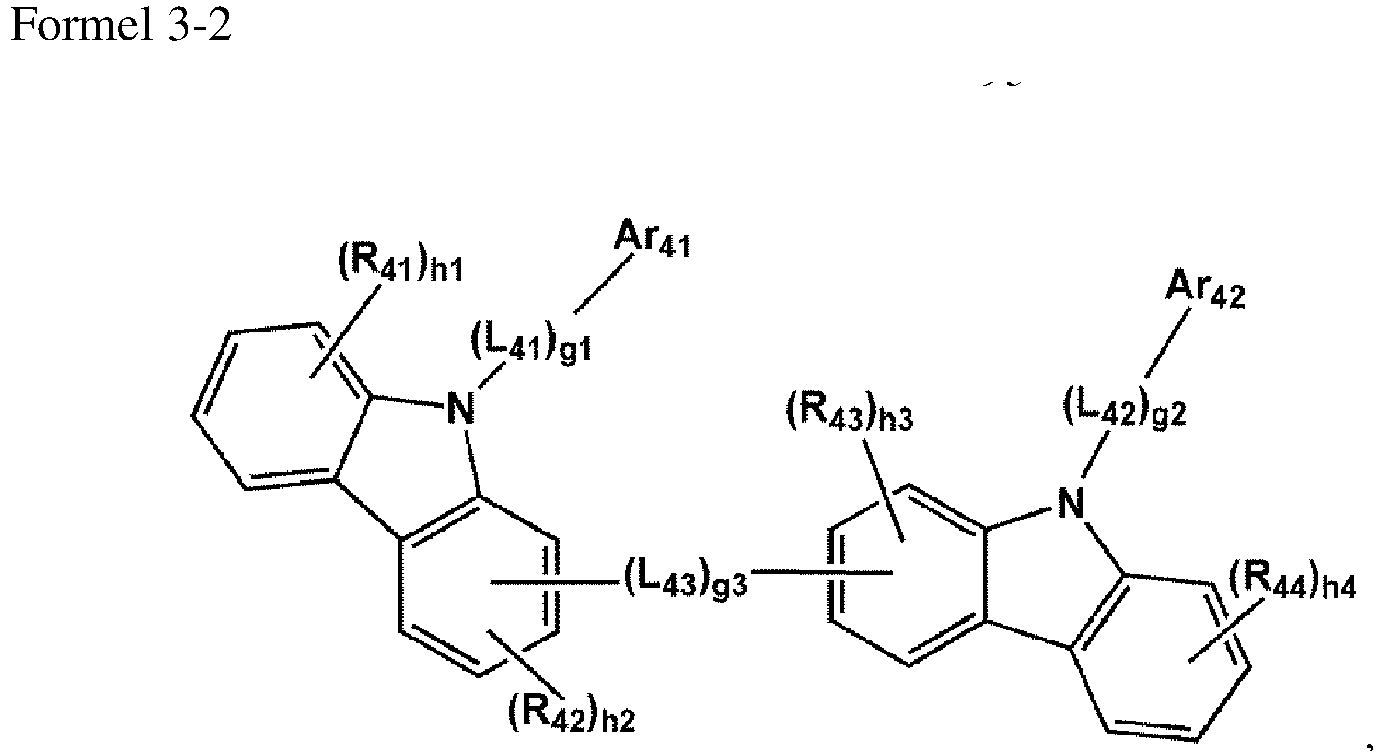 X1 C(R41) oder N ist;X2 C(R42) oder N ist;X3 C(R43) oder N ist;L21 bis L24, L31 bis L34, und L41 bis L43 jeweils unabhängig ausgewählt sind aus einersubstituierten oder unsubstituierten C3-C10-Cycloalkylengruppe, einer substituierten oder unsubstituierten C1-C10-Heterocycloalkylengruppe, einer substituierten oder unsubstituierten C3-C10-Cycloalkenylengruppe, einer substituierten oder unsubstituierten C1-C10-Heterocycloalkenylengruppe, einer substituierten oder unsubstituierten C6-C60-Arylengruppe, einer substituierten oder unsubstituierten C1-C60-Heteroarylengruppe, einer substituierten oder unsubstituierten zweiwertigen nichtaromatischen kondensierten polycyclischen Gruppe, und einer substituierten oder unsubstituierten zweiwertigen nichtaromatischen kondensierten heteropolycyclischen Gruppe,L25 ausgewählt ist aus einer substituierten oder unsubstituierten C3-C10-Cycloalkylengruppe, einer substituierten oder unsubstituierten C1-C10-Heterocycloalkylengruppe, einer substituierten oder unsubstituierten C3-C10-Cycloalkenylengruppe, einer substituierten oder unsubstituierten C1-C10-Heterocycloalkenylengruppe, einer substituierten oder unsubstituierten C6-C60 nichtkondensierten Arylengruppe, und einer substituierten oder unsubstituierten C1-C60 nichtkondensierten Heteroarylengruppe,L35 ausgewählt ist aus einer substituierten oder unsubstituierten C6-C60 kondensierten polycyclischen Arylengruppe, einer substituierten oder unsubstituierten C1-C60 kondensierten polycyclischen Heteroarylengruppe, einer substituierten oder unsubstituierten zweiwertigen nichtaromatischen kondensierten polycyclischen Gruppe, und einer substituierten oder unsubstituierten zweiwertigen nichtaromatischen kondensierten heteropolycyclischen Gruppe,b1 bis b5, d1 bis d5 und g1 bis g3 jeweils unabhängig eine ganze Zahl sind ausgewählt von 0 bis 3,Ar21 bis Ar24, Ar31 bis Ar34, und Ar41 bis Ar43 jeweils unabhängig eine Gruppe sind, ausgewählt aus Gruppen, die durch die Formeln A bis C dargestellt sind, einer substituierten oder unsubstituierten C3-C10-Cycloalkylgruppe, einer substituierten oder unsubstituierten C1-C10-Heterocycloalkylgruppe, einer substituierten oder unsubstituierten C3-C10-Cycloalkenylgruppe, einer substituierten oder unsubstituierten C1-C10-Heterocycloalkenylengruppe, einer substituierten oder unsubstituierten C6-C60-Arylgruppe, einer Biphenylgruppe, einer Terphenylgruppe, einer substituierten oder unsubstituierten C1-C60-Heteroarylgruppe, einer substituierten oder unsubstituierten einwertigen nichtaromatischen kondensierten polycyclischen Gruppe, und einer substituierten oder unsubstituierten einwertigen nichtaromatischen kondensierten heteropolycyclischen Gruppe,R21 bis R24, R31, und R41 bis R44 jeweils unabhängig ausgewählt sind aus Wasserstoff, Deuterium, -F, -Cl, -Br, -I, einer Hydroxylgruppe, einer Cyanogruppe, einer Nitrogruppe, einer Aminogruppe, einer Amidinogruppe, einer Hydrazingruppe, einer Hydrazongruppe, einer Carbonsäuregruppe oder ein Salz davon, einer Sulfonsäuregruppe oder ein Salz davon, einer Phosphorsäuregruppe oder ein Salz davon,
einer substituierten oder unsubstituierten C1-C60-Alkylgruppe, einer substituierten oder unsubstituierten C2-C60-Alkenylgruppe, einer substituierten oder unsubstituierten C2-C60-Alkinylgruppe, einer substituierten oder unsubstituierten C1-C60-Alkoxygruppe, einer substituierten oder unsubstituierten C3-C10-Cycloalkylgruppe, einer substituierten oder unsubstituierten C1-C10-Heterocycloalkylgruppe, einer substituierten oder unsubstituierten C3-C10-Cycloalkenylgruppe, einer substituierten oder unsubstituierten C1-C10-Heterocycloalkenylgruppe, einer substituierten oder unsubstituierten C6-C60-Arylgruppe, einer substituierten oder unsubstituierten C6-C60-Aryloxygruppe, einer substituierten oder unsubstituierten C6-C60-Arylthiogruppe, einer substituierten oder unsubstituierten C1-C60-Heteroarylgruppe, einer substituierten oder unsubstituierten einwertigen nichtaromatischen kondensierten polycyclischen Gruppe, einer substituierten oder unsubstituierten einwertigen nichtaromatischen kondensierten heteropolycyclischen Gruppe, und -Si(Q43)(Q44)(Q45),c1, c4, h1, und h4 jeweils unabhängig eine ganze Zahl ausgewählt aus 0 bis 4 sind, el1 eine ganze Zahl ausgewählt aus 0 bis 7 ist, und c2, c3, h2, und h3 jeweils unabhängig eine ganze Zahl ausgewählt aus 0 bis 3 sind,in Formel 1-1, mindestens eines, ausgewählt aus Ar21 bis Ar23, eine Gruppe ist, die ausgewählt ist aus Gruppen, die durch die Formeln A bis C dargestellt sind,in Formel 1-2, mindestens eines, ausgewählt aus Ar21 bis Ar24, eine Gruppe ist, die ausgewählt ist aus Gruppen, die durch die Formeln A bis C dargestellt sind,in Formel 1-3, mindestens eines, ausgewählt aus Ar21 und Ar22, eine Gruppe ist, die ausgewählt ist aus Gruppen, die durch die Formeln A bis C dargestellt sind,in Formel 2H-1, Ar31 eine Gruppe ist, die ausgewählt ist aus Gruppen, die durch die Formeln A bis C dargestellt sind,in Formel 2D-1, mindestens eines, ausgewählt aus Ar31 bis Ar34, eine Gruppe ist, die ausgewählt ist aus Gruppen, die durch die Formeln A bis C dargestellt sind,in Formel 2D-2, mindestens eines, ausgewählt aus Ar31 bis Ar33, eine Gruppe ist, die ausgewählt ist aus Gruppen, die durch die Formeln A bis C dargestellt sind, wobei die aus den durch Formeln A bis C dargestellten Gruppen ausgewählte Gruppe -N(Q1)(Q2) umfasst,in Formel 3-1, mindestens eines, ausgewählt aus Ar41 bis Ar43, eine Gruppe ist, die ausgewählt ist aus Gruppen, die durch die Formeln A bis C dargestellt sind,in Formel 3-2, eines, ausgewählt aus Ar41 und Ar42 eine Gruppe ist, die ausgewählt ist aus Gruppen, die durch die Formeln A bis C dargestellt sind, und das andere, ausgewählt aus Ar41 und Ar42 eine stickstoffhaltige heterocyclische Gruppe ist, die *=N-*' als eine ringbildende Einheit umfasst,wobei Formeln A bis C wie nachstehend definiert sind; undin L21 bis L25, L31 bis L35, L41 bis L43, Ar21 bis Ar24, Ar31 bis Ar34, Ar41 bis Ar43, R21 bis R24, R31, und R41 bis R44, die substituierte C3-C10-Cycloalkylengruppe, die substituierte C1-C10-Heterocycloalkylengruppe, die substituierte C3-C10-Cycloalkenylengruppe, die substituierte C1-C10-Heterocycloalkenylengruppe, die substituierte C6-C60-Arylengruppe, die substituierte C6-C60 nichtkondensierte Arylengruppe, die substituierte C6-C60 kondensierte polycyclische Arylengruppe, die substituierte C1-C60 Heteroarylengruppe, die substituierte C1-C60 nichtkondensierte Heteroarylengruppe, die substituierte C1-C60 kondensierte polycyclische Heteroarylengruppe, die substituierte zweiwertige nichtaromatische kondensierte polycyclische Gruppe, die substituierte zweiwertige nichtaromatische kondensierte heteropolycyclische Gruppe, die substituierte C1-C60 Alkylgruppe, die substituierte C2-C60-Alkenylgruppe, die substituierte C2-C60-Alkinylgruppe, die substituierte C1-C60-Alkoxygruppe, die substituierte C3-C10-Cycloalkylgruppe, die substituierte C1-C10-Heterocycloalkylgruppe, die substituierte C3-C10-Cycloalkenylgruppe, die substituierte C1-C10-Heterocycloalkenylgruppe, die substituierte C6-C60-Arylgruppe, die substituierte C6-C60-Aryloxygruppe, die substituierte C6-C60-Arylthiogruppe, die substituierte C1-C60-Heteroarylgruppe, die substituierte einwertige nichtaromatische kondensierte polycyclische Gruppe, und die substituierte einwertige nichtaromatische kondensierte heteropolycyclische Gruppe substituiert sind durch mindestens einen Substituenten, der ausgewählt ist aus:Deuterium, -F, -Cl, -Br, -I, einer Hydroxylgruppe, einer Cyanogruppe, einer Nitrogruppe, einer Aminogruppe, einer Amidinogruppe, einer Hydrazingruppe, einer Hydrazongruppe, einer Carbonsäuregruppe oder einem Salz davon, einer Sulfonsäuregruppe oder einem Salz davon, einer Phosphorsäuregruppe oder einem Salz davon, einer unsubstituierten C1-C60-Alkylgruppe, einer unsubstituierten C2-C60-Alkenylgruppe, einer unsubstituierten C2-C60-Alkinylgruppe und einer unsubstituierten C1-C60-Alkoxygruppe;einer C1-C60-Alkylgruppe, einer C2-C60-Alkenylgruppe, einer C2-C60-Alkinylgruppe und einer C1-C60-Alkoxygruppe, jeweils substituiert mit mindestens einem ausgewählt aus Deuterium, -F, -Cl, -Br, -I, einer Hydroxylgruppe, einer Cyanogruppe, einer Nitrogruppe, einer Aminogruppe, einer Amidinogruppe, einer Hydrazingruppe, einer Hydrazongruppe, einer Carbonsäuregruppe oder einem Salz davon, einer Sulfonsäuregruppe oder einem Salz davon, einer Phosphorsäuregruppe oder einem Salz davon, einer unsubstituierten C3-C10-Cycloalkylgruppe, einer unsubstituierten C1-C10-Heterocycloalkylgruppe, einer unsubstituierten C3-C10-Cycloalkenylgruppe, einer unsubstituierten C1-C10-Heterocycloalkenylgruppe, einer unsubstituierten C6-C60-Arylgruppe, einer unsubstituierten C6-C60-Aryloxygruppe, einer unsubstituierten C6-C60-Arylthiogruppe, einer unsubstituierten C1-C60-Heteroarylgruppe, einer unsubstituierten einwertigen nichtaromatischen kondensierten polycyclischen Gruppe, einer unsubstituierten einwertigen nichtaromatischen kondensierten heteropolycyclischen Gruppe, und -Si(Q13)(Q14)(Q15);einer unsubstituierten C3-C10-Cycloalkylgruppe, einer unsubstituierten C1-C10-Heterocycloalkylgruppe, einer unsubstituierten C3-C10-Cycloalkenylgruppe, einer unsubstituierten C1-C10-Heterocycloalkenylgruppe, einer unsubstituierten C6-C60-Arylgruppe, einer unsubstituierten C6-C60-Aryloxygruppe, einer unsubstituierten C6-C60-Arylthiogruppe, einer unsubstituierten C1-C60-Heteroarylgruppe, einer unsubstituierten einwertigen nichtaromatischen kondensierten polycyclischen Gruppe, einer unsubstituierten einwertigen nichtaromatischen kondensierten heteropolycyclischen Gruppe, einer unsubstituierten Biphenylgruppe, und einer unsubstituierten Terphenylgruppe;einer C3-C10-Cycloalkylgruppe, einer C1-C10-Heterocycloalkylgruppe, einer C3-C10-Cycloalkenylgruppe, einer C1-C10-Heterocycloalkenylgruppe, einer C6-C60-Arylgruppe, einer C6-C60-Aryloxygruppe, einer C6-C60-Arylthiogruppe, einer C1-C60-Heteroarylgruppe, einer einwertigen nichtaromatischen kondensierten polycyclischen Gruppe und einer einwertigen nichtaromatischen kondensierten heteropolycyclischen Gruppe, jeweils substituiert mit mindestens einer, ausgewählt aus Deuterium, -F, -Cl, -Br, -I, einer Hydroxylgruppe, einer Cyanogruppe, einer Nitrogruppe, einer Aminogruppe, einer Amidinogruppe, einer Hydrazingruppe, einer Hydrazongruppe, einer Carbonsäuregruppe oder einem Salz davon, einer Sulfonsäuregruppe oder einem Salz davon, einer Phosphorsäuregruppe oder einem Salz davon, einer unsubstituierten C1-C60-Alkylgruppe, einer unsubstituierten C2-C60-Alkenylgruppe, einer unsubstituierten C2-C60-Alkinylgruppe, einer unsubstituierten C1-C60-Alkoxygruppe, einer unsubstituierten C3-C10-Cycloalkylgruppe, einer unsubstituierten C1-C10-Heterocycloalkylgruppe, einer unsubstituierten C3-C10-Cycloalkenylgruppe, einer unsubstituierten C1-C10-Heterocycloalkenylgruppe, einer unsubstituierten C6-C60-Arylgruppe, einer unsubstituierten C6-C60-Aryloxygruppe, einer unsubstituierten C6-C60-Arylthiogruppe, einer unsubstituierten C1-C60-Heteroarylgruppe, einer unsubstituierten einwertigen nichtaromatischen kondensierten polycyclischen Gruppe, einer unsubstituierten einwertigen nichtaromatischen kondensierten heteropolycyclischen Gruppe, einer unsubstituierten Biphenylgruppe, einer Terphenylgruppe, und -Si(Q23)(Q24)(Q25); und
-Si(Q33)(Q34)(Q35),wobei Q1, Q2, Q13 bis Q15, Q23 bis Q25, Q33 bis Q35, und Q43 bis Q45 jeweils unabhängig voneinander ausgewählt sind aus Wasserstoff, Deuterium, -F, -Cl, -Br, -I, einer Hydroxylgruppe, einer Cyanogruppe, einer Nitrogruppe, einer Aminogruppe, einer Amidinogruppe, einer Hydrazingruppe, einer Hydrazongruppe, einer Carbonsäuregruppe oder einem Salz davon, einer Sulfonsäuregruppe oder einem Salz davon, einer Phosphorsäuregruppe oder einem Salz davon, einer unsubstituierten C1-C60-Alkylgruppe, einer unsubstituierten C2-C60-Alkenylgruppe, einer unsubstituierten C2-C60-Alkinylgruppe, einer unsubstituierten C1-C60-Alkoxygruppe, einer unsubstituierten C3-C10-Cycloalkylgruppe, einer unsubstituierten C1-C10-Heterocycloalkylgruppe, einer unsubstituierten C3-C10-Cycloalkenylgruppe, einer unsubstituierten C1-C10-Heterocycloalkenylgruppe, einer unsubstituierten C6-C60-Arylgruppe, einer unsubstituierten C1-C60-Heteroarylgruppe, einer unsubstituierten einwertigen nichtaromatischen kondensierten polycyclischen Gruppe, einer unsubstituierten einwertigen nichtaromatischen kondensierten heteropolycyclischen Gruppe, einer unsubstituierten Biphenylgruppe, und einer unsubstituierten Terphenylgruppe Formeln A bis C: Ring A1, Ring A11 und Ring A12 jeweils unabhängig ausgewählt sind aus einer C5-C30 carbocyclischen Gruppe und einer C2-C30-heterocyclischen Gruppe,R1, R2, R11, und R12 jeweils unabhängig ausgewählt sind aus:Deuterium, -F, -Cl, -Br, -I, einer Hydroxylgruppe, einer Cyanogruppe, einer Nitrogruppe, einer Aminogruppe, einer Amidinogruppe, einer Hydrazingruppe, einer Hydrazongruppe, einer Carbonsäuregruppe oder einem Salz davon, einer Sulfonsäuregruppe oder einem Salz davon, einer Phosphorsäuregruppe oder einem Salz davon, einer unsubstituierten C1-C60-Alkylgruppe, einer unsubstituierten C2-C60-Alkenylgruppe, einer unsubstituierten C2-C60-Alkinylgruppe und einer unsubstituierten C1-C60-Alkoxygruppe;einer C1-C60-Alkylgruppe, einer C2-C60-Alkenylgruppe, einer C2-C60-Alkinylgruppe und einer C1-C60-Alkoxygruppe, jeweils substituiert mit mindestens einem, ausgewählt aus Deuterium, -F, -Cl, -Br, -I, einer Hydroxylgruppe, einer Cyanogruppe, einer Nitrogruppe, einer Aminogruppe, einer Amidinogruppe, einer Hydrazingruppe, einer Hydrazongruppe, einer Carbonsäuregruppe oder einem Salz davon, einer Sulfonsäuregruppe oder einem Salz davon, einer Phosphorsäuregruppe oder einem Salz davon,einer unsubstituierten C3-C10-Cycloalkylgruppe, einer unsubstituierten C1-C10-Heterocycloalkylgruppe, einer unsubstituierten C3-C10-Cycloalkenylgruppe, einer unsubstituierten C1-C10-Heterocycloalkenylgruppe, einer unsubstituierten C6-C60-Arylgruppe, einer unsubstituierten C6-C60-Aryloxygruppe, einer unsubstituierten C6-C60-Arylthiogruppe, einer unsubstituierten C1-C60-Heteroarylgruppe, einer unsubstituierten einwertigen nichtaromatischen kondensierten polycyclischen Gruppe, und einer unsubstituierten einwertigen nichtaromatischen kondensierten heteropolycyclischen Gruppe;einer C3-C10-Cycloalkylgruppe, einer C1-C10-Heterocycloalkylgruppe, einer C3-C10-Cycloalkenylgruppe, einer C1-C10-Heterocycloalkenylgruppe, einer C6-C60-Arylgruppe, einer C6-C60-Aryloxygruppe, einer C6-C60-Arylthiogruppe, einer C1-C60-Heteroarylgruppe, einer einwertigen nichtaromatischen kondensierten polycyclischen Gruppe und einer einwertigen nichtaromatischen kondensierten heteropolycyclischen Gruppe, jeweils substituiert mit mindestens einem ausgewählt aus Deuterium, -F, -Cl, -Br, -I, einer Hydroxylgruppe, einer Cyanogruppe, einer Nitrogruppe, einer Aminogruppe, einer Amidinogruppe, einer Hydrazingruppe, einer Hydrazongruppe, einer Carbonsäuregruppe oder einem Salz davon, einer Sulfonsäuregruppe oder einem Salz davon, einer Phosphorsäuregruppe oder einem Salz davon, einer unsubstituierten C1-C60-Alkylgruppe, einer unsubstituierten C2-C60-Alkenylgruppe, einer unsubstituierten C2-C60-Alkinylgruppe, einer unsubstituierten C1-C60-Alkoxygruppe, einer unsubstituierten C3-C10-Cycloalkylgruppe, einer unsubstituierten C1-C10-Heterocycloalkylgruppe, einer unsubstituierten C3-C10-Cycloalkenylgruppe, einer unsubstituierten C1-C10-Heterocycloalkenylgruppe, einer unsubstituierten C6-C60-Arylgruppe, einer unsubstituierten C6-C60-Aryloxygruppe, einer unsubstituierten C6-C60-Arylthiogruppe, einer unsubstituierten C1-C60-Heteroarylgruppe, einer unsubstituierten einwertigen nichtaromatischen kondensierten polycyclischen Gruppe, einer unsubstituierten einwertigen nichtaromatischen kondensierten heteropolycyclischen Gruppe; und
-N(Q1)(Q2), -Si(Q3)(Q4)(Q5), und -B(Q6)(Q7),wobei Q1 bis Q7 jeweils unabhängig ausgewählt sind aus Wasserstoff, Deuterium, -F,-Cl, -Br, -I, einer Hydroxylgruppe, einer Cyanogruppe, einer Nitrogruppe, einer Aminogruppe, einer Amidinogruppe, einer Hydrazingruppe, einer Hydrazongruppe, einer Carbonsäuregruppe oder einem Salz davon, einer Sulfonsäuregruppe oder einem Salz davon, einer Phosphorsäuregruppe oder einem Salz davon, einer unsubstituierten C1-C60-Alkylgruppe, einer unsubstituierten C2-C60-Alkenylgruppe, einer unsubstituierten C2-C60-Alkinylgruppe, einer unsubstituierten C1-C60-Alkoxygruppe, einer unsubstituierten C3-C10-Cycloalkylgruppe, einer unsubstituierten C1-C10-Heterocycloalkylgruppe, einer unsubstituierten C3-C10-Cycloalkenylgruppe, einer unsubstituierten C1-C10-Heterocycloalkenylgruppe, einer unsubstituierten C6-C60-Arylgruppe, einer unsubstituierten C1-C60-Heteroarylgruppe, einer unsubstituierten einwertigen nichtaromatischen kondensierten polycyclischen Gruppe, und einer unsubstituierten einwertigen nichtaromatischen kondensierten heteropolycyclischen Gruppe,a1, a11, und a12 jeweils unabhängig eine ganze Zahl, ausgewählt aus 0 bis 10, sind;a2 eine ganze Zahl, ausgewählt aus 0 bis 2, ist; undwobei * und *' jeweils eine Bindungsstelle zu einem benachbarten Atom kennzeichnen. - Organische lichtemittierende Vorrichtung nach Anspruch 1, wobei mindestens zwei, ausgewählt aus der ersten Verbindung, der zweiten Verbindung und der dritten Verbindung, eine Triplett-Energie von 2,4 eV oder mehr aufweisen.
- Organische lichtemittierende Vorrichtung nach Anspruch 1 oder Anspruch 2, wobei jede der ersten Verbindung, der zweiten Verbindung und der dritten Verbindung eine asymmetrische Struktur aufweist.
- Organische lichtemittierende Vorrichtung nach einem der vorangehenden Ansprüche, wobei Ring A1, Ring A11 und Ring A12 jeweils unabhängig ausgewählt sind aus einem Benzol, einem Naphthalin, einem Fluoren, einem Benzofluoren, einem Pyridin, einem Pyrimidine, einem Carbazol, einem Benzocarbazol und einem Dibenzothiopen.
- Organische lichtemittierende Vorrichtung nach einem der vorangehenden Ansprüche, wobei,
in den Formeln A bis C, R1, R2, R11 und R12 jeweils unabhängig ausgewählt sind aus Deuterium, -F, -Cl, -Br, -I, einer Hydroxylgruppe, einer Cyanogruppe, einer Nitrogruppe, einer Aminogruppe, einer Amidinogruppe, einer Hydrazingruppe, einer Hydrazongruppe, einer Carbonsäuregruppe oder einem Salz davon, einer Sulfonsäuregruppe oder einem Salz davon, einer Phosphorsäuregruppe oder einem Salz davon, einem unsubstituierten C1-C20-Alkylgruppe, und einer unsubstituierten C1-C20-Alkoxygruppe;
einer C1-C20-Alkylgruppe und einer C1-C20-Alkoxygruppe, jeweils substituiert mit mindestens einem, ausgewählt aus Deuterium, -F, -Cl, -Br, -I, einer Hydroxylgruppe, einer Cyanogruppe, einer Nitrogruppe, einer Aminogruppe, einer Amidinogruppe, einer Hydrazingruppe, einer Hydrazongruppe, einer Carbonsäuregruppe oder einem Salz davon, einer Sulfonsäuregruppe oder einem Salz davon, einer Phosphorsäuregruppe oder einem Salz davon;
einer unsubstituierten Phenylgruppe, einer unsubstituierten Biphenylgruppe, einer unsubstituierten Terphenylgruppe, einer unsubstituierten Fluorenylgruppe, einer unsubstituierten Naphthylgruppe, einer unsubstituierten Pyridinylgruppe, einer unsubstituierten Pyrimidinylgruppe, einer unsubstituierten Triazinylgruppe, einer unsubstituierten Quinolinylgruppe, einer unsubstituierten Isoquinolinylgruppe, einer unsubstituierten Quinazolinylgruppe, und einer unsubstituierten Quinoxalinylgruppe;
einer Phenylgruppe, einer Biphenylgruppe, einer Terphenylgruppe, einer Fluorenylgruppe, einer Naphthylgruppe, einer Pyridinylgruppe, einer Pyrimidinylgruppe, einer Triazinylgruppe, einer Quinolinylgruppe, einer Isoquinolinylgruppe, einer Quinazolinylgruppe, und einer Quinoxalinylgruppe, jeweils substituiert mit mindestens einem, ausgewählt aus Deuterium, -F, -Cl, -Br, -I, einer Hydroxylgruppe, einer Cyanogruppe, einer Nitrogruppe, einer Aminogruppe, einer Amidinogruppe, einer Hydrazingruppe, einer Hydrazongruppe, einer Carbonsäuregruppe oder einem Salz davon, einer Sulfonsäuregruppe oder einem Salz davon, einer Phosphorsäuregruppe oder einem Salz davon, einer unsubstituierten C1-C10-Alkylgruppe, einer unsubstituierten C1-C10-Alkoxygruppe, und einer unsubstituierten C6-C16-Arylgruppe; und
-N(Q1)(Q2), -Si(Q3)(Q4)(Q5), und -B(Q6)(Q7),
wobei Q1 bis Q7 jeweils unabhängig ausgewählt sind aus einer unsubstituierten C1-C10-Alkylgruppe, einer unsubstituierten C1-C10-Alkoxygruppe, einer unsubstituierten Phenylgruppe, einer unsubstituierten Biphenylgruppe, einer unsubstituierten Terphenylgruppe, einer unsubstituierten Fluorenylgruppe, und einer unsubstituierten Naphthylgruppe. - Organische lichtemittierende Vorrichtung nach einem der vorangehenden Ansprüche, wobei, die Gruppe, die durch die Formel A dargestellt ist, ausgewählt ist aus Gruppen, die durch die Formeln A(1) und A(2) dargestellt sind; die Gruppe, die durch die Formel B dargestellt ist, ausgewählt ist aus Gruppen, die durch die Formeln B(1) bis B(4) dargestellt sind, und die Gruppe, die durch die Formel C dargestellt ist, ausgewählt ist aus Gruppen, die durch die Formeln C(1) bis C(16):
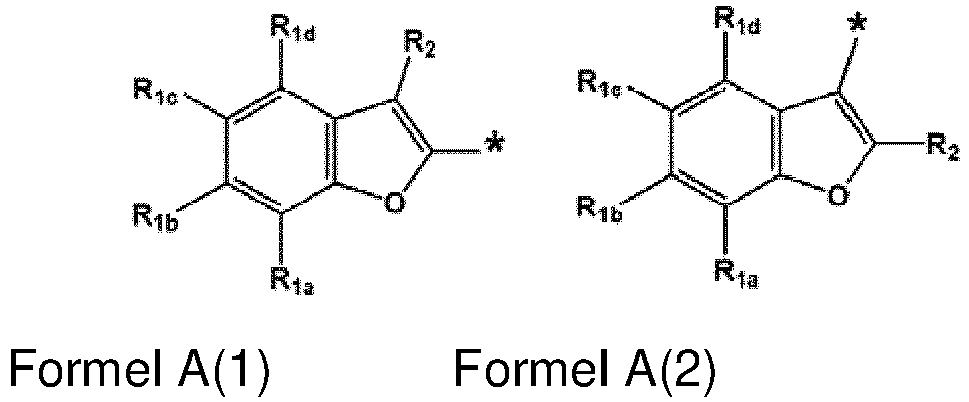
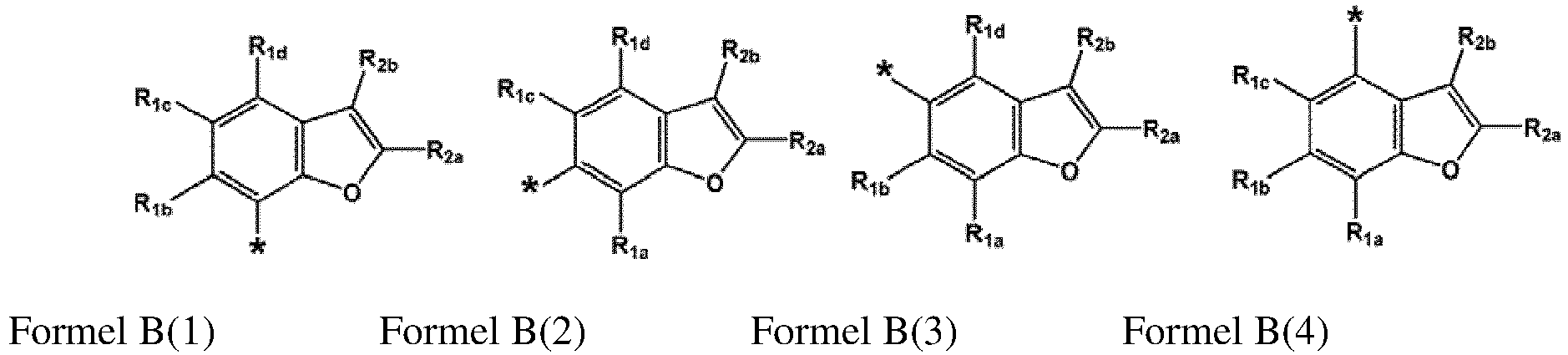


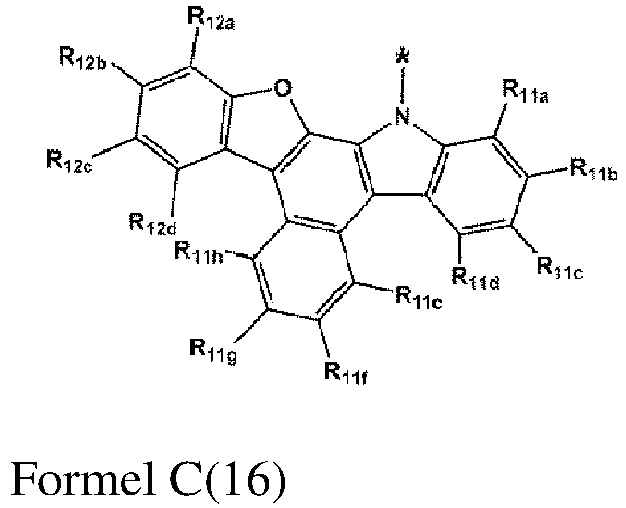 R1a bis R1d jeweils unabhängig Wasserstoff sind oder wie für R1 in Anspruch 1 oder Anspruch 5 definiert,R2a and R2b jeweils unabhängig Wasserstoff sind oder wie für R2 in Anspruch 1 oder Anspruch 5 definiert,R11a bis R11h jeweils unabhängig Wasserstoff sind oder wie für R11 in Anspruch 1 oderAnspruch 5 definiert,R12a bis R12d jeweils unabhängig Wasserstoff sind oder wie für R12 in Anspruch 1 oder Anspruch 5 definiert, und* eine Bindungsstelle zu einem benachbarten Atom kennzeichnet.
 - Organische lichtemittierende Vorrichtung nach einem der vorangehenden Ansprüche, wobei die erste Verbindung ausgewählt ist aus Verbindungen, die dargestellt sind durch die Formeln 1-1(1) bis 1-1(4), 1-2(1) und 1-3(1), die zweite Verbindung ausgewählt ist aus Verbindungen, die dargestellt sind durch die Formeln 2H-1(1) bis 2H-1(4), 2D-1(1) bis 2D-1(4), 2D-2(1) und 2D-2(2), und die dritte Verbindung ausgewählt ist aus Verbindungen, die dargestellt sind durch die Formeln 3-1(1), 3-1(2) und 3-2(1):
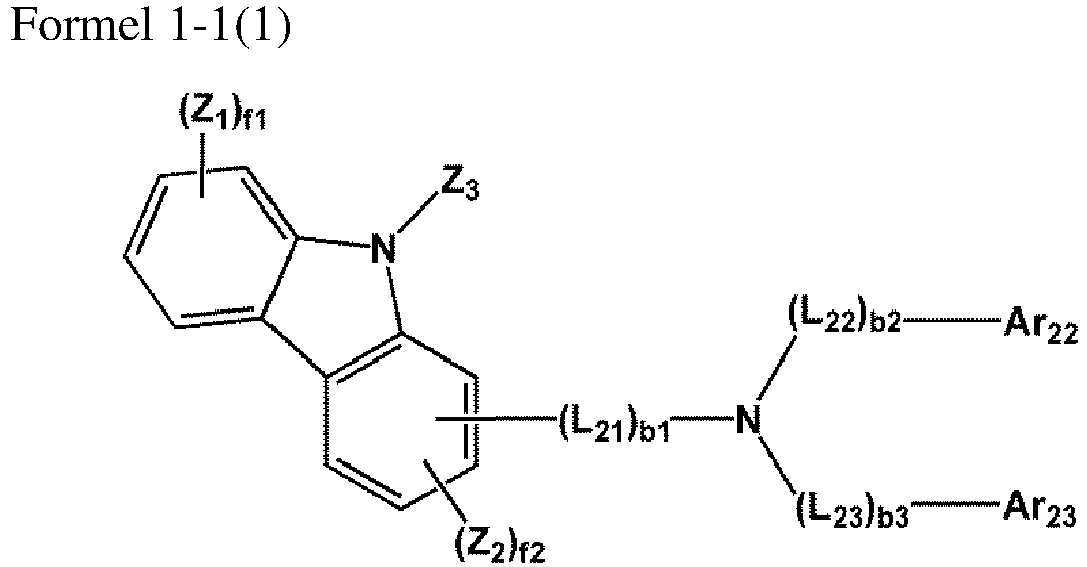



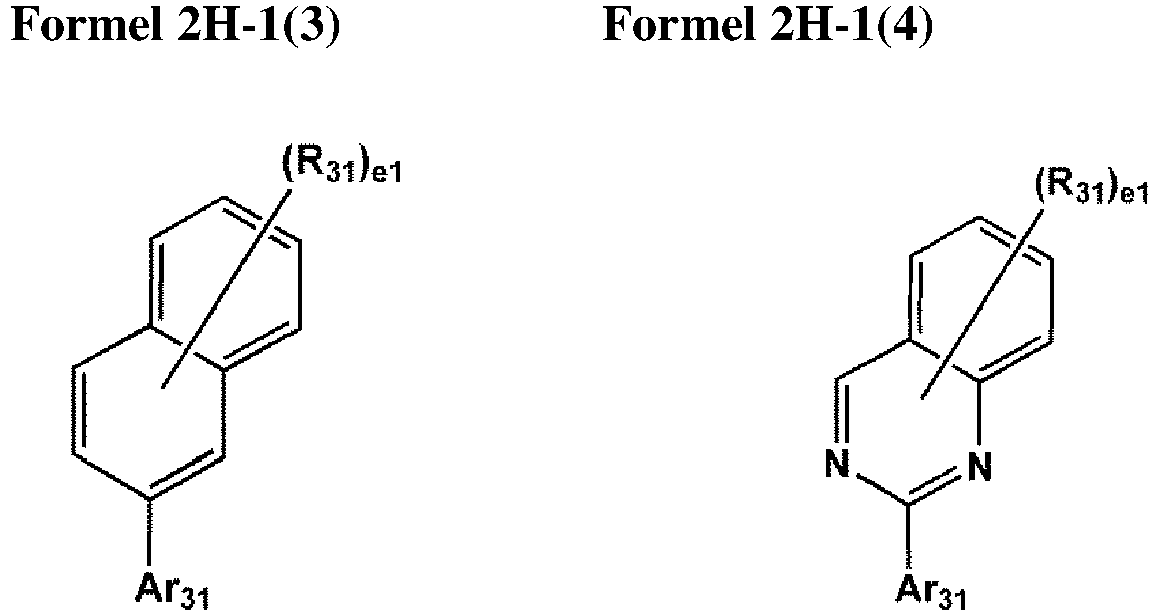


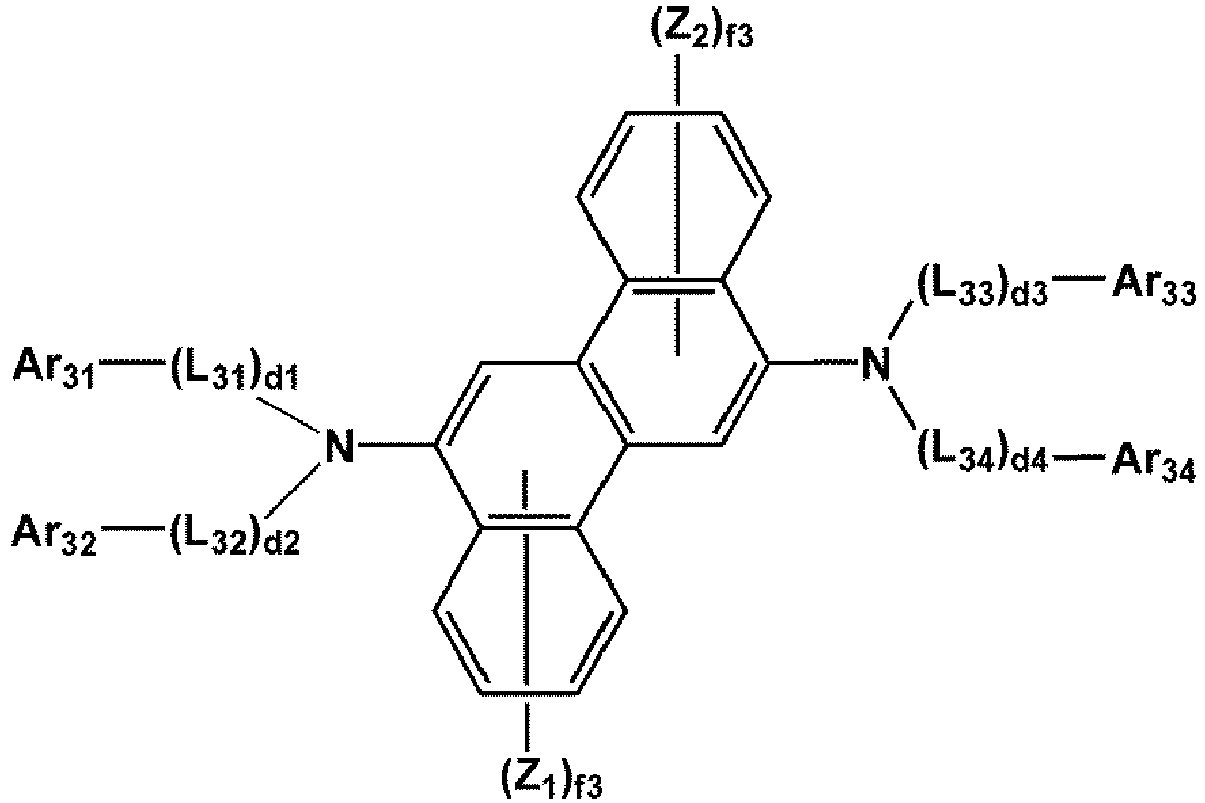


Z1 bis Z5 jeweils unabhängig ausgewählt sind aus:Deuterium, -F, -Cl, -Br, -I, einer Hydroxylgruppe, einer Cyanogruppe, einer Nitrogruppe, einer Aminogruppe, einer Amidinogruppe, einer Hydrazingruppe, einer Hydrazongruppe, einer Carbonsäuregruppe oder einem Salz davon, einer Sulfonsäuregruppe oder einem Salz davon, einer Phosphorsäuregruppe oder einem Salz davon, einer unsubstituierten C1-C60-Alkylgruppe, einer unsubstituierten C2-C60-Alkenylgruppe, einer unsubstituierten C2-C60-Alkinylgruppe und einer unsubstituierten C1-C60-Alkoxygruppe;einer C1-C60-Alkylgruppe, einer C2-C60-Alkenylgruppe, einer C2-C60-Alkinylgruppe und einer C1-C60-Alkoxygruppe, jeweils substituiert mit mindestens einem ausgewählt aus Deuterium, -F, -Cl, -Br, -I, einer Hydroxylgruppe, einer Cyanogruppe, einer Nitrogruppe, einer Aminogruppe, einer Amidinogruppe, einer Hydrazingruppe, einer Hydrazongruppe, einer Carbonsäuregruppe oder einem Salz davon, einer Sulfonsäuregruppe oder einem Salz davon, einer Phosphorsäuregruppe oder einem Salz davon, einer unsubstituierten C3-C10-Cycloalkylgruppe, einer unsubstituierten C1-C10-Heterocycloalkylgruppe, einer unsubstituierten C3-C10-Cycloalkenylgruppe, eine unsubstituierten C1-C10-Heterocycloalkenylgruppe, einer unsubstituierten C6-C60-Arylgruppe, einer unsubstituierten C6-C60-Aryloxygruppe, einer unsubstituierten C6-C60-Arylthiogruppe, einer unsubstituierten C1-C60-Heteroarylgruppe, einer unsubstituierten einwertigen nichtaromatischen kondensierten polycyclischen Gruppe, einer unsubstituierten einwertigen nichtaromatischen kondensierten heteropolycyclischen Gruppe, und -Si(Q13)(Q14)(Q15);einer unsubstituierten C3-C10-Cycloalkylgruppe, einer unsubstituierten C1-C10-Heterocycloalkylgruppe, einer unsubstituierten C3-C10-Cycloalkenylgruppe, einer unsubstituierten C1-C10-Heterocycloalkenylgruppe, einer unsubstituierten C6-C60-Arylgruppe, einer unsubstituierten C6-C60-Aryloxygruppe, einer unsubstituierten C6-C60-Arylthiogruppe, einer unsubstituierten C1-C60-Heteroarylgruppe, einer unsubstituierten einwertigen nichtaromatischen kondensierten polycyclischen Gruppe, und einer unsubstituierten einwertigen nichtaromatischen kondensierten heteropolycyclischen Gruppe;einer C3-C10-Cycloalkylgruppe, einer C1-C10-Heterocycloalkylgruppe, einer C3-C10-Cycloalkenylgruppe, einer C1-C10-Heterocycloalkenylgruppe, einer C6-C60-Arylgruppe, einer C6-C60-Aryloxygruppe, einer C6-C60-Arylthiogruppe, einer C1-C60-Heteroarylgruppe, einer einwertigen nichtaromatischen kondensierten polycyclischen Gruppe und einer einwertigen nichtaromatischen kondensierten heteropolycyclischen Gruppe, jeweils substituiert mit mindestens einer, ausgewählt aus Deuterium, -F, -Cl, -Br, -I, einer Hydroxylgruppe, einer Cyanogruppe, einer Nitrogruppe, einer Aminogruppe, einer Amidinogruppe, einer Hydrazingruppe, einer Hydrazongruppe, einer Carbonsäuregruppe oder einem Salz davon, einer Sulfonsäuregruppe oder einem Salz davon, einer Phosphorsäuregruppe oder einem Salz davon, einer unsubstituierten C1-C60-Alkylgruppe, einer unsubstituierten C2-C60-Alkenylgruppe, einer unsubstituierten C2-C60-Alkinylgruppe, einer unsubstituierten C1-C60-Alkoxygruppe, einer unsubstituierten C3-C10-Cycloalkylgruppe, einer unsubstituierten C1-C10-Heterocycloalkylgruppe, einer unsubstituierten C3-C10-Cycloalkenylgruppe, einer unsubstituierten C1-C10-Heterocycloalkenylgruppe, einer unsubstituierten C6-C60-Arylgruppe, einer unsubstituierten C6-C60-Aryloxygruppe, einer unsubstituierten C6-C60-Arylthiogruppe, einer unsubstituierten C1-C60-Heteroarylgruppe, einer unsubstituierten einwertigen nichtaromatischen kondensierten polycyclischen Gruppe, einer unsubstituierten einwertigen nichtaromatischen kondensierten heteropolycyclischen Gruppe und -Si(Q24)(Q24)(Q25); und
-Si(Q33)(Q34)(Q35),wobei Q1, Q2, Q13 bis Q15, Q23 bis Q25 und Q33 bis Q35 jeweils unabhängig ausgewählt sind aus Wasserstoff, Deuterium, -F, -Cl, -Br, -I, einer Hydroxylgruppe, einer Cyanogruppe, einer Nitrogruppe, einer Aminogruppe, einer Amidinogruppe, einer Hydrazingruppe, einer Hydrazongruppe, einer Carbonsäuregruppe oder einem Salz davon, einer Sulfonsäuregruppe oder einem Salz davon, einer Phosphorsäuregruppe oder einem Salz davon, einer unsubstituierten C1-C60-Alkylgruppe, einer unsubstituierten C2-C60-Alkenylgruppe, einer unsubstituierten C2-C60-Alkinylgruppe, einer unsubstituierten C1-C60-Alkoxygruppe, einer unsubstituierten C3-C10-Cycloalkylgruppe, einer unsubstituierten C1-C10-Heterocycloalkylgruppe, einer unsubstituierten C3-C10-Cycloalkenylgruppe, einer unsubstituierten C1-C10-Heterocycloalkenylgruppe, einer unsubstituierten C6-C60-Arylgruppe, einer unsubstituierten C1-C60-Heteroarylgruppe, einer unsubstituierten einwertigen nichtaromatischen kondensierten polycyclischen Gruppe, und einer unsubstituierten einwertigen nichtaromatischen kondensierten heteropolycyclischen Gruppe,f1 eine ganze Zahl, ausgewählt aus 0 bis 4, ist, f3 eine ganze Zahl, ausgewählt aus 0 bis 3, ist, f3 eine ganze Zahl, ausgewählt aus 0 bis 5, ist, und f4 eine ganze Zahl, ausgewählt aus 0 bis 2, ist,Ar21 bis Ar24, Ar31 bis Ar34 und Ar42 bis Ar43 so sind, wie in Anspruch 7, vorausgesetzt, dass: Formel 1-1(1) mindestens eines, ausgewählt aus Ar22 und Ar23, eine Gruppe ist, die ausgewählt ist aus Gruppen, die durch die Formeln A bis C dargestellt sind,in Formel 1-1(2), mindestens eines, ausgewählt aus Ar22 und Ar23, eine Gruppe ist, die ausgewählt ist aus Gruppen, die durch die Formeln A bis C dargestellt sind,in Formel 1-1(3), mindestens eines, ausgewählt aus Ar22 bis Ar23, eine Gruppe ist, die ausgewählt ist aus Gruppen, die durch die Formeln A bis C dargestellt sind,in Formel 1-1(4), mindestens eines, ausgewählt aus Ar21 bis Ar23, eine Gruppe ist, die ausgewählt ist aus Gruppen, die durch die Formeln A bis C dargestellt sind,in Formel 1-2(1), mindestens eines, ausgewählt aus Ar21 bis Ar24, eine Gruppe ist, die ausgewählt ist aus Gruppen, die durch die Formeln A bis C dargestellt sind,in Formel 1-3(1), mindestens eines, ausgewählt aus Ar21 und Ar22, eine Gruppe ist, die ausgewählt ist aus Gruppen, die durch die Formeln A bis C dargestellt sind,in den Formeln 2H-1(1) bis 2H-1(4), Ar31 eine Gruppe ist, die ausgewählt ist aus Gruppen, die durch die Formeln A bis C dargestellt sind,in Formel 2D-1(1), mindestens eines, ausgewählt aus Ar31 bis Ar34, eine Gruppe ist, die ausgewählt ist aus Gruppen, die durch die Formeln A bis C dargestellt sind,in Formel 2D-1(2), mindestens eines, ausgewählt aus Ar31 bis Ar34, eine Gruppe ist, die ausgewählt ist aus Gruppen, die durch die Formeln A bis C dargestellt sind,in Formel 2D-1(3), mindestens eines, ausgewählt aus Ar31 bis Ar34, eine Gruppe ist, die ausgewählt ist aus Gruppen, die durch die Formeln A bis C dargestellt sind,in Formel 2D-1(4), mindestens eines, ausgewählt aus Ar31 bis Ar34, eine Gruppe ist, die ausgewählt ist aus Gruppen, die durch die Formeln A bis C dargestellt sind,in Formel 2D-2(1), mindestens eines, ausgewählt aus Ar32 bis Ar33, eine Gruppe ist, die ausgewählt ist aus Gruppen, die durch die Formeln A bis C dargestellt sind,in Formel 2D-2(2), mindestens eines, ausgewählt aus Ar32 bis Ar33, eine Gruppe ist, die ausgewählt ist aus Gruppen, die durch die Formeln A bis C dargestellt sind,in Formel 3-1(1), mindestens eines, ausgewählt aus Ar41 bis Ar43, eine Gruppe ist, die ausgewählt ist aus Gruppen, die durch die Formeln A bis C dargestellt sind,in Formel 3-1(2), mindestens eines, ausgewählt aus Ar41 bis Ar43, eine Gruppe ist, die ausgewählt ist aus Gruppen, die durch die Formeln A bis C dargestellt sind, sowiein Formel 3-2(1), eines, ausgewählt aus Ar41 und Ar42 eine Gruppe ist, die ausgewählt ist aus Gruppen, die durch die Formeln A bis C dargestellt sind, und das andere, ausgewählt aus Ar41 und Ar42 eine stickstoffhaltige heterocyclische Gruppe ist, die *=N*' als eine ringbildende Einheit umfasst;und L21 bis L24, L31 bis L34, L42 bis L43, b1 bis b5, d1 bis d4, g1 bis g3, R21 bis R24, R32, R42 bis R44, cl bis c4, el, h1 bis h4, Q1 und Q2 so sind, wie in Anspruch 1 definiert. - Organische lichtemittierende Vorrichtung nach einem der Ansprüche 1 bis 6, wobei:(a) die erste Verbindung ausgewählt ist aus Verbindungen, die dargestellt sind durch die Formeln 1-1 bis 1-3, die zweite Verbindung dargestellt ist durch die Formel 2H-1, und die dritte Verbindung ausgewählt ist aus Verbindungen, die dargestellt sind durch die Formeln 3-1 und 3-2; oder(b) die erste Verbindung ausgewählt ist aus Verbindungen, die dargestellt sind durch die Formeln 1-1, 1-2 und 1-3, die zweite Verbindung ausgewählt ist aus Verbindungen, die dargestellt sind durch die Formeln 2D-1 und 2D-2, und die dritte Verbindung ausgewählt ist aus Verbindungen, die dargestellt sind durch die Formeln 3-1 und 3-2.
- Organische lichtemittierende Vorrichtung nach Anspruch 8, wobei:(i) Option (a) gilt unddie zweite Schicht eine Emissionsschicht ist,die zweite Schicht ferner eine Dotierung umfasst, unddie erste Schicht und die dritte Schicht jeweils die zweite Schicht direkt kontaktieren; oder(ii) Option (b) gilt unddie zweite Schicht eine Emissionsschicht ist,die zweite Schicht ferner einen Host umfasst, unddie erste Schicht und die dritte Schicht jeweils die zweite Schicht direkt kontaktieren.
- Organische lichtemittierende Vorrichtung, umfassend:eine erste Elektrode;eine zweite Elektrode, die der ersten Elektrode gegenüberliegt; undeine erste Schicht zwischen der ersten Elektrode und der zweiten Elektrode, wobei die erste Schicht eine erste Verbindung umfasst;eine zweite Schicht zwischen der ersten Schicht und der zweiten Elektrode, wobei die zweite Schicht eine zweite Verbindung umfasst; undeine dritte Schicht zwischen der zweiten Schicht und der zweiten Elektrode, wobei die dritte Schicht eine dritte Verbindung umfasst; wobeidie erste Verbindung und die zweite Verbindung jeweils unabhängig ausgewählt sind aus Verbindungen, die dargestellt sind durch die Formeln 1-1, 1-2 und 1-3, wobei die erste Verbindung sich von der zweiten Verbindung unterscheidet, unddie dritte Verbindung aus Verbindungen ausgewählt ist, die dargestellt sind durch die Formeln 2H-1, 2D-1 und 2D-2, 3-1 und 3 -2;wobei, den Formeln 1-1, 1-2, 1-3, 2H-1, 2D-1, 2D-2, 3-1 und 3-2 so sind, wie in Anspruch 1 definiert.
- Organische lichtemittierende Vorrichtung nach Anspruch 10, wobei die erste Verbindung und die zweite Verbindung jeweils unabhängig ausgewählt sind aus Verbindungen, die dargestellt sind durch die Formeln 1-1(1) bis 1-1(4), 1-2(1) und 1-3(1), und die dritte Verbindung ausgewählt ist aus Verbindungen, die dargestellt sind durch die Formeln 2H-1(1) bis 2H-1(4), 2D-1(1) bis 2D-1(4), 2D-2(1) und 2D-2(2), 3-1(1), 3-1(2) und 3-2(1);
wobei die Formeln 1-1(1) bis 1-1(4), 1-2(1), 1-3(1), 2H-1(1) bis 2H-1(4), 2D-1(1) bis 2D-1(4), 2D-2(1), 2D-2(2), 3-1(1), 3-1(2) und 3-2(1) so sind, wie in Anspruch 7 definiert. - Organische lichtemittierende Vorrichtung nach Anspruch 10, wobei:(a) die erste Verbindung und die zweite Verbindung jeweils unabhängig ausgewählt sind aus Verbindungen, die dargestellt sind durch die Formeln 1-1, 1-2 und 1-3, wobei die erste Verbindung sich von der zweiten Verbindung unterscheidet, und die dritte Verbindung ausgewählt ist aus Verbindungen, die dargestellt sind durch die Formeln 2H-1, 3-1 und 3-2; oder(b) die erste Verbindung und die zweite Verbindung jeweils unabhängig ausgewählt sind aus Verbindungen, die dargestellt sind durch die Formeln 1-1, 1-2 und 1-3, wobei die erste Verbindung sich von der zweiten Verbindung unterscheidet, und die dritte Verbindung ausgewählt ist aus Verbindungen, die dargestellt sind durch die Formeln 2D-1 und 2D-2.
- Organische lichtemittierende Vorrichtung nach Anspruch 12, wobei(i) Option (a) gilt unddie dritte Schicht eine Emissionsschicht ist,die dritte Schicht ferner eine Dotierung umfasst, unddie zweite Schicht die dritte Schicht direkt kontaktiert; oder(ii) Option (b) gilt unddie dritte Schicht eine Emissionsschicht ist,die dritte Schicht ferner einen Host umfasst, unddie zweite Schicht die dritte Schicht direkt kontaktiert.
- Organische lichtemittierende Vorrichtung nach Anspruch 1, wobei:
die erste Verbindung ausgewählt ist aus den Verbindungen 1-1 bis 1-12 und 2-1 bis 2-10, die zweite Verbindung ausgewählt ist aus den Verbindungen 3-1 bis 3-12 und 4-1 bis 4-12, und die dritte Verbindung ausgewählt ist aus den Verbindungen 5-1 bis 5-9: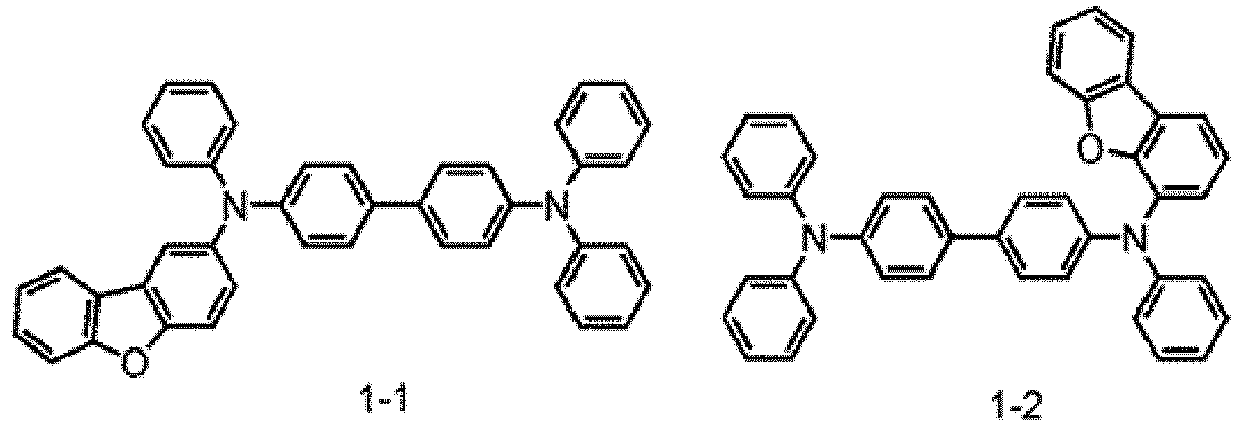
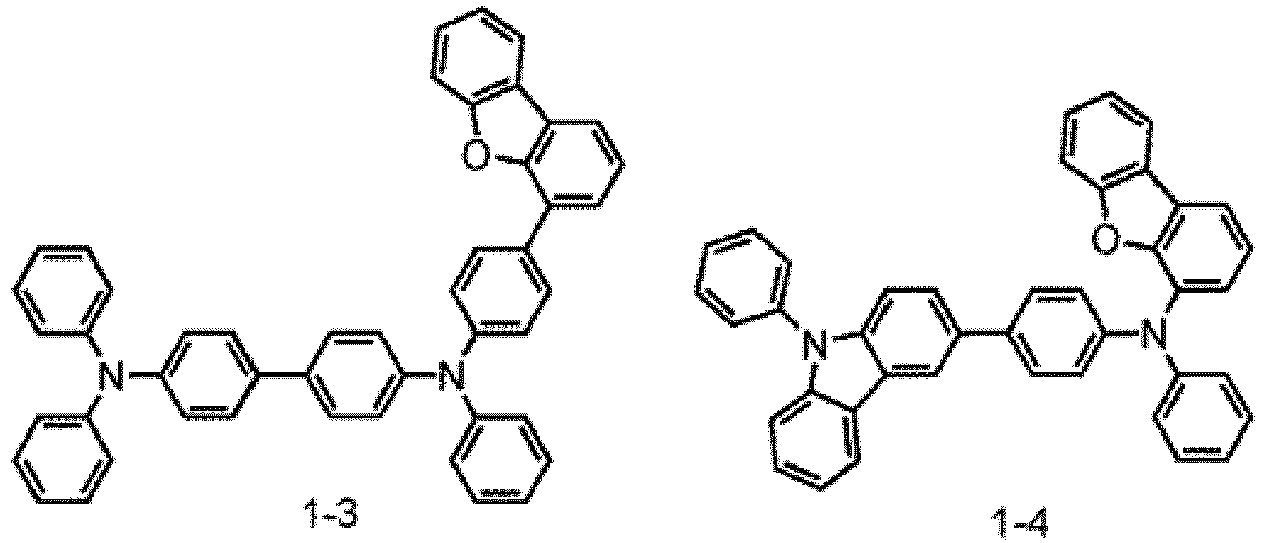


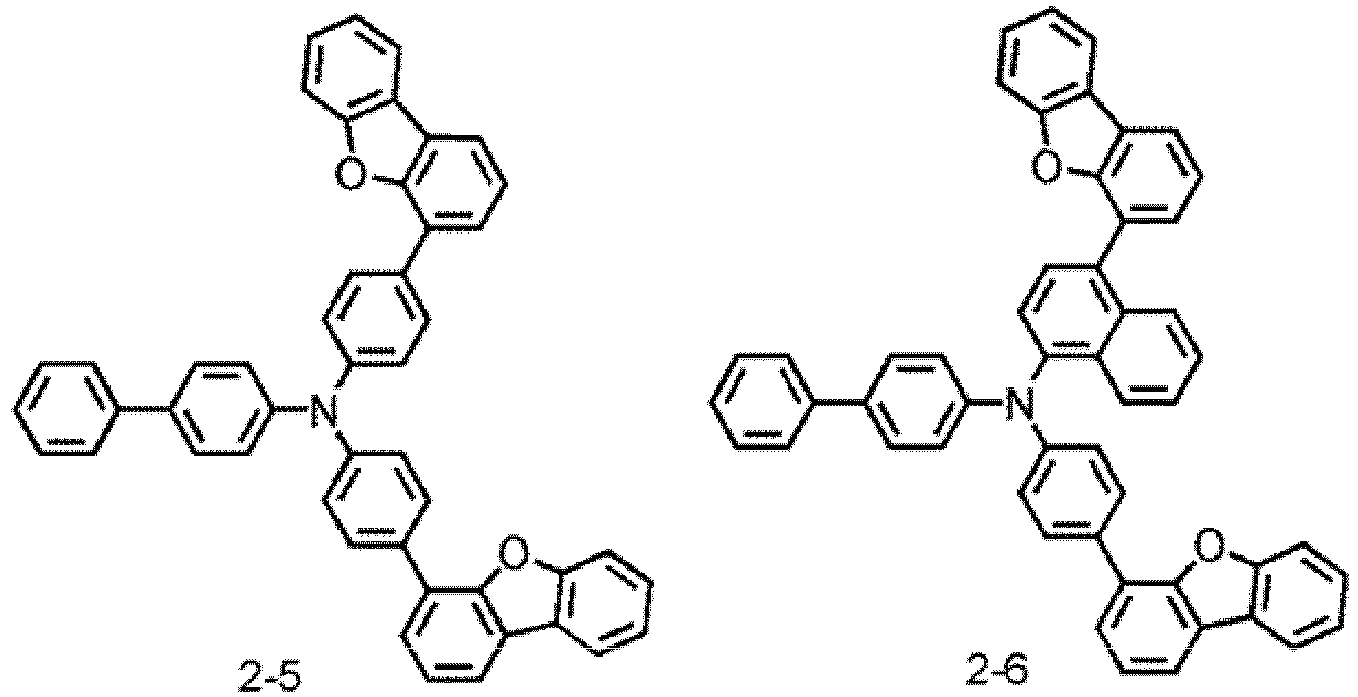


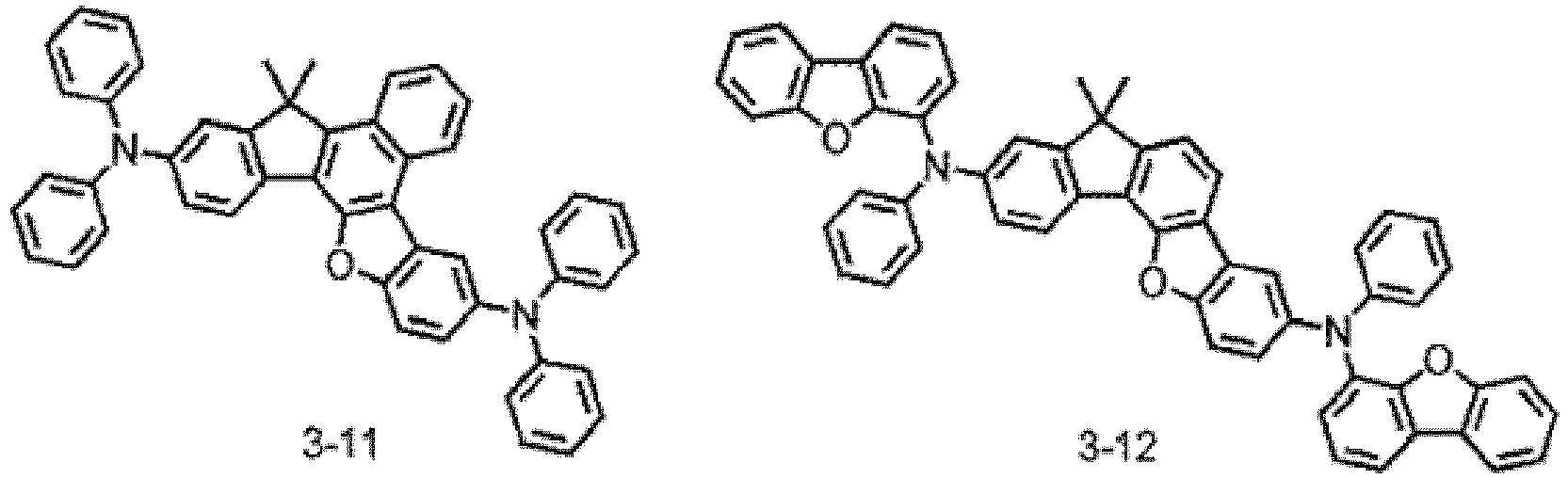


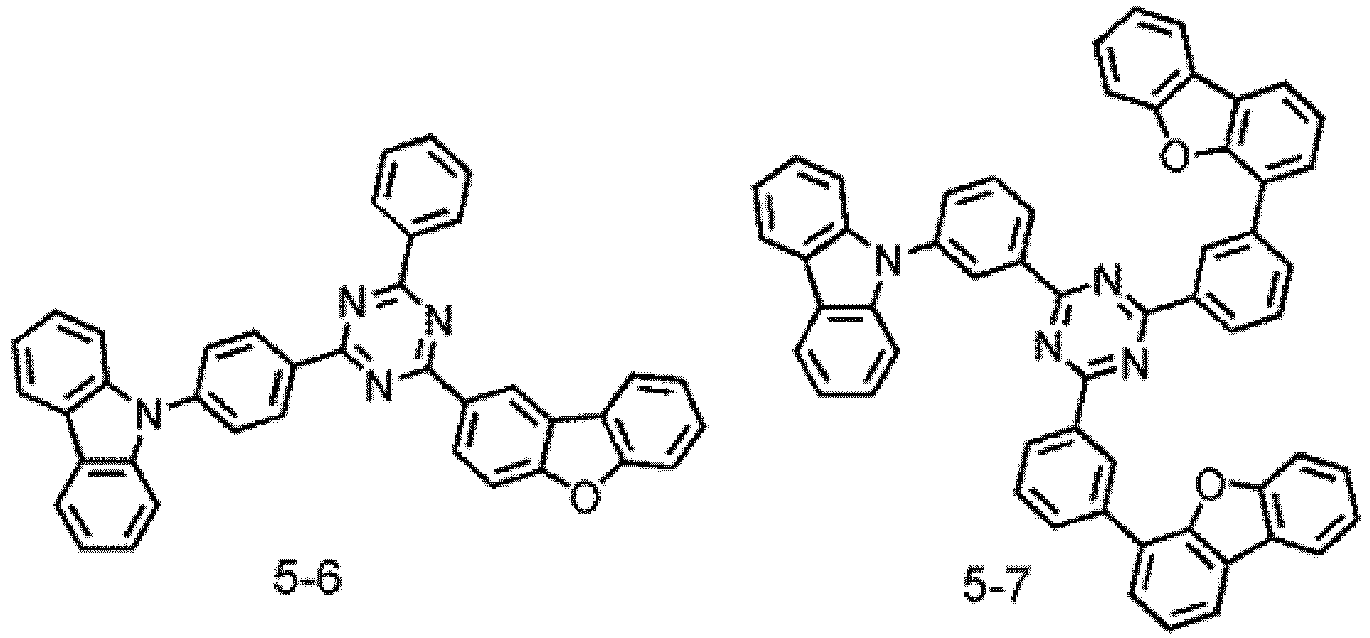

- Organische lichtemittierende Vorrichtung nach Anspruch 10, wobei:die erste Verbindung und die zweite Verbindung jeweils unabhängig ausgewählt sind aus den Verbindungen 1-1 bis 1-12 und 2-1 und 2-10, wobei die erste Verbindung sich von der zweiten Verbindung unterscheidet, und die dritte Verbindung ausgewählt ist aus den Verbindungen 3-1 bis 3-12, 4-1 bis 4-12 und 5-1 bis 5-9; unddie Verbindungen 1-1 bis 1-12 und 2-1 bis 2-10, 3-1 bis 3-12, 4-1 bis 4-12, und 5-1 bis 5-9 so sind, wie in Anspruch 14 definiert.
Priority Applications (1)
| Application Number | Priority Date | Filing Date | Title |
|---|---|---|---|
| EP20155229.6A EP3680948B1 (de) | 2015-08-21 | 2016-08-18 | Organische lichtemittierende vorrichtung |
Applications Claiming Priority (2)
| Application Number | Priority Date | Filing Date | Title |
|---|---|---|---|
| KR20150118277 | 2015-08-21 | ||
| KR1020160104281A KR102806395B1 (ko) | 2015-08-21 | 2016-08-17 | 유기 발광 소자 |
Related Child Applications (2)
| Application Number | Title | Priority Date | Filing Date |
|---|---|---|---|
| EP20155229.6A Division EP3680948B1 (de) | 2015-08-21 | 2016-08-18 | Organische lichtemittierende vorrichtung |
| EP20155229.6A Division-Into EP3680948B1 (de) | 2015-08-21 | 2016-08-18 | Organische lichtemittierende vorrichtung |
Publications (2)
| Publication Number | Publication Date |
|---|---|
| EP3133666A1 EP3133666A1 (de) | 2017-02-22 |
| EP3133666B1 true EP3133666B1 (de) | 2020-03-11 |
Family
ID=56925960
Family Applications (2)
| Application Number | Title | Priority Date | Filing Date |
|---|---|---|---|
| EP20155229.6A Active EP3680948B1 (de) | 2015-08-21 | 2016-08-18 | Organische lichtemittierende vorrichtung |
| EP16184809.8A Active EP3133666B1 (de) | 2015-08-21 | 2016-08-18 | Organische lichtemittierende vorrichtung |
Family Applications Before (1)
| Application Number | Title | Priority Date | Filing Date |
|---|---|---|---|
| EP20155229.6A Active EP3680948B1 (de) | 2015-08-21 | 2016-08-18 | Organische lichtemittierende vorrichtung |
Country Status (5)
| Country | Link |
|---|---|
| US (5) | US9960361B2 (de) |
| EP (2) | EP3680948B1 (de) |
| JP (4) | JP6881915B2 (de) |
| KR (1) | KR20250072569A (de) |
| CN (1) | CN106469790B (de) |
Families Citing this family (15)
| Publication number | Priority date | Publication date | Assignee | Title |
|---|---|---|---|---|
| EP3680948B1 (de) * | 2015-08-21 | 2025-03-26 | Samsung Display Co., Ltd. | Organische lichtemittierende vorrichtung |
| US11479544B2 (en) | 2017-03-08 | 2022-10-25 | Idemitsu Kosan Co., Ltd. | Compound, material for organic electroluminescence element, organic electroluminescence element, and electronic device |
| KR102393153B1 (ko) * | 2017-07-27 | 2022-05-02 | 에스에프씨주식회사 | 저전압 구동이 가능하며, 고효율 및 장수명 특성을 가지는 유기 발광 소자 |
| TWI820057B (zh) * | 2017-11-24 | 2023-11-01 | 德商麥克專利有限公司 | 用於有機電致發光裝置的材料 |
| TWI838352B (zh) | 2017-11-24 | 2024-04-11 | 德商麥克專利有限公司 | 用於有機電致發光裝置的材料 |
| KR102692561B1 (ko) | 2018-06-26 | 2024-08-06 | 삼성전자주식회사 | 유기 발광 소자 |
| KR102258085B1 (ko) * | 2018-10-04 | 2021-05-28 | 삼성에스디아이 주식회사 | 유기 광전자 소자용 조성물, 유기 광전자 소자 및 표시 장치 |
| KR102495276B1 (ko) * | 2018-11-07 | 2023-02-01 | 삼성에스디아이 주식회사 | 유기 광전자 소자 및 표시 장치 |
| US20200283426A1 (en) * | 2019-03-05 | 2020-09-10 | Samsung Display Co., Ltd. | Organic electroluminescence device and polycyclic compound for organic electroluminescence device |
| EP3939970B1 (de) | 2019-03-15 | 2023-12-27 | Idemitsu Kosan Co., Ltd. | Verbindung, material für organische elektrolumineszenzvorrichtungen, organische elektrolumineszenzvorrichtung und elektronische vorrichtung |
| CN110041268B (zh) * | 2019-05-17 | 2022-09-30 | 西安瑞联新材料股份有限公司 | 一种嘧啶类双极性化合物及其在oled器件中的应用 |
| WO2021033724A1 (ja) | 2019-08-19 | 2021-02-25 | 出光興産株式会社 | 化合物、有機エレクトロルミネッセンス素子用材料、有機エレクトロルミネッセンス素子及び電子機器 |
| KR102787039B1 (ko) * | 2020-11-09 | 2025-03-25 | 삼성에스디아이 주식회사 | 유기 광전자 소자용 조성물, 유기 광전자 소자 및 표시 장치 |
| CN116041357B (zh) * | 2021-10-28 | 2026-03-10 | 广州华睿光电材料有限公司 | 有机化合物及包括其的混合物、组合物和有机电子器件 |
| CN117343078A (zh) | 2021-11-25 | 2024-01-05 | 北京夏禾科技有限公司 | 有机电致发光材料和器件 |
Family Cites Families (35)
| Publication number | Priority date | Publication date | Assignee | Title |
|---|---|---|---|---|
| WO2007125714A1 (ja) | 2006-04-26 | 2007-11-08 | Idemitsu Kosan Co., Ltd. | 芳香族アミン誘導体及びそれらを用いた有機エレクトロルミネッセンス素子 |
| WO2009145016A1 (ja) | 2008-05-29 | 2009-12-03 | 出光興産株式会社 | 芳香族アミン誘導体及びそれらを用いた有機エレクトロルミネッセンス素子 |
| KR101217979B1 (ko) | 2009-04-24 | 2013-01-02 | 이데미쓰 고산 가부시키가이샤 | 방향족 아민 유도체를 이용한 유기 전계 발광 소자 |
| KR101431644B1 (ko) * | 2009-08-10 | 2014-08-21 | 롬엔드하스전자재료코리아유한회사 | 신규한 유기 발광 화합물 및 이를 포함하는 유기 전계 발광 소자 |
| JP2011139044A (ja) * | 2009-12-01 | 2011-07-14 | Semiconductor Energy Lab Co Ltd | 発光素子、発光装置、電子機器、および照明装置 |
| US10570113B2 (en) * | 2010-04-09 | 2020-02-25 | Semiconductor Energy Laboratory Co., Ltd. | Aromatic amine derivative, light-emitting element, light-emitting device, electronic device, and lighting device |
| JP2012028634A (ja) | 2010-07-26 | 2012-02-09 | Idemitsu Kosan Co Ltd | 有機エレクトロルミネッセンス素子 |
| EP2428512B1 (de) | 2010-09-08 | 2014-10-22 | Semiconductor Energy Laboratory Co., Ltd. | Fluorenverbindung, lichtemittierendes Element, lichtemittierende Vorrichtung, elektronische Vorrichtung und Beleuchtungsvorrichtung. |
| US9133173B2 (en) * | 2010-10-15 | 2015-09-15 | Semiconductor Energy Laboratory Co., Ltd. | Carbazole compound, material for light-emitting element, organic semiconductor material, light-emitting element |
| KR101423173B1 (ko) | 2010-11-04 | 2014-07-25 | 제일모직 주식회사 | 유기광전소자용 화합물 및 이를 포함하는 유기광전소자 |
| TWI545175B (zh) | 2010-12-17 | 2016-08-11 | 半導體能源研究所股份有限公司 | 有機化合物,發光元件,發光裝置,電子裝置,以及照明裝置 |
| WO2012108389A1 (ja) * | 2011-02-07 | 2012-08-16 | 出光興産株式会社 | ビスカルバゾール誘導体及びそれを用いた有機エレクトロルミネッセンス素子 |
| EP2700696A1 (de) | 2011-04-18 | 2014-02-26 | Idemitsu Kosan Co., Ltd | Pyrenderivat, organisches lichtemittierendes medium und organisches elektrolumineszenzelement mit dem pyrenderivat oder dem organischen lichtemittierenden medium |
| EP2709183B1 (de) | 2011-05-13 | 2019-02-06 | Joled Inc. | Organische elektrolumineszente vorrichtung zur emission von mehrfarbigem licht |
| WO2013036043A2 (ko) | 2011-09-09 | 2013-03-14 | 주식회사 엘지화학 | 유기 발광 소자 재료 및 이를 이용한 유기 발광 소자 |
| KR102261235B1 (ko) | 2011-11-22 | 2021-06-04 | 이데미쓰 고산 가부시키가이샤 | 방향족 복소 고리 유도체, 유기 일렉트로루미네선스 소자용 재료 및 유기 일렉트로루미네선스 소자 |
| WO2013077405A1 (ja) | 2011-11-25 | 2013-05-30 | 出光興産株式会社 | 芳香族アミン誘導体、有機エレクトロルミネッセンス素子用材料および有機エレクトロルミネッセンス素子 |
| CN104364250B (zh) * | 2012-04-13 | 2017-05-31 | 株式会社Lg化学 | 新的含氮杂环化合物及使用其的有机电子器件 |
| JP6088161B2 (ja) | 2012-06-29 | 2017-03-01 | 出光興産株式会社 | 芳香族アミン誘導体及び有機エレクトロルミネッセンス素子 |
| US20140014930A1 (en) * | 2012-07-13 | 2014-01-16 | Semiconductor Energy Laboratory Co., Ltd. | Organic Compound, Light-Emitting Element, Light-Emitting Device, Electronic Device, and Lighting Device |
| JP2015216135A (ja) | 2012-08-10 | 2015-12-03 | 出光興産株式会社 | 有機エレクトロルミネッセンス素子、および電子機器 |
| WO2014044722A1 (en) * | 2012-09-20 | 2014-03-27 | Basf Se | Azadibenzofurans for electronic applications |
| JP6194645B2 (ja) * | 2012-09-27 | 2017-09-13 | 東ソー株式会社 | アミン化合物及びその用途 |
| US9647220B2 (en) * | 2012-11-15 | 2017-05-09 | Sony Corporation | Organic multicolor light-emitting apparatus |
| US9496503B2 (en) * | 2013-03-25 | 2016-11-15 | Semiconductor Energy Laboratory Co., Ltd. | Organic compound, light-emitting element, light-emitting device, electronic device, and lighting device |
| KR101627755B1 (ko) | 2013-06-13 | 2016-06-07 | 제일모직 주식회사 | 유기 화합물, 유기 광전자 소자 및 표시 장치 |
| KR102137429B1 (ko) | 2013-07-11 | 2020-07-24 | 덕산네오룩스 주식회사 | 유기전기 소자용 화합물을 이용한 유기전기소자 및 그 전자 장치 |
| KR102194819B1 (ko) * | 2013-08-27 | 2020-12-24 | 삼성디스플레이 주식회사 | 유기 발광 소자 |
| JP6386299B2 (ja) | 2013-08-30 | 2018-09-05 | 株式会社半導体エネルギー研究所 | 発光素子用有機化合物 |
| JP2015106661A (ja) * | 2013-11-29 | 2015-06-08 | 出光興産株式会社 | 有機エレクトロルミネッセンス素子および電子機器 |
| KR102177213B1 (ko) * | 2014-01-20 | 2020-11-11 | 삼성디스플레이 주식회사 | 유기 발광 소자 |
| WO2015114102A1 (en) * | 2014-02-03 | 2015-08-06 | Basf Se | Silyl substituted azadibenzofurans and azadibenzothiophenes |
| WO2016193243A1 (en) | 2015-06-03 | 2016-12-08 | Udc Ireland Limited | Highly efficient oled devices with very short decay times |
| JP6879559B2 (ja) * | 2015-07-31 | 2021-06-02 | 出光興産株式会社 | 化合物、有機エレクトロルミネッセンス素子用材料、有機エレクトロルミネッセンス素子、及び電子機器 |
| EP3680948B1 (de) * | 2015-08-21 | 2025-03-26 | Samsung Display Co., Ltd. | Organische lichtemittierende vorrichtung |
-
2016
- 2016-08-18 EP EP20155229.6A patent/EP3680948B1/de active Active
- 2016-08-18 EP EP16184809.8A patent/EP3133666B1/de active Active
- 2016-08-19 JP JP2016161323A patent/JP6881915B2/ja active Active
- 2016-08-19 US US15/242,040 patent/US9960361B2/en active Active
- 2016-08-22 CN CN201610702926.4A patent/CN106469790B/zh active Active
-
2018
- 2018-04-27 US US15/965,772 patent/US11211564B2/en active Active
-
2021
- 2021-05-06 JP JP2021078789A patent/JP7206319B2/ja active Active
- 2021-11-18 US US17/530,403 patent/US11672173B2/en active Active
-
2023
- 2023-01-04 JP JP2023000317A patent/JP2023052206A/ja active Pending
- 2023-03-16 US US18/185,005 patent/US11968890B2/en active Active
-
2024
- 2024-03-19 US US18/610,113 patent/US20240224797A1/en active Pending
- 2024-08-02 JP JP2024127730A patent/JP7832999B2/ja active Active
-
2025
- 2025-05-07 KR KR1020250059249A patent/KR20250072569A/ko active Pending
Non-Patent Citations (1)
| Title |
|---|
| None * |
Also Published As
| Publication number | Publication date |
|---|---|
| KR20250072569A (ko) | 2025-05-23 |
| JP2021132221A (ja) | 2021-09-09 |
| US11968890B2 (en) | 2024-04-23 |
| US20170054081A1 (en) | 2017-02-23 |
| JP2024156870A (ja) | 2024-11-06 |
| JP2023052206A (ja) | 2023-04-11 |
| US20230225200A1 (en) | 2023-07-13 |
| JP2017041636A (ja) | 2017-02-23 |
| JP7832999B2 (ja) | 2026-03-18 |
| EP3680948A2 (de) | 2020-07-15 |
| EP3680948B1 (de) | 2025-03-26 |
| US20220077399A1 (en) | 2022-03-10 |
| JP7206319B2 (ja) | 2023-01-17 |
| US11672173B2 (en) | 2023-06-06 |
| JP6881915B2 (ja) | 2021-06-02 |
| EP3133666A1 (de) | 2017-02-22 |
| US20180248125A1 (en) | 2018-08-30 |
| US9960361B2 (en) | 2018-05-01 |
| EP3680948A3 (de) | 2020-10-21 |
| US11211564B2 (en) | 2021-12-28 |
| CN106469790A (zh) | 2017-03-01 |
| US20240224797A1 (en) | 2024-07-04 |
| CN106469790B (zh) | 2019-12-06 |
Similar Documents
| Publication | Publication Date | Title |
|---|---|---|
| US11968890B2 (en) | Organic light-emitting device | |
| EP2878599B1 (de) | Carbazolverbindung und organische lichtemittierende Vorrichtung damit | |
| KR102806395B1 (ko) | 유기 발광 소자 | |
| US10340463B2 (en) | Organic light-emitting device | |
| KR102552274B1 (ko) | 축합환 화합물 및 이를 포함한 유기 발광 소자 | |
| KR102163721B1 (ko) | 축합환 화합물 및 이를 포함한 유기 발광 소자 | |
| US20150333268A1 (en) | Condensed cyclic compound and organic light-emitting device comprising the same | |
| KR20150133089A (ko) | 축합환 화합물 및 이를 포함한 유기 발광 소자 | |
| KR102572715B1 (ko) | 축합환 화합물 및 이를 포함한 유기 발광 소자 | |
| KR102938606B1 (ko) | 축합환 화합물 및 이를 포함한 유기 발광 소자 | |
| KR20250133826A (ko) | 아지드 화합물, 이를 포함한 유기 발광 소자 및 이의 제조 방법 | |
| EP3644385A1 (de) | Kondensierte cyclische verbindung, zusammensetzung damit und organische lichtemittierende vorrichtung damit | |
| KR102606280B1 (ko) | 다환 화합물 및 이를 포함한 유기 발광 소자 | |
| KR102637793B1 (ko) | 헤테로시클릭 화합물 및 이를 포함한 유기 발광 소자 | |
| KR20170052733A (ko) | 축합환 화합물 및 이를 포함한 유기 발광 소자 | |
| KR102462420B1 (ko) | 축합환 화합물 및 이를 포함한 유기 발광 소자 | |
| KR102396297B1 (ko) | 복소환 화합물 이를 포함한 유기 발광 소자 | |
| KR102273048B1 (ko) | 축합환 화합물 및 이를 포함한 유기 발광 소자 | |
| EP3575295B1 (de) | Heterocyclische verbindung und organische lichtemittierende vorrichtung damit | |
| KR102388725B1 (ko) | 축합환 화합물 및 이를 포함한 유기 발광 소자 | |
| KR102291487B1 (ko) | 축합환 화합물 및 이를 포함한 유기 발광 소자 | |
| KR102611207B1 (ko) | 축합환 화합물 및 이를 포함한 유기 발광 소자 | |
| KR20210145895A (ko) | 헤테로시클릭 화합물 및 이를 포함하는 유기 발광 소자 |
Legal Events
| Date | Code | Title | Description |
|---|---|---|---|
| PUAI | Public reference made under article 153(3) epc to a published international application that has entered the european phase |
Free format text: ORIGINAL CODE: 0009012 |
|
| STAA | Information on the status of an ep patent application or granted ep patent |
Free format text: STATUS: THE APPLICATION HAS BEEN PUBLISHED |
|
| AK | Designated contracting states |
Kind code of ref document: A1 Designated state(s): AL AT BE BG CH CY CZ DE DK EE ES FI FR GB GR HR HU IE IS IT LI LT LU LV MC MK MT NL NO PL PT RO RS SE SI SK SM TR |
|
| AX | Request for extension of the european patent |
Extension state: BA ME |
|
| STAA | Information on the status of an ep patent application or granted ep patent |
Free format text: STATUS: REQUEST FOR EXAMINATION WAS MADE |
|
| 17P | Request for examination filed |
Effective date: 20170817 |
|
| RBV | Designated contracting states (corrected) |
Designated state(s): AL AT BE BG CH CY CZ DE DK EE ES FI FR GB GR HR HU IE IS IT LI LT LU LV MC MK MT NL NO PL PT RO RS SE SI SK SM TR |
|
| REG | Reference to a national code |
Ref country code: DE Ref legal event code: R079 Ref document number: 602016031390 Country of ref document: DE Free format text: PREVIOUS MAIN CLASS: H01L0051540000 Ipc: C09K0011060000 |
|
| GRAP | Despatch of communication of intention to grant a patent |
Free format text: ORIGINAL CODE: EPIDOSNIGR1 |
|
| STAA | Information on the status of an ep patent application or granted ep patent |
Free format text: STATUS: GRANT OF PATENT IS INTENDED |
|
| RIC1 | Information provided on ipc code assigned before grant |
Ipc: H01L 51/54 20060101ALI20190905BHEP Ipc: C09K 11/06 20060101AFI20190905BHEP |
|
| INTG | Intention to grant announced |
Effective date: 20190924 |
|
| GRAS | Grant fee paid |
Free format text: ORIGINAL CODE: EPIDOSNIGR3 |
|
| GRAA | (expected) grant |
Free format text: ORIGINAL CODE: 0009210 |
|
| STAA | Information on the status of an ep patent application or granted ep patent |
Free format text: STATUS: THE PATENT HAS BEEN GRANTED |
|
| AK | Designated contracting states |
Kind code of ref document: B1 Designated state(s): AL AT BE BG CH CY CZ DE DK EE ES FI FR GB GR HR HU IE IS IT LI LT LU LV MC MK MT NL NO PL PT RO RS SE SI SK SM TR |
|
| REG | Reference to a national code |
Ref country code: GB Ref legal event code: FG4D |
|
| REG | Reference to a national code |
Ref country code: CH Ref legal event code: EP |
|
| REG | Reference to a national code |
Ref country code: AT Ref legal event code: REF Ref document number: 1243137 Country of ref document: AT Kind code of ref document: T Effective date: 20200315 |
|
| REG | Reference to a national code |
Ref country code: IE Ref legal event code: FG4D |
|
| REG | Reference to a national code |
Ref country code: DE Ref legal event code: R096 Ref document number: 602016031390 Country of ref document: DE |
|
| PG25 | Lapsed in a contracting state [announced via postgrant information from national office to epo] |
Ref country code: RS Free format text: LAPSE BECAUSE OF FAILURE TO SUBMIT A TRANSLATION OF THE DESCRIPTION OR TO PAY THE FEE WITHIN THE PRESCRIBED TIME-LIMIT Effective date: 20200311 Ref country code: NO Free format text: LAPSE BECAUSE OF FAILURE TO SUBMIT A TRANSLATION OF THE DESCRIPTION OR TO PAY THE FEE WITHIN THE PRESCRIBED TIME-LIMIT Effective date: 20200611 Ref country code: FI Free format text: LAPSE BECAUSE OF FAILURE TO SUBMIT A TRANSLATION OF THE DESCRIPTION OR TO PAY THE FEE WITHIN THE PRESCRIBED TIME-LIMIT Effective date: 20200311 |
|
| REG | Reference to a national code |
Ref country code: NL Ref legal event code: MP Effective date: 20200311 |
|
| PG25 | Lapsed in a contracting state [announced via postgrant information from national office to epo] |
Ref country code: SE Free format text: LAPSE BECAUSE OF FAILURE TO SUBMIT A TRANSLATION OF THE DESCRIPTION OR TO PAY THE FEE WITHIN THE PRESCRIBED TIME-LIMIT Effective date: 20200311 Ref country code: LV Free format text: LAPSE BECAUSE OF FAILURE TO SUBMIT A TRANSLATION OF THE DESCRIPTION OR TO PAY THE FEE WITHIN THE PRESCRIBED TIME-LIMIT Effective date: 20200311 Ref country code: HR Free format text: LAPSE BECAUSE OF FAILURE TO SUBMIT A TRANSLATION OF THE DESCRIPTION OR TO PAY THE FEE WITHIN THE PRESCRIBED TIME-LIMIT Effective date: 20200311 Ref country code: GR Free format text: LAPSE BECAUSE OF FAILURE TO SUBMIT A TRANSLATION OF THE DESCRIPTION OR TO PAY THE FEE WITHIN THE PRESCRIBED TIME-LIMIT Effective date: 20200612 Ref country code: BG Free format text: LAPSE BECAUSE OF FAILURE TO SUBMIT A TRANSLATION OF THE DESCRIPTION OR TO PAY THE FEE WITHIN THE PRESCRIBED TIME-LIMIT Effective date: 20200611 |
|
| REG | Reference to a national code |
Ref country code: LT Ref legal event code: MG4D |
|
| PG25 | Lapsed in a contracting state [announced via postgrant information from national office to epo] |
Ref country code: NL Free format text: LAPSE BECAUSE OF FAILURE TO SUBMIT A TRANSLATION OF THE DESCRIPTION OR TO PAY THE FEE WITHIN THE PRESCRIBED TIME-LIMIT Effective date: 20200311 |
|
| PG25 | Lapsed in a contracting state [announced via postgrant information from national office to epo] |
Ref country code: SK Free format text: LAPSE BECAUSE OF FAILURE TO SUBMIT A TRANSLATION OF THE DESCRIPTION OR TO PAY THE FEE WITHIN THE PRESCRIBED TIME-LIMIT Effective date: 20200311 Ref country code: IS Free format text: LAPSE BECAUSE OF FAILURE TO SUBMIT A TRANSLATION OF THE DESCRIPTION OR TO PAY THE FEE WITHIN THE PRESCRIBED TIME-LIMIT Effective date: 20200711 Ref country code: RO Free format text: LAPSE BECAUSE OF FAILURE TO SUBMIT A TRANSLATION OF THE DESCRIPTION OR TO PAY THE FEE WITHIN THE PRESCRIBED TIME-LIMIT Effective date: 20200311 Ref country code: CZ Free format text: LAPSE BECAUSE OF FAILURE TO SUBMIT A TRANSLATION OF THE DESCRIPTION OR TO PAY THE FEE WITHIN THE PRESCRIBED TIME-LIMIT Effective date: 20200311 Ref country code: LT Free format text: LAPSE BECAUSE OF FAILURE TO SUBMIT A TRANSLATION OF THE DESCRIPTION OR TO PAY THE FEE WITHIN THE PRESCRIBED TIME-LIMIT Effective date: 20200311 Ref country code: SM Free format text: LAPSE BECAUSE OF FAILURE TO SUBMIT A TRANSLATION OF THE DESCRIPTION OR TO PAY THE FEE WITHIN THE PRESCRIBED TIME-LIMIT Effective date: 20200311 Ref country code: EE Free format text: LAPSE BECAUSE OF FAILURE TO SUBMIT A TRANSLATION OF THE DESCRIPTION OR TO PAY THE FEE WITHIN THE PRESCRIBED TIME-LIMIT Effective date: 20200311 Ref country code: PT Free format text: LAPSE BECAUSE OF FAILURE TO SUBMIT A TRANSLATION OF THE DESCRIPTION OR TO PAY THE FEE WITHIN THE PRESCRIBED TIME-LIMIT Effective date: 20200805 |
|
| REG | Reference to a national code |
Ref country code: AT Ref legal event code: MK05 Ref document number: 1243137 Country of ref document: AT Kind code of ref document: T Effective date: 20200311 |
|
| REG | Reference to a national code |
Ref country code: DE Ref legal event code: R097 Ref document number: 602016031390 Country of ref document: DE |
|
| PLBE | No opposition filed within time limit |
Free format text: ORIGINAL CODE: 0009261 |
|
| STAA | Information on the status of an ep patent application or granted ep patent |
Free format text: STATUS: NO OPPOSITION FILED WITHIN TIME LIMIT |
|
| PG25 | Lapsed in a contracting state [announced via postgrant information from national office to epo] |
Ref country code: AT Free format text: LAPSE BECAUSE OF FAILURE TO SUBMIT A TRANSLATION OF THE DESCRIPTION OR TO PAY THE FEE WITHIN THE PRESCRIBED TIME-LIMIT Effective date: 20200311 Ref country code: ES Free format text: LAPSE BECAUSE OF FAILURE TO SUBMIT A TRANSLATION OF THE DESCRIPTION OR TO PAY THE FEE WITHIN THE PRESCRIBED TIME-LIMIT Effective date: 20200311 Ref country code: IT Free format text: LAPSE BECAUSE OF FAILURE TO SUBMIT A TRANSLATION OF THE DESCRIPTION OR TO PAY THE FEE WITHIN THE PRESCRIBED TIME-LIMIT Effective date: 20200311 Ref country code: DK Free format text: LAPSE BECAUSE OF FAILURE TO SUBMIT A TRANSLATION OF THE DESCRIPTION OR TO PAY THE FEE WITHIN THE PRESCRIBED TIME-LIMIT Effective date: 20200311 |
|
| 26N | No opposition filed |
Effective date: 20201214 |
|
| PG25 | Lapsed in a contracting state [announced via postgrant information from national office to epo] |
Ref country code: SI Free format text: LAPSE BECAUSE OF FAILURE TO SUBMIT A TRANSLATION OF THE DESCRIPTION OR TO PAY THE FEE WITHIN THE PRESCRIBED TIME-LIMIT Effective date: 20200311 Ref country code: PL Free format text: LAPSE BECAUSE OF FAILURE TO SUBMIT A TRANSLATION OF THE DESCRIPTION OR TO PAY THE FEE WITHIN THE PRESCRIBED TIME-LIMIT Effective date: 20200311 |
|
| PG25 | Lapsed in a contracting state [announced via postgrant information from national office to epo] |
Ref country code: MC Free format text: LAPSE BECAUSE OF FAILURE TO SUBMIT A TRANSLATION OF THE DESCRIPTION OR TO PAY THE FEE WITHIN THE PRESCRIBED TIME-LIMIT Effective date: 20200311 |
|
| REG | Reference to a national code |
Ref country code: CH Ref legal event code: PL |
|
| PG25 | Lapsed in a contracting state [announced via postgrant information from national office to epo] |
Ref country code: CH Free format text: LAPSE BECAUSE OF NON-PAYMENT OF DUE FEES Effective date: 20200831 Ref country code: LI Free format text: LAPSE BECAUSE OF NON-PAYMENT OF DUE FEES Effective date: 20200831 Ref country code: LU Free format text: LAPSE BECAUSE OF NON-PAYMENT OF DUE FEES Effective date: 20200818 |
|
| REG | Reference to a national code |
Ref country code: BE Ref legal event code: MM Effective date: 20200831 |
|
| PG25 | Lapsed in a contracting state [announced via postgrant information from national office to epo] |
Ref country code: BE Free format text: LAPSE BECAUSE OF NON-PAYMENT OF DUE FEES Effective date: 20200831 Ref country code: IE Free format text: LAPSE BECAUSE OF NON-PAYMENT OF DUE FEES Effective date: 20200818 |
|
| PG25 | Lapsed in a contracting state [announced via postgrant information from national office to epo] |
Ref country code: TR Free format text: LAPSE BECAUSE OF FAILURE TO SUBMIT A TRANSLATION OF THE DESCRIPTION OR TO PAY THE FEE WITHIN THE PRESCRIBED TIME-LIMIT Effective date: 20200311 Ref country code: MT Free format text: LAPSE BECAUSE OF FAILURE TO SUBMIT A TRANSLATION OF THE DESCRIPTION OR TO PAY THE FEE WITHIN THE PRESCRIBED TIME-LIMIT Effective date: 20200311 Ref country code: CY Free format text: LAPSE BECAUSE OF FAILURE TO SUBMIT A TRANSLATION OF THE DESCRIPTION OR TO PAY THE FEE WITHIN THE PRESCRIBED TIME-LIMIT Effective date: 20200311 |
|
| PG25 | Lapsed in a contracting state [announced via postgrant information from national office to epo] |
Ref country code: MK Free format text: LAPSE BECAUSE OF FAILURE TO SUBMIT A TRANSLATION OF THE DESCRIPTION OR TO PAY THE FEE WITHIN THE PRESCRIBED TIME-LIMIT Effective date: 20200311 Ref country code: AL Free format text: LAPSE BECAUSE OF FAILURE TO SUBMIT A TRANSLATION OF THE DESCRIPTION OR TO PAY THE FEE WITHIN THE PRESCRIBED TIME-LIMIT Effective date: 20200311 |
|
| P01 | Opt-out of the competence of the unified patent court (upc) registered |
Effective date: 20230515 |
|
| PGFP | Annual fee paid to national office [announced via postgrant information from national office to epo] |
Ref country code: DE Payment date: 20250721 Year of fee payment: 10 |
|
| PGFP | Annual fee paid to national office [announced via postgrant information from national office to epo] |
Ref country code: GB Payment date: 20250722 Year of fee payment: 10 |
|
| PGFP | Annual fee paid to national office [announced via postgrant information from national office to epo] |
Ref country code: FR Payment date: 20250725 Year of fee payment: 10 |