EP2901909A1 - Machine à laver - Google Patents
Machine à laver Download PDFInfo
- Publication number
- EP2901909A1 EP2901909A1 EP13842693.7A EP13842693A EP2901909A1 EP 2901909 A1 EP2901909 A1 EP 2901909A1 EP 13842693 A EP13842693 A EP 13842693A EP 2901909 A1 EP2901909 A1 EP 2901909A1
- Authority
- EP
- European Patent Office
- Prior art keywords
- washing
- temperature
- controller
- water
- washing water
- Prior art date
- Legal status (The legal status is an assumption and is not a legal conclusion. Google has not performed a legal analysis and makes no representation as to the accuracy of the status listed.)
- Withdrawn
Links
Images




Classifications
-
- A—HUMAN NECESSITIES
- A47—FURNITURE; DOMESTIC ARTICLES OR APPLIANCES; COFFEE MILLS; SPICE MILLS; SUCTION CLEANERS IN GENERAL
- A47L—DOMESTIC WASHING OR CLEANING; SUCTION CLEANERS IN GENERAL
- A47L15/00—Washing or rinsing machines for crockery or tableware
- A47L15/0018—Controlling processes, i.e. processes to control the operation of the machine characterised by the purpose or target of the control
- A47L15/0047—Energy or water consumption, e.g. by saving energy or water
-
- A—HUMAN NECESSITIES
- A47—FURNITURE; DOMESTIC ARTICLES OR APPLIANCES; COFFEE MILLS; SPICE MILLS; SUCTION CLEANERS IN GENERAL
- A47L—DOMESTIC WASHING OR CLEANING; SUCTION CLEANERS IN GENERAL
- A47L15/00—Washing or rinsing machines for crockery or tableware
- A47L15/0018—Controlling processes, i.e. processes to control the operation of the machine characterised by the purpose or target of the control
- A47L15/0021—Regulation of operational steps within the washing processes, e.g. optimisation or improvement of operational steps depending from the detergent nature or from the condition of the crockery
- A47L15/0026—Rinsing phases
-
- A—HUMAN NECESSITIES
- A47—FURNITURE; DOMESTIC ARTICLES OR APPLIANCES; COFFEE MILLS; SPICE MILLS; SUCTION CLEANERS IN GENERAL
- A47L—DOMESTIC WASHING OR CLEANING; SUCTION CLEANERS IN GENERAL
- A47L15/00—Washing or rinsing machines for crockery or tableware
- A47L15/0018—Controlling processes, i.e. processes to control the operation of the machine characterised by the purpose or target of the control
- A47L15/0021—Regulation of operational steps within the washing processes, e.g. optimisation or improvement of operational steps depending from the detergent nature or from the condition of the crockery
- A47L15/0028—Washing phases
-
- A—HUMAN NECESSITIES
- A47—FURNITURE; DOMESTIC ARTICLES OR APPLIANCES; COFFEE MILLS; SPICE MILLS; SUCTION CLEANERS IN GENERAL
- A47L—DOMESTIC WASHING OR CLEANING; SUCTION CLEANERS IN GENERAL
- A47L2401/00—Automatic detection in controlling methods of washing or rinsing machines for crockery or tableware, e.g. information provided by sensors entered into controlling devices
- A47L2401/12—Water temperature
-
- A—HUMAN NECESSITIES
- A47—FURNITURE; DOMESTIC ARTICLES OR APPLIANCES; COFFEE MILLS; SPICE MILLS; SUCTION CLEANERS IN GENERAL
- A47L—DOMESTIC WASHING OR CLEANING; SUCTION CLEANERS IN GENERAL
- A47L2401/00—Automatic detection in controlling methods of washing or rinsing machines for crockery or tableware, e.g. information provided by sensors entered into controlling devices
- A47L2401/20—Time, e.g. elapsed operating time
-
- A—HUMAN NECESSITIES
- A47—FURNITURE; DOMESTIC ARTICLES OR APPLIANCES; COFFEE MILLS; SPICE MILLS; SUCTION CLEANERS IN GENERAL
- A47L—DOMESTIC WASHING OR CLEANING; SUCTION CLEANERS IN GENERAL
- A47L2501/00—Output in controlling method of washing or rinsing machines for crockery or tableware, i.e. quantities or components controlled, or actions performed by the controlling device executing the controlling method
- A47L2501/06—Water heaters
Definitions
- the present invention relates to a washing machine which performs washing by spraying washing water to objects to be washed such as tableware while heating the washing water.
- washing machine of this type there is proposed a washing machine which performs washing by spraying washing water, from a washing nozzle, to objects to be washed such as tableware while heating the washing water (see PTL 1, for example).
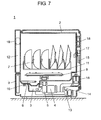
- FIG. 7 is a sectional side view of a conventional washing machine.
- FIG. 8 is a block diagram showing a control configuration of the conventional washing machine.
- washing machine 1 is configured by at least washing tub 2, washing pump 5, washing nozzle 6, heater 8, controller 9, thermistor 10, dish basket 11, drain pump 13, and the like.
- Washing tub 2 is provided inside washing machine 1.
- drain outlet 3 is provided.
- Washing pump 5 is disposed in a pump chamber communicating with drain outlet 3 and is driven by washing motor 4.
- Washing pump 5 circulates washing water inside washing tub 2.
- washing water is suctioned through drain outlet 3 into washing pump 5.
- the suctioned washing water is supplied by washing pump 5 to washing nozzle 6 rotatably disposed at an inner bottom of washing tub 2.
- the supplied washing water is sprayed from washing nozzle 6 toward tableware 7. After the sprayed washing water is used to wash tableware 7, the washing water is circulated through a path back to drain outlet 3.
- Heater 8 is disposed between washing nozzle 6 and the bottom of washing tub 2 to heat the washing water.
- Thermistor 10 is disposed in close contact with an outer bottom of washing tub 2 to detect the temperature of the washing water.
- Controller 9 detects by thermistor 10 that the temperature of the washing water reaches a predetermined temperature, and then performs a control of interrupting energization of heater 8 and the like.
- Dish basket 11 is configured such that pieces of tableware 7 are orderly arranged, and is disposed above washing nozzle 6. With this arrangement, the washing water is effectively sprayed on tableware 7 arranged in dish basket 11 to efficiently wash tableware 7.
- a front of washing tub 2 is opened.
- lid 12 which can be opened frontward is mounted.
- Drain pump 13 suctions the washing water from drain outlet 3 of washing tub 2 and discharges the washing water outside the machine through drain hose 14.
- controller 9 detects, by water level detector 16 communicating with washing tub 2, that the washing water has been supplied to a predetermined water level, controller 9 closes water supply valve 17 to stop the supply of the washing water.
- Blower fan 18 for drying blows air into washing tub 2.
- water vapor generated from surfaces of tableware 7 and the like is discharged outside washing tub 2 through exhaust port 19 provided in lid 12.
- tableware 7 is dried.
- controller 9 is connected through a load controller to washing pump 5, heater 8, drain pump 13, water supply valve 17, and blower fan 18, and controls those components. With this arrangement, controller 9 controls a washing operation including a series of steps such as a washing step, a rinsing step, a heat-rinsing step, and a drying step.
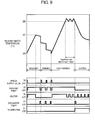
- FIG. 9 is an explanatory diagram showing a washing-water temperature and an operation program of a conventional washing machine.
- FIG. 10 is a flowchart of a heat-rinsing step of the conventional washing machine.
- a washing operation of a general washing machine includes four steps, i.e., a washing step, a rinsing step, a heat-rinsing step, and a drying step.
- controller 9 operates, in the washing step, water supply valve 17 to supply washing water through water supply hose 15. Thereafter, controller 9 energizes washing pump 5 and heater 8 and operates washing pump 5 and heater 8 until the washing-water temperature reaches a predetermined washing temperature (57°C, for example). Then, at the end of the washing step, controller 9 makes drain pump 13 discharge the washing water.
- a predetermined washing temperature 57°C, for example
- controller 9 operates water supply valve 17 to fill new washing water in washing tub 2. Thereafter, controller 9 does not energize heater 8 but energizes only washing pump 5 and performs the operation of rinsing tableware 7 twice for a predetermined period of time. Then, at the end of the rinsing step, controller 9 makes drain pump 13 discharge the washing water.
- controller 9 operates water supply valve 17 to fill new washing water in washing tub 2. Thereafter, controller 9 energizes washing pump 5 and heater 8 to set the temperature of the washing water to a predetermined temperature (80°C to 85°C, for example). At this time, heater 8 is intermittently operated so that the temperature of the washing water reaches the predetermined temperature. In this state, tableware 7 is rinsed.
- controller 9 supplies water in washing tub 2 up to a predetermined water amount (step S1), then turns on power of washing pump 5 (step S2), and turns on power of heater 8 (step S3). By this operation, the washing water is circulated and heated.
- step S4 it is determined whether or not the temperature of the washing water has reached a first maximum temperature (85°C, for example) (step S4). If the temperature has reached the first maximum temperature (Yes in step S4), the energization of heater 8 is stopped (step S5).
- a first maximum temperature 85°C, for example
- step S6 it is determined whether or not the temperature of the washing water has decreased to a second maximum temperature (80°C, for example), which is lower than the first maximum temperature (step S6). If the temperature has reached the second maximum temperature (Yes in step S6), the energization of heater 8 is started (step S7).
- a second maximum temperature 80°C, for example
- step S8 it is determined whether or not the temperature of the washing water has reached the first maximum temperature (85°C, for example) (step S8). If the temperature has reached the first maximum temperature (Yes in step S8), the energization of heater 8 is stopped (step S9).
- step S10 it is determined whether or not a predetermined period of time has elapsed. If the predetermined period of time has not elapsed (No in step S10), the flow goes back to step S6. Then, the subsequent steps for repeating the energization of heater 8 are executed so that the temperature of the washing water is kept between the first maximum temperature and the second maximum temperature.
- step S10 if the predetermined period of time has elapsed (Yes in step S10), the power of washing pump 5 and heater 8 are turned off (step S11). Further, power of drain pump 13 is turned on (step S12) to discharge the washing water from washing tub 2.
- the temperature of the washing water is controlled in the heat-rinsing step.
- controller 9 makes drain pump 13 discharge the washing water. Thereafter, an operation is made for a predetermined period of time such that heater 8 is intermittently energized while blower fan 18 is being energized. By this process, tableware 7 is dried.
- conventional washing machine 1 performs a control in such a manner that an amplitude of fluctuation of the temperature (the difference between the first maximum temperature and the second maximum temperature) is set to be a large value, for example, about 5°C when the washing water is held in a state of high temperature for a certain period of time.
- This control is made by taking into account delay of thermal conduction of washing tub 2 existing between thermistor 10 and the washing water.
- a transition period for example, when the temperature is increasing due to continuous energization of heater 8, there is always a temperature difference between the actual temperature of the washing water and the temperature detected by thermistor 10.
- controller 9 performs a control by estimating the temperature of the washing water by adding a temperature difference to the output value of thermistor 10. For example, when the temperature of the washing water is desired to be held at 80°C or higher, the control is made, by taking into account a magnitude of the amplitude of fluctuation of the temperature of the washing water, in such a manner that the energization of heater 8 is stopped after the washing water is once heated to, for example, 85°C. For this reason, there is an issue that extra power consumption is required.
- a washing machine of the present invention includes: a washing tub configured to contain an object to be washed; a washing apparatus which washes the object to be washed with washing water in the washing tub; a heater which heats the washing water; a temperature sensor disposed on an outer bottom surface of the washing tub, and configured to detect a temperature of the washing water; and a controller which controls a series of washing operations including a washing step, a rinsing step, a heat-rinsing step, and a drying step.
- the controller has a configuration in which, when the temperature sensor detects a first predetermined temperature in at least one of the washing step and the heat-rinsing step, the controller performs, until a predetermined period of time has elapsed, a heater control in which power-on and power-off of the heater are repeated based on preset periods of time.
- a washing machine of the exemplary embodiment of the present invention will be described below. Although a description will be made below by taking a configuration of a dishwasher as an example of a washing machine, the present invention is obviously not limited thereto. Components same as those in the conventional washing machine described with reference to FIG. 7 to FIG. 9 will be assigned the same reference marks and will be described briefly.
- FIG. 1 is a sectional side view of the washing machine of the exemplary embodiment of the present invention.
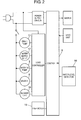
- FIG. 2 is a block diagram showing a control configuration of the washing machine of the exemplary embodiment.
- washing machine 1 of the present exemplary embodiment is configured by at least washing tub 2, washing pump 5, washing nozzle 6, heater 8, controller 9, thermistor 10, dish basket 11, drain pump 13, and the like.
- Dish basket 11 is provided in washing tub 2.
- Washing pump 5 and washing nozzle 6 are provided as a washing apparatus for washing tableware 7 stored in dish basket 11.
- Washing nozzle 6 is rotatably provided in washing tub 2. Washing pump 5 pressure-feeds washing water to washing nozzle 6, so that the washing water is sprayed from washing nozzle 6 toward tableware 7 stored in dish basket 11.
- the washing water in washing tub 2 is heated by heater 8.
- the temperature of the heated washing water is measured by thermistor 10, which is mounted on an outer bottom surface of washing tub 2 and serving as a temperature sensor.
- controller 9 measures the temperature of the washing water by detecting an output voltage of thermistor 10.
- controller 9 is connected, through a load controller, to washing pump 5, heater 8, drain pump 13, water supply valve 17, and blower fan 18, and controls those components.
- controller 9 controls and performs a washing operation including a series of steps such as a washing step, a rinsing step, a heat-rinsing step, and a drying step.
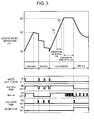
- FIG. 3 is an explanatory diagram showing a washing-water temperature and an operation program of the washing machine of the exemplary embodiment.
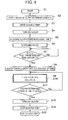
- FIG. 4 is a flowchart of a heat-rinsing step of the washing machine of the exemplary embodiment.
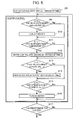
- FIG. 5 is a flowchart showing in detail a heater control in the flowchart of FIG. 4 .
- the operation of the washing machine which washes tableware 7 by using loads of washing pump 5, washing nozzle 6, heater 8, and the like, is the same as the operation of the conventional washing machine.
- the washing operation of the washing machine of the present exemplary embodiment includes four steps, i.e., a washing step, a rinsing step, a heat-rinsing step, and a drying step, similarly to the conventional washing machine.
- controller 9 operates water supply valve 17 to supply washing water through water supply hose 15. Thereafter, controller 9 energizes washing pump 5 and heater 8 to operate washing pump 5 and heater 8 until the washing-water temperature reaches a predetermined washing temperature (57°C, for example). Then, at the end of the washing step, controller 9 makes drain pump 13 discharge the washing water.
- a predetermined washing temperature 57°C, for example
- controller 9 operates water supply valve 17 to fill new washing water in washing tub 2. Thereafter, controller 9 energizes only washing pump 5, without energizing heater 8, and performs the operation of rinsing tableware 7, for example, twice for a predetermined period of time. Then, at the end of the rinsing step, controller 9 makes drain pump 13 discharge the washing water. The rinsing step ends with this operation.
- step S1 when the washing step and the rinsing step are finished, the heat-rinsing step is started (step S1).
- controller 9 energizes again water supply valve 17 to supply washing water to washing tub 2 up to a predetermined water amount through water supply hose 15 (step S2). Thereafter, when controller 9 detects, with water level detector 16, that the washing water has been supplied to a predetermined water level, controller 9 stops the power supply to water supply valve 17 to stop the supply of the washing water. Thereafter, washing motor 4 is energized to drive washing pump 5 (step S3) so that the washing operation is performed.
- controller 9 continuously energizes heater 8 (step S4) to heat the washing water to increase the temperature of the washing water. At this time, controller 9 measures the time period from first increased temperature Ta (50°C, for example) to second increased temperature Tb (68°C, for example) shown in FIG. 3 as a temperature increasing time (step S5). The temperature of first increased temperature Ta and the temperature of second increased temperature Tb are measured from the output of thermistor 10 which detects the temperature of the washing water.
- step S6 based on the length of the measured temperature increasing time and according to a preset and stored ranking (see FIG. 6 ), a rank which determine the content of the control of the subsequent washing operation is determined (step S6).
- controller 9 determines whether or not detected temperature TS of the washing water detected by thermistor 10 is equal to or higher than the first predetermined temperature T1 (step S7). If detected temperature TS is less than first predetermined temperature T1 (No in step S7), the measurement is repeated until detected temperature TS is equal to or higher than first predetermined temperature T1.
- step S7 if the temperature of the washing water is equal to or higher than first predetermined temperature T1 (Yes in step S7), first set periods of time based on which the heater control is performed are set, and the heater control to be described later is started (step S8).
- the first set periods of time are time periods for which power for energizing heater 8 is turned on and off, and the first set periods of time are set based on the rank determined in step S6.
- step S9 to S16 the heater control is finely performed in accordance with changes in the temperature of the washing water. The details will be described below with reference to FIG. 5 .
- step S17 it is determined whether or not a predetermined period of time has elapsed in the heat-rinsing step. If the predetermined period of time has not elapsed (No in step S17), the flow goes back to step S9, and the subsequent heater control is repeated until the predetermined period of time has elapsed.
- step S17 if the predetermined period of time has elapsed (Yes in step S17), the power of heater 8 is turned off (step S18).
- controller 9 stops washing pump 5 (step S19).
- step S20 the flow goes to the drying step shown in FIG. 3 (step S20).
- step S6 of FIG. 4 will be specifically described with reference to FIG. 6 .
- FIG. 6 is a diagram showing the content of the ranking for the heater control of the washing machine of the exemplary embodiment.
- FIG. 6 is an example of set values which are ranked depending on the lengths of the temperature increasing times of the washing water in the heat-rinsing step. Specifically, the temperature increasing times of the washing water are classified into four ranks. In FIG. 6 , the following values are set: the first predetermined temperature (a target thermistor temperature, a target washing-water temperature (estimated value)) at which the heater control is started, and the first set periods of time and second set periods of time for which the power of heater 8 is turned on and turned off.
- the first predetermined temperature a target thermistor temperature, a target washing-water temperature (estimated value)
- the actual temperature of the washing water is estimated based on the temperature detected by thermistor 10 (detected temperature TS of the thermistor). For example, when the amount of heat generation of heater 8 is large because of a high power-supply voltage or when the ambient temperature is high, the temperature increasing time of the washing water is short. In this case, the difference between detected temperature TS of the thermistor and the actual temperature of the washing water is relatively large because of delay due to thermal conductivity of washing tub 2.
- the temperature (first predetermined temperature T1) of the thermistor, at which the heater control of turning on and off the power of heater 8 is started is set to 76°C, as in rank A shown in FIG. 6 , which is lower than the temperatures in other ranks B to D.
- the thermistor temperature (first predetermined temperature T1), at which the heater control is started, is set to 79°C, as in rank D shown in FIG. 6 , which is higher than the temperatures in other ranks A to C.
- controller 9 can start the heater control after the temperature of the washing water reaches the target washing-water temperature, for example, 82°C. That is, by controlling the temperature of the washing water on a time basis, it is possible to control the variation in temperature due to the power-supply voltage and the ambient temperature, whereby to bring the temperature closer to a certain target washing-water temperature having a small variation. As a result, the temperature of the washing water can be kept at temperatures equal to or higher than 80°C, at which high sterilization effect can be obtained.
- the time periods for turning on and off the power of heater 8 there are two types of the time periods for turning on and off the power of heater 8, which are the first set periods of time and the second set periods of time as shown in FIG. 6 .
- controller 9 can perform a control so that the temperature is almost stable at the target washing-water temperature of 82°C.
- the temperature of the washing water is determined by the balance between a rate of temperature increase (an amount of heat generation of heater 8) and a speed of heat dissipation from washing tub 2. For this reason, when the temperature increasing time is short, the time ratio of power-on to power-off is set low, as in rank A shown in FIG. 6 , compared to other ranks B to D.
- controller 9 can control the temperature of the washing water to be kept in the vicinity of the target washing-water temperature as shown in FIG. 3
- the temperature of the washing water may gradually deviate from the target washing-water temperature.
- a more detailed heater control including step S9 to step S16 is performed as shown in FIG. 5 .
- controller 9 determines whether or not detected temperature TS of the thermistor detected by thermistor 10 is equal to or higher than fourth predetermined temperature T4 (step S9).
- Fourth predetermined temperature T4 is set higher by, for example, 2°C than first predetermined temperatures T1, each of which is set for each rank of the temperature increasing time.
- controller 9 determines whether or not detected temperature TS of the thermistor is equal to or higher than second predetermined temperature T2, which is set higher by, for example, 1°C than first predetermined temperatures T1, each of which is set for each rank of the temperature increasing time (step S11).
- controller 9 operates after making changes from the power-on/off time of heater 8 defined by the first set periods of time shown in FIG. 6 to the power-on/off time of heater 8 defined by the second set periods of time shown in FIG. 6 , in which the time ratio of power-on is set lower (step S12).
- controller 9 determines whether or not detected temperature TS of the thermistor exceeds third predetermined temperature T3, which is set lower by, for example, 1°C than first predetermined temperatures T1, each of which is set for each rank of the temperature increasing time (step S13).
- controller 9 operates after changing the heater control to first set periods of time shown in FIG. 6 (step S14).
- controller 9 While controller 9 is performing the heater control with the first set periods of time (step S14) and if detected temperature TS of the thermistor is equal to or lower than third predetermined temperature T3 (No in step S13), it is determined whether or not detected temperature TS of thermistor 10 is equal to or lower than third predetermined temperature T3, which is set lower by, for example, 1°C than first predetermined temperature T1 (step S15).
- controller 9 determines that the washing-water temperature is in a condition to be easily decreased. Then, controller 9 once makes the power of heater 8 to be continuously turned on (the power-off time is zero) and heats the washing water (step S16). This operation makes the temperature of the washing water to bring closer to first predetermined temperature T1.
- step S17 it is determined whether or not the heating of the washing water under the heater control has been performed for a predetermined period of time. If the predetermined period of time has elapsed (Yes in step S17), step S18 and the subsequent steps shown in FIG. 4 are executed.
- step S17 If the predetermined period of time has not elapsed (No in step S17), the flow goes back to step S9 to repeatedly perform the detailed heater control.
- step S9 If thermistor 10 detects fourth predetermined temperature T4 or higher temperatures which are higher than second predetermined temperature T2 (Yes in step S9) while the heater control is performed with the second set periods of time (step S12) in the period when the heater control shown in FIG. 5 is repeated for the predetermined period of time, controller 9 determines that the washing-water temperature is in a condition to be more easily increased. In that case, the power of heater 8 is once continuously turned off (the power-on time is zero) so that the temperature of the washing water is decreased (step S10). This operation makes the temperature of the washing water to bring closer to the target washing-water temperature (82°C, for example) of first predetermined temperature T1.
- step S13 is executed, and the heater control is set back to the first set periods of time, for example (step S14).
- the temperature of the washing water can be gradually returned to the target washing-water temperature (82°C, for example).
- the temperature of the washing water can be kept in the vicinity of first predetermined temperature T1 with the amplitude of fluctuation of the temperature kept small.
- a washing machine having higher energy saving performance can be realized.
- the target washing-water temperature for the heater control, the set temperatures of thermistor 10 (first predetermined temperature T1, second predetermined temperature T2, third predetermined temperature T3, and fourth predetermined temperature T4), and the set periods of time, which are described in the present exemplary embodiment are not limited to the above-described set values.
- those values can be set for each type of device in view of an amount of heat generation of heater 8 and a degree of heat insulation from washing tub 2 to surrounding air.
- the description has been made taking as an example the four ranks and the two set periods of time, i.e., the first set periods of time and the second set periods of time; however, the present invention is not limited thereto.
- the number of the ranks and the number of the set periods of time can be arbitrarily set depending on desired control accuracy.
- the heater control in the heat-rinsing step has been described in detail; however, it is obvious that a similar heater control can also be performed in the washing step. A similar effect can be obtained with this control.
- the present invention can be applied to a washing apparatus for medical instruments such as forceps to be used for surgery. With this application, it is possible to wash medical instruments, for which high sterilization effect is required, with washing water equal to or higher than 80°C.
- the present exemplary embodiment when the temperature of the washing water is kept at high temperatures for a certain period of time, it is possible to control the amplitude of fluctuation of the temperature of the washing water to be small so that it is possible to prevent the washing water from being heated too much. As a result, it is possible to realize a washing machine which is more energy-saving and in which the temperature of the washing water can be stably kept high.
- the maximum temperature of the washing water whose temperature is kept at a high temperature of 80°C or more for washing is as high as 85°C.
- the materials and the components used for washing machine 1 are greatly damaged by heat. Therefore, in the present exemplary embodiment, even when the power-supply voltage or the ambient temperature varies, the maximum temperature of the washing water whose temperature is kept at high temperatures can be lowered from 85°C to 82°C by finely performing the heater control of the temperature of the washing water. As a result, damage to the materials and the components constituting washing machine 1 can be reduced, whereby a highly reliable washing machine can be realized.
- a washing machine of the present invention includes: a washing tub configured to contain therein an object to be washed; a washing apparatus which washes the object to be washed with washing water in the washing tub; a heater which heats the washing water; a temperature sensor disposed on an outer bottom surface of the washing tub, and configured to detect a temperature of the washing water; and a controller which controls a series of washing operations including a washing step, a rinsing step, a heat-rinsing step, and a drying step.
- the controller has a configuration in which, when the temperature sensor detects a first predetermined temperature in at least one of the washing step and the heat-rinsing step, the controller performs, until a predetermined period of time has elapsed, a heater control in which power-on and power-off of the heater are repeated based on preset periods of time.
- the controller may measure, during heating of the washing water, a time period from when a temperature detected by the temperature sensor reaches a predetermined first increased temperature until when the temperature reaches a predetermined second increased temperature, and the controller may start the heater control based on a measured result.
- the controller may measure, during heating of the washing water, a time period from when a temperature detected by the temperature sensor reaches a predetermined first increased temperature until when the temperature reaches a predetermined second increased temperature, and the controller may change, based on the measured result, the set periods of time for the power-on and the power-off of the heater.
- the controller when the controller detects that the temperature detected by the temperature sensor deviates from the first predetermined temperature by a prescribed temperature or more while the controller is performing the heater control, the controller may change the set periods of time for the power-on and the power-off of the heater control to bring the temperature closer to the first predetermined temperature.
- the washing machine of the present invention can control the amplitude of fluctuation of the heating temperature of the washing water to be small.
- the present invention is useful in the field of dish washers or other fields in which it is required to prevent the washing water from being heated too much so that tableware can be washed while the temperature of the washing water is stably kept high with less energy.
Landscapes
- Washing And Drying Of Tableware (AREA)
- Control Of Washing Machine And Dryer (AREA)
Applications Claiming Priority (2)
| Application Number | Priority Date | Filing Date | Title |
|---|---|---|---|
| JP2012215885 | 2012-09-28 | ||
| PCT/JP2013/005524 WO2014050033A1 (fr) | 2012-09-28 | 2013-09-19 | Machine à laver |
Publications (2)
| Publication Number | Publication Date |
|---|---|
| EP2901909A1 true EP2901909A1 (fr) | 2015-08-05 |
| EP2901909A4 EP2901909A4 (fr) | 2016-02-10 |
Family
ID=50387475
Family Applications (1)
| Application Number | Title | Priority Date | Filing Date |
|---|---|---|---|
| EP13842693.7A Withdrawn EP2901909A4 (fr) | 2012-09-28 | 2013-09-19 | Machine à laver |
Country Status (6)
| Country | Link |
|---|---|
| EP (1) | EP2901909A4 (fr) |
| JP (1) | JP6229168B2 (fr) |
| KR (1) | KR101669378B1 (fr) |
| CN (1) | CN104703528B (fr) |
| TW (1) | TWI576080B (fr) |
| WO (1) | WO2014050033A1 (fr) |
Families Citing this family (4)
| Publication number | Priority date | Publication date | Assignee | Title |
|---|---|---|---|---|
| CN109674423A (zh) * | 2019-01-17 | 2019-04-26 | 珠海格力电器股份有限公司 | 一种洗碗机烘干方法、装置及洗碗机 |
| CN109674429A (zh) * | 2019-01-22 | 2019-04-26 | 珠海格力电器股份有限公司 | 洗碗机的余水烘干方法及洗碗机 |
| CN110419994A (zh) * | 2019-07-15 | 2019-11-08 | 杭州洁浦科技有限责任公司 | 水槽式清洗机的清洗方法 |
| CN110313876B (zh) * | 2019-07-15 | 2021-10-15 | 杭州洁浦科技有限责任公司 | 水槽式清洗机的清洗方法 |
Family Cites Families (9)
| Publication number | Priority date | Publication date | Assignee | Title |
|---|---|---|---|---|
| JP2000083887A (ja) | 1998-09-09 | 2000-03-28 | Toshiba Corp | 食器洗浄機 |
| DE19855779A1 (de) * | 1998-12-03 | 2000-06-08 | Miele & Cie | Verfahren zum Erwärmen der Spülflüssigkeit eines wasserführenden Haushaltgerätes, insbesondere einer programmgesteuerten Geschirrspülmaschine |
| JP2000279360A (ja) * | 1999-03-30 | 2000-10-10 | Osaka Gas Co Ltd | 食器洗浄機 |
| JP2004290505A (ja) * | 2003-03-27 | 2004-10-21 | Toto Ltd | 食器洗い機 |
| JP2004337429A (ja) * | 2003-05-16 | 2004-12-02 | Sanyo Electric Co Ltd | 食器洗い機 |
| JP4591169B2 (ja) | 2005-04-14 | 2010-12-01 | パナソニック株式会社 | 食器洗い機 |
| KR20070105051A (ko) * | 2006-04-25 | 2007-10-30 | 엘지전자 주식회사 | 식기 세척기 및 그 제어 방법 |
| DE102007005834A1 (de) * | 2007-02-01 | 2008-08-14 | Meiko Maschinenbau Gmbh & Co. Kg | Spülmaschine mit Aufheizsteuerung |
| US20110000511A1 (en) * | 2009-07-01 | 2011-01-06 | General Electric Company | Deep clean cycle |
-
2013
- 2013-09-19 EP EP13842693.7A patent/EP2901909A4/fr not_active Withdrawn
- 2013-09-19 KR KR1020157007714A patent/KR101669378B1/ko not_active Expired - Fee Related
- 2013-09-19 JP JP2014538156A patent/JP6229168B2/ja active Active
- 2013-09-19 WO PCT/JP2013/005524 patent/WO2014050033A1/fr not_active Ceased
- 2013-09-19 CN CN201380050321.6A patent/CN104703528B/zh active Active
- 2013-09-23 TW TW102134113A patent/TWI576080B/zh not_active IP Right Cessation
Also Published As
| Publication number | Publication date |
|---|---|
| WO2014050033A1 (fr) | 2014-04-03 |
| EP2901909A4 (fr) | 2016-02-10 |
| KR101669378B1 (ko) | 2016-10-25 |
| CN104703528A (zh) | 2015-06-10 |
| JPWO2014050033A1 (ja) | 2016-08-22 |
| TWI576080B (zh) | 2017-04-01 |
| CN104703528B (zh) | 2017-06-23 |
| TW201420058A (zh) | 2014-06-01 |
| JP6229168B2 (ja) | 2017-11-15 |
| KR20150048204A (ko) | 2015-05-06 |
Similar Documents
| Publication | Publication Date | Title |
|---|---|---|
| TWI412347B (zh) | Tableware cleaning machine | |
| US20060237052A1 (en) | Computer-controlled system for dishwashers | |
| US8778089B2 (en) | Dishwasher and a control method therefor | |
| US20080190453A1 (en) | Dishwashing Machine With Heating Control | |
| EP2901909A1 (fr) | Machine à laver | |
| WO2010004868A1 (fr) | Lave-vaisselle | |
| WO2013014871A1 (fr) | Lave-vaisselle | |
| US20090056757A1 (en) | Method of controlling dishwasher and dishwasher | |
| TWI471112B (zh) | Tableware cleaning machine | |
| JP2013240405A (ja) | 食器洗い機 | |
| JP5927503B2 (ja) | 食器洗い機 | |
| JP4201015B2 (ja) | 食器洗浄機 | |
| EP2786693A1 (fr) | Lave-vaisselle | |
| JP5018827B2 (ja) | 食器洗い機 | |
| KR940011561B1 (ko) | 식기세척기의 건조 제어방법 | |
| JPH0759708A (ja) | 食器洗い機 | |
| JP2001112698A (ja) | 食器洗い乾燥機 | |
| JP2016054848A (ja) | 食器洗浄機 |
Legal Events
| Date | Code | Title | Description |
|---|---|---|---|
| PUAI | Public reference made under article 153(3) epc to a published international application that has entered the european phase |
Free format text: ORIGINAL CODE: 0009012 |
|
| 17P | Request for examination filed |
Effective date: 20150319 |
|
| AK | Designated contracting states |
Kind code of ref document: A1 Designated state(s): AL AT BE BG CH CY CZ DE DK EE ES FI FR GB GR HR HU IE IS IT LI LT LU LV MC MK MT NL NO PL PT RO RS SE SI SK SM TR |
|
| AX | Request for extension of the european patent |
Extension state: BA ME |
|
| DAX | Request for extension of the european patent (deleted) | ||
| RA4 | Supplementary search report drawn up and despatched (corrected) |
Effective date: 20160112 |
|
| RIC1 | Information provided on ipc code assigned before grant |
Ipc: A47L 15/46 20060101AFI20160105BHEP |
|
| STAA | Information on the status of an ep patent application or granted ep patent |
Free format text: STATUS: EXAMINATION IS IN PROGRESS |
|
| 17Q | First examination report despatched |
Effective date: 20210401 |
|
| STAA | Information on the status of an ep patent application or granted ep patent |
Free format text: STATUS: THE APPLICATION IS DEEMED TO BE WITHDRAWN |
|
| 18D | Application deemed to be withdrawn |
Effective date: 20220126 |