EP2910643B1 - Verfahren zur sammlung eines biologischen materials und vorrichtung zur sammlung eines biologischen materials - Google Patents
Verfahren zur sammlung eines biologischen materials und vorrichtung zur sammlung eines biologischen materials Download PDFInfo
- Publication number
- EP2910643B1 EP2910643B1 EP13847140.4A EP13847140A EP2910643B1 EP 2910643 B1 EP2910643 B1 EP 2910643B1 EP 13847140 A EP13847140 A EP 13847140A EP 2910643 B1 EP2910643 B1 EP 2910643B1
- Authority
- EP
- European Patent Office
- Prior art keywords
- temperature
- atp
- collection container
- microbe
- biological material
- Prior art date
- Legal status (The legal status is an assumption and is not a legal conclusion. Google has not performed a legal analysis and makes no representation as to the accuracy of the status listed.)
- Not-in-force
Links
Images


Classifications
-
- C—CHEMISTRY; METALLURGY
- C12—BIOCHEMISTRY; BEER; SPIRITS; WINE; VINEGAR; MICROBIOLOGY; ENZYMOLOGY; MUTATION OR GENETIC ENGINEERING
- C12Q—MEASURING OR TESTING PROCESSES INVOLVING ENZYMES, NUCLEIC ACIDS OR MICROORGANISMS; COMPOSITIONS OR TEST PAPERS THEREFOR; PROCESSES OF PREPARING SUCH COMPOSITIONS; CONDITION-RESPONSIVE CONTROL IN MICROBIOLOGICAL OR ENZYMOLOGICAL PROCESSES
- C12Q1/00—Measuring or testing processes involving enzymes, nucleic acids or microorganisms; Compositions therefor; Processes of preparing such compositions
- C12Q1/02—Measuring or testing processes involving enzymes, nucleic acids or microorganisms; Compositions therefor; Processes of preparing such compositions involving viable microorganisms
- C12Q1/04—Determining presence or kind of microorganism; Use of selective media for testing antibiotics or bacteriocides; Compositions containing a chemical indicator therefor
- C12Q1/06—Quantitative determination
-
- C—CHEMISTRY; METALLURGY
- C12—BIOCHEMISTRY; BEER; SPIRITS; WINE; VINEGAR; MICROBIOLOGY; ENZYMOLOGY; MUTATION OR GENETIC ENGINEERING
- C12Q—MEASURING OR TESTING PROCESSES INVOLVING ENZYMES, NUCLEIC ACIDS OR MICROORGANISMS; COMPOSITIONS OR TEST PAPERS THEREFOR; PROCESSES OF PREPARING SUCH COMPOSITIONS; CONDITION-RESPONSIVE CONTROL IN MICROBIOLOGICAL OR ENZYMOLOGICAL PROCESSES
- C12Q1/00—Measuring or testing processes involving enzymes, nucleic acids or microorganisms; Compositions therefor; Processes of preparing such compositions
- C12Q1/02—Measuring or testing processes involving enzymes, nucleic acids or microorganisms; Compositions therefor; Processes of preparing such compositions involving viable microorganisms
- C12Q1/24—Methods of sampling, or inoculating or spreading a sample; Methods of physically isolating an intact microorganisms
-
- C—CHEMISTRY; METALLURGY
- C12—BIOCHEMISTRY; BEER; SPIRITS; WINE; VINEGAR; MICROBIOLOGY; ENZYMOLOGY; MUTATION OR GENETIC ENGINEERING
- C12M—APPARATUS FOR ENZYMOLOGY OR MICROBIOLOGY; APPARATUS FOR CULTURING MICROORGANISMS FOR PRODUCING BIOMASS, FOR GROWING CELLS OR FOR OBTAINING FERMENTATION OR METABOLIC PRODUCTS, i.e. BIOREACTORS OR FERMENTERS
- C12M33/00—Means for introduction, transport, positioning, extraction, harvesting, peeling or sampling of biological material in or from the apparatus
-
- C—CHEMISTRY; METALLURGY
- C12—BIOCHEMISTRY; BEER; SPIRITS; WINE; VINEGAR; MICROBIOLOGY; ENZYMOLOGY; MUTATION OR GENETIC ENGINEERING
- C12M—APPARATUS FOR ENZYMOLOGY OR MICROBIOLOGY; APPARATUS FOR CULTURING MICROORGANISMS FOR PRODUCING BIOMASS, FOR GROWING CELLS OR FOR OBTAINING FERMENTATION OR METABOLIC PRODUCTS, i.e. BIOREACTORS OR FERMENTERS
- C12M41/00—Means for regulation, monitoring, measurement or control, e.g. flow regulation
- C12M41/12—Means for regulation, monitoring, measurement or control, e.g. flow regulation of temperature
-
- C—CHEMISTRY; METALLURGY
- C12—BIOCHEMISTRY; BEER; SPIRITS; WINE; VINEGAR; MICROBIOLOGY; ENZYMOLOGY; MUTATION OR GENETIC ENGINEERING
- C12M—APPARATUS FOR ENZYMOLOGY OR MICROBIOLOGY; APPARATUS FOR CULTURING MICROORGANISMS FOR PRODUCING BIOMASS, FOR GROWING CELLS OR FOR OBTAINING FERMENTATION OR METABOLIC PRODUCTS, i.e. BIOREACTORS OR FERMENTERS
- C12M47/00—Means for after-treatment of the produced biomass or of the fermentation or metabolic products, e.g. storage of biomass
- C12M47/04—Cell isolation or sorting
-
- C—CHEMISTRY; METALLURGY
- C12—BIOCHEMISTRY; BEER; SPIRITS; WINE; VINEGAR; MICROBIOLOGY; ENZYMOLOGY; MUTATION OR GENETIC ENGINEERING
- C12N—MICROORGANISMS OR ENZYMES; COMPOSITIONS THEREOF; PROPAGATING, PRESERVING, OR MAINTAINING MICROORGANISMS; MUTATION OR GENETIC ENGINEERING; CULTURE MEDIA
- C12N1/00—Microorganisms; Compositions thereof; Processes of propagating, maintaining or preserving microorganisms or compositions thereof; Processes of preparing or isolating a composition containing a microorganism; Culture media therefor
- C12N1/06—Lysis of microorganisms
-
- C—CHEMISTRY; METALLURGY
- C12—BIOCHEMISTRY; BEER; SPIRITS; WINE; VINEGAR; MICROBIOLOGY; ENZYMOLOGY; MUTATION OR GENETIC ENGINEERING
- C12Q—MEASURING OR TESTING PROCESSES INVOLVING ENZYMES, NUCLEIC ACIDS OR MICROORGANISMS; COMPOSITIONS OR TEST PAPERS THEREFOR; PROCESSES OF PREPARING SUCH COMPOSITIONS; CONDITION-RESPONSIVE CONTROL IN MICROBIOLOGICAL OR ENZYMOLOGICAL PROCESSES
- C12Q1/00—Measuring or testing processes involving enzymes, nucleic acids or microorganisms; Compositions therefor; Processes of preparing such compositions
- C12Q1/008—Measuring or testing processes involving enzymes, nucleic acids or microorganisms; Compositions therefor; Processes of preparing such compositions for determining co-enzymes or co-factors, e.g. NAD, ATP
-
- C—CHEMISTRY; METALLURGY
- C12—BIOCHEMISTRY; BEER; SPIRITS; WINE; VINEGAR; MICROBIOLOGY; ENZYMOLOGY; MUTATION OR GENETIC ENGINEERING
- C12Q—MEASURING OR TESTING PROCESSES INVOLVING ENZYMES, NUCLEIC ACIDS OR MICROORGANISMS; COMPOSITIONS OR TEST PAPERS THEREFOR; PROCESSES OF PREPARING SUCH COMPOSITIONS; CONDITION-RESPONSIVE CONTROL IN MICROBIOLOGICAL OR ENZYMOLOGICAL PROCESSES
- C12Q1/00—Measuring or testing processes involving enzymes, nucleic acids or microorganisms; Compositions therefor; Processes of preparing such compositions
- C12Q1/68—Measuring or testing processes involving enzymes, nucleic acids or microorganisms; Compositions therefor; Processes of preparing such compositions involving nucleic acids
- C12Q1/6806—Preparing nucleic acids for analysis, e.g. for polymerase chain reaction [PCR] assay
-
- G—PHYSICS
- G01—MEASURING; TESTING
- G01N—INVESTIGATING OR ANALYSING MATERIALS BY DETERMINING THEIR CHEMICAL OR PHYSICAL PROPERTIES
- G01N35/00—Automatic analysis not limited to methods or materials provided for in any single one of groups G01N1/00 - G01N33/00; Handling materials therefor
- G01N2035/00346—Heating or cooling arrangements
- G01N2035/00356—Holding samples at elevated temperature (incubation)
- G01N2035/00366—Several different temperatures used
Definitions
- the present invention relates to a method for collecting cellular biological material contained in a sample, and a device for collecting biological material.
- a method for quantifying microbes in a sample has been known as an ATP assay in which the number of microbes is indirectly counted by quantifying a microbe-derived ATP (adenosine triphosphate) as an index (see, for example, Patent Literatures 1 to 3).
- This ATP assay is a quantifying method including: having an ATP extraction reagent contact with microbes contained in a sample; extracting endogenous ATP from the microbes; and counting the number of the microbes in accordance with an amount of luminescence given when the ATP reacts with a luminescent reagent.
- the number of collected microbes may be counted by, for example, determining the number of colonies of the microbes cultured on plate agar. This counting method requires several days. By contrast, when the above ATP assay is used, the time from collection of microbes to their counting can be markedly shortened to about one to several hours.
- a surfactant such as benzalkonium chloride has been used as an ATP extraction reagent.
- Use of such an ATP extraction reagent enables a microbial cell membrane to be disrupted, thereby extracting endogenous ATP from a microbe.
- ATP extraction reagent may be effective in extracting ATP from, for example, a microbial species A, ATP may not be sufficiently extracted from a different microbial species B.
- an ATP yield therein varies depending on a microbial species.
- microbes may not be quantified with high sensitivity and precision.
- a method for collecting a biological material from microbes by which a sufficient amount of the biological material can be collected regardless of a species of the microbes when the biological material such as ATP is collected from those microbes.
- an aspect of the present invention provides a method for collecting biological material from a microbe, the method including: a collection step of collecting a microbe from a medium containing the microbe at a first temperature; a temperature raising step of heating the microbe collected during the collection step to a second temperature higher than the first temperature; and an extraction step of extracting the biological material from the microbe at the second temperature, according to claim 1.
- another aspect of the present invention provides a device for collecting biological material from a microbe, the device including: a collection container that is used to collect a microbe from a medium containing the microbe and to extract a biological material from the microbe; and a temperature control mechanism that controls a temperature of the collection container, according to claim 3.
- the temperature control mechanism controls the temperature of the collection container so that the microbe is collected at a first temperature and the biological material is extracted from the microbe at a second temperature higher than the first temperature.
- the present invention provides a method and a device for collecting biological material, the method and device enabling collection of a sufficient amount of the biological material from microbes regardless of a species of the microbes.
- a method and a device for collecting biological material according to embodiments of the present invention are characterized in that: a microbe is collected from a microbe-containing medium at a predetermined first temperature; and ATP (adenosine triphosphate) that is a biological material of the collected microbe is extracted and collected from the microbe at a second temperature higher than the first temperature.
- ATP adenosine triphosphate
- FIG. 1 shows a device 1 for collecting a biological material.
- the device 1 includes: a collection container 21 that is used to collect a microbe from a liquid sample 8a containing the microbe (not shown) and to extract biological material ATP from the microbe; and a temperature control mechanism 9 that controls a temperature of the collection container 21.
- a term of "liquid sample 8a containing the microbe” corresponds to a term of "medium containing the microbe" set forth in the attached "Claims”.
- the collection container 21 includes: a funnel-shaped main body 25; and a filter 26 arranged at a bottom of the container 21.
- This collection container 21 is used to collect a microbe on the filter 26 while a suction head 23 of the filtration unit 2 described below sucks the liquid sample 8a in the collection container 21. Then, the liquid dispensing unit 31 dispenses an ATP extraction reagent in the container 21. In this way, a biological material is extracted and collected from the microbe.
- a term of "liquid dispensing unit 31" corresponds to a term of "dispensing mechanism" set forth in the attached "Claims”.
- the filter 26 is formed in a stack of two layers composing of a hydrophilic filter 26a (see FIG. 5A ) and a hydrophobic filter 26b (see FIG. 5A ) as described below. Although the structure is not shown in FIG. 1 , the hydrophilic filter 26a is disposed at an upper side and the hydrophobic filter 26b is disposed at a lower side of the stack of the two layers.
- the filter 26 retains the liquid sample 8a that has been injected into the main body 25 on the filter 26 unless the liquid sample 8a is sucked via the suction head 23.
- the microbe (not shown) is retained on the filter 26 and the liquid components are discharged through the filter 26 to the suction head 23 side.
- the collection container 21 is mounted on a predetermined position of a treatment stage 5 included in the device 1 for collecting biological material.
- the collection container 21 is detachably mounted on a mounting section 5a for a collection container, the mounting section 5a being arranged in the treatment stage 5.
- the mounting section 5a for a collection container according to the present embodiment is made of a material with efficient heat conductivity such as an aluminum alloy.
- the filtration unit 2 includes: the collection container 21; the suction head 23; a lift mechanism 22 that moves the suction head 23 up and down; and a suction pump 24 that sucks contents of the collection container 21 through the suction head 23.
- the suction head 23 is vertically movable up and down via the lift mechanism 22.
- the lift mechanism 22 lifts the suction head 23 so that the suction head 23 is connected with the collection container 21. Further, when the collection container 21 is mounted on the treatment stage 5 or removed from the treatment stage 5, the lift mechanism 22 moves down the suction head 23 to disconnect the suction head 23 from the collection container 21.
- the suction pump 24 is arranged in the middle of a pipe P1 that extends from the suction head 23.
- the suction pump 24 When the suction pump 24 is actuated, the liquid components contained in the collection container 21, as described above, pass through the filter 26, the suction head 23, and the suction pump 24 to be discharged into a waste tank (not shown) of the device 1 for collecting biological material.
- a suction pump controller 34d and a lift mechanism controller 34e of a control unit 34 control actuation and stop of the suction pump 24 and the lift mechanism 22, respectively.
- a liquid dispensing unit 31 includes: a liquid dispensing nozzle 31a; a dispensing pump 31b that sucks a predetermined amount of liquid from the liquid dispensing nozzle 31a or discharges that thereto; an actuator 31c that three-dimensionally moves the liquid dispensing nozzle 31a in a housing 7 of the device 1 for collecting biological material; and an actuator controller 34a and a flow rate controller 34b of the control unit 34.
- the liquid dispensing nozzle 31a of this liquid dispensing unit 31 is used in a step of measuring an intensity of ATP luminescence as described below.
- a predetermined amount of an ATP extract 8d (see FIG. 4C ) as obtained from the collection container 21 is transferred to a tube 32b for luminescence assay performed by an emission intensity-measuring unit 32 included in an ATP-quantification mechanism 3.
- the liquid dispensing nozzle 31a transfers an ATP luminescent reagent 8b placed in a reagent holder 6 to the tube 32b for luminescence assay.
- the actuator controller 34a controls actuator 31c in a predetermined manner so that the liquid dispensing nozzle 31a moves three-dimensionally. Further, the flow rate controller 34b controls the dispensing pump 31b in a predetermined manner so that dispensed amounts of the ATP luminescent reagent 8b and the ATP extract 8d etc. (see FIG. 4C ) are adjusted respectively.
- a temperature control mechanism 9 has a plurality of components and includes: a first heating unit 10 such as a heater that heats the collection container 21; a first temperature sensor 11 that detects a temperature of the collection container 21 and outputs a temperature detection signal on this temperature; and a temperature controller 34g that controls a calorific value of the first heating unit 10 based on the temperature detection signal outputted from the first temperature sensor 11.
- a first heating unit 10 such as a heater that heats the collection container 21
- a first temperature sensor 11 that detects a temperature of the collection container 21 and outputs a temperature detection signal on this temperature
- a temperature controller 34g that controls a calorific value of the first heating unit 10 based on the temperature detection signal outputted from the first temperature sensor 11.
- the first heating unit 10 and the first temperature sensor 11 are arranged adjacently to the collection container 21 on the mounting section 5a for a collection container. This arrangement allows a temperature of the collection container 21 to be accurately controlled.
- the temperature controller 34g of the control unit 34 outputs instructions to a given inverter or the like to supply power to the first heating unit 10 so that the first heating unit 10 arranged on the mounting section 5a for a collection container generates heat. More specifically, the temperature controller 34g controls the first heating unit 10 to heat the liquid sample 8a in the collection container 21 to the first temperature and keep the temperature at the first temperature. At this time, the temperature controller 34g of the control unit 34 turns on and off the first heating unit 10 based on temperature detection signals outputted from the first temperature sensor 11 arranged on the mounting section 5a for a collection container and inputted through an input section 34c for temperature detection signals. This operation allows a temperature of the liquid sample 8a in the collection container 21 to be controlled and kept within the above temperature range.
- the input section 34c of the control unit 34 includes an interface and an A/D converter, and receives temperature detection signals outputted from the first temperature sensor 11.
- the temperature controller 34g includes a central processing unit (not shown) and a storage unit (not shown). Those units are configured to cooperate together based on the temperature detection signals inputted through the input section 34c for temperature detection signals, whereby the first heating unit 10 is turned on and off as described above.
- this temperature controller 34g is configured to control a calorific value in a second heating unit 12 such as a heater that raises a temperature of an ATP extraction reagent 8c placed in the reagent holder 6.
- a term of "ATP extraction reagent 8c" corresponds to a term of "biological material extraction reagent” set forth in the attached "Claims”.
- the temperature controller 34g makes the second heating unit 12 turned on and off based on temperature detection signals outputted from a second temperature sensor 13 arranged in the reagent holder 6 in the vicinity of the ATP extraction reagent 8c and inputted through the input section 34c for temperature detection signals. This operation allows the temperature of the ATP extraction reagent 8c in the reagent holder 6 to be controlled and kept within the predetermined temperature range as described hereinafter.
- the "mechanism for raising a temperature of an extraction reagent" set forth in the attached “Claims” includes the second heating unit 12, the second temperature sensor 13, and the temperature controller 34g.
- the device 1 for collecting biological material of the present embodiment includes an ATP (i.e., biological material) quantification mechanism 3 in addition to the collection container 21, the filtration unit 2, the liquid dispensing unit 31, and the temperature control mechanism 9.
- ATP i.e., biological material
- the ATP quantification mechanism 3 primarily includes: the emission intensity-measuring unit 32; and an arithmetic part 34f of the control unit 34.
- the arithmetic part 34f determines quantity of ATP contained in a microbe based on detection signals indicating an ATP luminescence intensity, outputted from the emission intensity-measuring unit 32.
- the emission intensity-measuring unit 32 includes: a tube 32b for luminescence assay and a main body 32a for light detection.
- the tube 32b receives a dispensed ATP extract and an ATP luminescent reagent 8b to cause a luminescent reaction.
- the main body 32a has a photo multiplier or the like detecting the ATP luminescence intensity during the luminescent reaction.
- the main body 32a for light detection outputs detection signals indicating the ATP luminescence intensity via the tube 32b to the arithmetic part 34f of the control unit 34. That is, the main body 32a for light detection outputs detection signals which include the "ATP luminescence intensity reflecting an ATP amount in an ATP extract".
- the arithmetic part 34f calculates an ATP amount contained in microbes of the liquid sample 8a based on the detection signals including the "ATP luminescence intensity reflecting an ATP amount in the ATP extract".
- the detection signals are outputted from the main body 32a for light detection. Note that algorithm for calculating an ATP amount by the arithmetic part 34f will be described in detail hereinafter.
- FIG. 2 is a flow chart outlining a method for collecting biological material according to an embodiment of the present invention.
- the collection container 21 is placed on the mounting section 5a of the treatment stage 5.
- the liquid sample 8a to be a detection target is injected into the collection container 21.
- a start switch (not shown) is turned on to make the control unit 34 execute the following procedure.
- the temperature controller 34g of the control unit 34 starts a step of keeping a temperature of a collection container so as to maintain a temperature of the collection container 21 at the first temperature (Step S1 in FIG. 2 ). Specifically, the temperature controller 34g controls a calorific value of the first heating unit 10 so that the temperature of the collection container 21 is set to be the first temperature that is higher than the room temperature and lower than the second temperature described below, based on the temperature detection signals outputted from the first temperature sensor 11.
- first temperature of the present embodiment is not particularly limited as long as the first temperature is higher than room temperature and less than the second temperature described below.
- the temperature of contents of the collection container 21, however, is desirably set to be within a range (e.g., 30°C) from higher than room temperature to lower than 40°C.
- the lift mechanism controller 34e of the control unit 34 outputs instructions to the lift mechanism 22 to move the suction head 23 up and connect the suction head 23 with the collection container 21.
- the suction pump controller 34d of the control unit 34 actuates the suction pump 24. Then, through the suction head 23, filtration of the contents (i.e., liquid sample 8a) in the collection container 21 is started. This allows microbes to be collected on the filter 26 (Step S2 in FIG. 2 ).
- liquid components in the liquid sample 8a are discharged toward the suction head 23.
- an ATP eliminating reagent is dispensed in the collection container 21 to eliminate what is called free ATP present outside the microbial cells.
- the ATP eliminating reagent is placed in the reagent holder 6.
- the liquid dispensing nozzle 31a of the liquid dispensing unit 31 is used to dispense the ATP eliminating reagent from the reagent holder 6 into the collection container 21. Dispensing the ATP eliminating reagent completely eliminates the free ATP.
- Examples of this ATP eliminating reagent include an ATPase.
- the temperature controller 34g of the control unit 34 starts a step of raising a temperature of the collection container 21 (Step S4 in FIG. 2 ). Specifically, the temperature controller 34g controls a calorific value of the first heating unit 10 so that the temperature of the collection container 21 is set to be the predetermined second temperature, based on the temperature detection signals outputted from the first temperature sensor 11.
- the temperature of contents of the collection container 21 is desirably set to be within a range from higher than 40°C to lower than 100°C, for example, at 60°C.
- Step S5 in FIG. 2 an ATP extraction step of extracting ATP from the microbes in the collection container 21 is carried out.
- the actuator controller 34a and the flow rate controller 34b control the actuator 31c and the dispensing pump 31b, respectively, so that the liquid dispensing nozzle 31a dispenses a predetermined amount of the ATP extraction reagent 8c into the collection container 21.
- ATP extraction reagent 8c Dispensing this ATP extraction reagent 8c makes it possible to extract ATP contained in microbes and produce the ATP extract 8d in the collection container 21 (see FIG. 4C ).
- the ATP eliminating reagent dispensed in the collection container 21 during Step S4 is inactivated when the ATP eliminating reagent contacts with the ATP extraction reagent 8c.
- Examples of the ATP extraction reagent 8c suitably used include a surfactant, a mixed solution of ethanol and ammonia, methanol, ethanol, trichloroacetic acid, perchloric acid, and a Tris buffer. Among them, preferred is a surfactant.
- examples of the surfactant include sodium dodecyl sulfate, potassium lauryl sulfate, sodium monolauroyl phosphate, sodium alkylbenzene sulfonate, benzalkonium chloride, benzethonium chloride, cetylpyridinium chloride, cetyl trimethyl ammonium bromide, and myristyl dimethyl benzyl ammonium chloride.
- Step S6 in FIG. 2 a step of lowering a temperature of the collection container 21 is carried out. Specifically, the temperature controller 34g turns off the first heating unit 10 at the predetermined timing described hereinafter. By doing so, the temperature of the collection container 21 is dropped due to heat dissipation.
- the temperature immediately after this temperature lowering step is not particularly limited, but may be room temperature or higher. In the present embodiment, however, it is assumed that the temperature lowering step is carried out so that the above temperature becomes equal to the first temperature.
- the temperature controller 34g controls the temperature of the collection container 21 so as to keep it constant. Specifically, the temperature controller 34g of the present embodiment controls a calorific value of the first heating unit 10 so that the temperature of the collection container 21 is set to be the predetermined first temperature, based on the temperature detection signals outputted from the first temperature sensor 11.
- the actuator controller 34a and the flow rate controller 34b control the liquid dispensing nozzle 31a to collect a predetermined amount of the ATP extract 8d (see FIG. 4 C) in the collection container 21 (Step S7 in FIG. 2 ). Then, the liquid dispensing nozzle 31a transfers the ATP extract 8d thus collected to the tube 32b for luminescence assay.
- the actuator controller 34a and the flow rate controller 34b control the liquid dispensing nozzle 31a to dispense into the tube 32b the ATP luminescent reagent 8b placed in the reagent holder 6.
- Examples of the ATP luminescent reagent 8b include a luciferase-luciferin reagent.
- ATP in the ATP extract reacts with the ATP luminescent reagent 8b to emit light.
- the arithmetic part 34f of the control unit 34 performs digital processing of detection signals outputted from the main body 32a for light detection after the main body 32a (see FIG. 1 ) detects an ATP luminescence intensity.
- the main body 32a measures the luminescence intensity based on a single photon counting method (Step S8 in FIG. 2 ).
- Step S9 in FIG. 2 Execution of the Step S9 leads to completion of a biological material quantification step including a series of steps of a method for collecting biological material of the present embodiment.
- FIG. 3 which will be described below, is a time chart outlining a method for collecting biological material of an embodiment of the present invention. Note that in FIG. 3 , the ordinate represents a temperature T [°C] of the collection container 21 and the abscissa represents a time point t [min].
- the method for collecting biological material of the present embodiment include: a "step of keeping a temperature of a collection container" (Step S1 in FIG. 2 ), beginning at t1 [min]; a “step of collecting microbes " (Step S2 in FIG. 2 ) from t2 [min] to t3 [min]; a "ATP eliminating step” (Step S3 in FIG.2 ) from t3 [min] to t4 [min]; a "step of raising a temperature of the collection container” (Step S4 in FIG. 2 ) from t4 [min] to t5 [min]; an "ATP extraction step” (Step S5 in FIG.
- Step S6 in FIG. 2 a "step of lowering a temperature of the collection container” from t6 [min] to t7 [min]; and a "step of collecting ATP extract” (Step S7 in FIG. 2 ) from t7 [min] to t8 [min].
- FIG. 3 shows additional steps after the "step of collecting ATP extract” (Step S7 in FIG. 2 ).
- Those steps include: a "step of measuring an ATP luminescence intensity” (Step S8 in FIG. 2 ) from t8 [min] to t9 [min]; and an “arithmetic step” (Step S9 in FIG. 2 ) from t9 [min] to t10 [min].
- the first heating unit 10 (see FIG. 1 ) is being turned off during the period from time 0 [min] to t1 [min]. Accordingly, the temperature of the collection container 21 is kept at room temperature.
- the collection container 21 is mounted on the treatment stage 5 during this period, and the collection container 21 is to be filled with the liquid sample 8a of examination target.
- Step S1 in FIG. 2 the "step of keeping a temperature of a collection container" is started at t1 [min].
- the temperature control mechanism 9 maintains the temperature of the collection container 21 at the first temperature (T1). This procedure also keeps the temperature of contents of the collection container 21 equal to the first temperature (T1).
- the microbe-containing liquid sample 8a (see FIG. 1 ) is filtered by the filtration unit 2 at the first temperature. This allows microbes to be separated and collected on the filter 26 (Step S2 in FIG. 2 ).
- the ATP eliminating step (Step S3 in FIG. 2 ) is started at the timing of t3 [min] when the filtration of the liquid sample 8a is ended.
- the timing of t3 [min] can be determined by monitoring, for example, a change in pressure inside the suction head 23.
- the timing of t3 [min] may be set based on a filtration period [i.e., difference (t3 - t2)] [min] that has been calculated beforehand via a simulation test.
- a liquid level of contents of the collection container 21 may be measured with, for example, an optical liquid level meter (not shown) to set the timing of t3 [min] when the contents of the collection container 21 become empty.
- Such an ATP eliminating step is carried out at the first temperature (T1) by dispensing the ATP eliminating reagent in the collection container 21 as described above.
- T1 the first temperature
- an amount of the ATP eliminating reagent dispensed in the collection container 21 is extremely small in the present embodiment, and the collection container 21 is heated using the first heating unit 10. Accordingly, the first temperature (T1) hardly fluctuates when the ATP eliminating reagent is dispensed.
- the temperature of the ATP eliminating reagent should be raised beforehand to about the same temperature as the first temperature (T1).
- Such an endpoint t4 of the ATP eliminating step may be set based on an ATP eliminating period [i.e., difference (t4 - t3)] [min] that has been calculated beforehand via a simulation test.
- the stating time t3 [min] of the ATP eliminating step is a time when the liquid dispensing nozzle 31a starts to move from the initial position (or home position) toward the reagent holder 6.
- the ATP eliminating period [i.e., difference (t4 - t3)] [min] as calculated via the simulation test includes a period from the initial movement of the liquid dispensing nozzle 31a until the dispensation of the ATP eliminating reagent into the collection container 21.
- Step S4 in FIG. 2 the "step of raising a temperature of the collection container” is started at t4 [min] as described above. Then, the temperature of the collection container 21 reaches the second temperature (T2) at t5 [min]. After that, the temperature control mechanism 9 maintains the temperature of the collection container 21 at the second temperature (T2). This procedure also keeps the temperature of contents of the collection container 21 equal to the second temperature (T2).
- the ATP extraction reagent 8c is dispensed to the microbes at the second temperature (T2) collected on the filter 26.
- T2 the second temperature
- extracellular free ATP is eliminated from the microbes.
- the dispensed ATP extraction reagent 8c has been heated with the second heating unit 12 that is the "temperature raising mechanism for extraction reagent". Because of this, the second temperature (T2) is maintained in the collection container 21 when the ATP extraction reagent 8c is dispensed in the collection container 21.
- the endpoint t6 of the ATP extraction step may be set based on an ATP extraction period [i.e., difference (t6 - t5)] [min] that has been calculated beforehand via a simulation test.
- the staring time t5 [min] of the ATP extraction step is a time when the liquid dispensing nozzle 31a starts to move from the initial position (or home position) toward the reagent holder 6.
- the ATP extraction period [i.e., difference (t6 - t5)] [min] as calculated via the simulation test includes a period from the initial movement of the liquid dispensing nozzle 31a until the dispensation of the ATP extraction reagent into the collection container 21.
- Step S6 in FIG. 2 the "step of lowering a temperature of the collection container" is started at t6 [min] as described above. Then, the temperature of the collection container 21 reaches the first temperature (T1) at t7 [min]. After that, the temperature control mechanism 9 maintains the temperature of the collection container 21 at the first temperature (T1). This procedure also keeps the temperature of contents of the collection container 21 equal to the first temperature (T1).
- Step S5 of the ATP extraction step the ATP extract 8d (see FIG. 4C ) is prepared in the collection container 21.
- This ATP extract 8d is collected via the liquid dispensing unit 31, and is dispensed into the tube 32b (see FIG. 1 ) for luminescence assay while maintaining the first temperature (Step S7 in FIG. 2 ).
- execution of the Step S7 leads to completion of a series of steps of a method for collecting biological material of the present embodiment.
- the step of measuring an ATP luminescence intensity (Step S8 in FIG. 2 ) and the arithmetic step (Step S9 in FIG. 2 ) will be carried out.
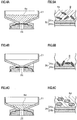
- FIGS. 4A to 4C are cross-sectional views of a collection container in which a level of liquid is indicated when a method for collecting biological material in an embodiment of the present invention is carried out.
- FIGS. 5A to 5C are schematic magnified views showing the vicinity of a filter corresponding to FIGS. 4A to 4C , respectively.
- FIGS. 5A to 5C an actual size of the microbes denoted by reference sign B is in a micrometer order.
- An actual size of ATP is at a molecular level.
- FIGS. 5A to 5C do not show the microbes and ATP in relatively corrected sizes reflecting the actual sizes.
- the collection container 21 is filled with a predetermined amount (e.g., the amount in the present embodiment is 10 mL but is not limited thereto) of the liquid sample 8a.
- a predetermined amount e.g., the amount in the present embodiment is 10 mL but is not limited thereto
- reference sign 26 denotes a filter.
- the liquid sample 8a placed over the filter 26 contains microbes B.
- reference sign 26a denotes a hydrophilic filter and reference sign 26b denotes a hydrophobic filter as described hereinbefore.
- the inside of the collection container 21 becomes visually empty as shown in FIG. 4B .
- the microbes are filtered out on the filter 26 (i.e., 26a and 26b).
- Step S2 the "ATP eliminating step” (not shown) (Step S3, in FIG. 2 ) and the "step of raising a temperature of the collection container” (Step S4 in FIG. 2 ) are carried out.
- the ATP extraction reagent 8c (see FIG. 1 ) is dispensed in the collection container 21 to extract ATP from the microbes B ( FIG. 5B ) (Step S5 in FIG. 2 ).
- an amount of liquid in the collection container 21 increases depending on a dispended amount of the ATP extraction reagent 8c as shown in FIG. 4C .
- the ATP extract 8d containing ATP extracted from the microbes is prepared in the collection container 21.
- the ATP eliminating reagent that is an enzyme-based reagent is inactivated when contacting the surfactant-based ATP extraction reagent 8c (see FIG. 1 ). Because of this, the ATP eliminating reagent used in Step S3 hardly influences the measurement of the ATP luminescence intensity in Step S8 (see FIG. 2 ).
- the ATP extraction step (Step S5 in FIG. 2 ) is carried out at an predetermined raised temperature (i.e., second temperature).
- an predetermined raised temperature i.e., second temperature.
- the device 1 for collecting biological material and the method for collecting biological material of the present embodiment more increase extraction efficiency of ATP from the microbe B than a conventional device and method.
- a quantification method for biological material using the method for collecting biological material of the present embodiment quantifies ATP with higher accuracy and sensitivity than conventional methods.
- the microbes are collected (Step S2 in FIG. 2 ) from the liquid sample 8a (i.e., medium) at the first temperature which is lower than the second temperature and higher than room temperature. This makes it possible to suppress a decrease in bioactivity of the microbes B in the liquid sample 8a.
- a quantification method for biological material using the method for collecting biological material of the present embodiment quantifies ATP with higher accuracy and sensitivity than conventional methods.
- a calorific value generated by the first heating unit 10 is utilized for raising the temperature.
- the ATP extraction reagent 8c heated by the second heating unit 12 may be dispensed in the collection container 21. By doing so, the temperature of the microbes B (see FIG. 5B ) is controlled (or kept) at the second temperature. Then, ATP is extracted from the microbes B at this second temperature.
- the above medication may be carried out.
- a heater etc.
- a Peltier element having an additional cooling function may be used instead of a heater. This makes it possible to shorten a time to reach a target temperature controlled by the control unit.
- the ATP luminescent reagent 8b may be dispensed to be mixed with the ATP extract 8d (see FIG. 4C ) that has been dispensed in the tube 32b, so as to cause a luminescent reaction.
- the ATP extract 8d may be dispensed to be mixed with the ATP luminescent reagent 8b that has been dispensed in the tube 32b so as to cause a luminescent reaction.
- microbes of the above embodiments include, but are not limited to, gram-positive bacteria (e.g., Corynebacteria, Micrococcus, Staphylococcus aureus, Staphylococcus epidermidis, Bacillus cereus, Bacillus subtilis ), gram-negative bacteria (e.g., Citrobacter, Escherichia coli, Pseudomonas aeruginosa, Serratia), and fungi (e.g., Aspergillus oryzae, Penicillium notatum, Wallemia, Candida).
- gram-positive bacteria e.g., Corynebacteria, Micrococcus, Staphylococcus aureus, Staphylococcus epidermidis, Bacillus cereus, Bacillus subtilis
- gram-negative bacteria e.g., Citrobacter, Escherichia coli, Pseudomonas aeruginosa, Serratia
- the above reagent may further include a cell conversion reagent using nutrients such as amino acids and/or saccharides.
- ATP is assumed to be a biological material.
- the present invention is not limited to this, and biological materials such as DNA, RNA, or NAD extracted from the microbes B are applicable.
- a biological material may be quantified based on fluorescence generated when the biological material is irradiated with excitation light.
- Limulus Amebocyte Lysate may be used as a luminescent reagent for biological material.
- the "microbe-containing medium” may be a gel carrier.
- the gel carrier placed in the collection container 21 may be mixed with, for example, a buffer solution to prepare a liquid sample 8a.
- examples of the gel carrier include a material that causes a phase transition from gel to sol by raising the temperature from room temperature. Such a material is preferably liquefied in a range from 30°C to less than 40°C.
- examples of a more preferable material include gelatin, a mixture of gelatin and glycerol, and a 10:1 copolymer of N-acryloyl glycinamide and N-methacryloyl-N'-biotinyl propylene diamine.
Landscapes
- Chemical & Material Sciences (AREA)
- Life Sciences & Earth Sciences (AREA)
- Health & Medical Sciences (AREA)
- Organic Chemistry (AREA)
- Engineering & Computer Science (AREA)
- Zoology (AREA)
- Wood Science & Technology (AREA)
- Bioinformatics & Cheminformatics (AREA)
- Biotechnology (AREA)
- Genetics & Genomics (AREA)
- Proteomics, Peptides & Aminoacids (AREA)
- Biochemistry (AREA)
- Microbiology (AREA)
- General Engineering & Computer Science (AREA)
- General Health & Medical Sciences (AREA)
- Analytical Chemistry (AREA)
- Molecular Biology (AREA)
- Physics & Mathematics (AREA)
- Immunology (AREA)
- Biophysics (AREA)
- Biomedical Technology (AREA)
- Sustainable Development (AREA)
- Medicinal Chemistry (AREA)
- Tropical Medicine & Parasitology (AREA)
- Virology (AREA)
- Mycology (AREA)
- Pathology (AREA)
- Chemical Kinetics & Catalysis (AREA)
- Cell Biology (AREA)
- Toxicology (AREA)
- Thermal Sciences (AREA)
- Measuring Or Testing Involving Enzymes Or Micro-Organisms (AREA)
- Apparatus Associated With Microorganisms And Enzymes (AREA)
- Sampling And Sample Adjustment (AREA)
Claims (4)
- Verfahren zum Gewinnen von ATP aus einer Mikrobe, wobei das Verfahren umfasst:einen Sammelschritt zum Gewinnen der Mikrobe aus einem Medium, das die Mikrobe enthält, bei einer ersten Temperatur, die höher als Raumtemperatur ist, um eine Abnahme der Bioaktivität der Mikrobe zu vermeiden, wobei die Mikrobe in einem Sammelbehälter gesammelt wird;einen Eliminierungsschritt zum Beseitigen von freiem ATP, das außerhalb einer Zelle der gesammelten Mikrobe vorhandenen ist,die auf diese Weise in dem Sammelschritt gewonnen wurde, wobei der Eliminierungsschritt bei der ersten Temperatur durchgeführt wird;einen Temperaturerhöhungsschritt zum Erwärmen der Mikrobe auf eine zweite Temperatur, die höher als die erste Temperatur ist, nach der Durchführung des Eliminierungsschritts;einen Extraktionsschritt zum Extrahieren von ATP aus der Mikrobe in dem Sammelbehälter bei der zweiten Temperatur zur Bildung von ATP-Extrakt;einen Temperaturerniedrigungsschritt zum Senken der Temperatur des Sammelbehälters, der den ATP-Extrakt enthält, auf die erste Temperatur; undeinen ATP-Extraktsammelschritt zum Gewinnen einer vorgegebenen Menge des ATP-Extrakts bei der ersten Temperatur.
- Verfahren zum Gewinnen von ATP nach Anspruch 1, wobei der ATP-Extraktsammelschritt unter Bedingungen durchgeführt wird, bei denen die erste Temperatur für eine vorgegebene Zeitspanne gehalten wird.
- Vorrichtung zum Gewinnen von ATP aus einer Mikrobe, wobei die Vorrichtung aufweist:einen Sammelbehälter, der zum Gewinnen einer Mikrobe aus einem Medium, das die Mikrobe enthält, und zum Extrahieren von ATP aus der Mikrobe ausgebildet ist; undeinen Temperatursteuermechanismus, der zum Steuern der Temperatur des Sammelbehälters ausgebildet ist, wobei:der Temperatursteuermechanismus ausgebildet ist, die Temperatur des Sammelbehälters so zu steuern, dass die Mikrobe bei einer ersten Temperatur gesammelt wird, die höher als Raumtemperatur ist, um eine Abnahme der Bioaktivität der Mikrobe zu verhindern, freies ATP, das außerhalb einer Zelle der Mikrobe vorhanden ist, bei der ersten Temperatur eliminiert wird und anschließend ATP aus der Mikrobe bei einer zweiten Temperatur extrahiert wird, die höher als die erste Temperatur ist.
- Vorrichtung zum Gewinnen von ATP nach Anspruch 3, wobei der Temperatursteuermechanismus ausgebildet ist, die Temperatur des Sammelbehälters so zu steuern, dass eine vorgegebene Menge des ATP-Extrakts, der ATP enthält, bei der ersten Temperatur gesammelt wird.
Applications Claiming Priority (2)
| Application Number | Priority Date | Filing Date | Title |
|---|---|---|---|
| JP2012231768A JP5882177B2 (ja) | 2012-10-19 | 2012-10-19 | 生体物質回収方法及び生体物質回収装置 |
| PCT/JP2013/078333 WO2014061785A1 (ja) | 2012-10-19 | 2013-10-18 | 生体物質回収方法及び生体物質回収装置 |
Publications (3)
| Publication Number | Publication Date |
|---|---|
| EP2910643A1 EP2910643A1 (de) | 2015-08-26 |
| EP2910643A4 EP2910643A4 (de) | 2016-06-08 |
| EP2910643B1 true EP2910643B1 (de) | 2018-02-28 |
Family
ID=50488341
Family Applications (1)
| Application Number | Title | Priority Date | Filing Date |
|---|---|---|---|
| EP13847140.4A Not-in-force EP2910643B1 (de) | 2012-10-19 | 2013-10-18 | Verfahren zur sammlung eines biologischen materials und vorrichtung zur sammlung eines biologischen materials |
Country Status (4)
| Country | Link |
|---|---|
| US (1) | US9988663B2 (de) |
| EP (1) | EP2910643B1 (de) |
| JP (1) | JP5882177B2 (de) |
| WO (1) | WO2014061785A1 (de) |
Families Citing this family (2)
| Publication number | Priority date | Publication date | Assignee | Title |
|---|---|---|---|---|
| JP7157658B2 (ja) * | 2018-12-27 | 2022-10-20 | 株式会社日立ハイテク | 自動分析装置 |
| JP7637477B2 (ja) * | 2020-05-14 | 2025-02-28 | 株式会社日立ハイテク | 細胞検出装置及び細胞検出方法 |
Citations (2)
| Publication number | Priority date | Publication date | Assignee | Title |
|---|---|---|---|---|
| EP0309429A2 (de) * | 1987-09-23 | 1989-03-29 | Life Science International Ab | Nachweis von zellulärem ATP durch Lumineszenz |
| JPH05184350A (ja) * | 1992-01-16 | 1993-07-27 | Mitsubishi Heavy Ind Ltd | 空中浮遊細菌の自動計測システム |
Family Cites Families (20)
| Publication number | Priority date | Publication date | Assignee | Title |
|---|---|---|---|---|
| EP0299078A4 (de) * | 1987-01-22 | 1989-09-11 | Kohjin Co | Hefeextrakt und verfahren zur herstellung. |
| JPH02286096A (ja) * | 1989-04-28 | 1990-11-26 | Meidensha Corp | 菌体濃度推定方法 |
| JP3175018B2 (ja) * | 1990-12-27 | 2001-06-11 | 東亜ディーケーケー株式会社 | 細胞内atpの測定方法 |
| JP3542367B2 (ja) * | 1993-11-15 | 2004-07-14 | キヤノン株式会社 | 微生物の分離精製回収方法、微生物個体数の計測方法および微生物の核酸回収方法 |
| JPH09107994A (ja) * | 1995-10-13 | 1997-04-28 | Toa Denpa Kogyo Kk | 細胞内atpの測定方法 |
| JP3773151B2 (ja) | 1997-12-03 | 2006-05-10 | キッコーマン株式会社 | 細胞内成分の分析法 |
| WO1999046047A2 (en) * | 1998-03-10 | 1999-09-16 | Large Scale Proteomics Corporation | Detection and characterization of microorganisms |
| GB9902659D0 (en) * | 1999-02-05 | 1999-03-31 | Microbiological Res Authority | Assay with reduced background |
| GB2352652A (en) * | 1999-08-06 | 2001-02-07 | Fsm Technologies Ltd | Pre-treating hollow fibre membranes for micro-organism detection |
| JP2001136999A (ja) * | 1999-11-12 | 2001-05-22 | Kikkoman Corp | 微生物atpの測定法において添加使用されるatp消去前処理剤および同処理剤を用いる微生物atpの高感度測定法 |
| WO2004001022A1 (en) | 2002-06-21 | 2003-12-31 | The University Of Newcastle Research Associates (Tunra) Ltd | Probiotic propionibacterium jensenii 702 |
| ATE437217T1 (de) * | 2002-12-17 | 2009-08-15 | Arkray Inc | Mikroorganismus- oder zellsammelverfahren und für das verfahren verwendetes mikroorganismus- oder zellensammelgerät |
| JP2004313028A (ja) * | 2003-04-11 | 2004-11-11 | Hitachi Ltd | 生物発光測定装置及び細胞内atp測定キット |
| JPWO2006109693A1 (ja) | 2005-04-08 | 2008-11-13 | エーザイ・アール・アンド・ディー・マネジメント株式会社 | 粘性試料のサンプリング器具、喀痰の均質化処理方法及び微生物の検出方法 |
| JP2007014239A (ja) * | 2005-07-06 | 2007-01-25 | Matsushita Electric Ind Co Ltd | 微生物検出方法および検出装置 |
| JP4853358B2 (ja) | 2007-03-30 | 2012-01-11 | 株式会社日立プラントテクノロジー | 発光測定装置 |
| US8628953B2 (en) | 2007-11-29 | 2014-01-14 | Hitachi Plant Technologies, Ltd. | Capturing carrier, capturing device, analysis system using the same, and method for capturing and testing microorganisms |
| JP5252176B2 (ja) * | 2007-11-29 | 2013-07-31 | 株式会社日立プラントテクノロジー | 捕集担体、捕集ユニット、捕集装置及び捕集・検査方法 |
| EP2305789A4 (de) * | 2008-06-27 | 2013-12-25 | Hitachi Plant Technologies Ltd | Kassette für mikrobenzellen erfassenden träger, trägerbehandlungsvorrichtung und verfahren zur zählung von mikrobenzellen |
| JP5218153B2 (ja) * | 2009-02-26 | 2013-06-26 | 株式会社日立プラントテクノロジー | 微生物検出装置、検出方法、及びそれに用いられる試料容器 |
-
2012
- 2012-10-19 JP JP2012231768A patent/JP5882177B2/ja not_active Expired - Fee Related
-
2013
- 2013-10-18 WO PCT/JP2013/078333 patent/WO2014061785A1/ja not_active Ceased
- 2013-10-18 US US14/434,214 patent/US9988663B2/en not_active Expired - Fee Related
- 2013-10-18 EP EP13847140.4A patent/EP2910643B1/de not_active Not-in-force
Patent Citations (2)
| Publication number | Priority date | Publication date | Assignee | Title |
|---|---|---|---|---|
| EP0309429A2 (de) * | 1987-09-23 | 1989-03-29 | Life Science International Ab | Nachweis von zellulärem ATP durch Lumineszenz |
| JPH05184350A (ja) * | 1992-01-16 | 1993-07-27 | Mitsubishi Heavy Ind Ltd | 空中浮遊細菌の自動計測システム |
Non-Patent Citations (1)
| Title |
|---|
| OTA TOSHIYUKI; ET AL: "JPH05184350 machine translation", 27 July 1993 (1993-07-27), XP055351564, Retrieved from the Internet <URL:www.epo.org> [retrieved on 20170303] * |
Also Published As
| Publication number | Publication date |
|---|---|
| WO2014061785A1 (ja) | 2014-04-24 |
| EP2910643A1 (de) | 2015-08-26 |
| US9988663B2 (en) | 2018-06-05 |
| US20150232908A1 (en) | 2015-08-20 |
| EP2910643A4 (de) | 2016-06-08 |
| JP2014082946A (ja) | 2014-05-12 |
| JP5882177B2 (ja) | 2016-03-09 |
Similar Documents
| Publication | Publication Date | Title |
|---|---|---|
| CN103364478A (zh) | 基板处理装置 | |
| JP6447765B1 (ja) | 検査デバイス及びデバイス | |
| EP3859343B1 (de) | Automatisierte analysevorrichtung | |
| KR101789356B1 (ko) | 전기화학발광 검출에 있어서의 신호 증강 화합물의 용도 | |
| WO2019093528A1 (en) | Device with specific number of cell(s) and nucleic acids in the wells and testing/calibration method using the device | |
| US9988663B2 (en) | Method for collecting biological material and device for collecting biological material | |
| US20180057853A1 (en) | Antimicrobial susceptibility testing device, antimicrobial susceptibility testing kit, and antimicrobial susceptibility testing method | |
| US11040349B2 (en) | Testing device for quantitative PCR | |
| US11566273B2 (en) | Method for producing cell contained base and method for evaluating equipment | |
| JP6897655B2 (ja) | デバイス及び検査方法 | |
| JP6660888B2 (ja) | 薬剤感受性試験システム | |
| JP6446151B1 (ja) | 検査デバイス及びデバイス | |
| US20210010072A1 (en) | Device, preparator's skill evaluating method, non-transitory recording medium storing computer program for evaluating skill of preparator, and preparator's skill evaluating device, and testing device performance evaluating method, non-transitory recording medium storing computer program for evaluating performance of testing device, and testing device performance evaluating device | |
| EP2910931B1 (de) | Verfahren zur quantitativen bestimmung einer biosubstanz und instrument zur quantitativen bestimmung einer biosubstanz | |
| JP6223844B2 (ja) | 微生物計測システムおよびその制御方法 | |
| JP2019216704A (ja) | デバイス | |
| ES2857811T3 (es) | Método de identificación de la exactitud en la detección, dispositivo de identificación de la exactitud en la detección y programa de identificación de la exactitud en la detección | |
| US11795446B2 (en) | Carrier and testing method | |
| EP2910628B1 (de) | Mikrobenquantifizierungsvorrichtung sowie mikrobenquantifizierungsverfahren | |
| JP7124438B2 (ja) | 細胞保持基材の生成方法、及び装置評価方法 | |
| US20210403997A1 (en) | Device, nucleic acid testing method and nucleic acid testing device, and gene testing method | |
| JP2019092422A (ja) | 検査デバイスの製造方法 | |
| Sampath | Label-free amino acid identification based on tRNA charging in a cavity and AMP blockade in a nanopore |
Legal Events
| Date | Code | Title | Description |
|---|---|---|---|
| PUAI | Public reference made under article 153(3) epc to a published international application that has entered the european phase |
Free format text: ORIGINAL CODE: 0009012 |
|
| 17P | Request for examination filed |
Effective date: 20150519 |
|
| AK | Designated contracting states |
Kind code of ref document: A1 Designated state(s): AL AT BE BG CH CY CZ DE DK EE ES FI FR GB GR HR HU IE IS IT LI LT LU LV MC MK MT NL NO PL PT RO RS SE SI SK SM TR |
|
| AX | Request for extension of the european patent |
Extension state: BA ME |
|
| DAX | Request for extension of the european patent (deleted) | ||
| RA4 | Supplementary search report drawn up and despatched (corrected) |
Effective date: 20160509 |
|
| RIC1 | Information provided on ipc code assigned before grant |
Ipc: C12Q 1/68 20060101ALI20160502BHEP Ipc: C12N 1/00 20060101ALI20160502BHEP Ipc: C12N 1/06 20060101ALI20160502BHEP Ipc: C12Q 1/66 20060101ALI20160502BHEP Ipc: C12M 1/34 20060101ALI20160502BHEP Ipc: G01N 1/28 20060101ALI20160502BHEP Ipc: C12Q 1/06 20060101AFI20160502BHEP |
|
| RAP1 | Party data changed (applicant data changed or rights of an application transferred) |
Owner name: HITACHI PLANT SERVICES CO., LTD. |
|
| STAA | Information on the status of an ep patent application or granted ep patent |
Free format text: STATUS: EXAMINATION IS IN PROGRESS |
|
| 17Q | First examination report despatched |
Effective date: 20170309 |
|
| GRAP | Despatch of communication of intention to grant a patent |
Free format text: ORIGINAL CODE: EPIDOSNIGR1 |
|
| STAA | Information on the status of an ep patent application or granted ep patent |
Free format text: STATUS: GRANT OF PATENT IS INTENDED |
|
| INTG | Intention to grant announced |
Effective date: 20171023 |
|
| GRAS | Grant fee paid |
Free format text: ORIGINAL CODE: EPIDOSNIGR3 |
|
| GRAA | (expected) grant |
Free format text: ORIGINAL CODE: 0009210 |
|
| STAA | Information on the status of an ep patent application or granted ep patent |
Free format text: STATUS: THE PATENT HAS BEEN GRANTED |
|
| AK | Designated contracting states |
Kind code of ref document: B1 Designated state(s): AL AT BE BG CH CY CZ DE DK EE ES FI FR GB GR HR HU IE IS IT LI LT LU LV MC MK MT NL NO PL PT RO RS SE SI SK SM TR |
|
| REG | Reference to a national code |
Ref country code: GB Ref legal event code: FG4D Ref country code: CH Ref legal event code: EP |
|
| REG | Reference to a national code |
Ref country code: AT Ref legal event code: REF Ref document number: 974178 Country of ref document: AT Kind code of ref document: T Effective date: 20180315 |
|
| REG | Reference to a national code |
Ref country code: IE Ref legal event code: FG4D |
|
| REG | Reference to a national code |
Ref country code: DE Ref legal event code: R096 Ref document number: 602013033842 Country of ref document: DE |
|
| REG | Reference to a national code |
Ref country code: NL Ref legal event code: MP Effective date: 20180228 |
|
| REG | Reference to a national code |
Ref country code: LT Ref legal event code: MG4D |
|
| REG | Reference to a national code |
Ref country code: AT Ref legal event code: MK05 Ref document number: 974178 Country of ref document: AT Kind code of ref document: T Effective date: 20180228 |
|
| PG25 | Lapsed in a contracting state [announced via postgrant information from national office to epo] |
Ref country code: NL Free format text: LAPSE BECAUSE OF FAILURE TO SUBMIT A TRANSLATION OF THE DESCRIPTION OR TO PAY THE FEE WITHIN THE PRESCRIBED TIME-LIMIT Effective date: 20180228 Ref country code: CY Free format text: LAPSE BECAUSE OF FAILURE TO SUBMIT A TRANSLATION OF THE DESCRIPTION OR TO PAY THE FEE WITHIN THE PRESCRIBED TIME-LIMIT Effective date: 20180228 Ref country code: LT Free format text: LAPSE BECAUSE OF FAILURE TO SUBMIT A TRANSLATION OF THE DESCRIPTION OR TO PAY THE FEE WITHIN THE PRESCRIBED TIME-LIMIT Effective date: 20180228 Ref country code: HR Free format text: LAPSE BECAUSE OF FAILURE TO SUBMIT A TRANSLATION OF THE DESCRIPTION OR TO PAY THE FEE WITHIN THE PRESCRIBED TIME-LIMIT Effective date: 20180228 Ref country code: ES Free format text: LAPSE BECAUSE OF FAILURE TO SUBMIT A TRANSLATION OF THE DESCRIPTION OR TO PAY THE FEE WITHIN THE PRESCRIBED TIME-LIMIT Effective date: 20180228 Ref country code: NO Free format text: LAPSE BECAUSE OF FAILURE TO SUBMIT A TRANSLATION OF THE DESCRIPTION OR TO PAY THE FEE WITHIN THE PRESCRIBED TIME-LIMIT Effective date: 20180528 Ref country code: FI Free format text: LAPSE BECAUSE OF FAILURE TO SUBMIT A TRANSLATION OF THE DESCRIPTION OR TO PAY THE FEE WITHIN THE PRESCRIBED TIME-LIMIT Effective date: 20180228 |
|
| PG25 | Lapsed in a contracting state [announced via postgrant information from national office to epo] |
Ref country code: LV Free format text: LAPSE BECAUSE OF FAILURE TO SUBMIT A TRANSLATION OF THE DESCRIPTION OR TO PAY THE FEE WITHIN THE PRESCRIBED TIME-LIMIT Effective date: 20180228 Ref country code: SE Free format text: LAPSE BECAUSE OF FAILURE TO SUBMIT A TRANSLATION OF THE DESCRIPTION OR TO PAY THE FEE WITHIN THE PRESCRIBED TIME-LIMIT Effective date: 20180228 Ref country code: GR Free format text: LAPSE BECAUSE OF FAILURE TO SUBMIT A TRANSLATION OF THE DESCRIPTION OR TO PAY THE FEE WITHIN THE PRESCRIBED TIME-LIMIT Effective date: 20180529 Ref country code: AT Free format text: LAPSE BECAUSE OF FAILURE TO SUBMIT A TRANSLATION OF THE DESCRIPTION OR TO PAY THE FEE WITHIN THE PRESCRIBED TIME-LIMIT Effective date: 20180228 Ref country code: BG Free format text: LAPSE BECAUSE OF FAILURE TO SUBMIT A TRANSLATION OF THE DESCRIPTION OR TO PAY THE FEE WITHIN THE PRESCRIBED TIME-LIMIT Effective date: 20180528 Ref country code: RS Free format text: LAPSE BECAUSE OF FAILURE TO SUBMIT A TRANSLATION OF THE DESCRIPTION OR TO PAY THE FEE WITHIN THE PRESCRIBED TIME-LIMIT Effective date: 20180228 |
|
| REG | Reference to a national code |
Ref country code: FR Ref legal event code: PLFP Year of fee payment: 6 |
|
| PG25 | Lapsed in a contracting state [announced via postgrant information from national office to epo] |
Ref country code: IT Free format text: LAPSE BECAUSE OF FAILURE TO SUBMIT A TRANSLATION OF THE DESCRIPTION OR TO PAY THE FEE WITHIN THE PRESCRIBED TIME-LIMIT Effective date: 20180228 Ref country code: AL Free format text: LAPSE BECAUSE OF FAILURE TO SUBMIT A TRANSLATION OF THE DESCRIPTION OR TO PAY THE FEE WITHIN THE PRESCRIBED TIME-LIMIT Effective date: 20180228 Ref country code: EE Free format text: LAPSE BECAUSE OF FAILURE TO SUBMIT A TRANSLATION OF THE DESCRIPTION OR TO PAY THE FEE WITHIN THE PRESCRIBED TIME-LIMIT Effective date: 20180228 Ref country code: PL Free format text: LAPSE BECAUSE OF FAILURE TO SUBMIT A TRANSLATION OF THE DESCRIPTION OR TO PAY THE FEE WITHIN THE PRESCRIBED TIME-LIMIT Effective date: 20180228 Ref country code: RO Free format text: LAPSE BECAUSE OF FAILURE TO SUBMIT A TRANSLATION OF THE DESCRIPTION OR TO PAY THE FEE WITHIN THE PRESCRIBED TIME-LIMIT Effective date: 20180228 |
|
| REG | Reference to a national code |
Ref country code: DE Ref legal event code: R097 Ref document number: 602013033842 Country of ref document: DE |
|
| PG25 | Lapsed in a contracting state [announced via postgrant information from national office to epo] |
Ref country code: SM Free format text: LAPSE BECAUSE OF FAILURE TO SUBMIT A TRANSLATION OF THE DESCRIPTION OR TO PAY THE FEE WITHIN THE PRESCRIBED TIME-LIMIT Effective date: 20180228 Ref country code: DK Free format text: LAPSE BECAUSE OF FAILURE TO SUBMIT A TRANSLATION OF THE DESCRIPTION OR TO PAY THE FEE WITHIN THE PRESCRIBED TIME-LIMIT Effective date: 20180228 Ref country code: CZ Free format text: LAPSE BECAUSE OF FAILURE TO SUBMIT A TRANSLATION OF THE DESCRIPTION OR TO PAY THE FEE WITHIN THE PRESCRIBED TIME-LIMIT Effective date: 20180228 Ref country code: SK Free format text: LAPSE BECAUSE OF FAILURE TO SUBMIT A TRANSLATION OF THE DESCRIPTION OR TO PAY THE FEE WITHIN THE PRESCRIBED TIME-LIMIT Effective date: 20180228 |
|
| PLBE | No opposition filed within time limit |
Free format text: ORIGINAL CODE: 0009261 |
|
| STAA | Information on the status of an ep patent application or granted ep patent |
Free format text: STATUS: NO OPPOSITION FILED WITHIN TIME LIMIT |
|
| PGFP | Annual fee paid to national office [announced via postgrant information from national office to epo] |
Ref country code: DE Payment date: 20181031 Year of fee payment: 6 |
|
| 26N | No opposition filed |
Effective date: 20181129 |
|
| PG25 | Lapsed in a contracting state [announced via postgrant information from national office to epo] |
Ref country code: SI Free format text: LAPSE BECAUSE OF FAILURE TO SUBMIT A TRANSLATION OF THE DESCRIPTION OR TO PAY THE FEE WITHIN THE PRESCRIBED TIME-LIMIT Effective date: 20180228 |
|
| PGFP | Annual fee paid to national office [announced via postgrant information from national office to epo] |
Ref country code: CH Payment date: 20181025 Year of fee payment: 6 Ref country code: FR Payment date: 20181030 Year of fee payment: 6 Ref country code: GB Payment date: 20181031 Year of fee payment: 6 |
|
| REG | Reference to a national code |
Ref country code: BE Ref legal event code: MM Effective date: 20181031 |
|
| PG25 | Lapsed in a contracting state [announced via postgrant information from national office to epo] |
Ref country code: LU Free format text: LAPSE BECAUSE OF NON-PAYMENT OF DUE FEES Effective date: 20181018 Ref country code: MC Free format text: LAPSE BECAUSE OF FAILURE TO SUBMIT A TRANSLATION OF THE DESCRIPTION OR TO PAY THE FEE WITHIN THE PRESCRIBED TIME-LIMIT Effective date: 20180228 |
|
| REG | Reference to a national code |
Ref country code: IE Ref legal event code: MM4A |
|
| PG25 | Lapsed in a contracting state [announced via postgrant information from national office to epo] |
Ref country code: BE Free format text: LAPSE BECAUSE OF NON-PAYMENT OF DUE FEES Effective date: 20181031 |
|
| PG25 | Lapsed in a contracting state [announced via postgrant information from national office to epo] |
Ref country code: IE Free format text: LAPSE BECAUSE OF NON-PAYMENT OF DUE FEES Effective date: 20181018 |
|
| PG25 | Lapsed in a contracting state [announced via postgrant information from national office to epo] |
Ref country code: MT Free format text: LAPSE BECAUSE OF NON-PAYMENT OF DUE FEES Effective date: 20181018 |
|
| PG25 | Lapsed in a contracting state [announced via postgrant information from national office to epo] |
Ref country code: TR Free format text: LAPSE BECAUSE OF FAILURE TO SUBMIT A TRANSLATION OF THE DESCRIPTION OR TO PAY THE FEE WITHIN THE PRESCRIBED TIME-LIMIT Effective date: 20180228 |
|
| REG | Reference to a national code |
Ref country code: DE Ref legal event code: R119 Ref document number: 602013033842 Country of ref document: DE |
|
| PG25 | Lapsed in a contracting state [announced via postgrant information from national office to epo] |
Ref country code: PT Free format text: LAPSE BECAUSE OF FAILURE TO SUBMIT A TRANSLATION OF THE DESCRIPTION OR TO PAY THE FEE WITHIN THE PRESCRIBED TIME-LIMIT Effective date: 20180228 |
|
| REG | Reference to a national code |
Ref country code: CH Ref legal event code: PL |
|
| PG25 | Lapsed in a contracting state [announced via postgrant information from national office to epo] |
Ref country code: MK Free format text: LAPSE BECAUSE OF NON-PAYMENT OF DUE FEES Effective date: 20180228 Ref country code: HU Free format text: LAPSE BECAUSE OF FAILURE TO SUBMIT A TRANSLATION OF THE DESCRIPTION OR TO PAY THE FEE WITHIN THE PRESCRIBED TIME-LIMIT; INVALID AB INITIO Effective date: 20131018 |
|
| PG25 | Lapsed in a contracting state [announced via postgrant information from national office to epo] |
Ref country code: LI Free format text: LAPSE BECAUSE OF NON-PAYMENT OF DUE FEES Effective date: 20191031 Ref country code: DE Free format text: LAPSE BECAUSE OF NON-PAYMENT OF DUE FEES Effective date: 20200501 Ref country code: CH Free format text: LAPSE BECAUSE OF NON-PAYMENT OF DUE FEES Effective date: 20191031 Ref country code: IS Free format text: LAPSE BECAUSE OF FAILURE TO SUBMIT A TRANSLATION OF THE DESCRIPTION OR TO PAY THE FEE WITHIN THE PRESCRIBED TIME-LIMIT Effective date: 20180628 |
|
| GBPC | Gb: european patent ceased through non-payment of renewal fee |
Effective date: 20191018 |
|
| PG25 | Lapsed in a contracting state [announced via postgrant information from national office to epo] |
Ref country code: GB Free format text: LAPSE BECAUSE OF NON-PAYMENT OF DUE FEES Effective date: 20191018 Ref country code: FR Free format text: LAPSE BECAUSE OF NON-PAYMENT OF DUE FEES Effective date: 20191031 |