EP2934773B1 - Verfahren und system zum entfernen von tinte aus filmen - Google Patents
Verfahren und system zum entfernen von tinte aus filmen Download PDFInfo
- Publication number
- EP2934773B1 EP2934773B1 EP13865695.4A EP13865695A EP2934773B1 EP 2934773 B1 EP2934773 B1 EP 2934773B1 EP 13865695 A EP13865695 A EP 13865695A EP 2934773 B1 EP2934773 B1 EP 2934773B1
- Authority
- EP
- European Patent Office
- Prior art keywords
- film
- cleaning composition
- cloth
- nonabrasive
- ink
- Prior art date
- Legal status (The legal status is an assumption and is not a legal conclusion. Google has not performed a legal analysis and makes no representation as to the accuracy of the status listed.)
- Active
Links
Images


Classifications
-
- B—PERFORMING OPERATIONS; TRANSPORTING
- B08—CLEANING
- B08B—CLEANING IN GENERAL; PREVENTION OF FOULING IN GENERAL
- B08B1/00—Cleaning by methods involving the use of tools
- B08B1/20—Cleaning of moving articles, e.g. of moving webs or of objects on a conveyor
-
- B—PERFORMING OPERATIONS; TRANSPORTING
- B08—CLEANING
- B08B—CLEANING IN GENERAL; PREVENTION OF FOULING IN GENERAL
- B08B1/00—Cleaning by methods involving the use of tools
- B08B1/10—Cleaning by methods involving the use of tools characterised by the type of cleaning tool
- B08B1/14—Wipes; Absorbent members, e.g. swabs or sponges
- B08B1/143—Wipes
-
- B—PERFORMING OPERATIONS; TRANSPORTING
- B41—PRINTING; LINING MACHINES; TYPEWRITERS; STAMPS
- B41M—PRINTING, DUPLICATING, MARKING, OR COPYING PROCESSES; COLOUR PRINTING
- B41M7/00—After-treatment of prints, e.g. heating, irradiating, setting of the ink, protection of the printed stock
- B41M7/0009—Obliterating the printed matter; Non-destructive removal of the ink pattern, e.g. for repetitive use of the support
Definitions
- Embodiments of the disclosure relate to chemical processing, such as the processing of flexible films (e.g., polyethylene, polypropylene, polyvinyl chloride, aluminum, and other films) used for packaging or labeling.
- flexible films e.g., polyethylene, polypropylene, polyvinyl chloride, aluminum, and other films
- Polymeric, metallic, and metalized polymeric films have various properties that make them useful as packaging or labeling materials.
- such films may be lightweight, strong, impervious to liquids and gases, transparent, printable, flexible, foldable, fusible, and/or heat-shrinkable. Films are commonly formed into sheets and rolled for processing, transport, and storage.
- Films may be printed with various inks to provide information, decoration, etc.
- rolls of polymeric films may be printed by unrolling the film, subjecting the unrolled film to a corona treatment (surface modification by exposure to a low-temperature plasma), applying an ink to the treated film, and rolling the film to another roller.
- Printing typically occurs in high-speed printing machinery, which may be capable of processing 100 linear feet (30.4 meters) per minute of plastic film or more.
- Errors in printing can be costly because large quantities of film may be processed before an error is identified and printing is interrupted.
- Higher-speed printing equipment is desirable in the industry because it allows for higher outputs; but higher-speed printing may correspond to larger quantities of misprinted films when errors are made.
- Misprinted films are typically sold as scrap for a small fraction of the price of virgin film. Such films may be melted and recycled, but this process may be costly and environmentally problematic.
- printing errors can be costly and disruptive, particularly when they occur with high-speed printing equipment.
- Various attempts have been made to develop methods of effectively removing ink from films.
- EP 1 414 829 A1 published May 19, 2004 , and titled "Procédé de recyclage de support d'impression imprime de type film
- et installation pour la mise en oeuvre dudit dazzling” describes a deinking process in which a plastic film is simultaneously or sequentially immersed in a detergent composition and scrubbed with brushes.
- European patent application EP2511096 describes using a cleaning agent (5) to mechanically clean print ink from film. Cleaning rollers (9) contact the surface of the film and erode the ink from the surface. The cleaning rollers are brush rollers or steel wool.
- the method includes removing the film from a first roll and feeding the film a processing system, exposing the film to a cleaning composition, and scraping the cleaning composition from the film.
- the method includes passing the film and the cleaning composition adjacent a first nonabrasive cloth to spread the cleaning composition over a width of the film, and passing the film and the cleaning composition adjacent at least one additional nonabrasive cloth to scrub the ink from the film before scraping the cleaning composition from the film.
- the method may be operated continuously to clean an entire roll of flexible film.
- a system for removing ink from a flexible film includes a means for removing the film from a first roll and feeding the film into the system, at least one nozzle configured to expose a first side of the film to a cleaning composition, and a blade configured to scrape the cleaning composition from the first side of the film.
- a system includes a first nonabrasive cloth configured to spread the cleaning composition over a width of the first side of the film, and at least one additional nonabrasive cloth configured to scrub the ink from the first side of the film before scraping the cleaning composition from the film.
- Such a system further typically includes means for continuously rolling the film back into a roll after ink removal, but may alternatively include a means for reprinting the film after ink removal.
- Processes and machines for removing ink from flexible films include unrolling the film from a first roll, exposing the film to a cleaning composition, scraping the cleaning composition from the film, and rolling the film onto a second roll.
- the process includes passing the film and the cleaning composition adjacent a first nonabrasive cloth and passing the film and the cleaning composition adjacent at least one additional nonabrasive cloth before scraping the cleaning composition from the film.
- the nonabrasive cloths spread the cleaning composition and/or scrub the ink and cleaning composition from the film.
- film means and includes a polymeric, metallic, or metalized polymeric material having a thickness of less than about 1 mm and a width of at least about 10 cm.
- Polymeric films that may be used in the processes disclosed herein include, for example, polyester (e.g., bi-axially oriented polyethylene terephthalate (BOPET)), polyethylene (e.g., high density polyethylene (HDPE), low density polyethylene (LDPE), or ethylene vinyl alcohol polyethylene resin (EVOH PE)), polypropylene (e.g., oriented polypropylene (OPP), bi-axially oriented polypropylene (BOPP) or cast polypropylene (CPP)), polyvinyl chloride (PVC), etc.
- BOPET bi-axially oriented polyethylene terephthalate
- polyethylene e.g., high density polyethylene (HDPE), low density polyethylene (LDPE), or ethylene vinyl alcohol polyethylene resin (EVOH PE)
- polypropylene e.g., oriented polypropy
- Metallic films that may be used in the processes disclosed herein include, for example, aluminum, copper, or tin.
- Metalized polymer films that may be used in the processes disclosed herein include, for example, polymer films coated with a thin layer of metal (e.g., aluminum).
- the term "flexible” means and includes capable of being bent or flexed repeatedly without structural damage.
- a continuous flexible material may be routed along rollers in a continuous process, and the rollers may bend the flexible material, such that different portions of the flexible material are each travelling in different directions simultaneously.
- ink means and includes an opaque or translucent material formulated to bond to a film.
- Inks include, for example, solvent-based inks, water-based inks, electron-beam-curing inks, ultraviolet-curing inks, and two-part inks.
- FIG. 1 A simplified (side view) schematic of a system 100 for removing ink from a flexible film 102 is shown in FIG. 1 , and the system 100 also illustrates a method of removing ink.
- the film 102 is unrolled from a first roll 104.
- the film 102 passes over, under, or between rollers 106, which are configured to allow the film 102 to continuously pass through the system 100 during the ink-removal process.
- the rollers 106 are also configured to direct the film 102 through the system 100 and to maintain tension on the film 102 while the film 102 is processed.
- the rollers 106 direct the film 102 upward, and a pair of rollers 106 bend the film such that the film is traveling downward during the ink removal.
- a cleaning composition 108 is applied to the film 102 through a first set of nozzles 110, typically after the film 102 has passed over, under, or between two or more rollers 106 to bring the film 102 to a location near the nozzles 110.
- the first set of nozzles 110 may include one or more rows of nozzles evenly spaced across a width of the film 102, but may alternatively be a single channel opening adjacent to the film 102.
- the nozzles 110 may be formed of a material selected to avoid corrosion upon exposure to the cleaning composition 108, or may be coated with a material selected to avoid corrosion.
- the nozzles 110 may be coated with polyurethane or may be formed of a ceramic.
- the nozzles 110 may include an array of nozzles, each typically having a diameter of less than about 1 mm, less than about 500 ⁇ m, or even less than about 200 ⁇ m.
- the cleaning composition 108 is spread across the width of the film 102 by a first nonabrasive cloth 112 or other soft material.
- the first nonabrasive cloth 112 may be disposed adjacent the nozzles 110, such that the cleaning composition 108 is spread across the film 102 almost immediately after application of the cleaning composition 108 to the film 102.
- the first nonabrasive cloth 112 may be disposed within ten (10) cm of the nozzle(s) 110, within five (5) cm of the nozzle(s) 110, or even within one (1) cm of the nozzle(s) 110.
- the first nonabrasive cloth 112 may be secured to a support or brace 113 such that a V-shaped space or air gap is formed between an upper portion of the first nonabrasive cloth 112 and the film 102, but a lower portion of the first nonabrasive cloth 112 rests against the film 102 with a thin layer of cleaning composition 108 therebetween.
- the cleaning composition 108 may be spread approximately uniformly across a width of the film 102.
- the width across which the cleaning composition 108 is spread may be the entire width of the film 102, or may be only a portion of the width of the film 102.
- portions at each edge of the film 102 over which the cleaning composition 108 is not spread such as portions of the film 102 that do not have ink or portions of the film 102 on which the ink is to be retained.
- a portion of the film 102 may remain uncoated with the cleaning composition 108 to limit or prevent contact of the cleaning composition 108 with the rollers 106.
- the cleaning composition 108 may be a commercial or industrial cleaning composition having one or more of a surfactant, a terpene, water, a solvent, and an emulsifier.
- a surfactant means and includes a compound having both a hydrophobic group and a hydrophilic group.
- the surfactant may be an anionic, nonionic, cationic, amphoteric, or zwitterionic surfactant, or a combination thereof.
- Examples of surfactants include, but are not limited to, soaps, sulfonates, sulfates, carboxylates, phosphonates, phosphates, laurates, quaternary ammonium detergents, etc.
- cleaning compositions including D-limonene may be used, such as those described in Great Britain Patent Specification 1 603 047, published November 18, 1981 , and titled "Cleansers Containing D-Limonene.”
- the cleaning composition 108 may be selected to be free of abrasive material, which may limit or prevent scratching or tearing of the film 102 during the ink-removal process.
- the first nonabrasive cloth 112 is typically a woven or nonwoven microfiber cloth.
- the first nonabrasive cloth 112 may be selected to limit or prevent scratching or tearing of the film 102 during the ink-removal process.
- the first nonabrasive cloth 112 may be a cloth as described in European Patent Specification EP-B1-1314808 , granted January 4, 2006, and titled "Superfine microfiber nonwoven web.”
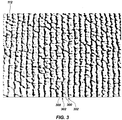
- FIG. 3 shows a detail of the first nonabrasive cloth 112.
- the first nonabrasive cloth 112 may have loops or threads of material arranged in rows 300 with spaces or voids 302 between the rows 300. According to the invention the first nonabrasive cloth 112 is oriented in the system 100 ( FIG.
- the rows 300 and the spaces or voids 302 form parallel channels oriented parallel to the direction of travel of the film 102.
- a portion of the cleaning composition 108 may travel adjacent the first nonabrasive cloth 112 through the spaces or voids 302.
- the rows 300 of material and the spaces or voids 302 of the first nonabrasive cloth 112 tend to spread the cleaning composition 108 into a relatively uniform coating on the film 102. If the cleaning composition 108 is applied to the film 102 across the entire width of the first nonabrasive cloth 112, the cleaning composition 108 tends to cover the entire portion of the film 102 passing over the first nonabrasive cloth 112.
- the cleaning composition 108 may be applied to the film 102 at a location at which the film 102 is traveling downward. In such an arrangement, the cleaning composition 108 flows down the film 102, driven both by the downward motion of the film 102 and by the force of gravity.
- the speed of the film 102, the distance between the first nonabrasive cloth 112 and subsequent processing features, and the viscosity of the cleaning composition 108 may be selected such that the film 102 is exposed to the cleaning composition 108 for a selected period of time.
- the film 102 may be exposed to the cleaning composition 108 for a time period from about 0.1 s (second) to about sixty (60) s, such as from about one (1) s to about ten (10) s.
- the ability of the cleaning composition 108 to remove ink may depend on the time of exposure of the film 102 to the cleaning composition 108.
- additional cleaning composition 108 may be applied to the film 102 through an additional set of nozzles 114 while the film 102 travels downward.
- the film 102 then passes adjacent to an additional nonabrasive cloth 116.
- the additional nonabrasive cloth 116 may be similar to the first nonabrasive cloth 112, described above, but may be disposed substantially parallel to the direction of travel of the film 102.
- the additional nonabrasive cloth 116 may be wrapped partially around a block, and the film 102 may pass along a surface of the block.
- the additional nonabrasive cloth 116 scrubs ink from the film 102 as the film 102 passes the additional nonabrasive cloth 116.
- cleaning composition 108 may be applied to the film 102 through another set of nozzles 114 (e.g., a third set of nozzles), which may be followed by another nonabrasive cloth 116.
- the sequence of cleaning composition 108 followed by a nonabrasive cloth 116 may be repeated as many times as necessary to sufficiently remove ink from the film 102.
- the film 102 may continue to travel in a generally downward direction during the application of the cleaning composition 108.
- the system may include four sets of nozzles 110, 114, and four nonabrasive cloths 112, 116.
- the first nonabrasive cloth 112 may be configured primarily to spread the cleaning composition 108, and the additional nonabrasive cloths 116 may be configured primarily to remove (e.g., scrub, rub, scrape, etc. ) ink from the film 102.
- a roller 106 bends the film 102 to a horizontal direction, and a stationary blade 118 scrapes the cleaning composition 108 and dislodged ink material from the film 102 into a collection vessel 120. With the film 102 in a horizontal orientation, the cleaning composition 108 and dislodged ink material may fall down the blade 118 and flow down an incline to the collection vessel 120.
- a pump 122 recycles the cleaning composition 108 back through the nozzles 110, 114.
- the collection vessel 120 or the pump 122 may include a means for separating ink material from the cleaning composition 108. For example, the collection vessel 120 may be large enough that ink material can settle from the cleaning composition 108 based on density.
- the pump 122 may include a filter to remove ink material from the cleaning composition 108.
- the film 102 may be scrubbed again with another cleaning composition 124.
- One or more rollers 106 may bend the film 102 to a vertical direction traveling downward.
- the cleaning composition 124 is applied to the film 102 through a set of nozzles 126, followed by another nonabrasive cloth 128.
- the sequence of cleaning composition 124 followed by a nonabrasive cloth 128 may be repeated as many times as necessary to sufficiently remove ink from the film 102, and may be performed while the film travels substantially downward.
- the system may include one set of nozzles 126, and one nonabrasive cloth 128.
- a roller 106 bends the film 102 back to a horizontal direction, and another stationary blade 130 scrapes the cleaning composition 124 and dislodged ink material from the film 102 into a collection vessel 132. With the film 102 in a horizontal orientation, the cleaning composition 124 and dislodged ink material may fall down the blade 130 and flow down an incline to the collection vessel 132.
- a pump 134 recycles the cleaning composition 124 back through the nozzles 126.
- the collection vessel 132 or the pump 134 may include means for separating ink material from the cleaning composition 124. For example, the collection vessel 132 may be large enough that ink material can settle from the cleaning composition 124 based on density.
- the pump 134 may include a filter to remove ink material from the cleaning composition 124.
- the cleaning composition 124 may be similar to the cleaning composition 108, as described above. However, the cleaning composition 124 may be kept separate from the cleaning composition 108, such that as the film 102 passes through the system 100, the film 102 is contacted with progressively cleaner liquid. Because the film 102 has already been scrubbed to remove some of the ink before cleaning composition 124 is applied, the cleaning composition 124 may be kept cleaner than the cleaning composition 108 used for initial cleaning. After the system 100 has operated for a period of time, the cleaning composition 124 may used to replace all or a portion of the cleaning composition 108, and new cleaning composition (e.g., virgin cleaning composition or a cleaning composition that has been purified) may be used to replace the cleaning composition 124.
- new cleaning composition e.g., virgin cleaning composition or a cleaning composition that has been purified
- the film 102 may be rinsed with a solvent 136, such as an alcohol, an ether, a chlorinated solvent, water, or any combination thereof.
- a solvent 136 such as an alcohol, an ether, a chlorinated solvent, water, or any combination thereof.
- the solvent 136 is typically a liquid and may include isopropyl alcohol, methanol, ethanol, water, and/or deionized water.
- One or more rollers 106 may bend the film 102 again to a vertical direction traveling downward.
- the solvent 136 is applied to the film 102 through a set of nozzles 138, followed by another nonabrasive cloth 140.
- the sequence of solvent 136 followed by a nonabrasive cloth 140 may be repeated as many times as necessary to sufficiently remove ink and cleaning composition from the film 102, and may be performed while the film travels substantially downward.
- the system may include one set of nozzles 138, and one nonabrasive cloth 140.
- a roller 106 bends the film 102 back to a horizontal direction, and another stationary blade 142 scrapes the film 102 to remove the solvent 136, cleaning composition, and ink, which are collected in a collection vessel 144. With the film 102 in a horizontal orientation, the solvent 136, cleaning composition, and dislodged ink material may fall down the blade 142 and flow down an incline to the collection vessel 144.
- a solvent pump 146 recycles the solvent 136 back through the nozzles 138.
- the collection vessel 144 or the solvent pump 146 may include a means for separating ink material and cleaning composition from the solvent 136. For example, the collection vessel 144 may be large enough that ink material and cleaning composition can settle from the solvent 136 based on density.
- the solvent pump 146 may include a filter to remove ink material or cleaning composition from the solvent 136.
- the solvent 136 may be selected to have a low boiling point, such that any solvent 136 remaining on the film 102 after the film 102 passes the blade 142 evaporates quickly at ambient temperatures.
- the film 102 may be dry or nearly dry ( i.e., free of solvent) after passing over the blade 142.
- the film 102 may travel downward during exposure to the cleaning compositions 108, 124, and solvent 136 and before contacting the nonabrasive cloths 112, 114, 128, 140.
- the total downward travel of the film 102 may be between 2 m and 20 m, such as between about 3 m and 10 m.
- the film 102 may travel downward a total of about 5 m in the system 100 from the point the first cleaning composition 108 is applied to the blade 142 configured to remove the solvent 136 from the film 102.
- the film 102 may be continuously transferred to a second (motorized) roll 148 for reuse in a printing process.
- the second roll 148 may be transported to a storage location to a printing system, to a cutting system, etc.
- the second roll 148 may provide a driving force to pull the film 102 along its path through the system 100.
- the blades 118, 130, 142 exert a force uniformly across the width of the film 102, such that the ink, cleaning compositions 108, 124, and solvent 136 are removed from the film 102.
- the blades 118, 130, 142 may be formed of a polymeric or metal material, and may be formed by casting, pressing, molding, stamping, etc.
- the design of the blades 118, 130, 142 may be selected to achieve any selected stiffness to promote removal of the ink, cleaning compositions 108, 124, and solvent 136 from the film 102.
- the blades 118, 130, 142 may be selected to have a width approximately equal to the width of the film 102 to be cleaned, approximately equal to the width of a portion of a film 102 if not all of the width is to be cleaned, or greater than the width of the film 102 or portion to be cleaned.
- the blades 118, 130, 142 may be formed of a molded polyurethane.
- the edges of the film 102 may retain ink material.
- the cleaning compositions 108, 124 may not be spread to the edges of the film 102 during the cleaning process.
- a portion of one or both edges of the film 102 may be sliced after the cleaning process, such as by conventional slicing techniques known in the art. For example, approximately one (1) mm, two (2) mm, five (5) mm, ten (10) mm, or even twenty (20) mm of material may be sliced from one edge or each edge of the film 102.
- the system 100 may be coupled with a printing system, as known in the art and not described in detail herein, such that the system 100 provides a continuous supply of cleaned flexible film 102 to the printing system.
- the second roll 148 may optionally be omitted if the supply of film 102 to be passed through the system 100 is expected to consistently provide the needs of the printing system.
- the printing system may provide the driving force to pull the film 102 through the system 100.
- the system 100 includes sufficient rollers 106 to maintain tension on the film 102.
- the tension on the film 102 allows the nonabrasive cloths 112, 116, 128, 140 and the blades 118, 130, 142 to exert forces on the film 102.
- the rollers 106 also maintain the direction of travel of the film 102.
- the placement of the rollers 106, the nonabrasive cloths 112, 116, 128, 140 and/or the blades 118, 130, 142 may be varied to vary the amount of force (e.g., tension) on the film 102. For example, tension may be increased to clean heavily printed films or films with relatively stronger-bonded ink, or may be decreased to clean relatively thin or weak films without breaking or tearing.
- the system 100 also includes various controls, which are known in the art and not described in detail herein.
- the system 100 may include motors, valves, springs, sensors, computer controls, etc.
- portions of the system 100 may be enclosed, such as to collect a portion of vapor of the solvent 136 or to protect workers from moving parts or from hazardous materials.
- the system 100 may be operable to continuously process flexible films to remove ink therefrom.
- the system 100 may be operable to process at least 50 linear meters of film per minute (50 m/min), 100 m/min, 200 m/min, or even 500 m/min.
- the system 100 as shown and described is configured to remove ink from a single side of a film 102. That is, the cleaning compositions 108, 124, the solvent 136, the nonabrasive cloths 112, 114, 128, 140, and blades 118, 130, 142 may all contact the same side of the film 102.
- the film 102 may be passed through the system 100 twice or through two systems 100 in series.
- a cleaning system may include additional nozzles, nonabrasive cloths, blades, rollers, etc. configured in the same manner as shown and described to remove ink from the opposite side before or after rolling the film 102 onto the second roll 148.
- the two sides of the film 102 may be cleaned sequentially (e.g., one side is substantially cleaned before the cleaning composition is applied to the other side) or simultaneously (e.g., the cleaning composition is applied to both sides concurrently).
- a roll of clear, flexible, bi-axially oriented polypropylene (BOPP) film having a width of about 1.0 m has a design printed on one surface, such that about 75% of that surface has ink affixed thereto.
- the BOPP film is processed in a system such as the system 100 shown in FIG. 1 .
- a cleaning solution including D-limonene and water is applied to the BOPP film, and is spread over substantially the entire width of the printed surface of the BOPP film by a microfiber cloth. The film travels downward approximately 1.5 m at about 100 m/min before additional cleaning solution is applied to the printed surface of the BOPP film.
- the printed surface of the BOPP film passes a second microfiber cloth, which scrubs some of the ink from the BOPP film. Additional cleaning solution is applied to the printed surface of the BOPP film, and a third microfiber cloth scrubs more of the ink. Additional cleaning solution is applied to the printed surface of the BOPP film, and a fourth microfiber cloth scrubs still more of the ink from the BOPP film.
- the BOPP film travels horizontally after passing a roller, and the cleaning solution and dislodged ink are then removed from the BOPP film by a first polyurethane blade. The cleaning solution is separated from the ink and recycled within the system.
- the BOPP film travels vertically downward again, where another cleaning solution is applied to the BOPP film.
- a fifth microfiber cloth scrubs ink from the BOPP film.
- the BOPP film travels horizontally after passing a roller, and the cleaning solution and dislodged ink are then removed from the BOPP film by a second polyurethane blade. The cleaning solution is separated from the ink and recycled within the system.
- the BOPP film travels vertically downward again, where a solution of 70% isopropyl alcohol and 30% water is applied to the BOPP film.
- a sixth microfiber cloth scrubs the BOPP film.
- the BOPP film travels horizontally after passing a roller, and the solution of alcohol and water, remaining cleaning solution, and dislodged ink are removed from the BOPP film by a third polyurethane blade.
- the solution of alcohol and water is separated from the ink and recycled within the system.
- the total downward travel of the BOPP film during the cleaning process is about 5 m.
- the BOPP film is rerolled for subsequent re-printing and reuse.
- the process removes substantially all the ink from the printed surface of the BOPP film, leaving a slight tint at the edges of the BOPP film, which is optionally removed by slicing.
- the BOPP film is substantially free of residue of the ink or the cleaning solution.
- the BOPP film may be suitable for reuse in packaging products, instead of recycled by melting the BOPP film.
- the BOPP film may be clean enough for packaging food products.
Landscapes
- Cleaning By Liquid Or Steam (AREA)
- Cleaning In General (AREA)
- Detergent Compositions (AREA)
- Separation, Recovery Or Treatment Of Waste Materials Containing Plastics (AREA)
- Paints Or Removers (AREA)
Claims (10)
- Verfahren zum Entfernen von Tinte von einer flexiblen Folie (102), wobei das Verfahren Folgendes umfasst:Entfernen der Folie von einer ersten Folienrolle (104);Speisen der Folie in ein System, Aussetzen der ersten Seite der Folie, die von der ersten Rolle entfernt wird, einer Reinigungszusammensetzung (108);Führen der ersten Seite der Folie und der Reinigungszusammensetzung angrenzend an ein erstes Element eines Mikrofasertuches, das mehrere parallele Kanäle (302) zwischen angrenzenden Reihen (300) von Fasern aufweist, um die Reinigungszusammensetzung über eine Breite der ersten Seite der Folie zu verteilen, wobei sich jeder Kanal der parallelen Kanäle in eine Richtung parallel zu einer Bewegungsrichtung der Folie erstreckt;Verschieben der Reinigungszusammensetzung ungefähr vertikal nach unten auf der ersten Seite der Folie von dem Mikrofasertuch zu wenigstens einem zusätzlichen Element eines nicht scheuernden Tuches (116);Führen der ersten Seite der Folie und der Reinigungszusammensetzung angrenzend an das wenigstens eine zusätzliche Element des nicht scheuernden Tuches (116), um die Tinte von der ersten Seite der Folie zu entfernen; undAbschaben der Reinigungszusammensetzung von der ersten Seite der Folie.
- Verfahren nach Anspruch 1, das ferner das Aussetzen der ersten Seite der Folie einer zusätzlichen Reinigungszusammensetzung vor dem Führen der ersten Seite der Folie und der Reinigungszusammensetzung angrenzend and das wenigstens eine zusätzliche Element des nicht scheuernden Tuches umfasst.
- Verfahren nach Anspruch 1, das ferner das Aussetzen der ersten Seite der Folie einem Lösungsmittel (136) nach dem Führen der ersten Seite der Folie und der Reinigungszusammensetzung angrenzend an das wenigstens eine zusätzliche Element des nicht scheuernden Tuches (116) umfasst, wobei das Lösungsmittel einen Alkohol, einen Ether, ein chloriertes Lösungsmittel und/oder Wasser umfasst.
- Verfahren nach Anspruch 3, das ferner das Führen der ersten Seite der Folie und des Lösungsmittels (136) angrenzend an ein weiteres Element des nicht scheuernden Tuches (140) umfasst.
- System (100) zum Entfernen von Tinte von einer flexiblen Folie (102), wobei das System Folgendes umfasst:ein Mittel zum Entfernen der Folie von einer ersten Folienrolle (104) und Speisen der Folie in das System, das sich in eine erste Richtung bewegt;wenigstens eine Walze, die konfiguriert ist, um die Folie zu biegen und die Folie zu veranlassen, sich in eine zweite Richtung entgegen der ersten Richtung zu bewegen;wenigstens eine Düse (110), die konfiguriert ist, um eine erste Seite der Folie, die von der Rolle entfernt und in das System gespeist wird, einer Reinigungszusammensetzung (108) auszusetzen;ein erstes Element des nicht scheuernden Tuches (112), das konfiguriert ist, um die Reinigungszusammensetzung über eine Breite der ersten Seite der Folie zu verteilen, wobei das erste Element des nicht scheuernden Tuches ein Mikrofasertuch einschließt, das mehrere parallele Kanäle (302) zwischen angrenzenden Reihen (300) von Fasern aufweist, wobei sich jeder Kanal der mehreren Kanäle in eine Richtung parallel zu der zweiten Richtung erstreckt;wenigstens ein zusätzliches Element des nicht scheuernden Tuches (116);wenigstens eine zusätzliche Düse (114), die konfiguriert ist, um die erste Seite der Folie einer zusätzlichen Reinigungszusammensetzung auszusetzen, während sich die Folie nach unten bewegt, bevor die Folie angrenzend an das wenigstens eine zusätzliche Element des nicht scheuernden Tuches (116) passiert;wobei das wenigstens eine zusätzliche Element des nicht scheuernden Tuches (116) konfiguriert ist, um die Tinte von der ersten Seite der Folie zu entfernen, nachdem die Folie und die Reinigungszusammensetzung sich in die zweite Richtung bewegen; undeine feststehende Klinge (118), die konfiguriert ist, um die Reinigungszusammensetzung von der ersten Seite der Folie abzuschaben, wobei das System derart konfiguriert ist, dass die erste Seite der Folie die Reinigungszusammensetzung ungefähr vertikal nach unten von dem ersten Element des nicht scheuernden Tuches (112) zu dem wenigstens einen zusätzlichen Element des nicht scheuernden Tuches (116) fördert.
- System nach Anspruch 5, das ferner wenigstens eine zusätzliche Düse (138) umfasst, die konfiguriert ist, um die erste Seite der Folie einem Lösungsmittel (136) auszusetzen, nachdem die Folie das wenigstens eine zusätzliche Element des nicht scheuernden Tuches (116) passiert.
- System nach Anspruch 6, das ferner ein anderes Element (140) umfasst, das das nicht scheuernde Tuch umfasst, das konfiguriert ist, um die erste Seite der Folie zu berühren, nachdem die Folie die wenigstens eine zusätzliche Düse (138) passiert, die konfiguriert ist, um die erste Seite der Folie einem Lösungsmittel auszusetzen.
- System nach Anspruch 5, wobei die wenigstens eine Düse (110) wenigstens eine mit Polyurethan beschichtete Düse umfasst.
- System nach Anspruch 5, wobei das erste Element ferner eine Klammer (113) umfasst, die konfiguriert ist, um das nicht scheuernde Tuch (112) in einer konstanten Position angrenzend an die Folie zu halten.
- System nach Anspruch 9, wobei die Klammer konfiguriert ist, um das nicht scheuernde Tuch (112) in einer Position derart zu halten, dass das nicht scheuernde Tuch (112) und die Folie (102) ein V-förmiges Volumen definieren, in das die Reinigungszusammensetzung passiert.
Priority Applications (1)
| Application Number | Priority Date | Filing Date | Title |
|---|---|---|---|
| PL13865695T PL2934773T3 (pl) | 2012-12-21 | 2013-12-13 | Sposób i układ do usuwania farby drukarskiej z folii |
Applications Claiming Priority (2)
| Application Number | Priority Date | Filing Date | Title |
|---|---|---|---|
| US13/725,817 US9724733B2 (en) | 2012-12-21 | 2012-12-21 | Method and system for removing ink from films |
| PCT/IB2013/002769 WO2014096926A1 (en) | 2012-12-21 | 2013-12-13 | Method and system for removing ink from films |
Publications (3)
| Publication Number | Publication Date |
|---|---|
| EP2934773A1 EP2934773A1 (de) | 2015-10-28 |
| EP2934773A4 EP2934773A4 (de) | 2016-09-28 |
| EP2934773B1 true EP2934773B1 (de) | 2021-05-19 |
Family
ID=50973241
Family Applications (1)
| Application Number | Title | Priority Date | Filing Date |
|---|---|---|---|
| EP13865695.4A Active EP2934773B1 (de) | 2012-12-21 | 2013-12-13 | Verfahren und system zum entfernen von tinte aus filmen |
Country Status (14)
| Country | Link |
|---|---|
| US (3) | US9724733B2 (de) |
| EP (1) | EP2934773B1 (de) |
| JP (1) | JP6012883B2 (de) |
| KR (1) | KR101782237B1 (de) |
| CN (2) | CN108856024B (de) |
| BR (1) | BR212015014914U2 (de) |
| CA (1) | CA2895899C (de) |
| DK (1) | DK2934773T3 (de) |
| ES (1) | ES2883219T3 (de) |
| HU (1) | HUE055851T2 (de) |
| IL (1) | IL239505B (de) |
| MX (1) | MX350319B (de) |
| PL (1) | PL2934773T3 (de) |
| WO (1) | WO2014096926A1 (de) |
Families Citing this family (13)
| Publication number | Priority date | Publication date | Assignee | Title |
|---|---|---|---|---|
| JP2016083863A (ja) * | 2014-10-27 | 2016-05-19 | 株式会社小森コーポレーション | 印刷機の洗浄装置 |
| NL2016719B1 (nl) | 2016-05-02 | 2017-11-10 | Boers Holding B V | Werkwijze voor het reinigen van een bedrukte baan flexibel materiaal, alsmede een inrichting daarvoor. |
| JP7123062B2 (ja) * | 2017-02-15 | 2022-08-22 | ボールドウィン ジメック アーベー | 印刷シリンダーを洗浄するための方法および装置 |
| CN107671080A (zh) * | 2017-10-09 | 2018-02-09 | 江阴市永昌交通机械部件有限公司 | 一种软管擦洗装置 |
| US10603897B2 (en) * | 2017-12-19 | 2020-03-31 | Xerox Corporation | Ink splitting multi-roll cleaner for a variable data lithography system |
| CN109334102B (zh) * | 2018-10-29 | 2020-09-18 | 合肥丹盛包装有限公司 | 一种具有高速喷码功能的瓦楞纸箱印刷粘合生产联线 |
| CN110745602B (zh) * | 2019-10-17 | 2021-03-02 | 浙江天荣电缆材料有限公司 | 一种用于聚酰亚胺薄膜加工的复卷机 |
| JP7588821B2 (ja) * | 2020-11-27 | 2024-11-25 | Sando Tech株式会社 | シート状物の洗浄装置及び洗浄方法 |
| KR102408412B1 (ko) * | 2020-12-07 | 2022-06-14 | 에스케이씨하이테크앤마케팅(주) | 이형 필름의 재생을 위한 방법 및 장치 |
| JP7606212B2 (ja) * | 2021-01-15 | 2024-12-25 | 富士機械工業株式会社 | フィルム洗浄装置 |
| CN113477606B (zh) * | 2021-06-29 | 2022-09-02 | 中船黄埔文冲船舶有限公司 | 一种船体结构油漆的去除方法 |
| CN113547854B (zh) * | 2021-07-24 | 2023-03-17 | 上海美美尚隽印刷有限公司 | 一种去塑化转移防刮工艺 |
| US20260038900A1 (en) * | 2022-07-26 | 2026-02-05 | Totalenergies Onetech | Rolled battery sheet recycling |
Family Cites Families (42)
| Publication number | Priority date | Publication date | Assignee | Title |
|---|---|---|---|---|
| US1858437A (en) | 1929-09-18 | 1932-05-17 | Paterson Parchment Paper Co | Reclaiming used vegetable parchment tympans |
| US1953352A (en) * | 1930-12-03 | 1934-04-03 | Libbey Owens Ford Glass Co | Apparatus for washing flat sheets or plates |
| US2634221A (en) * | 1948-07-13 | 1953-04-07 | Du Pont | Film washing process |
| US3310062A (en) * | 1965-05-27 | 1967-03-21 | Ibm | Web tensioning device |
| US3992141A (en) * | 1972-11-21 | 1976-11-16 | Foster Grant Co., Inc. | Method of and apparatus for treating plastic film |
| JPS5414406A (en) | 1977-07-05 | 1979-02-02 | Dotolo V | Deterging compositions |
| JPS59204560A (ja) * | 1983-05-10 | 1984-11-19 | Canon Inc | 記録装置 |
| FI881337A7 (fi) * | 1987-03-23 | 1988-09-24 | Idemitsu Petrochemical Co | Foerfarande foer framstaellning av polyolefiner. |
| DE4126888A1 (de) * | 1991-08-14 | 1993-02-18 | Baldwin Gegenheimer Gmbh | Bahnreinigungsanlage zur reinigung einer zu bedruckenden bahn |
| US5621939A (en) * | 1993-01-08 | 1997-04-22 | Minolta Co., Ltd. | Apparatus for regenerating recording medium |
| JPH0784488A (ja) | 1993-09-10 | 1995-03-31 | Asmo Co Ltd | 透明フィルム再生装置 |
| DE4332866C2 (de) | 1993-09-27 | 1997-12-18 | Fraunhofer Ges Forschung | Direkte Oberflächenbehandlung mit Barrierenentladung |
| JPH07113191A (ja) | 1993-10-13 | 1995-05-02 | Hitachi Metals Ltd | 洗浄装置 |
| JPH07331137A (ja) | 1994-06-09 | 1995-12-19 | Okura Ind Co Ltd | 印刷フィルムのインク除去方法 |
| JPH0957226A (ja) | 1995-08-28 | 1997-03-04 | Hino Shatai Kogyo Kk | Ohpフィルムの再生装置及び方法 |
| JPH09134026A (ja) | 1995-11-10 | 1997-05-20 | Minolta Co Ltd | トナー画像除去方法 |
| WO1997021862A2 (en) | 1995-11-30 | 1997-06-19 | Kimberly-Clark Worldwide, Inc. | Superfine microfiber nonwoven web |
| US6022423A (en) | 1996-05-23 | 2000-02-08 | Imagex Technologies, Inc. | Method for deinking paper |
| JP4046808B2 (ja) | 1997-07-16 | 2008-02-13 | 富士フイルム株式会社 | ベースフィルムの除塵方法及び装置 |
| US5938508A (en) * | 1997-08-11 | 1999-08-17 | Micron Electronics, Inc. | Method for removing marks from integrated circuit devices and devices so processed |
| JP4099292B2 (ja) | 1999-07-01 | 2008-06-11 | 芝浦メカトロニクス株式会社 | 基板のクリーニング装置 |
| US6569256B1 (en) | 2000-09-21 | 2003-05-27 | Intel Corporation | Removing toner from printed material |
| DE10138561B4 (de) | 2001-08-06 | 2005-08-11 | Faustus Forschungs Cie. Translational Cancer Research Gmbh | Tumorhemmende Cerverbindungen sowie deren Verwendung |
| US6592659B1 (en) | 2001-11-15 | 2003-07-15 | 3M Innovative Properties Company | Compositions for aqueous delivery of fluorinated silanes |
| FR2847179B1 (fr) | 2002-11-18 | 2005-06-10 | Duchenaud Uniflexo | Procede de recyclage de support d'impression imprime de type film plastique et installation pour la mise en oeuvre dudit procede |
| US20050044650A1 (en) * | 2003-08-29 | 2005-03-03 | Goldberg David S. | Microfiber mop head |
| JP2005279577A (ja) | 2004-03-30 | 2005-10-13 | Shin Nisseki Ekisho Film Kk | フィルムの清浄化方法 |
| US7592398B1 (en) * | 2004-06-18 | 2009-09-22 | Ppg Industries Ohio, Inc. | Flexible polymer coating and coated flexible substrates |
| JP2006077175A (ja) | 2004-09-10 | 2006-03-23 | Canon Inc | 消色性インク、これを含む画像の消去方法、及び該消去方法を用いた記録媒体の再生方法 |
| DE102005008939A1 (de) * | 2005-02-26 | 2006-09-21 | Sms Demag Ag | Verfahren und Vorrichtung zum Reiningen eines Metallbandes |
| FR2885536B1 (fr) * | 2005-05-12 | 2007-07-27 | Roquette Freres | Composition a base d'ethers de dianhydrohexitol pour le traitement d'une matiere autre que le corps humain |
| JP2007118600A (ja) | 2005-09-30 | 2007-05-17 | Canon Inc | 画像の消去方法及び記録媒体の再生方法 |
| JP2007118599A (ja) | 2005-09-30 | 2007-05-17 | Canon Inc | 画像の消去方法、画像の消去装置及び記録媒体の再生方法 |
| JP4709105B2 (ja) * | 2006-09-12 | 2011-06-22 | ユニ・チャーム株式会社 | 清掃体及び清掃用具 |
| US8281451B2 (en) * | 2008-08-08 | 2012-10-09 | Unger Marketing International, Llc | Cleaning sheets |
| EP2505375B1 (de) * | 2009-01-19 | 2016-03-23 | Avery Dennison Corporation | Verfahren zur Verwendung eines wiederverwendbaren Druckmedium sowie Vorrichtung und Verfahren |
| CN101758038B (zh) * | 2010-01-14 | 2011-05-25 | 王亚江 | 塑料薄膜清洗烘干一体机 |
| DE102010013925B4 (de) * | 2010-04-01 | 2015-11-12 | Wandres Brush-Hitec Gmbh | Bandförmiges Mikrofaser-Wischelement zur Entfernung organischer Verunreinigungen |
| KR20110124080A (ko) | 2010-05-10 | 2011-11-16 | 동우 화인켐 주식회사 | 필름 표면 세정장치 |
| EP2511096B1 (de) | 2011-04-14 | 2014-01-01 | Nordenia Hungary Kft. | Verfahren zum Einrichten einer Druckanlage zum Bedrucken von Folien und Reinigungsanlage zur Durchführung des Verfahrens |
| IL221612A0 (en) * | 2011-08-26 | 2012-12-31 | Sycamore Israel 1994 Ltd | Hand and surface cleaning wet wipe |
| CN202527391U (zh) * | 2012-02-09 | 2012-11-14 | 南通环球塑料工程有限公司 | 一种简易的薄膜清洗烘干一体机 |
-
2012
- 2012-12-21 US US13/725,817 patent/US9724733B2/en active Active
-
2013
- 2013-12-13 DK DK13865695.4T patent/DK2934773T3/da active
- 2013-12-13 JP JP2015548785A patent/JP6012883B2/ja active Active
- 2013-12-13 ES ES13865695T patent/ES2883219T3/es active Active
- 2013-12-13 CA CA2895899A patent/CA2895899C/en active Active
- 2013-12-13 BR BR212015014914U patent/BR212015014914U2/pt not_active Application Discontinuation
- 2013-12-13 HU HUE13865695A patent/HUE055851T2/hu unknown
- 2013-12-13 MX MX2015008046A patent/MX350319B/es active IP Right Grant
- 2013-12-13 PL PL13865695T patent/PL2934773T3/pl unknown
- 2013-12-13 CN CN201810521187.8A patent/CN108856024B/zh active Active
- 2013-12-13 CN CN201380066534.8A patent/CN104918717B/zh active Active
- 2013-12-13 WO PCT/IB2013/002769 patent/WO2014096926A1/en not_active Ceased
- 2013-12-13 EP EP13865695.4A patent/EP2934773B1/de active Active
- 2013-12-13 KR KR1020157019437A patent/KR101782237B1/ko active Active
-
2014
- 2014-01-24 US US14/163,857 patent/US9731329B2/en active Active
-
2015
- 2015-06-18 IL IL239505A patent/IL239505B/en active IP Right Grant
-
2017
- 2017-08-14 US US15/676,417 patent/US20170341111A1/en not_active Abandoned
Non-Patent Citations (1)
| Title |
|---|
| None * |
Also Published As
| Publication number | Publication date |
|---|---|
| US20170341111A1 (en) | 2017-11-30 |
| KR20150096516A (ko) | 2015-08-24 |
| US20140174472A1 (en) | 2014-06-26 |
| HUE055851T2 (hu) | 2022-01-28 |
| CA2895899C (en) | 2020-08-18 |
| ES2883219T3 (es) | 2021-12-07 |
| CN108856024A (zh) | 2018-11-23 |
| JP2016509613A (ja) | 2016-03-31 |
| IL239505A0 (en) | 2015-08-31 |
| CA2895899A1 (en) | 2014-06-26 |
| EP2934773A4 (de) | 2016-09-28 |
| BR212015014914U2 (pt) | 2018-02-06 |
| CN104918717A (zh) | 2015-09-16 |
| DK2934773T3 (da) | 2021-08-23 |
| WO2014096926A1 (en) | 2014-06-26 |
| CN104918717B (zh) | 2018-07-03 |
| IL239505B (en) | 2018-01-31 |
| EP2934773A1 (de) | 2015-10-28 |
| MX350319B (es) | 2017-09-04 |
| US20140174473A1 (en) | 2014-06-26 |
| US9724733B2 (en) | 2017-08-08 |
| US9731329B2 (en) | 2017-08-15 |
| MX2015008046A (es) | 2016-04-04 |
| JP6012883B2 (ja) | 2016-10-25 |
| PL2934773T3 (pl) | 2021-11-22 |
| CN108856024B (zh) | 2022-01-11 |
| KR101782237B1 (ko) | 2017-09-26 |
Similar Documents
| Publication | Publication Date | Title |
|---|---|---|
| EP2934773B1 (de) | Verfahren und system zum entfernen von tinte aus filmen | |
| JP2021175812A (ja) | ポリエステルのリサイクルシステム及びリサイクル方法 | |
| WO2021199897A1 (ja) | ポリエステルのリサイクルシステム及びリサイクル方法 | |
| JP2021160350A (ja) | ポリエステルフィルムの回収方法、回収装置及び機能層除去剤 | |
| JP2025098125A (ja) | 積層ポリエステルフィルムの機能層除去方法 | |
| EP2326433B1 (de) | Oberflächenreinigung | |
| JP5210007B2 (ja) | シート状物の洗浄装置 | |
| KR102408412B1 (ko) | 이형 필름의 재생을 위한 방법 및 장치 | |
| JP7196901B2 (ja) | ポリエステルフィルムの回収方法、回収装置及び機能層除去剤 | |
| EP1419829A1 (de) | Verfahren und Anlage zur Wiederverwendung von bedrückten Kunststofffolien | |
| KR101580738B1 (ko) | 반전 오프셋 인쇄 장치 및 방법 | |
| JP2022036124A (ja) | ポリエステルフィルムの回収方法、回収装置及び機能層除去剤 | |
| JP2022095499A (ja) | ポリエステルフィルムの回収方法、回収装置及び機能層除去剤 | |
| KR101419573B1 (ko) | 옵셋 인쇄장치 | |
| KR20130121387A (ko) | 실리콘 릴리즈 라이너의 회수 방법 및 이에 의해 회수된 재생 폴리에스터 필름 | |
| JP2022151302A (ja) | リサイクルポリエステルの製造方法、リサイクル装置及び機能層除去剤 | |
| JP2007055001A (ja) | インクジェット記録装置 | |
| KR101480138B1 (ko) | 원단의 표면 세척 장치 | |
| JP2011056839A (ja) | 除去版洗浄方法、除去版洗浄用基板、インキの回収方法、インキの再生方法、及び除去版洗浄装置 | |
| JP2016056032A (ja) | エッチング装置、およびこのエッチング装置に用いるガラス基板用エッチング液 | |
| JP7753909B2 (ja) | 被膜付きフィルムからの被膜の剥離装置および被膜の剥離方法 | |
| KR101593134B1 (ko) | Pet 필름의 추출장치 | |
| JP5470760B2 (ja) | 熱可塑性樹脂フィルムの製造方法 | |
| KR101944491B9 (ko) | 접착필름 가공방법 | |
| WO2023218811A1 (ja) | 被膜剥離方法および被膜剥離装置 |
Legal Events
| Date | Code | Title | Description |
|---|---|---|---|
| PUAI | Public reference made under article 153(3) epc to a published international application that has entered the european phase |
Free format text: ORIGINAL CODE: 0009012 |
|
| 17P | Request for examination filed |
Effective date: 20150721 |
|
| AK | Designated contracting states |
Kind code of ref document: A1 Designated state(s): AL AT BE BG CH CY CZ DE DK EE ES FI FR GB GR HR HU IE IS IT LI LT LU LV MC MK MT NL NO PL PT RO RS SE SI SK SM TR |
|
| AX | Request for extension of the european patent |
Extension state: BA ME |
|
| DAX | Request for extension of the european patent (deleted) | ||
| A4 | Supplementary search report drawn up and despatched |
Effective date: 20160830 |
|
| RIC1 | Information provided on ipc code assigned before grant |
Ipc: B08B 1/02 20060101ALI20160824BHEP Ipc: B08B 3/04 20060101ALI20160824BHEP Ipc: B08B 3/02 20060101ALI20160824BHEP Ipc: B08B 1/00 20060101AFI20160824BHEP Ipc: B41M 7/00 20060101ALN20160824BHEP |
|
| STAA | Information on the status of an ep patent application or granted ep patent |
Free format text: STATUS: EXAMINATION IS IN PROGRESS |
|
| 17Q | First examination report despatched |
Effective date: 20180716 |
|
| GRAP | Despatch of communication of intention to grant a patent |
Free format text: ORIGINAL CODE: EPIDOSNIGR1 |
|
| STAA | Information on the status of an ep patent application or granted ep patent |
Free format text: STATUS: GRANT OF PATENT IS INTENDED |
|
| RIC1 | Information provided on ipc code assigned before grant |
Ipc: B08B 3/04 20060101ALI20201124BHEP Ipc: B08B 1/02 20060101ALI20201124BHEP Ipc: B08B 1/00 20060101AFI20201124BHEP Ipc: B41M 7/00 20060101ALN20201124BHEP Ipc: B08B 3/02 20060101ALI20201124BHEP |
|
| INTG | Intention to grant announced |
Effective date: 20201222 |
|
| GRAS | Grant fee paid |
Free format text: ORIGINAL CODE: EPIDOSNIGR3 |
|
| GRAA | (expected) grant |
Free format text: ORIGINAL CODE: 0009210 |
|
| STAA | Information on the status of an ep patent application or granted ep patent |
Free format text: STATUS: THE PATENT HAS BEEN GRANTED |
|
| AK | Designated contracting states |
Kind code of ref document: B1 Designated state(s): AL AT BE BG CH CY CZ DE DK EE ES FI FR GB GR HR HU IE IS IT LI LT LU LV MC MK MT NL NO PL PT RO RS SE SI SK SM TR |
|
| REG | Reference to a national code |
Ref country code: GB Ref legal event code: FG4D |
|
| REG | Reference to a national code |
Ref country code: CH Ref legal event code: EP |
|
| REG | Reference to a national code |
Ref country code: DE Ref legal event code: R096 Ref document number: 602013077584 Country of ref document: DE |
|
| REG | Reference to a national code |
Ref country code: AT Ref legal event code: REF Ref document number: 1393489 Country of ref document: AT Kind code of ref document: T Effective date: 20210615 |
|
| REG | Reference to a national code |
Ref country code: IE Ref legal event code: FG4D |
|
| REG | Reference to a national code |
Ref country code: RO Ref legal event code: EPE |
|
| REG | Reference to a national code |
Ref country code: DE Ref legal event code: R081 Ref document number: 602013077584 Country of ref document: DE Owner name: FLORAL PACKAGING IP HOLDINGS LLC, LINDON, US Free format text: FORMER OWNER: FLORAL PACKAGING IP HOLDINGS LLC, PAYSON, UT, US Ref country code: DK Ref legal event code: T3 Effective date: 20210820 |
|
| REG | Reference to a national code |
Ref country code: NL Ref legal event code: FP |
|
| REG | Reference to a national code |
Ref country code: LT Ref legal event code: MG9D |
|
| REG | Reference to a national code |
Ref country code: SE Ref legal event code: TRGR |
|
| RAP4 | Party data changed (patent owner data changed or rights of a patent transferred) |
Owner name: FLORAL PACKAGING IP HOLDINGS LLC |
|
| REG | Reference to a national code |
Ref country code: SK Ref legal event code: T3 Ref document number: E 37939 Country of ref document: SK |
|
| PG25 | Lapsed in a contracting state [announced via postgrant information from national office to epo] |
Ref country code: LT Free format text: LAPSE BECAUSE OF FAILURE TO SUBMIT A TRANSLATION OF THE DESCRIPTION OR TO PAY THE FEE WITHIN THE PRESCRIBED TIME-LIMIT Effective date: 20210519 Ref country code: FI Free format text: LAPSE BECAUSE OF FAILURE TO SUBMIT A TRANSLATION OF THE DESCRIPTION OR TO PAY THE FEE WITHIN THE PRESCRIBED TIME-LIMIT Effective date: 20210519 Ref country code: HR Free format text: LAPSE BECAUSE OF FAILURE TO SUBMIT A TRANSLATION OF THE DESCRIPTION OR TO PAY THE FEE WITHIN THE PRESCRIBED TIME-LIMIT Effective date: 20210519 |
|
| PG25 | Lapsed in a contracting state [announced via postgrant information from national office to epo] |
Ref country code: GR Free format text: LAPSE BECAUSE OF FAILURE TO SUBMIT A TRANSLATION OF THE DESCRIPTION OR TO PAY THE FEE WITHIN THE PRESCRIBED TIME-LIMIT Effective date: 20210820 Ref country code: LV Free format text: LAPSE BECAUSE OF FAILURE TO SUBMIT A TRANSLATION OF THE DESCRIPTION OR TO PAY THE FEE WITHIN THE PRESCRIBED TIME-LIMIT Effective date: 20210519 Ref country code: IS Free format text: LAPSE BECAUSE OF FAILURE TO SUBMIT A TRANSLATION OF THE DESCRIPTION OR TO PAY THE FEE WITHIN THE PRESCRIBED TIME-LIMIT Effective date: 20210919 Ref country code: RS Free format text: LAPSE BECAUSE OF FAILURE TO SUBMIT A TRANSLATION OF THE DESCRIPTION OR TO PAY THE FEE WITHIN THE PRESCRIBED TIME-LIMIT Effective date: 20210519 Ref country code: PT Free format text: LAPSE BECAUSE OF FAILURE TO SUBMIT A TRANSLATION OF THE DESCRIPTION OR TO PAY THE FEE WITHIN THE PRESCRIBED TIME-LIMIT Effective date: 20210920 Ref country code: NO Free format text: LAPSE BECAUSE OF FAILURE TO SUBMIT A TRANSLATION OF THE DESCRIPTION OR TO PAY THE FEE WITHIN THE PRESCRIBED TIME-LIMIT Effective date: 20210819 |
|
| REG | Reference to a national code |
Ref country code: ES Ref legal event code: FG2A Ref document number: 2883219 Country of ref document: ES Kind code of ref document: T3 Effective date: 20211207 |
|
| REG | Reference to a national code |
Ref country code: HU Ref legal event code: AG4A Ref document number: E055851 Country of ref document: HU |
|
| PG25 | Lapsed in a contracting state [announced via postgrant information from national office to epo] |
Ref country code: SM Free format text: LAPSE BECAUSE OF FAILURE TO SUBMIT A TRANSLATION OF THE DESCRIPTION OR TO PAY THE FEE WITHIN THE PRESCRIBED TIME-LIMIT Effective date: 20210519 Ref country code: EE Free format text: LAPSE BECAUSE OF FAILURE TO SUBMIT A TRANSLATION OF THE DESCRIPTION OR TO PAY THE FEE WITHIN THE PRESCRIBED TIME-LIMIT Effective date: 20210519 |
|
| REG | Reference to a national code |
Ref country code: DE Ref legal event code: R097 Ref document number: 602013077584 Country of ref document: DE |
|
| PLBE | No opposition filed within time limit |
Free format text: ORIGINAL CODE: 0009261 |
|
| STAA | Information on the status of an ep patent application or granted ep patent |
Free format text: STATUS: NO OPPOSITION FILED WITHIN TIME LIMIT |
|
| 26N | No opposition filed |
Effective date: 20220222 |
|
| PG25 | Lapsed in a contracting state [announced via postgrant information from national office to epo] |
Ref country code: IS Free format text: LAPSE BECAUSE OF FAILURE TO SUBMIT A TRANSLATION OF THE DESCRIPTION OR TO PAY THE FEE WITHIN THE PRESCRIBED TIME-LIMIT Effective date: 20210919 Ref country code: AL Free format text: LAPSE BECAUSE OF FAILURE TO SUBMIT A TRANSLATION OF THE DESCRIPTION OR TO PAY THE FEE WITHIN THE PRESCRIBED TIME-LIMIT Effective date: 20210519 |
|
| PG25 | Lapsed in a contracting state [announced via postgrant information from national office to epo] |
Ref country code: MC Free format text: LAPSE BECAUSE OF FAILURE TO SUBMIT A TRANSLATION OF THE DESCRIPTION OR TO PAY THE FEE WITHIN THE PRESCRIBED TIME-LIMIT Effective date: 20210519 |
|
| PG25 | Lapsed in a contracting state [announced via postgrant information from national office to epo] |
Ref country code: LU Free format text: LAPSE BECAUSE OF NON-PAYMENT OF DUE FEES Effective date: 20211213 Ref country code: IE Free format text: LAPSE BECAUSE OF NON-PAYMENT OF DUE FEES Effective date: 20211213 |
|
| P01 | Opt-out of the competence of the unified patent court (upc) registered |
Effective date: 20230522 |
|
| PG25 | Lapsed in a contracting state [announced via postgrant information from national office to epo] |
Ref country code: CY Free format text: LAPSE BECAUSE OF FAILURE TO SUBMIT A TRANSLATION OF THE DESCRIPTION OR TO PAY THE FEE WITHIN THE PRESCRIBED TIME-LIMIT Effective date: 20210519 |
|
| PG25 | Lapsed in a contracting state [announced via postgrant information from national office to epo] |
Ref country code: MK Free format text: LAPSE BECAUSE OF FAILURE TO SUBMIT A TRANSLATION OF THE DESCRIPTION OR TO PAY THE FEE WITHIN THE PRESCRIBED TIME-LIMIT Effective date: 20210519 |
|
| PG25 | Lapsed in a contracting state [announced via postgrant information from national office to epo] |
Ref country code: MT Free format text: LAPSE BECAUSE OF FAILURE TO SUBMIT A TRANSLATION OF THE DESCRIPTION OR TO PAY THE FEE WITHIN THE PRESCRIBED TIME-LIMIT Effective date: 20210519 |
|
| REG | Reference to a national code |
Ref country code: AT Ref legal event code: UEP Ref document number: 1393489 Country of ref document: AT Kind code of ref document: T Effective date: 20210519 |
|
| REG | Reference to a national code |
Ref country code: CH Ref legal event code: U11 Free format text: ST27 STATUS EVENT CODE: U-0-0-U10-U11 (AS PROVIDED BY THE NATIONAL OFFICE) Effective date: 20260101 |
|
| PGFP | Annual fee paid to national office [announced via postgrant information from national office to epo] |
Ref country code: GB Payment date: 20251229 Year of fee payment: 13 |
|
| PGFP | Annual fee paid to national office [announced via postgrant information from national office to epo] |
Ref country code: AT Payment date: 20251230 Year of fee payment: 13 |
|
| PGFP | Annual fee paid to national office [announced via postgrant information from national office to epo] |
Ref country code: IT Payment date: 20251219 Year of fee payment: 13 Ref country code: DK Payment date: 20251226 Year of fee payment: 13 |
|
| PGFP | Annual fee paid to national office [announced via postgrant information from national office to epo] |
Ref country code: HU Payment date: 20251124 Year of fee payment: 13 Ref country code: NL Payment date: 20251226 Year of fee payment: 13 Ref country code: FR Payment date: 20251226 Year of fee payment: 13 |
|
| PGFP | Annual fee paid to national office [announced via postgrant information from national office to epo] |
Ref country code: TR Payment date: 20251121 Year of fee payment: 13 Ref country code: BE Payment date: 20251229 Year of fee payment: 13 |
|
| PGFP | Annual fee paid to national office [announced via postgrant information from national office to epo] |
Ref country code: SE Payment date: 20251227 Year of fee payment: 13 |
|
| PGFP | Annual fee paid to national office [announced via postgrant information from national office to epo] |
Ref country code: CZ Payment date: 20251125 Year of fee payment: 13 |
|
| PGFP | Annual fee paid to national office [announced via postgrant information from national office to epo] |
Ref country code: BG Payment date: 20251210 Year of fee payment: 13 Ref country code: PL Payment date: 20251128 Year of fee payment: 13 |
|
| PGFP | Annual fee paid to national office [announced via postgrant information from national office to epo] |
Ref country code: SK Payment date: 20251119 Year of fee payment: 13 Ref country code: RO Payment date: 20251125 Year of fee payment: 13 |
|
| PGFP | Annual fee paid to national office [announced via postgrant information from national office to epo] |
Ref country code: ES Payment date: 20260102 Year of fee payment: 13 |
|
| PGFP | Annual fee paid to national office [announced via postgrant information from national office to epo] |
Ref country code: DE Payment date: 20251229 Year of fee payment: 13 |
|
| PGFP | Annual fee paid to national office [announced via postgrant information from national office to epo] |
Ref country code: CH Payment date: 20260101 Year of fee payment: 13 |