EP2946831A2 - Séparation de catalyseur assistée par membrane lors de l'époxydation de liaisons c12 cycliques, insaturés par exemple cyclododécane (cden) - Google Patents
Séparation de catalyseur assistée par membrane lors de l'époxydation de liaisons c12 cycliques, insaturés par exemple cyclododécane (cden) Download PDFInfo
- Publication number
- EP2946831A2 EP2946831A2 EP15164248.5A EP15164248A EP2946831A2 EP 2946831 A2 EP2946831 A2 EP 2946831A2 EP 15164248 A EP15164248 A EP 15164248A EP 2946831 A2 EP2946831 A2 EP 2946831A2
- Authority
- EP
- European Patent Office
- Prior art keywords
- membrane
- carbon atoms
- substituents
- separation
- unsaturated
- Prior art date
- Legal status (The legal status is an assumption and is not a legal conclusion. Google has not performed a legal analysis and makes no representation as to the accuracy of the status listed.)
- Granted
Links
- 0 C*(CCN=O)(*CCCN)C=CCN Chemical compound C*(CCN=O)(*CCCN)C=CCN 0.000 description 1
Images
Classifications
-
- B—PERFORMING OPERATIONS; TRANSPORTING
- B01—PHYSICAL OR CHEMICAL PROCESSES OR APPARATUS IN GENERAL
- B01J—CHEMICAL OR PHYSICAL PROCESSES, e.g. CATALYSIS OR COLLOID CHEMISTRY; THEIR RELEVANT APPARATUS
- B01J19/00—Chemical, physical or physico-chemical processes in general; Their relevant apparatus
- B01J19/24—Stationary reactors without moving elements inside
- B01J19/2475—Membrane reactors
-
- B—PERFORMING OPERATIONS; TRANSPORTING
- B01—PHYSICAL OR CHEMICAL PROCESSES OR APPARATUS IN GENERAL
- B01D—SEPARATION
- B01D61/00—Processes of separation using semi-permeable membranes, e.g. dialysis, osmosis or ultrafiltration; Apparatus, accessories or auxiliary operations specially adapted therefor
- B01D61/02—Reverse osmosis; Hyperfiltration ; Nanofiltration
- B01D61/027—Nanofiltration
-
- B—PERFORMING OPERATIONS; TRANSPORTING
- B01—PHYSICAL OR CHEMICAL PROCESSES OR APPARATUS IN GENERAL
- B01J—CHEMICAL OR PHYSICAL PROCESSES, e.g. CATALYSIS OR COLLOID CHEMISTRY; THEIR RELEVANT APPARATUS
- B01J31/00—Catalysts comprising hydrides, coordination complexes or organic compounds
- B01J31/40—Regeneration or reactivation
- B01J31/4015—Regeneration or reactivation of catalysts containing metals
- B01J31/4061—Regeneration or reactivation of catalysts containing metals involving membrane separation
-
- C—CHEMISTRY; METALLURGY
- C07—ORGANIC CHEMISTRY
- C07D—HETEROCYCLIC COMPOUNDS
- C07D201/00—Preparation, separation, purification or stabilisation of unsubstituted lactams
- C07D201/02—Preparation of lactams
-
- C—CHEMISTRY; METALLURGY
- C07—ORGANIC CHEMISTRY
- C07D—HETEROCYCLIC COMPOUNDS
- C07D225/00—Heterocyclic compounds containing rings of more than seven members having one nitrogen atom as the only ring hetero atom
- C07D225/02—Heterocyclic compounds containing rings of more than seven members having one nitrogen atom as the only ring hetero atom not condensed with other rings
-
- C—CHEMISTRY; METALLURGY
- C07—ORGANIC CHEMISTRY
- C07D—HETEROCYCLIC COMPOUNDS
- C07D301/00—Preparation of oxiranes
- C07D301/02—Synthesis of the oxirane ring
- C07D301/03—Synthesis of the oxirane ring by oxidation of unsaturated compounds, or of mixtures of unsaturated and saturated compounds
- C07D301/12—Synthesis of the oxirane ring by oxidation of unsaturated compounds, or of mixtures of unsaturated and saturated compounds with hydrogen peroxide or inorganic peroxides or peracids
-
- C—CHEMISTRY; METALLURGY
- C07—ORGANIC CHEMISTRY
- C07D—HETEROCYCLIC COMPOUNDS
- C07D301/00—Preparation of oxiranes
- C07D301/32—Separation; Purification
-
- B—PERFORMING OPERATIONS; TRANSPORTING
- B01—PHYSICAL OR CHEMICAL PROCESSES OR APPARATUS IN GENERAL
- B01D—SEPARATION
- B01D2311/00—Details relating to membrane separation process operations and control
- B01D2311/02—Specific process operations before starting the membrane separation process
-
- B—PERFORMING OPERATIONS; TRANSPORTING
- B01—PHYSICAL OR CHEMICAL PROCESSES OR APPARATUS IN GENERAL
- B01J—CHEMICAL OR PHYSICAL PROCESSES, e.g. CATALYSIS OR COLLOID CHEMISTRY; THEIR RELEVANT APPARATUS
- B01J2219/00—Chemical, physical or physico-chemical processes in general; Their relevant apparatus
- B01J2219/24—Stationary reactors without moving elements inside
-
- B—PERFORMING OPERATIONS; TRANSPORTING
- B01—PHYSICAL OR CHEMICAL PROCESSES OR APPARATUS IN GENERAL
- B01J—CHEMICAL OR PHYSICAL PROCESSES, e.g. CATALYSIS OR COLLOID CHEMISTRY; THEIR RELEVANT APPARATUS
- B01J2231/00—Catalytic reactions performed with catalysts classified in B01J31/00
- B01J2231/70—Oxidation reactions, e.g. epoxidation, (di)hydroxylation, dehydrogenation and analogues
- B01J2231/72—Epoxidation
-
- B—PERFORMING OPERATIONS; TRANSPORTING
- B01—PHYSICAL OR CHEMICAL PROCESSES OR APPARATUS IN GENERAL
- B01J—CHEMICAL OR PHYSICAL PROCESSES, e.g. CATALYSIS OR COLLOID CHEMISTRY; THEIR RELEVANT APPARATUS
- B01J2531/00—Additional information regarding catalytic systems classified in B01J31/00
- B01J2531/50—Complexes comprising metals of Group V (VA or VB) as the central metal
- B01J2531/56—Vanadium
-
- B—PERFORMING OPERATIONS; TRANSPORTING
- B01—PHYSICAL OR CHEMICAL PROCESSES OR APPARATUS IN GENERAL
- B01J—CHEMICAL OR PHYSICAL PROCESSES, e.g. CATALYSIS OR COLLOID CHEMISTRY; THEIR RELEVANT APPARATUS
- B01J2531/00—Additional information regarding catalytic systems classified in B01J31/00
- B01J2531/60—Complexes comprising metals of Group VI (VIA or VIB) as the central metal
- B01J2531/64—Molybdenum
-
- B—PERFORMING OPERATIONS; TRANSPORTING
- B01—PHYSICAL OR CHEMICAL PROCESSES OR APPARATUS IN GENERAL
- B01J—CHEMICAL OR PHYSICAL PROCESSES, e.g. CATALYSIS OR COLLOID CHEMISTRY; THEIR RELEVANT APPARATUS
- B01J2531/00—Additional information regarding catalytic systems classified in B01J31/00
- B01J2531/60—Complexes comprising metals of Group VI (VIA or VIB) as the central metal
- B01J2531/66—Tungsten
-
- B—PERFORMING OPERATIONS; TRANSPORTING
- B01—PHYSICAL OR CHEMICAL PROCESSES OR APPARATUS IN GENERAL
- B01J—CHEMICAL OR PHYSICAL PROCESSES, e.g. CATALYSIS OR COLLOID CHEMISTRY; THEIR RELEVANT APPARATUS
- B01J2531/00—Additional information regarding catalytic systems classified in B01J31/00
- B01J2531/90—Catalytic systems characterized by the solvent or solvent system used
- B01J2531/98—Phase-transfer catalysis in a mixed solvent system containing at least 2 immiscible solvents or solvent phases
- B01J2531/985—Phase-transfer catalysis in a mixed solvent system containing at least 2 immiscible solvents or solvent phases in a water / organic solvent system
-
- B—PERFORMING OPERATIONS; TRANSPORTING
- B01—PHYSICAL OR CHEMICAL PROCESSES OR APPARATUS IN GENERAL
- B01J—CHEMICAL OR PHYSICAL PROCESSES, e.g. CATALYSIS OR COLLOID CHEMISTRY; THEIR RELEVANT APPARATUS
- B01J2540/00—Compositional aspects of coordination complexes or ligands in catalyst systems
- B01J2540/40—Non-coordinating groups comprising nitrogen
- B01J2540/42—Quaternary ammonium groups
-
- Y—GENERAL TAGGING OF NEW TECHNOLOGICAL DEVELOPMENTS; GENERAL TAGGING OF CROSS-SECTIONAL TECHNOLOGIES SPANNING OVER SEVERAL SECTIONS OF THE IPC; TECHNICAL SUBJECTS COVERED BY FORMER USPC CROSS-REFERENCE ART COLLECTIONS [XRACs] AND DIGESTS
- Y02—TECHNOLOGIES OR APPLICATIONS FOR MITIGATION OR ADAPTATION AGAINST CLIMATE CHANGE
- Y02P—CLIMATE CHANGE MITIGATION TECHNOLOGIES IN THE PRODUCTION OR PROCESSING OF GOODS
- Y02P20/00—Technologies relating to chemical industry
- Y02P20/50—Improvements relating to the production of bulk chemicals
- Y02P20/584—Recycling of catalysts
Definitions
- the present invention relates to a process for the separation of homogeneous catalysts from organic reaction mixtures.
- Nanofiltration is a pressure-driven membrane process in which a special membrane is used to separate certain dissolved components from a liquid phase.
- the selectivity of the membrane can be based on different mechanisms. In the size exclusion mechanism, the retained, dissolved components are prevented from penetrating the membrane due to steric effects. The separation thus depends on the size of the dissolved components and the mean pore size of the membrane. In most cases, the membrane is characterized by the molecular weight of the retained components.
- an electrostatic mechanism the selectivity of the membrane results from the surface charge of the membrane and the charge of the dissolved components. With the same sign of the charge, there is an electrostatic repulsion and thus the retention of the dissolved components.
- the separation can also be based on the fact that the membrane forms its own phase in which dissolve the constituents of the mixture to be separated. The separation then takes place due to different solubility and different diffusion rate of the components. The resulting transport speeds of individual components can differ so much that they are depleted or separated from each other.
- the separation effects used by a membrane are therefore significantly more complex than the purely mechanical screening effect that filters take advantage of.
- the membrane separation is used for example in water and wastewater treatment.
- One problem with using nanofiltration in other environments is often the lack of stability of the membrane in other than aqueous solutions.
- the stability of the membrane to organic solvents is often insufficient.
- the membrane makes the most diverse interactions with the medium to be separated to accomplish their separation task. Therefore, the selection of a membrane material suitable for the respective separation task is anything but trivial.
- a membrane that is particularly suitable for use in the presence of epoxidized cyclic unsaturated C12 compounds with hydrogen peroxide has not been identified.
- a particular focus of the present invention is the separation of homogeneous transition metal catalyst systems which are dissolved in the organic phase with the aid of a phase transfer reagent.
- a phase transfer reagent In particular, tertiary and quaternary ammonium compounds are used as the phase transfer reagent.
- a specially adapted to this catalyst system nanofiltration process is not yet known.
- the invention therefore provides a process for separating a homogeneous catalyst system from a reaction mixture in which the reaction mixture is separated on a membrane comprising at least one separation-active layer in such a way that the homogeneous catalyst system is at least partially enriched in the retentate of the membrane, the reaction mixture at least one partially epoxidized cyclic unsaturated compound having twelve carbon atoms, and the separation active layer of the membrane comprises crosslinked silicone acrylates and / or polydimethylsiloxane (PDMS) and / or polyimide.
- PDMS polydimethylsiloxane
- the reaction mixture comprises two immiscible or difficult to mix liquid phases.
- One of the phases essentially contains water (aqueous phase).
- this phase may contain hydrogen peroxide, catalyst, phase transfer reagent and traces of the cyclic, unsaturated C 12 compound, the epoxidized cyclic, unsaturated C 12 compound and its secondary product, such as e.g. Diols included.
- the other phase typically contains substantially epoxidized cyclic, unsaturated C12 compounds as the epoxidation reaction product.
- this may contain the reaction mixture used as starting material unmodified cyclic unsaturated C12 compounds and the catalyst and the phase transfer reagent.
- the two liquid phases are separated. This can be carried out for example by means of phase separation vessel.
- the reaction mixture is not added as a two-phase, but as a single-phase mixture on the membrane.
- the nonaqueous (organic) phase is separated by membrane.
- the catalyst can also be separated from the aqueous phase by means of membrane technology.
- the aqueous and organic phases are separated separately from each other with a respective membrane of catalyst.
- a different membrane may be used than for the organic phase.
- one of the following membrane materials is preferably used: polyamides, aromatic polyamides, polysulfones, polyethersulfones, hydrophobized polyethersulfones, sulfonated polyethersulfones, cellulose acetate, polypiperazine and polyvinylidene fluoride.
- a membrane based on silicone acrylate and / or polydimethylsiloxane (PDMS) and / or polyimide should be used.
- phase separation measures for phase separation, such as increasing the polarity of the aqueous phase or changing the density of a phase, are known to the person skilled in the art.
- cyclic, unsaturated C 12 compounds therefore includes both the cyclic, unsaturated C 12 compounds used as starting material and the epoxidized cyclic, unsaturated C 12 compounds obtained as product. If the starting material has exactly one multiple bond, the product is a saturated compound due to the epoxidation of the multiple bond.
- the membranes which can be used according to the invention do not necessarily consist exclusively of the abovementioned separation-active materials; they may also contain other materials.
- the membranes may have support or support materials on which the separation-active layers are applied.
- Corresponding support materials disclosed, for example EP 0 781 116 A1
- membranes which can be used for the process according to the invention are the products of the company Koch Membrane Systems, Inc., available under the type designation MPF or SELRO, the products of the company Solsep BV, the products of the type designation STARMEM from Grace / UOP, the Products of the type designation PURAMEM and DURAMEM of Evonik Industries AG, the products of the type designation NANO-PRO from AMS Technologies Ltd. as well as the membranes available from GMT Membrantechnik GmbH with the type designation oNF-1, oNF-2 and NC-1.
- the cyclic, unsaturated compound having twelve carbon atoms is preferably cyclododecene (CDEN).
- CDEN is obtained, for example, by selective hydrogenation from cyclododecatriene, which in turn is accessible from the trimerization of butadiene. Epoxidation gives monoepoxy-cyclododecane.
- the process according to the invention allows the separation of homogeneous epoxidation catalyst systems as known from the prior art.
- These are usually transition metal catalysts, in particular tungsten, molybdenum or vanadium-containing catalysts, as described, for example, in US Pat WO 00/44704 (A1 ) or DE 30 27 349 A1 are described.
- the catalyst system usually comprises a derivative of tungsten, molybdenum and / or vanadium.
- a derivative especially an oxide, a mixed oxide, an oxygen-containing acid, a salt of an oxygen-containing acid, a carbonyl derivative, a sulfide, a chloride, an oxychloride or a stearate of the elements tungsten, molybdenum and / or vanadium into consideration.
- suitable derivatives are the metal carbonyls W (CO) 6 or Mo (CO) 6 , the oxides MoO 2 , MoO 5 , Mo 2 O 3 , MoO 3 , WO 2 , W 2 O 5 , WO 3 , VO 2 , V 2 O 3 , or V 2 O 5 , the sulfides WS 2 or WS 3 .
- known epoxidation catalysts include tungstate or molybdate, especially sodium tungstate, Na 2 WO 4 , or sodium molybdate, Na 2 MoO 4 .
- These compounds are usually converted in situ into the catalytically active compound. This is preferably done by reaction with a derivative of phosphorus and / or arsenic. Particularly suitable for this purpose is an oxide, an oxygen acid, a salt of an oxygen acid, a sulfide, a chloride, an oxychloride or a fluoride of phosphorus and / or arsenic.
- the catalyst preferably comprises a catalytically active compound obtained by reacting a derivative of tungsten, molybdenum or vanadium with a derivative of phosphorus or arsenic.
- the catalytically active transition metal compound is formed in situ by reacting sodium tungstate with phosphoric acid.
- the catalysts described frequently comprise a phase transfer reagent with the aid of which the water-soluble catalyst can be converted into the organic C 12 phase.
- the catalyst comprises a derivative of tungsten, molybdenum or vanadium in conjunction with a phase transfer reagent.
- phase transfer reagent An example of a suitable phase transfer reagent is the trioctylamine available under the name Alamin.
- the octyl radicals may have been at least partially replaced by decyl radicals.
- the amine is a preferred phase transfer reagent of this invention.
- phase transfer reagent is tricaprylylmethylammonium chloride, available under the name Aliquat 336.
- esterquats denotes quaternary ammonium compounds which have at least one carboxylic acid ester group.
- the quaternary ammonium catalyst system therefore comprises an esterquat of the formula (I) wherein the substituents R independently represent the same or different alkyl or alcohol groups having 1 to 4 carbon atoms and at least one of the substituents R represents an alcohol group having 1 to 4 carbon atoms esterified with a saturated or unsaturated fatty acid having 1 to 30 carbon atoms, and where X- stands for a counter anion.
- the unsaturated fatty acids may be monounsaturated or polyunsaturated. Particularly preferred are saturated or unsaturated fatty acids having 8 to 20 carbon atoms, most preferably 16 to 18.
- Preferred counteranions X- are, for example, chloride, Cl - , and methyl sulfate, CH 3 SO 4 - .
- the substituents R according to formula (I) independently represent identical or different alkyl or alcohol groups having 1 to 4 carbon atoms, wherein at least one of the substituents R represents an esterified alcohol group.
- the alcohol groups are preferably monohydric alcohols. Suitable alkyl groups in particular methyl, ethyl, propyl, iso-propyl, n-butyl, iso-butyl, sec-butyl and tert-butyl.
- Suitable alcohols are in particular all monohydroxylated derivatives of these alkyl groups, in particular hydroxymethyl, 1-hydroxyethyl, 2-hydroxyethyl, 1-hydroxypropyl, 2-hydroxypropyl, 3-hydroxypropyl, 1-hydroxy-1-methyl-ethyl, 2-hydroxy-1-methyl -ethyl, 1-hydroxybutyl, 2-hydroxybutyl, 3-hydroxybutyl, 4-hydroxybutyl, 1-hydroxy-1-methyl-propyl, 2-hydroxy-1-methyl-propyl, 3-hydroxy-1-methyl-propyl, 1 -Hydroxymethyl-propyl and 1-hydroxymethyl-1-methyl-ethyl.
- Particularly preferred are saturated or unsaturated fatty acids having 8 to 20 carbon atoms, most preferably 16 to 18.
- the described ester quats can be prepared by esterifying the corresponding tertiary alcohol amines, eg N-methyldiisoproanolamine or triethanolamine, with a suitable fatty acid and then reacting them with a suitable alkylating agent, for example dimethyl sulfate or diethyl sulfate or methyl chloride, to form the quaternary alkanolamine compounds.
- a suitable alkylating agent for example dimethyl sulfate or diethyl sulfate or methyl chloride
- the esterquats of the formulas (I) to (III) are usually present as mixtures of different esters, wherein both the fatty acid group and the number of esterified fatty acid groups per alkanolamine compound can vary. Ester quats are therefore characterized by their degree of esterification. This is the average number of esterified fatty acids per alkanolamine compound. Preferably, the degree of esterification is in the range of 1 to 2.0, more preferably from 1.2 to 2.0, most preferably from 1.5 to 1.95.
- the alkanolamine compound is reacted with a fatty acid amount corresponding to the degree of esterification. The reaction of the esterification is checked by the acid value after the synthesis. If the acid number is less than 5 g KOH per g solution, the reaction is sufficiently complete.
- a composite membrane is used to separate the catalyst.
- a composite membrane comprises a support material and a membrane material applied thereto as a release active layer.
- the support material thus differs from the separation active material. It has been found that composite membranes comprising a porous support material and a layer prepared by crosslinking of silicone acrylates or polydimethylsiloxanes are both highly resistant to the described reaction mixture and lead to a high recovery of recovered catalyst.
- the described composite membranes are suitable for the recovery of catalysts comprising a derivative of tungsten, molybdenum or vanadium and the described ester quats as phase transfer reagent.
- the effect of the composite membrane is presumably based on the fact that the transport of the catalyst through the membrane is hindered more than the remaining components of the reaction mixture, in particular the cyclic unsaturated C12 compounds occur faster than the catalyst through the membrane.
- a special role is played by the layer based on cross-linked silicone acrylates or polydimethylsiloxanes, which is presumably decisive for influencing the diffusion behavior and is therefore also referred to as a release-active layer.
- the support material will play only a minor role in the separation effect, but its fundamental involvement in the solution of the separation task can not be excluded; but the processes on a membrane are too complex for that.
- Suitable composite membranes and their preparation are, for example, in DE19507584 .
- the various monomers of the components given in the formulas can be constructed in blocks with any number of blocks and any sequence or random distribution.
- the indices given in the formulas are to be regarded as statistical averages.
- the separation-active membrane material is built up by crosslinking of silicone acrylates of the formula IV in several layers.
- Such a membrane is made WO 2011 / 067054A1 known.
- a particularly advantageous family of membranes can be prepared if the preparation is carried out by curing a mixture of different silicone acrylates.
- the properties separation limit, degree of crosslinking and hydrophilicity can be adjusted almost infinitely in previously unknown areas.
- the components a) and b) are preferably present in a mass ratio of 10: 1 to 1: 10, in particular in the ratio of 2: 8 to 8: 2.
- silicone acrylates can be characterized by their silicon content. This is the smaller, the more organic substituents are bonded to the siloxane skeleton and the longer these substituents. If the above-described mixture of components a) and b) is used for coating the composite membrane, silicone acrylates having a silicon content of> 29% by weight and as component b) preferably silicone acrylates having a silicon content of ⁇ 27.5 are preferably used as component a) Weight% used.
- the silicone acrylates of the formula IV can be obtained by curing with a photoinitiator by electromagnetic radiation having a wavelength of ⁇ 800 nm and / or electron beams.
- the curing is carried out by UV radiation at a wavelength of ⁇ 400 nm.
- a support membrane are generally solvent-resistant porous three-dimensional structures, such. Tissue mats, micro or ultrafiltration membranes, or separators, e.g. Battery separators such as Separion® (brand of Evonik Degussa GmbH) or Solupor.
- separators e.g. Battery separators such as Separion® (brand of Evonik Degussa GmbH) or Solupor.
- Particularly suitable support membranes consist of polyacrylonitrile, polyimide, polyetheretherketone, polyvinylidene fluoride, polyamide, polyamideimide, polyethersulfone, polybenzimidazole, sulfonated polyetherketone, polyethylene, polypropylene or mixtures of the materials mentioned.
- Polyimide carrier membranes and polyacrylonitrile carrier membranes have proven to be particularly suitable. Thus, one of the two materials is preferably used as carrier material within the membrane.
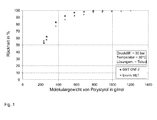
- the membrane to be used according to the invention can be characterized by means of a separation curve. It is in the context of this invention based on the filtration in a model system of polystyrene oligomers dissolved in toluene with a defined molecular weight at a temperature of 30 ° C and a transmembrane pressure difference of 30 bar certainly. Separation curves generated with this model system serve as a guide to membrane selection. Due to the different interactions of the real system with the membrane compared to the model system, the separation limits determined in the model system in the real system are usually only found with a certain deviation.
- the membrane to be used according to the invention has a gradient of the separation limit for molecular weights of more than 1000 g / mol above 97% retention and for molecular weights of less than 300 g / mol below 80% retention.
- the separation limit of a particularly suitable membrane is in FIG. 1 shown graphically.
- the separation limit was determined in an established manner with polystyrene in toluene at a separation temperature of 30 ° C. and a transmembrane pressure of 30 bar.
- the filtration of the reaction mixture according to the invention is usually a pressure-driven process. This means that along the membrane a pressure difference (transmembrane pressure difference, also called “transmembrane pressure”) is applied to force the passage of the reaction mixture through the membrane.
- transmembrane pressure is preferably 5 to 80 bar, more preferably 10 to 60 bar, in particular 30 to 40 bar.
- the temperature during filtration can be adjusted depending on the temperature stability of the membrane and the reaction mixture. It is advantageous to set the temperature as high as possible in order to reduce the viscosity of the reaction mixture and thus to accelerate the filtration.
- the filtration is preferably carried out at a temperature of 25 to 160 ° C, particularly preferably 40 to 110 ° C, in particular 60 to 90 ° C.
- the catalyst system is enriched in the retentate.
- retentate the membrane engineer understands the drainage from the membrane, which is pulled off in front of the membrane.
- the material which overcomes the membrane is called “permeate” and is withdrawn behind the membrane.
- the amount of retained catalyst can be detected by the amount of retained transition metal.
- the process according to the invention makes it possible to retain more than 50% of the transition metal in the retentate, based on the total amount of transition metal in the reaction mixture before filtration. Preferably, more than 70% of the transition metal is retained, more preferably more than 90%. If a phase transfer reagent is used, this will usually achieve a different retention than the transition metal. Nevertheless, it is enriched in the retentate. Therefore, the entire catalyst system is at least partially enriched in the retentate.
- the transition metal can be detected by ICP-MS (Inductively Coupled Plasma Mass Spectroscopy) or XRF (X-ray fluorescence analysis).
- the nitrogen is determined by an oxidative combustion analysis (at 1050 ° C in a quartz tube in an oxygen stream) followed by chemiluminescence detection of the excited NO 2 formed from NO in the presence of ozone.
- the filtration takes place in a special separation device which comprises the composite membrane according to the invention.
- the separation device is not part of the reactor in which the epoxidation reaction is carried out.
- the reaction mixture to be separated can either be withdrawn from the epoxidation reactor as a whole and fed to the separation apparatus, or a portion of the reaction mixture can be continuously removed from the epoxidation reactor and fed to the separation apparatus.
- the latter variant is particularly advantageous when the epoxidation reaction in a continuous process is carried out. It is furthermore advantageous if the retentate obtained in the filtration is returned to the epoxidation reactor.
- the composite membrane is part of the epoxidation reactor.
- the walls of the epoxidation reactor can be at least partially made of the composite membrane or the membrane is accommodated in another way directly in the reaction space. In this way, epoxidation and filtration can take place simultaneously, so that the reaction mixture freed from the catalyst containing a mixture of reaction product and educt can be continuously removed.
- a corresponding apparatus for the epoxidation of cyclic unsaturated C12 compounds with hydrogen peroxide comprising a reactor for carrying out the reaction, whose walls are at least partially provided with a separating active layer of crosslinked silicone acrylates and / or polydimethylsiloxane (PDMS) and / or polyimide, is therefore also within the scope of the invention ,
- the invention further provides a process for the synthesis of lactams (lactam process according to the invention) in which the epoxidized cyclic, unsaturated C 12 compounds obtained from the abovementioned process according to the invention for separating off a homogeneous catalyst system are used.
- the epoxidized cyclic unsaturated C12 compounds can then be hydrogenated in the presence of hydrogen and a catalyst comprising a noble metal and a metal oxide. This produces the corresponding ketone and possibly the alcohol derivative. If the ketone is in a mixture with the corresponding alcohol derivative, dehydration of the alcohol to the ketone can occur. Subsequently, the ketone can be oximated.
- the Beckmann rearrangement take place to the lactam, wherein the rearrangement can be carried out by means of sulfuric acid or cyanuric chloride.
- the lactams can be further processed to polyamides by polycondensation.
- laurolactam is prepared from monoepoxycyclododecane.
- Lactamvons Monoepoxy-cyclododecane can be obtained by the following reaction steps: 1,3-butadiene is converted by cyclotrimerization to cyclododecatriene. This is followed by hydrogenation to cyclododecene. Subsequent epoxidation gives the cyclododecane epoxide.
- a catalyst solution was prepared.
- sodium tungstate salt, concentrated phosphoric acid and water were submitted.
- the pH of the solution was adjusted to a strongly acidic value with 10% sulfuric acid.
- cyclic C12 mixtures consisting of 68.5% CDEN and 31.5% cyclododecane (CDAN) and Aliquat as phase transfer reagent were introduced together with the catalyst solution described above into a heating jacket with heating jacket.
- the reactor contents were heated to about 80 ° C. by means of a heating jacket.
- a 35% H 2 O 2 solution in water was continuously fed via a peristaltic pump. The speed of the H 2 O 2 feed was adjusted so that the internal temperature of the reactor did not rise above 85 ° C.
- a polymer membrane from Evonik MET Ltd. was tested. with an active membrane area of about 50 cm 2 .
- the active separation layer of the membrane is made of silicone acrylate and the support layer is made of polyimide.
- a portion of the organic phase from Example 1 was passed through the membrane under test at 55 ° C., a transmembrane pressure difference of 30 bar and an excess flow rate of 150 L / h.
- a polymer membrane from Evonik MET Ltd. was tested. with an active membrane area of about 80 cm 2 .
- the active separation layer of the membrane is made of silicone acrylate and the support layer is made of polyimide.
- the epoxidation of the cyclic, unsaturated C12 compounds was carried out continuously in a 3-stage stirred tank cascade.
- the stirred tank cascade used included 2 reactors with a nominal volume of 5 liters and the final stage a stirred tank with a nominal volume of 25 liters.
- the three reactors were provided with a jacket and were tempered via this to a temperature of about 80 ° C.
- the cyclic, unsaturated C12 compounds (83.8% by weight CDEN and 16.2% by weight CDAN), the catalyst components alamine, sodium tungstate and phosphoric acid and a 50% H 2 O 2 solution were added to the first reactor of the Cascade fed. In addition, a further H 2 O 2 dosage was carried out on the second reactor.
- reaction mixture consisting of two liquid phases passed from the cascade into a phase separation vessel, from which the organic phase was pumped to a continuous membrane unit.
- Chowdhury et al. use commercially unavailable Al 2 O 3 membranes with pore radii of 2.3 nm and 4.3 nm and pore diameters of 4.6 nm and 8.6 nm, respectively.
- a commercially available type of ceramic Membrane with a very low separation limit of 1 kD used to the maximum Clarify the performance of ceramic membranes. It is estimated that this type of membrane compared to that of Chowdhury et. Al used membranes a significantly smaller pore radius.
- Polymer membranes from Evonik MET Ltd. were tested. and type ONF-2 from GMT with a nominal membrane area of 0.6 m 2 with respect to the MET membrane and 0.75m 2 with respect to the ONF-2 type.
- the active separation layer of the membranes is made of silicone acrylate and the carrier layer is made of polyimide.
- Atech ceramic membranes with a separation limit of approx. 1 kD and a membrane area of 540 cm 2 were tested
- the low retention for the Atech 1 kD type shows that using ceramic membranes does not make sense for a technical implementation for the recovery of homogeneous catalysts from organic phases.
Landscapes
- Chemical & Material Sciences (AREA)
- Organic Chemistry (AREA)
- Engineering & Computer Science (AREA)
- Chemical Kinetics & Catalysis (AREA)
- Nanotechnology (AREA)
- Water Supply & Treatment (AREA)
- Materials Engineering (AREA)
- Inorganic Chemistry (AREA)
- Separation Using Semi-Permeable Membranes (AREA)
- Catalysts (AREA)
- Epoxy Compounds (AREA)
- Low-Molecular Organic Synthesis Reactions Using Catalysts (AREA)
Applications Claiming Priority (1)
| Application Number | Priority Date | Filing Date | Title |
|---|---|---|---|
| DE102014209421.6A DE102014209421A1 (de) | 2014-05-19 | 2014-05-19 | Membrangestützte Katalysatorabtrennung bei der Epoxidierung von cyclischen, ungesättigten C12-Verbindungen zum Beispiel Cyclododecen (CDEN) |
Publications (3)
| Publication Number | Publication Date |
|---|---|
| EP2946831A2 true EP2946831A2 (fr) | 2015-11-25 |
| EP2946831A3 EP2946831A3 (fr) | 2015-12-09 |
| EP2946831B1 EP2946831B1 (fr) | 2019-02-20 |
Family
ID=52991567
Family Applications (1)
| Application Number | Title | Priority Date | Filing Date |
|---|---|---|---|
| EP15164248.5A Active EP2946831B1 (fr) | 2014-05-19 | 2015-04-20 | Séparation de catalyseur assistée par membrane lors de l'époxydation de liaisons c12 cycliques, insaturés par exemple cyclododécane (cden) |
Country Status (7)
| Country | Link |
|---|---|
| US (2) | US9643153B2 (fr) |
| EP (1) | EP2946831B1 (fr) |
| JP (1) | JP6045632B2 (fr) |
| CN (1) | CN105080342B (fr) |
| DE (1) | DE102014209421A1 (fr) |
| ES (1) | ES2724585T3 (fr) |
| SG (1) | SG10201503934QA (fr) |
Cited By (3)
| Publication number | Priority date | Publication date | Assignee | Title |
|---|---|---|---|---|
| EP3263557A1 (fr) | 2016-06-30 | 2018-01-03 | Evonik Degussa GmbH | Procédé pour la réactivation d'un catalyseur d'oxydation homogène |
| WO2026093374A1 (fr) | 2024-10-30 | 2026-05-07 | Evonik Operations Gmbh | Procédé de réactivation d'un système catalytique homogène pour une réaction d'oxydation |
| WO2026093375A1 (fr) | 2024-10-30 | 2026-05-07 | Evonik Operations Gmbh | Procédé de concentration d'un système catalytique homogène dans une phase organique |
Families Citing this family (7)
| Publication number | Priority date | Publication date | Assignee | Title |
|---|---|---|---|---|
| AU2015237373B2 (en) * | 2014-03-26 | 2019-11-21 | Hydroxsys Holdings Limited | Durable asymmetric composite membrane |
| US11291215B2 (en) | 2014-03-26 | 2022-04-05 | Hydroxsys Holdings Limited | Durable asymmetric composite membranes and modified substrates used in their preparation |
| EP3498361A1 (fr) | 2017-12-18 | 2019-06-19 | Evonik Degussa GmbH | Procédé de fabrication de polyalcénamères thermostables |
| EP3546495A1 (fr) | 2018-03-29 | 2019-10-02 | Evonik Degussa GmbH | Procédé de production de polyalcénamères thermostables |
| EP3578539A1 (fr) | 2018-06-07 | 2019-12-11 | Evonik Operations GmbH | Procédé de production continue de cétones à partir des époxydes en lit fixe |
| KR102528919B1 (ko) * | 2018-12-19 | 2023-05-08 | 한화솔루션 주식회사 | 사이클로도데카논의 제조방법 |
| DE202019001414U1 (de) | 2019-02-01 | 2019-04-12 | Evonik Canada Inc. | Vorrichtung zum Trennen von Gaskomponenten aus einem Gasstrom mit veränderlicher Zusammensetzung oder Strömungsrate |
Citations (9)
| Publication number | Priority date | Publication date | Assignee | Title |
|---|---|---|---|---|
| DE3027349A1 (de) | 1979-07-19 | 1981-02-12 | Donegani Guido Ist | Verfahren zur katalytischen epoxydation von olefinen |
| DE19507584A1 (de) | 1995-03-04 | 1996-09-12 | Geesthacht Gkss Forschung | Strahlenchemisch modifizierte Silikonkompositmembran für die Ultrafiltration |
| EP0781116A1 (fr) | 1994-09-12 | 1997-07-02 | Advanced Tissue Sciences, Inc. | Cultures tridimensionnelles de cellules humaines sur des structures de valvules cardiaques, et leurs utilisations |
| WO2000044704A1 (fr) | 1999-01-28 | 2000-08-03 | Novance | Procede d'epoxidation ou de dihydroxylation d'acides gras unsatures |
| EP1205474A2 (fr) | 2000-11-08 | 2002-05-15 | Degussa AG | Procédé d'époxydation des doubles liaisons cis |
| EP1411050A1 (fr) | 2002-10-11 | 2004-04-21 | Degussa AG | Procédé de l'époxydation des cycloalcenes |
| EP1411051A1 (fr) | 2002-10-11 | 2004-04-21 | Degussa AG | Usage de composés pour la séparation accelerée des phases dans des réactions hétérogènes d'époxydation de cycloalcenes |
| EP1741481A2 (fr) | 2005-07-05 | 2007-01-10 | Gkss-Forschungszentrum Geesthacht Gmbh | Membrane composite |
| WO2011067054A1 (fr) | 2009-12-01 | 2011-06-09 | Evonik Goldschmidt Gmbh | Membranes composites à base de silicone, présentant un effet de séparation élevé |
Family Cites Families (14)
| Publication number | Priority date | Publication date | Assignee | Title |
|---|---|---|---|---|
| IT1122214B (it) * | 1979-07-19 | 1986-04-23 | Donegani Guido Ist | Processo per l'epossidazione catalitica di olefine con acqua ossigenata |
| JP3160937B2 (ja) * | 1991-05-10 | 2001-04-25 | ライオン株式会社 | 液体柔軟剤組成物 |
| US6043383A (en) * | 1998-04-14 | 2000-03-28 | Ube Industries, Ltd. | Process for producing 1,2-epoxy-5,9-cyclododecadiene |
| GB2369311B (en) * | 2000-11-24 | 2002-12-11 | Membrane Extraction Tech Ltd | Separating phase transfer agents |
| ES2410810T5 (es) * | 2002-01-16 | 2022-02-18 | Ube Industries | Procesos para producir laurolactama a partir de ciclododecanona |
| ES2276991T3 (es) | 2003-03-08 | 2007-07-01 | Degussa Gmbh | Hidrogenacion selectiva de ciclododecatrieno para dar ciclododeceno. |
| JP2010138522A (ja) * | 2008-12-12 | 2010-06-24 | Kao Corp | 柔軟剤組成物 |
| DE102009001225A1 (de) | 2009-02-27 | 2010-09-02 | Evonik Oxeno Gmbh | Verfahren zur Anreicherung eines Homogenkatalysators aus einem Prozessstrom |
| JP2012131732A (ja) * | 2010-12-21 | 2012-07-12 | Tosoh Corp | ジクロロエポキシブタンの製造方法 |
| DE102011082441A1 (de) | 2011-09-09 | 2013-03-14 | Evonik Oxeno Gmbh | Strahlschlaufenreaktor mit Nanofiltration |
| WO2013068443A1 (fr) * | 2011-11-09 | 2013-05-16 | Sondboe Sverre | Procédés membranaires pour la diminution d'au moins une impureté et fabrication d'un concentré comprenant au moins un composant naturel à partir d'un mélange huileux d'acides gras non marins, et compositions en résultant |
| WO2014083952A1 (fr) | 2012-11-28 | 2014-06-05 | シャープ株式会社 | Structure |
| DE102013208759A1 (de) | 2013-05-13 | 2014-11-13 | Evonik Industries Ag | Abtrennung von Homogenkatalysatoren mittels einer geregelten Membrantrenneinheit |
| DE102013215004A1 (de) | 2013-07-31 | 2015-02-05 | Evonik Industries Ag | Membrankaskade mit sinkender Trenntemperatur |
-
2014
- 2014-05-19 DE DE102014209421.6A patent/DE102014209421A1/de not_active Withdrawn
-
2015
- 2015-04-20 ES ES15164248T patent/ES2724585T3/es active Active
- 2015-04-20 EP EP15164248.5A patent/EP2946831B1/fr active Active
- 2015-05-18 CN CN201510252921.1A patent/CN105080342B/zh active Active
- 2015-05-18 US US14/714,985 patent/US9643153B2/en active Active
- 2015-05-19 SG SG10201503934QA patent/SG10201503934QA/en unknown
- 2015-05-19 JP JP2015101792A patent/JP6045632B2/ja active Active
-
2016
- 2016-12-19 US US15/382,991 patent/US20170095789A1/en not_active Abandoned
Patent Citations (9)
| Publication number | Priority date | Publication date | Assignee | Title |
|---|---|---|---|---|
| DE3027349A1 (de) | 1979-07-19 | 1981-02-12 | Donegani Guido Ist | Verfahren zur katalytischen epoxydation von olefinen |
| EP0781116A1 (fr) | 1994-09-12 | 1997-07-02 | Advanced Tissue Sciences, Inc. | Cultures tridimensionnelles de cellules humaines sur des structures de valvules cardiaques, et leurs utilisations |
| DE19507584A1 (de) | 1995-03-04 | 1996-09-12 | Geesthacht Gkss Forschung | Strahlenchemisch modifizierte Silikonkompositmembran für die Ultrafiltration |
| WO2000044704A1 (fr) | 1999-01-28 | 2000-08-03 | Novance | Procede d'epoxidation ou de dihydroxylation d'acides gras unsatures |
| EP1205474A2 (fr) | 2000-11-08 | 2002-05-15 | Degussa AG | Procédé d'époxydation des doubles liaisons cis |
| EP1411050A1 (fr) | 2002-10-11 | 2004-04-21 | Degussa AG | Procédé de l'époxydation des cycloalcenes |
| EP1411051A1 (fr) | 2002-10-11 | 2004-04-21 | Degussa AG | Usage de composés pour la séparation accelerée des phases dans des réactions hétérogènes d'époxydation de cycloalcenes |
| EP1741481A2 (fr) | 2005-07-05 | 2007-01-10 | Gkss-Forschungszentrum Geesthacht Gmbh | Membrane composite |
| WO2011067054A1 (fr) | 2009-12-01 | 2011-06-09 | Evonik Goldschmidt Gmbh | Membranes composites à base de silicone, présentant un effet de séparation élevé |
Non-Patent Citations (2)
| Title |
|---|
| ANGEW. CHEM., vol. 103, 1991, pages 1706 - 1709 |
| S. R. CHOWDHURY ET AL.: "Recovery of homogeneous polyoxometallate catalysts from aqueous and organic media by a mesoporous ceramic membrane without loss of catalytic activity", CHEMISTRY-A EUROPEAN JOURNAL, vol. 12, no. 11, 2006, pages 3061 - 3066, XP055200347, DOI: doi:10.1002/chem.200501021 |
Cited By (5)
| Publication number | Priority date | Publication date | Assignee | Title |
|---|---|---|---|---|
| EP3263557A1 (fr) | 2016-06-30 | 2018-01-03 | Evonik Degussa GmbH | Procédé pour la réactivation d'un catalyseur d'oxydation homogène |
| WO2018002114A1 (fr) | 2016-06-30 | 2018-01-04 | Evonik Degussa Gmbh | Procédé de réactivation d'un catalyseur d'oxydation homogène |
| US10994270B2 (en) | 2016-06-30 | 2021-05-04 | Evonik Operations Gmbh | Method for reactivation of a homogeneous oxidation catalyst |
| WO2026093374A1 (fr) | 2024-10-30 | 2026-05-07 | Evonik Operations Gmbh | Procédé de réactivation d'un système catalytique homogène pour une réaction d'oxydation |
| WO2026093375A1 (fr) | 2024-10-30 | 2026-05-07 | Evonik Operations Gmbh | Procédé de concentration d'un système catalytique homogène dans une phase organique |
Also Published As
| Publication number | Publication date |
|---|---|
| SG10201503934QA (en) | 2015-12-30 |
| JP6045632B2 (ja) | 2016-12-14 |
| EP2946831A3 (fr) | 2015-12-09 |
| EP2946831B1 (fr) | 2019-02-20 |
| CN105080342B (zh) | 2018-03-13 |
| DE102014209421A1 (de) | 2015-11-19 |
| US20150328619A1 (en) | 2015-11-19 |
| ES2724585T3 (es) | 2019-09-12 |
| US20170095789A1 (en) | 2017-04-06 |
| CN105080342A (zh) | 2015-11-25 |
| JP2015217388A (ja) | 2015-12-07 |
| US9643153B2 (en) | 2017-05-09 |
Similar Documents
| Publication | Publication Date | Title |
|---|---|---|
| EP2946831B1 (fr) | Séparation de catalyseur assistée par membrane lors de l'époxydation de liaisons c12 cycliques, insaturés par exemple cyclododécane (cden) | |
| EP2603543B1 (fr) | Procédé de production de polyéther-alcools | |
| EP3374353B1 (fr) | Procédé pour la réactivation d'un catalyseur d'oxydation homogène | |
| EP2817284B1 (fr) | Procédé et dispositif destinés à l'hydroformylation d'isobutène et à la séparation du mélange de produits | |
| EP2027180A1 (fr) | Procédé pour la fabrication de polyols de polyéther | |
| EP2356088A1 (fr) | Procédé de production d'acroléine comportant le traitement d'une phase glycérine brute | |
| EP2055383B1 (fr) | Utilisation d'échangeurs ioniques amphotères | |
| DE10312916A1 (de) | Verfahren zur Abtrennung von 2-Butanol aus tert.-Butanol/Wasser-Gemischen | |
| DE10137401A1 (de) | Synthese von TMBQ mit Übergangsmetall beinhaltendem Molekularsieb als Katalysator | |
| WO2015177009A2 (fr) | Séparation de catalyseur assistée par membrane dans le cadre de l'époxydation d'esters d'alkyle d'acides gras | |
| EP2984067B1 (fr) | Procédé destiné à la fabrication de di- et polyamines de la série diphénylméthane | |
| DE3236496C2 (de) | Verfahren zur extraktiven Abtrennung polarer organischer Verbindungen aus deren wäßrigen Lösungen | |
| DE4333642C2 (de) | Verfahren zur Herstellung von 2-Alkyl-5-formylimidazolen | |
| DE60317652T2 (de) | Verfahren zur Reinigung von Polyetherpolyolen | |
| DE60104699T2 (de) | Verfahren zur herstellung von cyclohexanonoxim | |
| EP2586519A1 (fr) | Préparation d'eaux usées polluées provenant de la production de produits phytosanitaires | |
| DE69417720T2 (de) | Verfahren zur herstellung von diolen | |
| DE2702294A1 (de) | Verfahren zur herstellung von polyphenylenoxiden | |
| DE4030831A1 (de) | Polyol-polyether mit hohem gehalt an ethylenoxid und niedriger viskositaet | |
| DE69602947T2 (de) | Anwendung von dendrimeren makromolekülen als katalysatoren oder verarbeitungshilfstoffe für phasenübertragungsreaktionen | |
| EP2984069B1 (fr) | Procédé destiné à la fabrication de di- et polyamines de la série diphénylméthane | |
| EP0982284A2 (fr) | Méthode pour la séparation de trimethlylolpropane de sels hydrosolubles dans une solution | |
| EP0545162B1 (fr) | Procédé pour séparation des composés organiques de phosphare et d'autre impurétés d'acide sulfurique | |
| WO1999033774A1 (fr) | Procede de preparation d'alkyleneglycol a faible teneur en composes carbonyle | |
| WO1999038825A1 (fr) | Procede de production d'alkyleneglycol |
Legal Events
| Date | Code | Title | Description |
|---|---|---|---|
| PUAL | Search report despatched |
Free format text: ORIGINAL CODE: 0009013 |
|
| PUAI | Public reference made under article 153(3) epc to a published international application that has entered the european phase |
Free format text: ORIGINAL CODE: 0009012 |
|
| 17P | Request for examination filed |
Effective date: 20150420 |
|
| AK | Designated contracting states |
Kind code of ref document: A2 Designated state(s): AL AT BE BG CH CY CZ DE DK EE ES FI FR GB GR HR HU IE IS IT LI LT LU LV MC MK MT NL NO PL PT RO RS SE SI SK SM TR |
|
| AX | Request for extension of the european patent |
Extension state: BA ME |
|
| AK | Designated contracting states |
Kind code of ref document: A3 Designated state(s): AL AT BE BG CH CY CZ DE DK EE ES FI FR GB GR HR HU IE IS IT LI LT LU LV MC MK MT NL NO PL PT RO RS SE SI SK SM TR |
|
| AX | Request for extension of the european patent |
Extension state: BA ME |
|
| RIC1 | Information provided on ipc code assigned before grant |
Ipc: B01J 31/40 20060101AFI20151105BHEP Ipc: C07D 301/12 20060101ALI20151105BHEP |
|
| RAP1 | Party data changed (applicant data changed or rights of an application transferred) |
Owner name: EVONIK DEGUSSA GMBH |
|
| STAA | Information on the status of an ep patent application or granted ep patent |
Free format text: STATUS: EXAMINATION IS IN PROGRESS |
|
| 17Q | First examination report despatched |
Effective date: 20180620 |
|
| GRAP | Despatch of communication of intention to grant a patent |
Free format text: ORIGINAL CODE: EPIDOSNIGR1 |
|
| STAA | Information on the status of an ep patent application or granted ep patent |
Free format text: STATUS: GRANT OF PATENT IS INTENDED |
|
| INTG | Intention to grant announced |
Effective date: 20180827 |
|
| GRAS | Grant fee paid |
Free format text: ORIGINAL CODE: EPIDOSNIGR3 |
|
| GRAA | (expected) grant |
Free format text: ORIGINAL CODE: 0009210 |
|
| STAA | Information on the status of an ep patent application or granted ep patent |
Free format text: STATUS: THE PATENT HAS BEEN GRANTED |
|
| AK | Designated contracting states |
Kind code of ref document: B1 Designated state(s): AL AT BE BG CH CY CZ DE DK EE ES FI FR GB GR HR HU IE IS IT LI LT LU LV MC MK MT NL NO PL PT RO RS SE SI SK SM TR |
|
| REG | Reference to a national code |
Ref country code: GB Ref legal event code: FG4D Free format text: NOT ENGLISH |
|
| REG | Reference to a national code |
Ref country code: CH Ref legal event code: EP |
|
| REG | Reference to a national code |
Ref country code: DE Ref legal event code: R096 Ref document number: 502015007989 Country of ref document: DE |
|
| REG | Reference to a national code |
Ref country code: AT Ref legal event code: REF Ref document number: 1097463 Country of ref document: AT Kind code of ref document: T Effective date: 20190315 |
|
| REG | Reference to a national code |
Ref country code: IE Ref legal event code: FG4D Free format text: LANGUAGE OF EP DOCUMENT: GERMAN |
|
| REG | Reference to a national code |
Ref country code: NL Ref legal event code: FP |
|
| REG | Reference to a national code |
Ref country code: LT Ref legal event code: MG4D |
|
| PG25 | Lapsed in a contracting state [announced via postgrant information from national office to epo] |
Ref country code: LT Free format text: LAPSE BECAUSE OF FAILURE TO SUBMIT A TRANSLATION OF THE DESCRIPTION OR TO PAY THE FEE WITHIN THE PRESCRIBED TIME-LIMIT Effective date: 20190220 Ref country code: FI Free format text: LAPSE BECAUSE OF FAILURE TO SUBMIT A TRANSLATION OF THE DESCRIPTION OR TO PAY THE FEE WITHIN THE PRESCRIBED TIME-LIMIT Effective date: 20190220 Ref country code: SE Free format text: LAPSE BECAUSE OF FAILURE TO SUBMIT A TRANSLATION OF THE DESCRIPTION OR TO PAY THE FEE WITHIN THE PRESCRIBED TIME-LIMIT Effective date: 20190220 Ref country code: NO Free format text: LAPSE BECAUSE OF FAILURE TO SUBMIT A TRANSLATION OF THE DESCRIPTION OR TO PAY THE FEE WITHIN THE PRESCRIBED TIME-LIMIT Effective date: 20190520 Ref country code: PT Free format text: LAPSE BECAUSE OF FAILURE TO SUBMIT A TRANSLATION OF THE DESCRIPTION OR TO PAY THE FEE WITHIN THE PRESCRIBED TIME-LIMIT Effective date: 20190620 |
|
| PG25 | Lapsed in a contracting state [announced via postgrant information from national office to epo] |
Ref country code: LV Free format text: LAPSE BECAUSE OF FAILURE TO SUBMIT A TRANSLATION OF THE DESCRIPTION OR TO PAY THE FEE WITHIN THE PRESCRIBED TIME-LIMIT Effective date: 20190220 Ref country code: IS Free format text: LAPSE BECAUSE OF FAILURE TO SUBMIT A TRANSLATION OF THE DESCRIPTION OR TO PAY THE FEE WITHIN THE PRESCRIBED TIME-LIMIT Effective date: 20190620 Ref country code: GR Free format text: LAPSE BECAUSE OF FAILURE TO SUBMIT A TRANSLATION OF THE DESCRIPTION OR TO PAY THE FEE WITHIN THE PRESCRIBED TIME-LIMIT Effective date: 20190521 Ref country code: HR Free format text: LAPSE BECAUSE OF FAILURE TO SUBMIT A TRANSLATION OF THE DESCRIPTION OR TO PAY THE FEE WITHIN THE PRESCRIBED TIME-LIMIT Effective date: 20190220 Ref country code: RS Free format text: LAPSE BECAUSE OF FAILURE TO SUBMIT A TRANSLATION OF THE DESCRIPTION OR TO PAY THE FEE WITHIN THE PRESCRIBED TIME-LIMIT Effective date: 20190220 Ref country code: BG Free format text: LAPSE BECAUSE OF FAILURE TO SUBMIT A TRANSLATION OF THE DESCRIPTION OR TO PAY THE FEE WITHIN THE PRESCRIBED TIME-LIMIT Effective date: 20190520 |
|
| REG | Reference to a national code |
Ref country code: ES Ref legal event code: FG2A Ref document number: 2724585 Country of ref document: ES Kind code of ref document: T3 Effective date: 20190912 |
|
| PG25 | Lapsed in a contracting state [announced via postgrant information from national office to epo] |
Ref country code: AL Free format text: LAPSE BECAUSE OF FAILURE TO SUBMIT A TRANSLATION OF THE DESCRIPTION OR TO PAY THE FEE WITHIN THE PRESCRIBED TIME-LIMIT Effective date: 20190220 Ref country code: CZ Free format text: LAPSE BECAUSE OF FAILURE TO SUBMIT A TRANSLATION OF THE DESCRIPTION OR TO PAY THE FEE WITHIN THE PRESCRIBED TIME-LIMIT Effective date: 20190220 Ref country code: RO Free format text: LAPSE BECAUSE OF FAILURE TO SUBMIT A TRANSLATION OF THE DESCRIPTION OR TO PAY THE FEE WITHIN THE PRESCRIBED TIME-LIMIT Effective date: 20190220 Ref country code: SK Free format text: LAPSE BECAUSE OF FAILURE TO SUBMIT A TRANSLATION OF THE DESCRIPTION OR TO PAY THE FEE WITHIN THE PRESCRIBED TIME-LIMIT Effective date: 20190220 Ref country code: EE Free format text: LAPSE BECAUSE OF FAILURE TO SUBMIT A TRANSLATION OF THE DESCRIPTION OR TO PAY THE FEE WITHIN THE PRESCRIBED TIME-LIMIT Effective date: 20190220 Ref country code: DK Free format text: LAPSE BECAUSE OF FAILURE TO SUBMIT A TRANSLATION OF THE DESCRIPTION OR TO PAY THE FEE WITHIN THE PRESCRIBED TIME-LIMIT Effective date: 20190220 |
|
| REG | Reference to a national code |
Ref country code: DE Ref legal event code: R097 Ref document number: 502015007989 Country of ref document: DE |
|
| PG25 | Lapsed in a contracting state [announced via postgrant information from national office to epo] |
Ref country code: SM Free format text: LAPSE BECAUSE OF FAILURE TO SUBMIT A TRANSLATION OF THE DESCRIPTION OR TO PAY THE FEE WITHIN THE PRESCRIBED TIME-LIMIT Effective date: 20190220 Ref country code: PL Free format text: LAPSE BECAUSE OF FAILURE TO SUBMIT A TRANSLATION OF THE DESCRIPTION OR TO PAY THE FEE WITHIN THE PRESCRIBED TIME-LIMIT Effective date: 20190220 |
|
| RAP2 | Party data changed (patent owner data changed or rights of a patent transferred) |
Owner name: EVONIK OPERATIONS GMBH |
|
| REG | Reference to a national code |
Ref country code: DE Ref legal event code: R081 Ref document number: 502015007989 Country of ref document: DE Owner name: EVONIK OPERATIONS GMBH, DE Free format text: FORMER OWNER: EVONIK DEGUSSA GMBH, 45128 ESSEN, DE |
|
| PLBE | No opposition filed within time limit |
Free format text: ORIGINAL CODE: 0009261 |
|
| STAA | Information on the status of an ep patent application or granted ep patent |
Free format text: STATUS: NO OPPOSITION FILED WITHIN TIME LIMIT |
|
| PG25 | Lapsed in a contracting state [announced via postgrant information from national office to epo] |
Ref country code: MC Free format text: LAPSE BECAUSE OF FAILURE TO SUBMIT A TRANSLATION OF THE DESCRIPTION OR TO PAY THE FEE WITHIN THE PRESCRIBED TIME-LIMIT Effective date: 20190220 Ref country code: LU Free format text: LAPSE BECAUSE OF NON-PAYMENT OF DUE FEES Effective date: 20190420 |
|
| 26N | No opposition filed |
Effective date: 20191121 |
|
| PG25 | Lapsed in a contracting state [announced via postgrant information from national office to epo] |
Ref country code: SI Free format text: LAPSE BECAUSE OF FAILURE TO SUBMIT A TRANSLATION OF THE DESCRIPTION OR TO PAY THE FEE WITHIN THE PRESCRIBED TIME-LIMIT Effective date: 20190220 |
|
| PG25 | Lapsed in a contracting state [announced via postgrant information from national office to epo] |
Ref country code: TR Free format text: LAPSE BECAUSE OF FAILURE TO SUBMIT A TRANSLATION OF THE DESCRIPTION OR TO PAY THE FEE WITHIN THE PRESCRIBED TIME-LIMIT Effective date: 20190220 |
|
| PG25 | Lapsed in a contracting state [announced via postgrant information from national office to epo] |
Ref country code: IE Free format text: LAPSE BECAUSE OF NON-PAYMENT OF DUE FEES Effective date: 20190420 |
|
| REG | Reference to a national code |
Ref country code: BE Ref legal event code: HC Owner name: EVONIK OPERATIONS GMBH; DE Free format text: DETAILS ASSIGNMENT: CHANGE OF OWNER(S), CHANGEMENT DE NOM DU PROPRIETAIRE; FORMER OWNER NAME: EVONIK DEGUSSA GMBH Effective date: 20200403 |
|
| REG | Reference to a national code |
Ref country code: NL Ref legal event code: HC Owner name: EVONIK OPERATIONS GMBH; DE Free format text: DETAILS ASSIGNMENT: CHANGE OF OWNER(S), CHANGE OF OWNER(S) NAME; FORMER OWNER NAME: EVONIK DEGUSSA GMBH Effective date: 20200928 |
|
| PG25 | Lapsed in a contracting state [announced via postgrant information from national office to epo] |
Ref country code: CY Free format text: LAPSE BECAUSE OF FAILURE TO SUBMIT A TRANSLATION OF THE DESCRIPTION OR TO PAY THE FEE WITHIN THE PRESCRIBED TIME-LIMIT Effective date: 20190220 |
|
| REG | Reference to a national code |
Ref country code: AT Ref legal event code: MM01 Ref document number: 1097463 Country of ref document: AT Kind code of ref document: T Effective date: 20200420 |
|
| PG25 | Lapsed in a contracting state [announced via postgrant information from national office to epo] |
Ref country code: HU Free format text: LAPSE BECAUSE OF FAILURE TO SUBMIT A TRANSLATION OF THE DESCRIPTION OR TO PAY THE FEE WITHIN THE PRESCRIBED TIME-LIMIT; INVALID AB INITIO Effective date: 20150420 Ref country code: MT Free format text: LAPSE BECAUSE OF FAILURE TO SUBMIT A TRANSLATION OF THE DESCRIPTION OR TO PAY THE FEE WITHIN THE PRESCRIBED TIME-LIMIT Effective date: 20190220 |
|
| PG25 | Lapsed in a contracting state [announced via postgrant information from national office to epo] |
Ref country code: AT Free format text: LAPSE BECAUSE OF NON-PAYMENT OF DUE FEES Effective date: 20200420 |
|
| PG25 | Lapsed in a contracting state [announced via postgrant information from national office to epo] |
Ref country code: MK Free format text: LAPSE BECAUSE OF FAILURE TO SUBMIT A TRANSLATION OF THE DESCRIPTION OR TO PAY THE FEE WITHIN THE PRESCRIBED TIME-LIMIT Effective date: 20190220 |
|
| PGFP | Annual fee paid to national office [announced via postgrant information from national office to epo] |
Ref country code: NL Payment date: 20220420 Year of fee payment: 8 |
|
| PGFP | Annual fee paid to national office [announced via postgrant information from national office to epo] |
Ref country code: GB Payment date: 20220425 Year of fee payment: 8 Ref country code: ES Payment date: 20220629 Year of fee payment: 8 |
|
| PGFP | Annual fee paid to national office [announced via postgrant information from national office to epo] |
Ref country code: BE Payment date: 20220421 Year of fee payment: 8 |
|
| P01 | Opt-out of the competence of the unified patent court (upc) registered |
Effective date: 20230524 |
|
| REG | Reference to a national code |
Ref country code: NL Ref legal event code: MM Effective date: 20230501 |
|
| GBPC | Gb: european patent ceased through non-payment of renewal fee |
Effective date: 20230420 |
|
| REG | Reference to a national code |
Ref country code: BE Ref legal event code: MM Effective date: 20230430 |
|
| PG25 | Lapsed in a contracting state [announced via postgrant information from national office to epo] |
Ref country code: GB Free format text: LAPSE BECAUSE OF NON-PAYMENT OF DUE FEES Effective date: 20230420 |
|
| PG25 | Lapsed in a contracting state [announced via postgrant information from national office to epo] |
Ref country code: NL Free format text: LAPSE BECAUSE OF NON-PAYMENT OF DUE FEES Effective date: 20230501 Ref country code: GB Free format text: LAPSE BECAUSE OF NON-PAYMENT OF DUE FEES Effective date: 20230420 |
|
| PG25 | Lapsed in a contracting state [announced via postgrant information from national office to epo] |
Ref country code: BE Free format text: LAPSE BECAUSE OF NON-PAYMENT OF DUE FEES Effective date: 20230430 |
|
| REG | Reference to a national code |
Ref country code: ES Ref legal event code: FD2A Effective date: 20240603 |
|
| PGFP | Annual fee paid to national office [announced via postgrant information from national office to epo] |
Ref country code: CH Payment date: 20240501 Year of fee payment: 10 |
|
| PG25 | Lapsed in a contracting state [announced via postgrant information from national office to epo] |
Ref country code: ES Free format text: LAPSE BECAUSE OF NON-PAYMENT OF DUE FEES Effective date: 20230421 |
|
| PG25 | Lapsed in a contracting state [announced via postgrant information from national office to epo] |
Ref country code: ES Free format text: LAPSE BECAUSE OF NON-PAYMENT OF DUE FEES Effective date: 20230421 |
|
| PGFP | Annual fee paid to national office [announced via postgrant information from national office to epo] |
Ref country code: IT Payment date: 20240424 Year of fee payment: 10 Ref country code: FR Payment date: 20240425 Year of fee payment: 10 |
|
| PGFP | Annual fee paid to national office [announced via postgrant information from national office to epo] |
Ref country code: DE Payment date: 20250422 Year of fee payment: 11 |
|
| REG | Reference to a national code |
Ref country code: CH Ref legal event code: H13 Free format text: ST27 STATUS EVENT CODE: U-0-0-H10-H13 (AS PROVIDED BY THE NATIONAL OFFICE) Effective date: 20251125 |
|
| PG25 | Lapsed in a contracting state [announced via postgrant information from national office to epo] |
Ref country code: FR Free format text: LAPSE BECAUSE OF NON-PAYMENT OF DUE FEES Effective date: 20250430 |
|
| PG25 | Lapsed in a contracting state [announced via postgrant information from national office to epo] |
Ref country code: CH Free format text: LAPSE BECAUSE OF NON-PAYMENT OF DUE FEES Effective date: 20250430 |
|
| PG25 | Lapsed in a contracting state [announced via postgrant information from national office to epo] |
Ref country code: IT Free format text: LAPSE BECAUSE OF NON-PAYMENT OF DUE FEES Effective date: 20250420 |