EP2946831A2 - Membrangestützte katalysatorabtrennung bei der epoxidierung von cyclischen, ungesättigten c12-verbindungen zum beispiel cyclododecen (cden) - Google Patents
Membrangestützte katalysatorabtrennung bei der epoxidierung von cyclischen, ungesättigten c12-verbindungen zum beispiel cyclododecen (cden) Download PDFInfo
- Publication number
- EP2946831A2 EP2946831A2 EP15164248.5A EP15164248A EP2946831A2 EP 2946831 A2 EP2946831 A2 EP 2946831A2 EP 15164248 A EP15164248 A EP 15164248A EP 2946831 A2 EP2946831 A2 EP 2946831A2
- Authority
- EP
- European Patent Office
- Prior art keywords
- membrane
- carbon atoms
- substituents
- separation
- unsaturated
- Prior art date
- Legal status (The legal status is an assumption and is not a legal conclusion. Google has not performed a legal analysis and makes no representation as to the accuracy of the status listed.)
- Granted
Links
- 0 C*(CCN=O)(*CCCN)C=CCN Chemical compound C*(CCN=O)(*CCCN)C=CCN 0.000 description 1
Images
Classifications
-
- B—PERFORMING OPERATIONS; TRANSPORTING
- B01—PHYSICAL OR CHEMICAL PROCESSES OR APPARATUS IN GENERAL
- B01J—CHEMICAL OR PHYSICAL PROCESSES, e.g. CATALYSIS OR COLLOID CHEMISTRY; THEIR RELEVANT APPARATUS
- B01J19/00—Chemical, physical or physico-chemical processes in general; Their relevant apparatus
- B01J19/24—Stationary reactors without moving elements inside
- B01J19/2475—Membrane reactors
-
- B—PERFORMING OPERATIONS; TRANSPORTING
- B01—PHYSICAL OR CHEMICAL PROCESSES OR APPARATUS IN GENERAL
- B01D—SEPARATION
- B01D61/00—Processes of separation using semi-permeable membranes, e.g. dialysis, osmosis or ultrafiltration; Apparatus, accessories or auxiliary operations specially adapted therefor
- B01D61/02—Reverse osmosis; Hyperfiltration ; Nanofiltration
- B01D61/027—Nanofiltration
-
- B—PERFORMING OPERATIONS; TRANSPORTING
- B01—PHYSICAL OR CHEMICAL PROCESSES OR APPARATUS IN GENERAL
- B01J—CHEMICAL OR PHYSICAL PROCESSES, e.g. CATALYSIS OR COLLOID CHEMISTRY; THEIR RELEVANT APPARATUS
- B01J31/00—Catalysts comprising hydrides, coordination complexes or organic compounds
- B01J31/40—Regeneration or reactivation
- B01J31/4015—Regeneration or reactivation of catalysts containing metals
- B01J31/4061—Regeneration or reactivation of catalysts containing metals involving membrane separation
-
- C—CHEMISTRY; METALLURGY
- C07—ORGANIC CHEMISTRY
- C07D—HETEROCYCLIC COMPOUNDS
- C07D201/00—Preparation, separation, purification or stabilisation of unsubstituted lactams
- C07D201/02—Preparation of lactams
-
- C—CHEMISTRY; METALLURGY
- C07—ORGANIC CHEMISTRY
- C07D—HETEROCYCLIC COMPOUNDS
- C07D225/00—Heterocyclic compounds containing rings of more than seven members having one nitrogen atom as the only ring hetero atom
- C07D225/02—Heterocyclic compounds containing rings of more than seven members having one nitrogen atom as the only ring hetero atom not condensed with other rings
-
- C—CHEMISTRY; METALLURGY
- C07—ORGANIC CHEMISTRY
- C07D—HETEROCYCLIC COMPOUNDS
- C07D301/00—Preparation of oxiranes
- C07D301/02—Synthesis of the oxirane ring
- C07D301/03—Synthesis of the oxirane ring by oxidation of unsaturated compounds, or of mixtures of unsaturated and saturated compounds
- C07D301/12—Synthesis of the oxirane ring by oxidation of unsaturated compounds, or of mixtures of unsaturated and saturated compounds with hydrogen peroxide or inorganic peroxides or peracids
-
- C—CHEMISTRY; METALLURGY
- C07—ORGANIC CHEMISTRY
- C07D—HETEROCYCLIC COMPOUNDS
- C07D301/00—Preparation of oxiranes
- C07D301/32—Separation; Purification
-
- B—PERFORMING OPERATIONS; TRANSPORTING
- B01—PHYSICAL OR CHEMICAL PROCESSES OR APPARATUS IN GENERAL
- B01D—SEPARATION
- B01D2311/00—Details relating to membrane separation process operations and control
- B01D2311/02—Specific process operations before starting the membrane separation process
-
- B—PERFORMING OPERATIONS; TRANSPORTING
- B01—PHYSICAL OR CHEMICAL PROCESSES OR APPARATUS IN GENERAL
- B01J—CHEMICAL OR PHYSICAL PROCESSES, e.g. CATALYSIS OR COLLOID CHEMISTRY; THEIR RELEVANT APPARATUS
- B01J2219/00—Chemical, physical or physico-chemical processes in general; Their relevant apparatus
- B01J2219/24—Stationary reactors without moving elements inside
-
- B—PERFORMING OPERATIONS; TRANSPORTING
- B01—PHYSICAL OR CHEMICAL PROCESSES OR APPARATUS IN GENERAL
- B01J—CHEMICAL OR PHYSICAL PROCESSES, e.g. CATALYSIS OR COLLOID CHEMISTRY; THEIR RELEVANT APPARATUS
- B01J2231/00—Catalytic reactions performed with catalysts classified in B01J31/00
- B01J2231/70—Oxidation reactions, e.g. epoxidation, (di)hydroxylation, dehydrogenation and analogues
- B01J2231/72—Epoxidation
-
- B—PERFORMING OPERATIONS; TRANSPORTING
- B01—PHYSICAL OR CHEMICAL PROCESSES OR APPARATUS IN GENERAL
- B01J—CHEMICAL OR PHYSICAL PROCESSES, e.g. CATALYSIS OR COLLOID CHEMISTRY; THEIR RELEVANT APPARATUS
- B01J2531/00—Additional information regarding catalytic systems classified in B01J31/00
- B01J2531/50—Complexes comprising metals of Group V (VA or VB) as the central metal
- B01J2531/56—Vanadium
-
- B—PERFORMING OPERATIONS; TRANSPORTING
- B01—PHYSICAL OR CHEMICAL PROCESSES OR APPARATUS IN GENERAL
- B01J—CHEMICAL OR PHYSICAL PROCESSES, e.g. CATALYSIS OR COLLOID CHEMISTRY; THEIR RELEVANT APPARATUS
- B01J2531/00—Additional information regarding catalytic systems classified in B01J31/00
- B01J2531/60—Complexes comprising metals of Group VI (VIA or VIB) as the central metal
- B01J2531/64—Molybdenum
-
- B—PERFORMING OPERATIONS; TRANSPORTING
- B01—PHYSICAL OR CHEMICAL PROCESSES OR APPARATUS IN GENERAL
- B01J—CHEMICAL OR PHYSICAL PROCESSES, e.g. CATALYSIS OR COLLOID CHEMISTRY; THEIR RELEVANT APPARATUS
- B01J2531/00—Additional information regarding catalytic systems classified in B01J31/00
- B01J2531/60—Complexes comprising metals of Group VI (VIA or VIB) as the central metal
- B01J2531/66—Tungsten
-
- B—PERFORMING OPERATIONS; TRANSPORTING
- B01—PHYSICAL OR CHEMICAL PROCESSES OR APPARATUS IN GENERAL
- B01J—CHEMICAL OR PHYSICAL PROCESSES, e.g. CATALYSIS OR COLLOID CHEMISTRY; THEIR RELEVANT APPARATUS
- B01J2531/00—Additional information regarding catalytic systems classified in B01J31/00
- B01J2531/90—Catalytic systems characterized by the solvent or solvent system used
- B01J2531/98—Phase-transfer catalysis in a mixed solvent system containing at least 2 immiscible solvents or solvent phases
- B01J2531/985—Phase-transfer catalysis in a mixed solvent system containing at least 2 immiscible solvents or solvent phases in a water / organic solvent system
-
- B—PERFORMING OPERATIONS; TRANSPORTING
- B01—PHYSICAL OR CHEMICAL PROCESSES OR APPARATUS IN GENERAL
- B01J—CHEMICAL OR PHYSICAL PROCESSES, e.g. CATALYSIS OR COLLOID CHEMISTRY; THEIR RELEVANT APPARATUS
- B01J2540/00—Compositional aspects of coordination complexes or ligands in catalyst systems
- B01J2540/40—Non-coordinating groups comprising nitrogen
- B01J2540/42—Quaternary ammonium groups
-
- Y—GENERAL TAGGING OF NEW TECHNOLOGICAL DEVELOPMENTS; GENERAL TAGGING OF CROSS-SECTIONAL TECHNOLOGIES SPANNING OVER SEVERAL SECTIONS OF THE IPC; TECHNICAL SUBJECTS COVERED BY FORMER USPC CROSS-REFERENCE ART COLLECTIONS [XRACs] AND DIGESTS
- Y02—TECHNOLOGIES OR APPLICATIONS FOR MITIGATION OR ADAPTATION AGAINST CLIMATE CHANGE
- Y02P—CLIMATE CHANGE MITIGATION TECHNOLOGIES IN THE PRODUCTION OR PROCESSING OF GOODS
- Y02P20/00—Technologies relating to chemical industry
- Y02P20/50—Improvements relating to the production of bulk chemicals
- Y02P20/584—Recycling of catalysts
Definitions
- the present invention relates to a process for the separation of homogeneous catalysts from organic reaction mixtures.
- Nanofiltration is a pressure-driven membrane process in which a special membrane is used to separate certain dissolved components from a liquid phase.
- the selectivity of the membrane can be based on different mechanisms. In the size exclusion mechanism, the retained, dissolved components are prevented from penetrating the membrane due to steric effects. The separation thus depends on the size of the dissolved components and the mean pore size of the membrane. In most cases, the membrane is characterized by the molecular weight of the retained components.
- an electrostatic mechanism the selectivity of the membrane results from the surface charge of the membrane and the charge of the dissolved components. With the same sign of the charge, there is an electrostatic repulsion and thus the retention of the dissolved components.
- the separation can also be based on the fact that the membrane forms its own phase in which dissolve the constituents of the mixture to be separated. The separation then takes place due to different solubility and different diffusion rate of the components. The resulting transport speeds of individual components can differ so much that they are depleted or separated from each other.
- the separation effects used by a membrane are therefore significantly more complex than the purely mechanical screening effect that filters take advantage of.
- the membrane separation is used for example in water and wastewater treatment.
- One problem with using nanofiltration in other environments is often the lack of stability of the membrane in other than aqueous solutions.
- the stability of the membrane to organic solvents is often insufficient.
- the membrane makes the most diverse interactions with the medium to be separated to accomplish their separation task. Therefore, the selection of a membrane material suitable for the respective separation task is anything but trivial.
- a membrane that is particularly suitable for use in the presence of epoxidized cyclic unsaturated C12 compounds with hydrogen peroxide has not been identified.
- a particular focus of the present invention is the separation of homogeneous transition metal catalyst systems which are dissolved in the organic phase with the aid of a phase transfer reagent.
- a phase transfer reagent In particular, tertiary and quaternary ammonium compounds are used as the phase transfer reagent.
- a specially adapted to this catalyst system nanofiltration process is not yet known.
- the invention therefore provides a process for separating a homogeneous catalyst system from a reaction mixture in which the reaction mixture is separated on a membrane comprising at least one separation-active layer in such a way that the homogeneous catalyst system is at least partially enriched in the retentate of the membrane, the reaction mixture at least one partially epoxidized cyclic unsaturated compound having twelve carbon atoms, and the separation active layer of the membrane comprises crosslinked silicone acrylates and / or polydimethylsiloxane (PDMS) and / or polyimide.
- PDMS polydimethylsiloxane
- the reaction mixture comprises two immiscible or difficult to mix liquid phases.
- One of the phases essentially contains water (aqueous phase).
- this phase may contain hydrogen peroxide, catalyst, phase transfer reagent and traces of the cyclic, unsaturated C 12 compound, the epoxidized cyclic, unsaturated C 12 compound and its secondary product, such as e.g. Diols included.
- the other phase typically contains substantially epoxidized cyclic, unsaturated C12 compounds as the epoxidation reaction product.
- this may contain the reaction mixture used as starting material unmodified cyclic unsaturated C12 compounds and the catalyst and the phase transfer reagent.
- the two liquid phases are separated. This can be carried out for example by means of phase separation vessel.
- the reaction mixture is not added as a two-phase, but as a single-phase mixture on the membrane.
- the nonaqueous (organic) phase is separated by membrane.
- the catalyst can also be separated from the aqueous phase by means of membrane technology.
- the aqueous and organic phases are separated separately from each other with a respective membrane of catalyst.
- a different membrane may be used than for the organic phase.
- one of the following membrane materials is preferably used: polyamides, aromatic polyamides, polysulfones, polyethersulfones, hydrophobized polyethersulfones, sulfonated polyethersulfones, cellulose acetate, polypiperazine and polyvinylidene fluoride.
- a membrane based on silicone acrylate and / or polydimethylsiloxane (PDMS) and / or polyimide should be used.
- phase separation measures for phase separation, such as increasing the polarity of the aqueous phase or changing the density of a phase, are known to the person skilled in the art.
- cyclic, unsaturated C 12 compounds therefore includes both the cyclic, unsaturated C 12 compounds used as starting material and the epoxidized cyclic, unsaturated C 12 compounds obtained as product. If the starting material has exactly one multiple bond, the product is a saturated compound due to the epoxidation of the multiple bond.
- the membranes which can be used according to the invention do not necessarily consist exclusively of the abovementioned separation-active materials; they may also contain other materials.
- the membranes may have support or support materials on which the separation-active layers are applied.
- Corresponding support materials disclosed, for example EP 0 781 116 A1
- membranes which can be used for the process according to the invention are the products of the company Koch Membrane Systems, Inc., available under the type designation MPF or SELRO, the products of the company Solsep BV, the products of the type designation STARMEM from Grace / UOP, the Products of the type designation PURAMEM and DURAMEM of Evonik Industries AG, the products of the type designation NANO-PRO from AMS Technologies Ltd. as well as the membranes available from GMT Membrantechnik GmbH with the type designation oNF-1, oNF-2 and NC-1.
- the cyclic, unsaturated compound having twelve carbon atoms is preferably cyclododecene (CDEN).
- CDEN is obtained, for example, by selective hydrogenation from cyclododecatriene, which in turn is accessible from the trimerization of butadiene. Epoxidation gives monoepoxy-cyclododecane.
- the process according to the invention allows the separation of homogeneous epoxidation catalyst systems as known from the prior art.
- These are usually transition metal catalysts, in particular tungsten, molybdenum or vanadium-containing catalysts, as described, for example, in US Pat WO 00/44704 (A1 ) or DE 30 27 349 A1 are described.
- the catalyst system usually comprises a derivative of tungsten, molybdenum and / or vanadium.
- a derivative especially an oxide, a mixed oxide, an oxygen-containing acid, a salt of an oxygen-containing acid, a carbonyl derivative, a sulfide, a chloride, an oxychloride or a stearate of the elements tungsten, molybdenum and / or vanadium into consideration.
- suitable derivatives are the metal carbonyls W (CO) 6 or Mo (CO) 6 , the oxides MoO 2 , MoO 5 , Mo 2 O 3 , MoO 3 , WO 2 , W 2 O 5 , WO 3 , VO 2 , V 2 O 3 , or V 2 O 5 , the sulfides WS 2 or WS 3 .
- known epoxidation catalysts include tungstate or molybdate, especially sodium tungstate, Na 2 WO 4 , or sodium molybdate, Na 2 MoO 4 .
- These compounds are usually converted in situ into the catalytically active compound. This is preferably done by reaction with a derivative of phosphorus and / or arsenic. Particularly suitable for this purpose is an oxide, an oxygen acid, a salt of an oxygen acid, a sulfide, a chloride, an oxychloride or a fluoride of phosphorus and / or arsenic.
- the catalyst preferably comprises a catalytically active compound obtained by reacting a derivative of tungsten, molybdenum or vanadium with a derivative of phosphorus or arsenic.
- the catalytically active transition metal compound is formed in situ by reacting sodium tungstate with phosphoric acid.
- the catalysts described frequently comprise a phase transfer reagent with the aid of which the water-soluble catalyst can be converted into the organic C 12 phase.
- the catalyst comprises a derivative of tungsten, molybdenum or vanadium in conjunction with a phase transfer reagent.
- phase transfer reagent An example of a suitable phase transfer reagent is the trioctylamine available under the name Alamin.
- the octyl radicals may have been at least partially replaced by decyl radicals.
- the amine is a preferred phase transfer reagent of this invention.
- phase transfer reagent is tricaprylylmethylammonium chloride, available under the name Aliquat 336.
- esterquats denotes quaternary ammonium compounds which have at least one carboxylic acid ester group.
- the quaternary ammonium catalyst system therefore comprises an esterquat of the formula (I) wherein the substituents R independently represent the same or different alkyl or alcohol groups having 1 to 4 carbon atoms and at least one of the substituents R represents an alcohol group having 1 to 4 carbon atoms esterified with a saturated or unsaturated fatty acid having 1 to 30 carbon atoms, and where X- stands for a counter anion.
- the unsaturated fatty acids may be monounsaturated or polyunsaturated. Particularly preferred are saturated or unsaturated fatty acids having 8 to 20 carbon atoms, most preferably 16 to 18.
- Preferred counteranions X- are, for example, chloride, Cl - , and methyl sulfate, CH 3 SO 4 - .
- the substituents R according to formula (I) independently represent identical or different alkyl or alcohol groups having 1 to 4 carbon atoms, wherein at least one of the substituents R represents an esterified alcohol group.
- the alcohol groups are preferably monohydric alcohols. Suitable alkyl groups in particular methyl, ethyl, propyl, iso-propyl, n-butyl, iso-butyl, sec-butyl and tert-butyl.
- Suitable alcohols are in particular all monohydroxylated derivatives of these alkyl groups, in particular hydroxymethyl, 1-hydroxyethyl, 2-hydroxyethyl, 1-hydroxypropyl, 2-hydroxypropyl, 3-hydroxypropyl, 1-hydroxy-1-methyl-ethyl, 2-hydroxy-1-methyl -ethyl, 1-hydroxybutyl, 2-hydroxybutyl, 3-hydroxybutyl, 4-hydroxybutyl, 1-hydroxy-1-methyl-propyl, 2-hydroxy-1-methyl-propyl, 3-hydroxy-1-methyl-propyl, 1 -Hydroxymethyl-propyl and 1-hydroxymethyl-1-methyl-ethyl.
- Particularly preferred are saturated or unsaturated fatty acids having 8 to 20 carbon atoms, most preferably 16 to 18.
- the described ester quats can be prepared by esterifying the corresponding tertiary alcohol amines, eg N-methyldiisoproanolamine or triethanolamine, with a suitable fatty acid and then reacting them with a suitable alkylating agent, for example dimethyl sulfate or diethyl sulfate or methyl chloride, to form the quaternary alkanolamine compounds.
- a suitable alkylating agent for example dimethyl sulfate or diethyl sulfate or methyl chloride
- the esterquats of the formulas (I) to (III) are usually present as mixtures of different esters, wherein both the fatty acid group and the number of esterified fatty acid groups per alkanolamine compound can vary. Ester quats are therefore characterized by their degree of esterification. This is the average number of esterified fatty acids per alkanolamine compound. Preferably, the degree of esterification is in the range of 1 to 2.0, more preferably from 1.2 to 2.0, most preferably from 1.5 to 1.95.
- the alkanolamine compound is reacted with a fatty acid amount corresponding to the degree of esterification. The reaction of the esterification is checked by the acid value after the synthesis. If the acid number is less than 5 g KOH per g solution, the reaction is sufficiently complete.
- a composite membrane is used to separate the catalyst.
- a composite membrane comprises a support material and a membrane material applied thereto as a release active layer.
- the support material thus differs from the separation active material. It has been found that composite membranes comprising a porous support material and a layer prepared by crosslinking of silicone acrylates or polydimethylsiloxanes are both highly resistant to the described reaction mixture and lead to a high recovery of recovered catalyst.
- the described composite membranes are suitable for the recovery of catalysts comprising a derivative of tungsten, molybdenum or vanadium and the described ester quats as phase transfer reagent.
- the effect of the composite membrane is presumably based on the fact that the transport of the catalyst through the membrane is hindered more than the remaining components of the reaction mixture, in particular the cyclic unsaturated C12 compounds occur faster than the catalyst through the membrane.
- a special role is played by the layer based on cross-linked silicone acrylates or polydimethylsiloxanes, which is presumably decisive for influencing the diffusion behavior and is therefore also referred to as a release-active layer.
- the support material will play only a minor role in the separation effect, but its fundamental involvement in the solution of the separation task can not be excluded; but the processes on a membrane are too complex for that.
- Suitable composite membranes and their preparation are, for example, in DE19507584 .
- the various monomers of the components given in the formulas can be constructed in blocks with any number of blocks and any sequence or random distribution.
- the indices given in the formulas are to be regarded as statistical averages.
- the separation-active membrane material is built up by crosslinking of silicone acrylates of the formula IV in several layers.
- Such a membrane is made WO 2011 / 067054A1 known.
- a particularly advantageous family of membranes can be prepared if the preparation is carried out by curing a mixture of different silicone acrylates.
- the properties separation limit, degree of crosslinking and hydrophilicity can be adjusted almost infinitely in previously unknown areas.
- the components a) and b) are preferably present in a mass ratio of 10: 1 to 1: 10, in particular in the ratio of 2: 8 to 8: 2.
- silicone acrylates can be characterized by their silicon content. This is the smaller, the more organic substituents are bonded to the siloxane skeleton and the longer these substituents. If the above-described mixture of components a) and b) is used for coating the composite membrane, silicone acrylates having a silicon content of> 29% by weight and as component b) preferably silicone acrylates having a silicon content of ⁇ 27.5 are preferably used as component a) Weight% used.
- the silicone acrylates of the formula IV can be obtained by curing with a photoinitiator by electromagnetic radiation having a wavelength of ⁇ 800 nm and / or electron beams.
- the curing is carried out by UV radiation at a wavelength of ⁇ 400 nm.
- a support membrane are generally solvent-resistant porous three-dimensional structures, such. Tissue mats, micro or ultrafiltration membranes, or separators, e.g. Battery separators such as Separion® (brand of Evonik Degussa GmbH) or Solupor.
- separators e.g. Battery separators such as Separion® (brand of Evonik Degussa GmbH) or Solupor.
- Particularly suitable support membranes consist of polyacrylonitrile, polyimide, polyetheretherketone, polyvinylidene fluoride, polyamide, polyamideimide, polyethersulfone, polybenzimidazole, sulfonated polyetherketone, polyethylene, polypropylene or mixtures of the materials mentioned.
- Polyimide carrier membranes and polyacrylonitrile carrier membranes have proven to be particularly suitable. Thus, one of the two materials is preferably used as carrier material within the membrane.
- the membrane to be used according to the invention can be characterized by means of a separation curve. It is in the context of this invention based on the filtration in a model system of polystyrene oligomers dissolved in toluene with a defined molecular weight at a temperature of 30 ° C and a transmembrane pressure difference of 30 bar certainly. Separation curves generated with this model system serve as a guide to membrane selection. Due to the different interactions of the real system with the membrane compared to the model system, the separation limits determined in the model system in the real system are usually only found with a certain deviation.
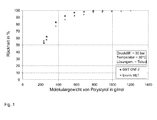
- the membrane to be used according to the invention has a gradient of the separation limit for molecular weights of more than 1000 g / mol above 97% retention and for molecular weights of less than 300 g / mol below 80% retention.
- the separation limit of a particularly suitable membrane is in FIG. 1 shown graphically.
- the separation limit was determined in an established manner with polystyrene in toluene at a separation temperature of 30 ° C. and a transmembrane pressure of 30 bar.
- the filtration of the reaction mixture according to the invention is usually a pressure-driven process. This means that along the membrane a pressure difference (transmembrane pressure difference, also called “transmembrane pressure”) is applied to force the passage of the reaction mixture through the membrane.
- transmembrane pressure is preferably 5 to 80 bar, more preferably 10 to 60 bar, in particular 30 to 40 bar.
- the temperature during filtration can be adjusted depending on the temperature stability of the membrane and the reaction mixture. It is advantageous to set the temperature as high as possible in order to reduce the viscosity of the reaction mixture and thus to accelerate the filtration.
- the filtration is preferably carried out at a temperature of 25 to 160 ° C, particularly preferably 40 to 110 ° C, in particular 60 to 90 ° C.
- the catalyst system is enriched in the retentate.
- retentate the membrane engineer understands the drainage from the membrane, which is pulled off in front of the membrane.
- the material which overcomes the membrane is called “permeate” and is withdrawn behind the membrane.
- the amount of retained catalyst can be detected by the amount of retained transition metal.
- the process according to the invention makes it possible to retain more than 50% of the transition metal in the retentate, based on the total amount of transition metal in the reaction mixture before filtration. Preferably, more than 70% of the transition metal is retained, more preferably more than 90%. If a phase transfer reagent is used, this will usually achieve a different retention than the transition metal. Nevertheless, it is enriched in the retentate. Therefore, the entire catalyst system is at least partially enriched in the retentate.
- the transition metal can be detected by ICP-MS (Inductively Coupled Plasma Mass Spectroscopy) or XRF (X-ray fluorescence analysis).
- the nitrogen is determined by an oxidative combustion analysis (at 1050 ° C in a quartz tube in an oxygen stream) followed by chemiluminescence detection of the excited NO 2 formed from NO in the presence of ozone.
- the filtration takes place in a special separation device which comprises the composite membrane according to the invention.
- the separation device is not part of the reactor in which the epoxidation reaction is carried out.
- the reaction mixture to be separated can either be withdrawn from the epoxidation reactor as a whole and fed to the separation apparatus, or a portion of the reaction mixture can be continuously removed from the epoxidation reactor and fed to the separation apparatus.
- the latter variant is particularly advantageous when the epoxidation reaction in a continuous process is carried out. It is furthermore advantageous if the retentate obtained in the filtration is returned to the epoxidation reactor.
- the composite membrane is part of the epoxidation reactor.
- the walls of the epoxidation reactor can be at least partially made of the composite membrane or the membrane is accommodated in another way directly in the reaction space. In this way, epoxidation and filtration can take place simultaneously, so that the reaction mixture freed from the catalyst containing a mixture of reaction product and educt can be continuously removed.
- a corresponding apparatus for the epoxidation of cyclic unsaturated C12 compounds with hydrogen peroxide comprising a reactor for carrying out the reaction, whose walls are at least partially provided with a separating active layer of crosslinked silicone acrylates and / or polydimethylsiloxane (PDMS) and / or polyimide, is therefore also within the scope of the invention ,
- the invention further provides a process for the synthesis of lactams (lactam process according to the invention) in which the epoxidized cyclic, unsaturated C 12 compounds obtained from the abovementioned process according to the invention for separating off a homogeneous catalyst system are used.
- the epoxidized cyclic unsaturated C12 compounds can then be hydrogenated in the presence of hydrogen and a catalyst comprising a noble metal and a metal oxide. This produces the corresponding ketone and possibly the alcohol derivative. If the ketone is in a mixture with the corresponding alcohol derivative, dehydration of the alcohol to the ketone can occur. Subsequently, the ketone can be oximated.
- the Beckmann rearrangement take place to the lactam, wherein the rearrangement can be carried out by means of sulfuric acid or cyanuric chloride.
- the lactams can be further processed to polyamides by polycondensation.
- laurolactam is prepared from monoepoxycyclododecane.
- Lactamvons Monoepoxy-cyclododecane can be obtained by the following reaction steps: 1,3-butadiene is converted by cyclotrimerization to cyclododecatriene. This is followed by hydrogenation to cyclododecene. Subsequent epoxidation gives the cyclododecane epoxide.
- a catalyst solution was prepared.
- sodium tungstate salt, concentrated phosphoric acid and water were submitted.
- the pH of the solution was adjusted to a strongly acidic value with 10% sulfuric acid.
- cyclic C12 mixtures consisting of 68.5% CDEN and 31.5% cyclododecane (CDAN) and Aliquat as phase transfer reagent were introduced together with the catalyst solution described above into a heating jacket with heating jacket.
- the reactor contents were heated to about 80 ° C. by means of a heating jacket.
- a 35% H 2 O 2 solution in water was continuously fed via a peristaltic pump. The speed of the H 2 O 2 feed was adjusted so that the internal temperature of the reactor did not rise above 85 ° C.
- a polymer membrane from Evonik MET Ltd. was tested. with an active membrane area of about 50 cm 2 .
- the active separation layer of the membrane is made of silicone acrylate and the support layer is made of polyimide.
- a portion of the organic phase from Example 1 was passed through the membrane under test at 55 ° C., a transmembrane pressure difference of 30 bar and an excess flow rate of 150 L / h.
- a polymer membrane from Evonik MET Ltd. was tested. with an active membrane area of about 80 cm 2 .
- the active separation layer of the membrane is made of silicone acrylate and the support layer is made of polyimide.
- the epoxidation of the cyclic, unsaturated C12 compounds was carried out continuously in a 3-stage stirred tank cascade.
- the stirred tank cascade used included 2 reactors with a nominal volume of 5 liters and the final stage a stirred tank with a nominal volume of 25 liters.
- the three reactors were provided with a jacket and were tempered via this to a temperature of about 80 ° C.
- the cyclic, unsaturated C12 compounds (83.8% by weight CDEN and 16.2% by weight CDAN), the catalyst components alamine, sodium tungstate and phosphoric acid and a 50% H 2 O 2 solution were added to the first reactor of the Cascade fed. In addition, a further H 2 O 2 dosage was carried out on the second reactor.
- reaction mixture consisting of two liquid phases passed from the cascade into a phase separation vessel, from which the organic phase was pumped to a continuous membrane unit.
- Chowdhury et al. use commercially unavailable Al 2 O 3 membranes with pore radii of 2.3 nm and 4.3 nm and pore diameters of 4.6 nm and 8.6 nm, respectively.
- a commercially available type of ceramic Membrane with a very low separation limit of 1 kD used to the maximum Clarify the performance of ceramic membranes. It is estimated that this type of membrane compared to that of Chowdhury et. Al used membranes a significantly smaller pore radius.
- Polymer membranes from Evonik MET Ltd. were tested. and type ONF-2 from GMT with a nominal membrane area of 0.6 m 2 with respect to the MET membrane and 0.75m 2 with respect to the ONF-2 type.
- the active separation layer of the membranes is made of silicone acrylate and the carrier layer is made of polyimide.
- Atech ceramic membranes with a separation limit of approx. 1 kD and a membrane area of 540 cm 2 were tested
- the low retention for the Atech 1 kD type shows that using ceramic membranes does not make sense for a technical implementation for the recovery of homogeneous catalysts from organic phases.
Landscapes
- Chemical & Material Sciences (AREA)
- Organic Chemistry (AREA)
- Engineering & Computer Science (AREA)
- Chemical Kinetics & Catalysis (AREA)
- Nanotechnology (AREA)
- Water Supply & Treatment (AREA)
- Materials Engineering (AREA)
- Inorganic Chemistry (AREA)
- Separation Using Semi-Permeable Membranes (AREA)
- Catalysts (AREA)
- Epoxy Compounds (AREA)
- Low-Molecular Organic Synthesis Reactions Using Catalysts (AREA)
Abstract
Description
- Die vorliegende Erfindung betrifft ein Verfahren zur Abtrennung homogener Katalysatoren aus organischen Reaktionsmischungen.
- Verfahren zur Rückgewinnung von Katalysatoren aus Reaktionsmischungen sind für die Wirtschaftlichkeit industrieller chemischer Prozesse von grundsätzlicher Bedeutung, da erst diese Verfahren die Wiederverwertung von häufig teurem Katalysatormaterial möglich machen. Die Rückgewinnung von Katalysatoren stellt den Fachmann dabei insbesondere bei der homogenen Katalyse vor besondere Herausforderungen. Da bei der homogenen Katalyse der Katalysator und die Reaktanden in derselben Phase vorliegen, ist es meist unmöglich, den Katalysator durch einfache physikalische Trennverfahren, wie beispielsweise Zentrifugation oder herkömmliche Filtration, von den Reaktanden zu trennen.
- Eine Möglichkeit zur Rückgewinnung homogener Katalysatoren bietet die Nanofiltration. Die Nanofiltration ist ein druckgetriebenes Membranverfahren, bei dem eine spezielle Membran zur Abtrennung bestimmter gelöster Komponenten aus einer flüssigen Phase dient. Die Selektivität der Membran kann dabei auf unterschiedlichen Mechanismen beruhen. Beim Größenausschlussmechanismus werden die zurückgehaltenen, gelösten Komponenten auf Grund von sterischen Effekten daran gehindert, die Membran zu durchdringen. Die Abtrennung hängt also von der Größe der gelösten Komponenten und der mittleren Porengröße der Membran ab. Meist wird die Membran dabei durch das Molekulargewicht der zurückgehaltenen Komponenten charakterisiert. Bei einem elektrostatischen Mechanismus ergibt sich die Selektivität der Membran aus der Oberflächenladung der Membran und der Ladung der gelösten Komponenten. Bei gleichem Vorzeichen der Ladung kommt es zu einer elektrostatischen Abstoßung und somit zum Rückhalt der gelösten Komponenten. Somit ist es beispielsweise auch möglich, die Nanofiltration zur Abtrennung von Schwermetallionen aus wässrigen Lösungen einzusetzen. Schließlich kann die Trennung auch darauf beruhen, dass die Membran eine eigene Phase bildet, in der sich die Bestandteile des zu trennenden Gemisches lösen. Die Trennung erfolgt dann auf Grund unterschiedlicher Löslichkeit und unterschiedlicher Diffusionsgeschwindigkeit der Komponenten. Die resultierenden Transportgeschwindigkeiten einzelner Komponenten können sich dabei so stark unterscheiden, dass diese von einander abgereichert bzw. getrennt werden. Die von einer Membran genutzten Trenneffekte sind mithin deutlich komplexer als der rein mechanisch wirkende Siebeffekt, den sich Filter zu Nutze machen.
- Die Membrantrennung findet beispielsweise Anwendung bei der Wasser- und Abwasseraufbereitung. Ein Problem bei der Anwendung der Nanofiltration in anderen Milieus ist häufig die mangelnde Stabilität der Membran in anderen als in wässrigen Lösungen. Insbesondere die Stabilität der Membran gegenüber organischen Lösungsmitteln ist oft unzureichend. Darüber hinaus macht sich die Membran zur Erledigung ihrer Trennaufgabe die unterschiedlichsten Wechselwirkungen mit dem zu trennenden Medium zu nutze. Deswegen ist die Auswahl eines für die jeweilige Trennaufgabe geeigneten Membranmaterials alles andere als trivial.
- Chowdhury et al. setzen bei der Epoxidierung von Olefinen für die Rückgewinnung von homogenen Katalysatoren aus organischen Lösungsmitteln eine Keramikmembran ein:
- S. R. Chowdhury et al., "Recovery of homogeneous polyoxometallate catalysts from aqueous and organic media by a mesoporous ceramic membrane without loss of catalytic activity", Chemistry-A European Journal, 2006, 12. Jg., Nr. 11, S. 3061-3066
- Eine Membran, die sich in besonderer Weise für den Einsatz in Gegenwart von epoxidierten cyclischen, ungesättigten C12-Verbindungen mit Wasserstoffperoxid eignet, wurde bisher nicht identifiziert.
- Es ist Aufgabe der vorliegenden Erfindung, ein Membranmaterial zur Abtrennung von homogenen Katalysatorsystemen anzugeben, das in Reaktionsgemischen zur Epoxidierung von cyclischen, ungesättigten C12-Verbindungen mit Wasserstoffperoxid eingesetzt werden kann.
-
- Ein besonderer Schwerpunkt der vorliegenden Erfindung liegt dabei auf der Abtrennung von homogenen Übergangsmetallkatalysatorsystemen, die mit Hilfe eines Phasentransferreagenz in der organischen Phase gelöst werden. Als Phasentransferreagenz kommen dabei insbesondere tertiäre und quartäre Ammoniumverbindungen zum Einsatz. Ein speziell auf dieses Katalysatorsystem abgestimmtes Nanofiltrationsverfahren ist bislang nicht bekannt.
- Umfangreiche Forschungstätigkeiten haben zu der Erkenntnis geführt, dass zur Abtrennung eines solchen Katalysatorsystems aus dem Reaktionsgemisch einer Epoxidierung von cyclischen, ungesättigten C12-Verbindungen sich solche Membranen eignen, die als trennaktive Schicht vernetzte Siliconacrylate und/oder Polydimethylsiloxan und/oder Polyimid enthalten. Diese drei Membranmaterialien können jeweils einzeln oder gemeinsam in der trennaktiven Schicht enthalten sein.
- Gegenstand der Erfindung ist mithin ein Verfahren zur Abtrennung eines homogenen Katalysatorsystems aus einem Reaktionsgemisch, bei welchem das Reaktionsgemisch an einer zumindest eine trennaktive Schicht umfassenden Membran dergestalt getrennt wird, dass das homogene Katalysatorsystem zumindest teilweise im Retentat der Membran angereichert wird, wobei das Reaktionsgemisch zumindest eine teilweise epoxidierte cyclische, ungesättigte Verbindung mit zwölf Kohlenstoffatome enthält, und die trennaktive Schicht der Membran vernetzte Siliconacrylate und/oder Polydimethylsiloxan (PDMS) und/oder Polyimid umfasst.
- Das Reaktionsgemisch umfasst zwei nicht oder schwer mischbaren flüssigen Phasen. Eine der Phasen enthält im Wesentlichen Wasser (wässrige Phase). Daneben kann diese Phase Wasserstoffperoxid, Katalysator, Phasentransferreagenz und Spuren der cyclischen, ungesättigten C12-Verbindung, der epoxidierten cyclischen, ungesättigten C12-Verbindung sowie dessen Folgeprodukt wie z.B. Diole enthalten. Die andere Phase (organische Phase) enthält typischerweise im Wesentlichen epoxidierte cyclische, ungesättigte C12-Verbindungen als Reaktionsprodukt der Epoxidierung. Daneben kann diese das Reaktionsgemisch die als Edukt eingesetzten unmodifizierten cyclischen, ungesättigten C12-Verbindungen sowie den Katalysator und das Phasentransferreagenz enthalten.
- Bevor das Reaktionsgemisch der Membran zugeführt wird, erfolgt eine Trennung der beiden flüssigen Phasen. Diese kann beispielsweise mittels Phasentrennbehälter durchgeführt werden. Insofern wird das Reaktionsgemisch nicht als zweiphasiges, sondern als einphasiges Gemisch auf die Membran gegeben. Vorzugsweise wird die nichtwässrige (organische) Phase per Membran getrennt. Der Katalysator kann auch aus der wässrige Phase mittels Membrantechnik abtrennt werden. Mithin werden wässrige und organische Phase getrennt voneinander mit einer jeweiligen Membran von Katalysator bereinigt. Für die wässrige Phase kann eine andere Membran verwendet werden als für die organische Phase. Für die wässrige Phase wird vorzugsweise eines der folgenden Membranmaterialen verwendet: Polyamide, aromatische Polyamide, Polysulfone, Polyethersulfone, hydrophobierte Polyethersulfone, sulfonierte Polyethersulfone, Celluloseactat, Polypiperazin und Polyvinylidenfluorid. Für die Auftrennung der organischen Phase sollte hingegen eine Membran auf Basis von Siliconacrylat und/oder Polydimethylsiloxan (PDMS) und/oder Polyimid verwendet werden.
- Sofern keine Phasentrennung des Reaktionsgemischs erfolgen sollte, sind dem Fachmann Maßnahmen zur Phasentrennung wie Erhöhung der Polarität der wässrigen Phase oder Änderung der Dichte einer Phase bekannt.
- Unter dem Begriff cyclische, ungesättigte C12-Verbindungen werden im Rahmen dieser Erfindung deshalb sowohl die als Edukt eingesetzten cyclischen, ungesättigten C12-Verbindungen als auch die als Produkt erhaltenen epoxidierten cyclischen, ungesättigten C12-Verbindungen zusammengefasst. Sofern das Edukt genau eine Mehrfachbindung aufweist, ist das Produkt auf Grund der Epoxidierung der Mehrfachbindung eine gesättigte Verbindung.
- Die erfindungsgemäß einsetzbaren Membranen bestehen nicht zwangsläufig ausschließlich aus den oben genannten trennaktiven Materialien, sie können auch noch weitere Materialien aufweisen. Insbesondere können die Membranen Stütz- oder Trägermaterialien aufweisen, auf denen die trennaktiven Schichten aufgebracht sind. Man spricht in einem solchen Fall von einer Verbund- oder Kompositmembran. Bei solchen Verbundmembranen liegt neben dem eigentlichen trennaktiven Material also noch ein Stützmaterial vor. Entsprechende Stützmaterialien offenbart zum Beispiel
EP 0 781 116 A1 . - Kommerziell erhältliche Membranen, die für das erfindungsgemäße Verfahren eingesetzt werden können, sind die unter der Typenbezeichnung MPF beziehungsweise SELRO erhältlichen Produkte der Firma Koch Membrane Systems, Inc., die Produkte der Firma Solsep B.V., die Produkte der Typenbezeichnung STARMEM von Grace/UOP, die Produkte der Typenbezeichnung PURAMEM und DURAMEM der Evonik Industries AG, die Produkte der Typenbezeichnung NANO-PRO von AMS Technologies Ltd. sowie die von der GMT Membrantechnik GmbH erhältlichen Membranen mit der Typenbezeichnung oNF-1, oNF-2 und NC-1.
- Mit dem erfindungsgemäßen Verfahren ist es möglich, homogene Katalysatoren zur Epoxidierung von cyclischen, ungesättigten C12-Verbindungen, nach erfolgreicher Epoxidierung direkt aus dem Reaktionsgemisch zurückzugewinnen. Dies ermöglicht eine besonders wirtschaftliche Reaktionsführung, da der zurückgewonnene Katalysator für weitere Epoxidierungsreaktionen erneut eingesetzt werden kann.
- Bei der cyclischen, ungesättigten Verbindung mit zwölf Kohlenstoffatomen handelt es sich bevorzugt um Cyclododecen (CDEN). CDEN wird beispielsweise durch selektive Hydrierung aus Cyclododecatrien gewonnen, welches wiederum aus der Trimerisierung von Butadien zugänglich ist. Durch die Epoxidierung wird Monoepoxy-Cyclododecan erhalten.
- Das erfindungsgemäße Verfahren erlaubt die Abtrennung von homogenen Epoxidierungskatalysatorsystemen wie sie aus dem Stand der Technik bekannt sind. Üblicherweise handelt es sich hierbei um Übergangsmetallkatalysatoren, insbesondere um Wolfram-, Molybdän- oder Vanadium-haltige Katalysatoren, wie sie beispielsweise in
WO 00/44704 (A1 DE 30 27 349 A1 beschrieben sind. - Das Katalysatorsystem umfasst üblicherweise ein Derivat von Wolfram, Molybdän und/oder Vanadium. Als Derivat kommt vor allem ein Oxid, ein gemischtes Oxid, eine sauerstoffhaltige Säure, ein Salz einer sauerstoffhaltigen Säure, ein Carbonylderivat, ein Sulfid, ein Chlorid, ein Oxichlorid oder ein Stearat der Elemente Wolfram, Molybdän und/oder Vanadium in Betracht.
- Geeignete Derivate sind beispielsweise die Metallcarbonyle W(CO)6 oder Mo(CO)6, die Oxide MoO2, MoO5, Mo2O3, MoO3, WO2, W2O5, WO3, VO2, V2O3, oder V2O5, die Sulfide WS2 oder WS3. Weitere Beispiele sind die Sauerstoffsäuren H2WO4 und H2MoO4 bzw. deren Alkali- oder Erdalkalisalze. Beispielsweise umfassen bekannte Epoxidierungskatalysatoren Wolframat oder Molybdat, insbesondere Natriumwolframat, Na2WO4, oder Natriummolybdat, Na2MoO4.
- Diese Verbindungen werden meist in situ in die katalytisch aktive Verbindung umgewandelt. Dies erfolgt bevorzugt durch Umsetzung mit einem Derivat von Phosphor und/oder Arsen. Besonders eignet sich hierfür ein Oxid, eine Sauerstoffsäure, ein Salz einer Sauerstoffsäure, ein Sulfid, ein Chlorid, ein Oxychlorid oder ein Fluorid von Phosphor und/oder Arsen.
- Bevorzugt umfasst der Katalysator deshalb eine katalytisch aktive Verbindung, die durch Umsetzung eines Derivats von Wolfram, Molybdän oder Vanadium mit einem Derivat von Phosphor oder Arsen erhalten wird. In einer besonders bevorzugten Ausführungsform wird die katalytisch aktive Übergangsmetallverbindung in situ durch Umsetzung von Natriumwolframat mit Phosphorsäure gebildet.
- Die beschriebenen Katalysatoren umfassen häufig ein Phasentransferreagenz, mit dessen Hilfe der an sich wasserlösliche Katalysator in die organische C12-Phase überführt werden kann.
- In einer besonders bevorzugten Ausführungsform der vorliegenden Erfindung umfasst der Katalysator demnach ein Derivat von Wolfram, Molybdän oder Vanadium in Verbindung mit einem Phasentransferreagenz.
- Als Phasentransferreagenz eignen sich hierbei insbesondere ternäre und quartäre Ammoniumverbindungen, wie sie beispielsweise in
DE 30 27 349 A1 beschrieben sind. - Als ternäre Ammoniumverbindungen werden im Rahmen dieser Erfindung organische Ammoniumverbindungen bezeichnet, bei denen drei Valenzen des Stickstoffatoms organisch gebunden sind. Darunter fallen insbesondere Verbindungen der Summenformel NR3, bei dem R organische Reste sind, Imin-Verbindungen der Formel R=NR, als auch N-alkylierte Heteroaromaten.
- Ein Beispiel für ein geeignetes Phasentransferreagenz ist das unter dem Namen Alamin erhältliche Trioctylamin. Die Octylreste können zumindest teilweise durch Decylreste ersetzt worden sein. Das Amin ist ein bevorzugtes Phasentransferreagenz dieser Erfindung.
- Als quartäre Ammoniumverbindungen werden im Rahmen dieser Erfindung organische Ammoniumverbindungen bezeichnet, bei denen alle vier Valenzen des Stickstoffatoms organisch gebunden sind. Darunter fallen insbesondere Verbindungen der Summenformel NR4 +X-, bei dem alle vier R organische Reste sind, Imin-Verbindungen der Formel R=NR2 +X-, als auch N-alkylierte Heteroaromaten, wobei X- jeweils das zugehörige Anion ist.
- Ein Beispiel für ein geeignetes Phasentransferreagenz ist das unter dem Namen Aliquat 336 erhältliche Tricaprylylmethylammoniumchlorid.
- Als weiterhin geeignete Phasentransferreagenzien für die Durchführung von Epoxidierungsreaktionen haben sich sogenannte Esterquats erwiesen. Mit dem Begriff Esterquat werden im Rahmen dieser Erfindung quartäre Ammoniumverbindungen bezeichnet, die mindestens eine Carbonsäureestergruppe aufweisen.
- In einer besonders bevorzugten Ausführungsform umfasst das Katalysatorsystem als quartäre Ammoniumverbindung deshalb ein Esterquat der Formel (I)

- Bevorzugte Gegenanionen X- sind beispielsweise Chlorid, Cl-, und Methylsulfat, CH3SO4 -.
- Die Substituenten R gemäß Formel (I) stellen unabhängig voneinander gleiche oder verschiedene Alkyl- oder Alkoholgruppen mit 1 bis 4 Kohlenstoffatomen dar, wobei mindestens einer der Substituenten R eine veresterte Alkoholgruppe darstellt. Bevorzugt handelt es sich bei den Alkoholgruppen um einwertige Alkohole. Geeignete Alkylgruppen sind insbesondere Methyl, Ethyl, Propyl, iso-Propyl, n-Butyl, iso-Butyl, sec-Butyl und tert-Butyl. Geeignete Alkohole sind insbesondere sämtliche monohydroxylierte Derivate dieser Alkylgruppen, insbesondere Hydroxymethyl, 1-Hydroxyethyl, 2-Hydroxyethyl, 1-Hydroxypropyl, 2-Hydroxypropyl, 3-Hydroxypropyl, 1-Hydroxy-1-methyl-ethyl, 2-Hydroxy-1-methyl-ethyl, 1-Hydroxybutyl, 2-Hydroxybutyl, 3-Hydroxybutyl, 4-Hydroxybutyl, 1-Hydroxy-1-methyl-propyl, 2-Hydroxy-1-methyl-propyl, 3-Hydroxy-1-methyl-propyl, 1-Hydroxymethyl-propyl und 1-Hydroxymethyl-1-methyl-ethyl.
- Als besonders geeignet haben sich dabei Ester einer quartären Ammoniumverbindung gemäß den Formeln Formeln (II) oder (III)


- Die beschriebenen Esterquats können hergestellt werden, indem die entsprechenden tertiären Alkoholamine, z.B. N-Methyldiisoproanolamin oder Triethanolamin, mit einer geeigneten Fettsäure verestert und anschließend mit einem geeigneten Alkylierungsmittel, z.B. Dimethylsulfat oder Diethylsulfat oder Methylchlorid, zu den quarternären Alkanolamninverbindungen umgesetzt werden.
- Die Esterquats der Formeln (I) bis (III) liegen in der Regel als Mischungen verschiedener Ester vor, wobei sowohl die Fettsäuregruppe als auch die Anzahl der veresterten Fettsäuregruppen pro Alkanolaminverbindung variieren können. Esterquats werden deshalb anhand ihres Veresterungsgrades charakterisiert. Dies ist die mittlere Anzahl von veresterten Fettsäuren pro Alkanolaminverbindung. Bevorzugt liegt der Veresterungsgrad im Bereich von 1 bis 2,0 besonders bevorzugt von 1,2 bis 2,0 am meisten bevorzugt von 1,5 bis 1,95. Für die Synthese eines Esterquats mit einem gewünschten Veresterungsgrad wird die Alkanolaminverbindung mit einer dem Veresterungsgrad entsprechender Stoffmenge an Fettsäure umgesetzt. Die Umsetzung der Veresterung wird anhand der Säurezahl nach der Synthese überprüft. Bei Säurezahl kleiner als 5 g KOH pro g Lösung ist die Umsetzung hinreichend vollständig.
- Bevorzugt wird eine Kompositmembran zur Abtrennung des Katalysators genutzt. Eine Kompositmembran umfasst ein Stützmaterial und ein darauf aufgebrachtes Membranmaterial als trennaktive Schicht. Das Stützmaterial unterscheidet sich mithin von dem trennaktiven Material. Es hat sich gezeigt, dass Kompositmembranen, die ein poröses Trägermaterial und eine durch Vernetzung von Siliconacrylaten oder Polydimethylsiloxanen hergestellte Schicht umfassen, sowohl äußerst beständig gegenüber dem beschriebenen Reaktionsgemisch sind, als auch zu einer hohen Ausbeute an rückgewonnenem Katalysator führen. Insbesondere eignen sich die beschriebenen Kompositmembranen zur Rückgewinnung von Katalysatoren, die ein Derivat von Wolfram, Molybdän oder Vanadium sowie die beschriebenen Esterquats als Phasentransferreagenz umfassen.
- Die Wirkung der Kompositmembran beruht dabei vermutlich darauf, dass der Transport des Katalysators durch die Membran stärker gehindert wird als die restlichen Bestandteile des Reaktionsgemisches, insbesondere die cyclischen ungesättigten C12-Verbindungen treten schneller als der Katalysator durch die Membran. Eine besondere Rolle kommt hierbei der der auf vernetzten Siliconacrylaten oder Polydimethylsiloxanen basierenden Schicht zu, die vermutlich maßgeblich für die Beeinflussung des Diffusionsverhaltens ist und deshalb auch als trennaktive Schicht bezeichnet wird. Das Stützmaterial wird bei der Trennwirkung nur eine untergeordnete Rolle spielen, seine grundsätzliche Beteiligung an der Lösung der Trennaufgabe kann aber nicht ausgeschlossen werden; dafür sind die Vorgänge an einer Membran zu komplex.
- Geeignete Kompositmembranen und deren Herstellung sind beispielsweise in
DE19507584 ,EP1741481 undWO 2011/067054 A1 beschrieben. - Besonders geeignete Membranen sind dadurch gekennzeichnet, dass es sich bei den Siliconacrylaten um Verbindungen der Formel IV handelt

- a = 1 bis 500, b = 1 bis 25 und c = 0 bis 20 ist,
- die Substituenten R1 unabhängig voneinander gleiche oder verschiedene Alkyl- oder Arylgruppen mit 1 bis 30 Kohlenstoffatomen darstellen, die gegebenenfalls mindestens eine Ether-, Ester-, Epoxy- und/oder Hydroxygruppe tragen können,
- die Substituenten R2 unabhängig voneinander gleiche oder verschiedene Substituenten aus der Gruppe R1, R3 und R4 darstellen,
- die Substituenten R3 unabhängig voneinander gleiche oder verschiedene Acrylatgruppen der Formeln V oder VI darstellen


- wobei d = 0 bis 12, e = 0 bis 1, f = 0 bis 12, g = 0 bis 2, h = 1 bis 3 und g + h = 3 ist, die Substituenten R6 unabhängig voneinander gleiche oder verschiedene Alkyl- oder Arylgruppen mit 1 bis 30 Kohlenstoffatomen oder Wasserstoff darstellen,
- die Gruppen R7 gleiche oder verschiedene zweibindige Kohlenwasserstoffreste, bevorzugt -CR6 2-, insbesondere CH2, darstellen,
- die Substituenten R4 unabhängig voneinander gleiche oder verschiedene Polyethergruppen der Formel (VII) darstellen

- wobei i = 0 bis 12, j = 0 bis 50, k = 0 bis 50 und I = 0 bis 50 ist,
- die Substituenten R8 gleiche oder verschiedene Alkyl- oder Arylgruppen mit 2 bis 30 Kohlenstoffatomen darstellen, und
- R9 eine Alkyl-, Aryl- oder Acylgruppe mit 2 bis 30 Kohlenstoffatomen oder Wasserstoff darstellt.
- Die verschiedenen Monomere der in den Formeln angegebenen Bausteine (Siloxanketten bzw. Polyoxyalkylenketten) können untereinander blockweise aufgebaut sein mit einer beliebigen Anzahl an Blöcken und einer beliebigen Sequenz oder einer statistischen Verteilung unterliegen. Die in den Formeln angegebenen Indizes sind als statistische Mittelwerte zu betrachten.
- Besonders bevorzugt wird das trennaktive Membranmaterial durch Vernetzung von Siliconacrylaten der Formel IV in mehreren Schichten aufgebaut.
- Eine solche Membran ist aus
WO 2011/067054A1 bekannt. - Ein besonders vorteilhafte Familie von Membranen lässt sich herstellen, wenn die Herstellung durch Aushärtung einer Mischung verschiedener Siliconacrylate erfolgt. Durch die Wahl der Mischung lassen sich die Eigenschaften Trenngrenze, Vernetzungsgrad und Hydrophilie nahezu stufenlose in bisher nicht gekannten Bereichen einstellen.
- Vorteilhafterweise weist die trennaktive Schicht selbst ein oder mehrere Schichten auf, welche durch Aushärtung einer Mischung verschiedener Siliconacrylate hergestellt wurden. Besonders vorteilhaft sind Mischungen bestehend aus zumindest folgenden Komponenten:
- a) ein oder mehrere Siliconacrylate mit einem Siliziumgehalt von mehr als 29 Gewichts-%, bevorzugt ein oder mehrere Siliconacrylate der Formel IV mit einem Siliziumgehalt von mehr als 29 Gewichts-%, insbesondere ein oder mehrere Siliconacrylate der Formel IV mit b=c=0 und einem Siliziumgehalt von mehr als 29 Gewichts-%, und
- b) ein oder mehrere Siliconacrylate mit einem Siliziumgehalt von weniger als 27,5 Gewichts-%, bevorzugt ein oder mehrere Siliconacrylate der Formel IV mit einem Siliziumgehalt von weniger als 27,5 Gewichts-%, insbesondere ein oder mehrere Siliconacrylate der Formel IV mit c>3 und einem Siliziumgehalt von weniger als 27,5 Gewichts-%,
- Die Komponenten a) und b) liegen bevorzugt in einem Massenverhältnis von 10 zu 1 bis 1 zu 10 vor, insbesondere im Verhältnis 2 zu 8 bis 8 zu 2.
- Verschiedene Siliconacrylate können durch ihren Siliziumanteil charakterisiert werden. Dieser ist umso kleiner, je mehr organische Substituenten an das Siloxangerüst gebunden sind und je länger diese Substituenten sind. Wird zur Beschichtung der Kompositmembran die oben beschriebene Mischung der Komponenten a) und b) eingesetzt, so werden als Komponente a) bevorzugt Siliconacrylate mit einem Siliziumgehalt von > 29 Gewichts-% und als Komponente b) bevorzugt Siliconacrylate mit einem Siliziumgehalt von < 27,5 Gewichts-% eingesetzt.
- Die Siliconacrylate der Formel IV können durch Aushärtung mit einem Photoinitiator durch elektromagnetische Strahlung mit einer Wellenlänge von < 800 nm und/oder Elektronenstrahlen erhalten werden. Insbesondere erfolgt die Aushärtung durch UV-Strahlung bei einer Wellenlänge von < 400 nm.
- Als Trägermembran eignen sich generell lösungsmittelbeständige poröse dreidimensionale Strukturen, wie z.B. Gewebevliese, Mikro- oder Ultrafiltrationsmembranen, oder Separatoren, wie z.B. Batterieseparatoren wie Separion® (Marke der Evonik Degussa GmbH) oder Solupor.
- Besonders geeignete Trägermembranen bestehen aus Polyacrylnitril, Polyimid, Polyetheretherketon, Polyvinylidenfluorid, Polyamid, Polyamidimid, Polyethersulfon, Polybenzimidazol, sulfoniertes Polyetherketon, Polyethylen, Polypropylen oder Mischungen der genannten Materialien.
- Als besonders geeignet haben sich Polyimidträgermembranen und Polyacrylnitrilträgermembranen erwiesen. Mithin wird bevorzugt eines der beiden Materialien als Trägermaterial innerhalb der Membran eingesetzt.
- Die erfindungsgemäß einzusetzende Membran kann anhand einer Trennkurve charakterisiert werden. Sie wird im Rahmen dieser Erfindung anhand der Filtration in einem Modelsystem von in Toluol gelösten Polystyrololigomeren mit definierter Molekülmasse bei einer Temperatur von 30°C und einer transmembranen Druckdifferenz von 30 bar bestimmt. Mit diesem Modelsystem erzeugte Trennkurven dienen als Anhaltspunkt für die Membranauswahl. Aufgrund der unterschiedlichen Wechselwirkungen des realen Systems mit der Membran gegenüber dem Modellsystem werden die im Modellsystem bestimmten Trenngrenzen im realen System in der Regel nur mit einer gewissen Abweichung wiedergefunden.
- Besonders bevorzugt weist die erfindungsgemäß einzusetzende Membran einen Verlauf der Trenngrenze für Molekulargewichte von mehr als 1000g/mol oberhalb von 97% Rückhalt und für Molekulargewichte von weniger als 300g/mol unterhalb von 80% Rückhalt.
- Die Trenngrenze einer besonders geeigneten Membran ist in
Figur 1 graphisch dargestellt. Dabei wurde die Trenngrenze in etablierter Weise mit Polystyrol in Toluol bei einer Trenntemperatur von 30°C und einem Transmembrandruck von 30 bar ermittelt. - Die erfindungsgemäße Filtration des Reaktionsgemisches ist in der Regel ein druckgetriebener Prozess. Das bedeutet, dass entlang der Membran eine Druckdifferenz (transmembrane Druckdifferenz, auch "Transmembrandruck" genannt) angelegt wird, um den Durchtritt des Reaktionsgemisches durch die Membran zu forcieren. Bevorzugt beträgt der Transmebrandruck 5 bis 80 bar, besonders bevorzugt 10 bis 60 bar, insbesondere 30 bis 40 bar.
- Die Temperatur während der Filtration kann in Abhängigkeit von der Temperaturstabilität der Membran und der Reaktionsmischung angepasst werden. Es ist von Vorteil, die Temperatur so hoch wie möglich zu wählen, um die Viskosität der Reaktionsmischung zu reduzieren und somit die Filtration zu beschleunigen. Bevorzugt wird die Filtration bei einer Temperatur von 25 bis 160 °C durchgeführt, besonders bevorzugt 40 bis 110 °C, insbesondere 60 bis 90°C.
- Mit dem erfindungsgemäßen Verfahren wird das Katalysatorsystem im Retentat angereichert. Unter "Retentat" versteht der Membrantechniker den Abfluss von der Membran, der vor der Membran abgezogen wird. Das Material, welches die Membran überwindet, wird "Permeat" genannt und hinter der Membran abgezogen. Die Menge an zurückgehaltenem Katalysator kann dabei anhand der Menge an zurückgehaltenem Übergangsmetall nachgewiesen werden. Das erfindungsgemäße Verfahren erlaubt es insbesondere, mehr als 50 % des Übergangsmetalls, bezogen auf die Gesamtmenge an Übergangsmetall im Reaktionsgemisch vor der Filtration, im Retentat zurückzuhalten. Bevorzugt werden mehr als 70 % des Übergangsmetalls zurückgehalten, besonders bevorzugt mehr als 90 %. Falls ein Phasentransferreagenz eingesetzt wird, wird dieses in der Regel einen anderen Rückhalt erzielen als das Übergangsmetall. Dennoch wird es im Retentat angereichert. Deswegen wird das gesamte Katalysatorsystem zumindest teilweise im Retentat angereichert. Das Übergangsmetall kann durch ICP-MS (Massenspektroskopie mit induktiv gekoppeltem Plasma) oder RFA (Röntgenfluoreszenzanalyse) nachgewiesen werden.
- Die Bestimmung von Wolfram und Phosphor erfolgt mittels ICP-OES mit einem Spektrometer der Firma Agilent. Da nur saure, wässrige Lösungen vermessen werden können, müssen die Proben vorher mittels Mikrowellenaufschluss (UltraClave der Firma MLS) aufgeschlossen werden.
- Die Stickstoffbestimmung erfolgt durch eine oxidative Verbrennungsanalyse (bei 1050°C im Quarzrohr im Sauerstoffstrom) mit anschließender Chemolumineszenz-Detektion des aus NO in Gegenwart von Ozon gebildeten angeregten NO2.
- In einer Ausführungsform des Verfahrens findet die Filtration in einer speziellen Trennvorrichtung statt, welche die erfindungsgemäße Kompositmembran umfasst. Dabei ist die Trennvorrichtung nicht Teil des Reaktors, in dem die Epoxidierungsreaktion durchgeführt wird. Das zu trennende Reaktionsgemisch kann entweder als Ganzes aus dem Epoxidierungsreaktor entnommen und der Trennvorrichtung zugeführt werden, oder es kann kontinuierlich ein Teil des Reaktionsgemisches dem Epoxidierungsreaktor entnommen und der Trennvorrichtung zugeführt werden. Letztere Variante ist insbesondere von Vorteil, wenn die Epoxidierungsreaktion in einem kontinuierlichen Prozess durchgeführt wird. Es ist weiterhin von Vorteil, wenn dass bei der Filtration gewonnene Retentat wieder dem Epoxidierungsreaktor zugeführt wird.
- In einer alternativen Ausführungsform ist die Kompositmembran Teil des Epoxidierungsreaktors. Beispielsweise können die Wände des Epoxidierungsreaktors zumindest teilweise aus der Kompositmembran gefertigt sein oder die Membran ist auf eine andere Weise direkt im Reaktionsraum untergebracht. Auf diese Weise können Epoxidierung und Filtration gleichzeitig stattfinden, so dass das vom Katalysator befreite Reaktionsgemisch enthaltend eine Mischung aus Reaktionsprodukt und Edukt kontinuierlich abgeführt werden kann. Eine entsprechende Vorrichtung zur Epoxidierung von cyclischen ungesättigten C12-Verbindungen mit Wasserstoffperoxid umfassend einen Reaktor zur Durchführung der Reaktion, dessen Wände zumindest teilweise mit einer trennaktiven Schicht aus vernetzten Siliconacrylate und/oder Polydimethylsiloxan (PDMS) und/oder Polyimid versehen sind, ist daher ebenfalls erfindungsgegenständlich.
- Ebenso erfindungsgegenständlich ist die Verwendung einer solchen Vorrichtung zur gleichzeitigen Durchführung einer Epoxidierung von cyclischen ungesättigten C12-Verbindungen mit der entsprechenden Katalysatorabtrennung an der in die Wand integrierten Membran.
- Ein weiterer Gegenstand der Erfindung ist ein Verfahren zur Synthese von Lactamen (erfindungsgemäßes Lactamverfahren), bei dem die epoxidierte cyclische, ungesättigte C12-Verbindungen, erhalten aus dem zuvor genannten erfindungsgemäßen Verfahren zur Abtrennung eines homogenen Katalysatorsystems, herangezogen wird.
- Die epoxidierten cyclischen, ungesättigten C12-Verbindungen können im Anschluss in Anwesenheit von Wasserstoff und einem Katalysator umfassend ein Edelmetall und ein Metalloxid hydriert werden. Hierbei entsteht das entsprechende Keton sowie ggf. das Alkohol-Derivat. Sofern das Keton in einem Gemisch mit dem entsprechenden Alkohol-Derivat vorliegt, kann eine Dehydrierung des Alkohols zum Keton erfolgen. Anschließend kann das Keton oximiert werden. Im Folgeschritt kann die Beckmann-Umlagerung zum Lactam erfolgen, wobei die Umlagerung mittels Schwefelsäure oder Cyanurchlorid erfolgen kann. Die Lactame können unter Polykondensation zu Polyamiden weiterverarbeitet werden.
- Die Hydrierung, die Dehydrierung, die Oximierung, die Beckmann-Umlagerung sowie die Kondensationsreaktion sind dem Fachmann bekannt.
- In einer bevorzugten Ausführungsform des erfindungsgsgemäßen Lactamverfahrens wird aus Monoepoxy-cyclododecan Laurinlactam hergestellt.
- Im Rahmen des bevorzugten Lactamverfahrens kann Monoepoxy-cyclododecan gewonnen werden durch folgende Reaktionsschritte: 1,3-Butadien wird durch Cyclotrimerisation zu Cyclododecatrien umgesetzt. Anschließend erfolgt eine Hydrierung zum Cyclododecen. Durch nachfolgende Epoxidierung wird das Cyclododecanepoxid erhalten.
- In einem ersten Schritt wurde eine Katalysatorlösung angesetzt. Hierzu wurden Natriumwolframat-Salz, konzentrierte Phosphorsäure sowie Wasser vorgelegt. Der pH-Wert der Lösung wurde mit 10%iger Schwefelsäure auf einen stark sauren Wert eingestellt. Im nächsten Schritt wurden in einen Rührkessel mit Heizmantel cyclisches C12-Gemsich, bestehend aus 68,5% CDEN und 31,5% Cyclododecan (CDAN) und Aliquat als Phasentransferreagenz zusammen mit der oben beschriebenen Katalysatorlösung eingefüllt. Der Reaktorinhalt wurde über Heizmantel auf etwa 80°C temperiert. Anschließend wurde eine 35%ige H2O2-Lösung in Wasser über eine Schlauchpumpe kontinuierlich zugeführt. Die Geschwindigkeit der H2O2 Zufuhr wurde dabei so eingestellt, dass die Reaktorinnentemperatur nicht über 85°C anstieg.
- Nach Dosierung der H2O2-Lösung wurde das Gemisch mehrere Stunden bei einer Temperatur von etwa 80°C gerührt und anschließend nach Ausstellen des Rührer die Phasen getrennt. Die organische Phase wurde für den folgenden Membranfiltrationsversuch genutzt.
- Ein Teil der organischen Phase wurde bei 23°C und einer transmembranen Druckdifferenz von 39 bar in einer Testzelle über der getesteten Membran gerührt.
- Getestet wurde eine Polymermembran von Evonik MET Ltd. mit einer aktiven Membranfläche von ca. 50 cm2.
- Die aktive Trennschicht der Membran besteht aus Siliconacrylat und die Trägerschicht besteht aus Polyimid.
- Nach einer Versuchsdauer von ca. 2,5 Stunden ergab sich ein Permeatfluss von 4,0 kg/(m2h). Über Proben von Retentat und Permeat wurde ein sehr hoher Wolfram-Membranrückhalt von 99,8% und ein Stickstoff-Membranrückhalt von 95,8% ermittelt.
- Ein Teil der organischen Phase aus Beispiels 1 wurde mit 55°C, einer transmembranen Druckdifferenz von 30 bar und einer Überströmung von 150 L/h über die getestete Membran geführt.
- Getestet wurde eine Polymermembran von Evonik MET Ltd. mit einer aktiven Membranfläche von ca. 80 cm2. Die aktive Trennschicht der Membran besteht aus Siliconacrylat und die Trägerschicht besteht aus Polyimid.
- Nach einer Versuchsdauer von ca. 120 Stunden ergab sich ein Permeatfluss von 5,1 kg/(m2h). Über Proben von Retentat und Permeat wurde ein sehr hoher Wolfram-Membranrückhalt von 99,98% und ein Stickstoff-Membranrückhalt von 87,2% ermittelt.
- In dem Beispiel wurde die Epoxidierung der cyclischen, ungesättigten C12-Verbindungen in einer 3-stufigen Rührkesselkaskade kontinuierlich durchgeführt. Die verwendete Rührkesselkaskade beinhaltete 2 Reaktoren mit einem Nennvolumen von 5 Litern und als letzte Stufe einen Rührkessel mit einem Nennvolumen von 25 Litern. Die drei Reaktoren waren mit einem Mantel versehen und wurden über diese auf eine Temperatur von etwa 80°C temperiert.
- Die cyclischen, ungesättigten C12-Verbindungen (83,8 Gew.-% CDEN und 16,2 Gew.-% CDAN), die Katalysatorkomponenten Alamin, Natriumwolframat und Phosphorsäure und eine 50 %ige H2O2-Lösung wurden dem ersten Reaktor der Kaskade zugeführt. Zusätzlich erfolgte eine weitere H2O2-Dosierung auf den 2. Reaktor.
- Das aus zwei flüssigen Phasen bestehende Reaktionsgemisch gelangte von der Kaskade in einen Phasentrennbehälter aus dem die organische Phase mittels Pumpe einer kontinuierlichen Membrananlage zugeführt wurde.
- Membranfiltration (organische Phase mit MET-Membran , GMT ONF-2, Atech 1 kD) Die organischen Phase wurde mit 45°C, einer transmembranen Druckdifferenz von 41,5 bar und einer Überströmung von ca. 300 L/h über die getestete Membranen MET und GMT ONF-2 geführt. Bei der zusätzlich eingesetzten Keramikmembran Atech 1 kD geschah dies mit ca. 600 L/h.
- Chowdhury et al. nutzen für ihre Versuche kommerziell nicht verfügbare Al2O3 Membranen mit Porenradien von 2,3 nm und 4,3 nm bzw. Porendurchmessern von 4,6 nm und 8,6 nm. Für das Beispiel 3 wurde deswegen ein kommerziell verfügbarer Typ Keramik-Membran mit einer besonders niedrigen Trenngrenze von 1 kD genutzt, um die maximale Leistungsfähigkeit von keramischen Membranen zu verdeutlichen. Schätzungsweise hat dieser Membrantyp im Vergleich zu den von Chowdhury et. Al genutzten Membranen einen deutlich kleineren Porenradius.
- Getestet wurden Polymermembranen von Evonik MET Ltd. und vom Typ ONF-2 von GMT mit einer nominalen Membranfläche von 0,6 m2 bezogen auf die MET-Membran und 0,75m2 bezogen auf den Typ ONF-2. Die aktive Trennschicht der Membranen besteht aus Siliconacrylat und die Trägerschicht besteht aus Polyimid. Des Weiteren wurden Atech Keramikmembranen mit einer Trenngrenze von ca. 1 kD und einer Membranfläche von 540 cm2 getestet
- Für die oben genannten Einstellungen, ergaben sich die folgenden Prozessdaten:
Membran Permeatfluss Membranrückhalt Wolfram Membranrückhalt Stickstoff MET-Membran 2,2 kg/(m2*h) 99,9 % 73,4 % ONF-2 2,3 kg/(m2*h) 99,9 % 74,5 % Atech 1 kD 4,4 kg/(m2*h) 56,2 % 25,5 % - Die niedrigen Rückhalte für den Typ Atech 1 kD zeigen, dass mit keramischen Membranen eine technische Umsetzung zur Rückgewinnung homogener Katalysatoren aus organischen Phasen nicht sinnvoll ist.
Claims (15)
- Verfahren zur Abtrennung eines homogenen Katalysatorsystems aus einem Reaktionsgemisch, bei welchem das Reaktionsgemisch zwei flüssige Phasen umfasst, wobei eine dieser Phasen an einer zumindest eine trennaktive Schicht umfassenden Membran dergestalt getrennt wird, dass das homogene Katalysatorsystem zumindest teilweise im Retentat der Membran angereichert wird, dadurch gekennzeichnet, dass das Reaktionsgemisch zumindest eine teilweise epoxidierte cyclische ungesättigte Verbindung mit zwölf Kohlenstoffatomen enthält, und dass die trennaktive Schicht der Membran vernetzte Siliconacrylate und/oder Polydimethylsiloxan (PDMS) und/oder Polyimid umfasst.
- Verfahren nach Anspruch 1, dadurch gekennzeichnet, dass die zwei Phasen eine organische Phase enthaltend die zumindest teilweise epoxidierte cyclische, ungesättigte Verbindung mit zwölf Kohlenstoffatomen sowie eine wässrige Phase umfasst.
- Verfahren nach Anspruch 2, dadurch gekennzeichnet, dass die wässrige Phase Wasserstoffperoxid enthält.
- Verfahren nach einem der vorhergehenden Ansprüche, dadurch gekennzeichnet, dass es sich bei der cyclischen ungesättigten Verbindung mit zwölf Kohlenstoffatomen um Cyclododecen handelt.
- Verfahren nach einem der vorhergehenden Ansprüche, dadurch gekennzeichnet, dass das Katalysatorsystem ein Derivat von Wolfram, Molybdän oder Vanadium in Verbindung mit einem Phasentransferreagenz umfasst.
- Verfahren nach Anspruch 4, dadurch gekennzeichnet, dass das Phasentransferreagenz eine tertiäre oder quartäre Ammoniumverbindung ist.
- Verfahren nach Anspruch 5, dadurch gekennzeichnet, dass die quartäre Ammoniumverbindung ein Esterquat der Formel (I) ist

- Verfahren nach Anspruch 5, dadurch gekennzeichnet, dass die quartäre Ammoniumverbindung ein Ester einer quartären Ammoniumverbindung gemäß den Formeln Formeln (II) oder (III)

- Verfahren nach einem der vorhergehenden Ansprüche, dadurch gekennzeichnet, dass es sich bei den Siliconacrylaten um Verbindungen der Formel IV handelt
 a = 1 bis 500, b = 1 bis 25 und c = 0 bis 20 ist,die Substituenten R1 unabhängig voneinander gleiche oder verschiedene Alkyl-oder Arylgruppen mit 1 bis 30 Kohlenstoffatomen darstellen, die gegebenenfalls mindestens eine Ether-, Ester-, Epoxy- und/oder Hydroxygruppe tragen können, die Substituenten R2 unabhängig voneinander gleiche oder verschiedene Substituenten aus der Gruppe R1, R3 und R4 darstellen,die Substituenten R3 unabhängig voneinander gleiche oder verschiedene Acrylatgruppen der Formeln V oder VI darstellen
 wobei d = 0 bis 12, e = 0 bis 1, f = 0 bis 12, g = 0 bis 2, h = 1 bis 3 und g + h = 3 ist,die Substituenten R6 unabhängig voneinander gleiche oder verschiedene Alkyl-oder Arylgruppen mit 1 bis 30 Kohlenstoffatomen oder Wasserstoff darstellen, die Gruppen R7 gleiche oder verschiedene zweibindige Kohlenwasserstoffreste, bevorzugt -CR6 2-, insbesondere CH2, darstellen,die Substituenten R4 unabhängig voneinander gleiche oder verschiedene Polyethergruppen der Formel (VII) darstellen
 wobei i = 0 bis 12, j = 0 bis 50, k = 0 bis 50 und I = 0 bis 50 ist,die Substituenten R8 gleiche oder verschiedene Alkyl- oder Arylgruppen mit 2 bis 30 Kohlenstoffatomen darstellen, undR9 eine Alkyl-, Aryl- oder Acylgruppe mit 2 bis 30 Kohlenstoffatomen oder Wasserstoff darstellt.
 - Verfahren nach einem der vorhergehenden Ansprüche, dadurch gekennzeichnet, dass die trennaktive Schicht auf einem Trägermaterial ausgewählt aus Polyacrylnitril, Polyimid, Polyetheretherketon, Polyvinylidenfluorid, Polyamid, Polyamidimid, Polyethersulfon, Polybenzimidazol, sulfoniertes Polyetherketon, Polyethylen, Polypropylen oder Mischungen daraus aufgebaut ist.
- Verfahren nach einem der vorhergehenden Ansprüche, dadurch gekennzeichnet, dass bei der Trennung ein Transmembrandruck von 5 bis 80 bar angelegt wird.
- Verfahren nach einem der vorhergehenden Ansprüche, dadurch gekennzeichnet, dass die Trennung bei einer Temperatur von 25 bis 160 °C durchgeführt wird.
- Vorrichtung zur Epoxidierung von cyclischen, ungesättigten C12-Verbindungen mit Wasserstoffperoxid umfassend einen Reaktor zur Durchführung der Reaktion, dadurch gekennzeichnet, dass die Wände des Reaktors zumindest teilweise mit einer trennaktiven Schicht aus vernetzten Siliconacrylate und/oder Polydimethylsiloxan (PDMS) versehen sind.
- Verwendung einer Vorrichtung nach Anspruch 13 zur gleichzeitigen Durchführung einer Epxoxidierung von cyclischen, ungesättigten C12-Verbindungen mit Wasserstoffperoxid und einem Verfahren nach einem der Ansprüche 1 bis 12.
- Verfahren zur Synthese von Lactamen, bei dem die epoxidierte cyclische ungesättigte Verbindung mit zwölf Kohlenstoffatomen, erhalten aus dem Verfahren gemäß einem der Ansprüche 1 bis 12 herangezogen wird.
Applications Claiming Priority (1)
| Application Number | Priority Date | Filing Date | Title |
|---|---|---|---|
| DE102014209421.6A DE102014209421A1 (de) | 2014-05-19 | 2014-05-19 | Membrangestützte Katalysatorabtrennung bei der Epoxidierung von cyclischen, ungesättigten C12-Verbindungen zum Beispiel Cyclododecen (CDEN) |
Publications (3)
| Publication Number | Publication Date |
|---|---|
| EP2946831A2 true EP2946831A2 (de) | 2015-11-25 |
| EP2946831A3 EP2946831A3 (de) | 2015-12-09 |
| EP2946831B1 EP2946831B1 (de) | 2019-02-20 |
Family
ID=52991567
Family Applications (1)
| Application Number | Title | Priority Date | Filing Date |
|---|---|---|---|
| EP15164248.5A Active EP2946831B1 (de) | 2014-05-19 | 2015-04-20 | Membrangestützte katalysatorabtrennung bei der epoxidierung von cyclischen, ungesättigten c12-verbindungen zum beispiel cyclododecen (cden) |
Country Status (7)
| Country | Link |
|---|---|
| US (2) | US9643153B2 (de) |
| EP (1) | EP2946831B1 (de) |
| JP (1) | JP6045632B2 (de) |
| CN (1) | CN105080342B (de) |
| DE (1) | DE102014209421A1 (de) |
| ES (1) | ES2724585T3 (de) |
| SG (1) | SG10201503934QA (de) |
Cited By (3)
| Publication number | Priority date | Publication date | Assignee | Title |
|---|---|---|---|---|
| EP3263557A1 (de) | 2016-06-30 | 2018-01-03 | Evonik Degussa GmbH | Verfahren zur reaktivierung eines homogenen oxidationskatalysators |
| WO2026093374A1 (en) | 2024-10-30 | 2026-05-07 | Evonik Operations Gmbh | Method for reactivating a homogeneous catalyst system for an oxidation reaction |
| WO2026093375A1 (en) | 2024-10-30 | 2026-05-07 | Evonik Operations Gmbh | Method for concentrating a homogeneous catalyst system in an organic phase |
Families Citing this family (7)
| Publication number | Priority date | Publication date | Assignee | Title |
|---|---|---|---|---|
| AU2015237373B2 (en) * | 2014-03-26 | 2019-11-21 | Hydroxsys Holdings Limited | Durable asymmetric composite membrane |
| US11291215B2 (en) | 2014-03-26 | 2022-04-05 | Hydroxsys Holdings Limited | Durable asymmetric composite membranes and modified substrates used in their preparation |
| EP3498361A1 (de) | 2017-12-18 | 2019-06-19 | Evonik Degussa GmbH | Verfahren zur herstellung von temperaturstabilen polyalkenameren |
| EP3546495A1 (de) | 2018-03-29 | 2019-10-02 | Evonik Degussa GmbH | Verfahren zur herstellung von temperaturstabilen polyalkenameren |
| EP3578539A1 (de) | 2018-06-07 | 2019-12-11 | Evonik Operations GmbH | Verfahren zur kontinuierlichen herstellung von ketonen aus epoxiden im festbett |
| KR102528919B1 (ko) * | 2018-12-19 | 2023-05-08 | 한화솔루션 주식회사 | 사이클로도데카논의 제조방법 |
| DE202019001414U1 (de) | 2019-02-01 | 2019-04-12 | Evonik Canada Inc. | Vorrichtung zum Trennen von Gaskomponenten aus einem Gasstrom mit veränderlicher Zusammensetzung oder Strömungsrate |
Citations (9)
| Publication number | Priority date | Publication date | Assignee | Title |
|---|---|---|---|---|
| DE3027349A1 (de) | 1979-07-19 | 1981-02-12 | Donegani Guido Ist | Verfahren zur katalytischen epoxydation von olefinen |
| DE19507584A1 (de) | 1995-03-04 | 1996-09-12 | Geesthacht Gkss Forschung | Strahlenchemisch modifizierte Silikonkompositmembran für die Ultrafiltration |
| EP0781116A1 (de) | 1994-09-12 | 1997-07-02 | Advanced Tissue Sciences, Inc. | Dreidimensionale kulturen von menschlichen zellen auf herzklappengerüst und ihreverwendung |
| WO2000044704A1 (fr) | 1999-01-28 | 2000-08-03 | Novance | Procede d'epoxidation ou de dihydroxylation d'acides gras unsatures |
| EP1205474A2 (de) | 2000-11-08 | 2002-05-15 | Degussa AG | Verfahren zur Epoxidation von cis-ständigen Doppelbindungen |
| EP1411050A1 (de) | 2002-10-11 | 2004-04-21 | Degussa AG | Verfahren zur Epoxidierung cyclischer Alkene |
| EP1411051A1 (de) | 2002-10-11 | 2004-04-21 | Degussa AG | Verwendung eines Absetzbeschleunigers zur verbesserten Phasentrennung bei heterogenen Epoxidierungsreaktionen cyclischer Alkene |
| EP1741481A2 (de) | 2005-07-05 | 2007-01-10 | Gkss-Forschungszentrum Geesthacht Gmbh | Kompositmembran |
| WO2011067054A1 (de) | 2009-12-01 | 2011-06-09 | Evonik Goldschmidt Gmbh | Komposit-siliconmembranen mit hoher trennwirkung |
Family Cites Families (14)
| Publication number | Priority date | Publication date | Assignee | Title |
|---|---|---|---|---|
| IT1122214B (it) * | 1979-07-19 | 1986-04-23 | Donegani Guido Ist | Processo per l'epossidazione catalitica di olefine con acqua ossigenata |
| JP3160937B2 (ja) * | 1991-05-10 | 2001-04-25 | ライオン株式会社 | 液体柔軟剤組成物 |
| US6043383A (en) * | 1998-04-14 | 2000-03-28 | Ube Industries, Ltd. | Process for producing 1,2-epoxy-5,9-cyclododecadiene |
| GB2369311B (en) * | 2000-11-24 | 2002-12-11 | Membrane Extraction Tech Ltd | Separating phase transfer agents |
| ES2410810T5 (es) * | 2002-01-16 | 2022-02-18 | Ube Industries | Procesos para producir laurolactama a partir de ciclododecanona |
| ES2276991T3 (es) | 2003-03-08 | 2007-07-01 | Degussa Gmbh | Hidrogenacion selectiva de ciclododecatrieno para dar ciclododeceno. |
| JP2010138522A (ja) * | 2008-12-12 | 2010-06-24 | Kao Corp | 柔軟剤組成物 |
| DE102009001225A1 (de) | 2009-02-27 | 2010-09-02 | Evonik Oxeno Gmbh | Verfahren zur Anreicherung eines Homogenkatalysators aus einem Prozessstrom |
| JP2012131732A (ja) * | 2010-12-21 | 2012-07-12 | Tosoh Corp | ジクロロエポキシブタンの製造方法 |
| DE102011082441A1 (de) | 2011-09-09 | 2013-03-14 | Evonik Oxeno Gmbh | Strahlschlaufenreaktor mit Nanofiltration |
| WO2013068443A1 (en) * | 2011-11-09 | 2013-05-16 | Sondboe Sverre | Membrane-based processes for reducing at least one impurity and making a concentrate comprising at least one natural component from a non-marine fatty acid oil mixture, and compositions resulting thereof |
| WO2014083952A1 (ja) | 2012-11-28 | 2014-06-05 | シャープ株式会社 | 構造体 |
| DE102013208759A1 (de) | 2013-05-13 | 2014-11-13 | Evonik Industries Ag | Abtrennung von Homogenkatalysatoren mittels einer geregelten Membrantrenneinheit |
| DE102013215004A1 (de) | 2013-07-31 | 2015-02-05 | Evonik Industries Ag | Membrankaskade mit sinkender Trenntemperatur |
-
2014
- 2014-05-19 DE DE102014209421.6A patent/DE102014209421A1/de not_active Withdrawn
-
2015
- 2015-04-20 ES ES15164248T patent/ES2724585T3/es active Active
- 2015-04-20 EP EP15164248.5A patent/EP2946831B1/de active Active
- 2015-05-18 CN CN201510252921.1A patent/CN105080342B/zh active Active
- 2015-05-18 US US14/714,985 patent/US9643153B2/en active Active
- 2015-05-19 SG SG10201503934QA patent/SG10201503934QA/en unknown
- 2015-05-19 JP JP2015101792A patent/JP6045632B2/ja active Active
-
2016
- 2016-12-19 US US15/382,991 patent/US20170095789A1/en not_active Abandoned
Patent Citations (9)
| Publication number | Priority date | Publication date | Assignee | Title |
|---|---|---|---|---|
| DE3027349A1 (de) | 1979-07-19 | 1981-02-12 | Donegani Guido Ist | Verfahren zur katalytischen epoxydation von olefinen |
| EP0781116A1 (de) | 1994-09-12 | 1997-07-02 | Advanced Tissue Sciences, Inc. | Dreidimensionale kulturen von menschlichen zellen auf herzklappengerüst und ihreverwendung |
| DE19507584A1 (de) | 1995-03-04 | 1996-09-12 | Geesthacht Gkss Forschung | Strahlenchemisch modifizierte Silikonkompositmembran für die Ultrafiltration |
| WO2000044704A1 (fr) | 1999-01-28 | 2000-08-03 | Novance | Procede d'epoxidation ou de dihydroxylation d'acides gras unsatures |
| EP1205474A2 (de) | 2000-11-08 | 2002-05-15 | Degussa AG | Verfahren zur Epoxidation von cis-ständigen Doppelbindungen |
| EP1411050A1 (de) | 2002-10-11 | 2004-04-21 | Degussa AG | Verfahren zur Epoxidierung cyclischer Alkene |
| EP1411051A1 (de) | 2002-10-11 | 2004-04-21 | Degussa AG | Verwendung eines Absetzbeschleunigers zur verbesserten Phasentrennung bei heterogenen Epoxidierungsreaktionen cyclischer Alkene |
| EP1741481A2 (de) | 2005-07-05 | 2007-01-10 | Gkss-Forschungszentrum Geesthacht Gmbh | Kompositmembran |
| WO2011067054A1 (de) | 2009-12-01 | 2011-06-09 | Evonik Goldschmidt Gmbh | Komposit-siliconmembranen mit hoher trennwirkung |
Non-Patent Citations (2)
| Title |
|---|
| ANGEW. CHEM., vol. 103, 1991, pages 1706 - 1709 |
| S. R. CHOWDHURY ET AL.: "Recovery of homogeneous polyoxometallate catalysts from aqueous and organic media by a mesoporous ceramic membrane without loss of catalytic activity", CHEMISTRY-A EUROPEAN JOURNAL, vol. 12, no. 11, 2006, pages 3061 - 3066, XP055200347, DOI: doi:10.1002/chem.200501021 |
Cited By (5)
| Publication number | Priority date | Publication date | Assignee | Title |
|---|---|---|---|---|
| EP3263557A1 (de) | 2016-06-30 | 2018-01-03 | Evonik Degussa GmbH | Verfahren zur reaktivierung eines homogenen oxidationskatalysators |
| WO2018002114A1 (de) | 2016-06-30 | 2018-01-04 | Evonik Degussa Gmbh | Verfahren zur reaktivierung eines homogenen oxidationskatalysators |
| US10994270B2 (en) | 2016-06-30 | 2021-05-04 | Evonik Operations Gmbh | Method for reactivation of a homogeneous oxidation catalyst |
| WO2026093374A1 (en) | 2024-10-30 | 2026-05-07 | Evonik Operations Gmbh | Method for reactivating a homogeneous catalyst system for an oxidation reaction |
| WO2026093375A1 (en) | 2024-10-30 | 2026-05-07 | Evonik Operations Gmbh | Method for concentrating a homogeneous catalyst system in an organic phase |
Also Published As
| Publication number | Publication date |
|---|---|
| SG10201503934QA (en) | 2015-12-30 |
| JP6045632B2 (ja) | 2016-12-14 |
| EP2946831A3 (de) | 2015-12-09 |
| EP2946831B1 (de) | 2019-02-20 |
| CN105080342B (zh) | 2018-03-13 |
| DE102014209421A1 (de) | 2015-11-19 |
| US20150328619A1 (en) | 2015-11-19 |
| ES2724585T3 (es) | 2019-09-12 |
| US20170095789A1 (en) | 2017-04-06 |
| CN105080342A (zh) | 2015-11-25 |
| JP2015217388A (ja) | 2015-12-07 |
| US9643153B2 (en) | 2017-05-09 |
Similar Documents
| Publication | Publication Date | Title |
|---|---|---|
| EP2946831B1 (de) | Membrangestützte katalysatorabtrennung bei der epoxidierung von cyclischen, ungesättigten c12-verbindungen zum beispiel cyclododecen (cden) | |
| EP2603543B1 (de) | Verfahren zur herstellung von polyetheralkoholen | |
| EP3374353B1 (de) | Verfahren zur reaktivierung eines homogenen oxidationskatalysators | |
| EP2817284B1 (de) | Verfahren und vorrichtung zur hydroformylierung von isobuten und zum auftrennen des produktgemisches | |
| EP2027180A1 (de) | Verfahren zur herstellung von polyetherpolyolen | |
| EP2356088A1 (de) | Verfahren zur herstellung von acrolein umfassend die aufarbeitung einer rohglycerin-phase | |
| EP2055383B1 (de) | Verwendung amphoterer Ionenaustauscher | |
| DE10312916A1 (de) | Verfahren zur Abtrennung von 2-Butanol aus tert.-Butanol/Wasser-Gemischen | |
| DE10137401A1 (de) | Synthese von TMBQ mit Übergangsmetall beinhaltendem Molekularsieb als Katalysator | |
| WO2015177009A2 (de) | Membrangestützte katalysatorabtrennung bei der epoxidierung von fettsäurealkylestern | |
| EP2984067B1 (de) | Verfahren zur herstellung von di- und polyaminen der diphenylmethanreihe | |
| DE3236496C2 (de) | Verfahren zur extraktiven Abtrennung polarer organischer Verbindungen aus deren wäßrigen Lösungen | |
| DE4333642C2 (de) | Verfahren zur Herstellung von 2-Alkyl-5-formylimidazolen | |
| DE60317652T2 (de) | Verfahren zur Reinigung von Polyetherpolyolen | |
| DE60104699T2 (de) | Verfahren zur herstellung von cyclohexanonoxim | |
| EP2586519A1 (de) | Aufarbeitung von belastetem Abwasser aus der Produktion von Pflanzenschutzmitteln | |
| DE69417720T2 (de) | Verfahren zur herstellung von diolen | |
| DE2702294A1 (de) | Verfahren zur herstellung von polyphenylenoxiden | |
| DE4030831A1 (de) | Polyol-polyether mit hohem gehalt an ethylenoxid und niedriger viskositaet | |
| DE69602947T2 (de) | Anwendung von dendrimeren makromolekülen als katalysatoren oder verarbeitungshilfstoffe für phasenübertragungsreaktionen | |
| EP2984069B1 (de) | Verfahren zur herstellung von di- und polyaminen der diphenylmethanreihe | |
| EP0982284A2 (de) | Verfahren zum Trennen von Trimethylolpropan von wasserlöslichen Salzen aus einer Lösung | |
| EP0545162B1 (de) | Verfahren zur Abtrennung organischer Phosphorverbindungen und weiterer Verunreinigungen aus verdünnter Schwefelsäure | |
| WO1999033774A1 (de) | Verfahren zur herstellung von alkylenglykol mit niedrigem gehalt an carbonylverbindungen | |
| WO1999038825A1 (de) | Verfahren zur herstellung von alkylenglykol |
Legal Events
| Date | Code | Title | Description |
|---|---|---|---|
| PUAL | Search report despatched |
Free format text: ORIGINAL CODE: 0009013 |
|
| PUAI | Public reference made under article 153(3) epc to a published international application that has entered the european phase |
Free format text: ORIGINAL CODE: 0009012 |
|
| 17P | Request for examination filed |
Effective date: 20150420 |
|
| AK | Designated contracting states |
Kind code of ref document: A2 Designated state(s): AL AT BE BG CH CY CZ DE DK EE ES FI FR GB GR HR HU IE IS IT LI LT LU LV MC MK MT NL NO PL PT RO RS SE SI SK SM TR |
|
| AX | Request for extension of the european patent |
Extension state: BA ME |
|
| AK | Designated contracting states |
Kind code of ref document: A3 Designated state(s): AL AT BE BG CH CY CZ DE DK EE ES FI FR GB GR HR HU IE IS IT LI LT LU LV MC MK MT NL NO PL PT RO RS SE SI SK SM TR |
|
| AX | Request for extension of the european patent |
Extension state: BA ME |
|
| RIC1 | Information provided on ipc code assigned before grant |
Ipc: B01J 31/40 20060101AFI20151105BHEP Ipc: C07D 301/12 20060101ALI20151105BHEP |
|
| RAP1 | Party data changed (applicant data changed or rights of an application transferred) |
Owner name: EVONIK DEGUSSA GMBH |
|
| STAA | Information on the status of an ep patent application or granted ep patent |
Free format text: STATUS: EXAMINATION IS IN PROGRESS |
|
| 17Q | First examination report despatched |
Effective date: 20180620 |
|
| GRAP | Despatch of communication of intention to grant a patent |
Free format text: ORIGINAL CODE: EPIDOSNIGR1 |
|
| STAA | Information on the status of an ep patent application or granted ep patent |
Free format text: STATUS: GRANT OF PATENT IS INTENDED |
|
| INTG | Intention to grant announced |
Effective date: 20180827 |
|
| GRAS | Grant fee paid |
Free format text: ORIGINAL CODE: EPIDOSNIGR3 |
|
| GRAA | (expected) grant |
Free format text: ORIGINAL CODE: 0009210 |
|
| STAA | Information on the status of an ep patent application or granted ep patent |
Free format text: STATUS: THE PATENT HAS BEEN GRANTED |
|
| AK | Designated contracting states |
Kind code of ref document: B1 Designated state(s): AL AT BE BG CH CY CZ DE DK EE ES FI FR GB GR HR HU IE IS IT LI LT LU LV MC MK MT NL NO PL PT RO RS SE SI SK SM TR |
|
| REG | Reference to a national code |
Ref country code: GB Ref legal event code: FG4D Free format text: NOT ENGLISH |
|
| REG | Reference to a national code |
Ref country code: CH Ref legal event code: EP |
|
| REG | Reference to a national code |
Ref country code: DE Ref legal event code: R096 Ref document number: 502015007989 Country of ref document: DE |
|
| REG | Reference to a national code |
Ref country code: AT Ref legal event code: REF Ref document number: 1097463 Country of ref document: AT Kind code of ref document: T Effective date: 20190315 |
|
| REG | Reference to a national code |
Ref country code: IE Ref legal event code: FG4D Free format text: LANGUAGE OF EP DOCUMENT: GERMAN |
|
| REG | Reference to a national code |
Ref country code: NL Ref legal event code: FP |
|
| REG | Reference to a national code |
Ref country code: LT Ref legal event code: MG4D |
|
| PG25 | Lapsed in a contracting state [announced via postgrant information from national office to epo] |
Ref country code: LT Free format text: LAPSE BECAUSE OF FAILURE TO SUBMIT A TRANSLATION OF THE DESCRIPTION OR TO PAY THE FEE WITHIN THE PRESCRIBED TIME-LIMIT Effective date: 20190220 Ref country code: FI Free format text: LAPSE BECAUSE OF FAILURE TO SUBMIT A TRANSLATION OF THE DESCRIPTION OR TO PAY THE FEE WITHIN THE PRESCRIBED TIME-LIMIT Effective date: 20190220 Ref country code: SE Free format text: LAPSE BECAUSE OF FAILURE TO SUBMIT A TRANSLATION OF THE DESCRIPTION OR TO PAY THE FEE WITHIN THE PRESCRIBED TIME-LIMIT Effective date: 20190220 Ref country code: NO Free format text: LAPSE BECAUSE OF FAILURE TO SUBMIT A TRANSLATION OF THE DESCRIPTION OR TO PAY THE FEE WITHIN THE PRESCRIBED TIME-LIMIT Effective date: 20190520 Ref country code: PT Free format text: LAPSE BECAUSE OF FAILURE TO SUBMIT A TRANSLATION OF THE DESCRIPTION OR TO PAY THE FEE WITHIN THE PRESCRIBED TIME-LIMIT Effective date: 20190620 |
|
| PG25 | Lapsed in a contracting state [announced via postgrant information from national office to epo] |
Ref country code: LV Free format text: LAPSE BECAUSE OF FAILURE TO SUBMIT A TRANSLATION OF THE DESCRIPTION OR TO PAY THE FEE WITHIN THE PRESCRIBED TIME-LIMIT Effective date: 20190220 Ref country code: IS Free format text: LAPSE BECAUSE OF FAILURE TO SUBMIT A TRANSLATION OF THE DESCRIPTION OR TO PAY THE FEE WITHIN THE PRESCRIBED TIME-LIMIT Effective date: 20190620 Ref country code: GR Free format text: LAPSE BECAUSE OF FAILURE TO SUBMIT A TRANSLATION OF THE DESCRIPTION OR TO PAY THE FEE WITHIN THE PRESCRIBED TIME-LIMIT Effective date: 20190521 Ref country code: HR Free format text: LAPSE BECAUSE OF FAILURE TO SUBMIT A TRANSLATION OF THE DESCRIPTION OR TO PAY THE FEE WITHIN THE PRESCRIBED TIME-LIMIT Effective date: 20190220 Ref country code: RS Free format text: LAPSE BECAUSE OF FAILURE TO SUBMIT A TRANSLATION OF THE DESCRIPTION OR TO PAY THE FEE WITHIN THE PRESCRIBED TIME-LIMIT Effective date: 20190220 Ref country code: BG Free format text: LAPSE BECAUSE OF FAILURE TO SUBMIT A TRANSLATION OF THE DESCRIPTION OR TO PAY THE FEE WITHIN THE PRESCRIBED TIME-LIMIT Effective date: 20190520 |
|
| REG | Reference to a national code |
Ref country code: ES Ref legal event code: FG2A Ref document number: 2724585 Country of ref document: ES Kind code of ref document: T3 Effective date: 20190912 |
|
| PG25 | Lapsed in a contracting state [announced via postgrant information from national office to epo] |
Ref country code: AL Free format text: LAPSE BECAUSE OF FAILURE TO SUBMIT A TRANSLATION OF THE DESCRIPTION OR TO PAY THE FEE WITHIN THE PRESCRIBED TIME-LIMIT Effective date: 20190220 Ref country code: CZ Free format text: LAPSE BECAUSE OF FAILURE TO SUBMIT A TRANSLATION OF THE DESCRIPTION OR TO PAY THE FEE WITHIN THE PRESCRIBED TIME-LIMIT Effective date: 20190220 Ref country code: RO Free format text: LAPSE BECAUSE OF FAILURE TO SUBMIT A TRANSLATION OF THE DESCRIPTION OR TO PAY THE FEE WITHIN THE PRESCRIBED TIME-LIMIT Effective date: 20190220 Ref country code: SK Free format text: LAPSE BECAUSE OF FAILURE TO SUBMIT A TRANSLATION OF THE DESCRIPTION OR TO PAY THE FEE WITHIN THE PRESCRIBED TIME-LIMIT Effective date: 20190220 Ref country code: EE Free format text: LAPSE BECAUSE OF FAILURE TO SUBMIT A TRANSLATION OF THE DESCRIPTION OR TO PAY THE FEE WITHIN THE PRESCRIBED TIME-LIMIT Effective date: 20190220 Ref country code: DK Free format text: LAPSE BECAUSE OF FAILURE TO SUBMIT A TRANSLATION OF THE DESCRIPTION OR TO PAY THE FEE WITHIN THE PRESCRIBED TIME-LIMIT Effective date: 20190220 |
|
| REG | Reference to a national code |
Ref country code: DE Ref legal event code: R097 Ref document number: 502015007989 Country of ref document: DE |
|
| PG25 | Lapsed in a contracting state [announced via postgrant information from national office to epo] |
Ref country code: SM Free format text: LAPSE BECAUSE OF FAILURE TO SUBMIT A TRANSLATION OF THE DESCRIPTION OR TO PAY THE FEE WITHIN THE PRESCRIBED TIME-LIMIT Effective date: 20190220 Ref country code: PL Free format text: LAPSE BECAUSE OF FAILURE TO SUBMIT A TRANSLATION OF THE DESCRIPTION OR TO PAY THE FEE WITHIN THE PRESCRIBED TIME-LIMIT Effective date: 20190220 |
|
| RAP2 | Party data changed (patent owner data changed or rights of a patent transferred) |
Owner name: EVONIK OPERATIONS GMBH |
|
| REG | Reference to a national code |
Ref country code: DE Ref legal event code: R081 Ref document number: 502015007989 Country of ref document: DE Owner name: EVONIK OPERATIONS GMBH, DE Free format text: FORMER OWNER: EVONIK DEGUSSA GMBH, 45128 ESSEN, DE |
|
| PLBE | No opposition filed within time limit |
Free format text: ORIGINAL CODE: 0009261 |
|
| STAA | Information on the status of an ep patent application or granted ep patent |
Free format text: STATUS: NO OPPOSITION FILED WITHIN TIME LIMIT |
|
| PG25 | Lapsed in a contracting state [announced via postgrant information from national office to epo] |
Ref country code: MC Free format text: LAPSE BECAUSE OF FAILURE TO SUBMIT A TRANSLATION OF THE DESCRIPTION OR TO PAY THE FEE WITHIN THE PRESCRIBED TIME-LIMIT Effective date: 20190220 Ref country code: LU Free format text: LAPSE BECAUSE OF NON-PAYMENT OF DUE FEES Effective date: 20190420 |
|
| 26N | No opposition filed |
Effective date: 20191121 |
|
| PG25 | Lapsed in a contracting state [announced via postgrant information from national office to epo] |
Ref country code: SI Free format text: LAPSE BECAUSE OF FAILURE TO SUBMIT A TRANSLATION OF THE DESCRIPTION OR TO PAY THE FEE WITHIN THE PRESCRIBED TIME-LIMIT Effective date: 20190220 |
|
| PG25 | Lapsed in a contracting state [announced via postgrant information from national office to epo] |
Ref country code: TR Free format text: LAPSE BECAUSE OF FAILURE TO SUBMIT A TRANSLATION OF THE DESCRIPTION OR TO PAY THE FEE WITHIN THE PRESCRIBED TIME-LIMIT Effective date: 20190220 |
|
| PG25 | Lapsed in a contracting state [announced via postgrant information from national office to epo] |
Ref country code: IE Free format text: LAPSE BECAUSE OF NON-PAYMENT OF DUE FEES Effective date: 20190420 |
|
| REG | Reference to a national code |
Ref country code: BE Ref legal event code: HC Owner name: EVONIK OPERATIONS GMBH; DE Free format text: DETAILS ASSIGNMENT: CHANGE OF OWNER(S), CHANGEMENT DE NOM DU PROPRIETAIRE; FORMER OWNER NAME: EVONIK DEGUSSA GMBH Effective date: 20200403 |
|
| REG | Reference to a national code |
Ref country code: NL Ref legal event code: HC Owner name: EVONIK OPERATIONS GMBH; DE Free format text: DETAILS ASSIGNMENT: CHANGE OF OWNER(S), CHANGE OF OWNER(S) NAME; FORMER OWNER NAME: EVONIK DEGUSSA GMBH Effective date: 20200928 |
|
| PG25 | Lapsed in a contracting state [announced via postgrant information from national office to epo] |
Ref country code: CY Free format text: LAPSE BECAUSE OF FAILURE TO SUBMIT A TRANSLATION OF THE DESCRIPTION OR TO PAY THE FEE WITHIN THE PRESCRIBED TIME-LIMIT Effective date: 20190220 |
|
| REG | Reference to a national code |
Ref country code: AT Ref legal event code: MM01 Ref document number: 1097463 Country of ref document: AT Kind code of ref document: T Effective date: 20200420 |
|
| PG25 | Lapsed in a contracting state [announced via postgrant information from national office to epo] |
Ref country code: HU Free format text: LAPSE BECAUSE OF FAILURE TO SUBMIT A TRANSLATION OF THE DESCRIPTION OR TO PAY THE FEE WITHIN THE PRESCRIBED TIME-LIMIT; INVALID AB INITIO Effective date: 20150420 Ref country code: MT Free format text: LAPSE BECAUSE OF FAILURE TO SUBMIT A TRANSLATION OF THE DESCRIPTION OR TO PAY THE FEE WITHIN THE PRESCRIBED TIME-LIMIT Effective date: 20190220 |
|
| PG25 | Lapsed in a contracting state [announced via postgrant information from national office to epo] |
Ref country code: AT Free format text: LAPSE BECAUSE OF NON-PAYMENT OF DUE FEES Effective date: 20200420 |
|
| PG25 | Lapsed in a contracting state [announced via postgrant information from national office to epo] |
Ref country code: MK Free format text: LAPSE BECAUSE OF FAILURE TO SUBMIT A TRANSLATION OF THE DESCRIPTION OR TO PAY THE FEE WITHIN THE PRESCRIBED TIME-LIMIT Effective date: 20190220 |
|
| PGFP | Annual fee paid to national office [announced via postgrant information from national office to epo] |
Ref country code: NL Payment date: 20220420 Year of fee payment: 8 |
|
| PGFP | Annual fee paid to national office [announced via postgrant information from national office to epo] |
Ref country code: GB Payment date: 20220425 Year of fee payment: 8 Ref country code: ES Payment date: 20220629 Year of fee payment: 8 |
|
| PGFP | Annual fee paid to national office [announced via postgrant information from national office to epo] |
Ref country code: BE Payment date: 20220421 Year of fee payment: 8 |
|
| P01 | Opt-out of the competence of the unified patent court (upc) registered |
Effective date: 20230524 |
|
| REG | Reference to a national code |
Ref country code: NL Ref legal event code: MM Effective date: 20230501 |
|
| GBPC | Gb: european patent ceased through non-payment of renewal fee |
Effective date: 20230420 |
|
| REG | Reference to a national code |
Ref country code: BE Ref legal event code: MM Effective date: 20230430 |
|
| PG25 | Lapsed in a contracting state [announced via postgrant information from national office to epo] |
Ref country code: GB Free format text: LAPSE BECAUSE OF NON-PAYMENT OF DUE FEES Effective date: 20230420 |
|
| PG25 | Lapsed in a contracting state [announced via postgrant information from national office to epo] |
Ref country code: NL Free format text: LAPSE BECAUSE OF NON-PAYMENT OF DUE FEES Effective date: 20230501 Ref country code: GB Free format text: LAPSE BECAUSE OF NON-PAYMENT OF DUE FEES Effective date: 20230420 |
|
| PG25 | Lapsed in a contracting state [announced via postgrant information from national office to epo] |
Ref country code: BE Free format text: LAPSE BECAUSE OF NON-PAYMENT OF DUE FEES Effective date: 20230430 |
|
| REG | Reference to a national code |
Ref country code: ES Ref legal event code: FD2A Effective date: 20240603 |
|
| PGFP | Annual fee paid to national office [announced via postgrant information from national office to epo] |
Ref country code: CH Payment date: 20240501 Year of fee payment: 10 |
|
| PG25 | Lapsed in a contracting state [announced via postgrant information from national office to epo] |
Ref country code: ES Free format text: LAPSE BECAUSE OF NON-PAYMENT OF DUE FEES Effective date: 20230421 |
|
| PG25 | Lapsed in a contracting state [announced via postgrant information from national office to epo] |
Ref country code: ES Free format text: LAPSE BECAUSE OF NON-PAYMENT OF DUE FEES Effective date: 20230421 |
|
| PGFP | Annual fee paid to national office [announced via postgrant information from national office to epo] |
Ref country code: IT Payment date: 20240424 Year of fee payment: 10 Ref country code: FR Payment date: 20240425 Year of fee payment: 10 |
|
| PGFP | Annual fee paid to national office [announced via postgrant information from national office to epo] |
Ref country code: DE Payment date: 20250422 Year of fee payment: 11 |
|
| REG | Reference to a national code |
Ref country code: CH Ref legal event code: H13 Free format text: ST27 STATUS EVENT CODE: U-0-0-H10-H13 (AS PROVIDED BY THE NATIONAL OFFICE) Effective date: 20251125 |
|
| PG25 | Lapsed in a contracting state [announced via postgrant information from national office to epo] |
Ref country code: FR Free format text: LAPSE BECAUSE OF NON-PAYMENT OF DUE FEES Effective date: 20250430 |
|
| PG25 | Lapsed in a contracting state [announced via postgrant information from national office to epo] |
Ref country code: CH Free format text: LAPSE BECAUSE OF NON-PAYMENT OF DUE FEES Effective date: 20250430 |
|
| PG25 | Lapsed in a contracting state [announced via postgrant information from national office to epo] |
Ref country code: IT Free format text: LAPSE BECAUSE OF NON-PAYMENT OF DUE FEES Effective date: 20250420 |