EP2952932B1 - Dispositif de tomographie par émission de positons - Google Patents
Dispositif de tomographie par émission de positons Download PDFInfo
- Publication number
- EP2952932B1 EP2952932B1 EP14746255.0A EP14746255A EP2952932B1 EP 2952932 B1 EP2952932 B1 EP 2952932B1 EP 14746255 A EP14746255 A EP 14746255A EP 2952932 B1 EP2952932 B1 EP 2952932B1
- Authority
- EP
- European Patent Office
- Prior art keywords
- detector units
- holding
- detector
- positron
- holding arms
- Prior art date
- Legal status (The legal status is an assumption and is not a legal conclusion. Google has not performed a legal analysis and makes no representation as to the accuracy of the status listed.)
- Not-in-force
Links
- 230000007246 mechanism Effects 0.000 claims description 81
- 229940121896 radiopharmaceutical Drugs 0.000 claims description 6
- 239000012217 radiopharmaceutical Substances 0.000 claims description 6
- 230000002799 radiopharmaceutical effect Effects 0.000 claims description 6
- 238000001514 detection method Methods 0.000 claims description 5
- 238000002601 radiography Methods 0.000 claims description 5
- 230000005855 radiation Effects 0.000 claims description 3
- 230000005251 gamma ray Effects 0.000 description 48
- 238000002600 positron emission tomography Methods 0.000 description 40
- 238000003384 imaging method Methods 0.000 description 21
- 239000013598 vector Substances 0.000 description 8
- 230000014509 gene expression Effects 0.000 description 7
- 230000000694 effects Effects 0.000 description 4
- 238000000034 method Methods 0.000 description 3
- 230000004044 response Effects 0.000 description 3
- 230000035945 sensitivity Effects 0.000 description 3
- 238000013459 approach Methods 0.000 description 2
- 238000003745 diagnosis Methods 0.000 description 2
- 238000010348 incorporation Methods 0.000 description 2
- 230000003993 interaction Effects 0.000 description 2
- 230000002285 radioactive effect Effects 0.000 description 2
- 230000009467 reduction Effects 0.000 description 2
- 241001465754 Metazoa Species 0.000 description 1
- 241000699670 Mus sp. Species 0.000 description 1
- 210000000481 breast Anatomy 0.000 description 1
- 230000008859 change Effects 0.000 description 1
- 238000006243 chemical reaction Methods 0.000 description 1
- 238000010276 construction Methods 0.000 description 1
- 239000006185 dispersion Substances 0.000 description 1
- 230000012447 hatching Effects 0.000 description 1
- 238000009607 mammography Methods 0.000 description 1
- 230000004048 modification Effects 0.000 description 1
- 238000012986 modification Methods 0.000 description 1
- 238000009206 nuclear medicine Methods 0.000 description 1
- 238000012545 processing Methods 0.000 description 1
- 238000004804 winding Methods 0.000 description 1
Images




Classifications
-
- A—HUMAN NECESSITIES
- A61—MEDICAL OR VETERINARY SCIENCE; HYGIENE
- A61B—DIAGNOSIS; SURGERY; IDENTIFICATION
- A61B6/00—Apparatus or devices for radiation diagnosis; Apparatus or devices for radiation diagnosis combined with radiation therapy equipment
- A61B6/02—Arrangements for diagnosis sequentially in different planes; Stereoscopic radiation diagnosis
- A61B6/03—Computed tomography [CT]
- A61B6/037—Emission tomography
-
- A—HUMAN NECESSITIES
- A61—MEDICAL OR VETERINARY SCIENCE; HYGIENE
- A61B—DIAGNOSIS; SURGERY; IDENTIFICATION
- A61B6/00—Apparatus or devices for radiation diagnosis; Apparatus or devices for radiation diagnosis combined with radiation therapy equipment
- A61B6/04—Positioning of patients; Tiltable beds or the like
- A61B6/0407—Supports, e.g. tables or beds, for the body or parts of the body
-
- A—HUMAN NECESSITIES
- A61—MEDICAL OR VETERINARY SCIENCE; HYGIENE
- A61B—DIAGNOSIS; SURGERY; IDENTIFICATION
- A61B6/00—Apparatus or devices for radiation diagnosis; Apparatus or devices for radiation diagnosis combined with radiation therapy equipment
- A61B6/10—Safety means specially adapted therefor
- A61B6/102—Protection against mechanical damage, e.g. anti-collision devices
-
- A—HUMAN NECESSITIES
- A61—MEDICAL OR VETERINARY SCIENCE; HYGIENE
- A61B—DIAGNOSIS; SURGERY; IDENTIFICATION
- A61B6/00—Apparatus or devices for radiation diagnosis; Apparatus or devices for radiation diagnosis combined with radiation therapy equipment
- A61B6/40—Arrangements for generating radiation specially adapted for radiation diagnosis
- A61B6/4057—Arrangements for generating radiation specially adapted for radiation diagnosis by using radiation sources located in the interior of the body
-
- A—HUMAN NECESSITIES
- A61—MEDICAL OR VETERINARY SCIENCE; HYGIENE
- A61B—DIAGNOSIS; SURGERY; IDENTIFICATION
- A61B6/00—Apparatus or devices for radiation diagnosis; Apparatus or devices for radiation diagnosis combined with radiation therapy equipment
- A61B6/42—Arrangements for detecting radiation specially adapted for radiation diagnosis
- A61B6/4266—Arrangements for detecting radiation specially adapted for radiation diagnosis characterised by using a plurality of detector units
-
- A—HUMAN NECESSITIES
- A61—MEDICAL OR VETERINARY SCIENCE; HYGIENE
- A61B—DIAGNOSIS; SURGERY; IDENTIFICATION
- A61B6/00—Apparatus or devices for radiation diagnosis; Apparatus or devices for radiation diagnosis combined with radiation therapy equipment
- A61B6/42—Arrangements for detecting radiation specially adapted for radiation diagnosis
- A61B6/4275—Arrangements for detecting radiation specially adapted for radiation diagnosis using a detector unit almost surrounding the patient, e.g. more than 180°
-
- A—HUMAN NECESSITIES
- A61—MEDICAL OR VETERINARY SCIENCE; HYGIENE
- A61B—DIAGNOSIS; SURGERY; IDENTIFICATION
- A61B6/00—Apparatus or devices for radiation diagnosis; Apparatus or devices for radiation diagnosis combined with radiation therapy equipment
- A61B6/44—Constructional features of apparatus for radiation diagnosis
- A61B6/4405—Constructional features of apparatus for radiation diagnosis the apparatus being movable or portable, e.g. handheld or mounted on a trolley
-
- A—HUMAN NECESSITIES
- A61—MEDICAL OR VETERINARY SCIENCE; HYGIENE
- A61B—DIAGNOSIS; SURGERY; IDENTIFICATION
- A61B6/00—Apparatus or devices for radiation diagnosis; Apparatus or devices for radiation diagnosis combined with radiation therapy equipment
- A61B6/44—Constructional features of apparatus for radiation diagnosis
- A61B6/4429—Constructional features of apparatus for radiation diagnosis related to the mounting of source units and detector units
- A61B6/4435—Constructional features of apparatus for radiation diagnosis related to the mounting of source units and detector units the source unit and the detector unit being coupled by a rigid structure
- A61B6/4441—Constructional features of apparatus for radiation diagnosis related to the mounting of source units and detector units the source unit and the detector unit being coupled by a rigid structure the rigid structure being a C-arm or U-arm
-
- A—HUMAN NECESSITIES
- A61—MEDICAL OR VETERINARY SCIENCE; HYGIENE
- A61B—DIAGNOSIS; SURGERY; IDENTIFICATION
- A61B6/00—Apparatus or devices for radiation diagnosis; Apparatus or devices for radiation diagnosis combined with radiation therapy equipment
- A61B6/52—Devices using data or image processing specially adapted for radiation diagnosis
- A61B6/5205—Devices using data or image processing specially adapted for radiation diagnosis involving processing of raw data to produce diagnostic data
-
- G—PHYSICS
- G01—MEASURING; TESTING
- G01T—MEASUREMENT OF NUCLEAR OR X-RADIATION
- G01T1/00—Measuring X-radiation, gamma radiation, corpuscular radiation, or cosmic radiation
- G01T1/29—Measurement performed on radiation beams, e.g. position or section of the beam; Measurement of spatial distribution of radiation
- G01T1/2914—Measurement of spatial distribution of radiation
- G01T1/2985—In depth localisation, e.g. using positron emitters; Tomographic imaging (longitudinal and transverse section imaging; apparatus for radiation diagnosis sequentially in different planes, steroscopic radiation diagnosis)
Definitions
- the present invention relates to a positron CT apparatus that detects radiation emitted from positron radiopharmaceutical administered to a subject and generates a distribution image of positrons as an image. More particularly, the present invention is directed to a technique of imaging a human body for a subject.
- a positron CT apparatus i.e., a PET (Positron Emission Tomography) apparatus reconstructs a tomographic image of a subject only upon simultaneous detection (i.e., coincidence counting) of two gamma-rays generated through annihilation of a positive electron (Positron) with a plurality of detectors.
- the radiopharmaceutical containing positron-emitting radionuclide is administered to the subject.
- pair annihilation gamma-rays of 511Kev emitted from the administered subject are detected with detectors each formed by groups of many detector elements (e.g., scintillators).
- a line (LOR: Line Of Response) is identified that connects the two detectors that detect positions where the pair annihilation gamma-rays are generated. Then information on coincidence that is detected in such a manner is stored for reconstruction, whereby a positron-emitting radionuclide image (i.e., a tomographic image) is obtained.
- the present Applicant has suggested another type of PET apparatus. See Japanese Patent No. 4650324 . That is, the PET apparatus is configured such that detector units and holding arms holding the detector units are mounted on a transportable carriage, and the detector units are disposed so as to surround the bed.
- the bed of the existing modality apparatus e.g., X-ray CT apparatus
- the carriage is transported close to the modality apparatus.
- This allows arrangement of the detector units adjacent to the modality apparatus. Consequently, additional arrangement of the PET apparatus to the existing modality apparatus is performable without new purchase of a plurality of PET apparatus and modality apparatus.
- the PET apparatus includes two holding arms A 1 , A 2 (a first C-shape arm, and a second C-shape arm) in an arc shape.
- the holding arms include at tips thereof detector units U 1 , U 2 (a first gamma-ray detector, and second gamma-ray detector), respectively.
- the two holding arms A 1 , A 2 move independently along a circle surrounding the subject M, thereby changing inclination angles of the detector units U 1 , U 2 such that surfaces of the detector units U 1 , U 2 into which gamma-rays enter face to each other across the subject M.
- Such a configuration allows variation in distance between the detector units U 1 , U 2 depending on a size of the subject M while the inclination angles are changed as illustrated in Figures 11(a) and 11(b) . This achieves radiography while the detector units U 1 , U 2 face to each other.
- JP 2007 263865 A discloses a nuclear medicine diagnosis device, including a first C-shaped arm member, on which a first gamma-ray detector is mounted by an arm member moving mechanism, and a second C-shaped arm member, on which a second gamma-ray detector is mounted, which are moved in the direction wherein both arm members are brought close, thereby bringing both the first and second gamma-ray detectors close to the specimen.
- Each tilt angle of both the first and second gamma-ray detectors is changed by a detector angle adjusting mechanism, to acquire each gamma-ray detection attitude.
- the RI distribution image is radiographed in a state where the first and second gamma-ray detectors are both brought sufficiently close to the specimen M beforehand.
- JP H11 285492 A discloses a photofluoroscope furnished with a top board that can be raised and laid, moved sideways, longitudinally, vertically, and rolled.
- An X-ray tube device and an radiograph receiving device that can be moved back and forth in relation to the top board, are supported opposite to each other at both ends of the C arm, separated by the top board.
- buttons to set control conditions are provided on a remote-control board of such photofluoroscope and a display section that displays an operation assistance condition showing the positions of the top board, C arm and the radiographic device and the motional directions of the top board, C arm and radiograph device, is provided.
- the visibility of the top board, C arm and radiographic device is improved by displaying the operating conditions by characters and numerals.
- FR 2 697 918 A1 discloses an instrument comprising detectors with active faces which are inclined relative to one another, connected mechanically to a support which can be rotated about a part of the patient's body being examined, and a mechanism to move the detectors radially in the plane of rotation.
- the instrument has four detectors of the same size, at least one of which is equipped with a collimator which are positioned obliquely relative to the detector's active face e.g. at an angle of 15 deg.
- Each detector is mounted on a plate which can be moved both radially and tangentially in the plane of rotation and, in a variant, one of the detectors can be replaced by a flat radioactive source surmounted by an inclined dispersion plate.
- the apparatus having the configuration of Figure 11 possesses the following drawback. That is, as illustrated in Figure 11 , the detector units U 1 , U 2 are mounted on the tips of the holding arms A 1 , A 2 , respectively. In other words, the detector units U 1 , U 2 are cantilevered. As a result, the detector units U 1 , U 2 are likely to swing. Moreover, a mechanism is required that changes and controls the inclination angles. This causes a complicated configuration.
- the present invention has been made regarding the state of the art noted above, and its object is to provide a positron CT apparatus with detector units unlikely to swing and thus achieves a simple configuration.
- the present invention adopts the following construction for overcoming the above drawback.
- One embodiment of the present invention discloses a positron CT apparatus that performs radiography by detecting radiation emitted from positron radiopharmaceutical administered to a subject.
- the positron CT apparatus includes a plurality of detector units each disposed on a part of an arc of a circle surrounding the subject, and a plurality of holding arms each disposed on the arc and holding the detector units individually. The holding arms moves along the circle surrounding the subject independently, thereby causing the detector units to move.
- a plurality of detector units and a plurality of holding arms are provided.
- the detector units are each disposed on a part of the arc of the circle surrounding the subject.
- the holding arms each disposed on the arc hold the detector units individually.
- the number of detector units is not necessarily equal to that of holding arms.
- the holding arms moves independently along the circle surrounding the subject, thereby causing the detector units to move.
- the detector units are each disposed on the arc, and the holding arms are also each disposed on the arc. Accordingly, the detector units are entirely held along the holding arms.
- the detector units are not cantilevered, causing a stable hold of the detector units. This results in less swing of the detector units.
- the detector units are each disposed on the arc surrounding the subject. Accordingly, there is no need for a mechanism of changing and controlling inclination angles. This achieves a simple configuration.
- the detector units are disposed individually depending on a focused imaging area. This can produce another effect of enlarging a stereo angle surrounding the imaging area.
- the positron CT apparatus further includes a distance changing mechanism changing a distance between the adjacent detector units by moving the detector units and the holding arms in one direction.
- the distance changing mechanism reduces the distance between the adjacent detector units. This allows a more enlarged stereo angle surrounding the subject.
- reduction in distance between the adjacent detector units causes the detector units to be close to the subject, achieving enhanced sensitivity of the detectors.
- an anti-collision mechanism that prevents collision of the detector units with the holding arms caused by operation of the distance changing mechanism.
- a first holding arm holds a first detector unit
- a second holding arm holds a second detector unit.
- the distance changing mechanism moves the detector units and the holding arms for changing a distances between the detector units. This may cause collision of the first holding arm with the second detector unit, or collision of the second holding arm with the first detector unit.
- the anti-collision mechanism is provided that prevents the collision of the detector unit with the holding arm caused by the operation of the distance changing mechanism.
- the mechanism can prevent the collision from occurring.
- the anti-collision mechanism may be formed by a mechanical mechanism, a mechanism that electrically controls positions, or a mechanism in combination of the above mechanisms.
- one embodiment of the positron CT apparatus is configured such that the detector units and the holding arms are attached to the transportable carriage, and the detector units surround a mount table supporting the subject placed thereon.
- the detector units and the holding arms are attached to the transportable carriage, and the detector units surround a mount table supporting the subject placed thereon.
- Such a configuration allows movement of the detector units and incorporation of the transportable the carriage. Consequently, the positron CT apparatus can image the subject placed on the mount table (e.g., bed) of the existing apparatus.
- a plurality of detector units and a plurality of holding arms are provided.
- the detector units are each disposed on a part of the arc of the circle surrounding the subject.
- the holding arms each disposed on the arc hold the detector units individually.
- the holding arms move independently along the circle surrounding the subject, thereby causing the detector units to move. This causes less swing of the detector units, achieving a simple configuration.
- Figures 1(a) and 1(b) are a schematic side view of a PET (Positron Emission Tomography) apparatus and a schematic front view of detector units and holding arms according to one embodiment of the present invention.
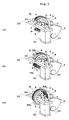
- Figures 2(a) to 2(c) are each a schematic perspective view of the PET apparatus according to the embodiment.
- Figure 1(b) is a side view of the PET apparatus seen reversely of Figure 1(a) , i.e., a side view seen from the head of a subject M.
- the PET apparatus includes two detector units 1, 2, and two holding arms 3, 4.
- the detector units 1, 2 are each disposed on a part of an arc of a circle surrounding the subject M.
- the holding arms 3, 4 are each disposed on a part of the arc.
- the holding arm 3 holds the detector unit 1.
- the holding arm 4 holds the detector unit 2.
- the detector units 1, 2 correspond to the detector units in the present invention.
- the holding arms 3, 4 correspond to the holding arms in the present invention.
- the PET apparatus further includes two arm holders 5, 6, two lifting members 7, 8, and a transportable carriage 9.
- the arm holders 5, 6 hold the holding arms 3, 4, respectively.
- the holding arm 3 is slidable relative to the arm holder 5 in a direction of arrow RA (circumferential direction).
- the holding arm 4 is slidable relative to the arm holder 6 in a direction of arrow RB (circumferential direction).
- the carriage 9 corresponds to the carriage in the present invention.
- the above configuration of the holding arms 3, 4 causes independent movement of the holding arms 3, 4 along the circle surrounding the subject M.
- the detector unit 1 held on the holding arm 3 is moved in the same direction of arrow RA (circumferential direction).
- the detector unit 2 held on the holding arm 4 is moved in the same direction of arrow RB (circumferential direction).
- the lifting members 7, 8 hold the arm holders 5, 6, respectively.
- the lifting member 7 is vertically movable relative to the carriage 9 in a direction of arrow RC (vertical direction, see Figure 1(a) ).
- the lifting member 8 is vertically movable relative to the carriage 9 in a direction of arrow RD (vertical direction, see Figure 1(b) ).
- Such a configuration of the lifting members 7, 8 mentioned above causes the arm holders 5, 6 to move independently in the vertical direction.
- the arm holder 5 held on the lifting member 7 is moved in the direction of arrow RC (vertical direction).
- the holding arm 3 held on the arm holder 5 as well as the detector unit 1 held on the holding arm 3 are also moved in the direction of arrow RC (vertical direction).
- the arm holder 6 held on the lifting member 8 is moved in the same direction of arrow RD (vertical direction).
- the holding arm 4 held on the arm holder 6 as well as the detector unit 2 held on the holding arm 4 are also moved in the same direction of arrow RD (vertical direction).
- the carriage 9 includes on a bottom thereof a rear wheel 10 and a front wheel 11. These wheels are moved on the floor, whereby the carriage 9 is transportable.
- the front wheel 11 is connected to a motor (not shown) via a driving shaft (not shown).
- the motor drives, and correspondingly the front wheel 11 drives.
- An operator rotates the rear wheel 10 by pushing and pulling the carriage 9 at a rear side thereof in any directions. This allows movement of the carriage 9 on the floor in any directions. Consequently, transporting the carriage 9 to a side close to an existing apparatus (e.g., a modality apparatus such as an X-ray CT apparatus) allows arrangement of the detector units 1, 2 adjacent to the existing apparatus.
- an existing apparatus e.g., a modality apparatus such as an X-ray CT apparatus
- the existing apparatus is provided with a bed 20 external to the PET apparatus.
- the bed 20 includes a base 21 (not shown in Figure 1 ), and a top board 22.
- the base 21 is disposed on the floor.
- the base 21 is extendable vertically, thereby changing a level of the top board 22 held on the base 21.
- the top board 22 supports the subject M placed thereon.
- the top board 22 is movable horizontally relative to the base 21.
- the PET apparatus further includes a distance changing mechanism 30 (only shown in Figure 1(a) ).
- the distance changing mechanism 30 moves distance units 1, 2 and the holding arms 3, 4 in one direction, thereby changing a distance between the detector units 1, 2.
- the distance changing mechanism 30 is only connected to the lifting member 7.
- the distance changing mechanism 30 is actually connected also to the arm holders 5, 6 and the lifting member 8.
- the distance changing mechanism 30 is formed by a motor, a driving shaft, a gear, and a rack (each of them not shown).
- the distance changing mechanism 30 corresponds to the distance changing mechanism in the present invention.
- the motor, the driving shaft, and the gear are attached to the arm holder 5, and an arc-shaped rack is attached to the holding arm 3.
- Driving the motor causes the gear to drive via the driving shaft, and accordingly, causes the arc-shaped rack engaged with the gear to drive, thereby causing the holding arm 3 to slide relative to the arm holder 5 in the direction of arrow RA (circumferential direction).
- the same is applied for slide of the holding arm 4 relative to the arm holder 6 in the direction of arrow RB (circumferential direction) with the distance changing mechanism 30.
- the distance changing mechanism 30 does not necessarily have such a configuration as above.
- the distance changing mechanism 30 is formed by a motor, a driving shaft, a gear, and a belt.
- the belt winds the holding arm 3.
- Driving the motor causes the gear to drive via a driving shaft. Winding of the belt engaged with the gear causes the holding arm 3 to slide relative to the arm holder 5 in the direction of arrow RA (circumferential direction).
- a configuration may be adopted.
- the motor, the driving shaft, and the gear are attached to the carriage 9, and a flat rack is attached to the lifting member 7.
- Driving the motor causes the gear to drive via the driving shaft, and accordingly causes the flat rack engaged with the gear to drive, thereby causing the lifting member 7 to move vertically relative to the carriage 9 in the direction of arrow RC (vertical direction).
- the same is applied for movement of the lifting member 8 vertically relative to the carriage 9 in the direction of arrow RD (vertical direction) with the distance changing mechanism 30.
- the distance changing mechanism 30 does not necessarily have such a configuration as above.
- the distance changing mechanism 30 is formed by a motor, a driving shaft, a screw shaft, and a guide member.
- the lifting member 7 is slidably attached to the guide member.
- Driving the motor causes the screw shaft to rotate via the driving shaft.
- Rotation of the screw shaft causes the lifting member 7 to move vertically relative to the guide member in the direction of arrow RC (vertical direction), thereby causing the lifting member 7 t move vertically relative to the carriage 9 in the direction of arrow RC direction (vertical direction).
- Such a configuration may be adopted.
- the distance changing mechanism 30 causes the holding arms 3, 4 to slide in the circumferential direction relative to the arm holders 5, 6, and causes the lifting members 7, 8 to move vertically relative to the carriage 9. Moreover, the distance changing mechanism 30 causes the arm holders 5, 6 and the holding arms 3, 4 to move vertically. This allows movement of the holding arms 3, 4 in one direction (circumferential direction or vertical direction). Accordingly, the distance between the detector units 1, 2 is changed.
- Scintillator blocks (not shown in Figures 1 and 2 ) of the gamma-ray detectors 1a, 2a (see Figures 5 and 6 ) convert gamma-rays into light.
- the gamma-rays are generated from the subject M to which the radiopharmaceutical is administered.
- photomultipliers (PMT: Photo Multiplier Tube) (not shown in Figure1 and 2 ) in the gamma-ray detectors 1a, 2a multiply and convert the converted light into electric signals.
- the electric signals are transmitted to a coincidence circuit (not shown) as image information (pixel values).
- a positron of a positron-emission type RI radioactive isotope
- the coincidence circuit checks positions of the scintillator blocks and an incidence timing of the gamma-ray beams. Only when the gamma-ray beams coincidently enter into two scintillator blocks facing to each other across the subject M, it is determined that the transmitted image information is valid data. When the gamma-ray beam enters into only one of the scintillator blocks, the coincidence circuit is invalid. That is, the coincidence circuit detects coincident observation of the gamma-ray beams in the two gamma-ray detectors 1a, 2a in accordance with the electric signals.
- RI radioactive isotope
- the image information transmitted to the coincidence circuit is determined as projection data.
- the projection data is reconstructed to generate a tomographic image (RI distribution image).
- Figure 3 schematically illustrates gamma-ray detectors in the detector unit.
- Figure 4 is a schematic perspective view of one of the gamma-ray detectors.
- the detector unit 1 is representatively illustrated. Since the detector unit 2 has the same configuration as that of the detector unit 1, the description thereof is to be omitted.
- DOI detector is described as one example of the gamma-ray detector that allows discrimination of a position in a depth direction (DOI: Depth of Interaction) where interaction occurs.
- the gamma-ray detector 1a includes a scintillator block 1A, a light guide 1B optically coupled to the scintillator block 1A, and a photomultiplier 1C (hereinafter, simply abbreviated to "PMT") optically coupled to the light guide 1B.
- the scintillator block 1A is formed by scintillator elements. The scintillator elements glow in association with incident gamma-rays, thereby converting the gamma-rays into light.
- the scintillator elements detect gamma-rays.
- the light glowing in the scintillator elements diffuses sufficiently in the scintillator block 1A, and the light enters into a PMT 1C through the light guide 1B.
- the PMT 1C multiplies and converts the light in the scintillator block 1A into an electric signal.
- the electric signal is transmitted to the coincidence circuit (not shown) as the image information (pixel value) mentioned above.
- the gamma-ray detector 1a is composed of scintillator elements disposed three-dimensionally. Accordingly, the gamma-ray detector 1a is a DOI detector formed by a plurality of layers in the depth direction. Figures 3 and 4 each illustrate a four-layered DOI detector. However, the number of layers is not particularly limited as long as the number is plural. Moreover, the gamma-ray detector is not necessarily a DOI detector. Alternatively, the gamma-ray detector may be formed by only one-layered scintillator elements.
- the distance changing mechanism 30 changes the distance between the detector units 1, 2. Accordingly, a relative position and a relative direction of the gamma-ray detectors 1a, 2a (as for a gamma-ray detector 2a of the detector unit 2, see Figures 5 and 6 ) vary constantly. Radiography is performed while the detector units 1, 2 face to each other in the vertical direction (see Figure 2 (b) ), or in the horizontal direction (see Figure 2 (c) ), or while the detector units 1, 2 approach the subject M (see Figure 7(b) ) depending on an imaging attitude or a size of the subject M.
- radiography also proceeds while the position and direction of the gamma-ray detectors 1a, 2a vary relative to a mechanical origin of the apparatus.
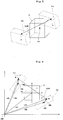
- Figure 5 is a schematic view illustrating a positional relationship of both the gamma-ray detectors and an image reconstruction area.
- Figure 6 is a graph illustrating coordinate systems of the both gamma-ray detectors and the image reconstruction area.
- the gamma-ray detectors 1a, 2a are assembles of minute scintillators a, b, respectively.
- An image reconstruction area S having the center coordinate OC is disposed between the gamma-ray detectors 1a, 2a.
- the center coordinate OC is specified by a vector VC starting from a mechanical origin OM of the apparatus.
- Vectors VA, VB extending from the mechanical origin OM of the apparatus to the center coordinates OA, OB of the gamma-ray detectors 1a, 2a, respectively, are determined in accordance with position data of the gamma-ray detectors 1a, 2a detected by a position sensor (not shown) and rotation angle data of the gamma-ray detectors 1a, 2a detected with an angle sensor (not shown).
- the vector uA is determined from information on the position and direction of the gamma-ray detectors 1a, 2a stored as the list mode data and the following Expression (3).
- the data on the position and the direction of the gamma-ray detectors 1a, 2a may be stored as tag information only when the position and the direction vary.
- uA R X ⁇ R Y ⁇ R Z ⁇ WA
- Rx, R Y , and Rz denote rotation of the gamma-ray detectors 1a, 2a about X-, Y-, and Z-axes, respectively, the axes being orthogonal to one another with reference to the mechanical origin OM of the apparatus
- T denotes a position in directions of the X-, Y-, and Z-axes (i.e., VA).
- the vector uB is determinable in the same manner as that for the vector uA.
- a list mode reconstruction algorithm of iterative approximation type is applicable to the determination of the line LOR (Line Of Response) connecting the scintillator elements a, b having detected the gamma-rays coincidently for every event.
- the update expression for obtaining an image with the list mode reconstruction algorithm is as the following Expression (4).
- the update Expression (4) is repeatedly performed to calculate an RI distribution image (distribution image of positron).
- Figure 7 is a schematic side view of an imaging mode with the PET apparatus.
- Figure 8 is a schematic side view of another imaging mode, different from that of Figure 7 , with the PET apparatus. Similar to the side view of Figure 1(b) , Figures 7 and 8 are each a side view of the PET apparatus seen reversely of Figure 1(a) , i.e., a side view seen from the head of a subject M.
- FIG. 2(a) the holding arms 3, 4 overlap one another completely, and ends of the detector units 1, 2 are adjacent to each other.
- the detector unit 1 is moved along with the holding arm 3 in the direction of arrow RA R (clockwise in the circumferential direction) in Figure 2(b)
- the detector unit 2 is moved along with the holding arm 4 in the direction of arrow RB L (counterclockwise in the circumferential direction).
- the detector units 1, 2 are moved in the vertical direction across the subject M so as to face to each other.
- the clockwise is a rotation direction seen from the subject M placed on his/her back on the top board 22, and the counterclockwise is a rotation direction seen from the subject M.
- the detector units 1, 2 face to each other in the vertical direction. From such a condition, the detector unit 1 is moved along with the holding arm 3 in the direction of arrow RA R (clockwise in the circumferential direction) in Figure 2(c) , and the detector unit 2 is moved along with the holding arm 4 in the direction of arrow RB R (clockwise circumferential direction). Thereafter, the detector units 1, 2 face to each other horizontally on both sides of the subject M.
- the holding arms 3, 4 slide in the direction of arrow RA (circumferential direction) or the direction of arrow RB (circumferential direction) at the same level without moving the lifting members 7, 8 vertically.
- the lifting members 7, 8 are moved independently in the vertical direction to change the levels of the holding arms 3, 4. Such may be adopted.
- FIGS 7(a) and 7(b) The following describes an imaging mode illustrated in Figures 7(a) and 7(b) .
- the holding arms 3, 4 overlap one another completely, and ends of the detector units 1, 2 are adjacent to each other.
- the detector unit 1 is moved along with the holding arm 3 in the direction of arrow RA R (clockwise in the circumferential direction) in Figure 7(a)
- the detector unit 2 is moved along with the holding arm 4 in the direction of arrow RB L (counterclockwise circumferential direction).
- the detector units 1, 2 are disposed vertically across the subject M so as to face to each other, as illustrated in Figure 7(a) .
- the detector units 1, 2 face to each other vertically. From such a condition, the arm holder 5, the holding arm 3, and the detector unit 1 are moved downward along with the lifting member 7 in a direction of arrow RC D (downward in the vertical direction) in Figure 7(b) , and the arm holder 6, the holding arm 4, and the detector unit 2 are moved upward along with the lifting member 8 in a direction of arrow RD U (upward in the vertical direction). Thereafter, the detector units 1, 2 are disposed close to the subject M in the vertical direction.
- the subject M is placed at the center of the detector units 1, 2 in Figures 1 , 2 , and 7 .
- the subject M may be placed close to the detector units 1, 2 radially.
- an imaging mode illustrated in Figures 8(a) and 8(b) only shown are the detector units 1, 2 and the subject M, and thus other elements are not shown.
- the ends of the detector units 1, 2 are adjacent to each other. From such a condition, the detector unit 1 is rotated by 90 degrees in the direction of arrow RA R (clockwise circumferential direction) in Figure 8(a) , and the detector unit 2 is rotated by 90 degrees in the direction of arrow RB R (clockwise in the circumferential direction). Thereafter, as illustrated in Figure 8(a) , the detector units 1, 2 are disposed above the subject M.
- the detector units 1, 2 are disposed above the subject M. From such a condition, the detector unit 1 is moved downward in the direction of arrow RC D (downward in the vertical direction) in Figure 8(b) , and the detector unit 2 is moved downward in the direction of arrow RD D (downward in the vertical direction). Accordingly, the subject M is accessible to the detector units 1, 2 radially.
- the detector units 1, 2 are not moved downward, but only the top board 22 (see Figures 1 , 2 , and 7 ) is moved upward, whereby the subject M on the top board 22 is moved upward to be accessible to the detector units 1, 2 radially.
- the detector units 1, 2 are moved downward, and the top board 22 is moved upward, whereby the subject M is accessible to the detector units 1, 2 radially.
- the imaging mode in Figure 8 in which the detector units 1, 2 are disposed above the subject M is not limitative.
- the following modes are applicable. That is, the detector units 1, 2 are disposed below the subject M.
- the detector units 1, 2 are disposed on either a left side or a right side of the subject M. In such modes, the subject M may be accessible to the detector units 1, 2 radially in the same manner.
- the PET apparatus of the present embodiment mentioned above includes a plurality of detector units (two detector units 1, 2 in the present embodiment) on a part of the arc of the circle surrounding the subject M, and a plurality of holding arms (two holding arms 3, 4 in the present embodiment) each disposed on the arc and holding the detector units 1, 2, respectively.
- the holding arms 3, 4 are moved independently along the circle surrounding the subject M, whereby the detector units 1, 2 are moved.
- the detector units 1, 2 are each disposed on the arc, and the holding arms 3, 4 are each disposed on the arc. Accordingly, the detector units 1, 2 are held entirely along the holding arms 3, 4. In the present embodiment, the detector unit 1 is entirely held along the holding arm 3, and the detector unit 2 is entirely held along the holding arm 4.
- the detector units 1, 2 are not cantilevered, causing a stable hold of the detector units 1, 2. This results in less swing of the detector units 1, 2.
- the detector units 1, 2 are each disposed on the arc surrounding the subject M. Accordingly, there is no need for a mechanism of changing and controlling inclination angles.
- the detector units are disposed individually depending on a focused imaging area. This can produce another effect of enlarging a stereo angle surrounding the imaging area.
- the present embodiment further includes the distance changing mechanism 30 changing the distance between the adjacent detector units 1, 2, by moving the detector units 1, 2 and the holding arms 3, 4 in one direction (the circumferential direction or the vertical direction in the present embodiment).
- the distance changing mechanism 30 reduces the distance between the adjacent detector units 1, 2 (e.g., reduces the distance from that in the imaging mode in Figure 7(a) to that in the imaging mode in Figure 7(b) ). This allows an enlarged stereo angle surrounding the subject M.
- reduction in distance between the adjacent detector units 1, 2 causes approach of the detector units 1, 2 to the subject M, achieving enhanced sensitivity of the detectors.
- the detector units 1, 2 and the holding arms 3, 4 are attached to the transportable carriage 9, and the detector units 1, 2 surround the mount table (bed 20 in the present embodiment) supporting the subject M placed thereon.
- the PET apparatus can image the subject placed on the mount table (e.g., bed 20 in the present embodiment) of the existing apparatus (e.g., a modality apparatus such as an X-ray CT apparatus).
- the present invention is not limited to the embodiment mentioned above, but may be modified as under.
- an anti-collision mechanism 50 as illustrated in Figure 10 is provided to prevent collision of the detector unit with the holding arm caused by operation of the distance changing mechanism. Such a mechanism can prevent the collision from occurring.
- the anti-collision mechanism 50 may be formed by a mechanical mechanism, a mechanism as illustrated in Figure 10(a) , a mechanism as illustrated in Figure 10(b) that electrically controls positions, or a mechanism in combination of the above mechanisms.
- the anti-collision mechanism 50 corresponds to the anti-collision mechanism in the present invention.
- the lifting member 7 includes a protrusion 51 on a lower end thereof.
- the holding arm 3 (not shown in Figure 10(a) ) contacts the detector unit 2 (not shown in Figure 10(a) )
- the holding arm 4 (not shown in Figure 10(a) ) contacts the detector unit 1 (not shown in Figure 10(a) )
- the lifting member 7 and the lifting member 8 are disposed at the same level. From such a condition, the lifting member 7 is moved upward or the lifting member 8 is moved downward, and correspondingly the detector unit 1 and the holding arm 3 are moved upward, or the detector unit 2 and the holding arm 4 are moved downward.
- the holding arm 3 collides against the detector unit 2
- the holding arm 4 collides against the detector unit 1.
- the above protrusion 51 provided so as to prevent the lifting member 7 above the lifting member 8 contacts the lifting member 8 immediately before the lifting member 7 is located above the lifting member 8. This allows mechanical stop of the lifting members 7, 8.
- the anti-collision mechanism 50 performing positional control electrically includes a position detecting mechanism 52, such as a potentiometer.
- the position detecting mechanism 52 are attached to each of the detector units, the holding arms, or the lifting members.
- the positions of the detector units, the holding arms, or the lifting members are detected, and detection results by the position detecting mechanism 52 are transmitted to a controller 53 formed by a central processing unit (CPU) and the like.
- the controller 53 controls the distance changing mechanism 30 to stop driving, whereby the collision is prevented from occurring.
Landscapes
- Health & Medical Sciences (AREA)
- Life Sciences & Earth Sciences (AREA)
- Engineering & Computer Science (AREA)
- Medical Informatics (AREA)
- Physics & Mathematics (AREA)
- Molecular Biology (AREA)
- High Energy & Nuclear Physics (AREA)
- Radiology & Medical Imaging (AREA)
- Surgery (AREA)
- Pathology (AREA)
- Nuclear Medicine, Radiotherapy & Molecular Imaging (AREA)
- Biomedical Technology (AREA)
- Heart & Thoracic Surgery (AREA)
- Biophysics (AREA)
- Optics & Photonics (AREA)
- Animal Behavior & Ethology (AREA)
- General Health & Medical Sciences (AREA)
- Public Health (AREA)
- Veterinary Medicine (AREA)
- Computer Vision & Pattern Recognition (AREA)
- General Physics & Mathematics (AREA)
- Spectroscopy & Molecular Physics (AREA)
- Nuclear Medicine (AREA)
Claims (10)
- Appareil de tomographie par émission de positons réalisant une radiographie en détectant du rayonnement émis depuis un produit radiopharmaceutique émettant des positons administré à un sujet (M), l'appareil de tomographie par émission de positons comprenant :une pluralité de modules détecteurs (1, 2) disposés chacun sur une partie d'un arc d'un cercle entourant le sujet (M),une pluralité de bras de maintien (3, 4) disposés chacun sur l'arc et maintenant les modules détecteurs (1, 2) individuellement,les bras de maintien (3, 4) se déplaçant le long du cercle entourant le sujet (M) indépendamment, amenant de ce fait les modules détecteurs (1, 2) à se déplacer, des supports de bras (5, 6) maintenant les bras de maintien (3, 4) individuellement,caractérisé en ce qu'il comprend en outreun mécanisme de changement de distance (30), dans lequel le mécanisme de changement de distance (30) change la distance entre les modules détecteurs adjacents (1, 2) en déplaçant les bras de maintien (3, 4) et les supports de bras (5, 6) dans une direction verticale (RC, RD).
- Appareil de tomographie par émission de positons selon la revendication 1, dans lequel
le mécanisme de changement de distance (30) change la distance entre les modules détecteurs adjacents (1, 2) en déplaçant les bras de maintien (3, 4) dans une direction circonférentielle (RA, RB). - Appareil de tomographie par émission de positons selon la revendication 2, dans lequel
le mécanisme de changement de distance (30) déplace les bras de maintien (3, 4) dans la direction circonférentielle (RA, RB) en faisant coulisser les bras de maintien (3, 4) par rapport aux supports de bras (5, 6) dans la direction circonférentielle (RA, RB). - Appareil de tomographie par émission de positons selon les revendications 1 à 3, comprenant en outre :des éléments de levage (7, 8) levant les supports de bras (5, 6) individuellement, dans lequelle mécanisme de changement de distance (30) déplace les supports de bras (5, 6) maintenus avec les éléments de levage (7, 8) et les bras de maintien (3, 4) maintenus avec les supports de bras (5, 6) en déplaçant les éléments de levage (7, 8) dans la direction verticale (RC, RD).
- Appareil de tomographie par émission de positons selon l'une quelconque des revendications 1 à 4, comprenant en outre :un mécanisme anti-collision (50) empêchant la collision des modules détecteurs (1, 2) avec les bras de maintien (3, 4) provoquée par l'opération du mécanisme de changement de distance (30).
- Appareil de tomographie par émission de positons selon la revendication 5, dans lequel
lorsque le nombre de modules détecteurs (1, 2) est de deux et le nombre de bras de maintien (3, 4) est de deux, et un premier bras de maintien (3) maintient un premier module détecteur (1), et un second bras de maintien (4) maintient un second module détecteur (2), le mécanisme anti-collision (50) empêche la collision du premier bras de maintien (3) avec le second module détecteur (2) ou la collision du second bras de maintien (4) avec le premier module détecteur (1). - Appareil de tomographie par émission de positons selon la revendication 5 ou 6, dans lequel
le mécanisme anti-collision (50) est formé d'un mécanisme mécanique. - Appareil de tomographie par émission de positons selon l'une quelconque des revendications 5 à 7, dans lequel
le mécanisme anti-collision (50) est formé d'un mécanisme qui commande électriquement des positions. - Appareil de tomographie par émission de positons selon la revendication 8, dans lequel
le mécanisme anti-collision (50) inclut
un mécanisme de détection de position (52) détectant des positions des modules détecteurs (1, 2) ou des mécanismes maintenant les modules détecteurs (1, 2) individuellement, et
un contrôleur (53) commandant le mécanisme anti-collision (50) conformément à un résultat de détection positionnelle par le mécanisme de détection de position (52). - Appareil de tomographie par émission de positons selon l'une quelconque des revendications 1 à 9, dans lequel
les modules détecteurs (1, 2) et les bras de maintien (3, 4) sont reliés à un chariot transportable (9), et les modules détecteurs (1, 2) entourent une table de support (20) supportant le sujet (M) placé sur elle.
Applications Claiming Priority (2)
| Application Number | Priority Date | Filing Date | Title |
|---|---|---|---|
| JP2013017225 | 2013-01-31 | ||
| PCT/JP2014/051121 WO2014119428A1 (fr) | 2013-01-31 | 2014-01-21 | Dispositif de tomographie par émission de positons |
Publications (3)
| Publication Number | Publication Date |
|---|---|
| EP2952932A1 EP2952932A1 (fr) | 2015-12-09 |
| EP2952932A4 EP2952932A4 (fr) | 2016-01-13 |
| EP2952932B1 true EP2952932B1 (fr) | 2017-11-01 |
Family
ID=51262143
Family Applications (1)
| Application Number | Title | Priority Date | Filing Date |
|---|---|---|---|
| EP14746255.0A Not-in-force EP2952932B1 (fr) | 2013-01-31 | 2014-01-21 | Dispositif de tomographie par émission de positons |
Country Status (5)
| Country | Link |
|---|---|
| US (1) | US10349904B2 (fr) |
| EP (1) | EP2952932B1 (fr) |
| JP (2) | JP6024764B2 (fr) |
| CN (1) | CN104919337B (fr) |
| WO (1) | WO2014119428A1 (fr) |
Families Citing this family (9)
| Publication number | Priority date | Publication date | Assignee | Title |
|---|---|---|---|---|
| WO2016064993A1 (fr) * | 2014-10-22 | 2016-04-28 | Carestream Health, Inc. | Appareil d'imagerie radiographique mobile |
| EP3494547B1 (fr) * | 2016-08-03 | 2020-06-17 | Koninklijke Philips N.V. | Reconstruction d'images tep en temps de vol (tof) à l'aide de noyaux localement modifiés |
| CN108853751B (zh) * | 2017-05-12 | 2024-05-17 | 南京中硼联康医疗科技有限公司 | 光子发射检测装置及具有其的硼中子捕获治疗系统 |
| EP3583981B1 (fr) * | 2017-05-12 | 2020-12-23 | Neuboron Medtech Ltd. | Dispositif de détection d'émission de photons et système de thérapie par capture de neutrons de bore le comprenant |
| US11712209B2 (en) | 2017-06-07 | 2023-08-01 | Epica International, Inc. | Imaging table for greater access to patient region of interest |
| US10702223B2 (en) * | 2017-06-07 | 2020-07-07 | Epica International, Inc. | Imaging table for greater access to patient region of interest |
| US11375962B2 (en) * | 2019-08-05 | 2022-07-05 | Linev Systems, Inc. | Fast foreign object scanner for scanning human bodies |
| CA3172365A1 (fr) * | 2020-02-24 | 2021-09-02 | The Research Foundation For The State University Of New York | Scanner de tomographie par emission de positons (tep) a haute resolution et haute sensibilite pourvu de modules detecteurs tep a prisme |
| US12119128B1 (en) * | 2020-11-23 | 2024-10-15 | Jeremy Basterash | Nuclear imaging device and method of collecting tomographic projections |
Family Cites Families (8)
| Publication number | Priority date | Publication date | Assignee | Title |
|---|---|---|---|---|
| FR2677447A1 (fr) * | 1991-06-07 | 1992-12-11 | Sopha Medical | Gamma camera tomographique munie d'un detecteur orientable. |
| FR2697918B1 (fr) | 1992-11-10 | 1994-12-30 | Gen Electric | Dispositif de scintigraphie. |
| JP3762539B2 (ja) * | 1998-04-03 | 2006-04-05 | 株式会社日立メディコ | X線透視撮影装置および方法 |
| JP2006055518A (ja) * | 2004-08-23 | 2006-03-02 | Shimadzu Corp | X線診断装置 |
| JP2008524574A (ja) * | 2004-12-17 | 2008-07-10 | コーニンクレッカ フィリップス エレクトロニクス エヌ ヴィ | ガントリシステム |
| JP4650324B2 (ja) * | 2006-03-29 | 2011-03-16 | 株式会社島津製作所 | 核医学診断装置 |
| CN101460864B (zh) * | 2006-09-19 | 2012-02-01 | 株式会社岛津制作所 | 核医学诊断装置的闪烁体阵列的识别机构所需的参数的决定方法 |
| JP5815218B2 (ja) * | 2010-08-30 | 2015-11-17 | 株式会社東芝 | 放射線治療装置、制御方法及び制御プログラム |
-
2014
- 2014-01-21 EP EP14746255.0A patent/EP2952932B1/fr not_active Not-in-force
- 2014-01-21 US US14/764,932 patent/US10349904B2/en not_active Expired - Fee Related
- 2014-01-21 CN CN201480004947.8A patent/CN104919337B/zh not_active Expired - Fee Related
- 2014-01-21 JP JP2014559638A patent/JP6024764B2/ja active Active
- 2014-01-21 WO PCT/JP2014/051121 patent/WO2014119428A1/fr not_active Ceased
-
2016
- 2016-10-13 JP JP2016201859A patent/JP2017003603A/ja active Pending
Non-Patent Citations (1)
| Title |
|---|
| None * |
Also Published As
| Publication number | Publication date |
|---|---|
| JP2017003603A (ja) | 2017-01-05 |
| CN104919337B (zh) | 2018-01-09 |
| EP2952932A1 (fr) | 2015-12-09 |
| CN104919337A (zh) | 2015-09-16 |
| US10349904B2 (en) | 2019-07-16 |
| JP6024764B2 (ja) | 2016-11-16 |
| WO2014119428A1 (fr) | 2014-08-07 |
| US20150366519A1 (en) | 2015-12-24 |
| EP2952932A4 (fr) | 2016-01-13 |
| JPWO2014119428A1 (ja) | 2017-01-26 |
Similar Documents
| Publication | Publication Date | Title |
|---|---|---|
| EP2952932B1 (fr) | Dispositif de tomographie par émission de positons | |
| JP6298451B2 (ja) | 画像処理システム及び画像処理方法 | |
| JP2006516742A (ja) | 単一フォトン放出コンピュータ断層撮影システム | |
| JP7578450B2 (ja) | 核医学診断装置 | |
| US7693565B2 (en) | Method and apparatus for automatically positioning a structure within a field of view | |
| EP3030154A1 (fr) | Système de tep à espacement de cristaux ou d'unités de détection | |
| US20090012718A1 (en) | Nuclear Medicine Diagnosis Apparatus and Diagnostic System Used Thereto | |
| JP5195935B2 (ja) | 放射線断層撮影装置 | |
| JP5176355B2 (ja) | 診断装置 | |
| CN102362198A (zh) | 放射线断层摄影装置 | |
| JP2535762B2 (ja) | 陽電子断層撮影装置におけるγ線吸収体による散乱同時計数測定法及び陽電子断層撮影装置 | |
| US20030150996A1 (en) | Apparatus for forming radiation source distribution image | |
| US9134441B2 (en) | Tomographic equipment, imaging system provided therewith, and imaging data acquisition method | |
| JP5262152B2 (ja) | 診断システム | |
| JP4817055B2 (ja) | マンモグラフィ装置 | |
| EP2392946B1 (fr) | Appareil de tomographie par rayonnement | |
| US11944479B2 (en) | Medical image diagnosis apparatus, x-ray computed tomography apparatus, and medical image diagnosis assisting method | |
| JP3881403B2 (ja) | 核医学診断装置 | |
| JP7001176B2 (ja) | データ処理方法、プログラム、データ処理装置および陽電子放出断層撮像装置 | |
| US20230284984A1 (en) | Pet apparatus, pet-ct apparatus, image generation and display method, and nonvolatile computer-readable storage medium storing image generation and display program | |
| JPH10160848A (ja) | 核医学診断装置 | |
| JP4374983B2 (ja) | 核医学イメージング装置 | |
| JPH10160849A (ja) | 核医学診断装置 | |
| JP6575682B2 (ja) | 放射線断層撮影装置 | |
| JP2005249412A (ja) | 放射能画像化装置 |
Legal Events
| Date | Code | Title | Description |
|---|---|---|---|
| PUAI | Public reference made under article 153(3) epc to a published international application that has entered the european phase |
Free format text: ORIGINAL CODE: 0009012 |
|
| 17P | Request for examination filed |
Effective date: 20150813 |
|
| AK | Designated contracting states |
Kind code of ref document: A1 Designated state(s): AL AT BE BG CH CY CZ DE DK EE ES FI FR GB GR HR HU IE IS IT LI LT LU LV MC MK MT NL NO PL PT RO RS SE SI SK SM TR |
|
| AX | Request for extension of the european patent |
Extension state: BA ME |
|
| A4 | Supplementary search report drawn up and despatched |
Effective date: 20151215 |
|
| RIC1 | Information provided on ipc code assigned before grant |
Ipc: A61B 6/10 20060101ALI20151209BHEP Ipc: A61B 6/03 20060101ALI20151209BHEP Ipc: G01T 1/161 20060101AFI20151209BHEP Ipc: A61B 6/00 20060101ALI20151209BHEP |
|
| DAX | Request for extension of the european patent (deleted) | ||
| R17P | Request for examination filed (corrected) |
Effective date: 20150813 |
|
| GRAP | Despatch of communication of intention to grant a patent |
Free format text: ORIGINAL CODE: EPIDOSNIGR1 |
|
| RIC1 | Information provided on ipc code assigned before grant |
Ipc: A61B 6/10 20060101ALI20170509BHEP Ipc: A61B 6/03 20060101ALI20170509BHEP Ipc: G01T 1/161 20060101AFI20170509BHEP Ipc: A61B 6/00 20060101ALI20170509BHEP |
|
| INTG | Intention to grant announced |
Effective date: 20170601 |
|
| GRAS | Grant fee paid |
Free format text: ORIGINAL CODE: EPIDOSNIGR3 |
|
| GRAA | (expected) grant |
Free format text: ORIGINAL CODE: 0009210 |
|
| AK | Designated contracting states |
Kind code of ref document: B1 Designated state(s): AL AT BE BG CH CY CZ DE DK EE ES FI FR GB GR HR HU IE IS IT LI LT LU LV MC MK MT NL NO PL PT RO RS SE SI SK SM TR |
|
| REG | Reference to a national code |
Ref country code: GB Ref legal event code: FG4D |
|
| REG | Reference to a national code |
Ref country code: CH Ref legal event code: EP Ref country code: AT Ref legal event code: REF Ref document number: 942587 Country of ref document: AT Kind code of ref document: T Effective date: 20171115 |
|
| REG | Reference to a national code |
Ref country code: IE Ref legal event code: FG4D |
|
| REG | Reference to a national code |
Ref country code: DE Ref legal event code: R096 Ref document number: 602014016619 Country of ref document: DE |
|
| REG | Reference to a national code |
Ref country code: FR Ref legal event code: PLFP Year of fee payment: 5 |
|
| REG | Reference to a national code |
Ref country code: NL Ref legal event code: MP Effective date: 20171101 |
|
| REG | Reference to a national code |
Ref country code: LT Ref legal event code: MG4D |
|
| REG | Reference to a national code |
Ref country code: AT Ref legal event code: MK05 Ref document number: 942587 Country of ref document: AT Kind code of ref document: T Effective date: 20171101 |
|
| PG25 | Lapsed in a contracting state [announced via postgrant information from national office to epo] |
Ref country code: SE Free format text: LAPSE BECAUSE OF FAILURE TO SUBMIT A TRANSLATION OF THE DESCRIPTION OR TO PAY THE FEE WITHIN THE PRESCRIBED TIME-LIMIT Effective date: 20171101 Ref country code: LT Free format text: LAPSE BECAUSE OF FAILURE TO SUBMIT A TRANSLATION OF THE DESCRIPTION OR TO PAY THE FEE WITHIN THE PRESCRIBED TIME-LIMIT Effective date: 20171101 Ref country code: NL Free format text: LAPSE BECAUSE OF FAILURE TO SUBMIT A TRANSLATION OF THE DESCRIPTION OR TO PAY THE FEE WITHIN THE PRESCRIBED TIME-LIMIT Effective date: 20171101 Ref country code: FI Free format text: LAPSE BECAUSE OF FAILURE TO SUBMIT A TRANSLATION OF THE DESCRIPTION OR TO PAY THE FEE WITHIN THE PRESCRIBED TIME-LIMIT Effective date: 20171101 Ref country code: NO Free format text: LAPSE BECAUSE OF FAILURE TO SUBMIT A TRANSLATION OF THE DESCRIPTION OR TO PAY THE FEE WITHIN THE PRESCRIBED TIME-LIMIT Effective date: 20180201 Ref country code: ES Free format text: LAPSE BECAUSE OF FAILURE TO SUBMIT A TRANSLATION OF THE DESCRIPTION OR TO PAY THE FEE WITHIN THE PRESCRIBED TIME-LIMIT Effective date: 20171101 |
|
| PG25 | Lapsed in a contracting state [announced via postgrant information from national office to epo] |
Ref country code: RS Free format text: LAPSE BECAUSE OF FAILURE TO SUBMIT A TRANSLATION OF THE DESCRIPTION OR TO PAY THE FEE WITHIN THE PRESCRIBED TIME-LIMIT Effective date: 20171101 Ref country code: AT Free format text: LAPSE BECAUSE OF FAILURE TO SUBMIT A TRANSLATION OF THE DESCRIPTION OR TO PAY THE FEE WITHIN THE PRESCRIBED TIME-LIMIT Effective date: 20171101 Ref country code: LV Free format text: LAPSE BECAUSE OF FAILURE TO SUBMIT A TRANSLATION OF THE DESCRIPTION OR TO PAY THE FEE WITHIN THE PRESCRIBED TIME-LIMIT Effective date: 20171101 Ref country code: HR Free format text: LAPSE BECAUSE OF FAILURE TO SUBMIT A TRANSLATION OF THE DESCRIPTION OR TO PAY THE FEE WITHIN THE PRESCRIBED TIME-LIMIT Effective date: 20171101 Ref country code: BG Free format text: LAPSE BECAUSE OF FAILURE TO SUBMIT A TRANSLATION OF THE DESCRIPTION OR TO PAY THE FEE WITHIN THE PRESCRIBED TIME-LIMIT Effective date: 20180201 Ref country code: IS Free format text: LAPSE BECAUSE OF FAILURE TO SUBMIT A TRANSLATION OF THE DESCRIPTION OR TO PAY THE FEE WITHIN THE PRESCRIBED TIME-LIMIT Effective date: 20180301 Ref country code: GR Free format text: LAPSE BECAUSE OF FAILURE TO SUBMIT A TRANSLATION OF THE DESCRIPTION OR TO PAY THE FEE WITHIN THE PRESCRIBED TIME-LIMIT Effective date: 20180202 |
|
| PG25 | Lapsed in a contracting state [announced via postgrant information from national office to epo] |
Ref country code: SK Free format text: LAPSE BECAUSE OF FAILURE TO SUBMIT A TRANSLATION OF THE DESCRIPTION OR TO PAY THE FEE WITHIN THE PRESCRIBED TIME-LIMIT Effective date: 20171101 Ref country code: EE Free format text: LAPSE BECAUSE OF FAILURE TO SUBMIT A TRANSLATION OF THE DESCRIPTION OR TO PAY THE FEE WITHIN THE PRESCRIBED TIME-LIMIT Effective date: 20171101 Ref country code: CY Free format text: LAPSE BECAUSE OF FAILURE TO SUBMIT A TRANSLATION OF THE DESCRIPTION OR TO PAY THE FEE WITHIN THE PRESCRIBED TIME-LIMIT Effective date: 20171101 Ref country code: DK Free format text: LAPSE BECAUSE OF FAILURE TO SUBMIT A TRANSLATION OF THE DESCRIPTION OR TO PAY THE FEE WITHIN THE PRESCRIBED TIME-LIMIT Effective date: 20171101 Ref country code: CZ Free format text: LAPSE BECAUSE OF FAILURE TO SUBMIT A TRANSLATION OF THE DESCRIPTION OR TO PAY THE FEE WITHIN THE PRESCRIBED TIME-LIMIT Effective date: 20171101 |
|
| REG | Reference to a national code |
Ref country code: DE Ref legal event code: R097 Ref document number: 602014016619 Country of ref document: DE |
|
| PG25 | Lapsed in a contracting state [announced via postgrant information from national office to epo] |
Ref country code: IT Free format text: LAPSE BECAUSE OF FAILURE TO SUBMIT A TRANSLATION OF THE DESCRIPTION OR TO PAY THE FEE WITHIN THE PRESCRIBED TIME-LIMIT Effective date: 20171101 Ref country code: PL Free format text: LAPSE BECAUSE OF FAILURE TO SUBMIT A TRANSLATION OF THE DESCRIPTION OR TO PAY THE FEE WITHIN THE PRESCRIBED TIME-LIMIT Effective date: 20171101 Ref country code: SM Free format text: LAPSE BECAUSE OF FAILURE TO SUBMIT A TRANSLATION OF THE DESCRIPTION OR TO PAY THE FEE WITHIN THE PRESCRIBED TIME-LIMIT Effective date: 20171101 Ref country code: RO Free format text: LAPSE BECAUSE OF FAILURE TO SUBMIT A TRANSLATION OF THE DESCRIPTION OR TO PAY THE FEE WITHIN THE PRESCRIBED TIME-LIMIT Effective date: 20171101 |
|
| REG | Reference to a national code |
Ref country code: CH Ref legal event code: PL |
|
| PLBE | No opposition filed within time limit |
Free format text: ORIGINAL CODE: 0009261 |
|
| STAA | Information on the status of an ep patent application or granted ep patent |
Free format text: STATUS: NO OPPOSITION FILED WITHIN TIME LIMIT |
|
| 26N | No opposition filed |
Effective date: 20180802 |
|
| PG25 | Lapsed in a contracting state [announced via postgrant information from national office to epo] |
Ref country code: LU Free format text: LAPSE BECAUSE OF NON-PAYMENT OF DUE FEES Effective date: 20180121 |
|
| REG | Reference to a national code |
Ref country code: IE Ref legal event code: MM4A |
|
| REG | Reference to a national code |
Ref country code: BE Ref legal event code: MM Effective date: 20180131 |
|
| PG25 | Lapsed in a contracting state [announced via postgrant information from national office to epo] |
Ref country code: BE Free format text: LAPSE BECAUSE OF NON-PAYMENT OF DUE FEES Effective date: 20180131 Ref country code: SI Free format text: LAPSE BECAUSE OF FAILURE TO SUBMIT A TRANSLATION OF THE DESCRIPTION OR TO PAY THE FEE WITHIN THE PRESCRIBED TIME-LIMIT Effective date: 20171101 Ref country code: LI Free format text: LAPSE BECAUSE OF NON-PAYMENT OF DUE FEES Effective date: 20180131 Ref country code: CH Free format text: LAPSE BECAUSE OF NON-PAYMENT OF DUE FEES Effective date: 20180131 |
|
| PG25 | Lapsed in a contracting state [announced via postgrant information from national office to epo] |
Ref country code: IE Free format text: LAPSE BECAUSE OF NON-PAYMENT OF DUE FEES Effective date: 20180121 |
|
| PG25 | Lapsed in a contracting state [announced via postgrant information from national office to epo] |
Ref country code: MC Free format text: LAPSE BECAUSE OF FAILURE TO SUBMIT A TRANSLATION OF THE DESCRIPTION OR TO PAY THE FEE WITHIN THE PRESCRIBED TIME-LIMIT Effective date: 20171101 |
|
| PG25 | Lapsed in a contracting state [announced via postgrant information from national office to epo] |
Ref country code: MT Free format text: LAPSE BECAUSE OF NON-PAYMENT OF DUE FEES Effective date: 20180121 |
|
| PG25 | Lapsed in a contracting state [announced via postgrant information from national office to epo] |
Ref country code: TR Free format text: LAPSE BECAUSE OF FAILURE TO SUBMIT A TRANSLATION OF THE DESCRIPTION OR TO PAY THE FEE WITHIN THE PRESCRIBED TIME-LIMIT Effective date: 20171101 |
|
| PG25 | Lapsed in a contracting state [announced via postgrant information from national office to epo] |
Ref country code: PT Free format text: LAPSE BECAUSE OF FAILURE TO SUBMIT A TRANSLATION OF THE DESCRIPTION OR TO PAY THE FEE WITHIN THE PRESCRIBED TIME-LIMIT Effective date: 20171101 |
|
| PG25 | Lapsed in a contracting state [announced via postgrant information from national office to epo] |
Ref country code: HU Free format text: LAPSE BECAUSE OF FAILURE TO SUBMIT A TRANSLATION OF THE DESCRIPTION OR TO PAY THE FEE WITHIN THE PRESCRIBED TIME-LIMIT; INVALID AB INITIO Effective date: 20140121 Ref country code: MK Free format text: LAPSE BECAUSE OF NON-PAYMENT OF DUE FEES Effective date: 20171101 |
|
| PG25 | Lapsed in a contracting state [announced via postgrant information from national office to epo] |
Ref country code: AL Free format text: LAPSE BECAUSE OF FAILURE TO SUBMIT A TRANSLATION OF THE DESCRIPTION OR TO PAY THE FEE WITHIN THE PRESCRIBED TIME-LIMIT Effective date: 20171101 |
|
| PGFP | Annual fee paid to national office [announced via postgrant information from national office to epo] |
Ref country code: FR Payment date: 20201210 Year of fee payment: 8 |
|
| PGFP | Annual fee paid to national office [announced via postgrant information from national office to epo] |
Ref country code: DE Payment date: 20210105 Year of fee payment: 8 Ref country code: GB Payment date: 20210113 Year of fee payment: 8 |
|
| REG | Reference to a national code |
Ref country code: DE Ref legal event code: R119 Ref document number: 602014016619 Country of ref document: DE |
|
| GBPC | Gb: european patent ceased through non-payment of renewal fee |
Effective date: 20220121 |
|
| PG25 | Lapsed in a contracting state [announced via postgrant information from national office to epo] |
Ref country code: GB Free format text: LAPSE BECAUSE OF NON-PAYMENT OF DUE FEES Effective date: 20220121 Ref country code: DE Free format text: LAPSE BECAUSE OF NON-PAYMENT OF DUE FEES Effective date: 20220802 |
|
| PG25 | Lapsed in a contracting state [announced via postgrant information from national office to epo] |
Ref country code: FR Free format text: LAPSE BECAUSE OF NON-PAYMENT OF DUE FEES Effective date: 20220131 |