EP2956029B1 - Procédé de fabrication d'au moins un bloc de produit cosmétique, installation et tétine associées - Google Patents
Procédé de fabrication d'au moins un bloc de produit cosmétique, installation et tétine associées Download PDFInfo
- Publication number
- EP2956029B1 EP2956029B1 EP14704325.1A EP14704325A EP2956029B1 EP 2956029 B1 EP2956029 B1 EP 2956029B1 EP 14704325 A EP14704325 A EP 14704325A EP 2956029 B1 EP2956029 B1 EP 2956029B1
- Authority
- EP
- European Patent Office
- Prior art keywords
- teat
- block
- liquid silicone
- crosslinking
- silicone elastomer
- Prior art date
- Legal status (The legal status is an assumption and is not a legal conclusion. Google has not performed a legal analysis and makes no representation as to the accuracy of the status listed.)
- Active
Links
Images

Classifications
-
- A—HUMAN NECESSITIES
- A45—HAND OR TRAVELLING ARTICLES
- A45D—HAIRDRESSING OR SHAVING EQUIPMENT; EQUIPMENT FOR COSMETICS OR COSMETIC TREATMENTS, e.g. FOR MANICURING OR PEDICURING
- A45D40/00—Casings or accessories specially adapted for storing or handling solid or pasty toiletry or cosmetic substances, e.g. shaving soaps or lipsticks
- A45D40/16—Refill sticks; Moulding devices for producing sticks
-
- B—PERFORMING OPERATIONS; TRANSPORTING
- B29—WORKING OF PLASTICS; WORKING OF SUBSTANCES IN A PLASTIC STATE IN GENERAL
- B29C—SHAPING OR JOINING OF PLASTICS; SHAPING OF MATERIAL IN A PLASTIC STATE, NOT OTHERWISE PROVIDED FOR; AFTER-TREATMENT OF THE SHAPED PRODUCTS, e.g. REPAIRING
- B29C33/00—Moulds or cores; Details thereof or accessories therefor
- B29C33/38—Moulds or cores; Details thereof or accessories therefor characterised by the material or the manufacturing process
- B29C33/3842—Manufacturing moulds, e.g. shaping the mould surface by machining
-
- B—PERFORMING OPERATIONS; TRANSPORTING
- B29—WORKING OF PLASTICS; WORKING OF SUBSTANCES IN A PLASTIC STATE IN GENERAL
- B29C—SHAPING OR JOINING OF PLASTICS; SHAPING OF MATERIAL IN A PLASTIC STATE, NOT OTHERWISE PROVIDED FOR; AFTER-TREATMENT OF THE SHAPED PRODUCTS, e.g. REPAIRING
- B29C33/00—Moulds or cores; Details thereof or accessories therefor
- B29C33/38—Moulds or cores; Details thereof or accessories therefor characterised by the material or the manufacturing process
- B29C33/40—Plastics, e.g. foam or rubber
- B29C33/405—Elastomers, e.g. rubber
-
- B—PERFORMING OPERATIONS; TRANSPORTING
- B29—WORKING OF PLASTICS; WORKING OF SUBSTANCES IN A PLASTIC STATE IN GENERAL
- B29C—SHAPING OR JOINING OF PLASTICS; SHAPING OF MATERIAL IN A PLASTIC STATE, NOT OTHERWISE PROVIDED FOR; AFTER-TREATMENT OF THE SHAPED PRODUCTS, e.g. REPAIRING
- B29C45/00—Injection moulding, i.e. forcing the required volume of moulding material through a nozzle into a closed mould; Apparatus therefor
- B29C45/0001—Injection moulding, i.e. forcing the required volume of moulding material through a nozzle into a closed mould; Apparatus therefor characterised by the choice of material
-
- B—PERFORMING OPERATIONS; TRANSPORTING
- B29—WORKING OF PLASTICS; WORKING OF SUBSTANCES IN A PLASTIC STATE IN GENERAL
- B29K—INDEXING SCHEME ASSOCIATED WITH SUBCLASSES B29B, B29C OR B29D, RELATING TO MOULDING MATERIALS OR TO MATERIALS FOR MOULDS, REINFORCEMENTS, FILLERS OR PREFORMED PARTS, e.g. INSERTS
- B29K2883/00—Use of polymers having silicon, with or without sulfur, nitrogen, oxygen, or carbon only, in the main chain, as mould material
- B29K2883/005—LSR, i.e. liquid silicone rubbers, or derivatives thereof
Definitions
- the present invention relates to a method of manufacturing at least one block of cosmetic product according to the preamble of claim 1.
- the cosmetic product is for example a cosmetic product for makeup or care of a body surface of a user, such as a lipstick or a protective product for the lips.
- cosmetic product means a product as defined in Regulation EC No. 1223/2009 of the European Parliament and of the Council of 30 November 2009 on cosmetic products.
- the block of cosmetic product is generally packaged in a case.
- the block has an elongate shape, possibly tapered at its end, designated by the term "grape”. He is often mounted on a deployable cup out of the holster.
- the block In order to manufacture the block, it is known to prepare a cosmetic composition and then to fluidify it by heating it. The cosmetic composition is then cast in an elastomer mold, also called "teat", having an internal cavity of complementary shape to that desired for the block.
- the pacifier is then cooled to allow solidification of the block. Then, the nipple and spaced from the surface of the block, for example by deforming it by evacuation. The cup is then put in place. The assembly formed of the block and the cup is extracted to be introduced into the case.
- FR 2,720,659 , FR 2,700,448 , EP 2,500,011 , EP 0 686 468 or WO 2004/100705 describe processes of the aforementioned type.
- the nature of the nipple and the demolding detracts from the brightness of the resulting block.
- An object of the invention is to obtain a method for manufacturing a block of cast cosmetic product, which makes it possible to obtain in a simple manner a cosmetic product of very satisfactory aesthetic appearance, in particular in terms of gloss.
- the subject of the invention is a method according to claim 1.
- the invention also relates to an installation according to claim 8.
- the plant according to the invention may comprise one or more of the features of claims 9 to 11.
- the invention also relates to a nipple according to claim 12.
- the pacifier according to the invention may comprise one or more of the features of claims 13 to 15.
- FIG. 7 A block of cosmetic product obtained by a process according to the invention is illustrated by the figure 7 .
- the block 10 is mounted on a support member 12, such as a cup.
- the cosmetic product is for example a cosmetic product for makeup or care of a body surface of a user, such as a lipstick or a protective product for the lips.
- Block 10 has an elongated shape along a vertical axis A-A '. It has a tapered free end 14.
- Block 10 is solid at room temperature, for example at 25 ° C. However, it is able to disintegrate or to be fluidized in contact with the body surface of a user.
- Block 10 is manufactured by a first method according to the invention, from a cosmetic composition capable of being cast.
- the cosmetic composition is solid at room temperature. It is capable of being fluidized by heating, for example a temperature greater than 50 ° C., in particular greater than 80 ° C.
- the first method according to the invention is implemented in an installation 20, schematically illustrated on the Figures 1 to 5 .
- the installation 20 is represented in the context of the manufacture of a block 10. In practice, the installation 20 is able to manufacture a large quantity of blocks 10 simultaneously, by duplication of the equipment shown on the drawings. Figures 1 to 5 .
- the installation 20 comprises at least one teat 22 made of liquid silicone elastomer or "LSR", intended for the formation of a block 10.
- LSR liquid silicone elastomer
- the installation 20 further comprises a reservoir 24 of cosmetic composition, and a set 26 for heating the cosmetic composition to fluidify this composition.
- the installation 20 also comprises a set 28 for casting the fluidized composition to bring it into the nipple 22, and a set 30 for modifying the temperature of the nipple 22.
- the installation 20 further comprises a set 32 of demolding the block 10 away from the nipple 22.
- the teat 22 defines an internal cavity 40 for molding the block 10, having a shape complementary to that of the block 10.
- the inner cavity 40 opens upwards through an opening 42 for introducing a cosmetic composition.
- the teat 22 thus comprises a deformable wall 44 made of liquid silicone elastomer, the wall comprising a shank 46 delimiting the cavity 40, an external support flange 48 located around the opening 42, and in the example illustrated by FIG. figure 5 an intermediate wall 50 for connecting the barrel 46 to the outer collar 48.
- the wall 44 is made in one piece by being made of material. It is for example obtained by a method of injection molding a liquid silicone elastomer.
- the liquid silicone elastomer is, for example, formed by the mixture 56, in a mixer 58, of a first precursor 52 comprising a polysiloxane comprising at least one unsaturated aliphatic group, preferably at least one vinyl group, with a second precursor 54 comprising a transition metal, such as platinum, and comprising a crosslinking agent, especially a polysiloxane free of unsaturated groups.
- a first precursor 52 comprising a polysiloxane comprising at least one unsaturated aliphatic group, preferably at least one vinyl group
- a second precursor 54 comprising a transition metal, such as platinum, and comprising a crosslinking agent, especially a polysiloxane free of unsaturated groups.
- the mixture 56 is for example made with the mass proportions 1 to 1 of the first precursor 52 and the second precursor 54.
- It has a low viscosity, in particular a viscosity, measured at 20 ° C. by DIN 53 018, of less than 500 Pa.s, in particular of less than 400 Pa.s, and advantageously of between 250 Pa.s and 350 Pa.s. .
- the mixture 56 is incapable of crosslinking at room temperature, especially at a temperature below 50 ° C.
- This mixture 56 thus has a fluid or pasty form. It is capable of being pumped to an injection mold 60, having a mold cavity of complementary shape to the nipple 22.
- the mold impression of the nipple is made in a hardened steel mold, and has a finish mirror polished type.
- the mixture 56 is adapted to be heated in the mold 60 at a temperature above 150 ° C, especially between 180 ° C and 200 ° C to amocer the crosslinking of the elastomer.
- the injection pressure in the mold 60 is for example greater than 50 bars.
- the injection pressure in the mold 60 is between 50 bars and 150 bars.
- the crosslinking is carried out by chemical addition reaction between the vinyl groups of the polysiloxane included in the first precursor 52 and the crosslinking agent contained in the second precursor 54, in the presence of the transition metal, to create covalent bonds between the chains. individual polysiloxane.
- the crosslinking is rapid, the residence time in the mold 60 is between three seconds and ten seconds, in particular between five seconds and six seconds per millimeter of wall thickness 44.
- Crosslinking therefore produces no by-product, unlike peroxide or sulfur crosslinking.
- the crosslinking in the mold 60 is generally followed by a post-treatment by heating, for example in an oven, at a temperature above 150 ° C., in particular greater than 180 ° C. for a duration greater than 1 hour, in particular between 3 hours and 5 hours.
- the liquid silicone elastomer forming the wall 44 is particularly advantageous. It has a good direct adhesion on different types of inserts, a low moisture recovery and resistance to many solvents, and often very good resistance to oils.
- This elastomer is also resistant to impact and is very hydrophobic.
- the liquid silicone elastomer forming the wall 44 has a density of between 1.0 g / cm 3 and 1.2 g / cm 3 , as measured by DIN 53 479 A.
- It has a tensile strength of between 5 N / mm 2 and 10 N / mm 2 , in particular between 7 N / mm 2 and 9 N / nm 2 , measured by DIN 53 504 S2. It preferably has an elongation at break greater than 500%, especially greater than 600%, and advantageously between 600% and 900%, as measured by DIN 53 504 S2.
- the liquid silicone elastomer forming the wall 44 also has a high tear strength, especially greater than 30 N / mm, and especially between 32 N / mm and 37 N / mm, as measured by the ASTM D standard. 624 Die B.
- the liquid silicone elastomer forming the wall 44 has a hardness of between 10 Shore A and 50 Shore A, especially between 30 Shore A and 40 Shore A.
- liquid silicone elastomer that can be used to form the wall 44 is the Silopren LSR 2630 sold by the company MOMENTIVE.
- the barrel 46 advantageously has a frustoconical outer surface 70.
- the thickness of the wall 44 therefore decreases by moving from the opening 42 towards the bottom of the cavity 40, along an axis BB 'of the cavity 40.
- the minimum thickness of the wall 44, taken perpendicular to the axis B-B ' is advantageously between 2.0 mm and 0.5 mm.
- the maximum thickness of the wall 44, taken perpendicular to the axis B-B ', is advantageously between 5.0 mm and 2.0 mm, in the vicinity of the flange 48.
- the flange 48 extends transversely with respect to the axis B-B '. It has an upper surface 72 inclined towards the barrel 46 while moving away from the axis B-B '.
- the minimum thickness of the collar 48, taken along the axis B-B ', is for example between 2.0 mm and 1.0 mm.
- the maximum thickness of the collar 48, taken along the axis B-B ', is for example between 6.0 mm and 2.0 mm.
- the flange 48 advantageously has an annular groove 74 extending around the barrel 46 and opening towards the barrel 46. It has an external orifice 76.
- the groove 74 allows the teat 22 to be held on a support during the application of a vacuum in order to demold two successive regions of the nipple 22.
- the groove 74 has a thickness of between 1 mm and 3 mm. It has a flat side in the same direction as the axis B-B 'and an inclined side of about 60 ° measured relative to the perpendicular to the axis B-B'.
- the orifice 76 coincides with an orientation pin of the nipple 22 in the installation 20.
- the intermediate wall 50 is inclined relative to the axis B-B 'by an angle of between 60 ° and 90 °. It has a crossing thickness moving transversely to the axis B-B ', away from the axis B-B'.
- the minimum thickness of the wall 50, taken along the axis BB ' is for example between 2.0 mm and 1.0 mm.
- the maximum thickness of the wall 50, taken along the axis B-B ', is for example between 5.0 mm and 2.0 mm.
- the heating assembly 26 is able to heat the cosmetic composition contained in the tank 24 at a temperature above 50 ° C to fluidify it.
- the casting assembly 28 comprises at least one tubing 80 capable of injecting the liquefied cosmetic composition into the cavity 40 of each nipple 22.
- the temperature modification assembly 30 comprises, for each nipple 22, a receptacle 82 for cooling the nipple 22, and a cooling circuit 82 for the receptacle 82, visible on the figure 2 .
- the heat regulation assembly 30 also advantageously comprises a receptacle 85 for preheating each nipple 22, associated with a circuit 85A for preheating the nipple 22, visible on the figure 1 .
- the heat regulation assembly 30 comprises a hot gas blowing device or halogens allowing contactless heating of each teat 22.
- Each receptacle 82, 85 delimits a housing 86 for receiving the barrel 46 of the nipple 22, advantageously of complementary shape to the barrel 46.
- the receptacle 82, 85 is able to come into contact with the outer surface 70 of the barrel 46 to heat and / or cool by contact with the nipple 22.
- the preheating circuit 85 is clean, before the injection of the cosmetic composition into the cavity 40, to optionally preheat the teat 22 at a temperature above 10 ° C, preferably between 10 ° C and 35 ° C.
- the cooling circuit 84 is clean, after the injection of the cosmetic composition in the cavity 40, to cool the teat 22 to a temperature below 0 ° C, especially below -10 ° C, in particular between -15 ° C and -25 ° C, to cause the solidification of the cosmetic composition and the formation of the block 10.
- the circuit 84 comprises a coolant composed for example of a mixture of water and glycol cooled by a cold group.
- the demolding assembly 32 comprises a demolding chamber 90, a first circuit 92 for depressurizing an upper region 94 of the enclosure 90, and a second circuit 96 for depressurizing a lower region 98 of the enclosure 90.
- the first circuit 92 is adapted to be activated to suck up an upper region of the barrel 46 and the intermediate wall 50 to deform them radially away from the axis BB 'and to separate them from an upper part of the product block 10 cosmetic.
- the second circuit 96 is adapted to be activated to suck a lower region of the barrel 46 and deform radially away from the axis B-B 'to separate it from a lower portion of the block 10 of cosmetic product.
- the demolding assembly 32 further comprises an apparatus 99 for placing the support member 12 on the block 10, and for extracting the assembly formed by the support member 12 and the block 10.
- a first method of manufacturing at least one block 10, implemented in the installation 20 according to the invention will now be described.
- the cosmetic composition contained in the reservoir 24 is heated by the heating assembly 26 to be fluidized.
- the heating temperature of the composition is greater than 50 ° C., and is in particular between 90 ° C. and 110 ° C.
- the fluidized composition is in liquid form. It is advantageously agitated to prevent sedimentation and the generation of air bubbles.
- each nipple 22 is introduced into a preheating receptacle 85 to be heated by the preheating circuit 85A, preferably at a temperature above 10 ° C and especially between 10 ° C and 35 ° C for a time greater than 30 seconds, and for example between 40 seconds and 80 seconds.
- the casting assembly 24 is then activated.
- the fluidized cosmetic composition is poured into the cavity 40 of the nipple 22 through the tubing 28.
- the teat 22 is then moved into the housing 86 of at least one cooling receptacle 82 to be cooled to a temperature below 0 ° C, especially below -10 ° C, and preferably between -15 ° C and -25 ° C.
- the nipple 22 is successively fed into the respective recesses 86 of a plurality of cooling receptacles 82.
- the cooling time of each nipple 22 in one or more receptacles 82 is in total greater than 100 seconds, and in particular between 200 seconds and 400 seconds.
- each teat 22 is then introduced into a demolding chamber 90.
- the first depression circuit 92 is then activated.
- An upper region of the barrel 46 and the intermediate wall 50 elastically deform away from the axis BB 'to press against the upper region 94 of the enclosure 90, away from an upper portion of the block 10.
- a lower region of the barrel 46 remains pressed against the block 10.
- the upper part of the block 10 is then discovered.
- the device 99 is then activated to bring the support member 12 into contact with the upper part of the block 10 and to secure the support member 12 to the block 10.
- the second depression circuit 94 is then activated.
- the lower region of the barrel 46 then deforms elastically away from the axis BB 'to press against the lower region 98 of the chamber 90.
- the assembly formed by the block 10 and the support member 12 secured to the block 10 is then extracted from the cavity 40, for subsequent packaging.
- the following cosmetic composition is prepared in the reservoir 24.
- Phase D (pigments) is ground to the three-cylinder with part of phase A (so that the mass of phase D is of the order of 1/3 of phase A).
- phase E The remaining ingredients (the remaining 2/3 of phase A and phase C) are heated in a skillet to 98 ° C and the mixture of phase D and part of phase A is added as well as phase E.
- a mass of 4.0 g to 5.0 g of composition is then poured into each cavity 40 of a nipple 22.
- the teat 22 is then introduced successively into several cooling receptacles 82, to be cooled to a temperature below -10 ° C, for a total time of about 300 seconds.
- the cosmetic composition contained in the cavity 40 then solidifies to form a block 10.
- the top of the block 10 is heated to melt the chimney, before passing into the demolding chamber 90.
- Each nipple 22 is then placed in a demolding chamber 90.
- the first vacuum circuit 92 is activated at a pressure of 0.8 bar, to allow the upper part of the block 10 to be seen by suctioning the upper region of the barrel 46. against the upper region 94 of the enclosure 90.
- a support member 12 formed by a cup is then stamped on the base of the block 10.
- the second evacuation circuit 94 is activated at a pressure of 0.7 bars to discover the lower part of the block 10.
- the block 10 and the support member 12 are then extracted out of the cavity 40.
- Example E1 The process described in Example E1 is reproduced with the same composition by cooling the teat at a temperature above 0 ° C. In this process, preheating teats 22 at 100 ° C for 60 seconds is applied before casting the cosmetic composition.
- Example E1 The method described in Example E1 is reproduced with the same composition using a teat 22 made from a peroxide-crosslinked silicone elastomer.
- the samples to be tested are all designated by a different number.
- a panel of 10 to 13 evaluators is assembled.
- Two reference samples are provided to each evaluator: a matte reference sample to which a score of 0 points is assigned and another brilliant reference sample to which a score of 10 points is assigned.
- the evaluator records each sample to be tested on the basis of the two reference samples presented in advance.
- the notes may exceed the values of the reference samples, for example a very bright sample may exceed 10 points.
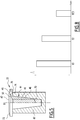
- test results are reported on the graph of the figure 8 , which has on the abscissa the reference of the test and on the ordinate, the degree of brightness obtained, from the to the least.
- liquid silicone elastomers make it possible to obtain particular gloss properties, unlike other different types of silicones, such as RTV silicones that carry at temperatures much lower than 150 ° C., or EVCs. which contain fluoride. On the contrary, the liquid silicone elastomer is free of fluorine.
- fluorine in the EVC offers better resistance to oils, solvents, etc., cosmetic compositions, but repels the cast oils and makes the grapes dull, regardless of the internal surface condition of the nipple and whatever the applied process even cold.
- liquid silicone elastomer solves these difficulties, while providing very bright grapes on the surface.
- liquid silicone elastomer (LSR) is obtained from the product Elastosil LR3003 / 20 TR A / B sold by the company Wacker.
- the liquid silicone elastomer has a temperature range of use of between -55 ° C. and 210 ° C., a hardness of between 10 Shore A and 30 Shore A, especially 20 Shore A, measured according to DIN 53505, a density of between 1.0 g / cm 3 and 1.2 g / cm 3 in particular 1.08 g / cm 3 , measured according to ISO 1183-1A, a viscosity before crosslinking less than 500 Pa.s advantageously between 230 Pa .s and 320 Pa.s, measured according to DIN 53019 at a shear rate of 0.9 s -1 , a tensile strength of between 7 N / mm 2 and 9 N / mm 2 advantageously 8 N / mm 2 , measured according to DIN 53504 S1, an elongation at break above 600% and advantageously between 700% and 1000%, measured according to DIN 53504 S1, a tear strength of between 24 N / mm and advantageously 26 N / mm, a re
- the mold 60 is made of hardened steel and has a surface state prepared by manual finishing and electrolytic polishing to obtain a roughness having an arithmetic mean difference in profile (Ra) of less than 0.2 and advantageously less than or equal to 0.1.
Landscapes
- Engineering & Computer Science (AREA)
- Manufacturing & Machinery (AREA)
- Mechanical Engineering (AREA)
- Cosmetics (AREA)
- Compositions Of Macromolecular Compounds (AREA)
Description
- La présente invention concerne un procédé de fabrication d'au moins un bloc de produit cosmétique selon le préambule de la revendication 1.
- Le produit cosmétique est par exemple un produit cosmétique de maquillage ou de soin d'une surface corporelle d'un utilisateur, tel qu'un rouge à lèvres ou un produit de protection pour les lèvres.
- Plus généralement, on entend par « produit cosmétique », un produit tel que défini dans le Règlement CE N°1223/2009 du Parlement européen et du Conseil daté du 30 novembre 2009, relatif aux produits cosmétiques.
- Dans le domaine des rouges à lèvres ou des produits de soin, le bloc de produit cosmétique est généralement conditionné dans un étui. Le bloc présente une forme allongée, éventuellement effilée à son extrémité, désignée par le terme « raisin ». Il est souvent monté sur une cupule déployable hors de l'étui.
- Pour fabriquer le bloc, il est connu de préparer une composition cosmétique, puis de la fluidifier en la chauffant. La composition cosmétique est alors coulée dans un moule en élastomère, aussi appelé « tétine », présentant une cavité interne de forme complémentaire à celle souhaitée pour le bloc.
- La tétine est alors refroidie pour permettre la solidification du bloc. Puis, la tétine et écartée de la surface du bloc, par exemple en la déformant par mise sous vide. La cupule est alors mise en place. L'ensemble formé du bloc et de la cupule est extrait pour être introduit dans l'étui.
-
FR 2 720 659 FR 2 700 448 EP 2 500 011 ,EP 0 686 468 ouWO 2004/100705 décrivent des procédés du type précité. - Ces procédés ne donnent pas entière satisfaction. En effet, dans le domaine cosmétique, l'apparence du produit après fabrication revêt une importance capitale. En particulier, dans le domaine des rouges à lèvres, il est souhaité que le bloc présente une brillance élevée à des fins esthétiques.
- Cependant, dans certains cas, la nature de la tétine et le démoulage nuit à la brillance du bloc obtenu.
- Un but de l'invention est d'obtenir un procédé de fabrication d'un bloc de produit cosmétique coulé, qui permette d'obtenir de manière simple un produit cosmétique d'aspect esthétique très satisfaisant, en particulier en terme de brillance.
- À cet effet, l'invention a pour objet un procédé selon la revendication 1.
- Le procédé selon l'invention peut comprendre l'une ou plusieurs des caractéristiques des revendications 2 à 7 ou la caractéristique suivante :
- le mélange du premier précurseur et du deuxième précurseur est inapte à réticuler à une température inférieure à 50 °C.
- L'invention a également pour objet une installation selon la revendication 8.
- L'installation selon l'invention peut comprendre l'une ou plusieurs des caractéristiques des revendications 9 à 11.
- L'invention a aussi pour objet une tétine selon la revendication 12.
- La tétine selon l'invention peut comprendre l'une ou plusieurs des caractéristiques des revendications 13 à 15.
- L'invention sera mieux comprise à la lecture de la description qui va suivre, donnée uniquement à titre d'exemple, et faite en se référant aux dessins annexés, sur lesquels :
- les
figures 1 à 4 illustrent schématiquement une première installation de fabrication d'un bloc de produit cosmétique selon l'invention, lors des différentes étapes d'un procédé de fabrication du bloc ; - la
figure 5 est une vue de face, prise en coupe partielle, d'une tétine de formation du bloc selon l'invention ; - la
figure 6 est une vue schématique d'un dispositif de moulage de la tétine de lafigure 5 ; - la
figure 7 est une vue de face d'un bloc de produit cosmétique obtenu par le procédé selon l'invention ; - la
figure 8 est un graphe illustrant les résultats d'un test de brillance réalisé sur des échantillons obtenus à l'aide du procédé selon l'invention et sur des échantillons comparatifs. - Un bloc 10 de produit cosmétique obtenu par un procédé selon l'invention est illustré par la
figure 7 . Sur cette figure, le bloc 10 est monté sur un organe de support 12, tel qu'une cupule. - Le produit cosmétique est par exemple un produit cosmétique de maquillage ou de soin d'une surface corporelle d'un utilisateur, tel qu'un rouge à lèvres ou un produit de protection pour les lèvres.
- Le bloc 10 présente une forme allongée suivant un axe vertical A-A'. Il présente une extrémité libre 14 effilée.
- Le bloc 10 est solide à température ambiante, par exemple à 25 °C. Il est cependant apte à se déliter ou à se fluidifier au contact de la surface corporelle d'un utilisateur.
- Le bloc 10 est fabriqué par un premier procédé selon l'invention, à partir d'une composition cosmétique propre à être coulée. La composition cosmétique est solide à température ambiante. Elle est apte à se fluidifier par chauffage, par exemple une température supérieure à 50 °C, notamment supérieure à 80 °C.
- Le premier procédé selon l'invention est mis en oeuvre dans une installation 20, illustrée schématiquement sur les
figures 1 à 5 . - Sur ces figures, l'installation 20 est représentée dans le cadre de la fabrication d'un bloc 10. En pratique, l'installation 20 est apte à fabriquer une grande quantité de blocs 10 simultanément, par duplication des équipements représentés sur les
figures 1 à 5 . - Comme illustré sur ces figures, et selon l'invention, l'installation 20 comporte au moins une tétine 22 réalisée en élastomère de silicone liquide ou «LSR», destinée à la formation d'un bloc 10.
- L'installation 20 comporte en outre un réservoir 24 de composition cosmétique, et un ensemble 26 de chauffage de la composition cosmétique pour fluidifier cette composition.
- L'installation 20 comprend également un ensemble 28 de coulage de la composition fluidifiée pour l'amener dans la tétine 22, et un ensemble 30 de modification de la température de la tétine 22.
- En référence aux
figures 3 et 4 , l'installation 20 comporte de plus un ensemble 32 de démoulage du bloc 10 à l'écart de la tétine 22. - Comme illustré par la
figure 5 , la tétine 22 délimite une cavité interne 40 de moulage du bloc 10, présentant une forme complémentaire à celle du bloc 10. La cavité interne 40 débouche vers le haut par une ouverture 42 d'introduction de composition cosmétique. - La tétine 22 comporte ainsi une paroi 44 déformable en élastomère de silicone liquide, la paroi comportant un fût 46 délimitant la cavité 40, une collerette extérieure 48 d'appui située autour de l'ouverture 42, et dans l'exemple illustré par la
figure 5 , une paroi intermédiaire 50 de liaison entre le fût 46 et la collerette extérieure 48. - La paroi 44 est réalisée d'un seul tenant en étant venue de matière. Elle est par exemple obtenue par un procédé de moulage par injection d'un élastomère de silicone liquide.
- En référence à la
figure 6 , l'élastomère de silicone liquide est par exemple formé par le mélange 56, dans un mélangeur 58, d'un premier précurseur 52 comportant un polysiloxane comprenant au moins un groupe aliphatique insaturé, de préférence au moins un groupe vinyle, avec un deuxième précurseur 54 comportant un métal de transition, tel que du platine, et comportant un agent réticulant, notamment un polysiloxane dépourvu de groupes insaturés. - Le mélange 56 est par exemple réalisé avec les proportions massiques 1 pour 1 de premier précurseur 52 et de deuxième précurseur 54.
- Il présente une viscosité faible, notamment une viscosité, mesurée à 20 °C par la norme DIN 53 018, inférieure à 500 Pa.s, notamment inférieure à 400 Pa.s, et avantageusement comprise entre 250 Pa.s et 350 Pa.s.
- Le mélange 56 est inapte à réticuler à température ambiante, notamment à une température inférieure à 50 °C.
- Ce mélange 56 présente donc une forme fluide ou pâteuse. Il est apte à être pompé jusqu'à un moule 60 d'injection, présentant une empreinte de moulage de forme complémentaire à la tétine 22. L'empreinte de moulage de la tétine est réalisée dans un moule en acier trempé, et présente une finition de type « poli miroir ». Le mélange 56 est propre à être chauffé dans le moule 60 à une température supérieure à 150 °C, notamment comprise entre 180 °C et 200 °C pour amocer la réticulation de l'élastomère.
- La pression d'injection dans le moule 60 est par exemple supérieure à 50 bars. Avantageusement, la pression d'injection dans le moule 60 est comprise entre 50 bars et 150 bars.
- La réticulation s'effectue par réaction chimique d'addition entre les groupes vinyle du polysiloxane compris dans le premier précurseur 52 et l'agent réticulant contenu dans le deuxième précurseur 54, en présence du métal de transition, pour créer des liaisons covalentes entre les chaînes individuelles de polysiloxane.
- La réticulation est rapide, le temps de séjour dans le moule 60 est compris entre trois secondes et dix secondes, notamment entre cinq secondes et six secondes par millimètre d'épaisseur de paroi 44.
- La réticulation n'engendre donc aucun sous-produit, contrairement à la réticulation aux peroxydes ou au soufre.
- Contrairement aux silicones de type RTV, aucune réticulation n'intervient à température ambiante. Par suite, il est possible de pomper chacun des précurseurs 52, 54, puis le mélange 56 jusqu'au moule 60 sans démarrer la réaction de réticulation, en maintenant le mélange 56 à une température comprise avantageusement entre 15 °C et 25 °C.
- La réticulation dans le moule 60 est généralement suivie d'un post-traitement par chauffage, par exemple dans un four, à une température supérieure à 150 °C, notamment supérieure à 180 °C pendant une durée supérieure à1 heure, notamment comprise entre 3 heures et 5 heures.
- L'élastomère de silicone liquide formant la paroi 44 est particulièrement avantageux. Il présente une bonne adhérence directe sur différents types d'inserts, une faible reprise d'humidité et une résistance à de nombreux solvants, et souvent une très bonne résistance aux huiles.
- Cet élastomère est en outre résistant à l'impact et est très hydrophobe.
- De préférence, l'élastomère de silicone liquide formant la paroi 44 présente une densité comprise entre 1,0 g/cm3 et 1,2 g/cm3, telle que mesurée par la norme DIN 53 479 A.
- Il présente une résistance à la traction comprise entre 5 N/mm2 et 10 N/mm2, notamment entre 7 N/mm2 et 9 N/nm2, mesurée par la norme DIN 53 504 S2. Il présente de préférence une élongation à la rupture supérieure à 500 %, notamment supérieure à 600 %, et avantageusement comprise entre 600 % et 900 %, telle que mesurée par la norme DIN 53 504 S2.
- L'élastomère de silicone liquide formant la paroi 44 possède en outre une résistance à la déchirure élevée, notamment supérieure à 30 N/mm, et notamment comprise entre 32 N/mm et 37 N/mm, telle que mesurée par la norme ASTM D 624 Die B.
- Il présente en outre une compression rémanente avantageusement comprise entre 10 % et 20 %, telle que mesurée par la norme ISO 815.
- L'élastomère de silicone liquide formant la paroi 44 présente une dureté comprise entre 10 Shore A et 50 Shore A, notamment entre 30 Shore A et 40 Shore A.
- Un exemple d'élastomère de silicone liquide pouvant être utilisé pour former la paroi 44 est le Silopren LSR 2630 commercialisé par la société MOMENTIVE.
- En référence à la
figure 5 , le fût 46 présente avantageusement une surface extérieure 70 tronconique. - L'épaisseur de la paroi 44 diminue donc en se déplaçant depuis l'ouverture 42 vers le fond de la cavité 40, le long d'un axe B-B' de la cavité 40. L'épaisseur minimale de la paroi 44, prise perpendiculairement à l'axe B-B', est avantageusement comprise entre 2,0 mm et 0,5 mm. L'épaisseur maximale de la paroi 44, prise perpendiculairement à l'axe B-B', est avantageusement comprise entre 5,0 mm et 2,0 mm, au voisinage de la collerette 48.
- La collerette 48 s'étend transversalement par rapport à l'axe B-B'. Elle présente une surface supérieure 72 inclinée vers le fût 46 en se déplaçant à l'écart de l'axe B-B'.
- L'épaisseur minimale de la collerette 48, prise le long de l'axe B-B', est par exemple comprise entre 2,0 mm et 1,0 mm. L'épaisseur maximale de la collerette 48, prise le long de l'axe B-B', est par exemple comprise entre 6,0 mm et 2,0 mm.
- La collerette 48 présente avantageusement une rainure annulaire 74 s'étendant autour du fût 46 et débouchant vers le fût 46. Elle présente un orifice 76 extérieur.
- La rainure 74 permet le maintien de la tétine 22 sur un support lors de l'application d'un vide pour démouler deux régions successives de la tétine 22.
- La rainure 74 présente une épaisseur comprise entre 1 mm et 3 mm. Elle dispose d'un côté plat dans la même direction que l'axe B-B' et d'un côté incliné d'environ 60° mesuré par rapport à la perpendiculaire à l'axe B-B'.
- L'orifice 76 coïncide avec un pion d'orientation de la tétine 22 dans l'installation 20.
- La paroi intermédiaire 50 est inclinée par rapport à l'axe B-B' d'un angle compris entre 60° et 90°. Elle présente une épaisseur croisante en se déplaçant transversalement par rapport à l'axe B-B', à l'écart de l'axe B-B'.
- L'épaisseur minimale de la paroi 50, prise le long de l'axe B-B' est par exemple comprise entre 2,0 mm et 1,0 mm. L'épaisseur maximale de la paroi 50, prise le long de l'axe B-B', est par exemple comprise entre 5,0 mm et 2,0 mm.
- En référence à la
figure 1 , l'ensemble de chauffage 26 est propre à chauffer la composition cosmétique contenue dans le réservoir 24 à une température supérieure à 50 °C pour la fluidifier. - L'ensemble de coulage 28 comporte au moins une tubulure 80 propre à injecter la composition cosmétique fluidifiée dans la cavité 40 de chaque tétine 22.
- L'ensemble 30 de modification de la température comporte, pour chaque tétine 22, un réceptacle 82 de refroidissement de la tétine 22, et un circuit 84 de de refroidissement du réceptacle 82, visibles sur la
figure 2 . - L'ensemble 30 de régulation thermique comporte en outre avantageusement un réceptacle 85 de préchauffage de chaque tétine 22, associé à un circuit 85A de préchauffage de la tétine 22, visible sur la
figure 1 . - En variante, l'ensemble 30 de régulation thermique comporte un dispositif de soufflage de gaz chaud ou des halogènes permettant un chauffage sans contact de chaque tétine 22.
- Chaque réceptacle 82, 85 délimite un logement 86 de réception du fût 46 de la tétine 22, avantageusement de forme complémentaire au fût 46. Ainsi, le réceptacle 82, 85 est propre à venir en contact avec la surface extérieure 70 du fût 46 pour chauffer et/ou refroidir par contact la tétine 22.
- Le circuit de préchauffage 85 est propre, avant l'injection de la composition cosmétique dans la cavité 40, à éventuellement préchauffer la tétine 22 à une température supérieure à 10 ° C, avantageusement comprise entre 10 °C et 35 °C.
- Le circuit de refroidissement 84 est propre, après l'injection de la composition cosmétique dans la cavité 40, à refroidir la tétine 22 à une température inférieure à 0 °C, notamment inférieure à -10 °C, notamment comprise entre -15 °C et -25 °C, pour provoquer la solidification de la composition cosmétique et la formation du bloc 10.
- Le circuit 84 comporte un fluide caloporteur composé par exemple d'un mélange d'eau et de glycol refroidi par un groupe froid.
- En référence à la
figure 3 et à lafigure 4 , l'ensemble de démoulage 32 comporte une enceinte de démoulage 90, un premier circuit 92 de mise en dépression d'une région supérieure 94 de l'enceinte 90, et un deuxième circuit 96 de mise en dépression d'une région inférieure 98 de l'enceinte 90. - Le premier circuit 92 est propre à être activé pour aspirer une région supérieure du fût 46 et de la paroi intermédiaire 50 pour les déformer radialement à l'écart de l'axe B-B' et les écarter d'une partie supérieure du bloc 10 de produit cosmétique.
- Le deuxième circuit 96 est propre à être activé pour aspirer une région inférieure du fût 46 et la déformer radialement à l'écart de l'axe B-B' pour l'écarter d'une partie inférieure du bloc 10 de produit cosmétique.
- Avantageusement, dans l'exemple représenté sur la
figure 3 , l'ensemble de démoulage 32 comporte en outre un appareil 99 de mise en place de l'organe de support 12 sur le bloc 10, et d'extraction de l'ensemble formé par l'organe de support 12 et le bloc 10. - Un premier procédé de fabrication d'au moins un bloc 10, mise en oeuvre dans l'installation 20 selon l'invention va maintenant être décrit.
- Initialement, la composition cosmétique contenue dans le réservoir 24 est chauffée par l'ensemble de chauffage 26 pour être fluidifiée. La température de chauffage de la composition est supérieure à 50 °C, et est notamment comprise entre 90 °C et 110 °C.
- La composition fluidifiée est sous forme liquide. Elle est avantageusement agitée afin d'éviter la sédimentation et la génération de bulles d'air.
- Dans un mode de réalisation particulier, chaque tétine 22 est introduite dans un réceptacle 85 de préchauffage pour y être chauffée par le circuit de préchauffage 85A, avantageusement à une température supérieure à 10 °C et notamment comprise entre 10 °C et 35 °C pendant un temps supérieur à 30 seconds, et compris par exemple entre 40 secondes et 80 secondes.
- En variante, aucun pré-chauffage de la tétine 22 n'est effectué.
- L'ensemble de coulage 24 est alors activé. La composition cosmétique fluidifiée est coulée dans la cavité 40 de la tétine 22 à travers la tubulure 28.
- La tétine 22 est alors déplacée dans le logement 86 d'au moins un réceptacle 82 de refroidissement pour y être refroidie à une température inférieure à 0 °C, notamment inférieure à -10 °C, et de préférence comprise ente -15 °C et -25 °C.
- De préférence, la tétine 22 est amenée successivement dans les logements 86 respectifs d'une pluralité de réceptacles 82 de refroidissement.
- Le temps de refroidissement de chaque tétine 22 dans un ou plusieurs réceptacles 82 est au total supérieur à 100 secondes, et notamment compris entre 200 secondes et 400 secondes.
- En référence à la
figure 3 , chaque tétine 22 est ensuite introduite dans une enceinte 90 de démoulage. Le premier circuit 92 de mise en dépression est alors activé. Une région supérieure du fût 46 et la paroi intermédiaire 50 se déforment de manière élastique à l'écart de l'axe B-B' pour se plaquer contre la région supérieure 94 de l'enceinte 90, à l'écart d'une partie supérieure du bloc 10. Une région inférieure du fût 46 reste plaquée contre le bloc 10. - La partie supérieure du bloc 10 est alors découverte. L'appareil 99 est ensuite activé pour amener l'organe de support 12 au contact de la partie supérieure du bloc 10 et pour solidariser l'organe de support 12 au bloc 10.
- Comme illustré sur la
figure 4 , le deuxième circuit 94 de mise en dépression est ensuite activé. La région inférieure du fût 46 se déforme alors de manière élastique à l'écart de l'axe B-B' pour venir se plaquer contre la région inférieure 98 de l'enceinte 90. - L'ensemble formé par le bloc 10 et par l'organe de support 12 solidarisé avec le bloc 10 est alors extrait hors de la cavité 40, en vue de son conditionnement ultérieur.
- D'une manière surprenante, la mise en oeuvre du procédé selon l'invention, et notamment l'utilisation d'une tétine 22 en élastomère de silicone liquide, permet d'obtenir des blocs 10 de produit cosmétique qui présentent un aspect esthétique particulièrement satisfaisant, notamment en terme de brillance.
- Cet effet est obtenu de manière aisée et à moindre coût, dans une installation 20 de structure simple.
- Pour illustrer l'effet de brillance obtenu, des exemples de préparation de blocs 10 à l'aide du procédé selon l'invention, et des exemples comparatifs vont maintenant être décrits.
- Dans cet exemple, la composition cosmétique suivante est préparée dans le réservoir 24.
Nom % en poids Phase Huile de castor hydrogénée dimère dilinolétate (Risocast DA-L) 13,02 B Triglycéride caprilique/caprique (TCG-M) 27,9 A Squalane (olive Squalane) 14,42 A Huile de castor hydrogénée Isostéarate (Risocast MIS) 9,3 A Malate de Diisostéaryle 9,3 A Cire microcristalline 6,51 C Céresine (Ceresin 810) 4,65 C Polyglyceryl 2-isostéarate 4,65 A Cire de polyéthylène 3,26 C Pigment Yellow 5 lake 0,85 D Pigment Blue one lake 0,2 D Pigment Red 7 0,47 D Dioxyde de titane 2,3 D Oxyde de fer rouge 0,76 D Oxyde de fer jaune 0,21 D mica 2,2 E - La phase D (pigments) est broyée à la tricylindre avec une partie de la phase A (de telle sorte que la masse de phase D soit de l'ordre du 1/3 de la phase A).
- On fait chauffer les ingrédients restants (soient les 2/3 restants de la phase A et la phase C) dans un poêlon, à 98°C, et on rajoute le mélange de la phase D et de la partie de la phase A ainsi que la phase E.
- On fait tout fondre pendant 30 minutes environ. Dans cet exemple, les tétines 22 ne sont pas préchauffées.
- Une masse de 4,0 g à 5,0 g de composition est alors coulée dans chaque cavité 40 d'une tétine 22.
- La tétine 22 est ensuite introduite successivement dans plusieurs réceptacles 82 de refroidissement, pour y être refroidie à une température inférieure à -10°C , pendant un temps total environ égal à 300 secondes. La composition cosmétique contenue dans la cavité 40 se solidifie alors pour former un bloc 10.
- Ceci étant fait, le haut du bloc 10 est réchauffé pour fondre la cheminée, avant de passer dans l'enceinte de démoulage 90.
- Chaque tétine 22 est ensuite placée dans une enceinte de démoulage 90. Le premier circuit de mise sous vide 92 est activé à une pression de 0,8 bars, pour permettre de découvrir la partie supérieure du bloc 10 en aspirant la région supérieure du fût 46 contre la région supérieure 94 de l'enceinte 90.
- Un organe de support 12 formé par une cupule est alors embouti sur l'embase du bloc 10.
- Puis, le deuxième circuit de mise sous vide 94 est activé à une pression de 0,7 bars pour découvrir la partie inférieure du bloc 10. Le bloc 10 et l'organe de support 12 sont alors extraits hors de la cavité 40.
- Le procédé décrit dans l'exemple E1 est reproduit avec la même composition en refroidissant la tétine à une température supérieure à 0 °C. Dans ce procédé, un préchauffage des tétines 22 à 100 °C pendant 60 secondes est appliqué, avant de couler la composition cosmétique.
- Le procédé décrit dans l'exemple E1 est reproduit avec la même composition en utilisant une tétine 22 réalisée à base d'un élastomère de silicone réticulé aux peroxydes.
- Pour évaluer la brillance, le test suivant est mis en place. Les échantillons à tester sont tous désignés par un numéro différent.
- Un panel comportant entre 10 et 13 évaluateurs est rassemblé.
- Deux échantillons de référence sont fournis à chaque évaluateur : un échantillon de référence mat auquel est attribué une note de 0 points et un autre échantillon de référence brillant auquel est attribué une note de 10 points.
- L'évaluateur note chaque échantillon à tester sur la base des deux échantillons de référence présentés au préalable.
- Les notes peuvent dépasser les valeurs des échantillons de référence, par exemple un échantillon très brillant peut dépasser les 10 points.
- L'ensemble des notes de chaque évaluateur sont reportées dans un tableau et une moyenne est faite sur les échantillons notés par le panel. Une analyse de la dispersion de résultats (variance) est faite pour vérifier la pertinence du classement final.
- Les résultats du test sont reportés sur le graphe de la
figure 8 , qui présente en abscisse la référence du test et en ordonnée, le degré de brillance obtenu, du plus vers le moins. - Comme visible sur la
figure 8 , l'utilisation du procédé selon l'invention, et notamment d'une tétine 22 en élastomère de silicone liquide conduit à l'obtention de blocs 10 présentant une brillance significativement améliorée (exemples E1 et E2) par rapport à ceux formés dans une tétine 22 en silicone classique (exemple comparatif EC3). - De plus, le refroidissement de la tétine 22 à une température significativement négative augmente encore la note de brillance obtenue (exemple E1), d'une manière particulièrement surprenante.
- D'une manière surprenante, les élastomères de silicone liquides permettent d'obtenir des propriétés particulières de brillance contrairement à d'autres types différents de silicones, tels que les silicones RTV qui véhiculent à des températures très inférieures à 150°C, ou aux EVC qui contiennent du fluor. Au contraire, l'élastomère de silicone liquide est dépourvu de fluor.
- La présence de fluor dans les EVC offre une meilleure résistance aux huiles, solvants, etc, des compositions cosmétiques, mais repulse les huiles coulées et rend les raisins mats, quelle que soit l'état de surface interne de la tétine et quel que soit le procédé appliqué même à froid.
- L'élastomère de silicone liquide résout ces difficultés, tout en fournissant des raisins très brillants en surface.
- En variante, la tétine réalisée en élastomère de silicone liquide (LSR) est obtenue à partir du produit Elastosil LR3003/20 TR A/B commercialisé par la société WACKER.
- L'élastomère de silicone liquide présente une plage d'utilisation en température comprise entre -55°C et 210°C, une dureté compriseentre 10 Shore A et 30 Shore A notamment 20 Shore A, mesurée selon la norme DIN 53505, une densité comprise entre 1,0 g/cm3, et 1,2 g/cm3 notamment 1,08 g/cm3, mesurée selon la norme ISO 1183-1A, une viscosité avant réticulation inférieure à 500 Pa.s avantageusement compris entre 230 Pa.s et 320 Pa.s, mesurée selon la norme DIN 53019 à un taux de cisaillement de 0,9 s-1, une résistance à la traction comprise entre 7 N/mm2 et 9 N/mm2 avantageusement 8 N/mm2, mesurée selon la norme DIN 53504 S1, une élongation à la rupture supérieure 600% et avantageusement comprise entre 700% et 1000%, mesurée selon la norme DIN 53504 S1, une résistance à la déchirure comprise entre 24 N/mm et avantageusement 26 N/mm, une compression rémanente comprise entre 10% et 20%, avantageusement 18%, mesurée selon la norme DIN ISO 815 B à 175°C pendant 22h.
- Avantageusement, le moule 60 est réalisé en acier trempé et présente un état de surface élaboré par une finition manuelle et un polissage électrolytique pour obtenir une rugosité ayant un écart moyen arithmétique du profil (Ra) inférieur à 0,2 et avantageusement inférieur ou égal à 0,1.
Claims (15)
- Procédé de fabrication d'au moins un bloc (10) de produit cosmétique, comprenant les étapes suivantes :- chauffage d'une composition cosmétique pour fluidifier la composition ;- coulage de la composition cosmétique fluidifiée dans une cavité (40) d'au moins une tétine (22) en élastomère ;- refroidissement de la composition cosmétique dans la tétine (22) pour former le bloc (10) ;- démoulage du bloc (10) hors de la cavité (40) ;dans lequel la tétine (22) est réalisée en élastomère de silicone liquide.
- Procédé selon la revendication 1, dans lequel la tétine (22) en élastomère de silicone liquide est susceptible d'être obtenue par un procédé d'injection d'un mélange (56) d'un premier précurseur (52) comprenant un polysiloxane muni de groupements aliphatiques insaturés avec un deuxième précurseur (54) comprenant un agent de réticulation et un métal de transition tel que du platine, l'injection étant réalisée dans un moule (60) chauffé à une température supérieure à 100 °C, avantageusement à une pression supérieure à 50 bar, le procédé d'injection comprenant la réticulation du polysiloxane en présence du métal de transition.
- Procédé selon la revendication 2, dans lequel le mélange (56) de précurseurs présente, avant réticulation, une viscosité, mesurée à 20 °C par la norme DIN 53018, inférieure à 500 Pa.s, notamment inférieure à 400 Pa.s.
- Procédé selon l'une quelconque des revendications précédentes, dans lequel l'étape de refroidissement comporte l'application à la tétine (22) d'une température inférieure à 0°C, avantageusement inférieure à -10°C.
- Procédé selon l'une quelconque des revendications précédentes, dans lequel l'étape de démoulage comporte un retrait partiel de la tétine (22) à l'écart d'une partie supérieure du bloc (10), la fixation d'un organe de support (12) du bloc (10) sur la partie supérieure découverte du bloc (10), puis le retrait total de la tétine (22) à l'écart du bloc (10).
- Procédé selon l'une quelconque des revendications précédentes, dans lequel l'étape de démoulage comporte la mise en place de la tétine (22) dans une enceinte de démoulage (90), puis l'écartement au moins partiel de la tétine (22) du bloc (10), par aspiration d'au moins une région de la tétine (22) contre l'enceinte de démoulage (90).
- Procédé selon l'une quelconque des revendications précédentes, dans lequel l'élastomère de silicone liquide de la tétine (22) présente une résistance à la déchirure supérieure à 30 N/mm, telle que mesurée par la norme ASTM D 624 Die B.
- Installation (20) de fabrication d'au moins un bloc (10) de produit cosmétique, comprenant:- un ensemble (26) de chauffage d'une composition cosmétique ;- au moins une tétine (22) en élastomère présentant une cavité (40) ;- un ensemble (28) de coulage de la composition cosmétique dans la cavité (40) ;- un ensemble (82, 84) de refroidissement de la composition dans la tétine (22) pour former le bloc ;- un ensemble (32) de démoulage du bloc (10) hors de la cavité (40),dans lequel la tétine (22) est réalisée en élastomère de silicone liquide.
- Installation (20) selon la revendications 8, dans laquelle la tétine (22) en élastomère de silicone liquide est susceptible d'être obtenue par un procédé d'injection d'un mélange (56) d'un premier précurseur (52) comprenant un polysiloxane muni de groupements aliphatiques insaturés avec un deuxième précurseur (54) comprenant un agent de réticulation et un métal de transition tel que du platine, l'injection étant réalisée dans un moule (60) chauffé à une température supérieure à 100 °C, avantageusement à une pression supérieure à 50 bar, le procédé d'injection comprenant la réticulation du polysiloxane en présence du métal de transition.
- Installation (20) selon la revendication 9, dans laquelle le mélange (56) de précurseurs présente, avant réticulation, une viscosité, mesurée à 20 °C par la norme DIN 53018 inférieure à 500 Pa.s, notamment inférieure à 400 Pa.s.
- Installation (20) selon l'une quelconque des revendications 8 à 10, dans laquelle l'élastomère de silicone liquide de la tétine (22) présente une résistance à la déchirure supérieure à 30 N/mm, telle que mesurée par la norme ASTM D 624 Die B.
- Tétine (22) de formation d'un bloc (10) de produit cosmétique, comprenant une paroi (44) en élastomère délimitant une cavité (40) de coulage d'une composition cosmétique, dans laquelle la paroi (44) est réalisée en élastomère de silicone liquide.
- Tétine selon la revendication 12 susceptible d'être obtenue par un procédé d'injection d'un mélange (56) d'un premier précurseur (52) comprenant un polysiloxane muni de groupements aliphatiques insaturés avec un deuxième précurseur (54) comprenant un agent de réticulation et un métal de transition tel que du platine, l'injection étant réalisée dans un moule (60) chauffé à une température supérieure à 100°C, avantageusement à une pression supérieure à 50 bar, le procédé d'injection comprenant la réticulation du polysiloxane en présence du métal de transition.
- Tétine selon la revendication 13, dans laquelle le mélange (56) de précurseurs présente, avant réticulation, une viscosité, mesurée à 20 °C par la norme DIN 53018 inférieure à 500 Pa.s, notamment inférieure à 400 Pa.s.
- Tétine (22) selon l'une quelconque des revendications 12 à 14, dans laquelle l'élastomère de silicone liquide de la paroi (44) présente une résistance à la déchirure supérieure à 30 N/mm, telle que mesurée par la norme ASTM D 624 Die B.
Applications Claiming Priority (2)
| Application Number | Priority Date | Filing Date | Title |
|---|---|---|---|
| FR1351182A FR3001874B1 (fr) | 2013-02-12 | 2013-02-12 | Procede de fabrication d'au moins un bloc de produit cosmetique, installation et tetine associees |
| PCT/EP2014/052593 WO2014124916A1 (fr) | 2013-02-12 | 2014-02-11 | Procédé de fabrication d'au moins un bloc de produit cosmétique, installation et tétine associées |
Publications (2)
| Publication Number | Publication Date |
|---|---|
| EP2956029A1 EP2956029A1 (fr) | 2015-12-23 |
| EP2956029B1 true EP2956029B1 (fr) | 2018-11-14 |
Family
ID=48289347
Family Applications (1)
| Application Number | Title | Priority Date | Filing Date |
|---|---|---|---|
| EP14704325.1A Active EP2956029B1 (fr) | 2013-02-12 | 2014-02-11 | Procédé de fabrication d'au moins un bloc de produit cosmétique, installation et tétine associées |
Country Status (4)
| Country | Link |
|---|---|
| EP (1) | EP2956029B1 (fr) |
| ES (1) | ES2710975T3 (fr) |
| FR (1) | FR3001874B1 (fr) |
| WO (1) | WO2014124916A1 (fr) |
Families Citing this family (4)
| Publication number | Priority date | Publication date | Assignee | Title |
|---|---|---|---|---|
| ITUB201570270U1 (it) | 2015-09-18 | 2017-03-18 | Cmi Eng S R L | Macchina per produrre prodotti cosmetici o medicinali per esempio in stick. |
| IT201900002831A1 (it) * | 2019-02-27 | 2020-08-27 | Cosmatic S R L | Dispositivo, macchina e metodo di colaggio di uno stick per labbra |
| EP3827699A1 (fr) * | 2019-11-29 | 2021-06-02 | Weckerle GmbH | Dispositif de fabrication de produits en forme de tige, en particulier de rouges à lèvres, et procédé de fabrication de tels produits |
| IT202100011990A1 (it) * | 2021-05-10 | 2022-11-10 | Elettra Srl | Dispositivo di apertura di un’ogiva contenente stick per labbra |
Family Cites Families (4)
| Publication number | Priority date | Publication date | Assignee | Title |
|---|---|---|---|---|
| FR2720609B1 (fr) * | 1994-06-07 | 1996-11-08 | Lagrost Sa Bureau Etudes | Dispositif pour le coulage et le démoulage d'objets en matière à bas point de fusion. |
| CN101163748B (zh) * | 2005-05-26 | 2011-04-13 | 陶氏康宁公司 | 用于模塑小的型材的方法和有机硅封装剂组合物 |
| JP2008266412A (ja) * | 2007-04-18 | 2008-11-06 | Shin Etsu Chem Co Ltd | 帯電防止性シリコーンゴム型取り材料 |
| JP2011098935A (ja) * | 2009-11-09 | 2011-05-19 | Shiseido Co Ltd | スティック状化粧料及びその製造方法 |
-
2013
- 2013-02-12 FR FR1351182A patent/FR3001874B1/fr not_active Expired - Fee Related
-
2014
- 2014-02-11 EP EP14704325.1A patent/EP2956029B1/fr active Active
- 2014-02-11 ES ES14704325T patent/ES2710975T3/es active Active
- 2014-02-11 WO PCT/EP2014/052593 patent/WO2014124916A1/fr not_active Ceased
Non-Patent Citations (1)
| Title |
|---|
| None * |
Also Published As
| Publication number | Publication date |
|---|---|
| FR3001874A1 (fr) | 2014-08-15 |
| FR3001874B1 (fr) | 2016-07-22 |
| WO2014124916A1 (fr) | 2014-08-21 |
| ES2710975T3 (es) | 2019-04-29 |
| EP2956029A1 (fr) | 2015-12-23 |
Similar Documents
| Publication | Publication Date | Title |
|---|---|---|
| EP2956029B1 (fr) | Procédé de fabrication d'au moins un bloc de produit cosmétique, installation et tétine associées | |
| FR2676164A1 (fr) | Chocolat hypocalorique. | |
| EP0452186B1 (fr) | Procédé pour l'obtention de blocs d'autoadhésifs thermofusibles à surface non collante | |
| EP1912517B1 (fr) | Produit alimentaire multicouche et procédé pour sa préparation | |
| FR3095123A1 (fr) | Procédé pour produire une poudre cosmétique solide | |
| EP2340739A1 (fr) | Dispositif de préparation d'une composition cosmétique, nécessaire et procédé associé | |
| FR2987740A1 (fr) | Dispersion destinee a encapsuler un produit actif et utilisation associee | |
| CA2908335C (fr) | Procede d'enrobage de produits fromagers | |
| FR2932956A1 (fr) | Procede pour la mise en forme d'un produit alimentaire par cryoextrusion mettant en oeuvre une regulation de temperature predictive. | |
| FR2747885A1 (fr) | Moule flexible a base de silicones destine a l'industrie alimentaire, ainsi que procede de fabrication d'un tel moule | |
| BE1020343A3 (fr) | Produit fromager sec et expanse et son procede de fabrication. | |
| WO2000003933A1 (fr) | Distributeur de produits cremeux sous pression muni d'un piston etanche | |
| DE102007031747A1 (de) | Verfahren zum Gießen von aushärtenden Zuckerlösungen | |
| FR2790700A1 (fr) | Procede de moulage de produits a durcissement thermique, composition d'elastomere vulcanisable, moules et pince de moulage pour sa mise en oeuvre | |
| WO2017097440A1 (fr) | Procédé d'imprégnation d'une piéce en matiére plastique | |
| FR2628675A1 (fr) | Dispositif de moulage sans barbes de moulage notamment pour l'obtention de joints toriques | |
| FR2504827A1 (fr) | Lubrifiant interne permettant l'emboutissage profond de tole d'acier exempt d'etain a revetement exterieur epoxy-phenolique | |
| WO2022129641A1 (fr) | Procédé de préparation de pépites de chocolat contenant des microalgues | |
| BE1020854A5 (fr) | Procede d'isolation du contenu de remplissage d'un produit alimentaire. | |
| EP1310159B1 (fr) | Procédé de moulage d'un produit fromager | |
| EP1093827A2 (fr) | Applicateur en mousse comprenant un ou plusieurs composés particulaires concentrés au voisinage de la surface d'application | |
| CH662041A5 (en) | Process for raising the softening temperature of a chocolate composition | |
| EP4599687A1 (fr) | Portions congelées, surgelées et/ou cryogénisées de produits liquides ou visqueux | |
| EP3332647B1 (fr) | Procédé pour la fabrication d'escalopes de foie gras cru | |
| EP1751022A1 (fr) | Couvercle et conditionnement pour produits intermediaires destines a l'elaboration d'une pâtisserie |
Legal Events
| Date | Code | Title | Description |
|---|---|---|---|
| PUAI | Public reference made under article 153(3) epc to a published international application that has entered the european phase |
Free format text: ORIGINAL CODE: 0009012 |
|
| 17P | Request for examination filed |
Effective date: 20150710 |
|
| AK | Designated contracting states |
Kind code of ref document: A1 Designated state(s): AL AT BE BG CH CY CZ DE DK EE ES FI FR GB GR HR HU IE IS IT LI LT LU LV MC MK MT NL NO PL PT RO RS SE SI SK SM TR |
|
| AX | Request for extension of the european patent |
Extension state: BA ME |
|
| DAX | Request for extension of the european patent (deleted) | ||
| GRAP | Despatch of communication of intention to grant a patent |
Free format text: ORIGINAL CODE: EPIDOSNIGR1 |
|
| STAA | Information on the status of an ep patent application or granted ep patent |
Free format text: STATUS: GRANT OF PATENT IS INTENDED |
|
| INTG | Intention to grant announced |
Effective date: 20180404 |
|
| GRAJ | Information related to disapproval of communication of intention to grant by the applicant or resumption of examination proceedings by the epo deleted |
Free format text: ORIGINAL CODE: EPIDOSDIGR1 |
|
| STAA | Information on the status of an ep patent application or granted ep patent |
Free format text: STATUS: REQUEST FOR EXAMINATION WAS MADE |
|
| INTC | Intention to grant announced (deleted) | ||
| RIN1 | Information on inventor provided before grant (corrected) |
Inventor name: LORENTE-GONZALES, SONIA Inventor name: DUVERGER, GUILLAUME |
|
| GRAR | Information related to intention to grant a patent recorded |
Free format text: ORIGINAL CODE: EPIDOSNIGR71 |
|
| GRAS | Grant fee paid |
Free format text: ORIGINAL CODE: EPIDOSNIGR3 |
|
| STAA | Information on the status of an ep patent application or granted ep patent |
Free format text: STATUS: GRANT OF PATENT IS INTENDED |
|
| INTG | Intention to grant announced |
Effective date: 20180906 |
|
| GRAA | (expected) grant |
Free format text: ORIGINAL CODE: 0009210 |
|
| STAA | Information on the status of an ep patent application or granted ep patent |
Free format text: STATUS: THE PATENT HAS BEEN GRANTED |
|
| AK | Designated contracting states |
Kind code of ref document: B1 Designated state(s): AL AT BE BG CH CY CZ DE DK EE ES FI FR GB GR HR HU IE IS IT LI LT LU LV MC MK MT NL NO PL PT RO RS SE SI SK SM TR |
|
| REG | Reference to a national code |
Ref country code: CH Ref legal event code: EP Ref country code: AT Ref legal event code: REF Ref document number: 1063784 Country of ref document: AT Kind code of ref document: T Effective date: 20181115 |
|
| REG | Reference to a national code |
Ref country code: DE Ref legal event code: R096 Ref document number: 602014035950 Country of ref document: DE |
|
| REG | Reference to a national code |
Ref country code: IE Ref legal event code: FG4D Free format text: LANGUAGE OF EP DOCUMENT: FRENCH |
|
| REG | Reference to a national code |
Ref country code: NL Ref legal event code: MP Effective date: 20181114 |
|
| REG | Reference to a national code |
Ref country code: LT Ref legal event code: MG4D |
|
| REG | Reference to a national code |
Ref country code: AT Ref legal event code: MK05 Ref document number: 1063784 Country of ref document: AT Kind code of ref document: T Effective date: 20181114 |
|
| REG | Reference to a national code |
Ref country code: ES Ref legal event code: FG2A Ref document number: 2710975 Country of ref document: ES Kind code of ref document: T3 Effective date: 20190429 |
|
| PG25 | Lapsed in a contracting state [announced via postgrant information from national office to epo] |
Ref country code: IS Free format text: LAPSE BECAUSE OF FAILURE TO SUBMIT A TRANSLATION OF THE DESCRIPTION OR TO PAY THE FEE WITHIN THE PRESCRIBED TIME-LIMIT Effective date: 20190314 Ref country code: FI Free format text: LAPSE BECAUSE OF FAILURE TO SUBMIT A TRANSLATION OF THE DESCRIPTION OR TO PAY THE FEE WITHIN THE PRESCRIBED TIME-LIMIT Effective date: 20181114 Ref country code: HR Free format text: LAPSE BECAUSE OF FAILURE TO SUBMIT A TRANSLATION OF THE DESCRIPTION OR TO PAY THE FEE WITHIN THE PRESCRIBED TIME-LIMIT Effective date: 20181114 Ref country code: NO Free format text: LAPSE BECAUSE OF FAILURE TO SUBMIT A TRANSLATION OF THE DESCRIPTION OR TO PAY THE FEE WITHIN THE PRESCRIBED TIME-LIMIT Effective date: 20190214 Ref country code: BG Free format text: LAPSE BECAUSE OF FAILURE TO SUBMIT A TRANSLATION OF THE DESCRIPTION OR TO PAY THE FEE WITHIN THE PRESCRIBED TIME-LIMIT Effective date: 20190214 Ref country code: LT Free format text: LAPSE BECAUSE OF FAILURE TO SUBMIT A TRANSLATION OF THE DESCRIPTION OR TO PAY THE FEE WITHIN THE PRESCRIBED TIME-LIMIT Effective date: 20181114 Ref country code: LV Free format text: LAPSE BECAUSE OF FAILURE TO SUBMIT A TRANSLATION OF THE DESCRIPTION OR TO PAY THE FEE WITHIN THE PRESCRIBED TIME-LIMIT Effective date: 20181114 Ref country code: AT Free format text: LAPSE BECAUSE OF FAILURE TO SUBMIT A TRANSLATION OF THE DESCRIPTION OR TO PAY THE FEE WITHIN THE PRESCRIBED TIME-LIMIT Effective date: 20181114 |
|
| PG25 | Lapsed in a contracting state [announced via postgrant information from national office to epo] |
Ref country code: PT Free format text: LAPSE BECAUSE OF FAILURE TO SUBMIT A TRANSLATION OF THE DESCRIPTION OR TO PAY THE FEE WITHIN THE PRESCRIBED TIME-LIMIT Effective date: 20190314 Ref country code: AL Free format text: LAPSE BECAUSE OF FAILURE TO SUBMIT A TRANSLATION OF THE DESCRIPTION OR TO PAY THE FEE WITHIN THE PRESCRIBED TIME-LIMIT Effective date: 20181114 Ref country code: RS Free format text: LAPSE BECAUSE OF FAILURE TO SUBMIT A TRANSLATION OF THE DESCRIPTION OR TO PAY THE FEE WITHIN THE PRESCRIBED TIME-LIMIT Effective date: 20181114 Ref country code: NL Free format text: LAPSE BECAUSE OF FAILURE TO SUBMIT A TRANSLATION OF THE DESCRIPTION OR TO PAY THE FEE WITHIN THE PRESCRIBED TIME-LIMIT Effective date: 20181114 Ref country code: SE Free format text: LAPSE BECAUSE OF FAILURE TO SUBMIT A TRANSLATION OF THE DESCRIPTION OR TO PAY THE FEE WITHIN THE PRESCRIBED TIME-LIMIT Effective date: 20181114 Ref country code: GR Free format text: LAPSE BECAUSE OF FAILURE TO SUBMIT A TRANSLATION OF THE DESCRIPTION OR TO PAY THE FEE WITHIN THE PRESCRIBED TIME-LIMIT Effective date: 20190215 |
|
| PG25 | Lapsed in a contracting state [announced via postgrant information from national office to epo] |
Ref country code: DK Free format text: LAPSE BECAUSE OF FAILURE TO SUBMIT A TRANSLATION OF THE DESCRIPTION OR TO PAY THE FEE WITHIN THE PRESCRIBED TIME-LIMIT Effective date: 20181114 Ref country code: PL Free format text: LAPSE BECAUSE OF FAILURE TO SUBMIT A TRANSLATION OF THE DESCRIPTION OR TO PAY THE FEE WITHIN THE PRESCRIBED TIME-LIMIT Effective date: 20181114 Ref country code: CZ Free format text: LAPSE BECAUSE OF FAILURE TO SUBMIT A TRANSLATION OF THE DESCRIPTION OR TO PAY THE FEE WITHIN THE PRESCRIBED TIME-LIMIT Effective date: 20181114 |
|
| REG | Reference to a national code |
Ref country code: DE Ref legal event code: R097 Ref document number: 602014035950 Country of ref document: DE |
|
| PG25 | Lapsed in a contracting state [announced via postgrant information from national office to epo] |
Ref country code: RO Free format text: LAPSE BECAUSE OF FAILURE TO SUBMIT A TRANSLATION OF THE DESCRIPTION OR TO PAY THE FEE WITHIN THE PRESCRIBED TIME-LIMIT Effective date: 20181114 Ref country code: SK Free format text: LAPSE BECAUSE OF FAILURE TO SUBMIT A TRANSLATION OF THE DESCRIPTION OR TO PAY THE FEE WITHIN THE PRESCRIBED TIME-LIMIT Effective date: 20181114 Ref country code: SM Free format text: LAPSE BECAUSE OF FAILURE TO SUBMIT A TRANSLATION OF THE DESCRIPTION OR TO PAY THE FEE WITHIN THE PRESCRIBED TIME-LIMIT Effective date: 20181114 Ref country code: EE Free format text: LAPSE BECAUSE OF FAILURE TO SUBMIT A TRANSLATION OF THE DESCRIPTION OR TO PAY THE FEE WITHIN THE PRESCRIBED TIME-LIMIT Effective date: 20181114 |
|
| PLBE | No opposition filed within time limit |
Free format text: ORIGINAL CODE: 0009261 |
|
| STAA | Information on the status of an ep patent application or granted ep patent |
Free format text: STATUS: NO OPPOSITION FILED WITHIN TIME LIMIT |
|
| REG | Reference to a national code |
Ref country code: CH Ref legal event code: PL |
|
| 26N | No opposition filed |
Effective date: 20190815 |
|
| PG25 | Lapsed in a contracting state [announced via postgrant information from national office to epo] |
Ref country code: LU Free format text: LAPSE BECAUSE OF NON-PAYMENT OF DUE FEES Effective date: 20190211 Ref country code: SI Free format text: LAPSE BECAUSE OF FAILURE TO SUBMIT A TRANSLATION OF THE DESCRIPTION OR TO PAY THE FEE WITHIN THE PRESCRIBED TIME-LIMIT Effective date: 20181114 Ref country code: MC Free format text: LAPSE BECAUSE OF FAILURE TO SUBMIT A TRANSLATION OF THE DESCRIPTION OR TO PAY THE FEE WITHIN THE PRESCRIBED TIME-LIMIT Effective date: 20181114 |
|
| REG | Reference to a national code |
Ref country code: BE Ref legal event code: MM Effective date: 20190228 |
|
| REG | Reference to a national code |
Ref country code: IE Ref legal event code: MM4A |
|
| PG25 | Lapsed in a contracting state [announced via postgrant information from national office to epo] |
Ref country code: LI Free format text: LAPSE BECAUSE OF NON-PAYMENT OF DUE FEES Effective date: 20190228 Ref country code: CH Free format text: LAPSE BECAUSE OF NON-PAYMENT OF DUE FEES Effective date: 20190228 |
|
| PG25 | Lapsed in a contracting state [announced via postgrant information from national office to epo] |
Ref country code: IE Free format text: LAPSE BECAUSE OF NON-PAYMENT OF DUE FEES Effective date: 20190211 |
|
| PG25 | Lapsed in a contracting state [announced via postgrant information from national office to epo] |
Ref country code: BE Free format text: LAPSE BECAUSE OF NON-PAYMENT OF DUE FEES Effective date: 20190228 |
|
| PG25 | Lapsed in a contracting state [announced via postgrant information from national office to epo] |
Ref country code: TR Free format text: LAPSE BECAUSE OF FAILURE TO SUBMIT A TRANSLATION OF THE DESCRIPTION OR TO PAY THE FEE WITHIN THE PRESCRIBED TIME-LIMIT Effective date: 20181114 |
|
| PG25 | Lapsed in a contracting state [announced via postgrant information from national office to epo] |
Ref country code: MT Free format text: LAPSE BECAUSE OF FAILURE TO SUBMIT A TRANSLATION OF THE DESCRIPTION OR TO PAY THE FEE WITHIN THE PRESCRIBED TIME-LIMIT Effective date: 20181114 |
|
| PG25 | Lapsed in a contracting state [announced via postgrant information from national office to epo] |
Ref country code: CY Free format text: LAPSE BECAUSE OF FAILURE TO SUBMIT A TRANSLATION OF THE DESCRIPTION OR TO PAY THE FEE WITHIN THE PRESCRIBED TIME-LIMIT Effective date: 20181114 |
|
| PG25 | Lapsed in a contracting state [announced via postgrant information from national office to epo] |
Ref country code: HU Free format text: LAPSE BECAUSE OF FAILURE TO SUBMIT A TRANSLATION OF THE DESCRIPTION OR TO PAY THE FEE WITHIN THE PRESCRIBED TIME-LIMIT; INVALID AB INITIO Effective date: 20140211 |
|
| PG25 | Lapsed in a contracting state [announced via postgrant information from national office to epo] |
Ref country code: MK Free format text: LAPSE BECAUSE OF FAILURE TO SUBMIT A TRANSLATION OF THE DESCRIPTION OR TO PAY THE FEE WITHIN THE PRESCRIBED TIME-LIMIT Effective date: 20181114 |
|
| PGFP | Annual fee paid to national office [announced via postgrant information from national office to epo] |
Ref country code: GB Payment date: 20251218 Year of fee payment: 13 |
|
| PGFP | Annual fee paid to national office [announced via postgrant information from national office to epo] |
Ref country code: FR Payment date: 20251208 Year of fee payment: 13 |
|
| PGFP | Annual fee paid to national office [announced via postgrant information from national office to epo] |
Ref country code: ES Payment date: 20260305 Year of fee payment: 13 |
|
| PGFP | Annual fee paid to national office [announced via postgrant information from national office to epo] |
Ref country code: DE Payment date: 20251216 Year of fee payment: 13 |
|
| PGFP | Annual fee paid to national office [announced via postgrant information from national office to epo] |
Ref country code: IT Payment date: 20260122 Year of fee payment: 13 |