EP2960204A1 - Stockage d'hydrogène par hydrogénation réversible de substrats conjugués-pi - Google Patents
Stockage d'hydrogène par hydrogénation réversible de substrats conjugués-pi Download PDFInfo
- Publication number
- EP2960204A1 EP2960204A1 EP15178631.6A EP15178631A EP2960204A1 EP 2960204 A1 EP2960204 A1 EP 2960204A1 EP 15178631 A EP15178631 A EP 15178631A EP 2960204 A1 EP2960204 A1 EP 2960204A1
- Authority
- EP
- European Patent Office
- Prior art keywords
- hydrogen
- conjugated
- extended
- hydrogenation
- liquid
- Prior art date
- Legal status (The legal status is an assumption and is not a legal conclusion. Google has not performed a legal analysis and makes no representation as to the accuracy of the status listed.)
- Granted
Links
- IVHUNDJOMKXTST-UHFFFAOYSA-N CN1C2C3N=CCNC3C3NCCNC3C2NCCC1 Chemical compound CN1C2C3N=CCNC3C3NCCNC3C2NCCC1 IVHUNDJOMKXTST-UHFFFAOYSA-N 0.000 description 1
- LKWDJOYHDIUBLP-UHFFFAOYSA-N C[n]1c2c(c3ccccc3[nH]3)c3c(c(cccc3)c3[nH]3)c3c2c2c1cccc2 Chemical compound C[n]1c2c(c3ccccc3[nH]3)c3c(c(cccc3)c3[nH]3)c3c2c2c1cccc2 LKWDJOYHDIUBLP-UHFFFAOYSA-N 0.000 description 1
- HXTIDLAZPXGZKP-UHFFFAOYSA-N Cc(cccc12)c1[nH]c1c2c([n](C)c2c3cccc2)c3c2c1c1ccccc1[n]2C Chemical compound Cc(cccc12)c1[nH]c1c2c([n](C)c2c3cccc2)c3c2c1c1ccccc1[n]2C HXTIDLAZPXGZKP-UHFFFAOYSA-N 0.000 description 1
- QQWXDAWSMPLECU-UHFFFAOYSA-N c(cc1)cc2c1[nH]c1c2ccc2c1c1ccccc1[nH]2 Chemical compound c(cc1)cc2c1[nH]c1c2ccc2c1c1ccccc1[nH]2 QQWXDAWSMPLECU-UHFFFAOYSA-N 0.000 description 1
- UJOBWOGCFQCDNV-UHFFFAOYSA-N c(cc1)cc2c1[nH]c1ccccc21 Chemical compound c(cc1)cc2c1[nH]c1ccccc21 UJOBWOGCFQCDNV-UHFFFAOYSA-N 0.000 description 1
Images











Classifications
-
- C—CHEMISTRY; METALLURGY
- C01—INORGANIC CHEMISTRY
- C01B—NON-METALLIC ELEMENTS; COMPOUNDS THEREOF; METALLOIDS OR COMPOUNDS THEREOF NOT COVERED BY SUBCLASS C01C
- C01B3/00—Hydrogen; Gaseous mixtures containing hydrogen; Separation of hydrogen from mixtures containing it; Purification of hydrogen; Reversible storage of hydrogen
- C01B3/0005—Reversible storage of hydrogen, e.g. by hydrogen getters or electrodes
- C01B3/001—Reversible storage of hydrogen, e.g. by hydrogen getters or electrodes characterised by the uptaking media; Treatment thereof
- C01B3/0015—Organic compounds, e.g. liquid organic hydrogen carriers [LOHC] or metalorganic compounds; Solutions thereof
-
- B—PERFORMING OPERATIONS; TRANSPORTING
- B01—PHYSICAL OR CHEMICAL PROCESSES OR APPARATUS IN GENERAL
- B01J—CHEMICAL OR PHYSICAL PROCESSES, e.g. CATALYSIS OR COLLOID CHEMISTRY; THEIR RELEVANT APPARATUS
- B01J3/00—Processes of utilising sub-atmospheric or super-atmospheric pressure to effect chemical or physical change of matter; Apparatus therefor
-
- B—PERFORMING OPERATIONS; TRANSPORTING
- B01—PHYSICAL OR CHEMICAL PROCESSES OR APPARATUS IN GENERAL
- B01J—CHEMICAL OR PHYSICAL PROCESSES, e.g. CATALYSIS OR COLLOID CHEMISTRY; THEIR RELEVANT APPARATUS
- B01J3/00—Processes of utilising sub-atmospheric or super-atmospheric pressure to effect chemical or physical change of matter; Apparatus therefor
- B01J3/02—Feed or outlet devices therefor
-
- Y—GENERAL TAGGING OF NEW TECHNOLOGICAL DEVELOPMENTS; GENERAL TAGGING OF CROSS-SECTIONAL TECHNOLOGIES SPANNING OVER SEVERAL SECTIONS OF THE IPC; TECHNICAL SUBJECTS COVERED BY FORMER USPC CROSS-REFERENCE ART COLLECTIONS [XRACs] AND DIGESTS
- Y02—TECHNOLOGIES OR APPLICATIONS FOR MITIGATION OR ADAPTATION AGAINST CLIMATE CHANGE
- Y02E—REDUCTION OF GREENHOUSE GAS [GHG] EMISSIONS, RELATED TO ENERGY GENERATION, TRANSMISSION OR DISTRIBUTION
- Y02E60/00—Enabling technologies; Technologies with a potential or indirect contribution to GHG emissions mitigation
- Y02E60/30—Hydrogen technology
- Y02E60/32—Hydrogen storage
Definitions
- This invention relates to processes for the reversible hydrogenation of pi-conjugated substrates to provide for the storage and release of hydrogen at practical operating temperatures and pressures, particularly for supplying hydrogen to fuel cells.
- Hydrogen is a widely used chemical commodity in the chemical and petroleum processing industries, but with the relatively recent development of fuel cells it is increasingly also being considered as a viable "clean" energy source.
- Stationary fuel cells can be supplied with hydrogen from on-site natural gas reformers or via existing hydrogen pipeline sources.
- a practical and effective method for storing hydrogen to power an on-board fuel cell or a hydrogen fuelled internal combustion engine is required.
- the transport of hydrogen as a cryogenic liquid although technologically well established, is an energy-intensive process which results in a significantly higher cost of the delivered gas.
- Hydrogen is also conventionally transported as a compressed gas in steel cylinders, but the storage capacity is relatively low. Higher gravimetric storage amounts, but at relatively low volumetric densities, can now be achieved with hydrogen gas at very high pressures up to 10,000 psi (690 bar) in light-weight containers made of very high strength composite materials. There are significant energy costs in thus compressing the gas as well as potential issues regarding consumers' acceptance of systems that contain hydrogen at such elevated pressures.
- the present invention is also directed to a dispensing device that allows dispensing of a first liquid and retrieval of a second liquid and methods of use thereof.
- the dispensing device is used to dispense a first liquid comprising an at least partially hydrogenated pi-conjugated substrate and retrieve a second liquid comprising the pi-conjugates substrate.
- the hydrogenation of benzene, toluene, naphthalene and related one or two six-membered ring aromatics to the corresponding saturated cyclic hydrocarbons, cyclohexane, methylcyclohexane and decalin, respectively, can be conducted at relatively mild conditions, e.g. ⁇ 100°C and ⁇ 100 psi (6.9 bar) of hydrogen pressure, where it is thermodynamically very favorable.
- the common one or two six-membered ring aromatic molecules are quite volatile as are their hydrogenated products. While the hydrogenation can be conducted in a closed system, the production of product hydrogen from the reverse reaction fundamentally requires that there be some means of totally separating the gas from the reaction's organic volatile components. While technically possible, this requires a further unit operation which increases the complexity and hence the cost of the hydrogen storage process.
- N. Kariya et al. have recently reported in Applied Catalysis A, 233, 91-102 (2002 ) what is described to be an efficient generation of hydrogen from liquid cycloalkanes such as cyclohexane, methylcyclohexane and decalin over platinum and other platinum-containing catalysts supported on carbon.
- the process is carried out at from about 200°C to 400°C under "wet-dry multiphase conditions", which involves intermittently contacting the saturated liquid hydrocarbon with the heated solid catalyst in a way such that the catalyst is alternately wet and dry.
- JP2002134141 A describes "liquid hydrides" based on phenyl-substituted silanes; aryl-substituted oligomers and low molecular weight polymers of ethylene; low molecular weight polymers of phenylene; and oligomers of aryl- and vinyl-substituted siloxanes where the aryl groups are phenyl, tolyl, naphthyl and anthracyl group.
- New methods and devices may be required for efficiently dispensing the hydrogenated substrates to fuel cells.
- Common fuel dispensing devices such as those used to dispense gasoline for automobiles and the like, referred to as gasoline dispensing nozzles, comprise a handle which is in communication with a gasoline supply means, a manual operating lever to control the flow of fuel to the vehicle, and a dispensing conduit for dispensing the gasoline to one or more gasoline tanks on board the vehicle.
- Common gasoline dispensing nozzles are described in U.S. Patent No. 5,197,523 to Fink, Jr. et al. and U.S. Patent No. 5,435,356 to Rabinovich .
- Such fuel dispensing and on board storage tanks are satisfactory for a fuel such as gasoline, diesel or alcohol, since the by-products of the combustion process are emitted into the atmosphere.
- conventional fuel dispensing and on-board storage tanks are less attractive for recyclable liquid fuels where the spent fuel must be stored on board the vehicle until it can be retrieved and regenerated.
- Recyclable liquid fuels that have generated recent interest include liquid aromatic compounds such as benzene, toluene and naphthalene ("the aromatic substrates"), which undergo reversible hydrogenation to form cyclohexane, methylcyclohexane and decalin ("the hydrogenated substrates”), respectively.
- the hydrogenated substrates are provided to a dehydrogenation system and hydrogen fuel cell where, under suitable conditions, the hydrogenated substrates dehydrogenate to form hydrogen for use by the fuel cell, and the aromatic substrate is recovered.
- liquid hydrogenated substrates are easily transported using conventional methods for liquid transport and distribution (pipelines, railcars, tanker trucks).
- liquid hydrogenated substrates can be delivered to a mobile or stationary fuel cell using a conventional gasoline dispensing nozzle.
- a dehydrogenation reaction is carried out to generate hydrogen for use by the fuel cell and the dehydrogenated substrate (i.e ., the aromatic substrate).
- the aromatic substrate is collected in a recovery tank and is later returned to a hydrogenation facility where it is reacted with hydrogen to regenerate the hydrogenated substrate.
- Chem. Eng., 21 (March 2003 ) describes the use of liquid organic hydrides by hydrogenating benzene and naphthalene to form cyclohexane and decalin, and transporting the hydrogenated compounds to user's site.
- a process for delivering hydrogen contained by a liquid substrate ("liquid hydride”) to a fuel cell vehicle or a stationary power source using the existing fossil fuel infrastructure is described in G. Pez, Toward New Solid and Liquid Phase Systems for the Containment, Transport and Deliver of Hydrogen," May 2003 , (see http://www.eere.energy.gov/hydrogenandfuelcells/pdfs/solid_liquid_carriers_pres_air_pro d.pdf).
- the Pez reference describes a process where the liquid substrate is hydrogenated at a hydrogenation plant and the resultant liquid hydride is delivered to a multi-vehicle fueling station or stationary power source using existing gasoline or diesel delivery methods.
- the Pez reference notes that a lightweight mid-size fuel cell vehicle could be driven about 400 miles on 18 gallons of a liquid hydride having a density of about 1 g/cc and containing 6 wt.% of desorbable hydrogen.
- the hydrogenated substrate is delivered to a storage tank onboard the vehicle with the mobile fuel cell or nearby the stationary fuel cell where it is stored until hydrogen is required.
- the hydrogenated substrate is then contacted with a suitable dehydrogenation catalyst under dehydrogenation conditions to provide hydrogen for the fuel cell and the corresponding aromatic substrate is directed to a recovery tank (see G. Pez, Toward New Solid and Liquid Phase Systems for the Containment, Transport and Deliver of Hydrogen," May 2003, http://www.eere.energy.gov/hydrogenandfuelcells/pdfs/solid_liquid_carriers_pres_air_pro d.pdf ).
- the onboard liquid hydride storage tank is sufficiently empty and/or the recovery tank is sufficiently full, the dehydrogenated form of the liquid carrier is removed from the recovery tank and the liquid hydride is added to the storage tank.
- Japanese Patent Application Publication No. JP2003321201 A describes a liquid hydride storage and feed system having a storage tank for the liquid hydride and a recovery tank for holding the resultant dehydrogenated form of the liquid carrier.
- a dual tank storage and recovery arrangement for a liquid hydride fuel will require twice the storage volume of a single tank. Accordingly, for applications where space is at a premium (e.g., a vehicular fuel cell) it would be desirable to use a single tank for storing the liquid hydride carrier and the corresponding dehydrogenated liquid carrier.
- JP2004026582 A describes a liquid fuel storage device having a first compartment for storing the liquid hydride fuel and a second compartment for storing the dehydrogenated form of the liquid carrier where the first and second compartments are separated by a movable barrier.
- U.S. Patent No. 6,544,400 to Hockaday et al describes a two-chamber storage device comprising a bladder for storing a hydrogen fuel source and a reaction chamber, where an elastic membrane separates the fuel bladder and the reaction chamber.
- process for refueling a vehicular fuel cell comprises attaching a liquid hydride fuel dispensing nozzle to the storage compartment to dispense the hydrogenated substrate (see, e.g., U.S. Patent No. 5,197,523 to Fink, Jr. et al .).
- the aromatic substrate is removed from the recovery tank by "pumping" it out by a separate retrieving means. This complicates the refueling process and increases the refueling time and these would be expected to meet with consumer resistance.
- the present invention provides a means of capturing and thereby storing hydrogen by its chemical reaction, conducted at moderate temperatures, in the presence of a catalyst, with a substrate having an extended pi-conjugated molecular structure as defined herein to yield the corresponding substantially hydrogenated form of the pi-conjugated system.
- hydrogenate including in its various forms, means to add hydrogen to saturate unsaturated bonds, and does not include hydrogen cleavage of molecules or hydrogenolysis (ie., breaking of carbon-carbon or carbon-heteroatom linkages).
- a delivery of the stored hydrogen is accomplished simply by reducing the pressure of hydrogen, and/or raising the temperature, both of which promote the corresponding dehydrogenation reaction.
- the pi-conjugated substrates of our invention can be reversibly catalytically hydrogenated at milder reaction conditions and with a lesser expenditure of energy than those of the prior art, i.e. principally benzene, toluene and naphthalene.
- the extended pi-conjugated substrate and its hydrogenated derivative are for the most part relatively large molecules, and are therefore relatively involatile, thus being easily separable from the product hydrogen stream.
- At least partial hydrogenation and dehydrogenation preferably wherein the reversible hydrogen uptake of the extended pi-conjugated substrate is at least 1.0 % of by weight of the at least partially hydrogenated substrate, yields an effective and practical hydrogen storage economy.
- a reversible hydrogenation of extended pi-conjugated aromatic molecules is generally thermodynamically more favorable; it can be carried out at a lower temperature than is possible with the commonly used as cited in Section 2, one, two, or three six-membered ring aromatic substrates of the prior art.
- the modulus of the heat or enthalpy of the (exothermic) hydrogenation reaction and of the (endothermic) dehydrogenation step is reduced, thus resulting in a hydrogenation/dehydrogenation system which is more easily reversible at modest and practical temperatures.
- An added advantage of using the extended pi-conjugated substrates is that they and their hydrogenated derivatives are far less volatile, thus precluding the need for a separate unit operation for totally separating these from the product hydrogen thus greatly simplifying the overall hydrogen storage equipment and its process of operation.
- the present invention also relates to methods for using a dispenser for dispensing a first liquid and retrieving a second liquid.
- the present invention also relates to methods for using a dispenser of the invention for dispensing a first liquid and retrieving a second liquid.
- the invention relates to a process for dispensing a first liquid to a first compartment and retrieving a second liquid situated in a second compartment, comprising:
- the present invention also relates to a fueling process.
- the invention relates to a fueling process comprising:
- the present invention also relates to a dispenser useful for dispensing a first liquid and retrieving a second liquid.
- the present invention relates to a dispenser for dispensing a first liquid and retrieving a second liquid comprising a first conduit having an orifice for dispensing the first liquid, and a second conduit having an orifice for retrieving a second liquid in direction countercurrent to the first liquid.
- Pi-conjugated (often written in the literature using the Greek letter ⁇ ) molecules are structures which are characteristically drawn with a sequence of alternating single and double bonds. But this representation of the chemical bonding is only a means of recognizing such molecules by their classical valence bond structures. It does not alone provide a description of their useful properties in the context of this invention for which concepts of modern molecular orbital theory of bonding need to be invoked.
- a molecule that comprises (is depicted as) a sequence of alternating single and double bonds is described as a "pi-conjugated system" in the sense that the pi-electrons of the double bonds can be delocalized over this sequence for the entire molecule.
- the pi-conjugated molecule has a lower overall energy, i.e. is more stable than if its pi-electrons were confined to or localized on the double bonds.
- This is well evident experimentally in the simplest pi-conjugated system, trans -1,3-butadiene.
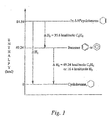
- 1,3-butadiene is more stable by 3.82 kcal/mol because of the internal conjugation, as evidenced by the lower modulus (absolute value) of the negative enthalpy of hydrogenation.
- a much larger stabilization from pi-conjugation of 35.6 kcal/mol can be calculated in the same way for benzene compared to cyclohexane and is referred to as its aromatic stabilization energy.
- ⁇ H enthalpy change
- H 2 The enthalpy change ( ⁇ H) for hydrogenation of A to A-H 2n at the standard state of 25°C and 1 atm. H 2 will henceforth be referred to as ⁇ ⁇ H H 2 o .
- experimentally derived and computational ⁇ ⁇ H H 2 o data herein refers to compositions in their standard state as gases at 1 atm., 25°C.
- the most common highly conjugated substrates are the aromatic compounds, benzene and naphthalene. While these can be readily hydrogenated at, e.g., 10-50 atm.
- H 2 at H 2 at ca 150°C in the presence of appropriate catalysts, the reverse reaction - an extensive catalytic dehydrogenation of cyclohexane and decahydronaphthalene (decalin) at about 1 atm.
- H 2 is only possible at much higher temperatures ( vide infra ).
- the dehydrogenation provide H 2 at 1-3 atm. at ca 200°C for potential use in conjunction with a hydrogen internal combustion engine and preferably at lower temperatures, e.g., 80°C-120°C, where present day PEM fuel cells operate.
- the lower dehydrogenation temperatures are also desirable for maintaining the reacting system in a condensed state (solid or preferably liquid) and minimizing coking and other problems that are often encountered in higher temperature catalytic dehydrogenation reactions.
- these hydrogenated extended pi-conjugated substrates can be dehydrogenated at temperatures below about 250°C while at hydrogen partial pressures of greater than about 1.449 psia (0.1 bar) and even at pressures in excess of 14.49 psia (1.0 bar) as will be shown by the examples. This is highly unexpected since temperatures required to effect dehydrogenation increase significantly with increasing hydrogen partial pressures.
- An added advantage of the extended pi-conjugated substrates of this invention is the relative involatility of the substrate, both in hydrogenated and dehydrogenated states, as this eases the separation of the released hydrogen for subsequent usage.
- these hydrogenated extended pi-conjugated substrates can be dehydrogenated at temperatures below about 300°C while at hydrogen partial pressures of greater than about 1.449 psia (0.1 bar) and even at pressures in excess of 14.49 psia (1.0 bar) as will be shown by the examples.
- Equations 2 and 3 fully define the thermodynamic boundaries for the reversible hydrogenation of substrate, A in Equation 1.
- the enthalpy and entropy change terms for Equation 1, ⁇ H and ⁇ S, respectively, are arrived at from the corresponding experimentally or computationally derived thermodynamic functions for the reaction components, A, A-H 2n and hydrogen.
- Temperature and hydrogen pressure are process parameters, which for a set of values of ⁇ H and ⁇ S, may be chosen for attaining at reaction equilibrium a high conversion of A to A-H 2n : for example, [A-H 2n ]/[A]>20 for the H 2 storage step and conversely [A-H 2n ]/[A] ⁇ 0.05 for the reverse reaction.
- Equation 1 The enthalpy change, ⁇ H (expressed as kcal/mol H 2 ) in Equation 1, is therefore the quantity that mostly determines for pi-conjugated substrates the reversibility of this chemistry at specified hydrogenation and dehydrogenation process parameters. Since ⁇ H varies only slightly with temperature, ⁇ H°, the enthalpy change for the reaction with all components at their standard state (1 atm., 25°C), is employed here as a first-order indication of the reversibility and hence the usefulness of a given hydrogenation/dehydrogenation reaction system for H 2 storage and delivery.
- the invention relates to a practical hydrogen storage device that operates via a reversible hydrogenation of a pi-conjugated system for which the change in enthalpy at standard conditions (referred to hereinafter as ⁇ ⁇ H H 2 o , standard conditions being 25°C and 1 atm.) of hydrogenation of the substrate is less than about - 15.0 kcal/mol H 2 , (a range of hydrogenation enthalpy changes that does not encompass the ⁇ ⁇ H H 2 o for benzene or the ⁇ ⁇ H H 2 o for naphthalene to their corresponding hydrocarbons).
- ⁇ ⁇ H H 2 o standard conditions being 25°C and 1 atm.
- the invention relates to a practical hydrogen storage device that operates via a reversible hydrogenation of a pi-conjugated system, the change in enthalpy at standard conditions of hydrogenation of the substrate as determined experimentally is within the range of about -7.0 to about -20.0 kcal/mol H 2 .
- the hydrogenation of the pi-conjugated substrate molecule may in some cases yield more than one product of the same overall chemical composition.
- structural isomers or conformers of the product molecule that differ only in the relative disposition of its carbon-hydrogen bonds or of other atoms or groups of atoms in the molecule.
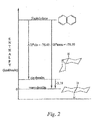
- the conformers will each have different energies (standard heats of formation, ⁇ H° f ), the thermodynamically most stable conformer having the lowest ⁇ H° f . This occurs in the hydrogenation of naphthalene, which can result in the formation of the two conformers, both saturated molecules, cis- decalin and trans-decalin, which as illustrated by Fig.
- non-equilibrium conformers provides a means of desirably lowering the hydrogenation enthalpy ⁇ ⁇ H H 2 o of the pi-conjugated unsaturated molecule, by now making its hydrogenation product less stable, thus enabling the dehydrogenation process to occur at a lower temperature.
- the additional advantage of a kinetically more facile dehydrogenation of the more energetic non-equilibrium conformers may also be in some cases, depending on the catalytic dehydrogenation mechanism.
- a difficulty in defining suitable pi-conjugated substrates for hydrogen storage is that experimentally derived hydrogenation enthalpy change data is available only for relatively small pi-conjugated molecules.
- Our basis for defining the following classes of extended pi-conjugated substrates suitable for the reversible hydrogenation/dehydrogenation processes of our invention is in terms of their enthalpy of hydrogenation as derived from quantum mechanical (QM) calculations.
- the PM3 method was implemented using the commercial software program package Spartan 02 and Spartan 04 by Wavefunction Inc., Irvine, CA. In performing the calculations, all structures were first fully optimized in their molecular geometry by an energy minimization procedure. The conformation of the hydrogenated species was carefully chosen so that the adjacent hydrogen atoms are present alternatively at opposite sides of the aromatic planes; the ultimate criteria being a selection of the conformer of lowest energy. It is known that PM3 incorrectly yields the heat of formation for the H 2 molecule. However, by replacing it with the experimental value of the heat of formation for H 2 at its standard state, we obtain the value of heat of reaction at standard conditions, ⁇ H°, for hydrogenation that is in fair agreement with the available experimental data. For example, for hydrogenation of benzene (gas) to cyclohexane
- the molecular geometry is as before carefully selected to ensure that the lowest energy conformer has been chosen.
- the final geometry optimization is carried out using the B3LYP functional with a 6-311G** or higher basis set (see Chapter 5 and 10, respectively in the above "Computational Chemistry” reference).
- This calculation also provides the electronic energy, E of the molecule.
- the molecule's normal vibrational frequencies are estimated using the harmonic oscillator approximation, derived from the second derivative of the energy.
- the frequencies are a measure of the vibrational energy of the molecule from which using standard methods of statistical mechanics, treating the molecule as an ideal gas, the total vibrational enthalpy, Hv and entropy, Sv are determined as a function of temperature.
- the corresponding temperatures for selected carriers were estimated from published experimental data (where available, e.g., the NIST Standard Reference Database No. 69 (March 2003) ) using the HSC5 Chemistry for Windows software program package (Outokumpu Research, Finland).
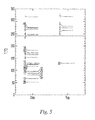
- the thus calculated dehydrogenation temperature results using (a) the specific above described ab initio DFT method and (b) experimental data (where available, including the NIST database) is collected in Fig. 5 for a number of pi-conjugated substrates.
- Experimentally determined values for the hydrogenation enthalpies can be obtained from measuring the heat of combustion of hydrogenated and dehydrogenated substrates to products of known thermodynamic properties (i.e., CO 2 , H 2 O, NO, or N 2 ) using known in the art or methods as described in Example 13 of the present application.
- extended pi-conjugated substrates are defined to include extended polycyclic aromatic hydrocarbons, extended pi-conjugated substrates with nitrogen heteroatoms, extended pi-conjugated substrates with heteroatoms other than nitrogen, pi-conjugated organic polymers or oligomers, ionic pi-conjugated substrates, pi-conjugated monocyclic substrates with multiple nitrogen heteroatoms, pi-conjugated substrates with at least one triple bonded group and selected fractions of coal tar or pitch that have as major components the above classes of pi-conjugated substrates, or any combination of two or more of the foregoing. These classes are further defined below, and non-limiting embodiments of species falling within these classes are provided.
- the modulus of the standard enthalpy change of hydrogenation of the extended pi-conjugated substrate, ⁇ ⁇ H H 2 o , to their corresponding saturated counterparts (e.g., the at least partially hydrogenated extended pi-conjugated substrates) is less than about 15.0 kcal/mol H 2 as determined experimentally (e.g., by combustion methods described above) or by the above-described ab initio DFT method. Accordingly, such molecules would therefore be suitable as reversible hydrogenation substrates for storing hydrogen according to this invention.
- the modulus of ⁇ ⁇ H H 2 o is greater than about 15 kcal/mole, at least for the first three of these systems which have been claimed in the prior art for H 2 storage.
- the molecules (1, 2, 3, and 5) also fit under this classification on the basis of ⁇ ⁇ H H 2 o data as calculated by ab initio DFT method, for which the agreement (within 1 kcal/mol H 2 ) with the experimentally derived data is excellent.
- the extended pi-conjugated substrates useful for reversible hydrogenation in accordance with this invention are represented as the unhydrogenated form of the substrate molecule, the actual substrate subjected to hydrogenation may already have some degree of hydrogenation.
- the extended pi-conjugated substrate may exist and be cycled between different levels of full or partial hydrogenation and dehydrogenation as to either the individual molecules or as to the bulk of the substrate, depending upon the degree of conversion of the hydrogenation and dehydrogenation reactions.
- the levels of hydrogenation and dehydrogenation of the starting extended pi-conjugated substrate and the at least partially hydrogenated extended pi-conjugated substrate will be selected to provide the requisite level of hydrogen storage and release under practical operating conditions and requirements.
- the substrates useful according to this invention may also have various ring substituents, such as -n-alkyl, -branched-chain alkyl, -alkoxy, -nitrile, -ether and - polyether, which may improve some properties such as melting temperature of the substrate while at the same time not adversely interfering with the hydrogenation/dehydrogenation equilibrium but due to the increased weight resulting in some loss of hydrogen storage capacity of the substrate.
- any of such substituent groups would have 12 or less carbons.
- Classes of extended pi-conjugated substrates suitable for the processes of this invention are further and more specifically defined as follows:
- Extended Polycyclic Aromatic Hydrocarbons are defined to be those molecules having either (1) a polycyclic aromatic hydrocarbon comprising a fused ring system having at least four rings wherein all rings of the fused ring system are represented as 6-membered aromatic sextet structures; or (2) a polycyclic aromatic hydrocarbon of more than two rings comprising a six-membered aromatic sextet ring fused with a 5-membered ring.
- the EPAH molecules represent a particular class of extended pi-conjugated substrates since their pi electrons are largely delocalized over the molecule. While, on a thermodynamic basis, generally preferred are the larger molecules (i.e., those with considerably more than four rings), the value of the standard enthalpy change of hydrogenation, ⁇ ⁇ H H 2 o , and thus the ease of reversible hydrogenation can be very dependent on the "external" shape or structure of the EPAH molecule. Fundamentally, the EPAH molecules that have the highest aromatic resonance stabilization energy will have the lowest modulus (absolute value) of the standard enthalphy of hydrogenation, ⁇ ⁇ H H 2 o . As is taught by E.
- Quantum mechanics calculations utilizing the PM3 methodology provide a more useful and quantitative but only approximate prediction of the ⁇ ⁇ H H 2 o values for hydrogenation as summarized in Fig. 6 for the represented molecules.
- Curve I shows the variation of ⁇ ⁇ H H 2 o of hydrogenation for a series of linear polyacenes for which the first three members are benzene, naphthalene, and anthracene.
- the heat, or enthalpy, of hydrogenation reaches its least negative value (smallest more favorably ⁇ ⁇ H H 2 o ) at naphthalene (2 rings) and becomes increasingly more negative with an increasing number of aromatic rings.
- fusing the aromatic rings in a staggered ("armchair") linear arrangement results in a less negative ⁇ ⁇ H H 2 o of hydrogenation as the number of rings increases ( Fig. 6 , Curve II).
- the large effect of polyaromatic hydrocarbon shape on the ⁇ H° of hydrogenation can also be illustrated by comparing the ⁇ H° of hydrogenation values for the three 13-ring polyaromatic hydrocarbons in Fig. 6 .
- polycyclic aromatic hydrocarbons particularly useful according this invention include pyrene, perylene, coronene, ovalene, picene and rubicene.
- EPAH's comprising 5-membered rings are defined to be those molecules comprising a six-membered aromatic sextet ring fused with a 5-membered ring.
- these pi-conjugated substrates comprising 5-membered rings would provide effective reversible hydrogen storage substrates according to this invention since they have a lower modulus of the ⁇ H° of hydrogenation than the corresponding conjugated system in a 6-membered ring.
- the calculated (PM3) ⁇ H° for hydrogenation of three linear, fused 6-membered rings (anthracene) is -17.1 kcal/mol H 2 .
- extended polycyclic aromatic hydrocarbons also include structures wherein at least one of such carbon ring structures comprises a ketone group in the ring structure and the ring structure with the ketone group is fused to at least one carbon ring structure which is represented as an aromatic sextet.
- Extended polycyclic aromatic hydrocarbons are available from Aldrich Chemical Company, Milwaukee, WI; Lancaster Synthesis, Windham, NH; and Acros Organics, Pittsburgh, PA; or can be prepared by known methods (see E. Clar, "Polycyclic Hydrocarbons", Academic Press, New York, 1964, Chapter 19 )
- Extended Pi-conjugated Substrates with Nitrogen Heteroatoms are defined as those N-heterocyclic molecules having (1) a five-membered cyclic unsaturated hydrocarbon containing a nitrogen atom in the five membered aromatic ring; or (2) a six-membered cyclic aromatic hydrocarbon containing a nitrogen atom in the six membered aromatic ring; wherein the N-heterocyclic molecule is fused to at least one six-membered aromatic sextet structure which may also contain a nitrogen heteroatom.
- a particularly germane example is provided by 1,4,5,8,9,12-hexaazatriphenylene, C 18 H 6 N 6 , and its perhydrogenated derivative, C 12 H 24 N 6 system for which the (DFT calculated) ⁇ ⁇ H H 2 o of hydrogenation is -11.5 kcal/mol H 2 as compared to the (DFT calculated) ⁇ ⁇ H H 2 o of hydrogenation of -14.2 kcal/mol H 2 for the corresponding all carbon triphenylene, perhydrotriphenylene system.
- pyrazine[2,3-b]pyrazine where the (DFT calculated) of ⁇ ⁇ H H 2 o of hydrogenation is -12.5 kcal/mol H 2 . This is substantially lower than the DFT calculation of ⁇ H° of hydrogenation for all carbon naphthalene (-15.1 kcal/mol H 2 for cis - decalin and -15.8 kcal/mol H 2 for trans-decalin) due to the presence of the four nitrogen atoms in the ring systems.
- Pi-conjugated aromatic molecules comprising five membered rings substrate classes identified above and particularly where a nitrogen heteroatom is contained in the five membered ring provide the lowest potential modulus of the ⁇ ⁇ H H 2 o of hydrogenation of this class of compounds and are therefore effective substrates for hydrogenation/dehydrogenation according to this invention.
- An experimental example of this is provided by carbazole,
- N-alkylcarbazoles such as N-ethylcarbazole which has a (DFT calculated) ⁇ ⁇ H H 2 o of hydrogenation of -12.1 kcal/mol H 2 and an experimentally measured average ⁇ ⁇ H H 2 o of hydrogenation (Example 13) that ranges between -11.8 and -12.4 kcal/mol H 2 .
- polycyclic aromatic hydrocarbons with a nitrogen heteroatom in the five-membered ring fitting this class include the N-alkylindoles such as N-methylindole, 1-ethyl-2-methylindole (see 21 in Table 1b); N-alkylcarbazoles such as N-methylcarbazole and N-propylcarbazole; indolocarbazoles such as indolo[2,3-b]carbazole (see 12 in Table 1b) and indolo[3,2-a]carbazole; and other heterocyclic structure with a nitrogen atom in the 5- and 6-membered rings such as N,N',N"-trimethyl-6,11-dihydro-5H-diindolo[2,3-a:2',3'-c]carbazole (see 42 in Table 1b), 1,7-dihydrobenzo[1,2-b:5,4-b']dipyrrole (see 14 in Table
- All of these compounds have ⁇ ⁇ H H 2 o values that are less than 15 kcal/mol H 2 with molecules of this class that contain multiple hetero nitrogen atoms (see, e.g., 43, 41 and 19 in Table 1b)) having a ⁇ ⁇ H H 2 o that is even less than 11 kcal/mol H 2 .
- the extended pi-conjugated substrates with nitrogen heteroatoms also comprise structures having ketone a group in the ring structure, wherein the ring structure with the ketone group is fused to at least one carbon ring structure which is represented as an aromatic sextet.
- An example of such structure is the molecule flavanthrone, a commercial vat dye, a polycyclic aromatic that contains both nitrogen heteroatoms and keto groups in the ring structure, and has a favorable (PM3 calculated) ⁇ H° of hydrogenation of -13.8 kcal/mol H 2 for the addition of one hydrogen atom to every site including the oxygen atoms.
- Extended pi-conjugated substrates with nitrogen heteroatoms are available from Aldrich Chemical, Lancaster Synthesis and Across, or can be prepared by known methods (see Tetrahedron 55, 2371 (1999 ) and references therein)
- Extended Pi-conjugated Substrates with Heteroatoms other than Nitrogen are defined as those molecules having a polycyclic aromatic hydrocarbon comprising a fused ring system having at least two rings wherein at least two of such rings of the fused ring system are represented as six-membered aromatic sextet structures or a five-membered pentet wherein at least one ring contains a heteroatom other than nitrogen.
- An example of an extended pi-conjugated substrate with an oxygen heteroatom is dibenzofuran, C 12 H 8 O, for which the (DFT calculated) ⁇ ⁇ H H 2 o of hydrogenation is -13.5 kcal/mol H 2 .
- phosphindol-1-ol (see 55, table 1c): for which the ab initio DFT calculated the ⁇ ⁇ H H 2 o of hydrogenation is -17 kcal/mol H 2 .
- An example of a extended pi-conjugated substrate with an silicon heteroatom is silaindene (see 56, table 1 c): for which the DFT calculated the ⁇ H° of hydrogenation is -16.4 kcal/mol H 2 .
- An example of a extended pi-conjugated substrate with an boron heteroatom is borafluorene (see 29, table 1c): for which the ab initio DFT calculated the ⁇ H° of hydrogenation is -10.2 kcal/mol H 2 .
- extended pi-conjugated substrates with heteroatoms other than nitrogen include dibenzothiophene, 1-methylphosphindole, 1-methoxyphosphindole, dimethylsilaindene, and methylboraindole.
- Extended pi-conjugated substrates with heteroatoms other than nitrogen are available from Aldrich Chemical, Lancaster Synthesis and Acros.
- Pi-conjugated Organic Polymers and Oligomers Containing Heteroatoms are defined as those molecules comprising at least two repeat units and containing at least one ring structure represented as an aromatic sextet of conjugated bonds or a five membered ring structure with two double bonds and a heteroatom selected from the group consisting of boron, nitrogen, oxygen, silicon, phosphorus and sulfur. Oligomers will usually be molecules with 3-12 repeat units.
- This class of materials represents many organic polymers that are electrical conductors or semiconductors, typically after "doping" with a proton source or an oxidant, the latter (doping) not being a requirement for the present invention. While there are often wide variations in the chemical structure of monomers and, often, the inclusion of heteroatoms (e.g., N, S, O) replacing carbon atoms in the ring structure in the monomer units, all of these pi-conjugated polymers and oligomers have the common structural features of chemical unsaturation and an extended conjugation. Generally, while the molecules with sulfur heteroatoms may possess the relative ease of dehydrogenation, they may be disfavored in fuel cell applications because of the potential effects of the presence of the sulfur atoms.
- heteroatoms e.g., N, S, O
- the chemical unsaturation and conjugation inherent in this class of polymers and oligomers represents an extended pi-conjugated system, and thus these pi-conjugated polymers and oligomers, particularly those with nitrogen or oxygen heteroatoms replacing carbon atoms in the ring structure, are a potentially suitable substrate for hydrogenation.
- These pi-conjugated organic polymers and oligomers may comprise repeat units containing at least one aromatic sextet of conjugated bonds or may comprise repeat units containing five membered ring structures.
- Aromatic rings and small polyaromatic hydrocarbon (e.g., naphthalene) moieties are common in these conducting polymers and oligomers, often in conjugation with heteroatoms and/or olefins.
- a heteroaromatic ladder polymer or oligomer containing repeat units such as contains a monomer with a naphthalene moiety in conjugation with unsaturated linkages containing nitrogen atoms.
- a heteroaromatic ladder polymer or oligomer containing repeat units such as contains a monomer with a naphthalene moiety in conjugation with unsaturated linkages containing nitrogen atoms.
- a pi-conjugated polymer or oligomer formed from a derivatised carbazole monomer repeat unit would be expected to demonstrate a low modulus of the ⁇ H° of hydrogenation as well, at least less than that found for the monomer unit N-methylcarbazole due to the greater conjugation of the oligomers and polymer.
- Other oligomers that contain 5-membered ring structures with nitrogen atoms are also subject of the present invention.
- oligomers of pyrrole such as: which has four pyrrole monomers terminated by methyl groups has a ab initio DFT calculated ⁇ ⁇ H H 2 o of hydrogenation of -12.5 kcal/mol H 2 .
- pi-conjugated organic polymers and oligomers which are particularly useful according to this invention as extended pi-conjugated substrates are polyindole, polyaniline, poly(methylcarbazole), and poly(9-vinylcarbazole).
- the monomers of these compositions have ⁇ ⁇ H H 2 o ⁇ 15.0 kcal/mole H 2 and the corresponding more extended pi-conjugated oligomeric or polymeric systems (e.g. polyindole and polycarbazoles) are expected to have even lower values of ⁇ ⁇ H H 2 o
- Pi-conjugated organic polymers and oligomers are available from Aldrich Chemical Company, Lancaster Synthesis and Acros, or can be prepared by known methods (see “ Handbook of Conducting Polymers” T. A. Skotheim et al. Eds. 2nd Ed., (1998) Marcel Dekker, Chapter 11 .
- Ionic pi-conjugated substrates are defined as those substrates having pi-conjugated cations and/or anions that contain unsaturated ring systems and/or unsaturated linkages between groups.
- Pi-conjugated systems which contain a secondary amine function, HNR 2 can be readily deprotonated by reaction with a strong base, such as lithium or potassium hydride, to yield the corresponding lithium amide or potassium amide salt. Examples of such systems are carbazole, imidazole and pyrrole.
- N-lithium carbazole and its fully hydrogenated lithium salt derivative were modeled using the same ab initio DFT methodology which afforded a geometry optimized structure with a nitrogen-bound lithium atom at a relatively long N-Li bond distance consistent with the expected highly polar, partially ionic nature of this bond.
- the same calculation carried out on the free anion provided an even lower ⁇ ⁇ H H 2 o for this idealized gas-phase species.
- Ionic pi-conjugated systems of this sub-class are pi-conjugated molecules that exist as salts, or cation-anion paired species wherein the anion of the latter constitutes the pi-conjugated system.
- the latter comprises the amido, -NR 2 or -NHR anion and also the alkoxide -OR anion where -R can be any organic group that is part of a pi-conjugated system.
- Non-limiting examples of ionic pi-conjugated substrates include N-lithiocarbazole, N-lithioindole, and N-lithiodiphenylamine and the corresponding N-sodium, N-potassium and N-tetramethylammonium compounds.
- Ionic pi-conjugated substrates are available from Aldrich Chemical, Lancaster Synthesis and Acros, or can be prepared by methods commonly practiced in the art. For example, the reaction of a secondary amine with a strong base such as LiH, NaH, KH, methyllithium, or n-butyllithium in an appropriate solvent, such as tetrahydrofuran.
- a strong base such as LiH, NaH, KH, methyllithium, or n-butyllithium
- an appropriate solvent such as tetrahydrofuran.
- Pi-conjugated monocyclic substrates with multiple nitrogen heteroatoms are defined as those molecules having a five-membered or six-membered aromatic ring having two or more nitrogen atoms in the aromatic ring structure, wherein the aromatic ring is not fused to another aromatic ring.
- the pi-conjugated monocyclic substrates with multiple nitrogen heteroatoms may have alkyl, N-monoalkylamino and N, N-dialkylamino substituents on the ring.
- Pyridine is well known to have a higher resonance stabilization energy than benzene and consistent with this, the modulus of its enthalpy of hydrogenation to piperidine at standard conditions, ⁇ ⁇ H H 2 o , of ca . 15 kcal/mole H 2 is 1.4 kcal/mol H 2 lower than that for the hydrogenation of benzene.
- ⁇ ⁇ H H 2 o the modulus of its enthalpy of hydrogenation to piperidine at standard conditions, ⁇ ⁇ H H 2 o , of ca . 15 kcal/mole H 2 is 1.4 kcal/mol H 2 lower than that for the hydrogenation of benzene.
- the pi-conjugated five-membered ring molecule pyrrole (4) has the remarkably low ⁇ ⁇ H H 2 o of 13.37 kcal/mol H 2 , which is predicted well by our ab initio DFT computational method as 13.1 kcal/mol H 2 .
- the applicants believe that the low ⁇ ⁇ H H 2 o of pyrrole is associated with ring strain and the effect of the N heteroatom.
- a second nitrogen atom inserted in the five-membered ring as in imidazole (40, Table 1 b) has the effect of further reducing ⁇ ⁇ H H 2 o to 8.8 kcal/mol H 2 .
- Another non-limiting example of a pi-conjugated monocyclic substrates with multiple nitrogen heteroatoms is pyrazine.
- Pi-conjugated monocyclic substrates with multiple nitrogen heteroatoms are available from Aldrich Chemical, Lancaster Synthesis and Acros.
- Pi-conjugated substrates with triply bonded groups are defined as those molecules having carbon-carbon and carbon-nitrogen triple bonds.
- Methods for desirably increasing the mean bond order to >1.5 and hence the hydrogen carrying capacity of the substrate by favorably incorporating the multiply conjugated triply-bonded cyano (-C ⁇ N) and alkynyl (-C ⁇ C-) groups into the carrier molecule.
- the invention relates to a process for the storage of hydrogen by a reversible catalytic hydrogenation of molecules containing the cyano or nitrile, -C ⁇ N, group where the latter is converted to an alkyl amino group, -CH 2 NH 2 .
- An example is the hydrogenation of acetonitrile, CH 3 CN, to ethylamine, CH 3 CH 2 NH 2 , which provides a very modest almost 9 wt. % theoretical hydrogen storage capacity.
- 1,4-dicyanobenzene which can be reversibly hydrogenated to 1,4-aminomethyl cyclohexane:
- the enthalpy for this reaction, ⁇ ⁇ H H 2 o is -16.4 kcal/mol H 2 but it is expected that its value can be favorably lowered with even more extensively pi-conjugated substrates, in general, aromatic nitriles, dinitriles and trinitriles where the aromatic ring may contain one to three nitrogen heteroatoms.
- the invention relates to a process for using pi-conjugated substrates that comprise nitrile and alkynyl functions as a reversible hydrogen source, where the modulus of the ⁇ ⁇ H H 2 o value ⁇ ⁇ H H 2 o is ⁇ 20 kcal/mol H 2 , and preferably ⁇ 18 kcal/mol H 2 .
- pi-conjugated substrates with multiply bonded linkages and groups include terephthalonitrile (1,4-dinitrilobenzene), benzonitrile, and 1,3,5-trinitrilobenzene.
- Pi-conjugated substrates with triple bonded groups with multiple nitrogen heteroatoms are available from Aldrich Chemical, Lancaster Synthesis and Acros.
- the corresponding lithium derivatives can also be prepared by the reaction of the pi-conjugated substrates with triple bonded groups with a strong base such as LiH, methyllithium, or n-butyllithium in an appropriate solvent, such as tetrahydrofuran.
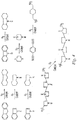
- Tables 1 a-1 d provide illustrative examples of extended pi-conjugated substrates and their corresponding enthalpies of hydrogenation at 300 K as calculated using the ab initio DFT method described above, ⁇ ⁇ H H 2 o (300 K) (cal.), and as determined experimentally, ⁇ ⁇ H H 2 o (298 K) (exp.).
- Table 1 a Extended polycyclic aromatic hydrocarbons and comparative data for benzene ( 1 ), naphthalene ( 2, 3 ), anthracene ( 46 ) and phenanthrene ( 47 ).
- the extended pi-conjugated substrates identified above will for the most part be solids in their relatively pure state at ambient conditions. From Examples 1-7 it is clear that in admixtures with suitable catalysts it is possible, though admittedly surprising, to conduct the hydrogenation and dehydrogenation chemistry well below the melting point of the substrate, and in most of these examples, also well below the melt temperature of hydrogenated substrate.
- the hydrogen storage and release chemistry can be conducted in conventional stirred tank reactors in which mechanical mixing ensures that there is a good mass transfer between the substrate molecules, the dispersed (or dissolved) catalyst, and hydrogen, with minimal mass transfer limitations ensuring rapid kinetics.
- the hydrogenation or the dehydrogenation could be conducted in a flow-through reactor (see Example 12).
- a liquid phase hydrogenated substrate could be used to safely and economically transport the gas as the hydrogenated pi-conjugated molecule from a large hydrogen plant, where there is the economy of scale, to distribution and use centers where the hydrogen is catalytically liberated from the liquid carrier at mild conditions for use in fuel cells or other devices.
- the substrates either in their hydrogenated or dehydrogenated states, should have a melting point of lower than about -10°C in order to be transferable in cold weather conditions, and should have a melting point of lower than about 100°C if they are to be transported or transferred with supplemental heating.
- the substrates will be considered for purposes of this invention to be liquid, and thereby transferable, if they have a viscosity of less than about 2000 cSt (centistokes).
- One way to render an extended pi-conjugated substrate as a liquid is to utilize mixtures of two or more components, one or more of which comprises an extended pi-conjugated substrate.
- mixtures may form a eutectic mixture.
- chrysene (1,2-benzophenanthrene, m.p. 250°C) and phenanthrene, (m.p. 99°C) are reported to form a eutectic melting at 95.5°C and for the 3-component system consisting of chrysene, anthracene and carbazole (m.p. 243°C), a eutectic is observed at 192°C. ( Pascal, Bull.Soc.Chim.Fr.
- n-alkyl, alkyl, alkoxy, ether or polyether groups as substituents on the ring structures of the polycyclic aromatic molecules, particularly the use of substituents of varying chain lengths up to about 12 carbon atoms, can lower their melting points, but at some cost in "dead weight" and reduced sorbed hydrogen capacity of the systems.
- substituents e.g., nitriles and alkynes, can provide additional sorbed hydrogen capacity since each nitrile group can accommodate two molar equivalents of hydrogen.
- the ability to hydrogenate a substrate having a normal melting point above about 200°C while present in a mixture having a freezing point of less than about 200°C would be advantageous, especially where the lowered freezing point mixture was predominantly of two or more of the extended pi-conjugated substrates to provide the maximum reversibility of the hydrogenation/dehydrogenation and highest hydrogen storage capacity.
- the extended pi-conjugated substrates and mixtures as described above provide such advantages.
- coal tar and pitch materials are highly complex mixtures that contain a very large proportion of extended polycyclic aromatics.
- pitch will be used to include the complex mixtures often referred to as "tars”.
- cleaning i.e., sulfur free
- synthetic pitch consisting of mixtures of dimers to pentamers of naphthalene, anthracene, phenanthrene etc.
- the prepared pitch compositions have softening points which range from 63°C to 114°C and even if it proves necessary to add a small amount of an additive (i.e.
- the extended pi-conjugated substrate useful in the process of the invention is a pitch or pitch fraction selected from the group consisting of natural pitch, synthetic pitch, synthetic pitch containing molecules with nitrogen heteroatoms, and combinations thereof.
- the process of storing hydrogen by a reversible hydrogenation of an extended pi-conjugated substrate in accordance with this invention comprises, in its most general form, the following sequence of steps:
- the hydrogenation catalyst is removed from the at least partially hydrogenated extended pi-conjugated substrate obtained from step a) prior to conducting step b).
- the hydrogenation and dehydrogenation can be carried out in a single vessel.
- Hydrogenation catalysts are also known to function as dehydrogenation catalysts and are described herein.
- the substrate and catalyst which functions both as hydrogenation catalyst and dehydrogenation catalyst, can be contained in a single vessel and the hydrogenation and dehydrogenation sequentially carried out in the same vessel under appropriate temperature and hydrogen partial pressures.
- the at least partially hydrogenated extended pi-conjugated substrate can be removed from the vessel in which it is hydrogenated and dehydrogenated in another vessel.
- the extended pi-conjugated substrate and the hydrogenated substrate are in a liquid form and so can be transferred and transported as a liquid.
- the hydrogenated and dehydrogenated substrates have a melting point above about -10°C, they can be transported as a liquid in most weather conditions without supplemental heat to keep them liquid. Even if the melting point is up to 100°C, the substrates can still be transferred and utilized as liquids with low level heating.
- the invention relates to a process for the storage of hydrogen comprising contacting hydrogen gas with a solid extended pi-conjugated substrate in the presence of an effective amount of a hydrogenation catalyst under hydrogenation conditions to at least partially hydrogenate the extended pi-conjugated substrate.
- the invention in another embodiment, relates to a process for the storage of hydrogen comprising contacting hydrogen gas at a hydrogen partial pressure greater than about 6.7 bar and at a temperature of between about 50°C and about 300°C with a solid extended pi-conjugated substrate in the presence of an effective amount of a hydrogenation catalyst to at least partially hydrogenate the extended pi-conjugated substrate.
- the substrate which in many cases of the substrates of this invention are relatively involatile solids or liquids at the reaction conditions, it is generally preferred to prepare an intimate physical mixture of the substrate with a hydrogenation catalyst.
- the substrate which may be a solid or a liquid, should preferably be sufficiently involatile at least at ambient temperatures and preferably also at the higher temperature reaction conditions so as to preclude the need for its bulk separation or the separation of any of the reaction products or intermediates from the gaseous hydrogen product. It may be necessary however, as a precautionary step in some cases to provide a trap containing an absorbent, which can scavenge and thus remove any trace level volatile containments from the released hydrogen.
- suitable substrates owing to their relatively large molecular size (e.g., three or more five or six-atom rings), will naturally be solids at the preferred reaction temperatures below about 250°C.
- physical (including eutectic) mixtures of a number of these substrates may be liquids, at least at reaction temperatures, which may be advantageous for providing an adequate mixing of the catalyst and reaction components.
- one of the components may be regarded as being both a solvent and a hydrogenation substrate.
- natural and synthetic pitch materials which consist of a liquid mixture of many extended polycyclic aromatic hydrocarbons are seen as suitable substrates.
- the invention relates to a process for the storage and subsequent release of hydrogen comprising:
- the hydrogenation catalysts which are generally known and which will generally also function as dehydrogenation catalysts for purposes of this invention, will comprise finely divided metals, and their oxides and hydrides, of Groups 4, 5, 6 and 8, 9, 10 of the Periodic Table according to the International Union of Pure and Applied Chemistry.
- Preferred are titanium, zirconium of Group 4; tantalum and niobium of Group 5; molybdenum and tungsten of Group 6; iron, ruthenium of Group 8; cobalt, rhodium and iridium of Group 9; and nickel, palladium and platinum of Group 10 of the Periodic Table according to the International Union of Pure and Applied Chemistry.
- These metals may be used as catalysts and catalyst precursors as metals, oxides and hydrides in their finely divided form, as very fine powders or as skeletal structures such as platinum black or Raney nickel, or well-dispersed on carbon, alumina, silica, zirconia or other medium or high surface area supports, preferably on carbon or alumina.
- Acidic supports, in combination with transition metal dehydrogenation catalysts, or in some cases, the acidic support alone, may be preferable for dehydrogenation catalysts.
- acidic supports are silica-alumina, gamma-alumina, zeolites in the proton-exchanged form, sulfonated zirconia, and solid perfluorinated polymeric sulfonic acids. In some cases the dehydrogenation may be catalyzed by solid state Brönsted or Lewis acids in the absence of transition metals.
- the above listed supports are, for the most part, of the Brönsted or protonic acid types.
- Suitable Lewis acid catalysts include aluminum trifluoride, aluminum chlorofluorides, zinc chloride, aluminum chloride, tin chloride, copper trifluoromethane sulfonate, scandium trichloride, and the hexafluoroacetylacetonate of complexes of lanthanum and the other members of the Lanthanide series of elements according to the Periodic Table according to the International Union of Pure and Applied Chemistry.
- Intermetallic hydrides such as ZnNiH 2.8 and ZrCoH 2.8 which have been used as either catalysts or catalyst precursors for a hydrogenolysis at very high temperatures ( ⁇ 500°C) of graphite (to CH 4 ) as described by P. V. Ryabchenko et al. in Khimiya Tverdogo Topliva 19, 129-134 (1985 ) may likewise be used.
- the extended pi-conjugated substrate, charged into the reactor as solid (together with the solid catalyst) is hydrogenated in the absence of any solvent.
- This is clearly illustrated by Examples 2-5 where the substrates, coronene and hexabenzocoronene, of melting point 442°C and 700+°C are solids even at the reaction temperatures of 140°C and 200°C respectively.
- This gas phase hydrogenation of a solid substrate provides for a new and novel gas/solid hydrogenation process.
- the novel gas/solid hydrogenation process can be described as comprising contacting hydrogen gas with a solid extended pi-conjugated substrate as defined in this description in the presence of an effective amount of a hydrogenation catalyst under hydrogenation conditions to at least partially hydrogenate the extended pi-conjugated substrate and more particularly, as a process for the storage of hydrogen comprising contacting hydrogen gas at a hydrogen partial pressure greater than about 100 psia (6.7 bar) and at a temperature of between about 50°C and about 300°C with a solid extended pi-conjugated substrate as defined in this description in the presence of an effective amount of a hydrogenation catalyst to at least partially hydrogenate the extended pi-conjugated substrate.
- the hydrogen gas overhead pressure usually in the general range of 500-1000 psia, (34.5 bar to 69 bar) for the hydrogenation step, is dropped to about 1.5-50 psia (0.1-3.3 bar), which is generally a sufficient pressure for delivering hydrogen to a fuel cell, with the reactor still at temperature.
- the increase in hydrogen pressure in the system is monitored as a function of time.
- the present invention relates to a dispenser useful for dispensing a first liquid and retrieving a second liquid.
- the dispenser of the invention provides a safe, convenient and efficient means for dispensing a first liquid and retrieving a second liquid.
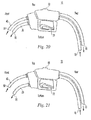
- an exemplary dispenser of the present invention for dispensing a first liquid and retrieving a second liquid is generally indicated as 10.
- the dispenser includes a housing 60.
- the rear of the housing is connected to a fuel hose 70 in communication with a first liquid supply means, and a return hose 80 in communication with a return second liquid holding means.
- the dispenser 10 of the present invention includes a dispensing conduit 20, a dispensing orifice 30, a retrieving conduit 40, and a retrieving orifice 50.
- the dispensing conduit 20 is in communication with a first compartment (not shown) and the retrieval conduit 40 is in communication with a second compartment (not shown).
- the dispensing orifice 30 is situated adjacent the retrieving orifice 50.
- the dispenser 10 of the present invention includes a dispensing conduit 20, a dispensing orifice 30, a retrieving conduit 40, and a retrieving orifice 50.
- the dispensing conduit 20 is in communication with a first compartment (not shown) and the retrieval conduit 40 is in communication with a second compartment (not shown).
- the dispensing conduit 20 and the second conduit 40 are situated in a housing 60, and the first conduit 20 is situated without the second conduit 40.
- the first liquid is dispensed into first compartment from the first conduit 20, and the second liquid in the second compartment is retrieved by the second conduit 40 prior to, simultaneously with or after the dispensing of the first liquid.
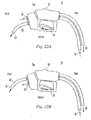
- Fig. 22a shows an exemplary dispenser 10 of the present invention that includes a dispensing conduit 20 and a dispensing orifice 30.
- the retrieving orifice 50 is proximate to the handle 60.
- the dispensing conduit 20 is in communication with a first compartment (not shown), and the retrieval orifice 50 is in communication with a second compartment (not shown) through an engaging, locking or sealing means (not shown).
- the first liquid is dispensed into the first compartment from the first conduit 20, and the second liquid in the second compartment is retrieved by the second orifice 50 conduit 40 prior to, simultaneously with, or after the dispensing of the first liquid.
- Methods for engaging, locking and sealing are known in the art.
- Fig. 22b shows an exemplary dispenser 10 of the present invention that includes a retrieving conduit 40 and a retrieving orifice 50.
- the dispensing orifice 30 is proximate to the handle 60.
- the retrieving conduit 40 is in communication with a second compartment (not shown), and the dispensing orifice 30 is in communication with a first compartment through an engaging, locking or sealing means (not shown).
- the first liquid is dispensed into the first compartment from the first orifice 30, and the second liquid in the second compartment is retrieved by the second conduit 40 prior to, simultaneously with, or after the dispensing of the first liquid.
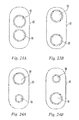
- Fig. 23a is a cross-sectional view of the dispensing orifice 30 and retrieving orifice 50 of one embodiment of the dispenser 10 of Fig. 20 .
- the dispensing conduit 20 (not shown) and the dispensing conduit 40 (not shown) are attached to the house 60.
- the retrieving orifice 50 is adjacent the dispensing orifice 30.
- Fig. 23b is a cross-sectional view of the dispensing orifice 30 and retrieving orifice 50 of one embodiment of the dispenser 10 of Fig. 21 .
- the dispensing conduit 20 (not shown) and the dispensing conduit 40 (not shown) are attached to the housing 60.
- the retrieving orifice 50 is without the dispensing orifice 30.
- Fig. 24a is a cross-sectional view of the dispensing orifice 30 and retrieving orifice 50 of one embodiment of the dispenser 10 of Fig. 20 .
- the dispensing conduit 20 (not shown) and the dispensing conduit 40 (not shown) are attached to the housing 60.
- the diameter of the retrieving orifice 50 is larger than the diameter of the dispensing orifice 30.
- Fig. 24b is a cross-sectional view of the dispensing orifice 30 and retrieving orifice 50 of one embodiment of the dispenser 10 of Fig. 20 .
- the dispensing conduit 20 (not shown) and the dispensing conduit 40 (not shown) are attached to the housing 60.
- the diameter of the retrieving orifice 50 is smaller than the diameter of the dispensing orifice 30.
- dispensers depicted in Figs. 22a - 24a are useful for ensuring that the dispensing conduit 20 and/or dispensing orifice 30 are in communication with the first compartment, and the retrieving conduit 40 and/or retrieving orifice 50 are in communication with the second compartment, thereby reducing or eliminating the possibility of, for example, dispersing the first liquid into the second compartment.
- Fig. 25a is a cross-section view of an exemplary embodiment of a dispenser of the invention (not shown) where the dispensing orifice 30 resides within the retrieving orifice 50.
- the dispensing orifice 30 is partitioned from the retrieving orifice 50 by a partition means 35, and the retrieving orifice is contained within a partition means 55.
- the partition means 35 and partition means 55 are attached to the housing 60.
- Fig. 25b is a cross-section view of an exemplary embodiment of the dispenser of the invention (not shown) where the retrieving orifice 50 resides within the dispensing orifice 30.
- the retrieving orifice 50 is partitioned from the dispensing orifice 30 by a partition means 55, and the retrieving orifice is contained within a partition means 35.
- the partition means 55 and partition means 35 are attached to the housing 60.
- Partition means useful in the present invention include those known in the art including, but not limited to hose such as fuel line house, plastic pipe and metal pipe.
- Figs. 25a and 25b are useful for insuring that the dispensing orifice 30 is in communication with the first compartment, and the retrieving orifice 50 is in communication with the second compartment, thereby reducing or eliminating the possibility of, for example, dispersing the first liquid into the second compartment.
- Fig. 26 shows an exemplary embodiment of the invention where the dispenser 10 of Fig. 20 is in communication with a tank 90 having a first compartment 100 for a holding a first liquid, and a second compartment 110 for holding a second liquid.
- a movable barrier 120 separates the first compartment 100 and the second compartment 110.
- the movable barrier 120 is capable of moving with changes in the volume of the first liquid in compartment 100 and with changes in the volume of the second liquid in compartment 110.
- the first liquid can be removed from the first compartment 90 by m eans of a first liquid outlet 105 .
- the second liquid can be delivered to the second compartment 110 by a second liquid inlet 115 .
- the first liquid is dispensed into the first compartment 100 from the first conduit 20
- the second liquid in the second compartment 110 is retrieved by the second conduit 40 prior to, simultaneously with or after the dispensing of the first liquid.
- Fig. 27 shows an exemplary embodiment of the invention where the dispenser 10 of Fig. 20 . is communicative with a first tank 130 for holding a first liquid, and a second tank 140 for holding a second liquid.
- the first liquid can be removed from the first tank 130 by a first liquid outlet 135 .
- the second liquid can be delivered to the second compartment 140 by a second liquid inlet 145 .
- the first liquid is dispensed into the first compartment 100 from the first conduit 2 0, and the second liquid in the second compartment 110 is retrieved by the second conduit 40 prior to, simultaneously with or after the dispensing of the first liquid.
- the present invention also relates to methods for using a dispenser of the invention for dispensing a first liquid and retrieving a second liquid.
- the invention relates to a process for dispensing a first liquid to a first compartment and retrieving a second liquid situated in a second compartment, comprising:
- first conduit and the second conduit are situated in a housing and the first conduit is situated without the second conduit.
- the first orifice is inserted into an orifice on a first compartment.
- the second orifice is immersed in a second liquid and the second liquid is retrieved. In another embodiment, the second orifice is immersed into a second liquid residing in a second compartment, and the second liquid is retrieved.
- the second liquid is transferred from the second conduit into a receiving tank.
- the transferring of the first liquid and the transferring of the second liquid are simultaneously conducted.
- the transferring of the first liquid is initiated prior to transferring the second liquid.
- the transferring of the first liquid is initiated after transferring the second liquid.
- Compartments useful in combination with the device of the invention include, but are not limited to, dual tanks; single tanks having a compartment for a first liquid and a compartment for a second liquid separated by an immovable barrier; and single tanks having a compartment for a first liquid and a compartment for a second liquid separated by an movable barrier.
- a single tank having a compartment for the first liquid and compartment for a second compartment separated by a movable barrier are particularly useful where space is limited, e.g., on a vehicle powered by a hydrogen fuel cell using a liquid hydride carrier.
- the second liquid e.g., the dehydrogenated carrier
- the second liquid can be envisioned as "occupying" the volume of the first liquid.
- Non-limiting examples of single tanks having first liquid compartment and a second liquid compartment include, but are not limited to, compartments separated by a movable barrier; compartments separated by a bladder where the first liquid is contained within the bladder and the second liquid is contained in the tank on the outside of the bladder; compartments separated by a bladder where the first liquid is contained within the bladder and the second liquid is contained in the tank on the outside of the bladder; or compartments separated by an impermeable membrane (see U.S. Patent No. 6,544,400 to Hockaday et al .).
- the first compartment and the second compartment are separated by an expandable bladder.
- first compartment and the second compartment are separated by an impermeable membrane.
- the invention relates to a process for dispensing a first liquid comprising, placing a dispenser in communication with a first compartment having a first liquid and a second compartment having a second liquid, where the first and second compartments are separated by a movable barrier, and the dispenser comprises a first conduit having an orifice for dispensing the first liquid and a second conduit having an orifice for retrieving a second liquid in direction countercurrent to the first liquid, transferring the first liquid through a first conduit into a first compartment; and retrieving the second liquid situated in the second compartment into a second conduit, wherein the increasing volume of the first liquid in the first compartment causes the displacement of the second liquid from the second compartment and into the second conduit.
- any first or second liquid can be dispensed or retrieved with the device of the invention provided the liquids are compatible with the dispensing/retrieving device and its associated components.
- Materials useful for the dispensing/retrieving device and its associated components will be chemically inert to the liquids, not degrade at the operating temperature, and not rupture or leak at the operating pressures. Suitable materials of construction are known in the art.
- liquid refers to any material that can be made to flow through the dispenser including, but not limited to, solutions, suspensions, emulsions, dispersions, and melts.
- liquids useful in the present invention will have a viscosity of up to about 2000 cSt (centistokes) at the operating temperature of the dispenser.
- the material need not be a liquid at ambient temperature, e.g., 25°C.
- the material may be made to flow after heating, e.g., forming a melt.
- Non-limiting examples of first liquids that can be dispensed with the dispenser of the invention include aqueous liquids such as acidic liquids, basic liquids, liquids having a pH of about 7, bodily fluids such as blood, and fluids comprising a medicament such as an active agent for treating or preventing a medical condition; at least partially hydrogenated pi-conjugated substrates as defined below; linear and branch-chain hydrocarbons such as (C 3 -C 20 )alkanes, (C 3 -C 20 )alkenes and (C 3 -C 20 )alkynes, each of which can by unsubstitued or substituted with one or more -R 1 ; cyclic hydrocarbons such as cyclopentane, cyclohexane, cycloheptane, and decalin, each of which can by unsubstitued or substituted with one or more -R 2 ; aromatic hydrocarbons such as benzene, toluene, xylene
- Non-limiting examples of second liquids that can be retrieved by the dispenser of the invention include those described above for the first liquids.
- Other non-limiting examples of second liquids include spent process fluids from chemical processes; degraded fluids such as used motor oil; pi-conjugated substrates as defined below; and fluids containing contaminants such as sewage or animal waste fluids (e.g., urine).
- Means for dispensing the first liquid include methods known in the art such as gravity; application of pressure to the first liquid to force the liquid out of the first orifice; sealing the first orifice to an orifice on the first compartment and evacuating the first compartment to draw the first liquid into the first compartment; or any combination of two or more of the foregoing.
- Means for retrieving the second liquid include methods known in the art and those methods described above including gravity; immersing the second orifice into a second liquid and using vacuum to draw the second liquid into the second orifice; sealing the second orifice to an orifice on a second compartment and using pressure to force the second liquid out of the compartment and into the second orifice; or any combination of two or more of the foregoing.
- the first liquid prior to dispensing, is heated to temperature sufficient to allow the first liquid to be dispensed through the dispenser orifice.
- the second liquid prior to retrieval, is heated to temperature sufficient to allow the second liquid to be retrieved through the retrieval orifice.
- the temperature of the first or second liquid may range up to about 250°C. In another embodiment, when the first or second liquid is heated, the temperature of the first or second liquid may range up to about 200°C. In another embodiment, when the first or second liquid is heated, the temperature of the first or second liquid may range may range up to about 100°C.
- the first liquid is an at least partially hydrogenated pi-conjugated substrate and the second liquid is a pi-conjugated substrate.
- the phrase "pi-conjugated substrate” refers to an unsaturated compound such as, e.g., an aromatic compound.
- the phrase "at least partially hydrogenated pi-conjugated substrate” refers to a pi-conjugated substrate that has been at least partially hydrogenated, e.g., by catalytic hydrogenation of the pi-conjugated substrate as described in section 5.1 above.
- Non-limiting examples of useful pi-conjugated substrates include small ring aromatic carbocycles and fused ring carbocycles having up to three fused rings including benzene, toluene, naphthalene and anthracene; heterocycle analogs of the small ring aromatic carbocycles and fused ring carbocycles having up to three fused rings where at least one of the carbon ring atoms is replaced by a heteroatom selected from the group consisting of B, N, O, P, Si, S or any combination of two or more of the foregoing; phenyl-substituted silanes, aryl-substituted oligomers and low molecular weight polymers of ethylene, oligomers of aryl- and vinyl-substituted siloxanes where the aryl groups are phenyl, tolyl, naphthyl and anthracyl groups (see JP2002134141 A ); and low molecular weight polymers of pheny
- useful pi-conjugated substrates include extended pi-conjugated substrates described in section 5.1.2 above.
- the extended pi-conjugated substrates selected from the group consisting of extended polycyclic aromatic hydrocarbons, extended pi-conjugated substrates with nitrogen heteroatoms, extended pi-conjugated substrates with heteroatoms other than nitrogen, pi-conjugated organic polymers and oligomers, ionic pi-conjugated substrates, pi-conjugated monocyclic substrates with multiple nitrogen heteroatoms, pi-conjugated substrates with at least one triple bonded group, a pitch, and any combination of two or more of the foregoing.
- the pi-conjugated substrate is an extended polycyclic aromatic hydrocarbon selected from the group consisting of pyrene, perylene, coronene, ovalene, picene and rubicene, fluorene, indene and acenanaphthylene, pyranthrone; and any combination of two or more of the foregoing
- the pi-conjugated substrate is a pi-conjugated aromatic molecule comprising five membered rings selected from the group consisting of fluorene, indene, acenanaphthylene, and any combination of two or more of the foregoing.
- the pi-conjugated substrate is an extended pi-conjugated substrate (EPAH) with nitrogen heteroatom selected from the group consisting of phenanthroline, quinoline, N-methylindole, 1,2-dimethylindole, 1-ethyl-2-methylindole; carbazole, N-methylcarbazole, N-ethylcarbazole, N-n-propylcarbazole N-iso-propylcarbazole; acridine; indolo[2,3-b]carbazole, indolo[3,2-a]carbazole 1,4,5,8,9,12-hexaazatriphenylene, pyrazine[2,3-b]pyrazine, N,N',N"-trimethyl-6,11-dihydro-5H-diindolo[2,3-a:2',3'-c]carbazole, 1,7-dihydrobenzo[1,2-b:
- the pi-conjugated substrate is a pi-conjugated aromatic molecule comprising six and five membered rings with nitrogen or oxygen heteroatoms in the five membered ring structure or is an extended pi-conjugated substrate with heteroatoms other than nitrogen selected from the group consisting of dibenzothiaphene, phosphindole, P-methoxyphosphindole, P-methylphosphindole, dimethylsilaindene, boraindole, borafluorene, methylboraindole; and any combination of two or more of the foregoing.
- the pi-conjugated substrate is a pi-conjugated organic polymer or oligomer selected from the group consisting of polypyrrole, polyindole, poly(methylcarbazole), polyaniline, poly(9-vinylcarbazole), and any combination of two or more of the foregoing.
- the pi-conjugated substrate is a pi-conjugated monocyclic substrate with multiple nitrogen heteroatoms selected from the group consisting of pyrazine, N-methylimidazole; and any combination thereof.
- the pi-conjugated substrate is an ionic pi-conjugated substrate selected from the group consisting of N-lithiocarbazole, N-lithioindole, N-lithiodiphenylamine, N-sodiumcarbazole, N-potassiumcarbazole, the tetramethylammonium salt of carbazole; and any combination of two or more of the foregoing.
- the pi-conjugated substrate is a pi-conjugated substrate with at least one triple bonded group selected from the group consisting of terephthalonitrile (1,4-dinitrilobenzene), benzonitrile, 1,3,5-trinitrilobenzene; and any combination of two or more of the foregoing.
- the pi-conjugated substrate is a pitch, which may be a natural pitch or a synthetic pitch.
- the prepared pitch compositions have softening points that range from 63°C to 114°C.
- the extended pi-conjugated substrate useful in the process of the invention is a pitch or pitch fraction selected from the group consisting of natural pitch, synthetic pitch, synthetic pitch containing molecules with nitrogen heteroatoms, and combinations thereof.
- an additive such as a low volatility hydrocarbon fluid or some of the hydrogenated liquid EPAH is added to the extended pi-conjugated fluid to increase their fluidity.
- n-alkyl, alkyl, alkoxy, ether or polyether groups as substituents on the ring structures of the polycyclic aromatic molecules, particularly the use such substituents of varying chain lengths up to about 12 carbon atoms, can lower their melting points, but at some cost in "dead weight" and reduced sorbed hydrogen capacity of the systems.
- certain substituents e.g., nitriles and alkynes, can provide additional sorbed hydrogen capacity since each nitrile group can accommodate two molar equivalents of hydrogen.
- the pi-conjugated substrate is a mixture of two or more components, one or more of which comprises a pi-conjugated substrate.
- mixtures may form a eutectic mixture.
- chrysene (1,2-benzophenanthrene, m.p. 250°C) and phenanthrene, (m.p. 99°C) are reported to form a eutectic melting at 95.5°C and for the 3-component system consisting of chrysene, anthracene and carbazole (m.p. 243°C), a eutectic is observed at 192°C. ( Pascal, Bull.Soc.Chim.Fr. 1921, 648 ).
- the mixture of at least two different at least partially hydrogenated pi-conjugated substrates is a eutectic mixture.
- the eutectic mixture comprises a mixture of an extended pi-conjugated substrate with nitrogen heteroatoms, an extended pi-conjugated substrate with heteroatoms other than nitrogen, and any combination thereof.
- the eutectic mixture comprises N-methylcarbazole, N-ethylcarbazole, N-propylcarbazole, N-isopropylcarbazole, or any combination of two or more of the foregoing.
- the eutectic mixture comprises 1-ethyl-2-methylindole and 1,2-dimethylindole.
- the present invention also relates to a liquid refueling process.
- the present invention relates to a fueling process comprising:
- Dehydrogenation processes useful in the present invention include those carried out at from about 200°C to 400°C under "wet-dry multiphase conditions", which involves intermittently contacting the saturated liquid hydrocarbon with the heated solid catalyst in a way such that the catalyst is alternately wet and dry described by N. Kariya et al., Applied Catalysis A 233: 91-102 (2002 ), the entire contents of which are incorporated herein by references.
- a preferred dehydrogenation process is a continuous liquid phase process, where the process is carried out at a temperature below the boiling point of the hydrogenated pi-conjugated substrate and the pi-conjugated substrate as described in section 5.1.3.
- the phrase "at a temperature below the boiling point of the hydrogenated pi-conjugated substrate and pi-conjugated substrate” means that the process is carried at sufficient pressure to prevent the hydrogenated pi-conjugated substrate and the pi-conjugated substrate from boiling at the reaction temperature.
- Example 1 Reversible Hydrogenation of Pyrene.
- a 0.2 g sample of pyrene (>99%, Fluka) and 0.1 g of rhodium on carbon catalyst (5% Rh, Acros Organics) were ground by hand with an agate mortar and pestle until a uniform color mixture was formed.
- the mixture was then placed in a 50cc high pressure reactor (Parr instruments) equipped with a customized grinding apparatus.
- the grinding apparatus consisted of an elongated stirrer shaft with an arc-shaped paddle.
- the bottom of the reactor contained a stainless steel insert with a concave bottom, which allowed the paddle of the stirrer shaft to sweep the bottom of the reactor with 1/8" clearance.
- the sample mixture was hydrogenated by grinding at 95°C and 1000 psia (69 bar) hydrogen for 1.5 hours. After the reaction time, the reactor was then quickly cooled to room temperature and vented. Half of the sample mixture was removed from the reactor (h-pyrene), and the remaining material was left in the reactor for dehydrogenation. The material to be dehydrogenated was purged as described above and ground at 95°C and 15 psia (1 bar) hydrogen for three hours before the reactor was cooled to room temperature. The sample was then removed for analysis (dh-pyrene).
- h-Pyrene Sample Components Molecular Formula Percentage of Sample Mixture Pyrene C 16 H 10 0.5 Dihydropyrene C 16 H 12 6.0 Tetrahydropyrene C 16 H 14 30 Hexahydropyrene C 16 H 16 25 Decahydropyrene C 16 H 20 36 Hexadecahydropyrene C 16 H 26 2.6 Table 3. Product distribution of dh-pyrene calculated from GC-MS from areas normalized for those masses.
- Example 2 Reversible Hydrogenation of Coronene with 5% Rh on carbon catalyst and mechanical grinding.
- a 0.125 g sample of coronene (95%, Acros Organics) and 0.065 g of rhodium on carbon catalyst (5% Rh, Acros Organics) were ground by hand with an agate mortar and pestle until a uniform dark green mixture was formed.
- the mixture was then placed in a 50 cc high pressure reactor (Parr instruments) equipped with a customized grinding apparatus.
- the grinding apparatus consisted of an elongated stirrer shaft with an arc-shaped paddle.
- the bottom of the reactor contained a stainless steel insert with a concave bottom, which allowed the paddle of the stirrer shaft to sweep the bottom of the reactor with 1/8" clearance.
- the coronene was hydrogenated by heating the sample mixture to 150°C under 1045 psia (72 bar) hydrogen while the mixture was continuously ground for four hours. The reactor was then quickly cooled to room temperature and vented to atmospheric pressure. The mixture was removed from the reactor, weighed, and half of the material was returned to the reactor for dehydrogenation.
- the hydrogenated coronene (h-coronene) was removed from the mixture by extracting with chloroform, filtering of the insoluble catalyst, and drying under vacuum. Dehydrogenation was carried out by continuous grinding at 150°C under 15 psia (1 bar) hydrogen for 16 hours.
- the mass spectrum of dh-coronene showed that the three masses at 310, 314, and 318 have decreased in intensity and a new peak was formed at 300 m/z, the molecular weight of coronene. Assuming that the response factors for each product were similar, a particular ion contribution to the spectrum and the weight increase of coronene upon hydrogenation was calculated. Upon hydrogenation coronene added 3.5 wt.% hydrogen and 80 percent of those hydrogenated products were converted back to coronene upon dehydrogenation. The irreversible hydrogenated product mainly consisted of the mass 318 isomer. Proton NMR spectroscopy was in good agreement with the mass spectroscopy results.
- Example 3 Reversible Hydrogenation of Coronene with 5% Rh on carbon catalyst.
- a 0.066 g sample of coronene (95%, Acros Organics) and 0.033 g of rhodium on carbon catalyst (5% Rh, Acros Organics) were ground with an agate mortar and pestle for 15 minutes until a uniform dark green mixture was formed.
- the sample was then placed in a differential pressure adsorption unit.
- the adsorption unit consisted of two identical pressure cells which were spanned by a differential pressure gauge. The absolute pressure of the two cells are measured independently by pressure transducers. Adsorption of hydrogen by the sample was characterized by a relative decrease of the pressure in the sample cell relative to the reference cell while maintaining an identical temperature between the two cells.
- the sample was degassed at ambient temperature for 30 minutes under vacuum. Both the sample cell and reference cells were placed under 970 psia (67 bar) hydrogen and heated to 150°C.
- the hydrogen pressure in the sample cell dropped, relative to the reference cell, for a period of 17 hours, indicating adsorption of 3.2 wt. % hydrogen by the sample ( Fig. 8 ).
- the cells were cooled to ambient temperature and the pressure in both cells reduced to 20 psia (1.4 bar).
- there was a increase in the pressure of the sample cell relative to the reference cell indicating desorption of hydrogen from the sample ( Fig. 9 ).
- the sample had desorbed 1.0 wt. % hydrogen (31 % of the sorbed hydrogen).
- Example 4 Reversible Hydrogenation of Coronene with Palladium.
- a 0.1 g sample of coronene (95%, Acros Organics) was impregnated with palladium metal particles by RF sputtering.
- Subsequent TGA combustion analysis demonstrated a 3% loading of palladium metal in the coronene solid.
- the sample was then placed in a differential pressure adsorption unit.
- the adsorption unit consisted of two identical pressure cells which were spanned by a differential pressure gauge. The absolute pressure of the two cells are measured independently by pressure transducers.
- Adsorption of hydrogen by the sample was characterized by a relative decrease of the pressure in the sample cell relative to the reference cell while maintaining an identical temperature between the two cells.
- the sample was degassed at ambient temperature for 20 minutes under vacuum. Both the sample cell and reference cells were placed under 995 psia (69 bar) hydrogen and heated to 150°C.
- the hydrogen pressure in the sample cell dropped, relative to the reference cell, for a period of 63 hours, indicating adsorption of 4.9 wt. % hydrogen by the sample ( Fig. 10 , Cycle #1).
- the pressure in both cells was reduced to 20 psia (1.4 bar).
- both cells were heated to 200°C. Throughout the period of heating, up to about 40 hours, there was an increase in the pressure of the sample cell relative to the reference cell, indicating desorption of hydrogen from the sample ( Fig. 11 ).
- the sample had desorbed 4.5 wt. % hydrogen (92 % of the sorbed hydrogen).
- the cells were then cooled to 150°C and the hydrogen pressure in both cells was raised to 1005 psia (69 bar).
- the hydrogen pressure in the sample cell dropped, relative to the reference cell, for a period of 91 hours, indicating adsorption of 3.9 wt. % hydrogen by the sample ( Fig. 10 , Cycle #2).
- the pressure was dropped to 20 psia (1.4 bar) and the temperature raised to 200°C in both cells.
- there was an increase in the pressure of the sample cell relative to the reference cell indicating desorption of 3.5 wt. % hydrogen from the sample (90% of the sorbed hydrogen in cycle #2, Fig. 12 ).
- Example 5 Reversible hydrogenation of hexabenzocoronene (HBC) with 5% Rh on carbon and mechanical grinding.
- HBC hexabenzocoronene
- HBC hexabenzocoronene
- rhodium on carbon catalyst 5% Rh, Acros Organics
- the grinding apparatus consisted of an elongated stirrer shaft with an arc-shaped paddle.
- the bottom of the reactor contained a stainless steel insert with a concave bottom, which allowed the paddle of the stirrer shaft to sweep the bottom of the reactor with 1/8" clearance.
- the HBC was hydrogenated by heating the sample mixture to 200°C under 1130 psia (78 bar) hydrogen while the mixture was continuously ground for eight hours. The reactor was then quickly cooled to room temperature and vented to atmospheric pressure. Half of the sample mixture was removed from the reactor (h-HBC), and the remaining material was left in the reactor for dehydrogenation. The material to be dehydrogenated was purged as described above and ground at 200°C and 15 psia (1 bar) hydrogen for 16 hours before the reactor was cooled to room temperature. The sample was then removed for analysis (dh-HBC).
- Example 6 Reversible Hydrogenation of Coronene with Titanium Hydride and Mechanical Grinding.
- a 0.1 g sample of coronene and 0.047 g of titanium hydride (TiH 2 , Alfa Aesar) were ground by hand with an agate mortar and pestle until a uniform mixture was formed.
- the mixture was then placed in a 50cc high pressure reactor (Parr instruments) equipped with a customized grinding apparatus.
- the grinding apparatus consisted of an elongated stirrer shaft with an arc-shaped paddle.
- the bottom of the reactor contained a stainless steel insert with a concave bottom, which allowed the paddle of the stirrer shaft to sweep the bottom of the reactor with 1/8" clearance.
- the mixture was removed from the reactor and the hydrogenated coronene (h-coronene) was removed from the mixture by extracting with chloroform, filtering of the insoluble catalyst, and drying under vacuum.
- Proton NMR spectroscopy showed that the coronene resonance (singlet at 9 ppm) diminished significantly after hydrogenation while new upfield resonances, assigned to methylene hydrogens, appeared.
- the integration of these methylene resonances vs. the unhydrogenated coronene demonstrate a 44% conversion of coronene to hydrogenated coronene products.
- the bottom of the reactor contained a stainless steel insert with a concave bottom, which allowed the paddle of the stirrer shaft to sweep the bottom of the reactor with 1/8" clearance.
- Mechanical agitation of the sample mixture was carried out by adding 5-8 stainless steel ball bearings of varying size (1/16" - 1 ⁇ 4" diameter).
- the stirrer motor was programmed such that rotational direction of the stirrer would alternate between clockwise and counterclockwise directions during the course of the reaction in order to ensure that all of the sample mixture would contact the grinding balls.
- the h-coronene was dehydrogenated by heating the sample mixture to 150°C under 15 psia (1 bar) hydrogen while the mixture was continuously ground for seven hours. The reactor was then quickly cooled to room temperature. The mixture was removed from the reactor and the dehydrogenated coronene (dh-coronene) was removed from the mixture by extracting with chloroform, filtering of the insoluble catalyst, and drying under vacuum. GC-MS analysis was carried out on the dehydrogenated h-coronene, and the results indicated that approximately 90% of the h-coronene was converted to coronene upon dehydrogenation with titanium hydride.
- Example 7 Reversible Hydrogenation of Carbazole with 5% Rh on carbon catalyst and mechanical grinding.
- a 0.2 g sample of carbazole (96%, Aldrich) and 0.1 g of rhodium on carbon catalyst (5% Rh, Acros Organics) were ground by hand with an agate mortar and pestle until a uniform mixture was formed.
- the mixture was then placed in a 50cc high pressure reactor (Parr instruments) equipped with a customized grinding apparatus.
- the grinding apparatus consisted of an elongated stirrer shaft with an arc-shaped paddle.
- the bottom of the reactor contained a stainless steel insert with a concave bottom, which allowed the paddle of the stirrer shaft to sweep the bottom of the reactor with 1/8" clearance.
- the carbazole was hydrogenated by heating the sample mixture to 125°C under 1050 psia (72.4 bar) hydrogen while the mixture was continuously ground for four hours. The reactor was then quickly cooled to room temperature and vented to atmospheric pressure. The reactor was brought into an argon glovebox and the mixture was removed from the reactor, weighed, and half of the material was returned to the reactor for dehydrogenation.
- the hydrogenated carbazole (h-carbazole) was removed from the mixture by extraction with acetone, filtering of the insoluble catalyst, and drying under vacuum.
- the reactor system was pressurized to 1000 psia (69 bar) hydrogen and vented to 15 psia (1 bar).
- the h-carbazole was dehydrogenated by heating the sample mixture to 125°C under 15 psia (1 bar) hydrogen in the absence of mechanical grinding for four hours. The reactor was then quickly cooled to room temperature. The reactor was brought into an argon glovebox and the mixture was removed from the reactor. The dehydrogenated carbazole (dh-carbazole) was removed from the mixture by extraction with acetone, filtering of the insoluble catalyst, and drying under vacuum.
- Tables 8 and 9 show the product distribution of h-carbazole and dh-carbazole calculated from GC-MS from areas normalized for those masses: Table 8. Product distribution of h-carbazole calculated from GC-MS from areas normalized for those masses.
- Example 8 Dehydrogenation of Liquid Pyrene under 0.15 to 0.26 Bar Hydrogen Pressure.
- a 0.4 g sample of substantially hydrogenated pyrene (colorless liquid at 25°C, h-pyrene) and 0.2 g platinum on carbon catalyst (10% Pt, Strem) were placed in a 50cc high pressure reactor (Parr instruments) equipped with a customized grinding apparatus.
- the grinding apparatus consisted of an elongated stirrer shaft with an arc-shaped paddle.
- the bottom of the reactor contained a stainless steel insert with a concave bottom, which allowed the paddle of the stirrer shaft to sweep the bottom of the reactor with 1/8" clearance.
- the sample was dehydrogenated by grinding at 160°C under a 15% hydrogen/85% helium mixture for 24 hours, initially at 15 psia (1 bar) for a hydrogen partial pressure of 2.25 psia (0.1 bar) and, over the course of the heating and evolution of hydrogen from the dehydrogenation reaction, the pressure increased to 24 psia (1.7 bar) for a hydrogen partial pressure of about 3.6 psia (0.26 bar).
- the reactor was quickly cooled to room temperature and vented.
- the sample mixture (dh-pyrene) was removed from the reactor and separated from the catalyst by extraction with chloroform (HPLC grade, Fisher) and filtering of the insoluble catalyst. The chloroform was then removed under vacuum to obtain the pure products.
- GC-MS was used to analyze the hydrogenated pyrene and dehydrogenated h-pyrene.
- Tables 10-11 show the product distribution of h-pyrene and dh-pyrene calculated from GC-MS from areas normalized for those masses: Table 10.
- the gravimetric hydrogen storage capacity of the hydrogenated pyrene + catalyst was 4.7 wt.% and after dehydrogenation the capacity was reduced to 3.7 wt.% hydrogen. This corresponds to approximately 21% of the stored hydrogen being released during dehydrogenation of h-pyrene.
- Example 9 Dehydrogenation of Liquid pyrene under 1 bar hydrogen pressure.
- a 0.4 g sample of substantially hydrogenated pyrene (colorless liquid at 25°C, h-pyrene) and 0.2 g rhodium on carbon catalyst (5% Rh, Acros Organics) were placed in a 50cc high pressure reactor (Parr instruments) equipped with a customized grinding apparatus.
- the grinding apparatus consisted of an elongated stirrer shaft with an arc-shaped paddle.
- the bottom of the reactor contained a stainless steel insert with a concave bottom, which allowed the paddle of the stirrer shaft to sweep the bottom of the reactor with 1/8" clearance.
- the gravimetric hydrogen storage capacity of the hydrogenated pyrene + catalyst was 4.7 wt.% and after dehydrogenation the capacity was reduced to 3.5 wt.% hydrogen. This corresponds to approximately 25% of the stored hydrogen being released during dehydrogenation of h-pyrene.
- Example 10 Hydrogenation and Dehydrogenation of N-Ethylcarbazole in a Single Reactor System. Under inert atmosphere, 8.0 g of N-ethylcarbazole, 0.2 g of 5% ruthenium on lithium aluminate (hydrogenation catalyst), and 0.2 g of 4% palladium on lithium aluminate (dehydrogenation catalyst) were placed in a 20 cc stirred tank reactor and the reactor was sealed. The reactor was connected to a manifold containing a vacuum source, high-pressure hydrogen source, high-pressure ballast, and a flow measurement system consisting of a calibrated 100 sccm flow meter.
- the pressure in the system was maintained at a constant 15 psia during the dehydrogenation. After ca. 220 minutes, the flow had diminished to ⁇ 2 sccm and flow meters were isolated from the reactor and the reactor was cooled to 160 °C. The total amount of hydrogen evolved was 4.99 liters (at standard temperature and pressure) which corresponds to a desorption of 5.6 wt. % hydrogen from the liquid. The hydrogen pressure in the reactor was increased to 1000 psia and the N-ethylcarbazole was rehydrogenated at 160°C.
- Example 11 Hydrogenation of N-ethylcarbazole and Dehydrogenation of N-ethylcarbazole in a Separate Reactor System.
- a 100 cc stainless steel pressure reactor was loaded with 50 g N-ethylcarbazole and 2.0 g of 5% ruthenium on lithium aluminate. After purging the headspace with hydrogen, the hydrogen pressure was increased to 800 psia. The reactor was heated to 160 °C and the hydrogen pressure increased to 1000 psia. After 2.5 hours, the reactor was cooled to 25 °C and the contents filtered to remove catalyst. GC/MS analysis showed complete conversion to perhydro-N-ethylcarbazole.
- the GC/MS analysis also revealed that the perhydro-N-ethylcarbazole was present in the hydrogenated mixture as three different conformational isomers (conformers) that were resolved on the GC column.
- the perhydro-N-ethylcarbazole was degassed by evacuation (1.0 x 10 -3 torr) at 20 °C for 20 minutes. Under inert atmosphere, 4.0 g of N-ethylcarbazole and 0.1 g of 4% palladium on lithium aluminate (dehydrogenation catalyst) were placed in a 20 cc stirred tank reactor and the reactor sealed.
- the reactor was connected to a manifold containing a vacuum source, hydrogen source, and a flow measurement system consisting of a calibrated 10 and 100 sccm flow meters in series. After evacuation of residual air from the manifold lines, hydrogen was purged through the reactor to displace the argon from the reactor headspace. The reactor was heated to 150 °C with stirring (300 rpm) under 1 atm. hydrogen. After 15 minutes at 150 °C, the measured hydrogen flow corresponded to the desorption of 0.2 wt. % hydrogen. The temperature was then raised to 200 °C, resulting in the rapid dehydrogenation of the hydrogenated N-ethylcarbazole. In the first 60 minutes at 197 °C, 3.8 wt. % hydrogen was desorbed. After 260 minutes at 200 °C, 5.35 wt. % hydrogen was desorbed, giving a total hydrogen desorption of 5.55 wt % hydrogen ( Fig. 14 ).
- Example 12 Dehydrogenation of N-Ethylcarbazole in Continuous Flow Reactor System.
- a tubular reactor (3/8 inches in diameter by 7 inches in length) was filled with a small amount of glass beads, the desired amount of catalyst (5% Pd on alumina spheres, 3 mm in diameter), and topped with a small amount of glass beads.
- the reactor was oriented in a vertical orientation and heated using a tube furnace to the desired temperature ( Fig. 15 ).
- a piston pump was used to obtain the desired flow of perhydrogenated N-ethyl carbazole from a holding tank through the reactor.
- the dehydrogenated liquid reaction product was passed through a backpressure regulator into a gas-liquid separator (1 liter cylindrical vessel).
- Example 13 Measurement of Heat of Reaction for the Hydrogenation of N-Ethylcarbazole. Hydrogenation calorimetry experiments were conducted using a Mettler RC1e Reaction Calorimeter with a HP100 stainless steel reactor. The reactor was equipped with a gas-inducing impeller operated at 1800 rpm. Hydrogen was delivered to the reactor using a Büchi Press Flow gas controller, to yield an accurate measure of the amount of hydrogen consumed. The reaction calorimeter calculates the heat flow rate into or out of the reactor by multiplying the difference between the jacket temperature and the reaction temperature by the heat transfer coefficient for the reaction system.
- This heat transfer coefficient, U varies with the properties of the liquid in the reactor, the reactor internals (impeller, baffles, etc.), and the agitation rate.
- the rate of heat production by the reaction was calculated from the overall heat flow rate by considering other terms in the heat balance. In a batch experiment, the most important other term is the sensible heat change in the reactor, for example during a temperature ramp, or during a temperature overshoot at the onset of reaction. Calculating this term requires the heat capacity, c P , of the reactor contents. For the highest quality calorimetric data, the values of U and c P must be measured as a function of temperature and liquid composition, and baseline conditions must be established before and after the reaction phase.
- the reactor was charged with 1150 grams of N-ethylcarbazole and heated to 150 °C. To attain a good baseline and an accurate U measurement at the front end of the experiment, the catalyst was added only after these objectives had been met, i.e., after attaining reaction temperature.
- the reactor was charged with 40 g of 5% ruthenium on lithium aluminate catalyst by direct addition to the liquid N-ethylcarbazole at 150°C, after which the agitation was started and the reactor was quickly pressurized to 1000 psia.
- the hydrogenation was conducted for 20 hours at 150 °C while maintaining a constant hydrogen pressure of 1000 psia. After 20 hours, the measured hydrogen uptake suggested a nearly complete hydrogenation.
- Example 14 Reversible Hydrogenation of 1-Ethyl-2-methylindole/1,2-Dimethylindole Mixture.
- a mixture of 4.2 g 1,2-dimethylindole and 1.8 g 1-ethyl-2-methylindole was placed in a 20 cc stainless steel reactor. This mixture was a free-flowing liquid at 20 °C.
- To the liquid mixture was added 1.0 g of 5% ruthenium on lithium aluminate.
- the reactor was sealed and the headspace purged with hydrogen.
- the mixture was heated to 170 °C under 700 psia hydrogen with stirring (500 rpm) for 3 hours.
- the reactor was cooled to ambient temperature and the contents dissolved in 100 cc chloroform.
- Example 15 Reversible Hydrogenation of 1-Ethyl-2-methylindole.
- a 100 cc stainless steel pressure reactor was loaded with 55 g 1-ethyl-2-methylindole and 2.5 g of 5% ruthenium on lithium aluminate. After purging the headspace with hydrogen, the reactor was heated to 160 °C and the hydrogen pressure increased to 1000 psia with stirring (1000 rpm). After 2 hours the reactor was cooled to ambient temperature.
- the calculated amount of desorbed hydrogen was 4.6 wt. %.
- 4.0 g of the hydrogenated mixture, 0.1 g of 5% palladium on alumina were placed in a 20 cc stirred tank reactor, and the reactor was sealed.
- the reactor was connected to a manifold containing a vacuum source, hydrogen source, and a flow measurement system consisting of a calibrated 10 and 100 sccm flow meters in series. After evacuation of residual air from the manifold lines, hydrogen was purged through the reactor to displace the argon from the reactor headspace.
- the reactor was heated to 160 °C with stirring (300 rpm) under 1 atm. hydrogen.
- Comparative Example 1 Reversible Hydrogenation of Pentacene with 5% Rh on carbon catalyst.
- a 0.100 g sample of pentacene (Aldrich) and 0.050 g of rhodium on carbon catalyst (5% Rh, Acros Organics) were ground with an agate mortar and pestle for 15 minutes until a uniform mixture was formed.
- the sample was then placed in a differential pressure adsorption unit.
- the adsorption unit consisted of two identical pressure cells which were spanned by a differential pressure gauge. The absolute pressure of the two cells was measured independently by pressure transducers. Adsorption of hydrogen by the sample was characterized by a relative decrease of the pressure in the sample cell relative to the reference cell while maintaining an identical temperature between the two cells.
- the sample was degassed at ambient temperature for 20 minutes under vacuum. Both the sample cell and reference cell were placed under 980 psia (67.6 bar) hydrogen and heated to 150°C. The hydrogen pressure in the sample cell dropped, relative to the reference cell, for a period of about 8 hours, indicating adsorption of 5.5 wt.% hydrogen by the sample ( Fig. 18 ). After 14 hours, the cells were cooled to ambient temperature and the pressure in both cells reduced to 18 psia (1.25 bar). Upon heating both cells to 150°C, there was a small increase in the pressure of the sample cell relative to the reference cell, indicating desorption of hydrogen from the sample ( Fig. 19 ). After 70 hours, the sample had desorbed 0.15 wt. % hydrogen (2.7% of the sorbed hydrogen).
- Comparative Example 2 Attempted Dehydrogenation of Decahydronaphthalene (Decalin) with 5% Rh on Carbon Catalyst.
- a 4.0 g sample of decahydronaphthalene (33% cis- and 66% trans-decalin, 99+%, Aldrich) and 2.0 g of rhodium on carbon catalyst (5% Rh, Acros Organics) were placed in a 25cc high pressure reactor (Parr instruments). Once the sample mixture was loaded into the reactor, the system was pressurized with helium to 1000 psia (69 bar) and vented. Pressurization and venting with helium was repeated three times.
- the reactor was pressurized with 1000 psia (69 bar) hydrogen at 150°C with stirring for one hour to activate the catalyst.
- the reactor system was vented down to 15 psia (1 bar) hydrogen pressure.
- Dehydrogenation was attempted by continuous heating at 150°C under 15 psia (1 bar) hydrogen for 16 hours.
- the sample was isolated by extraction with chloroform, filtering of the catalyst, and drying under vacuum. GC-MS indicated that the sample comprised 100% unreacted decahydronaphthalene and no detectable dehydrogenation had occurred.
- Example 1 demonstrates that the reversible hydrogenation of pyrene (C 16 H 10 ) can be achieved under mild conditions and short reaction times starting from solid pyrene and a solid admixed catalyst.
- the conversion of pyrene to hydrogenated pyrene compounds (C 16 H 12 - C 16 H 26 ) is 99.5% in 1.5 hours (Table 2).
- the temperature at which the hydrogenation is carried out is well below the melting point of pyrene (149°C).
- the hydrogenated pyrene can be isolated as a solid material at room temperature that shows a melting point onset of approximately 110°C. Thus, it is likely that pyrene, a solid at the onset of the hydrogenation, remains a solid during the hydrogenation reaction carried out at 95°C.
- the mixture of hydrogenated pyrene compounds can be dehydrogenated, under 15 psia (1 bar) hydrogen gas pressure, at 95°C with moderate mechanical grinding. After three hours under these conditions, 25% of the sample was converted back to pyrene and the abundance of dihydropyrene (C 16 H 12 ) was increased relative to the more deeply hydrogenated species.
- Example 2 teaches that the reversible hydrogenation of coronene (C 24 H 12 ) can be achieved under mild conditions and short reaction times starting from solid coronene and a solid admixed catalyst. Under 1045 psia (72 bar) of hydrogen gas pressure at 150°C with moderate mechanical grinding, the conversion of coronene to hydrogenated coronene compounds (C 24 H 22 - C 24 H 30 ) is 99+% in 4 hours (Table 4). This is a 3.5 wt.% increase of the gravimetric hydrogen capacity on a total sample weight basis (coronene + catalyst). The temperature at which the hydrogenation is carried out is far below the melting point of coronene (442°C).
- the hydrogenated coronene can be isolated as a solid material at room temperature that shows a melting point onset at approximately 280°C. Thus, it is likely that coronene, a solid at the onset of hydrogenation, remains a solid during the hydrogenation reaction carried out at 150°C.
- the mixture of hydrogenated coronene compounds can be dehydrogenated, under 15 psia (1 bar) hydrogen gas pressure, at 150°C with moderate mechanical grinding. After 16 hours under these conditions, 91% of the sample was converted back to coronene (Table 5).
- Example 3 demonstrates that the reversible hydrogenation of coronene can be used to store hydrogen under mild conditions of temperature and pressure and in the absence of mechanical grinding, using solid coronene and a solid admixed catalyst.
- a 3.2 wt.% increase of the gravimetric hydrogen capacity on a total sample weight basis (coronene + catalyst) is observed over a period of 17 hours ( Fig. 8 ).
- the mixture of hydrogenated coronene compounds can be dehydrogenated, under 20 psia (1.4 bar) hydrogen gas pressure, at 150°C in the absence of mechanical grinding. After 70 hours under these conditions the sample desorbed 1.0 wt. % hydrogen ( Fig. 9 , 31% of the sorbed hydrogen).
- Example 4 demonstrates that the reversible hydrogenation of coronene can be used to store large quantities of hydrogen under mild conditions of temperature and pressure and in the absence of mechanical grinding, using solid coronene and a solid admixed catalyst.
- the adsorbent can be subjected to multiple cycles of hydrogenation and dehydrogenation, thus forming the basis for a cyclic hydrogen storage process.
- the mixture of hydrogenated coronene compounds can be dehydrogenated, under 20 psia (1.4 bar) hydrogen gas pressure, at between 150°C and 200°C in the absence of mechanical grinding ( Fig. 7 ). After 24 hours at 150°C and 14 hours at 200°C the sample desorbed 4.5 wt. % hydrogen (92% of the sorbed hydrogen). The sample was hydrogenated a second time; under 1005 psia (69.4 bar) of hydrogen gas pressure at 150°C, a 3.9 wt.% increase of the gravimetric hydrogen capacity on a total sample weight basis (coronene + catalyst) is observed over a period of 91 hours ( Fig. 10 , cycle #2).
- the mixture of hydrogenated coronene compounds can be dehydrogenated, under 20 psia (1.4 bar) hydrogen gas pressure, at 200°C in the absence of mechanical grinding ( Fig. 11 ). After 9 hours at 200°C the sample desorbed 3.5 wt. % hydrogen (90% of the sorbed hydrogen).
- Figs. 11 and 12 further demonstrate an advantage of gas/solid hydrogenation and dehydrogenation of a two component solid system (hydrogenated and dehydrogenated forms of the solid substrate) in that the hydrogenation and dehydrogenation of the solid can easily and effectively go to completion under equilibrium conditions.
- Example 5 teaches that the reversible hydrogenation of hexabenzocoronene (C 42 H 18 ) can be achieved starting from solid hexabenzocoronene and a solid admixed catalyst. Under 1130 psia (78 bar) of hydrogen gas pressure at 200°C with moderate mechanical grinding, the conversion of hexabenzocoronene to hydrogenated hexabenzocoronene compounds (C 42 H 24 - C 42 H 36 ) is 72% in 8 hours (Table 6). This represents a 1.65 wt.% increase of the gravimetric hydrogen capacity on a total sample weight basis (hexabenzocoronene + catalyst).
- the temperature at which the hydrogenation is carried out is 500+°C below the melting point of hexabenzocoronene (700+°C).
- hexabenzocoronene a solid at the onset of hydrogenation, remains a solid during the hydrogenation reaction carried out at 200°C.
- the mixture of hydrogenated hexabenzocoronene compounds can be dehydrogenated, under 15 psia (1 bar) hydrogen gas pressure, at 200°C with moderate mechanical grinding. After 16 hours under these conditions, 58% of the hydrogenated hexabenzocoronene was converted back to hexabenzocoronene.
- Example 6 demonstrates that the reversible hydrogenation of coronene (C 24 H 12 ) can be achieved under mild conditions and short reaction times starting from solid coronene and a solid admixed catalyst from the group of early transition metals (Sc, Y, Ti, Zr, Hf, V, Nb, Ta). This is notable in that metals and metal alloys of the late transition metals (Fe, Ru, Os, Co, Rh, Ir, Ni, Pd, Pt) are typically employed as catalysts for hydrogenation and/or dehydrogenation. In addition, this example teaches that a catalyst in the form of a stable metal hydride (MH x ) can be utilized for the reversible hydrogenation of extended pi-conjugated substrates.
- MH x stable metal hydride
- Example 7 teaches that the reversible hydrogenation of extended pi-conjugated substrates containing heteroatoms (e.g. N, O, S) can be carried out under mild conditions and short reaction times in the solid state for the storage of hydrogen.
- a mixture of solid carbazole (C 12 H 9 N) and solid catalyst can be used to efficiently adsorb hydrogen in four hours or less at 125°C and 1050 psia (72.4 bar) hydrogen gas pressure. This temperature is about 120°C below the melting point of carbazole (246°C), which suggests that the hydrogenation occurs readily in the solid state.
- Dehydrogenation is accomplished at only 125°C under 15 psia (1 bar) hydrogen gas pressure in the absence of mechanical grinding to yield 3.1 wt. % hydrogen gas after only four hours. A small amount of additional hydrogenolysis is observed during the dehydrogenation reaction leading to the observation of dicyclohexyl, cyclohexylbenzene, and tributylamine.
- Example 8 demonstrates that the dehydrogenation of a hydrogenated liquid extended pi-conjugated substrate as taught by this invention can be achieved under mild conditions.
- a liquid hydrogenated pyrene and a solid admixed catalyst under 24 psia (1.7 bar) of 15% hydrogen/85% helium gas pressure at 160°C with moderate mechanical grinding
- the conversion of hydrogenated pyrene (C 16 H 20 - C 16 H 26 ) to dehydrogenated pyrene compounds results in liberation of 21% of the stored hydrogen (Table 11). Due to the extensive hydrogenation of the pyrene (Table 9), the melting point of the starting liquid is below 25°C.
- the mixture of dehydrogenated pyrene compounds (C 16 H 10 - C 16 H 26 ) was still found to be liquid at 25°C.
- Example 9 demonstrates that the dehydrogenation of a hydrogenated liquid substrate can be achieved at a mild temperature under hydrogen partial pressures of greater than about 1 bar.
- a liquid hydrogenated pyrene and a solid admixed catalyst under 23 psia (1.7 bar) of hydrogen gas pressure at 150°C with moderate mechanical grinding, the conversion of hydrogenated pyrene (C 16 H 20 - C 16 H 26 ) to dehydrogenated pyrene compounds (C 16 H 10 - C 16 H 26 ) results in liberation of 25% of the stored hydrogen (Table 13). Due to the extensive hydrogenation of the pyrene (Table 12), the melting point of the starting liquid is below 25°C.
- the mixture of dehydrogenated pyrene compounds (C 16 H 10 - C 16 H 26 ) was still found to be liquid at 25°C.
- the extent of dehydrogenation of liquid hydrogenated pyrene can be compared to that of liquid decalin in comparative Example 2.
- the dehydrogenation of decalin proceeded to undetectable ( ⁇ 0.5 %) conversion after 16 hours.
- Example 10 teaches that the reversible hydrogenation of N-ethylcarbazole can be used to store substantial amounts of hydrogen under mild conditions of temperature and pressure. Furthermore, the pi-conjugated N-ethylcarbazole substrate can be subjected to multiple cycles of hydrogenation and dehydrogenation with no discernable chemical degradation of the substrate, thus forming the basis for a cyclic hydrogen storage process in a single vessel. The low volatility of the hydrogenated N-ethylcarbazole liquid substrate facilitates the recovery of hydrogen from the liquid carrier. In the presence of separate hydrogenation and dehydrogenation catalysts, the N-ethylcarbazole substrate was hydrogenated under 1000 psia hydrogen at 160 °C for 250 minutes, storing ca.
- the substrate was then rehydrogenated under the original hydrogenation conditions (1000 psia hydrogen, 160 °C).
- the cycle of hydrogenation and dehydrogenation was repeated five times followed by a sixth hydrogenation.
- over 5.5 wt. % hydrogen was delivered and no decrease in the hydrogen storage capacity was evident.
- the rate of hydrogen delivery did not exhibit a systematic change over the five cycles, with times ranging from 220-370 minutes for the delivery of over 5.5 wt. % hydrogen at 197 °C.
- N-ethylcarbazole in a single reactor system can be used to reversibly store hydrogen using a temperature/pressure swing mode where hydrogenation (charging) is accomplished by raising the hydrogen pressure to above the equilibrium pressure for hydrogenation at the desired hydrogenation temperature and dehydrogenation (discharging) can be accomplished by lowering the pressure to below the equilibrium pressure for hydrogenation and increasing the temperature.
- hydrogenation is accomplished by raising the hydrogen pressure to above the equilibrium pressure for hydrogenation at the desired hydrogenation temperature
- dehydrogenation can be accomplished by lowering the pressure to below the equilibrium pressure for hydrogenation and increasing the temperature.
- the storage of hydrogen by the reversible hydrogenation of a pi-conjugated substrate can be accomplished using a pressure swing mode. In the pressure swing mode, at a temperature that is suitable for both hydrogenation and dehydrogenation, the temperature is held constant while the pressure is increased or decreased to effect the desired hydrogenation (charging) or dehydrogenation (discharging).
- Example 11 demonstrates that the reversible hydrogenation of N-ethylcarbazole can be used to store substantial amounts of hydrogen in the form of a hydrogenated liquid substrate and that the hydrogenated liquid substrate can be transported to a location where the hydrogen is recovered using a dehydrogenation reactor.
- a hydrogenation reactor system can be used to capture and store the hydrogen by the hydrogenation of a liquid-phase pi-conjugated substrate.
- the free-flowing liquid-phase hydrogenated substrate can be pumped or poured for distribution to holding tanks and storage vessels.
- the liquid can be easily transported using conventional methods for liquid transport and distribution (pipelines, railcars, tanker trucks).
- the hydrogen is generated at the point of use by a dehydrogenation reactor system that delivers hydrogen and recovers the dehydrogenated substrate for eventual transportation back to the hydrogenation reactor site.
- N-ethylcarbazole was hydrogenated under 1000 psia hydrogen at 160 °C for 2.5 hours in a hydrogenation reactor.
- the hydrogenated N-ethylcarbazole is a colorless, free-flowing, low-volatility liquid that is easily handled.
- Analysis of the hydrogenated N-ethylcarbazole using GC/MS revealed the presence of three different conformers. These conformers are individual compounds with the same formula and bond connectivity, but different stereochemistry. They will have different physical properties, including a different ⁇ H of hydrogenation for each conformer.
- Example 12 teaches that the dehydrogenation of hydrogenated N-ethylcarbazole can be carried out in a continuous flowing dehydrogenation reactor system. Continuous flow reactor systems may be well suited to applications where steady hydrogen flow rates are preferred. Flow systems can facilitate the collection of dehydrogenated substrate for transportation to a hydrogenation reactor. The rate of dehydrogenation and hydrogen flow from the reactor can be controlled by the temperature of the dehydrogenation reactor and the hydrogen pressure inside of the dehydrogenation reactor. The low volatility of N-ethylcarbazole and the various hydrogenated N-ethylcarbazole intermediates allows the separation of hydrogen from the dehydrogenated liquid substrate using a simple gas-liquid separator vessel.
- the hydrogen flow rate was 68 sccm at a dehydrogenation reactor temperature of 190 °C (Table 14, entry 8).
- the hydrogen flow rate was also controlled using the hydrogen pressure in the dehydrogenation reactor system.
- the hydrogen flow rate was 85 sccm at a dehydrogenation reactor hydrogen pressure of 28 psia.
- the hydrogen flow rate was 40 sccm at a dehydrogenation reactor hydrogen pressure of 115 psia.
- Example 13 demonstrates that N-ethylcarbazole has a heat of hydrogenation that is substantially lower than the heat of hydrogenation for other aromatic substrates (e.g. benzene, naphthalene, pyridine).
- the comparatively low heat of hydrogenation for N-ethylcarbazole results in a lower temperature dehydrogenation than any hydrogen carrier in the prior art.
- N-ethylcarbazole was hydrogenated under 1000 psia hydrogen at 150 °C for 20 hours. Baseline heat flows were carefully measured in order to accurately determine the amount of heat generated by the hydrogenation reaction.
- Example 14 teaches that a mixture of pi-conjugated substrates can be used to store substantial amounts of hydrogen under mild conditions of temperature and pressure.
- a higher capacity substrate (1,2-dimethylindole) that is a solid at ambient temperature and a slightly lower capacity substrate (1-ethyl-2-methylindole) that is a liquid at ambient temperature were blended in a 2:1 (mol/mol) ratio to form a mixture that was a free-flowing liquid at ambient temperature (20 °C).
- the 1,2-dimethylindole/1-ethyl-2-methylindole mixture was hydrogenated under 700 psia hydrogen at 170 °C for 3 hours with stirring (500 rpm) in a hydrogenation reactor.
- the hydrogenated 1,2-dimethylindole/1-ethyl-2-methylindole mixture is a colorless, free-flowing, low-volatility liquid that is easily handled.
- the hydrogenated liquid was placed in a dehydrogenation reactor.
- the hydrogenated 1,2-dimethylindole/1-ethyl-2-methylindole mixture was dehydrogenated under 15 psia hydrogen at 175 °C for 13 hours, yielding 4.5 wt. % hydrogen. Additional heating for 3 hours at 185 °C yielded more hydrogen, giving a total amount of 5.03 wt. % hydrogen stored and recovered (99% of theoretical capacity).
- Example 15 demonstrates that the reversible hydrogenation of 1-ethyl-2-methylindole can be used to store substantial amounts of hydrogen under mild conditions of temperature and pressure and release hydrogen at very mild temperatures.
- the dehydrogenation of liquid pi-conjugated substrates at low temperatures yields several advantages over the high-temperature dehydrogenation processes taught in the prior art. These include higher energy efficiency, compatibility with hydrogen fuel cell and hydrogen internal combustion engine waste heat, and ease of separation of hydrogen from the dehydrogenated liquid substrates.
- 1-ethyl-2-methylindole (boiling point 267 °C at 760 mm pressure) was hydrogenated under 1000 psia hydrogen at 160 °C for 2 hours in a hydrogenation reactor.
- the hydrogenated 1-ethyl-2-methylindole is a colorless, free-flowing, low-volatility liquid that is easily handled. After filtration to remove the hydrogenation catalyst, a portion of the hydrogenated liquid was placed in a dehydrogenation reactor. In the presence of a dehydrogenation catalyst, hydrogenated 1-ethyl-2-methylindole was dehydrogenated under 15 psia hydrogen at 180 °C for 17.5 hours, yielding ca. 4.6 wt. % hydrogen ( Fig. 16 ). A second portion of the hydrogenated liquid was placed in a dehydrogenation reactor.
- Comparative Example 1 demonstrates that the reversible hydrogenation of pentacene, a five-ring EPAH containing only one aromatic sextet, is not an efficient process for the storage of hydrogen under mild conditions of temperature and pressure using solid pentacene and a solid admixed catalyst.
- the ⁇ H° for the hydrogenation of pentacene (-17.5 kcal/mol H 2 ) is substantially larger than the ⁇ H° for the hydrogenation of coronene (-13.8 kcal/mol H 2 ).
- pentacene a solid at the onset of hydrogenation, remains a solid during the hydrogenation and dehydrogenation reactions carried out at 150°C.
- the mixture of hydrogenated pentacene compounds are not dehydrogenated at an effective conversion, under 18 psia (1.25 bar) hydrogen gas pressure, at 150°C.
- the sample desorbs only 0.15 wt. % hydrogen ( Fig. 19 , 2.7% of the sorbed hydrogen).
- This is compared to the dehydrogenation of coronene in Example 3 where after 70 hours at these same conditions the hydrogenated coronene sample desorbs 1.0 wt. % hydrogen ( Fig. 9 , 31% of the initially sorbed hydrogen).
- Comparative Example 2 demonstrates that an aromatic hydrocarbon, which is taught in the art as a hydrogen carrier that can release hydrogen by a catalytic dehydrogenation, is not effective for reversible hydrogen storage under the milder and more useful conditions of temperature and hydrogen pressure described in the current invention.
- Decahydronaphthalene (decalin) was subjected to more rigorous dehydrogenation conditions as compared to hydrogenated pyrene (Example 1) and essentially identical dehydrogenation conditions as hydrogenated coronene (Example 2).
- the decalin sample was heated with catalyst to 150°C under 15 psia (1 bar) hydrogen gas pressure. After 16 hours under these conditions there was no measurable conversion ( ⁇ 0.5%) of decalin to any dehydrogenated products.
Landscapes
- Chemical & Material Sciences (AREA)
- Organic Chemistry (AREA)
- Chemical Kinetics & Catalysis (AREA)
- Health & Medical Sciences (AREA)
- General Health & Medical Sciences (AREA)
- Engineering & Computer Science (AREA)
- Combustion & Propulsion (AREA)
- Inorganic Chemistry (AREA)
- Filling Or Discharging Of Gas Storage Vessels (AREA)
- Hydrogen, Water And Hydrids (AREA)
- Organic Low-Molecular-Weight Compounds And Preparation Thereof (AREA)
Applications Claiming Priority (4)
| Application Number | Priority Date | Filing Date | Title |
|---|---|---|---|
| US10/430,246 US7101530B2 (en) | 2003-05-06 | 2003-05-06 | Hydrogen storage by reversible hydrogenation of pi-conjugated substrates |
| US10/833,484 US7429372B2 (en) | 2003-05-06 | 2004-04-27 | Hydrogen storage by reversible hydrogenation of pi-conjugated substrates |
| US10/833,467 US20050013767A1 (en) | 2003-05-06 | 2004-04-27 | Method of delivering a reversible hydrogen storage fuel to a mobile or stationary fuel source |
| EP04751428.6A EP1660404B1 (fr) | 2003-05-06 | 2004-05-06 | Stockage d'hydrogene par hydrogenation reversible de substrats conjugues-pi |
Related Parent Applications (1)
| Application Number | Title | Priority Date | Filing Date |
|---|---|---|---|
| EP04751428.6A Division EP1660404B1 (fr) | 2003-05-06 | 2004-05-06 | Stockage d'hydrogene par hydrogenation reversible de substrats conjugues-pi |
Publications (2)
| Publication Number | Publication Date |
|---|---|
| EP2960204A1 true EP2960204A1 (fr) | 2015-12-30 |
| EP2960204B1 EP2960204B1 (fr) | 2018-06-13 |
Family
ID=33556314
Family Applications (2)
| Application Number | Title | Priority Date | Filing Date |
|---|---|---|---|
| EP04751428.6A Expired - Lifetime EP1660404B1 (fr) | 2003-05-06 | 2004-05-06 | Stockage d'hydrogene par hydrogenation reversible de substrats conjugues-pi |
| EP15178631.6A Expired - Lifetime EP2960204B1 (fr) | 2003-05-06 | 2004-05-06 | Stockage d'hydrogène par hydrogénation réversible de substrats conjugués-pi |
Family Applications Before (1)
| Application Number | Title | Priority Date | Filing Date |
|---|---|---|---|
| EP04751428.6A Expired - Lifetime EP1660404B1 (fr) | 2003-05-06 | 2004-05-06 | Stockage d'hydrogene par hydrogenation reversible de substrats conjugues-pi |
Country Status (6)
| Country | Link |
|---|---|
| EP (2) | EP1660404B1 (fr) |
| JP (1) | JP5431647B2 (fr) |
| KR (1) | KR101121819B1 (fr) |
| CA (1) | CA2524846C (fr) |
| MX (1) | MXPA05011850A (fr) |
| WO (1) | WO2005000457A2 (fr) |
Cited By (2)
| Publication number | Priority date | Publication date | Assignee | Title |
|---|---|---|---|---|
| US12606433B2 (en) | 2023-12-13 | 2026-04-21 | Saudi Arabian Oil Company | Methods for producing liquid organic hydrogen carriers (LOHC) |
| US12612566B2 (en) | 2023-12-18 | 2026-04-28 | Saudi Arabian Oil Company | Methods of processing, transporting, or both, of hydrogen |
Families Citing this family (23)
| Publication number | Priority date | Publication date | Assignee | Title |
|---|---|---|---|---|
| JP2007039312A (ja) * | 2005-06-30 | 2007-02-15 | National Institute Of Advanced Industrial & Technology | 水素製造装置及び方法 |
| DE102007024145B3 (de) * | 2007-05-24 | 2008-11-27 | Universität Heidelberg | Molekulare Wasserstoffspeicher und Wasserstoff-Transferreagenzien für Hydrierungsreaktionen |
| US7901491B2 (en) * | 2008-03-31 | 2011-03-08 | General Electric Company | Hydrogen storage material and related system |
| WO2012163227A1 (fr) * | 2011-05-27 | 2012-12-06 | 中国地质大学(武汉) | Pile à combustible directe à base d'un matériau organique liquide de stockage d'hydrogène et système de stockage d'énergie et d'alimentation en énergie |
| ES2551926T5 (es) * | 2011-08-23 | 2020-03-04 | Hydrogenious Technologies Gmbh | Disposición y procedimiento para el suministro de energía a edificios |
| US9289741B2 (en) | 2012-02-01 | 2016-03-22 | Battelle Memorial Institute | Suspended-slurry reactor |
| CN103232382B (zh) * | 2013-04-19 | 2015-04-29 | 西安交通大学 | 一种乙基咔唑的加氢方法及其产物的脱氢方法 |
| CN104555914B (zh) * | 2015-01-06 | 2017-06-13 | 江苏氢阳能源有限公司 | 液态储氢体系 |
| CN104761485A (zh) * | 2015-03-09 | 2015-07-08 | 中国科学院成都生物研究所 | 一种新型的储氢材料及氢的解析方法 |
| CN105214561B (zh) * | 2015-10-30 | 2018-02-06 | 安徽神剑新材料股份有限公司 | 一种负压反应容器的投料方法 |
| DE102016206106A1 (de) | 2016-04-12 | 2017-10-12 | Hydrogenious Technologies Gmbh | Speichervorrichtung für Wasserstoffträgermedium, Anlage umfassend eine derartige Speichervorrichtung und Verfahren zum Speichern von Wasserstoffträgermedium |
| KR101862012B1 (ko) * | 2016-09-09 | 2018-05-30 | 한국화학연구원 | 피리딘계 수소저장 물질을 활용한 수소 저장 및 방출 시스템 |
| KR101950701B1 (ko) * | 2017-08-25 | 2019-02-21 | 한양대학교 산학협력단 | 탄소-코팅된 지지체 기반의 촉매를 이용한 수소 저장 및 방출 방법 |
| IL264043A (en) | 2018-12-31 | 2020-06-30 | Yeda Res & Dev | A reversible liquid organic system for storing and releasing hydrogen, based on ethylene glycol |
| KR102622005B1 (ko) * | 2019-01-04 | 2024-01-10 | 한국화학연구원 | 피리딘 그룹을 포함하는 방향족 화합물을 제조하는 방법 |
| IL264702A (en) * | 2019-02-06 | 2020-08-31 | David Milstein | A reversible liquid organic system, method, and process, for loading and releasing hydrogen from nitrogen-based heterocyclic organic compounds |
| CN111013593B (zh) * | 2020-01-06 | 2022-06-10 | 苏州明德新能源技术有限公司 | 一种原位制备的用于催化液体有机氢载体吸氢和放氢的镍基催化剂及其制备方法 |
| FR3107843B1 (fr) * | 2020-03-03 | 2025-04-18 | Arkema France | DÉSHYDROGÉNATION PARTIELLE de LIQUIDES ORGANIQUES |
| KR102478995B1 (ko) * | 2020-11-25 | 2022-12-20 | 한국과학기술연구원 | 상변화물질을 활용한 수소 추출 반응기 및 수소 추출 공정 |
| DE102021201469A1 (de) | 2021-02-16 | 2022-08-18 | Siemens Mobility GmbH | Tankbehälter |
| JP2023088718A (ja) * | 2021-12-15 | 2023-06-27 | 国立大学法人 東京大学 | オルガノシロキサン系水素貯蔵用組成物 |
| KR102939310B1 (ko) | 2022-10-06 | 2026-03-13 | 고려대학교 산학협력단 | 수소 제조용 백금-탄탈럼 촉매 및 이를 이용한 수소의 제조방법 |
| CN117105169B (zh) * | 2023-05-11 | 2026-04-03 | 中国地质大学(武汉) | 一种低熔点混合液态储氢材料的制备方法及其应用 |
Citations (12)
| Publication number | Priority date | Publication date | Assignee | Title |
|---|---|---|---|---|
| US4567033A (en) | 1984-10-25 | 1986-01-28 | United Technologies Corporation | Low-energy method for freeing chemically bound hydrogen |
| US5197523A (en) | 1991-08-05 | 1993-03-30 | Husky Corporation | Dispensing nozzle improvement for extracting fuel |
| US5435356A (en) | 1992-06-03 | 1995-07-25 | Rabinovich; Joshua E. | Vapor recovery nozzle |
| US5703378A (en) * | 1995-04-18 | 1997-12-30 | Sandia Corporation | Materials for the scavanging of hydrogen at high temperatures |
| US6074447A (en) | 1997-02-21 | 2000-06-13 | University Of Hawaii | Hydrogen storage |
| JP2001010437A (ja) | 1999-05-28 | 2001-01-16 | Trw Occupant Restraint Syst Gmbh & Co Kg | ガスバッグをその折り畳んだ位置に固定する装置 |
| JP2002134141A (ja) | 2000-10-23 | 2002-05-10 | Masaru Ichikawa | 水素貯蔵・供給システム及び液状有機水素貯蔵・供給体 |
| WO2002038494A2 (fr) * | 2000-11-07 | 2002-05-16 | Hydro-Quebec | Procede d'hydrogenation rapide d'un materiau de stockage d'hydrogene |
| US20020096048A1 (en) | 2000-11-22 | 2002-07-25 | Cooper Alan Charles | Hydrogen storage using carbon-metal hybrid compositions |
| US6544400B2 (en) | 2000-03-30 | 2003-04-08 | Manhattan Scientifics, Inc. | Portable chemical hydrogen hydride system |
| JP2003321201A (ja) | 2002-04-26 | 2003-11-11 | Sekisui Chem Co Ltd | 水素貯蔵・供給システム |
| JP2004026582A (ja) | 2002-06-26 | 2004-01-29 | Toyota Motor Corp | 水素ガス生成装置 |
Family Cites Families (10)
| Publication number | Priority date | Publication date | Assignee | Title |
|---|---|---|---|---|
| AR205331A1 (es) * | 1972-07-24 | 1976-04-30 | Hoffmann La Roche | Procedimiento para la preparacion de carbazoles |
| BE796521A (fr) * | 1973-03-09 | 1973-07-02 | Omnium Chimique Sa | Procede de preparation de composes indoliques n-substitues et derives dihydroindoliques et dihydroindoliques n-substitues nouveaux |
| JPS5984864A (ja) * | 1982-11-05 | 1984-05-16 | Sagami Chem Res Center | 4−置換インド−ルの製造方法 |
| JPS6452729A (en) * | 1987-01-27 | 1989-02-28 | Agency Ind Science Techn | Dehydrogenation of compound having carbon-hydrogen bond and production of hydrogen |
| JPH0233867A (ja) * | 1988-07-25 | 1990-02-05 | Toshiaki Kabe | ヒートポンプとりん酸型燃料電池を組み合わせた発電システム |
| DE4204089A1 (de) * | 1992-02-12 | 1993-08-19 | Henkel Kgaa | Synthese von indolen durch dehydrierung von indolinen |
| DE69511678T2 (de) * | 1994-09-29 | 2000-03-23 | Marathon Oil Co., Findlay | Verfahren zur katalytischen dehydosierung von anthrahydrochinon |
| JP2001198469A (ja) * | 1999-11-05 | 2001-07-24 | Sekisui Chem Co Ltd | 水素貯蔵・供給用金属担持触媒及びこれを利用した水素貯蔵・供給システム |
| JP2004084933A (ja) * | 2002-07-03 | 2004-03-18 | Sekisui Chem Co Ltd | 水素ステーションシステム |
| JP4311015B2 (ja) * | 2002-12-25 | 2009-08-12 | 東京電力株式会社 | 水素供与剤及びそれを用いた水素の貯蔵、輸送方法 |
-
2004
- 2004-05-06 JP JP2006532795A patent/JP5431647B2/ja not_active Expired - Lifetime
- 2004-05-06 KR KR1020057021146A patent/KR101121819B1/ko not_active Expired - Lifetime
- 2004-05-06 MX MXPA05011850A patent/MXPA05011850A/es active IP Right Grant
- 2004-05-06 EP EP04751428.6A patent/EP1660404B1/fr not_active Expired - Lifetime
- 2004-05-06 CA CA2524846A patent/CA2524846C/fr not_active Expired - Lifetime
- 2004-05-06 WO PCT/US2004/014034 patent/WO2005000457A2/fr not_active Ceased
- 2004-05-06 EP EP15178631.6A patent/EP2960204B1/fr not_active Expired - Lifetime
Patent Citations (12)
| Publication number | Priority date | Publication date | Assignee | Title |
|---|---|---|---|---|
| US4567033A (en) | 1984-10-25 | 1986-01-28 | United Technologies Corporation | Low-energy method for freeing chemically bound hydrogen |
| US5197523A (en) | 1991-08-05 | 1993-03-30 | Husky Corporation | Dispensing nozzle improvement for extracting fuel |
| US5435356A (en) | 1992-06-03 | 1995-07-25 | Rabinovich; Joshua E. | Vapor recovery nozzle |
| US5703378A (en) * | 1995-04-18 | 1997-12-30 | Sandia Corporation | Materials for the scavanging of hydrogen at high temperatures |
| US6074447A (en) | 1997-02-21 | 2000-06-13 | University Of Hawaii | Hydrogen storage |
| JP2001010437A (ja) | 1999-05-28 | 2001-01-16 | Trw Occupant Restraint Syst Gmbh & Co Kg | ガスバッグをその折り畳んだ位置に固定する装置 |
| US6544400B2 (en) | 2000-03-30 | 2003-04-08 | Manhattan Scientifics, Inc. | Portable chemical hydrogen hydride system |
| JP2002134141A (ja) | 2000-10-23 | 2002-05-10 | Masaru Ichikawa | 水素貯蔵・供給システム及び液状有機水素貯蔵・供給体 |
| WO2002038494A2 (fr) * | 2000-11-07 | 2002-05-16 | Hydro-Quebec | Procede d'hydrogenation rapide d'un materiau de stockage d'hydrogene |
| US20020096048A1 (en) | 2000-11-22 | 2002-07-25 | Cooper Alan Charles | Hydrogen storage using carbon-metal hybrid compositions |
| JP2003321201A (ja) | 2002-04-26 | 2003-11-11 | Sekisui Chem Co Ltd | 水素貯蔵・供給システム |
| JP2004026582A (ja) | 2002-06-26 | 2004-01-29 | Toyota Motor Corp | 水素ガス生成装置 |
Non-Patent Citations (26)
| Title |
|---|
| "Hyforum 2000", September 2000, pages: 335 - 341, XP008124399 * |
| A. C. DILLON ET AL., NATURE, vol. 386, 1997, pages 377 - 379 |
| A. C. DILLON; M. J. HEBEN, APPL. PHYS. A, vol. 72, 2001, pages 133 - 142 |
| CARBON, vol. 26, 1988, pages 843 - 852 |
| CHAMBERS, J. PHYS. CHEM. B, vol. 102, 1998, pages 4253 - 4256 |
| CHEM. ENG., vol. 21, March 2003 (2003-03-01) |
| D. YOUNG: "Computational Chemistry - A Practical Guide for Applying Techniques to Real World Problems", 2001, WILEY - INTERSCIENCE |
| E. CLAR: "Polycyclic Hydrocarbons", 1964, ACADEMIC PRESS, article "Chapter 19" |
| E. CLAR: "Polycyclic Hydrocarbons", 1984, ACADEMIC PRESS, article "Chapter 6" |
| E. EWSOME ET AL., INT. J. HYDROGEN ENERGY, vol. 23, 1998, pages 905 - 909 |
| G. PEZ: "Toward New Solid and Liquid Phase Systems for the Containment", TRANSPORT AND DELIVER OF HYDROGEN, May 2003 (2003-05-01) |
| HODOSHIMA ET AL., LNT. J. HYDROGEN ENERGY, vol. 28, 2003, pages 1255 - 1262 |
| I. MOCHIDA ET AL., CARBON, vol. 38, 2000, pages 305 - 328 |
| J. C. FETZER, LARGE (C =24) POLYCYCLIC AROMATIC HYDROCARBONS, pages 206 - 212 |
| J. ORG. CHEM., vol. 4, 1980, pages 2797 |
| KARIYA N ET AL: "Efficient evolution of hydrogen from liquid cycloalkanes over Pt-containing catalysts supported on active carbons under ''wet-dry multiphase conditions''", APPLIED CATALYSIS A: GENERAL, ELSEVIER SCIENCE, AMSTERDAM, NL LNKD- DOI:10.1016/S0926-860X(02)00139-4, vol. 233, no. 1-2, 10 July 2002 (2002-07-10), pages 91 - 102, XP004367106, ISSN: 0926-860X * |
| MOCHIDA, CARBON, vol. 28, 2000 |
| N. KARIYA ET AL., APPLIED CATALYSIS A, vol. 233, 2002, pages 91 - 102 |
| NIST STANDARD REFERENCE DATABASE NO. 69, March 2003 (2003-03-01) |
| P. V. RYABCHENKO ET AL., KHIMIYA TVERDOGO TOPLIVA, vol. 19, 1985, pages 129 - 134 |
| PASCAL, BULL.SOC.CHIM.FR., 1921, pages 648 |
| R.O. LOUFTY; E.M. VEKSTER: "Investigation of Hydrogen Storage in Liquid Organic Hydrides", PROCEEDINGS OF THE INTERNATIONAL HYDROGEN ENERGY FORUM, 2000, pages 335 - 340, XP008124399 |
| S. HODOSHIMA ET AL., INT. J. HYDROGEN ENERGY, vol. 28, 2003, pages 1255 - 1262 |
| S. J. CHO ET AL., ACS FUEL CHEMISTRY DIVISION PREPRINTS, vol. 47, no. 2, 2002, pages 790 - 791 |
| T. A. SKOTHEIM ET AL.: "Handbook of Conducting Polymers, 2nd ed.", 1998, MARCEL DEKKER, article "Chapter 11" |
| TETRAHEDRON, vol. 55, 1999, pages 2371 |
Cited By (2)
| Publication number | Priority date | Publication date | Assignee | Title |
|---|---|---|---|---|
| US12606433B2 (en) | 2023-12-13 | 2026-04-21 | Saudi Arabian Oil Company | Methods for producing liquid organic hydrogen carriers (LOHC) |
| US12612566B2 (en) | 2023-12-18 | 2026-04-28 | Saudi Arabian Oil Company | Methods of processing, transporting, or both, of hydrogen |
Also Published As
| Publication number | Publication date |
|---|---|
| EP1660404B1 (fr) | 2015-08-05 |
| JP5431647B2 (ja) | 2014-03-05 |
| EP2960204B1 (fr) | 2018-06-13 |
| JP2007515363A (ja) | 2007-06-14 |
| EP1660404A4 (fr) | 2010-08-25 |
| KR20060022651A (ko) | 2006-03-10 |
| WO2005000457A3 (fr) | 2005-07-07 |
| EP1660404A2 (fr) | 2006-05-31 |
| CA2524846C (fr) | 2014-07-22 |
| CA2524846A1 (fr) | 2005-01-06 |
| KR101121819B1 (ko) | 2012-03-21 |
| WO2005000457A2 (fr) | 2005-01-06 |
| MXPA05011850A (es) | 2006-05-25 |
Similar Documents
| Publication | Publication Date | Title |
|---|---|---|
| US7429372B2 (en) | Hydrogen storage by reversible hydrogenation of pi-conjugated substrates | |
| CA2524846C (fr) | Stockage d'hydrogene par hydrogenation reversible de substrats conjugues-pi | |
| US7351395B1 (en) | Hydrogen storage by reversible hydrogenation of pi-conjugated substrates | |
| Bourane et al. | An overview of organic liquid phase hydrogen carriers | |
| CN101279222B (zh) | 通过π-共轭基质的可逆氢化的氢气存储 | |
| CA2531733C (fr) | Deshydrogenation de combustible liquide dans un reacteur catalytique a microcanaux | |
| EP2598434B1 (fr) | Procédé amélioré de stockage et de distribution d'hydrogène faisant appel à un catalyseur | |
| US12091317B2 (en) | Hydrogen storage system and method for manufacturing the same | |
| WO2018107239A1 (fr) | Matériau de stockage et de distribution d'hydrogène | |
| Cooper | Design and development of new carbon-based sorbent systems for an effective containment of hydrogen | |
| KR102411343B1 (ko) | 나프탈렌계 수소 저장 물질 및 이를 이용한 수소 저장 및 방출 방법 | |
| CN115108532A (zh) | 一种镁基储氢材料及其制备方法 | |
| US20110021818A1 (en) | Azaborine compounds as hydrogen storage substrates | |
| US7361213B2 (en) | Borazine-boron nitride hybrid hydrogen storage system | |
| WO2008063572A2 (fr) | Méthodes de stockage d'hydrogène utilisant de nouveaux matériaux de stockage de grande capacité à base de carbone | |
| Gébel | Literature review: state-of-the-art hydrogen storage technologies and Liquid Organic Hydrogen Carrier (LOHC) development |
Legal Events
| Date | Code | Title | Description |
|---|---|---|---|
| PUAI | Public reference made under article 153(3) epc to a published international application that has entered the european phase |
Free format text: ORIGINAL CODE: 0009012 |
|
| 17P | Request for examination filed |
Effective date: 20150728 |
|
| AC | Divisional application: reference to earlier application |
Ref document number: 1660404 Country of ref document: EP Kind code of ref document: P |
|
| AK | Designated contracting states |
Kind code of ref document: A1 Designated state(s): AT BE BG CH CY CZ DE DK EE ES FI FR GB GR HU IE IT LI LU MC NL PL PT RO SE SI SK TR |
|
| STAA | Information on the status of an ep patent application or granted ep patent |
Free format text: STATUS: EXAMINATION IS IN PROGRESS |
|
| 17Q | First examination report despatched |
Effective date: 20170629 |
|
| GRAP | Despatch of communication of intention to grant a patent |
Free format text: ORIGINAL CODE: EPIDOSNIGR1 |
|
| STAA | Information on the status of an ep patent application or granted ep patent |
Free format text: STATUS: GRANT OF PATENT IS INTENDED |
|
| INTG | Intention to grant announced |
Effective date: 20180103 |
|
| GRAS | Grant fee paid |
Free format text: ORIGINAL CODE: EPIDOSNIGR3 |
|
| GRAA | (expected) grant |
Free format text: ORIGINAL CODE: 0009210 |
|
| STAA | Information on the status of an ep patent application or granted ep patent |
Free format text: STATUS: THE PATENT HAS BEEN GRANTED |
|
| AC | Divisional application: reference to earlier application |
Ref document number: 1660404 Country of ref document: EP Kind code of ref document: P |
|
| AK | Designated contracting states |
Kind code of ref document: B1 Designated state(s): AT BE BG CH CY CZ DE DK EE ES FI FR GB GR HU IE IT LI LU MC NL PL PT RO SE SI SK TR |
|
| REG | Reference to a national code |
Ref country code: GB Ref legal event code: FG4D |
|
| REG | Reference to a national code |
Ref country code: CH Ref legal event code: EP Ref country code: AT Ref legal event code: REF Ref document number: 1008318 Country of ref document: AT Kind code of ref document: T Effective date: 20180615 |
|
| REG | Reference to a national code |
Ref country code: IE Ref legal event code: FG4D |
|
| REG | Reference to a national code |
Ref country code: DE Ref legal event code: R096 Ref document number: 602004052837 Country of ref document: DE |
|
| REG | Reference to a national code |
Ref country code: NL Ref legal event code: MP Effective date: 20180613 |
|
| PG25 | Lapsed in a contracting state [announced via postgrant information from national office to epo] |
Ref country code: FI Free format text: LAPSE BECAUSE OF FAILURE TO SUBMIT A TRANSLATION OF THE DESCRIPTION OR TO PAY THE FEE WITHIN THE PRESCRIBED TIME-LIMIT Effective date: 20180613 Ref country code: BG Free format text: LAPSE BECAUSE OF FAILURE TO SUBMIT A TRANSLATION OF THE DESCRIPTION OR TO PAY THE FEE WITHIN THE PRESCRIBED TIME-LIMIT Effective date: 20180913 Ref country code: SE Free format text: LAPSE BECAUSE OF FAILURE TO SUBMIT A TRANSLATION OF THE DESCRIPTION OR TO PAY THE FEE WITHIN THE PRESCRIBED TIME-LIMIT Effective date: 20180613 Ref country code: CY Free format text: LAPSE BECAUSE OF FAILURE TO SUBMIT A TRANSLATION OF THE DESCRIPTION OR TO PAY THE FEE WITHIN THE PRESCRIBED TIME-LIMIT Effective date: 20180613 Ref country code: ES Free format text: LAPSE BECAUSE OF FAILURE TO SUBMIT A TRANSLATION OF THE DESCRIPTION OR TO PAY THE FEE WITHIN THE PRESCRIBED TIME-LIMIT Effective date: 20180613 |
|
| PG25 | Lapsed in a contracting state [announced via postgrant information from national office to epo] |
Ref country code: GR Free format text: LAPSE BECAUSE OF FAILURE TO SUBMIT A TRANSLATION OF THE DESCRIPTION OR TO PAY THE FEE WITHIN THE PRESCRIBED TIME-LIMIT Effective date: 20180914 |
|
| REG | Reference to a national code |
Ref country code: AT Ref legal event code: MK05 Ref document number: 1008318 Country of ref document: AT Kind code of ref document: T Effective date: 20180613 |
|
| PG25 | Lapsed in a contracting state [announced via postgrant information from national office to epo] |
Ref country code: NL Free format text: LAPSE BECAUSE OF FAILURE TO SUBMIT A TRANSLATION OF THE DESCRIPTION OR TO PAY THE FEE WITHIN THE PRESCRIBED TIME-LIMIT Effective date: 20180613 |
|
| PG25 | Lapsed in a contracting state [announced via postgrant information from national office to epo] |
Ref country code: PL Free format text: LAPSE BECAUSE OF FAILURE TO SUBMIT A TRANSLATION OF THE DESCRIPTION OR TO PAY THE FEE WITHIN THE PRESCRIBED TIME-LIMIT Effective date: 20180613 Ref country code: CZ Free format text: LAPSE BECAUSE OF FAILURE TO SUBMIT A TRANSLATION OF THE DESCRIPTION OR TO PAY THE FEE WITHIN THE PRESCRIBED TIME-LIMIT Effective date: 20180613 Ref country code: EE Free format text: LAPSE BECAUSE OF FAILURE TO SUBMIT A TRANSLATION OF THE DESCRIPTION OR TO PAY THE FEE WITHIN THE PRESCRIBED TIME-LIMIT Effective date: 20180613 Ref country code: AT Free format text: LAPSE BECAUSE OF FAILURE TO SUBMIT A TRANSLATION OF THE DESCRIPTION OR TO PAY THE FEE WITHIN THE PRESCRIBED TIME-LIMIT Effective date: 20180613 Ref country code: RO Free format text: LAPSE BECAUSE OF FAILURE TO SUBMIT A TRANSLATION OF THE DESCRIPTION OR TO PAY THE FEE WITHIN THE PRESCRIBED TIME-LIMIT Effective date: 20180613 Ref country code: SK Free format text: LAPSE BECAUSE OF FAILURE TO SUBMIT A TRANSLATION OF THE DESCRIPTION OR TO PAY THE FEE WITHIN THE PRESCRIBED TIME-LIMIT Effective date: 20180613 |
|
| PG25 | Lapsed in a contracting state [announced via postgrant information from national office to epo] |
Ref country code: IT Free format text: LAPSE BECAUSE OF FAILURE TO SUBMIT A TRANSLATION OF THE DESCRIPTION OR TO PAY THE FEE WITHIN THE PRESCRIBED TIME-LIMIT Effective date: 20180613 |
|
| REG | Reference to a national code |
Ref country code: DE Ref legal event code: R097 Ref document number: 602004052837 Country of ref document: DE |
|
| PLBE | No opposition filed within time limit |
Free format text: ORIGINAL CODE: 0009261 |
|
| STAA | Information on the status of an ep patent application or granted ep patent |
Free format text: STATUS: NO OPPOSITION FILED WITHIN TIME LIMIT |
|
| 26N | No opposition filed |
Effective date: 20190314 |
|
| PG25 | Lapsed in a contracting state [announced via postgrant information from national office to epo] |
Ref country code: DK Free format text: LAPSE BECAUSE OF FAILURE TO SUBMIT A TRANSLATION OF THE DESCRIPTION OR TO PAY THE FEE WITHIN THE PRESCRIBED TIME-LIMIT Effective date: 20180613 Ref country code: SI Free format text: LAPSE BECAUSE OF FAILURE TO SUBMIT A TRANSLATION OF THE DESCRIPTION OR TO PAY THE FEE WITHIN THE PRESCRIBED TIME-LIMIT Effective date: 20180613 |
|
| REG | Reference to a national code |
Ref country code: CH Ref legal event code: PL |
|
| GBPC | Gb: european patent ceased through non-payment of renewal fee |
Effective date: 20190506 |
|
| PG25 | Lapsed in a contracting state [announced via postgrant information from national office to epo] |
Ref country code: MC Free format text: LAPSE BECAUSE OF FAILURE TO SUBMIT A TRANSLATION OF THE DESCRIPTION OR TO PAY THE FEE WITHIN THE PRESCRIBED TIME-LIMIT Effective date: 20180613 Ref country code: CH Free format text: LAPSE BECAUSE OF NON-PAYMENT OF DUE FEES Effective date: 20190531 Ref country code: LI Free format text: LAPSE BECAUSE OF NON-PAYMENT OF DUE FEES Effective date: 20190531 |
|
| REG | Reference to a national code |
Ref country code: BE Ref legal event code: MM Effective date: 20190531 |
|
| PG25 | Lapsed in a contracting state [announced via postgrant information from national office to epo] |
Ref country code: LU Free format text: LAPSE BECAUSE OF NON-PAYMENT OF DUE FEES Effective date: 20190506 |
|
| PG25 | Lapsed in a contracting state [announced via postgrant information from national office to epo] |
Ref country code: TR Free format text: LAPSE BECAUSE OF FAILURE TO SUBMIT A TRANSLATION OF THE DESCRIPTION OR TO PAY THE FEE WITHIN THE PRESCRIBED TIME-LIMIT Effective date: 20180613 |
|
| PG25 | Lapsed in a contracting state [announced via postgrant information from national office to epo] |
Ref country code: IE Free format text: LAPSE BECAUSE OF NON-PAYMENT OF DUE FEES Effective date: 20190506 Ref country code: GB Free format text: LAPSE BECAUSE OF NON-PAYMENT OF DUE FEES Effective date: 20190506 |
|
| PG25 | Lapsed in a contracting state [announced via postgrant information from national office to epo] |
Ref country code: BE Free format text: LAPSE BECAUSE OF NON-PAYMENT OF DUE FEES Effective date: 20190531 |
|
| PG25 | Lapsed in a contracting state [announced via postgrant information from national office to epo] |
Ref country code: PT Free format text: LAPSE BECAUSE OF FAILURE TO SUBMIT A TRANSLATION OF THE DESCRIPTION OR TO PAY THE FEE WITHIN THE PRESCRIBED TIME-LIMIT Effective date: 20181015 Ref country code: FR Free format text: LAPSE BECAUSE OF NON-PAYMENT OF DUE FEES Effective date: 20190531 |
|
| PG25 | Lapsed in a contracting state [announced via postgrant information from national office to epo] |
Ref country code: HU Free format text: LAPSE BECAUSE OF FAILURE TO SUBMIT A TRANSLATION OF THE DESCRIPTION OR TO PAY THE FEE WITHIN THE PRESCRIBED TIME-LIMIT; INVALID AB INITIO Effective date: 20040506 |
|
| P01 | Opt-out of the competence of the unified patent court (upc) registered |
Effective date: 20230522 |
|
| PGFP | Annual fee paid to national office [announced via postgrant information from national office to epo] |
Ref country code: DE Payment date: 20230314 Year of fee payment: 20 |
|
| REG | Reference to a national code |
Ref country code: DE Ref legal event code: R071 Ref document number: 602004052837 Country of ref document: DE |