EP2977385B1 - Anticorps humanises spécifiques de la forme protofibrillaire du peptide béta-amyloide - Google Patents
Anticorps humanises spécifiques de la forme protofibrillaire du peptide béta-amyloide Download PDFInfo
- Publication number
- EP2977385B1 EP2977385B1 EP15160538.3A EP15160538A EP2977385B1 EP 2977385 B1 EP2977385 B1 EP 2977385B1 EP 15160538 A EP15160538 A EP 15160538A EP 2977385 B1 EP2977385 B1 EP 2977385B1
- Authority
- EP
- European Patent Office
- Prior art keywords
- seq
- antibody
- sequence
- sequences
- antibody according
- Prior art date
- Legal status (The legal status is an assumption and is not a legal conclusion. Google has not performed a legal analysis and makes no representation as to the accuracy of the status listed.)
- Not-in-force
Links
Images




Classifications
-
- C—CHEMISTRY; METALLURGY
- C07—ORGANIC CHEMISTRY
- C07K—PEPTIDES
- C07K16/00—Immunoglobulins [IG], e.g. monoclonal or polyclonal antibodies
- C07K16/18—Immunoglobulins [IG], e.g. monoclonal or polyclonal antibodies against material from animals or humans
-
- A—HUMAN NECESSITIES
- A61—MEDICAL OR VETERINARY SCIENCE; HYGIENE
- A61P—SPECIFIC THERAPEUTIC ACTIVITY OF CHEMICAL COMPOUNDS OR MEDICINAL PREPARATIONS
- A61P25/00—Drugs for disorders of the nervous system
-
- A—HUMAN NECESSITIES
- A61—MEDICAL OR VETERINARY SCIENCE; HYGIENE
- A61P—SPECIFIC THERAPEUTIC ACTIVITY OF CHEMICAL COMPOUNDS OR MEDICINAL PREPARATIONS
- A61P25/00—Drugs for disorders of the nervous system
- A61P25/28—Drugs for disorders of the nervous system for treating neurodegenerative disorders of the central nervous system, e.g. nootropic agents, cognition enhancers, drugs for treating Alzheimer's disease or other forms of dementia
-
- A—HUMAN NECESSITIES
- A61—MEDICAL OR VETERINARY SCIENCE; HYGIENE
- A61K—PREPARATIONS FOR MEDICAL, DENTAL OR TOILETRY PURPOSES
- A61K39/00—Medicinal preparations containing antigens or antibodies
- A61K39/395—Antibodies; Immunoglobulins; Immune serum, e.g. antilymphocytic serum
- A61K39/39533—Antibodies; Immunoglobulins; Immune serum, e.g. antilymphocytic serum against materials from animals
- A61K39/3955—Antibodies; Immunoglobulins; Immune serum, e.g. antilymphocytic serum against materials from animals against proteinaceous materials, e.g. enzymes, hormones, lymphokines
-
- C—CHEMISTRY; METALLURGY
- C07—ORGANIC CHEMISTRY
- C07H—SUGARS; DERIVATIVES THEREOF; NUCLEOSIDES; NUCLEOTIDES; NUCLEIC ACIDS
- C07H21/00—Compounds containing two or more mononucleotide units having separate phosphate or polyphosphate groups linked by saccharide radicals of nucleoside groups, e.g. nucleic acids
- C07H21/04—Compounds containing two or more mononucleotide units having separate phosphate or polyphosphate groups linked by saccharide radicals of nucleoside groups, e.g. nucleic acids with deoxyribosyl as saccharide radical
-
- C—CHEMISTRY; METALLURGY
- C07—ORGANIC CHEMISTRY
- C07K—PEPTIDES
- C07K2317/00—Immunoglobulins specific features
- C07K2317/20—Immunoglobulins specific features characterized by taxonomic origin
- C07K2317/24—Immunoglobulins specific features characterized by taxonomic origin containing regions, domains or residues from different species, e.g. chimeric, humanized or veneered
-
- C—CHEMISTRY; METALLURGY
- C07—ORGANIC CHEMISTRY
- C07K—PEPTIDES
- C07K2317/00—Immunoglobulins specific features
- C07K2317/30—Immunoglobulins specific features characterized by aspects of specificity or valency
- C07K2317/33—Crossreactivity, e.g. for species or epitope, or lack of said crossreactivity
-
- C—CHEMISTRY; METALLURGY
- C07—ORGANIC CHEMISTRY
- C07K—PEPTIDES
- C07K2317/00—Immunoglobulins specific features
- C07K2317/50—Immunoglobulins specific features characterized by immunoglobulin fragments
- C07K2317/52—Constant or Fc region; Isotype
-
- C—CHEMISTRY; METALLURGY
- C07—ORGANIC CHEMISTRY
- C07K—PEPTIDES
- C07K2317/00—Immunoglobulins specific features
- C07K2317/50—Immunoglobulins specific features characterized by immunoglobulin fragments
- C07K2317/56—Immunoglobulins specific features characterized by immunoglobulin fragments variable (Fv) region, i.e. VH and/or VL
-
- C—CHEMISTRY; METALLURGY
- C07—ORGANIC CHEMISTRY
- C07K—PEPTIDES
- C07K2317/00—Immunoglobulins specific features
- C07K2317/50—Immunoglobulins specific features characterized by immunoglobulin fragments
- C07K2317/56—Immunoglobulins specific features characterized by immunoglobulin fragments variable (Fv) region, i.e. VH and/or VL
- C07K2317/565—Complementarity determining region [CDR]
-
- C—CHEMISTRY; METALLURGY
- C07—ORGANIC CHEMISTRY
- C07K—PEPTIDES
- C07K2317/00—Immunoglobulins specific features
- C07K2317/70—Immunoglobulins specific features characterized by effect upon binding to a cell or to an antigen
- C07K2317/71—Decreased effector function due to an Fc-modification
-
- C—CHEMISTRY; METALLURGY
- C07—ORGANIC CHEMISTRY
- C07K—PEPTIDES
- C07K2317/00—Immunoglobulins specific features
- C07K2317/90—Immunoglobulins specific features characterized by (pharmaco)kinetic aspects or by stability of the immunoglobulin
- C07K2317/92—Affinity (KD), association rate (Ka), dissociation rate (Kd) or EC50 value
-
- C—CHEMISTRY; METALLURGY
- C12—BIOCHEMISTRY; BEER; SPIRITS; WINE; VINEGAR; MICROBIOLOGY; ENZYMOLOGY; MUTATION OR GENETIC ENGINEERING
- C12N—MICROORGANISMS OR ENZYMES; COMPOSITIONS THEREOF; PROPAGATING, PRESERVING, OR MAINTAINING MICROORGANISMS; MUTATION OR GENETIC ENGINEERING; CULTURE MEDIA
- C12N15/00—Mutation or genetic engineering; DNA or RNA concerning genetic engineering, vectors, e.g. plasmids, or their isolation, preparation or purification; Use of hosts therefor
- C12N15/09—Recombinant DNA-technology
- C12N15/63—Introduction of foreign genetic material using vectors; Vectors; Use of hosts therefor; Regulation of expression
-
- C—CHEMISTRY; METALLURGY
- C12—BIOCHEMISTRY; BEER; SPIRITS; WINE; VINEGAR; MICROBIOLOGY; ENZYMOLOGY; MUTATION OR GENETIC ENGINEERING
- C12N—MICROORGANISMS OR ENZYMES; COMPOSITIONS THEREOF; PROPAGATING, PRESERVING, OR MAINTAINING MICROORGANISMS; MUTATION OR GENETIC ENGINEERING; CULTURE MEDIA
- C12N15/00—Mutation or genetic engineering; DNA or RNA concerning genetic engineering, vectors, e.g. plasmids, or their isolation, preparation or purification; Use of hosts therefor
- C12N15/09—Recombinant DNA-technology
- C12N15/63—Introduction of foreign genetic material using vectors; Vectors; Use of hosts therefor; Regulation of expression
- C12N15/79—Vectors or expression systems specially adapted for eukaryotic hosts
- C12N15/85—Vectors or expression systems specially adapted for eukaryotic hosts for animal cells
- C12N15/8509—Vectors or expression systems specially adapted for eukaryotic hosts for animal cells for producing genetically modified animals, e.g. transgenic
- C12N2015/8518—Vectors or expression systems specially adapted for eukaryotic hosts for animal cells for producing genetically modified animals, e.g. transgenic expressing industrially exogenous proteins, e.g. for pharmaceutical use, human insulin, blood factors, immunoglobulins, pseudoparticles
Definitions
- the subject of the present invention is humanized antibodies specific for the protofibrillar form of the ⁇ -amyloid peptide.
- the subject of the present invention is also the therapeutic, diagnostic and / or preventive use of these antibodies, in particular associated with the onset and progression of neurodegenerative disorders and / or diseases related to the deposition of amyloid plaques, and in particular of the disease. Alzheimer.
- AD Alzheimer's disease
- A- ⁇ ⁇ -amyloid peptide
- amyloid plaques are mainly composed of 40- or 42-residue A- ⁇ peptides that are generated during the proteolytic process of the ⁇ -amyloid precursor protein (APP).
- Extracellular deposits of A- ⁇ peptides represent the early and invariable characteristic of all forms of AD, including familial forms (FAD).
- FADs appear relatively early (between 40 and 60 years) and are due to mutations in the APP gene in 5% of FAD cases (> 20 families) with six single or double missense mutations; in the gene for presenilin 1 (PS 1) in 50 to 70% of FAD cases (> to 200 families) with more than 80 different mutations identified so far; and in the presenilin 2 gene (PS 2) in fewer cases of FAD with 2 missense mutations described in 8 families. Mutations in these three genes have been shown to induce changes in APP proteolysis, which lead to overproduction of A- ⁇ and early onset of pathology and symptoms that are similar to sporadic forms. of the AD.
- the neuronal toxicity of amyloid plaques may reside in the fibrils of high molecular weight which are formed by aggregation of soluble A- ⁇ peptides into fibrous forms first soluble (also called protofibrillar form) which are then converted into insoluble forms incorporated into amyloid plaques. Indeed, in vitro it has been shown that the soluble A- ⁇ peptide gradually aggregates into a fibrillar form (ie which can be labeled by agents such as congo red or thioflavin S which recognize tertiary structures in beta sheet of peptides / proteins), of high molecular weight (> 200 kDa) but still soluble.
- Protofibrillar transitional forms are generally considered precursors of amyloid fibers and may be responsible for cell dysfunction and neuronal loss in Alzheimer's disease and other protein aggregation-related diseases.
- senile amyloid plaques that is to say, aggregated, they are also called mature plaques
- cognitive status of Alzheimer patients unlike the diffuse deposits of A- ⁇ peptide which are also widely present in unaffected patients.
- senile amyloid plaques thus makes it possible to treat Alzheimer's pathology more specifically and effectively.
- Antibodies as described in the present application which are humanized and specific for the protofibrillar form of the A- ⁇ peptides, are intended to solve this problem. Allowing the recognition of senile amyloid plaques and not diffuse plaques, the antibodies of the invention recognize pathological plaques much more effectively than antibodies recognizing all forms of Abeta, which will be largely fixed on diffuse deposits. or fixed on the soluble forms of monomeric or low molecular weight A- ⁇ peptide.
- the murine antibody that has been humanized will be called the 13C3 antibody throughout the present application.
- the sequences that can code for or constitute the humanized antibodies described in the present application are shown in Table 2.
- the present invention is defined by the claims.
- the present application describes a humanized antibody specifically binding to the protofibrillar form of peptide A- ⁇ , a high molecular weight peptide.
- the antibody binds to A- ⁇ peptide having a molecular weight greater than 200, 300, 400 or 500 kDa. It is also described that the antibody binds to the aggregated A- ⁇ peptides in senile plaques and not to the diffuse deposits of A- ⁇ peptides.
- the antibody described here specifically binds to the protofibrillar forms of the A- ⁇ peptide but not to the other amyloid structural proteins (for example the IAPP Islet Amyloid Polypeptide).
- the present application also describes a humanized antibody having diminished effector functions, which allows a limitation of the adverse effects such as the appearance of microhemorrhages and vasogenic edema.
- the antibody no longer has effector functions.
- the antibody is an immunoglobulin G 4 whose Fc domain has undergone mutations decreasing the production of half-molecules.
- the antibody is an immunoglobulin G 4 whose Fc domain has undergone mutations decreasing the effector activity.
- the present application describes a humanized antibody comprising at least one CDR encoded by a nucleotide sequence having a sequence identical to one of the sequences SEQ ID NO: 9, 11, 13, 15, 17 and 19, or by sequences differing respectively by 1, 2, 3, 4 or 5 nucleotides of these sequences.
- the present application also describes a humanized antibody comprising at least one CDR having a sequence identical to one of the sequences SEQ ID NO: 10, 12, 14, 16, 18 and 20.
- the antibody described herein comprises at least one CDR whose sequence differs from one to two amino acids with respect to one of SEQ ID NO: 10, 12, 14, 16, 18, 20 and 32, as long as the antibody retains its binding specificity.
- the antibody comprises the CDRs encoded by the nucleotide sequences SEQ ID NOs: 9, 11, 13, 15, 17 and 19, or by sequences differing respectively by 1,2,3,4 or 5 nucleotides of these sequences.
- the antibody comprises the CDRs of sequence SEQ ID NO: 10, 12, 14, 16, 18 and 20.
- the antibody may also comprise the CDRs encoded by the nucleotide sequences SEQ ID NO: 9, 11, 13, 31, 17 and 19 or by sequences differing respectively by 1, 2, 3, 4 or 5 nucleotides of these sequences.
- the antibody comprises the CDRs of sequence SEQ ID NO: 10, 12, 14, 32, 18 and 20.
- the present application describes the humanized antibody comprising the CDRs encoded by the nucleotide sequences SEQ ID NOs: 9, 11, 29, 31, 17 and 19 or by sequences differing respectively by 1, 2, 3, 4 or 5 nucleotides of these sequences. Also described is a humanized antibody comprising CDRs of SEQ ID NO: 10, 12, 30, 32, 18 and 20.
- the antibody described herein comprises a variable portion of its heavy chain (VH) encoded by a sequence having at least 80%, 85%, 90%, 95% or 99% identity with the sequence SEQ ID NO: 5 or the sequence SEQ ID NO 27.
- the antibody described herein comprises a variable part of its heavy chain (VH) comprising a sequence having at least 80%, 85%, 90%, 95% or 99% identity with the SEQ sequence. ID NO: 6 or the sequence SEQ ID NO 28.
- the antibody described herein comprises a variable portion of its light chain (VL) encoded by a sequence having at least 80%, 85%, 90%, 95% or 99% identity with the sequence SEQ ID NO: 7 or the sequence SEQ ID NO 23.
- the antibody described herein comprises a variable portion of its light chain (VL) comprising a sequence having at least 80%, 85%, 90%, 95% or 99% identity with the SEQ sequence. ID NO: 8 or the sequence SEQ ID NO 24.
- VL variable portion of its light chain
- the antibody comprises a heavy chain comprising a variable part (VH) coded by one of the nucleotide sequences SEQ ID NO 5 and SEQ ID NO 27.
- VH variable part
- the antibody comprises a heavy chain comprising a variable part (VH) of polypeptide sequence SEQ ID NO 6 or SEQ ID NO 28.
- the antibody comprises a light chain comprising a variable portion (VL) encoded by one of the nucleotide sequences SEQ ID NO 7 and SEQ ID NO 23. In another embodiment, the antibody comprises a light chain comprising a variable part (VL) of polypeptide sequence SEQ ID NO 8 or SEQ ID NO 24.
- the antibody comprises the sequences encoded by the nucleotide sequences SEQ ID NO: 5 and 7. In an advantageous embodiment, the antibody comprises the polypeptide sequences SEQ ID NO: 6 and 8.
- the antibody comprises the sequences encoded by the nucleotide sequences SEQ ID NO: 5 and 23. In another embodiment, the antibody comprises the polypeptide sequences SEQ ID NO: 6 and 24.
- the antibody comprises the sequences encoded by the nucleotide sequences SEQ ID NO: 27 and 23. In another embodiment, the antibody comprises the polypeptide sequences SEQ ID NO: 28 and 24.
- the present application also describes an antibody comprising a heavy chain encoded by a sequence having at least 80%, 85%, 90%, 95% or 99% identity with one of the nucleotide sequences SEQ ID NO 1 and SEQ ID NO 25.
- the present application also describes an antibody comprising a heavy chain having at least 80%, 85%, 90%, 95% or 99% identity with the polypeptide sequence SEQ ID NO 2 or with the polypeptide sequence SEQ ID NO 26.
- the antibody described herein comprises a light chain encoded by a sequence having at least 80%, 85%, 90%, 95% or 99% identity with one of the SEQ ID NO 3 nucleotide sequences. and SEQ ID No. 21.
- the antibody described herein comprises a light chain comprising a sequence having at least 80%, 85%, 90%, 95% or 99% identity with one of the sequences. polypeptides SEQ ID NO 4 and SEQ ID NO 22.
- the present application describes an antibody comprising the sequences encoded by the nucleotide sequences SEQ ID NO: 1 and 3.
- the present application describes an antibody whose sequence comprises the polypeptide sequences SEQ ID NO: 2 and 4.
- the present application describes an antibody comprising the sequences encoded by the nucleotide sequences SEQ ID NO: 1 and 21.
- the present application describes an antibody whose sequence comprises the polypeptide sequences SEQ ID NO: 2 and 22.
- the present application describes an antibody comprising the sequences encoded by the nucleotide sequences SEQ ID NO: 25 and 21.
- the present application describes an antibody whose sequence comprises the polypeptide sequences SEQ ID NO: 26 and 22.
- the present application describes a humanized anti-A ⁇ peptide antibody having an affinity for the protofibrillar form of the A ⁇ peptide at least 100 times greater than its affinity for the other forms of this peptide.
- the present application describes an antibody characterized in that it induces a decrease in amyloid plaques.
- the present application describes the use of a humanized anti-A ⁇ peptide antibody in the treatment of diseases associated with neuro-degenerative disorders, and in particular in the treatment of Alzheimer's disease.
- the present application describes a pharmaceutical composition comprising a humanized anti-A ⁇ peptide antibody and excipients.
- the present application describes a method of treating Alzheimer's disease comprising administering to the patient a humanized anti-A ⁇ -peptide antibody.
- the present application describes a cell or cells producing a humanized anti-A ⁇ -peptide antibody, as well as the process for producing this antibody comprising culturing these cells.
- Such cells are advantageously derived from a cell line.
- the present application describes a medicament comprising a humanized anti-peptide-A ⁇ antibody.
- the present application describes a polynucleotide encoding a polypeptide having at least 80%, 85%, 90%, 95% or 99% identity with one of SEQ ID NO: 2, 4, 6, 8, 22, 24, 26 or 28.
- the present application describes a polynucleotide having a sequence having at least 80%, 85%, 90%, 95% or 99% identity with one of SEQ ID NO: 1, 3, 5, 7, 21, 23 , 25, or 27.
- the present application describes a recombinant vector comprising a nucleic acid having one of SEQ ID NO 1, 3, 5, 7, 21, 23, 25, or 27, and a host cell comprising this vector.
- Specific binding refers to a difference of at least about 10, 20, 30, 40, 50, or 100 between the intensity of binding to one receptor relative to another, here between binding to the protofibrillar form of the A- ⁇ peptide and binding to other forms of the peptide.
- epitope is meant the site of the antigen to which the antibody binds. If the antigen is a polymer, such as a protein or a polysaccharide, the epitope can be formed by contiguous or non-contiguous residues. Here the epitope is conformational, that is to say linked to the three-dimensional structure of the protofibrillar A- ⁇ peptide.
- protofibrillar form an oligomeric form of peptides A- ⁇ , soluble in vitro and capable of being isolated as an entity of molecular weight greater than 200 kDa, 300 kDa, 400 kDa or 500 kDa and which can bind agents such as thioflavine-S or Congo red.
- senile plaque is meant a plaque composed of an amyloid nucleus (fixing thioflavin S or Congo red) surrounded by dystrophic neurites and a reaction of glial cells. Senile plaques are found especially in patients with Alzheimer's disease, unlike diffuse amyloid deposits (not fixing thioflavin S or Congo red) which are much more numerous but are not associated with the disease.
- An antibody also called immunoglobulin, is composed of two identical heavy chains (“CH”) and two identical light chains (“CL”) which are linked by a disulfide bond.
- CH heavy chains
- CL light chains
- Each string contains a constant region and a variable region.
- Each variable region comprises three segments called complementarity determining regions ("CDRs") or "hypervariable regions", which are primarily responsible for epitope binding of an antigen.
- CDRs complementarity determining regions
- VH refers to the variable regions of an immunoglobulin heavy chain of an antibody, including the heavy chains of a Fv, scFv, dsFv, Fab, Fab 'or F (ab)' fragment.
- VL refers to the variable regions of an immunoglobulin light chain of an antibody, including the light chains of a Fv, scFv, dsFv, Fab, Fab 'or F (ab)' fragment.
- antibodies any functional antibody fragment: Fab (Fragment antigen binding), Fv, scFv (single chain Fv), Fc (crystallizable fragment).
- these functional fragments will be fragments of the Fv, scFv, Fab, F (ab ') 2, Fab', scFv-Fc type, diabodies, multispecific antibodies (in particular bi-specific), and synthetic polypeptides containing the sequences. of one or more CDRs, which generally have the same binding specificity as the humanized antibody from which they originate.
- fragments of the invention can be obtained from the humanized antibodies by methods such as digestion with enzymes such as pepsin or papain and / or by cleavage of the disulfide bridges by chemical reduction. Nanobodies also fit into this definition.
- CDR regions or CDRs are meant the hypervariable regions of immunoglobulin heavy and light chains as defined by Kabat et al. ( Kabat et al., Sequences of proteins of immunological interest, Ed., US Department of Health and Human Services, NIH, 1991 , and later editions). There are 3 heavy chain CDRs and 3 light chain CDRs.
- the term CDR or CDRs is used herein to designate, as appropriate, one or more of these regions, or all, of these regions which contain the majority of the amino acid residues responsible for the affine binding of the antibody. for the antigen or epitope that it recognizes.
- the most conserved regions of the variable domains are called FR regions or sequences for "framework" or "framework” regions.
- humanized antibody is meant an antibody that contains mainly human immunoglobulin sequences. This term generally refers to a non-human immunoglobulin that has been modified by incorporation of human sequences or residues found in human sequences.
- the humanized antibodies comprise one or typically two variable domains in which all or part of the CDR regions correspond to parts from the non-human parent sequence and in which all or part of the FR regions are derived from a human immunoglobulin sequence.
- the humanized antibody may then comprise at least a portion of a constant immunoglobulin (Fc) region, in particular that of the selected reference human immunoglobulin.
- Fc constant immunoglobulin
- one or two amino acids of one or more CDRs to be modified by a less immunogenic amino acid for the human host, without substantially reducing the binding specificity of the antibody to the high A- ⁇ peptide. molecular weight.
- the residues of the framework regions may not be and they may not be modified because they do not contribute to the immunogenic potential of the antibody.
- the present application describes in particular humanized antibodies whose variable parts are modified according to the technology explained in the international patent application. WO 2009/032661 .
- This technique notably uses a simulation of molecular dynamics from three-dimensional models of antibodies, said models being constructed by homology.
- the present application also describes any form of antibody having diminished effector functions, such as immunoglobulins carrying Fc domain mutations reducing its affinity for immune system receptors or as nanobodies.
- effector functions any binding of the Fc domain of the antibody to receptors or proteins inducing immune responses. The reduction of these effector functions makes it possible to reduce adverse effects such as the triggering of microhemorrhages ( Racke et al. J Neurosci 2005, 25: 629 ).
- Affinity can be measured by any technique known to those skilled in the art. It is advantageously measured according to the Biostat Speed technique developed from the algorithms described by Ratkovsk DA and Reedy TJ (Biometrics, 1986, 42, 575-82 ).
- the polynucleotides encoding said chains are inserted into expression vectors.
- These expression vectors may be plasmids, YACs, cosmids, retroviruses, episomes derived from EBV, and all the vectors that the person skilled in the art may judge appropriate for the expression of said chains.
- These vectors can be used to transform cells advantageously derived from a cell line.
- a cell line is even more advantageously derived from a mammal. It is advantageously the CHO line or a line derived from this line, or the line HEK293 or a line derived from this line.
- Transformation of the cells can be performed by any method known to those skilled in the art to introduce polynucleotides into a host cell.
- a method can be dextran transformation, calcium phosphate precipitation, polybrene transfection, protoplast fusion, electroporation, encapsulation of polynucleotides in liposomes, Biolistic injection and direct microinjection of DNA into the nucleus.
- the antibodies which are the subject of the invention may be included in pharmaceutical compositions for topical, oral, parenteral, intranasal, intravenous, intramuscular, subcutaneous, intraocular administration, etc.
- the pharmaceutical compositions contain pharmaceutically acceptable vehicles for an injectable formulation. It may be in particular salt solutions (monosodium phosphate, disodium, sodium chloride, potassium, calcium or magnesium, etc., or mixtures of such salts), sterile, isotonic, or dry compositions, in particular freeze-dried, which by the addition of sterilized water or physiological saline as appropriate, allow the constitution of injectable solutions.
- a pharmaceutical composition comprises (1) a Dulbecco phosphate buffer (pH ⁇ 7.4), optionally containing 1 mg / ml at 25 mg / ml of human serum albumin, (2) 0.9% w / v of sodium chloride (NaCl)), and (3) 5% (w / v) dextrose. It may also include an antioxidant such as tryptamine and a stabilizing agent such as Tween 20.
- the targeted pathologies can be all diseases related to the deposition of amyloid plaques.
- the targeted pathology is Alzheimer's disease.
- the doses depend on the desired effect, the duration of treatment and the route of administration used; they are generally between 5 mg and 1000 mg of antibody per day for an adult. In general, the doctor will determine the appropriate dosage depending on the stage of the disease, the age of the patient, its weight or any other factors to be taken into account depending on the patient.
- a 13C3 murine antibody has been humanized.
- This example describes the sequence and the obtaining of the humanized anti-A ⁇ peptide VH1VL1 antibody (LP09027) by production in transient expression in the mammalian line HEK293 called FreeStyle 293-F.
- the cDNAs coding for the humanized variable chains VL1 and VH1 are fused to the cDNAs coding for the human constant regions Ckappa and IgG4, respectively.
- the sequence of the IgG4 constant region is that of the variant having the substitutions S241P and L248E in the Kabat nomenclature, in order to significantly reduce the production of half-molecules ( Angla et al., 1993, Mol. Immunol., 30: 105-108 ) and the effector functions ( WO 97/09351 ).
- the nucleic sequences coding for CH1 (SEQ ID NO 1) and for CL1 (SEQ ID NO 3) were cloned independently into the expression vector to generate plasmids pXL4973 ( Fig 1A ) and pXL4979 ( Fig 1B ).
- a batch of the antibody is produced by production in transient expression in the FreeStyle 293-F line (Invitrogen) after co-transfection of the plasmids pXL4973 and pXL4979 according to the protocol described by Invitrogen (catalog number K9000-01).
- This batch (LP09027) is then purified by affinity chromatography on a MabSelect gel column (Amersham) according to the supplier's recommendations and then formulated in PBS buffer (Dulbecco reference 14190-094) and sterile filtered (0.2 ⁇ m). From 1 L of culture, 33 mg of antibody are obtained with a purity of 97% by SDS-PAGE under denaturing conditions and by steric exclusion chromatography.
- the mass obtained by SDS-PAGE under denaturing conditions and by LC / MS is in agreement with the primary amino acid sequence and the presence of an N-glycan on the Fc domain is a mass of 23969 Da for LC1 and 49650 Da for HC1 taking into account N-glycan in the form G0F.
- the mass obtained by SDS-PAGE under non-denaturing conditions and by size exclusion chromatography is in agreement with the hetero-tetrameric structure of the 150 kDa antibody. Fig 4A ).
- the batches of humanized antibodies LP09026 and LP09028 were produced from the nucleotide sequences SEQ ID NO 25 and SEQ ID NO 21 for LP09026 ( Fig 4B ), and SEQ ID NO 1 and SEQ ID NO 21 for LP09028 ( Fig 4C ).
- the protofibrils were prepared from the synthetic peptide A ⁇ (1-42) according to the method described by Johansson et al. (FEBS, 2006, 2618-2630 ).
- the lyophilized peptide (Anaspec reference 24224) is dissolved in 10 mM NaOH at a concentration of 100 ⁇ M, then stirred for 1 min and incubated on ice for 10 minutes.
- the preparation is incubated overnight at 37 ° C to form protofibrils and then centrifuged at 17900g for 15 min at 16 ° C to remove insoluble aggregates.
- the figure 2 shows a typical profile of protofibril separation.
- the molecular weight of the protofibrils is determined by Superdex200 gel filtration using the Biorad calibration kit (reference 150-1901) as molecular weight markers.
- the figure 3 shows that the molecular mass of protofibrils is greater than 200KDa.
- a solution of primary antibody (dilution of 3 in 3 in PBS Tween from a concentration of 100 ⁇ g / ml for the oligomers and from 25 ⁇ g / ml for the protofibrils) are added to each well and incubated for 1h at room temperature.
- the wells are washed 4 times with 300 ⁇ l of PBS Tween buffer.
- the human anti-Fc secondary antibody coupled to peroxidase Goat Anti Human IgG (Fc) peroxidase conjugate, Pierce, reference 31413
- diluted 1/10000 in PBS Tween buffer is added to each well and incubated for 1 hour at room temperature.
- TMB Interchim, reference UP664782
- 1M HCl solution Interchim, reference UPS29590
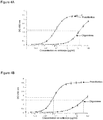
- EC50's are determined by BioStat Speed. The results obtained are shown in Table 1 as well as in the figure 4 and show the very high specificity of the antibody for protofibrils compared to low molecular weight oligomers (factor 184).
- the freeze-dried A ⁇ 1-42 peptide (Anaspec reference 24224) is dissolved according to the supplier's recommendations: 40 ⁇ l of 1% NH 4 OH are added to 500 ⁇ g of A ⁇ 1-42. After complete dissolution, 460 ⁇ l of PBS are added to obtain a concentration of 1 mg / ml. 10 ⁇ l aliquots are prepared and stored at -80 ° C.
- the humanized antibody at a concentration of 0.02 ⁇ g / ml is incubated for 1 hour at room temperature with a concentration range (from 1 ⁇ g / ml) of A ⁇ 1-28 peptides (Bachem, reference H7865), A ⁇ 1-16 (Anaspec, reference 24225), A ⁇ 25-35 (Anaspec, reference 24227), low molecular weight oligomers or protofibrils prepared as described above, the antibody / antigen mixture is then deposited in each well and the microtiter plate incubated.
- the A ⁇ 1-42 peptide (Anaspec, 20276) is dissolved in 200 ⁇ l of 10 mM NaOH at a concentration of 5 mg / ml.
- the peptide IAPP (Anaspec, 60804) is diluted in 200 ⁇ l of 50% DMSO at a concentration of 5 mg / ml. 100 ⁇ l of each preparation are diluted in 400 ⁇ l of PBS 1.25 ⁇ . The final concentration of the peptides is 1 mg / ml in 500 ⁇ l.
- the samples are incubated 72h at 37 ° C. After incubation, the samples are centrifuged at 17900g for 30 minutes at 4 ° C.
- thioflavin T (Anaspec, 88306) is carried out. 20 ⁇ l of thioflavin T (20 ⁇ M final), 10 ⁇ l of the sample and 70 ⁇ l of 1X PBS (final volume 100 ⁇ l) are mixed in a well of a black plate (Corning, 3792). Thioflavin T is excited at 450 nm and, in the presence of amyloid structure, emits fluorescence at 482 nm.
- a ⁇ 1-42 fibrils at 1 ⁇ g / ml and IAPP at 0.5 ⁇ g / ml are deposited in each well of a microtiter plate.
- the ELISA protocol is applied using serial dilutions of the humanized antibody from 10 mcg / ml.
- the figure 5 shows that the humanized antibody LP09027 specifically recognizes the fibrils of A ⁇ 1-42 but not those of IAPP.
- Example 5 Specificity of the humanized antibody LP09027 for the plates senile mature and not for diffuse plaques
- the humanized antibody (LP09027) conjugated with digoxygenine digoxygenine (digoxigenin-3-O-methylcarbonyl- ⁇ -aminocaproic acid-N-hydroxysuccinimide ester: Roche 11333054001; 11418165001) was used in Immunohistochemistry (Robot Ventana) on brain sections.
- APP mouse PS1 Alzheimer model described by Schmitz C. et al., Am. J. Pathol, 2004, 164, 1495-1502
- human brain sections Cerebral cortex
- mice show that the humanized antibody recognizes only the mature and dense senile plaques, but not the diffuse deposits of the A ⁇ peptide. These data correlate with the properties of this antibody which is specific for the protofibrillar Abeta form and therefore does not recognize the soluble, mono-or oligomeric forms of this peptide.
Landscapes
- Health & Medical Sciences (AREA)
- Chemical & Material Sciences (AREA)
- Organic Chemistry (AREA)
- Medicinal Chemistry (AREA)
- General Health & Medical Sciences (AREA)
- Life Sciences & Earth Sciences (AREA)
- Engineering & Computer Science (AREA)
- Bioinformatics & Cheminformatics (AREA)
- Biomedical Technology (AREA)
- Neurology (AREA)
- Neurosurgery (AREA)
- Molecular Biology (AREA)
- Proteomics, Peptides & Aminoacids (AREA)
- Immunology (AREA)
- Biochemistry (AREA)
- Biophysics (AREA)
- Genetics & Genomics (AREA)
- General Chemical & Material Sciences (AREA)
- Pharmacology & Pharmacy (AREA)
- Chemical Kinetics & Catalysis (AREA)
- Animal Behavior & Ethology (AREA)
- Nuclear Medicine, Radiotherapy & Molecular Imaging (AREA)
- Public Health (AREA)
- Veterinary Medicine (AREA)
- Psychiatry (AREA)
- Hospice & Palliative Care (AREA)
- Peptides Or Proteins (AREA)
- Medicines Containing Antibodies Or Antigens For Use As Internal Diagnostic Agents (AREA)
- Micro-Organisms Or Cultivation Processes Thereof (AREA)
- Preparation Of Compounds By Using Micro-Organisms (AREA)
- Medicines That Contain Protein Lipid Enzymes And Other Medicines (AREA)
- Medicines Containing Material From Animals Or Micro-Organisms (AREA)
Priority Applications (4)
| Application Number | Priority Date | Filing Date | Title |
|---|---|---|---|
| SI201031662T SI2977385T1 (en) | 2009-05-12 | 2010-05-11 | Humanised antibodies specific to the protofibrillar form of the amyloid-beta peptide |
| PL15160538T PL2977385T3 (pl) | 2009-05-12 | 2010-05-11 | Przeciwciała humanizowane swoiste dla postaci protofibrylarnej peptydu betaamyloidu |
| EP16155574.3A EP3050898B1 (fr) | 2009-05-12 | 2010-05-11 | Anticorps humanises spécifiques de la forme protofibrillaire du peptide béta-amyloide |
| HRP20180516TT HRP20180516T1 (hr) | 2009-05-12 | 2018-03-27 | Humanizirana protutijela specifična za protofibrilni oblik amiloidnog-beta peptida |
Applications Claiming Priority (2)
| Application Number | Priority Date | Filing Date | Title |
|---|---|---|---|
| FR0953133A FR2945538B1 (fr) | 2009-05-12 | 2009-05-12 | Anticorps humanises specifiques de la forme protofibrillaire du peptide beta-amyloide. |
| EP10728743.5A EP2430049B1 (fr) | 2009-05-12 | 2010-05-11 | Anticorps humanises spécifiques de la forme protofibrillaire du peptide béta-amyloide |
Related Parent Applications (2)
| Application Number | Title | Priority Date | Filing Date |
|---|---|---|---|
| EP10728743.5A Division EP2430049B1 (fr) | 2009-05-12 | 2010-05-11 | Anticorps humanises spécifiques de la forme protofibrillaire du peptide béta-amyloide |
| PCT/FR2010/050915 Previously-Filed-Application WO2010130946A1 (fr) | 2009-05-12 | 2010-05-11 | Anticorps humanises spécifiques de la forme protofibrillaire du peptide béta-amyloide |
Related Child Applications (3)
| Application Number | Title | Priority Date | Filing Date |
|---|---|---|---|
| EP16155574.3A Division EP3050898B1 (fr) | 2009-05-12 | 2010-05-11 | Anticorps humanises spécifiques de la forme protofibrillaire du peptide béta-amyloide |
| EP16155574.3A Previously-Filed-Application EP3050898B1 (fr) | 2009-05-12 | 2010-05-11 | Anticorps humanises spécifiques de la forme protofibrillaire du peptide béta-amyloide |
| EP16155574.3A Division-Into EP3050898B1 (fr) | 2009-05-12 | 2010-05-11 | Anticorps humanises spécifiques de la forme protofibrillaire du peptide béta-amyloide |
Publications (2)
| Publication Number | Publication Date |
|---|---|
| EP2977385A1 EP2977385A1 (fr) | 2016-01-27 |
| EP2977385B1 true EP2977385B1 (fr) | 2017-12-27 |
Family
ID=41591699
Family Applications (3)
| Application Number | Title | Priority Date | Filing Date |
|---|---|---|---|
| EP15160538.3A Not-in-force EP2977385B1 (fr) | 2009-05-12 | 2010-05-11 | Anticorps humanises spécifiques de la forme protofibrillaire du peptide béta-amyloide |
| EP16155574.3A Not-in-force EP3050898B1 (fr) | 2009-05-12 | 2010-05-11 | Anticorps humanises spécifiques de la forme protofibrillaire du peptide béta-amyloide |
| EP10728743.5A Active EP2430049B1 (fr) | 2009-05-12 | 2010-05-11 | Anticorps humanises spécifiques de la forme protofibrillaire du peptide béta-amyloide |
Family Applications After (2)
| Application Number | Title | Priority Date | Filing Date |
|---|---|---|---|
| EP16155574.3A Not-in-force EP3050898B1 (fr) | 2009-05-12 | 2010-05-11 | Anticorps humanises spécifiques de la forme protofibrillaire du peptide béta-amyloide |
| EP10728743.5A Active EP2430049B1 (fr) | 2009-05-12 | 2010-05-11 | Anticorps humanises spécifiques de la forme protofibrillaire du peptide béta-amyloide |
Country Status (42)
Families Citing this family (43)
| Publication number | Priority date | Publication date | Assignee | Title |
|---|---|---|---|---|
| EP2207568B1 (en) | 2007-11-16 | 2017-05-31 | The Rockefeller University | Antibodies specific for the protofibril form of beta-amyloid protein |
| AR085302A1 (es) * | 2011-02-24 | 2013-09-18 | Sanofi Sa | Metodo de produccion de anticuerpos sialilados |
| JP2013159596A (ja) * | 2012-02-08 | 2013-08-19 | Nihon Univ | β−アミロイド前駆体タンパク質のマイクロ凝集体に特異的なモノクローナル抗体 |
| WO2014152006A2 (en) | 2013-03-15 | 2014-09-25 | Intrinsic Lifesciences, Llc | Anti-hepcidin antibodies and uses thereof |
| CA2955086A1 (en) | 2014-08-08 | 2016-02-11 | Alector Llc | Anti-trem2 antibodies and methods of use thereof |
| US10323088B2 (en) | 2014-09-22 | 2019-06-18 | Intrinsic Lifesciences Llc | Humanized anti-hepcidin antibodies and uses thereof |
| SI3280441T1 (sl) | 2015-04-07 | 2022-01-31 | Alector Llc | Protitelesa anti-sortilin in metoda njihove uporabe |
| AU2016276981B2 (en) | 2015-06-12 | 2022-10-06 | Alector Llc | Anti-CD33 antibodies and methods of use thereof |
| HK1252675A1 (zh) | 2015-06-12 | 2019-05-31 | Alector Llc | 抗cd33抗体及其使用方法 |
| WO2017013599A1 (en) | 2015-07-21 | 2017-01-26 | Bioarctic Neuroscience Ab | Method for treatment of traumatic brain injury targeting aggregated peptides |
| KR20180054639A (ko) | 2015-08-28 | 2018-05-24 | 알렉터 엘엘씨 | 항-siglec-7 항체 및 이의 사용 방법 |
| US20190330335A1 (en) | 2015-10-06 | 2019-10-31 | Alector Llc | Anti-trem2 antibodies and methods of use thereof |
| CA3003458A1 (en) | 2015-10-29 | 2017-05-04 | Alector Llc | Anti-siglec-9 antibodies and methods of use thereof |
| WO2017152102A2 (en) | 2016-03-04 | 2017-09-08 | Alector Llc | Anti-trem1 antibodies and methods of use thereof |
| JP2020500020A (ja) | 2016-11-14 | 2020-01-09 | ノバルティス アーゲー | 融合誘導性タンパク質minionに関連する組成物、方法、および治療上の使用 |
| EP3354278A1 (en) * | 2017-01-31 | 2018-08-01 | Sanofi | Neuronal cell protective effect of antibodies specific for the protofibrillar form of the beta-amyloid peptide |
| EP3625258A1 (en) | 2017-05-16 | 2020-03-25 | Alector LLC | Anti-siglec-5 antibodies and methods of use thereof |
| CN111201030B (zh) | 2017-07-25 | 2024-11-01 | 真和制药有限公司 | 通过阻断tim-3和其配体的相互作用治疗癌症 |
| BR112019023789A2 (pt) | 2017-08-03 | 2020-07-28 | Alector Llc | anticorpos anti-cd33 e métodos de uso dos mesmos |
| DK3601358T5 (da) | 2017-08-03 | 2024-09-02 | Alector Llc | Anti-trem2-antistoffer og fremgangsmåder til anvendelse deraf |
| JP7337099B2 (ja) | 2018-05-25 | 2023-09-01 | アレクトル エルエルシー | 抗sirpa抗体およびその使用法 |
| TWI869346B (zh) | 2018-05-30 | 2025-01-11 | 瑞士商諾華公司 | Entpd2抗體、組合療法、及使用該等抗體和組合療法之方法 |
| CN119841953A (zh) | 2018-06-08 | 2025-04-18 | 艾利妥 | 抗siglec-7抗体及其使用方法 |
| LT3618928T (lt) | 2018-07-13 | 2023-04-11 | Alector Llc | Anti-sortilino antikūnai ir jų panaudojimo būdai |
| US12258398B2 (en) | 2018-07-27 | 2025-03-25 | Alector Llc | Anti-Siglec-5 antibodies and methods of use thereof |
| CR20210155A (es) | 2018-08-31 | 2021-05-10 | Alector Llc | Anticuerpos anti-cd33 y métodos para usarlos |
| UY38407A (es) | 2018-10-15 | 2020-05-29 | Novartis Ag | Anticuerpos estabilizadores de trem2 |
| WO2020160156A2 (en) | 2019-01-30 | 2020-08-06 | Immutics, Inc. | Anti-gal3 antibodies and uses thereof |
| TW202110878A (zh) | 2019-05-16 | 2021-03-16 | 法商賽諾菲公司 | 在神經系統中表現抗原結合蛋白 |
| WO2020263830A1 (en) | 2019-06-25 | 2020-12-30 | Gilead Sciences, Inc. | Flt3l-fc fusion proteins and methods of use |
| CA3151927A1 (en) * | 2019-08-20 | 2021-02-25 | The Curators Of The University Of Missouri | Amyloid-beta antibodies |
| TW202124446A (zh) | 2019-09-18 | 2021-07-01 | 瑞士商諾華公司 | 與entpd2抗體之組合療法 |
| CN114502590A (zh) | 2019-09-18 | 2022-05-13 | 诺华股份有限公司 | Entpd2抗体、组合疗法、以及使用这些抗体和组合疗法的方法 |
| US20230035072A1 (en) | 2019-12-12 | 2023-02-02 | Alector Llc | Methods of use of anti-cd33 antibodies |
| EP4157338A4 (en) | 2020-05-26 | 2024-11-13 | TrueBinding, Inc. | METHOD FOR TREATING INFLAMMATORY DISEASES BY GALECTIN-3 BLOCKING |
| JP7518286B2 (ja) | 2020-08-25 | 2024-07-17 | ギリアード サイエンシーズ, インコーポレイテッド | Hivを標的とする多重特異性抗原結合分子及び使用方法 |
| TW202406932A (zh) | 2020-10-22 | 2024-02-16 | 美商基利科學股份有限公司 | 介白素2-Fc融合蛋白及使用方法 |
| TW202300517A (zh) | 2021-03-12 | 2023-01-01 | 美商美國禮來大藥廠 | 抗類澱粉β抗體及其用途 |
| WO2022245671A1 (en) | 2021-05-18 | 2022-11-24 | Gilead Sciences, Inc. | Methods of using flt3l-fc fusion proteins |
| WO2022251048A1 (en) | 2021-05-24 | 2022-12-01 | Eli Lilly And Company | Anti-amyloid beta antibodies and uses thereof |
| WO2023081898A1 (en) | 2021-11-08 | 2023-05-11 | Alector Llc | Soluble cd33 as a biomarker for anti-cd33 efficacy |
| WO2026062585A1 (en) | 2024-09-20 | 2026-03-26 | Novartis Ag | Methods of treatment using anti-trem2 antibodies |
| WO2026062582A1 (en) | 2024-09-20 | 2026-03-26 | Novartis Ag | Methods of treatment using anti-trem2 antibodies |
Family Cites Families (29)
| Publication number | Priority date | Publication date | Assignee | Title |
|---|---|---|---|---|
| GB8607679D0 (en) | 1986-03-27 | 1986-04-30 | Winter G P | Recombinant dna product |
| US5530101A (en) | 1988-12-28 | 1996-06-25 | Protein Design Labs, Inc. | Humanized immunoglobulins |
| GB8928874D0 (en) | 1989-12-21 | 1990-02-28 | Celltech Ltd | Humanised antibodies |
| EP0519596B1 (en) | 1991-05-17 | 2005-02-23 | Merck & Co. Inc. | A method for reducing the immunogenicity of antibody variable domains |
| US6136310A (en) | 1991-07-25 | 2000-10-24 | Idec Pharmaceuticals Corporation | Recombinant anti-CD4 antibodies for human therapy |
| US5565332A (en) | 1991-09-23 | 1996-10-15 | Medical Research Council | Production of chimeric antibodies - a combinatorial approach |
| US5639641A (en) | 1992-09-09 | 1997-06-17 | Immunogen Inc. | Resurfacing of rodent antibodies |
| TWI239847B (en) | 1997-12-02 | 2005-09-21 | Elan Pharm Inc | N-terminal fragment of Abeta peptide and an adjuvant for preventing and treating amyloidogenic disease |
| US6761888B1 (en) | 2000-05-26 | 2004-07-13 | Neuralab Limited | Passive immunization treatment of Alzheimer's disease |
| US6750324B1 (en) | 1997-12-02 | 2004-06-15 | Neuralab Limited | Humanized and chimeric N-terminal amyloid beta-antibodies |
| CA2414772C (en) | 2000-07-07 | 2011-06-28 | Jan Naslund | Prevention and treatment of alzheimer's disease |
| JP2005500806A (ja) * | 2000-09-15 | 2005-01-13 | コーリー ファーマシューティカル ゲーエムベーハー | CpGに基づく免疫アゴニスト/免疫アンタゴニストの高スループットスクリーニングのためのプロセス |
| PE20020574A1 (es) * | 2000-12-06 | 2002-07-02 | Wyeth Corp | Anticuerpos humanizados que reconocen el peptido amiloideo beta |
| WO2005087177A2 (en) * | 2004-03-05 | 2005-09-22 | Ludwig Institute For Cancer Research | Chimeric anti-vegf-d antibodies and humanized anti-vegf-d antibodies and methods of using same |
| SE0401601D0 (sv) * | 2004-06-21 | 2004-06-21 | Bioarctic Neuroscience Ab | Protofibril specific antibodies and uses thereof |
| SI1674111T1 (sl) * | 2004-07-09 | 2011-02-28 | Chugai Pharmaceutical Co Ltd | Protitelo proti glipikanu 3 |
| MX2007000998A (es) * | 2004-07-30 | 2007-07-11 | Rinat Neuroscience Corp | Anticuerpos dirigidos peptido beta-amiloide y procedimientos que usan los mismos. |
| WO2006037604A1 (en) * | 2004-10-01 | 2006-04-13 | MAX-PLANCK-Gesellschaft zur Förderung der Wissenschaften e.V. | Novel antibodies directed to the mammalian eag1 ion channel protein |
| US7906625B2 (en) * | 2005-01-24 | 2011-03-15 | Amgen Inc. | Humanized anti-amyloid antibody |
| EP1996946A1 (en) * | 2006-03-22 | 2008-12-03 | Gyros Patent Ab | Plex method |
| RU2429244C2 (ru) * | 2006-03-23 | 2011-09-20 | Байоарктик Ньюросайенс Аб | Улучшенные селективные в отношении протофибрилл антитела и их применение |
| WO2008081008A1 (en) * | 2007-01-05 | 2008-07-10 | University Of Zurich | Method of providing disease-specific binding molecules and targets |
| BRPI0808551B1 (pt) * | 2007-03-01 | 2022-04-05 | Symphogen A/S | Composições de anticorpo para o receptor do fator de crescimento antiepidérmico recombinante, molécula de ligação bi-específica e composição farmacêutica que os compreende |
| MX338397B (es) | 2007-08-29 | 2016-04-15 | Sanofi Aventis | Anticuerpos anti - cxcr5 humanizados, derivados de los mismos y su uso. |
| EP2207568B1 (en) * | 2007-11-16 | 2017-05-31 | The Rockefeller University | Antibodies specific for the protofibril form of beta-amyloid protein |
| PL3211005T3 (pl) * | 2008-07-08 | 2021-11-29 | Geneuro Sa | Terapeutyczne zastosowanie specyficznego liganda w chorobach związanych z MSRV |
| DK2406289T3 (en) * | 2009-03-10 | 2017-05-01 | Baylor Res Inst | ANTIGEN PRESENTING CELL TARGETED ANTIVIRUS VACCINES |
| CN102770457A (zh) * | 2009-03-10 | 2012-11-07 | 贝勒研究院 | 靶向抗原呈递细胞的疫苗 |
| TWI508976B (zh) * | 2009-04-21 | 2015-11-21 | Univ Rockefeller | 對β-類澱粉蛋白之基原纖維形式具專一性之抗體 |
-
2009
- 2009-05-12 FR FR0953133A patent/FR2945538B1/fr not_active Expired - Fee Related
-
2010
- 2010-05-11 UA UAA201114656A patent/UA107574C2/ru unknown
- 2010-05-11 NZ NZ596540A patent/NZ596540A/xx not_active IP Right Cessation
- 2010-05-11 DK DK10728743.5T patent/DK2430049T3/en active
- 2010-05-11 SG SG2011085255A patent/SG176155A1/en unknown
- 2010-05-11 DK DK15160538.3T patent/DK2977385T3/en active
- 2010-05-11 JP JP2012510343A patent/JP2012526541A/ja active Pending
- 2010-05-11 HR HRP20150776TT patent/HRP20150776T1/hr unknown
- 2010-05-11 PL PL15160538T patent/PL2977385T3/pl unknown
- 2010-05-11 CN CN201080030434.6A patent/CN102459336B/zh not_active Expired - Fee Related
- 2010-05-11 EP EP15160538.3A patent/EP2977385B1/fr not_active Not-in-force
- 2010-05-11 KR KR1020117029577A patent/KR101783058B1/ko not_active Expired - Fee Related
- 2010-05-11 EA EA201171388A patent/EA028357B1/ru not_active IP Right Cessation
- 2010-05-11 EP EP16155574.3A patent/EP3050898B1/fr not_active Not-in-force
- 2010-05-11 HU HUE15160538A patent/HUE036737T2/hu unknown
- 2010-05-11 WO PCT/FR2010/050915 patent/WO2010130946A1/fr not_active Ceased
- 2010-05-11 SI SI201030968T patent/SI2430049T1/sl unknown
- 2010-05-11 PT PT107287435T patent/PT2430049E/pt unknown
- 2010-05-11 TW TW099115013A patent/TWI542360B/zh not_active IP Right Cessation
- 2010-05-11 ES ES10728743.5T patent/ES2542757T3/es active Active
- 2010-05-11 ES ES15160538.3T patent/ES2664409T3/es active Active
- 2010-05-11 MX MX2011012060A patent/MX2011012060A/es active IP Right Grant
- 2010-05-11 EP EP10728743.5A patent/EP2430049B1/fr active Active
- 2010-05-11 AU AU2010247215A patent/AU2010247215B2/en not_active Ceased
- 2010-05-11 RS RS20150459A patent/RS54122B1/sr unknown
- 2010-05-11 SI SI201031662T patent/SI2977385T1/en unknown
- 2010-05-11 MY MYPI2011005458A patent/MY159398A/en unknown
- 2010-05-11 PL PL10728743T patent/PL2430049T3/pl unknown
- 2010-05-11 PY PY201001018155A patent/PY1018155A/es unknown
- 2010-05-11 TW TW105112498A patent/TWI583791B/zh not_active IP Right Cessation
- 2010-05-11 CA CA2761665A patent/CA2761665A1/fr not_active Abandoned
- 2010-05-11 PE PE2011001949A patent/PE20120906A1/es active IP Right Grant
- 2010-05-11 PT PT151605383T patent/PT2977385T/pt unknown
- 2010-05-11 US US13/319,710 patent/US8614299B2/en not_active Expired - Fee Related
- 2010-05-11 LT LTEP15160538.3T patent/LT2977385T/lt unknown
- 2010-05-11 BR BRPI1012853-0A patent/BRPI1012853B1/pt not_active IP Right Cessation
- 2010-05-11 AR ARP100101602A patent/AR076670A1/es active IP Right Grant
- 2010-05-11 MA MA34434A patent/MA33350B1/fr unknown
- 2010-05-12 UY UY0001032633A patent/UY32633A/es active IP Right Grant
-
2011
- 2011-11-08 GT GT201100283A patent/GT201100283A/es unknown
- 2011-11-08 CR CR20110585A patent/CR20110585A/es unknown
- 2011-11-09 IL IL216237A patent/IL216237B/en active IP Right Grant
- 2011-11-10 TN TNP2011000571A patent/TN2011000571A1/fr unknown
- 2011-11-11 NI NI201100195A patent/NI201100195A/es unknown
- 2011-11-11 CO CO11153627A patent/CO6460745A2/es active IP Right Grant
- 2011-11-11 CL CL2011002831A patent/CL2011002831A1/es unknown
- 2011-11-11 SV SV2011004058A patent/SV2011004058A/es active IP Right Grant
- 2011-11-11 ZA ZA2011/08301A patent/ZA201108301B/en unknown
- 2011-11-11 EC EC2011011452A patent/ECSP11011452A/es unknown
-
2013
- 2013-10-01 US US14/042,942 patent/US9382312B2/en not_active Expired - Fee Related
-
2015
- 2015-07-14 CY CY20151100622T patent/CY1116842T1/el unknown
- 2015-10-01 JP JP2015195617A patent/JP6310895B2/ja not_active Expired - Fee Related
-
2016
- 2016-06-02 US US15/171,708 patent/US10112991B2/en not_active Expired - Fee Related
-
2018
- 2018-03-27 CY CY20181100343T patent/CY1120413T1/el unknown
- 2018-03-27 HR HRP20180516TT patent/HRP20180516T1/hr unknown
- 2018-09-26 US US16/142,666 patent/US20190119365A1/en not_active Abandoned
- 2018-11-27 HR HRP20181985TT patent/HRP20181985T1/hr unknown
Non-Patent Citations (1)
| Title |
|---|
| None * |
Also Published As
Similar Documents
| Publication | Publication Date | Title |
|---|---|---|
| EP2977385B1 (fr) | Anticorps humanises spécifiques de la forme protofibrillaire du peptide béta-amyloide | |
| KR101600095B1 (ko) | 모노클로널 항 베타 아밀로이드 항체 | |
| TWI579303B (zh) | 單株抗體 | |
| AU2008311367B2 (en) | Use of anti-amyloid beta antibody in ocular diseases | |
| EA035943B1 (ru) | Антитело, связывающееся с тау-белком человека | |
| CN105169388A (zh) | 人源化抗体 | |
| US20140127225A1 (en) | Compositions and methods for treating diseases of protein aggregation involving ic3b deposition | |
| JP2026504818A (ja) | 抗アミロイドβプロトフィブリル/オリゴマー抗体およびその使用 | |
| JP2021006025A (ja) | アミロイドβに対するヒト化抗体 | |
| HK1167152B (en) | Humanized antibodies specific to the protofibrillar form of the beta-amyloid peptide | |
| AU2015200604A1 (en) | Use of anti-amyloid beta antibody in ocular diseases | |
| HK1184793A (en) | Use of anti-amyloid beta antibody in ocular diseases |
Legal Events
| Date | Code | Title | Description |
|---|---|---|---|
| PUAI | Public reference made under article 153(3) epc to a published international application that has entered the european phase |
Free format text: ORIGINAL CODE: 0009012 |
|
| 17P | Request for examination filed |
Effective date: 20150324 |
|
| AC | Divisional application: reference to earlier application |
Ref document number: 2430049 Country of ref document: EP Kind code of ref document: P |
|
| AK | Designated contracting states |
Kind code of ref document: A1 Designated state(s): AL AT BE BG CH CY CZ DE DK EE ES FI FR GB GR HR HU IE IS IT LI LT LU LV MC MK MT NL NO PL PT RO SE SI SK SM TR |
|
| AX | Request for extension of the european patent |
Extension state: BA ME RS |
|
| 17Q | First examination report despatched |
Effective date: 20161118 |
|
| RIC1 | Information provided on ipc code assigned before grant |
Ipc: A61P 25/28 20060101ALN20170508BHEP Ipc: C07K 16/18 20060101AFI20170508BHEP Ipc: G01N 33/68 20060101ALI20170508BHEP Ipc: A61K 39/395 20060101ALN20170508BHEP |
|
| RIC1 | Information provided on ipc code assigned before grant |
Ipc: C07K 16/18 20060101AFI20170607BHEP Ipc: A61P 25/28 20060101ALN20170607BHEP Ipc: G01N 33/68 20060101ALI20170607BHEP Ipc: A61K 39/395 20060101ALN20170607BHEP |
|
| GRAP | Despatch of communication of intention to grant a patent |
Free format text: ORIGINAL CODE: EPIDOSNIGR1 |
|
| INTG | Intention to grant announced |
Effective date: 20170720 |
|
| GRAS | Grant fee paid |
Free format text: ORIGINAL CODE: EPIDOSNIGR3 |
|
| GRAA | (expected) grant |
Free format text: ORIGINAL CODE: 0009210 |
|
| AC | Divisional application: reference to earlier application |
Ref document number: 2430049 Country of ref document: EP Kind code of ref document: P |
|
| AK | Designated contracting states |
Kind code of ref document: B1 Designated state(s): AL AT BE BG CH CY CZ DE DK EE ES FI FR GB GR HR HU IE IS IT LI LT LU LV MC MK MT NL NO PL PT RO SE SI SK SM TR |
|
| REG | Reference to a national code |
Ref country code: GB Ref legal event code: FG4D Free format text: NOT ENGLISH |
|
| REG | Reference to a national code |
Ref country code: CH Ref legal event code: EP |
|
| REG | Reference to a national code |
Ref country code: AT Ref legal event code: REF Ref document number: 958207 Country of ref document: AT Kind code of ref document: T Effective date: 20180115 |
|
| REG | Reference to a national code |
Ref country code: IE Ref legal event code: FG4D Free format text: LANGUAGE OF EP DOCUMENT: FRENCH |
|
| REG | Reference to a national code |
Ref country code: DE Ref legal event code: R096 Ref document number: 602010047725 Country of ref document: DE |
|
| REG | Reference to a national code |
Ref country code: RO Ref legal event code: EPE Ref country code: HR Ref legal event code: TUEP Ref document number: P20180516 Country of ref document: HR |
|
| REG | Reference to a national code |
Ref country code: PT Ref legal event code: SC4A Ref document number: 2977385 Country of ref document: PT Date of ref document: 20180403 Kind code of ref document: T Free format text: AVAILABILITY OF NATIONAL TRANSLATION Effective date: 20180327 |
|
| REG | Reference to a national code |
Ref country code: NL Ref legal event code: FP Ref country code: FR Ref legal event code: PLFP Year of fee payment: 9 |
|
| REG | Reference to a national code |
Ref country code: DK Ref legal event code: T3 Effective date: 20180411 |
|
| REG | Reference to a national code |
Ref country code: ES Ref legal event code: FG2A Ref document number: 2664409 Country of ref document: ES Kind code of ref document: T3 Effective date: 20180419 |
|
| REG | Reference to a national code |
Ref country code: SE Ref legal event code: TRGR |
|
| REG | Reference to a national code |
Ref country code: HR Ref legal event code: T1PR Ref document number: P20180516 Country of ref document: HR |
|
| REG | Reference to a national code |
Ref country code: EE Ref legal event code: FG4A Ref document number: E015242 Country of ref document: EE Effective date: 20180327 |
|
| REG | Reference to a national code |
Ref country code: NO Ref legal event code: T2 Effective date: 20171227 |
|
| REG | Reference to a national code |
Ref country code: SK Ref legal event code: T3 Ref document number: E 26954 Country of ref document: SK |
|
| REG | Reference to a national code |
Ref country code: HU Ref legal event code: AG4A Ref document number: E036737 Country of ref document: HU |
|
| PG25 | Lapsed in a contracting state [announced via postgrant information from national office to epo] |
Ref country code: IS Free format text: LAPSE BECAUSE OF FAILURE TO SUBMIT A TRANSLATION OF THE DESCRIPTION OR TO PAY THE FEE WITHIN THE PRESCRIBED TIME-LIMIT Effective date: 20180427 Ref country code: SM Free format text: LAPSE BECAUSE OF FAILURE TO SUBMIT A TRANSLATION OF THE DESCRIPTION OR TO PAY THE FEE WITHIN THE PRESCRIBED TIME-LIMIT Effective date: 20171227 |
|
| REG | Reference to a national code |
Ref country code: GR Ref legal event code: EP Ref document number: 20180400893 Country of ref document: GR Effective date: 20180829 |
|
| REG | Reference to a national code |
Ref country code: DE Ref legal event code: R097 Ref document number: 602010047725 Country of ref document: DE |
|
| PLBE | No opposition filed within time limit |
Free format text: ORIGINAL CODE: 0009261 |
|
| STAA | Information on the status of an ep patent application or granted ep patent |
Free format text: STATUS: NO OPPOSITION FILED WITHIN TIME LIMIT |
|
| 26N | No opposition filed |
Effective date: 20180928 |
|
| REG | Reference to a national code |
Ref country code: HR Ref legal event code: ODRP Ref document number: P20180516 Country of ref document: HR Payment date: 20190327 Year of fee payment: 10 |
|
| PGFP | Annual fee paid to national office [announced via postgrant information from national office to epo] |
Ref country code: SM Payment date: 20190611 Year of fee payment: 6 |
|
| REG | Reference to a national code |
Ref country code: AT Ref legal event code: UEP Ref document number: 958207 Country of ref document: AT Kind code of ref document: T Effective date: 20171227 |
|
| REG | Reference to a national code |
Ref country code: HR Ref legal event code: ODRP Ref document number: P20180516 Country of ref document: HR Payment date: 20200331 Year of fee payment: 11 |
|
| PG25 | Lapsed in a contracting state [announced via postgrant information from national office to epo] |
Ref country code: MK Free format text: LAPSE BECAUSE OF NON-PAYMENT OF DUE FEES Effective date: 20171227 |
|
| PG25 | Lapsed in a contracting state [announced via postgrant information from national office to epo] |
Ref country code: AL Free format text: LAPSE BECAUSE OF FAILURE TO SUBMIT A TRANSLATION OF THE DESCRIPTION OR TO PAY THE FEE WITHIN THE PRESCRIBED TIME-LIMIT Effective date: 20171227 |
|
| PGFP | Annual fee paid to national office [announced via postgrant information from national office to epo] |
Ref country code: CY Payment date: 20200508 Year of fee payment: 11 |
|
| PG25 | Lapsed in a contracting state [announced via postgrant information from national office to epo] |
Ref country code: MC Free format text: LAPSE BECAUSE OF NON-PAYMENT OF DUE FEES Effective date: 20200602 |
|
| PG25 | Lapsed in a contracting state [announced via postgrant information from national office to epo] |
Ref country code: LV Free format text: LAPSE BECAUSE OF NON-PAYMENT OF DUE FEES Effective date: 20200511 |
|
| REG | Reference to a national code |
Ref country code: HR Ref legal event code: ODRP Ref document number: P20180516 Country of ref document: HR Payment date: 20210506 Year of fee payment: 12 |
|
| PGFP | Annual fee paid to national office [announced via postgrant information from national office to epo] |
Ref country code: BG Payment date: 20210319 Year of fee payment: 12 Ref country code: PL Payment date: 20210315 Year of fee payment: 12 |
|
| PGFP | Annual fee paid to national office [announced via postgrant information from national office to epo] |
Ref country code: SK Payment date: 20210324 Year of fee payment: 12 Ref country code: LU Payment date: 20210426 Year of fee payment: 12 |
|
| PGFP | Annual fee paid to national office [announced via postgrant information from national office to epo] |
Ref country code: EE Payment date: 20210401 Year of fee payment: 12 Ref country code: FI Payment date: 20210511 Year of fee payment: 12 Ref country code: DE Payment date: 20210413 Year of fee payment: 12 Ref country code: GR Payment date: 20210413 Year of fee payment: 12 Ref country code: HR Payment date: 20210506 Year of fee payment: 12 Ref country code: FR Payment date: 20210412 Year of fee payment: 12 Ref country code: NL Payment date: 20210512 Year of fee payment: 12 Ref country code: LT Payment date: 20210415 Year of fee payment: 12 Ref country code: IT Payment date: 20210412 Year of fee payment: 12 Ref country code: CZ Payment date: 20210415 Year of fee payment: 12 Ref country code: RO Payment date: 20210406 Year of fee payment: 12 Ref country code: NO Payment date: 20210511 Year of fee payment: 12 Ref country code: PT Payment date: 20210511 Year of fee payment: 12 |
|
| PGFP | Annual fee paid to national office [announced via postgrant information from national office to epo] |
Ref country code: AT Payment date: 20210426 Year of fee payment: 12 Ref country code: BE Payment date: 20210415 Year of fee payment: 12 Ref country code: GB Payment date: 20210414 Year of fee payment: 12 Ref country code: SI Payment date: 20210326 Year of fee payment: 12 Ref country code: TR Payment date: 20210430 Year of fee payment: 12 Ref country code: SE Payment date: 20210511 Year of fee payment: 12 Ref country code: IE Payment date: 20210511 Year of fee payment: 12 Ref country code: HU Payment date: 20210505 Year of fee payment: 12 Ref country code: ES Payment date: 20210609 Year of fee payment: 12 Ref country code: CH Payment date: 20210519 Year of fee payment: 12 Ref country code: DK Payment date: 20210511 Year of fee payment: 12 |
|
| PG25 | Lapsed in a contracting state [announced via postgrant information from national office to epo] |
Ref country code: CY Free format text: LAPSE BECAUSE OF NON-PAYMENT OF DUE FEES Effective date: 20210511 |
|
| PG25 | Lapsed in a contracting state [announced via postgrant information from national office to epo] |
Ref country code: MT Free format text: LAPSE BECAUSE OF NON-PAYMENT OF DUE FEES Effective date: 20200511 |
|
| REG | Reference to a national code |
Ref country code: HR Ref legal event code: PBON Ref document number: P20180516 Country of ref document: HR Effective date: 20220511 |
|
| REG | Reference to a national code |
Ref country code: DE Ref legal event code: R119 Ref document number: 602010047725 Country of ref document: DE |
|
| REG | Reference to a national code |
Ref country code: LT Ref legal event code: MM4D Effective date: 20220511 |
|
| REG | Reference to a national code |
Ref country code: EE Ref legal event code: MM4A Ref document number: E015242 Country of ref document: EE Effective date: 20220531 |
|
| REG | Reference to a national code |
Ref country code: DK Ref legal event code: EBP Effective date: 20220531 |
|
| REG | Reference to a national code |
Ref country code: SK Ref legal event code: MM4A Ref document number: E 26954 Country of ref document: SK Effective date: 20220511 |
|
| REG | Reference to a national code |
Ref country code: NO Ref legal event code: MMEP |
|
| REG | Reference to a national code |
Ref country code: CH Ref legal event code: PL |
|
| REG | Reference to a national code |
Ref country code: SE Ref legal event code: EUG |
|
| REG | Reference to a national code |
Ref country code: NL Ref legal event code: MM Effective date: 20220601 |
|
| REG | Reference to a national code |
Ref country code: AT Ref legal event code: MM01 Ref document number: 958207 Country of ref document: AT Kind code of ref document: T Effective date: 20220511 |
|
| REG | Reference to a national code |
Ref country code: BE Ref legal event code: MM Effective date: 20220531 |
|
| GBPC | Gb: european patent ceased through non-payment of renewal fee |
Effective date: 20220511 |
|
| PG25 | Lapsed in a contracting state [announced via postgrant information from national office to epo] |
Ref country code: SK Free format text: LAPSE BECAUSE OF NON-PAYMENT OF DUE FEES Effective date: 20220511 Ref country code: SE Free format text: LAPSE BECAUSE OF NON-PAYMENT OF DUE FEES Effective date: 20220512 Ref country code: RO Free format text: LAPSE BECAUSE OF NON-PAYMENT OF DUE FEES Effective date: 20220511 Ref country code: PT Free format text: LAPSE BECAUSE OF NON-PAYMENT OF DUE FEES Effective date: 20221111 Ref country code: NO Free format text: LAPSE BECAUSE OF NON-PAYMENT OF DUE FEES Effective date: 20220531 Ref country code: LU Free format text: LAPSE BECAUSE OF NON-PAYMENT OF DUE FEES Effective date: 20220511 Ref country code: LT Free format text: LAPSE BECAUSE OF NON-PAYMENT OF DUE FEES Effective date: 20220511 Ref country code: LI Free format text: LAPSE BECAUSE OF NON-PAYMENT OF DUE FEES Effective date: 20220531 Ref country code: HU Free format text: LAPSE BECAUSE OF NON-PAYMENT OF DUE FEES Effective date: 20220512 Ref country code: FI Free format text: LAPSE BECAUSE OF NON-PAYMENT OF DUE FEES Effective date: 20220511 Ref country code: EE Free format text: LAPSE BECAUSE OF NON-PAYMENT OF DUE FEES Effective date: 20220531 Ref country code: CZ Free format text: LAPSE BECAUSE OF NON-PAYMENT OF DUE FEES Effective date: 20220511 Ref country code: CH Free format text: LAPSE BECAUSE OF NON-PAYMENT OF DUE FEES Effective date: 20220531 Ref country code: AT Free format text: LAPSE BECAUSE OF NON-PAYMENT OF DUE FEES Effective date: 20220511 |
|
| PG25 | Lapsed in a contracting state [announced via postgrant information from national office to epo] |
Ref country code: SI Free format text: LAPSE BECAUSE OF NON-PAYMENT OF DUE FEES Effective date: 20220512 Ref country code: HR Free format text: LAPSE BECAUSE OF NON-PAYMENT OF DUE FEES Effective date: 20220511 Ref country code: GR Free format text: LAPSE BECAUSE OF NON-PAYMENT OF DUE FEES Effective date: 20221208 |
|
| PG25 | Lapsed in a contracting state [announced via postgrant information from national office to epo] |
Ref country code: IE Free format text: LAPSE BECAUSE OF NON-PAYMENT OF DUE FEES Effective date: 20220511 Ref country code: FR Free format text: LAPSE BECAUSE OF NON-PAYMENT OF DUE FEES Effective date: 20220531 Ref country code: DK Free format text: LAPSE BECAUSE OF NON-PAYMENT OF DUE FEES Effective date: 20220531 |
|
| PG25 | Lapsed in a contracting state [announced via postgrant information from national office to epo] |
Ref country code: GB Free format text: LAPSE BECAUSE OF NON-PAYMENT OF DUE FEES Effective date: 20220511 Ref country code: DE Free format text: LAPSE BECAUSE OF NON-PAYMENT OF DUE FEES Effective date: 20221201 Ref country code: BE Free format text: LAPSE BECAUSE OF NON-PAYMENT OF DUE FEES Effective date: 20220531 |
|
| PG25 | Lapsed in a contracting state [announced via postgrant information from national office to epo] |
Ref country code: NL Free format text: LAPSE BECAUSE OF NON-PAYMENT OF DUE FEES Effective date: 20220601 |
|
| REG | Reference to a national code |
Ref country code: ES Ref legal event code: FD2A Effective date: 20230705 |
|
| PG25 | Lapsed in a contracting state [announced via postgrant information from national office to epo] |
Ref country code: IT Free format text: LAPSE BECAUSE OF NON-PAYMENT OF DUE FEES Effective date: 20220511 Ref country code: ES Free format text: LAPSE BECAUSE OF NON-PAYMENT OF DUE FEES Effective date: 20220512 |
|
| PG25 | Lapsed in a contracting state [announced via postgrant information from national office to epo] |
Ref country code: PL Free format text: LAPSE BECAUSE OF NON-PAYMENT OF DUE FEES Effective date: 20220511 |
|
| PG25 | Lapsed in a contracting state [announced via postgrant information from national office to epo] |
Ref country code: BG Free format text: LAPSE BECAUSE OF NON-PAYMENT OF DUE FEES Effective date: 20220511 |
|
| PG25 | Lapsed in a contracting state [announced via postgrant information from national office to epo] |
Ref country code: TR Free format text: LAPSE BECAUSE OF NON-PAYMENT OF DUE FEES Effective date: 20220511 |