EP3009472B1 - Vorgeformtes kernreiter/wulstverbundmaterial und reifen mit vorgeformtem kernreiter-wulst - Google Patents
Vorgeformtes kernreiter/wulstverbundmaterial und reifen mit vorgeformtem kernreiter-wulst Download PDFInfo
- Publication number
- EP3009472B1 EP3009472B1 EP15187109.2A EP15187109A EP3009472B1 EP 3009472 B1 EP3009472 B1 EP 3009472B1 EP 15187109 A EP15187109 A EP 15187109A EP 3009472 B1 EP3009472 B1 EP 3009472B1
- Authority
- EP
- European Patent Office
- Prior art keywords
- rubber
- apex
- bead
- tire
- polybutadiene
- Prior art date
- Legal status (The legal status is an assumption and is not a legal conclusion. Google has not performed a legal analysis and makes no representation as to the accuracy of the status listed.)
- Not-in-force
Links
Images
Classifications
-
- B—PERFORMING OPERATIONS; TRANSPORTING
- B29—WORKING OF PLASTICS; WORKING OF SUBSTANCES IN A PLASTIC STATE IN GENERAL
- B29D—PRODUCING PARTICULAR ARTICLES FROM PLASTICS OR FROM SUBSTANCES IN A PLASTIC STATE
- B29D30/00—Producing pneumatic or solid tyres or parts thereof
- B29D30/06—Pneumatic tyres or parts thereof (e.g. produced by casting, moulding, compression moulding, injection moulding, centrifugal casting)
- B29D30/48—Bead-rings or bead-cores; Treatment thereof prior to building the tyre
-
- B—PERFORMING OPERATIONS; TRANSPORTING
- B29—WORKING OF PLASTICS; WORKING OF SUBSTANCES IN A PLASTIC STATE IN GENERAL
- B29D—PRODUCING PARTICULAR ARTICLES FROM PLASTICS OR FROM SUBSTANCES IN A PLASTIC STATE
- B29D30/00—Producing pneumatic or solid tyres or parts thereof
- B29D30/06—Pneumatic tyres or parts thereof (e.g. produced by casting, moulding, compression moulding, injection moulding, centrifugal casting)
- B29D30/08—Building tyres
-
- B—PERFORMING OPERATIONS; TRANSPORTING
- B29—WORKING OF PLASTICS; WORKING OF SUBSTANCES IN A PLASTIC STATE IN GENERAL
- B29D—PRODUCING PARTICULAR ARTICLES FROM PLASTICS OR FROM SUBSTANCES IN A PLASTIC STATE
- B29D30/00—Producing pneumatic or solid tyres or parts thereof
- B29D30/06—Pneumatic tyres or parts thereof (e.g. produced by casting, moulding, compression moulding, injection moulding, centrifugal casting)
- B29D30/0681—Parts of pneumatic tyres; accessories, auxiliary operations
-
- B—PERFORMING OPERATIONS; TRANSPORTING
- B60—VEHICLES IN GENERAL
- B60C—VEHICLE TYRES; TYRE INFLATION; TYRE CHANGING; CONNECTING VALVES TO INFLATABLE ELASTIC BODIES IN GENERAL; DEVICES OR ARRANGEMENTS RELATED TO TYRES
- B60C15/00—Tyre beads, e.g. ply turn-up or overlap
- B60C15/06—Flipper strips, fillers, or chafing strips and reinforcing layers for the construction of the bead
- B60C15/0603—Flipper strips, fillers, or chafing strips and reinforcing layers for the construction of the bead characterised by features of the bead filler or apex
-
- C—CHEMISTRY; METALLURGY
- C08—ORGANIC MACROMOLECULAR COMPOUNDS; THEIR PREPARATION OR CHEMICAL WORKING-UP; COMPOSITIONS BASED THEREON
- C08K—Use of inorganic or non-macromolecular organic substances as compounding ingredients
- C08K3/00—Use of inorganic substances as compounding ingredients
- C08K3/02—Elements
- C08K3/04—Carbon
-
- C—CHEMISTRY; METALLURGY
- C08—ORGANIC MACROMOLECULAR COMPOUNDS; THEIR PREPARATION OR CHEMICAL WORKING-UP; COMPOSITIONS BASED THEREON
- C08L—COMPOSITIONS OF MACROMOLECULAR COMPOUNDS
- C08L7/00—Compositions of natural rubber
-
- C—CHEMISTRY; METALLURGY
- C08—ORGANIC MACROMOLECULAR COMPOUNDS; THEIR PREPARATION OR CHEMICAL WORKING-UP; COMPOSITIONS BASED THEREON
- C08L—COMPOSITIONS OF MACROMOLECULAR COMPOUNDS
- C08L9/00—Compositions of homopolymers or copolymers of conjugated diene hydrocarbons
-
- C—CHEMISTRY; METALLURGY
- C08—ORGANIC MACROMOLECULAR COMPOUNDS; THEIR PREPARATION OR CHEMICAL WORKING-UP; COMPOSITIONS BASED THEREON
- C08L—COMPOSITIONS OF MACROMOLECULAR COMPOUNDS
- C08L9/00—Compositions of homopolymers or copolymers of conjugated diene hydrocarbons
- C08L9/06—Copolymers with styrene
-
- B—PERFORMING OPERATIONS; TRANSPORTING
- B29—WORKING OF PLASTICS; WORKING OF SUBSTANCES IN A PLASTIC STATE IN GENERAL
- B29D—PRODUCING PARTICULAR ARTICLES FROM PLASTICS OR FROM SUBSTANCES IN A PLASTIC STATE
- B29D30/00—Producing pneumatic or solid tyres or parts thereof
- B29D30/06—Pneumatic tyres or parts thereof (e.g. produced by casting, moulding, compression moulding, injection moulding, centrifugal casting)
- B29D30/48—Bead-rings or bead-cores; Treatment thereof prior to building the tyre
- B29D2030/482—Applying fillers or apexes to bead cores
-
- B—PERFORMING OPERATIONS; TRANSPORTING
- B29—WORKING OF PLASTICS; WORKING OF SUBSTANCES IN A PLASTIC STATE IN GENERAL
- B29K—INDEXING SCHEME ASSOCIATED WITH SUBCLASSES B29B, B29C OR B29D, RELATING TO MOULDING MATERIALS OR TO MATERIALS FOR MOULDS, REINFORCEMENTS, FILLERS OR PREFORMED PARTS, e.g. INSERTS
- B29K2009/00—Use of rubber derived from conjugated dienes, as moulding material
-
- B—PERFORMING OPERATIONS; TRANSPORTING
- B29—WORKING OF PLASTICS; WORKING OF SUBSTANCES IN A PLASTIC STATE IN GENERAL
- B29K—INDEXING SCHEME ASSOCIATED WITH SUBCLASSES B29B, B29C OR B29D, RELATING TO MOULDING MATERIALS OR TO MATERIALS FOR MOULDS, REINFORCEMENTS, FILLERS OR PREFORMED PARTS, e.g. INSERTS
- B29K2507/00—Use of elements other than metals as filler
- B29K2507/04—Carbon
-
- B—PERFORMING OPERATIONS; TRANSPORTING
- B60—VEHICLES IN GENERAL
- B60C—VEHICLE TYRES; TYRE INFLATION; TYRE CHANGING; CONNECTING VALVES TO INFLATABLE ELASTIC BODIES IN GENERAL; DEVICES OR ARRANGEMENTS RELATED TO TYRES
- B60C1/00—Tyres characterised by the chemical composition or the physical arrangement or mixture of the composition
- B60C2001/005—Compositions of the bead portions, e.g. clinch or chafer rubber or cushion rubber
- B60C2001/0058—Compositions of the bead apexes
Definitions
- the invention relates to preparation of an apex/bead composite or assembly as a pre-apexed tire bead, and pneumatic tire containing such pre-apexed bead.
- the invention relates to such pre-apexed bead where the apex is comprised of a rubber composition which contains a syndiotactic-1,2-polybutadiene polymer.
- Pneumatic tires are usually comprised of a circumferential tread and spaced apart beads with a sidewall extending from the beads to the tread and a carcass supporting the tread and sidewall components.
- the tire sidewalls usually contain a rubber apex within the sidewall which extends from a tire bead radially outward into the tire sidewall to add stiffness to the tire sidewall to thereby promote beneficial handling characteristics to the tire.
- the pneumatic tire is usually built as an assembly of components which includes individually assembling the apex and bead components together with other components to form a tire assembly which is then cured in a suitable mold to form the tire.
- a tire is prepared by building an assembly of components including such pre-apexed bead and then curing the assembly to form the tire.
- the envisioned methodology of providing a pre-apexed tire bead by preforming the composite of circumferential apex strip around an annular bead is comprised of extruding a shaped uncured rubber apex strip onto and circumferentially around an annular bead of uncured rubber encapsulated plurality of metal cords is considered to be a departure from past practice.
- the peripheral outer portion of the uncured rubber apex strip necessarily stretches to extend, or travel, a greater distance than the peripheral inner portion of the rubber apex strip around the annular bead.
- the peripheral outer portion of the extruded uncured rubber apex is stretched to a greater length than its peripheral inner portion, it has been observed that, because the stretched apex strip is elastomeric in nature, it has a natural tendency to try to shrink and thereby return to its original unstretched shape.
- the stretched elastomeric peripheral outer portion of the uncured apex strip tends to undesirably shrink and thereby deform and curl inward toward its peripheral inner portion.
- pre-formed apex/bead combination pre-apexed bead
- pre-apexed bead pre-apexed bead
- thermoplastic syndiotactic-1,2- polybutadiene polymer is chosen because it can be sulfur cured together with other diene-based elastomers present in the cured rubber composition with suitable elastomeric properties for the tire apex component of the tire.
- Syndiotactic-1,2-polybutadiene polymer is recognized as being a crystalline thermoplastic polymer and therefore in its uncured state rather than being elastomeric. However, upon blending with various diene-based elastomers to form a rubber composition, it exhibits elastomeric rubbery properties when the rubber composition is sulfur cured.
- syndiotactic polybutadiene has been proposed for use in various rubber compositions for various tire components for various purposes such as, for example, tire carcass, innerliner and apex components.
- tire components for various purposes such as, for example, tire carcass, innerliner and apex components.
- syndiotactic polybutadiene has been proposed for use in various rubber compositions for various tire components for various purposes such as, for example, tire carcass, innerliner and apex components.
- the uncured apex rubber strip contains the thermoplastic syndiotactic polybutadiene, it is somewhat less elastomeric in nature.
- the uncured rubber apex particularly its outer peripheral portion, may have a reduced tendency to attempt to return to its original shape after circumferentially stretching it when being wrapped circumferentially around the annular bead and thereby less tendency to curl inward to present the aforesaid unwanted altered apex shape and to thereby beneficially enable inserting the apex/bead composite into the tire assembly for preparation of a pneumatic tire.
- the apex comprises an uncured rubber composition which contains a syndiotactic-1,2- polybutadiene thermoplastic polymer having a melting point in a range of from 180°C to 230°C, alternately in a range of from 200°C to 230°C, and above a maximum mixing temperature reached (e.g. 140°C to 170°C) for mixing the rubber composition for the apex rubber.
- a syndiotactic-1,2- polybutadiene thermoplastic polymer having a melting point in a range of from 180°C to 230°C, alternately in a range of from 200°C to 230°C, and above a maximum mixing temperature reached (e.g. 140°C to 170°C) for mixing the rubber composition for the apex rubber.
- thermoplastic syndiotactic-1,2-polybutadiene polymer Because of the difficulty of mixing the high melting point thermoplastic syndiotactic-1,2-polybutadiene polymer at a temperature below its melting point with the rubber composition for the apex, it is considered to necessarily pre-form an alloy of the thermoplastic syndiotactic-1,2-polybutadiene polymer with a sulfur curable elastomer such as for example at least one of cis 1,4-polyisoprene rubber and polybutadiene rubber.
- the preparation of such alloy can be conducted, for example, by either mixing the syndiotactic-1,2-polybutaidene thermoplastic polymer with the elastomer (e.g.
- At least one of natural or synthetic cis 1,4-polyisoprene rubber and polybutadiene rubber) at a temperature in the range of the melting point of the syndiotactic-1,2-polybutadiene which is well above the aforesaid maximum attained mixing temperature of the apex rubber composition e.g.
- thermoplastic syndiotactic-1,2-polybutadiene polymer is melted into the cis 1,4-polyisoprene rubber and/or polybutadiene rubber to form the alloy of thermoplastic syndiotactic-1,2-polybutadiene and at least one of cis 1,4-polyisoprene rubber and polybutadiene rubber.
- an alloy may be prepared by polymerizing a 1,3-butadiene monomer to form the syndiotactic-1,2-polybutadiene polymer in situ within a polymerizate of a polymerized 1,3-butadiene or isoprene monomer comprising the polybutadiene and/or polyisoprene elastomer and organic solvent used for its polymerization preparation (sometimes referred to as a cement) after which the solvent is removed therefrom to form the alloy of thermoplastic syndiotactic-1,2-polybutadiene and polybutadiene or polyisoprene elastomer.
- organic solvent used for its polymerization preparation sometimes referred to as a cement
- the alloy can then be mixed with the apex rubber composition.
- a polymer melting point (MP), where referenced, may be determined, for example, as minimum endotherm values from differential scanning calorimetry (DSC) curves as conventionally used and understood by those having skill in such art.
- DSC differential scanning calorimetry
- US-A-2012/0259051 describes a rubber composition for a bead apex comprising natural rubber, butadiene rubber, 6.8 parts by weight of syndiotactic-1,2-polybutadiene having a melting point of about 200°C, and carbon black.
- the invention relates to a method in accordance with claims 1 or 7 respectively, to a pre-apexed annular tire bead in accordance with claim 9 and to a tire in accordance with claim 12.
- a method (process) of preparing a tire apex/bead composite as a pre-apexed bead comprises mixing a sulfur curable rubber composition and extruding the mixed uncured sulfur curable rubber composition through a suitable die to form and apply an uncured rubber apex strip onto and circumferentially around the outer peripheral surface of an annular tire bead, where said tire bead comprises uncured sulfur curable rubber encapsulated plurality of wire cords (e.g. metal cords such as for example brass coated steel cords), whereby the radially outer portion (e.g.
- wire cords e.g. metal cords such as for example brass coated steel cords
- the composition of the rubber apex comprises:
- the alloy comprises, for example, from 5 to 50 parts by weight of thermoplastic syndiotactic-1,2-polybutadiene per 100 parts by weight of at least one of cis 1,4-polyisoprene rubber and polybutadiene rubber.
- the melting point (MP) of the syndiotactic-1,2-polybutadiene is at least 10°C higher than the maximum temperature reached for the mixing of the apex rubber composition (e.g. a maximum mixing temperature in a range of from 140°C to 170°C) so that the thermoplastic syndiotactic-1,2-polybutadiene does not melt into the apex rubber composition as it is being mixed.
- thermoplastic syndiotactic-1,2-polybutadiene is introduced into the apex rubber composition in a form of the alloy thereof to enable thermoplastic syndiotactic-1,2-polybutadiene to be satisfactorily blended with the apex rubber composition as it is being mixed.
- the alloy may prepared, for example, by mixing the syndiotactic-1,2-polybutadene thermoplastic polymer with a diene-based elastomer (e.g. comprising at least one of polyisoprene rubber, such as at least one of natural and synthetic cis 1,4-polyisoprene rubber, polybutadiene rubber and styrene/butadiene rubber) at a temperature significantly above the aforesaid melt point temperature of the thermoplastic-1,2-polybutadiene (e.g. at least 10°C above such melting point) for which the syndiotactic-1,2- polybutadiene thermoplastic polymer is melted into the diene-based elastomer(s) to form the alloy.
- a diene-based elastomer e.g. comprising at least one of polyisoprene rubber, such as at least one of natural and synthetic cis 1,4-polyisoprene rubber, poly
- the alloy may prepared, for example, by polymerizing a 1,3-butadiene monomer to form the syndiotactic-1,2-polybutadiene thermoplastic polymer in situ within a polymerizate comprised of polybutadiene rubber or polyisoprene rubber and organic solvent formed by polymerization of 1,3-butadiene or isoprene monomer in the organic solvent following which the solvent is removed to form the alloy.
- the aforesaid reinforcing filler is limited to rubber reinforcing carbon black.
- rubber reinforcing carbon blacks may be found, for example and not intended to be limiting, in The Vanderbilt Rubber Handbook, 13th Edition, (1990) Pages 416 through 418 .
- the coupling agent may comprise, for example, a bis (3-triethoxysilylpropyl) polysulfide containing an average of from 2 to 4 connecting sulfur atoms in its polysulfidic bridge or an alkoxyorganomercaptosilane.
- precipitated silica amorphous synthetic precipitated silica created by acidification of an inorganic base treated silica such as for example sodium silicate
- PPG Industries as Hi-SilTM 210 and HiSilTM 243
- silicas from Solvay such as, for example, Zeosil 1165TMMP
- silicas from Evonic as, for example,VN2TM and VN3TM.
- the aforesaid method of this invention further comprises sulfur curing the prepared composite of annular tire bead containing the circumferential apex rubber strip (the pre-apexed bead).
- a pre-apexed tire bead as a composite of an annular tire bead of rubber encapsulated plurality of wire cords with a circumferential apex rubber strip is provided, particularly as prepared by the aforesaid method as well as a sulfur cured composite thereof.
- such method further includes building an uncured tire assembly containing the prepared uncured pre-formed apex/bead composite (pre-apexed bead) with the rubber apex extending radially outward from the tire bead into an associated tire rubber sidewall.
- such method further includes sulfur curing the tire assembly to form a pneumatic rubber tire (containing the pre-apexed bead).
- a pneumatic tire is provided as being prepared by such process.
- a pre-apexed annular tire bead (for a pneumatic rubber tire) which comprises an annular tire bead comprised of uncured rubber encapsulated wire cords where said bead contains a uncured rubber apex positioned onto and circumferentially around the outer periphery (the outer surface) of the annular bead, wherein the radially outer portion of the uncured rubber apex on the annular bead has a stretched length greater than the length of its radially inner portion, wherein the composition of the rubber apex comprises:
- the reinforcing filler for the rubber apex is limited to rubber reinforcing carbon black.
- the reinforcing filler for the rubber apex is a combination of rubber reinforcing carbon black and precipitated silica together with a coupling agent for the precipitated silica comprised of a bis (3-triethoxysilylpropyl) polysulfide containing an average of from 2 to 4 connecting sulfur atoms in its polysulfidic bridge or an alkoxyorganomercaptosilane.
- pre-apexed tire bead is a sulfur cured pre-apexed tire bead.
- a pneumatic tire which contains the pre-apexed tire bead where the apex extends radially outward from the tire bead into an associated tire rubber sidewall (e.g. a tire rubber sidewall extending from a tire bead radially outward to a tire tread).
- an associated tire rubber sidewall e.g. a tire rubber sidewall extending from a tire bead radially outward to a tire tread.
- a pneumatic tire is provided as a sulfur cured pneumatic rubber tire.
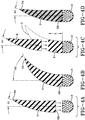
- Figure 4A illustrates a bead of rubber encapsulated metal cords to which a shaped uncured rubber apex is to be combined to form a composite thereof by the process illustrated in Figure 3 .
- Figure 4B illustrates a composite of uncured rubber apex and bead prepared by a process illustrated in Figure 3 in which the outer portion of the shaped apex is deformed by the process of preparation in which the outer portion of the apex is stretched by the aforesaid process.
- Figure 4C illustrates the composite of Figure 4B having been truncated by not including the aforesaid outer portion of the apex with the deleted outer portion being phantom outlined.
- Figure 4D illustrates a composite of uncured rubber apex and tire bead (pre-apexed tire bead) prepared by a process illustrated in Figure 3 in which the outer portion of the applied apex is not deformed by such process in which the rubber composition of the rubber apex contains a syndiotactic-1,2-polybutadiene.
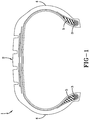
- a cross sectional view of a pneumatic tire 1 which comprises a tread 2, a tire bead 3 comprising rubber encapsulated metal cords, rubber sidewall 4 extending from the bead portion 3 to the tread 2 of the tire 1 and cured rubber apex 5 extending radially outward from the bead 3 into the sidewall 4 wherein the combination of bead 3 and apex 5 represent an apex/bead assembly.
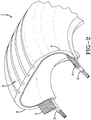
- a perspective view of a pneumatic tire 1 which comprises a tread 2, a tire bead 3 comprising rubber encapsulated metal cords, rubber sidewall 4 extending from the bead portion 3 to the tread 2 of the tire 1 and cured rubber apex 5 extending radially outward from the bead 3 into the sidewall 4 wherein the combination of bead 3 and apex 5 represent an apex/bead assembly.
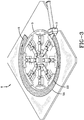
- a rotatable wheel 6 is shown to illustrate a process in which an annular tire bead 3 of rubber encapsulated wire cords is fitted to its periphery and to which an extruder 7 is shown as applying an extruded and shaped rubber apex 5 of an uncured rubber composition onto and circumferentially around the fitted bead 3.
- the applied apex has a radially outer portion 5A which is thereby stretched beyond its original extruded shape as it is wound around the fitted bead 3 and a radially inner portion 5B, which does not become significantly stretched, if it is stretched at all and at least not to the extent that its radial outer portion is stretched, to form a pre-apexed tire bead.
- FIG 4A a cross section of an annular bead 3 of rubber encapsulated wire cords is shown to which an extruded rubber apex 5 of an uncured rubber composition comprising diene-based elastomers having its outer portion 5A being extrusion-shaped to deviate from its inner portion 5B by an angle of A1.
- the rubber apex 5 is to be applied to the annular bead 3 by the process illustrated in Figure 3 .
- FIG 4B a cross section of an annular bead 3 of rubber encapsulated wire cords is shown to which an extruded, shaped rubber apex 5 of an uncured rubber composition composed diene-based elastomers, having an outer portion 5A and inner portion 5B, has been applied onto and circumferentially around the annular bead 3 by a process illustrated in Figure 3 .
- the stretched outer portion 5A of the apex 5 is shown as being visibly deformed by curling inward in a direction toward its inner portion 5B caused by the stretched outer apex rubber portion 5A attempting to return to its original unstretched condition after application by the process illustrated in Figure 3 .
- the extent of curled angular deformation A2 of the apex 5 is significantly greater than the original angle A1 and therefore presents a shape considered to be unsatisfactory for use in building the tire illustrated in Figure 1 and Figure 2 .
- FIG 4C an alternative assembly is illustrated in which a truncated, or shortened, uncured rubber apex 8 comprising a diene-elastomer rubber composition is applied onto and circumferentially around an annular bead 3 by the process illustrated in Figure 3 for which the amount of curled deformation of the shortened apex 8 caused by its stretching is comparatively minimized because of its shortened height. Then, to complete the apex, an apex extension 9 is later built onto the shortened apex 8 during the tire building process instead by the process illustrated in Figure 3 .
- FIG 4D a cross section of an annular bead 3 of rubber encapsulated wire cords is shown to which an extruded, shaped rubber apex 5 of an uncured rubber composition containing diene-based elastomers which also contains a thermoplastic syndiotactic-1,2-polybutadene polymer is applied by the process illustrated in Figure 3 to form a pre-apexed tire bead.
- syndiotactic polybutadiene might be prepared, for example, in an inert organic solvent such as, for example, utilizing a procedure described in US-A-3,901,868 or in an aqueous medium utilizing a process described in US-A-4,506,031 .
- the syndiotactic-1,2-polybutadiene purposefully has a melting point in a range from 180°C to 230°C so that it will not melt into the uncured apex rubber composition as it is being mixed to a temperature, for example, of from 150°C to 170°C. Therefore, such high melting point thermoplastic-1,2-polybutadiene is introduced in a form of the aforesaid alloy to promote a more effective mixing into the apex rubber composition.
- the styrene/butadiene rubber (solution or emulsion polymerization derived) for the rubber composition of the apex may be functionalized by containing functional groups reactive with hydroxyl groups contained on the precipitated silica.
- Such functional groups may be, for example, at least one of amine, siloxy, thiol groups.
- the functionalized styrene/butadiene rubber may be tin coupled.
- Rubber samples were prepared to evaluate use of thermoplastic syndiotactic-1,2-polybutadiene having a melting point of about 201 °C in rubber compositions intended for use as tire apex strip.
- Control rubber Sample A was prepared with its elastomer components being a combination of natural rubber and emulsion SBR rubber without the syndiotactic-1,2-polybutadiene polymer.
- Experimental rubber Sample B was prepared with an alloy of thermoplastic syndiotactic-1,2-polybutadiene having a melting point of about 201 °C and cis 1,4-polybutadiene elastomer.
- the rubber compositions were prepared by blending the ingredients in an internal rubber mixer in a series of sequential mixing steps while sheeting out the rubber mixtures and cooling to a temperature below 40°C between mixing steps.
- the sequential mixing steps comprised a non-productive mixing step(s) with a drop temperature of 160°C (temperature of removal of the rubber from the internal rubber mixer), (NP), followed by a productive mixing step (P) with a drop temperature of 110°C, (in which sulfur and sulfur cure accelerators and retarder were added).
- a curl test is provided to evaluate a tendency for an outer portion of an uncured rubber strip to curl inwardly as it is bent to an open ended circular (annular) configuration (shape).
- a strip of uncured rubber composition is provided as an extrusion of uncured rubber through a Garvey die head.
- Such strip Garvey extrudate has a cross-sectional, somewhat triangular shaped configuration comprised of a base portion and apex portion, somewhat similar to the shape illustrated in Figure 4A .
- the length of the strip of Garvey extrudate can be, for example, about 10 cm.
- the strip of Garvey extrudate is bent to form an open ended ring of a circular configuration with its base portion constituting the inner portion of the ring and its apex portion constituting the peripheral outer portion of the ring.
- the circular configuration of the strip of Garvey extrudate may be formed manually or be formed by wrapping the strip around a suitable mandrel (e.g. cylindrical or circular shaped mandrel).
- a suitable mandrel e.g. cylindrical or circular shaped mandrel.
- peripheral outer portion of the formed ring of the strip of Garvey extrudate is thereby stretched beyond the length of its original extruded form and beyond the length of its radially inner portion.
- a visual observation is made of the stretched outer peripheral portion of the rubber strip of Garvey extrudate in its circular form to evaluate its tendency to curl inward toward the radially inner portion of the circular configured strip.
- a rating of from 1 to 10 is provided for the degree of observed curl of the outer peripheral portion toward its radially inner portion.
- a rating of 10 is provided for an observed no curl deformation of the strip and a rating of 1 is provided for an observed severe curl deformation of the strip.
- Table 2 reports cure behavior and various physical properties of rubber Samples A and B based upon the formulation of Table 1 as well as a curl rating for the uncured, extruded, rubber Samples A and B.
- the rubber samples were sulfurcured, where appropriate, for 11 minutes at 170°C.
- An important feature of the SPBD addition for this Example is the observed resistance of the rubber sample of the uncured rubber apex composition to curl when submitted to the curl test. This is considered to be predictive of resistance of an uncured rubber apex composite to curl upon being applied onto and circumferentially about an annular tire bead to create an apex/bead composite in a form of a pre-apexed bead.
- Control rubber Sample A which did not contain syndiotactic polybutadiene had an observed laboratory curl test value of 2 and therefore would not be recommended for use as an apex for a pre-apexed annular tire bead created by extruding an uncured rubber apex onto and circumferentially around an annular tire bead.
- apex rubber composition presenting a curl value of less than 7 would be considered as being unsatisfactory for such pre-apexed bead preparation process.
- the rubber composition of rubber Sample B presented sufficiently minimal curl data which is predictive of acceptable performance in a tire building process that first produces a pre-apexed tire bead comprised of extruding an uncured rubber apex onto and circumferentially around an annular tire bead in a tire building process.
Landscapes
- Chemical & Material Sciences (AREA)
- Health & Medical Sciences (AREA)
- Chemical Kinetics & Catalysis (AREA)
- Medicinal Chemistry (AREA)
- Polymers & Plastics (AREA)
- Organic Chemistry (AREA)
- Engineering & Computer Science (AREA)
- Mechanical Engineering (AREA)
- Compositions Of Macromolecular Compounds (AREA)
- Tires In General (AREA)
Claims (12)
- Verfahren zur Herstellung einer vorgeformten Kernprofil-/Wulstanordnung in Form eines vorab mit einem Kernprofil versehenen Wulsts, wobei das Verfahren umfasst:Mischen einer schwefelvulkanisierbaren unvulkanisierten Kautschukzusammensetzung mit einer maximalen Mischtemperatur im Bereich von 140 bis 170°C; undExtrudieren der schwefelvulkanisierbaren unvulkanisierten Kautschukzusammensetzung durch ein Werkzeug zur Bildung und Anbringung eines unvulkanisierten Kernprofil-Kautschukstreifens (5-Figur 4D) auf, und in Umfangsrichtung um, den Außenumfang eines ringförmigen Wulsts (3), wobei ein äußerer Umfangsteil des unvulkanisierten Kernprofil-Kautschukstreifens (5 - Figur 4D) sich reckt, um sich über einen größeren Abstand als der innere Umfangsteil des unvulkanisierten Kernprofil-Kautschukstreifens (5 - Figur 4D) um den ringförmigen Wulst (3) zu erstrecken oder zu verlaufen, wobei der ringförmige Wulst (3) eine mit unvulkanisiertem Kautschuk eingekapselte Vielzahl von Drahtkorden umfasst, um dadurch die vorgeformte Kernprofil-/Wulstanordnung als vorab mit einem Kernprofil versehenen Wulst herzustellen;wobei die Kautschukzusammensetzung des unvulkanisierten Kernprofil-Kautschukstreifens (5 - Figur 4D) umfasst:(A) mindestens ein dienbasiertes Elastomer, umfassend mindestens eines von cis-1,4-Polyisopren, Polybutadien und Styrol-Butadien-Kautschuk;(B) 1 bis 10 oder 3 bis 7 Gewichtsteile thermoplastisches syndiotaktisches 1,2-Polybutadien je 100 Gewichtsteile des bzw. der in der Kernprofil-Kautschukstreifenzusammensetzung enthaltenen Elastomers bzw. Elastomere, wobei das syndiotaktische 1,2-Polybutadien einen Schmelzpunt (MP) im Bereich von 180°C bis 230°C oder von 200°C bis 230°C und mindestens 10°C höher als die maximale Mischtemperatur zur Herstellung der schwefelvulkanisierbaren unvulkanisierten Kautschukzusammensetzung aufweist und in Form einer Legierung bereitgestellt wird, die das thermoplastische syndiotaktische 1,2-Polybutadien mit mindestens einem von cis-1,4-Polyisoprenkautschuk und Polybutadienkautschuk umfasst;(C) 30 bis 120 phr eines Verstärkungsfüllstoffs, umfassend:(1) ein Carbon Black, oder(2) eine Kombination eines Carbon Blacks und Silika zusammen mit einem Haftvermittler für das Silika, der einen mit Hydroxylgruppen an dem Silika reaktiven Anteil und einen anderen, verschiedenen Anteil, der mit dem bzw. den dienbasierten Elastomer(en) in Wechselwirkung tritt, aufweist.
- Verfahren nach Anspruch 1, wobei ein äußerer Umfangsteil des unvulkanisierten Kernprofil-Kautschukstreifens (5 - Figur 4D) veranlasst wird, über seine ursprüngliche extrudierte Länge hinaus und über die Länge eines radial inneren Teils des unvulkanisierten Kernprofil-Kautschukstreifens (5 - Figur 4D) hinaus, benachbart zu dem ringförmigen Wulst (3), gereckt zu werden.
- Verfahren nach mindestens einem der vorhergehenden Ansprüche, wobei der Verstärkungsfüllstoff ein Kautschukverstärkungs-Carbon Black ist oder auf solches Kautschukverstärkungs-Carbon Black begrenzt ist.
- Verfahren nach mindestens einem der vorhergehenden Ansprüche, wobei der Verstärkungsfüllstoff eine Kombination eines Kautschukverstärkungs-Carbon Blacks und Silika oder ausgefällten Silikas ist, zusammen mit einem Haftvermittler für das Silika, umfassend ein Bis(3-triethoxysilylpropyl)polysulfid, das einen Durchschnitt von 2 bis 4 verbindenden Schwefelatomen in seiner Polysulfidbrücke enthält, oder ein Alkoxyorganomercaptosilan.
- Verfahren nach mindestens einem der vorhergehenden Ansprüche, wobei die dienbasierten Elastomere cis-1,4-Polyisopren und mindestens eines von Styrol-Butadien-Kautschuk und Polybutadienkautschuk umfassen.
- Verfahren nach mindestens einem der vorhergehenden Ansprüche, weiter das Schwefelvulkanisieren der Kernprofil-/Wulstanordnung, die den umfangsgerichteten Kernprofil-Kautschukstreifen enthält, umfassend.
- Verfahren zum Aufbauen eines Reifens, wobei das Verfahren das Aufbauen einer unvulkanisierten Reifenanordnung umfasst, die die hergestellte unvulkanisierte vorgeformte Kernprofil-/Wulstanordnung in Form eines vorab mit einem Kernprofil versehenen Wulsts gemäß mindestens einem der Ansprüche 1 bis 5 enthält, wobei das Kautschuk-Kernprofil sich radial auswärts von dem Reifenwulst in eine zugehörige Reifenseitenwand erstreckt.
- Verfahren nach Anspruch 7, weiter das Schwefelvulkanisieren des Reifens umfassend.
- Vorab mit einem Kernprofil versehener ringförmiger Reifenwulst, umfassend einen ringförmigen Reifenwulst (3), umfassend mit unvulkanisiertem Kautschuk eingekapselte Drahtkorde, wobei der Wulst (3) ein unvulkanisiertes Kautschuk-Kernprofil (5 - Figur 4D) enthält, das in Umfangsrichtung um und auf dem Außenumfang des ringförmigen Wulsts (3) angeordnet ist, wobei der radial äußere Teil des unvulkanisierten Kautschuk-Kernprofils (5 - Figur 4D) an dem ringförmigen Wulst (3) eine Länge aufweist, die über die Länge seines radial inneren Teils hinaus gereckt ist, und wobei die Zusammensetzung des Kautschuk-Kernprofils umfasst:(A) mindestens ein dienbasiertes Elastomer, umfassend mindestens eines von cis-1,4-Polyisopren, Polybutadien und Styrol-Butadien-Kautschuk,(B) 1 bis 10 oder 3 bis 7 Gewichtsteile thermoplastisches syndiotaktisches 1,2-Polybutadien je 100 Gewichtsteile des in der Kernprofil-Kautschukstreifenzusammensetzung enthaltenen Elastomers bzw. Elastomere, wobei das syndiotaktische 1,2-Polybutadien einen Schmelzpunt (MP) im Bereich von 180°C bis 230°C oder von 200°C bis 230°C aufweist und in Form einer Legierung vorliegt, die das thermoplastische syndiotaktische 1,2-Polybutadien mit mindestens einem von cis-1,4-Polyisoprenkautschuk und Polybutadienkautschuk umfasst; und(C) 30 bis 120 phr eines Verstärkungsfüllstoffs, umfassend:(1) ein Carbon Black, oder(2) eine Kombination eines Carbon Blacks und eines Silikas zusammen mit einem Haftvermittler für das Silika, der einen mit Hydroxylgruppen an dem Silika reaktiven Anteil und einen anderen, verschiedenen Anteil, der mit dem bzw. den dienbasierten Elastomer(en) in Wechselwirkung tritt, aufweist.
- Vorab mit einem Kernprofil versehener Reifenwulst nach Anspruch 9, wobei der Verstärkungsfüllstoff ist:(i) ein Kautschukverstärkungs-Carbon Black; oder(ii) auf ein Kautschukverstärkungs-Carbon Black begrenzt ist; oder(iii) eine Kombination eines Kautschukverstärkungs-Carbon Blacks und ausgefällten Silikas, zusammen mit einem Haftvermittler für das ausgefällte Silika, umfassend ein Bis(3-triethoxysilylpropyl)polysulfid, das einen Durchschnitt von 2 bis 4 verbindenden Schwefelatomen in seiner Polysulfidbrücke enthält; oder(iv) eine Kombination eines Kautschukverstärkungs-Carbon Blacks und ausgefällten Silikas, zusammen mit einem Haftvermittler für das ausgefällte Silika, umfassend ein Alkoxyorganomercaptosilan.
- Vorab mit einem Kernprofil versehener ringförmiger Reifenwulst nach einem der Ansprüche 9 bis 10 in Form eines schwefelvulkanisierten, vorab mit einem Kernprofil versehenen Reifenwulsts.
- Luftreifen, umfassend den vorab mit einem Kernprofil versehenen Reifenwulst gemäß mindestens einem der Ansprüche 9 bis 11, wobei das Kernprofil (5 - Figur 4D) sich radial auswärts von dem Reifenwulst (3) in eine zugehörige Reifenseitenwand erstreckt.
Applications Claiming Priority (1)
| Application Number | Priority Date | Filing Date | Title |
|---|---|---|---|
| US14/513,541 US20160101581A1 (en) | 2014-10-14 | 2014-10-14 | Pre-formed apex/bead composite and tire with pre-apexed bead |
Publications (2)
| Publication Number | Publication Date |
|---|---|
| EP3009472A1 EP3009472A1 (de) | 2016-04-20 |
| EP3009472B1 true EP3009472B1 (de) | 2018-11-28 |
Family
ID=54207404
Family Applications (1)
| Application Number | Title | Priority Date | Filing Date |
|---|---|---|---|
| EP15187109.2A Not-in-force EP3009472B1 (de) | 2014-10-14 | 2015-09-28 | Vorgeformtes kernreiter/wulstverbundmaterial und reifen mit vorgeformtem kernreiter-wulst |
Country Status (4)
| Country | Link |
|---|---|
| US (1) | US20160101581A1 (de) |
| EP (1) | EP3009472B1 (de) |
| CN (1) | CN105501001A (de) |
| BR (1) | BR102015026118A2 (de) |
Families Citing this family (6)
| Publication number | Priority date | Publication date | Assignee | Title |
|---|---|---|---|---|
| FR3050689B3 (fr) * | 2016-05-02 | 2018-05-25 | Michelin & Cie | Adaptateur pour ensemble roulant et ensemble roulant le comprenant |
| FR3050688B1 (fr) * | 2016-05-02 | 2018-04-20 | Compagnie Generale Des Etablissements Michelin | Adaptateur pour ensemble roulant et ensemble roulant le comprenant |
| CN111183049B (zh) * | 2017-10-06 | 2022-03-11 | 株式会社普利司通 | 轮胎用胎圈构件、轮胎以及轮胎用胎圈构件的制造方法 |
| JP7154947B2 (ja) * | 2018-10-26 | 2022-10-18 | Toyo Tire株式会社 | 空気入りタイヤの製造方法及びビード部材の収納ホルダー |
| CN113056494B (zh) | 2018-12-13 | 2025-10-28 | 株式会社引能仕材料 | 聚丁二烯组合物的制造方法 |
| CN115286845A (zh) * | 2022-06-20 | 2022-11-04 | 山东玲珑轮胎股份有限公司 | 一种轮胎用间同1,2-聚丁二烯橡胶三角胶及其制备方法 |
Citations (1)
| Publication number | Priority date | Publication date | Assignee | Title |
|---|---|---|---|---|
| EP1145832A2 (de) * | 2000-04-10 | 2001-10-17 | The Goodyear Tire & Rubber Company | Reifenherstellungsverfahren zur Verbesserung der Reifengleichförmigkeit |
Family Cites Families (17)
| Publication number | Priority date | Publication date | Assignee | Title |
|---|---|---|---|---|
| CA1040347A (en) | 1973-09-27 | 1978-10-10 | Hideo Ishikawa | Process for producing butadiene polymers |
| US4506031A (en) | 1982-09-17 | 1985-03-19 | The Goodyear Tire & Rubber Company | Microencapsulated aqueous polymerization catalyst |
| US4790365A (en) * | 1987-09-11 | 1988-12-13 | The Goodyear Tire & Rubber Company | Tire compounds containing syndiotactic-1,2-polybutadiene |
| US5283294A (en) | 1988-03-09 | 1994-02-01 | The Goodyear Tire & Rubber Company | Inverse phase polymerization |
| US5307850A (en) | 1988-09-14 | 1994-05-03 | The Goodyear Tire & Rubber Company | Pneumatic tire containing syndiotactic 1,2-polybutadiene |
| US5708053A (en) * | 1996-08-15 | 1998-01-13 | The Goodyear Tire & Rubber Company | Silica-filled rubber compositions and the processing thereof |
| CA2209418A1 (en) | 1996-12-20 | 1998-06-20 | Lewis Timothy Lukich | Rubber tire components with reduced spider flow |
| US6202726B1 (en) | 1999-03-23 | 2001-03-20 | The Goodyear Tire & Rubber Company | Tire with sidewall rubber insert |
| US6807994B2 (en) * | 2001-03-13 | 2004-10-26 | The Goodyear Tire & Rubber Company | Pneumatic tire having a rubber component containing a rubber gel and syndiotatic 1,2-polybutadiene |
| US20040089400A1 (en) * | 2002-11-08 | 2004-05-13 | Vargo Richard David | Method and apparatus for forming an annular elastomeric tire component |
| US6956093B1 (en) | 2004-10-29 | 2005-10-18 | The Goodyear Tire & Rubber Company | Preparation of syndiotactic polybutadiene, rubber composition and tire with rubber component |
| JP4493712B2 (ja) * | 2007-12-05 | 2010-06-30 | 住友ゴム工業株式会社 | タイヤ用ゴム組成物 |
| US20110146873A1 (en) * | 2009-12-22 | 2011-06-23 | Marc Weydert | Pneumatic tire with rubber component containing epoxidized palm oil |
| JP5346365B2 (ja) * | 2011-04-11 | 2013-11-20 | 住友ゴム工業株式会社 | ビードエイペックス用ゴム組成物及び空気入りタイヤ |
| JP5351244B2 (ja) * | 2011-04-22 | 2013-11-27 | 住友ゴム工業株式会社 | タイヤ用ゴム組成物、及び空気入りタイヤ |
| JP5466667B2 (ja) * | 2011-05-17 | 2014-04-09 | 住友ゴム工業株式会社 | タイヤ用ゴム組成物及び空気入りタイヤ |
| US8536262B2 (en) | 2011-12-20 | 2013-09-17 | The Goodyear Tire & Rubber Company | Tire tread base containing syndiotactic-1,2-polybutadiene with diverse carbon blacks |
-
2014
- 2014-10-14 US US14/513,541 patent/US20160101581A1/en not_active Abandoned
-
2015
- 2015-09-28 EP EP15187109.2A patent/EP3009472B1/de not_active Not-in-force
- 2015-10-14 BR BR102015026118A patent/BR102015026118A2/pt not_active Application Discontinuation
- 2015-10-14 CN CN201510660772.2A patent/CN105501001A/zh active Pending
Patent Citations (1)
| Publication number | Priority date | Publication date | Assignee | Title |
|---|---|---|---|---|
| EP1145832A2 (de) * | 2000-04-10 | 2001-10-17 | The Goodyear Tire & Rubber Company | Reifenherstellungsverfahren zur Verbesserung der Reifengleichförmigkeit |
Also Published As
| Publication number | Publication date |
|---|---|
| EP3009472A1 (de) | 2016-04-20 |
| US20160101581A1 (en) | 2016-04-14 |
| CN105501001A (zh) | 2016-04-20 |
| BR102015026118A2 (pt) | 2016-09-20 |
Similar Documents
| Publication | Publication Date | Title |
|---|---|---|
| EP3009471B1 (de) | Herstellung von apex-/wulstverbundmaterial und reifen mit vorgekeilter wulst | |
| EP3009472A1 (de) | Vorgeformtes kernreiter/wulstverbundmaterial und reifen mit vorgeformtem kernreiter-wulst | |
| DE69507181T2 (de) | Kautschukmischung für Reifen mit hohem Elastizitätsmodul und geringer Hysterese | |
| JP3206828B2 (ja) | トレッドベースラバーブレンドを有するタイヤ | |
| EP1897702A1 (de) | Reifen mit Lauffläche mit äußerer Kappenschicht und darunter liegender Übergangsschicht mit Maiskolben-Granulat | |
| DE2904006C2 (de) | Pneumatischer Kautschukreifen | |
| DE69302980T2 (de) | Reifen mit Apexmischung aus Gummi | |
| EP2714427B1 (de) | Hochleistungsreifen für kraftfahrzeugräder | |
| DE60302265T2 (de) | Kautschukmischung enthaltend ein thermoplastisches Polymer und eine Reifenseitenwand-Komponente oder einen Reifen-verstärkenden Ring aus einer solchen Kautschukmischung | |
| US20150096654A1 (en) | Rubbery blend containing trans isoprene-butadiene copolymer | |
| JPH07109384A (ja) | ベーストレッド用ゴム組成物およびそれを用いてなるタイヤ | |
| CN1438943A (zh) | 具有低滚动阻力的汽车轮胎 | |
| EP2366559A1 (de) | Reifen mit Lauffläche mit weicherer innerer Übergangsgummischicht kurzer Faserverstärkung | |
| CN110087906B (zh) | 用于轮胎部件的包括来自银胶菊的天然橡胶的弹性体组合物和包括所述轮胎部件的轮胎 | |
| US20170355834A1 (en) | Rubbery blend containing trans isoprene-butadiene copolymer | |
| KR0145085B1 (ko) | 신디오택틱 1, 2-폴리부타디엔을 함유하는 공기 타이어 | |
| US4483381A (en) | Pneumatic tire with belt reinforcement | |
| DE102009042425B4 (de) | Reifen mit kautschukbauteil, das einen verbundwerkstoff aus kautschuk und einer lage aus syndiotaktischem polybutadien, die mit seiner oberfläche covulkanisiert ist, umfasst | |
| US20220371365A1 (en) | Plasticizer system and rubber composition for pneumatic tire | |
| JPH10204213A (ja) | スパイダーフローの低下したゴムタイヤ部品 | |
| EP0514910A1 (de) | Kautschuk für Reifenwulst | |
| US4481327A (en) | Rubber compositions comprisining an alkadiene sulfone an carbon black | |
| JPH0540002U (ja) | 二重キヤツプトレツドを有するタイヤ | |
| EP3628692A1 (de) | Kieselsäureverstärkte kautschukzusammensetzung mit einem multifunktionalen gruppenfunktionalisierten elastomer und reifen mit lauffläche | |
| JPH07237405A (ja) | 空気入りラジアルタイヤ |
Legal Events
| Date | Code | Title | Description |
|---|---|---|---|
| PUAI | Public reference made under article 153(3) epc to a published international application that has entered the european phase |
Free format text: ORIGINAL CODE: 0009012 |
|
| AK | Designated contracting states |
Kind code of ref document: A1 Designated state(s): AL AT BE BG CH CY CZ DE DK EE ES FI FR GB GR HR HU IE IS IT LI LT LU LV MC MK MT NL NO PL PT RO RS SE SI SK SM TR |
|
| AX | Request for extension of the european patent |
Extension state: BA ME |
|
| 17P | Request for examination filed |
Effective date: 20161020 |
|
| RBV | Designated contracting states (corrected) |
Designated state(s): AL AT BE BG CH CY CZ DE DK EE ES FI FR GB GR HR HU IE IS IT LI LT LU LV MC MK MT NL NO PL PT RO RS SE SI SK SM TR |
|
| STAA | Information on the status of an ep patent application or granted ep patent |
Free format text: STATUS: EXAMINATION IS IN PROGRESS |
|
| 17Q | First examination report despatched |
Effective date: 20170324 |
|
| GRAP | Despatch of communication of intention to grant a patent |
Free format text: ORIGINAL CODE: EPIDOSNIGR1 |
|
| STAA | Information on the status of an ep patent application or granted ep patent |
Free format text: STATUS: GRANT OF PATENT IS INTENDED |
|
| RIC1 | Information provided on ipc code assigned before grant |
Ipc: C08L 9/06 20060101ALI20180614BHEP Ipc: C08L 7/00 20060101AFI20180614BHEP Ipc: B29K 507/04 20060101ALN20180614BHEP Ipc: B29D 30/48 20060101ALN20180614BHEP Ipc: C08L 9/00 20060101ALI20180614BHEP Ipc: B60C 1/00 20060101ALI20180614BHEP Ipc: B29K 9/00 20060101ALN20180614BHEP Ipc: C08K 3/04 20060101ALN20180614BHEP Ipc: B60C 15/06 20060101ALI20180614BHEP |
|
| INTG | Intention to grant announced |
Effective date: 20180628 |
|
| GRAS | Grant fee paid |
Free format text: ORIGINAL CODE: EPIDOSNIGR3 |
|
| GRAA | (expected) grant |
Free format text: ORIGINAL CODE: 0009210 |
|
| STAA | Information on the status of an ep patent application or granted ep patent |
Free format text: STATUS: THE PATENT HAS BEEN GRANTED |
|
| AK | Designated contracting states |
Kind code of ref document: B1 Designated state(s): AL AT BE BG CH CY CZ DE DK EE ES FI FR GB GR HR HU IE IS IT LI LT LU LV MC MK MT NL NO PL PT RO RS SE SI SK SM TR |
|
| REG | Reference to a national code |
Ref country code: CH Ref legal event code: EP |
|
| REG | Reference to a national code |
Ref country code: AT Ref legal event code: REF Ref document number: 1070160 Country of ref document: AT Kind code of ref document: T Effective date: 20181215 |
|
| REG | Reference to a national code |
Ref country code: DE Ref legal event code: R096 Ref document number: 602015020309 Country of ref document: DE |
|
| REG | Reference to a national code |
Ref country code: IE Ref legal event code: FG4D |
|
| REG | Reference to a national code |
Ref country code: NL Ref legal event code: MP Effective date: 20181128 |
|
| REG | Reference to a national code |
Ref country code: LT Ref legal event code: MG4D |
|
| REG | Reference to a national code |
Ref country code: AT Ref legal event code: MK05 Ref document number: 1070160 Country of ref document: AT Kind code of ref document: T Effective date: 20181128 |
|
| PG25 | Lapsed in a contracting state [announced via postgrant information from national office to epo] |
Ref country code: LT Free format text: LAPSE BECAUSE OF FAILURE TO SUBMIT A TRANSLATION OF THE DESCRIPTION OR TO PAY THE FEE WITHIN THE PRESCRIBED TIME-LIMIT Effective date: 20181128 Ref country code: HR Free format text: LAPSE BECAUSE OF FAILURE TO SUBMIT A TRANSLATION OF THE DESCRIPTION OR TO PAY THE FEE WITHIN THE PRESCRIBED TIME-LIMIT Effective date: 20181128 Ref country code: BG Free format text: LAPSE BECAUSE OF FAILURE TO SUBMIT A TRANSLATION OF THE DESCRIPTION OR TO PAY THE FEE WITHIN THE PRESCRIBED TIME-LIMIT Effective date: 20190228 Ref country code: AT Free format text: LAPSE BECAUSE OF FAILURE TO SUBMIT A TRANSLATION OF THE DESCRIPTION OR TO PAY THE FEE WITHIN THE PRESCRIBED TIME-LIMIT Effective date: 20181128 Ref country code: NO Free format text: LAPSE BECAUSE OF FAILURE TO SUBMIT A TRANSLATION OF THE DESCRIPTION OR TO PAY THE FEE WITHIN THE PRESCRIBED TIME-LIMIT Effective date: 20190228 Ref country code: IS Free format text: LAPSE BECAUSE OF FAILURE TO SUBMIT A TRANSLATION OF THE DESCRIPTION OR TO PAY THE FEE WITHIN THE PRESCRIBED TIME-LIMIT Effective date: 20190328 Ref country code: ES Free format text: LAPSE BECAUSE OF FAILURE TO SUBMIT A TRANSLATION OF THE DESCRIPTION OR TO PAY THE FEE WITHIN THE PRESCRIBED TIME-LIMIT Effective date: 20181128 Ref country code: LV Free format text: LAPSE BECAUSE OF FAILURE TO SUBMIT A TRANSLATION OF THE DESCRIPTION OR TO PAY THE FEE WITHIN THE PRESCRIBED TIME-LIMIT Effective date: 20181128 Ref country code: FI Free format text: LAPSE BECAUSE OF FAILURE TO SUBMIT A TRANSLATION OF THE DESCRIPTION OR TO PAY THE FEE WITHIN THE PRESCRIBED TIME-LIMIT Effective date: 20181128 |
|
| PG25 | Lapsed in a contracting state [announced via postgrant information from national office to epo] |
Ref country code: GR Free format text: LAPSE BECAUSE OF FAILURE TO SUBMIT A TRANSLATION OF THE DESCRIPTION OR TO PAY THE FEE WITHIN THE PRESCRIBED TIME-LIMIT Effective date: 20190301 Ref country code: AL Free format text: LAPSE BECAUSE OF FAILURE TO SUBMIT A TRANSLATION OF THE DESCRIPTION OR TO PAY THE FEE WITHIN THE PRESCRIBED TIME-LIMIT Effective date: 20181128 Ref country code: SE Free format text: LAPSE BECAUSE OF FAILURE TO SUBMIT A TRANSLATION OF THE DESCRIPTION OR TO PAY THE FEE WITHIN THE PRESCRIBED TIME-LIMIT Effective date: 20181128 Ref country code: RS Free format text: LAPSE BECAUSE OF FAILURE TO SUBMIT A TRANSLATION OF THE DESCRIPTION OR TO PAY THE FEE WITHIN THE PRESCRIBED TIME-LIMIT Effective date: 20181128 Ref country code: PT Free format text: LAPSE BECAUSE OF FAILURE TO SUBMIT A TRANSLATION OF THE DESCRIPTION OR TO PAY THE FEE WITHIN THE PRESCRIBED TIME-LIMIT Effective date: 20190328 |
|
| PG25 | Lapsed in a contracting state [announced via postgrant information from national office to epo] |
Ref country code: NL Free format text: LAPSE BECAUSE OF FAILURE TO SUBMIT A TRANSLATION OF THE DESCRIPTION OR TO PAY THE FEE WITHIN THE PRESCRIBED TIME-LIMIT Effective date: 20181128 |
|
| PG25 | Lapsed in a contracting state [announced via postgrant information from national office to epo] |
Ref country code: PL Free format text: LAPSE BECAUSE OF FAILURE TO SUBMIT A TRANSLATION OF THE DESCRIPTION OR TO PAY THE FEE WITHIN THE PRESCRIBED TIME-LIMIT Effective date: 20181128 Ref country code: IT Free format text: LAPSE BECAUSE OF FAILURE TO SUBMIT A TRANSLATION OF THE DESCRIPTION OR TO PAY THE FEE WITHIN THE PRESCRIBED TIME-LIMIT Effective date: 20181128 Ref country code: DK Free format text: LAPSE BECAUSE OF FAILURE TO SUBMIT A TRANSLATION OF THE DESCRIPTION OR TO PAY THE FEE WITHIN THE PRESCRIBED TIME-LIMIT Effective date: 20181128 Ref country code: CZ Free format text: LAPSE BECAUSE OF FAILURE TO SUBMIT A TRANSLATION OF THE DESCRIPTION OR TO PAY THE FEE WITHIN THE PRESCRIBED TIME-LIMIT Effective date: 20181128 |
|
| REG | Reference to a national code |
Ref country code: DE Ref legal event code: R097 Ref document number: 602015020309 Country of ref document: DE |
|
| PG25 | Lapsed in a contracting state [announced via postgrant information from national office to epo] |
Ref country code: RO Free format text: LAPSE BECAUSE OF FAILURE TO SUBMIT A TRANSLATION OF THE DESCRIPTION OR TO PAY THE FEE WITHIN THE PRESCRIBED TIME-LIMIT Effective date: 20181128 Ref country code: EE Free format text: LAPSE BECAUSE OF FAILURE TO SUBMIT A TRANSLATION OF THE DESCRIPTION OR TO PAY THE FEE WITHIN THE PRESCRIBED TIME-LIMIT Effective date: 20181128 Ref country code: SM Free format text: LAPSE BECAUSE OF FAILURE TO SUBMIT A TRANSLATION OF THE DESCRIPTION OR TO PAY THE FEE WITHIN THE PRESCRIBED TIME-LIMIT Effective date: 20181128 Ref country code: SK Free format text: LAPSE BECAUSE OF FAILURE TO SUBMIT A TRANSLATION OF THE DESCRIPTION OR TO PAY THE FEE WITHIN THE PRESCRIBED TIME-LIMIT Effective date: 20181128 |
|
| PLBE | No opposition filed within time limit |
Free format text: ORIGINAL CODE: 0009261 |
|
| STAA | Information on the status of an ep patent application or granted ep patent |
Free format text: STATUS: NO OPPOSITION FILED WITHIN TIME LIMIT |
|
| PG25 | Lapsed in a contracting state [announced via postgrant information from national office to epo] |
Ref country code: SI Free format text: LAPSE BECAUSE OF FAILURE TO SUBMIT A TRANSLATION OF THE DESCRIPTION OR TO PAY THE FEE WITHIN THE PRESCRIBED TIME-LIMIT Effective date: 20181128 |
|
| 26N | No opposition filed |
Effective date: 20190829 |
|
| PG25 | Lapsed in a contracting state [announced via postgrant information from national office to epo] |
Ref country code: TR Free format text: LAPSE BECAUSE OF FAILURE TO SUBMIT A TRANSLATION OF THE DESCRIPTION OR TO PAY THE FEE WITHIN THE PRESCRIBED TIME-LIMIT Effective date: 20181128 |
|
| PG25 | Lapsed in a contracting state [announced via postgrant information from national office to epo] |
Ref country code: MC Free format text: LAPSE BECAUSE OF FAILURE TO SUBMIT A TRANSLATION OF THE DESCRIPTION OR TO PAY THE FEE WITHIN THE PRESCRIBED TIME-LIMIT Effective date: 20181128 |
|
| REG | Reference to a national code |
Ref country code: CH Ref legal event code: PL |
|
| PG25 | Lapsed in a contracting state [announced via postgrant information from national office to epo] |
Ref country code: LI Free format text: LAPSE BECAUSE OF NON-PAYMENT OF DUE FEES Effective date: 20190930 Ref country code: LU Free format text: LAPSE BECAUSE OF NON-PAYMENT OF DUE FEES Effective date: 20190928 Ref country code: IE Free format text: LAPSE BECAUSE OF NON-PAYMENT OF DUE FEES Effective date: 20190928 Ref country code: CH Free format text: LAPSE BECAUSE OF NON-PAYMENT OF DUE FEES Effective date: 20190930 |
|
| REG | Reference to a national code |
Ref country code: BE Ref legal event code: MM Effective date: 20190930 |
|
| PG25 | Lapsed in a contracting state [announced via postgrant information from national office to epo] |
Ref country code: BE Free format text: LAPSE BECAUSE OF NON-PAYMENT OF DUE FEES Effective date: 20190930 |
|
| PG25 | Lapsed in a contracting state [announced via postgrant information from national office to epo] |
Ref country code: CY Free format text: LAPSE BECAUSE OF FAILURE TO SUBMIT A TRANSLATION OF THE DESCRIPTION OR TO PAY THE FEE WITHIN THE PRESCRIBED TIME-LIMIT Effective date: 20181128 |
|
| PG25 | Lapsed in a contracting state [announced via postgrant information from national office to epo] |
Ref country code: MT Free format text: LAPSE BECAUSE OF FAILURE TO SUBMIT A TRANSLATION OF THE DESCRIPTION OR TO PAY THE FEE WITHIN THE PRESCRIBED TIME-LIMIT Effective date: 20181128 Ref country code: HU Free format text: LAPSE BECAUSE OF FAILURE TO SUBMIT A TRANSLATION OF THE DESCRIPTION OR TO PAY THE FEE WITHIN THE PRESCRIBED TIME-LIMIT; INVALID AB INITIO Effective date: 20150928 |
|
| PGFP | Annual fee paid to national office [announced via postgrant information from national office to epo] |
Ref country code: FR Payment date: 20210812 Year of fee payment: 7 |
|
| PGFP | Annual fee paid to national office [announced via postgrant information from national office to epo] |
Ref country code: GB Payment date: 20210818 Year of fee payment: 7 Ref country code: DE Payment date: 20210818 Year of fee payment: 7 |
|
| PG25 | Lapsed in a contracting state [announced via postgrant information from national office to epo] |
Ref country code: MK Free format text: LAPSE BECAUSE OF FAILURE TO SUBMIT A TRANSLATION OF THE DESCRIPTION OR TO PAY THE FEE WITHIN THE PRESCRIBED TIME-LIMIT Effective date: 20181128 |
|
| REG | Reference to a national code |
Ref country code: DE Ref legal event code: R119 Ref document number: 602015020309 Country of ref document: DE |
|
| GBPC | Gb: european patent ceased through non-payment of renewal fee |
Effective date: 20220928 |
|
| PG25 | Lapsed in a contracting state [announced via postgrant information from national office to epo] |
Ref country code: FR Free format text: LAPSE BECAUSE OF NON-PAYMENT OF DUE FEES Effective date: 20220930 Ref country code: DE Free format text: LAPSE BECAUSE OF NON-PAYMENT OF DUE FEES Effective date: 20230401 |
|
| PG25 | Lapsed in a contracting state [announced via postgrant information from national office to epo] |
Ref country code: GB Free format text: LAPSE BECAUSE OF NON-PAYMENT OF DUE FEES Effective date: 20220928 |