EP3034613B1 - Nouveau composé sophorolipide et composition le comprenant - Google Patents
Nouveau composé sophorolipide et composition le comprenant Download PDFInfo
- Publication number
- EP3034613B1 EP3034613B1 EP14834955.8A EP14834955A EP3034613B1 EP 3034613 B1 EP3034613 B1 EP 3034613B1 EP 14834955 A EP14834955 A EP 14834955A EP 3034613 B1 EP3034613 B1 EP 3034613B1
- Authority
- EP
- European Patent Office
- Prior art keywords
- compound
- group
- formula
- fraction
- hydrogen atom
- Prior art date
- Legal status (The legal status is an assumption and is not a legal conclusion. Google has not performed a legal analysis and makes no representation as to the accuracy of the status listed.)
- Active
Links
Images


Classifications
-
- C—CHEMISTRY; METALLURGY
- C07—ORGANIC CHEMISTRY
- C07H—SUGARS; DERIVATIVES THEREOF; NUCLEOSIDES; NUCLEOTIDES; NUCLEIC ACIDS
- C07H15/00—Compounds containing hydrocarbon or substituted hydrocarbon radicals directly attached to hetero atoms of saccharide radicals
- C07H15/02—Acyclic radicals, not substituted by cyclic structures
- C07H15/04—Acyclic radicals, not substituted by cyclic structures attached to an oxygen atom of the saccharide radical
- C07H15/10—Acyclic radicals, not substituted by cyclic structures attached to an oxygen atom of the saccharide radical containing unsaturated carbon-to-carbon bonds
-
- A—HUMAN NECESSITIES
- A21—BAKING; EDIBLE DOUGHS
- A21D—TREATMENT OF FLOUR OR DOUGH FOR BAKING, e.g. BY ADDITION OF MATERIALS; BAKING; BAKERY PRODUCTS
- A21D2/00—Treatment of flour or dough by adding materials thereto before or during baking
- A21D2/08—Treatment of flour or dough by adding materials thereto before or during baking by adding organic substances
- A21D2/14—Organic oxygen compounds
- A21D2/16—Fatty acid esters
-
- A—HUMAN NECESSITIES
- A23—FOODS OR FOODSTUFFS; TREATMENT THEREOF, NOT COVERED BY OTHER CLASSES
- A23L—FOODS, FOODSTUFFS OR NON-ALCOHOLIC BEVERAGES, NOT OTHERWISE PROVIDED FOR; PREPARATION OR TREATMENT THEREOF
- A23L2/00—Non-alcoholic beverages; Dry compositions or concentrates therefor; Preparation or treatment thereof
- A23L2/52—Adding ingredients
-
- A—HUMAN NECESSITIES
- A23—FOODS OR FOODSTUFFS; TREATMENT THEREOF, NOT COVERED BY OTHER CLASSES
- A23L—FOODS, FOODSTUFFS OR NON-ALCOHOLIC BEVERAGES, NOT OTHERWISE PROVIDED FOR; PREPARATION OR TREATMENT THEREOF
- A23L29/00—Foods or foodstuffs containing additives; Preparation or treatment thereof
- A23L29/10—Foods or foodstuffs containing additives; Preparation or treatment thereof containing emulsifiers
-
- A—HUMAN NECESSITIES
- A61—MEDICAL OR VETERINARY SCIENCE; HYGIENE
- A61K—PREPARATIONS FOR MEDICAL, DENTAL OR TOILETRY PURPOSES
- A61K8/00—Cosmetics or similar toiletry preparations
- A61K8/18—Cosmetics or similar toiletry preparations characterised by the composition
- A61K8/30—Cosmetics or similar toiletry preparations characterised by the composition containing organic compounds
- A61K8/60—Sugars; Derivatives thereof
- A61K8/602—Glycosides, e.g. rutin
-
- A—HUMAN NECESSITIES
- A61—MEDICAL OR VETERINARY SCIENCE; HYGIENE
- A61Q—SPECIFIC USE OF COSMETICS OR SIMILAR TOILETRY PREPARATIONS
- A61Q19/00—Preparations for care of the skin
-
- A—HUMAN NECESSITIES
- A61—MEDICAL OR VETERINARY SCIENCE; HYGIENE
- A61Q—SPECIFIC USE OF COSMETICS OR SIMILAR TOILETRY PREPARATIONS
- A61Q19/00—Preparations for care of the skin
- A61Q19/007—Preparations for dry skin
-
- A—HUMAN NECESSITIES
- A61—MEDICAL OR VETERINARY SCIENCE; HYGIENE
- A61Q—SPECIFIC USE OF COSMETICS OR SIMILAR TOILETRY PREPARATIONS
- A61Q19/00—Preparations for care of the skin
- A61Q19/10—Washing or bathing preparations
-
- C—CHEMISTRY; METALLURGY
- C07—ORGANIC CHEMISTRY
- C07H—SUGARS; DERIVATIVES THEREOF; NUCLEOSIDES; NUCLEOTIDES; NUCLEIC ACIDS
- C07H15/00—Compounds containing hydrocarbon or substituted hydrocarbon radicals directly attached to hetero atoms of saccharide radicals
- C07H15/02—Acyclic radicals, not substituted by cyclic structures
- C07H15/04—Acyclic radicals, not substituted by cyclic structures attached to an oxygen atom of the saccharide radical
-
- C—CHEMISTRY; METALLURGY
- C07—ORGANIC CHEMISTRY
- C07H—SUGARS; DERIVATIVES THEREOF; NUCLEOSIDES; NUCLEOTIDES; NUCLEIC ACIDS
- C07H15/00—Compounds containing hydrocarbon or substituted hydrocarbon radicals directly attached to hetero atoms of saccharide radicals
- C07H15/02—Acyclic radicals, not substituted by cyclic structures
- C07H15/04—Acyclic radicals, not substituted by cyclic structures attached to an oxygen atom of the saccharide radical
- C07H15/06—Acyclic radicals, not substituted by cyclic structures attached to an oxygen atom of the saccharide radical being a hydroxyalkyl group esterified by a fatty acid
-
- C—CHEMISTRY; METALLURGY
- C12—BIOCHEMISTRY; BEER; SPIRITS; WINE; VINEGAR; MICROBIOLOGY; ENZYMOLOGY; MUTATION OR GENETIC ENGINEERING
- C12P—FERMENTATION OR ENZYME-USING PROCESSES TO SYNTHESISE A DESIRED CHEMICAL COMPOUND OR COMPOSITION OR TO SEPARATE OPTICAL ISOMERS FROM A RACEMIC MIXTURE
- C12P19/00—Preparation of compounds containing saccharide radicals
- C12P19/44—Preparation of O-glycosides, e.g. glucosides
-
- C—CHEMISTRY; METALLURGY
- C12—BIOCHEMISTRY; BEER; SPIRITS; WINE; VINEGAR; MICROBIOLOGY; ENZYMOLOGY; MUTATION OR GENETIC ENGINEERING
- C12P—FERMENTATION OR ENZYME-USING PROCESSES TO SYNTHESISE A DESIRED CHEMICAL COMPOUND OR COMPOSITION OR TO SEPARATE OPTICAL ISOMERS FROM A RACEMIC MIXTURE
- C12P19/00—Preparation of compounds containing saccharide radicals
- C12P19/44—Preparation of O-glycosides, e.g. glucosides
- C12P19/445—The saccharide radical is condensed with a heterocyclic radical, e.g. everninomycin, papulacandin
-
- A—HUMAN NECESSITIES
- A23—FOODS OR FOODSTUFFS; TREATMENT THEREOF, NOT COVERED BY OTHER CLASSES
- A23V—INDEXING SCHEME RELATING TO FOODS, FOODSTUFFS OR NON-ALCOHOLIC BEVERAGES AND LACTIC OR PROPIONIC ACID BACTERIA USED IN FOODSTUFFS OR FOOD PREPARATION
- A23V2002/00—Food compositions, function of food ingredients or processes for food or foodstuffs
-
- A—HUMAN NECESSITIES
- A61—MEDICAL OR VETERINARY SCIENCE; HYGIENE
- A61K—PREPARATIONS FOR MEDICAL, DENTAL OR TOILETRY PURPOSES
- A61K2800/00—Properties of cosmetic compositions or active ingredients thereof or formulation aids used therein and process related aspects
- A61K2800/10—General cosmetic use
-
- A—HUMAN NECESSITIES
- A61—MEDICAL OR VETERINARY SCIENCE; HYGIENE
- A61K—PREPARATIONS FOR MEDICAL, DENTAL OR TOILETRY PURPOSES
- A61K2800/00—Properties of cosmetic compositions or active ingredients thereof or formulation aids used therein and process related aspects
- A61K2800/40—Chemical, physico-chemical or functional or structural properties of particular ingredients
Definitions
- the present invention relates to a sophorolipid, which is a kind of biosurfactant.
- Biosurfactants which are surfactants derived from living organisms, have high biodegradability and a high degree of safety, and are expected to be used industrially as next-generation surfactants.
- a sophorolipid which is known as a glycolipid-type BS, is a fermentation product obtained from fermentation by yeast.
- An SL can be easily produced by, for example, inoculating yeast on a liquid medium containing carbon sources, such as sugars including glucose, and vegetable oils and fats, and stirring the medium while aerating the medium at a mild temperature and under pressure. Since SL has greater productivity (for example, about 100 g/L) than the other BS, it is widely used in industrial fields (Non-patent Document 1, Patent Document 1). Further, since SL is highly safe for the human body, SL has also been applied to detergents for dishwashing machines, and to cosmetics (Patent Document 2) .
- Non-patent Documents 2 and 3 Further, in order to expand the application of SL, a great deal of research is currently being conducted, including concerning SL production by fermentation under different medium conditions (in particular, carbon sources) (Non-patent Documents 2 and 3), or chemical synthesis of SL derivatives (Patent Document 3).
- Non-patent Document 4 discloses the microbial production and application of sophorolipids.
- An object of the present invention is to provide a novel SL that is widely applicable to various fields including food or beverages, cosmetics, pharmaceuticals, and quasi-drugs. More specifically, an object of the present invention is to provide a novel SL that ensures surfactant performance to the same extent as that of conventional SL, and yet has significantly attenuated bitterness compared with conventional SL, and thus can be suitably used for food or beverages, cosmetics, and oral pharmaceuticals or quasi-drugs, without greatly impairing the taste thereof.
- an SL compound with a novel structure different from conventional SL (acidic SL, lactonic SL) can be obtained from a culture of a microorganism having an SL-producing ability; and that the novel SL compound has surfactant performance (surface tension, emulsifying capacity) to the same extent as that of conventional SL (acidic SL, lactonic SL), and yet has significantly attenuated bitterness, unlike the bitter conventional SL.
- the SL compound is widely applicable as a component of, for example, food or beverages, oral pharmaceuticals, quasi-drugs, and cosmetics.
- the present invention was developed based on the above findings, and includes the following embodiments.
- the novel SL compound of the present invention has a surfactant performance (surface tension, emulsifying capacity) that is the same as or comparable to that of conventional SL (acidic SL, lactonic SL).
- a surfactant performance surface tension, emulsifying capacity
- conventional SL acidic SL, lactonic SL
- the bitterness of the novel SL compound of the present invention is significantly attenuated compared with conventional SL, which has strong bitterness.
- novel SL compound of the present invention may be effectively used, with its interfacial activation effects, as a component (for example, emulsifier, antifoaming agent, coagulant, preservative, binder, stabilizer, and the like) of a product in fields, for example, food or beverages, oral pharmaceuticals, oral quasi-drugs, and cosmetics, in which conventional SL could not be applied or was applied only limitedly due to its bitterness.
- a component for example, emulsifier, antifoaming agent, coagulant, preservative, binder, stabilizer, and the like
- novel SL compound of the present invention By using the novel SL compound of the present invention, it becomes possible to impart a desirable surfactant performance to food or beverages, pharmaceuticals, quasi-drugs, and cosmetics, while hardly changing their taste.
- SL compound of the present invention may hereinafter simply be referred to as "novel SL"
- Formula (I) may be represented by Formula (I) below.
- R 1 represents a hydrogen atom or methyl group.
- R 1 is preferably a methyl group.
- R 3 and R 4 are the same or different, and each represents a hydrogen atom or acetyl group.
- R 3 and R 4 may both be hydrogen atoms or acetyl groups. Further, when R 3 is a hydrogen atom, R 4 may be an acetyl group; conversely, when R 3 is an acetyl group, R 4 may be a hydrogen atom.
- R 3 and R 4 are preferably both acetyl groups.
- R 2 is a C 9-18 , preferably C 9-17 alkylene group, or a C 9-18 , preferably C 13-18 alkenylene group having 1 to 3 double bonds.
- the C 9-18 alkylene group includes C 9-18 linear or branched alkylene groups, and is preferably a linear alkylene group.
- the number of carbon atoms is preferably 11 to 18, more preferably 13 to 18, particularly preferably 15 to 16.
- the C 9-18 alkenylene group having 1 to 3 double bonds includes C 9-18 linear or branched alkenylene groups having 1 to 3 double bonds, and is preferably a linear alkenylene group, more preferably a C 9-18 linear alkenylene group having 1 or 2 double bonds, further preferably a C 9-18 linear alkenylene group having one double bond.
- the number of carbon atoms is preferably 13 to 18, more preferably 13 to 17, particularly preferably 13 to 16.
- R 2 is preferably a C 13-16 alkylene group or a C 13-16 alkenylene group having 1 or 2 double bonds, and more preferably a C 15-16 alkenylene group having one double bond.
- R 5 represents a hydrogen atom, or a saturated or unsaturated fatty acid residue that may have hydroxy.
- One of five R 5 in the compound of Formula (I) (hereinafter may also be referred to as "Compound (I)”) is a fatty acid residue as described in claim 1, and the remainder are all hydrogen atoms.
- Saturated fatty acid residues are C 12-20 linear fatty acid residues (lauric acid residue, myristic acid residue, pentadecylic acid residue, palmitic acid residue, margaric acid residue, stearic acid residue, arachidic acid residue), preferably C 14-20 , more preferably C 16-20 , further preferably C 16-18 linear fatty acid residue, and particularly preferably C 16 palmitic acid residue and C 18 stearic acid residue.
- unsaturated fatty acid residues are C 12-20 linear fatty acid residues having 1 to 3 double bonds.
- the number of double bonds is preferably 1 to 2, more preferably 1.
- the number of carbon atoms is preferably 16 to 20, more preferably 16 to 18, particularly preferably 18.
- unsaturated fatty acid residues include a C 16 palmitoleic acid residue having one double bond; a C 18 oleic acid residue or vaccenic acid residue having one double bond (preferably oleic acid residue); a C 18 linoleic acid residue having 2 double bonds; a C 18 linolenic acid residue (9,12,15), linolenic acid residue (6,9,12), and eleostearic acid residue having three double bonds; and a C 20 linolenic acid residue (9,12,15), linolenic acid residue (6,9,12), and eleostearic acid residue having 3 double bonds. More preferably, the unsaturated fatty acid residue is a C 16 palmitoleic acid residue having one double bond and a C 18 oleic acid residue having one double bond, particularly preferably a C 18 oleic acid residue having one double bond.
- fatty acid residues may have hydroxy, and may not have hydroxy.
- the number of hydroxy is 1 or 2, preferably 1. Further, the hydroxy may be present, for example, at ⁇ -position or ⁇ -1-position in the fatty acid residue.
- Compound (I) when R 5 is a saturated or unsaturated fatty acid residue that may have hydroxy, -OR 5 may be present at any of the 3', 4', 2", 3", and 4"-positions of the sophorose ring. More specifically, Compound (I) of the present invention include an SL compound in which an -OR 5 group having R 5 , which is the above-specified fatty acid residue, is present at one of these positions. More preferably, Compound (I) is a compound in which -OR 5 having R 5 , which is a saturated or unsaturated fatty acid residue that may have hydroxy, is present at the 4"-position of the sophorose ring.
- R 6 may be hydroxy.
- the SL compound of the present invention wherein R 6 is hydroxy may also be referred to as "a monomeric SL compound.”
- R 6 in Formula (I) may form a single bond together with one of R 7 bonded at the 3', 4', 2", 3", or 4"-position of the sophorose ring of the molecule represented by Formula (II) through an ester bond.
- the R 7 that forms a single bond together with R 6 may be any of R 7 bonded at the 3', 4', 2", 3", or 4"-position of the sophorose ring in Formula (II). More specifically, Compound (I) of the present invention includes a dimer-form SL compound in which the compound represented by Formula (I) is bonded to one of R 7 through a bond with R 6 (single bond). Preferable examples of such a dimer-form SL compound includes a compound in which R 7 in -OR 7 at the 4"-position of the sophorose ring in Formula (II) forms a single bond together with R 6 in Formula (1). For convenience, to differentiate the dimer-form SL compound from the "monomeric SL compound” mentioned above, the dimer-form SL compound may also be referred to as a "dimeric SL compound.”
- R 1' represents a hydrogen atom or methyl group, preferably a methyl group.
- R 3' and R 4' are the same or different, and each represents a hydrogen atom or acetyl group.
- R 3' and R 4' may both be hydrogen atoms, or may both be acetyl groups. Further, when R 3' is a hydrogen atom, R 4' may be an acetyl group; conversely, when R 3' is an acetyl group, R 4' may be a hydrogen atom. It is preferable that R 3' is a hydrogen atom, and R 4' is an acetyl group.
- R 2' represents a C 9-18 , preferably C 9-17 alkylene group, or a C 9-18 , preferably a C 13-18 alkenylene group having 1 to 3 double bonds.
- the C 9-18 alkylene group includes C 9-18 linear or branched alkylene groups, and is preferably a linear alkylene group.
- the number of carbon atoms is preferably 11 to 18, more preferably 13 to 18, further preferably 13 to 16, particularly preferably 13 or 14.
- the C 9-18 , alkenylene group having 1 to 3 double bonds includes C 9-18 linear or branched alkenylene groups having 1 to 3 double bonds, and is preferably a linear alkenylene group, more preferably a C 9-18 linear alkenylene group having 1 or 2 double bonds, further preferably a C 9-18 linear alkenylene group having one double bond.
- the number of carbon atoms is preferably 13 to 18, preferably 13 to 17, and particularly preferably 13 to 16.
- R 2' is preferably a C 13-16 alkylene group or a C 13-16 alkenylene group having one double bond, and more preferably a C 13 or C 14 alkylene group.
- R 6 is a group represented by Formula (II)
- R 2 in Formula (I) and R 2' in Formula (II) may be the same or different.
- R 2 is a C 15 alkenylene group having one double bond
- R 2' is a C 13 alkylene group.
- Preferable examples of the monomeric SL compound of the present invention include the compound represented by Formula (III) below, and preferable examples of the dimeric SL compound of the present invention include the compound represented by Formula (IV) below.
- R 1 represents a methyl group.
- R 2 represents a C 15 alkenylene group having one double bond, and R 5 represents an oleic acid residue having hydroxy.
- R 1 represents a methyl group.
- R 2 is a C 15 alkenylene group having one double bond, and R 5 represents an oleic acid residue having hydroxy.
- R 6 forms a single bond together with R 7 shown in Formula (V) below.
- R 1 represents a methyl group.
- R 2' represents a C 13 alkylene group,
- R 3' represents a hydrogen atom, and
- R 4' represents an acetyl group.
- the SL compound of the present invention may be prepared from a culture obtained from culturing yeast.
- yeast used for the culture include Candida bombicola.
- Candida bombicola is currently known as genus Starmerella.
- the yeast is a publicly known SL-producing yeast capable of SL production in significant amount (acidic SL, lactonic SL) (e.g., Canadian Journal of Chemistry, 39, 846 (1961 ) (note: genus Torulopsis disclosed in this document is classified as genus Candida; however, for the reason above, it is now classified as genus Starmerella), Applied and Environmental Microbiology, 47, 173 (1984 )).
- Candida ( Starmerella ) bombicola is registered to the bioresource bank ATCC (American Type Culture Collection), and can be obtained from the ATCC (e.g., Candida bombicola ATCC22214).
- SL-producing Candida yeasts known for the production of SL may presumably be used for the production of the SL compound of the present invention.
- SL-producing yeasts include Candida magnoliae, Candida gropengisseri, and Candida apicola. Production of a relatively large amount of SL in the culture solutions of these yeasts has already been reported ( R. Hommel, Biodegradation, 1, 107 (1990 )).
- the culture of yeast in the present invention uses culture mediums containing, as carbon sources, sugars such as glucose (hydrophilic substrate), or fatty acids, fatty acid esters such as fatty acid triglyceride, and oils and fats such as vegetable oils containing fatty acid as a component (hydrophobic substrate).
- sugars such as glucose (hydrophilic substrate)
- fatty acids such as glucose (hydrophilic substrate)
- fatty acid esters such as fatty acid triglyceride
- oils and fats such as vegetable oils containing fatty acid as a component (hydrophobic substrate).
- Other conditions of the culture medium are not particularly limited; other components of the medium may be suitably selected from medium components generally used for yeasts.
- the fatty acid moiety of SL is known to depend on the chain length and the proportion of the fatty acid added as a hydrophobic substrate of a medium component. This is also the case in the SL compound of the present invention, and the chain length and the proportion of the fatty acid in the SL compound may be controlled by suitably selecting the hydrophobic substrate to be added to the medium.
- a C 12-20 long-chain saturated fatty acid such as lauric acid (12:0), myristic acid (14:0), pentadecylic acid (15:0), palmitic acid (16:0), margaric acid (17:0), stearic acid (18:0), arachidic acid (20:0), or a lipid containing such saturated fatty acid at a high proportion as the hydrophobic substrate
- an SL compound having, as a constituent, such a saturated fatty acid residue or a chain (alkylene group) derived from the fatty acid.
- a C 16-20 long-chain unsaturated fatty acid having 1 to 3 double bonds such as palmitoleic acid (16:1), oleic acid (18:1), vaccenic acid (18:1), linoleic acid (18:2), (9,12,15)-linolenic acid (18:3), (6,9,12)-linolenic acid (18:3), eleostearic acid (18:3), 8,11-eicosadienoic acid (20:2) or 5,8,11-eicosatrienoic acid (20:3), or lipids having these unsaturated fatty acids at high proportions as a hydrophobic substrate, it is possible to produce SL compounds having these unsaturated fatty acid residues or chains (alkenylene group) derived from them.
- hydrophobic substrates Any oil-based substrates that have been reported usable for SL production by culture may be used as hydrophobic substrates (oil-based substrate).
- hydrophobic substrates include vegetable oils and fats ( Zhou et al., J. Am. Oil. Chem. Soc., 69: 89-91 (1992 ), etc.), animal oils and fats ( Deshpande et al., Bioresource Technol., 54: 143-150 (1995 )), fatty acids ( Asmer et al., J. Am. Oil. Chem. Soc., 65: 1460-1466 (1988 ), etc.), fatty acid esters ( Davila et al., Appl. Microbiol.
- Preferable examples include vegetable oils and fats or fatty acids, and fatty acid esters produced by using vegetable oils as a raw material.
- vegetable oils include soybean oil, rapeseed oil, cottonseed oil, sunflower oil, kapok oil, sesame oil, corn oil, rice oil, peanut oil, safflower oil, olive oil, linseed oil, tung oil, castor oil, palm oil, palm kernel oil, coconut oil, and mixtures thereof.
- Soybean oil, rapeseed oil, sunflower oil, safflower oil, and mixtures thereof are preferable. These fatty acids have 6 to 24, preferably 12 to 20 carbon atoms, and may have 0 to 3 unsaturated bonds in each molecule.
- fatty acids include saturated fatty acids such as caproic acid, caprylic acid, capric acid, undecanoic acid, lauric acid, tridecanoic acid, myristic acid, pentadecanoic acid, palmitic acid, margaric acid, stearic acid, nonadecanoic acid, arachidic acid, behenic acid, or lignoceric acid; unsaturated fatty acids such as obtusilic acid, linderic acid, tsuzuic acid, myristoleic acid, palmitoleic acid, petroselinic acid, oleic acid, elaidic acid, vaccenic acid, erucic acid, linoleic acid, ⁇ -linolenic acid, or linolenic acid; and mixtures thereof.
- saturated fatty acids such as caproic acid, caprylic acid, capric acid, undecanoic acid, lauric acid, tridecanoic acid, myristic acid, pentade
- fatty acid esters examples include the fatty acid esters described above.
- concentration of the oil-based substrate that can be added to the beginning of the culture is in a range of 50 to 200 g/L, preferably 100 to 150 g/L.
- the oil-based substrate in an amount corresponding to the above concentration is supplied to the culture system at a constant speed during the culture period.
- hydrophobic substrate examples include oleic acid, which is a C 18 unsaturated fatty acid having one double bond, or a lipid containing oleic acid at a high proportion.
- lipids include vegetable oils such as palm oil, rice bran oil, rapeseed oil, olive oil, or safflower oil, and animal oils such as lard or beef oil.
- a mixed substrate of triglyceride and oleic acid as a hydrophobic substrate, it is possible to obtain an SL compound having an oleic acid residue or a chain (alkenylene group) derived from the oleic acid at high yield.
- hydrophobic substrate long-chain saturated or unsaturated fatty acid, lipid
- hydrophilic substrate examples include monosaccharides such as glucose, fructose, or galactose; and disaccharides such as sucrose or maltose. Glucose is preferable.
- a suitable culture medium composition for the production of the SL compound of the present invention using Candida[Starmerella] bombicola (ATCC22214) strain is shown below.
- the method for producing the SL compound of the present invention (culture of SL-producing yeast) is not particularly limited, and a suitable method may be selected according to the objective. However, it is preferable to increase the culture scale from the seed culture to the main culture according to the standard method.
- the medium and conditions used in the culture are exemplified below.
- a Candida (Starmerella) bombicola (ATCC22214)) strain is subjected to shaking culture in a liquid medium containing 10 g/L of aqueous glucose, 5 g/L of yeast extract, and 10 g/L of peptone at 30°C for two days.
- the culture solution obtained by the above seed culture is inoculated as an inoculum in a liquid medium (having a pH of 4 to 5 before sterilization) containing 50 g/L of lipid (oils or fats), 50 g/L of long-chain saturated or unsaturated fatty acid, 100 g/L of aqueous glucose, 2.5 g/L of yeast extract, 1 g/L of sodium chloride, 20 g/L of monopotassium phosphate, 10 g/L of magnesium sulfate heptahydrate, and 1 g/L of urea; and is subjected to aeration culture at a temperature of about 30°C for six days for fermentation.
- a liquid medium having a pH of 4 to 5 before sterilization
- suitable lipid (oils and fats) and the long-chain saturated or unsaturated fatty acid may be selected according to the fatty acid residue or fatty acid-derived group (alkylene group, alkenylene group) constituting the SL compound of the present invention.
- an SL compound containing, as a constituent, an oleic acid residue or oleic acid-derived group (a C 18 alkenylene group having one double bond; in Formula (1), R 2 is a C 15 alkenylene group having one double bond)
- a vegetable oil containing, as a long-chain saturated or unsaturated fatty acid, oleic acid, and containing, as a lipid (oils or fats), an oleic acid residue, such as palm oil, rice bran oil, rapeseed oil, olive oil, safflower oil, and the like are suitably used.
- the following method may be used as a method for obtaining a fraction containing the SL compound of the present invention from the culture thus obtained above.
- the culture obtained above was left unattended, and the generated supernatant was removed. Thereafter, water in the same amount as that of the supernatant was added.
- the resulting mixture was adjusted to about pH 6.5 to 7 using an alkaline component such as sodium hydroxide, thereby solubilizing SL contained in the culture. Solids were removed from the resulting mixture by centrifugation, and a supernatant with solubilized SL was collected.
- the SL is reinsolubilized.
- an SL-containing fraction a mixture containing a conventional SL and the SL compound of the present invention.
- the conventional SL includes the acidic SL represented by Formula (VI) below, and the lactonic SL represented by Formula (VII) below.
- R 1 represents a hydrogen atom or methyl group.
- R 3 and R 4 are the same or different, and each represents a hydrogen atom or acetyl group.
- R 2 represents a C 9-18 alkylene group, or C 9-18 alkenylene group having 1 to 3 double bonds.
- R 1 represents a hydrogen atom or methyl group.
- R 3 and R 4 are the same or different, and each represents a hydrogen atom or acetyl group.
- R 2 represents a C 9-18 alkylene group, or C 9-18 alkenylene group having 1 to 3 double bonds.
- a fraction containing the SL compound of the present invention can be isolated from an SL-containing fraction containing both conventional SL (acidic SL, lactonic SL) and the SL compound of the present invention.
- Example 1(2) in the reverse-phase column chromatography using a C18 ODS column as a solid phase and a 50 to 95 vol% aqueous ethanol solution as a mobile phase, the conventional SL, i.e., the acidic SL and the lactonic SL, are both eluted with a 80 vol% aqueous ethanol solution, whereas the SL compound of the present invention is eluted with an aqueous ethanol solution whose ethanol concentration is 90 vol% or more.
- the conventional SL i.e., the acidic SL and the lactonic SL
- the SL compound of the present invention is roughly classified into an SL compound (monomeric SL compound) in which R 6 in Formula (I) is hydroxy, and an SL compound (dimeric SL compound) in which R 6 forms a single bond together with R 7 in Formula (II) to form a dimer.
- the former i.e., the "monomeric SL compound”
- the latter i.e., the "dimeric SL compound”
- the fraction (X1 fraction) eluted and isolated with a 90 vol% aqueous ethanol solution contains multiple kinds of the "monomeric SL compound" in which R 6 in Formula (I) is hydroxy. These compounds belong to a compound group having a peak in an area of a retention time from 45 to 60 minutes in HPLC under the conditions in later-described Table 1 (see Fig. 1 ).
- the X1 fractions include an SL compound in which R 1 is a methyl group, R 3 and R 4 are both acetyl groups, R 2 is a C 9-17 alkylene group or C 13-17 alkenylene group having 1 to 3 double bonds, and R 5 is a C 12-20 fatty acid residue that may have or may not have hydroxy (for convenience, this group of compounds is referred to as "monomeric SL compound example 1").
- the X1 fraction includes an SL compound in which R 1 is a hydrogen atom, instead of a methyl group as in the above compound (monomeric SL compound example 1); an SL compound in which R 3 and R 4 are hydrogen atoms, instead of acetyl groups as in the above compound; an SL compound in which one of R 3 and R 4 is a hydrogen atom while the other is an acetyl group, instead of both being acetyl groups as in the above compound; an SL compound in which R 1 is a hydrogen atom instead of a methyl group, and R 3 and R 4 are hydrogen atoms instead of both being acetyl groups as in the above compound; and an SL compound in which R 1 is a hydrogen atom instead of a methyl group, and one of R 3 and R 4 is a hydrogen atom while the other is an acetyl group instead of both being acetyl groups as in the above compound (for convenience, this group of compounds is referred to as "monomeric SL compound
- the X1 fraction includes an SL compound in which the -OR 5 group is bonded either at the 3', 4', 2" or 3"-position of the sophorose ring instead of being bonded at the 4"-position of the sophorose ring as in various compounds belonging to the above compound group (monomeric SL compound examples 1 and 2) .
- the fraction (X2 fraction) eluted and isolated with a 95 vol% aqueous ethanol solution contains multiple kinds of the "dimeric SL compound" in which R 6 in Formula (I) forms a single bond together with R 7 in Formula (II) to form a dimer. These compounds belong to a compound group having a peak in an area of a retention time from 60 to 70 minutes in HPLC under the conditions in later-described Table 1 (see Fig. 1 ).
- R 7 is a methyl group
- R 3 and R 4 are acetyl groups
- R 2 is a C 15 alkenylene group
- R 5 is an oleic acid residue having hydroxy.
- R 6 forms a single bond together with R 7 in the group represented by Formula (V) below.
- R 1' is a methyl group
- R 3' is a hydrogen atom
- R 4' is an acetyl group
- R 2' is a C 13 alkylene group.
- These X2 fractions also include a compound in which the fatty acid residue represented by R 5 , the aliphatic residue derived from the fatty acid represented by R 2 , and/or the aliphatic residue derived from the fatty acid represented by R 2' in Formulas (IV) and (V) have a chain length different from that of the above Compound.
- the X1 fractions include an SL compound in which R 1 and R 1' are methyl groups, R 3 and R 4 , R 3' and R 4' are all acetyl groups, R 2 and R 2' are C 9-17 alkylene group or C 13-17 alkenylene group having 1 to 3 double bonds, and R 5 is a C 12-20 fatty acid residue that may have or may not have hydroxy (for convenience, this group of compounds is referred to as "dimeric SL compound example 1").
- the X2 fraction includes, for example, an SL compound in which R 1 is a hydrogen atom instead of a methyl group as in the above compound; an SL compound in which R 3 and R 4 are hydrogen atoms instead of acetyl groups as in the above compound; an SL compound in which one of R 3 and R 4 is a hydrogen atom while the other is an acetyl group instead of both being acetyl groups as in the above compound; an SL compound in which R 1 is a hydrogen atom instead of a methyl group, and R 3 and R 4 are hydrogen atoms instead of both being acetyl groups as in the above compound; and an SL compound in which R 3 is a hydrogen atom instead of a methyl group, and one of R 3 and R 4 is a hydrogen atom while the other is an acetyl group while both being acetyl groups as in the above compound (for convenience, this group of compounds is referred to as "dimeric SL compound example 2").
- the X2 fraction includes, for example, a compound in which R 1' is a hydrogen atom instead of a methyl group in the various compounds belonging to the above compound groups (dimeric SL compound examples 1 and 2); a compound in which R 3' is an acetyl group instead of a hydrogen atom as in the above compounds; a compound in which R 3' is a hydrogen atom instead of an acetyl group as in the above compounds; a compound in which R 1 is a hydrogen atom instead of a methyl group, and R 3' is an acetyl group instead of a hydrogen atom as in the above compounds; and a compound in which R 1 is a hydrogen atom instead of a methyl group, and R 4' is a hydrogen atom instead of an acetyl group as in the above compounds (for convenience, this group of compounds is referred to as "dimeric SL compound example 3").
- the X2 fraction includes an SL compound in which the -OR 5 group is bonded at either the 3', 4', 2" or 3"-position of the sophorose ring, instead of at the 4"-position of the sophorose ring, as in various compounds belonging to the above compound groups (dimeric SL compound examples 1 to 3); and an SL compound in which the -OR 7 group is bonded at either the 3', 4', 2" or 3"-position of the sophorose ring, instead of at the 4"-position of the sophorose ring as in Formula (V).
- the SL compounds including both the monomeric SL compound and the dimeric SL compound, of the present invention have distinct characteristics including surfactant performance, in particular, surface tension and emulsifying capacity, and also have no or greatly attenuated bitterness unlike the conventional acidic SL and lactonic SL.
- composition of the present invention is characterized by comprising the SL compound of the present invention represented by Formula (1).
- the composition does not include natural products, or cultures of a raw material, i.e., an SL-producing yeast.
- SL compound is a general name for the monomeric SL compounds and the dimeric SL compounds described above.
- the compositions of the present invention include a composition that comprises only a monomeric SL compound as an SL compound, a composition that comprises only a dimeric SL compound as an SL compound, and a composition that comprises both a monomeric SL compound and a dimeric SL compound.
- composition of the present invention is characterized by having surfactant performance, in particular, surface tension and emulsifying capacity, based on the characteristics of the above SL compound (I) of the present invention.
- composition of the present invention includes at least the monomeric SL compound represented by Formula (III), and/or the dimeric SL compound represented by Formula (IV), and has surfactant performance, in particular, surface tension and emulsifying capacity.
- the composition of the present invention may be used as a surfactant for food or beverages, cosmetics, pharmaceuticals, quasi-drugs, and additives thereof (for example, emulsifier, antifoaming agent, coagulant, preservative, binder, stabilizer, etc.) based on the surfactant performance of the SL compound of the present invention.
- the composition of the present invention may be applied to products that are to be used in the oral cavity, to be orally administered, or to be possibly entered into mouths, such as food or beverages, cosmetics, oral pharmaceuticals, or quasi-drugs.
- Examples of the cosmetics that may be entered into mouths include lotions, emulsions, creams, lipsticks, lip balms, facial wash, facial cleansing, shampoo, and conditioner. Further, examples of the products that are used in the oral cavity include, in addition to food or beverages and pharmaceuticals, mouth wash, toothpastes, and mouth deodorants.
- the proportion of the SL compound in the composition of the present invention is not particularly limited and may be appropriately set according to the need, insofar as the surfactant performance, in particular, surface tension and emulsifying capacity, of the composition of the present invention can be ensured.
- the total amount of the SL compound is selected from a range of 0.01 to 100 wt%, preferably a range of 0.05 to 30 wt%, according to the usage of the composition.
- Candida bombicola ATCC 22214 was cultured in the medium while shaking at 30°C for two days. This was used as a pre-culture fluid.
- the pre-culture fluid was inoculated in a proportion of 4 mass% into a main culture medium (3 L) placed in a 5-liter fermenter, and then cultured at 30°C at an aeration rate of 0.6 vvm for 6 days for fermentation.
- the main culture medium contained, per liter, 100 g of aqueous glucose, 50 g of palm olein (produced by NOF Corporation, product name: Palmary 2000), 50 g of oleic acid (produced by Acid Chem, product name: Palmac 760), 1 g of sodium chloride, 10 g of monopotassium phosphate, 10 g of magnesium sulfate heptahydrate, 2.5 g of yeast extract (produced by Asahi Food & Healthcare Co., Ltd., product name: Meast Powder N), and 1 g of urea (pH 4.5 to 4.8 before sterilization).
- the fermentation was stopped.
- the culture fluid removed from the fermenter was heated to 50 to 80°C, then returned to room temperature, and allowed to stand for 2 to 3 days.
- the culture was separated into the following three layers in this order from the bottom: a liquid brown precipitate layer; a milky-white solid layer presumably mainly containing fungal cells; and a supernatant.
- industrial water or groundwater was added in an amount equal to the amount of the supernatant removed.
- a 48 mass% aqueous sodium hydroxide solution was gradually added to achieve a pH of 6.5 to 6.9, and SL contained in the culture fluid was solubilized.
- the resulting product was centrifuged (2,400 x g, 15 minutes, room temperature (25°C)) by a tabletop centrifuge (Westfalia: produced by Westfalia separator AG) to precipitate milky-white solids, and the supernatant was collected. While the collected supernatant was stirred, an aqueous sulfuric acid solution having a concentration of 62.5 mass% was gradually added to achieve a pH of 2.5 to 3.0, and the SL was insolubilized again. After this was allowed to stand for two days, the supernatant was removed by decantation as much as possible, thus obtaining the residue (about 50% water content). As described later, the residue was a mixture containing both conventional SL and the novel SL. This mixture is referred to as a "conventional SL/novel SL-containing mixture.”
- the "conventional SL/novel SL-containing mixture” contains 60 mass% of conventional SL and 40 mass% of the novel SL, based on the total SL amount (100 mass %).
- a solution obtained by mixing 600 g of 50% aqueous ethanol solution with 600 g (about 50% water content) of the "conventional SL/novel SL-containing mixture” was added to the C18 column (7.5 kg), and 10 L of 50% aqueous ethanol solution and then 10 L of 80% aqueous ethanol solution were subsequently added thereto, thereby eluting the conventional SL (acidic SL, lactonic SL).
- 15 L of 90% aqueous ethanol solution was supplied to elute and isolate a novel SL (X1).
- 15 L of 95% aqueous ethanol solution was supplied to elute and isolate a novel SL (X2).
- a fraction eluted with a 50% aqueous ethanol solution, a fraction eluted with a 80% aqueous ethanol solution, a fraction eluted with a 90% aqueous ethanol solution, and a fraction eluted with a 95% aqueous ethanol solution obtained in the above column chromatography were subjected to high-performance liquid chromatography (HPLC) under the conditions specified in the table below, and the elution behaviors of the substances contained in each elution fraction were confirmed. More specifically, each elution fraction was evaporated and dried to hardness, and then was dissolved in ethanol. With these test samples, HPLC was performed under the following conditions.
- the fraction eluted with a 80% aqueous ethanol solution contained a conventional SL (acidic SL, lactonic SL), and that neither the fraction eluted with a 90% aqueous ethanol solution (hereinafter may also be referred to as "X1 fraction”) nor the fraction eluted with a 95% aqueous ethanol solution (hereinafter may also be referred to as "X2 fraction”) contained a conventional SL (acidic SL, lactonic SL), by comparison with the retention time of a standard product of a conventional SL (acidic SL, lactonic SL).
- the acidic SL was eluted in an area of a retention time of 10 to 25 minutes
- the lactonic SL was eluted in an area of a retention time of 25 to 40 minutes.
- the fraction eluted with a 90% aqueous ethanol solution (X1 fraction) contained a substance having a peak in an area of a retention time of 45 to 60 minutes
- the fraction eluted with a 95% aqueous ethanol solution (X2 fraction) contained a substance having a peak in an area of a retention time of 60 to 70 minutes, in the HPLC under the above conditions.
- the HPLC analysis also revealed that the "conventional SL/novel SL-containing mixture" obtained in (1) contained 17.5 mass% of an acidic conventional SL, 42.5 mass% of a lactonic conventional SL, 19.5 mass% of a novel SL (X1), and 20.5 mass% of a novel SL (X2), based on the total SL amount (100 mass%) .
- the X1 fraction and the X2 fraction were freeze-dried to prepare test samples.
- Infrared absorption spectra were analyzed by the ATR method using a Spectrum TM100 (PerkinElmer Co., Ltd.) Fourier transform infrared spectrometer.
- Fig. 2 shows the obtained infrared absorption spectra, together with the analysis results of the conventional SL (acidic SL, lactonic SL).
- the acidic SL used herein is a compound in which R 3 and R 4 in Formula (VI) are both hydrogen atoms
- the lactonic SL used herein is a compound in which R 3 and R 3 in Formula (VII) are both acetyl groups.
- Fig. 2 shows infrared absorption spectra of the X1 fraction, the X2 fraction, the acidic SL, and the lactonic SL, in this order from top to bottom.
- the results enabled the prediction that the compounds contained in the X1 fraction and the X2 fraction have an SL-like structure similar to the structure of conventional SL.
- the organic layer thus collected was treated with an evaporator so as to remove the organic solvent, thereby collecting the residue (lipid).
- Table 2 shows the fatty acid composition of the compound contained in the mixture of the X1 fraction and the X2 fraction calculated according to the results of GC.
- the number before “:” is the number of carbon atoms in the fatty acid
- the number after “:” is the number of double bonds.
- “17OH” means that R 1 in Formula (I) is a methyl group
- “18OH” means that R 1 in Formula (I) is a hydrogen atom.
- the mixture of the X1 fraction and the X2 fraction contained a compound containing a C 12-20 saturated fatty acid residue (for example, a residue of lauric acid, myristic acid, palmitic acid, stearic acid, or arachidic acid), and a C 18 unsaturated fatty acid residue having 1 or 2 unsaturated group (for example, an oleic acid residue or linoleic acid residue). It was revealed, in particular, that the mixture contained a compound having a C 18 unsaturated fatty acid residue having one unsaturated group (oleic acid residue) (in Formula (I), R 1 is a methyl group) at a high proportion.
- Fig. 3(A) and 3(B) show the results of 1 H-NMR and 13 C-NMR with respect to the novel SL (X1-26)
- Fig. 5(A) and 5(B) show the results of 1 H-NMR and 13 C-NMR with respect to the novel SL (X2-36)
- Fig. 4 shows a two-dimensional NMR spectrum ( Fig. 4(A) : HMQC, Fig. 4(B) : HMBC) of the novel SL (X1-26)
- Fig. 6 shows a two-dimensional NMR spectrum ( Fig. 6(A) : HMQC, Fig. 6 (B) HMBC) of the novel SL (X2-36).
- Fig. 7(A) and 7(B) show the results.
- C6' and C6'' of the sugar skeleton were 64.7 ppm and 64.9 ppm, respectively (denoted by the circles in Fig. 7(A) and 7(B) ).
- HMBC Fig. 4(B) and Fig. 6(B)
- acetyl groups are bonded to the C6' and C6" positions of the compound represented by Formula (I).
- a proton is bonded at the C6" position of the novel SL (X2-36).
- Fig. 8(A) and 8(B) show the mass spectra of the novel SL (X1-26) and the novel SL (X2-36), respectively.
- a daughter ion (A) m/z729 resulting from decomposition of a compound with a molecular weight of [-280, C18 ⁇ 1] from the parent ion (M) was detected. It was revealed that the daughter ion completely matched the conventional SL (acidic SL) (however, it has two acetyl groups), and that a hydroxy oleic acid (C18 ⁇ 1) is bonded to the conventional SL (acidic SL).
- the novel SL (X1-26) has, as shown in Formula (III) below, a backbone of a conventional acidic SL and is structured such that a hydroxy oleic acid residue, which is a C 18 monovalent unsaturated fatty acid having hydroxy, is bonded at the C4"-position of the sophorose ring through an ester bond. Further, since each proton at the C6' and C6"-position is coupled with carbonyl from an acetyl group, it was confirmed that acetyl groups are bonded both to C6' and 6"-positions of the sophorose ring via oxygen atoms.
- Formula (III) a backbone of a conventional acidic SL and is structured such that a hydroxy oleic acid residue, which is a C 18 monovalent unsaturated fatty acid having hydroxy
- R 1 represents a methyl group
- R 2 represents a C 15 alkenylene group
- R 5 represents an oleic acid residue having hydroxy
- the novel SL (X2-36) has, as shown in Formula (IV) below, a backbone of a conventional acidic SL and is structured such that a hydroxy oleic acid residue, which is a C 18 monovalent unsaturated fatty acid having hydroxy, is bonded at the C4"-position of the sophorose ring through an ester bond. Further, since each proton at the C6'-position and the C6"-position is coupled with carbonyl from the acetyl group, it was confirmed that acetyl groups are bonded both to the C6' and 6"-positions of the sophorose ring via oxygen atoms.
- Formula (IV) a backbone of a conventional acidic SL and is structured such that a hydroxy oleic acid residue, which is a C 18 monovalent unsaturated fatty acid having hydroxy, is bonded at the C4"-position of the sophorose ring through an ester bond.
- novel SL (X1-26) since the acetyl groups are easily hydrolyzed, they are decomposed over time, and become hydrogen atoms. It was further confirmed that the novel SL (X2-36) was a dimer in which the acidic SL represented by Formula (V) below is bonded at the C-1-position.
- R 1 represents a methyl group
- R 2 represents a C 15 alkenylene group
- R 5 represents an oleic acid residue having hydroxy
- R 6 forms a single bond together with R 7 in Formula (V) below
- R 1 represents a methyl group
- R 2 represents a C 13 alkylene group
- R 3' represents a hydrogen atom
- R 4' represents an acetyl group
- the X1 fraction and the X2 fraction were individually subjected to MALDI/TOF MS analysis under the following conditions, thereby confirming the molecular weights.
- Fig. 9(A) and 9(B) show the results of the X1 fraction and the X2 fraction, respectively. With these results, the molecular weights were calculated, and the number of the bonded acetyl groups was confirmed. Tables 5 and 6 show the results.
- the X1 fraction contained 14 compounds having an SL structure and the above groups, in addition to the compound (X1-26) (detection peak: 1009) represented by Formula (III). More specifically, as shown in the above table, these 14 kinds of compounds are assumed to have a structure in which a C 16-20 saturated or unsaturated fatty acid residue that may have hydroxy is bonded either at the 2", 3", 4", 3', or 4'-position of the sophorose ring of a conventional acidic SL through an ester bond.
- the X2 fraction contained 15 compounds having an SL structure and the above groups, in addition to the compound (X2-36) (detection peak: 1671) represented by Formula (IV). More specifically, as shown in the above table, these 15 kinds of compounds are assumed to be dimers having a structure in which a C 12-20 saturated or unsaturated fatty acid residue that may have hydroxy is bonded either at the 2", 3", 4", 3', or 4'-position of the sophorose ring of a conventional acidic SL through an ester bond, and the R 6 group in Formula (I) forms a single bond together with R 7 bonded at the 4"-position of the sophorose ring in Formula (II) via an oxygen atom.
- R 2' in Formula (II) examples include a C 13-15 alkylene group and a C 15 alkenylene group having 1 or 2 double bonds.
- the compound contained in the X2 fraction is a dimer in which the C1-position of the compound represented by Formula (I) is bonded to the 4"-position of the conventional acidic SL (R 2' is C16, C18, C18 ⁇ 1, C18 ⁇ 2) through an ester bond.
- MS (n) analysis was performed under the following conditions so as to confirm the molecules (units) of the X1 fraction and the X2 fraction.
- Fig. 10(A) and 10(B) show the mass spectra of the X1 fraction and the X2 fraction, respectively. With these results, the molecular weights of the compounds contained in the X1 fraction and the X2 fraction were calculated. Table 8 shows the results. As shown in the table, the molecular weights obtained by ESIMS were similar to those obtained by MALDI/TOF MS. Table 8 Molecular Weights of Compounds Contained in X1 Fraction and X2 Fraction (Example) Elution Time (Minutes) X1 X2 Positive Mode 925, 967, 1009 1671, 1714 Negative Mode 901, 943, 985 1647, 1689 Molecular Weight 902, 944, 986 1648, 1690
- the surfactant performances of the monomeric SL compound (X1 fraction) and the dimeric SL compound (X2 fraction) identified above were individually evaluated both in terms of surface tension and emulsifying capacity.
- Each of the monomeric SL compound and the dimeric SL compound was prepared into a 0.1 mass% aqueous solution, and the minimum surface tension (mN/m) was measured using the Wilhelmy method (20°C, pH 7). For comparison, the minimum surface tension of a conventional SL (acidic SL), which has already been used as a surfactant, was also measured.
- the conventional SL is a compound having a structure in which R 1 is a methyl group, R 2 is a C 15 alkenylene group, and R 3 and R 4 are acetyl groups, in the chemical formula represented by Formula (VI) (the same in Test Example 2 below).
- Table 9 shows the results. As is clear from the results, both the monomeric SL compound and the dimeric SL compound had surface tension equivalent to that of the conventional SL (acidic SL) . Table 9 Minimum Surface Tension (mN/m) Conventional SL (Acidic SL) 40.2 Monomeric SL Compound 39.9 Dimeric SL Compound 39.1
- both the monomeric SL compound and the dimeric SL compound had surfactant performance (surface tension, emulsifying capacity) equivalent to that of the conventional acidic SL.
- An aqueous solution having a concentration of 0.05 to 0.25 mass% was prepared as a low- concentration aqueous solution, and an aqueous solution having a concentration of 0.5 to 1.0 mass% was prepared as a high-concentration aqueous solution.
- the conventional SL (lactonic SL) is a compound having a structure in which R 1 is a methyl group, R 2 is a C 15 alkenylene group, and R 3 and R 4 are acetyl groups, in the chemical formula represented by Formula (VII).
- Tables 11 to 14 show the results.
- the materials in the above formulation were mixed, shaped into cookies, and baked at 180°C for 13 minutes, thereby producing cookies.
- the panelists ate the cookies, and evaluated the presence/absence of the bitterness in comparison with cookies produced without adding SL (control).
- aqueous components and the oil components in the above formulation were heated individually to 80°C to 90°C according to a usual method, and the components were mixed and stirred. The resulting mixture was returned to room temperature, thereby producing a lip balm.
- the panelists applied the lip balm on their lips, and evaluated whether they felt bitterness on the tip of the tongue when they licked their lips, in comparison with a lip balm produced without adding SL (control).
- the components in the above formulation were mixed, thereby producing lotions respectively having a pH of 4 and 9.
- the panelists applied the lotions on their skin (including lips), and evaluated whether they felt bitterness on the tip of the tongue when they licked their lips, in comparison with lotion produced without adding SL (control).
- the materials in the above formulation were mixed according to a usual method, thereby preparing an emulsion with no bitterness.
- the materials in the above formulation were mixed according to a usual method, thereby preparing a cream for external use with no bitterness.
- the materials in the above formulation were mixed according to a usual method, thereby preparing a facial wash with no bitterness.
- the materials in the above formulation were mixed according to a usual method, thereby preparing a liquid facial cleansing with no bitterness.
Landscapes
- Chemical & Material Sciences (AREA)
- Life Sciences & Earth Sciences (AREA)
- Health & Medical Sciences (AREA)
- Organic Chemistry (AREA)
- Engineering & Computer Science (AREA)
- General Health & Medical Sciences (AREA)
- Biochemistry (AREA)
- Genetics & Genomics (AREA)
- Biotechnology (AREA)
- Zoology (AREA)
- Wood Science & Technology (AREA)
- Veterinary Medicine (AREA)
- Public Health (AREA)
- Animal Behavior & Ethology (AREA)
- Crystallography & Structural Chemistry (AREA)
- Molecular Biology (AREA)
- Food Science & Technology (AREA)
- Dermatology (AREA)
- Microbiology (AREA)
- Bioinformatics & Cheminformatics (AREA)
- Chemical Kinetics & Catalysis (AREA)
- General Chemical & Material Sciences (AREA)
- General Engineering & Computer Science (AREA)
- Polymers & Plastics (AREA)
- Nutrition Science (AREA)
- Birds (AREA)
- Epidemiology (AREA)
- Cosmetics (AREA)
- Preparation Of Compounds By Using Micro-Organisms (AREA)
- Saccharide Compounds (AREA)
- Bakery Products And Manufacturing Methods Therefor (AREA)
- General Preparation And Processing Of Foods (AREA)
- Medicinal Preparation (AREA)
Claims (10)
- Composé sophorolipide représenté par la formule (I) ci-dessous :
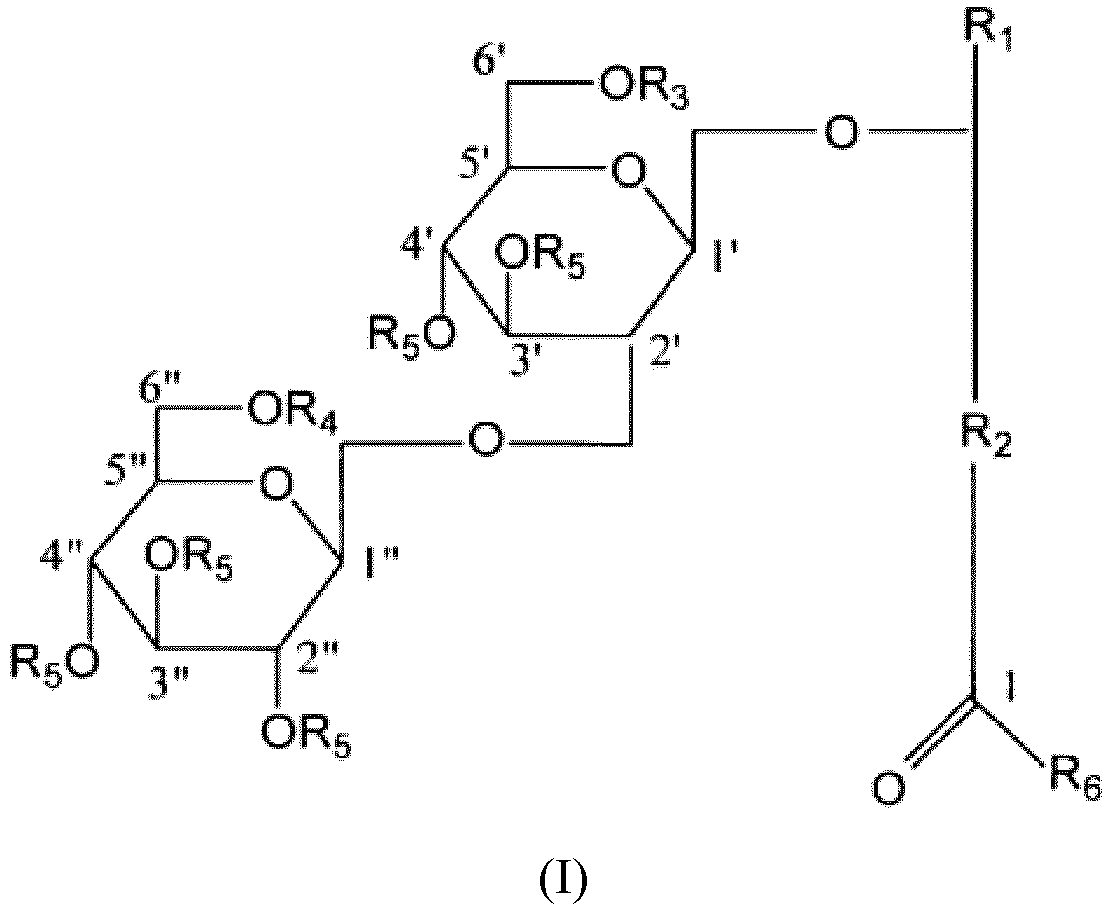 (dans la formule (I), R1 représente un atome d'hydrogène ou un groupe méthyle ; R3 et R4 sont identiques ou différents et représentent chacun un atome d'hydrogène ou un groupe acétyle ; l'un des cinq R5 est un résidu d'acide gras linéaire en C12 à C20 saturé, ou un résidu d'acide gras linéaire insaturé en C12 à C20 ayant 1 à 3 doubles liaisons, qui peut avoir 1 ou 2 radicaux hydroxy, et les quatre R5 restants sont des atomes d'hydrogène ; R2 représente un groupe alkylène en C9 à C18, ou un groupe alcénylène en C9 à C18 ayant 1 à 3 doubles liaisons ; et R6 représente un radical hydroxy, ou peut former une liaison simple conjointement avec l'un des cinq R7 dans le composé représenté par la formule (II) ci-dessous ;
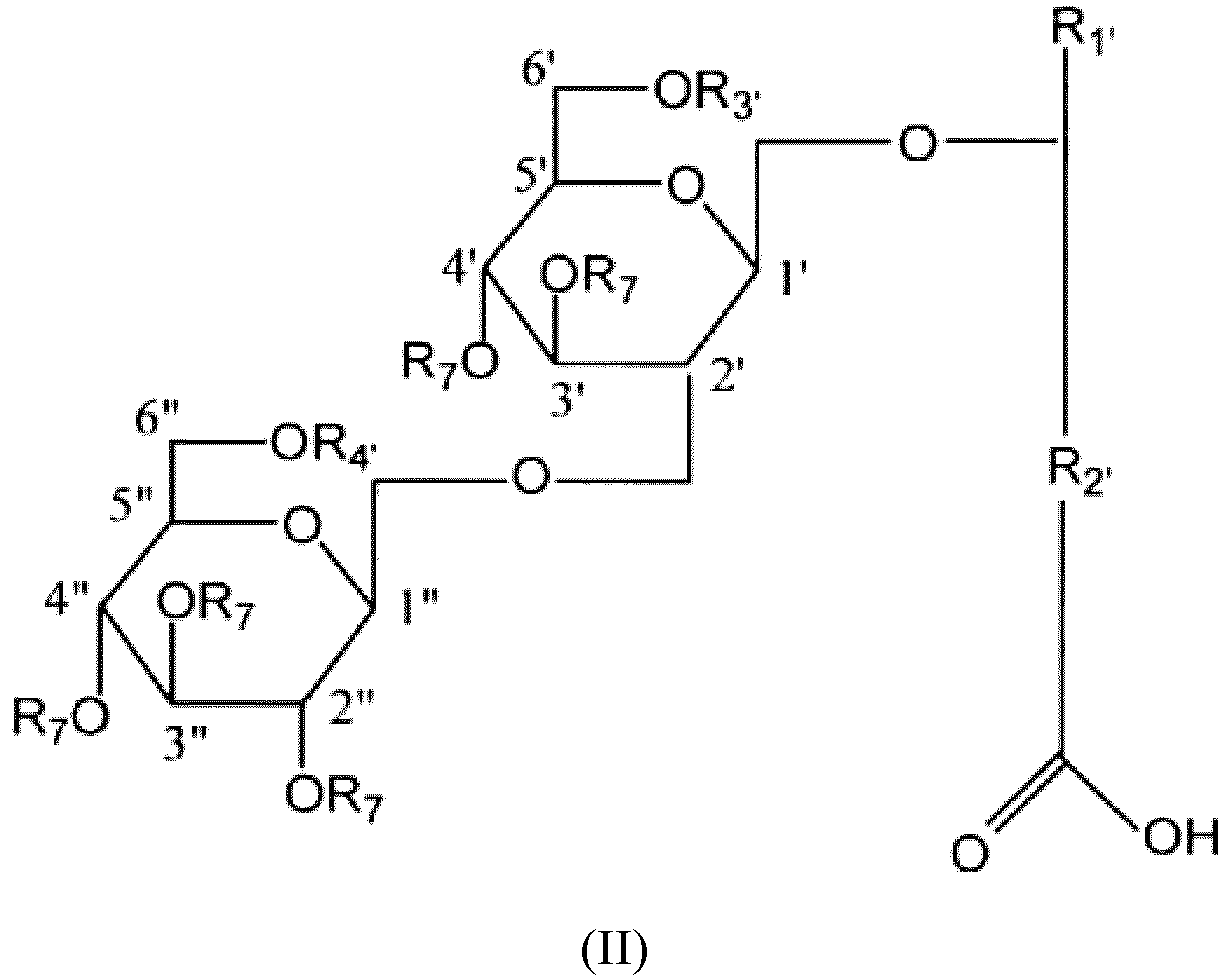 (dans la formule (II), R1' représente un atome d'hydrogène ou un groupe méthyle ;R3' et R4' sont identiques ou différents et représentent chacun un atome d'hydrogène ou un groupe acétyle ; R2' représente un groupe alkylène en C9 à C18, ou un groupe alcénylène en C9 à C18 ayant 1 à 3 doubles liaisons ; et l'un des R7 forme une liaison simple conjointement avec R6 dans le composé représenté par la formule (I) et les quatre R7 restants sont des atomes d'hydrogène)).
 - Composé sophorolipide selon la revendication 1, lequel composé sophorolipide est le composé spécifié en (1) ou (2) ci-dessous :(1) dans la formule (I), R6 est un radical hydroxy ; R1 est un groupe méthyle ; R2 est un groupe alkylène en C9 à C17 ou un groupe alcénylène en C13 à C17 ayant 1 à 3 doubles liaisons ; R3 et R4 sont identiques ou différents, et représentent chacun un atome d'hydrogène ou un groupe acétyle ; et R5 du groupe R5O lié à la position 4" du cycle sophorose est un résidu d'acide gras en C12 à C20 qui peut ou non avoir un radical hydroxy, et les R5 restants sont des atomes d'hydrogène ; et(2) dans la formule (I), R6 forme une liaison simple conjointement avec R7 du groupe R7O lié à la position 4" du cycle sophorose dans la formule (II) ; R1 est un groupe méthyle ; R2 est un groupe alkylène en C9 à C17, ou un groupe alcénylène en C13 à C17 ayant 1 à 3 doubles liaisons ; R3 et R4 sont identiques ou différents, et représentent chacun un atome d'hydrogène ou un groupe acétyle ; et R5 du groupe R5O lié à la position 4" du cycle sophorose est un résidu d'acide gras en C12 à C20 qui peut avoir 1 ou 2 radicaux hydroxy, et les R5 restants sont des atomes d'hydrogène ; et, dans la formule (II), R1' est un groupe méthyle ; R2' est un groupe alkylène en C9 à C17, ou un groupe alcénylène en C13 à C17 ayant 1 à 3 doubles liaisons ; et R3' et R4' sont identiques ou différents, et représentent chacun un atome d'hydrogène ou un groupe acétyle.
- Composé sophorolipide selon la revendication 1 ou 2, lequel composé sophorolipide est le composé spécifié en (1) ou (2) ci-dessous :(1) dans la formule (I), R6 est un radical hydroxy ; R1 est un groupe méthyle ; R2 est un groupe alcénylène en C15 ayant une seule double liaison ; R3 et R4 sont identiques ou différents et représentent chacun un atome d'hydrogène ou un groupe acétyle ; et R5 du groupe R5O lié à la position 4" du cycle sophorose est un résidu d'acide oléique ayant un radical hydroxy, et les R5 restants sont des atomes d'hydrogène ; et(2) dans la formule (I), R6 forme une liaison simple conjointement avec R7 du groupe R7O lié à la position 4" du cycle sophorose dans la formule (II) ; R1 est un groupe méthyle ; R2 est un groupe alcénylène en C15 ayant une seule double liaison ; R3 et R4 sont identiques ou différents et représentent chacun un atome d'hydrogène ou un groupe acétyle ; R5 du groupe R5O lié à la position 4" du cycle sophorose est un résidu d'acide oléique ayant un radical hydroxy, et les R5 restants sont des atomes d'hydrogène ; et, dans la formule (II), R1' est un groupe méthyle ; R2' est un groupe alkylène en C13 ; et R3' et R4' sont identiques ou différents et représentent chacun un atome d'hydrogène ou un groupe acétyle.
- Composé sophorolipide selon la revendication 1, lequel composé sophorolipide est un composé représenté par la formule (III) ou la formule (IV) ci-dessous :
 (dans la formule (III), R1 représente un groupe méthyle,R2 représente un groupe alcénylène en C15, et R5 représente un résidu d'acide oléique ayant un radical hydroxy)
 (dans la formule (IV), R1 représente un groupe méthyle,R2 représente un groupe alcénylène en C15, Rs représente un résidu d'acide oléique ayant un radical hydroxy, et R6 forme une liaison simple conjointement avec R7 dans la formule (V) ci-dessous)
 (dans la formule (V), R1' représente un groupe méthyle, R2' représente un groupe alkylène en C13, R3' représente un atome d'hydrogène, et R4' représente un groupe acétyle).
 - Utilisation d'un composé sophorolipide selon l'une quelconque des revendications 1 à 4 en tant que tensioactif.
- Utilisation d'un composé sophorolipide selon l'une quelconque des revendications 1 à 4 dans un cosmétique, un aliment, une boisson, ou un additif pour ceux-ci.
- Composition comprenant au moins un composé sophorolipide selon l'une quelconque des revendications 1 à 4 pour une utilisation en tant qu'agent pharmaceutique ou en tant que quasi-médicament.
- Utilisation d'une composition comprenant au moins un composé sophorolipide selon l'une quelconque des revendications 1 à 4 en tant que tensioactif.
- Composition comprenant au moins un composé sophorolipide selon l'une quelconque des revendications 1 à 4, laquelle composition est un cosmétique, un aliment ou une boisson, ou un additif pour ceux-ci.
- Composition pharmaceutique ou quasi-médicament comprenant au moins un composé sophorolipide selon l'une quelconque des revendications 1 à 4.
Applications Claiming Priority (2)
| Application Number | Priority Date | Filing Date | Title |
|---|---|---|---|
| JP2013167171 | 2013-08-09 | ||
| PCT/JP2014/070788 WO2015020114A1 (fr) | 2013-08-09 | 2014-08-06 | Nouveau composé sophorolipide et composition le comprenant |
Publications (4)
| Publication Number | Publication Date |
|---|---|
| EP3034613A1 EP3034613A1 (fr) | 2016-06-22 |
| EP3034613A4 EP3034613A4 (fr) | 2016-12-14 |
| EP3034613B1 true EP3034613B1 (fr) | 2025-01-08 |
| EP3034613C0 EP3034613C0 (fr) | 2025-01-08 |
Family
ID=52461444
Family Applications (1)
| Application Number | Title | Priority Date | Filing Date |
|---|---|---|---|
| EP14834955.8A Active EP3034613B1 (fr) | 2013-08-09 | 2014-08-06 | Nouveau composé sophorolipide et composition le comprenant |
Country Status (5)
| Country | Link |
|---|---|
| US (1) | US10752650B2 (fr) |
| EP (1) | EP3034613B1 (fr) |
| JP (1) | JP6449156B2 (fr) |
| CN (1) | CN105593370B (fr) |
| WO (1) | WO2015020114A1 (fr) |
Families Citing this family (21)
| Publication number | Priority date | Publication date | Assignee | Title |
|---|---|---|---|---|
| CN105683329B (zh) | 2013-09-04 | 2018-04-06 | 莎罗雅株式会社 | 低毒性的含有槐糖脂的组合物及其用途 |
| EP3117838B1 (fr) | 2014-03-10 | 2020-09-16 | Saraya Co., Ltd. | Composition contenant un sophorolipide, substance, huile et matière grasse physiologiquement active, et procédé de production de cette composition |
| US10155043B2 (en) * | 2015-12-29 | 2018-12-18 | The United States Of America, As Represented By The Secretary Of Agriculture | Compositions containing a bitter tastant and at least one sophorolipid, and methods of reducing bitter taste attributed to a bitter tastant in an edible composition |
| WO2018143166A1 (fr) | 2017-01-31 | 2018-08-09 | サラヤ株式会社 | Composition de cryoconservation de cellules et procédé de cryoconservation |
| WO2018163512A1 (fr) | 2017-03-07 | 2018-09-13 | サラヤ株式会社 | Composition d'agent de lavage |
| WO2019023323A1 (fr) * | 2017-07-25 | 2019-01-31 | Dsm Ip Assets B.V. | Utilisation de sophorolipides |
| CA3067248A1 (fr) * | 2017-09-28 | 2019-04-04 | Locus Agriculture Ip Company, Llc | Traitement du virus de la mosaique et des infections bacteriennes chez les plantes |
| US20200397686A1 (en) * | 2018-03-12 | 2020-12-24 | Monell Chemical Senses Center | Methods of Reducing Burning or Stinging Sensation Attributed to Certain Compositions |
| MX2021012552A (es) * | 2019-04-16 | 2021-11-12 | Locus Ip Co Llc | Aditivos alimentarios emulsionantes basados en microbios. |
| EP3984628A4 (fr) * | 2019-06-11 | 2023-07-12 | Saraya Co., Ltd. | Composition contenant un sophorolipide de type acide dont le brunissement est supprimé |
| CN112369542A (zh) * | 2019-10-28 | 2021-02-19 | 广州富诺营养科技有限公司 | 一种蘑菇粉固体饮料及其制备方法 |
| AU2021275871A1 (en) | 2020-05-20 | 2022-05-19 | Locus Ip Company, Llc | Methods of producing compositions comprising hydrophilic sophorolipids |
| WO2022210011A1 (fr) | 2021-03-31 | 2022-10-06 | アライドカーボンソリューションズ株式会社 | Nouveau dérivé de sophorolipide |
| US20250120901A1 (en) | 2021-06-08 | 2025-04-17 | Saraya Co., Ltd. | Biofilm remover and biofilm removal method |
| CA3258399A1 (fr) * | 2022-06-08 | 2023-12-14 | Locus Solutions Ipco, Llc | Sophorolipides éthériques stables à la ph et à la température et leur utilisation |
| CN119343320A (zh) * | 2022-06-08 | 2025-01-21 | 轨迹方案Ipco有限责任公司 | 组合物和用于絮凝的方法 |
| EP4651716A1 (fr) * | 2022-12-22 | 2025-11-26 | Locus Solutions IPCO, LLC | Sophorolipides et dérivés de sophorolipides en tant qu'additifs et adjuvants en mélange extemporané dans des formulations de protection des cultures |
| CN119685038B (zh) * | 2023-09-22 | 2026-03-24 | 中国石油化工股份有限公司 | 一种低聚生物基表面活性剂及其制备方法和应用 |
| WO2026032785A1 (fr) | 2024-08-06 | 2026-02-12 | Evonik Operations Gmbh | Souches de bacillus licheniformis utilisées dans le nettoyage et l'alimentation animale |
| EP4692292A1 (fr) | 2024-08-06 | 2026-02-11 | Evonik Operations GmbH | Procede ameliore de germination de spores bacteriennes |
| EP4632053A1 (fr) | 2025-04-15 | 2025-10-15 | Evonik Operations GmbH | Procédé de traitement d'une surface métallique |
Citations (10)
| Publication number | Priority date | Publication date | Assignee | Title |
|---|---|---|---|---|
| US4197166A (en) | 1977-08-01 | 1980-04-08 | Kao Soap Company, Limited | Dehydrating purification process for a fermentation product |
| JPH07118284A (ja) | 1991-06-03 | 1995-05-09 | Agency Of Ind Science & Technol | ソホロース誘導体 |
| EP0745719A2 (fr) | 1995-05-15 | 1996-12-04 | Hoechst Aktiengesellschaft | Utilisation de composés d'hydrates de carbone comme produit auxiliaire lors de la teinture ou de l'impression de matériaux fibreux |
| JP2002045195A (ja) | 2000-08-04 | 2002-02-12 | Saraya Kk | ソホロースリピッドの発酵生産法 |
| US20050164955A1 (en) | 2003-11-06 | 2005-07-28 | Gross Richard A. | Antifungal properties of various forms of sophorolipids |
| US20070027106A1 (en) | 2005-07-26 | 2007-02-01 | Jonathan Zerkowski | Charged sophorolipids and sophorolipid containing compounds |
| JP4370591B2 (ja) | 2001-07-31 | 2009-11-25 | 独立行政法人産業技術総合研究所 | リポソームおよびそれからなる細胞への物質導入担体 |
| JP2012047409A (ja) | 2010-08-27 | 2012-03-08 | Mitsubishi Heavy Ind Ltd | マルチ型空気調和システム |
| JP2013167171A (ja) | 2012-02-14 | 2013-08-29 | Mitsubishi Heavy Ind Ltd | 電動圧縮機 |
| EP2821495A1 (fr) | 2012-03-02 | 2015-01-07 | Saraya Co., Ltd. | Composition contenant un sophorolipide (sl) sous forme acide de haute pureté et procédé de préparation de celle-ci |
Family Cites Families (19)
| Publication number | Priority date | Publication date | Assignee | Title |
|---|---|---|---|---|
| CA2060698C (fr) | 1991-02-12 | 1997-09-30 | Peter J. Hall | Compositions de detergent |
| FR2720941B1 (fr) | 1994-06-13 | 1996-08-23 | Inst Francais Du Petrole | Utilisation des sophorolipides et compositions cosmétiques et dermatologiques. |
| FR2735979B1 (fr) | 1995-06-28 | 1997-08-14 | Inst Francais Du Petrole | Utilisation comme substances therapeutiquement actives ou produits cosmetiques des sophorolipides, en particulier pour le traitement de la peau |
| FR2757766B1 (fr) | 1996-12-27 | 1999-02-19 | Inst Francais Du Petrole | Utilisation des sophorolipides en tant qu'agent stimulateur du metabolisme des fibroblastes dermiques |
| JP2003013093A (ja) | 2001-06-27 | 2003-01-15 | Saraya Kk | 低泡性洗浄剤組成物 |
| JP4714377B2 (ja) | 2001-06-29 | 2011-06-29 | サラヤ株式会社 | ソホロースリピッドの精製方法 |
| JP4548827B2 (ja) | 2004-09-06 | 2010-09-22 | サラヤ株式会社 | 生分解性の液体洗浄剤組成物 |
| JP2006083238A (ja) | 2004-09-14 | 2006-03-30 | Saraya Kk | 洗浄剤組成物 |
| JP4628811B2 (ja) | 2005-02-01 | 2011-02-09 | サラヤ株式会社 | 泡ディスペンサ |
| EP1991238A4 (fr) | 2006-03-09 | 2010-11-03 | Univ Polytechnic | Propriétés anti-virus de l'herpès de différentes formes de sophorolipides |
| JP2008247845A (ja) | 2007-03-30 | 2008-10-16 | National Institute Of Advanced Industrial & Technology | 酸型ソホロースリピッドの生産方法 |
| JP4304352B2 (ja) | 2007-09-04 | 2009-07-29 | 独立行政法人産業技術総合研究所 | ソホロリピッドを含む経皮吸収制御剤及びその製造方法 |
| JP5649268B2 (ja) | 2008-05-15 | 2015-01-07 | サラヤ株式会社 | ソホロリピッドを含む吸着抑制組成物 |
| WO2010050413A1 (fr) | 2008-10-28 | 2010-05-06 | 株式会社カネカ | Procédé pour produire le lipide sophorose |
| DE102009045077A1 (de) | 2009-09-29 | 2011-03-31 | Evonik Goldschmidt Gmbh | Verwendung von Sophorolipiden und deren Derivaten in Kombination mit Pestiziden als Adjuvant/Additiv für den Pflanzenschutz und den industriellen non-crop Bereich |
| DE102010014680A1 (de) | 2009-11-18 | 2011-08-18 | Evonik Degussa GmbH, 45128 | Zellen, Nukleinsäuren, Enzyme und deren Verwendung sowie Verfahren zur Herstellung von Sophorolipiden |
| CA2795729C (fr) * | 2010-04-05 | 2015-12-08 | Polytechnic Institute Of New York University | Compositions d'analogues de sophorolipides |
| US20120142621A1 (en) | 2010-12-03 | 2012-06-07 | Biomedica Management Corporation | Purified Ethyl Ester Sophorolipid for the Treatment of Sepsis |
| CN105683329B (zh) | 2013-09-04 | 2018-04-06 | 莎罗雅株式会社 | 低毒性的含有槐糖脂的组合物及其用途 |
-
2014
- 2014-08-06 EP EP14834955.8A patent/EP3034613B1/fr active Active
- 2014-08-06 WO PCT/JP2014/070788 patent/WO2015020114A1/fr not_active Ceased
- 2014-08-06 JP JP2015530934A patent/JP6449156B2/ja active Active
- 2014-08-06 US US14/911,174 patent/US10752650B2/en active Active
- 2014-08-06 CN CN201480054091.5A patent/CN105593370B/zh active Active
Patent Citations (10)
| Publication number | Priority date | Publication date | Assignee | Title |
|---|---|---|---|---|
| US4197166A (en) | 1977-08-01 | 1980-04-08 | Kao Soap Company, Limited | Dehydrating purification process for a fermentation product |
| JPH07118284A (ja) | 1991-06-03 | 1995-05-09 | Agency Of Ind Science & Technol | ソホロース誘導体 |
| EP0745719A2 (fr) | 1995-05-15 | 1996-12-04 | Hoechst Aktiengesellschaft | Utilisation de composés d'hydrates de carbone comme produit auxiliaire lors de la teinture ou de l'impression de matériaux fibreux |
| JP2002045195A (ja) | 2000-08-04 | 2002-02-12 | Saraya Kk | ソホロースリピッドの発酵生産法 |
| JP4370591B2 (ja) | 2001-07-31 | 2009-11-25 | 独立行政法人産業技術総合研究所 | リポソームおよびそれからなる細胞への物質導入担体 |
| US20050164955A1 (en) | 2003-11-06 | 2005-07-28 | Gross Richard A. | Antifungal properties of various forms of sophorolipids |
| US20070027106A1 (en) | 2005-07-26 | 2007-02-01 | Jonathan Zerkowski | Charged sophorolipids and sophorolipid containing compounds |
| JP2012047409A (ja) | 2010-08-27 | 2012-03-08 | Mitsubishi Heavy Ind Ltd | マルチ型空気調和システム |
| JP2013167171A (ja) | 2012-02-14 | 2013-08-29 | Mitsubishi Heavy Ind Ltd | 電動圧縮機 |
| EP2821495A1 (fr) | 2012-03-02 | 2015-01-07 | Saraya Co., Ltd. | Composition contenant un sophorolipide (sl) sous forme acide de haute pureté et procédé de préparation de celle-ci |
Non-Patent Citations (3)
| Title |
|---|
| ABDUL RASHID YATIM: "Biotransformation of Palm Olein into sophorolipids biosurfactant", THESIS, UNIVERSITY OF NEW SOUTH WALES, 1 January 2008 (2008-01-01), UNIVERSITY OF NEW SOUTH WALES , XP055763217, Retrieved from the Internet <URL:http://hdl.handle.net/1959.4/44995> DOI: 10.26190/unsworks/14904 |
| HANS-J. DANIEL ET AL: "Sophorolipid Production with High Yields on Whey Concentrate and Rapeseed Oil without Consumption of Lactose", BIOTECHNOLOGY LETTERS, vol. 20, no. 8, 1 August 1998 (1998-08-01), NL, pages 805 - 807, XP055391449, ISSN: 0141-5492, DOI: 10.1023/B:BILE.0000015927.29348.1a * |
| VAN BOGAERT INGE N. A.; SAERENS KAREN; DE MUYNCK CASSANDRA; DEVELTER DIRK; SOETAERT WIM; VANDAMME ERICK J.: "Microbial production and application of sophorolipids", APPLIED MICROBIOLOGY AND BIOTECHNOLOGY, SPRINGER BERLIN HEIDELBERG, BERLIN/HEIDELBERG, vol. 76, no. 1, 3 May 2007 (2007-05-03), Berlin/Heidelberg, pages 23 - 34, XP037008646, ISSN: 0175-7598, DOI: 10.1007/s00253-007-0988-7 |
Also Published As
| Publication number | Publication date |
|---|---|
| US20160280733A1 (en) | 2016-09-29 |
| CN105593370A (zh) | 2016-05-18 |
| JP6449156B2 (ja) | 2019-01-09 |
| WO2015020114A1 (fr) | 2015-02-12 |
| CN105593370B (zh) | 2021-07-06 |
| EP3034613C0 (fr) | 2025-01-08 |
| US10752650B2 (en) | 2020-08-25 |
| EP3034613A4 (fr) | 2016-12-14 |
| EP3034613A1 (fr) | 2016-06-22 |
| JPWO2015020114A1 (ja) | 2017-03-02 |
Similar Documents
| Publication | Publication Date | Title |
|---|---|---|
| EP3034613B1 (fr) | Nouveau composé sophorolipide et composition le comprenant | |
| EP3042940B1 (fr) | Composition contenant un sophorolipide à faible toxicité, et utilisation de celui-ci | |
| EP2821495B1 (fr) | Composition contenant un sophorolipide (sl) sous forme acide de haute pureté et procédé de préparation de celle-ci | |
| Hu et al. | Sophorolipid production from different lipid precursors observed with LC-MS | |
| EP2055314B1 (fr) | Activateur comprenant un bio-tensioactif comme ingrédient actif un mannosyl érythritol lipide | |
| US20240384313A1 (en) | Methods of producing polyol lipids | |
| JP5470857B2 (ja) | 糖型バイオサーファクタント生産能を有する微生物及びそれを用いる糖型バイオサーファクタントの製造方法 | |
| Yang et al. | Recovery of purified lactonic sophorolipids by spontaneous crystallization during the fermentation of sugarcane molasses with Candida albicans O-13-1 | |
| JP2008247845A (ja) | 酸型ソホロースリピッドの生産方法 | |
| Chiewpattanakul et al. | Bioproduction and anticancer activity of biosurfactant produced by the dematiaceous fungus Exophiala dermatitidis SK80 | |
| JP5622190B2 (ja) | 新規微生物及びそれを用いる糖型バイオサーファクタントの製造方法 | |
| Pratap et al. | Waste derived-green and sustainable production of Sophorolipid | |
| JP2010022217A (ja) | グルコシルセラミドの製造方法 | |
| Dubey et al. | Physico-chemical, analytical and antimicrobial studies of novel sophorolipids synthesized using cetyl alcohol | |
| JP2010022218A (ja) | 新種微生物及びグルコシルセラミドの製造方法 | |
| Jin‐Ming et al. | Sphingolipids from the edible fungus Tuber indicum | |
| CN113966378B (zh) | 褐变被抑制的含酸型槐糖脂的组合物 | |
| JP7133306B2 (ja) | アシルステリルグルコシド、アシルステリルグルコシドの製造方法、組成物、抗酸化剤、血中脂質低下剤、抗肥満剤、抗腫瘍剤及びアテローム性動脈硬化症の予防又は治療剤 | |
| JP2005206576A (ja) | ハナビラタケ由来のセラミド含有組成物 | |
| Stonik et al. | marine drugs MDPI | |
| EP4194559A1 (fr) | Composition contenant des sophorolipides ayant une excellente maniabilité |
Legal Events
| Date | Code | Title | Description |
|---|---|---|---|
| PUAI | Public reference made under article 153(3) epc to a published international application that has entered the european phase |
Free format text: ORIGINAL CODE: 0009012 |
|
| 17P | Request for examination filed |
Effective date: 20160309 |
|
| AK | Designated contracting states |
Kind code of ref document: A1 Designated state(s): AL AT BE BG CH CY CZ DE DK EE ES FI FR GB GR HR HU IE IS IT LI LT LU LV MC MK MT NL NO PL PT RO RS SE SI SK SM TR |
|
| AX | Request for extension of the european patent |
Extension state: BA ME |
|
| DAX | Request for extension of the european patent (deleted) | ||
| A4 | Supplementary search report drawn up and despatched |
Effective date: 20161116 |
|
| RIC1 | Information provided on ipc code assigned before grant |
Ipc: C12P 19/12 20060101ALI20161110BHEP Ipc: A23L 23/10 20160101ALI20161110BHEP Ipc: A21D 13/08 20060101ALI20161110BHEP Ipc: C07H 15/10 20060101ALI20161110BHEP Ipc: A61K 8/60 20060101ALI20161110BHEP Ipc: A21D 2/08 20060101ALI20161110BHEP Ipc: C07H 15/04 20060101AFI20161110BHEP Ipc: A23L 29/10 20160101ALI20161110BHEP Ipc: C07H 15/06 20060101ALI20161110BHEP |
|
| TPAC | Observations filed by third parties |
Free format text: ORIGINAL CODE: EPIDOSNTIPA |
|
| STAA | Information on the status of an ep patent application or granted ep patent |
Free format text: STATUS: EXAMINATION IS IN PROGRESS |
|
| 17Q | First examination report despatched |
Effective date: 20170721 |
|
| TPAA | Information related to observations by third parties modified |
Free format text: ORIGINAL CODE: EPIDOSCTIPA |
|
| TPAC | Observations filed by third parties |
Free format text: ORIGINAL CODE: EPIDOSNTIPA |
|
| REG | Reference to a national code |
Ref country code: DE Ref legal event code: R079 Free format text: PREVIOUS MAIN CLASS: C12P0019120000 Ipc: C07H0015040000 Ref country code: DE Ref legal event code: R079 Ref document number: 602014091435 Country of ref document: DE Free format text: PREVIOUS MAIN CLASS: C12P0019120000 Ipc: C07H0015040000 |
|
| RIC1 | Information provided on ipc code assigned before grant |
Ipc: A61K 8/60 20060101ALI20240606BHEP Ipc: A23L 23/10 20160101ALI20240606BHEP Ipc: C12P 19/12 20060101ALI20240606BHEP Ipc: C07H 15/10 20060101ALI20240606BHEP Ipc: C07H 15/06 20060101ALI20240606BHEP Ipc: C07H 15/04 20060101AFI20240606BHEP |
|
| GRAP | Despatch of communication of intention to grant a patent |
Free format text: ORIGINAL CODE: EPIDOSNIGR1 |
|
| STAA | Information on the status of an ep patent application or granted ep patent |
Free format text: STATUS: GRANT OF PATENT IS INTENDED |
|
| INTG | Intention to grant announced |
Effective date: 20240719 |
|
| GRAS | Grant fee paid |
Free format text: ORIGINAL CODE: EPIDOSNIGR3 |
|
| GRAA | (expected) grant |
Free format text: ORIGINAL CODE: 0009210 |
|
| STAA | Information on the status of an ep patent application or granted ep patent |
Free format text: STATUS: THE PATENT HAS BEEN GRANTED |
|
| AK | Designated contracting states |
Kind code of ref document: B1 Designated state(s): AL AT BE BG CH CY CZ DE DK EE ES FI FR GB GR HR HU IE IS IT LI LT LU LV MC MK MT NL NO PL PT RO RS SE SI SK SM TR |
|
| REG | Reference to a national code |
Ref country code: GB Ref legal event code: FG4D |
|
| REG | Reference to a national code |
Ref country code: CH Ref legal event code: EP |
|
| REG | Reference to a national code |
Ref country code: DE Ref legal event code: R096 Ref document number: 602014091435 Country of ref document: DE |
|
| REG | Reference to a national code |
Ref country code: IE Ref legal event code: FG4D |
|
| U01 | Request for unitary effect filed |
Effective date: 20250115 |
|
| U07 | Unitary effect registered |
Designated state(s): AT BE BG DE DK EE FI FR IT LT LU LV MT NL PT RO SE SI Effective date: 20250122 |
|
| REG | Reference to a national code |
Ref country code: SK Ref legal event code: T3 Ref document number: E 46016 Country of ref document: SK |
|
| PG25 | Lapsed in a contracting state [announced via postgrant information from national office to epo] |
Ref country code: RS Free format text: LAPSE BECAUSE OF FAILURE TO SUBMIT A TRANSLATION OF THE DESCRIPTION OR TO PAY THE FEE WITHIN THE PRESCRIBED TIME-LIMIT Effective date: 20250408 |
|
| PG25 | Lapsed in a contracting state [announced via postgrant information from national office to epo] |
Ref country code: PL Free format text: LAPSE BECAUSE OF FAILURE TO SUBMIT A TRANSLATION OF THE DESCRIPTION OR TO PAY THE FEE WITHIN THE PRESCRIBED TIME-LIMIT Effective date: 20250108 |
|
| PG25 | Lapsed in a contracting state [announced via postgrant information from national office to epo] |
Ref country code: ES Free format text: LAPSE BECAUSE OF FAILURE TO SUBMIT A TRANSLATION OF THE DESCRIPTION OR TO PAY THE FEE WITHIN THE PRESCRIBED TIME-LIMIT Effective date: 20250108 |
|
| PG25 | Lapsed in a contracting state [announced via postgrant information from national office to epo] |
Ref country code: NO Free format text: LAPSE BECAUSE OF FAILURE TO SUBMIT A TRANSLATION OF THE DESCRIPTION OR TO PAY THE FEE WITHIN THE PRESCRIBED TIME-LIMIT Effective date: 20250408 Ref country code: IS Free format text: LAPSE BECAUSE OF FAILURE TO SUBMIT A TRANSLATION OF THE DESCRIPTION OR TO PAY THE FEE WITHIN THE PRESCRIBED TIME-LIMIT Effective date: 20250508 |
|
| PG25 | Lapsed in a contracting state [announced via postgrant information from national office to epo] |
Ref country code: HR Free format text: LAPSE BECAUSE OF FAILURE TO SUBMIT A TRANSLATION OF THE DESCRIPTION OR TO PAY THE FEE WITHIN THE PRESCRIBED TIME-LIMIT Effective date: 20250108 |
|
| PG25 | Lapsed in a contracting state [announced via postgrant information from national office to epo] |
Ref country code: GR Free format text: LAPSE BECAUSE OF FAILURE TO SUBMIT A TRANSLATION OF THE DESCRIPTION OR TO PAY THE FEE WITHIN THE PRESCRIBED TIME-LIMIT Effective date: 20250409 |
|
| U20 | Renewal fee for the european patent with unitary effect paid |
Year of fee payment: 12 Effective date: 20250723 |
|
| PG25 | Lapsed in a contracting state [announced via postgrant information from national office to epo] |
Ref country code: SM Free format text: LAPSE BECAUSE OF FAILURE TO SUBMIT A TRANSLATION OF THE DESCRIPTION OR TO PAY THE FEE WITHIN THE PRESCRIBED TIME-LIMIT Effective date: 20250108 |
|
| PLBI | Opposition filed |
Free format text: ORIGINAL CODE: 0009260 |
|
| REG | Reference to a national code |
Ref country code: CH Ref legal event code: L10 Free format text: ST27 STATUS EVENT CODE: U-0-0-L10-L00 (AS PROVIDED BY THE NATIONAL OFFICE) Effective date: 20251015 |
|
| PGFP | Annual fee paid to national office [announced via postgrant information from national office to epo] |
Ref country code: GB Payment date: 20250717 Year of fee payment: 12 |
|
| PG25 | Lapsed in a contracting state [announced via postgrant information from national office to epo] |
Ref country code: CZ Free format text: LAPSE BECAUSE OF FAILURE TO SUBMIT A TRANSLATION OF THE DESCRIPTION OR TO PAY THE FEE WITHIN THE PRESCRIBED TIME-LIMIT Effective date: 20250108 |
|
| PLAX | Notice of opposition and request to file observation + time limit sent |
Free format text: ORIGINAL CODE: EPIDOSNOBS2 |
|
| PGFP | Annual fee paid to national office [announced via postgrant information from national office to epo] |
Ref country code: SK Payment date: 20250723 Year of fee payment: 12 |
|
| 26 | Opposition filed |
Opponent name: MURGITROYD & COMPANY Effective date: 20251008 |
|
| PLBB | Reply of patent proprietor to notice(s) of opposition received |
Free format text: ORIGINAL CODE: EPIDOSNOBS3 |
|
| REG | Reference to a national code |
Ref country code: CH Ref legal event code: H13 Free format text: ST27 STATUS EVENT CODE: U-0-0-H10-H13 (AS PROVIDED BY THE NATIONAL OFFICE) Effective date: 20260324 |
|
| PG25 | Lapsed in a contracting state [announced via postgrant information from national office to epo] |
Ref country code: MC Free format text: LAPSE BECAUSE OF FAILURE TO SUBMIT A TRANSLATION OF THE DESCRIPTION OR TO PAY THE FEE WITHIN THE PRESCRIBED TIME-LIMIT Effective date: 20250108 |
|
| PG25 | Lapsed in a contracting state [announced via postgrant information from national office to epo] |
Ref country code: CH Free format text: LAPSE BECAUSE OF NON-PAYMENT OF DUE FEES Effective date: 20250831 |