EP3038270A1 - Verfahren zur Durchführung von Mehrfachzugang bei drahtlosen zellularen OFDM-Systemen über drahtlose Mehrwegkanäle, die Raum und Frequenzbereiche berücksichtigen, Basisstation und Computerprogramme dafür - Google Patents
Verfahren zur Durchführung von Mehrfachzugang bei drahtlosen zellularen OFDM-Systemen über drahtlose Mehrwegkanäle, die Raum und Frequenzbereiche berücksichtigen, Basisstation und Computerprogramme dafür Download PDFInfo
- Publication number
- EP3038270A1 EP3038270A1 EP14382559.4A EP14382559A EP3038270A1 EP 3038270 A1 EP3038270 A1 EP 3038270A1 EP 14382559 A EP14382559 A EP 14382559A EP 3038270 A1 EP3038270 A1 EP 3038270A1
- Authority
- EP
- European Patent Office
- Prior art keywords
- users
- user
- beams
- denotes
- angular
- Prior art date
- Legal status (The legal status is an assumption and is not a legal conclusion. Google has not performed a legal analysis and makes no representation as to the accuracy of the status listed.)
- Granted
Links
Images


Classifications
-
- H—ELECTRICITY
- H04—ELECTRIC COMMUNICATION TECHNIQUE
- H04B—TRANSMISSION
- H04B7/00—Radio transmission systems, i.e. using radiation field
- H04B7/02—Diversity systems; Multi-antenna system, i.e. transmission or reception using multiple antennas
- H04B7/04—Diversity systems; Multi-antenna system, i.e. transmission or reception using multiple antennas using two or more spaced independent antennas
- H04B7/0413—MIMO systems
-
- H—ELECTRICITY
- H04—ELECTRIC COMMUNICATION TECHNIQUE
- H04B—TRANSMISSION
- H04B7/00—Radio transmission systems, i.e. using radiation field
- H04B7/02—Diversity systems; Multi-antenna system, i.e. transmission or reception using multiple antennas
- H04B7/04—Diversity systems; Multi-antenna system, i.e. transmission or reception using multiple antennas using two or more spaced independent antennas
- H04B7/06—Diversity systems; Multi-antenna system, i.e. transmission or reception using multiple antennas using two or more spaced independent antennas at the transmitting station
- H04B7/0613—Diversity systems; Multi-antenna system, i.e. transmission or reception using multiple antennas using two or more spaced independent antennas at the transmitting station using simultaneous transmission
- H04B7/0615—Diversity systems; Multi-antenna system, i.e. transmission or reception using multiple antennas using two or more spaced independent antennas at the transmitting station using simultaneous transmission of weighted versions of same signal
- H04B7/0617—Diversity systems; Multi-antenna system, i.e. transmission or reception using multiple antennas using two or more spaced independent antennas at the transmitting station using simultaneous transmission of weighted versions of same signal for beam forming
-
- H—ELECTRICITY
- H01—ELECTRIC ELEMENTS
- H01Q—ANTENNAS, i.e. RADIO AERIALS
- H01Q21/00—Antenna arrays or systems
- H01Q21/06—Arrays of individually energised antenna units similarly polarised and spaced apart
- H01Q21/061—Two dimensional planar arrays
-
- H—ELECTRICITY
- H04—ELECTRIC COMMUNICATION TECHNIQUE
- H04B—TRANSMISSION
- H04B7/00—Radio transmission systems, i.e. using radiation field
- H04B7/02—Diversity systems; Multi-antenna system, i.e. transmission or reception using multiple antennas
- H04B7/04—Diversity systems; Multi-antenna system, i.e. transmission or reception using multiple antennas using two or more spaced independent antennas
- H04B7/0408—Diversity systems; Multi-antenna system, i.e. transmission or reception using multiple antennas using two or more spaced independent antennas using two or more beams, i.e. beam diversity
-
- H—ELECTRICITY
- H04—ELECTRIC COMMUNICATION TECHNIQUE
- H04B—TRANSMISSION
- H04B7/00—Radio transmission systems, i.e. using radiation field
- H04B7/02—Diversity systems; Multi-antenna system, i.e. transmission or reception using multiple antennas
- H04B7/04—Diversity systems; Multi-antenna system, i.e. transmission or reception using multiple antennas using two or more spaced independent antennas
- H04B7/0413—MIMO systems
- H04B7/0452—Multi-user MIMO systems
-
- H—ELECTRICITY
- H04—ELECTRIC COMMUNICATION TECHNIQUE
- H04B—TRANSMISSION
- H04B7/00—Radio transmission systems, i.e. using radiation field
- H04B7/02—Diversity systems; Multi-antenna system, i.e. transmission or reception using multiple antennas
- H04B7/04—Diversity systems; Multi-antenna system, i.e. transmission or reception using multiple antennas using two or more spaced independent antennas
- H04B7/06—Diversity systems; Multi-antenna system, i.e. transmission or reception using multiple antennas using two or more spaced independent antennas at the transmitting station
- H04B7/0613—Diversity systems; Multi-antenna system, i.e. transmission or reception using multiple antennas using two or more spaced independent antennas at the transmitting station using simultaneous transmission
- H04B7/0615—Diversity systems; Multi-antenna system, i.e. transmission or reception using multiple antennas using two or more spaced independent antennas at the transmitting station using simultaneous transmission of weighted versions of same signal
- H04B7/0619—Diversity systems; Multi-antenna system, i.e. transmission or reception using multiple antennas using two or more spaced independent antennas at the transmitting station using simultaneous transmission of weighted versions of same signal using feedback from receiving side
- H04B7/0621—Feedback content
- H04B7/0626—Channel coefficients, e.g. channel state information [CSI]
-
- H—ELECTRICITY
- H04—ELECTRIC COMMUNICATION TECHNIQUE
- H04B—TRANSMISSION
- H04B7/00—Radio transmission systems, i.e. using radiation field
- H04B7/02—Diversity systems; Multi-antenna system, i.e. transmission or reception using multiple antennas
- H04B7/04—Diversity systems; Multi-antenna system, i.e. transmission or reception using multiple antennas using two or more spaced independent antennas
- H04B7/06—Diversity systems; Multi-antenna system, i.e. transmission or reception using multiple antennas using two or more spaced independent antennas at the transmitting station
- H04B7/0697—Diversity systems; Multi-antenna system, i.e. transmission or reception using multiple antennas using two or more spaced independent antennas at the transmitting station using spatial multiplexing
-
- H—ELECTRICITY
- H04—ELECTRIC COMMUNICATION TECHNIQUE
- H04L—TRANSMISSION OF DIGITAL INFORMATION, e.g. TELEGRAPHIC COMMUNICATION
- H04L5/00—Arrangements affording multiple use of the transmission path
- H04L5/0001—Arrangements for dividing the transmission path
- H04L5/0003—Two-dimensional division
-
- H—ELECTRICITY
- H04—ELECTRIC COMMUNICATION TECHNIQUE
- H04L—TRANSMISSION OF DIGITAL INFORMATION, e.g. TELEGRAPHIC COMMUNICATION
- H04L5/00—Arrangements affording multiple use of the transmission path
- H04L5/0091—Signalling for the administration of the divided path, e.g. signalling of configuration information
- H04L5/0094—Indication of how sub-channels of the path are allocated
-
- H—ELECTRICITY
- H04—ELECTRIC COMMUNICATION TECHNIQUE
- H04B—TRANSMISSION
- H04B7/00—Radio transmission systems, i.e. using radiation field
- H04B7/02—Diversity systems; Multi-antenna system, i.e. transmission or reception using multiple antennas
- H04B7/04—Diversity systems; Multi-antenna system, i.e. transmission or reception using multiple antennas using two or more spaced independent antennas
- H04B7/0413—MIMO systems
- H04B7/0456—Selection of precoding matrices or codebooks, e.g. using matrices antenna weighting
-
- H—ELECTRICITY
- H04—ELECTRIC COMMUNICATION TECHNIQUE
- H04L—TRANSMISSION OF DIGITAL INFORMATION, e.g. TELEGRAPHIC COMMUNICATION
- H04L5/00—Arrangements affording multiple use of the transmission path
- H04L5/0001—Arrangements for dividing the transmission path
- H04L5/0003—Two-dimensional division
- H04L5/0005—Time-frequency
- H04L5/0007—Time-frequency the frequencies being orthogonal, e.g. OFDM(A) or DMT
-
- H—ELECTRICITY
- H04—ELECTRIC COMMUNICATION TECHNIQUE
- H04L—TRANSMISSION OF DIGITAL INFORMATION, e.g. TELEGRAPHIC COMMUNICATION
- H04L5/00—Arrangements affording multiple use of the transmission path
- H04L5/003—Arrangements for allocating sub-channels of the transmission path
- H04L5/0053—Allocation of signalling, i.e. of overhead other than pilot signals
Definitions
- the present invention generally relates to the field of multi-antenna technology in wireless cellular systems.
- the invention relates to methods, a base station and computer program for performing multiple access in wireless OFDM cellular systems over multipath wireless channels considering both space and frequency domains, in which the multi-antenna systems include massive antenna arrays at the base station.
- LTE Long-Term Evolution
- 3G systems which represents basically an evolution of current mobile communications standards, such as UMTS and GSM [1]. It is a 3GPP standard that provides throughputs up to 50 Mbps in uplink and up to 100 Mbps in downlink. It uses scalable bandwidth from 1.4 to 20 MHz in order to suit the needs of network operators that have different bandwidth allocations. LTE is also expected to improve spectral efficiency in networks, allowing carriers to provide more data and voice services over a given bandwidth.
- LTE-A LTE-Advanced
- IMT-Advanced an evolution of LTE, is being standardized in LTE Release 10 and beyond. It is aimed at fulfilling IMT-Advanced requirements, whose capabilities go beyond those of IMT-2000 and include enhanced peak data rates to support advanced services and applications (100 Mbps for high mobility, and 1 Gbps for low mobility) [2].
- MIMO Multiple-Input Multiple-Output
- LTE-Advanced foresees the use of up to eight transmit antennas at the base stations.
- LSAS Large-Scale Antenna Systems
- massive MIMO systems are currently being investigated as future extensions of LTE-Advanced beyond Release 12 [4].
- These systems comprise several tens or even hundreds of low-power antennas, where the degrees of freedom in excess allow for a variety of signal processing possibilities in transmission and reception.
- These large MIMO systems are currently subject to intense research.
- TRBF Time Reversal Beamforming
- TRBF techniques suffer the drawback of requiring a two-steps procedure comprising a probe mechanism followed by a time-reversal signal generation, thus requiring computationally expensive time-domain processing. Given the short time intervals currently present in modern cellular systems (as in LTE, with scheduling intervals of only 1 ms), beamforming procedures should not involve costly operations in time and processing power.
- Embodiments of the present invention address these and/or other needs by providing a combined space-frequency multiplexing technique for multi-antenna systems applicable to cellular scenarios with significant multipath that extends the orthogonal space-frequency division multiplexing approach proposed in patent application EP-A1-2806576 , by making the necessary changes in realistic cellular scenarios in order to overcome the loss of orthogonality caused by multipath.
- a R [ n,m,t ] denotes the time-domain signal received by antenna element (n, m)
- N c denotes the number of subcarriers in the frequency domain
- S R [ k,l,f ] denotes the frequency components of the received beam in (k, / ) direction.
- the base station discards, from said estimated angular profiles ⁇ i , those beams belonging to two or more different angular profiles as they would cause inter-user interference, thereby leading to new angular profiles ⁇ i given by:
- SNR is the signal-to-noise ratio
- a R [ n , m , f ] denotes the frequency-domain signal received by antenna element (n , m) :
- a R n m t exp - j 2 ⁇ N c f t .
- a base station configured to implement one or more aspects of the disclosed methods, as well as software programs to perform the methods embodiments steps and operations summarized above and disclosed in detail below.
- a computer program product is one embodiment that has a computer-readable medium including computer program instructions encoded thereon that when executed on at least one processor in a computer system causes the processor to perform the operations indicated herein as embodiments of the invention.
- Present invention allows for simultaneously addressing a number of users in the same time and frequency resources in the presence of multipath, thereby increasing cellular capacity.
- this invention is capable of avoiding inter-user interference even in the absence of detailed channel knowledge at the transmit side. Angles of departure that lead to significant inter-user interference can be identified and further avoided at the transmit side even with no channel reciprocity assumptions.
- channel reciprocity can be assumed a channel estimation procedure is provided where channel coefficients are characterized in the angular domain, and appropriate precoding and power allocation strategies can be applied so as to maximize the received signals while avoiding inter-user interference. Closed-form expressions for obtaining the antenna excitations are provided in both cases.
- present invention does not require accurate characterization of the angular channel characteristics at both the transmitter and receiver. Only the transmit directions enter into consideration when estimating the channel transfer characteristics, which would include the effects of the receiver's pattern as well as the multiple reflections from the surrounding objects.
- power allocation strategies are not based on the allocated power for each antenna, but rather on the allocated power per each of the angular directions. Beams can be properly excited with different transmit powers, or even with null power in order to avoid inter-user interference.
- Present invention allows simultaneous multiplexing of users 106 in the space and frequency domains in the presence of multipath.
- the transmitter is a base station 100 having multiple antennas 103, and the users 106 have single-antenna receivers.
- the wireless links between transmitter 100 and receivers 106 are referred to as downlink channels.
- Application of the ideas presented in this invention to receivers with more than one antenna, and to uplink channels, will be straightforward to people skilled in the art.
- a base station 100 comprising a large number of antennas 103 (in the form of a two-dimensional array) is aimed at transmitting a given number of signals to a set of M' users 106, so that each one receives its intended signal (or set of intended signals) without interference to/from the other users.
- the base station 100 includes a scheduler in space-time-frequency dimensions 101 as well as an orthogonal space-frequency processing technique 102 for addressing the users 106.
- the base station 100 transmits a set of M orthogonal beams 104 intended to be received by M' users 106, where M' ⁇ M ⁇ N 1 x N 2 .
- a cellular scenario is assumed where the wireless channel 105 presents significant multipath, thereby resulting in multiple signal components being received by each user 106. Orthogonality of the beams is achieved upon transmission by properly discretizing the spatial domain, while inter-user interference is avoided by exciting only those beams that result in multipath components received by one single user 106.
- the base station 100 will thus exclude those angular directions in space that result in angular components being received by more than one user 106.
- the base station 100 can detect the angular directions of their signals and then exclude those beams which are common to more than one user 106.
- precoding and power allocation strategies can be applied so as to maximize the received signal-to-noise ratio (SNR) of the users 106.
- the base station 100 can detect the received uplink beams corresponding to each of the users 106, and then avoid inter-user interference in the downlink by exciting only those beams not shared by several users 106.
- the base station 100 can apply specialized precoding and power allocation strategies such as Maximum Ratio Transmission (MRT) or Zero Forcing (ZF), so as to maximize the received SNR (or minimize the overall transmit power for the same SNR) [10].
- MRT Maximum Ratio Transmission
- ZF Zero Forcing
- Channel state information in prior art solutions would comprise the channel components between all users 106 and antenna 103 elements.
- MRT Maximum Ratio Transmission
- ZF Zero Forcing
- Channel state information in prior art solutions would comprise the channel components between all users 106 and antenna 103 elements.
- This information can then be acquired at the base station 100 and applied as part of the beamforming and power allocation strategies, thus maximizing the received SNR for the active users 106.
- a cell in a wireless cellular system comprises a base station 100 equipped with a large number of identical transmit antennas 103, and M' users 106 (each having a single antenna) willing to simultaneously transmit/receive at certain time-frequency resources allocated by the base station 100.
- the base station 100 is equipped with a two-dimensional antenna array with N 1 x N 2 antenna elements.
- OFDM Orthogonal Frequency-Division Multiplexing
- the base station 100 transmits a set of M orthogonal beams 201 intended for the M' users 106.
- the cellular scenario is characterized by significant multipath caused by the surrounding objects 202, and the users 106 receive multiple signal components 203 as a result of the combined effects of reflection, refraction, diffraction and scattering.
- Extension of the proposed ideas to other base station configurations, and to more than one receive antenna will be straightforward for those people skilled in the art.
- a space-frequency signal processing technique can be applied whereby the combined reception of the signals coming from all transmit antennas 103 will yield the desired results at particular directions in a 3D scenario.
- the (u , v) domain corresponds to the projection of the points in a spherical surface of radius unity over the (x, y) plane, i.e. the (u , v) coordinates are the (x, y) coordinates of the points in a spherical surface of unitary radius ( Fig. 3 ).
- ⁇ u U L ⁇ U L d x N 1
- ⁇ u D L ⁇ D L d x N 1
- ⁇ v U L ⁇ U L d y N 2
- ⁇ v D L ⁇ D L d y N 2
- ⁇ UL denotes the wavelength in uplink centre frequency
- ⁇ DL denotes the wavelength in downlink centre frequency
- ( ⁇ u UL , ⁇ ⁇ UL ) is the grid in uplink
- ( ⁇ u DL , ⁇ v DL ) is the grid in downlink.
- the frequency-domain OFDM transmit signal A T [ n , m , f ] corresponding to each antenna element (n, m) will be obtained by means of the following expression, where N c denotes the number of subcarriers in the frequency domain and P T is the overall transmit power of the array, as described in patent application EP-A1-2806576 :
- the corresponding received component at user i could be theoretically characterized by an angular channel transfer function H i [ k , l , n , m , f ] that represents the effects of the channel on the rays coming from antenna (n, m) in the transmit direction (k, / ) , including the relative phases of the different paths and the multiple components arriving at the receiver by reflection, diffraction and scattering.
- Fig. 4 illustrates the angular channel transfer function definition.
- Each antenna element 103 transmits in all directions, and considering an isolated direction ( ⁇ , ⁇ ) characterized by coordinates (k , / ) the transmit rays 401, 402 will encounter several obstacles 403 on their way. Reflected beams 404, 405 will arrive at the receiver 106 with different amplitudes and phases thereby leading to different channel coefficients H i [ k , l , n , m , f ]. It is important to emphasize that (k, / ) represents a transmit direction (not a received direction): a given transmit signal at (k, / ) direction can eventually suffer from multiple reflections and will thus be received at multiple directions of arrival.
- the angular channel transfer function H i [ k , l , n , m , f ] would be very difficult to measure in practice because each antenna 103 element radiates in all directions in space and each direction should be ideally isolated prior to obtaining the channel coefficients.
- ⁇ i contains the directions at the transmit side that lead to appreciable signal at the receive side.
- Prior art approaches usually consider the angular spectrum at both transmit and receive sides when characterizing the angular channel response [8], and this requires accurate channel sensing capabilities at the receiver which are not possible with only one antenna.
- the present invention simplifies this point by restricting multipath characterization at the transmit side where high angular resolution is available.
- the received signal will therefore comprise the superposition of multiple components that lead to a combined effective channel response H i [ k , l , f ], which only depend on the angular directions (k, / ) and can be estimated at the transmit side.
- the received signal thus comprises a number of multipath components at given directions in space, each comprising a complex channel coefficient H i [ k , l , f ] times an inverse DFT of the antenna excitations in the (n, m) coordinates.
- the channel coefficients represent an effective channel response comprising the multiple reflections, diffractions and relative phase offsets experienced by the transmit signals at (k, / ) direction leading to multiple received paths.
- the channel coefficients at the transmit side is advantageous for application of precoding techniques that try to maximize the received SNR at the users 106.
- the channel coefficients can be estimated at the transmit side in TDD mode (exploiting channel reciprocity) by means of transmitting, by the users 106, known training or pilot signals at the uplink channel, and decomposing the received signals by the base station 100 in search for their constituent beams.
- the number of non-null multipath components experienced by the users 106 for each transmit direction will be equal to the signals received by the base station 100 at (k , / ) directions with non-zero power.
- Estimation of ⁇ i [ k , l , f ] can be performed using any suitable estimation technique (such as e.g. Wiener filtering or Linear Minimum Mean Square Error (LMMSE), among others), without departure from the ideas proposed in this invention.
- Each user 106 would transmit a different (ideally orthogonal) pilot/training signal, so that the base station 100 can discriminate each the channel components corresponding to each of the users 106.
- the amplitude factors resulting from the difference in powers between the transmitted and received signals should be removed prior to obtaining ⁇ i [ k , l , f ], e.g. by normalization of A R [ n , m , f ] .
- ⁇ i contains the directions (k, / ) that lead to appreciable signal magnitude at the receiver and can thus be estimated at the transmitter from the uplink pilot/training signals.
- the (u , v) space in uplink direction will be slightly different to that in downlink because of the different centre frequencies in uplink and downlink, that lead to different values of ⁇ u, ⁇ v and therefore different beam grids. This difference should be taken into account when analysing the uplink directions of arrival and translating them back to downlink directions of departure in FDD mode.
- Usual channels exhibit a large number of multipath components at all directions in space, but only few of them have significant influence. In order to retain the most significant components it is possible to discard those directions for which the received powers are below a given threshold (either absolute or relative to the strongest path).
- the resulting paths characterize the angular profile of user i at the transmit side, and can then be further exploited to avoid inter-user interference.
- FIG. 6 shows an exemplary diagram in the (u , v) plane showing possible angular profiles corresponding to several users 106. Each set of directions forms a cluster that characterizes a given user 106. If any discrete point (k, / ) is shared by two different clusters and has significant power then interference will appear. Beams corresponding to user 1, and user 2, are isolated and do not lead to interference. However the beams for user 3, and user 4, have two beams in common 605, thereby appearing inter-user interference between users 3 and 4.
- Fig. 7 illustrates how beams common to user 3 and user 4, are avoided.
- the angular profiles for user 3, and user 4 are now disjoint, while the angular profiles for user 1, and user 2, remain unchanged.
- Inter-user interference will change dynamically according to the environmental conditions and user mobility. Periodic examination of the uplink signals should therefore allow to update ⁇ i and hence the beams potentially causing inter-user interference.
- the actual powers of the received beams may not be equal in uplink and downlink directions if reciprocity cannot be assumed, e.g. in FDD mode.
- Actual channel coefficients are frequency-dependant and the superposition of multiple reflected rays can result in different signal powers for the uplink and downlink directions. Therefore, in order to discard beams leading to significant inter-user interference it would be important to set a conservative power threshold with sufficiently low value, and to integrate powers over a time larger than the channel coherence time, in such a way that fast random channel variations can be smoothed out.
- Users 106 in the system can be allocated different powers depending on the overall power control strategy of the system. Such power control is outside the scope of the present invention, however it can be assumed that the transmit power for user i , P T,i is a priori known by the system. If the angular profile for a given user ⁇ i contains more than one direction in the (u , v) domain, then the same information will be conveyed by those beams and different power allocation strategies can be devised:
- excitation coefficients for the antenna elements can still be obtained from a double DFT of the user signals extended over ⁇ without considering any precoding operation:
- a T n m f 1 N 1 N 2 ⁇ k l ⁇ ⁇ ⁇ P T k l ⁇ S T k l f exp - j 2 ⁇ N 1 n k exp - j 2 ⁇ N 2 m l ,
- S T [ k , l , f ] is the data corresponding to the direction (k, l) in the frequency domain, which can be made equal to the signal intended for the user characterized by the angular profile ⁇ i which contains that direction:
- S T [ k , l , f ] S i [ f ]; ⁇ ( k , l ) ⁇ ⁇ i
- precoding strategies can also be devised aimed at tailoring the transmitted signals, e.g. for reducing inter-beam interference when the users' positions do not exactly match the grid positions ( u , v), or for any other purpose.
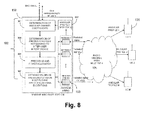
- Fig. 8 shown therein it is an exemplary embodiment where it is assumed that the base station 100 has complete knowledge of the downlink channel coefficients (e.g. in TDD mode, exploiting channel reciprocity).
- a base station 100 is willing to transmit a number M ' of data signals to M ' users 106 through a multipath radio channel 105.
- the base station 100 via the space-frequency processing technique 102 can perform angular profile detection 807 as well as determination of the angular channel coefficients, 803. New angular profiles not leading to inter-user interference are further obtained 804, and from them suitable precoding and power allocation strategies can be performed 805.
- orthogonal space-frequency division multiplexing 806 provides the antenna excitations to the antenna array 103 that delivers a total of M orthogonal beams and M' intended signals to the users 106, with ideally no inter-user interference and with maximized SNR.
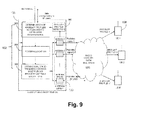
- Fig. 9 shown therein it is an exemplary embodiment where it is assumed that the base station 100 has no knowledge of the downlink channel coefficients (e.g. in FDD mode).
- the base station 100 is willing to transmit a number M' of signals to M ' users 106 through a wireless multipath channel 105.
- Analysis, via the space-frequency processing technique 102, of the uplink signals allows obtaining the angular profile characterizing the users 906, and with this information it is possible to determine new angular profiles not leading to inter-user interference, 903.
- Power allocation is then performed 904, and orthogonal space-frequency division multiplexing provides the antenna excitations 905 to the antenna array 103.
- Users 106 will receive their signals with no inter-user interference, although SNR cannot be maximized because of the absence of channel information at the transmit side.
- the invention can be implemented as a collection of software elements, hardware elements, firmware elements, or any suitable combinations of them. That is, the method according to the present invention is suitable for implementation with aid of processing means, such as computers and/or processors. Therefore, there is provided a computer program, comprising instructions arranged to cause the processing means, processor, or computer to perform the steps of any of the claims of the proposed methods.
- the computer program preferably comprises program code which is stored on a computer readable medium (not illustrated), which can be loaded and executed by a processing means, processor, or computer (not illustrated also) to cause it to perform the methods.
Landscapes
- Engineering & Computer Science (AREA)
- Signal Processing (AREA)
- Computer Networks & Wireless Communication (AREA)
- Mobile Radio Communication Systems (AREA)
- Radio Transmission System (AREA)
- Noise Elimination (AREA)
Priority Applications (3)
| Application Number | Priority Date | Filing Date | Title |
|---|---|---|---|
| EP14382559.4A EP3038270B1 (de) | 2014-12-23 | 2014-12-23 | Verfahren zur Durchführung von Mehrfachzugang bei drahtlosen zellularen OFDM-Systemen über drahtlose Mehrwegkanäle, die Raum und Frequenzbereiche berücksichtigen, Basisstation und Computerprogramme dafür |
| ES14382559.4T ES2643714T3 (es) | 2014-12-23 | 2014-12-23 | Método para realizar acceso múltiple en sistemas celulares de OFDM inalámbricos a través de canales inalámbricos multitrayectoria considerando tanto los dominios de espacio como de frecuencia, estación base y programas informáticos de los mismos |
| US14/978,623 US9425870B2 (en) | 2014-12-23 | 2015-12-22 | Method for performing multiple access in wireless OFDM cellular systems over multipath wireless channels considering both space and frequency domains, base station and computer programs thereof |
Applications Claiming Priority (1)
| Application Number | Priority Date | Filing Date | Title |
|---|---|---|---|
| EP14382559.4A EP3038270B1 (de) | 2014-12-23 | 2014-12-23 | Verfahren zur Durchführung von Mehrfachzugang bei drahtlosen zellularen OFDM-Systemen über drahtlose Mehrwegkanäle, die Raum und Frequenzbereiche berücksichtigen, Basisstation und Computerprogramme dafür |
Publications (2)
| Publication Number | Publication Date |
|---|---|
| EP3038270A1 true EP3038270A1 (de) | 2016-06-29 |
| EP3038270B1 EP3038270B1 (de) | 2017-07-19 |
Family
ID=52232068
Family Applications (1)
| Application Number | Title | Priority Date | Filing Date |
|---|---|---|---|
| EP14382559.4A Active EP3038270B1 (de) | 2014-12-23 | 2014-12-23 | Verfahren zur Durchführung von Mehrfachzugang bei drahtlosen zellularen OFDM-Systemen über drahtlose Mehrwegkanäle, die Raum und Frequenzbereiche berücksichtigen, Basisstation und Computerprogramme dafür |
Country Status (3)
| Country | Link |
|---|---|
| US (1) | US9425870B2 (de) |
| EP (1) | EP3038270B1 (de) |
| ES (1) | ES2643714T3 (de) |
Cited By (2)
| Publication number | Priority date | Publication date | Assignee | Title |
|---|---|---|---|---|
| EP3322104A1 (de) | 2016-11-14 | 2018-05-16 | Telefonica, S.A. | Verfahren, system und vorrichtung zur kompensation von doppler- beeinträchtigungen in ofdm-drahtloskommunikationsnetzwerken |
| WO2020143577A1 (zh) * | 2019-01-09 | 2020-07-16 | 华为技术有限公司 | 参数配置方法和通信装置 |
Families Citing this family (14)
| Publication number | Priority date | Publication date | Assignee | Title |
|---|---|---|---|---|
| JP6275340B2 (ja) * | 2015-07-09 | 2018-02-07 | 三菱電機株式会社 | 送信装置、受信装置、制御局および送信プレコーディング方法 |
| US10205491B2 (en) * | 2015-09-28 | 2019-02-12 | Futurewei Technologies, Inc. | System and method for large scale multiple input multiple output communications |
| US10743272B2 (en) * | 2016-02-16 | 2020-08-11 | Cable Television Laboratories, Inc. | Coordinated beamforming |
| EP3549275A1 (de) * | 2016-12-01 | 2019-10-09 | Telefonaktiebolaget LM Ericsson (PUBL) | Überlagert-codierte strahlformung |
| WO2019010714A1 (zh) * | 2017-07-14 | 2019-01-17 | 华为技术有限公司 | 一种波束成形方法及设备 |
| JP7043892B2 (ja) * | 2018-03-06 | 2022-03-30 | 日本電気株式会社 | 基地局 |
| CN114124170B (zh) * | 2018-04-08 | 2022-08-26 | 上海朗帛通信技术有限公司 | 一种被用于无线通信的用户设备、基站中的方法和装置 |
| US11362725B2 (en) | 2019-03-12 | 2022-06-14 | Telefonaktiebolaget Lm Ericsson (Publ) | Reshaping beams of a beam pattern |
| CN112751592B (zh) * | 2019-10-29 | 2021-11-19 | 华为技术有限公司 | 上报信道状态信息的方法和通信装置 |
| CN113067613B (zh) * | 2021-02-02 | 2022-11-08 | 上海大学 | 用于轨道交通物理层安全的基于天线选择的方向调制方法 |
| US11729582B2 (en) * | 2021-03-26 | 2023-08-15 | Qualcomm Incorporated | Measurement model based on uplink signals with reciprocity to downlink beam |
| CN113259941B (zh) * | 2021-05-12 | 2023-02-17 | 上海交通大学 | 基于反向散射波束成形的调节无线设备通信安全性的系统 |
| CN113346970B (zh) * | 2021-06-01 | 2022-10-18 | 上海科技大学 | 面向无线三维信道的用户级信道空域特征建模方法 |
| CN115296710B (zh) * | 2022-08-04 | 2024-06-14 | 哈尔滨工业大学 | 一种多路空域滤波的下行空分多址方法、存储介质及设备 |
Citations (1)
| Publication number | Priority date | Publication date | Assignee | Title |
|---|---|---|---|---|
| EP2806576A1 (de) * | 2013-05-21 | 2014-11-26 | Telefonica S.A. | Verfahren und System für mehrfachen Zugriff auf drahtlose zellulare OFDM-Systeme unter Berücksichtigung von Raum und Frequenzbereichen |
-
2014
- 2014-12-23 ES ES14382559.4T patent/ES2643714T3/es active Active
- 2014-12-23 EP EP14382559.4A patent/EP3038270B1/de active Active
-
2015
- 2015-12-22 US US14/978,623 patent/US9425870B2/en active Active
Patent Citations (1)
| Publication number | Priority date | Publication date | Assignee | Title |
|---|---|---|---|---|
| EP2806576A1 (de) * | 2013-05-21 | 2014-11-26 | Telefonica S.A. | Verfahren und System für mehrfachen Zugriff auf drahtlose zellulare OFDM-Systeme unter Berücksichtigung von Raum und Frequenzbereichen |
Non-Patent Citations (1)
| Title |
|---|
| HAN YU ET AL: "A joint SDMA and interference suppression multiuser transmission scheme for millimeter-wave massive MIMO systems", 2014 SIXTH INTERNATIONAL CONFERENCE ON WIRELESS COMMUNICATIONS AND SIGNAL PROCESSING (WCSP), IEEE, 23 October 2014 (2014-10-23), pages 1 - 5, XP032710784, DOI: 10.1109/WCSP.2014.6992074 * |
Cited By (6)
| Publication number | Priority date | Publication date | Assignee | Title |
|---|---|---|---|---|
| EP3322104A1 (de) | 2016-11-14 | 2018-05-16 | Telefonica, S.A. | Verfahren, system und vorrichtung zur kompensation von doppler- beeinträchtigungen in ofdm-drahtloskommunikationsnetzwerken |
| US10284280B2 (en) | 2016-11-14 | 2019-05-07 | Telefonica, S.A. | Method, system and device for compensation of Doppler impairments in OFDM wireless communication networks |
| WO2020143577A1 (zh) * | 2019-01-09 | 2020-07-16 | 华为技术有限公司 | 参数配置方法和通信装置 |
| CN111431679A (zh) * | 2019-01-09 | 2020-07-17 | 华为技术有限公司 | 参数配置方法和通信装置 |
| CN111431679B (zh) * | 2019-01-09 | 2024-04-12 | 华为技术有限公司 | 参数配置方法和通信装置 |
| US12267829B2 (en) | 2019-01-09 | 2025-04-01 | Huawei Technologies Co., Ltd. | Parameter configuration method and communications apparatus |
Also Published As
| Publication number | Publication date |
|---|---|
| ES2643714T3 (es) | 2017-11-24 |
| US9425870B2 (en) | 2016-08-23 |
| US20160182196A1 (en) | 2016-06-23 |
| EP3038270B1 (de) | 2017-07-19 |
Similar Documents
| Publication | Publication Date | Title |
|---|---|---|
| EP3038270B1 (de) | Verfahren zur Durchführung von Mehrfachzugang bei drahtlosen zellularen OFDM-Systemen über drahtlose Mehrwegkanäle, die Raum und Frequenzbereiche berücksichtigen, Basisstation und Computerprogramme dafür | |
| Hu et al. | Semi-passive elements assisted channel estimation for intelligent reflecting surface-aided communications | |
| Temiz et al. | A dual-functional massive MIMO OFDM communication and radar transmitter architecture | |
| EP2806576B1 (de) | Verfahren und System für mehrfachen Zugriff auf drahtlose zellulare OFDM-Systeme unter Berücksichtigung von Raum und Frequenzbereichen | |
| EP3221994B1 (de) | Verfahren und vorrichtung für übertragung und empfang eines referenzsignals | |
| US10020853B2 (en) | Method and system for processing downlink pilot signal | |
| WO2018107951A1 (zh) | 多天线设备的信道接入方法及装置 | |
| CN103731923B (zh) | 多用户调度方法和设备 | |
| CN107615856A (zh) | 用于多级波束成形的非正交多址通信的系统和方法 | |
| CN105577587A (zh) | 一种60GHz室内场景下MIMO系统信道估计方法及装置 | |
| CN101282151B (zh) | 一种ofdma系统中利用mimo预编码码书进行时频资源动态分配的机制 | |
| Li et al. | Channel estimation for reconfigurable-intelligent-surface-aided multiuser communication systems exploiting statistical CSI of correlated RIS–user channels | |
| Fan et al. | Power allocation for cell-free massive MIMO ISAC systems with OTFS signal | |
| JP2022062270A (ja) | 無線通信ネットワークにおける鏡面反射コンポーネントの推定 | |
| Li et al. | Directional training and fast sector-based processing schemes for mmwave channels | |
| KR20120011952A (ko) | 다중안테나 시스템에서 다중 섹터 협력 전송을 위한 송신 빔포밍과 다중 사용자 스케줄링 방법 및 장치 | |
| CN102457324B (zh) | 一种频分双工系统下行多用户多径波束赋形方法及装置 | |
| EP3035620B1 (de) | Verfahren und Vorrichtung zur Verringerung der Pilotleistungsverunreinigung in großen skalierbaren Antennensystemen | |
| US10236958B2 (en) | Method for signal transmission to multiple user equipments utilizing reciprocity of wireless channel | |
| CN109120321B (zh) | 一种波束赋形的方法、装置、基站及计算机可读存储介质 | |
| Gao et al. | Random pilot and data access for massive MIMO spatially correlated Rayleigh fading channels | |
| Tang et al. | Beamforming designs for multiuser transmissions in FDD massive MIMO systems using partial CSIT | |
| Tang et al. | Beam-Time Block Coding With Joint User Grouping and Beamforming for FDD Massive MIMO Systems | |
| Figueiredo et al. | Transmit diversity vs beamforming for multi-user OFDM systems | |
| Chalise et al. | A multiuser MIMO transmit beamformer based on the statistics of the signal-to-leakage ratio |
Legal Events
| Date | Code | Title | Description |
|---|---|---|---|
| PUAI | Public reference made under article 153(3) epc to a published international application that has entered the european phase |
Free format text: ORIGINAL CODE: 0009012 |
|
| AK | Designated contracting states |
Kind code of ref document: A1 Designated state(s): AL AT BE BG CH CY CZ DE DK EE ES FI FR GB GR HR HU IE IS IT LI LT LU LV MC MK MT NL NO PL PT RO RS SE SI SK SM TR |
|
| AX | Request for extension of the european patent |
Extension state: BA ME |
|
| STAA | Information on the status of an ep patent application or granted ep patent |
Free format text: STATUS: REQUEST FOR EXAMINATION WAS MADE |
|
| 17P | Request for examination filed |
Effective date: 20161219 |
|
| RBV | Designated contracting states (corrected) |
Designated state(s): AL AT BE BG CH CY CZ DE DK EE ES FI FR GB GR HR HU IE IS IT LI LT LU LV MC MK MT NL NO PL PT RO RS SE SI SK SM TR |
|
| GRAP | Despatch of communication of intention to grant a patent |
Free format text: ORIGINAL CODE: EPIDOSNIGR1 |
|
| STAA | Information on the status of an ep patent application or granted ep patent |
Free format text: STATUS: GRANT OF PATENT IS INTENDED |
|
| RAP1 | Party data changed (applicant data changed or rights of an application transferred) |
Owner name: TELEFONICA, S.A. |
|
| INTG | Intention to grant announced |
Effective date: 20170306 |
|
| GRAS | Grant fee paid |
Free format text: ORIGINAL CODE: EPIDOSNIGR3 |
|
| GRAA | (expected) grant |
Free format text: ORIGINAL CODE: 0009210 |
|
| STAA | Information on the status of an ep patent application or granted ep patent |
Free format text: STATUS: THE PATENT HAS BEEN GRANTED |
|
| AK | Designated contracting states |
Kind code of ref document: B1 Designated state(s): AL AT BE BG CH CY CZ DE DK EE ES FI FR GB GR HR HU IE IS IT LI LT LU LV MC MK MT NL NO PL PT RO RS SE SI SK SM TR |
|
| REG | Reference to a national code |
Ref country code: GB Ref legal event code: FG4D |
|
| REG | Reference to a national code |
Ref country code: CH Ref legal event code: EP |
|
| REG | Reference to a national code |
Ref country code: IE Ref legal event code: FG4D |
|
| REG | Reference to a national code |
Ref country code: AT Ref legal event code: REF Ref document number: 911327 Country of ref document: AT Kind code of ref document: T Effective date: 20170815 |
|
| REG | Reference to a national code |
Ref country code: DE Ref legal event code: R096 Ref document number: 602014011938 Country of ref document: DE |
|
| REG | Reference to a national code |
Ref country code: NL Ref legal event code: MP Effective date: 20170719 |
|
| REG | Reference to a national code |
Ref country code: ES Ref legal event code: FG2A Ref document number: 2643714 Country of ref document: ES Kind code of ref document: T3 Effective date: 20171124 |
|
| REG | Reference to a national code |
Ref country code: LT Ref legal event code: MG4D |
|
| REG | Reference to a national code |
Ref country code: AT Ref legal event code: MK05 Ref document number: 911327 Country of ref document: AT Kind code of ref document: T Effective date: 20170719 |
|
| PG25 | Lapsed in a contracting state [announced via postgrant information from national office to epo] |
Ref country code: NO Free format text: LAPSE BECAUSE OF FAILURE TO SUBMIT A TRANSLATION OF THE DESCRIPTION OR TO PAY THE FEE WITHIN THE PRESCRIBED TIME-LIMIT Effective date: 20171019 Ref country code: LT Free format text: LAPSE BECAUSE OF FAILURE TO SUBMIT A TRANSLATION OF THE DESCRIPTION OR TO PAY THE FEE WITHIN THE PRESCRIBED TIME-LIMIT Effective date: 20170719 Ref country code: FI Free format text: LAPSE BECAUSE OF FAILURE TO SUBMIT A TRANSLATION OF THE DESCRIPTION OR TO PAY THE FEE WITHIN THE PRESCRIBED TIME-LIMIT Effective date: 20170719 Ref country code: AT Free format text: LAPSE BECAUSE OF FAILURE TO SUBMIT A TRANSLATION OF THE DESCRIPTION OR TO PAY THE FEE WITHIN THE PRESCRIBED TIME-LIMIT Effective date: 20170719 Ref country code: HR Free format text: LAPSE BECAUSE OF FAILURE TO SUBMIT A TRANSLATION OF THE DESCRIPTION OR TO PAY THE FEE WITHIN THE PRESCRIBED TIME-LIMIT Effective date: 20170719 Ref country code: SE Free format text: LAPSE BECAUSE OF FAILURE TO SUBMIT A TRANSLATION OF THE DESCRIPTION OR TO PAY THE FEE WITHIN THE PRESCRIBED TIME-LIMIT Effective date: 20170719 Ref country code: NL Free format text: LAPSE BECAUSE OF FAILURE TO SUBMIT A TRANSLATION OF THE DESCRIPTION OR TO PAY THE FEE WITHIN THE PRESCRIBED TIME-LIMIT Effective date: 20170719 |
|
| PG25 | Lapsed in a contracting state [announced via postgrant information from national office to epo] |
Ref country code: PL Free format text: LAPSE BECAUSE OF FAILURE TO SUBMIT A TRANSLATION OF THE DESCRIPTION OR TO PAY THE FEE WITHIN THE PRESCRIBED TIME-LIMIT Effective date: 20170719 Ref country code: GR Free format text: LAPSE BECAUSE OF FAILURE TO SUBMIT A TRANSLATION OF THE DESCRIPTION OR TO PAY THE FEE WITHIN THE PRESCRIBED TIME-LIMIT Effective date: 20171020 Ref country code: BG Free format text: LAPSE BECAUSE OF FAILURE TO SUBMIT A TRANSLATION OF THE DESCRIPTION OR TO PAY THE FEE WITHIN THE PRESCRIBED TIME-LIMIT Effective date: 20171019 Ref country code: IS Free format text: LAPSE BECAUSE OF FAILURE TO SUBMIT A TRANSLATION OF THE DESCRIPTION OR TO PAY THE FEE WITHIN THE PRESCRIBED TIME-LIMIT Effective date: 20171119 Ref country code: LV Free format text: LAPSE BECAUSE OF FAILURE TO SUBMIT A TRANSLATION OF THE DESCRIPTION OR TO PAY THE FEE WITHIN THE PRESCRIBED TIME-LIMIT Effective date: 20170719 Ref country code: RS Free format text: LAPSE BECAUSE OF FAILURE TO SUBMIT A TRANSLATION OF THE DESCRIPTION OR TO PAY THE FEE WITHIN THE PRESCRIBED TIME-LIMIT Effective date: 20170719 |
|
| REG | Reference to a national code |
Ref country code: DE Ref legal event code: R097 Ref document number: 602014011938 Country of ref document: DE |
|
| PG25 | Lapsed in a contracting state [announced via postgrant information from national office to epo] |
Ref country code: CZ Free format text: LAPSE BECAUSE OF FAILURE TO SUBMIT A TRANSLATION OF THE DESCRIPTION OR TO PAY THE FEE WITHIN THE PRESCRIBED TIME-LIMIT Effective date: 20170719 Ref country code: DK Free format text: LAPSE BECAUSE OF FAILURE TO SUBMIT A TRANSLATION OF THE DESCRIPTION OR TO PAY THE FEE WITHIN THE PRESCRIBED TIME-LIMIT Effective date: 20170719 Ref country code: RO Free format text: LAPSE BECAUSE OF FAILURE TO SUBMIT A TRANSLATION OF THE DESCRIPTION OR TO PAY THE FEE WITHIN THE PRESCRIBED TIME-LIMIT Effective date: 20170719 |
|
| PLBE | No opposition filed within time limit |
Free format text: ORIGINAL CODE: 0009261 |
|
| STAA | Information on the status of an ep patent application or granted ep patent |
Free format text: STATUS: NO OPPOSITION FILED WITHIN TIME LIMIT |
|
| PG25 | Lapsed in a contracting state [announced via postgrant information from national office to epo] |
Ref country code: SK Free format text: LAPSE BECAUSE OF FAILURE TO SUBMIT A TRANSLATION OF THE DESCRIPTION OR TO PAY THE FEE WITHIN THE PRESCRIBED TIME-LIMIT Effective date: 20170719 Ref country code: EE Free format text: LAPSE BECAUSE OF FAILURE TO SUBMIT A TRANSLATION OF THE DESCRIPTION OR TO PAY THE FEE WITHIN THE PRESCRIBED TIME-LIMIT Effective date: 20170719 Ref country code: IT Free format text: LAPSE BECAUSE OF FAILURE TO SUBMIT A TRANSLATION OF THE DESCRIPTION OR TO PAY THE FEE WITHIN THE PRESCRIBED TIME-LIMIT Effective date: 20170719 Ref country code: SM Free format text: LAPSE BECAUSE OF FAILURE TO SUBMIT A TRANSLATION OF THE DESCRIPTION OR TO PAY THE FEE WITHIN THE PRESCRIBED TIME-LIMIT Effective date: 20170719 |
|
| 26N | No opposition filed |
Effective date: 20180420 |
|
| REG | Reference to a national code |
Ref country code: CH Ref legal event code: PL |
|
| PG25 | Lapsed in a contracting state [announced via postgrant information from national office to epo] |
Ref country code: SI Free format text: LAPSE BECAUSE OF FAILURE TO SUBMIT A TRANSLATION OF THE DESCRIPTION OR TO PAY THE FEE WITHIN THE PRESCRIBED TIME-LIMIT Effective date: 20170719 |
|
| REG | Reference to a national code |
Ref country code: IE Ref legal event code: MM4A |
|
| PG25 | Lapsed in a contracting state [announced via postgrant information from national office to epo] |
Ref country code: LU Free format text: LAPSE BECAUSE OF NON-PAYMENT OF DUE FEES Effective date: 20171223 Ref country code: MT Free format text: LAPSE BECAUSE OF NON-PAYMENT OF DUE FEES Effective date: 20171223 |
|
| REG | Reference to a national code |
Ref country code: FR Ref legal event code: ST Effective date: 20180831 |
|
| REG | Reference to a national code |
Ref country code: BE Ref legal event code: MM Effective date: 20171231 |
|
| PG25 | Lapsed in a contracting state [announced via postgrant information from national office to epo] |
Ref country code: FR Free format text: LAPSE BECAUSE OF NON-PAYMENT OF DUE FEES Effective date: 20180102 Ref country code: IE Free format text: LAPSE BECAUSE OF NON-PAYMENT OF DUE FEES Effective date: 20171223 |
|
| PG25 | Lapsed in a contracting state [announced via postgrant information from national office to epo] |
Ref country code: CH Free format text: LAPSE BECAUSE OF NON-PAYMENT OF DUE FEES Effective date: 20171231 Ref country code: LI Free format text: LAPSE BECAUSE OF NON-PAYMENT OF DUE FEES Effective date: 20171231 Ref country code: BE Free format text: LAPSE BECAUSE OF NON-PAYMENT OF DUE FEES Effective date: 20171231 |
|
| PG25 | Lapsed in a contracting state [announced via postgrant information from national office to epo] |
Ref country code: MC Free format text: LAPSE BECAUSE OF FAILURE TO SUBMIT A TRANSLATION OF THE DESCRIPTION OR TO PAY THE FEE WITHIN THE PRESCRIBED TIME-LIMIT Effective date: 20170719 Ref country code: HU Free format text: LAPSE BECAUSE OF FAILURE TO SUBMIT A TRANSLATION OF THE DESCRIPTION OR TO PAY THE FEE WITHIN THE PRESCRIBED TIME-LIMIT; INVALID AB INITIO Effective date: 20141223 |
|
| PG25 | Lapsed in a contracting state [announced via postgrant information from national office to epo] |
Ref country code: CY Free format text: LAPSE BECAUSE OF FAILURE TO SUBMIT A TRANSLATION OF THE DESCRIPTION OR TO PAY THE FEE WITHIN THE PRESCRIBED TIME-LIMIT Effective date: 20170719 |
|
| PG25 | Lapsed in a contracting state [announced via postgrant information from national office to epo] |
Ref country code: MK Free format text: LAPSE BECAUSE OF FAILURE TO SUBMIT A TRANSLATION OF THE DESCRIPTION OR TO PAY THE FEE WITHIN THE PRESCRIBED TIME-LIMIT Effective date: 20170719 |
|
| PG25 | Lapsed in a contracting state [announced via postgrant information from national office to epo] |
Ref country code: TR Free format text: LAPSE BECAUSE OF FAILURE TO SUBMIT A TRANSLATION OF THE DESCRIPTION OR TO PAY THE FEE WITHIN THE PRESCRIBED TIME-LIMIT Effective date: 20170719 |
|
| PG25 | Lapsed in a contracting state [announced via postgrant information from national office to epo] |
Ref country code: PT Free format text: LAPSE BECAUSE OF FAILURE TO SUBMIT A TRANSLATION OF THE DESCRIPTION OR TO PAY THE FEE WITHIN THE PRESCRIBED TIME-LIMIT Effective date: 20170719 |
|
| PG25 | Lapsed in a contracting state [announced via postgrant information from national office to epo] |
Ref country code: AL Free format text: LAPSE BECAUSE OF FAILURE TO SUBMIT A TRANSLATION OF THE DESCRIPTION OR TO PAY THE FEE WITHIN THE PRESCRIBED TIME-LIMIT Effective date: 20170719 |
|
| PGFP | Annual fee paid to national office [announced via postgrant information from national office to epo] |
Ref country code: GB Payment date: 20251229 Year of fee payment: 12 |
|
| PGFP | Annual fee paid to national office [announced via postgrant information from national office to epo] |
Ref country code: ES Payment date: 20260108 Year of fee payment: 12 |
|
| PGFP | Annual fee paid to national office [announced via postgrant information from national office to epo] |
Ref country code: DE Payment date: 20251229 Year of fee payment: 12 |