EP3040367A1 - Procédé de fabrication d'un article moulé insoluble dans l'eau et article moulé insoluble dans l'eau - Google Patents
Procédé de fabrication d'un article moulé insoluble dans l'eau et article moulé insoluble dans l'eau Download PDFInfo
- Publication number
- EP3040367A1 EP3040367A1 EP14840937.8A EP14840937A EP3040367A1 EP 3040367 A1 EP3040367 A1 EP 3040367A1 EP 14840937 A EP14840937 A EP 14840937A EP 3040367 A1 EP3040367 A1 EP 3040367A1
- Authority
- EP
- European Patent Office
- Prior art keywords
- water
- shaped material
- insoluble
- insoluble shaped
- anhydride
- Prior art date
- Legal status (The legal status is an assumption and is not a legal conclusion. Google has not performed a legal analysis and makes no representation as to the accuracy of the status listed.)
- Ceased
Links
Images

Classifications
-
- A—HUMAN NECESSITIES
- A61—MEDICAL OR VETERINARY SCIENCE; HYGIENE
- A61L—METHODS OR APPARATUS FOR STERILISING MATERIALS OR OBJECTS IN GENERAL; DISINFECTION, STERILISATION OR DEODORISATION OF AIR; CHEMICAL ASPECTS OF BANDAGES, DRESSINGS, ABSORBENT PADS OR SURGICAL ARTICLES; MATERIALS FOR BANDAGES, DRESSINGS, ABSORBENT PADS OR SURGICAL ARTICLES
- A61L27/00—Materials for grafts or prostheses or for coating grafts or prostheses
- A61L27/14—Macromolecular materials
- A61L27/20—Polysaccharides
-
- C—CHEMISTRY; METALLURGY
- C08—ORGANIC MACROMOLECULAR COMPOUNDS; THEIR PREPARATION OR CHEMICAL WORKING-UP; COMPOSITIONS BASED THEREON
- C08J—WORKING-UP; GENERAL PROCESSES OF COMPOUNDING; AFTER-TREATMENT NOT COVERED BY SUBCLASSES C08B, C08C, C08F, C08G or C08H
- C08J7/00—Chemical treatment or coating of shaped articles made of macromolecular substances
- C08J7/12—Chemical modification
- C08J7/14—Chemical modification with acids, their salts or anhydrides
-
- A—HUMAN NECESSITIES
- A61—MEDICAL OR VETERINARY SCIENCE; HYGIENE
- A61K—PREPARATIONS FOR MEDICAL, DENTAL OR TOILETRY PURPOSES
- A61K47/00—Medicinal preparations characterised by the non-active ingredients used, e.g. carriers or inert additives; Targeting or modifying agents chemically bound to the active ingredient
- A61K47/30—Macromolecular organic or inorganic compounds, e.g. inorganic polyphosphates
- A61K47/36—Polysaccharides; Derivatives thereof, e.g. gums, starch, alginate, dextrin, hyaluronic acid, chitosan, inulin, agar or pectin
-
- A—HUMAN NECESSITIES
- A61—MEDICAL OR VETERINARY SCIENCE; HYGIENE
- A61L—METHODS OR APPARATUS FOR STERILISING MATERIALS OR OBJECTS IN GENERAL; DISINFECTION, STERILISATION OR DEODORISATION OF AIR; CHEMICAL ASPECTS OF BANDAGES, DRESSINGS, ABSORBENT PADS OR SURGICAL ARTICLES; MATERIALS FOR BANDAGES, DRESSINGS, ABSORBENT PADS OR SURGICAL ARTICLES
- A61L27/00—Materials for grafts or prostheses or for coating grafts or prostheses
- A61L27/50—Materials characterised by their function or physical properties, e.g. injectable or lubricating compositions, shape-memory materials, surface modified materials
-
- A—HUMAN NECESSITIES
- A61—MEDICAL OR VETERINARY SCIENCE; HYGIENE
- A61L—METHODS OR APPARATUS FOR STERILISING MATERIALS OR OBJECTS IN GENERAL; DISINFECTION, STERILISATION OR DEODORISATION OF AIR; CHEMICAL ASPECTS OF BANDAGES, DRESSINGS, ABSORBENT PADS OR SURGICAL ARTICLES; MATERIALS FOR BANDAGES, DRESSINGS, ABSORBENT PADS OR SURGICAL ARTICLES
- A61L27/00—Materials for grafts or prostheses or for coating grafts or prostheses
- A61L27/50—Materials characterised by their function or physical properties, e.g. injectable or lubricating compositions, shape-memory materials, surface modified materials
- A61L27/54—Biologically active materials, e.g. therapeutic substances
-
- A—HUMAN NECESSITIES
- A61—MEDICAL OR VETERINARY SCIENCE; HYGIENE
- A61L—METHODS OR APPARATUS FOR STERILISING MATERIALS OR OBJECTS IN GENERAL; DISINFECTION, STERILISATION OR DEODORISATION OF AIR; CHEMICAL ASPECTS OF BANDAGES, DRESSINGS, ABSORBENT PADS OR SURGICAL ARTICLES; MATERIALS FOR BANDAGES, DRESSINGS, ABSORBENT PADS OR SURGICAL ARTICLES
- A61L31/00—Materials for other surgical articles, e.g. stents, stent-grafts, shunts, surgical drapes, guide wires, materials for adhesion prevention, occluding devices, surgical gloves, tissue fixation devices
- A61L31/04—Macromolecular materials
- A61L31/042—Polysaccharides
-
- A—HUMAN NECESSITIES
- A61—MEDICAL OR VETERINARY SCIENCE; HYGIENE
- A61L—METHODS OR APPARATUS FOR STERILISING MATERIALS OR OBJECTS IN GENERAL; DISINFECTION, STERILISATION OR DEODORISATION OF AIR; CHEMICAL ASPECTS OF BANDAGES, DRESSINGS, ABSORBENT PADS OR SURGICAL ARTICLES; MATERIALS FOR BANDAGES, DRESSINGS, ABSORBENT PADS OR SURGICAL ARTICLES
- A61L31/00—Materials for other surgical articles, e.g. stents, stent-grafts, shunts, surgical drapes, guide wires, materials for adhesion prevention, occluding devices, surgical gloves, tissue fixation devices
- A61L31/14—Materials characterised by their function or physical properties, e.g. injectable or lubricating compositions, shape-memory materials, surface modified materials
- A61L31/16—Biologically active materials, e.g. therapeutic substances
-
- A—HUMAN NECESSITIES
- A61—MEDICAL OR VETERINARY SCIENCE; HYGIENE
- A61P—SPECIFIC THERAPEUTIC ACTIVITY OF CHEMICAL COMPOUNDS OR MEDICINAL PREPARATIONS
- A61P19/00—Drugs for skeletal disorders
- A61P19/02—Drugs for skeletal disorders for joint disorders, e.g. arthritis, arthrosis
-
- A—HUMAN NECESSITIES
- A61—MEDICAL OR VETERINARY SCIENCE; HYGIENE
- A61P—SPECIFIC THERAPEUTIC ACTIVITY OF CHEMICAL COMPOUNDS OR MEDICINAL PREPARATIONS
- A61P41/00—Drugs used in surgical methods, e.g. surgery adjuvants for preventing adhesion or for vitreum substitution
-
- C—CHEMISTRY; METALLURGY
- C08—ORGANIC MACROMOLECULAR COMPOUNDS; THEIR PREPARATION OR CHEMICAL WORKING-UP; COMPOSITIONS BASED THEREON
- C08J—WORKING-UP; GENERAL PROCESSES OF COMPOUNDING; AFTER-TREATMENT NOT COVERED BY SUBCLASSES C08B, C08C, C08F, C08G or C08H
- C08J5/00—Manufacture of articles or shaped materials containing macromolecular substances
- C08J5/18—Manufacture of films or sheets
-
- C—CHEMISTRY; METALLURGY
- C08—ORGANIC MACROMOLECULAR COMPOUNDS; THEIR PREPARATION OR CHEMICAL WORKING-UP; COMPOSITIONS BASED THEREON
- C08L—COMPOSITIONS OF MACROMOLECULAR COMPOUNDS
- C08L1/00—Compositions of cellulose, modified cellulose or cellulose derivatives
-
- A—HUMAN NECESSITIES
- A61—MEDICAL OR VETERINARY SCIENCE; HYGIENE
- A61K—PREPARATIONS FOR MEDICAL, DENTAL OR TOILETRY PURPOSES
- A61K8/00—Cosmetics or similar toiletry preparations
- A61K8/18—Cosmetics or similar toiletry preparations characterised by the composition
- A61K8/72—Cosmetics or similar toiletry preparations characterised by the composition containing organic macromolecular compounds
- A61K8/73—Polysaccharides
- A61K8/733—Alginic acid; Salts thereof
-
- A—HUMAN NECESSITIES
- A61—MEDICAL OR VETERINARY SCIENCE; HYGIENE
- A61K—PREPARATIONS FOR MEDICAL, DENTAL OR TOILETRY PURPOSES
- A61K8/00—Cosmetics or similar toiletry preparations
- A61K8/18—Cosmetics or similar toiletry preparations characterised by the composition
- A61K8/72—Cosmetics or similar toiletry preparations characterised by the composition containing organic macromolecular compounds
- A61K8/73—Polysaccharides
- A61K8/735—Mucopolysaccharides, e.g. hyaluronic acid; Derivatives thereof
-
- A—HUMAN NECESSITIES
- A61—MEDICAL OR VETERINARY SCIENCE; HYGIENE
- A61K—PREPARATIONS FOR MEDICAL, DENTAL OR TOILETRY PURPOSES
- A61K8/00—Cosmetics or similar toiletry preparations
- A61K8/18—Cosmetics or similar toiletry preparations characterised by the composition
- A61K8/72—Cosmetics or similar toiletry preparations characterised by the composition containing organic macromolecular compounds
- A61K8/73—Polysaccharides
- A61K8/736—Chitin; Chitosan; Derivatives thereof
-
- A—HUMAN NECESSITIES
- A61—MEDICAL OR VETERINARY SCIENCE; HYGIENE
- A61L—METHODS OR APPARATUS FOR STERILISING MATERIALS OR OBJECTS IN GENERAL; DISINFECTION, STERILISATION OR DEODORISATION OF AIR; CHEMICAL ASPECTS OF BANDAGES, DRESSINGS, ABSORBENT PADS OR SURGICAL ARTICLES; MATERIALS FOR BANDAGES, DRESSINGS, ABSORBENT PADS OR SURGICAL ARTICLES
- A61L2300/00—Biologically active materials used in bandages, wound dressings, absorbent pads or medical devices
- A61L2300/60—Biologically active materials used in bandages, wound dressings, absorbent pads or medical devices characterised by a special physical form
- A61L2300/602—Type of release, e.g. controlled, sustained, slow
-
- C—CHEMISTRY; METALLURGY
- C08—ORGANIC MACROMOLECULAR COMPOUNDS; THEIR PREPARATION OR CHEMICAL WORKING-UP; COMPOSITIONS BASED THEREON
- C08J—WORKING-UP; GENERAL PROCESSES OF COMPOUNDING; AFTER-TREATMENT NOT COVERED BY SUBCLASSES C08B, C08C, C08F, C08G or C08H
- C08J2301/00—Characterised by the use of cellulose, modified cellulose or cellulose derivatives
- C08J2301/08—Cellulose derivatives
- C08J2301/26—Cellulose ethers
-
- C—CHEMISTRY; METALLURGY
- C08—ORGANIC MACROMOLECULAR COMPOUNDS; THEIR PREPARATION OR CHEMICAL WORKING-UP; COMPOSITIONS BASED THEREON
- C08J—WORKING-UP; GENERAL PROCESSES OF COMPOUNDING; AFTER-TREATMENT NOT COVERED BY SUBCLASSES C08B, C08C, C08F, C08G or C08H
- C08J2305/00—Characterised by the use of polysaccharides or of their derivatives not provided for in groups C08J2301/00 or C08J2303/00
- C08J2305/04—Alginic acid; Derivatives thereof
-
- C—CHEMISTRY; METALLURGY
- C08—ORGANIC MACROMOLECULAR COMPOUNDS; THEIR PREPARATION OR CHEMICAL WORKING-UP; COMPOSITIONS BASED THEREON
- C08J—WORKING-UP; GENERAL PROCESSES OF COMPOUNDING; AFTER-TREATMENT NOT COVERED BY SUBCLASSES C08B, C08C, C08F, C08G or C08H
- C08J2305/00—Characterised by the use of polysaccharides or of their derivatives not provided for in groups C08J2301/00 or C08J2303/00
- C08J2305/06—Pectin; Derivatives thereof
-
- C—CHEMISTRY; METALLURGY
- C08—ORGANIC MACROMOLECULAR COMPOUNDS; THEIR PREPARATION OR CHEMICAL WORKING-UP; COMPOSITIONS BASED THEREON
- C08J—WORKING-UP; GENERAL PROCESSES OF COMPOUNDING; AFTER-TREATMENT NOT COVERED BY SUBCLASSES C08B, C08C, C08F, C08G or C08H
- C08J2305/00—Characterised by the use of polysaccharides or of their derivatives not provided for in groups C08J2301/00 or C08J2303/00
- C08J2305/08—Chitin; Chondroitin sulfate; Hyaluronic acid; Derivatives thereof
-
- C—CHEMISTRY; METALLURGY
- C08—ORGANIC MACROMOLECULAR COMPOUNDS; THEIR PREPARATION OR CHEMICAL WORKING-UP; COMPOSITIONS BASED THEREON
- C08J—WORKING-UP; GENERAL PROCESSES OF COMPOUNDING; AFTER-TREATMENT NOT COVERED BY SUBCLASSES C08B, C08C, C08F, C08G or C08H
- C08J2305/00—Characterised by the use of polysaccharides or of their derivatives not provided for in groups C08J2301/00 or C08J2303/00
- C08J2305/10—Heparin; Derivatives thereof
-
- C—CHEMISTRY; METALLURGY
- C08—ORGANIC MACROMOLECULAR COMPOUNDS; THEIR PREPARATION OR CHEMICAL WORKING-UP; COMPOSITIONS BASED THEREON
- C08L—COMPOSITIONS OF MACROMOLECULAR COMPOUNDS
- C08L5/00—Compositions of polysaccharides or of their derivatives not provided for in groups C08L1/00 or C08L3/00
- C08L5/04—Alginic acid; Derivatives thereof
-
- C—CHEMISTRY; METALLURGY
- C08—ORGANIC MACROMOLECULAR COMPOUNDS; THEIR PREPARATION OR CHEMICAL WORKING-UP; COMPOSITIONS BASED THEREON
- C08L—COMPOSITIONS OF MACROMOLECULAR COMPOUNDS
- C08L5/00—Compositions of polysaccharides or of their derivatives not provided for in groups C08L1/00 or C08L3/00
- C08L5/06—Pectin; Derivatives thereof
-
- C—CHEMISTRY; METALLURGY
- C08—ORGANIC MACROMOLECULAR COMPOUNDS; THEIR PREPARATION OR CHEMICAL WORKING-UP; COMPOSITIONS BASED THEREON
- C08L—COMPOSITIONS OF MACROMOLECULAR COMPOUNDS
- C08L5/00—Compositions of polysaccharides or of their derivatives not provided for in groups C08L1/00 or C08L3/00
- C08L5/08—Chitin; Chondroitin sulfate; Hyaluronic acid; Derivatives thereof
-
- C—CHEMISTRY; METALLURGY
- C08—ORGANIC MACROMOLECULAR COMPOUNDS; THEIR PREPARATION OR CHEMICAL WORKING-UP; COMPOSITIONS BASED THEREON
- C08L—COMPOSITIONS OF MACROMOLECULAR COMPOUNDS
- C08L5/00—Compositions of polysaccharides or of their derivatives not provided for in groups C08L1/00 or C08L3/00
- C08L5/10—Heparin; Derivatives thereof
Definitions
- the present invention relates to a process for producing a water-insoluble shaped material, and also relates to a water-insoluble shaped material, an adhesion inhibitor, an injection material, and a sustained release preparation.
- polyanionic polysaccharides such as hyaluronic acid and alginic acid exhibit moderate viscosity, adhesiveness, moisture-retaining properties, and biocompatibility. These polyanionic polysaccharides and salts thereof are therefore widely used as a raw material for medical materials, food materials, cosmetic materials, and the like.
- hyaluronic acid has excellent characteristic properties such as moisture-retaining properties, also has high safety and biocompatibility, and therefore is utilized for various applications such as foods, cosmetics, and pharmaceuticals.
- hyaluronic acid is utilized for a raw material or the like of lubricants for joints, adhesion inhibitors, etc.
- sodium hyaluronate being a raw material has a high water-solubility, and thus insolubilizing treatment of some sort has to be applied to sodium hyaluronate depending on the application.
- Patent Literature 1 a process for producing a water-insoluble derivative of a polyanionic polysaccharide such as hyaluronic acid and carboxymethylcellulose through crosslinking reaction using a carbodiimide is described.
- Patent Literatures 2 and 3 a process for insolubilizing in water a polyanionic polysaccharide such as hyaluronic acid and a carboxyalkylcellulose by forming ionic bonds using a polyvalent cation is described. Further, in Patent Literature 4, a process for obtaining a water-insolubilized film by subjecting carboxymethylcellulose to ion exchange using a metal salt is described.
- Patent Literature 5 a process for insolubilizing sodium hyaluronate in water by cooling a sodium hyaluronate aqueous solution at -20°C under an acidic condition to form intramolecular crosslinks is described. Moreover, in Patent Literature 6, acetylation of hyaluronic acid performed by reacting a hyaluronic acid in a powder form with acetic anhydride in the presence of concentrated sulfuric acid is described, and further, in Patent Literature 7, a process for producing hyaluronic acid gel using an acidic liquid containing an alcohol is described.
- Patent Literature 1 since a crosslinking agent is used in the process described in Patent Literature 1, it is difficult to apply the process in many cases when safety has to be taken into account, such as applications where pharmaceuticals are administered to human bodies. Moreover, the extent of water-insolubility of the obtained films and the like is not described at all in Patent Literatures 2 to 4.
- Patent Literature 5 requires that the pH of the sodium hyaluronate aqueous solution be adjusted so as to be about 1.2, and remarkably increases the viscosity, making it difficult to handle the sodium hyaluronate aqueous solution during molding or the like. Moreover, freeze drying for a long period of time is required, and therefore the process has also a problem in terms of cost of electric power for cooling. Furthermore, when the sodium hyaluronate aqueous solution is placed under an acidic condition, the viscosity rapidly increases to make it difficult to perform molding, and therefore the application is limited in some cases. It is to be noted that, in Patent Literature 5, an intramolecular crosslinked structure is confirmed but the extent of insolubilization is not referred to.
- Patent Literature 6 the extent of water-insolubility of the obtained acetylation product of hyaluronic acid is not described at all. Further, the hyaluronic acid gel obtained by the process described in Patent Literature 7 contains a large amount of water, making it difficult to lift the gel. Thus, it is difficult to complete insolubilization while maintaining the shape of a shaped material.
- the present invention has been made in consideration of the problems of such conventional technologies, and the subject of the present invention is to provide a process for simply producing a water-insoluble shaped material in which intrinsic characteristics of the polyanionic polysaccharide being a raw material are retained, which has a high safety in that a chemical crosslinking agent is not required, and which is useful as a medical material, a food material, a cosmetic material, and the like. Moreover, the subject of the present invention is to also provide a water-insoluble shaped material produced by the process, an adhesion inhibitor, an injection material, and a sustained release preparation.
- the present inventors have conducted diligent studies for the purpose of achieving the subjects to find that it is possible to achieve the subjects without using a chemical crosslinking agent by treating a raw material shaped material that is formed using a water-soluble salt of a polyanionic polysaccharide with a treatment liquid containing an acid anhydride, and have completed the present invention.
- the process for producing a water-insoluble shaped material according to the present invention makes it possible to simply produce, without using a chemical crosslinking agent, a water-insoluble shaped material in which intrinsic characteristics of the polyanionic polysaccharide being a raw material are retained, which has a high safety in that a chemical crosslinking agent is not required, and which is useful as a medical material, a food material, a cosmetic material, and the like.
- the process for producing a water-insoluble shaped material according to the present invention includes a step (water-insolubilizing step) of forming the water-insoluble shaped material by treating a raw material shaped material containing a water-soluble salt of a polyanionic polysaccharide with a treatment liquid containing an acid anhydride to insolubilize the raw material shaped material in water.
- a step water-insolubilizing step of forming the water-insoluble shaped material by treating a raw material shaped material containing a water-soluble salt of a polyanionic polysaccharide with a treatment liquid containing an acid anhydride to insolubilize the raw material shaped material in water.
- the raw material shaped material for use in the water-insolubilizing step is formed using a water-soluble salt of a polyanionic polysaccharide.
- the polyanionic polysaccharide is a polysaccharide having one or more negatively charged anionic groups such as a carboxy group and a sulfonic acid group in a molecular structure thereof.
- the water-soluble salt of a polyanionic polysaccharide is a compound in which at least part of the anionic groups in the polyanionic polysaccharide forms a salt.
- the anionic group in the polyanionic polysaccharide may be an anionic group introduced in the molecule of the polysaccharide.
- polyanionic polysaccharide examples include carboxyalkylcelluloses such as carboxymethylcellulose and carboxyethylcellulose, carboxymethylstarch, carboxymethylamylose, chondroitin sulfate (including chondroitin-4-sulfate and chondroitin-6-sulfate), hyaluronic acid, heparin, heparin sulfate, heparan sulfate, alginic acid, pectin, carrageenan, dermatan sulfate, and dermatan-6-sulfate.
- These polyanionic polysaccharides can be used alone or in combination of two or more.
- water-soluble salt of the polyanionic polysaccharide examples include inorganic salts, ammonium salts, and organic amine salts.
- inorganic salt examples include: salts of alkali metals such as sodium and potassium; alkali earth metal salts such as calcium salts; and salts of metals such as zinc and iron.
- the raw material shaped material can be obtained, for example, in such a way that an aqueous solution obtained by dissolving a water-soluble salt of a polyanionic polysaccharide in water is molded in a desired form, and then drying or the like is conducted.
- Examples of the shape of the raw material shaped material include a film form, a lump form, a fiber form, a rod form, a tube form, a powder form, a particle form, and a sponge form.
- the water-insoluble shaped material having a shape such as a film form, a lump form, a fiber form, a rod form, a tube form, a powder form, a particular form, and a sponge form according to the application can be obtained by insolubilizing the raw material shaped material having any one of these shapes in water.
- the obtained water-insoluble shaped material is further molded into a desired shape as necessary.
- a raw material shaped material having a film form (sheet form) or a lump form (block form or sponge form) can be obtained by, for example, pouring an aqueous solution of a water-soluble salt of a polyanionic polysaccharide into a suitable container, and thereafter drying or freeze-drying the aqueous solution.
- a raw material shaped material having a fiber form can be obtained by extruding, from a nozzle, an aqueous solution of a water-soluble salt of a polyanionic polysaccharide into a poor solvent.
- a raw material shaped material having a rod form can be obtained by filling an aqueous solution of a water-soluble salt of a polyanionic polysaccharide in a suitable tube, and thereafter drying and freeze drying the aqueous solution. Furthermore, a raw material shaped material having a powder form or a particle form can be obtained by pulverizing a dried polyanionic polysaccharide into a powder. In this way, the process for producing a water-insoluble shaped material according to the present invention makes it possible to obtain a water-insolubilized product (water-insoluble shaped material) having a shape according to the application because water-insolubilizing treatment is performed after forming the polyanionic polysaccharide into a desired shape.
- the treatment liquid used for treating the raw material shaped material contains an acid anhydride.
- the acid anhydride include acetic anhydride, propionic anhydride, succinic anhydride, butyric anhydride, phthalic anhydride, and maleic anhydride.
- acetic anhydride and propionic anhydride are preferable.
- These acid anhydrides can be used alone or in combination of two or more.
- the treatment liquid further contains at least any one of media of water and a water-soluble organic solvent and an acid anhydride is dissolved or dispersed in the medium.
- an acid anhydride is dissolved or dispersed in such a medium makes it possible to sufficiently and quickly insolubilize the raw material shaped material to obtain a water-insoluble shaped material.
- water-soluble organic solvent examples include methanol, ethanol, propanol, dimethyl sulfoxide (DMSO), acetonitrile, and tetrahydrofuran.
- DMSO dimethyl sulfoxide
- acetonitrile acetonitrile
- tetrahydrofuran a compound that is preferable.
- methanol, ethanol, and dimethyl sulfoxide are preferable.
- These water-soluble organic solvents can be used alone or in combination of two or more.
- the concentration of the acid anhydride in the treatment liquid is usually 0.1 to 50% by mass, and the concentration of 5 to 30% by mass is preferable.
- concentration of the acid anhydride is less than 0.1% by mass, there is a tendency that the extent of water-insolubility of the water-insoluble shaped material to be obtained is insufficient or water-insolubilization requires a long time.
- concentration of the acid anhydride exceeds 50% by mass, there is a tendency that the effects hit a peak.
- the polyanionic polysaccharide has a high hydrophilicity, and therefore it is preferable that the treatment liquid contains water as a medium from the standpoint of more sufficiently and quickly insolubilizing the raw material shaped material in water. It is preferable that the water content in the treatment liquid is set to an extent that the raw material shaped material does not dissolve or is not swollen. Specifically, it is preferable that the water content in the treatment liquid is 0.01 to 50% by mass, more preferably 5 to 20% by mass. When the water content in the treatment liquid is less than 0.01% by mass, it sometimes occurs that the insolubilization is insufficient in a solvent other than methanol. On the other hand, when the water content in the treatment liquid exceeds 50%, it sometimes occurs that it is difficult to keep the shape of the water-insoluble shaped material to be obtained.
- the raw material shaped material is treated with the treatment liquid that contains an acid anhydride.
- the raw material shaped material is insolubilized in water to form a water-insoluble shaped material while the shape of the raw material shaped material is kept.
- the method for treating the raw material shaped material with the treatment liquid is not particularly limited, however it is preferable to treat the raw material shaped material so that the treatment liquid may make contact with the whole raw material shaped material and the treatment liquid may penetrate into the inside of the raw material shaped material.
- Specific examples of the treatment method include a method in which the raw material shaped material is immersed in the treatment liquid and a method in which the treatment liquid is applied or blown (sprayed) on the raw material shaped material.
- the raw material shaped material in a powder form or a particle form is treated to be insolubilized in water
- the raw material shaped material in a powder form or a particle form is, in the first place, dispersed in a poor solvent to a water-soluble salt of a polyanionic polysaccharide that constitutes the raw material shaped material.
- the raw material shaped material may be treated with the treatment liquid by adding the treatment liquid to bring the raw material shaped material in a powder form or a particle form dispersed in the poor solvent and the treatment liquid into contact with each other.
- the poor solvent methanol, ethanol, propanol, dimethyl sulfoxide, acetonitrile, tetrahydrofuran, and the like can be used. These poor solvents can be used alone or in combination of two or more. In addition, the poor solvent may contain a trace amount of water to an extent that the raw material shaped material in a powder form or a particle form does not dissolve.
- the temperature during treatment is not particularly limited as long as the temperature does not exceed the boiling point of the treatment liquid. It is preferable to set the temperature during treatment to 0 to 80°C from the standpoint of suppressing the denaturation by decomposition of the polyanionic polysaccharide and from the standpoint of suppressing vaporization of the medium, by-products, and the like, more preferably 0 to 70°C, particularly preferably room temperature (25°C) to 60°C.
- the water-insoluble shaped material can be obtained in a shorter time without causing the denaturation by decomposition or the like when the treatment is performed under a condition that the treatment liquid is not vaporized during the treatment, for example, with a heat press or a heat roller.
- the treatment when the treatment is performed with a heat press or a heat roller, it is preferable to set the temperature during treatment to 50 to 90°C, and it is preferable to set the treatment time to 30 minutes or shorter.
- the water-insoluble shaped material according to the present invention can be obtained by washing or the like with water, a water-soluble organic solvent, or the like when necessary.
- R 1 represents the main chain of a polyanionic polysaccharide
- R 2 represents the main chain of an alcohol.
- Acetic anhydride when cleaved in the presence of an alcohol, deprives sodium of the polyanionic polysaccharide to change the carboxy group in the polyanionic polysaccharide into an acid form from a sodium salt form. The change can be confirmed by the measurement of the Na content in the water-insoluble shaped material or the titration of the water-insoluble shaped material with an alkaline solution.
- all of the anionic groups in the molecule may not be changed into the acid form in the water-insoluble shaped material to be obtained.
- the water-insoluble shaped material according to the present invention In the process for producing the water-insoluble shaped material according to the present invention, it is not necessary to use a chemical crosslinking agent, and therefore a structure of a functional group or the like derived from the chemical crosslinking agent is not taken in a molecule that constitutes the water-insoluble shaped material to be obtained.
- a structure of a functional group or the like derived from the chemical crosslinking agent is not taken in a molecule that constitutes the water-insoluble shaped material to be obtained.
- the water-insoluble shaped material according to the present invention produced by the production process inherent characteristics of the polyanionic polysaccharide as a raw material are retained, and the water-insoluble shaped material has a high safety. Accordingly, the water-insoluble shaped material according to the present invention is suitable for a food material or cosmetic material as well as a medical material such as an adhesion inhibitor.
- the "water-insolubility" in the present DESCRIPTION means a property that a compound does not easily dissolve in water. More specifically, a dried body obtained by performing twice an operation of swelling the water-insoluble shaped material according to the present invention containing a polyanionic polysaccharide with water and then drying the swollen body has a mass being 80% or more of a mass on a dry basis before the operations.
- the water-insoluble shaped material according to the present invention is produced by eliminating, from the raw material shaped material containing a water-soluble salt of a polyanionic polysaccharide, at least part of cationic species constituting the salt. And, it is preferable that the water-insoluble shaped material according to the present invention has a swelling ratio of 6,000% by mass or less, more preferably 900% by mass or less, particularly preferably 100 to 500% by mass, most preferably 150 to 350% by mass.
- the water-insoluble shaped material having a sufficiently low swelling ratio is suitable for a food material or cosmetic material as well as a medical material such as an adhesion inhibitor.
- the "swelling ratio" in the present DESCRIPTION means a ratio (% by mass) of the "mass of the water-insoluble shaped material after retaining water (after swelling)" to the "mass of the water-insoluble shaped material before retaining water (before swelling)".
- the water-insoluble shaped material having a relatively low swelling ratio can be produced by increasing the amount of water in the treatment liquid within a range that does not exceed, for example, 20% by mass.
- the water-insoluble shaped material having a relatively low swelling ratio (for example, 6,000% by mass or less) can be produced by increasing the amount of the acid anhydride (for example, upper limit is 20% by mass) in the treatment liquid.
- the water-insoluble shaped material according to the present invention is obtained without using a chemical crosslinking agent by treating the raw material shaped material containing a water-soluble salt of a polyanionic polysaccharide with the treatment liquid containing an acid anhydride to insolubilize the raw material shaped material in water.
- the molecules of the polyanionic polysaccharide constituting the water-insoluble shaped material are not substantially crosslinked. Further, covalent bonds are not substantially formed anew in the polyanionic polysaccharide.
- the water-insoluble shaped material according to the present invention is stably water-insoluble in a wide pH range from acidic to alkaline regions.
- the water-insoluble shaped material according to the present invention when made contact with or immersed in an aqueous medium having a pH of, for example, 12 or more, can easily dissolve as a result of dissociation of physical bonds between molecules.
- the process for producing an adhesion inhibitor according to the present invention includes a step of retaining a polyhydric alcohol or a polyhydric alcohol aqueous solution in the aforementioned water-insoluble shaped material.
- the polyhydric alcohol include ethylene glycol, diethylene glycol, polyethylene glycol, methyl glycerol, polyoxyethylene glycosides, maltitol, mannitol, xylitol, sorbitol, reduced sugar syrup, dipropylene glycol, butylene glycol, valine, propylene glycol, glycerin (glycerol), polyglycerin, glycerin fatty acid esters.
- polyhydric alcohols used in medical fields and food fields such as glycerin, xylitol, sorbitol, and low-molecular weight polyethylene glycols, are suitably used. These polyhydric alcohols suitably used are available from the market and can be used as received. It is desirable to use glycerin, sorbitol, and the like that conform to the Japanese Pharmacopoeia. Glycerin is particularly preferable because glycerin is a high-safety material to such an extent that it is also used as an injection agent for a vein.
- Examples of the method for retaining the polyhydric alcohol or polyhydric alcohol aqueous solution in the water-insoluble shaped material include a method in which the water-insoluble shaped material is immersed in the polyhydric alcohol or the polyhydric alcohol aqueous solution having a predetermined concentration. That is to say, a desired adhesion inhibitor according to the present invention can be obtained by immersing the water-insoluble shaped material having a predetermined shape in a polyhydric alcohol aqueous solution and replacing the inside of the water-insoluble shaped material with the polyhydric alcohol aqueous solution to retain the polyhydric alcohol aqueous solution with a desired concentration.
- the injection material according to the present invention contains a water-insoluble shaped material the shape of which is a powder form or a particle form among the aforementioned water-insoluble molded bodies.
- the injection material according to the present invention may further contain a liquid medium such as an aqueous solution of a water-soluble salt of hyaluronic acid that is not insolubilized in water.
- a liquid medium such as an aqueous solution of a water-soluble salt of hyaluronic acid that is not insolubilized in water.
- the water-insoluble shaped material that constitutes the injection material according to the present invention can be produced without using a chemical crosslinking agent, retains the intrinsic characteristics of the polyanionic polysaccharide being a raw material, and therefore is excellent in safety.
- the injection material according to the present invention contains a water-insoluble shaped material in a powder form or a particle form resulting in a high fluidity, and therefore can easily be injected into an affected part through an injection needle by appropriately adjusting the particle diameter of the powder or particle.
- the injection material according to the present invention is useful as, for example, an intraarticular injection material and a subcutaneous injection material for treating arthrosis deformans.
- the sustained release preparation according to the present invention contains the aforementioned water-insoluble shaped material and a pharmaceutically allowable active ingredient.
- the water-insoluble shaped material that constitutes the sustained release preparation according to the present invention can be produced without using a chemical crosslinking agent, retains the intrinsic characteristics of the polyanionic polysaccharide being a raw material, and therefore is excellent in safety.
- the active ingredient can be released gradually because the water-insoluble shaped material is gradually decomposed and absorbed in vivo.
- the kind of the active ingredient is not particularly limited as long as the active ingredient is pharmaceutically allowable.
- sustained release preparation examples include a preparation in which a water-insoluble shaped material molded in a sheet form is impregnated with an active ingredient or a solution of the active ingredient, and a preparation containing: a capsule made of a water-insoluble shaped material; and an active ingredient sealed in the capsule.
- Sustained release properties in vivo can be controlled by appropriately setting the thickness, the shape, or the like of the sheet or capsule.
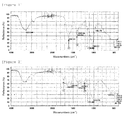
- Figure 1 shows an infrared absorption spectrum of the sodium hyaluronate film (before water-insolubilizing treatment) obtained in Example 1.
- Figure 2 shows an infrared absorption spectrum of the water-insoluble film (after water-insolubilizing treatment) obtained in Example 1.
- Figure 3 shows a fluorescent X-ray spectrum of the sodium hyaluronate film (before water-insolubilizing treatment) obtained in Example 1.
- Figure 4 shows a fluorescent X-ray spectrum of the water-insoluble film (after water-insolubilizing treatment) obtained in Example 1.
- Water-insoluble films were obtained in the same manner as in Example 1 except that the water-soluble salts of polyanionic polysaccharides and treatment liquids shown in Table 1 were used.
- Each of the water-insoluble films cut in a square the side of which was 2 cm was placed in a container having a diameter of 3.5 cm and a depth of 1.5 cm, and 5 ml of a PBS buffer solution (pH of 6.8) was added thereto.
- the container was placed in a shaker the temperature of which was adjusted to 37°C and shaken at 10 to 20 rpm.
- the change in the state of each water-insoluble film with time was visually observed to evaluate the water-insolubility of each film in accordance with the evaluation criteria shown below. The results are shown in Table 2.
- the swelling ratio of each prepared water-insoluble film was measured by the following procedure.
- the mass of the water-insoluble film in a dried state was measured and defined as the "mass before swelling”.
- the water-insoluble film was immersed in a sufficient amount of water and left at room temperature for 1 hour.
- the excessive water adhered to the surface of the sufficiently-swollen water-insoluble film was removed with a paper towel or the like, and the mass was measured and defined as the "mass after swelling”.
- the “swelling ratio” means a ratio (% by mass) of the "mass after swelling” to the "mass before swelling”.
- Table 2 it was difficult to hold up the water-insoluble film produced in Example 1 from water for immersion and remove excessive water adhered to the surface thereof, and therefore the swelling ratio was not able to be measured.
- the obtained sodium hyaluronate film was immersed in 100 mL of a treatment liquid (100% acetic anhydride) and left at room temperature for 10 days to apply water-insolubilizing treatment.
- the film to which the water-insolubilizing treatment was applied was washed with methanol, an 80% by volume methanol aqueous solution, and water in this order to obtain a water-insoluble film.
- the aforementioned "Solubility Test" was performed to the obtained water-insoluble film to find that the original shape of the film was kept for 72 hours or longer.
- the shaped material to which water-insolubilizing treatment was applied was washed with methanol, an 80% by volume methanol aqueous solution, and water in this order to obtain a water-insoluble shaped material in a sponge form.
- the aforementioned "Solubility Test" was performed to the obtained water-insoluble shaped material in a sponge form to find that the original shape of the sponge form was kept for 72 hours or longer.
- the obtained shaped material in a fiber form was immersed in 100 mL of a treatment liquid (10% acetic anhydride methanol solution) and left at room temperature for 18 hours to apply water-insolubilizing treatment.
- the shaped material to which water-insolubilizing treatment was applied was washed with methanol, an 80% by volume methanol aqueous solution, and water in this order to obtain a water-insoluble shaped material in a fiber form.
- the aforementioned "Solubility Test" was performed to the obtained water-insoluble shaped material in a fiber form to find that the original shape of the fiber form was kept for 72 hours or longer.
- the shaped material in a sponge form produced in Example 15 was cut in a cocoon shape, and thereafter was impregnated with a commercially available face lotion.
- the cocoon-shaped shaped material in a sponge form did not dissolve in the face lotion.
- the cocoon-shaped shaped material in a sponge form had a high sticking performance to skin, and therefore was able to be used as a cosmetic material for sticking to skin around eyes.
- the water-insoluble film produced in Example 5 and cut in a size of 12 cm x 9 cm was immersed in a 10% by volume glycerin aqueous solution, then air-dried, and sealed in a bag for sterilization.
- the bag for sterilization was irradiated with 25kGy irradiation rays for sterilization of the water-insoluble film together with the bag to obtain an adhesion inhibition film.
- a surgical incision was made in the abdomen of a mature dog (beagle dog, female, 1.5 years old, and body weight of 10 kg) after general anesthesia treatment, and the epidermis of the ventral wall was peeled in a square the side of which was 3 cm.
- the adhesion inhibition film was arranged so as to cover the peeled portion, and then the abdomen was closed. Two weeks later, when surgical incision was made in the abdomen of the same dog after general anesthesia treatment, adhesion was not observed. Moreover, the adhesion inhibition film arranged (implanted) in the body of the dog had disappeared in two weeks after implantation. It is inferred that the reason is because the carboxy groups of hyaluronic acid constituting the adhesion inhibition film were gradually neutralized by sodium ions or the like in vivo and the hyaluronic acid changed into soluble a hyaluronic acid salt, dissolved, and absorbed in vivo. On the other hand, it was observed that adhesion occurred between the peeled portion and the intestine with regard to the dog whose abdomen was closed without arranging the adhesion inhibition film.
- the obtained sodium hyaluronate film was immersed in 100 mL of a treatment liquid (20% acetic anhydride methanol solution) and left at room temperature (25°C) for 18 hours (Example 19), at 50°C for 1 hour (Example 20), and at 85°C for 5 minutes (Example 21) to apply water-insolubilizing treatment.
- the films to which the water-insolubilizing treatment was applied were washed with methanol, an 80% by volume methanol aqueous solution, and water in this order to obtain water-insoluble films.
- the aforementioned "Evaluation 1: Solubility Test” was performed to the obtained water-insoluble films to evaluate the water-insolubility.
- Example 5 1 g of the water-insoluble film produced in Example 5 was immersed in a 5000 units/ml hyaluronidase aqueous solution, and the resultant mixture was placed in a shaker the temperature of which was adjusted to 37°C and shaken at 10 to 20 rpm.
- a control test was performed in which 1.0 g of the water-insoluble film produced in Example 5 was immersed in a PBS buffer solution (pH of 6.8), and the resultant mixture was placed in a shaker the temperature of which was adjusted to 37°C and shaken at 10 to 20 rpm.
- the water-insoluble film according to the present embodiment had a hyaluronic acid structure resulting in decomposition by the hyaluronidase. From the above results, it is inferred that the water-insoluble film according to the present embodiment, even when arranged in vivo, is metabolized through a metabolic pathway similar to that of water-soluble hyaluronic acid.
- the water-insoluble film produced in Example 5 was cut in a square the side of which was 2 cm and placed in a container having a diameter of 3.5 cm and a depth of 1.5 cm, and 5 ml of a PBS buffer solution (pH of 6.8) was added thereto.
- the container was placed in a shaker the temperature of which was adjusted to 37°C and shaken at 10 to 20 rpm. As a result thereof, it was revealed that the original shape of the film was kept even after 3 months or more elapsed.
- the powder to which the water-insolubilizing treatment was applied was washed with methanol, an 80% by volume methanol aqueous solution, and water in this order to obtain a water-insoluble powder (water-insoluble hyaluronic acid powder).
- the aforementioned "Evaluation 1: Solubility Test” was performed to the obtained water-insoluble powder to evaluate the water-insolubility. As a result thereof, it was confirmed that the mass of the powder was kept for 72 hours or longer.
- the obtained water-insoluble powder was used for the same animal experiment as in Example 18. As a result thereof, it was confirmed that the water-insoluble powder exhibited an adhesion inhibition effect.
- the water-insoluble shaped material according to the present invention is useful as a medical material, a food material, a cosmetic material, and the like.
Landscapes
- Health & Medical Sciences (AREA)
- Chemical & Material Sciences (AREA)
- Life Sciences & Earth Sciences (AREA)
- Medicinal Chemistry (AREA)
- Public Health (AREA)
- General Health & Medical Sciences (AREA)
- Animal Behavior & Ethology (AREA)
- Veterinary Medicine (AREA)
- Epidemiology (AREA)
- Engineering & Computer Science (AREA)
- Transplantation (AREA)
- Dermatology (AREA)
- Oral & Maxillofacial Surgery (AREA)
- Organic Chemistry (AREA)
- Chemical Kinetics & Catalysis (AREA)
- Surgery (AREA)
- Manufacturing & Machinery (AREA)
- Vascular Medicine (AREA)
- Heart & Thoracic Surgery (AREA)
- Molecular Biology (AREA)
- Biomedical Technology (AREA)
- Polymers & Plastics (AREA)
- Materials Engineering (AREA)
- Pharmacology & Pharmacy (AREA)
- General Chemical & Material Sciences (AREA)
- Bioinformatics & Cheminformatics (AREA)
- Nuclear Medicine, Radiotherapy & Molecular Imaging (AREA)
- Inorganic Chemistry (AREA)
- Immunology (AREA)
- Physical Education & Sports Medicine (AREA)
- Rheumatology (AREA)
- Orthopedic Medicine & Surgery (AREA)
- Polysaccharides And Polysaccharide Derivatives (AREA)
- Medicinal Preparation (AREA)
- Pharmaceuticals Containing Other Organic And Inorganic Compounds (AREA)
- Materials For Medical Uses (AREA)
- Medicines That Contain Protein Lipid Enzymes And Other Medicines (AREA)
- Treatments Of Macromolecular Shaped Articles (AREA)
- Cosmetics (AREA)
Applications Claiming Priority (2)
| Application Number | Priority Date | Filing Date | Title |
|---|---|---|---|
| JP2013177746 | 2013-08-29 | ||
| PCT/JP2014/071988 WO2015029892A1 (fr) | 2013-08-29 | 2014-08-22 | Procédé de fabrication d'un article moulé insoluble dans l'eau et article moulé insoluble dans l'eau |
Publications (2)
| Publication Number | Publication Date |
|---|---|
| EP3040367A1 true EP3040367A1 (fr) | 2016-07-06 |
| EP3040367A4 EP3040367A4 (fr) | 2017-04-19 |
Family
ID=52586451
Family Applications (1)
| Application Number | Title | Priority Date | Filing Date |
|---|---|---|---|
| EP14840937.8A Ceased EP3040367A4 (fr) | 2013-08-29 | 2014-08-22 | Procédé de fabrication d'un article moulé insoluble dans l'eau et article moulé insoluble dans l'eau |
Country Status (6)
| Country | Link |
|---|---|
| US (2) | US9879124B2 (fr) |
| EP (1) | EP3040367A4 (fr) |
| JP (1) | JP6077663B2 (fr) |
| KR (1) | KR101821073B1 (fr) |
| CN (1) | CN105492512A (fr) |
| WO (1) | WO2015029892A1 (fr) |
Families Citing this family (11)
| Publication number | Priority date | Publication date | Assignee | Title |
|---|---|---|---|---|
| EP3263146A4 (fr) * | 2015-02-27 | 2018-06-20 | Dainichiseika Color & Chemicals Mfg. Co., Ltd. | Matériau à usage médical ainsi que procédé de fabrication de celui-ci, et matière prévenant l'adhérence |
| JP6659051B2 (ja) * | 2015-11-17 | 2020-03-04 | 株式会社リタファーマ | 水溶性ヒアルロン酸ゲル及びその製造方法 |
| JP6659052B2 (ja) * | 2016-01-21 | 2020-03-04 | 株式会社リタファーマ | 水溶性ヒアルロン酸ゲル及びその製造方法 |
| CN105770983B (zh) * | 2016-03-14 | 2019-02-19 | 武汉纺织大学 | 一种透明质酸生物粘合剂的制备方法 |
| JP2018035223A (ja) * | 2016-08-30 | 2018-03-08 | 大日精化工業株式会社 | 水不溶性粉末分散液の製造方法、水不溶性粉末分散液、及び膜状成形体 |
| JP2018033559A (ja) * | 2016-08-30 | 2018-03-08 | 大日精化工業株式会社 | 水不溶性成形体の製造方法、水不溶性成形体、及び癒着防止材 |
| JP6912327B2 (ja) | 2017-09-04 | 2021-08-04 | 大日精化工業株式会社 | 医療用・美容材料の製造方法及び医療用・美容材料 |
| JP6925233B2 (ja) * | 2017-10-27 | 2021-08-25 | 大日精化工業株式会社 | 化粧料用成形物及びその製造方法 |
| JP6762289B2 (ja) * | 2017-11-16 | 2020-09-30 | 大日精化工業株式会社 | 高分子成形体の製造方法 |
| JP2019119769A (ja) * | 2017-12-28 | 2019-07-22 | 大日精化工業株式会社 | 水不溶性成形体の製造方法及び水不溶性成形体 |
| JP2019170423A (ja) * | 2018-03-27 | 2019-10-10 | 大日精化工業株式会社 | 膜状成形体の製造方法及び膜状成形体 |
Family Cites Families (18)
| Publication number | Priority date | Publication date | Assignee | Title |
|---|---|---|---|---|
| JPH0751603B2 (ja) * | 1986-10-03 | 1995-06-05 | ユニチカ株式会社 | キトサンスポンジ |
| US6610669B1 (en) | 1987-09-18 | 2003-08-26 | Genzyme Corporation | Water insoluble derivatives of polyanionic polysaccharides |
| GR920100122A (el) | 1991-04-05 | 1993-03-16 | Ethicon Inc | Πολυσακχαρίτες οι οποίοι περιέχουν καρβοξύλιο με σταυροειδείς δεσμούς δια την πρόληψιν της προσφύσεως. |
| JP3051215B2 (ja) | 1991-08-27 | 2000-06-12 | 株式会社資生堂 | ヒアルロン酸ゲル及びその製造方法 |
| JPH0745575B2 (ja) | 1992-10-14 | 1995-05-17 | 工業技術院長 | 非水溶性多糖系高分子フイルムの製造方法 |
| JP3556975B2 (ja) | 1994-08-11 | 2004-08-25 | 株式会社資生堂 | アセチル化ヒアルロン酸の製造方法及び精製方法 |
| US5690961A (en) | 1994-12-22 | 1997-11-25 | Hercules Incorporated | Acidic polysaccharides crosslinked with polycarboxylic acids and their uses |
| ATE295745T1 (de) | 1997-08-22 | 2005-06-15 | Denki Kagaku Kogyo Kk | Hyaluronsäure-gel, verfahren zur dessen herstellung und hyaluronsäure-gel enthaltendes medizinisches material |
| JP2000044603A (ja) * | 1998-08-03 | 2000-02-15 | Denki Kagaku Kogyo Kk | ヒアルロン酸ゲル及びその製造方法 |
| JP2000191802A (ja) * | 1998-10-21 | 2000-07-11 | Daicel Chem Ind Ltd | フィルム及びその製造方法 |
| EP1174463A4 (fr) * | 1999-02-19 | 2008-04-16 | Denki Kagaku Kogyo Kk | Composition gelifiee a base d'acide hyaluronique, procede de production associe et matiere medicale contenant ladite composition |
| JP4990446B2 (ja) | 2001-05-28 | 2012-08-01 | 電気化学工業株式会社 | 関節症治療用注入剤 |
| JP4958368B2 (ja) | 2002-02-28 | 2012-06-20 | 電気化学工業株式会社 | 架橋ヒアルロン酸 |
| CA2578678C (fr) | 2004-09-15 | 2012-07-31 | Seikagaku Corporation | Polysaccharide photoreactif, produits de polysaccharide photoreticule, procede pour les produire et produits medicaux derives |
| WO2006080398A1 (fr) * | 2005-01-28 | 2006-08-03 | Neochemir Inc. | Composition pour preparer une preparation de dioxyde de carbone a usage externe |
| US7993678B2 (en) * | 2005-09-26 | 2011-08-09 | Novozymes Biopolymer A/S | Hyaluronic acid derivatives |
| JP5165217B2 (ja) | 2006-07-07 | 2013-03-21 | 生化学工業株式会社 | ゲル状又はフィルム状組成物並びにその製造方法及び用途 |
| KR101620241B1 (ko) * | 2011-08-02 | 2016-05-11 | 다이니치 세이카 고교 가부시키가이샤 | 유착 방지용 의료용 재료 및 그 제조 방법 |
-
2014
- 2014-08-22 JP JP2015534176A patent/JP6077663B2/ja not_active Expired - Fee Related
- 2014-08-22 KR KR1020167007838A patent/KR101821073B1/ko not_active Expired - Fee Related
- 2014-08-22 US US14/910,930 patent/US9879124B2/en not_active Expired - Fee Related
- 2014-08-22 WO PCT/JP2014/071988 patent/WO2015029892A1/fr not_active Ceased
- 2014-08-22 CN CN201480048023.8A patent/CN105492512A/zh active Pending
- 2014-08-22 EP EP14840937.8A patent/EP3040367A4/fr not_active Ceased
-
2017
- 2017-12-12 US US15/839,087 patent/US20180100048A1/en not_active Abandoned
Non-Patent Citations (1)
| Title |
|---|
| See references of WO2015029892A1 * |
Also Published As
| Publication number | Publication date |
|---|---|
| US20160208064A1 (en) | 2016-07-21 |
| CN105492512A (zh) | 2016-04-13 |
| JPWO2015029892A1 (ja) | 2017-03-02 |
| KR20160048876A (ko) | 2016-05-04 |
| JP6077663B2 (ja) | 2017-02-08 |
| WO2015029892A1 (fr) | 2015-03-05 |
| US9879124B2 (en) | 2018-01-30 |
| US20180100048A1 (en) | 2018-04-12 |
| EP3040367A4 (fr) | 2017-04-19 |
| KR101821073B1 (ko) | 2018-01-22 |
Similar Documents
| Publication | Publication Date | Title |
|---|---|---|
| US9879124B2 (en) | Method for manufacturing water-insoluble molded article and water-insoluble molded article | |
| EP3381438B2 (fr) | Composition pour l'injection d'acide hyaluronique, contenant un dérivé de l'acide hyaluronique et une fraction adn, et utilisation de cette dernière | |
| FI94767C (fi) | Ei-terapeuttisesti käytettävät hyaluronihapon täydelliset ja osittaiset esterit | |
| EP2353612B1 (fr) | Hydrogel injectable réticulé sur place et sa méthode de préparation et d'utilisation | |
| JP6178414B2 (ja) | 少なくとも1種のヒアルロン酸及び少なくとも1種のショ糖オクタ硫酸水溶性塩を含有する水性媒体組成物 | |
| DE69015775T2 (de) | Chitinderivate enthaltende Zusammensetzungen zur Verhütung der Adhäsion. | |
| Øvrebø et al. | Characterisation and biocompatibility of crosslinked hyaluronic acid with BDDE and PEGDE for clinical applications | |
| JP5933178B2 (ja) | キトサンカルボキシアルキルアミドのヒドロゲル、その調製方法、並びに、無水生成物、皮膚科組成物および美容用組成物 | |
| JP6077424B2 (ja) | 水不溶性成形体の製造方法及び水不溶性成形体 | |
| JP6474360B2 (ja) | 医療用材料の製造方法、医療用材料、及び癒着防止材 | |
| US20180021477A1 (en) | Medical material and anti-adhesion material | |
| CN111249172A (zh) | 一种美容注射凝胶及其制备方法 | |
| EP3263142A1 (fr) | Matériau cosmétique/médical et matériau prévenant l'adhérence | |
| EP3263146A1 (fr) | Matériau à usage médical ainsi que procédé de fabrication de celui-ci, et matière prévenant l'adhérence | |
| CA2956658C (fr) | Composition comprenant des solutions de polyglucosamine-glyoxylate melangees avec de l'hyaluronane | |
| US10857176B2 (en) | Composition comprising polyglucosamine-glyoxylate solutions mixed with hyaluronan | |
| WO2018043531A1 (fr) | Corps moulé non soluble dans l'eau ainsi que procédé de fabrication de celui-ci, et matériau antiadhésif | |
| SK9649Y1 (sk) | Hydrogél na báze zosieťovaného hydroxyfenylového derivátu kyseliny hyalurónovej | |
| JP2018035223A (ja) | 水不溶性粉末分散液の製造方法、水不溶性粉末分散液、及び膜状成形体 | |
| Xiao et al. | Optimized preparation of thiolated hyaluronic acid hydrogel with controllable degree of substitution | |
| JP2019119769A (ja) | 水不溶性成形体の製造方法及び水不溶性成形体 |
Legal Events
| Date | Code | Title | Description |
|---|---|---|---|
| PUAI | Public reference made under article 153(3) epc to a published international application that has entered the european phase |
Free format text: ORIGINAL CODE: 0009012 |
|
| 17P | Request for examination filed |
Effective date: 20160219 |
|
| AK | Designated contracting states |
Kind code of ref document: A1 Designated state(s): AL AT BE BG CH CY CZ DE DK EE ES FI FR GB GR HR HU IE IS IT LI LT LU LV MC MK MT NL NO PL PT RO RS SE SI SK SM TR |
|
| AX | Request for extension of the european patent |
Extension state: BA ME |
|
| DAX | Request for extension of the european patent (deleted) | ||
| A4 | Supplementary search report drawn up and despatched |
Effective date: 20170320 |
|
| RIC1 | Information provided on ipc code assigned before grant |
Ipc: A61P 41/00 20060101ALI20170313BHEP Ipc: A61L 27/20 20060101AFI20170313BHEP Ipc: C08J 5/18 20060101ALI20170313BHEP Ipc: A61L 27/54 20060101ALI20170313BHEP Ipc: A61L 31/16 20060101ALI20170313BHEP Ipc: A61L 27/00 20060101ALI20170313BHEP Ipc: A61L 31/04 20060101ALI20170313BHEP Ipc: C08J 7/14 20060101ALI20170313BHEP Ipc: A61L 31/00 20060101ALI20170313BHEP Ipc: A61K 8/73 20060101ALI20170313BHEP Ipc: A61Q 19/00 20060101ALI20170313BHEP |
|
| 17Q | First examination report despatched |
Effective date: 20180216 |
|
| REG | Reference to a national code |
Ref country code: DE Ref legal event code: R003 |
|
| STAA | Information on the status of an ep patent application or granted ep patent |
Free format text: STATUS: THE APPLICATION HAS BEEN REFUSED |
|
| 18R | Application refused |
Effective date: 20190624 |