EP3060623B1 - Materialien für elektronische vorrichtungen - Google Patents
Materialien für elektronische vorrichtungen Download PDFInfo
- Publication number
- EP3060623B1 EP3060623B1 EP14772289.6A EP14772289A EP3060623B1 EP 3060623 B1 EP3060623 B1 EP 3060623B1 EP 14772289 A EP14772289 A EP 14772289A EP 3060623 B1 EP3060623 B1 EP 3060623B1
- Authority
- EP
- European Patent Office
- Prior art keywords
- atoms
- aromatic ring
- ring system
- aromatic
- substituted
- Prior art date
- Legal status (The legal status is an assumption and is not a legal conclusion. Google has not performed a legal analysis and makes no representation as to the accuracy of the status listed.)
- Active
Links
- 0 Cc1cccc(C2(*)*)c1-c1c2cccc1 Chemical compound Cc1cccc(C2(*)*)c1-c1c2cccc1 0.000 description 6
- YIXPNGBOYCJLBG-UHFFFAOYSA-N Bc1c(C2(c3ccccc3-c3ccccc23)c2cccc(N(c3ccc4-c5ccccc5C(C)(C)c4c3)c(cc3)cc4c3c(cccc3)c3[o]4)c2)cccc1 Chemical compound Bc1c(C2(c3ccccc3-c3ccccc23)c2cccc(N(c3ccc4-c5ccccc5C(C)(C)c4c3)c(cc3)cc4c3c(cccc3)c3[o]4)c2)cccc1 YIXPNGBOYCJLBG-UHFFFAOYSA-N 0.000 description 1
- OUYSIBFPTGHRNQ-UHFFFAOYSA-N CC(C1)C=CC(c2ccccc22)=C1C21OCBc2ccccc12 Chemical compound CC(C1)C=CC(c2ccccc22)=C1C21OCBc2ccccc12 OUYSIBFPTGHRNQ-UHFFFAOYSA-N 0.000 description 1
- IXHWGNYCZPISET-UHFFFAOYSA-N N#CC(C#N)=C(C(F)=C(C1=C(C#N)C#N)F)C(F)=C1F Chemical compound N#CC(C#N)=C(C(F)=C(C1=C(C#N)C#N)F)C(F)=C1F IXHWGNYCZPISET-UHFFFAOYSA-N 0.000 description 1
- LWUPUBOVIBLOMX-UHFFFAOYSA-N O=C(c1ccccc1N(c(cc1)ccc1-c1ccccc1)c(cc1)ccc1-c1ccccc1)c(cccc1)c1Br Chemical compound O=C(c1ccccc1N(c(cc1)ccc1-c1ccccc1)c(cc1)ccc1-c1ccccc1)c(cccc1)c1Br LWUPUBOVIBLOMX-UHFFFAOYSA-N 0.000 description 1
- TXNIYKXBHVWKKT-UHFFFAOYSA-N OC1(c(ccc(-c2ccccc2)c2)c2-c2ccccc12)c1ccccc1Br Chemical compound OC1(c(ccc(-c2ccccc2)c2)c2-c2ccccc12)c1ccccc1Br TXNIYKXBHVWKKT-UHFFFAOYSA-N 0.000 description 1
Classifications
-
- C—CHEMISTRY; METALLURGY
- C07—ORGANIC CHEMISTRY
- C07C—ACYCLIC OR CARBOCYCLIC COMPOUNDS
- C07C211/00—Compounds containing amino groups bound to a carbon skeleton
- C07C211/43—Compounds containing amino groups bound to a carbon skeleton having amino groups bound to carbon atoms of six-membered aromatic rings of the carbon skeleton
- C07C211/54—Compounds containing amino groups bound to a carbon skeleton having amino groups bound to carbon atoms of six-membered aromatic rings of the carbon skeleton having amino groups bound to two or three six-membered aromatic rings
-
- C—CHEMISTRY; METALLURGY
- C07—ORGANIC CHEMISTRY
- C07C—ACYCLIC OR CARBOCYCLIC COMPOUNDS
- C07C209/00—Preparation of compounds containing amino groups bound to a carbon skeleton
- C07C209/68—Preparation of compounds containing amino groups bound to a carbon skeleton from amines, by reactions not involving amino groups, e.g. reduction of unsaturated amines, aromatisation, or substitution of the carbon skeleton
- C07C209/74—Preparation of compounds containing amino groups bound to a carbon skeleton from amines, by reactions not involving amino groups, e.g. reduction of unsaturated amines, aromatisation, or substitution of the carbon skeleton by halogenation, hydrohalogenation, dehalogenation, or dehydrohalogenation
-
- C—CHEMISTRY; METALLURGY
- C07—ORGANIC CHEMISTRY
- C07C—ACYCLIC OR CARBOCYCLIC COMPOUNDS
- C07C211/00—Compounds containing amino groups bound to a carbon skeleton
- C07C211/43—Compounds containing amino groups bound to a carbon skeleton having amino groups bound to carbon atoms of six-membered aromatic rings of the carbon skeleton
- C07C211/57—Compounds containing amino groups bound to a carbon skeleton having amino groups bound to carbon atoms of six-membered aromatic rings of the carbon skeleton having amino groups bound to carbon atoms of six-membered aromatic rings being part of condensed ring systems of the carbon skeleton
- C07C211/61—Compounds containing amino groups bound to a carbon skeleton having amino groups bound to carbon atoms of six-membered aromatic rings of the carbon skeleton having amino groups bound to carbon atoms of six-membered aromatic rings being part of condensed ring systems of the carbon skeleton with at least one of the condensed ring systems formed by three or more rings
-
- C—CHEMISTRY; METALLURGY
- C07—ORGANIC CHEMISTRY
- C07D—HETEROCYCLIC COMPOUNDS
- C07D307/00—Heterocyclic compounds containing five-membered rings having one oxygen atom as the only ring hetero atom
- C07D307/77—Heterocyclic compounds containing five-membered rings having one oxygen atom as the only ring hetero atom ortho- or peri-condensed with carbocyclic rings or ring systems
- C07D307/91—Dibenzofurans; Hydrogenated dibenzofurans
-
- C—CHEMISTRY; METALLURGY
- C09—DYES; PAINTS; POLISHES; NATURAL RESINS; ADHESIVES; COMPOSITIONS NOT OTHERWISE PROVIDED FOR; APPLICATIONS OF MATERIALS NOT OTHERWISE PROVIDED FOR
- C09K—MATERIALS FOR MISCELLANEOUS APPLICATIONS, NOT PROVIDED FOR ELSEWHERE
- C09K11/00—Luminescent materials, e.g. electroluminescent or chemiluminescent
- C09K11/02—Use of particular materials as binders, particle coatings or suspension media therefor
- C09K11/025—Use of particular materials as binders, particle coatings or suspension media therefor non-luminescent particle coatings or suspension media
-
- C—CHEMISTRY; METALLURGY
- C09—DYES; PAINTS; POLISHES; NATURAL RESINS; ADHESIVES; COMPOSITIONS NOT OTHERWISE PROVIDED FOR; APPLICATIONS OF MATERIALS NOT OTHERWISE PROVIDED FOR
- C09K—MATERIALS FOR MISCELLANEOUS APPLICATIONS, NOT PROVIDED FOR ELSEWHERE
- C09K11/00—Luminescent materials, e.g. electroluminescent or chemiluminescent
- C09K11/06—Luminescent materials, e.g. electroluminescent or chemiluminescent containing organic luminescent materials
-
- H—ELECTRICITY
- H05—ELECTRIC TECHNIQUES NOT OTHERWISE PROVIDED FOR
- H05B—ELECTRIC HEATING; ELECTRIC LIGHT SOURCES NOT OTHERWISE PROVIDED FOR; CIRCUIT ARRANGEMENTS FOR ELECTRIC LIGHT SOURCES, IN GENERAL
- H05B33/00—Electroluminescent light sources
- H05B33/10—Apparatus or processes specially adapted to the manufacture of electroluminescent light sources
-
- H—ELECTRICITY
- H10—SEMICONDUCTOR DEVICES; ELECTRIC SOLID-STATE DEVICES NOT OTHERWISE PROVIDED FOR
- H10K—ORGANIC ELECTRIC SOLID-STATE DEVICES
- H10K85/00—Organic materials used in the body or electrodes of devices covered by this subclass
- H10K85/60—Organic compounds having low molecular weight
- H10K85/615—Polycyclic condensed aromatic hydrocarbons, e.g. anthracene
- H10K85/622—Polycyclic condensed aromatic hydrocarbons, e.g. anthracene containing four rings, e.g. pyrene
-
- H—ELECTRICITY
- H10—SEMICONDUCTOR DEVICES; ELECTRIC SOLID-STATE DEVICES NOT OTHERWISE PROVIDED FOR
- H10K—ORGANIC ELECTRIC SOLID-STATE DEVICES
- H10K85/00—Organic materials used in the body or electrodes of devices covered by this subclass
- H10K85/60—Organic compounds having low molecular weight
- H10K85/631—Amine compounds having at least two aryl rest on at least one amine-nitrogen atom, e.g. triphenylamine
- H10K85/633—Amine compounds having at least two aryl rest on at least one amine-nitrogen atom, e.g. triphenylamine comprising polycyclic condensed aromatic hydrocarbons as substituents on the nitrogen atom
-
- H—ELECTRICITY
- H10—SEMICONDUCTOR DEVICES; ELECTRIC SOLID-STATE DEVICES NOT OTHERWISE PROVIDED FOR
- H10K—ORGANIC ELECTRIC SOLID-STATE DEVICES
- H10K85/00—Organic materials used in the body or electrodes of devices covered by this subclass
- H10K85/60—Organic compounds having low molecular weight
- H10K85/631—Amine compounds having at least two aryl rest on at least one amine-nitrogen atom, e.g. triphenylamine
- H10K85/636—Amine compounds having at least two aryl rest on at least one amine-nitrogen atom, e.g. triphenylamine comprising heteroaromatic hydrocarbons as substituents on the nitrogen atom
-
- C—CHEMISTRY; METALLURGY
- C07—ORGANIC CHEMISTRY
- C07C—ACYCLIC OR CARBOCYCLIC COMPOUNDS
- C07C2603/00—Systems containing at least three condensed rings
- C07C2603/02—Ortho- or ortho- and peri-condensed systems
- C07C2603/04—Ortho- or ortho- and peri-condensed systems containing three rings
- C07C2603/06—Ortho- or ortho- and peri-condensed systems containing three rings containing at least one ring with less than six ring members
- C07C2603/10—Ortho- or ortho- and peri-condensed systems containing three rings containing at least one ring with less than six ring members containing five-membered rings
- C07C2603/12—Ortho- or ortho- and peri-condensed systems containing three rings containing at least one ring with less than six ring members containing five-membered rings only one five-membered ring
- C07C2603/18—Fluorenes; Hydrogenated fluorenes
-
- C—CHEMISTRY; METALLURGY
- C07—ORGANIC CHEMISTRY
- C07C—ACYCLIC OR CARBOCYCLIC COMPOUNDS
- C07C2603/00—Systems containing at least three condensed rings
- C07C2603/02—Ortho- or ortho- and peri-condensed systems
- C07C2603/52—Ortho- or ortho- and peri-condensed systems containing five condensed rings
-
- C—CHEMISTRY; METALLURGY
- C07—ORGANIC CHEMISTRY
- C07C—ACYCLIC OR CARBOCYCLIC COMPOUNDS
- C07C2603/00—Systems containing at least three condensed rings
- C07C2603/56—Ring systems containing bridged rings
- C07C2603/90—Ring systems containing bridged rings containing more than four rings
-
- C—CHEMISTRY; METALLURGY
- C07—ORGANIC CHEMISTRY
- C07C—ACYCLIC OR CARBOCYCLIC COMPOUNDS
- C07C2603/00—Systems containing at least three condensed rings
- C07C2603/93—Spiro compounds
- C07C2603/95—Spiro compounds containing "not free" spiro atoms
- C07C2603/96—Spiro compounds containing "not free" spiro atoms containing at least one ring with less than six members
- C07C2603/97—Spiro compounds containing "not free" spiro atoms containing at least one ring with less than six members containing five-membered rings
-
- C—CHEMISTRY; METALLURGY
- C09—DYES; PAINTS; POLISHES; NATURAL RESINS; ADHESIVES; COMPOSITIONS NOT OTHERWISE PROVIDED FOR; APPLICATIONS OF MATERIALS NOT OTHERWISE PROVIDED FOR
- C09K—MATERIALS FOR MISCELLANEOUS APPLICATIONS, NOT PROVIDED FOR ELSEWHERE
- C09K2211/00—Chemical nature of organic luminescent or tenebrescent compounds
- C09K2211/10—Non-macromolecular compounds
- C09K2211/1003—Carbocyclic compounds
- C09K2211/1007—Non-condensed systems
-
- C—CHEMISTRY; METALLURGY
- C09—DYES; PAINTS; POLISHES; NATURAL RESINS; ADHESIVES; COMPOSITIONS NOT OTHERWISE PROVIDED FOR; APPLICATIONS OF MATERIALS NOT OTHERWISE PROVIDED FOR
- C09K—MATERIALS FOR MISCELLANEOUS APPLICATIONS, NOT PROVIDED FOR ELSEWHERE
- C09K2211/00—Chemical nature of organic luminescent or tenebrescent compounds
- C09K2211/10—Non-macromolecular compounds
- C09K2211/1003—Carbocyclic compounds
- C09K2211/1011—Condensed systems
-
- C—CHEMISTRY; METALLURGY
- C09—DYES; PAINTS; POLISHES; NATURAL RESINS; ADHESIVES; COMPOSITIONS NOT OTHERWISE PROVIDED FOR; APPLICATIONS OF MATERIALS NOT OTHERWISE PROVIDED FOR
- C09K—MATERIALS FOR MISCELLANEOUS APPLICATIONS, NOT PROVIDED FOR ELSEWHERE
- C09K2211/00—Chemical nature of organic luminescent or tenebrescent compounds
- C09K2211/10—Non-macromolecular compounds
- C09K2211/1003—Carbocyclic compounds
- C09K2211/1014—Carbocyclic compounds bridged by heteroatoms, e.g. N, P, Si or B
-
- C—CHEMISTRY; METALLURGY
- C09—DYES; PAINTS; POLISHES; NATURAL RESINS; ADHESIVES; COMPOSITIONS NOT OTHERWISE PROVIDED FOR; APPLICATIONS OF MATERIALS NOT OTHERWISE PROVIDED FOR
- C09K—MATERIALS FOR MISCELLANEOUS APPLICATIONS, NOT PROVIDED FOR ELSEWHERE
- C09K2211/00—Chemical nature of organic luminescent or tenebrescent compounds
- C09K2211/10—Non-macromolecular compounds
- C09K2211/1018—Heterocyclic compounds
- C09K2211/1025—Heterocyclic compounds characterised by ligands
- C09K2211/1029—Heterocyclic compounds characterised by ligands containing one nitrogen atom as the heteroatom
-
- C—CHEMISTRY; METALLURGY
- C09—DYES; PAINTS; POLISHES; NATURAL RESINS; ADHESIVES; COMPOSITIONS NOT OTHERWISE PROVIDED FOR; APPLICATIONS OF MATERIALS NOT OTHERWISE PROVIDED FOR
- C09K—MATERIALS FOR MISCELLANEOUS APPLICATIONS, NOT PROVIDED FOR ELSEWHERE
- C09K2211/00—Chemical nature of organic luminescent or tenebrescent compounds
- C09K2211/18—Metal complexes
- C09K2211/185—Metal complexes of the platinum group, i.e. Os, Ir, Pt, Ru, Rh or Pd
-
- H—ELECTRICITY
- H10—SEMICONDUCTOR DEVICES; ELECTRIC SOLID-STATE DEVICES NOT OTHERWISE PROVIDED FOR
- H10K—ORGANIC ELECTRIC SOLID-STATE DEVICES
- H10K50/00—Organic light-emitting devices
- H10K50/10—OLEDs or polymer light-emitting diodes [PLED]
- H10K50/11—OLEDs or polymer light-emitting diodes [PLED] characterised by the electroluminescent [EL] layers
-
- H—ELECTRICITY
- H10—SEMICONDUCTOR DEVICES; ELECTRIC SOLID-STATE DEVICES NOT OTHERWISE PROVIDED FOR
- H10K—ORGANIC ELECTRIC SOLID-STATE DEVICES
- H10K50/00—Organic light-emitting devices
- H10K50/10—OLEDs or polymer light-emitting diodes [PLED]
- H10K50/14—Carrier transporting layers
- H10K50/15—Hole transporting layers
-
- H—ELECTRICITY
- H10—SEMICONDUCTOR DEVICES; ELECTRIC SOLID-STATE DEVICES NOT OTHERWISE PROVIDED FOR
- H10K—ORGANIC ELECTRIC SOLID-STATE DEVICES
- H10K50/00—Organic light-emitting devices
- H10K50/10—OLEDs or polymer light-emitting diodes [PLED]
- H10K50/14—Carrier transporting layers
- H10K50/15—Hole transporting layers
- H10K50/155—Hole transporting layers comprising dopants
-
- H—ELECTRICITY
- H10—SEMICONDUCTOR DEVICES; ELECTRIC SOLID-STATE DEVICES NOT OTHERWISE PROVIDED FOR
- H10K—ORGANIC ELECTRIC SOLID-STATE DEVICES
- H10K50/00—Organic light-emitting devices
- H10K50/10—OLEDs or polymer light-emitting diodes [PLED]
- H10K50/17—Carrier injection layers
-
- H—ELECTRICITY
- H10—SEMICONDUCTOR DEVICES; ELECTRIC SOLID-STATE DEVICES NOT OTHERWISE PROVIDED FOR
- H10K—ORGANIC ELECTRIC SOLID-STATE DEVICES
- H10K50/00—Organic light-emitting devices
- H10K50/10—OLEDs or polymer light-emitting diodes [PLED]
- H10K50/18—Carrier blocking layers
-
- H—ELECTRICITY
- H10—SEMICONDUCTOR DEVICES; ELECTRIC SOLID-STATE DEVICES NOT OTHERWISE PROVIDED FOR
- H10K—ORGANIC ELECTRIC SOLID-STATE DEVICES
- H10K85/00—Organic materials used in the body or electrodes of devices covered by this subclass
- H10K85/60—Organic compounds having low molecular weight
- H10K85/615—Polycyclic condensed aromatic hydrocarbons, e.g. anthracene
- H10K85/623—Polycyclic condensed aromatic hydrocarbons, e.g. anthracene containing five rings, e.g. pentacene
-
- H—ELECTRICITY
- H10—SEMICONDUCTOR DEVICES; ELECTRIC SOLID-STATE DEVICES NOT OTHERWISE PROVIDED FOR
- H10K—ORGANIC ELECTRIC SOLID-STATE DEVICES
- H10K85/00—Organic materials used in the body or electrodes of devices covered by this subclass
- H10K85/60—Organic compounds having low molecular weight
- H10K85/615—Polycyclic condensed aromatic hydrocarbons, e.g. anthracene
- H10K85/624—Polycyclic condensed aromatic hydrocarbons, e.g. anthracene containing six or more rings
-
- H—ELECTRICITY
- H10—SEMICONDUCTOR DEVICES; ELECTRIC SOLID-STATE DEVICES NOT OTHERWISE PROVIDED FOR
- H10K—ORGANIC ELECTRIC SOLID-STATE DEVICES
- H10K85/00—Organic materials used in the body or electrodes of devices covered by this subclass
- H10K85/60—Organic compounds having low molecular weight
- H10K85/615—Polycyclic condensed aromatic hydrocarbons, e.g. anthracene
- H10K85/626—Polycyclic condensed aromatic hydrocarbons, e.g. anthracene containing more than one polycyclic condensed aromatic rings, e.g. bis-anthracene
-
- H—ELECTRICITY
- H10—SEMICONDUCTOR DEVICES; ELECTRIC SOLID-STATE DEVICES NOT OTHERWISE PROVIDED FOR
- H10K—ORGANIC ELECTRIC SOLID-STATE DEVICES
- H10K85/00—Organic materials used in the body or electrodes of devices covered by this subclass
- H10K85/60—Organic compounds having low molecular weight
- H10K85/649—Aromatic compounds comprising a hetero atom
- H10K85/657—Polycyclic condensed heteroaromatic hydrocarbons
- H10K85/6574—Polycyclic condensed heteroaromatic hydrocarbons comprising only oxygen in the heteroaromatic polycondensed ring system, e.g. cumarine dyes
-
- Y—GENERAL TAGGING OF NEW TECHNOLOGICAL DEVELOPMENTS; GENERAL TAGGING OF CROSS-SECTIONAL TECHNOLOGIES SPANNING OVER SEVERAL SECTIONS OF THE IPC; TECHNICAL SUBJECTS COVERED BY FORMER USPC CROSS-REFERENCE ART COLLECTIONS [XRACs] AND DIGESTS
- Y02—TECHNOLOGIES OR APPLICATIONS FOR MITIGATION OR ADAPTATION AGAINST CLIMATE CHANGE
- Y02E—REDUCTION OF GREENHOUSE GAS [GHG] EMISSIONS, RELATED TO ENERGY GENERATION, TRANSMISSION OR DISTRIBUTION
- Y02E10/00—Energy generation through renewable energy sources
- Y02E10/50—Photovoltaic [PV] energy
- Y02E10/549—Organic PV cells
Definitions
- the present invention relates to materials for use in electronic devices, particularly in organic electroluminescent devices.
- the development of functional compounds for use in electronic devices is currently the subject of intense research.
- the aim in particular is the development of compounds with which improved properties of the electronic devices can be achieved in one or more relevant points, such as power efficiency, lifetime or color coordinates of the emitted light.
- the term electronic device includes organic integrated circuits (OICs), organic field effect transistors (OFETs), organic thin film transistors (OTFTs), organic light emitting transistors (OLETs), organic solar cells (OSCs), organic optical Detectors, organic photoreceptors, organic field quench devices (OFQDs), organic light-emitting electrochemical cells (OLECs), organic laser diodes (O-lasers) and organic electroluminescent devices (OLEDs) understood.
- OICs organic integrated circuits
- OFETs organic field effect transistors
- OFTs organic thin film transistors
- OLETs organic light emitting transistors
- OSCs organic solar cells
- OFQDs organic field quench devices
- OFQDs organic light-emitting electrochemical cells
- O-lasers organic laser diodes
- OEDs organic electroluminescent devices
- OLEDs Of particular interest is the provision of compounds for use in the latter electronic devices referred to as OLEDs.
- the general structure and the functional principle of OLEDs is known to the person skilled in the art and is described inter alia in US 4539507 . US 5151629 . EP 0676461 and WO 1998/27136 described.
- the object of the present invention is to provide compounds which are suitable for use in a fluorescent or phosphorescent OLED, in particular a phosphorescent OLED, for example as matrix material and / or as hole transport / electron blocking material or exciton blocking material and / or as electron transport or electron transport Hole blocking material.
- the present invention therefore provides a compound according to formula (1), according to claim 1.
- An aryl group in the sense of this invention contains 6 to 60 aromatic ring atoms; a heteroaryl group in the context of this invention contains in principle 5 to 60 aromatic ring atoms, of which at least one represents a heteroatom.
- the heteroatoms are preferably selected from N, O and / or S. This is the basic definition. If other preferences are given in the description of the present invention, as for example with respect to the number of aromatic ring atoms or the heteroatoms contained, these apply.
- an aryl group or heteroaryl group is either a simple aromatic cycle, ie benzene, or a simple heteroaromatic cycle, for example pyridine, pyrimidine, thiophene, etc., or a fused (fused) aromatic or heteroaromatic polycycle, for example naphthalene, anthracene , Phenanthrene, quinoline, isoquinoline, or carbazole, understood.
- a condensed (fused) aromatic or heteroaromatic polycycle consists in the context of the present application of two or more condensed simple aromatic or heteroaromatic cycles.
- aromatics linked to one another by single bond for example biphenyl or bipyridine, are not designated as aryl or heteroaryl group but as aromatic ring system.
- An aryl or heteroaryl group which may be substituted in each case by the abovementioned radicals and which may be linked via any position on the aromatic or heteroaromatic compounds is understood in particular to mean groups which are derived from benzene, naphthalene, anthracene, phenanthrene, pyrene, Dihydropyrenes, chrysene, perylene, fluoranthene, benzanthracene, benzphenanthrene, tetracene, pentacene, benzopyrene, furan, benzofuran, isobenzofuran, dibenzofuran, thiophene, benzothiophene, isobenzothiophene, dibenzothiophene, pyrrole, indole, isoindole, carbazole, pyridine, quinoline, isoquinoline, acridine, Phenanthridine, benzo-5,6-quinoline, benzo-6,
- An aromatic ring system in the sense of this invention contains 6 to 60 aromatic ring atoms in the ring system.
- a heteroaromatic ring system in the context of this invention contains 5 to 60 aromatic ring atoms, at least one of which represents a heteroatom.
- the heteroatoms are preferably selected from N, O and / or S.
- the aromatic or heteroaromatic ring system is to be understood as meaning a system which does not necessarily contain only aryl or heteroaryl groups, but which also contains a plurality of aryl or heteroaryl groups through a nonaromatic moiety (preferably less than 10% of the atoms other than H.) ), such.
- an sp 3 -hybridized C, Si, N or O atom, an sp 2 -hybridized C or N atom or a sp-hybridized carbon atom can be connected.
- systems such as 9,9'-spirobifluorene, 9,9'-diarylfluorene, triarylamine, diaryl ethers, stilbene, etc. are to be understood as aromatic ring systems in the context of this invention, and also systems in which two or more aryl groups, for example by a linear or cyclic alkyl, alkenyl or alkynyl group or linked by a silyl group.
- systems in which two or more aryl or heteroaryl groups are linked together via single bonds are understood as aromatic or heteroaromatic ring systems in the context of this invention, such as systems such as biphenyl, terphenyl or diphenyltriazine.
- An aromatic or heteroaromatic ring system having 5-60 aromatic ring atoms, which may be substituted in each case by radicals as defined above and which may be linked via any positions on the aromatic or heteroaromatic compounds, is understood in particular to mean groups derived from benzene, naphthalene , Anthracene, benzanthracene, phenanthrene, benzphenanthrene, pyrene, chrysene, perylene, fluoranthene, naphthacene, pentacene, benzpyrene, biphenyl, biphenylene, terphenyl, terphenylene, quaterphenyl, fluorene, spirobifluorene, dihydrophenanthrene, dihydropyrene, tetrahydropyrene, cis- or trans-indenofluorene, Truxene, isotruxene, spirotruxene, spiroisotruxen
- alkoxy or thioalkyl group having 1 to 40 carbon atoms methoxy, trifluoromethoxy, ethoxy, n-propoxy, i-propoxy, n-butoxy, i-butoxy, s-butoxy, t-butoxy, n-pentoxy, s Pentoxy, 2-methylbutoxy, n-hexoxy, cyclohexyloxy, n-heptoxy, cycloheptyloxy, n-octyloxy, cyclooctyloxy, 2-ethylhexyloxy, pentafluoroethoxy, 2,2,2-trifluoroethoxy, Methylthio, ethylthio, n-propylthio, i-propylthio, n-butylthio, i-butylthio, s-butylthio, t-butylthio, n-pentylthio
- At least one R 1 comprises at least one aromatic or heteroaromatic ring system
- the total number of aromatic ring atoms in all R 1 and R 2 is at least 12, preferably at least 18, particularly preferably at least 24.
- R 2 comprises at least 24 aromatic ring atoms, as well as no further indeno [1,2,3-jk] fluorene skeleton.
- the 12-position represents the most acidic position of the framework in lndeno [1,2,3-jk] fluorene frameworks. Therefore, these bonds are particularly unstable. If there are other Indeno [1,2,3-jk] fluoren scaffolds in the compound, it will not only become very large, but also potentially more unstable.
- R 1 and / or R 2 do not comprise fused aromatic or heteroaromatic ring systems having more than 14 aromatic ring atoms.
- all R 1 and R 2 together comprise a total number of aromatic ring atoms of not more than 84, preferably not more than 60.
- Preferred embodiment of the compound of the formula (1) is therefore a compound of the following formula (2): wherein the symbols used have the meanings given above.
- R 1 in the abovementioned formulas is the same or different at each occurrence as H, D, F, CN, NO 2 , N (Ar 1 ) 2 , N (R 3 ) 2 , a straight-chain alkyl or alkoxy group having 1 to 10 C atoms or a branched or cyclic alkyl or alkoxy group having 3 to 10 C atoms or an alkenyl or alkynyl group having 2 to 10 C atoms, wherein the alkyl, alkoxy, alkenyl or Alkynyl group may be substituted by one or more radicals R 3 and wherein one or more non-adjacent CH 2 groups may be replaced by Si (R 3 ) 2 , -S- and -O- and wherein one or more H atoms by D or F may be replaced, or an aromatic ring system having 6 to 30 aromatic ring atoms, each of which may be substituted by one or more radicals R 3 ,
- R 3 in the abovementioned formulas is the same or different at each occurrence as H, D, F, CN, N (R 4 ) 2 , C (OO) R 4 , Si (R 4 ) 2 , a straight-chain alkyl, alkoxy or thioalkyl group having 1 to 20 C atoms or a branched or cyclic alkyl, alkoxy or thioalkyl group having 3 to 20 C atoms or an alkenyl or alkynyl group having 2 to 20 C atoms, wherein the alkyl, alkoxy, thioalkyl, alkenyl or alkynyl group can each be substituted by one or more radicals R 4 and wherein one or more adjacent or non-adjacent CH 2 groups can be replaced by Si (R 4 ) 2 , NR 4 , - O- or -S- may be replaced and wherein one or more H atoms may be replaced by D, F or
- R 1 is the same or different H, D, F, CN, NO 2 , N at each of at least one of positions 5 or 10 of the indeno [1,2,3-jk] fluorene skeleton.
- R 1 contains at positions 5 or 10 of the indeno [1,2,3-jk] fluorene skeleton, if present, no radicals selected from the group containing Cl, Br, I, B (OR 3 ) 2 and CHO.
- the alkyl groups preferably have not more than 4 carbon atoms.
- the alkyl groups preferably have not more than 4 carbon atoms.
- At least one R 1 is not H, preferably at least one R 1 comprises an aromatic or heteroaromatic ring system.
- Particularly preferred aromatic ring systems for R 1 or R 2 are selected from the group phenyl, ortho-, meta- or para-biphenyl, ortho-, meta- or para-terphenyl, ortho, meta, para or branched quaterphenyl , Fluorene, spirobifluorene, which may each be substituted by one or more radicals R 3 .
- Particularly preferred aromatic ring systems for R 1 or R 2 are in particular selected from the structures of the following formulas: wherein the structures may be substituted with one or more R 3 radicals, and R 3 is defined as indicated above.
- R 3 is preferably an aliphatic radical having 1 to 20 C atoms, or an aromatic ring system having 6 to 24 aromatic ring atoms or a heteroaromatic ring system having 5 to 24 aromatic ring atoms, preferably an aliphatic radical having 1 to 10 C atoms or a aromatic ring system with 6 to 18 aromatic ring atoms.
- heteroaromatic ring systems R 1 contain, as heteroaryl group, triazine, pyrimidine, pyrazine, pyridazine, pyridine, benzothiophene, benzofuran, indole, carbazole, azacarbazole, Diazacarbazole, dibenzothiophene and / or dibenzofuran.
- the heteroaromatic ring systems are in particular selected from the structures of the following formulas (H-1) to (H-14): wherein the heteroaromatic groups may be substituted at all free positions with radicals R 3 and wherein the heteroaromatic groups at any position with the indeno [1,2,3-jk] fluorene skeleton wherein the bond may also occur in place of NR 3 and wherein R 3 is as defined for formula (1) and the bond to the indeno [1,2,3-jk] fluorene skeleton also via a divalent aromatic or heteroaromatic ring system, preferably a divalent ring system according to one of the formulas (Ar3-1) to (Ar3-12), particularly preferably one of the formulas (Ar3-1) to (Ar3-4).
- a divalent aromatic or heteroaromatic ring system preferably a divalent ring system according to one of the formulas (Ar3-1) to (Ar3-12), particularly preferably one of the formulas (Ar3-1)
- R 3 is an aliphatic radical having 1 to 20 C atoms, or an aromatic ring system having 6 to 24 aromatic ring atoms or a heteroaromatic ring system having 5 to 24 aromatic ring atoms, preferably an aliphatic radical having 1 to 10 C atoms or an aromatic Ring system with 6 to 18 aromatic ring atoms.
- Preferred ring systems for the formulas Ar 1 in formula (3) or Ar 2 in formula (5) are structures of the formulas (H-1) to (H-15), which may be substituted at all free positions with radicals R 3 and the heteroaromatic groups may be attached at any free position to the N atom of the formula, and structures of formulas (A-1) to (A-25) wherein the structures may be substituted with one or more R 3 and R 3 the dashed bond represents the bond to the N atom of the formula, and R 3 is defined as indicated above.
- both Ar 2 in formula (5) are selected from the structures (A-2) to (A-25) or (H-7) to (H-9).
- Ar 3 is particularly preferably one of the structures (Ar 3-1 ) to (Ar3-4).
- the compound comprises exactly 1, 2, 3, 4 or 5, preferably 1, 2 or 3, more preferably 1 or 2, radicals R 1 and / or R 2 selected from the formulas (3), (4) and (5), preferably from the formulas (3) and (5).
- the compound contains exactly one radical R 1 or R 2 selected from the formulas (3), (4) and (5).
- Preferred embodiments of the compound of formula (1) are the compounds of formulas (1-3a) to (1-3g) and formulas (1-5a) to (1-5g): wherein R 1 , R 2 , Ar 1 , Ar 2 and Ar 3 are as defined above.
- R 2 if present with respect to the indeno [1,2,3-jk] fluorene skeleton, there is no nitrogen atom, preferably heteroatom, in the para position on a 6-ring aryl system directly on the indeno [ 1,2,3-jk] fluorene scaffold.
- This also applies to fused aromatic ring systems containing carbazole structures which are bonded at the 3-position to the indeno [1,2,3-jk] fluorene skeleton.
- it has been found that such compounds are significantly more unstable than compounds which have the nitrogen atom in the ortho or meta position.
- Ar 3 in formula (1-5a) is selected from the structures (Ar3-2) to (Ar3-11), the bond to the indeno [1,2,3-jk] fluorene Framework in formal (Ar3-5) at positions 1, 2 or 4 and in formula (Ar3-7) and (Ar3-9) not in para-position for bonding to nitrogen.
- Ar 3 is particularly preferably selected from the structures (Ar 3-2 ) and (Ar 3-3).
- a preferred embodiment of the compound of formula (1-5a) is a compound of the formulas wherein R 1 and Ar 2 are as defined above and the compound may be substituted at the free positions with one or more radicals R 3 , but is preferably unsubstituted.
- R 1 and R 2 are present in the formulas (1-3a) to (1-3g), (1-5a) to (1-5g), or formulas (1-5a). 1) and (1-5a-2), no or exactly one further group selected from the formulas (3), (4) or (5).
- R 1 and R 2 are present in the formulas (1-3a) to (1-3g) and (1-5a) to (1-5g), or the formulas (1-5a 1) and (1-5a-2), no or exactly one further group selected from the formulas (3), (4) or (5) and at least one further R 1 and / or R 2 if present an aromatic or heteroaromatic ring system, particularly preferably an aromatic or heteroaromatic ring system of the formulas (A-1) to (A-25) or (H-1) to (H-14), very particularly preferably an aromatic ring system, in particular according to the formulas (A- 1) to (A-25).
- the more than one R 1 do not form with one another aromatic or heteroaromatic ring systems fused to the indeno [1,2,3-jk] fluorene skeleton.
- at least one R 1 and / or R 2 are particularly preferably selected from the formulas (3), (4) and (5) and their abovementioned embodiments.
- At least one R 1 and / or R 2 is preferably an aromatic or heteroaromatic ring system containing at least one aryl group having at least three fused six-membered rings contains, preferably anthracene.
- At least one R 1 and / or R 2 is preferably an aromatic or heteroaromatic ring system containing at least one aryl group or an aromatic ring system having at least two condensed six-membered rings which is preferably bound directly or via a phenyl group to the indeno [1,2,3-jk] fluorene skeleton.
- the condensed aryl group is preferably selected from anthracene, pyrene, phenanthrene, chrysene, Monobenzoindenofluoren or Dibenzoindenofluoren.
- At least one radical R 1 stands for an electron-deficient heteroaromatic ring system having 5 to 40 aromatic ring atoms, preferably having 5 to 25 aromatic ring atoms, which contains one or more R 3 radicals can be substituted.
- An electron-deficient heteroaromatic ring system in the context of the present invention is a heteroaromatic ring system which contains at least one electron-poor heteroaryl group, which is either a 6-ring heteroaryl group having at least one nitrogen atom or a 5-ring heteroaryl group having at least two heteroatoms.
- Particularly preferred electron-deficient heteroaromatic ring systems R 1 contain as heteroaryl at least one group selected from triazine, pyrimidine, pyrazine, pyridazine, pyridine, imidazole, pyrazole, oxazole, oxadiazole, triazole, thiazole, thiadiazole, benzimidazole, quinoline, isoquinoline and quinoxaline.
- heteroaromatic ring systems are in particular selected from the structures of the formulas (H-1), (H-2), (H-3), (H-14), where R 3 has the meanings mentioned herein and the structures on a free Position over one Single bond or via a phenyl group to the indeno [1,2,3-jk] fluorene skeleton are bound.
- R 1 and / or R 2 are preferably N (Ar 1 ) 2 , a triarylamino group or an electron-rich heteroaromatic group Ring system having 5 to 40 aromatic ring atoms, in particular 5 to 25 aromatic ring atoms, which may be substituted by one or more radicals R 3 , in particular a radical according to the abovementioned formulas (3), (4) or (5).
- An electron-rich heteroaromatic ring system in the sense of the invention is a heteroaromatic ring system which contains at least one electron-rich heteroaryl group, which is a 5-ring heteroaryl group having exactly one heteroatom, to which one or more aryl groups may also be fused.
- Particularly preferred electron-rich heteroaromatic ring systems R 1 contain as heteroaryl pyrrole, furan, thiophene, benzothiophene, benzofuran, indole, carbazole, dibenzothiophene, dibenzofuran and / or azacarbazole.
- the electron-rich heteroaromatic ring systems are in particular selected from the structures of the abovementioned formulas (H-4) to (H-13).
- the abovementioned preferences can be combined with one another as desired.
- Examples of preferred compounds according to the above-mentioned embodiments, or compounds, as they can be preferably used in electronic devices, are the compounds of the following structures (1) to (55). 1 2 3 4 5 6 7 8th 9 10 11 12 13 14 15 16 17 18 19 20 21 22 23 24 25 26 27 28 29 30 31 32 33 34 35 36 37 38 39 40 41 42 43 44 45 46 47 48 49 50 51 52 53 54 55
- the synthesis of the compounds according to the invention can be carried out according to methods and reaction types known in the art, for example Friedel-Crafts reaction, palladium-catalyzed intramolecular CH arylation, Buchwald coupling and Suzuki coupling and Grignard reaction.
- the benzonitrile compound is the precursor compound for the later R 2.
- Several radicals W can also form rings, as can fused (fused) rings, or together form an aromatic or heteroaromatic ring system, for example carbazoles.
- W is preferably an R 2 N group, wherein R is preferably identical or different and is an aryl or heteroaryl group.
- the R 2 of the later indeno [1,2,3-jk] fluorene scaffold is not introduced via a Friedel-Crafts reaction, other substitution patterns are available at R 2 .
- Another object of the present invention thus provides a process for the preparation of compounds of formula (1), or (2), which is characterized in that starting from a fluorenone derivative, an addition to the keto group and a preferably transition metal-catalyzed coupling reaction for Ring closure to lndeno [1,2,3-jk] fluorene scaffold.
- Another object of the present invention is therefore a further process for the preparation of compounds with indeno [1,2,3-jk] fluorene skeleton, preferably compounds according to formula (1), or (2), which is characterized in that an addition to the keto group is carried out with an aryl ketone which has a leaving group in the ortho position relative to the keto group, and then the indeno [1,2,3-] is reacted by an intramolecular electrophilic reaction and a preferably transition-metal-catalyzed intramolecular coupling reaction. jk] fluoren scaffolding is established.
- Suitable reactive leaving groups are, for example, bromine, iodine, chlorine, boronic acids, boronic esters, amines, alkenyl or alkynyl groups with terminal CC double bond or CC triple bond, oxiranes, oxetanes, groups which have a cycloaddition, for example a 1,3-dipolar cycloaddition , such as dienes or azides, carboxylic acid derivatives, alcohols and silanes.
- Another object of the invention are therefore oligomers, polymers or dendrimers containing one or more compounds of the formula (1), or (2), wherein the bond (s) to the polymer, oligomer or dendrimer to any, in formula (1), or (2) can be located with R 1 and / or R 2 substituted positions.
- the compound is part of a side chain of the oligomer or polymer or constituent of the main chain.
- An oligomer in the context of this invention is understood as meaning a compound which is composed of at least three monomer units.
- a polymer in the context of the invention is understood as meaning a compound which is composed of at least ten monomer units.
- the polymers, oligomers or dendrimers of the invention may be conjugated, partially conjugated or non-conjugated.
- the oligomers or polymers of the invention may be linear, branched or dendritic.
- the units of the formula (1) or (2) can be linked directly to one another or they can be linked via a divalent group, for example via a substituted or unsubstituted alkylene group, via a heteroatom or via a bivalent aromatic or heteroaromatic group be linked together.
- branched and dendritic structures for example, 3, 5 or more units of the formula (1), or (2) via a trivalent or higher valent group, for example via a trivalent or higher valent aromatic or heteroaromatic group, to a branched or dendritic oligomer or Being polymer linked.
- the bonds to the oligomer, polymer or dendrimer are not located at both positions 5 and 10.
- the monomers according to the invention are homopolymerized or copolymerized with further monomers.
- Suitable and preferred comonomers are selected from fluorene (e.g. EP 842208 or WO 2000/22026 ), Spirobifluorenes (eg according to EP 707020 . EP 894107 or WO 2006/061181 ), Paraphenylenes (eg according to WO 1992/18552 ), Carbazoles (eg according to WO 2004/070772 or WO 2004/113468 ), Thiophenes (eg according to EP 1028136 ), Dihydrophenanthrenes (e.g.
- WO 2005/014689 or WO 2007/006383 cis and translinofluorenes (eg according to WO 2004/041901 or WO 2004/113412 ), Ketones (eg according to WO2005 / 040302 ), Phenanthrenes (eg according to WO 2005/104264 or WO 2007/017066 ) or several of these units.
- the polymers, oligomers and dendrimers usually also contain further units, for example emitting (fluorescent or phosphorescent) units, such as.
- Vinyl triarylamines e.g. WO 2007/068325
- phosphorescent metal complexes eg according to WO 2006/003000
- charge transport units especially those based on triarylamines.
- the polymers, oligomers and dendrimers according to the invention have advantageous properties, in particular high lifetimes, high efficiencies and good color coordinates.
- the present invention thus also provides a process for the preparation of the polymers, oligomers and dendrimers according to the invention, which is characterized in that they Polymerization according to SUZUKI, polymerization according to YAMAMOTO, polymerization according to SILENCE or polymerization according to HARTWIG-BUCHWALD.
- the dendrimers according to the invention can be prepared according to methods known to the person skilled in the art or in analogy thereto. Suitable methods are described in the literature, such as.
- formulations of the compounds according to the invention are required. These formulations may be, for example, solutions, dispersions or emulsions. It may be preferable to use mixtures of two or more solvents for this purpose.
- Suitable and preferred solvents are, for example, toluene, anisole, o, m- or p-xylene, methyl benzoate, mesitylene, tetralin, veratrol, THF, methyl THF, THP, chlorobenzene, dioxane, phenoxytoluene, in particular 3-phenoxytoluene, (-) - Fenchone, 1,2,3,5-tetramethylbenzene, 1,2,4,5-tetramethylbenzene, 1-methylnaphthalene, 2-methylbenzothiazole, 2-phenoxyethanol, 2-pyrrolidinone, 3-methylanisole, 4-methylanisole, 3,4- Dimethylanisole, 3,5-dimethylanisole, acetophenone, ⁇ -terpineol, benzothiazole, butylbenzoate, cumene, cyclohexanol, cyclohexanone, cyclohexylbenzene, decalin, dodecy
- the invention therefore further provides a formulation, in particular a solution, dispersion or emulsion, comprising at least one compound of the formula (1) or (2), or at least one polymer, oligomer or dendrimer comprising at least one unit of the formula (1) , or (2), as well as at least one solvent, preferably an organic solvent.
- a formulation in particular a solution, dispersion or emulsion, comprising at least one compound of the formula (1) or (2), or at least one polymer, oligomer or dendrimer comprising at least one unit of the formula (1) , or (2), as well as at least one solvent, preferably an organic solvent.
- the compounds of the formula (1) or (2) are suitable for use in electronic devices, in particular in organic electroluminescent devices (OLEDs). Depending on the substitution, the compounds are used in different functions and in different layers of the organic electroluminescent device.
- the compounds are preferably used as hole transport materials in a hole transport or hole injection layer, as matrix materials in an emitting layer, as electron blocking materials, as exciton blocking materials and / or as materials for an interlayer.
- the electronic devices are preferably selected from the group consisting of organic integrated circuits (O-ICs), organic field-effect transistors (O-FETs), organic thin-film transistors (OTFTs), organic light-emitting transistors (O-LETS), organic solar cells (O-SCs), organic optical detectors, organic photoreceptors, organic field quench devices (O-FQDs), light-emitting electrochemical cells (LECs), organic laser diodes (O-lasers), and most preferably organic electroluminescent devices (OLEDs).
- O-ICs organic integrated circuits
- O-FETs organic field-effect transistors
- O-OTFTs organic thin-film transistors
- O-LETS organic light-emitting transistors
- O-SCs organic solar cells
- organic optical detectors organic photoreceptors
- O-FQDs organic field quench devices
- LECs organic laser diodes
- O-lasers organic laser diodes
- organic electroluminescent devices comprising the anode, cathode and at least one emitting layer, characterized in that at least one organic layer, which may be an emitting layer, a hole transport layer or another layer, comprises at least one compound according to formula (1), or (2) contains.
- the organic electroluminescent device may contain further layers. These are selected, for example, from one or more hole injection layers, hole transport layers, hole blocking layers, electron transport layers, electron injection layers, electron blocking layers, exciton blocking layers, interlayers, charge generation layers (IDMC 2003, Taiwan; Session 21 OLED (5), T. Matsumoto, T. Nakada, J. Endo, K. Mori, N. Kawamura, A. Yokoi, J. Kido, Multiphoton Organic EL Device Having Charge Generation Layer ) and / or organic or inorganic pn passes. It should be noted, however, that not necessarily each of these layers must be present and the choice of layers always depends on the compounds used and in particular also on the fact that it is a fluorescent or phosphorescent electroluminescent device.
- the organic electroluminescent device may also include a plurality of emitting layers.
- these emission layers particularly preferably have a total of a plurality of emission maxima between 380 nm and 750 nm, so that overall white emission results, ie in the emitting layers different emitting compounds are used which can fluoresce or phosphoresce and the blue, yellow, green, emit orange or red light.
- Particularly preferred are three-layer systems, ie systems with three emitting layers, wherein at least one of these layers at least one compound according to formula (1), or (2) contains and wherein the three layers blue, green and orange or red emission show (for the principal Construction see eg WO 2005/011013 ).
- the compounds according to the invention may also be present in the hole transport layer and / or in an interlayer. It should be noted that, for the production of white light, instead of a plurality of color-emitting emitter compounds, a single-use emitter compound emitting in a wide wavelength range may also be suitable.
- the compound according to formula (1) or (2) is used in an electronic device containing one or more phosphorescent dopants.
- the compound can be used in different layers, preferably in a hole transport layer, a hole injection layer or in an emitting layer.
- the compound according to formula (1) or (2) can also be used according to the invention in an electronic device containing one or more fluorescent dopants.
- phosphorescent dopants typically includes compounds in which the light emission by a spin-forbidden transition, for example a transition from an excited triplet state or a state with a higher spin quantum number, for example a quintet state.
- Particularly suitable phosphorescent dopants are compounds which, given suitable excitation, emit light, preferably in the visible range, and also contain at least one atom of atomic number greater than 20, preferably greater than 38 and less than 84, particularly preferably greater than 56 and less than 80.
- Preferred phosphorescence emitters used are compounds containing copper, molybdenum, tungsten, rhenium, ruthenium, osmium, rhodium, iridium, palladium, platinum, silver, gold or europium, in particular compounds containing iridium, platinum or copper.
- luminescent iridium, platinum or copper complexes are regarded as phosphorescent compounds.
- Suitable phosphorescent emitter compounds can furthermore be taken from a table of phosphorescent dopants depicted below.
- the compounds of the formula (1) or (2) are used as hole transport material.
- the compounds are then preferably used in a hole transport layer and / or in a hole injection layer.
- a hole injection layer in the sense of this invention is a layer which is directly adjacent to the anode.
- a hole transport layer in the sense of this invention is a layer that lies between the hole injection layer and the emission layer.
- the hole transport layer can directly adjoin the emission layer.
- the compounds according to formula (1) or (2) are used as hole transport material or as hole injection material, it may be preferable if they are doped with electron acceptor compounds, for example with F 4 -TCNQ or with compounds as described in US Pat EP 1476881 or EP 1596445 to be discribed.
- a compound according to formula (1), or (2) as hole transport material in combination with a Hexaazatriphenylenderivat as in US 2007/0092755 described, used. Particularly preferably, the Hexaazatriphenylenderivat is used in a separate layer.
- the compound according to formula (1), or (2) is used as hole transport material in a hole transport layer
- the compound can be used as a pure material, ie in a proportion of 100%, in the hole transport layer, or it can be used in combination with one or several other compounds are used in the hole transport layer.
- the compounds of the formula (1) or (2) are used as matrix material in combination with one or more dopants, preferably phosphorescent dopants.
- a dopant in a system comprising a matrix material and a dopant, is understood to mean the component whose proportion in the mixture is the smaller.
- a matrix material in a system containing a matrix material and a dopant is understood to mean the component whose proportion in the mixture is the larger.
- the proportion of the matrix material in the emitting layer is in this case between 50.0 and 99.9% by volume, preferably between 80.0 and 99.5% by volume and particularly preferred for fluorescent emitting layers between 92.0 and 99.5% by volume and for phosphorescent emitting layers between 85.0 and 97.0 vol.%.
- the proportion of the dopant is between 0.1 and 50.0% by volume, preferably between 0.5 and 20.0% by volume and particularly preferred for fluorescent emitting layers between 0.5 and 8.0% by volume and for phosphorescent emitting layers between 3.0 and 15.0% by volume. -%.
- An emitting layer of an organic electroluminescent device may also contain systems comprising a plurality of matrix materials (mixed-matrix system) and / or multiple dopants.
- the dopants are generally those materials whose proportion in the system is smaller and the matrix materials are those materials whose proportion in the system is larger. In individual cases, however, the proportion of a single matrix material in the system may be smaller than the proportion of a single dopant.
- the compounds according to formula (1) or (2) are used as a component of mixed-matrix systems.
- the mixed-matrix systems preferably comprise two or three different matrix materials, more preferably two different matrix materials.
- the two different matrix materials can be present in a ratio of 1:10 to 1: 1, preferably in a ratio of 1: 4 to 1: 1.
- the mixed-matrix systems may comprise one or more dopants.
- the dopant compound or the dopant compounds together according to the invention have a proportion of 0.1 to 50.0% by volume of the total mixture and preferably a proportion of 0.5 to 20.0% by volume of the total mixture. Accordingly, the matrix components together have a proportion of 50.0 to 99.9% by volume of the total mixture and preferably a proportion of 80.0 to 99.5% by volume of the total mixture.
- Particularly suitable matrix materials which can be used in combination with the compounds according to the invention as matrix components of a mixed-matrix system are aromatic ketones, aromatic phosphine oxides or aromatic sulfoxides or sulfones, eg. B. according to WO 04/013080 . WO 04/093207 . WO 06/005627 or WO 10/006680 , Triarylamines, carbazole derivatives, e.g. B. CBP (N, N-Biscarbazolylbiphenyl) or in WO 05/039246 . US 2005/0069729 . JP 2004/288381 .
- EP 1205527 or WO 08/086851 disclosed carbazole derivatives, indolocarbazole derivatives, e.g. B. according to WO 07/063754 or WO 08/056746 , Azacarbazolderivate, z. B. according to EP 1617710 . EP 1617711 . EP1731584 . JP 2005/347160 , bipolar matrix materials, e.g. B. according to WO 07/137725 , Silane, z. B. according to WO 05/111172 , Azaborole or Boronester, z. B. according to WO 06/117052 , Triazine derivatives, e.g. B. according to the application WO 2010/015306 .
- Zinc complexes e.g. B. according to EP 652273 or WO 09/062578 , Diazasilol- or tetraazasilol derivatives, z. B. according to WO 10/054729 , Diazaphosphole derivatives, e.g. B. according to WO 10/054730 , or indenocarbazole derivatives, e.g. B. according to WO 10/136109 ,
- Preferred phosphorescent dopants for use in mixed-matrix systems comprising the compounds according to the invention are the phosphorescent dopants listed in a table below.
- the compounds of the formula (1) or (2) are used in an intermediate layer (interlayer).
- Interlayers are preferably used in organic electroluminescent devices comprising a plurality of emitting layers, for example in white-emitting OLEDs which each contain a red-emitting, a green-emitting and a blue-emitting layer.
- intermediate layers are arranged between two emitting layers.
- An intermediate layer comprising a compound according to the invention is arranged according to a preferred embodiment of the invention between the blue-emitting layer and the green-emitting layer of a white light-emitting OLED which contains a red-emitting, a green-emitting and a blue-emitting layer.
- the blue-emitting layer is particularly preferably a fluorescent layer
- the green-emitting layer is a phosphorescent layer.
- the compounds listed in the following table are particular suitable phosphorescent dopants.
- Preferred fluorescent dopants are selected from the class of arylamines.
- An arylamine or an aromatic amine in the sense of this invention is understood as meaning a compound which comprises three substituted or unsubstituted aromatic or heteroaromatic ring systems contains bound directly to the nitrogen. At least one of these aromatic or heteroaromatic ring systems is preferably a fused ring system, more preferably at least 14 aromatic ring atoms. Preferred examples of these are aromatic anthraceneamines, aromatic anthracenediamines, aromatic pyrenamines, aromatic pyrenediamines, aromatic chrysenamines or aromatic chrysenediamines.
- aromatic anthracene amine a compound in which a diarylamino group is bonded directly to an anthracene group, preferably in the 9-position.
- An aromatic anthracenediamine is understood to mean a compound in which two diarylamino groups are bonded directly to an anthracene group, preferably in the 9,10-position.
- Aromatic pyrenamines, pyrenediamines, chrysenamines and chrysenediamines are defined analogously thereto, the diarylamino groups on the pyrene preferably being bonded in the 1-position or in the 1,6-position.
- fluorescent dopants are selected from indenofluorenamines or diamines, for example according to WO 2006/122630 , Benzoindenofluorenaminen or diamines, for example according to WO 2008/006449 , and dibenzoindenofluorenamines or diamines, for example according to WO 2007/140847 , Further preferred are those in WO 2010/012328 disclosed condensed hydrocarbons.
- Suitable fluorescent dopants are further those in JP 2006100 1973 .
- US 2005/0260442 and WO 2004/092111 disclosed derivatives of these structures.
- Suitable matrix materials are materials of different substance classes.
- Preferred matrix materials are selected from the classes of the oligoarylenes (for example 2,2 ', 7,7'-tetraphenylspirobifluorene according to US Pat EP 676461 or Dinaphthylanthracen), in particular oligoarylenes containing condensed aromatic groups, the oligoarylenevinylenes (eg., DPVBi or spiro-DPVBi according to EP 676461 ), the polypodal metal complexes (eg according to WO 2004/081017 ), the hole-conducting compounds (eg according to WO 2004/058911 ), the electron-conducting compounds, in particular ketones, phosphine oxides, sulfoxides, etc.
- the oligoarylenes for example 2,2 ', 7,7'-tetraphenylspirobifluorene according to US Pat EP 676461 or Dinaphthylanthracen
- Particularly preferred matrix materials are selected from the classes of oligoarylenes containing naphthalene, anthracene, benzanthracene and / or pyrene or atropisomers of these compounds, the oligoarylenevinylenes, the ketones, the phosphine oxides and the sulfoxides.
- Very particularly preferred matrix materials are selected from the classes of oligoarylenes containing anthracene, benzanthracene, benzphenanthrene and / or pyrene or atropisomers of these compounds.
- an oligoarylene is to be understood as meaning a compound in which at least three aryl or arylene groups are bonded to one another.
- Preferred matrix materials for phosphorescent dopants are, in addition to the compounds according to the invention, carbazole derivatives (for example CBP (N, N-biscarbazolylbiphenyl) or compounds according to US Pat WO 2005/039246 . US 2005/0069729 . JP 2004/288381 . EP 1205527 or WO 2008/086851 ), Triarylamines, azacarbazoles (eg according to EP 1617710 . EP 1617711 . EP 1731584 . JP 2005/347160 ), Indolocarbazole derivatives, e.g. B.
- CBP N, N-biscarbazolylbiphenyl
- Triarylamines eg according to EP 1617710 . EP 1617711 . EP 1731584 . JP 2005/347160
- Indolocarbazole derivatives e.g. B.
- Ketones eg according to WO 2004/093207 or WO 2010/006680
- Phosphine oxides eg according to WO 2005/003253
- Oligophenylenes eg according to US 2005/0069729
- bipolar matrix materials eg according to WO 2007/137725
- Silanes eg according to WO 2005/111172
- Azaborole or Boronester z. B. according to WO 2006/117052 .
- Triazine derivatives e.g. B. according to WO 201 0/015306 .
- Zinc complexes eg according to WO 20091062578
- Aluminum complexes eg BAlq
- diazasilol and tetraazasilol derivatives e.g. B. according to WO 2010/054730
- Indenocarbazole derivatives e.g. B. according to WO 2010/136109 and WO 2011/000455 or diazaphospholes, e.g. B. according to WO 2010/054730
- Indenocarbazole derivatives e.g. B. according to WO 2010/136109 and WO 2011/000455 or diazaphospholes, e.g. B. according to WO 2010/054730
- diazaphospholes e.g. B. according to WO 2010/054730
- Suitable charge transport materials as can be used in the hole injection or hole transport layer or in the electron transport layer of the organic electroluminescent device according to the invention are, in addition to the compounds according to the invention, for example those disclosed in US Pat Y. Shirota et al., Chem. Rev., 2007, 107 (4), 953-1010 disclosed compounds or other materials, as used in the prior art in these layers.
- low work function metals, metal alloys or multilayer structures of various metals are preferable, such as alkaline earth metals, alkali metals, main group metals or lanthanides (eg, Ca, Ba, Mg, Al, In, Mg, Yb, Sm, etc.).
- alkaline earth metals alkali metals, main group metals or lanthanides (eg, Ca, Ba, Mg, Al, In, Mg, Yb, Sm, etc.).
- alloys of an alkali or alkaline earth metal and silver for example an alloy of magnesium and silver.
- further metals which have a relatively high work function such as, for example, As Ag or Al, which then usually combinations of metals, such as Ca / Ag, Ba / Ag or Mg / Ag are used.
- a thin intermediate layer of a high dielectric constant material between a metallic cathode and the organic semiconductor may also be preferable to provide a thin intermediate layer of a high dielectric constant material between a metallic cathode and the organic semiconductor.
- Suitable examples of these are alkali metal or alkaline earth metal fluorides, but also the corresponding oxides or carbonates (eg LiF, Li 2 O, BaF 2 , MgO, NaF, CsF, Cs 2 CO 3 , etc.).
- lithium-quinolinate can be used for this purpose (LiQ) can be used.
- the layer thickness of this layer is preferably between 0.5 and 5 nm.
- the anode high workfunction materials are preferred.
- the anode has a work function greater than 4.5 eV. Vacuum up.
- metals with a high redox potential such as Ag, Pt or Au, are suitable for this purpose.
- metal / metal oxide electrodes for example Al / Ni / NiO x , Al / PtO x ) may also be preferred.
- at least one of the electrodes must be transparent or partially transparent to allow either the irradiation of the organic material (organic solar cell) or the outcoupling of light (OLED, O-LASER).
- Preferred anode materials here are conductive mixed metal oxides. Particularly preferred are indium tin oxide (ITO) or indium zinc oxide (IZO). Preference is furthermore given to conductive, doped organic materials, in particular conductive doped polymers.
- the device is structured accordingly (depending on the application), contacted and finally sealed, since the life of the devices according to the invention is shortened in the presence of water and / or air.
- the organic electroluminescent device according to the invention is characterized in that one or more layers are coated with a sublimation method.
- the materials are vapor-deposited in vacuum sublimation systems at an initial pressure of less than 10 -5 mbar, preferably less than 10 -6 mbar. However, it is also possible that the initial pressure is even lower, for example less than 10 -7 mbar.
- an organic electroluminescent device characterized in that one or more layers with the OVPD (Organic Vapor Phase Deposition) process or coated by means of a carrier gas sublimation.
- the materials are applied at a pressure between 10 -5 mbar and 1 bar.
- OVJP Organic Vapor Jet Printing
- the materials are applied directly through a nozzle and thus structured (eg. MS Arnold et a /. Appl. Phys. Lett. 2008, 92, 053301 ).
- an organic electroluminescent device characterized in that one or more layers of solution, such. B. by spin coating, or with any printing process, such.
- any printing process such as screen printing, flexographic printing, Nozzle Printing or offset printing, but particularly preferably LITI (Light Induced Thermal Imaging, thermal transfer printing) or ink-jet printing (ink jet printing), are produced.
- LITI Light Induced Thermal Imaging, thermal transfer printing
- ink-jet printing ink jet printing
- one or more layers of solution and one or more layers are applied by a sublimation method.
- organic electroluminescent devices comprising one or more compounds according to the invention can be used in displays, as light sources in illumination applications and as light sources in medical and / or cosmetic applications (for example light therapy).
- the compounds according to the invention are distinguished in particular by the fact that, when used in organic electroluminescent devices, they bring about good power efficiencies, low operating voltages and long service lives of the devices. Furthermore, the compounds are resistant to oxidation, stable in temperature and have a high glass transition temperature, which is advantageous both for processability, for example from solution or from the gas phase, as well as for use in electronic devices.
- the compounds have a high hole mobility, which is highly desirable, especially when used as a hole transport material or hole injection material.
- the starting materials can be obtained from the companies ALDRICH or ABCR (palladium (II) acetate, tri-o-tolylphosphine, inorganics, solvents).
- inventive OLEDs and OLEDs according to the prior art is carried out according to a general method according to WO 04/058911 , which is adapted to the conditions described here (layer thickness variation, materials).
- the substrates used are glass plates coated with structured ITO (indium tin oxide) of thickness 50 nm.
- the OLEDs have in principle the following layer structure: Substrate / p-doped hole transport layer A '(HIL1) / hole transport layer A (HTL) / p-doped hole transport layer B (HIL2) / hole transport layer C (EBL) / emission layer (EML) / electron transport layer (ETL) / Electron injection layer (EIL) and finally a cathode.
- the cathode is formed by a 100 nm thick aluminum layer.
- Table 1 The materials needed to make the OLEDs are shown in Table 1, the construction of the various manufactured electronic devices in Table 2.
- the emission layer always consists of at least one matrix material (host material, host material) and an emitting dopant (dopant, emitter), which is admixed to the matrix material or the matrix materials by co-evaporation in a specific volume fraction.
- the electron transport layer or the hole injection layers may consist of a mixture of two materials.
- the OLEDs are characterized by default.
- the electroluminescence spectra are determined at a luminance of 1000 cd / m 2 and from this the CIE 1931 x and y color coordinates are calculated.
- the term EQE @ 10 mA / cm 2 denotes the external quantum efficiency at a current density of 10 mA / cm 2 .
- LD80 @ 60 mA / cm2 is the lifetime up to which the starting brightness of the considered OLED has dropped from 60 mA / cm 2 to 80% of the initial intensity at a constant current.
- Table 1 Structures of the materials used F4TCNQ HIM1 H1 SEB H2 TEG ETM LiQ NPB HTM1 HTM2 HTM3 HTM4 HTM5 HTM6 HTM7 ⁇ b>
- Table 2 Structure of the OLEDs ⁇ / b> Ex.
- a blue fluorescent reference sample V1 was prepared and compared with the inventive samples E1 to E7.
- the reference sample V1 has an external quantum efficiency of 6.2% and a lifetime (LD80 @ 60 mA / cm 2 ) of 120 h at a current density of 10 mA / cm 2 .
- the samples according to the invention have E1 (7.5%, 160 h), E2 (7.8%, 250 h), E3 (7.6%, 210 h), E4 (7.4%, 200 h), E5 (8.0%, 235 h) , E6 (7.7%, 270 h) and E7 (7.1%, 260 h) both better external quantum efficiency at a current density of 10 mA / cm 2 , as well as longer life (LD80 @ 60 mA / cm 2 ).
- a green reference phosphorescent sample V2 was prepared and compared with the inventive samples E8 to E12.
- the reference sample V2 has an external quantum efficiency of 11.7% and a lifetime (LD80 @ 20 mA / cm 2 ) of 80 h at a current density of 2 mA / cm 2 .
- the samples according to the invention have E8 (17.2%, 135 h), E9 (18.7%, 110 h), E10 (17.4%, 145 h), E11 (19.0%, 105 h) and E12 (20.2%, 160 h). both better external quantum efficiency at a current density of 2 mA / cm 2 , and longer lifetime (LD80 @ 20 mA / cm 2 ).
Landscapes
- Chemical & Material Sciences (AREA)
- Organic Chemistry (AREA)
- Engineering & Computer Science (AREA)
- Materials Engineering (AREA)
- Physics & Mathematics (AREA)
- Spectroscopy & Molecular Physics (AREA)
- Manufacturing & Machinery (AREA)
- Chemical Kinetics & Catalysis (AREA)
- Electroluminescent Light Sources (AREA)
- Organic Low-Molecular-Weight Compounds And Preparation Thereof (AREA)
Description
- Die vorliegende Erfindung betrifft Materialien für die Verwendung in elektronischen Vorrichtungen, insbesondere in organischen Elektrolumineszenzvorrichtungen.
- Die Entwicklung von funktionellen Verbindungen zur Verwendung in elektronischen Vorrichtungen ist aktuell Gegenstand intensiver Forschung. Ziel ist hierbei insbesondere die Entwicklung von Verbindungen, mit denen verbesserte Eigenschaften der elektronischen Vorrichtungen in einem oder mehreren relevanten Punkten erzielt werden können, wie beispielsweise Leistungseffizienz, Lebensdauer oder Farbkoordinaten des emittierten Lichts.
- Unter dem Begriff elektronische Vorrichtung werden gemäß der vorliegenden Erfindung unter anderem organische integrierte Schaltungen (OICs), organische Feld-Effekt-Transistoren (OFETs), organische Dünnfilmtransistoren (OTFTs), organische lichtemittierende Transistoren (OLETs), organische Solarzellen (OSCs), organische optische Detektoren, organische Photorezeptoren, organische Feld-Quench-Devices (OFQDs), organische lichtemittierende elektrochemische Zellen (OLECs), organische Laserdioden (O-Laser) und organische Elektrolumineszenzvorrichtungen (OLEDs) verstanden.
- Von besonderem Interesse ist die Bereitstellung von Verbindungen zur Verwendung in den zuletzt genannten, als OLEDs bezeichneten elektronischen Vorrichtungen. Der allgemeine Aufbau sowie das Funktionsprinzip von OLEDs ist dem Fachmann bekannt und unter anderem in
US 4539507 ,US 5151629 ,EP 0676461 undWO 1998/27136 - Betreffend die Leistungsdaten von OLEDs sind noch weitere Verbesserungen erforderlich, insbesondere in Hinblick auf eine breite kommerzielle Verwendung, beispielsweise in Anzeigevorrichtungen oder als Lichtquellen. Von besonderer Bedeutung sind in diesem Zusammenhang die Lebensdauer, die Effizienz und die Betriebsspannung der OLEDs sowie die realisierten Farbwerte. Insbesondere bei blau emittierenden OLEDs besteht Verbesserungspotential bezüglich der Lebensdauer der Vorrichtungen. Zudem ist es wünschenswert, dass die Verbindungen zur Verwendung als Funktionsmaterialien in elektronischen Vorrichtungen eine hohe thermische Stabilität und eine hohe Glasübergangstemperatur aufweisen und sich unzersetzt sublimieren lassen.
- Die Schrift
CN 102030701A und die Publikationen Rong et al., Chem. Comm. 2011, 47, 2155; Tuchscherer et al., Tetrahedron Lett. 1973, 11, 865; und Xia et al., Act. Cryst. Sect. B, 2001, B57, 507 beschreiben Verbindungen mit Indeno[1,2,3-jk]fluoren-Gerüst. In der SchriftUS 2006/0094859 A1 werden Polymere mit mehrfach verbrückten Biphenyl-Einheiten beschrieben. - Aufgabe der vorliegenden Erfindung ist die Bereitstellung von Verbindungen, welche sich für den Einsatz in einer fluoreszierenden oder phosphoreszierenden OLED, insbesondere einer phosphoreszierenden OLED, eignen, beispielsweise als Matrixmaterial und/oder als Lochtransport-/ Elektronenblockiermaterial bzw. Exzitonenblockiermaterial und/oder als Elektronentransport- bzw. Lochblockiermaterial.
- Der Übersichtlichkeit halber ist die Nummerierung des Indeno[1,2,3-jk]fluorens im Folgenden abgebildet:

- Gegenstand der vorliegenden Erfindung ist daher eine Verbindung gemäß Formel (1), gemäß Anspruch 1.
- Eine Arylgruppe im Sinne dieser Erfindung enthält 6 bis 60 aromatische Ringatome; eine Heteroarylgruppe im Sinne dieser Erfindung enthält prinzipiell 5 bis 60 aromatische Ringatome, von denen mindestens eines ein Heteroatom darstellt. Die Heteroatome sind bevorzugt ausgewählt aus N, O und/oder S. Dies stellt die grundlegende Definition dar. Werden in der Beschreibung der vorliegenden Erfindung andere Bevorzugungen angegeben, wie beispielsweise bezüglich der Zahl der aromatischen Ringatome oder der enthaltenen Heteroatome, so gelten diese.
- Dabei wird unter einer Arylgruppe bzw. Heteroarylgruppe entweder ein einfacher aromatischer Cyclus, also Benzol, bzw. ein einfacher heteroaromatischer Cyclus, beispielsweise Pyridin, Pyrimidin, Thiophen, etc., oder ein kondensierter (anellierter) aromatischer bzw. heteroaromatischer Polycyclus, beispielsweise Naphthalin, Anthracen, Phenanthren, Chinolin, Isochinolin, oder Carbazol, verstanden. Ein kondensierter (anellierter) aromatischer bzw. heteroaromatischer Polycyclus besteht im Sinne der vorliegenden Anmeldung aus zwei oder mehr miteinander kondensierten einfachen aromatischen bzw. heteroaromatischen Cyclen. Miteinander durch Einfachbindung verknüpfte Aromaten, wie zum Beispiel Biphenyl oder Bipyridin, werden dagegen nicht als Aryl- oder Heteroarylgruppe, sondern als aromatisches Ringsystem bezeichnet.
- Unter einer Aryl- oder Heteroarylgruppe, die jeweils mit den oben genannten Resten substituiert sein kann und die über beliebige Positionen am Aromaten bzw. Heteroaromaten verknüpft sein kann, werden insbesondere Gruppen verstanden, welche abgeleitet sind von Benzol, Naphthalin, Anthracen, Phenanthren, Pyren, Dihydropyren, Chrysen, Perylen, Fluoranthen, Benzanthracen, Benzphenanthren, Tetracen, Pentacen, Benzpyren, Füran, Benzofuran, Isobenzofuran, Dibenzofuran, Thiophen, Benzothiophen, Isobenzothiophen, Dibenzothiophen, Pyrrol, Indol, Isoindol, Carbazol, Pyridin, Chinolin, Isochinolin, Acridin, Phenanthridin, Benzo-5,6-chinolin, Benzo-6,7-chinolin, Benzo-7,8-chinolin, Phenothiazin, Phenoxazin, Pyrazol, Indazol, Imidazol, Benzimidazol, Naphthimidazol, Phenanthrimidazol, Pyridimidazol, Pyrazinimidazol, Chinoxalinimidazol, Oxazol, Benzoxazol, Naphthoxazol, Anthroxazol, Phenanthroxazol, Isoxazol, 1,2-Thiazol, 1,3-Thiazol, Benzothiazol, Pyridazin, Benzopyridazin, Pyrimidin, Benzpyrimidin, Chinoxalin, Pyrazin, Phenazin, Naphthyridin, Azacarbazol, Benzocarbolin, Phenanthrolin, 1,2,3-Triazol, 1,2,4-Triazol, Benzotriazol, 1,2,3-Oxadiazol, 1,2,4-Oxadiazol, 1,2,5-Oxadiazol, 1,3,4-Oxadiazol, 1,2,3-Thiadiazol, 1,2,4-Thiadiazol, 1,2,5-Thiadiazol, 1,3,4-Thiadiazol, 1,3,5-Triazin, 1,2,4-Triazin, 1,2,3-Triazin, Tetrazol, 1,2,4,5-Tetrazin, 1,2,3,4-Tetrazin, 1,2,3,5-Tetrazin, Purin, Pteridin, Indolizin und Benzothiadiazol.
- Ein aromatisches Ringsystem im Sinne dieser Erfindung enthält 6 bis 60 aromatische Ringatome im Ringsystem. Ein heteroaromatisches Ringsystem im Sinne dieser Erfindung enthält 5 bis 60 aromatische Ringatome, von denen mindestens eines ein Heteroatom darstellt. Die Heteroatome sind bevorzugt ausgewählt aus N, O und/oder S. Unter einem aromatischen oder heteroaromatischen Ringsystem im Sinne dieser Erfindung soll ein System verstanden werden, das nicht notwendigerweise nur Aryl- oder Heteroarylgruppen enthält, sondern in dem auch mehrere Aryl- oder Heteroarylgruppen durch eine nicht-aromatische Einheit (bevorzugt weniger als 10 % der von H verschiedenen Atome), wie z. B. ein sp3-hybridisiertes C-, Si-, N- oder O-Atom, ein sp2-hybridisiertes C- oder N- Atom oder ein sp-hybridisiertes C-Atom, verbunden sein können. So sollen beispielsweise auch Systeme wie 9,9'-Spirobifluoren, 9,9'-Diarylfluoren, Triarylamin, Diarylether, Stilben, etc. als aromatische Ringsysteme im Sinne dieser Erfindung verstanden werden, und ebenso Systeme, in denen zwei oder mehrere Arylgruppen beispielsweise durch eine lineare oder cyclische Alkyl-, Alkenyl- oder Alkinylgruppe oder durch eine Silylgruppe verbunden sind. Weiterhin werden auch Systeme, in denen zwei oder mehr Aryl- oder Heteroarylgruppen über Einfachbindungen miteinander verknüpft sind, als aromatische oder heteroaromatische Ringsysteme im Sinne dieser Erfindung verstanden, wie beispielsweise Systeme wie Biphenyl, Terphenyl oder Diphenyltriazin.
- Unter einem aromatischen oder heteroaromatischen Ringsystem mit 5 - 60 aromatischen Ringatomen, welches noch jeweils mit Resten wie oben definiert substituiert sein kann und welches über beliebige Positionen am Aromaten bzw. Heteroaromaten verknüpft sein kann, werden insbesondere Gruppen verstanden, die abgeleitet sind von Benzol, Naphthalin, Anthracen, Benzanthracen, Phenanthren, Benzphenanthren, Pyren, Chrysen, Perylen, Fluoranthen, Naphthacen, Pentacen, Benzpyren, Biphenyl, Biphenylen, Terphenyl, Terphenylen, Quaterphenyl, Fluoren, Spirobifluoren, Dihydrophenanthren, Dihydropyren, Tetrahydropyren, cis- oder trans-Indenofluoren, Truxen, Isotruxen, Spirotruxen, Spiroisotruxen, Füran, Benzofuran, Isobenzofuran, Dibenzofuran, Thiophen, Benzothiophen, Isobenzothiophen, Dibenzothiophen, Pyrrol, Indol, Isoindol, Carbazol, Indolocarbazol, Indenocarbazol, Pyridin, Chinolin, Isochinolin, Acridin, Phenanthridin, Benzo-5,6-chinolin, Benzo-6,7-chinolin, Benzo-7,8-chinolin, Phenothiazin, Phenoxazin, Pyrazol, Indazol, Imidazol, Benzimidazol, Naphthimidazol, Phenanthrimidazol, Pyridimidazol, Pyrazinimidazol, Chinoxalinimidazol, Oxazol, Benzoxazol, Naphthoxazol, Anthroxazol, Phenanthroxazol, Isoxazol, 1 ,2-Thiazol, 1 ,3-Thiazol, Benzothiazol, Pyridazin, Benzopyridazin, Pyrimidin, Benzpyrimidin, Chinoxalin, 1 ,5-Diazaanthracen, 2,7-Diazapyren, 2,3-Diazapyren, 1,6-Diazapyren, 1,8- Diazapyren, 4,5-Diazapyren, 4,5,9,10-Tetraazaperylen, Pyrazin, Phenazin, Phenoxazin, Phenothiazin, Fluorubin, Naphthyridin, Azacarbazol, Benzocarbolin, Phenanthrolin, 1,2,3-Triazol, 1,2,4-Triazol, Benzotriazol, 1,2,3- Oxadiazol, 1,2,4-Oxadiazol, 1,2,5-Oxadiazol, 1,3,4-Oxadiazol, 1,2,3- Thiadiazol, 1,2,4-Thiadiazol, 1,2,5-Thiadiazol, 1,3,4-Thiadiazol, 1,3,5- Triazin, 1,2,4-Triazin, 1,2,3-Triazin, Tetrazol, 1,2,4,5-Tetrazin, 1,2,3,4- Tetrazin, 1,2,3,5-Tetrazin, Purin, Pteridin, Indolizin und Benzothiadiazol oder Kombinationen dieser Gruppen.
- Im Rahmen der vorliegenden Erfindung werden unter einer geradkettigen Alkylgruppe mit 1 bis 40 C-Atomen bzw. einer verzweigten oder cyclischen Alkylgruppe mit 3 bis 40 C-Atomen bzw. einer Alkenyl- oder Alkinylgruppe mit 2 bis 40 C-Atomen, in der auch einzelne H-Atome oder CH2-Gruppen durch die oben bei der Definition der Reste genannten Gruppen substituiert sein können, bevorzugt die Reste Methyl, Ethyl, n-Propyl, iPropyl, n-Butyl, i-Butyl, s-Butyl, t-Butyl, 2-Methylbutyl, n-Pentyl, s-Pentyl, Cyclopentyl, neoPentyl, n-Hexyl, Cyclohexyl, neo-Hexyl, n-Heptyl, Cycloheptyl, n-Octyl, Cyclooctyl, 2-Ethylhexyl, Trifluormethyl, Pentafluorethyl, 2,2,2-Trifluorethyl, Ethenyl, Propenyl, Butenyl, Pentenyl, Cyclopentenyl, Hexenyl, Cyclohexenyl, Heptenyl, Cycloheptenyl, Octenyl, Cyclooctenyl, Ethinyl, Propinyl, Butinyl, Pentinyl, Hexinyl oder Octinyl verstanden. Unter einer Alkoxy- oder Thioalkylgruppe mit 1 bis 40 C-Atomen werden bevorzugt Methoxy, Trifluormethoxy, Ethoxy, n-Propoxy, i-Propoxy, n-Butoxy, i-Butoxy, s-Butoxy, t-Butoxy, n-Pentoxy, s-Pentoxy, 2-Methylbutoxy, n-Hexoxy, Cyclohexyloxy, n-Heptoxy, Cycloheptyloxy, nOctyloxy, Cyclooctyloxy, 2-Ethylhexyloxy, Pentafluorethoxy, 2,2,2- Trifluorethoxy, Methylthio, Ethylthio, n-Propylthio, i-Propylthio, n-Butylthio, i-Butylthio, s-Butylthio, t-Butylthio, n-Pentylthio, s-Pentylthio, n-Hexylthio, Cyclohexylthio, n-Heptylthio, Cycloheptylthio, n-Octylthio, Cyciooctylthio, 2- Ethylhexylthio, Trifluormethylthio, Pentafluorethylthio, 2,2,2- Trifluorethylthio, Ethenylthio, Propenylthio, Butenylthio, Pentenylthio, Cyclopentenylthio, Hexenylthio, Cyclohexenylthio, Heptenylthio, Cycloheptenylthio, Octenylthio, Cyclooctenylthio, Ethinylthio, Propinylthio, Butinylthio, Pentinylthio, Hexinylthio, Heptinylthio oder Octinylthio verstanden.
- Unter der Formulierung, dass zwei oder mehr Reste miteinander einen Ring bilden können, soll im Rahmen der vorliegenden Beschreibung unter anderem verstanden werden, dass die beiden Reste miteinander durch eine chemische Bindung verknüpft sind. Dies wird durch das folgende Schema verdeutlicht:

- Weiterhin soll unter der oben genannten Formulierung aber auch verstanden werden, dass für den Fall, dass einer der beiden Reste Wasserstoff darstellt, der zweite Rest unter Bildung eines Rings an die Position, an die das Wasserstoffatom gebunden war, bindet. Dies soll durch das folgende Schema verdeutlicht werden:

- Wenn mindestens ein R1 mindestens ein aromatisches oder heteroaromatisches Ringsystem umfasst, beträgt die Gesamtanzahl von aromatischen Ringatomen in allen R1 und R2 mindestens 12, bevorzugt mindestens 18, besonders bevorzugt mindestens 24.
- Wenn R1 kein aromatisches oder heteroaromatisches Ringsystem umfasst, umfasst R2 mindestens 24 aromatische Ringatome, sowie kein weiteres Indeno[1,2,3-jk]fluoren-Gerüst.
- Dadurch wird eine gewisse Flexibilität und Mindestgröße von R2 erreicht, was sich positiv auf die Stabilität der Verbindung auswirkt, insbesondere bei der Verwendung bei Sublimation. Insbesondere die 12-Position stellt in lndeno[1,2,3-jk]fluoren-Gerüsten die acideste Position des Gerüsts dar. Daher sind diese Bindungen besonders instabil. Wenn noch weitere Indeno[1,2,3-jk]fluoren-Gerüste in der Verbindung sind, wird diese nicht nur sehr groß, sondern auch potentiell instabiler.
- Bevorzugt umfassen R1 und/oder R2 keine anellierten aromatischen oder heteroaromatischen Ringsysteme mit mehr als 14 aromatischen Ringatomen.
- Ebenso bevorzugt umfassen alle R1 und R2 zusammen eine Gesamtzahl von aromatischen Ringatomen von nicht mehr als 84, bevorzugt nicht mehr als 60.
- Bevorzugte Ausführungsform der Verbindung der Formel (1) ist daher eine Verbindung der folgenden Formel (2):

- In einer bevorzugten Ausführungsform der Erfindung ist R1 in den oben genannten Formeln bei jedem Auftreten gleich oder verschieden H, D, F, Cl, Br, CN, NO2, N(Ar1)2, N(R3)2, C(=O)Ar1, C(=O)R3, eine geradkettige Alkyl-, Alkoxy- oder Thioalkylgruppe mit 1 bis 20 C-Atomen oder eine verzweigte oder cyclische Alkyl-, Alkoxy- oder Thioalkylgruppe mit 3 bis 20 C-Atomen oder eine Alkenyl- oder Alkinylgruppe mit 2 bis 20 C-Atomen, wobei die Alkyl-, Alkoxy-, Thioalkyl-, Alkenyl- oder Alkinylgruppe jeweils mit einem oder mehreren Resten R3 substituiert sein kann und wobei eine oder mehrere nicht benachbarte CH2-Gruppen durch Si(R3)2, -S- und -O-ersetzt sein können und wobei ein oder mehrere H-Atome durch D oder F ersetzt sein können, oder ein aromatisches Ringsystem mit 6 bis 30 aromatischen Ringatomen, das jeweils mit einem oder mehreren Reste(n) R3 substituiert sein kann, oder ein heteroaromatisches Ringsystem mit 5 bis 30 aromatischen Ringatomen, das jeweils mit einem oder mehreren Reste(n) R3 substituiert sein kann, wobei zwei oder mehr Reste R1 miteinander verknüpft sein können und einen Ring bilden können.
- In einer weiteren bevorzugten Ausführungsform der Erfindung ist R1 in den oben genannten Formeln bei jedem Auftreten gleich oder verschieden H, D, F, CN, NO2, N(Ar1)2, N(R3)2, C(=O)Ar1, C(=O)R3, eine geradkettige Alkyl-, Alkoxy- oder Thioalkylgruppe mit 1 bis 20 C-Atomen oder eine verzweigte oder cyclische Alkyl-, Alkoxy- oder Thioalkylgruppe mit 3 bis 20 C-Atomen oder eine Alkenyl- oder Alkinylgruppe mit 2 bis 20 C-Atomen, wobei die Alkyl-, Alkoxy-, Thioalkyl-, Alkenyl- oder Alkinylgruppe jeweils mit einem oder mehreren Resten R3 substituiert sein kann und wobei eine oder mehrere nicht benachbarte CH2-Gruppen durch Si(R3)2, -S- und -O-ersetzt sein können und wobei ein oder mehrere H-Atome durch D oder F ersetzt sein können, oder ein aromatisches Ringsystem mit 6 bis 30 aromatischen Ringatomen, das jeweils mit einem oder mehreren Reste(n) R3 substituiert sein kann, oder ein heteroaromatisches Ringsystem mit 5 bis 30 aromatischen Ringatomen, das jeweils mit einem oder mehreren Reste(n) R3 substituiert sein kann, wobei zwei oder mehr Reste R1 miteinander verknüpft sein können und einen Ring bilden können.
- In einer weiteren bevorzugten Ausführungsform der Erfindung ist R1 in den oben genannten Formeln bei jedem Auftreten gleich oder verschieden H, D, F, CN, NO2, N(Ar1)2, N(R3)2, eine geradkettige Alkyl- oder Alkoxygruppe mit 1 bis 10 C-Atomen oder eine verzweigte oder cyclische Alkyl- oder Alkoxygruppe mit 3 bis 10 C-Atomen oder eine Alkenyl- oder Alkinylgruppe mit 2 bis 10 C-Atomen, wobei die Alkyl-, Alkoxy-, Alkenyl- oder Alkinylgruppe jeweils mit einem oder mehreren Resten R3 substituiert sein kann und wobei eine oder mehrere nicht benachbarte CH2-Gruppen durch Si(R3)2, -S- und -O- ersetzt sein können und wobei ein oder mehrere H-Atome durch D oder F ersetzt sein können, oder ein aromatisches Ringsystem mit 6 bis 30 aromatischen Ringatomen, das jeweils mit einem oder mehreren Reste(n) R3 substituiert sein kann, oder ein heteroaromatisches Ringsystem mit 5 bis 30 aromatischen Ringatomen, das jeweils mit einem oder mehreren Reste(n) R3 substituiert sein kann, wobei zwei oder mehr Reste R1 miteinander verknüpft sein können und einen Ring bilden können.
- In einer weiteren Ausführungsform der Erfindung ist R3 in den oben genannten Formeln bei jedem Auftreten gleich oder verschieden H, D, F, CN, N(R4)2, C(=O)R4, Si(R4)2, eine geradkettige Alkyl-, Alkoxy- oder Thioalkylgruppe mit 1 bis 20 C-Atomen oder eine verzweigte oder cyclische Alkyl-, Alkoxy- oder Thioalkylgruppe mit 3 bis 20 C-Atomen oder eine Alkenyl- oder Alkinylgruppe mit 2 bis 20 C-Atomen, wobei die Alkyl-, Alkoxy-, Thioalkyl-, Alkenyl- oder Alkinylgruppe jeweils mit einem oder mehreren Resten R4 substituiert sein kann und wobei eine oder mehrere benachbarte oder nicht benachbarte CH2-Gruppen durch Si(R4)2, NR4, -O- oder -S- ersetzt sein können und wobei ein oder mehrere H-Atome durch D, F oder CN ersetzt sein können, oder ein aromatisches Ringsystem mit 6 bis 18 aromatischen Ringatomen, das jeweils mit einem oder mehreren Reste(n) R4 substituiert sein kann, oder ein heteroaromatisches Ringsystem mit 5 bis 18 aromatischen Ringatomen, das jeweils mit einem oder mehreren Reste(n) R4 substituiert sein kann, wobei zwei oder mehr Reste R4 miteinander verknüpft sein können und einen Ring bilden können.
- In einer weiteren Ausführungsform der Erfindung ist R1 an mindestens einer der Positionen 5 oder 10 des lndeno[1,2,3-jk]fluoren-Gerüsts bei jedem Auftreten gleich oder verschieden H, D, F, CN, NO2, N(Ar1)2, N(R3)2, C(=O)Ar1, P(=O)(Ar1)2, P(=O)(R3)2, Si(R3)2, OSO2R3, S(=O)R3, S(=O)2R3, eine geradkettige Alkyl-, Alkoxy- oder Thioalkylgruppe mit 1 bis 40 C-Atomen oder eine verzweigte oder cyclische Alkyl-, Alkoxy- oder Thioalkylgruppe mit 3 bis 40 C-Atomen oder eine Alkenyl- oder Alkinylgruppe mit 2 bis 40 C-Atomen, wobei die Alkyl-, Alkoxy-, Thioalkyl-, Alkenyl- oder Alkinylgruppe jeweils mit einem oder mehreren Resten R3 substituiert sein kann und wobei eine oder mehrere benachbarte oder nicht benachbarte CH2-Gruppen durch -R3C=CR3-, -C≡C-,C=O, C=S, C=Se, C=NR3, -C(=O)-NR3-, P(=O)(R3), -C(=O)-O-, Si(R3)2, NR3, -O-, -S-, SO oder SO2 ersetzt sein können und wobei ein oder mehrere H-Atome durch D, F, Cl, Br, I, CN oder NO2 ersetzt sein können, oder ein aromatisches Ringsystem mit 6 bis 60 aromatischen Ringatomen, das jeweils mit einem oder mehreren Reste(n) R3 substituiert sein kann, oder ein heteroaromatisches Ringsystem mit 5 bis 60 aromatischen Ringatomen, das jeweils mit einem oder mehreren Reste(n) R3 substituiert sein kann, wobei zwei oder mehr Reste R1 miteinander verknüpft sein können und einen Ring bilden können. Besonders bevorzugt enthält R1 an den Positionen 5 oder 10 des Indeno[1,2,3-jk]fluoren-Gerüsts, soweit jeweils vorhanden, keine Reste ausgewählt aus der Gruppe enthaltend Cl, Br, I, B(OR3)2 und CHO.
- Dabei haben für Verbindungen, die durch Vakuumverdampfung verarbeitet werden, die Alkylgruppen bevorzugt nicht mehr als 4 C-Atome. Für Verbindungen, die aus Lösung verarbeitet werden, eignen sich auch Verbindungen, die mit Alkylgruppen mit bis zu 10 C-Atomen substituiert sind oder die mit Oligoarylengruppen, beispielsweise ortho-, meta-, para- oder verzweigten Terphenylgruppen oder Quaterphenylgruppen, substituert sind.
- In einer weiteren Ausführungsform der Erfindung ist mindestens ein R1 nicht H, bevorzugt umfasst mindestens ein R1 ein aromatisches oder heteroaromatisches Ringsystem.
- Besonders bevorzugte aromatische Ringsysteme für R1, bzw. R2 sind ausgewählt aus der Gruppe Phenyl, ortho-, meta- oder para-Biphenyl, ortho-, meta- oder para-Terphenyl, ortho-, meta-, para- oder verzweigtes Quaterphenyl, Fluoren, Spirobifluoren, welche jeweils durch einen oder mehrere Reste R3 substituiert sein können.
- Besonders bevorzugte aromatische Ringsysteme für R1, bzw. R2 sind insbesondere ausgewählt aus den Strukturen der folgenden Formeln:


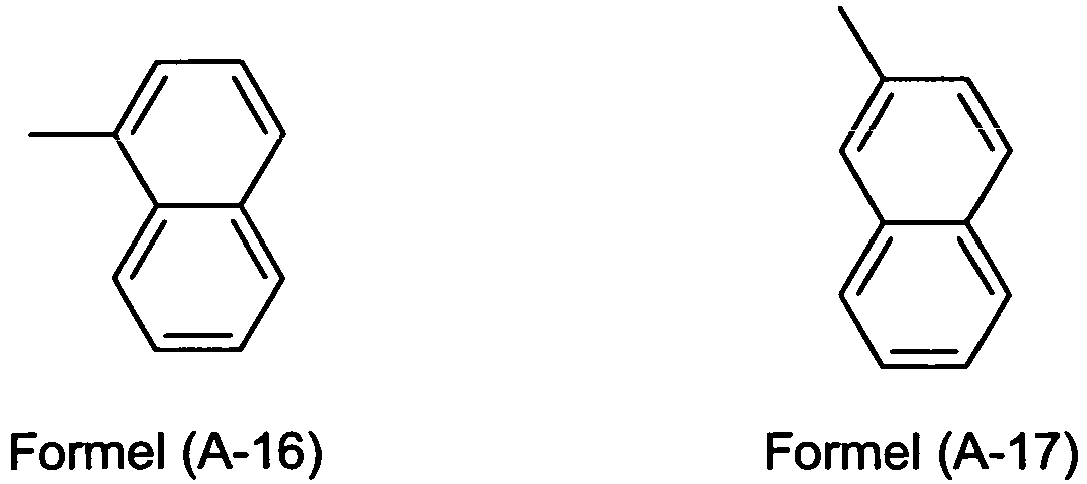
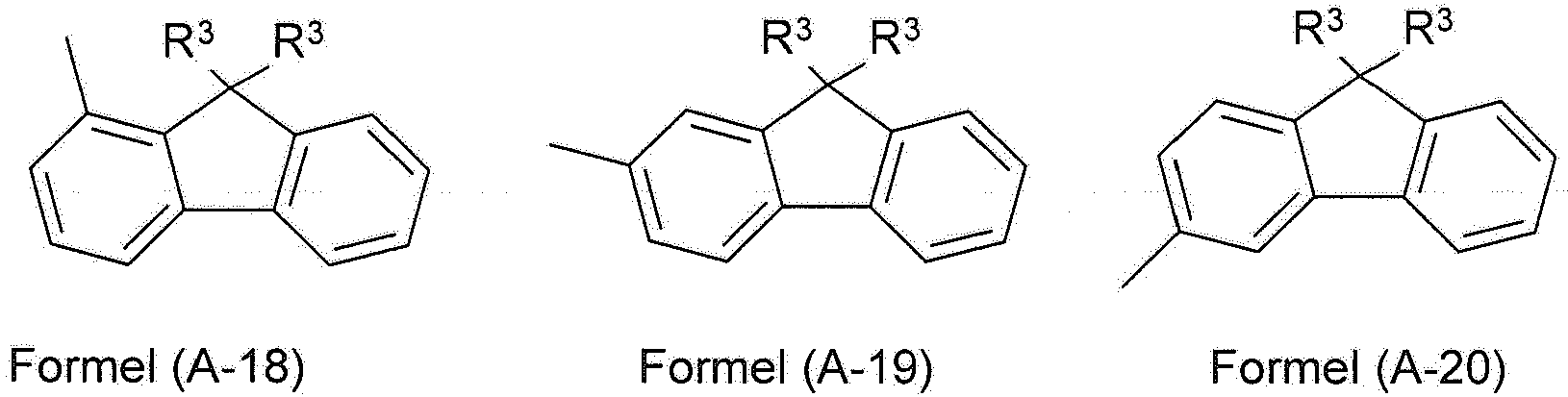


- Besonders bevorzugte heteroaromatische Ringsysteme R1 enthalten als Heteroarylgruppe Triazin, Pyrimidin, Pyrazin, Pyridazin, Pyridin, Benzothiophen, Benzofuran, Indol, Carbazol, Azacarbazol, Diazacarbazol, Dibenzothiophen und/oder Dibenzofuran. Dabei sind die heteroaromatischen Ringsysteme insbesondere ausgewählt aus den Strukturen der folgenden Formeln (H-1) bis (H-14):


- Wenn R1 für eine Gruppe N(Ar1)2 steht, dann ist diese Gruppe bevorzugt ausgewählt aus den Strukturen der folgenden Formeln (3) oder (4),


- Ar2
- ist gleich oder verschieden und bei jedem Auftreten ein aromatisches oder heteroaromatisches Ringsystem mit 5 bis 24 aromatischen Ringatomen, welches mit einem der mehreren Resten R3 substituiert sein kann; dabei ist die Summe der aromatischen Ringatome aller Gruppen Ar2 und Ar3 zusammen nicht größer als 60;
- Ar3
- ist bei jedem Auftreten ein aromatisches oder heteroaromatisches Ringsystem mit 5 bis 24 aromatischen Ringatomen, welches mit einem der mehreren Resten R3 substituiert sein kann;
- E
- ist ausgewählt aus der Gruppe bestehend aus einer Einfachbindung, C(R3)2, NR3, O oder S.
- Bevorzugte Ringsysteme für die Formeln Ar1 in Formel (3) bzw. Ar2 in Formel (5) sind Strukturen der Formeln (H-1) bis (H-15), wobei diese an allen freien Positionen mit Resten R3 substituiert sein können und die heteroaromatischen Gruppen an einer beliebigen freien Position mit dem N-Atom der Formel verbunden sein können, und Strukturen der Formeln (A-1) bis (A-25), wobei die Strukturen mit einem oder mehreren Resten R3 substituiert sein können und die gestrichelte Bindung die Bindung zum N-Atom der Formel darstellt, und R3 wie oben angegeben definiert ist.
- Ganz besonders bevorzugt ist mindestens ein Ar2 in Formel (5) ausgewählt aus den Strukturen (A-2) bis (A-25) oder (H-7) bis (H-9), insbesondere bevorzugt sind beide Ar2 in Formel (5) ausgewählt aus den Strukturen (A-2) bis (A-25) oder (H-7) bis (H-9).
- Ganz besonders bevorzugt ist mindestens ein Ar1 in Formel (3) ausgewählt aus den Strukturen (A-2) bis (A-17) oder (H-7) bis (H-9), insbesondere bevorzugt sind beide Ar2 in Formel (5) ausgewählt aus den Strukturen (A-2) bis (A-17) oder (H-7) bis (H-9).
- Bevorzugt ist Ar3 ausgewählt aus divalenten Gruppen der folgenden Formeln (Ar3-1) bis (Ar3-12):


- In einer bevorzugten Ausführungsform umfasst die Verbindung genau 1, 2, 3, 4 oder 5, bevorzugt 1, 2 oder 3, besonders bevorzugt 1 oder 2, Reste R1 und/oder R2 ausgewählt aus den Formeln (3), (4) und (5), bevorzugt aus den Formeln (3) und (5).
- In einer weiteren Ausführungsform enthält die Verbindung genau einen Rest R1 oder R2 ausgewählt aus den Formeln (3), (4) und (5).
- Bevorzugte Ausführungsformen der Verbindung nach Formel (1) sind die Verbindungen der Formeln (1-3a) bis (1-3g) und Formeln (1-5a) bis (1-5g):

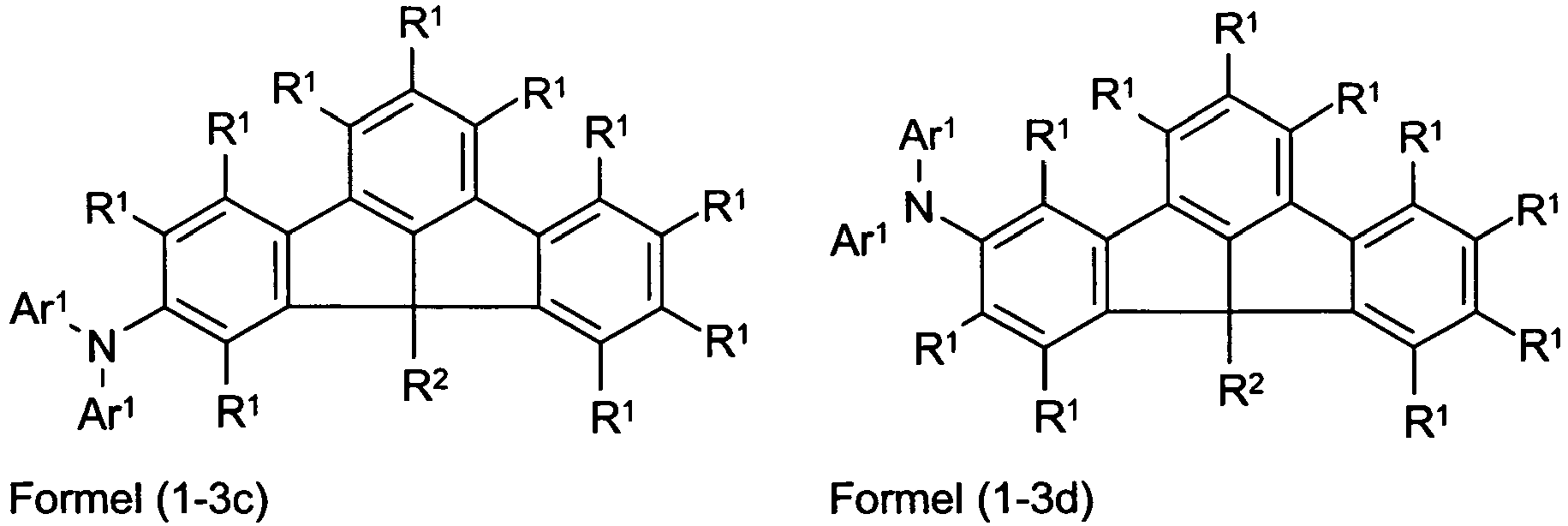


- In einer bevorzugten Ausführungsform der Erfindung ist in R2 soweit vorhanden in Bezug auf das Indeno[1,2,3-jk]fluoren-Gerüst kein Stickstoffatom, bevorzugt Heteroatom, in para-Stellung an einem 6-Ring-Arylsystem direkt am lndeno[1,2,3-jk]fluoren-Gerüst angeordnet. Dies gilt auch für annelierte aromatische Ringsysteme, welche Carbazolstrukturen enthalten, welche an 3-Position an das Indeno[1,2,3-jk]fluoren-Gerüst gebunden sind. Überraschenderweise wurde gefunden, dass solche Verbindungen deutlich instabiler sind als Verbindungen, welche das Stickstoffatom in ortho- oder meta-Stellung aufweisen.
- In einer bevorzugten Ausführungsform der Erfindung ist Ar3 in Formel (1-5a) ausgewählt aus den Strukturen (Ar3-2) bis (Ar3-11), bevorzugt ist dabei die Bindung zum lndeno[1,2,3-jk]fluoren-Gerüst in Formal (Ar3-5) an den Positionen 1, 2 oder 4 und in Formel (Ar3-7) und (Ar3-9) nicht in para-Position zur Bindung zum Stickstoff. Besonders bevorzugt ist Ar3 ausgewählt aus den Strukturen (Ar3-2) und (Ar3-3).
- Daher ist eine bevorzugte Ausführungsform der Verbindung nach Formel (1-5a) eine Verbindung der Formeln

- In einer bevorzugten Ausführungsform der Erfindung sind R1 und R2 soweit vorhanden, in den Formeln (1-3a) bis (1-3g), (1-5a) bis (1-5g), bzw. Formeln (1-5a-1) und (1-5a-2), keine oder genau eine weitere Gruppe ausgewählt aus den Formeln (3), (4) oder (5).
- In einer bevorzugten Ausführungsform der Erfindung sind R1 und R2 soweit vorhanden, in den Formeln (1-3a) bis (1-3g) und (1-5a) bis (1-5g), bzw. den Formeln (1-5a-1) und (1-5a-2), keine oder genau eine weitere Gruppe ausgewählt aus den Formeln (3), (4) oder (5) und noch mindestens ein weiterer R1 und/oder R2 soweit vorhanden ein aromatisches oder heteroaromatisches Ringsystem, besonders bevorzugt ein aromatisches oder heteroaromatisches Ringsystem der Formeln (A-1) bis (A-25) oder (H-1) bis (H-14), ganz besonders bevorzugt ein aromatisches Ringsystem, insbesondere gemäß der Formeln (A-1) bis (A-25).
- In einer bevorzugten Ausführungsform der Erfindung bilden die mehr als ein R1 untereinander keine an das lndeno[1,2,3-jk]fluoren-Gerüst anellierte aromatische oder heteroaromatische Ringsysteme.
- Je nach Verwendung der erfindungsgemäßen Verbindungen werden unterschiedliche Substituenten R1 und R2 ausgewählt.
- Wenn die Verbindung der Formel (1) bzw. (2) als Matrixmaterial für einen phosphoreszierenden Emitter verwendet wird, steht bevorzugt mindestens ein R1 und/oder R2 für N(Ar1)2, C(=O)Ar1, P(=O)(Ar1)2 oder ein aromatisches oder heteroaromatisches Ringsystem mit 5 bis 60 aromatischen Ringatomen, welches mit einem oder mehreren Resten R3 substituiert sein kann. Besonders bevorzugt sind in diesem Fall mindestens ein R1 und/oder R2 ausgewählt aus den Formeln (3), (4) und (5) und ihren vorstehend genannten Ausführungsformen.
- Wenn die Verbindung der Formel (1), bzw. (2) als Matrixmaterial für einen fluoreszierenden Emitter verwendet wird, steht bevorzugt mindestens ein R1 und/oder R2 für ein aromatisches oder heteroaromatisches Ringsystem, welches mindestens eine Arylgruppe mit mindestens drei kondensierten Sechsringen enthält, bevorzugt Anthracen.
- Wenn die Verbindung der Formel (1) bzw. (2) als fluoreszierender Emitter verwendet wird, umfasst bevorzugt mindestens ein R1 und/oder R2 für ein aromatisches oder heteroaromatisches Ringsystem, welches mindestens eine Arylgruppe oder ein aromatisches Ringsystem mit mindestens zwei kondensierten Sechsringen enthält, die bevorzugt direkt oder über eine Phenylgruppe an das Indeno[1,2,3-jk]fluoren-Gerüst gebunden ist. Dabei ist die kondensierte Arylgruppe bevorzugt ausgewählt aus Anthracen, Pyren, Phenanthren, Chrysen, Monobenzoindenofluoren oder Dibenzoindenofluoren.
- Wenn die Verbindungen der Formel (1) bzw. (2) als Elektronentransportmaterial verwendet werden, steht bevorzugt mindestens ein Rest R1 für ein elektronenarmes heteroaromatisches Ringsystem mit 5 bis 40 aromatischen Ringatomen, bevorzugt mit 5 bis 25 aromatischen Ringatomen, welches mit einem oder mehreren Resten R3 substituiert sein kann. Ein elektronenarmes heteroaromatisches Ringsystem im Sinne der vorliegenden Erfindung ist ein heteroaromatisches Ringsystem, welches mindestens eine elektronenarme Heteroarylgruppe enthält, wobei es sich dabei entweder um eine 6-Ringheteroarylgruppe mit mindestens einem Stickstoffatom oder um eine 5-Ringheteroarylgruppe mit mindestens zwei Heteroatomen handelt.
- Besonders bevorzugte elektronenarme heteroaromatische Ringsysteme R1 enthalten als Heteroarylgruppe mindestens eine Gruppe gewählt aus Triazin, Pyrimidin, Pyrazin, Pyridazin, Pyridin, Imidazol, Pyrazol, Oxazol, Oxadiazol, Triazol, Thiazol, Thiadiazol, Benzimidazol, Chinolin, Isochinolin und Chinoxalin. Dabei sind die heteroaromatischen Ringsysteme insbesondere ausgewählt aus den Strukturen der Formeln (H-1), (H-2), (H-3), (H-14), wobei R3 die dabei genannten Bedeutungen aufweist und die Strukturen an einer freien Position über eine Einfachbindung oder über eine Phenylgruppe an das Indeno[1,2,3-jk]fluoren-Gerüst gebunden sind.
- Wenn die Verbindungen der Formel (1) bzw. (2) als Lochtransportmaterial oder als emittierende Verbindung verwendet werden, steht bevorzugt mindestens ein Rest R1 und/oder R2 für N(Ar1)2, für eine Triarylaminogruppe oder für ein elektronenreiches heteroaromatisches Ringsystem mit 5 bis 40 aromatischen Ringatomen, insbesondere 5 bis 25 aromatischen Ringatomen, welches mit einem oder mehreren Resten R3 substituiert sein kann, insbesondere für einen Rest gemäß der oben genannten Formeln (3), (4) oder (5). Ein elektronenreiches heteroaromatisches Ringsystem in Sinne der Erfindung ist ein heteroaromatisches Ringsystem, welches mindestens eine elektronenreiche Heteroarylgruppe enthält, wobei es sich dabei um eine 5-Ringheteroarylgruppe mit genau einem Heteroatom handelt, an die auch eine oder mehrere Arylgruppen ankondensiert sein können.
- Besonders bevorzugte elektronenreiche heteroaromatisches Ringsysteme R1 enthalten als Heteroarylgruppe Pyrrol, Furan, Thiophen, Benzothiophen, Benzofuran, Indol, Carbazol, Dibenzothiophen, Dibenzofuran und/oder Azacarbazol. Dabei sind die elektronenreichen heteroaromatischen Ringsysteme insbesondere ausgewählt aus den Strukturen der oben genannten Formeln (H-4) bis (H-13).
- In einer Ausführungsform der Erfindung sind die oben genannten Bevorzugungen beliebig miteinander kombinierbar.
- Beispiele für bevorzugte Verbindungen gemäß der oben aufgeführten Ausführungsformen, bzw. Verbindungen, wie sie bevorzugt in elektronischen Vorrichtungen eingesetzt werden können, sind die Verbindungen der folgenden Strukturen (1) bis (55).


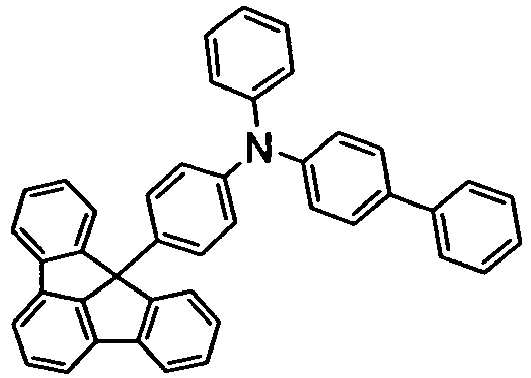
1 2 3 


4 5 6 


7 8 9 
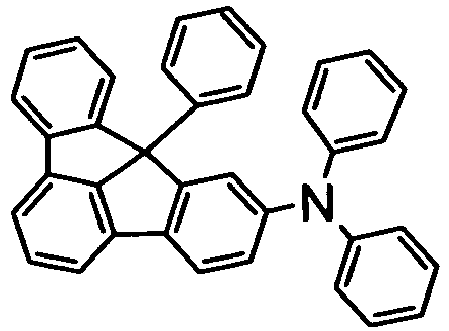
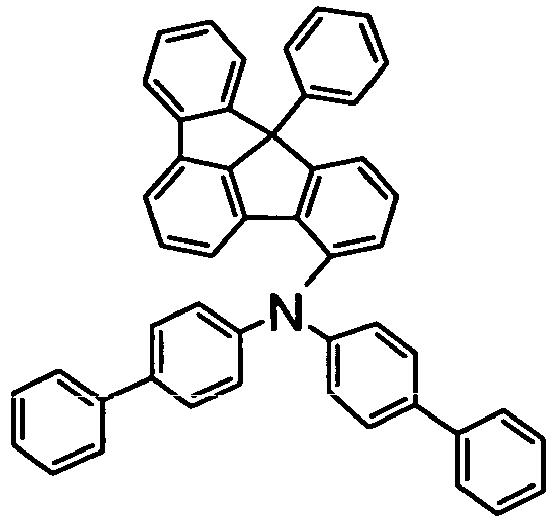
10 11 12 


13 14 15 


16 17 18 


19 20 21 


22 23 24 

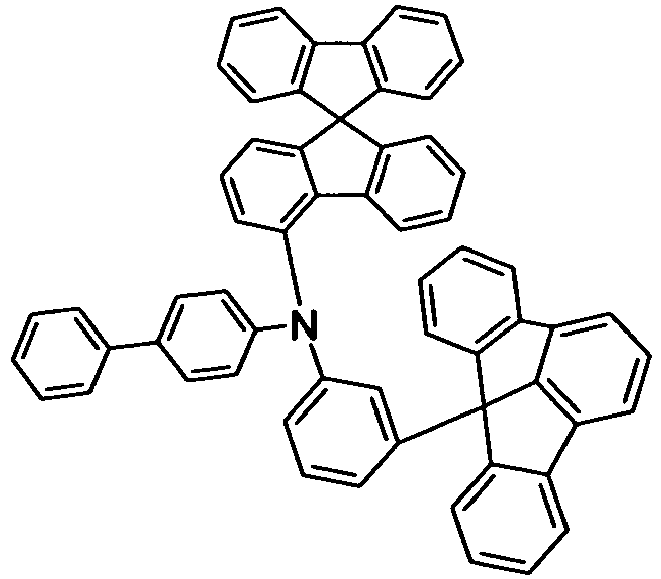
25 26 27 


28 29 30 


31 32 33 


34 35 36 


37 38 39 


40 41 42 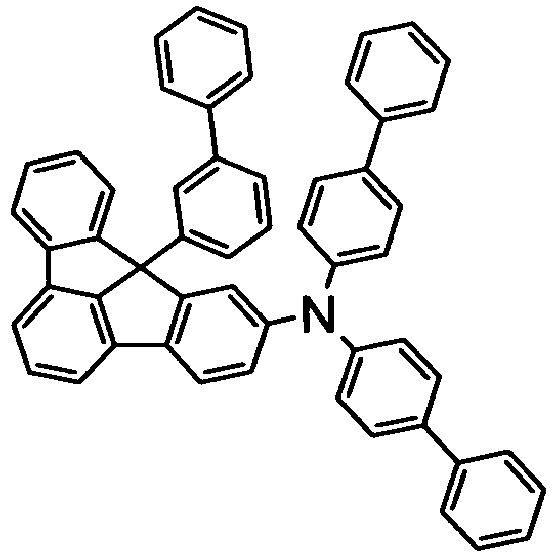


43 44 45 
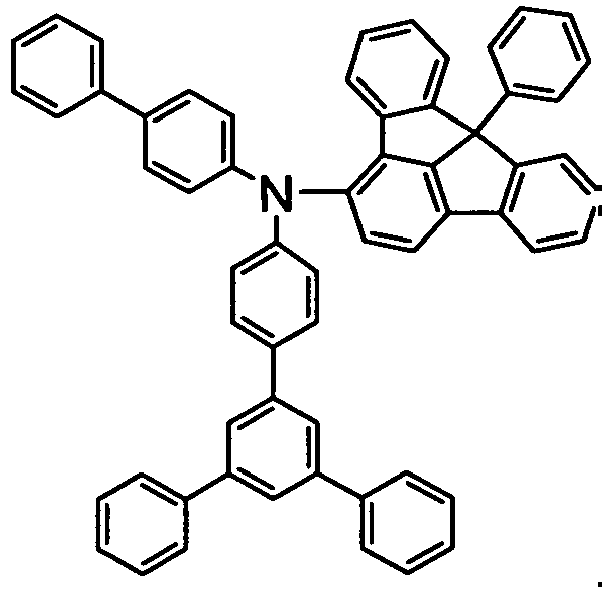

46 47 48 


49 50 51 


52 53 54 
55 - Die Synthese der erfindungsgemäßen Verbindungen kann gemäß im Stand der Technik bekannten Verfahren und Reaktionstypen, beispielsweise Friedel-Crafts Reaktion, Palladium-katalysierte intramolekulare C-H-Arylierung, Buchwald-Kupplung und Suzuki-Kupplung und Grignard-Reaktion erfolgen.
- Ein bevorzugtes erstes Verfahren zur Herstellung der erfindungsgemäßen Verbindungen geht von den in Schema 1 als Edukte abgebildeten Grundstrukturen aus. Diese sind in einigen Fällen kommerziell erhältlich, in anderen Fällen können sie in wenigen Syntheseschritten aus einfachen, kommerziell erhältlichen Verbindungen hergestellt werden:

- R: organischer Rest (soweit vorhanden)
- X: Hal oder andere reaktive Abgangsgruppe
- Y: OH, Hal oder andere reaktive Abgangsgruppe
- Solche Verbindungen können beispielsweise durch Umsetzung von Fluorenon mit entsprechend substituiertem Arylhalogenid im Rahmen einer Grignard-Reaktion erhalten werden:
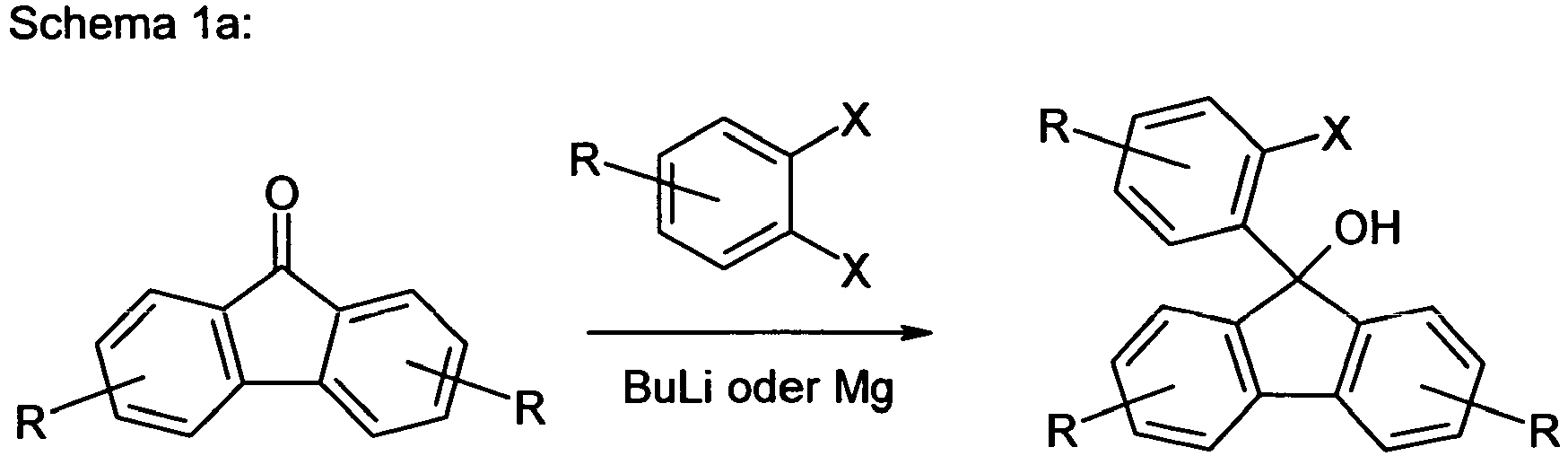
- R: organischer Rest (soweit vorhanden)
- X: Hal oder andere reaktive Abgangsgruppe
- In einem nächsten Schritt wird in die erhaltene Verbindung der gewünschte R2 anstatt der Gruppe Y eingeführt. Wenn R2 ein aromatisches Ringsystem umfasst, geschieht dies bevorzugt über eine Friedel-Crafts-Reaktion.

- R: organischer Rest (soweit vorhanden)
- X: Hal oder andere reaktive Abgangsgruppe
- A: aktivierender organischer Rest (soweit vorhanden)
- Aufgrund der Friedel-Crafts-Reaktion können dabei keine elektronenarmen Aromaten eingeführt werden. Insofern eignet sich dieser Reaktionsweg vor allem für unsubstituierte oder alkylierte Aromaten oder Arylamine (A ist N(Ar)2). Gleichzeitig bestimmt die Friedel-Crafts-Reaktion auch die Position des eventuell vorhandenen aktivierenden Rests in para-Position.
- In einem nächsten Schritt wird in einer intramolekularen Ringschlussreaktion das lndeno[1,2,3-jk]fluoren-Gerüst aufgebaut:


- R: organischer Rest (soweit vorhanden)
- X: Hal oder andere reaktive Abgangsgruppe
- A: aktivierender organischer Rest (soweit vorhanden)
- Ein bevorzugtes zweites Verfahren zur Herstellung der erfindungsgemäßen Verbindungen geht von dem in Schema 4 als Edukt abgebildeten Benzophenon-Derivat aus. Diese sind in einigen Fällen kommerziell erhältlich, in anderen Fällen können sie in wenigen Syntheseschritten aus einfachen, kommerziell erhältlichen Verbindungen hergestellt werden:

- R: organischer Rest (soweit vorhanden)
- W: organischer Rest (soweit vorhanden), insbesondere N(Ar)2
- X: Hal oder andere reaktive Abgangsgruppe
- In einer bevorzugten Ausführungsform des zweiten Verfahrens wird die Ausgangsverbindung durch eine Grignard-Reaktion an eine CN-Gruppe aufgebaut:

- R: organischer Rest (soweit vorhanden)
- W: organischer Rest (soweit vorhanden)
- X: Hal oder andere reaktive Abgangsgruppe
- Dabei stellt die Benzonitril-Verbindung die Vorläuferverbindung für den späteren R2 dar. Mehrere Reste W können dabei auch Ringe bilden, wie auch kondensierte (anellierte) Ringe, oder zusammen ein aromatisches oder heteroaromatisches Ringsystem bilden, z.B. Carbazole. W ist bevorzugt eine R2N-Gruppe, wobei R bevorzugt gleich oder verschieden eine Aryl- oder Heteroarylgruppe ist.
- In einer besonderen Ausführungsform des Verfahrens ist der Rest W ein Alkyl- oder Arylamin. Diese kann über eine Buchwald-Kupplung eingeführt werden:

- R: H oder organischer Rest, bevorzugt Aryl- oder Heteroarylgruppe
- X: Hal oder andere reaktive Abgangsgruppe
- In einer besonders bevorzugten Ausführungsform ist die Alkyl- oder Arylamingruppe in ortho- oder meta-Position zur Nitrilgruppe:


- R: organischer Rest (soweit vorhanden)
- W: organischer Rest (soweit vorhanden)
- X: Hal oder andere reaktive Abgangsgruppe
- In einem nächsten Schritt wird mit einer intramolekularen elektrophilen Reaktion der erste Teil des Indeno[1,2,3-jk]fluoren-Gerüsts aufgebaut:

- In einem nächsten Schritt wird in einer intramolekularen Ringschlussreaktion unter Übergangsmetallkatalyse das Indeno[1,2,3-jk]fluoren-Gerüst aufgebaut:

- R: organischer Rest (soweit vorhanden)
- W: organischer Rest (soweit vorhanden), insbesondere N(Ar)2
- X: Hal oder andere reaktive Abgangsgruppe
- Da bei diesem erfindungsgemäßen Verfahren der R2 des späteren Indeno[1,2,3-jk]fluoren-Gerüsts nicht über eine Friedel-Crafts-Reaktion eingeführt wird, sind andere Substitutionsmuster an R2 erhältlich. Besonders bevorzugt sind dabei Gruppen in meta- und ortho-Position in Bezug auf das Indeno[1,2,3-jk]fluoren-Gerüst, besonders bevorzugt Stickstoffsubstituenten wie Arylamine an diesen Positionen.

- Die oben gezeigte Syntheseverfahren haben exemplarischen Charakter und können vom Fachmann auf dem Gebiet der organischen Synthese in geeigneter Weise abgewandelt werden, wenn dies für die Synthese bestimmter Ausführungsformen von erfindungsgemäßen Verbindungen vorteilhaft ist.
- Einen weiteren Gegenstand der vorliegenden Erfindung stellt also ein Verfahren zur Herstellung von Verbindungen gemäß Formel (1), bzw. (2) dar, welches dadurch gekennzeichnet ist, dass ausgehend von einem Fluorenon-Derivat eine Addition an die Ketogruppe und eine bevorzugt übergangsmetallkatalysierte Kupplungsreaktion zum Ringschluss zum lndeno[1,2,3-jk]fluoren-Gerüst durchgeführt werden.
- Einen weiteren Gegenstand der vorliegenden Erfindung stellt also ein weiteres Verfahren zur Herstellung von Verbindungen mit Indeno[1,2,3-jk]fluoren-Gerüst, bevorzugt Verbindungen gemäß Formel (1), bzw. (2) dar, welches dadurch gekennzeichnet ist, dass an einem Arylketon, welches in ortho-Position zur Ketogruppe eine Abgangsgruppe aufweist, mit einem Biaryl-Derivat eine Addition an die Ketogruppe durchgeführt wird und anschließend über eine intramolekulare elektrophile Reaktion und eine bevorzugt übergangsmetallkatalysierte intramolekulare Kupplungsreaktion das lndeno[1,2,3-jk]fluoren-Gerüst aufgebaut wird.
- Die oben beschriebenen erfindungsgemäßen Verbindungen, insbesondere Verbindungen, welche mit reaktiven Abgangsgruppen, wie Brom, Iod, Chlor, Boronsäure oder Boronsäureester, substituiert sind, können als Monomere zur Erzeugung entsprechender Oligomere, Dendrimere oder Polymere Verwendung finden. Geeignete reaktive Abgangsgruppen sind beispielsweise Brom, Iod, Chlor, Boronsäuren, Boronsäureester, Amine, Alkenyl- oder Alkinylgruppen mit endständiger C-C-Doppelbindung bzw. CC-Dreifachbindung, Oxirane, Oxetane, Gruppen, die eine Cycloaddition, beispielsweise eine 1,3-dipolare Cycloaddition, eingehen, wie beispielsweise Diene oder Azide, Carbonsäurederivate, Alkohole und Silane.
- Weiterer Gegenstand der Erfindung sind daher Oligomere, Polymere oder Dendrimere enthaltend eine oder mehrere Verbindungen gemäß Formel (1), bzw. (2), wobei die Bindung(en) zum Polymer, Oligomer oder Dendrimer an beliebigen, in Formel (1), bzw (2) mit R1 und/oder R2 substituierten Positionen lokalisiert sein können. Je nach Verknüpfung der erfindungsgemäßen Verbindung ist die Verbindung Bestandteil einer Seitenkette des Oligomers oder Polymers oder Bestandteil der Hauptkette.
- Unter einem Oligomer im Sinne dieser Erfindung wird eine Verbindung verstanden, welche aus mindestens drei Monomereinheiten aufgebaut ist. Unter einem Polymer im Sinne der Erfindung wird eine Verbindung verstanden, die aus mindestens zehn Monomereinheiten aufgebaut ist.
- Die erfindungsgemäßen Polymere, Oligomere oder Dendrimere können konjugiert, teilkonjugiert oder nicht-konjugiert sein. Die erfindungsgemäßen Oligomere oder Polymere können linear, verzweigt oder dendritisch sein.
- In den linear verknüpften Strukturen können die Einheiten gemäß Formel (1), bzw. (2) direkt miteinander verknüpft sein oder sie können über eine bivalente Gruppe, beispielsweise über eine substituierte oder unsubstituierte Alkylengruppe, über ein Heteroatom oder über eine bivalente aromatische oder heteroaromatische Gruppe miteinander verknüpft sein.
- In verzweigten und dendritischen Strukturen können beispielsweise 3, 5 oder mehrere Einheiten gemäß Formel (1), bzw. (2) über eine trivalente oder höhervalente Gruppe, beispielsweise über eine trivalente oder höhervalente aromatische oder heteroaromatische Gruppe, zu einem verzweigten bzw. dendritischen Oligomer oder Polymer verknüpft sein.
- Für die Wiederholeinheiten gemäß Formel (1), bzw. (2) in Oligomeren, Dendrimeren und Polymeren gelten dieselben Bevorzugungen wie oben für die erfindungsgemäßen Verbindungen beschrieben.
- In einer Ausführungsform der Erfindung sind die Bindungen zum Oligomer, Polymer oder Dendrimer nicht an beiden Position 5 und 10 lokalisiert.
- Zur Herstellung der Oligomere oder Polymere werden die erfindungsgemäßen Monomere homopolymerisiert oder mit weiteren Monomeren copolymerisiert. Geeignete und bevorzugte Comonomere sind gewählt aus Fluorenen (z. B. gemäß
EP 842208 WO 2000/22026 EP 707020 EP 894107 WO 2006/061181 ), Paraphenylenen (z. B. gemäßWO 1992/18552 WO 2004/070772 oderWO 2004/113468 ), Thiophenen (z. B. gemäßEP 1028136 ), Dihydrophenanthrenen (z. B. gemäßWO 2005/014689 oderWO 2007/006383 ), cis- und translndenofluorenen (z. B. gemäßWO 2004/041901 oderWO 2004/113412 ), Ketonen (z. B. gemäßWO2005/040302 ), Phenanthrenen (z. B. gemäßWO 2005/104264 oderWO 2007/017066 ) oder auch mehreren dieser Einheiten. Die Polymere, Oligomere und Dendrimere enthalten üblicherweise noch weitere Einheiten, beispielsweise emittierende (fluoreszierende oder phosphoreszierende) Einheiten, wie z. B. Vinyltriarylamine (z. B. gemäßWO 2007/068325 ) oder phosphoreszierende Metallkomplexe (z. B. gemäßWO 2006/003000 ), und/oder Ladungstransporteinheiten, insbesondere solche basierend auf Triarylaminen. - Die erfindungsgemäßen Polymere, Oligomere und Dendrimere weisen vorteilhafte Eigenschaften, insbesondere hohe Lebensdauern, hohe Effizienzen und gute Farbkoordinaten auf.
- Die erfindungsgemäßen Polymere und Oligomere werden in der Regel durch Polymerisation von einer oder mehreren Monomersorten hergestellt, von denen mindestens ein Monomer im Polymer zu Wiederholungseinheiten der Formel (1), bzw. (2) führt. Geeignete Polymerisationsreaktionen sind dem Fachmann bekannt und in der Literatur beschrieben. Besonders geeignete und bevorzugte Polymerisationsreaktionen, die zu C-C- bzw. C-N-Verknüpfungen führen, sind folgende:
- (A) SUZUKI-Polymerisation;
- (B) YAMAMOTO-Polymerisation;
- (C) STILLE-Polymerisation; und
- (D) HARTWIG-BUCHWALD-Polymerisation.
- Wie die Polymerisation nach diesen Methoden durchgeführt werden kann und wie die Polymere dann vom Reaktionsmedium abgetrennt und aufgereinigt werden können, ist dem Fachmann bekannt und in der Literatur, beispielsweise in
WO 2003/048225 ,WO 2004/037887 undWO 2004/037887 , im Detail beschrieben. - Gegenstand der vorliegenden Erfindung ist somit auch ein Verfahren zur Herstellung der erfindungsgemäßen Polymere, Oligomere und Dendrimere, das dadurch gekennzeichnet ist, dass sie durch Polymerisation gemäß SUZUKI, Polymerisation gemäß YAMAMOTO, Polymerisation gemäß STILLE oder Polymerisation gemäß HARTWIG-BUCHWALD hergestellt werden. Die erfindungsgemäßen Dendrimere können gemäß dem Fachmann bekannten Verfahren oder in Analogie dazu hergestellt werden. Geeignete Verfahren sind in der Literatur beschrieben, wie z. B. in Frechet, Jean M. J.; Hawker, Craig J., "Hyperbranched polyphenylene and hyperbranched polyesters: new soluble, three-dimensional, reactive polymers", Reactive & Functional Polymers (1 995), 26(1-3), 127-36; Janssen, H. M.; Meijer, E. W., "The synthesis and characterization of dendritic molecules", Materials Science and Technology (1 999), 20 (Synthesis of Polymers), 403-458; Tomalia, Donald A., "Dendrimer molecules", Scientific American (1995), 272(5), 62-6;
WO 2002/067343 A1 undWO 2005/026144 A1 . - Für die Verarbeitung der erfindungsgemäßen Verbindungen aus flüssiger Phase, beispielsweise durch Spin-Coating oder durch Druckverfahren, sind Formulierungen der erfindungsgemäßen Verbindungen erforderlich. Diese Formulierungen können beispielsweise Lösungen, Dispersionen oder Emulsionen sein. Es kann bevorzugt sein, hierfür Mischungen aus zwei oder mehr Lösemitteln zu verwenden. Geeignete und bevorzugte Lösemittel sind beispielsweise Toluol, Anisol, o , m- oder p-Xylol, Methylbenzoat, Mesitylen, Tetralin, Veratrol, THF, Methyl-THF, THP, Chlorbenzol, Dioxan, Phenoxytoluol, insbesondere 3-Phenoxytoluol, (-)-Fenchon, 1,2,3,5-Tetramethylbenzol, 1,2,4,5-Tetramethylbenzol, 1-Methylnaphthalin, 2-Methylbenzothiazol, 2-Phenoxyethanol, 2-Pyrrolidinon, 3-Methylanisol, 4-Methylanisol, 3,4-Dimethylanisol, 3,5-Dimethylanisol, Acetophenon, α-Terpineol, Benzothiazol, Butylbenzoat, Cumol, Cyclohexanol, Cyclohexanon, Cyclohexylbenzol, Decalin, Dodecylbenzol, Ethylbenzoat, Indan, Methylbenzoat, NMP, p-Cymol, Phenetol, 1,4-Diisopropylbenzol, Dibenzylether, Diethylenglycolbutylmethylether, Triethylenglycolbutylmethyl-ether, Diethylenglycoldibutylether, Triethylenglycoldimethylether, Diethylenglycolmonobutylether, Tripropylenglycoldimethylether, Tetraethylenglycoldimethylether, 2-Isopropylnaphthalin, Pentylbenzol, Hexylbenzol, Heptylbenzol, Octylbenzol, 1,1-Bis(3,4-Dimethylphenyl)ethan oder Mischungen dieser Lösemittel.
- Gegenstand der Erfindung ist daher weiterhin eine Formulierung, insbesondere eine Lösung, Dispersion oder Emulsion, enthaltend mindestens eine Verbindung gemäß Formel (1), bzw. (2), oder mindestens ein Polymer, Oligomer oder Dendrimer enthaltend mindestens eine Einheit gemäß Formel (1), bzw. (2), sowie mindestens ein Lösungsmittel, bevorzugt ein organisches Lösungsmittel. Wie solche Lösungen hergestellt werden können, ist dem Fachmann bekannt und beispielsweise in
WO 2002/072714 ,WO 2003/019694 und der darin zitierten Literatur beschrieben. - Die Verbindungen gemäß Formel (1), bzw. (2) eignen sich für den Einsatz in elektronischen Vorrichtungen, insbesondere in organischen Elektrolumineszenzvorrichtungen (OLEDs). Abhängig von der Substitution werden die Verbindungen in unterschiedlichen Funktionen und in unterschiedlichen Schichten der organischen Elektrolumineszenzvorrichtung eingesetzt. Bevorzugt werden die Verbindungen als Lochtransportmaterialien in einer Lochtransport- oder Lochinjektionsschicht, als Matrixmaterialien in einer emittierenden Schicht, als Elektronenblockiermaterialien, als Excitonenblockiermaterialien und/oder als Materialien für eine Zwischenschicht (interlayer) eingesetzt.
- Weitere Gegenstände der Erfindung sind daher die Verwendung der Verbindungen gemäß Formel (1), bzw. (2) in elektronischen Vorrichtungen sowie elektronische Vorrichtungen selbst, welche eine oder mehrere Verbindungen gemäß Formel (1), bzw. (2) enthalten. Dabei sind die elektronischen Vorrichtungen bevorzugt ausgewählt aus der Gruppe bestehend aus organischen integrierten Schaltungen (O-ICs), organischen Feld-Effekt-Transistoren (O-FETs), organischen Dünnfilmtransistoren (OTFTs), organischen lichtemittierenden Transistoren (O-LETS), organischen Solarzellen (O-SCs), organischen optischen Detektoren, organischen Photorezeptoren, organischen Feld-Quench-Devices (O-FQDs), lichtemittierenden elektrochemischen Zellen (LECs), organischen Laserdioden (O-Laser) und besonders bevorzugt organischen Elektrolumineszenzvorrichtungen (OLEDs). Besonders bevorzugt sind organische Elektrolumineszenzvorrichtungen, enthaltend Anode, Kathode und mindestens eine emittierende Schicht, dadurch gekennzeichnet, dass mindestens eine organische Schicht, die eine emittierende Schicht, eine Lochtransportschicht oder eine andere Schicht sein kann, mindestens eine Verbindung gemäß Formel (1), bzw. (2) enthält.
- Außer Kathode, Anode und der emittierenden Schicht kann die organische Elektrolumineszenzvorrichtung noch weitere Schichten enthalten. Diese sind beispielsweise gewählt aus jeweils einer oder mehreren Lochinjektionsschichten, Lochtransportschichten, Lochblockierschichten, Elektronentransportschichten, Elektroneninjektionsschichten, Elektronenblockierschichten, Excitonenblockierschichten, Zwischenschichten (interlayers), Ladungserzeugungsschichten (Charge-Generation Layers) (IDMC 2003, Taiwan; Session 21 OLED (5), T. Matsumoto, T. Nakada, J. Endo, K. Mori, N. Kawamura, A. Yokoi, J. Kido, Multiphoton Organic EL Device Having Charge Generation Layer) und/oder organischen oder anorganischen p/n-Übergangen. Es sei aber darauf hingewiesen, dass nicht notwendigerweise jede dieser Schichten vorhanden sein muss und die Wahl der Schichten immer von den verwendeten Verbindungen abhängt und insbesondere auch von der Tatsache, ob es sich um eine fluoreszierende oder phosphoreszierende Elektrolumineszenzvorrichtung handelt.
- Die organische Elektrolumineszenzvorrichtung kann auch mehrere emittierende Schichten enthalten. Besonders bevorzugt weisen diese Emissionsschichten in diesem Fall insgesamt mehrere Emissionsmaxima zwischen 380 nm und 750 nm auf, so dass insgesamt weiße Emission resultiert, d. h. in den emittierenden Schichten werden verschiedene emittierende Verbindungen verwendet, die fluoreszieren oder phosphoreszieren können und die blaues, gelbes, grünes, orangefarbenes oder rotes Licht emittieren. Insbesondere bevorzugt sind Dreischichtsysteme, also Systeme mit drei emittierenden Schichten, wobei mindestens eine dieser Schichten mindestens eine Verbindung gemäß Formel (1), bzw. (2) enthält und wobei die drei Schichten blaue, grüne und orangefarbene oder rote Emission zeigen (für den prinzipiellen Aufbau siehe z. B.
WO 2005/011013 ). Alternativ und/oder zusätzlich können die erfindungsgemäßen Verbindungen auch in der Lochtransportschicht und/oder in einer Zwischenschicht (interlayer) vorhanden sein. Es soll angemerkt werden, dass sich für die Erzeugung von weißem Licht anstelle mehrerer farbig emittierender Emitterverbindungen auch eine einzeln verwendete Emitterverbindung eignen kann, welche in einem breiten Wellenlängenbereich emittiert. - Es ist erfindungsgemäß bevorzugt, wenn die Verbindung gemäß Formel (1), bzw. (2) in einer elektronischen Vorrichtung enthaltend einen oder mehrere phosphoreszierende Dotanden eingesetzt wird. Dabei kann die Verbindung in unterschiedlichen Schichten, bevorzugt in einer Lochtransportschicht, einer Lochinjektionsschicht oder in einer emittierenden Schicht verwendet werden. Die Verbindung gemäß Formel (1), bzw. (2) kann aber auch erfindungsgemäß in einer elektronischen Vorrichtung enthaltend einen oder mehrere fluoreszierende Dotanden eingesetzt werden.
- Vom Begriff phosphoreszierende Dotanden sind typischerweise Verbindungen umfasst, bei denen die Lichtemission durch einen spinverbotenen Übergang erfolgt, beispielsweise einen Übergang aus einem angeregten Triplettzustand oder einem Zustand mit einer höheren Spinquantenzahl, beispielsweise einem Quintett-Zustand.
- Als phosphoreszierende Dotanden (= Triplettemitter) eignen sich insbesondere Verbindungen, die bei geeigneter Anregung Licht, vorzugsweise im sichtbaren Bereich, emittieren und außerdem mindestens ein Atom der Ordnungszahl größer 20, bevorzugt größer 38 und kleiner 84, besonders bevorzugt größer 56 und kleiner 80 enthalten. Bevorzugt werden als Phosphoreszenzemitter Verbindungen, die Kupfer, Molybdän, Wolfram, Rhenium, Ruthenium, Osmium, Rhodium, Iridium, Palladium, Platin, Silber, Gold oder Europium enthalten, verwendet, insbesondere Verbindungen, die Iridium, Platin oder Kupfer enthalten.
- Dabei werden im Sinne der vorliegenden Erfindung alle lumineszierenden Iridium-, Platin- oder Kupferkomplexe als phosphoreszierende Verbindungen angesehen.
- Beispiele der oben beschriebenen Emitter können den Anmeldungen
WO 00/70655 WO 01/41512 WO 02/02714 WO 02/15645 EP 1191613 ,EP 1191612 ,EP 1191614 ,WO 05/033244 WO 05/019373 US 2005/0258742 entnommen werden. Generell eignen sich alle phosphoreszierenden Komplexe, wie sie gemäß dem Stand der Technik für phosphoreszierende OLEDs verwendet werden und wie sie dem Fachmann auf dem Gebiet der organischen Elektrolumineszenzvorrichtungen bekannt sind. Auch kann der Fachmann ohne erfinderisches Zutun weitere phosphoreszierende Komplexe in Kombination mit den Verbindungen gemäß Formel (1), bzw. (2) in organischen Elektrolumineszenzvorrichtungen einsetzen. - Explizite Beispiele für geeignete phosphoreszierende Emitterverbindungen können weiterhin einer im Folgenden abgebildeten Tabelle phosphoreszierender Dotanden entnommen werden.
- In einer bevorzugten Ausführungsform der Erfindung werden die Verbindungen gemäß Formel (1), bzw. (2) als Lochtransportmaterial eingesetzt. Die Verbindungen werden dann bevorzugt in einer Lochtransportschicht und/oder in einer Lochinjektionsschicht eingesetzt.
- Eine Lochinjektionsschicht im Sinne dieser Erfindung ist eine Schicht, die direkt an die Anode angrenzt. Eine Lochtransportschicht im Sinne dieser Erfindung ist eine Schicht, die zwischen der Lochinjektionsschicht und der Emissionsschicht liegt. Die Lochtransportschicht kann direkt an die Emissionschicht angrenzen. Wenn die Verbindungen gemäß Formel (1), bzw. (2) als Lochtransportmaterial oder als Lochinjektionsmaterial verwendet werden, kann es bevorzugt sein, wenn sie mit Elektronenakzeptor-Verbindungen dotiert sind, beispielsweise mit F4-TCNQ oder mit Verbindungen, wie sie in
EP 1476881 oderEP 1596445 beschrieben werden. In einer weiteren bevorzugten Ausführungsform der Erfindung wird eine Verbindung gemäß Formel (1), bzw. (2) als Lochtransportmaterial in Kombination mit einem Hexaazatriphenylenderivat, wie inUS 2007/0092755 beschrieben, verwendet. Besonders bevorzugt wird das Hexaazatriphenylenderivat dabei in einer separaten Schicht eingesetzt. - Wird die Verbindung gemäß Formel (1), bzw. (2) als Lochtransportmaterial in einer Lochtransportschicht eingesetzt, so kann die Verbindung als Reinmaterial, d.h. in einem Anteil von 100 %, in der Lochtransportschicht eingesetzt werden, oder sie kann in Kombination mit einer oder mehreren weiteren Verbindungen in der Lochtransportschicht eingesetzt werden.
- In einer weiteren Ausführungsform der vorliegenden Erfindung werden die Verbindungen der Formel (1), bzw. (2) als Matrixmaterial in Kombination mit einem oder mehreren Dotanden, vorzugsweise phosphoreszierenden Dotanden, eingesetzt.
- Unter einem Dotanden wird in einem System enthaltend ein Matrixmaterial und einen Dotanden diejenige Komponente verstanden, deren Anteil in der Mischung der kleinere ist. Entsprechend wird unter einem Matrixmaterial in einem System enthaltend ein Matrixmaterial und einen Dotanden diejenige Komponente verstanden, deren Anteil in der Mischung der größere ist.
- Der Anteil des Matrixmaterials in der emittierenden Schicht beträgt in diesem Fall zwischen 50.0 und 99.9 Vol.-%, bevorzugt zwischen 80.0 und 99.5 Vol.-% und besonders bevorzugt für fluoreszierende emittierende Schichten zwischen 92.0 und 99.5 Vol.-% sowie für phosphoreszierende emittierende Schichten zwischen 85.0 und 97.0 Vol.-%.
- Entsprechend beträgt der Anteil des Dotanden zwischen 0.1 und 50.0 Vol.-%, bevorzugt zwischen 0.5 und 20.0 Vol.-% und besonders bevorzugt für fluoreszierende emittierende Schichten zwischen 0.5 und 8.0 Vol.-% sowie für phosphoreszierende emittierende Schichten zwischen 3.0 und 15.0 Vol.-%.
- Eine emittierende Schicht einer organischen Elektrolumineszenzvorrichtung kann auch Systeme umfassend mehrere Matrixmaterialien (Mixed-Matrix-System) und/oder mehrere Dotanden enthalten. Auch in diesem Fall sind die Dotanden im Allgemeinen diejenigen Materialien, deren Anteil im System der kleinere ist und die Matrixmaterialien sind diejenigen Materialien, deren Anteil im System der größere ist. In Einzelfällen kann jedoch der Anteil eines einzelnen Matrixmaterials im System kleiner sein als der Anteil eines einzelnen Dotanden.
- In einer bevorzugten Ausführungsform der Erfindung werden die Verbindungen gemäß Formel (1), bzw. (2) als eine Komponente von Mixed-Matrix-Systemen verwendet. Die Mixed-Matrix-Systeme umfassen bevorzugt zwei oder drei verschiedene Matrixmaterialien, besonders bevorzugt zwei verschiedene Matrixmaterialien. Die beiden unterschiedlichen Matrixmaterialien können dabei in einem Verhältnis von 1 : 10 bis 1 : 1 vorhanden sein, bevorzugt in einem Verhältnis von 1 :4 bis 1 : 1.
- Die Mixed-Matrix-Systeme können einen oder mehrere Dotanden umfassen. Die Dotandverbindung bzw. die Dotandverbindungen zusammen haben erfindungsgemäß einen Anteil von 0.1 bis 50.0 Vol.-% an der Gesamtmischung und bevorzugt einen Anteil von 0.5 bis 20.0 Vol.-% an der Gesamtmischung. Entsprechend haben die Matrixkomponenten zusammen einen Anteil von 50.0 bis 99.9 Vol-% an der Gesamtmischung und bevorzugt einen Anteil von 80.0 bis 99.5 Vol.-% an der Gesamtmischung.
- Bevorzugt werden Mixed-Matrix-Systeme in phosphoreszierenden organischen Elektrolumineszenzvorrichtungen eingesetzt.
- Besonders geeignete Matrixmaterialien, welche in Kombination mit den erfindungsgemäßen Verbindungen als Matrixkomponenten eines Mixed-Matrix-Systems eingesetzt werden können, sind aromatische Ketone, aromatische Phosphinoxide oder aromatische Sulfoxide oder Sulfone, z. B. gemäß
WO 04/013080 WO 04/093207 WO 06/005627 WO 10/006680 WO 05/039246 US 2005/0069729 ,JP 2004/288381 EP 1205527 oderWO 08/086851 WO 07/063754 WO 08/056746 EP 1617710 ,EP 1617711 ,EP1731584 ,JP 2005/347160 WO 07/137725 WO 05/111172 WO 06/117052 WO 2010/015306 ,WO 2007/063754 oderWO 2008/056746 , Zinkkomplexe, z. B. gemäßEP 652273 WO 09/062578 WO 10/054729 WO 10/054730 WO 10/136109 - Bevorzugte phosphoreszierende Dotanden zur Verwendung in Mixed-Matrix-Systemen enthaltend die erfindungsgemäßen Verbindungen sind die in einer folgenden Tabelle aufgeführten phosphoreszierenden Dotanden.
- Gemäß einer weiteren bevorzugten Ausführungsform der Erfindung werden die Verbindungen gemäß Formel (1), bzw. (2) in einer Zwischenschicht (interlayer) eingesetzt. Zwischenschichten werden bevorzugt in organischen Elektrolumineszenzvorrichtungen enthaltend mehrere emittierende Schichten eingesetzt, beispielsweise in weiß emittierenden OLEDs, welche jeweils eine rot emittierende, eine grün emittierende und eine blau emittierende Schicht enthalten. Besonders bevorzugt sind Zwischenschichten zwischen zwei emittierenden Schichten angeordnet. Eine Zwischenschicht enthaltend eine erfindungsgemäße Verbindung ist gemäß einer bevorzugten Ausführungsform der Erfindung zwischen der blau emittierenden Schicht und der grün emittierenden Schicht einer weißes Licht emittierenden OLED, welche eine rot emittierende, eine grün emittierende und eine blau emittierende Schicht enthält, angeordnet. Besonders bevorzugt ist die blau emittierende Schicht dabei eine fluoreszierende Schicht, und die grün emittierende Schicht ist eine phosphoreszierende Schicht.
- Die in der folgenden Tabelle aufgeführten Verbindungen stellen besonders geeignete phosphoreszierende Dotanden dar.
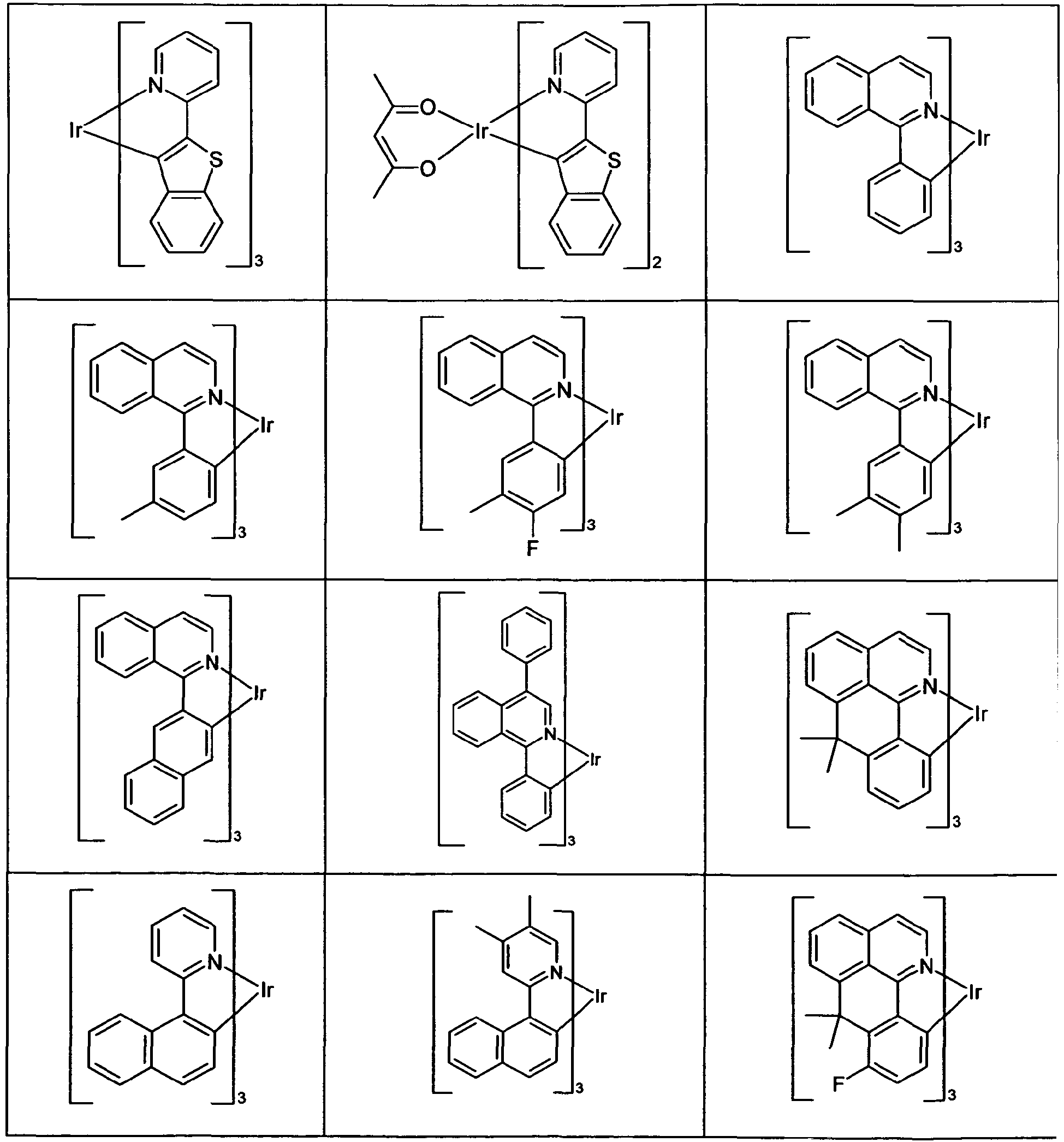


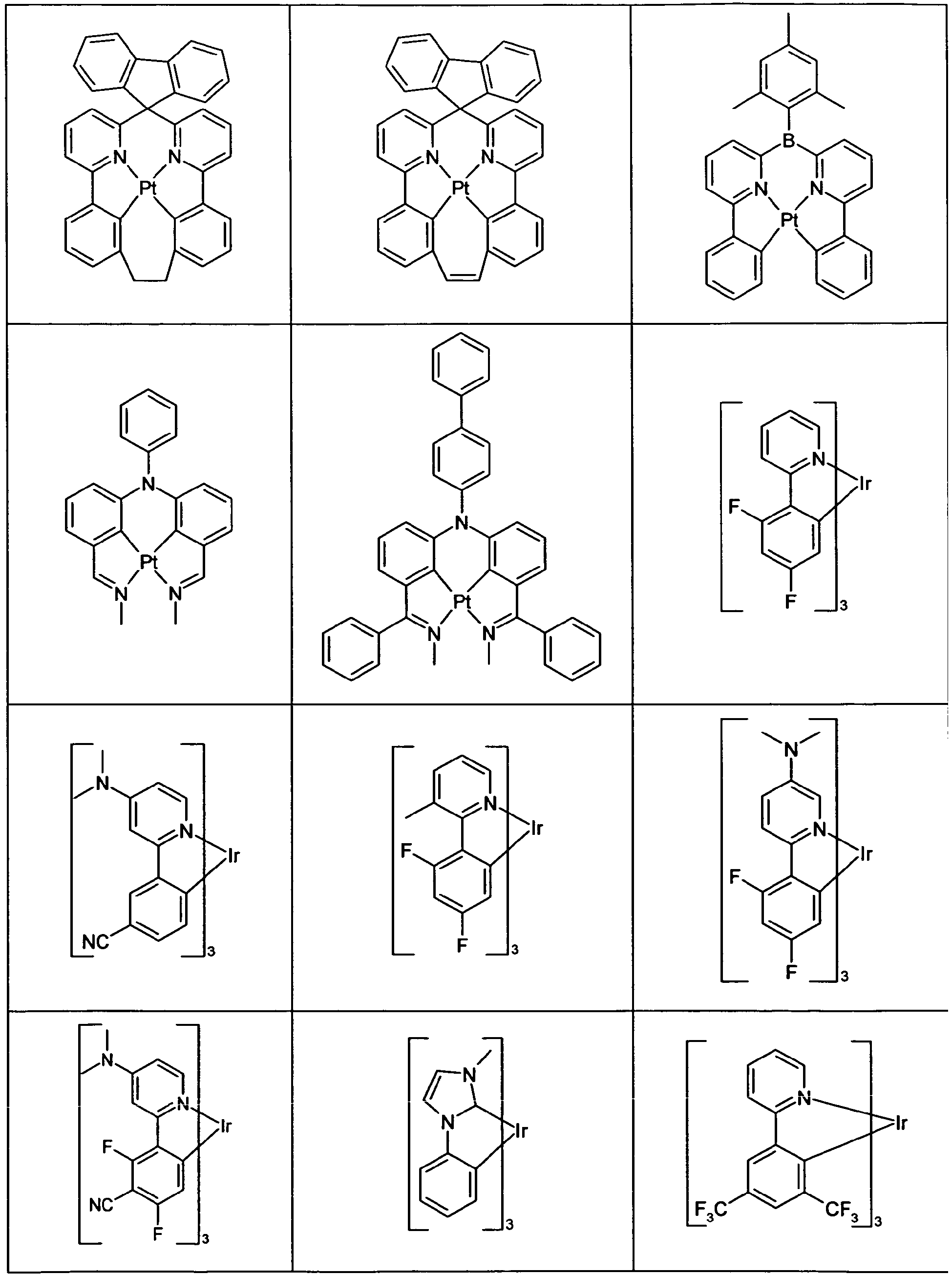

- Bevorzugte fluoreszierende Dotanden sind ausgewählt aus der Klasse der Arylamine. Unter einem Arylamin bzw. einem aromatischen Amin im Sinne dieser Erfindung wird eine Verbindung verstanden, die drei substituierte oder unsubstituierte aromatische oder heteroaromatische Ringsysteme direkt an den Stickstoff gebunden enthält. Bevorzugt ist mindestens eines dieser aromatischen oder heteroaromatischen Ringsysteme ein kondensiertes Ringsystem, besonders bevorzugt mit mindestens 14 aromatischen Ringatomen. Bevorzugte Beispiele hierfür sind aromatische Anthracenamine, aromatische Anthracendiamine, aromatische Pyrenamine, aromatische Pyrendiamine, aromatische Chrysenamine oder aromatische Chrysendiamine. Unter einem aromatischen Anthracenamin wird eine Verbindung verstanden, in der eine Diarylaminogruppe direkt an eine Anthracengruppe gebunden ist, vorzugsweise in 9-Position. Unter einem aromatischen Anthracendiamin wird eine Verbindung verstanden, in der zwei Diarylaminogruppen direkt an eine Anthracengruppe gebunden sind, vorzugsweise in 9,10-Position. Aromatische Pyrenamine, Pyrendiamine, Chrysenamine und Chrysendiamine sind analog dazu definiert, wobei die Diarylaminogruppen am Pyren bevorzugt in 1-Position bzw. in 1,6-Position gebunden sind. Weitere bevorzugte fluoreszierende Dotanden sind gewählt aus Indenofluorenaminen bzw. -diaminen, beispielsweise gemäß
WO 2006/122630 , Benzoindenofluorenaminen bzw. -diaminen, beispielsweise gemäßWO 2008/006449 , und Dibenzoindenofluorenaminen bzw. -diaminen, beispielsweise gemäßWO 2007/140847 . Weiterhin bevorzugt sind die inWO 2010/012328 offenbarten kondensierten Kohlenwasserstoffe. - Geeignete fluoreszierende Dotanden sind weiterhin die in
JP 2006100 1973 WO 2004/047499 ,WO 2006/098080 ,WO 2007/065678 ,US 2005/0260442 undWO 2004/092111 offenbarten Derivate dieser Strukturen. - Als Matrixmaterialien, bevorzugt für fluoreszierende Dotanden, kommen Materialien verschiedener Stoffklassen in Frage. Bevorzugte Matrixmaterialien sind ausgewählt aus den Klassen der Oligoarylene (z. B. 2,2',7,7'-Tetraphenylspirobifluoren gemäß
EP 676461 EP 676461 WO 2004/081017 ), der lochleitenden Verbindungen (z. B. gemäßWO 2004/058911 ), der elektronenleitenden Verbindungen, insbesondere Ketone, Phosphinoxide, Sulfoxide, etc. (z. B. gemäßWO 2005/084081 undWO 2005/084082 ), der Atropisomere (z. B. gemäßWO 2006/048268 ), der Boronsäurederivate (z. B. gemäßWO 2006/117052 ) oder der Benzanthracene (z. B. gemäßWO 2008/145239 ). Besonders bevorzugte Matrixmaterialien sind ausgewählt aus den Klassen der Oligoarylene, enthaltend Naphthalin, Anthracen, Benzanthracen und/oder Pyren oder Atropisomere dieser Verbindungen, der Oligoarylenvinylene, der Ketone, der Phosphinoxide und der Sulfoxide. Ganz besonders bevorzugte Matrixmaterialien sind ausgewählt aus den Klassen der Oligoarylene, enthaltend Anthracen, Benzanthracen, Benzphenanthren und/oder Pyren oder Atropisomere dieser Verbindungen. Unter einem Oligoarylen im Sinne dieser Erfindung soll eine Verbindung verstanden werden, in der mindestens drei Aryl- bzw. Arylengruppen aneinander gebunden sind. - Bevorzugte Matrixmaterialien für phosphoreszierende Dotanden sind neben den erfindungsgemäßen Verbindungen Carbazolderivate (z. B. CBP (N,N-Biscarbazolylbiphenyl) oder Verbindungen gemäß
WO 2005/039246 ,US 2005/0069729 ,JP 2004/288381 EP 1205527 oderWO 2008/086851 ), Triarylamine, Azacarbazole (z. B. gemäßEP 1617710 ,EP 1617711 ,EP 1731584 ,JP 2005/347160 WO 2007/063754 oderWO 2008/056746 , Ketone (z. B. gemäßWO 2004/093207 oderWO 2010/006680 ), Phosphinoxide, Sulfoxide und Sulfone (z. B. gemäßWO 2005/003253 ), Oligophenylene, aromatische Amine (z. B. gemäßUS 2005/0069729 ), bipolare Matrixmaterialien (z. B. gemäßWO 2007/137725 ), Silane (z. B. gemäßWO 2005/111172 ), Azaborole oder Boronester, z. B. gemäßWO 2006/117052 , Triazinderivate, z. B. gemäßWO 201 0/015306 ,WO 2007/063754 oderWO 2008/056746 , Zinkkomplexe (z. B. gemäßWO 20091062578 WO 2010/054730 , Indenocarbazolderivate, z. B. gemäßWO 2010/136109 undWO 2011/000455 oder Diazaphosphole, z. B. gemäßWO 2010/054730 . - Geeignete Ladungstransportmaterialien, wie sie in der Lochinjektions- bzw. Lochtransportschicht oder in der Elektronentransportschicht der erfindungsgemäßen organischen Elektrolumineszenzvorrichtung verwendet werden können, sind neben den erfindungsgemäßen Verbindungen beispielsweise die in Y. Shirota et al., Chem. Rev, 2007, 107(4), 953-1010 offenbarten Verbindungen oder andere Materialien, wie sie gemäß dem Stand der Technik in diesen Schichten eingesetzt werden.
- Als Kathode sind Metalle mit geringer Austrittsarbeit, Metalllegierungen oder mehrlagige Strukturen aus verschiedenen Metallen bevorzugt, wie beispielsweise Erdalkalimetalle, Alkalimetalle, Hauptgruppenmetalle oder Lanthanoide (z. B. Ca, Ba, Mg, Al, In, Mg, Yb, Sm, etc.). Weiterhin eignen sich Legierungen aus einem Alkali- oder Erdalkalimetall und Silber, beispielsweise eine Legierung aus Magnesium und Silber. Bei mehrlagigen Strukturen können auch zusätzlich zu den genannten Metallen weitere Metalle verwendet werden, die eine relativ hohe Austrittsarbeit aufweisen, wie z. B. Ag oder Al, wobei dann in der Regel Kombinationen der Metalle, wie beispielsweise Ca/Ag, Ba/Ag oder Mg/Ag verwendet werden. Es kann auch bevorzugt sein, zwischen einer metallischen Kathode und dem organischen Halbleiter eine dünne Zwischenschicht eines Materials mit einer hohen Dielektrizitatskonstante einzubringen. Hierfür kommen beispielsweise Alkalimetall- oder Erdalkalimetallfluoride, aber auch die entsprechenden Oxide oder Carbonate in Frage (z. B. LiF, Li2O, BaF2, MgO, NaF, CsF, Cs2CO3, etc.). Weiterhin kann dafür Lithiumchinolinat (LiQ) verwendet werden. Die Schichtdicke dieser Schicht beträgt bevorzugt zwischen 0.5 und 5 nm.
- Als Anode sind Materialien mit hoher Austrittsarbeit bevorzugt. Bevorzugt weist die Anode eine Austrittsarbeit größer 4.5 eV vs. Vakuum auf. Hierfür sind einerseits Metalle mit hohem Redoxpotential geeignet, wie beispielsweise Ag, Pt oder Au. Es können andererseits auch Metall/Metalloxid-Elektroden (z. B. Al/Ni/NiOx, Al/PtOx) bevorzugt sein. Für einige Anwendungen muss mindestens eine der Elektroden transparent oder teiltransparent sein, um entweder die Bestrahlung des organischen Materials (organische Solarzelle) oder die Auskopplung von Licht (OLED, O-LASER) zu ermöglichen. Bevorzugte Anodenmaterialien sind hier leitfähige gemischte Metalloxide. Besonders bevorzugt sind Indium-ZinnOxid (ITO) oder Indium-Zink-Oxid (IZO). Bevorzugt sind weiterhin leitfähige, dotierte organische Materialien, insbesondere leitfähige dotierte Polymere.
- Die Vorrichtung wird entsprechend (je nach Anwendung) strukturiert, kontaktiert und schließlich versiegelt, da sich die Lebensdauer der erfindungsgemäßen Vorrichtungen bei Anwesenheit von Wasser und/oder Luft verkürzt.
- In einer bevorzugten Ausführungsform ist die erfindungsgemäße organische Elektrolumineszenzvorrichtung dadurch gekennzeichnet, dass eine oder mehrere Schichten mit einem Sublimationsverfahren beschichtet werden. Dabei werden die Materialien in Vakuum-Sublimationsanlagen bei einem Anfangsdruck kleiner 10-5 mbar, bevorzugt kleiner 10-6 mbar aufgedampft. Dabei ist es jedoch auch möglich, dass der Anfangsdruck noch geringer ist, beispielsweise kleiner 10-7 mbar.
- Bevorzugt ist ebenfalls eine organische Elektrolumineszenzvorrichtung, dadurch gekennzeichnet, dass eine oder mehrere Schichten mit dem OVPD (Organic Vapour Phase Deposition) Verfahren oder mit Hilfe einer Trägergassublimation beschichtet werden. Dabei werden die Materialien bei einem Druck zwischen 10-5 mbar und 1 bar aufgebracht. Ein Spezialfall dieses Verfahrens ist das OVJP (Organic Vapour Jet Printing) Verfahren, bei dem die Materialien direkt durch eine Düse aufgebracht und so strukturiert werden (z. B. M. S. Arnold et a/. ,Appl. Phys. Lett. 2008, 92, 053301).
- Weiterhin bevorzugt ist eine organische Elektrolumineszenzvorrichtung, dadurch gekennzeichnet, dass eine oder mehrere Schichten aus Lösung, wie z. B. durch Spincoating, oder mit einem beliebigen Druckverfahren, wie z. B. Siebdruck, Flexodruck, Nozzle Printing oder Offsetdruck, besonders bevorzugt aber LITI (Light Induced Thermal Imaging, Thermotransferdruck) oder Ink-Jet Druck (Tintenstrahldruck), hergestellt werden. Hierfür sind lösliche Verbindungen gemäß Formel (1), bzw. (2) nötig. Hohe Löslichkeit lässt sich durch geeignete Substitution der Verbindungen erreichen.
- Weiterhin bevorzugt ist es, dass zur Herstellung einer erfindungsgemäßen organischen Elektrolumineszenzvorrichtung eine oder mehrere Schichten aus Lösung und eine oder mehrere Schichten durch ein Sublimationsverfahren aufgetragen werden.
- Die organischen Elektrolumineszenzvorrichtungen enthaltend eine oder mehrere erfindungsgemäße Verbindungen können in Displays, als Lichtquellen in Beleuchtungsanwendungen sowie als Lichtquellen in medizinischen und/oder kosmetischen Anwendungen (z.B. Lichttherapie) eingesetzt werden.
- Die erfindungsgemäßen Verbindungen zeichnen sich insbesondere dadurch aus, dass sie bei Verwendung in organischen Elektrolumineszenzvorrichtungen gute Leistungseffizienzen, geringe Betriebsspannungen und lange Lebensdauern der Vorrichtungen bewirken. Weiterhin sind die Verbindungen oxidationsstabil, temperaturstabil und weisen eine hohe Glasübergangstemperatur auf, was sowohl für die Prozessierbarkeit, beispielsweise aus Lösung oder aus der Gasphase, als auch für die Verwendung in elektronischen Vorrichtungen vorteilhaft ist.
- Weiterhin weisen die Verbindungen eine hohe Lochbeweglichkeit auf, was insbesondere bei der Verwendung als Lochtransportmaterial bzw. Lochinjektionsmaterial hoch erwünscht ist.
- Die Erfindung wird durch die nachfolgenden Anwendungsbeispiele näher erläutert, wobei die Erfindung nicht auf den Umfang der Beispiele beschränkt ist.
- Die nachfolgenden Synthesen werden, sofern nicht anders angegeben, unter einer Schutzgasatmosphäre durchgeführt. Die Edukte können von den Firmen ALDRICH bzw. ABCR (Palladium(II)acetat, Tri-o-tolylphosphin, Anorganika, Lösemittel) bezogen werden.
-

- Analog werden folgende Verbindungen erhalten:
Edukt 1 Edukt 2 Produkt Ausbeute 1a 


85% 1b 


70% 1c 


85% 1d 


83% 1e 


81 % 1f 


74% 1g 


81% 1h 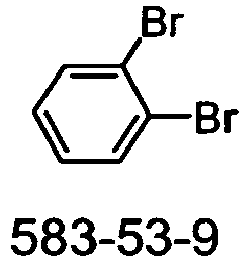

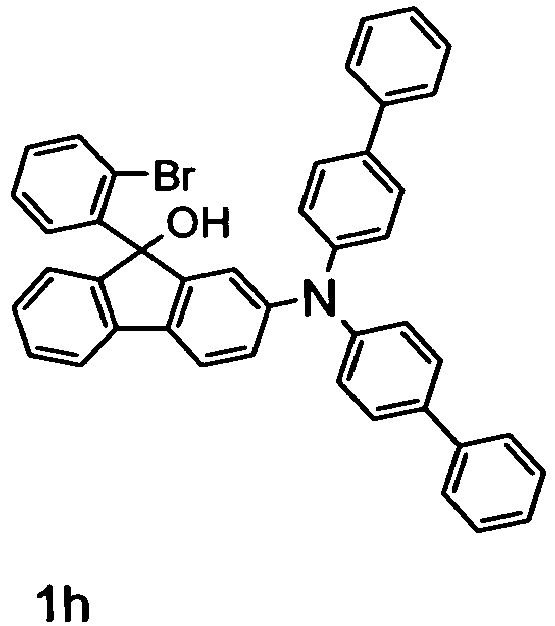
76% 1i 
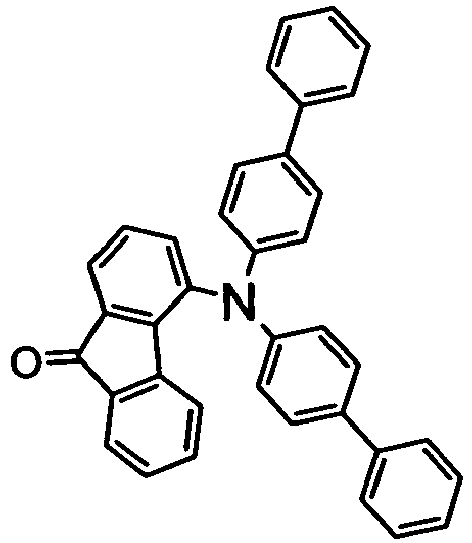
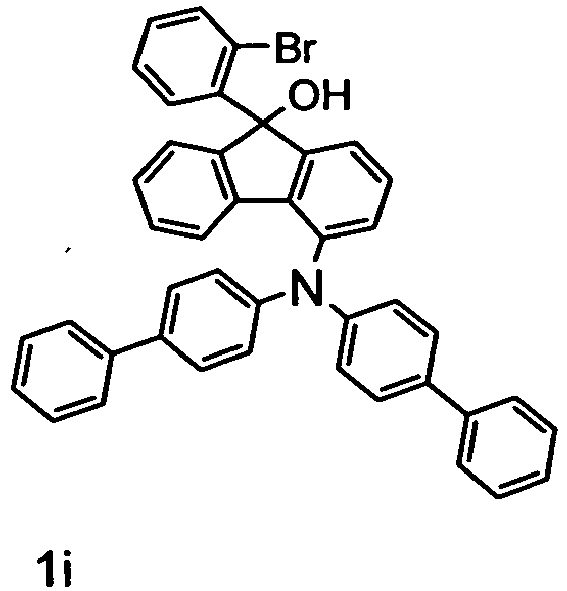
74% 1j 

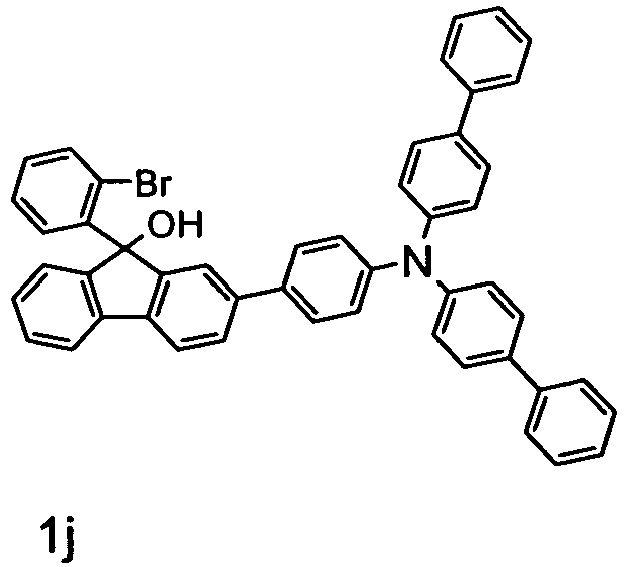
72% -

- Ein Gemisch aus 16.85 g (50 mmol) 9-(2-Bromo-phenyl)-9H-fluoren-9-ol und 19.88 g (50 mmol) Bis-biphenyl-4-yl-phenyl-amin [122215-84-3], Trifluormethansulfonsäure [1493-13-6] 15 g (100 mmol, 8.8 mL) und 300 ml Dioxan wird 24 h unter Rückfluss erhitzt. Nach Erkalten versetzt man mit 200 ml Wasser, rührt 30 min. nach, trennt die org. Phase ab, filtriert diese über ein kurzes Celite-Bett und entfernt dann das Lösungsmittel im Vakuum. Der Rückstand wird zweimal aus Toluol/Heptan umkristallisiert. Ausbeute: 26.1 g (36.5 mmol), 73%; Reinheit ca. 98 % n. 1H-NMR.
- Analog werden folgende Verbindungen erhalten:
Bsp. Edukt 1 Edukt 2 Produkt: Ausbeute 2a 


85% 2b 
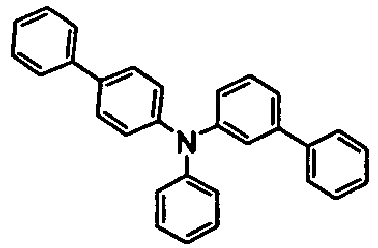

74% 2c 


70% 2e 


62% 2f 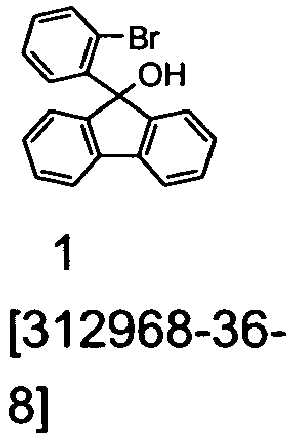


58% 2g 


85% 2h 
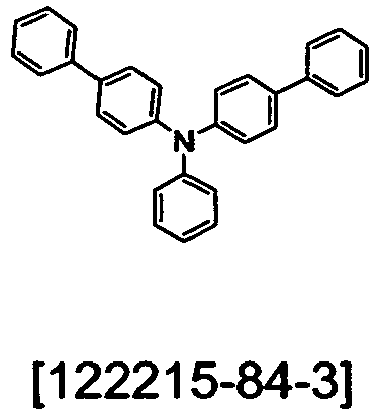

79% 2i 

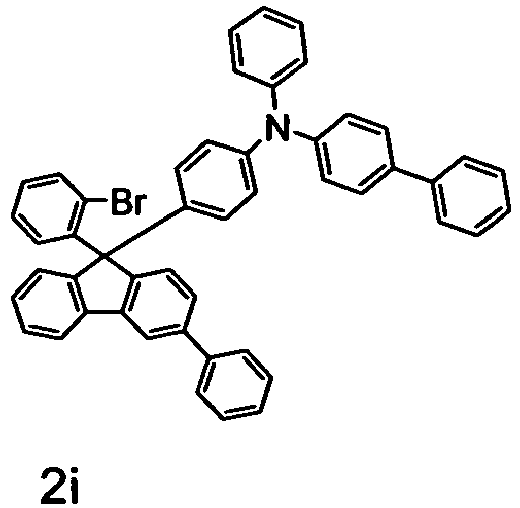
78% 2j 


68% 2k 


45% 2l 


41 % 2m 


48% 2n 


58% 2o 
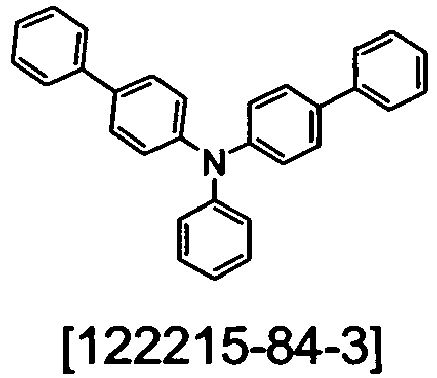
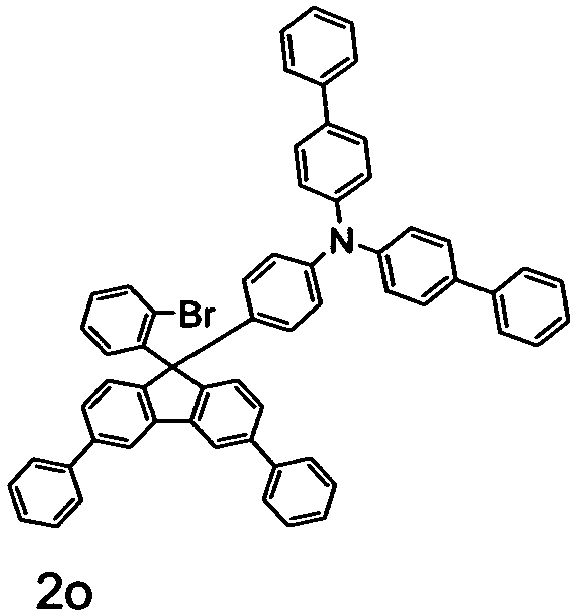
70% 2p 


62% 2r 

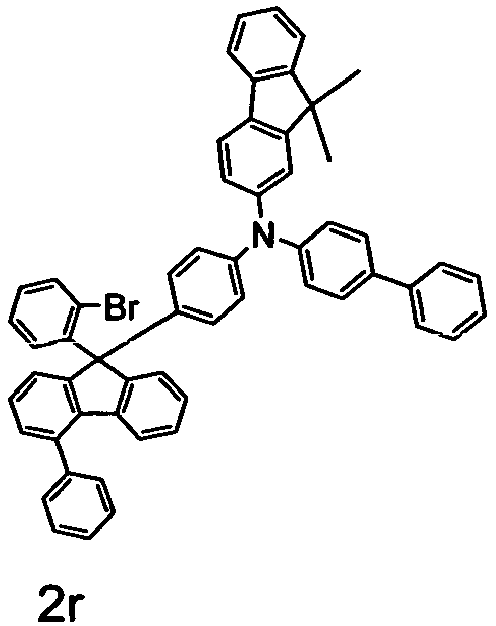
58% 2s 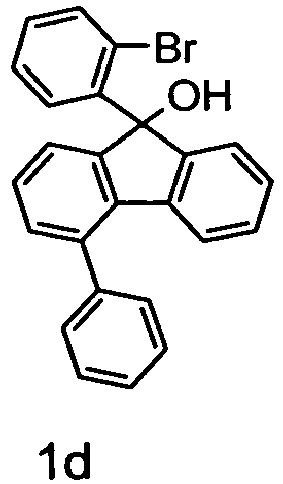


70% 2t 

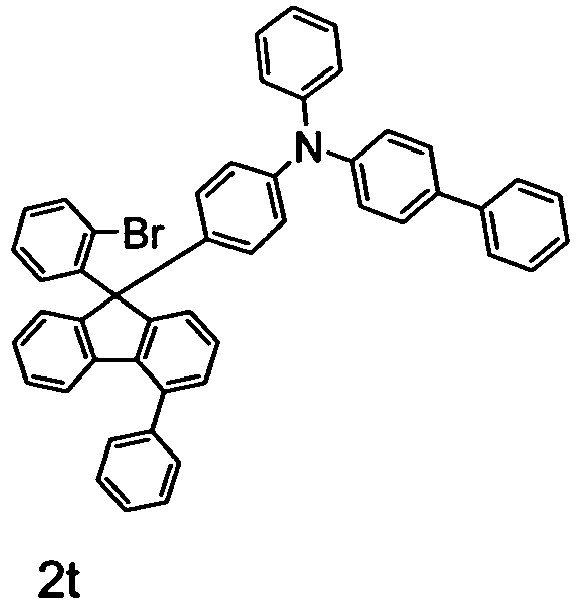
78% 2u 


82% 2v 


70% 2w 


78% 2x 


82% 2y 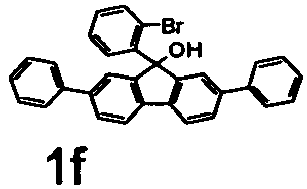


70% 2z 
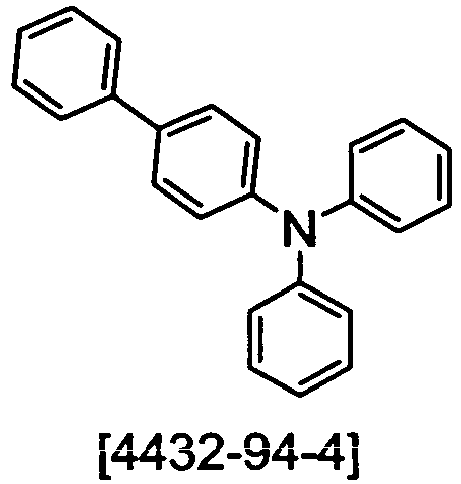

78% 2aa 


61% 2bb 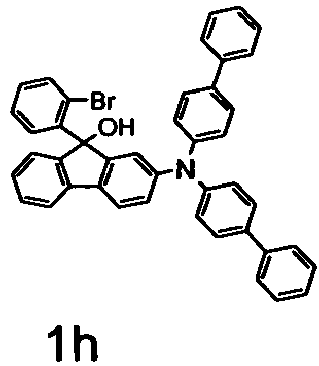


56% 2cc 


64% 2dd 


42% 2ee 


56% -

- Ein Gemisch aus 9.1 g (50 mmol) 1-Brom-3-cyano-benzen, 21.7 g (60 mmol) 4-Biphenyl-2-(9,9'-dimethylfluorenyl)-amin, [897671-69-1], 7.7 g (80 mmol) Natrium-tert-butylat, 1.4 g (5 mmol) Tricyclohexylamin, 561 mg (2.5 mmol) Palladium(II)acetat und 300 ml Mesitylen wird 24 h unter Rückfluss erhitzt. Nach Erkalten versetzt man mit 200 ml Wasser, rührt 30 min. nach, trennt die org. Phase ab, filtriert diese über ein kurzes Celite-Bett und entfernt dann das Lösungsmittel im Vakuum. Der Rückstand wird fünfmal aus Heptan umkristallisiert . Ausbeute: 16.8 g (36.5 mmol), 73%; Reinheit ca. 98 % n. 1H-NMR.
- Analog werden folgende Verbindungen erhalten:
Bsp. Edukt 1 Edukt 2 Produkt Ausbeute 3a 


43 % [102113-98-4] [6952-59-6] 3b 


56 % [1198395-24-2] [6952-59-6] 3c 


45 % [500717-23-7] [6952-59-6] 3d 


40 % [1290039-85-8] [6952-59-6] 3e 


35% [897671-69-1] [2042-37-7] 3f 


43 % [102113-98-4] [2042-37-7] 3g 


56 % [11983985-24-2] [2042-37-7] 3h 


45 % [500717-23-7] [2042-37-7] 3i 


40 % [2042-37-7] -

- Aus mit Jod aktivierten 2.68 g (110 mmol) Magnesiumspänen und einer Mischung aus 25.9 g (110 mmol) 1,2-Dibrombenzen, 0.8 ml 1,2-Dichlorethan, 50 ml 1,2-Dimethoxyethan, 500 ml THF wird unter Begleitheizen mit einem 70 °C warmen Ölbad das entsprechende Grignard-Reagenz dargestellt. Nachdem das Magnesium vollständig abreagiert hat, lässt man auf Raumtemperatur erkalten und tropft dann eine Lösung von 46.2 g (100 mmol) 4-Biphenyl-2-(9,9'-dimethylfluorenyl)-amin-3-cyano-benzen in 300 ml THF zu, erwärmt die Reaktionsmischung für 4 h auf 50 °C und rührt dann 12 h bei Raumtemperatur nach. Man gibt 100 ml Wasser zu, rührt kurz nach, trennt die org. Phase ab und entfernt das Lösungsmittel im Vakuum. Anschließend wird 6 h bei 80 °C mit 500 mL MNP und 5 mL Essigsäure nachgerührt. Nach Erkalten saugt man vom ausgefallenen Feststoff ab, wäscht diesen einmal mit 100 ml Heptan, zweimal mit je 100 ml Ethanol und kristallisiert abschließend aus Dioxan/EtOH um. Ausbeute: 26.6 g (43 mmol), 39%; Reinheit ca. 98 % n. 1H-NMR.
- Analog werden folgende Verbindungen erhalten:
Bsp. Edukt 1 Produkt Ausbeute 4a 

43 % 4b 

46 % 4c 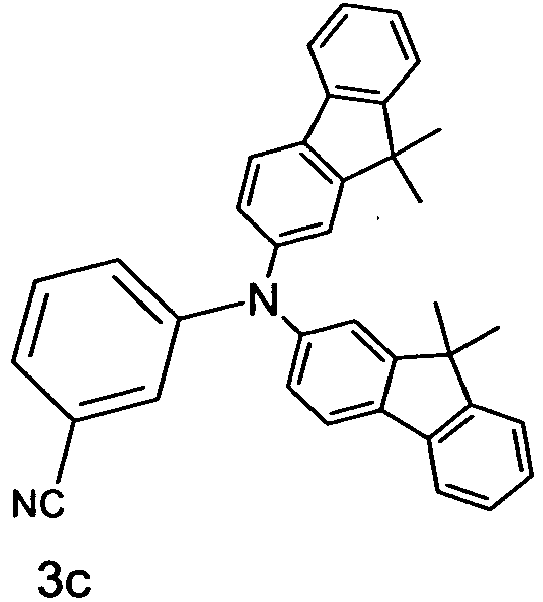

45 % 4d 

40 % 4e 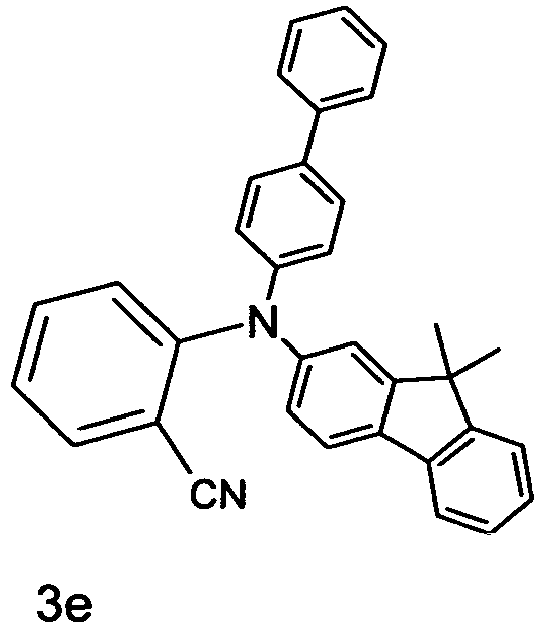

35% 4f 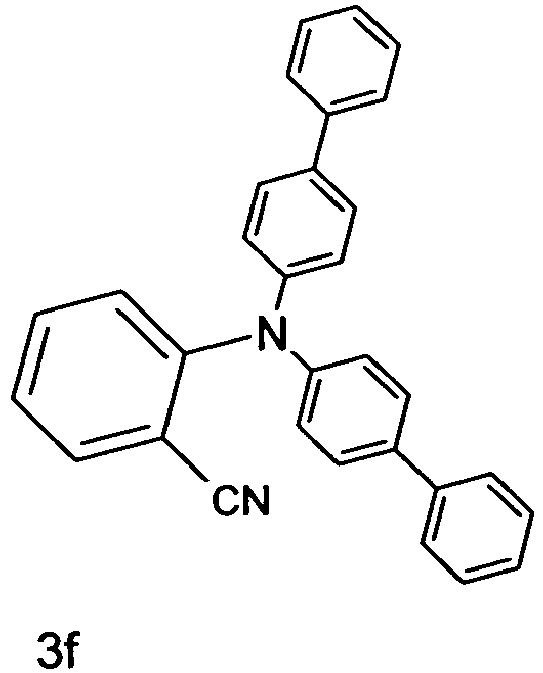

38 % 4g 

56 % 4h 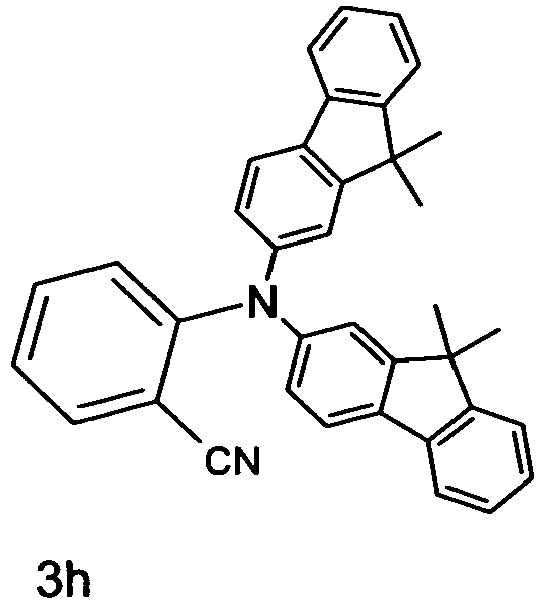

45 % 4i 

40 % -

- Aus mit Jod aktivierten 1,4 g (55 mmol) Magnesiumspänen und einer Mischung aus 12.9 g (55 mmol) 2-Brombiphenyl, 0.8 ml 1,2-Dichlorethan, 50 ml 1,2-Dimethoxyethan, 300 ml THF und 200 ml Toluol wird unter Begleitheizen mit einem 70 °C warmen Ölbad das entsprechende Grignard-Reagenz dargestellt. Nachdem das Magnesium vollständig abreagiert hat, lässt man auf Raumtemperatur erkalten und tropft dann eine Lösung von 31.1 g (50 mmol) {3-[Biphenyl-4-yl-(9,9-dimethyl-9H-fluoren-2-yl)-amino]-phenyl}-(2-bromo-phenyl)-methanon in 400 ml THF zu, erwärmt die Reaktionsmischung für 4 h auf 50 °C und rührt dann 12 h bei Raumtemperatur nach. Man gibt 100 ml Wasser zu, rührt kurz nach, trennt die org. Phase ab und entfernt das Lösungsmittel im Vakuum. Der Rückstand wird in der Wärme bei 40 °C in 500 ml Eisessig suspendiert, die Suspension wird mit 0.5 ml konz. Schwefelsäure versetzt, und anschließend 4 h bei 100 °C nachgerührt. Nach Erkalten saugt man vom ausgefallenen Feststoff ab, wäscht diesen einmal mit 100 ml Eisessig, dreimal mit je 100 ml Ethanol und kristallisiert abschließend aus Dioxan um. Ausbeute: 26.9 g (28 mmol), 68 %; Reinheit ca. 98 % n. 1H-NMR.
- Analog werden folgende Verbindungen erhalten:
Bsp. Edukt 1 Produkt Ausbeute 5a 

43 % 5b 

46 % 5c 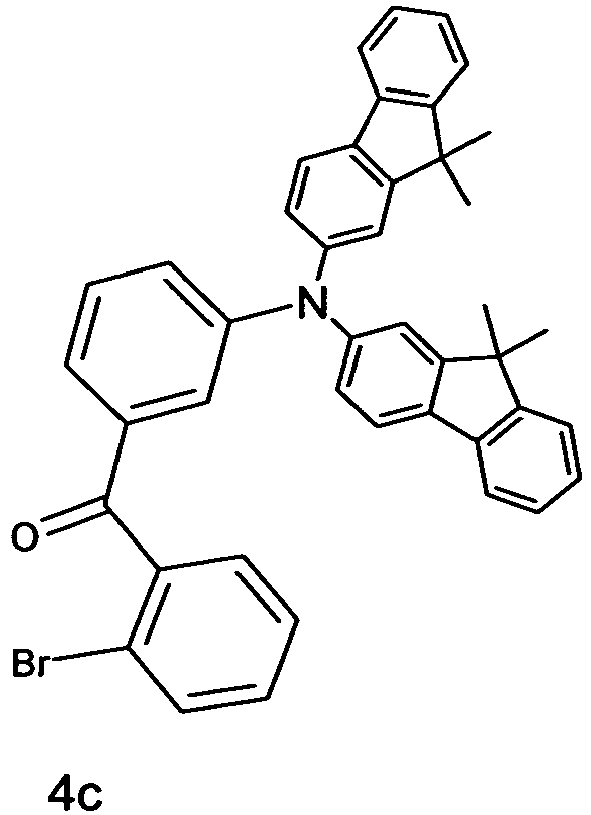

45 % 5d 

40 % 5e 

35% 5f 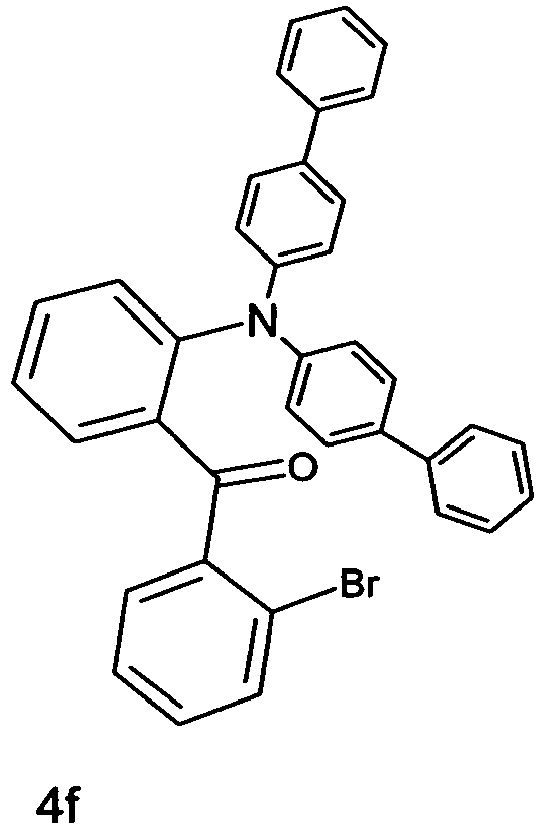

38 % 5g 

56 % 5h 

45 % 5i 

40 % 5g 

45 % -

- Ein Gemisch aus 38 g (53 mmol) Bis-biphenyl-4-yl-{4-[9-(2-brom-phenyl)-9H-fluoren-9-yl]-phenyl}-amin, 2,4 g (20 mmol) Palladium(II)acetat, 5,6 g (21,3 mmol) Triphenylphosphin, 28,14 g (267 mmol) Natriumcarbonat, 7,26 g (32 mmol) Benzyltriethylammoniumchlorid und 500 ml N,N-Dimethylacetamid wird 24 h unter Rückfluss erhitzt. Nach Erkalten versetzt man mit 200 ml Wasser, rührt 30 min. nach, trennt die org. Phase ab, filtriert diese über ein kurzes Celite-Bett und entfernt dann das Lösungsmittel im Vakuum. Der Rückstand wird fünfmal aus DMF/Heptan umkristallisiert und abschließend zweimal sublimiert (p ca. 10-6 mbar, T = 320 - 330 °C). Ausbeute: 14.5 g (22.8 mmol), 43 %; Reinheit: 99.9 % n. HPLC.
- Analog werden folgende Verbindungen erhalten:
Bsp. Edukt Produkt Ausbeute 6a 

75 % 6b 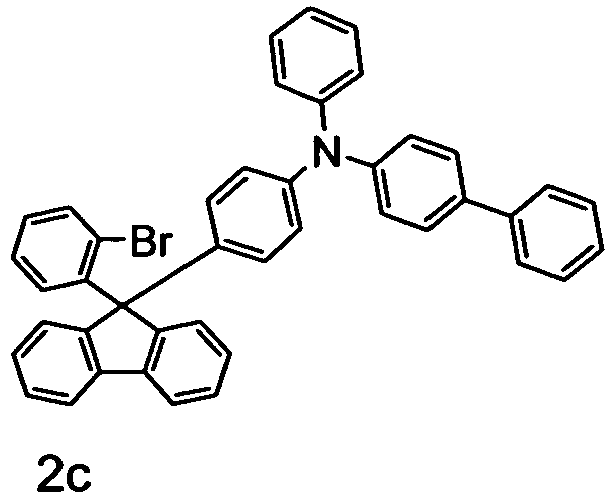

72 % 6d 

58 % 6e 

48% 6f 

63 % 6g 

41% 6h 

32% 6j 

34% 6k 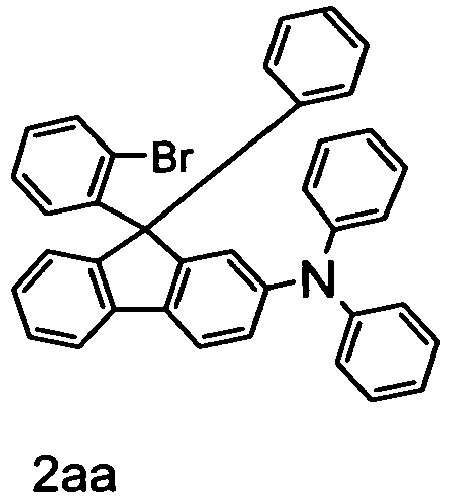

40% 6l 

50 % 6m 

34% 6n 
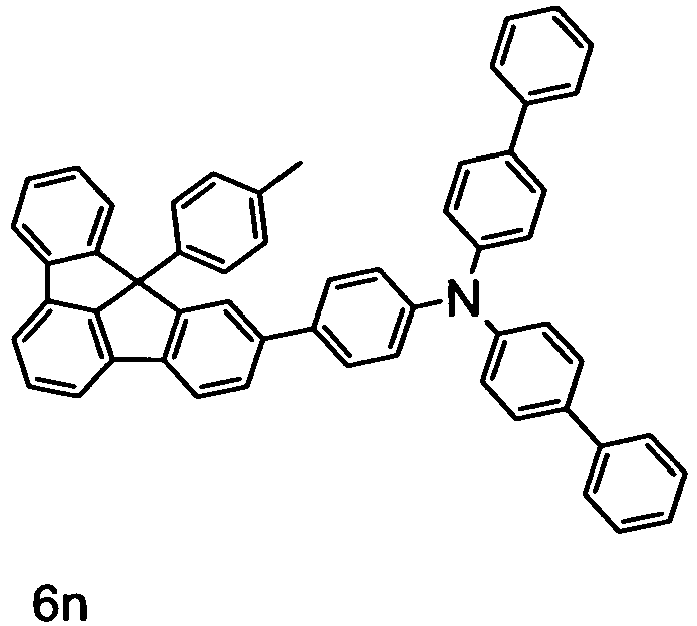
45% 6o 

47% 6p 

74% 6r 

63% 6s 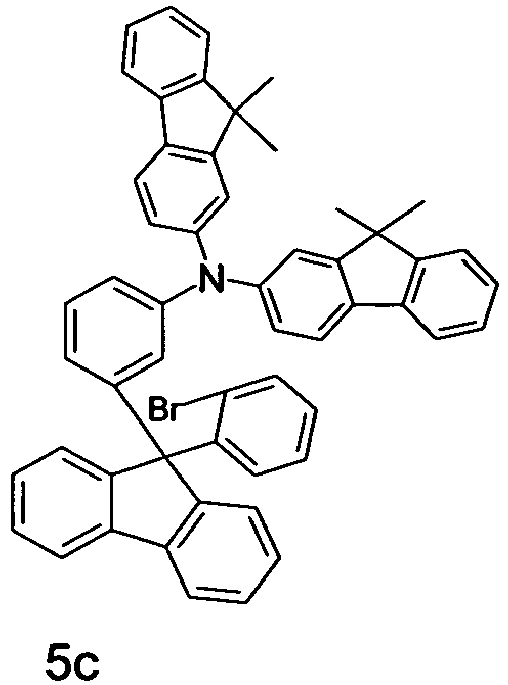

59% 6t 

62% 6u 

47% 6v 

53% 6w 

55% 6x 

48% 6y 

58% 6z 

49% 6aa 
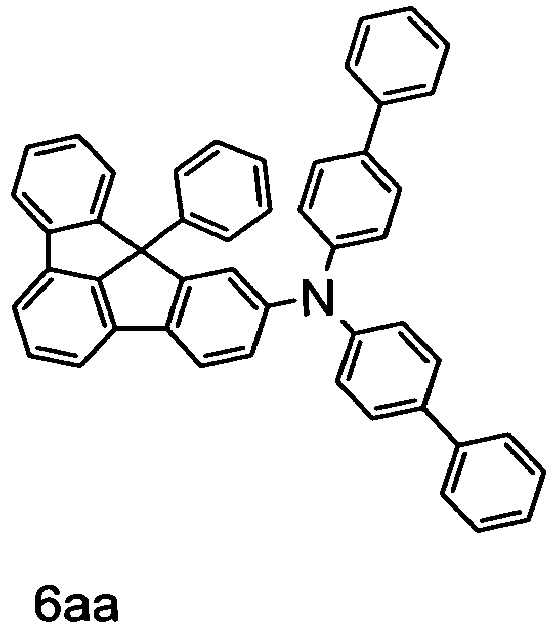
34 % 6ab 

36 % 6ac 

48 % 6ad 

28 % 6ae 

55 % - Die Herstellung von erfindungsgemäßen OLEDs sowie OLEDs nach dem Stand der Technik erfolgt nach einem allgemeinen Verfahren gemäß
WO 04/058911 - In den folgenden erfinderischen Beispielen E1 bis E12 und in den Referenzbeispielen V1 und V2 werden die Daten verschiedener OLEDs vorgestellt. Als Substrate werden Glasplättchen verwendet, die mit strukturiertem ITO (Indium Zinn Oxid) der Dicke 50 nm beschichtet sind. Die OLEDs haben prinzipiell folgenden Schichtaufbau: Substrat / p-dotierte Lochtransportschicht A' (HIL1) / Lochtransportschicht A (HTL) / p-dotierte Lochtransportschicht B (HIL2) / Lochtransportschicht C (EBL) / Emissionsschicht (EML) / Elektronentransportschicht (ETL) / Elektroneninjektionsschicht (EIL) und abschließend eine Kathode. Die Kathode wird durch eine 100 nm dicke Aluminiumschicht gebildet. Die zur Herstellung der OLEDs benötigten Materialien sind in Tabelle 1 gezeigt, der Aufbau der verschiedenen hergestellten elektronischen Vorrichtungen in Tabelle 2.
- Alle Materialien werden in einer Vakuumkammer thermisch aufgedampft. Dabei besteht die Emissionsschicht immer aus mindestens einem Matrixmaterial (Hostmaterial, Wirtsmaterial) und einem emittierenden Dotierstoff (Dotand, Emitter), der dem Matrixmaterial bzw. den Matrixmaterialien durch Coverdampfung in einem bestimmten Volumenanteil beigemischt wird. Eine Angabe wie H1:SEB(5%) bedeutet hierbei, dass das Material H1 in einem Volumenanteil von 95% und SEB in einem Anteil von 5% in der Schicht vorliegt. Analog kann auch die Elektronentransportschicht oder die Lochinjektionsschichten aus einer Mischung von zwei Materialien bestehen.
- Die OLEDs werden standardmäßig charakterisiert. Hierfür werden die Elektrolumineszenzspektren, die Stromeffizienz (gemessen in cd/A), die Leistungseffizienz (gemessen in Im/W) und die externe Quanteneffizienz (EQE, gemessen in Prozent) in Abhängigkeit der Leuchtdichte, berechnet aus Strom-Spannungs-Leuchtdichte-Kennlinien (IUL-Kennlinien) unter Annahme einer lambertschen Abstrahlcharakteristik sowie die Lebensdauer bestimmt. Die Elektrolumineszenzspektren werden bei einer Leuchtdichte von 1000 cd/m2 bestimmt und daraus die CIE 1931 x und y Farbkoordinaten berechnet. Die Angabe EQE @ 10 mA/cm2 bezeichnet die externe Quanteneffizienz bei einer Stromdichte von 10mA/cm2. LD80 @ 60 mA/cm2 ist die Lebensdauer, bis zu der die Starthelligkeit der betrachteten OLED bei konstantem Strom von 60 mA/cm2 auf 80 % der Anfangsintensität abgefallen ist.
Tabelle 1: Strukturen der verwendeten Materialien 


F4TCNQ HIM1 H1 


SEB H2 TEG 

ETM LiQ 


NPB HTM1 HTM2 


HTM3 HTM4 HTM5 

HTM6 HTM7 Tabelle 2: Aufbau der OLEDs Bsp. HIL1 HTL HIL2 EBL EML ETL EIL Dicke / nm Dicke / nm Dicke / nm Dicke / nm Dicke / nm Dicke / nm Dicke / nm V1 HIM1:F4TCNQ(3%) 20 nm HIM1 155 nm NPB:F4TCNQ(3%) 20 nm NPB 20 nm H1:SEB(5%) 20 nm ETM(50%):LiQ(50%) 30 nm LiQ 1 nm E1 HIM1:F4TCNQ(3%) 20 nm HIM1 155 nm HTM1:F4TCNQ(3%) 20 nm HTM1 20 nm H1:SEB(5%) 20 nm ETM(50%):LiQ(50%) 30 nm LiQ 1 nm E2 HIM1:F4TCNQ(3%) 20 nm HIM1 155 nm HTM2:F4TCNQ(3%) 20 nm HTM2 20 nm H1:SEB(5%) 20 nm ETM(50%):LiQ(50%) 30 nm LiQ 1 nm E3 HIM1:F4TCNQ(3%) 20 nm HIM1 155 nm HTM3:F4TCNQ(3%) 20 nm HTM3 20 nm H1:SEB(5%) 20 nm ETM(50%):LiQ(50%) 30 nm LiQ 1 nm E4 HIM1:F4TCNQ(3%) 20 nm HIM1 155 nm HTM4:F4TCNQ(3%) 20 nm HTM4 20 nm H1:SEB(5%) 20 nm ETM(50%):LiQ(50%) 30 nm LiQ 1 nm E5 HIM1:F4TCNQ(3%) 20 nm HIM1 155 nm HTM5:F4TCNQ(3%) 20 nm HTM5 20 nm H1:SEB(5%) 20 nm ETM(50%):LiQ(50%) 30 nm LiQ 1 nm E6 HIM1:F4TCNQ(3%) 20 nm HIM1 155 nm HTM6:F4TCNQ(3%) 20 nm HTM6 20 nm H1:SEB(5%) 20 nm ETM(5O%):LiQ(50%) 30 nm LiQ 1 nm E7 HIM1:F4TCNQ(3%) 20 nm HIM1 155 nm HTM7:F4TCNQ(3%) 20 nm HTM7 20 nm H1:SEB(5%) 20 nm ETM(50%):LiQ(50%) 30 nm LiQ 1 nm V2 HIM1:F4TCNQ(3%) 20 nm HIM1 210 nm NPB:F4TCNQ(3%) 20 nm NPB 20 nm H2:TEG(5%) 30 nm ETM(50%):LiQ(50%) 40 nm LiQ 1 nm E8 HIM1:F4TCNQ(3%) 20 nm HIM1 210 nm HTM1:F4TCNQ(3%) 20 nm HTM1 20 nm H2:TEG(5%) 30 nm ETM(50%):LiQ(50%) 40 nm LiQ 1 nm E9 HIM1:F4TCNQ(3%) 20 nm HIM1 210 nm HTM2:F4TCNQ(3%) 20 nm HTM2 20 nm H2:TEG(5%) 30 nm ETM(50%):LiQ(50%) 40 nm LiQ 1 nm E10 HIM1:F4TCNQ(3%) 20 nm HIM1 210 nm HTM3:F4TCNQ(3%) 20 nm HTM3 20 nm H2:TEG(5%) 30 nm ETM(50%):LiQ(50%) 40 nm LiQ 1 nm E11 HIM1:F4TCNQ(3%) 20 nm HIM1 210 nm HTM4:F4TCNQ(3%) 20 nm HTM4 20 nm H2:TEG(5%) 30 nm ETM(50%):LiQ(50%) 40 nm LiQ 1 nm E12 HIM1:F4TCNQ(3%) 20 nm HIM1 210 nm HTM5:F4TCNQ(3%) 20 nm HTM5 20 nm H2:TEG(5%) 30 nm ETM(50%):LiQ(50%) 40 nm LiQ 1 nm - Es wurde eine blaue fluoreszierende Referenzprobe V1 hergestellt und mit den erfindungsgemäßen Proben E1 bis E7 verglichen. Die Referenzprobe V1 hat bei einer Stromdichte von 10 mA/cm2 eine externe Quanteneffizienz von 6.2 % und eine Lebensdauer (LD80 @ 60 mA/cm2) von 120 h. Verglichen damit haben die erfindungsgemäßen Proben E1 (7.5 %, 160 h), E2 (7.8 %, 250 h), E3 (7.6 %, 210 h), E4 (7.4 %, 200 h), E5 (8.0 %, 235 h), E6 (7.7 %, 270 h) und E7 (7.1 %, 260 h) sowohl bessere externe Quanteneffizienz bei einer Stromdichte von 10 mA/cm2, als auch längere Lebensdauer (LD80 @ 60 mA/cm2).
- Es wurde eine grüne phosphoreszierende Referenzprobe V2 hergestellt und mit den erfindungsgemäßen Proben E8 bis E12 verglichen. Die Referenzprobe V2 hat bei einer Stromdichte von 2 mA/cm2 eine externe Quanteneffizienz von 11.7 % und eine Lebensdauer (LD80 @ 20 mA/cm2) von 80 h. Verglichen damit haben die erfindungsgemäßen Proben E8 (17.2 %, 135 h), E9 (18.7 %, 110 h), E10 (17.4 %, 145 h), E11 (19.0 %, 105 h) und E12 (20.2 %, 160 h) sowohl bessere externe Quanteneffizienz bei einer Stromdichte von 2 mA/cm2, als auch längere Lebensdauer (LD80 @ 20 mA/cm2).
Claims (10)
- Verbindung gemäß Formel (1),
 Z ist gleich CR1;Ar1 ist bei jedem Auftreten gleich oder verschieden ein aromatisches oder heteroaromatisches Ringsystem mit 5 bis 60 aromatischen Ringatomen, das mit einem oder mehreren Resten R3 substituiert sein kann; dabei können zwei Reste Ar1, welche an dasselbe N-Atom oder P-Atom binden, auch durch eine Einfachbindung oder eine Brücke ausgewählt aus N(R4), C(R4)2, O oder S, miteinander verbrückt sein.R1 ist bei jedem Auftreten gleich oder verschieden H, D, F, Cl, Br, I, CN, NO2, N(Ar1)2, N(R3)2, C(=O)Ar1, C(=O)R3, P(=O)(Ar1)2, P(=O)(R3)2, B(OR3)2, CHO, Si(R3)2, OSO2R3, S(=O)R3, S(=O)2R3, eine geradkettige Alkyl-, Alkoxy- oder Thioalkylgruppe mit 1 bis 40 C-Atomen oder eine verzweigte oder cyclische Alkyl-, Alkoxy- oder Thioalkylgruppe mit 3 bis 40 C-Atomen oder eine Alkenyl- oder Alkinylgruppe mit 2 bis 40 C-Atomen, wobei die Alkyl-, Alkoxy-, Thioalkyl-, Alkenyl- oder Alkinylgruppe jeweils mit einem oder mehreren Resten R3 substituiert sein kann und wobei eine oder mehrere benachbarte oder nicht benachbarte CH2-Gruppen durch -R3C=CR3-, -C≡C-,C=O, C=S, C=Se, C=NR3, -C(=O)-NR3-, P(=O)(R3), -C(=O)-O-, Si(R3)2, NR3, -O-, -S-, SO oder SO2 ersetzt sein können und wobei ein oder mehrere H-Atome durch D, F, Cl, Br, I, CN oder NO2 ersetzt sein können, oder ein aromatisches Ringsystem mit 6 bis 60 aromatischen Ringatomen, das jeweils mit einem oder mehreren Reste(n) R3 substituiert sein kann, oder ein heteroaromatisches Ringsystem mit 5 bis 60 aromatischen Ringatomen, das jeweils mit einem oder mehreren Reste(n) R3 substituiert sein kann, wobei zwei oder mehr Reste R1 miteinander verknüpft sein können und einen Ring bilden können;R2 ist ein aromatisches Ringsystem mit 6 bis 60 aromatischen Ringatomen, das jeweils mit einem oder mehreren Reste(n) R3 substituiert sein kann;R3 ist bei jedem Auftreten gleich oder verschieden H, D, F, Cl, Br, I, CN, NO2, N(R4)2, C(=O)Ar1, C(=O)R4, P(=O)(Ar1)2, B(OR4)2, CHO, Si(R4)2, OSO2R4, S(=O)R4, S(=O)2R4, eine geradkettige Alkyl-, Alkoxy- oder Thioalkylgruppe mit 1 bis 40 C-Atomen oder eine verzweigte oder cyclische Alkyl-, Alkoxy- oder Thioalkylgruppe mit 3 bis 40 C-Atomen oder eine Alkenyl- oder Alkinylgruppe mit 2 bis 40 C-Atomen, wobei die Alkyl-, Alkoxy-, Thioalkyl-, Alkenyl- oder Alkinylgruppe jeweils mit einem oder mehreren Resten R4 substituiert sein kann und wobei eine oder mehrere benachbarte oder nicht benachbarte CH2-Gruppen durch -R4C=CR4-, -C≡C-,C=O, C=S, C=Se, C=NR4, -C(=O)-NR4-, P(=O)(R4), -C(=O)-O-, Si(R4)2, NR4, -O-, -S-, SO oder SO2 ersetzt sein können und wobei ein oder mehrere H-Atome durch D, F, Cl, Br, I, CN oder NO2 ersetzt sein können, oder ein aromatisches Ringsystem mit 6 bis 60 aromatischen Ringatomen, das jeweils mit einem oder mehreren Reste(n) R4 substituiert sein kann, oder ein heteroaromatisches Ringsystem mit 5 bis 60 aromatischen Ringatomen, das jeweils mit einem oder mehreren Reste(n) R4 substituiert sein kann, wobei zwei oder mehr Reste R4 miteinander verknüpft sein können und einen Ring bilden können;R4 ist bei jedem Auftreten gleich oder verschieden, H, D, F, CN oder ein aliphatischer Rest mit 1 bis 20 C-Atomen, oder ein aromatisches Ringsystem mit 6 bis 60 aromatischen Ringatomen oder ein heteroaromatisches Ringsystem mit 5 bis 60 aromatischen Ringatomen, wobei in dem aliphatischen Rest, dem aromatischen Ringsystem oder dem heteroaromatischen Ringsystem ein oder mehrere H-Atome durch D, F, Cl, Br, I, CN oder eine Alkylgruppe mit 1 bis 5 C-Atomen ersetzt sein können, wobei zwei oder mehr Reste R4 miteinander verknüpft sein können und einen Ring bilden können;wobei R2 und/oder mindestens ein R1 der Formel (1) mindestens ein aromatisches oder heteroaromatisches Ringsystem umfasst; und
wenn mindestens ein R1 mindestens ein aromatisches oder heteroaromatisches Ringsystem umfasst, die Gesamtanzahl von aromatischen Ringatomen in allen R1 und R2 mindestens 12 beträgt; und
wenn R1 kein aromatisches oder heteroaromatisches Ringsystem umfasst, R2 mindestens 24 aromatische Ringatome sowie kein weiteres Indeno[1,2,3-jk]fluoren-Gerüst umfasst. - Verbindung nach Anspruch 1, dadurch gekennzeichnet, dass R1 an mindestens einer der Positionen 5 oder 10 des Indeno[1,2,3-jk]fluoren-Gerüsts bei jedem Auftreten gleich oder verschieden H, D, F, CN, NO2, N(Ar1)2, N(R3)2, C(=O)Ar1, P(=O)(Ar1)2, P(=O)(R3)2, Si(R3)2, OSO2R3, S(=O)R3, S(=O)2R3, eine geradkettige Alkyl-, Alkoxy- oder Thioalkylgruppe mit 1 bis 40 C-Atomen oder eine verzweigte oder cyclische Alkyl-, Alkoxy- oder Thioalkylgruppe mit 3 bis 40 C-Atomen oder eine Alkenyl- oder Alkinylgruppe mit 2 bis 40 C-Atomen, wobei die Alkyl-, Alkoxy-, Thioalkyl-, Alkenyl- oder Alkinylgruppe jeweils mit einem oder mehreren Resten R3 substituiert sein kann und wobei eine oder mehrere benachbarte oder nicht benachbarte CH2-Gruppen durch -R3C=CR3-, -C≡C-,C=O, C=S, C=Se, C=NR3, -C(=O)-NR3-, P(=O)(R3), -C(=O)-O-, Si(R3)2, NR3, -O-, -S-, SO oder SO2 ersetzt sein können und wobei ein oder mehrere H-Atome durch D, F, Cl, Br, I, CN oder NO2 ersetzt sein können, oder ein aromatisches Ringsystem mit 6 bis 60 aromatischen Ringatomen, das jeweils mit einem oder mehreren Reste(n) R3 substituiert sein kann, oder ein heteroaromatisches Ringsystem mit 5 bis 60 aromatischen Ringatomen ist, das jeweils mit einem oder mehreren Reste(n) R3 substituiert sein kann, wobei zwei oder mehr Reste R1 miteinander verknüpft sein können und einen Ring bilden können.
- Verbindung nach Anspruch 2,dadurch gekennzeichnet, dass R1 an den Positionen 5 oder 10 des Indeno[1,2,3-jk]fluoren-Gerüsts, soweit jeweils vorhanden, keine Reste enthält ausgewählt aus der Gruppe enthaltend Cl, Br, I, B(OR3)2 und CHO.
- Verbindung nach einem oder mehreren der Ansprüche 1 bis 3, dadurch gekennzeichnet, dass mindestens ein R1 nicht H ist.
- Verbindung nach einem der Ansprüche 1 bis 4, dadurch gekennzeichnet, dass mindestens ein R1 ein aromatisches oder heteroaromatisches Ringsystem umfasst.
- Verfahren zur Herstellung einer Verbindung nach einem oder mehreren der Ansprüche 1 bis 5, dadurch gekennzeichnet, dass der Grundkörper der Formel (1) durch eine oder mehrere Kupplungsreaktionen aufgebaut wird.
- Formulierung, enthaltend mindestens eine Verbindung nach einem oder mehreren der Ansprüche 1 bis 5.
- Elektronische Vorrichtung, enthaltend mindestens eine Verbindung nach einem oder mehreren der Ansprüche 1 bis 5.
- Elektronische Vorrichtung nach Anspruch 8, dadurch gekennzeichnet, dass sie ausgewählt ist aus organischen integrierten Schaltungen (O-ICs), organischen Feld-Effekt-Transistoren (O-FETs), organischen Dünnfilmtransistoren (O-TFTs), organischen lichtemittierenden Transistoren (O-LETs), organischen Solarzellen (O-SCs), organischen optischen Detektoren, organischen Photorezeptoren, organischen Feld-Quench-Devices (O-FQDs), lichtemittierenden elektrochemischen Zellen (LECs), organischen Laserdioden (O-Laser) und organischen Elektrolumineszenzvorrichtungen (OLEDs).
- Elektronische Vorrichtung nach Anspruch 9, gewählt aus organischen Elektrolumineszenzvorrichtungen (OLEDs), dadurch gekennzeichnet, dass die Verbindung nach einem oder mehreren der Ansprüche 1 bis 5 in einer oder mehreren der folgenden Funktionen eingesetzt wird:- als Lochtransportmaterial in einer Lochtransport- oder Lochinjektionsschicht,- als Lochinjektionsmaterial,- als Lochblockiermaterial,- als Emitter für fluoreszierende Emissionsschichten,- als Matrixmaterial in einer emittierenden Schicht,- als Elektronenblockiermaterial,- als Material für eine Zwischenschicht.
Priority Applications (1)
| Application Number | Priority Date | Filing Date | Title |
|---|---|---|---|
| EP14772289.6A EP3060623B1 (de) | 2013-10-23 | 2014-09-24 | Materialien für elektronische vorrichtungen |
Applications Claiming Priority (3)
| Application Number | Priority Date | Filing Date | Title |
|---|---|---|---|
| EP13005070 | 2013-10-23 | ||
| EP14772289.6A EP3060623B1 (de) | 2013-10-23 | 2014-09-24 | Materialien für elektronische vorrichtungen |
| PCT/EP2014/002586 WO2015058826A1 (de) | 2013-10-23 | 2014-09-24 | Materialien für elektronische vorrichtungen |
Publications (2)
| Publication Number | Publication Date |
|---|---|
| EP3060623A1 EP3060623A1 (de) | 2016-08-31 |
| EP3060623B1 true EP3060623B1 (de) | 2018-11-07 |
Family
ID=49553974
Family Applications (1)
| Application Number | Title | Priority Date | Filing Date |
|---|---|---|---|
| EP14772289.6A Active EP3060623B1 (de) | 2013-10-23 | 2014-09-24 | Materialien für elektronische vorrichtungen |
Country Status (6)
| Country | Link |
|---|---|
| US (1) | US9859502B2 (de) |
| EP (1) | EP3060623B1 (de) |
| JP (1) | JP6469673B2 (de) |
| KR (2) | KR20210091355A (de) |
| CN (2) | CN105722944A (de) |
| WO (1) | WO2015058826A1 (de) |
Families Citing this family (16)
| Publication number | Priority date | Publication date | Assignee | Title |
|---|---|---|---|---|
| KR101931250B1 (ko) | 2014-05-13 | 2018-12-20 | 제일모직 주식회사 | 화합물, 이를 포함하는 유기 광전자 소자 및 표시장치 |
| JP6576631B2 (ja) * | 2014-12-15 | 2019-09-18 | 三星ディスプレイ株式會社Samsung Display Co.,Ltd. | アミン化合物、および有機電界発光素子 |
| WO2016158191A1 (ja) * | 2015-03-30 | 2016-10-06 | 新日鉄住金化学株式会社 | 有機電界発光素子 |
| KR101896151B1 (ko) * | 2016-01-25 | 2018-09-07 | 주식회사 엘지화학 | 화합물 및 이를 포함하는 유기 전자 소자 |
| KR101865051B1 (ko) * | 2016-07-15 | 2018-06-08 | 주식회사 알파켐 | 신규한 유기발광화합물 및 이를 포함하는 유기 발광 소자 |
| TW201831468A (zh) | 2016-12-05 | 2018-09-01 | 德商麥克專利有限公司 | 含氮的雜環化合物 |
| TWI791481B (zh) * | 2017-01-30 | 2023-02-11 | 德商麥克專利有限公司 | 形成有機電致發光(el)元件之方法 |
| KR101857632B1 (ko) * | 2018-02-02 | 2018-05-14 | 덕산네오룩스 주식회사 | 유기전기소자용 화합물, 이를 이용한 유기전기소자 및 그 전자 장치 |
| CN112062718B (zh) * | 2019-05-25 | 2024-02-06 | 吉林奥来德光电材料股份有限公司 | 有机电致发光化合物和包含所述化合物的有机电致发光装置 |
| CN114207859B (zh) | 2019-08-02 | 2025-02-14 | 德山新勒克斯有限公司 | 有机电子器件 |
| KR20210015616A (ko) * | 2019-08-02 | 2021-02-10 | 덕산네오룩스 주식회사 | 유기전기소자 |
| KR102903024B1 (ko) | 2019-09-27 | 2025-12-23 | 삼성디스플레이 주식회사 | 축합환 화합물 및 이를 포함한 유기 발광 소자 |
| KR102843711B1 (ko) * | 2020-04-23 | 2025-08-08 | 덕산네오룩스 주식회사 | 유기전기소자용 화합물, 이를 이용한 유기전기소자 및 그 전자 장치 |
| KR102688630B1 (ko) * | 2020-10-12 | 2024-07-24 | 주식회사 엘지화학 | 신규한 화합물 및 이를 포함한 유기 발광 소자 |
| KR102739010B1 (ko) * | 2022-07-25 | 2024-12-06 | 덕산네오룩스 주식회사 | 유기전기 소자용 화합물, 이를 이용한 유기전기소자 및 그 전자 장치 |
| CN116730799B (zh) * | 2023-05-26 | 2024-01-12 | 西安欧得光电材料有限公司 | 一种含螺芴结构的oled化合物及其制备方法 |
Family Cites Families (2)
| Publication number | Priority date | Publication date | Assignee | Title |
|---|---|---|---|---|
| KR100949214B1 (ko) * | 2005-03-18 | 2010-03-24 | 이데미쓰 고산 가부시키가이샤 | 방향족 아민 유도체 및 그것을 사용한 유기 전기발광 소자 |
| CN102030701B (zh) * | 2010-11-04 | 2012-10-03 | 华东师范大学 | 一类Fluoradene衍生物及其制备方法 |
-
2014
- 2014-09-24 WO PCT/EP2014/002586 patent/WO2015058826A1/de not_active Ceased
- 2014-09-24 EP EP14772289.6A patent/EP3060623B1/de active Active
- 2014-09-24 CN CN201480057646.1A patent/CN105722944A/zh active Pending
- 2014-09-24 KR KR1020217021857A patent/KR20210091355A/ko not_active Ceased
- 2014-09-24 JP JP2016525945A patent/JP6469673B2/ja active Active
- 2014-09-24 KR KR1020167013361A patent/KR102279289B1/ko active Active
- 2014-09-24 US US15/030,565 patent/US9859502B2/en active Active
- 2014-09-24 CN CN202010756410.4A patent/CN112047845B/zh active Active
Non-Patent Citations (1)
| Title |
|---|
| None * |
Also Published As
| Publication number | Publication date |
|---|---|
| US20160268509A1 (en) | 2016-09-15 |
| KR20210091355A (ko) | 2021-07-21 |
| KR102279289B1 (ko) | 2021-07-19 |
| KR20160074630A (ko) | 2016-06-28 |
| CN105722944A (zh) | 2016-06-29 |
| CN112047845B (zh) | 2025-03-11 |
| CN112047845A (zh) | 2020-12-08 |
| JP6469673B2 (ja) | 2019-02-13 |
| WO2015058826A1 (de) | 2015-04-30 |
| EP3060623A1 (de) | 2016-08-31 |
| JP2016535735A (ja) | 2016-11-17 |
| US9859502B2 (en) | 2018-01-02 |
Similar Documents
| Publication | Publication Date | Title |
|---|---|---|
| EP3060623B1 (de) | Materialien für elektronische vorrichtungen | |
| EP3080229B1 (de) | Materialien für elektronische vorrichtungen | |
| EP2875699B1 (de) | Derivate von 2-diarylaminofluoren und diese enthaltnde organische elektronische verbindungen | |
| EP2705552B1 (de) | Verbindungen für elektronische vorrichtungen | |
| EP2791105B1 (de) | Verbindungen für elektronische vorrichtungen | |
| EP2875004B1 (de) | Fluorene und elektronische vorrichtungen, die sie enthalten | |
| EP2740165B1 (de) | Materialien für elektronische vorrichtungen | |
| EP3057947B1 (de) | Materialien für elektronische vorrichtungen | |
| EP2875092B1 (de) | Verbindungen und organische elektrolumineszierende vorrichtungen | |
| EP2922932B1 (de) | Materialien für elektronische vorrichtungen | |
| EP2931698B1 (de) | Materialien für elektronische vorrichtungen | |
| EP3016952B1 (de) | Spirokondensierte lactamverbindungen für organische elektrolumineszenzvorrichtungen | |
| EP2705550A1 (de) | Verbindungen für elektronische vorrichtungen | |
| WO2014106522A1 (de) | Materialien für elektronische vorrichtungen | |
| EP3345984A1 (de) | Verbindungen und organische elektronische vorrichtungen | |
| WO2012048780A1 (de) | Verbindungen für elektronische vorrichtungen | |
| WO2014037077A1 (de) | Verbindungen für elektronische vorrichtungen | |
| DE102012011335A1 (de) | Verbindungen für Organische Elekronische Vorrichtungen | |
| EP2941469A2 (de) | Materialien für elektronische vorrichtungen | |
| WO2014082705A1 (de) | Elektronische vorrichtung | |
| WO2011157346A1 (de) | Verbindungen für elektronische vorrichtungen | |
| EP2984150B1 (de) | Materialien für elektronische vorrichtungen | |
| DE102012022880A1 (de) | Elektronische Vorrichtungen enthaltend organische Schichten | |
| EP4634166A1 (de) | Materialien für elektronische vorrichtungen |
Legal Events
| Date | Code | Title | Description |
|---|---|---|---|
| PUAI | Public reference made under article 153(3) epc to a published international application that has entered the european phase |
Free format text: ORIGINAL CODE: 0009012 |
|
| 17P | Request for examination filed |
Effective date: 20160223 |
|
| AK | Designated contracting states |
Kind code of ref document: A1 Designated state(s): AL AT BE BG CH CY CZ DE DK EE ES FI FR GB GR HR HU IE IS IT LI LT LU LV MC MK MT NL NO PL PT RO RS SE SI SK SM TR |
|
| AX | Request for extension of the european patent |
Extension state: BA ME |
|
| DAX | Request for extension of the european patent (deleted) | ||
| STAA | Information on the status of an ep patent application or granted ep patent |
Free format text: STATUS: EXAMINATION IS IN PROGRESS |
|
| 17Q | First examination report despatched |
Effective date: 20180221 |
|
| GRAP | Despatch of communication of intention to grant a patent |
Free format text: ORIGINAL CODE: EPIDOSNIGR1 |
|
| STAA | Information on the status of an ep patent application or granted ep patent |
Free format text: STATUS: GRANT OF PATENT IS INTENDED |
|
| INTG | Intention to grant announced |
Effective date: 20180626 |
|
| GRAS | Grant fee paid |
Free format text: ORIGINAL CODE: EPIDOSNIGR3 |
|
| GRAA | (expected) grant |
Free format text: ORIGINAL CODE: 0009210 |
|
| STAA | Information on the status of an ep patent application or granted ep patent |
Free format text: STATUS: THE PATENT HAS BEEN GRANTED |
|
| AK | Designated contracting states |
Kind code of ref document: B1 Designated state(s): AL AT BE BG CH CY CZ DE DK EE ES FI FR GB GR HR HU IE IS IT LI LT LU LV MC MK MT NL NO PL PT RO RS SE SI SK SM TR |
|
| REG | Reference to a national code |
Ref country code: GB Ref legal event code: FG4D Free format text: NOT ENGLISH |
|
| REG | Reference to a national code |
Ref country code: CH Ref legal event code: EP Ref country code: AT Ref legal event code: REF Ref document number: 1062057 Country of ref document: AT Kind code of ref document: T Effective date: 20181115 |
|
| REG | Reference to a national code |
Ref country code: DE Ref legal event code: R096 Ref document number: 502014010010 Country of ref document: DE |
|
| REG | Reference to a national code |
Ref country code: IE Ref legal event code: FG4D Free format text: LANGUAGE OF EP DOCUMENT: GERMAN |
|
| REG | Reference to a national code |
Ref country code: NL Ref legal event code: MP Effective date: 20181107 |
|
| REG | Reference to a national code |
Ref country code: LT Ref legal event code: MG4D |
|
| PG25 | Lapsed in a contracting state [announced via postgrant information from national office to epo] |
Ref country code: LV Free format text: LAPSE BECAUSE OF FAILURE TO SUBMIT A TRANSLATION OF THE DESCRIPTION OR TO PAY THE FEE WITHIN THE PRESCRIBED TIME-LIMIT Effective date: 20181107 Ref country code: HR Free format text: LAPSE BECAUSE OF FAILURE TO SUBMIT A TRANSLATION OF THE DESCRIPTION OR TO PAY THE FEE WITHIN THE PRESCRIBED TIME-LIMIT Effective date: 20181107 Ref country code: NO Free format text: LAPSE BECAUSE OF FAILURE TO SUBMIT A TRANSLATION OF THE DESCRIPTION OR TO PAY THE FEE WITHIN THE PRESCRIBED TIME-LIMIT Effective date: 20190207 Ref country code: BG Free format text: LAPSE BECAUSE OF FAILURE TO SUBMIT A TRANSLATION OF THE DESCRIPTION OR TO PAY THE FEE WITHIN THE PRESCRIBED TIME-LIMIT Effective date: 20190207 Ref country code: LT Free format text: LAPSE BECAUSE OF FAILURE TO SUBMIT A TRANSLATION OF THE DESCRIPTION OR TO PAY THE FEE WITHIN THE PRESCRIBED TIME-LIMIT Effective date: 20181107 Ref country code: ES Free format text: LAPSE BECAUSE OF FAILURE TO SUBMIT A TRANSLATION OF THE DESCRIPTION OR TO PAY THE FEE WITHIN THE PRESCRIBED TIME-LIMIT Effective date: 20181107 Ref country code: FI Free format text: LAPSE BECAUSE OF FAILURE TO SUBMIT A TRANSLATION OF THE DESCRIPTION OR TO PAY THE FEE WITHIN THE PRESCRIBED TIME-LIMIT Effective date: 20181107 Ref country code: IS Free format text: LAPSE BECAUSE OF FAILURE TO SUBMIT A TRANSLATION OF THE DESCRIPTION OR TO PAY THE FEE WITHIN THE PRESCRIBED TIME-LIMIT Effective date: 20190307 |
|
| PG25 | Lapsed in a contracting state [announced via postgrant information from national office to epo] |
Ref country code: RS Free format text: LAPSE BECAUSE OF FAILURE TO SUBMIT A TRANSLATION OF THE DESCRIPTION OR TO PAY THE FEE WITHIN THE PRESCRIBED TIME-LIMIT Effective date: 20181107 Ref country code: SE Free format text: LAPSE BECAUSE OF FAILURE TO SUBMIT A TRANSLATION OF THE DESCRIPTION OR TO PAY THE FEE WITHIN THE PRESCRIBED TIME-LIMIT Effective date: 20181107 Ref country code: GR Free format text: LAPSE BECAUSE OF FAILURE TO SUBMIT A TRANSLATION OF THE DESCRIPTION OR TO PAY THE FEE WITHIN THE PRESCRIBED TIME-LIMIT Effective date: 20190208 Ref country code: AL Free format text: LAPSE BECAUSE OF FAILURE TO SUBMIT A TRANSLATION OF THE DESCRIPTION OR TO PAY THE FEE WITHIN THE PRESCRIBED TIME-LIMIT Effective date: 20181107 Ref country code: PT Free format text: LAPSE BECAUSE OF FAILURE TO SUBMIT A TRANSLATION OF THE DESCRIPTION OR TO PAY THE FEE WITHIN THE PRESCRIBED TIME-LIMIT Effective date: 20190307 Ref country code: NL Free format text: LAPSE BECAUSE OF FAILURE TO SUBMIT A TRANSLATION OF THE DESCRIPTION OR TO PAY THE FEE WITHIN THE PRESCRIBED TIME-LIMIT Effective date: 20181107 |
|
| PG25 | Lapsed in a contracting state [announced via postgrant information from national office to epo] |
Ref country code: DK Free format text: LAPSE BECAUSE OF FAILURE TO SUBMIT A TRANSLATION OF THE DESCRIPTION OR TO PAY THE FEE WITHIN THE PRESCRIBED TIME-LIMIT Effective date: 20181107 Ref country code: IT Free format text: LAPSE BECAUSE OF FAILURE TO SUBMIT A TRANSLATION OF THE DESCRIPTION OR TO PAY THE FEE WITHIN THE PRESCRIBED TIME-LIMIT Effective date: 20181107 Ref country code: PL Free format text: LAPSE BECAUSE OF FAILURE TO SUBMIT A TRANSLATION OF THE DESCRIPTION OR TO PAY THE FEE WITHIN THE PRESCRIBED TIME-LIMIT Effective date: 20181107 Ref country code: CZ Free format text: LAPSE BECAUSE OF FAILURE TO SUBMIT A TRANSLATION OF THE DESCRIPTION OR TO PAY THE FEE WITHIN THE PRESCRIBED TIME-LIMIT Effective date: 20181107 |
|
| REG | Reference to a national code |
Ref country code: DE Ref legal event code: R097 Ref document number: 502014010010 Country of ref document: DE |
|
| PG25 | Lapsed in a contracting state [announced via postgrant information from national office to epo] |
Ref country code: RO Free format text: LAPSE BECAUSE OF FAILURE TO SUBMIT A TRANSLATION OF THE DESCRIPTION OR TO PAY THE FEE WITHIN THE PRESCRIBED TIME-LIMIT Effective date: 20181107 Ref country code: SK Free format text: LAPSE BECAUSE OF FAILURE TO SUBMIT A TRANSLATION OF THE DESCRIPTION OR TO PAY THE FEE WITHIN THE PRESCRIBED TIME-LIMIT Effective date: 20181107 Ref country code: EE Free format text: LAPSE BECAUSE OF FAILURE TO SUBMIT A TRANSLATION OF THE DESCRIPTION OR TO PAY THE FEE WITHIN THE PRESCRIBED TIME-LIMIT Effective date: 20181107 Ref country code: SM Free format text: LAPSE BECAUSE OF FAILURE TO SUBMIT A TRANSLATION OF THE DESCRIPTION OR TO PAY THE FEE WITHIN THE PRESCRIBED TIME-LIMIT Effective date: 20181107 |
|
| PLBE | No opposition filed within time limit |
Free format text: ORIGINAL CODE: 0009261 |
|
| STAA | Information on the status of an ep patent application or granted ep patent |
Free format text: STATUS: NO OPPOSITION FILED WITHIN TIME LIMIT |
|
| 26N | No opposition filed |
Effective date: 20190808 |
|
| PG25 | Lapsed in a contracting state [announced via postgrant information from national office to epo] |
Ref country code: SI Free format text: LAPSE BECAUSE OF FAILURE TO SUBMIT A TRANSLATION OF THE DESCRIPTION OR TO PAY THE FEE WITHIN THE PRESCRIBED TIME-LIMIT Effective date: 20181107 |
|
| PG25 | Lapsed in a contracting state [announced via postgrant information from national office to epo] |
Ref country code: TR Free format text: LAPSE BECAUSE OF FAILURE TO SUBMIT A TRANSLATION OF THE DESCRIPTION OR TO PAY THE FEE WITHIN THE PRESCRIBED TIME-LIMIT Effective date: 20181107 |
|
| PG25 | Lapsed in a contracting state [announced via postgrant information from national office to epo] |
Ref country code: MC Free format text: LAPSE BECAUSE OF FAILURE TO SUBMIT A TRANSLATION OF THE DESCRIPTION OR TO PAY THE FEE WITHIN THE PRESCRIBED TIME-LIMIT Effective date: 20181107 |
|
| REG | Reference to a national code |
Ref country code: CH Ref legal event code: PL |
|
| PG25 | Lapsed in a contracting state [announced via postgrant information from national office to epo] |
Ref country code: CH Free format text: LAPSE BECAUSE OF NON-PAYMENT OF DUE FEES Effective date: 20190930 Ref country code: LI Free format text: LAPSE BECAUSE OF NON-PAYMENT OF DUE FEES Effective date: 20190930 Ref country code: IE Free format text: LAPSE BECAUSE OF NON-PAYMENT OF DUE FEES Effective date: 20190924 Ref country code: LU Free format text: LAPSE BECAUSE OF NON-PAYMENT OF DUE FEES Effective date: 20190924 |
|
| REG | Reference to a national code |
Ref country code: BE Ref legal event code: MM Effective date: 20190930 |
|
| PG25 | Lapsed in a contracting state [announced via postgrant information from national office to epo] |
Ref country code: BE Free format text: LAPSE BECAUSE OF NON-PAYMENT OF DUE FEES Effective date: 20190930 |
|
| GBPC | Gb: european patent ceased through non-payment of renewal fee |
Effective date: 20190924 |
|
| PG25 | Lapsed in a contracting state [announced via postgrant information from national office to epo] |
Ref country code: GB Free format text: LAPSE BECAUSE OF NON-PAYMENT OF DUE FEES Effective date: 20190924 Ref country code: FR Free format text: LAPSE BECAUSE OF NON-PAYMENT OF DUE FEES Effective date: 20190930 |
|
| REG | Reference to a national code |
Ref country code: AT Ref legal event code: MM01 Ref document number: 1062057 Country of ref document: AT Kind code of ref document: T Effective date: 20190924 |
|
| PG25 | Lapsed in a contracting state [announced via postgrant information from national office to epo] |
Ref country code: AT Free format text: LAPSE BECAUSE OF NON-PAYMENT OF DUE FEES Effective date: 20190924 |
|
| PG25 | Lapsed in a contracting state [announced via postgrant information from national office to epo] |
Ref country code: CY Free format text: LAPSE BECAUSE OF FAILURE TO SUBMIT A TRANSLATION OF THE DESCRIPTION OR TO PAY THE FEE WITHIN THE PRESCRIBED TIME-LIMIT Effective date: 20181107 |
|
| PG25 | Lapsed in a contracting state [announced via postgrant information from national office to epo] |
Ref country code: MT Free format text: LAPSE BECAUSE OF FAILURE TO SUBMIT A TRANSLATION OF THE DESCRIPTION OR TO PAY THE FEE WITHIN THE PRESCRIBED TIME-LIMIT Effective date: 20181107 Ref country code: HU Free format text: LAPSE BECAUSE OF FAILURE TO SUBMIT A TRANSLATION OF THE DESCRIPTION OR TO PAY THE FEE WITHIN THE PRESCRIBED TIME-LIMIT; INVALID AB INITIO Effective date: 20140924 |
|
| PG25 | Lapsed in a contracting state [announced via postgrant information from national office to epo] |
Ref country code: MK Free format text: LAPSE BECAUSE OF FAILURE TO SUBMIT A TRANSLATION OF THE DESCRIPTION OR TO PAY THE FEE WITHIN THE PRESCRIBED TIME-LIMIT Effective date: 20181107 |
|
| P01 | Opt-out of the competence of the unified patent court (upc) registered |
Effective date: 20230518 |
|
| PGFP | Annual fee paid to national office [announced via postgrant information from national office to epo] |
Ref country code: DE Payment date: 20250820 Year of fee payment: 12 |