EP3064542B1 - Biologisch abbaubare, thermoplastische polymerzusammensetzung, verfahren deren herstellung und verwendung davon - Google Patents
Biologisch abbaubare, thermoplastische polymerzusammensetzung, verfahren deren herstellung und verwendung davon Download PDFInfo
- Publication number
- EP3064542B1 EP3064542B1 EP15460007.6A EP15460007A EP3064542B1 EP 3064542 B1 EP3064542 B1 EP 3064542B1 EP 15460007 A EP15460007 A EP 15460007A EP 3064542 B1 EP3064542 B1 EP 3064542B1
- Authority
- EP
- European Patent Office
- Prior art keywords
- mtps
- pla
- starch
- polylactide
- agar
- Prior art date
- Legal status (The legal status is an assumption and is not a legal conclusion. Google has not performed a legal analysis and makes no representation as to the accuracy of the status listed.)
- Active
Links
Images

Classifications
-
- C—CHEMISTRY; METALLURGY
- C08—ORGANIC MACROMOLECULAR COMPOUNDS; THEIR PREPARATION OR CHEMICAL WORKING-UP; COMPOSITIONS BASED THEREON
- C08L—COMPOSITIONS OF MACROMOLECULAR COMPOUNDS
- C08L67/00—Compositions of polyesters obtained by reactions forming a carboxylic ester link in the main chain; Compositions of derivatives of such polymers
- C08L67/04—Polyesters derived from hydroxycarboxylic acids, e.g. lactones
-
- C—CHEMISTRY; METALLURGY
- C08—ORGANIC MACROMOLECULAR COMPOUNDS; THEIR PREPARATION OR CHEMICAL WORKING-UP; COMPOSITIONS BASED THEREON
- C08J—WORKING-UP; GENERAL PROCESSES OF COMPOUNDING; AFTER-TREATMENT NOT COVERED BY SUBCLASSES C08B, C08C, C08F, C08G or C08H
- C08J3/00—Processes of treating or compounding macromolecular substances
- C08J3/005—Processes for mixing polymers
-
- C—CHEMISTRY; METALLURGY
- C08—ORGANIC MACROMOLECULAR COMPOUNDS; THEIR PREPARATION OR CHEMICAL WORKING-UP; COMPOSITIONS BASED THEREON
- C08J—WORKING-UP; GENERAL PROCESSES OF COMPOUNDING; AFTER-TREATMENT NOT COVERED BY SUBCLASSES C08B, C08C, C08F, C08G or C08H
- C08J5/00—Manufacture of articles or shaped materials containing macromolecular substances
- C08J5/18—Manufacture of films or sheets
-
- C—CHEMISTRY; METALLURGY
- C08—ORGANIC MACROMOLECULAR COMPOUNDS; THEIR PREPARATION OR CHEMICAL WORKING-UP; COMPOSITIONS BASED THEREON
- C08K—Use of inorganic or non-macromolecular organic substances as compounding ingredients
- C08K5/00—Use of organic ingredients
- C08K5/04—Oxygen-containing compounds
- C08K5/05—Alcohols; Metal alcoholates
- C08K5/053—Polyhydroxylic alcohols
-
- C—CHEMISTRY; METALLURGY
- C08—ORGANIC MACROMOLECULAR COMPOUNDS; THEIR PREPARATION OR CHEMICAL WORKING-UP; COMPOSITIONS BASED THEREON
- C08K—Use of inorganic or non-macromolecular organic substances as compounding ingredients
- C08K5/00—Use of organic ingredients
- C08K5/04—Oxygen-containing compounds
- C08K5/15—Heterocyclic compounds having oxygen in the ring
- C08K5/151—Heterocyclic compounds having oxygen in the ring having one oxygen atom in the ring
-
- C—CHEMISTRY; METALLURGY
- C08—ORGANIC MACROMOLECULAR COMPOUNDS; THEIR PREPARATION OR CHEMICAL WORKING-UP; COMPOSITIONS BASED THEREON
- C08L—COMPOSITIONS OF MACROMOLECULAR COMPOUNDS
- C08L3/00—Compositions of starch, amylose or amylopectin or of their derivatives or degradation products
- C08L3/02—Starch; Degradation products thereof, e.g. dextrin
-
- C—CHEMISTRY; METALLURGY
- C08—ORGANIC MACROMOLECULAR COMPOUNDS; THEIR PREPARATION OR CHEMICAL WORKING-UP; COMPOSITIONS BASED THEREON
- C08L—COMPOSITIONS OF MACROMOLECULAR COMPOUNDS
- C08L5/00—Compositions of polysaccharides or of their derivatives not provided for in groups C08L1/00 or C08L3/00
-
- C—CHEMISTRY; METALLURGY
- C08—ORGANIC MACROMOLECULAR COMPOUNDS; THEIR PREPARATION OR CHEMICAL WORKING-UP; COMPOSITIONS BASED THEREON
- C08L—COMPOSITIONS OF MACROMOLECULAR COMPOUNDS
- C08L5/00—Compositions of polysaccharides or of their derivatives not provided for in groups C08L1/00 or C08L3/00
- C08L5/12—Agar or agar-agar, i.e. mixture of agarose and agaropectin; Derivatives thereof
-
- C—CHEMISTRY; METALLURGY
- C08—ORGANIC MACROMOLECULAR COMPOUNDS; THEIR PREPARATION OR CHEMICAL WORKING-UP; COMPOSITIONS BASED THEREON
- C08J—WORKING-UP; GENERAL PROCESSES OF COMPOUNDING; AFTER-TREATMENT NOT COVERED BY SUBCLASSES C08B, C08C, C08F, C08G or C08H
- C08J2303/00—Characterised by the use of starch, amylose or amylopectin or of their derivatives or degradation products
- C08J2303/02—Starch; Degradation products thereof, e.g. dextrin
-
- C—CHEMISTRY; METALLURGY
- C08—ORGANIC MACROMOLECULAR COMPOUNDS; THEIR PREPARATION OR CHEMICAL WORKING-UP; COMPOSITIONS BASED THEREON
- C08J—WORKING-UP; GENERAL PROCESSES OF COMPOUNDING; AFTER-TREATMENT NOT COVERED BY SUBCLASSES C08B, C08C, C08F, C08G or C08H
- C08J2367/00—Characterised by the use of polyesters obtained by reactions forming a carboxylic ester link in the main chain; Derivatives of such polymers
- C08J2367/04—Polyesters derived from hydroxy carboxylic acids, e.g. lactones
-
- C—CHEMISTRY; METALLURGY
- C08—ORGANIC MACROMOLECULAR COMPOUNDS; THEIR PREPARATION OR CHEMICAL WORKING-UP; COMPOSITIONS BASED THEREON
- C08J—WORKING-UP; GENERAL PROCESSES OF COMPOUNDING; AFTER-TREATMENT NOT COVERED BY SUBCLASSES C08B, C08C, C08F, C08G or C08H
- C08J2403/00—Characterised by the use of starch, amylose or amylopectin or of their derivatives or degradation products
- C08J2403/02—Starch; Degradation products thereof, e.g. dextrin
-
- C—CHEMISTRY; METALLURGY
- C08—ORGANIC MACROMOLECULAR COMPOUNDS; THEIR PREPARATION OR CHEMICAL WORKING-UP; COMPOSITIONS BASED THEREON
- C08J—WORKING-UP; GENERAL PROCESSES OF COMPOUNDING; AFTER-TREATMENT NOT COVERED BY SUBCLASSES C08B, C08C, C08F, C08G or C08H
- C08J2405/00—Characterised by the use of polysaccharides or of their derivatives not provided for in groups C08J2401/00 or C08J2403/00
- C08J2405/12—Agar-agar; Derivatives thereof
-
- C—CHEMISTRY; METALLURGY
- C08—ORGANIC MACROMOLECULAR COMPOUNDS; THEIR PREPARATION OR CHEMICAL WORKING-UP; COMPOSITIONS BASED THEREON
- C08J—WORKING-UP; GENERAL PROCESSES OF COMPOUNDING; AFTER-TREATMENT NOT COVERED BY SUBCLASSES C08B, C08C, C08F, C08G or C08H
- C08J2467/00—Characterised by the use of polyesters obtained by reactions forming a carboxylic ester link in the main chain; Derivatives of such polymers
- C08J2467/04—Polyesters derived from hydroxy carboxylic acids, e.g. lactones
Definitions
- the object of the invention is a biodegradable thermoplastic polymer composition, method for its manufacture and use thereof for manufacturing disposable items.
- Potato starch (C 6 H 10 O 5 )n (n>300), commonly known as potato flour, is a polysaccharide produced by some plants which accumulate it in special storage tissues present in roots, rhizomes, tubers and seeds. Starch obtained from potato, corn, wheat and rice is of industrial importance [7-12]. Starch may be used to modify many polymers in the form of thermoplastic starch (TPS). TPS [8-12] is biodegradable, can be manufactured by means of conventional technologies (extrusion, thermoforming, high pressure injection) which are used for the manufacture of the first generation, non-biodegradable, synthetic polymers, such as polyethylene, polypropylene or polystyrene. The key factors that are responsible for the demand for biodegradable polymers are the capacity of municipal waste landfills being run out, the dependence on gaseous and fossil fuels and the increasing need to inhibit greenhouse gas emissions.
- TPS can be used to solve the problem of the so-called first-generation polymer waste, by introducing it in a suitable proportion into other polymers, which leads to materials that are more susceptible to organic recycling.
- thermoplastic starch In order to obtain thermoplastic starch, the crystalline nature of the native starch grains should be destroyed through its thermal and mechanical processing.
- thermoplastic starch is obtained from a native starch and a plasticizer, which is glycerine, and an emulsifier in the form of glycerine monostearate.
- thermoplastic starch in patent specification WO 0248198 , a process of destructuration of native starch by means of water, and/or polyfunctional alcohols or low molecular weight compounds, such as ethylene or propylene glycol or dimethylformamide, was used.
- a method for manufacturing a thermoplastic starch at a temperature of 65-120°C using an extruder was developed with the use of the said compounds.
- the resulting thermoplastic starch retains its dimensional stability and is intended for manufacturing details by injection moulding and blow moulding.
- thermoplastic starch melting point of native starch can be lowered by adding compounds such as dimethylsulfoxide, 1,3-butanediol, formamide, glycerine, ethylene or propylene glycol, and dimethylformamide in an amount greater than 5 wt%, to native starch during its processing in the extruder.
- compounds such as dimethylsulfoxide, 1,3-butanediol, formamide, glycerine, ethylene or propylene glycol, and dimethylformamide in an amount greater than 5 wt%, to native starch during its processing in the extruder.
- destructuration of native starch can be performed against hydrophobic polymers acting as a plasticizer added in an amount of 10-40 wt%, preferably from the group of aliphatic polyesters, polyesterurethanes, polyesteramides, copolyesters with aliphatic and aromatic blocks, or mixtures thereof.
- thermoplastic potato or corn starch A method for obtaining a thermoplastic potato or corn starch, is also known, as described in patent PL 216930 (B1 ), according to which in a first step, native starch is mixed with glycerine and is transformed into a dry mixture with simultaneous draining of water at a temperature of 60-100°C, and in a second step, the dry mixture is conditioned and transformed into a plasticized state at a temperature of 130-150°C, and then extruded at a temperature of 150-180°C with simultaneous degassing of volatile matter, and granulated.
- a method for obtaining starch products with significantly improved mechanical properties using the process of reactive processing of polymer compositions is also described in the literature.
- native corn starch, glycerol, water and triethylamine are mixed for 45 minutes in order to obtain a homogeneous mass having a substantial viscosity.
- water is completely evaporated, and then epoxidized soybean oil is added in an amount of up to 4 wt%, which leads to the formation of covalent crosslinks between the starch, plasticizer and epoxidized soybean oil [9].
- Triethylamine is added in order to open the oxirane ring of epoxidized oil, which contributes to the initiation of chemical reactions between the components of the mixture.
- PLA polymer is a new-generation thermoplastic polymer material obtained from renewable raw materials, capable of composting (organic recycling, i.e. degrading in specially prepared composting facilities, at an elevated temperature), derived mainly from annually renewable resources of vegetable origin. It is an aliphatic polyester manufactured e.g. from raw materials containing corn starch, which makes its manufacturing independent from petroleum.
- PLA polymer is specifically designed for use in the processes of extrusion, thermoforming, injection, therefore it is easily processed in conventional machines for extrusion and thermoforming and is now manufactured on a large industrial scale.
- the main property of PLA which distinguishes it from conventional petroleum-derived polymers, is its biodegradability under industrial composting conditions [12-13]. PLA has good mechanical properties used in the packaging industry (e.g. for beverage bottles).
- PLA granulate is hygroscopic, which is important when considering the technological process.
- the films made from PLA are not as hygroscopic as the granulate.
- PLA films are stable under typical conditions of use and storage. These films are characterised by resistance to UV radiation, which is better in comparison with aromatic polymers, such as PET.
- PLA is a material of high polarity, has a high critical surface energy and therefore it is easily dyed, metallised and printed (it is possible to use natural pigments).
- PLA is mixed with other natural and synthetic polymers, including thermoplastic starch, in order to modify properties, such as undesirable brittleness, water absorption, and in order to reduce the price of products, and also to obtain products with different times of degradation under specific conditions of use or recycling.
- thermoplastic starch leading to the thermoplastic starch which can then be used to obtain starch-polylactide compositions, is the use of water, as a plasticizer, which poses a risk of obtaining a starch which is plasticized but rapidly undergoes the process of recrystallization.
- water only also leads to the material which is very brittle at room temperature.
- a technical disadvantage is also the method of starch plasticization, wherein in a first step, after addition of glycerol as a plasticizer, it is necessary to drain excessive water or to evaporate it.
- emulsifiers in the process of manufacturing thermoplastic starch adversely affects the mechanical properties of the resulting product.
- hydrophobic biodegradable polymers supporting or acting as a plasticizer
- the introduction of hydrophobic biodegradable polymers, supporting or acting as a plasticizer, to the native starch leads to a product which is unstable during storage and use due to differences in polarity of starch and hydrophobic polymers from the group of aliphatic polyesters, polyester urethanes, polyester amides, copolyesters with aliphatic and aromatic blocks, or mixtures thereof, leading to phase separation due to limited miscibility of these components and to the need to use compatibilizers.
- polymer compositions containing starch or starch-derived components and in particular those enriched in amylose, also containing biodegradable aliphatic polyesters, including polylactide and biodegradable fibrous material (cellulose pulp) with very good mechanical properties and very good resistance to water, are described.
- a disadvantage of this solution can be a disorder in the microstructure of the composition and its difficult processing because the fibrous cellulose, in itself, is difficult to process and has a tendency to aggregate.
- Patent PL 207301B1 discloses a method for manufacturing a biodegradable composition containing thermoplastic starch and at least two traditional petroleum-derived thermoplastic polymers (polyolefins, vinyl polymers, polyesters, polyurethanes), at least one of which exhibits compatibilizing properties in relation to the starch, and it is believed that such compatibilizers can be ethylene acrylic acid copolymer, polyethylene grafted with maleic anhydride, synthetic polycaprolactone, copolymer of isophorone diisocyanate and polyethylene glycol, polyvinyl chloride softened with a mixture of epoxidized soybean oil and alkyl ester of citric acid, and in particular butyl and octyl citrate.
- compatibilizers can be ethylene acrylic acid copolymer, polyethylene grafted with maleic anhydride, synthetic polycaprolactone, copolymer of isophorone diisocyanate and polyethylene glycol, polyvinyl chloride softened with a mixture of
- compositions can be considered as partially biodegradable because many of the proposed petroleum-derived thermoplastic polymers do not decompose to carbon dioxide and water, i.e. to the products which are required to meet the biodegradability criteria.
- a disadvantage of the proposed composition of the invention is its complexity and difficult processing requiring to further use, in addition to compatibilizers, supportive agents in the form of lubricants (preferably oleic acid amide, magnesium stearate, zinc stearate, calcium stearate), which is not preferred from both the processing and economical perspectives.
- Patent PL 214329B1 describes biodegradable polymer compositions containing thermoplastic potato or corn starch (starch plasticized preferably with glycerine) and a mixture of polylactide and polylactide grafted with maleic anhydride, and compatibilising components (preferably gluten).
- the compositions described in the invention through the use of polylactide grafted with maleic anhydride and compatibilizing additives (gluten) for their preparation, are characterized by a preferable set of strength properties, good flexibility and impact resistance, which is difficult to achieve in this type of compositions.
- compositions obtained by the method according to the invention are characterized by high biodegradability and homogeneity of their structure, dimensional stability under conditions of use, and as well as at an elevated temperature and under high humidity conditions.
- articles may be prepared by injection moulding, extrusion and transfer moulding, the articles being intended for elements of household and catering appliances, and office requisites.
- a disadvantage of the described solution is the use of gluten, as an auxiliary (compatibilizing) agent which, as a protein, can be partially decomposed [14] under the temperature conditions of the process for obtaining the compositions described in the invention.
- Patent US 5312850 discloses a polylactide-starch composition with the addition of a stabilizer and a plasticizer for obtaining a hot-melt adhesive.
- the aim of the invention is to provide a polymer composition which will consist of raw materials of natural origin, will be stable during storage, and articles manufactured therefrom will be fully biodegradable while maintaining the desirable physical and mechanical properties.
- the biodegradable thermoplastic polymer composition according to the invention consists of polylactide (PLA) and modified thermoplastic starch (mTPS) at a weight ratio mTPS to PLA of 7/1 to 1/7, respectively, wherein mTPS contains 30-80.8 wt% of native starch, 10-48.5% of glycerol as a plasticizer and additional modifying components in the form of 2-20 wt% of agar (AG) and/or 0.5-10 wt% of epoxidized vegetable oil (EOR), and/or 0.5 to 10 wt% of arabic gum (GA).
- PLA polylactide
- mTPS modified thermoplastic starch
- the composition according to the invention is characterized in that it consists of polylactide (PLA) in the amount of 12.5% by weight and modified thermoplastic starch (mTPS) in the amount of 87.5% by weight, wherein mTPS contains 30-80.8 wt% of native starch, 10-48.5% of glycerol as a plasticizer and additional modifying components in the form of 2-20 wt% of agar (AG) and/or 0.5-10 wt% of epoxidized vegetable oil (EOR), and/or 0.5 to 10 wt% of arabic gum (GA).
- PLA polylactide
- mTPS modified thermoplastic starch
- the composition according to the invention is characterized in that it consists of polylactide (PLA) in the amount of 87.5 % by weight and modified thermoplastic starch (mTPS) in the amount of 12.5% by weight, wherein mTPS contains 30-80.8 wt% of native starch, 10-48.5% of glycerol as a plasticizer and additional modifying components in the form of 2-20 wt% of agar (AG) and/or 0.5-10 wt% of epoxidized vegetable oil (EOR), and/or 0.5 to 10 wt% of arabic gum (GA).
- PLA polylactide
- mTPS modified thermoplastic starch
- the composition according to the invention is characterized in that it consists of 12.5% by weight of polylactide (PLA) and 87.5% by weight of modified thermoplastic starch (mTPS), wherein the modified thermoplastic starch contains 73.1 wt% of native starch, 24.4 wt% of glycerol as a plasticizer and additional modifying components in the form of 0.5 wt% of epoxidized vegetable oil (EOR) and 2 wt% of arabic gum (GA).
- PLA polylactide
- mTPS modified thermoplastic starch
- EOR epoxidized vegetable oil
- GA arabic gum
- the composition according to the invention is characterised in that it consists of polylactide (PLA) and modified thermoplastic starch (mTPS) in the weight ratio of 1/2 or 1/3, respectively, where the modified thermoplastic starch contains 73.1 wt% of native starch, 24.4 wt% of glycerol as a plasticizer and additional modifying components in the form of 0.5 wt% of epoxidized vegetable oil (EOR) and 2 wt% of arabic gum (GA).
- PLA polylactide
- mTPS modified thermoplastic starch
- EOR epoxidized vegetable oil
- GA arabic gum
- the composition according to the invention is characterized in that it consists of polylactide (PLA) and modified thermoplastic starch (mTPS) in the weight ratio of 1/2, 1/3 or 1/4, respectively, where the modified thermoplastic starch contains 73.5 wt% of native starch, 24.5 wt% of glycerol as a plasticizer and additional modifying components in the form of 2 wt% of arabic gum (GA).
- PLA polylactide
- mTPS modified thermoplastic starch
- compositions according to the invention contain a compostable polymer in the form of polylactide (PLA), a biodegradable macromolecular compound of natural origin, which is starch, as well as glycerol of vegetable origin and additives constituting components derived from renewable sources in the form of agar and/or epoxidized soybean oil and/or arabic gum.
- PLA polylactide
- the object of the invention is an environmentally friendly polymer composition which constitutes an alternative to conventional polymers which are not subject to degradation directly in the environment or to composting process. They also constitute a new material alternative for the manufacture of disposable articles or packaging materials, these materials in most cases being mass-produced from conventional, non-biodegradable and non-compostable polymers.
- Products made from the polymer composition according to the invention undergo biodegradation in a composting process (organic recycling) or disintegration in the natural environment, and then biodegradation at different times depending on the composition of the composition. These products are therefore easier for disposal than traditional packaging, films or postconsumer waste obtained from petroleum-derived materials, such as polyethylene (PE), polypropylene (PP), polyethylene terephthalate (PET).
- the material of the polymer composition according to the invention belongs to the group of bioplastics.
- bioplastics also contributes to the reduction of workload in many industries, e.g.: in agrotechnology, biodegradable films for mulching shorten the time to prepare ground for plant vegetation, and in medicine, biodegradable surgical sutures contribute to the reduction of ambulatory load by patients.
- the polymer composition according to the invention contains potato starch in powdered form, polylactide as a colourless commercial granulate, anhydrous glycerine - used as a plasticizer of starch and additives which modify processing properties, as well as physical and mechanical properties of the composition.
- additives are agar-agar and/or epoxidized soybean oil, and/or arabic gum and are introduced into the composition at the stage of obtaining the thermoplastic starch.
- PLA polylactide
- mTPS starch modified with natural compounds
- compositions and proportions of the polymer compositions according to the invention and the choice of the modifying additive are selected in a manner that ensures obtaining a granulate having a desired processability and physical and mechanical properties of products (disposable products or packaging materials) made from the polymer composition according to the invention.
- a modifying additive which is agar (C 12 H 18 O 9 )n [16]
- agar C 12 H 18 O 9 )n [16]
- thermoreversible hydrogen bonds [17-19] due to the strong intermolecular interaction of starch, agar and polylactide.
- Agar is a hydrophilic, colloidal polysaccharide consisting mainly of alternating L and D isomers of galactose units.
- Agar is a renewable raw material. It is obtained from seaweed Gelidium amansi. Annual world production is several million tons and is constantly increasing [16, 22-23].
- agar is compatible with starch [18] and has advantageous characteristics, such as high resistance to permeability of water molecules [20] (so-called WVP-water vapour permeability) and this property can be used to improve characteristics of the products which are based on starch and exhibit a strong tendency to change strength characteristics of products in an environment of high humidity [20].
- WVP-water vapour permeability high resistance to permeability of water molecules [20]
- WVP-water vapour permeability water molecules
- the addition of agar also prevents retrogradation of the starch [17], and in combination with PLA, it preferably modifies the degradation time of PLA in a particular environment of the product obtained from the composition according to the invention with the addition of agar.
- Polymer films from PLA and agar are thermally stable and are suitable for welding [21].
- Agar in the form of gel is known in food, pharmaceutical, analytical (chromatography, electrophoresis, microbiology) and medical applications.
- Agar gels have a high modulus of elasticity at a low content in a mixture with water.
- the use of agar in the modification of polymer granulates from polylactide, intended for processing applicable to thermoplastics, in order to obtain packaging films and disposable products is not known. Since the time of disintegration of articles made from the composition according to the invention with the addition of agar as a modifying additive is reduced with an increase in amounts of agar and starch in the composition, the so-modified composition according to the invention can be used for the manufacture of, for example, films.
- the density of the composition according to the invention with the addition of agar as a modifying additive is higher than the density of water, film made from such a composition will not float on the water surface and will not endanger birds and marine animals which prey in water reservoirs.
- the total time of disintegration in water for the film made from the composition according to the invention with the addition of agar as a modifying additive is about 7-45 days, and therefore articles made from this composition are very friendly to the environment, especially to the aquatic environment.
- thermoplastic compositions according to the invention with the addition of agar as a modifying additive are dedicated to forming utility products by transfer moulding.
- epoxidized vegetable oils preferably epoxidized soybean oil - EOS
- TPS epoxidized soybean oil
- the introduction of epoxidized vegetable oils (EOR), preferably epoxidized soybean oil - EOS, as an additive modifying TPS, to the compositions according to the invention allows improving the compatibility of TPS with PLA, which in turn improves the processing indexes of the compositions according to the invention, among others by increasing the melt flow index of mTPS and mTPS/PLA composition, as well as improves mechanical properties of the compositions according to the invention (among others, increase in the elongation at a breaking point of mTPS/PLA composition).
- EOR epoxidized vegetable oils
- the introduction of the modifying additive, which is arabic gum (GA), being a natural thickening and emulsifying compound, to the compositions according to the invention prevents flocculation and coalescence of epoxidized vegetable oils used in the modification of mTPS, which ensures the consistency and uniformity of mTPS/PLA composition.
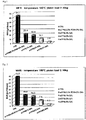
- the use of GA in the composition allows adjusting (reducing) the values of melt flow indexes of mTPS/PLA composition, which could be excessively increased due to the increase in the content of the epoxidized vegetable oil (EOR) in the composition, moreover the addition of GA allows increasing the flexibility of the compositions according to the invention ( Fig.1 and Fig. 2 ).
- Arabic gum also leads to formation of a durable coating on the surface of mTPS/PLA composition, which provides a high barrier capacity for oxidation processes of its components and improvement of adhesion of the composition to overprints, without disturbing its glossiness.
- Another object of the invention is a method for obtaining the thermoplastic polymer composition consisting of polylactide (PLA) and modified thermoplastic starch (mTPS) at a weight ratio mTPS to PLA of 7/1 to 1/7, respectively, wherein mTPS contains 30-80.8 wt% of native starch, 10-48.5% of glycerol as a plasticizer and additional modifying components in the form of 2-20 wt% of agar (AG) and/or 0.5-10 wt% of epoxidized vegetable oil (EOR) and/or 0.5 to 10 wt% of arabic gum (GA), characterized in that it consists of three steps, where:
- the method according to the invention is characterized in that the granulate of the biodegradable thermoplastic polymer composition, obtained in step c), can be formed into various shapes depending on the needs.
- composition according to the invention is manufactured in three steps.
- a starch mixture consisting of native starch, plasticizer and TPS modifier in the form of agar and/or epoxidized vegetable oil (preferably epoxidized soybean oil), and/or arabic gum, is prepared.
- the mixture from step a) is introduced into the charging hopper of a single-screw or twin-screw extruder, and is subjected to thermomechanical transformations under the influence of extrusion of the mixture, at the temperatures of the heating zones of the extruder in the range of 100°C to 210°C, preferably 110-180°C, at a rotation speed of the screw preferably of 10-100 min -1 , with simultaneous degassing of volatile matter released during extrusion, and granulation of the resulting mTPS extrudate, using a knife granulator.
- the process of extrusion of the starch mixture is preferably carried out in a co-rotating twin-screw extruder, equipped with continuously adjustable control of the rotational speed of the screws and appropriate controllers and sensors necessary for properly conducting and monitoring the extrusion process.
- the modified thermoplastic starch (mTPS) granulate is subjected in the last, third step to mixing with polylactide (PLA) granulate at a weight ratio of mTPS/PLA, without additional components supporting miscibility, in the range of 7/1 to 1/7, and subjected to extrusion using a single-screw or twin-screw extruder.
- plasticization and complete homogenisation of mTPS/PLA composition take place, while maintaining the temperature of the heating zones of the plasticizing system and the head of the extruder in the range of 133-210°C, preferably of 140-200°C, and the rotation speed of the screws preferably at 10 min -1 to 100 min -1 .
- the resulting extrudate is subjected to granulation, with the use of a knife granulator, and the resulting mTPS/PLA granulate is placed in airtight containers in order to protect it against humidity.
- PLA granulate is introduced to V-IV plasticizing zone of the extruder, directly to mTPS melt, whereby it is possible to extrude mTPS/PLA composition according to the invention in a continuous manner.
- thermoplastic mTPS/PLA composition uniform throughout its volume and with varying degrees of transparency depending on the composition of the composition is obtained.
- the mTPS/PLA compositions obtained by the above method according to the invention are 100% compostable according to standard PN-EN 14806:2010, which has been confirmed in tests conducted by COBRO-Packaging Research Institute, Warsaw.
- thermoplastic starch (mTPS) modified with agar are dedicated to forming utility products by transfer moulding.
- compositions containing, in their content, thermoplastic starch (mTPS) modified by means of epoxidized vegetable oil and/or arabic gum are intended for the manufacture of extruded, injection moulded or pressed (with transfer method) articles of everyday use. All types of compositions obtained by the method according to the invention can be used in the manufacture of e.g. disposable dishes and cutlery, dividers for creams, cosmetic sticks, inserts for nail files, flat films or other types of disposable polymer materials, manufactured so far from thermoplastics, and after use, they can be subjected to composting and biodegradation.
- the method for obtaining the polymer compositions according to the invention is simple, accessible and uses readily available components of natural origin or from renewable raw materials.
- modified thermoplastic starch (mTPS) granulate is manufactured by thermomechanical plasticising and mixing, while in the third step mTPS and PLA granulates are mixed in the extrusion process, whereby the polymer composition, homogeneous on a macro scale, according to the invention with good processing and physicochemical properties is obtained.
- mTPS modified thermoplastic starch
- Thermoplastic mTPS/PLA composition is obtained in a three-step process using polylactide (PLA 2003D - Ingeo Biopolymer) and thermoplastic starch (mTPS) containing, potato starch ("ZPZ" Pi a) and glycerol of vegetable origin (purity of 99.5%, techlanLab Tarnobrzeg), which was modified by the addition of epoxidized soybean oil (Brenntag) and an aqueous solution of arabic gum (Talens Arabic gum).
- a starch mixture consisting of 73.1 wt% of potato starch, 24.4 wt% of glycerol and the addition of epoxidized soybean oil in the amount of 0.5 wt%, and arabic gum in the amount of 2 wt%, was prepared.
- the mixture was conditioned for 24 hours at room temperature, the aim of which was to achieve complete swelling of the starch by means of glycerol, oil, and an aqueous solution of arabic gum.
- the resulting dry starch mixture after conditioning, was introduced into the charging hopper of a co-rotating twin-screw extruder and was extruded at the rotational speed of the screws of 65 RPM, while maintaining a constant temperature in 9 heating zones of the plasticizing unit of the extruder, the distribution of which was as follows 110°C /150°C/ 165°C/ 170°C /170°C/ 170°C/ 170°C /165°C/ 165°C/ and a constant temperature of the extruder head and connector at the level of 165°C.
- thermoplastic extrudate was cooled with air and granulated on a knife granulator into the form of granulate with a diameter of approx. 1 mm.
- mTPS modified thermoplastic starch
- PLA-2003D Ingeo Biopolymer commercial polylactide granulate
- mTPS/PLA composition was plasticised and completely homogenized.
- the mTPS/PLA mixture was extruded at the rotational speed of the screws of 20 RPM, while maintaining a constant temperature in 9 heating zones of the plasticizing system of the extruder, the distribution of which was as follows 110°C /150°C/ 165°C/ 170°C /170°C/ 175°C/ 175°C /170°C/ and a constant temperature of the extruder head and connector at the level of 170°C.
- the thermoplastic mTPS/PLA composition was cooled with air and granulated with the use of a knife granulator into the form of granulate with a diameter of approx. 1 mm.
- the mTPS/PLA compositions obtained by the above method are 100% compostable according to standard PN-EN 14806:2010, which has been confirmed in tests conducted by COBRO-Packaging Research Institute, Warsaw.
- thermoplastics From the mTPS/PLA compositions, obtained by the above method, disposable cutlery, cosmetic sticks, disposable inserts for nail files, or other disposable polymer materials, manufactured so far from thermoplastics, can be manufactured.
- thermoplastic mTPS/PLA composition is obtained in a three-step process using polylactide (PLA 2003D - Ingeo Biopolymer) and thermoplastic starch (mTPS) containing, in its content, potato starch ("ZPZ" Pila) and glycerol of vegetable origin (purity of 99.5%, techlanLab Tarnobrzeg), which was modified by the addition of an aqueous solution of arabic gum (Talens Arabic gum).
- a starch mixture consisting, in its content, potato starch in the amount of 73.5 wt%, glycerol used in the amount of 24.5 wt% of and an aqueous solution of arabic gum used in the amount of 2 wt%, was prepared.
- the resulting mixtures were conditioned for 24 hours at room temperature, the aim of which was to achieve complete swelling of the starch by means of glycerol and an aqueous solution of arabic gum.
- the resulting starch mixture after conditioning, was introduced into the charging hopper of a co-rotating twin-screw extruder and was extruded at the rotational speed of the screws of 65 RPM, while maintaining a constant temperature in 9 heating zones of the plasticizing system of the extruder, the distribution of which was as follows 110°C /150°C/ 165°C/ 170°C /170°C/ 170°C/ 170°C /165°C/ 165°C/ and a constant temperature of the extruder head and connector at the level of 165°C.
- thermoplastic mass being formed was degassed by evacuating gaseous products formed in this process from the 4th and 5th plasticising zone of the extruder. After leaving the extrusion head, the thermoplastic extrudate was cooled with air and granulated on a knife granulator into the form of granulate with a diameter of approx. 1 mm.
- the modified thermoplastic starch (*mTPS) granulate obtained in the extrusion process, was subjected, in the last step, to mixing with a commercial polylactide granulate (PLA), while maintaining the weight ratio of mTPS/PLA of 1/7 to 7/1, respectively, and was subjected to extrusion with the use of a co-rotating twin-screw extruder, whereby the mTPS/PLA composition was plasticised and completely homogenized.
- PHA polylactide granulate
- thermoplastic mTPS/PLA composition was cooled with air and granulated with the use of a knife granulator into the form of granulate with a diameter of approx. 1 mm.
- Table 1 and in Fig. 1 and 2 processing properties of the mTPS/PLA composition obtained in Example 1, are presented.
- the mTPS/PLA compositions obtained by the above method are 100% compostable according to standard PN-EN 14806:2010, which has been confirmed in tests conducted by COBRO-Packaging Research Institute, Warsaw. From the mTPS/PLA composition, obtained by the above method, e.g. disposable cutlery, cosmetic sticks, disposable insert for nail files, or other disposable polymer materials, manufactured so far from thermoplastics, can be manufactured.
- thermoplastic compositions made from PLA and thermoplastic starch (mTPS) modified by means of epoxidized oil (EOS) and/or an aqueous solution of arabic gum (GA).
- EOS epoxidized oil
- GA aqueous solution of arabic gum
- thermoplastic mTPS/PLA composition is obtained in a three-step process using polylactide (PLA 2003D - Ingeo Biopolymer) and thermoplastic starch (mTPS) containing potato starch ("ZPZ" Pi a) and glycerol of vegetable origin (purity of 99.5%, techlanLab Tarnobrzeg), which was modified by the addition of arabic gum (Difco, USA).
- a starch mixture containing potato starch used in the amount of 44.4 wt%, glycerol used in the amount of 44.4 wt% mixed at a temperature of 60-80°C with agar used in the amount of 11.2% was prepared. After stirring all the components, the resulting mixtures were conditioned for 24 hours at room temperature, the aim of which was to achieve complete swelling of the starch by means of glycerol.
- the resulting starch mixture containing starch, glycerol and agar, after conditioning, was introduced into the charging hopper of a co-rotating twin-screw extruder and was extruded at the rotational speed of the screws of 65 RPM, while maintaining a constant temperature in 9 heating zones of the plasticizing system of the extruder, the distribution of which was as follows 110°C /150°C/ 165°C/ 170°C /170°C/ 170°C/ 170°C/165°C/ 165°C/ and a constant temperature of the extruder head and connector at the level of 165°C.
- thermoplastic mass being formed was degassed by evacuating gaseous products formed in this process from the 4th and 5th plasticizing zone of the extruder. After leaving the extrusion head, the thermoplastic extrudate was cooled with air to room temperature and granulated on a knife granulator into the form of granulate with a diameter of approx. 1 mm.
- thermoplastic starch modified with agar, obtained by the process of extrusion, was mixed with a commercial polylactide granulate (PLA-2003D - Ingeo Biopolymer), while maintaining the weight ratio of mTPS/PLA of 1/7 to 7/1, respectively, and was subjected extrusion using a co-rotating twin-screw extruder.
- This process allowed plasticisation and complete homogenization of the mTPS/PLA composition.
- the mTPS/PLA mixture was extruded at the rotational speed of the screws of 20 RPM, while maintaining a constant temperature in 9 heating zones of the plasticising system of the extruder, the distribution of which was as follows 110°C /150°C/ 165°C/ 170°C /170°C/ 175°C/ 170°C /170°C/ and a constant temperature of the extruder head and connector at the level of 170°C.
- the thermoplastic mTPS/PLA composition was cooled with air to room temperature and granulated with the use of a knife granulator into the form of granulate with a diameter of approx. 1 mm.
- thermoplastic compositions obtained by the method according to the invention which contain agar, are dedicated to forming utility articles by transfer moulding.
- Table 2 Influence of the composition content according to Example 3 on the degree of degradation of the composition, expressed as the weight loss after 30 days of exposure in seawater.
- composition Weight ratio of mTPS/PLA Composition of mTPS [wt%] Weight loss of the sample after 30 days of incubation in seawater [wt%] mTPS PLA Starch Glycerol AG Composition Example 3 2.2 1.0 44.4 44.4 11.1 84 Composition Example 3 1.3 1.0 26.3 52.3 21.4 56 Composition Example 3 1.6 1.0 39.0 57.7 3.3 49
Landscapes
- Chemical & Material Sciences (AREA)
- Health & Medical Sciences (AREA)
- Chemical Kinetics & Catalysis (AREA)
- Medicinal Chemistry (AREA)
- Polymers & Plastics (AREA)
- Organic Chemistry (AREA)
- Engineering & Computer Science (AREA)
- Manufacturing & Machinery (AREA)
- Materials Engineering (AREA)
- Compositions Of Macromolecular Compounds (AREA)
- Biological Depolymerization Polymers (AREA)
Claims (9)
- Bioabbaubare thermoplastische Polymerzusammensetzung bestehend aus Polyactid (PLA) sowie modifizierter thermoplastischer Stärke (mTPS) mit einem Massenverhältnis mTPS zu PLA entsprechend 7/1 bis 1/7, wobei mTPS 30%-80,8 Masse% native Stärke, 10-48,5 % Glycerol als Plastifiziermittel sowie zusätzliche Modifizierungsmittel in Form von 2-20 Masse% Agar (AG) und/oder 0,5-10 Masse% epoxidiertes Pflanzenöl (EOR) und/oder 0,5 bis 10 Masse% Gummiarabikum (GA) enthält.
- Zusammensetzung gemäß Anspruch 1, dadurch gekennzeichnet, dass sie aus Polyactid (PLA) in einer Menge von 12,5 Masse% sowie modifizierter thermoplastischer Stärke (mTPS) in einer Menge von 87,5 Masse% besteht, wobei mTPS 30%-80,8 Masse% native Stärke, 10-48,5 % Glycerol als Plastifiziermittel sowie zusätzliche Modifizierungsmittel in Form von 2-20 Masse% Agar (AG) und/oder 0,5-10 Masse% epoxidiertes Pflanzenöl (EOR) und/oder 0,5 bis 10 Masse% Gummiarabikum (GA) enthält.
- Zusammensetzung gemäß Anspruch 1, dadurch gekennzeichnet, dass sie aus Polyactid (PLA) in einer Menge von 87,5 Masse% sowie modifizierter thermoplastischer Stärke (mTPS) in einer Menge von 12,5 Masse% besteht, wobei mTPS 30%-80,8 Masse% native Stärke, 10-48,5 % Glycerol als Plastifiziermittel sowie zusätzliche Modifizierungsmittel in Form von 2-20 Masse% Agar (AG) und/oder 0,5-10 Masse% epoxidiertes Pflanzenöl (EOR) und/oder 0,5 bis 10 Masse% Gummiarabikum (GA) enthält.
- Zusammensetzung gemäß Anspruch 1, dadurch gekennzeichnet, dass sie aus 12,5 Masse% Polyactid (PLA) sowie 87,5 Masse% modifizierte thermoplastische Stärke (mTPS) besteht, wobei modifizierte thermoplastische Stärke 73,1 Masse% native Stärke, 24,4 Masse% Glycerol als Plastifiziermittel sowie zusätzliche Modifizierungsmittel in Form von 0,5 Masse% epoxidiertes Pflanzenöl (EOR) und/oder 2 % Gummiarabikum (GA) enthält.
- Zusammensetzung gemäß Anspruch 1, dadurch gekennzeichnet, dass sie aus Polyactid (PLA) sowie modifizierter thermoplastischer Stärke (mTPS) in einem Gewichtsverhältnis entsprechend 1/2 oder 1/3 besteht, wo die modifizierte thermoplastische Stärke 73,1 Masse% native Stärke, 24,4 Masse% Glycerol als Plastifiziermittel sowie zusätzliche Modifizierungsmittel in Form von 0,5 Masse% epoxidiertes Pflanzenöl (EOR) und 2 Masse% Gummiarabikum (GA) enthält.
- Zusammensetzung gemäß Anspruch 1, dadurch gekennzeichnet, dass sie aus Polyactid (PLA) sowie modifizierter thermoplastischer Stärke (mTPS) in einem Gewichtsverhältnis entsprechend 1/2, 1/3 oder 1/4 besteht, wo die modifizierte thermoplastische Stärke 73,5 Masse% native Stärke, 24,5 Masse% Glycerol als Plastifiziermittel sowie zusätzliche Modifizierungsmittel in Form von 2 Masse% Gummiarabikum (GA) enthält.
- Verfahren zum Erhalten thermoplastischer Polymerzusammensetzung gemäß Anspruch 1, dadurch gekennzeichnet, dass es aus drei Schritten besteht, wo:a) im ersten Schritt native Stärke mittels eines mechanischen Mischers mit einem Plastifiziermittel in Form von Glycerol und zusätzlichem Modifizierungsmittel ausgewählt aus der Gruppe bestehend aus Agar-Agar (AG), epoxidiertem Pflanzenöl (EOS) oder Gummiarabikum (GA) in Raumtemperatur gemischt und so erhaltenes Gemisch in geschlossenen Gefäßen einer Konditionierung binnen 6-24 Stunden unterzogen wird;b) im zweiten Schritt das Gemisch aus dem Schritt a) mittels eines Ein- oder Doppelschneckenextruders unter Einhaltung der Kopftemperatur im Bereich von 120-210°C sowie der Temperatur der Heizzonen des plastifizierenden Systems im Bereich von 100°C bis 210°C bei gleichzeitiger Entgasung von flüchtigen Teilen extrudiert und dann das thermoplastische Extrudat mit Luft auf die Raumtemperatur gekühlt und granuliert wird, wobei ein Granulat einer modifizierten thermoplastischen Stärke (mTPS) mit einem Durchmesser von ca. 1 mm erhalten wird;c) im dritten Schritt das im Schritt b) erhaltene Granulat mit dem Polyactid-Granulat (PLA) gemischt wird, wobei das Massenverhältnis mTPS zu PLA entsprechend 7/1 bis 1/7 beträgt, und dann das erhaltene mTPS/PLA-Gemisch unter Verwendung eines Ein- oder Doppelschneckenextruders bei Einhaltung der Kopftemperatur im Bereich von 130-210°C, bevorzugt von 140-200°C, sowie der Temperatur der Heizzonen des plastifizierenden Systems im Bereich von 100°C bis 260°C, bei gleichzeitiger Entgasung von flüchtigen Teilen extrudiert und anschließend das thermoplastische Extrudat mit Luft auf die Raumtemperatur gekühlt und granuliert wird, wobei ein Granulat (mTPS/PLA) mit einem Durchmesser von ca. 1 mm erhalten wird.
- Verfahren gemäß Anspruch 7, dadurch gekennzeichnet, dass das Granulat im Schritt b) in die mTPS-Schmelze in die V-IV plastifizierende Extruderzone direkt eingeführt wird, wodurch die Extrusion der erfindungsgemäßen mTPS/PLA-Zusammensetzung kontinuierlich erfolgen kann.
- Verfahren gemäß Anspruch 7, dadurch gekennzeichnet, dass das Granulat der bioabbaubaren thermoplastischen, im Schritt c) erhaltenen Polymerzusammensetzung in verschiedene Formen je nach Bedarf gebracht werden kann.
Priority Applications (2)
| Application Number | Priority Date | Filing Date | Title |
|---|---|---|---|
| EP15460007.6A EP3064542B1 (de) | 2015-03-04 | 2015-03-04 | Biologisch abbaubare, thermoplastische polymerzusammensetzung, verfahren deren herstellung und verwendung davon |
| PL15460007T PL3064542T3 (pl) | 2015-03-04 | 2015-03-04 | Biodegradowalna termoplastyczna kompozycja polimerowa, sposób jej wytwarzania oraz zastosowanie |
Applications Claiming Priority (1)
| Application Number | Priority Date | Filing Date | Title |
|---|---|---|---|
| EP15460007.6A EP3064542B1 (de) | 2015-03-04 | 2015-03-04 | Biologisch abbaubare, thermoplastische polymerzusammensetzung, verfahren deren herstellung und verwendung davon |
Publications (2)
| Publication Number | Publication Date |
|---|---|
| EP3064542A1 EP3064542A1 (de) | 2016-09-07 |
| EP3064542B1 true EP3064542B1 (de) | 2017-01-25 |
Family
ID=52824208
Family Applications (1)
| Application Number | Title | Priority Date | Filing Date |
|---|---|---|---|
| EP15460007.6A Active EP3064542B1 (de) | 2015-03-04 | 2015-03-04 | Biologisch abbaubare, thermoplastische polymerzusammensetzung, verfahren deren herstellung und verwendung davon |
Country Status (2)
| Country | Link |
|---|---|
| EP (1) | EP3064542B1 (de) |
| PL (1) | PL3064542T3 (de) |
Cited By (3)
| Publication number | Priority date | Publication date | Assignee | Title |
|---|---|---|---|---|
| PL443303A1 (pl) * | 2022-12-29 | 2024-07-01 | Lubelska Polt | Sposób wytwarzania kompozycji polimerowej |
| EP4403325A3 (de) * | 2020-05-11 | 2024-09-25 | Hope Tree International GmbH | Granulat aus rein natürlichen bestandteilen; granulat zur herstellung kompostierbarer produkte sowie herstellungsverfahren des granulats und daraus zu erhaltenden produkten |
| EP4426780A4 (de) * | 2021-11-05 | 2025-10-08 | Sway Innovation Co | Kompostierbare zusammensetzungen auf seetangbasis sowie zugehörige systeme und verfahren |
Families Citing this family (11)
| Publication number | Priority date | Publication date | Assignee | Title |
|---|---|---|---|---|
| CN106750559A (zh) * | 2016-12-12 | 2017-05-31 | 钦州学院 | 一种淀粉基生物全降解材料及其制备方法 |
| CN109735076B (zh) * | 2019-01-23 | 2021-01-22 | 哈尔滨知明科技有限公司 | 一种高性能生物基/聚乳酸全降解材料的制备方法 |
| CN110372916B (zh) * | 2019-06-27 | 2021-03-12 | 广东中烟工业有限责任公司 | 一种淀粉基降温材料及其应用 |
| PL433862A1 (pl) | 2020-05-07 | 2021-11-08 | Grupa Azoty Spółka Akcyjna | Sposób wytwarzania skrobi termoplastycznej i skrobia termoplastyczna |
| EP3954727A1 (de) * | 2020-08-13 | 2022-02-16 | Hope Tree Holding GmbH | Granulat aus rein natürlichen bestandteilen; granulat zur herstellung kompostierbarer produkte sowie herstellungsverfahren des granulats und daraus zu erhaltenden produkten |
| CN111849450B (zh) * | 2020-06-28 | 2023-01-06 | 中国石油天然气股份有限公司 | 一种油田压裂油溶性长效阻水材料及其制备方法 |
| JP7814018B2 (ja) * | 2021-05-06 | 2026-02-16 | 日清紡ケミカル株式会社 | 生分解性樹脂組成物 |
| CN114276600B (zh) * | 2021-12-23 | 2022-09-30 | 南通宝加利新材料有限公司 | 一种可降解的pe膜制备方法 |
| PL449123A1 (pl) * | 2024-07-03 | 2026-01-05 | Krzysztof Pacyga | Termoplastyczna skrobia oraz biodegradowalny kompozyt termoplastyczny |
| PL449621A1 (pl) * | 2024-08-29 | 2026-03-02 | Sieć Badawcza Łukasiewicz - Instytut Nowych Syntez Chemicznych | Biodegradowalna kompozycja polimerowa na bazie skrobi termoplastycznej i polilaktydu przeznaczona do wytwarzania folii, sposób jej wytwarzania oraz sposób wytwarzania folii z tej kompozycji |
| CN119161619A (zh) * | 2024-10-23 | 2024-12-20 | 深圳市逸铭包装科技有限公司 | 一种可生物降解环保塑料生产工艺 |
Family Cites Families (12)
| Publication number | Priority date | Publication date | Assignee | Title |
|---|---|---|---|---|
| PL114442B2 (en) | 1978-06-01 | 1981-01-31 | Apparatus for profiling roll surfaces with provision for continuous adjustment of contour rounding radius | |
| IE66735B1 (en) | 1988-11-03 | 1996-02-07 | Biotec Biolog Naturverpack | Thermoplastically workable starch and a method for the manufacture thereof |
| US5312850A (en) | 1993-01-04 | 1994-05-17 | National Starch And Chemical Investment Holding Corporation | Polylactide and starch containing hot melt adhesive |
| DE4317696C1 (de) | 1993-05-27 | 1994-12-22 | Biotec Biolog Naturverpack | Verfahren zur Herstellung von gekörnter, thermoplastischer Stärke |
| FI104091B (fi) | 1995-07-12 | 1999-11-15 | Valtion Teknillinen | Sulatyöstettävä tärkkelyskoostumus, menetelmä sen valmistamiseksi sekä koostumuksen käyttö |
| DE19624641A1 (de) | 1996-06-20 | 1998-01-08 | Biotec Biolog Naturverpack | Biologisch abbaubarer Werkstoff, bestehend im wesentlichen aus oder auf Basis thermoplastischer Stärke |
| DE10062848C1 (de) | 2000-12-11 | 2002-04-04 | Biop Biopolymer Gmbh | Wasserformbeständiges, thermoplastisches Stärkematerial, Verfahren zu dessen Herstellung und dessen Verwendung |
| TW200712120A (en) * | 2005-07-28 | 2007-04-01 | Biograde Hong Kong Pty Ltd | Biodegradable polymer composition |
| MY156373A (en) * | 2008-11-06 | 2016-02-15 | Tristano Pty Ltd | Biodegradable polymer composition |
| PL214329B1 (pl) | 2008-12-17 | 2013-07-31 | Inst Chemii Przemyslowej Im Prof Ignacego Moscickiego | Biodegradowalna kompozycja zawierająca skrobię termoplastyczną |
| PL216930B1 (pl) | 2010-08-11 | 2014-05-30 | Inst Chemii Przemysłowej Im Prof Ignacego Mościckiego | Sposób wytwarzania skrobi termoplastycznej |
| CN101955639A (zh) * | 2010-09-29 | 2011-01-26 | 江苏天仁生物材料有限公司 | 一种聚乳酸改性材料及其制备方法和用途 |
-
2015
- 2015-03-04 EP EP15460007.6A patent/EP3064542B1/de active Active
- 2015-03-04 PL PL15460007T patent/PL3064542T3/pl unknown
Non-Patent Citations (1)
| Title |
|---|
| None * |
Cited By (4)
| Publication number | Priority date | Publication date | Assignee | Title |
|---|---|---|---|---|
| EP4403325A3 (de) * | 2020-05-11 | 2024-09-25 | Hope Tree International GmbH | Granulat aus rein natürlichen bestandteilen; granulat zur herstellung kompostierbarer produkte sowie herstellungsverfahren des granulats und daraus zu erhaltenden produkten |
| EP4426780A4 (de) * | 2021-11-05 | 2025-10-08 | Sway Innovation Co | Kompostierbare zusammensetzungen auf seetangbasis sowie zugehörige systeme und verfahren |
| PL443303A1 (pl) * | 2022-12-29 | 2024-07-01 | Lubelska Polt | Sposób wytwarzania kompozycji polimerowej |
| PL246152B1 (pl) * | 2022-12-29 | 2024-12-09 | Lubelska Polt | Sposób wytwarzania kompozycji polimerowej |
Also Published As
| Publication number | Publication date |
|---|---|
| PL3064542T3 (pl) | 2017-08-31 |
| EP3064542A1 (de) | 2016-09-07 |
Similar Documents
| Publication | Publication Date | Title |
|---|---|---|
| EP3064542A1 (de) | Biologisch abbaubare, thermoplastische polymerzusammensetzung, verfahren deren herstellung und verwendung davon | |
| Surendren et al. | A review of biodegradable thermoplastic starches, their blends and composites: recent developments and opportunities for single-use plastic packaging alternatives | |
| KR101962719B1 (ko) | 기계적물성이 향상된 탄소중립형 바이오베이스 플라스틱, 이의 제조에 사용되는 열가소성 바이오매스 복합체 및 이들의 제조방법 | |
| Teixeira et al. | Properties of thermoplastic starch from cassava bagasse and cassava starch and their blends with poly (lactic acid) | |
| EP2424937B1 (de) | Algenmischzusammensetzungen für thermoplastische artikel | |
| US9765205B2 (en) | Macrophyte-based bioplastic | |
| Sam et al. | Current application and challenges on packaging industry based on natural polymer blending | |
| DE69306874T2 (de) | Durch Wärme formbare Zusammensetzung, Verfahren zu ihrer Herstellung und ihre Anwendung zur Herstellung von thermogeformten Gegenständen | |
| JP2009527594A (ja) | 環境分解性ポリマー組成物及び環境分解性ポリマー組成物を得る方法 | |
| WO2010074185A1 (ja) | 樹脂組成物、フィルム、袋製品、および、樹脂組成物の製造方法 | |
| WO2009053383A1 (de) | Polymeres material und verfahren zu dessen herstellung | |
| US20260015797A1 (en) | Compostable seaweed-based compositions, and associated systems and methods | |
| CN102686660A (zh) | 基于淀粉的可生物降解聚合物、其制备方法及其制品 | |
| Liao et al. | Effects of mechanical cell disruption on the morphology and properties of spirulina-PLA biocomposites | |
| WO2018184897A1 (de) | Biologisch abbaubare folie | |
| Masanabo et al. | Faba bean lignocellulosic sidestream as a filler for the development of biodegradable packaging | |
| KR102393643B1 (ko) | 표면처리된 부산석고를 포함하는 생분해성 필름 조성물 및 이의 제조방법 | |
| Mustafa et al. | Extending bio‐based and biodegradable thermoplastics in food packaging: A focus on multiphase systems | |
| EP3902661B1 (de) | Compound bzw. folie enthaltend thermoplastische stärke sowie ein thermoplastisches polymer | |
| CN109504042A (zh) | Pha改性的tps/pbat可生物降解树脂及其制备方法 | |
| Preethi et al. | Utilization of tamarind kernel powder for the development of bioplastic films: production and characterization | |
| EP4471088A2 (de) | Erbsenstärkehaltige polymerzusammensetzung | |
| EP3907054A1 (de) | Verfahren zur herstellung thermoplastischer stärke, und danach hergestellte thermoplastische stärke | |
| Nida et al. | Biopolymers and biocomposites from agricultural waste | |
| Surendren | Development of Thermoplastic Starch-based Polymeric Blends and Composites Engineered with Extrusion Cast and Blown Films for Packaging Applications |
Legal Events
| Date | Code | Title | Description |
|---|---|---|---|
| PUAI | Public reference made under article 153(3) epc to a published international application that has entered the european phase |
Free format text: ORIGINAL CODE: 0009012 |
|
| 17P | Request for examination filed |
Effective date: 20150320 |
|
| AK | Designated contracting states |
Kind code of ref document: A1 Designated state(s): AL AT BE BG CH CY CZ DE DK EE ES FI FR GB GR HR HU IE IS IT LI LT LU LV MC MK MT NL NO PL PT RO RS SE SI SK SM TR |
|
| AX | Request for extension of the european patent |
Extension state: BA ME |
|
| GRAP | Despatch of communication of intention to grant a patent |
Free format text: ORIGINAL CODE: EPIDOSNIGR1 |
|
| RIC1 | Information provided on ipc code assigned before grant |
Ipc: C08L 67/04 20060101ALI20160922BHEP Ipc: C08L 3/02 20060101AFI20160922BHEP Ipc: C08J 5/00 20060101ALI20160922BHEP |
|
| INTG | Intention to grant announced |
Effective date: 20161012 |
|
| STAA | Information on the status of an ep patent application or granted ep patent |
Free format text: STATUS: GRANT OF PATENT IS INTENDED |
|
| GRAS | Grant fee paid |
Free format text: ORIGINAL CODE: EPIDOSNIGR3 |
|
| GRAA | (expected) grant |
Free format text: ORIGINAL CODE: 0009210 |
|
| STAA | Information on the status of an ep patent application or granted ep patent |
Free format text: STATUS: THE PATENT HAS BEEN GRANTED |
|
| AK | Designated contracting states |
Kind code of ref document: B1 Designated state(s): AL AT BE BG CH CY CZ DE DK EE ES FI FR GB GR HR HU IE IS IT LI LT LU LV MC MK MT NL NO PL PT RO RS SE SI SK SM TR |
|
| REG | Reference to a national code |
Ref country code: GB Ref legal event code: FG4D |
|
| REG | Reference to a national code |
Ref country code: CH Ref legal event code: EP |
|
| REG | Reference to a national code |
Ref country code: AT Ref legal event code: REF Ref document number: 864104 Country of ref document: AT Kind code of ref document: T Effective date: 20170215 |
|
| REG | Reference to a national code |
Ref country code: IE Ref legal event code: FG4D |
|
| REG | Reference to a national code |
Ref country code: DE Ref legal event code: R096 Ref document number: 602015001366 Country of ref document: DE |
|
| REG | Reference to a national code |
Ref country code: FR Ref legal event code: PLFP Year of fee payment: 3 |
|
| REG | Reference to a national code |
Ref country code: LT Ref legal event code: MG4D |
|
| REG | Reference to a national code |
Ref country code: NL Ref legal event code: MP Effective date: 20170125 |
|
| REG | Reference to a national code |
Ref country code: AT Ref legal event code: MK05 Ref document number: 864104 Country of ref document: AT Kind code of ref document: T Effective date: 20170125 |
|
| PG25 | Lapsed in a contracting state [announced via postgrant information from national office to epo] |
Ref country code: NL Free format text: LAPSE BECAUSE OF FAILURE TO SUBMIT A TRANSLATION OF THE DESCRIPTION OR TO PAY THE FEE WITHIN THE PRESCRIBED TIME-LIMIT Effective date: 20170125 |
|
| PG25 | Lapsed in a contracting state [announced via postgrant information from national office to epo] |
Ref country code: LT Free format text: LAPSE BECAUSE OF FAILURE TO SUBMIT A TRANSLATION OF THE DESCRIPTION OR TO PAY THE FEE WITHIN THE PRESCRIBED TIME-LIMIT Effective date: 20170125 Ref country code: IS Free format text: LAPSE BECAUSE OF FAILURE TO SUBMIT A TRANSLATION OF THE DESCRIPTION OR TO PAY THE FEE WITHIN THE PRESCRIBED TIME-LIMIT Effective date: 20170525 Ref country code: FI Free format text: LAPSE BECAUSE OF FAILURE TO SUBMIT A TRANSLATION OF THE DESCRIPTION OR TO PAY THE FEE WITHIN THE PRESCRIBED TIME-LIMIT Effective date: 20170125 Ref country code: NO Free format text: LAPSE BECAUSE OF FAILURE TO SUBMIT A TRANSLATION OF THE DESCRIPTION OR TO PAY THE FEE WITHIN THE PRESCRIBED TIME-LIMIT Effective date: 20170425 Ref country code: HR Free format text: LAPSE BECAUSE OF FAILURE TO SUBMIT A TRANSLATION OF THE DESCRIPTION OR TO PAY THE FEE WITHIN THE PRESCRIBED TIME-LIMIT Effective date: 20170125 Ref country code: GR Free format text: LAPSE BECAUSE OF FAILURE TO SUBMIT A TRANSLATION OF THE DESCRIPTION OR TO PAY THE FEE WITHIN THE PRESCRIBED TIME-LIMIT Effective date: 20170426 |
|
| PG25 | Lapsed in a contracting state [announced via postgrant information from national office to epo] |
Ref country code: PT Free format text: LAPSE BECAUSE OF FAILURE TO SUBMIT A TRANSLATION OF THE DESCRIPTION OR TO PAY THE FEE WITHIN THE PRESCRIBED TIME-LIMIT Effective date: 20170525 Ref country code: ES Free format text: LAPSE BECAUSE OF FAILURE TO SUBMIT A TRANSLATION OF THE DESCRIPTION OR TO PAY THE FEE WITHIN THE PRESCRIBED TIME-LIMIT Effective date: 20170125 Ref country code: LV Free format text: LAPSE BECAUSE OF FAILURE TO SUBMIT A TRANSLATION OF THE DESCRIPTION OR TO PAY THE FEE WITHIN THE PRESCRIBED TIME-LIMIT Effective date: 20170125 Ref country code: SE Free format text: LAPSE BECAUSE OF FAILURE TO SUBMIT A TRANSLATION OF THE DESCRIPTION OR TO PAY THE FEE WITHIN THE PRESCRIBED TIME-LIMIT Effective date: 20170125 Ref country code: AT Free format text: LAPSE BECAUSE OF FAILURE TO SUBMIT A TRANSLATION OF THE DESCRIPTION OR TO PAY THE FEE WITHIN THE PRESCRIBED TIME-LIMIT Effective date: 20170125 Ref country code: RS Free format text: LAPSE BECAUSE OF FAILURE TO SUBMIT A TRANSLATION OF THE DESCRIPTION OR TO PAY THE FEE WITHIN THE PRESCRIBED TIME-LIMIT Effective date: 20170125 Ref country code: BG Free format text: LAPSE BECAUSE OF FAILURE TO SUBMIT A TRANSLATION OF THE DESCRIPTION OR TO PAY THE FEE WITHIN THE PRESCRIBED TIME-LIMIT Effective date: 20170425 |
|
| REG | Reference to a national code |
Ref country code: DE Ref legal event code: R097 Ref document number: 602015001366 Country of ref document: DE |
|
| PG25 | Lapsed in a contracting state [announced via postgrant information from national office to epo] |
Ref country code: IT Free format text: LAPSE BECAUSE OF FAILURE TO SUBMIT A TRANSLATION OF THE DESCRIPTION OR TO PAY THE FEE WITHIN THE PRESCRIBED TIME-LIMIT Effective date: 20170125 Ref country code: SK Free format text: LAPSE BECAUSE OF FAILURE TO SUBMIT A TRANSLATION OF THE DESCRIPTION OR TO PAY THE FEE WITHIN THE PRESCRIBED TIME-LIMIT Effective date: 20170125 Ref country code: CZ Free format text: LAPSE BECAUSE OF FAILURE TO SUBMIT A TRANSLATION OF THE DESCRIPTION OR TO PAY THE FEE WITHIN THE PRESCRIBED TIME-LIMIT Effective date: 20170125 Ref country code: EE Free format text: LAPSE BECAUSE OF FAILURE TO SUBMIT A TRANSLATION OF THE DESCRIPTION OR TO PAY THE FEE WITHIN THE PRESCRIBED TIME-LIMIT Effective date: 20170125 Ref country code: RO Free format text: LAPSE BECAUSE OF FAILURE TO SUBMIT A TRANSLATION OF THE DESCRIPTION OR TO PAY THE FEE WITHIN THE PRESCRIBED TIME-LIMIT Effective date: 20170125 |
|
| PG25 | Lapsed in a contracting state [announced via postgrant information from national office to epo] |
Ref country code: DK Free format text: LAPSE BECAUSE OF FAILURE TO SUBMIT A TRANSLATION OF THE DESCRIPTION OR TO PAY THE FEE WITHIN THE PRESCRIBED TIME-LIMIT Effective date: 20170125 Ref country code: MC Free format text: LAPSE BECAUSE OF FAILURE TO SUBMIT A TRANSLATION OF THE DESCRIPTION OR TO PAY THE FEE WITHIN THE PRESCRIBED TIME-LIMIT Effective date: 20170125 Ref country code: SM Free format text: LAPSE BECAUSE OF FAILURE TO SUBMIT A TRANSLATION OF THE DESCRIPTION OR TO PAY THE FEE WITHIN THE PRESCRIBED TIME-LIMIT Effective date: 20170125 |
|
| PLBE | No opposition filed within time limit |
Free format text: ORIGINAL CODE: 0009261 |
|
| STAA | Information on the status of an ep patent application or granted ep patent |
Free format text: STATUS: NO OPPOSITION FILED WITHIN TIME LIMIT |
|
| REG | Reference to a national code |
Ref country code: IE Ref legal event code: MM4A |
|
| 26N | No opposition filed |
Effective date: 20171026 |
|
| PG25 | Lapsed in a contracting state [announced via postgrant information from national office to epo] |
Ref country code: LU Free format text: LAPSE BECAUSE OF NON-PAYMENT OF DUE FEES Effective date: 20170304 |
|
| PG25 | Lapsed in a contracting state [announced via postgrant information from national office to epo] |
Ref country code: SI Free format text: LAPSE BECAUSE OF FAILURE TO SUBMIT A TRANSLATION OF THE DESCRIPTION OR TO PAY THE FEE WITHIN THE PRESCRIBED TIME-LIMIT Effective date: 20170125 Ref country code: IE Free format text: LAPSE BECAUSE OF NON-PAYMENT OF DUE FEES Effective date: 20170304 |
|
| REG | Reference to a national code |
Ref country code: BE Ref legal event code: MM Effective date: 20170331 |
|
| REG | Reference to a national code |
Ref country code: FR Ref legal event code: PLFP Year of fee payment: 4 |
|
| PG25 | Lapsed in a contracting state [announced via postgrant information from national office to epo] |
Ref country code: BE Free format text: LAPSE BECAUSE OF NON-PAYMENT OF DUE FEES Effective date: 20170331 |
|
| PG25 | Lapsed in a contracting state [announced via postgrant information from national office to epo] |
Ref country code: MT Free format text: LAPSE BECAUSE OF NON-PAYMENT OF DUE FEES Effective date: 20170304 |
|
| REG | Reference to a national code |
Ref country code: CH Ref legal event code: PL |
|
| PG25 | Lapsed in a contracting state [announced via postgrant information from national office to epo] |
Ref country code: LI Free format text: LAPSE BECAUSE OF NON-PAYMENT OF DUE FEES Effective date: 20180331 Ref country code: CH Free format text: LAPSE BECAUSE OF NON-PAYMENT OF DUE FEES Effective date: 20180331 |
|
| PG25 | Lapsed in a contracting state [announced via postgrant information from national office to epo] |
Ref country code: HU Free format text: LAPSE BECAUSE OF FAILURE TO SUBMIT A TRANSLATION OF THE DESCRIPTION OR TO PAY THE FEE WITHIN THE PRESCRIBED TIME-LIMIT; INVALID AB INITIO Effective date: 20150304 |
|
| PG25 | Lapsed in a contracting state [announced via postgrant information from national office to epo] |
Ref country code: CY Free format text: LAPSE BECAUSE OF FAILURE TO SUBMIT A TRANSLATION OF THE DESCRIPTION OR TO PAY THE FEE WITHIN THE PRESCRIBED TIME-LIMIT Effective date: 20170125 |
|
| PG25 | Lapsed in a contracting state [announced via postgrant information from national office to epo] |
Ref country code: MK Free format text: LAPSE BECAUSE OF FAILURE TO SUBMIT A TRANSLATION OF THE DESCRIPTION OR TO PAY THE FEE WITHIN THE PRESCRIBED TIME-LIMIT Effective date: 20170125 |
|
| PG25 | Lapsed in a contracting state [announced via postgrant information from national office to epo] |
Ref country code: TR Free format text: LAPSE BECAUSE OF FAILURE TO SUBMIT A TRANSLATION OF THE DESCRIPTION OR TO PAY THE FEE WITHIN THE PRESCRIBED TIME-LIMIT Effective date: 20170125 |
|
| PG25 | Lapsed in a contracting state [announced via postgrant information from national office to epo] |
Ref country code: AL Free format text: LAPSE BECAUSE OF FAILURE TO SUBMIT A TRANSLATION OF THE DESCRIPTION OR TO PAY THE FEE WITHIN THE PRESCRIBED TIME-LIMIT Effective date: 20170125 |
|
| PGFP | Annual fee paid to national office [announced via postgrant information from national office to epo] |
Ref country code: GB Payment date: 20260225 Year of fee payment: 12 |
|
| PGFP | Annual fee paid to national office [announced via postgrant information from national office to epo] |
Ref country code: DE Payment date: 20260224 Year of fee payment: 12 |
|
| PGFP | Annual fee paid to national office [announced via postgrant information from national office to epo] |
Ref country code: FR Payment date: 20260205 Year of fee payment: 12 |
|
| PGFP | Annual fee paid to national office [announced via postgrant information from national office to epo] |
Ref country code: PL Payment date: 20260225 Year of fee payment: 12 |