EP3082643B1 - Procédé de planification d'un frittage d'une partie de prothèse dentaire - Google Patents
Procédé de planification d'un frittage d'une partie de prothèse dentaire Download PDFInfo
- Publication number
- EP3082643B1 EP3082643B1 EP14830521.2A EP14830521A EP3082643B1 EP 3082643 B1 EP3082643 B1 EP 3082643B1 EP 14830521 A EP14830521 A EP 14830521A EP 3082643 B1 EP3082643 B1 EP 3082643B1
- Authority
- EP
- European Patent Office
- Prior art keywords
- dental prosthetic
- wall thickness
- prosthetic part
- temperature profile
- sintering
- Prior art date
- Legal status (The legal status is an assumption and is not a legal conclusion. Google has not performed a legal analysis and makes no representation as to the accuracy of the status listed.)
- Active
Links
Images

Classifications
-
- A—HUMAN NECESSITIES
- A61—MEDICAL OR VETERINARY SCIENCE; HYGIENE
- A61C—DENTISTRY; APPARATUS OR METHODS FOR ORAL OR DENTAL HYGIENE
- A61C5/00—Filling or capping teeth
- A61C5/70—Tooth crowns; Making thereof
- A61C5/77—Methods or devices for making crowns
-
- A—HUMAN NECESSITIES
- A61—MEDICAL OR VETERINARY SCIENCE; HYGIENE
- A61C—DENTISTRY; APPARATUS OR METHODS FOR ORAL OR DENTAL HYGIENE
- A61C13/00—Dental prostheses; Making same
- A61C13/0003—Making bridge-work, inlays, implants or the like
- A61C13/0006—Production methods
-
- A—HUMAN NECESSITIES
- A61—MEDICAL OR VETERINARY SCIENCE; HYGIENE
- A61C—DENTISTRY; APPARATUS OR METHODS FOR ORAL OR DENTAL HYGIENE
- A61C13/00—Dental prostheses; Making same
- A61C13/0003—Making bridge-work, inlays, implants or the like
- A61C13/0004—Computer-assisted sizing or machining of dental prostheses
-
- A—HUMAN NECESSITIES
- A61—MEDICAL OR VETERINARY SCIENCE; HYGIENE
- A61C—DENTISTRY; APPARATUS OR METHODS FOR ORAL OR DENTAL HYGIENE
- A61C13/00—Dental prostheses; Making same
- A61C13/20—Methods or devices for soldering, casting, moulding or melting
-
- C—CHEMISTRY; METALLURGY
- C04—CEMENTS; CONCRETE; ARTIFICIAL STONE; CERAMICS; REFRACTORIES
- C04B—LIME, MAGNESIA; SLAG; CEMENTS; COMPOSITIONS THEREOF, e.g. MORTARS, CONCRETE OR LIKE BUILDING MATERIALS; ARTIFICIAL STONE; CERAMICS; REFRACTORIES; TREATMENT OF NATURAL STONE
- C04B35/00—Shaped ceramic products characterised by their composition; Ceramics compositions; Processing powders of inorganic compounds preparatory to the manufacturing of ceramic products
- C04B35/01—Shaped ceramic products characterised by their composition; Ceramics compositions; Processing powders of inorganic compounds preparatory to the manufacturing of ceramic products based on oxide ceramics
- C04B35/10—Shaped ceramic products characterised by their composition; Ceramics compositions; Processing powders of inorganic compounds preparatory to the manufacturing of ceramic products based on oxide ceramics based on aluminium oxide
- C04B35/111—Fine ceramics
-
- C—CHEMISTRY; METALLURGY
- C04—CEMENTS; CONCRETE; ARTIFICIAL STONE; CERAMICS; REFRACTORIES
- C04B—LIME, MAGNESIA; SLAG; CEMENTS; COMPOSITIONS THEREOF, e.g. MORTARS, CONCRETE OR LIKE BUILDING MATERIALS; ARTIFICIAL STONE; CERAMICS; REFRACTORIES; TREATMENT OF NATURAL STONE
- C04B35/00—Shaped ceramic products characterised by their composition; Ceramics compositions; Processing powders of inorganic compounds preparatory to the manufacturing of ceramic products
- C04B35/01—Shaped ceramic products characterised by their composition; Ceramics compositions; Processing powders of inorganic compounds preparatory to the manufacturing of ceramic products based on oxide ceramics
- C04B35/48—Shaped ceramic products characterised by their composition; Ceramics compositions; Processing powders of inorganic compounds preparatory to the manufacturing of ceramic products based on oxide ceramics based on zirconium or hafnium oxides, zirconates, zircon or hafnates
- C04B35/486—Fine ceramics
-
- C—CHEMISTRY; METALLURGY
- C04—CEMENTS; CONCRETE; ARTIFICIAL STONE; CERAMICS; REFRACTORIES
- C04B—LIME, MAGNESIA; SLAG; CEMENTS; COMPOSITIONS THEREOF, e.g. MORTARS, CONCRETE OR LIKE BUILDING MATERIALS; ARTIFICIAL STONE; CERAMICS; REFRACTORIES; TREATMENT OF NATURAL STONE
- C04B35/00—Shaped ceramic products characterised by their composition; Ceramics compositions; Processing powders of inorganic compounds preparatory to the manufacturing of ceramic products
- C04B35/622—Forming processes; Processing powders of inorganic compounds preparatory to the manufacturing of ceramic products
- C04B35/64—Burning or sintering processes
-
- F—MECHANICAL ENGINEERING; LIGHTING; HEATING; WEAPONS; BLASTING
- F27—FURNACES; KILNS; OVENS; RETORTS
- F27B—FURNACES, KILNS, OVENS OR RETORTS IN GENERAL; OPEN SINTERING OR LIKE APPARATUS
- F27B17/00—Furnaces of a kind not covered by any of groups F27B1/00 - F27B15/00
- F27B17/02—Furnaces of a kind not covered by any of groups F27B1/00 - F27B15/00 specially designed for laboratory use
- F27B17/025—Furnaces of a kind not covered by any of groups F27B1/00 - F27B15/00 specially designed for laboratory use for dental workpieces
-
- C—CHEMISTRY; METALLURGY
- C04—CEMENTS; CONCRETE; ARTIFICIAL STONE; CERAMICS; REFRACTORIES
- C04B—LIME, MAGNESIA; SLAG; CEMENTS; COMPOSITIONS THEREOF, e.g. MORTARS, CONCRETE OR LIKE BUILDING MATERIALS; ARTIFICIAL STONE; CERAMICS; REFRACTORIES; TREATMENT OF NATURAL STONE
- C04B2235/00—Aspects relating to ceramic starting mixtures or sintered ceramic products
- C04B2235/65—Aspects relating to heat treatments of ceramic bodies such as green ceramics or pre-sintered ceramics, e.g. burning, sintering or melting processes
- C04B2235/656—Aspects relating to heat treatments of ceramic bodies such as green ceramics or pre-sintered ceramics, e.g. burning, sintering or melting processes characterised by specific heating conditions during heat treatment
- C04B2235/6562—Heating rate
-
- C—CHEMISTRY; METALLURGY
- C04—CEMENTS; CONCRETE; ARTIFICIAL STONE; CERAMICS; REFRACTORIES
- C04B—LIME, MAGNESIA; SLAG; CEMENTS; COMPOSITIONS THEREOF, e.g. MORTARS, CONCRETE OR LIKE BUILDING MATERIALS; ARTIFICIAL STONE; CERAMICS; REFRACTORIES; TREATMENT OF NATURAL STONE
- C04B2235/00—Aspects relating to ceramic starting mixtures or sintered ceramic products
- C04B2235/65—Aspects relating to heat treatments of ceramic bodies such as green ceramics or pre-sintered ceramics, e.g. burning, sintering or melting processes
- C04B2235/656—Aspects relating to heat treatments of ceramic bodies such as green ceramics or pre-sintered ceramics, e.g. burning, sintering or melting processes characterised by specific heating conditions during heat treatment
- C04B2235/6567—Treatment time
Definitions
- the invention relates to a method for planning a sintering of a tooth replacement part, wherein a 3D model of the tooth replacement part to be produced has already been constructed.
- DE 10 2011 056 211 B3 discloses an apparatus and a method for sintering of sintered material, in particular toothed structures, wherein a shell is covered by a closure element, wherein the frame of the shell is connected to a protective gas supply.
- the heating rate, the holding temperature and a cooling time can be set manually.
- EP 2 620 733 A1 discloses a dental appliance, such as a dental kiln, having at least one operating program, a memory, and at least one sensing device, such as a camera. By means of the camera, the object can be detected and displayed by means of a display device, the object in the detected form.
- a plurality of predetermined reference objects are included, wherein upon agreement of a certain number of features of a reference object with the image of the detected object, the triggering of an associated operating program.
- US 2009/0079101 A1 discloses a sintering furnace with a thermally insulated camera and a temperature measuring device. At a temperature profile, the heating rate is 140 ° C per minute, a holding temperature of 1400 ° C and a cooling rate of 50 ° C per minute.
- DE 10 2008 013 555 A1 discloses a sintering furnace for the production of dental components, wherein the sintering of the dental prosthesis parts takes place along a sintering path.
- the dental prostheses are exposed to different temperatures when passing through this sintering section.
- the sintering section is thus divided into individual sintering segment segments, which can be adjusted to different temperatures.
- the carriers with the tooth replacement parts to be sintered are moved along the sintering section by means of a slide. Different temperatures can be set for each of the sintering segment segments. As a result, different temperature profiles for the sintering of different ceramics can be set.
- a disadvantage of this method is that the user can set wrong temperature profiles due to operating errors, so that this can lead to manufacturing errors of the tooth replacement part to be produced.
- a temperature profile with an excessively high heating rate can lead to cracks on the surface of the dental prosthetic item, for example in the case of oxide ceramics.
- the object of the present invention is therefore to provide a method for planning a sintering, such that such operating errors are prevented.
- the invention relates to a method for planning a heat treatment of a tooth replacement part, wherein a 3D model of the tooth replacement part to be produced already exists.
- the tooth replacement part can be sintered through faster, so that the holding time of the temperature profile can be reduced.
- a theoretical maximum heating rate for the respective dentist part can be determined or determined.
- mechanical characteristics of the material used such as a linear expansion coefficient, modulus of elasticity, strength, a transverse contraction number, a fracture toughness, an initial crack length or a shape factor, as well as thermodynamic characteristics, such as a volume-related heat capacity or a thermal conductivity, as well the geometry parameters of the tooth replacement part are used.
- the tooth replacement part to be produced can be, for example, a full denture for an implant, a dental prosthesis, a full crown, a partial crown, a Bridge of several whole teeth or be an inlay.
- the appropriate temperature profile is determined depending on the geometry parameters and / or the material parameters of the selected material. The determination of the temperature profile can be done for example by an automatic selection of the temperature profile from a variety of different temperature profiles of a database or by calculating an individual temperature profile.
- the temperature profile may contain at least one heating step or else several heating steps, wherein it is decisive that a maximum heating rate, which depends on the material used and significantly on the wall thickness of the dental prosthesis, is not exceeded. Because this could lead to cracks on the surface of the dental prosthesis or even to the chipping of the upper layers of the dental prosthesis.
- the outer layer of the dental prosthesis can shrink faster than the inner layers of the dental prosthesis, so that it leads to mechanical stresses.
- a holding temperature is maintained for the duration of a specific holding time, followed by a cooling phase.
- the cooling phase can take place, for example, by opening a door of the sintering furnace used, so that cool air can flow in.
- the holding temperature and the holding time are chosen so that, although the dental prosthesis part to be produced is completely sintered through, no sintering takes place.
- a particle size of the material to be sintered can exceed a specified limit, so that this can lead to a lower strength of the tooth replacement part.
- An advantage of this method is that operator errors in manually selecting an appropriate temperature profile are eliminated, thereby preventing manufacturing errors.
- a further advantage of this method is that, taking into account the geometry parameters and / or the material parameters, a suitable temperature profile can be selected which has the shortest possible duration with the highest possible heating rate and the lowest possible holding time, so that thereby the duration of the heat treatment of the dental prosthesis part is shortened.
- the geometry parameters of the dental prosthesis part can be a maximum lateral wall thickness, a maximum occlusal wall thickness, a ratio of the maximum occlusal wall thickness and the maximum lateral wall thickness, a maximum cross section of the tooth replacement part, a total volume of the tooth replacement part, a maximum total length of the tooth replacement part and / or a maximum Change in cross section of the tooth replacement part.
- the maximum lateral wall thickness relates to the lateral wall thickness of the tooth replacement part, for example, on the labial surfaces in incisors or in buccal surfaces of molars.
- the maximum occlusal wall thickness refers to the wall thickness of an occlusal surface of the tooth replacement part.
- the maximum cross section of the dental prosthesis part refers to a cross section perpendicular to a tooth axis of the dental prosthesis.
- a suitable temperature profile is selected, wherein in particular a specific heating rate and a specific holding time are determined at a holding temperature.
- the temperature profile can be determined such that with a rising maximum lateral wall thickness, with a rising maximum occlusal wall thickness, with a rising maximum component cross-section and / or with an increasing total volume of the dental prosthesis part, a heating rate of the temperature profile decreases, a holding time of the temperature profile increases and / or a holding temperature of the temperature profile decreases.
- the temperature profile can be determined so that with increasing thermal conductivity and / or increasing thermal shock resistance, a heating rate of the temperature profile increases.
- the heating rate can be increased depending on the thermal conductivity and the thermal shock resistance of the higher material, so that the total duration of sintering can be shortened.
- the heat treatment may be a sintering, a crystallization, a combination of a sintering and a glaze, or a combination of a crystallization and a glaze.
- the sintering may be applied to oxide ceramics such as zirconia or alumina, as well as non-noble metal alloys such as CoCrMo alloy.
- a crystallization takes place in particular in glass ceramics with the material system lithium disilicate.
- Dental restorations made from sintered oxide ceramics, in particular zirconium dioxide and aluminum oxide, are ready to be sintered.
- Powder pressed and sintered blanks made of metal, in particular of CoCrMo alloys, must also be sintered after mechanical further processing by grinding or milling into dental restorations.
- All metallic or ceramic base materials can be veneered or glazed by further firing processes after sintering. Together with the glaze as a so-called surface finish can also be a painting, which is fired in the same oven process.
- the glass ceramic also has the advantage that it can be crystallized in the same firing process, painted and glazed.
- the selected material for producing the tooth replacement part may be zirconium dioxide, wherein the tooth replacement part to be produced is a single tooth, a full crown, a partial crown or an inlay.
- the total volume of the dental prosthesis part corresponds at most to the volume of a molar tooth, the maximum lateral wall thickness and / or the maximum occlusal wall thickness being below a threshold value of 6 mm. Taking these factors into account, a first temperature profile is determined for sintering at a heating rate between 100 ° C / minute and 400 ° C / minute, with a holding temperature between 1500 ° C and 1600 ° C and a holding time between 5 minutes and 10 minutes.
- the first temperature profile thus enables rapid sintering for relatively small tooth replacement parts.
- the selected material may be zirconia, wherein the tooth replacement part to be produced is a bridge of at most 6 connected teeth or consists of at most 6 individual teeth. Taking these factors into account, a second temperature profile is determined for sintering at a heating rate between 70 ° C / minute and 200 ° C / minute, with a holding temperature between 1450 ° C and 1550 ° C and a holding time between 20 minutes and 40 minutes.
- the second temperature profile is selected for dental prosthetic items having a total of no more than six teeth, with a longer retention time being required for sintering the dental prosthetic item than for the first temperature profile.
- the selected material may be zirconia, wherein the dental prosthesis to be produced comprises more than 6 individual teeth, wherein a third temperature profile for sintering at a heating rate between 10 ° C / minute and 70 ° C / minute, with a holding temperature between 1500 ° C and 1600 ° C and a holding time of between 100 minutes and 140 minutes is determined.
- the third temperature profile is chosen for a relatively large tooth rate with a total volume of more than six teeth, the heating rate compared to the first temperature profile and to the second temperature profile is significantly reduced to prevent cracks on the surface of the dental prosthesis.
- the holding time is significantly increased in comparison to the first temperature profile and the second temperature profile in order to ensure complete sintering of the dental prosthesis.
- the selected material may be alumina (Al 2 O 3 ), wherein a fourth temperature profile for sintering at a heating rate between 10 ° C / minute to 70 ° C / minute, with a holding temperature between 1500 ° C and 1600 ° C and a Hold time between 100 minutes and 140 minutes is determined.
- the fourth temperature profile is suitable for the material alumina, regardless of the size of the dental prosthesis, the heating rate and the holding time is selected as the third temperature profile.
- the 3D model of the tooth replacement part to be produced can be graphically displayed by means of a display device, wherein certain partial regions of the 3D model are marked graphically, which exceed a certain limit with respect to the labial wall thickness or with respect to the occlusal wall thickness.
- the display device may, for example, be a monitor which graphically displays the constructed 3D model of the dental prosthesis part to be produced. Those areas where the wall thickness exceeds the specified limit, such as 3 mm height, are marked graphically. In this way, the user can recognize which partial areas of the 3D model do not fulfill the geometry parameters for the first temperature profile or for the second temperature profile. The user, like a Dentist or dental technician can then adjust these marked areas accordingly.
- the user can manually adjust the marked portions using virtual tools or that the marked portions are automatically adjusted by the computer so that the limit for the labial wall thickness or the occlusal wall thickness is exceeded.
- the faster sintering with the first temperature profile instead of the second temperature profile can be carried out for the tooth replacement part to be produced according to this adapted 3D model.
- the user can thus adjust the marked areas so that the limit for the wall thickness, for example, in the height of 3 mm, falls below.
- the geometry parameters for the first temperature profile are fulfilled, so that the sintering can be carried out with the first temperature profile, so that this leads to a shortening of the total duration of the sintering in comparison to the sintering with the second temperature profile.
- the determination of the appropriate temperature profile by a selection of several temperature profiles carried out, which are stored in a database.
- the different temperature profiles can be stored for example in a memory which is arranged in a microcomputer which is integrated in the sintering furnace.
- This memory may alternatively be integrated into a computer which is arranged outside the sintering furnace.
- the characteristics of the temperature profiles can by means of a Display device are displayed graphically.
- the display device may for example be a display that is adapted to the sintering furnace.
- the selection is done automatically by means of a computer, wherein the characteristics of the selected temperature profile can be displayed graphically.
- the determination of the appropriate temperature profile can be carried out by calculating an individual temperature profile, which is calculated individually taking into account the geometry parameters and / or the material parameters of the dental prosthesis part to be produced.
- an individual temperature profile is calculated taking into account the geometry parameters and / or the material parameters.
- known mathematical methods such as interpolation, can be used.
- the invention further relates to a system for carrying out a method for planning a heat treatment of a tooth replacement part by means of a sintering furnace comprising a computer, wherein a 3D model of the tooth replacement part to be produced already exists.
- a temperature profile for the sintering of the dental prosthesis part can be determined automatically by means of the computer.
- the system thus makes it possible to carry out the abovementioned method, whereby a suitable temperature profile for the respective tooth replacement part is automatically determined by the computer as a function of the geometry parameters and of the material parameters.
- An advantage of this system is that operator errors by the user, such as a dentist or a dental technician, are prevented in the manual selection of a suitable temperature profile.
- the system can have a display device, wherein the 3D model of the dental prosthesis part to be produced can be displayed graphically by means of the display device, whereby certain partial regions of the 3D model can be graphically marked, which exceed a certain limit with respect to the labial wall thickness or the occlusal wall thickness.
- the user is enabled to better estimate the dimensions of these subregions and thus the required adaptations of the 3D model.
- the system may comprise operating means, wherein the user manually adjusts the marked portions using the controls by means of virtual tools, or that the marked portions are automatically adjusted by means of the computer so that the threshold value of 6 mm for the labial wall thickness or the occlusal wall thickness is undershot.
- the faster sintering with the first temperature profile instead of the second temperature profile can be carried out for the tooth replacement part to be produced according to this adapted 3D model.
- the system may include a memory, wherein the determination of the appropriate temperature profile by a selection of several temperature profiles is carried out, which are stored in a database in the memory.
- the determination of the appropriate temperature profile can be carried out by calculating an individual temperature profile by means of the computer, the individual temperature profile being calculated individually taking into account the geometry parameters and / or the material parameters of the dental prosthesis part to be produced.
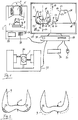
- the Fig. 1 shows a sketch to illustrate the present method for planning a heat treatment of a dental prosthesis part 1 by means of a sintering furnace 2.
- the sintering furnace in this case has insulation elements 3 and 4 heating elements to regulate the temperature within a combustion chamber 5.
- the heat treatment of the dental prosthesis 1 such as sintering, crystallization or glazing is carried out by the chamber 5 is heated by means of the heating elements 4 in a first step. After reaching a certain charging temperature, for example at 300 ° C, the chamber 5 is opened in a second step by a pedestal 6 is moved to a lower end position 7.
- the user like a dentist or dental technician, positions the dental prosthesis 1 to be sintered on the pedestal 6.
- a fourth step the chamber closes again by moving the pedestal back to an upper end position as indicated by the arrows 8 is.
- the chamber 5 is further heated by the heating elements 4 to a holding temperature and this holding temperature is maintained for the duration of a certain holding time.
- a cooling phase then takes place. The cooling phase can be done for example by switching off the heating elements or additionally by opening the chamber 5 by the base is moved to the lower end position 7.
- a 3D model 9 of the tooth replacement part 1 is already present. So that is the construction of the dental prosthesis already completed.
- the 3D model 9 is graphically displayed by means of a display device 39, such as a monitor.
- the 3D model 9 of the dental prosthesis part 1 has certain geometric parameters, such as a lateral wall thickness 10, an occlusal wall thickness 11, a maximum cross-section 12, which is represented by the dashed line, and a total volume 13 of the dental prosthesis part.
- a lateral wall thickness 10 an occlusal wall thickness 11
- a maximum cross-section 12 which is represented by the dashed line
- a total volume 13 of the dental prosthesis part In addition, in the design already determined from which material the dental prosthesis to be produced is to be produced.
- the maximum cross section 12 of the dental prosthesis part can for example be determined perpendicular to a tooth axis 14, which may correspond to an axis of symmetry of the dental prosthesis part.
- the lateral wall thickness 10 can be determined, for example, perpendicular to the tooth axis 14 in the labial area or in the buccal area of the tooth replacement part.
- the occlusal wall thickness 11 can be determined, for example, parallel to the tooth axis 14 on an occlusal surface 15 of the 3D model 9.
- a suitable temperature profile 16 is determined automatically by means of a computer 17.
- the computer 17 may be, for example, a microcomputer, a microchip or a conventional PC.
- the computer 17 may be disposed externally outside the sintering furnace 2.
- the computer 17 may be integrated with the display device 39 in the sintering furnace 2.
- the temperature profile 16 is shown as a graph of a temperature 17 as a function of the time 18.
- a first phase 19 the chamber 5 is heated at a first heating rate to a predrying temperature 20 in a second phase 21, the predrying temperature is maintained for a first hold time, in a third phase 22, the temperature in the chamber 5 is up to a loading temperature, for example, in the amount of 300 ° C heated.
- the chamber 5 is loaded with the tooth replacement part 1 to be sintered, so that the temperature drops slightly.
- the temperature in the chamber 5 rises at a second heating rate up to a second holding temperature 24.
- a sixth phase 25 For example, the heating elements 4 are controlled so that the holding temperature 24 is maintained for a period of a certain holding time.
- the tooth replacement part 1 is cooled.
- the computer is used 17 determines the appropriate temperature profile 16.
- the heating rates for the heating phases 19, 23, the holding temperatures 20, 24 and the holding times of the phases 21, 25 are determined.
- partial regions 27 and 28 which are shown in dashed lines, can be marked, which do not fulfill defined limit values of the geometry parameters.
- partial regions 27, 28 can be marked, which exceed a limit value of 6 mm with respect to the occlusal wall thickness.
- these marked portions 27 and 28 may be deformed either manually by the user using a virtual tool 29, such as a cursor, or automatically by means of the computer 17, so that the limits with respect to the geometry parameters are met.
- the control of the virtual tool 29 can be done by means of connected input means, such as a keyboard 30 and a mouse 31.
- a keyboard 30 and a mouse 31 By adapting or deforming the 3D model 9, an adapted 3D model 32 is generated, which is represented by a dashed line.
- the tooth replacement part 1 to be sintered from a blank 34 is subsequently machined out fully automatically by means of a CAM processing machine 33.
- the sintering takes place by means of the sintering furnace 2, as described above.
- the advantage of this method is therefore that even before the production of the dental prosthesis part by means of the CAM processing machine 33 and before the sintering of the dental prosthesis 1 by means of the sintering furnace 2, a determination of a suitable temperature profile 16 and a plausibility check and a possible adaptation of the 3D model. 9 can be done.
- the determination of the temperature profile 16 can be effected, for example, by a selection from a plurality of temperature profiles, which are stored in a memory 35.
- This memory 35 is integrated in the computer 17.
- the temperature profiles can be stored in a second memory 36, which is integrated into the sintering furnace 2.
- the determination of the appropriate temperature profile can also be done by calculating an individual temperature profile, which is calculated by the computer 17.
- the present method of scheduling a heat treatment may also be for multiple dental prostheses and multiple heat treatments before commencing sintering.
- An order may include the characteristics such as the name of the patient, the type of denture, such as full crown, partial crown or bridge, the material for the production of the dental prosthesis, the type of heat treatment, such as sintering, crystallization or glazing, and the Include type of suitable temperature profile.
- the jobs with these characteristics can be displayed for example by means of a display 37, which is integrated into the sintering furnace 2.
- the orders with the characteristic data could also be displayed by means of the display device 39.
- the user can select the respective order with the associated temperature profile before carrying out the sintering. Subsequently, the sintering is carried out automatically with a suitable temperature profile.
- the Fig. 2 shows the 3D model 9 of the dental prosthesis part 1 Fig. 1 , Wherein the areas 27 and 28 are marked, which exceed a limit, for example, in the amount of 6 mm with respect to the occlusal wall thickness.
- an adapted 3D model 32 is generated. On the basis of the adapted 3D model 32 then the tooth replacement part 1 by means of the CAM processing machine 33 from Fig. 1 worked out.
- the Fig. 3 shows several temperature profiles for performing a sintering, wherein the temperature 17 is plotted in ° C as a function of time 18 in minutes.
- a first temperature profile 40 has a heating rate 41 in the amount of 100 ° C / min, a holding temperature 42 in the height of 1580 ° C and a holding time 43 in the amount of 6 minutes.
- a second temperature profile 44 has a heating rate 45 in the amount of 100 ° C / min, a holding temperature 46 in the height of 1510 ° C and a holding time 47 of 30 minutes.
- a third temperature profile 48 shown by a dotted-dashed line, has a heating rate 49 of 25 ° C, a holding temperature 50 of 1510 ° C, and a hold time 51 of 120 minutes.
- a fourth temperature profile 52 shown by a dashed line, has a predrying phase 53 wherein the temperature is heated to a predrying temperature 54 and held for 20 minutes. Subsequently, the heating phase is carried out at a heating rate 55 in the amount of 100 ° C / minute up to a holding temperature 56 in the amount of 1510 ° C. This holding temperature 56 is then held for the duration of a hold time 57 of 30 minutes, followed by a cooling phase.
- a fifth temperature profile 58 has a heating rate 59 in the amount of 300 ° C / min, a holding temperature 60 in the height of 1580 ° C and a holding time of 6 minutes.
- the first temperature profile 40 is particularly suitable for small dental prostheses with a small wall thickness, for example, below 6 mm and a low total volume, the high heating rate 41 and the low holding time 43 of 6 minutes allows a short sintering time.
- the second temperature profile 44 is suitable for medium-sized dental replacement parts, for example, with a maximum wall thickness of more than 6 mm and consisting of at most six individual teeth.
- the third temperature profile 48 is suitable for large dentures such as bridges of more than six teeth.
- the fourth temperature profile 52 is suitable for materials that require pre-drying prior to sintering.
- the 3D model 9 out Fig. 1 and Fig. 2 can be deformed by the user or automatically by means of the computer in such a way that the requirements or the limit values for a specific temperature profile are met.
- Fig. 2 is shown that the 3D model 9 has been adjusted so that the occlusal wall thickness 11 does not exceed a limit in the height of 6 mm. So that can be for after the adapted 3D model 32 to be produced tooth replacement part 1 sintering with the first temperature profile 40 instead of the second temperature profile 44.
- the advantage of this adaptation is therefore that the duration of the sintering is shortened.
Landscapes
- Health & Medical Sciences (AREA)
- Engineering & Computer Science (AREA)
- Chemical & Material Sciences (AREA)
- Oral & Maxillofacial Surgery (AREA)
- Dentistry (AREA)
- Epidemiology (AREA)
- Life Sciences & Earth Sciences (AREA)
- Animal Behavior & Ethology (AREA)
- General Health & Medical Sciences (AREA)
- Public Health (AREA)
- Veterinary Medicine (AREA)
- Ceramic Engineering (AREA)
- Manufacturing & Machinery (AREA)
- General Engineering & Computer Science (AREA)
- Mechanical Engineering (AREA)
- Clinical Laboratory Science (AREA)
- Materials Engineering (AREA)
- Structural Engineering (AREA)
- Organic Chemistry (AREA)
- Inorganic Chemistry (AREA)
- Composite Materials (AREA)
- Dental Prosthetics (AREA)
Claims (15)
- Procédé pour la planification d'un traitement thermique d'une prothèse dentaire (1), un modèle 3D (9) de la prothèse dentaire (1) étant déjà disponible, caractérisé en ce que, en fonction de paramètres géométriques (10, 11, 12, 13) déterminés du modèle 3D (9) et de paramètres de matériaux déterminés de la prothèse dentaire (1) à fabriquer, un profil de température (16) pour le traitement thermique de la prothèse dentaire (1) est déterminé automatiquement au moyen d'un ordinateur (17), les paramètres de matériaux d'un matériau sélectionné pour la fabrication de la prothèse dentaire (1) étant une conductivité thermique, une résistance au choc thermique, un taux de chauffage maximal et/ou une valeur limite de température pour une transformation de phase du matériau.
- Procédé selon la revendication 1, caractérisé en ce que les paramètres géométriques (10, 11, 12, 13) du modèle 3D (9) de la prothèse dentaire (1) sont une épaisseur de paroi latérale maximale (10), une épaisseur de paroi occlusale maximale (11), un rapport entre l'épaisseur de paroi occlusale maximale (11) et l'épaisseur de paroi latérale maximale (10), une section transversale maximale (12) de la prothèse dentaire (1), un volume total (13) de la prothèse dentaire (1), une longueur totale maximale de la prothèse dentaire (1) et/ou une variation de section transversale de la prothèse dentaire (1).
- Procédé selon la revendication 2, caractérisé en ce que le profil de température (16) est déterminé de telle façon que dans le cas d'une épaisseur de paroi latérale maximale (10) croissante, dans le cas d'une épaisseur de paroi occlusale maximale (11) croissante, dans le cas d'une section transversale maximale de composant croissante et/ou dans le cas d'un volume total croissant (13) de la prothèse dentaire (1), un taux de chauffage (41, 45, 49, 55, 59) du profil de température (16) décroit, un temps de maintien (43, 47, 51, 57) du profil de température (16) croit et/ou une température de maintien (42, 46, 50, 56, 60) du profil de température (16) décroit.
- Procédé selon la revendication 1, caractérisé en ce que le profil de température (16) est déterminé de telle façon que, dans le cas d'une conductivité thermique croissante et/ou d'une résistance au choc thermique croissante, un taux de chauffage (41, 45, 49, 55, 59) du profil de température (16) croit.
- Procédé selon l'une quelconque des revendications 1 à 4, caractérisé en ce que le traitement thermique consiste d'un frittage, d'une cristallisation, d'une combinaison d'un frittage et d'un glaçage ou de la combinaison d'une cristallisation et d'un glaçage.
- Procédé selon l'une quelconque des revendications 1 à 5, caractérisé en ce que le matériau sélectionné pour la fabrication de la prothèse dentaire (1) est de l'oxyde de zirconium (ZrO2), la prothèse dentaire (1) à fabriquer étant une dent individuelle, une couronne anatomique, au moins une couronne partielle ou au moins un inlay, le volume total (13) de la prothèse dentaire (1) correspondant tout au plus au volume d'une molaire, l'épaisseur de paroi latérale maximale (10) et/ou l'épaisseur de paroi occlusale maximale (11) étant inférieures à une valeur limite de 6 mm, un premier profil de température (40) pour un frittage étant déterminé avec un taux de chauffage (41) situé entre 100 °C/minute et 400 °C/minute, une température de maintien (42) située entre 1500 °C et 1600 °C ainsi qu'un temps de maintien (43) situé entre 5 minutes et 10 minutes.
- Procédé selon l'une quelconque des revendications 1 à 5, caractérisé en ce que le matériau sélectionné est de l'oxyde de zirconium (ZrO2), la prothèse dentaire à fabriquer étant un bridge d'au maximum 6 dents liées ou au maximum 6 dents individuelles ou couronnes partielles, un deuxième profil de température (44) pour un frittage, comprenant un taux de chauffage (45) situé entre 70 °C/minute et 200 °C/minute, comprenant une température de maintien (46) située entre 1450 °C et 1550 °C ainsi qu'un temps de maintien (47) situé entre 20 minutes et 40 minutes, étant déterminé.
- Procédé selon l'une quelconque des revendications 1 à 5, caractérisé en ce que le matériau sélectionné est de l'oxyde de zirconium (ZrO2), la prothèse dentaire à fabriquer comprenant plus de 6 dents individuelles, un troisième profil de température (48) pour un frittage, comprenant un taux de chauffage (49) situé entre 10 °C/minute et 70 °C/minute, comprenant une température de maintien (50) située entre 1500 °C et 1600 °C ainsi qu'un temps de maintien (51) situé entre 100 minutes et 140 minutes, étant déterminé.
- Procédé selon l'une quelconque des revendications 1 à 5, caractérisé en ce que le matériau sélectionné est de l'oxyde d'aluminium (Al2O3), un quatrième profil de température (52) pour un frittage, comprenant un taux de chauffage (55) situé entre 10 °C/minute et 70 °C/minute, comprenant une température de maintien (56) située entre 1500°C et 1600°C ainsi qu'un temps de maintien (57) situé entre 100 minutes et 140 minutes, étant déterminé.
- Procédé selon l'une quelconque des revendications 1 à 9, caractérisé en ce que le modèle 3D (9) de la prothèse dentaire (1) à fabriquer est présenté graphiquement au moyen d'un dispositif d'affichage (39), des parties (27, 28) déterminées du modèle 3D (9) dépassant la valeur limite déterminée de l'épaisseur de paroi latérale ou de l'épaisseur de paroi occlusale (11) étant marquées graphiquement.
- Procédé selon la revendication 10, caractérisé en ce que l'utilisateur adapte manuellement les parties (27, 28) marquées en utilisant des outils virtuels (29) ou que les parties (27, 28) marquées sont adaptées automatiquement au moyen de l'ordinateur (17) de telle façon que la valeur limite pour l'épaisseur de paroi vestibulaire (10, 11) ou pour l'épaisseur de paroi occlusale (11) ne soit pas dépassée, de telle sorte que le frittage puisse être réalisé avec le premier profil de température (40) plutôt qu'avec le deuxième profil de température (44) pour la prothèse dentaire (1) à fabriquer selon ce modèle 3D adapté (32).
- Système pour l'exécution d'un procédé pour la planification d'un traitement thermique d'une prothèse dentaire (1) au moyen d'un four de frittage (2) comprenant un ordinateur (17), un modèle 3D (9) de la prothèse dentaire (1) étant déjà disponible, caractérisé en ce que, en fonction de paramètres géométriques (10, 11, 12, 13) déterminés du modèle 3D (9) et de paramètres de matériaux déterminés de la prothèse dentaire (1) à fabriquer, un profil de température (16) pour le frittage de la prothèse dentaire (1) pouvant être déterminé automatiquement au moyen de l'ordinateur (17), les paramètres de matériaux d'un matériau sélectionné pour la fabrication de la prothèse dentaire (1) étant une conductivité thermique, une résistance au choc thermique, un taux de chauffage maximal et/ou une valeur limite de température pour une transformation de phase du matériau.
- Système selon la revendication 12, caractérisé en ce que les paramètres géométriques (10, 11, 12, 13) du modèle 3D (9) de la prothèse dentaire (1) sont une épaisseur de paroi latérale maximale (10), une épaisseur de paroi occlusale maximale (11), un rapport entre l'épaisseur de paroi occlusale maximale (11) et l'épaisseur de paroi latérale maximale (10), une section transversale maximale (12) de la prothèse dentaire, un volume total (13) de la prothèse dentaire (1), une longueur totale maximale de la prothèse dentaire (1) et/ou une variation de la section transversale maximale de la prothèse dentaire.
- Système selon l'une quelconque des revendications 12 ou 13, caractérisé en ce que le système comprend un dispositif d'affichage (39), le modèle 3D (9) de la prothèse dentaire (1) à fabriquer pouvant être présenté graphiquement au moyen d'un dispositif d'affichage (39), des parties (27, 28) déterminées du modèle 3D (9) dépassant la valeur limite déterminée de l'épaisseur de paroi latérale ou de l'épaisseur de paroi occlusale pouvant être marquées graphiquement.
- Système selon la revendication 14, caractérisé en ce que le système comprend des moyens de commande (30, 31) l'utilisateur adaptant manuellement les parties (27, 28) marquées au moyen d'outils virtuels (29) en utilisant les moyens de commande (30, 31) ou les parties (27, 28) marquées étant adaptées automatiquement au moyen de l'ordinateur (17) de telle façon que la valeur limite pour l'épaisseur de paroi vestibulaire ou pour l'épaisseur de paroi occlusale (11) ne soit pas dépassée, de telle sorte que le frittage puisse être réalisé avec le premier profil de température (16) plutôt qu'avec le deuxième profil de température (16) pour la prothèse dentaire à fabriquer selon ce modèle 3D adapté (9, 32).
Applications Claiming Priority (2)
| Application Number | Priority Date | Filing Date | Title |
|---|---|---|---|
| DE102013226497.6A DE102013226497A1 (de) | 2013-12-18 | 2013-12-18 | Verfahren zur Planung einer Sinterung eines Zahnersatzteils |
| PCT/EP2014/078387 WO2015091744A1 (fr) | 2013-12-18 | 2014-12-18 | Procédé de planification d'un frittage d'une partie de prothèse dentaire |
Publications (2)
| Publication Number | Publication Date |
|---|---|
| EP3082643A1 EP3082643A1 (fr) | 2016-10-26 |
| EP3082643B1 true EP3082643B1 (fr) | 2019-05-22 |
Family
ID=52396643
Family Applications (1)
| Application Number | Title | Priority Date | Filing Date |
|---|---|---|---|
| EP14830521.2A Active EP3082643B1 (fr) | 2013-12-18 | 2014-12-18 | Procédé de planification d'un frittage d'une partie de prothèse dentaire |
Country Status (11)
| Country | Link |
|---|---|
| US (1) | US10939980B2 (fr) |
| EP (1) | EP3082643B1 (fr) |
| JP (1) | JP6846198B2 (fr) |
| KR (1) | KR102027418B1 (fr) |
| CN (1) | CN105813593B (fr) |
| AU (1) | AU2014368622B2 (fr) |
| BR (1) | BR112016012960B1 (fr) |
| CA (1) | CA2934416C (fr) |
| DE (1) | DE102013226497A1 (fr) |
| DK (1) | DK3082643T3 (fr) |
| WO (1) | WO2015091744A1 (fr) |
Families Citing this family (16)
| Publication number | Priority date | Publication date | Assignee | Title |
|---|---|---|---|---|
| EP2792985B1 (fr) * | 2013-04-18 | 2014-11-26 | Amann Girrbach AG | Dispositif de frittage |
| DE102013226497A1 (de) | 2013-12-18 | 2015-06-18 | Sirona Dental Systems Gmbh | Verfahren zur Planung einer Sinterung eines Zahnersatzteils |
| DE102016202703A1 (de) | 2016-02-22 | 2017-08-24 | Sirona Dental Systems Gmbh | Ofen für Dentalbauteile und wärmefeste Unterlage |
| DE102016202902A1 (de) | 2016-02-24 | 2017-08-24 | Sirona Dental Systems Gmbh | Induktionsofen und Verfahren zur Durchführung einer Wärmebehandlung eines Zahnersatzteils |
| DE102016214725B4 (de) | 2016-08-09 | 2018-07-26 | Sirona Dental Systems Gmbh | Rohling und Verfahren zur Herstellung eines Zahnersatzteils |
| KR101785608B1 (ko) | 2016-08-18 | 2017-10-17 | 이수영 | 치과용 소결장치의 온도 제어 장치 및 방법 |
| CN108007203B (zh) * | 2016-10-31 | 2019-11-22 | 辽宁爱尔创生物材料有限公司 | 一种快速烧结系统及快速烧结方法 |
| EP3759061A1 (fr) | 2018-02-28 | 2021-01-06 | 3M Innovative Properties Company | Procédé de production d'un article de zircone dentaire au moyen d'un procédé de frittage rapide |
| DE102018119080A1 (de) * | 2018-08-06 | 2020-02-06 | Redios-Tec Gmbh | Verfahren zur Herstellung eines Dentalbauteils |
| EP3659548B1 (fr) | 2018-11-29 | 2025-01-01 | Ivoclar Vivadent AG | Procédé de fabrication d'une restauration dentaire |
| US20220211587A1 (en) | 2019-04-25 | 2022-07-07 | Kuraray Noritake Dental Inc. | Zirconia pre-sintered body suitable for dental use and method for producing the same |
| DE102020121993A1 (de) | 2020-08-21 | 2022-02-24 | Ivoclar Vivadent Ag | Aluminiumoxid-Keramikmaterial |
| KR102441113B1 (ko) * | 2020-09-28 | 2022-09-06 | 가톨릭대학교 산학협력단 | 치과 수복재의 설계방법 |
| KR102490874B1 (ko) | 2021-01-04 | 2023-01-19 | 왕병철 | 치과 보철용 지르코니아 소결로 |
| EP4137312A1 (fr) | 2021-08-16 | 2023-02-22 | Ivoclar Vivadent AG | Procédé de fabrication d'une restauration dentaire |
| DE102024002136B3 (de) * | 2024-07-02 | 2025-09-04 | Thomas Baholzer | Dental Hybridofen |
Family Cites Families (22)
| Publication number | Priority date | Publication date | Assignee | Title |
|---|---|---|---|---|
| EP0191350A3 (fr) | 1985-02-15 | 1987-11-19 | BEGO Bremer Goldschlägerei Wilh. Herbst GmbH & Co. | Procédé de contrôle du processus de fusion et de coulée dans la technique de coulée de précision, en particulier dans la technique dentaire ainsi que son dispositif |
| US5239178A (en) | 1990-11-10 | 1993-08-24 | Carl Zeiss | Optical device with an illuminating grid and detector grid arranged confocally to an object |
| ATE137588T1 (de) | 1990-11-10 | 1996-05-15 | Grosskopf Rudolf Dr Ing | Optische abtastvorrichtung mit konfokalem strahlengang, in der lichtquellen- und detektormatrix verwendet werden |
| DE19651667C2 (de) | 1996-12-12 | 2003-07-03 | Rudolf Groskopf | Vorrichtung zur dreidimensionalen Untersuchung eines Objektes |
| DE19824497A1 (de) * | 1998-06-02 | 1999-12-09 | Dekema Dental Keramikoefen Gmb | Brennofen für Zahnersatz oder-teilersatz |
| IL125659A (en) | 1998-08-05 | 2002-09-12 | Cadent Ltd | Method and device for three-dimensional simulation of a structure |
| JP3440465B2 (ja) | 1998-12-17 | 2003-08-25 | 株式会社高岳製作所 | マルチスリット走査撮像装置 |
| EP1371939A1 (fr) | 2002-05-15 | 2003-12-17 | Icos Vision Systems N.V. | Dispositif pour mesurer en trois dimensions la topographie superficielle d'un article |
| JP2004347208A (ja) * | 2003-05-21 | 2004-12-09 | Koito Ind Ltd | 陶芸用電気炉 |
| NO322775B1 (no) | 2004-09-24 | 2006-12-11 | Tomra Systems Asa | Anordning og fremgangsmate for detektering av et medium |
| DE102006032655A1 (de) * | 2006-07-13 | 2008-01-17 | Zubler Gerätebau GmbH | Dentaltechnikofen und Verfahren zur Positionssteuerung einer Verschlussplatte an einem Dentaltechnikofen |
| DE102006036132B4 (de) * | 2006-08-01 | 2019-04-25 | Zubler Gerätebau GmbH | Verfahren zum Aufheizen einer für Dentalkeramik verwendeten, vorgewärmten Pressmuffel in einem Pressofen |
| US20090079101A1 (en) * | 2007-04-27 | 2009-03-26 | Jurgen Laubersheimer | Densification Process of Ceramics And Apparatus Therefor |
| DE102008012578C5 (de) * | 2008-03-05 | 2022-04-07 | Ivoclar Vivadent Ag | Dentalofen |
| DE102008013555A1 (de) | 2008-03-11 | 2009-10-15 | Straumann Holding Ag | Sinterofen für Dentalpräparate und Verfahren zum Sintern von Dentalpräparaten |
| WO2011118839A1 (fr) | 2010-03-24 | 2011-09-29 | 株式会社アドバンス | Système pour mesurer et traiter une prothèse dentaire |
| DE102011056211B3 (de) * | 2011-12-09 | 2013-02-07 | Degudent Gmbh | Verfahren und Vorrichtung zum Sintern von Sintergut |
| EP2620733B1 (fr) | 2012-01-27 | 2014-03-19 | Ivoclar Vivadent AG | Appareil dentaire |
| JP2013153929A (ja) | 2012-01-30 | 2013-08-15 | Daikoku Denki Co Ltd | 遊技場用管理システム |
| DE102012213279A1 (de) * | 2012-07-27 | 2014-01-30 | Sirona Dental Systems Gmbh | Sinterofen für Bauteile aus einem Sinterwerkstoff, insbesondere für Dentalbauteile und Verfahren zur Sinterung derartiger Bauteile |
| WO2014039268A1 (fr) * | 2012-09-04 | 2014-03-13 | 3M Innovative Properties Company | Procédé de production d'une restauration dentaire |
| DE102013226497A1 (de) | 2013-12-18 | 2015-06-18 | Sirona Dental Systems Gmbh | Verfahren zur Planung einer Sinterung eines Zahnersatzteils |
-
2013
- 2013-12-18 DE DE102013226497.6A patent/DE102013226497A1/de not_active Withdrawn
-
2014
- 2014-12-18 JP JP2016532541A patent/JP6846198B2/ja active Active
- 2014-12-18 DK DK14830521.2T patent/DK3082643T3/da active
- 2014-12-18 US US15/105,530 patent/US10939980B2/en active Active
- 2014-12-18 CA CA2934416A patent/CA2934416C/fr active Active
- 2014-12-18 CN CN201480069312.6A patent/CN105813593B/zh active Active
- 2014-12-18 WO PCT/EP2014/078387 patent/WO2015091744A1/fr not_active Ceased
- 2014-12-18 AU AU2014368622A patent/AU2014368622B2/en active Active
- 2014-12-18 KR KR1020167013853A patent/KR102027418B1/ko active Active
- 2014-12-18 BR BR112016012960-1A patent/BR112016012960B1/pt active IP Right Grant
- 2014-12-18 EP EP14830521.2A patent/EP3082643B1/fr active Active
Non-Patent Citations (1)
| Title |
|---|
| None * |
Also Published As
| Publication number | Publication date |
|---|---|
| AU2014368622B2 (en) | 2019-01-31 |
| KR20160099543A (ko) | 2016-08-22 |
| DE102013226497A1 (de) | 2015-06-18 |
| KR102027418B1 (ko) | 2019-11-04 |
| DK3082643T3 (da) | 2019-08-12 |
| AU2014368622A1 (en) | 2016-06-16 |
| US20160317257A1 (en) | 2016-11-03 |
| CA2934416C (fr) | 2023-03-28 |
| JP2016540562A (ja) | 2016-12-28 |
| WO2015091744A1 (fr) | 2015-06-25 |
| CN105813593A (zh) | 2016-07-27 |
| CA2934416A1 (fr) | 2015-06-25 |
| JP6846198B2 (ja) | 2021-03-24 |
| US10939980B2 (en) | 2021-03-09 |
| BR112016012960B1 (pt) | 2021-04-27 |
| EP3082643A1 (fr) | 2016-10-26 |
| CN105813593B (zh) | 2019-09-10 |
Similar Documents
| Publication | Publication Date | Title |
|---|---|---|
| EP3082643B1 (fr) | Procédé de planification d'un frittage d'une partie de prothèse dentaire | |
| EP3458787B1 (fr) | Four à induction et procédé pour faire subir un traitement thermique à un élément prothétique dentaire | |
| EP2877798B1 (fr) | Four de frittage pour éléments en matériau fritté, en particulier pour éléments dentaires, et procédé de frittage de tels éléments | |
| EP3496657B1 (fr) | Ébauche et procédé de fabrication d'un élément prothétique dentaire | |
| EP1406554B1 (fr) | Fabriquer une prothese dentaire a partir d'un modele positif mesure et numerise en trois dimensions | |
| EP2744440B1 (fr) | Procédé de déformation d'un fil métallique d'orthodontie constitué d'un matériau à mémoire de forme | |
| WO1999047065A1 (fr) | Couronnes dentaires et/ou bridges dentaires | |
| EP2952154B1 (fr) | Procédé de fabrication de restaurations dentaires et dispositif de fabrication de céramiques dentaires | |
| DE102015122865A1 (de) | Verfahren zur Herstellung einer dentalen Restauration | |
| DE19922870A1 (de) | Verfahren zur automatischen, individuell angepaßten Farb-, Transluzenz-, Helligkeits- und Fluoreszenzgebung von zahntechnischen Restaurationen | |
| EP3829482A1 (fr) | Ébauche multicolore à usage dentaire | |
| DE102009011175A1 (de) | Verfahren und Fertigungsvorrichtung zur automatischen dentalkeramischen Verblendung von Gerüsten von zahntechnischen Restaurationen | |
| EP2032741A1 (fr) | Procédé de fabrication d'objets en céramique ou en métal par façonnage par électrophorèse | |
| DE3231546C2 (de) | Verfahren und Vorrichtung zum Brennen dentaler, metallkeramischer Gegenstände | |
| WO2019101364A1 (fr) | Dispositif de prothèse dentaire comprenant une interface et une couche de protection, ainsi que procédé de fabrication associé et composition destinée à être utilisée comme couche de protection | |
| DE102016203055B4 (de) | Verfahren und System zum Erzeugen einer Dentalrestauration | |
| DE19852740C2 (de) | Verfahren und Keramikbrennofen zur Herstellung von glasinfiltrierten Keramikgerüsten für künstliche Zähne | |
| DE20118400U1 (de) | Vorrichtung zur Herstellung individueller Brenngutträger für Dentalkeramik | |
| EP1510186A1 (fr) | Matériaux composites céramique-métal noble pour la fabrication des prothèses dentaires |
Legal Events
| Date | Code | Title | Description |
|---|---|---|---|
| PUAI | Public reference made under article 153(3) epc to a published international application that has entered the european phase |
Free format text: ORIGINAL CODE: 0009012 |
|
| 17P | Request for examination filed |
Effective date: 20160714 |
|
| AK | Designated contracting states |
Kind code of ref document: A1 Designated state(s): AL AT BE BG CH CY CZ DE DK EE ES FI FR GB GR HR HU IE IS IT LI LT LU LV MC MK MT NL NO PL PT RO RS SE SI SK SM TR |
|
| AX | Request for extension of the european patent |
Extension state: BA ME |
|
| DAX | Request for extension of the european patent (deleted) | ||
| 17Q | First examination report despatched |
Effective date: 20180807 |
|
| GRAP | Despatch of communication of intention to grant a patent |
Free format text: ORIGINAL CODE: EPIDOSNIGR1 |
|
| INTG | Intention to grant announced |
Effective date: 20190116 |
|
| GRAS | Grant fee paid |
Free format text: ORIGINAL CODE: EPIDOSNIGR3 |
|
| GRAA | (expected) grant |
Free format text: ORIGINAL CODE: 0009210 |
|
| AK | Designated contracting states |
Kind code of ref document: B1 Designated state(s): AT CH DE DK FR GB IT LI |
|
| RBV | Designated contracting states (corrected) |
Designated state(s): AT CH DE DK FR GB IT LI |
|
| REG | Reference to a national code |
Ref country code: GB Ref legal event code: FG4D Free format text: NOT ENGLISH |
|
| REG | Reference to a national code |
Ref country code: CH Ref legal event code: EP |
|
| REG | Reference to a national code |
Ref country code: DE Ref legal event code: R096 Ref document number: 502014011788 Country of ref document: DE |
|
| REG | Reference to a national code |
Ref country code: AT Ref legal event code: REF Ref document number: 1135160 Country of ref document: AT Kind code of ref document: T Effective date: 20190615 |
|
| REG | Reference to a national code |
Ref country code: DK Ref legal event code: T3 Effective date: 20190808 |
|
| REG | Reference to a national code |
Ref country code: DE Ref legal event code: R097 Ref document number: 502014011788 Country of ref document: DE |
|
| PLBE | No opposition filed within time limit |
Free format text: ORIGINAL CODE: 0009261 |
|
| STAA | Information on the status of an ep patent application or granted ep patent |
Free format text: STATUS: NO OPPOSITION FILED WITHIN TIME LIMIT |
|
| 26N | No opposition filed |
Effective date: 20200225 |
|
| REG | Reference to a national code |
Ref country code: DE Ref legal event code: R082 Ref document number: 502014011788 Country of ref document: DE |
|
| PGFP | Annual fee paid to national office [announced via postgrant information from national office to epo] |
Ref country code: DK Payment date: 20231214 Year of fee payment: 10 |
|
| P01 | Opt-out of the competence of the unified patent court (upc) registered |
Free format text: CASE NUMBER: UPC_APP_413236/2023 Effective date: 20230509 |
|
| PGFP | Annual fee paid to national office [announced via postgrant information from national office to epo] |
Ref country code: AT Payment date: 20241126 Year of fee payment: 11 |
|
| PGFP | Annual fee paid to national office [announced via postgrant information from national office to epo] |
Ref country code: CH Payment date: 20250101 Year of fee payment: 11 |
|
| REG | Reference to a national code |
Ref country code: DK Ref legal event code: EBP Effective date: 20241231 |
|
| PGFP | Annual fee paid to national office [announced via postgrant information from national office to epo] |
Ref country code: DE Payment date: 20251126 Year of fee payment: 12 |
|
| PGFP | Annual fee paid to national office [announced via postgrant information from national office to epo] |
Ref country code: GB Payment date: 20251120 Year of fee payment: 12 |
|
| PG25 | Lapsed in a contracting state [announced via postgrant information from national office to epo] |
Ref country code: DK Free format text: LAPSE BECAUSE OF NON-PAYMENT OF DUE FEES Effective date: 20241231 |
|
| PGFP | Annual fee paid to national office [announced via postgrant information from national office to epo] |
Ref country code: IT Payment date: 20251119 Year of fee payment: 12 |
|
| PGFP | Annual fee paid to national office [announced via postgrant information from national office to epo] |
Ref country code: FR Payment date: 20251120 Year of fee payment: 12 |