EP3085694B1 - Benzoxazépinones fusionnés en tant que modulateurs de canaux ioniques - Google Patents
Benzoxazépinones fusionnés en tant que modulateurs de canaux ioniques Download PDFInfo
- Publication number
- EP3085694B1 EP3085694B1 EP16169306.4A EP16169306A EP3085694B1 EP 3085694 B1 EP3085694 B1 EP 3085694B1 EP 16169306 A EP16169306 A EP 16169306A EP 3085694 B1 EP3085694 B1 EP 3085694B1
- Authority
- EP
- European Patent Office
- Prior art keywords
- alkyl
- heteroaryl
- cycloalkyl
- aryl
- heterocyclyl
- Prior art date
- Legal status (The legal status is an assumption and is not a legal conclusion. Google has not performed a legal analysis and makes no representation as to the accuracy of the status listed.)
- Active
Links
- 0 *C1(*)C(*)(*)N(*)*C(****2)=C2*1 Chemical compound *C1(*)C(*)(*)N(*)*C(****2)=C2*1 0.000 description 18
- NKGQMTMAJFEXID-UHFFFAOYSA-N CCc1c[n](cccc2)c2n1 Chemical compound CCc1c[n](cccc2)c2n1 NKGQMTMAJFEXID-UHFFFAOYSA-N 0.000 description 3
- BGNWXRJWDQHCRB-UHFFFAOYSA-N CC(C)c1ncccn1 Chemical compound CC(C)c1ncccn1 BGNWXRJWDQHCRB-UHFFFAOYSA-N 0.000 description 2
- XCIZVKSCLVSDHN-UHFFFAOYSA-N CCc1nc(cccc2)c2cc1 Chemical compound CCc1nc(cccc2)c2cc1 XCIZVKSCLVSDHN-UHFFFAOYSA-N 0.000 description 2
- NUFMAGPLUJHMMZ-UHFFFAOYSA-N CN(c(c(C(NC1)=O)c2)ccc2-c(cc2)ccc2OC(F)(F)F)C1=O Chemical compound CN(c(c(C(NC1)=O)c2)ccc2-c(cc2)ccc2OC(F)(F)F)C1=O NUFMAGPLUJHMMZ-UHFFFAOYSA-N 0.000 description 2
- KZLRQHLWSFQFTJ-UHFFFAOYSA-N O=C(Cc1ncccn1)NCCN(CCOc(cc1)c2cc1-c(cc1)ccc1OC(F)(F)F)C2=O Chemical compound O=C(Cc1ncccn1)NCCN(CCOc(cc1)c2cc1-c(cc1)ccc1OC(F)(F)F)C2=O KZLRQHLWSFQFTJ-UHFFFAOYSA-N 0.000 description 2
- LHJGGACWZLWEPD-UHFFFAOYSA-N O=C(c1c2)N(Cc3c[n](cccc4)c4n3)CCOc1ccc2-c1ccc(C(F)(F)F)cc1 Chemical compound O=C(c1c2)N(Cc3c[n](cccc4)c4n3)CCOc1ccc2-c1ccc(C(F)(F)F)cc1 LHJGGACWZLWEPD-UHFFFAOYSA-N 0.000 description 2
- ZJEVGFSUBMDHLC-UHFFFAOYSA-N O=C1N(CC2(CN(CCOc(cc3)c4cc3-c(cc3)ccc3OC(F)(F)F)C4=O)COC2)CCC1 Chemical compound O=C1N(CC2(CN(CCOc(cc3)c4cc3-c(cc3)ccc3OC(F)(F)F)C4=O)COC2)CCC1 ZJEVGFSUBMDHLC-UHFFFAOYSA-N 0.000 description 2
- CNPQUOSYEPHJQV-UHFFFAOYSA-N O=C1N(Cc2ccccc2)CCOc(c(F)c2)c1cc2-c(cc1)ccc1OC(F)(F)F Chemical compound O=C1N(Cc2ccccc2)CCOc(c(F)c2)c1cc2-c(cc1)ccc1OC(F)(F)F CNPQUOSYEPHJQV-UHFFFAOYSA-N 0.000 description 2
- AZFYQDHEBOTMHA-UHFFFAOYSA-N O=C1N(Cc2ccccc2)CCOc2c1cc(-c1ccc(C(F)(F)F)cc1)c(F)c2 Chemical compound O=C1N(Cc2ccccc2)CCOc2c1cc(-c1ccc(C(F)(F)F)cc1)c(F)c2 AZFYQDHEBOTMHA-UHFFFAOYSA-N 0.000 description 2
- FKDBXQIOIAQDKC-UHFFFAOYSA-N O=C1N(Cc2ncccn2)CCOc2ccc(-c(cc3)ccc3OC(F)(F)F)nc12 Chemical compound O=C1N(Cc2ncccn2)CCOc2ccc(-c(cc3)ccc3OC(F)(F)F)nc12 FKDBXQIOIAQDKC-UHFFFAOYSA-N 0.000 description 2
- UNKDYGGGKXYGKX-UHFFFAOYSA-N O=C1NCCOc(cc2)c1cc2-c(cc1)ccc1OC(F)(F)F Chemical compound O=C1NCCOc(cc2)c1cc2-c(cc1)ccc1OC(F)(F)F UNKDYGGGKXYGKX-UHFFFAOYSA-N 0.000 description 2
- HFJBNGBPFGVECN-UHFFFAOYSA-N Bc(cc1)ccc1OC(F)(F)F Chemical compound Bc(cc1)ccc1OC(F)(F)F HFJBNGBPFGVECN-UHFFFAOYSA-N 0.000 description 1
- GYGFZWJSYNPMBL-QZTJIDSGSA-N CC(C)(C)OC(N[C@H](C[C@@H]1COc(c2c3)ccc3-c3ccc(C(F)(F)F)cc3)CN1C2=O)=O Chemical compound CC(C)(C)OC(N[C@H](C[C@@H]1COc(c2c3)ccc3-c3ccc(C(F)(F)F)cc3)CN1C2=O)=O GYGFZWJSYNPMBL-QZTJIDSGSA-N 0.000 description 1
- FCCGXAGSGDEFHZ-SECBINFHSA-N CC(C)(C)OC(N[C@H]1CN(C)C(C)(C)C1)=O Chemical compound CC(C)(C)OC(N[C@H]1CN(C)C(C)(C)C1)=O FCCGXAGSGDEFHZ-SECBINFHSA-N 0.000 description 1
- OCOOOCMTJFJKRF-UHFFFAOYSA-N CC(C)(C)Oc1cc(-c(cc23)ccc2OCCN(Cc2ncccn2)C3=O)ccn1 Chemical compound CC(C)(C)Oc1cc(-c(cc23)ccc2OCCN(Cc2ncccn2)C3=O)ccn1 OCOOOCMTJFJKRF-UHFFFAOYSA-N 0.000 description 1
- MTGDHHNKUJZVAO-UHFFFAOYSA-N CC(C)=[O]1CC(COS(C)(=O)=O)(CBr)C1 Chemical compound CC(C)=[O]1CC(COS(C)(=O)=O)(CBr)C1 MTGDHHNKUJZVAO-UHFFFAOYSA-N 0.000 description 1
- WDMZMKMTNQOKOQ-UHFFFAOYSA-N CC(C)Cc1nnc(C)[o]1 Chemical compound CC(C)Cc1nnc(C)[o]1 WDMZMKMTNQOKOQ-UHFFFAOYSA-N 0.000 description 1
- HUSUNUVDIZLAKQ-UHFFFAOYSA-N CC(C)[n]1c(-c(cc23)ccc2OCCN(Cc2ncccn2)C3=O)cnc1C Chemical compound CC(C)[n]1c(-c(cc23)ccc2OCCN(Cc2ncccn2)C3=O)cnc1C HUSUNUVDIZLAKQ-UHFFFAOYSA-N 0.000 description 1
- FTSCTVIJKUBBPP-UHFFFAOYSA-N CC1(C)COC(C)(CCN(CCOc(c2c3)ccc3-c(cc3)ccc3OC(F)(F)F)C2=O)OC1 Chemical compound CC1(C)COC(C)(CCN(CCOc(c2c3)ccc3-c(cc3)ccc3OC(F)(F)F)C2=O)OC1 FTSCTVIJKUBBPP-UHFFFAOYSA-N 0.000 description 1
- SCAWTEDWILEZJC-UHFFFAOYSA-N CC1(C)N(C)CCN(CC(F)F)C1 Chemical compound CC1(C)N(C)CCN(CC(F)F)C1 SCAWTEDWILEZJC-UHFFFAOYSA-N 0.000 description 1
- RLWSGJTXZQUQLN-UHFFFAOYSA-N CC1(CC1)C(N1Cc(cc(cc2)-c(cc3)ccc3OC(F)(F)F)c2OCC1)=O Chemical compound CC1(CC1)C(N1Cc(cc(cc2)-c(cc3)ccc3OC(F)(F)F)c2OCC1)=O RLWSGJTXZQUQLN-UHFFFAOYSA-N 0.000 description 1
- IWKQAMIEEPSFOV-UHFFFAOYSA-N CCCNS(C1CC1)(=O)=O Chemical compound CCCNS(C1CC1)(=O)=O IWKQAMIEEPSFOV-UHFFFAOYSA-N 0.000 description 1
- OKPTYPHVKNNPSG-UHFFFAOYSA-N CCCNS(c1ccccc1)(=O)=O Chemical compound CCCNS(c1ccccc1)(=O)=O OKPTYPHVKNNPSG-UHFFFAOYSA-N 0.000 description 1
- WNNUCBYVVRCGSE-UHFFFAOYSA-N CCCOc1ncccn1 Chemical compound CCCOc1ncccn1 WNNUCBYVVRCGSE-UHFFFAOYSA-N 0.000 description 1
- BDMFEFZOOOYCKN-UHFFFAOYSA-N CCC[n]1nccc1 Chemical compound CCC[n]1nccc1 BDMFEFZOOOYCKN-UHFFFAOYSA-N 0.000 description 1
- YVHDMQRVTVCDAS-UHFFFAOYSA-N CCCc1ncccn1 Chemical compound CCCc1ncccn1 YVHDMQRVTVCDAS-UHFFFAOYSA-N 0.000 description 1
- NBGXJZBHXXYWGL-UHFFFAOYSA-N CCN1CC(C)(C)N(C)CC1 Chemical compound CCN1CC(C)(C)N(C)CC1 NBGXJZBHXXYWGL-UHFFFAOYSA-N 0.000 description 1
- XWZIDZDMNYAEOP-UHFFFAOYSA-N CC[n]1ncc(I)c1 Chemical compound CC[n]1ncc(I)c1 XWZIDZDMNYAEOP-UHFFFAOYSA-N 0.000 description 1
- ASPIMPVOKAIQSB-UHFFFAOYSA-N CCc(nc1)c[n]1I Chemical compound CCc(nc1)c[n]1I ASPIMPVOKAIQSB-UHFFFAOYSA-N 0.000 description 1
- FZNCCJVKFDPKCH-UHFFFAOYSA-N CCc(nc1)ncc1-c1cnc(C(F)(F)F)cc1 Chemical compound CCc(nc1)ncc1-c1cnc(C(F)(F)F)cc1 FZNCCJVKFDPKCH-UHFFFAOYSA-N 0.000 description 1
- ZAXITHHHFYZUGN-UHFFFAOYSA-N CCc1n[n](C)cc1 Chemical compound CCc1n[n](C)cc1 ZAXITHHHFYZUGN-UHFFFAOYSA-N 0.000 description 1
- GNAVJYVAIDHQTA-UHFFFAOYSA-N CCc1nc(C(F)(F)F)ccn1 Chemical compound CCc1nc(C(F)(F)F)ccn1 GNAVJYVAIDHQTA-UHFFFAOYSA-N 0.000 description 1
- ADIDFXCLFPHHLE-UHFFFAOYSA-N CCc1ncc(C)[o]1 Chemical compound CCc1ncc(C)[o]1 ADIDFXCLFPHHLE-UHFFFAOYSA-N 0.000 description 1
- UINDRJHZBAGQFD-UHFFFAOYSA-N CCc1ncc[n]1C Chemical compound CCc1ncc[n]1C UINDRJHZBAGQFD-UHFFFAOYSA-N 0.000 description 1
- RILVNLMOTMFTMQ-UHFFFAOYSA-N CCc1ncccn1 Chemical compound CCc1ncccn1 RILVNLMOTMFTMQ-UHFFFAOYSA-N 0.000 description 1
- SZMPPAMMTRBEFK-UHFFFAOYSA-N CN(c(cc1)ccc1OC(F)(F)F)c(cc12)ccc1OCCN(Cc1ncccc1)C2=O Chemical compound CN(c(cc1)ccc1OC(F)(F)F)c(cc12)ccc1OCCN(Cc1ncccc1)C2=O SZMPPAMMTRBEFK-UHFFFAOYSA-N 0.000 description 1
- RJRPQETZPJBQBP-PHDIDXHHSA-N C[C@H](C1)N(C)C[C@@H]1N Chemical compound C[C@H](C1)N(C)C[C@@H]1N RJRPQETZPJBQBP-PHDIDXHHSA-N 0.000 description 1
- JMEACSYKIHYEGZ-CQSZACIVSA-N C[C@H](CN(Cc1c2)C(c3ncccn3)=O)Oc1ccc2-c(cc1)ccc1OC(F)(F)F Chemical compound C[C@H](CN(Cc1c2)C(c3ncccn3)=O)Oc1ccc2-c(cc1)ccc1OC(F)(F)F JMEACSYKIHYEGZ-CQSZACIVSA-N 0.000 description 1
- VIUXPOCKDQKYJJ-SSDOTTSWSA-N C[C@H]1N(C)CCN(CC(F)F)C1 Chemical compound C[C@H]1N(C)CCN(CC(F)F)C1 VIUXPOCKDQKYJJ-SSDOTTSWSA-N 0.000 description 1
- SZQCPPRPWDXLMM-UHFFFAOYSA-N Cc1c[n](C)nc1 Chemical compound Cc1c[n](C)nc1 SZQCPPRPWDXLMM-UHFFFAOYSA-N 0.000 description 1
- SKFKWCSPRIOCNA-UHFFFAOYSA-N Cc1ccc(-c(cc2)cc3c2OCCN(Cc2ncccn2)C3=O)[s]1 Chemical compound Cc1ccc(-c(cc2)cc3c2OCCN(Cc2ncccn2)C3=O)[s]1 SKFKWCSPRIOCNA-UHFFFAOYSA-N 0.000 description 1
- LBCREEUWXFNSAC-UHFFFAOYSA-N ClCc1c[n](cccc2)c2n1 Chemical compound ClCc1c[n](cccc2)c2n1 LBCREEUWXFNSAC-UHFFFAOYSA-N 0.000 description 1
- SJUWLULRHQROOV-UHFFFAOYSA-N N#CC1(CC1)c(cc1)ccc1-c(cc12)ccc1OCCN(Cc1ncccn1)C2=O Chemical compound N#CC1(CC1)c(cc1)ccc1-c(cc12)ccc1OCCN(Cc1ncccn1)C2=O SJUWLULRHQROOV-UHFFFAOYSA-N 0.000 description 1
- JDJHGZMTASXPEO-UHFFFAOYSA-N NCc1cccc(C(F)(F)F)n1 Chemical compound NCc1cccc(C(F)(F)F)n1 JDJHGZMTASXPEO-UHFFFAOYSA-N 0.000 description 1
- USPGYCNUDIUUHZ-LSDHHAIUSA-N N[C@@H](C[C@@H]1COc(cc2)c3cc2-c2ccc(C(F)(F)F)cc2)CN1C3=O Chemical compound N[C@@H](C[C@@H]1COc(cc2)c3cc2-c2ccc(C(F)(F)F)cc2)CN1C3=O USPGYCNUDIUUHZ-LSDHHAIUSA-N 0.000 description 1
- NKVQCSLWBYQOCB-UHFFFAOYSA-N O=C(C(C1)CC1(F)F)N1Cc2cc(-c(cc3)ccc3OC(F)(F)F)ccc2OCC1 Chemical compound O=C(C(C1)CC1(F)F)N1Cc2cc(-c(cc3)ccc3OC(F)(F)F)ccc2OCC1 NKVQCSLWBYQOCB-UHFFFAOYSA-N 0.000 description 1
- LKWVXYASWPNSDQ-UHFFFAOYSA-N O=C(C1(C[n]2cncc2)CC1)N1Cc2cc(-c3ccc(C(F)(F)F)cc3)ccc2OCC1 Chemical compound O=C(C1(C[n]2cncc2)CC1)N1Cc2cc(-c3ccc(C(F)(F)F)cc3)ccc2OCC1 LKWVXYASWPNSDQ-UHFFFAOYSA-N 0.000 description 1
- JIAKVZPMOHEMDS-UHFFFAOYSA-N O=C(c1c2)N(CC3(CBr)COC3)CCOc1ccc2-c(cc1)ccc1OC(F)(F)F Chemical compound O=C(c1c2)N(CC3(CBr)COC3)CCOc1ccc2-c(cc1)ccc1OC(F)(F)F JIAKVZPMOHEMDS-UHFFFAOYSA-N 0.000 description 1
- GQJLHXDZELXXBH-UHFFFAOYSA-N O=C(c1c2)N(CCN3CCCC3)CCOc1ccc2-c(cc1)ccc1OC(F)(F)F Chemical compound O=C(c1c2)N(CCN3CCCC3)CCOc1ccc2-c(cc1)ccc1OC(F)(F)F GQJLHXDZELXXBH-UHFFFAOYSA-N 0.000 description 1
- UCBXOZLPCIXFHN-UHFFFAOYSA-N O=C(c1c2)N(CCNS(c(cc3)ccc3F)(=O)=O)CCOc1ccc2-c(cc1)ccc1OC(F)(F)F Chemical compound O=C(c1c2)N(CCNS(c(cc3)ccc3F)(=O)=O)CCOc1ccc2-c(cc1)ccc1OC(F)(F)F UCBXOZLPCIXFHN-UHFFFAOYSA-N 0.000 description 1
- LWKTWZIRSDKYKO-UHFFFAOYSA-N O=C(c1c2)N(CCc3ccccn3)CCOc1ccc2-c(cc1)ccc1OC(F)(F)F Chemical compound O=C(c1c2)N(CCc3ccccn3)CCOc1ccc2-c(cc1)ccc1OC(F)(F)F LWKTWZIRSDKYKO-UHFFFAOYSA-N 0.000 description 1
- BSEXTKJKDGPXJZ-UHFFFAOYSA-N O=C(c1c2)N(Cc3c(C(F)(F)F)[n](-c4ccccc4)nc3)CCOc1ccc2-c(cc1)ccc1OC(F)(F)F Chemical compound O=C(c1c2)N(Cc3c(C(F)(F)F)[n](-c4ccccc4)nc3)CCOc1ccc2-c(cc1)ccc1OC(F)(F)F BSEXTKJKDGPXJZ-UHFFFAOYSA-N 0.000 description 1
- HEOIVMHWXUDLIY-UHFFFAOYSA-N O=C(c1c2)N(Cc3ccccn3)CCOc1ccc2Oc1ccc(C(F)(F)F)cc1 Chemical compound O=C(c1c2)N(Cc3ccccn3)CCOc1ccc2Oc1ccc(C(F)(F)F)cc1 HEOIVMHWXUDLIY-UHFFFAOYSA-N 0.000 description 1
- QZLNNVAQYNJYSM-UHFFFAOYSA-N O=C(c1c2)N(Cc3ncccn3)CCOc1ccc2-c(cc1)cc(F)c1F Chemical compound O=C(c1c2)N(Cc3ncccn3)CCOc1ccc2-c(cc1)cc(F)c1F QZLNNVAQYNJYSM-UHFFFAOYSA-N 0.000 description 1
- LVYNDEJJELKVGT-UHFFFAOYSA-N O=C(c1c2)N(Cc3ncccn3)CCOc1ccc2-c(cc1)ccc1Oc(cc1)ccc1F Chemical compound O=C(c1c2)N(Cc3ncccn3)CCOc1ccc2-c(cc1)ccc1Oc(cc1)ccc1F LVYNDEJJELKVGT-UHFFFAOYSA-N 0.000 description 1
- LUMHREITPSNQQC-UHFFFAOYSA-N O=C(c1c2)N(Cc3ncccn3)CCOc1ccc2-c1ccc(C2CC2)[s]1 Chemical compound O=C(c1c2)N(Cc3ncccn3)CCOc1ccc2-c1ccc(C2CC2)[s]1 LUMHREITPSNQQC-UHFFFAOYSA-N 0.000 description 1
- TZACNMKVVNTZAC-UHFFFAOYSA-N O=C(c1c2)NCCOc1ccc2-c1ccc(C(F)(F)F)cc1 Chemical compound O=C(c1c2)NCCOc1ccc2-c1ccc(C(F)(F)F)cc1 TZACNMKVVNTZAC-UHFFFAOYSA-N 0.000 description 1
- ZTPNIBLOOMKHQJ-UHFFFAOYSA-N O=C(c1c2)NCCOc1ccc2Br Chemical compound O=C(c1c2)NCCOc1ccc2Br ZTPNIBLOOMKHQJ-UHFFFAOYSA-N 0.000 description 1
- KVOQPECTPGVKGI-UHFFFAOYSA-N O=C(c1cc(Br)c2)N(Cc3ccccc3)CCOc1c2F Chemical compound O=C(c1cc(Br)c2)N(Cc3ccccc3)CCOc1c2F KVOQPECTPGVKGI-UHFFFAOYSA-N 0.000 description 1
- AETJPOQGPSZHHI-UHFFFAOYSA-N O=C(c1ccccc1)Nc(cc12)ccc1OCCN(Cc1ccccn1)C2=O Chemical compound O=C(c1ccccc1)Nc(cc12)ccc1OCCN(Cc1ccccn1)C2=O AETJPOQGPSZHHI-UHFFFAOYSA-N 0.000 description 1
- ZDXUJLYBXZCNJB-UHFFFAOYSA-N O=C(c1ncccn1)N1Cc2cc(-c(cc3)ccc3OC(F)(F)F)ccc2OCC1 Chemical compound O=C(c1ncccn1)N1Cc2cc(-c(cc3)ccc3OC(F)(F)F)ccc2OCC1 ZDXUJLYBXZCNJB-UHFFFAOYSA-N 0.000 description 1
- LWAKEUDCOBUSSR-MRXNPFEDSA-N O=C1N(CCN(CC(F)F)C2)[C@H]2COc(cc2)c1cc2-c1ccc(C(F)(F)F)cc1 Chemical compound O=C1N(CCN(CC(F)F)C2)[C@H]2COc(cc2)c1cc2-c1ccc(C(F)(F)F)cc1 LWAKEUDCOBUSSR-MRXNPFEDSA-N 0.000 description 1
- PJIHRAREOBZKAL-UHFFFAOYSA-N O=C1N(CCNS(c2ccccc2)(=O)=O)CCOc(cc2)c1cc2-c(cc1)ccc1OC(F)(F)F Chemical compound O=C1N(CCNS(c2ccccc2)(=O)=O)CCOc(cc2)c1cc2-c(cc1)ccc1OC(F)(F)F PJIHRAREOBZKAL-UHFFFAOYSA-N 0.000 description 1
- TWYGMAQXHGJUKK-UHFFFAOYSA-N O=C1N(C[n]2nc(C(F)(F)F)cc2)CCOc(cc2)c1cc2-c(cc1)ccc1OC(F)(F)F Chemical compound O=C1N(C[n]2nc(C(F)(F)F)cc2)CCOc(cc2)c1cc2-c(cc1)ccc1OC(F)(F)F TWYGMAQXHGJUKK-UHFFFAOYSA-N 0.000 description 1
- WDUJKAIFKSGVCF-UHFFFAOYSA-N O=C1N(Cc2ccccc2)CCOc(cc2F)c1cc2Br Chemical compound O=C1N(Cc2ccccc2)CCOc(cc2F)c1cc2Br WDUJKAIFKSGVCF-UHFFFAOYSA-N 0.000 description 1
- YSXIPTIFYUTDBA-UHFFFAOYSA-N O=C1N(Cc2ccccc2)CCOc2ccc(-c(cc3)ccc3OC(F)(F)F)nc12 Chemical compound O=C1N(Cc2ccccc2)CCOc2ccc(-c(cc3)ccc3OC(F)(F)F)nc12 YSXIPTIFYUTDBA-UHFFFAOYSA-N 0.000 description 1
- LOILFFIYTQCZKK-UHFFFAOYSA-N O=C1N(Cc2ncccn2)CCOc(cc2)c1cc2-c(cc1)ccc1Oc1ccccc1 Chemical compound O=C1N(Cc2ncccn2)CCOc(cc2)c1cc2-c(cc1)ccc1Oc1ccccc1 LOILFFIYTQCZKK-UHFFFAOYSA-N 0.000 description 1
- NOAUEFLUCGUNEO-UHFFFAOYSA-N O=C1N(Cc2ncccn2)CCOc2cc(-c3cc(C(F)(F)F)ccc3)ccc12 Chemical compound O=C1N(Cc2ncccn2)CCOc2cc(-c3cc(C(F)(F)F)ccc3)ccc12 NOAUEFLUCGUNEO-UHFFFAOYSA-N 0.000 description 1
- NQKHJRSVBKCSRF-UHFFFAOYSA-N O=C1N(Cc2ncccn2)CCOc2ccc(-c3ccc(C(F)(F)F)cc3)nc12 Chemical compound O=C1N(Cc2ncccn2)CCOc2ccc(-c3ccc(C(F)(F)F)cc3)nc12 NQKHJRSVBKCSRF-UHFFFAOYSA-N 0.000 description 1
- HNJBEVLQSNELDL-UHFFFAOYSA-N O=C1NCCC1 Chemical compound O=C1NCCC1 HNJBEVLQSNELDL-UHFFFAOYSA-N 0.000 description 1
- AHIZUTHGOBCYQT-UHFFFAOYSA-N O=C1NCCOc2ccc(-c(cc3)ccc3OC(F)(F)F)nc12 Chemical compound O=C1NCCOc2ccc(-c(cc3)ccc3OC(F)(F)F)nc12 AHIZUTHGOBCYQT-UHFFFAOYSA-N 0.000 description 1
- PFLPVOXSUCCZDH-UHFFFAOYSA-N O=C1c2cc(Br)ccc2OCC1 Chemical compound O=C1c2cc(Br)ccc2OCC1 PFLPVOXSUCCZDH-UHFFFAOYSA-N 0.000 description 1
- NRRCYZPJUABYHL-UHFFFAOYSA-N OC(Cc1ncccn1)=O Chemical compound OC(Cc1ncccn1)=O NRRCYZPJUABYHL-UHFFFAOYSA-N 0.000 description 1
- BLSMDXUAEFVYID-UHFFFAOYSA-N OC(c(c(F)c1)cc(Br)c1F)=O Chemical compound OC(c(c(F)c1)cc(Br)c1F)=O BLSMDXUAEFVYID-UHFFFAOYSA-N 0.000 description 1
- IOYATAKVVIXJQT-UHFFFAOYSA-N OC(c(cc(cc1F)Br)c1F)=O Chemical compound OC(c(cc(cc1F)Br)c1F)=O IOYATAKVVIXJQT-UHFFFAOYSA-N 0.000 description 1
- OEQRDOOCVFPGSM-UHFFFAOYSA-N OCCN(Cc1ccccc1)C(c(c(F)c1)cc(Br)c1F)=O Chemical compound OCCN(Cc1ccccc1)C(c(c(F)c1)cc(Br)c1F)=O OEQRDOOCVFPGSM-UHFFFAOYSA-N 0.000 description 1
- PNYVTJZTEFPIAO-UHFFFAOYSA-N OCCN(Cc1ccccc1)C(c1cc(Br)cc(F)c1F)=O Chemical compound OCCN(Cc1ccccc1)C(c1cc(Br)cc(F)c1F)=O PNYVTJZTEFPIAO-UHFFFAOYSA-N 0.000 description 1
Classifications
-
- A—HUMAN NECESSITIES
- A61—MEDICAL OR VETERINARY SCIENCE; HYGIENE
- A61K—PREPARATIONS FOR MEDICAL, DENTAL OR TOILETRY PURPOSES
- A61K31/00—Medicinal preparations containing organic active ingredients
- A61K31/33—Heterocyclic compounds
- A61K31/395—Heterocyclic compounds having nitrogen as a ring hetero atom, e.g. guanethidine or rifamycins
- A61K31/55—Heterocyclic compounds having nitrogen as a ring hetero atom, e.g. guanethidine or rifamycins having seven-membered rings, e.g. azelastine, pentylenetetrazole
- A61K31/551—Heterocyclic compounds having nitrogen as a ring hetero atom, e.g. guanethidine or rifamycins having seven-membered rings, e.g. azelastine, pentylenetetrazole having two nitrogen atoms, e.g. dilazep
- A61K31/5513—1,4-Benzodiazepines, e.g. diazepam or clozapine
-
- A—HUMAN NECESSITIES
- A61—MEDICAL OR VETERINARY SCIENCE; HYGIENE
- A61K—PREPARATIONS FOR MEDICAL, DENTAL OR TOILETRY PURPOSES
- A61K31/00—Medicinal preparations containing organic active ingredients
- A61K31/33—Heterocyclic compounds
- A61K31/395—Heterocyclic compounds having nitrogen as a ring hetero atom, e.g. guanethidine or rifamycins
- A61K31/55—Heterocyclic compounds having nitrogen as a ring hetero atom, e.g. guanethidine or rifamycins having seven-membered rings, e.g. azelastine, pentylenetetrazole
- A61K31/553—Heterocyclic compounds having nitrogen as a ring hetero atom, e.g. guanethidine or rifamycins having seven-membered rings, e.g. azelastine, pentylenetetrazole having at least one nitrogen and one oxygen as ring hetero atoms, e.g. loxapine, staurosporine
-
- A—HUMAN NECESSITIES
- A61—MEDICAL OR VETERINARY SCIENCE; HYGIENE
- A61P—SPECIFIC THERAPEUTIC ACTIVITY OF CHEMICAL COMPOUNDS OR MEDICINAL PREPARATIONS
- A61P11/00—Drugs for disorders of the respiratory system
-
- A—HUMAN NECESSITIES
- A61—MEDICAL OR VETERINARY SCIENCE; HYGIENE
- A61P—SPECIFIC THERAPEUTIC ACTIVITY OF CHEMICAL COMPOUNDS OR MEDICINAL PREPARATIONS
- A61P25/00—Drugs for disorders of the nervous system
-
- A—HUMAN NECESSITIES
- A61—MEDICAL OR VETERINARY SCIENCE; HYGIENE
- A61P—SPECIFIC THERAPEUTIC ACTIVITY OF CHEMICAL COMPOUNDS OR MEDICINAL PREPARATIONS
- A61P25/00—Drugs for disorders of the nervous system
- A61P25/02—Drugs for disorders of the nervous system for peripheral neuropathies
-
- A—HUMAN NECESSITIES
- A61—MEDICAL OR VETERINARY SCIENCE; HYGIENE
- A61P—SPECIFIC THERAPEUTIC ACTIVITY OF CHEMICAL COMPOUNDS OR MEDICINAL PREPARATIONS
- A61P25/00—Drugs for disorders of the nervous system
- A61P25/04—Centrally acting analgesics, e.g. opioids
-
- A—HUMAN NECESSITIES
- A61—MEDICAL OR VETERINARY SCIENCE; HYGIENE
- A61P—SPECIFIC THERAPEUTIC ACTIVITY OF CHEMICAL COMPOUNDS OR MEDICINAL PREPARATIONS
- A61P25/00—Drugs for disorders of the nervous system
- A61P25/06—Antimigraine agents
-
- A—HUMAN NECESSITIES
- A61—MEDICAL OR VETERINARY SCIENCE; HYGIENE
- A61P—SPECIFIC THERAPEUTIC ACTIVITY OF CHEMICAL COMPOUNDS OR MEDICINAL PREPARATIONS
- A61P25/00—Drugs for disorders of the nervous system
- A61P25/08—Antiepileptics; Anticonvulsants
-
- A—HUMAN NECESSITIES
- A61—MEDICAL OR VETERINARY SCIENCE; HYGIENE
- A61P—SPECIFIC THERAPEUTIC ACTIVITY OF CHEMICAL COMPOUNDS OR MEDICINAL PREPARATIONS
- A61P29/00—Non-central analgesic, antipyretic or antiinflammatory agents, e.g. antirheumatic agents; Non-steroidal antiinflammatory drugs [NSAID]
-
- A—HUMAN NECESSITIES
- A61—MEDICAL OR VETERINARY SCIENCE; HYGIENE
- A61P—SPECIFIC THERAPEUTIC ACTIVITY OF CHEMICAL COMPOUNDS OR MEDICINAL PREPARATIONS
- A61P3/00—Drugs for disorders of the metabolism
- A61P3/08—Drugs for disorders of the metabolism for glucose homeostasis
- A61P3/10—Drugs for disorders of the metabolism for glucose homeostasis for hyperglycaemia, e.g. antidiabetics
-
- A—HUMAN NECESSITIES
- A61—MEDICAL OR VETERINARY SCIENCE; HYGIENE
- A61P—SPECIFIC THERAPEUTIC ACTIVITY OF CHEMICAL COMPOUNDS OR MEDICINAL PREPARATIONS
- A61P43/00—Drugs for specific purposes, not provided for in groups A61P1/00-A61P41/00
-
- A—HUMAN NECESSITIES
- A61—MEDICAL OR VETERINARY SCIENCE; HYGIENE
- A61P—SPECIFIC THERAPEUTIC ACTIVITY OF CHEMICAL COMPOUNDS OR MEDICINAL PREPARATIONS
- A61P5/00—Drugs for disorders of the endocrine system
-
- A—HUMAN NECESSITIES
- A61—MEDICAL OR VETERINARY SCIENCE; HYGIENE
- A61P—SPECIFIC THERAPEUTIC ACTIVITY OF CHEMICAL COMPOUNDS OR MEDICINAL PREPARATIONS
- A61P5/00—Drugs for disorders of the endocrine system
- A61P5/48—Drugs for disorders of the endocrine system of the pancreatic hormones
-
- A—HUMAN NECESSITIES
- A61—MEDICAL OR VETERINARY SCIENCE; HYGIENE
- A61P—SPECIFIC THERAPEUTIC ACTIVITY OF CHEMICAL COMPOUNDS OR MEDICINAL PREPARATIONS
- A61P9/00—Drugs for disorders of the cardiovascular system
-
- A—HUMAN NECESSITIES
- A61—MEDICAL OR VETERINARY SCIENCE; HYGIENE
- A61P—SPECIFIC THERAPEUTIC ACTIVITY OF CHEMICAL COMPOUNDS OR MEDICINAL PREPARATIONS
- A61P9/00—Drugs for disorders of the cardiovascular system
- A61P9/04—Inotropic agents, i.e. stimulants of cardiac contraction; Drugs for heart failure
-
- A—HUMAN NECESSITIES
- A61—MEDICAL OR VETERINARY SCIENCE; HYGIENE
- A61P—SPECIFIC THERAPEUTIC ACTIVITY OF CHEMICAL COMPOUNDS OR MEDICINAL PREPARATIONS
- A61P9/00—Drugs for disorders of the cardiovascular system
- A61P9/06—Antiarrhythmics
-
- A—HUMAN NECESSITIES
- A61—MEDICAL OR VETERINARY SCIENCE; HYGIENE
- A61P—SPECIFIC THERAPEUTIC ACTIVITY OF CHEMICAL COMPOUNDS OR MEDICINAL PREPARATIONS
- A61P9/00—Drugs for disorders of the cardiovascular system
- A61P9/10—Drugs for disorders of the cardiovascular system for treating ischaemic or atherosclerotic diseases, e.g. antianginal drugs, coronary vasodilators, drugs for myocardial infarction, retinopathy, cerebrovascula insufficiency, renal arteriosclerosis
-
- A—HUMAN NECESSITIES
- A61—MEDICAL OR VETERINARY SCIENCE; HYGIENE
- A61P—SPECIFIC THERAPEUTIC ACTIVITY OF CHEMICAL COMPOUNDS OR MEDICINAL PREPARATIONS
- A61P9/00—Drugs for disorders of the cardiovascular system
- A61P9/12—Antihypertensives
-
- C—CHEMISTRY; METALLURGY
- C07—ORGANIC CHEMISTRY
- C07B—GENERAL METHODS OF ORGANIC CHEMISTRY; APPARATUS THEREFOR
- C07B59/00—Introduction of isotopes of elements into organic compounds ; Labelled organic compounds per se
- C07B59/002—Heterocyclic compounds
-
- C—CHEMISTRY; METALLURGY
- C07—ORGANIC CHEMISTRY
- C07D—HETEROCYCLIC COMPOUNDS
- C07D243/00—Heterocyclic compounds containing seven-membered rings having two nitrogen atoms as the only ring hetero atoms
- C07D243/06—Heterocyclic compounds containing seven-membered rings having two nitrogen atoms as the only ring hetero atoms having the nitrogen atoms in positions 1 and 4
- C07D243/10—Heterocyclic compounds containing seven-membered rings having two nitrogen atoms as the only ring hetero atoms having the nitrogen atoms in positions 1 and 4 condensed with carbocyclic rings or ring systems
- C07D243/14—1,4-Benzodiazepines; Hydrogenated 1,4-benzodiazepines
-
- C—CHEMISTRY; METALLURGY
- C07—ORGANIC CHEMISTRY
- C07D—HETEROCYCLIC COMPOUNDS
- C07D243/00—Heterocyclic compounds containing seven-membered rings having two nitrogen atoms as the only ring hetero atoms
- C07D243/06—Heterocyclic compounds containing seven-membered rings having two nitrogen atoms as the only ring hetero atoms having the nitrogen atoms in positions 1 and 4
- C07D243/10—Heterocyclic compounds containing seven-membered rings having two nitrogen atoms as the only ring hetero atoms having the nitrogen atoms in positions 1 and 4 condensed with carbocyclic rings or ring systems
- C07D243/14—1,4-Benzodiazepines; Hydrogenated 1,4-benzodiazepines
- C07D243/16—1,4-Benzodiazepines; Hydrogenated 1,4-benzodiazepines substituted in position 5 by aryl radicals
- C07D243/18—1,4-Benzodiazepines; Hydrogenated 1,4-benzodiazepines substituted in position 5 by aryl radicals substituted in position 2 by nitrogen, oxygen or sulfur atoms
- C07D243/24—Oxygen atoms
-
- C—CHEMISTRY; METALLURGY
- C07—ORGANIC CHEMISTRY
- C07D—HETEROCYCLIC COMPOUNDS
- C07D267/00—Heterocyclic compounds containing rings of more than six members having one nitrogen atom and one oxygen atom as the only ring hetero atoms
- C07D267/02—Seven-membered rings
- C07D267/08—Seven-membered rings having the hetero atoms in positions 1 and 4
-
- C—CHEMISTRY; METALLURGY
- C07—ORGANIC CHEMISTRY
- C07D—HETEROCYCLIC COMPOUNDS
- C07D267/00—Heterocyclic compounds containing rings of more than six members having one nitrogen atom and one oxygen atom as the only ring hetero atoms
- C07D267/02—Seven-membered rings
- C07D267/08—Seven-membered rings having the hetero atoms in positions 1 and 4
- C07D267/12—Seven-membered rings having the hetero atoms in positions 1 and 4 condensed with carbocyclic rings or ring systems
- C07D267/14—Seven-membered rings having the hetero atoms in positions 1 and 4 condensed with carbocyclic rings or ring systems condensed with one six-membered ring
-
- C—CHEMISTRY; METALLURGY
- C07—ORGANIC CHEMISTRY
- C07D—HETEROCYCLIC COMPOUNDS
- C07D291/00—Heterocyclic compounds containing rings having nitrogen, oxygen and sulfur atoms as the only ring hetero atoms
- C07D291/08—Heterocyclic compounds containing rings having nitrogen, oxygen and sulfur atoms as the only ring hetero atoms condensed with carbocyclic rings or ring systems
-
- C—CHEMISTRY; METALLURGY
- C07—ORGANIC CHEMISTRY
- C07D—HETEROCYCLIC COMPOUNDS
- C07D403/00—Heterocyclic compounds containing two or more hetero rings, having nitrogen atoms as the only ring hetero atoms, not provided for by group C07D401/00
- C07D403/02—Heterocyclic compounds containing two or more hetero rings, having nitrogen atoms as the only ring hetero atoms, not provided for by group C07D401/00 containing two hetero rings
- C07D403/06—Heterocyclic compounds containing two or more hetero rings, having nitrogen atoms as the only ring hetero atoms, not provided for by group C07D401/00 containing two hetero rings linked by a carbon chain containing only aliphatic carbon atoms
-
- C—CHEMISTRY; METALLURGY
- C07—ORGANIC CHEMISTRY
- C07D—HETEROCYCLIC COMPOUNDS
- C07D413/00—Heterocyclic compounds containing two or more hetero rings, at least one ring having nitrogen and oxygen atoms as the only ring hetero atoms
- C07D413/02—Heterocyclic compounds containing two or more hetero rings, at least one ring having nitrogen and oxygen atoms as the only ring hetero atoms containing two hetero rings
- C07D413/04—Heterocyclic compounds containing two or more hetero rings, at least one ring having nitrogen and oxygen atoms as the only ring hetero atoms containing two hetero rings directly linked by a ring-member-to-ring-member bond
-
- C—CHEMISTRY; METALLURGY
- C07—ORGANIC CHEMISTRY
- C07D—HETEROCYCLIC COMPOUNDS
- C07D413/00—Heterocyclic compounds containing two or more hetero rings, at least one ring having nitrogen and oxygen atoms as the only ring hetero atoms
- C07D413/02—Heterocyclic compounds containing two or more hetero rings, at least one ring having nitrogen and oxygen atoms as the only ring hetero atoms containing two hetero rings
- C07D413/06—Heterocyclic compounds containing two or more hetero rings, at least one ring having nitrogen and oxygen atoms as the only ring hetero atoms containing two hetero rings linked by a carbon chain containing only aliphatic carbon atoms
-
- C—CHEMISTRY; METALLURGY
- C07—ORGANIC CHEMISTRY
- C07D—HETEROCYCLIC COMPOUNDS
- C07D413/00—Heterocyclic compounds containing two or more hetero rings, at least one ring having nitrogen and oxygen atoms as the only ring hetero atoms
- C07D413/02—Heterocyclic compounds containing two or more hetero rings, at least one ring having nitrogen and oxygen atoms as the only ring hetero atoms containing two hetero rings
- C07D413/12—Heterocyclic compounds containing two or more hetero rings, at least one ring having nitrogen and oxygen atoms as the only ring hetero atoms containing two hetero rings linked by a chain containing hetero atoms as chain links
-
- C—CHEMISTRY; METALLURGY
- C07—ORGANIC CHEMISTRY
- C07D—HETEROCYCLIC COMPOUNDS
- C07D413/00—Heterocyclic compounds containing two or more hetero rings, at least one ring having nitrogen and oxygen atoms as the only ring hetero atoms
- C07D413/14—Heterocyclic compounds containing two or more hetero rings, at least one ring having nitrogen and oxygen atoms as the only ring hetero atoms containing three or more hetero rings
-
- C—CHEMISTRY; METALLURGY
- C07—ORGANIC CHEMISTRY
- C07D—HETEROCYCLIC COMPOUNDS
- C07D417/00—Heterocyclic compounds containing two or more hetero rings, at least one ring having nitrogen and sulfur atoms as the only ring hetero atoms, not provided for by group C07D415/00
- C07D417/14—Heterocyclic compounds containing two or more hetero rings, at least one ring having nitrogen and sulfur atoms as the only ring hetero atoms, not provided for by group C07D415/00 containing three or more hetero rings
-
- C—CHEMISTRY; METALLURGY
- C07—ORGANIC CHEMISTRY
- C07D—HETEROCYCLIC COMPOUNDS
- C07D419/00—Heterocyclic compounds containing two or more hetero rings, at least one ring having nitrogen, oxygen, and sulfur atoms as the only ring hetero atoms
- C07D419/02—Heterocyclic compounds containing two or more hetero rings, at least one ring having nitrogen, oxygen, and sulfur atoms as the only ring hetero atoms containing two hetero rings
- C07D419/06—Heterocyclic compounds containing two or more hetero rings, at least one ring having nitrogen, oxygen, and sulfur atoms as the only ring hetero atoms containing two hetero rings linked by a carbon chain containing only aliphatic carbon atoms
-
- C—CHEMISTRY; METALLURGY
- C07—ORGANIC CHEMISTRY
- C07D—HETEROCYCLIC COMPOUNDS
- C07D471/00—Heterocyclic compounds containing nitrogen atoms as the only ring hetero atoms in the condensed system, at least one ring being a six-membered ring with one nitrogen atom, not provided for by groups C07D451/00 - C07D463/00
- C07D471/02—Heterocyclic compounds containing nitrogen atoms as the only ring hetero atoms in the condensed system, at least one ring being a six-membered ring with one nitrogen atom, not provided for by groups C07D451/00 - C07D463/00 in which the condensed system contains two hetero rings
- C07D471/04—Ortho-condensed systems
-
- C—CHEMISTRY; METALLURGY
- C07—ORGANIC CHEMISTRY
- C07D—HETEROCYCLIC COMPOUNDS
- C07D487/00—Heterocyclic compounds containing nitrogen atoms as the only ring hetero atoms in the condensed system, not provided for by groups C07D451/00 - C07D477/00
- C07D487/02—Heterocyclic compounds containing nitrogen atoms as the only ring hetero atoms in the condensed system, not provided for by groups C07D451/00 - C07D477/00 in which the condensed system contains two hetero rings
- C07D487/04—Ortho-condensed systems
-
- C—CHEMISTRY; METALLURGY
- C07—ORGANIC CHEMISTRY
- C07D—HETEROCYCLIC COMPOUNDS
- C07D498/00—Heterocyclic compounds containing in the condensed system at least one hetero ring having nitrogen and oxygen atoms as the only ring hetero atoms
- C07D498/02—Heterocyclic compounds containing in the condensed system at least one hetero ring having nitrogen and oxygen atoms as the only ring hetero atoms in which the condensed system contains two hetero rings
- C07D498/04—Ortho-condensed systems
-
- C—CHEMISTRY; METALLURGY
- C07—ORGANIC CHEMISTRY
- C07B—GENERAL METHODS OF ORGANIC CHEMISTRY; APPARATUS THEREFOR
- C07B2200/00—Indexing scheme relating to specific properties of organic compounds
- C07B2200/05—Isotopically modified compounds, e.g. labelled
Definitions
- the present disclosure relates to novel compounds and to their use in the treatment of various diseases, including cardiovascular diseases and diabetes.
- the disclosure also relates to methods for preparation of the compounds and to pharmaceutical compositions comprising such compounds.
- the late sodium current (INaL) is a sustained component of the fast Na+ current of cardiac myocytes and neurons.
- Many common neurological and cardiac conditions are associated with abnormal (INaL) enhancement, which contributes to the pathogenesis of both electrical and contactile dysfunction in mammals. See, for example, Pathophysiology and Pharmacology of the Cardiac "Late Sodium Current", Pharmacology and Therapeutics 119 (2008) 326-339 . Accordingly, compounds that selectively inhibit (INaL) in mammals are useful in treating such disease states.
- RANEXA® a selective inhibitor of (INaL)
- RANEXA® a compound approved by the FDA for the treatment of chronic stable angina pectoris.
- RANEXA® has also been shown to be useful for the treatment of a variety of cardiovascular diseases, including ischemia-reperfusion injury, arrhythmia and unstable angina, and also for the treatment of diabetes. It would be desirable to provide novel compounds that selectively inhibit (INaL) in mammals and that have the similar or improved selectivity over peak INa inhibition of the cardiac sodium channel as RANEXA®.
- the present disclosure provide novel compounds that function as late sodium channel blockers.
- the disclosure provides compounds of Formula X: wherein:
- Some embodiments provide compounds of Formula IX or X for use in the treatment of a disease or condition in a mammal that is amenable to treatment by a late sodium channel blocker.
- diseases include cardiovascular diseases such as atrial and ventricular arrhythmias, heart failure (including congestive heart failure, diastolic heart failure, systolic heart failure, acute heart failure), Prinzmetal's (variant) angina, stable and unstable angina, exercise induced angina, congestive heart disease, ischemia, recurrent ischemia, reperfusion injury, myocardial infarction, acute coronary syndrome, peripheral arterial disease and intermittent claudication.
- diseases may also include diabetes and conditions related to diabetes, e.g. diabetic peripheral neuropathy.
- Such diseases may also include conditions affecting the neuromuscular system resulting in pain, seizures or paralysis. Therefore, it is contemplated that the compounds of the disclosure and their pharmaceutically acceptable salt, ester, stereoisomer, mixture of stereoisomers and/or tautomer forms are potentially of use as medicaments for the treatment of the aforementioned diseases.
- the disclosure provides pharmaceutical compositions comprising a therapeutically effective amount of a compound of Formula IX or X, and at least one pharmaceutically acceptable excipient.
- the compound is:
- alkyl refers to a monoradical branched or unbranched saturated hydrocarbon chain having from 1 to 20 carbon atoms, or from 1 to 15 carbon atoms, or from 1 to 10 carbon atoms, or from 1 to 8 carbon atoms, or from 1 to 6 carbon atoms, or from 1 to 4 carbon atoms. This term is exemplified by groups such as methyl, ethyl, n-propyl, iso-propyl, n-butyl, iso-butyl, t-butyl, n-hexyl, n-decyl, tetradecyl, and the like.
- substituted alkyl refers to:
- lower alkyl refers to a monoradical branched or unbranched saturated hydrocarbon chain having 1, 2, 3, 4, 5 or 6 carbon atoms. This term is exemplified by groups such as methyl, ethyl, n-propyl, iso-propyl, n-butyl, iso-butyl, t-butyl, n-hexyl, and the like.
- substituted lower alkyl refers to lower alkyl as defined above having 1 to 5 substituents (in some embodiments, 1, 2 or 3 substituents), as defined for substituted alkyl or a lower alkyl group as defined above that is interrupted by 1, 2, 3, 4 or 5 atoms as defined for substituted alkyl or a lower alkyl group as defined above that has both 1, 2, 3, 4 or 5 substituents as defined above and is also interrupted by 1, 2, 3, 4 or 5 atoms as defined above.
- alkylene refers to a diradical of a branched or unbranched saturated hydrocarbon chain, in some embodiments, having from 1 to 20 carbon atoms (e.g. 1-10 carbon atoms or 1, 2, 3, 4, 5 or 6 carbon atoms). This term is exemplified by groups such as methylene (-CH 2 -), ethylene (-CH 2 CH 2 -), the propylene isomers (e.g., -CH 2 CH 2 CH 2 - and -CH(CH 3 )CH 2 -), and the like.
- lower alkylene refers to a diradical of a branched or unbranched saturated hydrocarbon chain, in some embodiments, having 1, 2, 3, 4, 5 or 6 carbon atoms.
- substituted alkylene refers to an alkylene group as defined above having 1 to 5 substituents (in some embodiments, 1, 2 or 3 substituents) as defined for substituted alkyl.
- aralkyl refers to an aryl group covalently linked to an alkylene group, where aryl and alkylene are defined herein.
- Optionally substituted aralkyl refers to an optionally substituted aryl group covalently linked to an optionally substituted alkylene group.
- Such aralkyl groups are exemplified by benzyl, phenylethyl, 3-(4-methoxyphenyl)propyl, and the like.
- aralkyloxy refers to the group -O-aralkyl.
- Optionally substituted aralkyloxy refers to an optionally substituted aralkyl group covalently linked to an optionally substituted alkylene group.
- Such aralkyl groups are exemplified by benzyloxy, phenylethyloxy, and the like.
- alkenyl refers to a monoradical of a branched or unbranched unsaturated hydrocarbon group having from 2 to 20 carbon atoms (in some embodiments, from 2 to 10 carbon atoms, e.g. 2 to 6 carbon atoms) and having from 1 to 6 carbon-carbon double bonds, e.g. 1, 2 or 3 carbon-carbon double bonds.
- lower alkenyl refers to alkenyl as defined above having from 2 to 6 carbon atoms.
- substituted alkenyl refers to an alkenyl group as defined above having 1 to 5 substituents (in some embodiments, 1, 2 or 3 substituents) as defined for substituted alkyl.
- alkenylene refers to a diradical of a branched or unbranched unsaturated hydrocarbon group having from 2 to 20 carbon atoms (in some embodiments, from 2 to 10 carbon atoms, e.g. 2 to 6 carbon atoms) and having from 1 to 6 carbon-carbon double bonds, e.g. 1, 2 or 3 carbon-carbon double bonds.
- alkynyl refers to a monoradical of an unsaturated hydrocarbon, in some embodiments, having from 2 to 20 carbon atoms (in some embodiments, from 2 to 10 carbon atoms, e.g. 2 to 6 carbon atoms) and having from 1 to 6 carbon-carbon triple bonds e.g. 1, 2 or 3 carbon-carbon triple bonds.
- alkynyl groups include ethynyl (-C ⁇ CH), propargyl (or propynyl, i.e. -C ⁇ CCH 3 ), and the like.
- substituted alkynyl refers to an alkynyl group as defined above having 1 to 5 substituents (in some embodiments, 1, 2 or 3 substituents) as defined for substituted alkyl.
- alkynylene refers to a diradical of an unsaturated hydrocarbon, in some embodiments, having from 2 to 20 carbon atoms (in some embodiments, from 2 to 10 carbon atoms, e.g. 2 to 6 carbon atoms) and having from 1 to 6 carbon-carbon triple bonds e.g. 1, 2 or 3 carbon-carbon triple bonds.
- hydroxy or "hydroxyl” refers to a group -OH.
- alkoxy refers to the group R-O-, where R is alkyl or -Y-Z, in which Y is alkylene and Z is alkenyl or alkynyl, where alkyl, alkenyl and alkynyl are as defined herein.
- alkoxy groups are alkyl-O- and includes, by way of example, methoxy, ethoxy, n-propoxy, iso-propoxy, n-butoxy, tert-butoxy, sec-butoxy, n-pentoxy, n-hexyloxy, 1,2-dimethylbutoxy, and the like.
- lower alkoxy refers to the group R-O- in which R is optionally substituted lower alkyl. This term is exemplified by groups such as methoxy, ethoxy, n-propoxy, iso-propoxy, n-butoxy, iso-butoxy, t-butoxy, n-hexyloxy, and the like.
- substituted alkoxy refers to the group R-O-, where R is substituted alkyl or - Y-Z, in which Y is substituted alkylene and Z is substituted alkenyl or substituted alkynyl, where substituted alkyl, substituted alkenyl and substituted alkynyl are as defined herein.
- C 1-3 haloalkyl refers to an alkyl group having from 1 to 3 carbon atoms covalently bonded to from 1 to 7, or from 1 to 6, or from 1 to 3, halogen(s), where alkyl and halogen are defined herein.
- C 1-3 haloalkyl includes, by way of example, trifluoromethyl, difluoromethyl, fluoromethyl, 2,2,2-trifluoroethyl, 2,2-difluoroethyl, 2-fluoroethyl, 3,3,3-trifluoropropyl, 3,3-difluoropropyl, 3-fluoropropyl.
- cycloalkyl refers to cyclic alkyl groups of from 3 to 20 carbon atoms, or from 3 to 10 carbon atoms, having a single cyclic ring or multiple condensed rings.
- Such cycloalkyl groups include, by way of example, single ring structures such as cyclopropyl, cyclobutyl, cyclopentyl, cyclooctyl and the like or multiple ring structures such as adamantanyl and bicyclo[2.2.1]heptanyl or cyclic alkyl groups to which is fused an aryl group, for example indanyl, and the like, provided that the point of attachment is through the cyclic alkyl group.
- cycloalkenyl refers to cyclic alkyl groups of from 3 to 20 carbon atoms having a single cyclic ring or multiple condensed rings and having at least one double bond and in some embodiments, from 1 to 2 double bonds.
- substituted cycloalkyl and “susbstituted cycloalkenyl” refer to cycloalkyl or cycloalkenyl groups having 1, 2, 3, 4 or 5 substituents (in some embodiments, 1, 2 or 3 substituents), selected from the group consisting of alkyl, alkenyl, alkynyl, alkoxy, cycloalkyl, cycloalkenyl, cycloalkoxy, cycloalkenyloxy, acyl, acylamino, acyloxy, amino, substituted amino, aminocarbonyl, alkoxycarbonylamino, azido, cyano, halogen, hydroxy, keto, thiocarbonyl, carboxy, carboxyalkyl, arylthio, heteroarylthio, heterocyclylthio, thiol, alkylthio, aryl, aryloxy, heteroaryl, aminosulfonyl, aminocarbonylamino
- substituted cycloalkyl also includes cycloalkyl groups wherein one or more of the annular carbon atoms of the cycloalkyl group has an oxo group bonded thereto.
- a substituent on the cycloalkyl or cycloalkenyl may be attached to the same carbon atom as, or is geminal to, the attachment of the substituted cycloalkyl or cycloalkenyl to the 6,7-ring system.
- substituents may optionally be further substituted by 1, 2 or 3 substituents chosen from alkyl, alkenyl, alkynyl, carboxy, carboxyalkyl, aminocarbonyl, hydroxy, alkoxy, halogen, CF 3 , amino, substituted amino, cyano, cycloalkyl, heterocyclyl, aryl, heteroaryl, and -S(O) n R a , in which R a is alkyl, aryl or heteroaryl and n is 0, 1 or 2.
- cycloalkoxy refers to the group cycloalkyl-O-.
- substituted cycloalkoxy refers to the group substituted cycloalkyl-O-.
- cycloalkenyloxy refers to the group cycloalkenyl-O-.
- substituted cycloalkenyloxy refers to the group substituted cycloalkenyl-O-.
- aryl refers to an aromatic carbocyclic group of 6 to 20 carbon atoms having a single ring (e.g., phenyl) or multiple rings (e.g., biphenyl) or multiple condensed (fused) rings (e.g., naphthyl, fluorenyl and anthryl).
- aryls include phenyl, fluorenyl, naphthyl, anthryl, and the like.
- such aryl groups can optionally be substituted with 1, 2, 3, 4 or 5 substituents (in some embodiments, 1, 2 or 3 substituents), selected from the group consisting of alkyl, alkenyl, alkynyl, alkoxy, cycloalkyl, cycloalkenyl, cycloalkoxy, cycloalkenyloxy, acyl, acylamino, acyloxy, amino, substituted amino, aminocarbonyl, alkoxycarbonylamino, azido, cyano, halogen, hydroxy, keto, thiocarbonyl, carboxy, carboxyalkyl, arylthio, heteroarylthio, heterocyclylthio, thiol, alkylthio, aryl, aryloxy, heteroaryl, aminosulfonyl, aminocarbonylamino, heteroaryloxy, heterocyclyl, heterocyclooxy, hydroxyamino,
- substituents may optionally be further substituted by 1, 2 or 3 substituents chosen from alkyl, alkenyl, alkynyl, carboxy, carboxyalkyl, aminocarbonyl, hydroxy, alkoxy, halogen, CF 3 , amino, substituted amino, cyano, cycloalkyl, heterocyclyl, aryl, heteroaryl, and -S(O) n R a , in which R a is alkyl, aryl or heteroaryl and n is 0, 1 or 2.
- aryloxy refers to the group aryl-O- wherein the aryl group is as defined above, and includes optionally substituted aryl groups as also defined above.
- arylthio refers to the group R-S-, where R is as defined for aryl.
- heterocyclyl refers to a monoradical saturated group having a single ring or multiple condensed rings, having from 1 to 40 carbon atoms and from 1 to 10 hetero atoms, and from 1 to 4 heteroatoms, selected from nitrogen, sulfur, phosphorus, and/or oxygen within the ring.
- the heterocyclyl,” “heterocycle,” or “heterocyclic” group is linked to the remainder of the molecule through one of the heteroatoms within the ring.
- heterocyclic groups can be optionally substituted with 1 to 5 substituents (in some embodiments, 1, 2 or 3 substituents), selected from the group consisting of alkyl, alkenyl, alkynyl, alkoxy, cycloalkyl, cycloalkenyl, cycloalkoxy, cycloalkenyloxy, acyl, acylamino, acyloxy, amino, substituted amino, aminocarbonyl, alkoxycarbonylamino, azido, cyano, halogen, hydroxy, keto, thiocarbonyl, carboxy, carboxyalkyl, arylthio, heteroarylthio, heterocyclylthio, thiol, alkylthio, aryl, aryloxy, heteroaryl, aminosulfonyl, aminocarbonylamino, heteroaryloxy, heterocyclyl, heterocyclooxy, hydroxyamino, alkoxy
- a substituent on the heterocyclic group may be attached to the same carbon atom as, or is geminal to, the attachment of the substituted heterocyclic group to the 6,7-ring system.
- all substituents may optionally be further substituted by 1, 2 or 3 substituents chosen from alkyl, alkenyl, alkynyl, carboxy, carboxyalkyl, aminocarbonyl, hydroxy, alkoxy, halogen, CF 3 , amino, substituted amino, cyano, cycloalkyl, heterocyclyl, aryl, heteroaryl, and -S(O) n R a , in which R a is alkyl, aryl or heteroaryl and n is 0, 1 or 2.
- heterocyclics include tetrahydrofuranyl, morpholino, piperidinyl, and the like.
- heterocyclooxy refers to the group -O-heterocyclyl.
- heteroaryl refers to a group comprising single or multiple rings comprising 1 to 15 carbon atoms and 1 to 4 heteroatoms selected from oxygen, nitrogen and sulfur within at least one ring.
- heteroaryl is generic to the terms “aromatic heteroaryl” and “partially saturated heteroaryl”.
- aromatic heteroaryl refers to a heteroaryl in which at least one ring is aromatic, regardless of the point of attachment. Examples of aromatic heteroaryls include pyrrole, thiophene, pyridine, quinoline, pteridine.
- partially saturated heteroaryl refers to a heteroaryl having a structure equivalent to an underlying aromatic heteroaryl which has had one or more double bonds in an aromatic ring of the underlying aromatic heteroaryl saturated.
- partially saturated heteroaryls include dihydropyrrole, dihydropyridine, chroman, 2-oxo-1,2-dihydropyridin-4-yl, and the like.
- heteroaryl groups can be optionally substituted with 1 to 5 substituents (in some embodiments, 1, 2 or 3 substituents) selected from the group consisting alkyl, alkenyl, alkynyl, alkoxy, cycloalkyl, cycloalkenyl, cycloalkoxy, cycloalkenyloxy, acyl, acylamino, acyloxy, amino, substituted amino, aminocarbonyl, alkoxycarbonylamino, azido, cyano, halogen, hydroxy, keto, thiocarbonyl, carboxy, carboxyalkyl, arylthio, heteroarylthio, heterocyclylthio, thiol, alkylthio, aryl, aryloxy, heteroaryl, aminosulfonyl, aminocarbonylamino, heteroaryloxy, heterocyclyl, heterocyclooxy, hydroxyamino, alkoxya
- substituents may optionally be further substituted by 1, 2 or 3 substituents chosen from alkyl, alkenyl, alkynyl, carboxy, carboxyalkyl, aminocarbonyl, hydroxy, alkoxy, halogen, CF 3 , amino, substituted amino, cyano, cycloalkyl, heterocyclyl, aryl, heteroaryl, and -S(O) n R a , in which R a is alkyl, aryl or heteroaryl and n is 0, 1 or 2.
- heteroaryl groups can have a single ring (e.g., pyridyl or furyl) or multiple condensed rings (e.g., indolizinyl, benzothiazole or benzothienyl).
- nitrogen heterocyclyls and heteroaryls include, but are not limited to, pyrrole, imidazole, pyrazole, pyridine, pyrazine, pyrimidine, pyridazine, indolizine, isoindole, indole, indazole, purine, quinolizine, isoquinoline, quinoline, phthalazine, naphthylpyridine, quinoxaline, quinazoline, cinnoline, pteridine, carbazole, carboline, phenanthridine, acridine, phenanthroline, isothiazole, phenazine, isoxazole, phenoxazine, phenothiazine
- heteroaryloxy refers to the group heteroaryl-O-.
- amino refers to the group -NH 2 .
- substituted amino refers to the group -NRR where each R is independently selected from the group consisting of hydrogen, alkyl, cycloalkyl, aryl, heteroaryl and heterocyclyl provided that both R groups are not hydrogen or a group -Y-Z, in which Y is optionally substituted alkylene and Z is alkenyl, cycloalkenyl or alkynyl.
- substituents may optionally be further substituted by 1, 2 or 3 substituents chosen from alkyl, alkenyl, alkynyl, carboxy, carboxyalkyl, aminocarbonyl, hydroxy, alkoxy, halogen, CF 3 , amino, substituted amino, cyano, cycloalkyl, heterocyclyl, aryl, heteroaryl, and -S(O) n R a , in which R a is alkyl, aryl or heteroaryl and n is 0, 1 or 2.
- alkyl amine refers to R-NH 2 in which R is optionally substituted alkyl.
- dialkyl amine refers to R-NHR in which each R is independently an optionally substituted alkyl.
- trialkyl amine refers to NR 3 in which each R is independently an optionally substituted alkyl.
- cyano refers to the group -CN.
- carboxy refers to a group -C(O)-OH.
- esters or “carboxyester” refers to the group -C(O)OR, where R is alkyl, cycloalkyl, aryl, heteroaryl or heterocyclyl, which may be optionally further substituted by alkyl, alkoxy, halogen, CF 3 , amino, substituted amino, cyano or -S(O) n R a , in which R a is alkyl, aryl or heteroaryl and n is 0, 1 or 2.
- acyl denotes the group -C(O)R, in which R is hydrogen, alkyl, cycloalkyl, heterocyclyl, aryl or heteroaryl. Unless otherwise constrained by the definition, all substituents may optionally be further substituted by 1, 2 or 3 substituents selected from the group consisting of alkyl, alkenyl, alkynyl, carboxy, carboxyalkyl, aminocarbonyl, hydroxy, alkoxy, halogen, CF 3 , amino, substituted amino, cyano, cycloalkyl, heterocyclyl, aryl, heteroaryl, and -S(O) n R a , in which R a is alkyl, aryl or heteroaryl and n is 0, 1 or 2.
- Carboxyalkyl refers to the groups -C(O)O-alkyl or -C(O)O-cycloalkyl, where alkyl and cycloalkyl are as defined herein, and may be optionally further substituted by alkyl, alkenyl, alkynyl, carboxy, carboxyalkyl, aminocarbonyl, hydroxy, alkoxy, halogen, CF 3 , amino, substituted amino, cyano, cycloalkyl, heterocyclyl, aryl, heteroaryl, and -S(O) n R a , in which R a is alkyl, aryl or heteroaryl and n is 0, 1 or 2.
- aminocarbonyl refers to the group -C(O)NRR where each R is independently hydrogen, alkyl, cycloalkyl, aryl, heteroaryl, or heterocyclyl, or where both R groups are joined to form a heterocyclic group (e.g., morpholino).
- substituents may optionally be further substituted by 1, 2 or 3 substituents selected from the group consisting of alkyl, alkenyl, alkynyl, carboxy, carboxyalkyl, aminocarbonyl, hydroxy, alkoxy, halogen, CF 3 , amino, substituted amino, cyano, cycloalkyl, heterocyclyl, aryl, heteroaryl, and -S(O) n R a , in which R a is alkyl, aryl or heteroaryl and n is 0, 1 or 2.
- acyloxy refers to the group -OC(O)-R, in which R is alkyl, cycloalkyl, heterocyclyl, aryl or heteroaryl. Unless otherwise constrained by the definition, all substituents may optionally be further substituted by 1, 2 or 3 substituents selected from the group consisting of alkyl, alkenyl, alkynyl, carboxy, carboxyalkyl, aminocarbonyl, hydroxy, alkoxy, halogen, CF 3 , amino, substituted amino, cyano, cycloalkyl, heterocyclyl, aryl, heteroaryl, and -S(O) n R a , in which R a is alkyl, aryl or heteroaryl and n is 0, 1 or 2.
- acylamino refers to the group -NRC(O)R where each R is independently hydrogen, alkyl, cycloalkyl, aryl, heteroaryl or heterocyclyl. Unless otherwise constrained by the definition, all substituents may optionally be further substituted by 1, 2 or 3 substituents selected from the group consisting of alkyl, alkenyl, alkynyl, carboxy, carboxyalkyl, aminocarbonyl, hydroxy, alkoxy, halogen, CF 3 , amino, substituted amino, cyano, cycloalkyl, heterocyclyl, aryl, heteroaryl, and -S(O) n R a , in which R a is alkyl, aryl or heteroaryl and n is 0, 1 or 2.
- alkoxycarbonylamino refers to the group -N(R d )C(O)OR in which R is alkyl and R d is hydrogen or alkyl. Unless otherwise constrained by the definition, each alkyl may optionally be further substituted by 1, 2 or 3 substituents selected from the group consisting of alkyl, alkenyl, alkynyl, carboxy, carboxyalkyl, aminocarbonyl, hydroxy, alkoxy, halogen, CF 3 , amino, substituted amino, cyano, cycloalkyl, heterocyclyl, aryl, heteroaryl, and -S(O) n R a , in which R a is alkyl, aryl or heteroaryl and n is 0, 1 or 2.
- aminocarbonylamino refers to the group -NR c C(O)NRR, wherein R c is hydrogen or alkyl and each R is hydrogen, alkyl, cycloalkyl, aryl, heteroaryl or heterocyclyl.
- substituents may optionally be further substituted by 1, 2 or 3 substituents selected from the group consisting of alkyl, alkenyl, alkynyl, carboxy, carboxyalkyl, aminocarbonyl, hydroxy, alkoxy, halogen, CF 3 , amino, substituted amino, cyano, cycloalkyl, heterocyclyl, aryl, heteroaryl, and -S(O) n R a , in which R a is alkyl, aryl or heteroaryl and n is 0, 1 or 2.
- thiol refers to the group -SH.
- alkylthio refers to the group -S-alkyl.
- substituted alkylthio refers to the group -S-substituted alkyl.
- heterocyclylthio refers to the group -S-heterocyclyl.
- arylthio refers to the group -S-aryl.
- heteroarylthiol refers to the group -S-heteroaryl wherein the heteroaryl group is as defined above including optionally substituted heteroaryl groups as also defined above.
- sulfoxide refers to a group -S(O)R, in which R is alkyl, cycloalkyl, heterocyclyl, aryl or heteroaryl.
- substituted sulfoxide refers to a group -S(O)R, in which R is substituted alkyl, substituted cycloalkyl, substituted heterocyclyl, substituted aryl or substituted heteroaryl, as defined herein.
- sulfone refers to a group -S(O) 2 R, in which R is alkyl, cycloalkyl, heterocyclyl, aryl or heteroaryl.
- substituted sulfone refers to a group -S(O) 2 R, in which R is substituted alkyl, substituted cycloalkyl, substituted heterocyclyl, substituted aryl or substituted heteroaryl, as defined herein.
- aminonosulfonyl refers to the group -S(O) 2 NRR, wherein each R is independently hydrogen, alkyl, cycloalkyl, aryl, heteroaryl or heterocyclyl. Unless otherwise constrained by the definition, all substituents may optionally be further substituted by 1, 2 or 3 substituents selected from the group consisting of alkyl, alkenyl, alkynyl, carboxy, carboxyalkyl, aminocarbonyl, hydroxy, alkoxy, halogen, CF 3 , amino, substituted amino, cyano, cycloalkyl, heterocyclyl, aryl, heteroaryl, and -S(O) n R a , in which R a is alkyl, aryl or heteroaryl and n is 0, 1 or 2.
- hydroxyamino refers to the group -NHOH.
- alkoxyamino refers to the group -NHOR in which R is optionally substituted alkyl.
- halogen refers to fluoro, bromo, chloro and iodo.
- a "substituted" group includes embodiments in which a monoradical substituent is bound to a single atom of the substituted group (e.g. forming a branch), and also includes embodiments in which the substituent may be a diradical bridging group bound to two adjacent atoms of the substituted group, thereby forming a fused ring on the substituted group.
- a given group (moiety) is described herein as being attached to a second group and the site of attachment is not explicit, the given group may be attached at any available site of the given group to any available site of the second group.
- a "lower alkyl-substituted phenyl" where the attachment sites are not explicit, may have any available site of the lower alkyl group attached to any available site of the phenyl group.
- an "available site” is a site of the group at which a hydrogen of the group may be replaced with a substituent.
- a compound of Formula IX and X are intended to encompass the compounds of the disclosure, and the pharmaceutically acceptable salts, pharmaceutically acceptable esters, isomers, tautomers, solvates, isotopes, hydrates, and polymorphs of such compounds. Additionally, the compounds of the disclosure may possess one or more asymmetric centers, and can be produced as a racemic mixture or as individual enantiomers or diastereoisomers. The number of stereoisomers present in any given compound of a given formula depends upon the number of asymmetric centers present (there are 2 n stereoisomers possible where n is the number of asymmetric centers).
- the individual stereoisomers may be obtained by resolving a racemic or non-racemic mixture of an intermediate at some appropriate stage of the synthesis or by resolution of the compound by conventional means.
- the individual stereoisomers (including individual enantiomers and diastereoisomers) as well as racemic and non-racemic mixtures of stereoisomers are encompassed within the scope of the present disclosure, all of which are intended to be depicted by the structures of this specification unless otherwise specifically indicated.
- Isomers are different compounds that have the same molecular formula. Isomers include stereoisomers, enantiomers and diastereomers.
- Steps are isomers that differ only in the way the atoms are arranged in space.
- Enantiomers are a pair of stereoisomers that are non-superimposable mirror images of each other. A 1:1 mixture of a pair of enantiomers is a “racemic” mixture. The term “( ⁇ )” is used to designate a racemic mixture where appropriate.
- Diastereoisomers are stereoisomers that have at least two asymmetric atoms, but which are not mirror-images of each other.
- the absolute stereochemistry is specified according to the Cahn Ingold Prelog R S system. When the compound is a pure enantiomer the stereochemistry at each chiral carbon may be specified by either R or S.
- Resolved compounds whose absolute configuration is unknown are designated (+) or (-) depending on the direction (dextro- or laevorotary) that they rotate the plane of polarized light at the wavelength of the sodium D line.
- Tautomeric isomers are in equilibrium with one another.
- amide containing compounds may exist in equilibrium with imidic acid tautomers. Regardless of which tautomer is shown, and regardless of the nature of the equilibrium among tautomers, the compounds are understood by one of ordinary skill in the art to comprise both amide and imidic acid tautomers. Thus, the amide containing compounds are understood to include their imidic acid tautomers. Likewise, the imidic acid containing compounds are understood to include their amide tautomers.
- Non-limiting examples of amide-comprising and imidic acid-comprising tautomers are shown below:
- therapeutically effective amount refers to an amount that is sufficient to effect treatment, as defined below, when administered to a mammal in need of such treatment.
- the therapeutically effective amount will vary depending upon the subject and disease condition being treated, the weight and age of the subject, the severity of the disease condition, the manner of administration and the like, which can readily be determined by one of ordinary skill in the art.
- polymorph refers to different crystal structures of a crystalline compound.
- the different polymorphs may result from differences in crystal packing (packing polymorphism) or differences in packing between different conformers of the same molecule (conformational polymorphism).
- solvate refers to a complex formed by the combining of a compound of Formula IX or X and a solvent.
- hydrate refers to the complex formed by the combining of a compound of Formula IX or X and water.
- any formula or structure given herein, including Formula IX or X compounds, is also intended to represent unlabeled forms as well as isotopically labeled forms of the compounds.
- Isotopically labeled compounds have structures depicted by the formulas given herein except that one or more atoms are replaced by an atom having a selected atomic mass or mass number.
- isotopes that can be incorporated into compounds of the disclosure include isotopes of hydrogen, carbon, nitrogen, oxygen, phosphorous, fluorine and chlorine, such as, but not limited to 2 H (deuterium, D), 3 H (tritium), 11 C, 13 C, 14 C, 15 N, 18 F, 31 P, 32 P, 35 S, 36 Cl and 125 I.
- isotopically labeled compounds of the present disclosure for example those into which radioactive isotopes such as 3 H, 13 C and 14 C are incorporated.
- isotopically labelled compounds may be useful in metabolic studies, reaction kinetic studies, detection or imaging techniques, such as positron emission tomography (PET) or single-photon emission computed tomography (SPECT) including drug or substrate tissue distribution assays or in radioactive treatment of patients.
- PET positron emission tomography
- SPECT single-photon emission computed tomography
- the disclosure also included compounds of Formula IX or X in which from 1 to n hydrogens attached to a carbon atom is/are replaced by deuterium, in which n is the number of hydrogens in the molecule.
- Such compounds exhibit increased resistance to metabolism and are thus useful for increasing the half life of any compound of Formula I when administered to a mammal. See, for example, Foster, "Deuterium Isotope Effects in Studies of Drug Metabolism", Trends Pharmacol. Sci. 5(12):524-527 (1984 ).
- Such compounds are synthesized by means well known in the art, for example by employing starting materials in which one or more hydrogens have been replaced by deuterium.
- Deuterium labelled or substituted therapeutic compounds of the disclosure may have improved DMPK (drug metabolism and pharmacokinetics) properties, relating to distribution, metabolism and excretion (ADME). Substitution with heavier isotopes such as deuterium may afford certain therapeutic advantages resulting from greater metabolic stability, for example increased in vivo half-life, reduced dosage requirements and/or an improvement in therapeutic index.
- An 18 F labeled compound may be useful for PET or SPECT studies.
- Isotopically labeled compounds of this disclosure and prodrugs thereof can generally be prepared by carrying out the procedures disclosed in the schemes or in the examples and preparations described below by substituting a readily available isotopically labeled reagent for a non-isotopically labeled reagent. It is understood that deuterium in this context is regarded as a substituent in the compound of Formula I.
- the concentration of such a heavier isotope, specifically deuterium may be defined by an isotopic enrichment factor.
- any atom not specifically designated as a particular isotope is meant to represent any stable isotope of that atom.
- a position is designated specifically as “H” or “hydrogen”, the position is understood to have hydrogen at its natural abundance isotopic composition.
- any atom specifically designated as a deuterium (D) is meant to represent deuterium.
- treatment means administration of a compound of the invention, by or at the direction of a competent caregiver, to a mammal having a disease for purposes including:
- the compounds of this disclosure are capable of forming acid and/or base salts by virtue of the presence of amino and/or carboxyl groups or groups similar thereto.
- pharmaceutically acceptable salt of a given compound refers to salts that retain the biological effectiveness and properties of the given compound, and which are not biologically or otherwise undesirable.
- Pharmaceutically acceptable base addition salts can be prepared from inorganic and organic bases. Salts derived from inorganic bases include, by way of example only, sodium, potassium, lithium, ammonium, calcium and magnesium salts.
- Salts derived from organic bases include, but are not limited to, salts of primary, secondary and tertiary amines, such as alkyl amines, dialkyl amines, trialkyl amines, substituted alkyl amines, di(substituted alkyl) amines, tri(substituted alkyl) amines, alkenyl amines, dialkenyl amines, trialkenyl amines, substituted alkenyl amines, di(substituted alkenyl) amines, tri(substituted alkenyl) amines, cycloalkyl amines, di(cycloalkyl) amines, tri(cycloalkyl) amines, substituted cycloalkyl amines, disubstituted cycloalkyl amine, trisubstituted cycloalkyl amines, cycloalkenyl amines, di(cycloalkeny
- Amines are of general structure N(R 30 )(R 31 )(R 32 ), wherein mono-substituted amines have 2 of the three substituents on nitrogen (R 30 , R 31 and R 32 ) as hydrogen, di-substituted amines have 1 of the three substituents on nitrogen (R 30 , R 31 and R 32 ) as hydrogen, whereas trisubstituted amines have none of the three substituents on nitrogen (R 30 , R 31 and R 32 ) as hydrogen.
- R 30 , R 31 and R 32 are selected from a variety of substituents such as hydrogen, optionally substituted alkyl, aryl, heteroayl, cycloalkyl, cycloalkenyl, heterocyclyl and the like.
- the above-mentioned amines refer to the compounds wherein either one, two or three substituents on the nitrogen are as listed in the name.
- cycloalkenyl amine refers to cycloalkenyl-NH 2 , wherein “cycloalkenyl” is as defined herein.
- diheteroarylamine refers to NH(heteroaryl) 2 , wherein “heteroaryl” is as defined herein and so on.
- Suitable amines include, by way of example only, isopropylamine, trimethyl amine, diethyl amine, tri(iso-propyl) amine, tri(n-propyl) amine, ethanolamine, 2-dimethylaminoethanol, tromethamine, lysine, arginine, histidine, caffeine, procaine, hydrabamine, choline, betaine, ethylenediamine, glucosamine, N-alkylglucamines, theobromine, purines, piperazine, piperidine, morpholine, N-ethylpiperidine, and the like.
- Salts derived from inorganic acids include hydrochloric acid, hydrobromic acid, sulfuric acid, nitric acid, phosphoric acid, and the like.
- Salts derived from organic acids include acetic acid, propionic acid, glycolic acid, pyruvic acid, oxalic acid, malic acid, malonic acid, succinic acid, maleic acid, fumaric acid, tartaric acid, citric acid, benzoic acid, cinnamic acid, mandelic acid, methanesulfonic acid, ethanesulfonic acid, p-toluene-sulfonic acid, salicylic acid, and the like.
- pharmaceutically acceptable carrier or “pharmaceutically acceptable excipient” includes any and all solvents, dispersion media, coatings, antibacterial and antifungal agents, isotonic and absorption delaying agents and the like.
- the use of such media and agents for pharmaceutically active substances is well known in the art. Except insofar as any conventional media or agent is incompatible with the active ingredient, its use in the therapeutic compositions is contemplated. Supplementary active ingredients can also be incorporated into the compositions.
- Chronic diseases or “cardiovascular diseases” refer to diseases of the cardiovasculature arising from any one or more than one of, for example, heart failure (including congestive heart failure, diastolic heart failure and systolic heart failure), acute heart failure, ischemia, recurrent ischemia, myocardial infarction, arrhythmias, angina (including exercise-induced angina, variant angina, stable angina, unstable angina), acute coronary syndrome, diabetes and intermittent claudication.
- heart failure including congestive heart failure, diastolic heart failure and systolic heart failure
- acute heart failure ischemia, recurrent ischemia, myocardial infarction, arrhythmias
- angina including exercise-induced angina, variant angina, stable angina, unstable angina
- acute coronary syndrome diabetes and intermittent claudication.
- Intermittent claudication means the pain associated with peripheral artery disease.
- Peripheral artery disease or PAD is a type of occlusive peripheral vascular disease (PVD). PAD affects the arteries outside the heart and brain. The most common symptom of PAD is a painful cramping in the hips, thighs or calves when walking, climbing stairs or exercising. The pain is called intermittent claudication. When listing the symptom intermittent claudication, it is intended to include both PAD and PVD.
- Arrhythmia refers to any abnormal heart rate. Bradycardia refers to abnormally slow heart rate whereas tachycardia refers to an abnormally rapid heart rate.
- the treatment of arrhythmia is intended to include the treatment of supra ventricular tachycardias such as atrial fibrillation, atrial flutter, AV nodal reentrant tachycardia, atrial tachycardia and the ventricular tachycardias (VTs), including idiopathic ventricular tachycardia, ventricular fibrillation, pre-excitation syndrome and Torsade de Pointes (TdP).
- supra ventricular tachycardias such as atrial fibrillation, atrial flutter, AV nodal reentrant tachycardia, atrial tachycardia and the ventricular tachycardias (VTs), including idiopathic ventricular tachycardia, ventricular fibrillation, pre-excitation syndrome and Tors
- Names of compounds of the present disclosure are provided using ACD/Name software for naming chemical compounds (Advanced Chemistry Development, Inc., Toronto, Canada). Other compounds or radicals may be named with common names or systematic or non-systematic names.
- the naming and numbering of the compounds of the disclosure is illustrated with a representative compound of Formula I: which is named 4-(pyridin-2-ylmethyl)-7-(4-(trifluoromethoxy)phenyl)-3,4-dihydrobenzo[f] [1,4]oxazepin-5(2H)-one.
- Z 1 and Z 2 are each independently selected from the group consisting of CR 7 and N;
- Z 3 and Z 4 are each independently selected from the group consisting of CR 7 , C-Q-R 1 and N, provided that one of Z 3 and Z 4 is C-Q-R 1 and the other of Z 3 and Z 4 is CR 7 or N and further provided that only one of Z 1 , Z 2 and Z 4 is N;
- X is -O- or -NR 6 -;
- Y is -C(O)-, -C(R 11 ) 2 - or -S(O) 2 -;
- Q is a covalent bond, -O-C 0-2 alkylene, -NR 11 -C 0-2 alkylene, C 2 alkylene, C 2 alkenylene or C 2 alkynylene;
- R 1 is aryl, cycloalkyl, cyclo
- Z 1 and Z 2 are each independently selected from the group consisting of CR 7 and N;
- Z 3 and Z 4 are each independently selected from the group consisting of CR 7 , C-Q-R 1 and N, provided that one of Z 3 and Z 4 is C-Q-R 1 and the other of Z 3 and Z 4 is CR 7 or N and further provided that only one of Z 1 , Z 2 and Z 4 is N;
- X is -O- or -NR 6 -;
- Y is -C(O)-;
- Q is a covalent bond, -O-C 0-2 alkylene, -NR 11 -C 0-2 alkylene, C 2 alkylene, C 2 alkenylene or C 2 alkynylene;
- R 1 is aryl, cycloalkyl, cycloalkenyl, heterocyclyl or heteroaryl; wherein said aryl, cycloalkyl, cycloalkenyl, heterocyclyl or heteroaryl; where
- Z 1 , Z 2 , Z 3 , Z 4 , X, R 3 and R 4 are as defined herein;
- Y is -C(R 11 ) 2 -;
- R 2 is -L-R 5 , -L-C 1-6 alkylene-R 5 , -C 1-6 alkylene-L-R 5 or -C 1-6 alkylene-L-C 1-6 alkylene-R 5 ; wherein each -C 1-6 alkylene is optionally substituted by one substituent independently selected from the group consisting of C 2-4 alkynyl, halo, -NO 2 , -CN, -O-R 20 , -N(R 20 )(R 22 ), -C(O)-R 20 , -C(O)-OR 20 , -C(O)-N(R 20 )(R 22 ), -N(R 20 )-S(O) 2 -R 20 ,
- Z 1 , Z 2 , Z 3 , Z 4 , X, R 2 , R 3 and R 4 are as defined herein; and Y is -S(O) 2 -; provided that when X is -O-, R 2 is benzyl, each R 3 is hydrogen, Z 4 is C-Q-R 1 , Q is a bond and R 1 is aryl or heteroaryl, then both R 4 are hydrogen.
- R 1 is aryl, cycloalkyl, cycloalkenyl or heteroaryl; wherein said aryl, cycloalkenyl or heteroaryl are optionally substituted with one, two or three substituents independently selected from the group consisting of halo, -O-R 20 , -C(O)-R 20 , -C(O)-OR 20 , -N(R 20 )(R 22 ), -N(R 20 )-C(O)-R 22 , -N(R 20 )1-C(O)-OR 22 , -S(O) 2 -R 20 , -O-S(O) 2 -R 20 , C 1-6 alkyl, cycloalkyl and heterocyclyl; and wherein said C 1-6 alkyl or cycloalkyl are optionally substituted with one, two or three substituents independently selected from the group consisting of halo, -CN and -O-R 20
- each R 3 is independently hydrogen, deuterium or C 1-6 alkyl.
- each R 4 is independently hydrogen, deuterium or C 1-6 alkyl.
- R 5 is cycloalkyl, aryl, heteroaryl or heterocyclyl; wherein said cycloalkyl, aryl, heteroaryl or heterocyclyl are optionally substituted with one, two or three substituents independently selected from the group consisting of C 1-6 alkyl, halo, cycloalkyl, aryl, heterocyclyl, heteroaryl, -N(R 20 )(R 22 ), -C(O)-R 20 , -C(O)-OR 20 , -C(O)-N(R 20 )(R 22 ), -CN, oxo and-O-R 20 ; wherein said C 1-6 alkyl, cycloalkyl, aryl, heterocyclyl or heteroaryl are optionally further substituted with one, two or three substituents independently selected from the group consisting of halo, C 1-6 alkyl, aryl, heterocyclyl and heteroaryl; and wherein said C 1-6
- R 2 and one of R 3 can join together with the atom to which they are attached to form a heterocyclyl; wherein said heterocyclyl is optionally substituted with one, two or three substituents independently selected from the group consisting of C 1-6 alkyl, -O-R 20 , -N(R 20 )(R 22 ) and -C(O)-OR 20 ; and wherein said C 1-6 alkyl is optionally substituted with one, two or three substituents independently selected from the group consisting of halo and heteroaryl.
- each -C 1-6 alkylene of R 2 is unsubstituted -C 1-6 alkylene.
- the compound is not tert-butyl 6-oxo-8-phenyl-3,4,12,12a-tetrahydro-1H-benzo[f]pyrazino[2,1-c][1,4]oxazepine-2(6H)-carboxylate, tert-butyl 6-oxo-9-phenyl-3,4,12,12a-tetrahydro-1H-benzo[f]pyrazino[2,1-c][1,4]oxazepine-2(6H)-carboxylate, 8-phenyl-3,4,12,12a-tetrahydro-1H-benzo[f]pyrazino[2,1-c][1,4]oxazepin-6(2H)-one, 9-phenyl-3,4,12,12a-tetrahydro-1H-benzo[f]pyrazino[2,1-c][1,4]oxazepin-6(2H)-one, 8-morpholin
- Z 1 and Z 2 are each independently selected from the group consisting of CR 7 and N;
- Z 3 and Z 4 are each independently selected from the group consisting of CR 7 , C-Q-R 1 and N, provided that one of Z 3 and Z 4 is C-Q-R 1 and the other of Z 3 and Z 4 is CR 7 or N and further provided that only one of Z 1 , Z 2 and Z 4 is N;
- X is -O- or -NR 6 -;
- Y is -C(O)-, -C(R 11 ) 2 - or -S(O) 2 -;
- Q is a covalent bond, -O-C 0-2 alkylene, -NR 11 -C 0-2 alkylene or C 2 alkynylene;
- R 1 is aryl, cycloalkyl, cycloalkenyl, heterocyclyl or heteroaryl; wherein said aryl, cycloalkyl, cycloalkeny
- R 1 is aryl, cycloalkyl, cycloalkenyl or heteroaryl; wherein said aryl, cycloalkenyl or heteroaryl are optionally substituted with one, two or three substituents independently selected from the group consisting of halo, -O-R 20 , -C(O)-R 20 , -C(O)-OR 20 , -N(R 20 )(R 22 ), -N(R 20 )-C(O)-R 22 , -N(R 20 )-C(O)-OR 22 , -S(O) 2 -R 20 , -O-S(O) 2 -R 20 C 1-6 alkyl, cycloalkyl and heterocyclyl; and wherein said C 1-6 alkyl or cycloalkyl are optionally substituted with one, two or three substituents independently selected from the group consisting of halo, -CN and -O-R 20 .
- each R 3 is independently hydrogen, deuterium or C 1-15 alkyl.
- each R 4 is independently hydrogen, deuterium or C 1-15 alkyl.
- R 5 is cycloalkyl, aryl, heteroaryl or heterocyclyl; wherein said cycloalkyl, aryl, heteroaryl or heterocyclyl are optionally substituted with one, two or three substituents independently selected from the group consisting of C 1-6 alkyl, halo, cycloalkyl, aryl, heterocyclyl, heteroaryl, -N(R 20 )(R 22 ), -C(O)-R 20 , -C(O)-OR 20 , -C(O)-N(R 20 )(R 22 ), -CN and -OR 20 ; wherein said C 1-6 alkyl, cycloalkyl, aryl, heterocyclyl or heteroaryl are optionally further substituted with one, two or three substituents independently selected from the group consisting of halo, C 1-6 alkyl, aryl, heterocyclyl and heteroaryl; and wherein said C 1-6 alkyl is optionally
- Y is -C(O)- and R 2 and one of R 3 can join together with the atom to which they are attached to form a heterocyclyl; wherein said heterocyclyl is optionally substituted with one, two or three substituents independently selected from the group consisting of C 1-15 alkyl, -O-R 20 , -N(R 20 )(R 22 ) and -C(O)-OR 20 ; and wherein said C 1-15 alkyl is optionally substituted with one, two or three substituents independently selected from the group consisting of halo and heteroaryl.
- each R 10 is independently selected from the group consisting of halo, -NO 2 , -CN, -SF 5 , -Si(CH 3 ) 3 , -O-R 20 , -S-R 20 , -C(O)-R 20 , -C(O)-OR 20 , -N(R 20 )(R 22 ), -C(O)-N(R 20 )(R 22 ), -N(R 20 )-C(O)-R 22 , -N(R 20 )-C(O)-OR 22 , -N(R 20 )-S(O) 2 -R 26 , -S(O) 2 -R 20 , -O-S(O) 2 -R 20 , -S(O) 2 -N(R 20 )(R 22 ), C 1-6 al
- R 2 is -C 1-6 alkylene-R 5 or -C 1-6 alkylene-L-R 5 .
- each -C 1-6 alkylene of R 2 is optionally substituted by one substituent independently selected from the group consisting of C 2-4 alkynyl, halo, -NO 2 , -CN, -OR 20 , -N(R 20) (R 22 ), -C(O)-R 20 , -C(O)-OR 20 , -C(O)-N(R 20 )(R 22 ), -N(R 20 )-S(O) 2 -R 20 , cycloalkyl, aryl, heteroaryl or heterocyclyl; and wherein said cycloalkyl, aryl, heteroaryl or heterocyclyl are optionally substituted with one, two or three substituents independently selected from the group consisting of C 1-6 alkyl, C 2-4 alkynyl, halo, -NO 2 , cycloalkyl, aryl, heterocyclyl, heteroaryl, -N(R 20 )(
- each -C 1-6 alkylene of R 2 is unsubstituted.
- R 5 is cycloalkyl, aryl, heteroaryl or heterocyclyl; wherein said cycloalkyl, aryl, heteroaryl or heterocyclyl are optionally substituted with one, two or three substituents independently selected from the group consisting of C 1-6 alkyl, halo, cycloalkyl, heterocyclyl, heteroaryl, -N(R 20 )(R 22 ), -C(O)-OR 20 , -CN and -O-R 20 ; wherein said C 1-6 alkyl or heteroaryl are optionally further substituted with one, two or three substituents independently selected from the group consisting of halo, C 1-6 alkyl and aryl; and wherein said C 1-6 alkyl is optionally further substituted with one, two or three halo.
- R 2 and one of R 3 can join together with the atom to which they are attached to form a heterocyclyl; wherein said heterocyclyl is optionally substituted with one, two or three substituents independently selected from the group consisting of C 1-6 alkyl, -OR 20 , -N(R 20 )(R 22 ) and -C(O)-OR 20 ; and wherein said C 1-6 alkyl is optionally substituted with one, two or three substituents independently selected from the group consisting of halo and heteroaryl.
- R 2 is or R 2 and one of R 3 together with the carbon atoms to which they are attached form a
- n is 1, 2 or 3; and each R 10 is independently selected from the group consisting of halo, -O-R 20 , -O-S(O) 2 -R 20 , C 1-4 alkyl and cycloalkyl; and wherein said alkyl and cycloalkyl are optionally substituted with one, two or three halo or -CN; and R 20 is independently selected from the group consisting of C 1-6 alkyl, cycloalkyl and aryl; and wherein the alkyl and aryl are optionally substituted with one, two or three halo or cycloalkyl.
- n is 1, 2 or 3; and each R 10 is independently 2-fluoro, 3-fluoro, 4-fluoro, 2-chloro, 4-chloro, 2-methyl, 4-methyl, 4-ethyl, 4-isopropyl, 4-tert-butyl, 4-difluoromethyl, 4-trifluoromethyl, 4-cyclopropyl, 4-isobutoxy, 4-difluoromethoxy, 4-trifluoromethoxy, 4-(2,2,2-trifluoroethoxy), 4-trifluoromethylsulfoxyl, 4-(2,2,2-trifluoroethyl), 4-cyclopropoxy, 4-cyclobutylmethoxy, 4-fluorophenoxy, 4-phenoxy or 3-phenoxy.
- each R 3 is independently hydrogen, deuterium or C 1-6 alkyl optionally substituted with heteroaryl; or R 2 and one of R 3 can join together with the atom to which they are attached to form a heterocyclyl; wherein said heterocyclyl is optionally substituted with one, two or three substituents independently selected from the group consisting of C 1-6 alkyl, -N(R 20 )(R 22 ), and -N(R 20 )-C(O)-OR 20 ; and wherein said C 1-6 alkyl is optionally substituted with one, two or three substituents independently selected from the group consisting of halo and heteroaryl; and R 20 and R 22 are in each instance independently selected from the group consisting of hydrogen, C 1-6 alkyl and heteroaryl.
- each R 3 is independently hydrogen, deuterium or C 1-6 alkyl optionally substituted with heteroaryl; and each R 4 is independently hydrogen, deuterium or C 1-6 alkyl optionally substituted with heteroaryl.
- each R 3 is independently hydrogen, deuterium or C 1-6 alkyl optionally substituted with heteroaryl; m is 0 or 1; and R 17 is halo.
- each R 3 is independently hydrogen, deuterium, methyl, isopropyl or pyridin-2-ylmethyl; m is 0 or 1; and R 17 is fluoro.
- each R 4 is independently hydrogen, deuterium or C 1-6 alkyl.
- each R 3 is independently hydrogen, deuterium or C 1-6 alkyl optionally substituted with heteroaryl; or R 2 and one of R 3 can join together with the atom to which they are attached to form a heterocyclyl; wherein said heterocyclyl is optionally substituted with one, two or three substituents independently selected from the group consisting of C 1-6 alkyl, -N(R 20 )(R 22 ) and -N(R 20 )-C(O)-OR 20 ; and wherein said C 1-6 alkyl is optionally substituted with one, two or three substituents independently selected from the group consisting of halo and heteroaryl; and each R 4 is independently hydrogen, deuterium or C 1-6 alkyl optionally substituted with heteroaryl.
- each R 10 is independently selected from the group consisting of halo, - NO 2 , -CN, -SF 5 , -Si(CH 3 ) 3 , -O-R 20 , -S-R 20 , -C(O)-R 20 , -C(O)-OR 20 , -N(R 20 )(R 22 ), -C(O)-N(R 20 )(R 22 ), -N(R 20 )-C(O)-R 22 , -N(R 20 )-C(O)-OR 22 , -N(R 20 )-S(O) 2 -R 26 , -S(O) 2 -R 20 , -O-S(O) 2 -R 20 , -S(O) 2 -N(R 20 )(R 22 ), C 1-6 alkyl, C 2-4 alkenyl
- n is 0, 1, 2 or 3; each R 10 is independently selected from the group consisting of halo, -NO 2 , -CN, -SF 5 , -Si(CH 3 ) 3 , -O-R 20 , -S-R 20 , -C(O)-R 20 , -C(O)-OR 20 , -N(R 20 )(R 22 ), - C(O)-N(R 20 )(R 22 ), -N(R 20 )-C(O)-R 22 , -N(R 20 )-C(O)-OR 22 , -N(R 20 )-S(O) 2 -R 26 , -S(O) 2 -R 20 , -O-S(O) 2 -R 20 , -S(O) 2 -N(R 20 )(R 22 ), C 1-6 alkyl, C 2-4 alkenyl
- n is 1, 2 or 3; and each R 10 is independently selected from the group consisting of halo, -O-R 20 , -O-S(O) 2 -R 20 , C 1-4 alkyl and cycloalkyl; and wherein said alkyl and cycloalkyl are optionally substituted with one, two or three halo or -CN; and R 20 is C 1-6 alkyl, cycloalkyl or aryl; and wherein the alkyl and aryl are optionally substituted with one, two or three halo or cycloalkyl.
- n is 1, 2 or 3; and each R 10 is independently 2-fluoro, 3-fluoro, 4-fluoro, 2-chloro, 4-chloro, 2-methyl, 4-methyl, 4-ethyl, 4-isopropyl, 4-tert-butyl, 4-difluoromethyl, 4-trifluoromethyl, 4-cyclopropyl, 4-isobutoxy, 4-difluoromethoxy, 4-trifluoromethoxy, 4-(2,2,2-trifluoroethoxy), 4-trifluoromethylsulfoxyl, 4-(2,2,2-trifluoroethyl), 4-cyclopropoxy, 4-cyclobutylmethoxy, 4-fluorophenoxy, 4-phenoxy or 3-phenoxy.
- the compound is selected from the group consisting of:
- each R 10 is independently selected from the group consisting of halo, -NO 2 , -CN, -SF 5 , -Si(CH 3 ) 3 , -O-R 20 , -S-R 20 , -C(O)-R 20 , -C(O)-OR 20 , -N(R 20 )(R 22 ), -C(O)-N(R 20 )(R 22 ), -N(R 20 )-C(O)-R 22 , -N(R 20 )-C(O)-OR 22 , -N(R 20 )-S(O) 2 -R 26 , -S(O) 2 -R 20 , -O-S(O) 2 -R 20 , -S(O) 2 -N(R 20 )(R 22 ), C 1-6 alkyl,
- R 2 is -C 1-6 alkylene-R 5 or -C 1-6 alkylene-L-R 5 .
- R 5 is cycloalkyl, aryl, heteroaryl or heterocyclyl; wherein said cycloalkyl, aryl, heteroaryl or heterocyclyl are optionally substituted with one, two or three substituents independently selected from the group consisting of C 1-6 alkyl, halo, cycloalkyl, heterocyclyl, heteroaryl, -N(R 20 )(R 22 ), -C(O)-OR 20 , -CN and -O-R 20 ; wherein said C 1-6 alkyl or heteroaryl are optionally further substituted with one, two or three substituents independently selected from the group consisting of halo, C 1-6 alkyl and aryl; and wherein said C 1-6 alkyl is optionally further substituted with one, two or three halo.
- R 2 and one of R 3 can join together with the atom to which they are attached to form a heterocyclyl; wherein said heterocyclyl is optionally substituted with one, two or three substituents independently selected from the group consisting of C 1-15 alkyl, -O-R 20 , -N(R 20 )(R 22 ) and -C(O)-OR 20 ; and wherein said C 1-15 alkyl is optionally substituted with one, two or three substituents independently selected from the group consisting of halo and heteroaryl.
- R 2 is or R 2 and one of R 3 together with the carbon atoms to which they are attached form a
- n is 1, 2 or 3; and each R 10 is independently selected from the group consisting of halo, -O-R 20 , -O-S(O) 2 -R 20 , C 1-4 alkyl and cycloalkyl; and wherein said alkyl is optionally substituted with one, two or three halo; and R 20 is independently selected from the group consisting of C 1 -C 15 alkyl and cycloalkyl; and wherein the alkyl is optionally substituted with one, two or three halo or cycloalkyl.
- n is 1, 2 or 3; and each R 10 is independently 2-fluoro, 3-fluoro, 4-fluoro, 2-chloro, 4-chloro, 2-methyl, 4-methyl, 4-ethyl, 4-isopropyl, 4-tert-butyl, 4-difluoromethyl, 4-trifluoromethyl, 4-cyclopropyl, 4-isobutoxy, 4-difluoromethoxy, 4-trifluoromethoxy, 4-(2,2,2-trifluoroethoxy), 4-trifluoromethylsulfoxyl, 4-(2,2,2-trifluoroethyl), 4-cyclopropoxy or 4-cyclobutylmethoxy.
- each R 3 is independently hydrogen, deuterium or C 1-15 alkyl optionally substituted with heteroaryl; or R 2 and one of R 3 can join together with the atom to which they are attached to form a heterocyclyl; wherein said heterocyclyl is optionally substituted with one, two or three substituents independently selected from the group consisting of C 1-15 alkyl, -N(R 20 )(R 22 ) and -N(R 20 )-C(O)-OR 20 ; and wherein said C 1-15 alkyl is optionally substituted with one, two or three substituents independently selected from the group consisting of halo and heteroaryl; and R 20 and R 22 are in each instance independently selected from the group consisting of hydrogen, C 1 -C 15 alkyl and heteroaryl.
- each R 3 is independently hydrogen, deuterium or C 1-15 alkyl optionally substituted with heteroaryl.
- each R 3 is independently hydrogen, deuterium, methyl, isopropyl or pyridin-2-ylmethyl.
- each R 4 is independently hydrogen, deuterium or C 1-15 alkyl.
- each R 4 is independently hydrogen, deuterium or methyl.
- m is 0.
- m is 1; and R 17 is halo.
- n 1; and R 17 is fluoro.
- each R 10 is independently selected from the group consisting of halo, -NO 2 , -CN, -SF 5 , -Si(CH 3 ) 3 , -O-R 20 , -S-R 20 , -C(O)-R 20 , -C(O)-OR 20 , -N(R 20 )(R 22 ), -C(O)-N(R 20 )(R 22 ), -N(R 20 )-C(O)-R 22 , -N(R 20 )-C(O)-OR 22 , -N(R 20 )-S(O) 2 -R 26 , -S(O) 2 -R 20 , -O-S(O) 2 -R 20 , -S(O) 2 -N(R 20 )(R 22 ), C 1-6 alkyl, C 2-4 alkeny
- each R 10 is independently selected from the group consisting of halo,-NO 2 , -CN, -SF 5 , -Si(CH 3 ) 3 , -O-R 20 , -S-R 20 , -C(O)-R 20 , -C(O)-OR 20 , -N(R 20 )(R 22 ), -C(O)-N(R 20 )(R 22 ), -N(R 20 )-C(O)-R 22 , -N(R 20 )-C(O)-OR 22 , -N(R 20 )-S(O) 2 -R 26 , -S(O) 2 -R 20 , -O-S(O) 2 -R 20 , -S(O) 2 -N(R 20 )(R 22 ), C 1-6 alkyl, C 2-4 alkenyl, C
- R 2 is -C(O)-R 5 or -C(O)-C 1-6 alkylene-R 5 ; and R 5 is cycloalkyl, aryl or heteroaryl; wherein said cycloalkyl or heteroaryl are optionally substituted with one, two or three substituents independently selected from the group consisting of C 1-6 alkyl, halo and-C(O)-OR 20 .
- R 5 is cycloalkyl, aryl or heteroaryl; wherein said cycloalkyl or heteroaryl are optionally substituted with one, two or three substituents independently selected from the group consisting of C 1-6 alkyl, halo and -C(O)-OR 20 .
- each -C 1-6 alkylene of R 2 is unsubstituted.
- R 2 is or
- n is 1; and R 10 is -O-R 20 or C 1-4 alkyl; wherein said alkyl is optionally substituted with one, two or three halo; and R 20 is C 1 -C 15 alkyl; wherein the alkyl is optionally substituted with one, two or three halo.
- n is 1; and R 10 is 4-trifluoromethyl or 4-trifluoromethoxy.
- the compound is selected from the group consisting of:
- each R 10 is independently selected from the group consisting of halo, -NO 2 , -CN, -SF 5 , -Si(CH 3 ) 3 , -O-R 20 , -S-R 20 , -C(O)-R 20 , -C(O)-OR 20 , -N(R 20 )(R 22 ), -C(O)-N(R 20 )(R 22 ), -N(R 20 )-C(O)-R 22 , -N(R 20 )-C(O)-OR 22 , -N(R 20 )-S(O) 2 -R 26 , -S(O) 2 -R 20 , -O-S(O) 2 -R 20 , -S(O) 2 -N(R 20 )(R 22 ), C 1-6 alkyl, C 2-4 alkeny
- each R 10 is independently selected from the group consisting of halo, -NO 2 ,-CN, -SF 5 , -Si(CH 3 ) 3 , -O-R 20 , -S-R 20 , -C(O)-R 20 , -C(O)-OR 20 , -N(R 20 )(R 22 ), -C(O)-N(R 20 )(R 22 ),-N(R 20 )-(CO)-R 22 , -N(R 20 )-C(O)-OR 22 , -N(R 20 )-S(O) 2 -R 26 , -S(O) 2 -R 20 , -O-S(O) 2 -R 20 , N(R 20 )(R 22 ), C 1-6 alkyl, C 2-4 alkenyl, C 2-4 alkynyl, cycloalkyl
- each -C 1-6 alkylene of R 2 is unsubstituted.
- A is cycloalkenyl; n is 0, 1, 2, 3, 4 or 5; each R is independently selected from the group consisting of halo, -NO 2 , -CN, -SF 5 , -Si(CH 3 ) 3 , -O-R 20 , -S-R 20 , -C(O)-R 20 , -C(O)-OR 20 , -N(R 20 )(R 22 ), -C(O)-N(R 20 )(R 22 ), -N(R 20 )-C(O)-R 22 , -N(R 20 )-C(O)-OR 22 , -N(R 20 )-S(O) 2 -R 26 , -S(O) 2 -R 20 , -O-S(O) 2 -R 20 , -S(O) 2 -N(R 20 )(R 22 ), C 1-6 al
- each R 10 is independently selected from the group consisting of halo, -NO 2 , -CN, -SF 5 , -Si(CH 3 ) 3 , -O-R 20 , -S-R 20 , -C(O)-R 20 , -C(O)-OR 20 , -N(R 20 )(R 22 ), -C(O)-N(R 20 )(R 22 ), -N(R 20 )-C(O)-R 22 , -N(R 20 )-C(O)-OR 22 , -N(R 20 )-S(O) 2 -R 26 , -S(O) 2 -R 20 , -O-S(O) 2 -R 20 , -S(O) 2 -N(R 20 )(R 22 ), C 1-6 alky
- R 2 is -C 1-6 alkylene-R 5 .
- R 5 is heteroaryl
- each -C 1-6 alkylene of R 2 is unsubstituted.
- R 2 is
- A is cyclohex-1-enyl.
- A is cyclohex-1-enyl; n is 0 or 1; and R 10 is 4-methyl or 4- tert- butyl.
- the compound is selected from the group consisting of:
- each R 10 is independently selected from the group consisting of halo, -NO 2 , -CN, -SF 5 , -Si(CH 3 ) 3 , -O-R 20 , -S-R 20 , -C(O)-R 20 , -C(O)-OR 20 , -N(R 20 )(R 22 ), -C(O)-N(R 20 )(R 22 ), -N(R 20 )-C(O)-R 22 , -N(R 20 )-C(O)-OR 22 , -N(R 20 )-S(O) 2 -R 26 , -S(O) 2 -R 20 , -O-S(O) 2 -R 20 , -S(O) 2 -N(R 20 )(R 22 ), C
- each R 10 is independently selected from the group consisting of halo, -NO 2 , -CN, -SFs, -Si(CH 3 ) 3 , -O-R 20 , -S-R 20 , -C(O)-R 20 , -C(O)-OR 20 , -N(R 20 )(R 22 ) -C(O)-N(R 20 )(R 22 ), -N(R 20 )-C(O)-R 2 2, -N(R 20 )-C(O)-OR 22 , -N(R 20 )-S(O) 2 -R 26 , -S(O) 2 -R 20 , -O-S(O) 2 -R 20 , -S(O) 2 -N(R 20 )(R 22 ), C 1-6 alkyl
- B is heteroaryl
- B is 2-oxo-1,2-dihydropyridin-4-yl, pyridin-4-yl, pyridin-2-yl, thiazol-4-yl or thiophen-2-yl.
- each -C 1-6 alkylene of R 2 is unsubstituted.
- R 2 is -C 1-6 alkylene-R 5 .
- R 5 is heteroaryl
- R 2 is
- B is 2-oxo-1,2-dihydropyridin-4-yl, pyridin-4-yl, 5-(trifluoromethyl)pyridin-2-yl, 2-isopropylthiazol-4-yl, 5-(trifluoromethyl)thiophen-2-yl or 5-cyclopropylthiophen-2-yl.
- the compound is selected from the group consisting of:
- n is 0, 1, 2, 3, 4 or 5; represents a single, double or triple bond; each R 10 is independently selected from the group consisting of halo, -NO 2 , -CN, -SF 5 , -Si(CH 3 ) 3 , -O-R 20 , -S-R 20 , -C(O)-R 20 , -C(O)-OR 20 , -N(R 20 )(R 22 ) -C(O)-N(R 20 )(R 22 ), -N(R 20 )-C(O)-R 2 2, -N(R 20 )-C(O)-OR 22 , -N(R 20 )-S(O) 2 -R 26 , -S(O) 2 -R 20 , -O-S(O) 2 -R 20 -S(O) 2 -N(R 20 )(R 22 )C 1-6 alkyl
- each -C 1-6 alkylene of R 2 is unsubstituted.
- R 2 is
- n is 0 or 1; and R 10 is 4-trifluoromethyl or 4-trifluoromethoxy.
- the compound is selected from the group consisting of:
- each R 10 is independently selected from the group consisting of halo, - NO 2 , -CN, -SF 5 , -Si(CH 3 ) 3 , -O-R 20 , -S-R 20 , -C(O)-R 20 , -C(O)-OR 20 , -N(R 20 )(R 22 ) -C(O)-N(R 20 )(R 22 ), -N(R 20 )-C(O)-R 22 , -N(R 20 )-C(O)-OR 22 , -N(R 20 )-S(O) 2 -R 26 , -S(O) 2 -R 20 , -O-S(O) 2 -R 20 -S(O) 2 -N(R 20 )(R 22 ), C 1-6 alkyl, C 2-4 alkenyl, C
- R 2 is -C 1-6 alkylene-R 5 .
- R 5 is heteroaryl
- R 2 is
- n is 0 or 1; and R 10 is 4-trifluoromethyl or 4-trifluoromethoxy.
- the compound is selected from the group consisting of:
- the present invention provides compounds of Formula IX: wherein:
- each -C 1-6 alkylene of R 2 is unsubstituted.
- R 2 is selected from the group consisting of and
- the compound is selected from the group consisting of:
- the present invention provides compounds of Formula X: wherein:
- each -C 1-6 alkylene of R 2 is unsubstituted.
- R 5 is aryl
- R 2 is
- R 6 is hydrogen or methyl.
- the compound is selected from the group consisting of:
- Z 1 and Z 2 are each independently selected from the group consisting of CR 7 and N; Z 4 is CR 7 or N; provided that only one of Z 1 , Z 2 and Z 4 is N; n is 0, 1, 2, 3, 4 or 5; each R 10 is independently selected from the group consisting of halo, -NO 2 , -CN, -SF 5 , -Si(CH 3 ) 3 , -O-R 20 , -S-R 20 , -C(O)-R 20 , -C(O)-OR 20 , -N(R 20 )(R 22 ), -C(O)-N(R 20 )(R 22 ), -N(R 20 )-C(O)-R 2 2, -N(R 20 )-C(O)-OR 22 , -N(R 20 )-S(O) 2 -R 26 , -S(O) 2 -R 20 , -N(R 20 )-S(O) 2
- each R 10 is independently selected from the group consisting of halo, -NO 2 , -CN, -SF 5 , -Si(CH 3 ) 3 , -O-R 20 , -S-R 20 , -C(O)-R 20 , -C(O)-OR 20 , -N(R 20 )(R 22 ), -C(O)-N(R 20 )(R 22 ), -N(R 20 )-C(O)-R 22 , -N(R 20 )-C(O)-OR 22 , -N(R 20 )-S(O) 2 -R 26 , -S(O) 2 -R 20 ,
- R 2 is -C 1-6 alkylene-R 5 or -C 1-6 alkylene-L-C 1-6 alkylene-R 5 .
- each -C 1-6 alkylene of R 2 is unsubstituted.
- R 5 is cycloalkyl, aryl or heteroaryl; wherein said heteroaryl is optionally substituted with one, two or three substituents independently selected from the group consisting of C 1-6 alkyl, halo and -O-R 20 .
- R 2 is
- n is 0 or 1; and R 10 is 4-trifluoromethyl or 4-trifluoromethoxy.
- the compound is selected from the group consisting of:
- Q is a -O-, -NH- or -NR 11 -.
- R 11 is methyl
- each -C 1-6 alkylene of R 2 is unsubstituted.
- R 2 is -C 1-6 alkylene-R 5 .
- R 5 is heteroaryl
- R 2 is
- n is 1; R 10 is -O-R 20 ; R 20 is C 1 -C 15 alkyl; and wherein the alkyl is optionally substituted with one, two or three halo.
- R 10 is 4-trifluoromethoxy.
- the compound is selected from the group consisting of:
- R 1 is aryl, cycloalkenyl, heterocyclyl or heteroaryl; wherein said aryl, cycloalkenyl, heterocyclyl or heteroaryl are optionally substituted with one, two or three substituents independently selected from the group consisting of halo, -NO 2 , -CN, -SF 5 , -Si(CH 3 ) 3 , -O-R 20 , -S-R 20 , -C(O)-R 20 , -C(O)-OR 20 , -N(R 20 )(R 22 ), -C(O)-N(R 20 )(R 22 ), -N(R 20 )-C(O)-R 22 , -N(R 20 )-C(O)-OR 22 , -N(R 20 )-S(O) 2 -R 26 , -S(O) 2 -R 20 ,
- each R 4 is hydrogen, R 2 and R 3 together with the atom to which they are attached form a piperazine which is optionally substituted with tert-butoxycarbonyl and Q is a bond, then R 1 is not unsubstituted phenyl or morpholinyl; and that when Y is -S(O) 2 -, X is -O-, R 2 is benzyl, each R 3 is hydrogen, Z 4 is C-Q-R 1 , Q is a bond and R 1 is aryl or heteroaryl, then both R 4 are hydrogen.
- each R 10 is independently selected from the group consisting of halo, - NO 2 , -CN, -SF 5 , -Si(CH 3 ) 3 , -O-R 20 , -S-R 20 , -C(O)-R 20 , -C(O)-OR 20 , -N(R 20 )(R 22 ), -C(O)-N(R 20 )(R 22 ), -N(R 20 )-C(O)-R 22 , -N(R 20 )-C(O)-OR 22 , -N(R 20 )-S(O) 2 -R 26 , -S(O) 2 -R 20 , -S(O) 2 -N(R 20 )(R 22 ), C 1-6 alkyl, C 2-4 alkenyl, C 2-4 alkynyl, cycloalky
- R 2 is hydrogen or C 1-15 alkyl; wherein said alkyl is optionally substituted with one, two or three substituents independently selected from the group consisting of halo, aryl, heterocyclyl, heteroaryl, cycloalkyl and -O-R 20 ; wherein said aryl, heterocyclyl or heteroaryl are optionally further substituted with one, two or three substituents independently selected from the group consisting of halo, C 1-6 alkyl, heterocyclyl, heteroaryl, cycloalkyl, -C(O)-OR 20 , -CN and -O-R 20 ; and wherein said C 1-6 alkyl,or heteroaryl are optionally further substituted with one, two or three substituents independently selected from the group consisting of halo and - CF 3 ; or R 2 and one of R 3 can join together with the atom to which they are attached to form a heterocyclyl; wherein said heterocyclyl is optionally substituted
- R 2 is hydrogen, or R 2 and one of R 3 together with the carbon atoms to which they are attached form a or a pharmaceutically acceptable salt, ester, hydrate, solvate, stereoisomer, mixture of stereoisomers, tautomer, polymorph and/or prodrug thereof.
- n is 1 or 2; and each R 10 is independently selected from the group consisting of halo, -O-R 20 , C 1-4 alkyl and cycloalkyl; and wherein said alkyl is optionally substituted with one, two or three halo; and R 20 is independently selected from the group consisting of C 1 -C 15 alkyl and cycloalkyl; and wherein the alkyl is optionally substituted with one, two or three halo.
- n is 1 or 2; and each R 10 is independently selected from the group consisting of 2-fluoro, 3-fluoro, 4-fluoro, 2-chloro, 4-chloro, 4-ethyl, 4-isopropyl, 4-tert-butyl, 4-trifluoromethyl, 4-cyclopropyl, 4-isobutoxy, 4-trifluoromethoxy, 4-(2,2,2-trifluoroethoxy) and 4-cyclopropoxy.
- each R 3 is independently hydrogen or C 1-15 alkyl; or R 2 and one of R 3 can join together with the atom to which they are attached to form a heterocyclyl; wherein said heterocyclyl is optionally substituted with one, two or three substituents independently selected from the group consisting of C 1-15 alkyl, -N(R 20 )(R 22 ) and -N(R 20 )-C(O)-OR 20 ; and wherein said C 1-15 alkyl is optionally substituted with one, two or three substituents independently selected from the group consisting of halo and heteroaryl; and R 20 and R 22 are in each instance independently selected from the group consisting of hydrogen, C 1 -C 15 alkyl and heteroaryl.
- each R 3 is independently hydrogen or C 1-15 alkyl.
- each R 3 is independently hydrogen, methyl or isopropyl.
- the compound is selected from the group consisting of
- each R 10 is independently selected from the group consisting of halo, - NO 2 , -CN, -SF 5 , -Si(CH 3 ) 3 , -O-R 20 , -S-R 20 , -C(O)-R 20 , -C(O)-OR 20 , -N(R 20 )(R 22 ), -C(O)-N(R 20 )(R 22 ), -N(R 20 )-C(O)-R 22 , -N(R 20 )-C(O)-OR 22 , -N(R 20 )-S(O) 2 -R 26 , -S(O) 2 -R 20 , -S(O) 2 -N(R 20 )(R 22 ), C 1-6 alkyl, C 2-4 alkenyl, C 2-4 alkynyl, cycloalky
- R 2 is -C(O)-R 20 ; and R 20 is heteroaryl.
- R 2 is
- n is 1; and R 10 is -O-R 20 ; and R 20 is C 1 -C 15 alkyl; and wherein the alkyl is optionally substituted with one, two or three halo.
- n is 1; and R 10 is 4-trifluoromethoxy.
- the compound is pyrimidin-2-yl(7-(4-(trifluoromethoxy)phenyl)-2,3-dihydrobenzo[f][1,4]oxazepin-4(5H)-yl)methanone or a pharmaceutically acceptable salt, ester, hydrate, solvate, stereoisomer, mixture of stereoisomers, tautomer, polymorph and/or prodrug thereof.
- each R 10 is independently selected from the group consisting of halo, - NO 2 , -CN, -SF 5 , -Si(CH 3 ) 3 , -O-R 20 , -S-R 20 , -C(O)-R 20 , -C(O)-OR 20 , -N(R 20 )(R 22 ), -C(O)-N(R 20 )(R 22 ), -N(R 20 )-C(O)-R 22 , -N(R 20 )-C(O)-OR 22 , -N(R 20 )-S(O) 2 -R 26 , -S(O) 2 -R 20 , -S(O) 2 -N(R 20 )(R 22 ), C 1-6 alkyl, C 2-4 alkenyl, C 2-4 alkynyl, cycloalkyl
- each R 10 is independently selected from the group consisting of halo, -NO 2 , -CN, -SF 5 , -Si(CH 3 ) 3 , -O-R 20 , -S-R 20 , -C(O)-R 20 , -C(O)-OR 20 , -N(R 20 )(R 22 ), -C(O)-N(R 20 )(R 22 ), -N(R 20 )-C(O)-R 22 , -N(R 20 )-C(O)-OR 22 , -N(R 20 )-S(O) 2 -R 26 , -S(O) 2 -R 20 , -S(O) 2 -N(R 20 )(R 22 ), C 1-6 alkyl, C 2-4 alkenyl, C 2-4 alkyl, C 2-4 alkyl, C 2-4 alkenyl, C 2-4 alkyl, C 2-4 alkyl, C
- A is cyclohex-1-enyl.
- R 2 is C 1-15 alkyl; wherein said alkyl is optionally substituted with heteroaryl.
- R 2 is
- n is 0 or 1; and R 10 is C 1-4 alkyl.
- A is cyclohex-1-enyl; n is 0 or 1; and R 10 is 4-methyl or 4- tert- butyl.
- the compound is selected from the group consisting of
- each R 10 is independently selected from the group consisting of halo, -NO 2 , -CN, -SF 5 , -Si(CH 3 ) 3 , -O-R 20 , -S-R 20 , -C(O)-R 20 , -C(O)-OR 20 , -N(R 20 )(R 22 ), -C(O)-N(R 20 )(R 22 ), -N(R 20 )-C(O)-R 22 , -N(R 20 )-C(O)-OR 22 , -N(R 20 )-S(O) 2 -R 26 , -S(O) 2 -R 20 , -S(O) 2 -N(R 20 )(R 22 ), C 1-6 alkyl, C 2-4 alkenyl, C 2-4 alkyl, C 2-4 alkyl, C 2-4 alkenyl, C 2-4 alkyl, C 2-4 alkenyl,
- B is heterocyclyl
- B is 2-oxo-1,2-dihydropyridin-4-yl.
- B is heteroaryl
- B is pyridin-4-yl.
- R 2 is C 1-15 alkyl; wherein said alkyl is optionally substituted with heteroaryl.
- R 2 is
- n is 1; R 10 is -O-R 20 or C 1-4 alkyl; and R 20 is C 1 -C 15 alkyl.
- B is 2-tert-butoxypyridin-4-yl.
- B is 1-methyl-2-oxo-1,2-dihydropyridin-4-yl.
- the compound is selected from the group consisting of
- each R 10 is independently selected from the group consisting of halo, - NO 2 , -CN, -SF 5 , -Si(CH 3 ) 3 , -O-R 20 , -S-R 20 , -C(O)-R 20 , -C(O)-OR 20 , -N(R 20 )(R 22 ), -C(O)-N(R 20 )(R 22 ), -N(R 20 )-C(O)-R 22 , -N(R 20 )-C(O)-OR 22 , -N(R 20 )-S(O) 2 -R 26 , -S(O) 2 -R 20 , -S(O) 2 -N(R 20 )(R 22 ), C 1-6 alkyl, C 2-4 alkenyl, C 2-4 alkynyl, cycloalky
- R 2 is C 1-15 alkyl; wherein said alkyl is optionally substituted with heteroaryl.
- R 2 is
- n is 0 or 1; and R 10 is 4-trifluoromethyl or 4-trifluoromethoxy.
- the compound is selected from the group consisting of
- the present invention provides compounds of Formula IX: wherein:
- R 2 is selected from the group consisting of and
- the compound is selected from the group consisting of:
- the present invention provides compounds of Formula X: wherein:
- R 2 is
- R 6 is hydrogen or methyl.
- the compound is selected from the group consisting of
- the compounds provided by the present disclosure are effective in the treatment of conditions or diseases known to respond to administration of late sodium channel blockers, including but not limited to cardiovascular diseases such as atrial and ventricular arrhythmias, including atrial fibrillation, Prinzmetal's (variant) angina, stable angina, unstable angina, ischemia and reperfusion injury in cardiac, kidney, liver and the brain, exercise induced angina, pulmonary hypertension, congestive heart disease including diastolic and systolic heart failure, and myocardial infarction.
- cardiovascular diseases such as atrial and ventricular arrhythmias, including atrial fibrillation, Prinzmetal's (variant) angina, stable angina, unstable angina, ischemia and reperfusion injury in cardiac, kidney, liver and the brain, exercise induced angina, pulmonary hypertension, congestive heart disease including diastolic and systolic heart failure, and myocardial infarction.
- cardiovascular diseases such as atrial and ventricular arrhythmia
- compounds provided by the present disclosure which function as late sodium channel blockers may be used in the treatment of diseases affecting the neuromuscular system resulting in pain, itching, seizures, or paralysis, or in the treatment of diabetes or reduced insulin sensitivity, and disease states related to diabetes, such as diabetic peripheral neuropathy.
- Certain compounds of the disclosure may also possess a sufficient activity in modulating neuronal sodium channels, i.e., Na v 1.1., 1.2, 1.3, 1.5, 1.7, and/or 1.8, and may have appropriate pharmacokinetic properties such that they may be active with regard to the central and/or peripheral nervous system. Consequently, some compounds of the disclosure may also be of use in the treatment of epilepsy or pain or itching or heachache of a neuropathic origin.
- this disclosure provides a compound for use in a method of treating a disease state in a mammal that is alleviable by treatment with an agent capable of reducing late sodium current, comprising administering to a mammal in need thereof a therapeutically effective dose of a compound of Formula IX or X.
- the disease state is a cardiovascular disease selected from one or more of atrial and ventricular arrhythmias, heart failure (including congestive heart failure, diastolic heart failure, systolic heart failure, acute heart failure), Prinzmetal's (variant) angina, stable and unstable angina, exercise induced angina, congestive heart disease, ischemia, recurrent ischemia, reperfusion injury, myocardial infarction, acute coronary syndrome, peripheral arterial disease, pulmonary hypertension, and intermittent claudication.
- heart failure including congestive heart failure, diastolic heart failure, systolic heart failure, acute heart failure
- Prinzmetal's (variant) angina stable and unstable angina
- exercise induced angina congestive heart disease
- ischemia ischemia
- recurrent ischemia reperfusion injury
- myocardial infarction acute coronary syndrome
- peripheral arterial disease peripheral arterial disease
- pulmonary hypertension and intermittent claudication
- the disease state is diabetes or diabetic peripheral neuropathy.
- the disease state results in one or more of neuropathic pain, epilepsy, heachache, seizures, or paralysis.
- this disclosure provides a compound for use in a method of treating diabetes in a mammal, comprising administering to a mammal in need thereof a therapeutically effective dose of a compound of Formula IX or X.
- Diabetes mellitus is a disease characterized by hyperglycemia; altered metabolism of lipids, carbohydrates and proteins; and an increased risk of complications from vascular disease. Diabetes is an increasing public health problem, as it is associated with both increasing age and obesity.
- Type I also known as insulin dependent diabetes (IDDM)
- Type II also known as insulin independent or non-insulin dependent diabetes (NIDDM). Both types of diabetes mellitus are due to insufficient amounts of circulating insulin and/or a decrease in the response of peripheral tissue to insulin.
- Type I diabetes results from the body's failure to produce insulin, the hormone that "unlocks" the cells of the body, allowing glucose to enter and fuel them.
- the complications of Type I diabetes include heart disease and stroke; retinopathy (eye disease); kidney disease (nephropathy); neuropathy (nerve damage); as well as maintenance of good skin, foot and oral health.
- Type II diabetes results from the body's inability to either produce enough insulin or the cells inability to use the insulin that is naturally produced by the body.
- the condition where the body is not able to optimally use insulin is called insulin resistance.
- Type II diabetes is often accompanied by high blood pressure and this may contribute to heart disease.
- stress, infection, and medications can also lead to severely elevated blood sugar levels.
- severe blood sugar elevation in patients with type II diabetes can lead to an increase in blood osmolality (hyperosmolar state). This condition can lead to coma.
- ranolazine (RANEXA®, a selective inhibitor of INaL) may be an antidiabetic agent that causes ⁇ -cell preservation and enhances insulin secretion in a glucose-dependent manner in diabetic mice (see, Y. Ning et al. J Pharmacol Exp Ther. 2011, 337(1), 50-8 ). Therefore it is contemplated that the compounds of Formula IX or X can be used as antidiabetic agents for the treatment of diabetes.
- compositions that contain, as the active ingredient, one or more of the compounds described, or a pharmaceutically acceptable salt or ester thereof, and one or more pharmaceutically acceptable excipients, carriers, including inert solid diluents and fillers, diluents, including sterile aqueous solution and various organic solvents, permeation enhancers, solubilizers and adjuvants.
- the pharmaceutical compositions may be administered alone or in combination with other therapeutic agents.
- Such compositions are prepared in a manner well known in the pharmaceutical art (see, e.g., Remington's Pharmaceutical Sciences, Mace Publishing Co., Philadelphia, PA 17th Ed. (1985 ); and Modern Pharmaceutics, Marcel Dekker, Inc. 3rd Ed. (G.S. Banker & C.T. Rhodes, Eds .)
- compositions may be administered in either single or multiple doses by any of the accepted modes of administration of agents having similar utilities, including rectal, buccal, intranasal and transdermal routes, by intra-arterial injection, intravenously, intraperitoneally, parenterally, intramuscularly, subcutaneously, orally, topically, as an inhalant, or via an impregnated or coated device such as a stent, for example, or an artery-inserted cylindrical polymer.
- agents having similar utilities including rectal, buccal, intranasal and transdermal routes, by intra-arterial injection, intravenously, intraperitoneally, parenterally, intramuscularly, subcutaneously, orally, topically, as an inhalant, or via an impregnated or coated device such as a stent, for example, or an artery-inserted cylindrical polymer.
- compositions of the present disclosure include aqueous or oil suspensions, or emulsions, with sesame oil, corn oil, cottonseed oil, or peanut oil, as well as elixirs, mannitol, dextrose, or a sterile aqueous solution, and similar pharmaceutical vehicles.
- Aqueous solutions in saline are also conventionally used for injection, but less preferred in the context of the present disclosure.
- Ethanol, glycerol, propylene glycol, liquid polyethylene glycol, and the like (and suitable mixtures thereof), cyclodextrin derivatives, and vegetable oils may also be employed.
- the proper fluidity can be maintained, for example, by the use of a coating, such as lecithin, by the maintenance of the required particle size in the case of dispersion and by the use of surfactants.
- Sterile injectable solutions are prepared by incorporating a compound according to the present disclosure in the required amount in the appropriate solvent with various other ingredients as enumerated above, as required, followed by filtered sterilization.
- dispersions are prepared by incorporating the various sterilized active ingredients into a sterile vehicle which contains the basic dispersion medium and the required other ingredients from those enumerated above.
- the preferred methods of preparation are vacuum-drying and freeze-drying techniques which yield a powder of the active ingredient plus any additional desired ingredient from a previously sterile-filtered solution thereof.
- sterile injectable solutions are prepared containing a therapeutically effective amount, e.g., 0.1 to 700 mg, of a compound described herein. It will be understood, however, that the amount of the compound actually administered usually will be determined by a physician, in the light of the relevant circumstances, including the condition to be treated, the chosen route of administration, the actual compound administered and its relative activity, the age, weight, and response of the individual patient, the severity of the patient's symptoms, and the like.
- Oral administration is another route for administration of compounds in accordance with the disclosure. Administration may be via capsule or enteric coated tablets, or the like.
- the active ingredient is usually diluted by an excipient and/or enclosed within such a carrier that can be in the form of a capsule, sachet, paper or other container.
- the excipient serves as a diluent, it can be in the form of a solid, semi-solid, or liquid material (as above), which acts as a vehicle, carrier or medium for the active ingredient.
- compositions can be in the form of tablets, pills, powders, lozenges, sachets, cachets, elixirs, suspensions, emulsions, solutions, syrups, aerosols (as a solid or in a liquid medium), ointments containing, for example, up to 10% by weight of the active compound, soft and hard gelatin capsules, sterile injectable solutions, and sterile packaged powders.
- excipients include lactose, dextrose, sucrose, sorbitol, mannitol, starches, gum acacia, calcium phosphate, alginates, tragacanth, gelatin, calcium silicate, microcrystalline cellulose, polyvinylpyrrolidone, cellulose, sterile water, syrup, and methyl cellulose.
- the formulations can additionally include: lubricating agents such as talc, magnesium stearate, and mineral oil; wetting agents; emulsifying and suspending agents; preserving agents such as methyl and propylhydroxy-benzoates; sweetening agents; and flavoring agents.
- compositions of the disclosure can be formulated so as to provide quick, sustained or delayed release of the active ingredient after administration to the patient by employing procedures known in the art.
- Controlled release drug delivery systems for oral administration include osmotic pump systems and dissolutional systems containing polymer-coated reservoirs or drug-polymer matrix formulations. Examples of controlled release systems are given in U.S. Patent Nos. 3,845,770 ; 4,326,525 ; 4,902,514 ; and 5,616,345 .
- Another formulation for use in the methods of the present disclosure employs transdermal delivery devices ("patches"). Such transdermal patches may be used to provide continuous or discontinuous infusion of the compounds of the present disclosure in controlled amounts.
- transdermal patches for the delivery of pharmaceutical agents is well known in the art. See, e.g., U.S. Patent Nos. 5,023,252 , 4,992,445 and 5,001,139 . Such patches may be constructed for continuous, pulsatile, or on demand delivery of pharmaceutical agents.
- compositions are preferably formulated in a unit dosage form.
- unit dosage forms refers to physically discrete units suitable as unitary dosages for human subjects and other mammals, each unit containing a predetermined quantity of active material calculated to produce the desired therapeutic effect, in association with a suitable pharmaceutical excipient (e.g., a tablet, capsule, ampoule).
- the compounds are generally administered in a pharmaceutically effective amount.
- each dosage unit contains from 1 mg to 2 g, or alternatively, or 100 mg to 500 mg, of a compound described herein, and for parenteral administration, preferably from 0.1 mg to 700 mg, or alternatively, 0.1 mg to 100 mg, of a compound a compound described herein.
- the amount of the compound actually administered usually will be determined by a physician, in the light of the relevant circumstances, including the condition to be treated, the chosen route of administration, the actual compound administered and its relative activity, the age, weight, and response of the individual patient, the severity of the patient's symptoms, and the like.
- the principal active ingredient is mixed with a pharmaceutical excipient to form a solid preformulation composition containing a homogeneous mixture of a compound of the present disclosure.
- a pharmaceutical excipient for preparing solid compositions such as tablets, the principal active ingredient is mixed with a pharmaceutical excipient to form a solid preformulation composition containing a homogeneous mixture of a compound of the present disclosure.
- these preformulation compositions as homogeneous, it is meant that the active ingredient is dispersed evenly throughout the composition so that the composition may be readily subdivided into equally effective unit dosage forms such as tablets, pills and capsules.
- the tablets or pills of the present disclosure may be coated or otherwise compounded to provide a dosage form affording the advantage of prolonged action, or to protect from the acid conditions of the stomach.
- the tablet or pill can comprise an inner dosage and an outer dosage component, the latter being in the form of an envelope over the former.
- the two components can be separated by an enteric layer that serves to resist disintegration in the stomach and permit the inner component to pass intact into the duodenum or to be delayed in release.
- enteric layers or coatings such materials including a number of polymeric acids and mixtures of polymeric acids with such materials as shellac, cetyl alcohol, and cellulose acetate.
- compositions for inhalation or insufflation include solutions and suspensions in pharmaceutically acceptable, aqueous or organic solvents, or mixtures thereof, and powders.
- the liquid or solid compositions may contain suitable pharmaceutically acceptable excipients as described supra.
- the compositions are administered by the oral or nasal respiratory route for local or systemic effect.
- Compositions in preferably pharmaceutically acceptable solvents may be nebulized by use of inert gases. Nebulized solutions may be inhaled directly from the nebulizing device or the nebulizing device may be attached to a facemask tent, or intermittent positive pressure breathing machine. Solution, suspension, or powder compositions may be administered, preferably orally or nasally, from devices that deliver the formulation in an appropriate manner.
- Patients being treated by administration of the late sodium channel blockers of the disclosure often exhibit diseases or conditions that benefit from treatment with other therapeutic agents. These diseases or conditions can be of cardiovascular nature or can be related to pulmonary disorders, metabolic disorders, gastrointestinal disorders and the like. Additionally, some coronary patients being treated by administration of the late sodium channel blockers of the disclosure exhibit conditions that can benefit from treatment with therapeutic agents that are antibiotics, analgesics, and/or antidepressants and anti-anxiety agents.
- Cardiovascular related diseases or conditions that can benefit from a combination treatment of the late sodium channel blockers of the disclosure with other therapeutic agents include, without limitation, angina including stable angina, unstable angina (UA), exercised-induced angina, variant angina, arrhythmias, intermittent claudication, myocardial infarction including non-STE myocardial infarction (NSTEMI), pulmonary hypertension including pulmonary arterial hypertension, heart failure including congestive (or chronic) heart failure and diastolic heart failure and heart failure with preserved ejection fraction (diastolic dysfunction), acute heart failure, or recurrent ischemia.
- angina including stable angina, unstable angina (UA), exercised-induced angina, variant angina, arrhythmias, intermittent claudication, myocardial infarction including non-STE myocardial infarction (NSTEMI), pulmonary hypertension including pulmonary arterial hypertension, heart failure including congestive (or chronic) heart failure and diastolic heart failure and heart failure with preserved ejection fraction
- Therapeutic agents suitable for treating cardiovascular related diseases or conditions include anti-anginals, heart failure agents, antithrombotic agents, antiarrhythmic agents, antihypertensive agents, and lipid lowering agents.
- the late sodium channel blockers of the disclosure are co-administered with ranolazine (RANEXA®).
- Anti-anginals include beta-blockers, calcium channel blockers, and nitrates. Beta blockers reduce the heart's need for oxygen by reducing its workload resulting in a decreased heart rate and less vigorous heart contraction.
- beta-blockers include acebutolol (Sectral®), atenolol (Tenormin®), betaxolol (Kerlone®), bisoprolol/hydrochlorothiazide (Ziac®), bisoprolol (Zebeta®), carteolol (Cartrol®), esmolol (Brevibloc®), labetalol (Normodyne®, Trandate®), metoprolol (Lopressor®, Toprol® XL), nadolol (Corgard®), propranolol (Inderal®), sotalol (Badorece®), and timolol (Blocadren®).
- Nitrates dilate the arteries and veins thereby increasing coronary blood flow and decreasing blood pressure.
- examples of nitrates include nitroglycerin, nitrate patches, isosorbide dinitrate, and isosorbide-5-mononitrate.
- Calcium channel blockers prevent the normal flow of calcium into the cells of the heart and blood vessels causing the blood vessels to relax thereby increasing the supply of blood and oxygen to the heart.
- Examples of calcium channel blockers include amlodipine (Norvasc®, Lotrel®), bepridil (Vascor®), diltiazem (Cardizem®, Tiazac®), felodipine (Plendil®), nifedipine (Adalat®, Procardia®), nimodipine (Nimotop®), nisoldipine (Sular®), verapamil (Calan®, Isoptin®, Verelan®), and nicardipine.
- Diuretics eliminate excess fluids in the tissues and circulation thereby relieving many of the symptoms of heart failure.
- diuretics include hydrochlorothiazide, metolazone (Zaroxolyn®), furosemide (Lasix®), bumetanide (Bumex®), spironolactone (Aldactone®), and eplerenone (Inspra®).
- Angiotensin converting enzyme (ACE) inhibitors reduce the workload on the heart by expanding the blood vessels and decreasing resistance to blood flow.
- ACE inhibitors include benazepril (Lotensin®), captopril (Capoten®), enalapril (Vasotec®), fosinopril (Monopril®), lisinopril (Prinivil®, Zestril®), moexipril (Univasc®), perindopril (Aceon®), quinapril (Accupril®), ramipril (Altace®), and trandolapril (Mavik®).
- Vasodilators reduce pressure on the blood vessels by making them relax and expand.
- vasodilators include hydralazine, diazoxide, prazosin, clonidine, and methyldopa.
- ACE inhibitors, nitrates, potassium channel activators, and calcium channel blockers also act as vasodilators.
- Cardiac glycosides are compounds that increase the force of the heart's contractions. These compounds strengthen the pumping capacity of the heart and improve irregular heartbeat activity. Examples of cardiac glycosides include digitalis, digoxin, and digitoxin.
- Antithrombotics inhibit the clotting ability of the blood.
- Platelet inhibitors inhibit the clotting activity of platelets, thereby reducing clotting in the arteries.
- platelet inhibitors include acetylsalicylic acid (aspirin), ticlopidine, clopidogrel (Plavix®), prasugrel (Effient®), dipyridamole, cilostazol, persantine sulfinpyrazone, dipyridamole, indomethacin, and glycoprotein llb/llla inhibitors, such as abciximab, tirofiban, and eptifibatide (Integrelin®).
- Beta blockers and calcium channel blockers also have a platelet-inhibiting effect.
- Anticoagulants prevent blood clots from growing larger and prevent the formation of new clots.
- anticoagulants include bivalirudin (Angiomax®), warfarin (Coumadin®), unfractionated heparin, low molecular weight heparin, danaparoid, lepirudin, and argatroban.
- Thrombolytic agents act to break down an existing blood clot.
- examples of thrombolytic agents include streptokinase, urokinase, and tenecteplase (TNK), and tissue plasminogen activator (t-PA).
- Antiarrhythmic agents are used to treat disorders of the heart rate and rhythm.
- Examples of antiarrhythmic agents include amiodarone, dronedarone, quinidine, procainamide, lidocaine, and propafenone.
- Cardiac glycosides and beta blockers are also used as antiarrhythmic agents.
- Antihypertensive agents are used to treat hypertension, a condition in which the blood pressure is consistently higher than normal. Hypertension is associated with many aspects of cardiovascular disease, including congestive heart failure, atherosclerosis, and clot formation.
- antihypertensive agents include alpha-1-adrenergic antagonists, such as prazosin (Minipress®), doxazosin mesylate (Cardura®), prazosin hydrochloride (Minipress®), prazosin, polythiazide (Minizide®), and terazosin hydrochloride (Hytrin®); beta-adrenergic antagonists, such as propranolol (Inderal®), nadolol (Corgard®), timolol (Blocadren®), metoprolol (Lopressor®), and pindolol (Visken®); central alpha-adrenoceptor agonists, such as clonidine hydrochloride (Catapres®
- Lipid lowering agents are used to lower the amounts of cholesterol or fatty sugars present in the blood.
- lipid lowering agents include bezafibrate (Bezalip®), ciprofibrate (Modalim®), and statins, such as atorvastatin (Lipitor®), fluvastatin (Lescol®), lovastatin (Mevacor®, Altocor®), mevastatin, pitavastatin (Livalo®, Pitava®) pravastatin (Lipostat®), rosuvastatin (Crestor®), and simvastatin (Zocor®).
- statins such as atorvastatin (Lipitor®), fluvastatin (Lescol®), lovastatin (Mevacor®, Altocor®), mevastatin, pitavastatin (Livalo®, Pitava®) pravastatin (Lipostat®), rosuvastatin (Crestor®), and simvastatin (Z
- the patient presenting with an acute coronary disease event often suffers from secondary medical conditions such as one or more of a metabolic disorder, a pulmonary disorder, a peripheral vascular disorder, or a gastrointestinal disorder.
- secondary medical conditions such as one or more of a metabolic disorder, a pulmonary disorder, a peripheral vascular disorder, or a gastrointestinal disorder.
- Such patients can benefit from treatment of a combination therapy comprising administering to the patient a compound of Formula IX or X in combination with at least one therapeutic agent.
- Pulmonary disorder refers to any disease or condition related to the lungs.
- pulmonary disorders include, without limitation, asthma, chronic obstructive pulmonary disease (COPD), bronchitis, and emphysema.
- COPD chronic obstructive pulmonary disease
- bronchitis bronchitis
- emphysema emphysema
- therapeutics agents used to treat pulmonary disorders include bronchodilators including beta2 agonists and anticholinergics, corticosteroids, and electrolyte supplements.
- Specific examples of therapeutic agents used to treat pulmonary disorders include epinephrine, terbutaline (Brethaire®, Bricanyl®), albuterol (Proventil®), salmeterol (Serevent®, Serevent Diskus®), theophylline, ipratropium bromide (Atrovent®), tiotropium (Spiriva®), methylprednisolone (Solu-Medrol®, Medrol®), magnesium, and potassium.
- metabolic disorders include, without limitation, diabetes, including type I and type II diabetes, metabolic syndrome, dyslipidemia, obesity, glucose intolerance, hypertension, elevated serum cholesterol, and elevated triglycerides.
- therapeutic agents used to treat metabolic disorders include antihypertensive agents and lipid lowering agents, as described in the section "Cardiovascular Agent Combination Therapy" above.
- Additional therapeutic agents used to treat metabolic disorders include insulin, sulfonylureas, biguanides, alpha-glucosidase inhibitors, and incretin mimetics.
- Peripheral vascular disorders are disorders related to the blood vessels (arteries and veins) located outside the heart and brain, including, for example peripheral arterial disease (PAD), a condition that develops when the arteries that supply blood to the internal organs, arms, and legs become completely or partially blocked as a result of atherosclerosis.
- PAD peripheral arterial disease
- Gastrointestinal disorders refer to diseases and conditions associated with the gastrointestinal tract. Examples of gastrointestinal disorders include gastroesophageal reflux disease (GERD), inflammatory bowel disease (IBD), gastroenteritis, gastritis and peptic ulcer disease, and pancreatitis.
- GFD gastroesophageal reflux disease
- IBD inflammatory bowel disease
- pancreatitis pancreatitis
- therapeutic agents used to treat gastrointestinal disorders include proton pump inhibitors, such as pantoprazole (Protonix®), lansoprazole (Prevacid®), esomeprazole (Nexium®), omeprazole (Prilosec®), rabeprazole; H2 blockers, such as cimetidine (Tagamet®), ranitidine (Zantac®), famotidine (Pepcid®), nizatidine (Axid®); prostaglandins, such as misoprostol (Cytotec®); sucralfate; and antacids.
- proton pump inhibitors such as pantoprazole (Protonix®), lansoprazole (Prevacid®), esomeprazole (Nexium®), omeprazole (Prilosec®), rabeprazole
- H2 blockers such as cimetidine (Tagamet®), ranitidine (Zantac®), famotidine (
- Antibiotics, analgesics, antidepressants and anti-anxiety agents Combination Therapy
- Patients presenting with an acute coronary disease event may exhibit conditions that benefit from administration of therapeutic agent or agents that are antibiotics, analgesics, antidepressant and anti-anxiety agents in combination with a compound of Formula IX or X.
- Antibiotics are therapeutic agents that kill, or stop the growth of, microorganisms, including both bacteria and fungi.
- Example of antibiotic agents include ⁇ -Lactam antibiotics, including penicillins (amoxicillin), cephalosporins, such as cefazolin, cefuroxime, cefadroxil (Duricef®), cephalexin (Keflex®), cephradine (Velosef®), cefaclor (Ceclor®), cefuroxime axtel (Ceftin®), cefprozil (Cefzil®), loracarbef (Lorabid®), cefixime (Suprax®), cefpodoxime proxetil (Vantin®), ceftibuten (Cedax®), cefdinir (Omnicef®), ceftriaxone (Rocephin®), carbapenems, and monobactams; tetracyclines, such as tetracycline;
- Analgesics are therapeutic agents that are used to relieve pain.
- Examples of analgesics include opiates and morphinomimetics, such as fentanyl and morphine; paracetamol; NSAIDs, and COX-2 inhibitors.
- Antidepressant and anti-anxiety agents include those agents used to treat anxiety disorders, depression, and those used as sedatives and tranquillers.
- Examples of antidepressant and anti-anxiety agents include benzodiazepines, such as diazepam, lorazepam, and midazolam; enzodiazepines; barbiturates; glutethimide; chloral hydrate; meprobamate; sertraline (Zoloft®, Lustral®, Apo-Sertral®, Asentra®, Gladem®, Serlift®, Stimuloton®); escitalopram (Lexapro®, Cipralex®); fluoxetine (Prozac®, Sarafem®, Fluctin®, Fontex®, Prodep®, Fludep®, Lovan®); venlafaxine (Effexor® XR, Efexor®); citalopram (Celexa®, Cipramil®, Talohexane®);
- one aspect of the disclosure provides for a composition comprising the late sodium channel blockers of the disclosure and at least one therapeutic agent.
- the composition comprises the late sodium channel blockers of the disclosure and at least two therapeutic agents.
- the composition comprises the late sodium channel blockers of the disclosure and at least three therapeutic agents, the late sodium channel blockers of the disclosure and at least four therapeutic agents, or the late sodium channel blockers of the disclosure and at least five therapeutic agents.
- the methods of combination therapy include co-administration of a single formulation containing the the late sodium channel blockers of the disclosure and therapeutic agent or agents, essentially contemporaneous administration of more than one formulation comprising the late sodium channel blocker of the disclosure and therapeutic agent or agents, and consecutive administration of a late sodium channel blocker of the disclosure and therapeutic agent or agents, in any order, wherein preferably there is a time period where the late sodium channel blocker of the disclosure and therapeutic agent or agents simultaneously exert their therapeutic affect.
- the compounds of the disclosure may be prepared using methods disclosed herein and routine modifications thereof which will be apparent given the disclosure herein and methods well known in the art. Conventional and well-known synthetic methods may be used in addition to the teachings herein.
- the synthesis of typical compounds described herein, e.g. compounds having structures described by one or more of Formula I, IA, IB, II, IIA, IIB, III, IIIA, IV, V, VI, VIII, VIIIA, IX, X, XII or XIII or other formulas or compounds disclosed herein, may be accomplished as described in the following examples. If available, reagents may be purchased commercially, e.g. from Sigma Aldrich or other chemical suppliers.
- Typical embodiments of compounds in accordance with the present disclosure may be synthesized using the general reaction schemes described below. It will be apparent given the description herein that the general schemes may be altered by substitution of the starting materials with other materials having similar structures to result in products that are correspondingly different. Descriptions of syntheses follow to provide numerous examples of how the starting materials may vary to provide corresponding products. Given a desired product for which the substituent groups are defined, the necessary starting materials generally may be determined by inspection. Starting materials are typically obtained from commercial sources or synthesized using published methods. For synthesizing compounds which are embodiments of the present disclosure, inspection of the structure of the compound to be synthesized will provide the identity of each substituent group. The identity of the final product will generally render apparent the identity of the necessary starting materials by a simple process of inspection, given the examples herein.
- the compounds of this disclosure can be prepared from readily available starting materials using, for example, the following general methods and procedures. It will be appreciated that where typical or preferred process conditions (i.e., reaction temperatures, times, mole ratios of reactants, solvents, pressures, etc.) are given, other process conditions can also be used unless otherwise stated. Optimum reaction conditions may vary with the particular reactants or solvent used, but such conditions can be determined by one skilled in the art by routine optimization procedures.
- protecting groups may be necessary to prevent certain functional groups from undergoing undesired reactions.
- Suitable protecting groups for various functional groups as well as suitable conditions for protecting and deprotecting particular functional groups are well known in the art. For example, numerous protecting groups are described in T. W. Greene and G. M. Wuts (1999) Protecting Groups in Organic Synthesis, 3rd Edition, Wiley, New York , and references cited therein.
- the compounds of this disclosure may contain one or more chiral centers. Accordingly, if desired, such compounds can be prepared or isolated as pure stereoisomers, i.e., as individual enantiomers or diastereomers or as stereoisomer-enriched mixtures. All such stereoisomers (and enriched mixtures) are included within the scope of this disclosure, unless otherwise indicated. Pure stereoisomers (or enriched mixtures) may be prepared using, for example, optically active starting materials or stereoselective reagents well-known in the art. Alternatively, racemic mixtures of such compounds can be separated using, for example, chiral column chromatography, chiral resolving agents, and the like.
- the starting materials for the following reactions are generally known compounds or can be prepared by known procedures or obvious modifications thereof.
- many of the starting materials are available from commercial suppliers such as Aldrich Chemical Co. (Milwaukee, Wisconsin, USA), Bachem (Torrance, California, USA), Emka-Chemce or Sigma (St. Louis, Missouri, USA).
- solvent refers to a solvent inert under the conditions of the reaction being described in conjunction therewith (including, for example, benzene, toluene, acetonitrile, tetrahydrofuran (“THF”), dimethylformamide (“DMF”), chloroform, methylene chloride (or dichloromethane), diethyl ether, methanol, pyridine and the like).
- solvents used in the reactions of the present disclosure are inert organic solvents, and the reactions are carried out under an inert gas, preferably nitrogen.
- q.s means adding a quantity sufficient to achieve a stated function, e.g., to bring a solution to the desired volume (i.e., 100%).
- the compounds of Formula I are typically prepared by first providing the molecular core 1-1 and then attaching the desired -Q-R 1 substituents using suitable coupling conditions (e.g., Suzuki coupling) and the desired -R 2 substituents using suitable substitution conditions.
- suitable coupling conditions e.g., Suzuki coupling
- a halogenated compound of formula 1-1 in this case a brominated compound, is reacted with an appropriately substituted boronic acid derivative of formula R 1 Q-B(OH) 2 or a boronic ester thereof, in an inert solvent, for example aqueous N,N-dimethylformamide, in the presence of a mild base, for example potassium carbonate or sodium bicarbonate.
- the reaction is typically conducted in the presence of a metal catalyst with an appropriate ligand, for example dichlorobis(triphenylphosphine) palladium(II), at a temperature of about 120-170°C, for about 10 minutes to about 1 hour or at a lower temperature, i.e., 90-110°C for 2 to 5 days.
- a metal catalyst with an appropriate ligand for example dichlorobis(triphenylphosphine) palladium(II
- R 2 subsitutent can be modified or added either before (as shown in Scheme 1) or after the addition of the R 1 moiety.
- the R 2 moiety may be coupled to the core 1-1 under substitution reaction conditions with an appropriate reagent of formula LG-R 2 (where LG is a leaving group such as a halo, hydroxyl, alkoxy or the like) as shown in Scheme 1.
- Typical substitution reaction conditions include the presence of a base, such as ssium carbonate, sodium bicarbonate, triethylamine, and the like, in a polar aprotic solvent, such as N,N-dimethylformamide, and optionally an elevated temperature of about 100-150°C or in a microwave.
- the heteroaryl ring may be synthesized and cyclized before or after addition of the -Q-R 1 portion.
- the core may be synthesized before or after addition of the -Q-R 1 subsitutent (Scheme 2).
- Scheme 2 such alternative routes for the synthesis of 3,4-dihydrobenzo[f][1,4]oxazepin-5(2H)-one compounds of Formula 2-8 (i.e., Formula IA, II, IIA, IIB, IV, V, VI VIII, X, XII and XIII) are shown in Scheme 2, below, wherein the bromo and/or - Q-R 1 is at either Z 3 or Z 4 in each of the Formulas shown in Scheme 2.
- compounds of Formula 2-3 can be provided from compounds of Formula 2-1 via amide formation with a suitably protected amino alcohol 2-2, where PG is a protecting group, such as benzyl.
- Compounds of Formula 2-3 are coupled with an appropriately substituted boronic acid derivative of formula R 1 Q-B(OH) 2 or a boronic ester thereof, under typical coupling reaction conditions.
- Typical coupling reaction conditions an inert solvent, for example aqueous N,N-dimethylformamide, in the presence of a mild base, for example potassium carbonate or sodium bicarbonate.
- the reaction is typically conducted in the presence of a metal catalyst with an appropriate ligand, for example dichlorobis(triphenylphosphine) palladium(II), at a temperature of about 120-170°C, for about 10 minutes to about 1 hour or at a lower temperature, i.e., 90-110°C for 2 to 5 days.
- a metal catalyst for example dichlorobis(triphenylphosphine) palladium(II
- a temperature of about 120-170°C for about 10 minutes to about 1 hour or at a lower temperature, i.e., 90-110°C for 2 to 5 days.
- the compounds of Formula 2-4 can be isolated by conventional means.
- Compounds of Formula 2-4 are cyclized to afford compounds of Formula 2-5 using sodium hydride, in a suitable solvent, such as dimethylformamide. Deprotection under suitable conditions provides compounds of Formula 2-6 .
- compounds of Formula 2-8 are prepared from commercially available compounds of Formula 2-7 using sodium azide.
- Compounds of Formula 2-6 can be obtained from compounds of Formula 2-8 via reaction with an appropriately substituted boronic acid derivative of formula R 1 Q-B(OH) 2 or a boronic ester thereof, under typical coupling reaction conditions as described above.
- the R 2 moiety may be coupled to compounds of Formula 2-6 under substitution reaction conditions with an appropriate reagent of formula LG-R 2 (where LG is a leaving group such as a halo, hydroxyl, alkoxy or the like) as shown in Scheme 1 to afford 3,4-dihydrobenzo[f][1,4]oxazepin-5(2H)-one compounds of Formula 2-9 .
- Typical substitution reaction conditions include the presence of a base, such as ssium carbonate, sodium bicarbonate, triethylamine, and the like, in a polar aprotic solvent, such as N,N-dimethylformamide, and optionally an elevated temperature of about 100-150°C or in a microwave.
- 2,3,4,5-Tetrahydrobenzo[f][1,4]oxazepine compounds of Formula 3-2 are synthesized from compounds of Formula 2-6 as shown in Scheme 3, below, wherein -Q-R 1 is at either C7 or C8 in each of the Formulas shown in Scheme 2.
- compounds of Formula 3-1 can be provided from the reduction of compounds of Formula 2-6 via amide formation with a suitably protected amino alcohol 2-2, where PG is a protecting group, such as benzyl.
- the R 2 moiety may be coupled to compounds of Formula 2-6 under substitution reaction conditions with an appropriate reagent of formula LG-R 2 (where LG is a leaving group such as a halo, hydroxyl, alkoxy or the like) as shown in Scheme 1 to afford compounds of Formula 3-2 .
- compounds of Formula 4-3 can be provided from compounds of Formula 4-1 via sulfonamide formation with an amino alcohol 4-2 .
- Compounds of Formula 4-3 are coupled with an appropriately substituted boronic acid derivative of formula R 1 Q-B(OH) 2 or a boronic ester thereof, under typical coupling reaction conditions as discussed in Scheme 2.
- Compounds of Formula 4-4 are cyclized to afford compounds of Formula 5-5 using sodium hydride, in a suitable solvent, such as dimethylformamide.
- the R 2 moiety may be coupled to compounds of Formula 4-5 under substitution reaction conditions with an appropriate reagent of formula LG-R 2 (where LG is a leaving group such as a halo, hydroxyl, alkoxy or the like) as shown in Scheme 1 to afford compounds of Formula 4-6 .
- Typical substitution reaction conditions include the presence of a base, such as ssium carbonate, sodium bicarbonate, triethylamine, and the like, in a polar aprotic solvent, such as N,N-dimethylformamide, and optionally an elevated temperature of about 100-150 °C or in a microwave.
- 6-bromochroman-4-one (1.0g, 3 mmol) was dissolved in 10 mL methanesulfonic acid. The solution was cooled using an ice bath and sodium azide (0.30 g, 4.5 mmol) was added over a period of 45 min. The mixture was stirred at RT for 16 h. The mixture was neutralized using conc. HCl. The resulting solid was filtered and washed with water to afford Comound 1-A as analytically pure sample.
- Compound 2-A was prepared from Compound 1-A according to Example 1 using 1-ethynyl-4-(trifluoromethyl)benzene in place of the boronic acid.
- reaction mixture was extracted with EtOAc and water and the organic phase was dried, evaporated and purified by silica gel chromatography (95% DCM/MeOH) to afford 7-bromo-4-(pyrimidin-2-ylmethyl)-3,4-dihydrobenzo[f][1,4]oxazepin-5(2H)-one.
- the concentrate was purified by flash chromatography on silica gel eluding with 33% percent ethyl acetate/hexanes to afford the compound 2-tert-butoxy-4-(4,4,5,5-tetramethyl-1,3,2-dioxaborolan-2-yl)pyridine.
- reaction mixture was extracted with EtOAc and water and the organic phase was dried, evaporated and purified by silica gel chromatography (95% DCM/MeOH) and then purified by reverse phase chromatography to afford 7-(1-methyl-2-oxo-1,2-dihydropyridin-4-yl)-4-(pyrimidin-2-ylmethyl)-3,4-dihydrobenzo[f][1,4]oxazepin-5(2H)-one.
- Compound VI-4 was prepared according to Example 36 using 7-bromo-3,4-dihydrobenzo[f][1,4]oxazepin-5(2H)-one, 2-tert-butoxy-4-(4,4,5,5-tetramethyl-1,3,2-dioxaborolan-2-yl)pyridine and 2-(chloromethyl)pyridine hydrochloride.
- Recrystallization was conducted by dissolving in a minimum necessary amount of dichloromethane and crushing with excess hexane, resulting in 7-(4-(trifluoromethyl)phenyl)-3,4-dihydrobenzo[f][1,4]oxazepin-5(2H)-one as a grey solid (1.43 g).
- Compound IX-5 was prepared according to Example 44 using the appropriate starting materials [m/z 360.1, M+H].
- Compound IX-7 was prepared according to Example 44 using the appropriate starting materials.
- Compound IX-6 was prepared according to Example 44 using the appropriate starting materials.
- Compound IX-8 was prepared according to Example 44 using the appropriate starting materials.
- Compound IX-9 was prepared according to Example 44 using the appropriate starting materials.
- Compound IX-10 was prepared according to Example 44 using the appropriate starting materials [ m / z 402.1, M+H].
- 6-Bromo-1-methyl-1H-benzo[d][1,3]oxazine-2,4-dione (5.29 g, 20.66 mmol) and glycine (1.7 g, 22.73 mmol, 1.1 equiv.) were dissolved in AcOH (100 mL) in a round bottomed flask. The mixture was heated under reflux conditions for 2 hours. The mixture was purified by automated silica-gel column chromatography using EtOAc/hexane gradient as the eluent. The purification give the desired product (7-bromo-1-methyl-3,4-dihydro-1H-benzo[e][1,4]diazepine-2,5-dione, colorless powder, 446.7 mg).
- the mixture was heated at 60°C for 64 h.
- the mixture was purified by automated silica-gel column chromatography using EtOAc/hexane gradient as the eluent. The purification give the desired product (1-methyl-7-(4-(trifluoromethoxy)phenyl)-3,4-dihydro-1H-benzo[e][1,4]diazepine-2,5-dione, 415.0 mg).
- reaction mixture was concentrated in vaccuo, taken up in EA-H 2 O (200-100 mL), transferred to separation funnel, the aqueous layer was extracted with EA (100 mL x 3), combined organic phase was washed with 0.1 N HCl (100 mL x 2), dried, concentrated, column chromatographed using Yamazen, eluting with EaOAc/ n -hexane to give compound 61-B (6.386 g, 17.67 mmol, 88%). LCMS m/z 362.0 (M+H), anal HPLC > 90%. It was used directly in the next step without further purification.
- Alkylation of the amide was performed using sodium hydride following the standard procedure to provide the final products.
- Compound III-54 was prepared according to the Examples disclosed herein using the appropriate starting materials.
- Compound II-25 was prepared according to the Examples disclosed herein using the appropriate starting materials. C 21 H 21 F 3 N 2 O 2 x TFA. 391.1 (M+1).
- Compound III-30 was prepared according to the Examples disclosed herein using the appropriate starting materials. C 22 H 18 F 3 N 3 O 2 . 414.1 (M+1).
- Compound II-171 was prepared according to the Examples disclosed herein using the appropriate starting materials. C 21 H 16 F 3 N 3 O 5 S. 480.1 (M+1).
- Compound III-24 was prepared according to the Examples disclosed herein using the appropriate starting materials. MS found for C 16 H 14 F 3 NO 2 as (M+H) + 310.1.MS found for C 21 H 16 F 3 N 3 O 3 as (M+H) + 416.1.
- Compound VI-24 was prepared according to example 25 using 5-(4,4,5,5-tetramethyl-1,3,2-dioxaborolan-2-yl)-2-(2,2,2-trifluoroethyl)pyridine.
Landscapes
- Chemical & Material Sciences (AREA)
- Organic Chemistry (AREA)
- Health & Medical Sciences (AREA)
- General Health & Medical Sciences (AREA)
- Medicinal Chemistry (AREA)
- Pharmacology & Pharmacy (AREA)
- Life Sciences & Earth Sciences (AREA)
- Animal Behavior & Ethology (AREA)
- Public Health (AREA)
- Veterinary Medicine (AREA)
- Bioinformatics & Cheminformatics (AREA)
- Engineering & Computer Science (AREA)
- Chemical Kinetics & Catalysis (AREA)
- General Chemical & Material Sciences (AREA)
- Nuclear Medicine, Radiotherapy & Molecular Imaging (AREA)
- Cardiology (AREA)
- Diabetes (AREA)
- Neurosurgery (AREA)
- Heart & Thoracic Surgery (AREA)
- Neurology (AREA)
- Biomedical Technology (AREA)
- Epidemiology (AREA)
- Pain & Pain Management (AREA)
- Endocrinology (AREA)
- Hematology (AREA)
- Obesity (AREA)
- Rheumatology (AREA)
- Urology & Nephrology (AREA)
- Emergency Medicine (AREA)
- Hospice & Palliative Care (AREA)
- Pulmonology (AREA)
- Vascular Medicine (AREA)
- Pharmaceuticals Containing Other Organic And Inorganic Compounds (AREA)
- Plural Heterocyclic Compounds (AREA)
- Nitrogen Condensed Heterocyclic Rings (AREA)
- Nitrogen And Oxygen Or Sulfur-Condensed Heterocyclic Ring Systems (AREA)
- Heterocyclic Carbon Compounds Containing A Hetero Ring Having Nitrogen And Oxygen As The Only Ring Hetero Atoms (AREA)
- Photoreceptors In Electrophotography (AREA)
- Television Systems (AREA)
- Luminescent Compositions (AREA)
Claims (11)
- Un composé de formule X:
 n est 0, 1, 2, 3, 4 ou 5;R10 est 4-trifluorométhyle ou 4-trifluorométhoxy;R2 est un -C1-6-alkylène-R5; ouR2 est
 deux R4 avec l'atome de carbone auquel ils sont attachés forment un oxo;R5 est aryle;R6 est un hydrogène ou un alkyle en C1-6;ou un sel, un ester, un stéréoisomère, un mélange de stéréoisomères ou un tautomère pharmaceutiquement acceptables de celui-ci
 - Composé selon la revendication 1, dans lequel R2 est


- Composé selon la revendication 1, dans lequel R6 est un hydrogène ou un méthyle.
- Un composé de formule IX:
 n est 1;R10 est 4-trifluorométhyle;R2 est un -C1-6-alkylène-R5;R5 est un hétéroaryle comprenant 1 à 15 atomes de carbone et 1 à 4 hétéroatomes choisis parmi l'oxygène, l'azote et le soufre dans au moins un cycle;où ledit hétéroaryle est éventuellement substitué par un, deux ou trois halogènes;ou un sel, un ester, un stéréoisomère, un mélange de stéréoisomères ou un tautomère pharmaceutiquement acceptables de celui-ci.
 - Composé selon la revendication 4, dans lequel chaque -C1-6-alkylène de R2 n'est pas substitué.
- Composé selon la revendication 4, dans lequel R2 est choisi dans le groupe constitué de

- Composé choisi dans le groupe comprenant:4-(2-(benzyloxy)éthyl)-1-méthyl-7-(4-(trifluorométhoxy)phényl)-3,4-dihydro-1H-benzo[e][1,4]diazépine-2,5-dione (X-7);
 4-benzyl-7-(4-(trifluorométhyl)phényl)-3,4-dihydro-1H-benzo[e][1,4]diazépine-2,5-dione (X-8);
 4-benzyl-1-methyl-7-(4-(trifluorométhyl)phényl)-3,4-dihydro-1H-benzo[e][1,4]diazépine-2,5-dione (X-11);
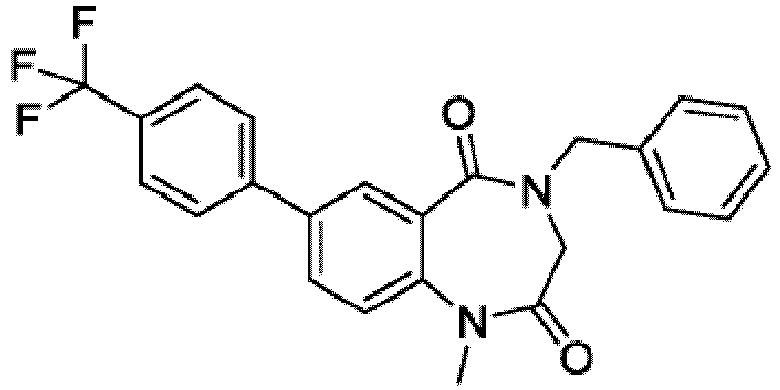 pyrimidine-2-yl(7-(4-(trifluorométhoxy)phényl)-2,3-dihydrobenzo[f][1,4]oxazépin-4(5H)-yl)méthanone (III-1);
 phényl(7-(4-(trifluorométhoxy)phényl)-2,3-dihydrobenzo[f][1,4]oxazépin-4(5H)-yl)méthanone (III-4);
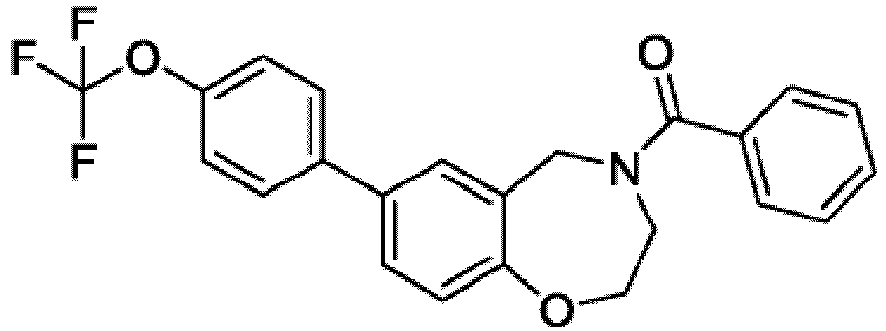 (1-méthylcyclopropyl)(7-(4-(trifluorométhoxy)phényl)-2,3-dihydrobenzo[f][1,4]oxazépin-4(5H)-yl)méthanone (III-10);
 (3,3-difluorocyclobutyl)(7-(4-(trifluorométhoxy)phényl)-2,3-dihydrobenzo[f][1,4] oxazépin-4(5H)-yl)méthanone (III-11);
 (1-méthyl-1H-pyrazole-4-yl)(7-(4-(trifluorométhoxy)phényl)-2,3-dihydrobenzo[f][1,4]oxazépin-4(5H)-yl)méthanone (III-12);
 (1H-pyrazole-3-yl)(7-(4-(trifluorométhoxy)phényl)-2,3-dihydrobenzo[f][1,4]oxazépin-4(5H)-yl)méthanone (III-15);
 pyrazine-2-yl(7-(4-(trifluorométhoxy)phényl)-2,3-dihydrobenzo[f][1,4]oxazépin-4(5H)-yl)méthanone (III-23);
 pyridazin-3-yl(7-(4-(trifluorométhoxy)phényl)-2,3 -dihydrobenzo[f][1,4]oxazépin-4(5H)-yl)méthanone (III-24);
 2-(pyridin-2-yl)-1-(7-(4-(trifluorométhyl)phényl)-2,3-dihydrobenzo[f][1,4]oxazépin-4(5H)-yl)éthanone (III-29);
 2-(pyrimidin-2-yl)-1-(7-(4-(trifluorométhyl)phényl)-2,3-dihydrobenzo[f][1,4]oxazépin-4(5H)-yl)éthanone (III- 30);
 (1-méthyl-1H-imidazol-5-yl)(7-(4-(trifluorométhyl)phényl)-2,3-dihydrobenzo[f][1,4]oxazépin-4(5H)-yl)méthanone (III-32);
 (1H-imidazol-2-yl)(7-(4-(trifluorométhyl)phényl)-2,3-dihydrobenzo[f][1,4]oxazépin-4(5H)-yl)méthanone (III-33);
 (1-méthyl-1H-imidazol-2-yl)(7-(4-(trifluorométhyl)phényl)-2,3-dihydrobenzo[f][1,4]oxazépin-4(5H)-yl)méthanone (III-37);
 (R)-(2-méthyl-7-(4-(trifluorométhoxy)phényl)-2,3-dihydrobenzo[f][1,4]oxazépin-4(5H)-yl)(pyrimidin-2-yl)méthanone (III-38);
 tert-butyle-2-(7-(4-(trifluorométhyl)phényl)-2,3,4,5-tétrahydrobenzo[f][1,4]oxazépin-4-carbonyl)-5,6-dihydroimidazo[1,2-a]pyrazine-7(8H)-carboxylate (III-40);
 (1H-1,2,4-triazole-3-yl)(7-(4-(trifluorométhyl)phényl)-2,3-dihydrobenzo[f][1,4]oxazépin-4(5H)-yl)méthanone (III-50);
 (1,5-diméthyl-1H-pyrazole-3-yl)(7-(4-(trifluorométhoxy)phényl)-2,3-dihydrobenzo[f][1,4]oxazépin-4(5H)-yl)méthanone (111-58);
 2-((pyrimidin-2-yl)méthyl)-8-(4-(trifluorométhyl)phényl)-3,4-dihydro-2H-benzo[b][1,4,5]oxathiazépin-sulfone (IX-2); et
 2-((5-chloropyrimidin-2-yl)méthyl)-8-(4-(trifluorométhyl)phényl)-3,4-dihydro-2H-benzo[b][1,4,5]oxathiazépin-sulfone (IX-3);ou un sel, un ester, un stéréoisomère, un mélange de stéréoisomères ou tautomère pharmaceutiquement acceptables de celui-ci.
- Composition pharmaceutique comprenant un excipient pharmaceutiquement acceptable et une quantité thérapeutiquement efficace d'un composé selon l'une quelconque des revendications 1 à 7 ou un sel pharmaceutiquement acceptable de celui-ci.
- Composé selon l'une quelconque des revendications 1 à 7 ou un sel pharmaceutiquement acceptable de celui-ci pour une utilisation en thérapie; de préférence pour une utilisation dans le traitement d'un état pathologique chez un humain qui peut être soulagé par un traitement avec un agent capable de réduire un courant de sodium tardif, de préférence
dans lequel l'état pathologique est choisi dans le groupe constitué d'arythmies auriculaires, d'arythmies ventriculaires, d'une insuffisance cardiaque, d'une insuffisance cardiaque diastolique, d'une insuffisance cardiaque systolique, d'une insuffisance cardiaque aiguë, d'un angor stable, d'un angor instable, d'un angor induit par l'exercice, d'une maladie cardiaque congestive, d'une ischémie, d'une ischémie récurrente, d'une lésion de reperfusion, d'un infarctus du myocarde, d'un syndrome coronarien aigu, d'une maladie artérielle périphérique, d'une hypertension pulmonaire et d'une claudication intermittente; ou dans lequel l'état pathologique est un diabète ou une neuropathie périphérique diabétique; ou dans lequel l'état pathologique conduit à un ou plusieurs parmi une douleur neuropathique, une épilepsie, une migraine, des attaques ou une paralysie. - Composition comprenant un composé selon l'une quelconque des revendications 1 à 7 en combinaison avec au moins un agent thérapeutique dans laquelle l'autre agent thérapeutique est choisi dans le groupe constitué d'anti-angoreux, d'agents contre une insuffisance cardiaque, d'agents anti-thrombotiques, d'agents anti-arythmiques, d'agents anti-hypertension et d'agents abaissant les lipides.
- Composition selon la revendication 10 pour une utilisation dans une thérapie, de préférence pour une utilisation dans le traitement de maladies ou d'états de type cardiovasculaires, de préférence un angor incluant un angor stable, un angor instable, un angor induit par l'exercice, un angor de repos, des arythmies, une claudication intermittente, un infarctus du myocarde incluant un infarctus du myocarde non STE, une hypertension pulmonaire incluant une hypertension artérielle pulmonaire, une insuffisance cardiaque incluant une insuffisance cardiaque congestive et une insuffisance cardiaque diastolique et une insuffisance cardiaque avec une fraction d'éjection préservée, une insuffisance cardiaque aiguë ou une ischémie récurrente.
Applications Claiming Priority (4)
| Application Number | Priority Date | Filing Date | Title |
|---|---|---|---|
| US201161503980P | 2011-07-01 | 2011-07-01 | |
| US201161582160P | 2011-12-30 | 2011-12-30 | |
| PCT/US2012/045086 WO2013006485A1 (fr) | 2011-07-01 | 2012-06-29 | Benzoxazépinones fusionnés en tant que modulateurs des canaux ioniques |
| EP12735402.5A EP2726466B1 (fr) | 2011-07-01 | 2012-06-29 | Benzoxazépinones fusionnés en tant que modulateurs des canaux ioniques |
Related Parent Applications (1)
| Application Number | Title | Priority Date | Filing Date |
|---|---|---|---|
| EP12735402.5A Division EP2726466B1 (fr) | 2011-07-01 | 2012-06-29 | Benzoxazépinones fusionnés en tant que modulateurs des canaux ioniques |
Publications (2)
| Publication Number | Publication Date |
|---|---|
| EP3085694A1 EP3085694A1 (fr) | 2016-10-26 |
| EP3085694B1 true EP3085694B1 (fr) | 2020-03-25 |
Family
ID=46513866
Family Applications (6)
| Application Number | Title | Priority Date | Filing Date |
|---|---|---|---|
| EP16169306.4A Active EP3085694B1 (fr) | 2011-07-01 | 2012-06-29 | Benzoxazépinones fusionnés en tant que modulateurs de canaux ioniques |
| EP16169333.8A Active EP3088395B1 (fr) | 2011-07-01 | 2012-06-29 | Benzoxazépinones fusionnés en tant que modulateurs de canaux ioniques |
| EP12735402.5A Active EP2726466B1 (fr) | 2011-07-01 | 2012-06-29 | Benzoxazépinones fusionnés en tant que modulateurs des canaux ioniques |
| EP16169320.5A Active EP3098218B1 (fr) | 2011-07-01 | 2012-06-29 | Benzoxazépinones fusionnés en tant que modulateurs de canaux ioniques |
| EP16169386.6A Active EP3085696B1 (fr) | 2011-07-01 | 2012-06-29 | Benzoxazépinones fusionnés en tant que modulateurs de canaux ioniques |
| EP16169314.8A Active EP3101013B1 (fr) | 2011-07-01 | 2012-06-29 | Benzoxazépinones fusionnés en tant que modulateurs de canaux ioniques |
Family Applications After (5)
| Application Number | Title | Priority Date | Filing Date |
|---|---|---|---|
| EP16169333.8A Active EP3088395B1 (fr) | 2011-07-01 | 2012-06-29 | Benzoxazépinones fusionnés en tant que modulateurs de canaux ioniques |
| EP12735402.5A Active EP2726466B1 (fr) | 2011-07-01 | 2012-06-29 | Benzoxazépinones fusionnés en tant que modulateurs des canaux ioniques |
| EP16169320.5A Active EP3098218B1 (fr) | 2011-07-01 | 2012-06-29 | Benzoxazépinones fusionnés en tant que modulateurs de canaux ioniques |
| EP16169386.6A Active EP3085696B1 (fr) | 2011-07-01 | 2012-06-29 | Benzoxazépinones fusionnés en tant que modulateurs de canaux ioniques |
| EP16169314.8A Active EP3101013B1 (fr) | 2011-07-01 | 2012-06-29 | Benzoxazépinones fusionnés en tant que modulateurs de canaux ioniques |
Country Status (38)
| Country | Link |
|---|---|
| US (5) | US8586732B2 (fr) |
| EP (6) | EP3085694B1 (fr) |
| JP (2) | JP5889407B2 (fr) |
| KR (2) | KR101608927B1 (fr) |
| CN (2) | CN106995415A (fr) |
| AP (1) | AP2013007300A0 (fr) |
| AR (1) | AR086828A1 (fr) |
| AU (1) | AU2012279236B2 (fr) |
| BR (1) | BR112013032361A2 (fr) |
| CA (1) | CA2838223A1 (fr) |
| CL (1) | CL2013003598A1 (fr) |
| CO (1) | CO6821960A2 (fr) |
| CR (1) | CR20130658A (fr) |
| CY (1) | CY1117915T1 (fr) |
| DK (1) | DK2726466T3 (fr) |
| EA (2) | EA027356B1 (fr) |
| EC (1) | ECSP13013083A (fr) |
| ES (6) | ES2790633T3 (fr) |
| HK (5) | HK1225725A1 (fr) |
| HR (1) | HRP20160952T1 (fr) |
| HU (1) | HUE029398T2 (fr) |
| IL (2) | IL230022B (fr) |
| MD (1) | MD4371C1 (fr) |
| ME (1) | ME02546B (fr) |
| MX (1) | MX336810B (fr) |
| NZ (2) | NZ716245A (fr) |
| PE (1) | PE20140690A1 (fr) |
| PH (1) | PH12013502549B1 (fr) |
| PL (1) | PL2726466T3 (fr) |
| PT (1) | PT2726466T (fr) |
| RS (1) | RS55024B1 (fr) |
| SI (1) | SI2726466T1 (fr) |
| SM (1) | SMT201600271B (fr) |
| TW (4) | TWI478908B (fr) |
| UA (1) | UA115529C2 (fr) |
| UY (1) | UY34171A (fr) |
| WO (1) | WO2013006485A1 (fr) |
| ZA (1) | ZA201308981B (fr) |
Cited By (3)
| Publication number | Priority date | Publication date | Assignee | Title |
|---|---|---|---|---|
| US12084458B2 (en) | 2021-02-19 | 2024-09-10 | Sudo Biosciences Limited | Substituted pyridines, pyridazines, and pyrimidines as TYK2 inhibitors |
| US12122785B2 (en) | 2021-02-19 | 2024-10-22 | Sudo Biosciences Limited | Substituted pyridines, pyridazines, pyrimidines, and 1,2,4-triazines as TYK2 inhibitors |
| US12600721B2 (en) | 2021-02-19 | 2026-04-14 | Sudo Biosciences Limited | TYK2 inhibitors and uses thereof |
Families Citing this family (48)
| Publication number | Priority date | Publication date | Assignee | Title |
|---|---|---|---|---|
| TWI598347B (zh) | 2009-07-13 | 2017-09-11 | 基利科學股份有限公司 | 調節細胞凋亡信號之激酶的抑制劑 |
| ES2642586T3 (es) * | 2009-07-27 | 2017-11-16 | Gilead Sciences, Inc. | Compuestos heterocíclicos condensados como moduladores de canales iónicos |
| EP2588197B1 (fr) | 2010-07-02 | 2014-11-05 | Gilead Sciences, Inc. | Composés hétérocycliques condensés en tant que modulateurs des canaux ioniques |
| KR20140033377A (ko) | 2011-05-10 | 2014-03-18 | 길리애드 사이언시즈, 인코포레이티드 | 나트륨 채널 조절제로서의 융합된 헤테로시클릭 화합물 |
| NO3175985T3 (fr) | 2011-07-01 | 2018-04-28 | ||
| UY34171A (es) | 2011-07-01 | 2013-01-31 | Gilead Sciences Inc | Compuestos heterocíclicos fusionados como moduladores del canal iónico |
| US9040678B2 (en) | 2011-08-05 | 2015-05-26 | Illumina, Inc. | Functionalization and purification of molecules by reversible group exchange |
| HK1201455A1 (en) * | 2012-01-27 | 2015-09-04 | Gilead Sciences Inc | Combination therapies using late sodium ion channel blockers and potassium ion channel blockers |
| UY34573A (es) | 2012-01-27 | 2013-06-28 | Gilead Sciences Inc | Inhibidor de la quinasa que regula la señal de la apoptosis |
| SG10201802911RA (en) | 2013-03-15 | 2018-05-30 | Global Blood Therapeutics Inc | Compounds and uses thereof for the modulation of hemoglobin |
| WO2014179492A1 (fr) * | 2013-05-01 | 2014-11-06 | Gilead Sciences, Inc. | Polythérapie pour traiter les arythmies ou l'insuffisance cardiaque |
| EP3027190A1 (fr) * | 2013-08-01 | 2016-06-08 | Gilead Sciences, Inc. | Composé et procédés pour le traitement du syndrome du qt long |
| KR20160035060A (ko) * | 2013-08-01 | 2016-03-30 | 길리애드 사이언시즈, 인코포레이티드 | 비대성 심근병증을 치료하는 방법 |
| AU2014318979B2 (en) * | 2013-09-10 | 2019-03-28 | Chromocell Corporation | Sodium channel modulators for the treatment of pain and diabetes |
| EA202092627A1 (ru) | 2013-11-18 | 2021-09-30 | Глобал Блад Терапьютикс, Инк. | Соединения и их применения для модуляции гемоглобина |
| NZ720651A (en) * | 2013-12-19 | 2017-12-22 | Gilead Sciences Inc | Fused heterocyclic compounds as ion channel modulators |
| TW201613908A (en) | 2014-02-13 | 2016-04-16 | Gilead Sciences Inc | Solid forms of an ion channel modulator |
| CN104844535A (zh) | 2014-02-13 | 2015-08-19 | 吉利德科学公司 | 用于制备稠合杂环离子通道调节剂的方法 |
| WO2015153153A1 (fr) * | 2014-04-02 | 2015-10-08 | Gilead Sciences, Inc. | Méthodes de traitement de patients ayant des dispositifs cardiaques implantables |
| MX2017003933A (es) | 2014-09-24 | 2017-06-30 | Gilead Sciences Inc | Metodos de tratamiento de la enfermedad hepatica. |
| CN112225699B (zh) | 2014-12-23 | 2023-11-14 | 吉利德科学公司 | 制备ask1抑制剂的方法 |
| MA41252A (fr) | 2014-12-23 | 2017-10-31 | Gilead Sciences Inc | Formes solides d'un inhibiteur d'ask 1 |
| EP3317269B1 (fr) | 2015-07-02 | 2022-09-21 | F. Hoffmann-La Roche AG | Lactames bicycliques en tant qu'inhibiteurs de la protéine kinase 1 interagissant avec des récepteurs pour le traitment par ex. de maladies inflammatoires |
| WO2017007805A1 (fr) | 2015-07-09 | 2017-01-12 | Gilead Sciences, Inc. | Formulations intraveineuses d'un inhibiteur de courant sodique tardif |
| IL287136B2 (en) | 2016-02-05 | 2023-09-01 | Denali Therapeutics Inc | Receptor inhibitors - interacting with protein kinase 1 |
| EP3464270B1 (fr) * | 2016-05-24 | 2022-02-23 | Genentech, Inc. | Inhibiteurs hétérocycliques de cbp/ep300 et leur utilisation dans le traitement du cancer |
| CA3033667A1 (fr) | 2016-08-12 | 2018-02-15 | Nanjing Gator Meditech Company, Ltd. | Regulateurs de proteine kinases |
| WO2018048977A1 (fr) * | 2016-09-08 | 2018-03-15 | Auspex Pharmaceuticals, Inc. | Composés d'oxazépin à substitution par du deutérium |
| WO2018073193A1 (fr) | 2016-10-17 | 2018-04-26 | F. Hoffmann-La Roche Ag | Lactames de pyridone bicycliques et leurs méthodes d'utilisation |
| AR110252A1 (es) | 2016-11-30 | 2019-03-13 | Gilead Sciences Inc | Compuestos heterocíclicos fusionados como inhibidores de la quinasa cam |
| JP7208137B2 (ja) | 2016-12-09 | 2023-01-18 | デナリ セラピューティクス インコーポレイテッド | 化合物、組成物および方法 |
| US20200085838A1 (en) * | 2017-05-16 | 2020-03-19 | Praxis Precision Medicines, Inc. | Methods of treating epilepsy and neurodevelopmental disorders |
| CA3063934A1 (fr) | 2017-05-17 | 2018-11-22 | Denali Therapeutics Inc. | Inhibiteurs de kinase et leurs utilisations |
| TWI795440B (zh) | 2017-09-15 | 2023-03-11 | 美商佛瑪治療公司 | 作為CBP/p300抑制劑之四氫─咪唑並喹啉化合物 |
| WO2019168874A1 (fr) | 2018-02-27 | 2019-09-06 | The Research Foundation For The State University Of New York | Compositions de difluorométhoxylation et de trifluorométhoxylation et leurs procédés de synthèse |
| US11649218B2 (en) | 2018-03-09 | 2023-05-16 | The United States Of America, As Represented By The Secretary, Department Of Health And Human Services | C-Abl tyrosine kinase inhibitory compound embodiments and methods of making and using the same |
| US10870648B2 (en) | 2018-06-29 | 2020-12-22 | Forma Therapeutics, Inc. | Inhibiting CREB binding protein (CBP) |
| WO2020086857A1 (fr) | 2018-10-24 | 2020-04-30 | Vanderbilt University | Modulateurs et inhibiteurs de wdr5 |
| KR102172595B1 (ko) * | 2018-12-19 | 2020-11-02 | 인하대학교 산학협력단 | 벤조옥사제핀 유도체 화합물을 포함하는 비만 예방 또는 치료용 약학 조성물 |
| WO2020190791A1 (fr) | 2019-03-15 | 2020-09-24 | Forma Therapeutics, Inc. | Inhibition de la protéine de liaison à un élément sensible à l'amp cyclique (creb) |
| CN109879830A (zh) * | 2019-03-27 | 2019-06-14 | 安徽师范大学 | 一种含环外双键的氧氮杂环庚烷衍生物及其制备方法 |
| WO2020247679A1 (fr) * | 2019-06-04 | 2020-12-10 | Vanderbilt University | Modulateurs et inhibiteurs de wdr5 |
| US11801243B2 (en) | 2020-09-23 | 2023-10-31 | Forma Therapeutics, Inc. | Bromodomain inhibitors for androgen receptor-driven cancers |
| US11795168B2 (en) | 2020-09-23 | 2023-10-24 | Forma Therapeutics, Inc. | Inhibiting cyclic amp-responsive element-binding protein (CREB) binding protein (CBP) |
| TW202334164A (zh) | 2022-01-12 | 2023-09-01 | 美商戴納立製藥公司 | (S)-5-苄基-N-(5-甲基-4-側氧基-2,3,4,5-四氫吡啶並[3,2-b][1,4]氧氮呯-3-基)-4H-1,2,4-三唑-3-甲醯胺的晶型 |
| WO2023143389A1 (fr) * | 2022-01-29 | 2023-08-03 | 江苏恒瑞医药股份有限公司 | Composé hétérocyclique fusionné, son procédé de préparation et son application médicale |
| US20250197390A1 (en) | 2022-03-16 | 2025-06-19 | Jiangsu Hengrui Pharmaceuticals Co., Ltd. | Fused heterocyclic compound, and preparation method therefor and medical use thereof |
| CN119677753A (zh) * | 2022-04-22 | 2025-03-21 | 帝人制药株式会社 | 氧杂氮杂环庚三烯衍生物 |
Family Cites Families (225)
| Publication number | Priority date | Publication date | Assignee | Title |
|---|---|---|---|---|
| US2867618A (en) | 1957-02-14 | 1959-01-06 | Dow Chemical Co | 3, 4-dihydro-2h-1, 3-benzoxazine |
| US2826575A (en) | 1957-05-06 | 1958-03-11 | Dow Chemical Co | 3, 3'-alkylenebis |
| NL128591C (fr) | 1965-07-02 | |||
| US3441649A (en) | 1966-08-18 | 1969-04-29 | Univ Minnesota | Suppression of cardiac ventricular fibrillation and cardiac arrhythmias with bretylium tosylate |
| US3594372A (en) | 1968-08-13 | 1971-07-20 | American Home Prod | Pyrimido(4,5-e)(1,4)oxazepin-5-ones and derivatives thereof |
| US3845770A (en) | 1972-06-05 | 1974-11-05 | Alza Corp | Osmatic dispensing device for releasing beneficial agent |
| US4062881A (en) | 1974-07-26 | 1977-12-13 | Cincinnati Milacron Chemicals, Inc. | Sulfide containing tin stabilizers |
| US4230705A (en) | 1976-09-22 | 1980-10-28 | American Cyanamid Company | 6-Phenyl-1,2,4-triazolo[4,3-b]pyridazines and their uses in treating anxiety |
| US4242515A (en) | 1979-03-28 | 1980-12-30 | American Cyanamid Company | Substituted 3-alkyl-6-phenyl-1,2,4-triazolo-[4,3-a]pyridines |
| US4244953A (en) | 1979-10-24 | 1981-01-13 | American Cyanamid Company | Substituted 6-phenyl-5,6,7,8-tetrahydro-1,2,4-triazolo-[4,3-a]pyridines |
| JPS5675428A (en) | 1979-11-21 | 1981-06-22 | Ayanori Takabe | Hypoglycemic agent containing procainamide hydrochloride |
| US4326525A (en) | 1980-10-14 | 1982-04-27 | Alza Corporation | Osmotic device that improves delivery properties of agent in situ |
| DE3382028D1 (de) * | 1982-09-30 | 1991-01-10 | Robins Co Inc A H | Kondensierte aromatische oxazepinone und sulphuranaloge, ihrer herstellung und verwendung als histamin-antagonist. |
| US4812565A (en) * | 1982-09-30 | 1989-03-14 | A. H. Robins Company, Incorporated | Fused aromatic oxazepinones, thiazepinones, diazepinones and sulfur analogs thereof |
| US5364620A (en) | 1983-12-22 | 1994-11-15 | Elan Corporation, Plc | Controlled absorption diltiazem formulation for once daily administration |
| US4654343A (en) | 1985-10-31 | 1987-03-31 | American Cyanamid Company | N-substituted-N[3-(1,2,4-triazolo[4,3-b]pyridazin-6-yl)phenyl]alkanamides, carbamates and ureas |
| US5023252A (en) | 1985-12-04 | 1991-06-11 | Conrex Pharmaceutical Corporation | Transdermal and trans-membrane delivery of drugs |
| JPH061779B2 (ja) | 1987-07-31 | 1994-01-05 | 田中電子工業株式会社 | 半導体装置の製造方法 |
| RO96410B1 (ro) * | 1987-02-16 | 1989-03-02 | Institutul Politehnic | Derivati de 1,4-benzoxazepinona si procedeu pentru prepararea lor |
| US4746655A (en) | 1987-06-10 | 1988-05-24 | A. H. Robins Company, Incorporated | Fused aromatic-spiropiperidine oxazepinones(and thiones) |
| US5001139A (en) | 1987-06-12 | 1991-03-19 | American Cyanamid Company | Enchancers for the transdermal flux of nivadipine |
| US4992445A (en) | 1987-06-12 | 1991-02-12 | American Cyanamid Co. | Transdermal delivery of pharmaceuticals |
| US4902514A (en) | 1988-07-21 | 1990-02-20 | Alza Corporation | Dosage form for administering nilvadipine for treating cardiovascular symptoms |
| DE4010488A1 (de) | 1990-03-31 | 1991-10-02 | Hoechst Ag | Benzoxazinderivate, verfahren zu ihrer herstellung und ihre verwendung zum behandeln oder zur prophylaxe von krankheiten |
| CA2044564A1 (fr) | 1990-06-28 | 1991-12-29 | Quirico Branca | Derives d'acides amines |
| CN1060467A (zh) | 1990-09-25 | 1992-04-22 | 武田药品工业株式会社 | 1,3-苯并嗪衍生物、其生产方法和用途 |
| JPH04209692A (ja) | 1990-12-03 | 1992-07-31 | Asahi Glass Co Ltd | フォトクロミック材料 |
| US5246948A (en) | 1991-05-10 | 1993-09-21 | Takeda Chemical Industries, Ltd. | Pyridine derivatives, their production and use |
| US5939412A (en) * | 1992-06-26 | 1999-08-17 | Smithkline Beecham Corporation | Bicyclic fibrinogen antagonists |
| US5693636A (en) * | 1991-06-28 | 1997-12-02 | Smithkline Beecham Corporation | Bicyclic fibrinogen antagonists |
| US5674863A (en) * | 1991-10-18 | 1997-10-07 | Genentech, Inc. | Nonpeptidyl integrin inhibitors having specificity for the GPIIb IIIa receptor |
| US5250679A (en) * | 1991-10-18 | 1993-10-05 | Genentech, Inc. | Nonpeptidyl platelet aggregation inhibitors having specificity for the GPIIb III.sub. receptor |
| US5272158A (en) | 1991-10-29 | 1993-12-21 | Merck & Co., Inc. | Fibrinogen receptor antagonists |
| JPH061779A (ja) | 1992-02-06 | 1994-01-11 | Wakamoto Pharmaceut Co Ltd | ベンズオキサジノン誘導体 |
| JPH06107647A (ja) | 1992-08-12 | 1994-04-19 | Takeda Chem Ind Ltd | 1,3−ベンゾオキサジン誘導体の製造法 |
| US5442055A (en) | 1992-11-13 | 1995-08-15 | Tanabe Seiyaku Co., Ltd. | Azetidinone compound and process for preparation thereof |
| US6011150A (en) | 1992-11-13 | 2000-01-04 | Tanabe Seiyaku Co., Ltd. | Azetidinone compound and process for preparation thereof |
| GB9225860D0 (en) | 1992-12-11 | 1993-02-03 | Smithkline Beecham Plc | Novel treatment |
| GB9226302D0 (en) | 1992-12-17 | 1993-02-10 | Smithkline Beecham Plc | Pharmaceuticals |
| US5550229A (en) | 1993-06-23 | 1996-08-27 | Tanabe Seiyaku Co., Ltd. | Alkylation process for preparing azetidinone compound and starting compound therefor |
| DE19526173A1 (de) | 1995-07-18 | 1997-01-30 | Hoechst Ag | Polyfullerenaddukte, Verfahren zu ihrer regioselektiven Herstellung und deren Verwendung |
| JPH09157262A (ja) | 1995-12-08 | 1997-06-17 | Tanabe Seiyaku Co Ltd | アゼチジノン誘導体及びその合成中間体の製法 |
| US5773186A (en) | 1996-02-19 | 1998-06-30 | Fuji Photo Film Co., Ltd. | Heat-sensitive recording material |
| GB9619492D0 (en) | 1996-09-18 | 1996-10-30 | Smithkline Beecham Plc | Novel treatment |
| EP0975614A1 (fr) | 1997-04-18 | 2000-02-02 | Smithkline Beecham Plc | Aryl bicyclique ou noyau heterocyclique bicyclique contenant des composes presentant une activite antagoniste combinee contre les recepteurs 5ht1a, 5ht1b et 5ht1d |
| EP0999208A4 (fr) | 1997-05-30 | 2001-08-08 | Meiji Seika Kaisha | Composes heterocycliques azotes et medicament contre l'hyperlipemie en contenant |
| JP3964053B2 (ja) | 1997-07-10 | 2007-08-22 | 三井化学株式会社 | 遷移金属化合物からなるオレフィン重合用触媒ならびに重合方法 |
| WO1999013038A1 (fr) | 1997-09-08 | 1999-03-18 | Unilever N.V. | Procede servant a augmenter l'activite d'une enzyme |
| HUP0100575A3 (en) | 1998-01-21 | 2003-03-28 | Merck Sharp & Dohme Ltd Hoddes | Triazolo-pyridazine derivatives as ligands for gaba receptors |
| WO1999041246A1 (fr) * | 1998-02-11 | 1999-08-19 | Du Pont Pharmaceuticals Company | Nouveaux sulfamides cycliques utilises comme inhibiteurs des metalloproteases |
| CN1293665A (zh) | 1998-02-18 | 2001-05-02 | 神经研究公司 | 新化合物及其用作阳性ampa受体调节剂 |
| EP1087968A1 (fr) | 1998-06-16 | 2001-04-04 | MERCK SHARP & DOHME LTD. | Derives de triazolo-pyridine comme ligands de recepteurs de gaba |
| WO2000023451A1 (fr) | 1998-10-21 | 2000-04-27 | Novo Nordisk A/S | Nouveaux composes, leur preparation et leur utilisation |
| CA2369103A1 (fr) | 1999-04-09 | 2000-10-19 | Meiji Seika Kaisha, Ltd. | Composes heterocycliques contenant de l'azote et composes de benamide et medicaments contenant ces composes |
| AU4145200A (en) | 1999-05-07 | 2000-11-21 | Takeda Chemical Industries Ltd. | Cyclic compounds and uses thereof |
| US6121916A (en) | 1999-07-16 | 2000-09-19 | Eaton-Vorad Technologies, L.L.C. | Method and apparatus for recognizing stationary objects with a moving side-looking radar |
| EP1206517A1 (fr) | 1999-08-27 | 2002-05-22 | The Procter & Gamble Company | Procedes de blanchissage sans danger pour les couleurs utilisant des composants de formulation cationique |
| EP1206513A2 (fr) | 1999-08-27 | 2002-05-22 | The Procter & Gamble Company | Disponibilite controlee de composants de formulation, compositions et procede de blanchissage utilisant ces produits |
| TR200200471T2 (tr) | 1999-08-27 | 2002-05-21 | The Procter & Gamble Company | Kararlı formülasyon komponentleri, bunların kullanıldığı terkipler ve çamaşır yıkama metodları |
| AU7072200A (en) | 1999-08-27 | 2001-03-26 | Procter & Gamble Company, The | Fast-acting formulation components, compositions and laundry methods employing same |
| JP2003508587A (ja) | 1999-08-27 | 2003-03-04 | ザ、プロクター、エンド、ギャンブル、カンパニー | 安定性増強配合成分、これを用いた組成物および洗濯方法 |
| EP1210332B1 (fr) | 1999-08-27 | 2006-05-31 | The Procter & Gamble Company | Composants, compositions et procedes de blanchissage destines a renforcer le blanchiment |
| TR200200457T2 (tr) | 1999-08-27 | 2002-07-22 | The Procter & Gamble Company | Zitteriyonik formülasyon bileşenleri kullanılan renklerin solmasını önleyici çamaşır yöntemleri. |
| IL135092A0 (en) | 2000-03-15 | 2001-05-20 | Kidron Agrochem Ltd | A composition for the control of pests |
| EP1286994A1 (fr) | 2000-05-15 | 2003-03-05 | Darwin Discovery Limited | Derives d'acides hydroxamique et carboxylique possedant une activite inhibitrice des metalloproteinases et du facteur de necrose tumorale |
| CZ2003284A3 (cs) | 2000-08-01 | 2003-09-17 | Ono Pharmaceutical Co., Ltd. | 3,4-Dihydroisochinolinový derivát a farmaceutické činidlo obsahující tento derivát jako účinnou složku |
| JP2004521079A (ja) | 2000-08-29 | 2004-07-15 | ファルマシア・コーポレーション | アルファーvベータ3アンタゴニストとして有用な二環式環系を含有する化合物 |
| JP2002205992A (ja) | 2000-11-08 | 2002-07-23 | Takeda Chem Ind Ltd | 二環式トリアゾロン誘導体およびそれを含有する除草剤 |
| EP1354602B1 (fr) | 2000-12-26 | 2006-10-04 | Sankyo Company, Limited | Compositions medicinales contenant un diuretique et un agent renforcant la resistance a l'insuline |
| HUP0303415A2 (hu) | 2001-03-09 | 2004-01-28 | Pfizer Products Inc. | Triazolopiridinek, mint gyulladásgátló anyagok és ezeket tartalmazó gyógyszerkészítmények |
| US6998408B2 (en) | 2001-03-23 | 2006-02-14 | Bristol-Myers Squibb Pharma Company | 6-5, 6-6, or 6-7 Heterobicycles as factor Xa inhibitors |
| US20030114448A1 (en) | 2001-05-31 | 2003-06-19 | Millennium Pharmaceuticals, Inc. | Inhibitors of factor Xa |
| JP2005089298A (ja) | 2001-09-18 | 2005-04-07 | Japan Tobacco Inc | ナフタレン化合物及びその医薬用途 |
| GB0124627D0 (en) | 2001-10-15 | 2001-12-05 | Smithkline Beecham Plc | Novel compounds |
| DE60222693T2 (de) | 2001-11-13 | 2008-07-17 | Schering Corp. | Nk1-antagonisten |
| US7196108B2 (en) | 2002-03-08 | 2007-03-27 | Incyte San Diego Inc. | Bicyclic heterocycles for the treatment of diabetes and other diseases |
| JP2003277384A (ja) | 2002-03-26 | 2003-10-02 | Kyorin Pharmaceut Co Ltd | 縮合ニ環式ピリジン誘導体 |
| JP2003321461A (ja) | 2002-04-25 | 2003-11-11 | Kyorin Pharmaceut Co Ltd | 縮合ビフェニル誘導体 |
| US20040152696A1 (en) * | 2002-08-01 | 2004-08-05 | Euro-Celtique S.A. | 2-substituted bicyclic benzoheterocyclic compounds and their use as sodium channel blockers |
| CA2497658A1 (fr) | 2002-08-13 | 2004-02-19 | Warner-Lambert Company Llc | Derives de chromone inhibiteurs de metalloproteinase de matrice |
| BR0313724A (pt) | 2002-08-13 | 2005-06-28 | Warner Lambert Co | Derivados de azaisoquinolina como inibidores de metaloproteinase de matriz |
| US20040242572A1 (en) | 2002-08-24 | 2004-12-02 | Boehringer Ingelheim International Gmbh | New carboxamide compounds having melanin concentrating hormone antagonistic activity, pharmaceutical preparations comprising these compounds and process for their manufacture |
| DE10238865A1 (de) | 2002-08-24 | 2004-03-11 | Boehringer Ingelheim International Gmbh | Neue Carbonsäureamid-Verbindungen mit MCH-antagonistischer Wirkung, diese Verbindungen enthaltende Arzneimittel und Verfahren zu ihrer Herstellung |
| US7005523B2 (en) | 2002-08-30 | 2006-02-28 | Pfizer Inc. | Cycloalkyl-[4-(trifluorophenyl)-oxazol-5yl]-triazolo-pyridines |
| PA8579601A1 (es) | 2002-08-30 | 2004-05-07 | Pfizer Prod Inc | Compuestos antiinflamatorios de di y trifloruro-triazolo-piridinas |
| AU2003262073A1 (en) | 2002-09-20 | 2004-04-08 | Tsumura And Co. | Antitussives |
| US20040204404A1 (en) | 2002-09-30 | 2004-10-14 | Robert Zelle | Human N-type calcium channel blockers |
| GB0223730D0 (en) | 2002-10-11 | 2002-11-20 | Novartis Ag | Organic compounds |
| AU2003285946A1 (en) | 2002-10-22 | 2004-05-13 | The Trustees Of The University Of Pennsylvania | Identification of antimycobacterial targets and the inhibition thereof as a treatment for infectious diseases |
| CN100430386C (zh) | 2002-11-07 | 2008-11-05 | 默克公司 | 苯丙氨酸衍生物作为二肽基肽酶抑制剂用于治疗或预防糖尿病 |
| CA2504735C (fr) | 2002-11-07 | 2009-06-23 | Merck & Co., Inc. | Derives de phenylalanine utilises comme inhibiteurs de la dipeptidyl peptidase dans le traitement ou la prevention du diabete |
| EP1592464A4 (fr) | 2003-01-13 | 2011-03-09 | Cortex Pharma Inc | Methode de traitement du declin cognitif du au manque de sommeil et au stress |
| MY142651A (en) | 2003-03-18 | 2010-12-15 | Merck Sharp & Dohme | Biaryl substituted triazoles as sodium channel blockers |
| DE10317526A1 (de) | 2003-04-16 | 2004-11-04 | Degussa Ag | Verfahren zum Delignifizieren von ligninhaltigen Faserstoffen |
| AU2004232939A1 (en) | 2003-04-17 | 2004-11-04 | Merck Sharp & Dohme Corp. | Heterocyclic cyclopentyl tetrahydroisoquinoline and tetrahydropyridopyridine modulators of chemokine receptor activity |
| MXPA05010174A (es) | 2003-04-25 | 2005-11-08 | Lundbeck & Co As H | Derivados de indol e indolina sustituidos. |
| WO2004101509A2 (fr) | 2003-05-06 | 2004-11-25 | Case Western Reserve University | Benzoxazines fonctionnalisees, polymeres et copolymeres de ces benzoxazines |
| CN1816530A (zh) | 2003-07-01 | 2006-08-09 | 麦克公司 | 用于治疗高眼压症的眼用组合物 |
| AU2004260624A1 (en) | 2003-07-21 | 2005-02-10 | Solvay Pharmaceuticals Gmbh | Use of 3,7-diazabicyclo`3, 3,1 !nonane compounds for the treatment and/or prophylaxis of anti-arrhythmic events in male human patients |
| CN1894222A (zh) | 2003-08-05 | 2007-01-10 | 沃泰克斯药物股份有限公司 | 作为电压门控离子通道抑制剂的稠合嘧啶化合物 |
| US20050239767A1 (en) | 2003-10-28 | 2005-10-27 | Chan Michael K | Intermolecular SNAr of the heterocycle-activated nitro and fluoro groups-application in the synthesis of polyazamacrocyclic ligands |
| BRPI0417674A (pt) | 2003-12-18 | 2007-03-20 | Pfizer Prod Inc | método para tratar a inflamação aguda em animais, com inibidores de quinase map p38 |
| AU2005219788B2 (en) | 2004-03-05 | 2010-06-03 | Nissan Chemical Corporation | Isoxazoline-substituted benzamide compound and noxious organism control agent |
| US7306631B2 (en) | 2004-03-30 | 2007-12-11 | The Procter & Gamble Company | Keratin dyeing compounds, keratin dyeing compositions containing them, and use thereof |
| GB0412986D0 (en) | 2004-06-10 | 2004-07-14 | Xention Discovery Ltd | Compounds |
| WO2006002470A1 (fr) | 2004-06-30 | 2006-01-12 | Monash University | Ligands chiraux pour catalyse asymétrique |
| JP2006063064A (ja) | 2004-07-27 | 2006-03-09 | Takeda Chem Ind Ltd | 受容体作動剤 |
| JP2007297283A (ja) | 2004-07-28 | 2007-11-15 | Santen Pharmaceut Co Ltd | 新規桂皮酸関連化合物 |
| EP1784390A2 (fr) * | 2004-08-13 | 2007-05-16 | Amgen Inc. | Heterocycles benzo-condenses substitues |
| US7521457B2 (en) | 2004-08-20 | 2009-04-21 | Boehringer Ingelheim International Gmbh | Pyrimidines as PLK inhibitors |
| EP1784188B1 (fr) | 2004-08-23 | 2010-07-14 | Merck Sharp & Dohme Corp. | Derives de triazole accoles inhibiteurs de la dipeptidyl peptidase-iv utilises dans le traitement ou la prevention du diabete |
| US7750010B2 (en) | 2004-09-13 | 2010-07-06 | Merck Sharp & Dohme Corp. | Tricyclic anilide spirohydantion CGRP receptor antagonists |
| AR050948A1 (es) | 2004-09-24 | 2006-12-06 | Hoffmann La Roche | Derivados de ftalazinona; su obtencion y su utilizacion en la fabricacion de medicamentos para el tratamiento del cancer. |
| WO2006048727A1 (fr) | 2004-11-02 | 2006-05-11 | Pfizer Products Inc. | Ligands de latame/amine piperazinylphenalkyle pour le recepteur 5ht1b |
| JP2006203875A (ja) | 2004-12-24 | 2006-08-03 | Matsushita Electric Ind Co Ltd | 受信装置 |
| US7579348B2 (en) | 2005-02-25 | 2009-08-25 | Pgxhealth, Llc | Derivatives of 8-substituted xanthines |
| TW200643015A (en) | 2005-03-11 | 2006-12-16 | Akzo Nobel Nv | 2-(4-oxo-4H-quinazolin-3-yl)acetamide derivatives |
| EP1874753A2 (fr) * | 2005-04-14 | 2008-01-09 | Smithkline Beecham Corporation | Composes, compositions et procedes |
| AR056317A1 (es) | 2005-04-20 | 2007-10-03 | Xenon Pharmaceuticals Inc | Compuestos de oxindol y composicion farmaceutica |
| DK2444079T3 (en) | 2005-05-17 | 2017-01-30 | Sarcode Bioscience Inc | Compositions and Methods for the Treatment of Eye Diseases |
| TW200714597A (en) | 2005-05-27 | 2007-04-16 | Astrazeneca Ab | Chemical compounds |
| US7572807B2 (en) | 2005-06-09 | 2009-08-11 | Bristol-Myers Squibb Company | Heteroaryl 11-beta-hydroxysteroid dehydrogenase type I inhibitors |
| BRPI0611948A2 (pt) | 2005-06-17 | 2010-10-13 | Wyeth Corp | compostos úteis como inibidores de serotonina e agonistas de antagonista de 5-ht1a |
| US7632837B2 (en) | 2005-06-17 | 2009-12-15 | Bristol-Myers Squibb Company | Bicyclic heterocycles as cannabinoid-1 receptor modulators |
| TW200726765A (en) | 2005-06-17 | 2007-07-16 | Bristol Myers Squibb Co | Triazolopyridine cannabinoid receptor 1 antagonists |
| WO2007004028A2 (fr) | 2005-06-30 | 2007-01-11 | Ranbaxy Laboratories Limited | Procedes de preparation de penemes et de leurs intermediaires |
| WO2007023750A1 (fr) | 2005-08-26 | 2007-03-01 | National University Corporation University Of Toyama | Amnion seche et procede de sechage de l’amnion |
| CA2621255A1 (fr) | 2005-09-21 | 2007-04-05 | Incyte Corporation | Utilisation pharmaceutique de composes amido |
| US7482360B2 (en) | 2005-09-23 | 2009-01-27 | Schering Corporation | Fused tetracyclic mGluR1 antagonists as therapeutic agents |
| US20090022694A1 (en) | 2005-10-18 | 2009-01-22 | Distefano Peter | Sirt1 inhibition |
| TW200804290A (en) | 2005-11-15 | 2008-01-16 | Astrazeneca Ab | Compounds and uses thereof |
| JP2009515976A (ja) | 2005-11-18 | 2009-04-16 | メルク エンド カムパニー インコーポレーテッド | スピロラクタム二環式cgrp受容体アンタゴニスト |
| WO2007061677A2 (fr) | 2005-11-18 | 2007-05-31 | Merck & Co., Inc. | Antagoniste du recepteur cgpr de spirolactam aryle |
| TW200734342A (en) | 2005-12-15 | 2007-09-16 | Astrazeneca Ab | New compounds for the treatment of cardiac arrhythmias |
| CN101330914A (zh) | 2005-12-16 | 2008-12-24 | 爱尔康公司 | 使用alk5调节剂控制眼内压 |
| US8013073B2 (en) | 2005-12-30 | 2011-09-06 | Chevron Oronite Company Llc | Method for preparing polyolefins containing vinylidine end groups using nonaromatic heterocyclic compounds |
| MX2008012617A (es) | 2006-03-31 | 2008-10-10 | Novartis Ag | Compuestos organicos. |
| EP2727585A1 (fr) * | 2006-05-16 | 2014-05-07 | Takeda Pharmaceutical Company Limited | Méthode de dépistage in-vivo |
| WO2007146284A2 (fr) | 2006-06-12 | 2007-12-21 | Vertex Pharmaceuticals Incorporated | Thiénopyrimidines utiles en tant que modulateurs de canaux ioniques |
| WO2008005338A1 (fr) | 2006-06-29 | 2008-01-10 | Arena Pharmaceuticals, Inc. | Modulateurs du récepteur h3 de l'histamine utiles dans le traitement de troubles liés audit récepteur |
| US20080011523A1 (en) | 2006-06-29 | 2008-01-17 | Packard Thomas G | Rotor energy augmented vehicle |
| EP2038272B8 (fr) | 2006-06-30 | 2013-10-23 | Sunesis Pharmaceuticals, Inc. | Inhibiteurs de pyridinonyle pdk1 |
| US20090318412A1 (en) * | 2006-07-11 | 2009-12-24 | Takahiro Matsumoto | Tricyclic heterocyclic compound and use thereof |
| AU2007272009A1 (en) | 2006-07-12 | 2008-01-17 | Syngenta Limited | Triazolopyridine derivatives as herbicides |
| US8217177B2 (en) | 2006-07-14 | 2012-07-10 | Amgen Inc. | Fused heterocyclic derivatives and methods of use |
| PE20080403A1 (es) | 2006-07-14 | 2008-04-25 | Amgen Inc | Derivados heterociclicos fusionados y metodos de uso |
| PL2074093T3 (pl) | 2006-08-22 | 2013-03-29 | Sun Pharmaceutical Ind Ltd | Sposób przygotowywania inhibitorów metaloproteinazy macierzy i chiralnego środka wspomagającego |
| EP2068869A4 (fr) | 2006-10-06 | 2011-05-25 | Abbott Lab | Nouveaux imidazothiazoles et imidazoxazoles |
| WO2008118141A2 (fr) | 2006-10-17 | 2008-10-02 | Acadia Pharmaceuticals Inc. | Utilisation de composés de modulation des cannabinoïdes en association avec d'autres composés thérapeutiques comme traitement d'appoint |
| ES2555803T3 (es) | 2006-10-23 | 2016-01-08 | Cephalon, Inc. | Fusión de derivados bicíclicos 2,4-diaminopirimidina como utilizar inhibidores ALK y c-Met |
| CN105481788A (zh) | 2006-10-28 | 2016-04-13 | 梅特希尔基因公司 | 组蛋白脱乙酰酶抑制剂 |
| WO2008053913A1 (fr) * | 2006-11-02 | 2008-05-08 | Shionogi & Co., Ltd. | Dérivé de sulfonylurée capable d'inhiber sélectivement mmp-13 |
| CA2670651A1 (fr) | 2006-12-21 | 2008-07-03 | Cv Therapeutics, Inc. | Reduction de symptomes cardiovasculaires |
| US8076350B2 (en) | 2006-12-22 | 2011-12-13 | Abbott Laboratories | Spirocyclic azaadamantane derivatives and methods of use |
| AR065081A1 (es) | 2007-01-29 | 2009-05-13 | Xenon Pharmaceuticals Inc | Compuestos de quinazolinona y pirimidona fusionados y composicion farmaceutica |
| EP2131657A1 (fr) | 2007-02-28 | 2009-12-16 | Merck & Co., Inc. | Benzodiazépinones, benzoxazépinones et benzothiazépinones substituées en tant que bloqueurs de canaux sodiques |
| EP2123644B1 (fr) | 2007-03-07 | 2014-12-17 | Takeda Pharmaceutical Company Limited | Dérivés de benzodiazépine et utilisation de ces derniers |
| GB0706072D0 (en) | 2007-03-28 | 2007-05-09 | Sterix Ltd | Compound |
| CN101657198A (zh) * | 2007-04-12 | 2010-02-24 | Cv医药有限公司 | 增强胰岛素分泌的雷诺嗪 |
| CA2681444A1 (fr) | 2007-04-12 | 2008-10-23 | Cv Therapeutics, Inc. | Ranolazine utilisee pour ameliorer la secretion d'insuline |
| WO2008134553A1 (fr) | 2007-04-26 | 2008-11-06 | Xenon Pharmaceuticals Inc. | Procédés de traitement de maladies associées aux canaux sodiques au moyen de composés bicycliques |
| WO2008144483A2 (fr) * | 2007-05-18 | 2008-11-27 | Armgo Pharma, Inc. | Agents de traitement de troubles comprenant la modulation de récepteurs de la ryanodine |
| WO2009005675A1 (fr) | 2007-06-28 | 2009-01-08 | Abbott Laboratories | Nouvelles triazolopyridazines |
| US20090012103A1 (en) * | 2007-07-05 | 2009-01-08 | Matthew Abelman | Substituted heterocyclic compounds |
| US20090036425A1 (en) | 2007-08-02 | 2009-02-05 | Pfizer Inc | Substituted bicyclolactam compounds |
| US20110263569A1 (en) | 2007-08-22 | 2011-10-27 | President And Fellows Of Harvard College | Ryanodine channel binders and uses thereof |
| WO2009036144A1 (fr) | 2007-09-12 | 2009-03-19 | Wyeth | Dérivés d'isoquinolinyle et d'isoindolinyle convenant comme antagonistes de l'histamine-3 |
| US8119658B2 (en) | 2007-10-01 | 2012-02-21 | Bristol-Myers Squibb Company | Triazolopyridine 11-beta hydroxysteroid dehydrogenase type I inhibitors |
| US8293763B2 (en) | 2007-12-19 | 2012-10-23 | Genentech, Inc. | 8-anilinoimidazopyridines and their use as anti-cancer and/or anti-inflammatory agents |
| PE20091339A1 (es) | 2007-12-21 | 2009-09-26 | Glaxo Group Ltd | Derivados de oxadiazol con actividad sobre receptores s1p1 |
| EP2231669A1 (fr) | 2008-01-09 | 2010-09-29 | The U.S.A. As Represented By The Secretary, Department Of Health And Human Services | Inhibiteurs de phosphodiestérase |
| CA2713521A1 (fr) | 2008-02-06 | 2009-08-13 | Gilead Palo Alto, Inc. | Utilisation de ranolazine pour traiter la douleur |
| KR20100124262A (ko) | 2008-02-13 | 2010-11-26 | 에자이 알앤드디 매니지먼트 가부시키가이샤 | 비시클로아민 유도체 |
| JP2009286773A (ja) | 2008-03-14 | 2009-12-10 | Bayer Cropscience Ag | 殺虫性縮環式アリール類 |
| WO2009137499A1 (fr) | 2008-05-05 | 2009-11-12 | Envivo Pharmaceuticals, Inc. | Inhibiteurs de l'histone désacétylase |
| WO2009137462A2 (fr) | 2008-05-05 | 2009-11-12 | Envivo Pharmaceuticals, Inc. | Procédés de traitement de troubles cognitifs à l'aide d'inhibiteurs de l'histone désacétylase |
| DE102008024182A1 (de) | 2008-05-19 | 2009-11-26 | Merck Patent Gmbh | Verbindungen für organische elektronische Vorrichtung |
| EP2297140A4 (fr) | 2008-06-06 | 2012-05-02 | Abbott Lab | Nouveaux composés de 1,2,4-oxadiazole et leurs procédés d'utilisation |
| WO2009153589A1 (fr) | 2008-06-17 | 2009-12-23 | Astrazeneca Ab | Composés pyridines |
| CA2730377C (fr) | 2008-07-11 | 2017-09-19 | Neumedics | Derives de tetracycline presentant une activite antibiotique reduite et des benefices neuroprotecteurs |
| JP5303561B2 (ja) | 2008-08-12 | 2013-10-02 | 日本曹達株式会社 | 含窒素ヘテロ環誘導体および農園芸用殺菌剤 |
| CN102186812A (zh) | 2008-08-18 | 2011-09-14 | 宇部兴产株式会社 | 制备氟烷基芳基亚磺酰基化合物及其氟化的化合物的方法 |
| EP2337559A2 (fr) | 2008-09-04 | 2011-06-29 | Gilead Sciences, Inc. | Procédé de traitement de fibrillation auriculaire |
| WO2010053757A1 (fr) * | 2008-10-29 | 2010-05-14 | Gilead Palo Alto, Inc. | Inhibiteurs, à base de 2-oxoquinoxaline, des canaux sodiques tardifs |
| US8389500B2 (en) | 2008-10-30 | 2013-03-05 | Gilead Sciences, Inc. | Fused heterocyclic compounds as ion channel modulators |
| WO2010074807A1 (fr) * | 2008-10-30 | 2010-07-01 | Gilead Palo Alto, Inc. | Dérivés 3, 4-dihydroquinolin-2 (1h) -one utilisés comme modulateurs de canaux sodiques |
| US20100125091A1 (en) * | 2008-11-14 | 2010-05-20 | Gilead Palo Alto, Inc. | Substituted heterocyclic compounds as ion channel modulators |
| US20100130436A1 (en) * | 2008-11-25 | 2010-05-27 | Gilead Palo Alto, Inc. | Co-administration of ranolazine and cardiac glycosides |
| JP5752601B2 (ja) | 2008-12-08 | 2015-07-22 | ブイエム ファーマ エルエルシー | タンパク質受容体チロシンキナーゼ阻害薬の組成物 |
| EP2373645A4 (fr) | 2008-12-08 | 2012-05-02 | Sirtris Pharmaceuticals Inc | Isoindolinone et analogues apparentés comme modulateurs de sirtuine |
| JP5271069B2 (ja) | 2008-12-24 | 2013-08-21 | 三和シヤッター工業株式会社 | 開閉装置 |
| PE20120008A1 (es) * | 2009-01-12 | 2012-01-24 | Icagen Inc | Derivados de fenoxi bencenosulfonamida |
| FR2943342B1 (fr) | 2009-03-20 | 2011-03-04 | Servier Lab | Nouveaux derives de benzothiadiazepines,leur procede de preparation et les compositions pharmaceutiques qui les contiennent. |
| SG174883A1 (en) | 2009-03-27 | 2011-11-28 | Presidio Pharmaceuticals Inc | Fused ring inhibitors of hepatitis c |
| WO2010118208A1 (fr) * | 2009-04-09 | 2010-10-14 | Exelixis, Inc. | Dérivés benzoxazepin-4-(5h)-yle et leur utilisation pour traiter le cancer |
| ES2642586T3 (es) | 2009-07-27 | 2017-11-16 | Gilead Sciences, Inc. | Compuestos heterocíclicos condensados como moduladores de canales iónicos |
| MY160064A (en) | 2009-09-28 | 2017-02-15 | Hoffmann La Roche | Benzoxazepin pi3k inhibitor compounds and methods of use |
| US20120264636A1 (en) | 2009-10-07 | 2012-10-18 | Decode Genetics Ehf. | Genetic variants indicative of vascular conditions |
| WO2011056985A2 (fr) | 2009-11-04 | 2011-05-12 | Gilead Sciences, Inc. | Composés hétérocycliques substitués |
| US20110152246A1 (en) | 2009-12-18 | 2011-06-23 | Intermune, Inc. | Novel inhibitors of hepatitis c virus replication |
| TWI508726B (zh) | 2009-12-21 | 2015-11-21 | Gilead Sciences Inc | 治療心房纖維性顫動之方法 |
| EP2588197B1 (fr) | 2010-07-02 | 2014-11-05 | Gilead Sciences, Inc. | Composés hétérocycliques condensés en tant que modulateurs des canaux ioniques |
| WO2012019071A1 (fr) * | 2010-08-06 | 2012-02-09 | The Trustees Of Columbia University In The City Of New York | Méthodes de traitement prophylactique et thérapeutique de la sarcopénie |
| WO2012019076A1 (fr) * | 2010-08-06 | 2012-02-09 | The Trustees Of Columbia University In The City Of New York | Compositions et méthodes de traitement prophylactique ou thérapeutique d'une lésion d'ischémie/reperfusion cardiaque |
| WO2012037105A1 (fr) * | 2010-09-14 | 2012-03-22 | The Trustees Of Columbia University In The City Of New York | Procédés de traitement, d'amélioration ou de prévention de troubles et de maladies neuronaux induits par le stress |
| WO2012036233A1 (fr) | 2010-09-17 | 2012-03-22 | 塩野義製薬株式会社 | Dérivé hétérocyclique condensé ayant une activité antagoniste du récepteur de l'hormone de concentration de la mélanine |
| ES2566828T3 (es) | 2010-09-21 | 2016-04-15 | Purdue Pharma L.P. | Análogos de buprenorfina como agonistas y/o antagonistas del receptor opioide |
| WO2012050918A2 (fr) | 2010-09-29 | 2012-04-19 | Presidio Pharmaceutical, Inc. | Inhibiteurs de l'hépatite c tricyliques à cycles fusionnés |
| EP2643316A2 (fr) * | 2010-11-24 | 2013-10-02 | Exelixis, Inc. | Benzoxazépines utilisées comme inhibiteurs de p13k/mtor et procédés d'utilisation et de fabrication |
| JP5675428B2 (ja) | 2011-02-25 | 2015-02-25 | サンドビック株式会社 | ベルトプレス装置 |
| US9090628B2 (en) | 2011-03-21 | 2015-07-28 | Genentech, Inc. | Benzoxazepin compounds selective for PI3K P110 delta and methods of use |
| KR20140033377A (ko) | 2011-05-10 | 2014-03-18 | 길리애드 사이언시즈, 인코포레이티드 | 나트륨 채널 조절제로서의 융합된 헤테로시클릭 화합물 |
| US8753674B2 (en) | 2011-06-03 | 2014-06-17 | Signpath Pharma Inc. | Liposomal mitigation of drug-induced long QT syndrome and potassium delayed-rectifier current |
| UY34171A (es) * | 2011-07-01 | 2013-01-31 | Gilead Sciences Inc | Compuestos heterocíclicos fusionados como moduladores del canal iónico |
| NO3175985T3 (fr) | 2011-07-01 | 2018-04-28 | ||
| TWI567061B (zh) | 2011-07-01 | 2017-01-21 | 吉李德科學股份有限公司 | 用於治療成癮之化合物 |
| SG195100A1 (en) | 2011-07-01 | 2013-12-30 | Bayer Ip Gmbh | Hydroxymethylaryl-substituted pyrrolotriazines as alk1 inhibitors |
| WO2013043925A1 (fr) | 2011-09-21 | 2013-03-28 | Gilead Sciences, Inc. | Bloqueurs des canaux sodiques réduisant la sécrétion de glucagon |
| US8623860B2 (en) | 2011-12-30 | 2014-01-07 | Boehringer Ingelheim International Gmbh | Azetidine derivatives, pharmaceutical compositions and uses thereof |
| WO2013097052A1 (fr) | 2011-12-30 | 2013-07-04 | Abbott Laboratories | Inhibiteurs de bromodomaine |
| HK1201455A1 (en) | 2012-01-27 | 2015-09-04 | Gilead Sciences Inc | Combination therapies using late sodium ion channel blockers and potassium ion channel blockers |
| WO2013185764A2 (fr) | 2012-06-13 | 2013-12-19 | Acesion Pharma | Compositions pharmaceutiques pour polythérapie |
| WO2014134419A1 (fr) | 2013-03-01 | 2014-09-04 | Gilead Sciences, Inc. | Utilisation de bloqueurs ikach pour le traitement de maladies cardiaques |
| TW201613908A (en) | 2014-02-13 | 2016-04-16 | Gilead Sciences Inc | Solid forms of an ion channel modulator |
| CN104844535A (zh) | 2014-02-13 | 2015-08-19 | 吉利德科学公司 | 用于制备稠合杂环离子通道调节剂的方法 |
-
2012
- 2012-06-28 UY UY0001034171A patent/UY34171A/es not_active Application Discontinuation
- 2012-06-28 TW TW101123291A patent/TWI478908B/zh not_active IP Right Cessation
- 2012-06-28 TW TW107102252A patent/TW201837023A/zh unknown
- 2012-06-28 TW TW104100530A patent/TWI549944B/zh not_active IP Right Cessation
- 2012-06-28 TW TW105120804A patent/TWI622583B/zh not_active IP Right Cessation
- 2012-06-29 EP EP16169306.4A patent/EP3085694B1/fr active Active
- 2012-06-29 HR HRP20160952TT patent/HRP20160952T1/hr unknown
- 2012-06-29 AP AP2013007300A patent/AP2013007300A0/xx unknown
- 2012-06-29 CN CN201611165938.4A patent/CN106995415A/zh active Pending
- 2012-06-29 KR KR1020137033295A patent/KR101608927B1/ko not_active Expired - Fee Related
- 2012-06-29 PT PT127354025T patent/PT2726466T/pt unknown
- 2012-06-29 MD MDA20130095A patent/MD4371C1/ro not_active IP Right Cessation
- 2012-06-29 EP EP16169333.8A patent/EP3088395B1/fr active Active
- 2012-06-29 ME MEP-2016-152A patent/ME02546B/fr unknown
- 2012-06-29 HU HUE12735402A patent/HUE029398T2/en unknown
- 2012-06-29 EA EA201391639A patent/EA027356B1/ru not_active IP Right Cessation
- 2012-06-29 EP EP12735402.5A patent/EP2726466B1/fr active Active
- 2012-06-29 ES ES16169386T patent/ES2790633T3/es active Active
- 2012-06-29 RS RS20160623A patent/RS55024B1/sr unknown
- 2012-06-29 EP EP16169320.5A patent/EP3098218B1/fr active Active
- 2012-06-29 UA UAA201314145A patent/UA115529C2/uk unknown
- 2012-06-29 EP EP16169386.6A patent/EP3085696B1/fr active Active
- 2012-06-29 ES ES16169320T patent/ES2797128T3/es active Active
- 2012-06-29 AU AU2012279236A patent/AU2012279236B2/en not_active Ceased
- 2012-06-29 PE PE2013002817A patent/PE20140690A1/es active IP Right Grant
- 2012-06-29 EA EA201790417A patent/EA201790417A3/ru unknown
- 2012-06-29 JP JP2014519190A patent/JP5889407B2/ja not_active Expired - Fee Related
- 2012-06-29 ES ES16169333T patent/ES2792866T3/es active Active
- 2012-06-29 NZ NZ716245A patent/NZ716245A/en not_active IP Right Cessation
- 2012-06-29 PH PH1/2013/502549A patent/PH12013502549B1/en unknown
- 2012-06-29 KR KR1020167008350A patent/KR20160040734A/ko not_active Withdrawn
- 2012-06-29 NZ NZ618691A patent/NZ618691A/en not_active IP Right Cessation
- 2012-06-29 PL PL12735402T patent/PL2726466T3/pl unknown
- 2012-06-29 CA CA2838223A patent/CA2838223A1/fr not_active Abandoned
- 2012-06-29 EP EP16169314.8A patent/EP3101013B1/fr active Active
- 2012-06-29 ES ES16169306T patent/ES2792864T3/es active Active
- 2012-06-29 CN CN201280042528.4A patent/CN103857659B/zh not_active Expired - Fee Related
- 2012-06-29 BR BR112013032361A patent/BR112013032361A2/pt not_active Application Discontinuation
- 2012-06-29 MX MX2013014846A patent/MX336810B/es active IP Right Grant
- 2012-06-29 DK DK12735402.5T patent/DK2726466T3/en active
- 2012-06-29 ES ES12735402.5T patent/ES2583415T3/es active Active
- 2012-06-29 ES ES16169314T patent/ES2842433T3/es active Active
- 2012-06-29 SI SI201230579A patent/SI2726466T1/sl unknown
- 2012-06-29 US US13/538,847 patent/US8586732B2/en active Active
- 2012-06-29 WO PCT/US2012/045086 patent/WO2013006485A1/fr not_active Ceased
- 2012-06-29 AR ARP120102370A patent/AR086828A1/es unknown
-
2013
- 2013-03-07 US US13/789,469 patent/US8697863B2/en active Active
- 2013-09-26 US US14/038,646 patent/US9193694B2/en active Active
- 2013-11-29 ZA ZA2013/08981A patent/ZA201308981B/en unknown
- 2013-12-13 CR CR20130658A patent/CR20130658A/es unknown
- 2013-12-13 CO CO13291981A patent/CO6821960A2/es not_active Application Discontinuation
- 2013-12-16 EC ECSP13013083 patent/ECSP13013083A/es unknown
- 2013-12-16 CL CL2013003598A patent/CL2013003598A1/es unknown
- 2013-12-18 IL IL230022A patent/IL230022B/en active IP Right Grant
-
2015
- 2015-10-01 US US14/872,787 patent/US9598435B2/en active Active
- 2015-12-28 JP JP2015255906A patent/JP6273250B2/ja not_active Expired - Fee Related
-
2016
- 2016-05-11 US US15/152,231 patent/US9676760B2/en active Active
- 2016-08-08 SM SM201600271T patent/SMT201600271B/it unknown
- 2016-08-18 CY CY20161100816T patent/CY1117915T1/el unknown
- 2016-12-08 HK HK16113997.8A patent/HK1225725A1/en unknown
- 2016-12-08 HK HK16113995.0A patent/HK1225724A1/en unknown
- 2016-12-08 HK HK16113998.7A patent/HK1225726A1/en unknown
- 2016-12-15 HK HK16114300.8A patent/HK1226061A1/en unknown
- 2016-12-15 HK HK16114299.1A patent/HK1226060A1/en unknown
-
2018
- 2018-01-08 IL IL256779A patent/IL256779A/en unknown
Non-Patent Citations (1)
| Title |
|---|
| None * |
Cited By (4)
| Publication number | Priority date | Publication date | Assignee | Title |
|---|---|---|---|---|
| US12084458B2 (en) | 2021-02-19 | 2024-09-10 | Sudo Biosciences Limited | Substituted pyridines, pyridazines, and pyrimidines as TYK2 inhibitors |
| US12103937B2 (en) | 2021-02-19 | 2024-10-01 | Sudo Biosciences Limited | Substituted pyridines and pyridazines as TYK2 inhibitors |
| US12122785B2 (en) | 2021-02-19 | 2024-10-22 | Sudo Biosciences Limited | Substituted pyridines, pyridazines, pyrimidines, and 1,2,4-triazines as TYK2 inhibitors |
| US12600721B2 (en) | 2021-02-19 | 2026-04-14 | Sudo Biosciences Limited | TYK2 inhibitors and uses thereof |
Also Published As
Similar Documents
| Publication | Publication Date | Title |
|---|---|---|
| EP3085694B1 (fr) | Benzoxazépinones fusionnés en tant que modulateurs de canaux ioniques | |
| HK1196602B (en) | Fused benzoxazepinones as ion channel modulators |
Legal Events
| Date | Code | Title | Description |
|---|---|---|---|
| PUAI | Public reference made under article 153(3) epc to a published international application that has entered the european phase |
Free format text: ORIGINAL CODE: 0009012 |
|
| AC | Divisional application: reference to earlier application |
Ref document number: 2726466 Country of ref document: EP Kind code of ref document: P |
|
| AK | Designated contracting states |
Kind code of ref document: A1 Designated state(s): AL AT BE BG CH CY CZ DE DK EE ES FI FR GB GR HR HU IE IS IT LI LT LU LV MC MK MT NL NO PL PT RO RS SE SI SK SM TR |
|
| AX | Request for extension of the european patent |
Extension state: BA ME |
|
| 17P | Request for examination filed |
Effective date: 20170426 |
|
| RBV | Designated contracting states (corrected) |
Designated state(s): AL AT BE BG CH CY CZ DE DK EE ES FI FR GB GR HR HU IE IS IT LI LT LU LV MC MK MT NL NO PL PT RO RS SE SI SK SM TR |
|
| STAA | Information on the status of an ep patent application or granted ep patent |
Free format text: STATUS: REQUEST FOR EXAMINATION WAS MADE |
|
| REG | Reference to a national code |
Ref country code: HK Ref legal event code: DE Ref document number: 1225726 Country of ref document: HK |
|
| STAA | Information on the status of an ep patent application or granted ep patent |
Free format text: STATUS: EXAMINATION IS IN PROGRESS |
|
| 17Q | First examination report despatched |
Effective date: 20180208 |
|
| GRAP | Despatch of communication of intention to grant a patent |
Free format text: ORIGINAL CODE: EPIDOSNIGR1 |
|
| STAA | Information on the status of an ep patent application or granted ep patent |
Free format text: STATUS: GRANT OF PATENT IS INTENDED |
|
| INTG | Intention to grant announced |
Effective date: 20190918 |
|
| GRAJ | Information related to disapproval of communication of intention to grant by the applicant or resumption of examination proceedings by the epo deleted |
Free format text: ORIGINAL CODE: EPIDOSDIGR1 |
|
| STAA | Information on the status of an ep patent application or granted ep patent |
Free format text: STATUS: EXAMINATION IS IN PROGRESS |
|
| GRAR | Information related to intention to grant a patent recorded |
Free format text: ORIGINAL CODE: EPIDOSNIGR71 |
|
| GRAS | Grant fee paid |
Free format text: ORIGINAL CODE: EPIDOSNIGR3 |
|
| STAA | Information on the status of an ep patent application or granted ep patent |
Free format text: STATUS: GRANT OF PATENT IS INTENDED |
|
| GRAA | (expected) grant |
Free format text: ORIGINAL CODE: 0009210 |
|
| STAA | Information on the status of an ep patent application or granted ep patent |
Free format text: STATUS: THE PATENT HAS BEEN GRANTED |
|
| INTC | Intention to grant announced (deleted) | ||
| INTG | Intention to grant announced |
Effective date: 20200212 |
|
| AC | Divisional application: reference to earlier application |
Ref document number: 2726466 Country of ref document: EP Kind code of ref document: P |
|
| AK | Designated contracting states |
Kind code of ref document: B1 Designated state(s): AL AT BE BG CH CY CZ DE DK EE ES FI FR GB GR HR HU IE IS IT LI LT LU LV MC MK MT NL NO PL PT RO RS SE SI SK SM TR |
|
| REG | Reference to a national code |
Ref country code: GB Ref legal event code: FG4D |
|
| REG | Reference to a national code |
Ref country code: AT Ref legal event code: REF Ref document number: 1248399 Country of ref document: AT Kind code of ref document: T Effective date: 20200415 Ref country code: IE Ref legal event code: FG4D |
|
| REG | Reference to a national code |
Ref country code: DE Ref legal event code: R096 Ref document number: 602012068828 Country of ref document: DE |
|
| PG25 | Lapsed in a contracting state [announced via postgrant information from national office to epo] |
Ref country code: RS Free format text: LAPSE BECAUSE OF FAILURE TO SUBMIT A TRANSLATION OF THE DESCRIPTION OR TO PAY THE FEE WITHIN THE PRESCRIBED TIME-LIMIT Effective date: 20200325 Ref country code: NO Free format text: LAPSE BECAUSE OF FAILURE TO SUBMIT A TRANSLATION OF THE DESCRIPTION OR TO PAY THE FEE WITHIN THE PRESCRIBED TIME-LIMIT Effective date: 20200625 Ref country code: FI Free format text: LAPSE BECAUSE OF FAILURE TO SUBMIT A TRANSLATION OF THE DESCRIPTION OR TO PAY THE FEE WITHIN THE PRESCRIBED TIME-LIMIT Effective date: 20200325 |
|
| PG25 | Lapsed in a contracting state [announced via postgrant information from national office to epo] |
Ref country code: SE Free format text: LAPSE BECAUSE OF FAILURE TO SUBMIT A TRANSLATION OF THE DESCRIPTION OR TO PAY THE FEE WITHIN THE PRESCRIBED TIME-LIMIT Effective date: 20200325 Ref country code: LV Free format text: LAPSE BECAUSE OF FAILURE TO SUBMIT A TRANSLATION OF THE DESCRIPTION OR TO PAY THE FEE WITHIN THE PRESCRIBED TIME-LIMIT Effective date: 20200325 Ref country code: GR Free format text: LAPSE BECAUSE OF FAILURE TO SUBMIT A TRANSLATION OF THE DESCRIPTION OR TO PAY THE FEE WITHIN THE PRESCRIBED TIME-LIMIT Effective date: 20200626 Ref country code: HR Free format text: LAPSE BECAUSE OF FAILURE TO SUBMIT A TRANSLATION OF THE DESCRIPTION OR TO PAY THE FEE WITHIN THE PRESCRIBED TIME-LIMIT Effective date: 20200325 Ref country code: BG Free format text: LAPSE BECAUSE OF FAILURE TO SUBMIT A TRANSLATION OF THE DESCRIPTION OR TO PAY THE FEE WITHIN THE PRESCRIBED TIME-LIMIT Effective date: 20200625 |
|
| REG | Reference to a national code |
Ref country code: NL Ref legal event code: MP Effective date: 20200325 |
|
| REG | Reference to a national code |
Ref country code: LT Ref legal event code: MG4D |
|
| PG25 | Lapsed in a contracting state [announced via postgrant information from national office to epo] |
Ref country code: NL Free format text: LAPSE BECAUSE OF FAILURE TO SUBMIT A TRANSLATION OF THE DESCRIPTION OR TO PAY THE FEE WITHIN THE PRESCRIBED TIME-LIMIT Effective date: 20200325 |
|
| PG25 | Lapsed in a contracting state [announced via postgrant information from national office to epo] |
Ref country code: SK Free format text: LAPSE BECAUSE OF FAILURE TO SUBMIT A TRANSLATION OF THE DESCRIPTION OR TO PAY THE FEE WITHIN THE PRESCRIBED TIME-LIMIT Effective date: 20200325 Ref country code: SM Free format text: LAPSE BECAUSE OF FAILURE TO SUBMIT A TRANSLATION OF THE DESCRIPTION OR TO PAY THE FEE WITHIN THE PRESCRIBED TIME-LIMIT Effective date: 20200325 Ref country code: EE Free format text: LAPSE BECAUSE OF FAILURE TO SUBMIT A TRANSLATION OF THE DESCRIPTION OR TO PAY THE FEE WITHIN THE PRESCRIBED TIME-LIMIT Effective date: 20200325 Ref country code: LT Free format text: LAPSE BECAUSE OF FAILURE TO SUBMIT A TRANSLATION OF THE DESCRIPTION OR TO PAY THE FEE WITHIN THE PRESCRIBED TIME-LIMIT Effective date: 20200325 Ref country code: RO Free format text: LAPSE BECAUSE OF FAILURE TO SUBMIT A TRANSLATION OF THE DESCRIPTION OR TO PAY THE FEE WITHIN THE PRESCRIBED TIME-LIMIT Effective date: 20200325 Ref country code: PT Free format text: LAPSE BECAUSE OF FAILURE TO SUBMIT A TRANSLATION OF THE DESCRIPTION OR TO PAY THE FEE WITHIN THE PRESCRIBED TIME-LIMIT Effective date: 20200818 Ref country code: CZ Free format text: LAPSE BECAUSE OF FAILURE TO SUBMIT A TRANSLATION OF THE DESCRIPTION OR TO PAY THE FEE WITHIN THE PRESCRIBED TIME-LIMIT Effective date: 20200325 Ref country code: IS Free format text: LAPSE BECAUSE OF FAILURE TO SUBMIT A TRANSLATION OF THE DESCRIPTION OR TO PAY THE FEE WITHIN THE PRESCRIBED TIME-LIMIT Effective date: 20200725 |
|
| REG | Reference to a national code |
Ref country code: ES Ref legal event code: FG2A Ref document number: 2792864 Country of ref document: ES Kind code of ref document: T3 Effective date: 20201112 |
|
| REG | Reference to a national code |
Ref country code: AT Ref legal event code: MK05 Ref document number: 1248399 Country of ref document: AT Kind code of ref document: T Effective date: 20200325 |
|
| REG | Reference to a national code |
Ref country code: DE Ref legal event code: R097 Ref document number: 602012068828 Country of ref document: DE |
|
| PG25 | Lapsed in a contracting state [announced via postgrant information from national office to epo] |
Ref country code: AT Free format text: LAPSE BECAUSE OF FAILURE TO SUBMIT A TRANSLATION OF THE DESCRIPTION OR TO PAY THE FEE WITHIN THE PRESCRIBED TIME-LIMIT Effective date: 20200325 Ref country code: MC Free format text: LAPSE BECAUSE OF FAILURE TO SUBMIT A TRANSLATION OF THE DESCRIPTION OR TO PAY THE FEE WITHIN THE PRESCRIBED TIME-LIMIT Effective date: 20200325 Ref country code: DK Free format text: LAPSE BECAUSE OF FAILURE TO SUBMIT A TRANSLATION OF THE DESCRIPTION OR TO PAY THE FEE WITHIN THE PRESCRIBED TIME-LIMIT Effective date: 20200325 |
|
| REG | Reference to a national code |
Ref country code: CH Ref legal event code: PL |
|
| PLBE | No opposition filed within time limit |
Free format text: ORIGINAL CODE: 0009261 |
|
| STAA | Information on the status of an ep patent application or granted ep patent |
Free format text: STATUS: NO OPPOSITION FILED WITHIN TIME LIMIT |
|
| PG25 | Lapsed in a contracting state [announced via postgrant information from national office to epo] |
Ref country code: PL Free format text: LAPSE BECAUSE OF FAILURE TO SUBMIT A TRANSLATION OF THE DESCRIPTION OR TO PAY THE FEE WITHIN THE PRESCRIBED TIME-LIMIT Effective date: 20200325 |
|
| 26N | No opposition filed |
Effective date: 20210112 |
|
| PG25 | Lapsed in a contracting state [announced via postgrant information from national office to epo] |
Ref country code: LU Free format text: LAPSE BECAUSE OF NON-PAYMENT OF DUE FEES Effective date: 20200629 |
|
| REG | Reference to a national code |
Ref country code: BE Ref legal event code: MM Effective date: 20200630 |
|
| PG25 | Lapsed in a contracting state [announced via postgrant information from national office to epo] |
Ref country code: LI Free format text: LAPSE BECAUSE OF NON-PAYMENT OF DUE FEES Effective date: 20200630 Ref country code: CH Free format text: LAPSE BECAUSE OF NON-PAYMENT OF DUE FEES Effective date: 20200630 |
|
| PG25 | Lapsed in a contracting state [announced via postgrant information from national office to epo] |
Ref country code: SI Free format text: LAPSE BECAUSE OF FAILURE TO SUBMIT A TRANSLATION OF THE DESCRIPTION OR TO PAY THE FEE WITHIN THE PRESCRIBED TIME-LIMIT Effective date: 20200325 Ref country code: BE Free format text: LAPSE BECAUSE OF NON-PAYMENT OF DUE FEES Effective date: 20200630 |
|
| PG25 | Lapsed in a contracting state [announced via postgrant information from national office to epo] |
Ref country code: TR Free format text: LAPSE BECAUSE OF FAILURE TO SUBMIT A TRANSLATION OF THE DESCRIPTION OR TO PAY THE FEE WITHIN THE PRESCRIBED TIME-LIMIT Effective date: 20200325 Ref country code: MT Free format text: LAPSE BECAUSE OF FAILURE TO SUBMIT A TRANSLATION OF THE DESCRIPTION OR TO PAY THE FEE WITHIN THE PRESCRIBED TIME-LIMIT Effective date: 20200325 Ref country code: CY Free format text: LAPSE BECAUSE OF FAILURE TO SUBMIT A TRANSLATION OF THE DESCRIPTION OR TO PAY THE FEE WITHIN THE PRESCRIBED TIME-LIMIT Effective date: 20200325 |
|
| PG25 | Lapsed in a contracting state [announced via postgrant information from national office to epo] |
Ref country code: MK Free format text: LAPSE BECAUSE OF FAILURE TO SUBMIT A TRANSLATION OF THE DESCRIPTION OR TO PAY THE FEE WITHIN THE PRESCRIBED TIME-LIMIT Effective date: 20200325 Ref country code: AL Free format text: LAPSE BECAUSE OF FAILURE TO SUBMIT A TRANSLATION OF THE DESCRIPTION OR TO PAY THE FEE WITHIN THE PRESCRIBED TIME-LIMIT Effective date: 20200325 |
|
| REG | Reference to a national code |
Ref country code: HK Ref legal event code: WD Ref document number: 1225726 Country of ref document: HK |
|
| PGFP | Annual fee paid to national office [announced via postgrant information from national office to epo] |
Ref country code: DE Payment date: 20250402 Year of fee payment: 14 |
|
| PGFP | Annual fee paid to national office [announced via postgrant information from national office to epo] |
Ref country code: GB Payment date: 20250401 Year of fee payment: 14 |
|
| PGFP | Annual fee paid to national office [announced via postgrant information from national office to epo] |
Ref country code: IT Payment date: 20250522 Year of fee payment: 14 |
|
| PGFP | Annual fee paid to national office [announced via postgrant information from national office to epo] |
Ref country code: FR Payment date: 20250508 Year of fee payment: 14 |
|
| PGFP | Annual fee paid to national office [announced via postgrant information from national office to epo] |
Ref country code: IE Payment date: 20250402 Year of fee payment: 14 |
|
| PGFP | Annual fee paid to national office [announced via postgrant information from national office to epo] |
Ref country code: ES Payment date: 20250703 Year of fee payment: 14 |