EP3088312A1 - Machine et procédé d'emballage et de traitement à haute pression de produits - Google Patents
Machine et procédé d'emballage et de traitement à haute pression de produits Download PDFInfo
- Publication number
- EP3088312A1 EP3088312A1 EP16170059.6A EP16170059A EP3088312A1 EP 3088312 A1 EP3088312 A1 EP 3088312A1 EP 16170059 A EP16170059 A EP 16170059A EP 3088312 A1 EP3088312 A1 EP 3088312A1
- Authority
- EP
- European Patent Office
- Prior art keywords
- pressure
- packaging
- products
- station
- packaging machine
- Prior art date
- Legal status (The legal status is an assumption and is not a legal conclusion. Google has not performed a legal analysis and makes no representation as to the accuracy of the status listed.)
- Granted
Links
Images


Classifications
-
- B—PERFORMING OPERATIONS; TRANSPORTING
- B65—CONVEYING; PACKING; STORING; HANDLING THIN OR FILAMENTARY MATERIAL
- B65B—MACHINES, APPARATUS OR DEVICES FOR, OR METHODS OF, PACKAGING ARTICLES OR MATERIALS; UNPACKING
- B65B55/00—Preserving, protecting or purifying packages or package contents in association with packaging
-
- A—HUMAN NECESSITIES
- A23—FOODS OR FOODSTUFFS; TREATMENT THEREOF, NOT COVERED BY OTHER CLASSES
- A23B—PRESERVATION OF FOODS, FOODSTUFFS OR NON-ALCOHOLIC BEVERAGES; CHEMICAL RIPENING OF FRUIT OR VEGETABLES
- A23B2/00—Preservation of foods or foodstuffs, in general
- A23B2/003—Control or safety devices for sterilisation or pasteurisation systems
-
- A—HUMAN NECESSITIES
- A23—FOODS OR FOODSTUFFS; TREATMENT THEREOF, NOT COVERED BY OTHER CLASSES
- A23B—PRESERVATION OF FOODS, FOODSTUFFS OR NON-ALCOHOLIC BEVERAGES; CHEMICAL RIPENING OF FRUIT OR VEGETABLES
- A23B2/00—Preservation of foods or foodstuffs, in general
- A23B2/10—Preservation of foods or foodstuffs, in general by treatment with pressure variation, shock, acceleration or shear stress
- A23B2/103—Preservation of foods or foodstuffs, in general by treatment with pressure variation, shock, acceleration or shear stress using sub- or super-atmospheric pressures, or pressure variations transmitted by a liquid or gas
-
- B—PERFORMING OPERATIONS; TRANSPORTING
- B65—CONVEYING; PACKING; STORING; HANDLING THIN OR FILAMENTARY MATERIAL
- B65B—MACHINES, APPARATUS OR DEVICES FOR, OR METHODS OF, PACKAGING ARTICLES OR MATERIALS; UNPACKING
- B65B31/00—Packaging articles or materials under special atmospheric or gaseous conditions; Adding propellants to aerosol containers
- B65B31/02—Filling, closing, or filling and closing, containers or wrappers in chambers maintained under vacuum or superatmospheric pressure or containing a special atmosphere, e.g. of inert gas
Definitions
- the present invention relates to a packaging machine and a corresponding method with which products, in particular food, are packaged and subsequently treated under high pressure.
- Foods are subject to chemical and biological processes that can change their composition and also produce harmful substances.
- the foods may oxidize, or they may be altered by enzymes and microorganisms, such as molds.
- enzymes and microorganisms such as molds.
- these processes must be prevented or at least sufficiently delayed within the desired shelf life.
- One possibility is to saccharify, salt, or dry foods to deprive the food of water and thereby hinder the development of microorganisms such as molds or bacteria.
- the addition of alcohol or vinegar, the addition of preservatives and the cooling also slow down the development of microorganisms and reduce the activity of enzymes.
- heat treatment may cause microorganisms to be killed and inactive enzymes to be inactivated. During pasteurisation, the food is heated to below 100 ° C for a certain time. However, the relatively resistant bacterial spores remain germinable, and there is a risk that the heat treatment will destroy important nutrients and aromas.
- Another method of extending the shelf life of food is to put the food in a gas-tight package and evacuate the package before sealing.
- the packaging may also be admixed with a protective gas or mixtures, for example nitrogen or CO 2 . Displacement of air, such as oxygen, also slows down the activity of enzymes or microorganisms.
- An at least on an industrial scale so far hardly used method is the (ultra-) high-pressure treatment of food.
- a foodstuff which is usually already packaged is subjected to very high pressures of typically 400 MPa to 600 MPa over a certain period of time, for example a few minutes.
- These high pressures ensure that harmful microorganisms in the food are destroyed and destroyed be killed.
- smaller molecules, such as vitamins, which determine the taste and nutritional value of the food are hardly influenced by the high-pressure treatment.
- the shelf life can be extended by a factor of 6 to 10 compared to the untreated product.
- the high pressure treatment has several advantages. For example, the taste is hardly changed, and the vitamin content in the food after a high-pressure treatment is sometimes more than twice as high as after a heat treatment.
- some heat-sensitive products, such as seafood do not allow any heat treatment at all. Pathogens, such as Listeria, can be safely killed, increasing food safety.
- the high-pressure treatment can also influence the internal structure of the food in a targeted manner, resulting in novel product possibilities, for example by gelling fruit preparations without heat.
- high-pressure treatment technology is already recognized as (food) safe in many countries.
- the high pressure treatment allows a longer shelf life of food while dispensing with preservatives.
- High-pressure-treated foods do not have to be permanently cooled, but they can also be stored at temperatures higher than 4 to 6 ° Celsius. At the same time, the high sensory and nutritional values (such as the vitamin content) of the products or foods are retained.
- a plant for the high-pressure treatment of food is also from the WO 2006/129180 A1 known.
- an autoclave is provided with a high pressure chamber in which the food is subjected to high pressure.
- the autoclave must be closed. Consequently, the system can not be operated continuously.
- it is typically operated in a batch process, in which the products are introduced in groups in the autoclave, high pressure treated and removed.
- a high-pressure system that can handle the industrial quantities is not yet available. Only many / multiple parallel autoclaves, which also i. d. R. manually filled, could handle the output.
- Object of the present invention is to provide a packaging machine and a method available that allow the cost-effective use of a high pressure treatment on an industrial scale.
- the packaging machine according to the invention is characterized in that a central control for the packaging station and the high-pressure treatment station is provided. So far, packing stations and high-pressure treatment stations have always been separate machines.
- the central controller according to the invention now makes it possible to match the operation of these stations and the respective throughput to one another in order to avoid waiting times of the stations.
- the central controller can ensure a smooth, possibly synchronized operation of the stations, so as to increase the overall throughput of the packaging machine.
- the produced and treated products can be cheaper in this way, if waiting times are avoided, especially in the cost-intensive high-pressure treatment station.
- the packaging machine according to the invention may have a plurality of packaging stations and a single high-pressure treatment station. This also ensures that the generally cost-intensive high-pressure treatment station are operated continuously can further reduce the cost of packaged and high pressure treated products. In addition, this facilitates the production of different packaging in the packaging machine.
- the packaging ensures during high pressure treatment that direct contact between the product to be treated and the high pressure medium (which is usually water) is avoided. It also ensures that the products are not recontaminated after treatment. Even with a clean room filling, there is always the risk of recontamination with certain germs occurring everywhere, such as Listeria. This danger increases when operating personnel must be used.
- the high pressure medium which is usually water
- the packaging station can be, for example, a thermoforming packaging station, a (chamber) belt machine or a tray sealing machine. It is even possible that the packages are evacuated and / or provided with a protective gas or inert gas mixture (for example nitrogen or CO 2 ) before sealing and sealing.
- a protective gas or inert gas mixture for example nitrogen or CO 2
- the protective gas prevents the growth of any remaining germs and oxidation of the products. In particular, in the food industry, the durability of these products can be considerably extended by combining a high-pressure treatment and a protective gas treatment of the products.
- At least one transport container for receiving products during the high-pressure treatment of these products is preferably provided.
- the transport container combines a plurality of products into a group, which together, d. H. in the so-called "batch mode" to be exposed to high pressure. This mode of operation makes sense, since the high-pressure chamber of the high-pressure treatment station must be sealed pressure-tight.
- the transport container facilitates the transport of the products and increases the speed when filling and discharging the high-pressure chamber.
- the transport container has a lower part and a upper part which can be connected to one another, wherein both the lower part and the upper part are designed to receive at least one product.
- the high-pressure treatment plant preferably comprises a transport device for transporting the transport containers from a loading station into a high-pressure chamber, on to an unloading station and back to the loading station.
- This transport device may be a group of driven conveyor belts or rollers, which together may define an annular closed transport path.
- the loading and unloading of the transport container can be done manually. However, these processes can take place more quickly if a robot or gripper for automatically loading or unloading the transport container is provided at the loading station and / or at the unloading station.
- the gripper could have a suction device to temporarily hold the products or their packaging by suction.
- a plurality of high pressure chambers can be provided, which are nevertheless supplied via a common pressure generator system with pressurized high pressure medium.
- a common pressure generator system with pressurized high pressure medium.
- a further advantage of the invention is that even if one high-pressure chamber fails (here and below, synonymously with the term "autoclave"), it can still be produced further with the other high-pressure chambers and consequently with at least 50% of the original capacity. Yet another advantage is that different products in each chamber may possibly also be treated differently.
- the high-pressure treatment station can have exactly two high-pressure chambers.
- the pressure generating system may include one or more high pressure pumps and one or more low pressure pumps.
- the pressure generator system comprises a controllable pressure distribution system, by means of which the pressure can be selectively applied to one of the high-pressure chambers.
- a controllable pressure distribution system by means of which the pressure can be selectively applied to one of the high-pressure chambers.
- this variant of the invention allows not only an alternating, but a staggered and even partially overlapping high-pressure operation of the autoclave. In this way, the average cycle time (i.e., the cycle time of the single autoclave divided by the number of autoclaves) can be shortened.
- the pressure generating system has a device for maintaining a high pressure in a high pressure chamber.
- This device ensures that the high pressure or maximum pressure in the high pressure chamber is maintained, even if the pressure generating system simultaneously provides for the increase in pressure in another high pressure chamber.
- the high pressure can be taken either a central pressure generator of the pressure generator system, or a separate high pressure pump, which is connected during the holding time of the high pressure to the high pressure chamber.
- the coordination of the operation of the packaging machine, in particular the synchronization of a packaging station and the high-pressure station can be facilitated by z. B. at the loading station a storage area for storing a plurality of products is provided. As a result, the products can be quasi-continuously delivered to this storage area, although they are then transferred in groups from the storage area in a transport container.
- the packaging station could continuously produce the packaging that can be continuously treated in the high-pressure treatment station (possibly depending on the operating data supplied by the high-pressure station).
- the packaging station can produce so many packages and transfer them to the storage area, so that it is constantly filled.
- the memory can further supply the high-pressure treatment station with packages. Since a shutdown of the high-pressure treatment station is avoided, the efficiency of the packaging machine is further increased.
- the inspection system could perform a weight measurement to detect underweight or empty packaging, metal detection to detect metallic residues on the products, and / or visual inspection for defects or damage to the product or packaging, such as faulty labeling. Damage to the product or packaging, which may be caused by the high pressure treatment, can also be detected.
- Sorting out facilities can ensure that defective or defective products or packaging are sorted out so that they do not have to be unnecessarily exposed to the time-consuming and expensive high-pressure process. Checking and sorting out the products and packaging can be done both before loading the transport container and after unloading a transport container.
- a fully automatic operation of the packaging machine with maximum throughput can be facilitated if as many other components of the system are connected to the central control, in particular the transport device, the gripper, the test system and / or the sorting.
- the invention also relates to a method for operating a packaging machine for packaging products, in particular food, in at least one packaging station and for subsequent high-pressure treatment of the packaged products in at least one high-pressure treatment station.
- the invention is characterized by the coordinated activation of the packaging station (s) and the high-pressure treatment station (s) by means of a common control. As already explained in detail, this ensures a smooth operation of the packaging machine at a very high throughput, so that even industrial scale and thus relatively inexpensive packaging products and can be harnessn.
- the common control is adapted to equalize the number of packaging produced per unit time in the packaging stations to the number of per-unit time in the high-pressure treatment stations high-pressure treated packaging.
- the packages stored in a storage area can also be taken into account. Overall, waiting times of the different components of the packaging machine are largely avoided in this way.
- packaging stations and the high-pressure treatment stations can also be operated synchronously with one another by means of the controller.
- At least two high-pressure chambers are provided, which are supplied with high-pressure medium via a common pressure generator system.
- the invention is characterized by the fact that the high-pressure chambers are operated in different or staggered timing. This allows quasi-continuous operation of the pressure generating system, with corresponding advantages in terms of lower pressure fluctuations, lower maintenance costs and lower operating costs.
- the asynchronous or staggered operation of the high pressure chamber also results in smoother output of treated products compared to synchronous operation, thus also facilitating the operation of downstream processing devices (eg, labeling or overwrapping devices).
- the high-pressure chambers are preferably supplied with pressurized high-pressure medium such that the maximum pressure set for the treatment of the products is always present in at most one of the high-pressure chambers and / or that the pressure for the high-pressure is always established in at most one of the high-pressure chambers. In this way, the required pump power of the pressure generating system is limited, so that the pressure generator system can be made smaller and cheaper.
- the construction of the high pressure begins in one of the high-pressure chambers after or exactly when the construction of the high-pressure is completed in another high-pressure chamber. In this way, a uniform, quasi-continuous operation of the pressure generating system is further promoted.
- the pressure build-up in the high-pressure chambers could also be at least partially parallel.
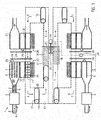
- FIG. 1 shows a schematic overview of a packaging machine according to the invention for packaging and high pressure treatment of products 2.
- the products 2 may be in particular food, their shelf life by the high pressure treatment is extended and / or their properties, such as the viscosity, specifically positively influenced.
- the packaging machine 1 comprises two packaging stations 3.
- the packaging stations 3 may be, for example, thermoforming packaging stations, (chamber) tape machines or so-called "tray sealer".
- the two packaging stations 3 may be the same or a different type.
- a conveyor belt 4 (or other suitable conveyor) receives the products 2, for example in already (pre-) formed lower shells of a package, and conveys the products 2 into the packaging station 3.
- a gas-tight closed package 5 is formed around each product. Before a package 5 is closed, it may be evacuated in the packaging station 3 and purged with a protective or replacement gas, for example nitrogen and / or CO 2 , which replaces the air in the package and prolongs the shelf life of the product 2.
- a protective or replacement gas for example nitrogen and / or CO 2
- the packaged products 2 move from the packaging station 3 to a storage area 7.
- the storage area 7 is large enough to accommodate a plurality of products 2 or packages 5.
- the supplied by means of the conveyor belt 6 products 2 or Ver-packs 5 come to rest.
- guide means 8 can be provided to align the packages 5 in a defined manner and to guide the packages 5 into different compartments of the storage area 7.
- the machine 1 has a multiplicity of transport containers 10.
- Each transport container 10 has a semi-cylindrical lower part 11 and a likewise semi-cylindrical upper part 12, which are connected via a hinge 13 pivotally one above the other.
- the two parts 11, 12 together to form a cylindrical transport container 10.
- the transport container 10 further has a holding element 14, which is connected via a further hinge with one of the two parts 11, 12, and which is formed in the embodiment as a securing grid.
- a holding element 14 may also be provided both on the lower part 11, and on the upper part 12. It serves to secure the products 2 or packagings 5 inserted in the two parts 11, 12 of the transport container 10 from slipping or displacement when the transport container 11 is opened or closed, z. B. when folding the two halves of the transport container 10th
- the transport containers 10 can each be conveyed along an annular closed transport path.
- the transport direction T is in FIG. 1 indicated by several arrows. Usually, the transport will be gradual or intermittent.
- the heart of the packaging machine 1 according to the invention is a high-pressure treatment station 17 designed as a double autoclave, which has two high-pressure chambers 18 which can be closed in a gas-tight manner.
- a high-pressure chamber 18 can accommodate one, two or three transport containers 10 at the same time, so that the products 2 received in the transport containers 10 can be exposed to the pressure of a high-pressure medium.
- a common pressure generator system 19 is provided by means of which the pressure of the high-pressure medium is generated and adjusted in both high-pressure chambers 18.
- the pressure generating system 19 has a plurality of low and high pressure pumps for the high pressure medium.
- a reservoir for the high pressure medium may be present.
- the high-pressure medium is selectively guided to the two high-pressure chambers 18.
- Corresponding switching means and valves in the pressure distribution system 20 provide for the regulation of the pressure at the two high pressure chambers 18.
- the pressure distribution system 20 is designed so that at the two high pressure chambers 18 different pressures can be applied simultaneously.
- the pressure generator system 19 also includes a device 21 for maintaining the high pressure in a high-pressure chamber 18.
- the device 21 may be a separate high-pressure pump 21, which is assigned to one of the two high-pressure chambers 18.
- the device 21 serves to pressure losses z. B. compensate for temperature fluctuations in one of the high-pressure chambers 18 during the holding time of the maximum pressure, while the pressure distribution system 20 simultaneously provides for the pressure build-up in the other high-pressure chamber 18.
- the open transport container 10 can be loaded with products 2.
- a gripper 24 is provided which by means of a gripping or suction device 25 can detect one or at the same time several packages 5 and can reload them from the storage area 7 into the open transport container 10.
- an unloading station 26 is provided on the downstream side of the autoclave 17 in the transport direction T, in which the opened transport containers 10 are unloaded.
- a gripper 24 is provided with a gripping or suction device 25 to remove the products 2 (not shown here) from the open transport container 10 and reload onto a discharge conveyor 27.
- means are provided (eg mechanical or pneumatic means) for closing or opening the transport containers 10 and possibly also the holding elements 14 outside the loading and unloading stations 23, 26.
- the means for automatically closing the transport container 10 could be provided, for example, at the point that the transport container 10 reaches a working stroke later than the loading station 23.
- the means for automatically opening the transport container 20 could be provided analogously at the point along the transport device 15, the transport container 10 reaches a working cycle before reaching the unloading station 23. If the opening and closing of the transport container 10 is not carried out at the loading and unloading station 23, 26 itself, if necessary, the cycle time of the packaging machine 1 can be shortened. If, however, sufficient time is available anyway, the closing or opening of the container can also take place at the loading station 23 or at the unloading station 26 itself.
- a central controller 28 is provided for controlling the packaging machine 1 or its components. Via data and control lines 29, the controller 28 is connected to the different components of the high-pressure treatment plant 1. In FIG. 1 It is indicated that the controller 28 is connected among other things to the packing stations 3, the pressure generator system 19, the pressure distribution system 20 and the grippers 24 at the loading and unloading station 23, 26. In addition, the controller 28 is also connected to the transport device 15 and further, in FIG. 1 not shown components of the packaging machine 1 connected. In particular, it may be connected to an operational data acquisition (BDE) system to monitor the operation of the packaging machine 1 and to ensure and control the quality of the high pressure treatment results.
- BDE operational data acquisition
- FIG. 2 shows an enlarged section of the packaging machine 1 from FIG. 1 in the area of the loading station 23.
- Enlarged shown here is in particular the area between the conveyor belt 6, which adjoins the packaging station 3, and the storage area 7.
- the packaged products 2 are initially transported in multiple lanes, since they are generated in the upstream packaging station 3 multi-lane.
- the packages 5 are transported in four adjacent tracks.
- a separating device 30, for example suitably shaped guide walls, provide for a reduction in the number of tracks, up to a separation of the packages 5.
- the packages 5 can be supplied individually to a test system 31.
- the test system 31 has suitable sensors to determine the weight of the packages 5, especially also empty packages, metal residues and / or other damages and defects on the product 2 or the packaging 5. In this way, defective or defective packaging 5 'can be detected and removed by means of sorting devices 32 from the processing process.
- the two arrows P indicate how the upper part 12 of the transport container 10 has been opened relative to the lower part 11 about the hinge 13, and how the holding element 14 has been opened relative to the upper part 12.
- FIG. 2 It can be seen that the packages 5 are stacked partially overlapping in the transport container 10.
- FIG. 3 schematically shows a modified form of the singulator 30, are brought in the two different conveyor belts 6 products 2 or 5 packages.
- Each of the conveyor belts 6 is assigned to a packaging station 3.
- the packing stations 3 may be of the same or different type.
- a controllable shut-off means 34 in this case a pivotable guide means, optionally releases the transport path from one of the two conveyor belts 6 to the separating device 30, so that the separated packages 5 can be fed to the testing system 31.
- the variant according to FIG. 3 It makes sense if the capacity of the packaging machine 1 is sufficient for processing additional products 2, or if different products 2 or packages 5 are to be produced on the packaging stations 3 upstream of the two conveyor belts 6.
- FIG. 4 shows an enlarged section of the high-pressure treatment station 17 of the packaging machine 1 according to the invention.
- the high-pressure station 17 On each of the two sides, the high-pressure station 17 has a box-shaped yoke into which a cylindrical autoclave 35 can be inserted laterally.
- Each of the two laterally movable in the direction of arrow S autoclave 35 is just big enough to accommodate two transport container 10 can.
- the autoclave 35 is displaced laterally in the direction of the arrow S and thus introduced into the yoke. Together with the yoke, which closes the autoclave 35 on both sides, the autoclave 35 now defines the high-pressure chamber 18.
- FIG. 4 already indicates that the two high pressure chambers 18 of the high pressure station 17 can be operated offset in time with each other even at the same cycle time. While the upper autoclave 35 is located outside the yoke to be loaded or unloaded, the lower autoclave 35 is in its associated yoke. As a result, the high pressure chamber 18 formed by the yoke and the lower autoclave 35 is closed, so that high pressure treatment of the products 2 can be performed in this high pressure chamber 18.
- the high-pressure chambers 18 are not offset laterally relative to the transport device 15, but directly in the conveying direction of the transport device 15.
- the cylindrical transport containers 10 could be moved straight into the likewise cylindrical high-pressure chamber 18 or removed from the high-pressure chamber 18 after the high-pressure treatment.
- FIG. 5 shows an enlarged section of the packaging machine 1 in the region of the unloading station 26.
- the transport container 10 are opened.
- the gripper 24 ensures by the indicated with the arrow G movement for the unloading of the transport container 10.
- the discharged packaging 5 are stored on a discharge conveyor 27.
- a separating device 30 ensures alignment and separation of the packages 5.
- a plurality of further processing stations are provided: a dryer 36 for drying the packages 5, ie for removing the high-pressure medium (usually water) still adhering to the packages 5, a labeling and labeling station 37, and a test system 31 with sorting facilities 32 to detect defective or defective products 2 or 5 packages and can sort out.
- a dryer 36 for drying the packages 5, ie for removing the high-pressure medium (usually water) still adhering to the packages 5, a labeling and labeling station 37, and a test system 31 with sorting facilities 32 to detect defective or defective products 2 or 5 packages and can sort out.
- the product 2 is placed on the first conveyor belt 4 in the lower part of a package 5, for example in a deep-drawn depression in a continuous film web, or in already isolated, preformed shells.
- the conveyor belt 4 transports the product 2 into the packaging station 3.
- the packaging 5 is evacuated and / or rinsed with a replacement gas before being gas-tightly sealed and sealed.
- the second conveyor belt 6 transports the finished packages 5 from the packaging station 3 to the singulator 30, at which a single track of packages 5 is produced. Separating and cutting devices may be present between the packaging station 3 and the separating device 30 in order to separate the possibly still interconnected packages 5 from each other.
- the packages 5 singulated by means of the singulator 30 reach the inspection system 31 in which different properties of the products 2 or their packages 5 are checked, for example weight, appearance, absence of product or presence of metal residues. Defective or defective packaging 5 'are recognized by the test system 31 and removed from the process via the sorting devices 32.
- the remaining packages 5 reach the storage area 7.
- the guide means 8 provide for alignment of the packages 5 and for distribution to the different compartments of the storage area 7.
- the aligned packages 5 are now detected by the gripper 24 and filled into an open transport container 10.
- the upper part 12 of the transport container 10 has been pivoted about the hinge 13 relative to the lower part 11, and the holding element 14 has also been pivoted in the direction P relative to the upper part 12.
- the storage area 7 continuously receives products and thus ensures that the power strokes of the high-pressure station 17 and the packaging stations 3 do not necessarily have to be exactly synchronized with one another. Even in the event of fluctuations in the productivity of the packaging stations 3, for example when converting or cleaning the packaging stations 3, sufficient products 2 can always be present in the storage area 7 in order to be able to feed the high-pressure station 17 "continuously".
- the retaining element 14 is pivoted back to close the upper part 12 in order to secure the packages 5 contained in the upper part 12 from slipping.
- the upper part 12 is pivoted about the hinge 13 on the lower part 11, whereby the transport container 10 is closed. In the closed, cylindrical shape of the transport container 10, the upper part 12 can be locked relative to the lower part 11.
- the transport device 15 conveys the sealed transport container 10, which is provided with openings for the passage of high-pressure medium, to the high-pressure station 17.
- One or more transport containers 10 are jointly introduced into the opened high-pressure chamber 18. This introduction can take place via a slide in the axial direction of the transport device 15.
- the high pressure chamber 18 After filling the high pressure chamber 18, the high pressure chamber 18 is flooded with high pressure medium (usually water at room temperature). It is conceivable for the high-pressure chamber 18 to be vented until it is completely filled with high-pressure medium. It is also possible that one or more plugs of the high pressure chamber 18 occupy a first closed position during flooding and are brought after flooding in a second, deeper closed position, so as to already generate a form in the high pressure medium.
- high pressure medium usually water at room temperature
- the pressure in the high-pressure chamber 18 is increased by means of the pressure generator system 19-typically to values between 400 MPa and 1000 MPa.
- the high-pressure medium penetrates through the openings in the transport container 10 and sets the packages 5 and the products 2 contained therein under high pressure.
- the maximum pressure of the high-pressure medium is maintained for a predetermined period of time before the pressure is released again.
- the packaging machine 1 is operated in cycles.
- the working cycle of all components of the packaging machine 1, in particular the conveyor belts 4, 6, the packaging stations 3, the gripper 24, the transport device 15 and the double autoclave 17 including the pressure generator system 19 are predetermined by the central controller 28.
- FIG. 6 schematically shows a section of the clocked operation of the two autoclaves or high-pressure chambers 18.
- the first autoclave works 18. Over a period of two minutes, the autoclave 18 is opened, unloaded, loaded again and closed. In the subsequent period of One minute, the first autoclave 18 is flooded with water and possibly deaerated. Thereafter, over a period of 3.5 minutes, the structure of the high pressure in the high-pressure chamber 18 by means of the pressure generator system 19. The maximum pressure is maintained for a further 2 minutes, possibly with the aid of the device 21 for maintaining the high pressure. At the end of this period of 2 minutes, the pressure in the high pressure chamber 18 is lowered back to normal pressure. Thus, the first power stroke of the first autoclave 18 is completed, and the second power stroke begins.
- the second autoclave 18 operates at the same timing, but offset in time to the first autoclave 18.
- the first power stroke of the second autoclave 18 begins after a waiting time of 3.5 minutes relative to the first autoclave 18. This ensures that the phase of the construction of the High pressure in the second autoclave 18 begins at the time when the first autoclave 18 has reached the maximum pressure. In this way, the pressure generating system 19 can virtually run in continuous operation.
- each high pressure chamber 18 may have an outlet valve for discharging high-pressure medium from the high-pressure chamber and a controllable actuator, by means of which the rate of pressure reduction in the high-pressure chamber can be regulated at least over a predetermined pressure range.
- the rate of pressure reduction could be infinitely variable, and the actuator could have a pressure booster and be controllable for example by means of compressed air. In this way it can be achieved that the pressure reduction is initially very fast, but is significantly slowed down in a predetermined pressure range, so as to avoid damage caused by a too rapid pressure reduction on the products 2 or their packaging 5.
- the transport containers 10 are again conveyed out of the high-pressure chamber 18 and brought to the unloading station 26 by means of the transport device 15. In this way, the transport container 10 can already be opened.
- a gripper 24 removes the packages 5 and sets them down on a discharge conveyor 27.
- the packages reach a dryer 36, which removes excess high-pressure medium.
- a labeller or printer 37 attaches labels and labels to the packages 5 before the packages 5 reach another inspection system 31 with sorting devices 32.
- packaging machine 1 is largely constructed (mirror) symmetrical.
- Each of the two high-pressure chambers 18 is associated with a packaging station 3 and a separate circuit of a transport device 15 with a group of transport containers 10. Only the control of the entire packaging machine 1 via the central controller 28, and the pressure generation in the two high-pressure chambers 18 via the common pressure generator system 19. It would be possible, however, that only a single, common cycle of a transport device 15 for the two chambers 18 transported transport container 10 would be provided.
- the packaging machine 1 according to the invention and the method according to the invention can be modified in many ways.
- more than two high pressure chambers 18 could be provided.
- the packaging machine 1 could also use integral transport containers 10. It would also be conceivable that only a single packaging station 3 is provided, and that the packaging 5 produced by it are distributed to the transport container 10 of the two high-pressure chambers 18.
- FIG. 6 shown periods of the individual process phases of the high-pressure chambers 18 are merely exemplary and can be set differently.
- the plurality of autoclaves 35 are not provided in a common housing or container 17, but in their own separate housings.
Landscapes
- Engineering & Computer Science (AREA)
- Life Sciences & Earth Sciences (AREA)
- Wood Science & Technology (AREA)
- Zoology (AREA)
- Chemical & Material Sciences (AREA)
- Food Science & Technology (AREA)
- Polymers & Plastics (AREA)
- Mechanical Engineering (AREA)
- Food Preservation Except Freezing, Refrigeration, And Drying (AREA)
- Auxiliary Devices For And Details Of Packaging Control (AREA)
Applications Claiming Priority (2)
| Application Number | Priority Date | Filing Date | Title |
|---|---|---|---|
| DE102009042083A DE102009042083B3 (de) | 2009-09-18 | 2009-09-18 | Maschine und Verfahren zum Verpacken und Hochdruckbehandeln von Produkten |
| EP10008108.2A EP2308759B1 (fr) | 2009-09-18 | 2010-08-03 | Machine et procédé d'emballage et de traitement à haute pression de produits |
Related Parent Applications (2)
| Application Number | Title | Priority Date | Filing Date |
|---|---|---|---|
| EP10008108.2A Division-Into EP2308759B1 (fr) | 2009-09-18 | 2010-08-03 | Machine et procédé d'emballage et de traitement à haute pression de produits |
| EP10008108.2A Division EP2308759B1 (fr) | 2009-09-18 | 2010-08-03 | Machine et procédé d'emballage et de traitement à haute pression de produits |
Publications (2)
| Publication Number | Publication Date |
|---|---|
| EP3088312A1 true EP3088312A1 (fr) | 2016-11-02 |
| EP3088312B1 EP3088312B1 (fr) | 2018-01-03 |
Family
ID=43627023
Family Applications (2)
| Application Number | Title | Priority Date | Filing Date |
|---|---|---|---|
| EP16170059.6A Not-in-force EP3088312B1 (fr) | 2009-09-18 | 2010-08-03 | Machine et procédé d'emballage et de traitement à haute pression de produits |
| EP10008108.2A Not-in-force EP2308759B1 (fr) | 2009-09-18 | 2010-08-03 | Machine et procédé d'emballage et de traitement à haute pression de produits |
Family Applications After (1)
| Application Number | Title | Priority Date | Filing Date |
|---|---|---|---|
| EP10008108.2A Not-in-force EP2308759B1 (fr) | 2009-09-18 | 2010-08-03 | Machine et procédé d'emballage et de traitement à haute pression de produits |
Country Status (4)
| Country | Link |
|---|---|
| US (1) | US8919080B2 (fr) |
| EP (2) | EP3088312B1 (fr) |
| DE (1) | DE102009042083B3 (fr) |
| ES (2) | ES2661947T3 (fr) |
Families Citing this family (12)
| Publication number | Priority date | Publication date | Assignee | Title |
|---|---|---|---|---|
| US9055755B2 (en) | 2011-08-09 | 2015-06-16 | Multivac Sepp Haggenmueller Gmbh & Co. Kg | Container for accommodating products during a high-pressure treatment |
| ES2489690T3 (es) * | 2011-08-09 | 2014-09-02 | Multivac Sepp Haggenmüller Gmbh & Co. Kg | Recipiente para la recepción de productos durante un tratamiento a alta presión |
| DE102014118876A1 (de) * | 2014-12-17 | 2016-06-23 | Thyssenkrupp Ag | Verfahren zur Hochdruckbehandlung eines Produkts |
| HK1257961A1 (zh) * | 2016-01-15 | 2019-11-01 | The Coca-Cola Company | 食品和饮料产品的连续高压处理 |
| US10406252B2 (en) | 2017-01-19 | 2019-09-10 | Curium Us Llc | Systems and methods for autoclave cart loading and unloading system |
| US20230002092A1 (en) * | 2017-02-16 | 2023-01-05 | Iowa Pacific Processors, Inc. | Protein preparation and packaging methods, systems and related devices |
| DE102017112137A1 (de) * | 2017-06-01 | 2018-12-06 | Weber Maschinenbau Gmbh Breidenbach | Verfahren zum Verarbeiten von Lebensmittelprodukten und Lebensmittelverarbeitungssystem mit Positionsnachverfolgung |
| WO2020142698A1 (fr) * | 2019-01-05 | 2020-07-09 | Foremost Technologies and Products, Inc. | Traitement par haute pression d'aliments et de compléments |
| US20220212821A1 (en) * | 2019-05-22 | 2022-07-07 | Iowa Pacific Processors, Inc. | Protein Preparation And Packaging Methods, Systems And Related Devices |
| AU2021286458A1 (en) * | 2020-06-09 | 2023-01-05 | Jbt Marel Corporation | High pressure processing for personal protective equipment and low moisture foods |
| CN113968394B (zh) * | 2021-11-18 | 2023-08-01 | 青岛日清食品机械有限公司 | 一种全自动食品杀菌流水线系统及使用方法 |
| US11926446B1 (en) * | 2023-06-16 | 2024-03-12 | Good Foods Group, Llc | System and method for formulating compounds into personal care products |
Citations (25)
| Publication number | Priority date | Publication date | Assignee | Title |
|---|---|---|---|---|
| DE2611389A1 (de) | 1975-03-20 | 1976-09-30 | Taiheiyo Kogyo Kk | Verfahren zum sterilisieren von lebensmitteln |
| EP0180540A1 (fr) * | 1984-10-12 | 1986-05-07 | Ingko GmbH Industrieanlagenbau | Appareil et procédé pour obtenir et commander les conditions aseptiques dans une installation de remplissage |
| DE4226255A1 (de) | 1992-08-08 | 1994-02-10 | Apv Gaulin Gmbh | Verfahren zur hydrostatischen Hochdruckbehandlung eines Stoffes |
| EP0588010A1 (fr) | 1992-07-21 | 1994-03-23 | Tetra Laval Holdings & Finance SA | Procédé de traitement, à haute pression, de produits alimentaires pour accroître la durée de conservation de ces produits |
| DE3734025C2 (de) | 1987-10-08 | 1994-11-17 | Juchem Franz Gmbh & Co Kg | Verfahren zur Entkeimung wasserhaltiger Lebensmittel |
| EP0687421A1 (fr) | 1994-06-17 | 1995-12-20 | Uhde GmbH | Dispositif pour la production de haute pression pour stériliser |
| US5593714A (en) * | 1994-12-06 | 1997-01-14 | Hirsch; Gerald P. | Method of pressure preservation of food products |
| DE19653677C1 (de) | 1996-12-16 | 1997-09-18 | Fritz Kortschack | Verfahren zur Herstellung stabiler, in Anwesenheit von Mikroorganismen hergestellter Fleisch- und Wurstwaren, die einer Reifung und Trocknung unterworfen werden |
| DE19649952A1 (de) | 1996-12-03 | 1998-06-04 | Uhde Hochdrucktechnik Gmbh | Verfahren zur Konservierung von festen, flüssigen oder pastösen verderblichen Produkten |
| DE19738800A1 (de) | 1997-09-06 | 1999-03-11 | Rudi F Prof Dr Vogel | Verfahren zur Inaktivierung von sporenbildenden Mikroorganismen durch wiederholte Hochdruckanwendung ("Hochdruck-Tyndallisierung") |
| EP0689391B1 (fr) | 1993-03-25 | 1999-07-21 | Asea Brown Boveri Ab | Procede et dispositif de traitement sous haute pression de substances liquides |
| WO1999038394A2 (fr) * | 1998-01-30 | 1999-08-05 | Flow International Corporation | Procede d'inactivation sous ultra haute pression des micro-organismes dans les jus |
| DE19801031C2 (de) | 1998-01-07 | 2000-06-15 | Fritz Kortschack | Verfahren zur Erhöhung der Lebensmittelsicherheit von Naturdärmen, die als Wursthüllen vorgesehen sind |
| DE19939677A1 (de) | 1999-08-20 | 2001-02-22 | Ludwig Horst | Verfahren zur Inaktivierung von zellwandlosen Bakterien, insbesondere der Mykoplasmen durch Anwendung hohen hydrostatischen Drucks |
| EP0748592B1 (fr) | 1995-06-16 | 2001-08-16 | Societe Des Produits Nestle S.A. | Pâté de viande à basse teneur en graisse |
| EP0683986B1 (fr) | 1994-05-27 | 2001-08-22 | Societe Des Produits Nestle S.A. | Fabrication de jambon cuit |
| EP0752211B1 (fr) | 1995-07-07 | 2001-10-17 | Societe Des Produits Nestle S.A. | Gel de protéines de lactoserum et polysaccharide obtenu par traitement haute pressions |
| EP1112008B1 (fr) | 1998-09-17 | 2002-05-15 | Richard S. Meyer | Procede de conservation de produits alimentaires sous haute temperature et sous ultra-haute pression |
| DE10101958A1 (de) | 2001-01-08 | 2002-07-11 | Fritz Kortschack | Verfahren zum Behandeln von Rohbrät |
| EP1201252B1 (fr) | 2000-10-25 | 2004-04-07 | Andreas März | Procédé d'inactivation des micro-organismes utilisant un traitment sous haute pression |
| EP1100340B1 (fr) | 1998-07-24 | 2004-09-29 | Ernest A. Voisin | Processus pour eliminer les bacteries dans des crustaces et coquillages et pour decortiquer des crustaces et coquillages, et appareil utilise a ces fins |
| DE102005011868A1 (de) | 2005-03-15 | 2006-09-21 | Fritz Kortschack | Verfahren zur Behandlung von Lebensmitteln, insbesondere zum Haltbarmachen von frischen Wurst- oder Fleischwaren |
| US20060257552A1 (en) * | 2005-05-16 | 2006-11-16 | Hormel Foods, Llc | Method and apparatus for material handling for a food product using high pressure pasteurization |
| WO2006129180A1 (fr) | 2005-06-03 | 2006-12-07 | Avure Technologies Inc. | Systemes et procedes destines a reduire la pression dans une chambre de pression |
| WO2007128281A1 (fr) * | 2006-05-05 | 2007-11-15 | Multivac Sepp Haggenmüller Gmbh & Co. Kg | Machine d'emballage, comprenant en particulier une thermoformeuse |
Family Cites Families (30)
| Publication number | Priority date | Publication date | Assignee | Title |
|---|---|---|---|---|
| DE7023578U (de) | 1971-11-18 | Huyck Corp | Eine Innenkammer festlegender Material-Behälter | |
| DE196536C (fr) | ||||
| DE822193C (de) | 1950-02-17 | 1951-11-22 | Erich Niecznik | Behaelter fuer verschiedene Inhalte |
| AT365150B (de) | 1979-02-01 | 1981-12-10 | Schoeller Lebensmittel | Verfahren zum abfuellen von cremigem speiseeis sowie vorrichtung und verpackung zur durchfuehrung des verfahrens |
| DE2917360A1 (de) | 1979-04-28 | 1980-11-06 | Haarmann & Reimer Gmbh | Ester des isocamphyl-guajakols, verfahren zu ihrer herstellung und ihre verwendung zur herstellung von 3- eckige klammer auf isocaamphyl-(5) eckige klammer zu -cyclohexanol |
| DE3625081A1 (de) * | 1986-07-24 | 1988-02-04 | Lieder Maschinenbau Gmbh & Co | Verfahren und vorrichtung zur konservierung von in einem behaelter eingeschlossener ware |
| US5059392A (en) * | 1989-04-24 | 1991-10-22 | Fmc Corporation | Batch sterilizing system |
| US5288462A (en) * | 1992-05-18 | 1994-02-22 | Stephen D. Carter | Sterilization apparatus and method |
| US5316745A (en) * | 1993-01-28 | 1994-05-31 | Flow International Corporation | High pressure sterilization apparatus and method |
| US5436432A (en) * | 1993-10-14 | 1995-07-25 | Cyr; Samuel A. | Microwave autoclave apparatus |
| DE19635598A1 (de) * | 1996-09-02 | 1998-03-05 | Focke & Co | Anlage zum Handhaben von insbesondere Zigaretten |
| IT1286223B1 (it) * | 1996-09-18 | 1998-07-08 | Awax Progettazione | Apparato per il confezionamento di prodotti in atmosfera modificata e controllata, con film estensibile ed impermeabile al gas |
| DE19952611A1 (de) | 1999-11-02 | 2001-05-23 | Eberhard Haack | Hochdruckbehälter und Verfahren zu seiner Herstellung |
| US7707807B2 (en) * | 2004-03-08 | 2010-05-04 | Medical Instill Technologies, Inc. | Apparatus for molding and assembling containers with stoppers and filling same |
| ES2170011B9 (es) * | 2000-10-06 | 2020-06-25 | Hiperbaric S A | Maquina para tratamiento de productos por alta presion. |
| US20040033296A1 (en) * | 2002-05-14 | 2004-02-19 | Yuan James T. C. | Method of using low temperature and high/low pressure processing to preserve food products |
| SE525457C2 (sv) | 2002-06-24 | 2005-02-22 | Flow Holdings Sagl | Förfarande för åstadkommande av en tryckändring mellan två trycktillstånd, högtryckspressanordning samt användning av förfarande eller högtryckspressanordning |
| NZ521836A (en) * | 2002-10-08 | 2005-07-29 | New Zealand Dairy Board | High pressure treatment to reduce microbial spoilage in cultured dairy foods, cooked meats, vegetables and the like |
| SE525002C2 (sv) * | 2003-03-21 | 2004-11-09 | Flow Holdings Sagl | Isostatpress för högtrycksbehandling samt förfarande, behållare, anläggning och användning |
| US20060257522A1 (en) * | 2003-06-16 | 2006-11-16 | Dsm Ip Assets B.V. | Pet food composition |
| US20060024414A1 (en) * | 2004-07-30 | 2006-02-02 | Kraft Foods Holdings, Inc. | Methods for preserving food products |
| GB2417230B (en) * | 2004-08-20 | 2008-01-09 | Mars Inc | Manufacture of packaged stabilized foodstuffs |
| US7331161B2 (en) * | 2004-11-05 | 2008-02-19 | Cp Packaging, Inc. | Combination vacuum manifold and support beam for a vacuum packaging system |
| JP4684026B2 (ja) * | 2005-07-04 | 2011-05-18 | 越後製菓株式会社 | 食品加熱処理方法並びに食品加熱処理装置 |
| NZ543085A (en) | 2005-10-20 | 2008-03-28 | Mercer Technologies Ltd | Method and apparatus for sterilization and vacuum packing in a hospital, laboratory or food processing environment |
| US20070237865A1 (en) * | 2006-04-05 | 2007-10-11 | Robert Love | Method for manufacturing high pressure processed food products |
| DE102007013698A1 (de) * | 2006-12-22 | 2008-06-26 | Multivac Sepp Haggenmüller Gmbh & Co. Kg | Verpackungsmaschine |
| JP4981486B2 (ja) * | 2007-03-05 | 2012-07-18 | 株式会社神戸製鋼所 | 食品類の高圧処理用パッケージ及び食品類の高圧処理方法 |
| DE102007015754B3 (de) * | 2007-03-30 | 2008-05-29 | Khs Ag | Anlage sowie Verfahren zum sterilen Verpacken von Produkten |
| US20110027438A1 (en) * | 2009-07-29 | 2011-02-03 | Finkowski James W | Hffs packaging method and apparatus for refrigerated dough |
-
2009
- 2009-09-18 DE DE102009042083A patent/DE102009042083B3/de not_active Expired - Fee Related
-
2010
- 2010-08-03 ES ES16170059.6T patent/ES2661947T3/es active Active
- 2010-08-03 ES ES10008108.2T patent/ES2599969T3/es active Active
- 2010-08-03 EP EP16170059.6A patent/EP3088312B1/fr not_active Not-in-force
- 2010-08-03 EP EP10008108.2A patent/EP2308759B1/fr not_active Not-in-force
- 2010-09-17 US US12/884,812 patent/US8919080B2/en not_active Expired - Fee Related
Patent Citations (26)
| Publication number | Priority date | Publication date | Assignee | Title |
|---|---|---|---|---|
| DE2611389A1 (de) | 1975-03-20 | 1976-09-30 | Taiheiyo Kogyo Kk | Verfahren zum sterilisieren von lebensmitteln |
| EP0180540A1 (fr) * | 1984-10-12 | 1986-05-07 | Ingko GmbH Industrieanlagenbau | Appareil et procédé pour obtenir et commander les conditions aseptiques dans une installation de remplissage |
| DE3734025C2 (de) | 1987-10-08 | 1994-11-17 | Juchem Franz Gmbh & Co Kg | Verfahren zur Entkeimung wasserhaltiger Lebensmittel |
| EP0588010A1 (fr) | 1992-07-21 | 1994-03-23 | Tetra Laval Holdings & Finance SA | Procédé de traitement, à haute pression, de produits alimentaires pour accroître la durée de conservation de ces produits |
| DE4226255A1 (de) | 1992-08-08 | 1994-02-10 | Apv Gaulin Gmbh | Verfahren zur hydrostatischen Hochdruckbehandlung eines Stoffes |
| EP0689391B1 (fr) | 1993-03-25 | 1999-07-21 | Asea Brown Boveri Ab | Procede et dispositif de traitement sous haute pression de substances liquides |
| EP0683986B1 (fr) | 1994-05-27 | 2001-08-22 | Societe Des Produits Nestle S.A. | Fabrication de jambon cuit |
| EP0687421A1 (fr) | 1994-06-17 | 1995-12-20 | Uhde GmbH | Dispositif pour la production de haute pression pour stériliser |
| US5593714A (en) * | 1994-12-06 | 1997-01-14 | Hirsch; Gerald P. | Method of pressure preservation of food products |
| EP0748592B1 (fr) | 1995-06-16 | 2001-08-16 | Societe Des Produits Nestle S.A. | Pâté de viande à basse teneur en graisse |
| EP0752211B1 (fr) | 1995-07-07 | 2001-10-17 | Societe Des Produits Nestle S.A. | Gel de protéines de lactoserum et polysaccharide obtenu par traitement haute pressions |
| DE19649952A1 (de) | 1996-12-03 | 1998-06-04 | Uhde Hochdrucktechnik Gmbh | Verfahren zur Konservierung von festen, flüssigen oder pastösen verderblichen Produkten |
| DE19653677C1 (de) | 1996-12-16 | 1997-09-18 | Fritz Kortschack | Verfahren zur Herstellung stabiler, in Anwesenheit von Mikroorganismen hergestellter Fleisch- und Wurstwaren, die einer Reifung und Trocknung unterworfen werden |
| DE19738800A1 (de) | 1997-09-06 | 1999-03-11 | Rudi F Prof Dr Vogel | Verfahren zur Inaktivierung von sporenbildenden Mikroorganismen durch wiederholte Hochdruckanwendung ("Hochdruck-Tyndallisierung") |
| DE19801031C2 (de) | 1998-01-07 | 2000-06-15 | Fritz Kortschack | Verfahren zur Erhöhung der Lebensmittelsicherheit von Naturdärmen, die als Wursthüllen vorgesehen sind |
| WO1999038394A2 (fr) * | 1998-01-30 | 1999-08-05 | Flow International Corporation | Procede d'inactivation sous ultra haute pression des micro-organismes dans les jus |
| EP1100340B1 (fr) | 1998-07-24 | 2004-09-29 | Ernest A. Voisin | Processus pour eliminer les bacteries dans des crustaces et coquillages et pour decortiquer des crustaces et coquillages, et appareil utilise a ces fins |
| EP1112008B1 (fr) | 1998-09-17 | 2002-05-15 | Richard S. Meyer | Procede de conservation de produits alimentaires sous haute temperature et sous ultra-haute pression |
| DE19939677A1 (de) | 1999-08-20 | 2001-02-22 | Ludwig Horst | Verfahren zur Inaktivierung von zellwandlosen Bakterien, insbesondere der Mykoplasmen durch Anwendung hohen hydrostatischen Drucks |
| EP1201252B1 (fr) | 2000-10-25 | 2004-04-07 | Andreas März | Procédé d'inactivation des micro-organismes utilisant un traitment sous haute pression |
| DE10101958A1 (de) | 2001-01-08 | 2002-07-11 | Fritz Kortschack | Verfahren zum Behandeln von Rohbrät |
| DE102005011868A1 (de) | 2005-03-15 | 2006-09-21 | Fritz Kortschack | Verfahren zur Behandlung von Lebensmitteln, insbesondere zum Haltbarmachen von frischen Wurst- oder Fleischwaren |
| WO2006097248A1 (fr) | 2005-03-15 | 2006-09-21 | Fritz Kortschack | Procede pour le traitement de produits alimentaires, notamment pour la conservation de charcuterie ou de viande fraiche |
| US20060257552A1 (en) * | 2005-05-16 | 2006-11-16 | Hormel Foods, Llc | Method and apparatus for material handling for a food product using high pressure pasteurization |
| WO2006129180A1 (fr) | 2005-06-03 | 2006-12-07 | Avure Technologies Inc. | Systemes et procedes destines a reduire la pression dans une chambre de pression |
| WO2007128281A1 (fr) * | 2006-05-05 | 2007-11-15 | Multivac Sepp Haggenmüller Gmbh & Co. Kg | Machine d'emballage, comprenant en particulier une thermoformeuse |
Also Published As
| Publication number | Publication date |
|---|---|
| EP2308759B1 (fr) | 2016-10-12 |
| US8919080B2 (en) | 2014-12-30 |
| EP2308759A2 (fr) | 2011-04-13 |
| EP3088312B1 (fr) | 2018-01-03 |
| ES2599969T3 (es) | 2017-02-06 |
| DE102009042083B3 (de) | 2011-04-21 |
| EP2308759A3 (fr) | 2013-01-02 |
| US20110067355A1 (en) | 2011-03-24 |
| ES2661947T3 (es) | 2018-04-04 |
Similar Documents
| Publication | Publication Date | Title |
|---|---|---|
| EP3088312B1 (fr) | Machine et procédé d'emballage et de traitement à haute pression de produits | |
| DE69208495T2 (de) | Verfahren zum Pasteurisieren, Sterilisieren und zur aseptischen Verpackung von Fleischprodukten und Vorrichtung dafür | |
| DE102010022132B4 (de) | Vorrichtung zum Umformen von Kunststoffvorformlingen zu Kunststoffbehältnissen und zum Zuführen eines Sterilisationsmediums sowie ein Verfahren zum Betreiben der Vorrichtung | |
| EP2132096B1 (fr) | Installation et procede d'emballage sterile de produits | |
| EP2308325B2 (fr) | Dispositif et procédé destinés au traitement à haute pression de produits | |
| DE60309649T2 (de) | Mehrstufige Einheit zum Bearbeiten einer Verpackungsmaterialbahn in einer Verpackungsmaschine zum Pasteurisieren von Nahrungsmitteln | |
| DE602004007195T2 (de) | Verfahren zur Pasteurisation von Oberflächen | |
| DE1915080A1 (de) | Verfahren und Vorrichtung zum UEberwachen von Mikroorganismen oder Enzymen | |
| EP3231520A1 (fr) | Dispositif de l'emboutillage des aliments liquides | |
| DE102008032635A1 (de) | Blasmaschine und Verfahren zur mikrobioloisch optimierten Herstellung von Kunststoffbehältern | |
| DE19805773C2 (de) | Verfahren und Vorrichtung zum Entkeimen von Einzelportionen | |
| EP2382878B1 (fr) | Conteneur de transport | |
| EP1439762B1 (fr) | Procede pour steriliser des produits | |
| EP0271915B1 (fr) | Procédé et dispositif de stérilisation de produits alimentaires en morceaux | |
| DE69605360T2 (de) | Verfahren und Anlage zum aseptischen Verpacken von frischen Nahrungsmitteln in nachgiebigen oder steifen Verpackungen | |
| DE10028183C1 (de) | Verfahren und Vorrichtung zum kontinuierlichen Sterilisieren eines stückigen Gemüse- bzw. Fruchtproduktes | |
| WO2001003519A1 (fr) | Procede et dispositif pour traiter de la viande, du poisson ou des fruits, des legumes et des produits similaires a traiter | |
| EP1042965B1 (fr) | Procédé et dispositif pour le traitement des produits alimentaires | |
| DE102005061247A1 (de) | Verfahren und Vorrichtung zum Entkeimen von Lebensmitteln | |
| EP0891714A2 (fr) | Procédé et appareil de stérilisation de portions unitaires | |
| EP4653385A1 (fr) | Installation de traitement de boîtes et procédé de traitement de boîtes | |
| WO2025233251A1 (fr) | Dispositif et procédé de refroidissement sous vide de produits | |
| EP4553036A1 (fr) | Procédé et installation pour le traitement de boîtes | |
| DE102024114204A1 (de) | Dosenbehandlungsanlage, Dosenbehandlungsverfahren und Getränkedose | |
| EP3070047A1 (fr) | Procede et dispositif de fourniture d'un gaz inerte dans une installation de remplissage de boissons |
Legal Events
| Date | Code | Title | Description |
|---|---|---|---|
| PUAI | Public reference made under article 153(3) epc to a published international application that has entered the european phase |
Free format text: ORIGINAL CODE: 0009012 |
|
| AC | Divisional application: reference to earlier application |
Ref document number: 2308759 Country of ref document: EP Kind code of ref document: P |
|
| AK | Designated contracting states |
Kind code of ref document: A1 Designated state(s): AL AT BE BG CH CY CZ DE DK EE ES FI FR GB GR HR HU IE IS IT LI LT LU LV MC MK MT NL NO PL PT RO SE SI SK SM TR |
|
| 17P | Request for examination filed |
Effective date: 20170404 |
|
| RBV | Designated contracting states (corrected) |
Designated state(s): AL AT BE BG CH CY CZ DE DK EE ES FI FR GB GR HR HU IE IS IT LI LT LU LV MC MK MT NL NO PL PT RO SE SI SK SM TR |
|
| GRAP | Despatch of communication of intention to grant a patent |
Free format text: ORIGINAL CODE: EPIDOSNIGR1 |
|
| INTG | Intention to grant announced |
Effective date: 20170731 |
|
| RIN1 | Information on inventor provided before grant (corrected) |
Inventor name: RICHTER, TOBIAS |
|
| GRAS | Grant fee paid |
Free format text: ORIGINAL CODE: EPIDOSNIGR3 |
|
| GRAA | (expected) grant |
Free format text: ORIGINAL CODE: 0009210 |
|
| AC | Divisional application: reference to earlier application |
Ref document number: 2308759 Country of ref document: EP Kind code of ref document: P |
|
| AK | Designated contracting states |
Kind code of ref document: B1 Designated state(s): AL AT BE BG CH CY CZ DE DK EE ES FI FR GB GR HR HU IE IS IT LI LT LU LV MC MK MT NL NO PL PT RO SE SI SK SM TR |
|
| REG | Reference to a national code |
Ref country code: GB Ref legal event code: FG4D Free format text: NOT ENGLISH |
|
| REG | Reference to a national code |
Ref country code: CH Ref legal event code: EP Ref country code: AT Ref legal event code: REF Ref document number: 960012 Country of ref document: AT Kind code of ref document: T Effective date: 20180115 |
|
| REG | Reference to a national code |
Ref country code: IE Ref legal event code: FG4D Free format text: LANGUAGE OF EP DOCUMENT: GERMAN |
|
| REG | Reference to a national code |
Ref country code: DE Ref legal event code: R096 Ref document number: 502010014543 Country of ref document: DE |
|
| REG | Reference to a national code |
Ref country code: ES Ref legal event code: FG2A Ref document number: 2661947 Country of ref document: ES Kind code of ref document: T3 Effective date: 20180404 |
|
| REG | Reference to a national code |
Ref country code: NL Ref legal event code: MP Effective date: 20180103 |
|
| REG | Reference to a national code |
Ref country code: LT Ref legal event code: MG4D |
|
| PG25 | Lapsed in a contracting state [announced via postgrant information from national office to epo] |
Ref country code: NL Free format text: LAPSE BECAUSE OF FAILURE TO SUBMIT A TRANSLATION OF THE DESCRIPTION OR TO PAY THE FEE WITHIN THE PRESCRIBED TIME-LIMIT Effective date: 20180103 |
|
| PG25 | Lapsed in a contracting state [announced via postgrant information from national office to epo] |
Ref country code: FI Free format text: LAPSE BECAUSE OF FAILURE TO SUBMIT A TRANSLATION OF THE DESCRIPTION OR TO PAY THE FEE WITHIN THE PRESCRIBED TIME-LIMIT Effective date: 20180103 Ref country code: NO Free format text: LAPSE BECAUSE OF FAILURE TO SUBMIT A TRANSLATION OF THE DESCRIPTION OR TO PAY THE FEE WITHIN THE PRESCRIBED TIME-LIMIT Effective date: 20180403 Ref country code: HR Free format text: LAPSE BECAUSE OF FAILURE TO SUBMIT A TRANSLATION OF THE DESCRIPTION OR TO PAY THE FEE WITHIN THE PRESCRIBED TIME-LIMIT Effective date: 20180103 Ref country code: LT Free format text: LAPSE BECAUSE OF FAILURE TO SUBMIT A TRANSLATION OF THE DESCRIPTION OR TO PAY THE FEE WITHIN THE PRESCRIBED TIME-LIMIT Effective date: 20180103 Ref country code: CY Free format text: LAPSE BECAUSE OF FAILURE TO SUBMIT A TRANSLATION OF THE DESCRIPTION OR TO PAY THE FEE WITHIN THE PRESCRIBED TIME-LIMIT Effective date: 20180103 |
|
| PG25 | Lapsed in a contracting state [announced via postgrant information from national office to epo] |
Ref country code: IS Free format text: LAPSE BECAUSE OF FAILURE TO SUBMIT A TRANSLATION OF THE DESCRIPTION OR TO PAY THE FEE WITHIN THE PRESCRIBED TIME-LIMIT Effective date: 20180503 Ref country code: BG Free format text: LAPSE BECAUSE OF FAILURE TO SUBMIT A TRANSLATION OF THE DESCRIPTION OR TO PAY THE FEE WITHIN THE PRESCRIBED TIME-LIMIT Effective date: 20180403 Ref country code: GR Free format text: LAPSE BECAUSE OF FAILURE TO SUBMIT A TRANSLATION OF THE DESCRIPTION OR TO PAY THE FEE WITHIN THE PRESCRIBED TIME-LIMIT Effective date: 20180404 Ref country code: SE Free format text: LAPSE BECAUSE OF FAILURE TO SUBMIT A TRANSLATION OF THE DESCRIPTION OR TO PAY THE FEE WITHIN THE PRESCRIBED TIME-LIMIT Effective date: 20180103 Ref country code: LV Free format text: LAPSE BECAUSE OF FAILURE TO SUBMIT A TRANSLATION OF THE DESCRIPTION OR TO PAY THE FEE WITHIN THE PRESCRIBED TIME-LIMIT Effective date: 20180103 Ref country code: PL Free format text: LAPSE BECAUSE OF FAILURE TO SUBMIT A TRANSLATION OF THE DESCRIPTION OR TO PAY THE FEE WITHIN THE PRESCRIBED TIME-LIMIT Effective date: 20180103 |
|
| PG25 | Lapsed in a contracting state [announced via postgrant information from national office to epo] |
Ref country code: MT Free format text: LAPSE BECAUSE OF FAILURE TO SUBMIT A TRANSLATION OF THE DESCRIPTION OR TO PAY THE FEE WITHIN THE PRESCRIBED TIME-LIMIT Effective date: 20180103 |
|
| REG | Reference to a national code |
Ref country code: DE Ref legal event code: R097 Ref document number: 502010014543 Country of ref document: DE |
|
| PG25 | Lapsed in a contracting state [announced via postgrant information from national office to epo] |
Ref country code: EE Free format text: LAPSE BECAUSE OF FAILURE TO SUBMIT A TRANSLATION OF THE DESCRIPTION OR TO PAY THE FEE WITHIN THE PRESCRIBED TIME-LIMIT Effective date: 20180103 Ref country code: IT Free format text: LAPSE BECAUSE OF FAILURE TO SUBMIT A TRANSLATION OF THE DESCRIPTION OR TO PAY THE FEE WITHIN THE PRESCRIBED TIME-LIMIT Effective date: 20180103 Ref country code: AL Free format text: LAPSE BECAUSE OF FAILURE TO SUBMIT A TRANSLATION OF THE DESCRIPTION OR TO PAY THE FEE WITHIN THE PRESCRIBED TIME-LIMIT Effective date: 20180103 |
|
| PLBE | No opposition filed within time limit |
Free format text: ORIGINAL CODE: 0009261 |
|
| STAA | Information on the status of an ep patent application or granted ep patent |
Free format text: STATUS: NO OPPOSITION FILED WITHIN TIME LIMIT |
|
| PG25 | Lapsed in a contracting state [announced via postgrant information from national office to epo] |
Ref country code: SK Free format text: LAPSE BECAUSE OF FAILURE TO SUBMIT A TRANSLATION OF THE DESCRIPTION OR TO PAY THE FEE WITHIN THE PRESCRIBED TIME-LIMIT Effective date: 20180103 Ref country code: CZ Free format text: LAPSE BECAUSE OF FAILURE TO SUBMIT A TRANSLATION OF THE DESCRIPTION OR TO PAY THE FEE WITHIN THE PRESCRIBED TIME-LIMIT Effective date: 20180103 Ref country code: DK Free format text: LAPSE BECAUSE OF FAILURE TO SUBMIT A TRANSLATION OF THE DESCRIPTION OR TO PAY THE FEE WITHIN THE PRESCRIBED TIME-LIMIT Effective date: 20180103 Ref country code: SM Free format text: LAPSE BECAUSE OF FAILURE TO SUBMIT A TRANSLATION OF THE DESCRIPTION OR TO PAY THE FEE WITHIN THE PRESCRIBED TIME-LIMIT Effective date: 20180103 |
|
| 26N | No opposition filed |
Effective date: 20181005 |
|
| PG25 | Lapsed in a contracting state [announced via postgrant information from national office to epo] |
Ref country code: SI Free format text: LAPSE BECAUSE OF FAILURE TO SUBMIT A TRANSLATION OF THE DESCRIPTION OR TO PAY THE FEE WITHIN THE PRESCRIBED TIME-LIMIT Effective date: 20180103 |
|
| PG25 | Lapsed in a contracting state [announced via postgrant information from national office to epo] |
Ref country code: MC Free format text: LAPSE BECAUSE OF FAILURE TO SUBMIT A TRANSLATION OF THE DESCRIPTION OR TO PAY THE FEE WITHIN THE PRESCRIBED TIME-LIMIT Effective date: 20180103 |
|
| REG | Reference to a national code |
Ref country code: CH Ref legal event code: PL |
|
| GBPC | Gb: european patent ceased through non-payment of renewal fee |
Effective date: 20180803 |
|
| PG25 | Lapsed in a contracting state [announced via postgrant information from national office to epo] |
Ref country code: LU Free format text: LAPSE BECAUSE OF NON-PAYMENT OF DUE FEES Effective date: 20180803 Ref country code: CH Free format text: LAPSE BECAUSE OF NON-PAYMENT OF DUE FEES Effective date: 20180831 Ref country code: LI Free format text: LAPSE BECAUSE OF NON-PAYMENT OF DUE FEES Effective date: 20180831 |
|
| REG | Reference to a national code |
Ref country code: BE Ref legal event code: MM Effective date: 20180831 |
|
| REG | Reference to a national code |
Ref country code: IE Ref legal event code: MM4A |
|
| PG25 | Lapsed in a contracting state [announced via postgrant information from national office to epo] |
Ref country code: IE Free format text: LAPSE BECAUSE OF NON-PAYMENT OF DUE FEES Effective date: 20180803 |
|
| PG25 | Lapsed in a contracting state [announced via postgrant information from national office to epo] |
Ref country code: BE Free format text: LAPSE BECAUSE OF NON-PAYMENT OF DUE FEES Effective date: 20180831 Ref country code: FR Free format text: LAPSE BECAUSE OF NON-PAYMENT OF DUE FEES Effective date: 20180831 |
|
| REG | Reference to a national code |
Ref country code: AT Ref legal event code: MM01 Ref document number: 960012 Country of ref document: AT Kind code of ref document: T Effective date: 20180803 |
|
| PG25 | Lapsed in a contracting state [announced via postgrant information from national office to epo] |
Ref country code: GB Free format text: LAPSE BECAUSE OF NON-PAYMENT OF DUE FEES Effective date: 20180803 |
|
| PGFP | Annual fee paid to national office [announced via postgrant information from national office to epo] |
Ref country code: ES Payment date: 20190919 Year of fee payment: 10 Ref country code: DE Payment date: 20190822 Year of fee payment: 10 |
|
| PG25 | Lapsed in a contracting state [announced via postgrant information from national office to epo] |
Ref country code: AT Free format text: LAPSE BECAUSE OF NON-PAYMENT OF DUE FEES Effective date: 20180803 |
|
| PG25 | Lapsed in a contracting state [announced via postgrant information from national office to epo] |
Ref country code: TR Free format text: LAPSE BECAUSE OF FAILURE TO SUBMIT A TRANSLATION OF THE DESCRIPTION OR TO PAY THE FEE WITHIN THE PRESCRIBED TIME-LIMIT Effective date: 20180103 |
|
| PG25 | Lapsed in a contracting state [announced via postgrant information from national office to epo] |
Ref country code: PT Free format text: LAPSE BECAUSE OF FAILURE TO SUBMIT A TRANSLATION OF THE DESCRIPTION OR TO PAY THE FEE WITHIN THE PRESCRIBED TIME-LIMIT Effective date: 20180103 |
|
| PG25 | Lapsed in a contracting state [announced via postgrant information from national office to epo] |
Ref country code: HU Free format text: LAPSE BECAUSE OF FAILURE TO SUBMIT A TRANSLATION OF THE DESCRIPTION OR TO PAY THE FEE WITHIN THE PRESCRIBED TIME-LIMIT; INVALID AB INITIO Effective date: 20100803 Ref country code: MK Free format text: LAPSE BECAUSE OF NON-PAYMENT OF DUE FEES Effective date: 20180103 Ref country code: RO Free format text: LAPSE BECAUSE OF FAILURE TO SUBMIT A TRANSLATION OF THE DESCRIPTION OR TO PAY THE FEE WITHIN THE PRESCRIBED TIME-LIMIT Effective date: 20180103 |
|
| REG | Reference to a national code |
Ref country code: DE Ref legal event code: R119 Ref document number: 502010014543 Country of ref document: DE |
|
| PG25 | Lapsed in a contracting state [announced via postgrant information from national office to epo] |
Ref country code: DE Free format text: LAPSE BECAUSE OF NON-PAYMENT OF DUE FEES Effective date: 20210302 |
|
| REG | Reference to a national code |
Ref country code: ES Ref legal event code: FD2A Effective date: 20220110 |
|
| PG25 | Lapsed in a contracting state [announced via postgrant information from national office to epo] |
Ref country code: ES Free format text: LAPSE BECAUSE OF NON-PAYMENT OF DUE FEES Effective date: 20200804 |