EP3098676A1 - Procede de substitution d'outil - Google Patents
Procede de substitution d'outil Download PDFInfo
- Publication number
- EP3098676A1 EP3098676A1 EP16171658.4A EP16171658A EP3098676A1 EP 3098676 A1 EP3098676 A1 EP 3098676A1 EP 16171658 A EP16171658 A EP 16171658A EP 3098676 A1 EP3098676 A1 EP 3098676A1
- Authority
- EP
- European Patent Office
- Prior art keywords
- tool
- tools
- machining
- processing
- machine tool
- Prior art date
- Legal status (The legal status is an assumption and is not a legal conclusion. Google has not performed a legal analysis and makes no representation as to the accuracy of the status listed.)
- Withdrawn
Links
Images
Classifications
-
- G—PHYSICS
- G05—CONTROLLING; REGULATING
- G05B—CONTROL OR REGULATING SYSTEMS IN GENERAL; FUNCTIONAL ELEMENTS OF SUCH SYSTEMS; MONITORING OR TESTING ARRANGEMENTS FOR SUCH SYSTEMS OR ELEMENTS
- G05B19/00—Program-control systems
- G05B19/02—Program-control systems electric
- G05B19/18—Numerical control [NC], i.e. automatically operating machines, in particular machine tools, e.g. in a manufacturing environment, so as to execute positioning, movement or co-ordinated operations by means of program data in numerical form
- G05B19/4093—Numerical control [NC], i.e. automatically operating machines, in particular machine tools, e.g. in a manufacturing environment, so as to execute positioning, movement or co-ordinated operations by means of program data in numerical form characterised by part programming, e.g. entry of geometrical information as taken from a technical drawing, combining this with machining and material information to obtain control information, named part program, for the NC machine
- G05B19/40937—Numerical control [NC], i.e. automatically operating machines, in particular machine tools, e.g. in a manufacturing environment, so as to execute positioning, movement or co-ordinated operations by means of program data in numerical form characterised by part programming, e.g. entry of geometrical information as taken from a technical drawing, combining this with machining and material information to obtain control information, named part program, for the NC machine concerning programming of machining or material parameters, pocket machining
- G05B19/40938—Tool management
-
- G—PHYSICS
- G05—CONTROLLING; REGULATING
- G05B—CONTROL OR REGULATING SYSTEMS IN GENERAL; FUNCTIONAL ELEMENTS OF SUCH SYSTEMS; MONITORING OR TESTING ARRANGEMENTS FOR SUCH SYSTEMS OR ELEMENTS
- G05B2219/00—Program-control systems
- G05B2219/30—Nc systems
- G05B2219/32—Operator till task planning
- G05B2219/32257—Tool replacement minimization
-
- Y—GENERAL TAGGING OF NEW TECHNOLOGICAL DEVELOPMENTS; GENERAL TAGGING OF CROSS-SECTIONAL TECHNOLOGIES SPANNING OVER SEVERAL SECTIONS OF THE IPC; TECHNICAL SUBJECTS COVERED BY FORMER USPC CROSS-REFERENCE ART COLLECTIONS [XRACs] AND DIGESTS
- Y02—TECHNOLOGIES OR APPLICATIONS FOR MITIGATION OR ADAPTATION AGAINST CLIMATE CHANGE
- Y02P—CLIMATE CHANGE MITIGATION TECHNOLOGIES IN THE PRODUCTION OR PROCESSING OF GOODS
- Y02P90/00—Enabling technologies with a potential contribution to greenhouse gas [GHG] emissions mitigation
- Y02P90/02—Total factory control, e.g. smart factories, flexible manufacturing systems [FMS] or integrated manufacturing systems [IMS]
Definitions
- the invention relates to a method for controlling a machine tool by means of a control device, wherein the machine tool has a plurality of different tools.
- such devices and methods are based on the effort to make the operations on a machine tool efficiently and optimally utilize the machine.
- the prior art methods have the disadvantage of being used to control the machine control of upstream CAM programs that are not available during a machine runtime. They are to be regarded as semi-automatic, as they always require the intervention of a human being. Furthermore, the state of the art assumes in any case that the machine actually provided by the user or CAM programmer (tools) are available. If this is not the case, the machine can not execute the program correctly. Deviating from the given program conditions (for example, missing tool) can not be compensated by control devices of the prior art and inevitably lead to the abort of the program.
- the aim of the present invention is to further improve the automation and utilization of machine tools.
- a method for controlling a machine tool by means of a control device, the machine tool having a plurality of different tools, the method comprising: receiving, by the control device, a first instruction for performing at least one machining of the workpiece with at least one of a plurality of different tools; Determining, by the controller, a second instruction to perform the machining of the workpiece with at least a second one of the plurality of different tools; and replacing, by the controller, the first instruction with the second instruction to perform the machining with the second tool instead of the first tool.
- a method replaces a preferred processing or processing sequence in the form of a first instruction or set of instructions completely or partially with an alternative (second) instruction set.
- an end result or a target geometry of the workpiece does not deviate, or only within narrow, tolerable limits from an initial geometry (default parameter).
- a significant advantage of the method is that free capacity can be used on processing facilities of the machine tool.
- the intended processing is then performed by at least one other, namely free, not originally intended for processing tool.
- the resulting tool substitution may be automatic, i. without intervention of a user, done.
- the tool substitution can be automatically initiated by the control device of the machine tool.
- the machine tool may have a plurality of processing devices each having a plurality of (different) tools.
- a free tool or a free processing device can take over the execution of a planned processing, if the actually intended tool or the actually intended processing device is busy.
- the machining can be performed by another tool on the same machining device or by the same tool on another machining device.
- the tool, but also the method for performing the machining can be substituted.
- the control device can first receive the data and parameters (first instruction) which an operator or user may have input before the machine runtime, and extracts, For example, from CNC data, information about the target geometry of the workpiece to be machined and the processing steps provided for this purpose.
- the control device can then provide for each intended processing step one or more alternative processing steps.
- the basis of this determination can form a database in which data or parameters are stored with respect to all available tools and processes and their characteristics (substitution data).
- the data in this database can be linked based on similarity parameters or other criteria. This data allows the substitution of a proposed processing step by an alternative processing step.
- the intended processing may be making a hole. This processing can be done by drilling with a drill, or alternatively by burning with a laser. These alternatives can be used to leverage spare capacity. In this way, the utilization of the machine tool can be increased overall.
- all the steps of the method according to the invention but at least the steps of determining the second instruction and replacing the first instruction by the second instruction during the life of the machine tool (machine running time), in particular during machining of a workpiece by the machine tool, carried out. It is thus during operation of the Machine tool possible to avoid idling of individual tools and / or processing facilities or reduce.
- the first and second tools are arranged on different processing devices of the machine tool. It is thus possible not only to perform substitutions within a processing facility, but also to delegate operations to other processing facilities that are currently free.
- the first and second tools are tools of different types.
- the machining by the second tool corresponds to a different machining method than the machining by the first tool. For example, making a hole instead of drilling by flame cutting or laser cutting can be done. This results in further substitution possibilities.
- the machining in particular the geometry of the result to be produced by machining, is defined by one or more parameters which are adhered to both when performing the machining by the first tool and when performing the machining by the second tool, or which differ only within given tolerances.
- the control device can be designed to query predetermined information in a database.
- the method comprises retrieving data from a database, by means of which data the processing is assigned to a plurality of different tools. All the links between the tools and machining operations available on the machine tool can already be stored in the database. Not only technical, but also legal considerations can be included in the linkage. For example, substitution of drilling by punching or flame cutting is not permitted in certain countries.
- the database may also contain information about manufacturing tolerances, processing times, etc. The substitution spectrum can be parameterized on the user side by specifications relating to the manufacturing tolerances. There can be a precise balance between product quality and manufacturing costs.
- the first and second tools are tools of the same kind.
- the use of a tool of the same type may include replacing a router with a first diameter with another router with a different diameter.
- the machining with the at least one first tool comprises a plurality of work steps
- the machining with the at least one second tool thereof comprises different work steps and / or work steps in a different order.
- the manufacturing process can be partially or completely substituted.
- the method comprises the replacement and / or combination of a plurality of work steps to be performed during the processing.
- the processing time can be shortened.
- a control device for a machine tool which is used to carry out the inventive method is set up or programmed.
- the method can be carried out automatically in this way by the control device.
- a computer program is furthermore provided, comprising machine-readable instructions which, when executed by a computer-implemented control device, cause the execution of the method according to the invention.
- the first instruction may be formed by CNC code, e.g. is analyzed and changed or at least partially replaced by the control device of the machine tool.
- the modified or new CNC code is then used to perform the intended processing. This can be done automatically during the life of the machine tool.
- An advantage of this implementation is that it is compatible with existing machine tools.
- the CNC code can also be generated outside the machine tool and then fed to the control device of the machine tool.
- a machine tool comprising at least first and second different tools for machining a workpiece, in particular a profile carrier, and a control device for controlling the machining of the workpiece by the machine tool according to the method according to the invention.
- the first and second tools may be arranged on different processing devices.
- the first and second tools, and in particular the processing means, are movable relative to one another.
- Such a machine tool allows flexible processing of a workpiece, wherein the sequence of the individual processing steps during the life of the machine tool is automatically adjustable.
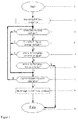
- FIG. 1 shows a flowchart of an exemplary implementation of the method according to the invention.
- a control device of a machine tool first receives a first instruction, in particular a CNC code.
- the CNC code represents the machinings to be made.
- the controller analyzes the CNC code and determines a sequence of processing steps.
- step 3 the control device checks whether alternative tools are available for the machining operations to be made.
- step 4 it is checked if an alternative manufacturing strategy is available.
- step 5 tests to see if an alternative manufacturing process is available.
- step 6 will check to see if an alternative manufacturing process is available.
- step 9 If no alternative manufacturing process is available, the process is terminated in step 9.
- step 7 the control device checks whether the available alternative meets the user's default or predetermined parameters. If this is the case, new CNC code will be created in step 8. Otherwise, the process returns to step 3.
- the analysis of the CNC code in step 2 comprises receiving and editing user-supplied processing data.
- the CNC code contains information about the geometry of the workpiece to be produced, the type, duration, and / or order of the machining operations, the tools to be used, and / or possible tolerances.
- the determination of an alternative tool in step 3 is, for example, determining a tool of the same or a similar type, which is arranged on the same processing device. Differences between the alternative tool and the original tool are represented by tool parameters (for example, speed, feed, etc.). For example, in this step, the availability of a miller having a different diameter and / or geometry than the originally intended mill to be replaced may be determined.
- An alternative production strategy in step 4 is provided, for example, by the fact that, during machining, a tool and / or production method of the same type is replaced or supplemented by one or more tools and / or production methods of the same or a similar type.
- the alternative manufacturing strategy may include the use of the originally provided or another processing device. For example, in the alternative manufacturing strategy drilling by circular milling or pre-drilling and milling are replaced.
- An alternative manufacturing method in step 5 is for example given by the fact that the intended processing steps are replaced or supplemented by one or more processing steps, wherein at least one of the processing steps is assigned to a different genus than the originally provided processing steps.
- the use of at least one further processing device is provided in this case.
- puncturing can be replaced by flame cutting or lasers.
- An alternative manufacturing process in step 6 provides that at least one method of a superordinate genus is used. Also in this case the use of at least one further processing device is provided. For example, the originally intended production of machining by machining can be replaced or supplemented by an adaptive production.
- the software according to the invention can be configured in such a way that before or during a machine runtime a predetermined first instruction for producing a machining (eg drilling, milling) or machining sequence (eg multiple cuts, pre-drilling and thread cutting, step drilling, shearing and punching) is replaced by another (second) Instruction or processing sequence is completely or partially replaced.
- the final result or the resulting contour / geometry is identical to the original geometry (the specified result) or deviates from it only within specified limits (tolerance, surface quality).
- Tolerances can be parameterized by the operator.
- a complete substitution provides that a first tool or a method or a processing device is then no longer used.
- a partial substitution provides that a first tool is still used in a processing step, but this is supplemented by upstream and / or downstream processing steps. The possible extent of substitution thus ranges from simple tool substitution to the replacement of entire operations or processing facilities.
- the use of the software is particularly in the field of so-called 2-, 2.5- and 3-axis machining advantage, but is not limited thereto. Rather, a use in the field of 4-, 5-, or 6-axis machining and adaptive production is possible.
- the software may take into account other constraints, such as: legal requirements: a substitution of drilling by punching or flame cutting in German steel construction is not permitted; in South America, such restrictions do not exist. Furthermore, a division or merger of operations is possible; e.g. Roughing and finishing can be replaced by milling in one go with the right tool.
- the present invention is particularly suitable for machine tools having a plurality of processing devices that may be movable relative to each other, and each having a plurality of identical or different tools.
- machine tools there are many degrees of freedom and a high degree of flexibility with regard to the type and order of the processing steps to be performed. These degrees of freedom and flexibility benefit the present invention.
Landscapes
- Engineering & Computer Science (AREA)
- Manufacturing & Machinery (AREA)
- Physics & Mathematics (AREA)
- Geometry (AREA)
- Human Computer Interaction (AREA)
- General Physics & Mathematics (AREA)
- Automation & Control Theory (AREA)
- Numerical Control (AREA)
Applications Claiming Priority (1)
| Application Number | Priority Date | Filing Date | Title |
|---|---|---|---|
| DE102015108535.6A DE102015108535B3 (de) | 2015-05-29 | 2015-05-29 | Verfahren zur Werkzeugsubstitution |
Publications (1)
| Publication Number | Publication Date |
|---|---|
| EP3098676A1 true EP3098676A1 (fr) | 2016-11-30 |
Family
ID=56137093
Family Applications (1)
| Application Number | Title | Priority Date | Filing Date |
|---|---|---|---|
| EP16171658.4A Withdrawn EP3098676A1 (fr) | 2015-05-29 | 2016-05-27 | Procede de substitution d'outil |
Country Status (2)
| Country | Link |
|---|---|
| EP (1) | EP3098676A1 (fr) |
| DE (1) | DE102015108535B3 (fr) |
Citations (5)
| Publication number | Priority date | Publication date | Assignee | Title |
|---|---|---|---|---|
| US7218981B1 (en) * | 2005-12-02 | 2007-05-15 | Powerchip Semiconductor Corp. | Dispatch integration system and method based on semiconductor manufacturing |
| DE102007016234A1 (de) | 2007-04-04 | 2008-10-09 | Toyoda Mitsuiseiki Europe Gmbh | Steuerung von Werkzeugmaschinen |
| US20100204818A1 (en) * | 2006-07-18 | 2010-08-12 | Mitsubishi Electric Corporation | Numerical control device |
| DE102009025167B3 (de) | 2009-06-12 | 2010-09-30 | Brinkhaus Gmbh | Verfahren zum Überwachen eines Fertigungsprozesses und Steuerung für eine Werkzeugmaschine |
| EP2267564A2 (fr) * | 2009-06-22 | 2010-12-29 | Jtekt Corporation | Système et procédé de détermination de l'intégration de procédé |
Family Cites Families (1)
| Publication number | Priority date | Publication date | Assignee | Title |
|---|---|---|---|---|
| JP4196936B2 (ja) * | 2004-11-16 | 2008-12-17 | 三菱電機株式会社 | 穴加工用ncプログラム作成装置及び穴加工ncプログラム作成装置用プログラム |
-
2015
- 2015-05-29 DE DE102015108535.6A patent/DE102015108535B3/de not_active Expired - Fee Related
-
2016
- 2016-05-27 EP EP16171658.4A patent/EP3098676A1/fr not_active Withdrawn
Patent Citations (5)
| Publication number | Priority date | Publication date | Assignee | Title |
|---|---|---|---|---|
| US7218981B1 (en) * | 2005-12-02 | 2007-05-15 | Powerchip Semiconductor Corp. | Dispatch integration system and method based on semiconductor manufacturing |
| US20100204818A1 (en) * | 2006-07-18 | 2010-08-12 | Mitsubishi Electric Corporation | Numerical control device |
| DE102007016234A1 (de) | 2007-04-04 | 2008-10-09 | Toyoda Mitsuiseiki Europe Gmbh | Steuerung von Werkzeugmaschinen |
| DE102009025167B3 (de) | 2009-06-12 | 2010-09-30 | Brinkhaus Gmbh | Verfahren zum Überwachen eines Fertigungsprozesses und Steuerung für eine Werkzeugmaschine |
| EP2267564A2 (fr) * | 2009-06-22 | 2010-12-29 | Jtekt Corporation | Système et procédé de détermination de l'intégration de procédé |
Also Published As
| Publication number | Publication date |
|---|---|
| DE102015108535B3 (de) | 2016-11-24 |
Similar Documents
| Publication | Publication Date | Title |
|---|---|---|
| EP3335086B1 (fr) | Procede et dispositif de commande destines a la commande optimale d'une machine-outil | |
| DE3308765C2 (fr) | ||
| EP3398698B2 (fr) | Procédé et dispositif de façonnage incrémentiel d'une pièce usinée métallique | |
| EP0311703A1 (fr) | Procédé pour commander une machine-outil | |
| DE102016204392A1 (de) | System und Verfahren zur Produktionsplanung | |
| DE112006003623T5 (de) | Verfahren zum Transformieren von G-Code in ein Step-NC-Teileprogramm | |
| DE10241742B4 (de) | Fertigungsanlage zum Herstellen von Produkten | |
| DE112018007741T5 (de) | Maschinenlernvorrichtung, vorrichtung zur erzeugung von programmen für eine numerisch gesteuerte bearbeitung und maschinenlernverfahren | |
| DE19614202C2 (de) | Verfahren und Vorrichtung zur Steuerung einer Werkzeugmaschine, insbesondere einer Funkenerosionsmaschine | |
| DE102018003992B4 (de) | Numerische Steuervorrichtung | |
| DE102023124968B4 (de) | Verfahren zur Schrupp- oder Schruppdrehbearbeitung mit optimierten Prozessparametern | |
| DE3719330A1 (de) | Antriebssteuerungsverfahren einer laserstrahlmaschine und programmuebersetzungsvorrichtung zum einsatz der laserstrahlmaschine | |
| DE112017003357B4 (de) | Auswahlvorrichtung, Auswahlverfahren und Programm | |
| EP3300521B1 (fr) | Procede d'alignement pour pieces | |
| DE102016014179B4 (de) | Numerische Steuerung | |
| DE102015108535B3 (de) | Verfahren zur Werkzeugsubstitution | |
| WO2024074403A1 (fr) | Procédé de fabrication assisté par ordinateur et système de fabrication | |
| WO2016113033A1 (fr) | Système de production à fonctionnalité supplémentaire et procédé de fonctionnement | |
| WO2023225696A1 (fr) | Optimisation de commande numérique d'une machine-outil | |
| EP4125013A1 (fr) | Création d'un plan de travail pour un composant | |
| EP3724729B1 (fr) | Procédé d'utilisation d'une machine-outil au moyen de l'adaptation d'un modèle de données précompilé | |
| DE102014004654A1 (de) | Verfahren zum Bestimmen einer Bearbeitungsreihenfolge für ein spanend zu bearbeitendes Werkstück | |
| DE19919147B4 (de) | Verfahren zur Ermittlung eines Konturfehlers und Verfahren zur Kontrolle einer korrekten Sollwertvorgabe | |
| EP3125055A1 (fr) | Procede de guidage d'outil pour des surfaces adjacentes | |
| EP2078994A1 (fr) | Appareil d'automatisation et son procédé de fonctionnement |
Legal Events
| Date | Code | Title | Description |
|---|---|---|---|
| PUAI | Public reference made under article 153(3) epc to a published international application that has entered the european phase |
Free format text: ORIGINAL CODE: 0009012 |
|
| AK | Designated contracting states |
Kind code of ref document: A1 Designated state(s): AL AT BE BG CH CY CZ DE DK EE ES FI FR GB GR HR HU IE IS IT LI LT LU LV MC MK MT NL NO PL PT RO RS SE SI SK SM TR |
|
| AX | Request for extension of the european patent |
Extension state: BA ME |
|
| STAA | Information on the status of an ep patent application or granted ep patent |
Free format text: STATUS: REQUEST FOR EXAMINATION WAS MADE |
|
| 17P | Request for examination filed |
Effective date: 20170530 |
|
| RBV | Designated contracting states (corrected) |
Designated state(s): AL AT BE BG CH CY CZ DE DK EE ES FI FR GB GR HR HU IE IS IT LI LT LU LV MC MK MT NL NO PL PT RO RS SE SI SK SM TR |
|
| GRAP | Despatch of communication of intention to grant a patent |
Free format text: ORIGINAL CODE: EPIDOSNIGR1 |
|
| STAA | Information on the status of an ep patent application or granted ep patent |
Free format text: STATUS: GRANT OF PATENT IS INTENDED |
|
| INTG | Intention to grant announced |
Effective date: 20190107 |
|
| STAA | Information on the status of an ep patent application or granted ep patent |
Free format text: STATUS: THE APPLICATION IS DEEMED TO BE WITHDRAWN |
|
| 18D | Application deemed to be withdrawn |
Effective date: 20190518 |