EP3099746B1 - Composition de gel de silicone - Google Patents
Composition de gel de silicone Download PDFInfo
- Publication number
- EP3099746B1 EP3099746B1 EP15740359.3A EP15740359A EP3099746B1 EP 3099746 B1 EP3099746 B1 EP 3099746B1 EP 15740359 A EP15740359 A EP 15740359A EP 3099746 B1 EP3099746 B1 EP 3099746B1
- Authority
- EP
- European Patent Office
- Prior art keywords
- silicone gel
- component
- electrical
- mpa
- viscosity
- Prior art date
- Legal status (The legal status is an assumption and is not a legal conclusion. Google has not performed a legal analysis and makes no representation as to the accuracy of the status listed.)
- Active
Links
Images
Classifications
-
- C—CHEMISTRY; METALLURGY
- C08—ORGANIC MACROMOLECULAR COMPOUNDS; THEIR PREPARATION OR CHEMICAL WORKING-UP; COMPOSITIONS BASED THEREON
- C08G—MACROMOLECULAR COMPOUNDS OBTAINED OTHERWISE THAN BY REACTIONS ONLY INVOLVING UNSATURATED CARBON-TO-CARBON BONDS
- C08G77/00—Macromolecular compounds obtained by reactions forming a linkage containing silicon with or without sulfur, nitrogen, oxygen or carbon in the main chain of the macromolecule
- C08G77/42—Block-or graft-polymers containing polysiloxane sequences
- C08G77/44—Block-or graft-polymers containing polysiloxane sequences containing only polysiloxane sequences
-
- C—CHEMISTRY; METALLURGY
- C08—ORGANIC MACROMOLECULAR COMPOUNDS; THEIR PREPARATION OR CHEMICAL WORKING-UP; COMPOSITIONS BASED THEREON
- C08L—COMPOSITIONS OF MACROMOLECULAR COMPOUNDS
- C08L83/00—Compositions of macromolecular compounds obtained by reactions forming in the main chain of the macromolecule a linkage containing silicon with or without sulfur, nitrogen, oxygen or carbon only; Compositions of derivatives of such polymers
- C08L83/04—Polysiloxanes
-
- C—CHEMISTRY; METALLURGY
- C08—ORGANIC MACROMOLECULAR COMPOUNDS; THEIR PREPARATION OR CHEMICAL WORKING-UP; COMPOSITIONS BASED THEREON
- C08K—Use of inorganic or non-macromolecular organic substances as compounding ingredients
- C08K5/00—Use of organic ingredients
- C08K5/0091—Complexes with metal-heteroatom-bonds
-
- C—CHEMISTRY; METALLURGY
- C08—ORGANIC MACROMOLECULAR COMPOUNDS; THEIR PREPARATION OR CHEMICAL WORKING-UP; COMPOSITIONS BASED THEREON
- C08K—Use of inorganic or non-macromolecular organic substances as compounding ingredients
- C08K5/00—Use of organic ingredients
- C08K5/04—Oxygen-containing compounds
- C08K5/06—Ethers; Acetals; Ketals; Ortho-esters
-
- C—CHEMISTRY; METALLURGY
- C08—ORGANIC MACROMOLECULAR COMPOUNDS; THEIR PREPARATION OR CHEMICAL WORKING-UP; COMPOSITIONS BASED THEREON
- C08K—Use of inorganic or non-macromolecular organic substances as compounding ingredients
- C08K5/00—Use of organic ingredients
- C08K5/54—Silicon-containing compounds
- C08K5/541—Silicon-containing compounds containing oxygen
- C08K5/5415—Silicon-containing compounds containing oxygen containing at least one Si—O bond
-
- C—CHEMISTRY; METALLURGY
- C08—ORGANIC MACROMOLECULAR COMPOUNDS; THEIR PREPARATION OR CHEMICAL WORKING-UP; COMPOSITIONS BASED THEREON
- C08K—Use of inorganic or non-macromolecular organic substances as compounding ingredients
- C08K5/00—Use of organic ingredients
- C08K5/54—Silicon-containing compounds
- C08K5/541—Silicon-containing compounds containing oxygen
- C08K5/5425—Silicon-containing compounds containing oxygen containing at least one C=C bond
-
- C—CHEMISTRY; METALLURGY
- C08—ORGANIC MACROMOLECULAR COMPOUNDS; THEIR PREPARATION OR CHEMICAL WORKING-UP; COMPOSITIONS BASED THEREON
- C08K—Use of inorganic or non-macromolecular organic substances as compounding ingredients
- C08K5/00—Use of organic ingredients
- C08K5/54—Silicon-containing compounds
- C08K5/541—Silicon-containing compounds containing oxygen
- C08K5/5435—Silicon-containing compounds containing oxygen containing oxygen in a ring
-
- C—CHEMISTRY; METALLURGY
- C08—ORGANIC MACROMOLECULAR COMPOUNDS; THEIR PREPARATION OR CHEMICAL WORKING-UP; COMPOSITIONS BASED THEREON
- C08K—Use of inorganic or non-macromolecular organic substances as compounding ingredients
- C08K5/00—Use of organic ingredients
- C08K5/54—Silicon-containing compounds
- C08K5/549—Silicon-containing compounds containing silicon in a ring
-
- C—CHEMISTRY; METALLURGY
- C08—ORGANIC MACROMOLECULAR COMPOUNDS; THEIR PREPARATION OR CHEMICAL WORKING-UP; COMPOSITIONS BASED THEREON
- C08K—Use of inorganic or non-macromolecular organic substances as compounding ingredients
- C08K5/00—Use of organic ingredients
- C08K5/56—Organo-metallic compounds, i.e. organic compounds containing a metal-to-carbon bond
-
- C—CHEMISTRY; METALLURGY
- C08—ORGANIC MACROMOLECULAR COMPOUNDS; THEIR PREPARATION OR CHEMICAL WORKING-UP; COMPOSITIONS BASED THEREON
- C08L—COMPOSITIONS OF MACROMOLECULAR COMPOUNDS
- C08L83/00—Compositions of macromolecular compounds obtained by reactions forming in the main chain of the macromolecule a linkage containing silicon with or without sulfur, nitrogen, oxygen or carbon only; Compositions of derivatives of such polymers
-
- C—CHEMISTRY; METALLURGY
- C08—ORGANIC MACROMOLECULAR COMPOUNDS; THEIR PREPARATION OR CHEMICAL WORKING-UP; COMPOSITIONS BASED THEREON
- C08L—COMPOSITIONS OF MACROMOLECULAR COMPOUNDS
- C08L83/00—Compositions of macromolecular compounds obtained by reactions forming in the main chain of the macromolecule a linkage containing silicon with or without sulfur, nitrogen, oxygen or carbon only; Compositions of derivatives of such polymers
- C08L83/14—Compositions of macromolecular compounds obtained by reactions forming in the main chain of the macromolecule a linkage containing silicon with or without sulfur, nitrogen, oxygen or carbon only; Compositions of derivatives of such polymers in which at least two but not all the silicon atoms are connected by linkages other than oxygen atoms
-
- H—ELECTRICITY
- H10—SEMICONDUCTOR DEVICES; ELECTRIC SOLID-STATE DEVICES NOT OTHERWISE PROVIDED FOR
- H10W—GENERIC PACKAGES, INTERCONNECTIONS, CONNECTORS OR OTHER CONSTRUCTIONAL DETAILS OF DEVICES COVERED BY CLASS H10
- H10W74/00—Encapsulations, e.g. protective coatings
- H10W74/40—Encapsulations, e.g. protective coatings characterised by their materials
- H10W74/47—Encapsulations, e.g. protective coatings characterised by their materials comprising organic materials, e.g. plastics or resins
- H10W74/476—Organic materials comprising silicon
-
- C—CHEMISTRY; METALLURGY
- C08—ORGANIC MACROMOLECULAR COMPOUNDS; THEIR PREPARATION OR CHEMICAL WORKING-UP; COMPOSITIONS BASED THEREON
- C08G—MACROMOLECULAR COMPOUNDS OBTAINED OTHERWISE THAN BY REACTIONS ONLY INVOLVING UNSATURATED CARBON-TO-CARBON BONDS
- C08G77/00—Macromolecular compounds obtained by reactions forming a linkage containing silicon with or without sulfur, nitrogen, oxygen or carbon in the main chain of the macromolecule
- C08G77/04—Polysiloxanes
- C08G77/12—Polysiloxanes containing silicon bound to hydrogen
-
- C—CHEMISTRY; METALLURGY
- C08—ORGANIC MACROMOLECULAR COMPOUNDS; THEIR PREPARATION OR CHEMICAL WORKING-UP; COMPOSITIONS BASED THEREON
- C08G—MACROMOLECULAR COMPOUNDS OBTAINED OTHERWISE THAN BY REACTIONS ONLY INVOLVING UNSATURATED CARBON-TO-CARBON BONDS
- C08G77/00—Macromolecular compounds obtained by reactions forming a linkage containing silicon with or without sulfur, nitrogen, oxygen or carbon in the main chain of the macromolecule
- C08G77/04—Polysiloxanes
- C08G77/20—Polysiloxanes containing silicon bound to unsaturated aliphatic groups
Definitions
- the present invention relates to a silicone gel composition and silicone gel for use in sealing or filling of electrical or electronic parts, and particularly relates to a silicone gel composition for use in sealing or filling of electrical or electronic parts that can form a silicone gel which, compared to conventional known silicone gels, can suppress the occurrence of air bubbles and cracks in the silicone gel and has excellent bonding to an electrical or electronic part when it seals or fills the electrical or electronic part, and a silicone gel that can suppress the occurrence of air bubbles and cracks when it seals or fills an electrical or electronic part.
- Priority is claimed on Japanese Patent Application No. 2014-012755, filed on January 27, 2014 .
- Silicone gel compositions have been widely used as sealants and fillers for electrical or electronic parts because they can form silicone gels having good stress relaxation, electrical characteristics, heat resistance and weather resistance by curing (refer to Patent Documents 1 to 3).
- silicone gel compositions include a silicone gel composition comprising an organopolysiloxane containing vinyl groups, having a branched structure and having viscosity of from 10 to 10,000 centistokes at 25C, a linear organopolysiloxane containing hydrogen atoms bonded to silicon atoms, and a hydrosilylation reaction catalyst (refer to Patent Document 4); a silicone gel composition comprising an organopolysiloxane containing vinyl groups having a branched structure, an organopolysiloxane containing hydrogen atoms bonded to silicon atoms, and a hydrosilylation reaction catalyst (refer to Patent Document 5); and a silicone gel composition comprising an organopolysiloxane containing vinyl groups, having a branched structure and having
- a silicone gel composition for sealing or filling of electrical or electronic parts which suppresses the occurrence of air bubbles and cracks in silicone gel can be provided and that an electrical or electronic part having excellent reliability can be provided by using a silicone gel composition which, by curing, forms a silicone gel having, at 25C and a shear frequency of 0.1 Hz, a loss elastic modulus of from 1.0 ⁇ 10 2 to 1.0 ⁇ 10 4 Pa (1.0 ⁇ 10 3 to 1.0 ⁇ 10 5 dyne/cm 2 ) and a complex elastic modulus of 1.0 ⁇ 10 5 Pa (1.0 ⁇ 10 6 dyne/cm 2 ) or less, and, advantageously, having 1/4 consistency of from 30 to 80 (refer to Patent Document 7, especially Practical Example 5).
- the operating temperature of these electronic parts has risen from about 150C in the past to about 175C, and due to the increased ubiquity of SiC semiconductors, operating temperatures of, for example, 180C or above are often required. If gel obtained from a conventional known silicone gel composition is used under such temperature conditions, there is the problem that the occurrence of air bubbles and cracks in the silicone gel cannot be sufficiently suppressed, and the reliability, durability and stability of the electrical or electronic part is diminished.
- the object of the present invention is to provide a silicone gel composition for use in sealing or filling of electrical or electronic parts that can form a silicone gel that can suppress the occurrence of air bubbles and cracks and exhibits good bonding to the electrical or electronic parts even when used under high-temperature conditions.
- the present inventors discovered that the above problem can be solved by using a silicone gel composition for use in sealing or filling of electrical or electronic parts, in which the silicone gel composition comprises at least one adhesion promoter (Z) and, by curing, forms a silicone gel having, at 25C and a shear frequency of 0.1 Hz, a loss elastic modulus of from 5.0 ⁇ 10 2 to 1.0 ⁇ 10 4 Pa (5.0 ⁇ 10 3 to 1.0 ⁇ 10 5 ) dyne/cm 2 , a complex elastic modulus of from 5.0 ⁇ 10 3 to 1.0 ⁇ 10 5 Pa (5.0 ⁇ 10 4 to 1.0 ⁇ 10 6 ) dyne/cm 2 , and a loss tangent of 0.3 or less, and they thereby achieved the present invention.
- the complex elastic modulus is preferred to be from 5.0 ⁇ 10 3 to 5.0 ⁇ 10 4 Pa (5.0 ⁇ 10 4 to 5.0 ⁇ 10 5 dyne/c
- the silicone gel composition is curable by hydrosilylation reaction.
- the silicone gel composition comprises
- the present inventors discovered that the above problem is advantageously solved by a silicone composition in which the weight ratio of component (A-1) / component (A-2) or component (A-1T) / component (A-2L) is 0.85 or less.
- the present invention further relates to a silicone gel obtained by curing the above silicone gel composition.
- the silicone gel preferably has 1/4 consistency as stipulated in JIS K 2220 of from 10 to 80, and more preferably from 20 to 80.
- the present invention further relates to a sealant for electrical or electronic parts, comprising the above silicone gel composition.
- the present invention further relates to an electrical or electronic part equipped with the above silicone gel.
- the electrical or electronic part is preferably a power device such as a motor control, a motor control for transport, a power generation system, or a space transportation system.
- the present invention further relates to a protection method for a semiconductor chip using the above silicone gel composition or silicone gel.
- silicone gel composition according to the present invention a silicone gel that can suppress the occurrence of air bubbles and cracks and has excellent bonding to electrical or electronic parts even when used under high-temperature conditions can be formed.
- the silicone gel according to the present invention a silicone gel that can suppress the occurrence of air bubbles and cracks and exhibits excellent bonding to electrical or electronic parts even when used under high-temperature conditions can be provided. Furthermore, by the sealant for electrical or electronic parts according to the present invention, electrical or electronic parts that have high reliability and stability even under high-temperature conditions can be provided because it contains the above silicone gel composition. Furthermore, by the electrical or electronic part according to the present invention, it has high reliability and stability even under high-temperature conditions because it is equipped with the above silicone gel. Additionally, by the protection method for a semiconductor device according to the present invention, electrical or electronic parts, particularly power devices, having high reliability and stability even under high-temperature conditions can be provided because it uses the above silicone gel.
- viscosity is the value measured using a type-B viscometer according to JIS K 7117-1 at 25C.
- the silicone gel composition according to the present invention is for use in sealing or filling of electrical or electronic parts, and comprises at least one adhesion promoter (Z).
- the silicone gel composition by curing, forms a silicone gel having, at 25C and a shear frequency of 0.1 Hz, a loss elastic modulus of from 5.0 ⁇ 10 2 to 1.0 ⁇ 10 4 Pa (5.0 ⁇ 10 3 to 1.0 ⁇ 10 5 dyne/cm 2 ), a complex elastic modulus of from 5.0 ⁇ 10 3 to 1.0 ⁇ 10 5 Pa (5.0 ⁇ 10 4 to 1.0 ⁇ 10 6 dyne/cm 2 ), and a loss tangent of 0.3 or less.
- the complex elastic modulus is preferred to be from 5.0 ⁇ 10 3 to 5.0 ⁇ 10 4 Pa (5.0 ⁇ 10 4 to 5.0 ⁇ 10 5 dyne/cm 2 ).
- the present invention came about through the discovery that an electrical or electronic part sealed or filled with a silicone gel exhibiting a loss elastic modulus, complex elastic modulus, and loss tangent in the above specified ranges can markedly suppress the occurrence of air bubbles and cracks in the silicone gel even under high-temperature conditions.
- electrical/electronic part means an electrical part or electronic part
- silicaling/filling means sealing or filling.
- the loss elastic modulus, complex elastic modulus, and loss tangent at 25C and a shear frequency of 0.1 Hz of a silicone gel obtained by curing a silicone gel composition can be easily measured by methods known to persons skilled in the art. For example, they may be determined by preparing the silicone gel into a circular plate of thickness from 5 to 6 mm and diameter of 25 mm, and then measuring under the conditions of 25C and shear frequency 0.1 Hz using a dynamic viscoelasticity measurement apparatus.
- the dynamic viscoelasticity measurement apparatus may be an apparatus known to persons skilled in the art without particularly limitation, an example of which is a dynamic viscoelasticity measurement apparatus manufactured by Rheometrics, Inc. (product name: Dynamic Analyzer ARES).
- the loss elastic modulus, complex elastic modulus, and loss tangent of such a silicone gel in the above specified ranges can be adjusted as appropriate by changing the composition, curing mechanism and curing conditions of the silicone gel composition.
- the 1/4 consistency as stipulated in JIS K 2220 of the silicone gel obtained by curing the silicone gel composition is from 10 to 80, more preferably from 20 to 80, because the occurrence of air bubbles and cracks in the silicone gel under high-temperature conditions is markedly suppressed.
- the curing mechanism of the silicone gel composition is not particularly limited, and examples are hydrosilylation reaction curing by alkenyl groups and hydrogen atoms bonded to silicon atoms, dealcoholizing condensation reaction curing by silanol groups and alkoxy groups bonded to silicon atoms, and radical reaction curing by ultraviolet light irradiation, among which hydrosilylation reaction curing is preferred because complete curing is relatively quick.
- the adhesion promoter (Z) is one of the mandatory components of the present invention, and is a component that improves bonding to the silicone gel substrate.
- bonding to the electrical or electronic part is improved and interface debonding between the silicone gel and electrical or electronic part when heated is suppressed while the various characteristics of the silicone gel are maintained, and as a result, the reliability of the electrical or electronic part can be improved.
- the adhesion promoter (Z) is not particularly limited provided that it can achieve the above objects, but examples include alkoxysilanes containing epoxy groups, such as 3-glycidoxypropyltrimethoxysilane, 3-glycidoxypropyltriethoxysilane, 3-glycidoxypropylmethyldimethoxysilane, 2-(3,4-epoxycyclohexyl)ethyltrimethoxysilane, and 4-oxiranylbutyltrimethoxysilane; alkoxysilanes containing acrylic groups, such as 3-methacryloxypropyltrimethoxysilane, 3-methacryloxypropyltriethoxysilane, and 3-acryloxypropyltrimethoxysilane; alkoxysilanes containing amino groups, such as 3-aminopropyltrimethoxysilane, 3-aminopropyltriethoxysilane, N-(2-aminoethyl)-3-amino
- R 2 represents an alkyl or alkoxyalkyl group
- R 3 represents an unsubstituted or substituted monovalent hydrocarbon group
- n is 3 or 4.
- the alkyl groups represented by R 2 may be either the same or different, and preferably have from 1 to 4 carbons, and more preferably, are methyl groups, ethyl groups, or propyl groups.
- another example of the alkoxyalkyl groups represented by R 2 is methoxyethyl.
- Examples of the monovalent hydrocarbon groups represented by R 3 include alkyl groups such as a methyl group, ethyl group, propyl group, butyl group, hexyl group, heptyl group, octyl group, nonyl group and decyl group; cycloalkyl groups such as a cyclopentyl group and cyclohexyl group; aryl groups such as a phenyl group, tolyl group, xylyl group and naphthyl group; aralkyl groups such as a benzyl group, phenethyl group and phenylpropyl group; and halogenated alkyl groups a such as 3-chloropropyl group and 3,3,3-trifluoropropyl group.
- alkyl groups such as a methyl group, ethyl group, propyl group, butyl group, hexyl group, heptyl group, octy
- it is an alkyl group having from 1 to 4 carbons, a 3,3,3-trifluoropropyl group, or a phenyl group, and most preferably a methyl group.
- silane coupling agent reaction condensates silanes represented by the above general formula (R 2 O) n SiR 3 4-n and partially hydrolyzed condensates thereof, ethyl polysilicates [average molecular formula Si m O( m-1) (OC 2 H 5 ) 2(m+1) (where m is 5 on average), SiO 2 content 40 wt%, viscosity 5 mPa s] or combinations thereof is preferred, and use of ethyl polysilicates [average molecular formula Si m O (m-1) (OC 2 H 5 ) 2(m+1) (where m is 5 on average), Si
- the adhesion promoter (Z) may be used in a range in which the silicone gel composition can form a silicone gel having the above specified loss elastic modulus, complex elastic modulus, and loss tangent. Specifically, it is preferably used in the range from 0.001 to 5.0 mass% with respect to the total amount of silicone gel composition, and more preferably in the range of 0.01 to 1.0 mass%. By using the adhesion promoter (Z) in the range of 0.001 to 5.0 mass% with respect to the total amount of silicone gel, a silicone gel having good bonding to electrical or electronic parts can be formed.
- the silicone gel composition contains (A) an organopolysiloxane containing alkenyl groups, having a viscosity of from 10 to 100,000 mPa s at 25C; (B) a linear organopolysiloxane containing hydrogen atoms bonded to silicon atoms at least at both ends of its molecular chain and having a viscosity of from 1 to 10,000 mPa s at 25C; and (C) a catalytic amount of a hydrosilylation reaction catalyst.
- the organopolysiloxane containing alkenyl groups of component (A) is the primary component of the silicone gel composition, and its viscosity is from 10 to 100,000 mPa s at 25C.
- the preferred viscosity of component (A) at 25C is in the range of 10 to 10,000 mPa s. If the viscosity of component (A) is less than 10 mPa s, the physical characteristics of the obtained silicone gel tend to decline, while on the other hand, if it exceeds 100,000 mPa s, the handleability of the obtained silicone gel composition tends to decline.
- the content of component (A) is 80 mass% or more with respect to the total amount of silicone gel composition, and more preferably 85 mass% or more.
- Component (A) is constituted of two or more types of organopolysiloxane containing alkenyl groups.
- Component (A) is made up of a mixture linear organopolysiloxanes containing alkenyl groups and organopolysiloxanes containing alkenyl groups having a branched structure, namely a mixture of (A-1) organopolysiloxane having alkenyl groups having a branched structure having viscosity of from 10 to 100,000 mPa s at 25C and (A-2) linear organopolysiloxane having alkenyl groups having viscosity of from 10 to 100,000 mPa s at 25C.
- the organopolysiloxane having alkenyl groups having a branched structure of component (A-1) means an organopolysiloxane of which the molecular structure is a branched structure or a partially branched linear structure.
- component (A-1) is an organopolysiloxane having RSiO 3/2 units (R is a monovalent hydrocarbon group) and/or SiO 4/2 units in the molecular structure, and is preferably an organopolysiloxane made up of R 2 SiO 2/2 units, RSiO 3/2 units and R 3 SiO 1/2 units.
- R in these units include monovalent hydrocarbon groups such as alkyl groups such as a methyl group, ethyl group and propyl group; alkenyl groups such as a vinyl group, allyl group, butenyl group and hexenyl group; aryl groups such as a phenyl group and tolyl group; and halogenated alkyl groups such as a 3,3,3-trifluoropropyl group, but at least one R in the polymer must be an alkenyl group.
- alkyl groups such as a methyl group, ethyl group and propyl group
- alkenyl groups such as a vinyl group, allyl group, butenyl group and hexenyl group
- aryl groups such as a phenyl group and tolyl group
- halogenated alkyl groups such as a 3,3,3-trifluoropropyl group, but at least one R in the polymer must be an alkenyl group.
- R 2 SiO 2/2 units account for from 80.0 to 99.65 mol%
- RSiO 3/2 units account for from 0.10 to 10.00 mol%
- the remaining mol% is R 3 SiO 1/2 units.
- the viscosity of component (A-1) is from 10 to 100,000 mPa s, preferably from 10 to 10,000 mPa s, and particularly preferably from 10 to 5,000 mPa s. If the viscosity of component (A-1) is less than 10 mPa s, the physical characteristics of the obtained silicone gel tend to decline, while on the other hand, if it exceeds 100,000 mPa s, the handleability of the obtained silicone gel composition tends to decline.
- a silicone gel that exhibits the specified ranges of loss elastic modulus, complex elastic modulus, and loss tangent is easily obtained.
- Component (A-1) may be constituted of only one type of organopolysiloxane containing alkenyl groups having a branched structure or two or more types of organopolysiloxane containing alkenyl groups having a branched structure.
- Component (A-1) is preferably constituted of two or more types of organopolysiloxane containing alkenyl groups having a branched structure.
- the weight ratio of the two organopolysiloxanes comprising different amounts of vinyl groups in component (A-1) is not particularly limited, but is preferably from 1:9 to 9:1, more preferably from 2:8 to 8:2, and even more preferably from 3:7 to 7:3.
- the linear organopolysiloxane containing alkenyl groups of component (A-2) preferably has alkenyl groups on at least both ends of its molecular chain, and may have alkenyl groups only on both ends of its molecular chain.
- Component (A-2) is not particularly limited, but examples include dimethylpolysiloxanes capped at both molecular terminals by dimethylvinylsiloxy groups, copolymers of dimethylsiloxane and methylphenylsiloxane capped at both molecular terminals by dimethylvinylsiloxy groups, copolymers of dimethylsiloxane and methylvinylsiloxane capped at both molecular terminals by trimethylsiloxy groups, copolymers of dimethylsiloxane, methylvinylsiloxane and methylphenylsiloxane capped at both molecular terminals by trimethylsiloxy groups, copolymers of dimethylsiloxane
- the viscosity of component (A-2) is from 10 to 100,000 mPa s, preferably from 10 to 10,000 mPa s, and particularly preferably from 50 to 10,000 mPa s. If the viscosity of component (A-2) is less than 10 mPa s, the physical characteristics of the obtained silicone gel tend to decline, while on the other hand, if it exceeds 100,000 mPa s, the handleability of the obtained silicone gel composition tends to decline.
- component (A-2) is (A-2L), namely an organopolysiloxane having alkenyl groups only at both ends of its molecule, and having viscosity of from 50 to 10,000 mPa s at 25C.
- the weight ratio of component (A-1T) to component (A-2L) is 0.85 or less. With this ratio set at 0.85 or less, the occurrence of air bubbles and cracks in the silicone gel can be effectively suppressed when an electrical or electronic part is sealed or filled with the obtained silicone gel.
- the linear organopolysiloxane having hydrogen atoms bonded to silicon atoms on at least both ends of its molecular chain of component (B) acts as a crosslinking agent of the silicone gel composition, and is characterized in that its viscosity is from 1 to 10,000 mPa s at 25C.
- Hydrogen atoms bonded to silicon atoms of component (B) may be contained at least at both ends of the molecule, and hydrogen atoms bonded to silicon atoms may be contained on a side chain of the molecule, or hydrogen atoms bonded to silicon atoms may be contained only on both ends of the molecule.
- Examples of organic groups bonded to silicon atoms other than alkenyl groups in component (B) include alkyl groups such as a methyl group, ethyl group and propyl group; aryl groups such as a phenyl group and tolyl group; and monovalent hydrocarbon groups excluding alkenyl groups, such as halogenated alkyl groups such as a 3,3,3-trifluoropropyl group.
- Examples of component (B) include dimethylpolysiloxane capped at both molecular terminals by dimethylhydrogensiloxane groups.
- component (B) only one type of organopolysiloxane may be used, or two or more types of organopolysiloxane may be used in combination.
- the viscosity at 25C of component (B) is from 1 to 10,000 mPa s, preferably from 10 to 10,000 mPa s. If the viscosity of component (B) is less than 1 mPa s, the physical characteristics of the obtained silicone gel tend to decline, while on the other hand, if it exceeds 10,000 mPa s, the handleability of the obtained silicone gel composition tends to decline.
- the hydrogen atoms bonded to silicon atoms in component (B) have a compounded amount in component (B) from 0.2 to 5 moles, and preferably from 0.8 to 1.2 moles, per 1 mole of alkenyl groups in component (A). This is because if the molar ratio of the hydrogen atoms bonded to silicon atoms in component (B) per mole of alkenyl groups in component (A) is below 0.2 moles, the obtained silicone gel composition will tend not to sufficiently cure, and on the other hand, if it exceeds 5 moles, the physical characteristics of the obtained silicone gel will tend to decline.
- the hydrosilylation reaction catalyst of component (C) is a catalyst for accelerating curing of the hydrosilylation reaction-curable silicone gel composition.
- component (C) include platinum-based catalysts such as chloroplatinic acid, alcohol solutions of chloroplatinic acid, olefin complexes of platinum, complexes of platinum and 1,3-divinyl-1,1,3,3-tetramethyldisiloxane, and platinum-supported powders; palladium-based catalysts such as tetrakis (triphenylphosphine) palladium, palladium black, and mixtures with triphenylphosphine; and rhodium-based catalysts. Platinum-based catalysts are preferred.
- the compounded amount of component (C) is a catalytic quantity, and in cases where a platinum-based catalyst is used as component (C), for practical reasons, the compounded amount of component (C) is preferably such that the content of platinum metal in the catalyst is from 0.01 to 1000 ppm, and particularly preferably from 0.1 to 500 ppm, by weight in the silicone gel composition.
- optional components may be blended in the silicone gel composition within a range such that the object of the present invention is achieved.
- optional components include hydrosilylation reaction inhibitors such as acetylene compounds, organophosphate compounds and vinyl group-containing siloxane compounds; inorganic fillers such as fumed silica, wet-produced silica, crushed quartz, titanium oxide, magnesium carbonate, zinc oxide, iron oxide, diatomaceous earth, and carbon black; inorganic fillers obtained by hydrophobic treatment of the surface of such inorganic fillers by organosilicon compounds; organopolysiloxanes not containing hydrogen atoms bonded to silicon atoms or alkenyl groups bonded to silicon atoms, heat resistance-imparting agents, cold resistance-imparting agents, thermally conductive fillers, flame retarders, thixotropy-imparting agents, pigments and dyes.
- hydrosilylation reaction inhibitors such as acetylene compounds, organophosphate compounds and vinyl group-containing siloxane compounds
- a hydrosilylation reaction inhibitor is a component for inhibiting a hydrosilylation reaction of the silicone gel composition, specific examples of which include acetylene-based reaction inhibitors such as ethynylcyclohexanol, and amine-based, carboxylic acid ester-based, phosphite ester-based reaction inhibitors.
- the added quantity of reaction inhibitors is normally from 0.001 to 5 mass% of the total silicone gel composition.
- acetylene-based compounds such as 3-methyl-1-butyn-3-ol, 3,5-dimethyl-1-hexyn-3-ol, and 3-phenyl-1-butyn-3-ol
- enyne compounds such as 3-methyl-3-penten-1-yne and 3,5-dimethyl-3-hexen-1-yne
- cycloalkenylsiloxanes such as 1,3,5,7-tetramethyl-1,3,5,7-tetravinylcyclotetrasiloxane and 1,3,5,7-tetramethyl-1,3,5,7-tetrahexenylcyclotetrasiloxane
- triazole compounds such as benzotriazole may be added without particular limitation.
- inorganic fillers examples include fumed silica, crystalline silica, precipitated silica, hollow fillers, silsesquioxane, fumed titanium dioxide, magnesium oxide, zinc oxide, iron oxide, aluminum hydroxide, magnesium carbonate, calcium carbonate, zinc carbonate, laminar mica, carbon black, diatomaceous earth, and glass fibers; and inorganic fillers obtained by hydrophobic treatment of the surface of such inorganic fillers by organosilicon compounds such as organoalkoxysilane compounds, organochlorosilane compounds or organosilazane compounds.
- silicone rubber powder and silicone resin powder may also be blended. However, the blended amount of inorganic fillers is, specifically, 20 mass% or less of the silicone gel composition, and particularly preferably 10 mass% or less.
- the heat resistance-imparting agent is not particularly limited provided that it can impart heat resistance to the silicone gel, but examples include metal oxides such as iron oxide, titanium oxide, cerium oxide, magnesium oxide, aluminum oxide, and zinc oxide; metal hydroxides such as cerium hydroxide; phthalocyanine compounds, carbon black, cerium silanolate, cerium fatty acid salts, and reaction products of organopolysiloxanes and cerium carboxylates.
- metal oxides such as iron oxide, titanium oxide, cerium oxide, magnesium oxide, aluminum oxide, and zinc oxide
- metal hydroxides such as cerium hydroxide
- phthalocyanine compounds carbon black, cerium silanolate, cerium fatty acid salts, and reaction products of organopolysiloxanes and cerium carboxylates.
- the cold resistance-imparting agent is not particularly limited provided that it can impart cold resistance to the silicone gel, but examples include plasticizers such as process oil, naphthene oil, higher fatty acid esters, and dialkyl phthalates.
- thermally conductive filler examples include gold, silver, copper, aluminum, nickel, brass, shape memory alloys, solder and similar metal powders; ceramics, glass, quartz, organic resin, and similar powders having gold, silver, nickel, copper, or a similar metal vapor-deposited or plated on the surface thereof; aluminum oxide (alumina), beryllium oxide, chromium oxide, zinc oxide, titanium oxide, crystalline silica, and similar metal oxide-based powders; boron nitride, silicon nitride, aluminum nitride, and similar metal nitride-based powders; boron carbide, titanium carbide, silicon carbide, and similar metal carbide-based powders; aluminum hydroxide, magnesium hydroxide and similar metal hydroxide-based powders; carbon nanotubes, carbon microfibers, diamond, graphite, and similar carbon-based powders; and mixtures of two or more types of these powders.
- a thermally conductive filler By adding such a thermally conductive filler to the silicone gel
- the silicone gel composition can be prepared by mixing the components; for example, the composition can be prepared by mixing the above components (A) to (C) and component (Z) and other optional components.
- the method for mixing the components may be a conventional known method and is not particularly limited, but is normally uniform mixing by simple stirring. Furthermore, when solid components such as inorganic fillers are contained as optional components, mixing using a mixing device is more preferable.
- a mixing device is not particularly limited, but is exemplified by a single-screw or twin-screw continuous mixer, twin roller, Ross mixer, Hobart mixer, dental mixer, planetary mixer, kneader mixer and Henschel mixer.
- the silicone gel according to the present invention is obtained by curing the above silicone gel composition, and is characterized by having, at 25C and a shear frequency of 0.1 Hz, a loss elastic modulus of from 5.0 ⁇ 10 2 to 1.0 ⁇ 10 4 Pa (5.0 ⁇ 10 3 to 1.0 ⁇ 10 5 dyne/cm 2 ), a complex elastic modulus of from 5.0 ⁇ 10 3 to 1.0 ⁇ 10 5 Pa (5.0 ⁇ 10 4 to 1.0 ⁇ 10 6 dyne/cm 2 ), and a loss tangent of 0.3 or less.
- the complex elastic modulus is preferred to be from 5.0 ⁇ 10 3 to 5.0 ⁇ 10 4 Pa (5.0 ⁇ 10 4 to 5.0 ⁇ 10 5 dyne/cm 2 ).
- silicone gel By such a silicone gel, the occurrence of bubbles and cracks can be suppressed and excellent bonding to electrical or electronic parts can be exhibited.
- an electrical or electronic part having high reliability and stability even under high-temperature conditions can be provided.
- the curing mechanism of the silicone gel composition for obtaining silicone gel is not particularly limited, and examples are hydrosilylation reaction curing by alkenyl groups and hydrogen atoms bonded to silicon atoms, dealcoholizing condensation reaction curing by silanol groups and alkoxy groups bonded to silicon atoms, and radical reaction curing by ultraviolet light irradiation, among which hydrosilylation reaction curing is preferred because complete curing is relatively quick.
- the temperature for curing this hydrosilylation reaction-curable silicone gel composition is not particularly limited, but is normally from 60C to 150C, and more preferably from 70C to 130C.
- the direct reading (reading unit of 1/10 mm) of 1/4 consistency stipulated in JIS K 2220 of the silicone gel is preferably from 10 to 80, more preferably from 20 to 80, even more preferably from 20 to 60, particularly preferably from 20 to 50.
- a silicone gel exhibiting a direct reading of 1/4 consistency stipulated in JIS K 2220 in this range has the silicone gel characteristics of low elastic modulus and low stress, and further, can considerably suppress the occurrence of air bubbles and cracks under high temperature conditions.
- the silicone gel has excellent heat resistance at high temperatures of 180C and above, and the gel does not tend to deteriorate when used for a long period at high temperature. Furthermore, when used in applications for protecting electronic components such as semiconductor chips, SiC semiconductor chips, ICs, hybrid ICs and power devices, the occurrence of air bubbles and cracks in the silicone gel can be suppressed even under high-temperature conditions, and further, because it has good bonding to electrical or electronic parts, it has the advantage of being able to provide electrical or electronic parts having high reliability and stability. Furthermore, because the silicone gel of the present invention is transparent, light-emitting semiconductor elements such as LEDs may be included in the above semiconductor chips.
- the sealant for electrical or electronic parts according to the present invention is for use in sealing or filling of electrical or electronic parts, and contains the silicone gel composition of the present invention.
- a sealant for electrical or electronic parts because it contains the above-described silicone gel composition, electrical or electronic parts can be sealed or filled by the silicone gel of the present invention, and as a result, electrical or electronic parts having high reliability and stability even under high-temperature conditions can be provided.
- the method for sealing or filling an electrical or electronic part with the sealant for electrical or electronic parts is not limited, but an example is contacting the portion of the electrical or electronic part to be protected with the sealant for electrical or electronic parts, and then curing this composition by heating it, letting it stand at room temperature, or irradiating it with ultraviolet light.
- a method in which an electrical or electronic part is sealed or filled with a hydrosilylation reaction-curable sealant for electrical or electronic parts and then cured by heating is particularly preferred because complete curing is relatively quick.
- heating in the range of 50C to 250C is preferred, and heating in the range of 70C to 130C is particularly preferred.
- the electrical or electronic part that is sealed or filled by the silicone gel of the present invention is not limited, but because the silicone gel of the present invention can suppress the occurrence of air bubbles and cracks and exhibits good bonding to electrical or electronic parts even under high-temperature conditions, it can be advantageously used in power devices used under high-temperature conditions, particularly power devices such as a motor control, a motor control for transport, a power generation system, or a space transportation system. Furthermore, because the silicone gel of the present invention has a certain degree of cold resistance in addition to the heat resistance demanded in an SiC semiconductor chip (for example, heat resistance of 180C or above), it can be advantageously used in power devices that demand the ability to withstand sharp temperature differences, and can improve the durability and reliability of such power devices.
- Examples of such power devices that demand heat resistance and cold resistance include motor controls used in cold regions such as general-purpose inverter controls, servo motor controls, machine tools or elevators, electric vehicles, hybrid cars or motor controls for rail transport used in cold regions, power generating systems used in cold regions such as solar, wind or fuel cell power generators and space transportation systems used in space.
- cold regions indicates regions where the temperature falls below 0C.
- the sealant for electrical or electronic parts of the present invention is also effective in electrical or electronic parts having a structure in which the space between electrodes, between electrical elements or between an electrical element and the package in the electrical or electronic part is narrow, or having a structure in which these structures cannot track to the expansion and contraction of the silicone gel.
- it may be used in electrical circuits or modules on which electrical elements such as semiconductor elements, capacitors and resistors are mounted, i.e., various sensors such as pressure sensors that are generally sealed or filled with silicone gel, and automotive igniters and regulators.
- the electrical or electronic part according to the present invention is an electrical or electronic part that has been filled or sealed by the silicone gel of the present invention.
- an electrical or electronic part By such an electrical or electronic part, it has high reliability and stability even under high-temperature conditions because it is equipped with the silicone gel of the present invention.
- Examples of such electrical or electronic parts are the same as the electrical or electronic parts described above, particularly power devices such as a motor control, a motor control for transport, a power generation system, or a space transportation system.
- the protection method for a semiconductor chip according to the present invention is a method for protecting a semiconductor chip by using the silicone gel of the present invention, an example of which is a protection method for a semiconductor chip that uses the sealant for electrical or electronic parts of the present invention as a sealant.
- a protection method for a semiconductor chip electrical or electronic parts, particularly power devices, having high reliability and stability even under high-temperature conditions can be provided because it uses the silicone gel of the present invention.
- silicone gel composition and silicone gel for sealing or filling of electrical or electronic parts of the present invention will be described through examples. Note that in the examples, viscosity is the value measured at 25C.
- Silicone gel in the shape of a circular plate of thickness from 5 to 6 mm and diameter of 25 mm was created by heating the silicone gel composition for 1 hour at 80C.
- the loss elastic modulus, complex elastic modulus, and loss tangent of this silicone gel were measured by a dynamic viscoelasticity measurement apparatus manufactured by Rheometrics, Inc. (product name: Dynamic Analyzer ARES) at 25C, shear frequency 0.1 Hz, strain 2%.
- Silicone gel was created by gently pouring the silicone gel composition for sealing or filling of electrical or electronic parts into a 50-mL glass beaker and then heating for 1 hour at 80C.
- the 1/4 consistency of this silicone gel was measured according to the method stipulated in JIS K 2220. Note that 1/4 consistency of the silicone gel was the direct reading (reading unit of 1/10 mm) of 1/4 consistency stipulated in JIS K 2220, as described above.
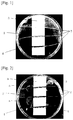
- Three electrodes (2) having a diameter of 2 mm and length of 80 mm were placed in parallel on a glass Petri dish (4) having a diameter of 95 mm and height of 12 mm, and on these electrodes, a substrate of polybutylene terephthalate (3) having dimensions of 75 mm x 25 mm ⁇ 2 mm (PBT, brand name "Duranex 2002”) was laid, creating an electrical or electronic part.
- PBT polybutylene terephthalate
- the silicone gel composition was poured gently into the glass Petri dish in an amount to result in a height of 10 mm, and after the glass Petri dish was degassed under reduced pressure of 5 mmHg or less for 3 minutes at room temperature, the silicone gel composition was cured by heating for 1 hour in an 80C oven to form a silicone gel (1 or 1'), and an electrical or electronic part sample was obtained. This sample was left to stand for 24 hours on a hot plate preheated to 180C, and then the occurrence of air bubbles or cracks (5) and the degree thereof in the silicone gel that sealed or filled the electrical or electronic part were observed macroscopically.
- the size of an air bubble or crack indicates the length of the longest portion of that air bubble or crack.
- FIG. 1 an optical photographic image from the top surface of the electrical or electronic part sample evaluated in Practical Example 8 is shown in FIG. 1
- an optical photographic image from the top surface of the electrical or electronic part sample evaluated in Comparative Example 4 is shown in FIG. 2 .
- FIG. 1 an optical photographic image from the top surface of the electrical or electronic part sample evaluated in Practical Example 8
- FIG. 2 In the electrical or electronic part sample evaluated in Practical Example 8, no large air bubbles or cracks were seen in the silicone gel, and no interface debonding from the substrate was seen.
- Comparative Example 4 air bubbles or cracks of 20 mm or greater in size occurred.
- the silicone gel obtained from the silicone gel composition of the present invention when it seals or fills an electrical or electronic part, can suppress the occurrence of air bubbles or cracks and has excellent bonding to the electrical or electronic part even when used under high temperature, and therefore, it can be advantageously used in sealants and protective materials of various semiconductor elements.
- it can be advantageously used in sealants and protective materials of power devices used under high-temperature conditions, such as a motor control, a motor control for transport, a power generation system, or a space transportation system.
- the silicone gel obtained from the silicone gel composition of the present invention has a certain degree of cold resistance in addition to the heat resistance demanded in an SiC semiconductor chip (for example, heat resistance of 180C or above), it can be advantageously used in sealants and protective materials of power devices that demand the ability to withstand sharp temperature differences, and can improve the durability and reliability of such power devices.
- Examples of such power devices that demand heat resistance and cold resistance include motor controls used in cold regions such as general-purpose inverter controls, servo motor controls, machine tools or elevators, electric vehicles, hybrid cars or motor controls for rail transport used in cold regions, power generating systems used in cold regions such as solar, wind or fuel cell power generators and space transportation systems used in space. Note that "cold regions” indicates regions where the temperature falls below 0C.
- the silicone gel composition of the present invention is also effective in electrical or electronic parts having a structure in which the space between electrodes, between electrical elements or between an electrical element and the package in the electrical or electronic part is narrow, or having a structure in which these structures cannot track to the expansion and contraction of the silicone gel.
- sealants and protective materials of electrical circuits or modules on which electrical elements such as semiconductor elements, capacitors and resistors are mounted i.e., various sensors such as pressure sensors that are generally sealed or filled with silicone gel, and automotive igniters, and regulators.
- silicone gel obtained from the silicone gel composition of the present invention is transparent, it is useful as optical materials or electronic materials used in general illumination devices, for example, lenses (including secondary optical lens materials provided on the outside of LED packages), sealing materials of light-emitting semiconductor elements, white reflector materials, light-diffusing materials, wavelength-converting materials, and sealants or protective materials of waveguides and plate-like, film-like and sheet-like light guide materials.
- lenses including secondary optical lens materials provided on the outside of LED packages
- sealing materials of light-emitting semiconductor elements for example, white reflector materials, light-diffusing materials, wavelength-converting materials, and sealants or protective materials of waveguides and plate-like, film-like and sheet-like light guide materials.
Landscapes
- Chemical & Material Sciences (AREA)
- Health & Medical Sciences (AREA)
- Chemical Kinetics & Catalysis (AREA)
- Medicinal Chemistry (AREA)
- Polymers & Plastics (AREA)
- Organic Chemistry (AREA)
- Compositions Of Macromolecular Compounds (AREA)
- Structures Or Materials For Encapsulating Or Coating Semiconductor Devices Or Solid State Devices (AREA)
Claims (11)
- Une composition de gel de silicone pour une utilisation dans le scellement ou le remplissage de pièces électriques ou électroniques comprenant :(A) un organopolysiloxane contenant des groupes alcényle, ayant une viscosité allant de 10 à 10 000 mPa·s à 25 °C telle que mesurée par un viscosimètre de type B selon JIS K7117-1 et comprenant(A-1T) un organopolysiloxane contenant des groupes alcényle, l'organopolysiloxane ayant une structure ramifiée ayant au moins une unité siloxane représentée par RSiO1,5, où R représente un groupe hydrocarboné monovalent, et ayant de 0,10 à 1,00 % en masse de groupements de groupe vinyle (CH2=CH-) dans une molécule et une viscosité allant de 10 à 5 000 mPa·s à 25 °C ; et(A-2L) un organopolysiloxane linéaire contenant des groupes alcényle uniquement au niveau des deux extrémités de sa chaîne moléculaire, ayant une viscosité allant de 50 à 10 000 mPa·s à 25 °C
où le rapport en poids du constituant (A-1T)/constituant (A-2L) est de 0,85 ou moins ;(B) un organopolysiloxane linéaire contenant des atomes d'hydrogène liés à des atomes de silicium au moins au niveau des deux extrémités de sa chaîne moléculaire et ayant une viscosité allant de 1 à 10 000 mPa·s à 25 °C, en une quantité dans laquelle une quantité des atomes d'hydrogène liés aux atomes de silicium va de 0,2 à 5 moles pour 1 mole de groupes alcényle contenus dans le constituant (A) ;(C) une quantité catalytique d'un catalyseur de réaction d'hydrosilylation ; et(Z) au moins un promoteur d'adhérence ;laquelle composition est durcissable afin de former un gel de silicone ayant 1/4 de consistance telle que stipulée dans JIS K 2220 allant de 10 à 80, et à 25 °C, une fréquence de cisaillement de 0,1 Hz et une contrainte de 2 %, un module élastique de perte allant de 5,0 × 10² à 1,0 x 10⁴ Pa (5,0 x 10³ à 1,0 x 10⁵ dyne/cm2), un module élastique complexe allant de 5,0 x 10³ à 1,0 x 10⁵ Pa (5,0 x 10⁴ à 1,0 x 10⁶ dyne/cm2), et une tangente de perte de 0,3 ou moins, de tels modules et tangente de perte étant mesurés par un appareil de mesure de viscoélasticité dynamique fabriqué par Rheometrics, Inc. (nom de produit : Dynamique Analyzer ARES) à 25 °C, fréquence de cisaillement 0,1 Hz, contrainte 2 %, à l'aide d'un plateau circulaire de gel de silicone avec une épaisseur de 5 à 6 mm et un diamètre de 25 mm créé en chauffant la composition de gel de silicone pendant 1 heure à 80 °C. - La composition de gel de silicone selon la revendication 1, laquelle est durcissable par l'intermédiaire d'une réaction d'hydrosilylation.
- La composition de gel de silicone selon la revendication 1, dans laquelle le constituant (A-1T) est un mélange d'au moins deux organopolysiloxanes contenant des groupes alcényle, ayant une structure ramifiée, lesquels diffèrent en quantité de groupements de groupe vinyle (CH2=CH-) dans une molécule.
- La composition de gel de silicone selon la revendication 3, dans laquelle le constituant (A-1T) est un mélange du constituant (A-1T1), lequel comprend de 0,10 à 0,30 % en masse de groupements de groupe vinyle (CH2=CH-) dans une molécule, et du constituant (A-1T2), lequel comprend de 0,30 à 1,00 % en masse de groupements de groupe vinyle (CH2=CH-) dans une molécule, le rapport en poids de (A-1T1)/(A-1T2) allant de 1/9 à 9/1.
- Un procédé de préparation d'un gel de silicone ayant 1/4 de consistance telle que stipulée dans JIS K 2220 allant de 10 à 80, et, à 25 °C, une fréquence de cisaillement de 0,1 Hz et une contrainte de 2 %, un module élastique de perte allant de 5,0 x 10² à 1,0 x 10⁴ Pa (5,0 x 10³ à 1,0 x 10⁵ dyne/cm2), un module élastique complexe allant de 5,0 x 10³ à 1,0 x 10⁵ Pa (5,0 x 10⁴ à 1,0 x 10⁶ dyne/cm2), et une tangente de perte de 0,3 ou moins, de tels modules et tangente de perte étant mesurés par un appareil de mesure de viscoélasticité dynamique fabriqué par Rheometrics, Inc. (nom de produit : Dynamique Analyzer ARES) à 25 °C, fréquence de cisaillement 0,1 Hz, contrainte 2 %, à l'aide d'un plateau circulaire de gel de silicone avec une épaisseur de 5 à 6 mm et un diamètre de 25 mm créé en chauffant la composition de gel de silicone pendant 1 heure à 80 °C, un tel gel en durcissant une composition de gel de silicone comprenant :(A) un organopolysiloxane contenant des groupes alcényle, ayant une viscosité allant de 10 à 10 000 mPa·s à 25 °C telle que mesurée par un viscosimètre de type B selon JIS K 7117-1 et comprenant(A-1T) un organopolysiloxane contenant des groupes alcényle, l'organopolysiloxane ayant une structure ramifiée ayant au moins une unité siloxane représentée par RSiO1,5, où R représente un groupe hydrocarboné monovalent, et ayant de 0,10 à 1,00 % en masse de groupements de groupe vinyle (CH2=CH-) dans une molécule et une viscosité allant de 10 à 5 000 mPa·s à 25 °C ; et(A-2L) un organopolysiloxane linéaire contenant des groupes alcényle uniquement au niveau des deux extrémités de sa chaîne moléculaire, ayant une viscosité allant de 50 à 10 000 mPa·s à 25 °C telle que mesurée par un viscosimètre de type B selon JIS K 7117-1
où le rapport en poids du constituant (A-1T)/constituant (A-2L) est de 0,85 ou moins ;(B) un organopolysiloxane linéaire contenant des atomes d'hydrogène liés à des atomes de silicium au moins au niveau des deux extrémités de sa chaîne moléculaire et ayant une viscosité allant de 1 à 10 000 mPa·s à 25 °C telle que mesurée par un viscosimètre de type B selon JIS K 7117-1, en une quantité dans laquelle une quantité des atomes d'hydrogène liés aux atomes de silicium va de 0,2 à 5 moles pour 1 mole de groupes alcényle contenus dans le constituant (A) ;(C) une quantité catalytique d'un catalyseur de réaction d'hydrosilylation ; et(Z) au moins un promoteur d'adhérence. - Un matériau de scellement étanche pour des pièces électriques ou électroniques, comprenant la composition de gel de silicone décrite dans n'importe laquelle des revendications 1 à 4.
- Un matériau de scellement étanche pour des pièces électriques ou électroniques, comprenant un gel de silicone ayant 1/4 de consistance telle que stipulée dans JIS K 2220 allant de 10 à 80, et à 25 °C, une fréquence de cisaillement de 0,1 Hz et une contrainte de 2 %, un module élastique de perte allant de 5,0 x 10² à 1,0 x 10⁴ Pa (5,0 x 10³ à 1,0 x 10⁵ dyne/cm2), un module élastique complexe allant de 5,0 x 10³ à 1,0 x 10⁵ Pa (5,0 x 10⁴ à 1,0 x 10⁶ dyne/cm2), et une tangente de perte de 0,3 ou moins, de tels modules et tangente de perte étant mesurés par un appareil de mesure de viscoélasticité dynamique fabriqué par Rheometrics, Inc. (nom de produit : Dynamique Analyzer ARES) à 25 °C, fréquence de cisaillement 0,1 Hz, contrainte 2 %, à l'aide d'un plateau circulaire de gel de silicone avec une épaisseur de 5 à 6 mm et un diamètre de 25 mm créé en chauffant la composition de gel de silicone pendant 1 heure à 80 °C, dans lequel le gel de silicone comprend un matériau durci de (A) un organopolysiloxane contenant des groupes alcényle, ayant une viscosité allant de 10 à 10 000 mPa·s à 25 °C telle que mesurée par un viscosimètre de type B selon JIS K 7117-1 et comprenant(A-1T) un organopolysiloxane contenant des groupes alcényle, l'organopolysiloxane ayant une structure ramifiée ayant au moins une unité siloxane représentée par RSiO1,5, où R représente un groupe hydrocarboné monovalent, et ayant de 0,10 à 1,00 % en masse de groupements de groupe vinyle (CH2=CH-) dans une molécule et une viscosité allant de 10 à 5 000 mPa·s à 25 °C ; et(A-2L) un organopolysiloxane linéaire contenant des groupes alcényle uniquement au niveau des deux extrémités de sa chaîne moléculaire, ayant une viscosité allant de 50 à 10 000 mPa·s à 25 °C
où le rapport en poids du constituant (A-1T)/constituant (A-2L) est de 0,85 ou moins ; et(B) un organopolysiloxane linéaire contenant des atomes d'hydrogène liés à des atomes de silicium au moins au niveau des deux extrémités de sa chaîne moléculaire et ayant une viscosité allant de 1 à 10 000 mPa·s à 25 °C telle que mesurée par un viscosimètre de type B selon JIS K 7117-1, en une quantité dans laquelle une quantité des atomes d'hydrogène liés aux atomes de silicium va de 0,2 à 5 moles pour 1 mole de groupes alcényle contenus dans le constituant (A) ;(C) une quantité catalytique d'un catalyseur de réaction d'hydrosilylation ; et comprenant en outre(Z) au moins un promoteur d'adhérence. - Une pièce électrique ou électronique pourvue d'un matériau de scellement étanche selon la revendication 6 ou la revendication 7, la pièce électrique ou électronique étant remplie ou scellée avec le matériau de scellement étanche.
- La pièce électrique ou électronique selon la revendication 8, la pièce électrique ou électronique étant sélectionnée dans le groupe constitué d'une puce de semiconducteur, d'un CI, d'un CI hybride, et d'un dispositif de puissance.
- La pièce électrique ou électronique selon la revendication 9, dans laquelle le dispositif de puissance est une commande de moteur, une commande de moteur pour le transport, un système de génération de puissance, ou un système spatial de transport.
- Un procédé de protection d'une pièce électrique ou électronique, comprenant les étapes consistant à :(1) fournir la pièce électrique ou électronique devant être protégée par un gel de silicone ;(2) sceller ou remplir la pièce électrique ou électronique avec la composition de gel de silicone décrite dans la revendication 1 ; et(3) faire durcir la composition de gel de silicone afin de former un gel de silicone.
Applications Claiming Priority (2)
| Application Number | Priority Date | Filing Date | Title |
|---|---|---|---|
| JP2014012755 | 2014-01-27 | ||
| PCT/JP2015/000292 WO2015111409A1 (fr) | 2014-01-27 | 2015-01-22 | Composition de gel de silicone |
Publications (3)
| Publication Number | Publication Date |
|---|---|
| EP3099746A1 EP3099746A1 (fr) | 2016-12-07 |
| EP3099746A4 EP3099746A4 (fr) | 2017-09-27 |
| EP3099746B1 true EP3099746B1 (fr) | 2021-05-05 |
Family
ID=53681219
Family Applications (1)
| Application Number | Title | Priority Date | Filing Date |
|---|---|---|---|
| EP15740359.3A Active EP3099746B1 (fr) | 2014-01-27 | 2015-01-22 | Composition de gel de silicone |
Country Status (5)
| Country | Link |
|---|---|
| US (1) | US10155852B2 (fr) |
| EP (1) | EP3099746B1 (fr) |
| CN (1) | CN106103594B (fr) |
| TW (1) | TWI666267B (fr) |
| WO (1) | WO2015111409A1 (fr) |
Families Citing this family (25)
| Publication number | Priority date | Publication date | Assignee | Title |
|---|---|---|---|---|
| TWI738743B (zh) | 2016-03-23 | 2021-09-11 | 美商道康寧公司 | 金屬-聚有機矽氧烷 |
| US10190031B2 (en) * | 2016-06-06 | 2019-01-29 | Jiali Wu | Thermally conductive interface composition and use thereof |
| KR101864505B1 (ko) * | 2016-11-21 | 2018-06-29 | 주식회사 케이씨씨 | 방열성이 우수한 실리콘 조성물 |
| CN113528082B (zh) * | 2020-04-15 | 2023-05-12 | 富乐(苏州)新材料有限公司 | 硅凝胶组合物、包括其的硅凝胶、封装结构及半导体器件 |
| CN115885015B (zh) | 2020-07-13 | 2024-04-05 | 陶氏东丽株式会社 | 有机硅凝胶组合物、其固化物及其用途 |
| JP7750635B2 (ja) * | 2020-08-21 | 2025-10-07 | ダウ・東レ株式会社 | 硬化性オルガノポリシロキサン組成物、熱伝導性部材および放熱構造体 |
| CN116261565A (zh) | 2020-10-13 | 2023-06-13 | 美国陶氏有机硅公司 | 具有醛官能团的有机硅化合物的制备 |
| CN112322048A (zh) * | 2020-11-03 | 2021-02-05 | 杭州之江新材料有限公司 | 一种有机硅凝胶组合物及其制备方法和应用 |
| CN112608713A (zh) * | 2020-12-16 | 2021-04-06 | 广州旭太材料科技有限公司 | 一种自粘性硅凝胶及其制备方法与应用 |
| US20240199935A1 (en) * | 2021-04-09 | 2024-06-20 | Dow Toray Co., Ltd. | Curable organopolysiloxane composition, thermally conductive member, and heat dissipation structure |
| WO2022246681A1 (fr) | 2021-05-26 | 2022-12-01 | Dow Silicones Corporation | Composition adhésive sensible à la pression de silicone contenant un additif de fluorosilicone et ses procédés de préparation et d'utilisation |
| US12384948B2 (en) | 2021-06-16 | 2025-08-12 | Dow Silicones Corporation | Silicone pressure sensitive adhesive composition containing a fluoro-containing polyorganohydrogensiloxane crosslinker and methods for the preparation and use of said composition |
| WO2022261853A1 (fr) | 2021-06-16 | 2022-12-22 | Dow Silicones Corporation | Composition adhésive sensible à la pression au silicone contenant un additif polyfluoropolyéther silane et procédés de préparation et d'utilisation de ladite composition |
| CN117480229A (zh) | 2021-07-08 | 2024-01-30 | 美国陶氏有机硅公司 | 含有氰酸酯官能化硅烷添加剂的有机硅压敏粘合剂组合物及其制备方法和所述组合物的用途 |
| WO2023028819A1 (fr) | 2021-08-31 | 2023-03-09 | Dow Silicones Corporation | Revêtements anti-statiques et antiadhésifs à base de silicone et leurs procédés de préparation et d'utilisation |
| CN118019747A (zh) | 2021-10-06 | 2024-05-10 | 陶氏环球技术有限责任公司 | 丙基亚胺官能化有机硅化合物和伯氨基丙基官能化有机硅化合物的制备 |
| KR20240074835A (ko) | 2021-10-06 | 2024-05-28 | 다우 글로벌 테크놀로지스 엘엘씨 | 아미노-작용성 유기규소 화합물의 제조 |
| JP2024536286A (ja) | 2021-10-06 | 2024-10-04 | ダウ グローバル テクノロジーズ エルエルシー | プロピルイミン官能性有機ケイ素化合物及び一級アミノプロピル官能性有機ケイ素化合物の調製 |
| US20250122229A1 (en) | 2021-11-22 | 2025-04-17 | Dow Silicones Corporation | Preparation of organosilicon compounds with carbinol functionality |
| US20250051524A1 (en) | 2022-03-21 | 2025-02-13 | Dow Silicones Corporation | Preparation of organosilicon compounds with carboxy functionality |
| JP2025514660A (ja) | 2022-04-13 | 2025-05-09 | ダウ グローバル テクノロジーズ エルエルシー | ビニルエステル官能性を有する有機ケイ素化合物の調製 |
| US20250215162A1 (en) | 2022-04-13 | 2025-07-03 | Dow Global Technologies Llc | Preparation of polyether-functional organosilicon compounds |
| KR20250027773A (ko) * | 2022-06-29 | 2025-02-27 | 다우 도레이 캄파니 리미티드 | Uv 경화성 오르가노폴리실록산 조성물 및 이의 용도 |
| JPWO2024121942A1 (fr) | 2022-12-06 | 2024-06-13 | ||
| CN121605144A (zh) | 2023-08-14 | 2026-03-03 | 陶氏环球技术有限责任公司 | 乙烯基官能化聚有机硅氧烷的钴催化的加氢甲酰化 |
Family Cites Families (22)
| Publication number | Priority date | Publication date | Assignee | Title |
|---|---|---|---|---|
| NL289728A (fr) | 1962-03-15 | |||
| JPS587452A (ja) | 1981-07-06 | 1983-01-17 | ダウ コ−ニング コ−ポレ−ション | 硬化性シロキサン組成物 |
| US4374967A (en) | 1981-07-06 | 1983-02-22 | Dow Corning Corporation | Low temperature silicone gel |
| JPS59204259A (ja) | 1983-05-06 | 1984-11-19 | Hitachi Ltd | 半導体装置の封止方法 |
| JPS6148945A (ja) | 1984-08-16 | 1986-03-10 | Toshiba Corp | ハイプリツドicモジユ−ル |
| JPS62104145A (ja) | 1985-10-31 | 1987-05-14 | Mitsubishi Electric Corp | 半導体装置 |
| JPS62181357A (ja) | 1986-02-06 | 1987-08-08 | Dow Corning Kk | ポリシロキサンゲル組成物 |
| JPH0319269A (ja) | 1989-06-15 | 1991-01-28 | Fujitsu Ltd | 半導体装置の製造方法 |
| JP2919502B2 (ja) * | 1989-10-25 | 1999-07-12 | 東レ・ダウコーニング・シリコーン株式会社 | 硬化性オルガノポリシロキサンゲル組成物 |
| JPH08225743A (ja) * | 1995-02-20 | 1996-09-03 | Toray Dow Corning Silicone Co Ltd | シリコーンゲル組成物 |
| JP3638746B2 (ja) * | 1997-01-30 | 2005-04-13 | 東レ・ダウコーニング・シリコーン株式会社 | 電気・電子部品封止・充填用シリコーンゲル組成物およびシリコーンゲル |
| JP3765444B2 (ja) * | 1997-07-10 | 2006-04-12 | 東レ・ダウコーニング株式会社 | 電気・電子部品封止・充填用シリコーンゲル組成物およびシリコーンゲル |
| JP3822321B2 (ja) * | 1997-07-17 | 2006-09-20 | 東レ・ダウコーニング株式会社 | 半導体装置 |
| JP4130527B2 (ja) | 2000-12-13 | 2008-08-06 | 三菱電機株式会社 | 半導体装置 |
| JP4875251B2 (ja) | 2001-04-26 | 2012-02-15 | 東レ・ダウコーニング株式会社 | シリコーンゲル組成物 |
| JP4908736B2 (ja) | 2003-10-01 | 2012-04-04 | 東レ・ダウコーニング株式会社 | 硬化性オルガノポリシロキサン組成物および半導体装置 |
| JP2007021593A (ja) * | 2005-07-12 | 2007-02-01 | Fanuc Ltd | 加工装置 |
| JP5148088B2 (ja) * | 2006-08-25 | 2013-02-20 | 東レ・ダウコーニング株式会社 | 硬化性オルガノポリシロキサン組成物および半導体装置 |
| JP5538872B2 (ja) * | 2009-12-24 | 2014-07-02 | 東レ・ダウコーニング株式会社 | シリコーンエラストマー組成物 |
| JP5594232B2 (ja) | 2010-06-11 | 2014-09-24 | 信越化学工業株式会社 | 硬化性シリコーンゲル組成物 |
| JP6025245B2 (ja) | 2012-07-04 | 2016-11-16 | 日本化薬株式会社 | 新規エポキシカルボキシレート化合物、その誘導体、それを含有する活性エネルギー線硬化型樹脂組成物及びその硬化物 |
| JP2018017847A (ja) | 2016-07-27 | 2018-02-01 | セイコーエプソン株式会社 | プロジェクションシステムおよびプロジェクションシステムの制御方法 |
-
2015
- 2015-01-22 EP EP15740359.3A patent/EP3099746B1/fr active Active
- 2015-01-22 WO PCT/JP2015/000292 patent/WO2015111409A1/fr not_active Ceased
- 2015-01-22 US US15/121,892 patent/US10155852B2/en active Active
- 2015-01-22 CN CN201580012682.0A patent/CN106103594B/zh active Active
- 2015-01-27 TW TW104102744A patent/TWI666267B/zh active
Also Published As
| Publication number | Publication date |
|---|---|
| CN106103594A (zh) | 2016-11-09 |
| EP3099746A1 (fr) | 2016-12-07 |
| US10155852B2 (en) | 2018-12-18 |
| TWI666267B (zh) | 2019-07-21 |
| WO2015111409A1 (fr) | 2015-07-30 |
| TW201533168A (zh) | 2015-09-01 |
| CN106103594B (zh) | 2019-06-28 |
| EP3099746A4 (fr) | 2017-09-27 |
| US20170022326A1 (en) | 2017-01-26 |
Similar Documents
| Publication | Publication Date | Title |
|---|---|---|
| US10155852B2 (en) | Silicone gel composition | |
| US8895678B2 (en) | Cross-linkable silicone composition and cross-linked product thereof | |
| EP3041903B1 (fr) | Composition de gel de silicone et son utilisation | |
| JP4933179B2 (ja) | 硬化性シリコーンゴム組成物及びその硬化物 | |
| JP6532986B2 (ja) | 硬化性シリコーン組成物 | |
| KR102044675B1 (ko) | 경화성 실리콘 조성물, 이의 경화물, 및 광반도체 디바이스 | |
| JP6965346B2 (ja) | ダイボンディング用硬化性シリコーン組成物 | |
| US9068049B2 (en) | Curable silicone composition and cured product thereof | |
| EP2758473B1 (fr) | Composition de silicone durcissable pour sceller un élément optique à semi-conducteurs, procédé de production d'un élément optique à semi-conducteurs scellé par une résine, et élément optique à semi-conducteurs ainsi obtenu | |
| JPWO2015155949A1 (ja) | 接着促進剤、それを含有してなる硬化性オルガノポリシロキサン組成物 | |
| KR20180105575A (ko) | 다이본딩용 실리콘 수지 조성물 및 경화물 | |
| JP5628474B2 (ja) | オルガノポリシロキサン、その製造方法、硬化性シリコーン組成物、およびその硬化物 | |
| JP5716139B1 (ja) | 付加硬化型シリコーン樹脂組成物、付加硬化型シリコーン樹脂硬化物、及び、光半導体素子封止体 | |
| TWI681992B (zh) | 加成反應固化型樹脂組合物以及光半導體裝置 | |
| JP7365798B2 (ja) | シリコーンゲル組成物、その硬化物、電子部品封止剤、電子部品、および半導体チップの保護方法 | |
| JP7811078B2 (ja) | オルガノポリシロキサン組成物、その硬化物、電子部品封止剤、電子部品、および半導体チップの保護方法 | |
| KR102912129B1 (ko) | 경화성 실리콘 조성물 및 이의 경화물 | |
| KR20160049539A (ko) | 1액형 경화성 실리콘 조성물 및 광반도체 장치 | |
| JP6981938B2 (ja) | 付加硬化型シリコーン組成物及び半導体装置 |
Legal Events
| Date | Code | Title | Description |
|---|---|---|---|
| PUAI | Public reference made under article 153(3) epc to a published international application that has entered the european phase |
Free format text: ORIGINAL CODE: 0009012 |
|
| STAA | Information on the status of an ep patent application or granted ep patent |
Free format text: STATUS: REQUEST FOR EXAMINATION WAS MADE |
|
| 17P | Request for examination filed |
Effective date: 20160824 |
|
| AK | Designated contracting states |
Kind code of ref document: A1 Designated state(s): AL AT BE BG CH CY CZ DE DK EE ES FI FR GB GR HR HU IE IS IT LI LT LU LV MC MK MT NL NO PL PT RO RS SE SI SK SM TR |
|
| AX | Request for extension of the european patent |
Extension state: BA ME |
|
| DAX | Request for extension of the european patent (deleted) | ||
| A4 | Supplementary search report drawn up and despatched |
Effective date: 20170825 |
|
| RIC1 | Information provided on ipc code assigned before grant |
Ipc: C08L 83/05 20060101ALI20170821BHEP Ipc: C08K 5/5415 20060101ALI20170821BHEP Ipc: C08K 5/07 20060101ALI20170821BHEP Ipc: C08K 5/5445 20060101ALI20170821BHEP Ipc: H01L 23/29 20060101ALI20170821BHEP Ipc: C08L 83/07 20060101AFI20170821BHEP Ipc: C08K 5/057 20060101ALI20170821BHEP Ipc: H01L 23/31 20060101ALI20170821BHEP Ipc: C08L 83/06 20060101ALI20170821BHEP |
|
| STAA | Information on the status of an ep patent application or granted ep patent |
Free format text: STATUS: EXAMINATION IS IN PROGRESS |
|
| 17Q | First examination report despatched |
Effective date: 20180409 |
|
| RAP1 | Party data changed (applicant data changed or rights of an application transferred) |
Owner name: DOW TORAY CO., LTD. |
|
| GRAP | Despatch of communication of intention to grant a patent |
Free format text: ORIGINAL CODE: EPIDOSNIGR1 |
|
| STAA | Information on the status of an ep patent application or granted ep patent |
Free format text: STATUS: GRANT OF PATENT IS INTENDED |
|
| INTG | Intention to grant announced |
Effective date: 20201209 |
|
| GRAS | Grant fee paid |
Free format text: ORIGINAL CODE: EPIDOSNIGR3 |
|
| GRAA | (expected) grant |
Free format text: ORIGINAL CODE: 0009210 |
|
| STAA | Information on the status of an ep patent application or granted ep patent |
Free format text: STATUS: THE PATENT HAS BEEN GRANTED |
|
| AK | Designated contracting states |
Kind code of ref document: B1 Designated state(s): AL AT BE BG CH CY CZ DE DK EE ES FI FR GB GR HR HU IE IS IT LI LT LU LV MC MK MT NL NO PL PT RO RS SE SI SK SM TR |
|
| REG | Reference to a national code |
Ref country code: GB Ref legal event code: FG4D |
|
| REG | Reference to a national code |
Ref country code: CH Ref legal event code: EP |
|
| REG | Reference to a national code |
Ref country code: AT Ref legal event code: REF Ref document number: 1389801 Country of ref document: AT Kind code of ref document: T Effective date: 20210515 |
|
| REG | Reference to a national code |
Ref country code: DE Ref legal event code: R096 Ref document number: 602015068956 Country of ref document: DE |
|
| REG | Reference to a national code |
Ref country code: IE Ref legal event code: FG4D |
|
| REG | Reference to a national code |
Ref country code: LT Ref legal event code: MG9D |
|
| REG | Reference to a national code |
Ref country code: AT Ref legal event code: MK05 Ref document number: 1389801 Country of ref document: AT Kind code of ref document: T Effective date: 20210505 |
|
| PG25 | Lapsed in a contracting state [announced via postgrant information from national office to epo] |
Ref country code: HR Free format text: LAPSE BECAUSE OF FAILURE TO SUBMIT A TRANSLATION OF THE DESCRIPTION OR TO PAY THE FEE WITHIN THE PRESCRIBED TIME-LIMIT Effective date: 20210505 Ref country code: AT Free format text: LAPSE BECAUSE OF FAILURE TO SUBMIT A TRANSLATION OF THE DESCRIPTION OR TO PAY THE FEE WITHIN THE PRESCRIBED TIME-LIMIT Effective date: 20210505 Ref country code: BG Free format text: LAPSE BECAUSE OF FAILURE TO SUBMIT A TRANSLATION OF THE DESCRIPTION OR TO PAY THE FEE WITHIN THE PRESCRIBED TIME-LIMIT Effective date: 20210805 Ref country code: FI Free format text: LAPSE BECAUSE OF FAILURE TO SUBMIT A TRANSLATION OF THE DESCRIPTION OR TO PAY THE FEE WITHIN THE PRESCRIBED TIME-LIMIT Effective date: 20210505 Ref country code: LT Free format text: LAPSE BECAUSE OF FAILURE TO SUBMIT A TRANSLATION OF THE DESCRIPTION OR TO PAY THE FEE WITHIN THE PRESCRIBED TIME-LIMIT Effective date: 20210505 |
|
| PG25 | Lapsed in a contracting state [announced via postgrant information from national office to epo] |
Ref country code: GR Free format text: LAPSE BECAUSE OF FAILURE TO SUBMIT A TRANSLATION OF THE DESCRIPTION OR TO PAY THE FEE WITHIN THE PRESCRIBED TIME-LIMIT Effective date: 20210806 Ref country code: IS Free format text: LAPSE BECAUSE OF FAILURE TO SUBMIT A TRANSLATION OF THE DESCRIPTION OR TO PAY THE FEE WITHIN THE PRESCRIBED TIME-LIMIT Effective date: 20210905 Ref country code: LV Free format text: LAPSE BECAUSE OF FAILURE TO SUBMIT A TRANSLATION OF THE DESCRIPTION OR TO PAY THE FEE WITHIN THE PRESCRIBED TIME-LIMIT Effective date: 20210505 Ref country code: RS Free format text: LAPSE BECAUSE OF FAILURE TO SUBMIT A TRANSLATION OF THE DESCRIPTION OR TO PAY THE FEE WITHIN THE PRESCRIBED TIME-LIMIT Effective date: 20210505 Ref country code: SE Free format text: LAPSE BECAUSE OF FAILURE TO SUBMIT A TRANSLATION OF THE DESCRIPTION OR TO PAY THE FEE WITHIN THE PRESCRIBED TIME-LIMIT Effective date: 20210505 Ref country code: PL Free format text: LAPSE BECAUSE OF FAILURE TO SUBMIT A TRANSLATION OF THE DESCRIPTION OR TO PAY THE FEE WITHIN THE PRESCRIBED TIME-LIMIT Effective date: 20210505 Ref country code: NO Free format text: LAPSE BECAUSE OF FAILURE TO SUBMIT A TRANSLATION OF THE DESCRIPTION OR TO PAY THE FEE WITHIN THE PRESCRIBED TIME-LIMIT Effective date: 20210805 Ref country code: PT Free format text: LAPSE BECAUSE OF FAILURE TO SUBMIT A TRANSLATION OF THE DESCRIPTION OR TO PAY THE FEE WITHIN THE PRESCRIBED TIME-LIMIT Effective date: 20210906 Ref country code: ES Free format text: LAPSE BECAUSE OF FAILURE TO SUBMIT A TRANSLATION OF THE DESCRIPTION OR TO PAY THE FEE WITHIN THE PRESCRIBED TIME-LIMIT Effective date: 20210505 |
|
| REG | Reference to a national code |
Ref country code: NL Ref legal event code: MP Effective date: 20210505 |
|
| PG25 | Lapsed in a contracting state [announced via postgrant information from national office to epo] |
Ref country code: NL Free format text: LAPSE BECAUSE OF FAILURE TO SUBMIT A TRANSLATION OF THE DESCRIPTION OR TO PAY THE FEE WITHIN THE PRESCRIBED TIME-LIMIT Effective date: 20210505 |
|
| PG25 | Lapsed in a contracting state [announced via postgrant information from national office to epo] |
Ref country code: RO Free format text: LAPSE BECAUSE OF FAILURE TO SUBMIT A TRANSLATION OF THE DESCRIPTION OR TO PAY THE FEE WITHIN THE PRESCRIBED TIME-LIMIT Effective date: 20210505 Ref country code: SK Free format text: LAPSE BECAUSE OF FAILURE TO SUBMIT A TRANSLATION OF THE DESCRIPTION OR TO PAY THE FEE WITHIN THE PRESCRIBED TIME-LIMIT Effective date: 20210505 Ref country code: SM Free format text: LAPSE BECAUSE OF FAILURE TO SUBMIT A TRANSLATION OF THE DESCRIPTION OR TO PAY THE FEE WITHIN THE PRESCRIBED TIME-LIMIT Effective date: 20210505 Ref country code: CZ Free format text: LAPSE BECAUSE OF FAILURE TO SUBMIT A TRANSLATION OF THE DESCRIPTION OR TO PAY THE FEE WITHIN THE PRESCRIBED TIME-LIMIT Effective date: 20210505 Ref country code: DK Free format text: LAPSE BECAUSE OF FAILURE TO SUBMIT A TRANSLATION OF THE DESCRIPTION OR TO PAY THE FEE WITHIN THE PRESCRIBED TIME-LIMIT Effective date: 20210505 Ref country code: EE Free format text: LAPSE BECAUSE OF FAILURE TO SUBMIT A TRANSLATION OF THE DESCRIPTION OR TO PAY THE FEE WITHIN THE PRESCRIBED TIME-LIMIT Effective date: 20210505 |
|
| REG | Reference to a national code |
Ref country code: DE Ref legal event code: R097 Ref document number: 602015068956 Country of ref document: DE |
|
| PLBE | No opposition filed within time limit |
Free format text: ORIGINAL CODE: 0009261 |
|
| STAA | Information on the status of an ep patent application or granted ep patent |
Free format text: STATUS: NO OPPOSITION FILED WITHIN TIME LIMIT |
|
| 26N | No opposition filed |
Effective date: 20220208 |
|
| PG25 | Lapsed in a contracting state [announced via postgrant information from national office to epo] |
Ref country code: IS Free format text: LAPSE BECAUSE OF FAILURE TO SUBMIT A TRANSLATION OF THE DESCRIPTION OR TO PAY THE FEE WITHIN THE PRESCRIBED TIME-LIMIT Effective date: 20210905 Ref country code: AL Free format text: LAPSE BECAUSE OF FAILURE TO SUBMIT A TRANSLATION OF THE DESCRIPTION OR TO PAY THE FEE WITHIN THE PRESCRIBED TIME-LIMIT Effective date: 20210505 |
|
| PG25 | Lapsed in a contracting state [announced via postgrant information from national office to epo] |
Ref country code: IT Free format text: LAPSE BECAUSE OF FAILURE TO SUBMIT A TRANSLATION OF THE DESCRIPTION OR TO PAY THE FEE WITHIN THE PRESCRIBED TIME-LIMIT Effective date: 20210505 |
|
| PG25 | Lapsed in a contracting state [announced via postgrant information from national office to epo] |
Ref country code: MC Free format text: LAPSE BECAUSE OF FAILURE TO SUBMIT A TRANSLATION OF THE DESCRIPTION OR TO PAY THE FEE WITHIN THE PRESCRIBED TIME-LIMIT Effective date: 20210505 |
|
| REG | Reference to a national code |
Ref country code: CH Ref legal event code: PL |
|
| GBPC | Gb: european patent ceased through non-payment of renewal fee |
Effective date: 20220122 |
|
| REG | Reference to a national code |
Ref country code: BE Ref legal event code: MM Effective date: 20220131 |
|
| PG25 | Lapsed in a contracting state [announced via postgrant information from national office to epo] |
Ref country code: LU Free format text: LAPSE BECAUSE OF NON-PAYMENT OF DUE FEES Effective date: 20220122 Ref country code: GB Free format text: LAPSE BECAUSE OF NON-PAYMENT OF DUE FEES Effective date: 20220122 |
|
| PG25 | Lapsed in a contracting state [announced via postgrant information from national office to epo] |
Ref country code: FR Free format text: LAPSE BECAUSE OF NON-PAYMENT OF DUE FEES Effective date: 20220131 Ref country code: BE Free format text: LAPSE BECAUSE OF NON-PAYMENT OF DUE FEES Effective date: 20220131 |
|
| PG25 | Lapsed in a contracting state [announced via postgrant information from national office to epo] |
Ref country code: LI Free format text: LAPSE BECAUSE OF NON-PAYMENT OF DUE FEES Effective date: 20220131 Ref country code: CH Free format text: LAPSE BECAUSE OF NON-PAYMENT OF DUE FEES Effective date: 20220131 |
|
| PG25 | Lapsed in a contracting state [announced via postgrant information from national office to epo] |
Ref country code: IE Free format text: LAPSE BECAUSE OF NON-PAYMENT OF DUE FEES Effective date: 20220122 |
|
| P01 | Opt-out of the competence of the unified patent court (upc) registered |
Effective date: 20230526 |
|
| PG25 | Lapsed in a contracting state [announced via postgrant information from national office to epo] |
Ref country code: HU Free format text: LAPSE BECAUSE OF FAILURE TO SUBMIT A TRANSLATION OF THE DESCRIPTION OR TO PAY THE FEE WITHIN THE PRESCRIBED TIME-LIMIT; INVALID AB INITIO Effective date: 20150122 |
|
| PG25 | Lapsed in a contracting state [announced via postgrant information from national office to epo] |
Ref country code: MK Free format text: LAPSE BECAUSE OF FAILURE TO SUBMIT A TRANSLATION OF THE DESCRIPTION OR TO PAY THE FEE WITHIN THE PRESCRIBED TIME-LIMIT Effective date: 20210505 Ref country code: CY Free format text: LAPSE BECAUSE OF FAILURE TO SUBMIT A TRANSLATION OF THE DESCRIPTION OR TO PAY THE FEE WITHIN THE PRESCRIBED TIME-LIMIT Effective date: 20210505 |
|
| PG25 | Lapsed in a contracting state [announced via postgrant information from national office to epo] |
Ref country code: TR Free format text: LAPSE BECAUSE OF FAILURE TO SUBMIT A TRANSLATION OF THE DESCRIPTION OR TO PAY THE FEE WITHIN THE PRESCRIBED TIME-LIMIT Effective date: 20210505 |
|
| PG25 | Lapsed in a contracting state [announced via postgrant information from national office to epo] |
Ref country code: MT Free format text: LAPSE BECAUSE OF FAILURE TO SUBMIT A TRANSLATION OF THE DESCRIPTION OR TO PAY THE FEE WITHIN THE PRESCRIBED TIME-LIMIT Effective date: 20210505 |
|
| PGFP | Annual fee paid to national office [announced via postgrant information from national office to epo] |
Ref country code: DE Payment date: 20251203 Year of fee payment: 12 |