EP3114128B1 - Nouvelles héteroaryldihydropyrimidines condensées en position 6 pour le traitement et la prophylaxie d'une infection à virus de l'hépatite b - Google Patents
Nouvelles héteroaryldihydropyrimidines condensées en position 6 pour le traitement et la prophylaxie d'une infection à virus de l'hépatite b Download PDFInfo
- Publication number
- EP3114128B1 EP3114128B1 EP15710127.0A EP15710127A EP3114128B1 EP 3114128 B1 EP3114128 B1 EP 3114128B1 EP 15710127 A EP15710127 A EP 15710127A EP 3114128 B1 EP3114128 B1 EP 3114128B1
- Authority
- EP
- European Patent Office
- Prior art keywords
- methyl
- phenyl
- oxo
- thiazol
- fluoro
- Prior art date
- Legal status (The legal status is an assumption and is not a legal conclusion. Google has not performed a legal analysis and makes no representation as to the accuracy of the status listed.)
- Active
Links
- 0 **c1c(*)c(*)ccc1C1N=C(c2ncc[s]2)NC(CN(CC2)C(*)C3(*)N2**N2C3C2)=C1C(O*)=O Chemical compound **c1c(*)c(*)ccc1C1N=C(c2ncc[s]2)NC(CN(CC2)C(*)C3(*)N2**N2C3C2)=C1C(O*)=O 0.000 description 8
- ONELXRQCJBCEOV-ZDUSSCGKSA-N COC(C1=C(CBr)NC(c2ncc[s]2)=N[C@H]1c(c(Cl)c1)ccc1F)=O Chemical compound COC(C1=C(CBr)NC(c2ncc[s]2)=N[C@H]1c(c(Cl)c1)ccc1F)=O ONELXRQCJBCEOV-ZDUSSCGKSA-N 0.000 description 5
- QMZPEPRAOFNSQH-ZDUSSCGKSA-N CC(NC(c1ncc[s]1)=N[C@H]1c(c(Cl)c2)ccc2F)=C1C(OC)=O Chemical compound CC(NC(c1ncc[s]1)=N[C@H]1c(c(Cl)c2)ccc2F)=C1C(OC)=O QMZPEPRAOFNSQH-ZDUSSCGKSA-N 0.000 description 2
- UFDQSDPDQSXANO-QMMMGPOBSA-N OC(CCCN(C[C@H]1N2CCNC1)C2=O)=O Chemical compound OC(CCCN(C[C@H]1N2CCNC1)C2=O)=O UFDQSDPDQSXANO-QMMMGPOBSA-N 0.000 description 2
- YNHPWNCHIBOYTO-UHFFFAOYSA-N CC(C)(CCCN(CC1N2CCNC1)C2=O)C(O)=O Chemical compound CC(C)(CCCN(CC1N2CCNC1)C2=O)C(O)=O YNHPWNCHIBOYTO-UHFFFAOYSA-N 0.000 description 1
- QMZPEPRAOFNSQH-UHFFFAOYSA-N CC(NC(c1ncc[s]1)=NC1c(c(Cl)c2)ccc2F)=C1C(OC)=O Chemical compound CC(NC(c1ncc[s]1)=NC1c(c(Cl)c2)ccc2F)=C1C(OC)=O QMZPEPRAOFNSQH-UHFFFAOYSA-N 0.000 description 1
- QMZPEPRAOFNSQH-CYBMUJFWSA-N CC(NC(c1ncc[s]1)=N[C@@H]1c(c(Cl)c2)ccc2F)=C1C(OC)=O Chemical compound CC(NC(c1ncc[s]1)=N[C@@H]1c(c(Cl)c2)ccc2F)=C1C(OC)=O QMZPEPRAOFNSQH-CYBMUJFWSA-N 0.000 description 1
- WQHNEVXVTWXJQW-AWEZNQCLSA-N CCOC(C1=C(CBr)NC(c2ncc[s]2)=N[C@H]1c1cccc(F)c1Cl)=O Chemical compound CCOC(C1=C(CBr)NC(c2ncc[s]2)=N[C@H]1c1cccc(F)c1Cl)=O WQHNEVXVTWXJQW-AWEZNQCLSA-N 0.000 description 1
- UNMMYMZNTXIHIZ-KUHUBIRLSA-N CCOC(C1=C(CN(CC2)C[C@@H](CN3)N2C3=O)NC(c2ncc[s]2)=N[C@H]1c(c(Br)c1)ccc1F)=O Chemical compound CCOC(C1=C(CN(CC2)C[C@@H](CN3)N2C3=O)NC(c2ncc[s]2)=N[C@H]1c(c(Br)c1)ccc1F)=O UNMMYMZNTXIHIZ-KUHUBIRLSA-N 0.000 description 1
- BMIVPTDVFSKSAS-BTYIYWSLSA-N CCOC(C1=C(CN(CC2)C[C@@H](CN3C(C)(C)C(O)=O)N2C3=O)NC(c2ncc[s]2)=N[C@H]1c1cccc(F)c1Cl)=O Chemical compound CCOC(C1=C(CN(CC2)C[C@@H](CN3C(C)(C)C(O)=O)N2C3=O)NC(c2ncc[s]2)=N[C@H]1c1cccc(F)c1Cl)=O BMIVPTDVFSKSAS-BTYIYWSLSA-N 0.000 description 1
- SDHWOINNETWZSH-HJPURHCSSA-N CCOC(C1=C(CN(CC2)C[C@@H](CN3C4(CC(O)=O)CC4)N2C3=O)NC(c2ncc[s]2)=N[C@H]1c1cccc(F)c1Cl)=O Chemical compound CCOC(C1=C(CN(CC2)C[C@@H](CN3C4(CC(O)=O)CC4)N2C3=O)NC(c2ncc[s]2)=N[C@H]1c1cccc(F)c1Cl)=O SDHWOINNETWZSH-HJPURHCSSA-N 0.000 description 1
- UIXJMDIVINMUEL-QKKBWIMNSA-N CCOC(C1=C(CN(CC2)C[C@@H](CN3CC(F)F)N2C3=O)NC(c2ncc[s]2)=N[C@H]1c1cccc(F)c1Cl)=O Chemical compound CCOC(C1=C(CN(CC2)C[C@@H](CN3CC(F)F)N2C3=O)NC(c2ncc[s]2)=N[C@H]1c1cccc(F)c1Cl)=O UIXJMDIVINMUEL-QKKBWIMNSA-N 0.000 description 1
- KJMQUMWNVNVGID-HJPURHCSSA-N CCOC(C1=C(CN(CC2)C[C@@H](CN3CCCC(O)=O)N2C3=O)NC(c2ncc[s]2)=N[C@H]1c1cccc(F)c1Cl)=O Chemical compound CCOC(C1=C(CN(CC2)C[C@@H](CN3CCCC(O)=O)N2C3=O)NC(c2ncc[s]2)=N[C@H]1c1cccc(F)c1Cl)=O KJMQUMWNVNVGID-HJPURHCSSA-N 0.000 description 1
- UIXJMDIVINMUEL-SZNDQCEHSA-N CCOC(C1=C(CN(CC2)C[C@H](CN3CC(F)F)N2C3=O)NC(c2ncc[s]2)=N[C@H]1c(cccc1F)c1Cl)=O Chemical compound CCOC(C1=C(CN(CC2)C[C@H](CN3CC(F)F)N2C3=O)NC(c2ncc[s]2)=N[C@H]1c(cccc1F)c1Cl)=O UIXJMDIVINMUEL-SZNDQCEHSA-N 0.000 description 1
- ZTGXZEMROLILJB-VEXWJQHLSA-N COC(C(CN1)(CN(CC(NC(c2ncc[s]2)=N[C@H]2c(c(Cl)c3)ccc3F)=C2C(OC)=O)CC2)N2C1=O)=O Chemical compound COC(C(CN1)(CN(CC(NC(c2ncc[s]2)=N[C@H]2c(c(Cl)c3)ccc3F)=C2C(OC)=O)CC2)N2C1=O)=O ZTGXZEMROLILJB-VEXWJQHLSA-N 0.000 description 1
- ZHKPCWNLAMGEMS-PKDNWHCCSA-N COC(C1=C(CN(CC2)CC(CCO3)N2C3=O)NC(c2ncc[s]2)=N[C@H]1c(c(Cl)c1)ccc1F)=O Chemical compound COC(C1=C(CN(CC2)CC(CCO3)N2C3=O)NC(c2ncc[s]2)=N[C@H]1c(c(Cl)c1)ccc1F)=O ZHKPCWNLAMGEMS-PKDNWHCCSA-N 0.000 description 1
- OHNNLIFBVDTYDC-KUXBLMNESA-N COC(C1=C(CN(CC2)CC(CN3Cc(cc4)ccc4C(O)=O)N2C3=O)NC(c2ncc[s]2)=N[C@H]1c(c(Cl)c1)ccc1F)=O Chemical compound COC(C1=C(CN(CC2)CC(CN3Cc(cc4)ccc4C(O)=O)N2C3=O)NC(c2ncc[s]2)=N[C@H]1c(c(Cl)c1)ccc1F)=O OHNNLIFBVDTYDC-KUXBLMNESA-N 0.000 description 1
- UXFVJUNQDZMKOT-VXLWULRPSA-N COC(C1=C(CN(CC2)CC(CN3c4ccc(C(O)=O)nc4)N2C3=O)NC(c2ncc[s]2)=N[C@H]1c(ccc(F)c1)c1Cl)=O Chemical compound COC(C1=C(CN(CC2)CC(CN3c4ccc(C(O)=O)nc4)N2C3=O)NC(c2ncc[s]2)=N[C@H]1c(ccc(F)c1)c1Cl)=O UXFVJUNQDZMKOT-VXLWULRPSA-N 0.000 description 1
- XYWUCLJLIYQBCR-JTSKRJEESA-N COC(C1=C(CN(CC2)C[C@@H](CN3CC4(CCC4)C(O)=O)N2C3=O)NC(c2ncc[s]2)=N[C@H]1c(c(Cl)c1)ccc1F)=O Chemical compound COC(C1=C(CN(CC2)C[C@@H](CN3CC4(CCC4)C(O)=O)N2C3=O)NC(c2ncc[s]2)=N[C@H]1c(c(Cl)c1)ccc1F)=O XYWUCLJLIYQBCR-JTSKRJEESA-N 0.000 description 1
- FKFOYSYCNJNZAN-AWEZNQCLSA-N COC(C1=C(C[Br]=C)NC(c2ncc[s]2)=N[C@H]1c(c(Cl)c1)ccc1F)=O Chemical compound COC(C1=C(C[Br]=C)NC(c2ncc[s]2)=N[C@H]1c(c(Cl)c1)ccc1F)=O FKFOYSYCNJNZAN-AWEZNQCLSA-N 0.000 description 1
- NHKBTEJCOLCJOO-DJJJIMSYSA-N C[C@@H](CN(CC(NC(c1ncc[s]1)=N[C@H]1c(c(Cl)c2)ccc2F)=C1C(OC)=O)CC1)N1S(NC)(=O)=O Chemical compound C[C@@H](CN(CC(NC(c1ncc[s]1)=N[C@H]1c(c(Cl)c2)ccc2F)=C1C(OC)=O)CC1)N1S(NC)(=O)=O NHKBTEJCOLCJOO-DJJJIMSYSA-N 0.000 description 1
- ZIRGWUZHKJDYKT-UHFFFAOYSA-N N#Cc1ncc[s]1 Chemical compound N#Cc1ncc[s]1 ZIRGWUZHKJDYKT-UHFFFAOYSA-N 0.000 description 1
- LKSRVNUPZNSFTE-UHFFFAOYSA-N NC(c1ncc[s]1)=N Chemical compound NC(c1ncc[s]1)=N LKSRVNUPZNSFTE-UHFFFAOYSA-N 0.000 description 1
- NFFAWDCALQDTSR-UHFFFAOYSA-N O=C1OCCC2N1CCNC2 Chemical compound O=C1OCCC2N1CCNC2 NFFAWDCALQDTSR-UHFFFAOYSA-N 0.000 description 1
- KMQWNQKESAHDKD-UHFFFAOYSA-N O=Cc(c(Cl)c1)ccc1F Chemical compound O=Cc(c(Cl)c1)ccc1F KMQWNQKESAHDKD-UHFFFAOYSA-N 0.000 description 1
- WFCGKWOJCWVQOI-VIFPVBQESA-N OC(C1(CN(C[C@H]2N3CCNC2)C3=O)CCC1)=O Chemical compound OC(C1(CN(C[C@H]2N3CCNC2)C3=O)CCC1)=O WFCGKWOJCWVQOI-VIFPVBQESA-N 0.000 description 1
- TVOXEAQVHMRSIS-FOBZMYGMSA-N OC(N(C1)C(CC2)CCC2C(O)=O)N2[C@H]1CNCC2 Chemical compound OC(N(C1)C(CC2)CCC2C(O)=O)N2[C@H]1CNCC2 TVOXEAQVHMRSIS-FOBZMYGMSA-N 0.000 description 1
- RNPWHARAGSSLQV-UHFFFAOYSA-N OC(c(nc1)ccc1N(CC1N2CCNC1)C2=O)=O Chemical compound OC(c(nc1)ccc1N(CC1N2CCNC1)C2=O)=O RNPWHARAGSSLQV-UHFFFAOYSA-N 0.000 description 1
Images

Classifications
-
- C—CHEMISTRY; METALLURGY
- C07—ORGANIC CHEMISTRY
- C07D—HETEROCYCLIC COMPOUNDS
- C07D471/00—Heterocyclic compounds containing nitrogen atoms as the only ring hetero atoms in the condensed system, at least one ring being a six-membered ring with one nitrogen atom, not provided for by groups C07D451/00 - C07D463/00
- C07D471/02—Heterocyclic compounds containing nitrogen atoms as the only ring hetero atoms in the condensed system, at least one ring being a six-membered ring with one nitrogen atom, not provided for by groups C07D451/00 - C07D463/00 in which the condensed system contains two hetero rings
- C07D471/04—Ortho-condensed systems
-
- A—HUMAN NECESSITIES
- A61—MEDICAL OR VETERINARY SCIENCE; HYGIENE
- A61K—PREPARATIONS FOR MEDICAL, DENTAL OR TOILETRY PURPOSES
- A61K31/00—Medicinal preparations containing organic active ingredients
- A61K31/33—Heterocyclic compounds
- A61K31/395—Heterocyclic compounds having nitrogen as a ring hetero atom, e.g. guanethidine or rifamycins
- A61K31/495—Heterocyclic compounds having nitrogen as a ring hetero atom, e.g. guanethidine or rifamycins having six-membered rings with two or more nitrogen atoms as the only ring heteroatoms, e.g. piperazine or tetrazines
- A61K31/4985—Pyrazines or piperazines ortho- or peri-condensed with heterocyclic ring systems
-
- A—HUMAN NECESSITIES
- A61—MEDICAL OR VETERINARY SCIENCE; HYGIENE
- A61K—PREPARATIONS FOR MEDICAL, DENTAL OR TOILETRY PURPOSES
- A61K31/00—Medicinal preparations containing organic active ingredients
- A61K31/33—Heterocyclic compounds
- A61K31/395—Heterocyclic compounds having nitrogen as a ring hetero atom, e.g. guanethidine or rifamycins
- A61K31/495—Heterocyclic compounds having nitrogen as a ring hetero atom, e.g. guanethidine or rifamycins having six-membered rings with two or more nitrogen atoms as the only ring heteroatoms, e.g. piperazine or tetrazines
- A61K31/505—Pyrimidines; Hydrogenated pyrimidines, e.g. trimethoprim
- A61K31/506—Pyrimidines; Hydrogenated pyrimidines, e.g. trimethoprim not condensed and containing further heterocyclic rings
-
- A—HUMAN NECESSITIES
- A61—MEDICAL OR VETERINARY SCIENCE; HYGIENE
- A61K—PREPARATIONS FOR MEDICAL, DENTAL OR TOILETRY PURPOSES
- A61K31/00—Medicinal preparations containing organic active ingredients
- A61K31/33—Heterocyclic compounds
- A61K31/395—Heterocyclic compounds having nitrogen as a ring hetero atom, e.g. guanethidine or rifamycins
- A61K31/495—Heterocyclic compounds having nitrogen as a ring hetero atom, e.g. guanethidine or rifamycins having six-membered rings with two or more nitrogen atoms as the only ring heteroatoms, e.g. piperazine or tetrazines
- A61K31/505—Pyrimidines; Hydrogenated pyrimidines, e.g. trimethoprim
- A61K31/517—Pyrimidines; Hydrogenated pyrimidines, e.g. trimethoprim ortho- or peri-condensed with carbocyclic ring systems, e.g. quinazoline, perimidine
-
- A—HUMAN NECESSITIES
- A61—MEDICAL OR VETERINARY SCIENCE; HYGIENE
- A61P—SPECIFIC THERAPEUTIC ACTIVITY OF CHEMICAL COMPOUNDS OR MEDICINAL PREPARATIONS
- A61P31/00—Antiinfectives, i.e. antibiotics, antiseptics, chemotherapeutics
-
- A—HUMAN NECESSITIES
- A61—MEDICAL OR VETERINARY SCIENCE; HYGIENE
- A61P—SPECIFIC THERAPEUTIC ACTIVITY OF CHEMICAL COMPOUNDS OR MEDICINAL PREPARATIONS
- A61P31/00—Antiinfectives, i.e. antibiotics, antiseptics, chemotherapeutics
- A61P31/12—Antivirals
-
- A—HUMAN NECESSITIES
- A61—MEDICAL OR VETERINARY SCIENCE; HYGIENE
- A61P—SPECIFIC THERAPEUTIC ACTIVITY OF CHEMICAL COMPOUNDS OR MEDICINAL PREPARATIONS
- A61P31/00—Antiinfectives, i.e. antibiotics, antiseptics, chemotherapeutics
- A61P31/12—Antivirals
- A61P31/20—Antivirals for DNA viruses
-
- A—HUMAN NECESSITIES
- A61—MEDICAL OR VETERINARY SCIENCE; HYGIENE
- A61P—SPECIFIC THERAPEUTIC ACTIVITY OF CHEMICAL COMPOUNDS OR MEDICINAL PREPARATIONS
- A61P43/00—Drugs for specific purposes, not provided for in groups A61P1/00-A61P41/00
-
- C—CHEMISTRY; METALLURGY
- C07—ORGANIC CHEMISTRY
- C07D—HETEROCYCLIC COMPOUNDS
- C07D417/00—Heterocyclic compounds containing two or more hetero rings, at least one ring having nitrogen and sulfur atoms as the only ring hetero atoms, not provided for by group C07D415/00
- C07D417/02—Heterocyclic compounds containing two or more hetero rings, at least one ring having nitrogen and sulfur atoms as the only ring hetero atoms, not provided for by group C07D415/00 containing two hetero rings
- C07D417/04—Heterocyclic compounds containing two or more hetero rings, at least one ring having nitrogen and sulfur atoms as the only ring hetero atoms, not provided for by group C07D415/00 containing two hetero rings directly linked by a ring-member-to-ring-member bond
-
- C—CHEMISTRY; METALLURGY
- C07—ORGANIC CHEMISTRY
- C07D—HETEROCYCLIC COMPOUNDS
- C07D487/00—Heterocyclic compounds containing nitrogen atoms as the only ring hetero atoms in the condensed system, not provided for by groups C07D451/00 - C07D477/00
- C07D487/02—Heterocyclic compounds containing nitrogen atoms as the only ring hetero atoms in the condensed system, not provided for by groups C07D451/00 - C07D477/00 in which the condensed system contains two hetero rings
- C07D487/04—Ortho-condensed systems
-
- C—CHEMISTRY; METALLURGY
- C07—ORGANIC CHEMISTRY
- C07D—HETEROCYCLIC COMPOUNDS
- C07D498/00—Heterocyclic compounds containing in the condensed system at least one hetero ring having nitrogen and oxygen atoms as the only ring hetero atoms
- C07D498/02—Heterocyclic compounds containing in the condensed system at least one hetero ring having nitrogen and oxygen atoms as the only ring hetero atoms in which the condensed system contains two hetero rings
- C07D498/04—Ortho-condensed systems
-
- C—CHEMISTRY; METALLURGY
- C07—ORGANIC CHEMISTRY
- C07D—HETEROCYCLIC COMPOUNDS
- C07D513/00—Heterocyclic compounds containing in the condensed system at least one hetero ring having nitrogen and sulfur atoms as the only ring hetero atoms, not provided for in groups C07D463/00, C07D477/00 or C07D499/00 - C07D507/00
- C07D513/02—Heterocyclic compounds containing in the condensed system at least one hetero ring having nitrogen and sulfur atoms as the only ring hetero atoms, not provided for in groups C07D463/00, C07D477/00 or C07D499/00 - C07D507/00 in which the condensed system contains two hetero rings
- C07D513/04—Ortho-condensed systems
-
- A—HUMAN NECESSITIES
- A61—MEDICAL OR VETERINARY SCIENCE; HYGIENE
- A61K—PREPARATIONS FOR MEDICAL, DENTAL OR TOILETRY PURPOSES
- A61K31/00—Medicinal preparations containing organic active ingredients
- A61K31/33—Heterocyclic compounds
- A61K31/395—Heterocyclic compounds having nitrogen as a ring hetero atom, e.g. guanethidine or rifamycins
- A61K31/495—Heterocyclic compounds having nitrogen as a ring hetero atom, e.g. guanethidine or rifamycins having six-membered rings with two or more nitrogen atoms as the only ring heteroatoms, e.g. piperazine or tetrazines
- A61K31/505—Pyrimidines; Hydrogenated pyrimidines, e.g. trimethoprim
- A61K31/519—Pyrimidines; Hydrogenated pyrimidines, e.g. trimethoprim ortho- or peri-condensed with heterocyclic rings
Definitions
- the present invention relates to organic compounds useful for therapy and/or prophylaxis in a human, and in particular to Hepatitis B virus (HBV) inhibitors by targeting on HBV capsid for the treatment of HBV infection.
- HBV Hepatitis B virus
- the present invention relates to novel 6-fused heteroaryldihydropyrimidines having pharmaceutical activity, their manufacture, pharmaceutical compositions containing them and their potential use as medicaments.
- the present invention relates to compounds of formula (I) wherein R 1 to R 6 , X, Y, W and n are as described below, or to pharmaceutically acceptable salts, or to enantiomers or diastereomers thereof.
- HBV is a species of the hepadnaviridae family of viruses. HBV is a serious public health problem worldwide, with more than 400 million people especially in Asia-pacific regions chronically infected by this small enveloped DNA virus. Although most individuals seem to resolve the infection following acute symptoms, 15-40% of HBV patients will finally develop clinical diseases during their lifespan, most notably, hepatitis, liver cirrhosis, and hepatocellular carcinoma. Every year 500,000 to 1 million people die from the end stage of liver diseases caused by HBV infection.
- HBV lifecycle begins with the binding of the "Dane” particle with an unidentified receptor on the surface of hepatocyte. Following entry, viral genome is delivered into nucleus where a covalently closed circular DNA (cccDNA) is formed through DNA repair of viral relaxed circular DNA. Unlike the mechanisms of most other DNA viruses, HBV cccDNA replicates through the retrotranscription of a 1.1-genome unit-length RNA copy (pregenomic RNA). Viral pregenomic RNA interacts with other two viral components, capsid protein and polymerase, as well as some host factors, to form capsid particles where viral DNA replication occurs. Most copies of the encapsidated genome then efficiently associate with the envelope proteins for virion assembly and secretion; a minority of these genomes is shunted to the nucleus, where they are converted to cccDNA.
- cccDNA covalently closed circular DNA
- nucleoside (tide) analogs targeting viral polymerase (lamivudine, adefovir, tenofovir, telbivudine and entecavir) and interferon modulating host immune functions. Mutations in the primary sequence of the polymerase that confer resistance to lamivudine and adefovir have been identified clinically and underlie a rebound of serum virus titers that 70% of treated patients experience within 3 years of the start of lamivudine therapy. Although resistance to telbivudine, adefovir, and entecavir occurs more rarely, it has been recorded.
- Interferon alpha is the other major therapy available for hepatitis B, but it is limited by a poor long-term response and debilitating side effects. Some viral genotypes do not show good responses to interferon therapy. Now, the standard of clinic cure of HBV infection is the loss and/or seroconversion of HBsAg. The majority (around or more than 90%) of treated patients fail to achieve this goal. This drawback is mainly due to the presence of a stable pool of viral cccDNA in nucleus that doesn't replicate itself, therefore, shows no accessibility to nucleoside (tide) analogs.
- HBV capsid protein plays essential roles in HBV replication.
- HBV has an icosahedral core comprising of 240 copies of the capsid (or core) protein.
- the predominant biological function of capsid protein is to act as a structural protein to encapsidate pre-genomic RNA and form immature capsid particles in the cytoplasm. This step is prerequisite for viral DNA replication.
- the HBV capsid spontaneously self-assembles from many copies of core dimers present in the cytoplasm. It has been shown that the formation of a trimeric nucleus and the subsequent elongation reactions occur by adding one dimeric subunit at a time until it is complete.
- capsid protein regulates viral DNA synthesis through different phosphorylation status of its C-terminal phosphorylation sites.
- capsid protein might facilitate the nuclear translocation of viral relaxed circular genome by means of the nuclear localization signals located in the Arginine-rich domain of the C-terminal region of capsid protein.
- capsid protein could play a structural and regulatory role in the functionality of cccDNA minichromosomes.
- Capsid protein also interacts with viral large envelope protein in endoplasmic reticulum and triggers the release of intact viral particles from hepatocytes.
- capsid related anti-HBV inhibitors There has been a couple of capsid related anti-HBV inhibitors reported. For example, phenylpropenamide derivatives, including compounds named AT-61 and AT-130 ( Feld J. et al. Antiviral Research 2007, 168-177 ), and a class of thiazolidin-4-ones from Valeant R&D ( WO2006/033995 ), have been shown to inhibit pgRNA packaging. A recent study suggested that phenylpropenamides are, in fact, accelerators of HBV capsid assembly, and their actions result in the formation of empty capsids. These very interesting results illustrate the importance of the kinetic pathway in successful virus assembly.
- HAP Heteroaryldihydropyrimidines or HAP, including compounds named Bay 41-4109, Bay 38-7690 and Bay 39-5493, were discovered in a tissue culture-based screening ( Deres K. et al. Science 2003, 893 ). These HAP analogs act as synthetic allosteric activators and are able to induce aberrant capsid formation that leads to degradation of the core protein. HAP analogs also reorganized core protein from preassembled capsids into noncapsid polymers, presumably by interaction of HAP with dimers freed during capsid 'breathing', the transitory breaking of individual intersubunit bonds.
- Bay 41-4109 was administered to HBV infected transgenic mouse or humanized mouse models and demonstrated in vivo efficacy with HBV DNA reduction ( Deres K. et al. Science 2003, 893 ; Brezillon N. et al. PLoS ONE 2011, e25096 ). It was also shown that bis-ANS, a small molecule that acts as a molecular 'wedge' and interferes with normal capsid-protein geometry and capsid formation ( Zlotnick A. et al. J. Virol. 2002, 4848-4854 ). Further reference may be made to DE 10013126 .
- the present invention relates to novel compounds of formula (I) wherein wherein
- the invention is also relates to their manufacture, medicaments based on a compound in accordance with the invention and their production as well as the use of compounds of formula (I) or other compounds of the present invention for use in the treatment or prophylaxis of HBV infection.
- C 1-6 alkyl signifies a saturated, linear- or branched chain alkyl group containing 1 to 6, particularly 1 to 4 carbon atoms, for example methyl, ethyl, propyl, isopropyl, 1-butyl, 2-butyl, tert-butyl and the like.
- Particular "C 1-6 alkyl” groups are methyl, ethyl, isopropyl and tert -butyl.
- -C m H 2m - alone or in combination signifies a saturated, linear or branched chain alkyl group containing 1 to 4 carbon atoms.
- -C t H 2t - alone or in combination signifies a saturated, linear or branched chain alkyl group containing 1 to 4 carbon atoms.
- C 1-6 alkoxy alone or in combination signifies a group C 1-6 alkyl-O-, wherein the "C l - 6 alkyl” is as defined above; for example methoxy, ethoxy, propoxy, iso -propoxy, n -butoxy, iso -butoxy, 2-butoxy, tert -butoxy and the like.
- Particular "C 1-6 alkoxy” groups are methoxy and ethoxy and more particularly methoxy.
- C 3-7 cycloalkyl refers to a saturated carbon ring containing from 3 to 7 carbon atoms, particularly from 3 to 6 carbon atoms, for example, cyclopropyl, cyclobutyl, cyclopentyl, cyclohexyl, cycloheptyl and the like.
- Particular "C 3-7 cycloalkyl” groups are cyclopropyl, cyclopentyl and cyclohexyl.
- carbonyl alone or in combination refers to the group -C(O)-.
- sulfonyl alone or in combination refers to the group -S(O) 2 -.
- halogen and "halo” are used interchangeably herein and refer to fluoro, chloro, bromo, or iodo.
- haloC 1-6 alkyl refers to an alkyl group wherein at least one of the hydrogen atoms of the alkyl group has been replaced by same or different halogen atoms, particularly fluoro atoms.
- haloC 1-6 alkyl include monofluoro-, difluoro- or trifluoro-methyl, - ethyl or -propyl, for example 3,3,3-trifluoropropyl, 2-fluoroethyl, 2,2,2-trifluoroethyl, fluoromethyl, difluoroethyl or trifluoromethyl.
- C 1-6 alkoxycarbonyl refers to a group C 1-6 alkoxy-C(O)-, wherein the "C 1-6 alkoxy” is as defined above.
- Carboxy-C m H 2m - refers to a group “-C m H 2m -COOH", wherein the "-C m H 2m -" is as defined above.
- C 3-7 cycloalkyl-C m H 2m - refers to a "C 3-7 cycloalkyl” group as defined above wherein one of the hydrogen atoms of the "C 3-7 cycloalkyl” group is replaced by a "-C m H 2m -" group.
- enantiomer denotes two stereoisomers of a compound which are non-superimposable mirror images of one another.
- diastereomer denotes a stereoisomer with two or more centers of chirality and whose molecules are not mirror images of one another. Diastereomers have different physical properties, e.g. melting points, boiling points, spectral properties, and activities.
- the compounds according to the present invention may exist in the form of their pharmaceutically acceptable salts.
- pharmaceutically acceptable salt refers to conventional acid-addition salts or base-addition salts that retain the biological effectiveness and properties of the compounds of formula (I) or other compounds of the present invention and are formed from suitable non-toxic organic or inorganic acids or organic or inorganic bases.
- Acid-addition salts include for example those derived from inorganic acids such as hydrochloric acid, hydrobromic acid, hydroiodic acid, sulfuric acid, sulfamic acid, phosphoric acid and nitric acid, and those derived from organic acids such as p -toluenesulfonic acid, salicylic acid, methanesulfonic acid, oxalic acid, succinic acid, citric acid, malic acid, lactic acid, fumaric acid, and the like.
- Base-addition salts include those derived from ammonium, potassium, sodium and, quaternary ammonium hydroxides, such as for example, tetramethyl ammonium hydroxide.
- the chemical modification of a pharmaceutical compound into a salt is a technique well known to pharmaceutical chemists in order to obtain improved physical and chemical stability, hygroscopicity, flowability and solubility of compounds. It is for example described in Bastin R.J., et al., Organic Process Research & Development 2000, 4, 427-435 ; or in Ansel, H., et al., In: Pharmaceutical Dosage Forms and Drug Delivery Systems, 6th ed. (1995), pp. 196 and 1456-1457 . Particular are the sodium salts of the compounds of formula (I).
- Racemates can be separated according to known methods into the enantiomers.
- diastereomeric salts which can be separated by crystallization are formed from the racemic mixtures by reaction with an optically active acid such as e.g. D- or L-tartaric acid, mandelic acid, malic acid, lactic acid or camphorsulfonic acid.
- the present invention provides (i) novel compounds having the general formula (I): wherein
- Another embodiment of present invention is (ii) a compound of formula I, wherein
- Another embodiment of the present invention is (iii) a compound of formula (IA), wherein
- a further embodiment of the present invention is (iv) a compound of formula (I) or (IA) or pharmaceutically acceptable salts, or enantiomers or diastereomers thereof, wherein
- Another embodiment of the present invention is (v) a compound of formula (IAA), wherein
- a further embodiment of the present invention is (vi) a compound of formula (I), (IA) or (IAA) or pharmaceutically acceptable salts, or enantiomers or diastereomers thereof, wherein
- Another embodiment of the present invention is (vii) a compound of formula (IB), wherein
- a further embodiment of the present invention is (viii) a compound according to formula (I) or (IB) or pharmaceutically acceptable salts, or enantiomers or diastereomers thereof, wherein
- Another embodiment of the present invention is (ix) a compound of formula (ID) wherein
- a further embodiment of the present invention is (x) a compound according to formula (I) or (ID), or pharmaceutically acceptable salts, or enantiomers or diastereomers thereof, wherein
- Another embodiment of the present invention is (xi) a compound of formula (IE), wherein
- a further embodiment of the present invention is (xii) a compound of formula (I) or (IE) or pharmaceutically acceptable salts, or enantiomers or diastereomers thereof, wherein
- Another embodiment of the present invention is (xiii) a compound of formula (IE), wherein
- a further embodiment of the present invention is (xiv) a compound according to formula (I) or (IE), or pharmaceutically acceptable salts, or enantiomers or diastereomers thereof, wherein
- Another embodiment of the present invention is (xv) a compound of formula (I), (IA), (IAA), (IB), (ID) or (IE) or pharmaceutically acceptable salts, or enantiomers or diastereomers, wherein the 2-thiazolyl group is further substituted by C 1-6 alkyl, and all the other substituents are defined as above.
- a further embodiment of the present invention is (xvi) a compound of formula (I), (IA), (IAA), (IB), (ID) or (IE) or pharmaceutically acceptable salts, or enantiomers or diastereomers, wherein the 2-thiazolyl group is further substituted by methyl, and all the other substituents are defined as above.
- Another embodiment of present invention is (xix) a compound of formula (IA) wherein
- Another embodiment of present invention is (xxi) a compound of formula (IAA) wherein
- Another embodiment of present invention is (xxiii) a compound of formula (IC) wherein
- Another embodiment of present invention is (xxiv) a compound of formula (ID) wherein
- Another embodiment of present invention is (xxvi) a compound of formula (IE) wherein
- Another embodiment of present invention is (xxviii) a compound of formula (IE) wherein
- Another embodiment of present invention is (xxxii) a compound of formula (I), wherein
- Another embodiment of present invention is (xxxiv) a compound of formula (IA) wherein
- Another embodiment of present invention is (xxxvi) a compound of formula (IAB) wherein
- Another embodiment of present invention is (xxxviii) a compound of formula (ID) wherein
- Another embodiment of present invention is (xl) a compound of formula (IF) wherein
- Another embodiment of present invention is (xxxxii) a compound of formula (IF) wherein
- the compounds of the present invention can be prepared by any conventional means. Suitable processes for synthesizing these compounds as well as their starting materials are provided in the schemes below and in the examples. All substituents, in particular, R 1 to R 6 , X, Y, W and n are as defined above unless otherwise indicated. Furthermore, and unless explicitly otherwise stated, all reactions, reaction conditions, abbreviations and symbols have the meanings well known to a person of ordinary skill in organic chemistry.
- Dihydropyrimidine V can be prepared from condensation and cyclization sequence of acetyl acetate II, aldehyde III and thiazole amidine IV.
- the reaction can be carried out in a suitable alcoholic solvent such as trifluoroethanol in the presence of a base such as potassium acetate under a heating condition over several hours.
- (-)-Enantiomer Va is obtained by SFC chiral separation of V.
- Bromide VI can be prepared by reaction of Va with a bromination reagent such as N- bromosuccinimide, in a suitable inert solvent such as carbon tetrachloride at 80-100 degrees Celsius.
- a bromination reagent such as N- bromosuccinimide
- a suitable inert solvent such as carbon tetrachloride at 80-100 degrees Celsius.
- Compound of interest I can be obtained by coupling bromide VI with a fused amine VII.
- the reaction is typically performed in a suitable solvent such as 1,2-dichloroethane at room temperature over several hours in the presence of an organic base such as N,N- diisopropylethylamine.
- Compound of interest I-I can be prepared in analogy to compound of interest I without SFC chiral separation of dihydropyrimidine V .
- the 2-thiazolyl group of general formula (I), (V), (Va), (Vb), (VI), (VI-I), (I-I) and any other compounds of this invention can be further substituted by C 1-6 alkyl, such as methyl.
- This invention also relates to a process for the preparation of a compound of formula (I) or other compounds of the present invention comprising the reaction of (a) a compound of formula (A) with in the presence of a base; wherein R 1 to R 6 , X, Y, W and n are defined above unless otherwise indicated.
- the base can be for example N , N -diisopropylethylamine.
- a compound of formula (I) or other compounds of the present invention when manufactured according to the above process is also an object of the invention.
- the invention also relates to a compound of formula (I) or other compounds of the present invention for use as therapeutically active substance.
- compositions or medicaments containing the compounds of the invention and a therapeutically inert carrier, diluent or excipient, as well as methods of using the compounds of the invention to prepare such compositions and medicaments.
- compounds of formula (I) or other compounds of the present invention may be formulated by mixing at ambient temperature at the appropriate pH, and at the desired degree of purity, with physiologically acceptable carriers, i.e., carriers that are non-toxic to recipients at the dosages and concentrations employed into a galenical administration form.
- physiologically acceptable carriers i.e., carriers that are non-toxic to recipients at the dosages and concentrations employed into a galenical administration form.
- the pH of the formulation depends mainly on the particular use and the concentration of compound, but preferably ranges anywhere from about 3 to about 8.
- a compound of formula (I) or a compound of the present invention is formulated in an acetate buffer, at pH 5.
- the compounds of formula (I) and other compounds of the present invention are sterile.
- the compound may be stored, for example, as a solid or amorphous composition, as a lyophilized formulation or as an aqueous solution.
- compositions are formulated, dosed, and administered in a fashion consistent with good medical practice.
- Factors for consideration in this context include the particular disorder being treated, the particular human being treated, the clinical condition of the individual patient, the cause of the disorder, the site of delivery of the agent, the method of administration, the scheduling of administration, and other factors known to medical practitioners.
- the "effective amount" of the compound to be administered will be governed by such considerations, and is the minimum amount necessary to the suppression of serum HBV DNA levels, or HBeAg seroconversion to HBeAb, or HBsAg loss, or normalization of alanine aminotransferase levels and improvement in liver histology. For example, such amount may be below the amount that is toxic to normal cells, or the human as a whole.
- the pharmaceutically effective amount of the compound of the invention administered parenterally per dose will be in the range of about 0.01 to 100 mg/kg, alternatively about 0.1 to 20 mg/kg of patient body weight per day, with the typical initial range of compound used being 0.3 to 15 mg/kg/day.
- oral unit dosage forms such as tablets and capsules, contain from about 0.1 to about 1000 mg of the compound of the invention.
- the compounds of the invention may be administered by any suitable means, including oral, topical (including buccal and sublingual), rectal, vaginal, transdermal, parenteral, subcutaneous, intraperitoneal, intrapulmonary, intradermal, intrathecal and epidural and intranasal, and, if desired for local treatment, intralesional administration.
- Parenteral infusions include intramuscular, intravenous, intraarterial, intraperitoneal, or subcutaneous administration.
- the compounds of the present invention may be administered in any convenient administrative form, e.g., tablets, powders, capsules, solutions, dispersions, suspensions, syrups, sprays, suppositories, gels, emulsions, patches, etc.
- Such compositions may contain components conventional in pharmaceutical preparations, e.g., diluents, carriers, pH modifiers, sweeteners, bulking agents, and further active agents.
- a typical formulation is prepared by mixing a compound of the present invention and a carrier or excipient.
- Suitable carriers and excipients are well known to those skilled in the art and are described in detail in, e.g., Ansel, Howard C., et al., Ansel's Pharmaceutical Dosage Forms and Drug Delivery Systems. Philadelphia: Lippincott, Williams & Wilkins, 2004 ; Gennaro, Alfonso R., et al. Remington: The Science and Practice of Pharmacy. Philadelphia: Lippincott, Williams & Wilkins, 2000 ; and Rowe, Raymond C. Handbook of Pharmaceutical Excipients. Chicago, Pharmaceutical Press, 2005 .
- the formulations may also include one or more buffers, stabilizing agents, surfactants, wetting agents, lubricating agents, emulsifiers, suspending agents, preservatives, antioxidants, opaquing agents, glidants, processing aids, colorants, sweeteners, perfuming agents, flavoring agents, diluents and other known additives to provide an elegant presentation of the drug (i.e., a compound of the present invention or pharmaceutical composition thereof) or aid in the manufacturing of the pharmaceutical product (i.e., medicament).
- buffers stabilizing agents, surfactants, wetting agents, lubricating agents, emulsifiers, suspending agents, preservatives, antioxidants, opaquing agents, glidants, processing aids, colorants, sweeteners, perfuming agents, flavoring agents, diluents and other known additives to provide an elegant presentation of the drug (i.e., a compound of the present invention or pharmaceutical composition thereof) or aid in the manufacturing
- An example of a suitable oral dosage form is a tablet containing about 0.1 mg to 1000 mg of the compound of the invention compounded with about 30 mg to 90 mg anhydrous lactose, about 5 mg to 40 mg sodium croscarmellose, about 5 mg to 30 mg polyvinylpyrrolidone (PVP) K30, and about 1 mg to 10 mg magnesium stearate.
- the powdered ingredients are first mixed together and then mixed with a solution of the PVP.
- the resulting composition can be dried, granulated, mixed with the magnesium stearate and compressed to tablet form using conventional equipment.
- An example of an aerosol formulation can be prepared by dissolving the compound, for example 5 mg to 400 mg, of the invention in a suitable buffer solution, e.g. a phosphate buffer, adding a tonicifier, e.g. a salt such sodium chloride, if desired.
- the solution may be filtered, e.g., using a 0.2 micron filter, to remove impurities and contaminants
- An embodiment therefore, includes a pharmaceutical composition comprising a compound of formula (I), or a stereoisomer or pharmaceutically acceptable salt thereof.
- a pharmaceutical composition comprising a compound of formula (I), or a stereoisomer or pharmaceutically acceptable salt thereof, together with a pharmaceutically acceptable carrier or excipient.
- a compound of the present invention can be used in a manner known per se as the active ingredient for the production of tablets of the following composition: Per tablet Active ingredient 200 mg Microcrystalline cellulose 155 mg Corn starch 25 mg Talc 25 mg Hydroxypropylmethylcellulose 20 mg 425 mg
- a compound of the present invention can be used in a manner known per se as the active ingredient for the production of capsules of the following composition: Per capsule Active ingredient 100.0 mg Corn starch 20.0 mg Lactose 95.0 mg Talc 4.5 mg Magnesium stearate 0.5 mg 220.0 mg
- the compounds of the invention can inhibit HBV's de novo DNA synthesis and reduce HBV DNA levels. Accordingly, the compounds of the invention are for use in the treatment or prophylaxis of HBV infection.
- the compounds of inventions are useful as HBV capsid inhibitors.
- the invention relates to a compound of formula (I) for use in the treatment or prophylaxis of HBV infection.
- the compounds of the invention can be used together with interferon, pegylated interferons, Lamivudine, Adefovir dipivoxil, Entecavir, Telbivudine, and Tenofovir disoproxil for the treatment or prophylaxis of HBV.
- the microwave assisted reactions were carried out in a Biotage Initiator Sixty microwave synthesizer.
- Step 1 Methyl 4-boc-piperazine-2-acetate ( CAS number: 183742-33-8 , Chemfinder) (1.0 g, 4 mmol) was dissolved in 10 mL of MeOH, then NaBH 4 (1.5 g, 40 mmol) was added portion wise and stirred overnight. The solvent was removed in vacuo and the residue was partitioned between EtOAC and water. The organic layer was separated, and then dried over Na 2 SO 4 and concentrated to give 3-(2-hydroxy-ethyl)-piperazine-1-carboxylic acid tert -butyl ester as crude oil (compound E ), which was used directly without further purification.
- Step 2 3-(2-Hydroxy-ethyl)-piperazine-1-carboxylic acid tert -butyl ester (58 mg, 0.25 mmol) was dissolved in 4 mL of dichloromethane and 1mL of DIPEA, and then triphosgene (27 mg, 0.09 mmol) was added at room temperature. The reaction mixture was stirred for 30 minutes, and the solvent was removed in vacuo. The residue was dissolved in 3 mL of dichloromethane and 1 mL of TFA.
- Example 2 was obtained as a light yellow solid (9 mg).
- Example 3 was obtained as a light yellow solid (21 mg).
- Example 4 was obtained as a light yellow solid (20 mg).
- Compound F was prepared in analogy to Example 1 by using hexahydropyrrolo[1,2-a]pyrazin-6(2H)-one ( CAS number: 117810-52-3 , Bepharm; for its synthesis, please refer to: Alvaro G., Large C. PCT Int. Appl., 2008090115 ) instead of hexahydro-pyrazino[1,2-c][1,3]oxazin-6-one (Compound D).
- Example 7 was obtained as a light yellow solid (19 mg).
- Example 8 was obtained as a light yellow solid (8 mg).
- Example 9 was obtained as a light yellow solid (11 mg).
- Example 10 was obtained as a light yellow solid (6 mg).
- Example 11 was obtained as a light yellow solid (11 mg).
- Step 1 To a stirred solution of Na 2 CO 3 (118 g, 1.11 mol) in water (600 mL) was added (2S)-piperazine-2-carboxylic acid dihydrochloride salts (30 g, 0.15 mol) at 25 °C, followed by di- tert -butyl dicarbonate (112 g, 0.56 mol) and tetrahydrofuran (300 mL). Then the mixture was stirred for additional 20 hours at room temperature. The reaction mixture was concentrated in vacuo and the resulting solution was extracted with methyl tert-butyl ether (200 mL) three times to remove nonpolar species.
- Step 3 To a solution of Compound J (15 g, 47.41 mmol), Ph 3 P (16.17 g, 61.63 mmol) and phthalimide (9.07 g, 61.63 mmol) in anhydrous tetrahydrofuran (230 mL) was added a solution of diisopropyl azodicarboxylate (12.46 g, 61.63 mmol) in tetrahydrofuran (20 mL) at 10 °C under N 2 atmosphere. Then the mixture was stirred for additional 2 hours at 10 °C. The mixture was quenched with IN HCl (100 mL) and then extracted with EtOAc (300 mL).
- the organic layer was dried over Na 2 SO 4 , filtered, and then concentrated in vacuo to give the crude product (50 g).
- Step 4 To a stirred solution of Compound K (12 g, 26.9 mmol) in ethanol (85 mL) was added methylamine alcohol solution (85 mL) at room temperature. Then the mixture was heated to reflux for additional 3 hours. The mixture was cooled to room temperature and then concentrated. The resulting residue was dissolved in water (50 mL), then acidified to pH 3 with IN HCl solution, and then extracted with methyl-tert-butyl ether (50 mL) three times. The pH was adjusted to 10 with solid NaOH and the mixture was extracted with ethyl acetate (150 mL) three times. The organic layer was dried and filtered and the solvent was removed under reduced pressure to give Compound L (6 g crude).
- Step 6 To a stirred solution of Compound M (2.2 g, 9.1 mmol) in 30 mL of dichloromethane was added dropwise 10 mL of TFA. After the reaction mixture was stirred for 1 hour, the solvent was removed in vacuo to give (8aS)-2,5,6,7,8,8a-hexahydro-1H-imidazo[1,5-a]pyrazin-3-one trifluoro acetitic acid salt (Compound H ) as a crude product which was used directly without further purification.
- Example 12 was obtained as a light yellow solid (13 mg).
- Example 13 The title compound was prepared in analogy to Example 11 by using 2-bromo-4-fluorobenzaldehyde and ethyl acetoacetate instead of 2-chloro-4-fluorobenzaldehyde and methyl acetoacetate.
- Example 13 was obtained as a light yellow solid (34 mg).
- Example 14 was obtained as a light yellow solid (34 mg).
- Example 19 was obtained as a light yellow solid (12 mg).
- Step 1 To a stirred solution of ( R )-4- N -boc-2-hydroxymethyl-piperazine ( CAS number: 314741-40-7 , Bepharm; for its synthesis, please refer to: Gao H., Renslo A. R. J. Org. Chem. 2007, 72, 8591-8592 ) (6 g, 27.8 mmol) in saturated NaHCO 3 (45 mL) and EtOAc (45 mL) was added benzyl chloroformate (7.13 g, 41.7 mmol) dropwise at 0 °C. Then the reaction mixture was stirred at room temperature for 15 hours.
- Step 2 To a stirred solution of oxalyl chloride (3.64 g, 28.65 mmol) in anhydrous dichloromethane (80 mL) at -78 °C was added dimethyl sulfoxide (4.47 g, 57.3 mmol) dropwise. After 10 minutes, a solution of Compound R (6.7 g, 19.1 mmol) in dichloromethane (20 mL) was added dropwise. After the mixture was stirred for 30 minutes at -78 °C, N,N- diisopropylethylamine (14.78 g, 114.6 mmol) was added and the reaction mixture was stirred for 30 minutes.
- Step 3 To a stirred solution of ethyl 3-amino-2,2-dimethyl-propanoate hydrochloride salt (3.4 g, 18.6 mmol) in anhydrous DCM (100 mL) was added DIPEA (2.6 g, 27.3 mmol) at room temperature. Then Compound S (7 g, 20 mmol) was added, followed by NaBH(OAc) 3 (6.3 g, 29.8 mmol) and AcOH (1.5 mL). The reaction mixture was stirred for 16 hours at room temperature. Water (100 mL) was added and the mixture was extracted with DCM (100 mL). The organic layer was dried and concentrated in vacuo to dryness to give crude Compound T (7.3 g).
- Step 4 To the solution of Compound T (3.3 g, 6.9 mmol) in EtOH (100 mL) was added Pd/C (1 g). Then the mixture was stirred at 50 °C for 3 hours under hydrogen atmosphere (50 Psi). The reaction mixture was filtered and the filtrate was concentrated in vacuo to get the Compound U (1.8 g).
- Step 6 To a stirred solution of Compound V (240 mg, 0.64 mmol) in THF (3 ml) was added a solution of LiOH ⁇ H 2 O (215 mg, 5.10 mmol) in H 2 O (1 mL) at room temperature. After the reaction mixture was stirred at room temperature overnight, it was acidified to PH 3 to 4 with 1 N HCl at 0 °C. The mixture was then concentrated and azeotropically dried with toluene to give the crude product which was dissolved in dichloromethane (2 mL) and treated with trifluoroacetic acid (2 mL) at room temperature.
- Example 20 was obtained as a light yellow solid (20 mg).
- Example 21 was obtained as a light yellow solid (10 mg).
- Example 22 was obtained as a light yellow solid (2 mg).
- 1 H NMR (400 MHz, METHANOL-d 4 ) d ppm 7.88 - 8.00 (m, 1H), 7.69 - 7.80 (m, 1H), 6.95 - 7.13 (m, 2H), 5.88 - 5.99 (m, 1H), 4.03 - 4.16 (m, 2H), 3.79 - 3.97 (m, 3H), 3.47 - 3.54 (m, 1H), 3.36 - 3.44 (m, 2H), 3.28 - 3.31 (m, 1 H), 3.07 - 3.24 (m, 2H), 2.76 - 2.94 (m, 2H), 2.57 (d, J 2.26 Hz, 3H), 2.31 - 2.42 (m, 1H), 2.12 - 2.22 (m, 1H),
- Example 23 was obtained as a light yellow solid (4 mg).
- Example 24 was obtained as a light yellow solid (5 mg).
- Step1 Piperazine-1,3-dicarboxylic acid 1- tert -butyl ester 3-methyl ester (244 mg, 1.0 mmol) was dissolved in 5 mL of dichloromethane followed by sequential addition of TEA (202 mg, 2.0 mmol) and benzyl chloroformate (170 mg, 1.0 mmol) at room temperature. After the reaction was stirred for 1 hour, it was diluted with dichloromethane, and then washed with water and brine. The solvent was concentrated to give crude Compound Y , which was used directly without further purification.
- Step 2 Piperazine-1,2,4-tricarboxylic acid 1-benzyl ester 4- tert -butyl ester 2-methyl ester (Compound Y ) from previous step was dissolved in 5 mL of THF at -78°C, then LDA (2 M, 1 mL, 2 mmol) was added dropwise. After the reaction mixture was stirred for 2 hours at -78 °C, 2-bromomethyl-isoindole-1,3-dione (239 mg, 1 mmol) in 2 mL of THF was added. The reaction mixture was stirred overnight. The solvent was removed in vacuo and the residue was triturate with petroleum ether. The solid was collected by filtration, washed with water and then dried in vacuo to give Compound Z .
- Step 3 2-(1,3-Dioxo-1,3-dihydro-isoindol-2-ylmethyl)-piperazine-1,2,4-tricarboxylic acid 1-benzyl ester 4- tert -butyl ester 2-methyl ester (Compound Z ) from Step 2 was dissolved in 3 mL of EtOH and 1 mL of N 2 H 4 solution. The reaction mixture was stirred at room temperature overnight. The solid was filtered off and the filtrate was concentrated in vacuo. The crude oil was dissolved in 10 mL of MeOH and stirred with 50 mg of Pd/C under H 2 atmosphere overnight. After filtration, the solvent was concentrated in vacuo to give 100 mg of crude Compound AA as oil, which was used directly without further purification in the next step.
- Step 4 3-Aminomethyl-piperazine-1,3-dicarboxylic acid 1- tert -butyl ester 3-methyl ester (Compound AA) from Step 3 was dissolved in 4 mL of dichloromethane and 1mL of DIPEA, then triphosgene (108 mg, 0.36 mmol) was added at room temperature. After the reaction mixture was stirred for 30 minutes, the solvent was removed in vacuo. The residue was dissolved in 3 mL of dichloromethane and 1 mL of TFA. The reaction mixture was stirred for 1 hour at room temperature, and the solvent was removed in vacuo to give the crude Compound X which was used directly without further purification.
- Example 25 was obtained as a light yellow solid (45 mg).
- Step 1 A mixture of tert -butyl (8aR)-3-oxo-1,2,5,6,8,8a-hexahydroimidazo[1,5-a]pyrazine-7-carboxylate (Compound M, 200 mg, 0.83 mmol), xantphos (46 mg, 0.08 mmol), Cs 2 CO 3 (378 mg, 1.16 mmol), Pd(OAc) 2 (18 mg, 0.08 mmol) and 4-iodo-benzoic acid methyl ester (282 mg, 1.08 mmol) in dioxane (6 mL) was degassed with argon atmosphere three times. The mixture was stirred at room temperature for 5 minutes under argon atmosphere, and then heated at 90 °C overnight. The mixture was diluted with EtOAc (20 mL), and filtered through celite. The filtrate was concentrated and purified on silica gel to give Compound AC (240 mg).
- Step 2 To a solution of Compound AC (240 mg, 0.64 mmol) in THF (3 mL) was added a solution of LiOH ⁇ H 2 O (215 mg, 5.10 mmol) in H 2 O (1 mL) at room temperature. After the reaction mixture was stirred at room temperature overnight, it was acidified to PH 3 to 4 with 1 N HCl at 0 °C. The mixture was then concentrated and azeotropically dried with toluene to give Compound AD (231 mg) which was used directly without further purification in the next step.
- Step 3 To a solution of Compound AD (231 mg, 0.64 mmol) in dichloromethane (2 mL) was added TFA (2 mL) at room temperature. The mixture was stirred at room temperature for 1 hour, then concentrated to give methyl 4-(3-oxo-1,5,6,7,8,8a-hexahydroimidazo[1,5-a]pyrazin-2-yl)benzoic acid (Compound AB ) (240 mg).
- Example 26 was obtained as a light yellow solid (76 mg).
- Compound AE was prepared in analogy to Compound AB in Example 25 by using 3-iodo-benzoic acid methyl ester instead of 4-iodo-benzoic acid methyl ester.
- the title compound was prepared in analogy to Compound AB in Example 25 by using 2-iodo-benzoic acid methyl ester instead of 4-iodo-benzoic acid methyl ester.
- Example 29 was obtained as a light yellow solid (220 mg).
- Example 30 was obtained as a light yellow solid (48 mg).
- Step 1 To a solution of piperazine-1,3-dicarboxylic acid 1- tert -butyl ester 3-methyl ester (10.6 g, 43mmol) in 250 mL of dichloromethane was added (Boc) 2 O (19 g, 86mmol) at 0°C. The reaction mixture stirred for 4 hours at room temperature, and then quenched with water and then extracted with dichloromethane. After the organic layer was dried over anhydrous Na 2 SO 4 , the filtrate was concentrated. The residue was purified by silica gel column chromatography to give Compound AH (yield 13.6 g, 92%).
- Step 2 To a solution of Compound AH (13.4g, 38.9 mmol) in 200 mL of anhydrous THF was added freshly prepared LDA (2M in THF, 38 mL) at -78°C. The reaction mixture was stirred for 30 minutes at -78°C and then warmed to room temperature for 30 minutes. The mixture was cooled down to -78°C and a solution of allyl bromide (6.7 mL, 77.9 mmol) in 10 mL of THF was added. After the mixture was warmed to room temperature and stirred overnight, the solvent was removed under reduced pressure. The residue was purified by silica gel column chromatography to afford Compound AI (yield 13.6 g, 91%).
- Step 3 To a solution of Compound AI (1.0 g, 2.6 mmol) in 20 mL of anhydrous THF was added LAH (2M in THF, 1.3 mL) at -78°C. The reaction mixture was stirred for 30 minutes at - 78°C and then warmed to room temperature and stirred overnight. Anhydrous Na 2 SO 4 was added. After 1 hour, the filtrate was concentrated. The residue was purified by silica gel column chromatography to afford Compound AJ (yield 0.7 g, 75%).
- Step 4 To a solution of Compound AJ (3 g, 8.4 mmol) in 50 mL of anhydrous dichloromethane was added Dess-Martin periodinane (6 g, 14.1 mmol) at 0 °C. The reaction mixture was stirred for 2 hours at room temperature, and then quenched with water. The filtrate was extracted with dichloromethane, and then dried over anhydrous Na 2 SO 4 , and the filtrate was concentrated to give Compound AK without further purification.
- Step 5 To a stirred solution of Compound AK (1.5 g, 4.2 mmol) in dichloromethane (15 mL) was added successively acetic acid and cyclopropylamine (0.29 mL, 4.2 mmol). The reaction mixture was stirred for 2 hours at room temperature, then sodium triacetoxyborohydride (520 mg, 8.4 mmol) was added and the reaction mixture was stirred for 3 hours at room temperature. The reaction mixture was quenched with saturated NH 4 Cl. Then water (20 mL) was added followed by dichloromethane (40 mL). The organic layer was separated and then washed with brine, and then dried over Na 2 SO 4 . The filtrate was concentrated to give Compound AL without further purification.
- Step 6 To a solution of Compound AL (1.5 g, 3.8 mmol) in 20 mL of anhydrous THF was added NaH (0.26 g, 9.4 mmol) at 0°C. The reaction mixture was stirred over night at 85°C. Then the reaction was cooled to room temperature, quenched with water and extracted with dichloromethane. The organic layer was dried over anhydrous Na 2 SO 4 and then concentrated in vacuo. The residue was purified by silica gel column chromatography to give Compound AM (yield 1.0 g, 82%).
- Step 7 To a solution of Compound AM (700 mg, 2.2 mmol) in H 2 O (1 mL) and CH 3 CN (6 mL) under nitrogen atmosphere was added RuCl 3 ⁇ H 2 O (18 mg, 0.086 mmol), followed by NaIO 4 (2.7 g, 12.6 mmol). The reaction was stirred at room temperature overnight. The mixture was diluted with water and ethyl ether, filtered through a celite pad, and the pad was washed with ethyl ether. The aqueous layer was extracted with dichloromethane. The combined organic layers were dried over Na 2 SO 4 , and concentrated to give Compound AN (yield 450 mg, 60%).
- Step 8 To a solution of Compound AN (600 mg, 1.76mmol) in dichloromethane (8 mL) was added TFA (2 mL) at 0°C. After the reaction mixture was stirred for 2 hours at room temperature, it was concentrated to give Compound AG without further purification.
- Example 31 was obtained as a light yellow solid (8 mg).
- the title compound was prepared in analogy to Compound AG in Example 30 by using iso -propyl amine instead of cyclopropyl amine.
- Example 32 was obtained as a light yellow solid (60 mg).
- Example 33 was obtained as a light yellow solid (381 mg).
- Compound AP-1 was prepared in analogy to Compound W in Example 20 by using 3-amino-3-methyl- butyric acid instead of DL-3-aminoisobutyric acid.
- Example 34 was obtained as a light yellow solid (26 mg).
- Example 35 was obtained as a light yellow solid (760 mg).
- the title compound was prepared in analogy to Compound W in Example 20 by using 1-(aminomethyl)cyclopropanecarboxylic acid (CAS number: 139132-50-6 , J&K; for its synthesis, please refer to: Mertin A., et al. Synlett, 1991 , 2 , 87-9) instead of DL-3-aminoisobutyric acid.
- Example 36 was obtained as a light yellow solid (170 mg).
- Example 37 was obtained as a light yellow solid (153 mg).
- Example 38 was obtained as a light yellow solid (54 mg).
- Example 39 was obtained as a light yellow solid (44 mg).
- Example 40 was obtained as a light yellow solid (5 mg).
- Example 41 was obtained as a light yellow solid (250 mg).
- Example 42 was obtained as a light yellow solid (260 mg).
- Example 43 was obtained as a light yellow solid (110 mg).
- Example 44 was obtained as a light yellow solid (74 mg).
- Example 45 As a mixture of two diastereomers (5 mg).
- Step 1 To a solution of dimethyl maleate (7.2 g, 50 mmol) in tetrachloromethane (150 mL) was added dropwise bromine (8.8 g, 55 mmol) in tetrachloromethane (10 mL) at 0 °C under nitrogen atmosphere. The reaction mixture was stirred at 0 °C overnight. The reaction mixture was quenched by adding ice-water, and then washed with Na 2 SO 3 solution. The organic phase was washed with water, separated, dried over Na 2 SO 4 and then concentrated to give crude Compound AS (15.2g, crude).
- Step 3 To a solution of Compound AT (4.5 g, 11.8 mmol) in THF (60 mL) was added di- tert -butyl dicarbonate and palladium hydroxide on carbon (1.0 g). The reaction mixture was heated to 45 °C overnight under pressure hydrogen atmosphere. The reaction mixture was filtrated and concentrated. The residue was purified by column chromatography to give Compound AU (3.6g).
- Step 4 To a solution of Compound AU (760 mg, 1.89 mmol) in methanol (4.0 mL) at 55°C was added dropwise sodium hydroxide (98 mg, 2.46 mmol) in water (1 mL). The reaction mixture was stirred at 55°C for 2 hours. The reaction mixture was cooled down and neutralized to pH 3.0, and then extracted with ethyl acetate (30 mL) three times. The combined organic phase was dried over Na 2 SO 4 , filtrated and then concentrated to give crude Compound AV (660 mg).
- Step 5 To a solution of Compound AV (776 mg, 2.0 mmol) in dichloromethane (8.0 mL) was added cyclopropyl amine (120 mg, 2.0 mmol), HATU (950 mg, 2.5 mmol) and diisopropylethylamine (0.5 mL). The reaction mixture was stirred at room temperature overnight. The reaction mixture was quenched by adding ice-water, and then extracted with dichloromethane (30 mL) three times. The combined organic phase was dried over Na 2 SO 4 , and then filtrated and concentrated to give crude Compound AW (578 mg).
- Step 6 To a mixture of phenylsilane (1.5 mL) and [Ir(COD) 2 Cl] 2 (7 mg, 0.01 mmol) in dichloromethane (1.5 mL) was added Compound AW (128 mg, 2.0 mmol). The reaction mixture was stirred at 40°C overnight. The reaction mixture was concentrated and then diluted with dichloromethane (20 mL), then quenched by adding 3 drops of hydrochloride in dioxane solution (3N). The reaction mixture was washed with water. The organic phase was separated and dried over Na 2 SO 4 , and then filtrated and concentrated. The residue was purified by column chromatography to give crude Compound AX (70 mg).
- Step 7 To a solution of Compound AX (72 mg, 0.174 mmol) in dichloromethane (2.0 mL) was added 4-nitrophenyl chloroformate (70 mg, 0.35 mmol) and diisopropylethylamine (5 drops). After the reaction mixture was heated to 40°C for 2 hours, it was concentrated and the residue was purified by column chromatography to give Compound AY (81 mg).
- Example 46 was prepared in analogy to Example 1 by using 4-[(8aS)-3-oxo-1,5,6,7,8,8a-hexahydroimidazo[1,5-a]pyrazin-2-yl]butanoic acid (Compound 46-A ) instead of hexahydro-pyrazino[1,2-c][1,3]oxazin-6-one (Compound D ).
- Compound 46 was obtained as a light yellow solid (65 mg).
- Step 1 tert -Butyl (3S)-3-formyl-4-methyl-piperazine-1-carboxylate (Compound S , 346 mg, 1 mmol) in dichloromethane (3 mL) and Et 3 N (0.5 mL) was added 4-aminobutanoic acid (103 mg,1 mmol). The reaction mixture was stirred for 1 hour at room temperature, then concentrated under reduced pressure. Then methanol (5 mL) and sodium cyanoborohydride (248 mg, 4 mmol) was added and the reaction mixture was stirred for another 3 hours at room temperature. The mixture was concentrated under reduced pressure to give crude compound 46-B .
- Step 2 Compound 46-B in THF (10 mL) was added potassium tert -butoxide (224 mg, 2 mmol), the reaction mixture was stirred at 80 °C for 4 h. The solution was cooled to room temperature and acidified to pH 5 with aqueous HCl solution. The mixture was then extracted with ethyl acetate 3 times. The combined organic layers were washed with brine, dried over Na 2 SO 4 , and concentrated under reduced pressure to give crude compound 46-C (301mg).
- Step 3 To a stirred solution of compound 46-C (301 mg, 0.92mmol) was dissolved in dichloromethane (4 mL) and treated with trifluoroacetic acid (2 mL) at room temperature. After the reaction mixture was stirred at room temperature for 1 hour, the solvent was removed in vacuo to give 4-[(8aS)-3-oxo-1,5,6,7,8,8a-hexahydroimidazo[1,5-a]pyrazin-2-yl]butanoic acid (Compound 46-A ) which was used directly.
- Example 47 was prepared in analogy to Example 1 by using 2-[1-[(8aR)-3-oxo-1,5,6,7,8,8a-hexahydroimidazo[1,5-a]pyrazin-2yl]cyclopropyl] acetic acid (Compound 47-A ) instead of hexahydro-pyrazino[1,2-c][1,3]oxazin-6-one (Compound D ).
- Example 47 was obtained as a light yellow solid (62 mg).
- Compound 47-A was prepared in analogy to compound Q in Example 19 by using methyl 2-(1-aminocyclopropyl)acetate hydrochloride salt (for its synthesis, refer to: Sandstroem A., et al, Bioorganic & Medicinal Chemistry, 16(10), 5590-5605; 2008 ) instead of ethyl 3-amino-2,2-dimethyl-propanoate hydrochloride salt.
- Example 48 was obtained as a light yellow solid (76 mg).
- MS calc'd 617 (MH + ), measured 617 (
- Compound C-1 was prepared in analogy to compound C by using ethyl acetoacetate and 2-chloro-3-fluorobenzaldehyde instead of methyl acetoacetate and 2-chloro-4-fluorobenzaldehyde.
- Example 49 was obtained as a light yellow solid (48 mg).
- Compound 49-A was prepared in analogy to compound Q in Example 19 by using ethyl (1R,2R)-2-aminocyclopentanecarboxylate (Accela Chembio Co., Ltd, SY024586) instead of ethyl 3-amino-2,2-dimethyl-propanoate hydrochloride salt.
- Example 50 was obtained as a light yellow solid (30 mg).
- Compound 50-A was prepared in analogy to compound Q in Example 19 by using ethyl (1S,2R)-2-aminocyclopentanecarboxylate trifluoroacetic acid salt (compound 50-B ) instead of ethyl 3-amino-2,2-dimethyl-propanoate hydrochloride salt.
- Example 51 was prepared in analogy to Example 1 by using (1R,2S)-2-[(8aS)-3-oxo-1,5,6,7,8,8a-hexahydroimidazo[1,5-a]pyrazin-2-yl]cyclopentanecarboxylic acid TFA salt (Compound 51-A ) instead of hexahydro-pyrazino[1,2-c][1,3]oxazin-6-one (Compound D ).
- Example 51 was obtained as a light yellow solid (68 mg).
- Compound 51-A was prepared in analogy to compound Q in Example 19 by using ethyl (1R,2S)-2-aminocyclopentanecarboxylate (Accela Chembio Co., Ltd, CAS: 197916-36-2 ) instead of ethyl 3-amino-2,2-dimethyl-propanoate hydrochloride salt.
- Example 52 was prepared in analogy to Example 1 by using (1S,2S)-2-[(8aS)-3-oxo-1,5,6,7,8,8a-hexahydroimidazo[1,5-a]pyrazin-2-yl]cyclopentanecarboxylic acid TFA salt (Compound 52-A ) instead of hexahydro-pyrazino[1,2-c][1,3]oxazin-6-one (Compound D ).
- Example 52 was obtained as a light yellow solid (1.7 mg).
- Compound 52-A was prepared in analogy to compound Q in Example 19 by using ethyl (1S,2S)-2-aminocyclopentanecarboxylate (Accela Chembio Co., Ltd, CAS: 752181-59-2 ) instead of ethyl 3-amino-2,2-dimethyl-propanoate hydrochloride salt.
- Example 53 was obtained as a light yellow solid (2 mg).
- Example 54 was prepared in analogy to Example 1 by using 4-[(8aS)-3-oxo-1,5,6,7,8,8a-hexahydroimidazo[1,5-a]pyrazin-2-yl]-2,2-dimethyl-butanoic acid TFA salt (Compound 54-A ) instead of hexahydro-pyrazino[1,2-c][1,3]oxazin-6-one (Compound D ).
- Example 54 was obtained as a light yellow solid (23 mg).
- Step 1 A mixture of 2,2-dimethylbutyrolactone (6.84 g, 60 mmol) and KOH (3.36 g) in H 2 O (60 mL) was heated at reflux for 2 h. The solution was cooled to room temperature and acidified to pH 5 with aqueous HCl solution. The mixture was then extracted with ethyl acetate 3 times. The combined organic layers were washed with brine, dried over Na 2 SO 4 , concentrated under reduced pressure to give 4-hydroxy-2,2-dimethyl-butanoic acid compound 54-B (4 g).
- Step 2 To the mixture of compound 54-B (2.2 g, 16.6 mmol) in ethyl ether (16 mL) and methanol (24 mL) at 0 °C was added a hexane solution (2.0 M) of trimethylsilyldiazomethane (12.5 mL, 25 mmol). The reaction mixture was stirred at 0 °C for 1 h. The solvent was evaporated and the residue was taken up in ethyl acetate, washed successively with diluted aqueous HCl solution, saturated NaHCO 3 solution and brine. The mixture was dried over Na 2 SO 4 and concentrated to give 4-hydroxy-2,2-dimethyl-butyric acid methyl ester compound 54-C (1.5 g).
- Step 3 To a solution of the alcohol 54-C (45 mg, 0.34 mmol) in THF (4 mL) at 0°C were added Ph 3 P (136 mg, 0.52 mmol), imidazole (71 mg, 1.04 mmol), and I 2 (132 mg, 0.52 mmol). After 1 h, the reaction mixture was quenched with saturated Na 2 S 2 O 3 solution. The aqueous layer was extracted twice with hexanes. The organic layer were dried over Na 2 SO 4 and concentrated under vacuum to give compound 54-D as a crude product.
- Ph 3 P 136 mg, 0.52 mmol
- imidazole 71 mg, 1.04 mmol
- I 2 132 mg, 0.52 mmol
- Step 4 To a stirred solution of compound M (256 mg, 1 mmol) in DMF (2 mL ) was added NaH (48 mg, 2 mmol) at room temperature. The reaction mixture was stirred 20 min at room temperature, then compound 54-D (256 mg, 1 mmol) was added. After the reaction mixture was stirred for 4 hours at room temperature, EA was added and the mixture was washed with water and brine. The mixture was dried over Na 2 SO 4 , and concentrated under reduced pressure to give the crude product, which was purified by column to give compound 54-E (150 mg).
- Step 5 To a stirred solution of compound 54-E (150 mg, 0.4 mmol) in THF (5 mL) and water (2 mL) was added LiOH (96 mg 2.4 mmol). After the reaction mixture was stirred at 80 °C for 18 h, it was concentrated under reduced pressure to give the crude product, which was dissolved in DCM (4 mL) and treated with TFA (4 mL). The mixture was stirred for 2 hours at room temperature, then it was concentrated under reduced pressure to give the crude product 54-A which was used directly.
- Example 55 was obtained as a light yellow solid (22 mg).
- Step 1 4,4-Dimethyl-2-pyrrolidinone (2.52 g, 22.3 mmol) was added to a mixture of concentrated HCl (50 mL) and water (50 mL) and the resulting mixture was refluxed at 120 °C for 20 hours. After it was cooled to room temperature, the mixture was washed twice with dichloromethane. The aqueous layer was evaporated to give 4-amino-3,3-dimethyl-butyric acid hydrochloride compound 55-B (3.4 g) as a white solid.
- Step 2 Aldehyde S (346 mg, 1 mmol) in dichloromethane (3 mL) and Et 3 N (0.5 mL) was added compound 55-B (131 mg, 1 mmol). The reaction mixture was stirred for 1 hour at room temperature, then concentrated under reduced pressure. Methanol (5 mL) was added followed by the addition of sodium cyanoborohydride (248 mg, 4 mmol). After the reaction mixture was stirred at room temperature for 1 h, it was concentrated under reduced pressure to give crude product 55-C .
- Step 3 Compound 55-C in THF (10 mL) was added potassium tert -butoxide (224 mg, 2 mmol), then the reaction mixture was stirred at 80 °C for 4 h. The solution was cooled to room temperature and acidified to pH 5 with aqueous HCl solution. The mixture was then extracted with ethyl acetate 3 times. The combined organic layers were washed with brine, dried over Na 2 SO 4 , and concentrated under reduced pressure to give crude product 55-D .
- potassium tert -butoxide 224 mg, 2 mmol
- Step 4 To a stirred solution of compound 55-D (301mg, 0.92mmol) in dichloromethane (4 mL) was added trifluoroacetic acid (2 mL) at room temperature. After the reaction mixture was stirred at room temperature for 1 hour, the solvent was removed under vacuum to give crude product 55-A which was used directly.
- Example 56 was obtained as a light yellow solid (60 mg).
- Step 1 To a stirred solution of compound M (150 mg, 0.62 mmol) in THF (3 mL) was added methyl acrylate (534 mg, 6.20 mmol) at room temperature, followed by a small amount of NaOH as a catalyst. LC-MS indicated compound M was consumed completely and the product 56-B was formed already. The resulting mixture was stirred at rt for 6 hours. The reaction mixture was then concentrated and directly used in the next step without further purification. The crude product amount was 180 mg.
- Step 2 To a solution of compound 56-B (180 mg, 0.55 mmol) in THF (3 mL) was added a solution of lithium hydroxide monohydrate (116 mg, 2.75 mmol) in H 2 O (1 mL) at room temperature. The resulting mixture was stirred at room temperature for 3 hours. LC-MS showed starting material 56-B was consumed completely. The mixture was adjusted to pH 4-5 with 1 N HCl, then concentrated. The residue was used directly in the next step and the amount of crude product 56-C was 300 mg.
- Step 3 To a solution of 56-C (crude 300 mg, 0.55 mmol) in dichloromethane (3 mL) was added trifluoroacetic acid (3 mL) at room temperature. The resulting mixture was stirred at room temperature for 2 hours. The reaction mixture was concentrated and the residue was directly used in the next step. The amount of crude product 56-A was 350 mg.
- Example 57 was obtained as a light yellow solid (48 mg).
- Compound 57-A was prepared in analogy to compound Q in Example 19 by using methyl (3R)-3-aminobutanoate hydrochloride salt (compound 57-B) instead of ethyl 3-amino-2,2-dimethyl-propanoate hydrochloride salt.
- Example 58 was obtained as a light yellow solid (50 mg).
- Compound 58-A was prepared in analogy to compound Q in Example 19 by using methyl (3S)-3-aminobutanoate hydrochloride salt (compound 58-B ) instead of ethyl 3-amino-2,2-dimethyl-propanoate hydrochloride salt.
- Compound 58-B was prepared in analogy to compound W in Example 20 by using (S)-3-aminobutanoic acid instead of DL-3-aminoisobutyric acid.
- Example 59 was obtained as a light yellow solid (15 mg).
- Compound 59-A was prepared in analogy to compound Q in Example 19 by using 1-aminomethyl-cyclobutanecarboxylic acid ethyl ester (for its synthesis, please refer to: Cao, Sheldon X. et al PCT Int. Appl. (2009), WO 2009067547 ) instead of ethyl 3-amino-2,2-dimethyl-propanoate hydrochloride salt.
- Example 59 was obtained as a light yellow solid (15 mg).
- 1 H NMR (400 MHz, METHANOL-d 4 ) d ppm 7.96 (d, 1H), 7.76 (d, 1H), 7.23-7.35 (m, 2H), 7.16 (m, 1H), 6.24 (s, 1H), 4.02-4.13 (m, 3H), 3.81-3.97 (m, 3H), 3.65-3.74 (m, 1H), 3.43-3.57 (m, 2H), 3.20 (m, 1H), 3.05 (m, 1H), 2.92 (d, 1H), 2.83 (d, 1H), 2.31-2.48 (m, 3H), 2.17 (br. s., 1H), 1.92-2.12 (m, 4H), 1.09-1.17 (m, 3H).
- Example 61 was obtained as a light yellow solid (30 mg).
- Compound 61-A was prepared in analogy to compound Q in Example 19 by using cis- methyl 3-aminocyclopentanecarboxylate methyl ester hydrochloride salt (compound 61-B ) instead of ethyl 3-amino-2,2-dimethyl-propanoate hydrochloride salt.
- Compound 61-B was prepared in analogy to compound W in Example 20 by using cis-3- aminocyclopentanecarboxylic acid (Accela Chembio Co., Ltd, CAS: 49805-32-5 ) instead of DL-3-aminoisobutyric acid.
- Example 62 was obtained as a light yellow solid (50 mg).
- Example 63 was obtained as a light yellow solid (10 mg).
- Compound 63-A was prepared in analogy to compound Q in Example 19 by using trans- methyl 3-aminocyclopentanecarboxylate methyl ester hydrochloride salt (compound 63-B ) instead of ethyl 3-amino-2,2-dimethyl-propanoate hydrochloride salt.
- Example 64 was obtained as a light yellow solid (10 mg).
- Example 65 was prepared in analogy to Example 1 by using 4-[(3-oxo-1,5,6,7,8,8a-hexahydroimidazo[1,5-a]pyrazin-2-yl)methyl]benzoic acid TFA salt (Compound 65-A ) instead of hexahydro-pyrazino[1,2-c][1,3]oxazin-6-one (Compound D ).
- Example 65 was obtained as a light yellow solid (90 mg).
- Compound 65-A was prepared in analogy to compound Q in Example 19 by using 4-aminomethyl-benzoic acid methyl ester hydrochloride instead of ethyl 3-amino-2,2-dimethyl-propanoate hydrochloride salt.
- Example 66 was obtained as a light yellow solid (82 mg).
- Example 67 was obtained as a light yellow solid (2.5 mg).
- Step 1 The mixture of methyl ( ⁇ )-4-Boc-piperazine-2-carboxylate ( CAS: 129799-08-2 , 2.44g, 0.01 mol), TEA (1.52g, 0.015 mol) in DCM (10 mL) was added to a solution of (4-nitrophenyl) carbonochloridate (2.42 g, 0.012 mol) in DCM (10 mL). After 1 hour at rt, the organic layer was washed with water and saturated sodium bicarbonate solution, dried over sodium sulfate. After removal of solvent, the crude product 67-B was obtained and used in the next step without purification. MS: calc'd 410 (MH + ), measured 410 (MH + ).
- Step 2 The mixture of compound 67-B (1.0 g, 2.44 mmol), 2-aminoethanol (1.0 g, 16.4 mmol), TEA (0.49 g, 4.88 mmol), nitromethane (2 mL) was heated at 130 °C with microwave for 3 hours. After removal of solvent, the residue was treated with water, extracted with ethyl acetate. Removal of solvent gave the crude product 67-C . MS: calc'd 300 (MH + ), measured 300 (MH + ).
- Step 3 A mixture of compound 67-C (730 mg, 2.44 mmol) and BH 3 .THF (1M, 4.88 mL). After stirring for 24 hours at rt, the mixture was treated with saturated sodium bicarbonate aqueous solution, extracted with ethyl acetate. After removal of solvent, the product 67-D was obtained. MS: calc'd 286 (MH+), measured 286 (MH+).
- Step 4 A mixture of compound 67-D (0.5 g, 1.75 mmol) in THF (15 mL) was added t-BuOK (0.294g, 2.63 mmol). After stirring for 30 minutes, t -butyl bromoacetate (0.68 g, 3.5 mmol) was added into it. Then the mixture was stirred for another 2 hours at rt, quenched with water, extracted with ethyl acetate. After removal of solvent, the crude product 67 -E was obtained and used in the next step. MS: calc'd 400 (MH + ), measured 400 (MH + ).
- Step 5 A mixture of compound 67-E (0.70 g, 1.75 mmol) in DCM (5 mL) was treated with TFA (2mL). After stirring for 1 hour at rt, the solvent and residue TFA was removed under reduced pressure to afford the product 67-A. MS: calc'd 244 (MH + ), measured 244 (MH + ).
- Example 68 was obtained as a light yellow solid (6.5 mg).
- Compound 68-A was prepared in analogy to Compound 67-A by using 3-aminopropan-1-ol instead of 2-aminoethanol.
- Example 69 was prepared in analogy to Example 1 by using 2-(5-hydroxy-4,4-dimethyl-pentyl)-1,5,6,7,8,8a-hexahydroimidazo[1,5-a]pyrazin-3-one (Compound 69-A ) instead of hexahydro-pyrazino[1,2-c][1,3]oxazin-6-one (Compound D ).
- Example 69 was obtained as a light yellow solid (55 mg).
- Compound 69-B was prepared in analogy to Compound 67-D by using 5-amino-2,2-dimethyl-pentan-1-ol instead of 2-aminoethanol.
- Example 70 was obtained as a light yellow solid (45 mg).
- Example 71 was prepared in analogy to Example 1 by using 2,2-dimethyl-5-(3-oxo-1,5,6,7,8,8a-hexahydroimidazo[1,5-a]pyrazin-2-yl)pentanoic acid (Compound 71-A ) instead of hexahydro-pyrazino[1,2-c][1,3]oxazin-6-one (Compound D ).
- Compound 71 was obtained as a light yellow solid (45 mg).
- Step 1 A mixture of tert -butyl 2-(5-hydroxy-4,4-dimethyl-pentyl)-3-oxo-5,6,8,8a-tetrahydro-1H-imidazo[1,5-a]pyrazine-7-carboxylate (compound 69-B ) (0.4g, 1.1 mmol) and pyridinium dichromate (1.7 g, 4.4 mmol) in DMF (10 mL) was stirred for 12 hours, then treated with water, adjusted pH ⁇ 7 with acetic acid, extracted with ethyl acetate. After removal of solvent, the crude product 71-B was obtained. MS: calc'd 370 (MH + ), measured 370 (MH + ).
- Step 2 A mixture of compound 71-B (0.41g, 1.1 mmol), TFA (2 mL) in DCM (2 mL) was stirred for 1.2 hours at rt. After removal of solvent and TFA, the crude product 71-A was obtained and used in the next step. MS: calc'd 270 (MH + ), measured 270 (MH + ).
- Example 72 was prepared in analogy to Example 1 by using cis -4-[(2R)-3-oxo-1,5,6,7,8,8a-hexahydroimidazo[1,5-a]pyrazin-2-yl]cyclohexanecarboxylic acid TFA salt (Compound 72-A ) instead of hexahydro-pyrazino[1,2-c][1,3]oxazin-6-one (Compound D ).
- Example 72 was obtained as a light yellow solid (30 mg).
- Compound 72-A was prepared in analogy to compound Q in Example 19 by using methyl cis -4-aminocyclohexanecarboxylate hydrochloride ( CAS: 61367-16-6 , TCI) instead of ethyl 3-amino-2,2-dimethyl-propanoate hydrochloride salt.
- Example 73 was prepared in analogy to Example 1 by using trans -4-[(2R)-3-oxo-1,5,6,7,8,8a-hexahydroimidazo[1,5-a]pyrazin-2-yl]cyclohexanecarboxylic acid TFA salt (Compound 73-A ) instead of hexahydro-pyrazino[1,2-c][1,3]oxazin-6-one (Compound D ) .
- Example 73 was obtained as a light yellow solid (46 mg).
- Compound 73-A was prepared in analogy to compound Q in Example 19 by using methyl- trans -4-amino-cyclohexanecarboxylic acid methyl ester ( CAS: 61367-07-5 , TCI) instead of ethyl 3-amino-2,2-dimethyl-propanoate hydrochloride salt.
- Example 74 was obtained as a light yellow solid (6 mg).
- Compound C-2 was prepared in analogy to compound C by using 2-chlorobenzaldehyde instead of 2-chloro-4-fluorobenzaldehyde.
- Example 75 was obtained as a light yellow solid (50 mg).
- Compound 75-A was prepared in analogy to compound Q by using methyl 2-(aminomethyl)butanoate (for its synthesis, please refer to: Kaptein, Bernardus; et al PCT Int. Appl. 2005, WO 2005085462 ) instead of ethyl 3-amino-2,2-dimethyl-propanoate hydrochloride salt.
- Example 76 was obtained as a light yellow solid (132 mg).
- Compound C-3 was prepared in analogy to compound C by using 2-methyl-3-fluorobenzaldehyde instead of 2-chloro-4-fluorobenzaldehyde and ethyl acetoacetate instead of methyl acetoacetate.
- Example 77 was obtained as a light yellow solid (60 mg).
- Example 78 was obtained as a light yellow solid (25 mg).
- Compound 78-A was prepared in analogy to compound Q in Example 19 by using methyl 2-(aminomethyl)butanoate (for its synthesis, please refer to: Liang, Congxin; Feng, Yangbo U.S. Pat. Appl. Publ. 2007, US 20070072934 ) instead of ethyl 3-amino-2,2-dimethyl-propanoate hydrochloride salt.
- Example 79 was obtained as a light yellow solid (7 mg).
- Compound 79-A was prepared in analogy to compound Q in Example 19 by using methyl 2-aminospiro[3.3]heptane-6-carboxylate hydrochloride salt (PharmaBlock (Nanjing) R&D Co. Ltd , PBLG1036) instead of ethyl 3-amino-2,2-dimethyl-propanoate hydrochloride salt.
- Example 80 was obtained as a light yellow solid (18 mg).
- Compound 80-A was prepared in analogy to compound Q in Example 19 by using methyl 5-aminopentanoate hydrochloride salt instead of ethyl 3-amino-2,2-dimethyl-propanoate hydrochloride salt.
- Example 81 was obtained as a light yellow solid (7 mg).
- Compound 81-A was prepared in analogy to compound Q in Example 19 by using methyl 3-(aminomethyl)cyclobutanecarboxylate hydrochloride salt (compound 81-B ) instead of ethyl 3-amino-2,2-dimethyl-propanoate hydrochloride salt.
- Compound 81-B was prepared in analogy to compound W in Example 20 by using 3-(aminomethyl)cyclobutanecarboxylic acid (PharmaBlock (Nanjing) R&D Co. Ltd , CAS: 1310729-95-3 ) instead of DL-3-aminoisobutyric acid.
- Example 82B (68.3 mg) was prepared in analogy to Example 82A.
- Step 1 The mixture of compound AV (6.5 g, 16.7 mmol) and borane-THF complex solution 1.0 M in THF (40 mL, 40 mmol) was stirred at 32°C overnight. The reaction mixture was concentrated. The residue was dissolved in ethyl acetate (60 mL) and added 2.0 mL of hydrogen chloride solution (4.0 M in dioxane). The mixture was extracted with ethyl acetate (50 mL) three times. The combined organic phase was dried over Na 2 SO 4 , filtrated and concentrated. The residue was purified by column to give compound 82-C-1 (4.0 g).
- Step 2 To a solution of oxalyl chloride (2.0 mL) in dry dichloromethane (60 mL) under nitrogen at -78°C was added dropwise of dimethyl sulfoxide (3.3 mL, 47 mmol) in dry dichloromethane (2.0 mL). After addition, the reaction mixture was stirred for 1 hour at -78°C. Then to the reaction mixture was added compound 82-C-1 (4.0 g, 10.7 mmol) in dry dichloromethane (6.0 mL) dropwise and stirred for another hour at -78°C. The reaction was quenched by adding triethylamine (12 mL, 86 mmol) dropwise over 30 minutes. The resulting mixture was warmed up to room temperature, and the organic phase was washed by ice-water, separated and dried over Na 2 SO 4 , then filtrated and concentrated to give crude compound 82-C-2 (3.72 g, crude), which was used directly.
- Step 3 To a solution of compound 82-C-2 (930 mg, 2.5 mmol) in dichloromethane (10 mL) was added cyclopropylamine (260 ⁇ L, 3.75 mmol), catalytic amount of acetic acid (2 drops) and sodium triacetoxyborohydride (1.06 g, 5 mmol). The reaction mixture was stirred at room temperature overnight. The reaction was quenched by adding ice-water, extracted with dichloromethane (30 mL) two times and the organic phase was washed with sodium bicarbonate solution and dried over Na 2 SO 4 , then filtrated and concentrated to give crude compound 82-C-3 (1.03 g, crude).
- Step 4 The mixture of compound 82-C-3 (1.03 g, 2.5 mmol) in dichloromethane (15 mL) was added diisopropylethylamine (1.0 mL) and 4-nitrophenyl chloroformate (1.0 g, 5.0 mmol). The reaction mixture was stirred at 40°C for 2 hours. The reaction was quenched by adding ice-water and extracted with dichloromethane (30 mL) two times. The organic phase was washed with sodium bicarbonate solution and dried over Na 2 SO 4 , then filtrated and concentrated. The residue was purified by column to give compound 82-C-4 (1.4 g).
- Example 83A was obtained as a light yellow solid (99 mg).
- Example 83B was obtained as a light yellow solid (72.9 mg).
- Example 83A was synthesized from compound 83A-1 (faster eluting) and Example 83B was synthesized from compound 83B-1 (slower eluting) on ChiralCel OJ-H column eluting with 25% methanol (0.05%DEA)/CO 2 .
- Compound C-5 was prepared in analogy to compound C by using 3,4-difluoro-2-methylbenzaldehyde instead of 2-chloro-4-fluorobenzaldehyde.
- Example 84A was obtained as a light yellow solid (20.3 mg).
- Example 84B was obtained as a light yellow solid (32.5 mg).
- Example 84A was synthesized from compound 84A-1 (faster eluting) and Example 84B was synthesized from compound 84B-1 (slower eluting) on ChiralPak AD-3 column eluting with 30% isopropanol (0.05%DEA)/CO 2 .
- Compound 84-C was prepared in analogy to compound 82-C by using isopropylamine instead of cyclopropylamine.
- Example 85A was obtained as a light yellow solid (3.6 mg).
- Example 85B was obtained as a light yellow solid (2.3 mg).
- Example 85A was synthesized from compound 85A-1 (faster eluting) and Example 85B was synthesized from compound 85B-1 (slower eluting) on ChiralPak AD-3 column eluting with 20% isopropanol (0.05%DEA)/CO 2 .
- Example 86A was obtained as a light yellow solid (64.8 mg).
- Example 86B was obtained as a light yellow solid (71.1 mg).
- Example 86A was synthesized from compound 86A-1 (faster eluting) and Example 86B was synthesized from compound 86B-1 (slower eluting) on ChiralPak AD-3 column eluting with 25% isopropanol (0.05%DEA)/CO 2 .
- Example 87A was obtained as a light yellow solid (52.7 mg).
- Example 87B was obtained as a light yellow solid (61.3 mg).
- Example 87A was synthesized from compound 87A-1 (faster eluting) and Example 87B was synthesized from compound 87B-1 (slower eluting) on ChiralPak AD-3 column eluting with 30% isopropanol (0.05%DEA)/CO 2 .
- Example 88A was obtained as a light yellow solid (37.2 mg).
- Example 88B was obtained as a light yellow solid (61.2 mg).
- Example 88A was synthesized from compound 88A-1 (faster eluting) and Example 88B was synthesized from compound 88B-1 (slower eluting) on ChiralPak AD-3 column eluting with 30% isopropanol (0.05%DEA)/CO 2 .
- Example 90A was obtained as a light yellow solid (13 mg).
- LC/MS calc'd 592
- Example 90B was obtained as a light yellow solid (25 mg).
- Example 90A was synthesized from compound 90A-1 (faster eluting) and Example 90B was synthesized from compound 90B-1 (slower eluting) on ChiralPak AD-3 column eluting with 30% isopropanol (0.05%DEA)/CO 2 .
- Step 1 To a solution of DIPA (3.67 g, 36 mmol, 1.2 eq) in THF (18 mL) was added n-BuLi (2M, 18 mL, 1.2 eq) dropwise at -78°C over 15 min and the mixture was stirred for another 15 min at - 78°C. Then compound AH (10.3 g, 30 mmol, 1.0 eq) in THF (30 mL) was added dropwise to the reaction at -78°C, after the addition was completed, the mixture was stirred for another 30 min at -78°C.
- Step 2 A mixture of compound 90-C-1 (8.2 g, 17.6 mmol) and Pd(OH) 2 /C (500 mg, 20%) in MeOH (100 mL) was stirred at rt for 2 h under hydrogen, then the solid was filtered off, the filtrate was concentrated and the residue was purified on silica gel (EA/PE: 0%-40%) to give compound 90-C-2 as a colorless oil(6.1 g).
- Step 3 To a solution of 90-C-2 (3.74 g, 0.01 mol, 1.0 eq) and imidazole (0.81 g, 0.012 mol, 1.2 eq) in DMF (20 mL) was added TBSCl (1.65 g, 0.11 mol, 1.1 eq) slowly at rt, then the mixture was stirred at rt for 16 h, diluted with EA (50 mL) washed with water (50 mL) and brine (50 mL), the organic layer was dried over Na 2 SO 4 and concentrated to give compound 90-C-3 as a colorless oil (4.4 g). MS: calc'd 489 (MH + ), measured 489 (MH + ).
- Step 4 To a solution of 90-C-3 (4.4 g, 9 mmol, 1.0 eq) in THF (50 mL) was added CH 3 MgBr (3.2M, 15 mL, 5.0 eq) dropwise at -40°C over 15 min, then the reaction mixture was stirred for 16 h and the temperature was warmed to rt during this period. The reaction was quenched with 1M HCl (50 mL), extracted with EA (100 mL), the organic layer was dried and concentrated, and residue was purified on silica gel (EA/PE: 20%-40%) to give compound 90-C-4 as colorless oil (1.9 g). MS: calc'd 415 (MH + ), measured 415 (MH + ).
- Step 5 A solution of 90-C-4 (1.86 g, 4.5 mmol, 1.0 eq) and TBAF (1 M, 9 mL, 2.0 eq) in THF (20 mL) was stirred at rt for 2 h, diluted with EA (50 mL), washed with water (50 mL) and brine (50 mL), the organic layer was dried over Na 2 SO 4 and concentrated, the residue was purified on silica gel (EA/PE: 30%-70%) to give compound 90-C-5 as colorless oil (1.2 g). MS: calc'd 301 (MH + ), measured 301 (MH + ).
- Step 6 A solution of 90-C-5 (0.9 g, 3 mmol, 1.0 eq), PPh 3 (1.57 g, 6 mmol, 2.0 eq) and imidazole (0.41 g, 6 mmol, 2.0 eq) in THF (20 mL) was refluxed for 1 h, then Iodine (1.3 g, 4.5 mmol, 1.5 eq) was added and refluxed for 2 h.
- Step 7 A mixture of 90-C-6 (0.61 g, 1.5 mmol, 1.0 eq) and KCN (0.195 g, 3 mmol, 2.0 eq) in DMSO (10 mL) was stirred at 80 °C for 16 h. Then reaction diluted with EA (50 mL), washed with water (50 mL) and brine (50 mL), the organic layer was dried over Na 2 SO 4 and concentrated, the residue was purified on silica gel (EA/PE: 0%-25%) to give compound 90-C-7 as colorless oil (0.41 g). MS: calc'd 310 (MH + ), measured 310 (MH + ).
- Step 8 A mixture of 90-C-7 (0.41 g, 1.3 mmol, 1.0 eq) in HCl/MeOH (3M, 10 mL) was stirred at 80 °C for 16 h. Then reaction was concentrated to give compound 90-C as white solid (0.36 g). MS: calc'd 243 (MH + ), measured 243 (MH + ).
- Example 91A was obtained as a light yellow solid (26 mg).
- LC/MS calc'd 577 (MH+), exp 577 (MH+).
- Example 91B was obtained as a light yellow solid (38 mg).
- LC/MS calc'd 577 (MH+), exp 577 (MH+).
- Example 91A was synthesized from compound 91A-1 (faster eluting) and Example 91B was synthesized from compound 91B-1 (slower eluting) on ChiralPak AD-3 column eluting with 30% isopropanol (0.05%DEA)/CO 2 .
- Example 92A was obtained as a light yellow solid (30 mg).
- Example 92B was obtained as a light yellow solid (30 mg).
- Step 1 To a solution of compound 92-C-1 (355 mg, 1 mmol) in THF (5 mL) was added lithium hydroxide monohydrate (124 mg, 3 mmol) in water (1 mL). After the reaction mixture was stirred at 35°C for 2 hours, it was neutralized with IN hydrochloride solution to pH 3.0. The mixture was extracted with ethyl acetate (30 mL) three times. The combined organic phase was dried over Na 2 SO 4 , filtrated and then concentrated to give compound 92-C-2 as a white solid (340 mg). MS: calc'd 356 (MH + ), exp 356 (MH + ).
- Step 2 A mixture of compound 92-C-2 (340 mg, 1 mmol), HATU (380 mg, 1 mmol), NH 4 Cl (275 mg, 5 mmol) and DIPEA (775 mg, 6 mmol) in THF(10 mL) was stirred 50°C for 2 hours. Then the undissolved material was filtered off and the filtrate was concentrated. The residue was purified on silica gel (EA/PE: 0%-40%) to give compound 92-C-3 as a white solid (200 mg). MS: calc'd 355 (MH + ), exp 355 (MH + ).
- Step 3 A mixture of compound 92-C-3 (200 mg, 0.6 mmol) in DCM/TFA (5 mL, 2:1) was stirred at room temperature for 2 hours, then the mixture was concentrated under reduced pressure to give compound 92-C as a slight yellow oil (200 mg), which was used directly in the next step. MS: calc'd 255 (MH + ), exp 255 (MH + ).
- Compound 92-C-1 was prepared in analogy to compound 82-C-5 by using tert -butylamine instead of cyclopropylamine.
- Example 93 was obtained as a light yellow solid (6 mg).
- Compound C-6 was prepared in analogy to compound C by using n -propyl acetoacetate instead of methyl acetoacetate.
- Example 57 was obtained as a light yellow solid (48 mg).
- Example 95 was prepared in analogy to Example 1 by using 5-(3-oxo-1,5,6,7,8,8a-hexahydroimidazo[1,5-a]pyrazin-2-yl)pyridine-2-carboxylic acid TFA salt (Compound 95-A ) instead of hexahydro-pyrazino[1,2-c][1,3]oxazin-6-one (Compound D ).
- Example 95 was obtained as a light yellow solid (48 mg).
- Step 1 A solution of 5-bromopyridine-2-carboxylic acid (5.0g, 24.75 mmol) in MeOH (30 mL) was added thionyl chloride (10 mL) dropwise at 0°C. Then the mixture was stirred for 12 hours at 60°C. After removal of solvent and the residual thionyl chloride, the crude product methyl 5-bromopyridine-2-carboxylate was obtained and used in the next step without further purification.
- Step 2 A mixture of methyl 5-bromopyridine-2-carboxylate (compound 95-A-1 , 0.72 g, 3.28 mmol), tert -butyl 3-oxo-1,2,5,6,8,8a-hexahydroimidazo[1,5-a]pyrazine-7-carboxylate (racemic compound M, 0.40 g, 1.64mmol), bis(dibenzylideneacetone) palladium (94.4 mg, 0.164 mmol), ( ⁇ )-2,2'-bis(diphenylphosphino)-1,1'-binaphthyl (196.8 mg, 0.33 mmol), cesium carbonate (160.4 mg, 4.92 mmol) in dioxane (3 mL) was stirred for 3 hours at 130°C in microwave. After removal of solvent, the residue was purified by column to afford product 95-A-2 as white solid. MS: calc'd 377 (MH + ), measured 377 (MH + ).
- Step 3 A mixture of compound 95-A-2 (0.24 g, 0.64 mmol), lithium hydroxide (0.13g, 3.2 mmol) in water (2 mL) and MeOH (5 mL) was stirred for 12 hours at room temperature. The reaction mixture was then neutralized with 1 N HCl to pH 6, extracted with ethyl acetate. The organic layer was dried over sodium sulfate. After removal of solvent, the residue was treated with TFA (2 mL) in DCM (10 mL). After the reaction mixture was stirred for 30 minutes, the solvent was removed to give the crude product, which was used in the next step directly. MS: calc'd 263 (MH + ), measured 263 (MH + ).
- Example 96 was obtained as a light yellow solid (15 mg).
- Step 1 To a stirred solution of 3-amino-2,2-difluoro-propionic acid hydrochloride salt (400 mg, 1.10 mmol) in DCM (5 mL) was added DIPEA (142 mg, 1.10 mmol) at 0 °C, sequentially followed by a solution of compound S (350 mg, 1 mmol) in DCM (5 mL). The reaction mixture was stirred at 0 ° C for five minutes. Then NaBH(OAc) 3 was added to the mixture. The resulting mixture was stirred at rt overnight. The reaction mixture was partitioned between DCM and water. The organic layer was separated, dried over Na 2 SO 4 , concentrated in vacuum and isolated to give compound 96-A-1 (320 mg).
- Step 2 A mixture of compound 96-A-1 (320 mg, 0.70 mmol) and Pd/C (30 mg) in MeOH (5 mL) was stirred with a hydrogen balloon at room temperature overnight. The reaction mixture was filtered and the filtrate was concentrated. The crude product 96-A-2 was obtained (226 mg) and used in the next step without further purification.
- Step 3 To a solution of compound 96-A-2 (crude 226 mg, 0.70 mmol) in dichloromethane (3 ml) was added DIPEA (0.6 mL, 3.50 mmol) at 0°C, then triphosgene (103 mg, 0.35 mmol) was added to the reaction mixture. The resulting mixture was warmed to rt and stirred overnight. The reaction mixture was concentrated and the residue was directly used in the next step. The amount of crude product 96-A-3 was 340 mg.
- Step 4 To a solution of compound 96-A-3 (crude 340 mg, 0.70 mmol) in dichloromethane (2 mL) was added trifluoroacetic acid (5 mL) at room temperature. After the reaction mixture was stirred for 1.5 hours, the solvent was removed to give the crude product 96-A (260 mg) which was used directly in the next step.
- Compound C-7 was prepared in analogy to compound C by using 3,4-difluoro-2-methylbenzaldehyde and ethyl acetoacetate instead of 2-chloro-4-fluorobenzaldehyde and methyl acetoacetate.
- Example 97A was obtained as a light yellow solid (25 mg).
- Example 97B was obtained as a light yellow solid (19 mg).
- Example 97A was synthesized from compound 97A-1 (faster eluting) and Example 97B was synthesized from compound 97B-1 (slower eluting) on ChiralPak AD-3 column eluting with 30% isopropanol (0.05%DEA)/CO 2 .
- Compound 97-C was prepared in analogy to compound 82-C by using cyclopropylmethanamine instead of cyclopropylamine.
- Example 93 was obtained as a light yellow solid (60 mg).
- Compound C-8 was prepared in analogy to compound C by using 4-methylthiazole-2-carbonitrile and ethyl acetoacetate instead of thiazole-2-carbonitrile and methyl acetoacetate.
Landscapes
- Chemical & Material Sciences (AREA)
- Organic Chemistry (AREA)
- Health & Medical Sciences (AREA)
- Life Sciences & Earth Sciences (AREA)
- General Health & Medical Sciences (AREA)
- Veterinary Medicine (AREA)
- Medicinal Chemistry (AREA)
- Pharmacology & Pharmacy (AREA)
- Animal Behavior & Ethology (AREA)
- Public Health (AREA)
- Epidemiology (AREA)
- Nuclear Medicine, Radiotherapy & Molecular Imaging (AREA)
- Chemical Kinetics & Catalysis (AREA)
- General Chemical & Material Sciences (AREA)
- Oncology (AREA)
- Virology (AREA)
- Communicable Diseases (AREA)
- Engineering & Computer Science (AREA)
- Bioinformatics & Cheminformatics (AREA)
- Biotechnology (AREA)
- Molecular Biology (AREA)
- Pharmaceuticals Containing Other Organic And Inorganic Compounds (AREA)
- Nitrogen And Oxygen Or Sulfur-Condensed Heterocyclic Ring Systems (AREA)
- Nitrogen Condensed Heterocyclic Rings (AREA)
- Plural Heterocyclic Compounds (AREA)
- Acyclic And Carbocyclic Compounds In Medicinal Compositions (AREA)
Claims (24)
- Composé de formule (I)
 R1 représente un hydrogène, un halogène ou un alkyle en C1-6 ;R2 représente un hydrogène ou un halogène ;R3 représente un hydrogène ou un halogène ;R4 représente un alkyle en C1-6 ;R5 représente un hydrogène, un hydroxy-alkyle en C1-6, un aminocarbonyle, un alcoxy en C1-6-carbonyle ou un carboxy ;R6 représente un hydrogène, un alcoxy en C1-6-carbonyle ou un carboxy-CmH2m- ;X représente un carbonyle ou un sulfonyle ;Y représente -CH2-, -O- ou -N(R7)-,
où R7 représente un hydrogène, un alkyle en C1-6, un halogénoalkyle en C1-6, un cycloalkyle en C3-7-CmH2m-, un alcoxy en C1-6-carbonyl-CmH2m-, -CtH2t-COOH, -halogénoalkyle en C1-6-COOH, -(alcoxy en C1-6)-alkyle en C1-6-COOH, -alkyle en C1-6-O-alkyle en C1-6-COOH, -cycloalkyle en C3-7-CmH2m-COOH, -CmH2m-cycloalkyle en C3-7-COOH, un hydroxy-CtH2t-, un carboxyspiro[3.3]heptyle ou un carboxyphényl-CmH2m-, un carboxypyridinyl-CmH2m- ;W représente -CH2-, -C(alkyle en C1-6)2-, -O- ou un carbonyle ;n représente 0 ou 1 ;m représente 0 à 7 ;t représente 1 à 7 ;ou des sels pharmaceutiquement acceptables, ou des énantiomères ou des diastéréoisomères de celui-ci. - Composé selon la revendication 1, dans lequelR1 représente un hydrogène, un chloro, un bromo ou un méthyle ;R2 représente un hydrogène ou un fluoro ;R3 représente un hydrogène, un chloro ou un fluoro ;R4 représente un méthyle, un éthyle ou un propyle ;R5 représente un hydrogène, un hydroxyméthyle, un aminocarbonyle, un méthoxycarbonyle ou un carboxy ;R6 représente un hydrogène, un méthyl-O-carbonyle ou un carboxyméthyle ;X représente un carbonyle ou un sulfonyle ;Y représente -CH2-, -O-, -N(R7)-,
où R7 représente un hydrogène, un méthyle, un difluoroéthyle, un isopropyle, un isobutyle, un t-butyle, un cyclopropyle, un cyclopropylméthyle, un méthyl-O-carbonylisopropyle, un carboxyéthyle, un carboxydifluoroéthyle, un carboxypropyle, un carboxybutyle, un carboxy(gemdiméthyl)méthyle, un carboxy(gemdiméthyl)éthyle, un carboxy(gemdiméthyl)propyle, un carboxy(gemdiméthyl)butyle, un carboxy(méthyl)éthyle, un carboxy(éthyl)éthyle, un carboxy(méthoxy)éthyle, un carboxycyclobutyle, un carboxycyclobutylméthyle, un carboxycyclopentyle, un carboxycyclohexyle, un carboxyméthylcyclopropyle, un carboxycyclopropylméthyle, un carboxycyclobutylméthyle, un carboxyspiro[3.3]heptyle, un carboxyméthoxyéthyle, un carboxyméthoxypropyle, un hydroxyéthyle, un hydroxyméthyl(gemdiméthyl)butyle, un hydroxy(gemdiméthyl)éthyle, un carboxyphényle, un carboxypyridinyle ou un carboxyphénylméthyle ;W représente -CH2-, -C(CH3)2-, -O- ou un carbonyle ;n représente 0 ou 1 ;ou des sels pharmaceutiquement acceptables, ou des énantiomères ou des diastéréoisomères de celui-ci. - Composé de formule (IA) selon la revendication 1,
 R1 représente un halogène ou un alkyle en C1-6 ;R2 représente un hydrogène ou un halogène ;R3 représente un hydrogène ou un halogène ;R4 représente un alkyle en C1-6 ;R5 représente un hydrogène, un hydroxy-alkyle en C1-6, un aminocarbonyle, un alcoxy en C1-6-carbonyle ou un carboxy ;R6 représente un hydrogène, un alcoxy en C1-6-carbonyle ou un carboxy-CmH2m- ;Y représente -N(R7)-,
où R7 représente un hydrogène, un alkyle en C1-6, un halogénoalkyle en C1-6, un cycloalkyle en C3-7-CmH2m-, un alcoxy en C1-6-carbonyl-CmH2m-, -CtH2t-COOH, -halogénoalkyle en C1-6-COOH, -(alcoxy en C1-6)-alkyle en C1-6-COOH, -alkyle en C1-6-O-alkyle en C1-6-COOH, -cycloalkyle en C3-7-CmH2m-COOH, -CmH2m-cycloalkyle en C3-7-COOH, un hydroxy-CtH2t-, un carboxyspiro[3.3]heptyle ou un carboxyphényl-CmH2m-, un carboxypyridinyl-CmH2m- ;W représente -CH2- ou un carbonyle.m représente 0 à 7 ;t représente 1 à 7 ;ou des sels pharmaceutiquement acceptables, ou des énantiomères ou des diastéréoisomères de celui-ci. - Composé selon la revendication 1 ou 3, ou des sels pharmaceutiquement acceptables, ou des énantiomères ou des diastéréoisomères de celui-ci, dans lequelR1 représente un chloro, un bromo ou un méthyle ;R2 représente un hydrogène ou un fluoro ;R3 représente un hydrogène, un chloro ou un fluoro ;R4 représente un méthyle, un éthyle ou un propyle ;R5 représente un hydrogène, un hydroxyméthyle, un aminocarbonyle, un méthoxycarbonyle ou un carboxy ;R6 représente un hydrogène, un méthyl-O-carbonyle ou un carboxyméthyle ;Y représente -N(R7)-,
où R7 représente un hydrogène, un méthyle, un difluoroéthyle, un isopropyle, un isobutyle, un t-butyle, un cyclopropyle, un cyclopropylméthyle, un méthyl-O-carbonylisopropyle, un carboxyéthyle, un carboxydifluoroéthyle, un carboxypropyle, un carboxybutyle, un carboxy(gemdiméthyl)méthyle, un carboxy(gemdiméthyl)éthyle, un carboxy(gemdiméthyl)propyle, un carboxy(gemdiméthyl)butyle, un carboxy(méthyl)éthyle, un carboxy(éthyl)éthyle, un carboxy(méthoxy)éthyle, un carboxycyclobutyle, un carboxycyclobutylméthyle, un carboxycyclopentyle, un carboxycyclohexyle, un carboxyméthylcyclopropyle, un carboxycyclopropylméthyle, un carboxycyclobutylméthyle, un carboxyspiro[3.3]heptyle, un carboxyméthoxyéthyle, un carboxyméthoxypropyle, un hydroxyéthyle, un hydroxyméthyl(gemdiméthyl)butyle, un hydroxy(gemdiméthyl)éthyle, un carboxyphényle, un carboxypyridinyle ou un carboxyphénylméthyle ;W représente -CH2- ou un carbonyle. - Composé de formule (IAA) selon la revendication 1 ou 3,
 R1 représente un halogène ou un alkyle en C1-6 ;R2 représente un hydrogène ou un halogène ;R3 représente un hydrogène ou un halogène ;R4 représente un alkyle en C1-6 ;R5 représente un hydrogène, un aminocarbonyle ou un carboxy ;R6 représente un hydrogène ;R7 représente un alkyle en C1-6, un halogénoalkyle en C1-6, un cycloalkyle en C3-7, un cycloalkyle en C3-7-CmH2m-, -CtH2t-COOH, -CmH2m-cycloalkyle en C3-7-COOH ou un carboxyphényle ;m représente 0 à 7 ;t représente 1 à 7 ;ou des sels pharmaceutiquement acceptables, ou des énantiomères ou des diastéréoisomères de celui-ci.
 - Composé selon l'une quelconque des revendications 1, 3 ou 5, ou des sels pharmaceutiquement acceptables, ou des énantiomères ou des diastéréoisomères de celui-ci, dans lequelR1 représente un chloro ou un méthyle ;R2 représente un hydrogène ou un fluoro ;R3 représente un hydrogène ou un fluoro ;R4 représente un méthyle ou un éthyle ;R5 représente un hydrogène, un aminocarbonyle ou un carboxy ;R6 représente un hydrogène ;R7 représente un méthyle, un isopropyle, un isobutyle, un t-butyle, un difluoroéthyle, un cyclopropyle, un cyclopropylméthyle, un carboxy(gemdiméthyl)éthyle, un carboxy(gemdiméthyl)propyle, un carboxycyclopropylméthyle, un carboxycyclobutylméthyle ou un carboxyphényle.
- Composé selon la revendication 5, ou des sels pharmaceutiquement acceptables, ou des énantiomères ou des diastéréoisomères de celui-ci, dans lequelR1 représente un chloro ou un méthyle ;R2 représente un hydrogène ou un fluoro ;R3 représente un hydrogène ou un fluoro ;R4 représente un méthyle ou un éthyle ;R5 représente un hydrogène ou un carboxy ;R6 représente un hydrogène ;R7 représente un méthyle, un isopropyle, un t-butyle, un cyclopropyle, un carboxy(gemdiméthyl)éthyle, un carboxy(gemdiméthyl)propyle, un carboxycyclopropylméthyle, un carboxycyclobutylméthyle ou un carboxyphényle.
- Composé de formule (IB) selon la revendication 1,
 R1 représente un hydrogène ou un halogène ;R2 représente un hydrogène ou un halogène ;R3 représente un hydrogène ou un halogène ;R4 représente un alkyle en C1-6 ;R5 représente un hydrogène ;R6 représente un hydrogène ou un carboxyméthyle ;Y représente -CH2- ou -O- ;W représente -CH2-, -C(alkyle en C1-6)2- ou -O- ;n représente 0 ou 1 ;ou des sels pharmaceutiquement acceptables, ou des énantiomères ou des diastéréoisomères de celui-ci.
 - Composé selon la revendication 1 ou 7, ou des sels pharmaceutiquement acceptables, ou des énantiomères ou des diastéréoisomères de celui-ci, dans lequelR1 représente un hydrogène, un chloro ou un bromo ;R2 représente un hydrogène ou un fluoro ;R3 représente un hydrogène ou un fluoro ;R4 représente un méthyle ou un éthyle ;R5 représente un hydrogène ;R6 représente un hydrogène ou un carboxyméthyle ;Y représente -CH2- ou -O- ;W représente -CH2-, -C(CH3)2- ou -O- ;n représente 0 ou 1.
- Composé de formule (ID) selon la revendication 1,
 R1 représente un halogène ou un alkyle en C1-6 ;R2 représente un hydrogène ou un halogène ;R3 représente un hydrogène ou un halogène ;R4 représente un alkyle en C1-6 ;R5 représente un hydrogène, un aminocarbonyle ou un carboxy ;R6 représente un hydrogène ou un alcoxy en C1-6-carbonyle ;X représente un carbonyle ;Y représente -O- ou -N(R7)- ou -CH2-,
où R7 représente un hydrogène, un alkyle en C1-6, un halogénoalkyle en C1-6, un cycloalkyle en C3-7, un cycloalkyle en C3-7-CmH2m-, -CtH2t-COOH, -CmH2m-cycloalkyle en C3-7-COOH, un hydroxy-CtH2t-, un carboxyspiro[3.3]heptyle ou un carboxyphényl-CmH2m- ;m représente 0 à 7 ;t représente 1 à 7 ;ou des sels pharmaceutiquement acceptables, ou des énantiomères ou des diastéréoisomères de celui-ci. - Composé selon la revendication 1 ou 9, ou des sels pharmaceutiquement acceptables, ou des énantiomères ou des diastéréoisomères de celui-ci, dans lequelR1 représente un chloro, un bromo ou un méthyle ;R2 représente un hydrogène ou un fluoro ;R3 représente un hydrogène ou un fluoro ;R4 représente un méthyle, un éthyle ou un propyle ;R5 représente un hydrogène, un aminocarbonyle ou un carboxy ;R6 représente un hydrogène ou un méthyl-O-carbonyle ;X représente un carbonyle ;Y représente -O-, -N(R7)- ou -CH2-,
où R7 représente un hydrogène, un méthyle, un isopropyle, un difluoroéthyle, un isobutyle, un t-butyle, un cyclopropyle, un cyclopropylméthyle, un carboxy(gemdiméthyl)éthyle, un carboxy(méthyl)éthyle, un carboxycyclopropylméthyle, un carboxyphényle, un carboxycyclopentyle, un carboxycyclohexyle, un carboxy(gemdiméthyl)propyle, un carboxy(gemdiméthyl)butyle, un carboxycyclobutylméthyle, un carboxyspiro[3.3]heptyle, un hydroxyéthyle, un hydroxy(gemdiméthyl)éthyle ou un carboxyphénylméthyle. - Composé de formule (IE) selon la revendication 1,
 R1 représente un halogène ou un alkyle en C1-6 ;R2 représente un hydrogène ou un halogène ;R3 représente un hydrogène ou un halogène ;R4 représente un alkyle en C1-6 ;R5 représente un hydrogène ou un carboxy ;R6 représente un hydrogène ou un carboxy-CmH2m- ;Y représente -O-, -N(R7)- ou -CH2-,
où R7 représente un alkyle en C1-6, un cycloalkyle en C3-7, -CtH2t-COOH, -cycloalkyle en C3-7-CmH2m-COOH, -CmH2m-cycloalkyle en C3-7-COOH, -(alcoxy en C1-6)alkyle en C1-6-COOH, -alkyle en C1-6-O-alkyle en C1-6-COOH, un carboxyspiro[3.3]heptyle ou un carboxyphényl-CmH2m- ;W représente -CH2- ou -C(alkyle en C1-6)2- ;m représente 0 à 7 ;t représente 1 à 7 ;ou des sels pharmaceutiquement acceptables, ou des énantiomères ou des diastéréoisomères de celui-ci. - Composé selon la revendication 1 ou 11, ou des sels pharmaceutiquement acceptables, ou des énantiomères ou des diastéréoisomères de celui-ci, dans lequelR1 représente un chloro ou un méthyle ;R2 représente un hydrogène ou un fluoro ;R3 représente un hydrogène ou un fluoro ;R4 représente un méthyle ou un éthyle ;R5 représente un hydrogène ou un carboxy ;R6 représente un hydrogène ou un carboxyméthyle ;Y représente -O-, -N(R7)- ou -CH2-,
où R7 représente un isopropyle, un méthyle, un isobutyle, un t-butyle, un cyclopropyle, un carboxyéthyle, un carboxypropyle, un carboxybutyle, un carboxy(gemdiméthyl)méthyle, un carboxy(gemdiméthyl)éthyle, un carboxy(méthyl)éthyle, un carboxycyclobutyle, un carboxycyclopropylméthyle, un carboxycyclopentyle, un carboxycyclohexyle, un carboxyméthylcyclopropyle, un carboxy(gemdiméthyl)propyle, un carboxy(éthyl)éthyle, un carboxy(méthoxy)éthyle, un carboxycyclobutylméthyle, un carboxyspiro[3.3]heptyle, un carboxyméthoxyéthyle, un carboxyméthoxypropyle, un carboxyphénylméthyle ou un carboxyphényle ;W représente -CH2- ou -C(CH3)2-. - Composé de formule (IE) selon la revendication 1,
 R1 représente un halogène ou un alkyle en C1-6 ;R2 représente un hydrogène ou un halogène ;R3 représente un hydrogène ou un halogène ;R4 représente un alkyle en C1-6 ;R5 représente un hydrogène ou un carboxy ;R6 représente un hydrogène ou un carboxy-CmH2m- ;Y représente -N(R7)-,
où R7 représente un hydrogène, un alkyle en C1-6, un cycloalkyle en C3-7, -CtH2t-COOH, -CmH2m-cycloalkyle en C3-7-COOH ou un carboxyphényle ;W représente -CH2- ;m représente 0 à 7 ;t représente 1 à 7 ;ou des sels pharmaceutiquement acceptables, ou des énantiomères ou des diastéréoisomères de celui-ci. - Composé selon la revendication 1 ou 13, ou des sels pharmaceutiquement acceptables, ou des énantiomères ou des diastéréoisomères de celui-ci, dans lequelR1 représente un chloro ou un méthyle ;R2 représente un hydrogène ou un fluoro ;R3 représente un hydrogène ou un fluoro ;R4 représente un méthyle ou un éthyle ;R5 représente un hydrogène ou un carboxy ;R6 représente un hydrogène ou un carboxyméthyle ;Y représente -N(R7)-,
où R7 représente un hydrogène, un méthyle, un t-butyle, un cyclopropyle, un carboxy(gemdiméthyl)éthyle, un carboxy(gemdiméthyl)propyle, un carboxy(méthyl)éthyle, un carboxycyclopropylméthyle, un carboxycyclopentyle, un carboxycyclohexyle, un carboxycyclobutylméthyle ou un carboxyphényle ;W représente -CH2-. - Composé de formule (IAA) selon la revendication 1,
 R1 représente un halogène ou un alkyle en C1-6 ;R2 représente un hydrogène ou un halogène ;R3 représente un hydrogène ou un halogène ;R4 représente un alkyle en C1-6 ;R5 représente un hydrogène ou un carboxy ;R6 représente un hydrogène ;R7 représente un alkyle en C1-6, un halogénoalkyle en C1-6, un cycloalkyle en C3-7, -CmH2m-COOH, -CmH2m-cycloalkyle en C3-7-COOH ou un carboxyphényle ;m représente 1 à 6 ;ou des sels pharmaceutiquement acceptables, ou des énantiomères ou des diastéréoisomères de celui-ci.
 - Composé de formule (IAB) selon la revendication 1,
 R1 représente un halogène ou un alkyle en C1-6 ;R2 représente un hydrogène ou un halogène ;R3 représente un hydrogène ou un halogène ;R4 représente un alkyle en C1-6 ;R5 représente un hydrogène ;R6 représente un hydrogène ;R8 représente -CmH2m-, -cycloalkyle en C3-7-CmH2m- ou un phényle ;m représente 1 à 6 ;ou des sels pharmaceutiquement acceptables, ou des énantiomères ou des diastéréoisomères de celui-ci.
 - Composé selon l'une quelconque des revendications 1 à 14, choisi parmile (4R)-4-(2-chloro-4-fluoro-phényl)-6-[(6-oxo-1,3,4,8,9,9a-hexahydropyrazino[1,2-c][1,3]oxazin-2-yl)méthyl]-2-thiazol-2-yl-1,4-dihydropyrimidine-5-carboxylate de méthyle ;le (4R)-4-(2-chloro-4-fluoro-phényl)-6-[(4-oxo-6,7,9,9a-tétrahydro-1H-pyrazino[2,1-c][1,4]oxazin-8-yl)méthyl]-2-thiazol-2-yl-1,4-dihydropyrimidine-5-carboxylate de méthyle ;le (4R)-6-[[(8aR)-3-oxo-5,6,8,8a-tétrahydro-1H-oxazolo[3,4-a]pyrazin-7-yl]méthyl]-4-(2-chloro-4-fluoro-phényl)-2-thiazol-2-yl-1,4-dihydropyrimidine-5-carboxylate de méthyle ;le (4R)-6-[[(8aS)-3-oxo-5,6,8,8a-tétrahydro-1H-oxazolo[3,4-a]pyrazin-7-yl]méthyl]-4-(2-chloro-4-fluoro-phényl)-2-thiazol-2-yl-1,4-dihydropyrimidine-5-carboxylate de méthyle ;le (4R)-6-[[(8aS)-6-oxo-1,3,4,7,8,8a-hexahydropyrrolo[1,2-a]pyrazin-2-yl]méthyl]-4-(2-chloro-4-fluoro-phényl)-2-thiazol-2-yl-1,4-dihydropyrimidine-5-carboxylate de méthyle ;le (4R)-6-[[(8aR)-6-oxo-1,3,4,7,8,8a-hexahydropyrrolo[1,2-a]pyrazin-2-yl]méthyl]-4-(2-chloro-4-fluoro-phényl)-2-thiazol-2-yl-1,4-dihydropyrimidine-5-carboxylate de méthyle ;le (4R)-6-[[(8aR)-6-oxo-1,3,4,7,8,8a-hexahydropyrrolo[1,2-a]pyrazin-2-yl]méthyl]-4-(2-bromo-4-fluoro-phényl)-2-thiazol-2-yl-1,4-dihydropyrimidine-5-carboxylate de méthyle ;le (4R)-6-[[(8aR)-6-oxo-1,3,4,7,8,8a-hexahydropyrrolo[1,2-a]pyrazin-2-yl]méthyl]-4-(2-bromo-4-fluoro-phényl)-2-thiazol-2-yl-1,4-dihydropyrimidine-5-carboxylate d'éthyle ;le (4S)-6-[[(8aR)-6-oxo-1,3,4,7,8,8a-hexahydropyrrolo[1,2-a]pyrazin-2-yl]méthyl]-4-(3,4-difluorophényl)-2-thiazol-2-yl-1,4-dihydropyrimidine-5-carboxylate d'éthyle ;le (4R)-4-(2-chloro-3-fluoro-phényl)-6-[(6-oxo-3,4,7,8,9,9a-hexahydro-1H-pyrido[1,2-a]pyrazin-2-yl)méthyl]-2-thiazol-2-yl-1,4-dihydropyrimidine-5-carboxylate d'éthyle ;le (4R)-6-[[(8aR)-3-oxo-1,2,5,6,8,8a-hexahydroimidazo[1,5-a]pyrazin-7-yl]méthyl]-4-(2-chloro-4-fluoro-phényl)-2-thiazol-2-yl-1,4-dihydropyrimidine-5-carboxylate de méthyle ;le (4R)-6-[[(8aS)-3-oxo-1,2,5,6,8,8a-hexahydroimidazo[1,5-a]pyrazin-7-yl]méthyl]-4-(2-chloro-4-fluoro-phényl)-2-thiazol-2-yl-1,4-dihydropyrimidine-5-carboxylate de méthyle ;le (4R)-6-[[(8aS)-3-oxo-1,2,5,6,8,8a-hexahydroimidazo[1,5-a]pyrazin-7-yl]méthyl]-4-(2-bromo-4-fluoro-phényl)-2-thiazol-2-yl-1,4-dihydropyrimidine-5-carboxylate d'éthyle ;le (4R)-6-[[(8aR)-3-oxo-1,2,5,6,8,8a-hexahydroimidazo[1,5-a]pyrazin-7-yl]méthyl]-4-(2-bromo-4-fluoro-phényl)-2-thiazol-2-yl-1,4-dihydropyrimidine-5-carboxylate d'éthyle ;le (4R)-6-[[(8aR)-1,3-dioxo-5,6,8,8a-tétrahydroimidazo[1,5-a]pyrazin-7-yl]méthyl]-4-(2-chloro-4-fluoro-phényl)-2-thiazol-2-yl-1,4-dihydropyrimidine-5-carboxylate de méthyle ;le (4R)-6-[[(8aS)-1,3-dioxo-5,6,8,8a-tétrahydroimidazo[1,5-a]pyrazin-7-yl]méthyl]-4-(2-chloro-4-fluoro-phényl)-2-thiazol-2-yl-1,4-dihydropyrimidine-5-carboxylate de méthyle ;le (4R)-6-[[(3aS)-1,1-dioxo-2,3,3a,4,6,7-hexahydro-[1,2,5]thiadiazolo[2,3-a]pyrazin-5-yl]méthyl]-4-(2-chloro-4-fluoro-phényl)-2-thiazol-2-yl-1,4-dihydropyrimidine-5-carboxylate de méthyle ;le (4R)-6-[[(3aR)-1,1-dioxo-2,3,3a,4,6,7-hexahydro-[1,2,5]thiadiazolo[2,3-a]pyrazin-5-yl]méthyl]-4-(2-chloro-4-fluoro-phényl)-2-thiazol-2-yl-1,4-dihydropyrimidine-5-carboxylate de méthyle ;l'acide 3-[(8aS)-7-[[(4R)-4-(2-chloro-3-fluoro-phényl)-5-éthoxycarbonyl-2-thiazol-2-yl-1,4-dihydropyrimidin-6-yl]méthyl]-3-oxo-5,6,8,8a-tétrahydro-1H-imidazo[1,5-a]pyrazin-2-yl]-2,2-diméthyl-propanoïque ;l'acide 3-[(8aS)-7-[[(4R)-4-(2-chlorophényl)-5-éthoxycarbonyl-2-thiazol-2-yl-1,4-dihydropyrimidin-6-yl]méthyl]-3-oxo-5,6,8,8a-tétrahydro-1H-imidazo[1,5-a]pyrazin-2-yl]-2-méthyl-propanoïque ;l'acide 3-[(8aS)-7-[[(4R)-4-(2-chloro-3-fluoro-phényl)-5-éthoxycarbonyl-2-thiazol-2-yl-1,4-dihydropyrimidin-6-yl]méthyl]-3-oxo-5,6,8,8a-tétrahydro-1H-imidazo[1,5-a]pyrazin-2-yl]-2-méthyl-propanoïque ;l'acide 3-[(8aS)-7-[[(4S)-4-(3,4-difluoro-2-méthyl-phényl)-5-éthoxycarbonyl-2-thiazol-2-yl-1,4-dihydropyrimidin-6-yl]méthyl]-3-oxo-5,6,8,8a-tétrahydro-1H-imidazo[1,5-a]pyrazin-2-yl]-2,2-diméthyl-propanoïque ;le (4R)-4-(2-chloro-3-fluoro-phényl)-6-[[2-(2-méthoxy-1,1-diméthyl-2-oxo-éthyl)-3-oxo-5,6,8,8a-tétrahydro-1H-imidazo[1,5-a]pyrazin-7-yl]méthyl]-2-thiazol-2-yl-1,4-dihydropyrimidine-5-carboxylate d'éthyle ;le 7-[[(4R)-4-(2-chloro-3-fluoro-phényl)-5-éthoxycarbonyl-2-thiazol-2-yl-1,4-dihydropyrimidin-6-yl]méthyl]-3-oxo-2,5,6,8-tétrahydro-1H-imidazo[1,5-a]pyrazine-8a-carboxylate de méthyle ;l'ester méthylique de l'acide (R)-6-[(S)-2-(4-carboxy-phényl)-3-oxo-hexahydro-imidazo[1,5-a]pyrazin-7-ylméthyl]-4-(2-chloro-4-fluoro-phényl)-2-thiazol-2-yl-1,4-dihydro-pyrimidine-5-carboxylique ;l'ester éthylique de l'acide (R)-6-[(S)-2-(4-carboxy-phényl)-3-oxo-hexahydro-imidazo[1,5-a]pyrazin-7-ylméthyl]-4-(2-chloro-3-fluoro-phényl)-2-thiazol-2-yl-1,4-dihydro-pyrimidine-5-carboxylique ;l'ester éthylique de l'acide (R)-6-[(S)-2-(3-carboxy-phényl)-3-oxo-hexahydro-imidazo[1,5-a]pyrazin-7-ylméthyl]-4-(2-chloro-3-fluoro-phényl)-2-thiazol-2-yl-1,4-dihydro-pyrimidine-5-carboxylique ;l'ester éthylique de l'acide (R)-6-[(S)-2-(2-carboxy-phényl)-3-oxo-hexahydro-imidazo[1,5-a]pyrazin-7-ylméthyl]-4-(2-chloro-3-fluoro-phényl)-2-thiazol-2-yl-1,4-dihydro-pyrimidine-5-carboxylique ;l'ester méthylique de l'acide (R)-6-[(S)-2-(3-carboxy-phényl)-3-oxo-hexahydro-imidazo[1,5-a]pyrazin-7-ylméthyl]-4-(2-chloro-4-fluoro-phényl)-2-thiazol-2-yl-1,4-dihydro-pyrimidine-5-carboxylique ;l'acide 2-[(8aS)-7-[[(4R)-4-(2-chloro-4-fluoro-phényl)-5-méthoxycarbonyl-2-thiazol-2-yl-1,4-dihydropyrimidin-6-yl]méthyl]-2-cyclopropyl-3-oxo-1,5,6,8-tétrahydroimidazo[1,5-a]pyrazin-8a-yl]acétique ;l'acide 2-[(8aS)-7-[[(4R)-4-(2-chloro-4-fluoro-phényl)-5-méthoxycarbonyl-2-thiazol-2-yl-1,4-dihydropyrimidin-6-yl]méthyl]-2-isopropyl-3-oxo-1,5,6,8-tétrahydroimidazo[1,5-a]pyrazin-8a-yl]acétique ;l'ester éthylique de l'acide (R)-6-[(S)-2-(1-carboxy-1-méthyl-éthyl)-3-oxo-hexahydro-imidazo[1,5-a]pyrazin-7-ylméthyl]-4-(2-chloro-3-fluoro-phényl)-2-thiazol-2-yl-1,4-dihydro-pyrimidine-5-carboxylique ;l'acide 3-[(8aS)-7-[[(4R)-4-(2-chloro-4-fluoro-phényl)-5-méthoxycarbonyl-2-thiazol-2-yl-1,4-dihydropyrimidin-6-yl]méthyl]-3-oxo-5,6,8,8a-tétrahydro-1H-imidazo[1,5-a]pyrazin-2-yl]-3-méthyl-butanoïque ;l'acide 3-[(8aS)-7-[[(4R)-4-(2-chloro-3-fluoro-phényl)-5-éthoxycarbonyl-2-thiazol-2-yl-1,4-dihydropyrimidin-6-yl]méthyl]-3-oxo-5,6,8,8a-tétrahydro-1H-imidazo[1,5-a]pyrazin-2-yl]-3-méthyl-butanoïque ;l'acide 1-[[(8aS)-7-[[(4R)-4-(2-chloro-4-fluoro-phényl)-5-méthoxycarbonyl-2-thiazol-2-yl-1,4-dihydropyrimidin-6-yl]méthyl]-3-oxo-5,6,8,8a-tétrahydro-1H-imidazo[1,5-a]pyrazin-2-yl]méthyl]cyclopropanecarboxylique ;l'acide 1-[[(8aS)-7-[[(4R)-4-(2-chloro-3-fluoro-phényl)-5-éthoxycarbonyl-2-thiazol-2-yl-1,4-dihydropyrimidin-6-yl]méthyl]-3-oxo-5,6,8,8a-tétrahydro-1H-imidazo[1,5-a]pyrazin-2-yl]méthyl]cyclopropanecarboxylique ;l'acide 3-[(8aS)-7-[[(4S)-4-(3,4-difluoro-2-méthyl-phényl)-5-méthoxycarbonyl-2-thiazol-2-yl-1,4-dihydropyrimidin-6-yl]méthyl]-3-oxo-5,6,8,8a-tétrahydro-1H-imidazo[1,5-a]pyrazin-2-yl]-3-méthyl-butanoïque ;l'acide 1-[[(8aS)-7-[[(4S)-4-(3,4-difluoro-2-méthyl-phényl)-5-méthoxycarbonyl-2-thiazol-2-yl-1,4-dihydropyrimidin-6-yl]méthyl]-3-oxo-5,6,8,8a-tétrahydro-1H-imidazo[1,5-a]pyrazin-2-yl]méthyl]cyclopropanecarboxylique ;l'acide 3-[(2S,8aR)-7-[[(4R)-4-(2-chloro-4-fluoro-phényl)-5-méthoxycarbonyl-2-thiazol-2-yl-1,4-dihydropyrimidin-6-yl]méthyl]-3-oxo-5,6,8,8a-tétrahydro-1H-imidazo[1,5-a]pyrazin-2-yl]cyclobutanecarboxylique ;l'acide 3-[(8aR)-7-[[(4R)-4-(2-chloro-4-fluoro-phényl)-5-méthoxycarbonyl-2-thiazol-2-yl-1,4-dihydropyrimidin-6-yl]méthyl]-3-oxo-5,6,8,8a-tétrahydro-1H-imidazo[15-a]pyrazin-2-yl]cyclobutanecarboxylique ;l'acide 3-[(8aS)-7-[[(4R)-4-(2-chloro-3-fluoro-phényl)-5-méthoxycarbonyl-2-thiazol-2-yl-1,4-dihydropyrimidin-6-yl]méthyl]-3-oxo-5,6,8,8a-tétrahydro-1H-imidazo[1,5-a]pyrazin-2-yl]-2,2-diméthyl-propanoïque ;l'acide 3-[(8aS)-7-[[(4R)-4-(2-chloro-4-fluoro-phényl)-5-méthoxycarbonyl-2-thiazol-2-yl-1,4-dihydropyrimidin-6-yl]méthyl]-3-oxo-5,6,8,8a-tétrahydro-1H-imidazo[1,5-a]pyrazin-2-yl]-2,2-diméthyl-propanoïque ;l'acide 3-[(8aS)-7-[[(4S)-4-(3,4-difluoro-2-méthyl-phényl)-5-méthoxycarbonyl-2-thiazol-2-yl-1,4-dihydropyrimidin-6-yl]méthyl]-3-oxo-5,6,8,8a-tétrahydro-1H-imidazo[1,5-a]pyrazin-2-yl]-2,2-diméthyl-propanoïque ;l'acide 3-[(8aS)-7-[[(4S)-4-(3-fluoro-2-méthyl-phényl)-5-méthoxycarbonyl-2-thiazol-2-yl-1,4-dihydropyrimidin-6-yl]méthyl]-3-oxo-5,6,8,8a-tétrahydro-1H-imidazo[1,5-a]pyrazin-2-yl]-2,2-diméthyl-propanoïque ;l'acide 7-[[(4R)-4-(2-chloro-4-fluoro-phényl)-5-méthoxycarbonyl-2-thiazol-2-yl-1,4-dihydropyrimidin-6-yl]méthyl]-2-cyclopropyl-3-oxo-5,6,8,8a-tétrahydro-1H-imidazo[1,5-a]pyrazine-8-carboxylique ;l'acide 2-[1-[(8aR)-7-[[(4R)-4-(2-chloro-4-fluoro-phényl)-5-méthoxycarbonyl-2-thiazol-2-yl-1,4-dihydropyrimidin-6-yl]méthyl]-3-oxo-5,6,8,8a-tétrahydro-1H-imidazo[1,5-a]pyrazin-2-yl]cyclopropyl]acétique ;l'acide 2-[1-[(8aR)-7-[[(4R)-4-(2-chloro-4-fluoro-phényl)-5-méthoxycarbonyl-2-thiazol-2-yl-1,4-dihydropyrimidin-6-yl]méthyl]-3-oxo-5,6,8,8a-tétrahydro-1H-imidazo[1,5-a]pyrazin-2-yl]cyclopropyl]acétique ;l'acide 2-[1-[(8aR)-7-[[(4R)-4-(2-chloro-3-fluoro-phényl)-5-éthoxycarbonyl-2-thiazol-2-yl-1,4-dihydropyrimidin-6-yl]méthyl]-3-oxo-5,6,8,8a-tétrahydro-1H-imidazo[1,5-a]pyrazin-2-yl]cyclopropyl]acétique ;l'acide (lR,2R)-2-[(8aS)-7-[[(4R)-4-(2-chloro-3-fluoro-phényl)-5-éthoxycarbonyl-2-thiazol-2-yl-1,4-dihydropyrimidin-6-yl]méthyl]-3-oxo-5,6,8,8a-tétrahydro-1H-imidazo[1,5-a]pyrazin-2-yl]cyclopentanecarboxylique ;l'acide (1S,2R)-2-[(8aS)-7-[[(4R)-4-(2-chloro-3-fluoro-phényl)-5-éthoxycarbonyl-2-thiazol-2-yl-1,4-dihydropyrimidin-6-yl]méthyl]-3-oxo-5,6,8,8a-tétrahydro-1H-imidazo[1,5-a]pyrazin-2-yl]cyclopentanecarboxylique ;l'acide (lR,2S)-2-[(8aS)-7-[[(4R)-4-(2-chloro-4-fluoro-phényl)-5-méthoxycarbonyl-2-thiazol-2-yl-1,4-dihydropyrimidin-6-yl]méthyl]-3-oxo-5,6,8,8a-tétrahydro-1H-imidazo[1,5-a]pyrazin-2-yl]cyclopentanecarboxylique ;l'acide (1S,2S)-2-[(8aS)-7-[[(4R)-4-(2-chloro-4-fluoro-phényl)-5-méthoxycarbonyl-2-thiazol-2-yl-1,4-dihydropyrimidin-6-yl]méthyl]-3-oxo-5,6,8,8a-tétrahydro-1H-imidazo[1,5-a]pyrazin-2-yl]cyclopentanecarboxylique ;l'acide 4-[(8aS)-7-[[(4R)-4-(2-chloro-3-fluoro-phényl)-5-éthoxycarbonyl-2-thiazol-2-yl-1,4-dihydropyrimidin-6-yl]méthyl]-3-oxo-5,6,8,8a-tétrahydro-1H-imidazo[1,5-a]pyrazin-2-yl]butanoïque ;l'acide 4-[(8aS)-7-[[(4R)-4-(2-chloro-4-fluoro-phényl)-5-méthoxycarbonyl-2-thiazol-2-yl-1,4-dihydropyrimidin-6-yl]méthyl]-3-oxo-5,6,8,8a-tétrahydro-1H-imidazo[1,5-a]pyrazin-2-yl]-2,2-diméthyl-butanoïque ;l'acide 4-[(8aS)-7-[[(4R)-4-(2-chloro-4-fluoro-phényl)-5-méthoxycarbonyl-2-thiazol-2-yl-1,4-dihydropyrimidin-6-yl]méthyl]-3-oxo-5,6,8,8a-tétrahydro-1H-imidazo[1,5-a]pyrazin-2-yl]-3,3-diméthyl-butanoïque ;l'ester éthylique de l'acide (R)-6-[(S)-2-(2-carboxy-éthyl)-3-oxo-hexahydro-imidazo[1,5-a]pyrazin-7-ylméthyl]-4-(2-chloro-3-fluoro-phényl)-2-thiazol-2-yl-1,4-dihydro-pyrimidine-5-carboxylique ;l'ester éthylique de l'acide (R)-6-[(S)-2-((R)-2-carboxy-1-méthyl-éthyl)-3-oxo-hexahydro-imidazo[1,5-a]pyrazin-7-ylméthyl]-4-(2-chloro-3-fluoro-phényl)-2-thiazol-2-yl-1,4-dihydro-pyrimidine-5-carboxylique ;l'ester éthylique de l'acide (R)-6-[(S)-2-((S)-2-carboxy-1-méthyl-éthyl)-3-oxo-hexahydro-imidazo[1,5-a]pyrazin-7-ylméthyl]-4-(2-chloro-3-fluoro-phényl)-2-thiazol-2-yl-1,4-dihydro-pyrimidine-5-carboxylique ;l'ester méthylique de l'acide (R)-6-[(S)-2-(1-carboxy-cyclobutylméthyl)-3-oxo-hexahydro-imidazo[1,5-a]pyrazin-7-ylméthyl]-4-(2-chloro-4-fluoro-phényl)-2-thiazol-2-yl-1,4-dihydro-pyrimidine-5-carboxylique ;l'ester éthylique de l'acide 6-[(S)-2-(1-carboxy-cyclobutylméthyl)-3-oxo-hexahydro-imidazo[1,5-a]pyrazin-7-ylméthyl]-4-((R)-2-chloro-3-fluoro-phényl)-2-thiazol-2-yl-1,4-dihydro-pyrimidine-5-carboxylique ;l'ester méthylique de l'acide (R)-6-[(S)-2-((1R,3S)-3-carboxy-cyclopentyl)-3-oxo-hexahydro-imidazo[1,5-a]pyrazin-7-ylméthyl]-4-(2-chloro-4-fluoro-phényl)-2-thiazol-2-yl-1,4-dihydro-pyrimidine-5-carboxylique ;l'ester éthylique de l'acide (R)-6-[(S)-2-((R)-(S)-3-carboxy-cyclopentyl)-3-oxo-hexahydro-imidazo[1,5-a]pyrazin-7-ylméthyl]-4-(2-chloro-3-fluoro-phényl)-2-thiazol-2-yl-1,4-dihydro-pyrimidine-5-carboxylique ;l'ester méthylique de l'acide (R)-6-[(S)-2-((1R,3R)-3-carboxy-cyclopentyl)-3-oxo-hexahydro-imidazo[1,5-a]pyrazin-7-ylméthyl]-4-(2-chloro-4-fluoro-phényl)-2-thiazol-2-yl-1,4-dihydro-pyrimidine-5-carboxylique ;l'ester éthylique de l'acide (R)-6-[(S)-2-((1R,3R)-3-carboxy-cyclopentyl)-3-oxo-hexahydro-imidazo[1,5-a]pyrazin-7-ylméthyl]-4-(2-chloro-3-fluoro-phényl)-2-thiazol-2-yl-1,4-dihydro-pyrimidine-5-carboxylique ;l'ester méthylique de l'acide (R)-6-[2-(4-carboxy-benzyl)-3-oxo-hexahydro-imidazo[1,5-a]pyrazin-7-ylméthyl]-4-(2-chloro-4-fluoro-phényl)-2-thiazol-2-yl-1,4-dihydro-pyrimidine-5-carboxylique ;l'ester éthylique de l'acide (R)-6-[2-(4-carboxy-benzyl)-3-oxo-hexahydro-imidazo[1,5-a]pyrazin-7-ylméthyl]-4-(2-chloro-3-fluoro-phényl)-2-thiazol-2-yl-1,4-dihydro-pyrimidine-5-carboxylique ;l'acide 2-[2-[7-[[(4R)-4-(2-chloro-3-fluoro-phényl)-5-éthoxycarbonyl-2-thiazol-2-yl-1,4-dihydropyrimidin-6-yl]méthyl]-3-oxo-5,6,8,8a-tétrahydro-1H-imidazo[1,5-a]pyrazin-2-yl]éthoxy] acétique ;l'acide 2-[3-[7-[[(4R)-4-(2-chloro-3-fluoro-phényl)-5-éthoxycarbonyl-2-thiazol-2-yl-1,4-dihydropyrimidin-6-yl]méthyl]-3-oxo-5,6,8,8a-tétrahydro-1H-imidazo[1,5-a]pyrazin-2-yl]propoxy]acétique ;le (4R)-4-(2-chloro-4-fluoro-phényl)-6-[[2-(5-hydroxy-4,4-diméthyl-pentyl)-3-oxo-5,6,8,8a-tétrahydro-1H-imidazo[1,5-a]pyrazin-7-yl]méthyl]-2-thiazol-2-yl-1,4-dihydropyrimidine-5-carboxylate de méthyle ;le (4R)-4-(2-chloro-3-fluoro-phényl)-6-[[2-(2-hydroxyéthyl)-3-oxo-5,6,8,8a-tétrahydro-1H-imidazo[1,5-a]pyrazin-7-yl]méthyl]-2-thiazol-2-yl-1,4-dihydropyrimidine-5-carboxylate d'éthyle ;le (4R)-4-(2-chloro-3-fluoro-phényl)-6-[[2-(2-hydroxyéthyl)-3-oxo-5,6,8,8a-tétrahydro-1H-imidazo[1,5-a]pyrazin-7-yl]méthyl]-2-thiazol-2-yl-1,4-dihydropyrimidine-5-carboxylate d'éthyle ;l'acide 4-[(8aS)-7-[[(4R)-4-(2-chloro-4-fluoro-phényl)-5-méthoxycarbonyl-2-thiazol-2-yl-1,4-dihydropyrimidin-6-yl]méthyl]-3-oxo-5,6,8,8a-tétrahydro-1H-imidazo[1,5-a]pyrazin-2-yl]cyclohexanecarboxylique ;l'acide 4-[(8aS)-7-[[(4R)-4-(2-chloro-4-fluoro-phényl)-5-méthoxycarbonyl-2-thiazol-2-yl-1,4-dihydropyrimidin-6-yl]méthyl]-3-oxo-5,6,8,8a-tétrahydro-1H-imidazo[1,5-a]pyrazin-2-yl]cyclohexanecarboxylique ;l'acide 3-[(8aS)-7-[[(4R)-4-(2-chlorophényl)-5-méthoxycarbonyl-2-thiazol-2-yl-1,4-dihydropyrimidin-6-yl]méthyl]-3-oxo-5,6,8,8a-tétrahydro-1H-imidazo[1,5-a]pyrazin-2-yl]-2,2-diméthyl-propanoïque ;l'acide 2-[[(8aS)-7-[[(4R)-4-(2-chloro-4-fluoro-phényl)-5-méthoxycarbonyl-2-thiazol-2-yl-1,4-dihydropyrimidin-6-yl]méthyl]-3-oxo-5,6,8,8a-tétrahydro-1H-imidazo[1,5-a]pyrazin-2-yl]méthyl]butanoïque ;l'acide 3-[(8aS)-7-[[(4S)-5-éthoxycarbonyl-4-(3-fluoro-2-méthyl-phényl)-2-thiazol-2-yl-1,4-dihydropyrimidin-6-yl]méthyl]-3-oxo-5,6,8,8a-tétrahydro-1H-imidazo[1,5-a]pyrazin-2-yl]-2,2-diméthyl-propanoïque ;l'acide 3-[(8aS)-7-[[4-(4-chlorophényl)-5-méthoxycarbonyl-2-thiazol-2-yl-1,4-dihydropyrimidin-6-yl]méthyl]-3-oxo-5,6,8,8a-tétrahydro-1H-imidazo[1,5-a]pyrazin-2-yl]-2,2-diméthyl-propanoïque ;l'acide 3-[(8aS)-7-[[(4R)-4-(2-chloro-3-fluoro-phényl)-5-éthoxycarbonyl-2-thiazol-2-yl-1,4-dihydropyrimidin-6-yl]méthyl]-3-oxo-5,6,8,8a-tétrahydro-1H-imidazo[1,5-a]pyrazin-2-yl]-2-méthoxy-propanoïque ;l'acide 2-[(8aS)-7-[[(4R)-4-(2-chloro-4-fluoro-phényl)-5-méthoxycarbonyl-2-thiazol-2-yl-1,4-dihydropyrimidin-6-yl]méthyl]-3-oxo-5,6,8,8a-tétrahydro-1H-imidazo[1,5-a]pyrazin-2-yl]spiro[3.3]heptane-6-carboxylique ;l'acide 5-[(8aS)-7-[[(4R)-4-(2-chloro-4-fluoro-phényl)-5-méthoxycarbonyl-2-thiazol-2-yl-1,4-dihydropyrimidin-6-yl]méthyl]-3-oxo-5,6,8,8a-tétrahydro-1H-imidazo[1,5-a]pyrazin-2-yl]pentanoïque ;l'acide 3-[[(8aS)-7-[[(4R)-4-(2-chloro-3-fluoro-phényl)-5-éthoxycarbonyl-2-thiazol-2-yl-1,4-dihydropyrimidin-6-yl]méthyl]-3-oxo-5,6,8,8a-tétrahydro-1H-imidazo[1,5-a]pyrazin-2-yl]méthyl]cyclobutanecarboxylique ;l'acide (8R,8aS)-7-[[(4R)-4-(2-chloro-3-fluoro-phényl)-5-éthoxycarbonyl-2-thiazol-2-yl-1,4-dihydropyrimidin-6-yl]méthyl]-2-cyclopropyl-3-oxo-5,6,8,8a-tétrahydro-1H-imidazo[1,5-a]pyrazine-8-carboxylique ;l'acide (8S,8aR)-7-[[(4R)-4-(2-chloro-3-fluoro-phényl)-5-éthoxycarbonyl-2-thiazol-2-yl-1,4-dihydropyrimidin-6-yl]méthyl]-2-cyclopropyl-3-oxo-5,6,8,8a-tétrahydro-1H-imidazo[1,5-a]pyrazine-8-carboxylique ;l'acide (8R,8aS)-2-cyclopropyl-7-[[(4S)-4-(3,4-difluoro-2-méthyl-phényl)-5-méthoxycarbonyl-2-thiazol-2-yl-1,4-dihydropyrimidin-6-yl]méthyl]-3-oxo-5,6,8,8a-tétrahydro-1H-imidazo[1,5-a]pyrazine-8-carboxylique ;l'acide (8S,8aR)-2-cyclopropyl-7-[[(4S)-4-(3,4-difluoro-2-méthyl-phényl)-5-méthoxycarbonyl-2-thiazol-2-yl-1,4-dihydropyrimidin-6-yl]méthyl]-3-oxo-5,6,8,8a-tétrahydro-1H-imidazo[1,5-a]pyrazine-8-carboxylique ;l'acide (8R,8aS)-7-[[(4R)-4-(2-chloro-3-fluoro-phényl)-5-éthoxycarbonyl-2-thiazol-2-yl-1,4-dihydropyrimidin-6-yl]méthyl]-2-isopropyl-3-oxo-5,6,8,8a-tétrahydro-1H-imidazo[1,5-a]pyrazine-8-carboxylique ;l'acide (8S,8aR)-7-[[(4R)-4-(2-chloro-3-fluoro-phényl)-5-éthoxycarbonyl-2-thiazol-2-yl-1,4-dihydropyrimidin-6-yl]méthyl]-2-isopropyl-3-oxo-5,6,8,8a-tétrahydro-1H-imidazo[1,5-a]pyrazine-8-carboxylique ;l'acide (8R,8aS)-7-[[(4S)-4-(3,4-difluoro-2-méthyl-phényl)-5-méthoxycarbonyl-2-thiazol-2-yl-1,4-dihydropyrimidin-6-yl]méthyl]-2-isopropyl-3-oxo-5,6,8,8a-tétrahydro-1H-imidazo[1,5-a]pyrazine-8-carboxylique ;l'acide (8S,8aR)-7-[[(4S)-4-(3,4-difluoro-2-méthyl-phényl)-5-méthoxycarbonyl-2-thiazol-2-yl-1,4-dihydropyrimidin-6-yl]méthyl]-2-isopropyl-3-oxo-5,6,8,8a-tétrahydro-1H-imidazo[1,5-a]pyrazine-8-carboxylique ;l'acide (8R,8aS)-2-tert-butyl-7-[[(4R)-4-(2-chloro-4-fluoro-phényl)-5-méthoxycarbonyl-2-thiazol-2-yl-1,4-dihydropyrimidin-6-yl]méthyl]-3-oxo-5,6,8,8a-tétrahydro-1H-imidazo[1,5-a]pyrazine-8-carboxylique ;l'acide (8S,8aR)-2-tert-butyl-7-[[(4R)-4-(2-chloro-4-fluoro-phényl)-5-méthoxycarbonyl-2-thiazol-2-yl-1,4-dihydropyrimidin-6-yl]méthyl]-3-oxo-5,6,8,8a-tétrahydro-1H-imidazo[1,5-a]pyrazine-8-carboxylique ;l'acide (8R,8aS)-2-tert-butyl-7-[[(4R)-4-(2-chloro-3-fluoro-phényl)-5-éthoxycarbonyl-2-thiazol-2-yl-1,4-dihydropyrimidin-6-yl]méthyl]-3-oxo-5,6,8,8a-tétrahydro-1H-imidazo[1,5-a]pyrazine-8-carboxylique ;l'acide (8S,8aR)-2-tert-butyl-7-[[(4R)-4-(2-chloro-3-fluoro-phényl)-5-éthoxycarbonyl-2-thiazol-2-yl-1,4-dihydropyrimidin-6-yl]méthyl]-3-oxo-5,6,8,8a-tétrahydro-1H-imidazo[1,5-a]pyrazine-8-carboxylique ;l'acide (8R,8aS)-2-tert-butyl-7-[[(4S)-4-(3,4-difluoro-2-méthyl-phényl)-5-méthoxycarbonyl-2-thiazol-2-yl-1,4-dihydropyrimidin-6-yl]méthyl]-3-oxo-5,6,8,8a-tétrahydro-1H-imidazo[1,5-a]pyrazine-8-carboxylique ;l'acide (8S,8aR)-2-tert-butyl-7-[[(4S)-4-(3,4-difluoro-2-méthyl-phényl)-5-méthoxycarbonyl-2-thiazol-2-yl-1,4-dihydropyrimidin-6-yl]méthyl]-3-oxo-5,6,8,8a-tétrahydro-1H-imidazo[1,5-a]pyrazine-8-carboxylique ;le (8aS)-7-[[(4R)-4-(2-chloro-4-fluoro-phényl)-5-méthoxycarbonyl-2-thiazol-2-yl-1,4-dihydropyrimidin-6-yl]méthyl]-3-oxo-2,5,6,8-tétrahydro-1H-imidazo[1,5-a]pyrazine-8a-carboxylate de méthyle ;l'acide 2-[(8aS)-7-[[(4R)-4-(2-chloro-4-fluoro-phényl)-5-méthoxycarbonyl-2-thiazol-2-yl-1,4-dihydropyrimidin-6-yl]méthyl]-1,1-diméthyl-3-oxo-6,8-dihydro-5H-oxazolo[3,4-a]pyrazin-8a-yl]acétique ;l'acide 2-[(8aR)-7-[[(4R)-4-(2-chloro-4-fluoro-phényl)-5-méthoxycarbonyl-2-thiazol-2-yl-1,4-dihydropyrimidin-6-yl]méthyl]-1,1-diméthyl-3-oxo-6,8-dihydro-5H-oxazolo[3,4-a]pyrazin-8a-yl]acétique ;l'acide (8S,8aR)-7-[[(4R)-4-(2-chloro-3-fluoro-phényl)-5-éthoxycarbonyl-2-thiazol-2-yl-1,4-dihydropyrimidin-6-yl]méthyl]-2-méthyl-3-oxo-5,6,8,8a-tétrahydro-1H-imidazo[1,5-a]pyrazine-8-carboxylique ;l'acide (8R,8aS)-7-[[(4R)-4-(2-chloro-3-fluoro-phényl)-5-éthoxycarbonyl-2-thiazol-2-yl-1,4-dihydropyrimidin-6-yl]méthyl]-2-méthyl-3-oxo-5,6,8,8a-tétrahydro-1H-imidazo[1,5-a]pyrazine-8-carboxylique ;le (4R)-6-[[(8R,8aS)-2-tert-butyl-8-carbamoyl-3-oxo-5,6,8,8a-tétrahydro-1H-imidazo[1,5-a]pyrazin-7-yl]méthyl]-4-(2-chloro-4-fluoro-phényl)-2-thiazol-2-yl-1,4-dihydropyrimidine-5-carboxylate de méthyle ;le (4R)-6-[[(8S,8aR)-2-tert-butyl-8-carbamoyl-3-oxo-5,6,8,8a-tétrahydro-1H-imidazo[1,5-a]pyrazin-7-yl]méthyl]-4-(2-chloro-4-fluoro-phényl)-2-thiazol-2-yl-1,4-dihydropyrimidine-5-carboxylate de méthyle ;l'acide 3-[(8aS)-7-[[(4R)-4-(2-chloro-3-fluoro-phényl)-5-propoxycarbonyl-2-thiazol-2-yl-1,4-dihydropyrimidin-6-yl]méthyl]-3-oxo-5,6,8,8a-tétrahydro-1H-imidazo[1,5-a]pyrazin-2-yl]-2,2-diméthyl-propanoïque ;l'acide 4-[(8aS)-7-[[(4R)-4-(2-chloro-4-fluoro-phényl)-5-éthoxycarbonyl-2-thiazol-2-yl-1,4-dihydropyrimidin-6-yl]méthyl]-3-oxo-5,6,8,8a-tétrahydro-1H-imidazo[1,5-a]pyrazin-2-yl]-2,2-diméthyl-butanoïque ;l'acide 5-[7-[[(4R)-4-(2-chloro-4-fluoro-phényl)-5-méthoxycarbonyl-2-thiazol-2-yl-1,4-dihydropyrimidin-6-yl]méthyl]-3-oxo-5,6,8,8a-tétrahydro-1H-imidazo[1,5-a]pyrazin-2-yl]pyridine-2-carboxylique ;l'ester éthylique de l'acide (S)-6-[(S)-2-(2-carboxy-2,2-difluoro-éthyl)-3-oxo-hexahydro-imidazo[1,5-a]pyrazin-7-ylméthyl]-4-(3,4-difluoro-2-méthyl-phényl)-2-thiazol-2-yl-1,4-dihydro-pyrimidine-5-carboxylique ;l'acide (8R,8aS)-7-[[(4R)-4-(2-chloro-3-fluoro-phényl)-5-éthoxycarbonyl-2-thiazol-2-yl-1,4-dihydropyrimidin-6-yl]méthyl]-2-(cyclopropylméthyl)-3-oxo-5,6,8,8a-tétrahydro-1H-imidazo[1,5-a]pyrazine-8-carboxylique ;l'acide (8S,8aR)-7-[[(4R)-4-(2-chloro-3-fluoro-phényl)-5-éthoxycarbonyl-2-thiazol-2-yl-1,4-dihydropyrimidin-6-yl]méthyl]-2-(cyclopropylméthyl)-3-oxo-5,6,8,8a-tétrahydro-1H-imidazo[1,5-a]pyrazine-8-carboxylique ;l'acide 3-[(8aS)-7-[[(4R)-4-(2-chloro-3-fluoro-phényl)-5-éthoxycarbonyl-2-(4-méthylthiazol-2-yl)-1,4-dihydropyrimidin-6-yl]méthyl]-3-oxo-5,6,8,8a-tétrahydro-1H-imidazo[1,5-a]pyrazin-2-yl]-2,2-diméthyl-propanoïque ;l'acide 2-[[(4R)-4-(2-chloro-3-fluoro-phényl)-5-éthoxycarbonyl-2-thiazol-2-yl-1,4-dihydropyrimidin-6-yl]méthyl]-6-oxo-1,3,4,7,8,8a-hexahydropyrrolo[1,2-a]pyrazine-1-carboxylique ;l'acide (8R,8aS)-7-[[(4R)-4-(2-chloro-3-fluoro-phényl)-5-éthoxycarbonyl-2-thiazol-2-yl-1,4-dihydropyrimidin-6-yl]méthyl]-2-isobutyl-3-oxo-5,6,8,8a-tétrahydro-1H-imidazo[1,5-a]pyrazine-8-carboxylique ;l'acide (8S,8aR)-7-[[(4R)-4-(2-chloro-3-fluoro-phényl)-5-éthoxycarbonyl-2-thiazol-2-yl-1,4-dihydropyrimidin-6-yl]méthyl]-2-isobutyl-3-oxo-5,6,8,8a-tétrahydro-1H-imidazo[1,5-a]pyrazine-8-carboxylique ;l'acide (8R,8aR)-7-[[(4R)-4-(2-chloro-3-fluoro-phényl)-5-éthoxycarbonyl-2-thiazol-2-yl-1,4-dihydropyrimidin-6-yl]méthyl]-3-oxo-5,6,8,8a-tétrahydro-1H-oxazolo[3,4-a]pyrazine-8-carboxylique ;l'acide (8S,8aS)-7-[[(4R)-4-(2-chloro-3-fluoro-phényl)-5-éthoxycarbonyl-2-thiazol-2-yl-1,4-dihydropyrimidin-6-yl]méthyl]-3-oxo-5,6,8,8a-tétrahydro-1H-oxazolo[3,4-a]pyrazine-8-carboxylique ;le (4R)-6-[[(8R,8aS)-2-tert-butyl-8-(hydroxyméthyl)-3-oxo-5,6,8,8a-tétrahydro-1H-imidazo[1,5-a]pyrazin-7-yl]méthyl]-4-(2-chloro-3-fluoro-phényl)-2-thiazol-2-yl-1,4-dihydropyrimidine-5-carboxylate d'éthyle ;le (4R)-6-[[(8S,8aR)-2-tert-butyl-8-(hydroxyméthyl)-3-oxo-5,6,8,8a-tétrahydro-1H-imidazo[1,5-a]pyrazin-7-yl]méthyl]-4-(2-chloro-3-fluoro-phényl)-2-thiazol-2-yl-1,4-dihydropyrimidine-5-carboxylate d'éthyle ;le (4R)-6-[[(8aR)-2-isopropyl-3-oxo-5,6,8,8a-tétrahydro-1H-imidazo[1,5-a]pyrazin-7-yl]méthyl]-4-(2-chloro-3-fluoro-phényl)-2-thiazol-2-yl-1,4-dihydropyrimidine-5-carboxylate d'éthyle ;le (4R)-6-[[(8aS)-2-isopropyl-3-oxo-5,6,8,8a-tétrahydro-1H-imidazo[1,5-a]pyrazin-7-yl]méthyl]-4-(2-chloro-3-fluoro-phényl)-2-thiazol-2-yl-1,4-dihydropyrimidine-5-carboxylate d'éthyle ;l'acide (8R,8aS)-7-[[(4R)-4-(2-chloro-3-fluoro-phényl)-5-éthoxycarbonyl-2-thiazol-2-yl-1,4-dihydropyrimidin-6-yl]méthyl]-2-(2,2-difluoroéthyl)-3-oxo-5,6,8,8a-tétrahydro-1H-imidazo[1,5-a]pyrazine-8-carboxylique ;l'acide (8S,8aR)-7-[[(4R)-4-(2-chloro-3-fluoro-phényl)-5-éthoxycarbonyl-2-thiazol-2-yl-1,4-dihydropyrimidin-6-yl]méthyl]-2-(2,2-difluoroéthyl)-3-oxo-5,6,8,8a-tétrahydro-1H-imidazo[1,5-a]pyrazine-8-carboxylique ;le (4R)-6-[[(8aR)-2-(2-hydroxy-2-méthyl-propyl)-3-oxo-5,6,8,8a-tétrahydro-1H-imidazo[1,5-a]pyrazin-7-yl]méthyl]-4-(2-chloro-3-fluoro-phényl)-2-thiazol-2-yl-1,4-dihydropyrimidine-5-carboxylate d'éthyle ;et le (4R)-6-[[(8aS)-2-(2-hydroxy-2-méthyl-propyl)-3-oxo-5,6,8,8a-tétrahydro-1H-imidazo[1,5-a]pyrazin-7-yl]méthyl]-4-(2-chloro-3-fluoro-phényl)-2-thiazol-2-yl-1,4-dihydropyrimidine-5-carboxylate d'éthyle ;ou des sels pharmaceutiquement acceptables, ou des énantiomères ou des diastéréoisomères de ceux-ci.
- Composé selon l'une quelconque des revendications 1 à 15 ou 17, choisi parmil'acide 3-[(8aS)-7-[[(4R)-4-(2-chloro-3-fluoro-phényl)-5-éthoxycarbonyl-2-thiazol-2-yl-1,4-dihydropyrimidin-6-yl]méthyl]-3-oxo-5,6,8,8a-tétrahydro-1H-imidazo[1,5-a]pyrazin-2-yl]-2,2-diméthyl-propanoïque ;l'acide 3-[(8aS)-7-[[(4S)-4-(3,4-difluoro-2-méthyl-phényl)-5-éthoxycarbonyl-2-thiazol-2-yl-1,4-dihydropyrimidin-6-yl]méthyl]-3-oxo-5,6,8,8a-tétrahydro-1H-imidazo[1,5-a]pyrazin-2-yl]-2,2-diméthyl-propanoïque ;l'ester méthylique de l'acide (R)-6-[(S)-2-(4-carboxy-phényl)-3-oxo-hexahydro-imidazo[1,5-a]pyrazin-7-ylméthyl]-4-(2-chloro-4-fluoro-phényl)-2-thiazol-2-yl-1,4-dihydro-pyrimidine-5-carboxylique ;l'ester éthylique de l'acide (R)-6-[(S)-2-(4-carboxy-phényl)-3-oxo-hexahydro-imidazo[1,5-a]pyrazin-7-ylméthyl]-4-(2-chloro-3-fluoro-phényl)-2-thiazol-2-yl-1,4-dihydro-pyrimidine-5-carboxylique ;l'ester éthylique de l'acide (R)-6-[(S)-2-(3-carboxy-phényl)-3-oxo-hexahydro-imidazo[1,5-a]pyrazin-7-ylméthyl]-4-(2-chloro-3-fluoro-phényl)-2-thiazol-2-yl-1,4-dihydro-pyrimidine-5-carboxylique ;l'ester méthylique de l'acide (R)-6-[(S)-2-(3-carboxy-phényl)-3-oxo-hexahydro-imidazo[1,5-a]pyrazin-7-ylméthyl]-4-(2-chloro-4-fluoro-phényl)-2-thiazol-2-yl-1,4-dihydro-pyrimidine-5-carboxylique ;l'acide 3-[(8aS)-7-[[(4R)-4-(2-chloro-3-fluoro-phényl)-5-éthoxycarbonyl-2-thiazol-2-yl-1,4-dihydropyrimidin-6-yl]méthyl]-3-oxo-5,6,8,8a-tétrahydro-1H-imidazo[1,5-a]pyrazin-2-yl]-3-méthyl-butanoïque ;l'acide 1-[[(8aS)-7-[[(4R)-4-(2-chloro-4-fluoro-phényl)-5-méthoxycarbonyl-2-thiazol-2-yl-1,4-dihydropyrimidin-6-yl]méthyl]-3-oxo-5,6,8,8a-tétrahydro-1H-imidazo[1,5-a]pyrazin-2-yl]méthyl]cyclopropanecarboxylique ;l'acide 1-[[(8aS)-7-[[(4R)-4-(2-chloro-3-fluoro-phényl)-5-éthoxycarbonyl-2-thiazol-2-yl-1,4-dihydropyrimidin-6-yl]méthyl]-3-oxo-5,6,8,8a-tétrahydro-1H-imidazo[1,5-a]pyrazin-2-yl]méthyl]cyclopropanecarboxylique ;l'acide 1-[[(8aS)-7-[[(4S)-4-(3,4-difluoro-2-méthyl-phényl)-5-méthoxycarbonyl-2-thiazol-2-yl-1,4-dihydropyrimidin-6-yl]méthyl]-3-oxo-5,6,8,8a-tétrahydro-1H-imidazo[1,5-a]pyrazin-2-yl]méthyl]cyclopropanecarboxylique ;l'acide 3-[(8aS)-7-[[(4R)-4-(2-chloro-4-fluoro-phényl)-5-méthoxycarbonyl-2-thiazol-2-yl-1,4-dihydropyrimidin-6-yl]méthyl]-3-oxo-5,6,8,8a-tétrahydro-1H-imidazo[1,5-a]pyrazin-2-yl]-2,2-diméthyl-propanoïque ;l'acide 3-[(8aS)-7-[[(4S)-4-(3,4-difluoro-2-méthyl-phényl)-5-méthoxycarbonyl-2-thiazol-2-yl-1,4-dihydropyrimidin-6-yl]méthyl]-3-oxo-5,6,8,8a-tétrahydro-1H-imidazo[1,5-a]pyrazin-2-yl]-2,2-diméthyl-propanoïque ;l'acide 4-[(8aS)-7-[[(4R)-4-(2-chloro-4-fluoro-phényl)-5-méthoxycarbonyl-2-thiazol-2-yl-1,4-dihydropyrimidin-6-yl]méthyl]-3-oxo-5,6,8,8a-tétrahydro-1H-imidazo[1,5-a]pyrazin-2-yl]-2,2-diméthyl-butanoïque ;l'acide 4-[(8aS)-7-[[(4R)-4-(2-chloro-4-fluoro-phényl)-5-méthoxycarbonyl-2-thiazol-2-yl-1,4-dihydropyrimidin-6-yl]méthyl]-3-oxo-5,6,8,8a-tétrahydro-1H-imidazo[1,5-a]pyrazin-2-yl]-3,3-diméthyl-butanoïque ;l'ester méthylique de l'acide (R)-6-[(S)-2-(1-carboxy-cyclobutylméthyl)-3-oxo-hexahydro-imidazo[1,5-a]pyrazin-7-ylméthyl]-4-(2-chloro-4-fluoro-phényl)-2-thiazol-2-yl-1,4-dihydro-pyrimidine-5-carboxylique ;l'ester éthylique de l'acide 6-[(S)-2-(1-carboxy-cyclobutylméthyl)-3-oxo-hexahydro-imidazo[1,5-a]pyrazin-7-ylméthyl]-4-((R)-2-chloro-3-fluoro-phényl)-2-thiazol-2-yl-1,4-dihydro-pyrimidine-5-carboxylique ;l'acide 3-[(8aS)-7-[[(4S)-5-éthoxycarbonyl-4-(3-fluoro-2-méthyl-phényl)-2-thiazol-2-yl-1,4-dihydropyrimidin-6-yl]méthyl]-3-oxo-5,6,8,8a-tétrahydro-1H-imidazo[1,5-a]pyrazin-2-yl]-2,2-diméthyl-propanoïque ;l'acide (8S,8aR)-7-[[(4R)-4-(2-chloro-3-fluoro-phényl)-5-éthoxycarbonyl-2-thiazol-2-yl-1,4-dihydropyrimidin-6-yl]méthyl]-2-cyclopropyl-3-oxo-5,6,8,8a-tétrahydro-1H-imidazo[1,5-a]pyrazine-8-carboxylique ;l'acide (8S,8aR)-2-cyclopropyl-7-[[(4S)-4-(3,4-difluoro-2-méthyl-phényl)-5-méthoxycarbonyl-2-thiazol-2-yl-1,4-dihydropyrimidin-6-yl]méthyl]-3-oxo-5,6,8,8a-tétrahydro-1H-imidazo[1,5-a]pyrazine-8-carboxylique ;l'acide (8S,8aR)-7-[[(4R)-4-(2-chloro-3-fluoro-phényl)-5-éthoxycarbonyl-2-thiazol-2-yl-1,4-dihydropyrimidin-6-yl]méthyl]-2-isopropyl-3-oxo-5,6,8,8a-tétrahydro-1H-imidazo[1,5-a]pyrazine-8-carboxylique ;l'acide (8S,8aR)-7-[[(4S)-4-(3,4-difluoro-2-méthyl-phényl)-5-méthoxycarbonyl-2-thiazol-2-yl-1,4-dihydropyrimidin-6-yl]méthyl]-2-isopropyl-3-oxo-5,6,8,8a-tétrahydro-1H-imidazo[1,5-a]pyrazine-8-carboxylique ;l'acide (8S,8aR)-2-tert-butyl-7-[[(4R)-4-(2-chloro-4-fluoro-phényl)-5-méthoxycarbonyl-2-thiazol-2-yl-1,4-dihydropyrimidin-6-yl]méthyl]-3-oxo-5,6,8,8a-tétrahydro-1H-imidazo[1,5-a]pyrazine-8-carboxylique ;l'acide (8S,8aR)-2-tert-butyl-7-[[(4R)-4-(2-chloro-3-fluoro-phényl)-5-éthoxycarbonyl-2-thiazol-2-yl-1,4-dihydropyrimidin-6-yl]méthyl]-3-oxo-5,6,8,8a-tétrahydro-1H-imidazo[1,5-a]pyrazine-8-carboxylique ;l'acide (8S,8aR)-2-tert-butyl-7-[[(4S)-4-(3,4-difluoro-2-méthyl-phényl)-5-méthoxycarbonyl-2-thiazol-2-yl-1,4-dihydropyrimidin-6-yl]méthyl]-3-oxo-5,6,8,8a-tétrahydro-1H-imidazo[1,5-a]pyrazine-8-carboxylique ;l'acide (8R,8aS)-7-[[(4R)-4-(2-chloro-3-fluoro-phényl)-5-éthoxycarbonyl-2-thiazol-2-yl-1,4-dihydropyrimidin-6-yl]méthyl]-2-méthyl-3-oxo-5,6,8,8a-tétrahydro-1H-imidazo[1,5-a]pyrazine-8-carboxylique ;le (4R)-6-[[(8R,8aS)-2-tert-butyl-8-carbamoyl-3-oxo-5,6,8,8a-tétrahydro-1H-imidazo[1,5-a]pyrazin-7-yl]méthyl]-4-(2-chloro-4-fluoro-phényl)-2-thiazol-2-yl-1,4-dihydropyrimidine-5-carboxylate de méthyle ;le (4R)-6-[[(8S,8aR)-2-tert-butyl-8-carbamoyl-3-oxo-5,6,8,8a-tétrahydro-1H-imidazo[1,5-a]pyrazin-7-yl]méthyl]-4-(2-chloro-4-fluoro-phényl)-2-thiazol-2-yl-1,4-dihydropyrimidine-5-carboxylate de méthyle ;l'acide 4-[(8aS)-7-[[(4R)-4-(2-chloro-4-fluoro-phényl)-5-éthoxycarbonyl-2-thiazol-2-yl-1,4-dihydropyrimidin-6-yl]méthyl]-3-oxo-5,6,8,8a-tétrahydro-1H-imidazo[1,5-a]pyrazin-2-yl]-2,2-diméthyl-butanoïque ;l'acide (8R,8aS)-7-[[(4R)-4-(2-chloro-3-fluoro-phényl)-5-éthoxycarbonyl-2-thiazol-2-yl-1,4-dihydropyrimidin-6-yl]méthyl]-2-(cyclopropylméthyl)-3-oxo-5,6,8,8a-tétrahydro-1H-imidazo[1,5-a]pyrazine-8-carboxylique ;l'acide (8S,8aR)-7-[[(4R)-4-(2-chloro-3-fluoro-phényl)-5-éthoxycarbonyl-2-thiazol-2-yl-1,4-dihydropyrimidin-6-yl]méthyl]-2-(cyclopropylméthyl)-3-oxo-5,6,8,8a-tétrahydro-1 imidazo[1,5-a]pyrazine-8-carboxylique ;l'acide 2-[[(4R)-4-(2-chloro-3-fluoro-phényl)-5-éthoxycarbonyl-2-thiazol-2-yl-1,4-dihydropyrimidin-6-yl]méthyl]-6-oxo-1,3,4,7,8,8a-hexahydropyrrolo[1,2-alpyrazine-1-carboxylique ;l'acide (8R,8aR)-7-[[(4R)-4-(2-chloro-3-fluoro-phényl)-5-éthoxycarbonyl-2-thiazol-2-yl-1,4-dihydropyrimidin-6-yl]méthyl]-3-oxo-5,6,8,8a-tétrahydro-1H-oxazolo[3,4-a]pyrazine-8-carboxylique ;l'acide (8S,8aS)-7-[[(4R)-4-(2-chloro-3-fluoro-phényl)-5-éthoxycarbonyl-2-thiazol-2-yl-1,4-dihydropyrimidin-6-yl]méthyl]-3-oxo-5,6,8,8a-tétrahydro-1H-oxazolo[3,4-a]pyrazine-8-carboxylique ;l'acide (8R,8aS)-7-[[(4R)-4-(2-chloro-3-fluoro-phényl)-5-éthoxycarbonyl-2-thiazol-2-yl-1,4-dihydropyrimidin-6-yl]méthyl]-2-(2,2-difluoroéthyl)-3-oxo-5,6,8,8a-tétrahydro-1H-imidazo[1,5-a]pyrazine-8-carboxylique ; etl'acide (8S,8aR)-7-[[(4R)-4-(2-chloro-3-fluoro-phényl)-5-éthoxycarbonyl-2-thiazol-2-yl-1,4-dihydropyrimidin-6-yl]méthyl]-2-(2,2-difluoroéthyl)-3-oxo-5,6,8,8a-tétrahydro-1H-imidazo[1,5-a]pyrazine-8-carboxylique ;ou des sels pharmaceutiquement acceptables, ou des énantiomères ou des diastéréoisomères de ceux-ci.
- Procédé de préparation d'un composé selon l'une quelconque des revendications 1 à 19 comprenant la réaction d'un composé de formule (A)
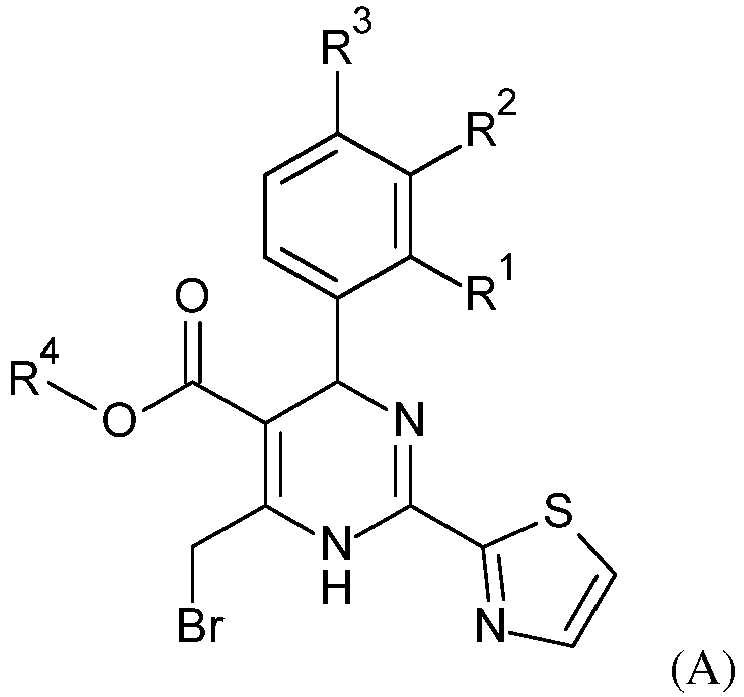

dans lesquelles R1 à R6, X, Y, W et n sont tels que définis dans l'une quelconque des revendications 1 à 18. - Composé selon l'une quelconque des revendications 1 à 19 pour une utilisation comme une substance thérapeutiquement active.
- Composition pharmaceutique comprenant un composé selon l'une quelconque des revendications 1 à 19 et un véhicule thérapeutiquement inerte.
- Utilisation d'un composé selon l'une quelconque des revendications 1 à 19 pour la préparation d'un médicament destiné au traitement ou à la prophylaxie d'une infection par le virus de l'hépatite B.
- Composé selon l'une quelconque des revendications 1 à 19 pour une utilisation dans le traitement ou la prophylaxie d'une infection par le virus de l'hépatite B.
Priority Applications (4)
| Application Number | Priority Date | Filing Date | Title |
|---|---|---|---|
| PL15710127T PL3114128T3 (pl) | 2014-03-07 | 2015-03-04 | Nowe skondensowane w pozycji 6 heteroarylodihydropirymidyny stosowane w leczeniu i profilaktyce zakażenia wirusem zapalenia wątroby typu B |
| RS20190265A RS58384B1 (sr) | 2014-03-07 | 2015-03-04 | Novi 6-fuzionisani heteroarildihidropirimidini za lečenje i profilaksu infekcije virusom hepatitisa b |
| SI201530620T SI3114128T1 (sl) | 2014-03-07 | 2015-03-04 | Novi 6-spojeni heteroarildihidropirimidini za zdravljenje in preprečevanje okužbe z virusom hepatitisa B |
| HRP20190352TT HRP20190352T1 (hr) | 2014-03-07 | 2015-03-04 | Novi 6-kondenzirani heteroarildihidropirimidini za liječenje i profilaksu infekcije virusom hepatitisa b |
Applications Claiming Priority (4)
| Application Number | Priority Date | Filing Date | Title |
|---|---|---|---|
| CNPCT/CN2014/073068 | 2014-03-07 | ||
| CNPCT/CN2014/083027 | 2014-07-25 | ||
| CN2015070895 | 2015-01-16 | ||
| PCT/EP2015/054454 WO2015132276A1 (fr) | 2014-03-07 | 2015-03-04 | Nouvelles héteroaryldihydropyrimidines condensées en position 6 pour le traitement et la prophylaxie d'une infection à virus de l'hépatite b |
Publications (2)
| Publication Number | Publication Date |
|---|---|
| EP3114128A1 EP3114128A1 (fr) | 2017-01-11 |
| EP3114128B1 true EP3114128B1 (fr) | 2019-01-02 |
Family
ID=52684200
Family Applications (1)
| Application Number | Title | Priority Date | Filing Date |
|---|---|---|---|
| EP15710127.0A Active EP3114128B1 (fr) | 2014-03-07 | 2015-03-04 | Nouvelles héteroaryldihydropyrimidines condensées en position 6 pour le traitement et la prophylaxie d'une infection à virus de l'hépatite b |
Country Status (32)
| Country | Link |
|---|---|
| US (4) | US9233978B2 (fr) |
| EP (1) | EP3114128B1 (fr) |
| JP (1) | JP6306750B2 (fr) |
| KR (2) | KR101933844B1 (fr) |
| CN (3) | CN107513073A (fr) |
| AU (1) | AU2015226206B2 (fr) |
| BR (1) | BR112016020566B1 (fr) |
| CA (1) | CA2935811C (fr) |
| CL (1) | CL2016002179A1 (fr) |
| CR (1) | CR20160337A (fr) |
| DK (1) | DK3114128T3 (fr) |
| EA (1) | EA030115B9 (fr) |
| ES (1) | ES2714110T3 (fr) |
| HK (1) | HK1245784A1 (fr) |
| HR (1) | HRP20190352T1 (fr) |
| HU (1) | HUE041734T2 (fr) |
| IL (1) | IL246449B (fr) |
| LT (1) | LT3114128T (fr) |
| MA (1) | MA39721A (fr) |
| MX (1) | MX350439B (fr) |
| MY (1) | MY188114A (fr) |
| NZ (1) | NZ721520A (fr) |
| PE (1) | PE20161338A1 (fr) |
| PH (1) | PH12016501631A1 (fr) |
| PL (1) | PL3114128T3 (fr) |
| PT (1) | PT3114128T (fr) |
| RS (1) | RS58384B1 (fr) |
| SG (1) | SG11201607332UA (fr) |
| SI (1) | SI3114128T1 (fr) |
| TW (2) | TWI606050B (fr) |
| UA (1) | UA117518C2 (fr) |
| WO (1) | WO2015132276A1 (fr) |
Families Citing this family (200)
| Publication number | Priority date | Publication date | Assignee | Title |
|---|---|---|---|---|
| ES2524356T3 (es) | 2010-07-22 | 2014-12-05 | Gilead Sciences, Inc. | Métodos y compuestos para tratar infecciones provocadas por virus Paramyxoviridae |
| KR101939710B1 (ko) | 2011-12-21 | 2019-01-17 | 노비라 테라퓨틱스, 인코포레이티드 | B형 간염의 항바이러스성 제제 |
| UY34993A (es) | 2012-08-28 | 2014-02-28 | Janssen R & D Ireland | Sulfamoilarilamidas y su uso como medicamentos para el tratamiento de la hepatitis b |
| WO2014131847A1 (fr) | 2013-02-28 | 2014-09-04 | Janssen R&D Ireland | Sulfamoyl-arylamides et leur utilisation en tant que médicaments pour le traitement de l'hépatite b |
| JP6419155B2 (ja) | 2013-04-03 | 2018-11-07 | ヤンセン・サイエンシズ・アイルランド・ユーシー | N−フェニル−カルボキサミド誘導体およびb型肝炎を治療するための医薬品としてのその使用 |
| HRP20181863T1 (hr) | 2013-05-17 | 2018-12-28 | Janssen Sciences Ireland Uc | Derivati sulfamoiltiofenamida i njihova uporaba kao lijekova za liječenje hepatitisa b |
| EA201592126A1 (ru) * | 2013-05-17 | 2016-05-31 | Ф. Хоффманн-Ля Рош Аг | 6-мостиковые гетероарилдигидропиримидины для лечения и профилактики заражения вирусом гепатита b |
| JO3583B1 (ar) | 2013-05-17 | 2020-07-05 | Janssen Sciences Ireland Uc | مشتقات سلفامويل بيرولاميد واستخدامها كادوية لمعالجة التهاب الكبد نوع بي |
| NO3024819T3 (fr) | 2013-07-25 | 2018-07-21 | ||
| MX368158B (es) | 2013-10-23 | 2019-09-20 | Janssen Sciences Ireland Uc | Derivados de carboxamida y su uso como medicamentos para el tratamiento de la hepatitis b. |
| KR102284938B1 (ko) | 2013-11-27 | 2021-08-02 | 선샤인 레이크 파르마 컴퍼니 리미티드 | 다이하이드로피리미딘 유도체 및 이의 중간산물의 제조 방법 |
| US10392349B2 (en) | 2014-01-16 | 2019-08-27 | Novira Therapeutics, Inc. | Azepane derivatives and methods of treating hepatitis B infections |
| WO2015120178A1 (fr) | 2014-02-05 | 2015-08-13 | Novira Therapeutics, Inc. | Polythérapie pour le traitement d'infections par le vhb |
| DK3102572T3 (en) | 2014-02-06 | 2019-02-04 | Janssen Sciences Ireland Uc | SULFAMOYLPYRROLAMIDE DERIVATIVES AND THEIR USE AS MEDICINES TO TREAT HEPATITIS B |
| ES2714110T3 (es) * | 2014-03-07 | 2019-05-27 | Hoffmann La Roche | Heteroarildihidropirimidinas 6-fusionadas novedosas para el tratamiento y profilaxis de la infección por el virus de la hepatitis B |
| US9771358B2 (en) | 2014-03-28 | 2017-09-26 | Sunshine Lake Pharma Co., Ltd. | Dihydropyrimidine compounds and their application in pharmaceuticals |
| CN106459061B (zh) * | 2014-05-30 | 2020-01-21 | 齐鲁制药有限公司 | 作为hbv抑制剂的二氢嘧啶并环衍生物 |
| TWI740546B (zh) | 2014-10-29 | 2021-09-21 | 美商基利科學股份有限公司 | 製備核糖苷的方法 |
| EP3253751B1 (fr) | 2015-02-07 | 2020-12-09 | Sunshine Lake Pharma Co., Ltd. | Complexes et sels de dérivés de dihydropyrimidine et leur application dans des produits pharmaceutiques |
| SG11201706835WA (en) * | 2015-03-16 | 2017-09-28 | Hoffmann La Roche | Combined treatment with a tlr7 agonist and an hbv capsid assembly inhibitor |
| US10442788B2 (en) | 2015-04-01 | 2019-10-15 | Enanta Pharmaceuticals, Inc. | Hepatitis B antiviral agents |
| WO2016183266A1 (fr) | 2015-05-13 | 2016-11-17 | Enanta Pharmaceuticals, Inc. | Agents antiviraux de l'hépatite b |
| US10875876B2 (en) | 2015-07-02 | 2020-12-29 | Janssen Sciences Ireland Uc | Cyclized sulfamoylarylamide derivatives and the use thereof as medicaments for the treatment of hepatitis B |
| US10179131B2 (en) | 2015-07-13 | 2019-01-15 | Enanta Pharmaceuticals, Inc. | Hepatitis B antiviral agents |
| US10301255B2 (en) | 2015-07-22 | 2019-05-28 | Enanta Pharmaceuticals, Inc. | Hepatitis B antiviral agents |
| HRP20220355T1 (hr) | 2015-09-16 | 2022-05-13 | Gilead Sciences, Inc. | Postupci za liječenje infekcija coronaviridae |
| US10829519B2 (en) | 2015-09-18 | 2020-11-10 | Wake Forest University Health Sciences | Angiotensin (1-7) analogs and methods relating thereto |
| WO2017064156A1 (fr) | 2015-10-16 | 2017-04-20 | F. Hoffmann-La Roche Ag | Nouvelles 2-hétéroaryldihydropyrimidines fusionnées en position 6 pour le traitement et la prophylaxie de l'infection par le virus de l'hépatite b |
| HK1255463A1 (zh) * | 2015-11-03 | 2019-08-16 | F. Hoffmann-La Roche Ag | Hbv衣壳组装抑制剂和干扰素的组合疗法 |
| CA2914601A1 (fr) * | 2015-12-11 | 2017-06-11 | Wake Forest University Health Sciences | Analogues d'angiotensine-(1-7) et methodes associees |
| WO2017108630A1 (fr) * | 2015-12-21 | 2017-06-29 | F. Hoffmann-La Roche Ag | Polythérapie à inhibiteur hbsag et inhibiteur d'assemblage de capside du vhb |
| US10280175B2 (en) | 2016-02-02 | 2019-05-07 | Enanta Pharmaceuticals, Inc. | Hepatitis B antiviral agents |
| ES2897913T3 (es) | 2016-02-19 | 2022-03-03 | Novartis Ag | Compuestos de piridona tetracíclicos como antivirales |
| AR107633A1 (es) * | 2016-02-19 | 2018-05-16 | Hoffmann La Roche | Procedimiento para la preparación del ácido 4-fenil-5-alcoxicarbonil-2-tiazol-2-il-1,4-dihidropirimidin-6-il-[metil]-3-oxo-5,6,8,8a-tetrahidro-1h-imidazo[1,5a]pirazin-2-il-carboxílico |
| KR102398439B1 (ko) | 2016-03-07 | 2022-05-16 | 이난타 파마슈티칼스, 인코포레이티드 | B형 간염 항바이러스제 |
| KR20180129943A (ko) | 2016-04-15 | 2018-12-05 | 노비라 테라퓨틱스, 인코포레이티드 | 캡시드 조립 억제제를 포함하는 배합물 및 방법 |
| DE202016102339U1 (de) * | 2016-05-03 | 2016-06-22 | Freund Maschinenfabrik Gmbh & Co. Kg | Gleitblock für ein Sägeband in einer Bandsägemaschine |
| EP3458455B1 (fr) * | 2016-05-20 | 2021-06-16 | F. Hoffmann-La Roche AG | Nouveaux composés de pyrazine ayant un coupleur d'oxygène, de soufre et d'azote pour le traitement de maladies infectieuses |
| SG11201810834WA (en) | 2016-06-10 | 2018-12-28 | Enanta Pharm Inc | Hepatitis b antiviral agents |
| WO2017216685A1 (fr) | 2016-06-16 | 2017-12-21 | Novartis Ag | Composés pyridones pentacycliques utiles en tant qu'agents antiviraux |
| WO2017216686A1 (fr) | 2016-06-16 | 2017-12-21 | Novartis Ag | Composés de 2-oxo-6,7-dihydropyrido-isoquinoline fusionnés en 8,9 utilisés comme antiviraux |
| EP3490987B1 (fr) * | 2016-07-29 | 2022-09-21 | Guangzhou Lupeng Pharmaceutical Company Ltd. | Nouveaux agents thérapeutiques pour le traitement de l'infection par hbv |
| JP2019526562A (ja) * | 2016-08-24 | 2019-09-19 | エフ.ホフマン−ラ ロシュ アーゲーF. Hoffmann−La Roche Aktiengesellschaft | Hbvキャプシドアセンブリ阻害剤とヌクレオシ(チ)ド類似体の併用療法 |
| WO2018045150A1 (fr) | 2016-09-02 | 2018-03-08 | Gilead Sciences, Inc. | Dérivés de 4,6-diamino-pyrido [3,2-d] pyrimidine en tant que modulateurs du récepteur de type toll |
| MA46093A (fr) | 2016-09-02 | 2021-05-19 | Gilead Sciences Inc | Composés modulateurs du recepteur de type toll |
| TW201811788A (zh) | 2016-09-09 | 2018-04-01 | 瑞士商諾華公司 | 作為抗病毒劑之多環吡啶酮化合物 |
| CN109715214B (zh) * | 2016-09-13 | 2022-03-04 | 豪夫迈·罗氏有限公司 | Tlr7激动剂和hbv衣壳组装抑制剂的组合治疗 |
| FI3526323T3 (fi) | 2016-10-14 | 2023-06-06 | Prec Biosciences Inc | Hepatiitti B -viruksen genomissa oleville tunnistussekvensseille spesifisiä muokattuja meganukleaaseja |
| WO2018073753A1 (fr) | 2016-10-18 | 2018-04-26 | Novartis Ag | Composés pyridones tétracycliques fusionnés en tant qu'agents antiviraux |
| CN116751200A (zh) | 2016-11-07 | 2023-09-15 | 爱彼特生物制药公司 | 含有取代的吡啶酮的三环化合物以及使用其的方法 |
| MX2019005119A (es) * | 2016-11-18 | 2019-06-20 | Sichuan Kelun Biotech Biopharmaceutical Co Ltd | Compuesto de dihidropirimidina y metodo de preparacion y uso del mismo. |
| US11166954B2 (en) | 2016-11-18 | 2021-11-09 | Sichuan Kelun-Biotech Biopharmaceutical Co., Ltd. | Dihydropyrimidine compound and preparation method and use thereof |
| CN108341810B (zh) * | 2017-01-23 | 2022-01-18 | 上海长森药业有限公司 | 环硫脲类化合物及其用途 |
| AR110768A1 (es) | 2017-01-31 | 2019-05-02 | Gilead Sciences Inc | Formas cristalinas de tenofovir alafenamida |
| CN116036112A (zh) | 2017-03-14 | 2023-05-02 | 吉利德科学公司 | 治疗猫冠状病毒感染的方法 |
| JP7427449B2 (ja) * | 2017-03-15 | 2024-02-05 | ノヴォ・ノルディスク・リサーチ・センター・オックスフォード・リミテッド | 大員環化合物 |
| US11098010B2 (en) | 2017-03-21 | 2021-08-24 | Arbutus Biopharma Corporation | Substituted dihydroindene-4-carboxamides and analogs thereof, and methods using same |
| BR102018007822A2 (pt) | 2017-04-20 | 2018-11-06 | Gilead Sciences, Inc. | composto, métodos para inibir pd-1, pd-l1 e/ou interação de pd-1/pd-l1 e para tratamento de câncer, composição farmacêutica, e, kit para tratamento de ou prevenção de câncer ou uma doença ou condição |
| AR111419A1 (es) | 2017-04-27 | 2019-07-10 | Novartis Ag | Compuestos fusionados de indazol piridona como antivirales |
| WO2018204198A1 (fr) | 2017-05-01 | 2018-11-08 | Gilead Sciences, Inc. | Formes cristallines de (s) 2 éthylbutyl 2 (((s) (((2r,3s,4r,5r) 5 (4 aminopyrrolo[2,1-f] [1,2,4]triazine-7-yl)-5-cyano-3,4-dihydroxytetrahydrofuran-2 yl)méthoxy)(phénoxy) phosphoryl)amino)propanoate |
| US11142527B2 (en) | 2017-06-26 | 2021-10-12 | Sunshine Lake Pharma Co., Ltd. | Dihydropyrimidine compounds and uses thereof in medicine |
| EP3645516A4 (fr) | 2017-06-27 | 2021-07-07 | Janssen Pharmaceutica NV | Dérivés hétéroaryldihydropyrimidine et méthodes de traitement d'infections par le virus de l'hépatite b |
| EP4512475A3 (fr) | 2017-07-11 | 2025-05-14 | Gilead Sciences, Inc. | Compositions comprenant un inhibiteur de l'arn polymerase et de la cyclodextrine pour le traitement d'infections virales |
| EA202090514A1 (ru) | 2017-08-28 | 2020-06-24 | Энанта Фармасьютикалс, Инк. | Противовирусное средство против гепатита в |
| US11261190B2 (en) * | 2017-10-18 | 2022-03-01 | Sunshine Lake Pharma Co., Ltd. | Dihydropyrimidine compounds and uses thereof in medicine |
| HRP20230023T1 (hr) | 2017-10-20 | 2023-03-17 | Dicerna Pharmaceuticals, Inc. | Postupci liječenja infekcije hepatitisom b |
| BR112020008765A2 (pt) | 2017-11-02 | 2020-10-20 | Aicuris Gmbh & Co. Kg | indol-2-carboxamidas pirazolo-piperidina substituídas altamente ativas inovadoras ativas contra o vírus da hepatite b (hbv) |
| GEAP202115351A (en) | 2017-11-02 | 2021-12-10 | Aicuris Gmbh & Co Kg | Novel, highly active amino-thiazole substituted indole-2-carboxamides active against the hepatitis b virus (hbv) |
| US20210079015A1 (en) | 2017-11-17 | 2021-03-18 | Novartis Ag | Novel dihydroisoxazole compounds and their use for the treatment of hepatitis b |
| US10723733B2 (en) | 2017-12-06 | 2020-07-28 | Enanta Pharmaceuticals, Inc. | Hepatitis B antiviral agents |
| TW201927789A (zh) * | 2017-12-06 | 2019-07-16 | 美商因那塔製藥公司 | B型肝炎抗病毒試劑 |
| EP3728266A1 (fr) | 2017-12-20 | 2020-10-28 | Novartis AG | Composés de pyrazolo-dihydropyrazinyl-pyridone fusionnés tricycliques utilisés en tant qu'agents antiviraux |
| JP7098748B2 (ja) | 2017-12-20 | 2022-07-11 | インスティチュート オブ オーガニック ケミストリー アンド バイオケミストリー エーエスシーアール,ヴイ.ヴイ.アイ. | Stingアダプタータンパク質を活性化するホスホン酸結合を有する2’3’環状ジヌクレオチド |
| KR102492187B1 (ko) | 2017-12-20 | 2023-01-27 | 인스티튜트 오브 오가닉 케미스트리 앤드 바이오케미스트리 에이에스 씨알 브이.브이.아이. | Sting 어댑터 단백질을 활성화하는 포스포네이트 결합을 가진 3'3' 사이클릭 다이뉴클레오티드 |
| WO2019126622A1 (fr) * | 2017-12-21 | 2019-06-27 | Janssen Sciences Ireland Unlimited Company | Composés d'isoxazole pour le traitement de maladies associées à des infections par le vhb |
| JP7256810B2 (ja) | 2017-12-28 | 2023-04-12 | エフ. ホフマン-ラ ロシュ アーゲー | B型肝炎ウイルス感染の治療及び予防のためのジヒドロピリミジニルチアゾール |
| WO2019143902A2 (fr) | 2018-01-22 | 2019-07-25 | Enanta Pharmaceuticals, Inc. | Hétérocycles substitués utiles en tant qu'agents antiviraux |
| KR102708681B1 (ko) | 2018-02-13 | 2024-09-26 | 길리애드 사이언시즈, 인코포레이티드 | Pd-1/pd-l1 억제제 |
| KR102526964B1 (ko) | 2018-02-26 | 2023-04-28 | 길리애드 사이언시즈, 인코포레이티드 | Hbv 복제 억제제로서의 치환된 피롤리진 화합물 |
| EP3759110A1 (fr) | 2018-02-28 | 2021-01-06 | Novartis AG | Composés d'indole-2-carbonyle et leur utilisation dans le traitement de l'hépatite b |
| JP2021515769A (ja) | 2018-03-14 | 2021-06-24 | ヤンセン・サイエンシズ・アイルランド・アンリミテッド・カンパニー | カプシド集合調節剤の投薬レジメン |
| US10729688B2 (en) | 2018-03-29 | 2020-08-04 | Enanta Pharmaceuticals, Inc. | Hepatitis B antiviral agents |
| US10870691B2 (en) | 2018-04-05 | 2020-12-22 | Gilead Sciences, Inc. | Antibodies and fragments thereof that bind hepatitis B virus protein X |
| TWI818007B (zh) | 2018-04-06 | 2023-10-11 | 捷克科學院有機化學與生物化學研究所 | 2'3'-環二核苷酸 |
| TW202005654A (zh) | 2018-04-06 | 2020-02-01 | 捷克科學院有機化學與生物化學研究所 | 2,2,─環二核苷酸 |
| TWI833744B (zh) | 2018-04-06 | 2024-03-01 | 捷克科學院有機化學與生物化學研究所 | 3'3'-環二核苷酸 |
| TW201945388A (zh) | 2018-04-12 | 2019-12-01 | 美商精密生物科學公司 | 對b型肝炎病毒基因體中之識別序列具有特異性之最佳化之經工程化巨核酸酶 |
| EP4600247A3 (fr) | 2018-04-19 | 2025-11-19 | Gilead Sciences, Inc. | Inhibiteurs de pd-1/pd-l1 |
| US20190359645A1 (en) | 2018-05-03 | 2019-11-28 | Institute Of Organic Chemistry And Biochemistry Ascr, V.V.I. | 2'3'-cyclic dinucleotides comprising carbocyclic nucleotide |
| JP7616987B2 (ja) | 2018-07-13 | 2025-01-17 | エフ. ホフマン-ラ ロシュ アーゲー | Rtel1発現の調節用のオリゴヌクレオチド |
| UA126421C2 (uk) | 2018-07-13 | 2022-09-28 | Гіліад Сайєнсіз, Інк. | Інгібітори pd-1/pd-l1 |
| TWI826492B (zh) | 2018-07-27 | 2023-12-21 | 加拿大商愛彼特生物製藥公司 | 經取代四氫環戊[c]吡咯、經取代二氫吡咯,其類似物及使用其之方法 |
| WO2020028097A1 (fr) | 2018-08-01 | 2020-02-06 | Gilead Sciences, Inc. | Formes solides d'acide (r)-11-(méthoxyméthyl)-12-(3-méthoxypropoxy)-3,3-diméthyl-8-0 x0-2,3,8,13b-tétrahydro-1h-pyrido[2,1-a] pyrrolo[1,2-c]phtalazine-7-carboxylique |
| US11053235B2 (en) | 2018-08-09 | 2021-07-06 | Janssen Sciences Ireland Unlimited Company | Substituted 1,4-dihydropyrimidines for the treatment of HBV infection or HBV-induced diseases |
| CA3113235A1 (fr) | 2018-09-21 | 2020-03-26 | Enanta Pharmaceuticals, Inc. | Heterocycles fonctionnalises utiles en tant qu'agents antiviraux |
| US11236085B2 (en) | 2018-10-24 | 2022-02-01 | Gilead Sciences, Inc. | PD-1/PD-L1 inhibitors |
| WO2020087107A1 (fr) | 2018-10-31 | 2020-05-07 | The University Of Sydney | Compositions et méthodes de traitement d'infections virales |
| WO2020092528A1 (fr) | 2018-10-31 | 2020-05-07 | Gilead Sciences, Inc. | Composés 6-azabenzimidazole substitués ayant une activité inhibitrice de hpk1 |
| PE20211655A1 (es) | 2018-10-31 | 2021-08-24 | Gilead Sciences Inc | Compuestos de 6-azabencimidazol sustituidos como inhibidores de hpk1 |
| UY38436A (es) | 2018-11-02 | 2020-05-29 | Aicuris Gmbh & Co Kg | Nuevas 6,7-dihidro-4h-pirazolo[1,5-a] pirazinindol-2-carboxamidas activas contra el virus de la hepatitis b (vhb) |
| PY1991608A (es) | 2018-11-02 | 2022-02-10 | Aicuris Gmbh & Co Kg | Nueva urea 6,7-dihidro-4h-pirazolo [1,5-a] pirazina activas contra el virus de la hepatitis b (vhb) |
| TW202031666A (zh) | 2018-11-02 | 2020-09-01 | 德商艾庫瑞斯公司 | 對抗b型肝炎病毒(hbv)之新穎6,7-二氫-4h-噻唑并[5,4-c]吡啶脲活性劑 |
| PY1991611A (es) | 2018-11-02 | 2022-03-14 | Aicuris Gmbh & Co Kg | Nueva urea 6,7-dihidro-4h-pirazolo [1,5-a] pirazinas activas contra el virus de la hepatitis b (vhb) |
| PY1991606A (es) | 2018-11-02 | 2022-02-10 | Aicuris Gmbh & Co Kg | Nueva urea 6,7-dihidro-4h-pirazolo [4,3-c] piridinas activas contra el virus de la hepatitis b (vhb) |
| PY1991601A (es) | 2018-11-02 | 2020-11-02 | Aicuris Gmbh & Co Kg | Nuevas 6,7-dihidro-4h-pirazolo [1,5-a] pirazina indole-2-carboxamidas activas contra el virus de la hepatitis b (vhb) |
| IL283190B2 (en) | 2018-11-21 | 2025-08-01 | Enanta Pharm Inc | Functionalized heterocycles as antiviral agents |
| TW202415643A (zh) | 2018-12-12 | 2024-04-16 | 加拿大商愛彼特生物製藥公司 | 經取代之芳基甲基脲類及雜芳基甲基脲類、其類似物及其使用方法 |
| TW202035412A (zh) * | 2018-12-20 | 2020-10-01 | 比利時商健生藥品公司 | 雜芳基二氫嘧啶衍生物和治療b型肝炎感染之方法 |
| US20220048919A1 (en) * | 2018-12-20 | 2022-02-17 | Janssen Phrmaceutica NV | Heteroaryldihydropyrimidine derivatives and methods of treating hepatitis b infections |
| CN113166154B (zh) * | 2018-12-25 | 2022-12-27 | 广东东阳光药业有限公司 | 氘代二氢嘧啶类化合物及其在药物中的应用 |
| US11096931B2 (en) | 2019-02-22 | 2021-08-24 | Janssen Sciences Ireland Unlimited Company | Amide derivatives useful in the treatment of HBV infection or HBV-induced diseases |
| CN113543851B (zh) | 2019-03-07 | 2025-03-18 | 捷克共和国有机化学与生物化学研究所 | 2’3’-环二核苷酸及其前药 |
| WO2020178768A1 (fr) | 2019-03-07 | 2020-09-10 | Institute Of Organic Chemistry And Biochemistry Ascr, V.V.I. | Analogue du dinucléotide 3'3'-cyclique comprenant un nucléotide modifié par cyclopentanyle utilisé en tant que modulateur de sting |
| WO2020178770A1 (fr) | 2019-03-07 | 2020-09-10 | Institute Of Organic Chemistry And Biochemistry Ascr, V.V.I. | Dinucléotides 3'3'-cycliques et leurs promédicaments |
| CA3130596A1 (fr) * | 2019-03-25 | 2020-10-01 | F. Hoffmann-La Roche Ag | Formes solides d'un compose du modificateur allosterique de la proteine capsidique du vhb |
| CN111825676B (zh) * | 2019-04-15 | 2023-10-17 | 广东东阳光药业股份有限公司 | 二氢嘧啶类化合物及其在药物中的应用 |
| TW202104210A (zh) | 2019-04-17 | 2021-02-01 | 美商基利科學股份有限公司 | Hiv蛋白酶抑制劑 |
| TW202210480A (zh) | 2019-04-17 | 2022-03-16 | 美商基利科學股份有限公司 | 類鐸受體調節劑之固體形式 |
| TW202212339A (zh) | 2019-04-17 | 2022-04-01 | 美商基利科學股份有限公司 | 類鐸受體調節劑之固體形式 |
| WO2020221826A1 (fr) | 2019-04-30 | 2020-11-05 | Aicuris Gmbh & Co. Kg | Nouveaux indole-2-carboxamides actifs contre le virus de l'hépatite b (vhb) |
| CN113748113A (zh) | 2019-04-30 | 2021-12-03 | 艾库里斯有限及两合公司 | 具有抗乙型肝炎病毒(hbv)活性的新型吲哚嗪-2-甲酰胺类化合物 |
| CU20210090A7 (es) | 2019-04-30 | 2022-06-06 | Aicuris Gmbh & Co Kg | Compuestos derivados de oxalil piperazinas activos contra el virus de la hepatitis b (vhb) |
| EP3962912A1 (fr) | 2019-04-30 | 2022-03-09 | AiCuris GmbH & Co. KG | Nouvelles urées de phényle et de pyridyle actives contre le virus de l'hépatite b (vhb) |
| CN111848627B (zh) * | 2019-04-30 | 2021-10-01 | 东莞市东阳光新药研发有限公司 | 二氢嘧啶类化合物及其在药物中的应用 |
| US11491148B2 (en) | 2019-05-06 | 2022-11-08 | Janssen Sciences Ireland Unlimited Company | Amide derivatives useful in the treatment of HBV infection or HBV-induced diseases |
| CN113825758B (zh) * | 2019-05-14 | 2023-08-01 | 正大天晴药业集团股份有限公司 | 抗HBV的四氢异噁唑并[4,3-c]吡啶类化合物的晶型 |
| TWI826690B (zh) | 2019-05-23 | 2023-12-21 | 美商基利科學股份有限公司 | 經取代之烯吲哚酮化物及其用途 |
| US11236111B2 (en) | 2019-06-03 | 2022-02-01 | Enanta Pharmaceuticals, Inc. | Hepatitis B antiviral agents |
| WO2020247575A1 (fr) | 2019-06-04 | 2020-12-10 | Enanta Pharmaceuticals, Inc. | Agents antiviraux de l'hépatite b |
| WO2020247561A1 (fr) | 2019-06-04 | 2020-12-10 | Enanta Pharmaceuticals, Inc, | Agents antiviraux de l'hépatite b |
| CA3142659A1 (fr) * | 2019-06-06 | 2020-12-10 | F. Hoffmann-La Roche Ag | Procede de rechange pour la preparation d'acide 4-phenyl-5-alcoxycarbonyl-2-thiazol-2-yl-1,4-dihydropyrimidin-6-yl]methyl]-3-oxo-5,6,8,8a-tetrahydro-1h-imidazo[1,5-a]pyrazin-2-yl]-carboxylique |
| WO2020255016A1 (fr) | 2019-06-18 | 2020-12-24 | Janssen Sciences Ireland Unlimited Company | Combinaison de vaccins contre le virus de l'hépatite b (vhb) et de dérivés de dihydropyrimidine en tant que modulateurs de l'assemblage des capsides |
| WO2020255017A1 (fr) | 2019-06-18 | 2020-12-24 | Janssen Sciences Ireland Unlimited Company | Combinaison de vaccins contre le virus de l'hépatite b (vhb) et de dérivés de dihydropyrimidine en tant que modulateurs d'assemblage de capside |
| AU2020301161B2 (en) | 2019-06-25 | 2023-10-26 | Gilead Sciences, Inc. | FLT3L-Fc fusion proteins and methods of use |
| WO2021007488A1 (fr) | 2019-07-11 | 2021-01-14 | Enanta Pharmaceuticals, Inc. | Hétérocycles substitués utilisés en tant qu'agents antiviraux |
| WO2021011891A1 (fr) | 2019-07-18 | 2021-01-21 | Gilead Sciences, Inc. | Formulations à action prolongée de ténofovir alafénamide |
| KR20220041853A (ko) * | 2019-07-31 | 2022-04-01 | 얀센 사이언시즈 아일랜드 언리미티드 컴퍼니 | 디히드로피리미딘 유도체 및 hbv 감염 또는 hbv-유도성 질환의 치료에 있어서의 이의 용도 |
| CA3146992A1 (fr) * | 2019-07-31 | 2021-02-04 | Janssen Sciences Ireland Unlimited Company | Derives de dihydropyrimidine et leurs utilisations dans le traitement d'une infection par le virus de l'hepatite b ou de maladies induites par le virus de l'hepatite b |
| WO2021034804A1 (fr) | 2019-08-19 | 2021-02-25 | Gilead Sciences, Inc. | Formulations pharmaceutiques de ténofovir alafénamide |
| US11236108B2 (en) | 2019-09-17 | 2022-02-01 | Enanta Pharmaceuticals, Inc. | Functionalized heterocycles as antiviral agents |
| EP4031140A1 (fr) | 2019-09-20 | 2022-07-27 | F. Hoffmann-La Roche AG | Procédé de traitement d'une infection par le virus de l'hépatite b à l'aide d'un modulateur allostérique de protéine centrale |
| EP4458975A3 (fr) | 2019-09-30 | 2025-02-12 | Gilead Sciences, Inc. | Vaccins contre le vhb et méthodes de traitement du vhb |
| WO2021078221A1 (fr) * | 2019-10-24 | 2021-04-29 | 广东东阳光药业有限公司 | Composé dihydropyrimidine et son utilisation en tant que médicament |
| ES3022990T3 (en) | 2019-12-06 | 2025-05-29 | Prec Biosciences Inc | Optimized engineered meganucleases having specificity for a recognition sequence in the hepatitis b virus genome |
| KR20220119666A (ko) * | 2019-12-20 | 2022-08-30 | 얀센 파마슈티카 엔.브이. | 헤테로아릴디하이드로피리미딘 유도체 및 b형 간염 감염의 치료 방법 |
| AU2020410993A1 (en) * | 2019-12-24 | 2022-06-16 | F. Hoffmann-La Roche Ag | Pharmaceutical combination of a therapeutic oligonucleotide targeting hbv and a tlr7 agonist for treatment of hbv |
| CN114828852A (zh) | 2019-12-24 | 2022-07-29 | 豪夫迈·罗氏有限公司 | 用于治疗hbv的靶向hbv的抗病毒药剂和/或免疫调节剂的药物组合 |
| EP4445902A3 (fr) | 2019-12-24 | 2024-12-18 | Carna Biosciences, Inc. | Composés modulant la diacylglycérol kinase |
| KR20220119616A (ko) | 2019-12-24 | 2022-08-30 | 에프. 호프만-라 로슈 아게 | Tlr7 효현제를 이용하여 바이러스 감염을 치료하는 방법 |
| AU2021214911A1 (en) | 2020-01-27 | 2022-07-21 | Gilead Sciences, Inc. | Methods for treating SARS CoV-2 infections |
| CA3167114A1 (fr) * | 2020-02-11 | 2021-08-19 | Romano Di Fabio | Inhibiteurs spirocycliques du virus de l'hepatite b |
| CN118994170A (zh) | 2020-03-12 | 2024-11-22 | 吉利德科学公司 | 制备1'-氰基核苷的方法 |
| US11802125B2 (en) | 2020-03-16 | 2023-10-31 | Enanta Pharmaceuticals, Inc. | Functionalized heterocyclic compounds as antiviral agents |
| CA3169348A1 (fr) | 2020-03-20 | 2021-09-23 | Gilead Sciences, Inc. | Promedicaments de nucleosides de 4'-c-substitue-2-halo-2'-desoxyadenosine et leurs procedes de fabrication et d'utilisation |
| EP4132651B1 (fr) | 2020-04-06 | 2026-03-18 | Gilead Sciences, Inc. | Formulations d'inhalation d'analogues de carbanucléosides à substitution 1'-cyano |
| WO2021219523A1 (fr) | 2020-04-28 | 2021-11-04 | F. Hoffmann-La Roche Ag | Procédé de préparation d'un acide pipérazine-2-carboxylique chiral |
| ES3041698T3 (en) | 2020-05-29 | 2025-11-13 | Gilead Sciences Inc | Remdesivir for the treatment of viral infections |
| CA3187821A1 (fr) | 2020-06-24 | 2021-12-30 | Gilead Sciences, Inc. | Analogues de 1'-cyano nucleoside et leurs utilisations |
| CN113831359B (zh) * | 2020-06-24 | 2026-03-06 | 广东东阳光药业股份有限公司 | 二氢嘧啶类化合物及其在药物中的应用 |
| JP2023533807A (ja) | 2020-07-14 | 2023-08-04 | エフ. ホフマン-ラ ロシュ アーゲー | 自己免疫疾患の処置のためのヒドロイソキノリン又はヒドロナフチリジン化合物 |
| AU2021322891A1 (en) * | 2020-08-05 | 2023-03-09 | Dicerna Pharmaceuticals, Inc. | Oligonucleotide treatment of hepatitis B patients |
| ES3054072T3 (en) | 2020-08-07 | 2026-01-29 | Gilead Sciences Inc | Prodrugs of phosphonamide nucleotide analogues and their pharmaceutical use |
| MX2023002233A (es) | 2020-08-24 | 2023-03-15 | Gilead Sciences Inc | Compuestos fosfolipidos y usos de estos. |
| WO2022047065A2 (fr) | 2020-08-27 | 2022-03-03 | Gilead Sciences, Inc. | Composés et méthodes de traitement d'infections virales |
| CN111892544A (zh) * | 2020-08-31 | 2020-11-06 | 南通大学 | 一种3-(氨基甲基)-4-(4-氟苯基)哌嗪-1-羧酸叔丁酯及其合成方法 |
| WO2022052923A1 (fr) * | 2020-09-08 | 2022-03-17 | 和博医药有限公司 | Composé dihydropyrimidine et son utilisation |
| WO2022078479A1 (fr) * | 2020-10-16 | 2022-04-21 | Janssen Pharmaceuticals, Inc. | Polythérapie pour le traitement d'une infection par le virus de l'hépatite b |
| TWI811812B (zh) | 2020-10-16 | 2023-08-11 | 美商基利科學股份有限公司 | 磷脂化合物及其用途 |
| TW202406932A (zh) | 2020-10-22 | 2024-02-16 | 美商基利科學股份有限公司 | 介白素2-Fc融合蛋白及使用方法 |
| KR20230116021A (ko) * | 2020-11-30 | 2023-08-03 | 선샤인 레이크 파르마 컴퍼니 리미티드 | 다이하이드로피리미딘 유도체의 염, 이의 착물 및 이의의약에서의 용도 |
| WO2022121844A1 (fr) * | 2020-12-09 | 2022-06-16 | 上海维申医药有限公司 | Composé de dihydropyrimidine, son procédé de préparation et son application |
| CN116888118A (zh) * | 2021-02-05 | 2023-10-13 | 和博医药有限公司 | 苯基二氢嘧啶类化合物及其应用 |
| CN114853761A (zh) * | 2021-02-05 | 2022-08-05 | 刘沛 | 一种含有二氢嘧啶的双功能衍生物及其用途 |
| EP4293022A4 (fr) * | 2021-02-09 | 2025-01-08 | Shanghai Visonpharma Co., Ltd. | Composé de dihydropyrimidine, son procédé de préparation et son utilisation |
| AU2022274607A1 (en) | 2021-05-13 | 2023-11-16 | Gilead Sciences, Inc. | COMBINATION OF A TLR8 MODULATING COMPOUND AND ANTI-HBV siRNA THERAPEUTICS |
| WO2022251318A1 (fr) | 2021-05-26 | 2022-12-01 | Gilead Sciences, Inc. | Formulations phospholipidiques d'analogues de carba-nucléoside 1'-cyano-substitué |
| EP4359415A1 (fr) | 2021-06-23 | 2024-05-01 | Gilead Sciences, Inc. | Composés modulant les diacylglycérol kinases |
| US11932634B2 (en) | 2021-06-23 | 2024-03-19 | Gilead Sciences, Inc. | Diacylglycerol kinase modulating compounds |
| WO2022271659A1 (fr) | 2021-06-23 | 2022-12-29 | Gilead Sciences, Inc. | Composés modulant les diacylglycérol kinases |
| WO2022271650A1 (fr) | 2021-06-23 | 2022-12-29 | Gilead Sciences, Inc. | Composés de modulation de la diacylglycérol kinase |
| JP7719954B2 (ja) | 2021-08-18 | 2025-08-06 | ギリアード サイエンシーズ, インコーポレイテッド | リン脂質化合物並びにその製造方法及び使用方法 |
| CN114702497B (zh) * | 2021-12-23 | 2023-03-21 | 华南理工大学 | 二氢嘧啶衍生物的晶型及其制备方法和在药物中的应用 |
| CN114702498B (zh) * | 2021-12-23 | 2022-12-16 | 华南理工大学 | 二氢嘧啶衍生物的酸加成盐及其在药物中的应用 |
| EP4486746A1 (fr) | 2022-03-02 | 2025-01-08 | Gilead Sciences, Inc. | Composés et méthodes de traitement d'infections virales |
| TW202525810A (zh) | 2022-03-02 | 2025-07-01 | 美商基利科學股份有限公司 | 用於治療病毒感染的化合物及方法 |
| CR20240367A (es) | 2022-03-03 | 2024-09-30 | Gilead Sciences Inc | Compuestos antivirales y métodos de elaboración y uso de los mismos. |
| WO2023168254A1 (fr) | 2022-03-03 | 2023-09-07 | Gilead Sciences, Inc. | Composés antiviraux, leurs procédés de production et d'utilisation |
| CN119604286A (zh) | 2022-06-06 | 2025-03-11 | 吉利德科学公司 | 用于治疗包括sars-cov-2的病毒感染的方法 |
| WO2024006376A1 (fr) | 2022-06-29 | 2024-01-04 | Gilead Sciences, Inc. | Formes solides d'un analogue nucléosidique et leurs utilisations |
| WO2024006461A1 (fr) | 2022-06-30 | 2024-01-04 | Gilead Sciences, Inc. | Formes solides d'un analogue nucléosidique et leurs utilisations |
| US12357577B1 (en) | 2024-02-02 | 2025-07-15 | Gilead Sciences, Inc. | Pharmaceutical formulations and uses thereof |
| EP4665737A1 (fr) | 2023-02-16 | 2025-12-24 | Gilead Sciences, Inc. | Composés phospholipidiques et leurs procédés de fabrication et d'utilisation |
| WO2024218026A1 (fr) | 2023-04-17 | 2024-10-24 | F. Hoffmann-La Roche Ag | Procédé de préparation de 4-hydroxy-4,5-dihydrothiazole-2-carbonitrile et de ses dérivés |
| US20250090537A1 (en) | 2023-08-31 | 2025-03-20 | Gilead Sciences, Inc. | Antiviral compounds and methods of making and using the same |
| CN121693506A (zh) | 2023-08-31 | 2026-03-17 | 吉利德科学公司 | 抗病毒化合物及其制备和使用方法 |
| WO2025054278A1 (fr) | 2023-09-06 | 2025-03-13 | Gilead Sciences, Inc. | Formes solides d'un analogue de nucléoside et leurs utilisations |
| WO2025240246A1 (fr) | 2024-05-13 | 2025-11-20 | Gilead Sciences, Inc. | Polythérapies avec de la ribavirine |
| WO2025240242A1 (fr) | 2024-05-13 | 2025-11-20 | Gilead Sciences, Inc. | Polythérapies avec ribavirine |
| WO2025240244A1 (fr) | 2024-05-13 | 2025-11-20 | Gilead Sciences, Inc. | Polythérapies comprenant du bulévirtide et du lonafarnib destinées à être utilisées dans le traitement d'une infection par le virus de l'hépatite d |
| WO2025240243A1 (fr) | 2024-05-13 | 2025-11-20 | Gilead Sciences, Inc. | Polythérapies comprenant du bulévirtide et un acide nucléique inhibiteur ciblant le virus de l'hépatite b |
Family Cites Families (23)
| Publication number | Priority date | Publication date | Assignee | Title |
|---|---|---|---|---|
| DE10012549A1 (de) | 2000-03-15 | 2001-09-20 | Bayer Ag | Arzneimittel gegen virale Erkrankungen |
| DE10012824A1 (de) | 2000-03-16 | 2001-09-20 | Bayer Ag | Arzneimittel gegen virale Erkrankungen |
| DE10013126A1 (de) * | 2000-03-17 | 2001-09-20 | Bayer Ag | Arzneimittel gegen virale Erkrankungen |
| EP1745137A1 (fr) | 2004-02-27 | 2007-01-24 | DSMIP Assets B.V. | Preparation enzymatique d'un aminoacide beta-2 enrichi de maniere enantiomere |
| WO2006033995A2 (fr) | 2004-09-16 | 2006-03-30 | Valeant Research And Development | Thiazolidine-4-ones possedant une activite antihepatite b |
| BRPI0616378A2 (pt) | 2005-09-22 | 2011-06-21 | Scripps Research Inst | inibidores de proteìna cinase baseados em alcóxi indolinona e métodos para modulação da atividade catalìtica |
| GB0701366D0 (en) | 2007-01-24 | 2007-03-07 | Glaxo Group Ltd | Novel pharmaceutical compositions |
| WO2009067547A1 (fr) | 2007-11-19 | 2009-05-28 | Takeda Pharmaceutical Company Limited | Inhibiteurs de kinase de type polo |
| ES2454366T3 (es) | 2008-02-22 | 2014-04-10 | Neurotune Ag | Compuestos bicíclicos que contienen nitrógeno activos en afecciones de dolor crónico |
| EP2334683B1 (fr) | 2008-08-29 | 2017-03-22 | MSD Italia S.r.l. | Dérivés hétérocycliques bicycliques saturés en tant qu antagonistes de smo |
| WO2010069147A1 (fr) | 2008-12-17 | 2010-06-24 | 张中能 | Derives de la dihydropyrimidine, leurs compositions et leur utilisation |
| CN102372706A (zh) | 2010-08-09 | 2012-03-14 | 江苏恒瑞医药股份有限公司 | 酞嗪酮类衍生物、其制备方法及其在医药上的应用 |
| WO2014029193A1 (fr) * | 2012-08-24 | 2014-02-27 | Sunshine Lake Pharma Co., Ltd. | Composés de dihydropyrimidine et leur application dans des produits pharmaceutiques |
| EA201592126A1 (ru) * | 2013-05-17 | 2016-05-31 | Ф. Хоффманн-Ля Рош Аг | 6-мостиковые гетероарилдигидропиримидины для лечения и профилактики заражения вирусом гепатита b |
| CN104650069B (zh) * | 2013-11-19 | 2019-04-19 | 广东东阳光药业有限公司 | 4-甲基二氢嘧啶类化合物及其在药物中的应用 |
| ES2714110T3 (es) * | 2014-03-07 | 2019-05-27 | Hoffmann La Roche | Heteroarildihidropirimidinas 6-fusionadas novedosas para el tratamiento y profilaxis de la infección por el virus de la hepatitis B |
| SG11201706835WA (en) * | 2015-03-16 | 2017-09-28 | Hoffmann La Roche | Combined treatment with a tlr7 agonist and an hbv capsid assembly inhibitor |
| HK1255463A1 (zh) * | 2015-11-03 | 2019-08-16 | F. Hoffmann-La Roche Ag | Hbv衣壳组装抑制剂和干扰素的组合疗法 |
| AR107633A1 (es) * | 2016-02-19 | 2018-05-16 | Hoffmann La Roche | Procedimiento para la preparación del ácido 4-fenil-5-alcoxicarbonil-2-tiazol-2-il-1,4-dihidropirimidin-6-il-[metil]-3-oxo-5,6,8,8a-tetrahidro-1h-imidazo[1,5a]pirazin-2-il-carboxílico |
| JP2019526562A (ja) * | 2016-08-24 | 2019-09-19 | エフ.ホフマン−ラ ロシュ アーゲーF. Hoffmann−La Roche Aktiengesellschaft | Hbvキャプシドアセンブリ阻害剤とヌクレオシ(チ)ド類似体の併用療法 |
| CN109715214B (zh) * | 2016-09-13 | 2022-03-04 | 豪夫迈·罗氏有限公司 | Tlr7激动剂和hbv衣壳组装抑制剂的组合治疗 |
| CA3130596A1 (fr) * | 2019-03-25 | 2020-10-01 | F. Hoffmann-La Roche Ag | Formes solides d'un compose du modificateur allosterique de la proteine capsidique du vhb |
| EP4031140A1 (fr) * | 2019-09-20 | 2022-07-27 | F. Hoffmann-La Roche AG | Procédé de traitement d'une infection par le virus de l'hépatite b à l'aide d'un modulateur allostérique de protéine centrale |
-
2015
- 2015-03-04 ES ES15710127T patent/ES2714110T3/es active Active
- 2015-03-04 MA MA039721A patent/MA39721A/fr unknown
- 2015-03-04 LT LTEP15710127.0T patent/LT3114128T/lt unknown
- 2015-03-04 MY MYPI2016703231A patent/MY188114A/en unknown
- 2015-03-04 SI SI201530620T patent/SI3114128T1/sl unknown
- 2015-03-04 KR KR1020187034667A patent/KR101933844B1/ko active Active
- 2015-03-04 PT PT15710127T patent/PT3114128T/pt unknown
- 2015-03-04 DK DK15710127.0T patent/DK3114128T3/en active
- 2015-03-04 AU AU2015226206A patent/AU2015226206B2/en active Active
- 2015-03-04 CR CR20160337A patent/CR20160337A/es unknown
- 2015-03-04 KR KR1020167023287A patent/KR101926243B1/ko active Active
- 2015-03-04 PE PE2016001260A patent/PE20161338A1/es unknown
- 2015-03-04 NZ NZ721520A patent/NZ721520A/en not_active IP Right Cessation
- 2015-03-04 HR HRP20190352TT patent/HRP20190352T1/hr unknown
- 2015-03-04 JP JP2016572899A patent/JP6306750B2/ja active Active
- 2015-03-04 SG SG11201607332UA patent/SG11201607332UA/en unknown
- 2015-03-04 MX MX2016011515A patent/MX350439B/es active IP Right Grant
- 2015-03-04 CN CN201710865883.6A patent/CN107513073A/zh active Pending
- 2015-03-04 UA UAA201610076A patent/UA117518C2/uk unknown
- 2015-03-04 EA EA201691726A patent/EA030115B9/ru not_active IP Right Cessation
- 2015-03-04 WO PCT/EP2015/054454 patent/WO2015132276A1/fr not_active Ceased
- 2015-03-04 BR BR112016020566-9A patent/BR112016020566B1/pt active IP Right Grant
- 2015-03-04 CN CN201811229303.5A patent/CN109232613A/zh active Pending
- 2015-03-04 PL PL15710127T patent/PL3114128T3/pl unknown
- 2015-03-04 CA CA2935811A patent/CA2935811C/fr active Active
- 2015-03-04 HU HUE15710127A patent/HUE041734T2/hu unknown
- 2015-03-04 EP EP15710127.0A patent/EP3114128B1/fr active Active
- 2015-03-04 CN CN201580012257.1A patent/CN106061978B/zh active Active
- 2015-03-04 RS RS20190265A patent/RS58384B1/sr unknown
- 2015-03-05 TW TW106109584A patent/TWI606050B/zh active
- 2015-03-05 TW TW104107096A patent/TWI603972B/zh active
- 2015-03-06 US US14/640,397 patent/US9233978B2/en active Active
- 2015-11-19 US US14/946,595 patent/US10081627B2/en active Active
-
2016
- 2016-06-26 IL IL246449A patent/IL246449B/en active IP Right Grant
- 2016-08-16 PH PH12016501631A patent/PH12016501631A1/en unknown
- 2016-08-30 CL CL2016002179A patent/CL2016002179A1/es unknown
-
2018
- 2018-04-23 HK HK18105251.3A patent/HK1245784A1/zh unknown
- 2018-08-14 US US16/103,198 patent/US10428069B2/en active Active
-
2019
- 2019-08-05 US US16/531,624 patent/US12351575B2/en active Active
Non-Patent Citations (1)
| Title |
|---|
| None * |
Also Published As
Similar Documents
| Publication | Publication Date | Title |
|---|---|---|
| US12351575B2 (en) | 6-fused heteroaryldihydropyrimidines for the treatment and prophylaxis of hepatitis B virus infection | |
| US9758530B2 (en) | 6-bridged heteroaryldihydropyrimidines for the treatment and prophylaxis of hepatitis B virus infection | |
| EP3484885B1 (fr) | Composés de 6,7-dihydro -4 h-pyrazolo [1,5-a]pyrazine pour le traitement des maladies infectieuses | |
| EP2892893B1 (fr) | Hétéroaryldihydropyrimidines d'acide 6-aminé pour le traitement et la prophylaxie d'une infection par le virus de l'hépatite b | |
| HK40002665A (en) | Novel 6-fused heteroaryldihydropyrimidines for the treatment and prophylaxis of hepatitis b virus infection | |
| HK1230189A1 (en) | Novel 6-fused heteroaryldihydropyrimidines for the treatment and prophylaxis of hepatitis b virus infection | |
| HK1230189B (zh) | 用於治疗和预防乙型肝炎病毒感染的新的6-稠合的杂芳基二氢嘧啶 |
Legal Events
| Date | Code | Title | Description |
|---|---|---|---|
| PUAI | Public reference made under article 153(3) epc to a published international application that has entered the european phase |
Free format text: ORIGINAL CODE: 0009012 |
|
| STAA | Information on the status of an ep patent application or granted ep patent |
Free format text: STATUS: REQUEST FOR EXAMINATION WAS MADE |
|
| 17P | Request for examination filed |
Effective date: 20161007 |
|
| AK | Designated contracting states |
Kind code of ref document: A1 Designated state(s): AL AT BE BG CH CY CZ DE DK EE ES FI FR GB GR HR HU IE IS IT LI LT LU LV MC MK MT NL NO PL PT RO RS SE SI SK SM TR |
|
| AX | Request for extension of the european patent |
Extension state: BA ME |
|
| DAX | Request for extension of the european patent (deleted) | ||
| STAA | Information on the status of an ep patent application or granted ep patent |
Free format text: STATUS: EXAMINATION IS IN PROGRESS |
|
| 17Q | First examination report despatched |
Effective date: 20171108 |
|
| GRAP | Despatch of communication of intention to grant a patent |
Free format text: ORIGINAL CODE: EPIDOSNIGR1 |
|
| STAA | Information on the status of an ep patent application or granted ep patent |
Free format text: STATUS: GRANT OF PATENT IS INTENDED |
|
| INTG | Intention to grant announced |
Effective date: 20180315 |
|
| GRAJ | Information related to disapproval of communication of intention to grant by the applicant or resumption of examination proceedings by the epo deleted |
Free format text: ORIGINAL CODE: EPIDOSDIGR1 |
|
| STAA | Information on the status of an ep patent application or granted ep patent |
Free format text: STATUS: EXAMINATION IS IN PROGRESS |
|
| INTC | Intention to grant announced (deleted) | ||
| GRAP | Despatch of communication of intention to grant a patent |
Free format text: ORIGINAL CODE: EPIDOSNIGR1 |
|
| STAA | Information on the status of an ep patent application or granted ep patent |
Free format text: STATUS: GRANT OF PATENT IS INTENDED |
|
| INTG | Intention to grant announced |
Effective date: 20180821 |
|
| GRAS | Grant fee paid |
Free format text: ORIGINAL CODE: EPIDOSNIGR3 |
|
| GRAA | (expected) grant |
Free format text: ORIGINAL CODE: 0009210 |
|
| STAA | Information on the status of an ep patent application or granted ep patent |
Free format text: STATUS: THE PATENT HAS BEEN GRANTED |
|
| AK | Designated contracting states |
Kind code of ref document: B1 Designated state(s): AL AT BE BG CH CY CZ DE DK EE ES FI FR GB GR HR HU IE IS IT LI LT LU LV MC MK MT NL NO PL PT RO RS SE SI SK SM TR |
|
| REG | Reference to a national code |
Ref country code: GB Ref legal event code: FG4D |
|
| REG | Reference to a national code |
Ref country code: AT Ref legal event code: REF Ref document number: 1084215 Country of ref document: AT Kind code of ref document: T Effective date: 20190115 Ref country code: CH Ref legal event code: EP |
|
| REG | Reference to a national code |
Ref country code: IE Ref legal event code: FG4D |
|
| REG | Reference to a national code |
Ref country code: DE Ref legal event code: R096 Ref document number: 602015022722 Country of ref document: DE |
|
| REG | Reference to a national code |
Ref country code: HR Ref legal event code: TUEP Ref document number: P20190352 Country of ref document: HR |
|
| REG | Reference to a national code |
Ref country code: PT Ref legal event code: SC4A Ref document number: 3114128 Country of ref document: PT Date of ref document: 20190227 Kind code of ref document: T Free format text: AVAILABILITY OF NATIONAL TRANSLATION Effective date: 20190220 |
|
| REG | Reference to a national code |
Ref country code: MA Ref legal event code: VAGR Ref document number: 39721 Country of ref document: MA Kind code of ref document: B1 |
|
| REG | Reference to a national code |
Ref country code: RO Ref legal event code: EPE |
|
| REG | Reference to a national code |
Ref country code: HR Ref legal event code: ODRP Ref document number: P20190352 Country of ref document: HR Payment date: 20190227 Year of fee payment: 5 |
|
| REG | Reference to a national code |
Ref country code: DK Ref legal event code: T3 Effective date: 20190318 |
|
| REG | Reference to a national code |
Ref country code: NL Ref legal event code: FP |
|
| REG | Reference to a national code |
Ref country code: SE Ref legal event code: TRGR |
|
| REG | Reference to a national code |
Ref country code: HR Ref legal event code: T1PR Ref document number: P20190352 Country of ref document: HR |
|
| VSFP | Annual fee paid to validation state [announced via postgrant information from national office to epo] |
Ref country code: MA Payment date: 20190125 Year of fee payment: 5 |
|
| REG | Reference to a national code |
Ref country code: NO Ref legal event code: T2 Effective date: 20190102 |
|
| REG | Reference to a national code |
Ref country code: ES Ref legal event code: FG2A Ref document number: 2714110 Country of ref document: ES Kind code of ref document: T3 Effective date: 20190527 |
|
| REG | Reference to a national code |
Ref country code: HU Ref legal event code: AG4A Ref document number: E041734 Country of ref document: HU |
|
| REG | Reference to a national code |
Ref country code: SK Ref legal event code: T3 Ref document number: E 30242 Country of ref document: SK |
|
| REG | Reference to a national code |
Ref country code: GR Ref legal event code: EP Ref document number: 20190400720 Country of ref document: GR Effective date: 20190509 |
|
| PG25 | Lapsed in a contracting state [announced via postgrant information from national office to epo] |
Ref country code: LV Free format text: LAPSE BECAUSE OF FAILURE TO SUBMIT A TRANSLATION OF THE DESCRIPTION OR TO PAY THE FEE WITHIN THE PRESCRIBED TIME-LIMIT Effective date: 20190102 Ref country code: IS Free format text: LAPSE BECAUSE OF FAILURE TO SUBMIT A TRANSLATION OF THE DESCRIPTION OR TO PAY THE FEE WITHIN THE PRESCRIBED TIME-LIMIT Effective date: 20190502 |
|
| REG | Reference to a national code |
Ref country code: DE Ref legal event code: R097 Ref document number: 602015022722 Country of ref document: DE |
|
| PG25 | Lapsed in a contracting state [announced via postgrant information from national office to epo] |
Ref country code: AL Free format text: LAPSE BECAUSE OF FAILURE TO SUBMIT A TRANSLATION OF THE DESCRIPTION OR TO PAY THE FEE WITHIN THE PRESCRIBED TIME-LIMIT Effective date: 20190102 Ref country code: MC Free format text: LAPSE BECAUSE OF FAILURE TO SUBMIT A TRANSLATION OF THE DESCRIPTION OR TO PAY THE FEE WITHIN THE PRESCRIBED TIME-LIMIT Effective date: 20190102 Ref country code: EE Free format text: LAPSE BECAUSE OF FAILURE TO SUBMIT A TRANSLATION OF THE DESCRIPTION OR TO PAY THE FEE WITHIN THE PRESCRIBED TIME-LIMIT Effective date: 20190102 |
|
| PLBE | No opposition filed within time limit |
Free format text: ORIGINAL CODE: 0009261 |
|
| STAA | Information on the status of an ep patent application or granted ep patent |
Free format text: STATUS: NO OPPOSITION FILED WITHIN TIME LIMIT |
|
| PG25 | Lapsed in a contracting state [announced via postgrant information from national office to epo] |
Ref country code: SM Free format text: LAPSE BECAUSE OF FAILURE TO SUBMIT A TRANSLATION OF THE DESCRIPTION OR TO PAY THE FEE WITHIN THE PRESCRIBED TIME-LIMIT Effective date: 20190102 Ref country code: LU Free format text: LAPSE BECAUSE OF NON-PAYMENT OF DUE FEES Effective date: 20190304 |
|
| 26N | No opposition filed |
Effective date: 20191003 |
|
| REG | Reference to a national code |
Ref country code: HR Ref legal event code: ODRP Ref document number: P20190352 Country of ref document: HR Payment date: 20200224 Year of fee payment: 6 |
|
| PG25 | Lapsed in a contracting state [announced via postgrant information from national office to epo] |
Ref country code: MT Free format text: LAPSE BECAUSE OF NON-PAYMENT OF DUE FEES Effective date: 20190304 |
|
| REG | Reference to a national code |
Ref country code: HR Ref legal event code: ODRP Ref document number: P20190352 Country of ref document: HR Payment date: 20210218 Year of fee payment: 7 |
|
| PG25 | Lapsed in a contracting state [announced via postgrant information from national office to epo] |
Ref country code: CY Free format text: LAPSE BECAUSE OF FAILURE TO SUBMIT A TRANSLATION OF THE DESCRIPTION OR TO PAY THE FEE WITHIN THE PRESCRIBED TIME-LIMIT Effective date: 20190102 |
|
| VSFP | Annual fee paid to validation state [announced via postgrant information from national office to epo] |
Ref country code: MA Payment date: 20191230 Year of fee payment: 6 |
|
| REG | Reference to a national code |
Ref country code: HR Ref legal event code: ODRP Ref document number: P20190352 Country of ref document: HR Payment date: 20220303 Year of fee payment: 8 |
|
| PG25 | Lapsed in a contracting state [announced via postgrant information from national office to epo] |
Ref country code: MK Free format text: LAPSE BECAUSE OF FAILURE TO SUBMIT A TRANSLATION OF THE DESCRIPTION OR TO PAY THE FEE WITHIN THE PRESCRIBED TIME-LIMIT Effective date: 20190102 |
|
| REG | Reference to a national code |
Ref country code: AT Ref legal event code: UEP Ref document number: 1084215 Country of ref document: AT Kind code of ref document: T Effective date: 20190102 |
|
| REG | Reference to a national code |
Ref country code: HR Ref legal event code: ODRP Ref document number: P20190352 Country of ref document: HR Payment date: 20221229 Year of fee payment: 9 |
|
| REG | Reference to a national code |
Ref country code: HR Ref legal event code: ODRP Ref document number: P20190352 Country of ref document: HR Payment date: 20240223 Year of fee payment: 10 |
|
| PGFP | Annual fee paid to national office [announced via postgrant information from national office to epo] |
Ref country code: GR Payment date: 20240222 Year of fee payment: 10 |
|
| PGFP | Annual fee paid to national office [announced via postgrant information from national office to epo] |
Ref country code: LT Payment date: 20240220 Year of fee payment: 10 |
|
| PGFP | Annual fee paid to national office [announced via postgrant information from national office to epo] |
Ref country code: NL Payment date: 20240220 Year of fee payment: 10 Ref country code: IE Payment date: 20240222 Year of fee payment: 10 |
|
| PGFP | Annual fee paid to national office [announced via postgrant information from national office to epo] |
Ref country code: AT Payment date: 20240222 Year of fee payment: 10 |
|
| PGFP | Annual fee paid to national office [announced via postgrant information from national office to epo] |
Ref country code: RO Payment date: 20240301 Year of fee payment: 10 Ref country code: HU Payment date: 20240311 Year of fee payment: 10 Ref country code: FI Payment date: 20240223 Year of fee payment: 10 Ref country code: CZ Payment date: 20240226 Year of fee payment: 10 Ref country code: BG Payment date: 20240227 Year of fee payment: 10 Ref country code: PT Payment date: 20240221 Year of fee payment: 10 Ref country code: SK Payment date: 20240228 Year of fee payment: 10 |
|
| PGFP | Annual fee paid to national office [announced via postgrant information from national office to epo] |
Ref country code: SI Payment date: 20240301 Year of fee payment: 10 |
|
| PGFP | Annual fee paid to national office [announced via postgrant information from national office to epo] |
Ref country code: TR Payment date: 20240227 Year of fee payment: 10 Ref country code: SE Payment date: 20240220 Year of fee payment: 10 Ref country code: RS Payment date: 20240227 Year of fee payment: 10 Ref country code: PL Payment date: 20240226 Year of fee payment: 10 Ref country code: NO Payment date: 20240222 Year of fee payment: 10 Ref country code: HR Payment date: 20240223 Year of fee payment: 10 Ref country code: DK Payment date: 20240220 Year of fee payment: 10 |
|
| PGFP | Annual fee paid to national office [announced via postgrant information from national office to epo] |
Ref country code: ES Payment date: 20250401 Year of fee payment: 11 |
|
| PGFP | Annual fee paid to national office [announced via postgrant information from national office to epo] |
Ref country code: CH Payment date: 20250401 Year of fee payment: 11 |
|
| REG | Reference to a national code |
Ref country code: HR Ref legal event code: PBON Ref document number: P20190352 Country of ref document: HR Effective date: 20250304 |
|
| REG | Reference to a national code |
Ref country code: LT Ref legal event code: MM4D Effective date: 20250304 |
|
| PG25 | Lapsed in a contracting state [announced via postgrant information from national office to epo] |
Ref country code: PT Free format text: LAPSE BECAUSE OF NON-PAYMENT OF DUE FEES Effective date: 20250904 |
|
| PG25 | Lapsed in a contracting state [announced via postgrant information from national office to epo] |
Ref country code: FI Free format text: LAPSE BECAUSE OF NON-PAYMENT OF DUE FEES Effective date: 20250304 Ref country code: LT Free format text: LAPSE BECAUSE OF NON-PAYMENT OF DUE FEES Effective date: 20250304 |
|
| REG | Reference to a national code |
Ref country code: SK Ref legal event code: MM4A Ref document number: E 30242 Country of ref document: SK Effective date: 20250304 |
|
| PG25 | Lapsed in a contracting state [announced via postgrant information from national office to epo] |
Ref country code: BG Free format text: LAPSE BECAUSE OF NON-PAYMENT OF DUE FEES Effective date: 20250304 |
|
| PG25 | Lapsed in a contracting state [announced via postgrant information from national office to epo] |
Ref country code: RS Free format text: LAPSE BECAUSE OF NON-PAYMENT OF DUE FEES Effective date: 20250304 Ref country code: CZ Free format text: LAPSE BECAUSE OF NON-PAYMENT OF DUE FEES Effective date: 20250304 |
|
| PG25 | Lapsed in a contracting state [announced via postgrant information from national office to epo] |
Ref country code: RO Free format text: LAPSE BECAUSE OF NON-PAYMENT OF DUE FEES Effective date: 20250304 |
|
| VSFP | Annual fee paid to validation state [announced via postgrant information from national office to epo] |
Ref country code: MA Payment date: 20221223 Year of fee payment: 9 |
|
| PG25 | Lapsed in a contracting state [announced via postgrant information from national office to epo] |
Ref country code: SK Free format text: LAPSE BECAUSE OF NON-PAYMENT OF DUE FEES Effective date: 20250304 |
|
| REG | Reference to a national code |
Ref country code: DK Ref legal event code: EBP Effective date: 20250331 |
|
| REG | Reference to a national code |
Ref country code: SE Ref legal event code: EUG |
|
| VS25 | Lapsed in a validation state [announced via postgrant information from nat. office to epo] |
Ref country code: MA Free format text: LAPSE BECAUSE OF NON-PAYMENT OF DUE FEES Effective date: 20250305 |
|
| VSFP | Annual fee paid to validation state [announced via postgrant information from national office to epo] |
Ref country code: MA Payment date: 20240306 Year of fee payment: 10 Ref country code: MA Payment date: 20220304 Year of fee payment: 8 Ref country code: MA Payment date: 20210315 Year of fee payment: 7 |
|
| REG | Reference to a national code |
Ref country code: NL Ref legal event code: MM Effective date: 20250401 |
|
| PG25 | Lapsed in a contracting state [announced via postgrant information from national office to epo] |
Ref country code: HU Free format text: LAPSE BECAUSE OF NON-PAYMENT OF DUE FEES Effective date: 20250305 |
|
| REG | Reference to a national code |
Ref country code: AT Ref legal event code: MM01 Ref document number: 1084215 Country of ref document: AT Kind code of ref document: T Effective date: 20250304 |
|
| VSFP | Annual fee paid to validation state [announced via postgrant information from national office to epo] |
Ref country code: MA Payment date: 20191230 Year of fee payment: 6 Ref country code: MA Payment date: 20190125 Year of fee payment: 5 |
|
| PG25 | Lapsed in a contracting state [announced via postgrant information from national office to epo] |
Ref country code: NL Free format text: LAPSE BECAUSE OF NON-PAYMENT OF DUE FEES Effective date: 20250401 |
|
| PG25 | Lapsed in a contracting state [announced via postgrant information from national office to epo] |
Ref country code: NO Free format text: LAPSE BECAUSE OF NON-PAYMENT OF DUE FEES Effective date: 20250331 |
|
| PG25 | Lapsed in a contracting state [announced via postgrant information from national office to epo] |
Ref country code: AT Free format text: LAPSE BECAUSE OF NON-PAYMENT OF DUE FEES Effective date: 20250304 |
|
| PG25 | Lapsed in a contracting state [announced via postgrant information from national office to epo] |
Ref country code: HR Free format text: LAPSE BECAUSE OF NON-PAYMENT OF DUE FEES Effective date: 20250304 |
|
| PG25 | Lapsed in a contracting state [announced via postgrant information from national office to epo] |
Ref country code: GR Free format text: LAPSE BECAUSE OF NON-PAYMENT OF DUE FEES Effective date: 20251003 |
|
| PG25 | Lapsed in a contracting state [announced via postgrant information from national office to epo] |
Ref country code: SE Free format text: LAPSE BECAUSE OF NON-PAYMENT OF DUE FEES Effective date: 20250305 Ref country code: IE Free format text: LAPSE BECAUSE OF NON-PAYMENT OF DUE FEES Effective date: 20250304 |
|
| REG | Reference to a national code |
Ref country code: CH Ref legal event code: U11 Free format text: ST27 STATUS EVENT CODE: U-0-0-U10-U11 (AS PROVIDED BY THE NATIONAL OFFICE) Effective date: 20260401 |
|
| PGFP | Annual fee paid to national office [announced via postgrant information from national office to epo] |
Ref country code: GB Payment date: 20260219 Year of fee payment: 12 |
|
| PG25 | Lapsed in a contracting state [announced via postgrant information from national office to epo] |
Ref country code: DK Free format text: LAPSE BECAUSE OF NON-PAYMENT OF DUE FEES Effective date: 20250331 |
|
| PGFP | Annual fee paid to national office [announced via postgrant information from national office to epo] |
Ref country code: DE Payment date: 20260219 Year of fee payment: 12 |
|
| PGFP | Annual fee paid to national office [announced via postgrant information from national office to epo] |
Ref country code: BE Payment date: 20260219 Year of fee payment: 12 Ref country code: IT Payment date: 20260219 Year of fee payment: 12 |
|
| PGFP | Annual fee paid to national office [announced via postgrant information from national office to epo] |
Ref country code: FR Payment date: 20260219 Year of fee payment: 12 |