EP3126475B1 - Utilisation de polymères comme agents lubrifiants dans la production de films de métaux alcalins - Google Patents
Utilisation de polymères comme agents lubrifiants dans la production de films de métaux alcalins Download PDFInfo
- Publication number
- EP3126475B1 EP3126475B1 EP15773352.8A EP15773352A EP3126475B1 EP 3126475 B1 EP3126475 B1 EP 3126475B1 EP 15773352 A EP15773352 A EP 15773352A EP 3126475 B1 EP3126475 B1 EP 3126475B1
- Authority
- EP
- European Patent Office
- Prior art keywords
- polymer
- formula
- alkali metal
- occurrence
- lithium
- Prior art date
- Legal status (The legal status is an assumption and is not a legal conclusion. Google has not performed a legal analysis and makes no representation as to the accuracy of the status listed.)
- Active
Links
Classifications
-
- C—CHEMISTRY; METALLURGY
- C10—PETROLEUM, GAS OR COKE INDUSTRIES; TECHNICAL GASES CONTAINING CARBON MONOXIDE; FUELS; LUBRICANTS; PEAT
- C10M—LUBRICATING COMPOSITIONS; USE OF CHEMICAL SUBSTANCES EITHER ALONE OR AS LUBRICATING INGREDIENTS IN A LUBRICATING COMPOSITION
- C10M107/00—Lubricating compositions characterised by the base-material being a macromolecular compound
- C10M107/40—Lubricating compositions characterised by the base-material being a macromolecular compound containing nitrogen
- C10M107/42—Macromolecular compounds obtained by reactions only involving carbon-to-carbon unsaturated bonds
-
- C—CHEMISTRY; METALLURGY
- C10—PETROLEUM, GAS OR COKE INDUSTRIES; TECHNICAL GASES CONTAINING CARBON MONOXIDE; FUELS; LUBRICANTS; PEAT
- C10M—LUBRICATING COMPOSITIONS; USE OF CHEMICAL SUBSTANCES EITHER ALONE OR AS LUBRICATING INGREDIENTS IN A LUBRICATING COMPOSITION
- C10M107/00—Lubricating compositions characterised by the base-material being a macromolecular compound
- C10M107/40—Lubricating compositions characterised by the base-material being a macromolecular compound containing nitrogen
- C10M107/44—Macromolecular compounds obtained otherwise than by reactions only involving carbon-to-carbon unsaturated bonds
-
- B—PERFORMING OPERATIONS; TRANSPORTING
- B21—MECHANICAL METAL-WORKING WITHOUT ESSENTIALLY REMOVING MATERIAL; PUNCHING METAL
- B21B—ROLLING OF METAL
- B21B1/00—Metal-rolling methods or mills for making semi-finished products of solid or profiled cross-section; Sequence of operations in milling trains; Layout of rolling-mill plant, e.g. grouping of stands; Succession of passes or of sectional pass alternations
- B21B1/22—Metal-rolling methods or mills for making semi-finished products of solid or profiled cross-section; Sequence of operations in milling trains; Layout of rolling-mill plant, e.g. grouping of stands; Succession of passes or of sectional pass alternations for rolling plates, strips, bands or sheets of indefinite length
-
- B—PERFORMING OPERATIONS; TRANSPORTING
- B21—MECHANICAL METAL-WORKING WITHOUT ESSENTIALLY REMOVING MATERIAL; PUNCHING METAL
- B21B—ROLLING OF METAL
- B21B1/00—Metal-rolling methods or mills for making semi-finished products of solid or profiled cross-section; Sequence of operations in milling trains; Layout of rolling-mill plant, e.g. grouping of stands; Succession of passes or of sectional pass alternations
- B21B1/40—Metal-rolling methods or mills for making semi-finished products of solid or profiled cross-section; Sequence of operations in milling trains; Layout of rolling-mill plant, e.g. grouping of stands; Succession of passes or of sectional pass alternations for rolling foils which present special problems, e.g. because of thinness
-
- B—PERFORMING OPERATIONS; TRANSPORTING
- B21—MECHANICAL METAL-WORKING WITHOUT ESSENTIALLY REMOVING MATERIAL; PUNCHING METAL
- B21D—WORKING OR PROCESSING OF SHEET METAL OR METAL TUBES, RODS OR PROFILES WITHOUT ESSENTIALLY REMOVING MATERIAL; PUNCHING METAL
- B21D33/00—Special measures in connection with working metal foils, e.g. gold foils
-
- C—CHEMISTRY; METALLURGY
- C08—ORGANIC MACROMOLECULAR COMPOUNDS; THEIR PREPARATION OR CHEMICAL WORKING-UP; COMPOSITIONS BASED THEREON
- C08G—MACROMOLECULAR COMPOUNDS OBTAINED OTHERWISE THAN BY REACTIONS ONLY INVOLVING UNSATURATED CARBON-TO-CARBON BONDS
- C08G73/00—Macromolecular compounds obtained by reactions forming a linkage containing nitrogen with or without oxygen or carbon in the main chain of the macromolecule, not provided for in groups C08G12/00 - C08G71/00
- C08G73/06—Polycondensates having nitrogen-containing heterocyclic rings in the main chain of the macromolecule
- C08G73/10—Polyimides; Polyester-imides; Polyamide-imides; Polyamide acids or similar polyimide precursors
- C08G73/12—Unsaturated polyimide precursors
-
- C—CHEMISTRY; METALLURGY
- C10—PETROLEUM, GAS OR COKE INDUSTRIES; TECHNICAL GASES CONTAINING CARBON MONOXIDE; FUELS; LUBRICANTS; PEAT
- C10M—LUBRICATING COMPOSITIONS; USE OF CHEMICAL SUBSTANCES EITHER ALONE OR AS LUBRICATING INGREDIENTS IN A LUBRICATING COMPOSITION
- C10M107/00—Lubricating compositions characterised by the base-material being a macromolecular compound
- C10M107/20—Lubricating compositions characterised by the base-material being a macromolecular compound containing oxygen
- C10M107/22—Macromolecular compounds obtained by reactions only involving carbon-to-carbon unsaturated bonds
- C10M107/28—Macromolecular compounds obtained by reactions only involving carbon-to-carbon unsaturated bonds containing monomers having an unsaturated radical bound to a carboxyl radical, e.g. acrylate
-
- C—CHEMISTRY; METALLURGY
- C10—PETROLEUM, GAS OR COKE INDUSTRIES; TECHNICAL GASES CONTAINING CARBON MONOXIDE; FUELS; LUBRICANTS; PEAT
- C10M—LUBRICATING COMPOSITIONS; USE OF CHEMICAL SUBSTANCES EITHER ALONE OR AS LUBRICATING INGREDIENTS IN A LUBRICATING COMPOSITION
- C10M149/00—Lubricating compositions characterised by the additive being a macromolecular compound containing nitrogen
- C10M149/12—Macromolecular compounds obtained otherwise than by reactions only involving carbon-to-carbon unsaturated bonds
- C10M149/14—Macromolecular compounds obtained otherwise than by reactions only involving carbon-to-carbon unsaturated bonds a condensation reaction being involved
-
- H—ELECTRICITY
- H01—ELECTRIC ELEMENTS
- H01M—PROCESSES OR MEANS, e.g. BATTERIES, FOR THE DIRECT CONVERSION OF CHEMICAL ENERGY INTO ELECTRICAL ENERGY
- H01M10/00—Secondary cells; Manufacture thereof
- H01M10/05—Accumulators with non-aqueous electrolyte
- H01M10/052—Li-accumulators
-
- H—ELECTRICITY
- H01—ELECTRIC ELEMENTS
- H01M—PROCESSES OR MEANS, e.g. BATTERIES, FOR THE DIRECT CONVERSION OF CHEMICAL ENERGY INTO ELECTRICAL ENERGY
- H01M10/00—Secondary cells; Manufacture thereof
- H01M10/05—Accumulators with non-aqueous electrolyte
- H01M10/052—Li-accumulators
- H01M10/0525—Rocking-chair batteries, i.e. batteries with lithium insertion or intercalation in both electrodes; Lithium-ion batteries
-
- H—ELECTRICITY
- H01—ELECTRIC ELEMENTS
- H01M—PROCESSES OR MEANS, e.g. BATTERIES, FOR THE DIRECT CONVERSION OF CHEMICAL ENERGY INTO ELECTRICAL ENERGY
- H01M4/00—Electrodes
- H01M4/02—Electrodes composed of, or comprising, active material
- H01M4/04—Processes of manufacture in general
-
- H—ELECTRICITY
- H01—ELECTRIC ELEMENTS
- H01M—PROCESSES OR MEANS, e.g. BATTERIES, FOR THE DIRECT CONVERSION OF CHEMICAL ENERGY INTO ELECTRICAL ENERGY
- H01M4/00—Electrodes
- H01M4/02—Electrodes composed of, or comprising, active material
- H01M4/04—Processes of manufacture in general
- H01M4/0402—Methods of deposition of the material
- H01M4/0409—Methods of deposition of the material by a doctor blade method, slip-casting or roller coating
-
- H—ELECTRICITY
- H01—ELECTRIC ELEMENTS
- H01M—PROCESSES OR MEANS, e.g. BATTERIES, FOR THE DIRECT CONVERSION OF CHEMICAL ENERGY INTO ELECTRICAL ENERGY
- H01M4/00—Electrodes
- H01M4/02—Electrodes composed of, or comprising, active material
- H01M4/04—Processes of manufacture in general
- H01M4/0402—Methods of deposition of the material
- H01M4/0416—Methods of deposition of the material involving impregnation with a solution, dispersion, paste or dry powder
-
- H—ELECTRICITY
- H01—ELECTRIC ELEMENTS
- H01M—PROCESSES OR MEANS, e.g. BATTERIES, FOR THE DIRECT CONVERSION OF CHEMICAL ENERGY INTO ELECTRICAL ENERGY
- H01M4/00—Electrodes
- H01M4/02—Electrodes composed of, or comprising, active material
- H01M4/04—Processes of manufacture in general
- H01M4/043—Processes of manufacture in general involving compressing or compaction
- H01M4/0435—Rolling or calendering
-
- H—ELECTRICITY
- H01—ELECTRIC ELEMENTS
- H01M—PROCESSES OR MEANS, e.g. BATTERIES, FOR THE DIRECT CONVERSION OF CHEMICAL ENERGY INTO ELECTRICAL ENERGY
- H01M4/00—Electrodes
- H01M4/02—Electrodes composed of, or comprising, active material
- H01M4/13—Electrodes for accumulators with non-aqueous electrolyte, e.g. for lithium-accumulators; Processes of manufacture thereof
- H01M4/134—Electrodes based on metals, Si or alloys
-
- H—ELECTRICITY
- H01—ELECTRIC ELEMENTS
- H01M—PROCESSES OR MEANS, e.g. BATTERIES, FOR THE DIRECT CONVERSION OF CHEMICAL ENERGY INTO ELECTRICAL ENERGY
- H01M4/00—Electrodes
- H01M4/02—Electrodes composed of, or comprising, active material
- H01M4/36—Selection of substances as active materials, active masses, active liquids
- H01M4/362—Composites
- H01M4/366—Composites as layered products
-
- H—ELECTRICITY
- H01—ELECTRIC ELEMENTS
- H01M—PROCESSES OR MEANS, e.g. BATTERIES, FOR THE DIRECT CONVERSION OF CHEMICAL ENERGY INTO ELECTRICAL ENERGY
- H01M4/00—Electrodes
- H01M4/02—Electrodes composed of, or comprising, active material
- H01M4/36—Selection of substances as active materials, active masses, active liquids
- H01M4/38—Selection of substances as active materials, active masses, active liquids of elements or alloys
- H01M4/381—Alkaline or alkaline earth metals elements
- H01M4/382—Lithium
-
- H—ELECTRICITY
- H01—ELECTRIC ELEMENTS
- H01M—PROCESSES OR MEANS, e.g. BATTERIES, FOR THE DIRECT CONVERSION OF CHEMICAL ENERGY INTO ELECTRICAL ENERGY
- H01M4/00—Electrodes
- H01M4/02—Electrodes composed of, or comprising, active material
- H01M4/36—Selection of substances as active materials, active masses, active liquids
- H01M4/38—Selection of substances as active materials, active masses, active liquids of elements or alloys
- H01M4/40—Alloys based on alkali metals
- H01M4/405—Alloys based on lithium
-
- H—ELECTRICITY
- H01—ELECTRIC ELEMENTS
- H01M—PROCESSES OR MEANS, e.g. BATTERIES, FOR THE DIRECT CONVERSION OF CHEMICAL ENERGY INTO ELECTRICAL ENERGY
- H01M4/00—Electrodes
- H01M4/02—Electrodes composed of, or comprising, active material
- H01M4/62—Selection of inactive substances as ingredients for active masses, e.g. binders, fillers
- H01M4/628—Inhibitors, e.g. gassing inhibitors, corrosion inhibitors
-
- C—CHEMISTRY; METALLURGY
- C10—PETROLEUM, GAS OR COKE INDUSTRIES; TECHNICAL GASES CONTAINING CARBON MONOXIDE; FUELS; LUBRICANTS; PEAT
- C10M—LUBRICATING COMPOSITIONS; USE OF CHEMICAL SUBSTANCES EITHER ALONE OR AS LUBRICATING INGREDIENTS IN A LUBRICATING COMPOSITION
- C10M2203/00—Organic non-macromolecular hydrocarbon compounds and hydrocarbon fractions as ingredients in lubricant compositions
- C10M2203/10—Petroleum or coal fractions, e.g. tars, solvents, bitumen
- C10M2203/102—Aliphatic fractions
- C10M2203/1025—Aliphatic fractions used as base material
-
- C—CHEMISTRY; METALLURGY
- C10—PETROLEUM, GAS OR COKE INDUSTRIES; TECHNICAL GASES CONTAINING CARBON MONOXIDE; FUELS; LUBRICANTS; PEAT
- C10M—LUBRICATING COMPOSITIONS; USE OF CHEMICAL SUBSTANCES EITHER ALONE OR AS LUBRICATING INGREDIENTS IN A LUBRICATING COMPOSITION
- C10M2203/00—Organic non-macromolecular hydrocarbon compounds and hydrocarbon fractions as ingredients in lubricant compositions
- C10M2203/10—Petroleum or coal fractions, e.g. tars, solvents, bitumen
- C10M2203/104—Aromatic fractions
- C10M2203/1045—Aromatic fractions used as base material
-
- C—CHEMISTRY; METALLURGY
- C10—PETROLEUM, GAS OR COKE INDUSTRIES; TECHNICAL GASES CONTAINING CARBON MONOXIDE; FUELS; LUBRICANTS; PEAT
- C10M—LUBRICATING COMPOSITIONS; USE OF CHEMICAL SUBSTANCES EITHER ALONE OR AS LUBRICATING INGREDIENTS IN A LUBRICATING COMPOSITION
- C10M2205/00—Organic macromolecular hydrocarbon compounds or fractions, whether or not modified by oxidation as ingredients in lubricant compositions
- C10M2205/02—Organic macromolecular hydrocarbon compounds or fractions, whether or not modified by oxidation as ingredients in lubricant compositions containing acyclic monomers
- C10M2205/028—Organic macromolecular hydrocarbon compounds or fractions, whether or not modified by oxidation as ingredients in lubricant compositions containing acyclic monomers containing aliphatic monomers having more than four carbon atoms
-
- C—CHEMISTRY; METALLURGY
- C10—PETROLEUM, GAS OR COKE INDUSTRIES; TECHNICAL GASES CONTAINING CARBON MONOXIDE; FUELS; LUBRICANTS; PEAT
- C10M—LUBRICATING COMPOSITIONS; USE OF CHEMICAL SUBSTANCES EITHER ALONE OR AS LUBRICATING INGREDIENTS IN A LUBRICATING COMPOSITION
- C10M2209/00—Organic macromolecular compounds containing oxygen as ingredients in lubricant compositions
- C10M2209/02—Macromolecular compounds obtained by reactions only involving carbon-to-carbon unsaturated bonds
- C10M2209/08—Macromolecular compounds obtained by reactions only involving carbon-to-carbon unsaturated bonds containing monomers having an unsaturated radical bound to a carboxyl radical, e.g. acrylate type
- C10M2209/086—Macromolecular compounds obtained by reactions only involving carbon-to-carbon unsaturated bonds containing monomers having an unsaturated radical bound to a carboxyl radical, e.g. acrylate type polycarboxylic, e.g. maleic acid
-
- C—CHEMISTRY; METALLURGY
- C10—PETROLEUM, GAS OR COKE INDUSTRIES; TECHNICAL GASES CONTAINING CARBON MONOXIDE; FUELS; LUBRICANTS; PEAT
- C10M—LUBRICATING COMPOSITIONS; USE OF CHEMICAL SUBSTANCES EITHER ALONE OR AS LUBRICATING INGREDIENTS IN A LUBRICATING COMPOSITION
- C10M2217/00—Organic macromolecular compounds containing nitrogen as ingredients in lubricant compositions
- C10M2217/02—Macromolecular compounds obtained from nitrogen containing monomers by reactions only involving carbon-to-carbon unsaturated bonds
- C10M2217/028—Macromolecular compounds obtained from nitrogen containing monomers by reactions only involving carbon-to-carbon unsaturated bonds containing monomers having an unsaturated radical bound to a nitrogen-containing hetero ring
- C10M2217/0285—Macromolecular compounds obtained from nitrogen containing monomers by reactions only involving carbon-to-carbon unsaturated bonds containing monomers having an unsaturated radical bound to a nitrogen-containing hetero ring used as base material
-
- C—CHEMISTRY; METALLURGY
- C10—PETROLEUM, GAS OR COKE INDUSTRIES; TECHNICAL GASES CONTAINING CARBON MONOXIDE; FUELS; LUBRICANTS; PEAT
- C10M—LUBRICATING COMPOSITIONS; USE OF CHEMICAL SUBSTANCES EITHER ALONE OR AS LUBRICATING INGREDIENTS IN A LUBRICATING COMPOSITION
- C10M2217/00—Organic macromolecular compounds containing nitrogen as ingredients in lubricant compositions
- C10M2217/06—Macromolecular compounds obtained by functionalisation op polymers with a nitrogen containing compound
-
- C—CHEMISTRY; METALLURGY
- C10—PETROLEUM, GAS OR COKE INDUSTRIES; TECHNICAL GASES CONTAINING CARBON MONOXIDE; FUELS; LUBRICANTS; PEAT
- C10M—LUBRICATING COMPOSITIONS; USE OF CHEMICAL SUBSTANCES EITHER ALONE OR AS LUBRICATING INGREDIENTS IN A LUBRICATING COMPOSITION
- C10M2217/00—Organic macromolecular compounds containing nitrogen as ingredients in lubricant compositions
- C10M2217/06—Macromolecular compounds obtained by functionalisation op polymers with a nitrogen containing compound
- C10M2217/065—Macromolecular compounds obtained by functionalisation op polymers with a nitrogen containing compound used as base material
-
- C—CHEMISTRY; METALLURGY
- C10—PETROLEUM, GAS OR COKE INDUSTRIES; TECHNICAL GASES CONTAINING CARBON MONOXIDE; FUELS; LUBRICANTS; PEAT
- C10N—INDEXING SCHEME ASSOCIATED WITH SUBCLASS C10M RELATING TO LUBRICATING COMPOSITIONS
- C10N2020/00—Specified physical or chemical properties or characteristics, i.e. function, of component of lubricating compositions
- C10N2020/01—Physico-chemical properties
- C10N2020/04—Molecular weight; Molecular weight distribution
-
- C—CHEMISTRY; METALLURGY
- C10—PETROLEUM, GAS OR COKE INDUSTRIES; TECHNICAL GASES CONTAINING CARBON MONOXIDE; FUELS; LUBRICANTS; PEAT
- C10N—INDEXING SCHEME ASSOCIATED WITH SUBCLASS C10M RELATING TO LUBRICATING COMPOSITIONS
- C10N2040/00—Specified use or application for which the lubricating composition is intended
- C10N2040/14—Electric or magnetic purposes
- C10N2040/17—Electric or magnetic purposes for electric contacts
-
- C—CHEMISTRY; METALLURGY
- C10—PETROLEUM, GAS OR COKE INDUSTRIES; TECHNICAL GASES CONTAINING CARBON MONOXIDE; FUELS; LUBRICANTS; PEAT
- C10N—INDEXING SCHEME ASSOCIATED WITH SUBCLASS C10M RELATING TO LUBRICATING COMPOSITIONS
- C10N2040/00—Specified use or application for which the lubricating composition is intended
- C10N2040/20—Metal working
- C10N2040/24—Metal working without essential removal of material, e.g. forming, gorging, drawing, pressing, stamping, rolling or extruding; Punching metal
-
- C—CHEMISTRY; METALLURGY
- C10—PETROLEUM, GAS OR COKE INDUSTRIES; TECHNICAL GASES CONTAINING CARBON MONOXIDE; FUELS; LUBRICANTS; PEAT
- C10N—INDEXING SCHEME ASSOCIATED WITH SUBCLASS C10M RELATING TO LUBRICATING COMPOSITIONS
- C10N2050/00—Form in which the lubricant is applied to the material being lubricated
- C10N2050/023—Multi-layer lubricant coatings
-
- C—CHEMISTRY; METALLURGY
- C10—PETROLEUM, GAS OR COKE INDUSTRIES; TECHNICAL GASES CONTAINING CARBON MONOXIDE; FUELS; LUBRICANTS; PEAT
- C10N—INDEXING SCHEME ASSOCIATED WITH SUBCLASS C10M RELATING TO LUBRICATING COMPOSITIONS
- C10N2060/00—Chemical after-treatment of the constituents of the lubricating composition
- C10N2060/09—Treatment with nitrogen containing compounds
-
- C—CHEMISTRY; METALLURGY
- C10—PETROLEUM, GAS OR COKE INDUSTRIES; TECHNICAL GASES CONTAINING CARBON MONOXIDE; FUELS; LUBRICANTS; PEAT
- C10N—INDEXING SCHEME ASSOCIATED WITH SUBCLASS C10M RELATING TO LUBRICATING COMPOSITIONS
- C10N2080/00—Special pretreatment of the material to be lubricated, e.g. phosphatising or chromatising of a metal
-
- Y—GENERAL TAGGING OF NEW TECHNOLOGICAL DEVELOPMENTS; GENERAL TAGGING OF CROSS-SECTIONAL TECHNOLOGIES SPANNING OVER SEVERAL SECTIONS OF THE IPC; TECHNICAL SUBJECTS COVERED BY FORMER USPC CROSS-REFERENCE ART COLLECTIONS [XRACs] AND DIGESTS
- Y02—TECHNOLOGIES OR APPLICATIONS FOR MITIGATION OR ADAPTATION AGAINST CLIMATE CHANGE
- Y02E—REDUCTION OF GREENHOUSE GAS [GHG] EMISSIONS, RELATED TO ENERGY GENERATION, TRANSMISSION OR DISTRIBUTION
- Y02E60/00—Enabling technologies; Technologies with a potential or indirect contribution to GHG emissions mitigation
- Y02E60/30—Hydrogen technology
- Y02E60/50—Fuel cells
Definitions
- the technology relates to the field of polymers and their use as lubricating rolling agents (between rolls) and to compositions comprising them.
- the technology also relates to alkali metal films comprising the lubricating agent and / or the composition on one or both of its surface (s).
- the technology is also related to processes for producing thin films of alkali metals, or their alloys, including the use of lubricating agents and compositions, and to films thus produced, which are suitable for use in electrochemical cells.
- liquid rolling additives such as organic solvents and which may contain greases or lubricating agents.
- examples include fatty acids or their derivatives such as lauric or stearic acids, and alcohols, for example EPAL 1012 TM from Ethyl Corporation USA, a mixture of linear C 10 -C 12 primary alcohols.
- EPAL 1012 TM from Ethyl Corporation USA
- a mixture of linear C 10 -C 12 primary alcohols for lithium and particularly for lithium intended for use in electrochemical cells, the use of such additives involves major drawbacks resulting from the reactivity of lithium and / or from the non-conductive nature of these additives.
- the chemical reactivity of the surface of lithium in contact with solvents or lubricating agents comprising reactive organic functions will create an electronically insulating passivation layer on the surface of the metal, limiting thus the proper functioning of electrochemical cells, in particular in rechargeable batteries.
- lubricating agents for the more reliable preparation of thin films of lithium have been described in U.S. Patents Nos. 5,837,401 and 6,019,801 .
- the lubricating agents used in these two patents include polymers including solvating polymer chains.
- the preferred agents described therein are based on diesters of fatty acids, such as polyoxyethylene distearates of the formula: CH 3 (CH 2 ) 16 C (O) O (CH 2 CH 2 O) n C (O) (CH 2 ) 16 CH 3 , where n varies between 3 and 100, polymers having polyoxyethylene segments with a molecular mass equal to 200, 400 and 600 being preferred.
- the methods described therein allow the production of, for example, lithium films 300 meters long with a thickness of 25 ⁇ m ⁇ 2 ⁇ m at a speed of about 20 m / min. It is generally described that these methods can achieve a production speed of up to 50 m / min.
- m and n are chosen such that the molecular weight of the lubricating agent of Formula I is in the range from 2000 to 250,000, or from 2000 to 50,000, or alternatively from 50,000 to 200,000.
- the ratio of repeating units A: B in molar percentage in the polymer is in the range of 100: 0 to 10:90.
- R 1 is, independently at each occurrence, a linear or branched hydrocarbon radical of formula C r H 2r + 1 , where 4 ⁇ r ⁇ 24, or in which 8 ⁇ r ⁇ 18 and all the others groups are as defined above.
- R 3 is, independently at each occurrence, a linear or branched hydrocarbon radical of formula C t H 2t + 1 , where 4 ⁇ t ⁇ 24, or in which 8 ⁇ t ⁇ 18, and all of the other groups are as defined above.
- s is chosen from integers ranging from 8 to 50, and all the other groups are as defined above.
- R 2 is, at each occurrence, a divalent radical of formula -CH 2 CH 2 O-, or R 2 is, at each occurrence, a divalent radical of formula -CH 2 CH 2 CH 2 O -, or else R 2 is absent, and all the other groups are as defined above.
- R 4 is a polyether residue of formula - [CH (R 5 ) CH 2 O] s CH 3 , in which R 5 is CH 3 at each occurrence, and all the other groups are as defined above .
- R 5 is hydrogen at each occurrence, and all other groups are as defined above.
- R 5 is, independently at each occurrence, CH 3 or hydrogen, such that R 4 is a polyether residue comprising repeating units of propylene oxide (PO) and ethylene oxide (EO), for example in a PO: EO molar ratio of between about 20: 1 and about 1:30, or between about 10: 1 and about 1:10.
- the polyether residue R 4 has a molecular mass lying in the range going from approximately 300 g / mole to approximately 5000 g / mole, or ranging from approximately 500 g / mole to approximately 2500 g / mole.
- the lubricating agent is chosen from Polymers 1 to 5 as defined in Table 1.
- the present application describes a composition comprising a lubricating agent as defined here, together with a solvent inert to alkali metals.
- the solvent is chosen from hydrocarbon solvents, aromatic solvents, and their combinations, that is to say solvent systems comprising an aromatic solvent and a hydrocarbon solvent.
- the hydrocarbon solvent can be chosen from hexane and heptane and the aromatic solvent can be toluene.
- the composition comprises the lubricating agent at a concentration of about 0.001% to about 10% (weight / volume), or about 0.01% to about 5% (weight / v), of the total volume of the product. composition.
- the present application also describes an alkali metal film having a first and a second surface, and comprising on at least one of the first and second surfaces, a thin layer of the lubricating agent or of the composition.
- the alkali metal film has a thickness ranging from about 5 ⁇ m to about 50 ⁇ m.
- the alkali metal is chosen from lithium, lithium alloys, sodium, and sodium alloys, or lithium having a purity of at least 99% by weight, or a lithium alloy comprising less than 3000 ppm of impurities by weight.
- the alkali metal film as defined herein comprises a passivation layer on at least one of its first and second surfaces, optionally, on both of its surfaces.
- the passivation layer may be of a thickness of 500 ⁇ or less, 100 ⁇ or less, or even 50 ⁇ or less.
- the alkali metal is lithium or a lithium alloy and the passivation layer comprises Li 2 O, Li 2 CO 3 , LiOH, or a combination of at least two thereof.
- steps (a) and (b) are performed under an atmosphere of essentially dry air, for example, in an anhydrous or humidity controlled chamber with a dew point between -45 and -55 ° C, for 0.7 to 2.2% relative humidity, preferably a dew point of about -50 ° C and a relative humidity of about 1.3%.
- the method further comprises a step of obtaining the strip of alkali metal, for example, by extruding an ingot or a rod of alkali metal.
- step (a) is carried out by applying the composition to the strip at the inlet of the rolls and can also be carried out by prior coating of the rolling rolls with or without additional addition of composition. directly on the strip before step (b).
- the alkali metal films as defined herein can be used, inter alia, for the production of electrodes and electrochemical cells comprising them in combination with an electrolyte and a counter electrode, both preferably in the form of films.
- the electrolyte can be a non-aqueous liquid electrolyte comprising a compatible organic solvent, a liquid electrolyte consisting of a molten salt, a gel polymer electrolyte or a solid polymer electrolyte.
- the counter electrode comprises an active counter electrode material as defined herein or as generally used in the field.
- the ratio of the repeating units A: B in molar percentage in the lubricating agent is between 100: 0 and 10:90, preferably between 100: 0 and 20:80, limits included. According to another embodiment, the ratio of repeating units A: B in molar percentage in the lubricating agent is between 60:40 and 10:90.
- R 4 is a polyether residue of formula - [CH (R 5 ) CH 2 O] s CH 3 , in which 5 ⁇ s ⁇ 100, and R 5 is CH 3 at each occurrence, preferably where 8 ⁇ s ⁇ 50.
- R 4 is a polyether residue of the formula - [CH (R 5 ) CH 2 O] s CH 3 , in which 5 ⁇ s ⁇ 100, and R 5 is an atom of hydrogen at each occurrence, preferably where 8 ⁇ s ⁇ 50.
- R 4 is a polyether residue of formula - [CH (R 5 ) CH 2 O] s CH 3 in which 5 ⁇ s ⁇ 100 and R 5 is independently at each occurrence CH 3 or hydrogen, preferably where 8 ⁇ s ⁇ 50, R 4 thus being a polyether chain having repeating units of propylene oxide (PO) and ethylene oxide (EO) (also referred to herein as a polyether PO / EO chain).
- PO propylene oxide
- EO ethylene oxide
- R 4 is a polyether PO / EO chain covalently linked to N (the nitrogen atom of a succinimide group).
- PO / EO polyether chains include, without limitation, polyethers having a PO / EO molar ratio ranging from about 20: 1 to about 1:30, or from about 10: 1 to about 1:10, from about 20: 1 to about 1:30, or from about 10: 1 to about 1:10. preferably having a molecular weight of between about 300 and about 5000, preferably about 500 and about 2500.
- R 4 also include the PO / EO polyether chains of polyether amines, the amine group being part of the succinimide of the.
- unit A such as the Jeffamine® monoamines of the "M” series, for example M-600, M-1000, M-2005 and M-2070 (Huntsman Corporation, Texas, USA), having a respective molar content of PO: EO of 9: 1, 3:19, 29: 6 and 10:31.
- the content of repeating unit B in the polymer of Formula I is adjusted in order to obtain a polymer soluble in a solvent or a non-polar solvent system, for example, such a solvent or solvent system comprises solvents.
- solvents eg, hexane, heptane
- aromatics eg, toluene
- Non-limiting examples of the lubricating agent polymers of Formula I are as detailed in Table 1. ⁇ b> Table 1 ⁇ /b> Polymer R 1 R 2 R 3 R 4 (PO: EO) Ratio A: B (approx. Molar%) Molecular mass (approx.) 1 C 16 H 33 Absent Absent 3:19 100: 0 5000 2 C 16 H 33 Absent Absent 10:31 100: 0 5000 3 C 16 H 33 Absent C 18 H 37 3:19 33:67 145,000 - 175,000 4 C 16 H 33 Absent C 18 H 37 10:31 20:80 165,000-195,000 5 C 16 H 33 Absent Absent 29: 6 100: 0 7000
- the lubricating agents of Formula I can be prepared by: (a) obtaining an alternating copolymer ( alt ) of alkylene R 1 CHCH 2 and maleic anhydride, R 1 being as defined above. This copolymer is then reacted with an amine of formula R 4 -R 2 -NH 2 , optionally at the same time, previously or subsequently with an amine of formula R 3 -NH 2 , in which R 2 , R 3 , and R 4 are as defined above. Examples of methods of producing lubricating agents are here illustrated in more detail in Synthesis Examples 1 to 4.
- compositions described herein include at least one lubricating agent of Formula I. These compositions can also include additional components such as alkali metal inert solvents.
- solvents include, without limitation, hydrocarbon solvents (eg, hexane, heptane, etc.), aromatic solvents (eg, toluene, etc.), or mixtures thereof.
- the alkali metal films consist of, for example, lithium or an alloy of lithium, sodium or a sodium alloy, preferably lithium or an alloy in which lithium is the major component, preferably lithium having a purity of d. at least 99% by weight, or a lithium alloy comprising less than 3000 ppm of impurities by weight.
- the alkali metal film as produced here comprises on one of its two surfaces or on these two surfaces, a thin layer of a lubricating agent of Formula I or of a composition comprising it.
- a lubricating agent of Formula I for example, lithium films comprising on one (more) surface (s) at least one lubricating agent or a composition of the invention may generally exhibit a lower impedance when compared to lithium films produced with the use of. other lubricant additives.
- Other improved properties of these films can also include a more stable and uniform passivation layer, and improved cycling properties.
- the passivation layer on the lithium film comprises lithium carbonate, lithium oxide and / or lithium hydroxide.
- Alkali metal films as described herein are produced by lamination or calendering between rolls using the lubricating agents of Formula I and compositions comprising them.
- Methods of preparing lithium films by metal lamination are illustrated, for example, in U.S. Patents Nos. 5,837,401 and 6,019,801 (both issued in the name of Gauthier et al .).
- the methods described in Gauthier et al. can be made using the lubricating agents and compositions as described herein (eg, see Section I above).
- a lithium strip approximately 250 ⁇ m thick is used in the lamination process to produce a lithium film.
- Lithium strips can be obtained, for example, by extruding commercially available lithium ingots or rods.
- a lithium strip previously mounted on an unwinder, is passed between two working rollers.
- a lubricant is added (for example, using a pouring spout on the strip and / or by pre-coating the working rollers) at the point of insertion of the lithium strip between the two rollers, i.e. - say just before the rolling step.
- the lithium film coming out of the work rolls can be wound up on a winder for later use.
- the lubricant acts, at least in part, to prevent the adhesion of the lithium film to itself.
- the lubricated lithium film produced is used directly for further lamination steps (eg, by continuous or series lamination) with a solid polymer electrolyte layer, a protective layer, and / or a current collector (eg, in a current collector / lithium film / electrolyte configuration or a current collector / lithium film / protective layer / electrolyte configuration).
- the winders or rolling mills arranged in series provide sufficient tension to the lithium film in order to reduce the adhesion of the lithium film to the working rolls but without excessive tension in order to avoid tearing of the lithium film.
- the roll-to-roll lamination step can produce an alkali metal film at a speed in the range of about 10 m / min to about 50 m / min of alkali metal film.
- the working rolls must be composed and / or covered with a material inert towards the alkali metal (such as metallic lithium) in the presence of the lubricating agent and / or of the composition of the invention.
- the rollers can be made of hard polymers such as plastics, metal rollers covered with plastic, stainless steel rollers, etc.
- the process of the invention can be carried out in an anhydrous atmosphere, preferably in an atmosphere of essentially dry air, for example, in an anhydrous or controlled humidity chamber, for example having a dew point between -45 and -55 ° C. , for 0.7 to 2.2% relative humidity, preferably a dew point of about -50 ° C for 1.3% relative humidity.
- electrochemical cells include at least one electrode having a film of alkaline material, such as lithium, as an active electrode material, a counter electrode, and an electrolyte between the electrode and the counter electrode.
- electrochemical cells comprising a plurality of arrangements (eg, a plurality of electrode / electrolyte / counter electrode or counter electrode / electrolyte / electrode / electrolyte / counter electrode arrangements).
- the cell can be a multi-layered material which can be folded or rolled into a cylinder.
- Electrochemical cells in which the lithium films described here could also be used also include lithium-air electrochemical cells such as those described in the PCT application published under the number WO2012 / 071668 (Zaghib et al. ) .
- the polymer of Formula I or its composition may be present on the surface between the lithium film and its adjacent layer (e.g., current collector, electrolyte, etc.), or may be in part or in part. completely diffuse, dispersed or dissolved in the electrolyte.
- the lubricating agent (or its composition) is present between the electrode and the electrolyte and is an ion conductor, for example by virtue of its dissolution of the lithium salts present in the electrolyte.
- the electrochemical cell comprising a lithium film as described here, is sealed or included inside a sealed compartment.
- An electrode comprises at least one alkali metal film as described in Section II or as prepared by the method of Section III.
- the alkali metal film of the electrode is a live lithium film or an alloy in which lithium is the major component, preferably lithium having a purity of at least 99% by weight, or an alloy of lithium comprising less than 3000 ppm of impurities by weight.
- the electrode further comprises a current collector made of a metallic layer such as, for example, a nickel or copper layer adhering to the surface of the alkali metal film opposite the surface. facing or that will face the electrolyte layer.
- a current collector made of a metallic layer such as, for example, a nickel or copper layer adhering to the surface of the alkali metal film opposite the surface. facing or that will face the electrolyte layer.
- an ion-conductive protective layer may be present between the film of alkali metal (eg, Li, Na, or an alloy of either) and the electrolyte, eg, in order to protect the lithium film from degradation and / or to prevent the formation of dendrites.
- An ion-conductive protective layer comprising, for example, an ion-conductive polymer, a ceramic (eg, lithium phosphorus oxynitride (LIPON) etc.), glass, or a combination of two or more these, can be applied to the surface of the lithium film or the electrolyte layer (eg, of a solid polymer electrolyte) before assembly.
- the protective vitreous or ceramic layers are applied by standard methods such as sputtering, or laser or plasma ablation. Examples of protective layers are described in the PCT application published under the number WO2008 / 009107 (Zaghib et al. ) .
- the electrolytes used in these electrochemical cells include any electrolyte compatible with the use of live lithium or other alkali metal film electrodes.
- Examples of such electrolytes include, without limitation, non-aqueous liquid electrolytes, gel polymer electrolytes, and solid polymer electrolytes.
- the electrolytes which follow are by way of illustrative examples and should not be interpreted as limiting.
- compatible liquid electrolytes include organic liquid electrolytes comprising an aprotic polar solvent such as ethylene carbonate (EC), diethyl carbonate (DEC), propylene carbonate (PC), dimethyl carbonate (DMC) ), methyl ethyl carbonate (EMC), ⁇ -butyrolactone ( ⁇ -BL), vinyl carbonate (VC), and mixtures thereof, and lithium salts such as LiTFSI, LiPF 6 , etc.
- molten salt electrolytes including lithium salts such as lithium chloride, lithium bromide, lithium fluoride, and compositions comprising them, or organic salts.
- Non-limiting examples of molten salt liquid electrolytes can be found in US2002 / 0110739 (McEwen et al ) .
- the liquid electrolyte can permeate a separator such as a polymer separator (eg, polypropylene, polyethylene, or a copolymer thereof).
- a separator such as a polymer separator (eg, polypropylene, polyethylene, or a copolymer thereof).
- Compatible gel polymer electrolytes can include, for example, polymer precursors and lithium salts (such as LiTFSI, LiPF 6 , etc.), an aprotic polar solvent as defined above, a polymerization / crosslinking initiator when required.
- examples of such gel electrolytes include, without limitation, the gel electrolytes described in PCT applications published under the numbers WO2009 / 111860 (Zaghib et al. ) and WO2004 / 068610 (Zaghib et al. ) .
- a gel electrolyte can also impregnate a separator as defined above.
- the solid polymer electrolytes can generally comprise one or more polar solid polymers, crosslinked or not, and salts, for example, lithium salts such as LiTFSI, LiPF 6 , LiDCTA, LiBETI, LiFSI, LiBF 4 , LiBOB, etc.
- Salts for example, lithium salts such as LiTFSI, LiPF 6 , LiDCTA, LiBETI, LiFSI, LiBF 4 , LiBOB, etc.
- Polyether type polymers such as polymers based on poly (ethylene oxide) (PEO) can be used, but several other polymers compatible with lithium are also known for the production of EPS. Examples of such polymers include star- or comb-shaped multi-branch polymers such as those described in PCT application published under No. WO2003 / 063287 (Zaghib et al. ) .
- the counter-electrodes comprise at least one electrochemically active material (MEA) compatible with the use of alkali metal electrodes, and particularly metallic lithium.
- MEA electrochemically active material
- Any counter-electrode MEA known in the field can be used in these electrochemical cells.
- the counter electrode MEA can operate at a voltage within the range of about 1V to about 5V. Examples of counter-electrode MEAs can be found, for example, in Whittingham MS (2004), Chem. Rev., 104, 4271-4301 .
- non-limiting examples of counter-electrode MEA include lithium titanates (eg Li 4 Ti 5 O 12 ), sulfur or materials comprising sulfur, lithium phosphates and of metal (ex: LiM'PO 4 where M 'is Fe, Ni, Mn, Co, or their combinations), vanadium oxides (ex: LiV 3 O 8 , V 2 O 5 , etc.), and oxides lithium and metal, such as LiMn 2 O 4 , LiM "O 2 (M” being Mn, Co, Ni or their combinations), Li (NiM "') O 2 (M'” being Mn, Co, Al, Fe, Cr, Ti, Zr, etc., or their combinations).
- the MEA of the counter electrode when the electrode comprises a sodium film are known to those skilled in the art.
- these include sulfur or a material comprising sulfur, sodium phosphates and one or more metals (ex: Na 2 FePO 4 F, Na 2 FeP 2 O 7 F, NaVPO 4 F, NaV 1 -x Cr x PO 4 F, where x ⁇ 1, for example 0 ⁇ x ⁇ 0.1) or sulphates of sodium and of a metal (ex: Na 2 Fe 2 (SO 4 ) 3 )
- the MEA of counter-electrode can also be oxygen in a lithium-air or sodium-air cell depending on the alkali metal of the electrode.
- the counter electrode can also include an electronically conductive material such as a carbon source, including, for example, Ketjen® carbon, Shawinigan carbon, graphite, carbon fibers, gas-formed carbon fibers (VGCF) , powder-free carbon obtained by carbonization of an organic precursor, and a combination of two or more thereof.
- a carbon source including, for example, Ketjen® carbon, Shawinigan carbon, graphite, carbon fibers, gas-formed carbon fibers (VGCF) , powder-free carbon obtained by carbonization of an organic precursor, and a combination of two or more thereof.
- the carbon used can be of natural or synthetic origin.
- the counter electrode can be a composite counter electrode which further comprises a polymer binder, and optionally an alkali metal salt such as lithium salts (eg: LiTFSI, LiDCTA, LiBETI, LiFSI, LiPF 6 , LiBF 4 , LiBOB, etc.) or sodium salts (eg: NaClO 4 , NaPF 6 , etc.).
- an alkali metal salt such as lithium salts (eg: LiTFSI, LiDCTA, LiBETI, LiFSI, LiPF 6 , LiBF 4 , LiBOB, etc.) or sodium salts (eg: NaClO 4 , NaPF 6 , etc.).
- lithium films with a thickness of 27 ⁇ m produced according to the procedure described in United States Patent No. 6,019,801 , were immersed in the lubricants tested. The lubricated films were then inserted into electrochemical cells and their properties measured.
- PEO (200) distearate PEO-200 distearate as described in U.S. Patent No. 6,019,801 .
- EPS Solid Polymer Electrolyte based on a polyether polymer as described in US Patents Nos. 6,903,174 and No 6,855,788 comprising LiTFSI as lithium salt in a ratio of 30/1 (oxygen v. Li).
- Polymer 1 is a polymer of Formula I having a molecular weight of about 5000, in which unit B is absent, R 1 is C 16 H 33 , R 2 is absent, and R 4 is covalently linked to N and represents the residue of Jeffamine® M-1000, a polyetheramine having a PO / EO ratio of 3/19.
- Polymer 2 is a polymer of Formula I having a molecular weight of about 5000, in which unit B is absent, R 1 is C 16 H 33 , R 2 is absent, and R 4 is covalently linked to N and represents the residue of Jeffamine® M-2070, a polyetheramine having a PO / EO ratio of 10/31.
- a lubricant was prepared by adding 1% by weight of PEO (200) distearate to a mixture of toluene and hexane (80:20 (vol: vol), both anhydrous). A 27 ⁇ m thick lithium film was then immersed in this lubricant for 5 minutes.
- a 4 cm 2 cell was assembled in the laboratory according to the Li / EPS / Li configuration.
- the initial impedance of the Li / EPS / Li cell at 80 ° C was 15 ohms. After six weeks, the impedance reached 111 ohms, showing a 640% increase in impedance.
- a 4 cm 2 cell was assembled in the laboratory according to the C-LiFePO 4 / EPS / Li configuration. The cell was then discharged at a rate of C / 4 and charged at a rate of C / 4 at a voltage of 2.5 V to 3.8 V at 80 ° C. The initial capacity of the cell was 158 mAh / g. After 350 cycles, the capacity reached 80% of the initial capacity.
- the lubricant was prepared by adding 1% by weight of Polymer 1 to a mixture of toluene and hexane (80:20 (vol: vol), both anhydrous). A 27 ⁇ m thick lithium film was then immersed in this lubricant for approximately 5 minutes.
- a 4 cm 2 cell was assembled in the laboratory according to the Li / EPS / Li configuration.
- the initial impedance of the Li / EPS / Li configuration cell at 80 ° C was 22 ohms. After six weeks, the impedance reached 48 ohms, showing a 120% increase in impedance.
- a 4 cm 2 cell was assembled in the laboratory according to the C-LiFePO 4 / EPS / Li configuration as in Example 1 (b). The cell was then discharged at a rate of C / 4 and charged at a rate of C / 4 at a voltage of 2.5 V to 3.8 V at 80 ° C. The initial capacity of the cell was 160 mAh / g. After 1100 cycles, the capacity reached 80% of the initial capacity.
- Example 1 The increase in impedance is lower in this cell than in that of Example 1, where a lubricant based on PEO (200) distearate was used.
- a Polymer 1 based lubricant results in a stable and more uniform passivation layer on the lithium surface.
- the cell incorporating the lithium film comprising a thin layer of Polymer 1 obtained an improved cycle life when compared to the cell described in Example 1.
- the lubricant was prepared by adding 1% by weight of Polymer 2 to a mixture of toluene and hexane (80:20 (vol: vol), both anhydrous). A 27 ⁇ m thick lithium film was then immersed in this lubricant for approximately 5 minutes.
- a 4 cm 2 cell was assembled in the laboratory according to the Li / EPS / Li configuration.
- the initial impedance of the Li / EPS / Li configuration cell at 80 ° C was 23 ohms. After six weeks, the impedance reached 45 ohms, showing a 96% increase in impedance.
- a 4 cm 2 cell was assembled in the laboratory according to the C-LiFePO 4 / EPS / Li configuration as in Example 1 (b). The cell was then discharged at a rate of C / 4 and charged at a rate of C / 4 at a voltage of 2.5 V to 3.8 V at 80 ° C. The initial capacity of the cell was 161 mAh / g. After 1300 cycles, the capacity reached 80% of the initial capacity (a decrease of 20%).
- Example 1 (b) where the lubricant based on PEO (200) distearate was used.
- the use of the Polymer 2 lubricant also results in a very stable and more uniform passivation layer on the lithium surface. This cell also obtained an improved cycle life when compared to the cell described in Example 1 (b).
- the resulting viscous polymer solution is then filtered and evaporated in a rotary evaporator.
- the sticky substance obtained is redissolved in 625 ml of heptane and washed 5 times with a volume of 100 ml of an aqueous solution of sulfuric acid (H 2 SO 4 ) at 0.1 M in order to remove the excess of Jeffamine® .
- the extraction of the Jeffamine® is then followed by rinsing with 5 portions of demineralized water.
- the heptane solution is dried by adding 40 g of 4 ⁇ molecular sieve previously treated under vacuum at 200 ° C.
- the 10% (weight / volume) solution of Polymer 3 in heptane thus obtained is ready for dilution and / or subsequent use in the rolling of an alkali metal such as lithium.
- the resulting quaternary solution is then placed in a 500 ml flask equipped with a Dean-Stark apparatus and a condenser. The solution is brought to reflux for 8 hours, during which time the water released during the formation of imide gradually appears in the burette of the Dean-Stark apparatus.
- the resulting viscous polymer solution is then filtered and evaporated.
- the waxy substance obtained is redissolved in 900 ml of heptane and washed 5 times with a volume of 200 ml of an aqueous solution of sulfuric acid (H 2 SO 4 ) at 0.1 M in order to remove the excess of Jeffamine® and triethylamine.
- the extraction is then followed by rinsing with 5 portions of demineralized water.
- the heptane solution is dried by adding 40 g of 4 ⁇ molecular sieve previously treated under vacuum at 200 ° C.
- the 10% (weight / volume) solution of Polymer 4 in heptane thus obtained is ready for dilution and / or subsequent use in the rolling of an alkali metal such as lithium.
- the slightly brown colored solution is washed with 0.1 M sulfuric acid solution three times, then with pure water again three times.
- the supernatant solution is separated and the toluene is evaporated.
- a viscous liquid is obtained having a molar mass of about 5000 (Polymer 2) which can be used in a rolling process.
Landscapes
- Chemical & Material Sciences (AREA)
- Chemical Kinetics & Catalysis (AREA)
- General Chemical & Material Sciences (AREA)
- Electrochemistry (AREA)
- Engineering & Computer Science (AREA)
- Organic Chemistry (AREA)
- Materials Engineering (AREA)
- Oil, Petroleum & Natural Gas (AREA)
- Manufacturing & Machinery (AREA)
- Composite Materials (AREA)
- Mechanical Engineering (AREA)
- Health & Medical Sciences (AREA)
- Emergency Medicine (AREA)
- Dispersion Chemistry (AREA)
- Medicinal Chemistry (AREA)
- Polymers & Plastics (AREA)
- Lubricants (AREA)
Description
- La présente demande revendique la priorité, sous la loi applicable, de la demande provisoire américaine no
61/973,493 - La technologie se rapporte au domaine des polymères et à leur utilisation comme agents lubrifiants de laminage (entre des rouleaux) et aux compositions les comprenant. La technologie se rapporte aussi aux films de métaux alcalins comprenant l'agent lubrifiant et/ou la composition sur une ou ses deux surface(s). La technologie est aussi reliée aux procédés de production de films minces de métaux alcalins, ou de leurs alliages, comprenant l'utilisation des agents lubrifiants et des compositions, et aux films ainsi produits, qui sont adaptés pour utilisation dans des cellules électrochimiques.
- La production de films minces de lithium sous forme de larges bandes, et en longueurs de plusieurs dizaines de mètres, au moyen de procédés rapides et fiables, fait face à d'importantes difficultés techniques attribuables aux propriétés physiques et chimiques extrêmes de ce métal : réactivité chimique, malléabilité, auto-soudage rapide par simple contact et forte adhésion sur la plupart des matériaux solides, y compris les métaux usuels.
- Les méthodes de laminage précédentes telles que décrites dans le brevet américain No
3,721,113 , utilisent des rouleaux de plastique dur ou de métal recouvert de plastique, mais des passages successifs du film entre les rouleaux étaient nécessaires afin d'obtenir un film d'environ 30 à 40 µm. Des procédés basés sur le revêtement de lithium fondu sur un support métallique ou plastique, ont aussi été décrits dans le brevet américain No4,824,746 . - Les difficultés rencontrées lors de la réalisation du laminage de films minces de lithium, par exemple, ayant une épaisseur pouvant aller de 5 à 40 microns, sont principalement dues à la réactivité et à l'adhésion du métal laminé aux matériaux avec lesquels il est en contact (e.g. les rouleaux de laminage, les films plastiques de protection, les additifs de laminage), ainsi qu'aux mauvaises propriétés mécaniques des feuillards minces. Par exemple, un film de lithium de 20 µm d'épaisseur et de 10 cm de largeur se brise sous une tension d'étirement de 579.13 kPa ou plus, ce qui ne permet pas de tirer sur le film à la sortie des rouleaux ou de décoller celui-ci des rouleaux de laminage si le film de lithium y adhère un tant soit peu.
- Une approche normalement utilisée pour le laminage ou le calandrage de métaux durs, tels que le fer et le nickel, est basée sur l'emploi d'additifs de laminage liquides tels que des solvants organiques et pouvant contenir des graisses ou des agents lubrifiants. Des exemples incluent les acides gras ou leurs dérivés comme les acides laurique ou stéarique, et les alcools, par exemple EPAL 1012™ d'Ethyl Corporation U.S.A., un mélange d'alcools primaires linéaires en C10-C12. Pour le lithium et particulièrement pour le lithium destiné à l'utilisation dans des cellules électrochimiques, l'emploi de tels additifs implique des inconvénients majeurs résultant de la réactivité du lithium et/ou de la nature non-conductrice de ces additifs.
- Selon un exemple, la réactivité chimique de la surface du lithium en contact avec des solvants ou agents lubrifiants comprenant des fonctions organiques réactives (par exemple, des acides organiques et des alcools) créera une couche de passivation isolante électroniquement à la surface du métal, limitant ainsi le bon fonctionnement des cellules électrochimiques, en particulier dans des piles rechargeables.
- Dans un deuxième exemple, le retrait des agents lubrifiants ou graisses restés en contact avec le lithium après laminage est très difficile. Ces agents lubrifiants sont des isolants électriques et ne sont pas solubles dans l'électrolyte. Lorsque ceux-ci sont laissés sur les films produits, ils nuisent ainsi au bon fonctionnement des électrodes de lithium qui en sont constituées. Le lavage de ces agents sur la surface du film de lithium conduit généralement à une contamination de la surface, c'est-à-dire à des films de lithium de moindre qualité.
- Les méthodes de laminage employant des agents lubrifiants pour la préparation de façon plus fiable de films minces de lithium ont été décrits dans les brevets américains nos
5,837,401 et6,019,801 . Les agents lubrifiants utilisés dans ces deux brevets comprennent des polymères incluant des chaines polymériques solvatantes. Les agents préférés qui y sont décrits sont basés sur des diesters d'acides gras, tels que les distéarates de polyoxyéthylène de formule : CH3(CH2)16C(O)O(CH2CH2O)nC(O)(CH2)16CH3, où n varie entre 3 et 100, les polymères ayant des segments polyoxyéthylène de masse moléculaire égale à 200, 400 et 600 étant préférés. Les méthodes décrites dans ceux-ci permettent la production, par exemple, de films de lithium de 300 mètres de long avec une épaisseur de 25 µm ± 2 µm à une vitesse d'environ 20 m/min. Il est généralement décrit que ces méthodes peuvent atteindre une vitesse de production allant jusqu'à 50 m/min. - Tandis que cette méthode était une amélioration par rapport à la technologie disponible à l'époque, il existe toujours un besoin pour le développement de nouveaux agents lubrifiants améliorés, par exemple, atteignant une conductivité accrue et/ou permettant d'obtenir des cellules électrochimiques avec une durée de vie, en cycles, améliorée.
- Des polymères modifiés à base de films de poly(octadécène-alt-anhydride maléique) sur des plaques de verre ont été décrits dans Schmidt et al, 2003, J. Appl. Polym. Sc., 87, 1255-1266. Ce document, en fait, réfère à l'incorporation d'amines fonctionnalisées dans le polymère et l'utilisation des plaques de verre obtenues dans des études d'immobilisation covalente de protéines, une utilisation très différente de celle d'agents lubrifiants dans le laminage de métaux alcalin.
- L'invention est telle que définie dans les revendications annexées.
- La présente demande décrit un agent lubrifiant défini comme un polymère de Formule I:
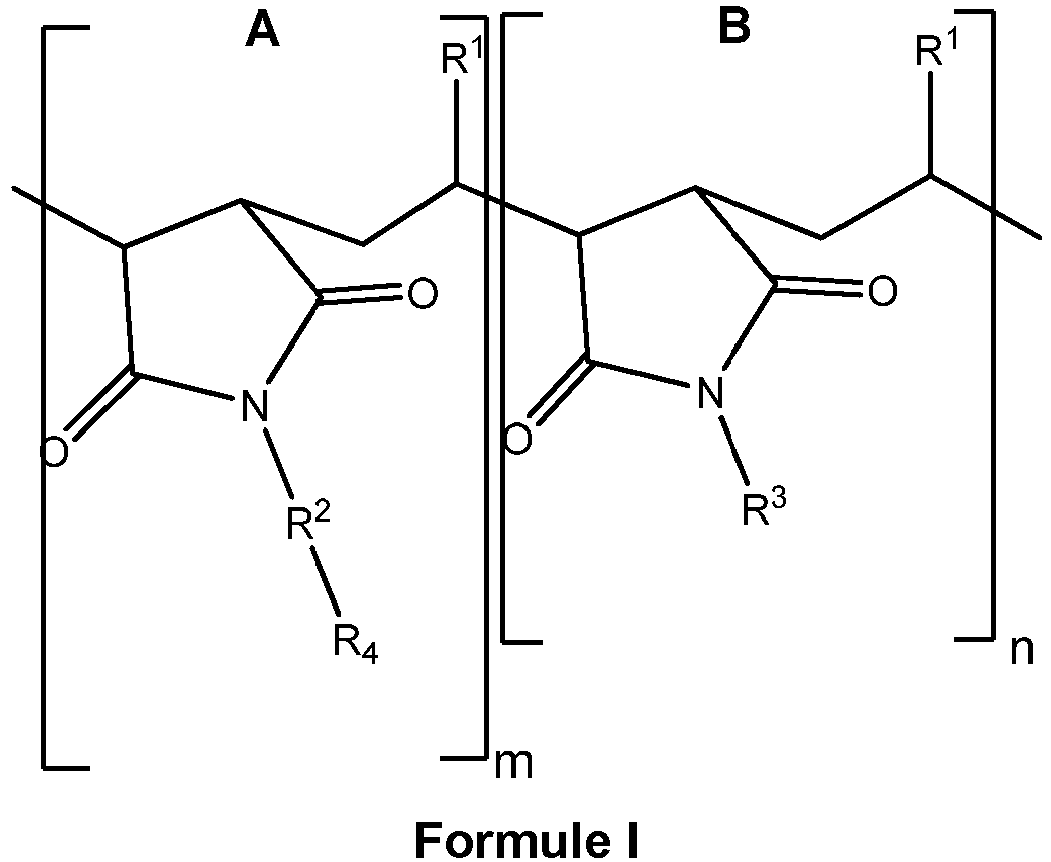
- m est un nombre entier positif et désigne le nombre d'unités répétitive A dans le polymère; n est zéro ou un nombre entier positif et désigne le nombre d'unités répétitive B dans le polymère, l'unité répétitive B étant absente lorsque n est zéro; où m et n sont choisis tel que la masse moléculaire du polymère de Formule I située dans l'intervalle de 1000 à 106;
- R1 est, indépendamment à chaque occurrence, choisi parmi les radicaux hydrocarbonés monovalents linéaires ou ramifiés;
- R2 est, indépendamment à chaque occurrence, choisi parmi -CH2CH2O- et -CH2CH2CH2O-, où R2 est lié à N par un atome de carbone, ou R2 est absent et N est lié de façon covalente à R4;
- R3 est, indépendamment à chaque occurrence, choisi parmi les radicaux hydrocarbonés monovalents linéaires ou ramifiés;
- R4 est, indépendamment à chaque occurrence, un résidu polyéther de formule -[CH(R5)CH2O]sCH3, où 5 ≤ s ≤ 100 ; et
- R5 est, indépendamment à chaque occurrence, H ou CH3.
- Selon un mode de réalisation, m et n sont choisis de sorte que la masse moléculaire de l'agent lubrifiant de Formule I se situe dans l'intervalle de 2000 à 250 000, ou de 2000 à 50 000, ou encore de 50 000 à 200 000. Selon un autre mode de réalisation, le ratio des unités répétitives A:B en pourcentage molaire dans le polymère se situe dans l'intervalle de 100:0 à 10:90.
- Selon un autre mode de réalisation, R1 est, indépendamment à chaque occurrence, un radical hydrocarboné linéaire ou ramifié de formule CrH2r+1, où 4 ≤ r ≤ 24, ou dans lequel 8 ≤ r ≤ 18 et tous les autres groupes sont tels que définis précédemment. Dans un autre mode de réalisation, R3 est, indépendamment à chaque occurrence, un radical hydrocarboné linéaire ou ramifié de formule CtH2t+1, où 4 ≤ t ≤ 24, ou dans lequel 8 ≤ t ≤ 18, et tous les autres groupes sont tels que définis précédemment. Dans un autre mode de réalisation, s est choisi parmi les nombres entiers allant de 8 à 50, et tous les autres groupes sont tels que définis précédemment.
- Selon un autre mode de réalisation, R2 est, à chaque occurrence, un radical divalent de formule -CH2CH2O-, ou R2 est, à chaque occurrence, un radical divalent de formule -CH2CH2CH2O-, ou encore R2 est absent, et tous les autres groupes sont tels que définis précédemment.
- Selon un mode de réalisation, R4 est un résidu polyéther de formule - [CH(R5)CH2O]sCH3, dans lequel R5 est CH3 à chaque occurrence, et tous les autres groupes sont tels que définis précédemment. Dans un autre mode de réalisation, R5 est un atome d'hydrogène à chaque occurrence, et tous les autres groupes sont tels que définis précédemment. Selon un autre mode, R5 est, indépendamment à chaque occurrence, CH3 ou hydrogène, tel que R4 est un résidu polyéther comprenant des unités répétitives d'oxyde de propylène (PO) et d'oxyde d'éthylène (EO), par exemple dans un ratio molaire en PO:EO situé entre environ 20:1 et environ 1:30, ou entre environ 10:1 et environ 1:10. Selon un exemple, le résidu polyéther R4 a une masse moléculaire se situant dans l'intervalle allant d'environ 300 g/mole à environ 5000 g/mole, ou allant d'environ 500 g/mole à environ 2500 g/mole.
- Selon un autre mode de réalisation, l'agent lubrifiant est choisi parmi les Polymères 1 à 5 tels que définis au Tableau 1.
- La présente demande décrit une composition comprenant un agent lubrifiant tel qu'ici défini, conjointement avec un solvant inerte aux métaux alcalins. Par exemple, le solvant est choisi parmi les solvants hydrocarbonés, les solvants aromatiques, et leurs combinaisons, c'est-à-dire des systèmes de solvants comprenant un solvant aromatique et un solvant hydrocarboné. Le solvant hydrocarboné peut être choisi parmi l'hexane et l'heptane et le solvant aromatique peut être le toluène. Selon un mode de réalisation, la composition comprend l'agent lubrifiant à une concentration d'environ 0.001% à environ 10% (poids/volume), ou environ 0.01% à environ 5% (poids/v), du volume total de la composition.
- Selon un aspect, la présente demande décrit aussi un film de métal alcalin ayant une première et une deuxième surface, et comprenant sur au moins l'une des première et deuxième surfaces, une mince couche de l'agent lubrifiant ou de la composition. Par exemple, le film de métal alcalin a une épaisseur si situant dans l'intervalle d'environ 5 µm à environ 50 µm. Selon un mode de réalisation, le métal alcalin est choisi parmi le lithium, les alliages de lithium, le sodium, et les alliages de sodium, ou du lithium ayant une pureté d'au moins 99% en poids, ou un alliage de lithium comprenant moins de 3000 ppm d'impuretés en poids.
- Dans un autre mode de réalisation, le film de métal alcalin tel qu'ici défini comprend une couche de passivation sur au moins une de ses première et deuxième surfaces, éventuellement, sur ses deux surfaces. Par exemple, la couche de passivation peut être d'une épaisseur de 500 Å ou moins, de 100 Å ou moins, ou encore de 50 Å ou moins. Par exemple, le métal alcalin est du lithium ou un alliage de lithium et la couche de passivation comprend du Li2O, du Li2CO3, du LiOH, ou une combinaison d'au moins deux de ceux-ci.
- Selon encore un autre aspect, la présente demande décrit un procédé pour la production d'un film de métal alcalin et le film de métal alcalin ainsi produit, le procédé comprenant les étapes :
- a) d'application d'une composition comprenant un agent lubrifiant tel qu'ici défini sur au moins l'une des première et deuxième surface d'un feuillard de métal alcalin afin d'obtenir un feuillard de métal alcalin lubrifié; et
- b) de laminage du feuillard de métal alcalin lubrifié obtenu à l'étape (a) entre au moins deux rouleaux pour produire un film de métal alcalin.
- Dans une mode réalisation, au moins les étapes (a) et (b) sont accomplies sous atmosphère d'air essentiellement sec, par exemple, dans une chambre anhydre ou à humidité contrôlée avec un point de rosée situé entre -45 et -55°C, pour 0.7 to 2.2% d'humidité relative, préférablement un point de rosée d'environ -50°C et une humidité relative d'environ 1.3%.
- Selon un autre mode de réalisation, le procédé comprend, en outre, une étape d'obtention du feuillard de métal alcalin, par exemple, par extrusion d'un lingot ou d'une tige de métal alcalin.
- Selon un autre aspect, l'étape (a) s'effectue par l'application de la composition sur le feuillard à l'entrée des rouleaux et peut aussi s'effectuer par enduction préalable des rouleaux de laminage avec ou sans ajout additionnel de composition directement sur le feuillard avant l'étape (b).
- Les films de métaux alcalins tels que définis ici peuvent être utilisés, entre autre, pour la production d'électrodes et de cellules électrochimiques les comprenant en combinaison avec un électrolyte et une contre-électrode, préférablement tous deux sous forme de films. L'électrolyte peut être un électrolyte liquide non-aqueux comprenant un solvant organique compatible, un électrolyte liquide constitué d'un sel fondu, un électrolyte polymère gel ou un électrolyte polymère solide. La contre-électrode comprend un matériau actif de contre-électrode tel qu'ici défini ou tel que généralement utilisé dans le domaine.
- La description détaillée et les exemples qui suivent sont à titre d'illustration et ne doivent pas être interprétés comme limitant davantage la portée de l'invention telle que définie dans les revendications.
- Le terme « environ » tel qu'utilisé dans le présent document signifie approximativement, dans la région de, et autour de. Lorsque le terme « environ » est utilisé en lien avec une valeur numérique, il la modifie au-dessus et en dessous par une variation de 10% par rapport à la valeur nominale. Ce terme peut aussi tenir compte, par exemple, de l'erreur expérimentale d'un appareil de mesure.
- Lorsqu'un intervalle de valeurs est mentionné dans la présente demande, les bornes inférieures et supérieures de l'intervalle sont, à moins d'indication contraire, toujours incluses dans la définition.
- Les polymères décrits ici sont utiles comme agents lubrifiants utilisés dans le laminage de films de métaux alcalins. Ces agents sont des copolymères polyéther d'alkyl-succinimide de Formule I:

- m et n désignent respectivement le nombre d'unités répétitives A et B dans le polymère, m étant un nombre entier positif et n étant un nombre entier positif ou zéro quand l'unité répétitive B est absente, et où m et n sont choisis tel que la masse moléculaire du polymère de Formule I se situe dans l'intervalle de 1000 à 106, de 2000 à 250 000, de 2000 à 100 000, de 2000 à 50 000, ou encore de 50 000 à 200 000, bornes incluses;
- R1 est, indépendamment à chaque occurrence, choisi parmi les radicaux hydrocarbonés monovalents linéaires ou ramifiés, de préférence parmi les radicaux hydrocarbonés monovalents linéaires ou ramifiés de formule CrH2r+1, où 4 ≤ r ≤ 24, de préférence où 8 ≤ r ≤ 18;
- R2 est, indépendamment à chaque occurrence, choisi parmi -CH2CH2O- et -CH2CH2CH2O-, où R2 est lié à N par un atome de carbone, ou R2 est absent et N est lié à R4 de façon covalente;
- R3 est, indépendamment à chaque occurrence, choisi parmi les radicaux hydrocarbonés monovalents linéaires ou ramifiés, de préférence parmi les radicaux hydrocarbonés monovalents linéaires ou ramifiés de formule CtH2t+1, où 4 ≤ t ≤ 24, de préférence où 8 ≤ t ≤ 18;
- R4 est, indépendamment à chaque occurrence, un résidu polyéther de formule -[CH(R5)CH2O]sCH3, où 5 ≤ s ≤ 100, de préférence où 8 ≤ s ≤ 50; et
- R5 est, indépendamment à chaque occurrence, un atome d'hydrogène ou un groupe CH3.
- Selon un mode de réalisation, le ratio des unités répétitives A:B en pourcentage molaire dans l'agent lubrifiant se situe entre 100:0 et 10:90, de préférence entre 100:0 et 20:80, bornes incluses. Selon un autre mode de réalisation, le ratio des unités répétitives A:B en pourcentage molaire dans l'agent lubrifiant se situe entre 60:40 et 10:90.
- Selon un mode de réalisation, R4 est un résidu polyéther de formule - [CH(R5)CH2O]sCH3, dans lequel 5 ≤ s ≤ 100, et R5 est CH3 à chaque occurrence, de préférence où 8 ≤ s ≤ 50. Dans un autre mode de réalisation, R4 est un résidu polyéther de formule -[CH(R5)CH2O]sCH3, dans lequel 5 ≤ s ≤ 100, et R5 est un atome d'hydrogène à chaque occurrence, de préférence où 8 ≤ s ≤ 50. Selon un autre mode différent, R4 est un résidu polyéther de formule -[CH(R5)CH2O]sCH3 dans lequel 5 ≤ s ≤ 100 et R5 est indépendamment à chaque occurrence CH3 ou hydrogène, de préférence où 8 ≤ s ≤ 50, R4 étant ainsi une chaîne polyéther possédant des unités répétitives d'oxyde de propylène (PO) et d'oxyde d'éthylène (EO) (aussi référé ici comme une chaîne polyéther PO/EO).
- Selon un mode de réalisation, R4 est une chaîne polyéther PO/EO liée de façon covalente à N (l'atome d'azote d'un groupe succinimide). Des exemples de ces chaînes polyéthers PO/EO comprennent, sans limitation, les polyéthers possédant un ratio molaire PO/EO variant d'environ 20:1 à environ 1:30, ou d'environ 10:1 à environ 1:10, de préférence ayant une masse moléculaire se situant entre environ 300 et environ 5000, de préférence environ 500 et environ 2500. Des exemples de R4 comprennent aussi les chaînes polyéther PO/EO d'amines polyéthers, le groupement amine faisant partie du succinimide de l'unité A, comme les monoamines Jeffamine® de la série "M", par exemple les M-600, M-1000, M-2005 et M-2070 (Huntsman Corporation, Texas, U.S.A), ayant un contenu molaire respectif en PO:EO de 9:1, 3:19, 29:6 et 10:31.
- Selon un aspect, la teneur en unité répétitive B dans le polymère de Formule I est ajusté afin d'obtenir un polymère soluble dans un solvant ou un système de solvant non-polaire, par exemple, un tel solvant ou système de solvants comprend des solvants hydrocarbonés (par exemple, hexane, heptane), aromatiques (par exemple, le toluène), ou leurs mélanges.
- Des exemples non-limitatifs de polymères agents lubrifiants de Formule I sont tels que détaillés au Tableau 1.
Tableau 1 Polymère R1 R2 R3 R4 (PO:EO) Ratio A: B (%molaire approx.) Masse Molécuaire (approx.) 1 C16H33 Absent Absent 3:19 100:0 5000 2 C16H33 Absent Absent 10:31 100:0 5000 3 C16H33 Absent C18H37 3:19 33:67 145,000 - 175,000 4 C16H33 Absent C18H37 10:31 20:80 165,000-195,000 5 C16H33 Absent Absent 29:6 100:0 7000 - Par exemple, les agents lubrifiants de Formule I peuvent être préparés par: (a) l'obtention d'un copolymère alterné (alt) d'alkylène R1CHCH2 et d'anhydride maléique, R1 étant tel que défini précédemment. Ce copolymère est ensuite réagi avec une amine de formule R4-R2-NH2, éventuellement en même temps, préalablement ou postérieurement avec une amine de formule R3-NH2, dans laquelle R2, R3, et R4 sont tel que définis précédemment. Des exemples de méthodes de production d'agents lubrifiants sont ici illustrés plus en détail dans les Exemples de Synthèse 1 à 4.
- Les compositions décrites ici comprennent au moins un agent lubrifiant de Formule I. Ces compositions peuvent aussi comprendre des composantes additionnelles comme des solvants inertes aux métaux alcalins. Des exemples de solvants incluent, sans limitation, les solvants hydrocarbonés (par exemple, l'hexane, l'heptane, etc.), les solvants aromatiques (par exemple, le toluène, etc.), ou leurs mélanges.
- Les films de métaux alcalins consistent en, par exemple, du lithium ou un alliage de lithium, du sodium ou un alliage de sodium, de préférence du lithium ou un alliage dans lequel le lithium est la composante majeure, préférablement du lithium ayant une pureté d'au moins 99% par poids, ou un alliage de lithium comprenant moins de 3000 ppm d'impuretés par poids.
- Selon un mode de réalisation, le film de métal alcalin tel que produit ici comprend sur l'une de ses deux surfaces ou sur ces deux surfaces, une mince couche d'un agent lubrifiant de Formule I ou d'une composition le comprenant. Par exemple, les films de lithium comprenant sur une(des) surface(s) au moins un agent lubrifiant ou une composition de l'invention peuvent généralement présenter une impédance plus faible lorsque comparés à des films de lithium produits avec l'utilisation d'autres additifs lubrifiants. D'autres propriétés améliorées de ces films peuvent aussi inclure une couche de passivation plus stable et plus uniforme, et des propriétés de cyclage améliorées.
- Lorsque la méthode de production du film mince de lithium est accomplie sous atmosphère d'air essentiellement anhydre, la couche de passivation sur le film de lithium comprend du carbonate de lithium, de l'oxyde de lithium et/ou de l'hydroxyde de lithium.
- Les films de métaux alcalins tels décrits ici sont produits par laminage ou calandrage entre des rouleaux en utilisant les agents lubrifiants de Formule I et les compositions les comprenant. Des procédés de préparation de films de lithium par laminage de métal sont illustrés, par exemple, dans les brevet américains nos
5,837,401 et6,019,801 (tous deux émis au nom de Gauthier et al .). Les procédés décrits dans Gauthier et al. peuvent être réalisés en utilisant les agents lubrifiants et compositions tels que décrits ici (par exemple, voir la Section I ci-dessus). - Par exemple, un feuillard de lithium d'environ 250 µm d'épaisseur est utilisé dans le procédé de laminage pour produire un film de lithium. Les feuillards de lithium peuvent être obtenus, par exemple, par extrusion de lingots ou tiges de lithium disponibles commercialement.
- De manière générale, un feuillard de lithium, préalablement monté sur un dérouleur, est passé entre deux rouleaux de travail. Un lubrifiant est ajouté (par exemple, à l'aide d'un bec verseur sur le feuillard et/ou par enduction préalable des rouleaux de travail) au point d'insertion du feuillard de lithium entre les deux rouleaux, c'est-à-dire juste avant l'étape de laminage. Selon un mode de réalisation, le film de lithium sortant des rouleaux de travail peut être enroulé sur un enrouleur pour utilisation ultérieure. Dans ce mode particulier, le lubrifiant agit, du moins en partie, afin de prévenir l'adhésion du film de lithium sur lui-même. Selon un autre mode de réalisation, le film de lithium lubrifié produit est utilisé directement pour d'autres étapes de laminage (par exemple, par laminage en continu ou en série) avec une couche d'électrolyte polymère solide, une couche protectrice, et/ou un collecteur de courant (par exemple, dans une configuration collecteur de courant/film de lithium/électrolyte ou une configuration collecteur de courant/film de lithium/couche protectrice/électrolyte). Dans chaque cas, les enrouleurs ou laminoirs disposés en série fournissent une tension suffisante au film de lithium afin de réduire l'adhésion du film de lithium aux rouleaux de travail mais sans tension excessive afin d'éviter le déchirement du film de lithium.
- Par exemple, l'étape de laminage entre rouleaux peut produire un film de métal alcalin à une vitesse dans la plage d'environ 10 m/min à environ 50 m/min de film de métal alcalin.
- Il est évident que les rouleaux de travail doivent être composés et/ou recouverts d'un matériau inerte envers le métal alcalin (comme le lithium métallique) en présence de l'agent lubrifiant et/ou de la composition de l'invention. Par exemple, les rouleaux peuvent être composés de polymères durs tels que les plastiques, les rouleaux métalliques recouverts de matière plastique, les rouleaux en acier inoxydable, etc.
- Le procédé de l'invention peut être effectué sous atmosphère anhydre, de préférence sous atmosphère d'air essentiellement sec, par exemple, dans une chambre anhydre ou à humidité contrôlée, par exemple ayant un point de rosée entre -45 et -55°C, pour de 0.7 à 2.2% d'humidité relative, de préférence un point de rosée d'environ -50°C pour 1.3% d'humidité relat ive.
- Les films de métaux alcalin tels que produits ici sont utiles pour la fabrication de cellules électrochimiques. Par exemple, les cellules électrochimiques comprennent au moins une électrode ayant un film de matériau alcalin, comme le lithium, en tant que matériau actif d'électrode, une contre-électrode et un électrolyte entre l'électrode et la contre-électrode. Une option concerne les cellules électrochimiques comprenant une pluralité d'agencements (par exemple, une pluralité d'agencements électrode/électrolyte/contre-électrode ou contre-électrode/électrolyte/électrode/électrolyte/contre-électrode). Par exemple, la cellule peut être un matériau multicouche qui peut être plié ou roulé en cylindre.
- Des cellules électrochimiques dans lesquelles les films de lithium ici décrits pourraient aussi être utilisés incluent aussi les cellules électrochimiques lithium-air comme celles décrites dans la demande PCT publiée sous le numéro
WO2012/071668 (Zaghib et al. ). - Selon un aspect, le polymère de Formule I ou sa composition peut être présente à la surface entre le film de lithium et sa couche adjacente (par exemple, le collecteur de courant, l'électrolyte, etc.), ou peut être en partie ou complètement diffuse, dispersée ou dissoute dans l'électrolyte. Selon un autre aspect, l'agent lubrifiant (ou sa composition) est présent entre l'électrode et l'électrolyte et est conducteur d'ion, par exemple de par sa dissolution des sels de lithium présents dans l'électrolyte.
- Selon un mode de réalisation préféré, la cellule électrochimique, comprenant un film de lithium tel qu'ici décrit, est scellée ou comprise à l'intérieur d'un compartiment étanche.
- Une électrode comprend au moins un film de métal alcalin tel que décrit à la Section II ou tel que préparé par le procédé de la Section III. De préférence, le film de métal alcalin de l'électrode est un film de lithium vif ou un alliage dans lequel le lithium est la composante majoritaire, de préférence du lithium ayant une pureté d'au moins 99% par poids, ou un alliage de lithium comprenant moins de 3000 ppm d'impuretés par poids.
- Selon un mode de réalisation, l'électrode comprend, en outre, un collecteur de courant fait d'une couche métallique telle que, par exemple, une couche de nickel ou de cuivre adhérant à la surface du film de métal alcalin opposée de la surface faisant face ou qui fera face à la couche d'électrolyte.
- De façon optionnelle, une couche protectrice conductrice d'ions peut être présente entre le film de métal alcalin (par exemple, de Li, Na, ou un alliage de l'un ou l'autre) et l'électrolyte, par exemple, afin de protéger le film de lithium de la dégradation et/ou de prévenir la formation de dendrites. Une couche protectrice conductrice d'ion comprenant, par exemple, un polymère conducteur d'ions, une céramique (par exemple, un oxynitrure de lithium et de phosphore (LIPON) etc.), du verre, ou une combinaison de deux ou plus de ceux-ci, peut être appliquée à la surface du film de lithium ou de la couche d'électrolyte (par exemple, d'un électrolyte polymère solide) avant l'assemblage. Les couches protectrices vitreuses ou de céramique sont appliquées par des procédés standards comme la pulvérisation cathodique, ou l'ablation par laser ou plasma. Des exemples de couches protectrices sont décrits dans la demande PCT publiée sous le numéro
WO2008/009107 (Zaghib et al. ). - Les électrolytes utilisés dans ces cellules électrochimiques incluent tout électrolyte compatible avec l'utilisation d'électrodes de film de lithium vif ou d'un autre métal alcalin. Des exemples de tels électrolytes incluent, sans limitations, les électrolytes liquides non-aqueux, les électrolytes de polymère gel, et les électrolytes de polymère solide. Les électrolytes qui suivent sont à titre d'exemples illustratifs et ne doivent pas être interprétés comme limitatifs.
- Par exemple, les électrolytes liquides compatibles incluent les électrolytes liquides organiques comprenant un solvant polaire aprotique tel que le carbonate d'éthylène (EC), le carbonate de diéthyle (DEC), le carbonate de propylène (PC), le carbonate de diméthyle (DMC), le carbonate de méthyle et d'éthyle (EMC), la γ-butyrolactone (γ-BL), le carbonate de vinyle (VC), et leurs mélanges, et des sels de lithium comme LiTFSI, LiPF6, etc. D'autres exemples d'électrolytes liquides compatibles incluent les électrolytes de sels fondus comprenant des sels de lithium comme le chlorure de lithium, le bromure de lithium, le fluorure de lithium, et les compositions les comprenant, or des sels organiques. Des exemples non limitatifs d'électrolytes liquides de sels fondus peuvent être trouvés dans
US2002/0110739 (McEwen et al ). L'électrolyte liquide peut imprégner un séparateur comme un séparateur en polymère (par exemple, de polypropylène, de polyéthylène, ou d'un copolymère de ceux-ci). - Les électrolytes polymère gel compatible peuvent comprendre, par exemple, des précurseurs de polymère et des sels de lithium (tels que LiTFSI, LiPF6, etc.), un solvant polaire aprotique tel que défini ci-dessus, un initiateur de polymérisation/réticulation lorsque requis. Des exemples de tels électrolytes gels incluent, sans limitations, les électrolytes gels décrits dans les demandes PCT publiées sous les numéros
WO2009/111860 (Zaghib et al. ) etWO2004/068610 (Zaghib et al. ). Un électrolyte gel peut aussi imprégner un séparateur tel que défini ci-dessus. - Les électrolytes polymère solides (EPS) peuvent généralement comprendre un ou des polymères solides polaires réticulés ou non et des sels, par exemple, des sels de lithium tels que LiTFSI, LiPF6, LiDCTA, LiBETI, LiFSI, LiBF4, LiBOB, etc. Des polymères de type polyéther tels que les polymères basés sur le poly(oxyde d'éthylène) (PEO) peuvent être utilisés, mais plusieurs autres polymères compatibles avec le lithium sont aussi connus pour la production de EPS. Des exemples de tels polymères incluent les polymères multi-branche en forme d'étoile ou de peigne comme ceux décrits dans la demande PCT publiée sous le no
WO2003/063287 (Zaghib et al. ). - Les contre-électrodes comprennent au moins un matériau électrochimiquement actif (MEA) compatible avec l'utilisation d'électrodes de métal alcalin, et particulièrement de lithium métallique. Tout MEA de contre-électrode connu du domaine peut être utilisé dans ces cellules électrochimiques. Par exemple, le MEA de contre-électrode peut opérer à un voltage à l'intérieur de la plage d'environ 1V à environ 5V. Des exemples de MEA de contre-électrode se retrouvent, par exemple, dans Whittingham M.S. (2004), Chem. Rev., 104, 4271-4301.
- Pour une électrode comprenant un film de lithium, des exemples non-limitatifs de MEA de contre-électrode incluent les titanates de lithium (ex: Li4Ti5O12), le soufre ou des matériaux comprenant du soufre, les phosphates de lithium et de métal (ex : LiM'PO4 où M' est Fe, Ni, Mn, Co, ou leurs combinaisons), les oxydes de vanadium (ex : LiV3O8, V2O5, etc.), et les oxydes de lithium et de métal, tels que LiMn2O4, LiM"O2 (M" étant Mn, Co, Ni ou leurs combinaisons), Li(NiM"')O2 (M'" étant Mn, Co, Al, Fe, Cr, Ti, Zr, etc., ou leurs combinaisons).
- De façon similaire, le MEA de la contre-électrode lorsque l'électrode comprend un film de sodium sont connus de la personne du métier. Par exemple, ceux-ci incluent le soufre ou un matériau comprenant du soufre, des phosphates de sodium et d'un ou des métaux (ex : Na2FePO4F, Na2FeP2O7F, NaVPO4F, NaV1-xCrxPO4F, où x<1, par exemple 0<x<0.1) ou des sulfates de sodium et d'un métal (ex : Na2Fe2(SO4)3) Le MEA de contre-électrode peut aussi être de l'oxygène dans une cellule lithium-air ou sodium-air selon le métal alcalin de l'électrode.
- La contre-électrode peut aussi comprendre un matériau conducteur électronique comme une source de carbone, incluant, par exemple, du carbone Ketjen®, du carbone Shawinigan, du graphite, des fibres de carbone, des fibres de carbone formée en phase gazeuse (VGCF), du carbone non-poudreux obtenu par carbonisation d'un précurseur organique, et une combinaison de deux ou plus de ceux-ci. Le carbone utilisé peut être d'origine naturelle ou synthétique.
- La contre-électrode peut être une contre-électrode composite qui comprend en outre, un liant polymère, et éventuellement un sel de métal alcalin tel que les sels de lithium (ex. : LiTFSI, LiDCTA, LiBETI, LiFSI, LiPF6, LiBF4, LiBOB, etc.) ou les sels de sodium (ex. : NaClO4, NaPF6, etc.).
- Les exemples qui suivent illustrent l'invention et ne doivent pas être interprétées comme limitant la portée de l'invention telle que définie par les revendications.
- Afin d'évaluer l'effet du lubrifiant sur la surface d'un film de lithium et les propriétés résultantes, des films de lithium d'une épaisseur de 27 µm, produits selon la procédure décrite dans le brevet américain no
6,019,801 , ont été immergés dans les lubrifiants testés. Les films lubrifiés ont ensuite été insérés dans des cellules électrochimiques et leurs propriétés mesurées. - Les composants utilisés dans les Exemples qui suivent sont définis comme suit: PEO(200) distéarate: PEO-200 distéarate tel que décrit dans le brevet américain no
6,019,801 . -
- Polymère 1 : est un polymère de Formule I ayant une masse moléculaire d'environ 5000, dans lequel l'unité B est absente, R1 est C16H33, R2 est absent, et R4 est lié à N de façon covalente et représente le résidu de Jeffamine® M-1000, un polyétheramine possédant un ratio PO/EO de 3/19.
- Polymère 2 : est un polymère de Formule I ayant une masse moléculaire d'environ 5000, dans lequel l'unité B est absente, R1 est C16H33, R2 est absent, et R4 est lié à N de façon covalente et représente le résidu de Jeffamine® M-2070, un polyétheramine possédant un ratio PO/EO de 10/31.
- C-LiFePO 4 : LiFePO4 enrobé de carbone
- Un lubrifiant a été préparé par l'addition de 1 % par poids de PEO(200) distéarate a une mélange de toluène et d'hexane (80:20 (vol:vol), tous deux anhydres). Un film de lithium de 27 µm d'épaisseur a ensuite été immergé dans ce lubrifiant pendant 5 minutes.
- Une cellule de 4 cm2 a été assemblée en laboratoire selon la configuration Li/EPS/Li. L'impédance initiale de la cellule Li/EPS/Li à 80° C était de 15 ohms. Après six semaines, l'impédance a atteint 111 ohms, montrant une augmentation de 640% de l'impédance.
- Une cellule de 4 cm2 a été assemblée en laboratoire selon la configuration C-LiFePO4/EPS/Li. La cellule a ensuite été déchargée à un taux de C/4 et chargée à un taux de C/4 à un voltage de 2.5 V à 3.8 V à 80°C. La capacité initiale de la cellule était de 158 mAh/g. Après 350 cycles, la capacité a atteint 80 % de la capacité initiale.
- Le lubrifiant a été préparé par l'addition de 1 % en poids du Polymère 1 à un mélange de toluène et d'hexane (80:20 (vol:vol), tous deux anhydres). Un film de lithium de 27 µm d'épaisseur a ensuite été immergé dans ce lubrifiant pendant environ 5 minutes.
- Une cellule de 4 cm2 a été assemblée en laboratoire selon la configuration Li/EPS/Li. L'impédance initiale de la cellule de configuration Li/EPS/Li à 80° C était de 22 ohms. Après six semaines, l'impédance a atteint 48 ohms, montrant une augmentation de 120% de l'impédance.
- Une cellule de 4 cm2 a été assemblée en laboratoire selon la configuration C-LiFePO4/EPS/Li comme à l'Exemple 1(b). La cellule a ensuite été déchargée à un taux de C/4 et chargée à un taux de C/4 à un voltage de 2.5 V à 3.8 V à 80°C. La capacité initiale de la cellule était de 160 mAh/g. Après 1100 cycles, la capacité a atteint 80 % de la capacité initiale.
- L'augmentation de l'impédance est plus basse dans cette cellule que dans celle de l'Exemple 1, où un lubrifiant à base de PEO(200) distéarate a été utilisé. L'utilisation d'un lubrifiant à base du Polymère 1 résulte en une couche de passivation stable et plus uniforme sur la surface du lithium. La cellule incorporant le film de lithium comprenant une mince couche de Polymère 1 a obtenu une durée de vie en cycles améliorée lorsque comparée à la cellule décrite à l'Exemple 1.
- Le lubrifiant a été préparé par l'addition de 1% par poids du Polymère 2 à un mélange de toluène et d'hexane (80:20 (vol:vol), tous deux anhydres). Un film de lithium de 27 µm d'épaisseur a ensuite été immergé dans ce lubrifiant pendant environ 5 minutes.
- Une cellule de 4 cm2 a été assemblée en laboratoire selon la configuration Li/EPS/Li. L'impédance initiale de la cellule de configuration Li/EPS/Li à 80° C était de 23 ohms. Après six semaines, l'impédance a atteint 45 ohms, montrant une augmentation de 96% en impédance.
- Une cellule de 4 cm2 a été assemblée en laboratoire selon la configuration C-LiFePO4/EPS/Li comme à l'Exemple 1(b). La cellule a ensuite été déchargée à un taux de C/4 et chargée à un taux de C/4 à un voltage de 2.5 V à 3.8 V à 80°C. La capacité initiale de la cellule était de 161 mAh/g. Après 1300 cycles, la capacité a atteint 80 % de la capacité initiale (une baisse de 20%).
- L'augmentation de l'impédance est plus basse pour cette cellule que pour celle de l'Exemple 1(b) où le lubrifiant à base de PEO(200) distéarate était utilisé. L'utilisation du lubrifiant à base de Polymère 2 résulte aussi en une couche de passivation très stable et plus uniforme sur la surface du lithium. Cette cellule a aussi obtenu une durée de vie en cycle améliorée lorsque compare à la cellule décrite à l'Exemple 1(b).
- 36.26 g d'un polymère poly(octadécène-alt-anhydride maléique) du commerce (Mw ≈ 65,000) sont dissouts dans 250ml de toluène sous agitation à la température de la pièce. De l'octadécylamine (18 g) dans 100 ml de toluène est ajouté goutte à goutte à la solution sous agitation sur une période de 2 heures. Ensuite, 40 g de Jeffamine® de type M-1000 (XTJ-506) avec un ratio PO/EO de 3:19 dilués dans 50 ml de toluène sont ajoutés rapidement et toujours sous agitation. La solution ternaire résultante est ensuite placée dans un ballon de 500 ml équipé d'un appareil Dean-Stark et d'un condenseur. La solution est portée à reflux pendant 8 heures, période durant laquelle l'eau libérée lors de la formation de l'imide apparait progressivement dans la burette de l'appareil Dean-Stark.
- La solution visqueuse de polymère résultante est ensuite filtrée et évaporée dans un évaporateur rotatif. La substance collante obtenue est redissoute dans 625 ml d'heptane et lavée 5 fois avec un volume de 100 ml d'une solution aqueuse d'acide sulfurique (H2SO4) à 0.1 M afin d'éliminer l'excès de Jeffamine®. L'extraction de la Jeffamine® est ensuite suivie d'un rinçage avec 5 portions d'eau déminéralisée. Le séchage de la solution d'heptane est effectué par l'addition de 40 g de tamis moléculaire 4Å préalablement traité sous vide à 200°C. La solution à 10 % (poids/volume) du Polymèr e 3 dans l'heptane ainsi obtenue est prête pour dilution et/ou utilisation ultérieure dans le laminage d'un métal alcalin comme le lithium.
- 36.26 g d'un polymère poly(octadécène-alt-anhydride maléique) du commerce (Mw ≈ 65,000) et 11 g de triéthylamine sont dissouts dans 250 mL de toluène sous agitation à la température de la pièce. De l'octadécylamine (21.5g) dans 100 ml de toluène est ajouté goutte à goutte à la solution sous agitation sur une période de 2 heures. Ensuite, 45 g de Jeffamine® de type M-2070 avec un ratio PO/EO de 10:31 dissous dans 100 ml de toluène sont ajoutés rapidement et toujours sous agitation. La solution quaternaire résultante est ensuite placée dans un ballon de 500 ml équipé d'un appareil Dean-Stark et d'un condenseur. La solution est portée à reflux pendant 8 heures, période durant laquelle l'eau libérée lors de la formation de l'imide apparait progressivement dans la burette de l'appareil Dean-Stark.
- La solution visqueuse de polymère résultante est ensuite filtrée et évaporée. La substance cireuse obtenue est redissoute dans 900 ml d'heptane et lavée 5 fois avec un volume de 200 ml d'une solution aqueuse d'acide sulfurique (H2SO4) à 0.1 M afin d'éliminer l'excès de Jeffamine® et de triéthylamine. L'extraction est ensuite suivie d'un rinçage avec 5 portions d'eau déminéralisée. Le séchage de la solution d'heptane est effectué par l'addition de 40 g de tamis moléculaire 4Å préalablement traité sous vide à 200°C. La solution à 10 % (poids/volume) du Polymère 4 dans l'heptane ainsi obtenue est prête pour dilution et/ou utilisation ultérieure dans le laminage d'un métal alcalin comme le lithium.
- 10 g d'anhydride maléique du commerce (Aldrich) sont ajoutés à une solution de 105 g de Jeffamine® M-1000 (Huntsman corporation) dans 300 mL de toluène. Le mélange réactionnel est soumis à une déshydratation de type Dean-Stark pour effectuer l'imidization des groupements terminaux NH2 de la Jeffamine pendant 5 heures. La solution limpide obtenue est refroidie à température 0°C et 25,8 g de 1-octadecène et 1,3 g d'azobis(isobutyronitrile) sont ajoutés. Le mélange est désaéré par bullage d'azote (100 ml/mn) pendant une heure. Le balayage de gaz neutre est arrêté et le mélange réactionnel est porté à 80°C pendant 24 heures. La solution de couleur légèrement brune est lavée avec une solution d'acide sulfurique 0,1 M à trois reprises, puis à l'eau pure de nouveau à trois reprises. La solution surnageant est séparée et le toluène est évaporé. On obtient un liquide visqueux d'une masse molaire d'environ 5000 g/mol (Polymère 1) qui peut être utilisé dans un processus de laminage.
- De manière similaire à l'Exemple de Synthèse 3, 10 g d'anhydride maléique du commerce (Aldrich) sont ajoutés à une solution de 210 g de Jeffamine® M-2070 (Huntsman corporation) dans 500 ml de toluène. Le mélange réactionnel est soumis à une déshydratation de type Dean-Stark pendant 5 heures. La solution limpide obtenue est refroidie à température 0°C et 25,8 g de 1-octadecène et 1,6 g d'azobis(isobutyronitrile) sont ajoutés. Le mélange est désaéré par bullage d'azote (100 ml/mn) pendant une heure. Le balayage de gaz neutre est arrêté et le mélange réactionnel est porté à 80°C pendant 24 heures. La solution de couleur légèrement brune est lavée avec une solution d'acide sulfurique 0,1 M à trois reprises, puis à l'eau pure de nouveau à trois reprises. La solution surnageant est séparée et le toluène est évaporé. On obtient un liquide visqueux ayant une masse molaire d'environ 5000 (Polymère 2) qui peut être utilisé dans un processus de laminage.
- De nombreuses modifications pourraient être apportées à l'un ou l'autre des modes de réalisation décrits ci-dessus sans s'éloigner de la portée de l'invention telle qu'envisagée.
Claims (29)
- Utilisation d'un polymère de Formule I:
 comme agent lubrifiant dans le laminage de films de métaux alcalins,dans lequel,m et n désignent respectivement le nombre d'unités répétitives A et B dans le polymère, m étant un nombre entier positif et n étant un nombre entier positif ou zéro quand l'unité répétitive B est absente, et où m et n sont choisis tel que la masse moléculaire du polymère de Formule I se situe dans l'intervalle de 1000 à 106;R1 est, indépendamment à chaque occurrence, choisi parmi les radicaux hydrocarbonés monovalents linéaires ou ramifiés;R2 est, indépendamment à chaque occurrence, choisi parmi -CH2CH2O- et -CH2CH2CH2O-, où R2 est lié à N par un atome de carbone, ou R2 est absent et N est lié de façon covalente à R4;R3 est, indépendamment à chaque occurrence, choisi parmi les radicaux hydrocarbonés monovalents linéaires ou ramifiés;R4 est, indépendamment à chaque occurrence, un résidu polyéther de formule -[CH(R5)CH2O]sCH3, où 5 ≤ s ≤ 100 ; etR5 est, indépendamment à chaque occurrence, un atome d'hydrogène ou un groupement CH3.
 - L'utilisation selon la revendication 1, dans lequel m et n sont choisis de sorte que la masse moléculaire du polymère de Formule I se situe dans l'intervalle de 2000 à 250 000.
- L'utilisation selon la revendication 1 ou 2, dans lequel m et n sont choisis de sorte que la masse moléculaire du polymère de Formule I se situe dans l'intervalle de 2000 à 50 000.
- L'utilisation selon la revendication 1 ou 2, dans lequel m et n sont choisis de sorte que la masse moléculaire du polymère de Formule I se situe dans l'intervalle de 50 000 à 200 000.
- L'utilisation selon l'une quelconque des revendications 1 à 4, dans lequel R1 est, indépendamment à chaque occurrence, un radical hydrocarboné linéaire ou ramifié de formule CrH2r+1, où 4 ≤ r ≤ 24, de préférence 8 ≤ r ≤ 18.
- L'utilisation selon l'une quelconque des revendications 1 à 5, dans lequel R3 est, indépendamment à chaque occurrence, un radical hydrocarboné linéaire ou ramifié de formule CtH2t+1, où 4 ≤ t ≤ 24, de préférence 8 ≤ t ≤ 18.
- L'utilisation selon l'une quelconque des revendications 1 à 6, dans lequel 8 ≤ s ≤ 50.
- L'utilisation selon l'une quelconque des revendications 1 à 7, dans lequel le ratio des unités répétitives A:B en pourcentage molaire dans le polymère se situe dans l'intervalle de 100:0 à 10:90.
- L'utilisation selon l'une quelconque des revendications 1 à 8, dans lequel R2 est un radical divalent de formule -CH2CH2O-.
- L'utilisation selon l'une quelconque des revendications 1 à 8, dans lequel R2 est un radical divalent de formule -CH2CH2CH2O-.
- L'utilisation selon l'une quelconque des revendications 1 à 8, dans lequel R2 est absent.
- L'utilisation selon l'une quelconque des revendications 1 à 11, dans lequel R4 est choisi parmi :(a) un résidu polyéther de formule -[CH(R5)CH2O]sCH3, dans lequel R5 est CH3 à chaque occurrence;(b) un résidu polyéther de formule -[CH(R5)CH2O]sCH3, dans lequel R5 est un hydrogène à chaque occurrence; et(c) un résidu polyéther de formule -[CH(R5)CH2O]sCH3, et dans lequel R5 est, indépendamment à chaque occurrence, CH3 ou hydrogène, tel que R4 est un résidu polyéther comprenant des unités répétitives d'oxyde de propylène (PO) et d'oxyde d'éthylène (EO).
- L'utilisation selon la revendication 12, dans lequel le résidu polyéther est un résidu polyéther (c) ayant un ratio molaire en PO:EO situé entre 20:1 et 1:30, de préférence entre 10:1 et 1:10.
- L'utilisation selon la revendication 12 ou 13, dans lequel le résidu polyéther a une masse moléculaire se situant entre 300 g/mole et 5000 g/mole.
- L'utilisation selon la revendication 1, dans laquelle le polymère de Formule I est choisi parmi les polymères suivants:- R1 est C16H33; R2 est absent; R3 est absent; R4 est un résidu polyéther de formule -[CH(R5)CH2O]sCH3, et dans lequel R5 est, indépendamment à chaque occurrence, CH3 ou hydrogène, tel que R4 est un résidu polyéther comprenant des unités répétitives d'oxyde de propylène (PO) et d'oxyde d'éthylène (EO), ayant un ratio molaire en PO:EO de 3 :19; le ratio des unités répétitives A:B en pourcentage molaire dans le polymère est 100 :00; et la masse moléculaire du polymère est 5000; ou- R1 est C16H33; R2 est absent; R3 est absent; R4 est un résidu polyéther de formule -[CH(R5)CH2O]sCH3, et dans lequel R5 est, indépendamment à chaque occurrence, CH3 ou hydrogène, tel que R4 est un résidu polyéther comprenant des unités répétitives d'oxyde de propylène (PO) et d'oxyde d'éthylène (EO), ayant un ratio molaire en PO:EO de 10 :31; le ratio des unités répétitives A:B en pourcentage molaire dans le polymère est 100 :00; et la masse moléculaire du polymère est 5000; ou- R1 est C16H33; R2 est absent; R3 est C18H37; R4 est un résidu polyéther de formule -[CH(R5)CH2O]sCH3, et dans lequel R5 est, indépendamment à chaque occurrence, CH3 ou hydrogène, tel que R4 est un résidu polyéther comprenant des unités répétitives d'oxyde de propylène (PO) et d'oxyde d'éthylène (EO), ayant un ratio molaire en PO:EO de 3 :19; le ratio des unités répétitives A:B en pourcentage molaire dans le polymère est 33 :67; et la masse moléculaire du polymère est entre 145000 et 175000; ou- R1 est C16H33; R2 est absent; R3 est C18H37; R4 est un résidu polyéther de formule -[CH(R5)CH2O]sCH3, et dans lequel R5 est, indépendamment à chaque occurrence, CH3 ou hydrogène, tel que R4 est un résidu polyéther comprenant des unités répétitives d'oxyde de propylène (PO) et d'oxyde d'éthylène (EO), ayant un ratio molaire en PO:EO de 10 :31; le ratio des unités répétitives A:B en pourcentage molaire dans le polymère est 20 :80; et la masse moléculaire du polymère est entre 165000 et 195000; ou- R1 est C16H33; R2 est absent; R3 est absent; R4 est un résidu polyéther de formule -[CH(R5)CH2O]sCH3, et dans lequel R5 est, indépendamment à chaque occurrence, CH3 ou hydrogène, tel que R4 est un résidu polyéther comprenant des unités répétitives d'oxyde de propylène (PO) et d'oxyde d'éthylène (EO), ayant un ratio molaire en PO:EO de 29 :6; le ratio des unités répétitives A:B en pourcentage molaire dans le polymère est 100 :0; et la masse moléculaire du polymère est 7000.
- Utilisation d'une composition dans le laminage de films de métaux alcalins, la composition comprenant un polymère de Formule I tel que défini dans l'une quelconque des revendications 1 à 15 conjointement avec un solvant inerte aux métaux alcalins de préférence choisi parmi les solvants hydrocarbonés, les solvants aromatiques et leurs mélanges.
- L'utilisation de la composition selon la revendication 16, dans laquelle le solvant est un système de solvants comprenant au moins un solvant aromatique, de préférence le toluène, et au moins un solvant hydrocarboné, de préférence l'hexane ou l'heptane.
- L'utilisation de la composition selon la revendication 16 ou 17, dans laquelle le polymère de Formule I est présent à une concentration de 0.001% à 10% (poids/volume), de préférence dans l'intervalle de 0.01% à 5% (poids/volume), par rapport au volume total de la composition.
- Film de métal alcalin ayant une première et une deuxième surfaces, et comprenant sur au moins l'une des première et deuxième surfaces, une mince couche de l'agent lubrifiant tel que défini dans l'une quelconque des revendications 1 à 15 ou de la composition telle que définie dans l'une quelconque des revendications 16 à 18.
- Film de métal alcalin selon la revendication 19, ayant une épaisseur située dans l'intervalle de 5 µm à 50 µm.
- Film de métal alcalin selon la revendication 19 ou 20, dans lequel ledit métal alcalin est choisi parmi le lithium, les alliages de lithium, le sodium, et les alliages de sodium.
- Film de métal alcalin selon la revendication 21, dans lequel le métal alcalin est du lithium ayant une pureté d'au moins 99% en poids, ou un alliage de lithium comprenant moins de 3000 ppm d'impuretés en poids.
- Film de métal alcalin selon l'une quelconque des revendications 19 à 22, comprenant une couche de passivation sur au moins l'une de ses première et deuxième surfaces.
- Film de métal alcalin selon la revendication 23, dans lequel la couche de passivation est d'une épaisseur de 100 Å ou moins, ou de 50 Å ou moins.
- Film de métal alcalin selon la revendication 23 ou 24, dans lequel ledit métal alcalin est le lithium ou un alliage de lithium et la couche de passivation comprend du Li2O, du Li2CO3, du LiOH ou une combinaison d'au moins deux de ceux-ci.
- Un procédé pour la production d'un film de métal alcalin, le procédé comprenant les étapes de:a) application d'une composition telle que définie dans l'une quelconque des revendications 16 à 18 sur au moins l'une des première et deuxième surfaces d'un feuillard de métal alcalin afin d'obtenir un feuillard de métal alcalin lubrifié; etb) laminage du feuillard de métal alcalin lubrifié obtenu à l'étape (a) entre au moins deux rouleaux pour produire un film de métal alcalin.
- Procédé selon la revendication 26, lequel est accompli sous atmosphère d'air essentiellement sec, de préférence dans une chambre anhydre ou à humidité contrôlée avec un point de rosée situé entre -45 et -55°C, pour 0.7 à 2.2% d'humidité relative.
- Électrode comprenant un film de métal alcalin tel que défini dans l'une quelconque des revendications 19 à 25.
- Cellule électrochimique comprenant une électrode telle que définie à la revendication 28, une contre-électrode et un électrolyte entre l'électrode et la contre-électrode.
Applications Claiming Priority (2)
| Application Number | Priority Date | Filing Date | Title |
|---|---|---|---|
| US201461973493P | 2014-04-01 | 2014-04-01 | |
| PCT/CA2015/050256 WO2015149173A1 (fr) | 2014-04-01 | 2015-03-31 | Polymères et leur utilisation comme agents lubrifiants dans la production de films de métaux alcalins |
Publications (3)
| Publication Number | Publication Date |
|---|---|
| EP3126475A1 EP3126475A1 (fr) | 2017-02-08 |
| EP3126475A4 EP3126475A4 (fr) | 2017-11-22 |
| EP3126475B1 true EP3126475B1 (fr) | 2021-10-13 |
Family
ID=54239172
Family Applications (1)
| Application Number | Title | Priority Date | Filing Date |
|---|---|---|---|
| EP15773352.8A Active EP3126475B1 (fr) | 2014-04-01 | 2015-03-31 | Utilisation de polymères comme agents lubrifiants dans la production de films de métaux alcalins |
Country Status (8)
| Country | Link |
|---|---|
| US (3) | US10106758B2 (fr) |
| EP (1) | EP3126475B1 (fr) |
| JP (1) | JP6678113B2 (fr) |
| KR (1) | KR102306374B1 (fr) |
| CN (1) | CN106414683B (fr) |
| CA (1) | CA2944521C (fr) |
| ES (1) | ES2902857T3 (fr) |
| WO (1) | WO2015149173A1 (fr) |
Families Citing this family (4)
| Publication number | Priority date | Publication date | Assignee | Title |
|---|---|---|---|---|
| US20160118685A1 (en) * | 2014-10-24 | 2016-04-28 | Battelle Memorial Institute | Methods and compositions for lithium ion batteries |
| CA2976241A1 (fr) | 2017-08-15 | 2019-02-15 | Hydro-Quebec | Materiaux d'electrode sous forme d'alliage a base de lithium et leurs procedes de fabrication |
| EP3837731A4 (fr) * | 2018-08-15 | 2022-05-18 | Hydro-Québec | Matériaux d'électrode et leurs procédés de préparation |
| KR102883390B1 (ko) | 2020-06-15 | 2025-11-07 | 주식회사 엘지에너지솔루션 | 리튬 금속 전극의 제조 방법 및 리튬 금속 이차전지 |
Family Cites Families (24)
| Publication number | Priority date | Publication date | Assignee | Title |
|---|---|---|---|---|
| DE1694238A1 (de) * | 1968-01-02 | 1972-02-10 | Bayer Ag | Antielektrostatische Polyamidformteile |
| US3721113A (en) * | 1971-08-23 | 1973-03-20 | Du Pont | Rolling of lithium |
| CA1288473C (fr) * | 1987-03-11 | 1991-09-03 | Andre Belanger | Electrode mince supportee sur feuillard conducteur electronique et procede de fabrication |
| GB2230021A (en) * | 1989-04-07 | 1990-10-10 | Shell Int Research | Detergent composition comprising as surfactant an ethoxylated succinimide derivative |
| US5336423A (en) * | 1992-05-05 | 1994-08-09 | The Lubrizol Corporation | Polymeric salts as dispersed particles in electrorheological fluids |
| CA2099526C (fr) | 1993-07-02 | 2005-06-21 | Hydro-Quebec | Additifs pour lubrifiants utilises dans le laminage de feuillards de lithium en films minces |
| CA2111047C (fr) | 1993-12-09 | 2002-02-26 | Paul-Etienne Harvey | Copolymere d'oxyde d'ethylene et d'au moins un oxiranne substitue portant une fonction reticulable, procede pour sa preparation, et son utilisation pour l'elaboration de materiauxa conduction ionique |
| US6855788B2 (en) | 1993-12-09 | 2005-02-15 | Hydro-Quebec | Copolymer of ethylene oxide and at least one substituted oxirane carrying a cross-linkable function, process for preparation thereof, and use thereof for producing ionically conductive materials |
| DE4422159A1 (de) * | 1994-06-24 | 1996-01-04 | Hoechst Ag | Umsetzungsprodukte von Polyetheraminen mit Polymeren alpha,beta-ungesättigter Dicarbonsäuren |
| US6019801A (en) * | 1994-07-12 | 2000-02-01 | Hydro-Quebec | Additives for lubricating agents used in the lamination of lithium sheets into thin films |
| EP1000674B1 (fr) * | 1994-07-12 | 2005-05-11 | Hydro-Quebec | Procédé d'élaboration d'un film mince de métal alcalin ou d'alliage de métal alcalin, par laminage d'un feuillard en présence d'une composition lubrifiante |
| US5928433A (en) * | 1997-10-14 | 1999-07-27 | The Lubrizol Corporation | Surfactant-assisted soil remediation |
| KR100757968B1 (ko) * | 2000-04-18 | 2007-09-11 | 도소 가부시키가이샤 | 열가소성수지 조합물의 제조방법 |
| WO2001093363A2 (fr) | 2000-05-26 | 2001-12-06 | Covalent Associates, Inc. | Electrolytes non inflammables |
| KR100686387B1 (ko) * | 2001-03-30 | 2007-02-23 | 신닛뽄세이테쯔 카부시키카이샤 | 성형성 및 피막 건조 온도에 의존하지 않고 장기 안정탈막성이 우수한 알칼리 가용형 윤활 표면 처리 금속제품 |
| CA2367290A1 (fr) | 2002-01-16 | 2003-07-16 | Hydro Quebec | Electrolyte polymere a haute stabilite > 4 volts comme electrolyte pour supercondensateur hybride et generateur electrochimique |
| CA2418257A1 (fr) | 2003-01-30 | 2004-07-30 | Hydro-Quebec | Composition electrolytique et electrolyte, generateurs les contenant et operant sans formation de dendrite lors du cyclage |
| CA2552282A1 (fr) | 2006-07-18 | 2008-01-18 | Hydro Quebec | Materiau multi-couches a base de lithium vif, procedes de preparation et applications dans les generateurs electrochimiques |
| CA2625271A1 (fr) | 2008-03-11 | 2009-09-11 | Hydro-Quebec | Methode de preparation d'une cellule electrochimique comportant un electrolyte gelifie |
| CN102317420A (zh) * | 2008-03-28 | 2012-01-11 | 富士胶片株式会社 | 形成涂膜的组合物和方法 |
| JP2011008997A (ja) * | 2009-06-24 | 2011-01-13 | Honjo Metal Co Ltd | リチウム箔積層体の製造方法 |
| WO2011050088A1 (fr) * | 2009-10-20 | 2011-04-28 | Soane Energy, Llc | Tensioactifs polymères modifiables destinés à mobiliser de l'huile à l'intérieur de l'eau |
| TWI439473B (zh) * | 2010-04-21 | 2014-06-01 | Univ Nat Cheng Kung | 馬來醯亞胺衍生物、馬來醯亞胺衍生共聚物及包含此衍生物或共聚物之組合物、薄膜及電池 |
| CA2724307A1 (fr) | 2010-12-01 | 2012-06-01 | Hydro-Quebec | Batterie lithium-air |
-
2015
- 2015-03-31 EP EP15773352.8A patent/EP3126475B1/fr active Active
- 2015-03-31 ES ES15773352T patent/ES2902857T3/es active Active
- 2015-03-31 JP JP2016559904A patent/JP6678113B2/ja active Active
- 2015-03-31 US US15/300,412 patent/US10106758B2/en active Active
- 2015-03-31 CA CA2944521A patent/CA2944521C/fr active Active
- 2015-03-31 CN CN201580028768.2A patent/CN106414683B/zh active Active
- 2015-03-31 KR KR1020167030517A patent/KR102306374B1/ko active Active
- 2015-03-31 WO PCT/CA2015/050256 patent/WO2015149173A1/fr not_active Ceased
-
2018
- 2018-10-12 US US16/158,996 patent/US10711218B2/en active Active
-
2020
- 2020-06-04 US US16/946,048 patent/US11453835B2/en active Active
Also Published As
| Publication number | Publication date |
|---|---|
| JP6678113B2 (ja) | 2020-04-08 |
| CN106414683B (zh) | 2019-08-30 |
| US20190048281A1 (en) | 2019-02-14 |
| KR20160142350A (ko) | 2016-12-12 |
| CN106414683A (zh) | 2017-02-15 |
| US20200291323A1 (en) | 2020-09-17 |
| CA2944521C (fr) | 2022-04-05 |
| EP3126475A4 (fr) | 2017-11-22 |
| US11453835B2 (en) | 2022-09-27 |
| KR102306374B1 (ko) | 2021-09-30 |
| US10106758B2 (en) | 2018-10-23 |
| CA2944521A1 (fr) | 2015-10-08 |
| US10711218B2 (en) | 2020-07-14 |
| EP3126475A1 (fr) | 2017-02-08 |
| JP2017509765A (ja) | 2017-04-06 |
| WO2015149173A1 (fr) | 2015-10-08 |
| US20170179491A1 (en) | 2017-06-22 |
| ES2902857T3 (es) | 2022-03-30 |
Similar Documents
| Publication | Publication Date | Title |
|---|---|---|
| EP2753656B1 (fr) | COPOLYMERES A BLOCS DONT UN POLYANIONIQUE BASE SUR UN MONOMERE ANION DE TYPE TFSILi COMME ELECTROLYTE DE BATTERIE | |
| US11453835B2 (en) | Polymers and the use thereof as lubricating agents in the production of alkali metal films | |
| EP3887415B1 (fr) | Électrolyte polymère pour batterie lithium métal polymère à performances ameliorées | |
| EP3485525B1 (fr) | Materiau a conduction ionique pour generateur electrochimique et procedes de fabrication | |
| EP3058613A1 (fr) | Copolymères à squelette acide polyacrylique en tant qu'activateurs de performance pour cellules au lithium-ion | |
| EP3326229B1 (fr) | Procédé de préparation d'ionomères à conduction cationique unipolaire à partir de monomères ioniques difluorés | |
| Wu et al. | Solvent-free semi-interpenetrating composite polymer electrolyte based on dual Li-salt for solid-state lithium batteries | |
| US10622674B2 (en) | Polymer gel electrolyte, lithium ion battery and method for producing same | |
| EP3049471B1 (fr) | Compositions polymeres conductrices d'ions lithium pour generateur electrochimique au lithium | |
| WO2023133642A1 (fr) | Électrolytes solides comprenant une molécule bifonctionnelle ionique, et leur utilisation en électrochimie | |
| EP3549192B1 (fr) | Amelioration de la conductivite ionique d'electrolyte a base de sels de lithium d'imidazolate | |
| WO2024192508A1 (fr) | Electrolyte polymere solide pour batteries tout solide | |
| EP1790030B1 (fr) | Materiau a conduction ionique contenant un oligoether sulfate | |
| EP4057376A1 (fr) | Électrode composite comportant un électrolyte solide à base de polycarbonates | |
| WO2025196383A1 (fr) | Separateur pour batterie lithium-ion |
Legal Events
| Date | Code | Title | Description |
|---|---|---|---|
| STAA | Information on the status of an ep patent application or granted ep patent |
Free format text: STATUS: THE INTERNATIONAL PUBLICATION HAS BEEN MADE |
|
| PUAI | Public reference made under article 153(3) epc to a published international application that has entered the european phase |
Free format text: ORIGINAL CODE: 0009012 |
|
| STAA | Information on the status of an ep patent application or granted ep patent |
Free format text: STATUS: REQUEST FOR EXAMINATION WAS MADE |
|
| 17P | Request for examination filed |
Effective date: 20161012 |
|
| AK | Designated contracting states |
Kind code of ref document: A1 Designated state(s): AL AT BE BG CH CY CZ DE DK EE ES FI FR GB GR HR HU IE IS IT LI LT LU LV MC MK MT NL NO PL PT RO RS SE SI SK SM TR |
|
| AX | Request for extension of the european patent |
Extension state: BA ME |
|
| DAV | Request for validation of the european patent (deleted) | ||
| DAX | Request for extension of the european patent (deleted) | ||
| A4 | Supplementary search report drawn up and despatched |
Effective date: 20171025 |
|
| RIC1 | Information provided on ipc code assigned before grant |
Ipc: C10M 107/42 20060101AFI20171017BHEP Ipc: H01M 4/04 20060101ALI20171017BHEP Ipc: B21B 1/40 20060101ALI20171017BHEP Ipc: B21B 33/00 20060101ALI20171017BHEP |
|
| RIC1 | Information provided on ipc code assigned before grant |
Ipc: H01M 4/40 20060101ALI20210304BHEP Ipc: C10M 107/28 20060101ALI20210304BHEP Ipc: C10N 50/00 20060101ALI20210304BHEP Ipc: H01M 4/62 20060101ALI20210304BHEP Ipc: C10N 60/00 20060101ALI20210304BHEP Ipc: C10N 40/14 20060101ALI20210304BHEP Ipc: B21B 1/40 20060101ALI20210304BHEP Ipc: H01M 4/134 20100101ALI20210304BHEP Ipc: H01M 4/36 20060101ALI20210304BHEP Ipc: C10N 20/04 20060101ALI20210304BHEP Ipc: C10M 107/44 20060101ALI20210304BHEP Ipc: C10M 149/14 20060101ALI20210304BHEP Ipc: C10N 80/00 20060101ALI20210304BHEP Ipc: C10M 107/42 20060101AFI20210304BHEP Ipc: H01M 10/052 20100101ALI20210304BHEP |
|
| GRAP | Despatch of communication of intention to grant a patent |
Free format text: ORIGINAL CODE: EPIDOSNIGR1 |
|
| STAA | Information on the status of an ep patent application or granted ep patent |
Free format text: STATUS: GRANT OF PATENT IS INTENDED |
|
| INTG | Intention to grant announced |
Effective date: 20210507 |
|
| RIN1 | Information on inventor provided before grant (corrected) |
Inventor name: ZAGHIB, KARIM Inventor name: ARMAND, MICHEL Inventor name: BOUCHARD, PATRICK Inventor name: VERREAULT, SERGE Inventor name: HAMEL-PAQUET, JULIE Inventor name: GIRARD, GABRIEL |
|
| GRAS | Grant fee paid |
Free format text: ORIGINAL CODE: EPIDOSNIGR3 |
|
| GRAA | (expected) grant |
Free format text: ORIGINAL CODE: 0009210 |
|
| STAA | Information on the status of an ep patent application or granted ep patent |
Free format text: STATUS: THE PATENT HAS BEEN GRANTED |
|
| AK | Designated contracting states |
Kind code of ref document: B1 Designated state(s): AL AT BE BG CH CY CZ DE DK EE ES FI FR GB GR HR HU IE IS IT LI LT LU LV MC MK MT NL NO PL PT RO RS SE SI SK SM TR |
|
| REG | Reference to a national code |
Ref country code: GB Ref legal event code: FG4D Free format text: NOT ENGLISH |
|
| REG | Reference to a national code |
Ref country code: CH Ref legal event code: EP |
|
| REG | Reference to a national code |
Ref country code: DE Ref legal event code: R096 Ref document number: 602015074112 Country of ref document: DE |
|
| REG | Reference to a national code |
Ref country code: IE Ref legal event code: FG4D Free format text: LANGUAGE OF EP DOCUMENT: FRENCH |
|
| REG | Reference to a national code |
Ref country code: AT Ref legal event code: REF Ref document number: 1438181 Country of ref document: AT Kind code of ref document: T Effective date: 20211115 |
|
| REG | Reference to a national code |
Ref country code: SE Ref legal event code: TRGR |
|
| REG | Reference to a national code |
Ref country code: LT Ref legal event code: MG9D |
|
| REG | Reference to a national code |
Ref country code: NO Ref legal event code: T2 Effective date: 20211013 |
|
| REG | Reference to a national code |
Ref country code: NL Ref legal event code: MP Effective date: 20211013 |
|
| REG | Reference to a national code |
Ref country code: ES Ref legal event code: FG2A Ref document number: 2902857 Country of ref document: ES Kind code of ref document: T3 Effective date: 20220330 |
|
| PG25 | Lapsed in a contracting state [announced via postgrant information from national office to epo] |
Ref country code: RS Free format text: LAPSE BECAUSE OF FAILURE TO SUBMIT A TRANSLATION OF THE DESCRIPTION OR TO PAY THE FEE WITHIN THE PRESCRIBED TIME-LIMIT Effective date: 20211013 Ref country code: LT Free format text: LAPSE BECAUSE OF FAILURE TO SUBMIT A TRANSLATION OF THE DESCRIPTION OR TO PAY THE FEE WITHIN THE PRESCRIBED TIME-LIMIT Effective date: 20211013 Ref country code: FI Free format text: LAPSE BECAUSE OF FAILURE TO SUBMIT A TRANSLATION OF THE DESCRIPTION OR TO PAY THE FEE WITHIN THE PRESCRIBED TIME-LIMIT Effective date: 20211013 Ref country code: BG Free format text: LAPSE BECAUSE OF FAILURE TO SUBMIT A TRANSLATION OF THE DESCRIPTION OR TO PAY THE FEE WITHIN THE PRESCRIBED TIME-LIMIT Effective date: 20220113 |
|
| PG25 | Lapsed in a contracting state [announced via postgrant information from national office to epo] |
Ref country code: IS Free format text: LAPSE BECAUSE OF FAILURE TO SUBMIT A TRANSLATION OF THE DESCRIPTION OR TO PAY THE FEE WITHIN THE PRESCRIBED TIME-LIMIT Effective date: 20220213 Ref country code: PT Free format text: LAPSE BECAUSE OF FAILURE TO SUBMIT A TRANSLATION OF THE DESCRIPTION OR TO PAY THE FEE WITHIN THE PRESCRIBED TIME-LIMIT Effective date: 20220214 Ref country code: PL Free format text: LAPSE BECAUSE OF FAILURE TO SUBMIT A TRANSLATION OF THE DESCRIPTION OR TO PAY THE FEE WITHIN THE PRESCRIBED TIME-LIMIT Effective date: 20211013 Ref country code: NL Free format text: LAPSE BECAUSE OF FAILURE TO SUBMIT A TRANSLATION OF THE DESCRIPTION OR TO PAY THE FEE WITHIN THE PRESCRIBED TIME-LIMIT Effective date: 20211013 Ref country code: LV Free format text: LAPSE BECAUSE OF FAILURE TO SUBMIT A TRANSLATION OF THE DESCRIPTION OR TO PAY THE FEE WITHIN THE PRESCRIBED TIME-LIMIT Effective date: 20211013 Ref country code: HR Free format text: LAPSE BECAUSE OF FAILURE TO SUBMIT A TRANSLATION OF THE DESCRIPTION OR TO PAY THE FEE WITHIN THE PRESCRIBED TIME-LIMIT Effective date: 20211013 Ref country code: GR Free format text: LAPSE BECAUSE OF FAILURE TO SUBMIT A TRANSLATION OF THE DESCRIPTION OR TO PAY THE FEE WITHIN THE PRESCRIBED TIME-LIMIT Effective date: 20220114 |
|
| REG | Reference to a national code |
Ref country code: DE Ref legal event code: R097 Ref document number: 602015074112 Country of ref document: DE |
|
| PG25 | Lapsed in a contracting state [announced via postgrant information from national office to epo] |
Ref country code: SM Free format text: LAPSE BECAUSE OF FAILURE TO SUBMIT A TRANSLATION OF THE DESCRIPTION OR TO PAY THE FEE WITHIN THE PRESCRIBED TIME-LIMIT Effective date: 20211013 Ref country code: SK Free format text: LAPSE BECAUSE OF FAILURE TO SUBMIT A TRANSLATION OF THE DESCRIPTION OR TO PAY THE FEE WITHIN THE PRESCRIBED TIME-LIMIT Effective date: 20211013 Ref country code: RO Free format text: LAPSE BECAUSE OF FAILURE TO SUBMIT A TRANSLATION OF THE DESCRIPTION OR TO PAY THE FEE WITHIN THE PRESCRIBED TIME-LIMIT Effective date: 20211013 Ref country code: EE Free format text: LAPSE BECAUSE OF FAILURE TO SUBMIT A TRANSLATION OF THE DESCRIPTION OR TO PAY THE FEE WITHIN THE PRESCRIBED TIME-LIMIT Effective date: 20211013 Ref country code: DK Free format text: LAPSE BECAUSE OF FAILURE TO SUBMIT A TRANSLATION OF THE DESCRIPTION OR TO PAY THE FEE WITHIN THE PRESCRIBED TIME-LIMIT Effective date: 20211013 Ref country code: CZ Free format text: LAPSE BECAUSE OF FAILURE TO SUBMIT A TRANSLATION OF THE DESCRIPTION OR TO PAY THE FEE WITHIN THE PRESCRIBED TIME-LIMIT Effective date: 20211013 |
|
| PLBE | No opposition filed within time limit |
Free format text: ORIGINAL CODE: 0009261 |
|
| STAA | Information on the status of an ep patent application or granted ep patent |
Free format text: STATUS: NO OPPOSITION FILED WITHIN TIME LIMIT |
|
| 26N | No opposition filed |
Effective date: 20220714 |
|
| PG25 | Lapsed in a contracting state [announced via postgrant information from national office to epo] |
Ref country code: MC Free format text: LAPSE BECAUSE OF FAILURE TO SUBMIT A TRANSLATION OF THE DESCRIPTION OR TO PAY THE FEE WITHIN THE PRESCRIBED TIME-LIMIT Effective date: 20211013 Ref country code: AL Free format text: LAPSE BECAUSE OF FAILURE TO SUBMIT A TRANSLATION OF THE DESCRIPTION OR TO PAY THE FEE WITHIN THE PRESCRIBED TIME-LIMIT Effective date: 20211013 |
|
| PG25 | Lapsed in a contracting state [announced via postgrant information from national office to epo] |
Ref country code: SI Free format text: LAPSE BECAUSE OF FAILURE TO SUBMIT A TRANSLATION OF THE DESCRIPTION OR TO PAY THE FEE WITHIN THE PRESCRIBED TIME-LIMIT Effective date: 20211013 |
|
| REG | Reference to a national code |
Ref country code: AT Ref legal event code: UEP Ref document number: 1438181 Country of ref document: AT Kind code of ref document: T Effective date: 20211013 |
|
| P01 | Opt-out of the competence of the unified patent court (upc) registered |
Effective date: 20230601 |
|
| PG25 | Lapsed in a contracting state [announced via postgrant information from national office to epo] |
Ref country code: HU Free format text: LAPSE BECAUSE OF FAILURE TO SUBMIT A TRANSLATION OF THE DESCRIPTION OR TO PAY THE FEE WITHIN THE PRESCRIBED TIME-LIMIT; INVALID AB INITIO Effective date: 20150331 |
|
| PG25 | Lapsed in a contracting state [announced via postgrant information from national office to epo] |
Ref country code: MK Free format text: LAPSE BECAUSE OF FAILURE TO SUBMIT A TRANSLATION OF THE DESCRIPTION OR TO PAY THE FEE WITHIN THE PRESCRIBED TIME-LIMIT Effective date: 20211013 Ref country code: CY Free format text: LAPSE BECAUSE OF FAILURE TO SUBMIT A TRANSLATION OF THE DESCRIPTION OR TO PAY THE FEE WITHIN THE PRESCRIBED TIME-LIMIT Effective date: 20211013 |
|
| PG25 | Lapsed in a contracting state [announced via postgrant information from national office to epo] |
Ref country code: TR Free format text: LAPSE BECAUSE OF FAILURE TO SUBMIT A TRANSLATION OF THE DESCRIPTION OR TO PAY THE FEE WITHIN THE PRESCRIBED TIME-LIMIT Effective date: 20211013 |
|
| PG25 | Lapsed in a contracting state [announced via postgrant information from national office to epo] |
Ref country code: MT Free format text: LAPSE BECAUSE OF FAILURE TO SUBMIT A TRANSLATION OF THE DESCRIPTION OR TO PAY THE FEE WITHIN THE PRESCRIBED TIME-LIMIT Effective date: 20211013 |
|
| PGFP | Annual fee paid to national office [announced via postgrant information from national office to epo] |
Ref country code: ES Payment date: 20250401 Year of fee payment: 11 |
|
| PGFP | Annual fee paid to national office [announced via postgrant information from national office to epo] |
Ref country code: CH Payment date: 20250401 Year of fee payment: 11 |
|
| REG | Reference to a national code |
Ref country code: CH Ref legal event code: U11 Free format text: ST27 STATUS EVENT CODE: U-0-0-U10-U11 (AS PROVIDED BY THE NATIONAL OFFICE) Effective date: 20260401 |
|
| PGFP | Annual fee paid to national office [announced via postgrant information from national office to epo] |
Ref country code: SE Payment date: 20260327 Year of fee payment: 12 |
|
| PGFP | Annual fee paid to national office [announced via postgrant information from national office to epo] |
Ref country code: GB Payment date: 20260327 Year of fee payment: 12 |
|
| PGFP | Annual fee paid to national office [announced via postgrant information from national office to epo] |
Ref country code: DE Payment date: 20260327 Year of fee payment: 12 Ref country code: NO Payment date: 20260327 Year of fee payment: 12 Ref country code: IE Payment date: 20260327 Year of fee payment: 12 |
|
| PGFP | Annual fee paid to national office [announced via postgrant information from national office to epo] |
Ref country code: AT Payment date: 20260327 Year of fee payment: 12 |
|
| PGFP | Annual fee paid to national office [announced via postgrant information from national office to epo] |
Ref country code: BE Payment date: 20260327 Year of fee payment: 12 Ref country code: LU Payment date: 20260327 Year of fee payment: 12 Ref country code: IT Payment date: 20260319 Year of fee payment: 12 |
|
| PGFP | Annual fee paid to national office [announced via postgrant information from national office to epo] |
Ref country code: FR Payment date: 20260325 Year of fee payment: 12 |