EP3144292B1 - 2,3,4,6-tetrasubstituierte benzol-1,5-diamin-derivate, herstellungsverfahren dafür und medizinische verwendung davon - Google Patents
2,3,4,6-tetrasubstituierte benzol-1,5-diamin-derivate, herstellungsverfahren dafür und medizinische verwendung davon Download PDFInfo
- Publication number
- EP3144292B1 EP3144292B1 EP15780205.9A EP15780205A EP3144292B1 EP 3144292 B1 EP3144292 B1 EP 3144292B1 EP 15780205 A EP15780205 A EP 15780205A EP 3144292 B1 EP3144292 B1 EP 3144292B1
- Authority
- EP
- European Patent Office
- Prior art keywords
- alkyl
- compound
- phenyl
- hydrogen
- fluorine
- Prior art date
- Legal status (The legal status is an assumption and is not a legal conclusion. Google has not performed a legal analysis and makes no representation as to the accuracy of the status listed.)
- Not-in-force
Links
- 0 **C(N=C(N(c1c(*)c(*)c(*)c(NC(C=C(*)*)=O)c1*)I)N=C)=* Chemical compound **C(N=C(N(c1c(*)c(*)c(*)c(NC(C=C(*)*)=O)c1*)I)N=C)=* 0.000 description 11
- YFJAIURZMRJPDB-UHFFFAOYSA-N CN(C)C1CCNCC1 Chemical compound CN(C)C1CCNCC1 YFJAIURZMRJPDB-UHFFFAOYSA-N 0.000 description 2
- FYSIGSQCZXQTIH-UHFFFAOYSA-N COc(cc(c([N+]([O-])=O)c1)F)c1N Chemical compound COc(cc(c([N+]([O-])=O)c1)F)c1N FYSIGSQCZXQTIH-UHFFFAOYSA-N 0.000 description 2
- QXZKRLMUMSEDFG-UHFFFAOYSA-N CC(C)(C)OC(N(C1)CC1Oc(nc(Nc(cc(c(N(CC1)CCC1N(C)C)c1)[N+]([O-])=O)c1OC)nc1)c1Cl)=O Chemical compound CC(C)(C)OC(N(C1)CC1Oc(nc(Nc(cc(c(N(CC1)CCC1N(C)C)c1)[N+]([O-])=O)c1OC)nc1)c1Cl)=O QXZKRLMUMSEDFG-UHFFFAOYSA-N 0.000 description 1
- RANGIWWFRYXUCM-UHFFFAOYSA-N CC(C)(C)OC(N(C1)CC1Oc1nc(Cl)ncc1Cl)=O Chemical compound CC(C)(C)OC(N(C1)CC1Oc1nc(Cl)ncc1Cl)=O RANGIWWFRYXUCM-UHFFFAOYSA-N 0.000 description 1
- WEAUEACLSWUNKJ-UHFFFAOYSA-N CC(C)(C)OC(N(C1)CC1Oc1nc(Nc(cc(c(F)c2)[N+]([O-])=O)c2OC)ncc1Cl)=O Chemical compound CC(C)(C)OC(N(C1)CC1Oc1nc(Nc(cc(c(F)c2)[N+]([O-])=O)c2OC)ncc1Cl)=O WEAUEACLSWUNKJ-UHFFFAOYSA-N 0.000 description 1
- GWAXHUNJFPGXOI-UHFFFAOYSA-N CC(N(CC1)CCC1Oc1nc(Nc(cc(c(N(CC2)CCC2N(C)C)c2)NC(C=C)=O)c2OC)ncc1Cl)=O Chemical compound CC(N(CC1)CCC1Oc1nc(Nc(cc(c(N(CC2)CCC2N(C)C)c2)NC(C=C)=O)c2OC)ncc1Cl)=O GWAXHUNJFPGXOI-UHFFFAOYSA-N 0.000 description 1
- HFXHNJPCSRVLKT-MRVPVSSYSA-N CC(N(CCC1)C[C@@H]1Oc1nc(Cl)ncc1Cl)=O Chemical compound CC(N(CCC1)C[C@@H]1Oc1nc(Cl)ncc1Cl)=O HFXHNJPCSRVLKT-MRVPVSSYSA-N 0.000 description 1
- YSDBJKNOEWSFGA-UHFFFAOYSA-N CC(N1CCN(C)CC1)=O Chemical compound CC(N1CCN(C)CC1)=O YSDBJKNOEWSFGA-UHFFFAOYSA-N 0.000 description 1
- YJXAWMQVIRDQEM-UHFFFAOYSA-N CC(c1c[n](C)nc1)S Chemical compound CC(c1c[n](C)nc1)S YJXAWMQVIRDQEM-UHFFFAOYSA-N 0.000 description 1
- AAAVELGWIUHUID-UHFFFAOYSA-N CC1(NC(Cl)=NC=C1Cl)/[O]=C(/CC1)\CN1S(C)(=O)=O Chemical compound CC1(NC(Cl)=NC=C1Cl)/[O]=C(/CC1)\CN1S(C)(=O)=O AAAVELGWIUHUID-UHFFFAOYSA-N 0.000 description 1
- URVVVMUZLBJMOM-UHFFFAOYSA-N CN(C)C(CC1)CCN1c(c(NC(C=C)=O)c1)cc(OC)c1N Chemical compound CN(C)C(CC1)CCN1c(c(NC(C=C)=O)c1)cc(OC)c1N URVVVMUZLBJMOM-UHFFFAOYSA-N 0.000 description 1
- CSXSQIZYDWSYIG-YDONVPIESA-N CN(C)C(CC1)CCN1c(c(NC(C=C)=O)c1)cc(OC)c1NC(NC1O[C@H](CC2)CN2S(C)(=O)=O)=NC=C1Cl Chemical compound CN(C)C(CC1)CCN1c(c(NC(C=C)=O)c1)cc(OC)c1NC(NC1O[C@H](CC2)CN2S(C)(=O)=O)=NC=C1Cl CSXSQIZYDWSYIG-YDONVPIESA-N 0.000 description 1
- ADFLPGPJZNMOGO-UHFFFAOYSA-N CN(C)C(CC1)CCN1c(c(NC(C=C)=O)c1)cc(OC)c1Nc(nc1)nc(OC(C2)CN2S(C)(=O)=O)c1Cl Chemical compound CN(C)C(CC1)CCN1c(c(NC(C=C)=O)c1)cc(OC)c1Nc(nc1)nc(OC(C2)CN2S(C)(=O)=O)c1Cl ADFLPGPJZNMOGO-UHFFFAOYSA-N 0.000 description 1
- MKQPHWJWLSCAST-LJQANCHMSA-N CN(C)C(CC1)CCN1c(c(NC(C=C)=O)c1)cc(OC)c1Nc(nc1)nc(O[C@H](CCC2)CN2S(C)(=O)=O)c1Cl Chemical compound CN(C)C(CC1)CCN1c(c(NC(C=C)=O)c1)cc(OC)c1Nc(nc1)nc(O[C@H](CCC2)CN2S(C)(=O)=O)c1Cl MKQPHWJWLSCAST-LJQANCHMSA-N 0.000 description 1
- XABSDLNZRSAPHJ-UHFFFAOYSA-N CN(C)C(CC1)CCN1c(c(NC(C=C)=O)c1)cc(OC)c1Nc(nc1NC2CC2)ncc1Cl Chemical compound CN(C)C(CC1)CCN1c(c(NC(C=C)=O)c1)cc(OC)c1Nc(nc1NC2CC2)ncc1Cl XABSDLNZRSAPHJ-UHFFFAOYSA-N 0.000 description 1
- JMAMAMVISVDHOP-UHFFFAOYSA-N CN(C)C(CC1)CCN1c(c(NC(C=C)=O)c1)cc(OC)c1Nc(nc1O)ncc1Cl Chemical compound CN(C)C(CC1)CCN1c(c(NC(C=C)=O)c1)cc(OC)c1Nc(nc1O)ncc1Cl JMAMAMVISVDHOP-UHFFFAOYSA-N 0.000 description 1
- UMEHORBRUKRSEM-SFHVURJKSA-N CN(C)C(CC1)CCN1c(c(NC(C=C)=O)c1)cc(OC)c1Nc(nc1O[C@@H](CCC2)CN2S=O)ncc1Cl Chemical compound CN(C)C(CC1)CCN1c(c(NC(C=C)=O)c1)cc(OC)c1Nc(nc1O[C@@H](CCC2)CN2S=O)ncc1Cl UMEHORBRUKRSEM-SFHVURJKSA-N 0.000 description 1
- ODAVAEWFWRVZLT-UHFFFAOYSA-N CN(C)C(CC1)CCN1c(c([N+]([O-])=O)c1)cc(OC)c1Nc(nc1OC2CNC2)ncc1Cl Chemical compound CN(C)C(CC1)CCN1c(c([N+]([O-])=O)c1)cc(OC)c1Nc(nc1OC2CNC2)ncc1Cl ODAVAEWFWRVZLT-UHFFFAOYSA-N 0.000 description 1
- SPQBBKKQOKKODM-UHFFFAOYSA-N CN(C)C1CCN(C)CC1 Chemical compound CN(C)C1CCN(C)CC1 SPQBBKKQOKKODM-UHFFFAOYSA-N 0.000 description 1
- YLABEAKNTSSOHL-UHFFFAOYSA-N CN(C)CCN(C)c(c(NC(C=C)=O)c1)cc(OC)c1Nc(nc1)nc(OC(C2)CN2S(C)(=O)=O)c1Cl Chemical compound CN(C)CCN(C)c(c(NC(C=C)=O)c1)cc(OC)c1Nc(nc1)nc(OC(C2)CN2S(C)(=O)=O)c1Cl YLABEAKNTSSOHL-UHFFFAOYSA-N 0.000 description 1
- LTDLDYCAMYLUSN-UHFFFAOYSA-N CN(C)CCN(C)c(c(NC(C=C)=O)c1)cc(OC)c1Nc(nc1OC(CC2)CCN2S(C)(=O)=O)ncc1Cl Chemical compound CN(C)CCN(C)c(c(NC(C=C)=O)c1)cc(OC)c1Nc(nc1OC(CC2)CCN2S(C)(=O)=O)ncc1Cl LTDLDYCAMYLUSN-UHFFFAOYSA-N 0.000 description 1
- LPEWISWDAPJWJZ-UHFFFAOYSA-O CN(C1CC[NH2+]CC1)I Chemical compound CN(C1CC[NH2+]CC1)I LPEWISWDAPJWJZ-UHFFFAOYSA-O 0.000 description 1
- RXYPXQSKLGGKOL-UHFFFAOYSA-N CN1CCN(C)CC1 Chemical compound CN1CCN(C)CC1 RXYPXQSKLGGKOL-UHFFFAOYSA-N 0.000 description 1
- PVOAHINGSUIXLS-UHFFFAOYSA-N CN1CCNCC1 Chemical compound CN1CCNCC1 PVOAHINGSUIXLS-UHFFFAOYSA-N 0.000 description 1
- MYZARDAFBAIJKO-RXMQYKEDSA-N COC[C@@H](C=[IH](C)N)N Chemical compound COC[C@@H](C=[IH](C)N)N MYZARDAFBAIJKO-RXMQYKEDSA-N 0.000 description 1
- WLKUSVNHZXUEFO-UHFFFAOYSA-N COc(cc(cc1)F)c1[N+]([O-])=O Chemical compound COc(cc(cc1)F)c1[N+]([O-])=O WLKUSVNHZXUEFO-UHFFFAOYSA-N 0.000 description 1
- JJWOMLRJNXMLSO-UHFFFAOYSA-N CS(N1CCCCC1)(=O)=O Chemical compound CS(N1CCCCC1)(=O)=O JJWOMLRJNXMLSO-UHFFFAOYSA-N 0.000 description 1
- SZQCPPRPWDXLMM-UHFFFAOYSA-N Cc1c[n](C)nc1 Chemical compound Cc1c[n](C)nc1 SZQCPPRPWDXLMM-UHFFFAOYSA-N 0.000 description 1
- STDZNWFPPCAUJJ-UHFFFAOYSA-N IN(CC1)CCC1N1CCOCC1 Chemical compound IN(CC1)CCC1N1CCOCC1 STDZNWFPPCAUJJ-UHFFFAOYSA-N 0.000 description 1
- KXDAEFPNCMNJSK-UHFFFAOYSA-N NC(c1ccccc1)=O Chemical compound NC(c1ccccc1)=O KXDAEFPNCMNJSK-UHFFFAOYSA-N 0.000 description 1
- IIDUNAVOCYMUFB-UHFFFAOYSA-N Nc(ccc(F)c1)c1O Chemical compound Nc(ccc(F)c1)c1O IIDUNAVOCYMUFB-UHFFFAOYSA-N 0.000 description 1
Classifications
-
- C—CHEMISTRY; METALLURGY
- C07—ORGANIC CHEMISTRY
- C07D—HETEROCYCLIC COMPOUNDS
- C07D471/00—Heterocyclic compounds containing nitrogen atoms as the only ring hetero atoms in the condensed system, at least one ring being a six-membered ring with one nitrogen atom, not provided for by groups C07D451/00 - C07D463/00
- C07D471/02—Heterocyclic compounds containing nitrogen atoms as the only ring hetero atoms in the condensed system, at least one ring being a six-membered ring with one nitrogen atom, not provided for by groups C07D451/00 - C07D463/00 in which the condensed system contains two hetero rings
- C07D471/04—Ortho-condensed systems
-
- C—CHEMISTRY; METALLURGY
- C07—ORGANIC CHEMISTRY
- C07D—HETEROCYCLIC COMPOUNDS
- C07D401/00—Heterocyclic compounds containing two or more hetero rings, having nitrogen atoms as the only ring hetero atoms, at least one ring being a six-membered ring with only one nitrogen atom
- C07D401/14—Heterocyclic compounds containing two or more hetero rings, having nitrogen atoms as the only ring hetero atoms, at least one ring being a six-membered ring with only one nitrogen atom containing three or more hetero rings
-
- A—HUMAN NECESSITIES
- A61—MEDICAL OR VETERINARY SCIENCE; HYGIENE
- A61K—PREPARATIONS FOR MEDICAL, DENTAL OR TOILETRY PURPOSES
- A61K31/00—Medicinal preparations containing organic active ingredients
- A61K31/16—Amides, e.g. hydroxamic acids
-
- A—HUMAN NECESSITIES
- A61—MEDICAL OR VETERINARY SCIENCE; HYGIENE
- A61K—PREPARATIONS FOR MEDICAL, DENTAL OR TOILETRY PURPOSES
- A61K31/00—Medicinal preparations containing organic active ingredients
- A61K31/33—Heterocyclic compounds
- A61K31/395—Heterocyclic compounds having nitrogen as a ring hetero atom, e.g. guanethidine or rifamycins
- A61K31/495—Heterocyclic compounds having nitrogen as a ring hetero atom, e.g. guanethidine or rifamycins having six-membered rings with two or more nitrogen atoms as the only ring heteroatoms, e.g. piperazine or tetrazines
- A61K31/505—Pyrimidines; Hydrogenated pyrimidines, e.g. trimethoprim
-
- A—HUMAN NECESSITIES
- A61—MEDICAL OR VETERINARY SCIENCE; HYGIENE
- A61K—PREPARATIONS FOR MEDICAL, DENTAL OR TOILETRY PURPOSES
- A61K31/00—Medicinal preparations containing organic active ingredients
- A61K31/33—Heterocyclic compounds
- A61K31/395—Heterocyclic compounds having nitrogen as a ring hetero atom, e.g. guanethidine or rifamycins
- A61K31/495—Heterocyclic compounds having nitrogen as a ring hetero atom, e.g. guanethidine or rifamycins having six-membered rings with two or more nitrogen atoms as the only ring heteroatoms, e.g. piperazine or tetrazines
- A61K31/505—Pyrimidines; Hydrogenated pyrimidines, e.g. trimethoprim
- A61K31/506—Pyrimidines; Hydrogenated pyrimidines, e.g. trimethoprim not condensed and containing further heterocyclic rings
-
- A—HUMAN NECESSITIES
- A61—MEDICAL OR VETERINARY SCIENCE; HYGIENE
- A61K—PREPARATIONS FOR MEDICAL, DENTAL OR TOILETRY PURPOSES
- A61K31/00—Medicinal preparations containing organic active ingredients
- A61K31/33—Heterocyclic compounds
- A61K31/395—Heterocyclic compounds having nitrogen as a ring hetero atom, e.g. guanethidine or rifamycins
- A61K31/55—Heterocyclic compounds having nitrogen as a ring hetero atom, e.g. guanethidine or rifamycins having seven-membered rings, e.g. azelastine, pentylenetetrazole
-
- A—HUMAN NECESSITIES
- A61—MEDICAL OR VETERINARY SCIENCE; HYGIENE
- A61K—PREPARATIONS FOR MEDICAL, DENTAL OR TOILETRY PURPOSES
- A61K45/00—Medicinal preparations containing active ingredients not provided for in groups A61K31/00 - A61K41/00
- A61K45/06—Mixtures of active ingredients without chemical characterisation, e.g. antiphlogistics and cardiaca
-
- A—HUMAN NECESSITIES
- A61—MEDICAL OR VETERINARY SCIENCE; HYGIENE
- A61P—SPECIFIC THERAPEUTIC ACTIVITY OF CHEMICAL COMPOUNDS OR MEDICINAL PREPARATIONS
- A61P25/00—Drugs for disorders of the nervous system
-
- A—HUMAN NECESSITIES
- A61—MEDICAL OR VETERINARY SCIENCE; HYGIENE
- A61P—SPECIFIC THERAPEUTIC ACTIVITY OF CHEMICAL COMPOUNDS OR MEDICINAL PREPARATIONS
- A61P3/00—Drugs for disorders of the metabolism
- A61P3/08—Drugs for disorders of the metabolism for glucose homeostasis
- A61P3/10—Drugs for disorders of the metabolism for glucose homeostasis for hyperglycaemia, e.g. antidiabetics
-
- A—HUMAN NECESSITIES
- A61—MEDICAL OR VETERINARY SCIENCE; HYGIENE
- A61P—SPECIFIC THERAPEUTIC ACTIVITY OF CHEMICAL COMPOUNDS OR MEDICINAL PREPARATIONS
- A61P35/00—Antineoplastic agents
-
- A—HUMAN NECESSITIES
- A61—MEDICAL OR VETERINARY SCIENCE; HYGIENE
- A61P—SPECIFIC THERAPEUTIC ACTIVITY OF CHEMICAL COMPOUNDS OR MEDICINAL PREPARATIONS
- A61P37/00—Drugs for immunological or allergic disorders
- A61P37/02—Immunomodulators
-
- A—HUMAN NECESSITIES
- A61—MEDICAL OR VETERINARY SCIENCE; HYGIENE
- A61P—SPECIFIC THERAPEUTIC ACTIVITY OF CHEMICAL COMPOUNDS OR MEDICINAL PREPARATIONS
- A61P9/00—Drugs for disorders of the cardiovascular system
-
- C—CHEMISTRY; METALLURGY
- C07—ORGANIC CHEMISTRY
- C07C—ACYCLIC OR CARBOCYCLIC COMPOUNDS
- C07C211/00—Compounds containing amino groups bound to a carbon skeleton
- C07C211/43—Compounds containing amino groups bound to a carbon skeleton having amino groups bound to carbon atoms of six-membered aromatic rings of the carbon skeleton
- C07C211/44—Compounds containing amino groups bound to a carbon skeleton having amino groups bound to carbon atoms of six-membered aromatic rings of the carbon skeleton having amino groups bound to only one six-membered aromatic ring
- C07C211/49—Compounds containing amino groups bound to a carbon skeleton having amino groups bound to carbon atoms of six-membered aromatic rings of the carbon skeleton having amino groups bound to only one six-membered aromatic ring having at least two amino groups bound to the carbon skeleton
- C07C211/50—Compounds containing amino groups bound to a carbon skeleton having amino groups bound to carbon atoms of six-membered aromatic rings of the carbon skeleton having amino groups bound to only one six-membered aromatic ring having at least two amino groups bound to the carbon skeleton with at least two amino groups bound to carbon atoms of six-membered aromatic rings of the carbon skeleton
- C07C211/51—Phenylenediamines
-
- C—CHEMISTRY; METALLURGY
- C07—ORGANIC CHEMISTRY
- C07C—ACYCLIC OR CARBOCYCLIC COMPOUNDS
- C07C211/00—Compounds containing amino groups bound to a carbon skeleton
- C07C211/43—Compounds containing amino groups bound to a carbon skeleton having amino groups bound to carbon atoms of six-membered aromatic rings of the carbon skeleton
- C07C211/54—Compounds containing amino groups bound to a carbon skeleton having amino groups bound to carbon atoms of six-membered aromatic rings of the carbon skeleton having amino groups bound to two or three six-membered aromatic rings
-
- C—CHEMISTRY; METALLURGY
- C07—ORGANIC CHEMISTRY
- C07D—HETEROCYCLIC COMPOUNDS
- C07D239/00—Heterocyclic compounds containing 1,3-diazine or hydrogenated 1,3-diazine rings
- C07D239/02—Heterocyclic compounds containing 1,3-diazine or hydrogenated 1,3-diazine rings not condensed with other rings
-
- C—CHEMISTRY; METALLURGY
- C07—ORGANIC CHEMISTRY
- C07D—HETEROCYCLIC COMPOUNDS
- C07D401/00—Heterocyclic compounds containing two or more hetero rings, having nitrogen atoms as the only ring hetero atoms, at least one ring being a six-membered ring with only one nitrogen atom
- C07D401/02—Heterocyclic compounds containing two or more hetero rings, having nitrogen atoms as the only ring hetero atoms, at least one ring being a six-membered ring with only one nitrogen atom containing two hetero rings
- C07D401/12—Heterocyclic compounds containing two or more hetero rings, having nitrogen atoms as the only ring hetero atoms, at least one ring being a six-membered ring with only one nitrogen atom containing two hetero rings linked by a chain containing hetero atoms as chain links
-
- C—CHEMISTRY; METALLURGY
- C07—ORGANIC CHEMISTRY
- C07D—HETEROCYCLIC COMPOUNDS
- C07D403/00—Heterocyclic compounds containing two or more hetero rings, having nitrogen atoms as the only ring hetero atoms, not provided for by group C07D401/00
- C07D403/02—Heterocyclic compounds containing two or more hetero rings, having nitrogen atoms as the only ring hetero atoms, not provided for by group C07D401/00 containing two hetero rings
- C07D403/12—Heterocyclic compounds containing two or more hetero rings, having nitrogen atoms as the only ring hetero atoms, not provided for by group C07D401/00 containing two hetero rings linked by a chain containing hetero atoms as chain links
-
- C—CHEMISTRY; METALLURGY
- C07—ORGANIC CHEMISTRY
- C07D—HETEROCYCLIC COMPOUNDS
- C07D403/00—Heterocyclic compounds containing two or more hetero rings, having nitrogen atoms as the only ring hetero atoms, not provided for by group C07D401/00
- C07D403/14—Heterocyclic compounds containing two or more hetero rings, having nitrogen atoms as the only ring hetero atoms, not provided for by group C07D401/00 containing three or more hetero rings
Definitions
- the present invention relates to the field of medical technology, and particularly to 2,3,4,6-tetra-substituted benzene-1,5-diamine derivatives, preparation method therefor and their use as EGFR tyrosine kinase inhibitors, and pharmaceutical compositions and medicinal compositions prepared therefrom.
- Lung cancer is a cancer having the highest incidence in the world. In China, the incidence of lung cancer ranks first among all cancers, and the incidence and mortality rate of the lung cancer are also the highest in all diseases in China. In the lung cancer patients in China, 30% of patients have EGFR mutations, over 90% of which are L858R and exon 19 deletion mutation, and these patients are more sensitive to EGFR inhibitors.
- the marketed first-generation of EGFR inhibitors, such as erlotinib, gefitinib have good effects in these patients, and the tumors in more than 60% of patients will shrink, thereby significantly prolonging the progression-free survival of patients.
- EGFR T790M mutation is clinically detected in 50% of patients who are resistant to the first-generation of EGFR inhibitors.
- the first-generation of EGFR inhibitors such as gefitinib and erlotinib, are more than 3uM, which means almost no activity.
- the therapeutic effect of the second generation of irreversible pan-EGFR inhibitors which are currently launched is significantly better than that of the first-generation of EGFR inhibitors in lung cancer patients with EGFR mutations.
- the second-generation of inhibitors also have strong inhibitory activity on wild-type EGFR, and the inhibitory activity on wild-type EGFR are significantly higher than that on resistant T790M mutation.
- Side effects, such as skin rashes, are severe in some patients.
- the effect of the second-generation of inhibitors in drug resistant patients is poor, and only a small portion of patients resistant to the first generation of EGFR inhibitors response to these drugs.
- the object of the present invention is to provide 2,3,4,6-tetra-substituted benzene-1,5-diamine derivatives as disclosed in the appended claims as new EGFR tyrosine kinase inhibitors with higher EGFR T790M selective inhibitory.
- ring A is 3 to 7 membered saturated or partially unsaturated monocyclic ring, 8 to 10 membered saturated or partially unsaturated bicyclic ring, 3 to 7 membered saturated or partially unsaturated heterocyclic monoring having 1 to 3 heteroatoms independently selected from N, O and S, 8 to 10 membered saturated or partially unsaturated heterocyclic biring having 1 to 5 heteroatoms independently selected from N, O and S.
- ring A when ring A is monocyclic ring, bicyclic ring, heterocyclic monoring or heterocyclic biring, it is selected from the group consisting of 3 to 7 membered saturated or partially unsaturated monocyclic ring; 8 to 10 membered saturated or partially unsaturated bicyclic ring; 3 to 7 membered saturated or partially unsaturated heterocyclic monoring having 1 or 2 nitrogen atoms; 8 to 10 membered saturated or partially unsaturated heterocyclic biring having 1, 2 or 3 nitrogen atoms; 3 to 7 membered saturated or partially unsaturated heterocyclic monoring having 1 or 2 O or S atoms; 8 to 10 membered saturated or partially unsaturated heterocyclic biring having 1, 2 or 3 O or S atoms; 3 to 7 membered saturated or partially unsaturated heterocyclic monoring having 1 nitrogen atom and 1 oxygen or sulfur atom; 8 to 10 membered saturated or partially unsaturated heterocyclic biring having 1 or 2 nitrogen atoms and 1 oxygen or sulfur atom; 3 to 7
- ring A when ring A is 5 to 6 membered monocyclic heteroaryl ring or 8 to 10 membered bicyclic heteroaryl ring, it is selected from the group consisting of wherein, R a1 is a hydrogen, methyl or ethyl.
- the compound of formula (I) is a compound of formula (II): wherein,
- each of Y 1 and Y 2 is independently divalent C 1-3 hydrocarbyl, and the methylidene in Y 1 or Y 2 are not replaced.
- the compound of formula (I) is a compound of formula (VII-1), formula (VII-2), formula (VII-3), formula (VII-4), formula (VII-5), formula (VII-6), formula (VII-7), formula (VII-8), formula (VII-9), or formula (VII-10): wherein, Z 1 , Z 2 , Z 3 , R 1, R 2 , R 3 , R 4 , R 5 , R 6 , R 7 , Y 1 , Y 2 , X, m 1 , m 2 , m 3 , W 1 , W 2 , and R 0 are defined as above; R 91 , R 92 , R 93 , R 94 , R 95 , R 81 , R 82 , and R 83 are defined as that of R 8 or R 9 .
- W 1 is CH or N; W 2 is N, O, S or CH.
- W 1 is CH or N; W 2 is N or CH.
- W 1 is CH; and W 2 is N, O, S or CH.
- W 1 is CH; and W 2 is N.
- the compound of formula (I) is a compound of formula (III): wherein, Z 1 , Z 2 , Z 3 , R 1, R 2 , R 3 , R 4 , R 5 , R 6 , R 7 , R 8 , R 9 , Y 2 , X, m 2 , m 3 , n 1 , n 2 , n 3 , n 4 , and R 0 are defined as above.
- the compound of formula (I) is a compound of formula (IV): wherein, Z 2 , R 1, R 2 , R 3 , R 4 , R 5 , R 6 , R 7 , R 8 , R 9 , Y 2 , X, m 3 , n n n 2 , n 3 , n 4 , and R 0 are defined as above.
- the compound of formula (I) is a compound of formula (V): wherein, Z 2 , R 1, R 2 , R 3 , R 4 , R 5 , R 6 , R 7 , R 8 , R 9 , X, m 3 , n 1 , n 2 , n 3 , n 4 , and R 0 are defined as above.
- a compound of formula (VI) is provided: wherein, Z 2 , R 1 , R 2 , R 3 , R 4 , R 5 , R 6 , R 7 , X, m 3 , n 3 , n 4 , and R 0 are defined as in claim 1.
- Z 2 is CR 10 or N;
- R 10 is a hydrogen, hydroxy, CN, NO 2 , fluorine, chlorine, -NR 11 R 12 , C 1-3 alkyl, C 3-6 cycloalkyl, C 3-6 cycloalkoxy, C 1-3 alkoxy, -CHO, -COC 1-3 alkyl, -CO-phenyl, phenyl, -CONR 11 R 12 , -C(O)OC 1-3 alkyl, -OC(O)C 1-3 alkyl, -SO 2 C 1-3 alkyl, -SO 2 -phenyl or t-butyloxycarbonyl; wherein, each of alkyl, cycloalkyl, phenyl, and alkoxy is unsubstituted or substituted with 1-3 substituents selected from the group consisting of fluorine, chlorine, nitro, phenyl, C 1-3 alkyl, C 1-3 alkoxy, C 3-6 cyclo
- Z 2 is CR 10
- R 10 is a hydrogen, hydroxy, NO 2 , fluorine, chlorine, -NH 2 , -N(CH 3 ) 2 , C 1-3 alkyl, cyclopropyl, cyclopropyloxy, C 1-3 alkoxy, -CHO, -COCH 3 , -CO-phenyl, phenyl, -CONH 2 , -CON(CH 3 ) 2 , -C(O)OCH 3 , -OC(O)CH 3 , -SO 2 CH 3 , -SO 2 -phenyl or t-butyloxycarbonyl; wherein each of alkyl, cyclopropyl, alkoxy and phenyl is unsubstituted or substituted with 1-3 substituents selected from the group consisting of fluorine, chlorine, nitro, phenyl, methyl, methoxy, cyclopropyl, cyclopropyloxy, -
- Z 2 is CR 10
- R 10 is hydroxy, NO 2 , fluorine, chlorine, -NH 2 , -N(CH 3 ) 2 , trifluoromethyl, methoxy, -CHO, -COCH 3 , -CONH 2 , -C(O)OCH 3 or -OC(O)CH 3 .
- R 0 is a hydrogen, hydroxy, C 1-3 alkyl, C 3-6 cycloalkyl, -CHO, -COC 1-3 alkyl, -CO-phenyl, phenyl, -CONR 11 R 12 , -C(O)OC 1-3 alkyl, -SO 2 C 1-3 alkyl, -SO 2 -phenyl, -S(O)C 1-3 alkyl, -S(O)-phenyl, or t-butyloxycarbonyl; wherein each of alkyl, cycloalkyl, and phenyl is unsubstituted or substituted with 1-3 substituents selected from the group consisting of fluorine, chlorine, hydroxy, NO 2 , phenyl, C 1-3 alkyl, C 1-3 alkoxy, C 3-6 cycloalkyl, C 3-6 cycloalkoxy, C 2-4 alkenyl, C 2-4 alkynyl, -CONR
- R 0 is a hydrogen, hydroxy, C 1-3 alkyl, cyclopropyl, -CHO, -COC 1-3 alkyl (preferably -COCH 3 ), -CO-phenyl, phenyl, -CONH 2 , -CON(CH 3 ) 2 , -C(O)OCH 3 , -SO 2 C 1-3 alkyl (preferably -SO 2 CH 3 ), -SO 2 -phenyl, -S(O)C 1-3 alkyl (preferably -S(O)CH 3 ), -S(O)-phenyl, or t-butyloxycarbonyl; wherein, each of alkyl and phenyl is unsubstituted or substituted with 1-3 (preferably 1) substituent selected from the group consisting of fluorine, chlorine, hydroxy, NO 2 , phenyl, methyl, methoxy, cyclopropyl, cyclopropyloxy, -CONH 2
- R 0 is a hydrogen, C 1-3 alkyl, -COC 1-3 alkyl (preferably -COCH 3 ), -CO-phenyl, -SO 2 C 1-3 alkyl (preferably -SO 2 CH 3 ), -SO 2 -phenyl, or t-butyloxycarbonyl; wherein each of alkyl and phenyl is unsubstituted or substituted with 1-3 (preferably 1) substituents selected from the group consisting of fluorine, chlorine, methyl;
- R 0 is C 1-3 alkyl, -COC 1-3 alkyl (preferably -COCH 3 ), or -SO 2 C 1-3 alkyl (preferably -SO 2 CH 3 ); wherein, the alkyl is unsubstituted or substituted with 1 substituent selected from the group consisting of fluorine and chlorine.
- R 0 is C 1-3 alkyl substituted by one fluorine (preferably fluoroethyl), -COC 1-3 alkyl (preferably -COCH 3 ) or -SO 2 C 1-3 alkyl (preferably -SO 2 CH 3 ).
- m 3 is 0 or 1.
- n 3 is 1, 2 or 3; n 4 is 1 or 2.
- n 3 is 1; n 4 is 1.
- X is NH, N(C 1-3 alkyl), O or S.
- each of R 3 and R 5 is independently a hydrogen or C 1-10 alkyl (preferably C 1-6 alkyl, more preferably C 1-3 alkyl).
- R 1 is a hydrogen
- R 2 is C 1-10 alkoxy (preferably C 1-6 alkoxy, more preferably C 1-3 alkoxy, most preferably methoxy).
- R 4 is a hydrogen, -OC 1-10 alkyl, -N(C 1-10 alkyl) 2 , -N(C 1-10 alkyl)(C 3-8 cycloalkyl), 3 to 7 membered saturated or partially unsaturated heterocyclic monoring having 1 or 2 nitrogen atoms and 0, 1, 2 or 3 O or S atoms; wherein each of alkyl, cycloalkyl, and 3 to 7 membered saturated or partially unsaturated heterocyclic monoring may be optionally substituted by 1-3 substituents selected from the group consisting of halogen, NO 2 , CN, hydroxy, -CH 2 NR 11 R 12 , -NR 11 R 12 , C 1-6 alkyl, C 3-8 cycloalkyl, C 3-8 cycloalkoxy, C 2-6 alkenyl, C 2-6 alkynyl, C 1-6 alkoxy, -CHO, -COC 1-6 alkyl, -
- R 4 is a hydrogen, or selected from the group consisting of
- R 4 is a group selected from the group consisting of:
- each of R 6 and R 7 is independently a hydrogen.
- each of R 6 and R 7 is independently a hydrogen or -CH 2 NR 13 R 14 , and, each of R 13 and R 14 is independently a hydrogen or methyl.
- each of R 6 and R 7 is independently a hydrogen or -CH 2 N R 13 R 14 , and, R 13 and R 14 together with the conjoint nitrogen form a 5-6 membered saturated N-containing heterocyclic ring.
- the structure of -CH 2 NR 13 R 14 is shown as formula (a): wherein, Q is O, S, NC 1-10 alkyl or C(C 1-10 alkyl) 2 .
- the compound of formula (I) is selected from the group consisting of:
- a pharmaceutical composition which comprises the compound of the first aspect of the present disclosure (such as the compound of formula (I), formula (II), formula (III), formula (IV), formula (V), formula (VI), formula (VII-1), formula (VII-2), formula (VII-3), formula (VII-4), formula (VII-5), formula (VII-6), formula (VII-7), formula (VII-8), formula (VII-9), formula (VII-10), or the exemplary compounds as described above), or a pharmaceutically acceptable salt, solvate, stereoisomer, or prodrug thereof, and a pharmaceutically acceptable carrier.
- the compound of the first aspect of the present disclosure such as the compound of formula (I), formula (II), formula (III), formula (IV), formula (V), formula (VI), formula (VII-1), formula (VII-2), formula (VII-3), formula (VII-4), formula (VII-5), formula (VII-6), formula (VII-7), formula (VII-8), formula (VII-9), formula (VII-10), or the exemplary compounds
- a pharmaceutical composition which comprises the compound of the first aspect of the present invention of formula (VI), or a pharmaceutically acceptable salt thereof, and a pharmaceutically acceptable carrier.
- the compound of the present invention or a pharmaceutically acceptable salt solvate, stereoisomer, or prodrug thereof may form a suitable dosage form for administration with one or more pharmaceutically acceptable carriers.
- These dosage forms are suitable for oral, rectal, topical, intraoral administration, and other parenteral administration (e.g., subcutaneous, intramuscular, intravenous administration, etc.).
- dosage forms suitable for oral administration include capsules, tablets, granules and syrups.
- Compounds of the present invention contained in these formulations may be solid powders or granules; solutions or suspensions in aqueous or non-aqueous liquid; water-in-oil or oil-in-water emulsions etc..
- Such dosage forms may be prepared with active compounds and one or more carriers or excipients through the conventional pharmacy methods.
- the above-mentioned carriers should be compatible with active compounds or other excipients.
- conventional non-toxic carriers include, but not limited to mannitol, lactose, starch, magnesium stearate, cellulose, glucose, sucrose and the like.
- Carriers used for liquid preparations include water, saline, aqueous dextrose, ethylidene glycol, polyethylidene glycol and the like.
- the active compounds may form a solution or suspension with the above-mentioned carriers.
- compositions of the present invention are formulated, quantified and administrated in a manner consistent with the practice of medicine.
- the "effective amount" of the administrated compound depends on the factors such as the specific disease to be treated, the individual being treated, the cause of diseases, the drug targets and the mode of administration, etc.
- a use of the compound of the first aspect of the present invention, or a pharmaceutically acceptable salt, for the manufacture of a medicament for adjusting (up-regulating or down-regulating) EGFR tyrosine kinase activity or treating EGFR-related diseases is provided.
- the EGFR-related disease is cancer, diabetes, immune system disease, neurodegenerative disease or cardiovascular disease, a disease having acquired resistance during the treatment using EGFR modulators.
- the cancer is non-small cell lung cancer, head and neck cancer, breast cancer, renal cancer, pancreatic cancer, cervical cancer, esophageal cancer, pancreatic cancer, prostate cancer, bladder cancer, colorectal cancer, ovarian cancer, stomach cancer, brain malignancies including glioblastoma, etc., or any combination thereof.
- the acquired resistance is caused by mutation of T790 encoded by EGFR exon 20, or comprises a resistance caused by mutation of T790 encoded by EGFR exon 20, such as T790M.
- the non-small cell lung cancer is caused by EGFR mutations, comprising sensitive mutations (such as L858R mutation or exon 19 deletions) and resistant mutations (such as EGFR T790M mutation).
- sensitive mutations such as L858R mutation or exon 19 deletions
- resistant mutations such as EGFR T790M mutation
- the EGFR modulator refers to a small molecule tyrosine kinase inhibitor which targets EGFR, such as gefitinib, erlotinib, Icotinib, lapatinib or afatinib.
- a medicinal composition comprising a therapeutically effective amount of the compound of the first aspect of the present invention, or a pharmaceutically acceptable salt, as well as a drug selected from the group consisting of gefitinib, erlotinib, icotinib, lapatinib, XL647, NVP-AEE-788, ARRY-334543, EKB-569, BIBW2992, HKI272, BMS-690514, CI-1033, vandetanib, PF00299804, WZ4002, cetuximab, trastuzumab, panitumumab, matuzumab, nimotuzumab, zalutumumab, pertuzumab, MDX-214, CDX-110, IMC-11F8, Zemab, Her2 vaccine PX 1041, HSP90 inhibitors, CNF2024, tanespimycin, alvespimycin, IPI-50
- Term "therapeutically effective amount” refers to an amount that yields a function or activity to humans and/or animals and may be tolerated by humans and/or animals.
- the therapeutically effective amount of the compound of the present invention, or a pharmaceutically acceptable salt, contained in the pharmaceutical composition or medicinal composition of the present invention is preferably 0.1 mg - 5 g/kg (body weight).
- compositions of the present invention are useful for treating EGFR-related diseases such as cancer, diabetes, immune system disorder, neurodegenerative disease or cardiovascular disease, a disease having acquired resistance during the treatment using EGFR modulators.
- the disease having acquired resistance is a disease caused by mutation of T790 encoded by EGFR exon 20, or comprises a disease caused by mutation of T790 encoded by EGFR exon 20.
- the T790 encoded by EGFR exon 20 is T790M.
- the compounds of Formula (I) of the present invention may be used in combination with other drugs in order to achieve a desired therapeutic effect.
- An example of the combination is for treating advanced NSCLC.
- a therapeutically effective amount of the compound of formula (I) of the present invention is used in combination with mTOR inhibitors (e.g., rapamycin); or Met inhibitors (including Met antibody MetMAb and small molecule Met inhibitors PF02341066); or IGF1R inhibitors (e.g., OSI-906); or heat shock protein inhibitors, and the like.
- the side effects generated by inhibition of wild-type EGFR are greatly reduced due to the mutation selectivity of the compounds.
- these compounds exhibit low cytotoxicity in normal cells (such as 3T3 cells), thereby greatly reducing the non-specific side effects, and are the ideal substitutes of the second-generation of EGFR-TKI.
- C 1-10 alkyl refers to a straight or branched saturated aliphatic hydrocarbon group having 1 to 10 carbon atoms, for example, methyl, ethyl, propyl, iso-propyl, n-butyl, iso-butyl, tert-butyl, pentyl, hexyl and the like, and preferably alkyl having 1 to 6 carbon atoms, and more preferably alkyl having 1 to 3 carbon atoms.
- C 2-10 alkynyl refers to a straight or branched unsaturated aliphatic hydrocarbon group having 2 to 10 (preferably 2 to 6) carbon atoms and carbon-carbon triple bond, for example ethynyl, propynyl, n-butynyl, iso-butynyl, pentynyl, hexynyl and the like.
- C 3-8 cycloalkyl refers to cycloalkyl having 3 to 8 carbon atoms, for example cyclopropyl, cyclobutyl, cyclopentyl, cyclohexyl and the like.
- C 1-10 alkoxy refers to C 1-10 alkyl-O-, for example methoxy, ethoxy, propoxy, butoxy and the like.
- C 3-8 cycloalkoxy refers to C 3-8 cycloalkyl-O-, for example cyclopropyloxy, cyclobutyloxy, cyclopentyloxy, cyclohexyloxy and the like.
- C 6-10 aryl refers to aromatic hydrocarbon group having 6 to 10 carbon atoms, for example phenyl, naphthyl and the like.
- Halogen refers to fluorine, chlorine, bromine or iodine.
- “Divalent C 1-3 hydrocarbyl” refers to a straight or branched alkylidene, alkenylidene or alkynylidene, wherein, “alkylidene” refers to divalent alkyl, for example, methylidene, ethylidene and the like; and “alkenylidene” refers to divalent alkenyl.
- Alkylidene is replaced refers to the methylidene in the divalent straight or branched C 1-3 hydrocarbyl may be replaced with the groups as defined herein, for example, it is -CH 2 -S(O)-CH 2 -, -CH 2 -O-CH 2 -, -CH 2 -C(O)NR y -CH 2 -, -C(O)-CH 2 -CH 2 -, -CH 2 -C(R y R x )-CH 2 -, -N(R y )-CH 2 -CH 2 -, -C(R y R x )-C(R y R x )-CH 2 - and the like after replacement.
- hetero aryl ring and “hetero aryl” may be used changeably, and refer to a group having 5 to 10 ring atoms (preferably 5, 6, 9 or 10 ring atoms), wherein 1 to 5 of ring atoms are heteroatoms and others are carbon atoms and the ring shares 6, 10 or 14 ⁇ electron.
- Term “heteroatom” refers to nitrogen, oxygen or sulfur.
- 5 to 6 membered monocyclic heteroaryl ring refers to a monocyclic heteroaryl ring having 5 to 6 ring atoms, for example, including (but not limited to): thiophene ring, furan ring, thiazole ring, imidazole ring, oxazole ring, pyrrole ring, imidazole ring, triazole ring, tetrazole ring, isoxazole ring, oxadiazole ring, thiadiazole ring, pyridine ring, pyridazine ring, pyrimidine ring, pyrazine ring and the like.
- 8 to 10 membered bicyclic heteroaryl ring refers to bicyclic hetero aryl ring having 8 to 10 ring atoms, for example, including (but not limited to): benzofuran ring, benzothiophene ring, indole ring, isoindole ring, quinoline ring, isoquinoline ring, indazole ring, benzothiazole ring, benzimidazole ring, quinazoline ring, quinoxaline ring, cinnoline ring, phthalazine ring.
- the 5 to 6 membered monocyclic heteroaryl ring or 8 to 10 membered bicyclic heteroaryl ring may be selected from the group consisting of wherein, R a1 is a hydrogen, methyl or ethyl.
- partially unsaturated refers to those having one or more unsaturated bonds while do not have fully conjugated ⁇ electron system.
- 3 to 7 membered saturated or partially unsaturated monocyclic ring refers to a saturated all-carbon monocyclic ring or partially unsaturated all-carbon monocyclic ring having 3 to 7 ring atoms, for example, including (but not limited to): cyclopropane, cyclobutane, cyclopentane, cyclohexane, cyclohexadiene ring, cycloheptane, cycloheptanetriene ring and the like.
- 8 to 10 membered saturated or partially unsaturated bicyclic ring refers to a saturated all-carbon bicyclic ring or partially unsaturated all-carbon bicyclic ring having 8 to 10 ring atoms.
- heterocyclic monoring refers to saturated monocyclic ring or partially unsaturated monocyclic ring having 3 to 7 ring atoms wherein 1 to 3 carbon atoms are substituted by heteroatom(s) selected from nitrogen, oxygen or sulfur.
- heterocyclic monoring includes (but not limited to): tetrahydrofuran ring, thiophane ring, pyrrolidinyl ring, piperidine ring, pyrroline ring, oxazolidine ring, piperazine ring, dioxalame, morpholine ring.
- 8 to 10 membered saturated or partially unsaturated heterocyclic biring refers to saturated bicyclic ring or partially unsaturated bicyclic ring having 8 to 10 ring atoms wherein 1 to 5 carbon atoms are substituted by heteroatom(s) selected from nitrogen, oxygen or sulfur.
- An example of heterocyclic biring includes (but not limited to): tetrahydroquinoline ring, tetrahydroisoquinoline ring, decahydroquinoline ring and the like.
- 3 to 7 membered saturated or partially unsaturated heterocyclic monoring having 1 or 2 nitrogen atoms and 0 to 3 O or S atoms refers to a heterocyclic monoring wherein 1 or 2 carbon atom are replaced by nitrogen and 0, 1, 2 or 3 carbon atoms are replaced by oxygen or sulfur.
- the active material of the invention or “the active compound of the invention” refers to the compound of formula (VI) of the invention, or a pharmaceutically acceptable salt, having significant inhibitory activity against resistant EGFR T790M mutation (especially EGFR T790M / L858R double mutation).
- pharmaceutically acceptable salt(s) includes pharmaceutically acceptable acid addition salt(s) and base addition salt(s).
- “Pharmaceutically acceptable acid addition salts” refer to salts that are able to retain the biological effectiveness of the free base without other side effects and are formed with inorganic or organic acids.
- Inorganic acid salts include, but not limited to, hydrochloride, hydrobromide, sulfate, phosphate and the like; organic acid salts include, but not limited to, formate, acetate, propionate, glycolate, gluconate, lactate, oxalate, maleate, succinate, fumarate, tartrate, citrate, glutamate, aspartate, benzoate, methanesulfonate, p-toluenesulfonate, salicylate and the like. These salts can be prepared by the methods known in the art.
- “Pharmaceutically acceptable base addition salts” include, but not limited to the salts of inorganic bases such as sodium, potassium, calcium and magnesium salts, and include but not limited to the salts of organic bases, such as ammonium salt, triethylamine salt, lysine salt, arginine salt and the like. These salts can be prepared by the methods known in the art.
- the compounds of formula (I) may exit in one or more crystalline forms.
- the active compounds of the present invention include various polymorphs and mixtures thereof.
- solvate refers to a complex formed with the compound of the present invention and a solvent.
- the solvate can be formed either through a reaction in a solvent or precipitated or crystallized from the solvent.
- a complex formed with water is referred to as "hydrate”.
- the compounds of formula (I) of the invention may contain one or more chiral centers, and may exist in different optically active forms.
- the compound includes enantiomers.
- the present invention includes both of two isomers and a mixture thereof, such as racemic mixtures. Enantiomers can be resolved using methods known in the art, such as crystallization and chiral chromatography and the like.
- the compound of formula (I) may include diastereomers.
- the present invention includes specific isomers resolved into optically pure isomers as well as the mixtures of diastereomeric isomers. Diastereomeric isomers can be resolved using methods known in the art, such as crystallization and preparative chromatography.
- prodrugs of the above-mentioned compounds include known amino protecting groups and carboxyl protecting groups which are hydrolyzed under physiologic conditions or released by enzyme reaction to obtain the parent compounds.
- Specific preparation methods of prodrugs can refer to ( Saulnier, MG; Frennesson, DB; Deshpande, MS; Hansel, SB and Vysa, DMBioorg.Med.Chem Lett. 1994, 4, 1985-1990 ; and Greenwald, RB; Choe, YH; Conover, CD; Shum, K.; Wu, D.; Royzen, M.J.Med.Chem.2000, 43, 475 ).
- the present disclosure provides preparation methods of compounds of formula (I).
- the compounds of the present invention can be easily prepared by a variety of synthetic operations, and these operations are familiar to those skilled in the art.
- An exemplary preparation of these compounds may include (but not limited to) the processes described below.
- Compound of formula (I-c-a) also may be preapred according to the following method.
- Compound of formula (I-b4) may be obtained through reaction of Compound of formula (I-a-a) with Compound of formula (I-b1) according to the similar method as described in scheme 1.
- Compound of formula (I-c-a) may be prepared according to the similar method as described in method 1 using Compound of formula (I-b4) as a raw material.
- Compound of formula (I-c-a) may react with Compound of formula (I-j-a) through substitution reaction or coupling reaction to form Compound of formula (VI), for example, at a certain temperature and using suitable catalysts (or comprising suitable ligand) or base and suitable solvent.
- the catalyst when using acid catalysis, the catalyst may be but is not limited to TFA or p-toluenesulfonic acid; when using Buchwald-Hartwig amination, the palladium catalyst used may be but is not limited to Pd 2 (dba) 3 (tri(dibenzylideneacetone)dipalladium), BINAP (( ⁇ )-2,2'-bis-(diphenylphosphino)-1,1'-binaphthyl), the ligand used may be but is not limited to XantPhos(4,5-bis(diphenylphosphino)-9,9- dimethylxanthene), and the base used may be but is not limited to cesium carbonate.
- Pd 2 (dba) 3 tri(dibenzylideneacetone)dipalladium
- BINAP (( ⁇ )-2,2'-bis-(diphenylphosphino)-1,1'-binaphthyl)
- Compound of formula (I-j-a) is prepared through animo-protecting reaction, amino-substituted reaction, nitro-reducting reaction, acylation and animo-deprotecting reaction using Compound of formula (I-d1) as a starting material.
- the reactions in the above steps are conventional in the art.
- Compound of formula (I-d1) is available commercially, or prepared through methods known to the skilled in the art (the preparation method of Compound of formula (I-j-a) may refer to WO2013014448A1 ).
- the main advantages of the present invention include:
- LC-MS Agilent 1200 HPLC System / 6140 MS liquid-mass spectrometer (available from Agilent), column WatersX-Bridge, 150 x 4.6mm, 3.5 ⁇ m.
- Preparative high performance liquid chromatography Waters PHW007, column XBridge C18, 4.6 x 150mm, 3.5um.
- the known starting materials of the invention are synthesized by the methods known in the art, or are purchased from ABCR GmbH & Co.KG, Acros Organics, Aldrich Chemical Company, Accela ChemBio Inc and Darui Chemical Company etc..
- reaction process was monitored by thin layer chromatography (TLC), compounds was purified by column chromatography.
- TLC thin layer chromatography
- the eluent used in Column chromatography or TLC were selected from a system of dichloromethane and methanol, n-hexane and ethyl acetate, petroleum ether and ethyl acetate, or acetone and the like, wherein the volume ratio of the solvents might be regulated according to the different polarity of compounds.
- DMF refers to dimethylformamide
- DMSO dimethylsulfoxide
- THF tetrahydrofuran
- DIEA N,N-diisopropylethylamine
- EA ethyl acetate
- PE petroleum ether.
- BINAP refers to (2R, 3S)-2,2'- bis diphenylphosphino-1,1'-binaphthyl
- NBS refers to N-bromosuccinimide
- NCS refers to N-chlorosuccinimide
- Pd 2 (dba) 3 refers to tris(dibenzylideneacetone)dipalladium
- Pd(dppf)Cl 2 refers to [1,1'-bis(diphenylphosphino)ferrocene] palladium dichloride.
- room temperature refers to be about 25 °C.
- the preparation method was similar to that of compound a, except that N,N,N'-trimethyl ethylenediamine in step 2 of preparation method of compound a was replaced by 4-dimethylamino piperidine.
- the preparation method was similar to preparation of compound 14-a, except that (R)-tert butyl-3-hydroxypyrrolidine-1-formate in step 1 was replaced with (S)-tert butyl-3-hydroxypyrrolidine- 1-fromate. MS m/z(ESI): 312 [M+H] + .
- the preparation method was similar to preparation of compound 14-a, except that methylsulfonyl chloride in step 3 was replaced with acetyl chloride. MS m/z(ESI): 276 [M+H] + .
- the preparation method was similar to preparation of compound 14-a, except that tert-butyl (R)-3-hydroxypyrrolidine-1-formate in step 1 was replaced with tert-butyl (S)-3-hydroxypyrrolidine- 1-formate, and methylsulfonyl chloride in step 3 was replaced with acetyl chloride.
- Preparation methods for compound 18-a to compound 21-a were similar to preparation of compound 14-a, except that: when preparing compound 18-a, 2,4,5-trichloropyrimidine in step 1 was replaced with 2,4-dichloro-5-fluoropyrimidine, and methylsulfonyl chloride in step 3 was replaced with acetyl chloride; when preparing compound 19-a, 2,4,5-trichloropyrimidine in step 1 was replaced with 2,4-dichloro-5-fluoropyrimidine, (R)-tert butyl-3-hydroxypyrrolidine-1-formate was replaced with (S)-tert butyl-3-hydroxypyrrolidine-1-formate, and methylsulfonyl chloride in step 3 was replaced with acetyl chloride; when preparing compound 20-a, 2,4,5-trichloropyrimidine in step 1 was replaced with 2,4-dichloro-5-fluoropyrimidine; when preparing compound 21-a, 2,4,5-trichloro
- the preparation method was similar to preparation of compound 31-a, except that methylsulfonyl chloride in step 3 was replaced with acetyl chloride. MS m/z(ESI): 261 [M+H] + .
- the preparation method was similar to preparation of compound 32-a, except that tert-butyl (S)-3-aminopiperidine-1-formate in step 1 was replaced with tert-butyl (R)-3-aminopiperidine- 1-formate. MS m/z(ESI): 325 [M+H] + .
- Compound 36-a was prepared by using compound 32a-2 as the raw material according to preparation of compound 35-a. MS m/z(ESI): 293 [M+H] + .
- the preparation method was similar to preparation of compound 36-a, except that tert-butyl (S)-3-aminopiperidine-1-formate was replaced with tert-butyl (R)-3-aminopiperidine-1-formate.
- Compound 41-a was prepared by using compound 13c and 2,4-dichloro-5-fluoropyrimidine as the starting materials successively according to steps 3, 4 and 5 in preparation of compound 13f. MS m/z(ESI):298 [M+H] + .
- the preparation method was similar to preparation of compound 44-a, except that methylsulfonyl chloride in step 3 was replaced with acetyl chloride. MS m/z(ESI):276[M+H] + .
- Compound 46-a was prepared by using compound 27a-2 and compound b as the raw material according to preparation of compound J-27. MS m/z(ESI):586.3[M+H] + .
- Zinc powder (980mg, 15.08mmol), trimethylchlorosilane (175mg, 1.61mmol), 1,2-dibromoethane (303mg, 1.61mmol) were added successively into 20ml of DMF.
- the air in the system was replaced with argon and then the reaction mixture was stirred at room temperature for 3 min.
- a solution of compound 48a-1(3.95g, 13.95mmol) in 10ml of DMF was added.
- the reaction mixture was stirred at room temperature for 1.5 hours.
- the preparation method was similar to step 1 in preparation of compound 31-a.
- the preparation method was similar to preparation of compound 7-a, except that N-Boc-3-hydroxy azetidine in step 1was replaced with tert-butyl 3-hydroxy-3-methylazetidine-1-formate.
- N-(5-(5-chloro-4-(1-(methylsulfonyl) azetidine-3-oxy)pyrimidine-2amino)-2-((2-(dimethylamino)ethyl)(methyl)amino)-4 -methoxyphenyl)acrylamide J-11 was prepared by using compound 1a (10g, 54.5mmol) as the raw material according to the method of Example 1, except that tert-butyl 4-hydroxyazacycloheptane-1-carboxylate in step 1 of Example 1 was replaced with N-Boc-3-hydroxy azetidine (8.58g, 49.5mmol).
- Example 36 MS [M+H] + : 562.2; 1 H NMR (400 MHz
- Compound J-54 was prepared by using compound 22-a as the raw material according to the method of Example 53.
- Compound J-55 was prepared by using compound 46-a as the raw material successively according to step 2 of Example 3 and step 1 of Example 53.
- Example 71 and J-72 were prepared according to the method of Example 70, except that 1-methylpiperazine in step 2 Example 70 was replaced with 2-(dimethylamino)ethanol and compound 47-a, respectively.
- the working concentration of each component in 10 ⁇ L T790M / L858R kinase reaction system was: 25 ⁇ M ATP, 0.1 (or 0.08) ng/ ⁇ L T790M/L858R kinase, and 2 ⁇ M Tyr04 substrate (Invitrogen, PV3193).
- the concentration of DMSO was 2%.
- the working concentration of each component in 10 ⁇ L wild-type EGFR kinase reaction system was: 10 ⁇ M ATP, 0.8 ng/ ⁇ L wild-type EGFR kinase, and 2 ⁇ M Tyr04 substrate (Invitrogen, PV3193). After the compounds to be tested were added, the concentration of DMSO was 2%.
- Inhibition ratio was calculated as follows (referring to the instruction of PV3193, Invitrogen):
- the exemplary compounds of the invention can inhibit EGFR mutant enzyme (T790M/L858R) at a concentration of 100 nM (some compounds below a concentration of 10 nM) and show fairly strong inhibitory activities, but show weaker inhibitory activities against EGFR wild-type enzyme (T790M WT).
- the compounds of the present invention have significant selective inhibitory activities against EGFR mutant enzyme compared with the positive control BIBW2992 (Afatinib), and the selective inhibitory activities of the exemplary compounds of the invention against EGFR mutant enzyme are greater than that of the comparative compound 1 (the specific structure is shown as below and can be found in WO2013014448A1 ), and the highest selectivity is 21 times higher than that of the comparative compound 1. It is also found that when the substitutent R 0 is replaced with hetero aryl ring, the selective inhibitory activities against EGFR mutant is obviously reduced when compared with comparative compound 1.
- MTT assay was conducted using the methods well known to those skilled in the art, and all of the reagents used in the method were commercially obtained.
- trypsin / EDTA Gibco, 25200-056
- trypsin / EDTA 0.25% trypsin / EDTA
- 1.5 mL of trypsin / EDTA was added to digest the adherent cells until the cells detached, and then 3.5 mL of medium was added to terminate the digestion.
- the digested cell suspension was transferred to a 15 mL centrifugal tube, and centrifuged at 1300 rpm for 3min, then the supernatant was discarded and cells were suspended in a fresh medium.
- the medium for A431 cell 10% FBS (Gibco, 10099-141) DMEM (Hyclone SH30243.01B);
- the medium for NIH3T3 cell 10% FBS (Gibco, 10099-141), DMEM (Hyclone SH30243.01B);
- the medium for H1975 cell 10% FBS (Gibco, 10099-141), RPMI-1640 (Hyclone SH30809.01B); 20 ⁇ L of 10mM compound to be tested was take and the compound solution (10X) was diluted according to the following concentration gradient (2000, 666.67, 222.22, 74.07, 24.69, 8.23, 2.74, 0.91 ⁇ M).
- Serum-free medium was then added (the final concentration: 10, 3.333, 1.111, 0.370, 0.123, 0.041, 0.014, 0.005 ⁇ M), and 10 ⁇ L of the compound to be tested in each well was added into the cell culture plates, in which the final concentration of DMSO was 0.5%.
- the cells were placed in an incubator after addition of the compound to be tested, and incubated for 72h. Then 10 ⁇ L of MTT (Sigma, M5655) solution at 5 mg/ml was added into each well, and the 96-well plate was placed in an incubator and incubated at 37 °C under 5% CO 2 for 4h.
- MTT Sigma, M5655
- the exemplary compounds of the invention can inhibit the activity of H1975 cell at and below a concentration of 100 nM (some compounds below a concentration of 10 nM) and show fairly strong inhibitory activities against EGFR mutant cells (H1975 cells) but weaker inhibitory activities against EGFR wild-type cells (A431 cells).
- the compounds of the present invention have significant selective inhibitory activities against EGFR mutant cell growth compared with the positive control BIBW2992.
- the selective inhibitory activities against EGFR mutant cell growth are greater than those of comparative compounds 1 and 2.
- the highest selectivity are improved to nearly 10 times when compared with comparative compound 1.
- Reagents, preparation methods of solution, as well as cell treating procedures and preparing procedures of lysate, and steps of ELISA assay in the following method were conducted according to the instructions of R&D DYC3570, R&D DYC1095E and R&D DYC1095BE.
- Wash buffer 0.05% Tween-20 in PBS buffer.
- Diluent for detecting antibody 20 mM Tris, 137 mM NaCl, 0.05% Tween-20, 0.1% BSA, pH 7.2-7.4.
- the assay was operated according to the instructions of R&D DYC1095E or R&D DYC1095BE.
- the assay was operated according to the instruction of R&D DYC3570E.
- Inhibition ratio % 100 % ⁇ OD EGF ⁇ OD compound / OD EGF ⁇ OD cell
- the exemplary compounds of the invention can inhibit the activity of H1975 cell at or below a concentration of 100 nM (some of the compounds below 10 nM) and show stronger inhibitory activities against target on mutant cellular level.
- the exemplary compounds of the invention have obvious selective inhibitory activities against target on cellular level.
- the highest selective inhibitory activity against target on cellular level is increased 32 times when compared with comparative compounds 1 or 2. It is found in the study that the inhibitory activities against H1975 cell and the selective inhibitory activities against target on cellular level is not efficiently improved, or even significantly reduced after the nitrogen-containing ring A is directly linked to pyridine and/or the substituent R 0 is replaced by hetero aryl ring.
- the enzyme and cell growth inhibition tests in vitro have showed that the compounds of the invention exhibit stronger inhibitory activities against EGFR mutant enzyme and cells but show weak inhibitory activities against EGFR wild-type enzyme and cells, and thus possessing better selectivity to EGFR mutant cells.
- the compounds show very weak inhibitory effect on NIH-3T3 cells in cytotoxicity test, thus exhibiting lower cytotoxicity. Therefore, such compounds have better selective inhibitory activities against T790M mutations and lower cytotoxicity.
- LC/MS/MS method was applied for determining the drug concentration in plasma at different times after the exemplary compounds were intragastrically and intravenously administered respectively to rats or mice in order to study the pharmacokinetic behavior of the compounds of the invention in vivo in rats or mice and to evaluate their pharmacokinetic characteristics.
- SD rats were administered intravenously on foot dorsal (1 mg/kg, 5 mL/kg, 5% DMAC (dimethylacetamide), 5% Solutol HS 15 (polyethylene glycol-15 hydroxystearate) and 90% saline); and were administered intragastrically (20mg/kg, 10mL/kg, 0.5% sodium carboxymethylcellulose aqueous solution); CD1 mice were administered intravenously via tail (1mg/kg, 5ml/kg, 5% DMAC, 5% Solutol HS 15 and 90% Saline) and were administered intragastrically (5 mg/kg, 10 mL/kg, 0.5% DMAC, 5% Solutol HS 15 and 90% saline).
- Blood collection Firstly, the animals which were selected prior to administration and met testing requirements were weighted. The rats or mice were bound before collecting blood. Blood from each administered rat was taken at predetermined time points (intravenous administration on foot dorsal: blood was collected before administration and at 0.083, 0.25, 0.5, 1, 2, 4, 8, 24h after administration respectively, 9 time points in total; intragastrical administration: blood was collected before administration and at 0.083, 0.25, 0.5, 1, 2, 4, 8, 24h after administration respectively, 9 time points in total), about 150 ⁇ L of blood was collected via tail vein or heart (collecting terminal blood).
- intravenous administration on foot dorsal blood was collected before administration and at 0.083, 0.25, 0.5, 1, 2, 4, 8, 24h after administration respectively, 9 time points in total
- intragastrical administration blood was collected before administration and at 0.083, 0.25, 0.5, 1, 2, 4, 8, 24h after administration respectively, 9 time points in total
- about 150 ⁇ L of blood was collected via tail vein or heart (collecting terminal blood
- the concentration of the drug was determined using LC/MS/MS.
- the pharmacokinetic parameters of some exemplary compounds of the invention in vivo in rats and mice at same doses and through same administration were shown in Table 5: Table 5 Pharmacokinetic parameters of compounds in rats and mice in vivo rat mice J-12 J-13 Comparative compound 1 J-12 J-13 Comparative compound 1 Clearance CL (mL/min/kg) 56.5 71.2 54.3 57.9 42.5 89.0 Half-life T 1/2 (hr) 3.84 3.73 4.13 3.82 3.40 1.54 Oral relative bioavailability F 44.3% 128% 18.5% 42.6% 66.6% 30.2% Maximum plasma concentration C max (ng/mL) 188 482 118 70.6 139 67.9 Area under the curve AUC (hr*ng/mL) 2619 5980 1119 605 1294 272
Landscapes
- Chemical & Material Sciences (AREA)
- Organic Chemistry (AREA)
- Health & Medical Sciences (AREA)
- Medicinal Chemistry (AREA)
- General Health & Medical Sciences (AREA)
- Animal Behavior & Ethology (AREA)
- Life Sciences & Earth Sciences (AREA)
- Pharmacology & Pharmacy (AREA)
- Veterinary Medicine (AREA)
- Public Health (AREA)
- Epidemiology (AREA)
- Nuclear Medicine, Radiotherapy & Molecular Imaging (AREA)
- General Chemical & Material Sciences (AREA)
- Chemical Kinetics & Catalysis (AREA)
- Bioinformatics & Cheminformatics (AREA)
- Engineering & Computer Science (AREA)
- Diabetes (AREA)
- Immunology (AREA)
- Obesity (AREA)
- Hematology (AREA)
- Endocrinology (AREA)
- Cardiology (AREA)
- Heart & Thoracic Surgery (AREA)
- Emergency Medicine (AREA)
- Biomedical Technology (AREA)
- Neurology (AREA)
- Neurosurgery (AREA)
- Pharmaceuticals Containing Other Organic And Inorganic Compounds (AREA)
- Plural Heterocyclic Compounds (AREA)
- Nitrogen Condensed Heterocyclic Rings (AREA)
- Medicines Containing Antibodies Or Antigens For Use As Internal Diagnostic Agents (AREA)
Claims (10)
- Eine Verbindung oder ein pharmazeutisch unbedenkliches Salz, mit der Formel (VI):
 Z2 CR10 ist, R10 ist Hydroxy, NO2, Fluor, Chlor, -NH2, -N(CH3)2, Trifluoromethyl, Methoxy, -CHO, -COCH3, -CONH2, -C(O)OCH3 oder OC(O)CH3;X ist NH, N(C1-3 alkyl), O oder S;m3 ist unabhängig 0 oder 1;R0 ist ein Hydrogen, Hydroxy, C1-3 alkyl, C3-6 cycloalkyl, -CHO, -COC1-3 alkyl, -CO-phenyl, Phenyl, -CONR11R12, -C(O)OC1-3 alkyl, -SO2 C1-3 alkyl, -SO2-phenyl, -SO C1-3 alkyl, -S(O)-phenyl, oder t-butyloxycarbonyl; wobei sowohl Alkyl, Cycloalkyl wie Phenyl jeweils unsubstituiert sind oder substituiert sind mit 1-3 Substituenten, ausgewählt aus der Gruppe bestehend aus Fluor, Chlor, Hydroxy, N02, Phenyl, C1-3 alkyl, C1-3 alkoxy, C3-6 cycloalkyl, C3-6 cycloalkoxy, C2-4 alkenyl, C2-4 alkynyl, - CONR11R12, -C(O)OC1-3 alkyl, -CHO, -OC(O)C1-3 alkyl C1-3, -SO2C1-3 alkyl, - SO2-phenyl und -CO-phenyl; oderRo ist ein 5- bis 6- gliedriges, monozyklisches Heteroaryl mit 1 bis 4 Heteroatomen, unabhängig ausgewählt aus N, O und S, oder ist
 Ra1 ein Hydrogen, Methyl oder Ethyl ist;n3 ist 1, 2 oder 3; n4 ist 1 oder 2;R1 ist ein Hydrogen oder C1-10 alkyl;R2 ist Methoxy,R3 und R5 sind unabhängig ein Hydrogen oder C1-10 alkyl;R4 wird ausgewählt aus der Gruppe bestehend aus


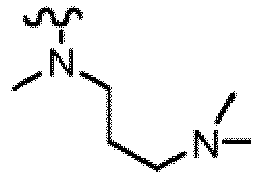 R6 und R7 sind jeweils unabhängig ein Hydrogen;wobei R11 und R12 jeweils unabhängig voneinander ein Hydrogen, C1-10 alkyl, C1-10 alkoxy, C3-8 cycloalkyl, C3-8 cycloalkoxy, C2-10 alkenyl, C2-10 alkynyl, C6-10 aryl sind; oder R11 und R12 bilden zusammen mit dem verbundenen Nitrogen einen 3-6-gliedrigen, gesättigten, N- enthaltenden heterozyklischen Ring.
 - Die Verbindung nach Anspruch 1, oder ein pharmazeutisch unbedenkliches Salz, wobei Ro ein Hydrogen, Hydroxy, C1-3 alkyl, Cyclopropyl, -CHO, -COC1-3 alkyl, -CO-phenyl, Phenyl, -CONH2, -CON(CH3)2, C(O)OCH3, -SO2C1-3 alkyl, -SO2-phenyl, -S(O)C1-3 alkyl. -S(O)-phenyl oder t-butyloxycarbonyl ist; wobei sowohl Alkyl wie Phenyl jeweils unsubstituiert sind oder substituiert sind mit 1-3 Substituenten, ausgewählt aus der Gruppe bestehend aus Fluor, Chlor, Hydroxy, NO2, Phenyl, Methyl, Methoxy, Cyclopropyl, Cyclopropyloxy, -CONH2, - CON(CH3)2, C(O)OCH3, -CHO, OC(O)CH3, -SO2CH3, -S02-phenyl, -CO-phenyl; oder Ro wird ausgewählt aus Pyridyl,

- Die Verbindung nach Anspruch 1, oder ein pharmazeutisch unbedenkliches Salz, wobei, Ro ein Hydrogen, C1-3 alkyl, -COC1-3 alkyl, -CO-phenyl, -S02C1-3 alkyl, -S02-phenyl oder t-butyloxycarbonyl ist; wobei sowohl Alkyl wie Phenyl jeweils unsubstituiert sind oder substituiert sind mit 1-3 Substituenten, ausgewählt aus der Gruppe bestehend aus Fluor, Chlor, Methyl.
- Die Verbindung nach Anspruch 1, oder ein pharmazeutisch unbedenkliches Salz, wobei R3 und R5 unabhängig ein Hydrogen sind.
- Die Verbindung nach Anspruch 1, oder ein pharmazeutisch unbedenkliches Salz, wobei R1 ein Hydrogen ist.
- Die Verbindung nach Anspruch 1, oder ein pharmazeutisch unbedenkliches Salz, wobei in der Verbindung der Formel (VI),(i) Z2 CR10 ist, R10 ist Trifluoromethyl, Fluor oder Chlor;
m3 ist 0; n3 ist 1; n4 ist 1;
X ist NH, O oder S;
R0 ist ein Hydrogen, C1-3 alkyl, -COC1-3 alkyl, -CO-phenyl, - SO2C1-3 alkyl, -S02-phenyl oder t-butyloxycarbonyl; wobei sowohl Alkyl wie Phenyl jeweils unsubstituiert sind oder substituiert sind mit 1-3 Substituenten, ausgewählt aus der Gruppe bestehend aus Fluor, Chlor und Methyl;
R1 ist ein Hydrogen; R2 ist Methoxy; R3, R5, R6 und R7 sind jeweils unabhängig ein Hydrogen;
R4 ist (ii) Z2 ist CR10, R10 ist Trifluoromethyl, Fluor oder Chlor;
m3 ist 0; n3 ist 3; n4 ist 2;
X ist O;
R0 ist ein Hydrogen, C1-3 alkyl, -CO C1-3 alkyl-, -CO-phenyl, - S02 C1-3 alkyl, -S02-phenyl, und t-butyloxycarbonyl; wobei sowohl Alkyl wie Phenyl jeweils unsubstituiert sind oder substituiert sind mit 1-3 Substituenten, ausgewählt aus der Gruppe bestehend aus Fluor, Chlor, und Methyl;
R1 ist ein Hydrogen; R2 ist Methoxy; R3, R5, R6 und R7 sind jeweils unabhängig ein Hydrogen;
R4 ist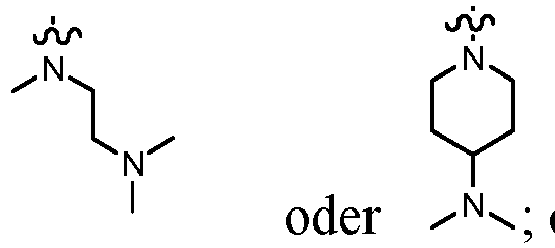 (iii) Z2 ist CR10, R10 ist Trifluoromethyl, Fluor oder Chlor;
m3 ist 0; n3 ist 2; n4 ist 2;
X ist NH oder O;
R0 ist ein Hydrogen, C1-3 alkyl, -COC1-3 alkyl, -CO-phenyl, -SO2C1-3 alkyl, -S02-phenyl, oder t-butyloxycarbonyl; wobei sowohl Alkyl wie Phenyl jeweils unsubstituiert sind oder substituiert sind mit 1-3 Substituenten, ausgewählt aus der Gruppe bestehend aus Fluor, Chlor, und Methyl;
R1 ist ein Hydrogen; R2 ist Methoxy; R3, R5, R6 und R7 sind jeweils unabhängig ein Hydrogen;
R4 ist (iv) Z2 ist CR10, R10 ist Trifluoromethyl, Fluor oder Chlor;
m3 ist 0; n3 ist 1; n4 ist 2;
X ist O;
R0 ist ein Hydrogen, C1-3 alkyl, -COC1-3 alkyl, -CO-phenyl, - S02 C1-3 alkyl, -S02-phenyl, oder t-butyloxycarbonyl; wobei sowohl Alkyl wie Phenyl jeweils unsubstituiert sind oder substituiert sind mit 1-3 Substituenten, ausgewählt aus der Gruppe bestehend aus Fluor, Chlor, und Methyl;
R1 ist ein Hydrogen; R2 ist Methoxy; R3, R5, R6 und R7 sind jeweils unabhängig ein Hydrogen;
R4 ist (v) Z2 ist CR10, R10 ist Trifluoromethyl, Fluor oder Chlor;
m3 ist 0; n3 ist 3; n4 ist 1;
X ist NH oder O;
R0 ist ein Hydrogen, C1-3 alkyl, -COC1-3 alkyl, -CO-phenyl, -S02 C1-3 alkyl, -S02-phenyl oder t-butyloxycarbonyl; wobei sowohl Alkyl wie Phenyl jeweils unsubstituiert sind oder substituiert sind mit 1-3 Substituenten, ausgewählt aus der Gruppe bestehend aus Fluor, Chlor, und Methyl;
R1 ist ein Hydrogen; R2 ist Methoxy; R3, R5, R6 und R7 sind jeweils unabhängig ein Hydrogen;(vi) Z2 ist CR10, R10 ist Trifluoromethyl, Fluor oder Chlor;
m3 ist 10; n3 ist 3; n4 ist 1;
X ist O;
R0 ist ein Hydrogen, C1-3 alkyl, -COC1-3 alkyl, -CO-phenyl, -S02 C1-3 alkyl, -S02-phenyl oder t-butyloxycarbonyl; wobei sowohl Alkyl wie Phenyl jeweils unsubstituiert sind oder substituiert sind mit 1-3 Substituenten, ausgewählt aus der Gruppe bestehend aus Fluor, Chlor, und Methyl;
R1 ist ein Hydrogen; R2 ist Methoxy; R3, R5, R6 und R7 sind jeweils unabhängig ein Hydrogen;
R4 ist
- Die Verbindung nach Anspruch 1, oder ein pharmazeutisch unbedenkliches Salz, wobei die Verbindung der Formel (VI) ausgewählt aus der Gruppe bestehend aus
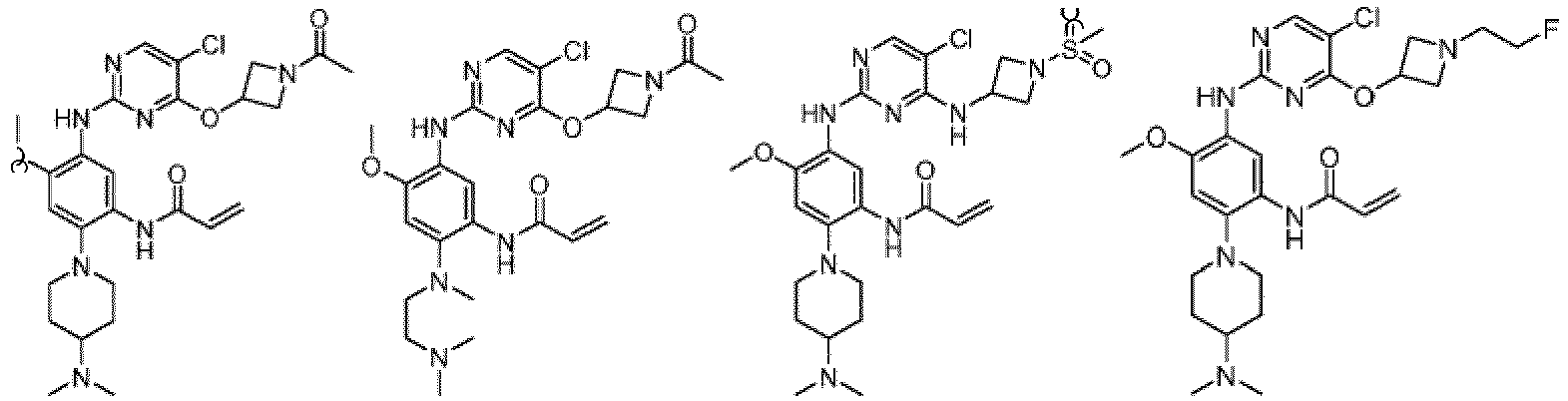


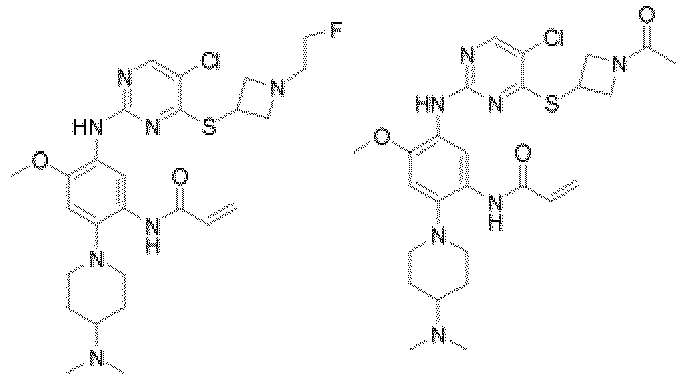


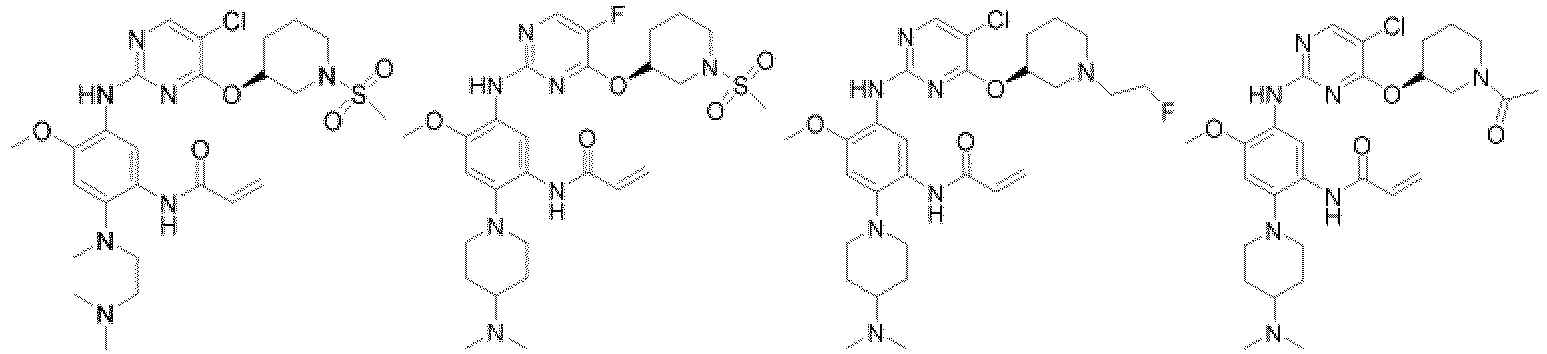


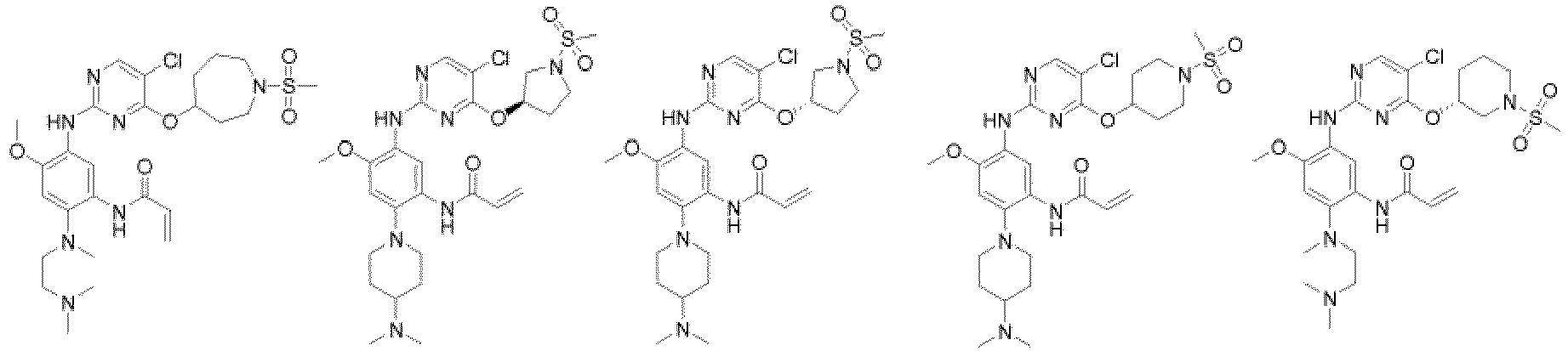

- Eine pharmazeutische Zusammensetzung, die eine Verbindung nach irgendeinem der Ansprüche 1 bis 7 enthält, oder ein pharmazeutisch unbedenkliches Salz; und ein pharmazeutisch unbedenklicher Träger.
- Eine Verwendung einer Verbindung nach irgendeinem der Ansprüche 1 bis 7, oder ein pharmazeutisch unbedenkliches Salz zur Herstellung eines Medikamentes zur Anpassung (hinauf- oder hinunterregulieren) der EGFR- TyrosinkinaseAktivität oder zur Behandlung von Erkrankungen in Zusammenhang mit EGFR.
- Eine pharmazeutische Zusammensetzung, die eine Verbindung nach irgendeinem der Ansprüche 1 bis 7 enthält, oder ein pharmazeutisch unbedenkliches Salz, ebenso wie eines oder mehrere Medikamente ausgewählt aus der Gruppe bestehend aus Gefitinib, Erlotinib, Icotinib, Lapatinib, XL647, NVP-AEE-788, ARRY-334543, EKB-569, BIBW2992, HK1272, BMS-690514, Cl-1033,
Vandetanib, PF00299804, WZ4002, Cetuximab, Trastuzumab, Panitumumab, Matuzumab, Nimotuzumab, Zalutumumab, Pertuzumab, MDX-214, CDX-IIO, IMC-I IF8, Zemab, Her2- Vakzin, PX 1041, HSP90- Inhibitor, CNF2024, Tanespimycin, Alvespimycin, IP1-504, SNX-5422, NVP-AUY922, oder Kombinationen davon.
Applications Claiming Priority (2)
| Application Number | Priority Date | Filing Date | Title |
|---|---|---|---|
| CN201410148176 | 2014-04-14 | ||
| PCT/CN2015/076451 WO2015158233A1 (zh) | 2014-04-14 | 2015-04-13 | 2,3,4,6-四取代苯-1,5-二胺衍生物、其制法与医药上的用途 |
Publications (3)
| Publication Number | Publication Date |
|---|---|
| EP3144292A1 EP3144292A1 (de) | 2017-03-22 |
| EP3144292A4 EP3144292A4 (de) | 2018-01-17 |
| EP3144292B1 true EP3144292B1 (de) | 2020-08-26 |
Family
ID=54271152
Family Applications (1)
| Application Number | Title | Priority Date | Filing Date |
|---|---|---|---|
| EP15780205.9A Not-in-force EP3144292B1 (de) | 2014-04-14 | 2015-04-13 | 2,3,4,6-tetrasubstituierte benzol-1,5-diamin-derivate, herstellungsverfahren dafür und medizinische verwendung davon |
Country Status (6)
| Country | Link |
|---|---|
| US (1) | US9879008B2 (de) |
| EP (1) | EP3144292B1 (de) |
| JP (1) | JP6321821B2 (de) |
| CN (1) | CN104974140B (de) |
| TW (1) | TWI555742B (de) |
| WO (1) | WO2015158233A1 (de) |
Families Citing this family (14)
| Publication number | Priority date | Publication date | Assignee | Title |
|---|---|---|---|---|
| CN105315285B (zh) * | 2014-07-25 | 2017-12-08 | 上海海雁医药科技有限公司 | 2,4‑二取代7H‑吡咯并[2,3‑d]嘧啶衍生物、其制法与医药上的用途 |
| CN106883213B (zh) * | 2015-12-15 | 2021-04-20 | 合肥中科普瑞昇生物医药科技有限公司 | 一种egfr和alk激酶的双重抑制剂 |
| CN106928150B (zh) * | 2015-12-31 | 2020-07-31 | 恩瑞生物医药科技(上海)有限公司 | 丙烯酰胺苯胺衍生物及其药学上的应用 |
| MY201038A (en) * | 2017-07-28 | 2024-01-31 | Yuhan Corp | Intermediates useful for the synthesis of a selective inhibitor against protein kinase and processes for preparing the same |
| CN107266426A (zh) * | 2017-08-15 | 2017-10-20 | 南通因诺威医药科技有限公司 | 2‑氨烃基嘧啶类化合物及其制备方法和用途 |
| CN111171002B (zh) * | 2019-05-16 | 2021-04-06 | 百济神州(苏州)生物科技有限公司 | 一种parp抑制剂中间体的制备方法 |
| CN110256429B (zh) * | 2019-06-17 | 2021-06-22 | 广东药科大学 | 一种具有螺环结构的氨基嘧啶类化合物及其制备方法和应用 |
| EP4087571A4 (de) * | 2020-01-07 | 2024-03-27 | Dana-Farber Cancer Institute, Inc. | Cyanopyrimidininhibitoren von egfr/her2 |
| CN115087641B (zh) * | 2021-01-11 | 2024-06-18 | 广州力鑫生物科技有限公司 | 2-氨基嘧啶类化合物及其药物组合物和应用 |
| JP2024512024A (ja) | 2021-03-23 | 2024-03-18 | ハリア・セラピューティクス・インコーポレイテッド | Lrrk2キナーゼ阻害剤として有用なピリミジン誘導体 |
| EP4337202A4 (de) | 2021-06-18 | 2025-04-02 | Aligos Therapeutics, Inc. | Verfahren und zusammensetzungen zum targeting von pd-l1 |
| CN113603695B (zh) * | 2021-08-05 | 2022-06-14 | 青岛恒宁生物科技有限公司 | 一种取代的嘧啶胺类化合物或其作为农药可接受的盐、组合物及其用途 |
| EP4448512A4 (de) | 2021-12-16 | 2025-11-19 | Aligos Therapeutics Inc | Verfahren und zusammensetzungen zum targeting von pd-l1 |
| CN120463717A (zh) * | 2024-05-30 | 2025-08-12 | 中国科学院基础医学与肿瘤研究所(筹) | 嘧啶氨基-芳基甲酰胺类化合物及其应用 |
Family Cites Families (8)
| Publication number | Priority date | Publication date | Assignee | Title |
|---|---|---|---|---|
| US6881737B2 (en) * | 2001-04-11 | 2005-04-19 | Amgen Inc. | Substituted triazinyl acrylamide derivatives and methods of use |
| DE102007010801A1 (de) * | 2007-03-02 | 2008-09-04 | Bayer Cropscience Ag | Diaminopyrimidine als Fungizide |
| CL2009000600A1 (es) * | 2008-03-20 | 2010-05-07 | Bayer Cropscience Ag | Uso de compuestos de diaminopirimidina como agentes fitosanitarios; compuestos de diaminopirimidina; su procedimiento de preparacion; agente que los contiene; procedimiento para la preparacion de dicho agente; y procedimiento para combatir plagas de animales y/u hongos dañinos patogenos de plantas. |
| US8338439B2 (en) | 2008-06-27 | 2012-12-25 | Celgene Avilomics Research, Inc. | 2,4-disubstituted pyrimidines useful as kinase inhibitors |
| NZ603525A (en) * | 2008-06-27 | 2015-02-27 | Celgene Avilomics Res Inc | Pyrimidine based compound and uses thereof |
| WO2011140338A1 (en) * | 2010-05-05 | 2011-11-10 | Gatekeeper Pharmaceuticals, Inc. | Compounds that modulate egfr activity and methods for treating or preventing conditions therewith |
| EP2635284B1 (de) | 2010-11-01 | 2019-12-18 | Celgene CAR LLC | Heterocyclische verbindungen und ihre verwendung |
| WO2013169401A1 (en) * | 2012-05-05 | 2013-11-14 | Ariad Pharmaceuticals, Inc. | Compounds for inhibiting cell proliferation in egfr-driven cancers |
-
2015
- 2015-04-13 EP EP15780205.9A patent/EP3144292B1/de not_active Not-in-force
- 2015-04-13 US US15/303,475 patent/US9879008B2/en not_active Expired - Fee Related
- 2015-04-13 CN CN201510173406.4A patent/CN104974140B/zh active Active
- 2015-04-13 WO PCT/CN2015/076451 patent/WO2015158233A1/zh not_active Ceased
- 2015-04-13 JP JP2016562498A patent/JP6321821B2/ja not_active Expired - Fee Related
- 2015-04-14 TW TW104111932A patent/TWI555742B/zh not_active IP Right Cessation
Non-Patent Citations (1)
| Title |
|---|
| None * |
Also Published As
| Publication number | Publication date |
|---|---|
| WO2015158233A1 (zh) | 2015-10-22 |
| JP2017513847A (ja) | 2017-06-01 |
| JP6321821B2 (ja) | 2018-05-09 |
| CN104974140A (zh) | 2015-10-14 |
| TW201544502A (zh) | 2015-12-01 |
| US20170057957A1 (en) | 2017-03-02 |
| EP3144292A1 (de) | 2017-03-22 |
| TWI555742B (zh) | 2016-11-01 |
| CN104974140B (zh) | 2017-11-24 |
| EP3144292A4 (de) | 2018-01-17 |
| US9879008B2 (en) | 2018-01-30 |
Similar Documents
| Publication | Publication Date | Title |
|---|---|---|
| EP3144292B1 (de) | 2,3,4,6-tetrasubstituierte benzol-1,5-diamin-derivate, herstellungsverfahren dafür und medizinische verwendung davon | |
| CN113286794B (zh) | Kras突变蛋白抑制剂 | |
| CN104109149B (zh) | 氘代的二氨基嘧啶化合物以及包含该化合物的药物组合物 | |
| CN102686581B (zh) | 喹唑啉衍生物 | |
| EP3173412B1 (de) | 2,4-disubstituiertes 7h-pyrrolo[2,3-d]pyrimidin-derivat, herstellungsverfahren und medizinische verwendung davon | |
| CN105555782B (zh) | 喹唑啉衍生物及其制备方法 | |
| CN112552295A (zh) | Kras突变蛋白抑制剂 | |
| CN112574255A (zh) | 一类基于有机胂的cdk抑制剂及其制备方法和用途 | |
| EP3327014A1 (de) | Egfr-hemmer und pharmazeutisch unbedenkliches salz und polymorph davon und verwendung davon | |
| WO2018052967A1 (en) | Substituted chromane-8-carboxamide compounds and analogues thereof, and methods using same | |
| EP3202767B1 (de) | Azabicycloderivate, verfahren zur herstellung davon und medizinische verwendung davon | |
| WO2022166570A1 (zh) | 同时诱导egfr和parp蛋白降解的化合物及制备方法和应用 | |
| TW201315727A (zh) | 尿嘧啶衍生物及其醫藥用途 | |
| CN111763215B (zh) | 一种具有含氮杂环结构的化合物及其制备方法和用途 | |
| JP2024505732A (ja) | ピリドピリミジノン系誘導体及びその製造方法と使用 | |
| CN113773305B (zh) | 一种氨基嘧啶衍生物及其作为egfr酪氨酸激酶抑制剂的应用 | |
| CN113336774B (zh) | 作为trk抑制剂的取代的手性二芳基大环化合物 | |
| CN111892536A (zh) | 取代的喹啉甲酰胺类化合物及其用途 | |
| KR20260054792A (ko) | 공유 푸마레이트 핸들을 이용한 신규한 아나플라스틱 림포마 키나아제 분해제 및 이의 용도 | |
| CN108117551A (zh) | 取代(1H-吡唑[3,4-b]吡啶)脲类化合物及其抗肿瘤用途 | |
| CN117940430A (zh) | 作为Wee-1抑制剂的1,2-二氢-3H-吡唑[3,4-d]嘧啶-3-酮化合物 | |
| CN115109055A (zh) | 一种用于egfr降解的双功能化合物及其应用 |
Legal Events
| Date | Code | Title | Description |
|---|---|---|---|
| STAA | Information on the status of an ep patent application or granted ep patent |
Free format text: STATUS: THE INTERNATIONAL PUBLICATION HAS BEEN MADE |
|
| PUAI | Public reference made under article 153(3) epc to a published international application that has entered the european phase |
Free format text: ORIGINAL CODE: 0009012 |
|
| STAA | Information on the status of an ep patent application or granted ep patent |
Free format text: STATUS: REQUEST FOR EXAMINATION WAS MADE |
|
| 17P | Request for examination filed |
Effective date: 20161220 |
|
| AK | Designated contracting states |
Kind code of ref document: A1 Designated state(s): AL AT BE BG CH CY CZ DE DK EE ES FI FR GB GR HR HU IE IS IT LI LT LU LV MC MK MT NL NO PL PT RO RS SE SI SK SM TR |
|
| AX | Request for extension of the european patent |
Extension state: BA ME |
|
| DAV | Request for validation of the european patent (deleted) | ||
| DAX | Request for extension of the european patent (deleted) | ||
| REG | Reference to a national code |
Ref country code: DE Ref legal event code: R079 Ref document number: 602015058050 Country of ref document: DE Free format text: PREVIOUS MAIN CLASS: C07C0211510000 Ipc: C07D0403140000 |
|
| A4 | Supplementary search report drawn up and despatched |
Effective date: 20171214 |
|
| RIC1 | Information provided on ipc code assigned before grant |
Ipc: C07D 403/12 20060101ALI20171208BHEP Ipc: A61P 35/00 20060101ALI20171208BHEP Ipc: A61K 31/16 20060101ALI20171208BHEP Ipc: C07D 401/14 20060101ALI20171208BHEP Ipc: C07D 403/14 20060101AFI20171208BHEP Ipc: C07D 401/12 20060101ALI20171208BHEP Ipc: A61K 31/505 20060101ALI20171208BHEP |
|
| STAA | Information on the status of an ep patent application or granted ep patent |
Free format text: STATUS: EXAMINATION IS IN PROGRESS |
|
| 17Q | First examination report despatched |
Effective date: 20181212 |
|
| GRAP | Despatch of communication of intention to grant a patent |
Free format text: ORIGINAL CODE: EPIDOSNIGR1 |
|
| STAA | Information on the status of an ep patent application or granted ep patent |
Free format text: STATUS: GRANT OF PATENT IS INTENDED |
|
| INTG | Intention to grant announced |
Effective date: 20200309 |
|
| GRAS | Grant fee paid |
Free format text: ORIGINAL CODE: EPIDOSNIGR3 |
|
| GRAA | (expected) grant |
Free format text: ORIGINAL CODE: 0009210 |
|
| STAA | Information on the status of an ep patent application or granted ep patent |
Free format text: STATUS: THE PATENT HAS BEEN GRANTED |
|
| AK | Designated contracting states |
Kind code of ref document: B1 Designated state(s): AL AT BE BG CH CY CZ DE DK EE ES FI FR GB GR HR HU IE IS IT LI LT LU LV MC MK MT NL NO PL PT RO RS SE SI SK SM TR |
|
| REG | Reference to a national code |
Ref country code: GB Ref legal event code: FG4D |
|
| REG | Reference to a national code |
Ref country code: CH Ref legal event code: EP |
|
| REG | Reference to a national code |
Ref country code: AT Ref legal event code: REF Ref document number: 1306262 Country of ref document: AT Kind code of ref document: T Effective date: 20200915 |
|
| REG | Reference to a national code |
Ref country code: IE Ref legal event code: FG4D |
|
| REG | Reference to a national code |
Ref country code: DE Ref legal event code: R096 Ref document number: 602015058050 Country of ref document: DE |
|
| REG | Reference to a national code |
Ref country code: LT Ref legal event code: MG4D |
|
| PG25 | Lapsed in a contracting state [announced via postgrant information from national office to epo] |
Ref country code: GR Free format text: LAPSE BECAUSE OF FAILURE TO SUBMIT A TRANSLATION OF THE DESCRIPTION OR TO PAY THE FEE WITHIN THE PRESCRIBED TIME-LIMIT Effective date: 20201127 Ref country code: BG Free format text: LAPSE BECAUSE OF FAILURE TO SUBMIT A TRANSLATION OF THE DESCRIPTION OR TO PAY THE FEE WITHIN THE PRESCRIBED TIME-LIMIT Effective date: 20201126 Ref country code: SE Free format text: LAPSE BECAUSE OF FAILURE TO SUBMIT A TRANSLATION OF THE DESCRIPTION OR TO PAY THE FEE WITHIN THE PRESCRIBED TIME-LIMIT Effective date: 20200826 Ref country code: NO Free format text: LAPSE BECAUSE OF FAILURE TO SUBMIT A TRANSLATION OF THE DESCRIPTION OR TO PAY THE FEE WITHIN THE PRESCRIBED TIME-LIMIT Effective date: 20201126 Ref country code: FI Free format text: LAPSE BECAUSE OF FAILURE TO SUBMIT A TRANSLATION OF THE DESCRIPTION OR TO PAY THE FEE WITHIN THE PRESCRIBED TIME-LIMIT Effective date: 20200826 Ref country code: HR Free format text: LAPSE BECAUSE OF FAILURE TO SUBMIT A TRANSLATION OF THE DESCRIPTION OR TO PAY THE FEE WITHIN THE PRESCRIBED TIME-LIMIT Effective date: 20200826 Ref country code: LT Free format text: LAPSE BECAUSE OF FAILURE TO SUBMIT A TRANSLATION OF THE DESCRIPTION OR TO PAY THE FEE WITHIN THE PRESCRIBED TIME-LIMIT Effective date: 20200826 Ref country code: PT Free format text: LAPSE BECAUSE OF FAILURE TO SUBMIT A TRANSLATION OF THE DESCRIPTION OR TO PAY THE FEE WITHIN THE PRESCRIBED TIME-LIMIT Effective date: 20201228 |
|
| REG | Reference to a national code |
Ref country code: NL Ref legal event code: MP Effective date: 20200826 |
|
| REG | Reference to a national code |
Ref country code: AT Ref legal event code: MK05 Ref document number: 1306262 Country of ref document: AT Kind code of ref document: T Effective date: 20200826 |
|
| PG25 | Lapsed in a contracting state [announced via postgrant information from national office to epo] |
Ref country code: LV Free format text: LAPSE BECAUSE OF FAILURE TO SUBMIT A TRANSLATION OF THE DESCRIPTION OR TO PAY THE FEE WITHIN THE PRESCRIBED TIME-LIMIT Effective date: 20200826 Ref country code: PL Free format text: LAPSE BECAUSE OF FAILURE TO SUBMIT A TRANSLATION OF THE DESCRIPTION OR TO PAY THE FEE WITHIN THE PRESCRIBED TIME-LIMIT Effective date: 20200826 Ref country code: RS Free format text: LAPSE BECAUSE OF FAILURE TO SUBMIT A TRANSLATION OF THE DESCRIPTION OR TO PAY THE FEE WITHIN THE PRESCRIBED TIME-LIMIT Effective date: 20200826 Ref country code: NL Free format text: LAPSE BECAUSE OF FAILURE TO SUBMIT A TRANSLATION OF THE DESCRIPTION OR TO PAY THE FEE WITHIN THE PRESCRIBED TIME-LIMIT Effective date: 20200826 Ref country code: IS Free format text: LAPSE BECAUSE OF FAILURE TO SUBMIT A TRANSLATION OF THE DESCRIPTION OR TO PAY THE FEE WITHIN THE PRESCRIBED TIME-LIMIT Effective date: 20201226 |
|
| PG25 | Lapsed in a contracting state [announced via postgrant information from national office to epo] |
Ref country code: DK Free format text: LAPSE BECAUSE OF FAILURE TO SUBMIT A TRANSLATION OF THE DESCRIPTION OR TO PAY THE FEE WITHIN THE PRESCRIBED TIME-LIMIT Effective date: 20200826 Ref country code: CZ Free format text: LAPSE BECAUSE OF FAILURE TO SUBMIT A TRANSLATION OF THE DESCRIPTION OR TO PAY THE FEE WITHIN THE PRESCRIBED TIME-LIMIT Effective date: 20200826 Ref country code: EE Free format text: LAPSE BECAUSE OF FAILURE TO SUBMIT A TRANSLATION OF THE DESCRIPTION OR TO PAY THE FEE WITHIN THE PRESCRIBED TIME-LIMIT Effective date: 20200826 Ref country code: RO Free format text: LAPSE BECAUSE OF FAILURE TO SUBMIT A TRANSLATION OF THE DESCRIPTION OR TO PAY THE FEE WITHIN THE PRESCRIBED TIME-LIMIT Effective date: 20200826 Ref country code: SM Free format text: LAPSE BECAUSE OF FAILURE TO SUBMIT A TRANSLATION OF THE DESCRIPTION OR TO PAY THE FEE WITHIN THE PRESCRIBED TIME-LIMIT Effective date: 20200826 |
|
| PGFP | Annual fee paid to national office [announced via postgrant information from national office to epo] |
Ref country code: FR Payment date: 20210208 Year of fee payment: 7 |
|
| REG | Reference to a national code |
Ref country code: DE Ref legal event code: R097 Ref document number: 602015058050 Country of ref document: DE |
|
| PG25 | Lapsed in a contracting state [announced via postgrant information from national office to epo] |
Ref country code: ES Free format text: LAPSE BECAUSE OF FAILURE TO SUBMIT A TRANSLATION OF THE DESCRIPTION OR TO PAY THE FEE WITHIN THE PRESCRIBED TIME-LIMIT Effective date: 20200826 Ref country code: AL Free format text: LAPSE BECAUSE OF FAILURE TO SUBMIT A TRANSLATION OF THE DESCRIPTION OR TO PAY THE FEE WITHIN THE PRESCRIBED TIME-LIMIT Effective date: 20200826 Ref country code: AT Free format text: LAPSE BECAUSE OF FAILURE TO SUBMIT A TRANSLATION OF THE DESCRIPTION OR TO PAY THE FEE WITHIN THE PRESCRIBED TIME-LIMIT Effective date: 20200826 |
|
| PGFP | Annual fee paid to national office [announced via postgrant information from national office to epo] |
Ref country code: GB Payment date: 20210208 Year of fee payment: 7 |
|
| PG25 | Lapsed in a contracting state [announced via postgrant information from national office to epo] |
Ref country code: SK Free format text: LAPSE BECAUSE OF FAILURE TO SUBMIT A TRANSLATION OF THE DESCRIPTION OR TO PAY THE FEE WITHIN THE PRESCRIBED TIME-LIMIT Effective date: 20200826 |
|
| PLBE | No opposition filed within time limit |
Free format text: ORIGINAL CODE: 0009261 |
|
| STAA | Information on the status of an ep patent application or granted ep patent |
Free format text: STATUS: NO OPPOSITION FILED WITHIN TIME LIMIT |
|
| PG25 | Lapsed in a contracting state [announced via postgrant information from national office to epo] |
Ref country code: IT Free format text: LAPSE BECAUSE OF FAILURE TO SUBMIT A TRANSLATION OF THE DESCRIPTION OR TO PAY THE FEE WITHIN THE PRESCRIBED TIME-LIMIT Effective date: 20200826 |
|
| PGFP | Annual fee paid to national office [announced via postgrant information from national office to epo] |
Ref country code: DE Payment date: 20210421 Year of fee payment: 7 |
|
| 26N | No opposition filed |
Effective date: 20210527 |
|
| PG25 | Lapsed in a contracting state [announced via postgrant information from national office to epo] |
Ref country code: SI Free format text: LAPSE BECAUSE OF FAILURE TO SUBMIT A TRANSLATION OF THE DESCRIPTION OR TO PAY THE FEE WITHIN THE PRESCRIBED TIME-LIMIT Effective date: 20200826 |
|
| PG25 | Lapsed in a contracting state [announced via postgrant information from national office to epo] |
Ref country code: MC Free format text: LAPSE BECAUSE OF FAILURE TO SUBMIT A TRANSLATION OF THE DESCRIPTION OR TO PAY THE FEE WITHIN THE PRESCRIBED TIME-LIMIT Effective date: 20200826 |
|
| PG25 | Lapsed in a contracting state [announced via postgrant information from national office to epo] |
Ref country code: LU Free format text: LAPSE BECAUSE OF NON-PAYMENT OF DUE FEES Effective date: 20210413 |
|
| REG | Reference to a national code |
Ref country code: BE Ref legal event code: MM Effective date: 20210430 |
|
| PG25 | Lapsed in a contracting state [announced via postgrant information from national office to epo] |
Ref country code: CH Free format text: LAPSE BECAUSE OF NON-PAYMENT OF DUE FEES Effective date: 20210430 Ref country code: LI Free format text: LAPSE BECAUSE OF NON-PAYMENT OF DUE FEES Effective date: 20210430 |
|
| PG25 | Lapsed in a contracting state [announced via postgrant information from national office to epo] |
Ref country code: IE Free format text: LAPSE BECAUSE OF NON-PAYMENT OF DUE FEES Effective date: 20210413 |
|
| PG25 | Lapsed in a contracting state [announced via postgrant information from national office to epo] |
Ref country code: IS Free format text: LAPSE BECAUSE OF FAILURE TO SUBMIT A TRANSLATION OF THE DESCRIPTION OR TO PAY THE FEE WITHIN THE PRESCRIBED TIME-LIMIT Effective date: 20201226 |
|
| PG25 | Lapsed in a contracting state [announced via postgrant information from national office to epo] |
Ref country code: BE Free format text: LAPSE BECAUSE OF NON-PAYMENT OF DUE FEES Effective date: 20210430 |
|
| REG | Reference to a national code |
Ref country code: DE Ref legal event code: R119 Ref document number: 602015058050 Country of ref document: DE |
|
| GBPC | Gb: european patent ceased through non-payment of renewal fee |
Effective date: 20220413 |
|
| PG25 | Lapsed in a contracting state [announced via postgrant information from national office to epo] |
Ref country code: GB Free format text: LAPSE BECAUSE OF NON-PAYMENT OF DUE FEES Effective date: 20220413 Ref country code: FR Free format text: LAPSE BECAUSE OF NON-PAYMENT OF DUE FEES Effective date: 20220430 Ref country code: DE Free format text: LAPSE BECAUSE OF NON-PAYMENT OF DUE FEES Effective date: 20221103 |
|
| PG25 | Lapsed in a contracting state [announced via postgrant information from national office to epo] |
Ref country code: HU Free format text: LAPSE BECAUSE OF FAILURE TO SUBMIT A TRANSLATION OF THE DESCRIPTION OR TO PAY THE FEE WITHIN THE PRESCRIBED TIME-LIMIT; INVALID AB INITIO Effective date: 20150413 |
|
| PG25 | Lapsed in a contracting state [announced via postgrant information from national office to epo] |
Ref country code: CY Free format text: LAPSE BECAUSE OF FAILURE TO SUBMIT A TRANSLATION OF THE DESCRIPTION OR TO PAY THE FEE WITHIN THE PRESCRIBED TIME-LIMIT Effective date: 20200826 |
|
| PG25 | Lapsed in a contracting state [announced via postgrant information from national office to epo] |
Ref country code: MK Free format text: LAPSE BECAUSE OF FAILURE TO SUBMIT A TRANSLATION OF THE DESCRIPTION OR TO PAY THE FEE WITHIN THE PRESCRIBED TIME-LIMIT Effective date: 20200826 |
|
| PG25 | Lapsed in a contracting state [announced via postgrant information from national office to epo] |
Ref country code: TR Free format text: LAPSE BECAUSE OF FAILURE TO SUBMIT A TRANSLATION OF THE DESCRIPTION OR TO PAY THE FEE WITHIN THE PRESCRIBED TIME-LIMIT Effective date: 20200826 |
|
| PG25 | Lapsed in a contracting state [announced via postgrant information from national office to epo] |
Ref country code: MT Free format text: LAPSE BECAUSE OF FAILURE TO SUBMIT A TRANSLATION OF THE DESCRIPTION OR TO PAY THE FEE WITHIN THE PRESCRIBED TIME-LIMIT Effective date: 20200826 |