EP3144392A1 - Procédé de production d'acide aminé de type mycosporine faisant appel à des microbes - Google Patents
Procédé de production d'acide aminé de type mycosporine faisant appel à des microbes Download PDFInfo
- Publication number
- EP3144392A1 EP3144392A1 EP15792252.7A EP15792252A EP3144392A1 EP 3144392 A1 EP3144392 A1 EP 3144392A1 EP 15792252 A EP15792252 A EP 15792252A EP 3144392 A1 EP3144392 A1 EP 3144392A1
- Authority
- EP
- European Patent Office
- Prior art keywords
- mycosporine
- amino acid
- maa
- microorganism
- amir
- Prior art date
- Legal status (The legal status is an assumption and is not a legal conclusion. Google has not performed a legal analysis and makes no representation as to the accuracy of the status listed.)
- Granted
Links
- 0 CCNN=C(CC(C(*)CC1)N=C)C(NC)=C1NCC(**)=O Chemical compound CCNN=C(CC(C(*)CC1)N=C)C(NC)=C1NCC(**)=O 0.000 description 1
Images

Classifications
-
- A—HUMAN NECESSITIES
- A61—MEDICAL OR VETERINARY SCIENCE; HYGIENE
- A61K—PREPARATIONS FOR MEDICAL, DENTAL OR TOILETRY PURPOSES
- A61K8/00—Cosmetics or similar toiletry preparations
- A61K8/18—Cosmetics or similar toiletry preparations characterised by the composition
- A61K8/30—Cosmetics or similar toiletry preparations characterised by the composition containing organic compounds
- A61K8/40—Cosmetics or similar toiletry preparations characterised by the composition containing organic compounds containing nitrogen
- A61K8/44—Aminocarboxylic acids or derivatives thereof, e.g. aminocarboxylic acids containing sulfur; Salts; Esters or N-acylated derivatives thereof
-
- A—HUMAN NECESSITIES
- A61—MEDICAL OR VETERINARY SCIENCE; HYGIENE
- A61K—PREPARATIONS FOR MEDICAL, DENTAL OR TOILETRY PURPOSES
- A61K31/00—Medicinal preparations containing organic active ingredients
- A61K31/185—Acids; Anhydrides, halides or salts thereof, e.g. sulfur acids, imidic, hydrazonic or hydroximic acids
- A61K31/19—Carboxylic acids, e.g. valproic acid
- A61K31/195—Carboxylic acids, e.g. valproic acid having an amino group
- A61K31/197—Carboxylic acids, e.g. valproic acid having an amino group the amino and the carboxyl groups being attached to the same acyclic carbon chain, e.g. gamma-aminobutyric acid [GABA], beta-alanine, epsilon-aminocaproic acid or pantothenic acid
- A61K31/198—Alpha-amino acids, e.g. alanine or edetic acid [EDTA]
-
- A—HUMAN NECESSITIES
- A61—MEDICAL OR VETERINARY SCIENCE; HYGIENE
- A61K—PREPARATIONS FOR MEDICAL, DENTAL OR TOILETRY PURPOSES
- A61K35/00—Medicinal preparations containing materials or reaction products thereof with undetermined constitution
- A61K35/66—Microorganisms or materials therefrom
- A61K35/74—Bacteria
-
- A—HUMAN NECESSITIES
- A61—MEDICAL OR VETERINARY SCIENCE; HYGIENE
- A61K—PREPARATIONS FOR MEDICAL, DENTAL OR TOILETRY PURPOSES
- A61K8/00—Cosmetics or similar toiletry preparations
- A61K8/18—Cosmetics or similar toiletry preparations characterised by the composition
- A61K8/96—Cosmetics or similar toiletry preparations characterised by the composition containing materials, or derivatives thereof of undetermined constitution
- A61K8/97—Cosmetics or similar toiletry preparations characterised by the composition containing materials, or derivatives thereof of undetermined constitution from algae, fungi, lichens or plants; from derivatives thereof
- A61K8/9728—Fungi, e.g. yeasts
-
- A—HUMAN NECESSITIES
- A61—MEDICAL OR VETERINARY SCIENCE; HYGIENE
- A61P—SPECIFIC THERAPEUTIC ACTIVITY OF CHEMICAL COMPOUNDS OR MEDICINAL PREPARATIONS
- A61P17/00—Drugs for dermatological disorders
-
- A—HUMAN NECESSITIES
- A61—MEDICAL OR VETERINARY SCIENCE; HYGIENE
- A61P—SPECIFIC THERAPEUTIC ACTIVITY OF CHEMICAL COMPOUNDS OR MEDICINAL PREPARATIONS
- A61P17/00—Drugs for dermatological disorders
- A61P17/02—Drugs for dermatological disorders for treating wounds, ulcers, burns, scars, keloids, or the like
-
- A—HUMAN NECESSITIES
- A61—MEDICAL OR VETERINARY SCIENCE; HYGIENE
- A61P—SPECIFIC THERAPEUTIC ACTIVITY OF CHEMICAL COMPOUNDS OR MEDICINAL PREPARATIONS
- A61P17/00—Drugs for dermatological disorders
- A61P17/16—Emollients or protectives, e.g. against radiation
-
- A—HUMAN NECESSITIES
- A61—MEDICAL OR VETERINARY SCIENCE; HYGIENE
- A61P—SPECIFIC THERAPEUTIC ACTIVITY OF CHEMICAL COMPOUNDS OR MEDICINAL PREPARATIONS
- A61P35/00—Antineoplastic agents
-
- A—HUMAN NECESSITIES
- A61—MEDICAL OR VETERINARY SCIENCE; HYGIENE
- A61Q—SPECIFIC USE OF COSMETICS OR SIMILAR TOILETRY PREPARATIONS
- A61Q17/00—Barrier preparations; Preparations brought into direct contact with the skin for affording protection against external influences, e.g. sunlight, X-rays or other harmful rays, corrosive materials, bacteria or insect stings
- A61Q17/04—Topical preparations for affording protection against sunlight or other radiation; Topical sun tanning preparations
-
- A—HUMAN NECESSITIES
- A61—MEDICAL OR VETERINARY SCIENCE; HYGIENE
- A61Q—SPECIFIC USE OF COSMETICS OR SIMILAR TOILETRY PREPARATIONS
- A61Q19/00—Preparations for care of the skin
-
- A—HUMAN NECESSITIES
- A61—MEDICAL OR VETERINARY SCIENCE; HYGIENE
- A61Q—SPECIFIC USE OF COSMETICS OR SIMILAR TOILETRY PREPARATIONS
- A61Q19/00—Preparations for care of the skin
- A61Q19/08—Anti-ageing preparations
-
- C—CHEMISTRY; METALLURGY
- C07—ORGANIC CHEMISTRY
- C07C—ACYCLIC OR CARBOCYCLIC COMPOUNDS
- C07C249/00—Preparation of compounds containing nitrogen atoms doubly-bound to a carbon skeleton
- C07C249/04—Preparation of compounds containing nitrogen atoms doubly-bound to a carbon skeleton of oximes
- C07C249/14—Separation; Purification; Stabilisation; Use of additives
-
- C—CHEMISTRY; METALLURGY
- C07—ORGANIC CHEMISTRY
- C07C—ACYCLIC OR CARBOCYCLIC COMPOUNDS
- C07C251/00—Compounds containing nitrogen atoms doubly-bound to a carbon skeleton
- C07C251/02—Compounds containing nitrogen atoms doubly-bound to a carbon skeleton containing imino groups
- C07C251/20—Compounds containing nitrogen atoms doubly-bound to a carbon skeleton containing imino groups having carbon atoms of imino groups being part of rings other than six-membered aromatic rings
-
- C—CHEMISTRY; METALLURGY
- C12—BIOCHEMISTRY; BEER; SPIRITS; WINE; VINEGAR; MICROBIOLOGY; ENZYMOLOGY; MUTATION OR GENETIC ENGINEERING
- C12N—MICROORGANISMS OR ENZYMES; COMPOSITIONS THEREOF; PROPAGATING, PRESERVING, OR MAINTAINING MICROORGANISMS; MUTATION OR GENETIC ENGINEERING; CULTURE MEDIA
- C12N15/00—Mutation or genetic engineering; DNA or RNA concerning genetic engineering, vectors, e.g. plasmids, or their isolation, preparation or purification; Use of hosts therefor
- C12N15/09—Recombinant DNA-technology
-
- C—CHEMISTRY; METALLURGY
- C12—BIOCHEMISTRY; BEER; SPIRITS; WINE; VINEGAR; MICROBIOLOGY; ENZYMOLOGY; MUTATION OR GENETIC ENGINEERING
- C12N—MICROORGANISMS OR ENZYMES; COMPOSITIONS THEREOF; PROPAGATING, PRESERVING, OR MAINTAINING MICROORGANISMS; MUTATION OR GENETIC ENGINEERING; CULTURE MEDIA
- C12N15/00—Mutation or genetic engineering; DNA or RNA concerning genetic engineering, vectors, e.g. plasmids, or their isolation, preparation or purification; Use of hosts therefor
- C12N15/09—Recombinant DNA-technology
- C12N15/63—Introduction of foreign genetic material using vectors; Vectors; Use of hosts therefor; Regulation of expression
- C12N15/74—Vectors or expression systems specially adapted for prokaryotic hosts other than E. coli, e.g. Lactobacillus, Micromonospora
- C12N15/76—Vectors or expression systems specially adapted for prokaryotic hosts other than E. coli, e.g. Lactobacillus, Micromonospora for Actinomyces; for Streptomyces
-
- C—CHEMISTRY; METALLURGY
- C12—BIOCHEMISTRY; BEER; SPIRITS; WINE; VINEGAR; MICROBIOLOGY; ENZYMOLOGY; MUTATION OR GENETIC ENGINEERING
- C12P—FERMENTATION OR ENZYME-USING PROCESSES TO SYNTHESISE A DESIRED CHEMICAL COMPOUND OR COMPOSITION OR TO SEPARATE OPTICAL ISOMERS FROM A RACEMIC MIXTURE
- C12P13/00—Preparation of nitrogen-containing organic compounds
- C12P13/04—Alpha- or beta- amino acids
-
- A—HUMAN NECESSITIES
- A61—MEDICAL OR VETERINARY SCIENCE; HYGIENE
- A61K—PREPARATIONS FOR MEDICAL, DENTAL OR TOILETRY PURPOSES
- A61K35/00—Medicinal preparations containing materials or reaction products thereof with undetermined constitution
-
- A—HUMAN NECESSITIES
- A61—MEDICAL OR VETERINARY SCIENCE; HYGIENE
- A61K—PREPARATIONS FOR MEDICAL, DENTAL OR TOILETRY PURPOSES
- A61K36/00—Medicinal preparations of undetermined constitution containing material from algae, lichens, fungi or plants, or derivatives thereof, e.g. traditional herbal medicines
-
- C—CHEMISTRY; METALLURGY
- C07—ORGANIC CHEMISTRY
- C07C—ACYCLIC OR CARBOCYCLIC COMPOUNDS
- C07C2601/00—Systems containing only non-condensed rings
- C07C2601/12—Systems containing only non-condensed rings with a six-membered ring
- C07C2601/16—Systems containing only non-condensed rings with a six-membered ring the ring being unsaturated
-
- C—CHEMISTRY; METALLURGY
- C12—BIOCHEMISTRY; BEER; SPIRITS; WINE; VINEGAR; MICROBIOLOGY; ENZYMOLOGY; MUTATION OR GENETIC ENGINEERING
- C12N—MICROORGANISMS OR ENZYMES; COMPOSITIONS THEREOF; PROPAGATING, PRESERVING, OR MAINTAINING MICROORGANISMS; MUTATION OR GENETIC ENGINEERING; CULTURE MEDIA
- C12N1/00—Microorganisms; Compositions thereof; Processes of propagating, maintaining or preserving microorganisms or compositions thereof; Processes of preparing or isolating a composition containing a microorganism; Culture media therefor
- C12N1/20—Bacteria; Culture media therefor
- C12N1/205—Bacterial isolates
-
- C—CHEMISTRY; METALLURGY
- C12—BIOCHEMISTRY; BEER; SPIRITS; WINE; VINEGAR; MICROBIOLOGY; ENZYMOLOGY; MUTATION OR GENETIC ENGINEERING
- C12R—INDEXING SCHEME ASSOCIATED WITH SUBCLASSES C12C - C12Q, RELATING TO MICROORGANISMS
- C12R2001/00—Microorganisms ; Processes using microorganisms
- C12R2001/01—Bacteria or Actinomycetales ; using bacteria or Actinomycetales
- C12R2001/465—Streptomyces
-
- Y—GENERAL TAGGING OF NEW TECHNOLOGICAL DEVELOPMENTS; GENERAL TAGGING OF CROSS-SECTIONAL TECHNOLOGIES SPANNING OVER SEVERAL SECTIONS OF THE IPC; TECHNICAL SUBJECTS COVERED BY FORMER USPC CROSS-REFERENCE ART COLLECTIONS [XRACs] AND DIGESTS
- Y02—TECHNOLOGIES OR APPLICATIONS FOR MITIGATION OR ADAPTATION AGAINST CLIMATE CHANGE
- Y02A—TECHNOLOGIES FOR ADAPTATION TO CLIMATE CHANGE
- Y02A50/00—TECHNOLOGIES FOR ADAPTATION TO CLIMATE CHANGE in human health protection, e.g. against extreme weather
- Y02A50/30—Against vector-borne diseases, e.g. mosquito-borne, fly-borne, tick-borne or waterborne diseases whose impact is exacerbated by climate change
Definitions
- the present invention relates to a method for producing a mycosporine-like amino acid using a microorganism, a mycosporine-like amino acid produced by the method, and an UV-absorbing agent comprising the mycosporine-like amino acid.
- UV rays induce acute skin reactions such as erythema, skin aging, and skin cancer.
- the ultraviolet rays contained in sunlight are classified, based on the wavelength, into three types: UV-A (320 nm-400 nm), UV-B (280 nm-320 nm) and UV-C (200-280 nm).
- UV-A 320 nm-400 nm
- UV-B 280 nm-320 nm
- UV-C 200-280 nm
- UV-B is a main cause of sunburn in the outdoors and has relatively larger energy than UV-A.
- UV-B is absorbed by skin layer, it reaches the stratum corneum and the epidermis, and causes acute skin pigmentation such as spots and freckles.
- UV-B is also known to cause immunosuppression involved in aging and onset of skin cancer.
- UV-A has a longer wavelength than UV-B and the energy is lower; however, UV-A penetrates into a further deeper portion of the skin than UV-B and is known to reach the dermis.
- UV-A not only acute skin pigmentation such as spots and freckles but also reduction in elasticity of the dermis (actinic elastosis) is caused, with the result that early skin aging such as wrinkles and sagging is induced.
- UV-A also causes immunosuppression and is involved in precancerous skin lesion and onset of skin cancer.
- UV-B varies in amount depending upon e.g., season, weather and latitude; whereas the amount of UV-A reached the surface of the earth is constant throughout the year. Therefore, it is important to protect the skin also from UV-A.
- UV protectors currently available in the market are divided into UV-absorbing agents and UV scattering agents.
- the UV-absorbing agents convert the UV energy into heat energy and release it, and include, for example, an organic compound such as 4-tert-butyl-4'-methoxydibenzoylmethane.
- the UV scattering agents contain an inorganic particle such as titanium oxide (TiO 2 ) and zinc oxide (ZnO), and when the UV scattering agent is applied to the skin, the inorganic particles present on the skin reflect UV rays and serve as a UV barrier.
- the UV-absorbing agents have problems: (1) the UV-absorbing agents are easily decomposed by light and have poor stability, (2) molecular excitation occurs and accelerates production of melanin to cause itchiness and allergy, and (3) a bad image is given to the users due to chemically synthesized substances.
- the UV scattering agents have the problems: (1) skin likely looks white when applied and the user tends to feel heavy in the skin, (2) generation of active oxygen is induced, and (3) pores of skin are closed and skin respiration may be inhibited. Because of these problems, development of a naturally derived safe UV-absorbing substance has been highly expected.
- MAAs Mycosporine-like amino acids
- MAAs are natural UV-A absorbing substances, which are known to be present in a wide variety of aquatic organisms such as coral, red algae, fish viscera and microalgae.
- shinorine is known to be the most effective natural UV-A absorbing substance.
- Chemical synthesis of an MAA has been tried; however it requires long and complicated processes (Patent Document 1).
- production of an MAA by light irradiation of cyanobacteria has been tried; however, the production amount of MAA is extremely low (Non-Patent Document 1).
- Patent Document 2 extraction of MAAs from natural products such as laver, algae and shellfish has been tried; however, a sufficient yield has not been obtained in these cases (Patent Document 2 and Non-Patent Documents 2 to 4). Furthermore, extraction and production from natural products are easily influenced by climate conditions and mostly unstable, and thus, it is difficult to obtain MAAs stably in a large amount. In the meantime, microbial biosyntheses of MAAs have been tried; however, these processes require disruption of cells and extraction with an organic solvent in order to obtain biosynthesized MAAs from the microbial cells (Patent Document 3 and Non-Patent Documents 5 and 6). Thus, the operation becomes complicated and an operation for removing debris derived from microbial cells is further required.
- the problems to be solved by the present invention include providing a method of producing a naturally derived safe UV-absorbing substance stably and in a large amount.
- the inventors have established a method of biosynthesizing an MAA by using a microorganism extracellularly producing the MAA, and obtaining the MAAs in a large amount from the extracellular culture solution.
- the inventors found that a naturally derived MAA can be more relatively easily and stably produced by this method than conventional methods, and have completed the present invention.
- the present invention provides:
- an MAA more easily than a complicated conventional chemical synthesis having many steps. It is also possible to obtain an MAA in a larger amount than conventional methods of obtaining MAAs from a natural product such as laver and shellfish. Thus, an MAA can be stably produced.
- a purification step is simplified compared to methods of obtaining MAAs by disruption of a microbial cell. As a result, a highly purified MAA can be quickly obtained in a high yield.
- the present invention provides a method for producing an MAA comprising the steps of: culturing a microorganism extracellularly producing the MAA; separating the microbial cell and extracellular culture solution; and recovering the MAA from the extracellular culture solution.
- an MAA is obtained from a culture supernatant of a microorganism.
- the MAA can be obtained in a larger amount than conventional methods using a natural product.
- the method of the present invention does not require a step of disrupting a microbial cell.
- the time and cost can be reduced compared to conventional methods of extracting MAAs by disrupting natural products such as algae.
- contaminants resulting from the disruption are carried in subsequent processes and complicate the following purification processes.
- such carry-in of contaminants can be prevented, with the result that the subsequent purification processes can be simplified.
- the time and cost required for purification can be both reduced.
- the term "mycosporine-like amino acid (hereinafter referred to as MAA)" is a general term of a compound having a cyclohexenone or cyclohexoneimine skeleton (optionally having a substituent) to which amino acid(s) is/are bound.
- Examples of the MAA include, but are not limited to, shinorine (the following Formula 2), porphyra-334 (the following Formula 3), asterina-330 (the following Formula 4), palythene (the following Formula 5), palythine (the following Formula 6), mycosporine-glycine (the following Formula 7), mycosporine-glycine:valine (the following Formula 8) and mycosporine serinol (the following Formula 9).
- shinorine the following Formula 2
- porphyra-334 the following Formula 3
- asterina-330 the following Formula 4
- palythene the following Formula 5
- palythine the following Formula 6
- mycosporine-glycine the following Formula 7
- mycosporine-glycine:valine the following Formula 8
- mycosporine serinol the following Formula 9
- microorganism examples include, but are not limited to, bacteria such as actinomycetes, Escherichia coli and Bacillus subtilis; fungi such as molds and yeast; microalgae such as cyanobacteria; and labyrinthulea.
- actinomycete refers to a gram-positive bacterium belonging to the Actinobacteria .
- examples of the "actinomycete” include, for example, the genus Streptomyces such as Streptomyces lividans, Streptomyces violaceoruber , Streptomyces coelicolor , Streptomyces avermitilis and Streptomyces griseus; the genus Actinosynnema such as Actinosynnema pretiosum and Actinosynnema mirum; the genus Pseudonocardia such as Pseudonocardia autotrophica, Pseudonocardia thermophila; and the genus Corynebacterium such as Corynebacterium glutamicum.
- the actinomycetes can be separated from e.g., soil, or obtained from microorganism depositary institutions.
- the "yeast” includes ascosporogenous yeast, basidiosporogenous yeast, and yeast belonging to the imperfect fungi.
- yeast include, for example, the genus Saccharomyces such as Saccharomyces cerevisiae ; the genus Schizosaccharomyces such as Schizosaccharomyces pombe; the genus Phaffia such as Phaffia rhodozyma; the genus Kluyveromyces such as Kluyveromyces marxianus; the genus Yarrowia such as Yarrowia lipolytica; the genus Pichia such as Pichia stipitis; and the genus Candida such as Candida utilis.
- the yeast can be separated from e.g., plants, animals and soil, or obtained from microorganism depositary institutions.
- microalgae refers to algae having a microscopic structure except sea algae which is multicellular organism.
- algae refer to all the oxygenic photosynthetic organisms except moss plants, ferns and seed plants principally living on the ground.
- the algae include various unicellular organisms and multicellular organisms.
- the algae include sea algae; Cyanobacteria belonging to prokaryotes; and Glaucophyta , Rhodophyta (red algae) and Chlorophyta belonging to eukaryotes.
- the microalgae also include a group body formed of a plurality of cells. The microalgae are not always living in water and those living in soil or on body surfaces of animals are included.
- Cyanobacteria examples include, for example, Anabaena variabilis, Nostoc punctiforme, Nostoc linckia, Nostoc commune, Nostoc verrucosum and Nostoc muscorum.
- the Cyanobacteria can be separated from nature, or obtained from microorganism depositary institutions.
- labyrinthulea is an amoeboid eukaryote included in stramenopiles.
- labyrinthulea include, for example, the genus Aurantiochytrium, the genus Schizochytrium, the genus Thraustochytrium and the genus Ulkenia.
- the labyrinthulea can be separated from nature such as seaweeds and land plants, or obtained from microorganism depositary institutions.
- microorganism extracellularly producing a mycosporine-like amino acid refers to a microorganism having ability to biosynthesize and extracellularly produce an MAA, for example, a microorganism having an MAA biosynthetic enzyme gene.
- a "microorganism extracellularly producing a MAA” may be a wild-type or an artificially mutated strain. Examples of an artificially mutation treatment include genetic recombination, UV irradiation, X-ray irradiation and treatment with a mutagenesis agent.
- the microorganism extracellularly producing a MAA may be a spontaneous mutant.
- the "microorganism extracellularly producing the MAA” includes a microorganism having a homologous or heterologous MAA biosynthetic enzyme gene.
- a microorganism into which a heterologous MAA biosynthetic enzyme gene is introduced by genetic recombination may be used.
- a method widely known in the art may be used.
- a homologous or heterologous MAA biosynthetic enzyme gene is introduced into a microorganism by genetic recombination
- a promoter for example, a promoter, a 5' untranslated region (UTR), a marker gene for transformant selection, a 3' untranslated region (UTR), or a part thereof may be introduced together with the gene.
- a promoter etc. widely known to those skilled in the art as those used in the microorganism may be used.
- a codon of the gene may be appropriately modified depending upon the codon usage in the microorganism into which the MAA biosynthetic enzyme gene is to be introduced.
- Codon usage in a microorganism can be checked by those skilled in the art, for example, by using Codon Usage Database (http://www.kazusa.or.jp/codon/) of Kazusa DNA Research Institute.
- codon usage can be checked by using the gene sequence design program, GeneOptimizer (R) provided by GENEART AG, etc. Further, based on the information of codon usage thus obtained, the codon of a subject gene can be optimized by a usual practice.
- mycosporine-like amino acid biosynthetic enzyme gene examples include, but are not limited to, amir_4256 (SEQ ID NO: 1), amir_4257 (SEQ ID NO: 2), amir_4258 (SEQ ID NO: 3) and amir_4259 (SEQ ID NO: 4) genes derived from Actinosynnema mirum DSM43827; pseP1_010100031425 (SEQ ID NO: 5), pseP1_010100031430 (SEQ ID NO: 6), pseP1_010100031435 (SEQ ID NO: 7) and pseP1_010100031440 (SEQ ID NO: 8) genes derived from Pseudonocardia sp.
- amir_4256 SEQ ID NO: 1
- amir_4257 SEQ ID NO: 2
- amir_4258 SEQ ID NO: 3
- amir_4259 SEQ ID NO:
- codon-optimized amir_4256 (SEQ ID NO: 9), codon-optimized amir_4257 (SEQ ID NO: 10), codon-optimized amir_4258 (SEQ ID NO: 11) and codon-optimized amir_4259 (SEQ ID NO: 12) genes are used as the mycosporine-like amino acid biosynthetic enzyme genes.
- the microorganism used herein is a microorganism belonging to Escherichia coli, yeast, actinomycetes, microalgae or labyrinthulea.
- the microorganism used herein is a microorganism belonging to Escherichia coli, yeast, actinomycetes, or labyrinthulea.
- an actinomycete a microorganism belonging to the genus Streptomyces, the genus Actinosynnema, the genus Pseudonocardia or the genus Corynebacterium is used. In other embodiment, a microorganism belonging to the genus Streptomyces or the genus Corynebacterium is used. In another embodiment, Streptomyces lividans, Streptomyces avermitilis or Corynebacterium glutamicum is used.
- an actinomycete comprising amir_4256, amir_4257, amir_4258 and amir_4259 genes derived from Actinosynnema mirum is used.
- Streptomyces avermitilis MA-4680 (NITE accession number: NBRC 14893, deposited with the Patent Microorganisms Depositary (NPMD), National Institute of Technology and Evaluation (NITE), located at 2-5-8, Kazusakamatari, Kisarazu-shi, Chiba, Japan); Streptomyces lividans 1326 (NITE accession number: NBRC 15675, deposited with the Patent Microorganisms Depositary (NPMD), National Institute of Technology and Evaluation (NITE), located at 2-5-8, Kazusakamatari, Kisarazu-shi, Chiba, Japan); or Corynebacterium glutamicum ATCC13032 (NITE accession number: NBRC 12168, deposited with the Patent Microorganisms Depositary (NITE accession number
- labyrinthulea a microorganism belonging to the genus Aurantiochytrium, the genus Schizochytrium, the genus Thraustochytrium or the genus Ulkenia is used. In other embodiment, a microorganism belonging to the genus Aurantiochytrium is used. In another embodiment, labyrinthulea comprising amir_4256 (SEQ ID NO: 1), amir_4257 (SEQ ID NO: 2), amir_4258 (SEQ ID NO: 3) and amir_4259 (SEQ ID NO: 4) genes derived from Actinosynnema mirum is used.
- amir_4256 SEQ ID NO: 1
- amir_4257 SEQ ID NO: 2
- amir_4258 SEQ ID NO: 3
- amir_4259 SEQ ID NO: 459
- labyrinthulea comprising codon-modified (for labyrinthulea) amir_4256, amir_4257, amir_4258 and amir_4259 genes is used.
- Aurantiochytrium sp. SAM2179 (FERM BP-5601) comprising codon-modified (for labyrinthulea) amir_4256, amir_4257, amir_4258 and amir_4259 genes is used (note that, this strain was deposited as Ulkenia sp. SAM2179, and the classification of this strain was changed at a later date after completion of genome sequencing).
- yeast a microorganism belonging to the genus Saccharomyces, the genus Schizosaccharomyces, the genus Phaffia, the genus Kluyveromyces, the genus Yarrowia, the genus Pichia or the genus Candida is used.
- a microorganism belonging to the genus Saccharomyces is used.
- yeast having a xylose-assimilating gene is used.
- yeast comprising air_4256 (SEQ ID NO: 1), amir_4257 (SEQ ID NO: 2), amir_4258 (SEQ ID NO: 3) and amir_4259 (SEQ ID NO: 4) genes derived from Actinosynnema mirum DSM43827 is used.
- Saccharomyces cerevisiae YPH499XW having a xylose-assimilating gene and comprising amir_4256 (SEQ ID NO: 1), amir_4257 (SEQ ID NO: 2), amir_4258 (SEQ ID NO: 3) and amir_4259 (SEQ ID NO: 4) genes derived from Actinosynnema mirum DSM43827 is used.
- Escherichia coli comprising air_4256 (SEQ ID NO: 1), air_4257 (SEQ ID NO: 2), amir_4258 (SEQ ID NO: 3) and amir_4259 (SEQ ID NO: 4) genes derived from Actinosynnema mirum DSM43827 is used.
- Escherichia coli JM109 comprising amir_4256 (SEQ ID NO: 1), amir_4257 (SEQ ID NO: 2), amir_4258 (SEQ ID NO: 3) and amir_4259 (SEQ ID NO: 4) genes derived from Actinosynnema mirum DSM43827 is used.
- the term "microbial cell” refers to a cell of a microorganism.
- extracellular culture solution (fluid) refers to a part obtained by removing the microbial cell from the culture solution obtained by culturing a microorganism. That is, the extracellular culture solution comprises various components contained in the culture medium used in culture and substances produced by a microorganism during the culture.
- a method for separating a microbial cell and extracellular culture solution is appropriately selected by those skilled in the art.
- a microbial cell and extracellular culture solution may be separated by subjecting the culture solution obtained by culturing a microorganism to centrifugation. Centrifugation conditions such as temperature, time and speed vary depending upon the type of microorganism and the conditions well-known to those skilled in the art may be used.
- a microbial cell and extracellular culture solution may be separated by filtering the culture solution obtained by culturing a microorganism by use of an appropriate filtration membrane.
- microbial cells may be aggregated with the help of an appropriate aggregating agent and thereafter subjected to centrifugation or filtration.
- Recovering an MAA from extracellular culture solution refers to obtaining a liquid mainly containing an MAA by removing various components contained in the culture medium used in culture that are contained in the extracellular culture solution and substances except the MAA produced by a microorganism during culture.
- a method for recovering an MAA from extracellular culture solution is also appropriately selected by those skilled in the art.
- an MAA can be recovered from extracellular culture solution by filtration with a membrane or by using an appropriate medium.
- the medium is appropriately selected by those skilled in the art.
- an aqueous solvent is used. Examples of the aqueous solvent include, but are not limited to, acidic, neutral or alkaline aqueous solution or an aqueous solution containing a salt.
- the present invention provides the method as mentioned above further comprising a step of purifying the recovered MAA.
- a method for purifying a metabolite from a culture of a microorganism that is well-known to those skilled in the art may be used.
- a purified MAA may be obtained by extraction with an organic solvent, a treatment with activated carbon, gel filtration, ion exchange column chromatography, high performance liquid chromatography (HPLC), crystallization and/or electrodialysis.
- a culture medium may be neutralized, if necessary.
- a neutralizer those known in the art may be used, including for example, a carbonate such as calcium carbonate, magnesium carbonate, sodium carbonate and sodium hydrogen carbonate; a hydroxide such as sodium hydroxide, potassium hydroxide, calcium hydroxide and magnesium hydroxide; ammonia; quicklime, limestone and hydrated lime.
- the neutralizer used in the present invention is a carbonate such as calcium carbonate, magnesium carbonate and sodium hydrogen carbonate.
- the neutralizer may be added to a culture medium before or during culture.
- the neutralizer may be added continuously or intermittently.
- the addition amount of neutralizer can be readily determined by measuring pH of the culture medium.
- the pH of the culture medium can be measured by a conventionally known method, for example, by a pH meter.
- culture medium and other culture conditions e.g., temperature, time, pH, stirring or not
- culture conditions e.g., temperature, time, pH, stirring or not
- a semi-synthetic medium for an actinomycete (6% glucose, 0.2% NaCl, 0.05% K 2 HPO 4 , 0.01% MgSO 4 ⁇ 7H 2 O, 0.2% (NH 4 ) 2 SO 4 , 0.2% yeast extract, 0.005% FeSO 4 ⁇ 7H 2 O, 0.005% MnSO 4 ⁇ 4H 2 O, 0.005% ZnSO 4 ⁇ 7H 2 O, 0.5% CaCO 3 ), TSB culture medium (0.25% glucose, 1.7% pancreatic digest of casein, 0.3% papaic digest of soybean, 0.5% NaCl, 0.25% K 2 HPO 4 ), or SYN culture medium (0.7% casamino acid, 0.2% yeast extract, 0.264% (NH 4 ) 2 SO 4 , 0.238% KH 2 PO 4 , 0.556% K 2 HPO 4 , 0.1% MgSO 4 ⁇ 7H 2 O, 0.0064% CuSO 4 ⁇ 5H 2 O, 0.0011%
- Escherichia coli for example, LB culture medium, 2 x YT culture medium, NZY culture medium, M9 culture medium, SOC culture medium, or YPD culture medium may be used.
- yeast for example, SD culture medium, YPD culture medium or YPAD culture medium may be used.
- the above culture medium may be appropriately modified in order to improve the culture state of a microorganism.
- a culture medium may be modified by increasing the initial concentration of glucose in the culture medium or by adding Trace element solution (x200) (CuSO 4 ⁇ 5H 2 O 64 mg, FeSO 4 ⁇ 7H 2 O 11 mg, MnSO 4 ⁇ 4H 2 O 79 mg, ZnSO 4 ⁇ 7H 2 O 15 mg/50 mL).
- the present invention provides an MAA produced by the aforementioned method of the present invention.
- the MAA produced by the present invention is not limited to MAAs whose structures are already determined but an MAA whose structure is newly determined may be included.
- the former MAA may be shinorine, porphyra-334, palythine, mycosporine serinol or mycosporine glycine, or any combination thereof.
- Examples of the MAA having new structure include mycosporine-glycine-alanine (the following Formula 10). Accordingly, in one embodiment, the present invention provides mycosporine-glycine-alanine. In other embodiment, the present invention provides mycosporine-glycine-alanine produced by the aforementioned method of the present invention.
- a conventionally known method may be used. For example, high-performance liquid chromatography-time-of-flight mass spectrometry (HPLC-TOFMS) may be used.
- HPLC-TOFMS high-performance liquid chromatography-time-of-flight mass spectrometry
- a conventionally known method may be used.
- a novel MAA may be identified by using High Resolution Mass Spectrometry (HR-MS) and Nuclear Magnetic Resonance (NMR) in combination.
- HR-MS High Resolution Mass Spectrometry
- NMR Nuclear Magnetic Resonance
- an MAA may be identified by using HPLC based on the retention time and the results of a UV spectrum.
- a novel MAA may be identified by measuring a UV absorption spectrum and accurate mass by using HPLC apparatus equipped with a photodiode array detector and an HR-MS detector.
- the present invention further provides a UV-absorbing composition
- a UV-absorbing composition comprising an effective amount of MAA produced by the method of the present invention or mycosporine-glycine-alanine as mentioned above as an active ingredient and another component acceptable for cosmetics, quasi-drugs or pharmaceuticals.
- the UV-absorbing composition of the present invention can be used not only in the fields of cosmetics and pharmaceuticals but also as a paint composition and another coating agent.
- the composition may comprise the MAA produced by the method of the present invention in an amount of about 0.05 to 10 wt%, an oil phase medium (about 5 to 40 wt%), an emulsifier (about 1 to 10 wt%), a small amount of an auxiliary agent and an aqueous phase medium such as water.
- the present invention further provides a composition, for preventing at least one symptom or disease selected from the group consisting of acute skin reactions, skin aging and skin cancer, comprising an MAA produced by the method of the present invention or mycosporine-glycine-alanine as mentioned above and a component acceptable for cosmetics, quasi-drugs or pharmaceuticals.
- the composition comprises an effective amount of MAA produced by the method of the present invention as an active ingredient.
- composition of the present invention may be prepared in the form that ordinary cosmetics or pharmaceuticals for skin application may take, such as cream, lotion, paste, ointment, emulsion (oil-in-water emulsion, water-in-oil emulsion, multiple emulsion, microemulsion, PET-emulsion, Pickering emulsion), gel (hydrogel, alcohol gel), suspension, foam, spray, tablet or powder.
- emulsion oil-in-water emulsion, water-in-oil emulsion, multiple emulsion, microemulsion, PET-emulsion, Pickering emulsion
- gel hydrogel, alcohol gel
- suspension foam
- spray tablet or powder.
- Examples of the component that can be comprised in the composition of the present invention as mentioned above and acceptable for cosmetics, quasi-drugs or pharmaceuticals include auxiliaries and additives of ordinary cosmetics, quasi-drugs or pharmaceuticals, for example, a preservative such as benzalkonium chloride, benzethonium chloride, hexamethonium chloride, butyl alcohol, benzyl alcohol, alkyl parabens such as methyl paraben or propyl paraben, catechol, resorcinol, cyclohexanol and m-cresol; an antioxidant such as ascorbic acid and methionine; a buffer such as phosphoric acid, citric acid and other organic acids; an emulsifier such as a sorbitan ester, Tween (R), silicon polyol, potassium stearate and an ethoxylated fatty acid ester; an emulsion stabilizer; anionic, cationic, nonionic or amphoteric polymer;
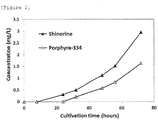
- the present inventors produced MAAs using Streptomyces lividans and Streptomyces avermitilis. In addition, the present inventors compared the production amount of MAA with respect to the production in extracellular culture solution and in microbial cells ( Figure 1 ).
- amir_4256 (SEQ ID NO: 1), amir_4257 (SEQ ID NO: 2), amir_4258 (SEQ ID NO: 3) and amir_4259 (SEQ ID NO: 4) genes derived from Actinosynnema mirum DSM43827 were used. These genes were ligated to a vector having pIJ101 ori under the control of PLD promoter (see, JP2002-51780A ) to prepare a gene expression vector. Streptomyces lividans 1326 (NITE accession number: NBRC 15675) was transformed with the gene expression vector to obtain an MAA producing strain. Streptomyces lividans was transformed in accordance with a conventionally known method.
- amir_4256 (SEQ ID NO: 1)
- amir_4257 (SEQ ID NO: 2)
- amir_4258 (SEQ ID NO: 3)
- amir_4259 (SEQ ID NO: 4)
- the homologous recombination of Streptomyces avermitilis was carried out in accordance with a conventionally known method.
- AVM culture medium see the following Table 1
- AVM culture medium pH 7.5
- Glucose 5 g 0.5%) Soy-bean flour 15 g (1.5%)
- Yeast extract 5 g (0.5%) Total 1000 mL
- the pre-culture solution (an amount corresponding to 0.1%) was added to 50 mL of TSBt culture medium (see the following Tables 2 to 4) contained in a 500 mL baffled flask. Glucose was further added to the TSBt culture medium at the starting of the culture such that the initial concentration of glucose became 50 g/L. These strains were cultured at 28°C and shaken at 160 rpm for two weeks.
- TSB culture medium Pancreatic digest of casein 17 g (1.7%) Papaic digest of soybean 3 g (0.3%) Glucose 25 g (0.25%) NaCl 5 g (0.5%) K 2 HPO 4 2.5 g (0.25%) Total 1000 mL
- TSBt culture medium TSB culture medium 50 mL
- Trace element solution (x200) 0.25 mL (amount corresponding to 0.5%)
- Trace element solution (x200) CuSO 4 ⁇ 5H 2 O 64 mg FeSO 4 ⁇ 5H 2 O 11 mg MnSO 4 ⁇ 4H 2 O 79 mg ZnSO 4 ⁇ 7H 2 O 15 mg Total 50 mL
- the culture solution was sampled at a predetermined time and the turbidity of the sampled culture solution was measured at 600 nm.
- the sampled culture solution was centrifuged at 14000 rpm for 20 minutes to separate extracellular culture solution and a precipitate (microbial cells).
- the separated extracellular culture solution was used as an extracellular culture solution-sample.
- Methanol (1 mL) was added to the separated microbial cells, and the microbial cells were disrupted by stirring and then subjected to centrifugation to recover the supernatant (microbial cell-sample).
- Figure 1 (A) shows the distribution of shinorine
- Figure 1 (B) shows the distribution of porphyra-334. It was verified that both shinorine and porphyra-334 are more largely distributed in the extracellular culture solution than in the microbial cells. From these results, it was demonstrated that the production amount of shinorine in the extracellular culture solution is about 5 times as large as the production amount in microbial cells at the time of two weeks from initiation of the culture. Similarly, it was demonstrated that the production amount of porphyra-334 in the extracellular culture solution is about 7 times as large as the production amount in the microbial cells.
- extracellular production amount of shinorine was 150 mg/L and intracellular production amount was 50 mg/L at the time of about one week from initiation of the culture.
- the extracellular production amount thereof was 510 mg/L and the intracellular production amount thereof was 105 mg/L at the time of about two weeks from initiation of the culture.
- Streptomyces avermitilis producing an MAA was cultured in the same manner as in Example 1 for two weeks.
- the initial glucose concentration was set at 100 g/L.
- mycosporine-glycine-alanine was produced as a novel MAA in addition to shinorine and porphyra-334.
- the production amount of mycosporine-glycine-alanine obtained was 25 mg/L.
- HPLC analysis was carried out in the conditions shown in Table 5, and as a result, the retention time was around 15 minutes.
- the novel MAA was identified as follows. Using an HPLC apparatus equipped with a photodiode array detector and an HR-MS detector, UV absorption spectrum and the accurate mass were measured. The measurement conditions of HPLC are as shown in the following Table. [Table 6] Column: YMC-Pack Pro C18 RS-303 (5 ⁇ m, 4.6 mm ⁇ ⁇ 25 cm) (manufactured by YMC) Eluent: 50 mM ammonium formate Flow rate: 0.5 mL/minute Retention time: Shinorine: around 5 minutes Porphyra-334: around 7 minutes Mycosporine-glycine-alanine: around 9 minutes
- the present inventors produced MAAs by using Corynebacterium glutamicum.
- amir_4256 (SEQ ID NO: 1), amir_4257 (SEQ ID NO: 2), amir_4258 (SEQ ID NO: 3) and amir_4259 (SEQ ID NO: 4) genes derived from Actinosynnema mirum DSM43827 were used. These genes were ligated to a vector having pBL1 ori, under the control of a gapA promoter (see, Appl Microbiol Biotechnol (2008) 81: 291-301 ) to obtain a gene expression vector.
- Corynebacterium glutamicum ATCC13032 (NITE accession number: NBRC 12168, deposited with International Patent Organism Depositary (IPOD), National Institute of Technology and Evaluation (NITE), located at 2-5-8, Kazusakamatari, Kisarazu-shi, Chiba) was transformed with the gene expression vector by electroporation to obtain an MAA producing strain.
- the electroporation was carried out in accordance with a conventionally known method.
- BHI culture medium To 50 mL of BHI culture medium (see Table 7), a glycerol stock of Corynebacterium glutamicum ATCC13032 having the MAA biosynthetic enzyme genes, which was prepared in Section 3-1 above, was added. The Corynebacterium glutamicum was cultured at 30°C and shaken at 180 rpm for 24 hours. [Table 7] BHI medium Brain Heart infusion 37 g Total 1000 mL
- the pre-culture solution (an amount corresponding to 3%) was added to 50 mL of BHI culture medium contained in a Sakaguchi flask. At the starting of the culture, 5 mL of 400 g/L sodium gluconate was further added to the BHI culture medium such that the initial concentration of sodium gluconate became 20 g/L. To adjust pH, 5 mL of 10% calcium carbonate solution was added. The strain was cultured at 30°C and shaken at 180 rpm for 48 hours.
- the sampled culture solution was centrifuged at 15000 rpm for 10 minutes to separate extracellular culture solution and a precipitate (microbial cells).
- the separated extracellular culture solution was filtered by using a membrane filter having a pore diameter of 0.2 ⁇ m and the filtrate was used as an extracellular culture solution-sample.
- the production amounts of shinorine and porphyra-334 in the extracellular culture solution-sample were measured by HPLC.
- the Measurement conditions of HPLC are the same as shown in Table 5.
- the present inventors produced MAAs by using Saccharomyces cerevisiae.
- cassettes were ligated to pRS404 vector (ATCC accession number: ATCC 87515) digested with BssHII and having TRP1 selection marker to prepare a genomic integration vector pIWX1X2XK.
- the genomic integration vector pIWX1X2XK was treated with EcoRV.
- Saccharomyces cerevisiae YPH499 Genetics 1989 May; 122 (1): 19-27 ) was transformed with the obtained fragments to obtain YPH499XW having xylose-assimilating ability. Saccharomyces cerevisiae was transformed in accordance with a conventionally known method.
- MAA biosynthetic enzyme genes amir 4256 (SEQ ID NO: 1) and amir 4257 (SEQ ID NO: 2) were ligated to pAT426 vector ( FEMS Yeast Res. 2014 May; 14 (3): 399-411 ) having 2 ⁇ ori and URA3 selection marker such that these genes were expressed under the control of TDH3 promoter and ADH1 promoter to prepare a gene expression vector pAT426-amir4256-7.
- YPH499XW was transformed with these gene expression vectors pAT426-amir4256-7 and pAT425-amir4258-9 to obtain an MAA producing strain, i.e., YPH499XWMAA. Saccharomyces cerevisiae was transformed in accordance with a conventionally known method.
- a glycerol stock of YPH499XWMAA having MAA biosynthetic enzyme genes which was prepared in section 5-1 above, was cultured on SD-LUW agar medium (see, the following Table 8). Thereafter, the obtained colony was inoculated onto 5 mL of SX-LUW liquid medium (see, the following Table 9). The strain was cultured at 30°C and shaken at 150 rpm for 13 days.
- the pre-culture solution (an amount corresponding to 2%) was added to 100 mL of SD-LU liquid medium contained in a 300 mL baffled flask.
- the strain was cultured at 30°C and shaken at 150 rpm for 48 hours.
- the sampled culture solution was centrifuged at 3,000 rpm for 5 minutes to separate extracellular culture solution and a precipitate (microbial cells).
- the separated extracellular culture solution was passed through a PTFE filter (0.45 ⁇ m) and the resultant solution was used as an extracellular culture solution-sample.
- the MAA concentration of the extracellular culture solution was measured. As a result, shinorine was extracellularly produced in an amount of 0.19 mg/L.
- the present inventors produced MAAs using labyrinthulea.
- amir_4256 SEQ ID NO: 1
- amir_4257 SEQ ID NO: 2
- amir_4258 SEQ ID NO: 3
- amir_4259 SEQ ID NO: 4
- These genes thus modified were introduced into Aurantiochytrium SAM2179 by homologous recombination to obtain an MAA producing strain. Homologous recombination of the labyrinthulea was carried out in accordance with a conventionally known method.
- Aurantiochytrium pre-cultured in Section 5-2 above was cultured in 10 mL of GY seawater medium (see, the following Table 11) at 28°C and shaken at 300 rpm for 5 days.
- GY seawater medium pH6.5
- Glucose 20 g (2%)
- Yeast extract 10 g (1%)
- Daigo's artificial seawater 18 g Total 1000 mL
- the culture solution was centrifuged at 15000 rpm for 10 minutes to separate extracellular culture solution and a precipitate (microbial cells).
- the separated extracellular culture solution was passed through a membrane filter having a pore diameter of 0.2 ⁇ m and the resultant solution was used as an extracellular culture solution-sample.
- the production amount of shinorine in the extracellular culture solution sample was measured by HPLC.
- the measurement conditions of HPLC are the same as shown in Table 5.
- Shinorine was extracellularly produced in an amount of 1.5 mg/L.
- the present inventors produced MAAs using Escherichia coli.
- amir_4256 SEQ ID NO: 1
- amir_4257 SEQ ID NO: 2
- amir_4258 SEQ ID NO: 3
- amir_4259 SEQ ID NO: 4
- These genes were ligated to a vector pkk223-3 (GenBank No. M77749) having pBR322 ori under the control of tac promoter to prepare a gene expression vector.
- Escherichia coli JM109 product code: 9052, manufactured by Takara Bio Inc.
- Escherichia coli was transformed in accordance with a conventionally known method.
- the pre-culture solution (an amount corresponding to 2%) was inoculated to 50 mL of LB culture medium contained in a 500 mL baffled flask.
- Sodium gluconate was further added to the LB culture medium at the starting of the culture such that the initial concentration of sodium gluconate became 50 g/L (a final concentration of 50 g/L), and calcium carbonate was further added such that its final concentration became 0.5%.
- the strain was cultured at 30°C and shaken at 160 rpm for a week.
- the concentration of MAA in the extracellular culture solution was measured. As a result, shinorine was extracellularly produced in an amount of 0.82 mg/L.
- an MAA can be produced by using a microorganism and recovered from extracellular culture solution.
- a novel MAA i.e., mycosporine-glycine-alanine
- MAAs can be obtained from extracellular culture solution. This is extremely advantageous in relation to the subsequent purification process.
- an MAA can be obtained stably in a large amount by use of a microorganism.
- the MAA obtained in this way can be used as an active ingredient of a UV-absorbing composition.
- the present invention can be used in the fields of e.g., cosmetics and pharmaceuticals.
Landscapes
- Health & Medical Sciences (AREA)
- Life Sciences & Earth Sciences (AREA)
- Chemical & Material Sciences (AREA)
- Organic Chemistry (AREA)
- General Health & Medical Sciences (AREA)
- Engineering & Computer Science (AREA)
- Animal Behavior & Ethology (AREA)
- Public Health (AREA)
- Veterinary Medicine (AREA)
- Genetics & Genomics (AREA)
- Zoology (AREA)
- Wood Science & Technology (AREA)
- Biotechnology (AREA)
- Bioinformatics & Cheminformatics (AREA)
- Microbiology (AREA)
- Dermatology (AREA)
- Epidemiology (AREA)
- General Engineering & Computer Science (AREA)
- Medicinal Chemistry (AREA)
- Pharmacology & Pharmacy (AREA)
- Biochemistry (AREA)
- Biomedical Technology (AREA)
- General Chemical & Material Sciences (AREA)
- Chemical Kinetics & Catalysis (AREA)
- Mycology (AREA)
- Birds (AREA)
- Molecular Biology (AREA)
- Nuclear Medicine, Radiotherapy & Molecular Imaging (AREA)
- Gerontology & Geriatric Medicine (AREA)
- Physics & Mathematics (AREA)
- Biophysics (AREA)
- Plant Pathology (AREA)
- Botany (AREA)
- Tropical Medicine & Parasitology (AREA)
- Toxicology (AREA)
- Virology (AREA)
- Preparation Of Compounds By Using Micro-Organisms (AREA)
- Micro-Organisms Or Cultivation Processes Thereof (AREA)
- Cosmetics (AREA)
- Acyclic And Carbocyclic Compounds In Medicinal Compositions (AREA)
Applications Claiming Priority (2)
| Application Number | Priority Date | Filing Date | Title |
|---|---|---|---|
| JP2014099647 | 2014-05-13 | ||
| PCT/JP2015/063682 WO2015174427A1 (fr) | 2014-05-13 | 2015-05-12 | Procédé de production d'acide aminé de type mycosporine faisant appel à des microbes |
Publications (3)
| Publication Number | Publication Date |
|---|---|
| EP3144392A1 true EP3144392A1 (fr) | 2017-03-22 |
| EP3144392A4 EP3144392A4 (fr) | 2018-02-21 |
| EP3144392B1 EP3144392B1 (fr) | 2019-07-10 |
Family
ID=54479964
Family Applications (1)
| Application Number | Title | Priority Date | Filing Date |
|---|---|---|---|
| EP15792252.7A Active EP3144392B1 (fr) | 2014-05-13 | 2015-05-12 | Procédé de production d'acide aminé de type mycosporine faisant appel à des microbes |
Country Status (7)
| Country | Link |
|---|---|
| US (1) | US10307356B2 (fr) |
| EP (1) | EP3144392B1 (fr) |
| JP (1) | JP5927593B2 (fr) |
| KR (1) | KR102148740B1 (fr) |
| CN (1) | CN106574282B (fr) |
| ES (1) | ES2742162T3 (fr) |
| WO (1) | WO2015174427A1 (fr) |
Cited By (1)
| Publication number | Priority date | Publication date | Assignee | Title |
|---|---|---|---|---|
| WO2025257308A1 (fr) | 2024-06-14 | 2025-12-18 | Basf Se | Composition biodégradable en deux parties pour la protection de la peau contre le rayonnement uv |
Families Citing this family (19)
| Publication number | Priority date | Publication date | Assignee | Title |
|---|---|---|---|---|
| JPWO2017094804A1 (ja) | 2015-12-01 | 2018-09-13 | 日本水産株式会社 | ドコサヘキサエン酸含有油及びその製造方法 |
| KR101911186B1 (ko) * | 2017-08-16 | 2018-10-25 | 씨제이제일제당 (주) | 마이코스포린 유사 아미노산을 생산하는 미생물 및 이를 이용한 마이코스포린 유사 아미노산의 생산방법 |
| WO2019094447A2 (fr) * | 2017-11-07 | 2019-05-16 | Algenol Biotech LLC | Production d'acides aminés de type mycosporine dans des cyanobactéries |
| KR102003911B1 (ko) * | 2018-02-23 | 2019-07-25 | 씨제이제일제당 주식회사 | 마이코스포린 유사 아미노산을 생산하는 미생물 및 이를 이용한 마이코스포린 유사 아미노산의 생산방법 |
| WO2020231426A1 (fr) * | 2019-05-15 | 2020-11-19 | Algenol Biotech LLC | Production d'acides aminés de type mycosporine utilisant des souches de production améliorées et de nouvelles enzymes |
| US11739337B2 (en) | 2019-09-06 | 2023-08-29 | Oregon State University | Gadusol derivative production in bacteria |
| JP7529959B2 (ja) * | 2019-12-03 | 2024-08-07 | 株式会社リツビ | 皮膚用組成物 |
| KR102351059B1 (ko) * | 2019-12-24 | 2022-01-12 | 씨제이제일제당 (주) | 마이코스포린 유사 아미노산을 생산하는 미생물 및 이를 이용한 마이코스포린 유사 아미노산의 생산방법 |
| CN117881655A (zh) * | 2021-07-07 | 2024-04-12 | 爱尔克米亚公司 | 紫外线辐射和可见光辐射吸收化合物 |
| EP4385506A4 (fr) * | 2021-08-12 | 2025-08-06 | Nagase & Co Ltd | Stabilisation de l'acide aminé de type mycosporine |
| KR102710251B1 (ko) * | 2021-12-24 | 2024-09-25 | 전남대학교산학협력단 | 시노린의 생산 방법 |
| CN114395053B (zh) * | 2022-03-25 | 2022-06-14 | 中国科学院南海海洋研究所 | 一种虫黄藻来源的DHQS-OMT融合基因及其在高效合成MAAs中的应用 |
| KR102548752B1 (ko) * | 2022-09-28 | 2023-07-03 | 큐티스바이오 주식회사 | 마이코스포린 유사 아미노산 생산능을 갖는 미생물 및 이를 이용한 마이코스포린 유사 아미노산의 생산 방법 |
| KR102603304B1 (ko) * | 2023-06-28 | 2023-11-16 | 전남대학교산학협력단 | 포피라-334 생산용 조성물 및 생산방법 |
| WO2025022833A1 (fr) * | 2023-07-21 | 2025-01-30 | 学校法人名城大学 | Absorbeur uv, antioxydant, agent anti-glycation, préparation externe pour la peau, produit cosmétique, procédé de production de composé et composé |
| CN121693339A (zh) | 2023-08-23 | 2026-03-17 | 松下知识产权经营株式会社 | 抗氧化剂、活性氧的除去方法和抗氧化剂的制造方法 |
| WO2025095048A1 (fr) * | 2023-11-02 | 2025-05-08 | 国立大学法人九州大学 | Nouveau sel de vinamidinium et absorbant d'uv-a contenant ledit nouveau sel de vinamidinium |
| WO2025184401A1 (fr) * | 2024-02-29 | 2025-09-04 | Heliobiosys, Inc. | Procédé de purification d'acides aminés analogues de la mycosporine à partir d'organismes pour produits cosmétiques et écrans solaires |
| CN119193457B (zh) * | 2024-11-29 | 2025-03-18 | 浙江大学海南研究院 | 一种生产类菌胞素代谢物的链霉菌重组工程菌株及其构建方法与应用 |
Family Cites Families (10)
| Publication number | Priority date | Publication date | Assignee | Title |
|---|---|---|---|---|
| JPH0662878A (ja) | 1992-08-12 | 1994-03-08 | Kaiyo Bio Technol Kenkyusho:Kk | 微生物によるマイコスポリン様アミノ酸の製造法 |
| JPH06329576A (ja) * | 1993-05-24 | 1994-11-29 | Kaiyo Bio Technol Kenkyusho:Kk | 新規紫外線吸収物質 |
| CA2251457A1 (fr) * | 1998-10-23 | 2000-04-23 | Norman Huner | Compositions comprenant des composes d'origine naturelle tires de plantes, d'algues et de cyanobacteries pour la protection contre les rayons solaires |
| GB0028161D0 (en) | 2000-11-17 | 2001-01-03 | Natural Environment Res | Personal care compositions |
| EP2031067A1 (fr) * | 2007-08-30 | 2009-03-04 | Albert-Ludwigs-Universität Freiburg | Fabrication d'actinomycètes génétiquement modifiés par recombinaison |
| JP2009120562A (ja) | 2007-11-16 | 2009-06-04 | Dic Corp | グリコシル基を有するマイコスポリン様アミノ酸誘導体及びその製造方法 |
| WO2010068413A1 (fr) * | 2008-11-25 | 2010-06-17 | Emergent Product Development Gaithersburg Inc. | Vaccin anti-chlamydia comprenant des polypeptides htra |
| KR100969325B1 (ko) | 2010-02-08 | 2010-07-09 | 인천대학교 산학협력단 | 홍조류로부터 비독성 자외선 차단용 추출물을 제조하는 방법 및 이를 이용한 비독성 자외선 차단제 |
| JP5913988B2 (ja) | 2012-01-06 | 2016-05-11 | 出光興産株式会社 | Aureobasidiumpullulans菌体抽出物を含む多機能化粧品原料 |
| MX2015001751A (es) * | 2012-08-07 | 2015-11-13 | Topgenix Inc | Composicion topica comprendiendo bacterias transformadas que expresan un compuesto de interes. |
-
2015
- 2015-05-12 JP JP2015545234A patent/JP5927593B2/ja active Active
- 2015-05-12 CN CN201580024948.3A patent/CN106574282B/zh active Active
- 2015-05-12 EP EP15792252.7A patent/EP3144392B1/fr active Active
- 2015-05-12 ES ES15792252T patent/ES2742162T3/es active Active
- 2015-05-12 US US15/309,449 patent/US10307356B2/en active Active
- 2015-05-12 KR KR1020167034333A patent/KR102148740B1/ko active Active
- 2015-05-12 WO PCT/JP2015/063682 patent/WO2015174427A1/fr not_active Ceased
Cited By (1)
| Publication number | Priority date | Publication date | Assignee | Title |
|---|---|---|---|---|
| WO2025257308A1 (fr) | 2024-06-14 | 2025-12-18 | Basf Se | Composition biodégradable en deux parties pour la protection de la peau contre le rayonnement uv |
Also Published As
| Publication number | Publication date |
|---|---|
| US10307356B2 (en) | 2019-06-04 |
| EP3144392A4 (fr) | 2018-02-21 |
| WO2015174427A1 (fr) | 2015-11-19 |
| KR102148740B1 (ko) | 2020-08-27 |
| ES2742162T3 (es) | 2020-02-13 |
| KR20170002587A (ko) | 2017-01-06 |
| JPWO2015174427A1 (ja) | 2017-04-20 |
| CN106574282A (zh) | 2017-04-19 |
| US20170202762A1 (en) | 2017-07-20 |
| JP5927593B2 (ja) | 2016-06-01 |
| EP3144392B1 (fr) | 2019-07-10 |
| CN106574282B (zh) | 2020-11-06 |
Similar Documents
| Publication | Publication Date | Title |
|---|---|---|
| EP3144392B1 (fr) | Procédé de production d'acide aminé de type mycosporine faisant appel à des microbes | |
| KR102249070B1 (ko) | 피부 주름 개선능을 갖는 고기능성 천연 대사산물을 생산하는 락토바실러스 파라카세이 아종 톨러란스 sw1 균주 및 이의 용도 | |
| ES2948261T3 (es) | Método de producción de ergotioneína | |
| JP2005501805A (ja) | Thermus科の微生物の発酵によるタンパク質の生成のためのプロセス、このようにして得られたタンパク質の混合物、およびそれらを含有する美容用組成物 | |
| Jacinavicius et al. | Effect of ultraviolet radiation on the metabolomic profiles of potentially toxic cyanobacteria | |
| KR102133689B1 (ko) | 용암해수 유래 미네랄과 더마바이오틱스 유래 뉴클레오티드의 결합체 제조방법 및 이를 이용한 기능성 더마바이오틱스 화장품 조성물 | |
| US20240207169A1 (en) | Composition for improving skin wrinkle, moisturizing, strengthening skin barrier, and promoting skin regeneration, comprising mixed lactic acid bacteria as active ingredient | |
| Bairwa et al. | Evaluation of UV-B protection efficiency of mycosporine like amino acid extracted from the cyanobacteria Anabaenopsis sp. SLCyA isolated from a hypersaline lake | |
| Sui et al. | Characterization of halophilic C50 carotenoid-producing archaea isolated from solar saltworks in Bohai Bay, China | |
| JP2019006679A (ja) | 新規マイコスポリン様アミノ酸 | |
| KR20190037436A (ko) | 수련 발효 추출물을 함유하는 화장료 조성물 및 이의 제조방법 | |
| KR101796696B1 (ko) | 리보핵산 및 오미자 추출물을 함유하는 화장료 조성물 | |
| KR102155716B1 (ko) | 락토바실러스 플란타룸 ami-1103 균주를 이용한 당근 발효물 제조방법 | |
| WO2024150591A1 (fr) | Extrait comprenant une mycosporine glutamine | |
| KR101635618B1 (ko) | 피부노화 억제와 피부주름 개선 활성을 가지는 화합물 | |
| WO2009147673A1 (fr) | Bacterie issue de paracoccus marcusii exprimant une voie de sequestration et de secretion et utilisations associees | |
| JP4620405B2 (ja) | 酵母変異株、グルタチオン高含有酵母の製造方法、その培養物、その分画物、酵母エキスおよびグルタチオン含有飲食品 | |
| KR20170050327A (ko) | 케라틴 펩타이드를 유효성분으로 함유하는 항노화용 화장료 조성물 | |
| KR101796710B1 (ko) | 리보핵산 및 제비꽃 추출물을 함유하는 화장료 조성물 | |
| RU2839983C2 (ru) | Рекомбинантные клетки, продуцирующие гиалуроновую кислоту | |
| KR20120129712A (ko) | 이온교환수지를 이용해 제조된 간수를 유효성분으로 포함하는 화장료 조성물 | |
| KR20240156491A (ko) | 사카로마이세스 속 미생물의 배양물을 포함하는 피부 주름 개선용 또는 피부 탄력 증진용 조성물 | |
| Parwata et al. | Ectoine Production by Novel Halophilic Bacteria Halomonas huangheensis LES5 AG4: Isolation, Screening, and Process Optimization. | |
| Rana et al. | Bioprospecting cyanobacteria for UV-protectant compound scytonemin and strategies for enhanced production: A review | |
| KR20240156490A (ko) | 바실러스 속 미생물의 배양물을 포함하는 피부 주름 개선용 또는 피부 탄력 증진용 조성물 |
Legal Events
| Date | Code | Title | Description |
|---|---|---|---|
| STAA | Information on the status of an ep patent application or granted ep patent |
Free format text: STATUS: THE INTERNATIONAL PUBLICATION HAS BEEN MADE |
|
| PUAI | Public reference made under article 153(3) epc to a published international application that has entered the european phase |
Free format text: ORIGINAL CODE: 0009012 |
|
| STAA | Information on the status of an ep patent application or granted ep patent |
Free format text: STATUS: REQUEST FOR EXAMINATION WAS MADE |
|
| 17P | Request for examination filed |
Effective date: 20161209 |
|
| AK | Designated contracting states |
Kind code of ref document: A1 Designated state(s): AL AT BE BG CH CY CZ DE DK EE ES FI FR GB GR HR HU IE IS IT LI LT LU LV MC MK MT NL NO PL PT RO RS SE SI SK SM TR |
|
| AX | Request for extension of the european patent |
Extension state: BA ME |
|
| DAV | Request for validation of the european patent (deleted) | ||
| DAX | Request for extension of the european patent (deleted) | ||
| RIC1 | Information provided on ipc code assigned before grant |
Ipc: A61K 8/99 20170101ALI20180109BHEP Ipc: A61K 8/44 20060101ALI20180109BHEP Ipc: C12N 15/09 20060101ALI20180109BHEP Ipc: A61K 35/74 20150101ALI20180109BHEP Ipc: A61K 36/064 20060101ALI20180109BHEP Ipc: A61K 31/198 20060101ALI20180109BHEP Ipc: A61Q 17/04 20060101ALI20180109BHEP Ipc: A61Q 19/00 20060101ALI20180109BHEP Ipc: C12P 13/04 20060101AFI20180109BHEP Ipc: A61P 35/00 20060101ALI20180109BHEP Ipc: C12R 1/465 20060101ALI20180109BHEP Ipc: A61P 17/16 20060101ALI20180109BHEP Ipc: C07C 251/20 20060101ALI20180109BHEP Ipc: C07C 249/14 20060101ALI20180109BHEP Ipc: C12N 1/21 20060101ALI20180109BHEP Ipc: A61Q 19/08 20060101ALI20180109BHEP Ipc: A61P 17/02 20060101ALI20180109BHEP |
|
| A4 | Supplementary search report drawn up and despatched |
Effective date: 20180123 |
|
| RIC1 | Information provided on ipc code assigned before grant |
Ipc: A61P 17/02 20060101ALI20180116BHEP Ipc: C12P 13/04 20060101AFI20180116BHEP Ipc: A61Q 19/08 20060101ALI20180116BHEP Ipc: A61K 8/44 20060101ALI20180116BHEP Ipc: A61K 36/064 20060101ALI20180116BHEP Ipc: A61K 8/99 20170101ALI20180116BHEP Ipc: A61P 17/16 20060101ALI20180116BHEP Ipc: C12N 15/09 20060101ALI20180116BHEP Ipc: C07C 251/20 20060101ALI20180116BHEP Ipc: A61Q 17/04 20060101ALI20180116BHEP Ipc: C07C 249/14 20060101ALI20180116BHEP Ipc: A61Q 19/00 20060101ALI20180116BHEP Ipc: C12N 1/21 20060101ALI20180116BHEP Ipc: A61K 31/198 20060101ALI20180116BHEP Ipc: A61P 35/00 20060101ALI20180116BHEP Ipc: A61K 35/74 20150101ALI20180116BHEP Ipc: C12R 1/465 20060101ALI20180116BHEP |
|
| GRAP | Despatch of communication of intention to grant a patent |
Free format text: ORIGINAL CODE: EPIDOSNIGR1 |
|
| STAA | Information on the status of an ep patent application or granted ep patent |
Free format text: STATUS: GRANT OF PATENT IS INTENDED |
|
| RIC1 | Information provided on ipc code assigned before grant |
Ipc: A61K 8/44 20060101ALI20181123BHEP Ipc: A61K 8/99 20170101ALI20181123BHEP Ipc: A61P 17/16 20060101ALI20181123BHEP Ipc: A61Q 19/00 20060101ALI20181123BHEP Ipc: A61P 17/02 20060101ALI20181123BHEP Ipc: C12P 13/04 20060101AFI20181123BHEP Ipc: C07C 249/14 20060101ALI20181123BHEP Ipc: A61K 35/00 20060101ALI20181123BHEP Ipc: A61K 36/064 20060101ALI20181123BHEP Ipc: A61K 35/74 20150101ALI20181123BHEP Ipc: C07C 251/20 20060101ALI20181123BHEP Ipc: A61K 36/00 20060101ALI20181123BHEP Ipc: A61Q 19/08 20060101ALI20181123BHEP Ipc: C12R 1/465 20060101ALI20181123BHEP Ipc: A61P 35/00 20060101ALI20181123BHEP Ipc: A61K 31/198 20060101ALI20181123BHEP Ipc: C12N 1/21 20060101ALI20181123BHEP Ipc: C12N 15/09 20060101ALI20181123BHEP Ipc: A61Q 17/04 20060101ALI20181123BHEP |
|
| INTG | Intention to grant announced |
Effective date: 20181217 |
|
| RIN1 | Information on inventor provided before grant (corrected) |
Inventor name: MATSUMOTO, JUN Inventor name: YAMAMOTO, SHOGO Inventor name: SOTA, MASAHIRO Inventor name: IKEDA, HARUO |
|
| GRAS | Grant fee paid |
Free format text: ORIGINAL CODE: EPIDOSNIGR3 |
|
| GRAA | (expected) grant |
Free format text: ORIGINAL CODE: 0009210 |
|
| STAA | Information on the status of an ep patent application or granted ep patent |
Free format text: STATUS: THE PATENT HAS BEEN GRANTED |
|
| AK | Designated contracting states |
Kind code of ref document: B1 Designated state(s): AL AT BE BG CH CY CZ DE DK EE ES FI FR GB GR HR HU IE IS IT LI LT LU LV MC MK MT NL NO PL PT RO RS SE SI SK SM TR |
|
| REG | Reference to a national code |
Ref country code: GB Ref legal event code: FG4D |
|
| REG | Reference to a national code |
Ref country code: CH Ref legal event code: EP Ref country code: AT Ref legal event code: REF Ref document number: 1153626 Country of ref document: AT Kind code of ref document: T Effective date: 20190715 |
|
| REG | Reference to a national code |
Ref country code: DE Ref legal event code: R096 Ref document number: 602015033612 Country of ref document: DE |
|
| REG | Reference to a national code |
Ref country code: IE Ref legal event code: FG4D |
|
| REG | Reference to a national code |
Ref country code: NL Ref legal event code: FP |
|
| REG | Reference to a national code |
Ref country code: LT Ref legal event code: MG4D |
|
| PG25 | Lapsed in a contracting state [announced via postgrant information from national office to epo] |
Ref country code: LT Free format text: LAPSE BECAUSE OF FAILURE TO SUBMIT A TRANSLATION OF THE DESCRIPTION OR TO PAY THE FEE WITHIN THE PRESCRIBED TIME-LIMIT Effective date: 20190710 Ref country code: PT Free format text: LAPSE BECAUSE OF FAILURE TO SUBMIT A TRANSLATION OF THE DESCRIPTION OR TO PAY THE FEE WITHIN THE PRESCRIBED TIME-LIMIT Effective date: 20191111 Ref country code: BG Free format text: LAPSE BECAUSE OF FAILURE TO SUBMIT A TRANSLATION OF THE DESCRIPTION OR TO PAY THE FEE WITHIN THE PRESCRIBED TIME-LIMIT Effective date: 20191010 Ref country code: SE Free format text: LAPSE BECAUSE OF FAILURE TO SUBMIT A TRANSLATION OF THE DESCRIPTION OR TO PAY THE FEE WITHIN THE PRESCRIBED TIME-LIMIT Effective date: 20190710 Ref country code: HR Free format text: LAPSE BECAUSE OF FAILURE TO SUBMIT A TRANSLATION OF THE DESCRIPTION OR TO PAY THE FEE WITHIN THE PRESCRIBED TIME-LIMIT Effective date: 20190710 Ref country code: NO Free format text: LAPSE BECAUSE OF FAILURE TO SUBMIT A TRANSLATION OF THE DESCRIPTION OR TO PAY THE FEE WITHIN THE PRESCRIBED TIME-LIMIT Effective date: 20191010 Ref country code: FI Free format text: LAPSE BECAUSE OF FAILURE TO SUBMIT A TRANSLATION OF THE DESCRIPTION OR TO PAY THE FEE WITHIN THE PRESCRIBED TIME-LIMIT Effective date: 20190710 |
|
| REG | Reference to a national code |
Ref country code: ES Ref legal event code: FG2A Ref document number: 2742162 Country of ref document: ES Kind code of ref document: T3 Effective date: 20200213 |
|
| PG25 | Lapsed in a contracting state [announced via postgrant information from national office to epo] |
Ref country code: IS Free format text: LAPSE BECAUSE OF FAILURE TO SUBMIT A TRANSLATION OF THE DESCRIPTION OR TO PAY THE FEE WITHIN THE PRESCRIBED TIME-LIMIT Effective date: 20191110 Ref country code: GR Free format text: LAPSE BECAUSE OF FAILURE TO SUBMIT A TRANSLATION OF THE DESCRIPTION OR TO PAY THE FEE WITHIN THE PRESCRIBED TIME-LIMIT Effective date: 20191011 Ref country code: LV Free format text: LAPSE BECAUSE OF FAILURE TO SUBMIT A TRANSLATION OF THE DESCRIPTION OR TO PAY THE FEE WITHIN THE PRESCRIBED TIME-LIMIT Effective date: 20190710 Ref country code: AL Free format text: LAPSE BECAUSE OF FAILURE TO SUBMIT A TRANSLATION OF THE DESCRIPTION OR TO PAY THE FEE WITHIN THE PRESCRIBED TIME-LIMIT Effective date: 20190710 Ref country code: RS Free format text: LAPSE BECAUSE OF FAILURE TO SUBMIT A TRANSLATION OF THE DESCRIPTION OR TO PAY THE FEE WITHIN THE PRESCRIBED TIME-LIMIT Effective date: 20190710 |
|
| PG25 | Lapsed in a contracting state [announced via postgrant information from national office to epo] |
Ref country code: TR Free format text: LAPSE BECAUSE OF FAILURE TO SUBMIT A TRANSLATION OF THE DESCRIPTION OR TO PAY THE FEE WITHIN THE PRESCRIBED TIME-LIMIT Effective date: 20190710 |
|
| PG25 | Lapsed in a contracting state [announced via postgrant information from national office to epo] |
Ref country code: PL Free format text: LAPSE BECAUSE OF FAILURE TO SUBMIT A TRANSLATION OF THE DESCRIPTION OR TO PAY THE FEE WITHIN THE PRESCRIBED TIME-LIMIT Effective date: 20190710 Ref country code: RO Free format text: LAPSE BECAUSE OF FAILURE TO SUBMIT A TRANSLATION OF THE DESCRIPTION OR TO PAY THE FEE WITHIN THE PRESCRIBED TIME-LIMIT Effective date: 20190710 Ref country code: DK Free format text: LAPSE BECAUSE OF FAILURE TO SUBMIT A TRANSLATION OF THE DESCRIPTION OR TO PAY THE FEE WITHIN THE PRESCRIBED TIME-LIMIT Effective date: 20190710 Ref country code: EE Free format text: LAPSE BECAUSE OF FAILURE TO SUBMIT A TRANSLATION OF THE DESCRIPTION OR TO PAY THE FEE WITHIN THE PRESCRIBED TIME-LIMIT Effective date: 20190710 |
|
| PG25 | Lapsed in a contracting state [announced via postgrant information from national office to epo] |
Ref country code: SK Free format text: LAPSE BECAUSE OF FAILURE TO SUBMIT A TRANSLATION OF THE DESCRIPTION OR TO PAY THE FEE WITHIN THE PRESCRIBED TIME-LIMIT Effective date: 20190710 Ref country code: CZ Free format text: LAPSE BECAUSE OF FAILURE TO SUBMIT A TRANSLATION OF THE DESCRIPTION OR TO PAY THE FEE WITHIN THE PRESCRIBED TIME-LIMIT Effective date: 20190710 Ref country code: IS Free format text: LAPSE BECAUSE OF FAILURE TO SUBMIT A TRANSLATION OF THE DESCRIPTION OR TO PAY THE FEE WITHIN THE PRESCRIBED TIME-LIMIT Effective date: 20200224 Ref country code: SM Free format text: LAPSE BECAUSE OF FAILURE TO SUBMIT A TRANSLATION OF THE DESCRIPTION OR TO PAY THE FEE WITHIN THE PRESCRIBED TIME-LIMIT Effective date: 20190710 |
|
| REG | Reference to a national code |
Ref country code: DE Ref legal event code: R097 Ref document number: 602015033612 Country of ref document: DE |
|
| PLBE | No opposition filed within time limit |
Free format text: ORIGINAL CODE: 0009261 |
|
| STAA | Information on the status of an ep patent application or granted ep patent |
Free format text: STATUS: NO OPPOSITION FILED WITHIN TIME LIMIT |
|
| REG | Reference to a national code |
Ref country code: AT Ref legal event code: UEP Ref document number: 1153626 Country of ref document: AT Kind code of ref document: T Effective date: 20190710 |
|
| PG2D | Information on lapse in contracting state deleted |
Ref country code: IS |
|
| 26N | No opposition filed |
Effective date: 20200603 |
|
| PG25 | Lapsed in a contracting state [announced via postgrant information from national office to epo] |
Ref country code: SI Free format text: LAPSE BECAUSE OF FAILURE TO SUBMIT A TRANSLATION OF THE DESCRIPTION OR TO PAY THE FEE WITHIN THE PRESCRIBED TIME-LIMIT Effective date: 20190710 |
|
| PG25 | Lapsed in a contracting state [announced via postgrant information from national office to epo] |
Ref country code: CH Free format text: LAPSE BECAUSE OF NON-PAYMENT OF DUE FEES Effective date: 20200531 Ref country code: LI Free format text: LAPSE BECAUSE OF NON-PAYMENT OF DUE FEES Effective date: 20200531 |
|
| PG25 | Lapsed in a contracting state [announced via postgrant information from national office to epo] |
Ref country code: LU Free format text: LAPSE BECAUSE OF NON-PAYMENT OF DUE FEES Effective date: 20200512 |
|
| PG25 | Lapsed in a contracting state [announced via postgrant information from national office to epo] |
Ref country code: IE Free format text: LAPSE BECAUSE OF NON-PAYMENT OF DUE FEES Effective date: 20200512 |
|
| PG25 | Lapsed in a contracting state [announced via postgrant information from national office to epo] |
Ref country code: MT Free format text: LAPSE BECAUSE OF FAILURE TO SUBMIT A TRANSLATION OF THE DESCRIPTION OR TO PAY THE FEE WITHIN THE PRESCRIBED TIME-LIMIT Effective date: 20190710 Ref country code: CY Free format text: LAPSE BECAUSE OF FAILURE TO SUBMIT A TRANSLATION OF THE DESCRIPTION OR TO PAY THE FEE WITHIN THE PRESCRIBED TIME-LIMIT Effective date: 20190710 |
|
| PG25 | Lapsed in a contracting state [announced via postgrant information from national office to epo] |
Ref country code: MK Free format text: LAPSE BECAUSE OF FAILURE TO SUBMIT A TRANSLATION OF THE DESCRIPTION OR TO PAY THE FEE WITHIN THE PRESCRIBED TIME-LIMIT Effective date: 20190710 |
|
| PGFP | Annual fee paid to national office [announced via postgrant information from national office to epo] |
Ref country code: MC Payment date: 20250314 Year of fee payment: 11 |
|
| PGFP | Annual fee paid to national office [announced via postgrant information from national office to epo] |
Ref country code: NL Payment date: 20250526 Year of fee payment: 11 |
|
| PGFP | Annual fee paid to national office [announced via postgrant information from national office to epo] |
Ref country code: DE Payment date: 20250314 Year of fee payment: 11 |
|
| PGFP | Annual fee paid to national office [announced via postgrant information from national office to epo] |
Ref country code: ES Payment date: 20250602 Year of fee payment: 11 |
|
| PGFP | Annual fee paid to national office [announced via postgrant information from national office to epo] |
Ref country code: BE Payment date: 20250401 Year of fee payment: 11 |
|
| PGFP | Annual fee paid to national office [announced via postgrant information from national office to epo] |
Ref country code: AT Payment date: 20250508 Year of fee payment: 11 |
|
| PGFP | Annual fee paid to national office [announced via postgrant information from national office to epo] |
Ref country code: GB Payment date: 20260318 Year of fee payment: 12 |
|
| PGFP | Annual fee paid to national office [announced via postgrant information from national office to epo] |
Ref country code: IT Payment date: 20260325 Year of fee payment: 12 |
|
| PGFP | Annual fee paid to national office [announced via postgrant information from national office to epo] |
Ref country code: FR Payment date: 20260310 Year of fee payment: 12 |