EP3145964B1 - Agent adhésif pour compositions de revêtement aqueuses - Google Patents
Agent adhésif pour compositions de revêtement aqueuses Download PDFInfo
- Publication number
- EP3145964B1 EP3145964B1 EP15741845.0A EP15741845A EP3145964B1 EP 3145964 B1 EP3145964 B1 EP 3145964B1 EP 15741845 A EP15741845 A EP 15741845A EP 3145964 B1 EP3145964 B1 EP 3145964B1
- Authority
- EP
- European Patent Office
- Prior art keywords
- copolymer
- coating composition
- mol
- group
- substrate
- Prior art date
- Legal status (The legal status is an assumption and is not a legal conclusion. Google has not performed a legal analysis and makes no representation as to the accuracy of the status listed.)
- Not-in-force
Links
- 239000008199 coating composition Substances 0.000 title claims description 155
- 239000002318 adhesion promoter Substances 0.000 title description 9
- 229920001577 copolymer Polymers 0.000 claims description 159
- 239000000758 substrate Substances 0.000 claims description 140
- 239000000049 pigment Substances 0.000 claims description 95
- 239000000178 monomer Substances 0.000 claims description 75
- 238000000576 coating method Methods 0.000 claims description 48
- 239000011248 coating agent Substances 0.000 claims description 41
- 238000000034 method Methods 0.000 claims description 41
- 229920003023 plastic Polymers 0.000 claims description 40
- 239000004033 plastic Substances 0.000 claims description 40
- 239000000203 mixture Substances 0.000 claims description 38
- 239000002952 polymeric resin Substances 0.000 claims description 37
- 229920003002 synthetic resin Polymers 0.000 claims description 37
- 239000007787 solid Substances 0.000 claims description 33
- 239000000654 additive Substances 0.000 claims description 28
- 239000003431 cross linking reagent Substances 0.000 claims description 28
- 125000002887 hydroxy group Chemical group [H]O* 0.000 claims description 25
- XLYOFNOQVPJJNP-UHFFFAOYSA-N water Substances O XLYOFNOQVPJJNP-UHFFFAOYSA-N 0.000 claims description 25
- 230000000996 additive effect Effects 0.000 claims description 22
- 125000000217 alkyl group Chemical group 0.000 claims description 17
- 125000004432 carbon atom Chemical group C* 0.000 claims description 17
- 239000003960 organic solvent Substances 0.000 claims description 15
- 229920001228 polyisocyanate Polymers 0.000 claims description 15
- 239000005056 polyisocyanate Substances 0.000 claims description 15
- 125000003178 carboxy group Chemical group [H]OC(*)=O 0.000 claims description 13
- 238000007334 copolymerization reaction Methods 0.000 claims description 12
- 125000000524 functional group Chemical group 0.000 claims description 12
- 125000003161 (C1-C6) alkylene group Chemical group 0.000 claims description 11
- 239000007859 condensation product Substances 0.000 claims description 10
- IVJISJACKSSFGE-UHFFFAOYSA-N formaldehyde;1,3,5-triazine-2,4,6-triamine Chemical class O=C.NC1=NC(N)=NC(N)=N1 IVJISJACKSSFGE-UHFFFAOYSA-N 0.000 claims description 10
- 125000004169 (C1-C6) alkyl group Chemical group 0.000 claims description 9
- 125000003700 epoxy group Chemical group 0.000 claims description 8
- 239000004814 polyurethane Substances 0.000 claims description 8
- 229920002635 polyurethane Polymers 0.000 claims description 8
- XSQUKJJJFZCRTK-UHFFFAOYSA-N urea group Chemical group NC(=O)N XSQUKJJJFZCRTK-UHFFFAOYSA-N 0.000 claims description 8
- 125000002947 alkylene group Chemical group 0.000 claims description 7
- 125000003118 aryl group Chemical group 0.000 claims description 7
- 125000006376 (C3-C10) cycloalkyl group Chemical group 0.000 claims description 6
- 229910052760 oxygen Inorganic materials 0.000 claims description 6
- 239000003973 paint Substances 0.000 claims description 6
- 229920000728 polyester Polymers 0.000 claims description 6
- 229910052717 sulfur Inorganic materials 0.000 claims description 6
- 125000003396 thiol group Chemical group [H]S* 0.000 claims description 6
- 125000003277 amino group Chemical group 0.000 claims description 5
- 229920000193 polymethacrylate Polymers 0.000 claims description 5
- 239000003822 epoxy resin Substances 0.000 claims description 4
- LNEPOXFFQSENCJ-UHFFFAOYSA-N haloperidol Chemical compound C1CC(O)(C=2C=CC(Cl)=CC=2)CCN1CCCC(=O)C1=CC=C(F)C=C1 LNEPOXFFQSENCJ-UHFFFAOYSA-N 0.000 claims description 4
- 229920000647 polyepoxide Polymers 0.000 claims description 4
- 125000000008 (C1-C10) alkyl group Chemical group 0.000 claims description 3
- 125000003647 acryloyl group Chemical group O=C([*])C([H])=C([H])[H] 0.000 claims 1
- -1 polyethylene Polymers 0.000 description 52
- KWYUFKZDYYNOTN-UHFFFAOYSA-M Potassium hydroxide Chemical compound [OH-].[K+] KWYUFKZDYYNOTN-UHFFFAOYSA-M 0.000 description 30
- 230000000694 effects Effects 0.000 description 30
- 238000002360 preparation method Methods 0.000 description 30
- NIXOWILDQLNWCW-UHFFFAOYSA-M Acrylate Chemical compound [O-]C(=O)C=C NIXOWILDQLNWCW-UHFFFAOYSA-M 0.000 description 26
- 239000006185 dispersion Substances 0.000 description 26
- ZWEHNKRNPOVVGH-UHFFFAOYSA-N 2-Butanone Chemical compound CCC(C)=O ZWEHNKRNPOVVGH-UHFFFAOYSA-N 0.000 description 22
- 239000004743 Polypropylene Substances 0.000 description 18
- 238000001723 curing Methods 0.000 description 17
- 229920001155 polypropylene Polymers 0.000 description 17
- 229920000877 Melamine resin Polymers 0.000 description 15
- 230000000052 comparative effect Effects 0.000 description 15
- 150000001875 compounds Chemical class 0.000 description 14
- 239000000945 filler Substances 0.000 description 12
- 229920000642 polymer Polymers 0.000 description 12
- 239000000463 material Substances 0.000 description 11
- UQSXHKLRYXJYBZ-UHFFFAOYSA-N Iron oxide Chemical compound [Fe]=O UQSXHKLRYXJYBZ-UHFFFAOYSA-N 0.000 description 10
- PPBRXRYQALVLMV-UHFFFAOYSA-N Styrene Chemical compound C=CC1=CC=CC=C1 PPBRXRYQALVLMV-UHFFFAOYSA-N 0.000 description 10
- 239000002253 acid Substances 0.000 description 10
- 238000004132 cross linking Methods 0.000 description 10
- 230000008569 process Effects 0.000 description 10
- 239000002904 solvent Substances 0.000 description 10
- QTBSBXVTEAMEQO-UHFFFAOYSA-N Acetic acid Chemical compound CC(O)=O QTBSBXVTEAMEQO-UHFFFAOYSA-N 0.000 description 9
- 229910052782 aluminium Inorganic materials 0.000 description 9
- XAGFODPZIPBFFR-UHFFFAOYSA-N aluminium Chemical compound [Al] XAGFODPZIPBFFR-UHFFFAOYSA-N 0.000 description 9
- 239000011230 binding agent Substances 0.000 description 9
- 229920000098 polyolefin Polymers 0.000 description 9
- WYKYCHHWIJXDAO-UHFFFAOYSA-N tert-butyl 2-ethylhexaneperoxoate Chemical compound CCCCC(CC)C(=O)OOC(C)(C)C WYKYCHHWIJXDAO-UHFFFAOYSA-N 0.000 description 9
- NIXOWILDQLNWCW-UHFFFAOYSA-N acrylic acid group Chemical group C(C=C)(=O)O NIXOWILDQLNWCW-UHFFFAOYSA-N 0.000 description 8
- 238000006116 polymerization reaction Methods 0.000 description 8
- 239000000080 wetting agent Substances 0.000 description 7
- WFDIJRYMOXRFFG-UHFFFAOYSA-N Acetic anhydride Chemical compound CC(=O)OC(C)=O WFDIJRYMOXRFFG-UHFFFAOYSA-N 0.000 description 6
- LYCAIKOWRPUZTN-UHFFFAOYSA-N Ethylene glycol Chemical compound OCCO LYCAIKOWRPUZTN-UHFFFAOYSA-N 0.000 description 6
- OKKJLVBELUTLKV-UHFFFAOYSA-N Methanol Chemical compound OC OKKJLVBELUTLKV-UHFFFAOYSA-N 0.000 description 6
- YXFVVABEGXRONW-UHFFFAOYSA-N Toluene Chemical compound CC1=CC=CC=C1 YXFVVABEGXRONW-UHFFFAOYSA-N 0.000 description 6
- 150000001252 acrylic acid derivatives Chemical class 0.000 description 6
- 125000005442 diisocyanate group Chemical group 0.000 description 6
- RRAMGCGOFNQTLD-UHFFFAOYSA-N hexamethylene diisocyanate Chemical compound O=C=NCCCCCCN=C=O RRAMGCGOFNQTLD-UHFFFAOYSA-N 0.000 description 6
- 238000010348 incorporation Methods 0.000 description 6
- 229910052751 metal Inorganic materials 0.000 description 6
- 239000002184 metal Substances 0.000 description 6
- 229920005989 resin Polymers 0.000 description 6
- 239000011347 resin Substances 0.000 description 6
- 239000000243 solution Substances 0.000 description 6
- 238000012360 testing method Methods 0.000 description 6
- UPMLOUAZCHDJJD-UHFFFAOYSA-N 4,4'-Diphenylmethane Diisocyanate Chemical compound C1=CC(N=C=O)=CC=C1CC1=CC=C(N=C=O)C=C1 UPMLOUAZCHDJJD-UHFFFAOYSA-N 0.000 description 5
- 102220591726 Aquaporin-5_C17A_mutation Human genes 0.000 description 5
- 239000004698 Polyethylene Substances 0.000 description 5
- 229910052799 carbon Inorganic materials 0.000 description 5
- 239000002270 dispersing agent Substances 0.000 description 5
- 125000005842 heteroatom Chemical group 0.000 description 5
- 239000003999 initiator Substances 0.000 description 5
- 239000004417 polycarbonate Substances 0.000 description 5
- 229920000515 polycarbonate Polymers 0.000 description 5
- 229920000573 polyethylene Polymers 0.000 description 5
- 238000003860 storage Methods 0.000 description 5
- SMZOUWXMTYCWNB-UHFFFAOYSA-N 2-(2-methoxy-5-methylphenyl)ethanamine Chemical compound COC1=CC=C(C)C=C1CCN SMZOUWXMTYCWNB-UHFFFAOYSA-N 0.000 description 4
- 239000004925 Acrylic resin Substances 0.000 description 4
- 239000005057 Hexamethylene diisocyanate Substances 0.000 description 4
- KFZMGEQAYNKOFK-UHFFFAOYSA-N Isopropanol Chemical compound CC(C)O KFZMGEQAYNKOFK-UHFFFAOYSA-N 0.000 description 4
- NTIZESTWPVYFNL-UHFFFAOYSA-N Methyl isobutyl ketone Chemical compound CC(C)CC(C)=O NTIZESTWPVYFNL-UHFFFAOYSA-N 0.000 description 4
- UIHCLUNTQKBZGK-UHFFFAOYSA-N Methyl isobutyl ketone Natural products CCC(C)C(C)=O UIHCLUNTQKBZGK-UHFFFAOYSA-N 0.000 description 4
- TZCXTZWJZNENPQ-UHFFFAOYSA-L barium sulfate Chemical compound [Ba+2].[O-]S([O-])(=O)=O TZCXTZWJZNENPQ-UHFFFAOYSA-L 0.000 description 4
- CQEYYJKEWSMYFG-UHFFFAOYSA-N butyl acrylate Chemical compound CCCCOC(=O)C=C CQEYYJKEWSMYFG-UHFFFAOYSA-N 0.000 description 4
- OSGAYBCDTDRGGQ-UHFFFAOYSA-L calcium sulfate Chemical compound [Ca+2].[O-]S([O-])(=O)=O OSGAYBCDTDRGGQ-UHFFFAOYSA-L 0.000 description 4
- JHIVVAPYMSGYDF-UHFFFAOYSA-N cyclohexanone Chemical compound O=C1CCCCC1 JHIVVAPYMSGYDF-UHFFFAOYSA-N 0.000 description 4
- 229960002887 deanol Drugs 0.000 description 4
- 239000012972 dimethylethanolamine Substances 0.000 description 4
- 238000001035 drying Methods 0.000 description 4
- 239000000835 fiber Substances 0.000 description 4
- 239000000976 ink Substances 0.000 description 4
- NIMLQBUJDJZYEJ-UHFFFAOYSA-N isophorone diisocyanate Chemical compound CC1(C)CC(N=C=O)CC(C)(CN=C=O)C1 NIMLQBUJDJZYEJ-UHFFFAOYSA-N 0.000 description 4
- 239000007788 liquid Substances 0.000 description 4
- 238000004519 manufacturing process Methods 0.000 description 4
- 238000010422 painting Methods 0.000 description 4
- 238000007639 printing Methods 0.000 description 4
- 239000007921 spray Substances 0.000 description 4
- 238000005507 spraying Methods 0.000 description 4
- RUELTTOHQODFPA-UHFFFAOYSA-N toluene 2,6-diisocyanate Chemical compound CC1=C(N=C=O)C=CC=C1N=C=O RUELTTOHQODFPA-UHFFFAOYSA-N 0.000 description 4
- 229920003270 Cymel® Polymers 0.000 description 3
- LFQSCWFLJHTTHZ-UHFFFAOYSA-N Ethanol Chemical compound CCO LFQSCWFLJHTTHZ-UHFFFAOYSA-N 0.000 description 3
- XEKOWRVHYACXOJ-UHFFFAOYSA-N Ethyl acetate Chemical compound CCOC(C)=O XEKOWRVHYACXOJ-UHFFFAOYSA-N 0.000 description 3
- 239000005058 Isophorone diisocyanate Substances 0.000 description 3
- ZMXDDKWLCZADIW-UHFFFAOYSA-N N,N-Dimethylformamide Chemical compound CN(C)C=O ZMXDDKWLCZADIW-UHFFFAOYSA-N 0.000 description 3
- UEEJHVSXFDXPFK-UHFFFAOYSA-N N-dimethylaminoethanol Chemical compound CN(C)CCO UEEJHVSXFDXPFK-UHFFFAOYSA-N 0.000 description 3
- BPQQTUXANYXVAA-UHFFFAOYSA-N Orthosilicate Chemical compound [O-][Si]([O-])([O-])[O-] BPQQTUXANYXVAA-UHFFFAOYSA-N 0.000 description 3
- 239000005062 Polybutadiene Substances 0.000 description 3
- 239000004793 Polystyrene Substances 0.000 description 3
- 239000000853 adhesive Substances 0.000 description 3
- 230000001070 adhesive effect Effects 0.000 description 3
- 239000003054 catalyst Substances 0.000 description 3
- 238000006243 chemical reaction Methods 0.000 description 3
- 239000003795 chemical substances by application Substances 0.000 description 3
- 229910017052 cobalt Inorganic materials 0.000 description 3
- 239000010941 cobalt Substances 0.000 description 3
- GUTLYIVDDKVIGB-UHFFFAOYSA-N cobalt atom Chemical compound [Co] GUTLYIVDDKVIGB-UHFFFAOYSA-N 0.000 description 3
- 238000004040 coloring Methods 0.000 description 3
- 239000003085 diluting agent Substances 0.000 description 3
- 150000002148 esters Chemical class 0.000 description 3
- 238000011156 evaluation Methods 0.000 description 3
- HNMCSUXJLGGQFO-UHFFFAOYSA-N hexaaluminum;hexasodium;tetrathietane;hexasilicate Chemical compound [Na+].[Na+].[Na+].[Na+].[Na+].[Na+].[Al+3].[Al+3].[Al+3].[Al+3].[Al+3].[Al+3].S1SSS1.S1SSS1.[O-][Si]([O-])([O-])[O-].[O-][Si]([O-])([O-])[O-].[O-][Si]([O-])([O-])[O-].[O-][Si]([O-])([O-])[O-].[O-][Si]([O-])([O-])[O-].[O-][Si]([O-])([O-])[O-] HNMCSUXJLGGQFO-UHFFFAOYSA-N 0.000 description 3
- WGCNASOHLSPBMP-UHFFFAOYSA-N hydroxyacetaldehyde Natural products OCC=O WGCNASOHLSPBMP-UHFFFAOYSA-N 0.000 description 3
- 230000006872 improvement Effects 0.000 description 3
- 239000004611 light stabiliser Substances 0.000 description 3
- 229910044991 metal oxide Inorganic materials 0.000 description 3
- 150000004706 metal oxides Chemical class 0.000 description 3
- 150000002739 metals Chemical class 0.000 description 3
- 239000010445 mica Substances 0.000 description 3
- 229910052618 mica group Inorganic materials 0.000 description 3
- 230000004048 modification Effects 0.000 description 3
- 238000012986 modification Methods 0.000 description 3
- 125000004108 n-butyl group Chemical group [H]C([H])([H])C([H])([H])C([H])([H])C([H])([H])* 0.000 description 3
- 239000012071 phase Substances 0.000 description 3
- 229920000058 polyacrylate Polymers 0.000 description 3
- 229920002857 polybutadiene Polymers 0.000 description 3
- NMRPBPVERJPACX-UHFFFAOYSA-N (3S)-octan-3-ol Natural products CCCCCC(O)CC NMRPBPVERJPACX-UHFFFAOYSA-N 0.000 description 2
- 229940008841 1,6-hexamethylene diisocyanate Drugs 0.000 description 2
- OMIGHNLMNHATMP-UHFFFAOYSA-N 2-hydroxyethyl prop-2-enoate Chemical compound OCCOC(=O)C=C OMIGHNLMNHATMP-UHFFFAOYSA-N 0.000 description 2
- CSCPPACGZOOCGX-UHFFFAOYSA-N Acetone Chemical compound CC(C)=O CSCPPACGZOOCGX-UHFFFAOYSA-N 0.000 description 2
- 239000005995 Aluminium silicate Substances 0.000 description 2
- 102220591724 Aquaporin-5_C13A_mutation Human genes 0.000 description 2
- OKTJSMMVPCPJKN-UHFFFAOYSA-N Carbon Chemical compound [C] OKTJSMMVPCPJKN-UHFFFAOYSA-N 0.000 description 2
- 229920003043 Cellulose fiber Polymers 0.000 description 2
- RTZKZFJDLAIYFH-UHFFFAOYSA-N Diethyl ether Chemical compound CCOCC RTZKZFJDLAIYFH-UHFFFAOYSA-N 0.000 description 2
- XEEYBQQBJWHFJM-UHFFFAOYSA-N Iron Chemical compound [Fe] XEEYBQQBJWHFJM-UHFFFAOYSA-N 0.000 description 2
- OFOBLEOULBTSOW-UHFFFAOYSA-N Malonic acid Chemical compound OC(=O)CC(O)=O OFOBLEOULBTSOW-UHFFFAOYSA-N 0.000 description 2
- LRHPLDYGYMQRHN-UHFFFAOYSA-N N-Butanol Chemical compound CCCCO LRHPLDYGYMQRHN-UHFFFAOYSA-N 0.000 description 2
- CTQNGGLPUBDAKN-UHFFFAOYSA-N O-Xylene Chemical compound CC1=CC=CC=C1C CTQNGGLPUBDAKN-UHFFFAOYSA-N 0.000 description 2
- 229930040373 Paraformaldehyde Natural products 0.000 description 2
- 229920002266 Pluriol® Polymers 0.000 description 2
- 239000004721 Polyphenylene oxide Substances 0.000 description 2
- 239000004734 Polyphenylene sulfide Substances 0.000 description 2
- 229920002396 Polyurea Polymers 0.000 description 2
- WYURNTSHIVDZCO-UHFFFAOYSA-N Tetrahydrofuran Chemical compound C1CCOC1 WYURNTSHIVDZCO-UHFFFAOYSA-N 0.000 description 2
- 230000021736 acetylation Effects 0.000 description 2
- 238000006640 acetylation reaction Methods 0.000 description 2
- XECAHXYUAAWDEL-UHFFFAOYSA-N acrylonitrile butadiene styrene Chemical compound C=CC=C.C=CC#N.C=CC1=CC=CC=C1 XECAHXYUAAWDEL-UHFFFAOYSA-N 0.000 description 2
- 239000004676 acrylonitrile butadiene styrene Substances 0.000 description 2
- 229920000122 acrylonitrile butadiene styrene Polymers 0.000 description 2
- 125000001931 aliphatic group Chemical group 0.000 description 2
- XXROGKLTLUQVRX-UHFFFAOYSA-N allyl alcohol Chemical compound OCC=C XXROGKLTLUQVRX-UHFFFAOYSA-N 0.000 description 2
- WNROFYMDJYEPJX-UHFFFAOYSA-K aluminium hydroxide Chemical compound [OH-].[OH-].[OH-].[Al+3] WNROFYMDJYEPJX-UHFFFAOYSA-K 0.000 description 2
- 235000012211 aluminium silicate Nutrition 0.000 description 2
- 230000015572 biosynthetic process Effects 0.000 description 2
- 229920001400 block copolymer Polymers 0.000 description 2
- 239000008367 deionised water Substances 0.000 description 2
- 229910021641 deionized water Inorganic materials 0.000 description 2
- 238000009826 distribution Methods 0.000 description 2
- 239000003995 emulsifying agent Substances 0.000 description 2
- 125000001495 ethyl group Chemical group [H]C([H])([H])C([H])([H])* 0.000 description 2
- 238000011049 filling Methods 0.000 description 2
- 239000003063 flame retardant Substances 0.000 description 2
- 238000005227 gel permeation chromatography Methods 0.000 description 2
- 239000010439 graphite Substances 0.000 description 2
- 229910002804 graphite Inorganic materials 0.000 description 2
- 229910052739 hydrogen Inorganic materials 0.000 description 2
- 239000003112 inhibitor Substances 0.000 description 2
- 125000000959 isobutyl group Chemical group [H]C([H])([H])C([H])(C([H])([H])[H])C([H])([H])* 0.000 description 2
- IQPQWNKOIGAROB-UHFFFAOYSA-N isocyanate group Chemical group [N-]=C=O IQPQWNKOIGAROB-UHFFFAOYSA-N 0.000 description 2
- HJOVHMDZYOCNQW-UHFFFAOYSA-N isophorone Chemical compound CC1=CC(=O)CC(C)(C)C1 HJOVHMDZYOCNQW-UHFFFAOYSA-N 0.000 description 2
- 125000001449 isopropyl group Chemical group [H]C([H])([H])C([H])(*)C([H])([H])[H] 0.000 description 2
- NLYAJNPCOHFWQQ-UHFFFAOYSA-N kaolin Chemical compound O.O.O=[Al]O[Si](=O)O[Si](=O)O[Al]=O NLYAJNPCOHFWQQ-UHFFFAOYSA-N 0.000 description 2
- 239000004922 lacquer Substances 0.000 description 2
- 229940094522 laponite Drugs 0.000 description 2
- XCOBTUNSZUJCDH-UHFFFAOYSA-B lithium magnesium sodium silicate Chemical compound [Li+].[Li+].[OH-].[OH-].[OH-].[OH-].[OH-].[OH-].[OH-].[OH-].[OH-].[OH-].[OH-].[OH-].[Na+].[Na+].[Mg+2].[Mg+2].[Mg+2].[Mg+2].[Mg+2].[Mg+2].[Mg+2].[Mg+2].[Mg+2].[Mg+2].[Mg+2].[Mg+2].[Mg+2].[Mg+2].[Mg+2].[Mg+2].O1[Si](O2)([O-])O[Si]3([O-])O[Si]1([O-])O[Si]2([O-])O3.O1[Si](O2)([O-])O[Si]3([O-])O[Si]1([O-])O[Si]2([O-])O3.O1[Si](O2)([O-])O[Si]3([O-])O[Si]1([O-])O[Si]2([O-])O3.O1[Si](O2)([O-])O[Si]3([O-])O[Si]1([O-])O[Si]2([O-])O3.O1[Si](O2)([O-])O[Si]3([O-])O[Si]1([O-])O[Si]2([O-])O3.O1[Si](O2)([O-])O[Si]3([O-])O[Si]1([O-])O[Si]2([O-])O3 XCOBTUNSZUJCDH-UHFFFAOYSA-B 0.000 description 2
- VTHJTEIRLNZDEV-UHFFFAOYSA-L magnesium dihydroxide Chemical compound [OH-].[OH-].[Mg+2] VTHJTEIRLNZDEV-UHFFFAOYSA-L 0.000 description 2
- 239000000347 magnesium hydroxide Substances 0.000 description 2
- 229910001862 magnesium hydroxide Inorganic materials 0.000 description 2
- JDSHMPZPIAZGSV-UHFFFAOYSA-N melamine Chemical compound NC1=NC(N)=NC(N)=N1 JDSHMPZPIAZGSV-UHFFFAOYSA-N 0.000 description 2
- 238000002156 mixing Methods 0.000 description 2
- 229910052755 nonmetal Inorganic materials 0.000 description 2
- 150000002843 nonmetals Chemical class 0.000 description 2
- 239000012766 organic filler Substances 0.000 description 2
- PGMYKACGEOXYJE-UHFFFAOYSA-N pentyl acetate Chemical compound CCCCCOC(C)=O PGMYKACGEOXYJE-UHFFFAOYSA-N 0.000 description 2
- 238000009832 plasma treatment Methods 0.000 description 2
- 239000006223 plastic coating Substances 0.000 description 2
- 229920003229 poly(methyl methacrylate) Polymers 0.000 description 2
- 239000004926 polymethyl methacrylate Substances 0.000 description 2
- 229920006324 polyoxymethylene Polymers 0.000 description 2
- 229920001955 polyphenylene ether Polymers 0.000 description 2
- 229920006380 polyphenylene oxide Polymers 0.000 description 2
- 229920000069 polyphenylene sulfide Polymers 0.000 description 2
- 229920002223 polystyrene Polymers 0.000 description 2
- 229920005749 polyurethane resin Polymers 0.000 description 2
- 239000000843 powder Substances 0.000 description 2
- 125000002924 primary amino group Chemical group [H]N([H])* 0.000 description 2
- 230000001681 protective effect Effects 0.000 description 2
- 238000003847 radiation curing Methods 0.000 description 2
- 238000010526 radical polymerization reaction Methods 0.000 description 2
- 150000003254 radicals Chemical class 0.000 description 2
- 238000000518 rheometry Methods 0.000 description 2
- 125000000467 secondary amino group Chemical group [H]N([*:1])[*:2] 0.000 description 2
- 150000004760 silicates Chemical class 0.000 description 2
- 229910052596 spinel Inorganic materials 0.000 description 2
- 239000011029 spinel Substances 0.000 description 2
- 239000003381 stabilizer Substances 0.000 description 2
- 239000000126 substance Substances 0.000 description 2
- 150000005846 sugar alcohols Polymers 0.000 description 2
- 239000000454 talc Substances 0.000 description 2
- 229910052623 talc Inorganic materials 0.000 description 2
- 235000012222 talc Nutrition 0.000 description 2
- KKEYFWRCBNTPAC-UHFFFAOYSA-L terephthalate(2-) Chemical compound [O-]C(=O)C1=CC=C(C([O-])=O)C=C1 KKEYFWRCBNTPAC-UHFFFAOYSA-L 0.000 description 2
- 239000004753 textile Substances 0.000 description 2
- 239000013008 thixotropic agent Substances 0.000 description 2
- DVKJHBMWWAPEIU-UHFFFAOYSA-N toluene 2,4-diisocyanate Chemical compound CC1=CC=C(N=C=O)C=C1N=C=O DVKJHBMWWAPEIU-UHFFFAOYSA-N 0.000 description 2
- 125000000391 vinyl group Chemical group [H]C([*])=C([H])[H] 0.000 description 2
- 239000001993 wax Substances 0.000 description 2
- 238000009736 wetting Methods 0.000 description 2
- 239000008096 xylene Substances 0.000 description 2
- DTGKSKDOIYIVQL-WEDXCCLWSA-N (+)-borneol Chemical group C1C[C@@]2(C)[C@@H](O)C[C@@H]1C2(C)C DTGKSKDOIYIVQL-WEDXCCLWSA-N 0.000 description 1
- OHANAHYVFPTLJI-UHFFFAOYSA-N (carbamoylamino)methyl 2-methylprop-2-enoate Chemical compound CC(=C)C(=O)OCNC(N)=O OHANAHYVFPTLJI-UHFFFAOYSA-N 0.000 description 1
- VNMOIBZLSJDQEO-UHFFFAOYSA-N 1,10-diisocyanatodecane Chemical compound O=C=NCCCCCCCCCCN=C=O VNMOIBZLSJDQEO-UHFFFAOYSA-N 0.000 description 1
- ZTNJGMFHJYGMDR-UHFFFAOYSA-N 1,2-diisocyanatoethane Chemical compound O=C=NCCN=C=O ZTNJGMFHJYGMDR-UHFFFAOYSA-N 0.000 description 1
- AZYRZNIYJDKRHO-UHFFFAOYSA-N 1,3-bis(2-isocyanatopropan-2-yl)benzene Chemical compound O=C=NC(C)(C)C1=CC=CC(C(C)(C)N=C=O)=C1 AZYRZNIYJDKRHO-UHFFFAOYSA-N 0.000 description 1
- XSCLFFBWRKTMTE-UHFFFAOYSA-N 1,3-bis(isocyanatomethyl)cyclohexane Chemical compound O=C=NCC1CCCC(CN=C=O)C1 XSCLFFBWRKTMTE-UHFFFAOYSA-N 0.000 description 1
- SBYYCRLQTMFKSE-UHFFFAOYSA-N 1,4-bis(isocyanatomethyl)-2,3,5,6-tetramethylbenzene Chemical compound CC1=C(C)C(CN=C=O)=C(C)C(C)=C1CN=C=O SBYYCRLQTMFKSE-UHFFFAOYSA-N 0.000 description 1
- MDQQPZKOSNKDRM-UHFFFAOYSA-N 1,4-bis(isocyanatomethyl)-2,3,5,6-tetramethylcyclohexane Chemical compound CC1C(C)C(CN=C=O)C(C)C(C)C1CN=C=O MDQQPZKOSNKDRM-UHFFFAOYSA-N 0.000 description 1
- ROHUXHMNZLHBSF-UHFFFAOYSA-N 1,4-bis(isocyanatomethyl)cyclohexane Chemical compound O=C=NCC1CCC(CN=C=O)CC1 ROHUXHMNZLHBSF-UHFFFAOYSA-N 0.000 description 1
- AHBNSOZREBSAMG-UHFFFAOYSA-N 1,5-diisocyanato-2-methylpentane Chemical compound O=C=NCC(C)CCCN=C=O AHBNSOZREBSAMG-UHFFFAOYSA-N 0.000 description 1
- ZDZKBUGUIJFYOB-UHFFFAOYSA-N 1,5-diisocyanatohexane Chemical compound O=C=NC(C)CCCCN=C=O ZDZKBUGUIJFYOB-UHFFFAOYSA-N 0.000 description 1
- ULJDCHKHOJHGBW-UHFFFAOYSA-N 1,8-diisocyanato-2,4-dimethyloctane Chemical compound O=C=NCC(C)CC(C)CCCCN=C=O ULJDCHKHOJHGBW-UHFFFAOYSA-N 0.000 description 1
- MIDIHVRZNKERPO-UHFFFAOYSA-N 1,9-diisocyanato-5-methylnonane Chemical compound O=C=NCCCCC(C)CCCCN=C=O MIDIHVRZNKERPO-UHFFFAOYSA-N 0.000 description 1
- ZFPGARUNNKGOBB-UHFFFAOYSA-N 1-Ethyl-2-pyrrolidinone Chemical compound CCN1CCCC1=O ZFPGARUNNKGOBB-UHFFFAOYSA-N 0.000 description 1
- IDQBJILTOGBZCR-UHFFFAOYSA-N 1-butoxypropan-1-ol Chemical compound CCCCOC(O)CC IDQBJILTOGBZCR-UHFFFAOYSA-N 0.000 description 1
- RWNUSVWFHDHRCJ-UHFFFAOYSA-N 1-butoxypropan-2-ol Chemical compound CCCCOCC(C)O RWNUSVWFHDHRCJ-UHFFFAOYSA-N 0.000 description 1
- YOQVGIBXRRGAOX-UHFFFAOYSA-N 1-isocyanato-3-(isocyanatomethyl)pentane Chemical compound O=C=NCC(CC)CCN=C=O YOQVGIBXRRGAOX-UHFFFAOYSA-N 0.000 description 1
- HYZJCKYKOHLVJF-UHFFFAOYSA-N 1H-benzimidazole Chemical compound C1=CC=C2NC=NC2=C1 HYZJCKYKOHLVJF-UHFFFAOYSA-N 0.000 description 1
- OVSKIKFHRZPJSS-UHFFFAOYSA-N 2,4-D Chemical compound OC(=O)COC1=CC=C(Cl)C=C1Cl OVSKIKFHRZPJSS-UHFFFAOYSA-N 0.000 description 1
- OAYXUHPQHDHDDZ-UHFFFAOYSA-N 2-(2-butoxyethoxy)ethanol Chemical compound CCCCOCCOCCO OAYXUHPQHDHDDZ-UHFFFAOYSA-N 0.000 description 1
- CUDYYMUUJHLCGZ-UHFFFAOYSA-N 2-(2-methoxypropoxy)propan-1-ol Chemical compound COC(C)COC(C)CO CUDYYMUUJHLCGZ-UHFFFAOYSA-N 0.000 description 1
- FWLHAQYOFMQTHQ-UHFFFAOYSA-N 2-N-[8-[[8-(4-aminoanilino)-10-phenylphenazin-10-ium-2-yl]amino]-10-phenylphenazin-10-ium-2-yl]-8-N,10-diphenylphenazin-10-ium-2,8-diamine hydroxy-oxido-dioxochromium Chemical compound O[Cr]([O-])(=O)=O.O[Cr]([O-])(=O)=O.O[Cr]([O-])(=O)=O.Nc1ccc(Nc2ccc3nc4ccc(Nc5ccc6nc7ccc(Nc8ccc9nc%10ccc(Nc%11ccccc%11)cc%10[n+](-c%10ccccc%10)c9c8)cc7[n+](-c7ccccc7)c6c5)cc4[n+](-c4ccccc4)c3c2)cc1 FWLHAQYOFMQTHQ-UHFFFAOYSA-N 0.000 description 1
- POAOYUHQDCAZBD-UHFFFAOYSA-N 2-butoxyethanol Chemical compound CCCCOCCO POAOYUHQDCAZBD-UHFFFAOYSA-N 0.000 description 1
- YIWUKEYIRIRTPP-UHFFFAOYSA-N 2-ethylhexan-1-ol Chemical compound CCCCC(CC)CO YIWUKEYIRIRTPP-UHFFFAOYSA-N 0.000 description 1
- 125000003903 2-propenyl group Chemical group [H]C([*])([H])C([H])=C([H])[H] 0.000 description 1
- WUPHOULIZUERAE-UHFFFAOYSA-N 3-(oxolan-2-yl)propanoic acid Chemical compound OC(=O)CCC1CCCO1 WUPHOULIZUERAE-UHFFFAOYSA-N 0.000 description 1
- WJIOHMVWGVGWJW-UHFFFAOYSA-N 3-methyl-n-[4-[(3-methylpyrazole-1-carbonyl)amino]butyl]pyrazole-1-carboxamide Chemical compound N1=C(C)C=CN1C(=O)NCCCCNC(=O)N1N=C(C)C=C1 WJIOHMVWGVGWJW-UHFFFAOYSA-N 0.000 description 1
- XFPRKNQSYRZNRI-UHFFFAOYSA-N 4-(isocyanatomethyl)bicyclo[2.2.1]heptane Chemical compound C1CC2CCC1(CN=C=O)C2 XFPRKNQSYRZNRI-UHFFFAOYSA-N 0.000 description 1
- GZVHEAJQGPRDLQ-UHFFFAOYSA-N 6-phenyl-1,3,5-triazine-2,4-diamine Chemical compound NC1=NC(N)=NC(C=2C=CC=CC=2)=N1 GZVHEAJQGPRDLQ-UHFFFAOYSA-N 0.000 description 1
- RREANTFLPGEWEN-MBLPBCRHSA-N 7-[4-[[(3z)-3-[4-amino-5-[(3,4,5-trimethoxyphenyl)methyl]pyrimidin-2-yl]imino-5-fluoro-2-oxoindol-1-yl]methyl]piperazin-1-yl]-1-cyclopropyl-6-fluoro-4-oxoquinoline-3-carboxylic acid Chemical compound COC1=C(OC)C(OC)=CC(CC=2C(=NC(\N=C/3C4=CC(F)=CC=C4N(CN4CCN(CC4)C=4C(=CC=5C(=O)C(C(O)=O)=CN(C=5C=4)C4CC4)F)C\3=O)=NC=2)N)=C1 RREANTFLPGEWEN-MBLPBCRHSA-N 0.000 description 1
- 239000004604 Blowing Agent Substances 0.000 description 1
- DKPFZGUDAPQIHT-UHFFFAOYSA-N Butyl acetate Natural products CCCCOC(C)=O DKPFZGUDAPQIHT-UHFFFAOYSA-N 0.000 description 1
- GAWIXWVDTYZWAW-UHFFFAOYSA-N C[CH]O Chemical group C[CH]O GAWIXWVDTYZWAW-UHFFFAOYSA-N 0.000 description 1
- 229910021532 Calcite Inorganic materials 0.000 description 1
- RYGMFSIKBFXOCR-UHFFFAOYSA-N Copper Chemical compound [Cu] RYGMFSIKBFXOCR-UHFFFAOYSA-N 0.000 description 1
- IMROMDMJAWUWLK-UHFFFAOYSA-N Ethenol Chemical compound OC=C IMROMDMJAWUWLK-UHFFFAOYSA-N 0.000 description 1
- 229920000028 Gradient copolymer Polymers 0.000 description 1
- 239000004609 Impact Modifier Substances 0.000 description 1
- PWHULOQIROXLJO-UHFFFAOYSA-N Manganese Chemical compound [Mn] PWHULOQIROXLJO-UHFFFAOYSA-N 0.000 description 1
- 239000004640 Melamine resin Substances 0.000 description 1
- CERQOIWHTDAKMF-UHFFFAOYSA-M Methacrylate Chemical compound CC(=C)C([O-])=O CERQOIWHTDAKMF-UHFFFAOYSA-M 0.000 description 1
- CERQOIWHTDAKMF-UHFFFAOYSA-N Methacrylic acid Chemical compound CC(=C)C(O)=O CERQOIWHTDAKMF-UHFFFAOYSA-N 0.000 description 1
- VVQNEPGJFQJSBK-UHFFFAOYSA-N Methyl methacrylate Chemical compound COC(=O)C(C)=C VVQNEPGJFQJSBK-UHFFFAOYSA-N 0.000 description 1
- SECXISVLQFMRJM-UHFFFAOYSA-N N-Methylpyrrolidone Chemical compound CN1CCCC1=O SECXISVLQFMRJM-UHFFFAOYSA-N 0.000 description 1
- 239000004952 Polyamide Substances 0.000 description 1
- 239000002202 Polyethylene glycol Substances 0.000 description 1
- 239000004614 Process Aid Substances 0.000 description 1
- NRCMAYZCPIVABH-UHFFFAOYSA-N Quinacridone Chemical compound N1C2=CC=CC=C2C(=O)C2=C1C=C1C(=O)C3=CC=CC=C3NC1=C2 NRCMAYZCPIVABH-UHFFFAOYSA-N 0.000 description 1
- BQCADISMDOOEFD-UHFFFAOYSA-N Silver Chemical compound [Ag] BQCADISMDOOEFD-UHFFFAOYSA-N 0.000 description 1
- WGLPBDUCMAPZCE-UHFFFAOYSA-N Trioxochromium Chemical compound O=[Cr](=O)=O WGLPBDUCMAPZCE-UHFFFAOYSA-N 0.000 description 1
- 239000007983 Tris buffer Substances 0.000 description 1
- 230000006750 UV protection Effects 0.000 description 1
- 240000008042 Zea mays Species 0.000 description 1
- 235000005824 Zea mays ssp. parviglumis Nutrition 0.000 description 1
- 235000002017 Zea mays subsp mays Nutrition 0.000 description 1
- XLOMVQKBTHCTTD-UHFFFAOYSA-N Zinc monoxide Chemical compound [Zn]=O XLOMVQKBTHCTTD-UHFFFAOYSA-N 0.000 description 1
- 239000005083 Zinc sulfide Substances 0.000 description 1
- AUNAPVYQLLNFOI-UHFFFAOYSA-L [Pb++].[Pb++].[Pb++].[O-]S([O-])(=O)=O.[O-][Cr]([O-])(=O)=O.[O-][Mo]([O-])(=O)=O Chemical compound [Pb++].[Pb++].[Pb++].[O-]S([O-])(=O)=O.[O-][Cr]([O-])(=O)=O.[O-][Mo]([O-])(=O)=O AUNAPVYQLLNFOI-UHFFFAOYSA-L 0.000 description 1
- HZEWFHLRYVTOIW-UHFFFAOYSA-N [Ti].[Ni] Chemical compound [Ti].[Ni] HZEWFHLRYVTOIW-UHFFFAOYSA-N 0.000 description 1
- UKLDJPRMSDWDSL-UHFFFAOYSA-L [dibutyl(dodecanoyloxy)stannyl] dodecanoate Chemical compound CCCCCCCCCCCC(=O)O[Sn](CCCC)(CCCC)OC(=O)CCCCCCCCCCC UKLDJPRMSDWDSL-UHFFFAOYSA-L 0.000 description 1
- 239000006096 absorbing agent Substances 0.000 description 1
- 150000007513 acids Chemical class 0.000 description 1
- 150000001338 aliphatic hydrocarbons Chemical class 0.000 description 1
- 125000004466 alkoxycarbonylamino group Chemical group 0.000 description 1
- 125000002877 alkyl aryl group Chemical group 0.000 description 1
- 150000001408 amides Chemical class 0.000 description 1
- 229920003180 amino resin Polymers 0.000 description 1
- 150000008064 anhydrides Chemical group 0.000 description 1
- PYKYMHQGRFAEBM-UHFFFAOYSA-N anthraquinone Natural products CCC(=O)c1c(O)c2C(=O)C3C(C=CC=C3O)C(=O)c2cc1CC(=O)OC PYKYMHQGRFAEBM-UHFFFAOYSA-N 0.000 description 1
- 150000004056 anthraquinones Chemical class 0.000 description 1
- 239000002518 antifoaming agent Substances 0.000 description 1
- 239000003963 antioxidant agent Substances 0.000 description 1
- 239000002216 antistatic agent Substances 0.000 description 1
- 239000008346 aqueous phase Substances 0.000 description 1
- 239000007864 aqueous solution Substances 0.000 description 1
- 150000004945 aromatic hydrocarbons Chemical class 0.000 description 1
- UHHXUPJJDHEMGX-UHFFFAOYSA-K azanium;manganese(3+);phosphonato phosphate Chemical compound [NH4+].[Mn+3].[O-]P([O-])(=O)OP([O-])([O-])=O UHHXUPJJDHEMGX-UHFFFAOYSA-K 0.000 description 1
- IRERQBUNZFJFGC-UHFFFAOYSA-L azure blue Chemical compound [Na+].[Na+].[Na+].[Na+].[Na+].[Na+].[Na+].[Na+].[Al+3].[Al+3].[Al+3].[Al+3].[Al+3].[Al+3].[S-]S[S-].[O-][Si]([O-])([O-])[O-].[O-][Si]([O-])([O-])[O-].[O-][Si]([O-])([O-])[O-].[O-][Si]([O-])([O-])[O-].[O-][Si]([O-])([O-])[O-].[O-][Si]([O-])([O-])[O-] IRERQBUNZFJFGC-UHFFFAOYSA-L 0.000 description 1
- 239000000440 bentonite Substances 0.000 description 1
- 229910000278 bentonite Inorganic materials 0.000 description 1
- SVPXDRXYRYOSEX-UHFFFAOYSA-N bentoquatam Chemical compound O.O=[Si]=O.O=[Al]O[Al]=O SVPXDRXYRYOSEX-UHFFFAOYSA-N 0.000 description 1
- 125000001797 benzyl group Chemical group [H]C1=C([H])C([H])=C(C([H])=C1[H])C([H])([H])* 0.000 description 1
- RSOILICUEWXSLA-UHFFFAOYSA-N bis(1,2,2,6,6-pentamethylpiperidin-4-yl) decanedioate Chemical compound C1C(C)(C)N(C)C(C)(C)CC1OC(=O)CCCCCCCCC(=O)OC1CC(C)(C)N(C)C(C)(C)C1 RSOILICUEWXSLA-UHFFFAOYSA-N 0.000 description 1
- 229910052797 bismuth Inorganic materials 0.000 description 1
- JCXGWMGPZLAOME-UHFFFAOYSA-N bismuth atom Chemical compound [Bi] JCXGWMGPZLAOME-UHFFFAOYSA-N 0.000 description 1
- 230000001680 brushing effect Effects 0.000 description 1
- 229910052980 cadmium sulfide Inorganic materials 0.000 description 1
- 239000006229 carbon black Substances 0.000 description 1
- 125000005587 carbonate group Chemical group 0.000 description 1
- 150000007942 carboxylates Chemical class 0.000 description 1
- 239000007795 chemical reaction product Substances 0.000 description 1
- 229910000423 chromium oxide Inorganic materials 0.000 description 1
- UMUXBDSQTCDPJZ-UHFFFAOYSA-N chromium titanium Chemical compound [Ti].[Cr] UMUXBDSQTCDPJZ-UHFFFAOYSA-N 0.000 description 1
- 238000009833 condensation Methods 0.000 description 1
- 230000005494 condensation Effects 0.000 description 1
- 150000004696 coordination complex Chemical class 0.000 description 1
- 229910052802 copper Inorganic materials 0.000 description 1
- 239000010949 copper Substances 0.000 description 1
- 235000005822 corn Nutrition 0.000 description 1
- 229910052593 corundum Inorganic materials 0.000 description 1
- 239000010431 corundum Substances 0.000 description 1
- 239000007822 coupling agent Substances 0.000 description 1
- PGWFQHBXMJMAPN-UHFFFAOYSA-N ctk4b5078 Chemical compound [Cd].OS(=O)(=O)[Se]S(O)(=O)=O PGWFQHBXMJMAPN-UHFFFAOYSA-N 0.000 description 1
- YQHLDYVWEZKEOX-UHFFFAOYSA-N cumene hydroperoxide Chemical compound OOC(C)(C)C1=CC=CC=C1 YQHLDYVWEZKEOX-UHFFFAOYSA-N 0.000 description 1
- 125000000753 cycloalkyl group Chemical group 0.000 description 1
- 125000000113 cyclohexyl group Chemical group [H]C1([H])C([H])([H])C([H])([H])C([H])(*)C([H])([H])C1([H])[H] 0.000 description 1
- 230000007423 decrease Effects 0.000 description 1
- 239000013530 defoamer Substances 0.000 description 1
- 230000001419 dependent effect Effects 0.000 description 1
- 230000006866 deterioration Effects 0.000 description 1
- GUJOJGAPFQRJSV-UHFFFAOYSA-N dialuminum;dioxosilane;oxygen(2-);hydrate Chemical compound O.[O-2].[O-2].[O-2].[Al+3].[Al+3].O=[Si]=O.O=[Si]=O.O=[Si]=O.O=[Si]=O GUJOJGAPFQRJSV-UHFFFAOYSA-N 0.000 description 1
- 125000000664 diazo group Chemical group [N-]=[N+]=[*] 0.000 description 1
- 239000012975 dibutyltin dilaurate Substances 0.000 description 1
- 150000005690 diesters Chemical class 0.000 description 1
- SBZXBUIDTXKZTM-UHFFFAOYSA-N diglyme Chemical compound COCCOCCOC SBZXBUIDTXKZTM-UHFFFAOYSA-N 0.000 description 1
- PPSZHCXTGRHULJ-UHFFFAOYSA-N dioxazine Chemical compound O1ON=CC=C1 PPSZHCXTGRHULJ-UHFFFAOYSA-N 0.000 description 1
- 238000007598 dipping method Methods 0.000 description 1
- VAPILSUCBNPFBS-UHFFFAOYSA-L disodium 2-oxido-5-[[4-[(4-sulfophenyl)diazenyl]phenyl]diazenyl]benzoate Chemical compound [Na+].[Na+].Oc1ccc(cc1C([O-])=O)N=Nc1ccc(cc1)N=Nc1ccc(cc1)S([O-])(=O)=O VAPILSUCBNPFBS-UHFFFAOYSA-L 0.000 description 1
- 125000003438 dodecyl group Chemical group [H]C([H])([H])C([H])([H])C([H])([H])C([H])([H])C([H])([H])C([H])([H])C([H])([H])C([H])([H])C([H])([H])C([H])([H])C([H])([H])C([H])([H])* 0.000 description 1
- 239000010459 dolomite Substances 0.000 description 1
- 229910000514 dolomite Inorganic materials 0.000 description 1
- 239000003480 eluent Substances 0.000 description 1
- 125000001033 ether group Chemical group 0.000 description 1
- 238000006266 etherification reaction Methods 0.000 description 1
- 150000002170 ethers Chemical class 0.000 description 1
- UHKJHMOIRYZSTH-UHFFFAOYSA-N ethyl 2-ethoxypropanoate Chemical compound CCOC(C)C(=O)OCC UHKJHMOIRYZSTH-UHFFFAOYSA-N 0.000 description 1
- 239000011521 glass Substances 0.000 description 1
- 239000003365 glass fiber Substances 0.000 description 1
- 239000012760 heat stabilizer Substances 0.000 description 1
- 238000010438 heat treatment Methods 0.000 description 1
- KWLMIXQRALPRBC-UHFFFAOYSA-L hectorite Chemical compound [Li+].[OH-].[OH-].[Na+].[Mg+2].O1[Si]2([O-])O[Si]1([O-])O[Si]([O-])(O1)O[Si]1([O-])O2 KWLMIXQRALPRBC-UHFFFAOYSA-L 0.000 description 1
- 229910000271 hectorite Inorganic materials 0.000 description 1
- CATSNJVOTSVZJV-UHFFFAOYSA-N heptan-2-one Chemical compound CCCCCC(C)=O CATSNJVOTSVZJV-UHFFFAOYSA-N 0.000 description 1
- 125000000623 heterocyclic group Chemical group 0.000 description 1
- FUZZWVXGSFPDMH-UHFFFAOYSA-N hexanoic acid Chemical compound CCCCCC(O)=O FUZZWVXGSFPDMH-UHFFFAOYSA-N 0.000 description 1
- 150000004679 hydroxides Chemical class 0.000 description 1
- 235000019239 indanthrene blue RS Nutrition 0.000 description 1
- UHOKSCJSTAHBSO-UHFFFAOYSA-N indanthrone blue Chemical compound C1=CC=C2C(=O)C3=CC=C4NC5=C6C(=O)C7=CC=CC=C7C(=O)C6=CC=C5NC4=C3C(=O)C2=C1 UHOKSCJSTAHBSO-UHFFFAOYSA-N 0.000 description 1
- 239000006115 industrial coating Substances 0.000 description 1
- 238000011835 investigation Methods 0.000 description 1
- 229910052742 iron Inorganic materials 0.000 description 1
- DALUDRGQOYMVLD-UHFFFAOYSA-N iron manganese Chemical compound [Mn].[Fe] DALUDRGQOYMVLD-UHFFFAOYSA-N 0.000 description 1
- PXZQEOJJUGGUIB-UHFFFAOYSA-N isoindolin-1-one Chemical compound C1=CC=C2C(=O)NCC2=C1 PXZQEOJJUGGUIB-UHFFFAOYSA-N 0.000 description 1
- GWVMLCQWXVFZCN-UHFFFAOYSA-N isoindoline Chemical compound C1=CC=C2CNCC2=C1 GWVMLCQWXVFZCN-UHFFFAOYSA-N 0.000 description 1
- 150000002576 ketones Chemical class 0.000 description 1
- MOUPNEIJQCETIW-UHFFFAOYSA-N lead chromate Chemical compound [Pb+2].[O-][Cr]([O-])(=O)=O MOUPNEIJQCETIW-UHFFFAOYSA-N 0.000 description 1
- 239000000391 magnesium silicate Substances 0.000 description 1
- 235000012243 magnesium silicates Nutrition 0.000 description 1
- 229910052748 manganese Inorganic materials 0.000 description 1
- 239000011572 manganese Substances 0.000 description 1
- NYGZLYXAPMMJTE-UHFFFAOYSA-M metanil yellow Chemical group [Na+].[O-]S(=O)(=O)C1=CC=CC(N=NC=2C=CC(NC=3C=CC=CC=3)=CC=2)=C1 NYGZLYXAPMMJTE-UHFFFAOYSA-M 0.000 description 1
- 125000005395 methacrylic acid group Chemical group 0.000 description 1
- UJRDRFZCRQNLJM-UHFFFAOYSA-N methyl 3-[3-(benzotriazol-2-yl)-5-tert-butyl-4-hydroxyphenyl]propanoate Chemical compound CC(C)(C)C1=CC(CCC(=O)OC)=CC(N2N=C3C=CC=CC3=N2)=C1O UJRDRFZCRQNLJM-UHFFFAOYSA-N 0.000 description 1
- 125000002496 methyl group Chemical group [H]C([H])([H])* 0.000 description 1
- 125000000896 monocarboxylic acid group Chemical group 0.000 description 1
- 229910052901 montmorillonite Inorganic materials 0.000 description 1
- 230000006855 networking Effects 0.000 description 1
- 238000006386 neutralization reaction Methods 0.000 description 1
- 229910001000 nickel titanium Inorganic materials 0.000 description 1
- UJRBOEBOIXOEQK-UHFFFAOYSA-N oxo(oxochromiooxy)chromium hydrate Chemical compound O.O=[Cr]O[Cr]=O UJRBOEBOIXOEQK-UHFFFAOYSA-N 0.000 description 1
- DGBWPZSGHAXYGK-UHFFFAOYSA-N perinone Chemical compound C12=NC3=CC=CC=C3N2C(=O)C2=CC=C3C4=C2C1=CC=C4C(=O)N1C2=CC=CC=C2N=C13 DGBWPZSGHAXYGK-UHFFFAOYSA-N 0.000 description 1
- 125000002080 perylenyl group Chemical group C1(=CC=C2C=CC=C3C4=CC=CC5=CC=CC(C1=C23)=C45)* 0.000 description 1
- CSHWQDPOILHKBI-UHFFFAOYSA-N peryrene Natural products C1=CC(C2=CC=CC=3C2=C2C=CC=3)=C3C2=CC=CC3=C1 CSHWQDPOILHKBI-UHFFFAOYSA-N 0.000 description 1
- 229920001568 phenolic resin Polymers 0.000 description 1
- 125000001997 phenyl group Chemical group [H]C1=C([H])C([H])=C(*)C([H])=C1[H] 0.000 description 1
- IEQIEDJGQAUEQZ-UHFFFAOYSA-N phthalocyanine Chemical compound N1C(N=C2C3=CC=CC=C3C(N=C3C4=CC=CC=C4C(=N4)N3)=N2)=C(C=CC=C2)C2=C1N=C1C2=CC=CC=C2C4=N1 IEQIEDJGQAUEQZ-UHFFFAOYSA-N 0.000 description 1
- 229910052615 phyllosilicate Inorganic materials 0.000 description 1
- 239000002985 plastic film Substances 0.000 description 1
- 239000004014 plasticizer Substances 0.000 description 1
- 229920002647 polyamide Polymers 0.000 description 1
- 229920000768 polyamine Polymers 0.000 description 1
- 229920000767 polyaniline Polymers 0.000 description 1
- 229920001225 polyester resin Polymers 0.000 description 1
- 239000004645 polyester resin Substances 0.000 description 1
- 229920001223 polyethylene glycol Polymers 0.000 description 1
- 229920000151 polyglycol Polymers 0.000 description 1
- 239000010695 polyglycol Substances 0.000 description 1
- 239000004800 polyvinyl chloride Substances 0.000 description 1
- 238000002203 pretreatment Methods 0.000 description 1
- 239000000047 product Substances 0.000 description 1
- 230000001737 promoting effect Effects 0.000 description 1
- BDERNNFJNOPAEC-UHFFFAOYSA-N propan-1-ol Chemical compound CCCO BDERNNFJNOPAEC-UHFFFAOYSA-N 0.000 description 1
- FYNROBRQIVCIQF-UHFFFAOYSA-N pyrrolo[3,2-b]pyrrole-5,6-dione Chemical compound C1=CN=C2C(=O)C(=O)N=C21 FYNROBRQIVCIQF-UHFFFAOYSA-N 0.000 description 1
- IZMJMCDDWKSTTK-UHFFFAOYSA-N quinoline yellow Chemical compound C1=CC=CC2=NC(C3C(C4=CC=CC=C4C3=O)=O)=CC=C21 IZMJMCDDWKSTTK-UHFFFAOYSA-N 0.000 description 1
- 230000005855 radiation Effects 0.000 description 1
- 239000001054 red pigment Substances 0.000 description 1
- 230000002787 reinforcement Effects 0.000 description 1
- 239000005871 repellent Substances 0.000 description 1
- 230000002940 repellent Effects 0.000 description 1
- 230000000284 resting effect Effects 0.000 description 1
- 238000005096 rolling process Methods 0.000 description 1
- 230000035945 sensitivity Effects 0.000 description 1
- 125000005624 silicic acid group Chemical class 0.000 description 1
- 235000012239 silicon dioxide Nutrition 0.000 description 1
- 229910052709 silver Inorganic materials 0.000 description 1
- 239000004332 silver Substances 0.000 description 1
- 239000012086 standard solution Substances 0.000 description 1
- 125000004079 stearyl group Chemical group [H]C([*])([H])C([H])([H])C([H])([H])C([H])([H])C([H])([H])C([H])([H])C([H])([H])C([H])([H])C([H])([H])C([H])([H])C([H])([H])C([H])([H])C([H])([H])C([H])([H])C([H])([H])C([H])([H])C([H])([H])C([H])([H])[H] 0.000 description 1
- 239000012258 stirred mixture Substances 0.000 description 1
- 125000001273 sulfonato group Chemical group [O-]S(*)(=O)=O 0.000 description 1
- 238000010345 tape casting Methods 0.000 description 1
- 125000000999 tert-butyl group Chemical group [H]C([H])([H])C(*)(C([H])([H])[H])C([H])([H])[H] 0.000 description 1
- YLQBMQCUIZJEEH-UHFFFAOYSA-N tetrahydrofuran Natural products C=1C=COC=1 YLQBMQCUIZJEEH-UHFFFAOYSA-N 0.000 description 1
- 239000002562 thickening agent Substances 0.000 description 1
- JOUDBUYBGJYFFP-FOCLMDBBSA-N thioindigo Chemical compound S\1C2=CC=CC=C2C(=O)C/1=C1/C(=O)C2=CC=CC=C2S1 JOUDBUYBGJYFFP-FOCLMDBBSA-N 0.000 description 1
- 238000005809 transesterification reaction Methods 0.000 description 1
- 238000012546 transfer Methods 0.000 description 1
- 150000003918 triazines Chemical class 0.000 description 1
- NTKBNCABAMQDIG-UHFFFAOYSA-N trimethylene glycol-monobutyl ether Natural products CCCCOCCCO NTKBNCABAMQDIG-UHFFFAOYSA-N 0.000 description 1
- 235000013799 ultramarine blue Nutrition 0.000 description 1
- 229920006305 unsaturated polyester Polymers 0.000 description 1
- LSGOVYNHVSXFFJ-UHFFFAOYSA-N vanadate(3-) Chemical compound [O-][V]([O-])([O-])=O LSGOVYNHVSXFFJ-UHFFFAOYSA-N 0.000 description 1
- 238000013022 venting Methods 0.000 description 1
- 229920001567 vinyl ester resin Polymers 0.000 description 1
- 239000011787 zinc oxide Substances 0.000 description 1
- 235000014692 zinc oxide Nutrition 0.000 description 1
- 229910052984 zinc sulfide Inorganic materials 0.000 description 1
- UQMZPFKLYHOJDL-UHFFFAOYSA-N zinc;cadmium(2+);disulfide Chemical compound [S-2].[S-2].[Zn+2].[Cd+2] UQMZPFKLYHOJDL-UHFFFAOYSA-N 0.000 description 1
- DRDVZXDWVBGGMH-UHFFFAOYSA-N zinc;sulfide Chemical compound [S-2].[Zn+2] DRDVZXDWVBGGMH-UHFFFAOYSA-N 0.000 description 1
Classifications
-
- C—CHEMISTRY; METALLURGY
- C08—ORGANIC MACROMOLECULAR COMPOUNDS; THEIR PREPARATION OR CHEMICAL WORKING-UP; COMPOSITIONS BASED THEREON
- C08L—COMPOSITIONS OF MACROMOLECULAR COMPOUNDS
- C08L23/00—Compositions of homopolymers or copolymers of unsaturated aliphatic hydrocarbons having only one carbon-to-carbon double bond; Compositions of derivatives of such polymers
- C08L23/02—Compositions of homopolymers or copolymers of unsaturated aliphatic hydrocarbons having only one carbon-to-carbon double bond; Compositions of derivatives of such polymers not modified by chemical after-treatment
- C08L23/18—Homopolymers or copolymers of hydrocarbons having four or more carbon atoms
- C08L23/24—Homopolymers or copolymers of hydrocarbons having four or more carbon atoms having ten or more carbon atoms
-
- C—CHEMISTRY; METALLURGY
- C08—ORGANIC MACROMOLECULAR COMPOUNDS; THEIR PREPARATION OR CHEMICAL WORKING-UP; COMPOSITIONS BASED THEREON
- C08F—MACROMOLECULAR COMPOUNDS OBTAINED BY REACTIONS ONLY INVOLVING CARBON-TO-CARBON UNSATURATED BONDS
- C08F212/00—Copolymers of compounds having one or more unsaturated aliphatic radicals, each having only one carbon-to-carbon double bond, and at least one being terminated by an aromatic carbocyclic ring
- C08F212/02—Monomers containing only one unsaturated aliphatic radical
- C08F212/04—Monomers containing only one unsaturated aliphatic radical containing one ring
- C08F212/06—Hydrocarbons
- C08F212/08—Styrene
-
- C—CHEMISTRY; METALLURGY
- C08—ORGANIC MACROMOLECULAR COMPOUNDS; THEIR PREPARATION OR CHEMICAL WORKING-UP; COMPOSITIONS BASED THEREON
- C08F—MACROMOLECULAR COMPOUNDS OBTAINED BY REACTIONS ONLY INVOLVING CARBON-TO-CARBON UNSATURATED BONDS
- C08F220/00—Copolymers of compounds having one or more unsaturated aliphatic radicals, each having only one carbon-to-carbon double bond, and only one being terminated by only one carboxyl radical or a salt, anhydride ester, amide, imide or nitrile thereof
- C08F220/02—Monocarboxylic acids having less than ten carbon atoms; Derivatives thereof
- C08F220/04—Acids; Metal salts or ammonium salts thereof
- C08F220/06—Acrylic acid; Methacrylic acid; Metal salts or ammonium salts thereof
-
- C—CHEMISTRY; METALLURGY
- C08—ORGANIC MACROMOLECULAR COMPOUNDS; THEIR PREPARATION OR CHEMICAL WORKING-UP; COMPOSITIONS BASED THEREON
- C08F—MACROMOLECULAR COMPOUNDS OBTAINED BY REACTIONS ONLY INVOLVING CARBON-TO-CARBON UNSATURATED BONDS
- C08F220/00—Copolymers of compounds having one or more unsaturated aliphatic radicals, each having only one carbon-to-carbon double bond, and only one being terminated by only one carboxyl radical or a salt, anhydride ester, amide, imide or nitrile thereof
- C08F220/02—Monocarboxylic acids having less than ten carbon atoms; Derivatives thereof
- C08F220/10—Esters
- C08F220/12—Esters of monohydric alcohols or phenols
- C08F220/16—Esters of monohydric alcohols or phenols of phenols or of alcohols containing two or more carbon atoms
- C08F220/18—Esters of monohydric alcohols or phenols of phenols or of alcohols containing two or more carbon atoms with acrylic or methacrylic acids
- C08F220/1818—C13or longer chain (meth)acrylate, e.g. stearyl (meth)acrylate
-
- C—CHEMISTRY; METALLURGY
- C08—ORGANIC MACROMOLECULAR COMPOUNDS; THEIR PREPARATION OR CHEMICAL WORKING-UP; COMPOSITIONS BASED THEREON
- C08F—MACROMOLECULAR COMPOUNDS OBTAINED BY REACTIONS ONLY INVOLVING CARBON-TO-CARBON UNSATURATED BONDS
- C08F220/00—Copolymers of compounds having one or more unsaturated aliphatic radicals, each having only one carbon-to-carbon double bond, and only one being terminated by only one carboxyl radical or a salt, anhydride ester, amide, imide or nitrile thereof
- C08F220/02—Monocarboxylic acids having less than ten carbon atoms; Derivatives thereof
- C08F220/10—Esters
- C08F220/20—Esters of polyhydric alcohols or phenols, e.g. 2-hydroxyethyl (meth)acrylate or glycerol mono-(meth)acrylate
-
- C—CHEMISTRY; METALLURGY
- C08—ORGANIC MACROMOLECULAR COMPOUNDS; THEIR PREPARATION OR CHEMICAL WORKING-UP; COMPOSITIONS BASED THEREON
- C08F—MACROMOLECULAR COMPOUNDS OBTAINED BY REACTIONS ONLY INVOLVING CARBON-TO-CARBON UNSATURATED BONDS
- C08F220/00—Copolymers of compounds having one or more unsaturated aliphatic radicals, each having only one carbon-to-carbon double bond, and only one being terminated by only one carboxyl radical or a salt, anhydride ester, amide, imide or nitrile thereof
- C08F220/02—Monocarboxylic acids having less than ten carbon atoms; Derivatives thereof
- C08F220/10—Esters
- C08F220/34—Esters containing nitrogen, e.g. N,N-dimethylaminoethyl (meth)acrylate
- C08F220/36—Esters containing nitrogen, e.g. N,N-dimethylaminoethyl (meth)acrylate containing oxygen in addition to the carboxy oxygen, e.g. 2-N-morpholinoethyl (meth)acrylate or 2-isocyanatoethyl (meth)acrylate
-
- C—CHEMISTRY; METALLURGY
- C08—ORGANIC MACROMOLECULAR COMPOUNDS; THEIR PREPARATION OR CHEMICAL WORKING-UP; COMPOSITIONS BASED THEREON
- C08F—MACROMOLECULAR COMPOUNDS OBTAINED BY REACTIONS ONLY INVOLVING CARBON-TO-CARBON UNSATURATED BONDS
- C08F220/00—Copolymers of compounds having one or more unsaturated aliphatic radicals, each having only one carbon-to-carbon double bond, and only one being terminated by only one carboxyl radical or a salt, anhydride ester, amide, imide or nitrile thereof
- C08F220/02—Monocarboxylic acids having less than ten carbon atoms; Derivatives thereof
- C08F220/52—Amides or imides
- C08F220/54—Amides, e.g. N,N-dimethylacrylamide or N-isopropylacrylamide
- C08F220/58—Amides, e.g. N,N-dimethylacrylamide or N-isopropylacrylamide containing oxygen in addition to the carbonamido oxygen, e.g. N-methylolacrylamide, N-(meth)acryloylmorpholine
-
- C—CHEMISTRY; METALLURGY
- C09—DYES; PAINTS; POLISHES; NATURAL RESINS; ADHESIVES; COMPOSITIONS NOT OTHERWISE PROVIDED FOR; APPLICATIONS OF MATERIALS NOT OTHERWISE PROVIDED FOR
- C09D—COATING COMPOSITIONS, e.g. PAINTS, VARNISHES OR LACQUERS; FILLING PASTES; CHEMICAL PAINT OR INK REMOVERS; INKS; CORRECTING FLUIDS; WOODSTAINS; PASTES OR SOLIDS FOR COLOURING OR PRINTING; USE OF MATERIALS THEREFOR
- C09D17/00—Pigment pastes, e.g. for mixing in paints
- C09D17/001—Pigment pastes, e.g. for mixing in paints in aqueous medium
-
- C—CHEMISTRY; METALLURGY
- C09—DYES; PAINTS; POLISHES; NATURAL RESINS; ADHESIVES; COMPOSITIONS NOT OTHERWISE PROVIDED FOR; APPLICATIONS OF MATERIALS NOT OTHERWISE PROVIDED FOR
- C09D—COATING COMPOSITIONS, e.g. PAINTS, VARNISHES OR LACQUERS; FILLING PASTES; CHEMICAL PAINT OR INK REMOVERS; INKS; CORRECTING FLUIDS; WOODSTAINS; PASTES OR SOLIDS FOR COLOURING OR PRINTING; USE OF MATERIALS THEREFOR
- C09D175/00—Coating compositions based on polyureas or polyurethanes; Coating compositions based on derivatives of such polymers
- C09D175/04—Polyurethanes
-
- C—CHEMISTRY; METALLURGY
- C09—DYES; PAINTS; POLISHES; NATURAL RESINS; ADHESIVES; COMPOSITIONS NOT OTHERWISE PROVIDED FOR; APPLICATIONS OF MATERIALS NOT OTHERWISE PROVIDED FOR
- C09D—COATING COMPOSITIONS, e.g. PAINTS, VARNISHES OR LACQUERS; FILLING PASTES; CHEMICAL PAINT OR INK REMOVERS; INKS; CORRECTING FLUIDS; WOODSTAINS; PASTES OR SOLIDS FOR COLOURING OR PRINTING; USE OF MATERIALS THEREFOR
- C09D201/00—Coating compositions based on unspecified macromolecular compounds
-
- C—CHEMISTRY; METALLURGY
- C09—DYES; PAINTS; POLISHES; NATURAL RESINS; ADHESIVES; COMPOSITIONS NOT OTHERWISE PROVIDED FOR; APPLICATIONS OF MATERIALS NOT OTHERWISE PROVIDED FOR
- C09D—COATING COMPOSITIONS, e.g. PAINTS, VARNISHES OR LACQUERS; FILLING PASTES; CHEMICAL PAINT OR INK REMOVERS; INKS; CORRECTING FLUIDS; WOODSTAINS; PASTES OR SOLIDS FOR COLOURING OR PRINTING; USE OF MATERIALS THEREFOR
- C09D7/00—Features of coating compositions, not provided for in group C09D5/00; Processes for incorporating ingredients in coating compositions
- C09D7/40—Additives
- C09D7/65—Additives macromolecular
-
- C—CHEMISTRY; METALLURGY
- C08—ORGANIC MACROMOLECULAR COMPOUNDS; THEIR PREPARATION OR CHEMICAL WORKING-UP; COMPOSITIONS BASED THEREON
- C08F—MACROMOLECULAR COMPOUNDS OBTAINED BY REACTIONS ONLY INVOLVING CARBON-TO-CARBON UNSATURATED BONDS
- C08F220/00—Copolymers of compounds having one or more unsaturated aliphatic radicals, each having only one carbon-to-carbon double bond, and only one being terminated by only one carboxyl radical or a salt, anhydride ester, amide, imide or nitrile thereof
- C08F220/02—Monocarboxylic acids having less than ten carbon atoms; Derivatives thereof
- C08F220/10—Esters
- C08F220/12—Esters of monohydric alcohols or phenols
- C08F220/16—Esters of monohydric alcohols or phenols of phenols or of alcohols containing two or more carbon atoms
- C08F220/18—Esters of monohydric alcohols or phenols of phenols or of alcohols containing two or more carbon atoms with acrylic or methacrylic acids
- C08F220/1804—C4-(meth)acrylate, e.g. butyl (meth)acrylate, isobutyl (meth)acrylate or tert-butyl (meth)acrylate
-
- C—CHEMISTRY; METALLURGY
- C08—ORGANIC MACROMOLECULAR COMPOUNDS; THEIR PREPARATION OR CHEMICAL WORKING-UP; COMPOSITIONS BASED THEREON
- C08F—MACROMOLECULAR COMPOUNDS OBTAINED BY REACTIONS ONLY INVOLVING CARBON-TO-CARBON UNSATURATED BONDS
- C08F2800/00—Copolymer characterised by the proportions of the comonomers expressed
- C08F2800/20—Copolymer characterised by the proportions of the comonomers expressed as weight or mass percentages
Definitions
- the present invention relates to a copolymer obtainable by copolymerizing at least three ethylenically unsaturated monomers different from each other, the copolymer having at least three different structural units (S1) and (S2) and (S3), a use of this copolymer as an adhesion-imparting additive in an aqueous coating composition, an aqueous coating composition comprising at least one polymeric resin (A1), at least one pigment (B) and at least one copolymer according to the invention as the adhesion-imparting additive as component (C) and processes for at least partially coating a substrate with a basecoat film and at least partially coating a substrate with a multi-layer coating.
- Plastics have prevailed in the context of vehicle painting as materials for vehicle parts, vehicle attachment parts and vehicle accessories both indoors and outdoors. Plastics as well as other materials for decorative reasons (for example, coloring) and / or due to technical expediency (for example, light and weather resistance) coated with appropriate suitable coating compositions and painted with it.
- An important prerequisite for a high-quality coating is its adhesion to the substrate or to the underlying layer, in particular to the underlying substrate surface. It is generally known that especially with the coating or coating of plastics great adhesion problems can occur to the plastic substrate.
- plastics are usually subjected to a surface-activating pretreatment. The most commonly used methods are flaming, plasma treatment and corona discharge.
- adhesion-promoting compounds are usually carried out by applying a primer layer, which contains the adhesion-promoting compounds (adhesive primer) in a separate coating process before the actual coating on the plastic substrate.
- a primer layer which contains the adhesion-promoting compounds (adhesive primer)
- adheresive primer adhesive primer
- polyolefins such as polyethylene and polypropylene, polypropylene modified with ethylene-propylene-diene copolymers (PP-EPDM) or polypropylene modified with ethylene-butylene-diene copolymers (PP-EBDM) and polybutadiene terephthalate-modified polycarbonate (PC PBT) and polyurethane (PUR-RIM) as plastic substrates to be coated.
- PP-EPDM polypropylene modified with ethylene-propylene-diene copolymers
- PP-EBDM polypropylene modified with ethylene-butylene-diene copolymers
- PC PBT polybutadiene terephthalate-modified polycarbonate
- PUR-RIM polyurethane
- a disadvantage of this conventional procedure is that it is necessary - especially in the case of substrates made of or based on PP-EPDM - before the actual coating, by means of which the decorative and / or technical effect is to be achieved, an adhesive primer on the substrate surface Apply and / or perform a pretreatment.
- an adhesive primer on the substrate surface Apply and / or perform a pretreatment.
- a separate process step is required in each case, but for economic reasons, in particular due to a higher time and cost, is undesirable.
- an aqueous coating composition which is suitable for producing a basecoat film on the surface of a substrate, in particular a plastic substrate, and which also has good adhesion of the basecoat film to the underlying substrate surface and optionally in addition to an optionally overlying further layer such as a clearcoat without a prior coating of the substrate with an adhesion primer and / or a pretreatment of the substrate allows, and also at least to the same extent suitable to achieve the desired decorative and / or technical effect which can also be achieved with conventional coating compositions.
- such coating compositions which make it possible to dispense with the use of chlorinated polyolefins as adhesion-promoting compounds.
- a coating composition which enables a more ecological and economical coating process than conventional coating compositions used, i.
- a further subject of the present invention is a use of this copolymer according to the invention as an adhesion-imparting additive in an aqueous coating composition which is suitable for at least partially coating a substrate, preferably a substrate of or based on at least one plastic, with a basecoat film.
- the copolymer or the coating composition according to the invention for producing a basecoat film on a substrate surface, preferably a substrate of or based on at least one plastic, good adhesion to the underlying substrate surface and also to an optionally overlying further layer such as a clearcoat layer can be achieved, in particular due to the presence of component (C) in the coating composition according to the invention.
- component (C) in the coating composition according to the invention.
- this good adhesion can also be achieved after the corresponding substrate coated with the coating composition according to the invention and optionally with a clearcoat layer applied thereon has been exposed to certain loads, in particular different climatic conditions such as weathering and has been stored for a period of time such as several months under these conditions. Even after such storage for several months, surprisingly no significant deterioration of the adhesion properties could be observed.
- the substrates which are at least partially coated by means of the coating composition of the invention thus have an excellent storage stability.
- composition in addition to the components water, (A1), (B) and (C), optionally at least one further optional component (D) and / or (A2) and / or organic Solvents should be included in the coating composition of the invention. All of the components may each be included in the coating composition of the invention in one of its preferred embodiments below.
- the proportions in% by weight of the components water contained in the coating composition according to the invention, (A1), (B) and (C) optionally additionally (D) and / or (A2) and / or organic solvents add up to 100% by weight. %, based on the total weight of the coating composition.
- plastic substrates are preferably substrates made of or based on at least one plastic. Suitable plastics are all customary plastics known to the person skilled in the art, in particular polystyrene (PS), polyvinyl chloride (PVC), polyurethane (PUR) or (PUR-RIM), glass-fiber-reinforced unsaturated polyesters, polymethyl methacrylate (PMMA), polyphenylene sulfide (PPS), polyoxymethylene (POM), polyphenylene ether (PPE), polyphenylene oxide (PPO), polyurea, polybutadiene terephthalate (PBT), polycarbonate (PC), polycarbonate (PC) modified with polybutadiene terephthalate (PC-PBT), acrylonitrile-butadiene-styrene copolymers (ABS), Polyolefins such as PS, polyvinyl chloride (PVC), polyurethane (PUR) or (PUR-RIM), glass-fiber-reinforce
- plastic substrates containing various of the plastics mentioned, therefore mixtures of these plastics are plastic substrates containing various of the plastics mentioned, therefore mixtures of these plastics.
- Particularly preferred plastics are polypropylene (PP) and polypropylene (PP) modified with ethylene-propylene-diene copolymers (EPDM).
- the modification of PP with EPDM essentially serves to elastify the plastic and can, among other things, influence the paintability of the plastic. With low EPDM contents, the paintability or adhesion of the coating on the substrate is often worse than with higher proportions of EPDM.
- EPDM contents of at least 20% by weight, for example from 20 to 25% by weight, based on the total weight of the plastic such as polypropylene and EPDM are advantageous.
- the aqueous coating composition according to the invention is particularly suitable for coating polypropylene / EPDM plastics with low EPDM contents of, for example, not higher than 25% by weight, in particular not higher than 20% by weight.
- the substrate used preferably has no primer layer, in particular no adhesion primer layer, ie the coating composition according to the invention is applied directly to the substrate surface of the substrate used.
- the substrate used according to the invention may be a pretreated substrate. Possible pretreatments are flaming, plasma treatment and corona discharge, in particular flaming. Preferably, however, the substrate used in the invention is not pretreated, i. an untreated substrate.
- the substrates used according to the invention may be plastic sheets. Are possible as substrates but also vehicle bodies made of plastics or certain vehicle parts and vehicle attachment parts and vehicle accessories for both the vehicle interior and the vehicle exterior.
- the copolymer of the present invention is obtainable by copolymerizing at least three ethylenically unsaturated monomers different from each other and has at least three structural units (S1) and (S2) and (S3) different from each other.
- S1 and (S2) and (S3) structural units
- other monomers can be used to form the copolymer, i.
- the copolymer may also have further structural units such as, for example, structural units (S4).
- ethylenically unsaturated monomers Such monomers have at least one, preferably exactly one, ethylenically unsaturated group, ie at least one unsaturated carbon-carbon double bond.
- Ethylenically unsaturated groups are, for example, vinyl groups, allyl groups and / or (meth) acrylic groups.
- the copolymer according to the invention itself preferably has no ethylenically unsaturated groups.
- the polymer main chain of the copolymer according to the invention is built up by the copolymerization.
- the copolymer of the invention may be linear, comb-shaped, star-shaped or branched.
- the distribution of the at least three structural units (S1), (S2) and (S3) can be both statistical and structured. If there is a structured distribution, then the at least three structural units (S1), (S2) and (S3) are distributed in a gradient-like or block-like manner.
- Gradient copolymers according to the invention are preferably copolymers whose polymer main chain is formed by copolymerization of the at least three mutually different ethylenically unsaturated monomers and in which the concentration of at least one of these structural units decreases continuously along the polymer main chain and the concentration of the remaining structural unit (s) increases.
- Block copolymers according to the invention are preferably copolymers whose polymer main chain is formed by addition of at least two ethylenically unsaturated monomers at respectively different times when carrying out a controlled polymerization reaction to produce the copolymer according to the invention.
- the structural units (S1) and (S2) and (S3) are preferably recurring.
- the copolymer according to the invention has a weight-average molecular weight of from 1,000 to 100,000 g / mol, more preferably from 3,000 to 80,000 g / mol, most preferably from 5,000 to 60,000 g / mol, in particular from 7,000 to 55,000 g or from 7 500 to 50 000 g / mol, more preferably from 10 000 to 40 000 g / mol, most preferably from 10 000 to 30 000 g / mol.
- the determination method for the determination of the weight-average molecular weight is described below.
- the copolymer according to the invention preferably has a number average molecular weight of from 100 to 50,000 g / mol, particularly preferably from 5,000 to 40,000 g / mol, very particularly preferably from 1,000 to 25,000 g / mol, in particular from 2,000 to 20,000 g / mol, more preferably from 3,000 to 15,000 g / mol, most preferably from 3,500 to 10,000 g / mol.
- the determination method for the determination of the number average molecular weight is described below.
- the copolymer according to the invention preferably has functional COOH groups by incorporation of the structural unit (S3).
- the copolymer according to the invention preferably has an acid number of from 5 to 200, particularly preferably from 7.5 to 150, very particularly preferably from 10 to 100, in particular from 12.5 to 50 or from 15 to 40, most preferably from 15 to 30, mg of KOH per g of copolymer.
- the determination method for determining the acid number is described below.
- the copolymer according to the invention preferably has functional OH groups by incorporation of the structural unit (S3).
- the copolymer according to the invention has an OH number (hydroxyl number) of 5 to 100, particularly preferably from 10 to 90, very particularly preferably from 20 to 80, in particular from 30 to 70 or from 40 to 60, mg KOH per g Copolymer on.
- the determination method for determining the hydroxyl value is described below.
- the structural units (S1), (S2) and (S3) will be introduced into the copolymer by copolymerization of monomers each independently having at least one (meth) acrylic group as an ethylenically unsaturated group.
- (meth) acryl or “(meth) acrylate” in the context of the present invention in each case the meanings “methacrylic” and / or “acrylic” or “methacrylate” and / or “acrylate”.
- Each structural unit (S1) has at least one branched alkyl group having at least 11, preferably at least 12, most preferably at least 13, more preferably at least 14, especially at least 15 or 16, most preferably at least 17 carbon atoms.
- the structural unit (S1) is the only structural unit of the copolymer having at least one such branched alkyl group having at least 11 carbon atoms. It is essential to the invention that the alkyl group is branched with at least 11 carbon atoms, since with a corresponding linear (unbranched) group sufficient adhesion can not be achieved when using the copolymer according to the invention as an adhesion-imparting additive.
- corresponding ethylenically unsaturated monomers are used, which are capable of incorporating the structural unit (S1).
- monomers which, for example, have a (meth) acrylate group to which a branched alkyl radical having at least 11, in particular at least 13, carbon atoms is bonded.
- Such monomers for example such a (meth) acrylate with a branched C 17 -alkyl radical are commercially available.
- the copolymer according to the invention may have differing structural units (S1): for example, the copolymer according to the invention may have at least one structural unit (S1) which has a branched alkyl group having at least 13 carbon atoms and at least one further structural unit (S1) which has a structural unit (S1) having branched alkyl group having at least 17 carbon atoms.
- (s1) at least one ethylenically unsaturated monomer capable of forming the structural unit (S1) in an amount in a range from 0.5 to 15 mol%, particularly preferably from 0.6 to 12.5 mol%, very particularly preferably from From 0.7 to 10 mol%, more preferably from 0.8 to 7.5 mol%, more preferably from 0.9 to 5 mol%, most preferably from 1.0 to 4 mol% or from 1 , 0 to 3 mol%, in each case based on the total amount of all monomers used for the preparation of the copolymer in mol%, used, wherein the total amount of all Total of monomers used to prepare the copolymer was added to 100 mol%.
- the structural unit (S2) is the only structural unit of the copolymer having at least one such urea group of the general formula (I).
- corresponding ethylenically unsaturated monomers are used, which are capable of incorporating the structural unit (S2).
- examples include ureidomethyl (meth) acrylate and / or (meth) acrylamidoethylethylenharnstoff, both of which are commercially available.
- (s2) at least one ethylenically unsaturated monomer capable of forming the structural unit (S2) in an amount in a range from 0.5 to 15 mol%, particularly preferably from 0.75 to 12.5 mol%, very particularly preferably from 1.0 to 10 mol%, more preferably from 1.25 to 7.5 mol%, particularly preferably from 1.5 to 5 mol%, most preferably from 1.75 to 4 mol%, each based to the total amount of all monomers used for the preparation of the copolymer in mol%, with the total amount of all monomers used for the preparation of the copolymer added to 100 mol% total.
- Each structural unit (S3) has at least one functional group selected from the group consisting of carboxyl groups, hydroxyl groups, thiol groups, amino groups including primary and secondary amino groups, and epoxide groups and mixtures thereof, preferably selected from the group consisting of carboxyl groups and hydroxyl groups and mixtures thereof, on.
- the structural unit (S3) is the only structural unit of the copolymer having at least one of the aforementioned functional groups.
- the copolymer according to the invention may have differing structural units (S3): for example, the copolymer of the invention may have at least one structural unit (S3) which has at least one carboxyl group and at least one further structural unit (S3) containing at least one hydroxyl group having.
- ethylenically unsaturated monomers are used, which are capable of incorporating the structural unit (S3).
- these are OH-functional ethylenically unsaturated monomers, such as alkyl (meth) acrylates, where the alkyl radicals of these (meth) acrylates each have at least one OH group or at least one protected OH group, in particular selected from the group consisting of hydroxyethyl (meth) acrylate, hydroxypropyl (meth) acrylate and hydroxybutyl (meth) acrylate.
- allyl alcohol vinyl alcohol, hydroxyalkyl vinyl ethers and hydroxyalkyl allyl ethers.
- An example of a COOH-functional ethylenically unsaturated monomer which can be used to form the structural unit (S3) is (meth) acrylic acid.
- (s3) at least one ethylenically unsaturated monomer capable of forming the structural unit (S3) in an amount in a range from 5 to 50 mol%, particularly preferably from 7.5 to 45 mol%, very particularly preferably from 10.0 to 40 mol%, more preferably from 12.5 to 35 mol%, particularly preferably from 15 to 30 mol%, most preferably from 15 to 25 mol%, in each case based on the Total amount of all monomers used for the preparation of the copolymer in mol%, with the total amount of all monomers used for the preparation of the copolymer added up to 100 mol%.
- the copolymer of the present invention has at least one other structural unit (S4) other than (S1) and (S2) and (S3), wherein each structural unit (S4) has at least one group selected from the group consisting of branched and unbranched C 1-10 C 3-10 -cycloalkyl groups, optionally substituted by at least one C 1-6 -alkyl group, optionally substituted by at least one C 1-6 -alkyl group-substituted aromatic groups, via a C 1-6 -alkyl group Alkylene group optionally substituted with at least one C 1-6 alkyl group-substituted aromatic groups and via a C 1-6 alkylene-bound optionally substituted with at least one C 1-6 alkyl group substituted C 3-10 cycloalkyl Groups.
- each structural unit (S4) has at least one group selected from the group consisting of branched and unbranched C 1-10 C 3-10 -cycloalkyl groups, optionally substituted by at least one C 1-6 -
- Examples of monomers (s4a) are alkyl (meth) acrylates such as, for example, methyl (meth) acrylate, ethyl (meth) acrylate, n-butyl (meth) acrylate, i-butyl (meth) acrylate, t-butyl (meth) acrylate , Lauryl (meth) acrylate, 2-ethylhexyl (meth) acrylate and Stearyl (meth) acrylate.
- Examples of monomers (s4b) are cycloalkyl (meth) acrylates such as, for example, cyclohexyl (meth) acrylate or isobornyl (meth) acrylate.
- Examples of monomers (s4c) are aryl (meth) acrylates such as, for example, phenyl (meth) acrylate or other ethylenically unsaturated monomers such as styrene.
- Examples of monomers (s4d) are alkylaryl (meth) acrylates, such as, for example, benzyl (meth) acrylate.
- (s4) at least one ethylenically unsaturated monomer capable of forming the structural unit (S4) in an amount in a range from 20 to 90 mol%, particularly preferably from 25 to 90 mol%, very particularly preferably from 30 to 87.5 mol %, more preferably from 35 to 85 mol%, particularly preferably from 40 to 82.5 mol%, most preferably from 45 to 80 mol% or from 50 to 80 mol% or from 60 to 80 mol% %, in each case based on the total amount of all monomers used for the preparation of the copolymer in mol%, wherein the total amount of all monomers used to prepare the copolymer adds up to 100 mol% total.
- At least one initiator such as, for example, tert-butyl peroxy 2-ethylhexanoate can be used.
- the copolymerization is carried out in an organic solvent such as methyl ethyl ketone (MEK) and / or methyl isobutyl ketone (MIBK).
- MEK methyl ethyl ketone
- MIBK methyl isobutyl ketone
- the copolymerization is preferably carried out free-radically, cationically or anionically. Particular preference is given to a free-radical polymerization for preparing the copolymer according to the invention.
- living or controlled polymerization processes can be used, for example controlled radical polymerization or group transfer polymerization.
- the copolymer according to the invention is obtainable by free-radical copolymerization of
- a further subject matter of the present invention is a use of the copolymer according to the invention as an adhesion-promoting additive in an aqueous coating composition which is suitable for at least partially coating a substrate, preferably a substrate of or based on at least one plastic, with a basecoat film.
- a coupling agent i. of an adhesion-promoting additive in aqueous coating compositions in such a way that it preferably accumulates at the interfaces of a lacquer layer obtained by using an aqueous coating composition, such as a base lacquer layer, in order to be able to improve the adhesion to the adjacent layers or to the substrate. If the water solubility of the adhesion promoter is too great, the said enrichment at the interfaces preferably does not take place and no adhesion improvement or adhesion mediation occurs.
- a further subject of the present invention is an aqueous coating composition
- aqueous coating composition comprising at least one polymeric resin (A1) and optionally at least one crosslinking agent (A2), at least one pigment (B) and at least one different from the polymeric resin (A1) and according to the invention as adhesion-promoting Additive used inventive copolymer as component (C).
- the coating composition according to the invention is preferably in the form of a dispersion or solution, in particular in the form of a dispersion.
- the aqueous coating composition of the present invention contains water as a liquid diluent.
- aqueous in connection with the coating composition according to the invention are preferably understood to mean those coating compositions which contain water as liquid diluent, ie as liquid solvent and / or dispersant, in particular dispersant.
- the coating composition according to the invention may also contain at least one organic solvent.
- organic solvents examples include heterocyclic, aliphatic or aromatic hydrocarbons such as toluene, isophorone, xylene, solvent naphtha, Solvesso 100, Shellsol A, monohydric or polyhydric alcohols such as ethylhexanol, butoxypropanol, isopropanol, butyldiglycol, methanol, ethanol, propanol and butanol, Ethers such as diethylene glycol dimethyl ether and dipropylene glycol methyl ether, ethyl and butyl glycol, esters such as ethyl acetate, butyl acetate, pentyl acetate or ethyl ethoxypropionate, ketones such as cyclohexanone, methyl ethyl ketone (MEK), methyl amyl ketone, methyl isobutyl ketone (MIBK) and acetone, and amides such as e
- N-methylpyrrolidone N-ethylpyrrolidone, dimethylformamide, toluene, xylene, Solventnaphtha, Solvesso 100 and Shellsol A.
- Preferably used are water-miscible organic solvents.
- the proportion of these organic solvents is preferably at most 25.0% by weight, particularly preferably at most 20.0% by weight, very particularly preferably at most 15.0% by weight, in particular at most 10.0% by weight or at most 5.0 wt .-%, each based on the total weight of the aqueous coating composition.
- aqueous means in particular that the coating composition according to the invention preferably at least 10 wt .-%, more preferably at least 20 wt .-%, most preferably at least 25 wt .-% water, each based on the total weight the aqueous coating composition.
- aqueous is particularly preferably understood to mean that, in addition to the stated conditions, "at least 10% by weight (or at least 20 or 25% by weight) of water, based on the total weight of the aqueous coating composition," the proportion of organic solvents in the coating composition of the invention is less than 25 wt .-%, in particular less than 20 wt .-%, each based on the total weight of the aqueous coating composition is.
- the coating composition according to the invention serves to produce a basecoat film on the substrate surface of a substrate, such as a substrate, or based on at least one plastic.
- basecoat or “basecoat film” is known to the person skilled in the art and preferably serves as a designation for an intermediate coating coloring in the general industrial coating, in particular automotive coating, which is at least partially applied to a substrate.
- the basecoat or the basecoat film preferably forms the first coat of a so-called two-coat finish.
- the second, topmost layer is then preferably a clearcoat, which protects the basecoat from weathering and mechanical and chemical influences.
- the coating composition according to the invention preferably has a solids content, ie a solids content, in the range from 10 to 50% by weight, more preferably in the range from 12.5 to 45% by weight, very particularly preferably in the range from 15 to 40% by weight. %, more preferably in the range of 17.5 to 35 wt .-% or from 20 to 30 wt .-%, each based on the total weight of the coating composition.
- the person skilled in the art will use determination methods for determining the solid content or the solid content, i. of non-volatile shares.
- the determination of the solids content is carried out according to the method described below.
- the coating composition according to the invention comprises at least one polymeric resin (A1) and optionally at least one crosslinking agent (A2).
- the polymeric resin (A1) is a polymeric resin other than the copolymer of the present invention.
- the at least one polymeric resin (A1), the optional crosslinking agent (A2) and the copolymer (C) are binder components of the coating composition according to the invention.
- binder is to be understood in accordance with DIN EN ISO 4618 (German version, date: March 2007) as being preferably the non-volatile fractions of a coating composition such as the coating composition of the invention which are preferably responsible for the film formation. Pigments contained therein, including the pigment (B) and optionally present fillers are thus not subsumed under the term of the binder.
- the non-volatile portion can be determined according to the method described below.
- the term “binder” is understood to mean the polymeric resins (A1) which are responsible for the film formation and contained in the coating composition.
- the term “binder” also includes crosslinking agents present in the coating composition such as, for example, component (A2), the copolymer (C) and, optionally, additives (D) falling within the definition of a binder.
- the coating composition according to the invention preference is given to using a dispersion or solution, particularly preferably at least one dispersion which contains the at least one polymeric resin (A1). Furthermore, it is possible to prepare the coating composition according to the invention at least one dispersion or solution, particularly preferred to use at least one dispersion of at least one crosslinking agent (A2) which is combined with the solution or dispersion containing (A1) shortly before the preparation of the coating composition (2K coating composition).
- polymeric resin (A1) of the coating composition according to the invention are suitable as polymeric resin (A1) of the coating composition according to the invention.
- the at least one polymeric resin (A1) has reactive functional groups that facilitate a crosslinking reaction.
- the polymeric resin (A1) is preferably a foreign-crosslinking polymeric resin.
- the coating composition according to the invention also contains at least one crosslinking agent (A2) in addition to the at least one polymeric resin (A1).
- a self-crosslinking polymeric resin (A1) may also be used.
- the polymeric resin (A1) present in the aqueous coating composition according to the invention or the at least one crosslinking agent (A2) optionally additionally present are preferably thermally crosslinkable. Alternatively or additionally, however, a radiation-curing crosslinking is possible.
- these components are crosslinkable only at substrate temperatures ⁇ 40 ° C, more preferably ⁇ 50 ° C, more preferably ⁇ 60 ° C and most preferably ⁇ 70 ° C.
- the at least one polymeric resin (A1) is selected from the group consisting of polyurethanes, polyesters, polyamides, polyureas, polystyrenes, polycarbonates, poly (meth) acrylates, vinyl ester-based resins, epoxy resins and mixtures thereof, preferably 70 to 100% by weight of the polymeric resin are selected from at least one of the aforementioned polymers.
- the polymers mentioned are preferably understood as meaning both homo- and corresponding co-polymers.
- the at least one polymeric resin (A1) is selected from the group consisting preferably of hydroxyl functional polyurethanes, polyesters, epoxy resins and poly (meth) acrylates, in particular from preferably each functional hydroxyl-containing polyurethanes, polyesters, and poly (meth) acrylates.
- polymeric resins are used for example in Römpp Lexikon Lacke and printing inks, Georg Thieme Verlag, Stuttgart, New York, 1998, pages 73 to 74 , described.
- the dispersibility of the polymeric resins in water can be achieved by means of measures familiar to the person skilled in the art.
- This may be the ionic modification of the polymeric resins by introduction of monomers containing, for example, carboxylate or sulfonate groups. Also possible is the non-ionic modification by, for example, polyglycol ether chains or the additional use of certain additives (D), such as dispersants, for example emulsifiers.
- additives such as dispersants, for example emulsifiers.
- the coating composition of the present invention preferably contains the at least one polymeric resin (A1) in an amount ranging from 5 to 40% by weight, more preferably in a range of 7.5 to 30% by weight, most preferably in one range from 10 to 25 wt .-%, each based on the total weight of the coating composition.
- the coating composition according to the invention optionally contains at least one crosslinking agent as component (A2).
- the Coating composition according to the invention at least one crosslinking agent as component (A2).
- the crosslinking agent (A2) is preferably suitable for thermal crosslinking or curing. Such crosslinking agents are known to the person skilled in the art. To accelerate crosslinking, suitable catalysts may be added to the aqueous coating composition.
- crosslinking agents (A2) known to the person skilled in the art can be used for the preparation of the aqueous coating composition according to the invention.
- suitable crosslinking agents are aminoplast resins, polyamines, phenoplasts, polyfunctional Mannich bases, melamine resins, benzoguanamine resins, anhydride group-containing compounds or resins, epoxy group-containing compounds or resins, tris (alkoxycarbonylamino) triazines, carbonate group-containing compounds or resins, blocked and / or unblocked Polyisocyanates, ⁇ -hydroxyalkylamides and compounds having on average at least two groups capable of transesterification, for example reaction products of malonic diesters and polyisocyanates or of esters and partial esters of polyhydric alcohols of malonic acid with monoisocyanates.
- the aqueous coating composition used in the present invention is formulated as a 1-component composition (1-K).
- the aqueous coating composition is formulated as a 2-component composition (2-K).
- a particularly preferred crosslinking agent (A2) is selected from the group consisting of blocked polyisocyanates and melamine resins such as melamine-formaldehyde condensation products, in particular etherified (alkylated) melamine-formaldehyde condensation products.
- blocked polyisocyanates it is possible to use any polyisocyanates, for example diisocyanates, in which the isocyanate groups have been reacted with a compound, such that the blocked polyisocyanate formed especially at reactive functional groups such as hydroxyl groups at room temperature, ie at a temperature of 18 to 23 ° C is resistant at elevated temperatures, for example at ⁇ 80 ° C, more preferably ⁇ 110 ° C, particularly preferably ⁇ 130 ° C. and most preferably ⁇ 140 ° C or at 90 ° C to 300 ° C or at 100 to 250 ° C, more preferably at 125 to 250 ° C and most preferably at 150 to 250 ° C, but reacts.
- reactive functional groups such as hydroxyl groups at room temperature, ie at a temperature of 18 to 23 ° C is resistant at elevated temperatures, for example at ⁇ 80 ° C, more preferably ⁇ 110 ° C, particularly preferably ⁇ 130 ° C. and most preferably ⁇ 140 ° C or at 90
- any organic polyisocyanates suitable for crosslinking can be used.
- polyisocyanates such as, for example, as diisocyanates, use is preferably made of (hetero) aliphatic, (hetero) cycloaliphatic, (hetero) aromatic or (hetero) aliphatic (hetero) aromatic diisocyanates. Preference is given to diisocyanates containing 2 to 36, in particular 6 to 15, carbon atoms.
- Preferred examples are 1,2-ethylene diisocyanate, 1,4-tetramethylene diisocyanate, 1,6-hexamethylene diisocyanate (HDI), 2,2,4- (2,4,4) -tri-methyl-1,6-hexamethylene diisocyanate (TMDI) , 1,3-bis (1-isocyanato-1-methylethyl) benzene, diphenylmethane diisocyanate (MDI), 1,9-diisocyanato-5-methylnonane, 1,8-diisocyanato-2,4-dimethyloctane, 1,12-dodecane diisocyanate, ⁇ , ⁇ '-diisocyanatodipropyl ether, cyclobutene-1,3-diisocyanate, cyclohexane-1,3- and -1,4-diisocyanate, 3-isocyanato-methyl-3,5,5-trimethyl-cyclohex
- polyisocyanates of higher isocyanate functionality examples are trimerized hexamethylene diisocyanate and trimerized isophorone diisocyanate.
- mixtures of polyisocyanates Very particular preference is given to 2,4-toluene diisocyanate and / or 2,6-toluene diisocyanate (TDI) or isomer mixtures of 2,4-toluene diisocyanate and 2,6-toluene diisocyanate and / or diphenylmethane diisocyanate (MDI) and / or 1,6- Hexamethylene diisocyanate (HDI). HDI is particularly preferred as the polyisocyanate used to prepare the polyurethane resin.
- TDI 2,4-toluene diisocyanate and / or 2,6-toluene diisocyanate
- MDI diphenylmethane diisocyanate
- HDI 1,6- Hexamethylene diisocyanate
- Suitable crosslinking agents (A2) are water-soluble or dispersible melamine resins, preferably melamine-formaldehyde condensation products, in particular optionally etherified (alkylated such as, for example, C 1 -C 6 -alkylated) melamine-formaldehyde condensation products.
- melamine-formaldehyde condensation products in particular optionally etherified (alkylated such as, for example, C 1 -C 6 -alkylated) melamine-formaldehyde condensation products.
- Their water solubility or water dispersibility - apart from the degree of condensation which should be as low as possible - depends on the etherification component, with only the lowest members of the alkanol or ethylene glycol monoether series yielding water-soluble condensates.
- etherified (methylated) melamine resins such as melamine-formaldehyde condensation products with at least one C 1-6 -alcohol, preferably with at least one C 1-4 -alcohol, in particular with methanol.
- solubilizers it is also possible to dissolve or disperse ethanol-, propanol- and / or butanol-etherified melamine resins, in particular the corresponding etherified melamine-formaldehyde condensation products, in the aqueous phase.
- the crosslinking agent (A2) of the coating composition according to the invention is at least one water-soluble or dispersible melamine resin, preferably at least one water-soluble or dispersible melamine-formaldehyde condensation product, especially at least one water-soluble or dispersible etherified (alkylated) , preferably methylated melamine-formaldehyde condensation product.
- the aqueous coating composition contains the crosslinking agent (A2) in an amount of 1 to 20% by weight, preferably in an amount of 2.5 to 15% by weight, more preferably in an amount of 3 to 10 Wt .-%, based on the total weight of the aqueous coating composition.
- the crosslinking agent (A2) in an amount of 1 to 20% by weight, preferably in an amount of 2.5 to 15% by weight, more preferably in an amount of 3 to 10 Wt .-%, based on the total weight of the aqueous coating composition.
- the coating composition according to the invention preferably comprises at least one polymeric resin (A1) selected from the group consisting of hydroxyl-functional polyurethanes, polyesters, epoxy resins and poly (meth) acrylates, and optionally optionally present as cross-linking agent (A2) at least one optionally alkylated melamine formaldehyde condensation product.
- A1 polymeric resin selected from the group consisting of hydroxyl-functional polyurethanes, polyesters, epoxy resins and poly (meth) acrylates
- cross-linking agent (A2) at least one optionally alkylated melamine formaldehyde condensation product.
- suitable polymeric resins (A1) and optionally present crosslinking agents is carried out depending on the desired and / or required properties of the coating system to be produced.
- Another selection criterion are the desired and / or required curing conditions, in particular the curing temperatures (crosslinking temperatures). How to make such a selection is known to those skilled in the art of painting and can be adapted accordingly.
- Possible are the one-component components known per se as well as two-component coating systems (cf. Rompp Lexikon Lacke and printing inks, Georg Thieme Verlag, Stuttgart, New York, 1998, pages 274-276, and pages 641-642 ).
- one-component systems are used.
- the coating composition according to the invention contains at least one pigment as component (B).
- pigment is known to the person skilled in the art, for example from DIN 55945 (date: October 2001).
- a “pigment” is preferably understood to mean powdery or platelet-shaped compounds which are essentially, preferably completely, insoluble in the surrounding medium, for example in the coating composition according to the invention.
- fillers pigments preferably differ by their refractive index, which for pigments is ⁇ 1.7.
- such a pigment is selected from the group consisting of organic and inorganic, coloring and filling pigments.
- suitable inorganic color pigments are white pigments such as zinc white, zinc sulfide or lithopone; Black pigments such as carbon black, iron manganese black or spinel black; Colored pigments such as chromium oxide, chromium oxide hydrate green, cobalt green or ultramarine green, cobalt blue, ultramarine blue or manganese blue, ultramarine violet or cobalt and manganese violet, iron oxide red, cadmium sulfoselenide, molybdate red or ultramarine red; Iron oxide brown, mixed brown, spinel and corundum phases or chrome orange; or iron oxide yellow, nickel titanium yellow, chromium titanium yellow, cadmium sulfide, cadmium zinc sulfide, chrome yellow or bismuth vanadate.
- suitable organic color pigments are monoazo pigments, disazo pigments, anthraquinone pigments, benzimidazole pigments, quinacridone pigments, quinophthalone pigments, diketopyrrolopyrrole pigments, dioxazine pigments, indanthrone pigments, isoindoline pigments, isoindolinone pigments, azomethine pigments, thioindigo pigments, metal complex pigments, perinone pigments, perylene pigments, phthalocyanine pigments or aniline black.
- filling pigments or fillers are chalk, calcium sulfate, barium sulfate, silicates such as talc or kaolin, silicic acids, oxides such as aluminum hydroxide or magnesium hydroxide or organic fillers such as textile fibers, cellulose fibers, polyethylene fibers or polymer powder; In addition, it will open Römpp Lexikon Lacke und Druckmaschine, Georg Thieme Verlag, 1998, pages 250 ff., «Fillers» , referenced.
- effect pigments contained in the aqueous coating composition (B) effect pigments can be used.
- a person skilled in the art is familiar with the term effect pigments.
- effect pigments are pigments which have an optically effecting or color and optically effective, in particular optically effecting, effect.
- a corresponding classification of the pigments can be made according to DIN 55944 (date: December 2011).
- the effect pigments are selected from the group consisting of organic and inorganic, optically effecting, color and optically effecting, pigments. They are preferably selected from the group consisting of organic and inorganic, optically effecting or color and optically effecting pigments.
- the organic and inorganic, optically effecting and color and optically effecting pigments are selected from the group consisting of optionally coated metallic effect pigments, optionally coated metal oxide effect pigments, from optionally coated metals and nonmetals composed effect pigments and optionally coated non-metallic effect pigments.
- the optionally coated, such as, for example, silicate-coated metallic effect pigments are aluminum effect pigments, iron effect pigments or copper effect pigments.
- very particularly preferred are optionally coated, such as, for example, silicate-coated aluminum effect pigments, in particular commercially available products from Eckart, such as Stapa® Hydrolac, Stapa® Hydroxal, Stapa® Hydrolux and Stapa® Hydrolan, most preferably Stapa® Hydrolux and Stapa® Hydrolan.
- effect pigments used according to the invention can be present in any conventional form known to the person skilled in the art, for example a platelet and / or platelet form, in particular a (corn) flake or silver dollar form.
- the effect pigments composed of metals and non-metals are iron oxide-coated platelet-shaped aluminum pigments, as described, for example, in European Patent Application EP 0 562 329 A2 to be discribed; Glass flakes coated with metals, in particular aluminum; or interference pigments containing a reflector layer of metal, in particular aluminum, and having a strong Farbflop.
- the non-metallic effect pigments are pearlescent pigments, in particular micropigments; metal oxide-coated, platelet-shaped graphite pigments; Interference pigments which do not contain a reflector layer of metal and have a strong color flop; platelet-shaped effect pigments based on iron oxide, which have a color shade from pink to brown-red; or organic, liquid crystalline effect pigments.
- effect pigments used according to the invention Römpp Lexikon Lacke und Druckmaschine, Georg Thieme Verlag, 1998, pages 176, «Effect pigments» and Pages 380 and 381, "Metal Oxide Mica Pigments" to "Metal Pigments", cited s.
- the pigment content of pigment (B) in the aqueous coating compositions of the present invention may vary.
- the pigment content based on the total weight of the aqueous coating composition according to the invention in the range of 0.1 to 50 wt .-%, preferably in the range of 0.5 to 45 wt .-%, particularly preferably in the range of 1.0 to 40 wt .-%, most preferably in the range of 2.0 to 35 wt .-% and in particular in the range of 3.0 to 25 wt .-%.
- the coating composition of the invention may contain one or more commonly used additives as component (D) depending on the desired application.
- additives (D) are preferably selected from the group consisting of antioxidants, antistatic agents, wetting and dispersing agents, emulsifiers, flow control agents, solubilizers, defoaming agents, wetting agents, stabilizers, preferably heat and / or heat stabilizers, process stabilizers and UV and / or or light stabilizers, flame retardants, light stabilizers, deaerators, inhibitors such as polymerization inhibitors, catalysts, waxes, wetting and dispersing agents, flexibilizers, flame retardants, reactive diluents, rheology aids, carrier media, waxes, water repellents, hydrophilicizing agents, thickeners, thixotropic agents, impact modifiers, blowing agents, process aids, Plasticizers, fillers, glass fibers and reinforcements, and mixtures of the other additives mentioned above.
- the additive content of additive (D) in the inventive Coating composition may vary.
- the content based on the total weight of the coating composition according to the invention is from 0.01 to 20.0 wt .-%, more preferably from 0.05 to 18.0 wt .-%, particularly preferably from 0.1 to 16.0 % By weight, most preferably from 0.1 to 14.0% by weight, in particular from 0.1 to 12.0% by weight and most preferably from 0.1 to 10.0% by weight ,
- filler is known to the person skilled in the art, for example from DIN 55945 (date: October 2001).
- a “filler” is to be understood as meaning in the coating composition according to the invention essentially, preferably completely, insoluble substance, which is used in particular for increasing the volume.
- “fillers” preferably differ from “pigments” by their refractive index, which for fillers is ⁇ 1.7. Any conventional filler known to those skilled in the art can be used as component (D).
- suitable fillers are kaolin, dolomite, calcite, chalk, calcium sulfate, barium sulfate, graphite, silicates such as magnesium silicates, in particular corresponding phyllosilicates such as hectorite, bentonite, montmorillonite, talc and / or mica, silicas, in particular fumed silicas, hydroxides such as aluminum hydroxide or magnesium hydroxide or organic fillers such as textile fibers, cellulose fibers, polyethylene fibers or polymer powder; In addition, it will open Römpp Lexikon Lacke and printing inks, Georg Thieme publishing house, 1998, pages 250 ff., "Fillers", referred s.
- the coating composition according to the invention contains the copolymer according to the invention as component (C).
- the coating composition according to the invention contains the copolymer (C) used as an adhesion-imparting additive in an amount in a range from 0.5 to 15% by weight, particularly preferably in an amount in a range from 1.0 to 10% by weight. %, most preferably in an amount in a range of 1.5 to 9 wt .-%, in particular in an amount in a range of 2.0 to 8 wt .-%, each based on the total solids content of the coating composition.
- Another object of the present invention is a process for the preparation of the coating composition according to the invention.
- the inventive method comprises at least the step of mixing the components water, (A1), optionally (A2), (B) and (C) and optionally further components such as (D) and / or organic solvent.
- the preparation of the coating composition according to the invention has, from a methodological point of view, no special features, but takes place according to the customary and known methods.
- the step of mixing the process according to the invention is preferably carried out by means of a high-speed stirrer, stirred tank or dissolver, for example an in-line dissolver.
- Another object of the present invention is a use of the coating composition according to the invention for at least partially coating a substrate with a basecoat film.
- a further subject of the present invention is a substrate which is at least partially coated with the coating composition according to the invention.
- the substrates used are preferably the already mentioned plastic substrates, i. Substrates of or based on at least one plastic.
- the at least partially coated substrates are suitable for the aesthetically and technically demanding field of vehicle painting, in particular automobile painting.
- the at least partially coated substrates, such as plastic substrates, in particular the substrates, such as plastic substrates, which are at least partially coated with a multicoat system obtained according to the method of the invention can be used as vehicle parts and vehicle mounting and accessory parts for both the interior and exterior of vehicles be used.
- a good and variable decorative effect can be achieved.
- the application of the aqueous coating composition according to the invention to a substrate such as a plastic substrate, ie the contacting according to step (1), can be carried out by all customary application methods, such as, for example, spraying, knife coating, brushing, pouring, dipping, impregnating, dropping or rolling, preferably by spray application, respectively.
- the substrate to be coated can rest as such, with the application device or system being moved.
- the substrate to be coated can also be moved, with the application system resting relative to the substrate or being moved in a suitable manner.
- spray application methods are used, such as compressed air spraying (pneumatic application), airless spraying, high rotation, electrostatic spray application (ESTA), optionally combined with hot spray application such as hot air hot spraying.
- aqueous coating composition takes place in the customary and known layer thicknesses, for example in wet film layer thicknesses of 10 to 200 micrometers, preferably of 50 to 150 micrometers.
- the resulting dry film layer thicknesses after curing are then, for example, in the range of 2 to 40 micrometers, in particular 5 to 20 micrometers.
- a further subject of the present invention is a basecoat film obtainable by the process according to the invention.
- a further layer in particular a clearcoat layer, is applied to the basecoat layer applied in accordance with step (1).
- the basecoat film is preferably dried before the application of the clearcoat material according to step (2).
- drying in the context of the present invention preferably means the removal of solvent from the applied paint. Depending on the nature of the binder, it may of course already lead to the occurrence of crosslinking reactions here. The networking is not yet complete. This means that there is no hardened paint layer.
- the drying may initially at room temperature (20 to 23 ° C) for 5 to 30, preferably 10 to 20 minutes and then at temperatures of 30 to 90 ° C, in particular 50 to 80 ° C for also 5 to 30, preferably 10 to 20 Minutes.
- a clearcoat is a coating material which, after application and curing, forms a transparent coating (the clearcoat layer) with protective and / or decorative properties.
- Protective properties are, for example, scratch resistance and weather resistance, in particular UV resistance.
- As a decorative property for example, to understand a good gloss.
- the clearcoats to be used are the clearcoats commonly used in the field of plastic coating, the selection and use of which is known to the person skilled in the art (cf. Rompp Lexicon Paints and Printing Inks, Georg Thieme Verlag, Stuttgart, New York, 1998, page 325 ).
- the general application methods of the clearcoat correspond to those described above for the basecoat.
- the application of the clearcoat is carried out in the usual and known layer thicknesses, for example in wet film layer thicknesses of 50 to 250 micrometers, preferably from 100 to 180 micrometers.
- the resulting dry film layer thicknesses after curing are then, for example, in the range of 15 to 80 micrometers, in particular 25 to 50 micrometers.
- the curing of basecoat (applied according to step (1)) and clearcoat (applied according to step (2)) is preferably carried out together.
- This has no methodological Specifics, but takes place by the usual and well-known methods such as heating in a convection oven or by irradiation with IR lamps.
- the actinic curing by, for example, UV radiation in radiation-curing systems.
- the curing conditions in particular the curing temperatures, depend, for example, on the temperature sensitivity of the substrates used or on the choice of the binders used.
- the curing can be carried out for example in the range of room temperature (20 to 23 ° C) or at elevated temperatures in the range of for example 40 ° C to 120 ° C, preferably from 60 ° C to 90 ° C.
- the duration of the curing phase is chosen individually and is inter alia dependent on the factors already mentioned (for example, choice of the binder and / or the curing temperatures).
- the curing can take place over a period of 5 to 120 minutes, preferably 10 minutes to 40 minutes.
- curing may be preceded by a venting or predrying phase, for example at room temperature for a period of 1 to 60 minutes.
- a further subject of the present invention is a multicoat system obtainable by the process according to the invention.
- the non-volatile content (solids content) is determined in accordance with DIN EN ISO 3251 (date: 1.6.2008). In this case, 1 g of sample are weighed into a previously dried aluminum dish and dried for 60 minutes at 130 ° C in a drying oven, cooled in a desiccator, and then weighed back. The residue based on the total amount of the sample used corresponds to the non-volatile fraction.
- the determination of the acid number is carried out in accordance with DIN EN ISO 2114 (date: June 2002), using "method A".
- the specified acid number corresponds to the total acid number specified in the DIN standard.
- the free acids contained in the sample are titrated with a potassium hydroxide standard solution in the presence of a color indicator.
- the acid number corresponds to the mass of potassium hydroxide in mg, which is required for the neutralization of 1 g of the test compound under the conditions specified in DIN EN ISO 2114.
- the OH number is determined in accordance with DIN 53240-2 (date: November 2007).
- the OH groups are reacted by acetylation with an excess of acetic anhydride. Subsequently, the excess acetic anhydride is converted by addition of water to acetic acid and titrated back all the acetic acid with ethanolic KOH.
- the OH number indicates the amount of KOH in mg, which is equivalent to the amount of acetic acid bound in the acetylation of 1 g of the compound to be tested.
- the adhesion between a base coat layer applied to the substrate used (obtainable by applying the coating composition of the invention or a comparative coating composition to a substrate) and the substrate itself can be determined and evaluated by the method described below.
- a steam jet is directed for one minute at a temperature of 60 ° C at 67 bar at a distance of 10 cm perpendicular to the coated substrate to be examined. Subsequently, the adhesion is assessed by means of a grading system with grades 0 to 5, whereby the grade 0 is awarded for coatings which show no visible traces after the steam jet treatment (very good adhesion) and the grade 5 for coatings, which after the Steam jet test clearly detached areas had (insufficient adhesion).
- the coated substrate to be examined can be exposed to weathering in a climate chamber before carrying out the steam jet test according to DIN EN ISO 55662, ie storage under constant climatic conditions in accordance with DIN EN ISO 6270-2 CH; Date: September 2005).
- the examined coated substrates are 10 days in the climatic chamber stored at 100% humidity and 40 ° C.
- the adhesion of the samples 24 h after removal from the climatic chamber is examined by means of the steam jet test described above, and then evaluated the liability using the stave system described above.
- the copolymer 1 is prepared starting from the components given in Table 1 below.
- Table 1 position Components used to prepare Copolymer 1 parts by weight 1 Methyl ethyl ketone (MEK) 47.31 2
- Initiator 1 tert-butyl peroxy-2-ethylhexanoate (TBPEH) 3.23 3
- Monomers 1 n-butyl acrylate 6.65 styrene 8.40 2-hydroxyethyl acrylate 5.38 acrylic acid 1.08
- Initiator 2 Tert-butyl peroxy-2-ethylhexanoate (TBPEH) 3.23 5
- Misch1 is a monomer mixture commercially available from BASF which contains 25% by weight ureidomethyl methacrylate (UMA) and 75% by weight methyl methacrylate.
- UMA ureidomethyl methacrylate
- C17A is a monomer having an acrylate group to which a branched C 17 alkyl radical is bound.
- Position 1 is placed in a reactor and heated to 75 ° C. At this temperature, positions 2 and 3 are started to be added. Position 3 is dosed uniformly over a period of 2 hours and position 2 over a period of 2.5 hours. After completion of the 2.5 hours, polymerization is continued for a period of 30 minutes. Positions 4 and 5 are then added to this mixture, with position 5 being dosed uniformly over a period of 2 hours and position 4 over a period of 2.5 hours. After completion of the 2.5 hours, polymerization is continued for a period of 30 minutes.
- the mixture obtained after the addition of positions 6 and 7 has a solids content of 49.5% by weight, an acid number of 22.3 mg KOH per g solids of this mixture and an OH number of 54 mg KOH per g solids Mix up.
- an aqueous dispersion is obtained which has a pH of 9.1 and a solids content of 24.6 wt .-%.
- the copolymer 1 contained in the aqueous dispersion has a number-average molecular weight of 4,639 g / mol and a weight-average molecular weight of 18,590 g / mol.
- the resulting aqueous dispersion of the copolymer 1 is used as described under point 1.3 below.
- the copolymer 2 is prepared starting from the components given in Table 2 below.
- Sipomer WAM II is methacrylamidoethylethyleneurea, a commercially available monomer from Rhodia. Table 2: position For the preparation of copolymer 2 used components parts by weight 1 Methyl ethyl ketone (MEK) 48.89 2 Initiator 1: Tert-butyl peroxy-2-ethylhexanoate (TBPEH) 3.33 3 Monomers 1: n-butyl acrylate 6.87 styrene 8.68 2-hydroxyethyl acrylate 5.56 acrylic acid 1.11 4 Initiator 2: Tert-butyl peroxy-2-ethylhexanoate (TBPEH) 3.33 5 Monomers 2: n-butyl acrylate 10.13 styrene 9.43 Sipomer WAM II 1.11 C17A 1.11 acrylic acid 0.44 6 dimethylethanolamine 0.63 7 n-butyl glycol 5.98 8th Deionized water 53.87
- Position 1 is placed in a reactor and heated to 75 ° C. At this temperature, positions 2 and 3 are started to be added. Position 3 is dosed uniformly over a period of 2 hours and position 2 over a period of 2.5 hours. After completion of the 2.5 hours, polymerization is continued for a period of 30 minutes. Positions 4 and 5 are then added to this mixture, with position 5 being dosed uniformly over a period of 2 hours and position 4 over a period of 2.5 hours. After completion of the 2.5 hours, polymerization is continued for a period of 30 minutes.
- the mixture obtained after the addition of positions 6 and 7 has a solids content of 48.7% by weight, an acid number of 31.2 mg KOH per g solids of this mixture and an OH number of 60 mg KOH per g solids of these Mix up.
- an aqueous dispersion is obtained which has a pH of 7.6 to 9.1 and a solids content of 23 to 28 wt .-%.
- the copolymer 2 contained in the aqueous dispersion has a number-average molecular weight of 4,071 g / mol and a weight-average molecular weight of 13,540 g / mol.
- the resulting aqueous dispersion of the copolymer 2 is used as described under point 1.3 below.
- the copolymer 3 is prepared analogously to copolymer 1, with the difference that instead of C17A a monomer C13A is used.
- the monomer C13A is a monomer having an acrylate group to which a branched C 13 alkyl radical is bonded.
- a total of two different non-inventive copolymers (comparative copolymers) VC1 and VC2 are prepared.
- the copolymers VC1 and VC2 are prepared analogously to copolymer 1, with the difference that instead of C17A in the case of VC1 a monomer C9A and in the case of VC2 a monomer C16C18A is used.
- the monomer C9A is a monomer having an acrylate group to which a branched C 9 alkyl radical is bonded.
- the monomer C16C18A is a mixture of two monomers, each having an acrylate group, to which either a linear (unbranched) C 16 alkyl radical or a linear (unbranched) C 18 alkyl radical is bonded.
- aqueous dispersion containing copolymer 1 according to the invention or the aqueous dispersion comprising copolymer 2 according to the invention or the aqueous dispersion containing copolymer 3 according to the invention are used in each case for producing aqueous coating compositions according to the invention, which are each suitable for producing a basecoat film on a substrate.
- a total of three aqueous basecoats 1, 2 and 3 are prepared using the components listed in Table 3 below in the order indicated in Table 3.
- the percentage by weight in connection with each of the components relates in each case to the total weight of the particular aqueous basecoat material 1, 2 or 3.
- Laponite RD is a commercial thixotropic agent.
- Pluriol P900 is a commercial polyethylene glycol.
- Viscalex HV 30 is a commercially available rheology aid.
- Foamstar MF324 is a commercial defoamer.
- Cymel 327 and 1133 are commercial melamine-formaldehyde resins.
- Pigment paste 1 is a 10% (wt.%) Dispersion of the "Russ Monarch 1400" pigment in water.
- Pigment paste 2 is a 50% (50% by weight) dispersion of the pigment "Titanrutil 2310" in water.
- Pigment paste 3 is a polyacrylate-based blue tinting paste.
- Pigment paste 4 is a polyacrylate-based white tinting paste.
- Pigment Paste 5 is a polyester-based black tinting paste.
- Pigment paste 6 is a polyacrylate-based red tinting paste.
- the aluminum effect pigment used is a dispersion having a solids content of 65% by weight.
- Dimethylethanolamine is used in the form of an aqueous solution (10% by weight in water).
- Parocryl VP 567750 is a commercial dispersion of an OH-functional acrylate resin in organic solvents.
- aqueous basecoats 1 to 3 For the preparation of the basecoats 1 to 3 used components Amount basecoat 1 [% by weight] Amount of base coat 2 [% by weight] Amount of base coat 3 [% by weight] Laponite RD 19.20 32,99 19.72 water 9.82 13.68 18.21 Commercially available dispersion of an OH-functional polyurethane resin (water content: 66.0% by weight, content of organic solvents: 6.3% by weight) 32.96 15.09 17.21 Commercially available dispersion of an OH-functional polyester resin (water content: 17.7% by weight, content of organic solvents: 20.0% by weight) 3.17 7.70 5,60 n-Butoxypropanol 2.11 - - n-butyl glycol - 4.05 6.60 Commercially available melamine-formaldehyde resin (isobutyl / methyletherified; 93% by weight solids content) - - 4.58 Cymel 327 4.40 - - Cymel 1133 -
- the aqueous basecoat material 1 contains 2.5% by weight of (B1a), 5% by weight (B1b) or 7.5% by weight (B1c ), the copolymer 1, in each case based on the total solids content of the aqueous basecoat 1, was added and the resulting mixture was stirred by means of a laboratory stirrer (260-1820 rpm).
- the amount of 2.5% by weight, 5% by weight and 7.5% by weight of copolymers 1 in each case refers to the copolymer as such, ie based on the solids content of the copolymer 1 in the aqueous Dispersion containing the copolymer 1, which is obtained as described in item 1.1 .
- the aqueous basecoat material 1 contains 2.5% by weight (B1a), 5% by weight (B1b) or 7.5% by weight (B1c ), of the copolymer 2, in each case based on the total solids content of the aqueous basecoat 1, was added and the resulting mixture was stirred by means of a laboratory stirrer (260-1820 rpm).
- the amount of 2.5% by weight, 5% by weight and 7.5% by weight of copolymers 2 in each case refers to the copolymer as such, ie based on the solids content of the copolymer 2 in the aqueous Dispersion containing the copolymer 1, which is obtained as described in item 1.1 .
- compositions B2-C1 and B3-C1 according to the invention 2 5 wt .-% of the copolymer 1, each based on the total solids content of the aqueous basecoat 2, are added to the aqueous basecoat and the resulting mixture by means of a laboratory stirrer (260-1820 rpm stirred).
- a laboratory stirrer 260-1820 rpm stirred
- the aqueous basecoat 3 5 wt .-% of the copolymer 2, each based on the total solids content of the aqueous basecoat 3, was added and the resulting mixture by means of a laboratory stirrer (260-1820 rpm stirred).
- the amount of 5% by weight of copolymers 1 or copolymer 2 refers in each case to the copolymer as such, ie based on the solids content of the copolymer 1 or 2 in the aqueous dispersion containing the copolymer 1 or 2, which is obtained as described in point 1.1 .
- the aqueous basecoat material 1 contains 2.5% by weight (V5a) or 5.0% by weight (V5b) of a commercially available adhesion promoter (Hardlen NA 3002 from Toyobo), based in each case on total solids content of the aqueous basecoat 1, added and the resulting mixture by means of a laboratory stirrer (260-1820 rpm) stirred.
- the amount of commercially available adhesion promoter is included based on the solids content of the commercially available adhesion promoter.
- Hardlen NA 3002 from Toyobo is a chlorinated polyolefin.
- the aqueous basecoat 1 is admixed with 1.0% by weight (V6a) or 2.0% by weight (V6b) of a commercially available adhesion promoter (Byk 4500 from BYK Chemie), based in each case on total solids content of the aqueous basecoat 1, added and the resulting mixture by means of a laboratory stirrer (260-1820 rpm) stirred.
- the amount of commercially available adhesion promoter is based on the solids content of the commercially available adhesion promoter.
- the substrates used are various plastic substrates, each in the form of test plates having an area of 10 cm ⁇ 10 cm ⁇ 0.3 cm.
- Substrates of polypropylene (PP) (substrate T1) or polypropylene (PP-EPDM) modified with ethylene-propylene-diene copolymers (substrate T2) are used as plastic substrates.
- the substrates are subjected to flame treatment for 2 seconds.
- a coating composition according to the invention B1a-C1, B1b-C1, B1c-C1, B1a-C2, B1b-C2, B1c-C2, B2-C1, B3-C1, B2-C2 or B3-C2 or B1-C3 or one of the comparative coating compositions V1, V2, V3, V4a, V4b, V5a or V5b or V6a or V6b.
- the respective basecoat applied in this way is dried for 10 minutes at room temperature (20-23 ° C.) and then for a further 10 minutes at 80 ° C. in a circulating air oven (oven temperature) (intermediate drying).
- a clear coat is applied to each of the thus obtained base coat layer coated plastic substrates.
- the composition of the clearcoat used in each case is reproduced in Table 4 below. Then done the common curing of the applied aqueous basecoat and the applied clearcoat for 10 minutes at room temperature (20-23 ° C) and then for 30 minutes at 80 ° C in a convection oven (oven temperature).
- the basecoat film each has a dry film thickness of 15 .mu.m and the clearcoat film has a dry film thickness of 35 .mu.m.
- Table 4 components used to prepare the clearcoat Components used to make the clearcoat Amount [wt%] Parocryl AC 30.3 (solvent-based acrylate resin) 50.93 Setal 82166 SS-55 25.51 cyclohexanone 3.91 Solvent naphtha 230/290 1.95 Parocryl AC 30.3 (solvent-based acrylate resin) 9.78 Disolucion de Silicona F-2 1.54 Leveling Agent (5% solution of Baysilon OL44) 0.49 Tinuvin 292 (commercial light stabilizer) 0.93 Tinuvin 1130 (commercial UV absorber) 0.93 Catalyst (1% solution of dibutyltin dilaurate) 0.59 Cumyl hydroperoxide (80%) 0.39 1-methoxypropyl acetate-2 3.05
- Table 5 summarizes the results: As can be seen from Table 5, by using the inventive copolymer 1 or 2 or 3 in the coating composition used to prepare a basecoat film, a significant improvement in the adhesion to the respective substrate T1 or T2 can be achieved.
Landscapes
- Chemical & Material Sciences (AREA)
- Organic Chemistry (AREA)
- Polymers & Plastics (AREA)
- Health & Medical Sciences (AREA)
- Chemical Kinetics & Catalysis (AREA)
- Medicinal Chemistry (AREA)
- Materials Engineering (AREA)
- Wood Science & Technology (AREA)
- Engineering & Computer Science (AREA)
- Life Sciences & Earth Sciences (AREA)
- Paints Or Removers (AREA)
- Application Of Or Painting With Fluid Materials (AREA)
- Addition Polymer Or Copolymer, Post-Treatments, Or Chemical Modifications (AREA)
Claims (15)
- Copolymère pouvant être obtenu par copolymérisation d'au moins trois monomères éthyléniquement insaturés chacun différents les uns des autres, caractérisé en ce que
le copolymère comprend au moins trois unités structurales (S1) et (S2) et (S3) chacune différentes les unes des autres,
chaque unité structurale (S1) comprenant au moins un groupe alkyle ramifié contenant au moins 11 atomes de carbone,
chaque unité structurale (S2) comprenant au moins un groupe urée de formule générale (I) relié par un groupe alkylène en C1-10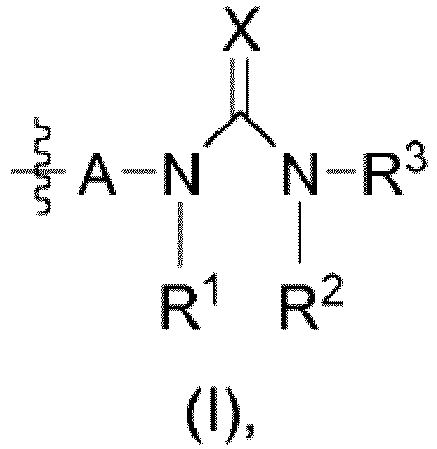 X représente O ou S,A représente un groupe alkylène en C1-10 etR1, R2 et R3 représentent chacun indépendamment les uns des autres H ou un radical alkyle en C1-10, ouR1 et R2 représentent ensemble - (CR4R5) n- et R3 a une des significations précédentes, R4 et R5 représentant chacun indépendamment l'un de l'autre H ou un radical alkyle en C1-6, et le paramètre n représentant un nombre entier dans la plage allant de 2 à 5,et chaque unité structurale (S3) comprenant au moins un groupe fonctionnel choisi dans le groupe constitué par les groupes carboxyle, les groupes hydroxyle, les groupes thiol, les groupes amino et les groupes époxyde, ainsi que leurs mélanges.
 - Copolymère selon la revendication 1, caractérisé en ce que les unités structurales (S1), (S2) et (S3) sont introduites dans le copolymère par copolymérisation de monomères, qui comprennent chacun indépendamment les uns des autres au moins un groupe (méth)acrylique en tant que groupe éthyléniquement insaturé.
- Copolymère selon la revendication 1 ou 2, caractérisé en ce que
chaque unité structurale (S1) comprend au moins un groupe alkyle ramifié contenant au moins 13 atomes de carbone, chaque unité structurale (S2) comprend au moins un groupe urée de formule générale (I) relié par un groupe alkylène en C1-6 X représente O ou S,A représente un groupe alkylène en C1-6 etR1 et R2 représentent ensemble -(CR4R5)n- et R3 représente H ou un radical alkyle en C1-6, R4 et R5 représentant chacun indépendamment l'un de l'autre H ou un radical alkyle en C1-6, et le paramètre n représentant un nombre entier dans la plage allant de 2 à 5,et chaque unité structurale (S3) présente comprend au moins un groupe fonctionnel choisi dans le groupe constitué par les groupes carboxyle et les groupes hydroxyle, ainsi que leurs mélanges.
 - Copolymère selon l'une quelconque des revendications précédentes, caractérisé en ce que le copolymère comprend au moins une unité structurale (S4) supplémentaire différente de (S1) et (S2), ainsi que de (S3), chaque unité structurale (S4) comprenant au moins un groupe choisi dans le groupe constitué par les groupes alkyle en C1-10 ramifiés et non ramifiés, les groupes cycloalkyle en C3-10 éventuellement substitués avec au moins un groupe alkyle en C1-6, les groupes aromatiques éventuellement substitués avec au moins un groupe alkyle en C1-6, les groupes aromatiques reliés par un groupe alkylène en C1-6, éventuellement substitués avec au moins un groupe alkyle en C1-6, et les groupes cycloalkyle en C3-10 reliés par un groupe alkylène en C1-6, éventuellement substitués avec au moins un groupe alkyle en C1-6.
- Copolymère selon l'une quelconque des revendications précédentes, caractérisé en ce que le copolymère peut être obtenu par copolymérisation radicalaire de(s1) au moins un monomère éthyléniquement insaturé apte à la formation de l'unité structurale (S1) en une quantité dans une plage allant de 0,5 à 15 % en moles, par rapport à la quantité totale de tous les monomères utilisés pour la fabrication du copolymère en % en moles,(s2) au moins un monomère éthyléniquement insaturé apte à la formation de l'unité structurale (S2) en une quantité dans une plage allant de 0,5 à 15 % en moles, par rapport à la quantité totale de tous les monomères utilisés pour la fabrication du copolymère en % en moles,(s3) au moins un monomère éthyléniquement insaturé apte à la formation de l'unité structurale (S3) en une quantité dans une plage allant de 5 à 50 % en moles, par rapport à la quantité totale de tous les monomères utilisés pour la fabrication du copolymère en % en moles, et(s4) au moins un monomère éthyléniquement insaturé apte à la formation de l'unité structurale (S4) en une quantité dans une plage allant de 20 à 90 % en moles, par rapport à la quantité totale de tous les monomères utilisés pour la fabrication du copolymère en % en moles, la quantité totale de tous les monomères (s1), (s2), (s3) et (s4) utilisés pour la fabrication du copolymère étant au total de 100 % en moles.
- Utilisation d'au moins un copolymère selon l'une quelconque des revendications précédentes en tant qu'additif promoteur d'adhésion dans une composition de revêtement aqueuse, qui est appropriée pour le revêtement au moins partiel d'un substrat avec une couche de vernis de base.
- Utilisation selon la revendication 6, caractérisée en ce qu'un substrat constitué par ou à base d'au moins un plastique est utilisé en tant que substrat.
- Composition de revêtement aqueuse, comprenant :au moins une résine polymère (A1) et éventuellement au moins un agent de réticulation (A2),au moins un pigment (B) etau moins un copolymère selon l'une quelconque des revendications 1 à 5 différent de la résine polymère (A1) et utilisé en tant qu'additif promoteur d'adhésion en tant que composant (C),pour le revêtement au moins partiel d'un substrat avec une couche de vernis de base.
- Composition de revêtement selon la revendication 8, caractérisée en ce que la composition de revêtement contient le copolymère (C) utilisé en tant qu'additif promoteur d'adhésion en une quantité dans une plage allant de 0,5 à 15 % en poids, par rapport à la teneur en solides totale de la composition de revêtement.
- Composition de revêtement selon la revendication 8 ou 9, caractérisée en ce que la résine polymère (A1) est choisie dans le groupe constitué par les polyuréthanes, les polyesters, les résines époxydes et les poly(méth)acrylates comprenant chacun des groupes hydroxyle fonctionnels, et leurs mélanges, et l'agent de réticulation éventuellement présent (A2) comprend au moins un produit de condensation mélamine-formaldéhyde éventuellement alkylé et/ou au moins un polyisocyanate bloqué.
- Composition de revêtement selon l'une quelconque des revendications 8 à 10, caractérisée en ce que la composition de revêtement contient :ladite au moins une résine polymère (A1) en une quantité dans une plage allant de 7,5 à 30 % en poids, par rapport au poids total de la composition de revêtement,ledit au moins un agent de réticulation éventuellement présent (A2) en une quantité dans une plage allant de 2,5 à 15 % en poids, par rapport au poids total de la composition de revêtement, etledit au moins un pigment (B) en une quantité dans une plage allant de 0,5 à 20 % en poids, par rapport au poids total de la composition de revêtement,la somme des quantités des composants eau, (A1), (B), (C) contenus dans la composition de revêtement, ainsi qu'éventuellement d'au moins un composant (D), (A2) en outre contenu dans celle-ci et/ou d'un solvant organique éventuellement contenu dans celle-ci étant au total de 100 % en poids.
- Procédé de revêtement au moins partiel d'un substrat avec une couche de vernis de base, comprenant au moins une étape (1) :(1) la mise en contact au moins partielle du substrat avec la composition de revêtement selon l'une quelconque des revendications 8 à 11.
- Procédé de revêtement au moins partiel d'un substrat avec un vernissage multicouche, comprenant au moins les étapes suivantes :(1) la mise en contact au moins partielle du substrat avec la composition de revêtement selon l'une quelconque des revendications 8 à 11 pour l'application au moins partielle d'une couche de vernis de base sur le substrat, et(2) l'application d'une couche de vernis transparent sur la couche de vernis de base appliquée selon l'étape (1).
- Couche de vernis de base pouvant être obtenue par le procédé selon la revendication 12 ou vernissage multicouche pouvant être obtenu par le procédé selon la revendication 13.
- Substrat au moins partiellement revêtu avec au moins la composition de revêtement selon l'une quelconque des revendications 8 à 11 ou au moyen du procédé selon la revendication 12 ou 13.
Applications Claiming Priority (2)
| Application Number | Priority Date | Filing Date | Title |
|---|---|---|---|
| EP14169112 | 2014-05-20 | ||
| PCT/EP2015/056555 WO2015176854A1 (fr) | 2014-05-20 | 2015-03-26 | Agent adhésif pour composition aqueuse de revêtement |
Publications (2)
| Publication Number | Publication Date |
|---|---|
| EP3145964A1 EP3145964A1 (fr) | 2017-03-29 |
| EP3145964B1 true EP3145964B1 (fr) | 2018-07-18 |
Family
ID=50732064
Family Applications (1)
| Application Number | Title | Priority Date | Filing Date |
|---|---|---|---|
| EP15741845.0A Not-in-force EP3145964B1 (fr) | 2014-05-20 | 2015-03-26 | Agent adhésif pour compositions de revêtement aqueuses |
Country Status (9)
| Country | Link |
|---|---|
| US (1) | US10208148B2 (fr) |
| EP (1) | EP3145964B1 (fr) |
| JP (2) | JP6474834B2 (fr) |
| KR (1) | KR20160148591A (fr) |
| CN (1) | CN106459301B (fr) |
| ES (1) | ES2690850T3 (fr) |
| MX (1) | MX2016015200A (fr) |
| RU (1) | RU2016149808A (fr) |
| WO (1) | WO2015176854A1 (fr) |
Families Citing this family (24)
| Publication number | Priority date | Publication date | Assignee | Title |
|---|---|---|---|---|
| US20180171207A1 (en) | 2015-06-17 | 2018-06-21 | Clariant International Ltd. | Water-Soluble Or Water-Swellable Polymers As Water Loss Reducers In Cement Slurries |
| ES2917178T3 (es) | 2015-07-09 | 2022-07-07 | Basf Se | Composiciones curables |
| MX2018006491A (es) | 2015-11-26 | 2018-08-01 | Basf Coatings Gmbh | Procedimiento para producir un sistema de pintura multicapa. |
| US11384186B2 (en) | 2016-12-12 | 2022-07-12 | Clariant International Ltd | Polymer comprising certain level of bio-based carbon |
| ES2867526T3 (es) | 2016-12-12 | 2021-10-20 | Clariant Int Ltd | Uso de un polímero bioderivado en una composición cosmética, dermatológica o farmacéutica |
| US11339241B2 (en) | 2016-12-15 | 2022-05-24 | Clariant International Ltd. | Water-soluble and/or water-swellable hybrid polymer |
| ES3017507T3 (en) | 2016-12-15 | 2025-05-13 | Clariant Int Ltd | Water-soluble and/or water-swellable hybrid polymer |
| EP3554644B1 (fr) | 2016-12-15 | 2025-03-19 | Clariant International Ltd | Polymère hybride soluble dans l'eau et/ou capable de gonfler dans l'eau |
| EP3554643B1 (fr) | 2016-12-15 | 2025-03-19 | Clariant International Ltd | Polymère hybride soluble dans l'eau et/ou pouvant gonfler dans l'eau |
| US20200157390A1 (en) * | 2017-06-22 | 2020-05-21 | Kuraray Co., Ltd. | Aqueous emulsion and adhesive using same |
| EP3775056B1 (fr) * | 2018-03-28 | 2021-12-15 | BASF Coatings GmbH | Laque de base aqueuse et réalisation de laquages multicouches à l'aide de la laque de base aqueuse |
| MX2020010561A (es) | 2018-04-13 | 2020-10-22 | Swimc Llc | Composiciones adhesivas acuosas. |
| BR112020020735A2 (pt) | 2018-04-13 | 2021-01-19 | Swimc Llc | Emulsão de látex, composição aquosa de revestimento, sistema para telhados, e, métodos. |
| EP3810701B1 (fr) * | 2018-06-25 | 2022-10-19 | DDP Specialty Electronic Materials US, LLC | Composition d'apprêt |
| CN114555733B (zh) * | 2019-10-14 | 2024-05-07 | 巴斯夫涂料有限公司 | 基于包含至少一个芳族取代基的含铋催化剂的涂料体系 |
| US11145801B2 (en) | 2019-11-12 | 2021-10-12 | International Business Machines Corporation | Adhesion layer to enhance encapsulation of superconducting devices |
| US11158782B2 (en) | 2019-11-12 | 2021-10-26 | International Business Machines Corporation | Metal fluoride encapsulation of superconducting devices |
| KR102279044B1 (ko) * | 2019-11-18 | 2021-07-19 | 송준혁 | 복합탄성중합체 조성물과 구조보강용 층 그리고 복합탄성중합체의 시공방법 |
| US11903328B2 (en) | 2020-02-07 | 2024-02-13 | International Business Machines Corporation | Self assembled monolayer formed on a quantum device |
| EP4099759A4 (fr) | 2020-02-28 | 2023-01-18 | Mitsubishi Electric Corporation | Dispositif de communication par satellite, dispositif de réseau central, circuit de commande, support de stockage et procédé de commande de qualité de service |
| EP4240794A1 (fr) * | 2020-11-03 | 2023-09-13 | BASF Coatings GmbH | Composition de revêtement durcissable sous uv comprenant un copolymère poly(éthylène-acrylate) insaturé et procédé de revêtement de substrats |
| CN113201087B (zh) * | 2020-11-20 | 2022-08-19 | 联固新材料科技(广州)有限公司 | 羟基丙烯酸分散体及其制备方法和双组分聚氨酯漆 |
| CN115748256B (zh) * | 2021-09-02 | 2025-04-11 | 北京化工大学 | 纤维表面处理的环保浸渍体系及其制备方法和浸渍处理方法 |
| CN119220198A (zh) * | 2024-11-27 | 2024-12-31 | 朝阳市征和化工有限公司 | 一种钴盐型粘合增进剂制备方法 |
Family Cites Families (8)
| Publication number | Priority date | Publication date | Assignee | Title |
|---|---|---|---|---|
| DE4209242A1 (de) | 1992-03-21 | 1993-09-23 | Basf Ag | Als glanzpigmente geeignete mischungen |
| US6403746B1 (en) * | 1999-11-30 | 2002-06-11 | Rohmax Additives Gmbh | Method for preparation of a composition that contains polymer ester compounds with long-chain alkyl residues and use of this composition |
| DE10256148A1 (de) * | 2002-11-29 | 2004-06-17 | Basf Ag | Gegenstand der vorliegenden Erfindung sind Zusammensetzungen enthaltend mindestens ein Copolymer (A) und mindestens ein Copolymer (B) sowie deren Verwendung in kosmetischen Zubereitungen |
| US20060217485A1 (en) * | 2005-03-23 | 2006-09-28 | Basf Corporation | Pigment dispersant, method of making coating compositions, and coating compositions |
| WO2011023409A1 (fr) * | 2009-08-31 | 2011-03-03 | Byk-Chemie Gmbh | Promoteur d'adhérence pour revêtements de différentes surfaces de support |
| US20110218295A1 (en) * | 2010-03-02 | 2011-09-08 | Basf Se | Anionic associative rheology modifiers |
| JP5669314B2 (ja) * | 2010-07-14 | 2015-02-12 | 関西ペイント株式会社 | 熱硬化性アクリル樹脂組成物及びそれを含んでなる水性塗料組成物 |
| JP5757662B2 (ja) * | 2011-09-01 | 2015-07-29 | 関西ペイント株式会社 | 共重合体、該共重合体を含有する水性塗料組成物及び複層塗膜形成方法 |
-
2015
- 2015-03-26 RU RU2016149808A patent/RU2016149808A/ru not_active Application Discontinuation
- 2015-03-26 EP EP15741845.0A patent/EP3145964B1/fr not_active Not-in-force
- 2015-03-26 US US15/312,415 patent/US10208148B2/en not_active Expired - Fee Related
- 2015-03-26 KR KR1020167031968A patent/KR20160148591A/ko not_active Abandoned
- 2015-03-26 WO PCT/EP2015/056555 patent/WO2015176854A1/fr not_active Ceased
- 2015-03-26 ES ES15741845.0T patent/ES2690850T3/es active Active
- 2015-03-26 CN CN201580025272.XA patent/CN106459301B/zh not_active Expired - Fee Related
- 2015-03-26 MX MX2016015200A patent/MX2016015200A/es unknown
- 2015-03-26 JP JP2016568887A patent/JP6474834B2/ja not_active Expired - Fee Related
-
2018
- 2018-11-02 JP JP2018207129A patent/JP2019052312A/ja active Pending
Non-Patent Citations (1)
| Title |
|---|
| None * |
Also Published As
| Publication number | Publication date |
|---|---|
| RU2016149808A (ru) | 2018-06-20 |
| US20170073446A1 (en) | 2017-03-16 |
| US10208148B2 (en) | 2019-02-19 |
| RU2016149808A3 (fr) | 2018-06-20 |
| JP2017518414A (ja) | 2017-07-06 |
| CN106459301A (zh) | 2017-02-22 |
| CN106459301B (zh) | 2018-12-11 |
| KR20160148591A (ko) | 2016-12-26 |
| MX2016015200A (es) | 2017-02-23 |
| JP6474834B2 (ja) | 2019-02-27 |
| JP2019052312A (ja) | 2019-04-04 |
| ES2690850T3 (es) | 2018-11-22 |
| EP3145964A1 (fr) | 2017-03-29 |
| WO2015176854A1 (fr) | 2015-11-26 |
Similar Documents
| Publication | Publication Date | Title |
|---|---|---|
| EP3145964B1 (fr) | Agent adhésif pour compositions de revêtement aqueuses | |
| DE69115929T2 (de) | Wässriger acrylurethanpolymer als pigmentdispergiermittel | |
| EP0692007B1 (fr) | Procede d'application d'une double couche de laque de finition sur la surface d'un substrat | |
| EP2697320B1 (fr) | Composition de revêtement de vernis transparent contenant un solvant, procédé de fabrication et utilisation | |
| WO2016116299A1 (fr) | Dispersions aqueuses contenant des polymérisats fabriqués en plusieurs étapes et compositions d'agents de revêtement contenant ces dispersions | |
| EP2782966B1 (fr) | Composition de revêtement de peinture vernie contenant un solvant, procédé de préparation et utilisation de ladite composition | |
| WO2010121794A2 (fr) | Revêtement multi-couches, sa production et son utilisation pour coller des vitres | |
| EP1017749B1 (fr) | Composition de revetement durcissable | |
| EP3197928A1 (fr) | Agent adhésif pour la production de compositions de revêtement appropriées à des couches de charge | |
| DE19809643A1 (de) | Beschichtungsmittel und Klebstoffe, ihre Verwendung und Verfahren zu ihrer Herstellung | |
| WO2017148796A1 (fr) | Dispersions aqueuses contenant des polymérisats fabriqués en plusieurs étapes et compositions d'agents de revêtement contenant ces dispersions | |
| EP3183068A1 (fr) | Composition aqueuse de revêtement contenant un épaississant pouvant être obtenu à partir d'au moins un polyamide et d'au moins un autre polymère | |
| EP3601456A1 (fr) | Pâtes aqueuses de pigments colorés contenant un polymère et peintures de base produites à partir de ces pâtes | |
| EP3700982A1 (fr) | Système d'agent de revêtement primaire pour substrats en plastique | |
| EP3143064B1 (fr) | Dispersion aqueuse d'au moins deux résines polymères et composition de revêtement à base aqueuse la contenant destinée à l'application d'une couche de vernis de recouvrement | |
| EP3227350B1 (fr) | Agent de revêtement pigmenté et revêtements fabriqués à partir de celui-ci | |
| EP3325177B1 (fr) | Combinaison de matiere de revetement comprenant une charge et un vernis de finition | |
| EP3227349B1 (fr) | Agent de revêtement pigmenté et revêtements fabriqués à partir de celui-ci | |
| DE60300031T2 (de) | Pigment dispergierendes Harz sowie dieses enthaltende wässrige Pigmentdispersion | |
| EP1240259B1 (fr) | Vernis achromatiques, leur procede de production et leur utilisation | |
| EP3227351B1 (fr) | Copolymère et agent de revêtement pigmenté contenant le copolymère |
Legal Events
| Date | Code | Title | Description |
|---|---|---|---|
| STAA | Information on the status of an ep patent application or granted ep patent |
Free format text: STATUS: THE INTERNATIONAL PUBLICATION HAS BEEN MADE |
|
| PUAI | Public reference made under article 153(3) epc to a published international application that has entered the european phase |
Free format text: ORIGINAL CODE: 0009012 |
|
| STAA | Information on the status of an ep patent application or granted ep patent |
Free format text: STATUS: REQUEST FOR EXAMINATION WAS MADE |
|
| 17P | Request for examination filed |
Effective date: 20161220 |
|
| AK | Designated contracting states |
Kind code of ref document: A1 Designated state(s): AL AT BE BG CH CY CZ DE DK EE ES FI FR GB GR HR HU IE IS IT LI LT LU LV MC MK MT NL NO PL PT RO RS SE SI SK SM TR |
|
| AX | Request for extension of the european patent |
Extension state: BA ME |
|
| DAV | Request for validation of the european patent (deleted) | ||
| DAX | Request for extension of the european patent (deleted) | ||
| GRAP | Despatch of communication of intention to grant a patent |
Free format text: ORIGINAL CODE: EPIDOSNIGR1 |
|
| STAA | Information on the status of an ep patent application or granted ep patent |
Free format text: STATUS: GRANT OF PATENT IS INTENDED |
|
| INTG | Intention to grant announced |
Effective date: 20180131 |
|
| GRAS | Grant fee paid |
Free format text: ORIGINAL CODE: EPIDOSNIGR3 |
|
| GRAA | (expected) grant |
Free format text: ORIGINAL CODE: 0009210 |
|
| STAA | Information on the status of an ep patent application or granted ep patent |
Free format text: STATUS: THE PATENT HAS BEEN GRANTED |
|
| AK | Designated contracting states |
Kind code of ref document: B1 Designated state(s): AL AT BE BG CH CY CZ DE DK EE ES FI FR GB GR HR HU IE IS IT LI LT LU LV MC MK MT NL NO PL PT RO RS SE SI SK SM TR |
|
| REG | Reference to a national code |
Ref country code: GB Ref legal event code: FG4D Free format text: NOT ENGLISH |
|
| REG | Reference to a national code |
Ref country code: CH Ref legal event code: EP |
|
| REG | Reference to a national code |
Ref country code: IE Ref legal event code: FG4D Free format text: LANGUAGE OF EP DOCUMENT: GERMAN |
|
| REG | Reference to a national code |
Ref country code: AT Ref legal event code: REF Ref document number: 1019257 Country of ref document: AT Kind code of ref document: T Effective date: 20180815 |
|
| REG | Reference to a national code |
Ref country code: DE Ref legal event code: R096 Ref document number: 502015005157 Country of ref document: DE |
|
| REG | Reference to a national code |
Ref country code: NL Ref legal event code: FP |
|
| REG | Reference to a national code |
Ref country code: ES Ref legal event code: FG2A Ref document number: 2690850 Country of ref document: ES Kind code of ref document: T3 Effective date: 20181122 |
|
| REG | Reference to a national code |
Ref country code: LT Ref legal event code: MG4D |
|
| PG25 | Lapsed in a contracting state [announced via postgrant information from national office to epo] |
Ref country code: LT Free format text: LAPSE BECAUSE OF FAILURE TO SUBMIT A TRANSLATION OF THE DESCRIPTION OR TO PAY THE FEE WITHIN THE PRESCRIBED TIME-LIMIT Effective date: 20180718 Ref country code: FI Free format text: LAPSE BECAUSE OF FAILURE TO SUBMIT A TRANSLATION OF THE DESCRIPTION OR TO PAY THE FEE WITHIN THE PRESCRIBED TIME-LIMIT Effective date: 20180718 Ref country code: RS Free format text: LAPSE BECAUSE OF FAILURE TO SUBMIT A TRANSLATION OF THE DESCRIPTION OR TO PAY THE FEE WITHIN THE PRESCRIBED TIME-LIMIT Effective date: 20180718 Ref country code: NO Free format text: LAPSE BECAUSE OF FAILURE TO SUBMIT A TRANSLATION OF THE DESCRIPTION OR TO PAY THE FEE WITHIN THE PRESCRIBED TIME-LIMIT Effective date: 20181018 Ref country code: IS Free format text: LAPSE BECAUSE OF FAILURE TO SUBMIT A TRANSLATION OF THE DESCRIPTION OR TO PAY THE FEE WITHIN THE PRESCRIBED TIME-LIMIT Effective date: 20181118 Ref country code: GR Free format text: LAPSE BECAUSE OF FAILURE TO SUBMIT A TRANSLATION OF THE DESCRIPTION OR TO PAY THE FEE WITHIN THE PRESCRIBED TIME-LIMIT Effective date: 20181019 Ref country code: BG Free format text: LAPSE BECAUSE OF FAILURE TO SUBMIT A TRANSLATION OF THE DESCRIPTION OR TO PAY THE FEE WITHIN THE PRESCRIBED TIME-LIMIT Effective date: 20181018 Ref country code: SE Free format text: LAPSE BECAUSE OF FAILURE TO SUBMIT A TRANSLATION OF THE DESCRIPTION OR TO PAY THE FEE WITHIN THE PRESCRIBED TIME-LIMIT Effective date: 20180718 Ref country code: PL Free format text: LAPSE BECAUSE OF FAILURE TO SUBMIT A TRANSLATION OF THE DESCRIPTION OR TO PAY THE FEE WITHIN THE PRESCRIBED TIME-LIMIT Effective date: 20180718 |
|
| PG25 | Lapsed in a contracting state [announced via postgrant information from national office to epo] |
Ref country code: HR Free format text: LAPSE BECAUSE OF FAILURE TO SUBMIT A TRANSLATION OF THE DESCRIPTION OR TO PAY THE FEE WITHIN THE PRESCRIBED TIME-LIMIT Effective date: 20180718 Ref country code: LV Free format text: LAPSE BECAUSE OF FAILURE TO SUBMIT A TRANSLATION OF THE DESCRIPTION OR TO PAY THE FEE WITHIN THE PRESCRIBED TIME-LIMIT Effective date: 20180718 Ref country code: AL Free format text: LAPSE BECAUSE OF FAILURE TO SUBMIT A TRANSLATION OF THE DESCRIPTION OR TO PAY THE FEE WITHIN THE PRESCRIBED TIME-LIMIT Effective date: 20180718 |
|
| REG | Reference to a national code |
Ref country code: DE Ref legal event code: R097 Ref document number: 502015005157 Country of ref document: DE |
|
| PG25 | Lapsed in a contracting state [announced via postgrant information from national office to epo] |
Ref country code: CZ Free format text: LAPSE BECAUSE OF FAILURE TO SUBMIT A TRANSLATION OF THE DESCRIPTION OR TO PAY THE FEE WITHIN THE PRESCRIBED TIME-LIMIT Effective date: 20180718 Ref country code: EE Free format text: LAPSE BECAUSE OF FAILURE TO SUBMIT A TRANSLATION OF THE DESCRIPTION OR TO PAY THE FEE WITHIN THE PRESCRIBED TIME-LIMIT Effective date: 20180718 Ref country code: RO Free format text: LAPSE BECAUSE OF FAILURE TO SUBMIT A TRANSLATION OF THE DESCRIPTION OR TO PAY THE FEE WITHIN THE PRESCRIBED TIME-LIMIT Effective date: 20180718 |
|
| PLBE | No opposition filed within time limit |
Free format text: ORIGINAL CODE: 0009261 |
|
| STAA | Information on the status of an ep patent application or granted ep patent |
Free format text: STATUS: NO OPPOSITION FILED WITHIN TIME LIMIT |
|
| PG25 | Lapsed in a contracting state [announced via postgrant information from national office to epo] |
Ref country code: DK Free format text: LAPSE BECAUSE OF FAILURE TO SUBMIT A TRANSLATION OF THE DESCRIPTION OR TO PAY THE FEE WITHIN THE PRESCRIBED TIME-LIMIT Effective date: 20180718 Ref country code: SM Free format text: LAPSE BECAUSE OF FAILURE TO SUBMIT A TRANSLATION OF THE DESCRIPTION OR TO PAY THE FEE WITHIN THE PRESCRIBED TIME-LIMIT Effective date: 20180718 Ref country code: SK Free format text: LAPSE BECAUSE OF FAILURE TO SUBMIT A TRANSLATION OF THE DESCRIPTION OR TO PAY THE FEE WITHIN THE PRESCRIBED TIME-LIMIT Effective date: 20180718 |
|
| 26N | No opposition filed |
Effective date: 20190423 |
|
| PG25 | Lapsed in a contracting state [announced via postgrant information from national office to epo] |
Ref country code: SI Free format text: LAPSE BECAUSE OF FAILURE TO SUBMIT A TRANSLATION OF THE DESCRIPTION OR TO PAY THE FEE WITHIN THE PRESCRIBED TIME-LIMIT Effective date: 20180718 |
|
| PG25 | Lapsed in a contracting state [announced via postgrant information from national office to epo] |
Ref country code: MC Free format text: LAPSE BECAUSE OF FAILURE TO SUBMIT A TRANSLATION OF THE DESCRIPTION OR TO PAY THE FEE WITHIN THE PRESCRIBED TIME-LIMIT Effective date: 20180718 |
|
| REG | Reference to a national code |
Ref country code: CH Ref legal event code: PL |
|
| PG25 | Lapsed in a contracting state [announced via postgrant information from national office to epo] |
Ref country code: LU Free format text: LAPSE BECAUSE OF NON-PAYMENT OF DUE FEES Effective date: 20190326 |
|
| REG | Reference to a national code |
Ref country code: BE Ref legal event code: MM Effective date: 20190331 |
|
| PG25 | Lapsed in a contracting state [announced via postgrant information from national office to epo] |
Ref country code: CH Free format text: LAPSE BECAUSE OF NON-PAYMENT OF DUE FEES Effective date: 20190331 Ref country code: LI Free format text: LAPSE BECAUSE OF NON-PAYMENT OF DUE FEES Effective date: 20190331 Ref country code: IE Free format text: LAPSE BECAUSE OF NON-PAYMENT OF DUE FEES Effective date: 20190326 |
|
| PG25 | Lapsed in a contracting state [announced via postgrant information from national office to epo] |
Ref country code: BE Free format text: LAPSE BECAUSE OF NON-PAYMENT OF DUE FEES Effective date: 20190331 |
|
| PG25 | Lapsed in a contracting state [announced via postgrant information from national office to epo] |
Ref country code: TR Free format text: LAPSE BECAUSE OF FAILURE TO SUBMIT A TRANSLATION OF THE DESCRIPTION OR TO PAY THE FEE WITHIN THE PRESCRIBED TIME-LIMIT Effective date: 20180718 |
|
| PGFP | Annual fee paid to national office [announced via postgrant information from national office to epo] |
Ref country code: IT Payment date: 20200324 Year of fee payment: 6 Ref country code: NL Payment date: 20200325 Year of fee payment: 6 Ref country code: GB Payment date: 20200326 Year of fee payment: 6 |
|
| PG25 | Lapsed in a contracting state [announced via postgrant information from national office to epo] |
Ref country code: MT Free format text: LAPSE BECAUSE OF FAILURE TO SUBMIT A TRANSLATION OF THE DESCRIPTION OR TO PAY THE FEE WITHIN THE PRESCRIBED TIME-LIMIT Effective date: 20180718 Ref country code: PT Free format text: LAPSE BECAUSE OF FAILURE TO SUBMIT A TRANSLATION OF THE DESCRIPTION OR TO PAY THE FEE WITHIN THE PRESCRIBED TIME-LIMIT Effective date: 20181118 |
|
| PGFP | Annual fee paid to national office [announced via postgrant information from national office to epo] |
Ref country code: FR Payment date: 20200326 Year of fee payment: 6 |
|
| PGFP | Annual fee paid to national office [announced via postgrant information from national office to epo] |
Ref country code: DE Payment date: 20200528 Year of fee payment: 6 Ref country code: ES Payment date: 20200427 Year of fee payment: 6 |
|
| REG | Reference to a national code |
Ref country code: AT Ref legal event code: MM01 Ref document number: 1019257 Country of ref document: AT Kind code of ref document: T Effective date: 20200326 |
|
| PG25 | Lapsed in a contracting state [announced via postgrant information from national office to epo] |
Ref country code: CY Free format text: LAPSE BECAUSE OF FAILURE TO SUBMIT A TRANSLATION OF THE DESCRIPTION OR TO PAY THE FEE WITHIN THE PRESCRIBED TIME-LIMIT Effective date: 20180718 |
|
| PG25 | Lapsed in a contracting state [announced via postgrant information from national office to epo] |
Ref country code: HU Free format text: LAPSE BECAUSE OF FAILURE TO SUBMIT A TRANSLATION OF THE DESCRIPTION OR TO PAY THE FEE WITHIN THE PRESCRIBED TIME-LIMIT; INVALID AB INITIO Effective date: 20150326 |
|
| PG25 | Lapsed in a contracting state [announced via postgrant information from national office to epo] |
Ref country code: AT Free format text: LAPSE BECAUSE OF NON-PAYMENT OF DUE FEES Effective date: 20200326 |
|
| REG | Reference to a national code |
Ref country code: DE Ref legal event code: R119 Ref document number: 502015005157 Country of ref document: DE |
|
| REG | Reference to a national code |
Ref country code: NL Ref legal event code: MM Effective date: 20210401 |
|
| GBPC | Gb: european patent ceased through non-payment of renewal fee |
Effective date: 20210326 |
|
| PG25 | Lapsed in a contracting state [announced via postgrant information from national office to epo] |
Ref country code: GB Free format text: LAPSE BECAUSE OF NON-PAYMENT OF DUE FEES Effective date: 20210326 Ref country code: FR Free format text: LAPSE BECAUSE OF NON-PAYMENT OF DUE FEES Effective date: 20210331 Ref country code: DE Free format text: LAPSE BECAUSE OF NON-PAYMENT OF DUE FEES Effective date: 20211001 Ref country code: NL Free format text: LAPSE BECAUSE OF NON-PAYMENT OF DUE FEES Effective date: 20210401 |
|
| PG25 | Lapsed in a contracting state [announced via postgrant information from national office to epo] |
Ref country code: IT Free format text: LAPSE BECAUSE OF NON-PAYMENT OF DUE FEES Effective date: 20210326 |
|
| REG | Reference to a national code |
Ref country code: ES Ref legal event code: FD2A Effective date: 20220523 |
|
| PG25 | Lapsed in a contracting state [announced via postgrant information from national office to epo] |
Ref country code: MK Free format text: LAPSE BECAUSE OF FAILURE TO SUBMIT A TRANSLATION OF THE DESCRIPTION OR TO PAY THE FEE WITHIN THE PRESCRIBED TIME-LIMIT Effective date: 20180718 |
|
| PG25 | Lapsed in a contracting state [announced via postgrant information from national office to epo] |
Ref country code: ES Free format text: LAPSE BECAUSE OF NON-PAYMENT OF DUE FEES Effective date: 20210327 |