EP3148540B1 - Verfahren zur herstellung von cyclischen depsipeptiden - Google Patents
Verfahren zur herstellung von cyclischen depsipeptiden Download PDFInfo
- Publication number
- EP3148540B1 EP3148540B1 EP15800006.7A EP15800006A EP3148540B1 EP 3148540 B1 EP3148540 B1 EP 3148540B1 EP 15800006 A EP15800006 A EP 15800006A EP 3148540 B1 EP3148540 B1 EP 3148540B1
- Authority
- EP
- European Patent Office
- Prior art keywords
- alkyl
- cycloalkyl
- group
- compound
- heterocycloalkyl
- Prior art date
- Legal status (The legal status is an assumption and is not a legal conclusion. Google has not performed a legal analysis and makes no representation as to the accuracy of the status listed.)
- Active
Links
- 0 C*C=C[C@@](CC(NC(*)(*)C(**)NC(*)C(*)=O)=O)OC(C(C)NC(*)=O)=O Chemical compound C*C=C[C@@](CC(NC(*)(*)C(**)NC(*)C(*)=O)=O)OC(C(C)NC(*)=O)=O 0.000 description 18
- RWXMDBYZOMCKGY-UHFFFAOYSA-N CC(NCc1nc(C(OC(C)(C)C)=O)c[s]1)Cl Chemical compound CC(NCc1nc(C(OC(C)(C)C)=O)c[s]1)Cl RWXMDBYZOMCKGY-UHFFFAOYSA-N 0.000 description 2
- XDTMQSROBMDMFD-UHFFFAOYSA-N C1CCCCC1 Chemical compound C1CCCCC1 XDTMQSROBMDMFD-UHFFFAOYSA-N 0.000 description 1
- MFNXWZGIFWJHMI-UHFFFAOYSA-N CC(C)(C)OC(NC(C)(C)C(O)=O)=O Chemical compound CC(C)(C)OC(NC(C)(C)C(O)=O)=O MFNXWZGIFWJHMI-UHFFFAOYSA-N 0.000 description 1
- YXIYWNJVJYJJFO-UHFFFAOYSA-N CC(C)SC(NCl)=S Chemical compound CC(C)SC(NCl)=S YXIYWNJVJYJJFO-UHFFFAOYSA-N 0.000 description 1
- AFGHAGHPXBZVBO-ZETCQYMHSA-N C[C@@H](C(O)=O)NC(C(C)(C)NC(OC(C)(C)C)=O)=O Chemical compound C[C@@H](C(O)=O)NC(C(C)(C)NC(OC(C)(C)C)=O)=O AFGHAGHPXBZVBO-ZETCQYMHSA-N 0.000 description 1
- QVHJQCGUWFKTSE-YFKPBYRVSA-N C[C@@H](C(O)=O)NC(OC(C)(C)C)=O Chemical compound C[C@@H](C(O)=O)NC(OC(C)(C)C)=O QVHJQCGUWFKTSE-YFKPBYRVSA-N 0.000 description 1
- GIMDYEZZNCXDLJ-HNQUOIGGSA-N O=C/C=C/CCCl Chemical compound O=C/C=C/CCCl GIMDYEZZNCXDLJ-HNQUOIGGSA-N 0.000 description 1
Images

Classifications
-
- A—HUMAN NECESSITIES
- A61—MEDICAL OR VETERINARY SCIENCE; HYGIENE
- A61P—SPECIFIC THERAPEUTIC ACTIVITY OF CHEMICAL COMPOUNDS OR MEDICINAL PREPARATIONS
- A61P25/00—Drugs for disorders of the nervous system
-
- C—CHEMISTRY; METALLURGY
- C07—ORGANIC CHEMISTRY
- C07K—PEPTIDES
- C07K11/00—Depsipeptides having up to 20 amino acids in a fully defined sequence; Derivatives thereof
- C07K11/02—Depsipeptides having up to 20 amino acids in a fully defined sequence; Derivatives thereof cyclic, e.g. valinomycins ; Derivatives thereof
-
- A—HUMAN NECESSITIES
- A61—MEDICAL OR VETERINARY SCIENCE; HYGIENE
- A61K—PREPARATIONS FOR MEDICAL, DENTAL OR TOILETRY PURPOSES
- A61K38/00—Medicinal preparations containing peptides
- A61K38/04—Peptides having up to 20 amino acids in a fully defined sequence; Derivatives thereof
- A61K38/12—Cyclic peptides, e.g. bacitracins; Polymyxins; Gramicidins S, C; Tyrocidins A, B or C
-
- A—HUMAN NECESSITIES
- A61—MEDICAL OR VETERINARY SCIENCE; HYGIENE
- A61K—PREPARATIONS FOR MEDICAL, DENTAL OR TOILETRY PURPOSES
- A61K38/00—Medicinal preparations containing peptides
- A61K38/04—Peptides having up to 20 amino acids in a fully defined sequence; Derivatives thereof
- A61K38/15—Depsipeptides; Derivatives thereof
-
- A—HUMAN NECESSITIES
- A61—MEDICAL OR VETERINARY SCIENCE; HYGIENE
- A61P—SPECIFIC THERAPEUTIC ACTIVITY OF CHEMICAL COMPOUNDS OR MEDICINAL PREPARATIONS
- A61P29/00—Non-central analgesic, antipyretic or antiinflammatory agents, e.g. antirheumatic agents; Non-steroidal antiinflammatory drugs [NSAID]
-
- A—HUMAN NECESSITIES
- A61—MEDICAL OR VETERINARY SCIENCE; HYGIENE
- A61P—SPECIFIC THERAPEUTIC ACTIVITY OF CHEMICAL COMPOUNDS OR MEDICINAL PREPARATIONS
- A61P35/00—Antineoplastic agents
-
- A—HUMAN NECESSITIES
- A61—MEDICAL OR VETERINARY SCIENCE; HYGIENE
- A61P—SPECIFIC THERAPEUTIC ACTIVITY OF CHEMICAL COMPOUNDS OR MEDICINAL PREPARATIONS
- A61P37/00—Drugs for immunological or allergic disorders
- A61P37/02—Immunomodulators
-
- A—HUMAN NECESSITIES
- A61—MEDICAL OR VETERINARY SCIENCE; HYGIENE
- A61P—SPECIFIC THERAPEUTIC ACTIVITY OF CHEMICAL COMPOUNDS OR MEDICINAL PREPARATIONS
- A61P37/00—Drugs for immunological or allergic disorders
- A61P37/02—Immunomodulators
- A61P37/06—Immunosuppressants, e.g. drugs for graft rejection
-
- A—HUMAN NECESSITIES
- A61—MEDICAL OR VETERINARY SCIENCE; HYGIENE
- A61P—SPECIFIC THERAPEUTIC ACTIVITY OF CHEMICAL COMPOUNDS OR MEDICINAL PREPARATIONS
- A61P37/00—Drugs for immunological or allergic disorders
- A61P37/08—Antiallergic agents
-
- A—HUMAN NECESSITIES
- A61—MEDICAL OR VETERINARY SCIENCE; HYGIENE
- A61P—SPECIFIC THERAPEUTIC ACTIVITY OF CHEMICAL COMPOUNDS OR MEDICINAL PREPARATIONS
- A61P43/00—Drugs for specific purposes, not provided for in groups A61P1/00-A61P41/00
-
- C—CHEMISTRY; METALLURGY
- C07—ORGANIC CHEMISTRY
- C07D—HETEROCYCLIC COMPOUNDS
- C07D498/00—Heterocyclic compounds containing in the condensed system at least one hetero ring having nitrogen and oxygen atoms as the only ring hetero atoms
- C07D498/02—Heterocyclic compounds containing in the condensed system at least one hetero ring having nitrogen and oxygen atoms as the only ring hetero atoms in which the condensed system contains two hetero rings
- C07D498/06—Peri-condensed systems
-
- C—CHEMISTRY; METALLURGY
- C07—ORGANIC CHEMISTRY
- C07D—HETEROCYCLIC COMPOUNDS
- C07D513/00—Heterocyclic compounds containing in the condensed system at least one hetero ring having nitrogen and sulfur atoms as the only ring hetero atoms, not provided for in groups C07D463/00, C07D477/00 or C07D499/00 - C07D507/00
- C07D513/02—Heterocyclic compounds containing in the condensed system at least one hetero ring having nitrogen and sulfur atoms as the only ring hetero atoms, not provided for in groups C07D463/00, C07D477/00 or C07D499/00 - C07D507/00 in which the condensed system contains two hetero rings
- C07D513/06—Peri-condensed systems
-
- C—CHEMISTRY; METALLURGY
- C07—ORGANIC CHEMISTRY
- C07D—HETEROCYCLIC COMPOUNDS
- C07D513/00—Heterocyclic compounds containing in the condensed system at least one hetero ring having nitrogen and sulfur atoms as the only ring hetero atoms, not provided for in groups C07D463/00, C07D477/00 or C07D499/00 - C07D507/00
- C07D513/12—Heterocyclic compounds containing in the condensed system at least one hetero ring having nitrogen and sulfur atoms as the only ring hetero atoms, not provided for in groups C07D463/00, C07D477/00 or C07D499/00 - C07D507/00 in which the condensed system contains three hetero rings
- C07D513/14—Ortho-condensed systems
-
- C—CHEMISTRY; METALLURGY
- C07—ORGANIC CHEMISTRY
- C07K—PEPTIDES
- C07K1/00—General methods for the preparation of peptides, i.e. processes for the organic chemical preparation of peptides or proteins of any length
- C07K1/06—General methods for the preparation of peptides, i.e. processes for the organic chemical preparation of peptides or proteins of any length using protecting groups or activating agents
- C07K1/061—General methods for the preparation of peptides, i.e. processes for the organic chemical preparation of peptides or proteins of any length using protecting groups or activating agents using protecting groups
-
- C—CHEMISTRY; METALLURGY
- C07—ORGANIC CHEMISTRY
- C07K—PEPTIDES
- C07K1/00—General methods for the preparation of peptides, i.e. processes for the organic chemical preparation of peptides or proteins of any length
- C07K1/107—General methods for the preparation of peptides, i.e. processes for the organic chemical preparation of peptides or proteins of any length by chemical modification of precursor peptides
- C07K1/1072—General methods for the preparation of peptides, i.e. processes for the organic chemical preparation of peptides or proteins of any length by chemical modification of precursor peptides by covalent attachment of residues or functional groups
- C07K1/1077—General methods for the preparation of peptides, i.e. processes for the organic chemical preparation of peptides or proteins of any length by chemical modification of precursor peptides by covalent attachment of residues or functional groups by covalent attachment of residues other than amino acids or peptide residues, e.g. sugars, polyols, fatty acids
-
- C—CHEMISTRY; METALLURGY
- C07—ORGANIC CHEMISTRY
- C07K—PEPTIDES
- C07K1/00—General methods for the preparation of peptides, i.e. processes for the organic chemical preparation of peptides or proteins of any length
- C07K1/107—General methods for the preparation of peptides, i.e. processes for the organic chemical preparation of peptides or proteins of any length by chemical modification of precursor peptides
- C07K1/113—General methods for the preparation of peptides, i.e. processes for the organic chemical preparation of peptides or proteins of any length by chemical modification of precursor peptides without change of the primary structure
-
- C—CHEMISTRY; METALLURGY
- C07—ORGANIC CHEMISTRY
- C07K—PEPTIDES
- C07K11/00—Depsipeptides having up to 20 amino acids in a fully defined sequence; Derivatives thereof
-
- C—CHEMISTRY; METALLURGY
- C07—ORGANIC CHEMISTRY
- C07K—PEPTIDES
- C07K5/00—Peptides containing up to four amino acids in a fully defined sequence; Derivatives thereof
- C07K5/04—Peptides containing up to four amino acids in a fully defined sequence; Derivatives thereof containing only normal peptide links
- C07K5/08—Tripeptides
- C07K5/0821—Tripeptides with the first amino acid being heterocyclic, e.g. His, Pro, Trp
Definitions
- the invention relates to the preparation of substituted, cyclic depsipeptides and to intermediates useful in their preparation.
- the cyclic depsipeptides prepared as described herein are disclosed in WO/2011/150283 .
- the cyclic depsipeptides prepared in accord with the present invention are known to be histone deacetylase (HDAC) inhibitors as disclosed in, for example, U.S. 20130203681 and are known to be useful in the treatment of diseases mediated by HDAC disregulation, such as cancer, inflammatory diseases, autoimmune diseases, allergic diseases and diseases of the central nervous system.
- HDAC histone deacetylase
- An aspect of the present invention relates to a process of preparing a compound of the Formula (1) or a pharmaceutically acceptable salt thereof, wherein:
- R 5 is H and R 6 is selected from the group consisting of H, isopropyl and methyl.
- R 5 is H and R 6 is isopropyl.
- R 12 is C(O)C 7 alkyl.
- R 12 is C(O)(CH 2 ) 6 CH 3 .
- R 3 and R 4 are methyl.
- the compound of Formula (1) is N-(2-aminoethyl)-2-aminoethyl-N-(2-aminoethyl)-2-aminoethyl-N-(2-aminoethyl)-2-aminoethyl-N-(2-aminoethyl)-2-aminoethyl-N-(2-aminoethyl)-2-aminoethyl-N-N-phenyl
- the compound of Formula (1) is N-(2-aminoethyl)-2-aminoethyl-N-(2-aminoethyl)-2-aminoethyl-N-(2-aminoethyl)-2-aminoethyl-N-(2-aminoethyl)-2-aminoethyl-N-(2-aminoethyl)-2-aminoethyl-N-N-phenyl
- R 12 is C(O)CR 13 R 14 NR 13 R 14 .
- An aspect of the present invention relates to a process of preparing a compound of the Formula (2) or a pharmaceutically acceptable salt thereof, wherein:
- a compound of Formula (2) is a thiazole.
- R 5 is H and R 6 is isopropyl.
- R 13 is -(CH 2 ) 6 CH 3 .
- R 1 and R 2 are H.
- FIG 1 depicts the chemical structures of largazole and several analogs of largazole.
- a "moiety" or “group” is any type of molecular arrangement designated by formula, chemical name, or structure.
- a conjugate is said to comprise one or more moieties or chemical groups. This means that the formula of the moiety is substituted at some place in order to be joined and be a part of the molecular arrangement of the conjugate.
- moieties may be directly covalently joined, it is not intended that the joining of two or more moieties must be directly to each other.
- a linking group, crosslinking group, or joining group refers to any molecular arrangement that will connect the moieties by covalent bonds such as, but not limited to, one or more amide group(s), which may join the moieties.
- the conjugate may be unsubstituted, the conjugate may have a variety of additional substituents connected to the linking groups and/or connected to the moieties.
- substituted refers to the replacement of at least one hydrogen atom of a molecular arrangement with a substituent.
- substituents may be further substituted with one or more of the above substituents, such that the substituent comprises a substituted alkyl, substituted aryl, substituted arylalkyl, substituted heterocycle, or substituted heterocycloalkyl.
- Ra and Rb in this context may be the same or different and, independently, hydrogen, alkyl, haloalkyl, substituted alkyl, aryl, substituted aryl, arylalkyl, substituted arylalkyl, heterocyclyl, substituted heterocyclyl, heterocycloalkyl or substituted heterocycloalkyl.
- unsubstituted refers to any compound that does not contain extra substituents attached to the compound.
- An unsubstituted compound refers to the chemical makeup of the compound without extra substituents, e.g., the compound does not contain protecting group(s).
- unsubstituted proline is a proline amino acid even though the amino group of proline may be considered disubstituted with alkyl groups.
- alkyl refers to any straight chain or branched, non-cyclic or cyclic, unsaturated or saturated aliphatic hydrocarbon containing from 1 to 10 carbon atoms, while the term “lower alkyl” has the same meaning as alkyl but contains from 1 to 6 carbon atoms.
- the term “higher alkyl” has the same meaning as alkyl but contains from 7 to 10 carbon atoms.
- saturated straight chain alkyls include, but are not limited to, methyl, ethyl, n-propyl, n-butyl, n-pentyl, n-hexyl, n-heptyl, n-octyl, n-nonyl, and the like; while saturated branched alkyls include, but are not limited to, isopropyl, sec-butyl, isobutyl, tert-butyl, isopentyl, and the like. Cyclic alkyls may be obtained by joining two alkyl groups bound to the same atom or by joining two alkyl groups each bound to adjoining atoms.
- saturated cyclic alkyls include, but are not limited to, cyclopropyl, cyclobutyl, cyclopentyl, cyclohexyl, and the like; while unsaturated cyclic alkyls include, but are not limited to, cyclopentenyl and cyclohexenyl, and the like.
- Cyclic alkyls are also referred to herein as a "homocycles" or "homocyclic rings.”
- Unsaturated alkyls contain at least one double or triple bond between adjacent carbon atoms (referred to as an "alkenyl” or “alkynyl", respectively).
- Representative straight chain and branched alkenyls include, but are not limited to, ethylenyl, propylenyl, 1-butenyl, 2-butenyl, isobutylenyl, 1-pentenyl, 2-pentenyl, 3-methyl-1-butenyl, 2-methyl-2-butenyl, 2,3-dimethyl-2-butenyl, and the like; while representative straight chain and branched alkynyls include, but are not limited to, acetylenyl, propynyl, 1-butynyl, 2-butynyl, 1-pentynyl, 2-pentynyl, 3-methyl-1-butynyl, and the like.
- aryl refers to any aromatic carbocyclic moiety such as, but not limited to, phenyl or naphthyl.
- arylalkyl refers to any alkyl having at least one alkyl hydrogen atom replaced with an aryl moiety, such as, but not limited to, benzyl, -(CH 2 ) 2 -phenyl, -(CH 2 ) 3 -phenyl, -CH(phenyl) 2 , and the like.
- halogen refers to any fluoro, chloro, bromo, or iodo moiety.
- haloalkyl refers to any alkyl having at least one hydrogen atom replaced with halogen, such as trifluoromethyl, and the like.
- heteroaryl refers to any aromatic heterocycle ring of 5 to 10 members and having at least one heteroatom selected from nitrogen, oxygen and sulfur, and containing at least 1 carbon atom, including, but not limited to, both mono and bicyclic ring systems.
- heteroaryls include, but are not limited to, furyl, benzofuranyl, thiophenyl, benzothiophenyl, pyrrolyl, indolyl, isoindolyl, azaindolyl, pyridyl, quinolinyl, isoquinolinyl, oxazolyl, isooxazolyl, benzoxazolyl, pyrazolyl, imidazolyl, benzimidazolyl, thiazolyl, benzothiazolyl, isothiazolyl, pyridazinyl, pyrimidinyl, pyrazinyl, triazinyl, cinnolinyl, phthalazinyl, or quinazolinyl.
- heteroarylalkyl refers to any alkyl having at least one alkyl hydrogen atom replaced with a heteroaryl moiety, such as -CHpyridinyl, - CH 2 pyrimidinyl, and the like.
- heterocycle refers to any 4- to 7-membered monocyclic, or 7- to 10-membered bicyclic, heterocyclic ring which is either saturated, unsaturated, or aromatic, and which contains from 1 to 4 heteroatoms independently selected from nitrogen, oxygen and sulfur, and wherein the nitrogen and sulfur heteroatoms may be optionally oxidized, and the nitrogen heteroatom may be optionally quaternized, including bicyclic rings in which any of the above heterocycles are fused to a benzene ring.
- the heterocycle may be attached via any heteroatom or carbon atom.
- Heterocycles may include heteroaryls exemplified by those defined above.
- heterocycles may also include, but are not limited to, morpholinyl, pyrrolidinonyl, pyrrolidinyl, piperidinyl, hydantoinyl, valerolactamyl, oxiranyl, oxetanyl, tetrahydrofuranyl, tetrahydropyranyl, tetrahydropyridinyl, tetrahydroprimidinyl, tetrahydrothiophenyl, tetrahydrothiopyranyl, tetrahydropyrimidinyl, tetrahydrothiophenyl, tetrahydrothiopyranyl, and the like.
- heterocycloalkyl refers to any alkyl having at least one alkyl hydrogen atom replaced with a heterocycle, such as -CH 2 -morpholinyl, and the like.
- cycloalkyl refers to any saturated or unsaturated (but not aromatic) carbocyclic ring containing from 3-7 carbon atoms, such as, but not limited to, cyclopropane, cyclobutane, cyclopentane, cyclohexane, cycloheptane, cyclohexene, and the like.
- alkylamino refers to at least one alkyl moiety attached through a nitrogen bridge (e.g., -N-alkyl or -N-(alkyl)-N-) including, but not limited to, methylamino, ethylamino, dimethylamino, diethylamino, and the like.
- alkyloxy refers to any alkyl moiety attached through an oxygen bridge (e.g., -O-alkyl) such as, but not limited to, methoxy, ethoxy, and the like.
- alkylthio refers to any alkyl moiety attached through a sulfur bridge (e.g., -S-alkyl) such as, but not limited to, methylthio, ethylthio, and the like.
- alkenyl refers to an unbranched or branched hydrocarbon chain having one or more double bonds therein.
- the double bond of an alkenyl group can be unconjugated or conjugated to another unsaturated group.
- Suitable alkenyl groups include, but are not limited to vinyl, allyl, butenyl, pentenyl, hexenyl, butadienyl, pentadienyl, hexadienyl, 2-ethylhexenyl, 2-propyl-2-butenyl,4-(2-methyl-3-butene)-pentenyl.
- An alkenyl group can be unsubstituted or substituted with one or two suitable substituents.
- alkynyl refers to unbranched or branched hydrocarbon chain having one or more triple bonds therein.
- the triple bond of an alkynyl group can be unconjugated or conjugated to another unsaturated group.
- Suitable alkynyl groups include, but are not limited to ethynyl, propynyl, butynyl, pentynyl, hexynyl, methylpropynyl, 4-methyl-1-butynyl, 4-propyl-2-pentynyl-, and 4-butyl-2-hexynyl.
- An alkynyl group can be unsubstituted or substituted with one or two suitable substituents.
- salts refers to any salt, such as a pharmaceutically acceptable salt, that complexes with identified compounds contained herein.
- examples of such salts include, but are not limited to, acid addition salts formed with inorganic acids (e.g., hydrochloric acid, hydrobromic acid, sulfuric acid, phosphoric acid, nitric acid, and the like), and salts formed with organic acids such as, but not limited to, acetic acid, oxalic acid, tartaric acid, succinic acid, malic acid, fumaric acid, maleic acid, ascorbic acid, benzoic acid, tannic acid, pamoic acid, alginic acid, polyglutamic, acid, naphthalene sulfonic acid, naphthalene disulfonic acid, and polygalacturonic acid.
- inorganic acids e.g., hydrochloric acid, hydrobromic acid, sulfuric acid, phosphoric acid, nitric acid, and the like
- organic acids such as,
- Salt compounds can also be administered as pharmaceutically acceptable quaternary salts known by a person skilled in the art, which specifically include the quaternary ammonium salts of the formula - NR,R',R" + Z - , wherein each R, R', R" is independently hydrogen, alkyl, or benzyl, and Z is a counter ion, including, but not limited to, chloride, bromide, iodide, alkoxide, toluenesulfonate, methylsulfonate, sulfonate, phosphate, or carboxylate (such as benzoate, succinate, acetate, glycolate, maleate, malate, fumarate, citrate, tartrate, ascorbate, cinnamoate, mandeloate, and diphenylacetate).
- quaternary ammonium salts of the formula - NR,R',R" + Z - , wherein each R, R', R" is independently hydrogen, alky
- Salt compounds can also be administered as pharmaceutically acceptable pyridine cation salts having a substituted or unsubstituted partial formula: wherein Z is a counter ion, including, but not limited to, chloride, bromide, iodide, alkoxide, toluenesulfonate, methylsulfonate, sulfonate, phosphate, or carboxylate (such as benzoate, succinate, acetate, glycolate, maleate, malate, fumarate, citrate, tartrate, ascorbate, cinnamoate, mandeloate, and diphenylacetate).
- Z is a counter ion, including, but not limited to, chloride, bromide, iodide, alkoxide, toluenesulfonate, methylsulfonate, sulfonate, phosphate, or carboxylate (such as benzoate, succinate, acetate, glycolate, maleate, malate, fum
- reactive groups refer to nucleophiles, electrophiles, or radically active groups, i.e., groups that react in the presence of radicals.
- a nucleophile is a moiety that forms a chemical bond to its reaction partner (the electrophile) by donating both bonding electrons. Electrophiles accept these electrons. Nucleophiles may take part in nucleophilic substitution, whereby a nucleophile becomes attracted to a full or partial positive charge on an element and displaces the group it is bonded to. Alternatively nucleophiles may take part in substitution of carbonyl group.
- Carboxylic acids are often made electrophilic by creating succinyl esters and reacting these esters with aminoalkyls to form amides.
- Other common nucleophilic groups include thiolalkyls, hydroxylalkyls, primary and secondary amines, and carbon nucleophiles such as enols and alkyl metal complexes.
- Other preferred methods of ligating proteins, oligosaccharides and cells using reactive groups are disclosed in (Lemieux and Bertozzi (1998)), incorporated herein by reference.
- one provides reactive groups for the Staudinger ligation, i.e., "click chemistry" with an azide comprising moiety and alkynyl reactive groups to form triazoles.
- Step 1 of Scheme 1 involves a ruthenium carbene-catalyzed cross olefin metathesis reaction between Compound I and Compound II to produce Compound III and is performed under conditions that are analogous to those described in Voigtritter, K. et al., J. Org. Chem. 76, 4697-4702 (2011 ).
- a ruthenium carbene catalyst such as, but not limited to, benzylidene-bis(tricyclohexylphosphine)dichlororuthenium (Grubbs first generation catalyst), (1,3-bis(2,4,6-trimethylphenyl)-2-imidazolidinylidene)dichloro(phenylmethylene)(tricyclohexylphosphine)ruthenium (Grubbs second generation catalyst), (1,3-bis-(2,4,6-trimethylphenyl)-2-imidazolidinylidene)dichloro( o -isopropoxyphenylmethylene)ruthenium (Hoveyda-Grubbs catalyst), or 1,3-bis(2,4,6-trimethylphenyl)-4,5-di
- a ruthenium carbene catalyst such as, but not limited to, benzylidene-bis(tricyclohexylphosphine)dichlororuthenium (Grubb
- the waste stream includes relatively volatile, unreacted starting materials (such as 4-chloro-2-pentene and crotonaldehyde) and solvent which can be distilled from the product and recycled, catalytic amounts of ruthenium species which can be recovered and recycled, manganese oxides which can be filtered and recycled, and propene gas.
- starting materials such as 4-chloro-2-pentene and crotonaldehyde
- solvent which can be distilled from the product and recycled
- catalytic amounts of ruthenium species which can be recovered and recycled
- manganese oxides which can be filtered and recycled
- Table 1 below illustrates how conversion rates in the reactions described in Scheme 1 to prepare Compound III (represented by compound 2c) or Compound IV (represented by compound 2a) vary with the choice of Compound II (represented by compound 1 wherein R 1 , R 2 and R 3 have the values shown in each of 1a, 1b and 1c), solvent, temperature, additive, catalyst, catalyst loading, and time.
- the Nagao-Aldol reaction is particularly useful for preparing stereochemically enriched, ⁇ -hydroxy carbonyl compounds which do not contain a substituent other than hydrogen on the carbon alpha to the carbonyl group bearing the chiral auxiliary.
- thiazolidine thione auxiliaries serve to activate the carbonyl groups to which they are attached towards nucleophilic addition by amine compounds, in particular primary amines, to give the corresponding amides directly without the need for additional activation.
- TDx includes, but is not limited to, (R)-4-isopropylthiazolidine-2-thione, (R)-4-benzylthiazolidine-2-thione, (R)-4-phenylthiazolidine-2-thione or (R)-4-(tert-butyl)thiazolidine-2-thione) was treated with a Lewis acid, a base and the aldehyde of Compound IV to yield Compound VI with a high degree of diastereoselectivity.
- the present invention demonstrates the use of a chlorine atom as a low molecular weight, "atom-economical” surrogate for a triphenylmethylthio group for preparing depsipeptide derivatives related to Largazole via Compound VI of Scheme 3 which are prepared via a Nagao-Aldol reaction between Compounds IV and V.
- the N-acylated chiral auxiliary, Compound V comprising a chiral thiazolidine dione, preferably (R)-1-(4-benzyl-2-thioxothiazolidin-3-yl)ethanone or (R)-1-(4-isopropyl-2-thioxothiazolidin-3-yl)ethanone, is treated with a Lewis acid, such as, but not limited to, a titanium (IV) halide, preferably titanium tetrachloride, in an aprotic solvent such as, but not limited to, dichloromethane, 1,2-dichloroethane or toluene, preferably dichloromethane, at about -78°C to about 0°C, preferably about -5°C, over a period of about 30 minutes followed by a tertiary amine base such as, but not limited to, triethylamine, (-)-sparteine or
- Step 4 describes the synthesis of Compound X.
- the secondary hydroxyl group of Compound VI was acylated with a protected amino acid derivative, wherein the protecting group is, for example, tert-butyloxy carbonyl (Boc), (9H-fluoren-9-yl)methyloxy carbonyl (Fmoc), or 2-(trimethylsilyl)ethyloxy carbonyl, preferably tert-butyloxy carbonyl.
- the protecting group is, for example, tert-butyloxy carbonyl (Boc), (9H-fluoren-9-yl)methyloxy carbonyl (Fmoc), or 2-(trimethylsilyl)ethyloxy carbonyl, preferably tert-butyloxy carbonyl.
- Step 1 of Scheme 4 describes the ester formation between Compound VI and Compound VII to give Compound VIII where R 18 of Compound VII includes, but is not limited to, -CH 2 CH 2 Si(CH 3 ) 3 , (9H-fluoren-9-yl)methyl (Fmoc) or tert-butyl (Boc), preferably tert-butyl, and was carried out using an activating agent such as, but not limited to, 1-ethyl-3-(3-dimethylaminopropyl)carbodiimide (EDCI), dicyclohexylcarbodiimde (DCC), diisopropylcarbodiimide (DIC), carbonyldiimidazole (CDI), 2,4,6-trichlorobenzoyl chloride, preferably 1-ethyl-3-(3-dimethylaminopropyl)carbodiimide (EDCI), with an aminopyridine catalyst such as, but not limited to, dimethylaminopyridine or 4-pyrrol
- Step 2 of Scheme 4 is an amide-forming reaction wherein the chiral thiazolidine thione group of Compound VIII serves to activate the carbonyl to which it is attached towards nucleophilic displacement by a primary amine as previously discussed.
- Compound IX is a 5- or 6-membered heterocyclic moiety that contains at least one nitrogen in the heterocyclic ring, with a carboxylate group, suitably protected as an ester, attached to the same carbon as the nitrogen atom, and a substituted or unsubstituted methylamino group attached to the other carbon atom to which the nitrogen is attached.
- each group, ester and substituted or unsubstituted methyl amino are situated ortho to a nitrogen atom in the heterocyclic ring, and meta to each other.
- the 5- or 6- membered heterocyclic moiety of Compound IX includes, but is not limited to, pyridine, pyrimidine, pyrazine, triazine, oxazole, thiazole, oxadiazole, or thiadiazole. In an exemplary embodiment, this moiety is thiazole or tert-butyl 2-(aminomethyl)thiazole-4-carboxylate.
- the reaction was typically performed by dissolving Compound VIII of Scheme 4 in an aprotic solvent such as, but not limited to, dichloromethane, 1,2-dichloroethane, acetonitrile, tetrahydrofuran, toluene, heptane, methyl tert-butyl ether, diisopropyl ether, ethyl acetate or isopropyl acetate, dimethyl formamide, dimethyl acetamide or N-methyl pyrroldinone, preferably dichloromethane, followed by adding Compound VI and stirring for about 1 hour to about 48 hours, preferably about 24 hours, at a temperature of about 0°C to about 40°C, preferably at room temperature (about 25°C).
- an aprotic solvent such as, but not limited to, dichloromethane, 1,2-dichloroethane, acetonitrile, tetrahydrofuran, toluene, heptane, methyl
- Step 1 of Scheme 5 describes an alternative and more preferable synthesis of Compound X.
- an aprotic solvent such as, but not limited to, dichloromethane, 1,2-dichloroethane, acetonitrile, tetrahydrofuran, toluene, heptane, methyl tert-butyl ether, diisopropyl ether, ethyl acetate, isopropyl acetate, dimethyl formamide, dimethyl acetamide or N-methyl pyrroldinone, preferably dichloromethane, was treated with Compound IX (where R 19 is, for example, tert-butyl or CH 2 CH 2 Si(CH 3 ) 3 , preferably tert-butyl) and stirred for about 1 hour to about 48 hours, preferably about 24 hours, at a temperature of about 0°C to about 40°C, preferably at room temperature
- an aprotic solvent such as, but not limited to, dichloromethan
- Step 2 of Scheme 5 the secondary hydroxyl group of Compound XI was acylated with the protected amino acid derivative of Compound VII, wherein the protecting group is, for example, tert-butyloxy carbonyl (Boc), (9H-fluoren-9-yl)methyloxy carbonyl (Fmoc) or 2-(trimethylsilyl)ethyloxy carbonyl, preferably tert-butyloxy carbonyl, to provide Compound X.
- the protecting group is, for example, tert-butyloxy carbonyl (Boc), (9H-fluoren-9-yl)methyloxy carbonyl (Fmoc) or 2-(trimethylsilyl)ethyloxy carbonyl, preferably tert-butyloxy carbonyl, to provide Compound X.
- the reaction was carried out using an activating agent, such as, but not limited to, dicyclohexylcarbodiimide (DCC), diisopropylcarbodiimide (DIC) or 1-ethyl-3-(3-dimethylaminopropyl)carbodiimide (EDCI), preferably 1-ethyl-3-(3-dimethylaminopropyl)carbodiimide (EDCI), in a solvent such as, but not limited to, dichloromethane, 1,2-dichloroethane, acetonitrile, tetrahydrofuran, toluene, heptane, methyl tert-butyl ether, diisopropyl ether, ethyl acetate or isopropyl acetate, dimethyl formamide, dimethyl acetamide or N-methyl pyrrolidinone, preferably dichloromethane, with an aminopyridine catalyst such as, but not limited to, dimethylamino
- Scheme 6 describes the preparation of the heterocyclic amino acid derivative of Compound XV which exemplifies Compound IX of Schemes 4 and 5.
- Compound XII and Compound XIII were combined in a solvent such as, but not limited to, 1,2-dimethoxyethane (DME), tetrahydrofuran (THF) or 1,4-dioxane, preferably 1,2-dimethoxyethane (DME), and a base was added such as, but not limited to, sodium hydrogen carbonate or potassium hydrogen carbonate, preferably potassium hydrogen carbonate, at a temperature of about -40°C to about 25°C, preferably about -10°C.
- a solvent such as, but not limited to, 1,2-dimethoxyethane (DME), tetrahydrofuran (THF) or 1,4-dioxane, preferably 1,2-dimethoxyethane (DME)
- a base was added such as, but not limited to, sodium hydrogen carbonate or potassium
- a solution of trifluoroacetic anhydride and a base such as, but not limited to, pyridine, 2-methylpyridine, 2,6-dimethyl pyridine, 2,3,5-trimethylpyridine or 2,4,6-trimethylpyridine, preferably 2,6-dimethylpyridine, in a solvent such as, but not limited to, 1,2-dimethoxyethane (DME), tetrahydrofuran (THF) or 1,4-dioxane, preferably 1,2-dimethoxyethane, was added at a temperature of about -40°C to about 25°C, preferably about -20°C.
- DME 1,2-dimethoxyethane
- THF tetrahydrofuran
- 1,4-dioxane 1,2-dimethoxyethane
- Scheme 7a describes the selective removal of the carbamate protecting group bearing R 18 within Compound XVI, in the presence of the ester group bearing R 19 , to provide Compound XVII.
- the carbamate protecting group bearing R 18 and the ester group bearing R 19 within Compound XVI are orthogonal protecting groups with respect to their structure or reactivity.
- R 18 of Compound XVI includes, but is not limited to, -CH 2 CH 2 Si(CH 3 ) 3 , (9H-fluoren-9-yl)methyl (Fmoc) or tert-butyl (Boc).
- R 19 of Compound XVI includes, but is not limited to, -CH 2 CH 2 Si(CH 3 ) 3 or tert-butyl (Boc).
- Step 1 of Scheme 7a was carried out by treating Compound XVI with a fluoride source such as, but not limited to, potassium fluoride, cesium fluoride, tetrabutylammonium fluoride or lithium tetrafluoroborate, preferably tetrabutylammonium fluoride in a solvent such as, but not limited to, tetrahydrofuran, acetonitrile, dimethyl formamide, N-methylpyrrolidone, N,N-dimethyl acetamide or dimethyl sulfoxide, preferably tetrahydrofuran, at a temperature of about 0°C to about 65°C, preferably at room temperature (about 25°C).
- a fluoride source such as, but not limited to, potassium fluoride, cesium fluoride, tetrabutylammonium fluoride or lithium tetrafluoroborate, preferably tetrabutylammonium fluoride in a solvent such as,
- Step 1 of Scheme 7a was carried out by treating Compound XVI with an amine base such as, but not limited to, morpholine, piperidine, piperazine, 1,4-bis-(3-aminopropylpiperazine, dicyclohexylamine, diisopropylethyl amine, 4-dimethylminopyridine, 1,8-Diazabicyclo[5.4.0]undec-7-ene, pyrrolidine, cyclohexylamine, ethanolamine, diethylamine, triethylamine, ammonia, tributylamine or triethylenediamine, preferably piperidine, in a solvent such as, but not limited to, dichloromethane, 1,2-dichloroethane, dimethyl formamide, n-methylpyrolidinone, or N,N-dimethylacetamide, preferably dichloromethane, at
- Step 1 of Scheme 7a was carried out by treating Compound XVI with an acid such as, for example, trifluoroacetic acid or HCl, dissolved in an organic solvent such as, for example, dichloromethane, toluene, ethyl acetate, THF, DME, MTBE, or dioxane, at a temperature of about 0°C to about 40°C, preferably at room temperature (about 25°C).
- an organic solvent such as, for example, dichloromethane, toluene, ethyl acetate, THF, DME, MTBE, or dioxane
- R 18 of Compound XVI is tert-butyl and Step 1 is carried out preferably with HCl in dioxane, more preferably at room temperature (about 25°C).
- reaction mixture was poured into a cooled, saturated solution of sodium bicarbonate at about pH 8-9, and the resulting mixture was twice extracted with ethyl acetate, once with brine, dried, and concentrated to dryness to provide Compound XVII in about 95% yield, and which was used directly in the next step without further purification.
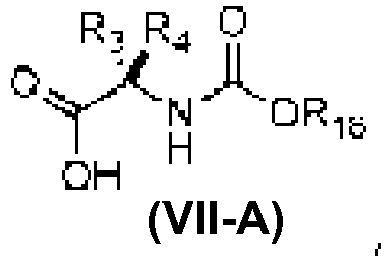
- Step 2 of Scheme 7a Compound XVII was converted to Compound XVIII by treatment with Compound VII and an activating agent such as, but not limited to, dicyclohexylcarbodiimide (DCC), diisopropylcarbodiimide (DIC) or 1-ethyl-3-(3-dimethylaminopropyl)carbodiimide (EDCI), preferably 1-ethyl-3-(3-dimethylaminopropyl)carbodiimide (EDCI) by itself or in the presence of an additive such as, but not limited to, hydroxybenztriazole (HOBt) or 1-hydroxy, 7-azabenztriazolein, preferably hydroxybenztriazole (HOBt), in a solvent such as, but not limited to, dichloromethane, 1,2-dichloroethane, acetonitrile, tetrahydrofuran, toluene, heptane, methyl tert-butyl ether
- Step 3 of Scheme 7a Compound XIX was produced by simultaneous hydrolysis of the carbamate and ester groups bearing R 18 and R 19 respectively, within Compound XVIII.
- Step 3 was carried out by treating Compound XVIII with, for example, potassium fluoride, cesium fluoride, tetrabutylammonium fluoride, lithium tetrafluoroborate, or trifluoroacetic acid, preferably tetrabutylammonium fluoride, in a solvent such as, but not limited to, tetrahydrofuran, acetonitrile, dimethyl formamide, N-methylpyrrolidinone, N,N-dimethyl acetamide or dimethyl sulfoxide, preferably tetrahydrofuran, at a temperature of about 0°C to about 40°C, preferably at room temperature (about 25°C).
- a solvent such as, but not limited to, tetrahydrofuran, acetonitrile, dimethyl
- Step 3 of Scheme 7a was carried out by treating Compound XVIII with an acid such as, but not limited to, trifluoroacetic acid or HCl, preferably trifluoroacetic acid, in a solvent such as, but not limited to, dichloromethane, 1,2-dichloroethane, or toluene, preferably dichloromethane, at a temperature of about 0°C to about 40°C, preferably at room temperature (about 25°C).
- an acid such as, but not limited to, trifluoroacetic acid or HCl, preferably trifluoroacetic acid
- a solvent such as, but not limited to, dichloromethane, 1,2-dichloroethane, or toluene, preferably dichloromethane, at a temperature of about 0°C to about 40°C, preferably at room temperature (about 25°C).
- Scheme 7b describes the concomitant removal of the carbamate protecting group bearing R 18 within Compound XVI, and the ester group bearing R 19 , to provide Compound XVII-A.
- Step 1 of Scheme 7b is carried out by treating Compound XVI with an acid such as, but not limited to, trifluoroacetic acid or HCl, preferably trifluoroacetic acid, in a solvent such as, but not limited to, dichloromethane, 1,2-dichloroethane, or toluene, preferably dichloromethane, at a temperature of about 0°C to about 40°C, preferably at room temperature (about 25°C).
- an acid such as, but not limited to, trifluoroacetic acid or HCl, preferably trifluoroacetic acid
- a solvent such as, but not limited to, dichloromethane, 1,2-dichloroethane, or toluene, preferably dichloromethane
- Step 2 of Scheme 7b Compound XVII-A was converted to Compound XVIII-A by treatment with Compound VII and an activating agent such as, but not limited to, dicyclohexylcarbodiimide (DCC), diisopropylcarbodiimide (DIC) or 1-ethyl-3-(3-dimethylaminopropyl)carbodiimide (EDCI), preferably 1-ethyl-3-(3-dimethylaminopropyl)carbodiimide (EDCI) by itself or in the presence of an additive such as, but not limited to, hydroxybenztriazole (HOBt) or 1-hydroxy, 7-azabenztriazolein, preferably hydroxybenztriazole (HOBt), in a solvent such as, but not limited to, dichloromethane, 1,2-dichloroethane, acetonitrile, tetrahydrofuran, toluene, heptane, methyl tert-but
- Step 3 of Scheme 7b Compound XIX was produced by hydrolysis of the carbamate and ester group bearing R 18 within Compound XVIII-A.
- Step 3 of Scheme 7b was carried out by treating Compound XVIII-A with an acid such as, but not limited to, trifluoroacetic acid or HCl, preferably trifluoroacetic acid, in a solvent such as, but not limited to, dichloromethane, 1,2-dichloroethane, or toluene, preferably dichloromethane, at a temperature of about 0°C to about 40°C, preferably at room temperature (about 25°C).
- an acid such as, but not limited to, trifluoroacetic acid or HCl, preferably trifluoroacetic acid
- a solvent such as, but not limited to, dichloromethane, 1,2-dichloroethane, or toluene, preferably dichloromethane, at a temperature of about 0°C to about 40°
- Step 1 of Scheme 8 is a macrolactamization reaction whereby the amino group of Compound XIX is acylated in an intramolecular fashion by the carboxylic acid group in Compound XIX to afford Compound XX.
- Step 1 was carried out by treatment of Compound XIX with an activating agent such as, but not limited to, N -[(dimethylamino)-1 H -1,2,3-triazolo-[4,5- b ]pyridin-1-ylmethylene]- N- methylmethanaminium hexafluorophosphate N- oxide (HATU), ( O -(7-azabenztriazol-1-yl)-1,1,3,3-bis(tetramethylene)uranium hexafluorophosphate) (HBTU), N , N , N ', N '-tetramethyl- O -(1 H -benzotriazol-1-yl)uronium hexafluorophosphate
- Step 2 of Scheme 8 Compound XX was converted to Compound XXII.
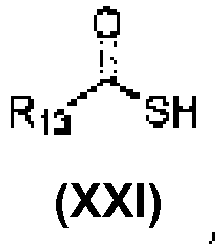
- the reaction was carried out by treating Compound XX with a thioate nucleophile prepared from the treatment of Compound XXI with a base such as, but not limited to, potassium hydroxide, sodium hydroxide, lithium hydroxide, cesium carbonate, potassium carbonate, sodium carbonate, lithium carbonate, potassium hydrogen carbonate, sodium hydrogen carbonate, sodium methoxide, potassium tert-butoxide, triethyl amine, N,N-diisopropylethylamine or 1,8-diazabicyclo[5.4.0]undec-7-ene, preferably potassium carbonate, in a solvent such as, but not limited to, acetone, acetonitrile, tetrahydrofuran, diisopropyl ether, methyl tert-butyl ether, 1,2-dimethoxyethane, 1,4-dioxane, toluen
- Step 1 of Scheme 9 Compound XX is converted to Compound XXIV.
- the reaction was carried out by treating Compound XX with a thioate nucleophile prepared from the treatment of Compound XXIII with a base such as, but not limited to, potassium hydroxide, sodium hydroxide, lithium hydroxide, cesium carbonate, potassium carbonate, sodium carbonate, lithium carbonate, potassium hydrogen carbonate, sodium hydrogen carbonate, sodium methoxide, potassium tert-butoxide, triethyl amine, N,N-diisopropylethylamine or 1,8-diazabicyclo[5.4.0]undec-7-ene, preferably potassium carbonate, in a solvent such as, but not limited to, acetone, acetonitrile, tetrahydrofuran, diisopropyl ether, methyl tert-butyl ether, 1,2-dimethoxyethane, 1,4-dioxane, toluene
- Step 2 of Scheme 9 Compound XXIV was converted to Compound XXV.
- the reaction was carried out by treating Compound XXIV with an acid.
- step 1 of Scheme 10 Compound VIII was treated with Compound XXVI in a manner analogous to conditions described in Xie et al., Journal of Asian Nat. Prod. Res. (2010), 12, 940-949 to provide Compound XXVII.
- step 2 of Scheme 10 Compound XXVII was converted to the corresponding amino acid via Boc group deprotection to give Compound XXVIII.
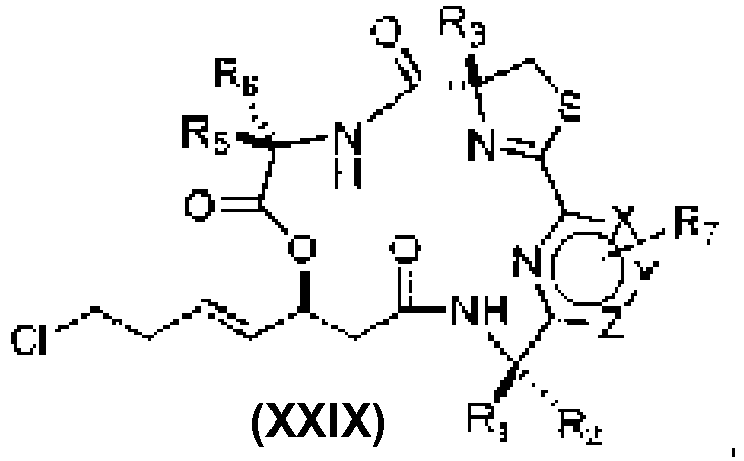
- Step 3 of Scheme 10 Compound XXVIII was converted to Compound XXIX via a macrolactamization reaction by treatment with an activating agent such as, but not limited to, N -[(dimethylamino)-1 H- 1,2,3-triazolo-[4,5- b ]pyridin-1-ylmethylene]- N- methylmethanaminium hexafluorophosphate N -oxide (HATU), ( O -(7-azabenztriazol-1-yl)-1,1,3,3-bis(tetramethylene)uranium hexafluorophosphate) (HBTU), N , N , N ', N '-tetramethyl- O- (1 H- benzotriazol-1-yl)uronium hexafluorophosphate, O -(benzotriazol-1-yl)- N , N , N',N '-tetramethyluronium hexafluorophosphate
- step 4 of Scheme 10 Compound XXIX was converted to a compound of Formula (2).
- the reaction was carried out by treating Compound XXIX with a thioate nucleophile prepared from the treatment of Compound XXI-A with a base such as, but not limited to, potassium hydroxide, sodium hydroxide, lithium hydroxide, cesium carbonate, potassium carbonate, sodium carbonate, lithium carbonate, potassium hydrogen carbonate, sodium hydrogen carbonate, sodium methoxide, potassium tert-butoxide, triethyl amine, N,N-diisopropylethylamine or 1,8-diazabicyclo[5.4.0]undec-7-ene, preferably potassium carbonate, in a solvent such as, but not limited to, acetone, acetonitrile, tetrahydrofuran, diisopropyl ether, methyl tert-butyl ether, 1,2-dimethoxyethane, 1,4-dioxane
- Example 1 Preparation of S-((E)-4-((7S,10S)-7-isopropyl-4,4-dimethyl-2,5,8,12-tetraoxo-9-oxa-16-thia-3,6,13,18-tetraazabicyclo[13.2.1]octadeca-1(17),15(18)-dien-10-yl)but-3-en-1-yl) octanethioate (Compound XXII ) from ((7S,10S)-10-((E)-4-chlorobut-1-en-1-yl)-7-isopropyl-4,4-dimethyl-9-oxa-16-thia-3,6,13,18-tetraazabicyclo[13.2.1]octadeca-1(17),15(18)-diene-2,5,8,12-tetraone) (Compound XX ).
- Example 3a Preparation of (S)-S-((E)-4-((7S,10S)-7-isopropyl-4,4-dimethyl-2,5,8,12-tetraoxo-9-oxa-16-thia-3,6,13,18-tetraazabicyclo[13.2.1]octadeca-1(17),15(18)-dien-10-yl)but-3-en-1-yl) 2-amino-3-methylbutanethioate hydrochloride (Compound XXV-A ) from ((S)-S-((E)-4-((7S,10S)-7-isopropyl-4,4-dimethyl-2,5,8,12-tetraoxo-9-oxa-16-thia-3,6,13,18-tetraazabicyclo[13.2.1]octadeca-1(17),15(18)-dien-10-yl)but-3-en-1-yl)2-((tert-but
- Example 3b Preparation of (S)-S-((E)-4-((7S,10S)-7-isopropyl-4,4-dimethyl-2,5,8,12-tetraoxo-9-oxa-16-thia-3,6,13,18-tetraazabicyclo[13.2.1]octadeca-1(17),15(18)-dien-10-yl)but-3-en-1-yl) 2-amino-3-methylbutanethioate benzenesulfonate (Compound XXV-B ) from ((S)-S-((E)-4-((7S,10S)-7-isopropyl-4,4-dimethyl-2,5,8,12-tetraoxo-9-oxa-16-thia-3,6,13,18-tetraazabicyclo[13.2.1]octadeca-1(17),15(18)-dien-10-yl)but-3-en-1-yl)2-(
- Example 4 Preparation of (7S,10S)-10-((E)-4-chlorobut-1-en-1-yl)-7-isopropyl-4,4-dimethyl-9-oxa-16-thia-3,6,13,18-tetraazabicyclo[13.2.1]octadeca-1(17),15(18)-diene-2,5,8,12-tetraone) (Compound XX ) from (7S,10S)-10-((E)-4-chlorobut-1-en-1-yl)-7-isopropyl-4,4-dimethyl-9-oxa-16-thia-3,6,13,18-tetraazabicyclo[13.2.1]octadeca-1(17),15(18)-diene-2,5,8,12-tetraone) (Compound XIX ).
- HATU (26g, 0.067 mol) was dissolved in acetonitrile (300 mL), and cooled to 0 ⁇ 5°C.
- a solution of 2-(((S,E)-3-(((S)-2-(2-amino-2-methylpropanamido)-3-methylbutanoyl)oxy)-7-chlorohept-4-enamido)methyl)thiazole-4-carboxylic acid trifluoroacetate 28g crude from Example 5
- diisopropylethyl amine 40ml, 0.225 mol
- dichloromethane 600 mL
- Example 5 Preparation of (7S,10S)-10-((E)-4-chlorobut-1-en-1-yl)-7-isopropyl-4,4-dimethyl-9-oxa-16-thia-3,6,13,18-tetraazabicyclo[13.2.1]octadeca-1(17),15(18)-diene-2,5,8,12-tetraone) (Compound XIX ) from 2-(((S,E)-3-(((S)-2-(2-amino-2-methylpropanamido)-3-methylbutanoyl)oxy)-7-chlorohept-4-enamido)methyl)thiazole-4-carboxylic acid trifluoroacetate (Compound XVIII ).
- Example 6 Preparation of tert-butyl 2-((5S,8S)-5-((E)-4-chlorobut-1-en-1-yl)-8-isopropyl-11,11,15,15-tetramethyl-3,7,10,13-tetraoxo-6,14-dioxa-2,9,12-triazahexadecyl)thiazole-4-carboxylate acid trifluoroacetate (Compound XVIII ) from tert-butyl 2-(((S,E)-3-(((S)-2-amino-3-methylbutanoyl)oxy)-7-chlorohept-4-enamido)methyl)thiazole-4-carboxylate (Compound XVII ) and 2-((tert-butoxycarbonyl)amino)-2-methylpropanoic acid (Compound VII ).
- Example 7 Preparation of tert-butyl 2-(((S,E)-3-(((S)-2-amino-3-methylbutanoyl)oxy)-7-chlorohept-4-enamido)methyl)thiazole-4-carboxylate (Compound XVII) from tert-butyl 2-((5S,8S)-5-((E)-4-chlorobut-1-en-1-yl)-8-isopropyl-12,12-dimethyl-3,7,10-trioxo-6,11-dioxa-2,9-diazatridecyl)thiazole-4-carboxylate (Compound XVI ).
- Example 8 Preparation of tert-butyl 2-((5S,8S)-5-((E)-4-chlorobut-1-en-1-yl)-8-isopropyl-12,12-dimethyl-3,7,10-trioxo-6,11-dioxa-2,9-diazatridecyl)thiazole-4-carboxylate (Compound VIII ) from (S,E)-tert-butyl 2-((7-chloro-3-hydroxyhept-4-enamido)methyl)thiazole-4-carboxylate (Compound VI-B ) and 2-((tert-butoxycarbonyl)amino)-2-methylpropanoic acid (Compound VII ).
- Example 10 Preparation of tert-butyl 2-((amino)methyl)thiazole-4-carboxylate (Compound XV ) from tert-butyl 2-(((tert-butoxycarbonyl)amino)methyl)thiazole-4-carboxylate (Compound XIV ).
- Example 11 Preparation of tert-butyl 2-(((tert-butoxycarbonyl)amino)methyl)thiazole-4-carboxylate (Compound XIV ) from tert-butyl bromopyruvate (Compound XII ) and tert-butyl (2-amino-2-thioxoethyl)carbamate (Compound XIII).
- Example 12 Preparation of (S,E)-1-((R)-4-benzyl-2-thioxothiazolidin-3-yl)-7-chloro-3-hydroxyhept-4-en-1-one (Compound XI ) from (S,E)-1-((R)-4-benzyl-2-thioxothiazolidin-3-yl)-7-chloro-3-hydroxyhept-4-en-1-one (Compound VI-B ) and tert-butyl 2-(aminomethyl)thiazole-4-carboxylate (Compound XV ).
- Example 13 Preparation of (S)-(S,E)-1-((R)-4-benzyl-2-thioxothiazolidin-3-yl)-7-chloro-1 -oxohept-4-en-3 -yl 2-((tert-butoxycarbonyl)amino)-3 -methylbutanoate (Compound XVI) from (S,E)-1-((R)-4-benzyl-2-thioxothiazolidin-3-yl)-7-chloro-3-hydroxyhept-4-en-1-one (Compound XI) and 2-((tert-butoxycarbonyl)amino)acetic acid (Compound VII).
- Example 14a Preparation of (S,E)-7-chloro-3-hydroxy-1-((R)-4-isopropyl-2-thioxothiazolidin-3-yl)hept-4-en-1-one (Compound VI-A-1, Table 2) from (E)-5-chloropent-2-enal (Compound IV ) and (R)-1-(4-isopropyl-2-thioxothiazolidin-3-yl)ethanone (Compound V-A; Table 2 ) (from Scheme 3).
- Example 14b Preparation (S,E)-1-((R)-4-benzyl-2-thioxothiazolidin-3-yl)-7-chloro-3-hydroxyhept-4-en-1-one (Compound VI-B-1; Table 2) from (E)-5-chloropent-2-enal (Compound IV ) and (R)-1-(4-benzyl-2-thioxothiazolidin-3-yl)ethanone (Compound V-B ) (from Scheme 3).
- Example 15 Preparation of (E)-5-chloropent-2-enal (Compound IV ) from 4-chloro-but-1-ene (Compound I ) and crotonaldehyde, (Compound II ).
- Example 16 Preparation of (E)-5-chloropent-2-en-1-ol (Compound III ) from 4-chloro-but-1-ene (Compound I ) and (E)-but-2-ene-1,4-diol, (Compound II from Scheme 1).
- Example 17 Preparation of (E)-5-chloropent-2-en-1-al from (Compound IV ) from (E)-5-chloropent-2-en-1-ol (Compound III ).
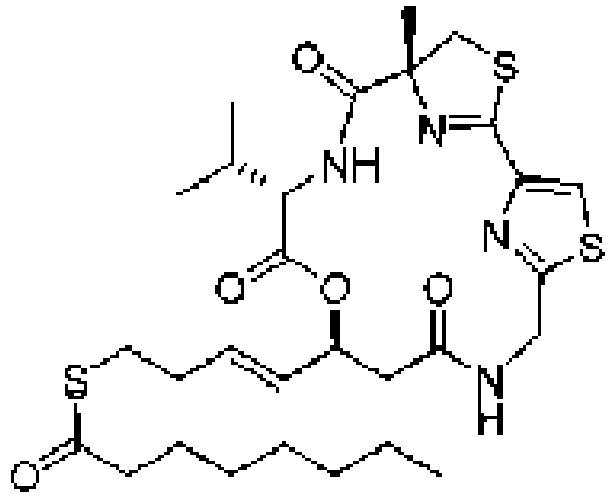
- Example 18 Preparation of S-((E)-4-((5R,8S,11S)-8-isopropyl-5-methyl-6,9,13-trioxo-10-oxa-3,17-dithia-7,14,19,20-tetraazatricyclo[14.2.1.12,5]icosa-1(18),2(20),16(19)-trien-11-yl)but-3-en-1-yl) octanethioate ( Largazole , a compound of Formula (2)) from (5R,8S,11S)-11-((E)-4-chlorobut-1-en-1-yl)-8-isopropyl-5-methyl-10-oxa-3,17-dithia-7,14,19,20-tetraazatricyclo[14.2.1.12,5]icosa-1(18),2(20),16(19)-triene-6,9,13-trione (Compound XXIX ).
- Example 20 Preparation of (R)-2'-((5S,8S)-5-((E)-4-chlorobut-1-en-1-yl)-8-isopropyl-12,12-dimethyl-3,7,10-trioxo-6,11-dioxa-2,9-diazatridecyl)-4-methyl-4,5-dihydro-[2,4'-bithiazole]-4-carboxylic acid (Compound XXVII ) from tert-butyl 2-((5S,8S)-5-((E)-4-chlorobut-1-en-1-yl)-8-isopropyl-12,12-dimethyl-3,7,10-trioxo-6,11-dioxa-2,9-diazatridecyl)thiazole-4-carboxylate (Compound VIII ) and (R)-2'-(aminomethyl)-4-methyl-4,5-dihydro-[2,4'-bith
Landscapes
- Chemical & Material Sciences (AREA)
- Organic Chemistry (AREA)
- Health & Medical Sciences (AREA)
- Life Sciences & Earth Sciences (AREA)
- General Health & Medical Sciences (AREA)
- Medicinal Chemistry (AREA)
- Proteomics, Peptides & Aminoacids (AREA)
- Biochemistry (AREA)
- Biophysics (AREA)
- Molecular Biology (AREA)
- Genetics & Genomics (AREA)
- Pharmacology & Pharmacy (AREA)
- Animal Behavior & Ethology (AREA)
- Public Health (AREA)
- Veterinary Medicine (AREA)
- General Chemical & Material Sciences (AREA)
- Chemical Kinetics & Catalysis (AREA)
- Bioinformatics & Cheminformatics (AREA)
- Engineering & Computer Science (AREA)
- Immunology (AREA)
- Nuclear Medicine, Radiotherapy & Molecular Imaging (AREA)
- Analytical Chemistry (AREA)
- Epidemiology (AREA)
- Gastroenterology & Hepatology (AREA)
- Biomedical Technology (AREA)
- Pulmonology (AREA)
- Transplantation (AREA)
- Rheumatology (AREA)
- Pain & Pain Management (AREA)
- Neurology (AREA)
- Neurosurgery (AREA)
- Pharmaceuticals Containing Other Organic And Inorganic Compounds (AREA)
- Peptides Or Proteins (AREA)
- Medicines That Contain Protein Lipid Enzymes And Other Medicines (AREA)
- Heterocyclic Carbon Compounds Containing A Hetero Ring Having Nitrogen And Oxygen As The Only Ring Hetero Atoms (AREA)
- Plural Heterocyclic Compounds (AREA)
- Organic Low-Molecular-Weight Compounds And Preparation Thereof (AREA)
- Hydrogenated Pyridines (AREA)
- Nitrogen And Oxygen Or Sulfur-Condensed Heterocyclic Ring Systems (AREA)
- Preparation Of Compounds By Using Micro-Organisms (AREA)
Claims (15)
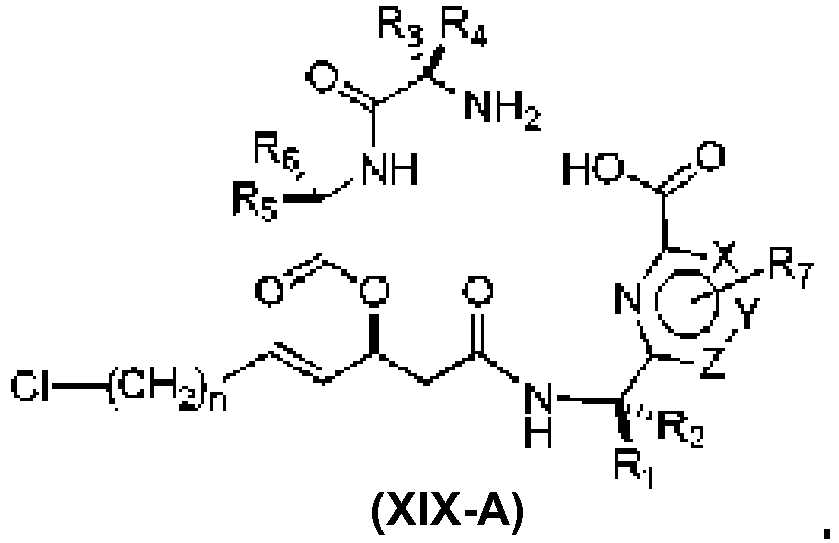
- Verfahren zum Herstellen einer Verbindung der Formel (1)
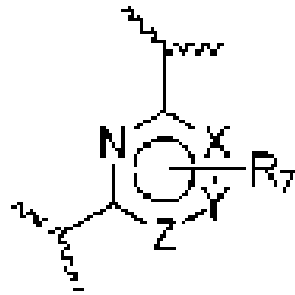
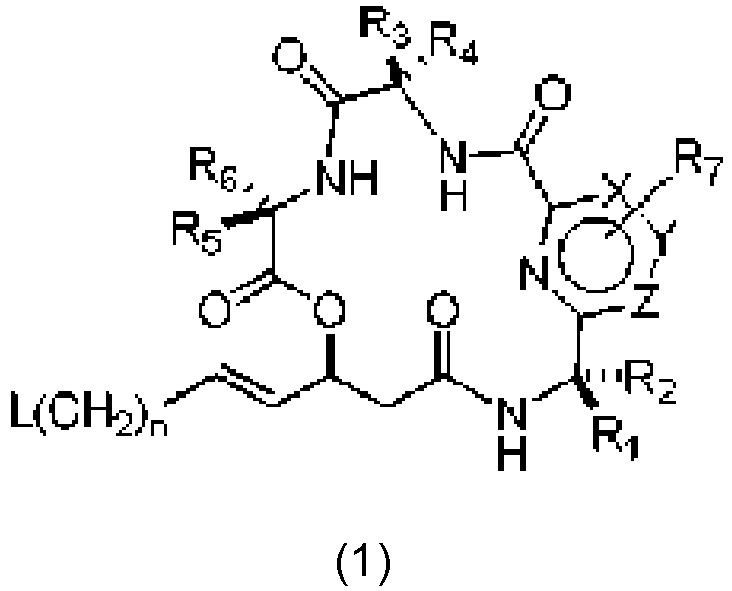 X, Y und Z unabhängig voneinander Kohlenstoff oder Stickstoff sind oder alternativ Y eine direkte Bindung ist und X und Z unabhängig voneinander Kohlenstoff, Stickstoff,Sauerstoff oder Schwefel sind;R1 und R2 unabhängig voneinander aus der Gruppe bestehend aus H, C1- bis C10-Alkyl und C3- bis C7-Cycloalkyl ausgewählt sind, oder R1 und R2 mit dem Kohlenstoffatom, an das R1 und R2 gebunden sind, zusammengenommen werden und ein C3- bis C7-Cycloalkyl oder ein C3- bis C7-Heterocycloalkyl bilden, wobei das C1- bis C10-Alkyl, das C3-bis -C7 -Cycloalkyl und das C3- bis C7-Heterocycloalkyl gegebenenfalls mit einem oder mehreren Substituenten substituiert sind, die aus der Gruppe bestehend aus C1- bis C10-Alkyl, C3- bis C7-Cycloalkyl, C3- C7-Heterocycloalkyl, Aryl, Heteroaryl, Halogen, Hydroxyl,-CN, -COOH, -CF3, -OCH2F, -OCHF2, -OC1- bis C10-Alkyl, O-Aryl, O-Heteroaryl, -NR8R9,-NR8C(O)R9, -NR8C(O)OR9, und- C(O)NR8R9 ausgewählt sind;R3 und R4 unabhängig voneinander aus der Gruppe bestehend aus H, C1- bis C10-Alkyl und C3- bis C7-Cycloalkyl ausgewählt sind, oder R3 und R4 mit dem Kohlenstoffatom, an das R3 und R4 gebunden sind, zusammengenommen werden und ein C3- bis C7-Cycloalkyl oder ein C3- bis C7-Heterocycloalkyl bilden, wobei das C1- bis C10-Alkyl, das C3-bis -C7 -Cycloalkyl und C3- bis C7-Heterocycloalkyl gegebenenfalls mit einem oder mehreren Substituenten substituiert sind, die aus der Gruppe bestehend aus C1- bis C10-Alkyl, C3- bis C7-Cycloalkyl, C3- C7-Heterocycloalkyl, Aryl, Heteroaryl, Halogen, Hydroxyl,-CN, -COOH, -CF3, -OCH2F, -OCHF2, -OC1- bis C10-Alkyl, O-Aryl, O-Heteroaryl, -NR8R9,-NR8C(O)R9, -NR8C(O)OR9, und- C(O)NR8R9 ausgewählt sind;R5 und R6 unabhängig voneinander aus der Gruppe bestehend aus H, C1- bis C10-Alkyl und C3- bis C7-Cycloalkyl ausgewählt sind, oder R5 und R6 mit dem Kohlenstoffatom, an das R5 und R6 gebunden sind, zusammengenommen werden und ein C3- bis C7-Cycloalkyl oder ein C3- bis C7-Heterocycloalkyl bilden, wobei das C1- bis C10-Alkyl, das C3-bis -C7 -Cycloalkyl und das C3- bis C7-Heterocycloalkyl gegebenenfalls mit einem oder mehreren Substituenten substituiert sind, die aus der Gruppe bestehend aus C1- bis C10-Alkyl, C3- bis C7-Cycloalkyl, C3- C7-Heterocycloalkyl, Aryl, Heteroaryl, Halogen, Hydroxyl,-CN, -COOH, -CF3, -OCH2F, -OCHF2, -OC1- bis C10-Alkyl, O-Aryl, O-Heteroaryl, -NR8R9,-NR8C(O)R9, -NR8C(O)OR9, und- C(O)NR8R9 ausgewählt sind;R7 unabhängig aus der Gruppe bestehend aus H, C1- bis C10-Alkyl, C3- bis C7-Cycloalkyl und C3- bis C7-Heterocycloalkyl ausgewählt ist, wobei das C1- bis C10-Alkyl, das C3- bis-C7-Cycloalkyl und das C3- bis C7-Heterocycloalkyl gegebenenfalls mit einem oder mehreren Substituenten substituiert sind, die aus der Gruppe bestehend aus C1- bis C10-Alkyl, C3- bis C7-Cycloalkyl, C3- C7-Heterocycloalkyl, Aryl, Heteroaryl, Halogen, Hydroxyl,-CN, -COOH, -CF3, -OCH2F, -OCHF2, -OC1- bis C10-Alkyl, O-Aryl, O-Heteroaryl, -NR8R9,-NR8C(O)R9, -NR8C(O)OR9, und- C(O)NR8R9 ausgewählt sind;R8 und R9 unabhängig aus der Gruppe bestehend aus H, C1- bis C10-Alkyl und C3- bis C7-Cycloalkyl ausgewählt sind, wobei das C1- bis C10-Alkyl und das C3- bis -C7 -Cycloalkyl gegebenenfalls mit einem oder mehreren Substituenten substituiert sind, die aus der Gruppe bestehend aus C1- bis C10-Alkyl, C3- bis C7-Cycloalkyl, C3- C7-Heterocycloalkyl, Aryl, Heteroaryl, Halogen, Hydroxyl, -CN, -COOH, -CF3, -OCH2F, -OCHF2, -OC1-C10 alkyl, O-Aryl, O-Heteroaryl, -NR10R11, -NR10C(O)R11, -NR10C(O)OR11 and-C(O)NR10R11ausgewählt sind;R10 und R11 unabhängig voneinander aus der Gruppe bestehend aus H, C1- bis C10-Alkyl und C3- bis C7-Cycloalkyl ausgewählt sind;L SR12 ist;R12 unabhängig aus der Gruppe bestehend aus H, Triphenylmethyl, C(O)R13, CO2R13, C(O)NR13R14, C(O)CR13R14NR13R14, Aminosäure, P(O)(OR15)2 und SR16 ausgewählt ist; R13 und R14 unabhängig voneinander aus der Gruppe bestehend aus H, C1- bis C10-Alkyl, C3- bis C7-Cycloalkyl, C3- bis C7-Heterocycloalkyl, Aryl und Heteroaryl ausgewählt sind, wobei das C1- bis C10-Alkyl, das C3- bis -C7-Cycloalkyl und das C3- bis C7-Heterocycloalkyl gegebenenfalls mit einem oder mehreren Substituenten substituiert sind, die aus der Gruppe bestehend aus C1- bis C10-Alkyl, C3- bis C7-Cycloalkyl, C3- C7-Heterocycloalkyl, Aryl, Heteroaryl, Halogen, Hydroxyl, -CN, -COOH, -CF3, -OCH2F, -OCHF2, -OC1- bis C10-Alkyl, O-Aryl, O-Heteroaryl, -NR10R11 und -NR10C(O)R11 ausgewählt sind, wobei R10 und R11 wie oben definiert sind;R15 tert-Butyl oder -(CH2)2Si(CH3)3 ist;R16 C1- bis C10-Alkyl oder C3- bis C7-Cycloalkyl ist; undn 2 oder 3 ist;umfassend:
das Umwandeln von Aldehyd (IV-A)


n, R5, R6 und TDx wie oben definiert sind;
durch Umsetzen von Alkohol (VI-A) mit geschützter Aminosäure (VII)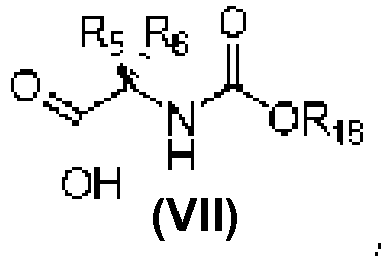
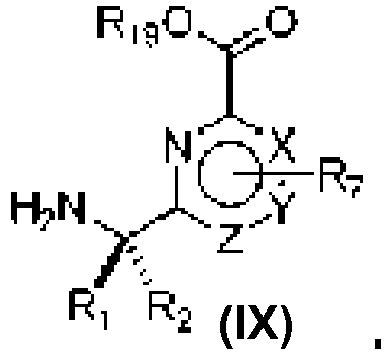
und n, X, Y und Z wie oben definiert sind, um die Verbindung (XA) bereitzustellen

um Amid (XVIII-A) bereitzustellen

- Verfahren nach Anspruch 1, wobei

- Verfahren nach Anspruch 1, wobei
- Verfahren nach Anspruch 1, wobei R5 H ist und R6 aus der Gruppe bestehend aus H, Isopropyl und Methyl ausgewählt ist, gegebenenfalls wobei R5 H ist und R6 Isopropyl ist.
- Verfahren nach Anspruch 1, wobei R12 C(O)C7-Alkyl ist, gegebenenfalls wobei R12 C(O)(CH2)6CH3 ist.
- Verfahren nach Anspruch 1, wobei R3 und R4 Methyl sind.
- Verfahren nach Anspruch 1, wobei die Verbindung der Formel (1) ist

- Verfahren nach Anspruch 1, wobei die Verbindung der Formel (1) ist

- Verfahren nach Anspruch 1, wobei R12 C(O)CR13R14NR13R14 ist.
- Verfahren zum Herstellen einer Verbindung der Formel (2)
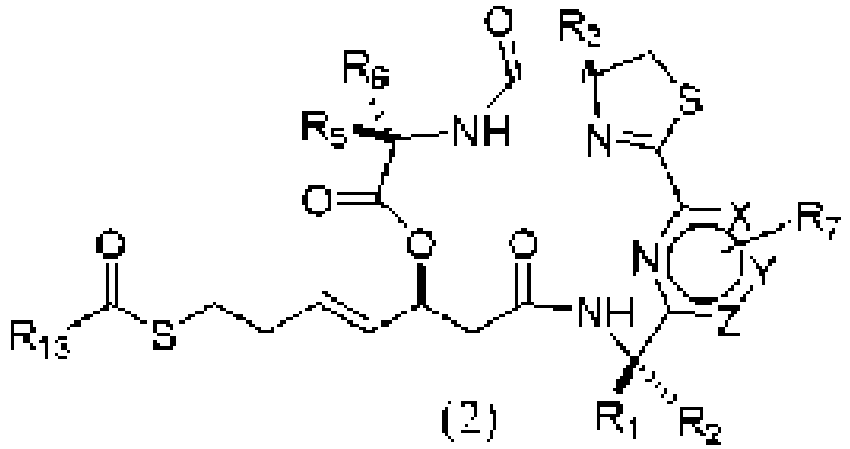 X, Y und Z unabhängig voneinander Kohlenstoff oder Stickstoff sind oder alternativ wobei Y eine direkte Bindung ist und X und Z unabhängig voneinander Kohlenstoff, Stickstoff, Sauerstoff oder Schwefel sind;R1 und R2 unabhängig voneinander aus der Gruppe bestehend aus H, C1- bis C10-Alkyl und C3- bis C7-Cycloalkyl ausgewählt sind, oder R1 und R2 mit dem Kohlenstoffatom, an das R1 und R2 gebunden sind, zusammengenommen werden und ein C3- bis C7-Cycloalkyl oder ein C3- bis C7-Heterocycloalkyl bilden, wobei das C1- bis C10-Alkyl, das C3-bis -C7 -Cycloalkyl und das C3- bis C7-Heterocycloalkyl gegebenenfalls mit einem oder mehreren Substituenten substituiert sind, die aus der Gruppe bestehend aus C1- bis C10-Alkyl, C3- bis C7-Cycloalkyl, C3- C7-Heterocycloalkyl, Aryl, Heteroaryl, Halogen, Hydroxyl,-CN, -COOH, -CF3, -OCH2F, -OCHF2, -OC1- bis C10-Alkyl, O-Aryl, O-Heteroaryl, -NR8R9,-NR8C(O)R9, -NR8C(O)OR9, und- C(O)NR8R9 ausgewählt sind;R3 aus der Gruppe bestehend aus H, C1- bis C10-Alkyl und C3- bis C7-Cycloalkyl ausgewählt ist, wobei das C1- bis C10-Alkyl und das C3- bis C7-Heterocycloalkyl gegebenenfalls mit einem oder mehreren Substituenten substituiert sind, die aus der Gruppe bestehend aus C1- bis C10-Alkyl, C3- bis C7-Cycloalkyl, C3- C7-Heterocycloalkyl, Aryl, Heteroaryl, Halogen, Hydroxyl, -CN, -COOH, -CF3, -OCH2F, OCHF2, -OC1- bis C10-Alkyl, O-Aryl, O-Heteroaryl, -NR8R9, -NR8C(O)R9, -NR8C(O)OR9, und- C(O)NR8R9 ausgewählt sind;R5 und R6 unabhängig voneinander aus der Gruppe bestehend aus H, C1- bis C10-Alkyl und C3- bis C7-Cycloalkyl ausgewählt sind, oder R5 und R6 mit dem Kohlenstoffatom, an das R5 und R6 gebunden sind, zusammengenommen werden und ein C3- bis C7-Cycloalkyl oder ein C3- bis C7-Heterocycloalkyl bilden, wobei das C1- bis C10-Alkyl, das C3-bis -C7 -Cycloalkyl und das C3- bis C7-Heterocycloalkyl gegebenenfalls mit einem oder mehreren Substituenten substituiert sind, die aus der Gruppe bestehend aus C1- bis C10-Alkyl, C3- bis C7-Cycloalkyl, C3- C7-Heterocycloalkyl, Aryl, Heteroaryl, Halogen, Hydroxyl,-CN, -COOH, -CF3, -OCH2F, -OCHF2, -OC1- bis C10-Alkyl, O-Aryl, O-Heteroaryl, -NR8R9,-NR8C(O)R9, -NR8C(O)OR9, und- C(O)NR8R9 ausgewählt sind;R7 unabhängig ausgewählt ist aus der Gruppe bestehend aus H, C1- bis C10-Alkyl, C3- bis C7-Cycloalkyl und C3- bis C7-Heterocycloalkyl, wobei das C1- bis C10-Alkyl, das C3- bis-C7-Cycloalkyl und das C3- bis C7-Heterocycloalkyl gegebenenfalls mit einem oder mehreren Substituenten substituiert sind, die aus der Gruppe ausgewählt sind bestehend aus C1- bis C10-Alkyl, C3- bis C7-Cycloalkyl, C3- C7-Heterocycloalkyl, Aryl, Heteroaryl, Halogen, Hydroxyl, -CN, -COOH, -CF3, -OCH2F, -OCHF2, -OC1- bis C10-Alkyl, O-Aryl, O-Heteroaryl, -NR8R9, -NR8C(O)R9, -NR8C(O)OR9, und- C(O)NR8R9;R8 und R9 unabhängig aus der Gruppe bestehend aus H, C1- bis C10-Alkyl und C3- bis C7-Cycloalkyl ausgewählt sind, wobei das C1- bis C10-Alkyl und das C3- bis -C7 -Cycloalkyl gegebenenfalls mit einem oder mehreren Substituenten substituiert sind, die aus der Gruppe bestehend aus C1- bis C10-Alkyl, C3- bis C7-Cycloalkyl, C3- C7-Heterocycloalkyl, Aryl, Heteroaryl, Halogen, Hydroxyl, -CN, -COOH, -CF3, -OCH2F, -OCHF2, -OC1-C10 alkyl, O-Aryl, O-Heteroaryl, -NR10R11, -NR10C(O)R11, -NR10C(O)OR11 and-C(O)NR10R11ausgewählt sind;R10 und R11 unabhängig voneinander aus der Gruppe bestehend aus H, C1- bis C10-Alkyl und C3- bis C7-Cycloalkyl ausgewählt sind; undR13 aus der Gruppe bestehend aus C1- bis C10-Alkyl, C3- bis C7-Cycloalkyl, C3- bis C7-Heterocycloalkyl, Aryl und Heteroaryl ausgewählt ist, wobei das C1- bis C10-Alkyl, das C3-bis -C7-Cycloalkyl und das C3- bis C7-Heterocycloalkyl gegebenenfalls mit einem oder mehreren Substituenten substituiert sind, die aus der Gruppe bestehend aus C1- bis C10-Alkyl, C3- bis C7-Cycloalkyl, C3- C7-Heterocycloalkyl, Aryl, Heteroaryl, Halogen, Hydroxyl,-CN, -COOH, -CF3, -OCH2F, -OCHF2, -OC1- bis C10-Alkyl, O-Aryl, O-Heteroaryl, -NR10R11 und -NR10C(O)R11 ausgewählt sind, wobei R10 und R11 wie oben definiert sind, umfassend: das Ummwandeln von Aldehyd (IV)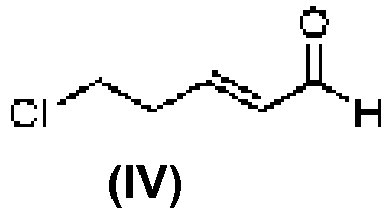


n, R5, R6 und TDx wie oben definiert sind;
durch Umsetzen von Alkohol (VI) mit geschützter Aminosäure (VII)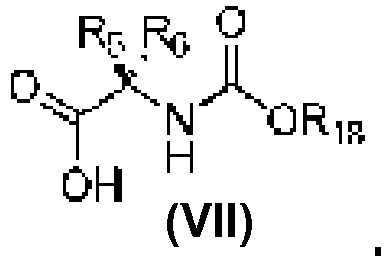


- Verfahren nach Anspruch 10, wobei

- Verfahren nach Anspruch 10, wobei R5 H ist und R6 Isopropyl ist.
- Verfahren nach Anspruch 10, wobei R13 -(CH2)6CH3 ist.
- Verfahren nach Anspruch 10, wobei R1 und R2 H sind.
- Verfahren nach Anspruch 10, wobei die Zusammensetzung der Formel (2) Folgende ist:
Priority Applications (3)
| Application Number | Priority Date | Filing Date | Title |
|---|---|---|---|
| PL19185579T PL3578179T3 (pl) | 2014-05-27 | 2015-05-27 | Sposób wytwarzania cyklicznych depsipeptydów |
| EP19185579.0A EP3578179B1 (de) | 2014-05-27 | 2015-05-27 | Verfahren zur herstellung von cyclischen depsipeptiden |
| DK19185579.0T DK3578179T3 (da) | 2014-05-27 | 2015-05-27 | Process for the preparation of cyclic depsipeptides |
Applications Claiming Priority (2)
| Application Number | Priority Date | Filing Date | Title |
|---|---|---|---|
| US201462003369P | 2014-05-27 | 2014-05-27 | |
| PCT/US2015/032590 WO2015183897A1 (en) | 2014-05-27 | 2015-05-27 | Process for the preparation of cyclic depsipeptides |
Related Child Applications (2)
| Application Number | Title | Priority Date | Filing Date |
|---|---|---|---|
| EP19185579.0A Division EP3578179B1 (de) | 2014-05-27 | 2015-05-27 | Verfahren zur herstellung von cyclischen depsipeptiden |
| EP19185579.0A Division-Into EP3578179B1 (de) | 2014-05-27 | 2015-05-27 | Verfahren zur herstellung von cyclischen depsipeptiden |
Publications (3)
| Publication Number | Publication Date |
|---|---|
| EP3148540A1 EP3148540A1 (de) | 2017-04-05 |
| EP3148540A4 EP3148540A4 (de) | 2018-01-10 |
| EP3148540B1 true EP3148540B1 (de) | 2019-12-25 |
Family
ID=54699686
Family Applications (2)
| Application Number | Title | Priority Date | Filing Date |
|---|---|---|---|
| EP15800006.7A Active EP3148540B1 (de) | 2014-05-27 | 2015-05-27 | Verfahren zur herstellung von cyclischen depsipeptiden |
| EP19185579.0A Active EP3578179B1 (de) | 2014-05-27 | 2015-05-27 | Verfahren zur herstellung von cyclischen depsipeptiden |
Family Applications After (1)
| Application Number | Title | Priority Date | Filing Date |
|---|---|---|---|
| EP19185579.0A Active EP3578179B1 (de) | 2014-05-27 | 2015-05-27 | Verfahren zur herstellung von cyclischen depsipeptiden |
Country Status (13)
| Country | Link |
|---|---|
| US (5) | US10100089B2 (de) |
| EP (2) | EP3148540B1 (de) |
| JP (4) | JP6522120B2 (de) |
| KR (3) | KR102432263B1 (de) |
| CN (2) | CN106456613B (de) |
| CA (1) | CA2950315C (de) |
| DK (1) | DK3578179T3 (de) |
| ES (1) | ES2866104T3 (de) |
| HU (1) | HUE053677T2 (de) |
| PL (1) | PL3578179T3 (de) |
| PT (2) | PT3578179T (de) |
| TW (4) | TWI837833B (de) |
| WO (1) | WO2015183897A1 (de) |
Families Citing this family (6)
| Publication number | Priority date | Publication date | Assignee | Title |
|---|---|---|---|---|
| CN106456613B (zh) * | 2014-05-27 | 2019-07-09 | 恩库勒公司 | 制备环缩肽的方法 |
| US11203602B2 (en) * | 2016-05-20 | 2021-12-21 | Onkure, Inc. | Thioester prodrugs of macrocycles as inhibitors of histone deacetylases |
| CN109134512B (zh) * | 2017-06-16 | 2021-07-02 | 复旦大学 | C-18位氟代的Laragzole类似物、其制备方法和制备抗肿瘤剂的用途 |
| CN109134511B (zh) * | 2017-06-16 | 2021-07-02 | 复旦大学 | C19位氟代的Largazole类似物、其制备方法和用途 |
| US11643438B2 (en) | 2018-07-20 | 2023-05-09 | The Board Of Regents Of The University Of Oklahoma | Antimicrobial peptides and methods of use |
| CA3205814A1 (en) * | 2020-12-21 | 2022-06-30 | Colorado State University Research Foundation | Synthesis of structural analogs of largazole and associated compounds |
Family Cites Families (9)
| Publication number | Priority date | Publication date | Assignee | Title |
|---|---|---|---|---|
| JP2008533053A (ja) * | 2005-03-11 | 2008-08-21 | ザ リージェンツ オブ ザ ユニバーシティ オブ コロラド | ヒストン脱アセチル化酵素阻害剤は、がん細胞を上皮増殖因子受容体阻害剤に対して感受性にする |
| US8759512B2 (en) * | 2008-02-24 | 2014-06-24 | University Of Florida Research Foundation, Inc. | Methods of preparation of macrocyclic compounds |
| US8217076B2 (en) | 2008-07-17 | 2012-07-10 | Colorado State University Research Foundation | Method for preparing largazole analogs and uses thereof |
| CN101781321B (zh) * | 2010-02-08 | 2012-12-26 | 中国科学院广州生物医药与健康研究院 | 拉格唑拉(Largazole)及其类似物的合成方法 |
| PL2575467T3 (pl) * | 2010-05-27 | 2017-10-31 | Univ Colorado Regents | Związki makrocykliczne użyteczne jako inhibitory deacetylaz histonowych |
| CN102391359B (zh) | 2011-11-17 | 2014-07-16 | 南京优科生物医药研究有限公司 | 组蛋白去乙酰化酶抑制剂及其合成方法和制药用途 |
| WO2013148324A1 (en) * | 2012-03-26 | 2013-10-03 | The Regents Of The University Of California | Anti-cancer polyketide compounds |
| CN103232474A (zh) * | 2013-04-16 | 2013-08-07 | 中国药科大学 | 组蛋白去乙酰化酶抑制剂 |
| CN106456613B (zh) * | 2014-05-27 | 2019-07-09 | 恩库勒公司 | 制备环缩肽的方法 |
-
2015
- 2015-05-27 CN CN201580027121.8A patent/CN106456613B/zh active Active
- 2015-05-27 WO PCT/US2015/032590 patent/WO2015183897A1/en not_active Ceased
- 2015-05-27 EP EP15800006.7A patent/EP3148540B1/de active Active
- 2015-05-27 CN CN201910227308.2A patent/CN110156874B/zh active Active
- 2015-05-27 PT PT191855790T patent/PT3578179T/pt unknown
- 2015-05-27 TW TW111135538A patent/TWI837833B/zh active
- 2015-05-27 US US15/313,800 patent/US10100089B2/en active Active
- 2015-05-27 KR KR1020227005999A patent/KR102432263B1/ko active Active
- 2015-05-27 CA CA2950315A patent/CA2950315C/en active Active
- 2015-05-27 JP JP2017514999A patent/JP6522120B2/ja active Active
- 2015-05-27 EP EP19185579.0A patent/EP3578179B1/de active Active
- 2015-05-27 HU HUE19185579A patent/HUE053677T2/hu unknown
- 2015-05-27 PT PT158000067T patent/PT3148540T/pt unknown
- 2015-05-27 TW TW108116572A patent/TWI711627B/zh active
- 2015-05-27 DK DK19185579.0T patent/DK3578179T3/da active
- 2015-05-27 PL PL19185579T patent/PL3578179T3/pl unknown
- 2015-05-27 KR KR1020207014187A patent/KR102368235B1/ko active Active
- 2015-05-27 TW TW104117108A patent/TWI683823B/zh active
- 2015-05-27 TW TW109138257A patent/TWI775203B/zh active
- 2015-05-27 ES ES19185579T patent/ES2866104T3/es active Active
- 2015-05-27 KR KR1020167036444A patent/KR102366527B1/ko active Active
-
2018
- 2018-09-11 US US16/127,399 patent/US10689419B2/en active Active
-
2019
- 2019-03-12 JP JP2019044425A patent/JP6892471B2/ja active Active
-
2020
- 2020-02-04 US US16/781,233 patent/US11053284B2/en active Active
-
2021
- 2021-01-15 JP JP2021004695A patent/JP7033677B2/ja active Active
- 2021-06-07 US US17/340,731 patent/US11739123B2/en active Active
-
2022
- 2022-02-28 JP JP2022029025A patent/JP7269398B2/ja active Active
-
2023
- 2023-07-14 US US18/222,170 patent/US12252511B2/en active Active
Non-Patent Citations (2)
| Title |
|---|
| "Green's Protective Groups in Organic Synthesis", 10 April 2006, JOHN WILEY & SONS, DOI: 10.1002/0470053488 * |
| "Thiols/Mercaptans. Organosulfur Compounds", 2018, SIGMA-ALDRICH, pages: 1 - 10 * |
Also Published As
Similar Documents
| Publication | Publication Date | Title |
|---|---|---|
| US12252511B2 (en) | Process for the preparation of cyclic depsipeptides | |
| EP3250237B1 (de) | Hemiasterlinderivate zur konjugation und therapie | |
| KR20060126703A (ko) | α-아미노산 유도체 및 그 의약 용도 | |
| HK40013091B (en) | Cyclic depsipeptide compounds | |
| HK40013091A (zh) | 环缩肽化合物 | |
| HK1229723A1 (en) | Process for the preparation of cyclic depsipeptides | |
| HK1229723B (en) | Process for the preparation of cyclic depsipeptides | |
| Wang | Synthetic studies on haouamine A and other biologically active heterocycles | |
| JP2025521648A (ja) | 環状ボロン酸エステル及びその使用 |
Legal Events
| Date | Code | Title | Description |
|---|---|---|---|
| STAA | Information on the status of an ep patent application or granted ep patent |
Free format text: STATUS: THE INTERNATIONAL PUBLICATION HAS BEEN MADE |
|
| PUAI | Public reference made under article 153(3) epc to a published international application that has entered the european phase |
Free format text: ORIGINAL CODE: 0009012 |
|
| STAA | Information on the status of an ep patent application or granted ep patent |
Free format text: STATUS: REQUEST FOR EXAMINATION WAS MADE |
|
| 17P | Request for examination filed |
Effective date: 20161219 |
|
| AK | Designated contracting states |
Kind code of ref document: A1 Designated state(s): AL AT BE BG CH CY CZ DE DK EE ES FI FR GB GR HR HU IE IS IT LI LT LU LV MC MK MT NL NO PL PT RO RS SE SI SK SM TR |
|
| AX | Request for extension of the european patent |
Extension state: BA ME |
|
| RIN1 | Information on inventor provided before grant (corrected) |
Inventor name: LIU, HUAYAN Inventor name: LI, ZHIFENG Inventor name: PISCOPIO, ANTHONY D. Inventor name: FU, XIAOYONG Inventor name: SHI, FENG |
|
| DAV | Request for validation of the european patent (deleted) | ||
| DAX | Request for extension of the european patent (deleted) | ||
| A4 | Supplementary search report drawn up and despatched |
Effective date: 20171208 |
|
| RIC1 | Information provided on ipc code assigned before grant |
Ipc: C07D 513/06 20060101ALI20171204BHEP Ipc: A61K 31/429 20060101ALI20171204BHEP Ipc: C07D 498/06 20060101ALI20171204BHEP Ipc: C07D 513/14 20060101ALI20171204BHEP Ipc: A61K 31/425 20060101AFI20171204BHEP Ipc: C07K 11/02 20060101ALI20171204BHEP |
|
| GRAP | Despatch of communication of intention to grant a patent |
Free format text: ORIGINAL CODE: EPIDOSNIGR1 |
|
| STAA | Information on the status of an ep patent application or granted ep patent |
Free format text: STATUS: GRANT OF PATENT IS INTENDED |
|
| RIC1 | Information provided on ipc code assigned before grant |
Ipc: C07D 498/06 20060101ALI20181213BHEP Ipc: A61K 31/425 20060101AFI20181213BHEP Ipc: C07K 11/02 20060101ALI20181213BHEP Ipc: A61K 31/429 20060101ALI20181213BHEP Ipc: C07D 513/14 20060101ALI20181213BHEP Ipc: C07D 513/06 20060101ALI20181213BHEP |
|
| INTG | Intention to grant announced |
Effective date: 20190116 |
|
| GRAJ | Information related to disapproval of communication of intention to grant by the applicant or resumption of examination proceedings by the epo deleted |
Free format text: ORIGINAL CODE: EPIDOSDIGR1 |
|
| GRAP | Despatch of communication of intention to grant a patent |
Free format text: ORIGINAL CODE: EPIDOSNIGR1 |
|
| GRAJ | Information related to disapproval of communication of intention to grant by the applicant or resumption of examination proceedings by the epo deleted |
Free format text: ORIGINAL CODE: EPIDOSDIGR1 |
|
| GRAP | Despatch of communication of intention to grant a patent |
Free format text: ORIGINAL CODE: EPIDOSNIGR1 |
|
| GRAJ | Information related to disapproval of communication of intention to grant by the applicant or resumption of examination proceedings by the epo deleted |
Free format text: ORIGINAL CODE: EPIDOSDIGR1 |
|
| GRAP | Despatch of communication of intention to grant a patent |
Free format text: ORIGINAL CODE: EPIDOSNIGR1 |
|
| INTG | Intention to grant announced |
Effective date: 20190225 |
|
| INTG | Intention to grant announced |
Effective date: 20190307 |
|
| GRAJ | Information related to disapproval of communication of intention to grant by the applicant or resumption of examination proceedings by the epo deleted |
Free format text: ORIGINAL CODE: EPIDOSDIGR1 |
|
| GRAP | Despatch of communication of intention to grant a patent |
Free format text: ORIGINAL CODE: EPIDOSNIGR1 |
|
| INTG | Intention to grant announced |
Effective date: 20190326 |
|
| INTG | Intention to grant announced |
Effective date: 20190424 |
|
| GRAJ | Information related to disapproval of communication of intention to grant by the applicant or resumption of examination proceedings by the epo deleted |
Free format text: ORIGINAL CODE: EPIDOSDIGR1 |
|
| STAA | Information on the status of an ep patent application or granted ep patent |
Free format text: STATUS: REQUEST FOR EXAMINATION WAS MADE |
|
| GRAP | Despatch of communication of intention to grant a patent |
Free format text: ORIGINAL CODE: EPIDOSNIGR1 |
|
| STAA | Information on the status of an ep patent application or granted ep patent |
Free format text: STATUS: GRANT OF PATENT IS INTENDED |
|
| INTC | Intention to grant announced (deleted) | ||
| INTG | Intention to grant announced |
Effective date: 20190802 |
|
| GRAS | Grant fee paid |
Free format text: ORIGINAL CODE: EPIDOSNIGR3 |
|
| GRAA | (expected) grant |
Free format text: ORIGINAL CODE: 0009210 |
|
| STAA | Information on the status of an ep patent application or granted ep patent |
Free format text: STATUS: THE PATENT HAS BEEN GRANTED |
|
| AK | Designated contracting states |
Kind code of ref document: B1 Designated state(s): AL AT BE BG CH CY CZ DE DK EE ES FI FR GB GR HR HU IE IS IT LI LT LU LV MC MK MT NL NO PL PT RO RS SE SI SK SM TR |
|
| REG | Reference to a national code |
Ref country code: GB Ref legal event code: FG4D |
|
| REG | Reference to a national code |
Ref country code: CH Ref legal event code: EP |
|
| REG | Reference to a national code |
Ref country code: AT Ref legal event code: REF Ref document number: 1216383 Country of ref document: AT Kind code of ref document: T Effective date: 20200115 |
|
| REG | Reference to a national code |
Ref country code: IE Ref legal event code: FG4D |
|
| REG | Reference to a national code |
Ref country code: DE Ref legal event code: R096 Ref document number: 602015044368 Country of ref document: DE |
|
| RAP2 | Party data changed (patent owner data changed or rights of a patent transferred) |
Owner name: ONKURE, INC. |
|
| REG | Reference to a national code |
Ref country code: NL Ref legal event code: FP |
|
| REG | Reference to a national code |
Ref country code: PT Ref legal event code: SC4A Ref document number: 3148540 Country of ref document: PT Date of ref document: 20200331 Kind code of ref document: T Free format text: AVAILABILITY OF NATIONAL TRANSLATION Effective date: 20200320 |
|
| PG25 | Lapsed in a contracting state [announced via postgrant information from national office to epo] |
Ref country code: LT Free format text: LAPSE BECAUSE OF FAILURE TO SUBMIT A TRANSLATION OF THE DESCRIPTION OR TO PAY THE FEE WITHIN THE PRESCRIBED TIME-LIMIT Effective date: 20191225 Ref country code: GR Free format text: LAPSE BECAUSE OF FAILURE TO SUBMIT A TRANSLATION OF THE DESCRIPTION OR TO PAY THE FEE WITHIN THE PRESCRIBED TIME-LIMIT Effective date: 20200326 Ref country code: NO Free format text: LAPSE BECAUSE OF FAILURE TO SUBMIT A TRANSLATION OF THE DESCRIPTION OR TO PAY THE FEE WITHIN THE PRESCRIBED TIME-LIMIT Effective date: 20200325 Ref country code: SE Free format text: LAPSE BECAUSE OF FAILURE TO SUBMIT A TRANSLATION OF THE DESCRIPTION OR TO PAY THE FEE WITHIN THE PRESCRIBED TIME-LIMIT Effective date: 20191225 Ref country code: LV Free format text: LAPSE BECAUSE OF FAILURE TO SUBMIT A TRANSLATION OF THE DESCRIPTION OR TO PAY THE FEE WITHIN THE PRESCRIBED TIME-LIMIT Effective date: 20191225 Ref country code: BG Free format text: LAPSE BECAUSE OF FAILURE TO SUBMIT A TRANSLATION OF THE DESCRIPTION OR TO PAY THE FEE WITHIN THE PRESCRIBED TIME-LIMIT Effective date: 20200325 Ref country code: FI Free format text: LAPSE BECAUSE OF FAILURE TO SUBMIT A TRANSLATION OF THE DESCRIPTION OR TO PAY THE FEE WITHIN THE PRESCRIBED TIME-LIMIT Effective date: 20191225 |
|
| REG | Reference to a national code |
Ref country code: LT Ref legal event code: MG4D |
|
| PG25 | Lapsed in a contracting state [announced via postgrant information from national office to epo] |
Ref country code: RS Free format text: LAPSE BECAUSE OF FAILURE TO SUBMIT A TRANSLATION OF THE DESCRIPTION OR TO PAY THE FEE WITHIN THE PRESCRIBED TIME-LIMIT Effective date: 20191225 Ref country code: HR Free format text: LAPSE BECAUSE OF FAILURE TO SUBMIT A TRANSLATION OF THE DESCRIPTION OR TO PAY THE FEE WITHIN THE PRESCRIBED TIME-LIMIT Effective date: 20191225 |
|
| PG25 | Lapsed in a contracting state [announced via postgrant information from national office to epo] |
Ref country code: AL Free format text: LAPSE BECAUSE OF FAILURE TO SUBMIT A TRANSLATION OF THE DESCRIPTION OR TO PAY THE FEE WITHIN THE PRESCRIBED TIME-LIMIT Effective date: 20191225 |
|
| PG25 | Lapsed in a contracting state [announced via postgrant information from national office to epo] |
Ref country code: EE Free format text: LAPSE BECAUSE OF FAILURE TO SUBMIT A TRANSLATION OF THE DESCRIPTION OR TO PAY THE FEE WITHIN THE PRESCRIBED TIME-LIMIT Effective date: 20191225 Ref country code: RO Free format text: LAPSE BECAUSE OF FAILURE TO SUBMIT A TRANSLATION OF THE DESCRIPTION OR TO PAY THE FEE WITHIN THE PRESCRIBED TIME-LIMIT Effective date: 20191225 Ref country code: CZ Free format text: LAPSE BECAUSE OF FAILURE TO SUBMIT A TRANSLATION OF THE DESCRIPTION OR TO PAY THE FEE WITHIN THE PRESCRIBED TIME-LIMIT Effective date: 20191225 |
|
| PG25 | Lapsed in a contracting state [announced via postgrant information from national office to epo] |
Ref country code: IS Free format text: LAPSE BECAUSE OF FAILURE TO SUBMIT A TRANSLATION OF THE DESCRIPTION OR TO PAY THE FEE WITHIN THE PRESCRIBED TIME-LIMIT Effective date: 20200425 Ref country code: SK Free format text: LAPSE BECAUSE OF FAILURE TO SUBMIT A TRANSLATION OF THE DESCRIPTION OR TO PAY THE FEE WITHIN THE PRESCRIBED TIME-LIMIT Effective date: 20191225 Ref country code: SM Free format text: LAPSE BECAUSE OF FAILURE TO SUBMIT A TRANSLATION OF THE DESCRIPTION OR TO PAY THE FEE WITHIN THE PRESCRIBED TIME-LIMIT Effective date: 20191225 |
|
| REG | Reference to a national code |
Ref country code: DE Ref legal event code: R097 Ref document number: 602015044368 Country of ref document: DE |
|
| PG25 | Lapsed in a contracting state [announced via postgrant information from national office to epo] |
Ref country code: DK Free format text: LAPSE BECAUSE OF FAILURE TO SUBMIT A TRANSLATION OF THE DESCRIPTION OR TO PAY THE FEE WITHIN THE PRESCRIBED TIME-LIMIT Effective date: 20191225 Ref country code: ES Free format text: LAPSE BECAUSE OF FAILURE TO SUBMIT A TRANSLATION OF THE DESCRIPTION OR TO PAY THE FEE WITHIN THE PRESCRIBED TIME-LIMIT Effective date: 20191225 |
|
| PLBE | No opposition filed within time limit |
Free format text: ORIGINAL CODE: 0009261 |
|
| STAA | Information on the status of an ep patent application or granted ep patent |
Free format text: STATUS: NO OPPOSITION FILED WITHIN TIME LIMIT |
|
| PG25 | Lapsed in a contracting state [announced via postgrant information from national office to epo] |
Ref country code: SI Free format text: LAPSE BECAUSE OF FAILURE TO SUBMIT A TRANSLATION OF THE DESCRIPTION OR TO PAY THE FEE WITHIN THE PRESCRIBED TIME-LIMIT Effective date: 20191225 |
|
| 26N | No opposition filed |
Effective date: 20200928 |
|
| REG | Reference to a national code |
Ref country code: DE Ref legal event code: R082 Ref document number: 602015044368 Country of ref document: DE Representative=s name: HENKEL & PARTNER MBB PATENTANWALTSKANZLEI, REC, DE Ref country code: DE Ref legal event code: R081 Ref document number: 602015044368 Country of ref document: DE Owner name: ONKURE, INC., BOULDER, US Free format text: FORMER OWNER: ONKURE, INC., LONGMONT, CO, US |
|
| PG25 | Lapsed in a contracting state [announced via postgrant information from national office to epo] |
Ref country code: LI Free format text: LAPSE BECAUSE OF NON-PAYMENT OF DUE FEES Effective date: 20200531 Ref country code: CH Free format text: LAPSE BECAUSE OF NON-PAYMENT OF DUE FEES Effective date: 20200531 Ref country code: MC Free format text: LAPSE BECAUSE OF FAILURE TO SUBMIT A TRANSLATION OF THE DESCRIPTION OR TO PAY THE FEE WITHIN THE PRESCRIBED TIME-LIMIT Effective date: 20191225 |
|
| PG25 | Lapsed in a contracting state [announced via postgrant information from national office to epo] |
Ref country code: PL Free format text: LAPSE BECAUSE OF FAILURE TO SUBMIT A TRANSLATION OF THE DESCRIPTION OR TO PAY THE FEE WITHIN THE PRESCRIBED TIME-LIMIT Effective date: 20191225 |
|
| PG25 | Lapsed in a contracting state [announced via postgrant information from national office to epo] |
Ref country code: LU Free format text: LAPSE BECAUSE OF NON-PAYMENT OF DUE FEES Effective date: 20200527 |
|
| PG25 | Lapsed in a contracting state [announced via postgrant information from national office to epo] |
Ref country code: TR Free format text: LAPSE BECAUSE OF FAILURE TO SUBMIT A TRANSLATION OF THE DESCRIPTION OR TO PAY THE FEE WITHIN THE PRESCRIBED TIME-LIMIT Effective date: 20191225 Ref country code: MT Free format text: LAPSE BECAUSE OF FAILURE TO SUBMIT A TRANSLATION OF THE DESCRIPTION OR TO PAY THE FEE WITHIN THE PRESCRIBED TIME-LIMIT Effective date: 20191225 Ref country code: CY Free format text: LAPSE BECAUSE OF FAILURE TO SUBMIT A TRANSLATION OF THE DESCRIPTION OR TO PAY THE FEE WITHIN THE PRESCRIBED TIME-LIMIT Effective date: 20191225 |
|
| PG25 | Lapsed in a contracting state [announced via postgrant information from national office to epo] |
Ref country code: MK Free format text: LAPSE BECAUSE OF FAILURE TO SUBMIT A TRANSLATION OF THE DESCRIPTION OR TO PAY THE FEE WITHIN THE PRESCRIBED TIME-LIMIT Effective date: 20191225 |
|
| REG | Reference to a national code |
Ref country code: FR Ref legal event code: PLFP Year of fee payment: 9 |
|
| P01 | Opt-out of the competence of the unified patent court (upc) registered |
Effective date: 20230522 |
|
| REG | Reference to a national code |
Ref country code: AT Ref legal event code: UEP Ref document number: 1216383 Country of ref document: AT Kind code of ref document: T Effective date: 20191225 |
|
| PGFP | Annual fee paid to national office [announced via postgrant information from national office to epo] |
Ref country code: IE Payment date: 20250310 Year of fee payment: 11 |
|
| PGFP | Annual fee paid to national office [announced via postgrant information from national office to epo] |
Ref country code: NL Payment date: 20250409 Year of fee payment: 11 |
|
| PGFP | Annual fee paid to national office [announced via postgrant information from national office to epo] |
Ref country code: DE Payment date: 20250402 Year of fee payment: 11 |
|
| PGFP | Annual fee paid to national office [announced via postgrant information from national office to epo] |
Ref country code: GB Payment date: 20250401 Year of fee payment: 11 |
|
| PGFP | Annual fee paid to national office [announced via postgrant information from national office to epo] |
Ref country code: IT Payment date: 20250422 Year of fee payment: 11 Ref country code: BE Payment date: 20250410 Year of fee payment: 11 |
|
| PGFP | Annual fee paid to national office [announced via postgrant information from national office to epo] |
Ref country code: PT Payment date: 20250526 Year of fee payment: 11 |
|
| PGFP | Annual fee paid to national office [announced via postgrant information from national office to epo] |
Ref country code: FR Payment date: 20250401 Year of fee payment: 11 |
|
| PGFP | Annual fee paid to national office [announced via postgrant information from national office to epo] |
Ref country code: AT Payment date: 20250425 Year of fee payment: 11 |