EP3188385A1 - Akustische verarbeitungsvorrichtung und informationsbereitstellungsverfahren - Google Patents
Akustische verarbeitungsvorrichtung und informationsbereitstellungsverfahren Download PDFInfo
- Publication number
- EP3188385A1 EP3188385A1 EP15835023.1A EP15835023A EP3188385A1 EP 3188385 A1 EP3188385 A1 EP 3188385A1 EP 15835023 A EP15835023 A EP 15835023A EP 3188385 A1 EP3188385 A1 EP 3188385A1
- Authority
- EP
- European Patent Office
- Prior art keywords
- sound
- reproduction
- audio
- signal
- identification information
- Prior art date
- Legal status (The legal status is an assumption and is not a legal conclusion. Google has not performed a legal analysis and makes no representation as to the accuracy of the status listed.)
- Withdrawn
Links
Images


Classifications
-
- H—ELECTRICITY
- H04—ELECTRIC COMMUNICATION TECHNIQUE
- H04R—LOUDSPEAKERS, MICROPHONES, GRAMOPHONE PICK-UPS OR LIKE ACOUSTIC ELECTROMECHANICAL TRANSDUCERS; ELECTRIC HEARING AIDS; PUBLIC ADDRESS SYSTEMS
- H04R27/00—Public address systems
-
- H—ELECTRICITY
- H04—ELECTRIC COMMUNICATION TECHNIQUE
- H04B—TRANSMISSION
- H04B11/00—Transmission systems employing ultrasonic, sonic or infrasonic waves
-
- H—ELECTRICITY
- H04—ELECTRIC COMMUNICATION TECHNIQUE
- H04R—LOUDSPEAKERS, MICROPHONES, GRAMOPHONE PICK-UPS OR LIKE ACOUSTIC ELECTROMECHANICAL TRANSDUCERS; ELECTRIC HEARING AIDS; PUBLIC ADDRESS SYSTEMS
- H04R3/00—Circuits for transducers
- H04R3/04—Circuits for transducers for correcting frequency response
-
- H—ELECTRICITY
- H04—ELECTRIC COMMUNICATION TECHNIQUE
- H04R—LOUDSPEAKERS, MICROPHONES, GRAMOPHONE PICK-UPS OR LIKE ACOUSTIC ELECTROMECHANICAL TRANSDUCERS; ELECTRIC HEARING AIDS; PUBLIC ADDRESS SYSTEMS
- H04R3/00—Circuits for transducers
- H04R3/12—Circuits for transducers for distributing signals to two or more loudspeakers
Definitions
- the present invention relates to a technique for processing audio signals.
- announcement systems used in buses provide passengers with guidance information by way of voice guidance on, for example, bus stops, bus fares, and the like, which guidance voice is played at an appropriate timing, for example at each of bus stops, upon operation of an operator, with such voice guidance being pre-prepared for each of bus routes.
- Patent Document 1 discloses a configuration in which information such as names of bus stops is announced to passengers through the generation of voice signals that correspond to voice data based on operations such as an input operation into a device installed in a bus carriage.
- Patent Document 2 discloses a configuration for the creation of voice data corresponding to a guidance voice whereby, supposing that a content of voice guidance is a sentence such as "the next stop is [name of a bus stop]", names of bus stops are created by utilizing low-compression coding, while common words such as "next", "is”, and the like are created by utilizing high-compression coding.
- audio communication A technique by which information is distributed to terminal devices using transmission of sound waves (hereinafter, "audio communication") is practiced in the art.
- audio communication information is distributed to and received by terminal devices upon emission of a sound that represents an audio signal in which information for distribution is contained within a high and inaudible frequency range, for example, from18 kHz to 20 kHz.
- a sound that represents an audio signal in which information for distribution is contained within a high and inaudible frequency range, for example, from18 kHz to 20 kHz.
- application of audio communication to the voice guidance systems exemplified in Patent Documents 1 and 2 is assumed. It is common for external environment noise, such as engine noise, and vibration noise to intrude into the interior of a bus.
- an object of the present invention is to provide appropriate audio communication in an environment in which certain frequency bands are suppressed.
- an audio processing device includes: information extraction means that extracts identification information from a first audio signal in a first frequency band in which audio signal there are included an audio component of a sound for reproduction and an audio component including the piece of identification information of the sound for reproduction; and second audio signal generation means that generates a second audio signal that includes the identification information extracted by the information extraction means, and is in a second frequency band, which frequency band is higher than the first frequency band, and wherein a sound represented by the second audio signal is emitted by sound emission means.
- an audio component of the sound for reproduction for example, guidance voice for provision to a user
- an audio component including the identification information of the sound for reproduction are each included in the first audio signal in the first frequency band, while the identification information extracted from the first audio signal is included in the second audio signal in the second frequency band.
- the second frequency band is, for example, in a high range of between 16 kHz and 20 kHz, and more preferably, within a range of between 18 kHz and 20 kHz.
- Examples of a "sound for reproduction" include sound of guidance information for provision to users of a public facility or a public transportation service, as in, for example, respectively, facility information on opening and closing hours, or information on transfer locations, fares, and so forth.
- the audio processing device includes: sound receiving means that receives a sound represented by a reproduction signal in which there are included the audio component of the sound for reproduction and the audio component that includes the identification information of the sound for reproduction, for generation of the first audio signal; and sound emission means that emits a sound represented by the second audio signal generated by the second audio signal generation means.
- sound receiving means that receives a sound represented by a reproduction signal in which there are included the audio component of the sound for reproduction and the audio component that includes the identification information of the sound for reproduction, for generation of the first audio signal
- sound emission means that emits a sound represented by the second audio signal generated by the second audio signal generation means.
- a length of time over which the sound represented by the second audio signal is emitted by the sound emission means is longer than a length of time over which the audio component including the identification information of the sound for reproduction within the reproduction signal is emitted. In this way, it is possible to ensure that sufficient opportunity exists for the terminal device at the receiving side to receive the identification information contained in the second audio signal.
- the first frequency band for example, is set to be within an audible range, while the second frequency band is set to be within a range higher than the first frequency band, namely, a frequency band that is barely audible to a user.
- a length of time over which the sound represented by the second audio signal in the second frequency band is emitted is set to be longer than a length of time over which the audio component including the identification information within the reproduction signal of the first frequency band is emitted.
- the identification information emitted via audio communication in which the sound in the second frequency band is utilized and which is barely audible to the user is transmitted for comparatively longer period of time.
- a period in which the sound represented by the second audio signal is emitted by the sound emission means and a period in which the audio component of the sound for reproduction within the reproduction signal is emitted may overlap.
- the audio component including the identification information is emitted in parallel to the emission of the corresponding sound for reproduction, it is possible for the terminal device of the user to acquire, closer to real-time, information corresponding to the notified identification information, as compared, for example, to a configuration in which the identification information is notified after playback of the sound for reproduction is complete.
- a reproduction signal is supplied, as the first audio signal, from a reproduction processing device to the information extraction means via a signal line, the reproduction processing device generating the reproduction signal that includes the audio component of the sound for reproduction and the audio component that includes the identification information of the sound for reproduction.
- the audio processing device since the audio processing device generates the second audio signal that includes the identification information extracted from the first audio signal in which the second frequency band is suppressed, it is possible to appropriately transmit the identification information without any need to change the existing system.
- the reproduction signal is supplied as an audio signal to the information extraction means via the signal line, it is not necessary to install a sound receiving device in the audio processing device. Accordingly, an advantage is realized in that configuration of devices can be simplified, in contrast to a set-up in which a sound receiving device is provided.
- the audio processing device includes: information extraction means that extracts identification information from a first audio signal that includes an audio component of a sound for reproduction and an audio component that includes the identification information of the sound for reproduction; transmission signal generation means that generates a transmission signal that includes the identification information extracted by the information extraction means; and transmission means that transmits an electromagnetic wave indicative of the transmission signal generated by the transmission signal generation means.
- Examples of communication using electromagnetic waves include Wi-Fi (registered trademark), Bluetooth (registered trademark), and infrared communication. According to the above embodiment, it is possible to distribute information by use of a variety of different transmission media, and thus it is possible to appropriately transmit the identification information even in an environment in which a particular frequency band is suppressed.
- the audio processing device may include sound receiving means that receives a sound represented by a reproduction signal that includes the audio component of the sound for reproduction and the audio component that includes the identification information of the sound for reproduction, for generation of the first audio signal.
- the reproduction signal may be supplied as the first audio signal from a reproduction processing device that generates the reproduction signal to the information extraction means via a signal line.
- the configuration in which the first audio signal is supplied to the information extraction method via a signal line it is not necessary to install a sound receiving device in the audio processing device, and thus it is possible to simplify the configuration of the devices as compared to a set-up in which a sound receiving device is installed.
- the sound receiving means preferably is provided close to the sound emission device that emits the sound represented by the reproduction signal. According to this configuration, since the sound receiving device is provided close to the sound emission device that emits the sound represented by the reproduction signal, interference caused by noise can be avoided.
- the present invention may also be characterized as a program that causes a computer to execute the different functional elements that the audio processing device according to each of the abovementioned embodiments includes, and a computer-readable recording medium in which the program is installed.
- a first aspect of the program of the present invention causes a computer to execute information extraction processing for extracting identification information from a first audio signal in a first frequency band in which audio signal there are included an audio component of a sound for reproduction and an audio component that includes the identification information of the sound for reproduction; and a second audio signal generation processing for generating a second audio signal that includes the identification information extracted in the information extraction processing, and is in a second frequency band, which frequency band is higher than the first frequency band, wherein a sound represented by the second audio signal is emitted by sound emission means.
- a second aspect of the program of the present invention causes a computer to execute information extraction processing for extracting identification information from a first audio signal that includes an audio component of a sound for reproduction and an audio component that includes the identification information of the sound for reproduction; transmission signal generation processing for generating a transmission signal that includes the identification information extracted in the information extraction processing; and transmission processing for transmitting an electromagnetic wave indicative of the transmission signal generated in the transmission signal generation processing.
- an information providing method in which there is utilized the audio processing device according to each of the abovementioned embodiments.
- an information providing method extracts identification information from a first audio signal in a first frequency band in which audio signal there are included an audio component of a sound for reproduction and an audio component that includes the identification information of the sound for reproduction; generates a second audio signal that is a signal including the identification information and that is in a second frequency band, which frequency band is higher than the first frequency band; and emits a sound represented by the second audio signal.
- the information providing method extracts identification information from a first audio signal that includes the audio component of a sound for reproduction and the audio component that includes the identification information of the sound for reproduction; generates a transmission signal that includes the identification information; and transmits an electromagnetic wave indicative of the transmission signal.
- the information providing method, the program, and the computer-readable recording medium with the program installed therein each of which may be realized according to one or other of the above preferred embodiments, realizes substantially the same effects as those realized by an information management system according to the abovementioned embodiments.
- the information providing method emits the audio component of the sound for reproduction after the emission of the audio component that includes the identification information of the sound for reproduction, and a period in which the sound represented by the second audio signal is emitted and a period in which the audio component of the sound for reproduction overlap.
- the voice guidance system 1 provides passengers of a public bus with voice guidance by way of guidance voice (sound for reproduction) that represent guidance information, for example, guidance on bus stops, fares, or on tourist sites, or a surrounding area, and so forth.
- guidance voice sound for reproduction
- FIG. 1 is a diagram showing a configuration of the voice guidance system 1 of the first embodiment.
- the voice guidance system 1 includes a reproduction system 100, an audio processing device 200, and a terminal device 300.
- the reproduction system 100 and the audio processing device 200 are installed inside a carriage C of a public bus service.
- the reproduction system 100 emits inside the carriage C, along with a guidance voice, a sound in a frequency band B 1 that includes identification information that corresponds to one of a multiplicity of guidance voices, each of which are different.
- a passenger of the carriage C (hereinafter, the user) hears the guidance voice.
- the audio processing device 200 extracts the identification information from the sound that the reproduction system 100 emits, so as to emit a sound in a frequency band B 2 that includes the identification information.
- the frequency band B 1 and the frequency B 2 are different from each other.
- the audio processing device 200 is a signal processing device that converts a frequency band of an audio that includes identification information to another frequency band that includes the same identification information.
- the terminal device 300 is a portable communication terminal that a user in the carriage C carries with him/her (e.g., a mobile phone/ smartphone), and the terminal device 300 extracts identification information of a guidance voice from a sound emitted by the audio processing device 200 and receives, via a communication network 400, for example, a mobile communication network or the Internet, from a guidance information server 500 guidance information that corresponds to the identification information.
- Guidance information relates to guidance provided by guidance voice.
- any of the following may be provided to the terminal device 300 as guidance information, for reproduction, to be emitted, or displayed: characters and/or still or moving images indicative of information on user guides, such as facilities, fares, and so forth; travel guide, such as stops, transfer locations, and so forth; and tourist information for local areas close to the guided location, such as tourist facilities, accommodation, area guides such as for historic sites, and so forth; characters that represent guidance voice, for example, characters to which a hearing-impaired person may refer so as to visually check guidance information; and/or sounds and/or characters obtained by translating the guidance information provided through the guidance voice into a foreign language. Details of the different elements of the voice guidance system 1 will now be described below.
- the reproduction system 100 includes an operator 110, a reproduction processing device 120, and a sound emission device 130.
- the operator 110 is an input device that receives instructions from the driver O P of a public transportation bus. Each time the carriage C approaches a given stop, the driver O P initiates playback of a guidance voice relating to the stop by operating the operator 110.
- the reproduction processing device 120 generates an audio signal (hereinafter, the "reproduction signal") A 2 that represents a sound obtained by synthesizing the guidance voice that the driver Op has initiated the playback of by operating the operator 110, from among multiple different guidance voices, and a sound that includes identification information of the guidance voice.
- the sound emission device 130 (e.g., speakers) emits a sound that represents the reproduction signal A 2 generated by the reproduction processing device 120.
- a single sound emission device 130 is shown, but in reality, multiple sound emission devices 130 are installed in the carriage C, and the reproduction signals A 2 are supplied in parallel thereto from the reproduction processing device 120.
- FIG. 2 is a block diagram showing a configuration of the reproduction system 100.
- the reproduction processing device 120 of the first embodiment includes a controller 102, a signal synthesizer 104, a storage device 106, and a filter 108, as FIG. 2 shows.
- the storage device 106 consists of a publically known recording medium, such as, for example, a semiconductor recording medium or a magnetic recording medium, and stores, for every location (stop) at which the carriage C stops, an audio signal (hereinafter referred to as a "target signal") A G (A G1 , A G2 , ...) that indicates a guidance voice related to one such location, as well as identification information D (D 1 , D 2 , ...) of guidance information that relates to the location.
- the target signal A G and the identification information D are not necessarily stored in the storage device 106 of the reproduction processing device 120.
- the reproduction processing device 120 may instead receive the target signal A G and the identification information D from an external device (a server device) by communicating with the external device.
- Stops include not only stops that exist along the route of a public bus but also places that serve as transfer locations (for example, public transportation stations, airports, or any given location on a public roadway).
- the identification information D is a unique code that is used to identify the guidance information, and it is set for each location at which the bus carriage C stops (bus stop). For example, a sequence of random numbers generated by a publically known method is set as the identification information D for all guidance information so that identification information D does not overlap.
- the controller 102 of FIG. 2 in accordance with the playback instruction that the operator 110 has accepted from the driver O P as the carriage C approaches a stop, reads from the storage device 106 the target signal A G and the identification information D that correspond to the stop and supplies the signal synthesizer 104 with the target signal A G and the identification information D.
- the signal synthesizer 104 generates a reproduction signal A1 by synthesizing the identification information D with the target signal A G .
- Any publically known method may be used for synthesizing the identification information D with the target signal A G , but one preferable method is that disclosed in WO 2010/016589 .
- FIG. 3 is a block diagram showing a configuration of the signal synthesizer 104.
- the signal synthesizer 104 includes a modulation processor 1042 and a synthesis processor 1044.
- the modulation processor 1042 generates an audio signal (hereinafter, the "modulation signal") A D that includes identification information D as an audio component in a particular frequency band by sequentially carrying out spread modulation of the identification information D using a spread code, and frequency conversion using a carrier wave in a predetermined frequency.
- the modulation processor 1042 synthesizes a notification sound with the modulation signal A D .
- the notification sound included in the modulation signal A D is a natural sound that attracts the attention of passengers in the carriage C (e.g., a sound for guidance, such as "dingdong").
- the frequency band of the modulation signal A D is one in which the emission of a sound by the sound emission device 130 and the reception of a sound by the audio processing device 200 are possible, and the frequency band is included within the frequency band range of sounds of voices or music that a user is exposed to in an ordinary environment, for example, equal to or less than approximately 16 kHz, which is within an audible range.
- the synthesis processor 1044 generates a reproduction signal A 1 by synthesizing (typically by adding) the target signal A G supplied from the controller 102 and the modulation signal A D generated by the modulation processor 1042.
- the method by which the modulation processor 1042 generates the modulation signal A D is not limited to the above example (spread modulation).
- the filter 108 of FIG. 2 is a low-path filter (LPF) that generates a reproduction signal A 2 by suppressing the frequency components in the higher end of the reproduction signal A 1 .
- FIG. 4 is a characteristic diagram of the filter 108 of the first embodiment.
- the filter 108 suppresses the components in the higher-end frequency band, for example, between 18 kHz and 20 kHz, of the reproduction signal A 1 while maintaining the components in the lower-end frequency band B 1 , for example, equal to or less than approximately 16 kHz, which is within an audible range, and which corresponds to the guidance voice.
- the frequency band B 1 is a frequency band in which the emission of a sound by the sound emission device 130 and the reception of a sound by the audio processing device 200 are possible, and this frequency band is included in the frequency band range of sounds of voices or music that the user is exposed to in an ordinary environment (for example, equal to or less than approximately 16 kHz, which is within an audible range).
- a frequency band b of a modulation signal A D including the identification information D is included in a pass band (frequency band B 1 ) of the filter 108.
- the frequency band B 1 of the target signal A G and the modulation signal A D are set to a band that passes the filter 108.
- the frequency band B 1 is not limited to the above example, and may be a low band equal to or less than 4 kHz or 6 kHz.
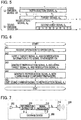
- a section (a) in FIG. 5 is a diagram illustrative of the relationship between the length of time over which a sound of the reproduction signal A 2 is emitted and the length of time of a sound indicated by the modulation signal A D (hereinafter "notification sound") and a sound of the target signal A G (guidance voice) that are contained in the reproduction signal A 2 .
- the sound of the reproduction signal A 2 is emitted over a time length T1.
- the modulation signal A D that includes identification information D extends over a time length T D from the start of the reproduction signal A 2 , and is contained in the time length T1 over which the sound of the reproduction signal A 2 is emitted.
- the guidance voice that the target signal A G indicates is emitted over a time length T G starting immediately after the emission of the modulation signal A D ends.
- the duration of emission of the sound indicated by the modulation signal A D (time length T D ) and the duration of emission of the sound indicated by the target signal A G (time length T G ) do not overlap.
- the time length T D over which the modulation signal A D is played is set to a sufficiently shorter time, for example, one to two seconds, compared to the time length T G of the guidance voice.
- FIG. 6 is a flowchart showing a flow of the overall operation of the reproduction processing device 120 of the present embodiment.
- the controller 102 reads from the storage device 106 the target signal A G of a guidance voice corresponding to the location in turn corresponding to the playback instruction, as well as the identification information D, and supplies the target signal A G and the identification information D to the signal synthesizer 104 (SA 2 ).
- the signal synthesizer 104 generates the reproduction signal A 1 by synthesizing the target signal A G of the guidance voice, which is an audio component of the guidance voice, supplied from the controller 102, and the modulation signal A D that includes the identification information D, which is an audio component that includes the identification information D of the guidance voice, supplied from the controller 102 (SA3).
- the filter 108 generates the reproduction signal A 2 by extracting the frequency band B 1 from the reproduction signal A 1 generated by the signal synthesizer 104 (SA4).
- the sound emission device 130 emits a sound indicated by the reproduction signal A 2 that has undergone processing carried out by the filter 108 (SA5).
- FIG. 7 is a block diagram showing a configuration of the audio processing device 200.
- the audio processing device 200 of the first embodiment is an audio device that is installed close to the sound emission device 130 of the reproduction system 100, for example, on a surface of a speaker net, and furthermore as shown in FIG. 7 , the audio processing device 200 includes a sound receiving device 202, an information extractor 206, a storage device 208, a signal processor 210, and a sound emission device 214.
- the sound receiving device 202 generates a first audio signal S 1 by receiving a sound of the reproduction signal A 2 emitted from the sound emission device 130 of the reproduction system 100.
- the first audio signal S 1 contains, in the frequency band B 1, an audio component of the modulation signal A D that includes identification information D (notification sound) and an audio component of the guidance voice.
- the reproduction signal A 2 is less likely to be influenced by noise since the audio processing device 200 is provided close to the sound emission device 130. In other words, the audio processing device 200 is provided at a position that minimizes noise when the sound receiving device 202 receives a sound of the reproduction signal A 2 .
- the information extractor 206 and the signal processor 210 of FIG. 7 are realized by a computer processing unit (Central Processing Unit: CPU) carrying out a program stored in the storage device 208.
- the information extractor 206 extracts the identification information D by demodulating the first audio signal S 1 generated by the sound receiving device 202. More specifically, the information extractor 206 extracts the identification information D by selecting, by way of, for example, a band pass filter, a band component of a frequency band b that includes the identification information D within the first audio signal S 1 and allowing the selected band component to pass a matched filter that has, as a coefficient, a spread code used in the spread modulation of the identification information D.
- a computer processing unit Central Processing Unit: CPU
- the audio processing device 200 since the audio processing device 200 is provided close to the sound emission device 130, it is possible to extract the identification information D with high accuracy even when the time length T D of the notification sound is set to a substantially shorter time compared to the time length T G of the guidance voice.
- the identification information D extracted by the information extractor 206 is stored in the storage device (memory) 208.
- the identification information D is notified by the reproduction system 100 to the audio processing device 200 in the form of audio communication that uses, as a transmission medium, a sound, namely a sound wave propagated through air in the form of vibrations.
- the information extractor 206 and all or part of the function of the signal processor may also be realized by use of specific electric circuitry.
- the signal processor (second audio signal generator) 210 generates a second audio signal (modulation signal) S 2 , which includes the identification information D as an audio component of the higher-end frequency band B 2 , by reading from the storage device 208 the identification information D extracted by the information extractor 206, and sequentially carrying out spread modulation of the identification information D using the spread code and frequency conversion using a carrier wave in a particular frequency.
- the sound emission device 214 emits a sound indicated by the second audio signal S 2 generated by the signal processor 210.
- FIG. 7 for convenience of explanation, an A/D converter that converts the reproduction signal A 2 from analog to digital format and a D/A converter that converts the second audio signal S 2 from digital to analog format are not shown.
- the frequency band B 2 of the second audio signal S 2 differs from the frequency band B 1 of the first audio signal S 1 .
- the frequency band B 2 of the second audio signal S 2 is higher than the frequency band B 1 of the first audio signal S 1 .
- the frequency band B 2 is a frequency in which emission of a sound by the sound emission device 214 and reception of a sound by the terminal device 300 are possible, and this frequency band is included within a frequency band of, for example, between 18 kHz and 20 kHz, which is higher than a frequency band of vocal or musical sounds to which a user is exposed in an ordinary environment, such as a frequency band that is equal to or less than approximately 16 kHz, which is in an audible range.
- the reproduced sound of the second audio signal S 2 that includes the identification information D is barely perceivable to the user of the terminal device 300.
- the second audio signal S 2 that includes the identification information D as an audio component of the frequency band B 2 , and which differs from the frequency band B 1 of the reproduction signal A 2 , even in a case that the reproduction system 100 (filter 108) is configured to suppress the frequency band B 2 so as to emphasize the frequency band B 1 of the guidance voice, it is still possible to notify different terminal devices 300 of the identification information D by audio communication by using the frequency band B 2 .
- the audio processing device 200 it is possible for the audio processing device 200 to appropriately transmit the identification information D via audio communication without any need to change the reproduction system 100, which is a conventional system that emits a sound indicated by the reproduction signal A 2 in which the frequency band B 2 is suppressed.
- Section (b) of FIG. 5 is a diagram illustrative of the second audio signal S 2 .
- the signal processor 210 of the first embodiment generates the second audio signal S 2 to which the identification information D is added in a repetitive manner in differing sections along the time axis.
- the sound that the second audio signal S 2 represents is emitted continuously over a time length T 2 from the time the information extractor 206 extracts the identification information D from the sound emitted from the sound emission device 130.
- the identification information D is notified to each terminal device 300 via audio communication in a repetitive manner over the time length T 2 .
- the time length T 2 over which the sound emission device 214 of the audio processing device 200 emits a sound indicated by the second audio signal S 2 is longer than the time length T D over which the sound emission device 130 of the reproduction system 100 emits the notification sound of the modulated signal A D . If the notification sound within the audible range that includes the identification information D is emitted over a protracted period of time, there is a possibility that the user will perceive incongruity or discomfort.
- the signal processor 210 of the audio processing device 200 transmits the identification information D via audio communication by use of a sound in the frequency band B 2 , which is barely perceivable by the user, it is possible to notify each terminal device 300 of the identification information D without the user perceiving incongruity or discomfort.
- the audio processing device 200 transmits (emits) the identification information D in a repetitive manner over the time length T 2 , which exceeds the time length T D , even if it is not possible to extract some of the identification information D of the second audio signal S 2 , for example, due to interference of mixed noise components, the terminal device 300 can re-acquire the identification information D of other sections.
- a possible configuration may be one in which the period (time length T 2 ) over which the sound of the second audio signal S 2 is emitted and the period (time length T G ) over which the sound (guidance voice) of the target signal A G is emitted overlap each other.
- the two periods it is possible to configure the two periods to at least partially overlap each other.
- the terminal device 300 can acquire guidance information that corresponds to the notified identification information D more in real-time as compared to, for example, a configuration in which the identification information D is notified after the playback of the guidance voice ends.
- This is of a great advantage, especially in public transportation services, such as public buses, for which the target locations for guidance are continually changing.
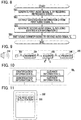
- FIG. 8 is a flowchart showing the flow of the overall operation of the audio processing device 200.
- the processing of FIG. 8 is initiated, triggered by the sound emission device 130 emitting a reproduced sound of the reproduction signal A 2 that contains the modulation signal A D including the identification information D and the target signal A G .
- the sound receiving device 202 generates the first audio signal S 1 by receiving the reproduced sound emitted from the sound emission device 130 (SB1).
- the information extractor 206 extracts the identification information D from the first audio signal S 1 (SB2).
- the signal processor 210 generates the second audio signal S 2 that is a signal including the identification information D and that is in the frequency band B 2 which is higher than the frequency band B 1 (SB3).
- the sound emission device 214 emits a sound (sound wave) indicated by the second audio signal S 2 (SB4).
- FIG. 9 is a block diagram showing a configuration of the terminal device 300.
- the terminal device 300 includes a sound receiving device 302, an identifier 304, an acquirer 306, and a presenter 308.
- the sound receiving device 302 is an audio device (microphone) that receives surrounding sounds, and it receives a sound emitted from the sound emission device 214 of the audio processing device 200 and generates an audio signal (hereinafter, the "received sound") X that indicates a time waveform of the sound.
- the received signal X includes audio components of the identification information D.
- an A/D converter that converts the received signal X generated by the sound receiving device 302 from analog to digital format is omitted from the figure.
- the identifier 304 extracts the identification information D of the guidance voice by demodulating the received signal X generated by the sound receiving device 302. More specifically, the identifier 304 extracts the identification information D by emphasizing within the received signal X the band component of the frequency band B 2 including the identification information D, for example, by use of a high pass filter, and letting the band component pass a matched filter that uses, as a coefficient, the spread code used in spread modulation of the identification information D.
- the acquirer 306 is a communication device that communicates with the guidance information server 500 via the communication network 400 (refer to FIG. 1 ).
- the communication scheme for deployment between the terminal device 300 and the guidance information server 500 may be freely selected, but typically, radio communication, for example, information communication that uses radio waves and infrared rays as a transmission medium, is employed that differs from the audio communication used for the audio processing device 200 to notify the terminal device 300 of the identification information D.
- the acquirer 306 transmits to the guidance information server 500 an information request R that includes the identification information D extracted from the received signal X by the identifier 304.
- the acquirer 306 receives the guidance information G transmitted from the guidance information server 500 responsive to the information request R.
- the guidance information server 500 possesses a guidance information table TB 1 shown in FIG. 10 .
- the guidance information table TB 1 correlates identification information D (D 1 , D 2 ...) with guidance information G (G 1 , G 2 ).
- the guidance information server 500 when it receives the information request R including the identification information D from the terminal device 300, reads guidance information G in the guidance information table TB 1 that corresponds to the identification information D in the information request R, and transmits to the terminal device 300, which is the transmitter of the information request R, the guidance information G.
- the presenter 308 of FIG. 9 presents to the user the guidance information G acquired by the acquirer 306, for example, by causing the guidance information G to be displayed on a display device.
- FIG. 11 is a diagram explaining an example display of the guidance information G by the presenter 308.
- the guidance information G is presented on the presenter 308 of the terminal device 300 as characters indicating the spoken content of the guidance voice.
- the user can visually recognize the guidance information G (guidance on the next stop in the example shown in the figure) that is presented on the presenter 308.
- the user can hear the guidance voice emitted from the sound emission device 130 of the reproduction system 100 and also can read, i.e., recognize by sight the guidance information G presented on the presenter 308.
- a hearing-impaired person a person with hearing disability
- the audio processing device 200 includes the sound receiving device 202 and the sound emission device 214. While it receives, using the sound receiving device 202, the reproduction signal A 2 emitted from the sound emission device 130 of the reproduction system 100, it emits, using the sound emission device 214, the second audio signal S 2 including the identification information D extracted from the first audio signal S 1 .
- the audio processing device 200 it is possible to notify a terminal device 300 of the identification information D via audio communication that uses the frequency band B 2 by disposing the audio processing device 200 close to the reproduction processing device 120, without changing the reproduction system 100 to include a module (signal processor 210) that converts an audio component including the identification information D within the reproduction signal A 2 from the frequency band B 1 to the frequency band B 2 .
- the filter 108 of the reproduction system 100 suppresses the frequency band B 2 in the higher range.
- the cause of the frequency band B 2 being suppressed in a sound emitted from the sound emission device 130 is not limited to this processing by the filter 108.
- it is still possible to suppress in the frequency band B 2 the sound emitted from the sound emission device 130 if, for example, the sound emission device 130 is acoustically characterized in that it has difficulty emitting a sound in a high frequency sound range that includes the frequency band B 2 .
- the frequency band B 2 it is also possible to use a sound emission device that is capable of emitting the frequency band B 2 , although realistically, not all existing devices on carriages C of a public bus service, and the like can be readily upgraded. It is also possible for the frequency band B 2 to be suppressed if a sampling frequency of the target signal A G is too low to include the frequency band B 2 as a target for reproduction. Regardless of how the frequency band B 2 is suppressed, employing the audio processing device of the first embodiment will still enable the transmission of the identification information D via audio communication by using the frequency band B 2 .
- the sound represented by the second audio signal S 2 is played over the time length T 2 that is longer than the time length T D over which the sound of the modulated signal A D is emitted. If the notification sound that includes the identification information D is overly long as compared to, for example, the guidance voice, there is a possibility that the user will perceive auditory incongruity or discomfort.
- the time length T D over which the notification sound including the identification information D is emitted is configured to be shorter than the time length T 2 of the second audio signal S 2 , and thus, it is possible to reduce the number of cases in which the user will perceive auditory unnaturalness or discomfort.
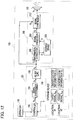
- FIG. 12 is a block diagram indicating a configuration of a reproduction system 100 of the second embodiment.
- the audio processing device 200 is arranged close to the sound emission device 130 of the reproduction system 100.
- the audio processing device 200 is arranged on a signal line between the reproduction processing device 120 and the sound emission device 130 within the reproduction system 100.
- a reproduction signal A 2 is supplied as the first audio signal S 1 via the signal line, from the reproduction processing device 120 that generates the reproduction signal A 2 including the target signal A G (audio component of the guidance voice) and the modulation signal A D (audio component including identification information D of the guidance voice).
- the audio processing device 200 of the second embodiment is configured with the sound receiving device 202 and the sound emission device 214 of the first embodiment omitted.
- the audio processing device 200 of the second embodiment includes a signal synthesizer 212 that generates a reproduction signal A 3 by synthesizing (e.g., by addition) the reproduction signal A 2 emitted from the reproduction processing device 120 and the second audio signal S 2 .
- the first audio signal S 1 that has the frequency band B 2 suppressed by the filter 108 of the reproduction processing device 120 is supplied to the information extractor 206 of the audio processing device 200.
- the information extractor 206 of the audio processing device 200 extracts the identification information D from the first audio signal S 1 (corresponding to the reproduction signal A Z of the first embodiment) in substantially the same way as in the first embodiment.
- the signal processor 210 generates, in substantially the same way as in the first embodiment, the second audio signal S 2 that includes, as an audio component in the frequency band B 2 in the higher range, the identification information D extracted by the information extractor 206.
- the second audio signal S 2 in the frequency band B 2 generated by the signal processor 210 is synthesized with the reproduction signal A 2 by the signal synthesizer 212, and is then emitted from the sound emission device 130.
- the sound emission device 130 may be understood as a sound emission means for emitting a sound represented by the reproduction signal A 3 obtained by synthesizing the reproduction signal A 2 with the second audio signal S 2 .
- the terminal device 300 obtains the guidance information G by extracting the identification information D from a sound played by the sound emission device 130.
- the above configuration has an advantage over the first embodiment in that it enables the configuration of devices to be simplified, since it is not necessary for the audio processing device 200 to include the sound receiving device 202 and the sound emission device 214. Furthermore, whereas in the first embodiment, it is necessary to ensure that the volume of the modulated signal A D is sufficiently high for the notification sound emitted from the reproduction system 100 to be accurately received by the audio processing device 200, in the second embodiment, it is possible to minimize the volume of the modulation signal A D as compared to the first embodiment since the reproduction processing device 120 and the audio processing device 200 are connected by wire.
- the notification sound represented by the modulated signal A D has to be an acoustically natural sound because it is actually emitted
- the necessary level of the volume of the modulated signal A D is reduced as described above, and thus the notification sound does not have to be an acoustically natural sound.
- the above configuration can also be configured to include the sound emission device 214 of the audio processing device instead of the sound emission device 130 of the reproduction system 100.
- the reproduction system 100 may use the sound emission device 130, the audio processing device 200, and the sound emission device 214.
- the reproduction system 100 emits from the sound emission device 130 the reproduction signal A 2 that is emitted from the reproduction processing system 120.
- the audio processing device 200 extracts, using the information extractor 206, identification information D from the reproduction signal A 2 supplied by wire from the reproduction processing device 120 and outputs, from the sound emission device 214, the second audio signal S 2 generated by the signal processor 210 and that includes the identification information D.
- the device configuration is simplified since it is not necessary to carry out processing by the signal synthesizer 212 (synthesizing the second audio signal S 2 and the reproduction signal A 2 ).
- the audio processing device 200 of the first embodiment transmits to the terminal device 300 the identification information D via audio communication that uses a sound as a transmission medium.
- the communication scheme through which the identification information D is notified to the terminal device 300 is not limited thereto.
- the audio processing device 200 of the third embodiment notifies the terminal device 300 of the identification information D by radio communication (e.g., near field communication) by use of electromagnetic waves, such as infrared rays or radio waves.
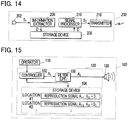
- FIG. 14 is a block diagram showing a configuration of an audio processing device 200 of the third embodiment.
- the sound emission device 214 of the first embodiment is replaced by a transmitter 216.
- the signal processor (transmission signal generator) 210 generates a transmission signal that includes identification information D extracted by the information extractor 206.
- the transmitter 216 is a communication device that transmits an electromagnetic wave that indicates the transmission signal generated by the signal processor 210.
- the identifier 304 of the terminal device 300 extracts the identification information D included in the received signal received from the audio processing device 200 and transmits to the guidance information server 500 the information request R including the identification information D, and then receives by return guidance information G. Substantially same effects as those of the first embodiment can be obtained by the above configuration.
- the third embodiment it is possible to employ a configuration in which the audio processing device 200 of the third embodiment does not include the sound receiving device 202 and in which a reproduction signal A 2 from the reproduction processing device 120 is supplied as a first audio signal S 1 to the audio processing device 200 via a signal line. According to this embodiment, it is possible to minimize the magnitude of a volume of the modulated signal A D compared to the above embodiment in which the reproduction signal A 2 (and eventually the first audio signal S 1 ) is acquired by the sound receiving device 202, since the reproduction processing device 120 and the audio processing device 200 are connected by wire. In addition, according to this embodiment, a required volume level of the modulated signal A D is reduced, and thus the modulated signal A D need not be an acoustically natural sound.
- the terminal device 300 is required to be provided with a reception device that receives radio waves or infrared rays that are transmitted from the transmitter 216.
- the first embodiment and the second embodiment have an advantage in that, because the identification information D is notified to the terminal device 300 via audio communication, the sound receiving device 302, which is used for voice calls and video recording, can also be used to receive the identification information D, and thus, there is no need for exclusive reception equipment to be adapted for use in the communication scheme of the transmitter 216.
Landscapes
- Engineering & Computer Science (AREA)
- Signal Processing (AREA)
- Physics & Mathematics (AREA)
- Acoustics & Sound (AREA)
- Computer Networks & Wireless Communication (AREA)
- Health & Medical Sciences (AREA)
- General Health & Medical Sciences (AREA)
- Otolaryngology (AREA)
- Telephonic Communication Services (AREA)
- Circuit For Audible Band Transducer (AREA)
- Navigation (AREA)
- Circuits Of Receivers In General (AREA)
Priority Applications (1)
| Application Number | Priority Date | Filing Date | Title |
|---|---|---|---|
| EP17205390.2A EP3319247A1 (de) | 2014-08-26 | 2015-08-20 | Audioverarbeitungsvorrichtung und verfahren zum bereitstellen von informationen |
Applications Claiming Priority (2)
| Application Number | Priority Date | Filing Date | Title |
|---|---|---|---|
| JP2014171320A JP6484958B2 (ja) | 2014-08-26 | 2014-08-26 | 音響処理装置、音響処理方法およびプログラム |
| PCT/JP2015/073400 WO2016031673A1 (ja) | 2014-08-26 | 2015-08-20 | 音響処理装置および情報提供方法 |
Related Child Applications (2)
| Application Number | Title | Priority Date | Filing Date |
|---|---|---|---|
| EP17205390.2A Division EP3319247A1 (de) | 2014-08-26 | 2015-08-20 | Audioverarbeitungsvorrichtung und verfahren zum bereitstellen von informationen |
| EP17205390.2A Division-Into EP3319247A1 (de) | 2014-08-26 | 2015-08-20 | Audioverarbeitungsvorrichtung und verfahren zum bereitstellen von informationen |
Publications (2)
| Publication Number | Publication Date |
|---|---|
| EP3188385A1 true EP3188385A1 (de) | 2017-07-05 |
| EP3188385A4 EP3188385A4 (de) | 2018-05-02 |
Family
ID=55399567
Family Applications (2)
| Application Number | Title | Priority Date | Filing Date |
|---|---|---|---|
| EP15835023.1A Withdrawn EP3188385A4 (de) | 2014-08-26 | 2015-08-20 | Akustische verarbeitungsvorrichtung und informationsbereitstellungsverfahren |
| EP17205390.2A Withdrawn EP3319247A1 (de) | 2014-08-26 | 2015-08-20 | Audioverarbeitungsvorrichtung und verfahren zum bereitstellen von informationen |
Family Applications After (1)
| Application Number | Title | Priority Date | Filing Date |
|---|---|---|---|
| EP17205390.2A Withdrawn EP3319247A1 (de) | 2014-08-26 | 2015-08-20 | Audioverarbeitungsvorrichtung und verfahren zum bereitstellen von informationen |
Country Status (7)
| Country | Link |
|---|---|
| US (2) | US10433083B2 (de) |
| EP (2) | EP3188385A4 (de) |
| JP (1) | JP6484958B2 (de) |
| KR (1) | KR101768838B1 (de) |
| CN (2) | CN108260055B (de) |
| AU (1) | AU2015310052B2 (de) |
| WO (1) | WO2016031673A1 (de) |
Families Citing this family (13)
| Publication number | Priority date | Publication date | Assignee | Title |
|---|---|---|---|---|
| JP5887446B1 (ja) | 2014-07-29 | 2016-03-16 | ヤマハ株式会社 | 情報管理システム、情報管理方法およびプログラム |
| JP5871088B1 (ja) | 2014-07-29 | 2016-03-01 | ヤマハ株式会社 | 端末装置、情報提供システム、情報提供方法およびプログラム |
| WO2016051534A1 (ja) * | 2014-09-30 | 2016-04-07 | 株式会社Six | 音響システム、通信機器及びプログラム |
| JP6780305B2 (ja) * | 2016-06-06 | 2020-11-04 | ヤマハ株式会社 | 情報処理装置および情報提供方法 |
| CN107888296A (zh) * | 2016-09-30 | 2018-04-06 | 通用电气公司 | 利用管道结构的通信系统和方法 |
| JP6961986B2 (ja) * | 2017-04-07 | 2021-11-05 | 富士通オプティカルコンポーネンツ株式会社 | 光送信機、及び光伝送方法 |
| US10034029B1 (en) * | 2017-04-25 | 2018-07-24 | Sprint Communications Company L.P. | Systems and methods for audio object delivery based on audible frequency analysis |
| CN108206976B (zh) * | 2018-01-12 | 2020-06-23 | 和君纵达数据科技有限公司 | 选择性播放声音信号的方法和用户终端 |
| US10322671B1 (en) * | 2018-05-02 | 2019-06-18 | GM Global Technology Operations LLC | System and application for auditory guidance and signaling |
| JP7272131B2 (ja) * | 2019-06-20 | 2023-05-12 | トヨタ自動車株式会社 | 車両用報知音発生システム |
| WO2021099760A1 (en) * | 2019-11-21 | 2021-05-27 | Cirrus Logic International Semiconductor Limited | Detection of live speech |
| US12067077B2 (en) * | 2021-11-10 | 2024-08-20 | GM Global Technology Operations LLC | Vehicle detection and identification through audio propagation |
| WO2025254196A1 (ja) * | 2024-06-06 | 2025-12-11 | 国立大学法人 鹿児島大学 | 送信装置、受信装置、通信システム、送信方法、および受信方法 |
Family Cites Families (79)
| Publication number | Priority date | Publication date | Assignee | Title |
|---|---|---|---|---|
| US3263207A (en) * | 1964-03-27 | 1966-07-26 | Herbert L West | Transistor underwater telephone system |
| JPS61116400A (ja) | 1984-11-12 | 1986-06-03 | シャープ株式会社 | 音声情報処理装置 |
| JPH0355999Y2 (de) | 1984-12-30 | 1991-12-13 | ||
| JP2539507B2 (ja) | 1989-01-20 | 1996-10-02 | 株式会社日立製作所 | 案内情報再生装置及びそれを用いた案内システム |
| JPH088855A (ja) | 1994-06-07 | 1996-01-12 | Neptune:Kk | 輸送機用案内放送装置 |
| JPH0879199A (ja) | 1994-09-02 | 1996-03-22 | Sony Corp | 文字情報提供システム |
| US5615301A (en) | 1994-09-28 | 1997-03-25 | Rivers; W. L. | Automated language translation system |
| JP3558239B2 (ja) | 1995-06-30 | 2004-08-25 | 株式会社リコー | 情報配信システム |
| JPH10174190A (ja) | 1996-12-16 | 1998-06-26 | Matsushita Electric Ind Co Ltd | 音響再生装置 |
| JPH1115827A (ja) | 1997-06-19 | 1999-01-22 | Fujitsu Ltd | 翻訳装置および記録媒体 |
| JPH11115827A (ja) | 1997-10-13 | 1999-04-27 | Nissan Diesel Motor Co Ltd | キャブティルトストッパ装置 |
| JPH11252121A (ja) | 1998-03-05 | 1999-09-17 | Ntt Data Corp | 位置依存情報提供システム |
| JP3348831B2 (ja) | 1998-05-11 | 2002-11-20 | 日本電信電話株式会社 | 文字併用音声通信システム、通信サーバ装置、及び通信表示装置 |
| JP2000207170A (ja) | 1999-01-14 | 2000-07-28 | Sony Corp | 情報処理装置および情報処理方法 |
| WO2000076154A1 (en) | 1999-06-02 | 2000-12-14 | Fujitsu Limited | Virtual communication space constructing system corresponding to real world sensing information |
| GB9917985D0 (en) | 1999-07-30 | 1999-09-29 | Scient Generics Ltd | Acoustic communication system |
| DE69933663D1 (de) * | 1999-08-03 | 2006-11-30 | Eta Sa Mft Horlogere Suisse | Elektronischer Wandler eines akustischen Signals in ein pseudo-digitales Signal und bidirektionelles Kommunikationsverfahren durch Schallwellen |
| US6546365B1 (en) | 2000-02-04 | 2003-04-08 | International Business Machines Corporation | System for national language support and automated translation table |
| US20010055391A1 (en) * | 2000-04-27 | 2001-12-27 | Jacobs Paul E. | System and method for extracting, decoding, and utilizing hidden data embedded in audio signals |
| JP3747759B2 (ja) | 2000-09-20 | 2006-02-22 | 日本ビクター株式会社 | 情報配信システム |
| JP2002217839A (ja) * | 2001-01-12 | 2002-08-02 | Nec Corp | 弾性波による通信システム |
| JP4657471B2 (ja) | 2001-03-05 | 2011-03-23 | 泉陽興業株式会社 | 観覧施設案内システム |
| US20040220995A1 (en) * | 2001-04-23 | 2004-11-04 | Takehiko Tsutsumi | Method, program, and apparatus for delegating information processing |
| US6542200B1 (en) | 2001-08-14 | 2003-04-01 | Cheldan Technologies, Inc. | Television/radio speech-to-text translating processor |
| JP2003186500A (ja) | 2001-12-17 | 2003-07-04 | Sony Corp | 情報伝達システム、情報符号化装置および情報復号装置 |
| US7460684B2 (en) | 2003-06-13 | 2008-12-02 | Nielsen Media Research, Inc. | Method and apparatus for embedding watermarks |
| JP2006251676A (ja) | 2005-03-14 | 2006-09-21 | Akira Nishimura | 振幅変調を用いた音響信号への電子透かしデータの埋め込み・検出装置 |
| JP3822224B1 (ja) | 2005-06-28 | 2006-09-13 | 株式会社フィールドシステム | 情報提供システム |
| JP4899416B2 (ja) | 2005-10-27 | 2012-03-21 | 大日本印刷株式会社 | ネットワーク接続装置 |
| JP4343896B2 (ja) | 2005-12-02 | 2009-10-14 | ソニー株式会社 | 再生端末装置及び出力方法 |
| US20070135135A1 (en) | 2005-12-09 | 2007-06-14 | Kenneth Brown | Electronic equipment with content management function and program for providing same |
| JP2007164659A (ja) | 2005-12-16 | 2007-06-28 | Absurd Spear:Kk | 音楽情報を利用した情報配信システム及び情報配信方法 |
| WO2007086860A1 (en) | 2006-01-27 | 2007-08-02 | Thomson Licensing | Closed-captioning system and method |
| US7822606B2 (en) | 2006-07-14 | 2010-10-26 | Qualcomm Incorporated | Method and apparatus for generating audio information from received synthesis information |
| CN101115124B (zh) | 2006-07-26 | 2012-04-18 | 日电(中国)有限公司 | 基于音频水印识别媒体节目的方法和装置 |
| EP1902906B1 (de) | 2006-09-22 | 2017-07-26 | Harman Becker Automotive Systems GmbH | Hinzufügbares Modul zum externen Steuern eines Sprachdialogsystems |
| JP4024285B1 (ja) | 2007-01-11 | 2007-12-19 | 有 小山 | 警報表示システム |
| JP2008299032A (ja) | 2007-05-31 | 2008-12-11 | Akira Nishimura | 語学教材および文字データ再生装置 |
| US8428275B2 (en) * | 2007-06-22 | 2013-04-23 | Sanyo Electric Co., Ltd. | Wind noise reduction device |
| US8676273B1 (en) | 2007-08-24 | 2014-03-18 | Iwao Fujisaki | Communication device |
| JP2009180893A (ja) | 2008-01-30 | 2009-08-13 | Dainippon Printing Co Ltd | 音響信号で制御されるコンテンツ再生装置 |
| JP2009205485A (ja) * | 2008-02-28 | 2009-09-10 | Fujitsu Fsas Inc | 乗降車通知方法及び乗降車通知システム |
| GB2460306B (en) | 2008-05-29 | 2013-02-13 | Intrasonics Sarl | Data embedding system |
| JP2010011282A (ja) * | 2008-06-30 | 2010-01-14 | Yamaha Corp | 変調装置、復調装置、情報伝達システム、変調方法および復調方法 |
| US8942388B2 (en) | 2008-08-08 | 2015-01-27 | Yamaha Corporation | Modulation device and demodulation device |
| JP5343758B2 (ja) | 2008-08-21 | 2013-11-13 | ヤマハ株式会社 | 音声再生装置 |
| EP2230596A1 (de) | 2009-02-27 | 2010-09-22 | Research In Motion Limited | Verfahren und Vorrichtung zur Verwendung bei der selektiven Wiederherstellung und Anzeige von Benutzeroberflächeninformationen einer drahtlosen Peripherievorrichtung |
| JP2010284423A (ja) | 2009-06-15 | 2010-12-24 | Toshiba Corp | 医用画像診断装置及び医用画像撮影方法 |
| JP2011109629A (ja) | 2009-11-17 | 2011-06-02 | Toru Tsurubuchi | 自動再生音声ガイドシステム |
| US8989883B2 (en) | 2010-03-25 | 2015-03-24 | Verisign, Inc. | Systems and methods for providing access to resources through enhanced audio signals |
| WO2011149558A2 (en) | 2010-05-28 | 2011-12-01 | Abelow Daniel H | Reality alternate |
| JP2011255982A (ja) | 2010-06-07 | 2011-12-22 | Hitachi Ltd | エレベーターの情報通知装置 |
| US9143881B2 (en) | 2010-10-25 | 2015-09-22 | At&T Intellectual Property I, L.P. | Providing interactive services to enhance information presentation experiences using wireless technologies |
| US9002717B2 (en) | 2010-12-03 | 2015-04-07 | At&T Intellectual Property I, L.P. | Method and apparatus for audio communication of information |
| US20120214416A1 (en) | 2011-02-23 | 2012-08-23 | Jonathan Douglas Kent | Methods and apparatuses for communication between devices |
| US9754045B2 (en) | 2011-04-01 | 2017-09-05 | Harman International (China) Holdings Co., Ltd. | System and method for web text content aggregation and presentation |
| KR101563951B1 (ko) | 2011-04-05 | 2015-10-28 | 야마하 가부시키가이샤 | 정보 제공 시스템, 식별 정보 해결 서버, 및 휴대 단말 장치 |
| JP2013005377A (ja) * | 2011-06-21 | 2013-01-07 | Yamaha Corp | 携帯端末装置および情報提供システム |
| JP2013008109A (ja) | 2011-06-22 | 2013-01-10 | Yamaha Corp | 文書投稿支援システム、携帯端末装置および文書投稿支援プログラム |
| JP5454544B2 (ja) | 2011-10-12 | 2014-03-26 | 富士ゼロックス株式会社 | 画像処理装置、情報提供システム及びプログラム |
| US9053096B2 (en) | 2011-12-01 | 2015-06-09 | Elwha Llc | Language translation based on speaker-related information |
| JP2013117688A (ja) | 2011-12-05 | 2013-06-13 | Sony Corp | 音響処理装置、音響処理方法、プログラム、記録媒体、サーバ装置、音響再生装置および音響処理システム |
| JP2013125047A (ja) | 2011-12-13 | 2013-06-24 | Zenrin Datacom Co Ltd | 情報提供システム、使用言語種別提供端末装置、情報提供装置、情報提供方法、使用言語種別提供プログラムおよび情報提供プログラム |
| JP5429826B2 (ja) * | 2011-12-28 | 2014-02-26 | 株式会社スポットライト | 超音波通信システム及びビーコン |
| JP6167542B2 (ja) | 2012-02-07 | 2017-07-26 | ヤマハ株式会社 | 電子装置及びプログラム |
| US20130336497A1 (en) * | 2012-04-04 | 2013-12-19 | Clinkle Corporation | Dynamic sonic signal intensity adjustment |
| CN103490826A (zh) * | 2012-06-12 | 2014-01-01 | 上海君戈网络科技有限公司 | 一种基于音频的信息交换系统及其交换方法 |
| CN103714028B (zh) * | 2012-09-29 | 2016-12-21 | 联想(北京)有限公司 | 信息处理的方法及电子设备 |
| US9305559B2 (en) | 2012-10-15 | 2016-04-05 | Digimarc Corporation | Audio watermark encoding with reversing polarity and pairwise embedding |
| CN203136168U (zh) | 2012-12-17 | 2013-08-14 | 北京天安信通科技有限责任公司 | 一种基于超声波或声波进行用户识别的无线移动通信终端 |
| CN103077165A (zh) | 2012-12-31 | 2013-05-01 | 威盛电子股份有限公司 | 自然语言对话方法及其系统 |
| JP2014138324A (ja) | 2013-01-17 | 2014-07-28 | Casio Comput Co Ltd | 情報提供システム、サーバシステム、端末装置、情報提供方法及びプログラム |
| CN103944645B (zh) * | 2013-01-18 | 2016-09-14 | 国民技术股份有限公司 | 一种音频通信方法及音频终端 |
| JP6255946B2 (ja) | 2013-02-21 | 2018-01-10 | ヤマハ株式会社 | 復調装置、音響伝送システム、プログラム及び復調方法 |
| KR101288305B1 (ko) * | 2013-05-02 | 2013-08-01 | (주)아이스플럽 | 차량에서의 자동 안내 방송 장치를 활용한 위치 정보 제공 시스템, 모바일 기기, 및 프로그램을 기록한 컴퓨터로 판독 가능한 기록 매체 |
| US20150149146A1 (en) | 2013-11-22 | 2015-05-28 | Jay Abramovitz | Systems for delivery of audio signals to mobile devices |
| US20150347399A1 (en) | 2014-05-27 | 2015-12-03 | Microsoft Technology Licensing, Llc | In-Call Translation |
| JP5871088B1 (ja) | 2014-07-29 | 2016-03-01 | ヤマハ株式会社 | 端末装置、情報提供システム、情報提供方法およびプログラム |
| JP5887446B1 (ja) | 2014-07-29 | 2016-03-16 | ヤマハ株式会社 | 情報管理システム、情報管理方法およびプログラム |
-
2014
- 2014-08-26 JP JP2014171320A patent/JP6484958B2/ja active Active
-
2015
- 2015-08-20 WO PCT/JP2015/073400 patent/WO2016031673A1/ja not_active Ceased
- 2015-08-20 CN CN201810035593.3A patent/CN108260055B/zh active Active
- 2015-08-20 US US15/503,500 patent/US10433083B2/en active Active
- 2015-08-20 EP EP15835023.1A patent/EP3188385A4/de not_active Withdrawn
- 2015-08-20 AU AU2015310052A patent/AU2015310052B2/en not_active Ceased
- 2015-08-20 CN CN201580045711.3A patent/CN106797257B/zh active Active
- 2015-08-20 KR KR1020177007837A patent/KR101768838B1/ko active Active
- 2015-08-20 EP EP17205390.2A patent/EP3319247A1/de not_active Withdrawn
-
2017
- 2017-12-04 US US15/830,367 patent/US10542360B2/en active Active
Also Published As
| Publication number | Publication date |
|---|---|
| CN108260055A (zh) | 2018-07-06 |
| AU2015310052A1 (en) | 2017-03-16 |
| CN108260055B (zh) | 2021-02-09 |
| US10433083B2 (en) | 2019-10-01 |
| EP3319247A1 (de) | 2018-05-09 |
| JP6484958B2 (ja) | 2019-03-20 |
| US20180098164A1 (en) | 2018-04-05 |
| KR20170042787A (ko) | 2017-04-19 |
| CN106797257A (zh) | 2017-05-31 |
| CN106797257B (zh) | 2021-02-09 |
| US10542360B2 (en) | 2020-01-21 |
| AU2015310052B2 (en) | 2017-05-04 |
| JP2016046753A (ja) | 2016-04-04 |
| WO2016031673A1 (ja) | 2016-03-03 |
| EP3188385A4 (de) | 2018-05-02 |
| KR101768838B1 (ko) | 2017-08-16 |
| US20170245069A1 (en) | 2017-08-24 |
Similar Documents
| Publication | Publication Date | Title |
|---|---|---|
| US10542360B2 (en) | Reproduction system, terminal device, method thereof, and non-transitory storage medium, for providing information | |
| EP3176782B1 (de) | Vorrichtung und verfahren zur ausgabe erhaltener verwandter informationen | |
| EP3176783B1 (de) | Informationsverwaltungssystem und informationsverwaltungsverfahren | |
| JP6033927B1 (ja) | 情報提供システムおよび情報提供方法 | |
| JP2016153906A (ja) | 端末装置 | |
| JP6729494B2 (ja) | 情報管理システムおよび情報管理方法 | |
| JP6231244B1 (ja) | 再生システム、端末装置、情報提供方法、端末装置の動作方法およびプログラム | |
| US20170255615A1 (en) | Information transmission device, information transmission method, guide system, and communication system | |
| EP3410305A1 (de) | Informationsverarbeitungsvorrichtung, informationsverarbeitungsverfahren, informationsverwaltungsvorrichtung und informationsverwaltungsverfahren | |
| JP2018125646A (ja) | 情報提供方法および情報送信装置 | |
| JP6825642B2 (ja) | 音響処理システムおよび音響処理方法 | |
| JP6596144B2 (ja) | 情報提供方法、音響処理装置およびプログラム | |
| JP6447695B2 (ja) | 再生システムおよび情報提供方法 | |
| US11250704B2 (en) | Information provision device, terminal device, information provision system, and information provision method | |
| JP6780529B2 (ja) | 情報提供装置および情報提供システム | |
| JP2017016163A (ja) | 管理装置 | |
| JP2018088088A (ja) | 情報処理システムおよび端末装置 |
Legal Events
| Date | Code | Title | Description |
|---|---|---|---|
| STAA | Information on the status of an ep patent application or granted ep patent |
Free format text: STATUS: THE INTERNATIONAL PUBLICATION HAS BEEN MADE |
|
| PUAI | Public reference made under article 153(3) epc to a published international application that has entered the european phase |
Free format text: ORIGINAL CODE: 0009012 |
|
| STAA | Information on the status of an ep patent application or granted ep patent |
Free format text: STATUS: REQUEST FOR EXAMINATION WAS MADE |
|
| 17P | Request for examination filed |
Effective date: 20170306 |
|
| AK | Designated contracting states |
Kind code of ref document: A1 Designated state(s): AL AT BE BG CH CY CZ DE DK EE ES FI FR GB GR HR HU IE IS IT LI LT LU LV MC MK MT NL NO PL PT RO RS SE SI SK SM TR |
|
| AX | Request for extension of the european patent |
Extension state: BA ME |
|
| DAV | Request for validation of the european patent (deleted) | ||
| DAX | Request for extension of the european patent (deleted) | ||
| A4 | Supplementary search report drawn up and despatched |
Effective date: 20180405 |
|
| RIC1 | Information provided on ipc code assigned before grant |
Ipc: H04R 3/04 20060101ALI20180323BHEP Ipc: H04R 3/12 20060101ALI20180323BHEP Ipc: H04B 11/00 20060101AFI20180323BHEP Ipc: H04R 27/00 20060101ALI20180323BHEP |
|
| STAA | Information on the status of an ep patent application or granted ep patent |
Free format text: STATUS: EXAMINATION IS IN PROGRESS |
|
| 17Q | First examination report despatched |
Effective date: 20201117 |
|
| STAA | Information on the status of an ep patent application or granted ep patent |
Free format text: STATUS: THE APPLICATION IS DEEMED TO BE WITHDRAWN |
|
| 18D | Application deemed to be withdrawn |
Effective date: 20240301 |