EP3194231B1 - Procédé, dispositif, système de programme d'ordinateur et produit de programme d'ordinateur pour afficher des facteurs d'influence de tronçons de parcours sur un véhicule - Google Patents
Procédé, dispositif, système de programme d'ordinateur et produit de programme d'ordinateur pour afficher des facteurs d'influence de tronçons de parcours sur un véhicule Download PDFInfo
- Publication number
- EP3194231B1 EP3194231B1 EP15756863.5A EP15756863A EP3194231B1 EP 3194231 B1 EP3194231 B1 EP 3194231B1 EP 15756863 A EP15756863 A EP 15756863A EP 3194231 B1 EP3194231 B1 EP 3194231B1
- Authority
- EP
- European Patent Office
- Prior art keywords
- vehicle
- route section
- driving route
- determined
- parameters
- Prior art date
- Legal status (The legal status is an assumption and is not a legal conclusion. Google has not performed a legal analysis and makes no representation as to the accuracy of the status listed.)
- Active
Links
Images
Classifications
-
- B—PERFORMING OPERATIONS; TRANSPORTING
- B60—VEHICLES IN GENERAL
- B60K—ARRANGEMENT OR MOUNTING OF PROPULSION UNITS OR OF TRANSMISSIONS IN VEHICLES; ARRANGEMENT OR MOUNTING OF PLURAL DIVERSE PRIME-MOVERS IN VEHICLES; AUXILIARY DRIVES FOR VEHICLES; INSTRUMENTATION OR DASHBOARDS FOR VEHICLES; ARRANGEMENTS IN CONNECTION WITH COOLING, AIR INTAKE, GAS EXHAUST OR FUEL SUPPLY OF PROPULSION UNITS IN VEHICLES
- B60K35/00—Instruments specially adapted for vehicles; Arrangement of instruments in or on vehicles
- B60K35/10—Input arrangements, i.e. from user to vehicle, associated with vehicle functions or specially adapted therefor
-
- B—PERFORMING OPERATIONS; TRANSPORTING
- B60—VEHICLES IN GENERAL
- B60K—ARRANGEMENT OR MOUNTING OF PROPULSION UNITS OR OF TRANSMISSIONS IN VEHICLES; ARRANGEMENT OR MOUNTING OF PLURAL DIVERSE PRIME-MOVERS IN VEHICLES; AUXILIARY DRIVES FOR VEHICLES; INSTRUMENTATION OR DASHBOARDS FOR VEHICLES; ARRANGEMENTS IN CONNECTION WITH COOLING, AIR INTAKE, GAS EXHAUST OR FUEL SUPPLY OF PROPULSION UNITS IN VEHICLES
- B60K35/00—Instruments specially adapted for vehicles; Arrangement of instruments in or on vehicles
- B60K35/20—Output arrangements, i.e. from vehicle to user, associated with vehicle functions or specially adapted therefor
- B60K35/28—Output arrangements, i.e. from vehicle to user, associated with vehicle functions or specially adapted therefor characterised by the type of the output information, e.g. video entertainment or vehicle dynamics information; characterised by the purpose of the output information, e.g. for attracting the attention of the driver
-
- B—PERFORMING OPERATIONS; TRANSPORTING
- B60—VEHICLES IN GENERAL
- B60W—CONJOINT CONTROL OF VEHICLE SUB-UNITS OF DIFFERENT TYPE OR DIFFERENT FUNCTION; CONTROL SYSTEMS SPECIALLY ADAPTED FOR HYBRID VEHICLES; ROAD VEHICLE DRIVE CONTROL SYSTEMS FOR PURPOSES NOT RELATED TO THE CONTROL OF A PARTICULAR SUB-UNIT
- B60W10/00—Conjoint control of vehicle sub-units of different type or different function
- B60W10/22—Conjoint control of vehicle sub-units of different type or different function including control of suspension systems
-
- B—PERFORMING OPERATIONS; TRANSPORTING
- B60—VEHICLES IN GENERAL
- B60W—CONJOINT CONTROL OF VEHICLE SUB-UNITS OF DIFFERENT TYPE OR DIFFERENT FUNCTION; CONTROL SYSTEMS SPECIALLY ADAPTED FOR HYBRID VEHICLES; ROAD VEHICLE DRIVE CONTROL SYSTEMS FOR PURPOSES NOT RELATED TO THE CONTROL OF A PARTICULAR SUB-UNIT
- B60W50/00—Details of control systems for road vehicle drive control not related to the control of a particular sub-unit, e.g. process diagnostic or vehicle driver interfaces
- B60W50/0097—Predicting future conditions
-
- B—PERFORMING OPERATIONS; TRANSPORTING
- B60—VEHICLES IN GENERAL
- B60W—CONJOINT CONTROL OF VEHICLE SUB-UNITS OF DIFFERENT TYPE OR DIFFERENT FUNCTION; CONTROL SYSTEMS SPECIALLY ADAPTED FOR HYBRID VEHICLES; ROAD VEHICLE DRIVE CONTROL SYSTEMS FOR PURPOSES NOT RELATED TO THE CONTROL OF A PARTICULAR SUB-UNIT
- B60W50/00—Details of control systems for road vehicle drive control not related to the control of a particular sub-unit, e.g. process diagnostic or vehicle driver interfaces
- B60W50/08—Interaction between the driver and the control system
- B60W50/14—Means for informing the driver, warning the driver or prompting a driver intervention
-
- G—PHYSICS
- G01—MEASURING; TESTING
- G01C—MEASURING DISTANCES, LEVELS OR BEARINGS; SURVEYING; NAVIGATION; GYROSCOPIC INSTRUMENTS; PHOTOGRAMMETRY OR VIDEOGRAMMETRY
- G01C21/00—Navigation; Navigational instruments not provided for in groups G01C1/00 - G01C19/00
- G01C21/26—Navigation; Navigational instruments not provided for in groups G01C1/00 - G01C19/00 specially adapted for navigation in a road network
- G01C21/34—Route searching; Route guidance
- G01C21/36—Input/output arrangements for on-board computers
- G01C21/3697—Output of additional, non-guidance related information, e.g. low fuel level
-
- B—PERFORMING OPERATIONS; TRANSPORTING
- B60—VEHICLES IN GENERAL
- B60K—ARRANGEMENT OR MOUNTING OF PROPULSION UNITS OR OF TRANSMISSIONS IN VEHICLES; ARRANGEMENT OR MOUNTING OF PLURAL DIVERSE PRIME-MOVERS IN VEHICLES; AUXILIARY DRIVES FOR VEHICLES; INSTRUMENTATION OR DASHBOARDS FOR VEHICLES; ARRANGEMENTS IN CONNECTION WITH COOLING, AIR INTAKE, GAS EXHAUST OR FUEL SUPPLY OF PROPULSION UNITS IN VEHICLES
- B60K2360/00—Indexing scheme associated with groups B60K35/00 or B60K37/00 relating to details of instruments or dashboards
- B60K2360/141—Activation of instrument input devices by approaching fingers or pens
-
- B—PERFORMING OPERATIONS; TRANSPORTING
- B60—VEHICLES IN GENERAL
- B60K—ARRANGEMENT OR MOUNTING OF PROPULSION UNITS OR OF TRANSMISSIONS IN VEHICLES; ARRANGEMENT OR MOUNTING OF PLURAL DIVERSE PRIME-MOVERS IN VEHICLES; AUXILIARY DRIVES FOR VEHICLES; INSTRUMENTATION OR DASHBOARDS FOR VEHICLES; ARRANGEMENTS IN CONNECTION WITH COOLING, AIR INTAKE, GAS EXHAUST OR FUEL SUPPLY OF PROPULSION UNITS IN VEHICLES
- B60K2360/00—Indexing scheme associated with groups B60K35/00 or B60K37/00 relating to details of instruments or dashboards
- B60K2360/143—Touch sensitive instrument input devices
- B60K2360/1438—Touch screens
-
- B—PERFORMING OPERATIONS; TRANSPORTING
- B60—VEHICLES IN GENERAL
- B60K—ARRANGEMENT OR MOUNTING OF PROPULSION UNITS OR OF TRANSMISSIONS IN VEHICLES; ARRANGEMENT OR MOUNTING OF PLURAL DIVERSE PRIME-MOVERS IN VEHICLES; AUXILIARY DRIVES FOR VEHICLES; INSTRUMENTATION OR DASHBOARDS FOR VEHICLES; ARRANGEMENTS IN CONNECTION WITH COOLING, AIR INTAKE, GAS EXHAUST OR FUEL SUPPLY OF PROPULSION UNITS IN VEHICLES
- B60K35/00—Instruments specially adapted for vehicles; Arrangement of instruments in or on vehicles
- B60K35/20—Output arrangements, i.e. from vehicle to user, associated with vehicle functions or specially adapted therefor
- B60K35/21—Output arrangements, i.e. from vehicle to user, associated with vehicle functions or specially adapted therefor using visual output, e.g. blinking lights or matrix displays
- B60K35/211—Output arrangements, i.e. from vehicle to user, associated with vehicle functions or specially adapted therefor using visual output, e.g. blinking lights or matrix displays producing three-dimensional [3D] effects, e.g. stereoscopic images
-
- B—PERFORMING OPERATIONS; TRANSPORTING
- B60—VEHICLES IN GENERAL
- B60W—CONJOINT CONTROL OF VEHICLE SUB-UNITS OF DIFFERENT TYPE OR DIFFERENT FUNCTION; CONTROL SYSTEMS SPECIALLY ADAPTED FOR HYBRID VEHICLES; ROAD VEHICLE DRIVE CONTROL SYSTEMS FOR PURPOSES NOT RELATED TO THE CONTROL OF A PARTICULAR SUB-UNIT
- B60W50/00—Details of control systems for road vehicle drive control not related to the control of a particular sub-unit, e.g. process diagnostic or vehicle driver interfaces
- B60W50/08—Interaction between the driver and the control system
- B60W50/14—Means for informing the driver, warning the driver or prompting a driver intervention
- B60W2050/146—Display means
-
- B—PERFORMING OPERATIONS; TRANSPORTING
- B60—VEHICLES IN GENERAL
- B60W—CONJOINT CONTROL OF VEHICLE SUB-UNITS OF DIFFERENT TYPE OR DIFFERENT FUNCTION; CONTROL SYSTEMS SPECIALLY ADAPTED FOR HYBRID VEHICLES; ROAD VEHICLE DRIVE CONTROL SYSTEMS FOR PURPOSES NOT RELATED TO THE CONTROL OF A PARTICULAR SUB-UNIT
- B60W2552/00—Input parameters relating to infrastructure
- B60W2552/30—Road curve radius
-
- B—PERFORMING OPERATIONS; TRANSPORTING
- B60—VEHICLES IN GENERAL
- B60W—CONJOINT CONTROL OF VEHICLE SUB-UNITS OF DIFFERENT TYPE OR DIFFERENT FUNCTION; CONTROL SYSTEMS SPECIALLY ADAPTED FOR HYBRID VEHICLES; ROAD VEHICLE DRIVE CONTROL SYSTEMS FOR PURPOSES NOT RELATED TO THE CONTROL OF A PARTICULAR SUB-UNIT
- B60W2552/00—Input parameters relating to infrastructure
- B60W2552/35—Road bumpiness, e.g. potholes
-
- B—PERFORMING OPERATIONS; TRANSPORTING
- B60—VEHICLES IN GENERAL
- B60W—CONJOINT CONTROL OF VEHICLE SUB-UNITS OF DIFFERENT TYPE OR DIFFERENT FUNCTION; CONTROL SYSTEMS SPECIALLY ADAPTED FOR HYBRID VEHICLES; ROAD VEHICLE DRIVE CONTROL SYSTEMS FOR PURPOSES NOT RELATED TO THE CONTROL OF A PARTICULAR SUB-UNIT
- B60W2556/00—Input parameters relating to data
- B60W2556/30—Data update rate
-
- B—PERFORMING OPERATIONS; TRANSPORTING
- B60—VEHICLES IN GENERAL
- B60W—CONJOINT CONTROL OF VEHICLE SUB-UNITS OF DIFFERENT TYPE OR DIFFERENT FUNCTION; CONTROL SYSTEMS SPECIALLY ADAPTED FOR HYBRID VEHICLES; ROAD VEHICLE DRIVE CONTROL SYSTEMS FOR PURPOSES NOT RELATED TO THE CONTROL OF A PARTICULAR SUB-UNIT
- B60W2556/00—Input parameters relating to data
- B60W2556/35—Data fusion
-
- B—PERFORMING OPERATIONS; TRANSPORTING
- B60—VEHICLES IN GENERAL
- B60W—CONJOINT CONTROL OF VEHICLE SUB-UNITS OF DIFFERENT TYPE OR DIFFERENT FUNCTION; CONTROL SYSTEMS SPECIALLY ADAPTED FOR HYBRID VEHICLES; ROAD VEHICLE DRIVE CONTROL SYSTEMS FOR PURPOSES NOT RELATED TO THE CONTROL OF A PARTICULAR SUB-UNIT
- B60W2556/00—Input parameters relating to data
- B60W2556/45—External transmission of data to or from the vehicle
-
- G—PHYSICS
- G01—MEASURING; TESTING
- G01C—MEASURING DISTANCES, LEVELS OR BEARINGS; SURVEYING; NAVIGATION; GYROSCOPIC INSTRUMENTS; PHOTOGRAMMETRY OR VIDEOGRAMMETRY
- G01C21/00—Navigation; Navigational instruments not provided for in groups G01C1/00 - G01C19/00
- G01C21/26—Navigation; Navigational instruments not provided for in groups G01C1/00 - G01C19/00 specially adapted for navigation in a road network
- G01C21/34—Route searching; Route guidance
- G01C21/36—Input/output arrangements for on-board computers
- G01C21/3626—Details of the output of route guidance instructions
- G01C21/3635—Guidance using 3D or perspective road maps
-
- G—PHYSICS
- G01—MEASURING; TESTING
- G01C—MEASURING DISTANCES, LEVELS OR BEARINGS; SURVEYING; NAVIGATION; GYROSCOPIC INSTRUMENTS; PHOTOGRAMMETRY OR VIDEOGRAMMETRY
- G01C21/00—Navigation; Navigational instruments not provided for in groups G01C1/00 - G01C19/00
- G01C21/26—Navigation; Navigational instruments not provided for in groups G01C1/00 - G01C19/00 specially adapted for navigation in a road network
- G01C21/34—Route searching; Route guidance
- G01C21/36—Input/output arrangements for on-board computers
- G01C21/3626—Details of the output of route guidance instructions
- G01C21/365—Guidance using head up displays or projectors, e.g. virtual vehicles or arrows projected on the windscreen or on the road itself
Definitions
- the invention relates to a method for displaying factors influencing route sections on a vehicle.
- the invention further relates to a device and a system for displaying factors influencing route sections on a vehicle.
- the invention further relates to a computer program and a computer program product for displaying factors influencing route sections on a vehicle.
- the DE 10 2014 200 031 A1 which relates to a method for controlling an active suspension, the method comprising steps of determining a measure of road normality ahead of the vehicle and comparing the measure to a vehicle measure. In response to the comparison, the abnormality is classified as one of a plurality of predetermined types. In response to a height measure of the abnormality, the abnormality is further classified as having a minor, moderate, and major severity. The suspension is controlled in response to the type and severity.
- the object underlying the invention is to create a method and a corresponding device that contribute to transmitting information content to a vehicle driver intuitively.
- the invention is characterized by a method for displaying influencing factors of route sections on a vehicle.
- the invention is further characterized by a device that corresponds to the method.
- First information about a first route section is determined.
- Second information about a second route section is determined.
- at least one first parameter set is determined that is representative of at least one influencing factor of the first route section on the vehicle.
- at least one second parameter set is determined that is representative of at least one influencing factor of the second route section on the vehicle.
- a display is generated that represents an influencing factor of the first route section and an influencing factor of the second route section in relation to a predetermined reference value.
- the first and/or second route section can relate to an upcoming, in particular possible, journey with the vehicle.
- Route sections are particularly preferably those route sections that can be traveled by the vehicle in the next few minutes or hours, i.e. in particular routes that relate to the future.
- At least one of the route sections can also alternatively or additionally relate to the near future, for example, less than 5 seconds, 20 seconds, or 45 seconds.
- the corresponding route section can relate to a current path guidance horizon known to the person skilled in the art, in particular a route section that extends up to 200 meters into the surroundings of the vehicle.
- Route sections can, for example, have an extension of less than 10 meters, 100 meters, 1 kilometer, or 10 kilometers. These can also relate to one or more specific lanes of a road or to freely passable terrain, for example, a specific route within freely passable terrain extending in two directions.
- the first information and the second information may include coordinate data representative of a route section or a larger area of the route to which the route section belongs.
- the route may include the course of the route in the form of coordinates and/or properties of the route.
- a parameter set can consist of one or more parameters.
- a parameter can represent, for example, a value, a mapping table, and/or a mathematical function.
- a parameter set can be determined based on information, in particular by retrieving one or more parameters from a memory, a database, or a server based on information. The parameter set can also be determined using data processing methods based on predetermined mathematical relationships.
- the method can be applied simultaneously to more than two, e.g., three, four, or more, route sections. This provides the driver with the opportunity to select the most suitable option for him or her, taking into account specific influences on the vehicle.
- the vehicle influenced by the route section during travel can be, for example, a specific or, for example, a statistical reference vehicle with statistically average characteristics.
- the vehicle to which the influencing factors refer is a vehicle of the same class as the vehicle in which the display is presented.
- the influencing factors refer to the vehicle in which the display is generated.
- the display is a graphic representation or a sequence of graphic representations generated or shown within the vehicle, for example, an animated graphic, an animation, or a video sequence.
- the display can be generated on an information display of the vehicle, in the so-called instrument cluster, in the so-called head-up display, or on a screen connected to the vehicle or located in the vehicle.
- the display can be designed to be perceivable in two or three dimensions.
- the method shown provides a driver with a good overview of the influencing factors of several road sections. This allows the driver to easily see whether one stretch of road is, for example, bumpier than another and then consciously decide between the two. For example, if they want to protect their vehicle, they can choose the less bumpy stretch. If they consciously want to avoid a bumpier stretch, choose, he can do so. Furthermore, he can choose a route to his liking without making a mistake.
- the process enables a straightforward and particularly intuitive transmission of information to the driver and/or vehicle occupants. This also enables a very good match between the expectation of a driving experience on a selected route and the driving experience that actually occurs there. This is possible even without the driver being familiar with the complex subject of how the vehicle is influenced by different road conditions. A further advantage arises, for example, when transporting sensitive goods and/or sleeping children, and similar situations.
- the driver receives even more intuitive information, as he can compare the route section with, for example, sections of the route he has already driven on.
- the first parameter set and the second parameter set are determined depending on at least one physical road surface property of the respective route section, preferably depending on a specific combination of different road surface properties of the respective route sections.
- the first parameter set and the second parameter set are determined depending on essentially the same and/or correspondingly suitable physical road surface properties.
- the influencing factors may be physical, particularly mechanical, factors, e.g., forces or vibrations, particularly of a specific type and/or amplitude and/or a specific amplitude profile and/or force profile, and the like.
- the first parameter set and/or the second parameter set are each determined depending on a specific combination of different road surface properties of the respective route sections, wherein at least one or two parameters are representative of the same influencing factors, for example certain physical road surface properties.
- At least one parameter of the first parameter set and/or at least one parameter of the second parameter set represent a vertical dynamic influence on the vehicle, in particular the vertical dynamic acceleration influences acting on the passenger compartment of the vehicle.
- Vertical dynamic accelerations include, for example, roll acceleration and/or pitch acceleration, and/or heave acceleration.
- the first parameter set and/or the second parameter set represent a combination of the values that are dependent, preferably one-to-one, on these types of accelerations.
- the first and/or the second parameter set can represent a statistical value which, for example, represents certain vertical dynamic influences on the vehicle, preferably with respect to at least two different frequency ranges, in particular spatial frequency ranges.
- the method may include a step for determining a vertical dynamic influence on the vehicle, for example, from database information.
- a vertical dynamic influence may include one or more influences of these properties on a vehicle or the vehicle.
- the influences can be, for example, physical acceleration influences and/or relate to one or more speed values, such as specific reference speed values, at which a vehicle travels the route.
- the influences can be determined for 1-5 different speed values that are typical for the route section, such as 30 km/h, 50 km/h, 60 km/h, 120 km/h, or 180 km/h.
- Such reference speed values can be selected depending on the road type or specific statistical values related to the route. This reduces the number of values to be determined and allows more suitable parameters to be determined.
- Determining one or two parameters that show a significant dependence of vertical dynamic accelerations on the information about a driving route is particularly advantageous because such parameters can also represent a measure of an off-road driving experience.
- an off-road driving experience can with typical or specific accelerations acting on the vehicle and driver, this may often be explicitly desired or explicitly undesired. It may also be that only a specific off-road driving experience is desired, for example, only lower frequencies with an amplitude limited to a certain value. This allows the display to very vividly represent such an off-road driving experience for the driver in relation to two or more route sections that the vehicle will or may travel in the near future.
- the first parameter set and the second parameter set are each determined from a predetermined combination of the road surface properties belonging to different classes of road surface properties.
- Such specific combinations of road characteristics can, for example, also be optimized in advance based on several relatively abstract requirements.
- Such requirements include, for example, the most gentle handling of the vehicle and/or a reduction in accelerations acting on the driver or passengers (lateral acceleration, pitching acceleration, rolling acceleration, etc.) and/or vibrations and/or a specific driving experience and/or a desired combination of these influencing factors.
- weighting factors can also be determined, which determine a measure for taking into account at least two different influencing factors when determining the corresponding parameter.
- one class of road surface properties relates to permanent physical road surface irregularities.
- the permanent physical road surface irregularities include, in particular, vertical road surface irregularities substantially in the longitudinal direction and/or substantially in the transverse direction, in particular in a first spatial frequency range and/or in a second spatial frequency range.
- the permanent physical road surface irregularities alternatively or additionally comprise a presence of at least one predetermined road surface irregularity pattern, and/or at least one quantitative for a road surface irregularity pattern, and/or a relative weighting of several patterns of a predetermined type.
- An unevenness pattern can be a road wave, a pothole, a regularly occurring gap between the concrete slabs, a rut, etc.
- a quantitative measure can be selected depending on a geometric measure, for example depth and/or height and/or shape factor and/or frequency of the unevenness pattern.
- the permanent physical road irregularities include, alternatively or additionally, in particular a measure of lateral accelerations acting on a vehicle or the vehicle when driving on the section of road in relation to one or more speeds or in a form that is standardized to a speed value.
- the driver drives for many hours, for example on holiday with children, or if a truck driver has to transport sensitive goods
- the drivers in both cases want to minimize the effective lateral acceleration, at least in relation to the driving speed, in order not to wake up the children and/or damage the goods.
- a class of road surface properties relates to physical acceleration influences on the vehicle or another vehicle, in particular vertical dynamic acceleration influences on the vehicle in the longitudinal direction and/or substantially in the transverse direction, which are to be expected on the vehicle or another vehicle with respect to one or more driving speeds in a first frequency range and/or in a second frequency range.
- the frequency ranges include, in particular, spatial frequency ranges.
- the spatial frequency range of a route refers in particular to the undulation of the road surface with respect to the undulation with a specific extension in the longitudinal or transverse direction.
- the spatial frequency range is determined in particular by means of a time-discrete Fourier analysis, in particular by means of a Fourier transformation.
- Fourier transformation is a method of Fourier analysis that allows continuous, to decompose aperiodic signals into a continuous spectrum.
- the function that describes this spectrum is also referred to as a Fourier transform or spectral function.
- determining the spatial frequency domain involves generating a spectral function, preferably using discrete forms of Fourier analysis, such as a fast Fourier transform (FFT), a cosine transform, and/or a modified discrete cosine transform (MDCT), resolved according to a location or information representing the location.
- discrete forms of Fourier analysis such as a fast Fourier transform (FFT), a cosine transform, and/or a modified discrete cosine transform (MDCT)
- a first frequency range can, for example, be approximately 0.2 - 30 Hz. Such a range is often strongly favored by drivers of off-road vehicles due to a certain associated kinesthetic experience.
- a second frequency range can, for example, be approximately 20 Hz - 350 Hz. These, in turn, are vibrations that are perceived by the auditory system and also directly physically. Frequencies from this range create a clearly different experience for the vehicle occupants than frequencies from the first range.
- the display can be designed graphically and illustrate the corresponding parameter in comparison to a previously experienced route, for example, allowing the driver to compare a predicted experience for a first and/or second route with a previous experience. This eliminates the need to deal with meaningless absolute values and does not necessarily require familiarity with the frequency ranges.
- the display represents an influencing factor of the first route section and an influencing factor of the second route section in relation to a predetermined reference value.
- the reference value is determined based on information representative of at least one influencing factor of a route section that has already been traveled in the past by the driver of the vehicle and/or is currently being traveled by the vehicle.
- the reference value includes a historical value related to the vehicle and/or the driver of the vehicle. For example, it may be a historical value for a particular parameter.
- the historical value may, in particular, refer to the last 50, 100, or 1,000 km, and/or to routes of the same type (e.g., motorways, federal highways, country roads, dirt roads, off-road routes), particularly those included in a navigation map as the same class of routes.
- the values collected by the driver when driving other vehicles can be transferred to the vehicle according to the invention.
- the reference value refers to a current, in particular measured, value of the parameter.
- a reference value determined in this way allows the driver to compare the forecast shown on the display for one or two alternative route sections with a value they actually experience. For example, if the road is too bumpy, they can look for a road that is at least 30% less bumpy.
- the first parameter set and/or the second parameter set comprise at least two parameters which are determined as a function of at least two of the following influencing factors of the route section: at least one statistical value and/or at least one qualitative value relating to the type of influencing factor, and/or at least one trend value of the influencing factor in relation to travel time or position.
- the statistical parameter of the first or second parameter set may represent a cumulation of a physical road property that preferably belongs to a specific class of road properties, in particular during the course of the first or second route section.
- At least one qualitative value provides an indication of the type of physical road surface property and/or the type of influence on the vehicle.
- the trend value can represent a change in the influencing variable over the course of the route section, e.g., a distribution value.
- the trend value can represent a change trend of the respective influencing variable, for example, increase, decrease, distribution characteristics, etc. This can be taken into account when determining the first and/or second influencing factor.
- trend values of the interactions between two or more parameters within the respective route section can also be determined or taken into account.
- the display can also include influencing factors of the first route section and the influencing factors of the second route section depending on the determined trend values of the interactions between at least two parameters of respective parameter sets within respective route sections.
- a graphic representation is generated for the display by assigning or converting the parameters of the first and/or second parameter set to graphic elements according to a predetermined formula.
- the display can be composed of the graphic elements determined in this way.
- the graphic elements can be prefabricated elements already stored in memory, such as so-called bitmaps.
- the display can also be generated using known means of simulation or mathematical modeling.
- the display preferably includes a symbolic representation for the vehicle and/or for one or more influencing factors.
- the appearance of the symbolic image in particular the displayed symbols or the appearance of a vehicle displayed in this way, changes depending on the determined influencing factors.
- the method may include a further step in which multiple graphics are displayed for one or more influencing factors, representing different vehicle states.
- the vehicle state may be a deformation of the vehicle in one or more degrees.
- At least one statistical value is represented for the display by changing a symbolic representation of the vehicle and/or at least one qualitative value for the type of influencing factor is represented by changing a further symbolic representation of the vehicle and/or at least one trend value of a parameter is represented by means of a, in particular symbolic, trend according to travel time or distance.
- the display can comprise a symbolic representation of the vehicle, with one part of the display representing the state of the vehicle as a function of the influencing variables of the first route section, and another part of the vehicle as a function of the second route section.
- the state of the vehicle can comprise a symbolic and/or imaginary form. An exaggerated representation is particularly preferred, meaning that the vehicle does not necessarily have to look as shown in the display after driving the route.
- the display may include several graphics or variants of a graphic that represent a transformation of the symbolically represented vehicle depending on the determined parameter sets, symbolizing the required properties of the vehicle to travel the route.
- the display may also represent one or more diagrams, particularly those generated in a further step of the method. These diagrams may graphically visualize a statistical value and/or a trend value of one or more influencing factors. Alternatively or additionally, the display may also include numerical values.
- the first and the second route section each comprise a part of at least two alternative routes of the vehicle, wherein the alternative routes preferably relate to the same destination or intermediate destination.
- the first route section and the second route section comprise at least partially parts of a predetermined vehicle route.
- the first information and/or the second information is determined as a function of providing a destination of a navigation system operated in the vehicle, and/or providing a navigation map, and/or providing data provided by a server outside the vehicle, in particular including retrieval of the data as a function of at least one item of information about the destination or information from a navigation map.
- the first information and/or the second information are determined as a function of a probability calculation for the route of the vehicle, in particular with regard to the probability of selecting the first route section and the second route section.
- the probability information can be used to determine which route sections will be traveled and with what probability. This can be determined based on a determined or estimated probability of the vehicle taking the turning directions, entrances and exits, junctions, roundabout exits, etc.
- the probability values can also be determined from statistical values relating to the vehicle or multiple vehicles.
- information about at least one measure is determined depending on at least one parameter of the first parameter set and/or the second parameter set, which changes the respective influencing factor on the vehicle, in particular in a specific manner or to a predetermined extent.
- the method further comprises one of the following steps: visualizing information about the determined measure and/or visualizing an operating action of the driver that leads to the measure, and/or activating the measure with means of the vehicle and visualizing information for the driver about this activation, preferably in the display.
- the measure can, for example, be proposed along with the notification, implemented automatically or prepared for implementation.
- the measure comprises one or more switching options for the chassis of the vehicle and/or for a driver assistance system of the vehicle, wherein preferably in the case of several options a respective determined or estimated effect is represented.
- a driver assistance system which provides information, in particular warnings or recommendations for action, e.g. regarding the vehicle's trajectory, to the driver and/or intervenes in the longitudinal dynamics or lateral dynamics of the vehicle, is switched to one or more switching options, in particular to switching options other than those currently active.
- the sensitivity or reaction of a driver assistance system can be changed by or in response to certain influencing factors.
- data about the road surface condition are determined using one or more perceptual sensors of the vehicle.
- the first information about the first route section and/or the second information about the second route section and/or the reference variable are determined as a function of the data.
- At least the reference value is determined in this way.
- the vehicle driver can use the display to compare the at least two predicted parameter sets for the first and second route sections with the current value of the respective parameter set, which represents a current influencing factor. This allows them to decide, for example, whether they prefer a more intense off-road driving experience than they currently experience or are willing to accept it.
- a vehicle profile is provided that is representative of the vehicle. At least one parameter of the first parameter set and/or the second parameter set is determined depending on the vehicle profile.
- the first parameter set and/or the second parameter set can be determined depending on one or more properties of the vehicle, in particular with regard to the properties that directly or indirectly affect the off-road capability of the vehicle.
- At least one parameter of the first parameter set and/or the second parameter set is determined depending on data that are representative of how the vehicle reacts to predetermined physical road characteristics.
- Such data can, for example, represent a function that transmits the accelerations acting on the vehicle to the passenger compartment or seats of the vehicle.
- This can be a function, particularly a system-theoretical function, that records the vehicle or a specific vehicle property as a whole, in particular the property of reacting to acceleration effects or transmitting them, e.g., from the wheels to the seats or steering wheel.
- the data can also represent specific properties of the vehicle's mechanical and/or hydraulic and/or mechatronic systems, particularly from a system-theoretical perspective. This can also take into account, for example, which vertical dynamic frequencies can be damped and how well by electronic vehicle systems.
- the first and second parameter sets are determined depending on the current load and/or the current seat occupancy and/or the current axle load distribution of the vehicle.
- the vehicle's properties can be permanent properties and/or the current or expected state of a variable property.
- a personal profile is provided that is assigned to at least one vehicle occupant. At least one parameter of the first parameter set and/or of the second parameter set is determined depending on the personal profile and/or depending on multiple personal profiles, if multiple personal profiles are provided.
- a personal profile can, for example, represent a person's personal sensitivity to certain influencing factors or personal preferences or preferences for certain influencing factors. It is known, for example, that different people have different sensitivity to various vertical dynamic acceleration influences or lateral dynamic acceleration influences or vibrations. Thus, these differences can also be taken into account.
- At least one parameter of the first parameter set and/or the second parameter set is compared with a predetermined maximum value. If the value is greater than the maximum value, information is determined regarding at least one possible measure, and/or switching data is determined regarding a change, in particular an automatic change, of a vehicle setting.
- the invention is characterized by a system according to claim 12. of route sections on a vehicle and/or an advantageous embodiment of the method for displaying influencing factors of route sections on a vehicle with the vehicle and/or the data processing device.
- the invention is characterized by a computer program according to claim 13.
- the invention is characterized by a computer program product according to claim 14.
- the vehicle is preferably a motor vehicle or motorcycle. This results in several of the advantages discussed above and several other advantages that will be apparent to those skilled in the art.
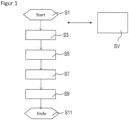
- Figure 1 shows a flowchart of a program for displaying factors influencing route sections on a vehicle.
- the program can be executed, for example, by means of a device SV, which in particular has at least one computing unit, a program and data memory, and, for example, one or more communication interfaces, and which is arranged, for example, in a vehicle.
- the program and data memory and the computing unit of the device SV can be embodied in a single unit and/or distributed across multiple units.
- the device SV can also be embodied as a portable device.
- the portable device is designed, for example, to exchange data with the vehicle and a data processing device which is arranged, in particular, remotely from the vehicle.
- the program can, for example, alternatively or additionally be executed in a distributed manner on the device SV, in particular the portable device, the vehicle and/or the data processing device.
- the SV device can also be described as a device for displaying factors influencing route sections on a vehicle.
- the program is started in a step S1, in which, for example, variables are initialized.
- a destination of a navigation system operated in the vehicle is provided.
- a navigation map is provided.
- data provided by a server outside the vehicle is provided. In particular, this data is retrieved depending on at least one piece of information about the destination or information from a navigation map.
- a first piece of information relating to a first route section and a second piece of information relating to a second route section are determined.
- the first route section and the second route section comprise, for example, at least partially parts of a predetermined vehicle route.
- the first information and/or the second information are determined, for example, as a function of a probability calculation relating to a route of the vehicle, in particular with regard to the probability of selecting the first route section and the second route section.
- data on the road surface condition are determined by means of one or more perceptual sensors of the vehicle and the first information on the first route section and/or the second information on the second route section are determined as a function of the data.
- At least one first parameter set is determined based on the first information, which is representative of at least one influencing factor, for example a physical road surface property, on the vehicle.
- at least one second parameter set is determined based on the second information, which is representative of at least one influencing factor, for example a physical Road surface characteristics on the vehicle. If the first and second route sections essentially match, the respective influencing factor for which the respective parameter sets are representative differs. If the first and second route sections do not match, the respective influencing factor for which the respective parameter sets are representative may be different or, alternatively, the same.
- a reference value is determined depending on information that is representative of at least one influencing factor of a route section that has already been traveled in the past by the driver of the vehicle and/or by the vehicle or is currently being traveled.
- the first parameter set and the second parameter set can, for example, be determined depending on at least one physical road property of the respective route section. These can each include multiple values of the physical road property within the route or a route section, or a function that represents a progression of the corresponding values.
- a particular advantage is that the course of interactions between different influencing factors can also be determined and represented in the display.
- a vehicle profile can be provided which is representative of the vehicle and at least one parameter of the first parameter set and/or the second parameter set can be determined depending on the vehicle profile.
- a parameter of the first parameter set and/or the second parameter set can be determined depending on data that is representative of how the vehicle reacts to given physical road characteristics.
- the first and second parameter sets are determined, for example, depending on the current load and/or the current seat occupancy and/or the current axle load distribution of the vehicle.
- a vehicle load can significantly influence the vehicle's sensitivity to certain influencing factors, in particular the vehicle's resonance frequencies.
- the load itself can also exhibit very different sensitivity to certain influencing factors. This sensitivity can be particularly significant with hazardous goods.
- the influencing factors relevant for driving the first and second route can be better compared using a display.
- a person profile is provided which is assigned to at least one vehicle occupant and at least one parameter of the first parameter set and/or the second parameter set is determined depending on the person profile.
- At least one parameter of the first parameter set and/or at least one parameter of the second parameter set represent, for example, a vertical dynamic influence on the vehicle.
- the first parameter set and the second parameter set are each determined from a given combination of road surface properties belonging to different classes of road surface properties.
- road surface properties concerns, for example, permanent physical road surface irregularities.
- One class of road surface properties concerns, for example, physical acceleration influences on the vehicle or on another vehicle.
- a display is generated which indicates an influencing factor of the first route section and an influencing factor of the second route section.
- the display can also represent an influencing factor of the first route section and an influencing factor of the second route section in relation to the specified reference value.
- a graphical representation is created by assigning or converting the parameters of the first and/or second parameter set to graphical elements according to a given formula.
- At least one statistical value is represented by changing a symbolic representation of the vehicle and/or at least one qualitative value relating to the type of influencing factor is represented by changing another symbolic representation of the vehicle and/or at least one trend value of a parameter is represented by a trend according to travel time or distance.
- the display according to the invention is designed as a comparative representation that represents a comparison of at least one influencing factor of the first route section with at least one influencing factor of the second route section.
- a relationship between the respective influencing factors of the same or corresponding type can be established, preferably using graphical means.
- the method can determine a difference between an influencing factor of the first route section and the influencing factor of the second route section and generate the display depending on the determined difference.
- Such a display can represent the determined difference or highlight the determined difference.
- the difference can include additive and/or multiplicative and/or logarithmic components.
- the display can, for example, represent a difference, a percentage difference or the logarithmic relationship of at least two influencing factors, which is particularly significant for human perception.
- the determined difference can be standardized to a unit of distance, in particular the length of the route segment.
- the determined difference can also be standardized to a unit of time or to the travel time.
- the differences can be highlighted using graphical means, e.g., varying colors, sizes, lines, etc.
- step S11 the program is terminated and can be started again in step S1 if necessary.
- information about at least one measure can be determined depending on at least one parameter of the first parameter set and/or the second parameter set, which changes the respective influencing factor on the vehicle, in particular in a specific manner or to a predetermined extent.
- additional information about the determined measure can be visualized, and/or an operating action of the driver that leads to the measure can be visualized, and/or the measure can be activated using vehicle means, and information about this activation can be visualized for the driver.
- the measure includes, for example, one or more switching options for the vehicle's chassis and/or for a driver assistance system of the vehicle.
- At least one parameter of the first parameter set and/or the second parameter set can be compared with a predetermined maximum value and, if the value is greater than the maximum value, information on at least one possible measure can be determined and/or switching data can be determined for a change in a vehicle setting.
Landscapes
- Engineering & Computer Science (AREA)
- Transportation (AREA)
- Mechanical Engineering (AREA)
- Automation & Control Theory (AREA)
- Radar, Positioning & Navigation (AREA)
- Remote Sensing (AREA)
- Chemical & Material Sciences (AREA)
- Combustion & Propulsion (AREA)
- Human Computer Interaction (AREA)
- Physics & Mathematics (AREA)
- General Physics & Mathematics (AREA)
- Navigation (AREA)
Claims (14)
- Procédé pour afficher des facteurs d'influence, sur un véhicule, de tronçons d'itinéraire, dans lequelsont déterminés une première information sur un premier tronçon d'itinéraire et, en fonction de la première information, au moins un premier ensemble de paramètres représentatifs d'au moins un facteur d'influence du premier tronçon d'itinéraire sur le véhicule,de plus, une deuxième information est déterminée pour un deuxième tronçon d'itinéraire et, en fonction de la deuxième information, au moins un deuxième ensemble de paramètres est déterminé, qui est représentatif d'au moins un facteur d'influence, sur le véhicule, du deuxième tronçon d'itinéraire,caractérisé en ce que, en fonction d'au moins un premier ensemble de paramètres et d'au moins un deuxième ensemble de paramètres, un affichage est généré pour un conducteur de véhicule, qui représente un facteur d'influence du premier tronçon d'itinéraire et un facteur d'influence du deuxième tronçon d'itinéraire,l'affichage étant conçu sous la forme d'une représentation comparative qui représente une comparaison d'au moins un facteur d'influence du premier tronçon d'itinéraire avec au moins un facteur d'influence du deuxième tronçon d'itinéraire,l'affichage représentant un facteur d'influence du premier tronçon d'itinéraire et un facteur d'influence du deuxième tronçon d'itinéraire par rapport à une valeur de référence prédéfinie, etla valeur de référence étant déterminée en fonction d'une information représentative d'au moins un facteur d'influence d'un tronçon d'itinéraire déjà parcouru dans le passé par le conducteur du véhicule et/ou par le véhicule ou qui est actuellement parcouru.
- Procédé selon la revendication 1, dans lequel le premier ensemble de paramètres et le deuxième ensemble de paramètres sont déterminés en fonction d'au moins une propriété physique de la chaussée du tronçon d'itinéraire concerné.
- Procédé selon l'une des revendications précédentes, dans lequel, pour l'affichage- au moins une valeur statistique est représentée par la modification d'une représentation symbolique du véhicule, et/ou- au moins une valeur qualitative du type de facteur d'influence est représentée par la modification d'une autre représentation symbolique du véhicule, et/ou- au moins une valeur de progression d'un paramètre est représentée par une progression en fonction du temps de trajet ou de la distance parcourue.
- Procédé selon l'une des revendications précédentes, dans lequel la première information et/ou la deuxième information est déterminée en fonction :- de la fourniture d'une destination d'un système de navigation utilisé dans le véhicule,- et/ou de la fourniture d'une carte de navigation,- et/ou de la fourniture de données fournies par un serveur extérieur au véhicule.
- Procédé selon l'une des revendications précédentes, dans lequel- une information concernant au moins une mesure est déterminée en fonction d'au moins un paramètre du premier ensemble de paramètres et/ou du deuxième ensemble de paramètres, qui modifie le facteur d'influence respectif sur le véhicule, en particulier d'une manière spécifique ou dans une mesure prédéterminée,comprenant en outre l'une des étapes suivantes :- visualisation d'une information concernant la mesure déterminée, et/ou- visualisation d'une action de commande du conducteur qui conduit à la mesure, et/ou- activation de la mesure avec des ressources du véhicule et visualisation d'une information pour le conducteur sur cette activation.
- Procédé selon la revendication 6, dans lequel la mesure comprend une ou plusieurs options de commutation pour la suspension du véhicule et/ou pour un système d'assistance à la conduite du véhicule.
- Procédé selon l'une des revendications précédentes, dans lequel- des données sur l'état de la chaussée sont déterminées au moyen d'un ou plusieurs capteurs perceptifs du véhicule, et- la première information sur le premier tronçon d'itinéraire et/ou la deuxième information sur le deuxième tronçon d'itinéraire et/ou une valeur de référence est(sont) déterminée(s) en fonction des données.
- Procédé selon l'une des revendications précédentes, dans lequel un profil de véhicule représentatif du véhicule est fourni, et dans lequel au moins un paramètre du premier ensemble de paramètres et/ou du deuxième ensemble de paramètres est déterminé en fonction du profil de véhicule.
- Procédé selon l'une des revendications précédentes, dans lequel un profil de personne est fourni, qui est associé à au moins un occupant du véhicule, et au moins un paramètre du premier ensemble de paramètres et/ou du deuxième ensemble de paramètres est(sont) déterminé(s) en fonction du profil de personne.
- Procédé selon l'une des revendications précédentes, dans lequel au moins un paramètre du premier ensemble de paramètres et/ou du deuxième ensemble de paramètres est comparé à une valeur maximale prédéfinie, et, si la valeur est supérieure à la valeur maximale, une information est déterminée pour au moins une mesure possible et/ou des données de commutation sont déterminées pour une modification d'un réglage du véhicule.
- Dispositif pour afficher des facteurs d'influence, sur un véhicule, de tronçons d'itinéraire, le dispositif étant conçu pour mettre en œuvre un procédé selon l'une des revendications 1 à 10.
- Système, le système comprenant un dispositif, un véhicule et un dispositif de traitement de données, le dispositif étant conçu selon la revendication 11, le dispositif étant en outre un dispositif portable et étant conçu pour échanger des données avec le véhicule et le dispositif de traitement de données et pour mettre en œuvre le procédé selon l'une des revendications 1 à 10 conjointement avec le véhicule et/ou le dispositif de traitement de données.
- Programme informatique pour afficher des facteurs d'influence, sur un véhicule, de tronçons d'itinéraire, le programme informatique étant conçu pour mettre en œuvre un procédé selon l'une des revendications 1 à 10 lors de son exécution sur un dispositif de traitement de données pour un système selon la revendication 12 et/ou dans un dispositif selon la revendication 11.
- Produit de programme d'ordinateur comprenant un support lisible par un dispositif de traitement de données, sur lequel est enregistré un code de programme exécutable selon un programme informatique selon la revendication 13, le code de programme mettant en œuvre le procédé selon l'une des revendications 1 à 10 lorsqu'il est exécuté par un dispositif de traitement de données pour un système selon la revendication 12 ou par un dispositif selon la revendication 11.
Priority Applications (1)
| Application Number | Priority Date | Filing Date | Title |
|---|---|---|---|
| EP17162728.4A EP3260346B1 (fr) | 2014-09-18 | 2015-08-14 | Procédé, dispositif, système, programme informatique d'affichage des facteurs d'influence des sections du trajet sur un véhicule |
Applications Claiming Priority (2)
| Application Number | Priority Date | Filing Date | Title |
|---|---|---|---|
| DE102014218806.7A DE102014218806B4 (de) | 2014-09-18 | 2014-09-18 | Verfahren, Vorrichtung, System, Computerprogramm und Computerprogrammprodukt zur Anzeige von Einflussfaktoren von Fahrstreckenabschnitten auf ein Fahrzeug |
| PCT/EP2015/068737 WO2016041712A1 (fr) | 2014-09-18 | 2015-08-14 | Procédé, dispositif, système de programme d'ordinateur et produit de programme d'ordinateur pour afficher des facteurs d'influence de tronçons de parcours sur un véhicule |
Related Child Applications (2)
| Application Number | Title | Priority Date | Filing Date |
|---|---|---|---|
| EP17162728.4A Division-Into EP3260346B1 (fr) | 2014-09-18 | 2015-08-14 | Procédé, dispositif, système, programme informatique d'affichage des facteurs d'influence des sections du trajet sur un véhicule |
| EP17162728.4A Division EP3260346B1 (fr) | 2014-09-18 | 2015-08-14 | Procédé, dispositif, système, programme informatique d'affichage des facteurs d'influence des sections du trajet sur un véhicule |
Publications (2)
| Publication Number | Publication Date |
|---|---|
| EP3194231A1 EP3194231A1 (fr) | 2017-07-26 |
| EP3194231B1 true EP3194231B1 (fr) | 2025-05-14 |
Family
ID=54014781
Family Applications (2)
| Application Number | Title | Priority Date | Filing Date |
|---|---|---|---|
| EP17162728.4A Active EP3260346B1 (fr) | 2014-09-18 | 2015-08-14 | Procédé, dispositif, système, programme informatique d'affichage des facteurs d'influence des sections du trajet sur un véhicule |
| EP15756863.5A Active EP3194231B1 (fr) | 2014-09-18 | 2015-08-14 | Procédé, dispositif, système de programme d'ordinateur et produit de programme d'ordinateur pour afficher des facteurs d'influence de tronçons de parcours sur un véhicule |
Family Applications Before (1)
| Application Number | Title | Priority Date | Filing Date |
|---|---|---|---|
| EP17162728.4A Active EP3260346B1 (fr) | 2014-09-18 | 2015-08-14 | Procédé, dispositif, système, programme informatique d'affichage des facteurs d'influence des sections du trajet sur un véhicule |
Country Status (4)
| Country | Link |
|---|---|
| US (1) | US10591311B2 (fr) |
| EP (2) | EP3260346B1 (fr) |
| DE (1) | DE102014218806B4 (fr) |
| WO (1) | WO2016041712A1 (fr) |
Families Citing this family (8)
| Publication number | Priority date | Publication date | Assignee | Title |
|---|---|---|---|---|
| DE102017212111A1 (de) * | 2017-07-14 | 2019-01-17 | Volkswagen Aktiengesellschaft | Fahrerassistenzsystem, Fortbewegungsmittel und Verfahren zum schlafphasenspezifischen Betreiben eines Fortbewegungsmittels |
| DE112018007027B4 (de) * | 2018-03-09 | 2026-05-07 | Ford Global Technologies, Llc | Abbiegewegvisualisierung zum verbessern von räumlichem und situativem bewusstsein bei abbiegemanövern |
| US11300977B2 (en) * | 2019-05-01 | 2022-04-12 | Smartdrive Systems, Inc. | Systems and methods for creating and using risk profiles for fleet management of a fleet of vehicles |
| US11609579B2 (en) | 2019-05-01 | 2023-03-21 | Smartdrive Systems, Inc. | Systems and methods for using risk profiles based on previously detected vehicle events to quantify performance of vehicle operators |
| US11262763B2 (en) | 2019-05-01 | 2022-03-01 | Smartdrive Systems, Inc. | Systems and methods for using risk profiles for creating and deploying new vehicle event definitions to a fleet of vehicles |
| US12125320B2 (en) | 2021-09-13 | 2024-10-22 | Omnitracs, Llc | Systems and methods for determining and using deviations from driver-specific performance expectations |
| US12399016B2 (en) | 2021-09-13 | 2025-08-26 | Omnitracs, Llc | Systems and methods for determining and using fleet-specific driver performance |
| DE102021123585A1 (de) * | 2021-09-13 | 2023-03-16 | Bayerische Motoren Werke Aktiengesellschaft | Verfahren und Fahrerassistenzsystem zur Unterstützung eines Fahrers beim Fahren entlang einer aufgezeichneten Trajektorie |
Citations (2)
| Publication number | Priority date | Publication date | Assignee | Title |
|---|---|---|---|---|
| DE102014200031A1 (de) * | 2013-01-08 | 2014-07-10 | Ford Global Technologies, Llc | Adaptives aktives Aufhängungssystem mit Straßenvorschau |
| DE102014218809A1 (de) * | 2014-09-18 | 2016-03-24 | Bayerische Motoren Werke Aktiengesellschaft | Verfahren, Vorrichtung, Computerprogramm und Computerprogrammprodukt zur Anzeige von einem oder mehreren Fahrerlebnisfaktoren auf zumindest einer ersten und einer zweiten Alternativroute |
Family Cites Families (22)
| Publication number | Priority date | Publication date | Assignee | Title |
|---|---|---|---|---|
| US8140241B2 (en) * | 2005-12-28 | 2012-03-20 | National University Corporation Nagoya University | Driving action estimating device, driving support device, vehicle evaluating system, driver model creating device, and driving action determining device |
| US20090164063A1 (en) | 2007-12-20 | 2009-06-25 | International Business Machines Corporation | Vehicle-mounted tool for monitoring road surface defects |
| US20100020170A1 (en) * | 2008-07-24 | 2010-01-28 | Higgins-Luthman Michael J | Vehicle Imaging System |
| JP2011065527A (ja) * | 2009-09-18 | 2011-03-31 | Toyota Motor Corp | 運転評価システム、車載機及び情報処理センター |
| US20110301806A1 (en) * | 2010-06-03 | 2011-12-08 | Daniel John Messier | Method and System For Intelligent Fuel Monitoring and Real Time Planning |
| US9946334B2 (en) * | 2010-12-30 | 2018-04-17 | Denso International America, Inc. | Method to determine driver workload function and usage of driver workload function for human-machine interface performance assessment |
| US9086297B2 (en) * | 2011-01-20 | 2015-07-21 | Telenav, Inc. | Navigation system having maneuver attempt training mechanism and method of operation thereof |
| US20120203428A1 (en) | 2011-02-08 | 2012-08-09 | Honda Motor Co., Ltd | Road profile scanning method and vehicle using side facing sensors |
| GB2492953A (en) | 2011-07-13 | 2013-01-23 | Land Rover Uk Ltd | Vehicle control system and method employing output from an imaging device |
| GB2494528B (en) | 2011-09-06 | 2014-01-29 | Jaguar Land Rover Ltd | Improvements in vehicle suspension control |
| US8915738B2 (en) * | 2012-01-24 | 2014-12-23 | Toyota Motor Engineering & Manufacturing North America, Inc. | Driver quality assessment for driver education |
| GB201205125D0 (en) * | 2012-02-08 | 2012-05-09 | Tomtom Int Bv | Methods using speed distribution profiles |
| US8694246B2 (en) * | 2012-05-15 | 2014-04-08 | Qualcomm Incorporated | Methods and systems for displaying enhanced turn-by-turn guidance on a personal navigation device |
| WO2014022904A1 (fr) * | 2012-08-07 | 2014-02-13 | Abuodeh Sa Ad | Système pour mettre automatiquement en correspondance un demandeur de service avec un fournisseur de service sur la base de leur proximité et pour établir un appel vocal entre eux |
| DE102012017118A1 (de) * | 2012-08-29 | 2014-05-15 | GM Global Technology Operations, LLC (n.d. Ges. d. Staates Delaware) | Verfahren und System zum Optimieren des Fahrverhaltens eines Kraftfahrzeuges während der Fahrt |
| DE102012017932A1 (de) | 2012-09-12 | 2013-03-14 | Daimler Ag | Verfahren zur Unterstützung eines Fahrers beim Führen eines Fahrzeugs im Gelände |
| DE102013200385B4 (de) | 2013-01-14 | 2025-02-13 | Robert Bosch Gmbh | Verfahren und Vorrichtung zur Unterstützung eines Fahrers eines Fahrzeugs bei einer Fahrt auf unebenem Gelände |
| US9165477B2 (en) * | 2013-12-06 | 2015-10-20 | Vehicle Data Science Corporation | Systems and methods for building road models, driver models, and vehicle models and making predictions therefrom |
| US9898759B2 (en) * | 2014-03-28 | 2018-02-20 | Joseph Khoury | Methods and systems for collecting driving information and classifying drivers and self-driving systems |
| US10160281B2 (en) * | 2014-05-02 | 2018-12-25 | Ford Global Technologies, Llc | Road roughness preview with drive history |
| US10449968B2 (en) * | 2016-09-23 | 2019-10-22 | Ford Motor Company | Methods and apparatus for adaptively assisting developmentally disabled or cognitively impaired drivers |
| US20180089605A1 (en) * | 2016-09-23 | 2018-03-29 | Intel Corporation | Enhanced ride sharing user experience |
-
2014
- 2014-09-18 DE DE102014218806.7A patent/DE102014218806B4/de active Active
-
2015
- 2015-08-14 EP EP17162728.4A patent/EP3260346B1/fr active Active
- 2015-08-14 WO PCT/EP2015/068737 patent/WO2016041712A1/fr not_active Ceased
- 2015-08-14 EP EP15756863.5A patent/EP3194231B1/fr active Active
-
2017
- 2017-03-17 US US15/461,744 patent/US10591311B2/en active Active
Patent Citations (2)
| Publication number | Priority date | Publication date | Assignee | Title |
|---|---|---|---|---|
| DE102014200031A1 (de) * | 2013-01-08 | 2014-07-10 | Ford Global Technologies, Llc | Adaptives aktives Aufhängungssystem mit Straßenvorschau |
| DE102014218809A1 (de) * | 2014-09-18 | 2016-03-24 | Bayerische Motoren Werke Aktiengesellschaft | Verfahren, Vorrichtung, Computerprogramm und Computerprogrammprodukt zur Anzeige von einem oder mehreren Fahrerlebnisfaktoren auf zumindest einer ersten und einer zweiten Alternativroute |
Also Published As
| Publication number | Publication date |
|---|---|
| DE102014218806B4 (de) | 2025-05-28 |
| US10591311B2 (en) | 2020-03-17 |
| DE102014218806A1 (de) | 2016-03-24 |
| WO2016041712A1 (fr) | 2016-03-24 |
| EP3194231A1 (fr) | 2017-07-26 |
| EP3260346A1 (fr) | 2017-12-27 |
| US20170191850A1 (en) | 2017-07-06 |
| EP3260346B1 (fr) | 2025-11-26 |
Similar Documents
| Publication | Publication Date | Title |
|---|---|---|
| EP3194231B1 (fr) | Procédé, dispositif, système de programme d'ordinateur et produit de programme d'ordinateur pour afficher des facteurs d'influence de tronçons de parcours sur un véhicule | |
| DE102009049592B4 (de) | Verfahren zum Betrieb eines Fahrerassistenzsystems in einem Kraftfahrzeug sowie zugehöriges Kraftfahrzeug | |
| DE102016216601B4 (de) | Verfahren zum Unterstützen eines Fahrers eines Kraftfahrzeugs beim Fahren auf einer Rennstrecke, Kraftfahrzeug und Computerprogrammprodukt | |
| DE102017114049A1 (de) | Systeme zum auswählen und durchführen von routen für autonome fahrzeuge | |
| DE102015115666A1 (de) | Leistungsfahrsystem und Leistungsfahrverfahren | |
| WO2010028626A1 (fr) | Procédé et dispositif pour la détermination d'une stratégie de conduite | |
| DE102017221191A1 (de) | Verfahren zur Anzeige des Verlaufs einer Sicherheitszone vor einem Fahrzeug oder einem Objekt mit einer Anzeigeeinheit, Vorrichtung zur Durchführung des Verfahrens sowie Kraftfahrzeug und Computerprogramm | |
| DE102018001375A1 (de) | Fahrzeugfahrassistenzsystem, Fahrzeugfahrassistenzverfahren und Computerprogrammprodukt | |
| DE102017212367A1 (de) | Verfahren zur Anzeige des Verlaufs einer Trajektorie vor einem Fahrzeug oder einem Objekt mit einer Anzeigeeinheit, Vorrichtung zur Durchführung des Verfahrens sowie Kraftfahrzeug und Computerprogramm | |
| EP3138752B1 (fr) | Procede et systeme destines a assister un utilisateur lors de la planification et l'execution d'un parcours routier avec son vehicule | |
| DE102012214873A1 (de) | Verfahren und Vorrichtung zum Signalisieren einer Fahranweisung für einen Fahrer eines Fahrzeugs | |
| WO2006037360A1 (fr) | Systeme pour informer un conducteur de la possibilite d'effectuer des depassements | |
| DE102015211892A1 (de) | Verfahren, Vorrichtung, Computerprogramm und Computerprogrammprodukt zur Verarbeitung von Daten eines Fahrstreckenprofils für ein Fahrzeug | |
| DE102015223248A1 (de) | Verfahren für ein Fahrerassistenzsystem | |
| DE112013002732T5 (de) | Steuern einer Anzeige von Anwendungen ausgehend von einem mobilen Gerät, das kommunikativ mit einer fahrzeuginternen Vorrichtung verbunden ist, in Abhängigkeit von einer Geschwindigkeitsschwelle | |
| EP4108545A1 (fr) | Procédé de détermination d'une trajectoire pouvant être actuellement parcourue pour un véhicule automobile fonctionnant au moins partiellement de manière assistée, ainsi que système d'aide | |
| DE102017101342A1 (de) | Fahrzeugautomatisierung und vorhersage für einen bediener-eingriffspegel | |
| DE102021200027B4 (de) | Verfahren zum Betreiben eines Assistenzsystems eines Kraftfahrzeugs, Computerprogrammprodukt sowie Assistenzsystem | |
| DE102014218809A1 (de) | Verfahren, Vorrichtung, Computerprogramm und Computerprogrammprodukt zur Anzeige von einem oder mehreren Fahrerlebnisfaktoren auf zumindest einer ersten und einer zweiten Alternativroute | |
| DE112017001558T5 (de) | Kartenanzeigesystem und Kartenanzeigeprogramm | |
| DE102017210461A1 (de) | Vorrichtung zum Ausgeben einer Fahrerwarnung in einem Kraftfahrzeug | |
| DE102011117747A1 (de) | Unterstützen eines Lernvorgangs eines Fahrers eines Kraftfahrzeugs | |
| DE102008039472A1 (de) | Verfahren zum Betrieb eines Navigationsgeräts | |
| DE102014214388A1 (de) | Verfahren und System zum Übertragen einer richtungsbezogenen Information an den Fahrer und an einen Insassen eines Fahrzeuges | |
| DE102017221632A1 (de) | Verfahren zum Bestimmen einer Risikozonenbewertung eines Fahrzeugs, elektronische Steuerungseinheit und Speichermedium |
Legal Events
| Date | Code | Title | Description |
|---|---|---|---|
| STAA | Information on the status of an ep patent application or granted ep patent |
Free format text: STATUS: THE INTERNATIONAL PUBLICATION HAS BEEN MADE |
|
| PUAI | Public reference made under article 153(3) epc to a published international application that has entered the european phase |
Free format text: ORIGINAL CODE: 0009012 |
|
| STAA | Information on the status of an ep patent application or granted ep patent |
Free format text: STATUS: REQUEST FOR EXAMINATION WAS MADE |
|
| 17P | Request for examination filed |
Effective date: 20170323 |
|
| AK | Designated contracting states |
Kind code of ref document: A1 Designated state(s): AL AT BE BG CH CY CZ DE DK EE ES FI FR GB GR HR HU IE IS IT LI LT LU LV MC MK MT NL NO PL PT RO RS SE SI SK SM TR |
|
| AX | Request for extension of the european patent |
Extension state: BA ME |
|
| DAV | Request for validation of the european patent (deleted) | ||
| DAX | Request for extension of the european patent (deleted) | ||
| STAA | Information on the status of an ep patent application or granted ep patent |
Free format text: STATUS: EXAMINATION IS IN PROGRESS |
|
| 17Q | First examination report despatched |
Effective date: 20200917 |
|
| P01 | Opt-out of the competence of the unified patent court (upc) registered |
Effective date: 20230427 |
|
| REG | Reference to a national code |
Ref country code: DE Ref legal event code: R079 Free format text: PREVIOUS MAIN CLASS: B60W0050000000 Ipc: G01C0021340000 Ref country code: DE Ref legal event code: R079 Ref document number: 502015017081 Country of ref document: DE Free format text: PREVIOUS MAIN CLASS: B60W0050000000 Ipc: G01C0021340000 |
|
| GRAP | Despatch of communication of intention to grant a patent |
Free format text: ORIGINAL CODE: EPIDOSNIGR1 |
|
| STAA | Information on the status of an ep patent application or granted ep patent |
Free format text: STATUS: GRANT OF PATENT IS INTENDED |
|
| RIC1 | Information provided on ipc code assigned before grant |
Ipc: B60K 35/00 20060101ALI20250127BHEP Ipc: G01C 21/36 20060101ALI20250127BHEP Ipc: G01C 21/34 20060101AFI20250127BHEP |
|
| INTG | Intention to grant announced |
Effective date: 20250205 |
|
| GRAS | Grant fee paid |
Free format text: ORIGINAL CODE: EPIDOSNIGR3 |
|
| GRAA | (expected) grant |
Free format text: ORIGINAL CODE: 0009210 |
|
| STAA | Information on the status of an ep patent application or granted ep patent |
Free format text: STATUS: THE PATENT HAS BEEN GRANTED |
|
| AK | Designated contracting states |
Kind code of ref document: B1 Designated state(s): AL AT BE BG CH CY CZ DE DK EE ES FI FR GB GR HR HU IE IS IT LI LT LU LV MC MK MT NL NO PL PT RO RS SE SI SK SM TR |
|
| REG | Reference to a national code |
Ref country code: GB Ref legal event code: FG4D Free format text: NOT ENGLISH |
|
| REG | Reference to a national code |
Ref country code: CH Ref legal event code: EP |
|
| REG | Reference to a national code |
Ref country code: IE Ref legal event code: FG4D Free format text: LANGUAGE OF EP DOCUMENT: GERMAN |
|
| REG | Reference to a national code |
Ref country code: DE Ref legal event code: R096 Ref document number: 502015017081 Country of ref document: DE |
|
| REG | Reference to a national code |
Ref country code: NL Ref legal event code: MP Effective date: 20250514 |
|
| PG25 | Lapsed in a contracting state [announced via postgrant information from national office to epo] |
Ref country code: FI Free format text: LAPSE BECAUSE OF FAILURE TO SUBMIT A TRANSLATION OF THE DESCRIPTION OR TO PAY THE FEE WITHIN THE PRESCRIBED TIME-LIMIT Effective date: 20250514 Ref country code: PT Free format text: LAPSE BECAUSE OF FAILURE TO SUBMIT A TRANSLATION OF THE DESCRIPTION OR TO PAY THE FEE WITHIN THE PRESCRIBED TIME-LIMIT Effective date: 20250915 Ref country code: ES Free format text: LAPSE BECAUSE OF FAILURE TO SUBMIT A TRANSLATION OF THE DESCRIPTION OR TO PAY THE FEE WITHIN THE PRESCRIBED TIME-LIMIT Effective date: 20250514 |
|
| PGFP | Annual fee paid to national office [announced via postgrant information from national office to epo] |
Ref country code: DE Payment date: 20250731 Year of fee payment: 11 |
|
| REG | Reference to a national code |
Ref country code: LT Ref legal event code: MG9D |
|
| PG25 | Lapsed in a contracting state [announced via postgrant information from national office to epo] |
Ref country code: GR Free format text: LAPSE BECAUSE OF FAILURE TO SUBMIT A TRANSLATION OF THE DESCRIPTION OR TO PAY THE FEE WITHIN THE PRESCRIBED TIME-LIMIT Effective date: 20250815 Ref country code: NO Free format text: LAPSE BECAUSE OF FAILURE TO SUBMIT A TRANSLATION OF THE DESCRIPTION OR TO PAY THE FEE WITHIN THE PRESCRIBED TIME-LIMIT Effective date: 20250814 |
|
| PG25 | Lapsed in a contracting state [announced via postgrant information from national office to epo] |
Ref country code: PL Free format text: LAPSE BECAUSE OF FAILURE TO SUBMIT A TRANSLATION OF THE DESCRIPTION OR TO PAY THE FEE WITHIN THE PRESCRIBED TIME-LIMIT Effective date: 20250514 Ref country code: NL Free format text: LAPSE BECAUSE OF FAILURE TO SUBMIT A TRANSLATION OF THE DESCRIPTION OR TO PAY THE FEE WITHIN THE PRESCRIBED TIME-LIMIT Effective date: 20250514 |
|
| PG25 | Lapsed in a contracting state [announced via postgrant information from national office to epo] |
Ref country code: BG Free format text: LAPSE BECAUSE OF FAILURE TO SUBMIT A TRANSLATION OF THE DESCRIPTION OR TO PAY THE FEE WITHIN THE PRESCRIBED TIME-LIMIT Effective date: 20250514 |
|
| PGFP | Annual fee paid to national office [announced via postgrant information from national office to epo] |
Ref country code: GB Payment date: 20250818 Year of fee payment: 11 |
|
| PG25 | Lapsed in a contracting state [announced via postgrant information from national office to epo] |
Ref country code: HR Free format text: LAPSE BECAUSE OF FAILURE TO SUBMIT A TRANSLATION OF THE DESCRIPTION OR TO PAY THE FEE WITHIN THE PRESCRIBED TIME-LIMIT Effective date: 20250514 |
|
| PGFP | Annual fee paid to national office [announced via postgrant information from national office to epo] |
Ref country code: FR Payment date: 20250827 Year of fee payment: 11 |
|
| PG25 | Lapsed in a contracting state [announced via postgrant information from national office to epo] |
Ref country code: RS Free format text: LAPSE BECAUSE OF FAILURE TO SUBMIT A TRANSLATION OF THE DESCRIPTION OR TO PAY THE FEE WITHIN THE PRESCRIBED TIME-LIMIT Effective date: 20250814 |
|
| PG25 | Lapsed in a contracting state [announced via postgrant information from national office to epo] |
Ref country code: IS Free format text: LAPSE BECAUSE OF FAILURE TO SUBMIT A TRANSLATION OF THE DESCRIPTION OR TO PAY THE FEE WITHIN THE PRESCRIBED TIME-LIMIT Effective date: 20250914 |
|
| PG25 | Lapsed in a contracting state [announced via postgrant information from national office to epo] |
Ref country code: LV Free format text: LAPSE BECAUSE OF FAILURE TO SUBMIT A TRANSLATION OF THE DESCRIPTION OR TO PAY THE FEE WITHIN THE PRESCRIBED TIME-LIMIT Effective date: 20250514 |
|
| PG25 | Lapsed in a contracting state [announced via postgrant information from national office to epo] |
Ref country code: SM Free format text: LAPSE BECAUSE OF FAILURE TO SUBMIT A TRANSLATION OF THE DESCRIPTION OR TO PAY THE FEE WITHIN THE PRESCRIBED TIME-LIMIT Effective date: 20250514 Ref country code: DK Free format text: LAPSE BECAUSE OF FAILURE TO SUBMIT A TRANSLATION OF THE DESCRIPTION OR TO PAY THE FEE WITHIN THE PRESCRIBED TIME-LIMIT Effective date: 20250514 |
|
| PG25 | Lapsed in a contracting state [announced via postgrant information from national office to epo] |
Ref country code: CZ Free format text: LAPSE BECAUSE OF FAILURE TO SUBMIT A TRANSLATION OF THE DESCRIPTION OR TO PAY THE FEE WITHIN THE PRESCRIBED TIME-LIMIT Effective date: 20250514 |
|
| PG25 | Lapsed in a contracting state [announced via postgrant information from national office to epo] |
Ref country code: EE Free format text: LAPSE BECAUSE OF FAILURE TO SUBMIT A TRANSLATION OF THE DESCRIPTION OR TO PAY THE FEE WITHIN THE PRESCRIBED TIME-LIMIT Effective date: 20250514 |
|
| PG25 | Lapsed in a contracting state [announced via postgrant information from national office to epo] |
Ref country code: SK Free format text: LAPSE BECAUSE OF FAILURE TO SUBMIT A TRANSLATION OF THE DESCRIPTION OR TO PAY THE FEE WITHIN THE PRESCRIBED TIME-LIMIT Effective date: 20250514 Ref country code: RO Free format text: LAPSE BECAUSE OF FAILURE TO SUBMIT A TRANSLATION OF THE DESCRIPTION OR TO PAY THE FEE WITHIN THE PRESCRIBED TIME-LIMIT Effective date: 20250514 |
|
| PG25 | Lapsed in a contracting state [announced via postgrant information from national office to epo] |
Ref country code: IT Free format text: LAPSE BECAUSE OF FAILURE TO SUBMIT A TRANSLATION OF THE DESCRIPTION OR TO PAY THE FEE WITHIN THE PRESCRIBED TIME-LIMIT Effective date: 20250514 |
|
| REG | Reference to a national code |
Ref country code: DE Ref legal event code: R097 Ref document number: 502015017081 Country of ref document: DE |
|
| PLBE | No opposition filed within time limit |
Free format text: ORIGINAL CODE: 0009261 |
|
| STAA | Information on the status of an ep patent application or granted ep patent |
Free format text: STATUS: NO OPPOSITION FILED WITHIN TIME LIMIT |
|
| REG | Reference to a national code |
Ref country code: CH Ref legal event code: H13 Free format text: ST27 STATUS EVENT CODE: U-0-0-H10-H13 (AS PROVIDED BY THE NATIONAL OFFICE) Effective date: 20260324 |
|
| REG | Reference to a national code |
Ref country code: CH Ref legal event code: L10 Free format text: ST27 STATUS EVENT CODE: U-0-0-L10-L00 (AS PROVIDED BY THE NATIONAL OFFICE) Effective date: 20260325 |
|
| PG25 | Lapsed in a contracting state [announced via postgrant information from national office to epo] |
Ref country code: MC Free format text: LAPSE BECAUSE OF FAILURE TO SUBMIT A TRANSLATION OF THE DESCRIPTION OR TO PAY THE FEE WITHIN THE PRESCRIBED TIME-LIMIT Effective date: 20250514 |
|
| PG25 | Lapsed in a contracting state [announced via postgrant information from national office to epo] |
Ref country code: LU Free format text: LAPSE BECAUSE OF NON-PAYMENT OF DUE FEES Effective date: 20250814 |
|
| 26N | No opposition filed |
Effective date: 20260217 |
|
| PG25 | Lapsed in a contracting state [announced via postgrant information from national office to epo] |
Ref country code: CH Free format text: LAPSE BECAUSE OF NON-PAYMENT OF DUE FEES Effective date: 20250831 |