EP3199035A1 - Reismehl als weizenmehlersatz und verfahren zur herstellung von glutenfreiem reismehlbrot - Google Patents
Reismehl als weizenmehlersatz und verfahren zur herstellung von glutenfreiem reismehlbrot Download PDFInfo
- Publication number
- EP3199035A1 EP3199035A1 EP15845039.5A EP15845039A EP3199035A1 EP 3199035 A1 EP3199035 A1 EP 3199035A1 EP 15845039 A EP15845039 A EP 15845039A EP 3199035 A1 EP3199035 A1 EP 3199035A1
- Authority
- EP
- European Patent Office
- Prior art keywords
- rice flour
- protease
- dough
- bread
- treated
- Prior art date
- Legal status (The legal status is an assumption and is not a legal conclusion. Google has not performed a legal analysis and makes no representation as to the accuracy of the status listed.)
- Withdrawn
Links
- 235000007164 Oryza sativa Nutrition 0.000 title claims abstract description 471
- 235000009566 rice Nutrition 0.000 title claims abstract description 470
- 235000013312 flour Nutrition 0.000 title claims abstract description 456
- 235000008429 bread Nutrition 0.000 title claims abstract description 206
- 238000004519 manufacturing process Methods 0.000 title claims abstract description 60
- 241000209094 Oryza Species 0.000 title claims abstract 49
- 238000000034 method Methods 0.000 title claims description 106
- 241000209140 Triticum Species 0.000 title description 14
- 235000021307 Triticum Nutrition 0.000 title description 14
- 239000004365 Protease Substances 0.000 claims abstract description 259
- 108091005804 Peptidases Proteins 0.000 claims abstract description 257
- 238000010438 heat treatment Methods 0.000 claims abstract description 115
- 238000002156 mixing Methods 0.000 claims abstract description 67
- XLYOFNOQVPJJNP-UHFFFAOYSA-N water Substances O XLYOFNOQVPJJNP-UHFFFAOYSA-N 0.000 claims abstract description 35
- 102100037486 Reverse transcriptase/ribonuclease H Human genes 0.000 claims abstract 26
- 239000000843 powder Substances 0.000 claims description 69
- 238000001035 drying Methods 0.000 claims description 41
- 238000000855 fermentation Methods 0.000 claims description 26
- 230000004151 fermentation Effects 0.000 claims description 26
- 238000007873 sieving Methods 0.000 claims description 16
- 239000000203 mixture Substances 0.000 claims description 15
- 240000004808 Saccharomyces cerevisiae Species 0.000 claims description 14
- 238000001665 trituration Methods 0.000 claims description 13
- 238000004898 kneading Methods 0.000 claims description 9
- 238000011161 development Methods 0.000 abstract description 2
- 240000007594 Oryza sativa Species 0.000 description 422
- 102000035195 Peptidases Human genes 0.000 description 231
- 235000019419 proteases Nutrition 0.000 description 219
- 238000011282 treatment Methods 0.000 description 63
- 235000013339 cereals Nutrition 0.000 description 33
- 239000002994 raw material Substances 0.000 description 31
- 230000000694 effects Effects 0.000 description 23
- 235000013305 food Nutrition 0.000 description 22
- 102000004190 Enzymes Human genes 0.000 description 14
- 108090000790 Enzymes Proteins 0.000 description 14
- 229940088598 enzyme Drugs 0.000 description 14
- 238000011156 evaluation Methods 0.000 description 14
- 239000000654 additive Substances 0.000 description 13
- 238000013467 fragmentation Methods 0.000 description 12
- 238000006062 fragmentation reaction Methods 0.000 description 12
- 235000019659 mouth feeling Nutrition 0.000 description 11
- 241000228257 Aspergillus sp. Species 0.000 description 8
- 241000196324 Embryophyta Species 0.000 description 8
- RWSXRVCMGQZWBV-WDSKDSINSA-N glutathione Chemical compound OC(=O)[C@@H](N)CCC(=O)N[C@@H](CS)C(=O)NCC(O)=O RWSXRVCMGQZWBV-WDSKDSINSA-N 0.000 description 8
- 239000000463 material Substances 0.000 description 8
- 235000018102 proteins Nutrition 0.000 description 8
- 102000004169 proteins and genes Human genes 0.000 description 8
- 108090000623 proteins and genes Proteins 0.000 description 8
- 208000015943 Coeliac disease Diseases 0.000 description 7
- 238000003860 storage Methods 0.000 description 7
- 239000000796 flavoring agent Substances 0.000 description 6
- 235000019634 flavors Nutrition 0.000 description 6
- 238000000227 grinding Methods 0.000 description 6
- 108091031676 miR-254 stem-loop Proteins 0.000 description 6
- 239000002562 thickening agent Substances 0.000 description 6
- 241000193385 Geobacillus stearothermophilus Species 0.000 description 5
- 108010068370 Glutens Proteins 0.000 description 5
- 235000021312 gluten Nutrition 0.000 description 5
- 238000003801 milling Methods 0.000 description 5
- 150000003839 salts Chemical class 0.000 description 5
- 241000194110 Bacillus sp. (in: Bacteria) Species 0.000 description 4
- 102000002322 Egg Proteins Human genes 0.000 description 4
- 108010000912 Egg Proteins Proteins 0.000 description 4
- 208000004262 Food Hypersensitivity Diseases 0.000 description 4
- 108010024636 Glutathione Proteins 0.000 description 4
- 101710180012 Protease 7 Proteins 0.000 description 4
- 230000000996 additive effect Effects 0.000 description 4
- 238000007796 conventional method Methods 0.000 description 4
- 235000020932 food allergy Nutrition 0.000 description 4
- 229960003180 glutathione Drugs 0.000 description 4
- 238000011534 incubation Methods 0.000 description 4
- 208000024891 symptom Diseases 0.000 description 4
- 229920000856 Amylose Polymers 0.000 description 3
- CIWBSHSKHKDKBQ-JLAZNSOCSA-N Ascorbic acid Chemical compound OC[C@H](O)[C@H]1OC(=O)C(O)=C1O CIWBSHSKHKDKBQ-JLAZNSOCSA-N 0.000 description 3
- 241000894006 Bacteria Species 0.000 description 3
- 240000006432 Carica papaya Species 0.000 description 3
- 241000233866 Fungi Species 0.000 description 3
- 108090000526 Papain Proteins 0.000 description 3
- 229920002472 Starch Polymers 0.000 description 3
- 102000004142 Trypsin Human genes 0.000 description 3
- 108090000631 Trypsin Proteins 0.000 description 3
- 239000013566 allergen Substances 0.000 description 3
- 230000007423 decrease Effects 0.000 description 3
- 235000005911 diet Nutrition 0.000 description 3
- 235000019249 food preservative Nutrition 0.000 description 3
- 239000005452 food preservative Substances 0.000 description 3
- 239000008187 granular material Substances 0.000 description 3
- 239000001866 hydroxypropyl methyl cellulose Substances 0.000 description 3
- 235000010979 hydroxypropyl methyl cellulose Nutrition 0.000 description 3
- 229920003088 hydroxypropyl methyl cellulose Polymers 0.000 description 3
- UFVKGYZPFZQRLF-UHFFFAOYSA-N hydroxypropyl methyl cellulose Chemical compound OC1C(O)C(OC)OC(CO)C1OC1C(O)C(O)C(OC2C(C(O)C(OC3C(C(O)C(O)C(CO)O3)O)C(CO)O2)O)C(CO)O1 UFVKGYZPFZQRLF-UHFFFAOYSA-N 0.000 description 3
- 235000019834 papain Nutrition 0.000 description 3
- 229940055729 papain Drugs 0.000 description 3
- 238000002360 preparation method Methods 0.000 description 3
- 239000007787 solid Substances 0.000 description 3
- 239000007921 spray Substances 0.000 description 3
- 235000019698 starch Nutrition 0.000 description 3
- 239000008107 starch Substances 0.000 description 3
- 239000012588 trypsin Substances 0.000 description 3
- QCVGEOXPDFCNHA-UHFFFAOYSA-N 5,5-dimethyl-2,4-dioxo-1,3-oxazolidine-3-carboxamide Chemical compound CC1(C)OC(=O)N(C(N)=O)C1=O QCVGEOXPDFCNHA-UHFFFAOYSA-N 0.000 description 2
- 244000298715 Actinidia chinensis Species 0.000 description 2
- 244000099147 Ananas comosus Species 0.000 description 2
- 235000009467 Carica papaya Nutrition 0.000 description 2
- 229920002907 Guar gum Polymers 0.000 description 2
- 101001091385 Homo sapiens Kallikrein-6 Proteins 0.000 description 2
- 102100034866 Kallikrein-6 Human genes 0.000 description 2
- 241000952054 Rhizopus sp. Species 0.000 description 2
- UIIMBOGNXHQVGW-UHFFFAOYSA-M Sodium bicarbonate Chemical compound [Na+].OC([O-])=O UIIMBOGNXHQVGW-UHFFFAOYSA-M 0.000 description 2
- 238000013019 agitation Methods 0.000 description 2
- 239000003963 antioxidant agent Substances 0.000 description 2
- 235000006708 antioxidants Nutrition 0.000 description 2
- 238000003149 assay kit Methods 0.000 description 2
- 238000007630 basic procedure Methods 0.000 description 2
- 235000014121 butter Nutrition 0.000 description 2
- 239000005018 casein Substances 0.000 description 2
- BECPQYXYKAMYBN-UHFFFAOYSA-N casein, tech. Chemical compound NCCCCC(C(O)=O)N=C(O)C(CC(O)=O)N=C(O)C(CCC(O)=N)N=C(O)C(CC(C)C)N=C(O)C(CCC(O)=O)N=C(O)C(CC(O)=O)N=C(O)C(CCC(O)=O)N=C(O)C(C(C)O)N=C(O)C(CCC(O)=N)N=C(O)C(CCC(O)=N)N=C(O)C(CCC(O)=N)N=C(O)C(CCC(O)=O)N=C(O)C(CCC(O)=O)N=C(O)C(COP(O)(O)=O)N=C(O)C(CCC(O)=N)N=C(O)C(N)CC1=CC=CC=C1 BECPQYXYKAMYBN-UHFFFAOYSA-N 0.000 description 2
- 235000021240 caseins Nutrition 0.000 description 2
- 230000037213 diet Effects 0.000 description 2
- 235000014103 egg white Nutrition 0.000 description 2
- 210000000969 egg white Anatomy 0.000 description 2
- 210000002969 egg yolk Anatomy 0.000 description 2
- 235000013345 egg yolk Nutrition 0.000 description 2
- 235000013601 eggs Nutrition 0.000 description 2
- 230000001747 exhibiting effect Effects 0.000 description 2
- 238000005187 foaming Methods 0.000 description 2
- 235000002864 food coloring agent Nutrition 0.000 description 2
- 230000037406 food intake Effects 0.000 description 2
- 235000010855 food raising agent Nutrition 0.000 description 2
- 235000003599 food sweetener Nutrition 0.000 description 2
- 239000012634 fragment Substances 0.000 description 2
- 239000000665 guar gum Substances 0.000 description 2
- 235000010417 guar gum Nutrition 0.000 description 2
- 229960002154 guar gum Drugs 0.000 description 2
- 230000028993 immune response Effects 0.000 description 2
- 235000012054 meals Nutrition 0.000 description 2
- 238000005259 measurement Methods 0.000 description 2
- 239000004033 plastic Substances 0.000 description 2
- 235000019833 protease Nutrition 0.000 description 2
- 230000002829 reductive effect Effects 0.000 description 2
- 238000002791 soaking Methods 0.000 description 2
- 239000000243 solution Substances 0.000 description 2
- 241000894007 species Species 0.000 description 2
- 238000001694 spray drying Methods 0.000 description 2
- 239000000126 substance Substances 0.000 description 2
- 239000000758 substrate Substances 0.000 description 2
- 239000003765 sweetening agent Substances 0.000 description 2
- 239000003053 toxin Substances 0.000 description 2
- 231100000765 toxin Toxicity 0.000 description 2
- CHHHXKFHOYLYRE-UHFFFAOYSA-M 2,4-Hexadienoic acid, potassium salt (1:1), (2E,4E)- Chemical compound [K+].CC=CC=CC([O-])=O CHHHXKFHOYLYRE-UHFFFAOYSA-M 0.000 description 1
- OTLLEIBWKHEHGU-UHFFFAOYSA-N 2-[5-[[5-(6-aminopurin-9-yl)-3,4-dihydroxyoxolan-2-yl]methoxy]-3,4-dihydroxy-6-(hydroxymethyl)oxan-2-yl]oxy-3,5-dihydroxy-4-phosphonooxyhexanedioic acid Chemical compound C1=NC=2C(N)=NC=NC=2N1C(C(C1O)O)OC1COC1C(CO)OC(OC(C(O)C(OP(O)(O)=O)C(O)C(O)=O)C(O)=O)C(O)C1O OTLLEIBWKHEHGU-UHFFFAOYSA-N 0.000 description 1
- 241000219068 Actinidia Species 0.000 description 1
- 244000298800 Actinidia arguta Species 0.000 description 1
- ZHQQRIUYLMXDPP-SSDOTTSWSA-N Actinidine Natural products C1=NC=C(C)C2=C1[C@H](C)CC2 ZHQQRIUYLMXDPP-SSDOTTSWSA-N 0.000 description 1
- 206010002199 Anaphylactic shock Diseases 0.000 description 1
- 244000221226 Armillaria mellea Species 0.000 description 1
- 108010011485 Aspartame Proteins 0.000 description 1
- 241000228212 Aspergillus Species 0.000 description 1
- 241000228245 Aspergillus niger Species 0.000 description 1
- 240000006439 Aspergillus oryzae Species 0.000 description 1
- 241000228251 Aspergillus phoenicis Species 0.000 description 1
- 241000131386 Aspergillus sojae Species 0.000 description 1
- 241000193830 Bacillus <bacterium> Species 0.000 description 1
- 241000193744 Bacillus amyloliquefaciens Species 0.000 description 1
- 241000193752 Bacillus circulans Species 0.000 description 1
- 241000194108 Bacillus licheniformis Species 0.000 description 1
- 235000014469 Bacillus subtilis Nutrition 0.000 description 1
- 241000193389 Bacillus thermoproteolyticus Species 0.000 description 1
- 108091005658 Basic proteases Proteins 0.000 description 1
- 108010004032 Bromelains Proteins 0.000 description 1
- OKTJSMMVPCPJKN-UHFFFAOYSA-N Carbon Chemical compound [C] OKTJSMMVPCPJKN-UHFFFAOYSA-N 0.000 description 1
- 229920002134 Carboxymethyl cellulose Polymers 0.000 description 1
- 241000219173 Carica Species 0.000 description 1
- 235000014649 Carica monoica Nutrition 0.000 description 1
- FBPFZTCFMRRESA-FSIIMWSLSA-N D-Glucitol Natural products OC[C@H](O)[C@H](O)[C@@H](O)[C@H](O)CO FBPFZTCFMRRESA-FSIIMWSLSA-N 0.000 description 1
- CIWBSHSKHKDKBQ-DUZGATOHSA-N D-araboascorbic acid Natural products OC[C@@H](O)[C@H]1OC(=O)C(O)=C1O CIWBSHSKHKDKBQ-DUZGATOHSA-N 0.000 description 1
- FBPFZTCFMRRESA-JGWLITMVSA-N D-glucitol Chemical compound OC[C@H](O)[C@@H](O)[C@H](O)[C@H](O)CO FBPFZTCFMRRESA-JGWLITMVSA-N 0.000 description 1
- PHOQVHQSTUBQQK-SQOUGZDYSA-N D-glucono-1,5-lactone Chemical compound OC[C@H]1OC(=O)[C@H](O)[C@@H](O)[C@@H]1O PHOQVHQSTUBQQK-SQOUGZDYSA-N 0.000 description 1
- 206010012735 Diarrhoea Diseases 0.000 description 1
- 206010013975 Dyspnoeas Diseases 0.000 description 1
- 108010059378 Endopeptidases Proteins 0.000 description 1
- 102000005593 Endopeptidases Human genes 0.000 description 1
- 102000018389 Exopeptidases Human genes 0.000 description 1
- 108010091443 Exopeptidases Proteins 0.000 description 1
- 108090000270 Ficain Proteins 0.000 description 1
- 241000218218 Ficus <angiosperm> Species 0.000 description 1
- 244000025361 Ficus carica Species 0.000 description 1
- 206010016946 Food allergy Diseases 0.000 description 1
- 229930091371 Fructose Natural products 0.000 description 1
- 239000005715 Fructose Substances 0.000 description 1
- RFSUNEUAIZKAJO-ARQDHWQXSA-N Fructose Chemical compound OC[C@H]1O[C@](O)(CO)[C@@H](O)[C@@H]1O RFSUNEUAIZKAJO-ARQDHWQXSA-N 0.000 description 1
- WQZGKKKJIJFFOK-GASJEMHNSA-N Glucose Natural products OC[C@H]1OC(O)[C@H](O)[C@@H](O)[C@@H]1O WQZGKKKJIJFFOK-GASJEMHNSA-N 0.000 description 1
- 108010015776 Glucose oxidase Proteins 0.000 description 1
- 239000004366 Glucose oxidase Substances 0.000 description 1
- 241000202807 Glycyrrhiza Species 0.000 description 1
- 239000002211 L-ascorbic acid Substances 0.000 description 1
- 235000000069 L-ascorbic acid Nutrition 0.000 description 1
- 235000010804 Maranta arundinacea Nutrition 0.000 description 1
- 241001465754 Metazoa Species 0.000 description 1
- 240000002582 Oryza sativa Indica Group Species 0.000 description 1
- 240000008467 Oryza sativa Japonica Group Species 0.000 description 1
- 241000228143 Penicillium Species 0.000 description 1
- 240000000064 Penicillium roqueforti Species 0.000 description 1
- 102000057297 Pepsin A Human genes 0.000 description 1
- 108090000284 Pepsin A Proteins 0.000 description 1
- XBDQKXXYIPTUBI-UHFFFAOYSA-M Propionate Chemical compound CCC([O-])=O XBDQKXXYIPTUBI-UHFFFAOYSA-M 0.000 description 1
- 241000932152 Proteinus sp. Species 0.000 description 1
- 208000003251 Pruritus Diseases 0.000 description 1
- 244000184734 Pyrus japonica Species 0.000 description 1
- 241000235527 Rhizopus Species 0.000 description 1
- 244000205939 Rhizopus oligosporus Species 0.000 description 1
- 240000005384 Rhizopus oryzae Species 0.000 description 1
- 241000220317 Rosa Species 0.000 description 1
- 244000157378 Rubus niveus Species 0.000 description 1
- 241000015473 Schizothorax griseus Species 0.000 description 1
- 102000012479 Serine Proteases Human genes 0.000 description 1
- 108010022999 Serine Proteases Proteins 0.000 description 1
- 244000228451 Stevia rebaudiana Species 0.000 description 1
- 241000187747 Streptomyces Species 0.000 description 1
- 241000187132 Streptomyces kanamyceticus Species 0.000 description 1
- 229930006000 Sucrose Natural products 0.000 description 1
- CZMRCDWAGMRECN-UGDNZRGBSA-N Sucrose Chemical compound O[C@H]1[C@H](O)[C@@H](CO)O[C@@]1(CO)O[C@@H]1[C@H](O)[C@@H](O)[C@H](O)[C@@H](CO)O1 CZMRCDWAGMRECN-UGDNZRGBSA-N 0.000 description 1
- 244000145580 Thalia geniculata Species 0.000 description 1
- 235000012419 Thalia geniculata Nutrition 0.000 description 1
- 108090001109 Thermolysin Proteins 0.000 description 1
- 101710097834 Thiol protease Proteins 0.000 description 1
- 208000024780 Urticaria Diseases 0.000 description 1
- 206010047700 Vomiting Diseases 0.000 description 1
- 208000006903 Wheat Hypersensitivity Diseases 0.000 description 1
- TVXBFESIOXBWNM-UHFFFAOYSA-N Xylitol Natural products OCCC(O)C(O)C(O)CCO TVXBFESIOXBWNM-UHFFFAOYSA-N 0.000 description 1
- 238000010521 absorption reaction Methods 0.000 description 1
- 230000002378 acidificating effect Effects 0.000 description 1
- ZHQQRIUYLMXDPP-ZETCQYMHSA-N actinidine Chemical compound C1=NC=C(C)C2=C1[C@@H](C)CC2 ZHQQRIUYLMXDPP-ZETCQYMHSA-N 0.000 description 1
- 238000007605 air drying Methods 0.000 description 1
- 208000026935 allergic disease Diseases 0.000 description 1
- 208000003455 anaphylaxis Diseases 0.000 description 1
- 239000000427 antigen Substances 0.000 description 1
- 102000036639 antigens Human genes 0.000 description 1
- 108091007433 antigens Proteins 0.000 description 1
- 230000003078 antioxidant effect Effects 0.000 description 1
- 239000007864 aqueous solution Substances 0.000 description 1
- 125000003118 aryl group Chemical group 0.000 description 1
- 229960005070 ascorbic acid Drugs 0.000 description 1
- 239000000605 aspartame Substances 0.000 description 1
- 235000010357 aspartame Nutrition 0.000 description 1
- IAOZJIPTCAWIRG-QWRGUYRKSA-N aspartame Chemical compound OC(=O)C[C@H](N)C(=O)N[C@H](C(=O)OC)CC1=CC=CC=C1 IAOZJIPTCAWIRG-QWRGUYRKSA-N 0.000 description 1
- 229960003438 aspartame Drugs 0.000 description 1
- 230000001580 bacterial effect Effects 0.000 description 1
- WQZGKKKJIJFFOK-VFUOTHLCSA-N beta-D-glucose Chemical compound OC[C@H]1O[C@@H](O)[C@H](O)[C@@H](O)[C@@H]1O WQZGKKKJIJFFOK-VFUOTHLCSA-N 0.000 description 1
- 235000012180 bread and bread product Nutrition 0.000 description 1
- 235000012813 breadcrumbs Nutrition 0.000 description 1
- 229910052799 carbon Inorganic materials 0.000 description 1
- 239000001768 carboxy methyl cellulose Substances 0.000 description 1
- 235000010948 carboxy methyl cellulose Nutrition 0.000 description 1
- 239000008112 carboxymethyl-cellulose Substances 0.000 description 1
- 239000000679 carrageenan Substances 0.000 description 1
- 235000010418 carrageenan Nutrition 0.000 description 1
- 229920001525 carrageenan Polymers 0.000 description 1
- 229940113118 carrageenan Drugs 0.000 description 1
- 230000015556 catabolic process Effects 0.000 description 1
- 238000006243 chemical reaction Methods 0.000 description 1
- 239000003153 chemical reaction reagent Substances 0.000 description 1
- 238000003776 cleavage reaction Methods 0.000 description 1
- 150000001875 compounds Chemical class 0.000 description 1
- 238000007906 compression Methods 0.000 description 1
- 230000006835 compression Effects 0.000 description 1
- 238000010411 cooking Methods 0.000 description 1
- 235000014510 cooky Nutrition 0.000 description 1
- 235000021403 cultural food Nutrition 0.000 description 1
- GVJHHUAWPYXKBD-UHFFFAOYSA-N d-alpha-tocopherol Natural products OC1=C(C)C(C)=C2OC(CCCC(C)CCCC(C)CCCC(C)C)(C)CCC2=C1C GVJHHUAWPYXKBD-UHFFFAOYSA-N 0.000 description 1
- 230000003247 decreasing effect Effects 0.000 description 1
- 238000006731 degradation reaction Methods 0.000 description 1
- 230000000378 dietary effect Effects 0.000 description 1
- 208000024829 digestive system symptom Diseases 0.000 description 1
- 208000037265 diseases, disorders, signs and symptoms Diseases 0.000 description 1
- 208000035475 disorder Diseases 0.000 description 1
- 230000002500 effect on skin Effects 0.000 description 1
- 239000003995 emulsifying agent Substances 0.000 description 1
- 239000002158 endotoxin Substances 0.000 description 1
- 235000010350 erythorbic acid Nutrition 0.000 description 1
- 239000004318 erythorbic acid Substances 0.000 description 1
- 231100000776 exotoxin Toxicity 0.000 description 1
- 239000002095 exotoxin Substances 0.000 description 1
- 238000001125 extrusion Methods 0.000 description 1
- 235000019197 fats Nutrition 0.000 description 1
- 235000019836 ficin Nutrition 0.000 description 1
- POTUGHMKJGOKRI-UHFFFAOYSA-N ficin Chemical compound FI=CI=N POTUGHMKJGOKRI-UHFFFAOYSA-N 0.000 description 1
- 238000004108 freeze drying Methods 0.000 description 1
- 230000002538 fungal effect Effects 0.000 description 1
- 235000012209 glucono delta-lactone Nutrition 0.000 description 1
- 229960003681 gluconolactone Drugs 0.000 description 1
- 239000008103 glucose Substances 0.000 description 1
- 229940116332 glucose oxidase Drugs 0.000 description 1
- 235000019420 glucose oxidase Nutrition 0.000 description 1
- 201000007235 gluten allergy Diseases 0.000 description 1
- 150000004676 glycans Chemical class 0.000 description 1
- 238000005469 granulation Methods 0.000 description 1
- 230000003179 granulation Effects 0.000 description 1
- 230000002401 inhibitory effect Effects 0.000 description 1
- 230000000977 initiatory effect Effects 0.000 description 1
- 229910052500 inorganic mineral Inorganic materials 0.000 description 1
- LTINPJMVDKPJJI-UHFFFAOYSA-N iodinated glycerol Chemical compound CC(I)C1OCC(CO)O1 LTINPJMVDKPJJI-UHFFFAOYSA-N 0.000 description 1
- 229940026239 isoascorbic acid Drugs 0.000 description 1
- 230000007803 itching Effects 0.000 description 1
- 239000007788 liquid Substances 0.000 description 1
- 230000003340 mental effect Effects 0.000 description 1
- HEBKCHPVOIAQTA-UHFFFAOYSA-N meso ribitol Natural products OCC(O)C(O)C(O)CO HEBKCHPVOIAQTA-UHFFFAOYSA-N 0.000 description 1
- 229910052751 metal Inorganic materials 0.000 description 1
- 239000002184 metal Substances 0.000 description 1
- 239000011707 mineral Substances 0.000 description 1
- 235000010755 mineral Nutrition 0.000 description 1
- 235000012149 noodles Nutrition 0.000 description 1
- 235000019198 oils Nutrition 0.000 description 1
- 235000015927 pasta Nutrition 0.000 description 1
- 229920001277 pectin Polymers 0.000 description 1
- 239000001814 pectin Substances 0.000 description 1
- 235000010987 pectin Nutrition 0.000 description 1
- 229940111202 pepsin Drugs 0.000 description 1
- 239000002304 perfume Substances 0.000 description 1
- 238000005498 polishing Methods 0.000 description 1
- 229920001282 polysaccharide Polymers 0.000 description 1
- 239000005017 polysaccharide Substances 0.000 description 1
- 235000010332 potassium propionate Nutrition 0.000 description 1
- 239000004331 potassium propionate Substances 0.000 description 1
- 235000010241 potassium sorbate Nutrition 0.000 description 1
- 239000004302 potassium sorbate Substances 0.000 description 1
- 229940069338 potassium sorbate Drugs 0.000 description 1
- 229920001592 potato starch Polymers 0.000 description 1
- 230000002035 prolonged effect Effects 0.000 description 1
- 238000010298 pulverizing process Methods 0.000 description 1
- HELXLJCILKEWJH-NCGAPWICSA-N rebaudioside A Chemical compound O([C@H]1[C@H](O)[C@@H](CO)O[C@H]([C@@H]1O[C@H]1[C@@H]([C@@H](O)[C@H](O)[C@@H](CO)O1)O)O[C@]12C(=C)C[C@@]3(C1)CC[C@@H]1[C@@](C)(CCC[C@]1([C@@H]3CC2)C)C(=O)O[C@H]1[C@@H]([C@@H](O)[C@H](O)[C@@H](CO)O1)O)[C@@H]1O[C@H](CO)[C@@H](O)[C@H](O)[C@H]1O HELXLJCILKEWJH-NCGAPWICSA-N 0.000 description 1
- 238000012827 research and development Methods 0.000 description 1
- 210000002345 respiratory system Anatomy 0.000 description 1
- CVHZOJJKTDOEJC-UHFFFAOYSA-N saccharin Chemical compound C1=CC=C2C(=O)NS(=O)(=O)C2=C1 CVHZOJJKTDOEJC-UHFFFAOYSA-N 0.000 description 1
- 235000019204 saccharin Nutrition 0.000 description 1
- 229940081974 saccharin Drugs 0.000 description 1
- 239000000901 saccharin and its Na,K and Ca salt Substances 0.000 description 1
- 235000015067 sauces Nutrition 0.000 description 1
- 230000007017 scission Effects 0.000 description 1
- WXMKPNITSTVMEF-UHFFFAOYSA-M sodium benzoate Chemical compound [Na+].[O-]C(=O)C1=CC=CC=C1 WXMKPNITSTVMEF-UHFFFAOYSA-M 0.000 description 1
- 235000010234 sodium benzoate Nutrition 0.000 description 1
- 239000004299 sodium benzoate Substances 0.000 description 1
- 235000017557 sodium bicarbonate Nutrition 0.000 description 1
- 229910000030 sodium bicarbonate Inorganic materials 0.000 description 1
- 229960002920 sorbitol Drugs 0.000 description 1
- 239000005720 sucrose Substances 0.000 description 1
- 239000011732 tocopherol Substances 0.000 description 1
- 235000010384 tocopherol Nutrition 0.000 description 1
- 229960001295 tocopherol Drugs 0.000 description 1
- 229930003799 tocopherol Natural products 0.000 description 1
- 238000001291 vacuum drying Methods 0.000 description 1
- 239000011782 vitamin Substances 0.000 description 1
- 229940088594 vitamin Drugs 0.000 description 1
- 229930003231 vitamin Natural products 0.000 description 1
- 235000013343 vitamin Nutrition 0.000 description 1
- 150000003722 vitamin derivatives Chemical class 0.000 description 1
- 230000008673 vomiting Effects 0.000 description 1
- 239000000230 xanthan gum Substances 0.000 description 1
- 229920001285 xanthan gum Polymers 0.000 description 1
- 235000010493 xanthan gum Nutrition 0.000 description 1
- 229940082509 xanthan gum Drugs 0.000 description 1
- 239000000811 xylitol Substances 0.000 description 1
- 235000010447 xylitol Nutrition 0.000 description 1
- HEBKCHPVOIAQTA-SCDXWVJYSA-N xylitol Chemical compound OC[C@H](O)[C@@H](O)[C@H](O)CO HEBKCHPVOIAQTA-SCDXWVJYSA-N 0.000 description 1
- 229960002675 xylitol Drugs 0.000 description 1
- UHVMMEOXYDMDKI-JKYCWFKZSA-L zinc;1-(5-cyanopyridin-2-yl)-3-[(1s,2s)-2-(6-fluoro-2-hydroxy-3-propanoylphenyl)cyclopropyl]urea;diacetate Chemical compound [Zn+2].CC([O-])=O.CC([O-])=O.CCC(=O)C1=CC=C(F)C([C@H]2[C@H](C2)NC(=O)NC=2N=CC(=CC=2)C#N)=C1O UHVMMEOXYDMDKI-JKYCWFKZSA-L 0.000 description 1
- GVJHHUAWPYXKBD-IEOSBIPESA-N α-tocopherol Chemical compound OC1=C(C)C(C)=C2O[C@@](CCC[C@H](C)CCC[C@H](C)CCCC(C)C)(C)CCC2=C1C GVJHHUAWPYXKBD-IEOSBIPESA-N 0.000 description 1
Images



Classifications
-
- A—HUMAN NECESSITIES
- A21—BAKING; EDIBLE DOUGHS
- A21D—TREATMENT OF FLOUR OR DOUGH FOR BAKING, e.g. BY ADDITION OF MATERIALS; BAKING; BAKERY PRODUCTS
- A21D13/00—Finished or partly finished bakery products
- A21D13/04—Products made from materials other than rye or wheat flour
- A21D13/045—Products made from materials other than rye or wheat flour from leguminous plants
-
- A—HUMAN NECESSITIES
- A21—BAKING; EDIBLE DOUGHS
- A21D—TREATMENT OF FLOUR OR DOUGH FOR BAKING, e.g. BY ADDITION OF MATERIALS; BAKING; BAKERY PRODUCTS
- A21D13/00—Finished or partly finished bakery products
- A21D13/04—Products made from materials other than rye or wheat flour
-
- A—HUMAN NECESSITIES
- A21—BAKING; EDIBLE DOUGHS
- A21D—TREATMENT OF FLOUR OR DOUGH FOR BAKING, e.g. BY ADDITION OF MATERIALS; BAKING; BAKERY PRODUCTS
- A21D13/00—Finished or partly finished bakery products
- A21D13/04—Products made from materials other than rye or wheat flour
- A21D13/043—Products made from materials other than rye or wheat flour from tubers, e.g. manioc or potato
-
- A—HUMAN NECESSITIES
- A21—BAKING; EDIBLE DOUGHS
- A21D—TREATMENT OF FLOUR OR DOUGH FOR BAKING, e.g. BY ADDITION OF MATERIALS; BAKING; BAKERY PRODUCTS
- A21D13/00—Finished or partly finished bakery products
- A21D13/04—Products made from materials other than rye or wheat flour
- A21D13/047—Products made from materials other than rye or wheat flour from cereals other than rye or wheat, e.g. rice
-
- A—HUMAN NECESSITIES
- A21—BAKING; EDIBLE DOUGHS
- A21D—TREATMENT OF FLOUR OR DOUGH FOR BAKING, e.g. BY ADDITION OF MATERIALS; BAKING; BAKERY PRODUCTS
- A21D13/00—Finished or partly finished bakery products
- A21D13/06—Products with modified nutritive value, e.g. with modified starch content
- A21D13/064—Products with modified nutritive value, e.g. with modified starch content with modified protein content
- A21D13/066—Gluten-free products
-
- A—HUMAN NECESSITIES
- A21—BAKING; EDIBLE DOUGHS
- A21D—TREATMENT OF FLOUR OR DOUGH FOR BAKING, e.g. BY ADDITION OF MATERIALS; BAKING; BAKERY PRODUCTS
- A21D13/00—Finished or partly finished bakery products
- A21D13/06—Products with modified nutritive value, e.g. with modified starch content
- A21D13/068—Products with modified nutritive value, e.g. with modified starch content with modified fat content; Fat-free products
-
- A—HUMAN NECESSITIES
- A21—BAKING; EDIBLE DOUGHS
- A21D—TREATMENT OF FLOUR OR DOUGH FOR BAKING, e.g. BY ADDITION OF MATERIALS; BAKING; BAKERY PRODUCTS
- A21D13/00—Finished or partly finished bakery products
- A21D13/40—Products characterised by the type, form or use
-
- A—HUMAN NECESSITIES
- A21—BAKING; EDIBLE DOUGHS
- A21D—TREATMENT OF FLOUR OR DOUGH FOR BAKING, e.g. BY ADDITION OF MATERIALS; BAKING; BAKERY PRODUCTS
- A21D8/00—Methods for preparing or baking dough
- A21D8/02—Methods for preparing dough; Treating dough prior to baking
- A21D8/04—Methods for preparing dough; Treating dough prior to baking treating dough with microorganisms or enzymes
-
- A—HUMAN NECESSITIES
- A21—BAKING; EDIBLE DOUGHS
- A21D—TREATMENT OF FLOUR OR DOUGH FOR BAKING, e.g. BY ADDITION OF MATERIALS; BAKING; BAKERY PRODUCTS
- A21D8/00—Methods for preparing or baking dough
- A21D8/02—Methods for preparing dough; Treating dough prior to baking
- A21D8/04—Methods for preparing dough; Treating dough prior to baking treating dough with microorganisms or enzymes
- A21D8/042—Methods for preparing dough; Treating dough prior to baking treating dough with microorganisms or enzymes with enzymes
Definitions
- the present invention relates to rice flour, which is prepared via protease treatment at a predetermined temperature for a predetermined period of time as rice flour as an alternative to wheat flour, and a method for producing gluten-free bread made from such rice flour.
- Food allergies are allergic diseases resulting from overactive immune responses to particular types of allergens contained in foods upon ingestion thereof. While major symptoms are dermal and mucosal symptoms accompanied by itching, such as hives, disorders of the respiratory system symptoms causing difficulty breathing and digestive system symptoms, such as diarrhea or vomiting, often develop. As a more severe symptom, anaphylactic shock may occasionally occur, which could result in death at worst. Accordingly, it is necessary that patients with food allergies always pay attention to food so as to avoid ingesting allergens in diet during their daily lives. This imposes mental burdens and stress not only on patients but also on their families. Since the types of foods that patients with food allergies can ingest are limited, types of meals remain unchanged.
- a method for producing bread made from 100% rice flour that is raised well without using the thickener has been developed.
- An example is a method involving the addition of an additive, such as glucose oxidase or glutathione ( JP2011-62096A ).
- glutathione By adding glutathione, the resulting bread made from 100% rice flour can be raised well and have a fine, and tender texture.
- compounds used as additives are often chemical reagents, and consumers are reluctant to accept the use of such additives from the viewpoint of safety.
- the use of glutathione as an additive has not been approved in Japan, and the practical use thereof cannot be thus expected.
- Examples of methods that do not involve the use of additives include a method of applying a plastic foaming technique ( JP2003-189786A ), a method in which rice flour is pre-fermented by malted rice ( JP2012-115197A ), and a method using protease derived from Bacillus stearothermophilus ( JP2014-33646A ).
- a plastic foaming technique JP2003-189786A
- JP2012-115197A a method in which rice flour is pre-fermented by malted rice
- JP2014-33646A a method using protease derived from Bacillus stearothermophilus
- the first object of the present invention is to develop and provide a method for producing bread made from 100% rice flour that raises well and is finely textured.
- the second object of the present invention is to develop and provide rice flour that can become a substitute for wheat flour and makes it possible to easily produce bread made from 100% rice flour at a bakery or in a home.
- the present inventors have conducted concentrated studies to solve the above objects. As a result, they succeeded in producing well-raised bread using 100% rice flour treated at a predetermined temperature for a given period of time, even if such rice flour does not contain any additive such as a thickener. Furthermore, by mixing protease with the rice flour, they have succeeded in producing bread that has been satisfactory in terms of tenderness and a mouth feeling texture, as well as the raising extent. When bread was produced by treating dough made from rice flour with protease at a predetermined temperature, drying the dough before fermentation, triturating the rice flour, and kneading the triturated rice flour again, it was found that the raising extent and the fineness of the texture of bread made from rice flour would not deteriorate.
- the present invention is based on the results of the research and development described above, and the present invention provides the following.
- rice flour that enables easy production of bread made from 100% rice flour, which is satisfactory in terms of the storage stability, the raising extent, the fineness of the texture, and the mouth feeling texture can be provided at a bakery or in a home.
- bread made from 100% rice flour with a sufficient raising extent and a tender and good mouth feeling texture can be provided.
- the first aspect of the present invention relates to a method for treatment of rice flour with protease.
- the method of the present invention comprises treating rice flour with protease for food application at a predetermined temperature for a given period of time. Because a protein in the rice flour is degraded to an adequate extent as a result of such treatment, dough that can easily retain air bubbles can be prepared.
- the method according to this aspect is a fundamental technique for the second and subsequent aspects of the present invention.
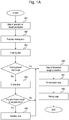
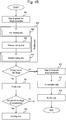
- the method for treatment of rice flour with protease comprises, as essential steps, producing step of dough made from rice flour, protease-mixing step, and heating step. Hereafter, these steps are described in detail.
- the "producing step of dough made from rice flour” comprises producing dough made from rice flour by mixing rice flour with water.
- Rice flour, protease, and water are essential raw materials in this aspect. Rice flour and water are used in this step, and protease is used in the protease-mixing step described below.
- the raw material of rice flour used in this step is rice seed ( Oryza sativa ); that is, what is usually called "rice.”
- the lineage or a variety of rice used as a raw material is not limited.
- rice may be Oryza sativa ssp. japonica or ssp. indica. Any rice variety, such as Koshihikari, Sasanishiki, Akitakomachi, or Konadamon, can be used without limitation, provided that it is of ssp. japonica.
- use of rice with amylose content of 15% by weight or more is preferable from the viewpoint of flavor.
- Amylose content is more preferably 20% to 25% by weight and further preferably 22% to 24% by weight.
- Examples of rice varieties with such amylose content include, but are not limited to, Koshihikari (15% to 20% by weight), Konadamon (18% to 21% by weight), Mizurochikara (20% to 26% by weight), Momiroman (24% to 28% by weight), and Koshinokaori (28% to 35% by weight).
- Conditions of rice polishing prior to preparation of rice flour are not limited. It may be rice with the germ or white rice (including pre-washed rice), with white rice being preferable. Before rice flour is prepared, white rice may be dry, or it may be moistened via soaking in water.
- the grain size (i.e., the grain diameter) of rice flour is not limited.
- Rice flour may have a relatively large grain size, which is prepared via roll grinding or pin grinding, or it may have a small grain size, which is prepared with the use of an air-swept mill or stamp mill.
- the grain size may range from 5 ⁇ m to 300 ⁇ m (average grain size: 15 ⁇ m to 70 ⁇ m).
- the average grain size is preferably between 15 ⁇ m and 40 ⁇ m.
- a method of wet air-swept milling via soaking in water is described.
- white rice is soaked in water for 2 hours to allow the rice to absorb water, and moisture is removed from the surface using a centrifuge dryer.
- a grinder such as a super powder mill (SPM-R290, a vortex pulverizer, Nishimura Machine Works Co., Ltd.) is used to perform air-swept milling, so that ground white rice can be obtained.
- the revolution speed of the super powder mill blade may be, for example, 40 Hz to 50 Hz, and the sample feed speed (of the feeders) may be 1 or 2.
- additives can be added, if necessary.
- Preferable additives can be added to the dough made from rice flour at any time without particular limitation. Additives may be added at an adequate time while refraining from suppressing or inhibiting the production of the dough made from rice flour or protease activity by taking additive types and properties into consideration. For example, additives may be added during this step or during the protease-mixing step described below. Alternatively, additives may be added after the heating step or during a plurality of steps.
- additives include food colors, including natural color and synthetic color, food preservatives, such as sodium benzoate, potassium sorbate, and propionate, antioxidants, such as L-ascorbic acid, erythorbic acid, and tocopherol, leavening agents, such as sodium bicarbonate and gluconolactone, sweeteners, such as aspartame, glycyrrhiza extract, xylitol, D-sorbitol, stevia, and saccharin, aromatics, including natural aromatics and synthetic perfume, and thickeners, such as guar gum, xanthan gum, hydroxypropyl methyl cellulose, carboxymethyl cellulose, pectin, and carrageenan.
- butter, egg egg white and/or egg yolk
- sugar, salt, minerals, and the like can be added, according to need, provided that protease activity is not suppressed or inhibited.
- a gluten-containing food material such as wheat flour is not preferable.
- such food material is intentionally added merely as a food material and such addition is not intended for food allergy control, such food material may be added.
- mixing refers to thorough mixing of raw materials. According to this aspect, in particular, the term refers to the production of dough made from rice flour via thorough mixing of rice flour, water, protease described below, and other raw materials, according to need.
- dough made from rice flour refers to rice flour dissolved in water.
- the ratio of rice flour to water is not limited.
- such dough may be in the form of an aqueous solution with rice flour content of less than 30% by weight, which has fluidity, it may be in the form of a liquid with rice flour content of 30% or more but less than 60% by weight, which has both viscosity and fluidity (as with arrowroot starch gruel), or it may be in the form of a paste with rice flour content of 60% by weight or more, which has no fluidity.
- Methods of mixing raw materials are not particularly limited, provided that raw materials are homogeneously dispersed in the resulting dough made from rice flour.
- An adequate known method may be selected in accordance with, for example, the conditions of dough made from rice flour.
- a method involving agitation can be employed. Agitation can be conducted with the use of an adequate agitator.
- a method of kneading blending
- Kneading can be conducted with the use of a kneader such as a blender.
- Mixing may be carried out until raw materials are thoroughly mixed, and the duration thereof is not particularly limited.
- protease is added to and mixed with the dough made from rice flour.
- any protease can be used, provided that it can be used for food application.
- Endopeptidase, exopeptidase, or a mixture thereof may be used.
- serine protease such as trypsin, alkaline protease, thiol proteases such as papain, bromelin, actinidine, and ficin
- metal protease such as thermolysin
- acidic protease such as pepsin.
- protease can be derived from any organism without particular limitation.
- protease may be derived from a bacterium, fungus, plant, or animal.
- the bacterial type is not limited; however, a bacterium of endotoxin free or exotoxin free is preferable since protease is used for food application.
- Bacillus bacteria such as B. subtilis, B. amyloliquefaciens, B. circulans, B. licheniformis, B. stearothermophilus, and B. thermoproteolyticus
- Streptomyces bacteria such as S. griseus and S. kanamyceticus.
- the fungal type is not limited; however, a fungus free of toxin is preferable since protease is used for food application.
- examples include Aspergillus fungi, such as A . oryzae, A. melleus, A. niger, A. sojae, and A . saitoi, Rhizopus fungi, such as R. niveus, R. arrhizus, and R. oligosporus, and Penicillium fungi, such as P. duponti, P. galaucum, and P. roqueforti.
- Aspergillus fungi such as A . oryzae, A. melleus, A. niger, A. sojae, and A . saitoi
- Rhizopus fungi such as R. niveus, R. arrhizus, and R. oligosporus
- Penicillium fungi such as P. duponti, P
- the plant type is not limited; however, a plant free of toxin is preferable since protease is used for food application.
- examples include plants of the genus Carica, such as C. papaya, plants of the genus Ananas, such as A. comosus, plants of the genus Actinidia, such as A . chinensis, A. deliciosa, and A . arguta, and plants of the genus Ficus, such as F. carica.
- proteases commercially available from various manufacturers may be used.
- the amount of protease to be added to dough made from rice flour may be adequately determined within the range of 5 U to 2000 U, and preferably from 7 U to 600 U, per ml of dough made from rice flour, on the basis of a specific activity of relevant protease.
- a specific activity of relevant protease In the case of Bacillus sp .-derived protein or Rhizopus sp .-derived peptidase R, for example, relatively low specific activity of 5 to 20 U is sufficient for 1 ml of the dough.
- Aspergillus sp .-derived protease P or Carica papaya L .-derived papain a relatively high specific activity of 150 to 2000 U or 600 to 2000 U is preferable.
- a specific activity of 150 U ⁇ 50 U is sufficient for 1 ml of the dough.
- the amount to be added can be adequately adjusted.
- the specific activity provided herein is based on the method of calculation described in detail in the examples.
- a method of protease mixing is carried out in accordance with the method of mixing described in the producing step of dough made from rice flour above.
- This step is carried out after the producing step of dough made from rice flour or simultaneously with the producing step of dough made from rice flour.
- the protease-mixing step is carried out simultaneously with the producing step of dough made from rice flour, rice flour, protease, and water used as raw materials in the steps described above are collectively or separately subjected to dough production.
- dough made from rice flour can be produced. 1-2-3. Heating step
- the dough made from rice flour is heated at a predetermined temperature for a given period of time.
- starch and protein in rice flour are blended with water and the protein contained in the rice flour is degraded by the protease.
- the object of the present invention can be achieved by this step.
- the heating step may be continuously carried out, or one or more intermittences may be present during the step.
- continuous treatment When the heating step is continuously carried out at a predetermined heating temperature for a given period of time as described below, it is referred to as “continuous treatment” herein, and it is referred to as an “intermittent treatment” when the treatment is carried out intermittently.
- intermittent treatment In a case of intermittent treatment, each intermittent instance of treatment takes place once every 15 hours or less, and preferably once every 10 or 5 hours or less.
- the heating step may be carried out after the protease-mixing step, or the heating step may be carried out after the producing step of dough made from rice flour carried out simultaneously with the protease-mixing step.
- the heating step may be divided into a "first heating step” that is carried out between the producing step of dough made from rice flour and the protease-mixing step and a "second heating step” that is carried out after the protease-mixing step. Even if the heating step is collectively carried out without division into two steps as described above, the step may be regarded as constituting intermittent treatment herein if heating at the temperature described below is interrupted during the period of heating.
- the heating temperature is the most important and characteristic condition according to this aspect, and such temperature is 40°C or more but less than 60°C.
- an object of the invention according to the present application that is, bread made from 100% rice flour that raises well and is finely textured, cannot be achieved.
- heating is carried out at 45°C or more but less than 60°C.
- the heating temperature before an intermittent instance of treatment is not necessarily the same as that after such instance.
- the heating step is divided into two steps; i.e., a first heating step and a second heating step, and the two steps are separately carried out, the first heating step can be carried out at 45°C or more but less than 55°C, and the second heating step can be carried out at 47.5°C or more but less than 60°C.
- heating duration refers to the total period during which the dough made from rice flour is treated at the heating temperature described above.
- heating duration refers to the total period during which the dough made from rice flour is treated at the heating temperature described above.
- the heating temperature before a given intermittent instance is not necessarily the same as that in the subsequent such instance.
- the heating step is divided into two steps; i.e., a first heating step and a second heating step
- the heating duration in the first heating step can be 2 to 17 hours or 5 to 16 hours
- that in the second heating step can be 30 minutes to 5 hours or 1 to 4 hours. It is preferable that the duration of the first heating step after the producing step of dough made from rice flour be relatively long, so as to blend the starch or protein in rice flour with water.
- the duration of the second heating step after the protease-mixing step may be relatively short, such as at least 30 minutes, preferably at least 1 hour, and more preferably at least 2 hours, although it varies depending on the amount of protease to be added.
- Heating can be carried out in accordance with any known technique, provided that the dough is heated to the temperature described above and maintained at such temperature during the duration described above.
- a heat-retaining apparatus such as an incubator or proofer, may be used.
- a protein contained in rice flour grains in the dough can be adequately degraded, and properties such that the dough can easily retain air bubbles therein can be achieved. While the precise mechanism thereof is not elucidated, cohesiveness of hydrated rice flour grains may be denatured as a result of protease treatment ( Hamada et al., 2013, Journal of Cereal Science 57: 91-97 ). According to the method for treatment of this aspect, in addition, dough made from protease-treated rice flour according to the second aspect can be produced.
- the second aspect of the present invention relates to dough made from protease-treated rice flour.
- the dough made from protease-treated rice flour according to this aspect is obtained by the method for treatment of rice flour with protease according to the first aspect.
- the dough made from protease-treated rice flour according to this aspect can serve as a raw material for the dry dough made from protease-treated rice flour according to the third aspect, the protease-treated rice flour according to the fourth aspect, and the method for producing bread made from rice flour according to the fifth aspect described below.
- the dough made from protease-treated rice flour according to this aspect is produced through a process comprising producing step of dough made from rice flour, protease-mixing step, and heating step.
- the producing step of dough made from rice flour, the protease-mixing step, and the heating step are the same as those described with respect to the first aspect. Accordingly, specific description thereof is omitted herein.
- the dough made from protease-treated rice flour obtained after the heating step has acquired properties such that it can retain air bubbles therein since a protein in rice flour is adequately degraded by protease.
- the dough made from protease-treated rice flour obtained in this aspect can be subjected to drying and then used as a raw material for the dough made from protease-treated rice flour according to the third aspect. Without the drying step, alternatively, bread dough used in the method of producing bread made from rice flour according to the fifth aspect can be prepared.
- the third aspect of the present invention relates to dry dough made from protease-treated rice flour.
- the dry dough made from protease-treated rice flour of this aspect is obtained with the use of, as a raw material, the dough made from protease-treated rice flour according to the second aspect and drying the same.
- dough made from protease-treated rice flour according to this embodiment dough made from protease-treated rice flour, which is lightweight, has high storage stability, and is easily transported, can be obtained.
- the dry dough made from protease-treated rice flour according to this aspect is composed of the dough made from protease-treated rice flour according to the second aspect, which is obtained by the method for treatment of rice flour with protease according to the first aspect.
- the dry dough made from protease-treated rice flour according to this aspect is obtained by merely drying the dough made from protease-treated rice flour according to the second aspect.
- the composition of the dry dough according to this aspect is basically the same as that of the dough made from protease-treated rice flour according to the second aspect, except for its water content.
- the water content of the dry dough is preferably 15% or less because mold is likely to occur during storage if water content exceeds 15%. Water content is more preferably between 5% and 13% and further preferably between 8% and 12%.
- the form of the dry dough made from protease-treated rice flour is not particularly limited, provided that it is in a solid form with water content of 15% or less.
- it may be a mass, plate, bar (including a noodle-like form), small piece, chip, granule, or powder.
- the dry dough made from protease-treated rice flour is not in a mass form but is composed of a plurality of fragments or grains, the sizes of fragments or grains are preferably equivalent to each other, although such sizes may be different from each other.
- the dry dough made from protease-treated rice flour according to this aspect can be produced using, as a raw material, the dough made from protease-treated rice flour according to the second aspect through the drying step.
- the fragmentation step can be carried out before and after the drying step.
- drying step the dough made from protease-treated rice flour according to the second aspect is dried, so as to obtain dry dough made from protease-treated rice flour.
- This step is essential for the method for producing dry dough made from protease-treated rice flour.
- drying is intended to reduce the moisture content of the dough made from protease-treated rice flour.
- the method of drying is not particularly limited, provided that the moisture content of the dough made from rice flour can be reduced.
- methods include a method of circulation drying in which warm air or cold air is applied to dough with the use of a blower or the like, a method of calm drying in which moisture is allowed to evaporate from dough via heating, a method of spray drying in which dough is sprayed and rapidly dried in air, a method of freeze drying, a method of vacuum drying in which dough is dried via deaeration of a sealed container with the use of a vacuum pump or the like, a method of air drying in which dough is exposed to air and allowed to stand (including via drying in the sun), and any combination thereof.
- dough made from protease-treated rice flour may be dried.
- dryers that can be used include a drum dryer, a far-infrared band dryer, a continuous vacuum dryer, a spray dryer, and a freeze dryer.
- dry dough made from protease-treated rice flour is dried via spray drying or other means with the use of a spray dryer or the like, the dough is pulverized at the same time as it is being dried.
- dry dough can be prepared in a powder form without the trituration step described below.
- fragmentation step dough made from protease-treated rice flour is fragmented.
- This step is an alternative step in the method for producing dry dough made from protease-treated rice flour, which may be carried out according to need.
- a spray dryer or the like is used in the drying step as described above, for example, the product that results after the drying step is in a powder form. Thus, this step is not necessary.
- the fragmentation step may be first carried out without particular limitation.
- the fragmentation step may be followed by the drying step, or the drying step may be followed by the fragmentation step.
- the fragmentation step may be carried out two times; that is, before and after the drying step. If the fragmentation step is carried out before the drying step, the surface area of the resulting dough made from protease-treated rice flour can be increased, and the drying time can be shortened. By performing the fragmentation step before the drying step, the absorption rate or transportability of dry dough made from rice flour can be improved, and bulkiness can be adjusted.
- fragmentation refers to preparation of dough made from protease-treated rice flour in the form of a chip, small piece, or granule with a grain size of at least 90 ⁇ m, and preferably at least 100 ⁇ m, via cleavage and/or trituration.
- the dough made from protease-treated rice flour can be fragmented with the use of a method or an apparatus known in the art.
- a known fragmentation apparatus or granulation apparatus such as a conversing mill, a line mill, an extrusion granulator, a crushing granulator, or a dry compression granulator, may be used.
- the weight of the dry dough made from protease-treated rice flour according to the present invention can be reduced and the storage stability and transportability thereof can be improved by drying the dough made from protease-treated rice flour according to the second aspect.
- a large quantity of dough made from protease-treated rice flour can be easily distributed.
- the dry dough made from protease-treated rice flour according to the third aspect can serve as a raw material of the dry powder of the protease-treated rice flour according to the fourth aspect and that of the method for producing the bread made from rice flour according to the fifth aspect.
- the fourth aspect of the present invention relates to dry powder of protease-treated rice flour.
- the dry powder of the protease-treated rice flour according to this aspect is obtained by powdering the dry dough made from protease-treated rice flour according to the third aspect as a raw material when it is in a solid form other than a powder form.
- dough made from protease-treated rice flour can be provided in a form that can be easily used for cooking.
- the dry powder of the protease-treated rice flour according to this aspect is composed of the dough made from protease-treated rice flour according to the second aspect, which is obtained by the method for treatment of rice flour with protease according to the first aspect. Since the dry powder of the protease-treated rice flour according to this aspect is merely a powder form of the dough made from protease-treated rice flour according to the second aspect, in principle, the composition thereof is the same as that of the dough made from protease-treated rice flour according to the second aspect. Water content may be equivalent to that of the dry dough made from protease-treated rice flour according to the third aspect.
- a form of the dry powder of the protease-treated rice flour according to this aspect is fine powder.
- the grain size of the dry powder of the protease-treated rice flour may be from 5 ⁇ m or more but less than 90 ⁇ m on average. As described above, the raising extent is likely to increase as the grain size decreases. Thus, the average grain size is preferably between 5 ⁇ m and 20 ⁇ m.
- the dry powder of the protease-treated rice flour according to this aspect can be obtained by triturating the dry dough made from protease-treated rice flour according to the third aspect as a raw material in the trituration step when it is in a solid form other than powder.
- a sieving step and a repeating step can be carried out, if necessary.
- the dry dough made from protease-treated rice flour according to the third aspect is pulverized to prepare powder. This step is essential when the dry dough made from protease-treated rice flour according to the third aspect is in a form other than powder, such as a mass, plate, bar (including a noodle-like form), small piece, chip, or granule.
- the dry dough made from protease-treated rice flour can be powdered with the use of a method or apparatus known in the field of milling.
- a roll mill or a grinding mill may be used.
- the product after the trituration step is subjected to sieving, so as to select the pulverized dry powder of the protease-treated rice flour in accordance with grain size.
- This step is an alternative step, which may be carried out according to need. This step can be carried out with the use of a method or apparatus known in the field of milling, such as a shifter.
- the product after the trituration step is allowed to pass through a plurality of sieves with different mesh sizes.
- the grain size of the dry powder of the protease-treated rice flour according to this aspect can be made uniform, or the dry powder of the protease-treated rice flour with different grain sizes can be obtained.
- the trituration step and the sieving step are repeated.
- dry powders of the protease-treated rice flour with different grain sizes selected in the sieving step dry powders of the protease-treated rice flour with grain sizes outside a grain size range of interest are subjected to the trituration step again and then to the sieving step.
- the number of repetitions is not particularly limited, and it may be adequately determined in accordance with the grain size of the dry powder of the protease-treated rice flour achieved after the sieving step. In general, the number of repetitions is 1 to 10, and preferably 1 to 5.
- the dry powder of the protease-treated rice flour according to this aspect is gluten-free rice flour; however, the dough thereof can easily retain air bubbles.
- it can be used as gluten-free cereal flour that can serve as an alternative to wheat flour for a variety of meals or food products that had been prepared with the use of wheat flour as a raw material in the past.
- the dry powder of the present invention can serve as an alternative to wheat flour for gluten-free powder for noodle preparation, a raw material for confectionaries such as cookies or cakes, batter for deep-fried foods or meunieres, or roux as a thickener for sauces, in addition to bread.
- Patients with celiac disease can ingest bread of non-wheat-flour-based products; i.e., rice flour products exhibiting mouth feeling textures and flavors equivalent to those of wheat-flour-based products such as breads, which are restricted until now.
- the dry powder of the protease-treated rice flour according to this aspect can be stored at an adequate temperature (e.g., 15°C to 25°C) for one year, and preferably for 10 months.
- the produced bread can remain well-raised and retain its fine texture after storage.
- the dry powder of the protease-treated rice flour according to this aspect can serve as a raw material for "bread” and the like, the market scale of which is large, and contribute to the increased consumption of rice in Japan.
- the fifth aspect of the present invention relates to a method for producing bread made from rice flour and bread made from rice flour produced by such method.
- the method for producing bread made from rice flour according to this aspect involves the use of the dough made from protease-treated rice flour according to the first aspect, the dry dough of rice flour, or the rice flour.
- 100% gluten-free bread made from rice flour that raises well and is finely textured can be produced.
- the method for producing bread made from rice flour according to this aspect comprises a producing step of fermented-dough, a fermentation step, and a baking step. These steps are not different from those of conventional methods for producing wheat-flour-based bread, except for using the protease-treated rice flour according to the first aspect as a raw material alternative to wheat flour as described above. Hereafter, each step of production is described.
- the dough made from protease-treated rice flour according to the second aspect, the dry dough made from protease-treated rice flour according to the third aspect, or the dry powder of the protease-treated rice flour according to the fourth aspect is used as a main raw material, yeast and sugar are added thereto, and the resulting mixture is kneaded to produce fermented-dough.
- Any yeast for food application can be used without limitation.
- Use of dry yeast ( S. cerevisiae ) that can be easily obtained is convenient.
- Any sugar can be used without limitation, provided that it can serve as a carbon source of yeast. Examples thereof include sucrose (sugar), glucose, and fructose.
- auxiliary materials can be added, according to need.
- auxiliary materials include salt, an emulsifier, butter, egg (egg white and/or egg yolk), yeast food, fat and oil, an aromatic, the sweetening agent as described above, the thickener as described above, the food color as described above, the food preservative as described above, the antioxidant as described above, the leavening agent as described above (including baking powder), and a vitamin (as an enrichment or food preservative).
- wheat flour with hard flour being preferable
- the amounts of yeast, sugar, and auxiliary materials to be added to the dough made from protease-treated rice flour, the dry dough made from protease-treated rice flour, or the dry powder of the protease-treated rice flour may be determined in accordance with a general recipe known in the baking industry. After the raw materials have been mixed, water is adequately added thereto, so as to achieve an adequate degree of viscosity as bread dough.
- a kneader e.g., a blender
- a domestic-use blender may be used.
- kneading may be carried out at the 4th to 6th speed for approximately 5 to 15 minutes, and more preferably at the 6th speed for approximately 10 minutes.
- the produced dough to be fermented is subjected to fermentation.
- the fermented-dough obtained after the step of producing fermented-dough is subjected to proofing.
- the fermented-dough Prior to the initiation of the present step, the fermented-dough is introduced into a mold or fixed in accordance with a form of interest, according to need. Fermentation may be carried out within a temperature range in which yeast can grow. This is generally 25°C to 40°C and preferably 27°C to 38°C.
- the duration of fermentation is 30 to 90 minutes, and preferably 40 to 60 minutes.
- proofing is adequately terminated when the fermentation dough raises to a level such that the volume is approximately double the volume before treatment as a result of fermentation.
- baking step the bread dough resulting after the fermentation step is baked.
- This step may be carried out in accordance with a baking method by a known bread baking method.
- baking may be carried out at 140°C to 190°C, and preferably 140°C to 160°C, for 30 to 40 minutes.
- the surface of bread made from 100% rice flour is likely to harden as a result of baking. It is thus preferable that baking be carried out via heating (i.e., moistening) while avoiding extremely high temperatures.
- the method for producing bread made from rice flour according to this aspect is intended to produce bread made from 100% rice flour with the use of, as a main raw material, dough made from protease-treated rice flour according to the second aspect, dry dough made from protease-treated rice flour according to the third aspect, or dry powder of the protease-treated rice flour according to the fourth aspect. Accordingly, an object to be achieved by this aspect (that is, bread made from rice flour) is, in principle, bread made from 100% rice flour.
- bread made from 100% rice flour refers to bread that is produced with the exclusive use of cereal flour other than rice flour as a raw powder material and without the addition of gluten. Accordingly, the term “bread made from 100% rice flour” is substantially synonymous with the term “100% gluten-free bread made from rice flour” herein. It should be noted that inclusion of a minor amount of other cereal flour may be impossible to avoid during milling or production, and, accordingly, bread comprising 98% or more, 99% or more, or 99.5% or more rice flour as powder is within the scope of the "bread made from 100% rice flour.” In such a case, it is preferable that gluten-containing cereal flour, such as wheat flour, not be included.
- the bread made from 100% rice flour according to this aspect is produced with the use of 100% rice flour as a raw material of cereal flour; however, such bread raises well and is finely textured. Accordingly, such bread is superior to bread made from 100% rice flour produced by a conventional technique in terms of tenderness, fineness, and desirable mouth feeing texture.
- bread made from 100% rice flour that raises well and is finely textured can be easily produced at town bakeries or in homes that are not fully equipped with facilities for protease treatment of rice flour.
- the bread made from rice flour according to this aspect is 100% gluten-free bread made from rice flour that raises well and is finely textured.
- it can be utilized as an alternative food for wheat-flour-based bread that can be supplied to patients with wheat allergies (i.e., gluten allergies), such as patients with celiac disease.
- Example 1 Correlation between temperature for protease treatment of rice flour and raising extent and texture of bread made from 100% rice flour
- As protease Aspergillus sp .-derived Proteax (Amano Enzyme Inc.) or Bacillus sp.- derived Thermoase (Amano Enzyme Inc.) was used. Subsequently, the protease was added to the resulting dough made from rice flour, and the resultant was incubated in an incubator (MIR-254; SANYO Electric Co., Ltd.: ND-420 for the treatment carried out at 65°C; Tokyo Rikakikai Co., Ltd.) at 25°C, 35°C, 45°C, 47.5°C, 50°C, 55°C, 60°C, and 65°C for 15 hours.
- an incubator MIR-254; SANYO Electric Co., Ltd.: ND-420 for the treatment carried out at 65°C; Tokyo Rikakikai Co., Ltd.
- Protease was added to adjust the protease activity to 150U in 1mL of the dough made from rice flour.
- 10g of sugar, 3g of salt, and 3g of dry yeast (Lesaffre) were added to 420g of the dough made from protease-treated rice flour, the mixture was kneaded with the use of a domestic-use blender (KSM150; KitchenAid) for 15 minutes, and the resulting dough was introduced into a bread mold and then subjected to proofing in an electronic fermentator (Proofer SK-15; Taisho Electric Mfg. Co., Ltd.) at 38°C for 50 minutes.
- protease activity in the dough was measured using casein (Wako Pure Chemical Industries, Ltd.) as a substrate and the Pierce Protease Assay Kit (Thermo Fisher Scientific K.K.). For such measurement, protease activity of a solution of 10 ⁇ g/mL trypsin was designated as being 1U, and the protease activity level of dough made from rice flour was assayed on the basis thereof.
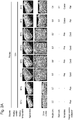
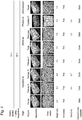
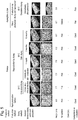
- Fig. 2A shows the results achieved with the use of Proteax
- Fig. 2B shows the results attained with the use of Thermoase.
- the raising extent and the fineness of the texture of the bread were completely lost when protease treatment was carried out at 60°C or higher.
- the resulting bread exhibited an insufficient raising extent and a coarse texture.
- treatment was carried out at 45°C to 55°C however, bread made from rice flour was produced, which was well-raised and finely textured.
- a similar trend was observed with the use of Thermoase, as shown in Fig. 2B .
- the temperature for protease treatment to be carried out in the method for treatment of rice flour with protease according to the present invention was designated as being 40°C or more but less than 60°C.
- the conditions for protease treatment of rice flour are designated to be such that heating is carried out at 15°C to 30°C for 5 to 30 hours with the use of Bacillus stearothermophilus -derived protease (Thermoase).
- the optimal temperature range for protease treatment of rice flour is from 40°C or more but less than 60°C, which is at least 10°C higher than the temperature range disclosed in JP2014-33646A , regardless of whether Thermoase or Proteax is used.
- the present invention is significantly different from the invention disclosed in JP2014-33646A in this respect.
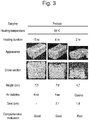
- the basic procedure was carried out in accordance with Example 1, except that the "Konadamon" rice variety was used, the temperature for protease treatment with Proteax was set at 55°C, and the treatment durations were set at 2 hours, 6 hours, and 15 hours.
- the duration of protease treatment for the method for treatment of rice flour with protease according to the present invention was designated as being 3 hours to 20 hours.
- Example 2 The basic procedure was carried out in accordance with Example 1. The specific procedure was as described below. To 210g (water content in powder: 14%) of white rice flour (rice variety: Konadamon), 210mL of water and various proteases were added, and the mixture was kneaded using a domestic-use hand blender (THM280 or THM281; Tescom Co., Ltd.) for 3 minutes to prepare dough (the step of producing dough made from rice flour and the protease-mixing step).
- THM280 or THM281 Tescom Co., Ltd.
- proteases were added, so as to adjust protease activity in the dough made from rice flour to the levels described below relative to 1mL of the dough made from rice flour: 150U Proteax (derived from Aspergillus sp .; Amano Enzyme Inc.); 150U protease A (derived from Aspergillus sp .; Amano Enzyme Inc.); 150U protease M (derived from Aspergillus sp .; Amano Enzyme Inc.); 600U protease P (derived from Aspergillus sp.; Amano Enzyme Inc.); 7.0U protin (derived from Bacillus sp .; Amano Enzyme Inc.); 150U Thermoase (derived from Bacillus sp .; Amano Enzyme Inc.); 6.9U peptidase R (derived from Rhizopus sp .; Amano Enzyme Inc.); and 600U papain (derived from Carica
- Protease activity in the dough made from rice flour was measured using casein (Wako Pure Chemical Industries, Ltd.) as a substrate and the Pierce Protease Assay Kit (Thermo Fisher Scientific K.K.). For this measurement, protease activity of a solution of 10 ⁇ g/mL trypsin was designated as being 1U, and the protease activity level of the dough made from rice flour was set on the basis thereof. Subsequently, the resulting dough made from rice flour was incubated in an incubator (MIR-254; SANYO Electric Co., Ltd.) at 55°C for 15 hours (the heating step).
- an incubator MIR-254; SANYO Electric Co., Ltd.
- the resulting dough was introduced into a bread mold and then subjected to proofing in an electronic fermentator (Proofer SK-15; Taisho Electric Mfg. Co., Ltd.) at 38°C for 60 minutes (the fermentation step).
- an electronic fermentator Proofer SK-15; Taisho Electric Mfg. Co., Ltd.
- an effective protease has been designated as being a protease derived from Bacillus stearothermophilus (e.g., Thermoase), and the effects of treatment with other proteases, such as protease A, protease M, and protease P, have been denied.
- the treatment was carried out under the conditions (i.e., the temperature and the duration) according to the present invention, in contrast, well-raised and finely textured bread made from 100% rice flour was produced with the use of various proteases, regardless of the types of proteases or organism species from which proteases were derived.
- the dough made from protease-treated rice flour is dried and bread made from 100% rice flour is produced with the use of the dry powder of the protease-treated rice flour. Whether or not the resulting bread is well-raised and finely textured is examined.
- proteases were added, so as to adjust protease activity to the levels described below relative to 1mL of the dough made from rice flour: 150U Proteax (derived from Aspergillus sp .; Amano Enzyme Inc.) and 150U protease A (derived from Aspergillus sp.; Amano Enzyme Inc.).
- the resulting dough made from protease-treated rice flour was subjected to circulation drying in an incubator (WFO-600ND; Tokyo Rikakikai Co., Ltd.) at 55°C for 6 hours or calm drying in an incubator (MIR-254; SANYO Electric Co., Ltd.) at 55°C for 15 hours (the drying step).
- the resulting dry dough made from protease-treated rice flour was pulverized or more but less than 90 ⁇ m (average grain size: approximately 9 ⁇ m) with the use of a Millser (IFM-503M; Iwatani Corporation) (grinding step).
- dough made from rice flour was produced in accordance with the method for producing bread made from 100% rice flour in which rice flour was subjected to pre-fermentation with the use of malted rice ( JP2012-115197A ).
- the resulting dough made from rice flour was dried at 55°C in the same manner as with the dough made from protease-treated rice flour according to the present invention.
- bread made from 100% rice flour was produced with the use of rice flour that had been pulverized in the same manner. The raising extent and the texture observed in a cross section of the resulting bread made from 100% rice flour were examined.
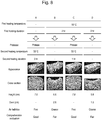
- Fig. 5 shows the results achieved with the use of Proteax as a protease.
- the dry powder of the protease-treated rice flour according to the present invention obtained by circulation drying or calm drying was used (the method of production involving drying and reproduction)
- the resulting bread made from 100% rice flour had raisen well and was finely textured to an extent equivalent to that of the bread made from 100% rice flour produced by the method described in Example 3 without the drying step (the basic method of production) ("Immediately after production" in Fig. 5 ).
- bread made from 100% rice flour is produced via the producing step of dough made from rice flour and the heating step of dough made from rice flour. The raising extent and other properties of the resulting bread are examined.
- the raising extent and other properties of the bread made from 100% rice flour produced by treating the dough made from rice flour while separately conducting the heating step before the protease-mixing step and after the protease-mixing step are examined.
- Proteax (Amano Enzyme Inc.) was added to adjust a protease activity to 900U relative to 1mL of the dough made from rice flour (the protease-mixing step), followed by incubation in an incubator (MIR-254; SANYO Electric Co., Ltd.) at 55°C for 2 or 4 hours (the second heating step). Thereafter, bread made from rice flour was produced in the same manner as in Example 4, and the raising extent and the texture inside the resulting bread made from 100% rice flour were examined.
- Fig. 8 The results are shown in Fig. 8 .
- A shows the results of (1)
- C shows the results of (2)
- B and D shows the results of (3).
- a and C it was found that bread made from 100% rice flour that raises well and is finely textured could be obtained, regardless of whether the heating step was carried out continuously after the protease-mixing step or the heating step was divided into a first heating step and a second heating step, as long as the total heating time was at least 3 hours during the process of production.
- the duration of heating the dough made from rice flour before protease mixing necessary for the bread made from 100% rice flour to raise would be at least 2 hours and the duration of heating after protease mixing necessary for the bread made from 100% rice flour to become finely textured (the second heating time) would be at least 1 hour.
- results shown in B and the results shown in D demonstrate that bread made from 100% rice flour produced without a protease-mixing step of would raise but its texture would be coarsen, as with the results achieved in Examples 5 and 6, even if the heating duration were to be 2 hours, which was the same as the first heating time as per in C, and it is 3 hours, that is the same as the total heating time shown in A and C, respectively.
Landscapes
- Life Sciences & Earth Sciences (AREA)
- Engineering & Computer Science (AREA)
- Food Science & Technology (AREA)
- Health & Medical Sciences (AREA)
- Microbiology (AREA)
- General Health & Medical Sciences (AREA)
- Nutrition Science (AREA)
- Molecular Biology (AREA)
- Botany (AREA)
- Bakery Products And Manufacturing Methods Therefor (AREA)
- Coloring Foods And Improving Nutritive Qualities (AREA)
- Cereal-Derived Products (AREA)
Applications Claiming Priority (2)
| Application Number | Priority Date | Filing Date | Title |
|---|---|---|---|
| JP2014197183A JP6454115B2 (ja) | 2014-09-26 | 2014-09-26 | 小麦粉代用米粉及びグルテンフリー米粉パンの製造方法 |
| PCT/JP2015/076882 WO2016047668A1 (ja) | 2014-09-26 | 2015-09-24 | 小麦粉代用米粉及びグルテンフリー米粉パンの製造方法 |
Publications (2)
| Publication Number | Publication Date |
|---|---|
| EP3199035A1 true EP3199035A1 (de) | 2017-08-02 |
| EP3199035A4 EP3199035A4 (de) | 2018-07-04 |
Family
ID=55581191
Family Applications (1)
| Application Number | Title | Priority Date | Filing Date |
|---|---|---|---|
| EP15845039.5A Withdrawn EP3199035A4 (de) | 2014-09-26 | 2015-09-24 | Reismehl als weizenmehlersatz und verfahren zur herstellung von glutenfreiem reismehlbrot |
Country Status (6)
| Country | Link |
|---|---|
| US (1) | US20170295804A1 (de) |
| EP (1) | EP3199035A4 (de) |
| JP (1) | JP6454115B2 (de) |
| CN (1) | CN106714562A (de) |
| AU (1) | AU2015322583A1 (de) |
| WO (1) | WO2016047668A1 (de) |
Families Citing this family (7)
| Publication number | Priority date | Publication date | Assignee | Title |
|---|---|---|---|---|
| CN108739924A (zh) * | 2018-05-29 | 2018-11-06 | 上海来伊份股份有限公司 | 一种大米面包产品及其加工方法 |
| CN109043307A (zh) * | 2018-06-25 | 2018-12-21 | 北京协同创新研究院 | 一种半固态酶法水解谷物粉及其生产方法 |
| CN109007563B (zh) * | 2018-07-05 | 2022-06-17 | 中国农业科学院农产品加工研究所 | 无麸质改良粉及其制备方法 |
| CN110050811A (zh) * | 2019-05-24 | 2019-07-26 | 江南大学 | 一种无麸质大米面包及其制备方法 |
| JP7166630B2 (ja) * | 2019-12-11 | 2022-11-08 | 協和化成株式会社 | 包餡生地の製法 |
| JP7805611B2 (ja) * | 2020-11-26 | 2026-01-26 | 国立研究開発法人農業・食品産業技術総合研究機構 | 米粉ドゥ及び米粉麺の製造方法 |
| CN113812435B (zh) * | 2021-07-02 | 2023-11-10 | 四川米老头食品工业集团股份有限公司 | 一种可冲泡成糊的米类饼干及其制备方法、食用方法 |
Family Cites Families (4)
| Publication number | Priority date | Publication date | Assignee | Title |
|---|---|---|---|---|
| US20030198725A1 (en) * | 2001-11-28 | 2003-10-23 | Cardenas Juan De Dios Figueroa | Nixtamalized corn and products thereof |
| CN102342425B (zh) * | 2011-10-11 | 2013-04-03 | 中南林业科技大学 | 一种婴幼儿速溶米粉加工方法 |
| JP6083730B2 (ja) * | 2012-08-09 | 2017-02-22 | 石川県公立大学法人 | 米粉パン用添加剤、米粉パン用米粉組成物、米粉パン用パン生地及び米粉パンの製造方法 |
| CN104146020B (zh) * | 2014-07-24 | 2016-04-06 | 中国农业科学院农产品加工研究所 | 改善无面筋蛋白面团发酵性能及营养特性的方法 |
-
2014
- 2014-09-26 JP JP2014197183A patent/JP6454115B2/ja not_active Expired - Fee Related
-
2015
- 2015-09-24 AU AU2015322583A patent/AU2015322583A1/en not_active Abandoned
- 2015-09-24 US US15/514,055 patent/US20170295804A1/en not_active Abandoned
- 2015-09-24 EP EP15845039.5A patent/EP3199035A4/de not_active Withdrawn
- 2015-09-24 CN CN201580051020.4A patent/CN106714562A/zh active Pending
- 2015-09-24 WO PCT/JP2015/076882 patent/WO2016047668A1/ja not_active Ceased
Also Published As
| Publication number | Publication date |
|---|---|
| JP2016067228A (ja) | 2016-05-09 |
| CN106714562A (zh) | 2017-05-24 |
| AU2015322583A1 (en) | 2017-04-13 |
| US20170295804A1 (en) | 2017-10-19 |
| JP6454115B2 (ja) | 2019-01-16 |
| EP3199035A4 (de) | 2018-07-04 |
| WO2016047668A1 (ja) | 2016-03-31 |
Similar Documents
| Publication | Publication Date | Title |
|---|---|---|
| EP3199035A1 (de) | Reismehl als weizenmehlersatz und verfahren zur herstellung von glutenfreiem reismehlbrot | |
| Baye | Teff: nutrient composition and health benefits | |
| Arendt et al. | Cereal grains for the food and beverage industries | |
| JP4891338B2 (ja) | 低湿予備調理を用いた、穀物ベース食品向けシリアルフラワー及び全粒シリアルフラワーの連続製造 | |
| Zhang et al. | Effect of ultrasound-assisted dough fermentation on the quality of dough and steamed bread with 50% sweet potato pulp | |
| Goel et al. | Wheat proteins: a valuable resources to improve nutritional value of bread | |
| Pagani et al. | Traditional Italian products from wheat and other starchy flours | |
| JP5228060B2 (ja) | 米粉を使用した韓国式パンケーキの粉末調合物 | |
| Legesse et al. | Functional and physicochemical properties of mango seed kernels and wheat flour and their blends for biscuit production | |
| Mahmoud et al. | Impact of solid state fermentation on chemical composition, functional properties, and antioxidant activity of wheat bran | |
| Boukid | Cereal-based foodstuffs: The backbone of Mediterranean cuisine | |
| Kanojia et al. | Products and byproducts of wheat milling process | |
| Dan et al. | Application of sourdough in gluten-free bakery products | |
| Paciulli et al. | Wheat bread in the mediterranean area: from past to the future | |
| CN102754765A (zh) | 一种牡丹籽营养粉的生产工艺 | |
| WO2020177431A1 (zh) | 一种猴头菇青稞酥的制备方法 | |
| Mir et al. | Understanding the role of additives in gluten-free breads | |
| JP6608629B2 (ja) | パン類の製造方法 | |
| JP4982922B2 (ja) | γ−アミノ酪酸含量を高めた食品素材の製造方法 | |
| Alper et al. | Recent advances in the use of sourdough fermentation to improve the quality of gluten-free bakery products | |
| KR20090117363A (ko) | 쌀겨-황국균-청국장균 배양혼합물의 제조 방법 및 그배양물의 가공 방법 | |
| Mella | Effects of malting and fermentation on the composition and functionality of sorghum flour | |
| Popa et al. | Oat flour in bread manufacturing | |
| Cauvain | Functional ingredients | |
| Ranjan et al. | Kodo Millet (Paspalum scrobiculatum) |
Legal Events
| Date | Code | Title | Description |
|---|---|---|---|
| PUAI | Public reference made under article 153(3) epc to a published international application that has entered the european phase |
Free format text: ORIGINAL CODE: 0009012 |
|
| 17P | Request for examination filed |
Effective date: 20170419 |
|
| AK | Designated contracting states |
Kind code of ref document: A1 Designated state(s): AL AT BE BG CH CY CZ DE DK EE ES FI FR GB GR HR HU IE IS IT LI LT LU LV MC MK MT NL NO PL PT RO RS SE SI SK SM TR |
|
| AX | Request for extension of the european patent |
Extension state: BA ME |
|
| DAV | Request for validation of the european patent (deleted) | ||
| DAX | Request for extension of the european patent (deleted) | ||
| A4 | Supplementary search report drawn up and despatched |
Effective date: 20180605 |
|
| RIC1 | Information provided on ipc code assigned before grant |
Ipc: A21D 13/04 20170101ALI20180529BHEP Ipc: A23L 7/104 20160101AFI20180529BHEP Ipc: A23L 33/10 20160101ALI20180529BHEP Ipc: A21D 8/04 20060101ALI20180529BHEP |
|
| STAA | Information on the status of an ep patent application or granted ep patent |
Free format text: STATUS: THE APPLICATION IS DEEMED TO BE WITHDRAWN |
|
| 18D | Application deemed to be withdrawn |
Effective date: 20190103 |