EP3199268A1 - Procede de fabrication generative de composants a l'aide d'une plateforme de construction pouvant etre chauffee et installation pour ledit procede - Google Patents
Procede de fabrication generative de composants a l'aide d'une plateforme de construction pouvant etre chauffee et installation pour ledit procede Download PDFInfo
- Publication number
- EP3199268A1 EP3199268A1 EP16153141.3A EP16153141A EP3199268A1 EP 3199268 A1 EP3199268 A1 EP 3199268A1 EP 16153141 A EP16153141 A EP 16153141A EP 3199268 A1 EP3199268 A1 EP 3199268A1
- Authority
- EP
- European Patent Office
- Prior art keywords
- component
- heating
- power
- temperature
- energy beam
- Prior art date
- Legal status (The legal status is an assumption and is not a legal conclusion. Google has not performed a legal analysis and makes no representation as to the accuracy of the status listed.)
- Withdrawn
Links
Images

Classifications
-
- B—PERFORMING OPERATIONS; TRANSPORTING
- B29—WORKING OF PLASTICS; WORKING OF SUBSTANCES IN A PLASTIC STATE IN GENERAL
- B29C—SHAPING OR JOINING OF PLASTICS; SHAPING OF MATERIAL IN A PLASTIC STATE, NOT OTHERWISE PROVIDED FOR; AFTER-TREATMENT OF THE SHAPED PRODUCTS, e.g. REPAIRING
- B29C64/00—Additive manufacturing, i.e. manufacturing of three-dimensional [3D] objects by additive deposition, additive agglomeration or additive layering, e.g. by 3D printing, stereolithography or selective laser sintering
- B29C64/10—Processes of additive manufacturing
- B29C64/141—Processes of additive manufacturing using only solid materials
- B29C64/153—Processes of additive manufacturing using only solid materials using layers of powder being selectively joined, e.g. by selective laser sintering or melting
-
- B—PERFORMING OPERATIONS; TRANSPORTING
- B22—CASTING; POWDER METALLURGY
- B22F—WORKING METALLIC POWDER; MANUFACTURE OF ARTICLES FROM METALLIC POWDER; MAKING METALLIC POWDER; APPARATUS OR DEVICES SPECIALLY ADAPTED FOR METALLIC POWDER
- B22F10/00—Additive manufacturing of workpieces or articles from metallic powder
- B22F10/20—Direct sintering or melting
- B22F10/28—Powder bed fusion, e.g. selective laser melting [SLM] or electron beam melting [EBM]
-
- B—PERFORMING OPERATIONS; TRANSPORTING
- B22—CASTING; POWDER METALLURGY
- B22F—WORKING METALLIC POWDER; MANUFACTURE OF ARTICLES FROM METALLIC POWDER; MAKING METALLIC POWDER; APPARATUS OR DEVICES SPECIALLY ADAPTED FOR METALLIC POWDER
- B22F10/00—Additive manufacturing of workpieces or articles from metallic powder
- B22F10/30—Process control
- B22F10/36—Process control of energy beam parameters
- B22F10/368—Temperature or temperature gradient, e.g. temperature of the melt pool
-
- B—PERFORMING OPERATIONS; TRANSPORTING
- B22—CASTING; POWDER METALLURGY
- B22F—WORKING METALLIC POWDER; MANUFACTURE OF ARTICLES FROM METALLIC POWDER; MAKING METALLIC POWDER; APPARATUS OR DEVICES SPECIALLY ADAPTED FOR METALLIC POWDER
- B22F12/00—Apparatus or devices specially adapted for additive manufacturing; Auxiliary means for additive manufacturing; Combinations of additive manufacturing apparatus or devices with other processing apparatus or devices
- B22F12/10—Auxiliary heating means
-
- B—PERFORMING OPERATIONS; TRANSPORTING
- B22—CASTING; POWDER METALLURGY
- B22F—WORKING METALLIC POWDER; MANUFACTURE OF ARTICLES FROM METALLIC POWDER; MAKING METALLIC POWDER; APPARATUS OR DEVICES SPECIALLY ADAPTED FOR METALLIC POWDER
- B22F12/00—Apparatus or devices specially adapted for additive manufacturing; Auxiliary means for additive manufacturing; Combinations of additive manufacturing apparatus or devices with other processing apparatus or devices
- B22F12/10—Auxiliary heating means
- B22F12/17—Auxiliary heating means to heat the build chamber or platform
-
- B—PERFORMING OPERATIONS; TRANSPORTING
- B29—WORKING OF PLASTICS; WORKING OF SUBSTANCES IN A PLASTIC STATE IN GENERAL
- B29C—SHAPING OR JOINING OF PLASTICS; SHAPING OF MATERIAL IN A PLASTIC STATE, NOT OTHERWISE PROVIDED FOR; AFTER-TREATMENT OF THE SHAPED PRODUCTS, e.g. REPAIRING
- B29C64/00—Additive manufacturing, i.e. manufacturing of three-dimensional [3D] objects by additive deposition, additive agglomeration or additive layering, e.g. by 3D printing, stereolithography or selective laser sintering
- B29C64/20—Apparatus for additive manufacturing; Details thereof or accessories therefor
- B29C64/295—Heating elements
-
- B—PERFORMING OPERATIONS; TRANSPORTING
- B33—ADDITIVE MANUFACTURING TECHNOLOGY
- B33Y—ADDITIVE MANUFACTURING, i.e. MANUFACTURING OF THREE-DIMENSIONAL [3D] OBJECTS BY ADDITIVE DEPOSITION, ADDITIVE AGGLOMERATION OR ADDITIVE LAYERING, e.g. BY 3D PRINTING, STEREOLITHOGRAPHY OR SELECTIVE LASER SINTERING
- B33Y30/00—Apparatus for additive manufacturing; Details thereof or accessories therefor
-
- B—PERFORMING OPERATIONS; TRANSPORTING
- B33—ADDITIVE MANUFACTURING TECHNOLOGY
- B33Y—ADDITIVE MANUFACTURING, i.e. MANUFACTURING OF THREE-DIMENSIONAL [3D] OBJECTS BY ADDITIVE DEPOSITION, ADDITIVE AGGLOMERATION OR ADDITIVE LAYERING, e.g. BY 3D PRINTING, STEREOLITHOGRAPHY OR SELECTIVE LASER SINTERING
- B33Y50/00—Data acquisition or data processing for additive manufacturing
- B33Y50/02—Data acquisition or data processing for additive manufacturing for controlling or regulating additive manufacturing processes
-
- B—PERFORMING OPERATIONS; TRANSPORTING
- B22—CASTING; POWDER METALLURGY
- B22F—WORKING METALLIC POWDER; MANUFACTURE OF ARTICLES FROM METALLIC POWDER; MAKING METALLIC POWDER; APPARATUS OR DEVICES SPECIALLY ADAPTED FOR METALLIC POWDER
- B22F12/00—Apparatus or devices specially adapted for additive manufacturing; Auxiliary means for additive manufacturing; Combinations of additive manufacturing apparatus or devices with other processing apparatus or devices
- B22F12/90—Means for process control, e.g. cameras or sensors
-
- B—PERFORMING OPERATIONS; TRANSPORTING
- B22—CASTING; POWDER METALLURGY
- B22F—WORKING METALLIC POWDER; MANUFACTURE OF ARTICLES FROM METALLIC POWDER; MAKING METALLIC POWDER; APPARATUS OR DEVICES SPECIALLY ADAPTED FOR METALLIC POWDER
- B22F2999/00—Aspects linked to processes or compositions used in powder metallurgy
-
- Y—GENERAL TAGGING OF NEW TECHNOLOGICAL DEVELOPMENTS; GENERAL TAGGING OF CROSS-SECTIONAL TECHNOLOGIES SPANNING OVER SEVERAL SECTIONS OF THE IPC; TECHNICAL SUBJECTS COVERED BY FORMER USPC CROSS-REFERENCE ART COLLECTIONS [XRACs] AND DIGESTS
- Y02—TECHNOLOGIES OR APPLICATIONS FOR MITIGATION OR ADAPTATION AGAINST CLIMATE CHANGE
- Y02P—CLIMATE CHANGE MITIGATION TECHNOLOGIES IN THE PRODUCTION OR PROCESSING OF GOODS
- Y02P10/00—Technologies related to metal processing
- Y02P10/25—Process efficiency
Definitions
- the invention relates to a method for the generative production of a component on a construction platform.
- particles of a building material are first produced layer by layer on the construction platform (which serves as the basis for the first layer of the component) and then on the component being formed (of which the first layer on the construction platform and possibly further layers have already been produced were) and solidified by an energy beam, such as an electron beam or a laser beam.
- the solidification leads to a firm cohesion of the particles of the building material, which form the component to be produced.
- the solidification can be done, for example, by melting or sintering.
- selective melting also known as selective laser melting, SLM
- electron beam melting also known as electron beam melting, EBM
- laser deposition welding also known as laser metal deposition, LMD
- SLM selective laser melting
- EBM electron beam melting
- LMD laser deposition welding
- SLS selective laser sintering
- the component is manufactured in layers on the construction platform. This thus also serves as the basis for producing the first layer of the component.
- the component can be produced for example by laser deposition welding directly on the construction platform, wherein the particles of the building material are fed directly to the laser beam.
- a powder bed can be produced on the building platform, wherein in each case only the particles of the building material are melted in the powder bed, which are necessary for the formation of the component.
- the construction platform is also equipped with a heating device, wherein the component being formed is heated via the building platform. In this way, a heating of the emerging component is possible, for example, the necessary Power of the energy beam to melt the particles to reduce.
- the invention relates to a system for producing a piecewise generative production of a component with a construction platform for the component to be produced, wherein the construction platform is equipped with a heating device.
- a system for producing a piecewise generative production of a component with a construction platform for the component to be produced, wherein the construction platform is equipped with a heating device.
- a turbine blade is made.
- the assembly and joining zone is to be heated to a temperature just below the melting point of the component material. This is intended to influence and control the crystal structure of the resulting component.
- a zone furnace is to be used, the assembly and joining zone being in its high-temperature zone.
- a predetermined temperature gradient can be achieved in the regions of the turbine blade which have already been produced be set perpendicular to the layers.
- the construction platform is lowered into the zone furnace, which itself is not heated.
- heating via the zone furnace is technically very complicated.
- the DE 10 2012 206 122 A1 It is to perform a local and individually adapted to the component geometry heating inductively, for this purpose, several induction coils are provided in the system.
- the induction coils are controlled for this purpose via a control and / or regulation and can also initiate local heat in this way in the emerging component.
- cracking in the component being formed can be avoided.
- the technical complexity is relatively large for this solution.
- the generative method uses an energy beam to selectively irradiate a powder bed in which the component is to be manufactured.
- the object of the invention is to provide a method for the generative production of a component and a system for carrying out this method, with which or during which the component can be kept at a constant temperature level as possible with comparatively simple means during the generative manufacturing process to adjust this temperature level in the currently in production location of the component.
- the heating power of the heater is lowered in the continuous process to the extent that a defined tolerance range for a reference temperature T r is maintained in the respective last produced layer.
- Meant with the reference temperature T r is the temperature that sets after their solidification and cooling in the case of melting additive manufacturing process. It is therefore not focused on the temperature in the molten bath or the heat-affected zone of the molten bath, which is clearly higher than that after their solidification in the situation just established temperature setting. However, the temperature is still higher than after complete cooling of the component. This is due to the power introduced into the component by the heater and the energy beam and can be explained by the fact that the workpiece to be machined has a not inconsiderable thermal resistance.
- the thermal resistance R th is typically between 1 and 10 per K / W for metal powders processed by generative processes.
- the energy beam for solidifying the particles couples a solidification power P s (ie, a melting rate for melting processes or a sintering efficiency for sintering processes), which can be set at 10 to 50 W. Due to the thermal resistance of the component being formed, this heat can not be dissipated quickly enough so that the surface temperature of the workpiece, ie, the temperature of the currently produced layer increases continuously in the course of the building process of the component.
- the temperature of the component can be up to 150 k above the set temperature of the heating plate.
- this estimate does not take into account thermal losses due to convection and thermal radiation, in reality the temperature increases will be lower.
- the effect of lack of heat dissipation due to the thermal resistance of the component is the predominant quantity to be considered.
- a permissible tolerance range is defined within which the temperature can fluctuate.
- This tolerance range depends on the requirements placed on the component to be manufactured and the material being processed.
- the goal in the generative production of the component may be to minimize stresses due to the cooling of the component or to set a specific metallic structure in the component, which is influenced by the cooling rate of the component.
- the tolerance range can be, for example, +/- 20 K.
- the advantage of lowering the heating power of the heating device in the construction platform is that on the one hand a simple heating device can be used, on the other hand by taking into account the heat generated by the energy beam heat dissipation of heat through the component in the direction of the construction platform is possible , This is only possible by reducing the heating power in the construction platform, because this can form a temperature gradient between the in-situ position and the build platform. On a technically much more complicated direct heating of the position in production can be advantageously dispensed with.
- a control is used for lowering the heating power, which takes into account as input variables for a lowering of the heating power of the heating device a hardening power P s of the energy beam and the heat conducting properties of the component.
- the solidification performance ie, melting performance in a melting generative process or sintering performance in a sintering generative process
- the nominal power of the energy beam can be used in determining the solidification power P s , wherein the solidification power is calculated by taking into account the amount of energy reflected by the particles as power loss. For example, this is about 67% for steel particles.
- time intervals between interruption of the energy beam cause a reduction in the solidification power in the time average.
- Shut-off intervals occur, for example, in the case of powder-bed-based additive manufacturing processes in that the irradiation of the same with the energy beam is interrupted in order to produce a new powder layer in the powder bed.
- the time switch-off intervals can also be used, for example, in relation to the irradiation times, at a percentage discount in the calculation of the solidification power P s .
- the first layer of the component being formed is heated via the construction platform to a temperature level which is at least as high as a calculated or determined by heating of the topmost layer of the finished without the use of the heater component (as already mentioned, this heating of the uppermost layer outside a possible molten bath or its heat affected zone is to be determined). If this temperature level is set via the construction platform, it can be achieved by reducing the heating power to 0 that at the end the calculated or determined Temperature level is reached in the component and this also existed during the manufacture of the component in the underlying layers. The cooling of the component is therefore slow, whereby the formation of cooling-related stresses in the component can be advantageously reduced.
- a higher temperature level than the determined or measured can be set, in which case a uniform temperature level of the layer produced in each case can be ensured by the heating power of the heater is lowered.
- a uniform temperature level of the layer produced in each case can be ensured by the heating power of the heater is lowered.
- T i the actual temperature
- a molten bath is not present so that the measurement can always be carried out.
- a correction of the heating power of the heating device is thus determined via the temperature actually prevailing in the layer being produced or the layer being produced, this being taken into account as a controlled variable.
- the reference variable is specified by the reference temperature T R , wherein the heating power of the heating device is influenced as a manipulated variable.
- the control loop thus formed must be designed so that the dynamic behavior of the controlled variable (control oscillations) is within the defined tolerance range for the reference temperature T r .
- the surface temperature T i of the workpiece being produced is determined by measuring the heat radiation emanating from the surface of the workpiece. This can be advantageously carried out without contact.
- a pyrometer or a thermal camera can be used for the measurement. The measurement can be carried out at individual measuring points or the total area of the layer being formed is used.
- the area of the molten bath and the heat-affected zone must be disregarded.
- a control which takes into account as a controlled variable the measured surface temperature T i of the workpiece in preparation, the measurement outside of a generated by the energy beam melt pool or during time intervals of the energy beam is performed and that the predetermined by the controller speed of lowering the heating power is corrected when the measured surface temperature T i does not correspond to the reference structure T r .
- the regulation takes place according to the criteria already given.
- the correction of the rate of decrease of the heating power according to the invention is such that the speed is increased when T i becomes too high and is reduced when T i becomes too low. The speed is therefore based on the model predefined by the control.
- the speed of lowering the heating power can be selected to be constant. But it can also be based on more complicated models that take into account the component geometry. Furthermore, empirical values which were obtained, for example, by a test run of the production of the component can be used in the function of lowering the heating power given by the control.
- the development of the actual surface temperature T i due to deviations of the reality of the model may differ from the desired value.
- the control loop a correction of the management of the heating power is possible in order to return to the reference temperature T r can.
- the advantage of a combination of a control with a control is that a drift of the actually measured surface temperature T i is slow and a control can be produced with little effort as a stable control loop, which behaves robust against a change.
- a correction interval is specified for correcting the speed of lowering the heating power.
- the correction interval is a parameter window which allows a correction only to a certain extent.
- This correction interval can be, for example, in the range of +/- 20% of the current heating power.
- a correction interval can also be specified with an absolute value by which the heating power may be increased or decreased at most within a certain period of time.
- the surface temperature T i of the workpiece being produced is determined by measuring the heat radiation emanating from the surface of the workpiece.
- a pyrometer or a thermal camera can be used, as has already been explained in detail.
- the object is achieved with the above-mentioned system according to the invention that the system has a control unit for the heater, with which the above-explained control method is feasible.
- a control unit for the heater provided with the above-described regulatory procedure is feasible.
- the system has a control unit and a control unit for the heating device, with which the above-described combined control and regulation method is feasible. The system is thus used according to the invention to carry out one of the methods described above, with the implementation of the already explained advantages can be achieved.
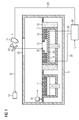
- An attachment according to FIG. 1 has a process chamber 11, in which a device 12 for receiving a powder bed 13 is provided.
- This device includes a build platform 14, which can be lowered in the manner of a piston in the device 12 in layers to make room for the powder bed 13.
- the device is with a thermal insulation 16 of a porous material, such. B. surrounded ceramic.
- a powder supply 17 is provided, via which powder can be transported onto the surface of the powder bed 13 with the aid of a scraper 18. If a new layer of powder has been produced on the powder bed 15, it is locally melted by means of an energy beam 20 generated by a laser 19, whereby a new layer of a component 21 that is being formed is produced.
- the energy beam 20 is coupled via a deflection optics 22 through a window 23 into the process chamber 11.
- a heating device 24 in the form of an electrical resistance heater is provided in the building platform 14. The latter is supplied with electrical energy via connecting lines 25, the heating power applied via the connection lines 25 being determined by a control unit 26.
- a target temperature T r is passed, which is used as a reference value for that temperature, which is to prevail on the surface of the component 21 being formed. Compliance with this target temperature T r is monitored by a temperature sensor 27 in the form of a thermal camera or a pyrometer.
- the determined surface temperature (actual temperature) T i is measured outside a molten bath 28 which is generated by the energy beam 20 in the powder bed or on the surface of the component 21 that is being formed.
- the signal of the measured temperature T i is transmitted via a signal line 29 to the control unit 26 and thus represents the controlled variable for the realized by means of the control unit 26 control loop.
- a disturbance is primarily the heating power to understand that by the energy beam 20 in the component 21st is introduced. Depending on the additional heating by the energy beam 20 the heating power is withdrawn by the control unit 26, wherein the heating power in the control loop represents the manipulated variable.
- the system according to FIG. 1 can be used for laser melting or laser sintering.
- a device for generating an electron beam could also be used, the system in this case being designed for an electrode-beam melting (not shown).
- the system according to FIG. 2 is suitable for laser deposition welding.
- an application head 30 is provided which can be brought into position above the building platform 14 by means of a swivel arm 31.
- the component 21 is formed in layers on the construction platform 14, wherein in the application head 30 on the one hand, a not-shown laser for generating the energy beam 20 and a powder conveyor are housed.
- the powder conveyor powder 32 is transported directly into the point of impact of the energy beam 20 and fused to the surface of the component 21 being formed.
- a control unit 33 is provided to adjust the temperature on the surface of the emerging component 21.
- the connection lines 25 of the heater 24 are driven, so that the heating power for the heater 24 can be adjusted.
- the reference temperature (setpoint temperature) T r is transferred to the control unit.
- a mathematical model is stored, with the aid of which the temperature development at the respective current surface of the component under construction (meaning the surface on which by means of the energy beam 20, the powder 32 is melted) can be determined. This is done in response to a lowering path z of the building platform 14.
- a linear increase in temperature on the surface of the component 20 can be assumed, wherein in the Production of the first layer an initial temperature T 0 prevails and in the production of the last layer, a temperature T 1 , which is determined by means of the above-mentioned calculation formula.
- T 0 in the Production of the first layer an initial temperature T 0 prevails and in the production of the last layer, a temperature T 1 , which is determined by means of the above-mentioned calculation formula.
- the heating power at the heater 24 is linearly reduced during the manufacture of the component.
- a temperature sensor 27 is also provided, which is not used by the control unit 33. With the help of the temperature sensor 27 but could be a scheme according to FIG. 1 will be realized. Just as it is also possible, according to the system FIG. 1 a control unit according to FIG. 2 provided. Finally, it is also possible, according to both systems FIG. 1 and FIG. 2 a combined control and regulation according to FIG. 3 to implement.
- FIG. 3 a block diagram is shown for a combined control and regulation. Therefore, both a control unit 33 and a control unit 26 are used. Both the control unit 33 and the control unit 26 use as an input signal the reference temperature T r , which is to prevail on the surface of the component currently being produced. The control unit 26 also receives a signal for the surface temperature (actual temperature) T i that actually prevails at the surface, which is determined using a temperature sensor (not shown). Both the control unit 33 and the control unit 26 generate as output a value for the heating power with which the heater 24 is to be operated. These are forwarded to a control module 34 as input variables, wherein the control module 34 supplies the connecting lines 25 with the required heating power.
- control module 34 thus a control signal 35 of the control and a control signal 36 of the control are processed and calculated from the required heating power.
- T i corresponds to the required temperature T r
- the control signal 35 is taken into account.
- T r and T i fall apart, a correction of the heating power with which the heater 24 is operated in sequence is calculated on the basis of the control signal 36.
- the signals T r and T i are also processed by the control module 34.
- the functions of controlling, regulating and supplying the heater 24 with a heating power to the control unit 33, the control unit 25 and the control module 34 are divided. This serves primarily the clarity and the explanation of the functionalities. In reality, these blocks can of course also be combined in one functional unit. This may be, for example, a computer that ensures all functionalities and takes into account the aforementioned input variables and output variables.
Landscapes
- Engineering & Computer Science (AREA)
- Chemical & Material Sciences (AREA)
- Materials Engineering (AREA)
- Manufacturing & Machinery (AREA)
- Physics & Mathematics (AREA)
- Mechanical Engineering (AREA)
- Optics & Photonics (AREA)
- Plasma & Fusion (AREA)
- Automation & Control Theory (AREA)
- Powder Metallurgy (AREA)
- Laser Beam Processing (AREA)
Priority Applications (5)
| Application Number | Priority Date | Filing Date | Title |
|---|---|---|---|
| EP16153141.3A EP3199268A1 (fr) | 2016-01-28 | 2016-01-28 | Procede de fabrication generative de composants a l'aide d'une plateforme de construction pouvant etre chauffee et installation pour ledit procede |
| US16/072,578 US11279082B2 (en) | 2016-01-28 | 2017-01-04 | Generative manufacturing of components with a heatable building platform and apparatus for implementing this method |
| EP17700606.1A EP3383568B1 (fr) | 2016-01-28 | 2017-01-04 | Procede de fabrication generative de composants a l'aide d'une plateforme de construction pouvant etre chauffee et installation pour ledit procede |
| PCT/EP2017/050108 WO2017129381A1 (fr) | 2016-01-28 | 2017-01-04 | Procédé de fabrication générative de composants avec une plate-forme de construction pouvant être chauffée et installation appropriée à ce procédé |
| CN201780008207.5A CN108495729B (zh) | 2016-01-28 | 2017-01-04 | 用于通过可加热的构造平台生成式地制造构件的方法和用于所述方法的设备 |
Applications Claiming Priority (1)
| Application Number | Priority Date | Filing Date | Title |
|---|---|---|---|
| EP16153141.3A EP3199268A1 (fr) | 2016-01-28 | 2016-01-28 | Procede de fabrication generative de composants a l'aide d'une plateforme de construction pouvant etre chauffee et installation pour ledit procede |
Publications (1)
| Publication Number | Publication Date |
|---|---|
| EP3199268A1 true EP3199268A1 (fr) | 2017-08-02 |
Family
ID=55300355
Family Applications (2)
| Application Number | Title | Priority Date | Filing Date |
|---|---|---|---|
| EP16153141.3A Withdrawn EP3199268A1 (fr) | 2016-01-28 | 2016-01-28 | Procede de fabrication generative de composants a l'aide d'une plateforme de construction pouvant etre chauffee et installation pour ledit procede |
| EP17700606.1A Active EP3383568B1 (fr) | 2016-01-28 | 2017-01-04 | Procede de fabrication generative de composants a l'aide d'une plateforme de construction pouvant etre chauffee et installation pour ledit procede |
Family Applications After (1)
| Application Number | Title | Priority Date | Filing Date |
|---|---|---|---|
| EP17700606.1A Active EP3383568B1 (fr) | 2016-01-28 | 2017-01-04 | Procede de fabrication generative de composants a l'aide d'une plateforme de construction pouvant etre chauffee et installation pour ledit procede |
Country Status (4)
| Country | Link |
|---|---|
| US (1) | US11279082B2 (fr) |
| EP (2) | EP3199268A1 (fr) |
| CN (1) | CN108495729B (fr) |
| WO (1) | WO2017129381A1 (fr) |
Cited By (1)
| Publication number | Priority date | Publication date | Assignee | Title |
|---|---|---|---|---|
| CN111465461A (zh) * | 2017-12-22 | 2020-07-28 | 赢创运营有限公司 | 用于逐层生产三维物体的设备 |
Families Citing this family (10)
| Publication number | Priority date | Publication date | Assignee | Title |
|---|---|---|---|---|
| EP3199268A1 (fr) | 2016-01-28 | 2017-08-02 | Siemens Aktiengesellschaft | Procede de fabrication generative de composants a l'aide d'une plateforme de construction pouvant etre chauffee et installation pour ledit procede |
| KR102277612B1 (ko) * | 2016-03-09 | 2021-07-14 | 파나소닉 아이피 매니지먼트 가부시키가이샤 | 3차원 형상 조형물의 제조 방법 |
| DE102018208400A1 (de) * | 2018-05-28 | 2019-11-28 | Siemens Aktiengesellschaft | Vorrichtung zum Erwärmen eines Bauteilmaterials, additive Herstellungsanlage und Verfahren zur additiven Herstellung |
| US20200147868A1 (en) * | 2018-11-09 | 2020-05-14 | General Electric Company | Method for Detecting Errors and Compensating for Thermal Dissipation in an Additive Manufacturing Process |
| EP3656490A1 (fr) * | 2018-11-22 | 2020-05-27 | Siemens Aktiengesellschaft | Procédé de fourniture de données pour une régulation adaptative de la température |
| JP7424093B2 (ja) * | 2019-03-08 | 2024-01-30 | 株式会社リコー | 立体造形物を造形する装置、立体造形物を造形する方法 |
| EP3747634B1 (fr) * | 2019-06-07 | 2022-05-04 | ExOne GmbH | Procédé de fabrication d'au moins un composant par impression 3d et imprimante 3d |
| EP4058290B1 (fr) * | 2019-12-13 | 2023-12-27 | Siemens Industry Software Inc. | Procédé et appareil de conception et de fabrication d'un composant dans un environnement de conception et de fabrication assistées par ordinateur |
| EP3928897A1 (fr) * | 2020-06-24 | 2021-12-29 | Siemens Aktiengesellschaft | Préchauffage d'une plaque de construction pour une fabrication additive |
| DE102022127242A1 (de) * | 2022-10-18 | 2024-04-18 | Trumpf Laser- Und Systemtechnik Gmbh | Vorrichtung zum Ausformen temperaturbeständiger Bauteile durch selektives Laserschmelzen |
Citations (9)
| Publication number | Priority date | Publication date | Assignee | Title |
|---|---|---|---|---|
| EP1355760B1 (fr) | 2001-02-02 | 2005-05-04 | Fraunhofer-Gesellschaft zur Förderung der angewandten Forschung e.V. | Procede et dispositif de fusion selective au laser de matieres metalliques |
| US20050173380A1 (en) * | 2004-02-09 | 2005-08-11 | Carbone Frank L. | Directed energy net shape method and apparatus |
| US20070122562A1 (en) * | 2005-11-30 | 2007-05-31 | Honeywell International, Inc. | Solid-free-form fabrication process and apparatus including in-process workpiece cooling |
| WO2008143106A1 (fr) * | 2007-05-14 | 2008-11-27 | Panasonic Electric Works Co., Ltd. | Procédé et dispositif pour fabriquer un article façonné en trois dimensions |
| DE102007057450A1 (de) * | 2007-11-29 | 2009-06-04 | Daimler Ag | Verfahren und Vorrichtung zur Herstellung eines dreidimensionalen Gegenstandes aus einem verfestigbaren Material |
| DE102009051479A1 (de) | 2009-10-30 | 2011-05-05 | Mtu Aero Engines Gmbh | Verfahren und Vorrichtung zur Herstellung eines Bauteils einer Strömungsmaschine |
| DE102012206122A1 (de) | 2012-04-13 | 2013-10-17 | MTU Aero Engines AG | Mehrfach-Spulenanordnung für eine Vorrichtung zur generativen Herstellung von Bauteilen und entsprechendes Herstellverfahren |
| DE102013001374A1 (de) * | 2013-01-28 | 2014-07-31 | Cl Schutzrechtsverwaltungs Gmbh | Vorrichtung zur Herstellung dreidimensionaler Objekte |
| US20150367415A1 (en) * | 2014-06-20 | 2015-12-24 | Velo3D, Inc. | Apparatuses, systems and methods for three-dimensional printing |
Family Cites Families (6)
| Publication number | Priority date | Publication date | Assignee | Title |
|---|---|---|---|---|
| SE524432C2 (sv) * | 2002-12-19 | 2004-08-10 | Arcam Ab | Anordning samt metod för framställande av en tredimensionell produkt |
| DE102006053121B3 (de) * | 2006-11-10 | 2007-12-27 | Eos Gmbh Electro Optical Systems | Vorrichtung und Verfahren zum Herstellen eines dreidimensionalen Objektes mittels eines Beschichters für pulverförmiges Aufbaumaterial |
| US8186414B2 (en) * | 2009-08-21 | 2012-05-29 | Loughborough University | Method for forming an object |
| CN202591611U (zh) * | 2012-05-29 | 2012-12-12 | 西安科技大学 | 一种可移动式激光快速成型预热装置 |
| US20170151631A1 (en) * | 2015-11-27 | 2017-06-01 | Metal Industries Research & Development Centre | Additive manufacturing apparatus |
| EP3199268A1 (fr) | 2016-01-28 | 2017-08-02 | Siemens Aktiengesellschaft | Procede de fabrication generative de composants a l'aide d'une plateforme de construction pouvant etre chauffee et installation pour ledit procede |
-
2016
- 2016-01-28 EP EP16153141.3A patent/EP3199268A1/fr not_active Withdrawn
-
2017
- 2017-01-04 WO PCT/EP2017/050108 patent/WO2017129381A1/fr not_active Ceased
- 2017-01-04 US US16/072,578 patent/US11279082B2/en active Active
- 2017-01-04 CN CN201780008207.5A patent/CN108495729B/zh active Active
- 2017-01-04 EP EP17700606.1A patent/EP3383568B1/fr active Active
Patent Citations (9)
| Publication number | Priority date | Publication date | Assignee | Title |
|---|---|---|---|---|
| EP1355760B1 (fr) | 2001-02-02 | 2005-05-04 | Fraunhofer-Gesellschaft zur Förderung der angewandten Forschung e.V. | Procede et dispositif de fusion selective au laser de matieres metalliques |
| US20050173380A1 (en) * | 2004-02-09 | 2005-08-11 | Carbone Frank L. | Directed energy net shape method and apparatus |
| US20070122562A1 (en) * | 2005-11-30 | 2007-05-31 | Honeywell International, Inc. | Solid-free-form fabrication process and apparatus including in-process workpiece cooling |
| WO2008143106A1 (fr) * | 2007-05-14 | 2008-11-27 | Panasonic Electric Works Co., Ltd. | Procédé et dispositif pour fabriquer un article façonné en trois dimensions |
| DE102007057450A1 (de) * | 2007-11-29 | 2009-06-04 | Daimler Ag | Verfahren und Vorrichtung zur Herstellung eines dreidimensionalen Gegenstandes aus einem verfestigbaren Material |
| DE102009051479A1 (de) | 2009-10-30 | 2011-05-05 | Mtu Aero Engines Gmbh | Verfahren und Vorrichtung zur Herstellung eines Bauteils einer Strömungsmaschine |
| DE102012206122A1 (de) | 2012-04-13 | 2013-10-17 | MTU Aero Engines AG | Mehrfach-Spulenanordnung für eine Vorrichtung zur generativen Herstellung von Bauteilen und entsprechendes Herstellverfahren |
| DE102013001374A1 (de) * | 2013-01-28 | 2014-07-31 | Cl Schutzrechtsverwaltungs Gmbh | Vorrichtung zur Herstellung dreidimensionaler Objekte |
| US20150367415A1 (en) * | 2014-06-20 | 2015-12-24 | Velo3D, Inc. | Apparatuses, systems and methods for three-dimensional printing |
Cited By (2)
| Publication number | Priority date | Publication date | Assignee | Title |
|---|---|---|---|---|
| CN111465461A (zh) * | 2017-12-22 | 2020-07-28 | 赢创运营有限公司 | 用于逐层生产三维物体的设备 |
| US11511488B2 (en) | 2017-12-22 | 2022-11-29 | Evonik Operations Gmbh | Device for producing three-dimensional objects layer by layer |
Also Published As
| Publication number | Publication date |
|---|---|
| WO2017129381A1 (fr) | 2017-08-03 |
| CN108495729A (zh) | 2018-09-04 |
| EP3383568B1 (fr) | 2021-05-26 |
| EP3383568A1 (fr) | 2018-10-10 |
| US11279082B2 (en) | 2022-03-22 |
| US20190030791A1 (en) | 2019-01-31 |
| CN108495729B (zh) | 2021-01-15 |
Similar Documents
| Publication | Publication Date | Title |
|---|---|---|
| EP3383568B1 (fr) | Procede de fabrication generative de composants a l'aide d'une plateforme de construction pouvant etre chauffee et installation pour ledit procede | |
| EP2442938B1 (fr) | Procédé de changement d'une opération de soudage au cours d'un procédé de soudage, et procédé d'apport de chaleur avant soudage | |
| EP3260276B1 (fr) | Ajustement automatique d'un réglage de chauffage dans un dispositif de fabrication additive | |
| DE102016111047B3 (de) | Verfahren und Anlage zur kombiniert additiven und umformenden Fertigung | |
| EP3509784B2 (fr) | Procédé de soudage par court-circuit | |
| EP2618990B1 (fr) | Procédé de frittage laser sélectif et installation de frittage laser sélectif | |
| EP1568472B1 (fr) | Procédé et dispositif de fabrication de produits par frittage et/ou fusion | |
| EP2953749A1 (fr) | Procédé de fusion laser avec au moins un faisceau laser de travail | |
| EP3322554B1 (fr) | Procédé pour la fabrication additive de pièces métalliques | |
| EP3077180B1 (fr) | Procédé de production accélérée d'objets par fabrication générative | |
| DE102018202506A1 (de) | Additives Herstellverfahren mit kontrollierter Verfestigung und zugehörige Vorrichtung | |
| DE102009049750A1 (de) | Verfahren und Vorrichtung zum Schneiden von Material mittels eines modulierten Laserstrahls | |
| WO2020035109A1 (fr) | Procédé d'impression de métal 3d et dispositif associé | |
| EP2269758B1 (fr) | Procédé de soudage à l'arc à courant continue | |
| EP3461571A1 (fr) | Procédé de rayonnement d'une couche de poudre dans une fabrication additive présentant des paramètres de fabrication définis de manière continue | |
| EP3345697B1 (fr) | Dispositif destinés à la fabrication additive de composants | |
| EP3334558A1 (fr) | Procédé et dispositif de soudage laser avec apport de matière | |
| EP4065304B1 (fr) | Procédé de soudage et dispositif de soudage permettant de mettre en oeuvre un procédé de soudage | |
| EP4114597A1 (fr) | Procédé de fabrication additive d'un composant tridimensionnel et système de réparation | |
| DE102021129738B4 (de) | Verfahren für eine einstellung einer vorrichtung für eine laseradditive fertigung | |
| DE102015212149A1 (de) | Leistungsversorgungssystem und Verfahren zur Einstellung einer Ausgangsgröße der Verstärkerstufe eines Leistungsversorgungssystems | |
| DE102015008918A1 (de) | Verfahren zur additiven Herstellung von dreidimensionalen Bauteilen | |
| EP3740381A1 (fr) | Dispositif de chauffage d'un matériau de composant, installation de fabrication additive et procédé de fabrication additive | |
| WO2023016719A1 (fr) | Procédé de soudage et dispositif de soudage pour souder des éléments | |
| DE102008040785B4 (de) | Laserschweißverfahren |
Legal Events
| Date | Code | Title | Description |
|---|---|---|---|
| PUAI | Public reference made under article 153(3) epc to a published international application that has entered the european phase |
Free format text: ORIGINAL CODE: 0009012 |
|
| AK | Designated contracting states |
Kind code of ref document: A1 Designated state(s): AL AT BE BG CH CY CZ DE DK EE ES FI FR GB GR HR HU IE IS IT LI LT LU LV MC MK MT NL NO PL PT RO RS SE SI SK SM TR |
|
| AX | Request for extension of the european patent |
Extension state: BA ME |
|
| RAP1 | Party data changed (applicant data changed or rights of an application transferred) |
Owner name: SIEMENS AKTIENGESELLSCHAFT |
|
| STAA | Information on the status of an ep patent application or granted ep patent |
Free format text: STATUS: THE APPLICATION IS DEEMED TO BE WITHDRAWN |
|
| 18D | Application deemed to be withdrawn |
Effective date: 20180203 |