EP3199565B1 - Composé polymère et élément électroluminescent l'utilisant - Google Patents
Composé polymère et élément électroluminescent l'utilisant Download PDFInfo
- Publication number
- EP3199565B1 EP3199565B1 EP15843285.6A EP15843285A EP3199565B1 EP 3199565 B1 EP3199565 B1 EP 3199565B1 EP 15843285 A EP15843285 A EP 15843285A EP 3199565 B1 EP3199565 B1 EP 3199565B1
- Authority
- EP
- European Patent Office
- Prior art keywords
- group
- substituent
- carbon atoms
- formula
- represented
- Prior art date
- Legal status (The legal status is an assumption and is not a legal conclusion. Google has not performed a legal analysis and makes no representation as to the accuracy of the status listed.)
- Active
Links
Classifications
-
- C—CHEMISTRY; METALLURGY
- C08—ORGANIC MACROMOLECULAR COMPOUNDS; THEIR PREPARATION OR CHEMICAL WORKING-UP; COMPOSITIONS BASED THEREON
- C08G—MACROMOLECULAR COMPOUNDS OBTAINED OTHERWISE THAN BY REACTIONS ONLY INVOLVING UNSATURATED CARBON-TO-CARBON BONDS
- C08G61/00—Macromolecular compounds obtained by reactions forming a carbon-to-carbon link in the main chain of the macromolecule
- C08G61/12—Macromolecular compounds containing atoms other than carbon in the main chain of the macromolecule
-
- C—CHEMISTRY; METALLURGY
- C08—ORGANIC MACROMOLECULAR COMPOUNDS; THEIR PREPARATION OR CHEMICAL WORKING-UP; COMPOSITIONS BASED THEREON
- C08L—COMPOSITIONS OF MACROMOLECULAR COMPOUNDS
- C08L65/00—Compositions of macromolecular compounds obtained by reactions forming a carbon-to-carbon link in the main chain; Compositions of derivatives of such polymers
-
- C—CHEMISTRY; METALLURGY
- C09—DYES; PAINTS; POLISHES; NATURAL RESINS; ADHESIVES; COMPOSITIONS NOT OTHERWISE PROVIDED FOR; APPLICATIONS OF MATERIALS NOT OTHERWISE PROVIDED FOR
- C09D—COATING COMPOSITIONS, e.g. PAINTS, VARNISHES OR LACQUERS; FILLING PASTES; CHEMICAL PAINT OR INK REMOVERS; INKS; CORRECTING FLUIDS; WOODSTAINS; PASTES OR SOLIDS FOR COLOURING OR PRINTING; USE OF MATERIALS THEREFOR
- C09D165/00—Coating compositions based on macromolecular compounds obtained by reactions forming a carbon-to-carbon link in the main chain; Coating compositions based on derivatives of such polymers
-
- C—CHEMISTRY; METALLURGY
- C09—DYES; PAINTS; POLISHES; NATURAL RESINS; ADHESIVES; COMPOSITIONS NOT OTHERWISE PROVIDED FOR; APPLICATIONS OF MATERIALS NOT OTHERWISE PROVIDED FOR
- C09K—MATERIALS FOR MISCELLANEOUS APPLICATIONS, NOT PROVIDED FOR ELSEWHERE
- C09K11/00—Luminescent materials, e.g. electroluminescent or chemiluminescent
- C09K11/02—Use of particular materials as binders, particle coatings or suspension media therefor
-
- H—ELECTRICITY
- H10—SEMICONDUCTOR DEVICES; ELECTRIC SOLID-STATE DEVICES NOT OTHERWISE PROVIDED FOR
- H10K—ORGANIC ELECTRIC SOLID-STATE DEVICES
- H10K50/00—Organic light-emitting devices
-
- H—ELECTRICITY
- H10—SEMICONDUCTOR DEVICES; ELECTRIC SOLID-STATE DEVICES NOT OTHERWISE PROVIDED FOR
- H10K—ORGANIC ELECTRIC SOLID-STATE DEVICES
- H10K71/00—Manufacture or treatment specially adapted for the organic devices covered by this subclass
- H10K71/10—Deposition of organic active material
- H10K71/12—Deposition of organic active material using liquid deposition, e.g. spin coating
- H10K71/13—Deposition of organic active material using liquid deposition, e.g. spin coating using printing techniques, e.g. ink-jet printing or screen printing
-
- H—ELECTRICITY
- H10—SEMICONDUCTOR DEVICES; ELECTRIC SOLID-STATE DEVICES NOT OTHERWISE PROVIDED FOR
- H10K—ORGANIC ELECTRIC SOLID-STATE DEVICES
- H10K85/00—Organic materials used in the body or electrodes of devices covered by this subclass
- H10K85/10—Organic polymers or oligomers
- H10K85/111—Organic polymers or oligomers comprising aromatic, heteroaromatic, or aryl chains, e.g. polyaniline, polyphenylene or polyphenylene vinylene
-
- H—ELECTRICITY
- H10—SEMICONDUCTOR DEVICES; ELECTRIC SOLID-STATE DEVICES NOT OTHERWISE PROVIDED FOR
- H10K—ORGANIC ELECTRIC SOLID-STATE DEVICES
- H10K85/00—Organic materials used in the body or electrodes of devices covered by this subclass
- H10K85/10—Organic polymers or oligomers
- H10K85/111—Organic polymers or oligomers comprising aromatic, heteroaromatic, or aryl chains, e.g. polyaniline, polyphenylene or polyphenylene vinylene
- H10K85/115—Polyfluorene; Derivatives thereof
-
- H—ELECTRICITY
- H10—SEMICONDUCTOR DEVICES; ELECTRIC SOLID-STATE DEVICES NOT OTHERWISE PROVIDED FOR
- H10K—ORGANIC ELECTRIC SOLID-STATE DEVICES
- H10K85/00—Organic materials used in the body or electrodes of devices covered by this subclass
- H10K85/10—Organic polymers or oligomers
- H10K85/151—Copolymers
-
- C—CHEMISTRY; METALLURGY
- C08—ORGANIC MACROMOLECULAR COMPOUNDS; THEIR PREPARATION OR CHEMICAL WORKING-UP; COMPOSITIONS BASED THEREON
- C08G—MACROMOLECULAR COMPOUNDS OBTAINED OTHERWISE THAN BY REACTIONS ONLY INVOLVING UNSATURATED CARBON-TO-CARBON BONDS
- C08G2261/00—Macromolecular compounds obtained by reactions forming a carbon-to-carbon link in the main chain of the macromolecule
- C08G2261/10—Definition of the polymer structure
- C08G2261/12—Copolymers
-
- C—CHEMISTRY; METALLURGY
- C08—ORGANIC MACROMOLECULAR COMPOUNDS; THEIR PREPARATION OR CHEMICAL WORKING-UP; COMPOSITIONS BASED THEREON
- C08G—MACROMOLECULAR COMPOUNDS OBTAINED OTHERWISE THAN BY REACTIONS ONLY INVOLVING UNSATURATED CARBON-TO-CARBON BONDS
- C08G2261/00—Macromolecular compounds obtained by reactions forming a carbon-to-carbon link in the main chain of the macromolecule
- C08G2261/10—Definition of the polymer structure
- C08G2261/13—Morphological aspects
- C08G2261/135—Cross-linked structures
-
- C—CHEMISTRY; METALLURGY
- C08—ORGANIC MACROMOLECULAR COMPOUNDS; THEIR PREPARATION OR CHEMICAL WORKING-UP; COMPOSITIONS BASED THEREON
- C08G—MACROMOLECULAR COMPOUNDS OBTAINED OTHERWISE THAN BY REACTIONS ONLY INVOLVING UNSATURATED CARBON-TO-CARBON BONDS
- C08G2261/00—Macromolecular compounds obtained by reactions forming a carbon-to-carbon link in the main chain of the macromolecule
- C08G2261/10—Definition of the polymer structure
- C08G2261/14—Side-groups
- C08G2261/141—Side-chains having aliphatic units
- C08G2261/1412—Saturated aliphatic units
-
- C—CHEMISTRY; METALLURGY
- C08—ORGANIC MACROMOLECULAR COMPOUNDS; THEIR PREPARATION OR CHEMICAL WORKING-UP; COMPOSITIONS BASED THEREON
- C08G—MACROMOLECULAR COMPOUNDS OBTAINED OTHERWISE THAN BY REACTIONS ONLY INVOLVING UNSATURATED CARBON-TO-CARBON BONDS
- C08G2261/00—Macromolecular compounds obtained by reactions forming a carbon-to-carbon link in the main chain of the macromolecule
- C08G2261/10—Definition of the polymer structure
- C08G2261/14—Side-groups
- C08G2261/141—Side-chains having aliphatic units
- C08G2261/1414—Unsaturated aliphatic units
-
- C—CHEMISTRY; METALLURGY
- C08—ORGANIC MACROMOLECULAR COMPOUNDS; THEIR PREPARATION OR CHEMICAL WORKING-UP; COMPOSITIONS BASED THEREON
- C08G—MACROMOLECULAR COMPOUNDS OBTAINED OTHERWISE THAN BY REACTIONS ONLY INVOLVING UNSATURATED CARBON-TO-CARBON BONDS
- C08G2261/00—Macromolecular compounds obtained by reactions forming a carbon-to-carbon link in the main chain of the macromolecule
- C08G2261/10—Definition of the polymer structure
- C08G2261/14—Side-groups
- C08G2261/148—Side-chains having aromatic units
-
- C—CHEMISTRY; METALLURGY
- C08—ORGANIC MACROMOLECULAR COMPOUNDS; THEIR PREPARATION OR CHEMICAL WORKING-UP; COMPOSITIONS BASED THEREON
- C08G—MACROMOLECULAR COMPOUNDS OBTAINED OTHERWISE THAN BY REACTIONS ONLY INVOLVING UNSATURATED CARBON-TO-CARBON BONDS
- C08G2261/00—Macromolecular compounds obtained by reactions forming a carbon-to-carbon link in the main chain of the macromolecule
- C08G2261/30—Monomer units or repeat units incorporating structural elements in the main chain
- C08G2261/31—Monomer units or repeat units incorporating structural elements in the main chain incorporating aromatic structural elements in the main chain
- C08G2261/312—Non-condensed aromatic systems, e.g. benzene
-
- C—CHEMISTRY; METALLURGY
- C08—ORGANIC MACROMOLECULAR COMPOUNDS; THEIR PREPARATION OR CHEMICAL WORKING-UP; COMPOSITIONS BASED THEREON
- C08G—MACROMOLECULAR COMPOUNDS OBTAINED OTHERWISE THAN BY REACTIONS ONLY INVOLVING UNSATURATED CARBON-TO-CARBON BONDS
- C08G2261/00—Macromolecular compounds obtained by reactions forming a carbon-to-carbon link in the main chain of the macromolecule
- C08G2261/30—Monomer units or repeat units incorporating structural elements in the main chain
- C08G2261/31—Monomer units or repeat units incorporating structural elements in the main chain incorporating aromatic structural elements in the main chain
- C08G2261/314—Condensed aromatic systems, e.g. perylene, anthracene or pyrene
- C08G2261/3142—Condensed aromatic systems, e.g. perylene, anthracene or pyrene fluorene-based, e.g. fluorene, indenofluorene, or spirobifluorene
-
- C—CHEMISTRY; METALLURGY
- C08—ORGANIC MACROMOLECULAR COMPOUNDS; THEIR PREPARATION OR CHEMICAL WORKING-UP; COMPOSITIONS BASED THEREON
- C08G—MACROMOLECULAR COMPOUNDS OBTAINED OTHERWISE THAN BY REACTIONS ONLY INVOLVING UNSATURATED CARBON-TO-CARBON BONDS
- C08G2261/00—Macromolecular compounds obtained by reactions forming a carbon-to-carbon link in the main chain of the macromolecule
- C08G2261/30—Monomer units or repeat units incorporating structural elements in the main chain
- C08G2261/31—Monomer units or repeat units incorporating structural elements in the main chain incorporating aromatic structural elements in the main chain
- C08G2261/316—Monomer units or repeat units incorporating structural elements in the main chain incorporating aromatic structural elements in the main chain bridged by heteroatoms, e.g. N, P, Si or B
- C08G2261/3162—Arylamines
-
- C—CHEMISTRY; METALLURGY
- C08—ORGANIC MACROMOLECULAR COMPOUNDS; THEIR PREPARATION OR CHEMICAL WORKING-UP; COMPOSITIONS BASED THEREON
- C08G—MACROMOLECULAR COMPOUNDS OBTAINED OTHERWISE THAN BY REACTIONS ONLY INVOLVING UNSATURATED CARBON-TO-CARBON BONDS
- C08G2261/00—Macromolecular compounds obtained by reactions forming a carbon-to-carbon link in the main chain of the macromolecule
- C08G2261/40—Polymerisation processes
- C08G2261/41—Organometallic coupling reactions
- C08G2261/411—Suzuki reactions
-
- C—CHEMISTRY; METALLURGY
- C08—ORGANIC MACROMOLECULAR COMPOUNDS; THEIR PREPARATION OR CHEMICAL WORKING-UP; COMPOSITIONS BASED THEREON
- C08G—MACROMOLECULAR COMPOUNDS OBTAINED OTHERWISE THAN BY REACTIONS ONLY INVOLVING UNSATURATED CARBON-TO-CARBON BONDS
- C08G2261/00—Macromolecular compounds obtained by reactions forming a carbon-to-carbon link in the main chain of the macromolecule
- C08G2261/50—Physical properties
- C08G2261/51—Charge transport
-
- C—CHEMISTRY; METALLURGY
- C08—ORGANIC MACROMOLECULAR COMPOUNDS; THEIR PREPARATION OR CHEMICAL WORKING-UP; COMPOSITIONS BASED THEREON
- C08G—MACROMOLECULAR COMPOUNDS OBTAINED OTHERWISE THAN BY REACTIONS ONLY INVOLVING UNSATURATED CARBON-TO-CARBON BONDS
- C08G2261/00—Macromolecular compounds obtained by reactions forming a carbon-to-carbon link in the main chain of the macromolecule
- C08G2261/50—Physical properties
- C08G2261/52—Luminescence
-
- C—CHEMISTRY; METALLURGY
- C08—ORGANIC MACROMOLECULAR COMPOUNDS; THEIR PREPARATION OR CHEMICAL WORKING-UP; COMPOSITIONS BASED THEREON
- C08G—MACROMOLECULAR COMPOUNDS OBTAINED OTHERWISE THAN BY REACTIONS ONLY INVOLVING UNSATURATED CARBON-TO-CARBON BONDS
- C08G2261/00—Macromolecular compounds obtained by reactions forming a carbon-to-carbon link in the main chain of the macromolecule
- C08G2261/70—Post-treatment
- C08G2261/76—Post-treatment crosslinking
-
- C—CHEMISTRY; METALLURGY
- C08—ORGANIC MACROMOLECULAR COMPOUNDS; THEIR PREPARATION OR CHEMICAL WORKING-UP; COMPOSITIONS BASED THEREON
- C08G—MACROMOLECULAR COMPOUNDS OBTAINED OTHERWISE THAN BY REACTIONS ONLY INVOLVING UNSATURATED CARBON-TO-CARBON BONDS
- C08G2261/00—Macromolecular compounds obtained by reactions forming a carbon-to-carbon link in the main chain of the macromolecule
- C08G2261/90—Applications
- C08G2261/95—Use in organic luminescent diodes
-
- H—ELECTRICITY
- H10—SEMICONDUCTOR DEVICES; ELECTRIC SOLID-STATE DEVICES NOT OTHERWISE PROVIDED FOR
- H10K—ORGANIC ELECTRIC SOLID-STATE DEVICES
- H10K2101/00—Properties of the organic materials covered by group H10K85/00
- H10K2101/10—Triplet emission
-
- H—ELECTRICITY
- H10—SEMICONDUCTOR DEVICES; ELECTRIC SOLID-STATE DEVICES NOT OTHERWISE PROVIDED FOR
- H10K—ORGANIC ELECTRIC SOLID-STATE DEVICES
- H10K50/00—Organic light-emitting devices
- H10K50/10—OLEDs or polymer light-emitting diodes [PLED]
- H10K50/11—OLEDs or polymer light-emitting diodes [PLED] characterised by the electroluminescent [EL] layers
-
- H—ELECTRICITY
- H10—SEMICONDUCTOR DEVICES; ELECTRIC SOLID-STATE DEVICES NOT OTHERWISE PROVIDED FOR
- H10K—ORGANIC ELECTRIC SOLID-STATE DEVICES
- H10K50/00—Organic light-emitting devices
- H10K50/10—OLEDs or polymer light-emitting diodes [PLED]
- H10K50/14—Carrier transporting layers
- H10K50/15—Hole transporting layers
-
- H—ELECTRICITY
- H10—SEMICONDUCTOR DEVICES; ELECTRIC SOLID-STATE DEVICES NOT OTHERWISE PROVIDED FOR
- H10K—ORGANIC ELECTRIC SOLID-STATE DEVICES
- H10K50/00—Organic light-emitting devices
- H10K50/10—OLEDs or polymer light-emitting diodes [PLED]
- H10K50/14—Carrier transporting layers
- H10K50/16—Electron transporting layers
-
- H—ELECTRICITY
- H10—SEMICONDUCTOR DEVICES; ELECTRIC SOLID-STATE DEVICES NOT OTHERWISE PROVIDED FOR
- H10K—ORGANIC ELECTRIC SOLID-STATE DEVICES
- H10K50/00—Organic light-emitting devices
- H10K50/10—OLEDs or polymer light-emitting diodes [PLED]
- H10K50/17—Carrier injection layers
-
- H—ELECTRICITY
- H10—SEMICONDUCTOR DEVICES; ELECTRIC SOLID-STATE DEVICES NOT OTHERWISE PROVIDED FOR
- H10K—ORGANIC ELECTRIC SOLID-STATE DEVICES
- H10K50/00—Organic light-emitting devices
- H10K50/10—OLEDs or polymer light-emitting diodes [PLED]
- H10K50/17—Carrier injection layers
- H10K50/171—Electron injection layers
Definitions
- the present invention relates to a method for producing a polymer compound.
- An organic electroluminescent device (hereinafter, referred to also as “light emitting device”) can be suitably used for the application of a display and are recently attracting attention, because of high light emission efficiency and low driving voltage.
- This light emitting device has organic layers such as a light emitting layer and a charge transporting layer.
- Polymer compounds used for production of a light emitting device are investigated because an organic layer can be formed by application methods typified by an inkjet printing method, by use of the polymer compounds.
- Patent document 1 describes a polymer compound comprising a constitutional unit derived from an aromatic hydrocarbon having a crosslinkable group in the side chain (the constitutional unit having a crosslinkable group contained in the polymer compound consists only of a constitutional unit derived from an aromatic hydrocarbon having a crosslinkable group in the side chain), as a material used in an organic layer of a light emitting device.
- Patent document 2 describes a polymer compound containing at the terminal a constitutional unit composed of a crosslinkable group (the constitutional unit having a crosslinkable group contained in the polymer compound consists only of a constitutional unit at the terminal composed of a crosslinkable group), as a material used in an organic layer of a light emitting device.
- these polymer compounds have a crosslinkable groups, it is possible that the polymer compound is subjected to an application method to form a film, then, the crosslinkable group is cross-linked by heating and the like, to form an organic layer which is substantially insoluble in a solvent. It is possible to laminate the other organic layer (for example, a light emitting layer) on this organic layer by an application method.
- the present invention has an object of providing a method for producing a polymer compound excellent in crosslinkability. Also described herein is the polymer compound obtainable by the production method. Further described herein are a composition comprising the polymer compound and a light emitting device produced by using the polymer compound.
- the present invention can provide a method for producing a polymer compound excellent in crosslinkability. Also described herein is the polymer compound obtainable by the production method. Further described herein are a composition comprising the polymer compound and a light emitting device produced by using the polymer compound.
- Me represents a methyl group
- Et represents an ethyl group
- Bu represents a butyl group
- i-Pr represents an isopropyl group
- t-Bu represents a tert-butyl group.
- a hydrogen atom may be a light hydrogen atom or a heavy hydrogen atom.
- a solid line representing a bond to a central metal in a formula representing a metal complex denotes a coordinate bond or a covalent bond.
- Polymer compound denotes a polymer having molecular weight distribution and having a polystyrene-equivalent number average molecular weight of 1 ⁇ 10 3 to 1 ⁇ 10 8 .
- Low molecular weight compound denotes a compound having no molecular weight distribution and having a molecular weight of 1 ⁇ 10 4 or less.
- Constant unit denotes a unit structure found once or more in a polymer compound.
- Terminal constitutional unit denotes a unit present at the terminal in a polymer compound, and usually denotes a unit present at the terminal of the main chain in a polymer compound.
- Terminal constitutional unit denotes a unit present at the terminal in a polymer compound, and usually denotes a unit present at the terminal of the main chain in a polymer compound.
- Alkyl group may be any of linear or branched.
- the number of carbon atoms of the linear alkyl group is, not including the number of carbon atoms of a substituent, usually 1 to 50, preferably 3 to 30, more preferably 4 to 20.
- the number of carbon atoms of the branched alkyl groups is, not including the number of carbon atoms of a substituent, usually 3 to 50, preferably 3 to 30, more preferably 4 to 20.
- the alkyl group optionally has a substituent, and examples thereof include a methyl group, an ethyl group, a propyl group, an isopropyl group, a butyl group, an isobutyl group, a tert-butyl group, a pentyl group, an isoamyl group, a 2-ethylbutyl group, a hexyl group, a heptyl group, a octyl group, a 2-ethylhexyl group, a 3-propylheptyl group, a decyl group, a 3,7-dimethyloctyl group, a 2-ethyloctyl group, a 2-hexyldecyl group and a dodecyl group, and groups obtained by substituting a hydrogen atom in these groups with a cycloalkyl group, an alkoxy group, a cycloalkoxy group, an ary
- the number of carbon atoms of "cycloalkyl group” is, not including the number of carbon atoms of a substituent, usually 3 to 50, preferably 3 to 30, more preferably 4 to 20.
- the cycloalkyl group optionally has a substituent, and examples thereof include a cyclohexyl group, a cyclohexylmethyl group and a cyclohexylethyl group.
- Aryl group denotes an atomic group remaining after removing from an aromatic hydrocarbon one hydrogen atom linked directly to a carbon atom constituting the ring.
- the number of carbon atoms of the aryl group is, not including the number of carbon atoms of a substituent, usually 6 to 60, preferably 6 to 20, more preferably 6 to 10.
- the aryl group optionally has a substituent, and examples thereof include a phenyl group, a 1-naphthyl group, a 2-naphthyl group, a 1-anthracenyl group, a 2-anthracenyl group, a 9-anthracenyl group, a 1-pyrenyl group, a 2-pyrenyl group, a 4-pyrenyl group, a 2-fluorenyl group, a 3-fluorenyl group, a 4-fluorenyl group, a 2-phenylphenyl group, a 3-phenylphenyl group, a 4-phenylphenyl group, and groups obtained by substituting a hydrogen atom in these groups with an alkyl group, a cycloalkyl group, an alkoxy group, a cycloalkoxy group, an aryl group, a fluorine atom or the like.
- Alkoxy group may be any of linear or branched.
- the number of carbon atoms of the linear alkoxy group is, not including the number of carbon atoms of a substituent, usually 1 to 40, preferably 4 to 10.
- the number of carbon atoms of the branched alkoxy group is, not including the number of carbon atoms of a substituent, usually 3 to 40, preferably 4 to 10.
- the alkoxy group optionally has a substituent, and examples thereof include a methoxy group, an ethoxy group, a propyloxy group, an isopropyloxy group, a butyloxy group, an isobutyloxy group, a tert-butyloxy group, a pentyloxy group, a hexyloxy group, a heptyloxy group, a octyloxy group, a 2-ethylhexyloxy group, a nonyloxy group, a decyloxy group, a 3,7-dimethyloctyloxy group and a lauryloxy group, and groups obtained by substituting a hydrogen atom in these groups with a cycloalkyl group, an alkoxy group, a cycloalkoxy group, an aryl group, a fluorine atom or the like.
- the number of carbon atoms of "Cycloalkoxy group” is, not including the number of carbon atoms of a substituent, usually 3 to 40, preferably 4 to 10.
- the cycloalkoxy group optionally has a substituent, and examples thereof include a cyclohexyloxy group.
- the number of carbon atoms of "Aryloxy group” is, not including the number of carbon atoms of a substituent, usually 6 to 60, preferably 7 to 48.
- the aryloxy group optionally has a substituent, and examples thereof include a phenoxy group, a 1-naphthyloxy group, a 2-naphthyloxy group, a 1-anthracenyloxy group, a 9-anthracenyloxy group, a 1-pyrenyloxy group, and groups obtained by substituting a hydrogen atom in these groups with an alkyl group, a cycloalkyl group, an alkoxy group, a cycloalkoxy group, a fluorine atom or the like.
- p-Valent heterocyclic group (p represents an integer of 1 or more) denotes an atomic group remaining after removing from a heterocyclic compound p hydrogen atoms among hydrogen atoms directly linked to a carbon atom or a hetero atom constituting the ring.
- p-valent heterocyclic groups "p-valent aromatic heterocyclic groups” as an atomic group remaining after removing from an aromatic heterocyclic compound p hydrogen atoms among hydrogen atoms directly linked to a carbon atom or a hetero atom constituting the ring are preferable.
- Aromatic heterocyclic compound denotes a compound in which the heterocyclic ring itself shows aromaticity such as oxadiazole, thiadiazole, thiazole, oxazole, thiophene, pyrrole, phosphole, furan, pyridine, pyrazine, pyrimidine, triazine, pyridazine, quinoline, isoquinoline, carbazole and dibenzophosphole, and a compound in which an aromatic ring is condensed to the heterocyclic ring even if the heterocyclic ring itself shows no aromaticity such as phenoxazine, phenothiazine, dibenzoborole, dibenzosilole and benzopyran.
- the number of carbon atoms of the monovalent heterocyclic group is, not including the number of carbon atoms of a substituent, usually 2 to 60, preferably 4 to 20.
- the monovalent heterocyclic group optionally has a substituent, and examples thereof include a thienyl group, a pyrrolyl group, a furyl group, a pyridyl group, a piperidinyl group, a quinolinyl group, an isoquinolinyl group, a pyrimidinyl group, a triazinyl group, and groups obtained by substituting a hydrogen atom in these groups with an alkyl group, a cycloalkyl group, an alkoxy group, a cycloalkoxy group or the like.
- Halogen atom denotes a fluorine atom, a chlorine atom, a bromine atom or an iodine atom.
- amino group optionally has a substituent, and a substituted amino group is preferable.
- the substituent which an amino group has is preferably an alkyl group, a cycloalkyl group, an aryl group or a monovalent heterocyclic group.
- the substituted amino group includes, for example, a dialkylamino group, a dicycloalkylamino group and a diarylamino group.
- the amino group includes, for example, a dimethylamino group, a diethylamino group, a diphenylamino group, a bis(4-methylphenyl)amino group, a bis(4-tert-butylphenyl)amino group and a bis(3,5-di-tert-butylphenyl)amino group.
- Alkenyl group may be any of linear or branched.
- the number of carbon atoms of the linear alkenyl group, not including the number of carbon atoms of the substituent, is usually 2 to 30, preferably 3 to 20.
- the number of carbon atoms of the branched alkenyl group, not including the number of carbon atoms of the substituent is usually 3 to 30, preferably 4 to 20.
- the number of carbon atoms of "Cycloalkenyl group”, not including the number of carbon atoms of the substituent, is usually 3 to 30, preferably 4 to 20.
- the alkenyl group and cycloalkenyl group each optionally have a substituent, and examples thereof include a vinyl group, a 1-propenyl group, a 2-propenyl group, a 2-butenyl group, a 3-butenyl group, a 3-pentenyl group, a 4-pentenyl group, a 1-hexenyl group, a 5-hexenyl group, a 7-octenyl group, the foregoing groups having a substituent.
- Alkynyl group may be any of linear or branched.
- the number of carbon atoms of the alkynyl group, not including the number of carbon atoms of the substituent, is usually 2 to 20, preferably 3 to 20.
- the number of carbon atoms of the branched alkynyl group, not including the number of carbon atoms of the substituent is usually 4 to 30, preferably 4 to 20.
- the number of carbon atoms of "Cycloalkynyl group”, not including the number of carbon atoms of the substituent, is usually 4 to 30, preferably 4 to 20.
- the alkynyl group and cycloalkynyl group each optionally have a substituent, and examples thereof include an ethynyl group, a 1-propynyl group, a 2-propynyl group, a 2-butynyl group, a 3-butynyl group, a 3-pentynyl group, a 4-pentynyl group, a 1-hexenyl group, a 5-hexenyl group, the foregoing groups having a substituent.
- Arylene group denotes an atomic group remaining after removing from an aromatic hydrocarbon two hydrogen atoms linked directly to carbon atoms constituting the ring.
- the number of carbon atoms of the arylene group is, not including the number of carbon atoms of a substituent, usually 6 to 60, preferably 6 to 30, more preferably 6 to 18.
- the arylene group optionally has a substituent, and examples thereof include a phenylene group, a naphthalenediyl group, an anthracenediyl group, a phenanthrenediyl group, a dihydrophenanthrenediyl group, a naphthacenediyl group, a fluorenediyl group, a pyrenediyl group, a perylenediyl group, a chrysenediyl group, the foregoing groups having a substituent, preferably, groups represented by the formulae (A-1) to (A-20).
- the arylene group includes groups obtained by linking a plurality of these groups.
- R and R a each independently represent a hydrogen atom, an alkyl group, a cycloalkyl group, an aryl group or a monovalent heterocyclic group.
- the plurality of R and R a each may be the same or different, and adjacent groups R a may be combined together to form a ring together with the atoms to which they are attached.
- the number of carbon atoms of the divalent heterocyclic group is, not including the number of carbon atoms of a substituent, usually 2 to 60, preferably 3 to 30, more preferably 4 to 15.
- the divalent heterocyclic group optionally has a substituent, and examples thereof include divalent groups obtained by removing from pyridine, diazabenzene, triazine, azanaphthalene, diazanaphthalene, carbazole, dibenzofuran, dibenzothiophene, dibenzosilole, phenoxazine, phenothiazine, acridine, dihydroacridine, furan, thiophene, azole, diazole and triazole two hydrogen atoms among hydrogen atoms linking directly to a carbon atom or a hetero atom constituting the ring, preferably groups represented by the formulae (AA-1) to (AA-34).
- the divalent heterocyclic group includes groups obtained by linking a plurality of these groups. [wherein, R and R a are as defined above.]
- Crosslinkable group is a group capable of forming a new bond by being subjected to heating treatment, ultraviolet irradiation treatment, a radical reaction and the like, and examples of crosslinkable groups are groups represented by the formulae (XL-1) to (XL-17).
- Q T , Q 1 and Q 2 are each independently a crosslinkable group represented by the formula (XL-1), (XL-7), (XL-16) or (XL-17), each optionally having a substituent.
- Substituent represents a halogen atom, a cyano group, an alkyl group, a cylcoalkyl group, an aryl group, a monovalent heterocyclic group, an alkoxy group, a cycloalkoxy group, an aryloxy group, an amino group, a substituted amino group, an alkenyl group, a cycloalkenyl group, an alkynyl group or a cycloalkynyl group.
- the substutuent may be a crosslinkable group.
- the polymer compound produced according to the method of the present invention is a polymer compound comprising
- Group A of crosslinkable groups is:
- R XL represents a methylene group and n XL represents an integer of 0 to 5. When there are a plurality of n XL , they may be the same or different. * represents a binding site.
- the foregoing crosslinkable groups each optionally have a substituent.
- the terminal constitutional unit represented by the formula (1) contained in the polymer compound produced according to the method of the present invention is a constitutional unit formed by "a step of end capping with a compound represented by the formula (1M)" in the method for producing a polymer compound of the present invention.
- the at least one type of constitutional unit selected from the group consisting of constitutional units represented by the formula (2) and constitutional units represented by the formula (2') contained in the polymer compound produced according to the method of the present invention is a constitutional unit formed by "a step of condensation-polymerizing at least one type of compound selected from the group consisting of a compound represented by the formula (2M) and a compound represented by the formula (2'M)" in the method for producing a polymer compound of the present invention.
- mT is preferably an integer of 0 to 3, more preferably 0 or 1, further preferably 0, because synthesis of the polymer compound according to the method of the present invention is easy.
- mT When there are a plurality of mT, they may be the same or different, and it is preferable that they are the same integer, because synthesis of the polymer compound according to the method of the present invention is easy.
- nT is an integer of 1 to 3, preferably 1 or 2, further preferably 1, because synthesis of the polymer compound according to the method of the present invention is easy.
- Q T is a crosslinkable group represented by the formula (XL-1), (XL-7), (XL-16) or (XL-17), preferably a crosslinkable group represented by the formula (XL-1) or (XL-17), among crosslinkable groups selected from the following Group A of crosslinkable groups, because the crosslinkability of the polymer compound produced according to the method of the present invention is more excellent.
- the crosslinkable group represented by Q T (that is, a crosslinkable group represented by the formula (XL-1), (XL-7), (XL-16) or (XL-17) in Group A of crosslinkable groups) optionally has a substituent.
- the substituent which the crosslinkable group represented by Q T optionally has is preferably an alkyl group, a cycloalkyl group or an aryl group, more preferably an alkyl group, because synthesis of the polymer compound according to the method of the present invention is easy.
- the crosslinkable group represented by the formula (XL-17) as Q T has a substituent
- the crosslinkable group represented by the formula (XL-17) is preferably a crosslinkable group represented by the formula (XL-17'), because the crosslinkability of the polymer compound produced according to the method of the present invention is excellent.
- R XLS is preferably an alkyl group, a cycloalkyl group, an alkoxy group, a cycloalkoxy group or an aryl group, more preferably an alkyl group, a cycloalkyl group or an aryl group, further preferably an alkyl group or an aryl group, particularly preferably an alkyl group, because synthesis of the polymer compound according to the method of the present invention is easy.
- the crosslinkable group represented by the formula (XL-17') includes crosslinkable groups represented by the formula (XLS-1), the formula (XLS-2), the formula (XLS-3), the formula (XLS-4) and the formula (XLS-7), and is preferably a crosslinkable group represented by the formula (XLS-1), the formula (XLS-3) or the formula (XLS-4), more preferably a crosslinkable group represented by the formula (XLS-1) or the formula (XLS-3), further preferably a crosslinkable group represented by the formula (XLS-3), because the crosslinkability of the polymer compound produced according to the method of the present invention is more excellent.
- Also disclosed herein are crosslinkable groups of the formula (XLS-5) and formula (XLS-6). [wherein, * represents a binding site.]
- Q T When there are a plurality of Q T , they may be the same or different, and it is preferable that they are the same crosslinkable group, because synthesis of the polymer compound according to the method of the present invention is easy.
- K T is an alkylene group, a cycloalkylene group, an arylene group or a divalent heterocyclic group, preferably an alkylene group or an arylene group, further preferably an alkylene group, because the crosslinkability of the polymer compound produced according to the method of the present invention is more excellent, the foregoing groups each optionally having a substituent.
- the number of carbon atoms of the alkylene group represented by K T is usually 1 to 10, preferably 1 to 8, more preferably 1 to 6, not including the number of carbon atoms of a substituent.
- the number of carbon atoms of the cycloalkylene group represented by K T is usually 3 to 10, not including the number of carbon atoms of a substituent.
- the alkylene group and the cycloalkylene group each optionally having a substituent, and include, for example, a methylene group, an ethylene group, a propylene group, a butylene group, a hexylene group, a cyclohexylene group and an octylene group.
- the arylene group represented by K T optionally has a substituent, and includes, for example, o-phenylene, m-phenylene and p-phenylene.
- the substituent which the group represented by K T optionally has is preferably an alkyl group, a cycloalkyl group or an aryl group.
- K T When there are a plurality of K T , they may be the same or different, and it is preferable that they are the same group or atom, because synthesis of the polymer compound according to the method of the present invention is easy.
- Ar T is an aromatic hydrocarbon group optionally having a substituent, because synthesis of the polymer compound according to the method of the present invention is easy.
- the number of carbon atoms of the aromatic hydrocarbon group represented by Ar T is usually 6 to 60, preferably 6 to 30, more preferably 6 to 18, not including the number of carbon atoms of a substituent.
- Ar T is preferably a group obtained by removing from a benzene ring optionally having a substituent, a fluorene ring optionally having a substituent, a naphthalene ring optionally having a substituent, a phenanthrene ring optionally having a substituent or a dihydrophenanthrene ring optionally having a substituent, more preferably a group obtained by removing from a benzene ring optionally having a substituent or a fluorene ring optionally having a substituent (nT+1) hydrogen atoms attached directly to carbon atoms constituting the ring, because the crosslinkability of the polymer compound produced according to the method of the present invention is more excellent.
- the aromatic hydrocarbon group represented by Ar T optionally has a substituent, and the substituent includes an alkyl group, a cycloalkyl group, an alkoxy group, a cycloalkoxy group, an aryl group, an aryloxy group, a halogen atom, a monovalent heterocyclic group and a cyano group.
- the polymer compound produced according to the method of the present invention comprises at least one terminal constitutional unit represented by the formula (1), and preferably contains two terminal constitutional units represented by the formula (1), because synthesis of the polymer compound according to the method of the present invention is easy.
- the amount of the terminal constitutional unit represented by the formula (1) is 0.1 mol% to 20 mol% with respect to the total amount of constitutional units contained in the polymer compound, because synthesis of the polymer compound according to the method of the present invention is easy.
- mT is an integer of 0 to 3, it is further preferable that mT is 0 or 1 and nT is 1 or 2, in the terminal constitutional unit represented by the formula (1).
- the terminal constitutional unit represented by the formula (1) includes, for example, terminal constitutional units represented by formula (1-1) to (1-7), (1-9), (1-10), (1-12), (1-13), (1-15), (1-16), (1-19), (1-20), (1-22) to (1-24), (1-30) and (1-31) , and is preferably an terminal constitutional unit represented by the formula (1-1) to the formula (1-7), the formula (1-10), the formula (1-12), the formula (1-13), the formula (1-16), the formula (1-20), the formula (1-23), the formula (1-24) or the formula (1-31), more preferably an terminal constitutional unit represented by the formula (1-1), the formula (1-4) to the formula (1-7), the formula (1-10), the formula (1-12), the formula (1-13), the formula (1-16), the formula (1-20), the formula (1-23), the formula (1-24) or the formula (1-31), further preferably an terminal constitutional unit represented by the formula (1-4), the formula (1-6), the formula (1-10), the formula (1-12), the formula (1-13),
- the terminal constitutional unit represented by the formula (1) includes, for example, terminal constitutional units represented by the formula (1-34) to (1-37) and (1-40) to (1-45), and is preferably an terminal constitutional unit represented by the formula (1-34), the formula (1-36), the formula (1-37) or the formula (1-41) to the formula (1-45), more preferably a crosslinkable group represented by the formula (1-36), the formula (1-42), the formula (1-44) or the formula (1-45), because the crosslinkability of the polymer compound produced according to the method of the present invention is more excellent.
- the constitutional unit represented by the formula (1) may be contained only singly or two or more units thereof may be contained in the polymer compound produced according to the method of the present invention., and it is preferable that the constitutional unit represented by the formula (1) may be contained only singly or two or more units thereof may be contained in the polymer compound produced according to the method of the present invention., because synthesis of the polymer compound according to the method of the present invention is easy.
- mA is preferably an integer of 0 to 3, more preferably 0 or 1, because synthesis of the polymer compound according to the method of the present invention is easy.
- Ar 1 is an aromatic hydrocarbon group optionally having a substituent, because synthesis of the polymer compound according to the method of the present invention is easy.
- the number of carbon atoms of the aromatic hydrocarbon group represented by Ar 1 is usually 6 to 60, preferably 6 to 30, more preferably 6 to 18, not including the number of carbon atoms of a substituent.
- the arylene group portion obtained by removing n substituents of the aromatic hydrocarbon group represented by Ar 1 is preferably a group represented by the formula (A-1) to the formula (A-20), more preferably a group represented by the formula (A-1), the formula (A-2), the formula (A-6) to the formula (A-10), the formula (A-19) or the formula (A-20), further preferably a group represented by the formula (A-1), the formula (A-2) or the formula (A-9), the foregoing groups each optionally having a substituent.
- divalent heterocyclic group portions obtained by removing n substituents of heterocyclic groups represented by the formula (AA-1) to the formula (AA-34).
- Ar 1 is preferably a group obtained by removing from a benzene ring optionally having a substituent, a fluorene ring optionally having a substituent, a naphthalene ring optionally having a substituent, a phenanthrene ring optionally having a substituent or a dihydrophenanthrene ring optionally having a substituent (2+n) hydrogen atoms linked directly to carbon atoms constituting the ring, more preferably a group obtained by from a benzene ring optionally having a substituent, a fluorene ring optionally having a substituent or a naphthalene ring optionally having a substituent removing (2+n) hydrogen atoms linked directly to carbon atoms constituting the ring, further preferably a group obtained by removing from a benzene ring optionally having a substituent or a fluorene ring optionally having a substituent (2+n) hydrogen atoms linked directly to carbon
- the aromatic hydrocarbon group represented by Ar 1 optionally has a substituent, and the substituent includes an alkyl group, a cycloalkyl group, an alkoxy group, a cycloalkoxy group, an aryl group, an aryloxy group, a halogen atom, a monovalent heterocyclic group and a cyano group.
- K A is an alkylene group, a cycloalkylene group, an arylene group or a divalent heterocyclic group, preferably an alkylene group or an arylene group, further preferably an alkylene group, because the crosslinkability of the polymer compound produced according to the method of the present invention is more excellent, the foregoing groups each optionally having a substituent.
- the number of carbon atoms of the alkylene group represented by K A is usually 1 to 10, preferably 1 to 8, more preferably 1 to 6, not including the number of carbon atoms of a substituent.
- the number of carbon atoms of the cycloalkylene group represented by K A is usually 3 to 10, not including the number of carbon atoms of a substituent.
- the alkylene group and the cycloalkylene group each optionally have a substituent, and include, for example, a methylene group, an ethylene group, a propylene group, a butylene group, a hexylene group, a cyclohexylene group and an octylene group.
- the arylene group represented by K A optionally has a substituent, and includes, for example, o-phenylene, m-phenylene and p-phenylene.
- the substituent which the group represented by K A optionally has is preferably an alkyl group, a cycloalkyl group or an aryl group.
- K A When there are a plurality of K A , they may be the same or different, and it is preferable that they are the same group or atom, because synthesis of the polymer compound according to the method of the present invention is easy.
- Q 1 is a crosslinkable group represented by the formula (XL-1), (XL-7), (XL-16) or (XL-17), preferably a crosslinkable group represented by the formula (XL-1) or (XL-17), among crosslinkable groups selected from Group A of crosslinkable groups, because the crosslinkability of the polymer compound produced according to the method of the present invention is more excellent.
- the crosslinkable group represented by Q 1 (that is, a crosslinkable group represented by formula (XL-1), (XL-7), (XL-16) or (XL-17) in Group A of crosslinkable groups) optionally has a substituent.
- the substituent which the crosslinkable group represented by Q 1 optionally has is preferably an alkyl group, a cycloalkyl group or an aryl group, more preferably an alkyl group, because synthesis of the polymer compound according to the method of the present invention is easy.
- the crosslinkable group represented by the formula (XL-17) as Q 1 has a substituent
- the crosslinkable group represented by the formula (XL-17) is preferably a crosslinkable group represented by the formula (XL-17'), because the crosslinkability of the polymer compound produced according to the method of the present invention is excellent.
- Q 1 When there are a plurality of Q 1 , they may be the same or different, and it is preferable that they are the same crosslinkable group, because synthesis of the polymer compound according to the method of the present invention is easy.
- K A is an alkylene group and Q 1 is a crosslinkable group represented by the formula (XL-1) or the formula (XL-17).
- the constitutional unit represented by the formula (2) is 2 to 90 mol%, preferably 2 to 70 mol%, further preferably 3 to 50 mol%, with respect to the total amount of constitutional units contained in the polymer compound, because the polymer compound produced according to the method of the present invention is excellent in stability.
- the constitutional unit represented by the formula (2) includes, for example, constitutional units represented by the formula (2-1) to the formula (2-29), the constitutional units represented by the formula (2-1) to the formula (2-29) each optionally having a substituent.
- constitutional units represented by the formula (2-1) to the formula (2-8), the formula (2-13), the formula (2-17) to the formula (2-21) or the formula (2-25) to the formula (2-29) more preferable are constitutional units represented by the formula (2-1), the formula (2-5), the formula (2-6), the formula (2-13), the formula (2-17), the formula (2-18), the formula (2-21), the formula (2-25), the formula (2-27) or the formula (2-28), further preferable are constitutional units represented by the formula (2-1), the formula (2-6), the formula (2-13), the formula (2-18), the formula (2-27) or the formula (2-28), because the crosslinkability of the polymer compound produced according to the method of the present invention is more excellent.
- Q 1 represents are as defined above.
- R 1 represents an alkyl group, and the alkyl group optionally has a substituent. When there are a plurality of R 1 , they may be the same or different.
- Q 1 , K A and R 1 are as defined above. When there are a plurality of Q 1 , K A or R 1 , they may be the same or different at each occurrence.
- constitutional units represented by the formula (2-101) to the formula (2-137) are Described herein.
- specific examples of the constitutional units represented by the formula (2) include, for example, constitutional units represented by formulae (2-101) to (2-104), (2-107), (2-111), (2-112), (2-115), (2-117), (2-120) to (2-126), (2-128) to (2-132), (2-134), (2-136) and (2-137).
- the constitutional unit represented by the formula (2) may be contained only singly or two or more units thereof may be contained in the polymer compound produced according to the method of the present invention.
- mB is preferably 0 or 1, more preferably 0, because synthesis of the polymer compound according to the method of the present invention is easy.
- m is preferably 2, because synthesis of the polymer compound according to the method of the present invention is easy.
- c is preferably 0, because synthesis of the polymer compound according to the method of the present invention is easy.
- Ar 3 is an aromatic hydrocarbon group, because a light emitting device using the polymer compound produced according to the method of the present invention is excellent in light emission efficiency.
- the definition and examples of the arylene group portion obtained by removing m substituents of the aromatic hydrocarbon group represented by Ar 3 are the same as the definition and examples of the arylene group represented by Ar X2 in the following formula (X).
- a 1 and a 2 each independently represent an integer of 0 or more.
- Ar X1 and Ar X3 each independently represent an arylene group or a divalent heterocyclic group, the foregoing groups each optionally having a substituent.
- Ar X2 and Ar X4 each independently represent an arylene group, a divalent heterocyclic group, or a divalent group in which at least one type of arylene group and at least one type of divalent heterocyclic group are bonded directly to each other, the foregoing groups each optionally having a substituent.
- Ar X2 or Ar X4 may be the same or different at each occurrence.
- R X1 , R X2 and R X3 each independently represent a hydrogen atom, an alkyl group, a cycloalkyl group, an aryl group or a monovalent heterocyclic group, the foregoing groups each optionally having a substituent.
- R X2 or R X3 When there are a plurality of R X2 or R X3 , they may be the same or different at each occurrence.
- Ar 2 and Ar 4 represent an arylene group, because production of the polymer compound according to the method of the present invention is easier.
- the definition and examples of the arylene group represented by Ar 2 and Ar 4 are the same as the definition and examples of the arylene group represented by Ar X1 and Ar X3 in the following formula (X).
- the group represented by Ar 2 , Ar 3 and Ar 4 each optionally has a substituent, and the substituent includes an alkyl group, a cycloalkyl group, an alkoxy group, a cycloalkoxy group, an aryl group, an aryloxy group, a halogen atom, a monovalent heterocyclic group and a cyano group.
- K B is a phenylene group or a methylene group, because the crosslinkability of the polymer compound produced according to the method of the present invention becomes higher.
- Q 2 is a crosslinkable group represented by the following formula (XL-1), (XL-7), (XL-16) or (XL-17) in Group A of crosslinkable groups, because synthesis of the polymer compound according to the method of the present invention is easy, the foregoing groups each optionally having a substituent.
- the crosslinkable group represented by Q 2 is a crosslinkable group represented by the formula (XL-1), (XL-7), (XL-16) or (XL-17), preferably a crosslinkable group represented by the formula (XL-1) or (XL-17), among crosslinkable groups selected from Group A of crosslinkable groups, because the crosslinkability of the polymer compound produced according to the method of the present invention is more excellent.
- the crosslinkable group represented by Q 2 (that is, a crosslinkable group represented by the formula (XL-1), (XL-7), (XL-16) or (XL-17) in Group A of crosslinkable groups) optionally has a substituent.
- the substituent which the crosslinkable group represented by Q 2 optionally has is preferably an alkyl group, a cycloalkyl group or an aryl group, more preferably an alkyl group, because synthesis of the polymer compound according to the method of the present invention is easy.
- the crosslinkable group represented by the formula (XL-17) as Q 2 has a substituent
- the crosslinkable group represented by the formula (XL-17) is preferably a crosslinkable group represented by the formula (XL-17'), because the crosslinkability of the polymer compound produced according to the method of the present invention is excellent.
- the constitutional unit represented by the formula (2') is 2 to 90 mol%, preferably 2 to 70 mol%, further preferably 3 to 50 mol% with respect to the total amount of constitutional units contained in the polymer compound, because the polymer compound produced according to the method of the present invention is excellent in stability.
- examples of the constitutional units represented by the formula (2') include, for example, constitutional units represented by formulae (2'-1) to (2'-3) and (2'-8).
- Preferable is a constitutional unit represented by the formula (2'-3), because the crosslinkability of the polymer compound produced according to the method of the present invention is more excellent.
- Q 2 and K B are as defined above. When there are a plurality of Q 2 , they may be the same or different.
- constitutional units represented by the formula (2'-101) to the formula (2'-109) are also described herein.
- specific examples of the constitutional units represented by the formula (2') include, for example, constitutional units represented by formulae (2'-101), (2'-103) and (2'-108).
- the constitutional unit represented by the formula (2') may be contained only singly or two or more units thereof may be contained in the polymer compound produced according to the method of the present invention.
- the polymer compound produced according to the method of the present invention further comprises a constitutional unit represented by the formula (X), because hole transportability is excellent.
- the arylene group represented by Ar X1 and Ar X3 is more preferably a group represented by the formula (A-1) or the formula (A-9), further preferably a group represented by the formula (A-1), the foregoing groups each optionally having a substituent.
- the divalent heterocyclic group represented by Ar X1 and Ar X3 is more preferably a group represented by the formula (AA-1), the formula (AA-2) or the formula (AA-7) to (AA-26), the foregoing groups each optionally having a substituent.
- Ar X1 and Ar X3 are preferably an arylene group optionally having a substituent.
- the arylene group represented by Ar X2 and Ar X4 is more preferably a group represented by the formula (A-1), the formula (A-6), the formula (A-7), the formulae (A-9) to (A-11) or the formula (A-19), the foregoing groups each optionally having a substituent.
- the more preferable range of the divalent heterocyclic group represented by Ar X2 and Ar X4 is the same as the more preferable range of the divalent heterocyclic group represented by Ar X1 and Ar X3 .
- the more preferable range and the further preferable range of the arylene group and the divalent heterocyclic group in the divalent group in which at least one type of arylene group and at least one type of divalent heterocyclic group are bonded directly to each other represented by Ar X2 and Ar X4 are the same as the more preferable range and the further preferable range of the arylene group and the divalent heterocyclic group represented by Ar X1 and Ar X3 , respectively.
- the divalent group in which at least one type of arylene group and at least one type of divalent heterocyclic group are bonded directly to each other represented by Ar X2 and Ar X4 includes, for example, groups represented by the following formulae, the foregoing groups each optionally having a substituent.
- R XX represents a hydrogen atom, an alkyl group, a cycloalkyl group, an aryl group or a monovalent heterocyclic group, the foregoing groups each optionally having a substituent.
- R XX is preferably an alkyl group, a cycloalkyl group or an aryl group, the foregoing groups each optionally having a substituent.
- Ar X2 and Ar X4 are preferably an arylene group optionally having a substituent.
- the substituent which the group represented by Ar X1 to Ar X4 and R X1 to R X3 optionally has is preferably an alkyl group, a cycloalkyl group or an aryl group, the foregoing groups each optionally further having a substituent.
- the constitutional unit represented by the formula (X) is preferably a constitutional unit represented by the formula (X-1) to (X-7), more preferably a constitutional unit represented by the formula (X-3) to (X-7), further preferably a constitutional unit represented by the formula (X-3) to (X-6).
- R X4 and R X5 each independently represent a hydrogen atom, an alkyl group, a cycloalkyl group, an alkoxy group, a cycloalkoxy group, an aryl group, an aryloxy group, a halogen atom, a monovalent heterocyclic group or a cyano group, the foregoing groups each optionally having a substituent.
- the plurality of R X4 may be the same or different.
- the plurality of R X5 may be the same or different, and adjacent groups R X5 may be combined together to form a ring together with the carbon atoms to which they are attached.
- the constitutional unit represented by the formula (X) is preferably 0.1 to 90 mol%, more preferably 1 to 70 mol%, further preferably 5 to 50 mol% with respect to the total amount of constitutional units contained in the polymer compound, because hole transportability is excellent.
- the constitutional unit represented by the formula (X) includes, for example, constitutional units represented by the formulae (X1-1) to (X1-19), preferably constitutional units represented by the formulae (X1-6) to (X1-14).
- the constitutional unit represented by the formula (X) may be contained only singly or two or more units thereof may be contained in the polymer compound produced according to the method of the present invention.
- the polymer compound produced according to the method of the present invention further comprises a constitutional unit represented by the formula (Y), because the luminance life of a light emitting device produced by using the polymer compound produced according to the method of the present invention is excellent.
- Ar Y1 represents an arylene group, a divalent heterocyclic group, or a divalent group in which at least one type of arylene group and at least one type of divalent heterocyclic group are bonded directly to each other, the foregoing groups each optionally having a substituent.
- the polymer compound produced according to the method of the present invention further comprises a constitutional unit represented by the formula (X) and a constitutional unit represented by the formula (Y), because the light emission efficiency of a light emitting device produced by using the polymer compound produced according to the method of the present invention is excellent.
- the arylene group represented by Ar Y1 is more preferably a group represented by the formula (A-1), the formula (A-6), the formula (A-7), the formula (A-9) to (A-11), the formula (A-13) or the formula (A-19), further preferably a group represented by the formula (A-1), the formula (A-7), the formula (A-9) or the formula (A-19), the foregoing groups each optionally having a substituent.
- the divalent heterocyclic group represented by Ar Y1 is more preferably a group represented by the formula (AA-4), the formula (AA-10), the formula (AA-13), the formula (AA-15), the formula (AA-18) or the formula (AA-20), further preferably a group represented by the formula (AA-4), the formula (AA-10), the formula (AA-18) or the formula (AA-20), the foregoing groups each optionally having a substituent.
- the more preferable range and the further preferable range of the arylene group and the divalent heterocyclic group in the divalent group in which at least one type of arylene group and at least one type of divalent heterocyclic group are bonded directly to each other represented by Ar Y1 are the same as the more preferable range and the further preferable range of the arylene group and the divalent heterocyclic group represented by Ar Y1 , respectively.
- the divalent group in which at least one type of arylene group and at least one type of divalent heterocyclic group are bonded directly to each other represented by Ar Y1 includes the same groups as the divalent group in which at least one type of arylene group and at least one type of divalent heterocyclic group are bonded directly to each other represented by Ar X2 and Ar X4 in the formula (X).
- the substituent which the group represented by Ar Y1 optionally has is preferably an alkyl group, a cycloalkyl group or an aryl group, the foregoing groups each optionally further having a substituent.
- the constitutional unit represented by the formula (Y) includes, for example, constitutional units represented by the formulae (Y-1) to (Y-7), and from the standpoint of the luminance life of a light emitting device produced by using the polymer compound produced according to the method of the present invention preferable is a constitutional unit represented by the formula (Y-1) or (Y-2), from the standpoint of electron transportability preferable is a constitutional unit represented by the formula (Y-3) or (Y-4), and from the standpoint of hole transportability preferable are constitutional units represented by the formulae (Y-5) to (Y-7).
- R Y1 represents a hydrogen atom, an alkyl group, a cycloalkyl group, an alkoxyl group, a cycloalkoxy group, an aryl group or a monovalent heterocyclic group, the foregoing groups each optionally having a substituent.
- the plurality of R Y1 may be the same or different, and adjacent groups R Y1 may be combined together to form a ring together with the carbon atoms to which they are attached.
- R Y1 is preferably a hydrogen atom, an alkyl group, a cycloalkyl group or an aryl group, the foregoing groups each optionally having a substituent.
- the constitional unit represented by the formula (Y-1) is preferably a constitutional unit represented by the formula (Y-1').
- R Y11 represents an alkyl group, a cycloalkyl gro6up, an alkoxy group, a cycloalkoxy group, an aryl group or a monovalent heterocyclic group, the foregoing groups each optionally having a substituent.
- the plurality of R Y1 may be the same or different.
- R Y11 is preferably an alkyl group, a cycloalkyl group or an aryl group, more preferably an alkyl group or a cycloalkyl group, the foregoing groups each optionally having a substituent.
- R Y1 represents the same meaning as described above.
- R Y2 represents a hydrogen atom, an alkyl group, a cycloalkyl group, an alkoxyl group, a cycloalkoxy group, an aryl group or a monovalent heterocyclic group, the foregoing groups each optionally having a substituent.
- the plurality of R Y2 may be the same or different, and R Y2 s may be combined together to form a ring together with the carbon atoms to which they are attached.
- R Y2 is preferably an alkyl group, a cycloalkyl group, an aryl group or a monovalent heterocyclic group, more preferably an alkyl group a cycloalkyl group or an aryl group, the foregoing groups each optionally having a substituent.
- the both are an alkyl group or a cycloalkyl group, the both are an aryl group, the both are a monovalent heterocyclic group, or one is an alkyl group or a cycloalkyl group and the other is an aryl group or a monovalent heterocyclic group, it is more preferable that one is an alkyl group or cycloalkyl group and the other is an aryl group, the foregoing groups each optionally having a substituent.
- the two groups R Y2 may be combined together to form a ring together with the atoms to which they are attached, and when the groups R Y2 form a ring, the group represented by - C(R Y2 ) 2 - is preferably a group represented by the formula (Y-A1) to (Y-A5), more preferably a group represented by the formula (Y-A4), the foregoing groups each optionally having a substituent.
- R Y2 s in the group represented by -C(R Y2 ) 2 -C(R Y2 ) 2 - in X Y1 are preferably an alkyl group or a cycloalkyl group optionally having a substituent.
- the plurality of R Y2 may be combined together to form a ring together with the atoms to which they are attached, and when the groups R Y2 form a ring, the group represented by - C(R Y2 ) 2 -C(R Y2 ) 2 - is preferably a group represented by the formula (Y-B1) to (Y-B5), more preferably a group represented by the formula (Y-B3), the foregoing groups each optionally having a substituent. [wherein, R Y2 are as defined above.]
- the constitutional unit represented by the formula (Y-2) is a constitutional unit represented by the formula (Y-2').
- R Y1 and X Y1 are as defined above.
- R Y1 represents the same meaning as described above.
- R Y3 represents a hydrogen atom, an alkyl group, a cycloalkyl group, an alkoxy group, a cycloalkoxy group, an aryl group or a monovalent heterocyclic group, the foregoing groups each optionally having a substituent.
- R Y3 is preferably an alkyl group, a cycloalkyl group, an alkoxy group, a cycloalkoxy group, an aryl group or a monovalent heterocyclic group, more preferably an aryl group, the foregoing groups each optionally having a substituent.
- R Y1 represents the same meaning as described above.
- R Y4 represents a hydrogen atom, an alkyl group, a cycloalkyl group, an alkoxy group, a cycloalkoxy group, an aryl group or a monovalent heterocyclic group, the foregoing groups each optionally having a substituent.
- R Y4 is preferably an alkyl group, a cycloalkyl group, an alkoxy group, a cycloalkoxy group, an aryl group or a monovalent heterocyclic group, more preferably an aryl group, the foregoing groups each optionally having a substituent.
- the constitutional unit represented by the formula (Y) includes, for example, consititutional units represented by the formulae (Y-11) to (Y-55).
- the constitutional unit represented by the formula (Y) in which Ar Y1 is an arylene group is preferably 0.5 to 80 mol%, more preferably 30 to 60 mol% with respect to the total amount of constitutional units contained in the polymer compound, because the luminance life of a light emitting device produced by using the polymer compound produced according to the method of the present invention is excellent.
- the constitutional unit represented by the formula (Y) in which Ar Y1 is a divalent heterocyclic group or a divalent group in which at least one type of arylene group and at least one type of divalent heterocyclic group are bonded directly to each other is preferably 0.5 to 30 mol%, more preferably 3 to 40 mol% with respect to the total amount of constitutional units contained in the polymer compound, because the charge transportability of a light emitting device produced by using the polymer compound produced according to the method of the present invention is excellent.
- the constitutional unit represented by the formula (Y) may be contained only singly or two or more units thereof may be contained in the polymer compound.
- the polymer compound produced according to the method of the present invention includes, for example, polymer compounds P-1 to P-9 shown in Table 5, provided that the terminal constitutional unit represented by the formula (1) is contained in an amount of 0.1 mol% to 20 mol% and the constitutional unit represented by the formula (2) or (2') is contained in an amount of 2 mol% to 90 mol%, with respect to the total amount of constitutional units contained in the polymer compound, "other constitutional unit” denotes a constitutional unit other than constitutional units represented by the formula (2), the formula (2'), the formula (X) and the formula (Y).
- the polymer compound P-1 to P-9 comprises at least one terminal constitutional unit represented by the formula (1).
- the polymer compound produced according to the method of the present invention may be any of a block copolymer, a random copolymer, an alternative copolymer and a graft copolymer, and may also be other embodiment, and a copolymer produced by copolymerizing a several raw material monomers is preferable.
- the method of the present invention is a method comprising
- At least one type of compound selected from the group consisting of a compound represented by the formula (2M) and a compound represented by the formula (2'M), and the other compound (for example, a compound represented by the formula (M-1) and/or a compound represented by the formula (M-2)) may be condensation-polymerized.
- compounds used in the method for producing a polymer compound of the present invention are collectively called "raw material monomer" in some cases.
- Z 7 and Z 8 represent a group selected from Group A of substituents
- a group selected from Group B of substituents is selected for Z 1 , Z 2 , Z 3 , Z 4 , Z 5 and Z 6 .
- Z 5 and Z 6 represent a group selected from Group A of substituents
- a group selected from Group B of substituents is selected for Z 1 , Z 2 , Z 3 , Z 4 , Z 7 and Z 8 .
- Z 7 and Z 8 represent a group selected from Group B of substituents
- a group selected from Group A of substituents is selected for Z 1 , Z 2 , Z 3 , Z 4 , Z 5 and Z 6 .
- Z 5 and Z 6 represent a group selected from Group B of substituents
- a group selected from Group A of substituents is selected for Z 1 , Z 2 , Z 3 , Z 4 , Z 7 and Z 8 .
- a compound having a group selected from Group A of substituents and a compound having a group selected from Group B of substituents are condensed by a known coupling reaction, to mutually connect carbon atoms linking to a group selected from Group A of substituents and a group selected from Group B of substituents.
- Condensation polymerization and end capping are usually conducted in the presence of a catalyst, a base and a solvent, and if necessary, may be conducted in the coexistence of a phase transfer catalyst.
- the catalyst includes, for example, transition metal complexes such as palladium complexes such as dichlorobis(triphenylphosphine)palladium, dichlorobis(tris-o-methoxyphenylphosphine)palladium, palladium[tetrakis(triphenylphosphine)], [tris(dibenzylideneacetone)]dipalladium and palladium acetate, nickel complexes such as nickel[tetrakis(triphenylphosphine)], [1,3-bis(diphenylphosphino)propane]dichloronickel and [bis(1,4-cyclooctadiene)]nickel; these transition metal complexes further having a ligand such as triphenylphosphine, tri-o-tolylphosphine, tri-tert-butylphosphine, tricyclohexylphosphine, diphenylphosphinopropane, bi
- the use amount of the catalyst is usually 0.00001 to 3 molar equivalents in terms of the amount of a transition metal with respect to the total number of moles of raw material monomers (the total number of moles of raw material monomers used in condensation polymerization and raw material monomers used in end capping).
- the catalyst may be additionally used.
- the base and the phase transfer catalyst include, for example, inorganic bases such as sodium carbonate, potassium carbonate, cesium carbonate, potassium fluoride, cesium fluoride and tripotassium phosphate; organic bases such as tetrabutylammonium fluoride and tetrabutylammonium hydroxide; and phase transfer catalysts such as tetrabutylammonium chloride and tetrabutylammonium bromide.
- inorganic bases such as sodium carbonate, potassium carbonate, cesium carbonate, potassium fluoride, cesium fluoride and tripotassium phosphate
- organic bases such as tetrabutylammonium fluoride and tetrabutylammonium hydroxide
- phase transfer catalysts such as tetrabutylammonium chloride and tetrabutylammonium bromide.
- the bases and the phase transfer catalysts each may be used singly or in combination.
- the use amounts of the base and the phase transfer catalyst are each usually 0.001 to 100 molar equivalents with respect to the total number of moles of raw material monomers (the total number of moles of raw material monomers used in condensation polymerization and raw material monomers used in end capping).
- the base may be additionally used, and the phase transfer catalyst may be additionally used.
- the solvent includes, for example, organic solvents such as toluene, xylene, mesitylene, tetrahydrofuran, 1,4-dioxane, dimethoxyethane, N,N-dimethylacetamide and N,N-dimethylformamide, and water.
- organic solvents such as toluene, xylene, mesitylene, tetrahydrofuran, 1,4-dioxane, dimethoxyethane, N,N-dimethylacetamide and N,N-dimethylformamide, and water.
- the solvent may be used singly or two or moresolvents may be used in combination.
- the use amount of the solvent is usually 10 to 100000 parts by weight with respect to 100 parts by weight of the sum of raw material monomers (100 parts by weight of the sum of raw material monomers used in condensation polymerization and raw material monomers used in end capping).
- the solvent may be additionally used.
- the reaction temperature of condensation polymerization and end capping is usually -100 to 200°C.
- the reaction time of condensation polymerization and end capping is usually 1 hour or more.
- Post-treatment of the polymerization reaction is carried out by known methods, for example, a method of removing water-soluble impurities by liquid separation, a method in which the reaction liquid after the polymerization reaction is added to a lower alcohol such as methanol and the like to cause deposition of a precipitate which is then filtrated before drying, and the like, singly or in combination.
- a method of removing water-soluble impurities by liquid separation a method in which the reaction liquid after the polymerization reaction is added to a lower alcohol such as methanol and the like to cause deposition of a precipitate which is then filtrated before drying, and the like, singly or in combination.
- the polymer compound can be purified by a usual method such as, for example, recrystallization, reprecipitation, continuous extraction with a Soxhlet extractor, column chromatography and the like.
- the compound represented by the formula (1M) can be synthesized according to a method described, for example, in “ Macromolecular Chemistry and Physics (1999), 200(4), 683-692 .”, “ Advanced Synthesis&Catalysis (2014), 356, (4), 765-769 .”, “ Journal of the American Chemical Society (2014), 136, (6), 2546-2554 .”, “ Organic&Biomolecular Chemistry (2014), 12, (7), 1124-1134 .” and “ Tetrahedron (1965), 21, (2), 245-254 .”.
- composition described herein comprises at least one type of material selected from the group consisting of a hole transporting material, a hole injection material, an electron transporting material, an electron injection material, a light emitting material, an antioxidant and a solvent and the polymer compound produced according to the method of the present invention.
- composition comprising the polymer compound produced according to the method of the present invention and a solvent (hereinafter, referred to as "ink” in some cases) is suitable for fabrication of a light emitting device using a printing method such as an inkjet printing method and a nozzle printing method.
- the viscosity of the ink may be adjusted depending on the kind of the printing method, and when a solution goes through a discharge apparatus such as in an inkjet printing method, the viscosity is preferably in the range of 1 to 20 mPa ⁇ s at 25°C for preventing curved aviation and clogging in discharging.
- the solvent contained in the ink those capable of dissolving or uniformly dispersing solid components in the ink are preferable.
- the solvent includes, for example, chlorine-based solvents such as 1,2-dichloroethane, 1,1,2-trichloroethane, chlorobenzene and o-dichlorobenzene; ether solvents such as tetrahydrofuran, dioxane, anisole and 4-methylanisole; aromatic hydrocarbon solvents such as toluene, xylene, mesitylene, ethylbenzene, n-hexylbenzene and cyclohexylbenzene; aliphatic hydrocarbon solvents such as cyclohexane, methylcyclohexane, n-pentane, n-hexane, n-heptane, n-octane, n-nonane, n-decane, n-dodecane and bicyclohe
- the compounding amount of the solvent is usually 1000 to 100000 parts by weight, preferably 2000 to 20000 parts by weight with respect to 100 parts by weight of the polymer compound produced according to the method of the present invention.
- the hole transporting material is classified into low molecular weight compounds and polymer compounds, and polymer compounds are preferable, polymer compounds having a crosslinkable group are more preferable.
- the polymer compound includes, for example, polyvinylcarbazole and derivatives thereof; polyarylene having an aromatic amine structure in the side chain or main chain and derivatives thereof.
- the polymer compound may also be a compound in which an electron accepting portion is linked.
- the electron accepting portion includes, for example, fullerene, tetrafluorotetracyanoquinodimethane, tetracyanoethylene and trinitrofluorenone, preferably fullerene.
- the compounding amount of the hole transporting material is usually 1 to 400 parts by weight, preferably 5 to 150 parts by weight with respect to 100 parts by weight of the polymer compound produced according to the method of the present invention.
- the hole transporting material may be used singly or two or more hole transporting materials may be used in combination.
- the electron transporting material is classified into low molecular weight compounds and polymer compounds.
- the electron transporting material optionally has a crosslinkable group.
- the low molecular weight compound includes, for example, a metal complexe having 8-hydroxyquinoline as a ligand, oxadiazole, anthraquinodimethane, benzoquinone, naphthoquinone, anthraquinone, tetracyanoanthraquinodimethane, fluorenone, diphenyldicyanoethylene, diphenoquinone and derivatives thereof.
- the polymer compound includes, for example, polyphenylene, polyfluorene and derivatives thereof. These polymer compounds may be doped with a metal.
- the compounding amount of the electron transporting material is usually 1 to 400 parts by weight, preferably 5 to 150 parts by weight with respect to 100 parts by weight of the polymer compound produced according to the method of the present invention.
- the electron transporting material may be used singly or two or more electron transporting materials may be used in combination.
- the hole injection material and the electron injection material are each classified into low molecular weight compounds and polymer compounds.
- the hole injection material and the electron injection material each optionally has a crosslinkable group.
- the low molecular weight compound includes, for example, metal phthalocyanines such as copper phthalocyanine; carbon; oxides of metals such as molybdenum and tungsten; metal fluorides such as lithium fluoride, sodium fluoride, cesium fluoride and potassium fluoride.
- metal phthalocyanines such as copper phthalocyanine
- carbon oxides of metals such as molybdenum and tungsten
- metal fluorides such as lithium fluoride, sodium fluoride, cesium fluoride and potassium fluoride.
- the polymer compound includes, for example, polyaniline, polythiophene, polypyrrole, polyphenylenevinylene, polythienylenevinylene, polyquinoline and polyquinoxaline, and derivatives thereof; electrically conductive polymers such as a polymer comprising an aromatic amine structure in the main chain or side chain.
- the compounding amounts of the hole injection material and the electron injection material are each usually 1 to 400 parts by weight, preferably 5 to 150 parts by weight with respect to 100 parts by weight of the polymer compound produced according to the method of the present invention.
- the hole injection material and the electron injection material may each be used singly or two or more of them may be used in combination.
- the electric conductivity of the electrically conductive polymer is preferably 1 ⁇ 10 -5 S/cm to 1 ⁇ 10 3 S/cm.
- the electrically conductive polymer can be doped with a suitable amount of ions.
- the kind of the ion to be doped is an anion for a hole injection material and a cation for an electron injection material.
- the anion includes, for example, a polystyrenesulfonate ion, an alkylbenzenesulfonate ion and a camphorsulfonate ion.
- the cation includes, for example, a lithium ion, a sodium ion, a potassium ion and a tetrabutylammonium ion.
- the ion to be doped may be used singly or two or more ions to be doped may be used.
- the light emitting material is classified into low molecular weight compounds and polymer compounds.
- the light emitting material optionally has a crosslinkable group.
- the low molecular weight compound includes, for example, naphthalene and derivatives thereof, anthracene and derivatives thereof, perylene and derivatives thereof, and, triplet light emitting complexes having iridium, platinum or europium as the central metal.
- the polymer compound includes, for example, polymer compounds comprising a phenylene group, a naphthalenediyl group, a fluorenediyl group, a phenanthrenediyl group, dihydrophenanthrenediyl group, a group represented by the formula (X), a carbazolediyl group, a phenoxazinediyl group, a phenothiazinediyl group, an anthracenediyl group, a pyrenediyl group and the like.
- the light emitting material may comprise a low molecular weight compound and a polymer compound, and preferably, comprises a triplet light emitting complex and a polymer compound.
- iridium complexes represented by the formulae Ir-1 to Ir-5 are preferable.
- At least one of R D1 to R D8 is preferably a group represented by the formula (D-A).
- At least one of R D11 to R D20 is preferably a group represented by the formula (D-A).
- At least one of R D1 to R D8 and R D11 to R D20 is preferably a group represented by the formula (D-A).
- At least one of R D21 to R D26 is preferably a group represented by the formula (D-A).
- At least one of R D31 to R D37 is preferably a group represented by the formula (D-A).
- m DA1 , m DA2 and m DA3 are usually an integer of 10 or less, preferably an integer of 5 or less, more preferably 0 or 1. It is preferable that m DA1 , m DA2 and m DA3 are the same integer.
- G DA1 is preferably a group represented by the formula (GDA-11) to (GDA-15), the foregoing groups each optionally having a substituent. [wherein,
- R DA is preferably a hydrogen atom, an alkyl group, a cycloalkyl group, an alkoxy group or a cycloalkoxy group, more preferably a hydrogen atom, an alkyl group or cycloalkyl group, the foregoing groups each optionally having a substituent.
- Ar DA1 , Ar DA2 and Ar DA3 are preferably groups represented by the formulae (ArDA-1) to (ArDA-3). [wherein,
- T DA is preferably groups represented by the formulae (TDA-1) to (TDA-3). [wherein, R DA and R DB are as defined above.]
- the group represented by the formula (D-A) is preferably a group represented by the fourmul(D-A1) to (D-A3) . [wherein,
- R p1 , R p2 and R p3 are preferably an alkyl group or a cycloalkyl group.
- the anionic bidentate ligand represented by -A D1 -A D2 - includes, for example, ligands represented by the following formulae. [wherein, * represents a position linking to Ir.]
- the metal complex represented by the formula Ir-1 is preferably a metal complex represented by the formula Ir-11 to Ir-13.
- the metal complex represented by the formula Ir-2 is preferably a metal complex represented by the formula Ir-21.
- the metal complex represented by the formula Ir-3 is preferably a metal complexe represented by the formula Ir-31 to Ir-33.
- the metal complex represented by the formula Ir-4 is preferably a metal complex represented by the formula Ir-41 to Ir-43.
- the metal complex represented by the formula Ir-5 is preferably a metal complex represented by the formula Ir-51 to Ir-53. [wherein, D represents a group represented by the formula (D-A). The plurality of D are the same or different. n D2 represents 1 or 2.
- R DC represents a hydrogen atom, an alkyl group, a cycloalkyl group, an aryl group or a monovalent heterocyclic group, the foregoing groups each optionally having a substituent.
- the plurality of R DC are the same or different.
- R DD represents an alkyl group, a cycloalkyl group, an aryl group or a monovalent heterocyclic group, the foregoing groups each optionally having a substituent.
- the plurality of R DD are the same or different.
- the triplet light emitting complex includes, for example, metal complexes listed below.
- the compounding amount of the light emitting material is usually 0.1 to 400 parts by weight with respect to 100 parts by weight of the polymer compound produced according to the method of the present invention.
- the antioxidant may advantageously be one which is soluble in the same solvent as for the polymer compound produced according to the method of the present invention and does not disturb light emission and charge transportation, and the examples thereof include phenol antioxidants and phosphorus-based antioxidants.
- the compounding amount of the antioxidant is usually 0.001 to 10 parts by weight with respect to 100 parts by weight of the polymer compound produced according to the method of the present invention.
- the antioxidant may be used singly or two or more antioxidants may be used in combination.
- the film may contain the polymer compound produced according to the method of the present invention as it is, alternatively, may contain the polymer compound produced according to the method of the present invention in the form of an intramolecularly-crosslinked or intermolecularly-crosslinked or intramolecularly and intermolecularly-crosslinked body.
- the crosslinked body of the polymer compound produced according to the method of the present invention may also be a crosslinked body in which the polymer compound produced according to the method of the present invention and the other compound are crosslinked intermolecularly.
- the film containing the crosslinked body of the polymer compound produced according to the method of the present invention is a film obtained by crosslinking a film containing the polymer compound produced according to the method of the present invention by an external stimulus such as heating, light irradiation and the like.
- the film containing the crosslinked body of the polymer compound produced according to the method of the present invention can be suitably used for lamination of the following light emitting device, because the film is substantially insolubilized in a solvent.
- the heating temperature for crosslinking the film is usually 25 to 300°C, and because the ligh emission efficiency is improved, preferably 50 to 250°C, more preferably 150 to 200°C.
- the kind of light used in light irradiation for crosslinking the film includes, for example, ultraviolet light, near-ultraviolet light and visible light.
- the film is suitable as a hole transporting layer or a hole injection layer in a light emitting device.
- the film can be fabricated, for example, by a spin coating method, a casting method, a micro gravure coating method, a gravure coating method, a bar coating method, a roll coating method, a wire bar coating method, a dip coating method, a spray coating method, a screen printing method, a flexo printing method, an offset printing method, an inkjet printing method, a capillary coating method or a nozzle coating method, using the ink.
- the thickness of the film is usually 1 nm to 10 ⁇ m.
- the light emitting device described herein is a light emitting device such as an organic electroluminescent device produced by using the polymer compound produced according to the method of the present invention, and the light emitting device includes, for example, a light emitting device containing the polymer compound produced according to the method of the present invention and a light emitting device containing the polymer compound produced according to the method of the present invention in the form of an intramolecularly-crosslinked or intermolecularly-crosslinked body or in the form of a body crosslinked in both modes.
- the constitution of the light emitting device described herein comprises, for example, electrodes consisting of an anode and a cathode and a layer produced by using the polymer compound produced according to the method of the present invention disposed between the electrodes.
- the layer produced by using the polymer compound produced according to the method of the present invention is usually at least one selected from a light emitting layer, a hole transporting layer, a hole injection layer, an electron transporting layer and an electron injection layer, preferably a hole transporting layer.
- These layers comprise a light emitting material, a hole transporting material, a hole injection material, an electron transporting material and an electron injection material, respectively.
- These layers can be formed by the same method as the above-described film fabrication using inks prepared by dissolving a light emitting material, a hole transporting material, a hole injection material, an electron transporting material and an electron injection material, respectively, in the solvent described above.
- the light emitting device comprises a light emitting layer between an anode and a cathode.
- the light emitting device described herein preferably comprises at least one of a hole injection layer and a hole transporting layer between an anode and a light emitting layer from the standpoint of hole injectability and hole transportability, and preferably comprises at least one of an electron injection layer and an electron transporting layer between a cathode and a light emitting layer from the standpoint of electron injectability and electron transportability.
- the material of a hole transporting layer, an electron transporting layer, a light emitting layer, a hole injection layer and an electron injection layer includes the above-described hole transporting materials, electron transporting materials, light emitting materials, hole injection materials and electron injection materials, respectively, in addition to the polymer compound produced according to the method of the present invention.
- the materials of a hole transporting layer, the material of an electron transporting layer and the material of a light emitting layer are soluble in a solvent which is used in forming a layer adjacent to the hole transporting layer, the electron transporting layer and the light emitting layer, respectively, in fabrication of a light emitting device, it is preferable that the materials have a crosslinkable group to avoid dissolution of the materials in the solvent. After forming the layers using the materials having a crosslinkable group, the layers can be insolubilized by crosslinking the crosslinkable groups.
- Methods of forming respective layers such as a light emitting layer, a hole transporting layer, an electron transporting layer, a hole injection layer and an electron injection layer in the light emitting device described herein include, for example, a method of vacuum vapor deposition from a powder and a method of film formation from solution or melted state when a low molecular weight compound is used, and, for example, a method of film formation from solution or melted state when a polymer compound is used.
- the order and the number of layers to be laminated and the thickness of each layer may be controlled in view of light emission efficiency and device life.
- the substrate in the light emitting device may advantageously be a substrate on which an electrode can be formed and which does not chemically change in forming an organic layer, and is a substrate made of a material such as, for example, glass, plastic and silicon.
- a substrate made of a material such as, for example, glass, plastic and silicon.
- an electrode most remote from the substrate is transparent or semi-transparent.
- the material of the anode includes, for example, electrically conductive metal oxides and semi-transparent metals, preferably, indium oxide, zinc oxide and tin oxide; electrically conductive compounds such as indium ⁇ tin ⁇ oxide (ITO) and indium ⁇ zinc ⁇ oxide; a composite of silver, palladium and copper (APC); NESA, gold, platinum, silver and copper.
- electrically conductive metal oxides and semi-transparent metals preferably, indium oxide, zinc oxide and tin oxide
- electrically conductive compounds such as indium ⁇ tin ⁇ oxide (ITO) and indium ⁇ zinc ⁇ oxide
- APC palladium and copper
- NESA gold, platinum, silver and copper.
- the material of the cathode includes, for example, metals such as lithium, sodium, potassium, rubidium, cesium, beryllium, magnesium, calcium, strontium, barium, aluminum, zinc and indium; alloys composed of two or more of them; alloys composed of one or more of them and at least one of silver, copper, manganese, titanium, cobalt, nickel, tungsten and tin; and graphite and graphite intercalation compounds.
- the alloy includes, for example, a magnesium-silver alloy, a magnesium-indium alloy, a magnesium-aluminum alloy, an indium-silver alloy, a lithium-aluminum alloy, a lithium-magnesium alloy, a lithium-indium alloy and a calcium-aluminum alloy.
- the anode and the cathode may each take a lamination structure composed of two or more layers.
- a planar anode and a planar cathode are disposed so as to overlap with each other.
- Patterned light emission can be produced by a method of placing a mask with a patterned window on the surface of a planer light emitting device, a method of forming extremely thick a layer intended to be a non-light emitting, thereby having the layer essentially no-light emitting or a method of forming an anode, a cathode or both electrodes in a patterned shape.
- both an anode and a cathode are formed in a stripe shape and disposed so as to cross with each other. Partial color display and multicolor display are made possible by a method of printing separately certain polymer compounds showing different emission or a method of using a color filter or a fluorescence conversion filter.
- the dot matrix display can be passively driven, or actively driven combined with TFT and the like. These displays can be used in computers, television sets, portable terminals and the like.
- the planar light emitting device can be suitably used as a planer light source for backlight of a liquid crystal display or as a planar light source for illumination. If a flexible substrate is used, it can be used also as a curved light source and a curved display.
- the polystyrene-equivalent number average molecular weight (Mn) and the polystyrene-equivalent weight average molecular weight (Mw) of a polymer compound were measured by size exclusion chromatography (SEC) (manufactured by Shimadzu Corp., trade name: LC-10Avp). SEC measurement conditions are as described below.
- the polymer compound to be measured was dissolved in tetrahydrofuranat a concentration of about 0.05 wt%, and 10 ⁇ L of the solution was injected into SEC.
- tetrahydrofuran was used and allowed to flow at a flow rate of 1.0 mL/min.
- PLgel MIXED-B manufactured by Polymer Laboratories
- UV-VIS detector manufactured by Tosoh., trade name: UV-8320GPC
- a measurement sample was dissolved in chloroform or tetrahydrofuran so as to give a concentration of about 2 mg/mL, and about 1 ⁇ L of the solution was injected into LC-MS (manufactured by Agilent Technologies, trade name: 1100LCMSD).
- LC-MS manufactured by Agilent Technologies, trade name: 1100LCMSD
- acetonitrile and tetrahydrofuran were used while changing the ratio thereof and allowed to flow at a flow rate of 0.2 mL/min.
- L-column 2 CDS 3 ⁇ m
- L-column 2 CDS 3 ⁇ m
- TLC-MS was measured by the following method.
- a measurement sample was dissolved at an arbitrary concentration in any solvent of toluene, tetrahydrofuran or chloroform, the solution was applied on a TLC plate for DART (manufactured by Techno Applications Inc., trade name: YSK5-100), and TLC-MS was measured using The AccuTOF TLC (trade name: JMS-T100TD, manufactured by JEOL Lt.). The temperature of a helium gas in measurement was controlled in the range of 200 to 400°C.
- NMR was measured by the following method.
- HPLC high performance liquid chromatography
- acetonitrile and tetrahydrofuran were used while varying the ratio of acetonitrile/tetrahydrofuran from 100/0 to 0/100 (voluminal ratio) and allowed to flow at a flow rate of 1.0 mL/min.
- Kaseisorb LC ODS 2000 manufactured by Tokyo Chemical Industry Co., Ltd.
- ODS column having an equivalent performance was used.
- a photo diode array detector manufactured by Shimadzu Corp., trade name: SPD-M20A was used.
- a nitrogen gas atmosphere was prepared in a reaction vessel, then, 4-bromobenzocyclobutene (1000 g), bis(pinacolato)diboron (1404 g), [1,1'-bis(diphenylphosphino)ferrocene]dichloropalladium complex (40 g), potassium acetate (1628 g), 1,1'-bis(diphenylphosphino)ferrocene (26.6 g) and 1,4-dioxane (10.9 L) were added, and the mixture was stirred for 5 hours while heating under reflux. Thereafter, the mixture was cooled down to room temperature, filtrated, and the resultant filtrate was concentrated under reduced pressure.
- a nitrogen gas atmosphere was prepared in a reaction vessel, then, 4-bromoanisole (200 g) and tetrahydrofuran (3.5 L) were added, and the mixture was cooled down to - 78°C. Thereafter, to this was added a sec-butyllithium cyclohexane solution (1.4 mol/L, 1.67 L), and the mixture was stirred at -78°C for 4 hours. Thereafter, to this was added a tetrahydrofuran solution prepared by dissolving 4-bromo-1-chlorobutane (208 g) in tetrahydrofuran (2.0 L), and the mixture was heated up to room temperature, then, stirred at room temperature for 16 hours.
- the resultant reaction mixture was added to a tetrahydrofuran solution prepared by dissolving 4-bromobenzocyclobutane (102 g) and [1,1'-bis(diphenylphosphino)ferrocene]dichloropalladium complex (22.7 g) in tetrahydrofuran (1.0 L), and the mixture was stirred at 75°C for 16 hours. Thereafter, to this were added dilute hydrochloric acid water and ethyl acetate, and an aqueous layer and an organic layer were separated. To the resultant organic layer was added sodium sulfate, and the mixture was filtrated. The resultant filtrate was concentrated under reduced pressure, to obtain a crude product.
- the resultant crude product was purified by a silica gel column using a mixed solvent of ethyl acetate and hexane as a developing solvent, to obtain 85 g of a compound MM2-st2 as yellow oil. This operation was repeated, to obtain a necessary amount of the compound MM2-st2.
- a nitrogen gas atmosphere was prepared in a reaction vessel, then, the compound MM2-st2 (90 g) and dichloromethane (1.0 L) were added, and the mixture was cooled down to -78°C. Thereafter, to this was added a tribromoborane dichloromethane solution (1 mol/L, 304 mL), and the mixture was stirred at -78°C for 2 hours. The resultant reaction mixture was heated up to room temperature, then, stirred at room temperature for 18 hours. The resultant reaction mixture was washed with water, then, dichloromethane was added, and an aqueous layer and an organic layer were separated. To the resultant organic layer was added sodium sulfate, and the mixture was filtrated.
- the resultant filtrate was concentrated, to obtain a crude product.
- the resultant crude product was purified by a silica gel column using a mixed solvent of tert-butyl methyl ether and hexane as a developing solvent, to obtain 45 g of a compound MM2-st3 as a white solid.
- a nitrogen gas atmosphere was prepared in a reaction vessel, then, the compound MM2-st3 (45 g), pyridine (31.7 mL) and dichloromethane (450 mL) were added, and the mixture was cooled down to 0°C. Thereafter, to this was added trifluoromethanesulfonic anhydride (43.8 mL), and the mixture was stirred at 0°C for 1 hour. The resultant reaction mixture was heated up to room temperature, then, stirred at room temperature for 1 hour. Thereafter, to this were added water and dichloromethane, and an aqueous layer and an organic layer were separated. To the resultant organic layer was added sodium sulfate, and the mixture was filtrated. The resultant filtrate was concentrated, to obtain a crude product. The resultant crude product was purified by a silica gel column using hexane as a developing solvent, to obtain 50 g of a compound MM2-st4 as pale yellow oil.
- a nitrogen gas atmosphere was prepared in a reaction vessel, then, the compound MM2-st4 (50 g), bis(pinacolato)diboron (99.0 g), [1,1'-bis(diphenylphosphino)ferrocene]dichloropalladium complex (2.65 g), potassium acetate (38.3 g) and 1,4-dioxane (600 mL) were added, and the mixture was heated up to 110°C, and stirred at 110°C for 16 hours. The resultant reaction mixture was cooled down to room temperature, then, filtrated, and the resultant filtrate was concentrated under reduced pressure.
- a nitrogen gas atmosphere was prepared in a reaction vessel, then, 2-bromofluorene (4.92 g), 5-bromo-1-pentene (8.94 g), tetrabutylammonium bromide (324 mg) and a potassium hydroxide aqueous solution (50% by weight, 17 mL) were added, and the mixture was heated up to 80°C, and stirred at 80°C for 4 hours.
- the resultant reaction mixture was cooled down to room temperature, water and heptane were added to this, and an aqueous layer and an organic layer were separated. To the resultant organic layer was added magnesium sulfate, and the mixture was filtrated.
- a nitrogen gas atmosphere was prepared in a reaction vessel, then, magnesium (44.1 g), diethyl ether (18 mL) and several fragments of iodine were added, then, a solution prepared by dissolving neopentyl bromide (206 mL) in diethyl ether (518 mL) was added, and the mixture was stirred under reflux for 1 hour.
- the resultant reaction mixture was added to a solution prepared by dissolving a compound MM4-st0 (179 g) synthesized according to a synthesis method described in JP-A No. 2014-133740 in diethyl ether (1800 mL), then, the mixture was stirred overnight at room temperature.
- a nitrogen gas atmosphere was prepared in a reaction vessel, then, the compound MM4-st1 (150 g), hexane (300 mL) and triethylsilane (96.5 mL) were added, and the mixture was cooled down to 0°C. Thereafter, into this was dropped trifluoroacetic acid (220 mL) over a period of 0.5 hours.
- the resultant reaction mixture was heated up to 30°C, and stirred at 30°C for 1 hour, then, stirred overnight at room temperature.
- To the resultant reaction mixture were added hexane and water, and an aqueous layer and an organic layer were separated. The resultant organic layer was washed with 10% by weight sodium acetate water and water.
- a nitrogen gas atmosphere was prepared in a reaction vessel, then, the colorless oil (166 g) obtained above and tetrahydrofuran (1500 mL) were added, then, a borane ⁇ THF complex (0.28 mol/L tetrahydrofuran solution, 237 mL) was dropped, then, the mixture was stirred at 50°C for 0.5 hours.
- the resultant reaction mixture was cooled down to room temperature, then, hexane and water were added, and an aqueous layer and an organic layer were separated. The resultant organic layer was washed with water, then, magnesium sulfate was added, and the mixture was filtrated, and the resultant filtrate was concentrated under reduced pressure.
- the resultant crude product was purified by a silica gel column (a developing solvent: hexane), to obtain 136 g of a compound MM4-st2 as colorless oil.
- a compound MM10 was synthesized according to a synthesis method described in International Publication WO2002/092723 .
- a compound MM11 was synthesized according to a synthesis method described in JP-A No. 2011-174062 .
- a compound MM12 was synthesized according to a synthesis method described in International Publication WO2005/049546 .
- a compound MM13 was synthesized according to a synthesis method described in JP-A No. 2010-215886 .
- a compound MM14 was synthesized according to a synthesis method described in International Publication WO2002/045184 .
- a compound MM15 was synthesized according to a synthesis method described in JP-A No. 2008-106241 .
- a compound MM16 was synthesized according to the following synthesis method.
- a compound MM17 was synthesized according to a synthesis method described in International Publication WO2013/146806 .
- a compound MM18 was synthesized according to the following synthesis method.
- a compound MM19 was synthesized according to a synthesis method described in International Publication WO2012/086671 .
- a compound MM20 was synthesized according to a synthesis method described in JP-A No. 2004-143419 .
- a gas in a flask equipped with a stirrer was purged with a nitrogen gas, then, a compound Ma2 (64.6 g) and tetrahydrofuran (615 mL) were added, and the mixture was cooled down to -70°C.
- a n-butyllithium hexane solution (1.6 M, 218 mL) was dropped over a period of 1 hour, then, the mixture was stirred at -70°C for 2 hours.
- a compound Ma1 (42.1 g) was added in several batches, then, the mixture was stirred at -70°C for 2 hours.
- the resultant organic layer was concentrated under reduced pressure, and the resultant crude product was recrystallized from a mixed solvent of toluene and ethanol, thereby obtaining 51.8 g of a compound Ma4 as a white solid. This operation was repeated, thereby obtaining a necessary amount of the compound Ma4.
- a gas in a flask equipped with a stirrer was purged with a nitrogen gas, then, a compound Mb1 (185.0 g), a compound Mb2 (121.1 g), copper(I) iodide (3.2 g), dichloromethane (185 mL) and triethylamine (2.59 L) were added, and the mixture was heated up to the reflux temperature. Thereafter, the mixture was stirred at the reflux temperature for 0.5 hours, and cooled down to room temperature. To this was added dichloromethane (1.85 L), then, the mixture was filtrated through a filter paved with celite. To the resultant filtrate was added a 10% by weight sodium hydrogen carbonate aqueous solution, then, an aqueous layer was separated.
- the resultant organic layer was washed with water twice, washed with saturated NaCl water, then, magnesium sulfate was added.
- the resultant mixture was filtrated, and the resultant filtrate was concentrated under reduced pressure.
- the resultant residue was purified by using a silica gel column (developing solvent: a mixed solvent of chloroform and ethyl acetate), thereby obtaining a crude product.
- the resultant crude product was dissolved in ethanol (1.4 L), then, activated carbon (5 g) was added, and the mixture was filtrated.
- the resultant filtrate was concentrated under reduced pressure, and the resultant residue was recrystallized from hexane, thereby obtaining 99.0 g of a compound Mb3 as a white solid. This operation was repeated, thereby obtaining a necessary amount of the compound Mb3.
- a gas in a flask equipped with a stirrer was purged with a nitrogen gas, then, the compound Mb3 (110.0 g), ethanol (1.65 L) and palladium/carbon (Pd weight: 10%) (11.0 g) were added, and the mixture was heated up to 30°C. Thereafter, a gas in the flask was purged with a hydrogen gas. Thereafter, the mixture was stirred at 30°C for 3 hours while feeding a hydrogen gas into the flask. Thereafter, a gas in the flask was purged with a nitrogen gas. The resultant mixture was filtrated, and the resultant filtrate was concentrated under reduced pressure.
- the resultant residue was purified by using a silica gel column (developing solvent: a mixed solvent of chloroform and ethyl acetate), thereby obtaining a crude product.
- the resultant crude product was recrystallized from hexane, thereby obtaining 93.4 g of a compound Mb4 as a white solid.
- the resultant organic layer was washed with a 10% by weight sodium thiosulfate aqueous solution, and further, washed with saturated sodium chloride water and water in this order.
- sodium sulfate sodium sulfate
- the resultant residue was purified by using a silica gel column (developing solvent; hexane), thereby obtaining a crude product.
- the resultant crude product was recrystallized from hexane, thereby obtaining 47.0 g of a compound Mb6 as a white solid.
- a gas in a flask equipped with a stirrer was purged with a nitrogen gas, then, sodium iodide (152.1 g) and acetone (600 mL) were added, and the mixture was stirred at room temperature for 0.5 hours.
- Mb6 40.0 g
- the mixture was heated up to the reflux temperature, and stirred at the reflux temperature for 24 hours. Thereafter, the mixture was cooled down to room temperature, and the resultant mixed liquid was added to water (1.2 L). The deposited solid was separated by filtration, then, washed with water, thereby obtaining a crude product.
- the resultant crude product was recrystallized from a mixed liquid of toluene and methanol, thereby obtaining 46.0 g of a compound Mb7 as a white solid. This operation was repeated, thereby obtaining a necessary amount of the compound Mb7.
- the resultant mixed liquid was filtrated, and the resultant filtrate was concentrated under reduced pressure, thereby obtaining a crude product.
- the resultant crude product was purified by using a silica gel column (developing solvent: a mixed solvent of hexane and toluene). Thereafter, the product was recrystallized from hexane, thereby obtaining 84.1 g of a compound Mb8 as a white solid.
- the resultant reaction mixture was concentrated under reduced pressure, then, toluene and dilute hydrochloric acid water were added, and an aqueous layer and an organic layer were separated. The resultant organic layer was further washed with water. The resultant organic layer was concentrated under reduced pressure, and the resultant residue was dissolved in heptane (450 mL), then, activated carbon (22.3 g) was added, and the mixture was stirred. The resultant mixture was filtrated, and the resultant filtrate was concentrated under reduced pressure, to obtain a crude product. The resultant crude product was washed in ethanol while grinding, to obtain 37.1 g of a compound MM18-st1 as a white solid. This operation was repeated, to obtain a necessary amount of the compound MM18-st1.
- the resultant white solid was recrystallized from a mixed solvent of toluene and methanol, to obtain a white solid.
- the resultant white solid was washed in acetonitrile while grinding, to obtain 25.5 g of a compound MM18 as a white solid.
- Step 1 An inert gas atmosphere was prepared in a reaction vessel, then, the compound MM11 (1.3 g), the compound MM12 (1.1 g), the compound MM13 (70 mg), the compound MM15 (80 mg), dichlorobis(tris-o-methoxyphenylphosphine)palladium (1.3 mg) and toluene (42 mL) were added, and the mixture was heated at 105°C.
- Step 2 Into the reaction liquid was dropped a 20% by weight tetraethylammonium hydroxide aqueous solution (27 mL), and the mixture was refluxed for 8 hours.
- Step 3 After the reaction, to this were added the compound MM1 (138 mg) and dichlorobis(tris-o-methoxyphenylphosphine)palladium (1.3 mg), and the mixture was refluxed for 14 hours.
- Step 4 The reaction liquid was cooled, then, washed with water once, with 10% by weight dilute hydrochloric acid water twice, with a 3% by weight ammonia aqueous solution twice and with water twice, and the resultant solution was dropped into methanol, to observe precipitation.
- the precipitate was dissolved in toluene and the solution was purified by passing through an alumina column and a silica gel column in this order.
- the resultant solution was dropped into methanol, the mixture was stirred, then, the resultant precipitate was isolated by filtration and dried, to obtain 1.5 g of a polymer compound 1.
- the polymer compound 1 had a Mn of 4.7 ⁇ 10 4 and a Mw of 1.5 ⁇ 10 5 .
- the polymer compound 1 is a copolymer constituted of a constitutional unit derived from the compound MM11, a constitutional unit derived from the compound MM12, a constitutional unit derived from the compound MM13 and a constitutional unit derived from the compound MM15 at a molar ratio of 50:40:5:5 according to the theoretical values calculated from the amounts of the charged raw materials, the copolymer containing at the terminal a constitutional unit represented by the following formula derived from the compound MM1. [wherein, * represents a position binding to an adjacent constitutional unit.].
- Step 1 An inert gas atmosphere was prepared in a reaction vessel, then, the compound MM11 (1.1 g), the compound MM12 (0.92 g), the compound MM13 (58 mg), the compound MM15 (66 mg), dichlorobis(tris-o-methoxyphenylphosphine)palladium (1.1 mg) and toluene (35 mL) were added, and the mixture was heated at 105°C.
- Step 2 Into the reaction liquid was dropped a 20% by weight tetraethylammonium hydroxide aqueous solution (22 mL), and the mixture was refluxed for 5 hours.
- Step 3 After the reaction, to this were added the compound MM2 (182 mg) and dichlorobis(tris-o-methoxyphenylphosphine)palladium (1.1 mg), and the mixture was refluxed overnight.
- Step 4 The reaction liquid was cooled, then, washed with water once, with 10% by weight dilute hydrochloric acid water twice, with a 3% by weight ammonia aqueous solution twice and with water twice, and the resultant solution was dropped into methanol, to observe precipitation.
- the precipitate was dissolved in toluene and the solution was purified by passing through an alumina column and a silica gel column in this order.
- the resultant solution was dropped into methanol, the mixture was stirred, then, the resultant precipitate was isolated by filtration and dried, to obtain 1.2 g of a polymer compound 2.
- the polymer compound 2 had a Mn of 4.7 ⁇ 10 4 and a Mw of 1.5 ⁇ 10 5 .
- the polymer compound 2 is a copolymer constituted of a constitutional unit derived from the compound MM11, a constitutional unit derived from the compound MM12, a constitutional unit derived from the compound MM13 and a constitutional unit derived from the compound MM15 at a molar ratio of 50:40:5:5 according to the theoretical values calculated from the amounts of the charged raw materials, the copolymer containing at the terminal a constitutional unit represented by the following formula derived from the compound MM2. [wherein, * represents a position binding to an adjacent constitutional unit.]
- Step 1 An inert gas atmosphere was prepared in a reaction vessel, then, the compound MM11 (1.1 g), the compound MM12 (0.92 g), the compound MM15 (133 mg), dichlorobis(tris-o-methoxyphenylphosphine)palladium (1.1 mg) and toluene (36 mL) were added, and the mixture was heated at 105°C.
- Step 2 Into the reaction liquid was dropped a 20% by weight tetraethylammonium hydroxide aqueous solution (22 mL), and the mixture was refluxed for 5 hours.
- Step 3 After the reaction, to this were added the compound MM3 (218 mg) and dichlorobis(tris-o-methoxyphenylphosphine)palladium (1.1 mg), and the mixture was refluxed overnight.
- Step 4 The reaction liquid was cooled, then, washed with water once, with 10% by weight dilute hydrochloric acid water twice, with a 3% by weight ammonia aqueous solution twice and with water twice, and the resultant solution was dropped into methanol, to observe precipitation.
- the precipitate was dissolved in toluene and the solution was purified by passing through an alumina column and a silica gel column in this order.
- the resultant solution was dropped into methanol, the mixture was stirred, then, the resultant precipitate was isolated by filtration and dried, to obtain 1.3 g of a polymer compound 3.
- the polymer compound 3 had a Mn of 5.0 ⁇ 10 4 and a Mw of 1.5 ⁇ 10 5 .
- the polymer compound 3 is a copolymer constituted of a constitutional unit derived from the compound MM11, a constitutional unit derived from the compound MM12 and a constitutional unit derived from the compound MM15 at a molar ratio of 50:40:10 according to the theoretical values calculated from the amounts of the charged raw materials, the copolymer containing at the terminal a constitutional unit represented by the following formula derived from the compound MM3. [wherein, * represents a position binding to an adjacent constitutional unit.].
- Step 1 An inert gas atmosphere was prepared in a reaction vessel, then, the compound MM11 (1.1 g), the compound MM12 (0.92 g), the compound MM15 (133 mg), dichlorobis(tris-o-methoxyphenylphosphine)palladium (1.1 mg) and toluene (36 mL) were added, and the mixture was heated at 105°C.
- Step 2 Into the reaction liquid was dropped a 20% by weight tetraethylammonium hydroxide aqueous solution (22 mL), and the mixture was refluxed for 5 hours.
- Step 3 After the reaction, to this were added the compound MM2 (181 mg) and dichlorobis(tris-o-methoxyphenylphosphine)palladium (1.1 mg), and the mixture was refluxed overnight.
- Step 4 The reaction liquid was cooled, then, washed with water once, with 10% by weight dilute hydrochloric acid water twice, with a 3% by weight ammonia aqueous solution twice and with water twice, and the resultant solution was dropped into methanol, to observe precipitation.
- the precipitate was dissolved in toluene and the solution was purified by passing through an alumina column and a silica gel column in this order.
- the resultant solution was dropped into methanol, the mixture was stirred, then, the resultant precipitate was isolated by filtration and dried, to obtain 1.3 g of a polymer compound 4.
- the polymer compound 4 had a Mn of 5.1 ⁇ 10 4 and a Mw of 1.6 ⁇ 10 5 .
- the polymer compound 4 is a copolymer constituted of a constitutional unit derived from the compound MM11, a constitutional unit derived from the compound MM12 and a constitutional unit derived from the compound MM15 at a molar ratio of 50:40:10 according to the theoretical values calculated from the amounts of the charged raw materials, the copolymer containing at the terminal a constitutional unit represented by the following formula derived from the compound MM2. [wherein, * represents a position binding to an adjacent constitutional unit.].
- Step 1 An inert gas atmosphere was prepared in a reaction vessel, then, the compound MM11 (0.88 g), the compound MM16 (129 mg), the compound MM17 (62 mg), the compound MM12 (1.1 g), dichlorobis(tris-o-methoxyphenylphosphine)palladium (1.1 mg) and toluene (35 mL) were added, and the mixture was heated at 105°C.
- Step 2 Into the reaction liquid was dropped a 20% by weight tetraethylammonium hydroxide aqueous solution (23 mL), and the mixture was refluxed for 7.5 hours.
- Step 3 After the reaction, to this were added the compound MM1 (115 mg) and dichlorobis(tris-o-methoxyphenylphosphine)palladium (1.1 mg), and the mixture was refluxed overnight.
- Step 4 The reaction liquid was cooled, then, washed with water once, with 10% by weight dilute hydrochloric acid water twice, with a 3% by weight ammonia aqueous solution twice and with water twice, and the resultant solution was dropped into methanol, to observe precipitation.
- the precipitate was dissolved in toluene and the solution was purified by passing through an alumina column and a silica gel column in this order.
- the resultant solution was dropped into methanol, the mixture was stirred, then, the resultant precipitate was isolated by filtration and dried, to obtain 1.3 g of a polymer compound 5.
- the polymer compound 5 had a Mn of 3.9 ⁇ 10 4 and a Mw of 1.5 ⁇ 10 5 .
- the polymer compound 5 is a copolymer constituted of a constitutional unit derived from the compound MM11, a constitutional unit derived from the compound MM16, a constitutional unit derived from the compound MM17 and a constitutional unit derived from the compound MM12 at a molar ratio of 40:5:5:50 according to the theoretical values calculated from the amounts of the charged raw materials, the copolymer containing at the terminal a constitutional unit represented by the following formula derived from the compound MM1. [wherein, * represents a position binding to an adjacent constitutional unit.].
- Step 1 An inert gas atmosphere was prepared in a reaction vessel, then, the compound MM11 (1.1 g), the compound MM12 (0.92 g), the compound MM13 (58 mg), the compound MM18 (84 mg), dichlorobis(tris-o-methoxyphenylphosphine)palladium (1.1 mg) and toluene (36 mL) were added, and the mixture was heated at 105°C.
- Step 2 Into the reaction liquid was dropped a 20% by weight tetraethylammonium hydroxide aqueous solution (23 mL), and the mixture was refluxed for 7 hours.
- Step 3 After the reaction, to this were added the compound MM4 (150 mg) and dichlorobis(tris-o-methoxyphenylphosphine)palladium (1.1 mg), and the mixture was refluxed for 16 hours.
- Step 4 The reaction liquid was cooled, then, washed with water once, with 10% by weight dilute hydrochloric acid water twice, with a 3% by weight ammonia aqueous solution twice and with water twice, and the resultant solution was dropped into methanol, to observe precipitation.
- the precipitate was dissolved in toluene and the solution was purified by passing through an alumina column and a silica gel column in this order.
- the resultant solution was dropped into methanol, the mixture was stirred, then, the resultant precipitate was isolated by filtration and dried, to obtain 1.2 g of a polymer compound 6.
- the polymer compound 6 had a Mn of 4.9 ⁇ 10 4 and a Mw of 1.5 ⁇ 10 5 .
- the polymer compound 6 is a copolymer constituted of a constitutional unit derived from the compound MM11, a constitutional unit derived from the compound MM12, a constitutional unit derived from the compound MM13 and a constitutional unit derived from the compound MM18 at a molar ratio of 50:40:5:5 according to the theoretical values calculated from the amounts of the charged raw materials, the copolymer containing at the terminal a constitutional unit represented by the following formula derived from the compound MM4. [wherein, * represents a position binding to an adjacent constitutional unit.].
- Step 1 An inert gas atmosphere was prepared in a reaction vessel, then, the compound MM11 (1.1 g), the compound MM12 (920 mg), the compound MM13 (58 mg), the compound MM15 (67 mg), dichlorobis(tris-o-methoxyphenylphosphine)palladium (1.1 mg) and toluene (35 mL) were added, and the mixture was heated at 105°C.
- Step 2 Into the reaction liquid was dropped a 20% by weight tetraethylammonium hydroxide aqueous solution (22 mL), and the mixture was refluxed for 6 hours.
- Step 3 After the reaction, to this were added phenylboronic acid (61 mg) and dichlorobis(tris-o-methoxyphenylphosphine)palladium (1.1 mg), and the mixture was refluxed for 18 hours.
- Step 4 The reaction liquid was cooled, then, washed with water once, with 10% by weight dilute hydrochloric acid water twice, with a 3% by weight ammonia aqueous solution twice and with water twice, and the resultant solution was dropped into methanol, to observe precipitation.
- the precipitate was dissolved in toluene and the solution was purified by passing through an alumina column and a silica gel column in this order.
- the resultant solution was dropped into methanol, the mixture was stirred, then, the resultant precipitate was isolated by filtration and dried, to obtain 1.3 g of a polymer compound C1.
- the polymer compound C1 had a Mn of 4.5 ⁇ 10 4 and a Mw of 1.4 ⁇ 10 5 .
- the polymer compound C1 is a copolymer constituted of a constitutional unit derived from the compound MM11, a constitutional unit derived from the compound MM12, a constitutional unit derived from the compound MM13 and a constitutional unit derived from the compound MM15 at a molar ratio of 50:40:5:5 according to the theoretical values calculated from the amounts of the charged raw materials, the copolymer containing at the terminal a constitutional unit represented by the following formula derived from phenylboronic acid. [wherein, * represents a position binding to an adjacent constitutional unit.].
- Step 1 An inert gas atmosphere was prepared in a reaction vessel, then, the compound MM11 (1.3 g), the compound MM12 (1.1 g), the compound MM10 (72 mg), the compound MM14 (85 mg), dichlorobis(tris-o-methoxyphenylphosphine)palladium (1.3 mg) and toluene (42 mL) were added, and the mixture was heated at 105°C.
- Step 2 Into the reaction liquid was dropped a 20% by weight tetraethylammonium hydroxide aqueous solution (27 mL), and the mixture was refluxed for 6 hours.
- Step 3 After the reaction, to this were added the compound MM1 (140 mg) and dichlorobis(tris-o-methoxyphenylphosphine)palladium (1.3 mg), and the mixture was refluxed for 17 hours.
- Step 4 The reaction liquid was cooled, then, washed with water once, with 10% by weight dilute hydrochloric acid water twice, with a 3% by weight ammonia aqueous solution twice and with water twice, and the resultant solution was dropped into methanol, to observe precipitation.
- the precipitate was dissolved in toluene and the solution was purified by passing through an alumina column and a silica gel column in this order.
- the resultant solution was dropped into methanol, the mixture was stirred, then, the resultant precipitate was isolated by filtration and dried, to obtain 1.3 g of a polymer compound C2.
- the polymer compound C2 had a Mn of 4.6 ⁇ 10 4 and a Mw of 1.4 ⁇ 10 5 .
- the polymer compound C2 is a copolymer constituted of a constitutional unit derived from the compound MM11, a constitutional unit derived from the compound MM12, a constitutional unit derived from the compound MM10 and a constitutional unit derived from the compound MM14 at a molar ratio of 50:40:5:5 according to the theoretical values calculated from the amounts of the charged raw materials, the copolymer containing at the terminal a constitutional unit represented by the following formula derived from the compound MM1. [wherein, * represents a position binding to an adjacent constitutional unit.].
- the polymer compound E1 is a copolymer constituted of a constitutional unit derived from the compound MM19, a constitutional unit derived from the compound MM14 and a constitutional unit derived from the compound MM20 at a molar ratio of 50:45:5 according to the theoretical values calculated from the amounts of the charged raw materials, the copolymer containing at the terminal a constitutional unit represented by the following formula derived from phenylboronic acid. [wherein, * represents a position binding to an adjacent constitutional unit.].
- the polymer compound 1 was dissolved in xylene, to prepare a 0.7% by weight xylene solution. On a glass substrate, this xylene solution was spin-coated to form a film with a thickness of 20 nm, then, the film was heated on a hot plate at 180°C for 60 minutes in a nitrogen gas atmosphere. Thereafter, it was cooled down to room temperature, to fabricate a measurement sample 1-1.
- T 1 of the measurement sample 1-1 was 0.701.
- a light transmission measurement apparatus manufactured by Varian, Inc., trade name: Cary 5E ultraviolet•visible spectral photometer
- the wavelength sweeping in measuring light transmission was from 300 to 600 nm.
- the measurement sample 1-1 was immersed in xylene, the mixture was stirred for 60 minutes, then, the product was taken out from xylene. Thereafter, the product was placed on a spin coater and dried by rotating at 1000 rpm for 10 seconds, to fabricate a measurement sample 1-2.
- T 2 of the measurement sample 1-2 was 0.701.
- a measurement sample 2-1 before immersion into xylene was fabricated and the minimum transmission (T 1 ) of the measurement sample 2-1 was determined in the same manner as in Evaluation Example 1 of film residual ratio excepting that a polymer compound 2 was used instead of the polymer compound 1 in Evaluation Example 1 of film residual ratio.
- T 1 of the measurement sample 2-1 was 0.730.
- a measurement sample 2-2 after immersion into xylene was fabricated, and the minimum transmission (T 2 ) of the measurement sample 2-2 was determined.
- T 2 of the measurement sample 2-2 was 0.740.
- the film residual ratio of a film using the polymer compound 2 was calculated using the above-described formula, to find a value of 95.7%. The results are shown in Table 6.
- a measurement sample 3-1 before immersion into xylene was fabricated and the minimum transmission (T 1 ) of the measurement sample 3-1 was determined in the same manner as in Evaluation Example 1 of film residual ratio excepting that a polymer compound 3 was used instead of the polymer compound 1 in Evaluation Example 1 of film residual ratio.
- T 1 of the measurement sample 3-1 was 0.726.
- a measurement sample 3-2 after immersion into xylene was fabricated, and the minimum transmission (T 2 ) of the measurement sample 3-2 was determined.
- T 2 of the measurement sample 3-2 was 0.751.
- the film residual ratio of a film using the polymer compound 3 was calculated using the above-described formula, to find a value of 89.4%. The results are shown in Table 6.
- a measurement sample 4-1 before immersion into xylene was fabricated and the minimum transmission (T 1 ) of the measurement sample 4-1 was determined in the same manner as in Evaluation Example 1 of film residual ratio excepting that a polymer compound 4 was used instead of the polymer compound 1 in Evaluation Example 1 of film residual ratio.
- T 1 of the measurement sample 4-1 was 0.727.
- a measurement sample 4-2 after immersion into xylene was fabricated, and the minimum transmission (T 2 ) of the measurement sample 4-2 was determined.
- T 2 of the measurement sample 4-2 was 0.727.
- the film residual ratio of a film using the polymer compound 4 was calculated using the above-described formula, to find a value of 100%. The results are shown in Table 6.
- a measurement sample 5-1 before immersion into xylene was fabricated and the minimum transmission (T 1 ) of the measurement sample 5-1 was determined in the same manner as in Evaluation Example 1 of film residual ratio excepting that a polymer compound 5 was used instead of the polymer compound 1 in Evaluation Example 1 of film residual ratio.
- T 1 of the measurement sample 5-1 was 0.753.
- a measurement sample 5-2 after immersion into xylene was fabricated, and the minimum transmission (T 2 ) of the measurement sample 5-2 was determined.
- T 2 of the measurement sample 5-2 was 0.761.
- the film residual ratio of a film using the polymer compound 5 was calculated using the above-described formula, to find a value of 96.3%. The results are shown in Table 6.
- a measurement sample 6-1 before immersion into xylene was fabricated and the minimum transmission (T 1 ) of the measurement sample 6-1 was determined in the same manner as in Evaluation Example 1 of film residual ratio excepting that a polymer compound 6 was used instead of the polymer compound 1 in Evaluation Example 1 of film residual ratio.
- T 1 of the measurement sample 6-1 was 0.723.
- a measurement sample 6-2 after immersion into xylene was fabricated, and the minimum transmission (T 2 ) of the measurement sample 6-2 was determined.
- T 2 of the measurement sample 6-2 was 0.724.
- the film residual ratio of a film using the polymer compound 6 was calculated using the above-described formula, to find a value of 99.6%. The results are shown in Table 6.
- a measurement sample C1-1 before immersion into xylene was fabricated and the minimum transmission (T 1 ) of the measurement sample C1-1 was determined in the same manner as in Evaluation Example 1 of film residual ratio excepting that a polymer compound C1 was used instead of the polymer compound 1 in Evaluation Example 1 of film residual ratio.
- T 1 of the measurement sample C1-1 was 0.702.
- a measurement sample C1-2 after immersion into xylene was fabricated, and the minimum transmission (T 2 ) of the measurement sample C1-2 was determined.
- T 2 of the measurement sample C1-2 was 0.755.
- the film residual ratio of a film using the polymer compound C1 was calculated using the above-described formula, to find a value of 79.4%. The results are shown in Table 6.
- a measurement sample C2-1 before immersion into xylene was fabricated and the minimum transmission (T 1 ) of the measurement sample C2-1 was determined in the same manner as in Evaluation Example 1 of film residual ratio excepting that a polymer compound C2 was used instead of the polymer compound 1 in Evaluation Example 1 of film residual ratio.
- T 1 of the measurement sample C2-1 was 0.702.
- a measurement sample C2-2 after immersion into xylene was fabricated, and the minimum transmission (T 2 ) of the measurement sample C2-2 was determined.
- T 2 of the measurement sample C2-2 was 0.785.
- the film residual ratio of a film using the polymer compound C2 was calculated using the above-described formula, to find a value of 68.4%. The results are shown in Table 6.
- a glass substrate was attached with an ITO film with a thickness of 45 nm by a sputtering method, to form an anode.
- a polythiophene•sulfonic acid type hole injection agent AQ-1200 manufactured by Plextronics was spin-coated to form a film with a thickness of 35 nm, and the film was heated on a hot plate at 170°C for 15 minutes under an air atmosphere, to form a hole injection layer.
- the polymer compound 1 was dissolved at a concentration of 0.7% by weight in xylene.
- the resultant xylene solution was spin-coated on the hole injection layer to form a film with a thickness of 20 nm, and the film was heated on a hot plate at 180°C for 30 minutes under a nitrogen gas atmosphere, to form a hole transporting layer.
- the polymer compound E1 was dissolved at a concentration of 1.1% by weight in xylene.
- the resultant xylene solution was spin-coated on the hole transporting layer to form a film with a thickness of 60 nm, and the film was heated on a hot plate at 150°C for 10 minutes under a nitrogen gas atmosphere, to form a light emitting layer.
- the substrate carrying the light emitting layer formed thereon was placed in a vapor deposition machine and the internal pressure thereof was reduced to 1 ⁇ 10 -4 Pa or less, then, as a cathode, sodium fluoride was vapor-deposited with a thickness of about 7 nm on the light emitting layer, then, aluminum was vapor-deposited with a thickness of about 120 nm on this. After vapor deposition, sealing with a glass substrate was performed, to fabricate a light emitting device D1.
- a light emitting device CD1 was fabricated in the same manner as in Example D1 excepting that a polymer compound C1 was used instead of the polymer compound 1 in Example D1.
- a light emitting device CD2 was fabricated in the same manner as in Example D1 excepting that a polymer compound C2 was used instead of the polymer compound 1 in Example D1.
- a method for producing a polymer compound excellent in crosslinkability can be provided. Also described herein is the polymer compound obtainable by the production method. Further described herein are a composition comprising the polymer compound and a light emitting device produced by using the polymer compound.
Landscapes
- Chemical & Material Sciences (AREA)
- Engineering & Computer Science (AREA)
- Organic Chemistry (AREA)
- Materials Engineering (AREA)
- Chemical Kinetics & Catalysis (AREA)
- Health & Medical Sciences (AREA)
- Medicinal Chemistry (AREA)
- Polymers & Plastics (AREA)
- Life Sciences & Earth Sciences (AREA)
- Wood Science & Technology (AREA)
- Physics & Mathematics (AREA)
- Optics & Photonics (AREA)
- Manufacturing & Machinery (AREA)
- Polyoxymethylene Polymers And Polymers With Carbon-To-Carbon Bonds (AREA)
- Electroluminescent Light Sources (AREA)
- Organic Low-Molecular-Weight Compounds And Preparation Thereof (AREA)
Claims (6)
- Procédé pour produire un composé polymère, comprenantau moins une unité constitutive terminale représentée par la formule suivante (1), etau moins un type d'unité constitutive sélectionné parmi le groupe constitué d'unités constitutives représentées par la formule suivante (2) et d'unités constitutives représentées par la formule suivante (2'), dans lequell'unité constitutive terminale représentée par la formule (1) est contenue en une quantité de 0,1 % molaire à 20 % molaire par rapport à la quantité totale d'unités constitutives contenues dans le composé polymère, etl'unité constitutive représentée par la formule (2) ou (2') est contenue en une quantité de 2 % molaire à 90 % molaire par rapport à la quantité totale d'unités constitutives contenues dans le composé polymère,le procédé comprenantune étape de polymérisation par condensation d'au moins un type de composé sélectionné parmi le groupe constitué d'un composé représenté par la formule suivante (2M) et d'un composé représenté par la formule suivante (2'M), etune étape de coiffage d'extrémité avec un composé représenté par la formule suivante (1M) :
 mT représente un nombre entier relatif de 0 à 5, nT représente un nombre entier relatif de 1 à 3, et cT représente 0 ou 1, et, lorsqu'il y a une pluralité de mT, ils peuvent être les mêmes ou différents, et nT est 1 lorsque cT est 0,QT représente un groupe réticulable représenté par la formule suivante (XL-1), (XL-7), (XL-16) ou (XL-17) dans le Groupe A de groupes réticulables, et, lorsqu'il y a une pluralité de QT, ils peuvent être les mêmes ou différents,KT représente un groupe alkylène, un groupe cycloalkylène, un groupe arylène ou un groupe hétérocyclique divalent, les groupes précédents ayant chacun optionnellement un substituant, et, lorsqu'il y a une pluralité de KT, ils peuvent être les mêmes ou différents, etArT représente un groupe hydrocarbure aromatique, le groupe hydrocarbure aromatique ayant optionnellement un substituant :
 mA représente un nombre entier relatif de 0 à 5, et n représente 1 ou 2, et, lorsqu'il y a une pluralité de mA, ils peuvent être les mêmes ou différents,Ar1 représente un groupe hydrocarbure aromatique, le groupe hydrocarbure aromatique ayant optionnellement un substituant,KA représente un groupe alkylène, un groupe cycloalkylène, un groupe arylène ou un groupe hétérocyclique divalent, les groupes précédents ayant chacun optionnellement un substituant, et, lorsqu'il y a une pluralité de KA, ils peuvent être les mêmes ou différents, etQ1 représente un groupe réticulable représenté par la formule suivante (XL-1), (XL-7), (XL-16) ou (XL-17) dans le Groupe A de groupes réticulables, et, lorsqu'il y a une pluralité de Q1, ils peuvent être les mêmes ou différents :
 mB représente un nombre entier relatif de 0 à 5, m représente un nombre entier relatif de 1 à 4, et c représente 0 ou 1, et, lorsqu'il y a une pluralité de mB, ils peuvent être les mêmes ou différents,Ar3 représente un groupe hydrocarbure aromatique, le groupe hydrocarbure aromatique ayant optionnellement un substituant,Ar2 et Ar4 représentent chacun indépendamment un groupe arylène, le groupe arylène ayant optionnellement un substituant,chacun des groupes Ar2, Ar3 et Ar4 est optionnellement lié directement ou par l'intermédiaire d'un atome d'oxygène ou d'un atome de soufre à un groupe qui est attaché à l'atome d'azote auquel ce groupe est attaché mais qui est différent de ce groupe lui-même, ainsi formant un anneau,KB représente un groupe phénylène ou un groupe méthylène, les groupes précédents ayant chacun optionnellement un substituant, et, lorsqu'il y a une pluralité de KB, ils peuvent être les mêmes ou différents, etQ2 représente un groupe réticulable qui est une unité constitutive représentée par la formule suivante (XL-1), (XL-7), (XL-16) ou (XL-17) dans le Groupe A de groupes réticulables, et, lorsqu'il y a une pluralité de Q2, ils peuvent être les mêmes ou différents :le Groupe A de groupes réticulables est :
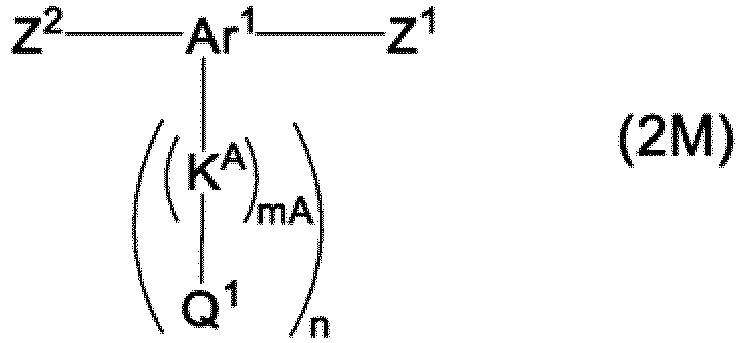 mA, n, Ar1, KA et Q1 sont tels que définis ci-dessus, etZ1 et Z2 représentent chacun indépendamment un groupe sélectionné parmi le Groupe A de substituants ou un groupe sélectionné parmi le Groupe B de substituants :
 mB, m, c, Ar2, Ar3, Ar4, KB et Q2 sont tels que définis ci-dessus, etZ3 et Z4 représentent chacun indépendamment un groupe sélectionné parmi le Groupe A de substituants ou un groupe sélectionné parmi le Groupe B de substituants :
 mT, nT, cT, QT, KT et ArT sont tels que définis ci-dessus, etZT représente un groupe sélectionné parmi le Groupe A de substituants ou un groupe sélectionné parmi le Groupe B de substituants :le Groupe A de substituants est :
un atome de chlore, un atome de brome, un atome d'iode, et un groupe représenté par -O-S(=O)2RC1, dans lequel RC1 représente un groupe alkyle, un groupe cycloalkyle ou un groupe aryle, les groupes précédents ayant chacun optionnellement un substituant,le Groupe B de substituants est :un groupe représenté par -B(ORC2)2, dans lequel RC2 représente un atome d'hydrogène, un groupe alkyle, un groupe cycloalkyle ou un groupe aryle, les groupes précédents ayant chacun optionnellement un substituant, et la pluralité de RC2 peuvent être les mêmes ou différents et peuvent être combinés ensemble pour former une structure cyclique conjointement avec les atomes d'oxygène auxquels ils sont attachés ;un groupe représenté par -BF3Q', dans lequel Q' représente Li, Na, K, Rb ou Cs ;un groupe représenté par -MgY', dans lequel Y' représente un atome de chlore, un atome de brome ou un atome d'iode ;un groupe représenté par -ZnY", dans lequel Y" représente un atome de chlore, un atome de brome ou un atome d'iode ; etun groupe représenté par -Sn(RC3)3, dans lequel RC3 représente un atome d'hydrogène, un groupe alkyle, un groupe cycloalkyle ou un groupe aryle, les groupes précédents ayant chacun optionnellement un substituant, et la pluralité de RC3 peuvent être les mêmes ou différents et peuvent être combinés ensemble pour former une structure cyclique conjointement avec l'atome d'étain auquel ils sont attachés ;dans lequel :- un quelconque substituant optionnel est sélectionné parmi le groupe constitué de : un atome d'halogène, un groupe cyano, un groupe alkyle, un groupe cylcoalkyle, un groupe aryle, un groupe hétérocyclique monovalent, un groupe alkoxy, un groupe cycloalkoxy, un groupe aryloxy, un groupe amino, un groupe amino substitué, un groupe alcényle, un groupe cycloalcényle, un groupe alkynyle ou un groupe cycloalkynyle ;- un groupe alkylène a 1 à 10 atomes de carbone, sans compter le nombre d'atomes de carbone d'un substituant ;- un groupe cycloalkylène a 3 à 10 atomes de carbone, sans compter le nombre d'atomes de carbone d'un substituant ;- un groupe arylène a 6 à 60 atomes de carbone, sans compter le nombre d'atomes de carbone d'un substituant ;- un groupe hétérocyclique divalent a 2 à 60 atomes de carbone, sans compter le nombre d'atomes de carbone d'un substituant ;- un groupe hydrocarbure aromatique a 6 à 60 atomes de carbone, sans compter le nombre d'atomes de carbone d'un substituant ;- un groupe alkyle est (i) un groupe alkyle linéaire ayant 1 à 50 atomes de carbone, sans compter le nombre d'atomes de carbone d'un substituant, ou (ii) un groupe alkyle ramifié ayant 3 à 50 atomes de carbone, sans compter le nombre d'atomes de carbone d'un substituant ;- un groupe cycloalkyle a 3 à 50 atomes de carbone, sans compter le nombre d'atomes de carbone d'un substituant ;- un groupe aryle a 6 à 60 atomes de carbone, sans compter le nombre d'atomes de carbone d'un substituant ;- un groupe hétérocyclique monovalent a 2 à 60 atomes de carbone ;- un groupe alkoxy est un groupe alkoxy linéaire ayant 1 à 40 atomes de carbone ou un groupe alkoxy ramifié ayant 3 à 40 atomes de carbone ;- un groupe cycloalkoxy a 3 à 40 atomes de carbone ;- un groupe aryloxy a 6 à 60 atomes de carbone ;- un groupe amino substitué est un dont le substituant est : un groupe alkyle linéaire ayant 1 à 50 atomes de carbone ou un groupe alkyle ramifié ayant 3 à 50 atomes de carbone ; un groupe cycloalkyle ayant 3 à 50 atomes de carbone ; un groupe aryle ayant 6 à 60 atomes de carbone ; ou un groupe hétérocyclique monovalent ayant 2 à 60 atomes de carbone ;- un groupe alcényle est un groupe alcényle linéaire ayant 2 à 30 atomes de carbone ou un groupe alcényle ramifié ayant 3 à 30 atomes de carbone ;- un groupe cycloalcényle a 3 à 30 atomes de carbone ;- un groupe alkynyle est un groupe alkynyle linéaire ayant 2 à 20 atomes de carbone ou un groupe alkynyle ramifié ayant 4 à 30 atomes de carbone ; et- un groupe cycloalkynyle a 4 à 30 atomes de carbone. - Procédé pour produire un composé polymère selon la revendication 1, dans lequel cT est 0.
- Procédé pour produire un composé polymère selon la revendication 1, dans lequelcT est 1, etArT est un groupe obtenu en enlevant, à partir d'un anneau benzène ayant optionnellement un substituant, un anneau fluorène ayant optionnellement un substituant, un anneau naphtalène ayant optionnellement un substituant, un anneau phénanthrène ayant optionnellement un substituant ou un anneau dihydrophénanthrène ayant optionnellement un substituant, (nT+1) atomes d'hydrogène attachés directement à des atomes de carbone constituant l'anneau ;dans lequel un quelconque substituant optionnel est tel que défini dans la revendication 1.
- Procédé pour produire un composé polymère selon l'une quelconque des revendications 1 à 3, comprenant en outre une unité constitutive représentée par la formule suivante (X) :
 a1 et a2 représentent chacun indépendamment un nombre entier relatif de 0 ou plus,ArX1 et ArX3 représentent chacun indépendamment un groupe arylène ou un groupe hétérocyclique divalent, les groupes précédents ayant chacun optionnellement un substituant,ArX2 et ArX4 représentent chacun indépendamment un groupe arylène, un groupe hétérocyclique divalent ou un groupe divalent dans lequel au moins un type de groupe arylène et au moins un type de groupe hétérocyclique divalent sont liés directement l'un à l'autre, les groupes précédents ayant chacun optionnellement un substituant, et, lorsqu'il y a une pluralité de ArX2 ou de ArX4, ils peuvent être les mêmes ou différents dans chaque cas, etRX1, RX2 et RX3 représentent chacun indépendamment un atome d'hydrogène, un groupe alkyle, un groupe cycloalkyle, un groupe aryle ou un groupe hétérocyclique monovalent, les groupes précédents ayant chacun optionnellement un substituant, et, lorsqu'il y a une pluralité de RX2 ou de RX3, ils peuvent être les mêmes ou différents dans chaque cas ;dans lequel un quelconque groupe arylène, un quelconque groupe hétérocyclique divalent, un quelconque groupe alkyle, un quelconque groupe cycloalkyle, un quelconque groupe aryle ou un quelconque substituant optionnel est tel que défini dans la revendication 1 et dans lequel un quelconque groupe hétérocyclique monovalent a 2 à 60 atomes de carbone, sans compter le nombre d'atomes de carbone d'un substituant.
 - Procédé pour produire un composé polymère selon l'une quelconque des revendications 1 à 4, comprenant en outre une unité constitutive représentée par la formule suivante (Y) :

- Procédé pour produire un composé polymère selon la revendication 5, dans lequel l'unité constitutive représentée par la formule (Y) est une unité constitutive représentée par la formule suivante (Y-1) ou une unité constitutive représentée par la formule suivante (Y-2) :

 RY1 est tel que défini ci-dessus, etXY1 représente un groupe représenté par -C(RY2)2-, -C(RY2)=C(RY2)- ou -C(RY2)2-C(RY2)2-, dans lequel RY2 représente un atome d'hydrogène, un groupe alkyle, un groupe cycloalkyle, un groupe alkoxy, un groupe cycloalkoxy, un groupe aryle ou un groupe hétérocyclique monovalent, les groupes précédents ayant chacun optionnellement un substituant, et la pluralité de RY2 peuvent être les mêmes ou différents, et des groupes RY2 peuvent être combinés ensemble pour former un anneau conjointement avec les atomes de carbone auquel ils sont attachés ;dans lequel :un quelconque groupe alkyle, un quelconque groupe cycloalkyle, un quelconque groupe aryle ou un quelconque substituant optionnel est tel que défini dans la revendication 1,un quelconque groupe hétérocyclique monovalent a 2 à 60 atomes de carbone, sans compter le nombre d'atomes de carbone d'un substituant,un quelconque groupe alkoxy est (i) un groupe alkoxy linéaire ayant 1 à 40 atomes de carbone, sans compter le nombre d'atomes de carbone d'un substituant, ou (ii) un groupe alkoxy ramifié ayant 3 à 40 atomes de carbone, sans compter le nombre d'atomes de carbone d'un substituant, etun quelconque groupe cycloalkoxy a 3 à 40 atomes de carbone, sans compter le nombre d'atomes de carbone d'un substituant.
Applications Claiming Priority (2)
| Application Number | Priority Date | Filing Date | Title |
|---|---|---|---|
| JP2014194866 | 2014-09-25 | ||
| PCT/JP2015/076390 WO2016047536A1 (fr) | 2014-09-25 | 2015-09-17 | Composé polymère et élément électroluminescent l'utilisant |
Publications (3)
| Publication Number | Publication Date |
|---|---|
| EP3199565A1 EP3199565A1 (fr) | 2017-08-02 |
| EP3199565A4 EP3199565A4 (fr) | 2018-05-16 |
| EP3199565B1 true EP3199565B1 (fr) | 2023-03-22 |
Family
ID=55581063
Family Applications (1)
| Application Number | Title | Priority Date | Filing Date |
|---|---|---|---|
| EP15843285.6A Active EP3199565B1 (fr) | 2014-09-25 | 2015-09-17 | Composé polymère et élément électroluminescent l'utilisant |
Country Status (6)
| Country | Link |
|---|---|
| US (1) | US10336860B2 (fr) |
| EP (1) | EP3199565B1 (fr) |
| JP (1) | JP6652061B2 (fr) |
| KR (1) | KR102256228B1 (fr) |
| CN (1) | CN106715520B (fr) |
| WO (1) | WO2016047536A1 (fr) |
Families Citing this family (9)
| Publication number | Priority date | Publication date | Assignee | Title |
|---|---|---|---|---|
| KR102298164B1 (ko) | 2017-10-30 | 2021-09-03 | 주식회사 엘지화학 | 공중합체, 및 이를 포함하는 유기발광소자 |
| EP3512307B1 (fr) | 2018-01-10 | 2021-04-21 | Samsung Electronics Co., Ltd. | Matériau polymère, matériau pour dispositif électroluminescent, composition, film mince et dispositif électroluminescent le comprenant |
| US11889751B2 (en) | 2018-04-26 | 2024-01-30 | Sumitomo Chemical Company, Limited | Light emitting element |
| EP3786210A4 (fr) * | 2018-04-26 | 2022-03-09 | Sumitomo Chemical Company, Limited | Copolymère séquencé et élément émetteur de lumière utilisant celui-ci |
| JP6866333B2 (ja) | 2018-08-16 | 2021-04-28 | エルジー・ケム・リミテッド | 4又は5位に芳香族アミノ基が置換したフルオレン誘導体を繰り返し単位として主鎖に含むポリマー、その正孔輸送材料としての使用、並びにそれを含む有機電子デバイス |
| KR102650117B1 (ko) * | 2018-09-27 | 2024-03-20 | 주식회사 엘지화학 | 유기 발광 소자 |
| JP6545879B1 (ja) | 2018-10-10 | 2019-07-17 | 住友化学株式会社 | 発光素子用膜及びそれを用いた発光素子 |
| KR102806396B1 (ko) | 2018-12-05 | 2025-05-14 | 삼성디스플레이 주식회사 | 축합환 화합물, 이를 포함한 조성물 및 이로부터 형성된 박막을 포함하는 유기 발광 소자 |
| JP7594870B2 (ja) | 2019-10-15 | 2024-12-05 | 住友化学株式会社 | 組成物及びそれを含有する発光素子 |
Family Cites Families (13)
| Publication number | Priority date | Publication date | Assignee | Title |
|---|---|---|---|---|
| JP3865406B2 (ja) | 1995-07-28 | 2007-01-10 | 住友化学株式会社 | 2,7−アリール−9−置換フルオレン及び9−置換フルオレンオリゴマー及びポリマー |
| GB0423528D0 (en) * | 2004-10-22 | 2004-11-24 | Cambridge Display Tech Ltd | Monomer for making a crosslinked polymer |
| JP5446079B2 (ja) | 2006-09-25 | 2014-03-19 | 住友化学株式会社 | 高分子化合物及びそれを用いた高分子発光素子 |
| JP5555977B2 (ja) | 2007-02-21 | 2014-07-23 | 日立化成株式会社 | 有機エレクトロニクス用材料、並びにこれを用いた有機エレクトロニクス素子及び有機エレクトロルミネセンス素子 |
| JP5625271B2 (ja) | 2008-07-29 | 2014-11-19 | 住友化学株式会社 | 高分子化合物及びそれを用いた発光素子 |
| JP5491796B2 (ja) | 2008-08-11 | 2014-05-14 | 三菱化学株式会社 | 電荷輸送性ポリマー、有機電界発光素子用組成物、有機電界発光素子、有機elディスプレイ及び有機el照明 |
| KR20100056344A (ko) * | 2008-11-18 | 2010-05-27 | 삼성전자주식회사 | 열경화성 조성물 및 그를 이용하는 인쇄회로기판 |
| JP5696662B2 (ja) | 2009-06-01 | 2015-04-08 | 日立化成株式会社 | 有機エレクトロルミネセンス素子、表示素子、照明装置および表示装置 |
| US20110012751A1 (en) * | 2009-07-20 | 2011-01-20 | Ken Jones | Message board system and method |
| WO2011078391A1 (fr) | 2009-12-25 | 2011-06-30 | 住友化学株式会社 | Composition et élément luminescent obtenu en utilisant celle-ci |
| JP2013087217A (ja) | 2011-10-19 | 2013-05-13 | Idemitsu Kosan Co Ltd | 架橋型重合体及びそれを用いた有機エレクトロルミネッセンス素子 |
| US9917273B2 (en) | 2011-10-19 | 2018-03-13 | Idemitsu Kosan Co., Ltd. | Cross-linking polymer and organic electroluminescent element using same |
| US9929347B2 (en) | 2012-03-27 | 2018-03-27 | Sumitomo Chemical Company, Limtied | Polymer compound and light emitting element using same |
-
2015
- 2015-09-17 WO PCT/JP2015/076390 patent/WO2016047536A1/fr not_active Ceased
- 2015-09-17 JP JP2016550141A patent/JP6652061B2/ja active Active
- 2015-09-17 KR KR1020177010577A patent/KR102256228B1/ko active Active
- 2015-09-17 EP EP15843285.6A patent/EP3199565B1/fr active Active
- 2015-09-17 US US15/513,761 patent/US10336860B2/en active Active
- 2015-09-17 CN CN201580050885.9A patent/CN106715520B/zh active Active
Also Published As
| Publication number | Publication date |
|---|---|
| WO2016047536A1 (fr) | 2016-03-31 |
| KR20170065553A (ko) | 2017-06-13 |
| EP3199565A1 (fr) | 2017-08-02 |
| JP6652061B2 (ja) | 2020-02-19 |
| US20170283546A1 (en) | 2017-10-05 |
| KR102256228B1 (ko) | 2021-05-27 |
| EP3199565A4 (fr) | 2018-05-16 |
| CN106715520B (zh) | 2019-05-14 |
| JPWO2016047536A1 (ja) | 2017-07-13 |
| US10336860B2 (en) | 2019-07-02 |
| CN106715520A (zh) | 2017-05-24 |
Similar Documents
| Publication | Publication Date | Title |
|---|---|---|
| US9741934B2 (en) | Polymer compound and light emitting device using the same | |
| EP3199565B1 (fr) | Composé polymère et élément électroluminescent l'utilisant | |
| US11021568B2 (en) | Polymer compound and light emitting device using the same | |
| EP3154101B1 (fr) | Élément électroluminescent | |
| EP3093292B1 (fr) | Complexe métallique et élément d'émission de lumière utilisant celui-ci | |
| EP3133660B1 (fr) | Composition et élément électroluminescent utilisant cette composition | |
| EP3131131B1 (fr) | Élément électroluminescent et composition utilisée dedans | |
| EP3222625B1 (fr) | Complexe métallique et élément électroluminescent l'utilisant | |
| EP3410508A1 (fr) | Composition, composé phosphorescent, et élément électroluminescent | |
| EP3288094B1 (fr) | Élément électroluminescent et composition utilisée dans ledit élément électroluminescent | |
| EP3674343A1 (fr) | Composé polymère et élément électroluminescent l'utilisant | |
| EP3136462A1 (fr) | Élément électroluminescent | |
| KR20170125903A (ko) | 조성물 및 그것을 사용한 발광 소자 | |
| EP3171673B1 (fr) | Procédé de fabrication d'élément électroluminescent | |
| EP3618579B1 (fr) | Composition et élément électroluminescent faisant appel à cette dernière | |
| EP3373701A1 (fr) | Procédé de commande d'élément électroluminescent et dispositif électroluminescent | |
| EP3165550A1 (fr) | Composé polymère et élément électroluminescent l'utilisant | |
| EP3203543B1 (fr) | Élément électroluminescent | |
| EP3121182B1 (fr) | Complexe métallique et élément électroluminescent le comprenant |
Legal Events
| Date | Code | Title | Description |
|---|---|---|---|
| STAA | Information on the status of an ep patent application or granted ep patent |
Free format text: STATUS: THE INTERNATIONAL PUBLICATION HAS BEEN MADE |
|
| PUAI | Public reference made under article 153(3) epc to a published international application that has entered the european phase |
Free format text: ORIGINAL CODE: 0009012 |
|
| STAA | Information on the status of an ep patent application or granted ep patent |
Free format text: STATUS: REQUEST FOR EXAMINATION WAS MADE |
|
| 17P | Request for examination filed |
Effective date: 20170404 |
|
| AK | Designated contracting states |
Kind code of ref document: A1 Designated state(s): AL AT BE BG CH CY CZ DE DK EE ES FI FR GB GR HR HU IE IS IT LI LT LU LV MC MK MT NL NO PL PT RO RS SE SI SK SM TR |
|
| AX | Request for extension of the european patent |
Extension state: BA ME |
|
| DAV | Request for validation of the european patent (deleted) | ||
| DAX | Request for extension of the european patent (deleted) | ||
| A4 | Supplementary search report drawn up and despatched |
Effective date: 20180418 |
|
| RIC1 | Information provided on ipc code assigned before grant |
Ipc: C08G 61/12 20060101AFI20180410BHEP Ipc: H01L 51/00 20060101ALN20180410BHEP Ipc: H01L 51/50 20060101ALI20180410BHEP |
|
| STAA | Information on the status of an ep patent application or granted ep patent |
Free format text: STATUS: EXAMINATION IS IN PROGRESS |
|
| 17Q | First examination report despatched |
Effective date: 20181220 |
|
| GRAP | Despatch of communication of intention to grant a patent |
Free format text: ORIGINAL CODE: EPIDOSNIGR1 |
|
| STAA | Information on the status of an ep patent application or granted ep patent |
Free format text: STATUS: GRANT OF PATENT IS INTENDED |
|
| RIC1 | Information provided on ipc code assigned before grant |
Ipc: H01L 51/00 20060101ALN20221027BHEP Ipc: C08L 65/00 20060101ALI20221027BHEP Ipc: C09D 165/00 20060101ALI20221027BHEP Ipc: C09K 11/06 20060101ALI20221027BHEP Ipc: H01L 51/50 20060101ALI20221027BHEP Ipc: C08G 61/12 20060101AFI20221027BHEP |
|
| INTG | Intention to grant announced |
Effective date: 20221118 |
|
| RAP3 | Party data changed (applicant data changed or rights of an application transferred) |
Owner name: SUMITOMO CHEMICAL COMPANY, LTD. |
|
| GRAS | Grant fee paid |
Free format text: ORIGINAL CODE: EPIDOSNIGR3 |
|
| GRAA | (expected) grant |
Free format text: ORIGINAL CODE: 0009210 |
|
| STAA | Information on the status of an ep patent application or granted ep patent |
Free format text: STATUS: THE PATENT HAS BEEN GRANTED |
|
| AK | Designated contracting states |
Kind code of ref document: B1 Designated state(s): AL AT BE BG CH CY CZ DE DK EE ES FI FR GB GR HR HU IE IS IT LI LT LU LV MC MK MT NL NO PL PT RO RS SE SI SK SM TR |
|
| REG | Reference to a national code |
Ref country code: GB Ref legal event code: FG4D |
|
| REG | Reference to a national code |
Ref country code: CH Ref legal event code: EP |
|
| REG | Reference to a national code |
Ref country code: DE Ref legal event code: R096 Ref document number: 602015082903 Country of ref document: DE |
|
| REG | Reference to a national code |
Ref country code: IE Ref legal event code: FG4D |
|
| REG | Reference to a national code |
Ref country code: AT Ref legal event code: REF Ref document number: 1555268 Country of ref document: AT Kind code of ref document: T Effective date: 20230415 |
|
| REG | Reference to a national code |
Ref country code: LT Ref legal event code: MG9D |
|
| REG | Reference to a national code |
Ref country code: NL Ref legal event code: MP Effective date: 20230322 |
|
| PG25 | Lapsed in a contracting state [announced via postgrant information from national office to epo] |
Ref country code: RS Free format text: LAPSE BECAUSE OF FAILURE TO SUBMIT A TRANSLATION OF THE DESCRIPTION OR TO PAY THE FEE WITHIN THE PRESCRIBED TIME-LIMIT Effective date: 20230322 Ref country code: NO Free format text: LAPSE BECAUSE OF FAILURE TO SUBMIT A TRANSLATION OF THE DESCRIPTION OR TO PAY THE FEE WITHIN THE PRESCRIBED TIME-LIMIT Effective date: 20230622 Ref country code: LV Free format text: LAPSE BECAUSE OF FAILURE TO SUBMIT A TRANSLATION OF THE DESCRIPTION OR TO PAY THE FEE WITHIN THE PRESCRIBED TIME-LIMIT Effective date: 20230322 Ref country code: LT Free format text: LAPSE BECAUSE OF FAILURE TO SUBMIT A TRANSLATION OF THE DESCRIPTION OR TO PAY THE FEE WITHIN THE PRESCRIBED TIME-LIMIT Effective date: 20230322 Ref country code: HR Free format text: LAPSE BECAUSE OF FAILURE TO SUBMIT A TRANSLATION OF THE DESCRIPTION OR TO PAY THE FEE WITHIN THE PRESCRIBED TIME-LIMIT Effective date: 20230322 |
|
| REG | Reference to a national code |
Ref country code: AT Ref legal event code: MK05 Ref document number: 1555268 Country of ref document: AT Kind code of ref document: T Effective date: 20230322 |
|
| PG25 | Lapsed in a contracting state [announced via postgrant information from national office to epo] |
Ref country code: SE Free format text: LAPSE BECAUSE OF FAILURE TO SUBMIT A TRANSLATION OF THE DESCRIPTION OR TO PAY THE FEE WITHIN THE PRESCRIBED TIME-LIMIT Effective date: 20230322 Ref country code: NL Free format text: LAPSE BECAUSE OF FAILURE TO SUBMIT A TRANSLATION OF THE DESCRIPTION OR TO PAY THE FEE WITHIN THE PRESCRIBED TIME-LIMIT Effective date: 20230322 Ref country code: GR Free format text: LAPSE BECAUSE OF FAILURE TO SUBMIT A TRANSLATION OF THE DESCRIPTION OR TO PAY THE FEE WITHIN THE PRESCRIBED TIME-LIMIT Effective date: 20230623 Ref country code: FI Free format text: LAPSE BECAUSE OF FAILURE TO SUBMIT A TRANSLATION OF THE DESCRIPTION OR TO PAY THE FEE WITHIN THE PRESCRIBED TIME-LIMIT Effective date: 20230322 |
|
| PG25 | Lapsed in a contracting state [announced via postgrant information from national office to epo] |
Ref country code: SM Free format text: LAPSE BECAUSE OF FAILURE TO SUBMIT A TRANSLATION OF THE DESCRIPTION OR TO PAY THE FEE WITHIN THE PRESCRIBED TIME-LIMIT Effective date: 20230322 Ref country code: RO Free format text: LAPSE BECAUSE OF FAILURE TO SUBMIT A TRANSLATION OF THE DESCRIPTION OR TO PAY THE FEE WITHIN THE PRESCRIBED TIME-LIMIT Effective date: 20230322 Ref country code: PT Free format text: LAPSE BECAUSE OF FAILURE TO SUBMIT A TRANSLATION OF THE DESCRIPTION OR TO PAY THE FEE WITHIN THE PRESCRIBED TIME-LIMIT Effective date: 20230724 Ref country code: ES Free format text: LAPSE BECAUSE OF FAILURE TO SUBMIT A TRANSLATION OF THE DESCRIPTION OR TO PAY THE FEE WITHIN THE PRESCRIBED TIME-LIMIT Effective date: 20230322 Ref country code: EE Free format text: LAPSE BECAUSE OF FAILURE TO SUBMIT A TRANSLATION OF THE DESCRIPTION OR TO PAY THE FEE WITHIN THE PRESCRIBED TIME-LIMIT Effective date: 20230322 Ref country code: AT Free format text: LAPSE BECAUSE OF FAILURE TO SUBMIT A TRANSLATION OF THE DESCRIPTION OR TO PAY THE FEE WITHIN THE PRESCRIBED TIME-LIMIT Effective date: 20230322 |
|
| PG25 | Lapsed in a contracting state [announced via postgrant information from national office to epo] |
Ref country code: SK Free format text: LAPSE BECAUSE OF FAILURE TO SUBMIT A TRANSLATION OF THE DESCRIPTION OR TO PAY THE FEE WITHIN THE PRESCRIBED TIME-LIMIT Effective date: 20230322 Ref country code: PL Free format text: LAPSE BECAUSE OF FAILURE TO SUBMIT A TRANSLATION OF THE DESCRIPTION OR TO PAY THE FEE WITHIN THE PRESCRIBED TIME-LIMIT Effective date: 20230322 Ref country code: IS Free format text: LAPSE BECAUSE OF FAILURE TO SUBMIT A TRANSLATION OF THE DESCRIPTION OR TO PAY THE FEE WITHIN THE PRESCRIBED TIME-LIMIT Effective date: 20230722 |
|
| REG | Reference to a national code |
Ref country code: DE Ref legal event code: R097 Ref document number: 602015082903 Country of ref document: DE |
|
| PLBE | No opposition filed within time limit |
Free format text: ORIGINAL CODE: 0009261 |
|
| STAA | Information on the status of an ep patent application or granted ep patent |
Free format text: STATUS: NO OPPOSITION FILED WITHIN TIME LIMIT |
|
| PG25 | Lapsed in a contracting state [announced via postgrant information from national office to epo] |
Ref country code: SI Free format text: LAPSE BECAUSE OF FAILURE TO SUBMIT A TRANSLATION OF THE DESCRIPTION OR TO PAY THE FEE WITHIN THE PRESCRIBED TIME-LIMIT Effective date: 20230322 Ref country code: DK Free format text: LAPSE BECAUSE OF FAILURE TO SUBMIT A TRANSLATION OF THE DESCRIPTION OR TO PAY THE FEE WITHIN THE PRESCRIBED TIME-LIMIT Effective date: 20230322 Ref country code: CZ Free format text: LAPSE BECAUSE OF FAILURE TO SUBMIT A TRANSLATION OF THE DESCRIPTION OR TO PAY THE FEE WITHIN THE PRESCRIBED TIME-LIMIT Effective date: 20230322 |
|
| 26N | No opposition filed |
Effective date: 20240102 |
|
| REG | Reference to a national code |
Ref country code: CH Ref legal event code: PL |
|
| PG25 | Lapsed in a contracting state [announced via postgrant information from national office to epo] |
Ref country code: LU Free format text: LAPSE BECAUSE OF NON-PAYMENT OF DUE FEES Effective date: 20230917 |
|
| REG | Reference to a national code |
Ref country code: BE Ref legal event code: MM Effective date: 20230930 |
|
| GBPC | Gb: european patent ceased through non-payment of renewal fee |
Effective date: 20230917 |
|
| PG25 | Lapsed in a contracting state [announced via postgrant information from national office to epo] |
Ref country code: LU Free format text: LAPSE BECAUSE OF NON-PAYMENT OF DUE FEES Effective date: 20230917 Ref country code: IT Free format text: LAPSE BECAUSE OF FAILURE TO SUBMIT A TRANSLATION OF THE DESCRIPTION OR TO PAY THE FEE WITHIN THE PRESCRIBED TIME-LIMIT Effective date: 20230322 Ref country code: MC Free format text: LAPSE BECAUSE OF FAILURE TO SUBMIT A TRANSLATION OF THE DESCRIPTION OR TO PAY THE FEE WITHIN THE PRESCRIBED TIME-LIMIT Effective date: 20230322 |
|
| REG | Reference to a national code |
Ref country code: IE Ref legal event code: MM4A |
|
| PG25 | Lapsed in a contracting state [announced via postgrant information from national office to epo] |
Ref country code: IE Free format text: LAPSE BECAUSE OF NON-PAYMENT OF DUE FEES Effective date: 20230917 |
|
| PG25 | Lapsed in a contracting state [announced via postgrant information from national office to epo] |
Ref country code: GB Free format text: LAPSE BECAUSE OF NON-PAYMENT OF DUE FEES Effective date: 20230917 |
|
| PG25 | Lapsed in a contracting state [announced via postgrant information from national office to epo] |
Ref country code: CH Free format text: LAPSE BECAUSE OF NON-PAYMENT OF DUE FEES Effective date: 20230930 |
|
| PG25 | Lapsed in a contracting state [announced via postgrant information from national office to epo] |
Ref country code: IE Free format text: LAPSE BECAUSE OF NON-PAYMENT OF DUE FEES Effective date: 20230917 Ref country code: GB Free format text: LAPSE BECAUSE OF NON-PAYMENT OF DUE FEES Effective date: 20230917 Ref country code: FR Free format text: LAPSE BECAUSE OF NON-PAYMENT OF DUE FEES Effective date: 20230930 Ref country code: CH Free format text: LAPSE BECAUSE OF NON-PAYMENT OF DUE FEES Effective date: 20230930 |
|
| PG25 | Lapsed in a contracting state [announced via postgrant information from national office to epo] |
Ref country code: BE Free format text: LAPSE BECAUSE OF NON-PAYMENT OF DUE FEES Effective date: 20230930 |
|
| PG25 | Lapsed in a contracting state [announced via postgrant information from national office to epo] |
Ref country code: BG Free format text: LAPSE BECAUSE OF FAILURE TO SUBMIT A TRANSLATION OF THE DESCRIPTION OR TO PAY THE FEE WITHIN THE PRESCRIBED TIME-LIMIT Effective date: 20230322 |
|
| PG25 | Lapsed in a contracting state [announced via postgrant information from national office to epo] |
Ref country code: BG Free format text: LAPSE BECAUSE OF FAILURE TO SUBMIT A TRANSLATION OF THE DESCRIPTION OR TO PAY THE FEE WITHIN THE PRESCRIBED TIME-LIMIT Effective date: 20230322 |
|
| PG25 | Lapsed in a contracting state [announced via postgrant information from national office to epo] |
Ref country code: CY Free format text: LAPSE BECAUSE OF FAILURE TO SUBMIT A TRANSLATION OF THE DESCRIPTION OR TO PAY THE FEE WITHIN THE PRESCRIBED TIME-LIMIT; INVALID AB INITIO Effective date: 20150917 |
|
| PG25 | Lapsed in a contracting state [announced via postgrant information from national office to epo] |
Ref country code: HU Free format text: LAPSE BECAUSE OF FAILURE TO SUBMIT A TRANSLATION OF THE DESCRIPTION OR TO PAY THE FEE WITHIN THE PRESCRIBED TIME-LIMIT; INVALID AB INITIO Effective date: 20150917 |
|
| PGFP | Annual fee paid to national office [announced via postgrant information from national office to epo] |
Ref country code: DE Payment date: 20250820 Year of fee payment: 11 |
|
| PG25 | Lapsed in a contracting state [announced via postgrant information from national office to epo] |
Ref country code: TR Free format text: LAPSE BECAUSE OF FAILURE TO SUBMIT A TRANSLATION OF THE DESCRIPTION OR TO PAY THE FEE WITHIN THE PRESCRIBED TIME-LIMIT Effective date: 20230322 |