EP3201006B1 - Caractéristique d'identification servant à identifier un objet - Google Patents
Caractéristique d'identification servant à identifier un objet Download PDFInfo
- Publication number
- EP3201006B1 EP3201006B1 EP16779022.9A EP16779022A EP3201006B1 EP 3201006 B1 EP3201006 B1 EP 3201006B1 EP 16779022 A EP16779022 A EP 16779022A EP 3201006 B1 EP3201006 B1 EP 3201006B1
- Authority
- EP
- European Patent Office
- Prior art keywords
- identification
- ink
- pigments
- light
- particles
- Prior art date
- Legal status (The legal status is an assumption and is not a legal conclusion. Google has not performed a legal analysis and makes no representation as to the accuracy of the status listed.)
- Active
Links
Images


Classifications
-
- B—PERFORMING OPERATIONS; TRANSPORTING
- B42—BOOKBINDING; ALBUMS; FILES; SPECIAL PRINTED MATTER
- B42D—BOOKS; BOOK COVERS; LOOSE LEAVES; PRINTED MATTER CHARACTERISED BY IDENTIFICATION OR SECURITY FEATURES; PRINTED MATTER OF SPECIAL FORMAT OR STYLE NOT OTHERWISE PROVIDED FOR; DEVICES FOR USE THEREWITH AND NOT OTHERWISE PROVIDED FOR; MOVABLE-STRIP WRITING OR READING APPARATUS
- B42D25/00—Information-bearing cards or sheet-like structures characterised by identification or security features; Manufacture thereof
Definitions
- the invention relates to an identification feature for identifying an article according to claim 1.
- Electromagnetic radiation in a wavelength range of about 380 nm to 790 nm is generally referred to as light spectrum and is perceivable by humans with his eyes as light. Since the sensitivity of the human eye at the perceptual limits does not abruptly, but gradually decreases, an overly precise narrowing of the light spectrum makes little sense. In addition, the color perception for individual wavelengths in humans is individually slightly different pronounced. Therefore, the Commission Internationale de l'Éclairage (CIE) has empirically determined spectral sensitivities for wavelengths and defined a standard valence system to establish a relation between human color perception (color) and the physical causes of a color stimulus (color valence). The CIE standard-valence system captures the totality of human perceivable colors.
- the wavelength ranges adjacent to the light spectrum are the ultraviolet radiation in the short-wave range and the infrared radiation in the long-wave range.
- Diffraction or Diffraction is the deflection of waves on an obstacle. Diffraction can cause a wave in areas of space spread, which would be blocked in a straight path through the obstacle.
- diffraction is no longer negligible if geometric structures play a role whose size is comparable to the wavelength of the waves used.
- quantum physics light is no longer understood as a classical wave, but as a quantum object. Accordingly, the light is composed of individual discrete energy quanta, the so-called photons. A photon is an elementary particle that always moves at the speed of light.
- the remitted radiation contains predominantly long-wave components up to 790 nm and the remitted radiation is perceived with the color red. With predominantly long-wave absorption up to 790 nm, the color perception from the reflected light is violet.
- energy can be given off again in the form of radiation.
- the incident light beam and the outgoing light beam as well as the solder lie on the reflecting surface in one plane. Incidence angle and angle of departure are equal to each other.
- the ratio of the reflected light intensity to the incident light intensity is referred to as reflectance and is material and wavelength dependent.
- Scattering The light changes its propagation, but not in a defined direction, as in reflection, but diffusely in all possible spatial directions. Depending on the scattering body, a distinction is made between Compton scattering (on free electrons), Rayleigh scattering (on bound electrons without energy transfer), Raman scattering (on bound electrons with energy transfer) and Mie scattering (on particles whose expansion in the Magnitude of the wavelength is).
- Refraction Light is refracted at an interface between two media of different optical density, ie a light beam changes its direction at this interface. Some materials split a light beam into two beams of different polarization. In this case one speaks of a birefringence.
- Optical activity Certain media rotate the polarization plane of polarized light.
- Photo Effect The photons of the incident radiation dissolve electrons from the irradiated body.
- a color stimulus results from absorption and remission (i.e., scattering or reflection) of certain frequency components of visible light.
- the color stimulus is the physical identification of the radiation of visible light, which causes a perception by direct irritation of the retina of the eye, whereby this perception can be perceived as color.
- the color stimulus can be from both a primary light source, i. H. from a self-radiator, d. H. from a self-luminous source, as well as from a secondary light source, d. H. emanating from a lit body.
- a color stimulus caused by a primary light source it is called a light color
- the color stimulus caused by a secondary light source is referred to as body color.
- Body colors change the spectral composition of the incident light according to a transmission and remission behavior of the matter of the body in question.
- a relative spectral radiation distribution S ⁇ is decisive, ie the "irritating" radiation as a function of the wavelength and not in its absolute magnitude or intensity.
- the spectral distribution which determines the color sensation is called the color-stimulus function ⁇ ( ⁇ ).
- this function is equal to its spectral distribution S (A).
- the color stimulus is determined by the product of the beam density factor ⁇ ( ⁇ ) and the spectral distribution of the light source.
- Radiometry is the science of measuring electromagnetic radiation and their application.
- the quantitative measurement of radiation intensities is done with different types of detectors.
- the detectors for the physical measurement of radiation quantities are called radiometers. These detectors convert part of the radiation into heat or into an electrical signal, which, among other things, can be used to deduce the nature of the radiating surface and its temperature.
- Photometry or photometry are measuring methods in the wavelength range of the visible light and the ultraviolet spectral range by means of a photometer, wherein a photometer or photometer is an instrument for measuring at least one photometric quantity. Photometric quantities are derived from the associated radiometric quantities.
- a photometric quantity and a corresponding radiometric quantity The difference between a photometric quantity and a corresponding radiometric quantity is that the sensitivity of the observer is included in photometry by multiplying the radiometric quantity by a CIE-standardized spectral light-sensitivity curve, which is also referred to as the V-lambda curve becomes.
- An index v in noncursive writing, which is attached to the variables by convention, stands for the reference to visible light, ie typically the spectral range from 380 nm to 790 nm.
- the luminous flux measured in the SI unit lumens (lm) is the radiant power of a light source, weighted with the light sensitivity curve, and corresponds to the radiometric magnitude radiant power, ie the radiant flux or radiant energy per time, measured in the SI unit watts (W ).
- the amount of light measured in the SI unit of lumen-seconds (lms), is the radiant energy of a light source weighted with the sensitivity curve, and corresponds to the radiometric amount of radiant energy, ie the amount of radiation or the energy of a number of photons in one stream of photons assumed electromagnetic radiation, measured in the SI unit Joule (J).
- the luminous intensity, measured in the SI unit candela (cd), is the luminous flux per solid angle, measured at a great distance from the light source, and corresponds to the radiometric quantity radiation intensity, d. H. the radiant intensity, radiant intensity or radiant flux per solid angle, measured in the SI unit watts per steradian (W / sr).
- the light intensity indicates how intensively a light source shines in a certain direction.
- the luminous flux is equal to the luminous intensity multiplied by 4 ⁇ , the solid solid angle.
- Illuminance measured in the SI unit lux (lx) is the luminous flux per illuminated area, and corresponds to the radiometric magnitude irradiance, ie the radiant flux density or radiant flux per effective receiver area, measured in SI units watts per square meter (W / m 2 ). The illuminance indicates how intensively the surface is illuminated.
- the specific light emission measured in the SI unit Lux (lx) is the emitted luminous flux, relative to the size of the light-emitting surface, and corresponds to the radiometric magnitude specific emittance or emission current density, ie the radiative flux per effective transmitter area, measured in the SI Unit watts per square meter (W / m 2 ).
- the luminance measured in the SI unit candela per square meter (cd / m 2 ), is the luminous intensity of a light source, based on its projected area (perpendicular to the viewing direction), and corresponds to the radiometric quantity radiance, ie the radiation flux per solid angle per effective Transmitter area, measured in SI unit watts per square meter and steradian (W / (m 2 sr)).
- the luminance takes a picture-capturing optical system, for. As the person or a camera, as brightness of a light-emitting surface true.
- An emission spectrum is the electromagnetic spectrum that is emitted by atoms, molecules or materials without radiating electromagnetic radiation of the same frequency.
- the counterpart of an emission spectrum is the absorption spectrum. While discrete energy levels cause a line spectrum, energy bands cause a continuous spectrum.
- An atomic spectrum is the emission spectrum of a single isolated atom, ie the intensity of the light emitted by it as a function of wavelength or frequency.
- the spectral lines each correspond to the energy difference between two different states of the atom. This energy difference is applied, for example, by an absorbed photon and then emitted in the form of another photon with that energy, that is emitted. This energy (or in the spectrum the line) is discrete, so it can not take any values.
- each atom - according to its electron configuration - can only emit particles of discrete wavelength.
- the wavelengths of the emitted particles are therefore specific to a particular element.
- the fact that the "lines" in the spectrum ('peaks') are exact curves with a certain width is based on quantum effects.
- the spectral lines become wider with increasing gas pressure. At very high pressure, the line width can increase to such an extent that one observes a continuum of light similar to a solid.
- the cause is the more frequent mutual interference of the atoms during the collision. If an electron is completely released from the atom by absorption of a photon, this is called ionization of the atom. For this purpose, depending on the initial state of the electron, a certain minimum energy is necessary.
- a solid is matter in the solid state, especially at a temperature of 20 ° C.
- Solid particles have a certain minimum extent in technical usage, but this is not sharply defined. They are therefore macroscopic body - in contrast to microscopic bodies such. For example, atoms and molecules.
- Polycrystalline solids consist of a collection of small single crystals, which are disorganized into a large whole.
- An absorption or absorption line spectrum is an electromagnetic spectrum that arises when broadband, in particular white, light radiates matter and light quanta, i. H. Photons of certain wavelengths or wavelengths are absorbed thereby (resonance absorption). The absorbed photons are missing in the passing light, whereby the so-called Fraunhofer lines are formed in the spectrum. Therefore the spectrum at the respective wavelengths is dark or in extreme cases black.
- An absorption band is a wavelength interval in which the electromagnetic radiation, e.g. As solar radiation, by chemical substances, eg. B. atmospheric gases such as carbon dioxide, carbon monoxide, ozone, methane, etc. on the way to Receiver is selectively absorbed.
- the originally continuous spectrum of the radiation source arrives at the receiver only with dark gaps, these gaps forming the so-called absorption bands. Certain intervals of the entire wavelength range emitted by the radiation source are no longer present.
- An image of the spectrum obtained by selective absorption is called band spectrum.
- An absorption band consists of a larger number of individual, ie singular, closely spaced absorption lines.
- the absorption bands are due to the coupling of electrical vibrational and rotational excitation in molecules, so that no single energy difference is absorbed, but depending on the excitation of the molecules, a whole spectrum of energy values, ie the absorption spectrum.
- the various molecules absorb each only in a specific wavelength interval for them. If the photons of the electromagnetic radiation emitted by a radiation source are absorbed by these photons excite atoms, then these are sharply defined amounts of energy and thus wavelengths, and the dark areas are accordingly narrow lines. On the other hand, in molecules many absorbable energy values are often close to each other and form wider dark areas in the spectrum, ie the absorption bands. In any case, the observed absorption spectrum is characteristic of the type of matter that traverses the radiation.
- spectroscopy is an important method for analyzing substances. Be free atoms, z. B. in a gas or vapor, spectroscopy, the photons are emitted again after absorption, uniformly in all spatial directions. If the light is irradiated only from one direction, then in the light which has passed through, the absorption spectrum typical of the type of atom present, ie for the relevant chemical element, is found as a line spectrum. The light scattered in the other spatial directions shows the corresponding emission spectrum.
- the spectroscopy of solids may be between the absorption and eventual Emission still a relaxation occur in the solid state.
- the absorption and emission spectra are not complementary to each other as in the case of the free atoms.
- Luminescence is the optical radiation of a physical system, which arises during the transition from an excited state to the ground state. Depending on the type of excitation, a distinction is made between different types of luminescence. So z. B. electroluminescence excited by electric current, z. B. in light emitting diodes (LED). Photoluminescence is excited by photons, with differentiation between phosphorescence and fluorescence depending on the time between excitation and emission of the light. Radioluminescence is excited by an irradiation with alpha or beta radiation or by X-radiation. Superluminescence is produced by optical pumping, whereby spontaneously emitted light is amplified by stimulated emission in an optically active medium. Chemiluminescence is excited by a chemical reaction.
- a light-emitting diode is a semiconductor light-emitting component whose electrical properties correspond to those of a pn-type semiconductor diode.
- a light emitting diode emits electromagnetic radiation having a wavelength ( ⁇ ) dependent on the semiconductor material and its doping, this radiation being either visible light or infrared radiation or ultraviolet radiation.
- a solid to absorb light including a semiconductor
- the ability of a solid to absorb light is subject to the condition that the photon energy is absorbed by the excitation of electrons. Since electrons can not be excited at an energetic distance between a valence band and a conduction band of the solid, ie in its so-called bandgap, the energy of a photon must surpass the energy of the bandgap. Otherwise, the photon can not be absorbed.
- the Energy of a photon is coupled to the frequency of electromagnetic radiation via Planck's constant of action. If a solid has a bandgap, it is therefore transparent to radiation below a certain frequency or above a certain wavelength ( ⁇ ), with the exception of special effects.
- the energy of a photon emitted by the solid is equal to the energy of the bandgap, ie the energy gap between the conduction and valence bands.
- the energy of the bandgap decreases with increasing temperature due to the thermal expansion of the lattice first quadratically, then more or less linearly, starting from a maximum value at the temperature of zero Kelvin.
- the temperature dependence of the band gap is material-dependent and can be z. B. with the Varshni formula describe.
- the size of the band gap, ie the energy gap determines the energy, ie the frequency, wavelength or color of the radiation or of the emitted light. It can be controlled by the chemical composition of the semiconductor.
- the exchange of atoms in the crystal lattice alters the crystalline and / or molecular structure of the material, including its lattice parameters or even its lattice structure.
- light emitting diodes of the frequently used semiconductor material emit indium gallium nitride (InGaN) or gallium nitride (GaN) in the ultraviolet (230 nm ⁇ ⁇ 400 nm), violet (400 nm ⁇ ⁇ 450 nm), blue (450 nm ⁇ ⁇ ) depending on the doping 500 nm) or green (500 nm ⁇ ⁇ 570 nm) spectral range.
- LEDs emit in a limited spectral range ⁇ z. B. of maximum ⁇ ⁇ 30 nm, so their radiation is almost monochromatic. For a light-emitting diode z. B.
- indium gallium nitride InGaN, In x Ga 1-x N
- indium gallium nitride InGaN, In x Ga 1-x N
- gallium nitride Indium gallium nitride
- 20% indium nitride and 80% gallium nitride produce a blue-violet radiation with a wavelength of 420 nm.
- the radiation is 440 nm, which is blue Color corresponds.
- Other materials for LEDs form z.
- the aforementioned methods for generating white light are z. B. in the WO 2007/017049 A1 described.
- the WO 2007/017049 A1 is also known photonic material with regularly arranged cavities containing at least one colorant, wherein the wall material of the photonic material dielectric
- the wall material of the photonic material dielectric As such, it has properties which, as such, are substantially nonabsorbent for the wavelength of an absorption band of the respective colorant and are substantially transparent to the wavelength of an absorption wavelength excitable emission of the colorant and the cavities are designed such that radiation of the wavelength of the weak absorption band of the colorant is stored in the photonic material.
- the colorant is an emitter for radiation in the range of 550 nm to 700 nm, which is preferably a rare earth compound doped with europium, samarium, terbium or praseodymium, preferably with triply positively charged europium ions.
- the colorant is present in nanoparticulate form, preferably with an average particle size of less than 50 nm (hydraulic diameter determined by means of dynamic light scattering).
- phosphor which produce visible light by excitation with short-wave light to the ultraviolet or electron bombardment.
- Phosphors are often inorganic, crystalline substances, which provide a technically utilizable light output by targeted introduction of impurities in the crystal structure. In this case, purity levels of the starting materials of up to 99.9999% are required.
- the phosphors are mostly based on oxides or sulfides such as zinc oxide, zinc sulfide, zinc-cadmium sulfide and zinc sulfide selenide, and silicates such as willemite and zinc beryllium silicate.
- Zinc sulfide is also used in self-luminous radioactive luminescent paints.
- the doping element determines the luminous color (ZnS: Mn ⁇ orange-red, ZnS: Ag ⁇ blue, ZnS: Cu ⁇ green, ZnS: Ln ⁇ depending on the lanthanoid red to blue-green).
- Parameters such as light color of the fluorescence and phosphorescence, afterglow duration and efficiency of the energy reproduction are not only dependent on the substances used, but also of their processing such as annealing, grinding, quenching, atmospheric effects during these processes.
- EP 2 062 960 A1 is a phosphor, in particular a phosphor, which is used in illuminations or in light-emitting devices including LED, wherein the phosphor substantially comprises a silicate and an activating agent ion and has a main chemical composition which is expressed by the following formula: aAO ⁇ bA'O ⁇ cSiO 2 : xEu ⁇ yLn ⁇ zM ⁇ ⁇ N, wherein A is selected from the group consisting of Sr, Ca, Ba and combinations thereof; A 'is selected from the group consisting of Mg, Zn and combinations thereof; Ln an ion / ion is selected from at least one member selected from the group consisting of Nd, Dy, Ho, Tm, La, Ce, Er, Pr, Bi, Sm, Sn, Y, Lu, Ga, Sb, Tb, Mn and Pb; M is selected from the group consisting of Cl, F, B, I and combinations thereof; N is selected from the group consist
- the phosphor is preferably excited by an excitation light source having an emission maximum in the range of UV light to blue-violet light of 240 nm to 455 nm, this phosphor having a light emission spectrum with two or three maxima in the range of 370 nm to 760 nm generated.
- colorant is according to DIN 55943: 2001-10 "colorants - terms" one Collective name for all coloring substances.
- the DIN 55943 first divides the colorants into organic and inorganic colorants. Each of the two groups is divided into dyes and pigments. Pigments are coloring substances which, unlike dyes, are insoluble in the application medium. In this case, that substance is referred to as the application medium, in which the colorant is incorporated or will.
- the properties of the pigments are in addition to the chemical structure by their solid state properties such. As crystal structure, crystal modification, particle size and particle size distribution determined. In order to address the respective matter of a dye having optical properties, particles of the respective dye are referred to below, even if these particles are molecules soluble in the application medium or more complex chemical compounds.
- Colorants specifically absorb a limited portion of the visible white light and remit the unabsorbed portion of the white light.
- the complementary color of the light perceived by a viewer is absorbed by the colorant.
- the color absorption is based on conjugated double bonds and aromatic bases of the molecules. During absorption, conjugated electrons in the double bond system are raised to a higher energy state and the colorant molecule releases energy by radiation in another, in particular visible, wavelength or by heat radiation.
- the absorption range of a colorant can be influenced, which groups can be formed as a nitro, sulfonic acid, dimethylamino or hydroxy group. At the same time, this can also influence the chemical reactivity and the color property.
- a chemical compound is an aromatic molecule.
- the absorption of electromagnetic radiation raises the energy level of electrons in molecules or atoms. This means that approximately a distance between electrons and the respective associated atomic nuclei is increased.
- the energy required for this is the incident electromagnetic radiation, z. B. the light removed. Since these processes occur under quantum conditions, the absorption of electromagnetic radiation is not continuous, but occurs only in certain jumps, which correspond to the energy difference between the electrons before and after the absorption. This energy difference is inversely proportional to the absorbed wavelength of the incident light and thus determines the color in which the colorant appears.
- the ⁇ -electrons can be "smeared", i. H. delocalize, whereby the energetic distance between excited state and ground state decreases and shifts an absorption or emission maximum in the direction of longer wavelengths.
- the longer the absorption range is, the longer the wavelength of such unsaturated bonds is conjugated.
- Organic and inorganic chromophores There are organic and inorganic chromophores, d. H. Color carrier.
- Organic chromophores consist of systems of conjugated double bonds such as carotene and / or large aromatic molecules such as methyl red.
- Inorganic chromophores are often found among the transition metals. Examples are vanadium, chromium, manganese, iron, cobalt, nickel and copper. Depending on the oxidation state and complex formation, these elements can show very different colors.
- the term "chromophore" refers to that part of a colorant which ensures the basic presence of the color.
- Chromophores are molecular structures whose vibrational properties can be significantly influenced by auxochromes (electron donors) and antiauxochromes (electron acceptors), which further shift and / or polarize the delocalized ⁇ electrons of the chromophore.
- auxochromes or antiauxochromes increase the mesomerism in the molecule by displacing electrons to or from a chromophore group.
- the absorption spectrum of a chromophore alone need not necessarily be within the visible range of the electromagnetic spectrum. However, if the chromophore is further modified by the mesomeric effect of a substituent, its absorption spectrum is usually shifted.
- Chromophores are therefore the basic structures that contain delocalizable electrons.
- the type of chromophores influences the hue of the colorant via its absorption maximum, while the frequency of the chromophores influences the color depth.
- Functional colorants fulfill a specific defined function in their application, which is not based solely on an aesthetic color scheme. So z.
- an indicator dye is a functional colorant.
- the ink is to realize a required hue on a substrate, the hue can be specified as a color location in a color space.
- the optical properties of a printing ink are dependent on the printing process used for the inking, the printing substrate, the location of the observer and the light source under which the printed product is viewed.
- the mechanical properties of printing inks are also called rheological properties.
- the color transport is determined by the tack of the ink.
- the tack is the force necessary to separate an ink film. It is a complex ratio of viscosity, cohesion and adhesion and is measured in the ink test as tack.
- Aerosol formation is the formation of a color mist and color threads at high print speeds. These aerosols are undesirable.
- the aerosol formation is strongly temperature-dependent, as it correlates directly with the viscosity.
- the layer thicknesses of the printing inks applied to the printing substrate are very low (typically about 1 ⁇ m to 8 ⁇ m, in offset printing preferably 0.7 ⁇ m to 2.5 ⁇ m), in particular high-color pigments are used.
- Most printing inks consist of a dispersion (actually: suspension) of pigments in a carrier fluid and are thus a heterogeneous substance mixture consisting of a liquid and finely distributed solids.
- Pigments are organic, inorganic or synthetic crystalline powders.
- Organic pigments are extracted from petroleum and used to make cyan, magenta, yellow and spot colors. Organic pigments are less stable to temperature.
- Inorganic pigments are usually special blacks for black and titanium (IV) oxide for opaque white. Carbon black is inorganic by definition. Most inorganic pigments are characterized by the fact that they do not react chemically with the oxygen in the air, which makes them extremely resistant to aging and their hue virtually any length maintained.
- Finely ground metal pigments are used for metal effects. Silver effects are achieved by aluminum bronze. Gold effects can be achieved by using brass bronze or aluminum bronze with yellow / orange pigment. Luminescent colors are caused by UV-active pigments in the printing ink.
- Pigments are insoluble in the printing ink and are generally harmless to health. Radioactive bulbs are not counted among the pigments, although they are insoluble in the application medium. They are self-illuminants whose radiation is not caused by UV radiation or daylight, but by radioactive excitation.
- Dyes allow cleaner colors than pigments because they reflect light with a narrower spectrum. Dyes are soluble on a molecular basis in water, alcohol and fats. Dyes, however, tend to fade under the influence of UV radiation, so they are not as colorfast as pigments. In addition, most dyes are toxic and therefore unsuitable for the coloring of commodities.
- the pigments of the printing ink are in the binder, i. H. dispersed in a dispersant, d. H. finely distributed.
- the binder allows good wetting of the individual pigments and prevents sticking of pigments to agglomerates.
- the binders bond the printing ink on the substrate during printing and determine the viscosity.
- a typical offset ink contains pigments in a mass fraction between 12% and 18%.
- Pigments typically arise in the form of primary particles, in particular in the form of angular primary particles.
- the primary particles can grow together to form aggregates via their surfaces.
- Agglomerates are when primary particles and / or aggregates are connected by their respective corners and / or edges.
- Dispersing process when incorporating the pigments into the relevant application medium, the pigment agglomerates are comminuted. This results in smaller agglomerates, aggregates and primary particles.
- These, if present, are wetted by a dispersing medium or dispersing agent. Ideally, they are distributed statistically via the application medium.
- BR bacteriorhodopsin
- the protein of the BR consists of 248 amino acids, which, arranged in seven approximately parallel alpha helices, pass through a cell membrane and form a pore. In this pore is a bound to the protein retinal molecule.
- Retinal is the chromophore of the molecule and bound to the amine function of the amino acid Lys216 via an imine bond, usually referred to as Schiff's base in this context.
- BR forms two-dimensional crystalline regions in the cell membrane of Halobacterium salinarum, assembled to form trimers. These areas, up to five microns in size, in which BR trimers exist in a two-dimensional hexagonal arrangement in the lipid bilayer are called purple membrane (PM).
- PM purple membrane
- BR can be considered as a light energy driven molecular machine that pumps protons. Initiated by the light-induced isomerization of the chromophore and driven by changes in the proton affinities of amino acid functions, protons from one cytoplasmic to another are synthesized in a multi-step process extracellular side displaced by the pore of the protein. Triggering the directed proton shift is the isomerization of the retinal chromophore due to light absorption. The chromophore is in the unexposed state as a mixture of all-trans and 13-cis retinal, after exposure only in the 13-cis configuration.
- Ink As the ink is an intensely colored liquid for use z. B. referred to in the word processing or goods labeling.
- Ink consists of a solution or dispersion of colorants in water or other solvent and contains little or no binder. Inks without binders are therefore none Printing inks.
- the particles of the dye of the ink of the first identification element are z. B. in a mass fraction between 1% and 15% in the ink in question.
- WO 2012/083469 A1 a method for verifying the authenticity of a security feature, in particular on a security document, wherein the security feature in the visible area under excitation of a flash of light shows a change, wherein at least a first image of the unexcited security feature is recorded with a mobile phone, the mobile phone is a camera having built-in flash function, wherein at least a second image of the stimulated with the flash function using the safety feature is recorded with the same mobile phone, the order of the two aforementioned recordings can also be performed vice versa.
- an authentication check is then performed on the mobile phone from the at least two pictures with the aid of a suitable data processing program and the result of this check is output via a display or an acoustic interface on the mobile phone.
- An electronic flash device is a z. B. in a data acquisition device or in an image pickup device, for. B. in a camera or in a mobile phone, z. B. in a smartphone built-in flash unit with a on a gas discharge tube based flash lamp works.
- Electronic flash units usually work with xenon-filled flash tubes.
- a typical lighting duration of this flash is between about 1/300 and 1 / 40,000 seconds depending on the power and control.
- the emitted spectral range of a xenon-filled flash tube extends continuously from the ultraviolet range over the visible range to the infrared range, depending on the design of the flash tube, a particularly high radiation intensity in the wavelength range z. B. between 300 nm and 500 nm or between 880 nm and 1000 nm.
- LEDs are used in mobile phones or smart phones, preferably power LEDs as a flash unit, z.
- These flashlight LEDs have i. d. R. two spectral maxima, namely at about 440 nm (blue) and at about 570 nm (yellow), resulting in at least approximately white light for a viewer in the additive color mixture.
- a security element or document having a support and at least one first feature attached to the support having a dynamic effect is known, the dynamic effect due to excitation by illumination having a selected wavelength or wavelength band, producing an optical spectral response dynamically changing the optical spectral response during illumination excitation over an observable period of time between a plurality of color phenomena, wherein the first dynamic effect feature is located in a region of the carrier close to an adjacent feature mounted on the carrier is arranged, wherein the adjacent feature has a color impression, which is selected such that this color impression enhances and / or supplemented at least one color impression of the first feature with the dynamic effect.
- This dynamic effect is preferably caused by a pigment, as z. B.
- such a pigment comprises a core having a carrier substance and either a fluorescent material or a phosphorescent material, the core having a substantially spherical shape, wherein a shell surrounding the core is provided, the shell containing photochromic material which is in the radiation of a first light source having a first optical property and having a second optical property in the radiation of a second light source, the second light source containing a quantity of wavelengths insufficient in the first light source, the second optical property being one of the fluorescent material or The radiation emitted by the phosphorescent material is attenuated.
- the first optical property is z. B. substantially transparent.
- the second light source comprises z. B. ultraviolet wavelengths.
- the security identifier contains a random pattern.
- the security identifier is z. B. formed by the reflective surface of each object to be marked.
- the safety mark of particles e.g. As colored particles, pigments, effect pigments, sand, dust, crystals (eg salt crystals of different colors), ferromagnetic, magnetizable, permanent magnetic, fluorescent, phosphorescent, iridescent, opalescent or radioactive particles.
- the particular machine-readable random pattern is applied to a product or a label. From a read random pattern, a fingerprint is extracted in the form of a data set containing the individual features of the pattern. This fingerprint is saved individually for each security code. During authentication, the fingerprint is extracted again and the match with the stored fingerprint is verified.
- Suitable particles in safety characteristics are, for example, organic and inorganic, especially inorganic fluorescent particles, such as those offered by the company Leuchtstoffwerk Breitmaschine GmbH (98597 Breitungen, www.leuchtstoffwerk.com).
- crystals for. B. platelet-shaped crystals, liquid crystals, reflective pigments of at least two layers with different refractive index, effect pigments (interference pigments, Pearlescent and metallic luster pigments). Effect pigments are offered, for example, on the one hand under the trade names Iriodin® / Afflair® and Colourstream® by Merck KGaA, Darmstadt, and on the other hand under the trade name Helicone® by Wacker Chemie, Burghausen.
- a particular advantage of reflective particles is the fact that a) they are subject to almost no wear by light in contrast to fluorescent particles and b) depending on the viewing and illumination angle different random patterns arise. Such changes arise z.
- each individual pigment acts as a microscopic mirror for light of a particular wavelength, which reflects that light in its random spatial orientation, creating three-dimensional random patterns.
- the particles used have, for example, a diameter between 0.1 ⁇ m and 1 ⁇ m, between 1 ⁇ m and 10 ⁇ m, between 10 ⁇ m and 80 ⁇ m, between 80 ⁇ m and 150 ⁇ m or between 150 ⁇ m and 2000 ⁇ m, and in each case a thickness of up to 50 ⁇ m, preferably up to 10 ⁇ m, particularly preferably up to 3 ⁇ m.
- the particles are preferably introduced into a matrix (carrier). The resulting mixture is used to coat objects.
- Suitable as matrix are paints and varnishes, preferably water, solvent, powder, UV varnishes, epoxy resins, plastics (eg polyethylene), ethyl acetate and comparable materials, paraffins, waxes and wax-like coatings (eg Flexane ).
- the concentration in percent by weight of the particles in the matrix is between 0.01% and 30%, preferably between 0.01% and 1%, between 1% and 10%, and between 10% and 30%, particularly preferably between 0.01 % and 1% and between 10% and 15%.
- a stochastic distribution ie a random distribution of optically active particles in a layer with readable information for the authentication and / or identification of a Security feature is z. B. also in the WO 2006/078220 A1 described, wherein these particles have a length extension preferably in the range between 10 nm and 500 microns.
- the WO 2007/131043 A2 discloses an object to be authenticated having a substrate and a mark on the substrate, the mark comprising a luminescent material, this material being distributed in a random pattern, the luminescent material having photoluminescence with a quantum efficiency of at least 10 percent.
- the marker has particles with the luminescent material, these particles being distributed in the random pattern. The particles have a size in the nanometer range.
- the WO 2013/144645 A1 relates to a method for generating a mark to distinguish between genuine and counterfeit goods, wherein at least one coding is applied to a surface, wherein the coding is created randomly, so that the coding has a unique pattern when of a certain kind is subjected to stimulus. It can also be applied to a variety of codes.
- the unique pattern arises z. B. from the fact that the position of elements of the coding is visible only under UV radiation, that the visible color of the elements of the coding is visible only under UV radiation, or that the position of the elements of the coding and the visible color of the elements Coding under IR radiation are visible.
- an identification feature for Identification of an object which comprises at least two identification elements, wherein at least a first of the identification elements is given by at least one defined limited surface with a defined diffractive surface structure, which is visible by light irradiation in the visual area, and wherein at least a second of the identification elements within an optical Detection field is provided, which detects the defined limited surface of the first identification element at least partially, wherein the first and the second identification element are each an integral part of the object.
- the at least one second identification element is given by a random structure in a surface of the second identification element or the object, wherein the random structure of the second identification element z.
- the at least one second identification element is z. B. not visible.
- the position at which the at least one second identification element is arranged relative to the at least one first identification element is stored. Further, identification information unique to the at least one second identification element is stored. For identification, an image of the first identification element is compared with the stored data.
- the DE 28 29 778 A1 is a mark such.
- these features on or in the map area available in random distribution and physically scanned, wherein for generating a reproducible, the random distribution of the characteristics corresponding sample size on or in the card with optical means scannable and contrasting with the surroundings track is provided, the optical properties of which is modulated by the random distribution of lying with the track features.
- the features are z. B. absorbing and / or scattering structures in one or more levels of the stamp, the structures z. B. inclusions in the layers of Wert Schweizer are.
- the line has z. B. in random distribution fluorescent particles that vary in size and in their mutual distance from each other.
- a data carrier is arranged with an optically variable security element arranged on its surface, wherein the security element in each case imparts a different visual impression at at least two viewing angles, wherein the data carrier is provided with a background layer at least in a partial area, which has at least one authenticity feature, and wherein the security element at least partially overlaps this background layer, the background layer being arranged such that it is not completely covered by the security element in at least one direction.
- the background layer contains z. B. at least one authenticity feature from the group of luminescent, metallic, magnetic electrically conductive substances or optically variable pigments. In the background layer are z. B. visually and / or machine readable information.
- a device for detecting a document having a security feature with wavelength conversion properties, comprising: a) a light-generating device, which is designed to illuminate the security feature for the emission of light with excitation light; b) an image pickup device configured to receive a light emitted by the security feature in response to the excitation light to obtain an emission pickup, the image pickup device further configured to receive light emitted by the security feature in response to a reference light to obtain a reference pickup ; and c) a processor configured to recognize the document based on the emission recording and the reference recording.
- the reference light z.
- the light generating device is designed such that Reference light to generate, in particular as a continuous light during the reference recording, or the light generating device is designed to generate reference light pulses as the reference light during reference recording.
- the processor is z. B. configured to compare the emission recording with the reference recording to obtain a comparison result and to recognize the document on the basis of the comparison result, wherein the reference light in particular has a predetermined wavelength, and wherein the processor is formed, a wavelength difference between the predetermined wavelength and at least one wavelength of the emission light, or a temporal wavelength characteristic of the emission light with respect to the predetermined wavelength, in particular a time course of a wavelength amplitude or wavelength differences, to determine the comparison result.
- the device is preferably a mobile communication device, in particular a smartphone, wherein the light generating device is an LED flash unit of the mobile communication device, and wherein the image pickup device is a digital camera of the mobile communication device.
- the device comprises a transceiver unit, which is designed to emit the emission recording or the reference recording or a comparison result of a comparison of the emission recording with the reference recording via a communication network to a remote server for the purpose of document recognition and, in response thereto, to receive a result of the document recognition.
- the device comprises a control device for activating the light-generating device in order to generate excitation light and / or reference light.
- the control device can be set up in terms of programming and, for example, be designed to execute a computer program that can be an application software (APP).
- the security feature exhibiting wavelength conversion properties may include, for example, siliceous pigments, especially silicate phosphorous pigments, silicate, sulfide, nitride, YAG, TAG, thiogallate phosphorous pigments added to a printing ink.
- Such a security feature emits in response to an excitation with blue light of the wavelength of about 400 nm, a color-shifted light spectrum, which may have, for example, light of the color green, yellow, orange and / or red.
- an LED whose light emission spectrum comprises blue light in a wavelength range between 390 nm and 470 nm.
- the document recognition can therefore be performed by means of an ordinary smartphone equipped with an LED flash unit.
- the excitation light may therefore comprise or be blue light in a wavelength range from 390 nm to 470 nm, preferably in a wavelength range between 430 nm and 460 nm.
- the light generating device can comprise an LED for generating continuous light or flash light or pulsed light.
- the security feature is excited to emit light.
- the security feature Due to the wavelength conversion properties of the security feature, which can be realized, for example, by the use of a silicate compound, such as silicate phosphor, the security feature emits light having a wavelength that differs from a wavelength of the excitation light.
- the emission recording thus contains information about a wavelength spectrum emitted by the security feature in response to the excitation light.
- the reference receptacle includes information about a reference wavelength spectrum that is emissive by the security feature in response to the reference light.
- a group of identifying information is known, the information serving for identification being identifiable by an enlargement or amplification, the group including a first information element and a second information element, the second information element not being augmented by any magnification or gain can be identified with which the first information element is identified.
- a method for the identification of an object in which for identification of the object, an identification feature is used with a plurality of defined within a defined limited area on or on the object identification elements, wherein in a first operating state of the identification feature by irradiation of the identification elements having surface with Visible light, a first identification element is visually recognizable and a second identification element is visually not recognizable, wherein the second identification element as one of pigments or formed from at least one dye random structure is formed, wherein in a second operating state of the identification feature by irradiation of the identification elements having area with a different from the first operating state electromagnetic radiation, the random structure of the second identification element is visually recognizable, wherein the identification feature with a first data acquisition device
- a first illumination situation a first image is captured, wherein the detected first image is stored in the form of digitized image data or a first information decoded from the acquired first image respectively in a first memory, wherein in a second, different from the
- an identification feature with multiple arranged in a defined limited area identification elements for the identification of an object wherein in a first operating state of the identification feature by irradiation of the identification elements having surface with visible light, a first identification element is visually recognizable and a second identification element is not visually recognizable , wherein the second identification element is formed as a random structure formed of pigments or a random structure formed of particles of at least one dye, wherein in a second operating state of the identification feature by irradiation of the surface having the identification elements with at least the random structure of an electromagnetic radiation other than the first operating state of the second identification element is visually recognizable, wherein the first Identification element is designed as an array of code-associated characters and / or meaning carriers, each of the characters or meaning carriers of this arrangement is in each case designed as a pixel-based raster graphics, wherein the pigments or the particles of the at least one dye of the second identification element in a Printing ink or are contained in an ink, wherein
- QR Quick Response
- This QR code is z. B. used for authenticity of banknotes, (value) documents or objects.
- the QR code can be incorporated with a microscopic message that z. B. is readable only with a microscope.
- the QR code is generated by means of a CAD system.
- the QR code is z. B.
- lanthanides refers to the chemical element lanthanum and the 14 elements in the periodic table to the lanthanum cerium, praseodymium, neodymium, promethium, samarium, europium, gadolinium, terbium, dysprosium, holmium, erbium, thulium, ytterbium and lutetium. All lanthanoids are silvery, relatively soft and reactive metals and are part of the group of rare earth metals.
- the QR code described in the abovementioned abstract is printed on the carrier material in a direct printing process using an aerosol jet printer. Details of an aerosol jet printer are z. B. in the WO 2006/065978 A2 described.
- An aerosol jet printer first atomises a printing ink having a viscosity between 1 cP and 1,000 cP into fine droplets having a size of 1 ⁇ m to 5 ⁇ m, preferably from 1 ⁇ m to 2 ⁇ m, and introduces these droplets into a first gas stream first gas stream which transports the thus aerosolized ink to a printhead.
- a second gas stream arranged annularly around the first gas stream is provided, by means of which the first gas stream conveying the aerosolized ink is reduced to a diameter of z. B. is collimated less than 10 microns.
- Both gas streams leave a printing material nozzle of the printhead at high speed and transfer the fine droplets of the ink to the nozzle of the printhead at a distance of z. B. 1 mm to 5 mm arranged substrate.
- Such an aerosol jet printer achieves a resolution of less than 10 ⁇ m, ie more than 2,500 dpi.
- An aerosol jet printer differs accordingly in its operation and in its construction of an inkjet printer. Differences to an inkjet printer exist z. B.
- an inkjet printer typically uses ink with a viscosity of between 8 cP and 12 cP, which is a significantly reduced range compared to an aerosol jet printer.
- a code is an agreement on a set of signs or meaning carriers for the purpose of an information exchange.
- the characters or meaning carriers of a code can be visually readable or haptically detectable or not directly usable by humans, but readable by means of a technical device, d. H. be machine-readable.
- a code is z.
- a visually readable or haptic detectable font since a font is a sign system for the preservation and dissemination of encoded information.
- the characters of a font can be z.
- B. each act on an alphanumeric character or another character.
- the meaning carriers agreed for a particular code are, for example, Each is, for example, a pictograph that represents something material or an ideogram representing an abstract concept.
- Examples of a 2D code are the DataMatrix code defined in the international standard ISO / IEC 16022 or the QR code according to ISO / IEC 18004 or the MaxiCode developed by UPS for fast identification, tracking and sorting of packets or in the standard ISO / IEC 24778 codified Aztec code.
- the two-dimensional QR code consists of a rectangular, mostly square pixel pattern, wherein the individual pixels or symbol elements consist of contrasting, preferably white and black squares and a z.
- a QR code contains at least 21 ⁇ 21 and a maximum of 177 ⁇ 177 symbol elements.
- a QR code is by means of a smartphone with a camera, in particular with a semiconductor camera, and with a trained as a "QR Code Reader" program, d. H. a so-called APP, readable, with the reading i. d. R. omnidirectional is possible. The reading is in particular a picture interpretation based on the recorded contrast values.
- a QR code arranged on a carrier contains markings for identifying its position and orientation at defined locations. Also, at further defined locations in the pixel pattern, information for resolution and version of the pixel pattern and data format of the data stored in the pixel pattern and for error correction are stored, one of a set of allowable error correction levels selected error correction stage during the generation of the respective QR code is determined. Thus, four error-correcting error correction levels L, M, Q and H were determined, according to which 7% (level L), 15%, 25% or 30% (level H) z. B. due to destruction or incorrect production unreadable data can be restored. Each QR code can encode up to 7,089 numbers or 4,296 letters.
- a raster graphics thus consists of a lattice-like arrangement of pixels, that is to say an arrangement in a plurality of respectively adjacent columns and these columns each intersecting rows.
- Contrast refers to a difference between bright and dark areas or colors of an image.
- the contrast is a distinguishing feature for a brightness curve of an image or at least between two pixels.
- the range of contrast or dynamics describes the intensity difference between the brightest and darkest points of an image.
- the contrast is defined by the maximum luminance and minimum luminance present in the image or between the pixels. Different intensities of the respective luminance are perceived by the human eye according to the Weber-Fechner law not linear, but logarithmic. So that a visual or an optical system, eg. As an eye or a camera can perceive an object, this object must be sufficiently large and have a sufficiently high contrast. This is understood to mean the limit of visibility that is reached when objects that are viewed and z. B.
- the invention has for its object to provide an identification feature for the identification of an object that can be massively and inexpensively formed in a printing process and a reliable statement regarding the identity and / or authenticity of the object in question allowed.
- the advantages that can be achieved with the invention are, in particular, that the claimed identification feature can be mass-produced in a simple manner and inexpensively in a printing method that can be executed with a printing press.
- the identification feature contains in a defined limited area a plurality of identification elements for the identification of an object, of which, however, an identification element in the visual area is not recognizable and thus usually remains hidden to a human observer.
- a first identification element is preferably designed as an arrangement of characters and / or meaning carriers belonging to a code.
- the first identification element is designed as an arrangement of characters or meaning carriers of a multi-dimensional code, for. B. in the form of a pixel pattern having QR code.
- Such a trained first identification element is both high device complexity and both generated and machine-readable.
- the second identification element is formed as a random structure formed of pigments or of a dye, this random structure being recognizable only by irradiation with electromagnetic energy of a specific wavelength in the visual range and thereby being photographically imaged.
- the random structure makes the identification feature unique, so that on the basis of the second identification element, a check of the authenticity and / or identity of the object bearing the relevant identification feature z. B. is easily possible by comparison with a previously created pattern image.
- the pigments or the at least one dye of the second identification element are contained in a printing ink or in an ink, so that z. B. from this ink or ink formed pixels of the first identification element can be arranged by means of a printing forme-bound printing process or by means of a pressure-formless printing process on the object.
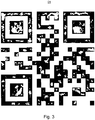
- Fig. 1 shows by way of example preferably a printing device of a Printing machine formed in particular in an inkjet printing method identification feature 01 with a plurality of identification elements for identification and / or authentication of this identification feature 01 supporting object, wherein the identification feature 01 z. B. is arranged on a surface of this article.
- the identification elements of the identification feature 01 are located within a defined limited area on or on the object. All identification elements belonging to the relevant identification feature 01 are arranged within that area which occupies the relevant identification feature 01 on the surface of the relevant object. Thus, at least a first identification element and a second identification element are present in this same area, wherein the second identification element has the function of a security feature.
- the first identification element is preferably designed as an arrangement of code-associated characters and / or meaning carriers, wherein each of the characters or meaning carriers of this arrangement is in each case designed as a pixel-based graphic, these pixels being applied by application of an ink or an ink are formed on the surface of the subject or are.
- the first identification element is not used as a particular machine-readable information carrier, but forms only the environment for the second identification element.
- the pigments or the particles of the at least one dye of the second identification element are contained in the printing ink or in the ink.
- the second identification element comprising the pigments or the particles of the at least one dye is therefore applied together with the first identification element formed from the printing ink or the ink in the same or in only a single working step on the surface of the relevant object.
- the second identification element is thus at the time of the arrangement of the identification feature 01 on the surface of the object in question always a part of the first identification element and not readily separable from the first identification element.
- the first identification element is designed as a multi-dimensional code, for. B. as a two-dimensional code having a pixel pattern, in particular as a QR code.
- a pixel pattern at least two contrasting configurations of pixels 02 are present in the respective pixel pattern, ie at least two different types of pixels 02 are present, ie they form optical contrast contrasts.
- These pixels 02 are in the relevant first identification element for the purpose of their visual perception in at least two different shades, z. B. designed in a color pairing, z. Black / White or Blue / Yellow or Red / Green.
- the contrast can then be considered sufficient if the different types of pixels 02 as such are different from the optical or visual system, e.g. B. from a data acquisition device or image recording device, in particular a scanner or a (semiconductor) camera, z. B. with a CCD image sensor or with a CMOS image sensor, reliably visually perceptible and the different configurations of the pixels 02 are clearly distinguishable from each other.
- This minimum contrast depends on the design of the optical or visual system used and also on the light conditions surrounding the relevant identification feature 01 at the time of data acquisition or image acquisition.
- the pixels 02 of the pixel pattern are preferably each formed in their geometric configuration as a rectangle, in particular as a square.
- An arrangement of the respective pixels 02 selected for the formation of the pixel pattern represents a z. B. with the aid of a computing unit using mathematical algorithms encoded, in particular machine-readable information content.
- a link to the website www.kba.com is coded.
- the first identification element is designed as a visually readable or haptic detectable font.
- the font in particular has at least one alphanumeric character.
- at least one meaning carrier belonging to the code in the arrangement is designed as a pictogram or as an ideogram.
- the first identification element is visually recognizable by an irradiation of the surface having the identification elements with visible light and the second identification element is not visually recognizable.
- a second operating state of the identification feature 01 is by irradiation of the identification elements having surface having a different from the first operating state electromagnetic radiation, the random structure formed from pigments or particles of at least one dye formed random structure of the second identification element, which within the same defined limited area as that first identification element is arranged on the object, visually recognizable.
- the random structure of the second identification element formed either from pigments or particles of the at least one dye preferably represents a second machine-readable information content.
- the random structure of the second identification element formed either from pigments of a colorant or from particles of the at least one dye forms a second machine-readable information content
- Information content preferably by means of a computing unit z. B. determined by a gray value determination or another threshold value evaluation with regard to the number and / or intensity of the pigments or particles concerned or with respect to the area filled or claimed by them in the first identification element.
- the respective information content of the first and / or second identification element is preferably in each case omnidirectionally readable.
- the second identification element is formed as a random structure formed from pigments 03 or the at least one dye, wherein the random structure of the second identification element formed from pigments 03 or the at least one dye only by virtue of a by irradiation of electromagnetic energy having a wavelength z. B. from the UV-triggered optical change for a viewer in the visual field is recognizable and photographically mapped.
- this energy is of an electromagnetic nature and preferably originates from a radiation whose respective wavelength z. B. is in the UV range.
- an emission spectrum of the radiation irradiated in the second operating state of the identification feature 01 into the surface having the identification elements includes the wavelength of at least one absorption line of the pigments or the particles of the at least one dye of the second identification element or radiation energy absorbed by the relevant particles of the dye causes the relevant pigment or particles of the dye to emit electromagnetic radiation in the spectrum of visible light.
- the radiation energy of the electromagnetic radiation radiated into the surface having the identification elements in the second operating state of the identification feature 01 is at least 1.59 eV.
- the pigments 03 or the particles of the at least one dyestuff of the second identification element are preferably contained in an ink or ink used for printing the first identification element, ie for printing the QR code, for example, wherein at least a subset of the pixels 02 of the first identification element forming pixel pattern of this ink or ink.
- the first identification element and the second identification element are each z. B. in a compression-molded Printing process, preferably in an offset printing process or in a gravure printing process or in a high-pressure process, or in a pressure-formless, ie direct printing process, for.
- the object on the surface of the identification feature 01 is formed, for. As a substrate, on which by means of a printing press several identifiers 01 in a printing process z. B. be formed in a benefit.
- the substrate is z. B. formed as a web or as a sheet, the printing material z. B. made of paper or a plastic film or of a metal foil or of a textile.
- the identification feature 01 is formed directly and directly on the surface of the object by means of a printing process, wherein the object z. B. as a package, in particular as a hollow body, for. B. as a (glass) bottle or as a (tin) can or as a plastic container, or as a salable product such as. B.
- the second identification element embodied as a random structure formed from pigments 03 or the at least one dye can, like the respective first identification element belonging to the same identification feature 01, be formed identically or differently, ie individually, for the plurality of identification features 01 printed on the printing substrate in a same production process be.
- the contained in the ink or ink, the In order to form the random structure, pigments 03 have a core with a carrier substance and with either a fluorescent material or with a phosphorescent material, the core preferably having a substantially spherical shape.
- a shell surrounding the core is provided, wherein the shell contains photochromic material with which a radiation emitted by the fluorescent material or the phosphorescent material is attenuated or at least attenuatable.
- the pigments used to form the random structure 03 then correspond to z. B. the in WO 2007/005354 A2 described embodiment.
- an identification feature with a plurality of within a defined limited area on or on the object arranged identification elements is used to identify the object and / or to verify its authenticity, wherein in a first operating state of the identification feature irradiation of the surface having the identification elements with visible light a first identification element is visually recognizable and a second identification element is visually not recognizable, wherein the second identification element is formed as an integral part of the first identification element as a formed of pigments or particles of at least one dye random structure, wherein in a second operating state of the identification feature by irradiating the surface having the identification elements with one of the first Radiozu was different electromagnetic radiation excited the random structure of the second identification element forming pigments or particles of the at least one dye for spontaneous emission and fluorescence or phosphorescence and visually recognizable.
- the identification feature a single first image or a sequence of first images is detected, the respective detected first image in the form of digitized image data or a first information decoded from the respective first image are respectively stored in a first memory, wherein at a second, different from the first location with a second data acquisition device again in an illumination situation in which the random structure the second identification element is visually recognizable, a single second image or a sequence of second images which is preferably identical or at least comparable with respect to the illumination situations is detected, wherein the respective captured second image is in the form of digitized image data or a second one decoded from the respective second image Information are each stored in a second memory, wherein the first memory and the second memory after a second place made request for a data exchange via a Kommunikati Onstress be connected to each other, wherein after the data transmission
- the respective sequences exist z. B. from three or more images that are detected in particular in different lighting situations, with a first figure z. B. under normal daylight conditions with light in the wavelength range of 380 nm to 790 nm and a second image during irradiation of the identification feature with a radiation z. B. from the IR range or UV range and a third image after completion of the irradiation of the identification feature with the radiation z. B. from the IR range or UV range are detected.
- the respective sequences for the first image and for the second image preferably each have an equal number of images.
- the first preferably non-contact digital data acquisition device and the second preferably non-contact digital data acquisition device are z. B. each a scanner or as a camera, in particular as a digital camera formed. The detection of the first image and / or the detection of the second image take place for. Using a code reader designed as an application program, e.g. B. a QR code reader or a program for automated text recognition or optical character recognition.
- the first memory and / or the second memory are z. B. each formed as a database in which the respective image is stored digitized in each case in the form of digitized image data and / or in each case one of the detected image concerned decoded information.
- the respective mapping and / or decoding takes place temporally before the object z. B. from a supplier, who may also be the manufacturer of the item in question, is delivered to a user, so z. B. at a time in the production of this article or in the application of the identification feature 01 on or on the object or product in question.
- the user detects, using the irradiation of electromagnetic energy with a wavelength z. B. from the UV region in the second identification element, the respective second image of the identification feature 01, wherein the image data from the respective second image and / or its decoded information is stored at least at short notice.
- the image data of the respective stored first image of the identification feature 01 arranged on the object and the image data of the detected respective second image of the identification feature 01 arranged in this article are then preferably shown in FIG a computing unit z. B. compared with methods of image processing or pattern recognition and checked for conformity.
- the first decoded from the detected respective first image Information and decoded from the detected respective second image second information is preferably compared with each other in the arithmetic unit and checked for conformity.
- the comparison result executes the comparison result message generated to the user and / or to the supplier or the manufacturer of this item and / or z.
- the respective captured second image of the identification feature 01 arranged on or on the relevant object is read by the second data acquisition device via a preferably wireless communication link, e.g. B. via the Internet or a mobile phone connection, to a z. B. from the supplier or manufacturer of the object or operated for him stationary computer, z. B. transmit a network server.
- the transmission of the image data or the decoded information, in particular of the respective captured second image of the identification feature 01 arranged on or on this object for example. B. to the stationary computer and / or a transfer of the result of the comparison message z. B.
- a particularly preferred embodiment of the invention are in an amount of z. B. in a same production process printed identification features 01 for all belonging to this set identification features 01 whose respective first identification elements are identical, ie they are all coded with the same information, whereas the respective, belonging to a particular identification feature 01 second identification element respectively from the other is formed differently for belonging to this quantity second identification elements.
- the relevant random structure is z. B.
- z. B. at the end of a production line for producing a certain set of identification features 01 of these identification features 01 in the relevant, z. B. formed as a printing machine production machine continuously according to the production progress for the production of this set of identification features 01 of each finished identification feature 01 with a non-contact digital data acquisition device, eg. B. with a scanner or with a camera, recorded at least a first image and z. B. in the form of digital image data in a first memory, in particular stored in a database, this at least a first image of the relevant identification feature 01 respectively only the first identification element or each of its first identification element maps together with its second identification element.
- a non-contact digital data acquisition device eg. B. with a scanner or with a camera
- a lighting device with at least one light source of a semiconductor material, for. B. a LED or laser illumination device, and / or a scanner or a semiconductor camera with a CCD image sensor or a CMOS image sensor used.
- a lighting device may be used with at least one gas discharge tube, for. B. with a xenon filled flash tube.
- the production machine or processing machine can also be designed as a packaging machine or as a bottling plant or as a packaging machine.
- the first image is preferably acquired without the use of a polarizing filter or a color filter or another accessory which manipulates the light remitting by the relevant identification feature 01.
- an electromagnetic radiation which is at least partially absorbed by the pigments or the particles of the at least one dye of the random structure.
- the electromagnetic radiation absorbing pigments or particles of the at least one dye of the random structure are excited by the at least partial absorption of the relevant electromagnetic radiation at least to a visually detectable luminescence, preferably also to fluorescence or phosphorescence, wherein the first image and the second image of the respective data acquisition device each detected during the luminescence of the pigments or the particles of the at least one dye of the random structure.
- This printing machine preferably has at least one printing device that prints in an inkjet printing method, this printing device having the identification feature 01 in each case by applying printing ink or ink containing in each case the pigments 03 or the particles of the at least one dye of the second identification element to the surface of the relevant object formed.
- This printing press has a control unit that controls the printing process carried out by the printing press, and preferably a plurality of drives and / or adjusting elements, wherein the drives and / or adjusting elements of the control unit z. B. depending on particular in this printing machine z. B.
- z. B. are controlled by a production planning system parameters.
- As the controlled by her drives and / or actuators are preferably in a particular digital network, eg. B. connected in a bus system at least in terms of data technology, wherein the Actuators and / or control elements of the control unit by a data communication over the network, in particular depending on in this printing machine sensory detected or controlled by program parameters are controlled. It is advantageous also to bind the printing device in question forming the relevant identification feature 01 to this network and the relevant identification feature 01 concerning this network z. B. controlled by the control unit to communicate. In the printing machine is preferably connected to the network, z. B.
- said at least one image is detected by the identification feature 01, wherein the at least one detected image in the form of digitized image data or decoded from the at least one detected image information in each case preferably in a network stored memory to be stored.
- the image data stored in the memory or the decoded information stored there are preferably only communicated via the network after a request triggered outside the printing press.
- a sequence of several images is acquired by the respective identification feature 01 in a defined period of time with the data acquisition device arranged in the printing machine, whereby at least a part of these images is acquired under different lighting situations, the ones belonging to the same sequence being detected under different lighting situations
- Images are each stored in the memory. It is particularly advantageous to capture at least three images from the respective identification feature 01, which is preferably printed in each case with the printing device in an inkjet printing process, with the data acquisition device arranged in the printing machine, wherein a first image is only applied to the z. B. formed as a QR code first identification element, because in the first lighting situation, the random structure having the second identification element z. B.
- a second image is respectively acquired by the same identification feature 01 or by the same identification features 01 with the data acquisition device arranged in the printing machine, in which case the respective identification features 01 are each irradiated with electromagnetic energy of a specific wavelength, so that the Random structure having second identification element is visible together with the first identification element in the visual field and can be detected by the data acquisition device, in particular by a camera can be imaged, wherein the required electromagnetic energy z.
- B. is provided by a flash unit.
- the irradiation of the respective identification features 01 is terminated in each case with electromagnetic energy of a specific wavelength for visualization of the second identification element having the random structure, and in each case a third image is produced by the same identification feature 01 or by the same identification features 01 with the data acquisition device arranged in the printing machine detected, wherein now the random structure having second identification element due to spontaneous emission, fluorescence or - if the process is delayed in time and / or persists much longer - of phosphorescence especially in the visual field is recognizable and can be detected by the data acquisition device.
- This sequence of the at least three images respectively acquired by the same identification feature 01 or by the same identification features 01, in each case with the data acquisition device arranged in the printing press is, for example, B.
- control unit evaluated by the control unit to the effect whether the relevant identification feature 01 or the respective identification features 01 created properly with the function of a security feature, ie has been printed or are, whereby a test or production control or quality control of the respective identifiers 01 still within the Printing machine is running. The result of this test or
- Production control or quality control or the respective sequence of images of the same identification feature 01 is z. B. stored in the preferably connected to the network memory.
- a method for production control of identification features printed with a printing machine on a printing material or article can be carried out, the identification features 01 having a first identification element visually detectable under daylight conditions and a second identification element not visually detectable under daylight conditions, wherein the second identification element only passes through an irradiation of the identification feature 01 with electromagnetic energy of a specific wavelength is visually detectable by at least partially absorbing this radiated energy from pigments of a colorant or particles of a dye of the second identification element and these pigments or these particles of the dye to a visually detectable spontaneous emission and fluorescence or phosphorescence are excited, wherein in the printing machine with an arranged in her Dat In each case, a sequence with at least three images is detected by the respectively printed with a printing device of this printing machine identification features 01, wherein belonging to the respective sequence first image of the identification feature 01 only images under daylight conditions visually detectable first identification element, which to the respective sequence belonging second image of the identification feature 01, the first identification element together with the irradiation of
- the printing device of the printing press prints the respective identification features 01, the z. B. are each formed as a QR code, each in an inkjet printing process.
- the second identification element is designed in particular as a random structure contained in the first identification element.
- the pigments of the colorant or particles of the dye used in each case for the second identification element are advantageously introduced in each case by an agitator and / or in an ultrasonic water bath and / or by means of an ultrasonic atomizer into an ink or ink used in each case for printing the first identification element.
- the pigments used for the second identification element of the colorant or particles of the dye are generally introduced in each case in a mass fraction of less than 5%, in particular up to at most 2% in the printing ink or ink used for printing the first identification element.
- those pigments of the colorant or those particles of the dye are used, each having a core with a fluorescent material or with a phosphorescent material and each one surrounding the core shell of a photochromic and / or a fluorescent or a phosphorescent material exhibit.
- the pigments correspond z. B. the in WO 2007/005354 A2 described embodiment.
- the shell, ie the surface of the pigments consists z.
- the time required for the spontaneous emission of the second identification element electromagnetic energy of certain wavelength
- the pigments used for the second identification element of the colorant or particles of the dye preferably have a length extension in the range between 0.5 .mu.m and 10 .mu.m.
- the pigments used for the ink or the ink of the first identification element of the colorant or particles of the dye are each dispersed in a first dispersant, d. H.
- the pigments of the colorant or the particles of the dye form in each case a first heterogeneous composition in conjunction with the first dispersant, and the pigments used for the second identification element of the colorant or particles of the dye are each dispersed in a second dispersant to form a second heterogeneous composition , wherein preferably the first dispersant and the second dispersant differ from each other, so that different dispersants are used for the first identification element and for the second identification element, wherein between these two dispersants preferably repulsion, d. H. there is a rejection.
- the use of different dispersants for the first identification element and for the second identification element promote coagulation of the pigments used for the second identification element of the colorant or particles of the dye, d. H. a concentration of these pigments of the colorant or particles of the dye and thus a repeal of their finely divided state in the printed image generated in each case with the printing device.
- this ink or ink in each case at 23 ° C, a conductivity preferably in the range of 900 .mu.S / cm to 2200 ⁇ S / cm, in particular between 1000 ⁇ S / cm to 1,900 ⁇ S / cm.
- the conductivity of the ink or ink used is z. B. by a supply of additives, preferably by salts and / or polymers, for. B. increased by polymer salts.
- the additives may be in the form of z. B. a solid and / or a solution and / or a dispersion of the ink or ink used.
- a density of the pigments used in the ink or dye of the dye or dye is in the range between 0.6 kg / m 3 and 1.3 kg / m 3 , preferably between 0.8 kg / m 3 and 1.0 kg / m 3 .
- the upper values of said ranges are preferred.
- an identification feature with at least two arranged in a defined limited area identification elements for the identification of an object, wherein the first identification element is visually recognizable by irradiation of the identification elements of the identification feature having visible light surface and the second identification element is not visually recognizable, wherein the first identification element is formed from a printing ink or from an ink, wherein the second identification element is formed as a random structure formed from pigments of a colorant or as a random structure formed from particles of at least one dye, wherein the Random structure of the second identification element is formed as an integral part of the ink or the ink of the first identification element.
- the ink or ink at 23 ° C has a conductivity in the range of 900 .mu.S / cm to 2,200 .mu.S / cm and / or in the ink or in the ink of the first identification element is at least one polymer and / or as an additive Conducting salt at least one alkali metal salt or an ammonium salt.
- a conducting salt is a salt which, during electrolysis, undertakes a transport of electrical charges and / or reduces the ohmic resistance of the solution in a solution.
- the random structure of the second identification element forming pigments or particles of the at least one dye have a density z. B.
- the pigments or particles of the at least one dye forming the random structure of the second identification element have a spherical surface and those pigments of a colorant or those particles of at least one dye, each containing as colorant in the printing ink or ink forming the first identification element are edged or spherical.
- the pigments of the colorant or the particles of the dye of the ink or the ink of the first identification element are each dispersed in a first dispersant and the pigments of the colorant or the particles of the dye of the second identification element are each dispersed in a second dispersant, wherein the first Dispersant and the second dispersant preferably differ materially from each other.
- the pigments of the colorant forming the random structure of the second identification element or the particles of the at least one dye preferably have an incident light diffusely reflecting surface.
- the random structure of the second identification element forming pigments of the colorant or the particles of the at least one dye have z. B. a length extension in the range between 0.5 .mu.m and 10 .mu.m.
- the printing ink or the ink of the first identification element is preferably applied in a layer thickness in the range of 0.3 microns to 10 microns on a surface of the object to be identified.
- the pigments of the colorant or the particles of the dye each of the printing ink or the ink of the first identification element are made of an organic or of an inorganic or of a synthetic crystalline powder or in particular of carbon black or of titanium (IV) oxide or of an aluminum bronze or formed from a brass bronze.
- the pigments of the colorant or the particles of the dye in each case by the printing ink or the ink of the first identification element are in a mass fraction z.
- between 12% and 18% in the relevant of the ink or ink and / or each of the random structure of the second identification element forming pigments of the colorant or the particles of the dye are each in a mass fraction, in particular less than 5%, preferably less than 2% contained in the relevant ink or ink of the first identification element.
- An identification feature also results with at least two identification elements arranged in a defined limited area for identifying an object, whereby the first identification element is visually recognizable by irradiation of the surface having the identification elements of the identification feature with visible light and its second identification element is not visually recognizable, wherein the first identification element is formed from a printing ink or from an ink, wherein the second identification element is formed as a random structure formed from pigments of a colorant or as a random structure formed from particles of at least one dye, wherein the random structure of the second identification element as an integral part of Printing ink or the ink of the first identification element is formed, wherein the on a surface of the object to be identified in a r lattice-shaped arrangement of pixels applied ink or ink of the first identification element has a layer thickness in the range of 0.3 microns to 10 microns, wherein the pigments of the colorant forming the random structure of the second identification element or the particles of the at least one colorant form by coagulation, ie by a concentration
- the raster graphics consists of a grid-like arrangement of the pixels, this arrangement forming an image in the form of computer-readable data. This arrangement has at least two groups of pixels between which there is a visually perceivable contrast.
- the pigments of the colorant forming the random structure of the second identification element or the particles of the at least one dye which, by coagulation, form a planar structure comprising a plurality of adjacent pixels of the raster graphic are each formed in pixels of the same brightness, z. In each case in the pixels formed with a dark ink or ink compared to other pixels of the same raster graphics.
- the pigments of the colorant forming the random structure of the second identification element or the particles of the at least one dye have a length extension in the range between 0.5 ⁇ m and 10 ⁇ m.
- the pigments of the colorant forming the random structure of the second identification element or the particles of the at least one dye exhibit spontaneous emission of visually detectable light and / or fluorescence and / or phosphorescence by an incident electromagnetic radiation of the type described above.
- the identification feature may be formed with any of the physical and / or material features described above.
- an article with an identification feature arranged for its identification can be formed, wherein the identification feature has at least two identification elements in a defined limited area, wherein the first identification element is formed from a printing ink or an ink, wherein the second identification element is one of pigments a random structure formed of a colorant or is formed as a random structure formed of particles of at least one dye, wherein the random structure of the second Identification element is formed as an integral part of the ink or the ink of the first identification element, wherein the ink or the ink of the first identification element is applied in a layer thickness in the range of 0.3 .mu.m to 10 .mu.m on a surface of the object to be identified, wherein the Random structure of the second identification element-forming pigments of the colorant or the particles of the at least one dye have an incident electromagnetic radiation diffusely reflecting surface.
- This item is z. B. as a substrate made of paper or a plastic film or of a metal foil or of a textile or as a hollow body or as a bottle or as a can or as a product made of a plastic or of a ceramic or of a metal or wood ,
- the pigments of the colorant or the particles of the dye each of the printing ink or the ink of the first identification element are made of an organic or of an inorganic or of a synthetic crystalline powder or of carbon black or of titanium (IV) oxide or of an aluminum bronze or formed of a brass bronze and / or the random structure of the second identification element forming pigments of the colorant or the particles of the at least one dye have a surface of a chitosan Algnat or of a cellulose or of an ethylcellulose or of a gelatin or a gum arabic or a melamine-aldehyde resin or a melamine-formaldehyde resin or a melamine-urea-formalde
- an article with an identification feature arranged for its identification wherein the identification feature has at least two identification elements in a defined limited area, wherein the first identification element is formed from a printing ink or an ink, wherein the second identification element as one of pigments of a
- the random structure of the second identification element is formed as an integral part of the printing ink or the ink of the first identification element, wherein the ink or ink applied to a surface of the object to be identified is formed colorant formed random structure or as a random structure formed of particles of at least one dye of the first identification element is preferably applied in a raster graphic consisting of a lattice-like arrangement of pixels, wherein the random structure de Coagulation of the second identification element-forming pigments of the colorant or the particles of the at least one dye form a planar structure comprising a plurality of adjacent pixels of the raster graphic ( Fig.
- the random structure of the second identification element forming pigments of the colorant or the particles of the at least one dye by an incident electromagnetic radiation of a certain wavelength z.
- a spontaneous emission of visually detectable light and / or fluorescence and / or phosphorescence wherein the random structure of the second identification element forming pigments of the colorant or the particles of at least one dye their spontaneous emission of visually detectable light and / or fluorescence and / or phosphorescence by an incident electromagnetic radiation having a wavelength in particular from the IR range or from the UV range.
- the identification feature of the article may be formed with one or more of the physical and / or physical features described above.
- Subject matter applied ink or ink is formed, wherein the random structure forming pigments of the colorant or the particles of the at least one dye by irradiation of the identification feature with an electromagnetic radiation z.
- B. from the IR region or the UV region to a spontaneous emission and fluorescence or phosphorescence are excited and visually recognizable, wherein for checking the identity and / or authenticity of the object with a data acquisition device of the identification feature during the irradiation of the identification feature the electromagnetic radiation z.
- a single first image or a sequence of first images is detected and wherein with the same data acquisition device of the relevant identification feature after completion of the irradiation of the identification feature with the electromagnetic radiation z.
- a single second image or a sequence of second images is detected, is checked by a performed by means of a computing unit comparison of the respective first and second images, whether the random structure forming pigments of the colorant or the particles of the at least one dye fluoresce or phosphorize, wherein in a detected by the arithmetic unit fluorescence or phosphorescence of the random structure forming pigments of the colorant or particles of the at least one dye the identity and / or authenticity of the article is considered confirmed.
- the random structure is z. B. by irradiation of the identification feature with light in a wavelength range of 380 nm to 790 nm visually unrecognizable.
- the identification feature is arranged on or on the object in a printing-form-linked printing method or in a printing-form-free printing method.
- As an object z. B. a trained as a web or as a sheet Printing material or a packaging or a hollow body or a bottle or a can or a plastic container used.
- the identification feature is preferably arranged on or on the object in a printing machine or in a packaging machine or in a filling installation or in a finishing machine.
- the respective images of the identification feature are respectively detected in each case with a data acquisition device of a mobile communication device, wherein a camera of a mobile phone or a smartphone is preferably used as the data acquisition device.
- the pigments forming the random structure of the colorant or the particles of the at least one dye form a planar structure by coagulation, wherein the planar structure is greater than an optical resolution of the data acquisition device used for the images.
- An information content of the random structure is determined in particular by means of a computing unit by means of a gray value determination or a threshold value evaluation in each case with regard to the number and / or the intensity of the relevant pigments or particles or with regard to the area claimed by them.
- the identification feature of the article may in turn be formed with one or more of the physical and / or material features described above.
Landscapes
- Luminescent Compositions (AREA)
- Inks, Pencil-Leads, Or Crayons (AREA)
Claims (15)
- Caractéristique d'identification (01) servant à identifier un objet, comprenant une structure aléatoire formée de pigments d'une matière colorante ou de particules d'au moins un colorant, dans laquelle au moins deux éléments d'identification (02, 03) sont placés dans une surface délimitée de manière définie de la caractéristique d'identification,
dans laquelle un premier élément d'identification (02) est constitué par une encre d'impression ou une encre, dans laquelle un deuxième élément d'identification (03) est constitué par la structure aléatoire formée des pigments d'une matière colorante ou des particules d'au moins un colorant, dans laquelle les pigments de la matière colorante ou les particules dudit au moins un colorant de l'encre d'impression ou de l'encre du premier élément d'identification sont dispersé(e)s chacun(e) dans un premier agent dispersant, et dans laquelle les pigments de la matière colorante ou les particules dudit au moins un colorant du deuxième élément d'identification sont dispersé(e)s chacun(e) dans un deuxième agent dispersant, caractérisée en ce que le premier agent dispersant et le deuxième agent dispersant diffèrent l'un de l'autre matériellement. - Caractéristique d'identification selon la revendication 1, caractérisée en ce qu'au moins un polymère et/ou au moins un sel de métal alcalin ou un sel d'ammonium sont contenus en tant qu'additif dans l'encre d'impression ou dans l'encre.
- Caractéristique d'identification selon la revendication 1 ou 2, caractérisée en ce que la structure aléatoire est réalisée sous la forme d'une partie intégrante de l'encre d'impression ou de l'encre.
- Caractéristique d'identification selon la revendication 1 ou 2 ou 3, caractérisée en ce que les pigments de la matière colorante ou les particules dudit au moins un colorant formant la structure aléatoire présente chacun(e) une surface réfléchissant de manière diffuse la lumière incidente.
- Caractéristique d'identification selon la revendication 1 ou 2 ou 3 ou 4, caractérisée en ce que les pigments de la matière colorante ou les particules dudit au moins un colorant, qui sont contenu(e)s chacun(e) en tant que substance colorante dans l'encre d'impression ou l'encre constituant le premier élément d'identification, sont formé(e)s chacun(e) d'une poudre cristalline organique ou anorganique ou synthétique ou de noir de carbone ou d'oxyde de titane(IV) ou d'un bronze d'aluminium ou d'un bronze de laiton.
- Caractéristique d'identification selon la revendication 1 ou 2 ou 3 ou 4 ou 5, caractérisée en ce que les pigments de la matière colorante de l'encre d'impression du premier élément d'identification sont contenus dans une fraction massique comprise entre 12 % et 18 % dans l'encre d'impression concernée ou en ce que les particules dudit au moins un colorant de l'encre du premier élément d'identification sont contenus dans une fraction massique comprise entre 1 % et 15 % dans l'encre concernée.
- Caractéristique d'identification selon la revendication 1 ou 2 ou 3 ou 4 ou 5 ou 6, caractérisée en ce que les pigments de la matière colorante ou les particules dudit au moins un colorant constituant chacun(e) la structure aléatoire du deuxième élément d'identification sont contenu(e)s chacun(e) dans une fraction massique inférieure à 5 % dans l'encre d'impression ou l'encre concernée du premier élément d'identification.
- Caractéristique d'identification selon la revendication 1 ou 2 ou 3 ou 4 ou 5 ou 6 ou 7, caractérisée en ce que, à la suite d'une irradiation de la surface présentant les éléments d'identification de la caractéristique d'identification par une lumière dans une gamme de longueurs d'onde de 380 nm à 790 nm, le premier élément d'identification de ladite caractéristique d'identification peut être reconnu visuellement et/ou en ce que, à la suite d'une irradiation de la surface présentant les éléments d'identification de la caractéristique d'identification par une lumière dans une gamme de longueurs d'onde de 380 nm à 790 nm, le deuxième élément d'identification de ladite caractéristique d'identification ne peut pas être reconnu visuellement.
- Caractéristique d'identification selon la revendication 1 ou 2 ou 3 ou 4 ou 5 ou 6 ou 7 ou 8, caractérisée en ce que les pigments de la matière colorante ou les particules dudit au moins un colorant formant la structure aléatoire présentent, à la suite d'un rayonnement électromagnétique incident, respectivement une émission spontanée d'une lumière reconnaissable visuellement et/ou une fluorescence et/ou une phosphorescence.
- Caractéristique d'identification selon la revendication 1 ou 2 ou 3 ou 4 ou 5 ou 6 ou 7 ou 8 ou 9, caractérisée en ce qu'il existe une répulsion entre le premier agent dispersant et le deuxième agent dispersant.
- Caractéristique d'identification selon la revendication 1 ou 2 ou 3 ou 4 ou 5 ou 6 ou 7 ou 8 ou 9 ou 10, caractérisée en ce que les pigments de la matière colorante ou les particules dudit au moins un colorant formant la structure aléatoire constituent dans chaque cas par coagulation respectivement une structure plane.
- Caractéristique d'identification selon la revendication 1 ou 2 ou 3 ou 4 ou 5 ou 6 ou 7 ou 8 ou 9 ou 10 ou 11, caractérisée en ce que l'encre d'impression ou l'encre est placée contre ou sur la surface de l'objet à identifier sous la forme d'une image matricielle constituée de plusieurs pixels, dans laquelle les pigments de la matière colorante ou les particules dudit au moins un colorant formant la structure aléatoire constituent une structure plane comportant plusieurs pixels voisins de l'image matricielle.
- Caractéristique d'identification selon la revendication 12, caractérisée en ce que l'image matricielle constituée par l'encre d'impression ou l'encre forme le premier élément d'identification.
- Caractéristique d'identification selon la revendication 12 ou 13, caractérisée en ce que l'image matricielle constituée par l'encre d'impression ou l'encre constitue une image prenant la forme de données lisibles par ordinateur.
- Caractéristique d'identification selon la revendication 12 ou 13 ou 14, caractérisée en ce que l'image matricielle constituée par l'encre d'impression ou l'encre comprend au moins deux sortes de pixels entre lesquels il existe un contraste visuellement perceptible et/ou en ce que l'image matricielle constituée par l'encre d'impression ou l'encre présente différentes sortes de pixels, dans laquelle les différentes sortes de pixels sont réalisées sous la forme d'au moins deux teintes différentes.
Applications Claiming Priority (2)
| Application Number | Priority Date | Filing Date | Title |
|---|---|---|---|
| DE102015219394.2A DE102015219394B4 (de) | 2015-10-07 | 2015-10-07 | Identifikationsmerkmal zur Identifikation eines Gegenstandes |
| PCT/EP2016/072940 WO2017060124A1 (fr) | 2015-10-07 | 2016-09-27 | Caractéristique d'identification servant à identifier un objet |
Publications (2)
| Publication Number | Publication Date |
|---|---|
| EP3201006A1 EP3201006A1 (fr) | 2017-08-09 |
| EP3201006B1 true EP3201006B1 (fr) | 2018-06-27 |
Family
ID=57123969
Family Applications (1)
| Application Number | Title | Priority Date | Filing Date |
|---|---|---|---|
| EP16779022.9A Active EP3201006B1 (fr) | 2015-10-07 | 2016-09-27 | Caractéristique d'identification servant à identifier un objet |
Country Status (3)
| Country | Link |
|---|---|
| EP (1) | EP3201006B1 (fr) |
| DE (1) | DE102015219394B4 (fr) |
| WO (1) | WO2017060124A1 (fr) |
Family Cites Families (28)
| Publication number | Priority date | Publication date | Assignee | Title |
|---|---|---|---|---|
| DE2858685C2 (fr) | 1978-07-06 | 1989-06-29 | Gao Gesellschaft Fuer Automation Und Organisation Mbh, 8000 Muenchen, De | |
| FR2733505B1 (fr) * | 1995-04-26 | 1997-07-18 | Imaje Sa | Composition d'encre a base d'eau pour le marquage de tous supports |
| DE19611383A1 (de) | 1996-03-22 | 1997-09-25 | Giesecke & Devrient Gmbh | Datenträger mit optisch variablem Element |
| US7104449B2 (en) | 1998-11-12 | 2006-09-12 | Wenyu Han | Method and apparatus for patterning cards, instruments and documents |
| DE19914702A1 (de) | 1999-03-31 | 2000-10-05 | Norbert Hampp | Verfahren und Zubereitung zur photochromen Markierung und/oder Sicherung der Authentizität von Gegenständen |
| DE10304805A1 (de) * | 2003-02-05 | 2004-08-19 | Informium Ag | Verfahren zur Herstellung von Sicherheitskennzeichen |
| US8110281B2 (en) | 2004-07-02 | 2012-02-07 | 3Dtl, Inc. | Systems and methods for creating optical effects on media |
| US7938341B2 (en) | 2004-12-13 | 2011-05-10 | Optomec Design Company | Miniature aerosol jet and aerosol jet array |
| EP1851732A4 (fr) | 2005-01-19 | 2010-08-04 | Agency Science Tech & Res | Etiquette d'identification, objet adapte pour etre identifie et procedes connexes, dispositifs et systemes |
| CN101238596B (zh) | 2005-08-11 | 2010-10-06 | 皇家菲利浦电子股份有限公司 | 光子材料、其制备方法和用途及包含其的照明装置 |
| WO2007131043A2 (fr) | 2006-05-02 | 2007-11-15 | Ultradots, Inc. | Authentication et identification d'objets en utilisant des marques formées avec des modèles aléatoires corrélés |
| RU2477522C2 (ru) * | 2006-06-01 | 2013-03-10 | Эдванст Трэк Энд Трэйс | Способ и устройство для обеспечения безопасности документов |
| EP2062960B1 (fr) | 2006-08-15 | 2012-09-19 | Dalian Luminglight Co., Ltd. | Matériau luminescent à base de silicate avec pic multi-émission, son procédé de fabrication et son utilisation dans un dispositif d'éclairage |
| GB0702092D0 (en) * | 2007-02-02 | 2007-03-14 | Fracture Code Corp Aps | Graphic Code Application Apparatus and Method |
| EP2153422B1 (fr) | 2007-04-24 | 2019-01-16 | Sicpa Holding Sa | Procédé de marquage d'un document ou article; procédé et dispositif pour identifier le document ou article marqué; utilisation de particules de polarisation circulaire |
| CH699477A1 (de) | 2008-08-29 | 2010-03-15 | Unica Technology Ag | Identifikationsmerkmal. |
| US9418282B2 (en) | 2010-12-22 | 2016-08-16 | U-Nica Technology Ag | Method and device for authenticating documents marked with photochromic systems |
| JP5589939B2 (ja) | 2011-04-12 | 2014-09-17 | 大日本印刷株式会社 | 微粒子、粒子群、偽造防止用インク、偽造防止用トナー、偽造防止用シートおよび偽造防止媒体 |
| DE102011082174A1 (de) | 2011-09-06 | 2013-03-07 | Bundesdruckerei Gmbh | Vorrichtung zum mobilen Erkennen eines Dokumentes |
| WO2013054290A1 (fr) | 2011-10-14 | 2013-04-18 | 3Dtl, Inc. | Article ou document de sécurité doté d'un élément de sécurité comprenant au moins un élément à effet dynamique |
| WO2013060831A2 (fr) | 2011-10-28 | 2013-05-02 | BAM Bundesanstalt für Materialforschung und -prüfung | Procédé et mélanges de colorants pour le marquage de polymères à mémoire de forme et article en polymère à mémoire de forme à lisibilité déclenchable |
| GB2502510A (en) | 2012-03-30 | 2013-12-04 | Smartwater Technology Ltd | Method of generating a code containing random markers |
| DE102013102364A1 (de) | 2013-03-10 | 2014-09-11 | Informium Ag | Verfahren zur Herstellung eines Identifikationsmerkmals mit integriertem Kopierschutz |
| DE102013102365A1 (de) * | 2013-03-10 | 2014-09-11 | Informium Ag | Identifikationsmerkmal mit integriertem Kopierschutz |
| DE102013022028A1 (de) * | 2013-12-19 | 2015-06-25 | Giesecke & Devrient Gmbh | Wertdokument |
| US9658373B2 (en) | 2014-01-28 | 2017-05-23 | 3Dtl, Inc. | Anti-copy optical materials and methods |
| DE102014207318B4 (de) * | 2014-04-16 | 2022-03-31 | Koenig & Bauer Ag | Identifikationsmerkmal mit mehreren in einer definiert begrenzten Fläche angeordneten Identifikationselementen zur Identifikation eines Gegenstandes |
| DE102014207323B4 (de) * | 2014-04-16 | 2018-08-16 | Koenig & Bauer Ag | Verfahren zur Identifikation eines Gegenstandes |
-
2015
- 2015-10-07 DE DE102015219394.2A patent/DE102015219394B4/de not_active Expired - Fee Related
-
2016
- 2016-09-27 WO PCT/EP2016/072940 patent/WO2017060124A1/fr not_active Ceased
- 2016-09-27 EP EP16779022.9A patent/EP3201006B1/fr active Active
Non-Patent Citations (1)
| Title |
|---|
| None * |
Also Published As
| Publication number | Publication date |
|---|---|
| EP3201006A1 (fr) | 2017-08-09 |
| WO2017060124A1 (fr) | 2017-04-13 |
| DE102015219394B4 (de) | 2019-01-17 |
| DE102015219394A1 (de) | 2017-04-13 |
Similar Documents
| Publication | Publication Date | Title |
|---|---|---|
| DE102014207323B4 (de) | Verfahren zur Identifikation eines Gegenstandes | |
| DE102015219400B4 (de) | Verfahren zur Prüfung der Identität und/oder Echtheit eines Gegenstandes | |
| DE102014207318B4 (de) | Identifikationsmerkmal mit mehreren in einer definiert begrenzten Fläche angeordneten Identifikationselementen zur Identifikation eines Gegenstandes | |
| EP3201005B1 (fr) | Caractéristique d'identification servant à identifier un objet | |
| DE60202055T2 (de) | Chiplose rf tags | |
| EP2089237B1 (fr) | Caractéristique d'authenticité sous forme de substances luminescentes | |
| DE102015219388B4 (de) | Verfahren zur Produktionskontrolle von mit einer Druckmaschine auf einen Bedruckstoff oder Gegenstand gedruckten Identifikationsmerkmalen | |
| US20120187341A1 (en) | Markers for Protection Valuable Liquid and Solid Materials | |
| WO2011020603A1 (fr) | Elément de sécurité à changement de couleur | |
| DE102013102364A1 (de) | Verfahren zur Herstellung eines Identifikationsmerkmals mit integriertem Kopierschutz | |
| DE102015219393B4 (de) | Verfahren zur Identifikation eines Gegenstandes | |
| DE102015219395B4 (de) | Identifikationsmerkmal mit mindestens zwei in einer definiert begrenzten Fläche angeordneten Identifikationselementen zur Identifikation eines Gegenstandes | |
| DE10115949A1 (de) | Unsichtbare Laserbeschriftung als Sicherheitsmerkmal für Kunststoffkarten | |
| DE102015219396B4 (de) | Gegenstand mit einem zu seiner Identifikation angeordneten Identifikationsmerkmal | |
| EP4045330B1 (fr) | Methode de marquage et identification de produits | |
| DE102015219399B4 (de) | Identifikationsmerkmal zur Identifikation eines Gegenstandes | |
| DE102015219397B4 (de) | Gegenstand mit einem zu seiner Identifikation angeordneten Identifikationsmerkmal | |
| WO2022218920A1 (fr) | Procédé de marquage et d'identification univoques de produits | |
| DE102015219394B4 (de) | Identifikationsmerkmal zur Identifikation eines Gegenstandes | |
| DE102015219392B4 (de) | Identifikationsmerkmal mit mehreren in einer definiert begrenzten Fläche angeordneten Identifikationselementen zur Identifikation eines Gegenstandes | |
| DE10252628A1 (de) | Verfahren zur Codierung von Informationen sowie Vorrichtung und Verfahren zur Auswertung der codierten Information | |
| DE102015219385A1 (de) | Verfahren zur Ausbildung mindestens eines Identifikationsmerkmals mit einer Druckmaschine | |
| WO2022112209A1 (fr) | Procédé permettant de marquer des produits ayant une caractéristique de sécurité optique avec une dimension temporelle | |
| DE102013102366A1 (de) | Vorrichtungen zur Herstellung und zum Auslesen eines Identifikationsmerkmals mit integriertem Kopierschutz | |
| Anand et al. | Advances in lanthanide-doped upconversion nanomaterials in security inks: a comprehensive review |
Legal Events
| Date | Code | Title | Description |
|---|---|---|---|
| PUAI | Public reference made under article 153(3) epc to a published international application that has entered the european phase |
Free format text: ORIGINAL CODE: 0009012 |
|
| 17P | Request for examination filed |
Effective date: 20170502 |
|
| AK | Designated contracting states |
Kind code of ref document: A1 Designated state(s): AL AT BE BG CH CY CZ DE DK EE ES FI FR GB GR HR HU IE IS IT LI LT LU LV MC MK MT NL NO PL PT RO RS SE SI SK SM TR |
|
| AX | Request for extension of the european patent |
Extension state: BA ME |
|
| GRAP | Despatch of communication of intention to grant a patent |
Free format text: ORIGINAL CODE: EPIDOSNIGR1 |
|
| DAV | Request for validation of the european patent (deleted) | ||
| DAX | Request for extension of the european patent (deleted) | ||
| INTG | Intention to grant announced |
Effective date: 20180219 |
|
| GRAS | Grant fee paid |
Free format text: ORIGINAL CODE: EPIDOSNIGR3 |
|
| GRAA | (expected) grant |
Free format text: ORIGINAL CODE: 0009210 |
|
| AK | Designated contracting states |
Kind code of ref document: B1 Designated state(s): AL AT BE BG CH CY CZ DE DK EE ES FI FR GB GR HR HU IE IS IT LI LT LU LV MC MK MT NL NO PL PT RO RS SE SI SK SM TR |
|
| REG | Reference to a national code |
Ref country code: GB Ref legal event code: FG4D Free format text: NOT ENGLISH |
|
| REG | Reference to a national code |
Ref country code: AT Ref legal event code: REF Ref document number: 1011957 Country of ref document: AT Kind code of ref document: T Effective date: 20180715 |
|
| REG | Reference to a national code |
Ref country code: IE Ref legal event code: FG4D Free format text: LANGUAGE OF EP DOCUMENT: GERMAN |
|
| REG | Reference to a national code |
Ref country code: DE Ref legal event code: R096 Ref document number: 502016001364 Country of ref document: DE |
|
| REG | Reference to a national code |
Ref country code: FR Ref legal event code: PLFP Year of fee payment: 3 |
|
| PG25 | Lapsed in a contracting state [announced via postgrant information from national office to epo] |
Ref country code: LT Free format text: LAPSE BECAUSE OF FAILURE TO SUBMIT A TRANSLATION OF THE DESCRIPTION OR TO PAY THE FEE WITHIN THE PRESCRIBED TIME-LIMIT Effective date: 20180627 Ref country code: SE Free format text: LAPSE BECAUSE OF FAILURE TO SUBMIT A TRANSLATION OF THE DESCRIPTION OR TO PAY THE FEE WITHIN THE PRESCRIBED TIME-LIMIT Effective date: 20180627 Ref country code: NO Free format text: LAPSE BECAUSE OF FAILURE TO SUBMIT A TRANSLATION OF THE DESCRIPTION OR TO PAY THE FEE WITHIN THE PRESCRIBED TIME-LIMIT Effective date: 20180927 Ref country code: FI Free format text: LAPSE BECAUSE OF FAILURE TO SUBMIT A TRANSLATION OF THE DESCRIPTION OR TO PAY THE FEE WITHIN THE PRESCRIBED TIME-LIMIT Effective date: 20180627 Ref country code: BG Free format text: LAPSE BECAUSE OF FAILURE TO SUBMIT A TRANSLATION OF THE DESCRIPTION OR TO PAY THE FEE WITHIN THE PRESCRIBED TIME-LIMIT Effective date: 20180927 |
|
| REG | Reference to a national code |
Ref country code: NL Ref legal event code: MP Effective date: 20180627 |
|
| REG | Reference to a national code |
Ref country code: LT Ref legal event code: MG4D |
|
| PG25 | Lapsed in a contracting state [announced via postgrant information from national office to epo] |
Ref country code: HR Free format text: LAPSE BECAUSE OF FAILURE TO SUBMIT A TRANSLATION OF THE DESCRIPTION OR TO PAY THE FEE WITHIN THE PRESCRIBED TIME-LIMIT Effective date: 20180627 Ref country code: RS Free format text: LAPSE BECAUSE OF FAILURE TO SUBMIT A TRANSLATION OF THE DESCRIPTION OR TO PAY THE FEE WITHIN THE PRESCRIBED TIME-LIMIT Effective date: 20180627 Ref country code: LV Free format text: LAPSE BECAUSE OF FAILURE TO SUBMIT A TRANSLATION OF THE DESCRIPTION OR TO PAY THE FEE WITHIN THE PRESCRIBED TIME-LIMIT Effective date: 20180627 Ref country code: GR Free format text: LAPSE BECAUSE OF FAILURE TO SUBMIT A TRANSLATION OF THE DESCRIPTION OR TO PAY THE FEE WITHIN THE PRESCRIBED TIME-LIMIT Effective date: 20180928 |
|
| PG25 | Lapsed in a contracting state [announced via postgrant information from national office to epo] |
Ref country code: NL Free format text: LAPSE BECAUSE OF FAILURE TO SUBMIT A TRANSLATION OF THE DESCRIPTION OR TO PAY THE FEE WITHIN THE PRESCRIBED TIME-LIMIT Effective date: 20180627 |
|
| PG25 | Lapsed in a contracting state [announced via postgrant information from national office to epo] |
Ref country code: SK Free format text: LAPSE BECAUSE OF FAILURE TO SUBMIT A TRANSLATION OF THE DESCRIPTION OR TO PAY THE FEE WITHIN THE PRESCRIBED TIME-LIMIT Effective date: 20180627 Ref country code: PL Free format text: LAPSE BECAUSE OF FAILURE TO SUBMIT A TRANSLATION OF THE DESCRIPTION OR TO PAY THE FEE WITHIN THE PRESCRIBED TIME-LIMIT Effective date: 20180627 Ref country code: EE Free format text: LAPSE BECAUSE OF FAILURE TO SUBMIT A TRANSLATION OF THE DESCRIPTION OR TO PAY THE FEE WITHIN THE PRESCRIBED TIME-LIMIT Effective date: 20180627 Ref country code: IS Free format text: LAPSE BECAUSE OF FAILURE TO SUBMIT A TRANSLATION OF THE DESCRIPTION OR TO PAY THE FEE WITHIN THE PRESCRIBED TIME-LIMIT Effective date: 20181027 Ref country code: RO Free format text: LAPSE BECAUSE OF FAILURE TO SUBMIT A TRANSLATION OF THE DESCRIPTION OR TO PAY THE FEE WITHIN THE PRESCRIBED TIME-LIMIT Effective date: 20180627 Ref country code: CZ Free format text: LAPSE BECAUSE OF FAILURE TO SUBMIT A TRANSLATION OF THE DESCRIPTION OR TO PAY THE FEE WITHIN THE PRESCRIBED TIME-LIMIT Effective date: 20180627 |
|
| PG25 | Lapsed in a contracting state [announced via postgrant information from national office to epo] |
Ref country code: SM Free format text: LAPSE BECAUSE OF FAILURE TO SUBMIT A TRANSLATION OF THE DESCRIPTION OR TO PAY THE FEE WITHIN THE PRESCRIBED TIME-LIMIT Effective date: 20180627 Ref country code: ES Free format text: LAPSE BECAUSE OF FAILURE TO SUBMIT A TRANSLATION OF THE DESCRIPTION OR TO PAY THE FEE WITHIN THE PRESCRIBED TIME-LIMIT Effective date: 20180627 Ref country code: IT Free format text: LAPSE BECAUSE OF FAILURE TO SUBMIT A TRANSLATION OF THE DESCRIPTION OR TO PAY THE FEE WITHIN THE PRESCRIBED TIME-LIMIT Effective date: 20180627 |
|
| REG | Reference to a national code |
Ref country code: DE Ref legal event code: R097 Ref document number: 502016001364 Country of ref document: DE |
|
| PG25 | Lapsed in a contracting state [announced via postgrant information from national office to epo] |
Ref country code: MC Free format text: LAPSE BECAUSE OF FAILURE TO SUBMIT A TRANSLATION OF THE DESCRIPTION OR TO PAY THE FEE WITHIN THE PRESCRIBED TIME-LIMIT Effective date: 20180627 |
|
| PLBE | No opposition filed within time limit |
Free format text: ORIGINAL CODE: 0009261 |
|
| STAA | Information on the status of an ep patent application or granted ep patent |
Free format text: STATUS: NO OPPOSITION FILED WITHIN TIME LIMIT |
|
| PG25 | Lapsed in a contracting state [announced via postgrant information from national office to epo] |
Ref country code: DK Free format text: LAPSE BECAUSE OF FAILURE TO SUBMIT A TRANSLATION OF THE DESCRIPTION OR TO PAY THE FEE WITHIN THE PRESCRIBED TIME-LIMIT Effective date: 20180627 |
|
| 26N | No opposition filed |
Effective date: 20190328 |
|
| REG | Reference to a national code |
Ref country code: BE Ref legal event code: MM Effective date: 20180930 |
|
| REG | Reference to a national code |
Ref country code: IE Ref legal event code: MM4A |
|
| PG25 | Lapsed in a contracting state [announced via postgrant information from national office to epo] |
Ref country code: LU Free format text: LAPSE BECAUSE OF NON-PAYMENT OF DUE FEES Effective date: 20180927 |
|
| PG25 | Lapsed in a contracting state [announced via postgrant information from national office to epo] |
Ref country code: IE Free format text: LAPSE BECAUSE OF NON-PAYMENT OF DUE FEES Effective date: 20180927 |
|
| PG25 | Lapsed in a contracting state [announced via postgrant information from national office to epo] |
Ref country code: SI Free format text: LAPSE BECAUSE OF FAILURE TO SUBMIT A TRANSLATION OF THE DESCRIPTION OR TO PAY THE FEE WITHIN THE PRESCRIBED TIME-LIMIT Effective date: 20180627 Ref country code: BE Free format text: LAPSE BECAUSE OF NON-PAYMENT OF DUE FEES Effective date: 20180930 |
|
| PG25 | Lapsed in a contracting state [announced via postgrant information from national office to epo] |
Ref country code: AL Free format text: LAPSE BECAUSE OF FAILURE TO SUBMIT A TRANSLATION OF THE DESCRIPTION OR TO PAY THE FEE WITHIN THE PRESCRIBED TIME-LIMIT Effective date: 20180627 |
|
| PG25 | Lapsed in a contracting state [announced via postgrant information from national office to epo] |
Ref country code: MT Free format text: LAPSE BECAUSE OF FAILURE TO SUBMIT A TRANSLATION OF THE DESCRIPTION OR TO PAY THE FEE WITHIN THE PRESCRIBED TIME-LIMIT Effective date: 20180627 |
|
| PG25 | Lapsed in a contracting state [announced via postgrant information from national office to epo] |
Ref country code: TR Free format text: LAPSE BECAUSE OF FAILURE TO SUBMIT A TRANSLATION OF THE DESCRIPTION OR TO PAY THE FEE WITHIN THE PRESCRIBED TIME-LIMIT Effective date: 20180627 |
|
| PG25 | Lapsed in a contracting state [announced via postgrant information from national office to epo] |
Ref country code: PT Free format text: LAPSE BECAUSE OF FAILURE TO SUBMIT A TRANSLATION OF THE DESCRIPTION OR TO PAY THE FEE WITHIN THE PRESCRIBED TIME-LIMIT Effective date: 20180627 |
|
| PG25 | Lapsed in a contracting state [announced via postgrant information from national office to epo] |
Ref country code: CY Free format text: LAPSE BECAUSE OF FAILURE TO SUBMIT A TRANSLATION OF THE DESCRIPTION OR TO PAY THE FEE WITHIN THE PRESCRIBED TIME-LIMIT Effective date: 20180627 Ref country code: MK Free format text: LAPSE BECAUSE OF NON-PAYMENT OF DUE FEES Effective date: 20180627 Ref country code: HU Free format text: LAPSE BECAUSE OF FAILURE TO SUBMIT A TRANSLATION OF THE DESCRIPTION OR TO PAY THE FEE WITHIN THE PRESCRIBED TIME-LIMIT; INVALID AB INITIO Effective date: 20160927 |
|
| PGFP | Annual fee paid to national office [announced via postgrant information from national office to epo] |
Ref country code: DE Payment date: 20240903 Year of fee payment: 9 |
|
| PGFP | Annual fee paid to national office [announced via postgrant information from national office to epo] |
Ref country code: GB Payment date: 20240922 Year of fee payment: 9 |
|
| PGFP | Annual fee paid to national office [announced via postgrant information from national office to epo] |
Ref country code: FR Payment date: 20240924 Year of fee payment: 9 |
|
| PGFP | Annual fee paid to national office [announced via postgrant information from national office to epo] |
Ref country code: AT Payment date: 20240924 Year of fee payment: 9 |
|
| PGFP | Annual fee paid to national office [announced via postgrant information from national office to epo] |
Ref country code: CH Payment date: 20241001 Year of fee payment: 9 |
|
| REG | Reference to a national code |
Ref country code: CH Ref legal event code: H13 Free format text: ST27 STATUS EVENT CODE: U-0-0-H10-H13 (AS PROVIDED BY THE NATIONAL OFFICE) Effective date: 20260504 |