EP3202731A1 - Zwischenschichtfolie für verbundglas sowie verbundglas - Google Patents
Zwischenschichtfolie für verbundglas sowie verbundglas Download PDFInfo
- Publication number
- EP3202731A1 EP3202731A1 EP15846564.1A EP15846564A EP3202731A1 EP 3202731 A1 EP3202731 A1 EP 3202731A1 EP 15846564 A EP15846564 A EP 15846564A EP 3202731 A1 EP3202731 A1 EP 3202731A1
- Authority
- EP
- European Patent Office
- Prior art keywords
- resin layer
- laminated glass
- plastic layer
- interlayer film
- layer
- Prior art date
- Legal status (The legal status is an assumption and is not a legal conclusion. Google has not performed a legal analysis and makes no representation as to the accuracy of the status listed.)
- Granted
Links
Images
Classifications
-
- B—PERFORMING OPERATIONS; TRANSPORTING
- B32—LAYERED PRODUCTS
- B32B—LAYERED PRODUCTS, i.e. PRODUCTS BUILT-UP OF STRATA OF FLAT OR NON-FLAT, e.g. CELLULAR OR HONEYCOMB, FORM
- B32B27/00—Layered products comprising a layer of synthetic resin
- B32B27/06—Layered products comprising a layer of synthetic resin as the main or only constituent of a layer, which is next to another layer of the same or of a different material
- B32B27/08—Layered products comprising a layer of synthetic resin as the main or only constituent of a layer, which is next to another layer of the same or of a different material of synthetic resin
-
- C—CHEMISTRY; METALLURGY
- C03—GLASS; MINERAL OR SLAG WOOL
- C03C—CHEMICAL COMPOSITION OF GLASSES, GLAZES OR VITREOUS ENAMELS; SURFACE TREATMENT OF GLASS; SURFACE TREATMENT OF FIBRES OR FILAMENTS MADE FROM GLASS, MINERALS OR SLAGS; JOINING GLASS TO GLASS OR OTHER MATERIALS
- C03C27/00—Joining pieces of glass to pieces of other inorganic material; Joining glass to glass other than by fusing
- C03C27/06—Joining glass to glass by processes other than fusing
- C03C27/10—Joining glass to glass by processes other than fusing with the aid of adhesive specially adapted for that purpose
-
- B—PERFORMING OPERATIONS; TRANSPORTING
- B32—LAYERED PRODUCTS
- B32B—LAYERED PRODUCTS, i.e. PRODUCTS BUILT-UP OF STRATA OF FLAT OR NON-FLAT, e.g. CELLULAR OR HONEYCOMB, FORM
- B32B17/00—Layered products essentially comprising sheet glass, or glass, slag, or like fibres
- B32B17/06—Layered products essentially comprising sheet glass, or glass, slag, or like fibres comprising glass as the main or only constituent of a layer, next to another layer of a specific material
- B32B17/10—Layered products essentially comprising sheet glass, or glass, slag, or like fibres comprising glass as the main or only constituent of a layer, next to another layer of a specific material of synthetic resin
-
- B—PERFORMING OPERATIONS; TRANSPORTING
- B32—LAYERED PRODUCTS
- B32B—LAYERED PRODUCTS, i.e. PRODUCTS BUILT-UP OF STRATA OF FLAT OR NON-FLAT, e.g. CELLULAR OR HONEYCOMB, FORM
- B32B17/00—Layered products essentially comprising sheet glass, or glass, slag, or like fibres
- B32B17/06—Layered products essentially comprising sheet glass, or glass, slag, or like fibres comprising glass as the main or only constituent of a layer, next to another layer of a specific material
- B32B17/10—Layered products essentially comprising sheet glass, or glass, slag, or like fibres comprising glass as the main or only constituent of a layer, next to another layer of a specific material of synthetic resin
- B32B17/10005—Layered products essentially comprising sheet glass, or glass, slag, or like fibres comprising glass as the main or only constituent of a layer, next to another layer of a specific material of synthetic resin laminated safety glass or glazing
- B32B17/10009—Layered products essentially comprising sheet glass, or glass, slag, or like fibres comprising glass as the main or only constituent of a layer, next to another layer of a specific material of synthetic resin laminated safety glass or glazing characterized by the number, the constitution or treatment of glass sheets
- B32B17/10036—Layered products essentially comprising sheet glass, or glass, slag, or like fibres comprising glass as the main or only constituent of a layer, next to another layer of a specific material of synthetic resin laminated safety glass or glazing characterized by the number, the constitution or treatment of glass sheets comprising two outer glass sheets
-
- B—PERFORMING OPERATIONS; TRANSPORTING
- B32—LAYERED PRODUCTS
- B32B—LAYERED PRODUCTS, i.e. PRODUCTS BUILT-UP OF STRATA OF FLAT OR NON-FLAT, e.g. CELLULAR OR HONEYCOMB, FORM
- B32B17/00—Layered products essentially comprising sheet glass, or glass, slag, or like fibres
- B32B17/06—Layered products essentially comprising sheet glass, or glass, slag, or like fibres comprising glass as the main or only constituent of a layer, next to another layer of a specific material
- B32B17/10—Layered products essentially comprising sheet glass, or glass, slag, or like fibres comprising glass as the main or only constituent of a layer, next to another layer of a specific material of synthetic resin
- B32B17/10005—Layered products essentially comprising sheet glass, or glass, slag, or like fibres comprising glass as the main or only constituent of a layer, next to another layer of a specific material of synthetic resin laminated safety glass or glazing
- B32B17/1055—Layered products essentially comprising sheet glass, or glass, slag, or like fibres comprising glass as the main or only constituent of a layer, next to another layer of a specific material of synthetic resin laminated safety glass or glazing characterized by the resin layer, i.e. interlayer
- B32B17/10559—Shape of the cross-section
- B32B17/10577—Surface roughness
-
- B—PERFORMING OPERATIONS; TRANSPORTING
- B32—LAYERED PRODUCTS
- B32B—LAYERED PRODUCTS, i.e. PRODUCTS BUILT-UP OF STRATA OF FLAT OR NON-FLAT, e.g. CELLULAR OR HONEYCOMB, FORM
- B32B17/00—Layered products essentially comprising sheet glass, or glass, slag, or like fibres
- B32B17/06—Layered products essentially comprising sheet glass, or glass, slag, or like fibres comprising glass as the main or only constituent of a layer, next to another layer of a specific material
- B32B17/10—Layered products essentially comprising sheet glass, or glass, slag, or like fibres comprising glass as the main or only constituent of a layer, next to another layer of a specific material of synthetic resin
- B32B17/10005—Layered products essentially comprising sheet glass, or glass, slag, or like fibres comprising glass as the main or only constituent of a layer, next to another layer of a specific material of synthetic resin laminated safety glass or glazing
- B32B17/1055—Layered products essentially comprising sheet glass, or glass, slag, or like fibres comprising glass as the main or only constituent of a layer, next to another layer of a specific material of synthetic resin laminated safety glass or glazing characterized by the resin layer, i.e. interlayer
- B32B17/10761—Layered products essentially comprising sheet glass, or glass, slag, or like fibres comprising glass as the main or only constituent of a layer, next to another layer of a specific material of synthetic resin laminated safety glass or glazing characterized by the resin layer, i.e. interlayer containing vinyl acetal
-
- B—PERFORMING OPERATIONS; TRANSPORTING
- B32—LAYERED PRODUCTS
- B32B—LAYERED PRODUCTS, i.e. PRODUCTS BUILT-UP OF STRATA OF FLAT OR NON-FLAT, e.g. CELLULAR OR HONEYCOMB, FORM
- B32B17/00—Layered products essentially comprising sheet glass, or glass, slag, or like fibres
- B32B17/06—Layered products essentially comprising sheet glass, or glass, slag, or like fibres comprising glass as the main or only constituent of a layer, next to another layer of a specific material
- B32B17/10—Layered products essentially comprising sheet glass, or glass, slag, or like fibres comprising glass as the main or only constituent of a layer, next to another layer of a specific material of synthetic resin
- B32B17/10005—Layered products essentially comprising sheet glass, or glass, slag, or like fibres comprising glass as the main or only constituent of a layer, next to another layer of a specific material of synthetic resin laminated safety glass or glazing
- B32B17/1055—Layered products essentially comprising sheet glass, or glass, slag, or like fibres comprising glass as the main or only constituent of a layer, next to another layer of a specific material of synthetic resin laminated safety glass or glazing characterized by the resin layer, i.e. interlayer
- B32B17/10779—Layered products essentially comprising sheet glass, or glass, slag, or like fibres comprising glass as the main or only constituent of a layer, next to another layer of a specific material of synthetic resin laminated safety glass or glazing characterized by the resin layer, i.e. interlayer containing polyester
-
- B—PERFORMING OPERATIONS; TRANSPORTING
- B32—LAYERED PRODUCTS
- B32B—LAYERED PRODUCTS, i.e. PRODUCTS BUILT-UP OF STRATA OF FLAT OR NON-FLAT, e.g. CELLULAR OR HONEYCOMB, FORM
- B32B27/00—Layered products comprising a layer of synthetic resin
-
- B—PERFORMING OPERATIONS; TRANSPORTING
- B32—LAYERED PRODUCTS
- B32B—LAYERED PRODUCTS, i.e. PRODUCTS BUILT-UP OF STRATA OF FLAT OR NON-FLAT, e.g. CELLULAR OR HONEYCOMB, FORM
- B32B27/00—Layered products comprising a layer of synthetic resin
- B32B27/06—Layered products comprising a layer of synthetic resin as the main or only constituent of a layer, which is next to another layer of the same or of a different material
-
- B—PERFORMING OPERATIONS; TRANSPORTING
- B32—LAYERED PRODUCTS
- B32B—LAYERED PRODUCTS, i.e. PRODUCTS BUILT-UP OF STRATA OF FLAT OR NON-FLAT, e.g. CELLULAR OR HONEYCOMB, FORM
- B32B2307/00—Properties of the layers or laminate
- B32B2307/40—Properties of the layers or laminate having particular optical properties
-
- B—PERFORMING OPERATIONS; TRANSPORTING
- B32—LAYERED PRODUCTS
- B32B—LAYERED PRODUCTS, i.e. PRODUCTS BUILT-UP OF STRATA OF FLAT OR NON-FLAT, e.g. CELLULAR OR HONEYCOMB, FORM
- B32B2307/00—Properties of the layers or laminate
- B32B2307/50—Properties of the layers or laminate having particular mechanical properties
- B32B2307/538—Roughness
-
- B—PERFORMING OPERATIONS; TRANSPORTING
- B32—LAYERED PRODUCTS
- B32B—LAYERED PRODUCTS, i.e. PRODUCTS BUILT-UP OF STRATA OF FLAT OR NON-FLAT, e.g. CELLULAR OR HONEYCOMB, FORM
- B32B2605/00—Vehicles
- B32B2605/006—Transparent parts other than made from inorganic glass, e.g. polycarbonate glazings
Definitions
- the present invention relates to an interlayer film for laminated glass which has a laminated structure including a plastic layer with a high Young's modulus and a resin layer, which is excellent in impact resistance and penetration resistance, which has high adhesiveness between the plastic layer and the resin layer, and which prevents blocking of the resin layer.
- the present invention also relates to a laminated glass including the interlayer film for laminated glass.
- Laminated glass is less likely to scatter even when fractured by external impact and can be safely used. Due to this advantage, laminated glass has been widely used in windshields of vehicles and windowpanes of aircraft, buildings, or the like.
- a known example of laminated glass is a type of laminated glass including at least a pair of glass plates integrated through, for example, an interlayer film for laminated glass which contains a polyvinyl acetal resin such as polyvinyl butyral resin and a plasticizer.
- Laminated glass is desired to be hardly broken by external impact and have high penetration resistance.
- an interlayer film for laminated glass having a multilayer structure including a resin layer that contains an adhesive resin such as a polyvinyl acetal resin and a plastic layer with a high Young' s modulus such as a layer of polyethylene terephthalate has been proposed.
- Patent Literature 1 discloses an interlayer film including a resin layer (A) containing two transparent adhesive resins and a resin layer (B) including two resin layers (a) and polyethylene terephthalate positioned between the resin layers (a).
- the resin layer (B) containing polyethylene terephthalate imparts excellent impact resistance, penetration resistance, and flame resistance to the interlayer film.
- Patent Literature 2 discloses an interlayer film for laminated glass including a laminate of a plasticized polyvinyl acetal resin film and a polyester film, and teaches that use of a highly elastic polyester film in combination improves the mechanical strength of the resulting interlayer film and that laminated glass including the interlayer film has significantly improved penetration resistance.
- Patent Literature 3 discloses an interlayer film including two or more types of layers having different Young's moduli stacked on one another, and teaches that an interlayer film having a triple layer structure including an interlayer film with a high Young's modulus sandwiched between interlayer films each with a low Young's modulus has better impact resistance and peeling resistance.
- Patent Literature 3 includes an example disclosing an interlayer film in which two types of layers A and B are stacked to form a A/B/A structure.
- An interlayer film for laminated glass having a multilayer structure including a plastic layer with a high Young's modulus and a resin layer that contains an adhesive resin such as a polyvinyl acetal resin has a problem that the plastic layer is peeled from the resin layer due to poor adhesiveness between the plastic layer and the resin layer.
- the roughness of the surface of the resin layer on the side to be in contact with the plastic layer may be reduced.
- the resin layer is commonly stored in the form of a roll before being stacked on the plastic layer.
- the resin layer in the form of a roll has a problem of blocking in which resin layers in the roll adheres to each other so that the resin layer is hardly rewound.
- the present invention aims to provide, in consideration of the state of the art, an interlayer film for laminated glass which has a laminated structure including a plastic layer with a high Young's modulus and a resin layer, which is excellent in impact resistance and penetration resistance, which has high adhesiveness between the plastic layer and the resin layer, and which prevents blocking of the resin layers.
- the present invention also aims to provide a laminated glass including the interlayer film for laminated glass.
- the present invention relates to an interlayer film for laminated glass, having a multilayer structure including: a plastic layer with a Young's modulus of 1 GPa or more; and a first resin layer on a first surface of the plastic layer, the first resin layer having a glossiness of 10 to 40 on the surface on the side to be in contact with the plastic layer.
- an interlayer film for laminated glass having a multilayer structure including a plastic layer with a Young's modulus of 1 GPa or more and a first resin layer on a first surface of the plastic layer
- the present inventors focused on the glossiness of the surface of the first resin layer on the side to be in contact with the plastic layer.
- the present inventors found out that control of the glossiness within a specific range enables compatible achievement of high adhesiveness between the plastic layer and the resin layer and smooth rewinding of the resin layer in the form of a roll with less blocking thereof, thereby completing the present invention.
- the interlayer film for laminated glass of the present invention has a multilayer structure including a plastic layer with a Young's modulus of 1 GPa or more and a first resin layer. Such a multilayer structure imparts excellent impact resistance and penetration resistance.
- the plastic layer has a Young's modulus of 1 GPa or more.
- the Young's modulus of the plastic layer is preferably 1.5 GPa or more, more preferably 2 GPa or more.
- the upper limit of the Young's modulus of the plastic layer is not particularly limited, and is practically about 10 GPa.
- the Young's modulus of the plastic layer as used herein means the value indicated by the slope of the straight line part of a stress-strain curve that is drawn in a tensile test in conformity with JIS K7127 at 23°C.
- the plastic layer preferably contains a thermoplastic resin.
- the thermoplastic resin contained in the plastic layer may be any thermoplastic resin with which the above Young's modulus can be achieved.
- examples thereof include chain polyolefins (e.g., polyethylene, polypropylene, poly(4-methylpentene-1)), alicyclic polyolefins (e.g., ring-opening metathesis polymers or addition polymers of norbornenes, addition copolymers of norbornenes and other olefins), biodegradable polymers (e.g., polylactic acid, polybutyl succinate), polyamides (e.g., nylon 6, nylon 11, nylon 12, nylon 66), aramids, polyesters (e.g., polymethyl methacrylate, polyvinyl chloride, polyvinylidene chloride, polystyrene, styrene-copolymerized polymethyl methacrylate, polycarbonate, polypropylene terephthalate, polyethylene terephthalate, polyethylene naphthalate, polybuty
- thermoplastic resins may be used alone, or in combination of two or more thereof. Preferred among these are polyethylene terephthalate (PET), polybutylene terephthalate (PBT), and the like because they are easily formable and can impart better impact resistance and penetration resistance.
- PET polyethylene terephthalate
- PBT polybutylene terephthalate
- the plastic layer preferably contains an ultraviolet shielding agent.
- the ultraviolet shielding agent is not particularly limited, and examples thereof include metallic ultraviolet shielding agents, metal oxide ultraviolet shielding agents, benzotriazole ultraviolet shielding agents (benzotriazole compounds), benzophenone ultraviolet shielding agents (benzophenone compounds), triazine ultraviolet shielding agents (triazine compounds), malonic acid ester ultraviolet shielding agents (malonic acid ester compounds), oxanilide ultraviolet shielding agents (oxanilide compounds), and benzoate ultraviolet shielding agents (benzoate compounds).
- the plastic layer preferably contains an antioxidant.
- the antioxidant is not particularly limited, and examples thereof include 2,2-bis[[[3-(3,5-di-tert-butyl -4-hydroxyphenyl)propionyl]oxy]methyl]propane-1,3-diol, 1,3-bis[3-(3,5-di-tert-butyl-4-hydroxyphenyl)propionate], 4,4'-thiobis(6-tert-butyl-3-methylphenol), 4,4'-dimethyl -6,6'-di(tert-butyl)[2,2'-methylenebis(phenol)], 2,6-di-t-butyl-p-cresol, and 4,4'-butylidenebis-(6-t-butyl -3-methylphenol).
- the plastic layer may optionally further contain additives such as a light stabilizer, a flame retardant, an antistatic agent, a pigment, a dye, an adhesion modifier, a damp proofing agent, and a fluorescent brightener.
- additives such as a light stabilizer, a flame retardant, an antistatic agent, a pigment, a dye, an adhesion modifier, a damp proofing agent, and a fluorescent brightener.
- the lower limit is preferably 5 ⁇ m and the upper limit is preferably 300 ⁇ m.
- the lower limit of the thickness of the plastic layer is more preferably 30 ⁇ m and the upper limit thereof is more preferably 150 ⁇ m.
- the lower limit is 10 and the upper limit is 40.
- the first resin layer can exhibit high adhesiveness to the plastic layer and blocking can be prevented.
- the glossiness is less than 10
- the adhesiveness to the plastic layer is poor.
- the glossiness is more than 40, blocking cannot be prevented.
- the lower limit of the glossiness is preferably 15, more preferably 18, and the upper limit thereof is preferably 35, more preferably 30.
- the glossiness as used herein means the 75° specular glossiness measured in conformity with the measurement method 2 described in JIS Z 8741:1997 using a precision gloss meter (e.g., "GM-26PRO” produced by Murakami Color Research Laboratory Co., Ltd.).
- a precision gloss meter e.g., "GM-26PRO” produced by Murakami Color Research Laboratory Co., Ltd.
- the glossiness of the interlayer film for laminated glass of the present invention is preferably the minimum glossiness obtained by setting the first resin layer on a sample table and measuring the glossiness while rotating the first resin layer on the sample plate to the irradiation direction of a light source.
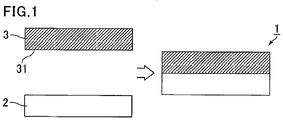
- Fig. 1 is a schematic view for showing the surface of the first resin layer on the side to be in contact with the plastic layer.
- An interlayer film for laminated glass 1 in Fig. 1 has a double layer structure including a plastic layer 2 and a first resin layer 3.
- the glossiness of a surface 31 of the first resin layer 3 on the side to be in contact with the plastic layer 2 is controlled.
- the lower limit is preferably 5 ⁇ m and the upper limit is preferably 55 ⁇ m.
- the first resin layer can exhibit higher adhesiveness to the plastic layer and blocking can be further prevented.
- the lower limit of the ten-point average roughness Rz is more preferably 10 ⁇ m, still more preferably 15 ⁇ m, and the upper limit thereof is more preferably 50 ⁇ m, still more preferably 35 ⁇ m.
- the first resin layer preferably has a pitch of roughness measured in conformity with JIS B0601-1982 of 80 ⁇ m or more on the surface on the side to be in contact with the plastic layer.
- the pitch of roughness is 80 ⁇ m or more, the first resin layer can exhibit higher adhesiveness to the plastic layer and blocking can be further prevented.
- the pitch of roughness is more preferably 100 ⁇ m or more, still more preferably 150 ⁇ m or more.
- the first resin layer preferably contains an adhesive thermoplastic resin.
- the adhesive thermoplastic resin examples include polyvinylidene fluoride, polytetrafluoroethylene, vinylidene fluoride-propylene hexafluoride copolymers, polytrifluoroethylene, acrylonitrile-butadiene-styrene copolymers, polyester, polyether, polyamide, polycarbonate, polyacrylate, polymethacrylate, polyvinyl chloride, polyethylene, polypropylene, polystyrene, polyvinyl acetal, and ethylene-vinyl acetate copolymers. Preferred among these is polyvinyl acetal.
- the polyvinyl acetal can be produced by acetalization of polyvinyl alcohol (PVA) with an aldehyde.
- PVA polyvinyl alcohol
- the degree of saponification of the PVA is commonly within a range of 70 to 99.9 mol%.
- the degree of polymerization of the PVA for obtaining the polyvinyl acetal is preferably 200 or more, more preferably 500 or more, still more preferably 1700 or more, particularly preferably 2000 or more, and preferably 5000 or less, more preferably 4000 or less, still more preferably 3000 or less, furthermore preferably less than 3000, particularly preferably 2800 or less.
- the polyvinyl acetal is preferably obtained by acetalization of PVA having a degree of polymerization satisfying the above upper limit and lower limit. When the degree of polymerization is equal to or more than the lower limit, a laminated glass to be obtained has higher penetration resistance. When the degree of polymerization is equal to or less than the upper limit, formation of an interlayer film is facilitated.
- the degree of polymerization of PVA refers to the average degree of polymerization.
- the average degree of polymerization can be determined by the method in conformity with JIS K6726 "Testing methods for polyvinyl alcohol".
- the aldehyde used is preferably a C1-C10 aldehyde.
- Examples of the C1-C10 aldehyde include formaldehyde, acetaldehyde, propionaldehyde, n-butyraldehyde, isobutyraldehyde, n-valeraldehyde, 2-ethylbutyraldehyde, n-hexylaldehyde, n-octylaldehyde, n-nonylaldehyde, n-decyl aldehyde, and benzaldehyde.
- n-butyraldehyde, n-hexylaldehyde, or n-valeraldehyde is preferably used, and n-butyraldehyde is more preferably used.
- the aldehydes may be used alone, or in combination of two or more thereof.
- the polyvinyl acetal is preferably polyvinyl butyral.
- the use of polyvinyl butyral further improves the weather resistance or the like properties of the interlayer film relative to a laminated glass member.
- the first resin layer preferably contains a plasticizer.
- plasticizer may be used as long as it is commonly used in interlayer films for laminated glass.
- examples thereof include organic plasticizers such as monobasic organic acid esters and polybasic organic acid esters, and phosphoric acid plasticizers such as organophosphate compounds and organophosphite compounds.
- organic plasticizers examples include triethylene glycol-di-2-ethylhexanoate, triethylene glycol-di-2-ethylbutyrate, triethylene glycol-di-n-heptanoate, tetraethylene glycol-di-2-ethylhexanoate, tetraethylene glycol-di-2-ethylbutyrate, tetraethylene glycol-di-n-heptanoate, diethylene glycol-di-2-ethylhexanoate, diethylene glycol-di-2-ethylbutyrate, and diethylene glycol-di-n-heptanoate.
- the first resin layer contains preferably triethylene glycol-di-2-ethylhexanoate, triethylene glycol-di-2-ethylbutyrate, or triethylene glycol-di-n-heptanoate, more preferably triethylene glycol-di-2-ethylhexanoate.
- the amount of the plasticizer relative to the amount of the thermoplastic resin in the first resin layer is not particularly limited.
- the amount of the plasticizer based on 100 parts by mass of the thermoplastic resin is preferably 25 parts by mass or more, more preferably 30 parts by mass or more, still more preferably 35 parts by mass or more, and preferably 80 parts by mass or less, more preferably 60 parts by mass or less, still more preferably 50 parts by mass or less.
- the amount of the plasticizer is equal to or more than the lower limit, a laminated glass to be obtained has better penetration resistance.
- an interlayer film to be obtained has higher transparency.
- the first resin layer preferably contains an adhesion modifier.
- an alkali metal salt or an alkaline earth metal salt is preferably used.
- the adhesion modifier include salts such as potassium, sodium, and magnesium salts.
- an acid forming the salts examples include organic carboxylic acids such as octylic acid, hexylic acid, 2-ethylbutyric acid, butyric acid, acetic acid, and formic acid , and inorganic acids such as hydrochloric acid and nitric acid.
- organic carboxylic acids such as octylic acid, hexylic acid, 2-ethylbutyric acid, butyric acid, acetic acid, and formic acid
- inorganic acids such as hydrochloric acid and nitric acid.
- the first resin layer may optionally contain additives such as an ultraviolet shielding agent, an antioxidant, a light stabilizer, a modified silicon oil as an adhesion modifier, a flame retardant, an antistatic agent, a damp proofing agent, a heat ray reflecting agent, a heat ray absorbing agent, an anti-blocking agent, an antistatic agent, and a colorant including pigment or dyes.
- additives such as an ultraviolet shielding agent, an antioxidant, a light stabilizer, a modified silicon oil as an adhesion modifier, a flame retardant, an antistatic agent, a damp proofing agent, a heat ray reflecting agent, a heat ray absorbing agent, an anti-blocking agent, an antistatic agent, and a colorant including pigment or dyes.
- the thickness of the first resin layer is preferably 100 ⁇ m and the upper limit is preferably 2 mm. When the thickness of the first resin layer is within the range, excellent impact resistance and penetration resistance can be achieved.
- the lower limit of the thickness of the first resin layer is more preferably 200 ⁇ m, and the upper limit thereof is more preferably 1 mm.
- a second resin layer may be further stacked on a second surface, which is the opposite surface of the first surface, of the plastic layer.
- the second resin layer may be a layer same as or different from the first resin layer.
- the resulting interlayer film for laminated glass can have various properties which are hardly achieved by a single layer structure.
- the glossiness of the second resin layer is preferably 10 to 40 on a surface on the side to be in contact with the plastic layer.
- the interlayer film for laminated glass of the present invention may be produced by any method.
- the interlayer film for laminated glass may be produced by separately preparing the plastic layer and the first resin layer and then laminating the layers to each other or by co-extruding resin compositions as raw materials of the layers from a co-extruder.
- a lip die that can provide projections and recesses is used in the extrusion molding of the resin composition from an extruder for forming a first resin layer and extrusion molding conditions are controlled, the glossiness of the surface on the side to be in contact with the plastic layer can be set to 10 to 40.
- the glossiness of the surface of the resulting resin film can be adjusted to a predetermined range by using a lip die having lips with a wide interval, setting the temperature of the resin composition high upon extrusion, setting the line speed high, and the like. Also, it is also effective to keep a long distance between the die and a cooling water tank.
- the glossiness of the surface on the side to be in contact with the plastic layer can be set to 10 to 40 by using a lip die having lips with an interval of 0.5 to 4.0 mm, setting the temperature of the resin composition at the inlet of the die to 100°C to 300°C and the temperature of the lip die to 100°C to 300°C, and performing the extrusion at a line speed of 3 to 35 m/min.
- the present invention also encompasses a laminated glass including a pair of glass plates and the interlayer film for laminated glass of the present invention sandwiched between the pair of glass plates.
- the glass plates may be common transparent glass plates. Examples thereof include plates of inorganic glass such as float glass plates, polished glass plates, figured glass plates, meshed glass plates, wired glass plates, colored glass plates, heat-absorbing glass plates, heat-reflecting glass plates, and green glass plates.
- An ultraviolet shielding glass plate including an ultraviolet shielding coat layer on a glass surface may also be used.
- Other examples of the glass plates include organic plastic plates made of polyethylene terephthalate, polycarbonate, polyacrylate, or the like.
- the glass plates may include two or more types of glass plates.
- the laminated glass may be a laminate including the interlayer film for laminated glass of the present invention between a transparent float glass plate and a colored glass plate such as a green glass plate.
- the glass plates may include two or more glass plates with different thicknesses.
- the present invention can provide interlayer film for laminated glass which has a laminated structure including a plastic layer with a high Young's modulus and a resin layer, which is excellent in impact resistance and penetration resistance, which has high adhesiveness between the plastic layer and the resin layer, and which prevents blocking of the resin layer.
- the present invention can also provide a laminated glass including the interlayer film for laminated glass.
- Fig. 1 is a schematic view for showing a surface of a first resin layer on the side to be in contact with a plastic layer.
- a polyethylene terephthalate film (“U34 LUMIRROR” produced by TORAY Industries, Inc., Young's modulus: 4.5 GPa, thickness: 100 ⁇ m) was used as a plastic layer.
- the resulting resin composition was extruded from an extruder to give a single-layer first resin layer having a thickness of 380 ⁇ m.
- a lip die having lips with an interval of 1.0 mm was used, the temperature of the resin composition at the inlet of the die and the temperature of the lip die were adjusted to 200°C and 210°C, respectively, and the line speed was set to 10 m/min.
- the obtained first resin layer was wound to give a roll.
- the obtained first resin layer and plastic layer were thermally press-bonded by a roll-to-roll method using a thermal press-bonding laminator ("MRK-650Y type" produced by MCK Co., Ltd.) under the conditions of a heating temperature of 90°C, a pressure for the press-bonding of 1 kN, and a tension upon delivery of 100 N, thereby producing an interlayer film for laminated glass having a double layer structure.
- a thermal press-bonding laminator "MRK-650Y type" produced by MCK Co., Ltd.
- the interlayer film for laminated glass and a roll were produced in the same manner as in Example 1, except that the interval of lips, the temperature of the resin composition at the inlet of the die, the temperature of the lip die, and the line speed in the production of the first resin layer were changed.
- the first resin layers and interlayer films for laminated glass obtained in the examples and comparative examples were evaluated by the following methods.
- the glossiness of the surface of each obtained first resin layer on the side to be in contact with the plastic layer was measured using a precision gloss meter ("GM-26PRO" produced by Murakami Color Research Laboratory or the like) in conformity with the measuring method 2 disclosed in JIS Z 8741:1997.
- GM-26PRO produced by Murakami Color Research Laboratory or the like
- JIS Z 8741:1997 JIS Z 8741:1997.
- the minimum glossiness obtained by setting the first resin layer on a sample table and measuring the glossiness while rotating the first resin layer on the sample table to the irradiation direction of a light source was determined as the glossiness of the surface of the first resin layer on the side to be in contact with the plastic layer.
- the ten-point average roughness Rz and the pitch of roughness of the surface of the first resin layer on the side to be in contact with the plastic layer were measured by a method in conformity with JIS B0601-1982.
- the roll (500 m) of each obtained first resin layer was set on a rewinder, and the force required for rewinding the first resin layer was measured using a tension detector (LX-050TD produced by Mitsubishi Electric Corporation). Commonly, when the maximum value of the force required for rewinding the first resin layer is 350 N/m or less, it is determined that blocking does not occur.
- the case where the force required for rewinding the first resin layer from the roll was 200 N/m or less was rated "Excellent (oo)", the case where the force was more than 200 N/m but not more than 350 N/m was rated "Good (o) and the case where the force was more than 350 N/m was rated "Poor ( ⁇ )".
- the adhesive force between the plastic layer and the first resin layer was measured using a TENSILON universal testing machine ("RTM-500” produced by Orientec Co., LTD.) at 23°C at a rate of 500 mm/min in conformity with JIS K6854-2.
- the present invention can provide an interlayer film for laminated glass which has a laminated structure including a plastic layer with a high Young's modulus and a resin layer, which is excellent in impact resistance and penetration resistance, which has high adhesiveness between the plastic layer and the resin layer, and which prevents blocking of the resin layer.
- the present invention also can provide a laminated glass including the interlayer film for laminated glass.
Landscapes
- Chemical & Material Sciences (AREA)
- Engineering & Computer Science (AREA)
- Ceramic Engineering (AREA)
- Life Sciences & Earth Sciences (AREA)
- Chemical Kinetics & Catalysis (AREA)
- General Chemical & Material Sciences (AREA)
- Geochemistry & Mineralogy (AREA)
- Materials Engineering (AREA)
- Organic Chemistry (AREA)
- Joining Of Glass To Other Materials (AREA)
- Laminated Bodies (AREA)
Applications Claiming Priority (2)
| Application Number | Priority Date | Filing Date | Title |
|---|---|---|---|
| JP2014202344 | 2014-09-30 | ||
| PCT/JP2015/077707 WO2016052606A1 (ja) | 2014-09-30 | 2015-09-30 | 合わせガラス用中間膜及び合わせガラス |
Publications (3)
| Publication Number | Publication Date |
|---|---|
| EP3202731A1 true EP3202731A1 (de) | 2017-08-09 |
| EP3202731A4 EP3202731A4 (de) | 2018-04-18 |
| EP3202731B1 EP3202731B1 (de) | 2023-12-27 |
Family
ID=55630631
Family Applications (1)
| Application Number | Title | Priority Date | Filing Date |
|---|---|---|---|
| EP15846564.1A Active EP3202731B1 (de) | 2014-09-30 | 2015-09-30 | Zwischenschichtfolie für verbundglas sowie verbundglas |
Country Status (8)
| Country | Link |
|---|---|
| US (1) | US20170197383A1 (de) |
| EP (1) | EP3202731B1 (de) |
| JP (2) | JP5933139B1 (de) |
| KR (1) | KR102452747B1 (de) |
| CN (1) | CN106232549A (de) |
| MX (1) | MX2017003745A (de) |
| RU (1) | RU2693107C2 (de) |
| WO (1) | WO2016052606A1 (de) |
Families Citing this family (2)
| Publication number | Priority date | Publication date | Assignee | Title |
|---|---|---|---|---|
| WO2015129758A1 (ja) * | 2014-02-25 | 2015-09-03 | 積水化学工業株式会社 | 合わせガラス用中間膜、合わせガラス用中間膜の製造方法及び合わせガラス |
| CN109963822A (zh) | 2017-02-22 | 2019-07-02 | 积水化学工业株式会社 | 绝热性片、夹层玻璃用中间膜和夹层玻璃 |
Family Cites Families (20)
| Publication number | Priority date | Publication date | Assignee | Title |
|---|---|---|---|---|
| US3994654A (en) * | 1975-01-02 | 1976-11-30 | Monsanto Company | Die for extruding thermoplastic sheets |
| US5091258A (en) * | 1990-08-20 | 1992-02-25 | Monsanto Company | Laminate for a safety glazing |
| JP3493245B2 (ja) * | 1995-05-12 | 2004-02-03 | ミネソタ マイニング アンド マニュファクチャリング カンパニー | 再帰性反射シート及び再帰性反射性能を有する物品 |
| JP2000290046A (ja) * | 1999-04-09 | 2000-10-17 | Sekisui Chem Co Ltd | 合わせガラス用中間膜及びその製造方法 |
| JP4429428B2 (ja) | 1999-10-07 | 2010-03-10 | 積水化学工業株式会社 | 合わせガラス用中間膜及び合わせガラス |
| US20010046595A1 (en) * | 1999-12-14 | 2001-11-29 | Moran James R. | Intrusion resistant glass laminates |
| AU780336B2 (en) * | 1999-12-14 | 2005-03-17 | Solutia Inc. | Intrusion resistant glass laminates |
| US6960635B2 (en) * | 2001-11-06 | 2005-11-01 | Dow Global Technologies Inc. | Isotactic propylene copolymers, their preparation and use |
| JP2003192402A (ja) | 2001-12-25 | 2003-07-09 | Central Glass Co Ltd | 耐衝撃性および耐剥離性に優れた合わせガラス |
| CN1842414A (zh) * | 2003-08-07 | 2006-10-04 | 纳幕尔杜邦公司 | 利用硬质夹层的装饰层压安全玻璃及其制备方法 |
| CN1569717A (zh) * | 2004-04-27 | 2005-01-26 | 番禺新法五金玻璃有限公司 | 一种夹层玻璃及其制造方法 |
| WO2006051852A1 (ja) * | 2004-11-10 | 2006-05-18 | Nippon Sheet Glass Company, Limited | 車両用曲げ合わせガラスおよびその曲げ合わせガラスを装着した車両 |
| US20080254302A1 (en) * | 2007-04-13 | 2008-10-16 | David Paul Bourcier | Multiple layer polymer interlayers having a melt fractured surface |
| JP4942556B2 (ja) | 2007-06-05 | 2012-05-30 | 株式会社ブリヂストン | 合わせガラス用中間膜、及びこれを用いた合わせガラス |
| US20100215952A1 (en) * | 2007-07-31 | 2010-08-26 | CentralGlass Company, Limited | Laminated Glass Having Plastic Film Inserted Therein |
| US20110083796A1 (en) * | 2008-07-16 | 2011-04-14 | Sheppard Robert M | Matte Surface Multilayer Films Having Improved Sealing Properties, Their Methods of Manufacture, and Articles Made Therefrom |
| JP5348991B2 (ja) * | 2008-10-08 | 2013-11-20 | 株式会社ブリヂストン | 積層体 |
| JP5745034B2 (ja) * | 2011-03-29 | 2015-07-08 | 株式会社ブリヂストン | 熱線遮蔽性積層体及びそのフィルムロール |
| EP2752396A4 (de) * | 2011-08-31 | 2015-04-29 | Sekisui Chemical Co Ltd | Zwischenschicht für verbundglas, verfahren zur herstellung der zwischenschicht für verbundglas und verbundglas |
| EP3127880A4 (de) * | 2014-03-31 | 2017-09-20 | Sekisui Chemical Co., Ltd. | Zwischenfolie für verbundglas und verbundglas |
-
2015
- 2015-09-30 JP JP2015553971A patent/JP5933139B1/ja active Active
- 2015-09-30 US US15/323,497 patent/US20170197383A1/en not_active Abandoned
- 2015-09-30 MX MX2017003745A patent/MX2017003745A/es unknown
- 2015-09-30 RU RU2017114659A patent/RU2693107C2/ru active
- 2015-09-30 CN CN201580020726.4A patent/CN106232549A/zh active Pending
- 2015-09-30 EP EP15846564.1A patent/EP3202731B1/de active Active
- 2015-09-30 KR KR1020167029957A patent/KR102452747B1/ko active Active
- 2015-09-30 WO PCT/JP2015/077707 patent/WO2016052606A1/ja not_active Ceased
-
2016
- 2016-04-27 JP JP2016089538A patent/JP2016166130A/ja active Pending
Also Published As
| Publication number | Publication date |
|---|---|
| RU2017114659A (ru) | 2018-11-05 |
| EP3202731A4 (de) | 2018-04-18 |
| RU2693107C2 (ru) | 2019-07-01 |
| EP3202731B1 (de) | 2023-12-27 |
| CN106232549A (zh) | 2016-12-14 |
| JP2016166130A (ja) | 2016-09-15 |
| KR20170063434A (ko) | 2017-06-08 |
| MX2017003745A (es) | 2017-06-30 |
| WO2016052606A1 (ja) | 2016-04-07 |
| US20170197383A1 (en) | 2017-07-13 |
| KR102452747B1 (ko) | 2022-10-07 |
| JPWO2016052606A1 (ja) | 2017-04-27 |
| RU2017114659A3 (de) | 2019-04-26 |
| JP5933139B1 (ja) | 2016-06-08 |
Similar Documents
| Publication | Publication Date | Title |
|---|---|---|
| EP3202735B1 (de) | Zwischenschichtfilm für verbundglas, rollenförmiger körper, verbundglas, verfahren zur herstellung des zwischenschichtfilms für verbundglas und verfahren zur herstellung des rollenförmigen körpers | |
| CN110494404B (zh) | 夹层玻璃用的聚乙烯醇缩醛树脂薄膜 | |
| TW201819181A (zh) | 一種包含功能性薄膜之層合玻璃 | |
| US20160129673A1 (en) | Intermediate film for laminated glass, and laminated glass | |
| WO2018182032A1 (ja) | 合わせガラス | |
| TWI691541B (zh) | 層合玻璃用中間膜及層合玻璃 | |
| EP3202731A1 (de) | Zwischenschichtfolie für verbundglas sowie verbundglas | |
| JP2018145068A (ja) | 合わせガラス用中間膜、合わせガラス、及び、合わせガラスシステム | |
| CN101208196A (zh) | 包含聚(对苯二甲酸环己二甲酯-共聚-对苯二甲酸乙二酯)共聚酯的聚合物夹层 | |
| TW201936540A (zh) | 層合玻璃 | |
| KR20160140580A (ko) | 접합 유리용 중간막, 접합 유리용 중간막의 제조 방법 및 접합 유리 | |
| WO2018198677A1 (ja) | 合わせガラス | |
| JPWO2017171042A1 (ja) | ポリビニルアセタールアイオノマー樹脂フィルム及び合わせガラス | |
| CN112739754A (zh) | 聚乙烯醇缩醛树脂薄膜和其薄膜卷以及层叠体 | |
| WO2020067083A1 (ja) | 積層フィルム | |
| WO2018198678A1 (ja) | 合わせガラス | |
| EP3202732B1 (de) | Zwischenfolie für verbundglas sowie verbundglas | |
| EP3858798A1 (de) | Verbundglaszwischenschicht und verbundglas | |
| JP2023027939A (ja) | 複合フィルム及びその製造方法 | |
| TW202140283A (zh) | 具有減少黃色之聚合物夾層 | |
| JP2017095330A (ja) | 合わせガラス用中間膜及び合わせガラス | |
| JP2017178675A (ja) | 合わせガラス用中間膜及び合わせガラス |
Legal Events
| Date | Code | Title | Description |
|---|---|---|---|
| STAA | Information on the status of an ep patent application or granted ep patent |
Free format text: STATUS: THE INTERNATIONAL PUBLICATION HAS BEEN MADE |
|
| PUAI | Public reference made under article 153(3) epc to a published international application that has entered the european phase |
Free format text: ORIGINAL CODE: 0009012 |
|
| STAA | Information on the status of an ep patent application or granted ep patent |
Free format text: STATUS: REQUEST FOR EXAMINATION WAS MADE |
|
| 17P | Request for examination filed |
Effective date: 20170315 |
|
| AK | Designated contracting states |
Kind code of ref document: A1 Designated state(s): AL AT BE BG CH CY CZ DE DK EE ES FI FR GB GR HR HU IE IS IT LI LT LU LV MC MK MT NL NO PL PT RO RS SE SI SK SM TR |
|
| AX | Request for extension of the european patent |
Extension state: BA ME |
|
| DAV | Request for validation of the european patent (deleted) | ||
| DAX | Request for extension of the european patent (deleted) | ||
| A4 | Supplementary search report drawn up and despatched |
Effective date: 20180320 |
|
| RIC1 | Information provided on ipc code assigned before grant |
Ipc: B32B 27/00 20060101ALI20180314BHEP Ipc: C03C 27/12 20060101AFI20180314BHEP Ipc: B32B 17/10 20060101ALI20180314BHEP |
|
| STAA | Information on the status of an ep patent application or granted ep patent |
Free format text: STATUS: EXAMINATION IS IN PROGRESS |
|
| 17Q | First examination report despatched |
Effective date: 20210906 |
|
| GRAP | Despatch of communication of intention to grant a patent |
Free format text: ORIGINAL CODE: EPIDOSNIGR1 |
|
| STAA | Information on the status of an ep patent application or granted ep patent |
Free format text: STATUS: GRANT OF PATENT IS INTENDED |
|
| INTG | Intention to grant announced |
Effective date: 20230922 |
|
| GRAS | Grant fee paid |
Free format text: ORIGINAL CODE: EPIDOSNIGR3 |
|
| GRAA | (expected) grant |
Free format text: ORIGINAL CODE: 0009210 |
|
| STAA | Information on the status of an ep patent application or granted ep patent |
Free format text: STATUS: THE PATENT HAS BEEN GRANTED |
|
| REG | Reference to a national code |
Ref country code: DE Ref legal event code: R081 Ref document number: 602015087090 Country of ref document: DE Owner name: SEKISUI CHEMICAL CO., LTD., JP Free format text: FORMER OWNER: SEKISUI CHEMICAL CO., LTD., OSAKA-SHI, OSAKA, JP |
|
| AK | Designated contracting states |
Kind code of ref document: B1 Designated state(s): AL AT BE BG CH CY CZ DE DK EE ES FI FR GB GR HR HU IE IS IT LI LT LU LV MC MK MT NL NO PL PT RO RS SE SI SK SM TR |
|
| P01 | Opt-out of the competence of the unified patent court (upc) registered |
Effective date: 20231121 |
|
| REG | Reference to a national code |
Ref country code: GB Ref legal event code: FG4D |
|
| REG | Reference to a national code |
Ref country code: CH Ref legal event code: EP |
|
| REG | Reference to a national code |
Ref country code: DE Ref legal event code: R096 Ref document number: 602015087090 Country of ref document: DE |
|
| REG | Reference to a national code |
Ref country code: IE Ref legal event code: FG4D |
|
| REG | Reference to a national code |
Ref country code: NL Ref legal event code: FP |
|
| PG25 | Lapsed in a contracting state [announced via postgrant information from national office to epo] |
Ref country code: GR Free format text: LAPSE BECAUSE OF FAILURE TO SUBMIT A TRANSLATION OF THE DESCRIPTION OR TO PAY THE FEE WITHIN THE PRESCRIBED TIME-LIMIT Effective date: 20240328 |
|
| REG | Reference to a national code |
Ref country code: LT Ref legal event code: MG9D |
|
| PG25 | Lapsed in a contracting state [announced via postgrant information from national office to epo] |
Ref country code: LT Free format text: LAPSE BECAUSE OF FAILURE TO SUBMIT A TRANSLATION OF THE DESCRIPTION OR TO PAY THE FEE WITHIN THE PRESCRIBED TIME-LIMIT Effective date: 20231227 |
|
| PG25 | Lapsed in a contracting state [announced via postgrant information from national office to epo] |
Ref country code: ES Free format text: LAPSE BECAUSE OF FAILURE TO SUBMIT A TRANSLATION OF THE DESCRIPTION OR TO PAY THE FEE WITHIN THE PRESCRIBED TIME-LIMIT Effective date: 20231227 |
|
| PG25 | Lapsed in a contracting state [announced via postgrant information from national office to epo] |
Ref country code: LT Free format text: LAPSE BECAUSE OF FAILURE TO SUBMIT A TRANSLATION OF THE DESCRIPTION OR TO PAY THE FEE WITHIN THE PRESCRIBED TIME-LIMIT Effective date: 20231227 Ref country code: GR Free format text: LAPSE BECAUSE OF FAILURE TO SUBMIT A TRANSLATION OF THE DESCRIPTION OR TO PAY THE FEE WITHIN THE PRESCRIBED TIME-LIMIT Effective date: 20240328 Ref country code: FI Free format text: LAPSE BECAUSE OF FAILURE TO SUBMIT A TRANSLATION OF THE DESCRIPTION OR TO PAY THE FEE WITHIN THE PRESCRIBED TIME-LIMIT Effective date: 20231227 Ref country code: ES Free format text: LAPSE BECAUSE OF FAILURE TO SUBMIT A TRANSLATION OF THE DESCRIPTION OR TO PAY THE FEE WITHIN THE PRESCRIBED TIME-LIMIT Effective date: 20231227 Ref country code: BG Free format text: LAPSE BECAUSE OF FAILURE TO SUBMIT A TRANSLATION OF THE DESCRIPTION OR TO PAY THE FEE WITHIN THE PRESCRIBED TIME-LIMIT Effective date: 20240327 |
|
| REG | Reference to a national code |
Ref country code: AT Ref legal event code: MK05 Ref document number: 1644387 Country of ref document: AT Kind code of ref document: T Effective date: 20231227 |
|
| PG25 | Lapsed in a contracting state [announced via postgrant information from national office to epo] |
Ref country code: SE Free format text: LAPSE BECAUSE OF FAILURE TO SUBMIT A TRANSLATION OF THE DESCRIPTION OR TO PAY THE FEE WITHIN THE PRESCRIBED TIME-LIMIT Effective date: 20231227 Ref country code: RS Free format text: LAPSE BECAUSE OF FAILURE TO SUBMIT A TRANSLATION OF THE DESCRIPTION OR TO PAY THE FEE WITHIN THE PRESCRIBED TIME-LIMIT Effective date: 20231227 Ref country code: NO Free format text: LAPSE BECAUSE OF FAILURE TO SUBMIT A TRANSLATION OF THE DESCRIPTION OR TO PAY THE FEE WITHIN THE PRESCRIBED TIME-LIMIT Effective date: 20240327 Ref country code: LV Free format text: LAPSE BECAUSE OF FAILURE TO SUBMIT A TRANSLATION OF THE DESCRIPTION OR TO PAY THE FEE WITHIN THE PRESCRIBED TIME-LIMIT Effective date: 20231227 Ref country code: HR Free format text: LAPSE BECAUSE OF FAILURE TO SUBMIT A TRANSLATION OF THE DESCRIPTION OR TO PAY THE FEE WITHIN THE PRESCRIBED TIME-LIMIT Effective date: 20231227 |
|
| PG25 | Lapsed in a contracting state [announced via postgrant information from national office to epo] |
Ref country code: IS Free format text: LAPSE BECAUSE OF FAILURE TO SUBMIT A TRANSLATION OF THE DESCRIPTION OR TO PAY THE FEE WITHIN THE PRESCRIBED TIME-LIMIT Effective date: 20240427 |
|
| PG25 | Lapsed in a contracting state [announced via postgrant information from national office to epo] |
Ref country code: AT Free format text: LAPSE BECAUSE OF FAILURE TO SUBMIT A TRANSLATION OF THE DESCRIPTION OR TO PAY THE FEE WITHIN THE PRESCRIBED TIME-LIMIT Effective date: 20231227 Ref country code: CZ Free format text: LAPSE BECAUSE OF FAILURE TO SUBMIT A TRANSLATION OF THE DESCRIPTION OR TO PAY THE FEE WITHIN THE PRESCRIBED TIME-LIMIT Effective date: 20231227 |
|
| PG25 | Lapsed in a contracting state [announced via postgrant information from national office to epo] |
Ref country code: SK Free format text: LAPSE BECAUSE OF FAILURE TO SUBMIT A TRANSLATION OF THE DESCRIPTION OR TO PAY THE FEE WITHIN THE PRESCRIBED TIME-LIMIT Effective date: 20231227 |
|
| PG25 | Lapsed in a contracting state [announced via postgrant information from national office to epo] |
Ref country code: SM Free format text: LAPSE BECAUSE OF FAILURE TO SUBMIT A TRANSLATION OF THE DESCRIPTION OR TO PAY THE FEE WITHIN THE PRESCRIBED TIME-LIMIT Effective date: 20231227 Ref country code: SK Free format text: LAPSE BECAUSE OF FAILURE TO SUBMIT A TRANSLATION OF THE DESCRIPTION OR TO PAY THE FEE WITHIN THE PRESCRIBED TIME-LIMIT Effective date: 20231227 Ref country code: RO Free format text: LAPSE BECAUSE OF FAILURE TO SUBMIT A TRANSLATION OF THE DESCRIPTION OR TO PAY THE FEE WITHIN THE PRESCRIBED TIME-LIMIT Effective date: 20231227 Ref country code: IS Free format text: LAPSE BECAUSE OF FAILURE TO SUBMIT A TRANSLATION OF THE DESCRIPTION OR TO PAY THE FEE WITHIN THE PRESCRIBED TIME-LIMIT Effective date: 20240427 Ref country code: EE Free format text: LAPSE BECAUSE OF FAILURE TO SUBMIT A TRANSLATION OF THE DESCRIPTION OR TO PAY THE FEE WITHIN THE PRESCRIBED TIME-LIMIT Effective date: 20231227 Ref country code: CZ Free format text: LAPSE BECAUSE OF FAILURE TO SUBMIT A TRANSLATION OF THE DESCRIPTION OR TO PAY THE FEE WITHIN THE PRESCRIBED TIME-LIMIT Effective date: 20231227 Ref country code: AT Free format text: LAPSE BECAUSE OF FAILURE TO SUBMIT A TRANSLATION OF THE DESCRIPTION OR TO PAY THE FEE WITHIN THE PRESCRIBED TIME-LIMIT Effective date: 20231227 |
|
| PG25 | Lapsed in a contracting state [announced via postgrant information from national office to epo] |
Ref country code: PT Free format text: LAPSE BECAUSE OF FAILURE TO SUBMIT A TRANSLATION OF THE DESCRIPTION OR TO PAY THE FEE WITHIN THE PRESCRIBED TIME-LIMIT Effective date: 20240429 Ref country code: PL Free format text: LAPSE BECAUSE OF FAILURE TO SUBMIT A TRANSLATION OF THE DESCRIPTION OR TO PAY THE FEE WITHIN THE PRESCRIBED TIME-LIMIT Effective date: 20231227 |
|
| PG25 | Lapsed in a contracting state [announced via postgrant information from national office to epo] |
Ref country code: PT Free format text: LAPSE BECAUSE OF FAILURE TO SUBMIT A TRANSLATION OF THE DESCRIPTION OR TO PAY THE FEE WITHIN THE PRESCRIBED TIME-LIMIT Effective date: 20240429 Ref country code: PL Free format text: LAPSE BECAUSE OF FAILURE TO SUBMIT A TRANSLATION OF THE DESCRIPTION OR TO PAY THE FEE WITHIN THE PRESCRIBED TIME-LIMIT Effective date: 20231227 |
|
| REG | Reference to a national code |
Ref country code: DE Ref legal event code: R097 Ref document number: 602015087090 Country of ref document: DE |
|
| PG25 | Lapsed in a contracting state [announced via postgrant information from national office to epo] |
Ref country code: DK Free format text: LAPSE BECAUSE OF FAILURE TO SUBMIT A TRANSLATION OF THE DESCRIPTION OR TO PAY THE FEE WITHIN THE PRESCRIBED TIME-LIMIT Effective date: 20231227 |
|
| PG25 | Lapsed in a contracting state [announced via postgrant information from national office to epo] |
Ref country code: DK Free format text: LAPSE BECAUSE OF FAILURE TO SUBMIT A TRANSLATION OF THE DESCRIPTION OR TO PAY THE FEE WITHIN THE PRESCRIBED TIME-LIMIT Effective date: 20231227 |
|
| PLBE | No opposition filed within time limit |
Free format text: ORIGINAL CODE: 0009261 |
|
| STAA | Information on the status of an ep patent application or granted ep patent |
Free format text: STATUS: NO OPPOSITION FILED WITHIN TIME LIMIT |
|
| 26N | No opposition filed |
Effective date: 20240930 |
|
| PG25 | Lapsed in a contracting state [announced via postgrant information from national office to epo] |
Ref country code: SI Free format text: LAPSE BECAUSE OF FAILURE TO SUBMIT A TRANSLATION OF THE DESCRIPTION OR TO PAY THE FEE WITHIN THE PRESCRIBED TIME-LIMIT Effective date: 20231227 Ref country code: MC Free format text: LAPSE BECAUSE OF FAILURE TO SUBMIT A TRANSLATION OF THE DESCRIPTION OR TO PAY THE FEE WITHIN THE PRESCRIBED TIME-LIMIT Effective date: 20231227 |
|
| REG | Reference to a national code |
Ref country code: CH Ref legal event code: PL |
|
| PG25 | Lapsed in a contracting state [announced via postgrant information from national office to epo] |
Ref country code: LU Free format text: LAPSE BECAUSE OF NON-PAYMENT OF DUE FEES Effective date: 20240930 |
|
| PG25 | Lapsed in a contracting state [announced via postgrant information from national office to epo] |
Ref country code: CH Free format text: LAPSE BECAUSE OF NON-PAYMENT OF DUE FEES Effective date: 20240930 |
|
| PG25 | Lapsed in a contracting state [announced via postgrant information from national office to epo] |
Ref country code: IE Free format text: LAPSE BECAUSE OF NON-PAYMENT OF DUE FEES Effective date: 20240930 |
|
| PGFP | Annual fee paid to national office [announced via postgrant information from national office to epo] |
Ref country code: NL Payment date: 20250814 Year of fee payment: 11 |
|
| PGFP | Annual fee paid to national office [announced via postgrant information from national office to epo] |
Ref country code: DE Payment date: 20250805 Year of fee payment: 11 |
|
| PGFP | Annual fee paid to national office [announced via postgrant information from national office to epo] |
Ref country code: IT Payment date: 20250825 Year of fee payment: 11 |
|
| PGFP | Annual fee paid to national office [announced via postgrant information from national office to epo] |
Ref country code: BE Payment date: 20250818 Year of fee payment: 11 Ref country code: GB Payment date: 20250807 Year of fee payment: 11 |
|
| PGFP | Annual fee paid to national office [announced via postgrant information from national office to epo] |
Ref country code: FR Payment date: 20250808 Year of fee payment: 11 |
|
| PG25 | Lapsed in a contracting state [announced via postgrant information from national office to epo] |
Ref country code: CY Free format text: LAPSE BECAUSE OF FAILURE TO SUBMIT A TRANSLATION OF THE DESCRIPTION OR TO PAY THE FEE WITHIN THE PRESCRIBED TIME-LIMIT; INVALID AB INITIO Effective date: 20150930 |
|
| PG25 | Lapsed in a contracting state [announced via postgrant information from national office to epo] |
Ref country code: HU Free format text: LAPSE BECAUSE OF FAILURE TO SUBMIT A TRANSLATION OF THE DESCRIPTION OR TO PAY THE FEE WITHIN THE PRESCRIBED TIME-LIMIT; INVALID AB INITIO Effective date: 20150930 |