EP3203104A1 - Halterung zur befestigung eines aggregats, insbesondere einer pumpe, an einem kraftfahrzeug - Google Patents
Halterung zur befestigung eines aggregats, insbesondere einer pumpe, an einem kraftfahrzeug Download PDFInfo
- Publication number
- EP3203104A1 EP3203104A1 EP17151583.6A EP17151583A EP3203104A1 EP 3203104 A1 EP3203104 A1 EP 3203104A1 EP 17151583 A EP17151583 A EP 17151583A EP 3203104 A1 EP3203104 A1 EP 3203104A1
- Authority
- EP
- European Patent Office
- Prior art keywords
- leg
- holder
- damping element
- fastening
- section
- Prior art date
- Legal status (The legal status is an assumption and is not a legal conclusion. Google has not performed a legal analysis and makes no representation as to the accuracy of the status listed.)
- Granted
Links
Images

Classifications
-
- B—PERFORMING OPERATIONS; TRANSPORTING
- B60—VEHICLES IN GENERAL
- B60R—VEHICLES, VEHICLE FITTINGS, OR VEHICLE PARTS, NOT OTHERWISE PROVIDED FOR
- B60R11/00—Arrangements for holding or mounting articles, not otherwise provided for
-
- F—MECHANICAL ENGINEERING; LIGHTING; HEATING; WEAPONS; BLASTING
- F16—ENGINEERING ELEMENTS AND UNITS; GENERAL MEASURES FOR PRODUCING AND MAINTAINING EFFECTIVE FUNCTIONING OF MACHINES OR INSTALLATIONS; THERMAL INSULATION IN GENERAL
- F16M—FRAMES, CASINGS OR BEDS OF ENGINES, MACHINES OR APPARATUS, NOT SPECIFIC TO ENGINES, MACHINES OR APPARATUS PROVIDED FOR ELSEWHERE; STANDS; SUPPORTS
- F16M13/00—Other supports for positioning apparatus or articles; Means for steadying hand-held apparatus or articles
- F16M13/02—Other supports for positioning apparatus or articles; Means for steadying hand-held apparatus or articles for supporting on, or attaching to, an object, e.g. tree, gate, window-frame, cycle
-
- F—MECHANICAL ENGINEERING; LIGHTING; HEATING; WEAPONS; BLASTING
- F16—ENGINEERING ELEMENTS AND UNITS; GENERAL MEASURES FOR PRODUCING AND MAINTAINING EFFECTIVE FUNCTIONING OF MACHINES OR INSTALLATIONS; THERMAL INSULATION IN GENERAL
- F16F—SPRINGS; SHOCK-ABSORBERS; MEANS FOR DAMPING VIBRATION
- F16F1/00—Springs
- F16F1/36—Springs made of rubber or other material having high internal friction, e.g. thermoplastic elastomers
- F16F1/371—Springs made of rubber or other material having high internal friction, e.g. thermoplastic elastomers characterised by inserts or auxiliary extension or exterior elements, e.g. for rigidification
-
- F—MECHANICAL ENGINEERING; LIGHTING; HEATING; WEAPONS; BLASTING
- F16—ENGINEERING ELEMENTS AND UNITS; GENERAL MEASURES FOR PRODUCING AND MAINTAINING EFFECTIVE FUNCTIONING OF MACHINES OR INSTALLATIONS; THERMAL INSULATION IN GENERAL
- F16F—SPRINGS; SHOCK-ABSORBERS; MEANS FOR DAMPING VIBRATION
- F16F15/00—Suppression of vibrations in systems; Means or arrangements for avoiding or reducing out-of-balance forces, e.g. due to motion
- F16F15/02—Suppression of vibrations of non-rotating, e.g. reciprocating systems; Suppression of vibrations of rotating systems by use of members not moving with the rotating systems
- F16F15/04—Suppression of vibrations of non-rotating, e.g. reciprocating systems; Suppression of vibrations of rotating systems by use of members not moving with the rotating systems using elastic means
-
- F—MECHANICAL ENGINEERING; LIGHTING; HEATING; WEAPONS; BLASTING
- F16—ENGINEERING ELEMENTS AND UNITS; GENERAL MEASURES FOR PRODUCING AND MAINTAINING EFFECTIVE FUNCTIONING OF MACHINES OR INSTALLATIONS; THERMAL INSULATION IN GENERAL
- F16F—SPRINGS; SHOCK-ABSORBERS; MEANS FOR DAMPING VIBRATION
- F16F15/00—Suppression of vibrations in systems; Means or arrangements for avoiding or reducing out-of-balance forces, e.g. due to motion
- F16F15/02—Suppression of vibrations of non-rotating, e.g. reciprocating systems; Suppression of vibrations of rotating systems by use of members not moving with the rotating systems
- F16F15/04—Suppression of vibrations of non-rotating, e.g. reciprocating systems; Suppression of vibrations of rotating systems by use of members not moving with the rotating systems using elastic means
- F16F15/08—Suppression of vibrations of non-rotating, e.g. reciprocating systems; Suppression of vibrations of rotating systems by use of members not moving with the rotating systems using elastic means with rubber springs ; with springs made of rubber and metal
-
- F—MECHANICAL ENGINEERING; LIGHTING; HEATING; WEAPONS; BLASTING
- F16—ENGINEERING ELEMENTS AND UNITS; GENERAL MEASURES FOR PRODUCING AND MAINTAINING EFFECTIVE FUNCTIONING OF MACHINES OR INSTALLATIONS; THERMAL INSULATION IN GENERAL
- F16M—FRAMES, CASINGS OR BEDS OF ENGINES, MACHINES OR APPARATUS, NOT SPECIFIC TO ENGINES, MACHINES OR APPARATUS PROVIDED FOR ELSEWHERE; STANDS; SUPPORTS
- F16M1/00—Frames or casings of engines, machines or apparatus; Frames serving as machinery beds
-
- H—ELECTRICITY
- H02—GENERATION; CONVERSION OR DISTRIBUTION OF ELECTRIC POWER
- H02K—DYNAMO-ELECTRIC MACHINES
- H02K5/00—Casings; Enclosures; Supports
- H02K5/04—Casings or enclosures characterised by the shape, form or construction thereof
- H02K5/16—Means for supporting bearings, e.g. insulating supports or means for fitting bearings in the bearing-shields
-
- H—ELECTRICITY
- H02—GENERATION; CONVERSION OR DISTRIBUTION OF ELECTRIC POWER
- H02K—DYNAMO-ELECTRIC MACHINES
- H02K5/00—Casings; Enclosures; Supports
- H02K5/24—Casings; Enclosures; Supports specially adapted for suppression or reduction of noise or vibrations
-
- B—PERFORMING OPERATIONS; TRANSPORTING
- B60—VEHICLES IN GENERAL
- B60R—VEHICLES, VEHICLE FITTINGS, OR VEHICLE PARTS, NOT OTHERWISE PROVIDED FOR
- B60R11/00—Arrangements for holding or mounting articles, not otherwise provided for
- B60R2011/0042—Arrangements for holding or mounting articles, not otherwise provided for characterised by mounting means
- B60R2011/0049—Arrangements for holding or mounting articles, not otherwise provided for characterised by mounting means for non integrated articles
- B60R2011/005—Connection with the vehicle part
- B60R2011/0052—Connection with the vehicle part using screws, bolts, rivets or the like
Definitions
- the invention relates to a holder according to claim 1.
- a substantially plate-shaped insert element made of metal is arranged, which is designed for local stiffening of the damping element.
- the insert is formed on two opposite edges, each with a running into the damping element wings.
- the wings have a constant thickness over their length. This leads to a different load on the insert, so that there is a risk of mechanical breakage at the transition of the wings to the plate-shaped insert.
- an improved mount for an assembly may be provided on a motor vehicle in that the mount comprises a damping element and a fastening element connected to the damping element, wherein the damping element is connectable to the aggregate, wherein the fastening element at least one leg and a connecting portion connected to the leg, wherein the leg is formed to stiffen the damping element at least partially, wherein the connection portion is connectable to the motor vehicle, wherein decreases with increasing distance to the connection portion, a thickness of the leg.
- This embodiment has the advantage that a cutting of the fastening element into a material of the damping element and a possible damage of the damping element is avoided by the fastening element.
- the thickness of the leg is at least partially selected such that when a force is introduced into the leg, a bending stress over at least a portion of the leg is constant.
- the fastening element has a further leg, wherein the further leg is connected to the connecting portion, wherein the connecting portion between the leg and the other leg is arranged.
- the damping element With increasing distance of the other leg to the connection portion takes a thickness of the other Thigh off. In this way, the damping element can be stiffened by the two legs on both sides and reliable deflection of the damping element when carrying the unit can be avoided. Furthermore, high moments are avoided on the connection portion by the simultaneous arrangement of the legs on the connection portion.
- the connecting portion, the leg and the further leg are formed integrally and of the same material.
- the fastening element preferably has a plastic, in particular a polyamide, as a material.
- the damping element has a further material, wherein the further material preferably comprises an elastomer.
- the material of the fastening element has a lower elasticity than the further material of the damping element.
- the holder is produced by means of an injection molding process, in particular a two-component injection molding process.
- the damping element is designed to extend in a ring around a longitudinal axis.
- the leg has a first section.
- the first section runs on a circular path around the longitudinal axis.
- leg comprises a second portion, wherein the second portion is formed substantially planar.
- the second portion is connected to the first portion and the attachment portion and disposed between the first portion and the attachment portion.
- the leg comprises a recess.
- the recess is preferably formed trapezoidal.
- the recess has an increasing cross section in the direction of a free end of the leg.
- the damping element has a receptacle with a receiving portion.
- the receiving portion is formed corresponding to the leg, wherein the receiving portion completely engages around the leg.
- connection section is planar.
- the leg is connected at a first side surface with the connection portion.
- the fastening element comprises a stiffening rib.
- the stiffening rib is connected to the attachment portion and preferably extends over at least 80 percent of a maximum longitudinal extent of the attachment portion. This ensures that a distortion of the connection section, in particular during curing of the connection section after injection molding, is avoided. This ensures that the connection section is flat.
- the stiffening rib is connected to the second portion of the leg.
- the stiffening rib is arranged in the transverse direction between the leg and the further leg. As a result, the holder can be made particularly compact.
- the fastening element comprises at least one fastening bolt.
- the fastening bolt is connected to the connecting portion.
- the damping element has a first contact surface and a second contact surface arranged at a distance from the first contact surface. Between the first contact surface and the second contact surface of the fastening bolt is arranged. In this way, a reliable, uniform load on the contact surface is ensured.
- the holder has an engagement element.
- the fastening bolt has a groove.
- the fastening bolt is designed to pass through a fastening section of the motor vehicle.
- the engagement element is arranged on a side facing away from the damping element of the fastening portion and engages in the groove to secure the fastening bolt on the mounting portion.
- a distance between the groove and the abutment surface is less than a thickness of the attachment portion. In this way it is ensured that the holder is non-positively connected to the mounting portion of the motor vehicle.
- the fastening element has at least one broken edge.
- the broken edge is rounded or chamfered. In this way it is ensured that the fastening element does not cut into the further material of the damping element and so early tears the damping element.
- FIG. 1 shows a perspective view of a system 10.
- the coordinate system 30 is designed as a legal system.
- the coordinate system 30 has an x-axis (longitudinal direction), a y-axis (transverse direction), and a z-axis (height).
- the x-axis, the y-axis and the z-axis intersect at an origin 31.
- the coordinate system 30 can also be designed differently.
- the coordinate system 30 is used below to explain the embodiment of the system 10 in the following figures particularly clearly.
- the system 10 includes a bracket 15, a mounting portion 20 and an assembly 25.
- the mounting portion 20 may be, for example, a part of a motor vehicle, in particular an internal combustion engine or a body.
- the unit 25 may be formed, for example, as a pump.
- the unit 25 has a cylindrical shape in sections and is connected to the fastening section 20 by means of the holder 15.
- FIG. 2 shows an exploded view of the in FIG. 1 shown system 10.
- the attachment portion 20 is exemplified plan.
- the attachment portion 20 extends, for example, in an xy plane and has, for example, a first through-opening 35 and a second through-opening 40.
- the first through-opening 35 is arranged spaced apart from the second through-opening 40 in the longitudinal direction.
- the holder 15 comprises a damping element 45 and a fastening element 50.
- the damping element 45 extends in sections annularly about a longitudinal axis 55, which is preferably aligned parallel to the x-axis, arranged in the embodiment by way of example on the x-axis is.
- the damping element 45 has a first receptacle 60.
- the first receptacle 60 is cylindrical and serves to encompass an outer circumferential surface 65 of the unit 25.
- the damping element 45 furthermore has a first contact surface 70 and preferably a second contact surface 75.
- the first abutment surface 70 and the second abutment surface 75 are arranged on a side of the damping element 45 facing the attachment section 20 and are arranged spaced apart in the transverse direction by way of example. With the first and the second contact surface 70, 75, the damping element 45 abuts against the attachment portion 20.
- the fastening section 20 has a fastening section thickness d in the z-direction.
- the damping element 45 has a depression 80.
- the depression 80 is arranged offset relative to the first and / or second contact surface 70, 75 in the z-direction on a side facing away from the attachment section 20.
- the recess 80 is formed by way of example groove-shaped.
- the fastening element 50 has, for example, a first fastening bolt 85 and a second fastening bolt 90.
- the first fastening bolt 85 is assigned to the first through-opening 35.
- the second fastening bolt 90 is assigned to the second through-opening 40.
- the fastening bolts 85, 90 each have a groove 105, 110.
- the groove 105, 110 has in the assembled state of the system 10 in the z-direction a groove spacing a to the contact surface 70, 75 on.
- the holder 15 further comprises a first engagement element 95 and, by way of example, a second engagement element 100.
- the first engagement element 95 and the second engagement element 100 are embodied identically in the embodiment by way of example.
- the engagement member 95, 100 is exemplified U-shaped.
- the engagement element 95, 100 preferably comprises metal as a material.
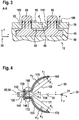
- FIG. 3 shows a cross section along an in FIG. 1 shown cutting plane AA through the system 10.
- the engagement member 95, 100 is on a for Damping element 45 facing away from the mounting portion 20 is arranged.
- the first fastening bolt 85 is guided through the first through hole 35 and the second fastening bolt 90 is guided through the second through hole 40.
- the first engagement element 95 engages in the first groove 105 and positively connects the first attachment bolt 85 with the attachment portion 20.
- the second engagement member 100 engages on a side facing away from the damping element 45 of the attachment portion 20 in the second groove 110 and positively connects the second attachment bolt 90 with the attachment portion 20th
- the engagement element 95, 100 can be pushed easily into the groove 105, 110 in the longitudinal direction, so that the holder 15 can be connected to the attachment section 20 in a particularly quick and cost-effective manner.
- the groove spacing a is smaller than the fastening section thickness d of the fastening section 20.
- the damping element 45 is compressed and prestressed on the contact surface 70, 75.
- the engagement member 95, 100 is inserted into the groove 105, 110.
- the bias is in the assembled state by the choice that the groove spacing a is smaller than the fixing portion thickness d at least partially maintained, so that the holder 15 is additionally frictionally connected to the mounting portion 20.
- tolerance compensation between bracket 15 and mounting portion 20 can be provided.
- the engagement element 95, 100 is loaded in the groove 105, 110 in the z-direction, so that unintentional release of the engagement element 95, 100 from the groove 105, 110 is prevented.
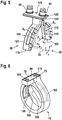
- FIG. 4 shows a side view of the fastener 50.
- the fastener 50 includes a first leg 115, a connection portion 120 and a second leg 125.
- the first leg 115 is connected at its fixed end 130 to a first side surface 135 of the attachment portion 120.
- the second leg 125 is with its fixed end 140 as well with the first side surface 135 of the Connecting portion 120 connected to the connection portion 120.
- the fixed end 130 of the first leg 115 in the transverse direction (y-axis) offset from the fixed end 140 of the second leg 125 is arranged.
- the legs 115, 125 are arranged at the same height.
- the fastening bolt 85, 90 is connected to the connection section 120.
- the attachment portion 120 is planar and exemplarily extends in an xy plane.
- the first leg 115 and the second leg 125 are formed in the embodiment, for example, to a symmetry plane 150 axisymmetric.
- the plane of symmetry 150 runs in an xy plane.
- the first leg 115 may be formed differently to the second leg 12.
- the first leg 115 has a first portion 155 and a second portion 160.
- the second section 160 adjoins the fixed end 130 of the first leg 115.
- the second section 160 is arranged between the first section 155 and the connection section 120.
- the second section 160 is planar and exemplarily extends in an xz-plane.
- the first section 155 runs on a circular path about the longitudinal axis 55.
- Other geometric configurations of the first section 155 are also conceivable.
- the first section 155 in the embodiment includes, for example, approximately a quarter-circle segment, so that a free end 165 of the first leg 115 ends approximately at the level of the longitudinal axis 55.
- a first thickness s 1 of the first leg 115 in the first section 155 decreases with increasing first distance a 1 from the connection section 120 to the free end 165 of the first leg 115.
- the first thickness s 1 is selected in the first section 155 such that when a first force F 1 acting on the first leg 115 acts in an at least partially yz-plane, for example during assembly of the unit 25 on the holder 15 first bending stress S 1 is substantially constant over the extent of the first portion 155.
- a second thickness s 2 of the second section 160 is constant, for example. Also, in the second portion 160 with increasing first distance a 1 to the connecting portion 120 toward the first portion 155 of the first leg 115, the second thickness s 2 of the first leg 115 decrease. As a result, in the second section 160, the first bending stress S 1 can be kept constant under load.
- the second leg 125 has a third section 171 and a fourth section 172.
- the fourth section 160 adjoins the fixed end 140 of the second leg 125.
- the fourth section 172 is arranged between the third section 171 and the connection section 120.
- the fourth section 172 is planar and extends transversely offset parallel to the second section 160.
- the third section 171 runs for example on a circular path about the longitudinal axis 55. Other geometric configurations of the third section 171 are conceivable.
- the third portion 171 in the embodiment includes, for example, about a quarter circle segment, wherein a free end 170 of the second leg 125 ends approximately at the level of the longitudinal axis 55. As a result, the legs 115, 125 together encompass approximately an angular segment of 180 °.
- the second and fourth sections 160, 172 have the same width in the z-direction.
- a third thickness s 3 of the second limb 125 in the third section 171 decreases with increasing second distance a 2 from the connection section 120 to the free end 170 of the second limb 125.
- the third thickness s 1 is selected in the third section 171 such that when a second force F 2 acting on the second leg 125 acts in an at least partially yz-plane, for example during assembly of the unit 25 on the holder 15, a second bending stress S 2 is substantially constant over the extension of the third portion 171.
- a fourth thickness s 4 of the fourth section 172 is constant. Also, in the fourth section 172, the fourth thickness s 4 of the second leg 125 may decrease as the second distance a 2 toward the connection section 120 increases towards the third section 171 of the second leg 125.
- the embodiment of the limb 115, 125 described above has the advantage that an expansion of the limb 115, 125 resulting from the force F 1 , F 2 and thus a resulting mechanical stress of the fastening element 50 is distributed over the entire limb 115, 125 and not locally on the legs 115, 125 acts.
- the entire structure of the fastener 50 is supporting and a predetermined breaking point is avoided on the fastener 50.
- FIG. 5 shows a perspective view of the in FIG. 4
- the first leg 115 has a first recess 175 and the second leg 125 has a second recess 180.
- the recess 175, 180 is formed by way of example trapezoidal and exemplified as a through hole in the legs 115, 125 formed. It would also be conceivable that the recess is formed as a recess in the legs 115, 125 and / or only one of the two legs 115, 125 has the recess 175, 180. Also can be dispensed with the recess 175, 180.
- the recess 175, 180 has in the direction of the free end 165, 170 of the leg 115, 125 an increasing cross-section.
- the recess 175, 180 may be geometrically different.
- the first recess 175 and the first section 155 of the first leg 115 are matched to one another such that when the first force F 1 is introduced into the first section 155, the first bending stress S 1 is constant over the extent of the first section 155.
- the second recess 180 and the third section 171 of the second leg 125 are advantageously matched to one another such that when the second force F 2 is introduced into the third section 171, the second bending stress S 2 is constant over the extent of the third section 171.
- the connecting portion 120, the first leg 115, the second leg 125 and the fastening bolt 85, 90 are formed in one piece and of uniform material. Particularly advantageous here is when the fastener 50 has a plastic, in particular a polyamide, as a material. Furthermore, it is advantageous if the fastening element 50 is produced by means of an injection molding process.
- At least one edge 173 of the fastener 50 preferably all the edges 173, are broken.
- the broken edge 173 may be rounded or chamfered.
- FIG. 6 shows a perspective view of the damping element 45.
- the damping element 45 is formed substantially annular and has a second receptacle 185.
- the second receptacle 185 has a first receiving portion 190, a second receiving portion 195 and a third receiving portion 200.
- the second receptacle 185 comprises a first outlet opening 205 and a second outlet opening 210.
- the first outlet opening 205 and the second outlet opening 210 are arranged adjacent to the depression 80 between the two contact surfaces 70, 75.
- the outlet opening 205, 210 is connected to the second receiving portion 195.
- first receiving portion 190 of the first leg 115 engages.
- first leg 115 in the first receiving portion 190 is completely encompassed by the first receiving portion 190, so that the first leg 115 is completely covered by a further material of the damping element 45.
- second receiving portion 195 of the connecting portion 120 engages.
- the second receiving section 195 completely surrounds the connecting section 120.
- the first fastening opening 205 carries the first fastening bolt 85 and the second fastening opening 90 guides the second fastening bolt 90.
- the third receiving portion 200 of the second leg engages 125, wherein the third receiving portion 200 completely surrounds the second leg 125, so that the second leg 125 is completely surrounded by the further material of the damping element 45.
- the holder 15 is produced by means of a two-component injection molding process. It is also conceivable that the fastening element 50 is produced in a first injection molding process and serves as a depositor in a second injection molding process, in which the fastening element 50 is encapsulated with the further material of the damping element 45. As a result, the holder 15 can be produced particularly inexpensively and easily. In particular, can be dispensed with a time-intensive use of a primer on the fastener 50 for cohesive connection of the fastener 50 with the damping element 45.
- EPDM ethylene-propylene-diene rubber
- the material of the fastener 50 has a lower elasticity than the other material of the damping element 45. This ensures that vibrations between the unit 25 and the mounting portion 20 are effectively damped by the damping element 45 and not on the bracket 15 between the Attachment section 20 and the unit 25 are transmitted. In this way, it is ensured that the unit 25 is mounted with low vibration and, on the other hand, that vibrations generated by the unit 25 are not transmitted to the attachment section 20.
- the broken edge 173 on the fastening element 50 further ensures that the fastening element 50 does not locally overstress the material of the damping element 45 and thereby tears the further material of the damping element 45.
- the recess 175, 180 ensures that the introduced during assembly of the unit 25 on the holder in the holder 15 stretching of the fastener 50 does not act locally, but the strain on the entire leg 115, 125 is distributed. This increases the load capacity of the Further, the recess 175, 180 provides a positive connection with the damping element 45 and thus reduces a shear stress on common surfaces between legs 115, 125 and damping element 45th
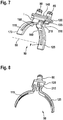
- FIG. 7 shows a perspective view of a development of the in the FIGS. 4 and 5
- the fastener 50 illustratively includes a first stiffening rib 215 and, for example, a second stiffening rib 220.
- the stiffening rib 215, 220 is disposed on the first side surface 135 of the attachment portion 120.
- the stiffening rib 215, 220 extends in the longitudinal direction (x-axis), for example, parallel to the longitudinal axis 55.
- the first stiffening rib 215 is connected to the second portion 160 of the first leg 115.
- the second stiffening rib 220 is longitudinally connected to the second portion 160 of the second leg 125.
- the reinforcing rib 215, 220 extends over at least 80 percent of a maximum longitudinal extent I of the connecting portion 120.
- This embodiment has the advantage that a moment of resistance of the connection section 120 is increased and so that the connection section 120 remains distortion-free and flat even under mechanical load. This prevents a bending of the connection portion 120 out of the plane, for example, due to thermal stresses during injection molding of the fastener 50 is avoided. This ensures that the first fastening bolt 85 is aligned parallel to the second fastening bolt 90 in the z-direction.
- FIG. 8 shows a perspective view of a development of in FIG. 7 illustrated fastener 50.
- the stiffening rib 215 is in the transverse direction is disposed between the first leg 115 and the second leg 125 and extends substantially over the entire longitudinal extent of the attachment portion 120th
- FIGS. 1 to 8 shown features can be combined with each other and / or can be dispensed with individual features.
Landscapes
- Engineering & Computer Science (AREA)
- General Engineering & Computer Science (AREA)
- Mechanical Engineering (AREA)
- Power Engineering (AREA)
- Physics & Mathematics (AREA)
- Acoustics & Sound (AREA)
- Aviation & Aerospace Engineering (AREA)
- Chemical & Material Sciences (AREA)
- Combustion & Propulsion (AREA)
- Vibration Prevention Devices (AREA)
- Clamps And Clips (AREA)
- Springs (AREA)
Abstract
Description
- Die Erfindung betrifft eine Halterung gemäß Patentanspruch 1.
- Aus der
DE 10 2011 085 558 A1 ist eine Halterung zum Befestigen eines Aggregats, insbesondere einer Pumpe an einem Kraftfahrzeug, mit einem ringförmigen Dämpfungselement, dessen Innenbereich zur Aufnahme des Aggregats vorgesehen ist und das außenseitig ein Befestigungselement aufweist, vom Zentrum des Dämpfungselements weg weisender Oberseite als Schnittstelle zum Kraftfahrzeug vorgesehen ist, bekannt. Im Dämpfungselement ist ein im Wesentlichen plattenförmiges Einlegeelement aus Metall angeordnet, das zur lokalen Versteifung des Dämpfungselements ausgelegt ist. Das Einlegeteil ist an zwei gegenüberliegenden Rändern mit jeweils einem in das Dämpfungselement hineinlaufenden Flügel ausgebildet. Die Flügel weisen eine konstante Dicke über ihre Länge auf. Dies führt zu einer unterschiedlichen Belastung des Einlegeteils, sodass die Gefahr eines mechanischen Bruchs am Übergang der Flügel zum plattenförmigen Einlegeteil besteht. - Es ist Aufgabe der Erfindung, eine verbesserte und langzeitstabile Halterung bereitzustellen.
- Diese Aufgabe wird mittels einer Halterung gemäß Patentanspruch 1 gelöst. Vorteilhafte Ausführungsformen sind in den abhängigen Ansprüchen angegeben.
- Es wurde erkannt, dass eine verbesserte Halterung für ein Aggregat, insbesondere einer Pumpe, an einem Kraftfahrzeug dadurch bereitgestellt werden kann, dass die Halterung ein Dämpfungselement und ein mit dem Dämpfungselement verbundenes Befestigungselement umfasst, wobei das Dämpfungselement mit dem Aggregat verbindbar ist, wobei das Befestigungselement wenigstens einen Schenkel und einen mit dem Schenkel verbundenen Anbindungsabschnitt umfasst, wobei der Schenkel ausgebildet ist, das Dämpfungselement zumindest abschnittsweise zu versteifen, wobei der Anbindungsabschnitt mit dem Kraftfahrzeug verbindbar ist, wobei mit zunehmendem Abstand zu dem Anbindungsabschnitt eine Dicke des Schenkels abnimmt.
- Diese Ausgestaltung hat den Vorteil, dass ein Einschneiden des Befestigungselements in einen Werkstoff des Dämpfungselements und eine mögliche Beschädigung des Dämpfungselements durch das Befestigungselement vermieden wird.
- In einer weiteren Ausführungsform ist die Dicke des Schenkels zumindest abschnittsweise derart gewählt, dass bei Einleitung einer Kraft in den Schenkel eine Biegespannung über zumindest einen Abschnitt des Schenkels konstant ist. Diese Ausgestaltung gewährleistet, dass bei Belastung des Befestigungselements, insbesondere bei Montage des Aggregats an der Halterung, eine lokale Überbelastung des Schenkels, die ggf. zu einem Bruch des Schenkels führen kann, vermieden wird. Dadurch ist die Halterung besonders langzeitstabil und kann zuverlässig das Aggregat am Kraftfahrzeug fixieren.
- In einer weiteren Ausführungsform weist das Befestigungselement einen weiteren Schenkel auf, wobei der weitere Schenkel mit dem Anbindungsabschnitt verbunden ist, wobei der Anbindungsabschnitt zwischen dem Schenkel und dem weiteren Schenkel angeordnet ist. Mit zunehmendem Abstand des weiteren Schenkels zu dem Anbindungsabschnitt nimmt eine Dicke des weiteren Schenkels ab. Auf diese Weise kann beidseitig das Dämpfungselement durch die beiden Schenkel versteift werden und zuverlässig eine Durchbiegung des Dämpfungselements beim Tragen des Aggregats vermieden werden. Ferner werden hohe Momente auf den Anbindungsabschnitt durch die gleichzeitige Anordnung der Schenkel am Anbindungsabschnitt vermieden.
- In einer weiteren Ausführungsform sind sind der Anbindungsabschnitt, der Schenkel und der weitere Schenkel einstückig und materialeinheitlich ausgebildet. Das Befestigungselement weist vorzugsweise einen Kunststoff, insbesondere ein Polyamid, als Werkstoff auf. Alternativ oder zusätzlich weist das Dämpfungselement einen weiteren Werkstoff auf, wobei der weitere Werkstoff vorzugsweise ein Elastomer aufweist. Alternativ oder zusätzlich weist der Werkstoff des Befestigungselements eine geringere Elastizität auf als der weitere Werkstoff des Dämpfungselements. Zusätzlich oder alternativ ist die Halterung mittels eines Spritzgussverfahrens, insbesondere eines Zwei-Komponenten-Spritzgussverfahrens hergestellt.
- In einer weiteren Ausführungsform ist das Dämpfungselement ringförmig um eine Längsachse sich erstreckend ausgebildet. Der Schenkel weist einen ersten Abschnitt auf. Der erste Abschnitt verläuft auf einer Kreisbahn um die Längsachse.
- In einer weiteren Ausführungsform umfasst der der Schenkel einen zweiten Abschnitt, wobei der zweite Abschnitt im Wesentlichen plan ausgebildet ist. Der zweite Abschnitt ist mit dem ersten Abschnitt und dem Anbindungsabschnitt verbunden und zwischen dem ersten Abschnitt und dem Anbindungsabschnitt angeordnet.
- In einer weiteren Ausführungsform umfasst der Schenkel eine Aussparung. Die Aussparung ist vorzugsweise trapezförmig ausgebildet. Die Aussparung weist in Richtung eines freien Endes des Schenkels einen zunehmenden Querschnitt auf. Dadurch kann zusätzlich gewährleistet werden, dass das Biegemoment in dem Schenkel über den Schenkel hinweg zum freien Ende hin konstant ist. Ferner wird eine zuverlässige formschlüssige Verbindung des Dämpfungselements und des Befestigungselements sicher gewährleistet.
- In einer weiteren Ausführungsform weist das Dämpfungselement eine Aufnahme mit einem Aufnahmeabschnitt auf. Der Aufnahmeabschnitt ist korrespondierend zu dem Schenkel ausgebildet, wobei der Aufnahmeabschnitt vollständig den Schenkel umgreift. Dadurch kann eine sichere Befestigung, insbesondere eine formschlüssige und/oder stoffschlüssige Verbindung zwischen dem Dämpfungselement und dem Schenkel sicher gewährleistet werden.
- In einer weiteren Ausführungsform ist der Anbindungsabschnitt plan ausgebildet. Der Schenkel ist an einer ersten Seitenfläche mit dem Anbindungsabschnitt verbunden. An der ersten Seitenfläche umfasst das Befestigungselement eine Versteifungsrippe. Die Versteifungsrippe ist mit dem Anbindungsabschnitt verbunden und erstreckt sich vorzugsweise über wenigstens 80 Prozent einer maximalen Längserstreckung des Anbindungsabschnitts. Dadurch wird gewährleistet, dass ein Verzug des Anbindungsabschnitts, insbesondere beim Aushärten des Anbindungsabschnitts nach dem Spritzgießen, vermieden wird. Dadurch wird sichergestellt, dass der Anbindungsabschnitt plan ist.
- In einer weiteren Ausführungsform ist die Versteifungsrippe mit dem zweiten Abschnitt des Schenkels verbunden. Dadurch wird ein besonders niedriger Materialverbrauch zur Herstellung des Befestigungselements mit der Versteifungsrippe sichergestellt. Zusätzlich oder alternativ ist die Versteifungsrippe in Querrichtung zwischen dem Schenkel und dem weiteren Schenkel angeordnet. Dadurch kann die Halterung besonders kompakt ausgebildet sein.
- In einer weiteren Ausführungsform umfasst das Befestigungselement wenigstens einen Befestigungsbolzen. Der Befestigungsbolzen ist mit dem Anbindungsabschnitt verbunden. Das Dämpfungselement weist eine erste Anlagefläche und eine zur ersten Anlagefläche beabstandet angeordnete zweite Anlagefläche auf. Zwischen der ersten Anlagefläche und der zweiten Anlagefläche ist der Befestigungsbolzen angeordnet. Auf diese Weise wird eine zuverlässige, gleichmäßige Belastung der Anlagefläche sichergestellt.
- In einer weiteren Ausführungsform weist die Halterung ein Eingriffselement auf. Der Befestigungsbolzen weist eine Nut auf. Der Befestigungsbolzen ist ausgebildet, einen Befestigungsabschnitt des Kraftfahrzeugs zu durchgreifen. Das Eingriffselement ist auf einer zum Dämpfungselement abgewandten Seite des Befestigungsabschnitts angeordnet und greift in die Nut ein, um den Befestigungsbolzen am Befestigungsabschnitt zu sichern. Ein Abstand zwischen der Nut und der Anlagefläche ist geringer als eine Dicke des Befestigungsabschnitts. Auf diese Weise wird sichergestellt, dass die Halterung kraftschlüssig mit dem Befestigungsabschnitt des Kraftfahrzeugs verbunden ist.
- In einer weiteren Ausführungsform weist das Befestigungselement zumindest eine gebrochene Kante auf. Vorzugsweise ist die gebrochene Kante verrundet oder angefast. Auf diese Weise wird sichergestellt, dass das Befestigungselement nicht in den weiteren Werkstoff des Dämpfungselements einschneidet und so frühzeitig das Dämpfungselement einreißt.
- Nachfolgend wird die Erfindung anhand von Figuren näher erläutert. Dabei zeigen:
- Figur 1
- eine perspektivische Ansicht eines Systems;
- Figur 2
- eine Explosionsdarstellung des in
Figur 1 gezeigten Systems; - Figur 3
- eine Schnittansicht entlang einer in
Figur 1 gezeigten Schnittebene A-A durch das inFigur 1 gezeigte System; - Figur 4
- eine Seitenansicht eines Befestigungselements der Halterung;
- Figur 5
- eine perspektivische Ansicht des in
Figur 4 gezeigten Befestigungselements; - Figur 6
- eine perspektivische Darstellung eines Dämpfungselements des in den
Figuren 1 und 2 gezeigten Systems; - Figur 7
- eine perspektivische Ansicht einer Weiterbildung des in den
Figuren 4 und5 gezeigten Befestigungselements; und - Figur 8
- eine perspektivische Ansicht einer weiteren Weiterbildung des in
Figur 7 gezeigten Befestigungselements. -
Figur 1 zeigt eine perspektivische Darstellung eines Systems 10. In den folgenden Figuren soll auf ein Koordinatensystem 30 Bezug genommen werden. Das Koordinatensystem 30 ist als Rechtssystem ausgebildet. Das Koordinatensystem 30 weist eine x-Achse (Längsrichtung), eine Y-Achse (Querrichtung) und eine z-Achse (Höhe) auf. Die x-Achse, die Y-Achse und die z-Achse schneiden sich in einem Ursprung 31. Das Koordinatensystem 30 kann selbstverständlich auch anders ausgebildet sein. Das Koordinatensystem 30 dient im Folgenden dazu, die Ausgestaltung des Systems 10 in den nachfolgenden Figuren besonders anschaulich zu erläutern. - Das System 10 umfasst eine Halterung 15, einen Befestigungsabschnitt 20 und ein Aggregat 25. Der Befestigungsabschnitt 20 kann beispielsweise ein Teil eines Kraftfahrzeugs, insbesondere eines Verbrennungsmotors oder einer Karosserie, sein. Das Aggregat 25 kann beispielsweise als Pumpe ausgebildet sein. Das Aggregat 25 ist beispielhaft abschnittsweise zylinderförmig ausgebildet und ist mittels der Halterung 15 mit dem Befestigungsabschnitt 20 verbunden.
-
Figur 2 zeigt eine Explosionsdarstellung des inFigur 1 gezeigten Systems 10. - Der Befestigungsabschnitt 20 ist beispielhaft plan ausgebildet. Der Befestigungsabschnitt 20 erstreckt sich beispielsweise in einer xy-Ebene und weist eine beispielhaft eine erste Durchgangsöffnung 35 und eine zweite Durchgangsöffnung 40 auf. Die erste Durchgangsöffnung 35 ist in Längsrichtung beabstandet zu der zweiten Durchgangsöffnung 40 angeordnet.
- Die Halterung 15 umfasst ein Dämpfungselement 45 und ein Befestigungselement 50. Das Dämpfungselement 45 verläuft abschnittsweise ringförmig um eine Längsachse 55, die vorzugsweise parallel zur x-Achse ausgerichtet ist, in der Ausführungsform beispielhaft auf der x-Achse angeordnet ist. Dabei weist das Dämpfungselement 45 eine erste Aufnahme 60 auf. Die erste Aufnahme 60 ist zylinderförmig ausgebildet und dient dazu, eine äußere Umfangsfläche 65 des Aggregats 25 zu umgreifen.
- Das Dämpfungselement 45 weist ferner eine erste Anlagefläche 70 und vorzugsweise eine zweite Anlagefläche 75 auf. Die erste Anlagefläche 70 und die zweite Anlagefläche 75 sind auf einer zum Befestigungsabschnitt 20 zugewandten Seite des Dämpfungselements 45 angeordnet und in Querrichtung beispielhaft beabstandet zueinander angeordnet. Mit der ersten und der zweiten Anlagefläche 70, 75 liegt das Dämpfungselement 45 an dem Befestigungsabschnitt 20 an. Der Befestigungsabschnitt 20 weist in z-Richtung eine Befestigungsabschnittsdicke d auf.
- Zwischen der ersten Anlagefläche 70 und der zweiten Anlagefläche 75 weist das Dämpfungselement 45 eine Vertiefung 80 auf. Die Vertiefung 80 ist gegenüber der ersten und/oder zweiten Anlagefläche 70, 75 in z-Richtung versetzt auf einer zum Befestigungsabschnitt 20 abgewandte Seite angeordnet. Die Vertiefung 80 ist beispielhaft nutförmig ausgebildet.
- Das Befestigungselement 50 weist beispielhaft einen ersten Befestigungsbolzen 85 und einen zweiten Befestigungsbolzen 90 auf. Der erste Befestigungsbolzen 85 ist der ersten Durchgangsöffnung 35 zugeordnet. Der zweite Befestigungsbolzen 90 ist der zweiten Durchgangsöffnung 40 zugeordnet. Der Befestigungsbolzen 85, 90 weist jeweils eine Nut 105, 110 auf. Die Nut 105, 110 weist in nicht montiertem Zustand des Systems 10 in z-Richtung einen Nutabstand a zur der Anlagefläche 70, 75 auf.
- Die Halterung 15 umfasst ferner ein erstes Eingriffselement 95 und beispielhaft ein zweites Eingriffselement 100. Das erste Eingriffselement 95 und das zweite Eingriffselement 100 sind in der Ausführungsform beispielhaft identisch ausgebildet. Das Eingriffselement 95, 100 ist beispielhaft U-förmig ausgebildet. Das Eingriffselement 95, 100 weist vorzugsweise Metall als Werkstoff auf.
-
Figur 3 zeigt einen Querschnitt entlang einer inFigur 1 gezeigten Schnittebene A-A durch das System 10. Das Eingriffselement 95, 100 ist auf einer zum Dämpfungselement 45 abgewandten Seite des Befestigungsabschnitts 20 angeordnet. Der erste Befestigungsbolzen 85 ist durch die erste Durchgangsöffnung 35 und der zweite Befestigungsbolzen 90 ist durch die zweite Durchgangsöffnung 40 geführt. Das erste Eingriffselement 95 greift in die erste Nut 105 ein und verbindet formschlüssig den ersten Befestigungsbolzen 85 mit dem Befestigungsabschnitt 20. Das zweite Eingriffselement 100 greift auf einer dem Dämpfungselement 45 abgewandten Seite des Befestigungsabschnitts 20 in die zweite Nut 110 ein und verbindet formschlüssig den zweiten Befestigungsbolzen 90 mit dem Befestigungsabschnitt 20. - Durch die U-förmige Ausgestaltung des Eingriffselements 95, 100 kann das Eingriffselement 95, 100 in Längsrichtung auf einfache Weise in die Nut 105, 110 aufgeschoben werden, sodass besonders schnell und kostengünstig die Halterung 15 mit dem Befestigungsabschnitt 20 verbunden werden kann.
- Besonders von Vorteil ist, wenn in unmontiertem Zustand der Halterung 15 der Nutabstand a kleiner ist als die Befestigungsabschnittsdicke d des Befestigungsabschnitts 20. Um das Eingriffselement 95, 100 zu montieren wird das Dämpfungselement 45 an der Anlagefläche 70, 75 gestaucht und vorgespannt. Dann wird das Eingriffselement 95, 100 in die Nut 105, 110 eingeschoben. Die Vorspannung wird in montiertem Zustand durch die Wahl dass der Nutabstand a kleiner ist als die Befestigungsabschnittsdicke d zumindest teilweise aufrecht erhalten, sodass die Halterung 15 zusätzlich kraftschlüssig mit dem Befestigungsabschnitt 20 verbunden ist. Dadurch kann Toleranzausgleich zwischen Halterung 15 und Befestigungsabschnitt 20 bereitgestellt werden. Ferner wird das Eingriffselement 95, 100 in der Nut 105, 110 in z-Richtung belastet, sodass ein unbeabsichtigtes Lösen des Eingriffselement 95, 100 aus der Nut 105, 110 verhindert wird.
-
Figur 4 zeigt eine Seitenansicht des Befestigungselements 50. Das Befestigungselement 50 umfasst einen ersten Schenkel 115, einen Anbindungsabschnitt 120 und einen zweiten Schenkel 125. Der erste Schenkel 115 ist mit seinem festen Ende 130 mit einer ersten Seitenfläche 135 des Anbindungsabschnitts 120 verbunden. Der zweite Schenkel 125 ist mit seinem festen Ende 140 ebenso mit der ersten Seitenfläche 135 des Anbindungsabschnitts 120 mit dem Anbindungsabschnitt 120 verbunden. Dabei ist das feste Ende 130 des ersten Schenkels 115 in Querrichtung (y-Achse) versetzt zu dem festen Ende 140 des zweiten Schenkels 125 angeordnet. In Längsrichtung sind die Schenkel 115, 125 auf gleicher Höhe angeordnet. Auf einer zur ersten Seitenfläche 135 gegenüberliegenden zweiten Seitenfläche 145 ist der Befestigungsbolzen 85, 90 mit dem Anbindungsabschnitt 120 verbunden. Der Anbindungsabschnitt 120 ist plan ausgebildet und erstreckt sich beispielhaft in einer xy-Ebene. - Der erste Schenkel 115 und der zweite Schenkel 125 sind in der Ausführungsform beispielhaft zu einer Symmetrieebene 150 achsensymmetrisch ausgebildet. Die Symmetrieebene 150 verläuft dabei in einer xy-Ebene. Selbstverständlich kann der erste Schenkel 115 auch andersartig zum zweiten Schenkel 12 ausgebildet sein.
- Der erste Schenkel 115 weist einen ersten Abschnitt 155 und einen zweiten Abschnitt 160 auf. Der zweite Abschnitt 160 grenzt dabei an das feste Ende 130 des ersten Schenkels 115 an. Der zweite Abschnitt 160 ist dabei zwischen dem ersten Abschnitt 155 und dem Anbindungsabschnitt 120 angeordnet. Der zweite Abschnitt 160 ist plan ausgebildet und erstreckt sich beispielhaft in einer xz-Ebene. Der erste Abschnitt 155 verläuft beispielhaft auf einer Kreisbahn um die Längsachse 55. Auch sind andere geometrische Ausgestaltungen des ersten Abschnitts 155 denkbar. Der erste Abschnitt 155 schließt in der Ausführungsform beispielhaft etwa ein Viertelkreissegment ein, sodass ein freies Ende 165 des ersten Schenkels 115 etwa auf Höhe der Längsachse 55 endet. Im ersten Abschnitt 155 nimmt eine erste Dicke s1 des ersten Schenkels 115 im ersten Abschnitt 155 mit zunehmendem ersten Abstand a1 vom Anbindungsabschnitt 120 hin zum freien Ende 165 des ersten Schenkels 115 ab. Die erste Dicke s1 ist im ersten Abschnitt 155 derart gewählt, dass bei Wirken einer in einer zumindest teilweise in einer yz-Ebene wirkenden ersten Kraft F1 auf den ersten Schenkel 115, z.B. bei einer Montage des Aggregats 25 an der Halterung 15, eine erste Biegespannung S1 im Wesentlichen konstant über die Erstreckung des ersten Abschnitts 155 ist.
- Im zweiten Abschnitt 160 ist eine zweite Dicke s2 des zweiten Abschnitts 160 beispielsweise konstant. Auch kann im zweiten Abschnitt 160 mit zunehmendem ersten Abstand a1 zum Anbindungsabschnitt 120 hin zum ersten Abschnitt 155 des ersten Schenkels 115 die zweite Dicke s2 des ersten Schenkels 115 abnehmen. Dadurch kann auch im zweiten Abschnitt 160 die erste Biegespannung S1 bei Belastung konstant gehalten werden.
- Der zweite Schenkel 125 weist einen dritten Abschnitt 171 und einen vierten Abschnitt 172 auf. Der vierte Abschnitt 160 grenzt dabei an das feste Ende 140 des zweiten Schenkels 125 an. Der vierte Abschnitt 172 ist dabei zwischen dem dritten Abschnitt 171 und dem Anbindungsabschnitt 120 angeordnet. Der vierte Abschnitt 172 ist plan ausgebildet und erstreckt sich in Querrichtung versetzt parallel zu dem zweiten Abschnitt 160. Der dritte Abschnitt 171 verläuft beispielhaft auf einer Kreisbahn um die Längsachse 55. Auch sind andere geometrische Ausgestaltungen des dritten Abschnitts 171 denkbar. Der dritte Abschnitt 171 schließt in der Ausführungsform beispielhaft etwa ein Viertelkreissegment ein, wobei ein freies Ende 170 des zweiten Schenkels 125 etwa auf Höhe der Längsachse 55 endet. Dadurch umgreifen die Schenkel 115, 125 zusammen etwa ein Winkelsegment von 180°. Der zweite und vierte Abschnitt 160, 172 sind in z-Richtung gleich breit ausgebildet.
- Im dritten Abschnitt 171 nimmt eine dritte Dicke s3 des zweiten Schenkels 125 im dritten Abschnitt 171 mit zunehmendem zweiten Abstand a2 vom Anbindungsabschnitt 120 hin zum freien Ende 170 des zweiten Schenkels 125 ab. Die dritte Dicke s1 ist im dritten Abschnitt 171 derart gewählt, dass bei Wirken einer in einer zumindest teilweise in einer yz-Ebene wirkenden zweiten Kraft F2 auf den zweiten Schenkel 125, z.B. bei einer Montage des Aggregats 25 an der Halterung 15, eine zweite Biegespannung S2 im Wesentlichen konstant über die Erstreckung des dritten Abschnitts 171 ist.
- Im vierten Abschnitt 172 ist eine vierte Dicke s4 des vierten Abschnitts 172 beispielsweise konstant. Auch kann im vierten Abschnitt 172 mit zunehmendem zweiten Abstand a2 zum Anbindungsabschnitt 120 hin zum dritten Abschnitt 171 des zweiten Schenkels 125 die vierte Dicke s4 des zweiten Schenkels 125 abnehmen.
- Die oben beschriebene Ausgestaltung des Schenkels 115, 125 hat den Vorteil, dass eine aus der Kraft F1, F2 resultierende Dehnung des Schenkels 115, 125 und damit eine resultierende mechanische Spannung des Befestigungselements 50 auf den gesamten Schenkel 115, 125 verteilt ist und nicht lokal auf den Schenkel 115, 125 wirkt. Somit wirkt die gesamte Struktur des Befestigungselements 50 tragend und eine Sollbruchstelle wird am Befestigungselement 50 vermieden.
- Dies hat den Vorteil, dass das Aggregat 25 zuverlässig am Befestigungsabschnitt 20 befestigt ist und eine Auslenkung des Aggregats 25, beispielsweise während einer Montage, beispielsweise insbesondere einer Montage von Schläuchen, insbesondere beispielsweise von Kühlschläuchen oder im Betrieb des Aggregats 25, stark begrenzt ist.
-
Figur 5 zeigt eine perspektivische Ansicht des inFigur 4 gezeigten Befestigungselements 50. Der erste Schenkel 115 weist eine erste Aussparung 175 und der zweite Schenkel 125 weist eine zweite Aussparung 180 auf. Die Aussparung 175, 180 ist beispielhaft trapezförmig ausgebildet und beispielhaft als Durchgangsöffnung in dem Schenkel 115, 125 ausgebildet. Auch wäre denkbar, dass die Aussparung als Einbuchtung in dem Schenkel 115, 125 ausgebildet ist und/oder nur einer der beiden Schenkel 115, 125 die Aussparung 175, 180 aufweist. Auch kann auf die Aussparung 175, 180 verzichtet werden. Die Aussparung 175, 180 weist in Richtung des freien Endes 165, 170 des Schenkels 115, 125 einen zunehmenden Querschnitt auf. Auch kann die Aussparung 175, 180 geometrisch andersartig ausgebildet sein. In der Ausführungsform ist die erste Aussparung 175 und der erste Abschnitt 155 des ersten Schenkels 115 derart aufeinander abgestimmt, dass bei Einleitung der ersten Kraft F1 in den ersten Abschnitt 155 die erste Biegespannung S1 über die Erstreckung des ersten Abschnitts 155 konstant ist. Ebenso ist vorteilhafterweise die zweite Aussparung 180 und der dritte Abschnitt 171 des zweiten Schenkels 125 derart aufeinander abgestimmt, dass bei Einleitung der zweiten Kraft F2 in den dritten Abschnitt 171 die zweite Biegespannung S2 über die Erstreckung des dritten Abschnitts 171 konstant ist. - In der Ausführungsform sind der Anbindungsabschnitt 120, der erste Schenkel 115, der zweite Schenkel 125 und der Befestigungsbolzen 85, 90 einstückig und materialeinheitlich ausgebildet. Besonders von Vorteil ist hierbei, wenn das Befestigungselement 50 einen Kunststoff, insbesondere einen Polyamid, als Werkstoff aufweist. Ferner ist von Vorteil, wenn das Befestigungselement 50 mittels eines Spritzgussverfahrens hergestellt wird.
- Des Weiteren sind in der Ausführungsform ist wenigstens eine Kante 173 des Befestigungselements 50, vorzugsweise alle Kanten 173 gebrochen. Die gebrochene Kante 173 kann dabei verrundet oder angefast sein. Diese Ausgestaltung hat den Vorteil, dass das Befestigungselement 50 aus einer Spritzgussform besonders leicht entformt werden kann.
-
Figur 6 zeigt eine perspektivische Darstellung des Dämpfungselements 45. Das Dämpfungselement 45 ist im Wesentlichen ringförmig ausgebildet und weist eine zweite Aufnahme 185 auf. Die zweite Aufnahme 185 weist einen ersten Aufnahmeabschnitt 190, einen zweiten Aufnahmeabschnitt 195 und einen dritten Aufnahmeabschnitt 200 auf. Ferner umfasst die zweite Aufnahme 185 eine erste Austrittsöffnung 205 und eine zweite Austrittsöffnung 210. Die erste Austrittsöffnung 205 und die zweite Austrittsöffnung 210 sind angrenzend an die Vertiefung 80 zwischen den beiden Anlageflächen 70, 75 angeordnet. Die Austrittsöffnung 205, 210 ist mit dem zweiten Aufnahmeabschnitt 195 verbunden. - In den ersten Aufnahmeabschnitt 190 greift der erste Schenkel 115 ein. Dabei wird der erste Schenkel 115 in dem ersten Aufnahmeabschnitt 190 vollständig von dem ersten Aufnahmeabschnitt 190 umgriffen, sodass der erste Schenkel 115 vollständig durch einen weiteren Werkstoff des Dämpfungselements 45 überdeckt ist. In den zweiten Aufnahmeabschnitt 195 greift der der Anbindungsabschnitt 120 ein. Dabei umgreift der zweite Aufnahmeabschnitt 195 in der Ausführungsform vollständig den Anbindungsabschnitt 120. Durch die erste Austrittsöffnung 205 ist der erste Befestigungsbolzen 85 und durch die zweite Austrittsöffnung 210 der zweite Befestigungsbolzen 90 geführt. In den dritten Aufnahmeabschnitt 200 greift der zweite Schenkel 125 ein, wobei der dritte Aufnahmeabschnitt 200 vollständig den zweiten Schenkel 125 umgreift, sodass der zweite Schenkel 125 vollständig durch den weiteren Werkstoff des Dämpfungselements 45 umgeben ist.
- Von besonderem Vorteil ist hierbei, wenn ein Elastomer, vorzugsweise insbesondere einen Ethylen-Propylen-Dien-Kautschuk (EPDM) aufweist. Von besonderem Vorteil ist, wenn die Halterung 15 mittels eines Zwei-Komponenten-Spritzgussverfahrens hergestellt wird. Auch ist denkbar, dass das Befestigungselement 50 in einem ersten Spritzgussverfahren hergestellt wird und in einem zweiten Spritzgussverfahren als Einleger dient, bei dem das Befestigungselement 50 mit dem weiteren Werkstoff des Dämpfungselements 45 umspritzt wird. Dadurch kann die Halterung 15 besonders kostengünstig und einfach hergestellt werden. Insbesondere kann dabei auf einen zeitintensiven Einsatz von einem Primer am Befestigungselement 50 zur stoffschlüssigen Verbindung des Befestigungselements 50 mit dem Dämpfungselement 45 verzichtet werden.
- In der Ausführungsform weist der Werkstoff des Befestigungselements 50 eine geringere Elastizität auf als der weitere Werkstoff des Dämpfungselements 45. Dadurch wird sichergestellt, dass Schwingungen zwischen dem Aggregat 25 und dem Befestigungsabschnitt 20 wirksam durch das Dämpfungselement 45 gedämpft werden und nicht über die Halterung 15 zwischen dem Befestigungsabschnitt 20 und dem Aggregat 25 übertragen werden. Auf diese Weise wird sichergestellt, dass das Aggregat 25 schwingungsarm gelagert wird und zum anderen vom Aggregat 25 erzeugte Schwingungen nicht an den Befestigungsabschnitt 20 übertragen werden.
- Durch die gebrochene Kante 173 am Befestigungselement 50 wird ferner gewährleistet, dass das Befestigungselement 50 nicht den Werkstoff des Dämpfungselements 45 lokal überbeansprucht und der weitere Werkstoff des Dämpfungselements 45 dadurch einreißt.
- Durch die Aussparung 175, 180 wird sichergestellt, dass die bei der Montage des Aggregats 25 am Halter in die Halterung 15 eingebrachte Dehnung des Befestigungselements 50 nicht lokal wirkt, sondern die Dehnung auf den gesamten Schenkel 115, 125 verteilt wird. Dies erhöht die Belastbarkeit des Befestigungselements 50 und sorgt für eine fehlerfreie Funktion der Halterung 15. Ferner bietet die Aussparung 175, 180 eine formschlüssige Verbindung mit dem Dämpfungselement 45 und reduziert somit eine Scherspannung an gemeinsamen Oberflächen zwischen Schenkel 115, 125 und Dämpfungselement 45.
-
Figur 7 zeigt eine perspektivische Ansicht einer Weiterbildung des in denFiguren 4 und5 gezeigten Befestigungselements 50. Das Befestigungselement 50 umfasst beispielhaft eine erste Versteifungsrippe 215 und beispielsweise eine zweite Versteifungsrippe 220. Die Versteifungsrippe 215, 220 ist an der ersten Seitenfläche 135 des Anbindungsabschnitts 120 angeordnet. Die Versteifungsrippe 215, 220 erstreckt sich in Längsrichtung (x-Achse) beispielhaft parallel zur Längsachse 55. In der Ausführungsform ist die erste Versteifungsrippe 215 mit dem zweiten Abschnitt 160 des ersten Schenkels 115 verbunden. Ferner ist die zweite Versteifungsrippe 220 in Längsrichtung mit dem zweiten Abschnitt 160 des zweiten Schenkels 125 verbunden. Besonders von Vorteil ist hierbei, wenn sich die Versteifungsrippe 215, 220 über wenigstens 80 Prozent einer maximalen Längserstreckung I des Anbindungsabschnitts 120 erstreckt. Diese Ausgestaltung hat den Vorteil, dass ein Widerstandsmoment des Anbindungsabschnitts 120 erhöht ist und sodass auch bei mechanischer Belastung der Anbindungsabschnitt 120 verzugsfrei und plan bleibt. Dadurch wird verhindert, dass ein Verbiegen des Anbindungsabschnitts 120 aus der Ebene heraus beispielsweise auf Grund thermischer Spannungen beim Spritzgießen des Befestigungselements 50 vermieden wird. Somit ist sichergestellt, dass der erste Befestigungsbolzen 85 parallel zum zweiten Befestigungsbolzen 90 in z-Richtung ausgerichtet ist.
Dadurch kann sicher gewährleistet werden, dass der Befestigungsbolzen 85, 90 durch die Durchgangsöffnung 35, 40 bei der Montage der Halterung 15 am Befestigungsabschnitt 20 geführt werden kann. Ferner wird vermieden, dass der Befestigungsbolzen 85, 90 im Betriebszustand einseitig belastet wird und das Befestigungselement 50 frühzeitig mechanisch versagt. -
Figur 8 zeigt eine perspektivische Ansicht einer Weiterbildung des inFigur 7 erläuterten Befestigungselements 50. In der Ausführungsform ist nur eine Versteifungsrippe 215 vorgesehen. Die Versteifungsrippe 215 ist in Querrichtung zwischen dem ersten Schenkel 115 und dem zweiten Schenkel 125 angeordnet und erstreckt sich im Wesentlichen über die gesamte Längserstreckung des Anbindungsabschnitts 120. - Es wird darauf hingewiesen dass die in den
Figuren 1 bis 8 gezeigten Merkmale miteinander kombiniert werden können und/oder auf einzelne Merkmale verzichtet werden kann.
Claims (13)
- Halterung (15) zum Befestigen eines Aggregats (25), insbesondere einer Pumpe, an einem Kraftfahrzeug (20)- mit einem Dämpfungselement (45) und einem mit dem Dämpfungselement (45) verbundenen Befestigungselement (50),- wobei das Dämpfungselement (45) mit dem Aggregat (25) verbindbar ist,- wobei das Befestigungselement (50) wenigstens einen Schenkel (115, 125) und einen mit dem Schenkel (115, 125) verbundenen Anbindungsabschnitt (120) umfasst,- wobei der Schenkel (115, 125) ausgebildet ist, das Dämpfungselement (45) zumindest abschnittsweise zu versteifen,- wobei der Anbindungsabschnitt (120) mit dem Kraftfahrzeug (20) verbindbar ist,- wobei mit zunehmendem Abstand (a1, a2) zu dem Anbindungsabschnitt (120) eine Dicke (s1, s2, s3, s4) des Schenkels (115, 125) abnimmt.
- Halterung (15) nach Anspruch 1,- wobei die Dicke (s1, s2, s3, s4) des Schenkels (115, 125) zumindest abschnittsweise derart gewählt ist, dass bei Einleitung einer Kraft (F1, F2) in den Schenkel (115, 125) eine Biegespannung (S1, S2) über zumindest einen Abschnitt (155, 171) des Schenkels (115, 125) konstant ist.
- Halterung (15) nach Anspruch 1 oder 2,- wobei das Befestigungselement (50) einen weiteren Schenkel (125) aufweist,- wobei der weitere Schenkel (125) mit dem Anbindungsabschnitt (120) verbunden ist,- wobei der Anbindungsabschnitt (120) zwischen dem Schenkel (115) und dem weiteren Schenkel (125) angeordnet ist,- wobei mit zunehmendem Abstand des weiteren Schenkels (125) zu dem Anbindungsabschnitt (120) eine Dicke (s3, s4) des weiteren Schenkels (125) abnimmt.
- Halterung (15) nach Anspruch 3,- wobei der Anbindungsabschnitt (120), der Schenkel (115) und der weitere Schenkel (125) einstückig und materialeinheitlich ausgebildet ist sind, wobei das Befestigungselement (50) wenigstens Kunststoff, insbesondere ein Polymanid, als Werkstoff aufweist,- und/oder- wobei vorzugsweise das Dämpfungselement (45) einen weiteren Werkstoff aufweist,- wobei der weitere Werkstoff vorzugsweise ein Elastomer aufweist,- und/oder- wobei der Werkstoff des Befestigungselements (50) eine geringere Elastizität aufweist als der weitere Werkstoff des Dämpfungselements (45)- und/oder wobei die Halterung (15) mittels eines Spritzgussverfahrens, insbesondere eines Zwei-Komponenten-Spritzgussverfahrens, hergestellt ist.
- Halterung (15) nach Anspruch einem der vorhergehenden Ansprüche,- wobei das Dämpfungselement (45) ringförmig um eine Längsachse (55) sich erstreckt,- wobei der Schenkel (115, 125) einen ersten Abschnitt (155, 171) aufweist,- wobei der erste Abschnitt (155, 171) auf einer Kreisbahn um die Längsachse (55) verläuft.
- Halterung (15) nach Anspruch 5,- wobei der Schenkel (115, 125) einen zweiten Abschnitt (160, 172) umfasst,- wobei der zweite Abschnitt (160, 172) im Wesentlichen plan ausgebildet ist,- wobei der zweite Abschnitt (160, 172) mit dem ersten Abschnitt (155, 171) und dem Anbindungsabschnitt (120) verbunden und zwischen dem ersten Abschnitt (155, 171) und dem Anbindungsabschnitt (120) angeordnet ist.
- Halterung (15) nach einem der vorhergehenden Ansprüche,- wobei der Schenkel (115, 125) eine Aussparung (175, 180) aufweist,- wobei die Aussparung (175, 180) vorzugsweise trapezförmig ausgebildet ist,- wobei die Aussparung (175, 180) in Richtung eines freien Ende (165, 170) des Schenkels (115, 125) einen zunehmenden Querschnitt aufweist.
- Halterung (15)nach einem der vorhergehenden Ansprüche,- wobei das Dämpfungselement (45) eine Aufnahme (60, 185) mit einem Aufnahmeabschnitt (190, 195, 200) umfasst,- wobei der Aufnahmeabschnitt (190, 195, 200) korrespondierend zu dem Schenkel (115, 125) ausgebildet ist,- wobei der Aufnahmeabschnitt (190, 195, 200) vollständig den Schenkel (115, 125) umgreift.
- Halterung (15) nach einem der vorhergehenden Ansprüche,- wobei der Anbindungsabschnitt (120) plan ausgebildet ist,- wobei der Schenkel (115, 125) an einer ersten Seitenfläche (135) mit dem Anbindungsabschnitt (120) verbunden ist,- wobei an der ersten Seitenfläche (135) das Befestigungselement (50) eine Versteifungsrippe (215, 220) umfasst,- wobei die Versteifungsrippe (215, 220) mit dem Anbindungsabschnitt (120) verbunden ist und sich vorzugsweise über wenigstens 80 Prozent einer maximalen Längserstreckung des Anbindungsabschnitts (120) erstreckt.
- Halterung (15) nach Anspruch 9,- wobei die Versteifungsrippe (215, 220) mit dem zweiten Abschnitt (160, 172) des Schenkels (115, 125) verbunden ist,- und/oder- wobei die Versteifungsrippe (215, 220) in Querrichtung zwischen dem Schenkel (115) und dem weiteren Schenkel (125) angeordnet ist.
- Halterung (15) nach einem vorhergehenden Ansprüche,- wobei das Befestigungselement (50) wenigstens einen Befestigungsbolzen (85, 90) umfasst,- wobei der Befestigungsbolzen (85, 90) mit dem Anbindungsabschnitt (120) verbunden ist,- wobei das Dämpfungselement (45) eine erste Anlagefläche (70) und eine zur ersten Anlagefläche (70) beabstandet angeordnete zweite Anlagefläche (75) aufweist,- wobei zwischen der ersten Anlagefläche (70) und der zweiten Anlagefläche (75) der Befestigungsbolzen (85, 90) angeordnet ist.
- Halterung (15) nach Anspruch 11,- aufweisend ein Eingriffselement (95, 100), wobei der Befestigungsbolzen (85, 90) eine Nut (105, 110) aufweist,- wobei der Befestigungsbolzen (85, 90) ausgebildet ist, einen Befestigungsabschnitt (20) des Kraftfahrzeugs zu durchgreifen,- wobei das Eingriffselement (95, 100) auf einer zum Dämpfungselement (45) abgewandten Seite des Befestigungsabschnitts (20) angeordnet ist und in die Nut (105, 110) eingreift, um den Befestigungsbolzen (85, 90) am Befestigungsabschnitt (20) zu sichern,- wobei ein Abstand zwischen der Nut (105, 110) und der Anlagefläche (70, 75) geringer ist als eine Dicke (d) des Befestigungsabschnitts (20).
- Halterung (15) nach einem vorgehenden Ansprüche,- wobei das Befestigungselement (50) zumindest eine gebrochene Kante aufweist,- wobei vorzugsweise die gebrochene Kante verrundet oder angefast ist.
Applications Claiming Priority (1)
| Application Number | Priority Date | Filing Date | Title |
|---|---|---|---|
| DE102016201560.5A DE102016201560B4 (de) | 2016-02-02 | 2016-02-02 | Halterung zur Befestigung eines Aggregats, insbesondere einer Pumpe, an einem Kraftfahrzeug |
Publications (2)
| Publication Number | Publication Date |
|---|---|
| EP3203104A1 true EP3203104A1 (de) | 2017-08-09 |
| EP3203104B1 EP3203104B1 (de) | 2021-12-08 |
Family
ID=57821852
Family Applications (1)
| Application Number | Title | Priority Date | Filing Date |
|---|---|---|---|
| EP17151583.6A Active EP3203104B1 (de) | 2016-02-02 | 2017-01-16 | Halterung zur befestigung eines aggregats, insbesondere einer pumpe, an einem kraftfahrzeug |
Country Status (5)
| Country | Link |
|---|---|
| US (1) | US9994161B2 (de) |
| EP (1) | EP3203104B1 (de) |
| JP (1) | JP6851209B2 (de) |
| CN (1) | CN107131412B (de) |
| DE (1) | DE102016201560B4 (de) |
Cited By (1)
| Publication number | Priority date | Publication date | Assignee | Title |
|---|---|---|---|---|
| FR3119568A1 (fr) * | 2021-02-11 | 2022-08-12 | Psa Automobiles Sa | Ensemble a support de pompe et ecran thermique pour un moteur thermique |
Families Citing this family (7)
| Publication number | Priority date | Publication date | Assignee | Title |
|---|---|---|---|---|
| DE102016209204A1 (de) * | 2016-05-27 | 2017-11-30 | Robert Bosch Gmbh | Vorrichtung zur Regelung mindestens eines Fluidstroms in einem Fahrzeug |
| US10131222B1 (en) * | 2017-05-05 | 2018-11-20 | Toyota Motor Engineering & Manufacturing North America, Inc. | Snorkel roof drip attachment |
| JP6499734B2 (ja) | 2017-08-24 | 2019-04-10 | ファナック株式会社 | 取付構造および冷却ファン |
| EP3785961B1 (de) * | 2019-08-26 | 2025-10-15 | Vibracoustic Nantes SAS | Halterung zur lagerung eines elektromotors und verfahren zur herstellung solch einer halterung |
| US12184152B1 (en) * | 2021-01-11 | 2024-12-31 | Hydro-Gear Limited Partnership | Vibration damping apparatus for mounting an electric actuator on a hydraulic drive |
| DE102021106098B3 (de) * | 2021-03-12 | 2022-05-25 | Bühler Motor GmbH | Halterung zur Befestigung einer Pumpe |
| JP7736175B2 (ja) * | 2022-04-04 | 2025-09-09 | 株式会社アイシン | 電動ポンプ |
Citations (3)
| Publication number | Priority date | Publication date | Assignee | Title |
|---|---|---|---|---|
| DE2526061A1 (de) * | 1974-06-13 | 1975-12-18 | Pneumatiques Caoutchouc Mfg | Stossdaempfer fuer fender |
| JPS62274123A (ja) * | 1986-05-21 | 1987-11-28 | Suzuki Motor Co Ltd | 弾性支持体 |
| DE102011085558A1 (de) | 2011-11-02 | 2013-05-02 | Robert Bosch Gmbh | Halterung zur Befestigung eines Aggregats, insbesondere einer Pumpe, an einem Kraftfahrzeug |
Family Cites Families (20)
| Publication number | Priority date | Publication date | Assignee | Title |
|---|---|---|---|---|
| US3012743A (en) * | 1959-10-05 | 1961-12-12 | Jenkins Orville | Motor mounting ring |
| DE2933586C2 (de) * | 1979-08-18 | 1982-11-18 | Goetze Ag, 5093 Burscheid | Schwingungstilger für rotierende Wellen |
| SE467635B (sv) * | 1988-09-30 | 1992-08-17 | Electrolux Ab | Vibrationsdaempare i motorsaag |
| JPH051666Y2 (de) * | 1989-02-20 | 1993-01-18 | ||
| US5113104A (en) * | 1989-10-19 | 1992-05-12 | General Electric Company | Structured product dynamoelectric machine |
| US5397950A (en) * | 1993-12-23 | 1995-03-14 | Cary Products Co., Inc. | Isolation motor mount and gasket |
| EP0696833B1 (de) * | 1994-08-08 | 1998-04-08 | Siemens Aktiengesellschaft | Geräuschdämpfende Motorbefestigung, insbesondere für elektrische Stellantriebe in Kraftfahrzeugen |
| DE19713461C2 (de) * | 1996-03-20 | 1999-02-11 | Henniges Elastomer Kunststoff | Elastomeres Federelement |
| JPH11241744A (ja) * | 1998-02-26 | 1999-09-07 | Mitsubishi Eng Plast Corp | 樹脂製ばね及び樹脂製ばね組立体 |
| JP2002181101A (ja) * | 2000-12-18 | 2002-06-26 | Maruyasu Industries Co Ltd | ブラケットリング |
| JP2004242478A (ja) * | 2003-02-10 | 2004-08-26 | Nippon Pop Rivets & Fasteners Ltd | ケーブルクランプ |
| US20050023912A1 (en) * | 2003-07-28 | 2005-02-03 | A.O. Smith Corporation | Electric motor for hydromassage bathtubs |
| DE202004017501U1 (de) * | 2004-11-11 | 2005-01-05 | Kirchhoff Gmbh & Co.Kg | Vorrichtung zur Verbindung zweier Abgas führender Rohre |
| US20070035073A1 (en) * | 2005-08-10 | 2007-02-15 | Kinmartin Jeffrey C | Isolation for electric motor |
| JP5074935B2 (ja) * | 2008-01-21 | 2012-11-14 | 日本電産セイミツ株式会社 | 振動モータ |
| DE102009029067A1 (de) * | 2009-09-01 | 2011-03-03 | Robert Bosch Gmbh | Halterung zur Befestigung eines Aggregats |
| US8714943B2 (en) * | 2010-09-29 | 2014-05-06 | Halla Visteon Climate Control Corporation | Mounting and damping system for a compressor |
| JP5836781B2 (ja) * | 2011-12-06 | 2015-12-24 | 株式会社ブリヂストン | 防振装置 |
| JP5967800B2 (ja) * | 2012-01-31 | 2016-08-10 | ミネベア株式会社 | フレキシブルプリント基板のホルダを備えるモータ及びそのモータを用いたアクチュエータ |
| KR101339261B1 (ko) * | 2012-10-16 | 2013-12-09 | 기아자동차 주식회사 | 차량용 트랜스미션 마운팅 유닛 |
-
2016
- 2016-02-02 DE DE102016201560.5A patent/DE102016201560B4/de not_active Expired - Fee Related
- 2016-05-26 US US15/165,229 patent/US9994161B2/en active Active
-
2017
- 2017-01-16 EP EP17151583.6A patent/EP3203104B1/de active Active
- 2017-01-26 CN CN201710349987.1A patent/CN107131412B/zh active Active
- 2017-02-02 JP JP2017017573A patent/JP6851209B2/ja active Active
Patent Citations (3)
| Publication number | Priority date | Publication date | Assignee | Title |
|---|---|---|---|---|
| DE2526061A1 (de) * | 1974-06-13 | 1975-12-18 | Pneumatiques Caoutchouc Mfg | Stossdaempfer fuer fender |
| JPS62274123A (ja) * | 1986-05-21 | 1987-11-28 | Suzuki Motor Co Ltd | 弾性支持体 |
| DE102011085558A1 (de) | 2011-11-02 | 2013-05-02 | Robert Bosch Gmbh | Halterung zur Befestigung eines Aggregats, insbesondere einer Pumpe, an einem Kraftfahrzeug |
Cited By (2)
| Publication number | Priority date | Publication date | Assignee | Title |
|---|---|---|---|---|
| FR3119568A1 (fr) * | 2021-02-11 | 2022-08-12 | Psa Automobiles Sa | Ensemble a support de pompe et ecran thermique pour un moteur thermique |
| WO2022171939A1 (fr) * | 2021-02-11 | 2022-08-18 | Psa Automobiles Sa | Ensemble a support de pompe et ecran thermique pour un moteur thermique |
Also Published As
| Publication number | Publication date |
|---|---|
| CN107131412A (zh) | 2017-09-05 |
| US20170217380A1 (en) | 2017-08-03 |
| DE102016201560A1 (de) | 2017-08-03 |
| EP3203104B1 (de) | 2021-12-08 |
| DE102016201560B4 (de) | 2024-02-01 |
| JP6851209B2 (ja) | 2021-03-31 |
| CN107131412B (zh) | 2021-08-03 |
| JP2017161068A (ja) | 2017-09-14 |
| US9994161B2 (en) | 2018-06-12 |
Similar Documents
| Publication | Publication Date | Title |
|---|---|---|
| EP3203104B1 (de) | Halterung zur befestigung eines aggregats, insbesondere einer pumpe, an einem kraftfahrzeug | |
| EP3142884B1 (de) | Aggregatlagerung | |
| EP2473755B1 (de) | Halterung zur befestigung eines aggregats | |
| EP1729387A2 (de) | Befestigungsvorrichtung für eine Leitung | |
| DE102012024653B4 (de) | Entkopplungselement | |
| DE102007017991B4 (de) | Blattfeder aus einem Faser-Kunststoff-Verbundwerkstoff und Krafteinleitungselement für dieselbe | |
| EP2251579B1 (de) | Schelle | |
| DE102009028458B4 (de) | Modulares Lenkerelement | |
| DE102016012538A1 (de) | Gummilager und Verfahren zum Herstellen eines Gummilagers | |
| DE102016118138B4 (de) | Toleranzausgleichselement zum Ausgleichen eines Abstandes zwischen einem Instrumententräger und einem Karosseriebauteil eines Fahrzeugs | |
| DE102016200307A1 (de) | Federteller für einen Schwingungsdämpfer | |
| EP1375293A2 (de) | Elastisches Kopplungsbauteil, Anordnung mit zwei im Betrieb Schwingungen und/oder Vibrationen ausgesetzten Bauteilen und Träger zum Halten eines Bauteils an einem in Betrieb Schwingungen und/oder Vibrationen ausgesetzten Bauteil | |
| DE102023207479A1 (de) | Vorrichtung zum Ausgleichen von Toleranzen | |
| EP3682098B1 (de) | Haltevorrichtung | |
| EP1609703B1 (de) | Querträger | |
| EP0762012B1 (de) | Schwingungstilger | |
| DE102019008388A1 (de) | Lagersystem und Verfahren zur Lagerung eines Fahrzeugbauteils | |
| EP2323871B1 (de) | Airbaganordnung | |
| DE102010006279B4 (de) | Anordnung an einem Fahrzeugaufbau zur Befestigung eines Schwingungsdämpfers oder eines Federbeins | |
| DE102004001286B4 (de) | Vorrichtung zur Halterung eines Bauteils an einer Karosserie | |
| DE102012023785A1 (de) | Vorrichtung zum spannungsarmen Verbinden zweier Bauteile eines Kraftfahrzeuges sowie Fahrzeug-Scheinwerfer | |
| EP2009258A2 (de) | Steifer Träger für eine Aufhängung einer Abgasanlage eines Kraftfahrzeugs | |
| DE10325433B4 (de) | Airbaggehäuse | |
| DE10312947A1 (de) | Befestigung eines Airbaggehäuses | |
| WO2004074696A1 (de) | Halteclip |
Legal Events
| Date | Code | Title | Description |
|---|---|---|---|
| PUAI | Public reference made under article 153(3) epc to a published international application that has entered the european phase |
Free format text: ORIGINAL CODE: 0009012 |
|
| STAA | Information on the status of an ep patent application or granted ep patent |
Free format text: STATUS: THE APPLICATION HAS BEEN PUBLISHED |
|
| AK | Designated contracting states |
Kind code of ref document: A1 Designated state(s): AL AT BE BG CH CY CZ DE DK EE ES FI FR GB GR HR HU IE IS IT LI LT LU LV MC MK MT NL NO PL PT RO RS SE SI SK SM TR |
|
| AX | Request for extension of the european patent |
Extension state: BA ME |
|
| STAA | Information on the status of an ep patent application or granted ep patent |
Free format text: STATUS: REQUEST FOR EXAMINATION WAS MADE |
|
| 17P | Request for examination filed |
Effective date: 20180209 |
|
| RBV | Designated contracting states (corrected) |
Designated state(s): AL AT BE BG CH CY CZ DE DK EE ES FI FR GB GR HR HU IE IS IT LI LT LU LV MC MK MT NL NO PL PT RO RS SE SI SK SM TR |
|
| RAP1 | Party data changed (applicant data changed or rights of an application transferred) |
Owner name: ROBERT BOSCH GMBH |
|
| GRAP | Despatch of communication of intention to grant a patent |
Free format text: ORIGINAL CODE: EPIDOSNIGR1 |
|
| STAA | Information on the status of an ep patent application or granted ep patent |
Free format text: STATUS: GRANT OF PATENT IS INTENDED |
|
| INTG | Intention to grant announced |
Effective date: 20210706 |
|
| GRAS | Grant fee paid |
Free format text: ORIGINAL CODE: EPIDOSNIGR3 |
|
| GRAA | (expected) grant |
Free format text: ORIGINAL CODE: 0009210 |
|
| STAA | Information on the status of an ep patent application or granted ep patent |
Free format text: STATUS: THE PATENT HAS BEEN GRANTED |
|
| AK | Designated contracting states |
Kind code of ref document: B1 Designated state(s): AL AT BE BG CH CY CZ DE DK EE ES FI FR GB GR HR HU IE IS IT LI LT LU LV MC MK MT NL NO PL PT RO RS SE SI SK SM TR |
|
| REG | Reference to a national code |
Ref country code: GB Ref legal event code: FG4D Free format text: NOT ENGLISH |
|
| REG | Reference to a national code |
Ref country code: AT Ref legal event code: REF Ref document number: 1454010 Country of ref document: AT Kind code of ref document: T Effective date: 20211215 Ref country code: CH Ref legal event code: EP |
|
| REG | Reference to a national code |
Ref country code: DE Ref legal event code: R096 Ref document number: 502017012169 Country of ref document: DE |
|
| REG | Reference to a national code |
Ref country code: IE Ref legal event code: FG4D Free format text: LANGUAGE OF EP DOCUMENT: GERMAN |
|
| REG | Reference to a national code |
Ref country code: LT Ref legal event code: MG9D |
|
| REG | Reference to a national code |
Ref country code: NL Ref legal event code: MP Effective date: 20211208 |
|
| PG25 | Lapsed in a contracting state [announced via postgrant information from national office to epo] |
Ref country code: RS Free format text: LAPSE BECAUSE OF FAILURE TO SUBMIT A TRANSLATION OF THE DESCRIPTION OR TO PAY THE FEE WITHIN THE PRESCRIBED TIME-LIMIT Effective date: 20211208 Ref country code: LT Free format text: LAPSE BECAUSE OF FAILURE TO SUBMIT A TRANSLATION OF THE DESCRIPTION OR TO PAY THE FEE WITHIN THE PRESCRIBED TIME-LIMIT Effective date: 20211208 Ref country code: FI Free format text: LAPSE BECAUSE OF FAILURE TO SUBMIT A TRANSLATION OF THE DESCRIPTION OR TO PAY THE FEE WITHIN THE PRESCRIBED TIME-LIMIT Effective date: 20211208 Ref country code: BG Free format text: LAPSE BECAUSE OF FAILURE TO SUBMIT A TRANSLATION OF THE DESCRIPTION OR TO PAY THE FEE WITHIN THE PRESCRIBED TIME-LIMIT Effective date: 20220308 |
|
| PG25 | Lapsed in a contracting state [announced via postgrant information from national office to epo] |
Ref country code: SE Free format text: LAPSE BECAUSE OF FAILURE TO SUBMIT A TRANSLATION OF THE DESCRIPTION OR TO PAY THE FEE WITHIN THE PRESCRIBED TIME-LIMIT Effective date: 20211208 Ref country code: NO Free format text: LAPSE BECAUSE OF FAILURE TO SUBMIT A TRANSLATION OF THE DESCRIPTION OR TO PAY THE FEE WITHIN THE PRESCRIBED TIME-LIMIT Effective date: 20220308 Ref country code: LV Free format text: LAPSE BECAUSE OF FAILURE TO SUBMIT A TRANSLATION OF THE DESCRIPTION OR TO PAY THE FEE WITHIN THE PRESCRIBED TIME-LIMIT Effective date: 20211208 Ref country code: HR Free format text: LAPSE BECAUSE OF FAILURE TO SUBMIT A TRANSLATION OF THE DESCRIPTION OR TO PAY THE FEE WITHIN THE PRESCRIBED TIME-LIMIT Effective date: 20211208 Ref country code: GR Free format text: LAPSE BECAUSE OF FAILURE TO SUBMIT A TRANSLATION OF THE DESCRIPTION OR TO PAY THE FEE WITHIN THE PRESCRIBED TIME-LIMIT Effective date: 20220309 Ref country code: ES Free format text: LAPSE BECAUSE OF FAILURE TO SUBMIT A TRANSLATION OF THE DESCRIPTION OR TO PAY THE FEE WITHIN THE PRESCRIBED TIME-LIMIT Effective date: 20211208 |
|
| PG25 | Lapsed in a contracting state [announced via postgrant information from national office to epo] |
Ref country code: NL Free format text: LAPSE BECAUSE OF FAILURE TO SUBMIT A TRANSLATION OF THE DESCRIPTION OR TO PAY THE FEE WITHIN THE PRESCRIBED TIME-LIMIT Effective date: 20211208 |
|
| PG25 | Lapsed in a contracting state [announced via postgrant information from national office to epo] |
Ref country code: SM Free format text: LAPSE BECAUSE OF FAILURE TO SUBMIT A TRANSLATION OF THE DESCRIPTION OR TO PAY THE FEE WITHIN THE PRESCRIBED TIME-LIMIT Effective date: 20211208 Ref country code: SK Free format text: LAPSE BECAUSE OF FAILURE TO SUBMIT A TRANSLATION OF THE DESCRIPTION OR TO PAY THE FEE WITHIN THE PRESCRIBED TIME-LIMIT Effective date: 20211208 Ref country code: RO Free format text: LAPSE BECAUSE OF FAILURE TO SUBMIT A TRANSLATION OF THE DESCRIPTION OR TO PAY THE FEE WITHIN THE PRESCRIBED TIME-LIMIT Effective date: 20211208 Ref country code: PT Free format text: LAPSE BECAUSE OF FAILURE TO SUBMIT A TRANSLATION OF THE DESCRIPTION OR TO PAY THE FEE WITHIN THE PRESCRIBED TIME-LIMIT Effective date: 20220408 Ref country code: EE Free format text: LAPSE BECAUSE OF FAILURE TO SUBMIT A TRANSLATION OF THE DESCRIPTION OR TO PAY THE FEE WITHIN THE PRESCRIBED TIME-LIMIT Effective date: 20211208 |
|
| PG25 | Lapsed in a contracting state [announced via postgrant information from national office to epo] |
Ref country code: PL Free format text: LAPSE BECAUSE OF FAILURE TO SUBMIT A TRANSLATION OF THE DESCRIPTION OR TO PAY THE FEE WITHIN THE PRESCRIBED TIME-LIMIT Effective date: 20211208 |
|
| REG | Reference to a national code |
Ref country code: CH Ref legal event code: PL |
|
| REG | Reference to a national code |
Ref country code: DE Ref legal event code: R097 Ref document number: 502017012169 Country of ref document: DE |
|
| PG25 | Lapsed in a contracting state [announced via postgrant information from national office to epo] |
Ref country code: MC Free format text: LAPSE BECAUSE OF FAILURE TO SUBMIT A TRANSLATION OF THE DESCRIPTION OR TO PAY THE FEE WITHIN THE PRESCRIBED TIME-LIMIT Effective date: 20211208 Ref country code: IS Free format text: LAPSE BECAUSE OF FAILURE TO SUBMIT A TRANSLATION OF THE DESCRIPTION OR TO PAY THE FEE WITHIN THE PRESCRIBED TIME-LIMIT Effective date: 20220408 |
|
| REG | Reference to a national code |
Ref country code: BE Ref legal event code: MM Effective date: 20220131 |
|
| PLBE | No opposition filed within time limit |
Free format text: ORIGINAL CODE: 0009261 |
|
| STAA | Information on the status of an ep patent application or granted ep patent |
Free format text: STATUS: NO OPPOSITION FILED WITHIN TIME LIMIT |
|
| PG25 | Lapsed in a contracting state [announced via postgrant information from national office to epo] |
Ref country code: LU Free format text: LAPSE BECAUSE OF NON-PAYMENT OF DUE FEES Effective date: 20220116 Ref country code: DK Free format text: LAPSE BECAUSE OF FAILURE TO SUBMIT A TRANSLATION OF THE DESCRIPTION OR TO PAY THE FEE WITHIN THE PRESCRIBED TIME-LIMIT Effective date: 20211208 Ref country code: AL Free format text: LAPSE BECAUSE OF FAILURE TO SUBMIT A TRANSLATION OF THE DESCRIPTION OR TO PAY THE FEE WITHIN THE PRESCRIBED TIME-LIMIT Effective date: 20211208 |
|
| 26N | No opposition filed |
Effective date: 20220909 |
|
| GBPC | Gb: european patent ceased through non-payment of renewal fee |
Effective date: 20220308 |
|
| PG25 | Lapsed in a contracting state [announced via postgrant information from national office to epo] |
Ref country code: SI Free format text: LAPSE BECAUSE OF FAILURE TO SUBMIT A TRANSLATION OF THE DESCRIPTION OR TO PAY THE FEE WITHIN THE PRESCRIBED TIME-LIMIT Effective date: 20211208 Ref country code: BE Free format text: LAPSE BECAUSE OF NON-PAYMENT OF DUE FEES Effective date: 20220131 |
|
| PG25 | Lapsed in a contracting state [announced via postgrant information from national office to epo] |
Ref country code: LI Free format text: LAPSE BECAUSE OF NON-PAYMENT OF DUE FEES Effective date: 20220131 Ref country code: FR Free format text: LAPSE BECAUSE OF NON-PAYMENT OF DUE FEES Effective date: 20220208 Ref country code: CH Free format text: LAPSE BECAUSE OF NON-PAYMENT OF DUE FEES Effective date: 20220131 |
|
| PG25 | Lapsed in a contracting state [announced via postgrant information from national office to epo] |
Ref country code: IE Free format text: LAPSE BECAUSE OF NON-PAYMENT OF DUE FEES Effective date: 20220116 Ref country code: GB Free format text: LAPSE BECAUSE OF NON-PAYMENT OF DUE FEES Effective date: 20220308 |
|
| REG | Reference to a national code |
Ref country code: AT Ref legal event code: MM01 Ref document number: 1454010 Country of ref document: AT Kind code of ref document: T Effective date: 20220116 |
|
| PG25 | Lapsed in a contracting state [announced via postgrant information from national office to epo] |
Ref country code: AT Free format text: LAPSE BECAUSE OF NON-PAYMENT OF DUE FEES Effective date: 20220116 |
|
| PG25 | Lapsed in a contracting state [announced via postgrant information from national office to epo] |
Ref country code: HU Free format text: LAPSE BECAUSE OF FAILURE TO SUBMIT A TRANSLATION OF THE DESCRIPTION OR TO PAY THE FEE WITHIN THE PRESCRIBED TIME-LIMIT; INVALID AB INITIO Effective date: 20170116 |
|
| PG25 | Lapsed in a contracting state [announced via postgrant information from national office to epo] |
Ref country code: MK Free format text: LAPSE BECAUSE OF FAILURE TO SUBMIT A TRANSLATION OF THE DESCRIPTION OR TO PAY THE FEE WITHIN THE PRESCRIBED TIME-LIMIT Effective date: 20211208 Ref country code: CY Free format text: LAPSE BECAUSE OF FAILURE TO SUBMIT A TRANSLATION OF THE DESCRIPTION OR TO PAY THE FEE WITHIN THE PRESCRIBED TIME-LIMIT Effective date: 20211208 |
|
| PG25 | Lapsed in a contracting state [announced via postgrant information from national office to epo] |
Ref country code: TR Free format text: LAPSE BECAUSE OF FAILURE TO SUBMIT A TRANSLATION OF THE DESCRIPTION OR TO PAY THE FEE WITHIN THE PRESCRIBED TIME-LIMIT Effective date: 20211208 |
|
| PG25 | Lapsed in a contracting state [announced via postgrant information from national office to epo] |
Ref country code: MT Free format text: LAPSE BECAUSE OF FAILURE TO SUBMIT A TRANSLATION OF THE DESCRIPTION OR TO PAY THE FEE WITHIN THE PRESCRIBED TIME-LIMIT Effective date: 20211208 |
|
| PGFP | Annual fee paid to national office [announced via postgrant information from national office to epo] |
Ref country code: DE Payment date: 20260319 Year of fee payment: 10 |
|
| PGFP | Annual fee paid to national office [announced via postgrant information from national office to epo] |
Ref country code: IT Payment date: 20260130 Year of fee payment: 10 |
|
| PGFP | Annual fee paid to national office [announced via postgrant information from national office to epo] |
Ref country code: CZ Payment date: 20260102 Year of fee payment: 10 |