EP3203330B1 - Capteur virtuel destiné à l'identification et au réglage ou à la commande d'un système de ventilation - Google Patents
Capteur virtuel destiné à l'identification et au réglage ou à la commande d'un système de ventilation Download PDFInfo
- Publication number
- EP3203330B1 EP3203330B1 EP17154539.5A EP17154539A EP3203330B1 EP 3203330 B1 EP3203330 B1 EP 3203330B1 EP 17154539 A EP17154539 A EP 17154539A EP 3203330 B1 EP3203330 B1 EP 3203330B1
- Authority
- EP
- European Patent Office
- Prior art keywords
- soft sensor
- ventilation system
- variables
- pattern
- soft
- Prior art date
- Legal status (The legal status is an assumption and is not a legal conclusion. Google has not performed a legal analysis and makes no representation as to the accuracy of the status listed.)
- Active
Links
Images
Classifications
-
- G—PHYSICS
- G05—CONTROLLING; REGULATING
- G05B—CONTROL OR REGULATING SYSTEMS IN GENERAL; FUNCTIONAL ELEMENTS OF SUCH SYSTEMS; MONITORING OR TESTING ARRANGEMENTS FOR SUCH SYSTEMS OR ELEMENTS
- G05B13/00—Adaptive control systems, i.e. systems automatically adjusting themselves to have a performance which is optimum according to some preassigned criterion
- G05B13/02—Adaptive control systems, i.e. systems automatically adjusting themselves to have a performance which is optimum according to some preassigned criterion electric
- G05B13/0265—Adaptive control systems, i.e. systems automatically adjusting themselves to have a performance which is optimum according to some preassigned criterion electric the criterion being a learning criterion
- G05B13/027—Adaptive control systems, i.e. systems automatically adjusting themselves to have a performance which is optimum according to some preassigned criterion electric the criterion being a learning criterion using neural networks only
Definitions
- the invention relates to a method and a soft sensor for the identification and control of linear or non-linear dynamic systems of a ventilation system in the field of ventilation technology using a neural network, wherein the ventilation system ensures to promote air exchange flows between building exterior and building interior.
- the exhaust air stream is usually withdrawn from the interior of a building and exits through the ventilation system after the eventual heat recovery as exhaust air flow.
- the ventilation system continuously discharges fresh air into the interior of the building, whereby this fresh air is drawn in from the outside of the building as a supply air flow through the ventilation system.
- DE 10 2011 002 734 B4 is disclosed a ventilation device for installation in a thermal building envelope, wherein air flow, internal humidity and CO 2 measuring device provided and adapted to the ventilation device is controlled by taking into account the deviation specifications by the manipulated variables specified by the user. Similar state of the art with measuring devices and related control units is z. In WO 90/08293 and DE 196 00 694 A1 described. In this case, several measuring devices in the form of real sensors for controlling the ventilation device are used to obtain accurate and detailed measurement data on the ventilation device. This leads to a high cost for the user of the ventilation device. US7359842 describes a device with a soft sensor.
- controllers or controls from the prior art are usually based on a physical model and IF-THEN rules and the monitoring of predetermined limits or known manipulated variables.
- classic controllers or controllers have the disadvantage that the setting up of the physical model is complex and the controller does not allow for all ventilation systems optimal control. Especially from the economic point of view, the solution is not the best either.
- An artificial neural network is usually based on the networking of many neurons. Because it is able to learn certain behavior through algorithm, it is being used more and more in practice. It is also increasingly used in control engineering.
- the DE 199 42 144 A1 a method for the adaptive identification and adaptive damping of oscillations, wherein by a "harmonically activated neural network" parameters of the vibration or nonuniformity are identified and a corresponding compensation quantity is determined.
- a method for controlling a manipulated variable using a chip-based neural network wherein the neural network is connected to a sensor and has access to a database.
- the neural network determines a new deviation function recognized as dominant and applies it to a corresponding control element.
- the KR 101261198 discloses a method for controlling the decreasing indoor temperature of a building by an air conditioner in which indoor and outdoor temperature measurement data and slope thereof are input to a neural network as inputs.
- the time calculated by the network model when the indoor temperature reaches the predetermined target temperature is output as the output.
- this time is compared with a target size, then a boiler or blower is controlled.
- the indoor CO 2 concentration is taken into account hereunder.
- a soft sensor also referred to as an estimator, observer, or software sensor, is most often formed by a computer or similar device having an artificial neural network implemented.
- the object of the invention is therefore to provide a simple and economical solution, as an alternative to hardware sensors or measuring devices to provide a soft sensor for the ventilation system, which is capable of the linear or non-linear dynamic transmission behavior of measurements on the respective target variables with a sufficient To model accuracy and quality in order to be able to record dynamic quantities in the ventilation system without additional hardware sensors, and to control or control the ventilation system with the help of the soft sensor.
- characteristic values for electrical power can be approximated by means of static characteristic diagrams.
- speed signal air exchange current, PWM (pulse-width modulation) signal, etc.
- PWM pulse-width modulation
- the PWM signal is the voltage input signal of a fan.
- Simple measuring devices can be integrated inexpensively in the ventilation system for the measured variables speed, air exchange flow and PWM signal.
- the output variable electrical power is ideal to use as a reference variable for a cascade control of the ventilation system.
- the pressure loss is also an important parameter. With increasing pressure loss, the efficiency decreases, because more energy or a higher power is necessary to keep the air exchange constant.
- the pressure loss is a variable in time, and it is dependent on many factors such as the condition of the piping system and the filter in the system, possible incorrect adjustment of the inlet and outlet valves or the freezing of the heat exchanger, and other factors.
- the maintenance intervals can be designed depending on the condition of the ventilation system.
- the soft sensor can be specifically trained with measured variables that correspond to a specific state, on known patterns of the output variables. The patterns of the input variables and output variables are compared with one another, and the deviation is kept as minimal as possible so that the known patterns in the ventilation system can be detected by the soft sensor.
- the pattern reflects a behavior of the data.
- the electrical power can be added over time, so that the consumption of the electrical energy amount of the ventilation system in a desired period using the soft sensor is determined and predicted.
- the frequency can also be approximated as a target variable by means of the soft sensor in which the frequency range has high amplitudes, for example resonance frequencies.
- the ventilation system is controlled specifically in a desired frequency range.
- the soft sensor may be implemented as a standalone device or integrated in the ventilation system, wherein the soft sensor is implemented with a multi-dimensional neural network with normalized radial basis functions, and is trained with a local model network with a Lolimot algorithm. After the training phase, the soft sensor has means for detecting the ventilation system. Furthermore, with the help of the soft sensor, one can predict the electrical energy consumption of the ventilation system.
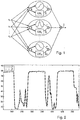
- Fig. 1 shows a sketch with the local model network applied here, being based on a neural network with normalized radial basis functions, and each neuron is provided with a local linear submodel.
- the radial basis functions describe the scope of the respective submodels.
- the special feature of the local model network is the efficient training in which the parameters of the hidden layer are determined by heuristic methods. Furthermore, an accurate approximation is already achieved with a smaller number of neurons. It is also possible to specify model complexity with maximum number of neurons for recursive algorithms, such as the LOcal Linear MOdell Tree (Lolimot) algorithm.
- the local model network is well suited for medium to high-dimensional mapping tasks due to the fast parameter calculation and the relatively slow increase in the number of parameters with the input dimension. Especially from a control point of view, the local model network with linear submodels are highly desirable because the submodels can be used to design controllers and for linear stability analysis.
- the Lolimot algorithm is a recursive, growing algorithm with a heuristic tree construction method for approximating functions based on the local model network. It is suitable for both static and dynamic system identification. An iterative process optimizes the structure of the model network.
- Fig. 2 are the progressions of the electrical power of a ventilation unit over a period of 150 seconds to 550 seconds shown.
- the solid curve here denotes the measured values of a real reference sensor and the dashed curve the output variables of the modeled dynamic and nonlinear software sensor.
- the power values are approximated by the three measured variables speed, air exchange current and PWM signal.
- the challenge of a ventilation system is to efficiently convert electrical energy through fans into kinetic energy as efficiently as possible, to a defined degree Ensure air exchange rate. After the definition of the efficiency, the electrical energy simplifies the effort and the air exchange or air exchange the benefits of a ventilation system.
- the electrical performance of the device can be calculated without additional hardware sensor use.
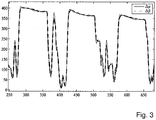
- Fig. 3 shows the course of the pressure loss of a ventilation system over a period of 250 seconds to 700 seconds.
- the pressure loss was excited during the surveying and verification experiments by means of a flap system and measured with a reference pressure sensor, and the curve is shown with the solid curve.
- the curve approximated by the soft sensor is shown by the dashed curve.
- the comparison between the measured and modeled behavior proves the quality of the identified network.
- the verification of the soft sensor shows sufficiently accurate results even in the case of pressure drop measurements.
Landscapes
- Engineering & Computer Science (AREA)
- Artificial Intelligence (AREA)
- Evolutionary Computation (AREA)
- Health & Medical Sciences (AREA)
- Computer Vision & Pattern Recognition (AREA)
- Medical Informatics (AREA)
- Software Systems (AREA)
- Physics & Mathematics (AREA)
- General Physics & Mathematics (AREA)
- Automation & Control Theory (AREA)
- Ventilation (AREA)
- Air Conditioning Control Device (AREA)
Claims (14)
- Procédé servant à identifier et à réguler ou commander des systèmes dynamiques linéaires ou non linéaires pour un système de ventilation actif dans le domaine de la technique de conditionnement de l'air en utilisant un capteur virtuel, qui est réalisé par un ordinateur ou est intégré dans le système de ventilation en tant que circuit, dans lequel le capteur virtuel est implémenté avec un réseau neuronal artificiel approprié, caractérisé en ce que- les grandeurs d'entrée, le flux d'échange d'air, la vitesse de rotation et le signal à modulation de largeur d'impulsion, sont données sur l'entrée du capteur virtuel,- le capteur virtuel est entraîné avec un algorithme d'apprentissage approprié,- les grandeurs d'entrée sont approximées et une puissance électrique et une perte de pression sont enregistrées en tant que grandeurs de sortie sur un support de stockage,- la dynamique sous-jacente du système de ventilation est pronostiquée avec les grandeurs de sortie et le système de ventilation est régulé ou commandé.
- Procédé selon la revendication 1, caractérisé en ce que la grandeur de sortie, la puissance électrique, est utilisée en tant que grandeur de pilotage pour une régulation en cascade du système de ventilation.
- Procédé selon la revendication 1 ou 2, caractérisé en ce que le capteur virtuel est entraîné de manière ciblée sur des modèles connus des grandeurs de sortie de sorte que les modèles connus soient détectés dans le système de ventilation.
- Procédé selon la revendication 3, caractérisé en ce que le capteur virtuel est entraîné de manière ciblée pour qu'un encrassement du système de canalisations soit reproduit par un modèle de la grandeur de sortie, la perte de pression, de sorte que le capteur virtuel émette, lors de l'identification dudit modèle, un avertissement d'alerte.
- Procédé selon la revendication 3, caractérisé en ce que le capteur virtuel est entraîné de manière ciblée pour qu'un encrassement des filtres dans le système soit reproduit par un modèle des grandeurs de sortie, la perte de pression, de sorte que le capteur virtuel émette, lors de l'identification dudit modèle, un avertissement d'alerte.
- Procédé selon la revendication 3, caractérisé en ce que le capteur virtuel est entraîné de manière ciblée pour qu'un réglage défectueux des soupapes d'admission et d'évacuation soit reproduit par un modèle de la grandeur de sortie, la perte de pression, de sorte que le capteur virtuel émette, dans le cas dudit modèle, un avertissement d'alerte.
- Procédé selon la revendication 3, caractérisé en ce que le capteur virtuel est entraîné de manière ciblée pour qu'un gel de l'échangeur de chaleur soit reproduit par un modèle de la grandeur de sortie, la perte de pression, de sorte que le capteur virtuel émette, lors de l'identification dudit modèle, un avertissement d'alerte.
- Procédé selon l'une quelconque des revendications 1 à 7, caractérisé en ce que des émissions sonores du système de ventilation sont réduites en ce que la fréquence est approximée en tant que grandeur cible et ainsi le système de ventilation est régulé de manière ciblée.
- Procédé selon l'une quelconque des revendications 1 à 8, caractérisé en ce que la consommation de la quantité d'énergie électrique du système de ventilation est déterminée et pronostiquée dans un laps de temps souhaité à l'aide du capteur virtuel.
- Capteur virtuel servant à déterminer les grandeurs de sortie, la puissance et la perte de pression, d'un système de ventilation actif dans le domaine de la technique de conditionnement de l'air, dans lequel un dispositif est intégré par un ordinateur ou un circuit dans le système de ventilation, lequel est raccordé directement, par LAN, WLAN ou Bluetooth, au système de ventilation, et dans lequel le capteur virtuel est implémenté avec un réseau neuronal artificiel approprié, caractérisé en ce que le capteur virtuel est réalisé pour entraîner des grandeurs de mesure du système de ventilation en tant que grandeurs d'entrée avec un algorithme d'apprentissage approprié et pour utiliser les grandeurs de sortie en tant que grandeurs de régulation ou de commande afin de réguler ou de commander le fonctionnement du système de ventilation.
- Capteur virtuel selon la revendication 10, caractérisé en ce que le capteur virtuel est implémenté avec un réseau neuronal multidimensionnel avec des fonctions de base radiales normées.
- Capteur virtuel selon la revendication 11, caractérisé en ce que le capteur virtuel est entraîné avec un réseau de modèle local avec un algorithme Lolimot.
- Capteur virtuel selon l'une quelconque des revendications 10 à 12, caractérisé en ce que le capteur virtuel présente un dispositif servant à détecter le système de ventilation.
- Capteur virtuel selon l'une quelconque des revendications 10 à 13, caractérisé en ce que le capteur virtuel pronostique la consommation d'énergie électrique du système de ventilation.
Applications Claiming Priority (1)
| Application Number | Priority Date | Filing Date | Title |
|---|---|---|---|
| DE102016201745.4A DE102016201745A1 (de) | 2016-02-05 | 2016-02-05 | Softsensor zur Identifikation und Regelung oder Steuerung eines Lüftungssystems |
Publications (2)
| Publication Number | Publication Date |
|---|---|
| EP3203330A1 EP3203330A1 (fr) | 2017-08-09 |
| EP3203330B1 true EP3203330B1 (fr) | 2018-11-28 |
Family
ID=57995037
Family Applications (1)
| Application Number | Title | Priority Date | Filing Date |
|---|---|---|---|
| EP17154539.5A Active EP3203330B1 (fr) | 2016-02-05 | 2017-02-03 | Capteur virtuel destiné à l'identification et au réglage ou à la commande d'un système de ventilation |
Country Status (2)
| Country | Link |
|---|---|
| EP (1) | EP3203330B1 (fr) |
| DE (1) | DE102016201745A1 (fr) |
Families Citing this family (3)
| Publication number | Priority date | Publication date | Assignee | Title |
|---|---|---|---|---|
| WO2019241272A1 (fr) | 2018-06-11 | 2019-12-19 | Broan-Nutone Llc | Système de ventilation à équilibrage automatique de flux dérivé d'un réseau de neurones artificiels et procédés d'utilisation |
| CN109361635B (zh) * | 2018-11-23 | 2021-06-04 | 泰山学院 | 基于深度残差网络的水下通信调制方式识别方法及系统 |
| CN109960146A (zh) * | 2019-01-25 | 2019-07-02 | 石化盈科信息技术有限责任公司 | 提高软测量仪表模型预测精度的方法 |
Family Cites Families (9)
| Publication number | Priority date | Publication date | Assignee | Title |
|---|---|---|---|---|
| FI88432C (fi) | 1989-01-13 | 1993-05-10 | Halton Oy | Foerfarande foer reglering och uppraetthaollande av luftstroemmar och motsvarande i ventilationsanlaeggningar och ett ventilationssystem i enlighet med foerfarandet |
| DE19600694C2 (de) | 1996-01-10 | 2001-01-18 | Thomas Nitsche | Klimasystem |
| DE19942144A1 (de) | 1999-09-03 | 2001-06-07 | Schroeder Dierk | Verfahren zur adaptiven Schwingungsdämpfung mittels neuronaler Netze |
| WO2002006953A1 (fr) * | 2000-07-06 | 2002-01-24 | Yamatake Corporation | Capteur logiciel et dispositif d'evaluation correspondant |
| DE102010012682B4 (de) | 2010-03-24 | 2011-10-27 | Deutsch-Französisches Forschungsinstitut Saint-Louis | Verfahren zur Regelung unter Verwendung eines neuronalen Netzes und Einrichtung hierzu |
| DE102011002734B4 (de) | 2011-01-14 | 2013-08-22 | Blumartin Gmbh | Regelverfahren für eine Lüftungsvorrichtung mit Lüftungsvorrichtung |
| US8880925B2 (en) * | 2011-06-30 | 2014-11-04 | Intel Corporation | Techniques for utilizing energy usage information |
| KR101261198B1 (ko) | 2013-01-10 | 2013-05-10 | 동국대학교 산학협력단 | 신경망 모델에 의한 지능형 제어 알고리즘을 이용한 건물의 실내온도 하강 제어방법 |
| US20150134123A1 (en) * | 2013-11-14 | 2015-05-14 | Ces Group, Llc | Predictive monitoring and control of an environment using cfd |
-
2016
- 2016-02-05 DE DE102016201745.4A patent/DE102016201745A1/de not_active Withdrawn
-
2017
- 2017-02-03 EP EP17154539.5A patent/EP3203330B1/fr active Active
Non-Patent Citations (1)
| Title |
|---|
| None * |
Also Published As
| Publication number | Publication date |
|---|---|
| DE102016201745A1 (de) | 2017-08-10 |
| EP3203330A1 (fr) | 2017-08-09 |
Similar Documents
| Publication | Publication Date | Title |
|---|---|---|
| DE69823271T2 (de) | Verbesserter adaptiver Durchflussregler | |
| DE19804565C2 (de) | Selbstlernendes Regelverfahren | |
| EP3203330B1 (fr) | Capteur virtuel destiné à l'identification et au réglage ou à la commande d'un système de ventilation | |
| EP2667278B1 (fr) | Procédé et dispositif de commande des paramètres d'air dans des pièces | |
| DE102007030492A1 (de) | Gebäudemodellbasiertes prädiktives Regelverfahren zum Heizen eines begrenzten Systems | |
| EP4185928A1 (fr) | Autoévaluation de contrôleur de positions pour jumeau numérique | |
| EP1095319B1 (fr) | Procede pour actionner un systeme de regulation et dispositif pour mettre ledit procede en oeuvre | |
| EP3916236B1 (fr) | Procédé de fonctionnement d'un système de ventilation et système de ventilation doté d'un ventilateur radial courbé vers l'arrière | |
| EP1550925B1 (fr) | Régulation de la température | |
| EP4179265B1 (fr) | Procédé et système de ventilateur pour vérifier un point de fonctionnement actuel d'une unité de ventilateur | |
| CH700963B1 (de) | Computerimplementiertes Verfahren und System zur automatischen Überwachung und Darstellung eines energieeffizienten Betriebs von gebäudetechnischen Anlagen. | |
| EP3881141A1 (fr) | Procédé et dispositif pour déterminer un débit volumétrique et une pression sans capteur | |
| DE102011075337A1 (de) | Verfahren und Vorrichtung zur Ansteuerung einer Anlage | |
| EP1235131A2 (fr) | Régulation de la température d'une pièce | |
| EP3707386B1 (fr) | Stabilité des paramètres | |
| EP3168540A1 (fr) | Procédé d'exécution d'un équilibrage hydraulique automatisé, soupape et installation de chauffage associées | |
| DE102019206839A1 (de) | Analyseverfahren und Vorrichtungen hierzu | |
| DE102023209111A1 (de) | Verfahren zum Durchführen eines hydraulischen Abgleichs einer Heizungsanlage | |
| EP3976404B1 (fr) | Procédé de commande de dispositif de climatisation | |
| EP3035144B1 (fr) | Procédé et dispositif pour contrôler la décharge d'énergie thermique dans des structures résidentielles locales et régionales | |
| EP3521947A1 (fr) | Procédé de gestion de l'énergie | |
| DE19942491A1 (de) | Verfahren zum Regeln einer Zuluft-Konditionieranlage und Regelvorrichtung für eine Zuluft-Konditionieranlage | |
| WO2021104575A1 (fr) | Procédé de régulation en boucle ouverte ou en boucle fermée d'un système de climatisation d'un véhicule | |
| EP3260787A1 (fr) | Procede destine au reglage d'un debit d'air | |
| EP3483513A1 (fr) | Procédé de fonctionnement d'une installation de chauffage et installation de chauffage |
Legal Events
| Date | Code | Title | Description |
|---|---|---|---|
| PUAI | Public reference made under article 153(3) epc to a published international application that has entered the european phase |
Free format text: ORIGINAL CODE: 0009012 |
|
| STAA | Information on the status of an ep patent application or granted ep patent |
Free format text: STATUS: THE APPLICATION HAS BEEN PUBLISHED |
|
| AK | Designated contracting states |
Kind code of ref document: A1 Designated state(s): AL AT BE BG CH CY CZ DE DK EE ES FI FR GB GR HR HU IE IS IT LI LT LU LV MC MK MT NL NO PL PT RO RS SE SI SK SM TR |
|
| AX | Request for extension of the european patent |
Extension state: BA ME |
|
| STAA | Information on the status of an ep patent application or granted ep patent |
Free format text: STATUS: REQUEST FOR EXAMINATION WAS MADE |
|
| 17P | Request for examination filed |
Effective date: 20180206 |
|
| RBV | Designated contracting states (corrected) |
Designated state(s): AL AT BE BG CH CY CZ DE DK EE ES FI FR GB GR HR HU IE IS IT LI LT LU LV MC MK MT NL NO PL PT RO RS SE SI SK SM TR |
|
| GRAP | Despatch of communication of intention to grant a patent |
Free format text: ORIGINAL CODE: EPIDOSNIGR1 |
|
| STAA | Information on the status of an ep patent application or granted ep patent |
Free format text: STATUS: GRANT OF PATENT IS INTENDED |
|
| INTG | Intention to grant announced |
Effective date: 20180803 |
|
| GRAS | Grant fee paid |
Free format text: ORIGINAL CODE: EPIDOSNIGR3 |
|
| GRAA | (expected) grant |
Free format text: ORIGINAL CODE: 0009210 |
|
| STAA | Information on the status of an ep patent application or granted ep patent |
Free format text: STATUS: THE PATENT HAS BEEN GRANTED |
|
| AK | Designated contracting states |
Kind code of ref document: B1 Designated state(s): AL AT BE BG CH CY CZ DE DK EE ES FI FR GB GR HR HU IE IS IT LI LT LU LV MC MK MT NL NO PL PT RO RS SE SI SK SM TR |
|
| REG | Reference to a national code |
Ref country code: CH Ref legal event code: EP |
|
| REG | Reference to a national code |
Ref country code: AT Ref legal event code: REF Ref document number: 1070957 Country of ref document: AT Kind code of ref document: T Effective date: 20181215 |
|
| REG | Reference to a national code |
Ref country code: DE Ref legal event code: R096 Ref document number: 502017000397 Country of ref document: DE |
|
| REG | Reference to a national code |
Ref country code: IE Ref legal event code: FG4D Free format text: LANGUAGE OF EP DOCUMENT: GERMAN |
|
| REG | Reference to a national code |
Ref country code: NL Ref legal event code: FP |
|
| REG | Reference to a national code |
Ref country code: LT Ref legal event code: MG4D |
|
| PG25 | Lapsed in a contracting state [announced via postgrant information from national office to epo] |
Ref country code: ES Free format text: LAPSE BECAUSE OF FAILURE TO SUBMIT A TRANSLATION OF THE DESCRIPTION OR TO PAY THE FEE WITHIN THE PRESCRIBED TIME-LIMIT Effective date: 20181128 Ref country code: BG Free format text: LAPSE BECAUSE OF FAILURE TO SUBMIT A TRANSLATION OF THE DESCRIPTION OR TO PAY THE FEE WITHIN THE PRESCRIBED TIME-LIMIT Effective date: 20190228 Ref country code: LT Free format text: LAPSE BECAUSE OF FAILURE TO SUBMIT A TRANSLATION OF THE DESCRIPTION OR TO PAY THE FEE WITHIN THE PRESCRIBED TIME-LIMIT Effective date: 20181128 Ref country code: HR Free format text: LAPSE BECAUSE OF FAILURE TO SUBMIT A TRANSLATION OF THE DESCRIPTION OR TO PAY THE FEE WITHIN THE PRESCRIBED TIME-LIMIT Effective date: 20181128 Ref country code: IS Free format text: LAPSE BECAUSE OF FAILURE TO SUBMIT A TRANSLATION OF THE DESCRIPTION OR TO PAY THE FEE WITHIN THE PRESCRIBED TIME-LIMIT Effective date: 20190328 Ref country code: NO Free format text: LAPSE BECAUSE OF FAILURE TO SUBMIT A TRANSLATION OF THE DESCRIPTION OR TO PAY THE FEE WITHIN THE PRESCRIBED TIME-LIMIT Effective date: 20190228 Ref country code: LV Free format text: LAPSE BECAUSE OF FAILURE TO SUBMIT A TRANSLATION OF THE DESCRIPTION OR TO PAY THE FEE WITHIN THE PRESCRIBED TIME-LIMIT Effective date: 20181128 Ref country code: FI Free format text: LAPSE BECAUSE OF FAILURE TO SUBMIT A TRANSLATION OF THE DESCRIPTION OR TO PAY THE FEE WITHIN THE PRESCRIBED TIME-LIMIT Effective date: 20181128 |
|
| PG25 | Lapsed in a contracting state [announced via postgrant information from national office to epo] |
Ref country code: AL Free format text: LAPSE BECAUSE OF FAILURE TO SUBMIT A TRANSLATION OF THE DESCRIPTION OR TO PAY THE FEE WITHIN THE PRESCRIBED TIME-LIMIT Effective date: 20181128 Ref country code: SE Free format text: LAPSE BECAUSE OF FAILURE TO SUBMIT A TRANSLATION OF THE DESCRIPTION OR TO PAY THE FEE WITHIN THE PRESCRIBED TIME-LIMIT Effective date: 20181128 Ref country code: GR Free format text: LAPSE BECAUSE OF FAILURE TO SUBMIT A TRANSLATION OF THE DESCRIPTION OR TO PAY THE FEE WITHIN THE PRESCRIBED TIME-LIMIT Effective date: 20190301 Ref country code: RS Free format text: LAPSE BECAUSE OF FAILURE TO SUBMIT A TRANSLATION OF THE DESCRIPTION OR TO PAY THE FEE WITHIN THE PRESCRIBED TIME-LIMIT Effective date: 20181128 Ref country code: PT Free format text: LAPSE BECAUSE OF FAILURE TO SUBMIT A TRANSLATION OF THE DESCRIPTION OR TO PAY THE FEE WITHIN THE PRESCRIBED TIME-LIMIT Effective date: 20190328 |
|
| PG25 | Lapsed in a contracting state [announced via postgrant information from national office to epo] |
Ref country code: IT Free format text: LAPSE BECAUSE OF FAILURE TO SUBMIT A TRANSLATION OF THE DESCRIPTION OR TO PAY THE FEE WITHIN THE PRESCRIBED TIME-LIMIT Effective date: 20181128 Ref country code: DK Free format text: LAPSE BECAUSE OF FAILURE TO SUBMIT A TRANSLATION OF THE DESCRIPTION OR TO PAY THE FEE WITHIN THE PRESCRIBED TIME-LIMIT Effective date: 20181128 Ref country code: CZ Free format text: LAPSE BECAUSE OF FAILURE TO SUBMIT A TRANSLATION OF THE DESCRIPTION OR TO PAY THE FEE WITHIN THE PRESCRIBED TIME-LIMIT Effective date: 20181128 Ref country code: PL Free format text: LAPSE BECAUSE OF FAILURE TO SUBMIT A TRANSLATION OF THE DESCRIPTION OR TO PAY THE FEE WITHIN THE PRESCRIBED TIME-LIMIT Effective date: 20181128 |
|
| REG | Reference to a national code |
Ref country code: DE Ref legal event code: R097 Ref document number: 502017000397 Country of ref document: DE |
|
| PG25 | Lapsed in a contracting state [announced via postgrant information from national office to epo] |
Ref country code: SK Free format text: LAPSE BECAUSE OF FAILURE TO SUBMIT A TRANSLATION OF THE DESCRIPTION OR TO PAY THE FEE WITHIN THE PRESCRIBED TIME-LIMIT Effective date: 20181128 Ref country code: RO Free format text: LAPSE BECAUSE OF FAILURE TO SUBMIT A TRANSLATION OF THE DESCRIPTION OR TO PAY THE FEE WITHIN THE PRESCRIBED TIME-LIMIT Effective date: 20181128 Ref country code: SM Free format text: LAPSE BECAUSE OF FAILURE TO SUBMIT A TRANSLATION OF THE DESCRIPTION OR TO PAY THE FEE WITHIN THE PRESCRIBED TIME-LIMIT Effective date: 20181128 Ref country code: EE Free format text: LAPSE BECAUSE OF FAILURE TO SUBMIT A TRANSLATION OF THE DESCRIPTION OR TO PAY THE FEE WITHIN THE PRESCRIBED TIME-LIMIT Effective date: 20181128 |
|
| PLBE | No opposition filed within time limit |
Free format text: ORIGINAL CODE: 0009261 |
|
| STAA | Information on the status of an ep patent application or granted ep patent |
Free format text: STATUS: NO OPPOSITION FILED WITHIN TIME LIMIT |
|
| PG25 | Lapsed in a contracting state [announced via postgrant information from national office to epo] |
Ref country code: LU Free format text: LAPSE BECAUSE OF NON-PAYMENT OF DUE FEES Effective date: 20190203 Ref country code: SI Free format text: LAPSE BECAUSE OF FAILURE TO SUBMIT A TRANSLATION OF THE DESCRIPTION OR TO PAY THE FEE WITHIN THE PRESCRIBED TIME-LIMIT Effective date: 20181128 Ref country code: MC Free format text: LAPSE BECAUSE OF FAILURE TO SUBMIT A TRANSLATION OF THE DESCRIPTION OR TO PAY THE FEE WITHIN THE PRESCRIBED TIME-LIMIT Effective date: 20181128 |
|
| 26N | No opposition filed |
Effective date: 20190829 |
|
| REG | Reference to a national code |
Ref country code: BE Ref legal event code: MM Effective date: 20190228 |
|
| REG | Reference to a national code |
Ref country code: IE Ref legal event code: MM4A |
|
| PG25 | Lapsed in a contracting state [announced via postgrant information from national office to epo] |
Ref country code: IE Free format text: LAPSE BECAUSE OF NON-PAYMENT OF DUE FEES Effective date: 20190203 |
|
| PG25 | Lapsed in a contracting state [announced via postgrant information from national office to epo] |
Ref country code: BE Free format text: LAPSE BECAUSE OF NON-PAYMENT OF DUE FEES Effective date: 20190228 |
|
| PG25 | Lapsed in a contracting state [announced via postgrant information from national office to epo] |
Ref country code: TR Free format text: LAPSE BECAUSE OF FAILURE TO SUBMIT A TRANSLATION OF THE DESCRIPTION OR TO PAY THE FEE WITHIN THE PRESCRIBED TIME-LIMIT Effective date: 20181128 |
|
| PG25 | Lapsed in a contracting state [announced via postgrant information from national office to epo] |
Ref country code: MT Free format text: LAPSE BECAUSE OF FAILURE TO SUBMIT A TRANSLATION OF THE DESCRIPTION OR TO PAY THE FEE WITHIN THE PRESCRIBED TIME-LIMIT Effective date: 20181128 |
|
| REG | Reference to a national code |
Ref country code: CH Ref legal event code: PL |
|
| PG25 | Lapsed in a contracting state [announced via postgrant information from national office to epo] |
Ref country code: CH Free format text: LAPSE BECAUSE OF NON-PAYMENT OF DUE FEES Effective date: 20200229 Ref country code: LI Free format text: LAPSE BECAUSE OF NON-PAYMENT OF DUE FEES Effective date: 20200229 |
|
| PG25 | Lapsed in a contracting state [announced via postgrant information from national office to epo] |
Ref country code: CY Free format text: LAPSE BECAUSE OF FAILURE TO SUBMIT A TRANSLATION OF THE DESCRIPTION OR TO PAY THE FEE WITHIN THE PRESCRIBED TIME-LIMIT Effective date: 20181128 |
|
| PG25 | Lapsed in a contracting state [announced via postgrant information from national office to epo] |
Ref country code: HU Free format text: LAPSE BECAUSE OF FAILURE TO SUBMIT A TRANSLATION OF THE DESCRIPTION OR TO PAY THE FEE WITHIN THE PRESCRIBED TIME-LIMIT; INVALID AB INITIO Effective date: 20170203 |
|
| PG25 | Lapsed in a contracting state [announced via postgrant information from national office to epo] |
Ref country code: MK Free format text: LAPSE BECAUSE OF FAILURE TO SUBMIT A TRANSLATION OF THE DESCRIPTION OR TO PAY THE FEE WITHIN THE PRESCRIBED TIME-LIMIT Effective date: 20181128 |
|
| PGFP | Annual fee paid to national office [announced via postgrant information from national office to epo] |
Ref country code: NL Payment date: 20260123 Year of fee payment: 10 |
|
| PGFP | Annual fee paid to national office [announced via postgrant information from national office to epo] |
Ref country code: GB Payment date: 20260127 Year of fee payment: 10 |
|
| PGFP | Annual fee paid to national office [announced via postgrant information from national office to epo] |
Ref country code: DE Payment date: 20260127 Year of fee payment: 10 |
|
| PGFP | Annual fee paid to national office [announced via postgrant information from national office to epo] |
Ref country code: AT Payment date: 20260126 Year of fee payment: 10 |
|
| PGFP | Annual fee paid to national office [announced via postgrant information from national office to epo] |
Ref country code: FR Payment date: 20260225 Year of fee payment: 10 |