EP3203548B1 - Anode, lithiumsekundärbatterie damit, batteriemodul mit der lithiumsekundärbatterie - Google Patents
Anode, lithiumsekundärbatterie damit, batteriemodul mit der lithiumsekundärbatterie Download PDFInfo
- Publication number
- EP3203548B1 EP3203548B1 EP15845711.9A EP15845711A EP3203548B1 EP 3203548 B1 EP3203548 B1 EP 3203548B1 EP 15845711 A EP15845711 A EP 15845711A EP 3203548 B1 EP3203548 B1 EP 3203548B1
- Authority
- EP
- European Patent Office
- Prior art keywords
- lithium
- anode
- silicon
- layer
- metal layer
- Prior art date
- Legal status (The legal status is an assumption and is not a legal conclusion. Google has not performed a legal analysis and makes no representation as to the accuracy of the status listed.)
- Active
Links
Images



Classifications
-
- H—ELECTRICITY
- H01—ELECTRIC ELEMENTS
- H01M—PROCESSES OR MEANS, e.g. BATTERIES, FOR THE DIRECT CONVERSION OF CHEMICAL ENERGY INTO ELECTRICAL ENERGY
- H01M10/00—Secondary cells; Manufacture thereof
- H01M10/42—Methods or arrangements for servicing or maintenance of secondary cells or secondary half-cells
- H01M10/4235—Safety or regulating additives or arrangements in electrodes, separators or electrolyte
-
- H—ELECTRICITY
- H01—ELECTRIC ELEMENTS
- H01M—PROCESSES OR MEANS, e.g. BATTERIES, FOR THE DIRECT CONVERSION OF CHEMICAL ENERGY INTO ELECTRICAL ENERGY
- H01M10/00—Secondary cells; Manufacture thereof
- H01M10/05—Accumulators with non-aqueous electrolyte
- H01M10/052—Li-accumulators
- H01M10/0525—Rocking-chair batteries, i.e. batteries with lithium insertion or intercalation in both electrodes; Lithium-ion batteries
-
- H—ELECTRICITY
- H01—ELECTRIC ELEMENTS
- H01M—PROCESSES OR MEANS, e.g. BATTERIES, FOR THE DIRECT CONVERSION OF CHEMICAL ENERGY INTO ELECTRICAL ENERGY
- H01M4/00—Electrodes
- H01M4/02—Electrodes composed of, or comprising, active material
- H01M4/13—Electrodes for accumulators with non-aqueous electrolyte, e.g. for lithium-accumulators; Processes of manufacture thereof
- H01M4/134—Electrodes based on metals, Si or alloys
-
- H—ELECTRICITY
- H01—ELECTRIC ELEMENTS
- H01M—PROCESSES OR MEANS, e.g. BATTERIES, FOR THE DIRECT CONVERSION OF CHEMICAL ENERGY INTO ELECTRICAL ENERGY
- H01M4/00—Electrodes
- H01M4/02—Electrodes composed of, or comprising, active material
- H01M4/36—Selection of substances as active materials, active masses, active liquids
- H01M4/362—Composites
- H01M4/366—Composites as layered products
-
- H—ELECTRICITY
- H01—ELECTRIC ELEMENTS
- H01M—PROCESSES OR MEANS, e.g. BATTERIES, FOR THE DIRECT CONVERSION OF CHEMICAL ENERGY INTO ELECTRICAL ENERGY
- H01M4/00—Electrodes
- H01M4/02—Electrodes composed of, or comprising, active material
- H01M4/36—Selection of substances as active materials, active masses, active liquids
- H01M4/38—Selection of substances as active materials, active masses, active liquids of elements or alloys
- H01M4/381—Alkaline or alkaline earth metals elements
- H01M4/382—Lithium
-
- H—ELECTRICITY
- H01—ELECTRIC ELEMENTS
- H01M—PROCESSES OR MEANS, e.g. BATTERIES, FOR THE DIRECT CONVERSION OF CHEMICAL ENERGY INTO ELECTRICAL ENERGY
- H01M4/00—Electrodes
- H01M4/02—Electrodes composed of, or comprising, active material
- H01M4/36—Selection of substances as active materials, active masses, active liquids
- H01M4/38—Selection of substances as active materials, active masses, active liquids of elements or alloys
- H01M4/386—Silicon or alloys based on silicon
-
- H—ELECTRICITY
- H01—ELECTRIC ELEMENTS
- H01M—PROCESSES OR MEANS, e.g. BATTERIES, FOR THE DIRECT CONVERSION OF CHEMICAL ENERGY INTO ELECTRICAL ENERGY
- H01M2220/00—Batteries for particular applications
- H01M2220/30—Batteries in portable systems, e.g. mobile phone, laptop
-
- Y—GENERAL TAGGING OF NEW TECHNOLOGICAL DEVELOPMENTS; GENERAL TAGGING OF CROSS-SECTIONAL TECHNOLOGIES SPANNING OVER SEVERAL SECTIONS OF THE IPC; TECHNICAL SUBJECTS COVERED BY FORMER USPC CROSS-REFERENCE ART COLLECTIONS [XRACs] AND DIGESTS
- Y02—TECHNOLOGIES OR APPLICATIONS FOR MITIGATION OR ADAPTATION AGAINST CLIMATE CHANGE
- Y02E—REDUCTION OF GREENHOUSE GAS [GHG] EMISSIONS, RELATED TO ENERGY GENERATION, TRANSMISSION OR DISTRIBUTION
- Y02E60/00—Enabling technologies; Technologies with a potential or indirect contribution to GHG emissions mitigation
- Y02E60/10—Energy storage using batteries
-
- Y—GENERAL TAGGING OF NEW TECHNOLOGICAL DEVELOPMENTS; GENERAL TAGGING OF CROSS-SECTIONAL TECHNOLOGIES SPANNING OVER SEVERAL SECTIONS OF THE IPC; TECHNICAL SUBJECTS COVERED BY FORMER USPC CROSS-REFERENCE ART COLLECTIONS [XRACs] AND DIGESTS
- Y02—TECHNOLOGIES OR APPLICATIONS FOR MITIGATION OR ADAPTATION AGAINST CLIMATE CHANGE
- Y02T—CLIMATE CHANGE MITIGATION TECHNOLOGIES RELATED TO TRANSPORTATION
- Y02T10/00—Road transport of goods or passengers
- Y02T10/60—Other road transportation technologies with climate change mitigation effect
- Y02T10/70—Energy storage systems for electromobility, e.g. batteries
Definitions
- the present specification relates to an anode, a lithium secondary battery including the same, a battery module including the lithium secondary battery, and a method for manufacturing an anode.
- a battery acting as a power source is also required to become compact and lightweight.
- a lithium secondary battery is put into practical use, and is used for a mobile electronic device such as a small video camera, a mobile telephone, and a laptop computer, a communication device, and the like.
- the lithium secondary battery is an energy storage device having high energy and power, and has an advantage in that the capacity or operating voltage is higher than that of other batteries.
- the lithium secondary battery has a problem in safety of the battery due to high energy, and thus has a risk such as an explosion or a fire.
- safety is most important.
- the lithium secondary battery is composed of a cathode, an anode, and an electrolyte, and lithium ions released from a cathode active material by a first charging serve to transfer energy while shuttling between both electrodes, like being inserted into an anode active material, that is, carbon particles and again being dissociated during the discharge, thereby making the charge and discharge possible.
- JP 2005190902 discloses a negative electrode for a lithium battery, comprising a copper current collector which is provided with a silicon/lithium layer and a silicon layer.
- US 2007/020408 discloses an electrode comprising a copper current collector provided with a layer of lithium metal and a layer of silicon dioxide on the lithium layer.
- the present specification has been made in an effort to provide an anode, a lithium secondary battery including the same, a battery module including the lithium secondary battery, and a method for manufacturing an anode.
- the present invention is defined by the subject-matter of the appended claims.
- the present specification provides an anode including: a current collector; a lithium metal layer provided on the current collector; and a silicon layer provided on the lithium metal layer.
- anode including: a current collector; a lithium metal layer provided on the current collector; and a lithium-silicon composite layer provided on the lithium metal layer and containing a lithium-silicon composite in which silicon is alloyed with lithium.
- the present specification provides a lithium secondary battery including the anode and the cathode, and an electrolyte provided between the anode and the cathode.
- the present application provides a battery module including the lithium secondary battery as a unit cell.
- the chemical stability and safety of a lithium metal are improved.
- the initial charge and discharge efficiency of a battery to which the anode according to an exemplary embodiment of the present specification is applied is improved.
- the anode may have a thickness of 1 ⁇ m or more and 1,000 ⁇ m or less.
- the anode may be used in a battery, and the anode means an electrode which releases electrons when the battery is discharged.
- the anode may be used for a secondary battery, and the anode means an electrode which releases electrons based on the time when the battery is discharged, and may serve as a cathode (reduction electrode) when the battery is charged.
- the lithium metal layer is composed of only a lithium metal.
- the lithium metal layer may partially deteriorate due to oxygen or moisture, or may include impurities.
- a lithium metal of a lithium metal layer is a metal having a standard reduction potential of -3.040 V, and a metal which very strongly tends to be oxidized.
- a metal which very strongly tends to be oxidized When the lithium metal meets a heterogeneous material which has an oxidizing tendency, such as oxygen, sulfur, or polysulfide, oxidation (corrosion) of the lithium metal rapidly proceeds.
- the lithium metal When the lithium metal is used as an electrode, dendrites are formed on the surface of the lithium metal, thereby degrading the reactivity of the lithium metal.
- a lithium salt having relatively stable lithium ions was used as an electrode material, but as a high-capacity battery is continuously required, there is an increasing need for stably using a high-capacity lithium metal as an electrode material.
- the metal layer may be a layer containing a metal capable of being alloyed with lithium.
- the metal layer may contain a metal which reacts with lithium to expand the volume thereof.
- the metal layer may be a layer containing a metal capable of being alloyed with lithium.
- the metal layer may be a layer composed of only a metal capable of being alloyed with lithium.
- the metal which the metal layer or metal oxide layer contains is silicon (Si),
- the lithium-metal composite layer may include a lithium-metal composite formed by meeting a lithium metal element of the lithium metal layer and a metal element of the metal layer at the interface between the lithium metal layer and the metal layer. It is possible to further include a lithium-silicon composite layer provided between the lithium metal layer and the silicon layer.
- the content of a lithium-metal composite formed by alloying the metal with lithium may be affected by the content of the metal capable of being alloyed with lithium.
- a part or all of the metal capable of being alloyed with lithium included in the anode may be alloyed with lithium to form a lithium-metal composite.
- the weight ratio of the lithium element to the silicon element in the anode is be 100 : 1 to 50.
- the content of the lithium-silicon composite formed by alloying the silicon with lithium may be affected by the content of silicon.
- a part or all of the silicon included in the anode may be alloyed with lithium to form a lithium-silicon composite.
- the lithium-silicon composite layer includes a lithium-silicon composite.
- the lithium-silicon composite layer may include a lithium-silicon composite represented by the following Chemical Formula 1. [Chemical Formula 1] Li x Si
- x is a real number of 1.0 to 4.0.
- the metal layer may receive ions containing a lithium metal transferred from an interface of the lithium metal layer or an electrolyte to include a lithium-metal composite in which the ions are bonded to the metal element of the metal layer.
- a part of the metal element of the metal layer may be bonded to ions containing transferred lithium to form a lithium-metal composite.
- the metal layer may receive ions containing a lithium metal transferred from an interface of the lithium metal layer or an electrolyte, and thus be composed of a lithium-metal composite in which the ions are bonded to the metal element of the metal layer.
- all of the metal elements of the metal layer may be bonded to ions containing transferred lithium to form a lithium-metal composite.
- the metal layer. is a silicon layer containing a silicon element as the metal capable of being alloyed with lithium
- the silicon layer may include a lithium-silicon composite.
- the metal layer when the metal layer is a silicon layer containing a silicon element as the metal capable of being alloyed with lithium, the silicon layer may receive ions containing a lithium metal transferred from an interface of the lithium metal layer or an electrolyte to include a lithium-silicon composite in which the ions are bonded to a silicon element of the silicon layer.
- the silicon layer may be composed of a lithium-silicon composite composite.
- all of the silicon elements of the silicon layer may be bonded to ions containing the transferred lithium metal to form a lithium-silicon composite.
- a lithium metal is a material which is highly reactive with moisture, and thus may react with moisture, thereby making the surface of the lithium metal electrode deteriorate, or forming dendritic crystals on the surface of the lithium metal electrode.
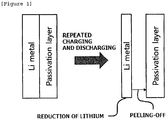
- a protective film may be formed on a lithium metal electrode, but since the volume of the lithium metal is changed while charging and discharging of the battery are repeated, the protective film provided on the lithium metal may be peeled off.
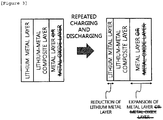
- the anode of the present specification has an advantage in that the metal layer, is not peeled off by a change in volume of the lithium metal layer, which is caused by the repeated charging and discharging. Specifically, as illustrated in FIGS. 2 and 3 , since a metal layer includes a metal capable of being alloyed with lithium even though the volume of the lithium metal layer is reduced while lithium of the lithium metal layer is consumed, a lithium-metal composite layer may be formed between the lithium metal layer and the metal layer and as a result, an interface between the lithium metal layer and the metal layer may be maintained without being peeled off. Accordingly, the anode of the present specification has an advantage in that the chemical safety and stability of the lithium metal are improved.
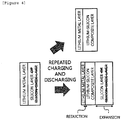
- the metal layer is a silicon layer containing a silicon element as the metal capable of being alloyed with lithium, as illustrated in FIGS. 4 and 5 , even though the volume of the lithium metal layer is reduced while the lithium of the lithium metal layer is consumed, the silicon element of the silicon layer or silicon oxide layer, which is capable of being alloyed with the lithium, reacts with the lithium metal element of the lithium metal layer to form a lithium-silicon composite layer at an interface between the lithium metal layer and the silicon layer or silicon oxide layer, and as a result, the interface between the lithium metal layer and the silicon layer may be maintained without being peeled off.
- the initial charge and discharge efficiency of a battery to which the anode according to an exemplary embodiment of the present specification is applied may be improved. Since the interface between the lithium metal layer and the metal is maintained without being peeled off, the initial efficiency and the efficiency of the cycle are improved.
- the anode may further include a current collector.
- the anode may include a current collector, a lithium metal layer provided on the current collector, and a metal layer provided on the lithium metal layer.
- the current collector collects current of an anode, uses any material having electric conductivity without limitation, and may be manufactured by using materials and methods generally used in the art. For example, it is possible to use one or two or more selected from the group consisting of carbon, stainless steel, nickel, aluminum, iron, and titanium.
- a shape of the current collector various shapes such as a film, a sheet, foil, a net, a porous body, a foam body, or a non-woven body may be each employed.
- the present specification provides an anode including: a current collector; a lithium metal layer provided on the current collector; and a silicon layer layer provided on the lithium metal layer.
- the anode may further include a lithium-silicon composite layer provided between the lithium metal layer and the silicon layer.
- the silicon layer may include a lithium-silicon composite in which the silicon is alloyed with lithium.
- the weight ratio of the lithium element to the silicon element in the anode is 100 : 1 to 50.
- the lithium-silicon composite layer may include the lithium-silicon composite represented by Chemical Formula 1.
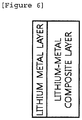
- the present specification provides an anode including: a lithium metal layer; and a lithium-metal composite layer provided on the lithium metal layer and containing a lithium-metal composite capable of being alloyed with lithium is alloyed with lithium.
- the lithium-metal composite layer may be a layer in which all of the metal elements of the metal layer, which is capable of being alloyed with the lithium, are bonded to ions containing the lithium metal to form a lithium-metal.
- the anode may include a lithium metal layer; and a lithium-metal composite layer on the lithium metal layer.
- the lithium-metal composite layer may be a lithium-silicon composite layer containing a silicon element as a metal capable of being alloyed with lithium.
- the lithium-silicon composite layer may be a layer in which all of the silicon elements of the silicon layer are bonded to ions containing the lithium metal to form a lithium-silicon composite.
- the anode may include a lithium metal layer; and a lithium-silicon composite layer on the lithium metal layer.
- the lithium-silicon composite layer may include a lithium-silicon composite represented by the following Chemical Formula 1. [Chemical Formula 1] Li x Si
- Chemical Formula 1 x is a real number of 1.0 to 4.0.
- the present specification provides an anode including: a current collector; a lithium metal layer provided on the current collector; and a lithium-silicon composite layer provided on the lithium metal layer and containing a lithium-silicon composite in which silicon is alloyed with lithium.
- the lithium-silicon composite layer may include the lithium-silicon composite represented by Chemical Formula 1.
- the present specification provides a lithium secondary battery including the anode; and the cathode, and an electrolyte provided between the anode and the cathode.
- the shape of the lithium secondary battery is not limited, and may be, for example, a coin-type, a flat plat-type, a cylinder-type, a cone-type, a button-type, a sheet-type, or a laminate-type.
- the lithium secondary battery may be a lithium air battery.
- a cathode of the lithium secondary battery may be an air electrode.
- the lithium secondary battery may be manufactured as a flow battery by further including each tank which stores a cathode electrolytic solution and an anode electrolytic solution and a pump which allows each electrolytic solution to move to an electrode cell.
- the electrolyte may be an electrolyte liquid in which the anode and the cathode are impregnated.
- the lithium secondary battery may further include a separation membrane provided between the anode and the cathode.
- a separation membrane provided between the anode and the cathode.
- the separation membrane may be a non-conductive porous membrane or an insulating porous membrane.
- a polymer non-woven fabric such as a non-woven fabric formed of a polypropylene material or a non-woven fabric formed of a polyphenylene sulfide material; or a porous film formed of an olefin-based resin such as polyethylene or polypropylene, and it is also possible to use a combination of two or more thereof.
- the lithium secondary battery may further include a cathode electrolytic solution at a cathode side and an anode electrolytic solution at an anode side, which are divided by a separation membrane.
- the cathode electrolytic solution and the anode electrolytic solution may include a solvent and an electrolytic salt, respectively.
- the cathode electrolytic solution and the anode electrolytic solution may include solvents which are the same as or different from each other.
- the electrolytic solution may be an aqueous electrolytic solution or a non-aqueous electrolytic solution.
- the aqueous electrolytic solution may include water as a solvent
- the non-aqueous electrolytic solution may include a non-aqueous solvent as a solvent.
- non-aqueous solvent those generally used in the art may be selected, and the non-aqueous solvent is not particularly limited, but for example, it is possible to select the non-aqueous solvent from the group consisting of carbonate-based, ester-based, ether-based, ketone-based, organosulfur-based, organophosphorous-based, and non-protonic solvents, and combinations thereof.
- the electrolytic salt refers to a salt which is dissociated into a positive ion and a negative ion in water or a non-aqueous organic solvent, and is not particularly limited as long as the electrolytic salt may transfer lithium ions in a lithium secondary battery, and those generally used in the art may be selected.
- the concentration of electrolytic salt in the electrolytic solution may be 0.1 M or more and 3 M or less. In this case, charge and discharge characteristics of the lithium secondary battery may be effectively exhibited.
- the electrolyte may be a solid electrolyte membrane or a polymer electrolyte membrane.
- a material for the solid electrolyte membrane and the polymer electrolyte membrane is not particularly limited, and those generally used in the art may be employed.
- the solid electrolyte membrane may include a composite metal oxide
- the polymer electrolyte membrane may be a membrane in which a conductive polymer is provided inside a porous base material.
- the cathode means an electrode in which when the battery is discharged in the lithium secondary battery, electrons are received and lithium-containing ions are reduced. In contrast, when the battery is charged, the cathode serves as an anode (oxidation electrode), so that a cathode active material is oxidized to release electrons and lose lithium-containing ions.
- the cathode may include a cathode current collector and a cathode active material layer formed on the cathode current collector.
- a material for the cathode active material of the cathode active material layer is not particularly limited as long as the material is applied together with the anode to a lithium secondary battery, and as a result, lithium-containing ions may be reduced and oxidized during the discharging and during the charging, respectively.
- the present specification provides a battery module including the lithium secondary battery as a unit cell.
- the battery module may be formed by stacking the unit cell as a bipolar plate provided between two or more lithium secondary batteries according to one exemplary embodiment of the present specification.
- the bipolar plate may be porous, such that the air supplied from the outside may be supplied to a cathode included in each of the lithium air batteries.
- the bipolar plate may include a porous stainless steel or a porous ceramic.
- the battery module may be specifically used as a power source for an electric vehicle, a hybrid electric vehicle, a plug-in hybrid electric vehicle, or a power storage device.
- the present specification provides a method for manufacturing an anode, the method including: preparing a lithium metal layer; preparing a metal layer; and attaching the prepared lithium metal layer to the silicon layer containing a silicon element as the metal capable of being alloyed with lithium.
- the lithium metal layer may be compressed to the metal layer by pressure or thermally compressed to the metal layer by heat and pressure.
- the present specification provides a method for manufacturing an anode, the method including: preparing a lithium metal layer; and forming a metal layer on the lithium metal layer.
- the metal layer is a silicon layer containing a silicon element as the metal capable of being alloyed with lithium.
- the metal layer may be formed by depositing a metal on a lithium metal layer or applying a composition including a metal on a lithium metal layer.
- composition including the metal may further include a binder resin.
- the composition may include silicon, a binder resin, and a solvent.
- binder resin and solvent are not particularly limited, but it is possible to employ those generally used in the art.
- the binder resin may include polyvinylidene fluoride (PVdF).
- the content of the binder resin may be 5 parts by weight to 20 parts by weight.
- the present specification provides a method for manufacturing an anode, the method including: preparing a metal layer; and forming a lithium metal layer on the metal layer.
- the metal layer is a silicon layer containing a silicon element as the metal capable of being alloyed with lithium.
- a lithium metal layer may be formed by depositing a lithium metal or applying a soft lithium metal, or a sputtering method.
- the silicon layer may be formed by depositing silicon, or may be manufactured by depositing or applying a silane-based compound to form a layer, and reducing the layer.
- the silane-based compound may include hydrogenated silicon (Si n H 2n+2 ) and an organic compound in which a hydrogen atom of the hydrogenated silicon is substituted with a hydrocarbon group, a halogen group, an alkoxy group, and a hydroxy group, and may include, for example, at least one of silane, chlorosilane, dichlorosilane, trichlorosilane, tetraalkylsilane, chlorotrialkylsilane, dichlorodialkylsilane, and trichloroalkylsilane, but the silane-based compound is not limited thereto.
- the hydrocarbon group is a functional group of an organic compound composed of only carbon and hydrogen, and the hydrocarbon group may be any one group of a straight-chained or branch-chained alkyl group, an alkenyl group, a fluorene group, a cycloalkyl group, and an aryl group, or a group in which two or more groups are linked.
- examples of the halogen group include fluorine, chlorine, bromine, iodine, and the like, but are not limited thereto.
- the alkoxy group preferably has 1 to 12 carbon atoms, and more specific examples thereof include methoxy, ethoxy, isopropyloxy, and the like, but are not limited thereto.
- the alkyl group may be straight-chained or branch-chained, and the number of carbon atoms thereof is not particularly limited, but is preferably 1 to 12. Specific examples thereof include a methyl group, an ethyl group, a propyl group, an isopropyl group, a butyl group, a t-butyl group, a pentyl group, a hexyl group, a heptyl group, and the like, but are not limited thereto.
- the alkenyl group may be straight-chained or branch-chained, and the number of carbon atoms thereof is not particularly limited, but is preferably 2 to 12. Specific examples thereof include a butenyl group; a pentenyl group; or an alkenyl group to which an aryl group such as a stylbenyl group and a styrenyl group is linked, but are not limited thereto.
- the fluorenyl group has a structure in which two cyclic organic compounds are linked to each other through one atom, and examples thereof include and the like.
- the fluorenyl group includes the structure of an open fluorenyl group, and herein, the open fluorenyl group has a structure in which the linkage of one ring compound is broken in the structure of two ring compounds linked through one atom, and examples thereof include and the like.
- the cycloalkyl group may be monocyclic or polycyclic, and the number of carbon atoms thereof is not particularly limited, but is preferably 6 to 40. Specific examples thereof include a cyclopropyl group, a cyclobutyl group, a cyclopentyl group, a cyclohexyl group, a cycloheptyl group, and the like, but are not limited thereto.
- the aryl group may be monocyclic or polycyclic, and the number of carbon atoms thereof is not particularly limited, but is preferably 6 to 40.
- the monocyclic aryl group include a phenyl group, a biphenyl group, a terphenyl group, stylbene, and the like
- examples of the polycyclic aryl group include a naphthyl group, an anthracenyl group, a phenanthrene group, a pyrenyl group, a perylenyl group, a chrysenyl group, a fluorene group, and the like, but the examples are not limited thereto.
- a composition including silicon and PVdF at a weight ratio of 90 : 10 was coated to have a thickness of 10 ⁇ m on a lithium foil to form a protective layer (passivation layer), thereby manufacturing an anode.
- a pure lithium foil was used as an anode without a protective layer.
- Lithium phosphorous oxynitride (LiPON) was used to form a protective layer having a thickness of 10 ⁇ m instead of the protective layer of Example 1 on the lithium foil by sputtering, thereby manufacturing an anode.
Landscapes
- Chemical & Material Sciences (AREA)
- Chemical Kinetics & Catalysis (AREA)
- Electrochemistry (AREA)
- General Chemical & Material Sciences (AREA)
- Engineering & Computer Science (AREA)
- Materials Engineering (AREA)
- Manufacturing & Machinery (AREA)
- Composite Materials (AREA)
- Battery Electrode And Active Subsutance (AREA)
- Secondary Cells (AREA)
- Inorganic Chemistry (AREA)
- Cell Separators (AREA)
Claims (11)
- Anode, umfassend:einen Stromabnehmer;eine Lithiummetallschicht, die nur aus Lithiummetall zusammengesetzt ist und auf dem Stromabnehmer vorgesehen ist; undeine Siliziumschicht, die auf der Lithiummetallschicht vorgesehen ist,wobei das Gewichtsverhältnis von Lithiumelement zu Siliziumelement in der Anode 100 : 1 bis 50 beträgt.
- Anode gemäß Anspruch 1, ferner umfassend:
eine Lithium-Silizium-Verbundschicht, die zwischen der Lithiummetallschicht und der Siliziumschicht vorgesehen ist. - Anode gemäß Anspruch 1, wobei die Siliziumschicht einen Lithium-Silizium-Verbundstoff umfasst, in dem das Silizium mit Lithium legiert ist.
- Anode gemäß Anspruch 2, wobei die Lithium-Silizium-Verbundschicht einen Lithium-Silizium-Verbundstoff der folgenden chemischen Formel 1 umfasst:
[Chemische Formel 1] LixSi
in der chemischen Formel 1 ist x eine reelle Zahl von 1,0 bis 4,0. - Anode, umfassend:einen Stromabnehmer;eine Lithiummetallschicht, die nur aus Lithiummetall zusammengesetzt ist und auf dem Stromabnehmer vorgesehen ist; undeine Lithium-Silizium-Verbundschicht, die auf der Lithiummetallschicht vorgesehen ist und eine Lithium-Silizium-Zusammensetzung enthält, in der Silizium mit Lithium legiert ist,wobei das Gewichtsverhältnis von Lithiumelement zu Siliziumelement in der Anode 100 : 1 bis 50 beträgt.
- Anode gemäß Anspruch 5, wobei die Lithium-Silizium-Verbundschicht einen Lithium-Silizium-Verbundstoff der folgenden chemischen Formel 1 umfasst:
[Chemische Formel 1] LixSi
in der chemischen Formel 1 ist x eine reelle Zahl von 1,0 bis 4,0. - Lithium-Sekundärbatterie, umfassend:die Anode gemäß einem der Ansprüche 1 bis 6; und eine Kathode,und einen Elektrolyt, der zwischen der Anode und der Kathode vorgesehen ist.
- Lithiumsekundärbatterie gemäß Anspruch 7, wobei der Elektrolyt eine Elektrolytflüssigkeit ist, in der die Anode und die Kathode imprägniert sind.
- Lithium-Sekundärbatterie gemäß Anspruch 8, ferner umfassend:
eine Trennmembran, die zwischen der Anode und der Kathode vorgesehen ist. - Lithiumsekundärbatterie gemäß Anspruch 7, wobei der Elektrolyt eine Festelektrolytmembran oder eine Polymerelektrolytmembran ist.
- Batteriemodul, umfassend die Lithiumsekundärbatterie gemäß Anspruch 7 als eine Einheitszelle.
Applications Claiming Priority (2)
| Application Number | Priority Date | Filing Date | Title |
|---|---|---|---|
| KR20140130622 | 2014-09-29 | ||
| PCT/KR2015/010117 WO2016052932A1 (ko) | 2014-09-29 | 2015-09-24 | 애노드, 이를 포함하는 리튬 이차 전지, 상기 리튬 이차 전지를 포함하는 전지 모듈 및 애노드의 제조방법 |
Publications (3)
| Publication Number | Publication Date |
|---|---|
| EP3203548A1 EP3203548A1 (de) | 2017-08-09 |
| EP3203548A4 EP3203548A4 (de) | 2018-04-18 |
| EP3203548B1 true EP3203548B1 (de) | 2019-01-23 |
Family
ID=55630903
Family Applications (1)
| Application Number | Title | Priority Date | Filing Date |
|---|---|---|---|
| EP15845711.9A Active EP3203548B1 (de) | 2014-09-29 | 2015-09-24 | Anode, lithiumsekundärbatterie damit, batteriemodul mit der lithiumsekundärbatterie |
Country Status (6)
| Country | Link |
|---|---|
| US (1) | US10199693B2 (de) |
| EP (1) | EP3203548B1 (de) |
| JP (1) | JP6599449B2 (de) |
| KR (1) | KR101751601B1 (de) |
| CN (1) | CN106716686B (de) |
| WO (1) | WO2016052932A1 (de) |
Families Citing this family (25)
| Publication number | Priority date | Publication date | Assignee | Title |
|---|---|---|---|---|
| WO2017190135A1 (en) | 2016-04-29 | 2017-11-02 | University Of Maryland, College Park | Metal alloy layers on substrates, methods of making same, and uses thereof |
| KR102264691B1 (ko) | 2017-08-11 | 2021-06-15 | (주)엘지에너지솔루션 | 리튬금속과 무기물 복합층을 이용한 전리튬화 |
| KR102617672B1 (ko) * | 2017-08-29 | 2023-12-26 | 한양대학교 산학협력단 | 보호막이 코팅된 리튬 전극 및 이를 포함하는 리튬 이차전지 |
| CN108063222B (zh) * | 2017-08-31 | 2024-04-02 | 广东猛狮新能源科技股份有限公司 | 一种锂离子电池负极材料、其制备方法和锂离子电池 |
| KR101979349B1 (ko) * | 2017-09-11 | 2019-05-16 | 한국과학기술연구원 | 리튬 금속 전극, 그 제조방법 및 이를 포함하는 이차전지 |
| KR102358448B1 (ko) * | 2017-11-21 | 2022-02-04 | 주식회사 엘지에너지솔루션 | 리튬 이차전지용 음극 및 이의 제조 방법 |
| KR102490867B1 (ko) | 2017-12-04 | 2023-01-20 | 삼성에스디아이 주식회사 | 리튬금속전지용 음극 및 이를 포함한 리튬금속전지 |
| KR102601605B1 (ko) | 2017-12-27 | 2023-11-14 | 삼성전자주식회사 | 음극, 이를 포함하는 리튬전지 및 음극 제조방법 |
| KR102362887B1 (ko) | 2018-01-03 | 2022-02-14 | 주식회사 엘지에너지솔루션 | 리튬이차전지용 음극의 전리튬화 방법 및 이에 사용되는 리튬 메탈 적층체 |
| EP3759752B1 (de) | 2018-02-26 | 2025-09-24 | Graphenix Development, Inc. | Anoden für lithium-basierte energiespeichervorrichtungen |
| CN113767499B (zh) * | 2019-05-03 | 2024-07-16 | 株式会社Lg新能源 | 固体电解质膜和包含其的固态电池 |
| KR102802139B1 (ko) * | 2019-05-03 | 2025-04-28 | 주식회사 엘지에너지솔루션 | 고체 전해질막 및 이를 포함하는 전고체 전지 |
| US11024842B2 (en) | 2019-06-27 | 2021-06-01 | Graphenix Development, Inc. | Patterned anodes for lithium-based energy storage devices |
| JP7713442B2 (ja) | 2019-08-13 | 2025-07-25 | グラフェニクス ディベロップメント,インコーポレイテッド | リチウムベースのエネルギー貯蔵装置用のアノード、その製造方法およびリチウムイオン電池の製造方法 |
| WO2021034916A1 (en) | 2019-08-20 | 2021-02-25 | Graphenix Development, Inc. | Structured anodes for lithium-based energy storage devices |
| US11489154B2 (en) | 2019-08-20 | 2022-11-01 | Graphenix Development, Inc. | Multilayer anodes for lithium-based energy storage devices |
| US11495782B2 (en) | 2019-08-26 | 2022-11-08 | Graphenix Development, Inc. | Asymmetric anodes for lithium-based energy storage devices |
| JP7213990B2 (ja) | 2019-10-11 | 2023-01-27 | エルジー エナジー ソリューション リミテッド | リチウム二次電池及びリチウム二次電池の製造方法 |
| CN111653727B (zh) * | 2020-06-30 | 2022-05-17 | 陕西煤业化工技术研究院有限责任公司 | 一种预锂化硅基薄膜负极材料及其制备方法 |
| CN111647863B (zh) * | 2020-07-02 | 2022-03-25 | 河北大学 | Li2FexSiO4正极薄膜的制备方法及应用 |
| CN112909433B (zh) * | 2021-01-28 | 2022-12-16 | 山东大学 | 一氧化硅/聚丙烯酸改性高安全电池隔膜及其制备方法和应用 |
| JP2022140029A (ja) * | 2021-03-12 | 2022-09-26 | ソフトバンク株式会社 | 負極用材料、負極、リチウム二次電池、及び、負極用材料の製造方法 |
| US12388067B2 (en) | 2021-04-26 | 2025-08-12 | Graphenix Development, Inc. | Anodes for lithium-based energy storage devices |
| JP7353333B2 (ja) * | 2021-08-31 | 2023-09-29 | 本田技研工業株式会社 | リチウム金属二次電池 |
| CN121123574B (zh) * | 2025-11-12 | 2026-02-06 | 湖南善德储能新材料研究院有限公司 | 一种复合锂离子电池隔膜及其制备方法和锂离子电池 |
Family Cites Families (12)
| Publication number | Priority date | Publication date | Assignee | Title |
|---|---|---|---|---|
| JP3721734B2 (ja) | 1997-09-01 | 2005-11-30 | ソニー株式会社 | 非水電解液二次電池 |
| CN1179432C (zh) | 2001-05-31 | 2004-12-08 | 三星Sdi株式会社 | 锂电池的锂金属阳级保护层的形成方法 |
| JP4368193B2 (ja) | 2003-12-26 | 2009-11-18 | 三洋電機株式会社 | リチウム前駆体電池及びリチウム二次電池の製造方法 |
| US8377591B2 (en) | 2003-12-26 | 2013-02-19 | Nec Corporation | Anode material for secondary battery, anode for secondary battery and secondary battery therewith |
| JP2007227219A (ja) * | 2006-02-24 | 2007-09-06 | Matsushita Electric Ind Co Ltd | 非水電解質二次電池用負極板およびその製造方法 |
| US7754390B2 (en) | 2006-03-14 | 2010-07-13 | Panasonic Corporation | Manufacturing method of negative electrode for nonaqueous electrolytic rechargeable battery, and nonaqueous electrolytic rechargeable battery using it |
| JP2007280926A (ja) | 2006-03-14 | 2007-10-25 | Matsushita Electric Ind Co Ltd | 非水電解質二次電池用負極の製造方法とそれを用いた非水電解質二次電池 |
| JP4602478B2 (ja) * | 2008-08-04 | 2010-12-22 | パナソニック株式会社 | リチウム二次電池の製造方法およびリチウム二次電池 |
| JP5095863B2 (ja) * | 2010-04-23 | 2012-12-12 | パナソニック株式会社 | リチウムイオン電池用負極およびその製造方法、ならびにリチウムイオン電池 |
| JP2011233402A (ja) * | 2010-04-28 | 2011-11-17 | Sumitomo Electric Ind Ltd | 正極体、正極体の製造方法および非水電解質電池 |
| CN103109400B (zh) * | 2010-09-16 | 2016-01-20 | 株式会社Lg化学 | 新型电极活性材料和包含所述新型电极活性材料的锂二次电池 |
| CN103563140B (zh) | 2011-05-23 | 2015-11-25 | 株式会社Lg化学 | 具有增强的功率密度特性的高输出锂二次电池 |
-
2015
- 2015-09-24 KR KR1020150135692A patent/KR101751601B1/ko active Active
- 2015-09-24 CN CN201580052138.9A patent/CN106716686B/zh active Active
- 2015-09-24 US US15/510,813 patent/US10199693B2/en active Active
- 2015-09-24 JP JP2017516687A patent/JP6599449B2/ja active Active
- 2015-09-24 EP EP15845711.9A patent/EP3203548B1/de active Active
- 2015-09-24 WO PCT/KR2015/010117 patent/WO2016052932A1/ko not_active Ceased
Also Published As
| Publication number | Publication date |
|---|---|
| JP6599449B2 (ja) | 2019-10-30 |
| CN106716686A (zh) | 2017-05-24 |
| EP3203548A4 (de) | 2018-04-18 |
| WO2016052932A1 (ko) | 2016-04-07 |
| US20170279163A1 (en) | 2017-09-28 |
| CN106716686B (zh) | 2020-09-22 |
| KR20160037782A (ko) | 2016-04-06 |
| US10199693B2 (en) | 2019-02-05 |
| KR101751601B1 (ko) | 2017-06-30 |
| JP2017528893A (ja) | 2017-09-28 |
| EP3203548A1 (de) | 2017-08-09 |
Similar Documents
| Publication | Publication Date | Title |
|---|---|---|
| US10199693B2 (en) | Anode, lithium secondary battery comprising same, battery module comprising the lithium secondary battery, and method for manufacturing anode | |
| EP3203549B1 (de) | Anode, lithiumsekundärbatterie damit, batteriemodul mit der lithiumsekundärbatterie und verfahren zur herstellung der anode | |
| CN109326770B (zh) | 通过气相沉积保形涂覆可充电锂离子电池的锂阳极 | |
| CN107799726B (zh) | 电极活性材料的化学锂化 | |
| JP6892247B2 (ja) | リチウムイオン二次電池、及び電子機器 | |
| CN103022485A (zh) | 磷酸锰锂包覆锰酸锂二次锂电池正极材料及其制备方法 | |
| JP2013197012A (ja) | リチウムイオン二次電池用負極、リチウムイオン二次電池及び車両 | |
| JP2021170547A (ja) | 二次電池、電池制御ユニットおよび電子機器 | |
| KR20160049077A (ko) | 실릴 포스파이트계 소재를 함유하는 전해질 및 그를 포함하는 리튬 이차 전지 | |
| WO2021025079A1 (ja) | 正極活物質、正極および二次電池 | |
| KR20140058928A (ko) | 비수계 고용량 리튬 이차전지 | |
| CN106463770A (zh) | 钠离子二次电池 | |
| US20220246930A1 (en) | Negative electrode active material, negative electrode, and secondary battery | |
| CN108232113A (zh) | 包含不可逆地释放锂的材料的电池组电池和电池组 | |
| EP4246646A1 (de) | Lithiumsekundärbatterie | |
| US20240266608A1 (en) | Lithium secondary battery | |
| US20230344007A1 (en) | Lithium secondary battery | |
| CN115699354A (zh) | 阴极活性材料和具有该阴极活性材料的锂离子电池 | |
| KR20150131653A (ko) | 리튬 황 배터리 시스템 | |
| EP4239715B1 (de) | Lithiumsekundärbatterie | |
| JPH10116628A (ja) | リチウム二次電池 |
Legal Events
| Date | Code | Title | Description |
|---|---|---|---|
| STAA | Information on the status of an ep patent application or granted ep patent |
Free format text: STATUS: THE INTERNATIONAL PUBLICATION HAS BEEN MADE |
|
| PUAI | Public reference made under article 153(3) epc to a published international application that has entered the european phase |
Free format text: ORIGINAL CODE: 0009012 |
|
| STAA | Information on the status of an ep patent application or granted ep patent |
Free format text: STATUS: REQUEST FOR EXAMINATION WAS MADE |
|
| 17P | Request for examination filed |
Effective date: 20170310 |
|
| AK | Designated contracting states |
Kind code of ref document: A1 Designated state(s): AL AT BE BG CH CY CZ DE DK EE ES FI FR GB GR HR HU IE IS IT LI LT LU LV MC MK MT NL NO PL PT RO RS SE SI SK SM TR |
|
| AX | Request for extension of the european patent |
Extension state: BA ME |
|
| DAV | Request for validation of the european patent (deleted) | ||
| DAX | Request for extension of the european patent (deleted) | ||
| STAA | Information on the status of an ep patent application or granted ep patent |
Free format text: STATUS: EXAMINATION IS IN PROGRESS |
|
| A4 | Supplementary search report drawn up and despatched |
Effective date: 20180315 |
|
| RIC1 | Information provided on ipc code assigned before grant |
Ipc: H01M 4/134 20100101AFI20180309BHEP Ipc: H01M 4/36 20060101ALI20180309BHEP Ipc: H01M 10/0525 20100101ALI20180309BHEP Ipc: H01M 4/38 20060101ALI20180309BHEP Ipc: H01M 10/42 20060101ALI20180309BHEP |
|
| 17Q | First examination report despatched |
Effective date: 20180410 |
|
| GRAP | Despatch of communication of intention to grant a patent |
Free format text: ORIGINAL CODE: EPIDOSNIGR1 |
|
| STAA | Information on the status of an ep patent application or granted ep patent |
Free format text: STATUS: GRANT OF PATENT IS INTENDED |
|
| INTG | Intention to grant announced |
Effective date: 20181004 |
|
| GRAS | Grant fee paid |
Free format text: ORIGINAL CODE: EPIDOSNIGR3 |
|
| GRAA | (expected) grant |
Free format text: ORIGINAL CODE: 0009210 |
|
| STAA | Information on the status of an ep patent application or granted ep patent |
Free format text: STATUS: THE PATENT HAS BEEN GRANTED |
|
| AK | Designated contracting states |
Kind code of ref document: B1 Designated state(s): AL AT BE BG CH CY CZ DE DK EE ES FI FR GB GR HR HU IE IS IT LI LT LU LV MC MK MT NL NO PL PT RO RS SE SI SK SM TR |
|
| REG | Reference to a national code |
Ref country code: GB Ref legal event code: FG4D |
|
| REG | Reference to a national code |
Ref country code: CH Ref legal event code: EP |
|
| REG | Reference to a national code |
Ref country code: AT Ref legal event code: REF Ref document number: 1092163 Country of ref document: AT Kind code of ref document: T Effective date: 20190215 |
|
| REG | Reference to a national code |
Ref country code: IE Ref legal event code: FG4D |
|
| REG | Reference to a national code |
Ref country code: DE Ref legal event code: R096 Ref document number: 602015023817 Country of ref document: DE |
|
| REG | Reference to a national code |
Ref country code: NL Ref legal event code: MP Effective date: 20190123 |
|
| PG25 | Lapsed in a contracting state [announced via postgrant information from national office to epo] |
Ref country code: NL Free format text: LAPSE BECAUSE OF FAILURE TO SUBMIT A TRANSLATION OF THE DESCRIPTION OR TO PAY THE FEE WITHIN THE PRESCRIBED TIME-LIMIT Effective date: 20190123 |
|
| PG25 | Lapsed in a contracting state [announced via postgrant information from national office to epo] |
Ref country code: LT Free format text: LAPSE BECAUSE OF FAILURE TO SUBMIT A TRANSLATION OF THE DESCRIPTION OR TO PAY THE FEE WITHIN THE PRESCRIBED TIME-LIMIT Effective date: 20190123 Ref country code: SE Free format text: LAPSE BECAUSE OF FAILURE TO SUBMIT A TRANSLATION OF THE DESCRIPTION OR TO PAY THE FEE WITHIN THE PRESCRIBED TIME-LIMIT Effective date: 20190123 Ref country code: FI Free format text: LAPSE BECAUSE OF FAILURE TO SUBMIT A TRANSLATION OF THE DESCRIPTION OR TO PAY THE FEE WITHIN THE PRESCRIBED TIME-LIMIT Effective date: 20190123 Ref country code: ES Free format text: LAPSE BECAUSE OF FAILURE TO SUBMIT A TRANSLATION OF THE DESCRIPTION OR TO PAY THE FEE WITHIN THE PRESCRIBED TIME-LIMIT Effective date: 20190123 Ref country code: PT Free format text: LAPSE BECAUSE OF FAILURE TO SUBMIT A TRANSLATION OF THE DESCRIPTION OR TO PAY THE FEE WITHIN THE PRESCRIBED TIME-LIMIT Effective date: 20190523 Ref country code: NO Free format text: LAPSE BECAUSE OF FAILURE TO SUBMIT A TRANSLATION OF THE DESCRIPTION OR TO PAY THE FEE WITHIN THE PRESCRIBED TIME-LIMIT Effective date: 20190423 Ref country code: PL Free format text: LAPSE BECAUSE OF FAILURE TO SUBMIT A TRANSLATION OF THE DESCRIPTION OR TO PAY THE FEE WITHIN THE PRESCRIBED TIME-LIMIT Effective date: 20190123 |
|
| REG | Reference to a national code |
Ref country code: AT Ref legal event code: MK05 Ref document number: 1092163 Country of ref document: AT Kind code of ref document: T Effective date: 20190123 |
|
| PG25 | Lapsed in a contracting state [announced via postgrant information from national office to epo] |
Ref country code: IS Free format text: LAPSE BECAUSE OF FAILURE TO SUBMIT A TRANSLATION OF THE DESCRIPTION OR TO PAY THE FEE WITHIN THE PRESCRIBED TIME-LIMIT Effective date: 20190523 Ref country code: LV Free format text: LAPSE BECAUSE OF FAILURE TO SUBMIT A TRANSLATION OF THE DESCRIPTION OR TO PAY THE FEE WITHIN THE PRESCRIBED TIME-LIMIT Effective date: 20190123 Ref country code: GR Free format text: LAPSE BECAUSE OF FAILURE TO SUBMIT A TRANSLATION OF THE DESCRIPTION OR TO PAY THE FEE WITHIN THE PRESCRIBED TIME-LIMIT Effective date: 20190424 Ref country code: HR Free format text: LAPSE BECAUSE OF FAILURE TO SUBMIT A TRANSLATION OF THE DESCRIPTION OR TO PAY THE FEE WITHIN THE PRESCRIBED TIME-LIMIT Effective date: 20190123 Ref country code: RS Free format text: LAPSE BECAUSE OF FAILURE TO SUBMIT A TRANSLATION OF THE DESCRIPTION OR TO PAY THE FEE WITHIN THE PRESCRIBED TIME-LIMIT Effective date: 20190123 Ref country code: BG Free format text: LAPSE BECAUSE OF FAILURE TO SUBMIT A TRANSLATION OF THE DESCRIPTION OR TO PAY THE FEE WITHIN THE PRESCRIBED TIME-LIMIT Effective date: 20190423 |
|
| REG | Reference to a national code |
Ref country code: DE Ref legal event code: R097 Ref document number: 602015023817 Country of ref document: DE |
|
| PG25 | Lapsed in a contracting state [announced via postgrant information from national office to epo] |
Ref country code: CZ Free format text: LAPSE BECAUSE OF FAILURE TO SUBMIT A TRANSLATION OF THE DESCRIPTION OR TO PAY THE FEE WITHIN THE PRESCRIBED TIME-LIMIT Effective date: 20190123 Ref country code: RO Free format text: LAPSE BECAUSE OF FAILURE TO SUBMIT A TRANSLATION OF THE DESCRIPTION OR TO PAY THE FEE WITHIN THE PRESCRIBED TIME-LIMIT Effective date: 20190123 Ref country code: EE Free format text: LAPSE BECAUSE OF FAILURE TO SUBMIT A TRANSLATION OF THE DESCRIPTION OR TO PAY THE FEE WITHIN THE PRESCRIBED TIME-LIMIT Effective date: 20190123 Ref country code: IT Free format text: LAPSE BECAUSE OF FAILURE TO SUBMIT A TRANSLATION OF THE DESCRIPTION OR TO PAY THE FEE WITHIN THE PRESCRIBED TIME-LIMIT Effective date: 20190123 Ref country code: DK Free format text: LAPSE BECAUSE OF FAILURE TO SUBMIT A TRANSLATION OF THE DESCRIPTION OR TO PAY THE FEE WITHIN THE PRESCRIBED TIME-LIMIT Effective date: 20190123 Ref country code: SK Free format text: LAPSE BECAUSE OF FAILURE TO SUBMIT A TRANSLATION OF THE DESCRIPTION OR TO PAY THE FEE WITHIN THE PRESCRIBED TIME-LIMIT Effective date: 20190123 Ref country code: AL Free format text: LAPSE BECAUSE OF FAILURE TO SUBMIT A TRANSLATION OF THE DESCRIPTION OR TO PAY THE FEE WITHIN THE PRESCRIBED TIME-LIMIT Effective date: 20190123 |
|
| PG25 | Lapsed in a contracting state [announced via postgrant information from national office to epo] |
Ref country code: SM Free format text: LAPSE BECAUSE OF FAILURE TO SUBMIT A TRANSLATION OF THE DESCRIPTION OR TO PAY THE FEE WITHIN THE PRESCRIBED TIME-LIMIT Effective date: 20190123 |
|
| PLBE | No opposition filed within time limit |
Free format text: ORIGINAL CODE: 0009261 |
|
| STAA | Information on the status of an ep patent application or granted ep patent |
Free format text: STATUS: NO OPPOSITION FILED WITHIN TIME LIMIT |
|
| PG25 | Lapsed in a contracting state [announced via postgrant information from national office to epo] |
Ref country code: AT Free format text: LAPSE BECAUSE OF FAILURE TO SUBMIT A TRANSLATION OF THE DESCRIPTION OR TO PAY THE FEE WITHIN THE PRESCRIBED TIME-LIMIT Effective date: 20190123 |
|
| 26N | No opposition filed |
Effective date: 20191024 |
|
| PG25 | Lapsed in a contracting state [announced via postgrant information from national office to epo] |
Ref country code: SI Free format text: LAPSE BECAUSE OF FAILURE TO SUBMIT A TRANSLATION OF THE DESCRIPTION OR TO PAY THE FEE WITHIN THE PRESCRIBED TIME-LIMIT Effective date: 20190123 |
|
| PG25 | Lapsed in a contracting state [announced via postgrant information from national office to epo] |
Ref country code: TR Free format text: LAPSE BECAUSE OF FAILURE TO SUBMIT A TRANSLATION OF THE DESCRIPTION OR TO PAY THE FEE WITHIN THE PRESCRIBED TIME-LIMIT Effective date: 20190123 |
|
| PG25 | Lapsed in a contracting state [announced via postgrant information from national office to epo] |
Ref country code: MC Free format text: LAPSE BECAUSE OF FAILURE TO SUBMIT A TRANSLATION OF THE DESCRIPTION OR TO PAY THE FEE WITHIN THE PRESCRIBED TIME-LIMIT Effective date: 20190123 |
|
| REG | Reference to a national code |
Ref country code: CH Ref legal event code: PL |
|
| PG25 | Lapsed in a contracting state [announced via postgrant information from national office to epo] |
Ref country code: LI Free format text: LAPSE BECAUSE OF NON-PAYMENT OF DUE FEES Effective date: 20190930 Ref country code: LU Free format text: LAPSE BECAUSE OF NON-PAYMENT OF DUE FEES Effective date: 20190924 Ref country code: IE Free format text: LAPSE BECAUSE OF NON-PAYMENT OF DUE FEES Effective date: 20190924 Ref country code: CH Free format text: LAPSE BECAUSE OF NON-PAYMENT OF DUE FEES Effective date: 20190930 |
|
| REG | Reference to a national code |
Ref country code: BE Ref legal event code: MM Effective date: 20190930 |
|
| PG25 | Lapsed in a contracting state [announced via postgrant information from national office to epo] |
Ref country code: BE Free format text: LAPSE BECAUSE OF NON-PAYMENT OF DUE FEES Effective date: 20190930 |
|
| PG25 | Lapsed in a contracting state [announced via postgrant information from national office to epo] |
Ref country code: CY Free format text: LAPSE BECAUSE OF FAILURE TO SUBMIT A TRANSLATION OF THE DESCRIPTION OR TO PAY THE FEE WITHIN THE PRESCRIBED TIME-LIMIT Effective date: 20190123 |
|
| PG25 | Lapsed in a contracting state [announced via postgrant information from national office to epo] |
Ref country code: MT Free format text: LAPSE BECAUSE OF FAILURE TO SUBMIT A TRANSLATION OF THE DESCRIPTION OR TO PAY THE FEE WITHIN THE PRESCRIBED TIME-LIMIT Effective date: 20190123 Ref country code: HU Free format text: LAPSE BECAUSE OF FAILURE TO SUBMIT A TRANSLATION OF THE DESCRIPTION OR TO PAY THE FEE WITHIN THE PRESCRIBED TIME-LIMIT; INVALID AB INITIO Effective date: 20150924 |
|
| PG25 | Lapsed in a contracting state [announced via postgrant information from national office to epo] |
Ref country code: MK Free format text: LAPSE BECAUSE OF FAILURE TO SUBMIT A TRANSLATION OF THE DESCRIPTION OR TO PAY THE FEE WITHIN THE PRESCRIBED TIME-LIMIT Effective date: 20190123 |
|
| P01 | Opt-out of the competence of the unified patent court (upc) registered |
Effective date: 20230408 |
|
| REG | Reference to a national code |
Ref country code: DE Ref legal event code: R081 Ref document number: 602015023817 Country of ref document: DE Owner name: LG ENERGY SOLUTION, LTD., KR Free format text: FORMER OWNER: LG CHEM, LTD., SEOUL, KR |
|
| REG | Reference to a national code |
Ref country code: GB Ref legal event code: 732E Free format text: REGISTERED BETWEEN 20230824 AND 20230831 |
|
| PGFP | Annual fee paid to national office [announced via postgrant information from national office to epo] |
Ref country code: DE Payment date: 20250820 Year of fee payment: 11 |
|
| PGFP | Annual fee paid to national office [announced via postgrant information from national office to epo] |
Ref country code: GB Payment date: 20250820 Year of fee payment: 11 |
|
| PGFP | Annual fee paid to national office [announced via postgrant information from national office to epo] |
Ref country code: FR Payment date: 20250821 Year of fee payment: 11 |