EP3208100B1 - Élément de sécurité à codage magnétique et son procédé de fabrication - Google Patents
Élément de sécurité à codage magnétique et son procédé de fabrication Download PDFInfo
- Publication number
- EP3208100B1 EP3208100B1 EP17000207.5A EP17000207A EP3208100B1 EP 3208100 B1 EP3208100 B1 EP 3208100B1 EP 17000207 A EP17000207 A EP 17000207A EP 3208100 B1 EP3208100 B1 EP 3208100B1
- Authority
- EP
- European Patent Office
- Prior art keywords
- magnetic
- magnet
- security element
- regions
- code
- Prior art date
- Legal status (The legal status is an assumption and is not a legal conclusion. Google has not performed a legal analysis and makes no representation as to the accuracy of the status listed.)
- Active
Links
Images


Classifications
-
- B—PERFORMING OPERATIONS; TRANSPORTING
- B42—BOOKBINDING; ALBUMS; FILES; SPECIAL PRINTED MATTER
- B42D—BOOKS; BOOK COVERS; LOOSE LEAVES; PRINTED MATTER CHARACTERISED BY IDENTIFICATION OR SECURITY FEATURES; PRINTED MATTER OF SPECIAL FORMAT OR STYLE NOT OTHERWISE PROVIDED FOR; DEVICES FOR USE THEREWITH AND NOT OTHERWISE PROVIDED FOR; MOVABLE-STRIP WRITING OR READING APPARATUS
- B42D25/00—Information-bearing cards or sheet-like structures characterised by identification or security features; Manufacture thereof
- B42D25/30—Identification or security features, e.g. for preventing forgery
-
- B—PERFORMING OPERATIONS; TRANSPORTING
- B42—BOOKBINDING; ALBUMS; FILES; SPECIAL PRINTED MATTER
- B42D—BOOKS; BOOK COVERS; LOOSE LEAVES; PRINTED MATTER CHARACTERISED BY IDENTIFICATION OR SECURITY FEATURES; PRINTED MATTER OF SPECIAL FORMAT OR STYLE NOT OTHERWISE PROVIDED FOR; DEVICES FOR USE THEREWITH AND NOT OTHERWISE PROVIDED FOR; MOVABLE-STRIP WRITING OR READING APPARATUS
- B42D25/00—Information-bearing cards or sheet-like structures characterised by identification or security features; Manufacture thereof
- B42D25/30—Identification or security features, e.g. for preventing forgery
- B42D25/36—Identification or security features, e.g. for preventing forgery comprising special materials
- B42D25/369—Magnetised or magnetisable materials
-
- G—PHYSICS
- G06—COMPUTING OR CALCULATING; COUNTING
- G06K—GRAPHICAL DATA READING; PRESENTATION OF DATA; RECORD CARRIERS; HANDLING RECORD CARRIERS
- G06K19/00—Record carriers for use with machines and with at least a part designed to carry digital markings
- G06K19/06—Record carriers for use with machines and with at least a part designed to carry digital markings characterised by the kind of the digital marking, e.g. shape, nature, code
- G06K19/06187—Record carriers for use with machines and with at least a part designed to carry digital markings characterised by the kind of the digital marking, e.g. shape, nature, code with magnetically detectable marking
-
- G—PHYSICS
- G06—COMPUTING OR CALCULATING; COUNTING
- G06K—GRAPHICAL DATA READING; PRESENTATION OF DATA; RECORD CARRIERS; HANDLING RECORD CARRIERS
- G06K19/00—Record carriers for use with machines and with at least a part designed to carry digital markings
- G06K19/06—Record carriers for use with machines and with at least a part designed to carry digital markings characterised by the kind of the digital marking, e.g. shape, nature, code
- G06K19/06187—Record carriers for use with machines and with at least a part designed to carry digital markings characterised by the kind of the digital marking, e.g. shape, nature, code with magnetically detectable marking
- G06K19/06196—Constructional details
Definitions
- the invention relates to a security element for securing security papers, documents of value and other data carriers, with a magnetic coding consisting of a plurality of magnetic areas, which are arranged at a distance along a longitudinal direction, and in which the sequence of magnetic areas and spaces between the magnetic areas forms a coding.
- the invention also relates to a method for producing such a security element.
- Data carriers such as documents of value or identity documents, but also other objects of value, such as branded articles, are often provided with security elements for security purposes, which allow the authenticity of the data carrier to be checked and which at the same time serve as protection against unauthorized reproduction.
- the security elements are designed, for example, in the form of a security thread that is wholly or partially embedded in a banknote.
- a machine-readable security element for banknotes is a security thread with machine-readable magnetic areas, the information content of which can be detected and evaluated by the magnetic sensor of a banknote processing system during the authenticity check.
- Examples of conventional security elements with magnetic coding are, for example, in FR2767218-A1 , GB2478537-A and WO2009 / 090676-A1 disclosed.
- the object of the invention is to provide a generic security element which avoids or reduces the disadvantages of the prior art.
- the magnetic coding should be able to code a large amount of information, but it should be simple, inexpensive and reliable to produce.
- the magnetic areas are formed by a magnetic material applied in the same thickness, but the magnetic areas have different amounts of magnetic material in a transverse direction perpendicular to the longitudinal direction, so that the sequence of magnetic areas and intermediate spaces is a first Forms coding of the magnetic coding, and the sequence of magnetic areas of different amounts of material forms a second coding of the magnetic coding.
- the magnetic regions are spaced along a direction which is referred to as the longitudinal direction in the context of this description.
- the direction perpendicular to this in the plane of the security element is referred to as the transverse direction.
- the thickness of the magnetic material of the magnetic areas is measured perpendicular to the security element, i.e. perpendicular to the longitudinal and transverse directions.
- intermediate spaces denotes the intermediate regions lying between the magnetic regions in the longitudinal direction. Because the longitudinal direction by the direction of the spaced arrangement the magnetic areas are defined, they do not necessarily have to coincide with the long side of an elongated security element on which the magnetic coding is applied. In advantageous configurations, however, the longitudinal direction of the magnetic coding coincides with the direction of the longest extension of the security element, for example the longitudinal axis of a security thread.
- the magnetic areas are all formed by a magnetic material applied in the same thickness, neither different pressure cylinders for different pressure levels nor a complex pressure cylinder with different pressure level characteristics are required for the production of the magnetic areas, so that the magnetic areas are provided on the security element simply, inexpensively and reliably can.
- An additional storage possibility for information in the form of a second coding is then created in that the magnetic areas are generated in a transverse direction perpendicular to the longitudinal direction with different amounts of magnetic material.
- the different amounts of magnetic material lead to different large signal strengths in the measurement signal of a magnetic sensor when reading out the magnetic coding, so that the sequence of different sizes of signals can be used to infer the sequence of the magnetic areas of different amounts of material and thus the second coding can be read out.
- the magnetic areas it is particularly advantageous for the magnetic areas to have three, four or five different amounts of material in the transverse direction, even if other numbers such as two or six or more different amounts of material are also possible in principle.
- a ternary code can be realized from a number of trits (trinary digit), in which a small amount of material, for example encodes the Trit 0 or L (ow), a large amount of material the Trit 2 or H (igh) and a medium-sized amount of material the Trit 1 or M (edium).
- a code based on 4 or 5 can be implemented.
- the differently large amounts of material are realized in that the magnetic areas have differently large dimensions in the transverse direction.
- the magnetic areas in the transverse direction can also have a grid of different strengths, for example by a sequence of parallel, spaced-apart magnetic tracks.
- the dimensions of the magnetic areas and the dimensions of the spaces between the magnetic areas are advantageously always an integral multiple of a basic length l, the basic length ilia preferably being between 1 mm and 6 mm. This ensures that the magnetic areas and spaces can be clearly assigned to a sequence of one or more bits.
- the magnetic areas are formed by magnetic material with different magnetic properties, the sequence of magnetic areas with different magnetic properties forming a third coding of the magnetic coding.
- the magnetic areas can be formed by magnetic material with differently large coercive field strengths.
- the magnetic areas of maximum dimension in the transverse direction occupy the entire width of the security element, in particular a security thread.
- the other magnetic areas then have a smaller width. It is however, it is also possible that all magnetic areas occupy the entire width and differ, for example, by the grid.
- the dimension of the magnetic areas in the longitudinal direction is advantageously between 1 mm and 6 mm, and the dimension of the magnetic areas in the transverse direction is advantageously between 1 mm and 6 mm or the width of the security element.
- the magnetic areas can all be formed by the same magnetic material, but magnetic areas made of magnetic material with different magnetic properties can also be formed in order to form a third coding of the magnetic coding by the sequence of magnetic areas with different magnetic properties.
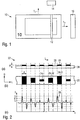
- Fig. 1 shows a schematic representation of a bank note 10 which is provided with a security thread 12 according to the invention with magnetic coding.
- the security thread 12 can be applied to the top of the banknote 10 or can be partially or completely embedded in the banknote.
- the invention is not limited to security threads and banknotes, but can be used for all types of security elements, for example for labels on goods and packaging or for securing documents, ID cards, passports, credit cards, health cards and the like.
- wide security strips or transfer elements can also be considered.
- the banknote 10 is guided past a magnetic sensor 14, for example by a transport system (not shown) in the transport direction T 1 , so that the security thread 12 can be read by the magnetic sensor 14 along its longitudinal axis.
- the authenticity check takes place during transport in the transport direction T 2 , where the security thread can be read out by a magnetic sensor 16 along its transverse axis, as explained in more detail below.
- Fig. 2 (a) 2 shows a schematic cross section of the thread 12
- Fig. 2 (c) schematically shows the sensor signal detected by magnetic sensor 14 as a function of location x.
- the security thread 12 has a carrier 20 in the form of a transparent plastic film, for example a PET film.
- a magnetic coding 22 is arranged on the carrier 20 and is formed from a plurality of magnetic regions 24 which are arranged along a longitudinal direction L and are spaced apart from the longitudinal axis of the security thread 12.
- the sequence of the magnetic areas 24 and the spaces 26 between the magnetic areas 24 forms a first coding of the magnetic coding 22.
- the first coding is a binary coding, represented by bits 1 (magnetic area 24) and 0 (space 26), so that the alternating representation of the Fig. 2 (a) forms the bit sequence 10101010101.
- the magnetic areas 24 are all formed by a magnetic material applied in the same thickness d.
- the security thread 12 will typically have further layers, for example protective layers, functional layers with further security features, or camouflage layers for visually concealing the magnetic coding.
- these further layers are not essential for the present invention and are therefore not shown or described further.
- the magnetic areas 24 have dimensions which are always an integral multiple of a basic length l, where t is typically between 1 mm and 6 mm, in the exemplary embodiment approximately 2 mm. Each magnetic area 24 then clearly represents a sequence of one or more bits 1 Fig. 2 the magnetic areas 24 each have a longitudinal dimension 1 ⁇ l, that is to say each represents a single bit 1, as indicated in the above-mentioned bit sequence. Likewise, the distances between adjacent magnetic areas 24 are always an integer multiple of the basic length l, so that each space 26 clearly represents a sequence of one or more bits 0. In the embodiment of the Fig. 2 the spaces 26 each have a longitudinal dimension 1 ⁇ l, that is to say each represents a single bit 0, as indicated in the above-mentioned bit sequence.
- the magnetic coding 22 now also contains a further, second coding, which relates to FIG Fig. 2 (b) is formed in that the magnetic regions 24 have three different dimensions in the transverse direction Q. In the transverse direction there is then one of three possible, differently large amounts of magnetic material.
- a first group of magnetic areas 24-H extends over the entire width of the security thread 12, a second group of magnetic areas 24-L has only a very small dimension in the transverse direction and a third group of magnetic areas 24-M has a medium-sized dimension in the transverse direction on.
- the wide magnetic areas 24-H create a large one Signal (H)
- the narrow magnetic areas 24-L generate a small signal (L)
- the medium-wide magnetic areas 24-M produce a medium-sized signal (M).
- the widths of the magnetic areas 24-H, 24-M, 24-L are advantageously matched to one another, starting from the widest magnetic area 24-H, so that the ratios of the signal strengths H / M and M / L reach or exceed a certain threshold, for example 1.25 or 1.5.
- the sequence of the differently wide magnetic areas 24 thus forms a second coding, in the exemplary embodiment a ternary coding, represented by the trits (trinary digit) H (magnetic area 24-H), M (magnetic area 24-M) and L (magnetic area 24-L) so the in Fig. 2 (b) sequence shown for example represents the step sequence HMLMHL.
- the magnetic code 22 of the security thread 12 therefore contains two codes simultaneously and can therefore store a larger amount of information than would be possible with a single code.
- the first coding from the sequence of magnetic areas 24 and spaces 26 can, for example, indicate the country of issue and the value of the banknote 10, while the second coding with the sequence of differently wide magnetic areas 24-H, 24-M, 24-L indicate the year of manufacture Security thread 12 or other thread-specific information indicates.
- the wide magnetic areas 24-H can have a width of 6 mm, that is to say they take up the entire width of the thread, the medium-wide magnetic areas 24-M can have a width of 4 mm and the narrow magnetic areas 24-L one Have a width of 2 mm. Since the signal strength of the magnetic sensor 14 in With these dimensions, the magnetic regions 24-H, 24-M, 24-L generate signal strengths H: M: L in a ratio of 3: 2: 1, as in FIG Fig. 2 (c) illustrated.
- Fig. 3 illustrates the situation described again using a different magnetic coding.
- the dimensions of the magnetic areas 24 and the gaps 26 in the longitudinal direction are each also an integral multiple of a basic length l, the second and third gaps 26 each having a length 2 so, for example, and thus encoding two successive bits 0.
- the sequence of the magnetic areas 24 and the spaces 26 as the first coding 30 represents the bit sequence 010010010101.
- This first, binary coding 30 can code, for example, the country of issue and the number of values of a banknote, in particular, in particular, information that is identical for all identical banknotes.
- the magnetic areas 24-H, 24-M and 24-L have different dimensions, as in Fig. 3 (b) shown, which leads to different signal strengths in the measurement signal 28 detected by the magnetic sensor 14 ( Fig. 3 (c) ).
- a second, ternary coding 32 is formed in this way, which represents the step sequence HLMHL in the exemplary embodiment.
- the code 32 can, for example, indicate the year of manufacture of the security thread 12 and thus in particular contain information specific to the security thread.
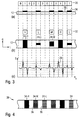
- Fig. 4 shows an alternative design of a security thread 38, in which the magnetic areas 34 of the magnetic coding not only have the same length and thickness, but also have the same width and, for example, each occupy the entire width of the security thread 38.
- the magnetic areas 24 differ in the grid in the transverse direction and therefore have a different large amount of magnetic material in the transverse direction despite the same width.
- the magnetic areas 34-H are full-area (no grid)
- the magnetic areas 34-M and 34-L each consist of a plurality of parallel magnetic tracks 36 extending in the longitudinal direction L.
- the duty cycle of magnetic tracks 36 and the empty tracks lying between them is Magnetic areas 34-M still 2: 1, with magnetic areas 34-L only 1: 2.
- the magnetic areas 34-M and 34-L therefore contain only 2/3 or 1/3 of the material quantity of the magnetic areas 34-H and the magnetic edge length of the magnetic areas 34-M and 34-L is only 2/3 or 1 / 3 the magnetic edge length of the magnetic areas 34-H.
- the magnetic areas 34 When reading out the security thread section of the Fig. 4 in the longitudinal direction, the magnetic areas 34 therefore generate the same signal 28 as the magnetic areas 24 of the security thread section of FIG Fig. 2 (b) and therefore also form a second coding with the HMLMHL step sequence.
- FIG. 5 shows in a representation like in Fig. 2 a security thread 40 with a magnetic coding 42, in which the magnetic areas 44 do not have different dimensions in the transverse direction Q, but are additionally formed by magnetic material with two differently large coercive field strengths.
- Each magnetic area 44 is either made of a material of low coercive field strength (magnetic areas 50 in Fig. 5 shown filled) or a material of high coercive field strength (magnetic field regions 52, in Fig. 5 hatched) formed.
- the sequence of magnetic areas of high coercive field strength and magnetic areas of low coercive field strength then represents a third coding in the magnetic coding 42.
- the magnetic coding 42 naturally also contains the first coding, which by the sequence of the spaces 46 and the magnetic areas 44 per se, independently of them Width and coercive field strength, is given ( Fig. 5 (a) ), as well as the second coding, which is given by the sequence of differently wide magnetic areas ( Fig. 5 (b) ), as related to above Fig. 2 explained in detail.
- the different coercive field strengths of the magnetic areas 44 can be read out separately or together in different reading channels of a magnetic sensor 14, as in FIG 5 (c) and 5 (d) shown.
- the measurement signal 54 contains both amounts from the high-coercive magnetic areas 52 and amounts from the low-coercive magnetic areas 50, so that the first and second coding can be derived from the measurement signal 54, as already described above.
- the common read channel contains the Step sequence HMLMHL ( Fig. 5 (c) ) and the highly coercive reading channel the step sequence MMH ( Fig. 5 (d) ).
- both read channels are detected with a magnetic sensor 14, then other encodings can also be derived from the two measurement signals 54, 56, for example a bit sequence which indicates the sequence of low and high coercive magnetic areas 50, 52.
- the magnetic coding 22 in the designs described so far along the longitudinal direction L of the magnetic coding has been read out
- the magnetic coding 22 can also be transported during the transport of the security thread 12 along the transverse direction Q (transport direction T 2 in Fig. 1 and 6 (a) ) can be read out.
- the magnetic sensor 16 is designed to be spatially resolved and has a spatial resolution of 1 mm in the longitudinal direction L, for example. With a basic length l between 1 mm and 6 mm, the positions of the magnetic areas 24 and the spaces 26 can then be detected without further ado, so that the first coding given by the sequence of the magnetic areas 24 and the spaces 26 can also be read out in the case of transverse direction transport.
- a distinction between the different broad magnetic areas 24-H, 24-M, 24-L is made when reading out in the transport direction T 2 not based on the signal strength, but on the point in time at which A magnetic signal is detected at a certain longitudinal thread position, or via the position of the edge edges 64-H, 64-M, 64-L of the magnetic areas 24 derived therefrom. From the classification of the magnetic areas as narrow (edge edge 64-L was detected), medium-wide (Edge 64-M was detected) or wide (edge 64-H was detected), the second coding can then be derived and thus the magnetic code 22 can be read out as a whole.
- a coding can be derived from the magnetic coding 22 in the transport direction T 2 .
- the measurement signal 66 shown is proportional to the number of magnetic regions 24 which begin or end at a specific position in the transverse direction Q.
- two wide magnetic areas 24-H begin at the left edge of the security thread 22 with the edge edges 64-H
- a medium-wide magnetic area 24-M begins somewhat further inside the edge edge with the edge edge 64-M, and start closest to the middle of the thread with the edge edges 64-L three narrow magnetic areas 24-L.
- the measurement signal 66 therefore shows three peaks with a relative amplitude of 2: 1: 3, this measured amplitude ratio representing a characteristic of the magnetic coding 22. After the thread center has been exceeded, the peaks of the measurement signal 66 occur again in the reverse order and with a negative sign.
Landscapes
- Physics & Mathematics (AREA)
- General Physics & Mathematics (AREA)
- Engineering & Computer Science (AREA)
- Theoretical Computer Science (AREA)
- Inspection Of Paper Currency And Valuable Securities (AREA)
- Credit Cards Or The Like (AREA)
Claims (11)
- Élément de sécurité (12), destiné à sécuriser des papiers de sécurité, des documents de valeur et autres supports de données, pourvu d'un codage magnétique (22) constitué d'une pluralité de zones magnétiques (24), qui sont placées en étant écartées le long d'une direction longitudinale (L), les séquences de zones magnétiques (24) et d'espaces intermédiaires (26) situés entre les zones magnétiques formant un premier codage (30) du codage magnétique, caractérisé en ce que les zones magnétiques (24) sont formées d'une matière magnétique appliquée sur une même épaisseur (d), mais dans une direction transversale (Q) perpendiculaire à la direction longitudinale, les zones magnétiques (24) présentent différentes quantités de matière magnétique, la séquence de zones magnétiques de différente quantité de matière (24-H, 24-M, 24-L) formant un deuxième codage do codage magnétique (22).
- Élément de sécurité selon la revendication 1, caractérisé en ce que les zones magnétiques (24) présentent dans la direction transversale (Q) trois, quatre ou cinq quantités de matière de différente taille.
- Élément de sécurité selon la revendication 1 ou 2, caractérisé en ce que les zones magnétiques (24) présentent une dimension différente dans la direction transversale (Q).
- Élément de sécurité selon au moins l'une quelconque des revendications 1 à 3, caractérisé en ce que les zones magnétiques (24) présentent dans la direction transversale (Q) un tramage de différente épaisseur.
- Élément de sécurité selon au moins l'une quelconque des revendications 1 à 4, caractérisé en ce que les dimensions des zones magnétiques (24) dans la direction longitudinale (L) et les dimensions des espaces intermédiaires (26) situés entre les zones magnétiques dans la direction longitudinale s'élèvent toujours à un multiple entier d'une longueur de base ℓ.
- Élément de sécurité selon au moins l'une quelconque des revendications 1 à 5, caractérisé en ce que les zones magnétiques (24) sont formées de matière magnétique présentant différentes propriétés magnétiques, la séquence de zones magnétiques (24) de différentes propriétés magnétiques formant un troisième codage du codage magnétique (22).
- Élément de sécurité selon la revendication 6, caractérisé en ce que les zones magnétiques (24) sont formées de matière magnétique de différente force coercitive.
- Élément de sécurité selon au moins l'une quelconque des revendications 1 à 7, caractérisé en ce que les zones magnétiques (24) de dimension maximale dans la direction transversale (Q) occupent toute la largeur de l'élément de sécurité (12), notamment d'un fil de sécurité.
- Élément de sécurité selon au moins l'une quelconque des revendications 1 à 8, caractérisé en ce que la dimension des zones magnétiques (24) dans la direction longitudinale (L) se situe entre 1 mm et 6 mm, et / ou la dimension des zones magnétiques (24) dans la direction transversale (Q) se situe entre 1 mm et 6 mm ou la largeur de l'élément de sécurité.
- Élément de sécurité selon au moins l'une quelconque des revendications 1 à 9, caractérisé en ce que l'élément de sécurité (12) est un fil de sécurité, une bande de sécurité ou un ruban de sécurité.
- Procédé, destiné à fabriquer un élément de sécurité (12) pourvu d'un codage magnétique (22), lors duquel, sur un support (20)- le long d'une direction longitudinale (L), on applique sur une même épaisseur (d) de la matière magnétique, pour créer une pluralité de zones magnétiques (24) écartées le long d'une direction longitudinale (L), la séquence de zones magnétiques (24) et d'espaces intermédiaires (26) situés entre les zones magnétiques formant un premier codage (30) du codage magnétique (22),
caractérisé en ce que- dans une direction transversale (Q) perpendiculaire à la direction longitudinale, on applique les zones magnétiques (24) dans différentes quantités de matière magnétique, la séquence de zones magnétiques de différente quantité de matière (24-H, 24-M, 24-L) formant un deuxième codage du codage magnétique (22).
Applications Claiming Priority (1)
| Application Number | Priority Date | Filing Date | Title |
|---|---|---|---|
| DE102016001828.3A DE102016001828A1 (de) | 2016-02-17 | 2016-02-17 | Sicherheitselement mit Magnetcodierung |
Publications (2)
| Publication Number | Publication Date |
|---|---|
| EP3208100A1 EP3208100A1 (fr) | 2017-08-23 |
| EP3208100B1 true EP3208100B1 (fr) | 2020-05-06 |
Family
ID=58098391
Family Applications (1)
| Application Number | Title | Priority Date | Filing Date |
|---|---|---|---|
| EP17000207.5A Active EP3208100B1 (fr) | 2016-02-17 | 2017-02-10 | Élément de sécurité à codage magnétique et son procédé de fabrication |
Country Status (3)
| Country | Link |
|---|---|
| EP (1) | EP3208100B1 (fr) |
| CN (1) | CN107089066B (fr) |
| DE (1) | DE102016001828A1 (fr) |
Families Citing this family (7)
| Publication number | Priority date | Publication date | Assignee | Title |
|---|---|---|---|---|
| CN112166303B (zh) * | 2018-05-25 | 2022-07-01 | 森斯泰克有限责任公司 | 绝对值编码器 |
| CN111016494B (zh) * | 2019-11-20 | 2021-01-26 | 中钞特种防伪科技有限公司 | 防伪元件及防伪产品 |
| CN111860731B (zh) * | 2020-06-04 | 2023-04-25 | 珠海市太乙人工智能有限公司 | 一种磁性编码尺及编码尺的二进制编码方法 |
| CN112329902B (zh) * | 2020-11-02 | 2024-02-13 | 中钞特种防伪科技有限公司 | 磁性防伪元件及磁性防伪产品 |
| CN113516216A (zh) * | 2021-04-26 | 2021-10-19 | 中钞特种防伪科技有限公司 | 防伪元件、防伪元件检测方法及防伪产品 |
| CN113947174B (zh) * | 2021-09-08 | 2023-09-05 | 中钞特种防伪科技有限公司 | 一种防伪元件及使用该防伪元件的防伪产品 |
| CN116187380B (zh) * | 2021-11-25 | 2026-02-06 | 中钞特种防伪科技有限公司 | 防伪元件和防伪产品 |
Family Cites Families (8)
| Publication number | Priority date | Publication date | Assignee | Title |
|---|---|---|---|---|
| US5486022A (en) * | 1994-04-04 | 1996-01-23 | Crane & Co., Inc. | Security threads having at least two security detection features and security papers employing same |
| FR2767218B1 (fr) * | 1997-08-06 | 1999-11-12 | Conception Organisation Logist | Code magnetique comportant une base de lecture et systeme de lecture d'un tel code |
| DE102007025939A1 (de) * | 2007-06-04 | 2008-12-11 | Giesecke & Devrient Gmbh | Sicherheitselement zur Absicherung von Wertdokumenten |
| ITMI20080053A1 (it) * | 2008-01-15 | 2009-07-16 | Fabriano Securities Srl | Elemento di sicurezza, particolarmente per banconote, carte di sicurezza e simili, avente caratteristiche anti-contraffazione. |
| GB2478537B (en) * | 2010-03-08 | 2013-07-24 | Rue De Int Ltd | Improvements in security documents |
| DE102010019463A1 (de) * | 2010-05-05 | 2011-11-10 | Giesecke & Devrient Gmbh | Sicherheitselement zur Absicherung von Wertdokumenten |
| ITTO20100568A1 (it) * | 2010-07-01 | 2012-01-02 | Fabriano Securities Srl | Sistema per codifiche magnetiche tramite deposito di aree magnetiche realizzate da almeno due tipi di inchiostri magnetici, con differente coercitivita', depositati in modo almeno parzialmente sovrapposto da utilizzare per fili di sicurezza per docum |
| DE102013005839A1 (de) * | 2013-04-04 | 2014-10-09 | Giesecke & Devrient Gmbh | Sicherheitselement für Wertdokumente |
-
2016
- 2016-02-17 DE DE102016001828.3A patent/DE102016001828A1/de not_active Withdrawn
-
2017
- 2017-02-10 EP EP17000207.5A patent/EP3208100B1/fr active Active
- 2017-02-17 CN CN201710243940.7A patent/CN107089066B/zh active Active
Non-Patent Citations (1)
| Title |
|---|
| None * |
Also Published As
| Publication number | Publication date |
|---|---|
| CN107089066B (zh) | 2018-12-18 |
| DE102016001828A1 (de) | 2017-08-17 |
| CN107089066A (zh) | 2017-08-25 |
| EP3208100A1 (fr) | 2017-08-23 |
Similar Documents
| Publication | Publication Date | Title |
|---|---|---|
| EP3208100B1 (fr) | Élément de sécurité à codage magnétique et son procédé de fabrication | |
| EP1812243B1 (fr) | Element de securite comportant des materiaux magnetiques presentant la meme remanence et une intensite de champ coercitive differente | |
| DE3781894T2 (de) | Dokument mit magnetisch detektierbaren sicherheitsmitteln und streifen mit magnetisch detektierbarem identifikationskode und identifikationskode. | |
| DE69013414T2 (de) | Kodierung eines sicherheitsfadens für banknoten und sicherheitspapiere. | |
| EP2156414B1 (fr) | Elément de sécurité pour la protection de documents de valeur | |
| EP2307898B1 (fr) | Dispositif de mesure pour la mesure de propriétés magnétiques et procédé de fabrication pour un tel dispositif de mesure | |
| DE19650759A1 (de) | Sicherheitselement | |
| EP2143081B1 (fr) | Procédé et dispositif pour vérifier des documents-valeurs | |
| DE102009042022A1 (de) | Langgestrecktes Sicherheitselement mit maschinenlesbaren magnetischen Bereichen | |
| EP2385503B1 (fr) | Elément de sécurité pour la sécurisation de documents de valeur | |
| EP2095339A1 (fr) | Élément de sécurité pour documents de valeur | |
| WO2008061729A1 (fr) | Élément de sécurité pour la sécurisation de documents de valeur | |
| WO1998033659A1 (fr) | Document de valeur et mode de fabrication | |
| EP1673231B1 (fr) | Document de valeur comprenant differentes substances caracteristiques | |
| DE2107113A1 (de) | Zum Druck von Wertscheinen bestimmtes Papier vn Band oder Bogenform mit einer Sicherheitsstruktur und Detektorsystem zur Identifizierung dieser Sicherheitsstruktur | |
| EP2187452A2 (fr) | Procédé de marquage/codage d'une cellule solaire et cellule solaire | |
| DE69212219T2 (de) | Verfahren zum Kodieren eines Sicherheitsdrahtes, insbesondere für Bankpapier | |
| EP1673234B1 (fr) | Document de valeur | |
| WO2005036478A1 (fr) | Systeme de codage pour documents de valeur | |
| EP1494874B1 (fr) | Element de securite | |
| DE2140148A1 (de) | Informationsspeicherkarte und Ver fahren zur Trennung bestimmter Karten | |
| EP3693708B1 (fr) | Cylindre doté d'une tige de piston et d'un dispositif optique de mesure de la position | |
| EP2319022B1 (fr) | Document de valeur et/ou de sécurité, et procédé de vérification | |
| EP4484175A1 (fr) | Dispositif de sécurité avec zones de caractéristiques lisibles par machine, document de valeur et méthode de contrôle | |
| EP1662443A2 (fr) | Marquage de sécurité magnétique |
Legal Events
| Date | Code | Title | Description |
|---|---|---|---|
| PUAI | Public reference made under article 153(3) epc to a published international application that has entered the european phase |
Free format text: ORIGINAL CODE: 0009012 |
|
| STAA | Information on the status of an ep patent application or granted ep patent |
Free format text: STATUS: THE APPLICATION HAS BEEN PUBLISHED |
|
| AK | Designated contracting states |
Kind code of ref document: A1 Designated state(s): AL AT BE BG CH CY CZ DE DK EE ES FI FR GB GR HR HU IE IS IT LI LT LU LV MC MK MT NL NO PL PT RO RS SE SI SK SM TR |
|
| AX | Request for extension of the european patent |
Extension state: BA ME |
|
| STAA | Information on the status of an ep patent application or granted ep patent |
Free format text: STATUS: REQUEST FOR EXAMINATION WAS MADE |
|
| 17P | Request for examination filed |
Effective date: 20180223 |
|
| RBV | Designated contracting states (corrected) |
Designated state(s): AL AT BE BG CH CY CZ DE DK EE ES FI FR GB GR HR HU IE IS IT LI LT LU LV MC MK MT NL NO PL PT RO RS SE SI SK SM TR |
|
| GRAP | Despatch of communication of intention to grant a patent |
Free format text: ORIGINAL CODE: EPIDOSNIGR1 |
|
| STAA | Information on the status of an ep patent application or granted ep patent |
Free format text: STATUS: GRANT OF PATENT IS INTENDED |
|
| INTG | Intention to grant announced |
Effective date: 20191204 |
|
| GRAS | Grant fee paid |
Free format text: ORIGINAL CODE: EPIDOSNIGR3 |
|
| GRAA | (expected) grant |
Free format text: ORIGINAL CODE: 0009210 |
|
| STAA | Information on the status of an ep patent application or granted ep patent |
Free format text: STATUS: THE PATENT HAS BEEN GRANTED |
|
| AK | Designated contracting states |
Kind code of ref document: B1 Designated state(s): AL AT BE BG CH CY CZ DE DK EE ES FI FR GB GR HR HU IE IS IT LI LT LU LV MC MK MT NL NO PL PT RO RS SE SI SK SM TR |
|
| REG | Reference to a national code |
Ref country code: GB Ref legal event code: FG4D Free format text: NOT ENGLISH |
|
| REG | Reference to a national code |
Ref country code: AT Ref legal event code: REF Ref document number: 1266171 Country of ref document: AT Kind code of ref document: T Effective date: 20200515 Ref country code: CH Ref legal event code: EP |
|
| REG | Reference to a national code |
Ref country code: IE Ref legal event code: FG4D Free format text: LANGUAGE OF EP DOCUMENT: GERMAN |
|
| REG | Reference to a national code |
Ref country code: DE Ref legal event code: R096 Ref document number: 502017005077 Country of ref document: DE |
|
| REG | Reference to a national code |
Ref country code: LT Ref legal event code: MG4D |
|
| REG | Reference to a national code |
Ref country code: NL Ref legal event code: MP Effective date: 20200506 |
|
| PG25 | Lapsed in a contracting state [announced via postgrant information from national office to epo] |
Ref country code: FI Free format text: LAPSE BECAUSE OF FAILURE TO SUBMIT A TRANSLATION OF THE DESCRIPTION OR TO PAY THE FEE WITHIN THE PRESCRIBED TIME-LIMIT Effective date: 20200506 Ref country code: NO Free format text: LAPSE BECAUSE OF FAILURE TO SUBMIT A TRANSLATION OF THE DESCRIPTION OR TO PAY THE FEE WITHIN THE PRESCRIBED TIME-LIMIT Effective date: 20200806 Ref country code: SE Free format text: LAPSE BECAUSE OF FAILURE TO SUBMIT A TRANSLATION OF THE DESCRIPTION OR TO PAY THE FEE WITHIN THE PRESCRIBED TIME-LIMIT Effective date: 20200506 Ref country code: LT Free format text: LAPSE BECAUSE OF FAILURE TO SUBMIT A TRANSLATION OF THE DESCRIPTION OR TO PAY THE FEE WITHIN THE PRESCRIBED TIME-LIMIT Effective date: 20200506 Ref country code: GR Free format text: LAPSE BECAUSE OF FAILURE TO SUBMIT A TRANSLATION OF THE DESCRIPTION OR TO PAY THE FEE WITHIN THE PRESCRIBED TIME-LIMIT Effective date: 20200807 Ref country code: PT Free format text: LAPSE BECAUSE OF FAILURE TO SUBMIT A TRANSLATION OF THE DESCRIPTION OR TO PAY THE FEE WITHIN THE PRESCRIBED TIME-LIMIT Effective date: 20200907 Ref country code: IS Free format text: LAPSE BECAUSE OF FAILURE TO SUBMIT A TRANSLATION OF THE DESCRIPTION OR TO PAY THE FEE WITHIN THE PRESCRIBED TIME-LIMIT Effective date: 20200906 |
|
| PG25 | Lapsed in a contracting state [announced via postgrant information from national office to epo] |
Ref country code: BG Free format text: LAPSE BECAUSE OF FAILURE TO SUBMIT A TRANSLATION OF THE DESCRIPTION OR TO PAY THE FEE WITHIN THE PRESCRIBED TIME-LIMIT Effective date: 20200806 Ref country code: RS Free format text: LAPSE BECAUSE OF FAILURE TO SUBMIT A TRANSLATION OF THE DESCRIPTION OR TO PAY THE FEE WITHIN THE PRESCRIBED TIME-LIMIT Effective date: 20200506 Ref country code: HR Free format text: LAPSE BECAUSE OF FAILURE TO SUBMIT A TRANSLATION OF THE DESCRIPTION OR TO PAY THE FEE WITHIN THE PRESCRIBED TIME-LIMIT Effective date: 20200506 Ref country code: LV Free format text: LAPSE BECAUSE OF FAILURE TO SUBMIT A TRANSLATION OF THE DESCRIPTION OR TO PAY THE FEE WITHIN THE PRESCRIBED TIME-LIMIT Effective date: 20200506 |
|
| PG25 | Lapsed in a contracting state [announced via postgrant information from national office to epo] |
Ref country code: NL Free format text: LAPSE BECAUSE OF FAILURE TO SUBMIT A TRANSLATION OF THE DESCRIPTION OR TO PAY THE FEE WITHIN THE PRESCRIBED TIME-LIMIT Effective date: 20200506 Ref country code: AL Free format text: LAPSE BECAUSE OF FAILURE TO SUBMIT A TRANSLATION OF THE DESCRIPTION OR TO PAY THE FEE WITHIN THE PRESCRIBED TIME-LIMIT Effective date: 20200506 |
|
| PG25 | Lapsed in a contracting state [announced via postgrant information from national office to epo] |
Ref country code: DK Free format text: LAPSE BECAUSE OF FAILURE TO SUBMIT A TRANSLATION OF THE DESCRIPTION OR TO PAY THE FEE WITHIN THE PRESCRIBED TIME-LIMIT Effective date: 20200506 Ref country code: SM Free format text: LAPSE BECAUSE OF FAILURE TO SUBMIT A TRANSLATION OF THE DESCRIPTION OR TO PAY THE FEE WITHIN THE PRESCRIBED TIME-LIMIT Effective date: 20200506 Ref country code: RO Free format text: LAPSE BECAUSE OF FAILURE TO SUBMIT A TRANSLATION OF THE DESCRIPTION OR TO PAY THE FEE WITHIN THE PRESCRIBED TIME-LIMIT Effective date: 20200506 Ref country code: CZ Free format text: LAPSE BECAUSE OF FAILURE TO SUBMIT A TRANSLATION OF THE DESCRIPTION OR TO PAY THE FEE WITHIN THE PRESCRIBED TIME-LIMIT Effective date: 20200506 Ref country code: ES Free format text: LAPSE BECAUSE OF FAILURE TO SUBMIT A TRANSLATION OF THE DESCRIPTION OR TO PAY THE FEE WITHIN THE PRESCRIBED TIME-LIMIT Effective date: 20200506 Ref country code: EE Free format text: LAPSE BECAUSE OF FAILURE TO SUBMIT A TRANSLATION OF THE DESCRIPTION OR TO PAY THE FEE WITHIN THE PRESCRIBED TIME-LIMIT Effective date: 20200506 |
|
| REG | Reference to a national code |
Ref country code: DE Ref legal event code: R097 Ref document number: 502017005077 Country of ref document: DE |
|
| PG25 | Lapsed in a contracting state [announced via postgrant information from national office to epo] |
Ref country code: PL Free format text: LAPSE BECAUSE OF FAILURE TO SUBMIT A TRANSLATION OF THE DESCRIPTION OR TO PAY THE FEE WITHIN THE PRESCRIBED TIME-LIMIT Effective date: 20200506 Ref country code: SK Free format text: LAPSE BECAUSE OF FAILURE TO SUBMIT A TRANSLATION OF THE DESCRIPTION OR TO PAY THE FEE WITHIN THE PRESCRIBED TIME-LIMIT Effective date: 20200506 |
|
| PLBE | No opposition filed within time limit |
Free format text: ORIGINAL CODE: 0009261 |
|
| STAA | Information on the status of an ep patent application or granted ep patent |
Free format text: STATUS: NO OPPOSITION FILED WITHIN TIME LIMIT |
|
| 26N | No opposition filed |
Effective date: 20210209 |
|
| PG25 | Lapsed in a contracting state [announced via postgrant information from national office to epo] |
Ref country code: SI Free format text: LAPSE BECAUSE OF FAILURE TO SUBMIT A TRANSLATION OF THE DESCRIPTION OR TO PAY THE FEE WITHIN THE PRESCRIBED TIME-LIMIT Effective date: 20200506 |
|
| PG25 | Lapsed in a contracting state [announced via postgrant information from national office to epo] |
Ref country code: MC Free format text: LAPSE BECAUSE OF FAILURE TO SUBMIT A TRANSLATION OF THE DESCRIPTION OR TO PAY THE FEE WITHIN THE PRESCRIBED TIME-LIMIT Effective date: 20200506 |
|
| REG | Reference to a national code |
Ref country code: BE Ref legal event code: MM Effective date: 20210228 |
|
| PG25 | Lapsed in a contracting state [announced via postgrant information from national office to epo] |
Ref country code: CH Free format text: LAPSE BECAUSE OF NON-PAYMENT OF DUE FEES Effective date: 20210228 Ref country code: LI Free format text: LAPSE BECAUSE OF NON-PAYMENT OF DUE FEES Effective date: 20210228 Ref country code: LU Free format text: LAPSE BECAUSE OF NON-PAYMENT OF DUE FEES Effective date: 20210210 |
|
| PG25 | Lapsed in a contracting state [announced via postgrant information from national office to epo] |
Ref country code: IE Free format text: LAPSE BECAUSE OF NON-PAYMENT OF DUE FEES Effective date: 20210210 |
|
| PG25 | Lapsed in a contracting state [announced via postgrant information from national office to epo] |
Ref country code: BE Free format text: LAPSE BECAUSE OF NON-PAYMENT OF DUE FEES Effective date: 20210228 |
|
| PG25 | Lapsed in a contracting state [announced via postgrant information from national office to epo] |
Ref country code: HU Free format text: LAPSE BECAUSE OF FAILURE TO SUBMIT A TRANSLATION OF THE DESCRIPTION OR TO PAY THE FEE WITHIN THE PRESCRIBED TIME-LIMIT; INVALID AB INITIO Effective date: 20170210 |
|
| P01 | Opt-out of the competence of the unified patent court (upc) registered |
Effective date: 20230520 |
|
| PG25 | Lapsed in a contracting state [announced via postgrant information from national office to epo] |
Ref country code: CY Free format text: LAPSE BECAUSE OF FAILURE TO SUBMIT A TRANSLATION OF THE DESCRIPTION OR TO PAY THE FEE WITHIN THE PRESCRIBED TIME-LIMIT Effective date: 20200506 |
|
| PG25 | Lapsed in a contracting state [announced via postgrant information from national office to epo] |
Ref country code: MK Free format text: LAPSE BECAUSE OF FAILURE TO SUBMIT A TRANSLATION OF THE DESCRIPTION OR TO PAY THE FEE WITHIN THE PRESCRIBED TIME-LIMIT Effective date: 20200506 |
|
| PG25 | Lapsed in a contracting state [announced via postgrant information from national office to epo] |
Ref country code: MT Free format text: LAPSE BECAUSE OF FAILURE TO SUBMIT A TRANSLATION OF THE DESCRIPTION OR TO PAY THE FEE WITHIN THE PRESCRIBED TIME-LIMIT Effective date: 20200506 |
|
| PG25 | Lapsed in a contracting state [announced via postgrant information from national office to epo] |
Ref country code: TR Free format text: LAPSE BECAUSE OF FAILURE TO SUBMIT A TRANSLATION OF THE DESCRIPTION OR TO PAY THE FEE WITHIN THE PRESCRIBED TIME-LIMIT Effective date: 20200506 |
|
| PGFP | Annual fee paid to national office [announced via postgrant information from national office to epo] |
Ref country code: GB Payment date: 20260219 Year of fee payment: 10 |
|
| PGFP | Annual fee paid to national office [announced via postgrant information from national office to epo] |
Ref country code: DE Payment date: 20260217 Year of fee payment: 10 |
|
| PGFP | Annual fee paid to national office [announced via postgrant information from national office to epo] |
Ref country code: AT Payment date: 20260216 Year of fee payment: 10 |
|
| PGFP | Annual fee paid to national office [announced via postgrant information from national office to epo] |
Ref country code: IT Payment date: 20260227 Year of fee payment: 10 |
|
| PGFP | Annual fee paid to national office [announced via postgrant information from national office to epo] |
Ref country code: FR Payment date: 20260219 Year of fee payment: 10 |