EP3208301B1 - Composition de résine et film de compensation optique l'utilisant - Google Patents
Composition de résine et film de compensation optique l'utilisant Download PDFInfo
- Publication number
- EP3208301B1 EP3208301B1 EP15850872.1A EP15850872A EP3208301B1 EP 3208301 B1 EP3208301 B1 EP 3208301B1 EP 15850872 A EP15850872 A EP 15850872A EP 3208301 B1 EP3208301 B1 EP 3208301B1
- Authority
- EP
- European Patent Office
- Prior art keywords
- residue unit
- group
- butyl
- fumarate
- residue
- Prior art date
- Legal status (The legal status is an assumption and is not a legal conclusion. Google has not performed a legal analysis and makes no representation as to the accuracy of the status listed.)
- Active
Links
- 0 CC*(C)=*(CC*(C)NC)*(C)*(C)C1(**)OC1 Chemical compound CC*(C)=*(CC*(C)NC)*(C)*(C)C1(**)OC1 0.000 description 11
Classifications
-
- G—PHYSICS
- G02—OPTICS
- G02B—OPTICAL ELEMENTS, SYSTEMS OR APPARATUS
- G02B5/00—Optical elements other than lenses
- G02B5/30—Polarising elements
- G02B5/3083—Birefringent or phase retarding elements
-
- C—CHEMISTRY; METALLURGY
- C08—ORGANIC MACROMOLECULAR COMPOUNDS; THEIR PREPARATION OR CHEMICAL WORKING-UP; COMPOSITIONS BASED THEREON
- C08L—COMPOSITIONS OF MACROMOLECULAR COMPOUNDS
- C08L35/00—Compositions of homopolymers or copolymers of compounds having one or more unsaturated aliphatic radicals, each having only one carbon-to-carbon double bond, and at least one being terminated by a carboxyl radical, and containing at least one other carboxyl radical in the molecule, or of salts, anhydrides, esters, amides, imides or nitriles thereof; Compositions of derivatives of such polymers
- C08L35/02—Homopolymers or copolymers of esters
-
- B—PERFORMING OPERATIONS; TRANSPORTING
- B29—WORKING OF PLASTICS; WORKING OF SUBSTANCES IN A PLASTIC STATE IN GENERAL
- B29C—SHAPING OR JOINING OF PLASTICS; SHAPING OF MATERIAL IN A PLASTIC STATE, NOT OTHERWISE PROVIDED FOR; AFTER-TREATMENT OF THE SHAPED PRODUCTS, e.g. REPAIRING
- B29C55/00—Shaping by stretching, e.g. drawing through a die; Apparatus therefor
- B29C55/02—Shaping by stretching, e.g. drawing through a die; Apparatus therefor of plates or sheets
-
- C—CHEMISTRY; METALLURGY
- C08—ORGANIC MACROMOLECULAR COMPOUNDS; THEIR PREPARATION OR CHEMICAL WORKING-UP; COMPOSITIONS BASED THEREON
- C08F—MACROMOLECULAR COMPOUNDS OBTAINED BY REACTIONS ONLY INVOLVING CARBON-TO-CARBON UNSATURATED BONDS
- C08F20/00—Homopolymers and copolymers of compounds having one or more unsaturated aliphatic radicals, each having only one carbon-to-carbon double bond, and only one being terminated by only one carboxyl radical or a salt, anhydride, ester, amide, imide or nitrile thereof
- C08F20/02—Monocarboxylic acids having less than ten carbon atoms, Derivatives thereof
- C08F20/10—Esters
-
- C—CHEMISTRY; METALLURGY
- C08—ORGANIC MACROMOLECULAR COMPOUNDS; THEIR PREPARATION OR CHEMICAL WORKING-UP; COMPOSITIONS BASED THEREON
- C08F—MACROMOLECULAR COMPOUNDS OBTAINED BY REACTIONS ONLY INVOLVING CARBON-TO-CARBON UNSATURATED BONDS
- C08F22/00—Homopolymers and copolymers of compounds having one or more unsaturated aliphatic radicals each having only one carbon-to-carbon double bond, and at least one being terminated by a carboxyl radical and containing at least one other carboxyl radical in the molecule; Salts, anhydrides, esters, amides, imides or nitriles thereof
- C08F22/10—Esters
- C08F22/12—Esters of phenols or saturated alcohols
- C08F22/14—Esters having no free carboxylic acid groups
-
- C—CHEMISTRY; METALLURGY
- C08—ORGANIC MACROMOLECULAR COMPOUNDS; THEIR PREPARATION OR CHEMICAL WORKING-UP; COMPOSITIONS BASED THEREON
- C08F—MACROMOLECULAR COMPOUNDS OBTAINED BY REACTIONS ONLY INVOLVING CARBON-TO-CARBON UNSATURATED BONDS
- C08F22/00—Homopolymers and copolymers of compounds having one or more unsaturated aliphatic radicals each having only one carbon-to-carbon double bond, and at least one being terminated by a carboxyl radical and containing at least one other carboxyl radical in the molecule; Salts, anhydrides, esters, amides, imides or nitriles thereof
- C08F22/10—Esters
- C08F22/12—Esters of phenols or saturated alcohols
- C08F22/16—Esters having free carboxylic acid groups
-
- C—CHEMISTRY; METALLURGY
- C08—ORGANIC MACROMOLECULAR COMPOUNDS; THEIR PREPARATION OR CHEMICAL WORKING-UP; COMPOSITIONS BASED THEREON
- C08F—MACROMOLECULAR COMPOUNDS OBTAINED BY REACTIONS ONLY INVOLVING CARBON-TO-CARBON UNSATURATED BONDS
- C08F220/00—Copolymers of compounds having one or more unsaturated aliphatic radicals, each having only one carbon-to-carbon double bond, and only one being terminated by only one carboxyl radical or a salt, anhydride ester, amide, imide or nitrile thereof
- C08F220/02—Monocarboxylic acids having less than ten carbon atoms; Derivatives thereof
- C08F220/10—Esters
- C08F220/26—Esters containing oxygen in addition to the carboxy oxygen
-
- C—CHEMISTRY; METALLURGY
- C08—ORGANIC MACROMOLECULAR COMPOUNDS; THEIR PREPARATION OR CHEMICAL WORKING-UP; COMPOSITIONS BASED THEREON
- C08F—MACROMOLECULAR COMPOUNDS OBTAINED BY REACTIONS ONLY INVOLVING CARBON-TO-CARBON UNSATURATED BONDS
- C08F222/00—Copolymers of compounds having one or more unsaturated aliphatic radicals, each having only one carbon-to-carbon double bond, and at least one being terminated by a carboxyl radical and containing at least one other carboxyl radical in the molecule; Salts, anhydrides, esters, amides, imides, or nitriles thereof
- C08F222/10—Esters
- C08F222/12—Esters of phenols or saturated alcohols
- C08F222/14—Esters having no free carboxylic acid groups, e.g. dialkyl maleates or fumarates
-
- C—CHEMISTRY; METALLURGY
- C08—ORGANIC MACROMOLECULAR COMPOUNDS; THEIR PREPARATION OR CHEMICAL WORKING-UP; COMPOSITIONS BASED THEREON
- C08J—WORKING-UP; GENERAL PROCESSES OF COMPOUNDING; AFTER-TREATMENT NOT COVERED BY SUBCLASSES C08B, C08C, C08F, C08G or C08H
- C08J5/00—Manufacture of articles or shaped materials containing macromolecular substances
- C08J5/18—Manufacture of films or sheets
-
- C—CHEMISTRY; METALLURGY
- C08—ORGANIC MACROMOLECULAR COMPOUNDS; THEIR PREPARATION OR CHEMICAL WORKING-UP; COMPOSITIONS BASED THEREON
- C08L—COMPOSITIONS OF MACROMOLECULAR COMPOUNDS
- C08L1/00—Compositions of cellulose, modified cellulose or cellulose derivatives
- C08L1/08—Cellulose derivatives
- C08L1/26—Cellulose ethers
-
- C—CHEMISTRY; METALLURGY
- C08—ORGANIC MACROMOLECULAR COMPOUNDS; THEIR PREPARATION OR CHEMICAL WORKING-UP; COMPOSITIONS BASED THEREON
- C08L—COMPOSITIONS OF MACROMOLECULAR COMPOUNDS
- C08L1/00—Compositions of cellulose, modified cellulose or cellulose derivatives
- C08L1/08—Cellulose derivatives
- C08L1/26—Cellulose ethers
- C08L1/28—Alkyl ethers
-
- C—CHEMISTRY; METALLURGY
- C08—ORGANIC MACROMOLECULAR COMPOUNDS; THEIR PREPARATION OR CHEMICAL WORKING-UP; COMPOSITIONS BASED THEREON
- C08L—COMPOSITIONS OF MACROMOLECULAR COMPOUNDS
- C08L33/00—Compositions of homopolymers or copolymers of compounds having one or more unsaturated aliphatic radicals, each having only one carbon-to-carbon double bond, and only one being terminated by only one carboxyl radical, or of salts, anhydrides, esters, amides, imides or nitriles thereof; Compositions of derivatives of such polymers
- C08L33/02—Homopolymers or copolymers of acids; Metal or ammonium salts thereof
-
- C—CHEMISTRY; METALLURGY
- C08—ORGANIC MACROMOLECULAR COMPOUNDS; THEIR PREPARATION OR CHEMICAL WORKING-UP; COMPOSITIONS BASED THEREON
- C08L—COMPOSITIONS OF MACROMOLECULAR COMPOUNDS
- C08L35/00—Compositions of homopolymers or copolymers of compounds having one or more unsaturated aliphatic radicals, each having only one carbon-to-carbon double bond, and at least one being terminated by a carboxyl radical, and containing at least one other carboxyl radical in the molecule, or of salts, anhydrides, esters, amides, imides or nitriles thereof; Compositions of derivatives of such polymers
-
- C—CHEMISTRY; METALLURGY
- C08—ORGANIC MACROMOLECULAR COMPOUNDS; THEIR PREPARATION OR CHEMICAL WORKING-UP; COMPOSITIONS BASED THEREON
- C08L—COMPOSITIONS OF MACROMOLECULAR COMPOUNDS
- C08L35/00—Compositions of homopolymers or copolymers of compounds having one or more unsaturated aliphatic radicals, each having only one carbon-to-carbon double bond, and at least one being terminated by a carboxyl radical, and containing at least one other carboxyl radical in the molecule, or of salts, anhydrides, esters, amides, imides or nitriles thereof; Compositions of derivatives of such polymers
- C08L35/06—Copolymers with vinyl aromatic monomers
-
- G—PHYSICS
- G02—OPTICS
- G02B—OPTICAL ELEMENTS, SYSTEMS OR APPARATUS
- G02B5/00—Optical elements other than lenses
- G02B5/30—Polarising elements
- G02B5/3025—Polarisers, i.e. arrangements capable of producing a definite output polarisation state from an unpolarised input state
- G02B5/3033—Polarisers, i.e. arrangements capable of producing a definite output polarisation state from an unpolarised input state in the form of a thin sheet or foil, e.g. Polaroid
-
- G—PHYSICS
- G02—OPTICS
- G02F—OPTICAL DEVICES OR ARRANGEMENTS FOR THE CONTROL OF LIGHT BY MODIFICATION OF THE OPTICAL PROPERTIES OF THE MEDIA OF THE ELEMENTS INVOLVED THEREIN; NON-LINEAR OPTICS; FREQUENCY-CHANGING OF LIGHT; OPTICAL LOGIC ELEMENTS; OPTICAL ANALOGUE/DIGITAL CONVERTERS
- G02F1/00—Devices or arrangements for the control of the intensity, colour, phase, polarisation or direction of light arriving from an independent light source, e.g. switching, gating or modulating; Non-linear optics
- G02F1/01—Devices or arrangements for the control of the intensity, colour, phase, polarisation or direction of light arriving from an independent light source, e.g. switching, gating or modulating; Non-linear optics for the control of the intensity, phase, polarisation or colour
- G02F1/13—Devices or arrangements for the control of the intensity, colour, phase, polarisation or direction of light arriving from an independent light source, e.g. switching, gating or modulating; Non-linear optics for the control of the intensity, phase, polarisation or colour based on liquid crystals, e.g. single liquid crystal display cells
- G02F1/133—Constructional arrangements; Operation of liquid crystal cells; Circuit arrangements
- G02F1/1333—Constructional arrangements; Manufacturing methods
- G02F1/1335—Structural association of cells with optical devices, e.g. polarisers or reflectors
- G02F1/13363—Birefringent elements, e.g. for optical compensation
-
- C—CHEMISTRY; METALLURGY
- C08—ORGANIC MACROMOLECULAR COMPOUNDS; THEIR PREPARATION OR CHEMICAL WORKING-UP; COMPOSITIONS BASED THEREON
- C08J—WORKING-UP; GENERAL PROCESSES OF COMPOUNDING; AFTER-TREATMENT NOT COVERED BY SUBCLASSES C08B, C08C, C08F, C08G or C08H
- C08J2301/00—Characterised by the use of cellulose, modified cellulose or cellulose derivatives
- C08J2301/08—Cellulose derivatives
- C08J2301/26—Cellulose ethers
- C08J2301/28—Alkyl ethers
-
- C—CHEMISTRY; METALLURGY
- C08—ORGANIC MACROMOLECULAR COMPOUNDS; THEIR PREPARATION OR CHEMICAL WORKING-UP; COMPOSITIONS BASED THEREON
- C08J—WORKING-UP; GENERAL PROCESSES OF COMPOUNDING; AFTER-TREATMENT NOT COVERED BY SUBCLASSES C08B, C08C, C08F, C08G or C08H
- C08J2333/00—Characterised by the use of homopolymers or copolymers of compounds having one or more unsaturated aliphatic radicals, each having only one carbon-to-carbon double bond, and only one being terminated by only one carboxyl radical, or of salts, anhydrides, esters, amides, imides, or nitriles thereof; Derivatives of such polymers
- C08J2333/02—Homopolymers or copolymers of acids; Metal or ammonium salts thereof
-
- C—CHEMISTRY; METALLURGY
- C08—ORGANIC MACROMOLECULAR COMPOUNDS; THEIR PREPARATION OR CHEMICAL WORKING-UP; COMPOSITIONS BASED THEREON
- C08J—WORKING-UP; GENERAL PROCESSES OF COMPOUNDING; AFTER-TREATMENT NOT COVERED BY SUBCLASSES C08B, C08C, C08F, C08G or C08H
- C08J2335/00—Characterised by the use of homopolymers or copolymers of compounds having one or more unsaturated aliphatic radicals, each having only one carbon-to-carbon double bond, and at least one being terminated by a carboxyl radical, and containing at least one other carboxyl radical in the molecule, or of salts, anhydrides, esters, amides, imides or nitriles thereof; Derivatives of such polymers
-
- C—CHEMISTRY; METALLURGY
- C08—ORGANIC MACROMOLECULAR COMPOUNDS; THEIR PREPARATION OR CHEMICAL WORKING-UP; COMPOSITIONS BASED THEREON
- C08J—WORKING-UP; GENERAL PROCESSES OF COMPOUNDING; AFTER-TREATMENT NOT COVERED BY SUBCLASSES C08B, C08C, C08F, C08G or C08H
- C08J2433/00—Characterised by the use of homopolymers or copolymers of compounds having one or more unsaturated aliphatic radicals, each having only one carbon-to-carbon double bond, and only one being terminated by only one carboxyl radical, or of salts, anhydrides, esters, amides, imides, or nitriles thereof; Derivatives of such polymers
- C08J2433/02—Homopolymers or copolymers of acids; Metal or ammonium salts thereof
-
- C—CHEMISTRY; METALLURGY
- C08—ORGANIC MACROMOLECULAR COMPOUNDS; THEIR PREPARATION OR CHEMICAL WORKING-UP; COMPOSITIONS BASED THEREON
- C08J—WORKING-UP; GENERAL PROCESSES OF COMPOUNDING; AFTER-TREATMENT NOT COVERED BY SUBCLASSES C08B, C08C, C08F, C08G or C08H
- C08J2435/00—Characterised by the use of homopolymers or copolymers of compounds having one or more unsaturated aliphatic radicals, each having only one carbon-to-carbon double bond, and at least one being terminated by a carboxyl radical, and containing at least one other carboxyl radical in the molecule, or of salts, anhydrides, esters, amides, imides or nitriles thereof; Derivatives of such polymers
-
- C—CHEMISTRY; METALLURGY
- C08—ORGANIC MACROMOLECULAR COMPOUNDS; THEIR PREPARATION OR CHEMICAL WORKING-UP; COMPOSITIONS BASED THEREON
- C08L—COMPOSITIONS OF MACROMOLECULAR COMPOUNDS
- C08L2201/00—Properties
- C08L2201/10—Transparent films; Clear coatings; Transparent materials
-
- C—CHEMISTRY; METALLURGY
- C08—ORGANIC MACROMOLECULAR COMPOUNDS; THEIR PREPARATION OR CHEMICAL WORKING-UP; COMPOSITIONS BASED THEREON
- C08L—COMPOSITIONS OF MACROMOLECULAR COMPOUNDS
- C08L2203/00—Applications
- C08L2203/16—Applications used for films
Definitions
- the present invention relates to a resin composition and an optical compensation film using the same. More specifically, the present invention relates to a resin composition and an optical compensation film for a liquid crystal display excellent in the retardation characteristics and wavelength dispersion characteristics.
- a liquid crystal display is being widely used as a most important display device in the multimedia society, including applications ranging from a cellular phone to a computer monitor, a notebook computer and a television set.
- many optical films are used so as to enhance display characteristics.
- an optical compensation film plays a great role in, for example, improving the contrast or compensating the color tone when the display is viewed from the front or oblique direction.
- the liquid crystal display includes many systems such as vertical alignment type (VA-LCD), in-plane switching liquid crystal display (IPS-LCD), super twisted nematic liquid crystal display (STN-LCD), reflective liquid crystal display and transflective liquid crystal display, and an optical compensation film suited for the display is required.
- VA-LCD vertical alignment type
- IPS-LCD in-plane switching liquid crystal display
- STN-LCD super twisted nematic liquid crystal display
- reflective liquid crystal display and transflective liquid crystal display and an optical compensation film suited for the display is required.
- a stretched film of a cellulose-based resin, a polycarbonate, a cyclic polyolefin, etc. is used.
- a film composed of a cellulose-based resin, such as triacetyl cellulose film is being widely used because of its good adhesiveness to polyvinyl alcohol as a polarizer.
- the optical compensation film composed of a cellulose-based resin has several problems.
- a cellulose-based resin film is processed into an optical compensation film having a retardation value appropriate to various displays by adjusting the stretching conditions
- a special stretching method of, for example, adhering a heat-shrinkable film to one surface or both surfaces of the film and heating and stretching the laminate to apply a shrinking force in the thickness direction of the polymer film is required, which makes it difficult to control the refractive index (retardation value) (see, for example, Patent Documents 1 to 3).
- nx indicates the refractive index in the fast axis direction (the direction having a minimum refractive index) in the film plane
- ny indicates the refractive index in the slow axis direction (the direction having a maximum refractive index) in the film plane
- nz indicates the refractive index outside the film plane (thickness direction).
- a cellulose-based resin film is generally produced by a solvent casting method, and the cellulose-based resin film deposited by a casting method has an out-of-plane retardation (Rth) of about 40 nm in the film thickness direction and therefore, raises a problem, such as occurrence of a color shift in an IPS-mode liquid crystal display, etc.
- Rth out-of-plane retardation
- a retardation film composed of a fumaric acid ester-based resin has also been proposed (see, for example, Patent Document 4).
- the three-dimensional indices of a stretched film composed of a fumaric acid ester-based resin are nz>ny>nx and, for example, lamination to another optical compensation film, etc. is needed for obtaining an optical compensation film exhibiting the above-described three-dimensional refractive indices.
- the optical compensation films of Patent Documents 5 to 7 have an excellent performance as an optical compensation film, but in order to develop the intended Re, a film thickness larger than that in the present invention is necessary.
- the retardation film is generally used also as an antireflection layer of a reflective liquid crystal display device, a touch panel or an organic EL and in these uses, a retardation film giving a larger retardation in the longer wavelength region (hereinafter, referred to as "reverse wavelength dispersion film”) is required, but Patent Documents 5 to 7 are silent on use as a reverse wavelength dispersion film.
- the retardation is preferably about 1/4 of the measured wavelength ⁇ , and a ratio Re(450)/Re(550) between a retardation at 450 nm and a retardation at 550 nm is preferably close to 0.81.
- the reverse wavelength dispersion film used is also required to be thin. To satisfy these required characteristics, various retardation films are being developed.
- a retardation plate having a reverse wavelength dispersion property obtained by blending a polymer having a positive intrinsic birefringence and a polymer having a negative intrinsic birefringence
- Patent Document 8 a norbornene-based polymer as a polymer having a positive intrinsic birefringence, a styrene-maleic anhydride copolymer as a polymer having a negative intrinsic birefringence, and a composition obtained by blending these polymers are disclosed, but in the retardation plate using the composition, Re and Nz do not satisfy the preferable relationship as the retardation characteristics of a retardation film.
- the present invention has been made by taking into account the above-described problems, and an object of the present invention is to provide a resin composition suitable for an optical compensation film, and an optical compensation film using the same, which is excellent in the retardation characteristics and wavelength dispersion characteristics.
- the gist of the present invention resides in the following [2] to [29].
- the resin composition of the present invention contains, as resin components, from 30 to 99 wt% of a cellulose-based resin represented by the following formula (1) and from 1 to 70 wt% of a cinnamic acid ester copolymer: (wherein each of R 1 , R 2 and R 3 independently represents hydrogen or a substituent having a carbon number of 1 to 12).
- the cellulose-based resin of the present invention includes, for example, a cellulose ether, a cellulose ester, a cellulose ether ester, and a cellulose acylate.
- the resin composition of the present invention may contain one kind or two or more kinds of these cellulose-based resins.
- a number average molecular weight (Mn) as determined in terms of standard polystyrene from an elution curve measured by gel permeation chromatography (GPC) is preferably from 1 ⁇ 10 3 to 1 ⁇ 10 6 , more preferably from 5 ⁇ 10 3 to 2 ⁇ 10 5 .
- the cellulose-based resin of the present invention is preferably a cellulose ether because of excellent compatibility with a cinnamic acid ester copolymer, large in-plane retardation Re and excellent stretchability.
- the cellulose ether that is preferred as the cellulose-based resin for use in the optical compensation film of the present invention is described below.
- the cellulose ether as the cellulose-based resin of the present invention is a polymer obtained by linearly polymerizing ⁇ -glucose units and is a polymer in which hydroxyl groups at the 2-position, 3-position and 6-position of the glucose unit are etherified in part or in whole.
- the cellulose ether for use in the present invention includes, for example, an alkyl cellulose such as methyl cellulose, ethyl cellulose and propyl cellulose; a hydroxyalkyl cellulose such as hydroxyethyl cellulose and hydroxypropyl cellulose; an aralkyl cellulose such as benzyl cellulose and trityl cellulose; a cyanoalkyl cellulose such as cyan ethyl cellulose; a carboxyalkyl cellulose such as carboxymethyl cellulose and carboxyethyl cellulose; a carboxyalkylalkyl cellulose such as carboxymethylmethyl cellulose and carboxymethylethyl cellulose; and an aminoalkyl cellulose such as aminoethyl cellulose.
- an alkyl cellulose such as methyl cellulose, ethyl cellulose and propyl cellulose
- a hydroxyalkyl cellulose such as hydroxyethyl cellulose and hydroxypropyl cellulose
- a substitution degree (etherification degree) of substituting, though an oxygen atom, the hydroxyl group of cellulose in the cellulose ether means a ratio at which a hydroxyl group of cellulose is etherified (in the case of 100% etherification, the substitution degree is 1) at each of the 2-position, 3-position and 6-position and in view of solubility, compatibility and stretchability, the total degree of substitution DS of an ether group is preferably from 1.5 to 3.0 (1.5 ⁇ DS ⁇ 3.0), more preferably from 1.8 to 2.8.
- the cellulose ether preferably has a substituent having a carbon number of 1 to 12.
- the substituent having a carbon number of 1 to 12 includes, for example, a methyl group, an ethyl group, a propyl group, a butyl group, a pentyl group, a hexyl group, a heptyl group, an octyl group, a decanyl group, a dodecanyl group, an isobutyl group, a tert-butyl group, a cyclohexyl group, a phenonyl group, a benzyl group, and a naphthyl group.
- a methyl group, an ethyl group, a propyl group, a butyl group and a pentyl group which are an alkyl group having a carbon number of 1 to 5, are preferred.
- the cellulose ether of cellulosed-based polymer used in the present invention may have only one kind of an ether group or two or more kinds of ether groups and may also have an ester group, in addition to the ether group.
- the cellulose ether is generally synthesized by alkali-decomposing cellulose pulp obtained from wood or cotton and etherifying the alkali-decomposed cellulose pulp.
- alkali for example, a hydroxide of an alkali metal such as lithium, potassium and sodium, or ammonia may be used.
- the alkalis above are generally used in the form of an aqueous solution.
- the alkalized cellulose pulp is then put into contact with an etherifying agent used according to the type of the cellulose ether, and thereby etherified.
- the etherifying agent includes, for example, an alkyl halide such as methyl chloride and ethyl chloride; an aralkyl halide such as benzyl chloride and trityl chloride; a halocarboxylic acid such as monochloroacetic acid and monochloropropionic acid; and an alkylene oxide such as ethylene oxide, propylene oxide and butylene oxide.
- an alkyl halide such as methyl chloride and ethyl chloride
- an aralkyl halide such as benzyl chloride and trityl chloride
- a halocarboxylic acid such as monochloroacetic acid and monochloropropionic acid
- an alkylene oxide such as ethylene oxide, propylene oxide and butylene oxide.
- One of these etherifying agents may be used alone, or two or more thereof may be used in combination.
- a depolymerization treatment with hydrogen chloride, hydrogen bromide, hydrochloric acid, sulfuric acid, etc. may be performed so as to adjust the viscosity.
- the cinnamic acid ester copolymer contained in the resin composition of the present invention is a copolymer containing a cinnamic acid ester residue unit, and the residue unit includes, for example, a cinnamic acid ester residue unit where the benzene ring in the cinnamic acid ester residue unit does not have a substituent, such as methyl cinnamate residue unit, ethyl cinnamate residue unit and isopropyl cinnamate residue unit; a cinnamic acid ester residue unit where the benzene ring has an electron-donating substituent, such as aminocinnamic acid ester residue unit, alkylcinnamic acid ester residue unit and alkoxycinnamic acid ester residue unit; and a cinnamic acid ester residue unit where the benzene ring has an electron-with
- the cinnamic acid ester copolymer is preferably a cinnamic acid ester copolymer containing 5 mol% or more of a cinnamic acid ester residue unit with the benzene ring having an electron-donating substituent or a cinnamic acid ester residue unit with the benzene ring having an electron-withdrawing substituent, because when used as a retardation film, a higher-performance retardation film is obtained.
- the cinnamic acid ester copolymer is more preferably a cinnamic acid ester copolymer containing from 10 to 90 mol% of an alkoxycinnamic acid ester residue unit represented by the following formula (2): (wherein each of R 4 and R 5 independently represents an alkyl group having a carbon number of 1 to 12).
- the retardation developability is more enhanced when the content of the alkoxycinnamic acid ester residue unit is 10 mol% or more, and the compatibility is more enhanced when it is 90 mol% or less. That is, in the present invention, when the cinnamic acid ester copolymer is a cinnamic acid ester copolymer containing from 10 to 90 mol% of an alkoxycinnamic acid ester residue unit, the compatibility of the copolymer becomes higher and in the case of using the resin composition according to the present invention as an optical compensation film, Re is more enhanced.
- R 4 that is an ester substituent of the alkoxycinnamic acid ester residue unit represented by formula (2) in the cinnamic acid ester copolymer is an alkyl group having a carbon number of 1 to 12, and examples thereof include a methyl group, an ethyl group, a propyl group, an isopropyl group, an s-butyl group, a tert-butyl group, an s-pentyl group, a tert-pentyl group, an s-hexyl group, a tert-hexyl group, a 2-ethylhexyl group, a cyclopropyl group, a cyclopentyl group, and a cyclohexyl group.
- R 5 that is an ester substituent is an alkyl group having a carbon number of 1 to 12, and examples thereof include a methyl group, an ethyl group, a propyl group, an isopropyl group, an s-butyl group, a tert-butyl group, an s-pentyl group, a tert-pentyl group, an s-hexyl group, a tert-hexyl group, a 2-ethylhexyl group, a cyclopropyl group, a cyclopentyl group, and a cyclohexyl group.
- the alkoxycinnamic acid ester residue unit represented by formula (2) is preferably an alkoxycinnamic acid ester residue unit selected from a methyl 4-methoxycinnamate residue, an ethyl 4-methoxycinnamate residue, an isopropyl 4-methoxycinnamate residue, an n-propyl 4-methoxycinnamate residue, an n-butyl 4-methoxycinnamate residue, a sec-butyl 4-methoxycinnamate residue, a tert-butyl 4-methoxycinnamate residue, a 2-ethylhexyl 4-methoxycinnamate residue, a methyl 4-ethoxycin
- the cinnamic acid ester copolymer in the case where the cinnamic acid ester copolymer contains an alkoxycinnamic acid residue unit and a fumaric acid monoester residue unit, the cinnamic acid ester copolymer preferably contains from 5 to 50 mol% of a fumaric acid monoester residue unit represented by the following formula (3), from 0 to 85 mol% of a fumaric acid diester residue unit represented by the following formula (4), and from 10 to 90 mol% of an alkoxycinnamic acid ester residue unit represented by formula (2), and most preferably contains from 10 to 50 mol% of a fumaric acid monoester residue unit represented by the following formula (3), from 0 to 60 mol% of a fumaric acid diester residue unit represented by the following formula (4), and from 30 to 90 mol% of an alkoxycinnamic acid ester residue unit represented by formula (2): (wherein R 6 represents an alkyl group having
- the cinnamic acid ester copolymer contains an alkoxycinnamic acid residue unit
- the content of the fumaric acid monoester residue unit is more than 5 mol%
- a resin having more excellent compatibility is obtained
- the content of the residue unit above is from 5 to 50 mol%
- a resin having higher developability of retardation characteristics and more excellent compatibility is obtained.
- R 6 that is an ester substituent of the residue unit is an alkyl group having a carbon number of 1 to 12, and examples thereof include a methyl group, an ethyl group, a propyl group, an isopropyl group, an s-butyl group, a tert-butyl group, an s-pentyl group, a tert-pentyl group, an s-hexyl group, a tert-hexyl group, a 2-ethylhexyl group, a cyclopropyl group, a cyclopentyl group, and a cyclohexyl group.
- the fumaric acid monoester residue unit represented by formula (3) includes, for example, a monomethyl fumarate residue, a monoethyl fumarate residue, a mono-n-propyl fumarate residue, a monoisopropyl fumarate residue, a mono-n-butyl fumarate residue, a mono-s-butyl fumarate residue, a mono-tert-butyl fumarate residue, a mono-n-pentyl fumarate residue, a mono-s-pentyl fumarate residue, a mono-tert-pentyl fumarate residue, a mono-n-hexyl fumarate residue, a mono-s-hexyl fumarate residue, a mono-tert-
- a fumaric acid monoester residue unit selected from a monomethyl fumarate residue unit, a monoethyl fumarate residue unit, a monoisopropyl fumarate residue unit, a mono-n-propyl fumarate residue unit, a mono-n-butyl fumarate residue unit, a mono-s-butyl fumarate residue unit, and a mono-tert-butyl fumarate residue unit is preferred.
- R 7 and R 8 that are an ester substituent of the residue unit are an alkyl group having a carbon number of 1 to 12, and examples thereof include a methyl group, an ethyl group, a propyl group, an isopropyl group, an s-butyl group, a tert-butyl group, an s-pentyl group, a tert-pentyl group, an s-hexyl group, a tert-hexyl group, a 2-ethylhexyl group, a cyclopropyl group, a cyclopentyl group, and a cyclohexyl group.
- the fumaric acid diester residue unit represented by formula (4) includes, for example, a dimethyl fumarate residue, a diethyl fumarate residue, a di-n-propyl fumarate residue, a diisopropyl fumarate residue, a di-n-butyl fumarate residue, a di-s-butyl fumarate residue, a di-tert-butyl fumarate residue, a di-n-pentyl fumarate residue, a di-s-pentyl fumarate residue, a di-tert-pentyl fumarate residue, a di-n-hexyl fumarate residue, a di-s-hexyl fumarate residue, a di-tert-he
- a fumaric acid diester residue unit selected from a dimethyl fumarate residue unit, a diethyl fumarate residue unit, a diisopropyl fumarate residue unit and a di-tert-butyl fumarate residue unit is preferred.
- the cinnamic acid ester copolymer may contain from 0 to 20 mol% of a residue unit of a monomer copolymerizable with cinnamic acid esters.
- the cinnamic acid ester copolymer contains an alkoxycinnamic acid residue unit and contains a residue unit selected from the group consisting of an acrylic acid ester residue unit represented by the following formula (5), a methacrylic acid ester residue unit represented by the following formula (6), an acrylic acid amide residue unit represented by the following formula (7), and a methacrylic acid amide residue unit represented by the following formula (8)
- the cinnamic acid ester copolymer contains an alkoxycinnamic acid residue unit
- a residue unit selected from the group consisting of an acrylic acid ester residue unit represented by formula (5), a methacrylic acid ester residue unit represented by formula (6), an acrylic acid amide residue unit represented by formula (7), and a methacrylic acid amide residue unit represented by formula (8) is more than 5 mol%, a resin having more excellent compatibility is obtained, and when the content of a residue unit selected from the group above is from 5 to 40 mol%, a resin having higher developability of retardation characteristics and more excellent compatibility is obtained.
- the cinnamic acid ester copolymer contains a residue unit selected from the group above, when the content of the fumaric acid diester residue unit represented by formula (4) is more than 5%, a resin having more excellent polymerizability is obtained.
- each of R 9 , R 10 , R 11 and R 12 which are part of the ester substituent of the acrylic acid ester residue unit, methacrylic acid ester residue unit, acrylic acid amide residue unit or methacrylic acid amide residue unit is an alkyl group having carbon number of 1 to 12, an alkylene group or an ether group, and examples thereof include a methyl (methylene) group, an ethyl (ethylene) group, a propyl (propylene) group, an isopropyl (isopropylene) group, an s-butyl (s-butylene) group, a tert-buty
- the cinnamic acid ester copolymer may contain from 0 to 20 mol% of a residue unit of a monomer copolymerizable with cinnamic acid esters.
- the cinnamic acid ester copolymer contains a cinnamic acid ester residue unit with the benzene ring having an electron-withdrawing substituent
- R 14 represents an alkyl group having a carbon number of 1 to 12
- X represents a nitro group, a bromo group, an iodo group, a cyano group, a chloro group, a sulfonic acid group, a carboxylic acid group, a fluoro group or a phenyl group).
- the cinnamic acid ester copolymer contains a p-position-substituted cinnamic acid ester residue unit represented by formula (10), when the content of the fumaric acid diester residue unit is 20 mol% or more, the polymerizability is more enhanced, and when the content of the p-position-substituted cinnamic acid ester residue unit is 5 mol% or more, the retardation developability is more enhanced.
- the fumaric acid ester copolymer is a fumaric acid ester copolymer containing 20 mol% or more of a fumaric acid diester residue unit and 5 mol% or more of the p-position-substituted cinnamic acid ester residue unit, whereby the polymerizability of the copolymer is increased and when the resin composition according to the present invention is used as an optical compensation film, Re is more enhanced.
- R 14 that is an ester substituent of the p-position-substituted cinnamic acid ester residue unit represented by formula (10) is an alkyl group having a carbon number of 1 to 12, and examples thereof include a methyl group, an ethyl group, a propyl group, an isopropyl group, an s-butyl group, a tert-butyl group, an s-pentyl group, a tert-pentyl group, an s-hexyl group, a tert-hexyl group, a 2-ethylhexyl group, a cyclopropyl group, a cyclopentyl group, and a cyclohexyl group.
- the substituent X is a substituent contributing to enhancement of negative retardation and is a nitro group, a bromo group, an iodo group, a cyano group, a chloro group, a sulfonic acid group, a carboxylic acid group, a fluoro group or a phenyl group.
- the p-position-substituted cinnamic acid ester residue unit represented by formula (10) includes, for example, a p-position-substituted cinnamic acid ester residue unit selected from a methyl 4-nitrocinnamate residue unit, an ethyl 4-nitrocinnamate residue unit, an isopropyl 4-nitrocinnamate residue unit, an n-propyl 4-nitrocinnamate residue unit, an n-butyl 4-nitrocinnamate residue unit, a sec-butyl 4-nitrocinnamate residue unit, a tert-butyl 4-nitrocinnamate residue unit, a 2-ethylhexyl 4-nitrocinnamate residue unit, a methyl 4-fluorocinnamate residue unit, an ethyl 4-fluorocinnamate residue unit, an isopropyl 4-fluorocinnamate residue unit, an n-propyl 4-fluorocinnamate residue unit, an n-but
- the cinnamic acid ester copolymer when the cinnamic acid ester copolymer contains a p-position-substituted cinnamic acid ester residue unit represented by formula (10) and the fumaric acid diester residue unit is a diethyl fumarate residue unit, the cinnamic acid ester copolymer exhibits more excellent compatibility and is therefore most preferably a cinnamic acid ester copolymer containing from 20 to 90 mol% of a diethyl fumarate residue unit, from 5 to 75 mol% of a p-position-substituted cinnamic acid ester residue unit represented by formula (10), and from 5 to 30 mol% of a fumaric acid monoester residue unit represented by formula (3).
- the cinnamic acid ester copolymer when the cinnamic acid ester copolymer contains a p-position-substituted cinnamic acid ester residue unit represented by formula (10) and contains a residue unit selected from the group consisting of an acrylic acid ester residue unit represented by formula (5), a methacrylic acid ester residue unit represented by formula (6), an acrylic acid amide residue unit represented by formula (7), and a methacrylic acid amide residue unit represented by formula (8), in view of retardation characteristics and compatibility, the cinnamic acid ester copolymer is most preferably a cinnamic acid ester copolymer containing from 20 to 94.5 mol% of a fumaric acid diester residue unit represented by formula (4), from 5 to 75 mol% of a p-position-substituted cinnamic acid ester residue unit represented by formula (10), and from 0.5 to 30 mol% of a residue unit selected from
- the cinnamic acid ester copolymer may contain from 0 to 20 mol% of a residue unit of a monomer copolymerizable with cinnamic acid esters.
- the residue unit of a monomer copolymerizable with cinnamic acid esters includes, for example, one member or two or more members of a residue of styrenes, such as styrene residue and ⁇ -methylstyrene residue; an acrylic acid residue; a residue of acrylic acid esters, such as methyl acrylate residue, ethyl acrylate residue and butyl acrylate residue; a methacrylic acid residue; a residue of methacrylic acid esters, such as methyl methacrylate residue, ethyl methacrylate residue and butyl methacrylate residue; a residue of vinyl esters, such as vinyl acetate residue and vinyl propionate residue; a vinyl ether residue such as methyl vinyl ether residue, ethyl vinyl ether residue and butyl vinyl ether residue; an N-substituted maleimide residue such as N-methylmaleimide residue, N-cyclohexylmaleimide residue and N-phen
- the number average molecular weight (Mn) as determined in terms of standard polystyrene from an elution curve measured by gel permeation chromatography (GPC) is preferably from 1 ⁇ 10 3 to 5 ⁇ 10 6 , more preferably from 5 ⁇ 10 3 to 2 ⁇ 10 5 .
- compositional proportions of the cellulose-based resin and the cinnamic acid ester copolymer in the resin composition of the present invention are from 30 to 99 wt% of the cellulose-based resin and from 1 to 70 wt% of the cinnamic acid ester copolymer. If the cellulose-based resin is less than 30 wt% (if the cinnamic acid ester copolymer exceeds 70 wt%) or the cellulose-based resin exceeds 99 wt% (if the cinnamic acid ester copolymer is less than 1 wt%), control of the retardation is difficult.
- compositional proportions are preferably from 30 to 90 wt% of the cellulose-based resin and from 10 to 70 wt% of the cinnamic acid ester copolymer, more preferably from 40 to 80 wt% of the cellulose-based resin and from 20 to 60 wt% of the cinnamic acid ester copolymer.
- the copolymer may be produced by any method as long as the cinnamic acid ester copolymer is obtained.
- the cinnamic acid ester copolymer contains a fumaric acid diester residue unit, a fumaric acid monoester residue unit and an alkoxycinnamic acid ester residue unit
- radical polymerization is performed using fumaric acid monoesters, fumaric acid diesters and alkoxycinnamic acid esters and depending on the case, using a monomer copolymerizable with the fumaric acid monoesters, fumaric acid diesters and alkoxycinnamic acid esters in combination, whereby the cinnamic acid ester copolymer can be produced.
- the fumaric acid monoesters include, for example, monomethyl fumarate, monoethyl fumarate, mono-n-propyl fumarate, monoisopropyl fumarate, mono-n-butyl fumarate, mono-s-butyl fumarate, mono-tert-butyl fumarate, mono-s-pentyl fumarate, mono-tert-pentyl fumarate, mono-s-hexyl fumarate, mono-tert-hexyl fumarate, mono-2-ethylhexyl fumarate, monocyclopropyl fumarate, monocyclopentyl fumarate, and monocyclohexyl fumarate.
- the fumaric acid diesters include, for example, dimethyl fumarate, diethyl fumarate, di-n-propyl fumarate, diisopropyl fumarate, di-n-butyl fumarate, di-s-butyl fumarate, di-tert-butyl fumarate, di-s-pentyl fumarate, di-tert-pentyl fumarate, di-s-hexyl fumarate, di-tert-hexyl fumarate, di-2-ethylhexyl fumarate, dicyclopropyl fumarate, dicyclopentyl fumarate, and dicyclohexyl fumarate.
- the alkoxycinnamic acid esters include, for example, methyl 4-methoxycinnamate, ethyl 4-methoxycinnamate, isopropyl 4-methoxycinnamate, n-propyl 4-methoxycinnamate, n-butyl 4-methoxycinnamate, sec-butyl 4-methoxycinnamate, tert-butyl 4-methoxycinnamate, 2-ethylhexyl 4-methoxycinnamate, methyl 4-ethoxycinnamate, ethyl 4-ethoxycinnamate, isopropyl 4-ethoxycinnamate, n-propyl 4-ethoxycinnamate, n-butyl 4-ethoxycinnamate, sec-butyl 4-ethoxycinnamate, tert-butyl 4-ethoxycinnamate, 2-ethylhexyl 4-ethoxycinnamate, methyl 4-
- the monomer copolymerizable with fumaric acid monoesters, fumaric acid diesters and alkoxycinnamic acid esters includes, for example, one member or two or more members of styrenes such as styrene and ⁇ -methylstyrene; acrylic acid; acrylic acid esters such as methyl acrylate, ethyl acrylate and butyl acrylate; methacrylic acid; methacrylic acid esters such as methyl methacrylate, ethyl methacrylate and butyl methacrylate; vinyl esters such as vinyl acetate and vinyl propionate; a vinyl ether such as methyl vinyl ether, ethyl vinyl ether and butyl vinyl ether; an N-substituted maleimide such as N-methylmaleimide, N-cyclohexylmaleimide and N-phenylmaleimide; acrylonitrile; methacrylonitrile; a cinnamic acid este
- the cinnamic acid ester copolymer contains a fumaric acid diester residue unit and a p-position-substituted cinnamic acid ester residue unit represented by formula (10)
- radical polymerization is performed using fumaric acid diesters and p-position-substituted cinnamic acid esters represented by formula (10) and depending on the case, using a monomer copolymerizable with the fumaric acid diesters and the p-position-substituted cinnamic acid esters in combination, whereby the cinnamic acid ester copolymer can be produced.
- the p-position-substituted cinnamic acid esters include, for example, methyl 4-nitrocinnamate, ethyl 4-nitrocinnamate, isopropyl 4-nitrocinnamate, n-propyl 4-nitrocinnamate, n-butyl 4-nitrocinnamate, sec-butyl 4-nitrocinnamate, tert-butyl 4-nitrocinnamate, 2-ethylhexyl 4-nitrocinnamate, methyl 4-fluorocinnamate, ethyl 4-fluorocinnamate, isopropyl 4-fluorocinnamate, n-propyl 4-fluorocinnamate, n-butyl 4-fluorocinnamate, sec-butyl 4-fluorocinnamate, tert-butyl 4-fluorocinnamate, 2-ethylhexyl 4-fluorocinnamate, methyl 4-chlorocinnamate, ethyl 4-chlor
- the fumaric acid monoesters include, for example, monomethyl fumarate, monoethyl fumarate, mono-n-propyl fumarate, monoisopropyl fumarate, mono-n-butyl fumarate, mono-s-butyl fumarate, mono-tert-butyl fumarate, mono-n-pentyl fumarate, mono-s-pentyl fumarate, mono-tert-pentyl fumarate, mono-n-hexyl fumarate, mono-s-hexyl fumarate, mono-tert-hexyl fumarate, mono-2-ethylhexyl fumarate, monocyclopropyl fumarate, monocyclopentyl fumarate, and monocyclohexyl fumarate.
- other copolymerizable monomers used in the radical polymerization include, for example, one member or two or more members of styrenes such as styrene and ⁇ -methylstyrene; acrylic acid; acrylic acid esters such as methyl acrylate, ethyl acrylate and butyl acrylate; methacrylic acid; methacrylic acid esters such as methyl methacrylate, ethyl methacrylate and butyl methacrylate; vinyl esters such as vinyl acetate and vinyl propionate; acrylonitrile; methacrylonitrile; a cinnamic acid ester such as methyl cinnamate, ethyl cinnamate and propyl cinnamate; cinnamic acid; olefins such as ethylene and propylene; vinylpyrrolidone; and vinylpyridine.
- styrenes such as styrene and ⁇ -methylstyren
- any of a bulk polymerization method, a solution polymerization method, a suspension polymerization method, a precipitation polymerization method, and an emulsion polymerization method may be employed.
- the polymerization initiator at the time of performing radical polymerization includes, for example, an organic peroxide such as benzoyl peroxide, lauryl peroxide, octanoyl peroxide, acetyl peroxide, di-tert-butyl peroxide, tert-butyl cumyl peroxide, dicumyl peroxide and 2,5-dimethyl-2,5-di(2-ethylhexanoylperoxy)hexane; and an azo-based initiator such as 2,2'-azobis(2,4-dimethylvaleronitrile), 2,2'-azobis(2-butyronitrile), 2,2'-azobisisobutyronitrile, dimethyl 2,2'-azobisisobutyrate and 1,1'-azobis(cyclohexane-1-carbonitrile).
- an organic peroxide such as benzoyl peroxide, lauryl peroxide, octanoyl peroxide
- the polymerization temperature at the time of performing radical polymerization can be appropriately set according to the decomposition temperature of the polymerization initiator, and in general, the polymerization is preferably performed at 30 to 150°C.
- the resin composition of the present invention may contain an antioxidant so as to enhance the thermal stability.
- the antioxidant includes, for example, a hindered phenol-based antioxidant, a phosphorus-based antioxidant, a sulfur-based antioxidant, a lactone-based antioxidant, an amine-based antioxidant, a hydroxylamine-based antioxidant, a vitamin E-based antioxidant, and other antioxidants.
- a hindered phenol-based antioxidant e.g., a hindered phenol-based antioxidant, a phosphorus-based antioxidant, a sulfur-based antioxidant, a lactone-based antioxidant, an amine-based antioxidant, a hydroxylamine-based antioxidant, a vitamin E-based antioxidant, and other antioxidants.
- One of these antioxidants may be used alone, or two or more thereof may be used in combination.
- the resin composition of the present invention may contain a hindered amine-based light stabilizer or an ultraviolet absorber so as to enhance the weather resistance.
- the ultraviolet absorber includes, for example, benzotriazole, benzophenone, triazine, and benzoate.
- a compound known as a so-called plasticizer may be added for the purpose of, for example, improving the mechanical property, imparting flexibility, imparting water absorption resistance, reducing the water vapor permeability, and adjusting the retardation
- the plasticizer includes, for example, a phosphoric acid ester and a carboxylic acid ester.
- an acrylic polymer, etc. are also used.
- the phosphoric acid ester includes, for example, triphenyl phosphate, tricresyl phosphate, and phenyldiphenyl phosphate.
- the carboxylic acid ester includes a phthalic acid ester, a citric acid ester, etc.
- the phthalic acid ester includes, for example, dimethyl phthalate, diethyl phthalate, dicyclohexyl phthalate, dioctyl phthalate, and diethylhexyl phthalate
- the citric acid ester includes acetyl triethyl citrate, acetyl tributyl citrate, etc.
- Other examples include butyl oleate, methyl acetyl ricinoleate, dibutyl sebacate, triacetin, and trimethylolpropane tribenzoate.
- An alkylphthalylalkyl glycolate is also used for this purpose.
- the alkyl of the alkylphthalylalkyl glycolate is an alkyl group having 1 to 8 carbon atoms.
- the alkylphthalylalkyl glycolate includes methylphthalylmethyl glycolate, ethylphthalylethyl glycolate, propylphthalylpropyl glycolate, butylphthalylbutyl glycolate, octylphthalyloctyl glycolate, methylphthalylethyl glycolate, ethylphthalylmethyl glycolate, ethylphthalylpropyl glycolate, propylphthalylethyl glycolate, methylphthalylpropyl glycolate, methylphthalylbutyl glycolate, ethylphthalylbutyl glycolate, butylphthalylmethyl glycolate, butylphthalylethyl glycolate, propylphthalylbutyl glycolate, butylphthalylpropyl glycolate, methylphthalyloctyl glycolate, eth
- the resin composition of the present invention may contain an additive having an aromatic hydrocarbon ring or an aromatic heterocyclic ring for the purpose of adjusting the retardation.
- the birefringence ⁇ n represented by the following formula (A) of the additive used for the purpose of adjusting the retardation is not particularly limited, but from the viewpoint that an optical compensation film having excellent optical properties is obtained, the birefringence is preferably 0.05 or more, more preferably from 0.05 to 0.5, still more preferably from 0.1 to 0.5.
- the ⁇ n of the additive can be determined by a molecular orbital calculation.
- ⁇ n ny ⁇ nx (wherein nx represents the refractive index in the fast axis direction of the additive molecule, and ny represents the refractive index in the slow axis direction of the additive molecule).
- the additive having an aromatic hydrocarbon ring or an aromatic heterocyclic ring in the resin composition of the present invention is not particularly limited as to the number of aromatic hydrocarbon rings or aromatic heterocyclic rings in the molecule, but from the viewpoint that an optical compensation film having excellent optical properties is obtained, the number of such rings is preferably from 1 to 12, more preferably from 1 to 8.
- the aromatic hydrocarbon ring includes, for example, a 5-membered ring, a 6-membered ring, a 7-membered ring, and a fused ring composed of two or more aromatic rings
- the aromatic heterocyclic ring includes, for example, a furan ring, a thiophene ring, a pyrrole ring, an oxazole ring, a thiazole ring, an imidazole ring, a triazole ring, a pyridine ring, a pyrimidine ring, a pyrazine ring, and a 1,3,5-triazine ring.
- the aromatic hydrocarbon ring or aromatic heterocyclic ring may have a substituent, and the substituent includes, for example, a hydroxyl group, an ether group, a carbonyl group, an ester group, a carboxylic acid residue, an amino group, an imino group, an amido group, an imido group, a cyano group, a nitro group, a sulfonyl group, a sulfonic acid residue, a phosphonyl group, and a phosphonic acid residue.
- the substituent includes, for example, a hydroxyl group, an ether group, a carbonyl group, an ester group, a carboxylic acid residue, an amino group, an imino group, an amido group, an imido group, a cyano group, a nitro group, a sulfonyl group, a sulfonic acid residue, a phosphonyl group, and a phosphonic acid residue.
- the additive having an aromatic hydrocarbon ring or an aromatic heterocyclic ring for use in the present invention includes, for example, a phosphoric acid ester-based compound such as tricresyl phosphate, trixylenyl phosphate, triphenyl phosphate, 2-ethylhexyldiphenyl phosphate, cresyldiphenyl phosphate and bisphenol A bis(diphenyl phosphate); a phthalic acid ester-based compound such as dimethyl phthalate, diethyl phthalate, dibutyl phthalate, dihexyl phthalate, di-normal-octyl phthalate, 2-ethylhexyl phthalate, diisooctyl phthalate, dicapryl phthalate, dinonyl phthalate, diisononyl phthalate, didecyl phthalate and diisodecyl phthalate; a trimellitic acid ester-based compound such as tribu
- tricresyl phosphate 2-ethylhexyldiphenyl phosphate, 2-hydroxy-4-methoxybenzophenone, and 2,2',4,4'-tetrahydroxybenzophenone are preferred.
- One of these may be used, or two or more thereof may be used in combination, as needed.
- the proportion of the additive having an aromatic hydrocarbon ring or an aromatic heterocyclic ring in the resin composition of the present invention is preferably from 0.01 to 30 wt% (the resin component above: from 70 to 99.99 wt%), more preferably from 0.01 to 20 wt%, furthermore preferably from 0.01 to 15 wt%.
- the resin composition of the present invention may contain other polymers, a surfactant, a polymer electrolyte, an electroconductive complex, a pigment, a dye, an antistatic agent, an antiblocking agent, a lubricant, etc., as long as the gist of the invention is observed.
- the resin composition of the present invention can be obtained by blending a cellulose-based resin and a cinnamic acid ester copolymer.
- the melt blending method when incorporating an additive having an aromatic hydrocarbon ring or an aromatic heterocyclic ring into the resin composition of the present invention is a method where the resin and the additive having an aromatic hydrocarbon ring or an aromatic heterocyclic ring are melted by heating and kneaded, thereby producing the resin composition.
- the solution blending method is a method where the resin and the additive having an aromatic hydrocarbon ring or an aromatic heterocyclic ring are dissolved in a solvent and blended.
- the solvent which can be used for the solution blending includes, for example, a chlorine-based solvent such as methylene chloride and chloroform; an aromatic solvent such as toluene and xylene; acetone; methyl ethyl ketone; methyl isobutyl ketone; an alcohol solvent such as methanol, ethanol and propanol; an ether solvent such as dioxane and tetrahydrofuran; dimethylformamide; and N-methylpyrrolidone. It is also possible to dissolve each of the resin and the additive having an aromatic hydrocarbon ring or an aromatic heterocyclic ring in a solvent and thereafter, blend the solutions. Furthermore, it is possible to knead a powder, a pellet, etc. of each resin and then dissolve the kneaded product in a solvent. The obtained blend resin solution may be charged into a poor solvent to precipitate the resin composition, or the blend resin solution may be directly used for the production of an optical compensation film.
- a chlorine-based solvent
- the optical compensation film using the resin composition of the present invention preferably has a thickness of 5 to 200 ⁇ m, more preferably from 10 to 100 ⁇ m, still more preferably from 20 to 80 ⁇ m, and most preferably from 20 to 60 ⁇ m.
- the retardation characteristics of the optical compensation film using the resin composition of the present invention vary depending on the intended optical compensation film and, for example, include: 1) the in-plane retardation (Re) represented by the following expression (1) is preferably from 80 to 300 nm, more preferably from 100 to 300 nm, still more preferably from 100 to 280 nm, and the Nz coefficient represented by the following expression (2) is preferably from 0.35 to 0.65, more preferably from 0.45 to 0.55; 2) the in-plane retardation (Re) is preferably from 50 to 200 nm, more preferably from 80 to 160 nm, and the Nz coefficient is preferably from -0.2 to 0.2, more preferably from -0.1 to 0.1; and 3) the in-plane retardation (Re) is preferably from 0 to 20 nm, more preferably from 0 to 5 nm, and the out-of-plane retardation (Rth) represented by the following expression (3) is preferably from -150 to 20 nm, more preferably from -150 to 10
- Re ny ⁇ nx ⁇ d
- Nz ny ⁇ nz / ny ⁇ nx
- Rth nx + ny / 2 ⁇ nz ⁇ d
- nx represents a refractive index in a fast axis direction in a film plane
- ny represents a refractive index in a slow axis direction in a film plane
- nz represents a refractive index outside a film plane
- d represents the film thickness
- the wavelength dispersion characteristics of the optical film of the present invention are preferably 0.60 ⁇ Re(450)/Re(550) ⁇ 1.05, more preferably 0.61 ⁇ Re(450)/Re(550) ⁇ 1.02, still more preferably 0.61 ⁇ Re(450)/Re(550) ⁇ 1.00.
- optical compensation film using a conventional cellulose-based resin it is difficult for an optical compensation film using a conventional cellulose-based resin to simultaneously satisfy these retardation characteristics and wavelength dispersion characteristics, but in the case of using a cellulose ether in the present invention, the optical compensation film using the resin composition of the present invention satisfies these characteristics at the same time.
- the ratio Re(589) (nm)/film thickness ( ⁇ m) between the retardation at 589 nm and the film thickness is preferably 4.0 nm/ ⁇ m or more.
- the light transmittance is preferably 85% or more, more preferably 90% or more.
- the haze is preferably 1% or less, more preferably 0.5% or less.
- the solution casting method is a method of casting a resin solution (generally called a dope) on a supporting substrate and evaporating the solvent by heating to obtain an optical compensation film.
- a T-die method for example, a doctor blade method, a bar coater method, a roll coater method, and a lip coater method are used, and in industry, a method of continuously extruding a dope from a die on a belt-shaped or drum-shaped supporting substrate is commonly employed.
- the supporting substrate used includes, for example, a glass substrate, a metal substrate such as stainless steel and ferrotype, and a plastic substrate such as polyethylene terephthalate.
- a metal substrate having a mirror-finished surface is preferably used.
- the resin solution at the time of production of the optical compensation film using the resin composition of the present invention is prepared by dissolving the cellulose-based resin and the cinnamic acid ester copolymer in a solvent.
- the viscosity of the resin solution can be adjusted by the molecular weight of the polymer, the concentration of the polymer, or the type of the solvent.
- the viscosity of the resin solution is not particularly limited but in order to more facilitate the film coatability, the viscosity is preferably from 100 to 10,000 cps, more preferably from 300 to 5,000 cps, still more preferably from 500 to 3,000 cps.
- the production method of the optical compensation film using the resin composition of the present invention includes, for example, a method of dissolving a resin composition containing, as the resin component, from 30 to 99 wt% of a cellulose-based resin represented by the following formula (1) and from 1 to 70 wt% of a cinnamic acid ester copolymer in a solvent, casting the obtained resin solution on a base material, and after drying, separating the film from the base material: (wherein each of R 1 , R 2 and R 3 independently represents hydrogen or a substituent having a carbon number of 1 to 12).
- the optical compensation film obtained using the resin composition of the present invention is preferably subjected to uniaxial stretching or unbalanced biaxial stretching so as to develop the in-plane retardation (Re).
- a longitudinal uniaxial stretching method by roll stretching, a transverse uniaxial stretching method by tenter stretching, and a combination thereof, that is, an unbalanced sequential biaxial stretching method or an unbalanced simultaneous biaxial stretching method may be used.
- the retardation characteristics can be developed without using a special stretching method of performing the stretching under the action of a shrinking force of a heat-shrinkable film.
- the thickness of the optical compensation film at the time of stretching is preferably from 10 to 200 ⁇ m, more preferably from 30 to 150 ⁇ m, still more preferably from 30 to 100 ⁇ m.
- the stretching temperature is not particularly limited but is preferably from 50 to 200°C, more preferably from 100 to 180°C, because good retardation characteristics are obtained.
- the stretch ratio in uniaxial stretching is not particularly limited but is preferably from 1.05 to 4.0 times, more preferably from 1.1 to 3.5 times, because good retardation characteristics are obtained.
- the stretch ratio in unbalanced biaxial stretching is not particularly limited, but the stretch ratio in the length direction is preferably from 1.05 to 4.0 times, more preferably from 1.1 to 3.5 times, because an optical compensation film having excellent optical properties is obtained, and the stretch ratio in the width direction is preferably from 1.01 to 1.2 times, more preferably from 1.05 to 1.1 times, because an optical compensation film having excellent optical properties is obtained.
- the in-plane retardation (Re) can be controlled by the stretching temperature and the stretch ratio.
- the optical compensation film using the resin composition of the present invention can be laminated, as needed, to a film containing other resins.
- resins include, for example, polyethersulfone, polyarylate, polyethylene terephthalate, polynaphthalene terephthalate, polycarbonate, cyclic polyolefin, a maleimide-based resin, a fluororesin, and polyimide.
- a hardcoat layer or a gas barrier layer may also be stacked thereon.
- the optical compensation film using the resin composition of the present invention is a thin film exhibiting specific retardation characteristics and therefore, is useful as an optical compensation film or an antireflection film for a liquid crystal display.
- a structural analysis of the polymer was performed using a nuclear magnetic resonance analyzer (trade name: JNM-GX270, manufactured by JEOL Ltd.), and the structure was determined by proton nuclear magnetic resonance spectroscopy ( 1 H-NMR) spectrum analysis.
- the fumaric acid monoester concentration was determined according to JIS K2501 (2003), "Petroleum products and lubricant oils-Testing method for neutralization number.”
- the light transmittance and haze of the film produced were measured using a haze meter (trade name: NDH2000, manufactured by Nippon Denshoku Industries Co., Ltd.), and measurements of light transmittance and haze were performed in conformity with JIS K 7361-1 (1997) and JIS-K 7136 (2000), respectively.
- the retardation characteristics of the optical compensation film were measured using a sample inclination-type automatic birefringence analyzer (trade name: KOBRA-WR, manufactured by Oji Scientific Instruments) and using light with a wavelength of 589 nm.
- the wavelength dispersion characteristics of the optical compensation film were measured as a ratio between the retardation Re(450) of light with a wavelength of 450 nm and the retardation Re(550) of light with a wavelength of 550 nm by using a sample inclination-type automatic birefringence analyzer (trade name: KOBRA-WR, manufactured by Oji Scientific Instruments).
- a 75 mL-volume glass ampoule was charged with 12 g of monoethyl fumarate, 37 g of ethyl 4-methoxycinnamate, and 1.40 g of 2,5-dimethyl-2,5-di(2-ethylhexanoylperoxy)hexane as a polymerization initiator and after repeating nitrogen substitution and release of the pressure, sealed in the pressure-reduced state.
- This ampoule was placed in a constant temperature bath at 60°C and held for 48 hours, thereby performing radical polymerization. After the completion of polymerization reaction, the polymerization product was taken out of the ampoule and dissolved in 50 g of tetrahydrofuran.
- the number average molecular weight was 31,000
- the concentration of the monoethyl fumarate residue unit was 40 mol%
- the concentration of the ethyl 4-methoxycinnamate residue unit was 60 mol%.
- a 75 mL-volume glass ampoule was charged with 6.3 g of monoethyl fumarate, 15 g of diisopropyl fumarate, 29 g of methyl 4-ethoxycinnamate, and 1.48 g of 2,5-dimethyl-2,5-di(2-ethylhexanoylperoxy)hexane as a polymerization initiator and after repeating nitrogen substitution and release of the pressure, sealed in the pressure-reduced state.
- This ampoule was placed in a constant temperature bath at 60°C and held for 48 hours, thereby performing radical polymerization.
- the polymerization product was taken out of the ampoule and dissolved in 50 g of tetrahydrofuran.
- the number average molecular weight was 38,000
- the concentration of the monoethyl fumarate residue unit was 22 mol%
- the concentration of the diisopropyl fumarate residue unit was 40 mol%
- the concentration of the methyl 4-ethoxycinnamate residue unit was 38 mol%.
- a 75 mL-volume glass ampoule was charged with 4.3 g of monoisopropyl fumarate, 13 g of diethyl fumarate, 33 g of isopropyl 4-methoxycinnamate, and 1.46 g of 2,5-dimethyl-2,5-di(2-ethylhexanoylperoxy)hexane as a polymerization initiator and after repeating nitrogen substitution and release of the pressure, sealed in the pressure-reduced state.
- This ampoule was placed in a constant temperature bath at 60°C and held for 10 hours, thereby performing radical polymerization.
- the polymerization product was taken out of the ampoule and dissolved in 50 g of tetrahydrofuran.
- the number average molecular weight was 33,000
- the concentration of the monoisopropyl fumarate residue unit was 16 mol%
- the concentration of the diethyl fumarate residue unit was 41 mol%
- the concentration of the isopropyl 4-methoxycinnamate residue unit was 43 mol%.
- the polymerization product was taken out of the ampoule and dissolved in 50 g of tetrahydrofuran.
- the number average molecular weight was 33,000
- the concentration of the monoethyl fumarate residue unit was 4.5 mol%
- the concentration of the diethyl fumarate residue unit was 35.5 mol%
- the concentration of the ethyl 4-methoxycinnamate residue unit was 60 mol%.
- a 75 mL-volume glass ampoule was charged with 5.0 g of monoethyl fumarate, 38 g of diisopropyl fumarate, 7.3 g of n-propyl 4-methoxycinnamate, and 1.46 g of 2,5-dimethyl-2,5-di(2-ethylhexanoylperoxy)hexane as a polymerization initiator and after repeating nitrogen substitution and release of the pressure, sealed in the pressure-reduced state.
- This ampoule was placed in a constant temperature bath at 60°C and held for 48 hours, thereby performing radical polymerization.
- the polymerization product was taken out of the ampoule and dissolved in 50 g of tetrahydrofuran.
- the number average molecular weight was 31,000, the concentration of the monoethyl fumarate residue unit was 13 mol%, the concentration of the diisopropyl fumarate residue unit was 72 mol%, and the concentration of the n-propyl 4-methoxycinnamate residue unit was 15 mol%.
- a 75 mL-volume glass ampoule was charged with 1.6 g of monoethyl fumarate, 4.8 g of diisopropyl fumarate, 44 g of n-propyl 4-methoxycinnamate, and 1.18 g of 2,5-dimethyl-2,5-di(2-ethylhexanoylperoxy)hexane as a polymerization initiator and after repeating nitrogen substitution and release of the pressure, sealed in the pressure-reduced state.
- This ampoule was placed in a constant temperature bath at 60°C and held for 60 hours, thereby performing radical polymerization.
- the polymerization product was taken out of the ampoule and dissolved in 50 g of tetrahydrofuran.
- the resulting polymer solution was added dropwise to hexane and precipitated, and the precipitate was washed with 2 kg of hexane and then vacuum-dried at 80°C for 10 hours to obtain 11 g of a monoethyl fumarate/diisopropyl fumarate/n-propyl 4-methoxycinnamate copolymer.
- the number average molecular weight was 36,000
- the concentration of the monoethyl fumarate residue unit was 7 mol%
- the concentration of the diisopropyl fumarate residue unit was 11 mol%
- the concentration of the n-propyl 4-methoxycinnamate residue unit was 82 mol%.
- a 75 mL-volume glass ampoule was charged with 10 g of diisopropyl fumarate, 5.0 g ofN-(n-butoxymethyl)acrylamide, 35 g of ethyl 4-methoxycinnamate, and 1.44 g of 2,5-dimethyl-2,5-di(2-ethylhexanoylperoxy)hexane as a polymerization initiator and after repeating nitrogen substitution and release of the pressure, sealed in the pressure-reduced state.
- This ampoule was placed in a constant temperature bath at 60°C and held for 48 hours, thereby performing radical polymerization.
- the number average molecular weight was 24,000
- the concentration of the diisopropyl fumarate residue unit was 35 mol%
- the concentration of the N-(n-butoxymethyl)acrylamide residue unit was 15 mol%
- the concentration of the ethyl 4-methoxycinnamate residue unit was 50 mol%.
- Synthesis Example 8 (synthesis 8 of cinnamic acid ester copolymer (diethyl fumarate/2-hydroxyethyl acrylate/ethyl 4-methoxycinnamate copolymer)):
- a 75 mL-volume glass ampoule was charged with 9.3 g of diethyl fumarate, 3.7 g of 2-hydroxyethyl acrylate, 37 g of ethyl 4-methoxycinnamate, and 1.52 g of 2,5-dimethyl-2,5-di(2-ethylhexanoylperoxy)hexane as a polymerization initiator and after repeating nitrogen substitution and release of the pressure, sealed in the pressure-reduced state.
- This ampoule was placed in a constant temperature bath at 60°C and held for 48 hours, thereby performing radical polymerization.
- the polymerization product was taken out of the ampoule and dissolved in 50 g of tetrahydrofuran.
- the number average molecular weight was 22,000
- the concentration of the diethyl fumarate residue unit was 36 mol%
- the concentration of the 2-hydroxyethyl acrylate residue unit was 14 mol%
- the concentration of the ethyl 4-methoxycinnamate residue unit was 50 mol%.
- a 75 mL-volume glass ampoule was charged with 23 g of diisopropyl fumarate, 2.3 g of 2-hydroxyethyl acrylate, 25 g of ethyl 4-methoxycinnamate, and 1.50 g of 2,5-dimethyl-2,5-di(2-ethylhexanoylperoxy)hexane as a polymerization initiator and after repeating nitrogen substitution and release of the pressure, sealed in the pressure-reduced state.
- This ampoule was placed in a constant temperature bath at 60°C and held for 48 hours, thereby performing radical polymerization.
- the polymerization product was taken out of the ampoule and dissolved in 50 g of tetrahydrofuran.
- the number average molecular weight was 36,000
- the concentration of the diisopropyl fumarate residue unit was 58 mol%
- the concentration of the 2-hydroxyethyl acrylate residue unit was 10 mol%
- the concentration of the ethyl 4-methoxycinnamate residue unit was 32 mol%.
- a 75 mL-volume glass ampoule was charged with 18 g of diisopropyl fumarate, 0.30 g of 2-hydroxyethyl acrylate, 32.0 g of ethyl 4-methoxycinnamate, and 1.45 g of 2,5-dimethyl-2,5-di(2-ethylhexanoylperoxy)hexane as a polymerization initiator and after repeating nitrogen substitution and release of the pressure, sealed in the pressure-reduced state.
- This ampoule was placed in a constant temperature bath at 60°C and held for 48 hours, thereby performing radical polymerization.
- the polymerization product was taken out of the ampoule and dissolved in 50 g of tetrahydrofuran.
- the number average molecular weight was 37,000
- the concentration of the diisopropyl fumarate residue unit was 57 mol%
- the concentration of the 2-hydroxyethyl acrylate residue unit was 3 mol%
- the concentration of the ethyl 4-methoxycinnamate residue unit was 40 mol%.
- a 75 mL-volume glass ampoule was charged with 57 g of diisopropyl fumarate, 5.1 g of monoethyl fumarate, 3.9 g of ethyl 4-nitrocinnamate, and 1.46 g of 2,5-dimethyl-2,5-di(2-ethylhexanoylperoxy)hexane as a polymerization initiator and after repeating nitrogen substitution and release of the pressure, sealed in the pressure-reduced state.
- This ampoule was placed in a constant temperature bath at 62°C and held for 72 hours, thereby performing radical polymerization.
- the polymerization product was taken out of the ampoule and dissolved in 50 g of tetrahydrofuran.
- the number average molecular weight was 18,000
- the concentration of the diisopropyl fumarate residue unit was 78 mol%
- the concentration of the monoethyl fumarate residue unit was 12 mol%
- the concentration of the ethyl 4-nitrocinnamate residue unit was 10 mol%.
- Synthesis Example 12 (synthesis 12 of cinnamic acid ester copolymer (diisopropyl fumarate/monoisopropyl fumarate/ethyl 4-nitrocinnamate copolymer)):
- a 75 mL-volume glass ampoule was charged with 53 g of diisopropyl fumarate, 5.8 g of monoisopropyl fumarate, 6.0 g of ethyl 4-nitrocinnamate, and 1.91 g of 2,5-dimethyl-2,5-di(2-ethylhexanoylperoxy)hexane as a polymerization initiator and after repeating nitrogen substitution and release of the pressure, sealed in the pressure-reduced state.
- This ampoule was placed in a constant temperature bath at 65°C and held for 120 hours, thereby performing radical polymerization.
- the polymerization product was taken out of the ampoule and dissolved in 50 g of tetrahydrofuran.
- the number average molecular weight was 16,000
- the concentration of the diisopropyl fumarate residue unit was 68 mol%
- the concentration of the monoisopropyl fumarate residue unit was 15 mol%
- the concentration of the ethyl 4-nitrocinnamate residue unit was 17 mol%.
- a 75 mL-volume glass ampoule was charged with 48 g of diisopropyl fumarate, 5.7 g of monoisopropyl fumarate, 11.0 g of ethyl 4-nitrocinnamate, and 0.567 g of 1,1'-azobis(cyclohexane-1-carbonitrile) as a polymerization initiator and after repeating nitrogen substitution and release of the pressure, sealed in the pressure-reduced state.
- This ampoule was placed in a constant temperature bath at 80°C and held for 144 hours, thereby performing radical polymerization. After the completion of polymerization reaction, the polymerization product was taken out of the ampoule and dissolved in 50 g of tetrahydrofuran.
- the number average molecular weight was 13,000
- the concentration of the diisopropyl fumarate residue unit was 51 mol%
- the concentration of the monoisopropyl fumarate residue unit was 16 mol%
- the concentration of the ethyl 4-nitrocinnamate residue unit was 33 mol%.
- a 75 mL-volume glass ampoule was charged with 40 g of diisopropyl fumarate, 4.9 g of monoethyl fumarate, 5.2 g of ethyl 4-cyanocinnamate, and 1.49 g of 2,5-dimethyl-2,5-di(2-ethylhexanoylperoxy)hexane as a polymerization initiator and after repeating nitrogen substitution and release of the pressure, sealed in the pressure-reduced state.
- This ampoule was placed in a constant temperature bath at 65°C and held for 72 hours, thereby performing radical polymerization.
- the polymerization product was taken out of the ampoule and dissolved in 50 g of tetrahydrofuran.
- the number average molecular weight was 25,000
- the concentration of the diisopropyl fumarate residue unit was 78 mol%
- the concentration of the monoethyl fumarate residue unit was 9 mol%
- the concentration of the ethyl 4-cyanocinnamate residue unit was 13 mol%.
- the polymerization product was taken out of the ampoule and dissolved in 50 g of tetrahydrofuran.
- the number average molecular weight was 17,000
- the concentration of the diisopropyl fumarate residue unit was 58 mol%
- the concentration of the monoethyl fumarate residue unit was 10 mol%
- the concentration of the ethyl 4-cyanocinnamate residue unit was 32 mol%.
- a 75 mL-volume glass ampoule was charged with 47 g of diisopropyl fumarate, 7.2 g of monoethyl fumarate, 11.0 g of ethyl 4-bromocinnamate, and 1.91 g of 2,5-dimethyl-2,5-di(2-ethylhexanoylperoxy)hexane as a polymerization initiator and after repeating nitrogen substitution and release of the pressure, sealed in the pressure-reduced state.
- This ampoule was placed in a constant temperature bath at 65°C and held for 72 hours, thereby performing radical polymerization.
- the polymerization product was taken out of the ampoule and dissolved in 50 g of tetrahydrofuran.
- the number average molecular weight was 25,000
- the concentration of the diisopropyl fumarate residue unit was 73 mol%
- the concentration of the monoethyl fumarate residue unit was 12 mol%
- the concentration of the ethyl 4-bromocinnamate residue unit was 15 mol%.
- a 75 mL-volume glass ampoule was charged with 59 g of diisopropyl fumarate, 2.5 g of monoethyl fumarate, 3.8 g of ethyl 4-nitrocinnamate, and 1.99 g of 2,5-dimethyl-2,5-di(2-ethylhexanoylperoxy)hexane as a polymerization initiator and after repeating nitrogen substitution and release of the pressure, sealed in the pressure-reduced state.
- This ampoule was placed in a constant temperature bath at 62°C and held for 72 hours, thereby performing radical polymerization.
- the polymerization product was taken out of the ampoule and dissolved in 50 g of tetrahydrofuran.
- the number average molecular weight was 24,000
- the concentration of the diisopropyl fumarate residue unit was 87 mol%
- the concentration of the monoethyl fumarate residue unit was 4 mol%
- the concentration of the ethyl 4-nitrocinnamate residue unit was 9 mol%.
- a 75 mL-volume glass ampoule was charged with 58 g of diisopropyl fumarate, 3.0 g of monoethyl fumarate, 7.0 g of ethyl 4-cyanocinnamate, and 1.90 g of 2,5-dimethyl-2,5-di(2-ethylhexanoylperoxy)hexane as a polymerization initiator and after repeating nitrogen substitution and release of the pressure, sealed in the pressure-reduced state.
- This ampoule was placed in a constant temperature bath at 62°C and held for 72 hours, thereby performing radical polymerization.
- the polymerization product was taken out of the ampoule and dissolved in 50 g of tetrahydrofuran.
- the number average molecular weight was 21,000, the concentration of the diisopropyl fumarate residue unit was 81 mol%, the concentration of the monoethyl fumarate residue unit was 4 mol%, and the concentration of the ethyl 4-cyanocinnamate residue unit was 15 mol%.
- a 75 mL-volume glass ampoule was charged with 58 g of diethyl fumarate, 2.7 g of monoethyl fumarate, 4.1 g of ethyl 4-nitrocinnamate, and 2.17 g of 2,5-dimethyl-2,5-di(2-ethylhexanoylperoxy)hexane as a polymerization initiator and after repeating nitrogen substitution and release of the pressure, sealed in the pressure-reduced state.
- This ampoule was placed in a constant temperature bath at 65°C and held for 72 hours, thereby performing radical polymerization.
- the polymerization product was taken out of the ampoule and dissolved in 50 g of tetrahydrofuran.
- the number average molecular weight was 16,000
- the concentration of the diethyl fumarate residue unit was 84 mol%
- the concentration of the monoethyl fumarate residue unit was 6 mol%
- the concentration of the ethyl 4-nitrocinnamate residue unit was 10 mol%.
- Synthesis Example 20 (synthesis 20 of cinnamic acid ester copolymer (diethyl fumarate/ethyl 4-nitrocinnamate copolymer)):
- a 75 mL-volume glass ampoule was charged with 53 g of diethyl fumarate, 12 g of ethyl 4-nitrocinnamate, and 0.567 g of 1,1'-azobis(cyclohexane-1-carbonitrile) as a polymerization initiator and after repeating nitrogen substitution and release of the pressure, sealed in the pressure-reduced state.
- This ampoule was placed in a constant temperature bath at 80°C and held for 144 hours, thereby performing radical polymerization. After the completion of polymerization reaction, the polymerization product was taken out of the ampoule and dissolved in 50 g of tetrahydrofuran.
- the number average molecular weight was 13,000
- the concentration of the diethyl fumarate residue unit was 69 mol%
- the concentration of the ethyl 4-nitrocinnamate residue unit was 31 mol%.
- Synthesis Example 21 (synthesis 21 of cinnamic acid ester copolymer (diethyl fumarate/monoethyl fumarate/ethyl 4-cyanocinnamate copolymer)):
- a 75 mL-volume glass ampoule was charged with 57 g of diethyl fumarate, 2.7 g of monoethyl fumarate, 5.2 g of ethyl 4-cyanocinnamate, and 2.17 g of 2,5-dimethyl-2,5-di(2-ethylhexanoylperoxy)hexane as a polymerization initiator and after repeating nitrogen substitution and release of the pressure, sealed in the pressure-reduced state.
- This ampoule was placed in a constant temperature bath at 65°C and held for 72 hours, thereby performing radical polymerization.
- the polymerization product was taken out of the ampoule and dissolved in 50 g of tetrahydrofuran.
- the number average molecular weight was 21,000, the concentration of the diethyl fumarate residue unit was 85 mol%, the concentration of the monoethyl fumarate residue unit was 5 mol%, and the concentration of the ethyl 4-cyanocinnamate residue unit was 10 mol%.
- a 75 mL-volume glass ampoule was charged with 54 g of diethyl fumarate, 11.0 g of ethyl 4-cyanocinnamate, and 2.12 g of 2,5-dimethyl-2,5-di(2-ethylhexanoylperoxy)hexane as a polymerization initiator and after repeating nitrogen substitution and release of the pressure, sealed in the pressure-reduced state.
- This ampoule was placed in a constant temperature bath at 65°C and held for 120 hours, thereby performing radical polymerization. After the completion of polymerization reaction, the polymerization product was taken out of the ampoule and dissolved in 50 g of tetrahydrofuran.
- the number average molecular weight was 15,000
- the concentration of the diethyl fumarate residue unit was 68 mol%
- the concentration of the ethyl 4-cyanocinnamate residue unit was 32 mol%.
- a 75 mL-volume glass ampoule was charged with 52 g of diethyl fumarate, 3.2 g of monoethyl fumarate, 9.8 g of ethyl 4-bromocinnamate, and 2.17 g of 2,5-dimethyl-2,5-di(2-ethylhexanoylperoxy)hexane as a polymerization initiator and after repeating nitrogen substitution and release of the pressure, sealed in the pressure-reduced state.
- This ampoule was placed in a constant temperature bath at 65°C and held for 72 hours, thereby performing radical polymerization.
- the polymerization product was taken out of the ampoule and dissolved in 50 g of tetrahydrofuran.
- the number average molecular weight was 23,000
- the concentration of the diethyl fumarate residue unit was 83 mol%
- the concentration of the monoethyl fumarate residue unit was 5 mol%
- the concentration of the ethyl 4-bromocinnamate residue unit was 12 mol%.
- Synthesis Example 25 (synthesis 24 of cinnamic acid ester copolymer (di-tert-butyl fumarate/monoethyl fumarate/ethyl 4-nitrocinnamate copolymer):
- a 75 mL-volume glass ampoule was charged with 57 g of di-tert-butyl fumarate, 5.7 g of monoethyl fumarate, 3.4 g of ethyl 4-nitrocinnamate, and 1.75 g of 2,5-dimethyl-2,5-di(2-ethylhexanoylperoxy)hexane as a polymerization initiator and after repeating nitrogen substitution and release of the pressure, sealed in the pressure-reduced state.
- This ampoule was placed in a constant temperature bath at 62°C and held for 72 hours, thereby performing radical polymerization.
- the polymerization product was taken out of the ampoule and dissolved in 50 g of tetrahydrofuran.
- the number average molecular weight was 22,000
- the concentration of the di-tert-butyl fumarate residue unit was 77 mol%
- the concentration of the monoethyl fumarate residue unit was 13 mol%
- the concentration of the ethyl 4-nitrocinnamate residue unit was 10 mol%.
- Synthesis Example 26 (synthesis 25 of cinnamic acid ester copolymer (di-tert-butyl fumarate/monoisopropyl fumarate/ethyl 4-nitrocinnamate copolymer):
- a 75 mL-volume glass ampoule was charged with 53 g of di-tert-butyl fumarate, 5.8 g of monoisopropyl fumarate, 5.5 g of ethyl 4-nitrocinnamate, and 1.75 g of 2,5-dimethyl-2,5-di(2-ethylhexanoylperoxy)hexane as a polymerization initiator and after repeating nitrogen substitution and release of the pressure, sealed in the pressure-reduced state.
- This ampoule was placed in a constant temperature bath at 65°C and held for 120 hours, thereby performing radical polymerization.
- the polymerization product was taken out of the ampoule and dissolved in 50 g of tetrahydrofuran.
- the number average molecular weight was 18,000
- the concentration of the di-tert-butyl fumarate residue unit was 69 mol%
- the concentration of the monoisopropyl fumarate residue unit was 15 mol%
- the concentration of the ethyl 4-nitrocinnamate residue unit was 16 mol%.
- Synthesis Example 27 (synthesis 26 of cinnamic acid ester copolymer (di-tert-butyl fumarate/monoisopropyl fumarate/ethyl 4-nitrocinnamate copolymer):
- a 75 mL-volume glass ampoule was charged with 48 g of di-tert-butyl fumarate, 5.3 g of monoisopropyl fumarate, 10.1 g of ethyl 4-nitrocinnamate, and 0.823 g of 1,1'-azobis(cyclohexane-1-carbonitrile) as a polymerization initiator and after repeating nitrogen substitution and release of the pressure, sealed in the pressure-reduced state.
- This ampoule was placed in a constant temperature bath at 80°C and held for 144 hours, thereby performing radical polymerization. After the completion of polymerization reaction, the polymerization product was taken out of the ampoule and dissolved in 50 g of tetrahydrofuran.
- the number average molecular weight was 15,000
- the concentration of the di-tert-butyl fumarate residue unit was 53 mol%
- the concentration of the monoisopropyl fumarate residue unit was 15 mol%
- the concentration of the ethyl 4-nitrocinnamate residue unit was 32 mol%.
- Synthesis Example 28 (synthesis 27 of cinnamic acid ester copolymer (di-tert-butyl fumarate/monoethyl fumarate/ethyl 4-cyanocinnamate copolymer):
- a 75 mL-volume glass ampoule was charged with 40 g of di-tert-butyl fumarate, 4.0 g of monoethyl fumarate, 4.7 g of ethyl 4-cyanocinnamate, and 1.49 g of 2,5-dimethyl-2,5-di(2-ethylhexanoylperoxy)hexane as a polymerization initiator and after repeating nitrogen substitution and release of the pressure, sealed in the pressure-reduced state.
- This ampoule was placed in a constant temperature bath at 65°C and held for 72 hours, thereby performing radical polymerization.
- the polymerization product was taken out of the ampoule and dissolved in 50 g of tetrahydrofuran.
- the number average molecular weight was 28,000
- the concentration of the di-tert-butyl fumarate residue unit was 77 mol%
- the concentration of the monoethyl fumarate residue unit was 10 mol%
- the concentration of the ethyl 4-cyanocinnamate residue unit was 13 mol%.
- Synthesis Example 29 (synthesis 28 of cinnamic acid ester copolymer (di-tert-butyl fumarate/monoethyl fumarate/ethyl 4-cyanocinnamate copolymer):
- a 75 mL-volume glass ampoule was charged with 45 g of di-tert-butyl fumarate, 5.1 g of monoethyl fumarate, 11.0 g of ethyl 4-cyanocinnamate, and 1.696 g of 2,5-dimethyl-2,5-di(2-ethylhexanoylperoxy)hexane as a polymerization initiator and after repeating nitrogen substitution and release of the pressure, sealed in the pressure-reduced state.
- This ampoule was placed in a constant temperature bath at 65°C and held for 120 hours, thereby performing radical polymerization.
- the polymerization product was taken out of the ampoule and dissolved in 50 g of tetrahydrofuran.
- the number average molecular weight was 19,000
- the concentration of the di-tert-butyl fumarate residue unit was 58 mol%
- the concentration of the monoethyl fumarate residue unit was 9 mol%
- the concentration of the ethyl 4-cyanocinnamate residue unit was 33 mol%.
- Synthesis Example 30 (synthesis 29 of cinnamic acid ester copolymer (di-tert-butyl fumarate/monoethyl fumarate/ethyl 4-bromocinnamate copolymer):
- a 75 mL-volume glass ampoule was charged with 47 g of di-tert-butyl fumarate, 6.0 g of monoethyl fumarate, 9.6 g of ethyl 4-bromocinnamate, and 1.70 g of 2,5-dimethyl-2,5-di(2-ethylhexanoylperoxy)hexane as a polymerization initiator and after repeating nitrogen substitution and release of the pressure, sealed in the pressure-reduced state.
- This ampoule was placed in a constant temperature bath at 65°C and held for 72 hours, thereby performing radical polymerization.
- the polymerization product was taken out of the ampoule and dissolved in 50 g of tetrahydrofuran.
- the number average molecular weight was 30,000
- the concentration of the di-tert-butyl fumarate residue unit was 74 mol%
- the concentration of the monoethyl fumarate residue unit was 11 mol%
- the concentration of the ethyl 4-bromocinnamate residue unit was 15 mol%.
- Synthesis Example 31 (synthesis 30 of cinnamic acid ester copolymer (di-tert-butyl fumarate/monoethyl fumarate/ethyl 4-nitrocinnamate copolymer):
- a 75 mL-volume glass ampoule was charged with 59 g of di-tert-butyl fumarate, 2.1 g of monoethyl fumarate, 3.2 g of ethyl 4-nitrocinnamate, and 1.68 g of 2,5-dimethyl-2,5-di(2-ethylhexanoylperoxy)hexane as a polymerization initiator and after repeating nitrogen substitution and release of the pressure, sealed in the pressure-reduced state.
- This ampoule was placed in a constant temperature bath at 62°C and held for 72 hours, thereby performing radical polymerization.
- the polymerization product was taken out of the ampoule and dissolved in 50 g of tetrahydrofuran.
- the number average molecular weight was 29,000
- the concentration of the di-tert-butyl fumarate residue unit was 87 mol%
- the concentration of the monoethyl fumarate residue unit was 4 mol%
- the concentration of the ethyl 4-nitrocinnamate residue unit was 9 mol%.
- Synthesis Example 32 (synthesis 31 of cinnamic acid ester copolymer (diisopropyl fumarate/diethyl fumarate/2-hydroxyethyl acrylate/ethyl 4-nitrocinnamate copolymer):
- a 75 mL-volume glass ampoule was charged with 49 g of diisopropyl fumarate, 6.7 g of diethyl fumarate, 4.0 g of 2-hydroxyethyl acrylate, 4.9 g of ethyl 4-nitrocinnamate, and 1.97 g of 2,5-dimethyl-2,5-di(2-ethylhexanoylperoxy)hexane as a polymerization initiator and after repeating nitrogen substitution and release of the pressure, sealed in the pressure-reduced state.
- This ampoule was placed in a constant temperature bath at 65°C and held for 72 hours, thereby performing radical polymerization.
- the polymerization product was taken out of the ampoule and dissolved in 50 g of tetrahydrofuran.
- the number average molecular weight was 21,000, the concentration of the diisopropyl fumarate residue unit was 69 mol%, the concentration of the diethyl fumarate residue unit was 10 mol%, the concentration of the 2-hydroxyethyl acrylate residue unit was 10 mol%, and the concentration of the ethyl 4-nitrocinnamate residue unit was 11 mol%.
- Synthesis Example 33 (synthesis 32 of cinnamic acid ester copolymer (diisopropyl fumarate/N-(n-butoxymethyl)acrylamide/ethyl 4-nitrocinnamate copolymer):
- a 75 mL-volume glass ampoule was charged with 50 g of diisopropyl fumarate, 8.0 g of N-(n-butoxymethyl)acrylamide, 6.8 g of ethyl 4-nitrocinnamate, and 1.91 g of 2,5-dimethyl-2,5-di(2-ethylhexanoylperoxy)hexane as a polymerization initiator and after repeating nitrogen substitution and release of the pressure, sealed in the pressure-reduced state.
- This ampoule was placed in a constant temperature bath at 65°C and held for 120 hours, thereby performing radical polymerization.
- the polymerization product was taken out of the ampoule and dissolved in 50 g of tetrahydrofuran.
- the number average molecular weight was 15,000
- the concentration of the diisopropyl fumarate residue unit was 70 mol%
- the concentration of the N-(n-butoxymethyl)acrylamide residue unit was 15 mol%
- the concentration of the ethyl 4-nitrocinnamate residue unit was 15 mol%.
- Synthesis Example 34 (synthesis 33 of cinnamic acid ester copolymer (diisopropyl fumarate/diethyl fumarate/2-hydroxyethyl acrylate/ethyl 4-nitrocinnamate copolymer):
- a 75 mL-volume glass ampoule was charged with 42 g of diisopropyl fumarate, 6.3 g of diethyl fumarate, 4.0 g of 2-hydroxyethyl acrylate, 11.0 g of ethyl 4-nitrocinnamate, and 0.918 g of 1,1'-azobis(cyclohexane-1-carbonitrile) as a polymerization initiator and after repeating nitrogen substitution and release of the pressure, sealed in the pressure-reduced state.
- This ampoule was placed in a constant temperature bath at 80°C and held for 144 hours, thereby performing radical polymerization.
- the polymerization product was taken out of the ampoule and dissolved in 50 g of tetrahydrofuran.
- the number average molecular weight was 11,000
- the concentration of the diisopropyl fumarate residue unit was 47 mol%
- the concentration of the diethyl fumarate residue unit was 10 mol%
- the concentration of the 2-hydroxyethyl acrylate residue unit was 9 mol%
- the concentration of the ethyl 4-nitrocinnamate residue unit was 34 mol%.
- Synthesis Example 35 (synthesis 34 of cinnamic acid ester copolymer (diisopropyl fumarate/diethyl fumarate/2-hydroxyethyl acrylate/ethyl 4-cyanocinnamate copolymer):
- a 75 mL-volume glass ampoule was charged with 41 g of diisopropyl fumarate, 6.7 g of diethyl fumarate, 4.0 g of 2-hydroxyethyl acrylate, 13.0 g of ethyl 4-cyanocinnamate, and 1.97 g of 2,5-dimethyl-2,5-di(2-ethylhexanoylperoxy)hexane as a polymerization initiator and after repeating nitrogen substitution and release of the pressure, sealed in the pressure-reduced state.
- This ampoule was placed in a constant temperature bath at 65°C and held for 120 hours, thereby performing radical polymerization.
- the polymerization product was taken out of the ampoule and dissolved in 50 g of tetrahydrofuran.
- the number average molecular weight was 15,000
- the concentration of the diisopropyl fumarate residue unit was 45 mol%
- the concentration of the diethyl fumarate residue unit was 11 mol%
- the concentration of the 2-hydroxyethyl acrylate residue unit was 11 mol%
- the concentration of the ethyl 4-cyanocinnamate residue unit was 33 mol%.
- Synthesis Example 36 (synthesis 35 of cinnamic acid ester copolymer (diisopropyl fumarate/N-(n-butoxymethyl)acrylamide/ethyl 4-bromocinnamate copolymer):
- a 75 mL-volume glass ampoule was charged with 47 g of diisopropyl fumarate, 7.1 g of N-(n-butoxymethyl)acrylamide, 10.7 g of ethyl 4-bromocinnamate, and 1.85 g of 2,5-dimethyl-2,5-di(2-ethylhexanoylperoxy)hexane as a polymerization initiator and after repeating nitrogen substitution and release of the pressure, sealed in the pressure-reduced state.
- This ampoule was placed in a constant temperature bath at 65°C and held for 72 hours, thereby performing radical polymerization.
- the polymerization product was taken out of the ampoule and dissolved in 50 g of tetrahydrofuran.
- Example 1 Light Transmittance (%) Haze (%) Re (nm) Re/Thickness (nm/ ⁇ m) Rth (nm) Nz Coefficient Re(450)/ Re(550)
- Example 1 93 0.7 270 9.0 18 0.57 0.95
- Example 2 93 0.5 282 9.4 36 0.63 0.95
- Example 3 92 0.7 234 7.8 18 0.58 0.94
- Example 4 75 5.8 264 8.8 -9 0.47 0.94
- Example 5 93 0.4 153 5.1 13 0.59 0.94
- Example 6 93 0.6 270 9.0 2 0.51 0.95
- Example 7 92 0.7 231 7.7 5 0.52 0.93
- Example 8 92 0.8 228 7.6 0 0.50 0.93
- Example 9 92 0.8 192 6.4 9 0.55 0.92
- Example 10 68 12 252 8.4 -5 0.48 0.94
- the obtained optical compensation film had high light transmittance, excellent transparency, small haze, and target optical properties in terms of in-plane retardation (Re) and Nz coefficient, and had a large Re(589)/film thickness ratio.
- the optical compensation film obtained was cut into a 50 mm square and uniaxially stretched to 2.0 times at 150°C (thickness after stretching: 30 ⁇ m).
- the resulting optical compensation film was measured for light transmittance, haze, retardation characteristics and wavelength dispersion characteristics, and the results thereof are shown together in Table 1.
- the obtained optical compensation film had high light transmittance, excellent transparency, small haze, and target optical properties in terms of in-plane retardation (Re) and Nz coefficient, and had a large Re(589)/film thickness ratio.
- the optical compensation film obtained was cut into a 50 mm square and uniaxially stretched to 2.0 times at 150°C (thickness after stretching: 30 ⁇ m).
- the resulting optical compensation film was measured for light transmittance, haze, retardation characteristics and wavelength dispersion characteristics, and the results thereof are shown together in Table 1.
- the optical compensation film obtained was cut into a 50 mm square and uniaxially stretched to 2.0 times at 150°C (thickness after stretching: 30 ⁇ m).
- the resulting optical compensation film was measured for light transmittance, haze, retardation characteristics and wavelength dispersion characteristics, and the results thereof are shown together in Table 1.
- the obtained optical compensation film had target optical properties in terms of in-plane retardation (Re) and Nz coefficient and had a large Re(589)/film thickness ratio.
- the optical compensation film obtained was cut into a 50 mm square and uniaxially stretched to 2.0 times at 150°C (thickness after stretching: 30 ⁇ m).
- the resulting optical compensation film was measured for light transmittance, haze, retardation characteristics and wavelength dispersion characteristics, and the results thereof are shown together in Table 1.
- the obtained optical compensation film had high light transmittance, excellent transparency, small haze, and target optical properties in terms of in-plane retardation (Re) and Nz coefficient, and had a large Re(589)/film thickness ratio.
- the obtained optical compensation film had high light transmittance, excellent transparency, small haze, and target optical properties in terms of in-plane retardation (Re) and Nz coefficient, and had a large Re(589)/film thickness ratio.
- the resulting optical compensation film was measured for light transmittance, haze, retardation characteristics and wavelength dispersion characteristics, and the results thereof are shown together in Table 1.
- the obtained optical compensation film had high light transmittance, excellent transparency, small haze, and target optical properties in terms of in-plane retardation (Re) and Nz coefficient, and had a large Re(589)/film thickness ratio.
- the optical compensation film obtained was cut into a 50 mm square and uniaxially stretched to 2.0 times at 150°C (thickness after stretching: 30 ⁇ m).
- the resulting optical compensation film was measured for light transmittance, haze, retardation characteristics and wavelength dispersion characteristics, and the results thereof are shown together in Table 1.
- the obtained optical compensation film had high light transmittance, excellent transparency, small haze, and target optical properties in terms of in-plane retardation (Re) and Nz coefficient, and had a large Re(589)/film thickness ratio.
- the optical compensation film obtained was cut into a 50 mm square and uniaxially stretched to 2.0 times at 150°C (thickness after stretching: 30 ⁇ m).
- the resulting optical compensation film was measured for light transmittance, haze, retardation characteristics and wavelength dispersion characteristics, and the results thereof are shown together in Table 1.
- the obtained optical compensation film had high light transmittance, excellent transparency, small haze, and target optical properties in terms of in-plane retardation (Re) and Nz coefficient, and had a large Re(589)/film thickness ratio.
- the obtained optical compensation film had target optical properties in terms of in-plane retardation (Re) and Nz coefficient and had a large Re(589)/film thickness ratio.
- Example 11 92 0.7 183 6.1 -5 0.48 0.88
- Example 12 93 0.5 210 7.0 9 0.54 0.91
- Example 13 93 0.4 285 9.5 23 0.58 0.95
- Example 14 91 0.8 153 5.1 14 0.59 0.86
- Example 15 92 0.7 189 6.3 14 0.57 0.90
- Example 16 93 0.5 129 4.3 5 0.53 0.85
- Example 17 83 2.6 156 5.2 -14 0.41 0.85
- Example 18 85 2.3 159 5.3 14 0.58 0.82
- Example 19 92 0.6 171 5.7 9 0.55 0.88
- Example 20 91 0.8 243 8.1 23 0.59 0.93
- Example 21 92 0.6 135 4.5 13 0.60 0.92
- Example 21 92 0.6 135 4.5 13 0.60 0.92
- Example 21 92 0.6 135 4.5 13 0.60 0.92
- Example 21 92 0.6 135 4.5 13 0.60 0.92
- Example 21 92 0.6 135 4.5 13 0.60 0.92
- the obtained optical compensation film had high light transmittance, excellent transparency, small haze, and target optical properties in terms of in-plane retardation (Re) and Nz coefficient, and had a large Re(589)/film thickness ratio.
- the optical compensation film obtained was cut into a 50 mm square and uniaxially stretched to 2.0 times at 150°C (thickness after stretching: 30 ⁇ m).
- the resulting optical compensation film was measured for light transmittance, haze, retardation characteristics and wavelength dispersion characteristics, and the results thereof are shown together in Table 2.
- the obtained optical compensation film had high light transmittance, excellent transparency, small haze, and target optical properties in terms of in-plane retardation (Re) and Nz coefficient, and had a large Re(589)/film thickness ratio.
- the optical compensation film obtained was cut into a 50 mm square and uniaxially stretched to 2.0 times at 150°C (thickness after stretching: 30 ⁇ m).
- the resulting optical compensation film was measured for light transmittance, haze, retardation characteristics and wavelength dispersion characteristics, and the results thereof are shown together in Table 2.
- the obtained optical compensation film had high light transmittance, excellent transparency, small haze, and target optical properties in terms of in-plane retardation (Re) and Nz coefficient, and had a large Re(589)/film thickness ratio.
- the optical compensation film obtained was cut into a 50 mm square and uniaxially stretched to 2.0 times at 150°C (thickness after stretching: 30 ⁇ m).
- the resulting optical compensation film was measured for light transmittance, haze, retardation characteristics and wavelength dispersion characteristics, and the results thereof are shown together in Table 2.
- the obtained optical compensation film had high light transmittance, excellent transparency, small haze, and target optical properties in terms of in-plane retardation (Re) and Nz coefficient, and had a large Re(589)/film thickness ratio.
- the optical compensation film obtained was cut into a 50 mm square and uniaxially stretched to 2.0 times at 150°C (thickness after stretching: 30 ⁇ m).
- the resulting optical compensation film was measured for light transmittance, haze, retardation characteristics and wavelength dispersion characteristics, and the results thereof are shown together in Table 2.
- the obtained optical compensation film had high light transmittance, excellent transparency, small haze, and target optical properties in terms of in-plane retardation (Re) and Nz coefficient, and had a large Re(589)/film thickness ratio.
- the optical compensation film obtained was cut into a 50 mm square and uniaxially stretched to 2.0 times at 150°C (thickness after stretching: 30 ⁇ m).
- the resulting optical compensation film was measured for light transmittance, haze, retardation characteristics and wavelength dispersion characteristics, and the results thereof are shown together in Table 2.
- the obtained optical compensation film had high light transmittance, excellent transparency, small haze, and target optical properties in terms of in-plane retardation (Re) and Nz coefficient, and had a large Re(589)/film thickness ratio.
- the optical compensation film obtained was cut into a 50 mm square and uniaxially stretched to 2.0 times at 150°C (thickness after stretching: 30 ⁇ m).
- the resulting optical compensation film was measured for light transmittance, haze, retardation characteristics and wavelength dispersion characteristics, and the results thereof are shown together in Table 2.
- the obtained optical compensation film had target optical properties in terms of in-plane retardation (Re) and Nz coefficient and had a large Re(589)/film thickness ratio.
- the optical compensation film obtained was cut into a 50 mm square and uniaxially stretched to 2.0 times at 150°C (thickness after stretching: 30 ⁇ m).
- the resulting optical compensation film was measured for light transmittance, haze, retardation characteristics and wavelength dispersion characteristics, and the results thereof are shown together in Table 2.
- the resulting optical compensation film was measured for light transmittance, haze, retardation characteristics and wavelength dispersion characteristics, and the results thereof are shown together in Table 2.
- the obtained optical compensation film had high light transmittance, excellent transparency, small haze, and target optical properties in terms of in-plane retardation (Re) and Nz coefficient, and had a large Re(589)/film thickness ratio.
- the optical compensation film obtained was cut into a 50 mm square and uniaxially stretched to 2.0 times at 150°C (thickness after stretching: 30 ⁇ m).
- the resulting optical compensation film was measured for light transmittance, haze, retardation characteristics and wavelength dispersion characteristics, and the results thereof are shown together in Table 2.
- the obtained optical compensation film had high light transmittance, excellent transparency, small haze, and target optical properties in terms of in-plane retardation (Re) and Nz coefficient, and had a large Re(589)/film thickness ratio.
- the optical compensation film obtained was cut into a 50 mm square and uniaxially stretched to 2.0 times at 150°C (thickness after stretching: 30 ⁇ m).
- the resulting optical compensation film was measured for light transmittance, haze, retardation characteristics and wavelength dispersion characteristics, and the results thereof are shown together in Table 2.
- the obtained optical compensation film had high light transmittance, excellent transparency, small haze, and target optical properties in terms of in-plane retardation (Re) and Nz coefficient, and had a large Re(589)/film thickness ratio.
- the optical compensation film obtained was cut into a 50 mm square and uniaxially stretched to 2.0 times at 150°C (thickness after stretching: 30 ⁇ m).
- the resulting optical compensation film was measured for light transmittance, haze, retardation characteristics and wavelength dispersion characteristics, and the results thereof are shown together in Table 2.
- the obtained optical compensation film had high light transmittance, excellent transparency, small haze, and target optical properties in terms of in-plane retardation (Re) and Nz coefficient, and had a large Re(589)/film thickness ratio.
- the optical compensation film obtained was cut into a 50 mm square and uniaxially stretched to 2.0 times at 150°C (thickness after stretching: 30 ⁇ m).
- the resulting optical compensation film was measured for light transmittance, haze, retardation characteristics and wavelength dispersion characteristics, and the results thereof are shown together in Table 2.
- the obtained optical compensation film had high light transmittance, excellent transparency, small haze, and target optical properties in terms of in-plane retardation (Re) and Nz coefficient, and had a large Re(589)/film thickness ratio.
- the resulting optical compensation film was measured for light transmittance, haze, retardation characteristics and wavelength dispersion characteristics, and the results thereof are shown together in Table 2.
- the obtained optical compensation film had high light transmittance, excellent transparency, small haze, and target optical properties in terms of in-plane retardation (Re) and Nz coefficient, and had a large Re(589)/film thickness ratio.
- the optical compensation film obtained was cut into a 50 mm square and uniaxially stretched to 2.0 times at 150°C (thickness after stretching: 30 ⁇ m).
- the resulting optical compensation film was measured for light transmittance, haze, retardation characteristics and wavelength dispersion characteristics, and the results thereof are shown together in Table 2.
- the obtained optical compensation film had high light transmittance, excellent transparency, small haze, and target optical properties in terms of in-plane retardation (Re) and Nz coefficient, and had a large Re(589)/film thickness ratio.
- the optical compensation film obtained was cut into a 50 mm square and uniaxially stretched to 2.0 times at 150°C (thickness after stretching: 30 ⁇ m).
- the resulting optical compensation film was measured for light transmittance, haze, retardation characteristics and wavelength dispersion characteristics, and the results thereof are shown together in Table 2.
- the obtained optical compensation film had high light transmittance, excellent transparency, small haze, and target optical properties in terms of in-plane retardation (Re) and Nz coefficient, and had a large Re(589)/film thickness ratio.
- the optical compensation film obtained was cut into a 50 mm square and uniaxially stretched to 2.0 times at 150°C (thickness after stretching: 30 ⁇ m).
- the resulting optical compensation film was measured for light transmittance, haze, retardation characteristics and wavelength dispersion characteristics, and the results thereof are shown together in Table 2.
- the obtained optical compensation film had high light transmittance, excellent transparency, small haze, and target optical properties in terms of in-plane retardation (Re) and Nz coefficient, and had a large Re(589)/film thickness ratio.
- the optical compensation film obtained was cut into a 50 mm square and uniaxially stretched to 2.0 times at 150°C (thickness after stretching: 30 ⁇ m).
- the resulting optical compensation film was measured for light transmittance, haze, retardation characteristics and wavelength dispersion characteristics, and the results thereof are shown together in Table 2.
- the obtained optical compensation film had high light transmittance, excellent transparency, small haze, and target optical properties in terms of in-plane retardation (Re) and Nz coefficient, and had a large Re(589)/film thickness ratio.
- the optical compensation film obtained was cut into a 50 mm square and uniaxially stretched to 2.0 times at 150°C (thickness after stretching: 30 ⁇ m).
- the resulting optical compensation film was measured for light transmittance, haze, retardation characteristics and wavelength dispersion characteristics, and the results thereof are shown together in Table 2.
- the obtained optical compensation film had high light transmittance, excellent transparency, small haze, and target optical properties in terms of in-plane retardation (Re) and Nz coefficient, and had a large Re(589)/film thickness ratio.
- the optical compensation film obtained was cut into a 50 mm square and uniaxially stretched to 2.0 times at 150°C (thickness after stretching: 30 ⁇ m).
- the resulting optical compensation film was measured for light transmittance, haze, retardation characteristics and wavelength dispersion characteristics, and the results thereof are shown together in Table 2.
- the obtained optical compensation film had target optical properties in terms of in-plane retardation (Re) and Nz coefficient and had a large Re(589)/film thickness ratio.
- the resulting optical compensation film was measured for light transmittance, haze, retardation characteristics and wavelength dispersion characteristics, and the results thereof are shown together in Table 2.
- the obtained optical compensation film had high light transmittance, excellent transparency, small haze, and target optical properties in terms of in-plane retardation (Re) and Nz coefficient, and had a large Re(589)/film thickness ratio.
- the optical compensation film obtained was cut into a 50 mm square and uniaxially stretched to 2.0 times at 150°C (thickness after stretching: 30 ⁇ m).
- the resulting optical compensation film was measured for light transmittance, haze, retardation characteristics and wavelength dispersion characteristics, and the results thereof are shown together in Table 2.
- the obtained optical compensation film had high light transmittance, excellent transparency, small haze, and target optical properties in terms of in-plane retardation (Re) and Nz coefficient, and had a large Re(589)/film thickness ratio.
- the optical compensation film obtained was cut into a 50 mm square and uniaxially stretched to 2.0 times at 150°C (thickness after stretching: 30 ⁇ m).
- the resulting optical compensation film was measured for light transmittance, haze, retardation characteristics and wavelength dispersion characteristics, and the results thereof are shown together in Table 2.
- the obtained optical compensation film had high light transmittance, excellent transparency, small haze, and target optical properties in terms of in-plane retardation (Re) and Nz coefficient, and had a large Re(589)/film thickness ratio.
- the optical compensation film obtained was cut into a 50 mm square and uniaxially stretched to 2.0 times at 150°C (thickness after stretching: 30 ⁇ m).
- the resulting optical compensation film was measured for light transmittance, haze, retardation characteristics and wavelength dispersion characteristics, and the results thereof are shown together in Table 2.
- the obtained optical compensation film had high light transmittance, excellent transparency, small haze, and target optical properties in terms of in-plane retardation (Re) and Nz coefficient, and had a large Re(589)/film thickness ratio.
- the optical compensation film obtained was cut into a 50 mm square and uniaxially stretched to 2.0 times at 150°C (thickness after stretching: 30 ⁇ m).
- the resulting optical compensation film was measured for light transmittance, haze, retardation characteristics and wavelength dispersion characteristics, and the results thereof are shown together in Table 2.
- the obtained optical compensation film had high light transmittance, excellent transparency, small haze, and target optical properties in terms of in-plane retardation (Re) and Nz coefficient, and had a large Re(589)/film thickness ratio.
- the optical compensation film obtained was cut into a 50 mm square and uniaxially stretched to 1.4 times at 150°C (thickness after stretching: 30 ⁇ m). The resulting film was measured for light transmittance, haze, retardation characteristics and wavelength dispersion characteristics, and the results thereof are shown in Table 3.
- the obtained film had a large out-of-plane retardation (Rth) in the thickness direction, failing in having target optical properties.
- the obtained film had a small out-of-plane retardation (Rth) in the thickness direction, failing in having target optical properties.
- the obtained film had a small out-of-plane retardation (Rth) in the thickness direction, failing in having target optical properties.
- the obtained film had a small out-of-plane retardation (Rth) in the thickness direction, failing in having target optical properties.
- the obtained film had a small out-of-plane retardation (Rth) in the thickness direction, failing in having target optical properties.
- the optical compensation film obtained was cut into a 50 mm square and uniaxially stretched to 2.0 times at 150°C (thickness after stretching: 30 ⁇ m).
- the resulting optical compensation film was measured for light transmittance, haze, retardation characteristics and wavelength dispersion characteristics, and the results thereof are shown together in Table 3.
- the obtained film did not have target optical properties in terms of in-plane retardation (Re) and Nz coefficient.
- the obtained film did not have target optical properties in terms of in-plane retardation (Re) and Nz coefficient.
- the optical compensation film obtained was cut into a 50 mm square and uniaxially stretched to 2.0 times at 150°C (thickness after stretching: 30 ⁇ m).
- the resulting optical compensation film was measured for light transmittance, haze, retardation characteristics and wavelength dispersion characteristics, and the results thereof are shown together in Table 3.
- the obtained film did not have target optical properties in terms of in-plane retardation (Re) and Nz coefficient.
- the optical compensation film obtained was cut into a 50 mm square and uniaxially stretched to 2.0 times at 150°C (thickness after stretching: 30 ⁇ m).
- the resulting optical compensation film was measured for light transmittance, haze, retardation characteristics and wavelength dispersion characteristics, and the results thereof are shown together in Table 3.
- the obtained film did not have target optical properties in terms of in-plane retardation (Re) and Nz coefficient.
- the optical compensation film obtained was cut into a 50 mm square and uniaxially stretched to 2.0 times at 150°C (thickness after stretching: 30 ⁇ m).
- the resulting optical compensation film was measured for light transmittance, haze, retardation characteristics and wavelength dispersion characteristics, and the results thereof are shown together in Table 3.
- the obtained film did not have target optical properties in terms of in-plane retardation (Re) and Nz coefficient.
- the optical compensation film obtained was cut into a 50 mm square and uniaxially stretched to 2.0 times at 150°C (thickness after stretching: 30 ⁇ m).
- the resulting optical compensation film was measured for light transmittance, haze, retardation characteristics and wavelength dispersion characteristics, and the results thereof are shown together in Table 3.
- the obtained film did not have target optical properties in terms of in-plane retardation (Re) and Nz coefficient.
Landscapes
- Chemical & Material Sciences (AREA)
- Polymers & Plastics (AREA)
- Organic Chemistry (AREA)
- Health & Medical Sciences (AREA)
- Chemical Kinetics & Catalysis (AREA)
- Medicinal Chemistry (AREA)
- Physics & Mathematics (AREA)
- Engineering & Computer Science (AREA)
- General Physics & Mathematics (AREA)
- Optics & Photonics (AREA)
- Manufacturing & Machinery (AREA)
- Nonlinear Science (AREA)
- Materials Engineering (AREA)
- Mathematical Physics (AREA)
- Crystallography & Structural Chemistry (AREA)
- Mechanical Engineering (AREA)
- Polarising Elements (AREA)
- Compositions Of Macromolecular Compounds (AREA)
Claims (28)
- Composition de résine, comprenant : comme constituants de résine,
de 30 à 99 % en masse d'une résine à base de cellulose représentée par la formule (1) suivante ; et
de 1 à 70 % en masse d'un copolymère d'ester d'acide cinnamique :
et dans laquelle le copolymère d'ester d'acide cinnamique contient de 10 à 90 % en mol d'une unité de résidu d'ester d'acide alcoxycinnamique représentée par la formule (2) suivante :
- Composition de résine selon la revendication 1,
dans laquelle le copolymère d'ester d'acide cinnamique contient de 5 à 50 % en mol d'une unité de résidu de monoester d'acide fumarique représentée par la formule (3) suivante, de 0 à 85 % en mol d'une unité de résidu de diester d'acide fumarique représentée par la formule (4) suivante, et de 10 à 90 % en mol d'une unité de résidu d'ester d'acide alcoxycinnamique représentée par la formule (2) :


- Composition de résine selon la revendication 1,
dans laquelle le copolymère d'ester d'acide cinnamique contient de 10 à 50 % en mol d'une unité de résidu de monoester d'acide fumarique représentée par la formule (3) suivante, de 0 à 60 % en mol d'une unité de résidu de diester d'acide fumarique représentée par la formule (4) suivante, et de 30 à 90 % en mol d'une unité de résidu d'ester d'acide alcoxycinnamique représentée par la formule (2) suivante :


- Composition de résine selon la revendication 1 ou 2,
dans laquelle le copolymère d'ester d'acide cinnamique contient :de 5 à 50 % en mol d'une unité de résidu de monoester d'acide fumarique choisie dans le groupe consistant en une unité de résidu de fumarate de monométhyle, une unité de résidu de fumarate de monoéthyle, une unité de résidu de fumarate de monoisopropyle, une unité de résidu de fumarate de mono-n-propyle, une unité de résidu de fumarate de mono-n-butyle, une unité de résidu de fumarate de mono-tert-butyle, et une unité de résidu de fumarate de mono-2-éthylhexyle ;de 0 à 85 % en mol d'une unité de résidu de diester d'acide fumarique choisie dans le groupe consistant en une unité de résidu de fumarate de diméthyle, une unité de résidu de fumarate de diéthyle, une unité de résidu de fumarate de diisoproyle, une unité de résidu de fumarate de di-n-propyle, une unité de résidu de fumarate de di-n-butyle, une unité de résidu de fumarate de di-tert-butyle, et une unité de résidu de fumarate de di-2-éthylhexyle ; etde 10 à 90 % en mol d'une unité de résidu d'ester d'acide alcoxycinnamique représentée par la formule (2) suivante :
- Composition de résine selon la revendication 1,
dans laquelle le copolymère d'ester d'acide cinnamique contient :de 5 à 85 % en mol d'une unité de résidu de diester d'acide fumarique représentée par la formule (4) suivante ;de 5 à 40 % en mol d'une unité de résidu choisie dans le groupe consistant en une unité de résidu d'ester d'acide acrylique représentée par la formule (5) suivante, une unité de résidu d'ester d'acide méthacrylique représentée par la formule (6) suivante, une unité de résidu d'amide d'acide acrylique représentée par la formule (7) suivante et une unité de résidu d'amide d'acide méthacrylique représentée par la formule (8) suivante ; etde 10 à 90 % en mol d'une unité de résidu d'ester d'acide alcoxycinnamique représentée par la formule (2) suivante : dans laquelle chacun de R7 et R8 représente indépendamment un groupe alkyle ayant de 1 à 12 atomes de carbone ;


 dans lesquelles chacun de R9, R10, R11 et R12 représente indépendamment un groupe alkyle ayant de 1 à 12 atomes de carbone, un groupe alkylène ou un groupe éther ; et
 dans laquelle chacun de R4 et R5 représente indépendamment un groupe alkyle ayant de 1 à 12 atomes de carbone.
 - Composition de résine selon la revendication 1,
dans laquelle le copolymère d'ester d'acide cinnamique contient :de 5 à 65 % en mol d'une unité de résidu de diester d'acide fumarique représentée par la formule (4) suivante ;de 5 à 40 % en mol d'une unité de résidu choisie dans le groupe consistant en une unité de résidu d'ester d'acide acrylique représentée par la formule (5) suivante, une unité de résidu d'ester d'acide méthacrylique représentée par la formule (6) suivante, une unité de résidu d'amide d'acide acrylique représentée par la formule (7) suivante, et une unité de résidu d'amide d'acide méthacrylique représentée par la formule (8) suivante ; etde 30 à 90 % en mol d'une unité de résidu d'ester d'acide alcoxycinnamique représentée par la formule (2) suivante : dans laquelle chacun de R7 et R8 représente indépendamment un groupe alkyle ayant de 1 à 12 atomes de carbone ;


 dans lesquelles chacun de R9, R10, R11 et R12 représente indépendamment un groupe alkyle ayant de 1 à 12 atomes de carbone, un groupe alkylène ou un groupe éther ; et
 dans laquelle chacun de R4 et R5 représente indépendamment un groupe alkyle ayant de 1 à 12 atomes de carbone.
 - Composition de résine, comprenant : comme constituants de résine,
de 30 à 99 % en masse d'une résine à base de cellulose représentée par la formule (1) suivante ; et
de 1 à 70 % en masse d'un copolymère d'ester d'acide cinnamique :
et dans laquelle le copolymère d'ester d'acide cinnamique contient 20 % en mol ou plus d'une unité de résidu de diester d'acide fumarique représentée par la formule (4) suivante et 5 % en mol ou plus d'une unité de résidu d'ester d'acide cinnamique substituée représentée par la formule (9) suivante :

- Composition de résine selon la revendication 7,
dans laquelle le copolymère d'ester d'acide cinnamique contient 20 % en mol ou plus d'une unité de résidu de diester d'acide fumarique représentée par la formule (4) suivante et 5 % en mol ou plus d'une unité de résidu d'ester d'acide cinnamique substitué à la positon p représentée par la formule (10) suivante :

- Composition de résine selon la revendication 7,
dans laquelle le copolymère d'ester d'acide cinnamique contient de 20 à 90 % en mol d'une unité de résidu de diester d'acide fumarique représentée par la formule (4) suivante, de 5 à 75 % en mol d'une unité de résidu d'ester d'acide cinnamique substitué à la position p représentée par la formule (10) suivante, et de 5 à 30 % en mol d'une unité de résidu de monoester d'acide fumarique représentée par la formule (3) suivante :


- Composition de résine selon la revendication 7,
dans laquelle le copolymère d'ester d'acide cinnamique est un copolymère d'ester d'acide cinnamique choisi dans le groupe consistant en :un copolymère d'ester d'acide fumarique contenant de 20 à 95 % en mol d'une unité de résidu de fumarate de diéthyle, de 5 à 75 % en mol d'une unité de résidu d'ester d'acide cinnamique substitué à la position p représentée par la formule (10) suivante, et de 0 à 30 % en mol d'une unité de résidu de monoester d'acide fumarique représentée par la formule (3) suivante ;un copolymère d'ester d'acide fumarique contenant de 20 à 90 % en mol d'une unité de résidu de fumarate de diisopropyle, de 5 à 75 % en mol d'une unité de résidu d'ester d'acide cinnamique substitué à la position p représentée par la formule (10) suivante, et de 5 à 30 % en mol d'une unité de résidu de monoester d'acide fumarique représentée par la formule (3) suivante ;et un copolymère d'ester d'acide fumarique contenant de 20 à 90 % en mol d'une unité de résidu de fumarate de di-tert-butyle, de 5 à 75 % en mol d'une unité de résidu d'ester d'acide cinnamique substitué à la position p représentée par la formule (10) suivante, et de 5 à 30 % en mol d'une unité de résidu de monoester d'acide fumarique représentée par la formule (3) suivante :

- Composition de résine selon la revendication 9 ou 10,
dans laquelle l'unité de résidu de monoester d'acide fumarique selon la revendication 9 ou 10 est une unité de résidu de monoester d'acide fumarique choisie dans le groupe consistant en une unité de résidu de fumarate de monométhyle, une unité de résidu de fumarate de monoéthyle, une unité de résidu de fumarate de monoisopropyle, une unité de résidu de fumarate de mono-n-propyle, une unité de résidu de fumarate de mono-n-butyle, une unité de résidu de fumarate de mono-s-butyle, une unité de résidu de fumarate de mono-tert-butyle, et une unité de résidu de fumarate de mono-2-éthylhexyle. - Composition de résine selon la revendication 7,
dans laquelle le copolymère d'ester d'acide cinnamique est un copolymère d'ester d'acide cinnamique contenant :
de 20 à 94,5 % en mol d'une unité de résidu de diester d'acide fumarique représentée par la formule (4) suivante ;
de 5 à 75 % en mol d'une unité de résidu d'ester d'acide cinnamique substitué à la position p représentée par la formule (10) suivante ; et
de 0,5 à 30 % en mol d'une unité de résidu choisie dans le groupe consistant en une unité de résidu d'ester d'acide acrylique représentée par la formule (5) suivante, une unité de résidu d'ester d'acide méthacrylique représentée par la formule (6) suivante, une unité de résidu d'amide d'acide acrylique représentée par la formule (7) suivante, et une unité de résidu d'amide d'acide méthacrylique représentée par la formule (8) suivante :

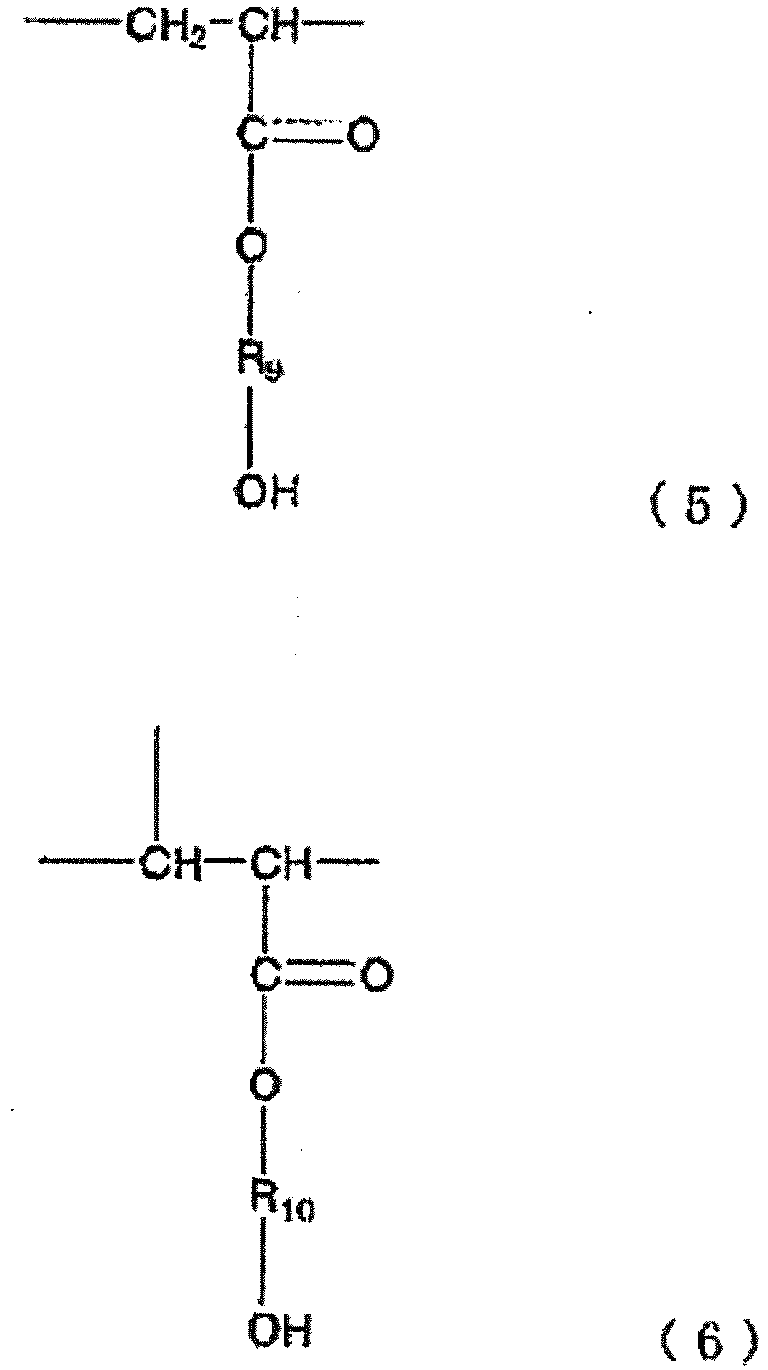
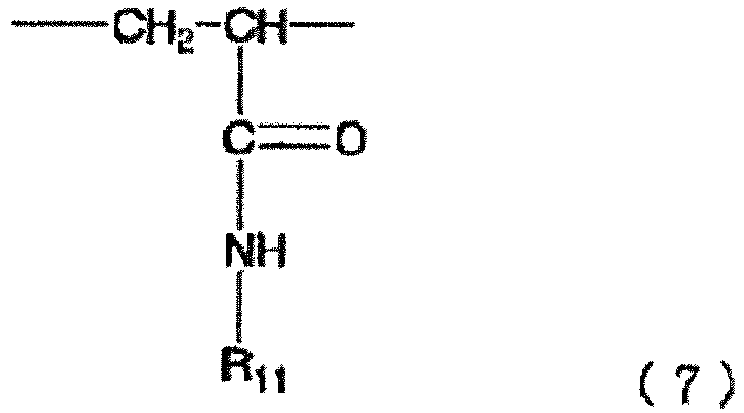

- Composition de résine selon l'une quelconque des revendications 8 à 12,
dans laquelle l'unité de résidu d'ester d'acide cinnamique substitué à la position p est choisie dans le groupe consistant en une unité de résidu de 4-nitrocinnamate de méthyle, une unité de résidu de 4-nitrocinnamate d'éthyle, une unité de résidu de 4-nitrocinnamate d'isopropyle, une unité de résidu de 4-nitrocinnamate de n-propyle, une unité de résidu de 4-nitrocinnamate de n-butyle, une unité de résidu de 4-nitrocinnamate de sec-butyle, une unité de résidu de 4-nitrocinnamate de tert-butyle, une unité de résidu de 4-nitrocinnamate de 2-éthylhexyle, une unité de résidu de 4-fluorocinnamate de méthyle, une unité de résidu de 4-fluorocinnamate d'éthyle, une unité de résidu de 4-fluorocinnamate d'isopropyle, une unité de résidu de 4-fluorocinnamate de n-propyle, une unité de résidu de 4-fluorocinnamate de n-butyle, une unité de résidu de 4-fluorocinnamate de sec-butyle, une unité de résidu de 4-fluorocinnamate de tert-butyle, une unité de résidu de 4-flouorocinnamate de 2-éthylhexyle, une unité de résidu de 4-chlorocinnamate de méthyle, une unité de résidu de 4-chlorocinnamate d'éthyle, une unité de résidu de 4-chlorocinnamate d'isopropyle, une unité de résidu de 4-chlorocinnamate de n-propyle, une unité de résidu de 4-chlorocinnamate de n-butyle, une unité de résidu de 4-chlorocinnamate de sec-butyle, une unité de résidu de 4-chlorocinnamate de tert-butyle, une unité de résidu de 4-chlorocinnamate de 2-éthylhexyle, une unité de résidu de 4-bromocinnamate de méthyle, une unité de résidu de 4-bromocinnamate d'éthyle, une unité de résidu de 4-bromocinnamate d'isopropyle, une unité de résidu de 4-bromocinnamate de n-propyle, une unité de résidu de 4-bromocinnamate de n-butyle, une unité de résidu de 4-bromocinnamate de sec-butyle, une unité de résidu de 4-bromocinnamate de tert-butyle, une unité de résidu de 4-bromocinnamate de 2-éthylhexyle, une unité de résidu de 4-iodocinnamate de méthyle, une unité de résidu de 4-iodocinnamate d'éthyle, une unité de résidu de 4-iodocinnamate d'isopropyle, une unité de résidu de 4-iodocinnamate de n-propyle, une unité de résidu de 4-iodocinnamate de n-butyle, une unité de résidu de 4-iodocinnamate de sec-butyle, une unité de résidu de 4-iodocinnamate de tert-butyle, une unité de résidu de 4-iodocinnamate de 2-éthylhexyle, une unité de résidu de 4-cyanocinnamate de méthyle, une unité de résidu de 4-cyanocinnamate d'éthyle, une unité de résidu de 4-cyanocinnamate d'isopropyle, une unité de résidu de 4-cyanocinnamate de n-propyle, une unité de résidu de 4-cyanocinnamate de n-butyle, une unité de résidu de 4-cyanocinnamate de sec-butyle, une unité de résidu de 4-cyanocinnamate de tert-butyle, une unité de résidu de 4-cyanocinnamate de 2-éthylhexyle, une unité de résidu de 4-sulfonate cinnamate de méthyle, une unité de résidu de 4-sulfonate cinnamate d'éthyle, une unité de résidu de 4-sulfonate cinnamate d'isopropyle, une unité de résidu de 4-sulfonate cinnamate de n-propyle, une unité de résidu de 4-sulfonate cinnamate de n-butyle, une unité de résidu de 4-sulfonate cinnamate de sec-butyle, une unité de résidu de 4-sulfonate cinnamate de tert-butyle, une unité de résidu de 4-sulfonate cinnamate de 2-éthylhexyle, une unité de résidu de 4-carboxylate cinnamate d'éthyle, une unité de résidu de 4-carboxylate cinnamate d'isopropyle, une unité de résidu de 4-carboxylate cinnamate de n-propyle, une unité de résidu de 4-carboxylate cinnamate de n-butyle, une unité de résidu de 4-carboxylate cinnamate de sec-butyle, une unité de résidu de 4-carboxylate cinnamate de tert-butyle, une unité de résidu de 4-carboxylate cinnamate de 2-éthylhexyle, une unité de résidu de 4-phénylcinnamate de méthyle, une unité de résidu de 4-phénylcinnamate d'éthyle, une unité de résidu de 4-phénylcinnamate d'isopropyle, une unité de résidu de 4-phénylcinnamate de n-propyle, une unité de résidu de 4-phénylcinnamate de n-butyle, une unité de résidu de 4-phénylcinnamate de sec-butyle, une unité de résidu de 4-phénylcinnamate de tert-butyle, et une unité de résidu de 4-phénylcinnamate de 2-éthylhexyle. - Composition de résine selon l'une quelconque des revendications 1 à 13,
dans laquelle la résine à base de cellulose représentée par la formule (1) est un éther de cellulose. - Composition de résine selon la revendication 14,
dans laquelle un degré d'éthérification (degré de substitution) de l'éther de cellulose est de 1,5 à 3,0. - Film de compensation optique, obtenu en utilisant la composition de résine selon l'une quelconque des revendications 1 à 15,
dans lequel une épaisseur du film de compensation optique est de 5 à 200 µm. - Film de compensation optique, obtenu en utilisant la composition de résine selon l'une quelconque des revendications 1 à 15,
dans lequel une épaisseur du film de compensation optique est de 20 à 60 µm. - Film de compensation optique selon la revendication 16 ou 17,
dans lequel un retard dans le plan (Re) représenté par la formule (1) suivante est de 80 à 300 nm et un coefficient Nz représenté par l'expression (2) suivante est de 0,35 à 0,65 :

- Film de compensation optique selon la revendication 16 ou 17,
dans lequel un retard dans le plan (Re) représenté par l'expression (1) suivante est de 50 à 300 nm et un coefficient Nz représenté par l'expression (2) suivante est de -0,2 à 0,2 :

- Film de compensation optique selon la revendication 16 ou 17,
dans laquelle un retard dans le plan (Re) représenté par l'expression (1) suivante est de 0 à 20 nm et un retard à l'extérieur du plan (Rth) représenté par l'expression (3) suivante est de -150 à 20 nm :

- Film de compensation optique selon l'une quelconque des revendications 16 à 20,
dans lequel une transmission de lumière est de 85 % ou supérieure. - Film de compensation optique selon l'une quelconque des revendications 16 à 21,
dans lequel un voile est de 1 % ou inférieur. - Film de compensation optique selon l'une quelconque des revendications 16 à 22,
dans lequel un rapport Re(450)/Re(550) entre un retard à 450 nm et un retard à 550 nm est 0,60<Re(450)/Re(550)<1,05. - Film de compensation optique selon l'une quelconque des revendications 16 à 23,
dans lequel un rapport Re(589) (nm)/épaisseur de film (µm) entre un retard à 589 nm et une épaisseur de film est de 4,0 nm/µm ou supérieur. - Procédé de production du film de compensation optique selon l'une quelconque des revendications 16 à 24, comprenant :
la dissolution, dans un solvant, d'une composition de résine contenant, comme constituants de résine, de 30 à 99 % en masse d'une résine à base de cellulose représentée par la formule (1) suivante et de 1 à 70 % en masse d'un copolymère d'ester d'acide cinnamique ;
la coulée de la solution de résine obtenue sur un matériau de base; et
après séchage, la séparation du film résultant du matériau de base :
- Procédé de production d'un film de compensation optique selon la revendication 25,
dans lequel lorsque la résine à base de cellulose représentée par la formule (1) est un éther de cellulose, un degré d'éthérification (degré de substitution) est de 1,5 à 3,0. - Procédé de production du film de compensation optique selon la revendication 18 ou 19, comprenant :
la soumission d'un film ayant une épaisseur de 10 à 200 µm obtenu par coulée, à un étirement uniaxial ou un étirement biaxial non équilibré. - Procédé de production du film de compensation optique selon la revendication 18 ou 19, comprenant :
la soumission d'un film ayant une épaisseur de 30 à 100 µm obtenu par coulée, à un étirage uniaxial ou un étirage biaxial non équilibré.
Applications Claiming Priority (7)
| Application Number | Priority Date | Filing Date | Title |
|---|---|---|---|
| JP2014210357 | 2014-10-15 | ||
| JP2014210358 | 2014-10-15 | ||
| JP2014238140A JP6572532B2 (ja) | 2014-10-15 | 2014-11-25 | 樹脂組成物およびそれを用いた光学補償フィルム |
| JP2014239367 | 2014-11-26 | ||
| JP2014239366 | 2014-11-26 | ||
| JP2015185764A JP6048556B2 (ja) | 2014-11-26 | 2015-09-18 | 樹脂組成物およびそれを用いた光学補償フィルム |
| PCT/JP2015/078929 WO2016060115A1 (fr) | 2014-10-15 | 2015-10-13 | Composition de résine et film de compensation optique l'utilisant |
Publications (3)
| Publication Number | Publication Date |
|---|---|
| EP3208301A1 EP3208301A1 (fr) | 2017-08-23 |
| EP3208301A4 EP3208301A4 (fr) | 2018-05-16 |
| EP3208301B1 true EP3208301B1 (fr) | 2019-04-03 |
Family
ID=57181697
Family Applications (1)
| Application Number | Title | Priority Date | Filing Date |
|---|---|---|---|
| EP15850872.1A Active EP3208301B1 (fr) | 2014-10-15 | 2015-10-13 | Composition de résine et film de compensation optique l'utilisant |
Country Status (4)
| Country | Link |
|---|---|
| US (1) | US10126478B2 (fr) |
| EP (1) | EP3208301B1 (fr) |
| CN (1) | CN106795327B (fr) |
| TW (1) | TW201627375A (fr) |
Families Citing this family (12)
| Publication number | Priority date | Publication date | Assignee | Title |
|---|---|---|---|---|
| US20180171207A1 (en) | 2015-06-17 | 2018-06-21 | Clariant International Ltd. | Water-Soluble Or Water-Swellable Polymers As Water Loss Reducers In Cement Slurries |
| EP3553097B1 (fr) | 2016-12-07 | 2022-05-04 | Tosoh Corporation | Copolymère et film optique l'utilisant |
| ES2867526T3 (es) | 2016-12-12 | 2021-10-20 | Clariant Int Ltd | Uso de un polímero bioderivado en una composición cosmética, dermatológica o farmacéutica |
| US11384186B2 (en) | 2016-12-12 | 2022-07-12 | Clariant International Ltd | Polymer comprising certain level of bio-based carbon |
| EP3554644B1 (fr) | 2016-12-15 | 2025-03-19 | Clariant International Ltd | Polymère hybride soluble dans l'eau et/ou capable de gonfler dans l'eau |
| EP3554643B1 (fr) | 2016-12-15 | 2025-03-19 | Clariant International Ltd | Polymère hybride soluble dans l'eau et/ou pouvant gonfler dans l'eau |
| US11339241B2 (en) | 2016-12-15 | 2022-05-24 | Clariant International Ltd. | Water-soluble and/or water-swellable hybrid polymer |
| ES3017507T3 (en) | 2016-12-15 | 2025-05-13 | Clariant Int Ltd | Water-soluble and/or water-swellable hybrid polymer |
| KR102227340B1 (ko) * | 2017-05-08 | 2021-03-11 | 후지필름 가부시키가이샤 | 액정 표시 장치 |
| JP2019028159A (ja) * | 2017-07-27 | 2019-02-21 | 日東電工株式会社 | 位相差フィルム、光学補償層付偏光板、画像表示装置、および位相差フィルムの製造方法 |
| US20200325327A1 (en) * | 2017-10-16 | 2020-10-15 | Nissan Chemical Corporation | Cured-film-forming composition, orientation material, and retardation material |
| JPWO2022071040A1 (fr) * | 2020-09-30 | 2022-04-07 |
Family Cites Families (13)
| Publication number | Priority date | Publication date | Assignee | Title |
|---|---|---|---|---|
| JP2818983B2 (ja) | 1990-10-24 | 1998-10-30 | 日東電工株式会社 | 複屈折性フィルムの製造方法 |
| JPH05297223A (ja) | 1992-04-22 | 1993-11-12 | Fuji Photo Film Co Ltd | 複屈折性フィルムの製造方法、それを用いた位相差板及び液晶表示装置 |
| JPH05323120A (ja) | 1992-05-21 | 1993-12-07 | Fuji Photo Film Co Ltd | 複屈折性フィルムの製造方法、並びに位相差板及び液晶表示装置 |
| JP2001337222A (ja) | 2000-05-25 | 2001-12-07 | Fuji Photo Film Co Ltd | 位相差板 |
| JP2002131534A (ja) * | 2000-10-19 | 2002-05-09 | Fuji Photo Film Co Ltd | 光学補償シート、偏光板および液晶表示装置 |
| KR100852224B1 (ko) * | 2000-12-28 | 2008-08-13 | 하야시 텔렘프 가부시끼가이샤 | 위상차 필름 및 그 제조 방법 |
| JP4697098B2 (ja) | 2006-09-05 | 2011-06-08 | 東ソー株式会社 | 位相差フィルム |
| US9370901B2 (en) | 2011-07-29 | 2016-06-21 | Tosoh Corporation | Resin composition, optical compensation film using the same and production method of optical compensation film |
| JP5782902B2 (ja) | 2011-07-29 | 2015-09-24 | 東ソー株式会社 | 樹脂組成物およびそれを用いた光学補償フィルム |
| CN104487467B (zh) | 2012-07-20 | 2016-11-23 | 东曹株式会社 | 富马酸二异丙酯-肉桂酸衍生物类共聚物及使用其的相位差膜 |
| JP6136254B2 (ja) * | 2012-12-27 | 2017-05-31 | 東ソー株式会社 | 樹脂組成物およびそれを用いた光学補償フィルム |
| JP6136253B2 (ja) * | 2012-12-27 | 2017-05-31 | 東ソー株式会社 | 樹脂組成物およびそれを用いた光学補償フィルム |
| JP6048446B2 (ja) * | 2013-06-07 | 2016-12-21 | 東ソー株式会社 | 樹脂組成物およびそれを用いた光学補償フィルム |
-
2015
- 2015-10-13 CN CN201580054741.0A patent/CN106795327B/zh active Active
- 2015-10-13 EP EP15850872.1A patent/EP3208301B1/fr active Active
- 2015-10-13 US US15/519,403 patent/US10126478B2/en active Active
- 2015-10-15 TW TW104133815A patent/TW201627375A/zh unknown
Non-Patent Citations (1)
| Title |
|---|
| None * |
Also Published As
| Publication number | Publication date |
|---|---|
| US10126478B2 (en) | 2018-11-13 |
| EP3208301A4 (fr) | 2018-05-16 |
| TW201627375A (zh) | 2016-08-01 |
| EP3208301A1 (fr) | 2017-08-23 |
| US20170242174A1 (en) | 2017-08-24 |
| CN106795327A (zh) | 2017-05-31 |
| CN106795327B (zh) | 2019-08-30 |
Similar Documents
| Publication | Publication Date | Title |
|---|---|---|
| EP3006494B1 (fr) | Composition de résine, film de compensation optique l'utilisant et procédé de production correspondant | |
| EP3208301B1 (fr) | Composition de résine et film de compensation optique l'utilisant | |
| JP6572532B2 (ja) | 樹脂組成物およびそれを用いた光学補償フィルム | |
| EP2738205B1 (fr) | Composition de résine, film de compensation optique mettant en uvre celle-ci, et procédé de fabrication de ce film | |
| JP6048556B2 (ja) | 樹脂組成物およびそれを用いた光学補償フィルム | |
| JP6136254B2 (ja) | 樹脂組成物およびそれを用いた光学補償フィルム | |
| JP6136253B2 (ja) | 樹脂組成物およびそれを用いた光学補償フィルム | |
| EP3553097B1 (fr) | Copolymère et film optique l'utilisant | |
| KR102390746B1 (ko) | 수지 조성물 및 그것을 사용한 광학 보상 필름 | |
| JP5920052B2 (ja) | 樹脂組成物およびそれを用いた光学補償フィルム | |
| JP6808939B2 (ja) | 樹脂組成物およびそれを用いた光学補償フィルム | |
| JP6237366B2 (ja) | 光学補償フィルム用重合体 | |
| JP7287183B2 (ja) | 樹脂組成物およびそれからなるフィルム | |
| JP6229561B2 (ja) | 光学補償フィルム用重合体 | |
| JP2022180307A (ja) | セルロース系樹脂およびそれを用いた光学フィルム | |
| JP2023152307A (ja) | 樹脂組成物およびそれを用いた光学フィルム | |
| JP2021143302A (ja) | 樹脂組成物およびそれを用いた位相差フィルム |
Legal Events
| Date | Code | Title | Description |
|---|---|---|---|
| STAA | Information on the status of an ep patent application or granted ep patent |
Free format text: STATUS: THE INTERNATIONAL PUBLICATION HAS BEEN MADE |
|
| PUAI | Public reference made under article 153(3) epc to a published international application that has entered the european phase |
Free format text: ORIGINAL CODE: 0009012 |
|
| STAA | Information on the status of an ep patent application or granted ep patent |
Free format text: STATUS: REQUEST FOR EXAMINATION WAS MADE |
|
| 17P | Request for examination filed |
Effective date: 20170515 |
|
| AK | Designated contracting states |
Kind code of ref document: A1 Designated state(s): AL AT BE BG CH CY CZ DE DK EE ES FI FR GB GR HR HU IE IS IT LI LT LU LV MC MK MT NL NO PL PT RO RS SE SI SK SM TR |
|
| AX | Request for extension of the european patent |
Extension state: BA ME |
|
| DAV | Request for validation of the european patent (deleted) | ||
| DAX | Request for extension of the european patent (deleted) | ||
| A4 | Supplementary search report drawn up and despatched |
Effective date: 20180416 |
|
| RIC1 | Information provided on ipc code assigned before grant |
Ipc: C08F 20/10 20060101ALI20180410BHEP Ipc: C08F 22/14 20060101ALI20180410BHEP Ipc: C08L 1/00 20060101AFI20180410BHEP Ipc: G02F 1/13363 20060101ALI20180410BHEP Ipc: C08L 35/02 20060101ALI20180410BHEP Ipc: G02B 5/30 20060101ALI20180410BHEP Ipc: C08F 22/16 20060101ALI20180410BHEP |
|
| GRAP | Despatch of communication of intention to grant a patent |
Free format text: ORIGINAL CODE: EPIDOSNIGR1 |
|
| STAA | Information on the status of an ep patent application or granted ep patent |
Free format text: STATUS: GRANT OF PATENT IS INTENDED |
|
| INTG | Intention to grant announced |
Effective date: 20180918 |
|
| GRAJ | Information related to disapproval of communication of intention to grant by the applicant or resumption of examination proceedings by the epo deleted |
Free format text: ORIGINAL CODE: EPIDOSDIGR1 |
|
| STAA | Information on the status of an ep patent application or granted ep patent |
Free format text: STATUS: REQUEST FOR EXAMINATION WAS MADE |
|
| GRAR | Information related to intention to grant a patent recorded |
Free format text: ORIGINAL CODE: EPIDOSNIGR71 |
|
| GRAS | Grant fee paid |
Free format text: ORIGINAL CODE: EPIDOSNIGR3 |
|
| STAA | Information on the status of an ep patent application or granted ep patent |
Free format text: STATUS: GRANT OF PATENT IS INTENDED |
|
| GRAA | (expected) grant |
Free format text: ORIGINAL CODE: 0009210 |
|
| STAA | Information on the status of an ep patent application or granted ep patent |
Free format text: STATUS: THE PATENT HAS BEEN GRANTED |
|
| INTC | Intention to grant announced (deleted) | ||
| INTG | Intention to grant announced |
Effective date: 20190221 |
|
| AK | Designated contracting states |
Kind code of ref document: B1 Designated state(s): AL AT BE BG CH CY CZ DE DK EE ES FI FR GB GR HR HU IE IS IT LI LT LU LV MC MK MT NL NO PL PT RO RS SE SI SK SM TR |
|
| REG | Reference to a national code |
Ref country code: GB Ref legal event code: FG4D |
|
| REG | Reference to a national code |
Ref country code: CH Ref legal event code: EP Ref country code: AT Ref legal event code: REF Ref document number: 1115657 Country of ref document: AT Kind code of ref document: T Effective date: 20190415 |
|
| REG | Reference to a national code |
Ref country code: DE Ref legal event code: R096 Ref document number: 602015027809 Country of ref document: DE |
|
| REG | Reference to a national code |
Ref country code: IE Ref legal event code: FG4D |
|
| REG | Reference to a national code |
Ref country code: NL Ref legal event code: FP |
|
| REG | Reference to a national code |
Ref country code: LT Ref legal event code: MG4D |
|
| REG | Reference to a national code |
Ref country code: AT Ref legal event code: MK05 Ref document number: 1115657 Country of ref document: AT Kind code of ref document: T Effective date: 20190403 |
|
| PG25 | Lapsed in a contracting state [announced via postgrant information from national office to epo] |
Ref country code: NO Free format text: LAPSE BECAUSE OF FAILURE TO SUBMIT A TRANSLATION OF THE DESCRIPTION OR TO PAY THE FEE WITHIN THE PRESCRIBED TIME-LIMIT Effective date: 20190703 Ref country code: HR Free format text: LAPSE BECAUSE OF FAILURE TO SUBMIT A TRANSLATION OF THE DESCRIPTION OR TO PAY THE FEE WITHIN THE PRESCRIBED TIME-LIMIT Effective date: 20190403 Ref country code: SE Free format text: LAPSE BECAUSE OF FAILURE TO SUBMIT A TRANSLATION OF THE DESCRIPTION OR TO PAY THE FEE WITHIN THE PRESCRIBED TIME-LIMIT Effective date: 20190403 Ref country code: FI Free format text: LAPSE BECAUSE OF FAILURE TO SUBMIT A TRANSLATION OF THE DESCRIPTION OR TO PAY THE FEE WITHIN THE PRESCRIBED TIME-LIMIT Effective date: 20190403 Ref country code: AL Free format text: LAPSE BECAUSE OF FAILURE TO SUBMIT A TRANSLATION OF THE DESCRIPTION OR TO PAY THE FEE WITHIN THE PRESCRIBED TIME-LIMIT Effective date: 20190403 Ref country code: PT Free format text: LAPSE BECAUSE OF FAILURE TO SUBMIT A TRANSLATION OF THE DESCRIPTION OR TO PAY THE FEE WITHIN THE PRESCRIBED TIME-LIMIT Effective date: 20190803 Ref country code: ES Free format text: LAPSE BECAUSE OF FAILURE TO SUBMIT A TRANSLATION OF THE DESCRIPTION OR TO PAY THE FEE WITHIN THE PRESCRIBED TIME-LIMIT Effective date: 20190403 Ref country code: LT Free format text: LAPSE BECAUSE OF FAILURE TO SUBMIT A TRANSLATION OF THE DESCRIPTION OR TO PAY THE FEE WITHIN THE PRESCRIBED TIME-LIMIT Effective date: 20190403 Ref country code: CZ Free format text: LAPSE BECAUSE OF FAILURE TO SUBMIT A TRANSLATION OF THE DESCRIPTION OR TO PAY THE FEE WITHIN THE PRESCRIBED TIME-LIMIT Effective date: 20190403 |
|
| PG25 | Lapsed in a contracting state [announced via postgrant information from national office to epo] |
Ref country code: BG Free format text: LAPSE BECAUSE OF FAILURE TO SUBMIT A TRANSLATION OF THE DESCRIPTION OR TO PAY THE FEE WITHIN THE PRESCRIBED TIME-LIMIT Effective date: 20190703 Ref country code: LV Free format text: LAPSE BECAUSE OF FAILURE TO SUBMIT A TRANSLATION OF THE DESCRIPTION OR TO PAY THE FEE WITHIN THE PRESCRIBED TIME-LIMIT Effective date: 20190403 Ref country code: RS Free format text: LAPSE BECAUSE OF FAILURE TO SUBMIT A TRANSLATION OF THE DESCRIPTION OR TO PAY THE FEE WITHIN THE PRESCRIBED TIME-LIMIT Effective date: 20190403 Ref country code: PL Free format text: LAPSE BECAUSE OF FAILURE TO SUBMIT A TRANSLATION OF THE DESCRIPTION OR TO PAY THE FEE WITHIN THE PRESCRIBED TIME-LIMIT Effective date: 20190403 Ref country code: GR Free format text: LAPSE BECAUSE OF FAILURE TO SUBMIT A TRANSLATION OF THE DESCRIPTION OR TO PAY THE FEE WITHIN THE PRESCRIBED TIME-LIMIT Effective date: 20190704 |
|
| PG25 | Lapsed in a contracting state [announced via postgrant information from national office to epo] |
Ref country code: AT Free format text: LAPSE BECAUSE OF FAILURE TO SUBMIT A TRANSLATION OF THE DESCRIPTION OR TO PAY THE FEE WITHIN THE PRESCRIBED TIME-LIMIT Effective date: 20190403 Ref country code: IS Free format text: LAPSE BECAUSE OF FAILURE TO SUBMIT A TRANSLATION OF THE DESCRIPTION OR TO PAY THE FEE WITHIN THE PRESCRIBED TIME-LIMIT Effective date: 20190803 |
|
| REG | Reference to a national code |
Ref country code: DE Ref legal event code: R097 Ref document number: 602015027809 Country of ref document: DE |
|
| PG25 | Lapsed in a contracting state [announced via postgrant information from national office to epo] |
Ref country code: SK Free format text: LAPSE BECAUSE OF FAILURE TO SUBMIT A TRANSLATION OF THE DESCRIPTION OR TO PAY THE FEE WITHIN THE PRESCRIBED TIME-LIMIT Effective date: 20190403 Ref country code: RO Free format text: LAPSE BECAUSE OF FAILURE TO SUBMIT A TRANSLATION OF THE DESCRIPTION OR TO PAY THE FEE WITHIN THE PRESCRIBED TIME-LIMIT Effective date: 20190403 Ref country code: DK Free format text: LAPSE BECAUSE OF FAILURE TO SUBMIT A TRANSLATION OF THE DESCRIPTION OR TO PAY THE FEE WITHIN THE PRESCRIBED TIME-LIMIT Effective date: 20190403 Ref country code: EE Free format text: LAPSE BECAUSE OF FAILURE TO SUBMIT A TRANSLATION OF THE DESCRIPTION OR TO PAY THE FEE WITHIN THE PRESCRIBED TIME-LIMIT Effective date: 20190403 |
|
| PLBE | No opposition filed within time limit |
Free format text: ORIGINAL CODE: 0009261 |
|
| STAA | Information on the status of an ep patent application or granted ep patent |
Free format text: STATUS: NO OPPOSITION FILED WITHIN TIME LIMIT |
|
| PG25 | Lapsed in a contracting state [announced via postgrant information from national office to epo] |
Ref country code: SM Free format text: LAPSE BECAUSE OF FAILURE TO SUBMIT A TRANSLATION OF THE DESCRIPTION OR TO PAY THE FEE WITHIN THE PRESCRIBED TIME-LIMIT Effective date: 20190403 Ref country code: IT Free format text: LAPSE BECAUSE OF FAILURE TO SUBMIT A TRANSLATION OF THE DESCRIPTION OR TO PAY THE FEE WITHIN THE PRESCRIBED TIME-LIMIT Effective date: 20190403 |
|
| 26N | No opposition filed |
Effective date: 20200106 |
|
| PG25 | Lapsed in a contracting state [announced via postgrant information from national office to epo] |
Ref country code: TR Free format text: LAPSE BECAUSE OF FAILURE TO SUBMIT A TRANSLATION OF THE DESCRIPTION OR TO PAY THE FEE WITHIN THE PRESCRIBED TIME-LIMIT Effective date: 20190403 |
|
| PG25 | Lapsed in a contracting state [announced via postgrant information from national office to epo] |
Ref country code: SI Free format text: LAPSE BECAUSE OF FAILURE TO SUBMIT A TRANSLATION OF THE DESCRIPTION OR TO PAY THE FEE WITHIN THE PRESCRIBED TIME-LIMIT Effective date: 20190403 Ref country code: MC Free format text: LAPSE BECAUSE OF FAILURE TO SUBMIT A TRANSLATION OF THE DESCRIPTION OR TO PAY THE FEE WITHIN THE PRESCRIBED TIME-LIMIT Effective date: 20190403 |
|
| REG | Reference to a national code |
Ref country code: CH Ref legal event code: PL |
|
| PG25 | Lapsed in a contracting state [announced via postgrant information from national office to epo] |
Ref country code: LU Free format text: LAPSE BECAUSE OF NON-PAYMENT OF DUE FEES Effective date: 20191013 Ref country code: CH Free format text: LAPSE BECAUSE OF NON-PAYMENT OF DUE FEES Effective date: 20191031 Ref country code: LI Free format text: LAPSE BECAUSE OF NON-PAYMENT OF DUE FEES Effective date: 20191031 |
|
| REG | Reference to a national code |
Ref country code: BE Ref legal event code: MM Effective date: 20191031 |
|
| PG25 | Lapsed in a contracting state [announced via postgrant information from national office to epo] |
Ref country code: BE Free format text: LAPSE BECAUSE OF NON-PAYMENT OF DUE FEES Effective date: 20191031 |
|
| PG25 | Lapsed in a contracting state [announced via postgrant information from national office to epo] |
Ref country code: IE Free format text: LAPSE BECAUSE OF NON-PAYMENT OF DUE FEES Effective date: 20191013 |
|
| PG25 | Lapsed in a contracting state [announced via postgrant information from national office to epo] |
Ref country code: CY Free format text: LAPSE BECAUSE OF FAILURE TO SUBMIT A TRANSLATION OF THE DESCRIPTION OR TO PAY THE FEE WITHIN THE PRESCRIBED TIME-LIMIT Effective date: 20190403 |
|
| PG25 | Lapsed in a contracting state [announced via postgrant information from national office to epo] |
Ref country code: HU Free format text: LAPSE BECAUSE OF FAILURE TO SUBMIT A TRANSLATION OF THE DESCRIPTION OR TO PAY THE FEE WITHIN THE PRESCRIBED TIME-LIMIT; INVALID AB INITIO Effective date: 20151013 Ref country code: MT Free format text: LAPSE BECAUSE OF FAILURE TO SUBMIT A TRANSLATION OF THE DESCRIPTION OR TO PAY THE FEE WITHIN THE PRESCRIBED TIME-LIMIT Effective date: 20190403 |
|
| PG25 | Lapsed in a contracting state [announced via postgrant information from national office to epo] |
Ref country code: MK Free format text: LAPSE BECAUSE OF FAILURE TO SUBMIT A TRANSLATION OF THE DESCRIPTION OR TO PAY THE FEE WITHIN THE PRESCRIBED TIME-LIMIT Effective date: 20190403 |
|
| P01 | Opt-out of the competence of the unified patent court (upc) registered |
Effective date: 20230523 |
|
| PGFP | Annual fee paid to national office [announced via postgrant information from national office to epo] |
Ref country code: NL Payment date: 20250912 Year of fee payment: 11 |
|
| PGFP | Annual fee paid to national office [announced via postgrant information from national office to epo] |
Ref country code: GB Payment date: 20250828 Year of fee payment: 11 |
|
| PGFP | Annual fee paid to national office [announced via postgrant information from national office to epo] |
Ref country code: FR Payment date: 20250908 Year of fee payment: 11 |
|
| PGFP | Annual fee paid to national office [announced via postgrant information from national office to epo] |
Ref country code: DE Payment date: 20250902 Year of fee payment: 11 |