EP3209637B1 - 2-hydroxy-triacylglycerol -verbindungen zur behandlung von krankheiten - Google Patents
2-hydroxy-triacylglycerol -verbindungen zur behandlung von krankheiten Download PDFInfo
- Publication number
- EP3209637B1 EP3209637B1 EP15790481.4A EP15790481A EP3209637B1 EP 3209637 B1 EP3209637 B1 EP 3209637B1 EP 15790481 A EP15790481 A EP 15790481A EP 3209637 B1 EP3209637 B1 EP 3209637B1
- Authority
- EP
- European Patent Office
- Prior art keywords
- formula
- cancer
- compound
- disease
- hydroxy
- Prior art date
- Legal status (The legal status is an assumption and is not a legal conclusion. Google has not performed a legal analysis and makes no representation as to the accuracy of the status listed.)
- Active
Links
Images


Classifications
-
- C—CHEMISTRY; METALLURGY
- C07—ORGANIC CHEMISTRY
- C07C—ACYCLIC OR CARBOCYCLIC COMPOUNDS
- C07C69/00—Esters of carboxylic acids; Esters of carbonic or haloformic acids
- C07C69/66—Esters of carboxylic acids having esterified carboxylic groups bound to acyclic carbon atoms and having any of the groups OH, O—metal, —CHO, keto, ether, acyloxy, groups, groups, or in the acid moiety
- C07C69/73—Esters of carboxylic acids having esterified carboxylic groups bound to acyclic carbon atoms and having any of the groups OH, O—metal, —CHO, keto, ether, acyloxy, groups, groups, or in the acid moiety of unsaturated acids
- C07C69/732—Esters of carboxylic acids having esterified carboxylic groups bound to acyclic carbon atoms and having any of the groups OH, O—metal, —CHO, keto, ether, acyloxy, groups, groups, or in the acid moiety of unsaturated acids of unsaturated hydroxy carboxylic acids
-
- A—HUMAN NECESSITIES
- A61—MEDICAL OR VETERINARY SCIENCE; HYGIENE
- A61K—PREPARATIONS FOR MEDICAL, DENTAL OR TOILETRY PURPOSES
- A61K31/00—Medicinal preparations containing organic active ingredients
- A61K31/21—Esters, e.g. nitroglycerine, selenocyanates
- A61K31/215—Esters, e.g. nitroglycerine, selenocyanates of carboxylic acids
- A61K31/22—Esters, e.g. nitroglycerine, selenocyanates of carboxylic acids of acyclic acids, e.g. pravastatin
- A61K31/23—Esters, e.g. nitroglycerine, selenocyanates of carboxylic acids of acyclic acids, e.g. pravastatin of acids having a carboxyl group bound to a chain of seven or more carbon atoms
- A61K31/231—Esters, e.g. nitroglycerine, selenocyanates of carboxylic acids of acyclic acids, e.g. pravastatin of acids having a carboxyl group bound to a chain of seven or more carbon atoms having one or two double bonds
-
- A—HUMAN NECESSITIES
- A23—FOODS OR FOODSTUFFS; TREATMENT THEREOF, NOT COVERED BY OTHER CLASSES
- A23L—FOODS, FOODSTUFFS OR NON-ALCOHOLIC BEVERAGES, NOT OTHERWISE PROVIDED FOR; PREPARATION OR TREATMENT THEREOF
- A23L33/00—Modifying nutritive qualities of foods; Dietetic products; Preparation or treatment thereof
- A23L33/10—Modifying nutritive qualities of foods; Dietetic products; Preparation or treatment thereof using additives
-
- A—HUMAN NECESSITIES
- A23—FOODS OR FOODSTUFFS; TREATMENT THEREOF, NOT COVERED BY OTHER CLASSES
- A23L—FOODS, FOODSTUFFS OR NON-ALCOHOLIC BEVERAGES, NOT OTHERWISE PROVIDED FOR; PREPARATION OR TREATMENT THEREOF
- A23L33/00—Modifying nutritive qualities of foods; Dietetic products; Preparation or treatment thereof
- A23L33/10—Modifying nutritive qualities of foods; Dietetic products; Preparation or treatment thereof using additives
- A23L33/115—Fatty acids or derivatives thereof; Fats or oils
-
- A—HUMAN NECESSITIES
- A61—MEDICAL OR VETERINARY SCIENCE; HYGIENE
- A61K—PREPARATIONS FOR MEDICAL, DENTAL OR TOILETRY PURPOSES
- A61K31/00—Medicinal preparations containing organic active ingredients
- A61K31/185—Acids; Anhydrides, halides or salts thereof, e.g. sulfur acids, imidic, hydrazonic or hydroximic acids
- A61K31/19—Carboxylic acids, e.g. valproic acid
- A61K31/20—Carboxylic acids, e.g. valproic acid having a carboxyl group bound to a chain of seven or more carbon atoms, e.g. stearic, palmitic, arachidic acids
-
- A—HUMAN NECESSITIES
- A61—MEDICAL OR VETERINARY SCIENCE; HYGIENE
- A61P—SPECIFIC THERAPEUTIC ACTIVITY OF CHEMICAL COMPOUNDS OR MEDICINAL PREPARATIONS
- A61P1/00—Drugs for disorders of the alimentary tract or the digestive system
- A61P1/16—Drugs for disorders of the alimentary tract or the digestive system for liver or gallbladder disorders, e.g. hepatoprotective agents, cholagogues, litholytics
-
- A—HUMAN NECESSITIES
- A61—MEDICAL OR VETERINARY SCIENCE; HYGIENE
- A61P—SPECIFIC THERAPEUTIC ACTIVITY OF CHEMICAL COMPOUNDS OR MEDICINAL PREPARATIONS
- A61P1/00—Drugs for disorders of the alimentary tract or the digestive system
- A61P1/18—Drugs for disorders of the alimentary tract or the digestive system for pancreatic disorders, e.g. pancreatic enzymes
-
- A—HUMAN NECESSITIES
- A61—MEDICAL OR VETERINARY SCIENCE; HYGIENE
- A61P—SPECIFIC THERAPEUTIC ACTIVITY OF CHEMICAL COMPOUNDS OR MEDICINAL PREPARATIONS
- A61P11/00—Drugs for disorders of the respiratory system
-
- A—HUMAN NECESSITIES
- A61—MEDICAL OR VETERINARY SCIENCE; HYGIENE
- A61P—SPECIFIC THERAPEUTIC ACTIVITY OF CHEMICAL COMPOUNDS OR MEDICINAL PREPARATIONS
- A61P13/00—Drugs for disorders of the urinary system
- A61P13/08—Drugs for disorders of the urinary system of the prostate
-
- A—HUMAN NECESSITIES
- A61—MEDICAL OR VETERINARY SCIENCE; HYGIENE
- A61P—SPECIFIC THERAPEUTIC ACTIVITY OF CHEMICAL COMPOUNDS OR MEDICINAL PREPARATIONS
- A61P13/00—Drugs for disorders of the urinary system
- A61P13/12—Drugs for disorders of the urinary system of the kidneys
-
- A—HUMAN NECESSITIES
- A61—MEDICAL OR VETERINARY SCIENCE; HYGIENE
- A61P—SPECIFIC THERAPEUTIC ACTIVITY OF CHEMICAL COMPOUNDS OR MEDICINAL PREPARATIONS
- A61P15/00—Drugs for genital or sexual disorders; Contraceptives
-
- A—HUMAN NECESSITIES
- A61—MEDICAL OR VETERINARY SCIENCE; HYGIENE
- A61P—SPECIFIC THERAPEUTIC ACTIVITY OF CHEMICAL COMPOUNDS OR MEDICINAL PREPARATIONS
- A61P17/00—Drugs for dermatological disorders
-
- A—HUMAN NECESSITIES
- A61—MEDICAL OR VETERINARY SCIENCE; HYGIENE
- A61P—SPECIFIC THERAPEUTIC ACTIVITY OF CHEMICAL COMPOUNDS OR MEDICINAL PREPARATIONS
- A61P19/00—Drugs for skeletal disorders
- A61P19/02—Drugs for skeletal disorders for joint disorders, e.g. arthritis, arthrosis
-
- A—HUMAN NECESSITIES
- A61—MEDICAL OR VETERINARY SCIENCE; HYGIENE
- A61P—SPECIFIC THERAPEUTIC ACTIVITY OF CHEMICAL COMPOUNDS OR MEDICINAL PREPARATIONS
- A61P25/00—Drugs for disorders of the nervous system
-
- A—HUMAN NECESSITIES
- A61—MEDICAL OR VETERINARY SCIENCE; HYGIENE
- A61P—SPECIFIC THERAPEUTIC ACTIVITY OF CHEMICAL COMPOUNDS OR MEDICINAL PREPARATIONS
- A61P25/00—Drugs for disorders of the nervous system
- A61P25/04—Centrally acting analgesics, e.g. opioids
-
- A—HUMAN NECESSITIES
- A61—MEDICAL OR VETERINARY SCIENCE; HYGIENE
- A61P—SPECIFIC THERAPEUTIC ACTIVITY OF CHEMICAL COMPOUNDS OR MEDICINAL PREPARATIONS
- A61P25/00—Drugs for disorders of the nervous system
- A61P25/14—Drugs for disorders of the nervous system for treating abnormal movements, e.g. chorea, dyskinesia
-
- A—HUMAN NECESSITIES
- A61—MEDICAL OR VETERINARY SCIENCE; HYGIENE
- A61P—SPECIFIC THERAPEUTIC ACTIVITY OF CHEMICAL COMPOUNDS OR MEDICINAL PREPARATIONS
- A61P25/00—Drugs for disorders of the nervous system
- A61P25/14—Drugs for disorders of the nervous system for treating abnormal movements, e.g. chorea, dyskinesia
- A61P25/16—Anti-Parkinson drugs
-
- A—HUMAN NECESSITIES
- A61—MEDICAL OR VETERINARY SCIENCE; HYGIENE
- A61P—SPECIFIC THERAPEUTIC ACTIVITY OF CHEMICAL COMPOUNDS OR MEDICINAL PREPARATIONS
- A61P25/00—Drugs for disorders of the nervous system
- A61P25/18—Antipsychotics, i.e. neuroleptics; Drugs for mania or schizophrenia
-
- A—HUMAN NECESSITIES
- A61—MEDICAL OR VETERINARY SCIENCE; HYGIENE
- A61P—SPECIFIC THERAPEUTIC ACTIVITY OF CHEMICAL COMPOUNDS OR MEDICINAL PREPARATIONS
- A61P25/00—Drugs for disorders of the nervous system
- A61P25/20—Hypnotics; Sedatives
-
- A—HUMAN NECESSITIES
- A61—MEDICAL OR VETERINARY SCIENCE; HYGIENE
- A61P—SPECIFIC THERAPEUTIC ACTIVITY OF CHEMICAL COMPOUNDS OR MEDICINAL PREPARATIONS
- A61P25/00—Drugs for disorders of the nervous system
- A61P25/22—Anxiolytics
-
- A—HUMAN NECESSITIES
- A61—MEDICAL OR VETERINARY SCIENCE; HYGIENE
- A61P—SPECIFIC THERAPEUTIC ACTIVITY OF CHEMICAL COMPOUNDS OR MEDICINAL PREPARATIONS
- A61P25/00—Drugs for disorders of the nervous system
- A61P25/24—Antidepressants
-
- A—HUMAN NECESSITIES
- A61—MEDICAL OR VETERINARY SCIENCE; HYGIENE
- A61P—SPECIFIC THERAPEUTIC ACTIVITY OF CHEMICAL COMPOUNDS OR MEDICINAL PREPARATIONS
- A61P25/00—Drugs for disorders of the nervous system
- A61P25/28—Drugs for disorders of the nervous system for treating neurodegenerative disorders of the central nervous system, e.g. nootropic agents, cognition enhancers, drugs for treating Alzheimer's disease or other forms of dementia
-
- A—HUMAN NECESSITIES
- A61—MEDICAL OR VETERINARY SCIENCE; HYGIENE
- A61P—SPECIFIC THERAPEUTIC ACTIVITY OF CHEMICAL COMPOUNDS OR MEDICINAL PREPARATIONS
- A61P29/00—Non-central analgesic, antipyretic or antiinflammatory agents, e.g. antirheumatic agents; Non-steroidal antiinflammatory drugs [NSAID]
-
- A—HUMAN NECESSITIES
- A61—MEDICAL OR VETERINARY SCIENCE; HYGIENE
- A61P—SPECIFIC THERAPEUTIC ACTIVITY OF CHEMICAL COMPOUNDS OR MEDICINAL PREPARATIONS
- A61P3/00—Drugs for disorders of the metabolism
-
- A—HUMAN NECESSITIES
- A61—MEDICAL OR VETERINARY SCIENCE; HYGIENE
- A61P—SPECIFIC THERAPEUTIC ACTIVITY OF CHEMICAL COMPOUNDS OR MEDICINAL PREPARATIONS
- A61P3/00—Drugs for disorders of the metabolism
- A61P3/04—Anorexiants; Antiobesity agents
-
- A—HUMAN NECESSITIES
- A61—MEDICAL OR VETERINARY SCIENCE; HYGIENE
- A61P—SPECIFIC THERAPEUTIC ACTIVITY OF CHEMICAL COMPOUNDS OR MEDICINAL PREPARATIONS
- A61P3/00—Drugs for disorders of the metabolism
- A61P3/06—Antihyperlipidemics
-
- A—HUMAN NECESSITIES
- A61—MEDICAL OR VETERINARY SCIENCE; HYGIENE
- A61P—SPECIFIC THERAPEUTIC ACTIVITY OF CHEMICAL COMPOUNDS OR MEDICINAL PREPARATIONS
- A61P3/00—Drugs for disorders of the metabolism
- A61P3/08—Drugs for disorders of the metabolism for glucose homeostasis
- A61P3/10—Drugs for disorders of the metabolism for glucose homeostasis for hyperglycaemia, e.g. antidiabetics
-
- A—HUMAN NECESSITIES
- A61—MEDICAL OR VETERINARY SCIENCE; HYGIENE
- A61P—SPECIFIC THERAPEUTIC ACTIVITY OF CHEMICAL COMPOUNDS OR MEDICINAL PREPARATIONS
- A61P35/00—Antineoplastic agents
-
- A—HUMAN NECESSITIES
- A61—MEDICAL OR VETERINARY SCIENCE; HYGIENE
- A61P—SPECIFIC THERAPEUTIC ACTIVITY OF CHEMICAL COMPOUNDS OR MEDICINAL PREPARATIONS
- A61P35/00—Antineoplastic agents
- A61P35/02—Antineoplastic agents specific for leukemia
-
- A—HUMAN NECESSITIES
- A61—MEDICAL OR VETERINARY SCIENCE; HYGIENE
- A61P—SPECIFIC THERAPEUTIC ACTIVITY OF CHEMICAL COMPOUNDS OR MEDICINAL PREPARATIONS
- A61P5/00—Drugs for disorders of the endocrine system
-
- A—HUMAN NECESSITIES
- A61—MEDICAL OR VETERINARY SCIENCE; HYGIENE
- A61P—SPECIFIC THERAPEUTIC ACTIVITY OF CHEMICAL COMPOUNDS OR MEDICINAL PREPARATIONS
- A61P9/00—Drugs for disorders of the cardiovascular system
-
- A—HUMAN NECESSITIES
- A61—MEDICAL OR VETERINARY SCIENCE; HYGIENE
- A61P—SPECIFIC THERAPEUTIC ACTIVITY OF CHEMICAL COMPOUNDS OR MEDICINAL PREPARATIONS
- A61P9/00—Drugs for disorders of the cardiovascular system
- A61P9/06—Antiarrhythmics
-
- A—HUMAN NECESSITIES
- A61—MEDICAL OR VETERINARY SCIENCE; HYGIENE
- A61P—SPECIFIC THERAPEUTIC ACTIVITY OF CHEMICAL COMPOUNDS OR MEDICINAL PREPARATIONS
- A61P9/00—Drugs for disorders of the cardiovascular system
- A61P9/10—Drugs for disorders of the cardiovascular system for treating ischaemic or atherosclerotic diseases, e.g. antianginal drugs, coronary vasodilators, drugs for myocardial infarction, retinopathy, cerebrovascula insufficiency, renal arteriosclerosis
-
- A—HUMAN NECESSITIES
- A61—MEDICAL OR VETERINARY SCIENCE; HYGIENE
- A61P—SPECIFIC THERAPEUTIC ACTIVITY OF CHEMICAL COMPOUNDS OR MEDICINAL PREPARATIONS
- A61P9/00—Drugs for disorders of the cardiovascular system
- A61P9/12—Antihypertensives
-
- C—CHEMISTRY; METALLURGY
- C07—ORGANIC CHEMISTRY
- C07C—ACYCLIC OR CARBOCYCLIC COMPOUNDS
- C07C51/00—Preparation of carboxylic acids or their salts, halides or anhydrides
- C07C51/347—Preparation of carboxylic acids or their salts, halides or anhydrides by reactions not involving formation of carboxyl groups
- C07C51/367—Preparation of carboxylic acids or their salts, halides or anhydrides by reactions not involving formation of carboxyl groups by introduction of functional groups containing oxygen only in singly bound form
-
- C—CHEMISTRY; METALLURGY
- C07—ORGANIC CHEMISTRY
- C07C—ACYCLIC OR CARBOCYCLIC COMPOUNDS
- C07C67/00—Preparation of carboxylic acid esters
- C07C67/08—Preparation of carboxylic acid esters by reacting carboxylic acids or symmetrical anhydrides with the hydroxy or O-metal group of organic compounds
-
- C—CHEMISTRY; METALLURGY
- C07—ORGANIC CHEMISTRY
- C07C—ACYCLIC OR CARBOCYCLIC COMPOUNDS
- C07C67/00—Preparation of carboxylic acid esters
- C07C67/30—Preparation of carboxylic acid esters by modifying the acid moiety of the ester, such modification not being an introduction of an ester group
- C07C67/317—Preparation of carboxylic acid esters by modifying the acid moiety of the ester, such modification not being an introduction of an ester group by splitting-off hydrogen or functional groups; by hydrogenolysis of functional groups
- C07C67/327—Preparation of carboxylic acid esters by modifying the acid moiety of the ester, such modification not being an introduction of an ester group by splitting-off hydrogen or functional groups; by hydrogenolysis of functional groups by elimination of functional groups containing oxygen only in singly bound form
-
- C—CHEMISTRY; METALLURGY
- C07—ORGANIC CHEMISTRY
- C07C—ACYCLIC OR CARBOCYCLIC COMPOUNDS
- C07C69/00—Esters of carboxylic acids; Esters of carbonic or haloformic acids
- C07C69/02—Esters of acyclic saturated monocarboxylic acids having the carboxyl group bound to an acyclic carbon atom or to hydrogen
- C07C69/22—Esters of acyclic saturated monocarboxylic acids having the carboxyl group bound to an acyclic carbon atom or to hydrogen having three or more carbon atoms in the acid moiety
- C07C69/30—Esters of acyclic saturated monocarboxylic acids having the carboxyl group bound to an acyclic carbon atom or to hydrogen having three or more carbon atoms in the acid moiety esterified with trihydroxylic compounds
-
- C—CHEMISTRY; METALLURGY
- C11—ANIMAL OR VEGETABLE OILS, FATS, FATTY SUBSTANCES OR WAXES; FATTY ACIDS THEREFROM; DETERGENTS; CANDLES
- C11C—FATTY ACIDS FROM FATS, OILS OR WAXES; CANDLES; FATS, OILS OR FATTY ACIDS BY CHEMICAL MODIFICATION OF FATS, OILS, OR FATTY ACIDS OBTAINED THEREFROM
- C11C3/00—Fats, oils, or fatty acids by chemical modification of fats, oils, or fatty acids obtained therefrom
-
- C—CHEMISTRY; METALLURGY
- C11—ANIMAL OR VEGETABLE OILS, FATS, FATTY SUBSTANCES OR WAXES; FATTY ACIDS THEREFROM; DETERGENTS; CANDLES
- C11C—FATTY ACIDS FROM FATS, OILS OR WAXES; CANDLES; FATS, OILS OR FATTY ACIDS BY CHEMICAL MODIFICATION OF FATS, OILS, OR FATTY ACIDS OBTAINED THEREFROM
- C11C3/00—Fats, oils, or fatty acids by chemical modification of fats, oils, or fatty acids obtained therefrom
- C11C3/04—Fats, oils, or fatty acids by chemical modification of fats, oils, or fatty acids obtained therefrom by esterification of fats or fatty oils
- C11C3/06—Fats, oils, or fatty acids by chemical modification of fats, oils, or fatty acids obtained therefrom by esterification of fats or fatty oils with glycerol
-
- A—HUMAN NECESSITIES
- A23—FOODS OR FOODSTUFFS; TREATMENT THEREOF, NOT COVERED BY OTHER CLASSES
- A23V—INDEXING SCHEME RELATING TO FOODS, FOODSTUFFS OR NON-ALCOHOLIC BEVERAGES AND LACTIC OR PROPIONIC ACID BACTERIA USED IN FOODSTUFFS OR FOOD PREPARATION
- A23V2002/00—Food compositions, function of food ingredients or processes for food or foodstuffs
-
- A—HUMAN NECESSITIES
- A23—FOODS OR FOODSTUFFS; TREATMENT THEREOF, NOT COVERED BY OTHER CLASSES
- A23V—INDEXING SCHEME RELATING TO FOODS, FOODSTUFFS OR NON-ALCOHOLIC BEVERAGES AND LACTIC OR PROPIONIC ACID BACTERIA USED IN FOODSTUFFS OR FOOD PREPARATION
- A23V2250/00—Food ingredients
- A23V2250/18—Lipids
- A23V2250/194—Triglycerides
Definitions
- the present invention relates to a compound, the method for producing said compound and the use of said compound for the preparation of a medicine to be used in the prevention and/or treatment of at least one disease whose common aetiology is based on alterations (of any origin) of the lipids of the cell membrane or of the lipids circulating in blood or plasma such as, for example, alterations in the level, in the composition or in the structure of said lipids.
- alterations of any origin of the lipids of the cell membrane or of the lipids circulating in blood or plasma
- alterations in the level, in the composition or in the structure of said lipids such as, for example, alterations in the level, in the composition or in the structure of said lipids.
- the present invention relates to a compound for use in the prevention and/or treatment of at least one disease.
- the present invention relates to a pharmaceutical and/or nutraceutical composition which comprises said compound and a method for the preparation thereof.
- the present invention relates to a method for the prevention and/or therapeutic treatment of at least one disease in humans and animals which comprises administration to the patient of a therapeutically effective amount of said compound or said pharmaceutical and/or nutraceutical composition.
- the present invention due to its broad spectrum of application, can be encompassed in the field of nutrition, medicine and pharmacy in general.
- oils are important nutrients in the human diet.
- oils are triglycerides formed by one glycerol molecule which on each carbon atom carries one oxygen joined to one acyl moiety (instead of a hydrogen radical), wherein each molecule of the triglyceride carries three equal or different acyl moieties which result in the esterification of each one of the three hydroxyl moieties of the glycerol with one carboxyl moiety of a fatty acid.
- oils have beneficial effects on human health, while others have negative effects on health (Flickinger and Huth, 2004; West et al ., 2005; Hunter et al ., 2010; Lawrence, 2013; Michas et al ., 2014).
- oils rich in long chain trans-monounsaturated or saturated fatty acids e.g., palm oil
- have negative effects on metabolic and cardiovascular health Stender and Dyerberg, 2004.
- oils rich in monounsaturated (e.g., olive oil) or polyunsaturated (e.g., fish oil) fatty acids have positive effects on health (Sanchez-Quesada et al ., 2013; Grosso et al ., 2013; Berge et al ., 2014; Mayneris-Perxachs et al ., 2014; Michas et al ., 2014; McDonald et al ., 2014; Whayne, 2014; Gultekin et al ., 2014).
- Cell membranes are structures which define the entity of cells and the organelles contained in them. In the membranes or in their proximities occur most of the biological processes and their lipids not only have a structural role, but also regulate the activity of important processes. Given that the lipid composition of the membrane depends to a great extent on ingested lipids, which then circulate through plasma until reaching the target cells, the intake of triglycerides rich in unsaturated or saturated very short chain fatty acids regulates the plasma lipid profile and the lipid composition of the membranes (Escribá et al ., 2003). Thus, fat intake conditions in part the lipid content of the membranes and, as mentioned before, this has implications on cell function and, for this reason, on health.
- regulation of the lipid composition of the membrane also influences the localisation or the function of important proteins involved in the control of cell physiology, such as G or PKC proteins (Escribá et al ., 1995; 1997; Yang et al; 2005; Martinez et al ., 2005). These and other studies demonstrate the importance lipids have on the control of important cell functions.
- membrane lipid regulation allows their functions to be maintained in cell types of a very diverse nature. For this reason, it could be said that membrane lipids can determine the good or bad functioning of multiple signalling mechanisms and other cell functions in a wide variety of cells of different organs and tissues of the same animal.
- alterations in the composition and structure of membranes are related to the aetiology of numerous pathologies and, in many cases, the manifestation of a determined disease is due to the combination of these alterations with others which affect determined proteins which interact with the membrane or which are found in the sequence of signals of other proteins that interact with them.
- one contribution of the present invention is to provide a compound that can regulate the composition of the membrane or plasma lipid profile and also for the permanence of said regulated composition or said plasma lipid profile to be more extended. Also, another contribution of the present invention consists of providing a compound that can modify certain cell functions effectively and safely with the net result of preventing the appearance of a determined pathological process (or several pathological processes) and/or to reverse them once they have appeared on the basis of its effect on cell membranes.
- Another contribution of the present invention consists of providing a compound for the prevention and/or treatment of diseases whose common aetiology is based on alterations of the plasma lipid profile (alterations in the circulating levels of lipids, the lipid metabolism, or composition), as well as of the structure and/or function of the lipids located in the cell membrane or with an altered regulation of cell signalling as a consequence of said alterations in said lipids present in the cell membrane.
- cardiovascular/metabolic diseases e.g., high blood pressure, atherosclerosis, arteriosclerosis, heart attacks, ictus, arrhythmias, hypertriglyceridemia, hypercholesterolemia and other dyslipidaemias, obesity, diabetes, metabolic syndrome, etc .
- cancer lung cancer, breast cancer, prostate cancer, leukaemia, gliomas and other brain tumours pancreatic cancer, liver cancer, mesotheliomas, male and female gonadal tumours, head and neck cancer, kidney tumours, melanoma, etc .
- neurological/inflammatory diseases e.g., high blood pressure, atherosclerosis, arteriosclerosis, heart attacks, ictus, arrhythmias, hypertriglyceridemia, hypercholesterolemia and other dyslipidaemias, obesity, diabetes, metabolic syndrome, etc .
- cancer lung cancer, breast cancer, prostate cancer, leukaemia, gliomas and other brain tumours pancreatic cancer, liver cancer, mesotheliomas, male
- Formula II wherein
- the present invention relates to a compound of the Formula I, wherein R1, R2 and R3 are hydrocarbon moieties which comprise, each and independently, an aliphatic chain comprising between 5 and 22 carbon atoms and between 0 and 6 double bonds, wherein said compound is selected from all the enantiomers, diastereoisomers, mesomeric compounds and the E / Z isomers possible from Formula I, for use in the prevention and/or the treatment of at least one disease selected from among: cancer, metabolic/cardiovascular diseases, and/or neurological/inflammatory diseases.
- the present description relates to the use of at least one compound of the Formula I, like those disclosed herein, independently or in combination with at least one other compound, for the preparation of a medicament for use in the prevention and/or the treatment of at least one disease selected from among: cancer, metabolic/cardiovascular diseases, and/or neurological/inflammatory diseases.
- the present invention relates to a pharmaceutical and/or nutraceutical composition which comprises
- the present description centres on new molecular entities, hydroxy-triglycerides.
- the hydroxy-triglycerides of the present description (which we also call TGM, from triglyceride mimetic, of the invention) are compounds of the Formula I: wherein R1 , R2 and R3 are hydrocarbon moieties.
- Said hydrocarbon moieties comprise, each and independently, an aliphatic chain.
- Said aliphatic chain comprises between 5 and 22 carbon atoms and between 0 and 6 double bonds.
- each one of R1, R2 and R3 can be the same or a different hydrocarbon moiety which consists of a hydrocarbon chain of 5 to 22 carbon atoms and with 0 to 6 double bonds.
- R1 , R2 and R3 are hydrocarbon moieties wherein each and independently are constituted by an aliphatic chain which comprises between 5 and 20 carbon atoms, or between 10 and 22 carbon atoms, more preferably between 12 and 20 carbon atoms, and even more preferably between 6 and 20 carbon atoms.
- An embodiment of invention refers to a compound of Formula I, wherein said hydrocarbon moieties R1 , R2 and R3 comprise, each and independently, an aliphatic chain of the Formula II, wherein a is a whole number between 1 and 6, b is a whole number between 1 and 6, and c is a whole number chosen from 0, 3 and 6; more preferably wherein a is a whole number between 1 and 6, b is a whole number between 2 and 6, and c is a whole number chosen from 0, 3 and 6; even more preferably wherein a is a whole number between 1 and 6, b is a whole number between 2 and 6, and c is a whole number chosen from 0 and 3.
- said hydrocarbon moieties R1 , R2 and R3 comprise, each and independently, an aliphatic chain of the Formula II, wherein a is a whole number chosen from 1 and 2, b is a whole number between 4 and 6, and c is a whole number chosen from 0 and 3.
- the present invention relates to a compound of Formula I, wherein R1 , R2 and R3 are hydrocarbon moieties, wherein said hydrocarbon moieties consist of, each and independently, an aliphatic chain of between 12 and 22 carbon atoms of the Formula II, wherein a is a whole number between 1 and 6; b is a whole number between 1 and 6; and c is a whole number chosen from 0, 3 and 6.
- the present invention relates to a compound of Formula I, wherein R1 , R2 and R3 are hydrocarbon moieties, wherein said hydrocarbon moieties consist of, each and independently, an aliphatic chain of between 16 and 20 carbon atoms of the Formula II, wherein a is a whole number between 1 and 6; b is a whole number between 1 and 6; and c is a whole number chosen from 0 and 3.
- the present invention relates to a compound of Formula I, wherein R1 , R2 and R3 are hydrocarbon moieties, wherein said hydrocarbon moieties consist of, each and independently, an aliphatic chain of between 16 and 20 carbon atoms of the Formula II, wherein a is a whole number between 1 and 2; b is a whole number between 4 and 6; and c is a whole number chosen from 0 and 3.
- TGMX the TGM is referred to as TGMX, wherein X represents the number of double bonds of the acyl moiety.
- TGM0 one TGM with all the hydrocarbon moieties R1, R2 and R3 without double bonds would be a TGM0, with 1 double bond in all the hydrocarbon moieties would be a TGM1, with two double bonds in all the hydrocarbon moieties would be a TGM2 and so on.
- the combinations of hydrocarbon moieties with different numbers of double bonds could be represented using two or three numbers to refer to the number and type (but not the position) of the different chains that the TGM can have.
- a TGM having two acyl moieties with 1 double bond and one acyl moiety with 4 double bonds would be a TGM114.
- a TGM having one acyl moiety with 1 double bond, another acyl with 4 double bonds and a third hydrocarbon moiety with 6 double bonds would be a TGM146.
- the number of each chain is proportional to the stoichiometry, specifically to the proportion, of each 2-hydroxy fatty acid used in the synthesis method.
- TGM114 also encompasses TGM 141 and TGM41 1.
- TGMXY the number of double bonds of each acyl moiety
- the TGM is referred to in form TGMXYZ, where X, Y and Z represent the number of double bonds of each acyl moiety.
- the radicals R1, R2 and R3 can be constituted by the same or different hydrocarbon molecule of between 5 and 22 carbon atoms and between 0 and 6 double bonds and that given the molecule's capacity to rotate in the membrane it is irrelevant whether a hydrocarbon moiety is in one position (e.g., R1 ) or another (e.g., R3 ).
- the compound of formula I of the present description has hydrocarbon moieties R1, R2 and R3 chosen from compounds of formula II, wherein a is 4, b is 0 and c is 0 (TGM0), a is 6, b is 1 and c is 6 (TGM1), a is 6, b is 2 and c is 3 (TGM2), a is 6, b is 3 and c is 0 (TGM3A), a is 3, b is 3 and c is 3 (TGM3G), a is 2, b is 4 and c is 3 (TGM4), a is 2, b is 5 and c is 0 (TGM5), a is 1, b is 6 and c is 0 (TGM6).
- TGM1 would be characterised by substituting for R1, R2 and R3 the molecule indicated in Table 1 on the Formula I, shown above.
- the complete structure of the TGM1 would, therefore, be the following:
- the compound of Formula I of the present invention comprises all the stereoisomers of said compound.
- the compound of the present invention comprises all the isomers which have the same molecular formula and same sequence of bonded atoms, with the same bonds between their atoms, as that of Formula I, but which differ in the three-dimensional orientation of their atoms in space, due to the fact that said compound comprises a stereocenter at each one of the three carbons to which a hydroxyl is bonded, and optionally at least one double bond.
- the compound of Formula I of the present invention comprises also all the enantiomers, diastereoisomers, mesomeric compounds and E / Z isomers possible on the basis of Formula I.
- each one of the three hydroxy-acyl moieties which each compound of the present invention has, could likewise be isomers ( R ) and ( S ).
- the present description also relates to a method for the production (method of synthesis) of a compound of Formula I, like the general method described above ( cf. Figure 1 ).
- Said method comprises three main steps, as follows: A) formation of a 2-hydroxy-protected fatty acid of the Formula III wherein R is a hydrocarbon moiety which comprises an aliphatic chain comprising between 5 and 22 carbon atoms and between 0 and 6 double bonds, and PG is an alcohol protecting group, from a 2-hydroxy fatty acid or the sodium salt of a 2-hydroxy fatty acid ( cf .
- OPG comprises an oxygen atom (O) which is bonded with (i) the alpha carbon to the carboxylic acid moiety of the fatty acid, and (ii) an alcohol protecting group (PG), wherein preferably OPG is selected from a silyl ether moiety, an alkyl ether moiety, an alkoxy methyl ether moiety, a methylthiomethyl ether moiety, an alkyl ester moiety, a methoxyalkyl ester moiety, a haloalkyl ester moiety, a benzyl ester moiety, an oxoalkyl ester moiety, a carbonic ester moiety or an acetal moiety.
- OPG is selected from a silyl ether moiety, an alkyl ether moiety, an alkoxy methyl ether moiety, a methylthiomethyl ether moiety, an alkyl ester moiety, a methoxyalkyl ester moiety, a haloalkyl este
- Step A) comprises optionally a first step i) formation of the 2-hydroxy fatty acid from the sodium salt of a 2-hydroxy fatty acid and three following steps ii) esterification of the acid moiety of the 2-hydroxy fatty acid, preferably with an alcohol, to obtain the corresponding ester of the 2-hydroxy fatty acid; iii) protection of the hydroxyl moiety in position 2 of the 2-hydroxy fatty acid ester to obtain an ester of the 2-OPG fatty acid; and iv) hydrolysis of the ester of the 2-OPG fatty acid to obtain the 2-OPG fatty acid, wherein the OPG comprises one oxygen atom (O) which is bonded with (i) the carbon alpha to the carboxylic acid moiety, or to the ester moiety of the carboxylic acid, of the fatty acid, and (ii) one alcohol protecting group (PG), wherein preferably OPG is selected from a silyl ether moiety, an alkyl ether moiety, an alkoxy methyl ether moiety, a
- step A) comprises reaction of the alpha carbon of a fatty acid or the sodium salt of a fatty acid to obtain a 2-OPG fatty acid.
- step A) comprises optionally a first step i) formation of the fatty acid from the sodium salt of a fatty acid and three following steps ii) esterification of the acid moiety of the fatty acid to obtain the corresponding ester of the fatty acid; iii) reaction of the alpha carbon of the fatty acid ester to obtain an ester of the 2-OPG fatty acid; and iv) hydrolysis of the ester of the 2-OPG fatty acid to obtain the 2-OPG fatty acid, wherein step iii) optionally comprises a) hydrolysis of the 2-OPG moiety of the ester of the 2-OPG fatty acid to obtain an ester of the 2-hydroxy fatty acid and b) protection of the hydroxyl moiety in position 2 of the ester of the 2-hydroxy fatty acid to obtain another ester of the 2-OPG fatty acid.
- step A) comprises optionally a first step i) formation of the fatty acid from the sodium salt of a fatty acid and four following steps ii) esterification of the acid moiety of the fatty acid to obtain the corresponding ester of the fatty acid; iii) hydroxylation of the alpha carbon of the fatty acid ester to obtain an ester of the 2-hydroxy fatty acid; iv) protection of the hydroxyl moiety in position 2 of the ester of the 2-hydroxy fatty acid to obtain an ester of the 2-OPG fatty acid; and v) hydrolysis of the ester of the 2-OPG fatty acid to obtain the 2-OPG fatty acid, wherein the OPG moiety is defined as has been mentioned above.
- said method comprises optionally a first step i) formation of the fatty acid from the sodium salt of a fatty acid and three following steps A1) formation of a tri(acyl)glycerol by reaction of glycerol and said fatty acid; B2) reaction of the alpha carbon of each moiety of the fatty acid to obtain a tri(2-hydroxy-protected acyl)glycerol; and C) deprotection to obtain the tri(2-hydroxy-acyl)glycerol ( cf . Figure 1C ).
- said method comprises optionally a first step i) formation of the fatty acid from the sodium salt of a fatty acid and three following steps A2) formation of a tri(acyl)glycerol by reaction of glycerol and said fatty acid; B2) hydroxylation of the alpha carbon of each moiety of the fatty acid to obtain the tri(2-hydroxy-acyl)glycerol.
- steps A1) and A2) preferably comprise reaction of glycerol and at least one type and up to three types of 2-hydroxy-protected fatty acid.
- the present invention relates to a compound of the Formula I, according to that described above, to be used as a food and/or medicine, preferably in the treatment and/or prevention of at least one disease or pathology united by their aetiology, relative to alterations of the plasma lipid profile or the structure or function of the membrane lipids.
- Said disease or pathology, united by said common aetiology, and prevented or treated by means of the use of hydroxy-triglycerides of the invention is a cancer, a metabolic/cardiovascular disease, and/or a neurological/inflammatory disease.
- the present invention relates to a compound of Formula I, according to that described above, to be used in the prevention and/or the treatment of at least one disease chosen from among: cancer, metabolic/cardiovascular diseases, and/or neurological/inflammatory diseases.
- the present invention also relates to the use of at least one compound of Formula I, according to that described above, independently or in combination with at least one other compound, for the preparation of a medicine to be used in the prevention and/or the treatment of at least one disease chosen from among: cancer, metabolic/cardiovascular diseases, and/or neurological/inflammatory diseases.
- Said use of at least one compound of Formula I can be independent or in combination with at least one other compound.
- Said diseases or pathologies, united by said common aetiology, and prevented or treated by means of the use of hydroxy-triglycerides of the invention are preferably, for example:
- the at least one disease is selected from:
- At least one disease is selected from:
- the present invention relates to a compound of Formula I with radicals R1, R2 and R3, which can be the same or different and which have hydrocarbon moieties with 5 to 22 carbon atoms and 0 to 6 double bonds, to be used, independently or in combination with other compounds, as a medicine in humans and animals for the prevention and treatment of cardiovascular diseases and obesity, cancer, neurodegenerative diseases, psychiatric disorders, and metabolic diseases.
- the present invention relates to a compound of Formula I, wherein R1, R2 and R3 are hydrocarbon moieties, wherein said hydrocarbon moieties consist of, each and independently, one aliphatic chain of between 16 and 22 carbon atoms of the Formula II, wherein a is a whole number between 1 and 6; b is a whole number between 1 and 6; and c is a whole number chosen from 0, 3 and 6, to be used in the prevention and/or treatment of at least one disease, wherein said disease is selected from:
- the hydroxy-triglycerides of the invention can be effectively used for the prevention and/or treatment of any disease whose aetiology is related either to alterations in the levels, the composition, the structure or of any other type of molecular or supramolecular characteristic, of the lipids of the biological membranes or with an altered regulation of the cell signalling as a consequence of said alterations in said lipids present in the biological membranes.
- the effect of these hydroxy-triglycerides is related to the circulating levels of plasma lipids or the lipid metabolism.
- the hydroxy-triglycerides of the present invention, and for use according to present invention are capable of regulating in a positive manner (preventing and/or curing) alterations related to body lipids.
- the intake of olive oil has a positive repercussion on cardiovascular health (Escribá et al ., 2003), protects against obesity (Pe ⁇ alvo et al ., 2012), against dyslipidaemias (Kimura et al ., 2013), prevents the development of diabetes (Perona et al ., 2007), reduces the incidence of cancer (Barone et al ., 2014), etc.
- a determined type of natural triglyceride not hydroxylated
- the latter is distributed throughout the organism and gives rise to the regulation of the lipid species of the cell membranes of all the organs.
- the hydroxy-triglycerides used in the present invention produce a wide range of positive effects for health in general, and for the prevention and treatment of the pathologies indicated above, without observable secondary effects.
- the hydroxy-triglycerides of the present invention and for use according to present invention, present modifications with respect to natural triglycerides to slow down their metabolism, increasing the time of their presence in the organism, and, through this, their therapeutic effect. It has been possible to confirm this slower metabolism in an experimental manner ( Figure 9 ).
- the hydroxy-triglycerides of the invention can be administered independently or formulated in pharmaceutical or nutraceutical compositions in which they are combined with excipients.
- the present invention relates to a pharmaceutical and/or nutraceutical composition, which comprises a) at least one compound of Formula I, according to any of claims 1 to 6; and b) at least one excipient.
- the present invention relates to a method for the preparation of a pharmaceutical and/or nutraceutical composition, like the one described above, which comprises mixing a) at least one compound of Formula I, according to any of claims 1 to 6; and b) at least one excipient.
- Said excipient can be selected from binders, fillers, disintegrators, lubricants, coaters, sweeteners, flavourings, colourings, carriers, antioxidants, compactors, stabilisers, etc. and combinations thereof.
- the hydroxy-triglycerides of the description can form part of pharmaceutical or nutraceutical compositions, in combination with other active principles.
- the pharmaceutical and/or nutraceutical composition of the present invention comprises at least two different compounds of Formula I, as described in claims 1 to 6.
- nutraceutical is defined as a compound which is ingested periodically during meals or as a complement thereto and which serves to prevent or reverse diseases, in this case, whose aetiology is linked to alterations in cell membrane lipids.
- the present description relates to a method for the prevention and/or therapeutic treatment of at least one disease in humans and animals whose common aetiology is related to structural and/or functional alterations of the lipids located in cell membranes or circulating in plasma, which comprises the administration to the patient of a therapeutically effective quantity of at least one compound of Formula I of the present description, like the one described above.
- the present description relates to a method for the prevention and/or treatment of at least one disease in humans and animals which comprises administration to the patient of a therapeutically effective quantity of at least one compound of the Formula I, like that disclosed herein, or at least one pharmaceutical and/or nutraceutical composition also like that disclosed in the present document.
- Another embodiment of the description is a method for the prevention and/or treatment of a patient with at least one disease selected from among: cancer, metabolic/cardiovascular diseases, and/or neurological/inflammatory diseases, wherein at least one disease is selected from:
- the present description relates to a method for the prevention and/or therapeutic treatment of at least one disease in humans and animals which comprises the administration to the patient of a therapeutically effective quantity of at least one compound of Formula I of the present description, according to that described above, or at least one pharmaceutical and/or nutraceutical composition according to that described above.
- said at least one disease is selected from cancers, metabolic/cardiovascular pathologies, and/or neurological/inflammatory pathologies, more preferably said disease is selected from among:
- a "therapeutically effective quantity” is understood to mean that which reverses the disease or prevents it without showing adverse secondary effects or, which if it does produce them, are assumable on the basis of the criteria defined by the regulatory agencies in pharmaceutical matters (basically, that the benefit produced is greater than the damage caused; e.g. episodes of nausea would be assumable in a cancer patient with a serious prognosis).
- the administration of the hydroxy-triglycerides of the invention, and for use according to present invention can be carried out via any path, for example, enteral (through the digestive system), oral (through pills, capsules, granulates, emulsions, tablets or syrups), rectal (through suppositories or enemas), topical (through creams or patches), inhaled, parenteral injected, through IV injection, intramuscular injection or subcutaneous injection, in the form indicated above or any other type of pharmaceutically acceptable form, etc.
- the oils described in the present invention, and for use according to present invention also have the capacity to be administered in oral, intraperitoneal, intravenous, subcutaneous or topical form, without apparent secondary effects at nutraceutical or pharmaceutical doses.
- the composition comprised of a hydroxy-triglyceride of the invention, and for use according to present invention, and of another active principle is effective in the prevention and treatment of the indications cited above.
- said at least one disease is selected from cancers, metabolic/cardiovascular pathologies, and/or neurological/inflammatory pathologies. More preferably, said at least one disease is selected between:
- said at least one disease is selected from:
- Example 1 Method of synthesis of the 2-hydroxy-triglycerides exemplified by the formation of the 2-hydroxy-triglyceride TGM1 of the invention.
- the sodium salt of the 2 hydroxy-octadecanoic acid, methyl tert-butyl ether (MTBE) and hydrochloric acid 3M (HCl) are loaded into a reactor with mechanical agitation. It is agitated until obtaining a clear solution. Once the clear dissolution has been obtained, agitation is stopped and the phases are separated. The organic phase is vacuum concentrated (99% yield) to obtain crude 2-hydroxy-octadecanoic acid.
- CMME Chloromethyl methyl ether
- pTSA p-toluenesulfonic acid
- the methyl ester of 2-methoxymethyloxy-octadecanoic acid is loaded in a reactor and is dissolved in tetrahydrofuran (THF).
- a solution of potassium hydroxide (KOH) in water is added to this solution.
- the solution is heated to 40 °C for 1 h.
- the reaction is stopped with HCl (3 M) and is extracted, afterwards the organic phase is vacuum concentrated.
- the dropping funnel is used to add the solution of N , N '-dicyclohexylcarbodiimide (DCC) in CH 2 Cl 2 .
- the reaction is heated at reflux (40°C) for 2-3 days.
- the reaction is filtered on a celite bed and the solid is washed with CH 2 Cl 2 .
- the filtered liquid is washed with saturated NaHCO 3 , saturated NH 4 Cl and saturated NaCl.
- the organic phase is dried over magnesium sulphate (MgSO 4 ), is filtered and is vacuum concentrated.
- the crude product is purified by flash chromatography on a column to obtain said compound in 90% purity.
- ppts pyridinium para -toluenesulfonate
- Example 2 Hydroxy-triglycerides for use according to the invention in the prevention and/or treatment of cancer.
- human cells of different types of cancer were used.
- the cells were incubated at 37°C and 5% of CO 2 in air, in culture medium RPMI1640 or DMEM with bovine foetal serum (10%) and other supplements and in the presence or absence of the triglycerides of the present invention at different concentrations during 72 hours. It was possible to observe that the hydroxy-triglycerides for use according to the invention have a high efficacy against the growth of human tumour cells, but not against the growth of normal non-tumour cells (human fibroblasts, MRC5).
- the molecules for use according to the invention presented efficacy to stop the growth of lung cancer, cerebral glioma, neuroblastoma (central nervous system), breast cancer, prostate cancer, pancreatic cancer, leukaemias (lymphomas and myelomas), cervical cancer, cancer of the colon and liver cancer, but they did not present noteworthy activity against non-tumour cells (MRC5) ( Figure 2 and Table 2 ).
- Figure 2 shows the inhibition of growth of human lung cancer cells (A549) produced by molecules of the invention ( A ) TGM1, ( B ) TGM2, ( C ) TGM4 and ( D ) TGM6 depending on concentration and the time of incubation. Similar experiments were made with the rest of TGMs for use according to the invention for different types of tumour cells (see Table 2 ).
- Said Table 2 shows the IC 50 values of each one of the hydroxy-triglycerides versus the cell growth of various types of cancer. The IC 50 value is the concentration that reduces the number of tumour cells by half.
- the hydroxy-triglycerides (TGM) are capable of inhibiting the growth of tumour cells with high power.
- natural triglycerides like triolein (main triglyceride of olive oil), has a low or nil power to inhibit the growth of tumour cells.
- nude immunosuppressed rats were used ⁇ [Crl:Nu(Ico)-Fox1] Nu/Nu ⁇ in which human non-microcytic lung cancer cells were implanted by injection (5x10 6 cells A549 per animal).
- the size of the tumours was measured for the first time 10 days after implanting the human tumour cells, once the tumours became visible.
- the animals were treated with vehicle (water: Control), or with 400 mg/kg (oral, once a day) of triolein (TO) or the different hydroxy-triglycerides indicated above ( Table 1 ) and the volume of the tumours was monitored during 28 days.
- TO triolein
- Table 1 the volume of the tumours was monitored during 28 days.
- Figure 3 shows the final volume of the tumour (mm 3 ) measured with a digital Vernier calliper gauge.
- the number of animals in all the groups was 8.
- the tumour growth inhibition produced by the natural triglyceride, triolein is modest, while the antitumor effect of the hydroxy-triglycerides for use according to present invention is very marked and was significant (P ⁇ 0.01): in all cases, it was possible to observe that the molecules of the invention reduced the volume of the tumours without killing the animals, which demonstrates that they are effective for the treatment of cancer.
- Example 3 Hydroxy-triglycerides for use according to the invention in the prevention and/or treatment of metabolic and cardiovascular pathologies.
- Metabolic and cardiovascular pathologies are closely related. The overfeeding which characterises our society not only gives rise to problems of obesity and excess weight. It is also linked to the appearance of diabetes, dyslipidaemia, hypertension, strokes, arteriosclerosis, ictus, etc. All of these pathologies increase the risk of premature death and can even cause death. In this sense, certain natural oils show a certain efficacy against this type of pathologies, but their power is limited. In contrast, the molecules of the invention have an important effect against the development of this type of pathologies. To be able to study the effects of the compounds for use in the prevention and treatment of metabolic and cardiovascular pathologies according to present invention, hypertensive rats were used (SHR strain, spontaneously hypertensive rats). These rats present obesity, high blood pressure, dyslipidaemia (hypercholesterolemia and hypertriglyceridemia), diabetes, metabolic syndrome and other related health problems.
- SHR strain spontaneously hypertensive rats
- Hypertensive rats of the SHR strain (spontaneously hypertensive rats) with an approximate weight of 300 grams were treated with the compound TGM1 of present invention, and for use according to present invention, during 9 days (400 mg/kg, every 12 h, p.o.). Systolic pressure was measured before starting the treatment (basal) and 9 days later.
- this treatment with the compound TGM1 of present invention, and for use according to present invention produced drops in blood pressure of approximately 25 mmHg, while the 14-day treatments with 600 mg/kg of TGM1 induced even greater drops in systolic blood pressure of up to 37 mmHg for TGM1 and up to 52 mmHg for the compound TGM6 of present invention, and for use according to present invention, ( Figure 4 and Table 3 ).
- This hypotensive effect clearly indicates that the molecules of this invention have a high potential for the prevention and treatment of cardiovascular pathologies, and that the TGMs for use according to the present invention can be used for the prevention and treatment of hypertension at nutraceutical and pharmaceutical level.
- Table 3 3.
- Metabolic syndrome is a disease characterised by the concurrence of various metabolic and cardiovascular pathological conditions, which include obesity, hypertension, hypercholesterolemia, hypertriglyceridemia, diabetes, etc. (Kaur, 2014).
- various metabolic and cardiovascular pathological conditions include obesity, hypertension, hypercholesterolemia, hypertriglyceridemia, diabetes, etc.
- the efficacy shown by the hydroxy-triglycerides for use according to the present invention to reduce body weight, high blood pressure, glucose levels, cholesterol and triglycerides demonstrate that the molecules for use according to the present invention can be tools of great value for the prevention and treatment of metabolic syndrome.
- the set of health problems that appear in SHR rats and other strains of rats demonstrate that metabolic and cardiovascular pathologies are related. As currently each symptom is treated separately, patients who have metabolic and cardiovascular pathologies receive a high number of medicines which can endanger the health of their liver.
- the hydroxy-triglycerides have shown efficacy against all the cardiovascular metabolic disorders studied. For this reason, it is possible to conclude that the molecules for use according to the present invention are effective to prevent and treat diseases of a metabolic and cardiovascular nature, such as for example hypertension, atherosclerosis, arteriosclerosis, strokes, ictus, arrhythmia, hypertriglyceridemia, hypercholesterolemia and other dyslipidaemias, obesity, diabetes, metabolic syndrome, etc., through pharmaceutical and nutraceutical approaches.
- diseases of a metabolic and cardiovascular nature such as for example hypertension, atherosclerosis, arteriosclerosis, strokes, ictus, arrhythmia, hypertriglyceridemia, hypercholesterolemia and other dyslipidaemias, obesity
- Example 4 Hydroxy-triglycerides for use according to the invention in the prevention and/or treatment of neurodegenerative pathologies.
- Neurodegenerative pathologies include various types of disorders, such as Alzheimer's disease, Parkinson's disease, Huntington's disease, different types of dementia, different types of sclerosis, adult polyglucosan body disease (APBD), neuropathic pain, spinal injury, aging, etc.
- Numerous neurological diseases tend to produce inflammation and, in the opposite direction, inflammation produces neurological problems of various types, mainly pain.
- the fact that certain neurodegenerative diseases, such as Alzheimer's disease, give rise to inflammatory processes is notorious and it has even been demonstrated that this disease would be in part produced by inflammatory processes (Krstic and Knuesel, 2013; Liu and Chan, 2014).
- hydroxy-triglycerides for use according to the present invention have the capacity to restore the lipid balance in the membranes of the neurons and, through this, to contribute to the prevention and treatment of these pathologies.
- the molecules for use according to the present invention are capable of regulating the activity of the Glycogen Branching Enzyme 1 (GBE1) and its joining to membranes ( Table 9 ). Alterations in this enzyme give rise to a neurodegenerative process known as APBD (Kakhlon et al ., 2013). It has been described that a modification of tyrosine in position 329 of this enzyme (Y329S) causes a reduction in the activity of GBE1. This gives rise to a lower branching of glycogen, which precipitates forming glucose bodies which interfere with cell activity (Kakhlon et al ., 2013). This gives rise to problems in the function of certain organs, to motor problems and, in some cases, to cognitive decline.
- GBE1 Glycogen Branching Enzyme 1
- Y329S a modification of tyrosine in position 329 of this enzyme
- the hydroxy-triglycerides for use according to the present invention are capable of regulating the joining of native GBE1 (wild type, wt) and with the variant Y329S to membranes and to increase the activity of the form Y329S, which is very low in normal conditions (Table 9 ). For this reason, the molecules for use according to the present invention are effective for the prevention and treatment of the polyglucosan bodies disease, APBD. Table 9.
- Alzheimer's disease is a neurodegenerative pathology which gives rise to a cognitive decline of its patients and a gradual loss in their quality of life. This disease has a high social and clinical cost, also indirectly affecting the relatives of the ill. Its incidence doubles every 4-5 years as of 60 years of age, affecting approximately one third of people over the age of 80. It has been observed that in the brains of patients with Alzheimer's disease there are lipid alterations which would affect the levels of phosphatidylethanolamine and of the unsaturated fatty acids (Guan et al ., 1999). Also, the neurodegenerative process is associated to an inflammatory process in the brain, which would accelerate the death of neurons (Hoozemans et al ., 2011).
- a transgenic rat model was used with 5 mutations which appear in human familiar Alzheimer's (symbolised as Tag, and abbreviated Tg). This model of Alzheimer's is very severe, and the animals already show a cognitive deficit at 2 months of age.
- both young rats (of 3 months of age) and aged rats (of 10 months of age) were used and treated for 3 months with the hydroxy-triglycerides of the present invention (50 mg/kg day, p.o.).
- the rats were subjected to a low-calorie diet so that they would be hungry and carry out a test in a radial maze, in which food was placed in 4 of the device's 8 arms (asymmetrically), quantifying the number of errors committed until the exercise was completed.
- the number of errors committed by the rats during the first week of the tests was considered to be 100%.
- hydroxy-triglycerides allow for normalisation of the lipids of the neuronal membranes and reduce the neuro-inflammation (related to the appearance of senile plaques), which gives rise to the recovery of the cognitive parameters of the transgenic rats with human Alzheimer's originated by the presence of 5 characteristic mutations of human familiar Alzheimer's.
- the hydroxy-triglycerides for use according to the present invention produced improvements in the cognitive parameters of both young animals with incipient Alzheimer's and in aged rates with an advanced pathological condition ( Figure 7 and Table 10 ).
- control animals were treated with vehicle (saline) and the rest with 50 mg/kg (p.o.) daily of the indicated compound.
- TGMs for use according to the invention on the cognitive parameters and aging
- the flies used were the first generation (F1) from the crossing of UAS-A ⁇ human-Tau 2N4R (stock 33771) flies with elav -GAL4 c155 (stock 8760) flies.
- F1 the first generation
- This model which over-expresses the two proteins typical of Alzheimer's disease is complementary to the model described above and very convenient, as these animals have a life of approximately 1 month and it is possible to add the compounds to the food of the larvae to see the preventative effect thereof throughout their entire life. Also, it allows the effect on aging to be seen and on the life expectancy of these animals (survival over time).
- the flies with human Alzheimer's present a greater cognitive decline in comparison to the "Oregon" fly strain, which are the healthy controls.
- each one of the TGMs 100 ⁇ M was added to the food consumed by these animals. It was possible to observe a positive effect of same in the geotaxis test of climbing ( Figure 7B and Table 11 ).
- the behavioural motor activity was investigated in 25 flies treated with vehicle or one of the TGMs. In this study, the flies were introduced in a glass cylinder with an opening closed with a sponge so air could enter.
- the flies were taken to the ground (bottom) of the pipe by giving it a sharp blow on a table and their behaviour was timed during 20 seconds. Once this time was over, the number of flies which had passed (crossed) a mark at 15 cm from the bottom was counted (geotaxis test). Usually, more than 90% of healthy young flies passed the line within 20 seconds. However, with aging or with Alzheimer's disease, the behavioural motor activity (percentage of flies which crossed the line) declined, compared to normal flies. In this context, the treatments with the hydroxy-triglycerides for use according to the present invention avoided this cognitive decline associated to Alzheimer's, making the cognitive capacity of the diseased flies similar to that of the healthy flies.
- TGMs of the invention have a positive effect on cell signalling because they allow the propagation of cell signals which are lost in association with a wide variety of diseases.
- This effect shown on the structure of the membrane explains in part why certain oils, such as olive oil or fish oil, have important beneficial properties for the prevention of various diseases, such as cancer, cardiovascular/metabolic diseases and neurological/neurodegenerative diseases.
- Figure 6 and Table 12 show clearly how all the TGMs have a similar effect, although with minor nuances in each case.
- Tm solid-liquid transition
- T H lamellar to hexagonal transition
- the efficacy of the hydroxy-triglycerides has been demonstrated, which were used successfully in the prevention and/or treatment of diseases whose common aetiology is based on alterations of the plasma lipid profile, as well as on the structure and/or function of the lipids located in the cell membrane. Consequently, interventions on the structure and function of the biological membranes, through the molecules encompassed in the present invention, can modify effectively certain cell functions with the net result of preventing and/or reversing a determined pathological process.
Landscapes
- Health & Medical Sciences (AREA)
- Chemical & Material Sciences (AREA)
- Organic Chemistry (AREA)
- Life Sciences & Earth Sciences (AREA)
- Engineering & Computer Science (AREA)
- Chemical Kinetics & Catalysis (AREA)
- General Chemical & Material Sciences (AREA)
- Veterinary Medicine (AREA)
- Public Health (AREA)
- Medicinal Chemistry (AREA)
- Pharmacology & Pharmacy (AREA)
- Animal Behavior & Ethology (AREA)
- General Health & Medical Sciences (AREA)
- Nuclear Medicine, Radiotherapy & Molecular Imaging (AREA)
- Bioinformatics & Cheminformatics (AREA)
- Biomedical Technology (AREA)
- Neurology (AREA)
- Neurosurgery (AREA)
- Diabetes (AREA)
- Hematology (AREA)
- Oil, Petroleum & Natural Gas (AREA)
- Obesity (AREA)
- Wood Science & Technology (AREA)
- Cardiology (AREA)
- Heart & Thoracic Surgery (AREA)
- Endocrinology (AREA)
- Psychiatry (AREA)
- Urology & Nephrology (AREA)
- Emergency Medicine (AREA)
- Pain & Pain Management (AREA)
- Polymers & Plastics (AREA)
- Epidemiology (AREA)
- Food Science & Technology (AREA)
- Nutrition Science (AREA)
- Mycology (AREA)
- Child & Adolescent Psychology (AREA)
- Rheumatology (AREA)
- Hospice & Palliative Care (AREA)
- Psychology (AREA)
- Orthopedic Medicine & Surgery (AREA)
Claims (15)
- Verbindung der Formel I:

-(CH2)a-(CH=CH-CH2)b-(CH2)c-CH3 II
umfassen, wobeia eine ganze Zahl zwischen 1 und 6 ist;b eine ganze Zahl zwischen 1 und 6 ist; undc eine ganze Zahl, ausgewählt aus 0, 3 und 6, ist,wobei die Verbindung alle Enantiomere, Diastereoisomere, mesomere Verbindungen und E/Z-Isomere der Formel I umfasst. - Verbindung der Formel I nach Anspruch 1, wobei die Kohlenwasserstoffreste R1, R2 und R3 jeweils unabhängig voneinander eine aliphatische Kette umfassen, die zwischen 5 und 20 Kohlenstoffatome umfasst.
- Verbindung der Formel I nach einem der Ansprüche 1 oder 2, wobei die Kohlenwasserstoffreste R1, R2 und R3 jeweils unabhängig voneinander eine aliphatische Kette umfassen, die zwischen 16 und 20 Kohlenstoffatome umfasst.
- Verbindung der Formel I nach einem der Ansprüche 1 bis 3, wobei
a eine ganze Zahl zwischen 1 und 6 ist;
b eine ganze Zahl zwischen 2 und 6 ist; und
c eine ganze Zahl, ausgewählt aus 0 und 3, ist. - Verbindung der Formel I nach einem der Ansprüche 1 oder 2, wobei R1, R2 und R3 jeweils unabhängig voneinander aus (CH2)6-(CH=CH-CH2)1-(CH2)6-CH3, (CH2)6-(CH=CH-CH2)2-(CH2)3-CH3, (CH2)6-(CH=CH-CH2)3-CH3, (CH2)3-(CH=CH-CH2)3-(CH2)3-CH3, (CH2)2-(CH=CH-CH2)4-(CH2)3-CH3, (CH2)2-(CH=CH-CH2)5-CH3 und CH2-(CH=CH-CH2)6-CH3 ausgewählt sind.
- Verbindung der Formel I nach einem der Ansprüche 1 bis 5, wobei R1, R2 und R3 jeweils unabhängig voneinander aus (CH2)6-(CH=CH-CH2)2-(CH2)3-CH3, (CH2)6-(CH=CH-CH2)3-CH3, (CH2)3-(CH=CH-CH2)3-(CH2)3-CH3, (CH2)2-(CH=CH-CH2)4-(CH2)3-CH3, (CH2)2-(CH=CH-CH2)5-CH3 und CH2-(CH=CH-CH2)6-CH3 ausgewählt sind.
- Verfahren zur Herstellung einer Verbindung der Formel I nach einem der Ansprüche 1 bis 6, wobei das Verfahren Folgendes umfasst:A) Bildung einer 2-Hydroxy-geschützten Fettsäure der Formel III
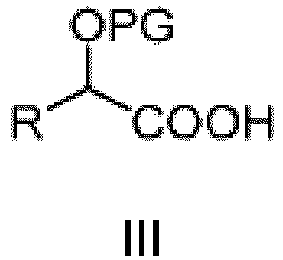
aus einer 2-Hydroxyfettsäure oder dem Natriumsalz einer 2-Hydroxyfettsäure;B) Bildung des Triglycerids der Formel IV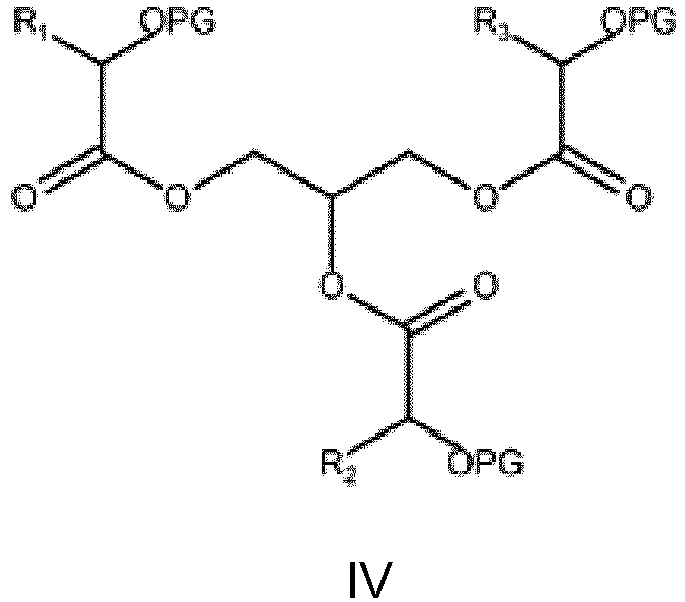
durch die Reaktion eines Glycerins und mindestens einer 2-Hydroxy-geschützten Fettsäure der Formel III; undC) Entschützung des im vorherigen Schritt erhaltenen Triglycerids der Formel IV. - Verbindung der Formel I:

- Verbindung der Formel I zur Verwendung nach Anspruch 8, wobei die Kohlenwasserstoffreste R1, R2 und R3 jeweils unabhängig voneinander eine aliphatische Kette mit 5 bis 22 Kohlenstoffatomen der Formel II:
-(CH2)a-(CH=CH-CH2)b-(CH2)c-CH3 II
umfassen, wobeia eine ganze Zahl zwischen 1 und 6 ist;b eine ganze Zahl zwischen 0 und 6 ist; undc eine ganze Zahl zwischen 0 und 6 ist. - Verbindung der Formel I zur Verwendung nach Anspruch 8, wobei R1, R2 und R3 jeweils unabhängig voneinander aus (CH2)4-CH3, (CH2)6-(CH=CH-CH2)1-(CH2)6-CH3, (CH2)6-(CH=CH-CH2)2-(CH2)3-CH3, (CH2)6-(CH=CH-CH2)3-CH3, (CH2)3-(CH=CH-CH2)3-(CH2)3-CH3, (CH2)2-(CH=CH-CH2)4-(CH2)3-CH3, (CH2)2-(CH=CH-CH2)5-CH3 und CH2-(CH=CH-CH2)6-CH3 ausgewählt sind.
- Verbindung der Formel I zur Verwendung nach einem der Ansprüche 8 bis 10, wobei mindestens eine Krankheit ausgewählt ist aus:a) einem Krebs, der wiederum ausgewählt ist aus: Lungenkrebs, Brustkrebs, Prostatakrebs, Leukämie, Gliomen und/oder anderen Hirntumoren, Bauchspeicheldrüsenkrebs, Leberkrebs, Gebärmutterhalskrebs, neuroendokrinem Krebs, Mesotheliomen, männlichen und/oder weiblichen Genitaltumoren, Kopf- und/oder Halskrebs, Nierentumoren und/oder Melanom;b) einer Stoffwechsel-/Herz-Kreislauf-Erkrankung, die wiederum ausgewählt ist aus: Bluthochdruck, Atherosklerose, Arteriosklerose, Herzinfarkten, Schlaganfall, Arrhythmie, Hypertriglyceridämie, Hypercholesterinämie und/oder anderen Dyslipidämien, Fettleibigkeit, Diabetes und/oder Stoffwechselsyndrom; und/oderc) einer neurologischen/entzündlichen Erkrankung, die wiederum ausgewählt ist aus: Morbus Alzheimer, Morbus Parkinson, Morbus Huntington, amyotropher Lateralsklerose, multipler Sklerose, Wirbelsäulenverletzung, adulter Polyglucosankörper-Erkrankung, Depression, Angstzuständen, Schmerzen, Schizophrenie, Schlafstörungen, allgemeiner Entzündung und/oder lokaler Entzündung einschließlich Uveitis, Rheumatismus, arthritis-, arthrose- und/oder altersbedingten Entzündungsprozessen.
- Verbindung der Formel I zur Verwendung nach einem der Ansprüche 8 bis 11, wobei mindestens eine Krankheit ausgewählt ist aus:a) einem Krebs, der wiederum ausgewählt ist aus: Lungenkrebs, Brustkrebs, Prostatakrebs, Leukämie, Gliomen, Bauchspeicheldrüsenkrebs, Leberkrebs, Gebärmutterhalskrebs und/oder neuroendokrinem Krebs;b) einer Stoffwechsel-/Herz-Kreislauf-Erkrankung, die wiederum ausgewählt ist aus: Bluthochdruck, Hypertriglyceridämie, Hypercholesterinämie, Fettleibigkeit und/oder Diabetes; und/oderc) einer neurologischen/entzündlichen Erkrankung, die wiederum ausgewählt ist aus: Morbus Alzheimer und/oder adulter Polyglucosankörper-Erkrankung.
- Pharmazeutische und/oder nutrazeutische Zusammensetzung, die Folgendes umfasst:a) mindestens eine Verbindung der Formel I nach einem der Ansprüche 1 bis 6; undb) mindestens einen Arzneimittelträger.
- Pharmazeutische und/oder nutrazeutische Zusammensetzung nach Anspruch 13, die mindestens zwei verschiedene Verbindungen der Formel I nach einem der Ansprüche 1 bis 6 umfasst.
- Verfahren zur Herstellung einer pharmazeutischen und/oder nutrazeutischen Zusammensetzung nach einem der Ansprüche 13 und 14, das das Mischen vona) mindestens einer Verbindung der Formel I nach einem der Ansprüche 1 bis 6; undb) mindestens einem Arzneimittelträger umfasst.
Applications Claiming Priority (2)
| Application Number | Priority Date | Filing Date | Title |
|---|---|---|---|
| EP14189696 | 2014-10-21 | ||
| PCT/EP2015/074321 WO2016062746A1 (en) | 2014-10-21 | 2015-10-21 | Method for the synthesis of hydroxy-triglycerides and uses thereof for the prevention and treatment of diseases |
Publications (2)
| Publication Number | Publication Date |
|---|---|
| EP3209637A1 EP3209637A1 (de) | 2017-08-30 |
| EP3209637B1 true EP3209637B1 (de) | 2019-05-08 |
Family
ID=51947108
Family Applications (1)
| Application Number | Title | Priority Date | Filing Date |
|---|---|---|---|
| EP15790481.4A Active EP3209637B1 (de) | 2014-10-21 | 2015-10-21 | 2-hydroxy-triacylglycerol -verbindungen zur behandlung von krankheiten |
Country Status (13)
| Country | Link |
|---|---|
| US (1) | US10047036B2 (de) |
| EP (1) | EP3209637B1 (de) |
| JP (1) | JP6348229B2 (de) |
| KR (1) | KR101970151B1 (de) |
| CN (1) | CN107428671B (de) |
| AU (1) | AU2015334964B2 (de) |
| CA (1) | CA2965047C (de) |
| CL (1) | CL2017000988A1 (de) |
| ES (1) | ES2731251T3 (de) |
| IL (1) | IL251135A (de) |
| MX (1) | MX364197B (de) |
| RU (1) | RU2679443C2 (de) |
| WO (1) | WO2016062746A1 (de) |
Families Citing this family (2)
| Publication number | Priority date | Publication date | Assignee | Title |
|---|---|---|---|---|
| WO2020147979A1 (de) * | 2019-01-17 | 2020-07-23 | Ioi Oleo Gmbh | Verfahren zur herstellung von polyolbasierten estern von hydroxycarbonsäuren |
| KR102446371B1 (ko) * | 2019-06-11 | 2022-09-22 | 대봉엘에스 주식회사 | 유지 조성물 및 이의 용도 |
Family Cites Families (13)
| Publication number | Priority date | Publication date | Assignee | Title |
|---|---|---|---|---|
| GB8620896D0 (en) * | 1986-08-29 | 1986-10-08 | Unilever Plc | Cosmetic composition |
| FR2731015B1 (fr) * | 1995-02-24 | 1997-05-30 | Sci Sartone | Procede d'enrichissement enzymatique d'huiles d'origine marine et les triglycerides d'acides gras polyinsatures ainsi obtenus |
| ES2186576B1 (es) * | 2001-10-11 | 2004-09-16 | Universitat De Les Illes Balears | Acido 2-hidroxioleico para utilizar como medicamento. |
| AU2003222739A1 (en) * | 2002-05-08 | 2003-11-11 | Danmarks Tekniske Universitet (Technical University Of Denmark) | A facile two-step enzyme process for increasing the content of polyunsaturated fatty acids in fish oil |
| US7163673B2 (en) * | 2003-06-17 | 2007-01-16 | The United States Of America As Represented By The Secretary Of Agriculture | Sunscreen reagents from hydroxy-substituted acylglycerides |
| DK1841433T3 (da) * | 2005-01-27 | 2012-01-16 | Sucampo Ag | Præparat til behandling af lidelser i centralnervesystemet |
| KR101438177B1 (ko) * | 2006-11-01 | 2014-09-05 | 프로노바 바이오파마 너지 에이에스 | 페록시솜 증식자-활성화 수용체의 활성자 또는 조절자인 알파-치환된 오메가-3 지질 |
| US20080156717A1 (en) * | 2006-12-07 | 2008-07-03 | Access Business Group International Llc | Fluid flow director for water treatment system |
| JP2009096720A (ja) * | 2007-10-12 | 2009-05-07 | Idemitsu Kosan Co Ltd | 生分解性液状エステル化合物 |
| ES2342997B1 (es) | 2008-12-09 | 2011-06-06 | Universitat De Les Illes Balears | Alpha derivados de acidos grasos cis-monoinsaturados para ser usados como medicamento. |
| ES2345241B1 (es) | 2009-03-16 | 2011-09-08 | Lipopharma Therapeutics | Uso de 2-hidroxiderivados de acidos grasos poliinsaturados como medicamentos. |
| ES2401629B1 (es) * | 2011-10-07 | 2014-03-04 | Universitat De Les Illes Balears | Enantiómeros de 2-hidroxiderivados de ácidos grasos y su uso como medicamentos. |
| CN103897284A (zh) * | 2012-12-25 | 2014-07-02 | 胶州市富田化工有限公司 | 一种新型pvc增塑剂 |
-
2015
- 2015-10-21 JP JP2017518439A patent/JP6348229B2/ja active Active
- 2015-10-21 ES ES15790481T patent/ES2731251T3/es active Active
- 2015-10-21 KR KR1020177010835A patent/KR101970151B1/ko active Active
- 2015-10-21 CN CN201580055837.9A patent/CN107428671B/zh active Active
- 2015-10-21 CA CA2965047A patent/CA2965047C/en active Active
- 2015-10-21 WO PCT/EP2015/074321 patent/WO2016062746A1/en not_active Ceased
- 2015-10-21 MX MX2017005103A patent/MX364197B/es active IP Right Grant
- 2015-10-21 AU AU2015334964A patent/AU2015334964B2/en active Active
- 2015-10-21 US US15/520,735 patent/US10047036B2/en active Active
- 2015-10-21 EP EP15790481.4A patent/EP3209637B1/de active Active
- 2015-10-21 RU RU2017112073A patent/RU2679443C2/ru active
-
2017
- 2017-03-13 IL IL251135A patent/IL251135A/en active IP Right Grant
- 2017-04-20 CL CL2017000988A patent/CL2017000988A1/es unknown
Non-Patent Citations (1)
| Title |
|---|
| None * |
Also Published As
| Publication number | Publication date |
|---|---|
| CL2017000988A1 (es) | 2017-11-10 |
| JP6348229B2 (ja) | 2018-06-27 |
| CA2965047A1 (en) | 2016-04-28 |
| CN107428671B (zh) | 2020-12-04 |
| RU2017112073A (ru) | 2018-11-23 |
| MX364197B (es) | 2019-04-16 |
| CN107428671A (zh) | 2017-12-01 |
| CA2965047C (en) | 2018-06-26 |
| WO2016062746A1 (en) | 2016-04-28 |
| AU2015334964A1 (en) | 2017-03-30 |
| IL251135A0 (en) | 2017-04-30 |
| JP2017536339A (ja) | 2017-12-07 |
| US20170313646A1 (en) | 2017-11-02 |
| RU2017112073A3 (de) | 2018-11-23 |
| RU2679443C2 (ru) | 2019-02-11 |
| HK1246271A1 (zh) | 2018-09-07 |
| MX2017005103A (es) | 2017-06-20 |
| EP3209637A1 (de) | 2017-08-30 |
| BR112017006332A2 (pt) | 2017-12-19 |
| US10047036B2 (en) | 2018-08-14 |
| ES2731251T3 (es) | 2019-11-14 |
| IL251135A (en) | 2017-12-31 |
| AU2015334964B2 (en) | 2019-06-20 |
| KR101970151B1 (ko) | 2019-04-19 |
| KR20180037915A (ko) | 2018-04-13 |
Similar Documents
| Publication | Publication Date | Title |
|---|---|---|
| AU765569B2 (en) | Water-soluble pro-drugs of propofol | |
| ES2256472T3 (es) | Productos fenolicos naturales y derivados de los mismos para la proteccion frente a enfermedades neurodegenerativas. | |
| RU2509071C2 (ru) | Новые липидные соединения | |
| KR102265409B1 (ko) | 지질 화합물을 이용한 치료방법 | |
| US11014947B2 (en) | Lipophenol compounds and uses thereof | |
| EP3209637B1 (de) | 2-hydroxy-triacylglycerol -verbindungen zur behandlung von krankheiten | |
| Wu et al. | Design, synthesis and preliminary biological evaluation of brain targeting l-ascorbic acid prodrugs of ibuprofen | |
| JPS63501498A (ja) | L‐ドーパの新規誘導体、その製法とそれを含有する医薬組成物 | |
| WO2010007788A1 (ja) | グリチルレチン酸誘導体及びその利用 | |
| US20230097753A1 (en) | Alpha-hydroxylated fatty-acid metabolites, medical uses and use as biomarkers | |
| WO2015048821A1 (en) | Tricyclic pyrone compounds reduce amyloid beta aggregates | |
| KR20210022504A (ko) | 신규 세스퀴테르펜 유도체(1) 및 이의 용도 | |
| HK1246271B (zh) | 用於合成羟基-三甘油酯的方法及其用於预防和治疗疾病的用途 | |
| BR112017006332B1 (pt) | Método para síntese de hidróxi-triglicerídeos e usos respectivos para prevenção e tratamento de doenças | |
| ES2965646T3 (es) | Procedimiento para la producción de lípidos que contienen unidades estructurales a base de glicéridos de ácidos hidroxicarboxílicos | |
| JP7490204B2 (ja) | 脳機能改善剤 | |
| RU2841595C1 (ru) | Метаболиты альфа-гидроксилированных жирных кислот, их медицинские применения и применение в качестве биомаркеров | |
| CN102850424B (zh) | 3-羟基-孕甾-21-(2′,5′-二甲氧基)苯亚甲基-5-烯-20-酮、其制备方法和用途 | |
| HK40115347A (zh) | 用於神经退行性疾病的化合物和组合物 | |
| US20180215703A1 (en) | Stearoyl amino acid salt and method of use thereof | |
| JP2021017420A (ja) | 脳由来神経栄養因子産生促進剤、神経成長因子産生促進剤、酸化ストレス抑制剤及びそれらの使用 | |
| BR102015007435A2 (pt) | uso de compostos tia oxo para diminuir apo c3 | |
| WO2012080555A1 (es) | Éteres de hidroxitirosol | |
| BRPI0717972A2 (pt) | Lipídeos de ômega-3 alfa-substituídos que são ativadores ou moduladores do receptor ativado por proliferadores de peroxissoma (ppar) |
Legal Events
| Date | Code | Title | Description |
|---|---|---|---|
| STAA | Information on the status of an ep patent application or granted ep patent |
Free format text: STATUS: THE INTERNATIONAL PUBLICATION HAS BEEN MADE |
|
| PUAI | Public reference made under article 153(3) epc to a published international application that has entered the european phase |
Free format text: ORIGINAL CODE: 0009012 |
|
| STAA | Information on the status of an ep patent application or granted ep patent |
Free format text: STATUS: REQUEST FOR EXAMINATION WAS MADE |
|
| 17P | Request for examination filed |
Effective date: 20170518 |
|
| AK | Designated contracting states |
Kind code of ref document: A1 Designated state(s): AL AT BE BG CH CY CZ DE DK EE ES FI FR GB GR HR HU IE IS IT LI LT LU LV MC MK MT NL NO PL PT RO RS SE SI SK SM TR |
|
| AX | Request for extension of the european patent |
Extension state: BA ME |
|
| RIN1 | Information on inventor provided before grant (corrected) |
Inventor name: ESCRIBA RUIZ, PABLO VICENTE Inventor name: BUSQUETS XAUBET, XAVIER |
|
| RIN1 | Information on inventor provided before grant (corrected) |
Inventor name: BUSQUETS XAUBET, XAVIER Inventor name: ESCRIBA RUIZ, PABLO VICENTE |
|
| DAV | Request for validation of the european patent (deleted) | ||
| DAX | Request for extension of the european patent (deleted) | ||
| STAA | Information on the status of an ep patent application or granted ep patent |
Free format text: STATUS: EXAMINATION IS IN PROGRESS |
|
| 17Q | First examination report despatched |
Effective date: 20180619 |
|
| GRAP | Despatch of communication of intention to grant a patent |
Free format text: ORIGINAL CODE: EPIDOSNIGR1 |
|
| STAA | Information on the status of an ep patent application or granted ep patent |
Free format text: STATUS: GRANT OF PATENT IS INTENDED |
|
| INTG | Intention to grant announced |
Effective date: 20181210 |
|
| GRAS | Grant fee paid |
Free format text: ORIGINAL CODE: EPIDOSNIGR3 |
|
| GRAA | (expected) grant |
Free format text: ORIGINAL CODE: 0009210 |
|
| STAA | Information on the status of an ep patent application or granted ep patent |
Free format text: STATUS: THE PATENT HAS BEEN GRANTED |
|
| AK | Designated contracting states |
Kind code of ref document: B1 Designated state(s): AL AT BE BG CH CY CZ DE DK EE ES FI FR GB GR HR HU IE IS IT LI LT LU LV MC MK MT NL NO PL PT RO RS SE SI SK SM TR |
|
| REG | Reference to a national code |
Ref country code: GB Ref legal event code: FG4D |
|
| REG | Reference to a national code |
Ref country code: CH Ref legal event code: EP Ref country code: AT Ref legal event code: REF Ref document number: 1129931 Country of ref document: AT Kind code of ref document: T Effective date: 20190515 |
|
| REG | Reference to a national code |
Ref country code: DE Ref legal event code: R096 Ref document number: 602015029998 Country of ref document: DE |
|
| REG | Reference to a national code |
Ref country code: IE Ref legal event code: FG4D |
|
| REG | Reference to a national code |
Ref country code: CH Ref legal event code: NV Representative=s name: VOSSIUS AND PARTNER PATENTANWAELTE RECHTSANWAE, CH |
|
| REG | Reference to a national code |
Ref country code: NL Ref legal event code: MP Effective date: 20190508 |
|
| REG | Reference to a national code |
Ref country code: LT Ref legal event code: MG4D |
|
| PG25 | Lapsed in a contracting state [announced via postgrant information from national office to epo] |
Ref country code: NL Free format text: LAPSE BECAUSE OF FAILURE TO SUBMIT A TRANSLATION OF THE DESCRIPTION OR TO PAY THE FEE WITHIN THE PRESCRIBED TIME-LIMIT Effective date: 20190508 Ref country code: PT Free format text: LAPSE BECAUSE OF FAILURE TO SUBMIT A TRANSLATION OF THE DESCRIPTION OR TO PAY THE FEE WITHIN THE PRESCRIBED TIME-LIMIT Effective date: 20190908 Ref country code: AL Free format text: LAPSE BECAUSE OF FAILURE TO SUBMIT A TRANSLATION OF THE DESCRIPTION OR TO PAY THE FEE WITHIN THE PRESCRIBED TIME-LIMIT Effective date: 20190508 Ref country code: SE Free format text: LAPSE BECAUSE OF FAILURE TO SUBMIT A TRANSLATION OF THE DESCRIPTION OR TO PAY THE FEE WITHIN THE PRESCRIBED TIME-LIMIT Effective date: 20190508 Ref country code: FI Free format text: LAPSE BECAUSE OF FAILURE TO SUBMIT A TRANSLATION OF THE DESCRIPTION OR TO PAY THE FEE WITHIN THE PRESCRIBED TIME-LIMIT Effective date: 20190508 Ref country code: NO Free format text: LAPSE BECAUSE OF FAILURE TO SUBMIT A TRANSLATION OF THE DESCRIPTION OR TO PAY THE FEE WITHIN THE PRESCRIBED TIME-LIMIT Effective date: 20190808 Ref country code: LT Free format text: LAPSE BECAUSE OF FAILURE TO SUBMIT A TRANSLATION OF THE DESCRIPTION OR TO PAY THE FEE WITHIN THE PRESCRIBED TIME-LIMIT Effective date: 20190508 Ref country code: HR Free format text: LAPSE BECAUSE OF FAILURE TO SUBMIT A TRANSLATION OF THE DESCRIPTION OR TO PAY THE FEE WITHIN THE PRESCRIBED TIME-LIMIT Effective date: 20190508 |
|
| REG | Reference to a national code |
Ref country code: ES Ref legal event code: FG2A Ref document number: 2731251 Country of ref document: ES Kind code of ref document: T3 Effective date: 20191114 |
|
| PG25 | Lapsed in a contracting state [announced via postgrant information from national office to epo] |
Ref country code: RS Free format text: LAPSE BECAUSE OF FAILURE TO SUBMIT A TRANSLATION OF THE DESCRIPTION OR TO PAY THE FEE WITHIN THE PRESCRIBED TIME-LIMIT Effective date: 20190508 Ref country code: BG Free format text: LAPSE BECAUSE OF FAILURE TO SUBMIT A TRANSLATION OF THE DESCRIPTION OR TO PAY THE FEE WITHIN THE PRESCRIBED TIME-LIMIT Effective date: 20190808 Ref country code: LV Free format text: LAPSE BECAUSE OF FAILURE TO SUBMIT A TRANSLATION OF THE DESCRIPTION OR TO PAY THE FEE WITHIN THE PRESCRIBED TIME-LIMIT Effective date: 20190508 |
|
| REG | Reference to a national code |
Ref country code: AT Ref legal event code: MK05 Ref document number: 1129931 Country of ref document: AT Kind code of ref document: T Effective date: 20190508 |
|
| PG25 | Lapsed in a contracting state [announced via postgrant information from national office to epo] |
Ref country code: AT Free format text: LAPSE BECAUSE OF FAILURE TO SUBMIT A TRANSLATION OF THE DESCRIPTION OR TO PAY THE FEE WITHIN THE PRESCRIBED TIME-LIMIT Effective date: 20190508 Ref country code: DK Free format text: LAPSE BECAUSE OF FAILURE TO SUBMIT A TRANSLATION OF THE DESCRIPTION OR TO PAY THE FEE WITHIN THE PRESCRIBED TIME-LIMIT Effective date: 20190508 Ref country code: EE Free format text: LAPSE BECAUSE OF FAILURE TO SUBMIT A TRANSLATION OF THE DESCRIPTION OR TO PAY THE FEE WITHIN THE PRESCRIBED TIME-LIMIT Effective date: 20190508 Ref country code: RO Free format text: LAPSE BECAUSE OF FAILURE TO SUBMIT A TRANSLATION OF THE DESCRIPTION OR TO PAY THE FEE WITHIN THE PRESCRIBED TIME-LIMIT Effective date: 20190508 Ref country code: SK Free format text: LAPSE BECAUSE OF FAILURE TO SUBMIT A TRANSLATION OF THE DESCRIPTION OR TO PAY THE FEE WITHIN THE PRESCRIBED TIME-LIMIT Effective date: 20190508 Ref country code: CZ Free format text: LAPSE BECAUSE OF FAILURE TO SUBMIT A TRANSLATION OF THE DESCRIPTION OR TO PAY THE FEE WITHIN THE PRESCRIBED TIME-LIMIT Effective date: 20190508 |
|
| REG | Reference to a national code |
Ref country code: DE Ref legal event code: R097 Ref document number: 602015029998 Country of ref document: DE |
|
| PG25 | Lapsed in a contracting state [announced via postgrant information from national office to epo] |
Ref country code: SM Free format text: LAPSE BECAUSE OF FAILURE TO SUBMIT A TRANSLATION OF THE DESCRIPTION OR TO PAY THE FEE WITHIN THE PRESCRIBED TIME-LIMIT Effective date: 20190508 |
|
| PLBE | No opposition filed within time limit |
Free format text: ORIGINAL CODE: 0009261 |
|
| STAA | Information on the status of an ep patent application or granted ep patent |
Free format text: STATUS: NO OPPOSITION FILED WITHIN TIME LIMIT |
|
| PG25 | Lapsed in a contracting state [announced via postgrant information from national office to epo] |
Ref country code: TR Free format text: LAPSE BECAUSE OF FAILURE TO SUBMIT A TRANSLATION OF THE DESCRIPTION OR TO PAY THE FEE WITHIN THE PRESCRIBED TIME-LIMIT Effective date: 20190508 |
|
| 26N | No opposition filed |
Effective date: 20200211 |
|
| PG25 | Lapsed in a contracting state [announced via postgrant information from national office to epo] |
Ref country code: PL Free format text: LAPSE BECAUSE OF FAILURE TO SUBMIT A TRANSLATION OF THE DESCRIPTION OR TO PAY THE FEE WITHIN THE PRESCRIBED TIME-LIMIT Effective date: 20190508 |
|
| PG25 | Lapsed in a contracting state [announced via postgrant information from national office to epo] |
Ref country code: MC Free format text: LAPSE BECAUSE OF FAILURE TO SUBMIT A TRANSLATION OF THE DESCRIPTION OR TO PAY THE FEE WITHIN THE PRESCRIBED TIME-LIMIT Effective date: 20190508 Ref country code: SI Free format text: LAPSE BECAUSE OF FAILURE TO SUBMIT A TRANSLATION OF THE DESCRIPTION OR TO PAY THE FEE WITHIN THE PRESCRIBED TIME-LIMIT Effective date: 20190508 |
|
| PG25 | Lapsed in a contracting state [announced via postgrant information from national office to epo] |
Ref country code: LU Free format text: LAPSE BECAUSE OF NON-PAYMENT OF DUE FEES Effective date: 20191021 |
|
| REG | Reference to a national code |
Ref country code: BE Ref legal event code: MM Effective date: 20191031 |
|
| PG25 | Lapsed in a contracting state [announced via postgrant information from national office to epo] |
Ref country code: BE Free format text: LAPSE BECAUSE OF NON-PAYMENT OF DUE FEES Effective date: 20191031 |
|
| PG25 | Lapsed in a contracting state [announced via postgrant information from national office to epo] |
Ref country code: IE Free format text: LAPSE BECAUSE OF NON-PAYMENT OF DUE FEES Effective date: 20191021 |
|
| PG25 | Lapsed in a contracting state [announced via postgrant information from national office to epo] |
Ref country code: CY Free format text: LAPSE BECAUSE OF FAILURE TO SUBMIT A TRANSLATION OF THE DESCRIPTION OR TO PAY THE FEE WITHIN THE PRESCRIBED TIME-LIMIT Effective date: 20190508 |
|
| PG25 | Lapsed in a contracting state [announced via postgrant information from national office to epo] |
Ref country code: GR Free format text: LAPSE BECAUSE OF FAILURE TO SUBMIT A TRANSLATION OF THE DESCRIPTION OR TO PAY THE FEE WITHIN THE PRESCRIBED TIME-LIMIT Effective date: 20190508 Ref country code: IS Free format text: LAPSE BECAUSE OF FAILURE TO SUBMIT A TRANSLATION OF THE DESCRIPTION OR TO PAY THE FEE WITHIN THE PRESCRIBED TIME-LIMIT Effective date: 20190908 |
|
| PG25 | Lapsed in a contracting state [announced via postgrant information from national office to epo] |
Ref country code: MT Free format text: LAPSE BECAUSE OF FAILURE TO SUBMIT A TRANSLATION OF THE DESCRIPTION OR TO PAY THE FEE WITHIN THE PRESCRIBED TIME-LIMIT Effective date: 20190508 Ref country code: HU Free format text: LAPSE BECAUSE OF FAILURE TO SUBMIT A TRANSLATION OF THE DESCRIPTION OR TO PAY THE FEE WITHIN THE PRESCRIBED TIME-LIMIT; INVALID AB INITIO Effective date: 20151021 |
|
| PG25 | Lapsed in a contracting state [announced via postgrant information from national office to epo] |
Ref country code: MK Free format text: LAPSE BECAUSE OF FAILURE TO SUBMIT A TRANSLATION OF THE DESCRIPTION OR TO PAY THE FEE WITHIN THE PRESCRIBED TIME-LIMIT Effective date: 20190508 |
|
| PGFP | Annual fee paid to national office [announced via postgrant information from national office to epo] |
Ref country code: ES Payment date: 20251031 Year of fee payment: 11 |
|
| REG | Reference to a national code |
Ref country code: CH Ref legal event code: U11 Free format text: ST27 STATUS EVENT CODE: U-0-0-U10-U11 (AS PROVIDED BY THE NATIONAL OFFICE) Effective date: 20251101 |
|
| PGFP | Annual fee paid to national office [announced via postgrant information from national office to epo] |
Ref country code: DE Payment date: 20251027 Year of fee payment: 11 |
|
| PGFP | Annual fee paid to national office [announced via postgrant information from national office to epo] |
Ref country code: GB Payment date: 20251024 Year of fee payment: 11 |
|
| PGFP | Annual fee paid to national office [announced via postgrant information from national office to epo] |
Ref country code: IT Payment date: 20251022 Year of fee payment: 11 |
|
| PGFP | Annual fee paid to national office [announced via postgrant information from national office to epo] |
Ref country code: FR Payment date: 20251028 Year of fee payment: 11 |
|
| PGFP | Annual fee paid to national office [announced via postgrant information from national office to epo] |
Ref country code: CH Payment date: 20251101 Year of fee payment: 11 |