EP3214125A1 - Compositions à base de copolymères d'oléfines cycliques et élastomères pour la fabrication d'objets moulés et leurs applications. - Google Patents
Compositions à base de copolymères d'oléfines cycliques et élastomères pour la fabrication d'objets moulés et leurs applications. Download PDFInfo
- Publication number
- EP3214125A1 EP3214125A1 EP17000181.2A EP17000181A EP3214125A1 EP 3214125 A1 EP3214125 A1 EP 3214125A1 EP 17000181 A EP17000181 A EP 17000181A EP 3214125 A1 EP3214125 A1 EP 3214125A1
- Authority
- EP
- European Patent Office
- Prior art keywords
- ethylene
- component
- ring
- monomers
- compositions according
- Prior art date
- Legal status (The legal status is an assumption and is not a legal conclusion. Google has not performed a legal analysis and makes no representation as to the accuracy of the status listed.)
- Withdrawn
Links
- 239000000203 mixture Substances 0.000 title claims abstract description 93
- 229920001971 elastomer Polymers 0.000 title description 33
- 239000000806 elastomer Substances 0.000 title description 33
- 238000002360 preparation method Methods 0.000 title description 2
- 229920000089 Cyclic olefin copolymer Polymers 0.000 claims abstract description 84
- -1 polycyclic olefin Chemical class 0.000 claims abstract description 57
- 239000000178 monomer Substances 0.000 claims abstract description 43
- 229920001577 copolymer Polymers 0.000 claims abstract description 42
- VGGSQFUCUMXWEO-UHFFFAOYSA-N Ethene Chemical compound C=C VGGSQFUCUMXWEO-UHFFFAOYSA-N 0.000 claims abstract description 31
- 239000005977 Ethylene Substances 0.000 claims abstract description 29
- 229920000642 polymer Polymers 0.000 claims abstract description 27
- 230000009477 glass transition Effects 0.000 claims abstract description 24
- 238000000465 moulding Methods 0.000 claims abstract description 23
- 238000007334 copolymerization reaction Methods 0.000 claims abstract description 20
- JRZJOMJEPLMPRA-UHFFFAOYSA-N olefin Natural products CCCCCCCC=C JRZJOMJEPLMPRA-UHFFFAOYSA-N 0.000 claims abstract description 19
- 238000004519 manufacturing process Methods 0.000 claims abstract description 18
- 239000004711 α-olefin Substances 0.000 claims abstract description 13
- 238000007151 ring opening polymerisation reaction Methods 0.000 claims abstract description 9
- 238000010276 construction Methods 0.000 claims abstract description 8
- 238000005516 engineering process Methods 0.000 claims abstract description 8
- 229920001519 homopolymer Polymers 0.000 claims abstract description 7
- 125000003367 polycyclic group Chemical group 0.000 claims abstract description 6
- 229920001384 propylene homopolymer Polymers 0.000 claims abstract description 6
- 238000005984 hydrogenation reaction Methods 0.000 claims abstract description 5
- 239000003814 drug Substances 0.000 claims abstract description 4
- 238000004870 electrical engineering Methods 0.000 claims abstract description 4
- 125000002950 monocyclic group Chemical group 0.000 claims abstract description 4
- 239000005022 packaging material Substances 0.000 claims abstract description 4
- 238000002844 melting Methods 0.000 claims description 12
- 230000008018 melting Effects 0.000 claims description 12
- 238000000034 method Methods 0.000 claims description 9
- JFNLZVQOOSMTJK-KNVOCYPGSA-N norbornene Chemical compound C1[C@@H]2CC[C@H]1C=C2 JFNLZVQOOSMTJK-KNVOCYPGSA-N 0.000 claims description 8
- 239000000835 fiber Substances 0.000 claims description 5
- 230000008569 process Effects 0.000 claims description 5
- 238000005259 measurement Methods 0.000 claims description 4
- 125000004435 hydrogen atom Chemical group [H]* 0.000 claims description 3
- 238000003856 thermoforming Methods 0.000 claims description 2
- 239000003708 ampul Substances 0.000 claims 2
- 239000001752 chlorophylls and chlorophyllins Substances 0.000 description 31
- 229920000098 polyolefin Polymers 0.000 description 26
- WKBPZYKAUNRMKP-UHFFFAOYSA-N 1-[2-(2,4-dichlorophenyl)pentyl]1,2,4-triazole Chemical compound C=1C=C(Cl)C=C(Cl)C=1C(CCC)CN1C=NC=N1 WKBPZYKAUNRMKP-UHFFFAOYSA-N 0.000 description 24
- 239000004698 Polyethylene Substances 0.000 description 19
- 229920000573 polyethylene Polymers 0.000 description 19
- 239000004743 Polypropylene Substances 0.000 description 17
- 229920001155 polypropylene Polymers 0.000 description 17
- 238000001746 injection moulding Methods 0.000 description 14
- 229920001903 high density polyethylene Polymers 0.000 description 10
- 239000004700 high-density polyethylene Substances 0.000 description 10
- 229920001038 ethylene copolymer Polymers 0.000 description 9
- 150000001925 cycloalkenes Chemical class 0.000 description 8
- 238000000113 differential scanning calorimetry Methods 0.000 description 8
- QQONPFPTGQHPMA-UHFFFAOYSA-N propylene Natural products CC=C QQONPFPTGQHPMA-UHFFFAOYSA-N 0.000 description 8
- 238000006116 polymerization reaction Methods 0.000 description 7
- 239000000654 additive Substances 0.000 description 6
- SFFFIHNOEGSAIH-UHFFFAOYSA-N bicyclo[2.2.1]hept-2-ene;ethene Chemical group C=C.C1C2CCC1C=C2 SFFFIHNOEGSAIH-UHFFFAOYSA-N 0.000 description 6
- 239000003054 catalyst Substances 0.000 description 6
- 238000001125 extrusion Methods 0.000 description 6
- 229920001684 low density polyethylene Polymers 0.000 description 6
- 239000004702 low-density polyethylene Substances 0.000 description 6
- 239000000155 melt Substances 0.000 description 6
- 125000004805 propylene group Chemical group [H]C([H])([H])C([H])([*:1])C([H])([H])[*:2] 0.000 description 6
- 239000000126 substance Substances 0.000 description 6
- 238000007792 addition Methods 0.000 description 5
- 238000002347 injection Methods 0.000 description 5
- 239000007924 injection Substances 0.000 description 5
- 239000000463 material Substances 0.000 description 5
- 229920001179 medium density polyethylene Polymers 0.000 description 5
- 239000004701 medium-density polyethylene Substances 0.000 description 5
- 229920001169 thermoplastic Polymers 0.000 description 5
- 239000004416 thermosoftening plastic Substances 0.000 description 5
- XLYOFNOQVPJJNP-UHFFFAOYSA-N water Chemical compound O XLYOFNOQVPJJNP-UHFFFAOYSA-N 0.000 description 5
- 238000002425 crystallisation Methods 0.000 description 4
- 230000008025 crystallization Effects 0.000 description 4
- 239000010432 diamond Substances 0.000 description 4
- 238000010102 injection blow moulding Methods 0.000 description 4
- 230000035699 permeability Effects 0.000 description 4
- 238000007142 ring opening reaction Methods 0.000 description 4
- 230000007704 transition Effects 0.000 description 4
- VXNZUUAINFGPBY-UHFFFAOYSA-N 1-Butene Chemical compound CCC=C VXNZUUAINFGPBY-UHFFFAOYSA-N 0.000 description 3
- 239000000956 alloy Substances 0.000 description 3
- 229910045601 alloy Inorganic materials 0.000 description 3
- 230000004888 barrier function Effects 0.000 description 3
- 125000004122 cyclic group Chemical group 0.000 description 3
- 238000010101 extrusion blow moulding Methods 0.000 description 3
- 239000010410 layer Substances 0.000 description 3
- 229920000092 linear low density polyethylene Polymers 0.000 description 3
- 239000004707 linear low-density polyethylene Substances 0.000 description 3
- 239000007788 liquid Substances 0.000 description 3
- 229920002959 polymer blend Polymers 0.000 description 3
- 230000000717 retained effect Effects 0.000 description 3
- LIKMAJRDDDTEIG-UHFFFAOYSA-N 1-hexene Chemical compound CCCCC=C LIKMAJRDDDTEIG-UHFFFAOYSA-N 0.000 description 2
- 150000001336 alkenes Chemical class 0.000 description 2
- 238000005275 alloying Methods 0.000 description 2
- 125000004429 atom Chemical group 0.000 description 2
- 230000015572 biosynthetic process Effects 0.000 description 2
- 125000004432 carbon atom Chemical group C* 0.000 description 2
- 230000006835 compression Effects 0.000 description 2
- 238000007906 compression Methods 0.000 description 2
- 238000001816 cooling Methods 0.000 description 2
- 238000005336 cracking Methods 0.000 description 2
- 238000010586 diagram Methods 0.000 description 2
- 238000011049 filling Methods 0.000 description 2
- 229920000578 graft copolymer Polymers 0.000 description 2
- 229930195733 hydrocarbon Natural products 0.000 description 2
- 150000002430 hydrocarbons Chemical class 0.000 description 2
- 239000000314 lubricant Substances 0.000 description 2
- 239000012968 metallocene catalyst Substances 0.000 description 2
- 125000002496 methyl group Chemical group [H]C([H])([H])* 0.000 description 2
- 230000003287 optical effect Effects 0.000 description 2
- 238000007789 sealing Methods 0.000 description 2
- 239000002356 single layer Substances 0.000 description 2
- 239000007787 solid Substances 0.000 description 2
- 238000001179 sorption measurement Methods 0.000 description 2
- 229920001897 terpolymer Polymers 0.000 description 2
- 229920002725 thermoplastic elastomer Polymers 0.000 description 2
- KWKAKUADMBZCLK-UHFFFAOYSA-N 1-octene Chemical compound CCCCCCC=C KWKAKUADMBZCLK-UHFFFAOYSA-N 0.000 description 1
- OKTJSMMVPCPJKN-UHFFFAOYSA-N Carbon Chemical compound [C] OKTJSMMVPCPJKN-UHFFFAOYSA-N 0.000 description 1
- 239000004215 Carbon black (E152) Substances 0.000 description 1
- 229920006798 HMWPE Polymers 0.000 description 1
- 239000004705 High-molecular-weight polyethylene Substances 0.000 description 1
- 229920010126 Linear Low Density Polyethylene (LLDPE) Polymers 0.000 description 1
- ZOKXTWBITQBERF-UHFFFAOYSA-N Molybdenum Chemical compound [Mo] ZOKXTWBITQBERF-UHFFFAOYSA-N 0.000 description 1
- 239000006057 Non-nutritive feed additive Substances 0.000 description 1
- RTAQQCXQSZGOHL-UHFFFAOYSA-N Titanium Chemical compound [Ti] RTAQQCXQSZGOHL-UHFFFAOYSA-N 0.000 description 1
- 239000012963 UV stabilizer Substances 0.000 description 1
- 239000004699 Ultra-high molecular weight polyethylene Substances 0.000 description 1
- QCWXUUIWCKQGHC-UHFFFAOYSA-N Zirconium Chemical compound [Zr] QCWXUUIWCKQGHC-UHFFFAOYSA-N 0.000 description 1
- 238000010521 absorption reaction Methods 0.000 description 1
- 239000012790 adhesive layer Substances 0.000 description 1
- 239000002216 antistatic agent Substances 0.000 description 1
- QVGXLLKOCUKJST-UHFFFAOYSA-N atomic oxygen Chemical compound [O] QVGXLLKOCUKJST-UHFFFAOYSA-N 0.000 description 1
- 230000005540 biological transmission Effects 0.000 description 1
- 229920001400 block copolymer Polymers 0.000 description 1
- 238000000071 blow moulding Methods 0.000 description 1
- IAQRGUVFOMOMEM-UHFFFAOYSA-N butene Natural products CC=CC IAQRGUVFOMOMEM-UHFFFAOYSA-N 0.000 description 1
- 125000000484 butyl group Chemical group [H]C([*])([H])C([H])([H])C([H])([H])C([H])([H])[H] 0.000 description 1
- 229910052799 carbon Inorganic materials 0.000 description 1
- 238000006243 chemical reaction Methods 0.000 description 1
- 150000001875 compounds Chemical class 0.000 description 1
- 239000004035 construction material Substances 0.000 description 1
- 238000009826 distribution Methods 0.000 description 1
- 239000000975 dye Substances 0.000 description 1
- 125000001495 ethyl group Chemical group [H]C([H])([H])C([H])([H])* 0.000 description 1
- 239000005038 ethylene vinyl acetate Substances 0.000 description 1
- 239000004744 fabric Substances 0.000 description 1
- 230000002349 favourable effect Effects 0.000 description 1
- 239000003063 flame retardant Substances 0.000 description 1
- 239000011521 glass Substances 0.000 description 1
- 229910052735 hafnium Inorganic materials 0.000 description 1
- VBJZVLUMGGDVMO-UHFFFAOYSA-N hafnium atom Chemical compound [Hf] VBJZVLUMGGDVMO-UHFFFAOYSA-N 0.000 description 1
- 238000010438 heat treatment Methods 0.000 description 1
- 239000002815 homogeneous catalyst Substances 0.000 description 1
- 239000004615 ingredient Substances 0.000 description 1
- 238000010103 injection stretch blow moulding Methods 0.000 description 1
- 239000011256 inorganic filler Substances 0.000 description 1
- 125000001449 isopropyl group Chemical group [H]C([H])([H])C([H])(*)C([H])([H])[H] 0.000 description 1
- 238000004898 kneading Methods 0.000 description 1
- 239000003446 ligand Substances 0.000 description 1
- 230000014759 maintenance of location Effects 0.000 description 1
- 239000011159 matrix material Substances 0.000 description 1
- 238000002074 melt spinning Methods 0.000 description 1
- 229910052751 metal Inorganic materials 0.000 description 1
- 239000002184 metal Substances 0.000 description 1
- 229910052750 molybdenum Inorganic materials 0.000 description 1
- 239000011733 molybdenum Substances 0.000 description 1
- 125000004108 n-butyl group Chemical group [H]C([H])([H])C([H])([H])C([H])([H])C([H])([H])* 0.000 description 1
- 125000003136 n-heptyl group Chemical group [H]C([H])([H])C([H])([H])C([H])([H])C([H])([H])C([H])([H])C([H])([H])C([H])([H])* 0.000 description 1
- 125000001280 n-hexyl group Chemical group C(CCCCC)* 0.000 description 1
- 125000000740 n-pentyl group Chemical group [H]C([H])([H])C([H])([H])C([H])([H])C([H])([H])C([H])([H])* 0.000 description 1
- 125000004123 n-propyl group Chemical group [H]C([H])([H])C([H])([H])C([H])([H])* 0.000 description 1
- 229910052758 niobium Inorganic materials 0.000 description 1
- 239000010955 niobium Substances 0.000 description 1
- GUCVJGMIXFAOAE-UHFFFAOYSA-N niobium atom Chemical compound [Nb] GUCVJGMIXFAOAE-UHFFFAOYSA-N 0.000 description 1
- 125000003518 norbornenyl group Chemical group C12(C=CC(CC1)C2)* 0.000 description 1
- 150000002894 organic compounds Chemical class 0.000 description 1
- 239000012766 organic filler Substances 0.000 description 1
- 229910052760 oxygen Inorganic materials 0.000 description 1
- 239000001301 oxygen Substances 0.000 description 1
- 239000000049 pigment Substances 0.000 description 1
- 229920003023 plastic Polymers 0.000 description 1
- 239000004033 plastic Substances 0.000 description 1
- 239000004014 plasticizer Substances 0.000 description 1
- 229920001200 poly(ethylene-vinyl acetate) Polymers 0.000 description 1
- 238000003825 pressing Methods 0.000 description 1
- 229920005653 propylene-ethylene copolymer Polymers 0.000 description 1
- 239000012779 reinforcing material Substances 0.000 description 1
- 229910052702 rhenium Inorganic materials 0.000 description 1
- WUAPFZMCVAUBPE-UHFFFAOYSA-N rhenium atom Chemical compound [Re] WUAPFZMCVAUBPE-UHFFFAOYSA-N 0.000 description 1
- 229910052703 rhodium Inorganic materials 0.000 description 1
- 239000010948 rhodium Substances 0.000 description 1
- MHOVAHRLVXNVSD-UHFFFAOYSA-N rhodium atom Chemical compound [Rh] MHOVAHRLVXNVSD-UHFFFAOYSA-N 0.000 description 1
- 238000001175 rotational moulding Methods 0.000 description 1
- 229920006395 saturated elastomer Polymers 0.000 description 1
- 125000002914 sec-butyl group Chemical group [H]C([H])([H])C([H])([H])C([H])(*)C([H])([H])[H] 0.000 description 1
- 239000002904 solvent Substances 0.000 description 1
- 238000010561 standard procedure Methods 0.000 description 1
- 230000000707 stereoselective effect Effects 0.000 description 1
- 229910052715 tantalum Inorganic materials 0.000 description 1
- GUVRBAGPIYLISA-UHFFFAOYSA-N tantalum atom Chemical compound [Ta] GUVRBAGPIYLISA-UHFFFAOYSA-N 0.000 description 1
- XBFJAVXCNXDMBH-UHFFFAOYSA-N tetracyclo[6.2.1.1(3,6).0(2,7)]dodec-4-ene Chemical compound C1C(C23)C=CC1C3C1CC2CC1 XBFJAVXCNXDMBH-UHFFFAOYSA-N 0.000 description 1
- 239000004753 textile Substances 0.000 description 1
- 239000003017 thermal stabilizer Substances 0.000 description 1
- 239000010936 titanium Substances 0.000 description 1
- 229910052719 titanium Inorganic materials 0.000 description 1
- WFKWXMTUELFFGS-UHFFFAOYSA-N tungsten Chemical compound [W] WFKWXMTUELFFGS-UHFFFAOYSA-N 0.000 description 1
- 229910052721 tungsten Inorganic materials 0.000 description 1
- 239000010937 tungsten Substances 0.000 description 1
- 229920000785 ultra high molecular weight polyethylene Polymers 0.000 description 1
- 229910052720 vanadium Inorganic materials 0.000 description 1
- GPPXJZIENCGNKB-UHFFFAOYSA-N vanadium Chemical compound [V]#[V] GPPXJZIENCGNKB-UHFFFAOYSA-N 0.000 description 1
- 229910052726 zirconium Inorganic materials 0.000 description 1
Images

Classifications
-
- C—CHEMISTRY; METALLURGY
- C08—ORGANIC MACROMOLECULAR COMPOUNDS; THEIR PREPARATION OR CHEMICAL WORKING-UP; COMPOSITIONS BASED THEREON
- C08L—COMPOSITIONS OF MACROMOLECULAR COMPOUNDS
- C08L23/00—Compositions of homopolymers or copolymers of unsaturated aliphatic hydrocarbons having only one carbon-to-carbon double bond; Compositions of derivatives of such polymers
- C08L23/02—Compositions of homopolymers or copolymers of unsaturated aliphatic hydrocarbons having only one carbon-to-carbon double bond; Compositions of derivatives of such polymers not modified by chemical after-treatment
- C08L23/04—Homopolymers or copolymers of ethene
- C08L23/08—Copolymers of ethene
- C08L23/0807—Copolymers of ethene with unsaturated hydrocarbons only containing four or more carbon atoms
- C08L23/0823—Copolymers of ethene with unsaturated hydrocarbons only containing four or more carbon atoms with aliphatic cyclic olefins
-
- C—CHEMISTRY; METALLURGY
- C08—ORGANIC MACROMOLECULAR COMPOUNDS; THEIR PREPARATION OR CHEMICAL WORKING-UP; COMPOSITIONS BASED THEREON
- C08L—COMPOSITIONS OF MACROMOLECULAR COMPOUNDS
- C08L2205/00—Polymer mixtures characterised by other features
- C08L2205/02—Polymer mixtures characterised by other features containing two or more polymers of the same C08L -group
- C08L2205/025—Polymer mixtures characterised by other features containing two or more polymers of the same C08L -group containing two or more polymers of the same hierarchy C08L, and differing only in parameters such as density, comonomer content, molecular weight, structure
Definitions
- the present invention relates to blends of elastomeric cycloolefin copolymers and selected polymers. These blends have excellent mechanical properties such as very good moduli of elasticity, elongations at break, Charpy impact strengths (notched and notched), as well as excellent barrier properties, electrical properties, chemical properties such as solubility, chemical resistance and reduced relative to elastomeric cycloolefin copolymers adsorption capacity.
- Cycloolefin copolymers (hereinafter referred to as "COC") have been known for years.
- Typical representatives of these copolymers are derived from norbornene and ethylene. Most of these copolymers are amorphous, characterized by excellent transparency and are used for the production of films, optical components and containers of all kinds.
- Amorphous COCs often have glass transition temperatures greater than 30 ° C and have no crystalline domains. This can be determined, for example, by means of differential scanning calorimetry (DSC), in that no phase transitions from solid to liquid (melting transitions) can be recognized in the DSC diagrams. Moldings of these copolymers are characterized by high moduli of elasticity and tensile strengths, low elongation at break and low opacities or high transparency.
- COC is one of the thermoplastic elastomers.
- Typical representatives of these copolymers are derived here from norbornene and ethylene, but have compared to the amorphous COC lower levels of norbornene (or other polycyclic olefins) derived structural units or higher levels of ethylene-derived structural units.
- Elastomeric COCs are produced under ring-holding polymerization. These copolymers are semi-crystalline and molded articles of these copolymers may look transparent or cloudy. Elastomers COC can be used for the production of films and containers of all kinds.
- Elastomeric COCs typically have glass transition temperatures less than 30 ° C and have crystalline domains. This can be ascertained, for example, by means of the DSC, in that phase transitions from solid to liquid (melting transitions) can be recognized in the DSC diagrams. Moldings of these copolymers are characterized by lower moduli of elasticity and comparable or lower tensile strengths in comparison with moldings of amorphous COC, by very large elongation at break and by comparable or higher opacities.
- polyolefins such as polyethylene or polyethylene are blended with additives of amorphous COC to modify certain properties of the polyolefins.
- thermoplastic engineering materials based on polyolefins described which simultaneously have good heat resistance, chemical resistance, stiffness, toughness and very good dielectric properties.
- the compositions described contain as essential ingredients hard and brittle norbornene-ethylene copolymers and polyethylene or branched polyolefins.
- elastomers such as, for example, elastomeric ethylene copolymers and terpolymers or graft copolymers, are added. Additions of polyethylene or branched polyolefins to the norbornene-ethylene copolymers improve the chemical resistance and toughness of the norbornene-ethylene copolymer.
- thermoplastic combination of 5 to 90 weight percent linear polyolefin, which comprises 8 to 40 percent ultrahigh molecular weight polyolefin of selected viscosity and 60 to 92 percent low to high molecular weight polyolefin of selected viscosity and 95 to 10 weight percent of at least one cycloolefin-derived thermoplastic having a softening temperature of at least 70 ° C is in US 4,990,559 A described.
- Polymer alloys of cycloolefin polymers and polyolefins are disclosed in US Pat EP 0 566 988 A1 described. Alloying cycloolefin polymers with other polyolefins is attractive because the latter are relatively inexpensive and thus afford cost advantages for the corresponding alloys.
- Polyolefins are polymers which are derived from open-chain noncyclic olefins, for example polypropylene and polyethylene or polyolefin co- and terpolymers and / or their graft copolymers.
- As additives cycloolefin block copolymers are called. These consist of hard and soft blocks and have the function of compatibilizers between the phases of the polymer blend. This document discloses a method in which starting from favorable combinations of cycloolefin polymers, polyolefins and additives to polymer alloys which have the highest possible level of material properties, in particular strength, hardness, heat resistance and toughness.
- DE 195 36 043 A1 discloses a polyolefin film having selected amorphous cycloolefin polymer and further polyolefin, preferably polypropylene, such as isotactic propylene homopolymer, or blends of propylene homo- or copolymers with other polyolefins, such as HDPE, LDPE and LLDPE.
- polypropylene such as isotactic propylene homopolymer
- other polyolefins such as HDPE, LDPE and LLDPE.
- thermoformable film with high heat resistance and water vapor barrier contains a cycloolefin copolymer having a glass transition temperature between 65 and 200 ° C and may additionally contain polyethylenes of various densities, for example HDPE, LDPE and LLDPE, or other polymers such as ethylene-vinyl acetate copolymer or polypropylene.
- the object of the present invention is therefore to provide cycloolefin copolymer compositions and moldings produced therefrom having the abovementioned properties.
- cycloolefin polymers used according to the invention as component a) and as component b1) are polymers known per se. These are prepared in the case of component a) by ring-holding copolymerization or in the case of component b1) by ring copolymerization or by ring-opening polymerization of cyclic monomers and optionally other monomers copolymerizable therewith, which can be followed by a hydrogenation step to the ring-opening polymerization.
- cycloolefin polymers used according to the invention as component a) and b1) are derived from polycyclic olefin monomers or from mixtures thereof.
- Polycyclic olefin monomers are understood as meaning organic compounds which have two or more rings in the molecule, which consist of atoms which are linked to one another and which contain a double bond in one of the rings.
- polycyclic olefin monomers are copolymerized with ethylene and optionally with other monomers copolymerizable therewith, for example with further monocyclic or non-cyclic olefins, under ring retention or, in the case of component b1), may also be homo- or copolymerized by ring opening of polycyclic olefin monomers.
- the cycloolefin-ethylene copolymers used as component a) and b1) are mainly linear types.
- the sequence of different Monomer units in these cycloolefin-ethylene copolymers may be random or in the form of blocks.
- the individual monomer units can be arranged sterically differently, for example isotactic, syndiotactic or atactic. Preferably, they are copolymers having a random sequence of monomer units.
- a typical use as a component a) elastomeric COC is the product TOPAS ELASTOMER ® E-140 (manufactured by TOPAS Advanced Polymers GmbH, Frankfurt am Main). Moldings made from this product exhibit the properties listed below. Unlike amorphous COC grades, E-140 is resistant to, does not swell or dissolve in nonpolar hydrocarbon solvents. In this regard, this material is comparable to other semi-crystalline polyolefins such as polyethylenes (PE) or polypropylenes (PP). This also affects the properties of mixtures with elastomeric COC as TOPAS ® E-140, as the majority component. Data sheets of TOPAS ® E-140 can be found on the Internet at http://www.topas.com/tech-center/datasheets.
- Typical usable as component b1) amorphous COC are the TOPAS ® grades 6017, 6013 and 8007.
- moldings from the product TOPAS ® 8007 show the properties listed below. Data sheets of these amorphous COC as TOPAS ® 8007, can be found on the Internet at http://www.topas.com/tech-center/datasheets.
- the semicrystalline COC elastomers used as component a) have a glass transition temperature of less than 30 ° C, preferably less than or equal to 10 ° C and more preferably from -20 ° C to + 10 ° C, determined by DSC measurements.
- Semicrystalline COC elastomers which are preferably used as component a) have a crystallite melting point of less than or equal to 125 ° C. and preferably of 60 ° C. to 110 ° C., determined by DSC measurements.
- semi-crystalline COC elastomers have a glass transition temperature in the range of -20 ° C to +10 ° C and a crystallite melting temperature in the range of 60 ° C to 110 ° C.
- the COC elastomers used as component a) are partially crystalline.
- the degree of crystallinity is preferably less than or equal to 40%, in particular less than or equal to 30%, and very particularly preferably 10% to 30%, determined by DSC measurements.
- Preferably used components b1) are the amorphous COC types described above, in particular the types produced by ring-retained copolymerization.
- polyethylenes and / or polypropylenes can be used.
- These are partially crystalline ethylene homopolymers, which preferably have a crystallite melting point of 130 to 140 ° C, to semi-crystalline ethylene-C 3 -C 8 - alpha-olefin copolymers, preferably a crystallite melting temperature of 50 to 130 ° C to have partially crystalline propylene homopolymers, preferably having a crystallite melting temperature of 160 to 165 ° C and / or partially crystalline propylene C 4 -C 8 alpha-olefin copolymers, preferably a crystallite melting temperature of 100 to 160 ° C have.
- C 3 -C 8 -alpha-olefins examples include propylene, butene-1, hexene-1, octene-1. It is possible to use homopolymers or copolymers based on ethylene or propylene.
- the selected polyolefins of component b2) are linear or branched types.
- the sequence of different monomer units in these polyolefins may be random or in the form of blocks.
- the individual monomer units can be arranged sterically differently, for example isotactic, syndiotactic or atactic.
- Preferred components b2) are polyolefin homopolymers derived from ethylene or propylene or polyolefin copolymers derived from ethylene and / or propylene with a proportion of up to 10% by weight of higher 4-8-C-alpha-olefins.
- copolymers are also to be understood as meaning polymers which are derived from three or more different monomers.
- Most preferably used components b2) are high density polyethylene (HDPE), medium density (MDPE) and low density (LDPE). These polyethylenes are produced by the low or high pressure process with appropriate catalysts and are characterized by low density compared to other plastics ( ⁇ 0.96 g / cm 3 ), high toughness and elongation at break, by very good electrical and dielectric properties very good chemical resistance, and depending on the type by high resistance to stress cracking and good machinability.
- HDPE high density polyethylene
- MDPE medium density
- LDPE low density polyethylenes
- These polyethylenes are produced by the low or high pressure process with appropriate catalysts and are characterized by low density compared to other plastics ( ⁇ 0.96 g / cm 3 ), high toughness and elongation at break, by very good electrical and dielectric properties very good chemical resistance, and depending on the type by high resistance to stress cracking and good machinability.
- the polyethylene molecules contain branches.
- the degree of branching of the molecular chains and the length of the side chains substantially influence the properties of the polyethylene.
- the HDPE and MDPE types are few and branched only with short side chains.
- Polyethylene crystallizes on cooling from the melt.
- the long molecular chains are folded into subregions and form very small crystallites, which together with amorphous zones to superstructures, the so-called spherulites are connected.
- the crystalline portion has a higher density than the amorphous portion. Therefore, different densities are obtained, depending on the crystalline fraction. This degree of crystallization is between 35% and 80%, depending on the type of polyethylene.
- HDPE high density polyethylene
- MDPE medium density polyethylene
- LDPE low density polyethylene
- This type is highly branched polymer chains which result in a low density.
- linear linear low density polyethylene (LLDPE). Its polymer molecule has only short branches. These branches are prepared by copolymerization of ethylene and higher ⁇ -olefins such as butene, hexene or octene. The degree of crystallinity of this type is 10 to 50% and the density is in the range of 0.87 g / cm 3 to 0.940 g / cm 3 .
- the properties of polyethylene are mainly determined by density, molecular weight and molecular weight distribution. So z. As the impact and impact strength, tear resistance, elongation at break and the resistance to stress cracking with the molecular weight. Densely dispersed HDPE with a low low molecular weight fraction is impact resistant, even at low temperature, than widely distributed within the same ranges for melt index and viscosity number. Broadly distributed types are easier to process.
- Polypropylene is an isotactic, syndiotactic or atactic polypropylene produced using stereospecific catalysts. Particularly preferred is the isotactic polypropylene, in which all methyl groups are arranged on one side of the zigzag imaginary molecular chain, used in the inventive compositions as component b2).
- the regular structure of the isotactic polypropylene promotes the formation of crystalline regions.
- the chain molecules are rarely incorporated in full length in a crystallite, as they also contain non-isotactic and thus non-crystallizable portions.
- amorphous areas are formed by the entanglements of the chains in the melt, especially at a high degree of polymerization.
- the crystalline fraction depends on the manufacturing conditions of the molded parts and is 50% to 70%.
- the semi-crystalline structure causes due to the high secondary forces in the crystallite some strength and stiffness; while the disordered regions with the higher mobility of their chain segments above the glass transition temperature give flexibility and toughness.
- the density of polypropylene is very low and is between 0.895 g / cm 3 and 0.92 g / cm 3 .
- Polypropylene moldings are characterized by higher rigidity, hardness and strength in comparison with moldings made of polyethylenes.
- Polypropylene has a glass transition temperature of 0 to -10 ° C.
- the crystallite melting range is 160 to 165 ° C. These temperatures can be modified by copolymerization; the person skilled in the measures are known.
- Preferred components b) are HDPE, MDPE, LDPE, LLDPE, HMWPE, UHMWPE, propylene homopolymers, propylene copolymers having 1-10% by weight of structural units derived from 1-alkenes having 4-8 C atoms, propylene-ethylene copolymers having 10 to 90 % By weight of structural units derived from propylene and combinations of two or more thereof.
- compositions of the invention are therefore usually cloudy.
- COC elastomers such as TOPAS ® E-140, and amorphous TOPAS ® varieties with higher glass transition temperature high transparency and low haze values. Mixtures of both are due to the multiphase nature of these mixtures be less transparent. In the mixtures, various components will form discrete phases of the individual materials. This property leads to reduced transparency of the mixtures of these components.
- compositions according to the invention use components a) and b) whose refractive indices do not differ or only slightly differ. These compositions have a significantly higher transparency than compositions of components a) and b) with significantly different refractive indices. Preference is given to using components a) having a refractive index in the range from 1.50 to 1.52 in combination with components b1) and / or b2) having a refractive index of from 1.49 to 1.53.
- Polycyclic olefin monomers used for the preparation of cycloolefin polymers used according to the invention are compounds of the following formulas I to VI wherein R 1 , R 2 , R 3 , R 4 , R 5 , R 6 , R 7 and R 8 are the same or different and a Represent hydrogen atom or a C 1 -C 8 -alkyl radical, where identical radicals in the different formulas may have a different meaning.
- C 1 -C 8 -alkyl radicals are to be understood as meaning straight-chain or branched saturated aliphatic hydrocarbon radicals having 1-8 C atoms, such as methyl, ethyl, n-propyl, isopropyl, n-butyl, sec-butyl, tert. Butyl, n-pentyl, n-hexyl, 2-ethylhexyl, n-heptyl or n-octyl.
- the preferred polycyclic olefin monomers of formulas I to VI may be polymerized individually or in combination with ethylene under ring-holding or, in the case of ring-opening polymerization, singly alone or combined with each other or together with comonomers.
- Preferred monomers of the formula VIII are C 3 -C 8 -alpha-olefins.
- copolymers prepared from polycyclic olefin monomers of the formulas I or III and from ethylene are used.
- cycloolefins are derived from norbornene or tetracyclododecene, which have been copolymerized with ethylene, with norbornene-ethylene copolymers are of particular importance.
- the polymerization of said monomers can proceed under ring-holding conditions or under ring-opening conditions.
- ring-holding polymerization the polycyclic structure of the monomer (s) used is retained and these are incorporated into the polymer chain by opening the olefinic bond.
- ring-opening polymerization the structure of the polycyclic monomer used changes and other ring structures and optionally double bonds are formed which occur in the polymer chain and which are optionally hydrogenated in a subsequent step.
- the course of a polymerization depends on the choice of the catalyst system used in the polymerization. The person skilled in the art is aware of this.
- Cycloolefin polymers in the context of this description are polymers which have been prepared by copolymerization of one or more polycyclic olefin monomers with ethylene and optionally further ethylenically unsaturated comonomers copolymerizable therewith under ring-holding conditions, or by homo- or copolymerization of one or more polycyclic olefin monomers with optionally further copolymerizable ethylenically unsaturated comonomers have been prepared under ring-opening conditions, and have been hydrogenated in a subsequent step, if appropriate.
- a scheme for ring-retaining as well as ring-opening polymerization of polycyclic olefin monomer can be found in WO 2011/129869 A1 ,
- the cycloolefin polymerizations occurring under opening of the double bond can be used, for example, with catalyst systems according to EP-A-0 407 870 or EP-A-0 203 799 as well as with a classical Ziegler catalyst system are carried out (see, eg DD-A-222 317 ).
- compositions may also contain cycloolefin polymers which have been polymerized under ring opening in the presence of, for example, tungsten, molybdenum, rhodium or rhenium containing catalysts.
- the resulting Cycloolefinco polymers have double bonds, which can be removed by hydrogenation (see, eg US-A-3 557 072 and US-A-4,178,424 ).
- cycloolefin polymers prepared by ring-retaining copolymerization in the presence of metallocene catalysts are used. Under these conditions, the cyclic structure of the cycloolefin monomers is retained and incorporated into the resulting polymer chain.
- ring-opening polymerization types or hydrogenated types derived therefrom can be used in the present invention.
- Cycloolefin copolymers prepared by ring-retaining copolymerization in the presence of metallocene catalysts are preferably used in the compositions according to the invention and in particular as components a) and b1). Under these conditions, the polycyclic structure of the cycloolefin monomers is retained and incorporated into the resulting polymer chain.
- Cycloolefin copolymers containing structural units derived from monomers of the formulas I to VI or VII are preferably prepared by means of a homogeneous catalyst.
- This preferably consists of a metallocene whose central atom is a metal from the group of titanium, zirconium, hafnium, vanadium, niobium and tantalum, which forms a sandwich structure with two bridged mononuclear or polynuclear ligands, and an aluminoxane.
- This reaction is known and for example in EP 0 566 988 A1 and the documents mentioned there.
- the glass transition temperature can be adjusted by selecting the ratio of norbornene to ethylene.
- High levels of norbornene units in the copolymer mean high glass transition temperatures. The same applies to copolymers derived from other bi- or polycyclic olefins and ethylene.
- Glass transition temperature and crystallite melting temperature in the context of the present description are to be understood as the quantities determined according to ISO 11373 by the differential scanning calorimetry (DSC) method, the heating rate being 10 K / minute.
- compositions comprising as component b1) an amorphous cycloolefin copolymer having a glass transition temperature in the range from 30 to 200 ° C.
- compositions are characterized in that the partially crystalline cycloolefin copolymer and / or the amorphous cycloolefin copolymer has been prepared by ring-retaining copolymerization of ethylene and norbornene.
- compositions contain as component a) a partially crystalline cycloolefin copolymer having a glass transition temperature of -20 ° C to + 10 ° C and having a Kristallitschmelztemperatur of 60 ° C to 110 ° C.
- Very particularly preferred compositions have a proportion of component a) of 90 to 70% by weight and a proportion of component b1) and / or b2) of 10 to 30% by weight in total.
- compositions according to the invention may comprise additives, for example thermal stabilizers, UV stabilizers, antistatic agents, flame retardants, plasticizers, lubricants and lubricants, pigments, dyes, optical brighteners, processing aids, inorganic and organic fillers, ie in particular also reinforcing materials such as glass, carbon or high modulus fibers, or combinations of two or more of these additives.
- additives for example thermal stabilizers, UV stabilizers, antistatic agents, flame retardants, plasticizers, lubricants and lubricants, pigments, dyes, optical brighteners, processing aids, inorganic and organic fillers, ie in particular also reinforcing materials such as glass, carbon or high modulus fibers, or combinations of two or more of these additives.
- the proportion of additives in the compositions according to the invention is usually between 0 and 25% by weight, preferably between 0.1 and 20% by weight and more preferably between 0.5 and 10% by weight, based on the total mass Composition.
- compositions of the invention can be prepared and processed by standard methods known for thermoplastics, such as. B. by kneading, pressing, extrusion or injection molding.
- compositions according to the invention exhibit processing properties which can also be determined by the specific composition of the mixture.
- the processing of the pure components can be used as a guideline for the expected behavior.
- these mixtures can be processed from the melt by known methods such as injection molding, injection blow molding, injection stretch blow molding, extrusion blow molding and rotational molding.
- the higher extensional viscosity and melt strength of COC elastomers e.g. from E-140, increases the suitability of such blends for all processes requiring this property, e.g. for extrusion blow molding.
- Increasing amounts of COC elastomers therefore improve the melt strength of blends.
- Blends with COC elastomer levels greater than 50% should be particularly well suited because in such blends the COC elastomer forms the matrix of the blend.
- E-140 adheres very well to other types of TOPAS, especially those with a glass transition temperature below 100 ° C.
- TOPAS 8007 with E-140 in a 2-component injection molding process
- a very good adhesion has been demonstrated, which often leads to a cohesive failure instead of an adhesion failure.
- these varieties can be grown in multilayer structures are coextruded without an adhesive layer is used between them. In this case, a very high peel strength or even cohesive failure is observed in one of the layers.
- the coextrusion of E-140 with PE or PP grades In this case, the copolymers of PE or PP show improved adhesion in comparison with HDPE or PP homopolymer.
- compositions of the invention can be processed particularly advantageously for the production of moldings by the press, injection molding or extrusion process.
- moldings are plates, fibers, rods, films and tubes.
- the invention also relates to the use of the above-described compositions and the moldings produced therefrom in medicine, medical technology, food technology, electronics, electrical engineering, container and apparatus construction, vehicle construction or as packaging materials.
- compositions according to the invention can be used for producing containers, in particular bottles, cartridges or ampoules.
- the production can be carried out, for example, by extrusion blow molding, injection blow molding, injection blow molding, injection molding, 2-component injection molding or by co-injection.
- Mono-layer or multi-layer containers can be produced.
- a filling and sealing step can follow directly.
- compositions according to the invention can also be used for the production of seals.
- the production can be carried out, for example, by extrusion and coextrusion, injection molding, 2-component injection molding or by co-injection.
- Seals can be produced from monolayers or from multiple layers (eg coextrudates).
- compositions according to the invention can also be used for the production of parts for inhalers. These can be produced, for example, by blow molding, injection blow molding, injection molding, 2-component injection molding or by co-injection. Parts for monolayer or multi-layer inhalers may be produced. After production, a filling and sealing step can follow directly.
- compositions of the invention can also be used for the production of bite splints. These can be produced for example by extrusion, injection molding, 2-component injection molding or by co-injection. Bite rails can be produced from monolayers or from multiple layers.
- compositions according to the invention can also be used for the production of injectors, in particular syringes or ampoules. These can be produced for example by injection molding, 2-component injection molding or by co-injection. Injectors can be produced from monolayers or from multiple layers.
- compositions of the invention can also be used for the production of textile fabrics and fibers, for example for the technical or medical field, in particular filaments, staple fibers or rovings. These can be produced and processed for example by melt spinning processes. In this case, coextruded filaments can be produced.
- compositions according to the invention can also be used for the production of films, for example thermoforming films or stretched films. These can be produced for example by flat film extrusion and coextrusion or by blown film extrusion and coextrusion.
- the films may be single-layered or multi-layered and mono- or biaxially stretched.
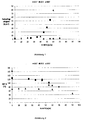
- FIG. 1 is the Charpy impact strength (notched) in [kJ / m 2 ] moldings of binary mixtures of the COC elastomer TOPAS ® E-140 and presented from different amorphous COC grades.
- the weight fraction of COC elastomer in the mixture is indicated on the x-axis.
- the y-axis shows the Charpy impact strengths of each mixture.
- the curves with the diamonds indicate the values for mixtures of E-140 with Type 6017.
- the curves with the squares indicate the values for mixtures of E-140 with Type 6013.
- the curves with the triangles indicate the values for mixtures of E-140 with Type 8007. It can be seen that the values for the Charpy impact strength (notched) increase significantly with increasing COC elastomer content.
- the heat deflection temperature according to method B is shown in [° C] of molded parts of binary mixtures of the COC elastomer TOPAS ® E-140 and of different amorphous COC grades.
- the weight fraction of COC elastomer in the mixture is indicated on the x-axis.
- the heat deflection temperatures of the individual mixtures are given.
- As amorphous COC grades the TOPAS ® types 6017, 6013 and 8007 were used.
- the curves with the diamonds indicate the values for mixtures of E-140 with Type 6017.
- the curves with the squares indicate the values for mixtures of E-140 with Type 6013.
- the curves with the triangles indicate the values for mixtures of E-140 with Type 8007. It can be seen that the values for the heat distortion temperature drop significantly with increasing proportion of COC elastomer. Nevertheless, it should also be noted that the heat deflection temperature even at proportions of up to 90% E-140 is still significantly above that of 100% E-140
- Figure 3 is the tensile modulus in [MPa] of moldings of binary mixtures of the COC elastomer TOPAS ® E-140 and presented from different amorphous COC grades.
- the weight fraction of COC elastomer in the mixture is indicated on the x-axis.
- the y-axis shows the tensile moduli of the individual mixtures.
- As amorphous COC grades the TOPAS ® types 6017, 6013 and 8007 were used.
- the curves with the diamonds indicate the values for mixtures of E-140 with Type 8007.
- the curves with the squares show the Values for mixtures of E-140 with Type 6013.
- the curves with the triangles indicate the values for mixtures of E-140 with Type 6017.
- Figure 4 is the elongation at break in [%] of moldings of binary mixtures of the COC elastomer TOPAS ® E-140 and presented from different amorphous COC grades.
- the weight fraction of COC elastomer in the mixture is indicated on the x-axis.
- the y-axis gives the ultimate elongation of the individual mixtures.
- As amorphous COC grades the TOPAS ® types 6017, 6013 and 8007 were used.
- the curves with the diamonds indicate the values for mixtures of E-140 with Type 8007.
- the curves with the squares indicate the values for mixtures of E-140 with Type 6013.
- the curves with the triangles indicate the values for mixtures of E-140 with Type 6017. It can be seen that the values for the elongation at break increase significantly with increasing proportion of COC elastomer.
- the elastomeric COC type E-140 shows a very good elasticity as can be seen from the residual elongation at room temperature and which is typical for a thermoplastic elastomer. With increasing amounts of non-elastic amorphous TOPAS grades, this flexibility is maintained only in low concentrations of the non-elastic partner.
Landscapes
- Chemical & Material Sciences (AREA)
- Health & Medical Sciences (AREA)
- Chemical Kinetics & Catalysis (AREA)
- Medicinal Chemistry (AREA)
- Polymers & Plastics (AREA)
- Organic Chemistry (AREA)
- Compositions Of Macromolecular Compounds (AREA)
Applications Claiming Priority (1)
| Application Number | Priority Date | Filing Date | Title |
|---|---|---|---|
| DE202016001500.2U DE202016001500U1 (de) | 2016-03-05 | 2016-03-05 | Zusammensetzungen enthaltend Cycloolefincopolymer-Elastomere und daraus hergestellte Formkörper |
Publications (1)
| Publication Number | Publication Date |
|---|---|
| EP3214125A1 true EP3214125A1 (fr) | 2017-09-06 |
Family
ID=56081716
Family Applications (1)
| Application Number | Title | Priority Date | Filing Date |
|---|---|---|---|
| EP17000181.2A Withdrawn EP3214125A1 (fr) | 2016-03-05 | 2017-02-06 | Compositions à base de copolymères d'oléfines cycliques et élastomères pour la fabrication d'objets moulés et leurs applications. |
Country Status (2)
| Country | Link |
|---|---|
| EP (1) | EP3214125A1 (fr) |
| DE (1) | DE202016001500U1 (fr) |
Cited By (4)
| Publication number | Priority date | Publication date | Assignee | Title |
|---|---|---|---|---|
| CN113166519A (zh) * | 2018-11-30 | 2021-07-23 | 埃克森美孚化学专利公司 | 环烯烃共聚物的共混物和由其制备的膜 |
| CN114752137A (zh) * | 2022-03-22 | 2022-07-15 | 金发科技股份有限公司 | 一种阻燃聚烯烃材料及其制备方法和应用 |
| CN119039731A (zh) * | 2024-08-28 | 2024-11-29 | 无锡阿科力科技股份有限公司 | 一种环烯烃共聚物复合材料的3d打印方法 |
| WO2026002290A1 (fr) * | 2024-07-29 | 2026-01-02 | 拓烯科技(衢州)有限公司 | Lubrifiant, matériau composite d'oléfine cyclique transmettant la lumière, son procédé de préparation et son utilisation |
Families Citing this family (2)
| Publication number | Priority date | Publication date | Assignee | Title |
|---|---|---|---|---|
| DE202016007973U1 (de) | 2016-12-22 | 2017-01-18 | Topas Advanced Polymers Gmbh | Behälter enthaltend Cycloolefincopolymer-Elastomere und deren Verwendung |
| DE202017006503U1 (de) | 2017-12-19 | 2018-06-26 | Topas Advanced Polymers Gmbh | Mehrschichtfolien enthaltend steife Cycoolefinpolymere und flexible Polymere und deren Verwendung |
Citations (16)
| Publication number | Priority date | Publication date | Assignee | Title |
|---|---|---|---|---|
| US3557072A (en) | 1967-01-12 | 1971-01-19 | Charbonnages De France | Plastomers derived from dimethanooctahydronaphthalene and their method of manufacture |
| US4178424A (en) | 1977-12-05 | 1979-12-11 | The Bf Goodrich Company | Cycloolefin copolymers |
| DD214137A1 (de) | 1983-03-31 | 1984-10-03 | Leuna Werke Veb | Thermoplastkombinationen |
| DD214623A1 (de) | 1983-03-31 | 1984-10-17 | Leuna Werke Veb | Thermoplastkombinationen |
| DD222317A1 (de) | 1984-03-22 | 1985-05-15 | Leuna Werke Veb | Verfahren zur herstellung von norbornen-ethylen-kopolymerisaten |
| EP0203799A1 (fr) | 1985-05-24 | 1986-12-03 | Mitsui Petrochemical Industries, Ltd. | Copolymère statistique et son procédé de production |
| JPH01318052A (ja) | 1988-06-17 | 1989-12-22 | Mitsui Petrochem Ind Ltd | ポリオレフィン樹脂組成物 |
| EP0407870A2 (fr) | 1989-07-08 | 1991-01-16 | Hoechst Aktiengesellschaft | Procédé de préparation de polymères de cyclo-oléfines |
| US4990559A (en) | 1989-02-14 | 1991-02-05 | Mitsui Petrochemical Industries, Ltd. | Thermoplastic resin composition |
| JPH03122148A (ja) | 1989-10-05 | 1991-05-24 | Mitsui Petrochem Ind Ltd | 環状オレフィン系重合体組成物 |
| EP0566988A1 (fr) | 1992-04-22 | 1993-10-27 | Hoechst Aktiengesellschaft | Composition de polymères de cyclooléfines et polyoléfines |
| DE19536043A1 (de) | 1995-09-28 | 1997-04-10 | Hoechst Ag | Polyolefinfolie mit Cycloolefinpolymer, Verfahren zu ihrer Herstellung und ihre Verwendung |
| WO2004026946A1 (fr) | 2002-09-13 | 2004-04-01 | Ticona Gmbh | Procede de realisation a partir d'un film thermoformable d'un emballage presentant une resistance elevee a la deformation thermique et une grande impermeabilite a la vapeur d'eau |
| WO2011129869A1 (fr) | 2010-04-15 | 2011-10-20 | Topas Advanced Polymers, Inc. | Mélanges à l'état fondu de polymères de cyclooléfine amorphe et d'élastomères de cyclooléfine partiellement cristallins présentant une ténacité améliorée |
| US20120003410A1 (en) | 2010-04-15 | 2012-01-05 | Tatarka Paul D | Partially crystalline cycloolefin elastomer medical tubing |
| US20120021151A1 (en) | 2010-04-15 | 2012-01-26 | Tatarka Paul D | Transparent, Flexible Products Made With Partially Crystalline Cycloolefin Elastomer |
-
2016
- 2016-03-05 DE DE202016001500.2U patent/DE202016001500U1/de not_active Expired - Lifetime
-
2017
- 2017-02-06 EP EP17000181.2A patent/EP3214125A1/fr not_active Withdrawn
Patent Citations (17)
| Publication number | Priority date | Publication date | Assignee | Title |
|---|---|---|---|---|
| US3557072A (en) | 1967-01-12 | 1971-01-19 | Charbonnages De France | Plastomers derived from dimethanooctahydronaphthalene and their method of manufacture |
| US4178424A (en) | 1977-12-05 | 1979-12-11 | The Bf Goodrich Company | Cycloolefin copolymers |
| DD214137A1 (de) | 1983-03-31 | 1984-10-03 | Leuna Werke Veb | Thermoplastkombinationen |
| DD214623A1 (de) | 1983-03-31 | 1984-10-17 | Leuna Werke Veb | Thermoplastkombinationen |
| DD222317A1 (de) | 1984-03-22 | 1985-05-15 | Leuna Werke Veb | Verfahren zur herstellung von norbornen-ethylen-kopolymerisaten |
| EP0203799A1 (fr) | 1985-05-24 | 1986-12-03 | Mitsui Petrochemical Industries, Ltd. | Copolymère statistique et son procédé de production |
| JPH01318052A (ja) | 1988-06-17 | 1989-12-22 | Mitsui Petrochem Ind Ltd | ポリオレフィン樹脂組成物 |
| US4990559A (en) | 1989-02-14 | 1991-02-05 | Mitsui Petrochemical Industries, Ltd. | Thermoplastic resin composition |
| EP0407870A2 (fr) | 1989-07-08 | 1991-01-16 | Hoechst Aktiengesellschaft | Procédé de préparation de polymères de cyclo-oléfines |
| JPH03122148A (ja) | 1989-10-05 | 1991-05-24 | Mitsui Petrochem Ind Ltd | 環状オレフィン系重合体組成物 |
| EP0566988A1 (fr) | 1992-04-22 | 1993-10-27 | Hoechst Aktiengesellschaft | Composition de polymères de cyclooléfines et polyoléfines |
| DE19536043A1 (de) | 1995-09-28 | 1997-04-10 | Hoechst Ag | Polyolefinfolie mit Cycloolefinpolymer, Verfahren zu ihrer Herstellung und ihre Verwendung |
| WO2004026946A1 (fr) | 2002-09-13 | 2004-04-01 | Ticona Gmbh | Procede de realisation a partir d'un film thermoformable d'un emballage presentant une resistance elevee a la deformation thermique et une grande impermeabilite a la vapeur d'eau |
| WO2011129869A1 (fr) | 2010-04-15 | 2011-10-20 | Topas Advanced Polymers, Inc. | Mélanges à l'état fondu de polymères de cyclooléfine amorphe et d'élastomères de cyclooléfine partiellement cristallins présentant une ténacité améliorée |
| US20110256373A1 (en) * | 2010-04-15 | 2011-10-20 | Tatarka Paul D | Melt blends of amorphous cycloolefin polymers and partially crystalline cycloolefin elastomers with improved toughness |
| US20120003410A1 (en) | 2010-04-15 | 2012-01-05 | Tatarka Paul D | Partially crystalline cycloolefin elastomer medical tubing |
| US20120021151A1 (en) | 2010-04-15 | 2012-01-26 | Tatarka Paul D | Transparent, Flexible Products Made With Partially Crystalline Cycloolefin Elastomer |
Cited By (5)
| Publication number | Priority date | Publication date | Assignee | Title |
|---|---|---|---|---|
| CN113166519A (zh) * | 2018-11-30 | 2021-07-23 | 埃克森美孚化学专利公司 | 环烯烃共聚物的共混物和由其制备的膜 |
| CN114752137A (zh) * | 2022-03-22 | 2022-07-15 | 金发科技股份有限公司 | 一种阻燃聚烯烃材料及其制备方法和应用 |
| CN114752137B (zh) * | 2022-03-22 | 2023-08-29 | 金发科技股份有限公司 | 一种阻燃聚烯烃材料及其制备方法和应用 |
| WO2026002290A1 (fr) * | 2024-07-29 | 2026-01-02 | 拓烯科技(衢州)有限公司 | Lubrifiant, matériau composite d'oléfine cyclique transmettant la lumière, son procédé de préparation et son utilisation |
| CN119039731A (zh) * | 2024-08-28 | 2024-11-29 | 无锡阿科力科技股份有限公司 | 一种环烯烃共聚物复合材料的3d打印方法 |
Also Published As
| Publication number | Publication date |
|---|---|
| DE202016001500U1 (de) | 2016-05-09 |
Similar Documents
| Publication | Publication Date | Title |
|---|---|---|
| EP3214125A1 (fr) | Compositions à base de copolymères d'oléfines cycliques et élastomères pour la fabrication d'objets moulés et leurs applications. | |
| DE69500703T2 (de) | Klebstoffharzmasse | |
| DE69107558T2 (de) | Polyolefin-Filme. | |
| DE60102917T2 (de) | Zusammensetzung und folien daraus | |
| DE69623668T2 (de) | Thermoplastisches Siegel und Verpackungsfolie | |
| DE69434201T2 (de) | Ethylen-Copolymere mit enger Zusammensetzungsverteilung, ihre Herstellung und ihre Verwendung | |
| JP6254166B2 (ja) | 多層化ポリオレフィン系フィルム | |
| DE112010001528B4 (de) | Medizinischer Mehrlagen-Film und Verwendung davon | |
| CN100462375C (zh) | 透明的抗冲击间规聚丙烯 | |
| DE60020710T2 (de) | Hydrierte blockcopolymerzusammensetzungen und verwendungen davon | |
| DE69324731T2 (de) | Thermoplastische Harzzusammensetzung | |
| DE60103728T2 (de) | Heissschrumpffähige siegelbare mehrschichtfolie | |
| DE69015085T2 (de) | Laminierte, perlmuttartig glänzende und gereckte Produckte und Verfahren zu ihrer Herstellung. | |
| DE69018606T2 (de) | Film aus modifiziertem Polyolefin mit stabilem Eindrehverhalten, Falteigenschaften und Sperr-Charakteristik. | |
| DE69023983T2 (de) | Opake, laminierte und gestreckte Produkte sowie Verfahren zu ihrer Herstellung. | |
| DE102012006287A1 (de) | Transparente thermoplastische Harzzusammensetzung mit hoher Duktilität und deren Verwendung | |
| CN1675299A (zh) | 用矿物油对间规聚丙烯的改性 | |
| DE3850518T2 (de) | Polyolefinfolien. | |
| MX2015001700A (es) | Composiciones de poliolefina y articulos fabricados a partir de las mismas. | |
| WO2011039314A1 (fr) | Films polyoléfiniques thermoscellables | |
| EP4396105A1 (fr) | Emballage-coque en polyoléfine et utilisation | |
| DE112012005884T5 (de) | Herstellungsverfahren für eine Fünfschicht-Polyolefin-Streckfolie | |
| WO2012022409A1 (fr) | Compositions de polymères de cyclo-oléfine, corps moulés et leur utilisation | |
| DE112020001602T5 (de) | Harzzusammensetzung für abdichtungsmaterial, mehrschichtiger körper, verpackungsmaterial und verpackungsbehälter | |
| KR102884944B1 (ko) | 커플링된 소비 후 재순환 폴리프로필렌 및 이를 제공하는 공정 |
Legal Events
| Date | Code | Title | Description |
|---|---|---|---|
| PUAI | Public reference made under article 153(3) epc to a published international application that has entered the european phase |
Free format text: ORIGINAL CODE: 0009012 |
|
| AK | Designated contracting states |
Kind code of ref document: A1 Designated state(s): AL AT BE BG CH CY CZ DE DK EE ES FI FR GB GR HR HU IE IS IT LI LT LU LV MC MK MT NL NO PL PT RO RS SE SI SK SM TR |
|
| AX | Request for extension of the european patent |
Extension state: BA ME |
|
| 17P | Request for examination filed |
Effective date: 20180306 |
|
| RBV | Designated contracting states (corrected) |
Designated state(s): AL AT BE BG CH CY CZ DE DK EE ES FI FR GB GR HR HU IE IS IT LI LT LU LV MC MK MT NL NO PL PT RO RS SE SI SK SM TR |
|
| GRAP | Despatch of communication of intention to grant a patent |
Free format text: ORIGINAL CODE: EPIDOSNIGR1 |
|
| INTG | Intention to grant announced |
Effective date: 20180712 |
|
| STAA | Information on the status of an ep patent application or granted ep patent |
Free format text: STATUS: THE APPLICATION IS DEEMED TO BE WITHDRAWN |
|
| 18D | Application deemed to be withdrawn |
Effective date: 20181123 |