EP3224254B1 - Substituierte indazole, verfahren zu ihrer herstellung, pharmazeutische präparate, die diese enthalten sowie deren verwendung zur herstellung von arzneimitteln - Google Patents
Substituierte indazole, verfahren zu ihrer herstellung, pharmazeutische präparate, die diese enthalten sowie deren verwendung zur herstellung von arzneimitteln Download PDFInfo
- Publication number
- EP3224254B1 EP3224254B1 EP15800828.4A EP15800828A EP3224254B1 EP 3224254 B1 EP3224254 B1 EP 3224254B1 EP 15800828 A EP15800828 A EP 15800828A EP 3224254 B1 EP3224254 B1 EP 3224254B1
- Authority
- EP
- European Patent Office
- Prior art keywords
- alkyl
- trifluoromethyl
- hydroxy
- indazol
- methyl
- Prior art date
- Legal status (The legal status is an assumption and is not a legal conclusion. Google has not performed a legal analysis and makes no representation as to the accuracy of the status listed.)
- Active
Links
- 0 CC(*)(c1cc2n[n](*)cc2cc1NC(C(N=C(*)C1)=CC=*1S)=O)O Chemical compound CC(*)(c1cc2n[n](*)cc2cc1NC(C(N=C(*)C1)=CC=*1S)=O)O 0.000 description 1
- IXRQDHBIEOXTEY-UHFFFAOYSA-N CC(C)(CC[n]1nc(cc(C(OC)=O)c(NC(c2cccc(C(F)F)n2)=O)c2)c2c1)O Chemical compound CC(C)(CC[n]1nc(cc(C(OC)=O)c(NC(c2cccc(C(F)F)n2)=O)c2)c2c1)O IXRQDHBIEOXTEY-UHFFFAOYSA-N 0.000 description 1
Images


Classifications
-
- A—HUMAN NECESSITIES
- A61—MEDICAL OR VETERINARY SCIENCE; HYGIENE
- A61K—PREPARATIONS FOR MEDICAL, DENTAL OR TOILETRY PURPOSES
- A61K31/00—Medicinal preparations containing organic active ingredients
- A61K31/33—Heterocyclic compounds
- A61K31/395—Heterocyclic compounds having nitrogen as a ring hetero atom, e.g. guanethidine or rifamycins
- A61K31/435—Heterocyclic compounds having nitrogen as a ring hetero atom, e.g. guanethidine or rifamycins having six-membered rings with one nitrogen as the only ring hetero atom
- A61K31/44—Non condensed pyridines; Hydrogenated derivatives thereof
- A61K31/4427—Non condensed pyridines; Hydrogenated derivatives thereof containing further heterocyclic ring systems
- A61K31/4439—Non condensed pyridines; Hydrogenated derivatives thereof containing further heterocyclic ring systems containing a five-membered ring with nitrogen as a ring hetero atom, e.g. omeprazole
-
- A—HUMAN NECESSITIES
- A61—MEDICAL OR VETERINARY SCIENCE; HYGIENE
- A61P—SPECIFIC THERAPEUTIC ACTIVITY OF CHEMICAL COMPOUNDS OR MEDICINAL PREPARATIONS
- A61P17/00—Drugs for dermatological disorders
-
- A—HUMAN NECESSITIES
- A61—MEDICAL OR VETERINARY SCIENCE; HYGIENE
- A61P—SPECIFIC THERAPEUTIC ACTIVITY OF CHEMICAL COMPOUNDS OR MEDICINAL PREPARATIONS
- A61P19/00—Drugs for skeletal disorders
- A61P19/02—Drugs for skeletal disorders for joint disorders, e.g. arthritis, arthrosis
-
- A—HUMAN NECESSITIES
- A61—MEDICAL OR VETERINARY SCIENCE; HYGIENE
- A61P—SPECIFIC THERAPEUTIC ACTIVITY OF CHEMICAL COMPOUNDS OR MEDICINAL PREPARATIONS
- A61P29/00—Non-central analgesic, antipyretic or antiinflammatory agents, e.g. antirheumatic agents; Non-steroidal antiinflammatory drugs [NSAID]
-
- A—HUMAN NECESSITIES
- A61—MEDICAL OR VETERINARY SCIENCE; HYGIENE
- A61P—SPECIFIC THERAPEUTIC ACTIVITY OF CHEMICAL COMPOUNDS OR MEDICINAL PREPARATIONS
- A61P35/00—Antineoplastic agents
-
- A—HUMAN NECESSITIES
- A61—MEDICAL OR VETERINARY SCIENCE; HYGIENE
- A61P—SPECIFIC THERAPEUTIC ACTIVITY OF CHEMICAL COMPOUNDS OR MEDICINAL PREPARATIONS
- A61P9/00—Drugs for disorders of the cardiovascular system
-
- C—CHEMISTRY; METALLURGY
- C07—ORGANIC CHEMISTRY
- C07D—HETEROCYCLIC COMPOUNDS
- C07D401/00—Heterocyclic compounds containing two or more hetero rings, having nitrogen atoms as the only ring hetero atoms, at least one ring being a six-membered ring with only one nitrogen atom
- C07D401/02—Heterocyclic compounds containing two or more hetero rings, having nitrogen atoms as the only ring hetero atoms, at least one ring being a six-membered ring with only one nitrogen atom containing two hetero rings
- C07D401/12—Heterocyclic compounds containing two or more hetero rings, having nitrogen atoms as the only ring hetero atoms, at least one ring being a six-membered ring with only one nitrogen atom containing two hetero rings linked by a chain containing hetero atoms as chain links
-
- C—CHEMISTRY; METALLURGY
- C07—ORGANIC CHEMISTRY
- C07D—HETEROCYCLIC COMPOUNDS
- C07D405/00—Heterocyclic compounds containing both one or more hetero rings having oxygen atoms as the only ring hetero atoms, and one or more rings having nitrogen as the only ring hetero atom
- C07D405/14—Heterocyclic compounds containing both one or more hetero rings having oxygen atoms as the only ring hetero atoms, and one or more rings having nitrogen as the only ring hetero atom containing three or more hetero rings
-
- C—CHEMISTRY; METALLURGY
- C07—ORGANIC CHEMISTRY
- C07F—ACYCLIC, CARBOCYCLIC OR HETEROCYCLIC COMPOUNDS CONTAINING ELEMENTS OTHER THAN CARBON, HYDROGEN, HALOGEN, OXYGEN, NITROGEN, SULFUR, SELENIUM OR TELLURIUM
- C07F7/00—Compounds containing elements of Groups 4 or 14 of the Periodic Table
- C07F7/02—Silicon compounds
- C07F7/08—Compounds having one or more C—Si linkages
- C07F7/18—Compounds having one or more C—Si linkages as well as one or more C—O—Si linkages
- C07F7/1804—Compounds having Si-O-C linkages
Definitions
- the present application relates to new substituted indazoles, processes for their preparation, intermediates for use in the preparation of the new compounds, the use of the new substituted indazoles for the treatment and / or prophylaxis of diseases and their use for the preparation of medicaments for treatment and / or prophylaxis of diseases, in particular of proliferative diseases, of autoimmune diseases, of metabolic and of inflammatory diseases such as, for example Rheumatoid arthritis, spondyloarthritis (especially spondyloarthritis psoriatica and ankylosing spondylitis), chronic obstructive pulmonary disease (abbreviation: COPD), multiple sclerosis, systemic lupus erythematosus, gout, the metabolic syndrome, endogenous inflammation or insulin-borne inflammation, insulin-borne inflammatory disease, endometrial insulin-borne disease, inflammatory disease, and insulin-borne inflammation Pain as well as lymphoma.
- proliferative diseases of autoimmune diseases, of metabolic
- the present invention relates to novel substituted indazoles of the general formula (I) which inhibit the interleukin-1 receptor-associated kinase 4 (IRAK4).
- IRAK4 interleukin-1 receptor-associated kinase 4
- IRAK4 Interleukin-1 receptor-associated kinase 4 plays a key role in the activation of the immune system. Therefore, this kinase is an important therapeutic target for the development of anti-inflammatory substances.
- IRAK4 is expressed by a large number of cells and mediates the signal transduction of toll-like receptors (TLR), except TLR3, and receptors of the interleukin (IL) -1 ⁇ family, consisting of the IL-1R (receptor), IL-18R, IL -33R and IL-36R ( Janeway and Medzhitov, Annu. Rev. Immunol., 2002 ; Dinarello, Annu. Rev.
- MyD88 interacts with IRAK4 and an active complex is formed, which interacts with and activates the kinases IRAK1 or IRAK2 ( Kollewe, Mackensen, et al., Journal of Biological Chemistry, 2004 ; Precious et al., J. Biol. Chem., 2009 ).
- NF nuclear factor
- MAPK Mitogen-activated protein kinase
- inflammatory signaling molecules and enzymes such as cytokines, chemokines and COX-2 (cyclooxygenase-2), and increased mRNA stability of inflammation-associated genes such as COX-2, IL-6 (interleukin-6) -, IL- 8th ( Holtmann, Enninga, et al., Journal of Biological Chemistry, 2001 ; Datta, Novotny, et al., The Journal of Immunology, 2004 ).
- IRAK4 KDKI The central role of IRAK4 in the pathology of different inflammatory diseases has already been shown by the direct comparison of wild-type (WT) mice with genetically modified animals with a kinase-inactive form of IRAK4 (IRAK4 KDKI).
- IRAK4 KDKI animals have an improved clinical picture in the animal model for multiple sclerosis, atherosclerosis, heart attack and Alzheimer's ( Rekhter, Staschke, et al., Biochemical and Biophysical Research Communication, 2008 ; Maekawa, Mizue, et al., Circulation, 2009 ; Staschke, Dong, et al., The Journal of Immunology, 2009 ; Kim, Febbraio, et al., The Journal of Immunology, 2011 ; Cameron, Tse, et al., The Journal of Neuroscience, 2012 ).
- IRAK4 immune complex-mediated IFN ⁇ (interferon-alpha) production by plasmacytoid dendritic cells, a key process in the pathogenesis of systemic lupus erythematosus (SLE), was demonstrated ( Chiang et al., The Journal of Immunology, 2010 ). Furthermore, the signaling pathway is associated with obesity (obesity) ( Ahmad, R., P. Shihab, et al., Diabetology & Metabolic Syndrome, 2015 ) In addition to the essential role of IRAK4 in innate immunity, there is also evidence that IRAK4 influences the differentiation of the so-called Th17 T cells, components of adaptive immunity.
- IRAK4 kinase activity In the absence of IRAK4 kinase activity, fewer IL-17 producing T cells (Th17 T cells) are generated compared to WT mice.
- IRAK4 is the prophylaxis and / or treatment of atherosclerosis, type 1 diabetes mellitus, rheumatoid arthritis, spondyloarthropathies (especially spondyloarthritis psoriatic and ankylosing spondylitis), lupus erythematosus, psoriasis, vitiligo, giant cell arteritis, inflammatory bowel diseases and viral diseases such as HIV (human immunodeficiency virus), hepatitis virus possible ( Staschke, et al., The Journal of Immunology, 2009 ; Marquez, et al., Ann Rheum Dis, 2014 ; Zambrano-Zaragoza, et al., International Journal of Inflammation, 2014 ; Wang
- IRAK4 Due to the central role of IRAK4 in the MyD88-mediated signaling cascade of TLRs (except TLR3) and the IL-1 receptor family, the inhibition of IRAK4 can be used for the prophylaxis and / or treatment of diseases mediated by the named receptors.
- TLRs and components of the IL-1 receptor family are in the pathogenesis of rheumatoid arthritis, psoriatic arthritis, myasthenia gravis, vasculitis such as Behçet's disease, granulomatosis with polyangiitis and giant cell arteritis, pancreatitis, systemic lupus erythematosus, dermatomyositis, and dermatomyositis, and dermatomyositis Metabolic syndrome including insulin resistance, hypertension, dyslipoproteinemia and obesity, diabetes mellitus (type 1 and type 2), diabetic nephropathy, osteoarthritis, Sjögren's syndrome, and sepsis ( Yang, Tuzun, et al., J Immunol, 2005 ; Candia, Marquez et al., The Journal of Rheumatology, 2007 ; Scanzello, Plaas, et al.
- Curr Opin Rheumatol, 2008 Deng, Ma-Krupa, et al., Circ Res, 2009 ; Roger, Froidevaux, et al, PNAS, 2009 ; Devaraj, Tobias, et al., Arterioscler Thromb Vasc Biol, 2011 ; Kim, Cho, et al., Clin Rheumatol, 2010 ; Carrasco et al., Clinical and Experimental Rheumatology, 2011 ; Gambuzza, Licata, et al., Journal of Neuroimmunology, 2011 ; Fresno, Archives Of Physiology And Biochemistry, 2011 ; Volin and Koch, J Interferon Cytokine Res, 2011 ; Akash, Shen, et al., Journal of Pharmaceutical Sciences, 2012 ; Goh and Midwood, Rheumatology, 2012 ; Dasu, Ramirez, et al., Clinical Science, 2012 ; Ouziel, Gustot, et al.,
- pulmonary diseases such as pulmonary fibrosis, obstructive pulmonary disease (COPD), acute shortness of breath syndrome (ARDS), acute lung damage (ALI), interstitial Lung disease (ILD), sarcoidosis and pulmonary hypertension show an association with different TLR-mediated signaling pathways.
- COPD obstructive pulmonary disease
- ARDS acute shortness of breath syndrome
- ALI acute lung damage
- ILD interstitial Lung disease
- sarcoidosis pulmonary hypertension
- the pathogenesis of pulmonary diseases can be both infectiously mediated and non-infectiously mediated processes ( Ramirez Cruz, Maldonado Bernal, et al., Rev Alerg Mex, 2004 ; Jeyaseelan, Chu, et al., Infection and Immunity, 2005 ; Seki, Tasaka, et al., Inflammation Research, 2010 ; Xiang, Fan, et al., Mediators of Inflammation, 2010 ; Margaritopoulos, Antoniou, et al., Fibrogenesis & Tissue Repair, 2010 ; Hilberath, Carlo, et al., The FASEB Journal, 2011 ; Nadigel, Prefontaine, et al., Respiratory Research, 2011 ; Kovach and Standiford, International Immunopharmacology, 2011 ; Bauer, Shapiro, et al., Mol Med, 2012 ; Deng, Yang, et al., PLoS One, 2013 ; Freeman,
- TLRs as well as IL-1R family members are also involved in the pathogenesis of other inflammatory diseases such as allergy, Behçet's disease, gout, lupus erythematosus, adult Still's disease, pericarditis and inflammatory bowel diseases such as ulcerative colitis and Crohn's disease, graft rejection and graft versus-host response is involved, so that the inhibition of IRAK4 is a suitable prophylactic and / or therapeutic approach ( Liu-Bryan, Scott, et al., Arthritis & Rheumatism, 2005 ; Piggott, Eisenbarth, et al., J Clin Inves, 2005 ; Christensen, Shupe, et al., Immunity, 2006 ; Cario, Inflammatory Bowel Diseases, 2010 ; Nickerson, Christensen, et al., The Journal of Immunology, 2010 ; Rakoff-Nahoum, Hao, et al., Immunity, 2006
- TLR- and IL-1R family-mediated diseases such as adenomyosis can be positively influenced by IRAK4 inhibitors ( Akoum, Lawson, et al., Human Reproduction, 2007 ; Allhorn, Boing, et al., Reproductive Biology and Endocrinology, 2008 ; Lawson, Bourcier, et al., Journal of Reproductive Immunology, 2008 ; Sikora, Mielczarek-Palacz, et al., American Journal of Reproductive Immunology, 2012 ; Khan, Kitajima, et al., Journal of Obst
- IRAK4 inhibitors can also have a positive effect on atherosclerosis ( Seneviratne, Sivagurunathan, et al., Clinica Chimica Acta, 2012 ; Falck-Hansen, Kassiteridi, et al., International Journal of Molecular Sciences, 2013 ; Sedimbi, Hagglof, et al., Cell Mol Life Sci, 2013 ).
- IRAK4-mediated TLR processes in the pathogenesis of eye diseases such as retinal ischemia, keratitis, allergic conjunctivitis, keratoconjunctivitis sicca, macular degeneration and uveitis are described ( Kaarniranta and Salminen, J Mol Med (Berl), 2009 ; Sun and Pearlman, Investigative Ophthalmology & Visual Science, 2009 ; Redfern and McDermott, Experimental Eye Research, 2010 ; Kezic, Taylor, et al., J Leukoc Biol, 2011 ; Chang, McCluskey, et al., Clinical & Experimental Ophthalmology, 2012 ; Guo, Gao, et al., Immunol Cell Biol, 2012 ; Lee, Hattori, et al., Investigative Ophthalmology & Visual Science, 2012 ; Qi, Zhao, et al., Investigative Ophthalmology & Visual Science, 2014 ).
- fibrotic diseases such as liver fibrosis, myocarditis, primarily biliary cirrhosis, cystic fibrosis ( Zhao, Zhao, et al., Scand J Gastroenterol, 2011 ; Benias, Gopal, et al., Clin Res Hepatol Gastroenterol, 2012 ; Yang, L. and E. Seki, Front Physiol, 2012 ; Liu, Hu, et al., Biochim Biophys Acta., 2015 ).
- IRAK4 has in TLR and IL-1R family-mediated diseases can chronic liver diseases such as fatty liver hepatitis and especially non-alcoholic fatty liver disease (NAFLD - non-alcoholic fatty liver disease) and / or non-alcoholic fatty liver hepatitis (NASH - non-alcoholic steatohepatitis), alcohol-toxic hepatitis (ASH - alcoholic steatohepatitis) can be treated preventively and / or therapeutically with IRAK4 inhibitors ( Nozaki, Saibara, et al., Alcohol Clin Exp Res, 2004 ; Csak, T., A.
- the inhibition of IRAK4 also means the treatment / and / or prevention of cardiovascular and neurological diseases such as myocardial reperfusion damage, myocardial infarction, hypertension, high blood pressure ( Oyama, Blais, et al., Circulation, 2004 ; Timmers, Sluijter, et al., Circulation Research, 2008 ; Fang and Hu, Med Sci Monit, 2011 ; Bijani, International Reviews of Immunology, 2012 ; Bomfim, Dos Santos, et al., Clin Sci (Lond), 2012 ; Christia and Frangogiannis, European Journal of Clinical Investigation, 2013 ; Thompson and Webb, Clin Sci (Lond), 2013 ; Hernanz, Martinez-Revelles, et al., British Journal of Pharmacology, 2015 ; Frangogiannis, Curr Opin Cardiol, 2015 ; Bomfim, Echem, et al., Life Sciences, 2015 ;
- Examples of pain are hyperalgesia, allodynia, premenstrual pain, endometriosis-associated pain, postoperative pain, interstitial cystitis, CRPS (complex regional pain syndrome), trigeminal neuralgia, prostatitis, pain caused by spinal cord injuries, inflammation-induced pain, lower back pain, cancer pain, chemotherapy-associated pain, HIV treatment-induced neuropathy, burn-induced pain and chronic pain
- CRPS complex regional pain syndrome
- trigeminal neuralgia prostatitis, pain caused by spinal cord injuries, inflammation-induced pain, lower back pain, cancer pain, chemotherapy-associated pain, HIV treatment-induced neuropathy, burn-induced pain and chronic pain
- Wolf Livshits, et al., Brain, Behavior, and Immunity, 2008 ; Kim, Lee, et al., Toll-like Receptors: Roles in Infection and Neuropathology, 2009 ; del Rey, Apkarian, et al., Annals of the New York Academy of Sciences, 2012 ;
- lymphomas such as ABC-DLBCL (activated B-cell diffuse large B-cell lymphoma), mantle cell lymphoma and Waldenström's disease, as well as chronic lymphatic leukemia, melanoma, pancreatic tumor and liver cell carcinoma are characterized by mutations in MyD88 or changes in MyD88 activity that can be treated with an IRAK4 inhibitor ( Ngo, Young, et al., Nature, 2011 ; Puente, Pinyol, et al., Nature, 2011 ; Ochi, Nguyen, et al., J Exp Med, 2012 ; Srivastava, Geng, et al., Cancer Research, 2012 ; Treon, Xu, et al., New England Journal of Medicine, 2012 ; Choi, Kim, et al., Human Pathology, 2013 ; ( Liang, Chen, et al., Clinical Cancer Research, 2013 ).
- ABC-DLBCL activated B-cell diffuse large B-cell lymphoma
- MyD88 plays an important role in Ras-dependent tumors, so that IRAK4 inhibitors are also suitable for their treatment ( Kfoury, A., KL Corf, et al., Journal of the National Cancer Institute, 2013 ).
- a therapeutic effect in breast cancer, ovarian cancer, colorectal cancer, head and neck cancer, lung cancer, prostate cancer due to the inhibition of IRAK4 is to be assumed, since the indicated indications are associated with the signaling pathway ( Szczepanski, Czystowska, et al., Cancer Res, 2009 ; Zhang, He, et al., Mol Biol Rep, 2009 ; Wang, Qian, et al., Br J Cancer Kim, 2010 ; Jo, et al., World J Surg Oncol, 2012 ; Zhao, Zhang, et al .; Front Immunol, 2014 ; Chen, Zhao, et al., Int J Clin Exp Pathol, 2015 ).
- Inflammatory diseases such as CAPS (cryopyrin-associated periodic syndromes), including FCAS (familial cold urticaria), MWS (Muckle-Wells syndrome), NOMID (neonatal-onset multisystem inflammatory disease) and CONCA (chronic infantile, neurological, cutaneous, and articular) syndrome; FMF (familial Mediterranean fever), HIDS (hyper-IgD syndrome), TRAPS (tumor necrosis factor receptor 1-associated periodic syndrome), juvenile idiopathic arthritis, adult Still's disease, Adamantiades-Behçet's disease, rheumatoid arthritis, osteoarthritis, keratoconjunctiv PAPA syndrome (pyogenic arthritis, pyoderma gangrenosum and acne), Schnitzler syndrome and Sjögren syndrome are treated by blocking the IL-1 signaling pathway, so that an IRAK4 inhibitor is also suitable for the treatment of the diseases mentioned ( Narayanan, Corrales, et al., Cornea,
- the ligand of the IL-33R, IL-33 is particularly involved in the pathogenesis of acute renal failure, so that the inhibition of IRAK4 for prophylaxis and / or treatment is a suitable therapeutic approach ( Akcay, Nguyen, et al., Journal of the American Society of Nephrology, 2011 ).
- Components of the IL-1 receptor family are associated with myocardial infarction, various pulmonary diseases such as asthma, COPD, idiopathic interstitial pneumonia, allergic rhinitis, pulmonary fibrosis and acute respiratory distress syndrome (ARDS), so that a prophylactic and / or therapeutic effect is indicated in the above indications inhibition of IRAK4 is expected
- pulmonary diseases such as asthma, COPD, idiopathic interstitial pneumonia, allergic rhinitis, pulmonary fibrosis and acute respiratory distress syndrome (ARDS)
- ARDS acute respiratory distress syndrome
- IRAK4 inhibitors A large number of IRAK4 inhibitors are known from the prior art (see for example Annual Reports in Medicinal Chemistry (2014), 49, 117-133 ). US8293923 and US20130274241 disclose IRAK4 inhibitors with an indazole structure substituted at position 3. 2-substituted indazoles are not described.
- WO2013106254 and WO2011153588 2,3-disubstituted indazole derivatives are disclosed.
- WO2007091107 describes 2-substituted indazole derivatives for the treatment of Duchenne muscular dystrophy. The disclosed compounds have no 6-hydroxyalkyl substitution.
- WO2015091426 describes indazoles such as Example 64, which are substituted at position 2 with a carboxamide side chain.
- WO2015104662 2-substituted indazoles of the following general formula are disclosed: in which R 2 is an alkyl or cycloalkyl group. Explicitly described are 2-substituted indazoles with a methyl, 2-methoxyethyl and cyclopentyl group at the 2-position (Examples 1, 4 and 76). Example 117 also describes an indazole derivative with a hydroxyethyl substituent at the 1-position. However, no indazole derivatives with a 3-hydroxy-3-methylbutyl substituent at the 1-position or 2-position are described.
- Indazoles which have a hydroxy-substituted alkyl group at position 2 are generically encompassed by the general formula, but are described in WO2015104662 not explicitly disclosed.
- Indazoles with an alkyl group at position 2, where the alkyl group is additionally substituted with a methylsulfonyl group, have the general formula and the definitions for the substituent R 2 in WO2015104662 not included.
- the object of the present invention is to provide new compounds which act as inhibitors of the Interleukin-1 Receptor Associated Kinase-4 (IRAK4).
- IRAK4 Interleukin-1 Receptor Associated Kinase-4
- the new IRAK4 inhibitors are particularly suitable for the treatment and prevention of proliferative, metabolic and inflammatory diseases, which are characterized by an overreacting immune system. Inflammatory skin diseases, cardiovascular diseases, lung diseases, eye diseases, neurological diseases, pain diseases and cancer diseases are particularly mentioned here.
- Compounds according to the invention are the compounds of the formula (I) and their salts, solvates and solvates of the salts, the compounds of the formulas encompassed by the formula (I) and their salts, solvates and solvates of the salts and those of the formula (I) Compounds mentioned below as examples and their salts, solvates and solvates of the salts, provided that the compounds mentioned below by formula (I) are not already salts, solvates and solvates of the salts.
- preferred salts are physiologically acceptable salts of the compounds according to the invention.
- salts are also included which are not themselves suitable for pharmaceutical applications, but which can be used, for example, for the isolation or purification of the compounds according to the invention.
- Physiologically acceptable salts of the compounds according to the invention include acid addition salts of mineral acids, carboxylic acids and sulfonic acids, for example salts of hydrochloric acid, hydrobromic acid, sulfuric acid, phosphoric acid, methanesulfonic acid, ethanesulfonic acid, toluenesulfonic acid, benzenesulfonic acid, naphthalenedisulfonic acid, acetic acid, trifluoric acid, acetic acid, propenoic acid, propionic acid, propionic acid, propionic acid, propionic acid, propionic acid, propionic acid, propionic acid, propenoic acid, propionic acid, propionic acid, propionic acid, propionic acid, propionic acid, propionic acid, propionic acid, propionic acid, propionic acid, propionic acid, propionic acid, propionic acid, propionic acid, propionic acid, propionic acid, propionic acid,
- Physiologically acceptable salts of the compounds according to the invention also include salts of conventional bases, such as, by way of example and by way of preference, alkali metal salts (for example sodium and potassium salts), alkaline earth metal salts (for example calcium and magnesium salts) and ammonium salts, derived from ammonia or organic amines having 1 to 16 carbon atoms, such as, for example and preferably, ethylamine, diethylamine, triethylamine, ethyldiisopropylamine, monoethanolamine, diethanolamine, triethanolamine, dicyclohexylamine, dimethylaminoethanol, procaine, dibenzylamine, N-methylmorpholine, arginine, lysine, ethylenediamine and N-methylpiperidine.
- alkali metal salts for example sodium and potassium salts
- alkaline earth metal salts for example calcium and magnesium salts
- ammonium salts derived from ammonia or organic amines having
- solvates are those forms of the compounds according to the invention which form a complex in the solid or liquid state by coordination with solvent molecules. Hydrates are a special form of solvate, in which coordination takes place with water.
- the compounds according to the invention can exist in different stereoisomeric forms, ie in the form of configuration isomers or optionally also as conformational isomers (enantiomers and / or diastereomers, including those in the case of atropisomers).
- the present invention therefore encompasses the enantiomers and diastereomers and their respective mixtures.
- the stereoisomerically uniform constituents can be isolated in a known manner from such mixtures of enantiomers and / or diastereomers; Chromatographic methods are preferably used for this, in particular HPLC chromatography on an achiral or chiral phase.
- the present invention encompasses all tautomeric forms.
- the present invention also encompasses all suitable isotopic variants of the compounds according to the invention.
- An isotopic variant of a compound according to the invention is understood here to mean a compound in which at least one atom within the compound according to the invention is replaced by another atom of the same atomic number, but with a different atomic mass than the atomic mass usually or predominantly occurring in nature.
- isotopes that can be incorporated into a compound of the invention are those of hydrogen, carbon, nitrogen, oxygen, phosphorus, sulfur, fluorine, chlorine, bromine and iodine, such as 2H (deuterium), 3H (tritium), 13C, 14C , 15N, 17O, 18O, 32P, 33P, 33S, 34S, 35S, 36S, 18F, 36Cl, 82Br, 123I, 124I, 129I and 131I.
- Certain isotopic variants of a compound according to the invention can be useful, for example, for the investigation of the mechanism of action or the distribution of active substances in the body; Due to the comparatively easy to produce and detect, compounds labeled with 3H or 14C isotopes are particularly suitable for this.
- incorporation of isotopes, such as deuterium can lead to certain therapeutic benefits as a result of greater metabolic stability of the compound, such as for example, an increase in the half-life in the body or a reduction in the required active dose;
- Such modifications of the compounds according to the invention can therefore optionally also represent a preferred embodiment of the present invention.
- Isotopic variants of the compounds according to the invention can be prepared by the processes known to the person skilled in the art, for example by the methods described below and the instructions given for the exemplary embodiments, by using corresponding isotopic modifications of the respective reagents and / or starting compounds.
- the present invention further relates to all possible crystalline and polymorphic forms of the compounds according to the invention, it being possible for the polymorphs to be present either as individual polymorphs or as a mixture of several polymorphs in all concentration ranges.
- a symbol * on a bond means the point of attachment in the molecule.
- radicals in the compounds according to the invention are substituted, the radicals, unless otherwise specified, can be mono- or polysubstituted. In the context of the present invention, the meaning of all radicals which occur more than once is independent of one another. A substitution with one, two or three identical or different substituents is preferred.
- R 1 is a C 2 -C 6 alkyl radical substituted by 1, 2 or 3 fluorine atoms. 2,2,2-trifluoroethyl, 3,3,3-trifluoropropyl and 4,4,4-trifluorobutyl are particularly preferred. A 4,4,4-trifluorobutyl radical is very particularly preferred.
- a further preferred embodiment of R 1 is a C 2 -C 6 alkyl radical which is substituted by one or two hydroxyl groups or a C 1 -C 3 alkoxy or a C 1 -C 3 alkoxy which is substituted three times by fluorine .
- a C 2 -C 5 alkyl radical which is substituted by hydroxy or C 1 -C 3 alkoxy or by trifluoromethoxy or 2,2,2-trifluoroethoxy is particularly preferred.
- 3-Hydroxy-3-methylbutyl, 3-methoxypropyl, 3-hydroxypropyl, 3-trifluoromethoxypropyl, 2-methoxyethyl or 2-hydroxyethyl are very particularly preferred.
- the 3-hydroxy-3-methylbutyl radical is preferred.
- R 1 furthermore preferably represents a C 2 -C 6 -alkyl radical which is substituted by a C 1 -C 6 -alkyl-SO 2 group.
- a C 2 -C 4 alkyl radical substituted with methyl-SO 2 is particularly preferred.
- 2- (methylsulfonyl) ethyl or 3- (methylsulfonyl) propyl are preferred for R 1 . From the latter group, 2- (methylsulfonyl) ethyl is particularly preferred.
- R 1 furthermore preferably represents an oxetanyl, tetrahydrofuranyl, tetrahydro-2H-pyran-4-yl, 1,1-dioxide-tetrahydro-2H-thiopyran-3-yl, 1,1-dioxide-tetrahydro-2H-thiopyran-2-yl, 1,1-dioxido-tetrahydro-2H-thiopyran-4-yl, 1,1 -dioxidotetrahydrothiophen-3 -yl, 1,1 -dioxidotetrahydrothiophen-2-yl, 1,1-dioxoxidothietan-2-yl or 1,1- Dioxidothietan-3-yl substituted C 1 -C 3 alkyl group.
- a C 1 -C 3 alkyl radical substituted with an oxetane group is particularly preferred.
- an oxetan-3-ylmethyl group is preferred for R 1
- R 2 and R 3 which always have the same meaning, hydrogen or methyl are preferred. Methyl is particularly preferred.
- R 4 is an unsubstituted or mono- or poly-substituted by halogen C 1 -C 3 alkyl, or substituted with a hydroxy C 1 -C 3 alkyl, or substituted with a hydroxy group and three fluorine atoms C 1 -C 3 -alkyl radical preferred.
- the following radicals are particularly preferred for R 4 : methyl, ethyl, trifluoro-C 1 -C 3 -alkyl, difluoro-C 1 -C 3 -alkyl, hydroxymethyl, 1-hydroxyethyl, 2-hydroxypropan-2-yl and 2,2 , 2-trifluoro-1-hydroxyethyl.
- the radicals methyl, trifluoromethyl and difluoromethyl are particularly preferred for R 4 .
- a trifluoromethyl radical is particularly preferred.
- R 5 is hydrogen, fluorine, chlorine or C 1 -C 3 alkyl.
- R 5 is particularly preferably hydrogen, fluorine or methyl.
- R 5 is very particularly preferably hydrogen or fluorine.
- R 4 is methyl or trifluoromethyl and R 5 is fluorine.
- Compounds in which R 4 is methyl and R 5 is fluorine are very particularly preferred, where R 5 is in the ortho position to R 4 .
- R 6 preferred embodiments are oxetanyl, tetrahydrofuranyl, tetrahydro-2H-pyran-4-yl, 1,1-dioxide-tetrahydro-2H-thiopyran-3-yl, 1,1-dioxide-tetrahydro-2H-thiopyran-2-yl, 1 , 1-Dioxidotetrahydro-2H-thiopyran-4-yl, 1,1-Dioxidotetrahydrothiophen-3 -yl, 1,1-Dioxidotetrahydrothiophen-2-yl, 1,1-Dioxidothietan-2-yl or 1,1-Dioxidothietan-3 to call -yl.
- Oxetanyl is particularly preferred.
- Oxetan-3-yl is very particularly preferred.
- R 7 stands exclusively in connection with the functional groups -SO 2 - and -SO-, ie for an -SO 2 - or SO group substituted with R 7 .
- C 1 -C 4 -alkyl is preferred for R 7 , the C 1 -C 4 -alkyl radical being unsubstituted or simply substituted by hydroxy or by cyclopropyl or by three fluorine atoms.
- a cyclopropyl radical is also preferred for R 7 .
- Methyl, ethyl or hydroxyethyl are particularly preferred for R 7 .
- Methyl is particularly preferred for R 7 .
- R 8 an unsubstituted C 1 -C 4 -alkyl radical or a triple-substituted fluorine-substituted C 1 -C 4 -alkyl radical is preferred.
- Methyl, ethyl, trifluoromethyl or 2,2,2-trifluoroethyl are particularly preferred.
- Methyl, trifluoromethyl or 2,2,2-trifluoroethyl are very particularly preferred.
- the compounds of the general formula (III) are suitable for producing a subset of the compounds of the general formula (I).
- the compounds of general formula (III) are inhibitors of Interleukin-1 Receptor Associated Kinase-4 (IRAK4).
- the compounds according to the invention act as inhibitors of IRAK4 kinase and show an unforeseeable, valuable pharmacological spectrum of action.
- another object of the present invention is the use of the compounds according to the invention for the treatment and / or prophylaxis of diseases in humans and animals.
- gynecological diseases Treatment and / or prophylaxis of gynecological diseases, inflammatory skin diseases, cardiovascular diseases, lung diseases, eye diseases, autoimmune diseases, pain disorders, metabolic diseases, gout, Liver diseases, the metabolic syndrome, insulin resistance and cancer diseases with the IRAK4 inhibitors according to the invention are particularly preferred.
- the compounds according to the invention are suitable for the prophylaxis and / or treatment of various diseases and disease-related conditions, in particular of diseases or diseases mediated by TLR (except TLR3) and / or IL-1 receptor families, the pathology of which is mediated directly by IRAK4.
- TLR diseases or diseases mediated by TLR (except TLR3) and / or IL-1 receptor families, the pathology of which is mediated directly by IRAK4.
- Multiple sclerosis, atherosclerosis, heart attack, Alzheimer's disease, viral-induced myocarditis, gout, Vogt-Koyanagi-Harada syndrome, lupus erythematosus, psoriasis, spondyloarthritis and arthritis can be named as IRAK4-associated diseases.
- the compounds of the invention can also be used for the prophylaxis and / or treatment of MyD88- and TLR-mediated diseases (except TLR3).
- COPD chronic obstruct
- the compounds according to the invention are suitable for the prophylaxis and / or treatment of the TLR-mediated diseases Behçet's disease, gout, endometriosis and endometriosis-associated pain and other endometriosis-associated symptoms such as dysmenorrhea, dyspareunia, dysuria and dyschezia.
- the compounds according to the invention are suitable for prophylaxis and / or treatment in the event of graft rejection, of lupus erythematosus, adult Still's disease and chronic inflammatory bowel diseases such as ulcerative colitis and Crohn's disease.
- the use of the compounds according to the invention is also suitable for the treatment and / or prevention of the following diseases: eye diseases such as keratitis, allergic conjunctivitis, keratoconjunctivitis sicca, macular degeneration and uveitis; cardiovascular diseases such as atherosclerosis, myocardial reperfusion damage, myocardial infarction, hypertension and neurological diseases such as Alzheimer's, stroke and Parkinson's.
- eye diseases such as keratitis, allergic conjunctivitis, keratoconjunctivitis sicca, macular degeneration and uveitis
- cardiovascular diseases such as atherosclerosis, myocardial reperfusion damage, myocardial infarction, hypertension and neurological diseases such as Alzheimer's, stroke and Parkinson's.
- the mechanism of action of the compounds according to the invention further enables the prophylaxis and / or treatment of TLR and IL-1 receptor families mediated liver diseases, in particular NAFLD, NASH, ASH, liver fibrosis and liver cirrhosis.
- the prophylaxis and / or treatment of itching and pain, in particular of acute, chronic, inflammatory and neuropathic pain is given by the compounds according to the invention.
- the compounds according to the invention are suitable for the prophylaxis and / or treatment of oncological diseases such as lymphomas, chronic lymphatic leukemia, melanoma and liver cell carcinoma, breast cancer, prostate cancer and Ras-dependent tumors.
- oncological diseases such as lymphomas, chronic lymphatic leukemia, melanoma and liver cell carcinoma, breast cancer, prostate cancer and Ras-dependent tumors.
- the compounds according to the invention are suitable for the treatment and / or prevention of diseases which are mediated via the IL-1 receptor family.
- diseases include CAPS (cryopyrin-associated periodic syndromes) including FCAS (familial cold urticaria), MWS (Muckle-Wells syndrome), NOMID (neonatal-onset multisystem inflammatory disease) and CONCA (chronic infantile, neurological, cutaneous, and articular ) Syndrome, FMF (familial Mediterranean fever), HIDS (hyper-IgD syndrome), TRAPS (tumor necrosis factor receptor 1-associated periodic syndrome), juvenile idiopathic arthritis, adult Still's disease, Adamantiades-Behçet's disease, rheumatoid arthritis, psoriatic arthritis , Ankylosing spondylitis, osteoarthritis, keratoconjunctivitis sicca and Sjögren's syndrome, multiple sclerosis, lupus erythematosus, alopecia are
- Pulmonary diseases such as asthma, COPD, idiopathic interstitial pneumonia and ARDS, gynecological diseases such as endometriosis as well as endometriosis-associated pain and other endometriosis-associated symptoms such as dysmenorrhea, dyspareunia, dysuria and dyschezia, chronic inflammatory bowel diseases and colitis such as ulcerative disease such as Crohn's disease Dysregulation of the IL-1 receptor family associated and suitable for the therapeutic and / or prophylactic use of the compounds according to the invention.
- gynecological diseases such as endometriosis as well as endometriosis-associated pain and other endometriosis-associated symptoms such as dysmenorrhea, dyspareunia, dysuria and dyschezia
- chronic inflammatory bowel diseases and colitis such as ulcerative disease such as Crohn's disease Dysregulation of the IL-1 receptor family associated and suitable for the therapeutic and / or prophylactic use
- the compounds according to the invention can furthermore be used for the treatment and / or prevention of IL-1 receptor family-mediated neurological diseases such as stroke, Alzheimer's, stroke, traumatic brain injury and dermatological diseases such as psoriasis, atopic dermatitis, acne inversa, alopecia areata and allergic contact dermatitis become.
- IL-1 receptor family-mediated neurological diseases such as stroke, Alzheimer's, stroke, traumatic brain injury and dermatological diseases such as psoriasis, atopic dermatitis, acne inversa, alopecia areata and allergic contact dermatitis become.
- the compounds according to the invention are furthermore suitable for the treatment and / or prophylaxis of pain disorders, in particular acute, chronic, inflammatory and neuropathic pain.
- Hyperalgesia, allodynia, pain in arthritis (such as osteoarthritis, rheumatoid arthritis and spondyloarthritis), premenstrual pain, endometriosis-associated pain, postoperative pain, pain in interstitial cystitis, CRPS (complex regional pain syndrome), trigeminal neuralgia, pain in prostatitis are preferred for this caused by spinal cord injuries, inflammation-induced pain, low back pain, cancer pain, chemotherapy-associated pain, HIV treatment-induced neuropathy, burn-induced pain and chronic pain.
- the present invention furthermore also relates to a method for the treatment and / or prevention of diseases, in particular the aforementioned diseases, using an effective amount of at least one of the compounds according to the invention.
- treatment includes inhibiting, delaying, stopping, alleviating, weakening, restricting, reducing, suppressing, suppressing or curing an illness, a disease, an illness, an injury or a health disorder , the development, course, or progression of such conditions and / or the symptoms of such conditions.
- therapy is understood here as a synonym with the term "treatment”.
- prevention means avoiding or reducing the risk, an illness, a disease, an illness, an injury or a health disorder, an unfolding or a Progression of such conditions and / or getting, experiencing, suffering or having symptoms of such conditions.
- the treatment or prevention of an illness, a condition, an illness, an injury or a health disorder can take place partially or completely.
- the compounds according to the invention can be used alone or, if necessary, in combination with other active ingredients.
- the present invention further relates to medicaments containing at least one of the compounds according to the invention and one or more further active compounds, in particular for the treatment and / or prevention of the aforementioned diseases.
- suitable combination active ingredients which may be mentioned are: In general, active ingredients such as antibacterial (e.g. penicillins, vancomycin, ciprofloxacin), antiviral (e.g. aciclovir, oseltamivir) and antifungal (e.g. naftifin, nystatin) substances and gamma globulins, immunomodulatory and immunosuppressive compounds such as cyclosporin, e.g.
- Humhotrexat® (TNF), TNF ,, Etanercept, infliximab), IL-1 inhibitors (e.g. anakinra, canakinumab, rilonacept), phosphodiesterase inhibitors (e.g. apremilast), Jak / STAT inhibitors (e.g.
- tofacitinib baricitinib, GLPG0634
- leflunomide cyclophosphamide
- rituximab ramuximab
- Mycophenolate mofetil interferons
- corticosteroids eg prednisone, prednisolone, methylprednisolone, hydrocortisone, betamethasone
- cyclophophamides azathioprine and sulfasalazines
- Paracetamol non-steroidal anti-inflammatory substances (NSAIDS) (e.g. aspirin, ibuprofen, naproxen, etodolac, celecoxib, colchicine).
- NSAIDS non-steroidal anti-inflammatory substances
- immunotherapy for example aldesleukin, alemtuzumab, basiliximab, Catumaxomab, celmoleukin, denileukin-diftitox, Eculizumab, edrecolomab, gemtuzumab, ibritumomab tiuxetan, imiquimod, interferon-alpha, interferon beta, interferon gamma, ipilimumab, lenalidomide, Lenograstim, Mifamurtid, Ofatumumab, Oprelvekin, Picibanil, Plerixafor, Polysaccharid-K, Sargramostim, Sipuleucel-T, Tasonermin, Teceleukin, Tocilizumab), antiproliferative substances such as but not exclusively amsacrine, blein, arginine, arginine, arginine, arginine, arginine, arg
- estradiol polyestradiol phosphate, raloxifene
- gestagens e.g.
- topoisomerase I inhi bitoren for example, irinotecan, topotecan
- topoisomerase II inhibitors eg, amrubicin, daunorubicin, elliptinium, etoposide, idarubicin, mitoxantrone, teniposide
- microtubule-active agents eg Cabazitaxel Eribulin, paclitaxel, vinblastine, vincristine, vindesine, vinorelbine
- telomerase inhibitors e.g. imetelstat
- alkylating substances e.g.
- bevacizumab antiandrogenic compounds
- antiandrogenic compounds e.g. bevacizumab, enzalutamide, flutamide, nilutamide, bicalutamide, cyproterone, cyproterone acetate
- proteasome inhibitors e.g. bortezomib, carfilzomib, oropomib, ONYX0914
- gonadoliberinarone gonadoliberinarone, gonadoliberinarone, gonadoliberinarone, Deslorelin, Ganirelix, Goserelin, Histrelin, Triptorelin, Degarelix, Leuprorelin
- methionine aminopeptidase inhibitors e.g.
- heparanase inhibitors e.g. SST0001, PI-88
- Inhibitors against genetically modified Ras protein e.g. farnesyl transferase inhibitors such as lonafarnib, tipifarnib
- HSP90 inhibitors e.g. geldamycin derivatives such as 17-allylaminogeldanamycin, 17-demethoxygeldanamycin (17AAG), 17-DMAG, retaspimycin hydrochloride, IPI-493, AUI-493 , BIIB028, STA-9090, KW-2478
- kinesin spindle protein inhibitors e.g.
- MEK mitogen-activated protein kinase kinase inhibitors
- Kinase inhibitors e.g.: Sorafenib, Regorafenib, Lapatinib, Sutent, Dasatinib, Cetuximab, BMS-908662, GSK2118436, AMG 706, Erlotinib, Gefitinib, Imatinib, Nilotinib, Pazopanib, Roniciclib, Sunitinib, Vandetanib, Vemurafenib), Hedgehog signal inhibitors (e.g.
- BTK Bruton's Tyrosine Kinase inhibitor
- Ibrutinib JAK / pan-JAK (Janus Kinase) inhibitor
- PI3K inhibitor e.g.
- bisphosphonates e.g. Etridonat, Clodronat, Tiludronat, Pamidronate, alendronic acid, ibandronate, risedronate, zoledronate.
- the combination also includes examples, but not exclusively, of the following active ingredients: rituximab, cyclophosphamide, doxorubicin, doxorubicin in combination with estrone, vincristine, chlorambucil, fludarabine, dexamethasone, cladribine, prednisone, 131I-chTNT, abiraterone, bisanitrarubinin Calcium, Calciumlevofolinat, capecitabine, carmofur, clodronic, romiplostim, crisantaspase, darbepoetin alfa, decitabine, denosumab, dibrospidium, eltrombopag, endostatin, epitiostanol, epoetin alfa, filgrastim, fotemustine, gallium nitrate, gemcitabine, Glutoxim, histamine dihydrochloride, hydroxyurea, improsulfan, Ix
- a combination of non-drug therapy such as chemotherapy (e.g. azacitidine, belotecan, enocitabine, melphalan, valrubicin, vinflunine, zorubicin), radiotherapy (e.g. I-125 seeds, palladium-103 seeds, radium-223) is also suitable for tumor therapy -chloride) or phototherapy (e.g. temoporfin, talaporfin), which are accompanied by drug treatment with the IRAK4 inhibitors according to the invention or which are supplemented with drug therapy with the IRAK4 inhibitors according to the invention after the end of non-drug tumor therapy such as chemotherapy, radiotherapy or phototherapy.
- chemotherapy e.g. azacitidine, belotecan, enocitabine, melphalan, valrubicin, vinflunine, zorubicin
- radiotherapy e.g. I-125 seeds, palladium-103 seeds, radium-223
- phototherapy e
- IRAK4 inhibitors can be combined with the following active ingredients in addition to those already mentioned: Active substances for Alzheimer's therapy such as, for example, acetylcholinesterase inhibitors (for example donepezil, rivastigmine, galantamine, tacrine), NMDA (N-methyl-D-aspartate) receptor antagonists (for example memantine); L-DOPA / carbidopa (L-3,4-dihydroxyphenylalanine), COMT (catechol-O-methyltransferase) inhibitors (e.g. entacapone), dopamine agonists (e.g.
- Active substances for Alzheimer's therapy such as, for example, acetylcholinesterase inhibitors (for example donepezil, rivastigmine, galantamine, tacrine), NMDA (N-methyl-D-aspartate) receptor antagonists (for example memantine); L-DOPA / carbidopa (L-3,4-dihydroxyphenylalan
- NSAIDs non-steroidal anti-inflammatory substances
- rheumatoid diseases such as rheumatoid arthritis, spondyloarthritis and juvenile idiopathic arthritis
- methotrexate and biologics for B-cell and T-cell therapy e.g. rituximab, abatacept
- Neurotrophic substances such as acetylcholinesterase inhibitors (eg donepezil), MAO (monoamine oxidase) inhibitors (eg selegiline), interferons and anticonvulsants (eg gabapentin);
- Active ingredients for the treatment of cardiovascular diseases such as beta-blockers (e.g. metoprolol), ACE inhibitors (e.g.
- angiotensin receptor blockers e.g. losartan, valsartan
- diuretics e.g. hydrochlorothiazide
- calcium channel blockers e.g. nifedipine
- statins e.g. simvastatin , Fluvastatin
- Anti-diabetics such as metformin, glinide (e.g. nateglinide), DPP-4 (dipeptidyl peptidase 4) inhibitors (e.g. linagliptin, saxagliptin, sitagliptin, vildagliptin), SGLT2 (sodium / glucose cotransporter 2) inhibitors e.g.
- gliflozin Dapagliflozin, empagliflozin
- incretin mimetics hormones glucose-dependent insulinotropic peptide (GIP) - and glucagon-like peptide 1 (GLP-1) analogues / agonists) (e.g. exenatide, liraglutide, lixisenatide), ⁇ -glucoside carbohydrate ( ⁇ -glucoside) , Voglibiose) and sulfonylureas (e.g. glibenclamide, tolbutamide), insulin sensitizers (e.g. pioglitazone) and insulin therapy (e.g.
- NPH insulin, insulin lispro substances used to treat hypoglycemia to treat diabetes and metabolic syndrome.
- Lipid-lowering agents such as fibrates (e.g. bezafibrate, etofibrate, fenofibrate, gemfibrozil), nicotinic acid derivatives (e.g. nicotinic acid / laropiprant), ezetimibe, statins (e.g. simvastatin, fluvastatin), anion exchangers (e.g. colestyramine, colestipol, colesevelam.
- Active substances such as mesalazine, sulfasalazine, azathioprine, 6-mercaptopurine or methotrexate, probiotic bacteria (Mutaflor, VSL # 3®, Lactobacillus GG, Lactobacillus plantarum, L. acidophilus, L. casei, Bifidobacterium infantis 35624, Enterococcus fecobiumichifiumium SF68, long68 coli Nissle 1917), antibiotics such as ciprofloxacin and metronidazole, antidiarrheals such as loperamide or laxativa (bisacodyl) for the treatment of inflammatory bowel diseases.
- probiotic bacteria Motaflor, VSL # 3®, Lactobacillus GG, Lactobacillus plantarum, L. acidophilus, L. casei, Bifidobacterium infantis 35624, Enterococcus fecobiumichifium
- Immunosuppressants such as glucocorticoids and non-steroidal anti-inflammatory substances (NSAIDs), cortisone, chloroquine, cyclosporin, azathioprine, belimumab, rituximab, cyclophosphamide for the treatment of lupus erythematosus.
- NSAIDs non-steroidal anti-inflammatory substances
- exemplary but not exclusively calcineurin inhibitors e.g. tacrolimus and ciclosporin
- Cell division inhibitors e.g.
- Vitamin D3 analogs such as calcipotriol, tacalcitol or calcitriol; Salicylic acid, urea, ciclosporin, methotrexate, efalizumab for dermatological diseases.
- Medicines which contain at least one of the compounds according to the invention and one or more further active ingredients, in particular EP4 inhibitors (prostaglandin E2 receptor 4 inhibitors), P2X3 inhibitors (P2X purinoceptor 3), PTGES inhibitors (prostaglandin E synthase inhibitors) or AKR1C3 inhibitors (Aldo-keto reductase family 1 member C3 inhibitors), for the treatment and / or prevention of the aforementioned diseases.
- EP4 inhibitors prostaglandin E2 receptor 4 inhibitors
- P2X3 inhibitors P2X purinoceptor 3
- PTGES inhibitors prostaglandin E synthase inhibitors
- AKR1C3 inhibitors Aldo-keto reductase family 1 member C3 inhibitors
- the compounds according to the invention can act systemically and / or locally.
- they can be applied in a suitable way, e.g. oral, parenteral, pulmonary, nasal, sublingual, lingual, buccal, rectal, dermal, transdermal, conjunctival, via the ear or as an implant or stent.
- the compounds according to the invention can be administered in suitable administration forms.
- suitable administration forms which release the compounds according to the invention quickly and / or modified and which contain the compounds according to the invention in crystalline and / or amorphous and / or dissolved form, such as e.g. Tablets (non-coated or coated tablets, for example with gastric juice-resistant or delayed dissolving or insoluble coatings which control the release of the compound according to the invention), rapidly disintegrating tablets or films / wafers in the oral cavity, films / lyophilisates, capsules (for example hard or Soft gelatin capsules), dragees, granules, pellets, powders, emulsions, suspensions, aerosols or solutions.
- Tablets non-coated or coated tablets, for example with gastric juice-resistant or delayed dissolving or insoluble coatings which control the release of the compound according to the invention
- rapidly disintegrating tablets or films / wafers in the oral cavity films / lyophilisates
- capsules for example hard or Soft gelatin capsules
- dragees dragees,
- Parenteral administration can be done by bypassing an absorption step (e.g. intravenous, intraarterial, intracardial, intraspinal or intralumbal) or by switching on absorption (e.g. intramuscular, subcutaneous, intracutaneous, percutaneous or intraperitoneal).
- absorption step e.g. intravenous, intraarterial, intracardial, intraspinal or intralumbal
- absorption e.g. intramuscular, subcutaneous, intracutaneous, percutaneous or intraperitoneal.
- Suitable forms of application for parenteral administration include: Injection and infusion preparations in the form of solutions, suspensions, emulsions, lyophilisates or sterile powders.
- inhalation pharmaceutical forms including powder inhalers, nebulizers
- nasal drops solutions or sprays
- lingual, sublingual or buccal tablets films / wafers or capsules
- suppositories ear or eye preparations
- vaginal capsules aqueous suspensions
- aqueous suspensions are suitable (e.g. Lotions, shake mixes), lipophilic Suspensions, ointments, creams, transdermal therapeutic systems (e.g. plasters), milk, pastes, foams, powder, implants or stents.
- Oral or parenteral administration in particular oral administration, is preferred.
- the compounds according to the invention can be converted into the administration forms mentioned. This can be done in a manner known per se by mixing with inert, non-toxic, pharmaceutically suitable auxiliaries.
- auxiliaries include Carriers (e.g. microcrystalline cellulose, lactose, mannitol), solvents (e.g. liquid polyethylene glycols), emulsifiers and dispersing or wetting agents (e.g. sodium dodecyl sulfate, polyoxysorbitanoleate), binders (e.g. polyvinylpyrrolidone), synthetic and natural polymers (e.g. albumin), stabilizers (e.g. antioxidants such as, for example, ascorbic acid), dyes (for example inorganic pigments, for example iron oxides) and taste and / or odor corrections.
- Carriers e.g. microcrystalline cellulose, lactose, mannitol
- solvents e.g. liquid polyethylene glycols
- the present invention further relates to medicaments which contain at least one compound according to the invention, usually together with one or more inert, non-toxic, pharmaceutically suitable auxiliaries, and to their use for the purposes mentioned above.
- the dosage is approximately 0.01 to 100 mg / kg, preferably approximately 0.01 to 20 mg / kg and very particularly preferably 0.1 to 10 mg / kg body weight.
- Methyl 5-amino-1H-indazole-6-carboxylate (intermediate 2) can be prepared from methyl 1H-indazole-6-carboxylate (intermediate 0) according to synthesis scheme 2 by nitration and reduction of the nitro group of intermediate 1 by hydrogen in the presence of Palladium on carbon analogous to WO 2008/001883 be preserved.
- Various coupling reagents known in the literature can be used to prepare intermediates 3 starting from intermediate 2 ( Amino Acids, Peptides and Proteins in Organic Chemistry. Vol.3 - Building Blocks, Catalysis and Coupling Chemistry, Andrew B. Hughes, Wiley, Chapter 12 - Peptide-Coupling Reagents, 407-442 ; Chem. Soc.
- 2-substituted indazole derivatives (intermediates 4) can be prepared (see synthesis scheme 3). Reactions with optionally substituted alkyl chlorides, alkyl bromides, alkyl iodides or alkyl 4-methylbenzenesulfonates are suitable for this.
- alkyl halides or alkyl 4-methylbenzenesulfonates used are commercially available or can be prepared analogously to routes known from the literature (for which Production of alkyl 4-methylbenzenesulfonates may be mentioned, for example, by reacting a corresponding alcohol with 4-methylbenzenesulfonyl chloride in the presence of triethylamine or pyridine, see for example Bioorganic and Medicinal Chemistry, 2006, 14, 12 4277-4294 ).
- an alkali metal iodide such as potassium iodide or sodium iodide, can be added when using alkyl chlorides or alkyl bromides.
- potassium carbonate, cesium carbonate or sodium hydride can be used as bases.
- N-cyclohexyl-N-methylcyclohexanamine can also be used in some cases.
- suitable solvents are 1-methylpyrrolidin-2-one, DMF, DMSO or THF.
- the alkyl halides or alkyl-4-methylbenzenesulfonates used can have functional groups that have previously been protected with a protective group (see also PGM Wuts, TW Greene, Greene's Protective Groups in Organic Synthesis, Fourth Edition, ISBN: 9780471697541 ).
- alkyl halides or alkyl 4-methylbenzenesulfonates which have one or more hydroxyl groups
- these hydroxyl groups can optionally be protected by a tert- butyl (dimethyl) silyl group or a similar silicon-containing protective group known to the person skilled in the art.
- the hydroxyl groups can also be protected with the tetrahydro-2H-pyran (THP) group or with the acetyl or benzoyl group.
- THP tetrahydro-2H-pyran
- the protective groups used can then be split off after the synthesis of intermediate 4, but also after the synthesis of (I).
- a tert- butyl (dimethylsilyl) group is used as a protective group, this can be split off using tetrabutylammonium fluoride in a solvent such as THF.
- a THP protective group can, for example, be split off using 4-methylbenzenesulfonic acid (optionally as a monohydrate).
- Acetyl groups or benzoyl groups can be split off by treatment with aqueous sodium hydroxide solution.
- the alkyl halides or alkyl-4-methylbenzenesulfonates used can contain functional groups which can be implemented by oxidation or reduction reactions known to the person skilled in the art (cf. for example Science of Synthesis, Georg Thieme Verlag ). If, for example, the functional group is a sulfide group, this can be oxidized to a sulfoxide or sulfone group by methods known from the literature. If it is a sulfoxide group, this can also be oxidized to a sulfone group.
- 3-chloroperbenzoic acid (CAS 937-14-4 ) can be used (compare for example also US201094000 for the oxidation of a 2- (methylsulfanyl) ethyl-1H-pyrazole derivative to a 2- (methylsulfinyl) ethyl-1H-pyrazole derivative and the oxidation of a further 2- (methylsulfanyl) ethyl-1H-pyrazole derivative to a 2nd - (Methylsulfonyl) ethyl-1H-pyrazole derivative).
- intermediate 4 can be prepared by Mitsunobu reaction (see for example KCK Swamy et. al. Chem. Rev. 2009, 109, 2551 - 2651 ) of intermediate 3 with optionally substituted alkyl alcohols.
- phosphines such as triphenylphosphine, tributylphosphine or 1,2-diphenylphosphinoethane in combination with diisopropyl azodicarboxylate ( CAS 2446-83-5 ) or other diaza derivatives mentioned in the literature ( KCK Swamy et. al. Chem. Rev. 2009, 109, 2551 - 2651 ) can be used.
- the use of triphenylphosphine and diisopropyl azodicarboxylic acid is preferred.
- alkyl alcohol carries a functional group
- known protective group strategies can be used - as in the reactions with alkyl halides mentioned above (further information is given PGM Wuts, TW Greene, Greene's Protective Groups in Organic Synthesis, Fourth Edition, ISBN: 9780471697541 ) and - as in the above-mentioned reactions with alkyl halides - oxidation or reduction steps in accordance with the synthesis of intermediate 4, but also after the synthesis of the compounds of the general formula (I) according to the invention.
- R 1 , R 2 , R 3 , R 4 , R 5 have the definitions given in the general formula (I).
- Suitable alkyl magnesium halides such as, for example, methyl magnesium chloride or methyl magnesium bromide in THF or in diethyl ether or else in mixtures of THF and diethyl ether can be used for this purpose.
- R 1 of the compounds of the formula (Ia) contains a suitable functional group, then oxidation or reduction reactions can optionally be used subsequently in analogy to synthesis scheme 3 for the preparation of further compounds according to the invention.
- the substituents R 1 , R 4 , R 5 have the definitions given in the general formula (I).
- R 2 and R 3 always have the same meaning and simultaneously represent C 1 -C 6 alkyl.
- intermediate 4 can be prepared in an alternative manner (see synthesis scheme 5).
- intermediate 1 is converted to intermediate 6 using methods as described in synthesis scheme 3 (preparation of intermediate 4 from intermediate 3).
- Intermediate 6 can then be converted to intermediate 7 by reducing the nitro group.
- the nitro group can be reduced to palladium on carbon under a hydrogen atmosphere (see for example WO2013174744 for the reduction of 6-isopropoxy-5-nitro-1H-indazole to 6-isopropoxy-1H-indazol-5-amine) or by using iron and ammonium chloride in water and ethanol (see for example also Journal of the Chemical Society, 1955, 2412 -2419 ), or by using tin (II) chloride ( CAS 7772-99-8 ).
- Intermediate 4 can be prepared from Intermediate 7 analogously to Synthesis Scheme 2 (preparation of Intermediate 3 from Intermediate 2). As described in Synthesis Scheme 3, protecting group strategies can also be used in Synthesis Scheme 5 if necessary.
- oxidation or reduction reactions known to the person skilled in the art can also be carried out (compare, for example Science of Synthesis, Georg Thieme Verlag ).
- the substituents R 1 , R 4 , R 5 have the definitions given in the general formula (I).
- mixtures of substances were purified by column chromatography on silica gel.
- Flash chromatography column chromatography purification
- Isolera® devices from Biotage.
- Cartridges from Biotage such as the cartridge “SNAP Cartridge, KP_SIL” of different sizes and cartridges "Interchim Puriflash Silica HP 15UM flash column” from Interchim of different sizes, were used.
- reaction mixture was diluted with water and extracted with ethyl acetate.
- the combined organic phases were filtered through a water-repellent filter and concentrated.
- the residue was purified by column chromatography on silica gel (hexane / ethyl acetate). 400 mg of the title compound were obtained.
- reaction mixture was filtered and the filter cake washed with ethyl acetate. It was partitioned between water and ethyl acetate and extracted twice with ethyl acetate. The combined organic phases were filtered through a water-repellent filter and concentrated. After purification of the residue by preparative HPLC, 428 mg of the title compound were obtained.
- the aqueous phase was extracted twice with ethyl acetate, the organic phases were combined, filtered through a water-repellent filter and concentrated. The residue was dissolved in 3 ml of DMSO and purified by preparative HPLC. The product-containing fractions were freeze-dried. 20 mg of the title compound were obtained.
- the aqueous phase was extracted twice with ethyl acetate, the organic phases were combined, dried over magnesium sulfate, filtered and concentrated. The residue was dissolved in 2.0 ml of DMSO and purified by preparative HPLC. The product-containing fractions were freeze-dried. 30 mg of the title compound were obtained.
- the mixture was mixed with water, extracted twice with ethyl acetate, the combined organic phases were washed with saturated sodium chloride solution and filtered through a water-repellent filter and concentrated. The residue was purified by column chromatography on silica gel (hexane / ethyl acetate). 100 mg of a product fraction were obtained, which was extracted with diethyl ether. After drying, 60 mg of the title compound were obtained.
- TR-FRET Time Resolved Fluorescence Resonance Energy Transfer
- the biotinylated peptide Biotin-Ahx-KKARFSRFAGSSPSQASFAEPG C-terminus in amide form
- was used as the substrate for the kinase reaction. can be bought from the company Biosyntan GmbH (Berlin-Buch).
- concentration of the IRAK4 was adjusted to the activity of the enzyme and adjusted so that the assay worked in the linear range. Typical concentrations were on the order of about 0.2 nM.
- the reaction was stopped by adding 5 ⁇ l of a solution of TR-FRET detection reagents [0.1 ⁇ M streptavidin-XL665 (Cisbio Bioassays; France, catalog number 610SAXLG) and 1.5 nM antiphosho-serine antibody [Merck Millipore, "STK Antibody", catalog no. 35-002] and 0.6 nM LANCE EU-W1024-labeled anti-mouse IgG antibody (Perkin-Elmer, Product No. AD0077.
- TR-FRET detection reagents 0.1 ⁇ M streptavidin-XL665 (Cisbio Bioassays; France, catalog number 610SAXLG) and 1.5 nM antiphosho-serine antibody [Merck Millipore, "STK Antibody", catalog no. 35-002] and 0.6 nM LANCE EU-W1024-labeled anti-mouse IgG antibody (Perkin-Elmer, Product No. AD0077.
- a terbium cryptate-labeled anti-mouse IgG antibody from Cisbio Bioassays are used) in aqueous EDTA solution (100 mM EDTA, 0.4% [w / v] bovine serum albumin [BSA] in 25 mM HEPES pH 7.5].
- the resulting mixture was incubated for 1 h at 22 ° C to allow the formation of a complex from the biotinylated phosphorylated substrate and the detection reagents.
- the amount of the phosphorylated substrate was then evaluated by measuring the resonance energy transfer from the europium chelate-labeled anti-mouse IgG antibody to the Streptavidin-XL665.
- the fluorescence emissions at 620 nm and 665 nm after excitation at 350 nm were measured in a TR-FRET measuring device, for example a Rubystar (BMG Labtechnologies, Offenburg, Germany) or a Viewlux (Perkin-Elmer).
- the ratio of the emissions at 665 nm and 622 nm was taken as a measure of the amount of the phosphorylated substrate.
- the test substances were tested on the same microtiter plate at 11 different concentrations in the range from 20 ⁇ M to 0.073 nM (20 ⁇ M, 5.7 ⁇ M, 1.6 ⁇ M, 0.47 ⁇ M, 0.13 ⁇ M, 38 nM, 11 nM, 3.1 nM, 0.89 nM, 0.25 nM and 0.073 nM).
- the inhibitory activity of the substances of the general formula (III) according to the invention on IRAK4 was also measured in the IRAK4-TR-FRET assay described above.
- TNF- ⁇ tumor necrosis factor-alpha
- THP-1 cells human monocytic acute leukemia cell line
- TNF- ⁇ is a cytokine that is involved in inflammatory processes.
- the TNF- ⁇ release is triggered in this test by incubation with bacterial lipopolysaccharide (LPS).
- LPS bacterial lipopolysaccharide
- THP-1 cells were supplemented in continuous suspension cell culture [RPMI 1460 medium with L-Glutamax (Gibco, Cat. No. 61870-044) with fetal calf serum (FCS) 10% (Invitrogen, Cat. No. 10082-147 ), 1% penicillin / streptomycin (Gibco BRL, cat. No. 15140-114)] and should not exceed a cell concentration of 1x10 6 cells / ml.
- FCS fetal calf serum
- the assay was carried out in cell culture medium (RPMI 1460 medium with L-Glutamax supplemented with FCS 10%).
- the plates were centrifuged for 30 seconds at 80 g and incubated for 17 hours at 37 ° C., 5% CO 2 and 95% air humidity.
- the TNF-alpha HTRF Detection Kit (Cisbio, Cat. No. 62TNFPEB / C) was used to determine the amount of TNF- ⁇ .
- 2 ⁇ l of the detection solution consisting of anti-TNF- ⁇ -XL665 conjugate and anti-TNF- ⁇ -cryptate conjugate dissolved according to the manufacturer's instructions in the reconstitution buffer, were added for the HTRF (Homogeneous Time-Resolved Fluorescence) test. After the addition, incubation was carried out either at room temperature for 3 h or at 4 ° C. overnight.
- the signals were then read out with an HTRF-capable measuring device such as the BMG PheraStar at 620 / 665nm.
- the effect of the substances is expressed as a ratio between neutral and inhibitor control in percent.
- the IC 50 values were calculated with a 4-parameter fit. ⁇ u> Table 2: ⁇ /u> IC ⁇ sub> 50 ⁇ /sub> values of the example compounds with regard to the TNF- ⁇ release in THP-1 cells example IC 50 [ ⁇ M] 1 1.0 2nd 15.1 3rd 0.7 4th 5.6 5 5.4 6 0.9 7 16.4 8th 1.0 9 6.5 10th 1.0 11 0.2 12th 0.3 13 0.1 14 0.2 15 0.2 16 0.2 17th 0.5 18th 0.3 19th 0.1 20th 0.2 21 1.8
- the effect of the compounds of the general formula (I) according to the invention on the induced cytokine production in human PBMCs was investigated.
- the cytokine production was induced by LPS, a TLR4 ligand, which leads to the activation of the IRAK4-mediated signaling pathway.
- the human PBMCs were obtained from anti-coagulated human whole blood. For this purpose, 15 ml of Ficoll-Paque (biochrom, cat.no.L6115) was placed in Leucosep tubes and 20 ml of human blood was added. After centrifuging the blood at 800 g for 15 min at room temperature, the plasma including the platelets was removed and discarded. The PBMCs were transferred to centrifuge tubes and filled with PBS (phosphate buffered saline) (Gibco, Cat. No. 14190). The cell suspension was centrifuged at 250 g for 10 min at room temperature and the supernatant was discarded.
- PBS phosphate buffered saline
- the PBMCs were resuspended in complete medium (RPMI 1640, without L-glutamine (PAA, cat.no.E15-039), 10% FCS; 50 U / ml penicillin, 50 ⁇ g / ml streptomycin (PAA, cat. No P11-010) and 1% L-glutamine (Sigma, Cat.No. G7513)).
- complete medium RPMI 1640, without L-glutamine (PAA, cat.no.E15-039), 10% FCS; 50 U / ml penicillin, 50 ⁇ g / ml streptomycin (PAA, cat. No P11-010) and 1% L-glutamine (Sigma, Cat.No. G7513)).
- the assay was also carried out in complete medium.
- the PBMCs were seeded in 96-well plates with a cell density of 2.5x10 5 cells / well.
- the compounds according to the invention were serially diluted in a constant volume of 100% DMSO and used in the assay with 8 different concentrations in the range from 10 ⁇ M to 3 nM so that the final DMSO concentration was 0.4% DMSO.
- the cells were thus pre-incubated for 30 min before the actual stimulation.
- stimulation with 0.1 ⁇ g / ml LPS Sigma, Escherichia coli 0128: B12, cat. No. L2887
- Cell viability was determined using the CellTiter-Glo Luminescent Assay (Promega, Cat. No. G7571 (G755 / G756A)) according to the manufacturer's instructions.
- the amount of secreted TNF- ⁇ in the cell culture supernatant was determined using the Human Prolnflammatory 9-Plex Tissue Culture Kit (MSD, Cat.No. K15007B) according to the manufacturer's instructions.
- MSD Human Prolnflammatory 9-Plex Tissue Culture Kit
- the example compound 11 and the example compound 12 with an activity Akttechnik 1 ⁇ M are mentioned as examples.
- TH-17 cells play a crucial role in the pathogenesis of diseases such as rheumatoid arthritis, psoriatric arthritis, ankylosing spondylitis (ankylosing spondylitis) or multiple Play skerose ( Lubberts, Nat. Rev. Rheumatol., 2015 ; Marinoni et al., Auto. Immune. Highlights, 2014 ; Isailovic et al., J.
- FG1415 10% Fetal Bovine Serum (FBS) [Gibco, Cat. No. 10493-106]; 50 ⁇ M ⁇ -mercaptoethanol (Gibco, Cat. No. 31350], 50 U / ml penicillin and Streptomycin [Gibco, Cat. No. 15140-114]) differentiated into DCs over 6 days in culture. After harvesting the DCs, they were resuspended in the complete medium and in a cell density of 2x10 5 cells / well in a 96-well plate ( Costar, Cat No. 3599.
- the compounds according to the invention were serially diluted in a constant volume of 100% DMSO and 9 different assays were used in the assay its concentrations in the range from 10 ⁇ M to 1 nM. Care was taken to ensure that the DMSO concentration contained was 0.1% DMSO for each of the 9 concentrations used. The DCs were preincubated for 30 minutes with the compounds according to the invention.
- the DCs were then analyzed using 10ng / ml LPS (Sigma, Escherichia coli serotype 0127: B8, cat.no.L3129) (TLR4 ligand) and 2.5 ⁇ g / ml of TLR-7/8 ligand R848 (Invivogen, cat No.-tlrl-r848-5), which both activate the IRAK4-mediated signaling pathway, stimulated for 24 hours in the incubator (37 ° C, 95% RH, 5% CO 2 ) for IL-23 production. After this 24-hour incubation period, the supernatants were removed and analyzed using a commercially available hIL-23 ELISA (eBiosciences, cat. No. 88-7237-88), which was carried out according to the manufacturer's instructions.
- the results of the inhibition of IL-23 in human DCs are exemplary for the example compound 12 in illustration 1 shown.
- the so obtained pDCs were supplemented in complete medium (RPMI 1640 + GlutaMax [ Gibco, Cat. No. 61870-010] with 10% FBS [Gibco, Cat. No. 10493-106] and 50 U penicillin / streptomycin [Gibco, Cat. No. 15140-114]) and plated out in a cell density of 5 ⁇ 10 4 cells / well in a 96-well microtiter plate (Costar, Cat. No. 3599).
- the compounds according to the invention were serially diluted in a constant volume of 100% DMSO and used in the assay with 9 different concentrations in the range from 10 ⁇ M to 1 nM.
- the pDCs were preincubated with the compounds according to the invention for 30 minutes.
- the pDCs were stimulated either with a TLR7 / 8 ligand (Imiquimod, R837, Invivogen, cat. No. Tlrl-imq) or with a TLR-9 ligand (CPG-A, ODN2216, Invivogen, cat. No. Tlrl -2216-1) and led to the activation of the IRAK4-mediated signaling pathways.
- the compounds of the general formula (I) according to the invention were investigated in an in vivo TLR-mediated inflammation model with regard to their in vivo activity.
- This mechanistic model shows in particular the potential effect of the compounds according to the invention on TLR4-mediated diseases, since an LPS-mediated inflammation model was used.
- Female Balb / c mice (approx. 8 weeks old; Charles River Laboratories, Germany) were divided into groups of 5 animals each.
- the control group was treated with the vehicle in which the substance was dissolved (substance vehicle) and also with the vehicle in which the LPS was dissolved.
- the positive control group was also given 0.2 mg LPS / kg body weight (Sigma, cat.no. L4391) (Lipopolysaccharides from E.
- coli 0111: B4 intraperitoneally (ip).
- the positive control group also received the substance vehicle described above.
- the substance was administered orally 16 hours before induction of inflammation by the administration of LPS.
- the animals were drawn from the blood after 1.5 hours.
- the concentration of certain cytokines was determined in the plasma using the Mouse ProInflammatory 7-Plex Tissue Culture Kit (MSD, Cat.No. K15012B) according to the manufacturer's instructions.
- IRAK4 inhibitors are effective in the TLR-mediated inflammation model.
- Figure 3 shows the amount of TNF- ⁇ in plasma, which is reduced in a dose-dependent manner compared to the LPS-induced concentration by the administration of example compound 11.
- mice Female Balb / c mice (about 8 weeks, Charles River Laboratories, Germany) were administered IL-1 ⁇ ip and the effect of the invention Compounds examined for IL-1 ⁇ -mediated cytokine secretion.
- the group size was 5 animals each.
- the control group was treated with the vehicles which were used to dissolve the substance and the IL-1 ⁇ .
- the substance treatment groups and the positive control group were each administered ip with 90 ⁇ g IL-1 ⁇ / kg body weight (R&D, Cat. No. 401-ML / CF).
- the substance or its vehicle in the positive control group was applied 6 hours before the IL-1 ⁇ administration.
- TNF- ⁇ was determined in plasma after final blood withdrawal 2 hours after administration of the IL-1 ⁇ using the Mouse ProInflammatory 7-Plex Tissue Culture Kit (MSD, cat.no.K15012B) according to the manufacturer's instructions.
- MSD Mouse ProInflammatory 7-Plex Tissue Culture Kit
- the administration of IL-1 ⁇ leads to an increased concentration of TNF- ⁇ in the plasma, which is inhibited by the treatment with the example compounds 11 and 12. This is through Figure 4 clarifies.
- the disease status of the animals was assessed from day 8, on which the animals show signs of arthritis for the first time, and subsequently 3 times a week, using the disease activity score until the end (day 20).
- the statistical analysis was carried out using the one-factor analysis of variance (ANOVA; Analysis of Variance) and the comparison to the control group by means of multiple comparative analysis (Dunnett test).
- mice For experimental induction of a NASH, 45 male C57BL / 6 mice at the age of 2 days are injected subcutaneously with 200 ⁇ g streptozotocin (STZ; Sigma-Aldrich, USA). From the age of 4 weeks, these animals are fed ad libitum on a high-fat diet (HFD; 57 kcal% fat, cat. No. # HFD32 from CLEA, Japan) until the end of the experiment. At the age of 6 weeks, the animals were randomly divided into 3 groups (15 animals per group). While one of the groups received no treatment, the other 2 groups were treated orally daily with either vehicle or the test substance for 4 weeks.
- HFD high-fat diet
- mice 30 male db / db mice are used at the age of 8 weeks. This is a recognized model for obesity, obesity and type 2 diabetes (Aileen JF King; The use of animal models in diabetes research; British Journal of Pharmacology 166 (2012), 877-894 ).
- the animals were given a standard diet (RM1 (E) 801492, SDS) and tap water ad libitum.
- the animals are randomly divided into 3 groups (10 animals per group) and treated orally with the test substance for 6 weeks. Blood is taken from the animals at different times during the study period (before the start of therapy, 3 weeks after the start of therapy and 2 days before the end of therapy) to determine parameters of insulin sensitivity (e.g. HbA1c, glucose content, insulin content).
- an OGTT oral glucose tolerance test
- HOMA-IR index fasting insulin level (mU / l) * fasting glucose level (mmol / l) / 22.5) is calculated.
- the anti-tumor activity of the compounds of the general formula (I) according to the invention is investigated in murine xenotransplantation models.
- female CB-17 SCID mice are subcutaneously tumor cell lines from human B-cell lymphomas, e.g. B. TMD-8 implanted.
- the oral monotherapy treatment begins with a compound according to the invention or the treatment by administration of a compound according to the invention in combination with a standard therapy, which are each administered orally.
- the animals are randomized beforehand. Treatment is stopped as soon as the untreated control group has large tumors.
- the tumor size and body weight are determined three times a week.
- T / C tumor weight of the treatment group on Day x / tumor weight of control group on day x
- a connection with a T / C greater than or equal to 0.5 is defined as active.
- the statistical analysis is carried out using the one-way ANOVA and the comparison to the control group using a pairwise comparison analysis (Dunnett test).
- illustration 1 Inhibition of IL-23 in human monocyte-generated DCs for the example compound 12. Data are presented as mean values with standard deviations.
- FIG. 2 Inhibition of INF- ⁇ in (A) imiquimod (R837) - or (B) CpG-A-stimulated human plasmacytoid DCs for the example compound 12. Data are presented as mean values with standard deviations.
- FIG. 3 Treatment of LPS-induced inflammation with example compound 11 leads to a reduced amount of secreted TNF- ⁇ . Data are presented as means with standard deviations.
- FIG. 4 Treatment of IL-1 ⁇ -induced inflammation with the example compounds 11 (left) and 12 (right) leads to a dose-dependent reduction in the amount of TNF- ⁇ secreted. Data are presented as means with standard deviations.
- Figure 5 Anti-inflammatory effects of example compound 11 in the animal model of rheumatoid arthritis (adjuvant-induced rat model). Significant and dose-dependent inhibition of rheumatic arthritis measured using the Disease Activity Score. The data correspond to the mean values + standard deviations.
- Figure 6 Anti-inflammatory effects of example compound 12 in the animal model of rheumatoid arthritis (collagen-antibody-induced mouse model). Significant and dose-dependent inhibition of rheumatic arthritis measured using the Disease Activity Score. The data correspond to the mean values + standard deviations. The statistical significance between the collagen antibody (AK) control and the treatment groups was calculated by means of a one-way analysis of variance ANOVA with a subsequent multiple comparison analysis (Dunnet's test) (* p ⁇ 0.05; ** p ⁇ 0.01; *** p ⁇ 0.001; ** ** p ⁇ 0.0001).
Landscapes
- Chemical & Material Sciences (AREA)
- Organic Chemistry (AREA)
- Health & Medical Sciences (AREA)
- Animal Behavior & Ethology (AREA)
- Life Sciences & Earth Sciences (AREA)
- Pharmacology & Pharmacy (AREA)
- General Health & Medical Sciences (AREA)
- Public Health (AREA)
- Veterinary Medicine (AREA)
- Medicinal Chemistry (AREA)
- Nuclear Medicine, Radiotherapy & Molecular Imaging (AREA)
- General Chemical & Material Sciences (AREA)
- Chemical Kinetics & Catalysis (AREA)
- Engineering & Computer Science (AREA)
- Bioinformatics & Cheminformatics (AREA)
- Epidemiology (AREA)
- Rheumatology (AREA)
- Physical Education & Sports Medicine (AREA)
- Orthopedic Medicine & Surgery (AREA)
- Immunology (AREA)
- Cardiology (AREA)
- Heart & Thoracic Surgery (AREA)
- Dermatology (AREA)
- Pain & Pain Management (AREA)
- Pharmaceuticals Containing Other Organic And Inorganic Compounds (AREA)
- Plural Heterocyclic Compounds (AREA)
- Nitrogen Condensed Heterocyclic Rings (AREA)
- Organic Low-Molecular-Weight Compounds And Preparation Thereof (AREA)
Description
- Die vorliegende Anmeldung betrifft neue substituierte Indazole, Verfahren zu ihrer Herstellung, Zwischenstufen zur Verwendung bei der Herstellung der neuen Verbindungen, die Verwendung der neuen substituierten Indazole zur Behandlung und/oder Prophylaxe von Krankheiten sowie ihre Verwendung zur Herstellung von Arzneimitteln zur Behandlung und/oder Prophylaxe von Krankheiten, insbesondere von proliferativen Erkrankungen, von Autoimmunerkrankungen, von metabolischen und von inflammatorischen Erkrankungen wie z.B. Rheumatoider Arthritis, Spondyloarthritiden (insbesondere Spondyloarthritis psoriatica und Morbus Bechterew), chronisch obstruktiver Lungenerkrankung (englisch chronic obstructive pulmonary disease, Abkürzung: COPD), Multipler Sklerose, Systemischem Lupus Erythematodes, Gicht, des metabolischen Syndroms, Fettleberhepatitis, Insulinresistenz, Endometriose und entzündungsinduziertem oder chronischem Schmerz sowie von Lymphomen.
- Die vorliegende Erfindung betrifft neue substituierte Indazole der allgemeinen Formel (I), die die Interleukin-1 Receptor-Associated Kinase 4 (IRAK4) hemmen.
- Humanes IRAK4 (Interleukin-1 receptor-associated kinase 4) spielt eine Schlüsselrolle bei der Aktivierung des Immunsystems. Deshalb ist diese Kinase ein wichtiges therapeutisches Zielmolekül für die Entwicklung von entzündungshemmenden Substanzen. IRAK4 wird von einer Vielzahl von Zellen exprimiert und vermittelt die Signaltransduktion von Toll-like Rezeptoren (TLR), außer TLR3, sowie Rezeptoren der Interleukin (IL)-1β Familie, bestehend aus dem IL-1R (Rezeptor), IL-18R, IL-33R und IL-36R (Janeway und Medzhitov, Annu. Rev. Immunol., 2002; Dinarello, Annu. Rev. Immunol., 2009; Flannery and Bowie, Biochemical Pharmacology, 2010). Weder IRAK4 Knockout Mäuse noch humane Zellen von Patienten, denen IRAK4 fehlt, reagieren auf die Stimulation von TLRs (außer TLR3) und der IL-1β Familie (Suzuki, Suzuki, et al., Nature, 2002; Davidson, Currie, et al., The Journal of Immunology, 2006; Ku, von Bernuth, et al., JEM, 2007; Kim, Staschke, et al., JEM, 2007).
- Die Bindung der TLR Liganden bzw. der Liganden der IL-1β Familie an den jeweiligen Rezeptor führt zur Rekrutierung und Bindung von MyD88 [Myeloid differentiation primary response gene (88)] an den Rezeptor. Infolgedessen tritt MyD88 mit IRAK4 in Interaktion und es kommt zur Bildung eines aktiven Komplexes, welcher mit den Kinasen IRAK1 oder IRAK2 interagiert und diese aktiviert (Kollewe, Mackensen, et al., Journal of Biological Chemistry, 2004; Precious et al., J. Biol. Chem., 2009). Infolgedessen wird der NF (nuclear factor)-κB Signalweg und der MAPK (Mitogen-activated protein kinase) Signalweg aktiviert (Wang, Deng, et al., Nature, 2001). Die Aktivierung des NF-κB Signalweges als auch des MAPK Signalweges führen zu Prozessen, die mit verschiedenen Immunprozessen assoziiert sind. So kommt es beispielsweise zu einer erhöhten Expression von unterschiedlichen inflammatorischen Signalmolekülen und Enzymen, wie z.B. Zytokinen, Chemokinen und COX-2 (Cyclooxygenase-2), und zu einer erhöhten mRNA Stabilität von inflammationsassoziierten Genen wie beispielsweise COX-2, IL-6 (Interleukin-6)-, IL-8 (Holtmann, Enninga, et al., Journal of Biological Chemistry, 2001; Datta, Novotny, et al., The Journal of Immunology, 2004). Des Weiteren können diese Prozesse mit der Proliferation und der Differenzierung von bestimmten Zelltypen, wie z.B. Monozyten, Makrophagen, Dendritischen Zellen, T-Zellen und B-Zellen einhergehen (Wan, Chi, et al., Nat Immunol, 2006; McGettrick and J. O'Neill, British Journal of Haematology, 2007).
- Die zentrale Rolle von IRAK4 in der Pathologie von unterschiedlichen inflammatorischen Erkrankungen konnte bereits durch den direkten Vergleich von Wildtyp (WT) Mäusen mit genetisch veränderten Tieren mit einer Kinase-inaktiven Form des IRAK4 (IRAK4 KDKI) gezeigt werden. IRAK4 KDKI Tiere weisen ein verbessertes Krankheitsbild im Tiermodell für Multiple Sklerose, Atherosklerose, Herzinfarkt und Alzheimer auf (Rekhter, Staschke, et al., Biochemical and Biophysical Research Communication, 2008; Maekawa, Mizue, et al., Circulation, 2009; Staschke, Dong, et al., The Journal of Immunology, 2009; Kim, Febbraio, et al., The Journal of Immunology, 2011; Cameron, Tse, et al., The Journal of Neuroscience, 2012). Des Weiteren zeigte sich, dass die Deletion von IRAK4 im Tiermodell vor einer viral-induzierten Myokarditis infolge einer verbesserten anti-viralen Reaktion bei gleichzeitig verringerter systemischer Inflammation schützt (Valaperti, Nishii, et al., Circulation, 2013). Außerdem wurde gezeigt, dass die Expression von IRAK4 mit dem Ausmaß des Vogt-Koyanagi-Harada-Syndroms korreliert (Sun, Yang, et al., PLoS ONE, 2014). Zudem konnte die hohe Relevanz von IRAK4 für die Immunkomplexvermittelte IFNα (Interferon-alpha) Produktion durch plasmazytoide Dendritische Zellen, ein Schlüsselprozess bei der Pathogenese des Systemischen Lupus Erythematodes (SLE), gezeigt werden (Chiang et al., The Journal of Immunology, 2010). Des Weiteren ist der Signalweg mit Fettleibigkeit (Adipositas) assoziiert (Ahmad, R., P. Shihab, et al., Diabetology & Metabolic Syndrome, 2015)
Neben der essentiellen Rolle von IRAK4 bei der angeborenen Immunität gibt es auch Hinweise, dass IRAK4 die Differenzierung der sogenannten Th17 T-Zellen, Komponenten der adaptiven Immunität, beeinflusst. In Abwesenheit der IRAK4 Kinaseaktivität werden weniger IL-17 produzierende T-Zellen (Th17 T-Zellen) im Vergleich zu WT Mäusen generiert. Durch die Inhibition von IRAK4 ist die Prophylaxe und/oder Behandlung von Atherosklerose, Diabetes mellitus Typ 1, Rheumatoide Arthritis, Spondyloarthritiden (insbesondere Spondyloarthritis psoriatica und Morbus Bechterew), Lupus erythematodes, Psoriasis, Vitiligo, Riesenzellarteriitis, chronisch entzündlicher Darmerkrankung und Viruserkrankungen, wie z.B. HIV (Humane Immundefizienz-Virus), Hepatitis Virus möglich (Staschke, et al., The Journal of Immunology, 2009; Marquez, et al., Ann Rheum Dis, 2014; Zambrano-Zaragoza, et al., International Journal of Inflammation, 2014; Wang, et al., Experimental and Therapeutic Medicine, 2015; Ciccia, et al., Rheumatology, 2015). - Durch die zentrale Rolle von IRAK4 in der MyD88-vermittelten Signalkaskade von TLRs (außer TLR3) und der IL-1 Rezeptorfamilie kann die Inhibition von IRAK4 zur Prophylaxe und/oder Behandlung von durch die genannten Rezeptoren vermittelte Erkrankungen genutzt werden. TLRs als auch Komponenten der IL-1 Rezeptorfamilie sind in der Pathogenese der Rheumatoiden Arthritis, der Psoriasis Arthritis, Myasthenia gravis, der Vaskulitis wie beispielsweise Morbus Behçet, Granulomatose mit Polyangiitis und Riesenzellarteriitis, Pankreatitis, des Systemischen Lupus Erythematodes, der Dermamyositis und Polymyositis, des Metabolischen Syndroms inklusive z.B. Insulinresistenz, Hypertonie, Dyslipoproteinämie und Adipositas, der Diabetes mellitus (Typ 1 und Typ 2), der diabetischen Nephropathie, der Osteoarthritis, des Sjögren-Syndroms, und der Sepsis involviert (Yang, Tuzun, et al., J Immunol, 2005; Candia, Marquez et al., The Journal of Rheumatology, 2007; Scanzello, Plaas, et al. Curr Opin Rheumatol, 2008; Deng, Ma-Krupa, et al., Circ Res, 2009; Roger, Froidevaux, et al, PNAS, 2009; Devaraj, Tobias, et al., Arterioscler Thromb Vasc Biol, 2011; Kim, Cho, et al., Clin Rheumatol, 2010; Carrasco et al., Clinical and Experimental Rheumatology, 2011; Gambuzza, Licata, et al., Journal of Neuroimmunology, 2011; Fresno, Archives Of Physiology And Biochemistry, 2011; Volin and Koch, J Interferon Cytokine Res, 2011; Akash, Shen, et al., Journal of Pharmaceutical Sciences, 2012; Goh and Midwood, Rheumatology, 2012; Dasu, Ramirez, et al., Clinical Science, 2012; Ouziel, Gustot, et al., Am J Patho, 2012; Ramirez and Dasu, Curr Diabetes Rev, 2012, Okiyama et al., Arthritis Rheum, 2012; Chen et al., Arthritis Research & Therapy, 2013; Holle, Windmoller, et al., Rheumatology (Oxford), 2013; Li, Wang, et al., Pharmacology & Therapeutics, 2013; Sedimbi, Hagglof, et al., Cell Mol Life Sci, 2013; Caso, Costa, et al., Mediators of Inflammation, 2014; Cordiglieri, Marolda, et al., J Autoimmun, 2014; Jialal, Major, et al., J Diabetes Complications, 2014; Kaplan, Yazgan, et al., Scand J Gastroenterol, 2014; Talabot-Aye, et al., Cytokine, 2014; Zong, Dorph, et al., Ann Rheum Di, 2014; Ballak, Stienstra, et al., Cytokine, 2015; Timper, Seelig, et al., J Diabetes Complications, 2015). Hauterkrankungen wie Psoriasis, atopische Dermatitis, Kindler Syndrom, bullösen Pemphigoid, allergische Kontaktdermatitis, Alopecia areata, Acne inversa und Acne vulgaris sind mit dem IRAK4-vermittelten TLR-Signalweg bzw. der IL-1R Familie assoziiert (Schmidt, Mittnacht, et al., J Dermatol Sci, 1996; Hoffmann, J Investig Dermatol Symp Proc, 1999; Gilliet, Conrad, et al., Archives of Dermatology, 2004; Niebuhr, Langnickel, et al., Allergy, 2008; Miller, Adv Dermatol, 2008; Terhorst, Kalali, et al., Am J Clin Dermatol, 2010; Viguier, Guigue, et al., Annals of Internal Medicine, 2010; Cevikbas, Steinhoff, J Invest Dermatol, 2012; Minkis, Aksentijevich, et al., Archives of Dermatology, 2012; Dispenza, Wolpert, et al., J Invest Dermatol, 2012; Minkis, Aksentijevich, et al., Archives of Dermatology, 2012; Gresnigt and van de Veerdonk, Seminars in Immunology, 2013; Selway, Kurczab, et al., BMC Dermatology, 2013; Sedimbi, Hagglof, et al., Cell Mol Life Sci, 2013; Wollina, Koch, et al. Indian Dermatol Online, 2013; Foster, Baliwag, et al., The Journal of Immunology, 2014).
Auch bei pulmonalen Erkrankungen wie Lungenfibrose, obstruktiver Lungenerkrankung (COPD), akutem Atemnot-Syndrom (ARDS), akuter Lungenschädigung (ALI), interstitieller Lungenerkrankung (ILD), Sarkoidose und pulmonaler Hypertonie zeigt sich eine Assoziation mit verschiedenen TLR-vermittelten Signalwegen. Bei der Pathogenese der pulmonalen Erkrankungen kann es sich sowohl um infektiös vermittelte als auch um nicht-infektiös vermittelte Prozesse handeln (Ramirez Cruz, Maldonado Bernal, et al., Rev Alerg Mex, 2004; Jeyaseelan, Chu, et al., Infection and Immunity, 2005; Seki, Tasaka, et al., Inflammation Research, 2010; Xiang, Fan, et al., Mediators of Inflammation, 2010; Margaritopoulos, Antoniou, et al., Fibrogenesis & Tissue Repair, 2010; Hilberath, Carlo, et al., The FASEB Journal, 2011; Nadigel, Prefontaine, et al., Respiratory Research, 2011; Kovach and Standiford, International Immunopharmacology, 2011; Bauer, Shapiro, et al., Mol Med, 2012; Deng, Yang, et al., PLoS One, 2013; Freeman, Martinez, et al., Respiratory Research, 2013; Dubaniewicz, A., Human Immunology, 2013). TLRs als auch IL-1R Familienmitglieder sind auch in die Pathogenese anderer inflammatorischer Erkrankungen wie Allergie, Behçet-Krankheit, Gicht, Lupus erythematodes, Adult Morbus Still-Krankheit, Perikarditis und chronisch entzündliche Darmerkrankungen, wie Kolitis ulcerosa und Morbus Crohn, Transplantatabstoßung und Graft-versus-Host-Reaktion involviert, so dass die Inhibition von IRAK4 hier ein geeigneter prophylaktischer und/oder therapeutischer Ansatz ist (Liu-Bryan, Scott, et al., Arthritis & Rheumatism, 2005; Piggott, Eisenbarth, et al., J Clin Inves, 2005; Christensen, Shupe, et al., Immunity, 2006; Cario, Inflammatory Bowel Diseases, 2010; Nickerson, Christensen, et al., The Journal of Immunology, 2010; Rakoff-Nahoum, Hao, et al., Immunity, 2006; Heimesaat, Fischer, et al., PLoS ONE, 2007; Heimesaat, Nogai, et al., Gut, 2010; Kobori, Yagi, et al., J Gastroenterol, 2010; Schmidt, Raghavan, et al., Nat Immunol, 2010; Shi, Mucsi, et al., Immunological Reviews, 2010; Leventhal and Schroppel, Kidney Int, 2012; Chen, Lin, et al., Arthritis Res Ther, 2013; Hao, Liu, et al., Curr Opin Gastroenterol, 2013; Kreisel and Goldstein, Transplant International, 2013; Li, Wang, et al., Pharmacology & Therapeutics, 2013; Walsh, Carthy, et al., Cytokine & Growth Factor Reviews, 2013; Zhu, Jiang, et al., Autoimmunity, 2013; Yap and Lai, Nephrology, 2013; Vennegaard, Dyring-Andersen, et al., Contact Dermatitis, 2014; D'Elia, Brucato, et al., Clin Exp Rheumatol, 2015; Jain, Thongprayoon, et al., Am J Cardiol., 2015; Li, Zhang, et al., Oncol Rep., 2015).
Durch TLR- und IL-1R Familie-vermittelte gynäkologische Erkrankungen wie Adenomyosis, Dysmenorrhoe, Dyspareunie und Endometriose, insbesondere Endometriose-assoziierte Schmerzen und andere Endometriose-assoziierte Symptome wie Dysmenorrhoe, Dyspareunie, Dysurie und Dyschezie, können durch den prophylaktischen und/oder therapeutischen Einsatz von IRAK4 Inhibitoren positiv beeinflusst werden (Akoum, Lawson, et al., Human Reproduction, 2007; Allhorn, Boing, et al., Reproductive Biology and Endocrinology, 2008; Lawson, Bourcier, et al., Journal of Reproductive Immunology, 2008; Sikora, Mielczarek-Palacz, et al., American Journal of Reproductive Immunology, 2012; Khan, Kitajima, et al., Journal of Obstetrics and Gynaecology Research, 2013; Santulli, Borghese, et al., Human Reproduction, 2013). Der prophylaktische und/oder therapeutische Einsatz von IRAK4 Inhibitoren kann außerdem Atherosklerose positiv beeinflussen (Seneviratne, Sivagurunathan, et al., Clinica Chimica Acta, 2012; Falck-Hansen, Kassiteridi, et al., International Journal of Molecular Sciences, 2013; Sedimbi, Hagglof, et al., Cell Mol Life Sci, 2013).
Neben den bereits aufgeführten Erkrankungen werden IRAK4-vermittelte TLR-Prozesse in der Pathogenese von Augenerkrankungen wie retinale Ischämie, Keratitis, allergisch bedingte Konjunktivitis, Keratoconjunctivitis sicca, Makuladegeneration und Uveitis beschrieben (Kaarniranta and Salminen, J Mol Med (Berl), 2009; Sun and Pearlman, Investigative Ophthalmology & Visual Science, 2009; Redfern and McDermott, Experimental Eye Research, 2010; Kezic, Taylor, et al., J Leukoc Biol, 2011; Chang, McCluskey, et al., Clinical & Experimental Ophthalmology, 2012; Guo, Gao, et al., Immunol Cell Biol, 2012; Lee, Hattori, et al., Investigative Ophthalmology & Visual Science, 2012; Qi, Zhao, et al., Investigative Ophthalmology & Visual Science, 2014).
Die Inhibition von IRAK4 ist außerdem ein geeigneter therapeutischer Ansatz für fibrotische Erkrankungen, wie beispielsweise Leberfibrose, Myokarditis, primär biliäre Zirrhose, zystische Fibrose (Zhao, Zhao, et al., Scand J Gastroenterol, 2011; Benias, Gopal, et al., Clin Res Hepatol Gastroenterol, 2012; Yang, L. and E. Seki, Front Physiol, 2012; Liu, Hu, et al., Biochim Biophys Acta., 2015).
Durch die Schlüsselstellung, die IRAK4 in TLR- und IL-1R Familie-vermittelten Erkrankungen hat, können chronische Lebererkrankungen wie beispielsweise Fettleberhepatitis und insbesondere nichtalkoholischen Fettlebererkrankungen (NAFLD - non-alcoholic fatty liver disease) und/oder nichtalkoholischer Fettleberhepatitis (NASH - non-alcoholic steatohepatitis), alkoholtoxische Hepatitis (ASH - alkoholische Steatohepatitis) präventiv und/oder therapeutisch mit IRAK4 Inhibitoren behandelt werden (Nozaki, Saibara, et al., Alcohol Clin Exp Res, 2004; Csak, T., A. Velayudham, et al., Am J Physiol Gastrointest Liver Physiol, 2011; Miura, Kodama, et al., Gastroenterology, 2010; Kamari, Shaish, et al., J Hepatol, 2011; Ye, Li, et al., Gut, 2012; Roh, Seki, J Gastroenterol Hepatol, 2013; Ceccarelli, S., V. Nobili, et al., World J Gastroenterol, 2014; Miura, Ohnishi, World J Gastroenterol, 2014; Stojsavljevic, Palcic, et al., World J Gastroenterol, 2014).
Aufgrund der zentralen Rolle von IRAK4 in TLR-vermittelten Prozessen ist durch die Inhibition von IRAK4 auch die Behandlung /und/oder Prävention von kardiovaskulären und neurologischen Erkrankungen wie z.B. myokardialem Reperfusionsschaden, Myokardinfarkt, Hypertonie, Bluthochdruck (Oyama, Blais, et al., Circulation, 2004; Timmers, Sluijter, et al., Circulation Research, 2008; Fang and Hu, Med Sci Monit, 2011; Bijani, International Reviews of Immunology, 2012; Bomfim, Dos Santos, et al., Clin Sci (Lond), 2012; Christia and Frangogiannis, European Journal of Clinical Investigation, 2013; Thompson and Webb, Clin Sci (Lond), 2013; Hernanz, Martinez-Revelles, et al., British Journal of Pharmacology, 2015; Frangogiannis, Curr Opin Cardiol, 2015; Bomfim, Echem, et al., Life Sciences, 2015) sowie Alzheimer, Schlaganfall, Hirnschlag, Schädel-Hirn-Trauma, Amyotrophe Lateralsklerose (ALS) und Parkinson möglich (Brough, Tyrrell, et al., Trends in Pharmacological Sciences, 2011; Carty and Bowie, Biochemical Pharmacology, 2011; Denes, Kitazawa, Cheng, et al., The Journal of Immunology, 2011; Lim, Kou, et al., The American Journal of Pathology, 2011; Beraud and Maguire-Zeiss, Parkinsonism & Related Disorders, 2012; Denes, Wilkinson, et al., Disease Models & Mechanisms, 2013; Noelker, Morel, et al., Sci. Rep., 2013; Wang, Wang, et al., Stroke, 2013; Xiang, Chao, et al., Rev Neurosci, 2015; Lee, Lee, et al., J Neuroinflammation, 2015).
Aufgrund der Involvierung von TLR-vermittelten Signalen und IL-1 Rezeptorfamilie-vermittelten Signalen über IRAK4 bei Juckreiz und Schmerz inklusive akutem, chronischem, entzündlichem und neuropathischem Schmerz ist von einer therapeutischen Wirkung in den genannten Indikationen durch die Inhibierung von IRAK4 auszugehen. Für Schmerz seien beispielhaft Hyperalgesie, Allodynie, prämenstrueller Schmerz, Endometriose-assoziierter Schmerz, postoperativer Schmerz, interstitielle Zystitis, CRPS (komplexes regionales Schmerzsyndrom), Trigeminusneuralgie, Prostatitis, Schmerz verursacht durch Rückenmarksverletzungen, entzündungsinduzierter Schmerz, Kreuzschmerzen, Krebsschmerzen, Chemotherapie-assoziierter Schmerz, HIV behandlungs-induzierte Neuropathie, Verbrennungs-induzierter Schmerz und chronischer Schmerz zu nennen (Wolf, Livshits, et al., Brain, Behavior, and Immunity, 2008; Kim, Lee, et al., Toll-like Receptors: Roles in Infection and Neuropathology, 2009; del Rey, Apkarian, et al., Annals of the New York Academy of Sciences, 2012; Guerrero, Cunha, et al., European Journal of Pharmacology, 2012; Kwok, Hutchinson, et al., PLoS ONE, 2012; Nicotra, Loram, et al., Experimental Neurology, 2012; Chopra and Cooper, J Neuroimmune Pharmacol, 2013; David, Ratnayake, et al., Neurobiology of Disease, 2013; Han, Zhao, et al., Neuroscience, 2013; Liu and Ji, Pflugers Arch., 2013; Stokes, Cheung, et al., Journal of Neuroinflammation, 2013; Zhao, Zhang, et al., Neuroscience, 2013; Liu, Zhang, et al., Cell Research, 2014; Park, Stokes, et al., Cancer Chemother Pharmacol, 2014; Van der Watt, Wilkinson, et al., BMC Infect Dis, 2014; Won, K. A., M. J. Kim, et al., J Pain, 2014; Min, Ahmad, et al., Photochem Photobiol., 2015; Schrepf, Bradley, et al., Brain Behav Immun, 2015; Wong, L., J. D. Done, et al., Prostate, 2015).
Dies gilt auch für einige onkologische Erkrankungen. Bestimmte Lymphome, wie beispielsweise ABC-DLBCL (Aktivierte B Zellen-Diffuses großzelliges B-Zell-Lymphom), Mantelzelllymphon und Morbus Waldenström als auch chronisch lymphatische Leukämie, Melanoma, Pankreastumor und Leberzellkarzinom sind durch Mutationen in MyD88 oder Veränderungen in der MyD88-Aktivität charakterisiert, die durch einen IRAK4 Inhibitor behandelt werden können (Ngo, Young, et al., Nature, 2011; Puente, Pinyol, et al., Nature, 2011; Ochi, Nguyen, et al., J Exp Med, 2012; Srivastava, Geng, et al., Cancer Research, 2012; Treon, Xu, et al., New England Journal of Medicine, 2012; Choi, Kim, et al., Human Pathology, 2013; (Liang, Chen, et al., Clinical Cancer Research, 2013). Des Weiteren spielt MyD88 eine wichtige Rolle in Ras-abhängigen Tumoren, so dass IRAK4 Inhibitoren auch zu deren Behandlung geeignet sind (Kfoury, A., K. L. Corf, et al., Journal of the National Cancer Institute, 2013). Es ist außerdem von einer therapeutischen Wirkung bei Brustkrebs, Ovarialkarzinom, Kolorektales Karzinom, Kopf-Hals-Karzinom, Lungenkrebs, Prostatakrebs durch die Inhibierung von IRAK4 auszugehen, da die genannten Indikationen mit dem Signalweg assoziiert sind (Szczepanski, Czystowska, et al., Cancer Res, 2009; Zhang, He, et al., Mol Biol Rep, 2009; Wang, Qian, et al., Br J Cancer Kim, 2010; Jo, et al., World J Surg Oncol, 2012; Zhao, Zhang, et al.; Front Immunol, 2014; Chen, Zhao, et al., Int J Clin Exp Pathol, 2015). Inflammatorische Erkrankungen wie CAPS (Cryopyrin-assoziierte periodische Syndrome), inklusive FCAS (familiäre Kälteurtikaria), MWS (Muckle-Wells-Syndrom), NOMID- (neonatal-onset multisystem inflammatory disease) und CONCA- (chronic infantile, neurological, cutaneous, and articular) Syndrom; FMF (familiäres Mittelmeerfieber), HIDS (Hyper-IgD-Syndrom), TRAPS (Tumornekrosefaktor-Rezeptor 1-assoziiertes periodisches Syndrom), juvenile idiopathische Arthritis, Adult Morbus Still-Krankheit, Morbus Adamantiades-Behçet, rheumatoide Arthritis, Osteoarthritis, Keratoconjunctivitis sicca, PAPA-Syndrom (Pyogene Arthritis, Pyoderma gangraenosum und Akne), Schnitzler Syndrom und Sjögren Syndrom werden durch die Blockierung des IL-1 Signalweges behandelt, so dass auch hier ein IRAK4 Inhibitor zur Behandlung der genannten Krankheiten geeignet ist (Narayanan, Corrales, et al., Cornea, 2008; Brenner, Ruzicka, et al., British Journal of Dermatology, 2009; Henderson and Goldbach-Mansky, Clinical Immunology, 2010; Dinarello, European Journal of Immunology, 2011; Gul, Tugal-Tutkun, et al., Ann Rheum Dis, 2012; Pettersson, Annals of MedicinePetterson, 2012; Ruperto, Brunner, et al., New England Journal of Medicine, 2012; Nordström, Knight, et al., The Journal of Rheumatology, 2012; Vijmasi, Chen, et al., Mol Vis, 2013; Yamada, Arakaki, et al., Opinion on Therapeutic Targets, 2013; de Koning, Clin Transl Allergy, 2014). Der Ligand des IL-33R, IL-33, ist insbesondere in der Pathogenese von akutem Nierenversagen involviert, so dass die Inhibition von IRAK4 zur Prophylaxe und/oder Behandlung ein geeigneter Therapieansatz ist (Akcay, Nguyen, et al., Journal of the American Society of Nephrology, 2011). Komponenten der IL-1 Rezeptorfamilie sind mit Myokardinfarkt, unterschiedlichen pulmonalen Erkrankungen wie Asthma, COPD, idiopathischer interstitieller Pneumonie, allergische Rhinitis, Lungenfibrose und akutem Atemnot-Syndrom (ARDS) assoziiert, so dass eine prophylaktische und/oder therapeutische Wirkung in den genannten Indikationen durch die Inhibierung von IRAK4 zu erwarten ist (Kang, Homer, et al., The Journal of Immunology, 2007; Imaoka, Hoshino, et al., European Respiratory Journal, 2008; Couillin, Vasseur, et al., The Journal of Immunology, 2009; Abbate, Kontos, et al., The American Journal of Cardiology, 2010; Lloyd, Current Opinion in Immunology, 2010; Pauwels, Bracke, et al., European Respiratory Journal, 2011; Haenuki, Matsushita, et al., Journal of Allergy and Clinical Immunology, 2012; Yin, Li, et al., Clinical & Experimental Immunology, 2012; Abbate, Van Tassell, et al., The American Journal of Cardiology, 2013; Alexander-Brett, et al., The Journal of Clinical Investigation, 2013; Bunting, Shadie, et al., BioMed Research International, 2013; Byers, Alexander-Brett, et al., The Journal of Clinical Investigation, 2013; Kawayama, Okamoto, et al., J Interferon Cytokine Res, 2013; Martinez-González, Roca, et al., American Journal of Respiratory Cell and Molecular Biology, 2013; Nakanishi, Yamaguchi, et al., PLoS ONE, 2013; Qiu, Li, et al., Immunology, 2013; Li, Guabiraba, et al., Journal of Allergy and Clinical Immunology, 2014; Saluja, Ketelaar, et al., Molecular Immunology, 2014; Lugrin, Parapanov, et al., The Journal of Immunology, 2015). - Aus dem Stand der Technik sind eine Vielzahl von IRAK4 Inhibitoren bekannt (siehe beispielsweise Annual Reports in Medicinal Chemistry (2014), 49, 117 - 133).
US8293923 undUS20130274241 offenbaren IRAK4 Inhibitoren mit einer an Position 3 substituierten Indazolstruktur. 2-substituierte Indazole werden nicht beschrieben. - In
WO2013106254 undWO2011153588 werden 2,3-disubstituierte Indazolderivate offenbart.
InWO2007091107 werden 2-substituierte Indazolderivate für die Behandlung der Duchenne-Muskeldystrophie beschrieben. Die offenbarten Verbindungen weisen keine 6-Hydroxyalkyl-Substitution auf. -
WO2015091426 beschreibt Indazole wie Beispiel 64, die an der Position 2 mit einer Carboxamidseitenkette substituiert sind.
- In
WO2015104662 werden 2-substituierte Indazole der folgenden allgemeinen Formel offenbart:
Indazole, die an Position 2 eine Hydroxy-substituierte Alkylgruppe aufweisen, sind zwar generisch mit der allgemeinen Formel umfasst, werden aber inWO2015104662 nicht explizit offenbart. Indazole mit einer Alkylgruppe an Position 2, wobei die Alkylgruppe zusätzlich mit einer Methylsulfonylgruppe substituiert ist, sind mit der allgemeinen Formel und den Definitionen für den Substituenten R2 inWO2015104662 nicht umfasst. - Zusätzlich zum oben beschriebenen Substitutionsmuster am Indazol in 1- und 2-Position, werden in der
WO2015104662 Indazole mit einer Substitution an Position 6 beschrieben, für die R1 die folgende Bedeutung hat: Alkyl, Cyano, -NRaRb oder optional substituierte Gruppen ausgewählt aus Cycloalkyl, Aryl oder Heterocyclyl, wobei die Substituenten unabhängig voneinander Alkyl, Alkoxy, Halogen, Hydroxyl, Hydroxyalkyl, Amino, Aminoalkyl, Nitro, Cyano, Haloalkyl, Haloalkoxy, -OCOCH2-O-Alkyl, -OP(O)(O-Alkyl)2 oder -CH2-OP(O)(O-Alkyl)2 sind. Für Indazolverbindungen, in denen R1 eine Alkylgruppe ist, ist das effektive Anmeldedatum der 7. Januar 2015 (internationales Anmeldedatum derWO2015104662 ). Die für die Priorität in Anspruch genommenen indischen Anmeldungen 146/CHE/2014 und 3018/CHE/2014 offenbaren keine Indazolverbindungen, für die R1 eine Alkylgruppe ist. - Damit sind Indazolverbindungen der folgenden allgemeinen Formel

- Als Beispiele für Substituenten an der Position 6 werden in
WO2015104662 für R1 Cyclopropyl, Cyclohexyl, Cyano, 3-Fluorphenyl und gesättigte heterocyclische Substituenten beschrieben. Indazole mit einer Hydroxy-substituierten Alkylgruppe an Position 6 werden inWO2015104662 nicht explizit beschrieben. - Die Aufgabe der vorliegenden Erfindung besteht darin, neue Verbindungen zur Verfügung zu stellen, die als Inhibitoren der Interleukin-1 Receptor Associated Kinase-4 (IRAK4) wirken.
- Die neuen IRAK4 Inhibitoren sind insbesondere zur Behandlung und zur Prävention von proliferativen, metabolischen und entzündlichen Erkrankungen geeignet, die durch ein überreagierendes Immunsystem charakterisiert sind. Besonders genannt seien hier entzündliche Hauterkrankungen, Herz-Kreislauf-Erkrankungen, Lungenerkrankungen, Augenerkrankungen, neurologische Erkrankungen, Schmerzerkrankungen und Krebserkrankungen.
- Des Weiteren sind die neuen IRAK4 Inhibitoren geeignet zur Behandlung und Prävention
- von Autoimmun- und inflammatorischen Erkrankungen, insbesondere Rheumatoide Arthritis, Multiple Sklerose, Systemischer Lupus Erythematodes, Spondyloarthritiden und Gicht,
- von Stoffwechselerkrankungen, insbesondere Lebererkrankungen wie Fettleber sowie
- von gynäkologischen Erkrankungen, insbesondere von Endometriose sowie von Endometriose-assoziierten Schmerzen und anderen Endometriose-assoziierten Symptomen wie Dysmenorrhoe, Dyspareunie, Dysurie und Dyschezie.
- Gegenstand der vorliegenden Erfindung sind Verbindungen der allgemeinen Formel (I)

- R1
- für C1-C6-Alkyl steht, wobei der C1-C6-Alkylrest unsubstituiert oder ein- oder mehrfach, gleich oder verschieden substituiert ist mit
Halogen, Hydroxy, einem unsubstituierten oder ein- oder mehrfach mit Halogen substituierten C3-C6-Cycloalkyl, einem Rest R6, R7SO2, R7SO oder R8O oder für eine Gruppe steht, ausgewählt aus:
- R2 und R3
- immer dieselbe Bedeutung haben und gleichzeitig entweder für Wasserstoff oder C1-C6-Alkyl stehen;
- R4
- für Halogen, Cyano, ein unsubstituiertes oder ein- oder mehrfach, gleich oder verschieden voneinander substituiertes C1-C6-Alkyl oder ein unsubstituiertes oder ein- oder mehrfach, gleich oder verschieden voneinander substituiertes C3-C6-Cycloalkyl steht, und die Substituenten ausgewählt sind aus der Gruppe Halogen und Hydroxy;
- R5
- für Wasserstoff, Halogen oder ein unsubstituiertes oder ein- oder mehrfach mit Halogen substituiertes C1-C6-Alkyl steht;
- R6
- für einen unsubstituierten oder ein- oder zweifach mit Methyl substituierten monocyclischen, gesättigten Heterocyclus mit 4 bis 6 Ringatomen steht, der ein Heteroatom oder eine Heterogruppe aus der Reihe O, S, SO und SO2 enthält;
- R7
- für C1-C6-Alkyl steht, wobei der C1-C6-Alkylrest unsubstituiert oder ein- oder mehrfach, gleich oder verschieden mit Halogen, Hydroxy oder C3-C6-Cycloalkyl substituiert ist, oder R7 steht für C3-C6-Cycloalkyl;
- R8
- für C1-C6-Alkyl steht, wobei der C1-C6-Alkylrest unsubstituiert oder ein- oder mehrfach, gleich oder verschieden mit Halogen, substituiert ist;
- Wenn bei den im Folgenden beschriebenen Synthese-Intermediaten und Ausführungsbeispielen der Erfindung eine Verbindung in der Form eines Salzes der korrespondierenden Base bzw. Säure aufgeführt ist, so ist die exakte stöchiometrische Zusammensetzung eines solchen Salzes, wie es nach dem jeweiligen Herstell- und/oder Reinigungsverfahren erhalten wurde, in der Regel nicht bekannt. Sofern nicht genauer spezifiziert, sind daher Namens- und Strukturformel-Zusätze wie beispielsweise "Hydrochlorid", "Trifluoracetat", "Natrium-Salz" bzw. "x HCl", "x CF3COOH", "x Na+" bei solchen Salzen nicht stöchiometrisch zu verstehen, sondern haben allein deskriptiven Charakter bezüglich der enthaltenen salzbildenden Komponenten.
Sinngemäß gleiches gilt für den Fall, dass Synthese-Intermediate oder Ausführungsbeispiele oder Salze hiervon nach den beschriebenen Herstell- und/oder Reinigungsverfahren in Form von Solvaten, wie beispielsweise Hydraten, erhalten wurden, deren stöchiometrische Zusammensetzung (sofern definierter Art) nicht bekannt ist. - Erfindungsgemäße Verbindungen sind die Verbindungen der Formel (I) und deren Salze, Solvate und Solvate der Salze, die von Formel (I) umfassten Verbindungen der nachfolgend genannten Formeln und deren Salze, Solvate und Solvate der Salze sowie die von Formel (I) umfassten, nachfolgend als Ausführungsbeispiele genannten Verbindungen und deren Salze, Solvate und Solvate der Salze, soweit es sich bei den von Formel (I) umfassten, nachfolgend genannten Verbindungen nicht bereits um Salze, Solvate und Solvate der Salze handelt.
Als Salze sind im Rahmen der vorliegenden Erfindung physiologisch unbedenkliche Salze der erfindungsgemäßen Verbindungen bevorzugt. Umfasst sind aber auch Salze, die für pharmazeutische Anwendungen selbst nicht geeignet sind, aber beispielsweise für die Isolierung oder Reinigung der erfindungsgemäßen Verbindungen verwendet werden können.
Physiologisch unbedenkliche Salze der erfindungsgemäßen Verbindungen umfassen Säureadditionssalze von Mineralsäuren, Carbonsäuren und Sulfonsäuren, z.B. Salze der Chlorwasserstoffsäure, Bromwasserstoffsäure, Schwefelsäure, Phosphorsäure, Methansulfonsäure, Ethansulfonsäure, Toluolsulfonsäure, Benzolsulfonsäure, Naphthalindisulfonsäure, Essigsäure, Trifluoressigsäure, Propionsäure, Milchsäure, Weinsäure, Äpfelsäure, Zitronensäure, Fumarsäure, Maleinsäure und Benzoesäure. - Physiologisch unbedenkliche Salze der erfindungsgemäßen Verbindungen umfassen auch Salze üblicher Basen, wie beispielhaft und vorzugsweise Alkalimetallsalze (z.B. Natrium- und Kaliumsalze), Erdalkalisalze (z.B. Calcium- und Magnesiumsalze) und Ammoniumsalze, abgeleitet von Ammoniak oder organischen Aminen mit 1 bis 16 C-Atomen, wie beispielhaft und vorzugsweise Ethylamin, Diethylamin, Triethylamin, Ethyldiisopropylamin, Monoethanolamin, Diethanolamin, Triethanolamin, Dicyclohexylamin, Dimethylaminoethanol, Prokain, Dibenzylamin, N-Methylmorpholin, Arginin, Lysin, Ethylendiamin und N-Methylpiperidin.
Als Solvate werden im Rahmen der Erfindung solche Formen der erfindungsgemäßen Verbindungen bezeichnet, welche in festem oder flüssigem Zustand durch Koordination mit Lösungsmittelmolekülen einen Komplex bilden. Hydrate sind eine spezielle Form der Solvate, bei denen die Koordination mit Wasser erfolgt.
Die erfindungsgemäßen Verbindungen können in Abhängigkeit von ihrer Struktur in unterschiedlichen stereoisomeren Formen existieren, d.h. in Gestalt von Konfigurationsisomeren oder gegebenenfalls auch als Konformationsisomere (Enantiomere und/oder Diastereomere, einschließlich solcher bei Atropisomeren). Die vorliegende Erfindung umfasst deshalb die Enantiomere und Diastereomere und ihre jeweiligen Mischungen. Aus solchen Mischungen von Enantiomeren und/oder Diastereomeren lassen sich die stereoisomer einheitlichen Bestandteile in bekannter Weise isolieren; vorzugsweise werden hierfür chromatographische Verfahren verwendet, insbesondere die HPLC-Chromatographie an achiraler bzw. chiraler Phase. - Sofern die erfindungsgemäßen Verbindungen in tautomeren Formen vorkommen können, umfasst die vorliegende Erfindung sämtliche tautomere Formen.
- Die vorliegende Erfindung umfasst auch alle geeigneten isotopischen Varianten der erfindungsgemäßen Verbindungen. Unter einer isotopischen Variante einer erfindungsgemäßen Verbindung wird hierbei eine Verbindung verstanden, in welcher mindestens ein Atom innerhalb der erfindungsgemäßen Verbindung gegen ein anderes Atom der gleichen Ordnungszahl, jedoch mit einer anderen Atommasse als der gewöhnlich oder überwiegend in der Natur vorkommenden Atommasse ausgetauscht ist. Beispiele für Isotope, die in eine erfindungsgemäße Verbindung inkorporiert werden können, sind solche von Wasserstoff, Kohlenstoff, Stickstoff, Sauerstoff, Phosphor, Schwefel, Fluor, Chlor, Brom und Iod, wie 2H (Deuterium), 3H (Tritium), 13C, 14C, 15N, 17O, 18O, 32P, 33P, 33S, 34S, 35S, 36S, 18F, 36Cl, 82Br, 123I, 124I, 129I und 131I. Bestimmte isotopische Varianten einer erfindungsgemäßen Verbindung, wie insbesondere solche, bei denen ein oder mehrere radioaktive Isotope inkorporiert sind, können von Nutzen sein beispielsweise für die Untersuchung des Wirkmechanismus oder der Wirkstoffverteilung im Körper; aufgrund der vergleichsweise leichten Herstell- und Detektierbarkeit sind hierfür insbesondere mit 3H- oder 14C-Isotopen markierte Verbindungen geeignet. Darüber hinaus kann der Einbau von Isotopen, wie beispielsweise von Deuterium, zu bestimmten therapeutischen Vorteilen als Folge einer größeren metabolischen Stabilität der Verbindung führen, wie beispielsweise eine Verlängerung der Halbwertszeit im Körper oder eine Reduktion der erforderlichen Wirkdosis; solche Modifikationen der erfindungsgemäßen Verbindungen können daher gegebenenfalls auch eine bevorzugte Ausführungsform der vorliegenden Erfindung darstellen. Isotopische Varianten der erfindungsgemäßen Verbindungen können nach den dem Fachmann bekannten Verfahren hergestellt werden, so beispielsweise nach den weiter unten beschriebenen Methoden und den für die Ausführungsbeispiele angegebenen Vorschriften, indem entsprechende isotopische Modifikationen der jeweiligen Reagenzien und/oder Ausgangsverbindungen eingesetzt werden.
- Ein weiterer Gegenstand der vorliegenden Erfindung sind alle möglichen kristallinen und polymorphen Formen der erfindungsgemäßen Verbindungen, wobei die Polymorphe entweder als einzelne Polymorphe oder als Gemisch mehrerer Polymorphe in allen Konzentrationsbereichen vorliegen können.
- Im Rahmen der vorliegenden Erfindung haben die Substituenten, soweit nicht anders spezifiziert, die folgenden Bedeutungen:
- Alkyl steht im Rahmen der Erfindung für einen linearen oder verzweigten Alkylrest mit der jeweils angegebenen Anzahl an Kohlenstoffatomen. Beispielhaft seien Methyl, Ethyl, n-Propyl, Isopropyl, n-Butyl, iso-Butyl, 1-Methylpropyl, 2-Methylpropyl, tert.-Butyl, n-Pentyl, 1-Ethylpropyl, 1-Methylbutyl, 2-Methylbutyl, 3-Methylbutyl, 2,2-Dimethylpropyl, n-Hexyl, 1-Methylpentyl, 2-Methylpentyl, 3-Methylpentyl, 4-Methylpentyl, 1-Ethylbutyl und 2-Ethylbutyl genannt. Bevorzugt sind Methyl, Ethyl, n-Propyl, n-Butyl, 2-Methylbutyl, 3-Methylbutyl und 2,2-Dimethylpropyl.
- Cycloalkyl steht im Rahmen der Erfindung für einen monocyclischen, gesättigten Alkylrest mit der jeweils angegebenen Anzahl an Kohlenstoffatomen. Beispielhaft und vorzugsweise seien Cyclopropyl, Cyclobutyl, Cyclopentyl und Cyclohexyl genannt.
- Alkoxy steht im Rahmen der Erfindung für einen linearen oder verzweigten Alkoxyrest mit der jeweils angegebenen Anzahl an Kohlenstoffatomen. 1 bis 6 Kohlenstoffatome sind bevorzugt. Beispielhaft seien Methoxy, Ethoxy, n-Propoxy, Isopropoxy, 1-Methylpropoxy, n-Butoxy, iso-Butoxy, tert.-Butoxy, n-Pentoxy, iso-Pentoxy, 1-Ethylpropoxy, 1-Methylbutoxy, 2-Methylbutoxy, 3-Methylbutoxy und n-Hexoxy genannt. Besonders bevorzugt ist ein linearer oder verzweigter Alkoxyrest mit 1 bis 4 Kohlenstoffatomen. Beispielhaft und vorzugsweise seien Methoxy, Ethoxy, n-Propoxy, 1-Methylpropoxy, n-Butoxy und iso-Butoxy genannt.
- Halogen steht im Rahmen der Erfindung für Fluor, Chlor und Brom. Bevorzugt ist Fluor.
- Hydroxy steht im Rahmen der Erfindung für OH.
- Ein monocyclischer, gesättigter Heterocyclus steht für einen monocyclischen, gesättigten Heterocyclus mit 4 bis 6 Ringatomen, der ein Heteroatom oder eine Heterogruppen aus der Reihe O, S, SO und SO2 enthält. Ein Heterocylcus mit einem Heteroatom oder einer Heterogruppe aus der Reihe O, SO und SO2 ist bevorzugt. Beispielsweise seien genannt: Oxetan, Tetrahydrofuran, Tetrahydro-2H-pyran-4-yl, 1,1-Dioxidotetrahydro-2H-thiopyran-3-yl, 1,1-Dioxidotetrahydro-2H-thiopyran-2-yl, 1,1 -Dioxidotetrahydro-2H-thiopyran-4-yl, 1,1 -Dioxidotetrahydrothiophen-3 -yl, 1,1-Dioxidotetrahydrothiophen-2-yl, 1,1-Dioxidothietan-2-yl oder 1,1-Dioxidothietan-3-yl. Besonders bevorzugt sind hierbei Oxetan und Tetrahydrofuran. Ganz besonders bevorzugt ist Oxetan-3-yl.
- Ein Symbol * an einer Bindung bedeutet die Verknüpfungsstelle im Molekül.
- Wenn Reste in den erfindungsgemäßen Verbindungen substituiert sind, können die Reste, soweit nicht anders spezifiziert, ein- oder mehrfach substituiert sein. Im Rahmen der vorliegenden Erfindung gilt, dass für alle Reste, die mehrfach auftreten, deren Bedeutung unabhängig voneinander ist. Eine Substitution mit ein, zwei oder drei gleichen oder verschiedenen Substituenten ist bevorzugt.
- Eine bevorzugte Ausführungsform von R1 ist ein mit 1, 2 oder 3 Fluoratomen substituierter C2-C6-Alkylrest. Besonders bevorzugt sind 2,2,2-Trifluorethyl, 3,3,3-Trifluorpropyl und 4,4,4-Trifluorbutyl. Ganz besonders bevorzugt ist ein 4,4,4-Trifluorbutylrest.
Eine weitere bevorzugte Ausführungsform von R1 ist ein C2-C6-Alkylrest, der mit einer oder zwei Hydroxygruppe(n) oder einem C1-C3-Alkoxy oder einem dreifach mit Fluor substituierten C1-C3-Alkoxy substituiert ist. Besonders bevorzugt ist ein C2-C5-Alkylrest, der mit Hydroxy oder C1-C3-Alkoxy oder mit Trifluormethoxy oder 2,2,2-Trifluorethoxy substituiert ist. Ganz besonders bevorzugt sind 3-Hydroxy-3-methylbutyl, 3-Methoxypropyl, 3-Hydroxypropyl, 3-Trifluormethoxypropyl, 2-Methoxyethyl oder 2-Hydroxyethyl. Insbesondere ist der 3-Hydroxy-3-methylbutylrest bevorzugt. - Weiterhin bevorzugt steht R1 für einen mit einer C1-C6-Alkyl-SO2-Gruppe substituierten C2-C6-Alkylrest. Ein mit Methyl-SO2 substituierter C2-C4-Alkylrest ist besonders bevorzugt. Insbesondere sind für R1 2-(Methylsulfonyl)ethyl oder 3-(Methylsulfonyl)propyl bevorzugt. Aus der letztgenannten Gruppe ist 2-(Methylsulfonyl)ethyl besonders bevorzugt.
- Weiterhin bevorzugt steht R1 für ein mit Oxetanyl, Tetrahydrofuranyl, Tetrahydro-2H-pyran-4-yl, 1,1-Dioxidotetrahydro-2H-thiopyran-3-yl, 1,1-Dioxidotetrahydro-2H-thiopyran-2-yl, 1,1-Dioxido-tetrahydro-2H-thiopyran-4-yl, 1,1 -Dioxidotetrahydrothiophen-3 -yl, 1,1 -Dioxidotetrahydrothiophen-2-yl, 1,1-Dioxidothietan-2-yl oder 1,1-Dioxidothietan-3-yl substituierter C1-C3 Alkylrest. Besonders bevorzugt ist ein mit einer Oxetangruppe subsituierter C1-C3 Alkylrest. Insbesondere ist eine Oxetan-3-ylmethylgruppe für R1 bevorzugt.
- Für R2 und R3, die immer dieselbe Bedeutung haben, sind Wasserstoff oder Methyl bevorzugt. Dabei ist Methyl besonders bevorzugt.
- Im Fall von R4 ist ein unsubstituierter oder ein ein- oder mehrfach mit Halogen substituierter C1-C3-Alkylrest oder ein mit einer Hydroxygruppe substituierter C1-C3-Alkylrest oder ein mit einer Hydroxygruppe und drei Fluoratomen substituierter C1-C3-Alkylrest bevorzugt.
Besonders bevorzugt für R4 sind folgende Reste: Methyl, Ethyl, Trifluor-C1-C3-alkyl, Difluor-C1-C3-Alkyl, Hydroxymethyl, 1-Hydroxyethyl, 2-Hydroxypropan-2-yl und 2,2,2-Trifluor-1-hydroxyethyl. Besonders bevorzugt für R4 sind die Reste Methyl, Trifluormethyl und Difluormethyl. Hierbei ist ein Trifluormethylrest besonders bevorzugt. - Eine bevorzugte Ausführungsform von R5 ist Wasserstoff, Fluor, Chlor oder C1-C3-Alkyl. Besonders bevorzugt ist R5 Wasserstoff, Fluor oder Methyl. Ganz besonders bevorzugt ist R5 Wasserstoff oder Fluor.
- Besonders bevorzugt sind außerdem Verbindungen, in denen R4 Methyl oder Trifluormethyl bedeutet und R5 Fluor. Ganz besonders bevorzugt sind Verbindungen bei denen R4 für Methyl steht und R5 für Fluor steht, wobei R5 in ortho-Position zu R4 steht.
- Für R6 sind als bevorzugte Ausführungsformen Oxetanyl, Tetrahydrofuranyl, Tetrahydro-2H-pyran-4-yl, 1,1-Dioxidotetrahydro-2H-thiopyran-3-yl, 1,1-Dioxidotetrahydro-2H-thiopyran-2-yl, 1,1 -Dioxidotetrahydro-2H-thiopyran-4-yl, 1,1 -Dioxidotetrahydrothiophen-3 -yl, 1,1-Dioxidotetrahydrothiophen-2-yl, 1,1-Dioxidothietan-2-yl oder 1,1-Dioxidothietan-3-yl zu nennen. Besonders bevorzugt ist hierbei Oxetanyl. Ganz besonders bevorzugt ist Oxetan-3-yl.
- R7 steht ausschließlich im Zusammenhang mit den funktionellen Gruppen -SO2- und -SO-, d.h. für eine mit R7 substituierte -SO2- oder SO-Gruppe. In diesem Zusammenhang ist für R7 C1-C4-Alkyl bevorzugt, wobei der C1-C4-Alkylrest unsubstituiert oder einfach mit Hydroxy oder mit Cyclopropyl oder mit drei Fluoratomen substituiert ist. Weiterhin bevorzugt ist für R7 ein Cyclopropylrest. Besonders bevorzugt für R7 sind Methyl, Ethyl oder Hydroxyethyl. Ganz besonders ist Methyl für R7 bevorzugt.
Das bedeutet, dass im Falle eines mit R7SO2- oder R7SO- substituierten C1-C6-Alkylrestes im Sinne von R1 ein mit einem C1-C6-Alkyl-SO2 oder einem C1-C6-Alkyl-SO substituiertes C1-C6-Alkyl bevorzugt ist. Hierbei sind für R1 insbesondere Methylsulfonylethyl und Methylsulfonylpropyl bevorzugt. Ganz besonders bevorzugt ist hierbei Methylsulfonylethyl. - Für R8 ist ein unsubstituierter C1-C4-Alkylrest oder ein dreifach mit Fluor substituierter C1-C4-Alkylrest bevorzugt. Besonders bevorzugt sind Methyl, Ethyl, Trifluormethyl oder 2,2,2-Trifluorethyl. Ganz besonders bevorzugt sind Methyl, Trifluormethyl oder 2,2,2-Trifluorethyl.
- Bevorzugt sind Verbindungen der Formel (I), in der
- R1
- für C1-C6-Alkyl steht, wobei der C1-C6-Alkylrest unsubstituiert oder ein- oder mehrfach, gleich oder verschieden substituiert ist mit Fluor, Hydroxy, einem Rest R6, R7SO2, R7SO oder R8O;
- R2 und R3
- immer dieselbe Bedeutung haben und gleichzeitig entweder für Wasserstoff oder C1-C3-Alkyl stehen;
- R4
- für Halogen, Cyano oder C1-C3-Alkyl steht, wobei der C1-C3-Alkylrest unsubstituiert oder ein- oder mehrfach, gleich oder verschieden substituiert ist mit Halogen oder Hydroxy;
- R5
- für Wasserstoff, Fluor, Chlor oder C1-C3-Alkyl steht;
- R6
- für Oxetanyl oder Tetrahydrofuranyl steht;
- R7
- für C1-C4-Alkyl steht, wobei der C1-C4-Alkylrest unsubstituiert oder einfach mit Hydroxy oder mit Cyclopropyl oder mit drei Fluoratomen substituiert ist;
- R8
- für unsubstituiertes C1-C4-Alkyl oder dreifach mit Fluor substituiertes C1-C4-Alkyl steht;
- Weiterhin bevorzugt sind Verbindungen der Formel (I), in der
- R1
- für C2-C6-Alkyl steht, wobei C2-C6-Alkyl unsubstituiert ist, oder C2-C6-Alkyl ein-, zwei- oder dreifach mit Fluor substituiert ist oder C2-C6-Alkyl einfach mit Hydroxy, R6, R7SO2, oder R8O substituiert ist oder in der R1 für ein mit Oxetanyl subsituiertes C1-C3 Alkyl steht;
- R2 und R3
- immer dieselbe Bedeutung haben und gleichzeitig entweder für Wasserstoff oder Methyl stehen;
- R4
- für einen unsubstituierten oder einen ein- oder mehrfach mit Halogen substituierten C1-C3-Alkylrest oder einen mit einer Hydroxygruppe substituierten C1-C3-Alkylrest oder einen mit einer Hydroxygruppe und drei Fluoratomen substituierten C1-C3-Alkylrest steht;
- R5
- für Wasserstoff, Fluor oder C1-C3 Alkyl steht;
- R7
- für C1-C3-Alkyl steht:
- R8
- für C1-C4-Alkyl steht, wobei der C1-C4-Alkylrest unsubstituiert oder ein-, zwei- oder dreifach mit Fluor substituiert ist;
- Besonders bevorzugt sind außerdem Verbindungen der allgemeinen Formel (I), in der
- R1
- für einen C2-C5-Alkylrest, der mit Hydroxy oder C1-C3-Alkoxy oder Trifluormethoxy oder 2,2,2-Trifluorethoxy oder Trifluormethyl substituiert ist oder für einen mit Methyl-SO2 substituierten C2-C4-Alkylrest oder für einen mit Oxetan-3-yl subsituierten C1-C2 Alkylrest steht;
- R2 und R3
- immer dieselbe Bedeutung haben und gleichzeitig für Wasserstoff oder Methyl stehen;
- R4
- für Methyl, Ethyl, Trifluor-C1-C3-alkyl, Difluor-C1-C3-Alkyl, Hydroxymethyl, 1-Hydroxyethyl, 2-Hydroxypropan-2-yl und 2,2,2-Trifluor-1-hydroxyethyl steht und
- R5
- für Wasserstoff, Fluor oder Methyl steht;
- Ganz besonders bevorzugt sind Verbindungen, in denen
- R1
- für 4,4,4-Trifluorbutyl, 3-Hydroxy-3-methylbutyl, 3-Hydroxybutyl, 3-Methoxypropyl, 3-Hydroxypropyl, 3-Hydroxy-2-methylpropyl, 3-Hydroxy-2,2-dimethylpropyl, 3-Trifluormethoxypropyl, 2-Methoxyethyl, 2-Hydroxyethyl, 2-(Methylsulfonyl)ethyl oder 3-(Methylsulfonyl)propyl steht;
- R2 und R3
- gleichzeitig für Methyl oder Wasserstoff stehen und
- R4
- für Difluormethyl, Trifluormethyl oder Methyl steht und
- R5
- für Wasserstoff oder Fluor steht;
- Ganz besonders bevorzugt sind außerdem Verbindungen, in denen
- R1
- für 3-Hydroxy-3-methylbutyl, 3-Hydroxybutyl, 3-Hydroxy-2-methylpropyl, 3-Hydroxy-2,2-dimethylpropyl, 3-(Methylsulfonyl)propyl oder 2-(Methylsulfonyl)ethyl steht;
- R2 und R3
- gleichzeitig für Methyl stehen;
- R4
- für Difluormethyl oder Trifluormethyl steht; und
- R5
- für Wasserstoff steht;
- Weiterhin besonders bevorzugt sind außerdem Verbindungen, in denen
- R1
- für 3-Hydroxy-3-methylbutyl, 3-Hydroxybutyl, 3-Hydroxy-2-methylpropyl, 3-Hydroxy-2,2-dimethylpropyl, 3-(Methylsulfonyl)propyl oder 2-(Methylsulfonyl)ethyl steht;
- R2 und R3
- gleichzeitig für Methyl stehen;
- R4
- für Methyl steht und
- R5
- für Fluor steht, wobei R5 in ortho-Position zu R4 steht;
- Gegenstand der vorliegenden Erfindung sind insbesondere die folgenden Verbindungen:
- 1) N-[6-(2-Hydroxypropan-2-yl)-2-(2-methoxyethyl)-2H-indazol-5-yl]-6-(trifluormethyl)pyridin-2-carboxamid
- 2) N-[6-(Hydroxymethyl)-2-(2-methoxyethyl)-2H-indazol-5-yl]-6-(trifluormethyl)pyridin-2-carboxamid
- 3) N-[6-(2-Hydroxypropan-2-yl)-2-(3-methoxypropyl)-2H-indazol-5-yl]-6-(trifluormethyl)pyridin-2-carboxamid
- 4) N-[6-(Hydroxymethyl)-2-(3-methoxypropyl)-2H-indazol-5-yl]-6-(trifluormethyl)pyridin-2-carboxamid
- 5) N-[2-(2-Hydroxyethyl)-6-(2-hydroxypropan-2-yl)-2H-indazol-5-yl]-6-(trifluormethyl)pyridin-2-carboxamid
- 6) N-[6-(2-Hydroxypropan-2-yl)-2-(3-hydroxypropyl)-2H-indazol-5-yl]-6-(trifluormethyl)pyridin-2-carboxamid
- 7) N-[2-(2-Hydroxyethyl)-6-(hydroxymethyl)-2H-indazol-5-yl]-6-(trifluormethyl)pyridin-2-carboxamid
- 8) N-[6-(2-Hydroxypropan-2-yl)-2-(oxetan-3-ylmethyl)-2H-indazol-5-yl]-6-(trifluormethyl)pyridin-2-carboxamid
- 9) N-[6-(Hydroxymethyl)-2-(oxetan-3-ylmethyl)-2H-indazol-5-yl]-6-(trifluormethyl)pyridin-2-carboxamid
- 10) N-{6-(2-Hydroxypropan-2-yl)-2-[3-(methylsulfonyl)propyl]-2H-indazol-5-yl}-6-(trifluormethyl)pyridin-2-carboxamid
- 11) N-[2-(3-Hydroxy-3-methylbutyl)-6-(2-hydroxypropan-2-yl)-2H-indazol-5-yl]-6-(trifluormethyl)pyridin-2-carboxamid
- 12) N-{6-(2-Hydroxypropan-2-yl)-2-[2-(methylsulfonyl)ethyl]-2H-indazol-5-yl}-6-(trifluormethyl)pyridin-2-carboxamid
- 13) 6-(Difluormethyl)-N-[2-(3-hydroxy-3-methylbutyl)-6-(2-hydroxypropan-2-yl)-2H-indazol-5-yl]pyridin-2-carboxamid
- 14) 6-(Difluormethyl)-N-{6-(2-hydroxypropan-2-yl)-2-[2-(methylsulfonyl)ethyl]-2H-indazol-5-yl}pyridin-2-carboxamid
- 15) 6-(Difluormethyl)-N-[6-(2-hydroxypropan-2-yl)-2-(3-hydroxypropyl)-2H-indazol-5-yl]pyridin-2-carboxamid
- 16) N-[6-(2-Hydroxypropan-2-yl)-2-(4,4,4-trifluorbutyl)-2H-indazol-5-yl]-6-(trifluormethyl)pyridin-2-carboxamid
- 17) N- {6-(2-Hydroxypropan-2-yl)-2-[3-(trifluormethoxy)propyl]-2H-indazol-5-yl} -6-(trifluormethyl)pyridin-2-carboxamid
- 18) N-{6-(2-Hydroxypropan-2-yl)-2-[3-(2,2,2-trifluorethoxy)propyl]-2H-indazol-5-yl}-6-(trifluormethyl)pyridin-2-carboxamid
- 19) 5-Fluor-N-[2-(3-hydroxy-3-methylbutyl)-6-(2-hydroxypropan-2-yl)-2H-indazol-5-yl]-6-methylpyridin-2-carboxamid
- 20) N-[2-(3-Hydroxy-3-methylbutyl)-6-(2-hydroxypropan-2-yl)-2H-indazol-5-yl]-6-methylpyridin-2-carboxamid
- 21) 6-(2-Hydroxypropan-2-yl)-N-[6-(2-hydroxypropan-2-yl)-2-(4,4,4-trifluorbutyl)-2H-indazol-5-yl]pyridin-2-carboxamid
- 22) N-{2-[2-(1-Hydroxycyclopropyl)ethyl]-6-(2-hydroxypropan-2-yl)-2H-indazol-5-yl}-6-(trifluormethyl)pyridin-2-carboxamid.
- Ein weiterer Gegenstand der Erfindung ist ein Verfahren zur Herstellung von Verbindungen der allgemeinen Formel (III) aus Verbindungen der allgemeinen Formel (II)

- R1
- für 4,4,4-Trifluorbutyl, 3-Hydroxy-3-methylbutyl, 3-Methoxypropyl, 3-Hydroxypropyl, 3-Hydroxy-2-methylpropyl, 3-Hydroxy-2,2-dimethylpropyl, 3-Trifluormethoxypropyl, 2-Methoxyethyl, 2-Hydroxyethyl, 2-(Methylsulfonyl)ethyl, 3-(Methylsulfonyl)propyl oder 2-(1-Hydroxycyclopropyl)ethyl ist;
- R4
- für Difluormethyl, Trifluormethyl oder Methyl steht; und
- R5
- für Wasserstoff oder Fluor steht;
- Ein weiterer Gegenstand der Erfindung sind Verbindungen der allgemeinen Formel (III),

- R1
- für 4,4,4-Trifluorbutyl, 3-Hydroxy-3-methylbutyl, 3-Methoxypropyl, 3-Hydroxypropyl, 3-Hydroxybutyl, 3-Hydroxy-2-methylpropyl, 3-Hydroxy-2,2-dimethylpropyl, 3-Trifluor-methoxypropyl, 2-Methoxyethyl, 2-Hydroxyethyl, 2-(Methylsulfonyl)ethyl, 3-(Methylsulfonyl)propyl oder 2-(1-Hydroxycyclopropyl)ethyl ist;
- R4
- für Difluormethyl, Trifluormethyl oder Methyl steht; und
- R5
- für Wasserstoff oder Fluor steht,
- Bevorzugt sind insbesondere folgende Verbindungen der allgemeinen Formel (III), nämlich Methyl-5-{[(5-fluor-6-methylpyridin-2-yl)carbonyl]amino}-2-(3-hydroxy-3-methylbutyl)-2H-indazol-6-carboxylat und Methyl-2-(3-hydroxy-3-methylbutyl)-5-({[6-(trifluormethyl)pyridin-2-yl]carbonyl}amino)-2H-indazol-6-carboxylat.
- Die Verbindungen der allgemeinen Formel (III) sind geeignet zur Herstellung einer Teilmenge der Verbindungen der allgemeinen Formel (I).
Darüber hinaus sind die Verbindungen der allgemeinen Formel (III) Inhibitoren der Interleukin-1 Receptor Associated Kinase-4 (IRAK4). - Ein weiterer Gegenstand der Erfindung ist ein Verfahren zur Herstellung der erfindungsgemäßen Verbindungen der allgemeinen Formel (I) aus Verbindungen der Formel (III)

- R1
- 4,4,4-Trifluorbutyl, 3-Hydroxy-3-methylbutyl, 3-Hydroxybutyl, 3-Methoxypropyl, 3-Hydroxypropyl, 3-Hydroxy-2-methylpropyl, 3-Hydroxy-2,2-dimethylpropyl, 3-Trifluor-methoxypropyl, 2-Methoxyethyl, 2-Hydroxyethyl, 3-(Methylsulfonyl)propyl oder 2-(1-Hydroxycyclopropyl)ethyl ist;
- R2 und R3
- für Methyl stehen;
- R4
- für Difluormethyl, Trifluormethyl oder Methyl steht; und
- R5
- für Wasserstoff oder Fluor steht.
- Die erfindungsgemäßen Verbindungen wirken als Inhibitoren der IRAK4 Kinase, und zeigen ein nicht vorhersehbares, wertvolles pharmakologisches Wirkspektrum.
- Daher ist neben den weiter oben genannten ein weiterer Gegenstand der vorliegenden Erfindung die Verwendung der erfindungsgemäßen Verbindungen zur Behandlung und/oder Prophylaxe von Krankheiten bei Menschen und Tieren.
- Die Behandlung und/oder Prophylaxe von gynäkologischen Erkrankungen, entzündlichen Hauterkrankungen, Herz-Kreislauf-Erkrankungen, Lungenerkrankungen, Augenerkrankungen, Autoimmunerkrankungen, Schmerzerkrankungen, Stoffwechselerkrankungen, Gicht, Lebererkrankungen, des metabolischen Syndroms, der Insulinresistenz und von Krebserkrankungen mit den erfindungsgemäßen IRAK4 Inhibitoren ist besonders bevorzugt.
- Die erfindungsgemäßen Verbindungen sind geeignet für die Prophylaxe und/oder Behandlung von verschiedenen Erkrankungen und krankheitsbedingten Zuständen, insbesondere von TLR- (außer TLR3) und/oder IL-1-Rezeptorfamilie-vermittelten Erkrankungen bzw. Erkrankungen, dessen Pathologie direkt durch IRAK4 vermittelt ist. Als IRAK4-assoziierte Erkrankungen sind Multiple Sklerose, Atherosklerose, Herzinfarkt, Alzheimer, viral-induzierte Myokarditis, Gicht, Vogt-Koyanagi-Harada-Syndrom, Lupus erythematodes, Psoriasis, Spondyloarthritiden und Arthritis zu benennen.
- Die erfindungsgemäßen Verbindungen können ferner für die Prophylaxe und/oder Behandlung von MyD88- und TLR (außer TLR3)-vermittelte Erkrankungen eingesetzt werden. Dies umfasst Multiple Sklerose, Rheumatoide Arthritis, Spondyloarthritiden (insbesondere Spondyloarthritis psoriatica und Morbus Bechterew), Metabolisches Syndrom inklusive Insulinresistenz, Diabetes mellitus, Osteoarthritis, Sjögren-Syndrom, Riesenzellarteriitis, Sepsis, Poly- und Dermatomyositis, Hauterkrankungen wie Psoriasis, atopische Dermatitis, Alopecia areata, Acne inversa und Acne vulgaris, pulmonale Erkrankungen wie Lungenfibrose, chronisch obstruktive Lungenerkrankung (COPD), akutes Atemnot-Syndrom (ARDS), akute Lungenschädigung (ALI), interstitielle Lungenerkrankung (ILD), Sarkoidose und pulmonale Hypertonie.
- Aufgrund des Wirkmechanismus der erfindungsgemäßen Verbindungen sind sie zur Prophylaxe und/oder Behandlung der TLR-vermittelten Erkrankungen Behçet-Krankheit, Gicht, Endometriose sowie von Endometriose-assoziierten Schmerzen und anderen Endometriose-assoziierten Symptomen wie Dysmenorrhoe, Dyspareunie, Dysurie und Dyschezie geeignet. Des Weiteren sind die erfindungsgemäßen Verbindungen zur Prophylaxe und/oder Behandlung bei Transplantatabstoßung, von Lupus erythematodes, Adult Morbus Still-Krankheit und chronisch entzündlichen Darmerkrankungen wie Kolitis ulcerosa und Morbus Crohn geeignet.
- Neben den bereits aufgeführten Erkrankungen ist die Verwendung der erfindungsgemäßen Verbindungen auch zur Behandlung und/oder Prävention folgender Erkrankungen geeignet: Augenerkrankungen wie Keratitis, allergisch bedingte Konjunktivitis, Keratoconjunctivitis sicca, Makuladegeneration und Uveitis; kardiovaskuläre Erkrankungen wie Atherosklerose, myokardialer Reperfusionsschaden, Myokardinfarkt, Hypertonie und neurologische Erkrankungen wie Alzheimer, Schlaganfall und Parkinson.
- Der Wirkmechanismus der erfindungsgemäßen Verbindungen ermöglicht ferner die Prophylaxe und/oder Behandlung von TLR- und IL-1 Rezeptorfamilie vermittelten Lebererkrankungen, insbesondere NAFLD, NASH, ASH, Leberfibrose und Leberzirrhose.
- Weiterhin ist die Prophylaxe und/oder Behandlung von Juckreiz und Schmerz, insbesondere von akutem, chronischem, entzündlichem und neuropathischem Schmerz durch die erfindungsgemäßen Verbindungen gegeben.
- Aufgrund des Wirkmechanismus der erfindungsgemäßen Verbindungen sind sie zur Prophylaxe und/oder Behandlung von onkologischen Erkrankungen wie Lymphome, chronisch lymphatische Leukämie, Melanoma und Leberzellkarzinom, Brustkrebs, Prostatakrebs und Ras-abhängige Tumore geeignet.
- Außerdem sind die erfindungsgemäßen Verbindungen geeignet zur Behandlung und/oder Prävention von Erkrankungen, die über die IL-1 Rezeptorfamilie vermittelt sind. Diese Erkrankungen umfassen CAPS (Cryopyrin-assoziierte periodische Syndrome) inklusive FCAS (familiäre Kälteurtikaria), MWS (Muckle-Wells-Syndrom), NOMID- (neonatal-onset multisystem inflammatory disease) und CONCA- (chronic infantile, neurological, cutaneous, and articular) Syndrom, FMF (familiäres Mittelmeerfieber), HIDS (Hyper-IgD-Syndrom), TRAPS (Tumornekrosefaktor-Rezeptor 1-assoziiertes periodisches Syndrom), juvenile idiopathische Arthritis, Adult Morbus Still-Krankheit, Morbus Adamantiades-Behçet, Rheumatoide Arthritis, Psoriasis Arthritis, Morbus Bechterew, Osteoarthritis, Keratoconjunctivitis sicca und Sjögren Syndrome, Multiple Sklerose, Lupus erythematodes, Alopecia areata, Diabetes mellitus Typ 1, Diabetes mellitus Typ 2 und die Folgen eines Myokardinfarktes. Pulmonale Erkrankungen wie Asthma, COPD, idiopathische interstitielle Pneumonie und ARDS, gynäkologische Erkrankungen wie Endometriose sowie Endometriose-assoziierte Schmerzen und andere Endometriose-assoziierte Symptome wie Dysmenorrhoe, Dyspareunie, Dysurie und Dyschezie, chronisch-entzündliche Darmerkrankungen wie Morbus Crohn und Kolitis ulcerosa sind mit einer Dysregulation der IL-1 Rezeptorfamilie assoziiert und für den therapeutischen und/oder prophylaktischen Einsatz der erfindungsgemäßen Verbindungen geeignet.
- Die erfindungsgemäßen Verbindungen können ferner für Behandlung und/oder Prävention von IL-1 Rezeptorfamilie-vermittelten neurologischen Erkrankungen wie Hirnschlag, Alzheimer, Schlaganfall, Schädel-Hirn-Trauma und dermatologische Erkrankungen wie Psoriasis, atopische Dermatitis, Acne inversa, Alopecia areata und allergische Kontaktdermatitis eingesetzt werden.
- Weiterhin sind die erfindungsgemäßen Verbindungen geeignet für die Behandlung und/oder Prophylaxe von Schmerzerkrankungen, insbesondere von akutem, chronischem, entzündlichem und neuropathischem Schmerz. Hierfür seien vorzugsweise Hyperalgesie, Allodynie, Schmerz bei Arthritis (wie Osteoarthritis, rheumatoider Arthritis und Spondyloarthritis), prämenstrueller Schmerz, Endometriose-assoziierter Schmerz, postoperativer Schmerz, Schmerz bei interstitieller Zystitis, CRPS (komplexes regionales Schmerzsyndrom), Trigeminusneuralgie, Schmerz bei Prostatitis, Schmerzen verursacht durch Rückenmarksverletzungen, entzündungsinduzierter Schmerz, Kreuzschmerzen, Krebsschmerzen, Chemotherapie-assoziierter Schmerz, HIV behandlungsinduzierte Neuropathie, Verbrennungs-induzierter Schmerz und chronischer Schmerz genannt.
- Im Weiteren ist Gegenstand der vorliegenden Erfindung auch ein Verfahren zur Behandlung und/oder Prävention von Erkrankungen, insbesondere der zuvor genannten Erkrankungen, unter Verwendung einer wirksamen Menge von mindestens einer der erfindungsgemäßen Verbindungen.
- Im Sinne der vorliegenden Erfindung umfasst der Begriff "Behandlung" oder "behandeln" ein Hemmen, Verzögern, Aufhalten, Lindern, Abschwächen, Einschränken, Verringern, Unterdrücken, Zurückdrängen oder Heilen einer Krankheit, eines Leidens, einer Erkrankung, einer Verletzung oder einer gesundheitlichen Störung, der Entfaltung, des Verlaufs oder des Fortschreitens solcher Zustände und/oder der Symptome solcher Zustände. Der Begriff "Therapie" wird hierbei als Synonym mit dem Begriff "Behandlung" verstanden.
- Die Begriffe "Prävention", "Prophylaxe" oder "Vorbeugung" werden im Rahmen der vorliegenden Erfindung synonym verwendet und bezeichnen das Vermeiden oder Vermindern des Risikos, eine Krankheit, ein Leiden, eine Erkrankung, eine Verletzung oder eine gesundheitliche Störung, eine Entfaltung oder ein Fortschreiten solcher Zustände und/oder die Symptome solcher Zustände zu bekommen, zu erfahren, zu erleiden oder zu haben.
- Die Behandlung oder die Prävention einer Krankheit, eines Leidens, einer Erkrankung, einer Verletzung oder einer gesundheitlichen Störung können teilweise oder vollständig erfolgen.
- Die erfindungsgemäßen Verbindungen können allein oder bei Bedarf in Kombination mit anderen Wirkstoffen eingesetzt werden. Weiterer Gegenstand der vorliegenden Erfindung sind Arzneimittel, enthaltend mindestens eine der erfindungsgemäßen Verbindungen und einen oder mehrere weitere Wirkstoffe, insbesondere zur Behandlung und/oder Prävention der zuvor genannten Erkrankungen. Als geeignete Kombinationswirkstoffe seien beispielhaft und vorzugsweise genannt:
Allgemein sind Wirkstoffe wie antibakterielle (z.B. Penicilline, Vancomycin, Ciprofloxacin), antivirale (z.B. Aciclovir, Oseltamivir) und antimykotische (z.B. Naftifin, Nystatin) Substanzen und Gammaglobuline, immunomodulatorische und immunosuppressive Verbindungen wie Cyclosporin, Methotrexat®, TNF-Antagonisten (z.B. Humira®,, Etanercept, Infliximab), IL-1 Inhibitoren (z.B. Anakinra, Canakinumab, Rilonacept), Phosphodiesterasehemmer (z.B Apremilast), Jak/STAT Inhibitoren (z.B. Tofacitinib, Baricitinib, GLPG0634), Leflunomid, Cyclophosphamid, Rituximab, Belimumab, Tacrolimus, Rapamycin, Mycophenolate mofetil, Interferone, Corticosteroide (z.B. Prednisone, Prednisolone, Methylprednisolone, Hydrocortisone, Betamethason), Cyclophophamide, Azathioprine und Sulfasalazine; Paracetamol, non-steroidale anti-inflammatorische Substanzen (NSAIDS) (z.B. Aspirin, Ibuprofen, Naproxen, Etodolac, Celecoxib, Colchicine) zu nennen. - Für die Tumortherapie seien zu nennen: Immunotherapie (z.B. Aldesleukin, Alemtuzumab, Basiliximab, Catumaxomab, Celmoleukin, Denileukin-Diftitox, Eculizumab, Edrecolomab, Gemtuzumab, Ibritumomab-Tiuxetan, Imiquimod, Interferon-alpha, Interferon-beta, Interferongamma, Ipilimumab, Lenalidomid, Lenograstim, Mifamurtid, Ofatumumab, Oprelvekin, Picibanil, Plerixafor, Polysaccharid-K, Sargramostim, Sipuleucel-T, Tasonermin, Teceleukin, Tocilizumab), antiproliferative Substanzen wie beispielsweise aber nicht ausschließlich Amsacrin, Arglabin, Arsentrioxid, Asparaginase, Bleomycin, Busulfan, Dactinomycin, Docetaxel, Epirubicin, Peplomycin, Trastuzumab, Rituximab, Obinutuzumab, Ofatumumab, Tositumomab, Aromatase Inhibitoren (z.B. Exemestan, Fadrozol, Formestan, Letrozol, Anastrozol, Vorozol), Antiestrogene (z.B. Chlormadinon, Fulvestrant, Mepitiostan, Tamoxifen, Toremifen), Estrogene (z.B. Estradiol, Polyestradiolphosphat, Raloxifen), Gestagene (z.B. Medroxyprogesteron, Megestrol), Topoisomerase I Inhibitoren (z.B. Irinotecan, Topotecan), Topoisomerasen II Inhibitoren (z.B. Amrubicin, Daunorubicin, Elliptiniumacetat, Etoposid, Idarubicin, Mitoxantron, Teniposid), Mikrotubuli-aktive Substanzen (z.B. Cabazitaxel, Eribulin, Paclitaxel, Vinblastin, Vincristin, Vindesin, Vinorelbin), Telomeraseinhibitoren (z.B. Imetelstat), alkylierende Substanzen und Histon-Deacetylasen Inhibitoren (z.B. Bendamustin, Carmustin, Chlormethin, Dacarbazin, Estramustin, Ifosfamid, Lomustin, Mitobronitol, Mitolactol, Nimustin Prednimustin, Procarbazin, Ranimustin, Streptozotocin, Temozolomid, Thiotepa, Treosulfan, Trofosfamid, Vorinostat, Romidepsin, Panobinostat); Substanzen, die Prozesse der Zelldifferenzierung beeinflussen wie Abarelix, Aminoglutethimid, Bexaroten, MMP Inhibitoren (Peptidmimetika, Nicht-Peptidmimetika und Tetracycline wie z.B. Marimastat, BAY 12-9566, BMS-275291, Clodronate, Prinomastat, Doxycycline), mTOR Inhibitoren (z.B. Sirolimus, Everolimus, Temsirolimus, Zotarolimus), Antimetabolite (z.B. Clofarabin, Doxifluridin, Methotrexat, 5-Fluoruracil, Cladribin, Cytarabin, Fludarabin, Mercaptopurin, Methotrexat, Pemetrexed, Raltitrexed, Tegafur, Tioguanin), Platinverbindungen (z.B. Carboplatin, Cisplatin, Cisplatinum, Eptaplatin, Lobaplatin, Miriplatin, Nedaplatin, Oxaliplatin); Antiangiogene Verbindungen (z.B. Bevacizumab), antiandrogene Verbindungen (z.B. Bevacizumab, Enzalutamid, Flutamid, Nilutamid, Bicalutamid, Cyproteron, Cyproteronacetat), Proteasomeinhibitoren (z.B. Bortezomib, Carfilzomib, Oprozomib, ONYX0914), Gonadoliberin-Agonisten und -Antagonisten (z.B. Abarelix, Buserelin, Deslorelin, Ganirelix, Goserelin, Histrelin, Triptorelin, Degarelix, Leuprorelin), Methionine Aminopeptidase Inhibitoren (z.B. Bengamid-Derivate, TNP-470, PPI-2458), Heparanaseinhibitoren (z.B. SST0001, PI-88); Inhibitoren gegen genetisch verändertes Ras-Protein (z.B. Farnesyl-Transferase Inhibitoren wie Lonafarnib, Tipifarnib), HSP90 Inhibitoren (z.B. Geldamycin-Derivate wie 17-Allylaminogeldanamycin, 17-demethoxygeldanamycin (17AAG), 17-DMAG, Retaspimycin Hydrochloride, IPI-493, AUY922, BIIB028, STA-9090, KW-2478), Kinesin Spindleprotein Inhibitoren (z.B. SB715992, SB743921, Pentamidine/Chlorpromazine), MEK (mitogen-activated protein kinase kinase) Inhibitoren (z.B. Trametinib, BAY 86-9766 (Refametinib), AZD6244), Kinase-Inhibitoren (z.B.: Sorafenib, Regorafenib, Lapatinib, Sutent, Dasatinib, Cetuximab, BMS-908662, GSK2118436, AMG 706, Erlotinib, Gefitinib, Imatinib, Nilotinib, Pazopanib, Roniciclib, Sunitinib, Vandetanib, Vemurafenib), Hedgehog Signalinhibitoren (z.B. Cyclopamin, Vismodegib), BTK (Bruton's Tyrosine Kinase) Inhibitor (z.B. Ibrutinib), JAK/pan-JAK (Janus Kinase) Inhibitor (z.B. SB-1578, Baricitinib, Tofacitinib, Pacritinib, Momelotinib, Ruxolitinib, VX-509, AZD-1480, TG-101348), PI3K Inhibitor (z.B. BAY 1082439, BAY 80-6946 (Copanlisib), ATU-027, SF-1126, DS-7423, GSK-2126458, Buparlisib, PF-4691502, BYL-719, XL-147, XL-765, Idelalisib), SYK (Spleen Tyrosine Kinase) Inhibitor (z.B. Fostamatinib, Excellair, PRT-062607), p53-Gentherapie, Bisphosphonate (z.B. Etridonat, Clodronat, Tiludronat, Pamidronat, Alendronsäure, Ibandronat, Risedronat, Zoledronat). Zur Kombination sind außerdem beispielhaft, aber nicht ausschließlich folgende Wirkstoffe zu nennen: Rituximab, Cyclophosphamide, Doxorubicin, Doxorubicin in Kombination mit Estron, Vincristine, Chlorambucil, Fludarabin, Dexamethasone, Cladribin, Prednisone, 131I-chTNT, Abirateron, Aclarubicin, Alitretinoin, Bisantren, Calciumfolinat, Calciumlevofolinat, Capecitabin, Carmofur, Clodronsäure, Romiplostim, Crisantaspase, Darbepoetin-alfa, Decitabin, Denosumab, Dibrospidiumchlorid, Eltrombopag, Endostatin, Epitiostanol, Epoetin-alfa, Filgrastim, Fotemustin, Galliumnitrat, Gemcitabin, Glutoxim, Histamindihydrochlorid, Hydroxycarbamid, Improsulfan, Ixabepilon, Lanreotid, Lentinan, Levamisol, Lisurid, Lonidamin, Masoprocol, Methyltestosteron, Methoxsalen, Methylaminolevulinat, Miltefosin, Mitoguazon, Mitomycin, Mitotan, Nelarabin, Nimotuzumab, Nitracrin, Omeprazol, Palifermin, Panitumumab, Pegaspargase, PEG-epoetin-beta (Methoxy-PEG-epoetin-beta), Pegfilgrastim, Peg-interferon-alfa-2b, Pentazocin, Pentostatin, Perfosfamid, Pirarubicin, Plicamycin, Poliglusam, Porfimer-Natrium, Pralatrexat, Quinagolid, Razoxan, Sizofiran, Sobuzoxan, Natriumglycididazol, Tamibaroten, die Kombination von Tegafur und Gimeracil und Oteracil, Testosteron, Tetrofosmin, Thalidomid, Thymalfasin, Trabectedin, Tretinoin, Trilostan, Tryptophan, Ubenimex, Vapreotid, Yttrium-90-Glasmikrokugeln, Zinostatin, Zinostatin-Stimalamer.
- Für die Tumortherapie geeignet ist auch eine Kombination aus nicht-medikamentöser Therapie wie Chemotherapie (z.B. Azacitidin, Belotecan, Enocitabine, Melphalan, Valrubicin, Vinflunin, Zorubicin), Radiotherapie (z.B. I-125-Seeds, Palladium-103-Seed, Radium-223-chlorid) oder Phototherapie (z.B. Temoporfin, Talaporfin), die von einer medikamentösen Behandlung mit den erfindungsgemäßen IRAK4 Inhibitoren begleitet werden oder die nach Beendigung der nichtmedikamentösen Tumortherapie wie Chemotherapie, Radiotherapie oder Phototherapie durch eine medikamentöse Behandlung mit den erfindungsgemäßen IRAK4 Inhibitoren ergänzt werden. Die erfindungsgemäßen IRAK4 Inhibitoren können außer mit den bereits genannten auch mit folgenden Wirkstoffen kombiniert werden:
Wirkstoffe für die Alzheimertherapie wie beispielsweise Acetylcholinesterase-Hemmern (z.B. Donepezil, Rivastigmine, Galantamin, Tacrin), NMDA (N-Methyl-D-Aspartat)-Rezeptorantagonisten (z.B. Memantine); L-DOPA/Carbidopa (L-3,4-Dihydroxyphenylalanin), COMT (Catechol-O-Methyltransferase)-Hemmer (z.B. Entacapon), Dopaminagonisten (z.B. Ropinrol, Pramipexol, Bromocriptin), MAO-B (Monoaminooxidase-B)-Hemmer (z.B. Selegilin), Anticholinergika (z.B. Trihexyphenidyl) und NMDA-Antagonisten (z.B. Amantadin) zur Behandlung von Parkinson; Beta-Interferon (IFN-beta) (z.B. IFN beta-lb, IFN beta-la Avonex® und Betaferon®), Glatirameracetat, Immunglobuline, Natalizumab, Fingolimod und Immunsuppressiva wie Mitoxantron, Azathioprin und Cyclophosphamid zur Behandlung der Multiplen Sklerose; Substanzen zur Behandlung von pulmonalen Erkrankungen wie beispielsweise Beta-2-Sympathomimetika (z.B. Salbutamol), Anticholinergika (z.B. Glycopyrronium), Methylxanthine (z.B. Theophyllin), Leukotrienrezeptor-Antagonist (z.B. Montelukast), PDE-4 (Phosphodiesterase Typ 4)-Hemmer (z.B. Roflumilast), Methotrexat, IgE Antikörper, Azathioprin und Cyclophosphamid, Kortisolhaltige Präparate; Substanzen zur Behandlung von Osteoarthritis wie non-steroidale anti-inflammatorische Substanzen (NSAIDs). Neben den zwei genannten Therapien sind für rheumatoide Erkrankungen wie beispielsweise rheumatoide Arthritis, Spondyloarthritiden und juvenile idiopathische Arthritis Methotrexat und Biologika zur B-Zell- und T-Zell-Therapie (z.B. Rituximab, Abatacept) zu nennen. Neurotrophe Substanzen wie Acetylcholinesterase Inhibitoren (z.B. Donepezil), MAO (Monoaminooxidase) Inhibitoren (z.B. Selegilin), Interferone und Antikonvulsivum (z.B. Gabapentin); Wirkstoffe zur Behandlung von kardiovaskulären Erkrankungen wie beta-Blocker (z.B. Metoprolol), ACE Inhibitoren (z.B. Benazepril), Angiotensin-Rezeptorblocker (z.B. Losartan, Valsartan), Diuretika (z.B. Hydrochlorothiazid), Calciumkanal-Blocker (z.B. Nifedipin), Statine (z.B. Simvastatin, Fluvastatin); Anti-Diabetika wie z.B. Metformin, Glinide (z.B. Nateglinid), DPP-4 (Dipeptidyl-Peptidase-4)-Inhibitoren (z.B. Linagliptin, Saxagliptin, Sitagliptin, Vildagliptin), SGLT2 (sodium/glucose cotransporter 2)-Inhibitoren/ Gliflozin (z.B. Dapagliflozin, Empagliflozin), Inkretinmimetika (Hormone Glukoseabhängiges insulinotropes Peptid (GIP)- und Glucagon-like Peptid 1 (GLP-1)-Analoga/Agonisten) (z.B. Exenatid, Liraglutid, Lixisenatide), α-Glucosidase-Hemmer (z.B. Acarbose, Miglitol, Voglibiose) und Sulfonylharnstoffe (z.B. Glibenclamid, Tolbutamid), Insulin-Sensitizer (z.B. Pioglitazon) und Insulintherapie (z.B. NPH-Insulin, Insulin lispro), Substanzen zur Behandlung einer Hypoglykämie zur Behandlung von Diabetes und metabolischem Syndrom. Lipidsenker wie beispielsweise Fibrate (z.B. Bezafibrat, Etofibrat, Fenofibrat, Gemfibrozil), Nikotinsäurederivate (z.B. Nicotinsäure/Laropiprant), Ezetimib, Statine (z.B. Simvastatin, Fluvastatin), Anionenaustauscher (z.B. Colestyramin, Colestipol, Colesevelam). Wirkstoffe wie Mesalazin, Sulfasalazin, Azathioprin, 6-Mercaptopurin oder Methotrexat, probiotische Bakterien (Mutaflor, VSL#3®, Lactobacillus GG, Lactobacillus plantarum, L. acidophilus, L. casei, Bifidobacterium infantis 35624, Enterococcus fecium SF68, Bifidobacterium longum, Escherichia coli Nissle 1917), Antibiotika wie beispielsweise Ciprofloxacin und Metronidazol, Antidiarrhoika wie z.B. Loperamid oder Laxativa (Bisacodyl) zur Behandlung von chronisch-entzündlichen Darmerkrankungen. Immunsuppressiva wie Glucocorticoide und non-steroidale anti-inflammatorische Substanzen (NSAIDs), Cortison, Chloroquin, Cyclosporin, Azathioprin, Belimumab, Rituximab, Cyclophosphamid zur Behandlung von Lupus erythematodes. Beispielhaft aber nicht ausschließlich Calcineurinhemmer (z.B. Tacrolimus und Ciclosporin), Zellteilungshemmer (z.B. Azathioprin, Mycophenolat Mofetil, Mycophenolsäure, Everolimus oder Sirolimus), Rapamycin, Basiliximab, Daclizumab, Anti-CD3-Antikörper, Anti-T-Lymphozytenglobulin/Anti-Lymphozytenglobulin bei Organtransplantation. Vitamin D3-Analoga wie beispielsweise Calcipotriol, Tacalcitol oder Calcitriol; Salicylsäure, Harnstoff, Ciclosporin, Methotrexat, Efalizumab bei dermatologischen Erkrankungen. - Weiterhin seien Arzneimittel genannt, die mindestens eine der erfindungsgemäßen Verbindungen und einen oder mehrere weitere Wirkstoffe enthalten, insbesondere EP4-Inhibitoren (Prostaglandin E2 Receptor 4 Inhibitoren), P2X3- Inhibitoren (P2X Purinoceptor 3), PTGES-Inhibitoren (Prostaglandin E Synthase Inhibitoren) oder AKR1C3-Inhibitoren (Aldo-keto reductase family 1 member C3 Inhibitoren), zur Behandlung und/oder Prävention der zuvor genannten Erkrankungen.
- Die erfindungsgemäßen Verbindungen können systemisch und/oder lokal wirken. Zu diesem Zweck können sie auf geeignete Weise appliziert werden, wie z.B. oral, parenteral, pulmonal, nasal, sublingual, lingual, buccal, rectal, dermal, transdermal, conjunctival, über das Ohr oder als Implantat bzw. Stent.
- Für diese Applikationswege können die erfindungsgemäßen Verbindungen in geeigneten Applikationsformen verabreicht werden.
- Für die orale Applikation eignen sich nach dem Stand der Technik funktionierende, die erfindungsgemäßen Verbindungen schnell und/oder modifiziert abgebende Applikationsformen, die die erfindungsgemäßen Verbindungen in kristalliner und/oder amorpher und/oder gelöster Form enthalten, wie z.B. Tabletten (nicht-überzogene oder überzogene Tabletten, beispielsweise mit magensaftresistenten oder sich verzögert auflösenden oder unlöslichen Überzügen, die die Freisetzung der erfindungsgemäßen Verbindung kontrollieren), in der Mundhöhle schnell zerfallende Tabletten oder Filme/Oblaten, Filme/Lyophylisate, Kapseln (beispielsweise Hart- oder Weichgelatinekapseln), Dragees, Granulate, Pellets, Pulver, Emulsionen, Suspensionen, Aerosole oder Lösungen.
- Die parenterale Applikation kann unter Umgehung eines Resorptionsschrittes geschehen (z.B. intravenös, intraarteriell, intrakardial, intraspinal oder intralumbal) oder unter Einschaltung einer Resorption (z.B. intramuskulär, subcutan, intracutan, percutan oder intraperitoneal). Für die parenterale Applikation eignen sich als Applikationsformen u.a. Injektions- und Infusionszubereitungen in Form von Lösungen, Suspensionen, Emulsionen, Lyophilisaten oder sterilen Pulvern.
- Für die sonstigen Applikationswege eignen sich z.B. Inhalationsarzneiformen (u.a. Pulverinhalatoren, Nebulizer), Nasentropfen, -lösungen oder -sprays, lingual, sublingual oder buccal zu applizierende Tabletten, Filme/Oblaten oder Kapseln, Suppositorien, Ohren- oder Augenpräparationen, Vaginalkapseln, wässrige Suspensionen (Lotionen, Schüttelmixturen), lipophile Suspensionen, Salben, Cremes, transdermale therapeutische Systeme (z.B. Pflaster), Milch, Pasten, Schäume, Streupuder, Implantate oder Stents.
- Bevorzugt sind die orale oder parenterale Applikation, insbesondere die orale Applikation.
- Die erfindungsgemäßen Verbindungen können in die angeführten Applikationsformen überführt werden. Dies kann in an sich bekannter Weise durch Mischen mit inerten, nichttoxischen, pharmazeutisch geeigneten Hilfsstoffen geschehen. Zu diesen Hilfsstoffen zählen u.a. Trägerstoffe (beispielsweise mikrokristalline Cellulose, Lactose, Mannitol), Lösungsmittel (z.B. flüssige Polyethylenglycole), Emulgatoren und Dispergier- oder Netzmittel (beispielsweise Natriumdodecylsulfat, Polyoxysorbitanoleat), Bindemittel (beispielsweise Polyvinylpyrrolidon), synthetische und natürliche Polymere (beispielsweise Albumin), Stabilisatoren (z.B. Antioxidantien wie beispielsweise Ascorbinsäure), Farbstoffe (z.B. anorganische Pigmente wie beispielsweise Eisenoxide) und Geschmacks- und/oder Geruchskorrigentien.
- Ein weiterer Gegenstand der vorliegenden Erfindung sind Arzneimittel, die mindestens eine erfindungsgemäße Verbindung, üblicherweise zusammen mit einem oder mehreren inerten, nichttoxischen, pharmazeutisch geeigneten Hilfsstoffen enthalten, sowie deren Verwendung zu den zuvor genannten Zwecken.
- Im Allgemeinen hat es sich als vorteilhaft erwiesen, bei parenteraler Applikation Mengen von etwa 0.001 bis 1 mg/kg, vorzugsweise etwa 0.01 bis 0.5 mg/kg Körpergewicht zur Erzielung wirksamer Ergebnisse zu verabreichen. Bei oraler Applikation beträgt die Dosierung etwa 0.01 bis 100 mg/kg, vorzugsweise etwa 0.01 bis 20 mg/kg und ganz besonders bevorzugt 0.1 bis 10 mg/kg Körpergewicht.
- Trotzdem kann es gegebenenfalls erforderlich sein, von den genannten Mengen abzuweichen, und zwar in Abhängigkeit von Körpergewicht, Applikationsweg, individuellem Verhalten gegenüber dem Wirkstoff, Art der Zubereitung und Zeitpunkt bzw. Intervall, zu welchem die Applikation erfolgt. So kann es in einigen Fällen ausreichend sein, mit weniger als der vorgenannten Mindestmenge auszukommen, während in anderen Fällen die genannte obere Grenze überschritten werden muss. Im Falle der Applikation größerer Mengen kann es empfehlenswert sein, diese in mehreren Einzelgaben über den Tag zu verteilen.
- Die nachfolgenden Ausführungsbeispiele erläutern die Erfindung. Die Erfindung ist nicht auf die Beispiele beschränkt.
- Die Prozentangaben in den folgenden Tests und Beispielen sind, sofern nicht anders angegeben, Gewichtsprozente; Teile sind Gewichtsteile. Lösungsmittelverhältnisse, Verdünnungsverhältnisse und Konzentrationsangaben von flüssig/flüssig-Lösungen beziehen sich jeweils auf das Volumen.
- Die Herstellung der erfindungsgemäßen Verbindungen wird durch die folgenden Syntheseschemata verdeutlicht.
- Als Ausgangsmaterial zur Synthese der erfindungsgemäßen Verbindungen werden Carbonsäuren (Intermediat V3) verwendet, welche kommerziell erhältlich sind oder auf literaturbekannten oder analog zu literaturbekannten Wegen (siehe zum Beispiel European Journal of Organic Chemistry 2003, 8, 1559 - 1568, Chemical and Pharmaceutical Bulletin, 1990, 38, 9, 2446 - 2458, Synthetic Communications 2012, 42, 658 - 666, Tetrahedron, 2004, 60, 51, 11869 - 11874) hergestellt werden können (siehe beispielsweise Syntheseschema 1). Einige Carbonsäuren V3 können ausgehend von Carbonsäureestern (Intermediat V2) durch Verseifung (vergleiche zum Beispiel die Umsetzung von Ethyl-6-(hydroxymethyl)pyridin-2-carboxylat mit wässriger Natriumhydroxidlösung in Methanol,
WO2004113281 ) oder - in dem Fall, dass es sich um einen tert-Butylester handelt - durch Reaktion mit einer Säure wie zum Beispiel Chlorwasserstoff oder Trifluoressigsäure (vergleiche zum Beispiel Dalton Transactions, 2014 , 43, 19, 7176 - 7190) hergestellt werden. Die Carbonsäuren V3 können auch in Form ihrer Alkalimetallsalze verwendet werden. Die Herstellung der Intermediate V2 kann gegebenenfalls aus den Intermediaten V1 erfolgen, welche als Substituent X1 ein Chlor, Brom oder Iod tragen, durch Umsetzung in einer KohlenmonoxidAtmosphäre gegebenenfalls unter Überdruck in Gegenwart eines Phosphinliganden wie zum Beispiel 1,3-Bis(diphenylphoshino)propan, einer Palladium-Verbindung wie zum Beispiel Palladium(II)acetat und einer Base wie zum Beispiel Triethylamin unter Zusatz von Ethanol oder Methanol in einem Lösemittel wie zum Beispiel Dimethylsulfoxid (für Herstellungsmethoden vergleiche zum BeispielWO2012112743 ,WO 2005082866 , Chemical Communications (Cambridge, England), 2003, 15, 1948 - 1949,WO200661715 WO 2012061926 , European Journal of Organic Chemistry, 2002, 2, 327 - 330, Synthesis, 2004, 10, 1619 - 1624, Journal of the American Chemical Society, 2013, 135, 32, 12122 - 12134, Bioorganic and Medicinal Chemistry Letters, 2014, 24, 16, 4039 - 4043,US2007185058 ,WO2009117421 aufgeführt.
- X1 bedeutet Chlor, Brom oder Iod.
- Rd bedeutet Methyl, Ethyl, Benzyl oder tert-Butyl.
- R4, R5 haben die in der allgemeinen Formel (I) beschriebenen Definitionen.
- Methyl-5-amino-1H-indazol-6-carboxylat (Intermediat 2) kann ausgehend von Methyl-1H-indazol-6-carboxylat (Intermediat 0) gemäß Syntheseschema 2 durch Nitrierung und Reduktion der Nitrogruppe von Intermediat 1 durch Wasserstoff in Gegenwart von Palladium auf Kohle analog zu
WO 2008/001883 erhalten werden. Zur Herstellung der Intermediate 3 ausgehend vom Intermediat 2 können verschiedene in der Literatur bekannte Kupplungsreagenzien eingesetzt werden (Amino Acids, Peptides and Proteins in Organic Chemistry. Vol.3 - Building Blocks, Catalysis and Coupling Chemistry, Andrew B. Hughes, Wiley, Kapitel 12 - Peptide-Coupling Reagents, 407-442; Chem. Soc. Rev., 2009, 38, 606). Beispielsweise können 1-(3-Dimethylaminopropyl)-3-ethylcarbodiimidhydrochlorid in Kombination mit 1-Hydroxy-1H-benzotriazol Hydrat (HOBt,WO2012107475 ; Bioorg. Med. Chem. Lett., 2008 , 18, 2093), (1H-Benzotriazol-1-yloxy)(dimethylamino)-N,N-dimethylmethaniminiumtetrafluoroborat (TBTU, CAS 125700-67-6), (Dimethylamino)-N,N-dimethyl(3H-[1,2,3]triazolo[4,5-b]pyridin-3-yloxy)methaneiminiumhexa-fluorophosphat (HATU, CAS 148893-10-1), Propanphosphonsäureanhydrid (als Lösung in Ethylacetat oder DMF, CAS68957-94-8) oder Di-1H-imidazol-1-ylmethanon (CDI) als Kupplungsreagenzien verwendet werden, wobei jeweils zur Reaktionsmischung noch eine Base wie Triethylamin oder N-Ethyl-N-isopropylpropan-2-amin gegeben wird. Bevorzugt ist die Verwendung von TBTU und N-Ethyl-N-isopropylpropan-2-amin in THF.
- Ausgehend von den Intermediaten 3 können 2-substituierte Indazolderivate (Intermediate 4) hergestellt werden (siehe Syntheseschema 3). Hierfür kommen Reaktionen mit gegebenenfalls substituierten Alkylchloriden, Alkylbromiden, Alkyliodiden oder Alkyl-4-methylbenzolsulfonaten in Betracht. Die verwendeten Alkylhalogenide oder Alkyl-4-methylbenzolsulfonate sind kommerziell erhältlich oder können analog zu literaturbekannten Wegen hergestellt werden (für die Herstellung von Alkyl-4-methylbenzolsulfonaten sei zum Beispiel die Umsetzung eines entsprechenden Alkoholes mit 4-Methylbenzolsulfonylchlorid in Gegenwart von Triethylamin oder Pyridin genannt, siehe zum Beispiel Bioorganic and Medicinal Chemistry, 2006, 14, 12 4277 - 4294). Gegebenenfalls kann bei der Verwendung von Alkylchloriden oder Alkylbromiden noch ein Alkalimetalliodid zugegeben werden wie Kaliumiodid oder Natriumiodid. Als Basen können beispielsweise Kaliumcarbonat, Cäsiumcarbonat oder Natriumhydrid verwendet werden. Bei reaktiven Alkylhalogeniden kann in einigen Fällen auch N-Cyclohexyl-N-methylcyclohexanamin zur Verwendung kommen. Als Lösemittel kommen zum Beispiel 1-Methylpyrrolidin-2-on, DMF, DMSO oder THF in Betracht. Gegebenenfalls können die verwendeten Alkylhalogenide oder Alkyl-4-methylbenzolsulfonate funktionelle Gruppen aufweisen, die vorher gegebenenfalls mit einer Schutzgruppe geschützt wurden (vergleiche auch P. G. M. Wuts, T. W. Greene, Greene's Protective Groups in Organic Synthesis, Fourth Edition, ISBN: 9780471697541). Kommen beispielsweise Alkylhalogenide oder Alkyl-4-methylbenzolsulfonate zum Einsatz, die eine oder mehrere Hydroxygruppen aufweisen, so können diese Hydroxygruppen gegebenenfalls durch eine tert-Butyl(dimethyl)silyl-Gruppe oder eine ähnliche dem Fachmann geläufige Silicium-haltige Schutzgruppe geschützt vorliegen. Alternativ können die Hydroxygruppen aber auch mit der Tetrahydro-2H-pyran (THP)-Gruppe oder mit der Acetyl- oder Benzoylgruppe geschützt vorliegen. Die verwendeten Schutzgruppen können dann nachfolgend der Synthese von Intermediat 4, aber auch nach der Synthese von (I) abgespalten werden. Wird zum Beispiel eine tert-Butyl(dimethylsilyl)gruppe als Schutzgruppe verwendet, so kann diese unter Verwendung von Tetrabutylammoniumfluorid in einem Lösemittel wie zum Beispiel THF abgespalten werden. Eine THP-Schutzgruppe kann zum Beispiel unter Verwendung von 4-Methylbenzolsulfonsäure (ggf. als Monohydrat) abgespalten werden. Acetylgruppen oder Benzoylgruppen können durch Behandlung mit wässriger Natronlauge abgespalten werden.
- Gegebenenfalls können die verwendeten Alkylhalogenide oder Alkyl-4-methylbenzolsulfonate funktionelle Gruppen enthalten, die durch dem Fachmann bekannte Oxidations- oder Reduktionsreaktionen umgesetzt werden können (vergleiche zum Beispiel Science of Synthesis, Georg Thieme Verlag). Handelt es sich beispielsweise bei der funktionellen Gruppe um eine Sulfidgruppe, so kann diese durch literaturbekannte Methoden zu einer Sulfoxid- oder Sulfongruppe oxidiert werden. Handelt es sich um eine Sulfoxidgruppe so kann diese ebenfalls zu einer Sulfongruppe oxidiert werden. Beispielsweise kann für diese Oxidationsschritte 3-Chloroperbenzoesäure (CAS 937-14-4) verwendet werden (vergleiche hierzu zum Beispiel auch
US201094000 für die Oxidation eines 2-(Methylsulfanyl)ethyl-lH-pyrazol-Derivates zu einem 2-(Methylsulfinyl)ethyl-1H-pyrazol-Derivat und die Oxidation eines weiteren 2-(Methylsulfanyl)ethyl-1H-pyrazol-Derivates zu einem 2-(Methylsulfonyl)ethyl-1H-pyrazol-Derivat). Enthalten die verwendeten Alkylhalogenide oder -tosylate eine Ketogruppe, so kann diese durch dem Fachmann bekannte Reduktionsmethoden zu einer Alkoholgruppe reduziert werden (vergleiche zum Beispiel Chemische Berichte, 1980, 113, 1907 - 1920 für die Verwendung von Natriumborhydrid). Diese Oxidations- oder Reduktionsschritte können nachfolgend der Synthese von Intermediat 4, aber auch nach der Synthese der erfindungsgemäßen Verbindungen der allgemeinen Formel (I) erfolgen. Alternativ kann die Herstellung von Intermediat 4 durch Mitsunobu Reaktion (siehe zum Beispiel K. C. K. Swamy et. al. Chem. Rev. 2009, 109, 2551 - 2651) von Intermediat 3 mit gegebenenfalls substituierten Alkylalkoholen erfolgen. Verschiedene Phosphine wie Triphenylphosphin, Tributylphosphin oder 1,2-Diphenylphosphinoethan in Kombination mit Azodicarbonsäurediisopropylester (CAS 2446-83-5) oder weiteren in der Literatur genannten Diazenderivaten (K. C. K. Swamy et. al. Chem. Rev. 2009, 109, 2551 - 2651) können benutzt werden. Bevorzugt ist die Verwendung von Triphenylphosphin und Azodicarbonsäurediisopropylester. Trägt der Alkylalkohol eine funktionelle Gruppe, so können - wie bei den oben genannten Reaktionen mit Alkylhalogeniden - bekannte Schutzgruppenstrategien verwendet werden (weitere Hinweise sind P. G. M. Wuts, T. W. Greene, Greene's Protective Groups in Organic Synthesis, Fourth Edition, ISBN: 9780471697541 zu entnehmen) sowie - wie bei den oben genannten Reaktionen mit Alkylhalogeniden - Oxidations- oder Reduktionsschritte entsprechend der Synthese von Intermediat 4, aber auch nach der Synthese der erfindungsgemäßen Verbindungen der allgemeinen Formel (I) erfolgen. Ausgehend von Intermediat 4 können erfindungsgemäße Verbindungen der allgemeinen Formel (I) mit der Bedeutung R2 und R3 = C1-C6-Alkyl (wobei R2 und R3 dieselbe Bedeutung haben), durch eine Grignard-Reaktion erhalten werden (vergleiche zum Beispiel die Umsetzung eines Methyl-1H-indazol-6-carboxylat-Derivates mit Methylmagnesiumbromid inEP 2489663 ). Für die Grignard-Reaktion können Alkylmagnesiumhalogenide verwendet werden. Besonders bevorzugt sind Methylmagnesiumchlorid oder Methylmagnesiumbromid in THF oder Diethylether oder auch in Mischungen aus THF und Diethylether. Alternativ können ausgehend von Intermediat 4 erfindungsgemäße Verbindungen der allgemeinen Formel (I) mit der Bedeutung R2 und R3 = C1-C6-Alkyl (wobei R2 und R3 dieselbe Bedeutung haben), durch eine Reaktion mit einem Alkyllithiumreagenz erhalten werden (vergleiche zum Beispiel die Umsetzung eines Methyl-2-amino-4-chlor-1-methyl-1H-benzimidazol-7-carboxylat-Derivates mit Isopropyllithium oder tert-ButyllithiuminWO2006116412 ). Ausgehend von Intermediat 4 können erfindungsgemäße Verbindungen der allgemeinen Formel (I) mit der Bedeutung R2 = H und R3 = H durch Reduktion mit Lithiumaluminiumhydrid in THF, Lithiumborhydrid in THF oder Natriumborhydrid in THF gegebenenfalls unter Zusatz von Methanol oder Mischungen aus Lithiumborhydrid und Natriumborhydrid hergestellt werden.
- Die Substituenten R1, R2, R3, R4, R5 haben die in der allgemeinen Formel (I) angegebenen Definitionen.
- Ausgehend von Intermediat 3 kann Intermediat 5 mit der Bedeutung R2 und R3 = C1-C6-Alkyl (wobei R2 und R3 dieselbe Bedeutung haben) durch eine Grignard-Reaktion erhalten werden (siehe Syntheseschema 4). Hierfür können geeignete Alkylmagnesiumhalogenide wie zum Beispiel Methylmagnesiumchlorid oder Methylmagnesiumbromid in THF oder in Diethylether oder auch in Mischungen aus THF und Diethylether verwendet werden.
Ausgehend von Intermediat 5 kann dann eine Teilmenge (I-a) mit der Bedeutung R2 und R3 = C1-C6-Alkyl (wobei R2 und R3 dieselbe Bedeutung haben) der erfindungsgemäßen Verbindungen (I) hergestellt werden. Hierfür kommen analog zu Syntheseschema 3 (Herstellung von Intermediat 3) Reaktionen von Intermediat 5 mit gegebenenfalls substituierten Alkylchloriden, Alkylbromiden, Alkyliodiden oder Alkyl-4-methylbenzolsulfonaten in Betracht. Es können Schutzgruppenstrategien analog zu den in Syntheseschema 3 beschriebenen verwendet werden. Alternativ kann zur Herstellung einer Teilmenge (I-a) mit der Bedeutung R2 und R3 = C1-C6-Alkyl (wobei R2 und R3 dieselbe Bedeutung haben) der erfindungsgemäßen Verbindungen (I) die Mitsunobu Reaktion von Intermediat 5 mit gegebenenfalls substituierten Alkylalkoholen verwendet werden (analog zu Syntheseschema 3).
Beinhaltet R1 der Verbindungen der Formel (I-a) eine geeignete funktionelle Gruppe, so können gegebenenfalls nachfolgend in Analogie zu Syntheseschema 3 Oxidations- bzw. Reduktionsreaktionen verwendet werden zur Herstellung weiterer erfindungsgemäßer Verbindungen.
- Ausgehend von Intermediat 1 kann Intermediat 4 auf alternative Weise hergestellt werden (siehe Syntheseschema 5). Zuerst wird Intermediat 1 mit Methoden wie bei Syntheseschema 3 (Herstellung von Intermediat 4 aus Intermediat 3) beschrieben zu Intermediat 6 umgesetzt.
Das Intermediat 6 kann dann durch Reduktion der Nitrogruppe zu Intermediat 7 umgesetzt werden. Beispielsweise kann die Nitrogruppe mit Palladium auf Kohlenstoff unter einer Wasserstoffatmosphäre reduziert werden (vergleiche zum BeispielWO2013174744 für die Reduktion von 6-Isopropoxy-5-nitro-1H-indazol zu 6-Isopropoxy-1H-indazol-5-amin) oder durch die Verwendung von Eisen und Ammoniumchlorid in Wasser und Ethanol (siehe zum Beispiel auch Journal of the Chemical Society, 1955, 2412 -2419), oder durch die Verwendung von Zinn(II)-chlorid (CAS 7772-99-8). Die Verwendung von Eisen und Ammoniumchlorid in Wasser und Ethanol ist bevorzugt. Die Herstellung von Intermediat 4 aus Intermediat 7 kann analog zu Syntheseschema 2 (Herstellung von Intermediat 3 aus Intermediat 2) erfolgen.
Wie bei Syntheseschema 3 beschrieben, können gegebenenfalls auch bei Syntheseschema 5 Schutzgruppenstrategien verwendet werden. Gegebenenfalls können zusätzlich ausgehend von Intermediat 6 bzw. Intermediat 7 wie bei Syntheseschema 3 beschrieben dem Fachmann bekannte Oxidation- oder Reduktionsreaktionen durchgeführt werden (vergleiche zum Beispiel Science of Synthesis, Georg Thieme Verlag).
-
Abkürzungen und Erläuterungen DMF N,N-Dimethylformamid DMSO Dimethylsulfoxid THF Tetrahydrofuran RT Raumtemperatur d. Th. der Theorie HPLC Hochleistungsflüssigkeitschromatographie h Stunde(n) HCOOH Ameisensäure MeCN Acetonitril min Minute(n) UPLC Ultra- Hochleistungsflüssigchromatographie DAD Diodenarraydetektor ELSD Verdampfungslichtstreudetektor ESI Elektronenspray-Ionisation SQD Single Quadrupole Detektor KPG Kerngezogenes Präzisions-Glasgerät NH3 Ammoniak - Die chemische Bezeichnung der Intermediate und Beispiele wurde unter Verwendung der Software von ACD / LABS (Batch Version 12.01.) erstellt.
- In einigen Fällen wurden die erfindungsgemäßen Verbindungen sowie deren Vor- und/oder Zwischenstufen durch LC-MS analysiert:
- Methode A1: UPLC (MeCN-HCOOH):
Instrument: Waters Acquity UPLC-MS SQD 3001; Säule: Acquity UPLC BEH C18 1.7 50x2.1mm; Eluent A: Wasser + 0.1% Vol. Ameisensäure (99%), Eluent B: Acetonitril; Gradient: 0-1.6 min 1-99% B, 1.6-2.0 min 99% B; Fluss 0.8 ml/min; Temperatur: 60 °C.; Injektion: 2 µl; DAD scan: 210-400 nm; MS ESI+, ESI-, scan range 160-1000 m/z; ELSD. - Methode A2: UPLC (MeCN-NH3):
Instrument: Waters Acquity UPLC-MS SQD 3001; Säule: Acquity UPLC BEH C18 1.7 50x2.1mm; Eluent A: Wasser + 0.2% Vol. Ammoniak (32%), Eluent B: Acetonitril; Gradient: 0-1.6 min 1-99% B, 1.6-2.0 min 99% B; Fluss 0.8 ml/min; Temperatur: 60 °C; Injektion: 2 µl; DAD scan: 210-400 nm; MS ESI+, ESI-, scan range 160-1000 m/z; ELSD. - Methode A3: (LC-MS)
Instrument: Agilent 1290 Infinity LC; Säule: Acquity UPLC BEH C18 1.7 50x2.1mm; Eluent A: Wasser + 0.05% Vol. Ameisensäure, Eluent B: Acetonitril + 0.05% Vol. Ameisensäure; Gradient: 0-1.7 min 2-90% B, 1.7-2.0 min 90% B; Fluss 1.2 ml/min; Temperatur: 60 °C; Injektion: 2 µl; DAD scan: 190-390 nm; MS: Agilent TOF 6230. - Methode A4: (LC-MS)
Instrument: Waters Acquity; Säule: Kinetex (Phenomenex), 50x2 mm; Eluent A: Wasser + 0.05% Vol. Ameisensäure, Eluent B: Acetonitril + 0.05% Vol. Ameisensäure; Gradient: 0-1.9 min 1-99% B, 1.9-2.1 min 99% B; Fluss 1.5 ml/min; Temperatur: 60 °C; Injektion: 0.5 µl; DAD scan: 200 - 400 nm. - In einigen Fällen wurden die erfindungsgemäßen Verbindungen sowie deren Vor- und/oder Zwischenstufen mit folgenden beispielhaften präparativen HPLC-Methoden gereinigt:
- Methode P1: System: Waters Autopurificationsystem: Pump 2545, Sample Manager 2767, CFO, DAD 2996, ELSD 2424, SQD; Säule: XBrigde C18 5µm 100x30 mm; Eluent: A: Wasser + 0.1% Vol. Ameisensäure, Eluent B: Acetonitril; Gradient: 0-8 min 10-100% B, 8-10 min 100% B; Flow: 50 mL/min; Temperatur: Raumtemperatur; Lösung: Max. 250 mg / max. 2.5 mL DMSO o. DMF; Injektion: 1 x 2.5 mL; Detection: DAD scan range 210-400 nm; MS ESI+, ESI-, scan range 160-1000 m/z.
- Methode P2: System: Waters Autopurificationsystem: Pump 254, Sample Manager 2767, CFO, DAD 2996, ELSD 2424, SQD 3100; Säule: XBrigde C18 5µm 100x30 mm; Eluent: A: Wasser + 0.2% Vol. Ammoniak (32%), Eluent B: Methanol; Gradient: 0-8 min 30-70% B; Fluss: 50 mL/min; Temperatur: Raumtemperatur; Detektion: DAD scan range 210-400 nm; MS ESI+, ESI-, scan range 160-1000 m/z; ELSD.
- Methode P3: System: Labomatic, Pump: HD-5000, Fraction Collector: LABOCOL Vario-4000, UV-Detektor: Knauer UVD 2.1S; Säule: XBrigde C18 5µm 100x30 mm; Eluent A: Wasser + 0.2% Vol. Ammoniak (25%), Eluent B: Acetonitril; Gradient: 0-1 min 15% B, 1-6,3 min 15-55% B, 6,3-6,4min 55-100% B, 6,4-7,4min 100% B; Flow: 60 mL/min; Temperatur: Raumtemperatur; Lösung: Max. 250 mg / 2mL DMSO; Injektion: 2 x 2mL; Detection: UV 218 nm; Software: SCPA PrepCon5.
- Methode P4: System: Labomatic, Pump: HD-5000, Fraction Collector: LABOCOL Vario-4000, UV-Detektor: Knauer UVD 2.1S; Säule: Chromatorex RP C18 10µm 125x30 mm, Eluent: A: Wasser + 0.1% Vol. Ameisensäure, Eluent B: Acetonitril; Gradient: 0 - 15 min 65 - 100% B; Fluss: 60 mL/min; Temperatur: Raumtemperatur; Lösung: Max. 250 mg / 2mL DMSO; Injektion: 2 x 2mL; Detection: UV 254 nm; Software: SCPA PrepCon5.
- Methode P5: System: Sepiatec: Prep SFC100, Säule: Chiralpak IA 5µm 250x20 mm; Eluent A: Kohlendioxid, Eluent B: Ethanol; Gradient: isokratisch 20% B; Fluss: 80 mL/min; Temperatur: 40°C; Lösung: Max. 250 mg / 2mL DMSO; Injektion: 5 x 0.4 mL Detektion: UV 254 nm.
- Methode P6: System: Agilent: Prep 1200, 2xPrep Pump, DLA, MWD, Gilson: Liquid Handler 215; Säule: Chiralcel OJ-H 5µm 250x20 mm; Eluent A: Hexan, Eluent B: Ethanol; Gradient: isokratisch 30% B; Fluss: 25 mL/min; Temperatur: 25°C; Lösung: 187 mg / 8 mL Ethanol/Methanol; Injektion: 8 x 1.0 mL Detektion: UV 280 nm.
- Methode P7: System: Labomatic, Pump: HD-5000, Fraction Collector: LABOCOL Vario-4000, UV-Detektor: Knauer UVD 2.1S; Säule: XBrigde C18 5µm 100x30 mm; Eluent A: Wasser + 0.1% Vol. Ameisensäure, Eluent B: Acetonitril; Gradient: 0-3min: 65%B isokratisch, 3-13min: 65-100% B; Fluss: 60ml/min; Temperatur: Raumtemperatur; Lösung: Max. 250 mg / 2mL DMSO; Injektion: 2 x 2mL; Detektion: UV 254 nm.
- Methode P8: System: Agilent: Prep 1200, 2xPrep Pump, DLA, MWD, Gilson: Liquid Handler 215; Säule: Chiralpak IF 5µm 250x20 mm; Eluent A: Ethanol, Eluent B: Methanol; Gradient: isokratisch 50% B; Fluss: 25 mL/min; Temperatur: 25°C; Lösung: 600 mg / 7 mL N,N-Dimethylformamid; Injektion: 10 x 0.7 mL Detektion: UV 254 nm
- In einigen Fällen erfolgte die Aufreinigung von Substanzgemischen durch Säulenchromatographie an Kieselgel.
- Zur Herstellung einiger der erfindungsgemäßen Verbindungen sowie deren Vorstufen und/oder Zwischenstufen wurde eine säulenchromatographische Reinigung ("Flash-Chromatographie") an Kieselgel durchgeführt unter Verwendung von Geräten Isolera® der Firma Biotage. Hierbei kamen Kartuschen der Firma Biotage wie zum Beispiel die Kartusche "SNAP Cartridge, KP_SIL" unterschiedlicher Größe sowie Kartuschen "Interchim Puriflash Silica HP 15UM flash column" der Firma Interchim unterschiedlicher Größe zum Einsatz.
-

- 2.00 g (9.26 mmol) 2-(6-Bromopyridin-2-yl)propan-2-ol (CAS 638218-78-7) wurden in 20 ml Methanol und 20 ml DMSO gelöst. Anschließend wurden 250 mg 1,3-Bis(diphenylphoshino)-propan, 130 mg Palladium(II)acetat und 3 ml Triethylamin zugegeben. Das Reaktionsgemisch wurde bei Raumtemperatur dreimal mit Kohlenmonoxid gespült und unter 13 bar Kohlenmonoxidatmosphäre 30 min gerührt. Man entfernte die Kohlenmonoxidatmosphäre durch Anlegen eines Vakuums und rührte unter 14 bar Kohlenmonoxidatmosphäre bei 100°C 24 h. Man entspannte den Autoklaven, versetzte die Reaktionsmischung mit Wasser, extrahierte dreimal mit Ethylacetat, wusch mit gesättigter wässriger Natriumhydrogencarbonatlösung, Kochsalzlösung, filtrierte über einen wasserabweisenden Filter und engte ein. Man erhielt 1.60 g eines Rohproduktes.
UPLC-MS (Methode A1): Rt = 0.76 min (UV Detektor: TIC), gefundene Masse 195.00. -

- 1.60 g des Rohproduktes Intermediat 0-1 wurden in 15 ml Methanol vorgelegt, man addierte 0.74 g Kaliumhydroxid und rührte 16.5 h bei 50°C. Nach Einengen erhielt man 2.1 g eines Rückstandes, welcher ohne weitere Reinigung eingesetzt wurde.
UPLC-MS (Methode A1): Rt = 0.47 min (UV Detektor: TIC), gefundene Masse 181.00. -
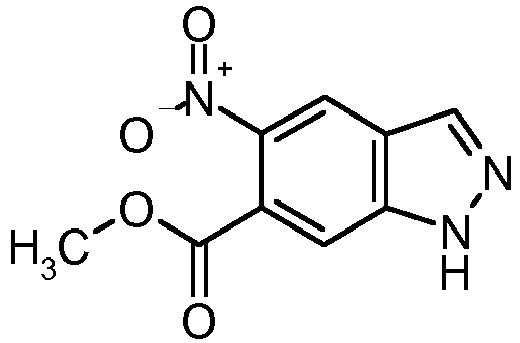
- 4.60 g (26.1 mmol) Methyl-1H-indazol-6-carboxylat (CAS Nr.: 170487-40-8) wurden in 120 ml Schwefelsäure (96%ig) gelöst und in einem Dreihalskolben mit KPG-Rührer, Tropftrichter und Innenthermometer auf -15°C gekühlt. Zu dieser Lösung wurde innerhalb von 15 min die vorher hergestellte und gekühlte Nitriersäure (10 ml Schwefelsäure 96%ig in 5 ml Salpetersäure 65%ig) zugetropft. Nach Beendigung des Zutropfens wurde 1 h nachgerührt (Innentemperatur bei -13°C). Die Reaktionsmischung wurde auf Eis gegeben, der Niederschlag abgesaugt, mit Wasser gewaschen und im Trockenschrank bei 50°C im Vakuum getrocknet. Es wurden 5.49 g der Titelverbindung erhalten.
UPLC-MS (Methode A2): Rt = 0.75 min
MS (ESIpos): m/z = 222(M+H)+
1H NMR (400 MHz, DMSO-d6): δ [ppm] = 3.87 (s, 3 H), 7.96 (s, 1 H), 8.44 (s, 1 H), 8.70 (s, 1 H), 13.98 (br. s., 1 H). -

- 4.40 g (19.8 mmol) Methyl-5-nitro-1H-indazol-6-carboxylat (Intermediat 1-1) wurden in 236 ml Methanol gelöst und mit 1.06 g (0.99 mmol) Palladium auf Aktivkohle 3 h bei 25°C unter Normaldruck Wasserstoff hydriert. Das Reaktionsgemisch wurde über Celite filtriert, der Filter mit Methanol gewaschen und das Filtrat eingeengt. Es wurden 3.53 g der Titelverbindung erhalten.
1H NMR (300 MHz, DMSO-d6): δ [ppm] = 3.85 (s, 3 H) 6.01 (s, 2 H) 6.98 (s, 1 H) 7.79 - 7.91 (m, 1 H) 7.99 (s, 1 H) 12.84 (br. s., 1 H). -

- 4.95 g (25.9 mmol) 6-(Trifluormethyl)pyridin-2-carbonsäure wurden in 45 ml THF vorgelegt. Man addierte 9.07 g (28.2 mmol) O-(Benzotriazol-1-yl)-N,N,N',N'-tetramethyluroniumtetrafluoroborat und 4.92 ml (28.2 mmol) N-Ethyl-N-isopropylpropan-2-amin und rührte 30 min bei 25°C. Anschließend wurden 4.50 g (23.5 mmol) Methyl-5-amino-1H-indazol-6-carboxylat (Intermediat 2-1) hinzugegeben und 24 h bei 25°C gerührt. Die Reaktionsmischung wurde über einen Membranfilter abgesaugt und der Feststoff mit THF und mit Wasser gewaschen und über Nacht im Trockenschrank getrocknet. Es wurden 7.60 g der Titelverbindung erhalten.
UPLC-MS (Methode A2): Rt = 1.16 min
MS (ESIpos): m/z = 365 (M+H)+
1H NMR (400 MHz, DMSO-d6): δ [ppm] = 3.97 (s, 3 H), 8.13 - 8.27 (m, 2 H), 8.30 (s, 1 H), 8.33 - 8.45 (m, 1 H), 8.45 - 8.51 (m, 1 H), 9.15 (s, 1 H), 12.57 (s, 1 H), 13.44 (s, 1 H). -

- 2.85 g (23.5 mmol) 6-(Difluormethyl)pyridin-2-carbonsäure wurden in 30 ml THF vorgelegt. Man addierte 6.05 g (18.8 mmol) O-(Benzotriazol-1-yl)-N,N,N',N'-tetramethyluroniumtetrafluoroborat und 3.3 ml N-Ethyl-N-isopropylpropan-2-amin und rührte 10 Minuten bei Raumtemperatur. Anschließend wurden 3.00 g (15.7 mmol) Methyl-5-amino-1H-indazol-6-carboxylat hinzugegeben und über Nacht bei Raumtemperatur gerührt. Das Reaktionsgemisch wurde mit Wasser versetzt, der Niederschlag wurde abgesaugt und mit Wasser und Dichlormethan mehrfach gewaschen. Man erhielt 1.53 g (27% d. Th.) der Titelverbindung. Man trennte die Phasen des Filtrates, engte die organische Phase ein, versetzte mit wenig Dichlormethan, suspendierte im Ultraschallbad und saugte den Niederschlag ab. Man erhielt weitere 1.03 g der Titelverbindung.
1H-NMR (erste Produktfraktion, 300MHz, DMSO-d6): δ [ppm]= 3.99 (s, 3H), 7.09 (t, 1H), 8.00 (d, 1H), 8.21 - 8.40 (m, 4H), 9.14 (s, 1H), 12.53 (s, 1H), 13.44 (s, 1H). -

- 2.10 g Kalium-6-(2-hydroxypropan-2-yl)pyridin-2-carboxylat (Intermediat V3-1) wurden in 15 ml THF vorgelegt. Man addierte 3.69 g (11.5 mmol) O-(Benzotriazol-1-yl)-N,N,N',N'-tetramethyluroniumtetrafluoroborat und 2.00 ml N-Ethyl-N-isopropylpropan-2-amin und rührte 15 min bei Raumtemperatur. Anschließend wurden 1.83 g (9.58 mmol) Methyl-5-amino-1H-indazol-6-carboxylat (Intermediat 2-1) hinzugegeben und 19 h bei Raumtemperatur gerührt. Man versetzte mit Wasser und Ethylacetat, filtrierte den ungelösten Feststoff ab, trennte die Phasen des Filtrates, extrahierte die wässrige Phase zweimal mit Ethylacetat, wusch mit Kochsalzlösung, filtrierte über einen wasserabweisenden Filter, engte ein und reinigte säulenchromatographisch an Kieselgel (Hexan/Ethylacetat). Nach Entfernung der Lösungsmittel wurden 1.56 g der Titelverbindung als gelber Schaum erhalten.
UPLC-MS (Methode A1): Rt = 1.00 min (UV Detektor: TIC Smooth), gefundene Masse 354.00. 1H-NMR (500MHz,DMSO-d6): δ [ppm] = 1.63 (s, 6H), 3.97 (s, 3H), 5.37(s ,1H), 7.90 - 7.95 (m, 1H), 8.03-8.07 (m, 2H), 8.23(s, 1H), 8.29 (s, 1H), 9.19 (s, 1H), 12.79 (s, 1H), 13.41 (br.s., 1H). -

- 1.00 g (2.66 mmol) Methyl-5-({[6-(trifluormethyl)pyridin-2-yl]carbonyl}amino)-1H-indazol-6-carboxylat (Intermediat 3-1) wurden in 10 ml DMF gelöst und nach Zugabe von 1.10 g (7.99 mmol) Kaliumcarbonat und 221 mg (1.33 mmol) Kaliumiodid 30 min bei 25°C gerührt. Es wurden 603 mg (3.99 mmol) 3-Brommethyl-oxetan zugegeben und 24 h bei 25°C gerührt. Die Reaktionsmischung wurde zwischen Wasser und Ethylacetat verteilt. Es wurde zweimal mit Ethylacetat extrahiert, die vereinigten organischen Phasen über einen wasserabweisenden Filter filtriert und eingeengt. Der Rückstand wurde säulenchromatographisch an Kieselgel (Hexan/Ethylacetat) gereinigt. Es wurden 260 mg der Titelverbindung erhalten.
UPLC-MS (Methode A2): Rt = 1.24 min
MS (ESIpos): m/z = 435(M+H)+
1H NMR (400 MHz, DMSO-d6): δ [ppm] = 3.49 - 3.64 (m, 1 H), 3.95 (s, 3 H), 4.49 (t, 2 H), 4.68 (dd, 2 H), 4.81 (d, 2 H), 8.20 (dd, 1 H), 8.35 - 8.41 (m, 1 H), 8.43 - 8.49 (m, 2 H), 8.55 - 8.58 (m, 1 H), 9.06 (s, 1 H), 12.53 (s, 1 H). -

- 1.00 g (2.75 mmol) Methyl-5-({[6-(trifluormethyl)pyridin-2-yl]carbonyl}amino)-1H-indazol-6-carboxylat (Intermediat 3-1) wurden in 5 ml DMF gelöst und unter Rühren mit 387 µl (4.12 mmol) 2-Bromethyl-methylether, 1.14 g (8.23 mmol) Kaliumcarbonat und 228 mg (1.37 mmol) Kaliumiodid versetzt. Die Reaktionsmischung wurde 24 h bei 25°C gerührt, mit Wasser verdünnt und zweimal mit Ethylacetat extrahiert. Die vereinigten, organischen Phasen wurden über einen wasserabweisenden Filter filtriert und eingeengt. Der Rückstand wurde säulenchromatographisch an Kieselgel (Hexan/Ethylacetat) gereinigt. Es wurden 12 mg der Titelverbindung erhalten. UPLC-MS (Methode A1): Rt = 1.24 min
MS (ESIpos): m/z = 423 (M+H)+
1H NMR (400 MHz, DMSO-d6): δ [ppm] = 3.24 (s, 3 H), 3.86 (t, 2 H), 3.96 (s, 3 H), 4.65 (t, 2 H), 8.21 (dd, 1 H), 8.35 - 8.42 (m, 1 H), 8.43 - 8.51 (m, 2 H), 8.52 (d, 1 H), 9.06 (s, 1 H), 12.53 (s, 1 H). -

- 1.00 g (2.75 mmol) Methyl-5-({[6-(trifluormethyl)pyridin-2-yl]carbonyl}amino)-1H-indazol-6-carboxylat (Intermediat 3-1) wurden in 5 ml DMF gelöst und unter Rühren mit 460 µl (4.12 mmol) 1-Brom-3-methoxypropan, 1.14 g (8.23 mmol) Kaliumcarbonat und 228 mg (1.37 mmol) Kaliumiodid versetzt. Die Reaktionsmischung wurde 72 h bei 25°C gerührt, mit Wasser verdünnt und zweimal mit Ethylacetat extrahiert. Die vereinigten organischen Phasen wurden über einen wasserabweisenden Filter filtriert und eingeengt. Der Rückstand wurde säulenchromatographisch an Kieselgel (Hexan/Ethylacetat) gereinigt. Es wurden 28 mg der Titelverbindung erhalten.
UPLC-MS (Methode A1): Rt = 1.29 min
MS (ESIpos): m/z = 437 (M+H)+
1H NMR (400 MHz, DMSO-d6): δ [ppm] = 2.17 (quin, 2 H), 3.24 (s, 3 H), 3.33 - 3.36 (m, 2 H), 3.96 (s, 3 H), 4.53 (t, 2 H), 8.21 (dd, 1 H), 8.35 - 8.42 (m, 1 H), 8.45 - 8.49 (m, 2 H), 8.54 (d, 1 H), 9.06 (s, 1 H), 12.54 (s, 1 H). -

- 930 mg (2.55 mmol) Methyl-5-({[6-(trifluormethyl)pyridin-2-yl]carbonyl}amino)-1H-indazol-6-carboxylat (Intermediat 3-1), 1.06 g Kaliumcarbonat und 212 mg Kaliumiodid wurden in 9 ml DMF vorgelegt und die Mischung wurde 15 min gerührt. Danach addierte man 0.62 ml 4-Brom-2-methylbutan-2-ol und rührte bei 60°C für 16 h. Man versetzte mit Wasser, extrahierte zweimal mit Ethylacetat und wusch dreimal mit gesättigter Natriumchloridlösung, filtrierte und engte ein. Nach säulenchromatographischer Reinigung an Kieselgel (Hexan/Ethylacetat) wurden 424 mg der Titelverbindung erhalten.
UPLC-MS (Methode A2): Rt = 1.21 min (UV Detector: TIC), gefundene Masse 450.00.
1H-NMR (400MHz, DMSO-d6): δ [ppm]= 1.16 (s, 6 H) 2.02 - 2.11 (m, 2 H) 3.96 (s, 3 H) 4.51-4.60 (m, 3 H) 8.20 (dd, J=7.83, 1.01 Hz, 1 H) 8.39 (s, 1 H) 8.45 (s, 2 H) 8.55 (d, J=0.76 Hz, 1 H) 9.05 (s, 1 H) 12.52 (s, 1 H) - 1.95 g (7.03 mmol) Methyl-5-amino-2-(3-hydroxy-3-methylbutyl)-2H-indazol-6-carboxylat (Intermediat 7-1) wurden in 30 ml THF vorgelegt. Man addierte 1.48 g (7.73 mmol) 6-(Trifluormethyl)pyridin-2-carbonsäure, 2.71 g (8.44 mmol) O-(Benzotriazol-1-yl)-N,N,N',N'-tetramethyl-uroniumtetrafluoroborat und 1.47 ml (8.44 mmol) N-Ethyl-N-isopropylpropan-2-amin und rührte 20.5 h bei 25°C. Man versetzte mit Wasser, extrahierte dreimal mit Ethylacetat, wusch mit Kochsalzlösung, filtrierte über einen wasserabweisenden Filter und engte ein. Der Rückstand wurde säulenchromatographisch an Kieselgel (Hexan/Ethylacetat-Gradient) getrennt. Es wurden 2.79 g der Titelverbindung erhalten.
UPLC-MS (Methode A1): Rt = 1.23 min (UV Detektor: TIC), gefundene Masse 450.00 -

- 1.00 g (2.66 mmol, 97%) Methyl-5-({[6-(trifluormethyl)pyridin-2-yl]carbonyl}amino)-1H-indazol-6-carboxylat (Intermediat 3-1) wurden in 50 ml DMF vorgelegt, unter Rühren wurde mit 1.10 g (7.99 mmol) Kaliumcarbonat und 221 mg (1.33 mmol) Kaliumiodid versetzt und 30 min bei 25°C gerührt. Anschließend wurden 857 µl (3.99 mmol) (2-Bromethoxy)(tert-butyl)dimethylsilan zugegeben und 24 h bei 25°C gerührt. Die Reaktionsmischung wurde mit Wasser verdünnt und mit Ethylacetat extrahiert. Die vereinigten, organischen Phasen wurden über einen wasserabweisenden Filter filtriert und eingeengt. Der Rückstand wurde säulenchromatographisch an Kieselgel (Hexan/Ethylacetat) gereinigt. Es wurden 400 mg der Titelverbindung erhalten.
UPLC-MS (Methode A1): Rt = 1.58 min
MS (ESIpos): m/z = 523(M+H)+
1H NMR (300 MHz, DMSO-d6): δ [ppm] = -0.18 - -0.13 (m, 6 H), 0.74 (s, 9 H), 3.96 (s, 3 H), 4.08 (t, 2 H), 4.57 (t, 2 H), 8.15 - 8.25 (m, 1 H), 8.32 - 8.43 (m, 1 H), 8.43 - 8.52 (m, 3 H), 9.07 (s, 1 H), 12.53 (s, 1 H). -

- Analog zu Intermediat 4-5 wurden 1.00 g (2.75 mmol) Methyl-5-({[6-(trifluormethyl)pyridin-2-yl]carbonyl}amino)-1H-indazol-6-carboxylat (Intermediat 3-1) in 10 ml DMF gelöst, unter Rühren mit 1.14 g (8.24 mmol) Kaliumcarbonat und 228 mg (1.37 mmol) Kaliumiodid versetzt und 30 min bei 25°C gerührt. Anschließend wurden 1.04 g (4.12 mmol) (3-Brompropoxy)(tert-butyl)dimethylsilan zugegeben und 24 h bei 25°C gerührt. Die Reaktionsmischung wurde filtriert und der Filterkuchen mit Ethylacetat gewaschen. Es wurde zwischen Wasser und Ethylacetat verteilt und zweimal mit Ethylacetat extrahiert. Die vereinigten, organischen Phasen wurden über einen wasserabweisenden Filter filtriert und eingeengt. Nach Reinigung des Rückstandes durch präparative HPLC wurden 428 mg der Titelverbindung erhalten.
UPLC-MS (Methode A1): Rt = 1.63 min
MS (ESIpos): m/z = 537(M+H)+
1H NMR (400 MHz, DMSO-d6): δ [ppm] = -0.02 - 0.06 (m, 6 H), 0.87 (s, 9 H), 2.14 (quin, 2 H), 3.62 (t, 2 H), 3.96 (s, 3 H), 4.54 (t, 2 H), 8.20 (d, 1 H), 8.35 - 8.42 (m, 1 H), 8.43 - 8.48 (m, 3 H), 8.49 - 8.53 (m, 1 H), 9.06 (s, 1 H). -

- 300 mg (0.80 mmol) Methyl-5-({[6-(2-hydroxypropan-2-yl)pyridin-2-yl]carbonyl}amino)-1H-indazol-6-carboxylat (Intermediat 3-3) wurden in 4.5 ml DMF vorgelegt. Man addierte 287 mg (1.21 mmol) 1,1,1-Trifluor-4-iodbutan und 333 mg Kaliumcarbonat und rührte bei 100°C 23 h. Man addierte Wasser und extrahierte dreimal mit Ethylacetat. Man engte ein und reinigte durch präparative HPLC. Man erhielt 72 mg der Titelverbindung.
UPLC-MS (Methode A1): Rt = 1.26 min (UV Detektor: TIC), gefundene Masse 464.17. -

- 195 mg (0.46 mmol) Methyl-5-amino-2-(3-hydroxy-3-methylbutyl)-2H-indazol-6-carboxylat (Intermediat 7-1) wurden mit 78 mg (0.50 mmol) 5-Fluor-6-methylpyridin-2-carbonsäure analog zu Intermediat 4-4 (Herstellungsmethode 2) in 19.5 h umgesetzt. Es wurden 228 mg eines Rohproduktes nach analoger wässriger Aufarbeitung erhalten.
UPLC-MS (Methode A1): Rt = 1.20 min (UV Detektor: TIC), gefundene Masse 414.00. -

- 195 mg (0.45 mmol) Methyl-5-amino-2-(3-hydroxy-3-methylbutyl)-2H-indazol-6-carboxylat (Intermediat 7-1) wurden mit 70 mg (0.50 mmol) 6-Methylpyridin-2-carbonsäure analog zu Herstellung von Intermediat 4-4 (Herstellungsmethode 2) in 19.5 h umgesetzt. Es wurden 278 mg der Titelverbindung als Rohprodukt nach analoger wässriger Aufarbeitung erhalten.
UPLC-MS (Methode A1): Rt = 1.14 min (UV Detektor: TIC), gefundene Masse 396.00. -

- Eine Mischung aus 250 mg (0.58 mmol) Methyl-5-({[6-(trifluormethyl)pyridin-2-yl]carbonyl}amino)-1H-indazol-6-carboxylat (Intermediat 3-1), 193 mg (0.88 mmol) 3-Brompropyl-2,2,2-trifluorethylether, 242 mg Kaliumcarbonat und 145 mg Kaliumiodid in 3 ml DMF 20 h bei 100°C gerührt. Man versetzte mit Wasser, extrahierte mit Ethylacetat, wusch mit Kochsalzlösung und engte ein. Nach Reinigung durch präparative HPLC erhielt man 52 mg der Titelverbindung.
UPLC-MS (Methode A1): Rt = 1.39 min (UV Detektor: TIC), gefundene Masse 504.12. -

- 2.00 g Methyl-5-amino-2-(3-hydroxy-3-methylbutyl)-2H-indazol-6-carboxylat (Intermediat 7-1) wurden in 40 ml THF vorgelegt. Es wurden 1.50 g 6-(Difluormethyl)pyridin-2-carbonsäure, 2.78 g O-(Benzotriazol-1-yl)-N,N,N',N'-tetramethyluroniumtetrafluoroborat (TBTU, CAS-Nummer 125700-67-6) und 1.5 ml N-Ethyl-N-isopropylpropan-2-amin zugegeben und die Mischung wurde 24 h bei RT gerührt. Man versetzte mit Wasser, extrahierte dreimal mit Ethylacetat, wusch die vereinigten organischen Phasen mit Kochsalzlösung und filtrierte durch einen wasserabweisenden Filter. Man engte ein und reinigte den Rückstand säulenchromatographisch an Kieselgel (Hexan/Ethylacetat). Man erhielt 3.05 g der Titelverbindung als gelben Feststoff.
UPLC-MS (Methode A1): Rt = 1.15 min (UV Detektor: TIC), gefundene Masse 432.00.
1H-NMR (400MHz, DMSO-d6): δ [ppm]= 1.17 (s, 6H), 2.04 - 2.11 (m, 2H), 3.99 (s, 3H), 4.52 - 4.60 (m, 3H), 7.10 (t, 1H), 8.00 (dd, 1H), 8.28 - 8.38 (m, 2H), 8.44 - 8.47 (m, 1H), 8.56 (d, 1H), 9.05 (s, 1H), 12.49 (s, 1H). -

- Zu einer im Eiswasser-Kältebad abgekühlten Lösung aus 1.50 g (4.12 mmol) Methyl-5-({[6-(trifluormethyl)pyridin-2-yl]carbonyl}amino)-1H-indazol-6-carboxylat (Intermediat 3-1) in 20 ml THF wurden vorsichtig 6.9 ml (5 Äquivalente) einer 3M Methylmagnesiumbromid-Lösung in Diethylether gegeben. Man rührte 1 h mit Eiswasser-Kältebadkühlung und 19.5 h bei Raumtemperatur. Man gab nochmals 2 Äquivalente der Methylmagnesiumbromid-Lösung zu und ließ weitere 24 h bei Raumtemperatur rühren. Man versetzte mit gesättigter wässriger Ammoniumchloridlösung, rührte die Mischung um und extrahierte dreimal mit Ethylacetat. Die vereinigten organischen Phasen wurden mit Kochsalzlösung gewaschen, über einen wasserabweisenden Filter filtriert und eingeengt. Der Rückstand wurde säulenchromatographisch an Kieselgel (Hexan/Ethylacetat) gereinigt. Es wurden 763 mg der Titelverbindung erhalten.
1H-NMR (400MHz, DMSO-d6): δ [ppm]= 1.63 (s, 6H), 5.99 (s, 1H), 7.49 (s, 1H), 8.06 (s, 1H), 8.14 - 8.19 (m, 1H), 8.37 (t, 1H), 8.46 (d, 1H), 8.78 (s, 1H), 12.32 (s, 1H), 12.97 (s, 1H). -

- Analog zur Herstellung von Intermediat 5-1 wurden 2.40 g (6.93 mmol) Methyl-5-({[6-(difluormethyl)pyridin-2-yl]carbonyl}amino)-1H-indazol-6-carboxylat (Intermediat 3-2) in 10 ml THF mit drei Portionen 3M Methylmagnesiumbromidlösung in Diethylether (6.9 ml, dann 45 min Rühren bei Raumtemperatur; 11.6 ml, dann 2 h Rühren bei Raumtemperatur; 6.9 ml, dann 2 h Rühren bei Raumtemperatur) umgesetzt. Nach Aufarbeitung wie bei Intermediat 5-1 wurden 2.39 g eines Rohproduktes erhalten, welches ohne weitere Reinigung weiter eingesetzt wurde.
-

- 5.00 g (22.6 mmol) Methyl-5-nitro-1H-indazol-6-carboxylat (Intermediat 1-1) wurden in 40 ml DMF vorgelegt. Man addierte 5.65 g (33.9 mmol) 4-Brom-2-methylbutan-2-ol, 9.37 g (67.8 mmol) Kaliumcarbonat und 5.63 g (33.9 mmol) Kaliumiodid und die Mischung wurde 20 h bei 100°C gerührt. Man versetzte mit Wasser, extrahierte dreimal mit Ethylacetat, wusch mit Kochsalzlösung, filtrierte über einen wasserabweisenden Filter und engte ein. Der Rückstand wurde säulchenchromatographisch an Kieselgel (Hexan/Ethylacetat) gereinigt. Der erhaltene Feststoff wurde aus Diethylether ausgerührt, abgesaugt, mit Diethylether nachgewaschen und getrocknet. Es wurden 2.49 g der Titelverbindung erhalten.
UPLC-MS (Methode A1): Rt = 0.93 min (UV Detektor: TIC), gefundene Masse 307.00.
1H-NMR (400MHz, DMSO-d6): δ [ppm]= 1.15 (s, 6H), 2.02 - 2.11 (m, 2H), 3.84 (s, 3H), 4.54 (s, 1H), 4.58 - 4.65 (m, 2H), 8.05 (s, 1H), 8.69 (s, 1H), 8.86 (s, 1H). -

- Man addierte 4.53 g Eisen und 217 mg Ammoniumchlorid zu 2.49 g (8.10 mmol) Methyl-2-(3-hydroxy-3-methylbutyl)-5-nitro-2H-indazol-6-carboxylat (Intermediat 6-1) in 30 ml Ethanol und 10 ml Wasser und rührte die Mischung 21.5 h bei 90°C. Man filtrierte über Celite, wusch dreimal mit Ethanol nach, engte das Filtrat ein und versetzte den Rückstand mit Wasser. Man extrahierte dreimal mit Ethylacetat (zur Verbesserung der Phasentrennung wurde mit Kochsalzlösung versetzt). Die vereinigten organischen Phasen wurden mit Kochsalzlösung gewaschen, über einen wasserabweisenden Filter filtriert und eingeengt. Es wurden 1.95 g (85% der Theorie) der Titelverbindung erhalten.
UPLC-MS (Methode A1): Rt = 0.67 min (UV Detektor: TIC), gefundene Masse 277.00.
1H-NMR (400MHz, DMSO-d6): δ [ppm]= 1.14 (s, 6H), 1.96 - 2.08 (m, 2H), 3.85 (s, 3H), 4.39 - 4.51 (m, 3H), 5.81 (s, 2H), 6.80 (s, 1H), 8.05 (s, 1H), 8.18 (s, 1H). -

- 75 mg (0.18 mmol) Methyl-2-(2-methoxyethyl)-5-({[6-(trifluormethyl)pyridin-2-yl]carbonyl}-amino)-2H-indazol-6-carboxylat (Intermediat 4-2) wurden in 500 µl THF gelöst und mit 887 µl (0.89 mmol) einer 1 M Methylmagnesiumbromidlösung in THF versetzt. Die Reaktionsmischung wurde 60 min bei 25°C gerührt. Anschließend wurde vorsichtig 1 ml einer gesättigten, wässrigen Ammoniumchloridlösung hinzugegeben und filtriert. Die wässrige Phase wurde zweimal mit Ethylacetat extrahiert, die organischen Phasen vereint, über einen wasserabweisenden Filter filtriert und eingeengt. Der Rückstand wurde in 3 ml DMSO gelöst und durch präparative HPLC gereinigt. Die produkthaltigen Fraktionen wurden gefriergetrocknet. Es wurden 20 mg der Titelverbindung erhalten.
UPLC-MS (Methode A1): Rt = 1.08 min
MS (ESIpos): m/z = 423 (M+H)+
1H NMR (300 MHz, DMSO-d6): δ [ppm] = 1.62 (s, 6 H), 3.22 (s, 3 H), 3.82 (t, 2 H), 4.55 (t, 2 H), 5.96 (s, 1 H), 7.57 (s, 1 H), 8.16 (dl H), 8.29 - 8.42 (m, 2 H), 8.42 - 8.50 (m, 1 H), 8.71 (s, 1 H), 12.36 (s, 1 H) -

- 13 mg (0.36 mmol) Lithiumaluminiumhydrid wurden in 1 ml THF suspendiert und auf 0°C gekühlt. 75 mg (0.17 mmol) Methyl-2-(2-methoxyethyl)-5-({[6-(trifluormethyl)pyridin-2-yl]-carbonyl}amino)-2H-indazol-6-carboxylat (Intermediat 4-2) gelöst in 500 µl THF wurden zugetropft und 60 min bei 25°C gerührt. Man verdünnte mit Wasser, extrahierte zweimal mit Ethylacetat und die vereinigten, organischen Phasen wurden mit Kochsalzlösung gewaschen, über einen wasserabweisenden Filter filtriert, eingeengt und im Vakuum getrocknet. Man erhielt 13 mg der Titelverbindung.
UPLC-MS (Methode A2): Rt = 0.99 min
MS (ESIpos): m/z = 394 (M+H)+
1H NMR (400 MHz, DMSO-d6): δ [ppm] = 3.23 (s, 3 H), 3.83 (t, 2 H), 4.56 (t, 2 H), 4.69 (d, 2 H), 5.77 (t, 1 H), 7.57 (s, 1 H), 8.19 (d, 1 H), 8.33 - 8.41 (m, 2 H), 8.43 - 8.47 (m, 1 H), 8.51 (s, 1 H), 11.20 (s, 1 H) -

- 75 mg (0.17 mmol) Methyl-2-(3-methoxypropyl)-5-({[6-(trifluormethyl)pyridin-2-yl]carbonyl}-amino)-2H-indazol-6-carboxylat (Intermediat 4-3) wurden in 500 µl THF gelöst und mit 859 µl (0.86 mmol) einer 1 M Methylmagnesiumbromidlösung in THF versetzt. Die Reaktionsmischung wurde 60 min bei 25°C gerührt. Anschließend wurde vorsichtig 1 ml einer gesättigten Ammoniumchloridlösung hinzugegeben und filtriert. Die wässrige Phase wurde zweimal mit Ethylacetat extrahiert, die organischen Phasen vereint, über einen wasserabweisenden Filter filtriert und eingeengt. Der Rückstand wurde in 3 ml DMSO gelöst und durch präparative HPLC gereinigt. Die produkthaltigen Fraktionen wurden gefriergetrocknet. Es wurden 25 mg der Titelverbindung erhalten.
UPLC-MS (Methode A1): Rt = 1.13 min
MS (ESIpos): m/z = 437 (M+H)+
1H NMR (400 MHz, DMSO-d6): δ [ppm] = 1.62 (s, 6 H), 2.14 (quin, 2 H), 3.23 (s, 3 H), 3.26 - 3.32 (m, 2 H), 4.44 (t, 2 H), 5.95 (s, 1 H), 7.58 (s, 1 H), 8.16 (d, 1 H), 8.31 - 8.40 (m, 2 H), 8.43 - 8.48 (m, 1 H), 8.72 (s, 1 H), 12.36 (s, 1 H). -

- 13 mg Lithiumaluminiumhydrid wurden in THF suspendiert und die Mischung auf 0°C abgekühlt. Man tropfte 75 mg (0.17 mmol) Methyl-2-(3-methoxypropyl)-5-({[6-(trifluormethyl)pyridin-2-yl]carbonyl}amino)-2H-indazol-6-carboxylat (Intermediat 4-3) in THF zu und ließ innerhalb von 30 min auf Raumtemperatur kommen. Man verdünnte mit Wasser, filtrierte, wusch den Rückstand mit Ethylacetat und extrahierte das Filtrat mit Ethylacetat. Die vereinigten Ethylacetatphasen wurden mit Kochsalzlösung gewaschen, über einen wasserabweisenden Filter filtriert und eingeengt. Man reinigte den Rückstand durch präparative HPLC.
1H NMR (300 MHz, DMSO-d6 ): δ [ppm] = 2.14 (quin, 2 H), 3.23 (s, 3 H), 3.29 (t, 2 H), 4.45 (t, 2 H), 4.68 (d, 2 H), 5.77 (t, 1 H), 7.58 (s, 1 H), 8.18 (d, 1 H), 8.32 - 8.48 (m, 3 H), 8.51 (s, 1 H), 11.21 (s, 1 H). - Herstellung von N-[2-(2-{[tert-Butyl(dimethyl)silyl]oxy}ethyl)-6-(2-hydroxypropan-2-yl)-2H-indazol-5-yl]-6-(trifluormethyl)pyridin-2-carboxamid

- 100 mg (0.19 mmol) Methyl-2-(2-{[tert-butyl(dimethyl)silyl]oxy}ethyl)-5-({[6-(trifluormethyl)pyridin-2-yl]carbonyl}amino)-2H-indazol-6-carboxylat (Intermediat 4-5) wurden in 1 ml THF gelöst und mit 669 µl (0.67 mmol) einer 1 M Methylmagnesiumbromidlösung in THF versetzt. Die Reaktionsmischung wurde 60 min bei 25°C gerührt. Es wurden nochmals 287 µl (0.29 mmol) einer 1 M Methylmagnesiumbromidlösung in THF hinzugegeben und 3 h bei 25°C gerührt. Anschließend wurden vorsichtig 20 ml einer gesättigten Ammoniumchloridlösung hinzugegeben und filtriert. Die wässrige Phase wurde zweimal mit Ethylacetat extrahiert, die organischen Phasen vereint, über Magnesiumsulfat getrocknet, filtriert, eingeengt und im Vakuum getrocknet. Man erhielt 50 mg N-[2-(2-{[tert-Butyl(dimethyl)silyl]oxy}ethyl)-6-(2-hydroxypropan-2-yl)-2H-indazol-5-yl]-6-(trifluormethyl)pyridin-2-carboxamid.
UPLC-MS (Methode A2): Rt = 1.51 min
MS (ESIpos): m/z = 523(M+H)+
1H NMR (300 MHz, DMSO-d6): δ [ppm] = -0.17 - -0.09 (m, 6 H), 0.78 (s, 9 H), 1.62 (s, 6 H), 4.04 (t, 2 H), 4.47 (t, 2 H), 5.98 (s, 1 H), 7.57 (s, 1 H), 8.16 (d, 1 H), 8.29 (s, 1 H), 8.37 (t, 1 H), 8.45 (d, 1 H), 8.73 (s, 1 H), 12.38 (s, 1 H). -

- 50 mg (96 µmol) N-[2-(2-{[tert-Butyl(dimethyl)silyl]oxy}ethyl)-6-(hydroxymethyl)-2H-indazol-5-yl]-6-(trifluormethyl)pyridin-2-carboxamid wurden in 1.0 ml THF gelöst und mit 144 µL (0.14 mmol) einer 1 M Lösung Tetrabutylammoniumfluorid in THF versetzt. Die Reaktionsmischung wurde 1 h bei Raumtemperatur gerührt. Man verdünnte mit Wasser, extrahierte zweimal mit Ethylacetat und die vereinigten organischen Phasen wurden mit gesättigter Natriumchloridlösung gewaschen, über einen wasserabweisenden Filter filtriert und eingeengt. Man erhielt 36 mg N-[2-(2-Hydroxyethyl)-6-(2-hydroxypropan-2-yl)-2H-indazol-5-yl]-6-(trifluormethyl)pyridin-2-carboxamid (Beispiel 5).
1H-NMR (400MHz, DMSO-d6): d [ppm] = 1.62 (s, 6H), 3.86 (q, 2H), 4.43 (t, 2H), 4.95 (t, 1H), 5.94 (s, 1H), 7.57 (s, 1H), 8.16 (dd, 1H), 8.30 (s, 1H), 8.37 (t, 1H), 8.45 (d, 1H), 8.72 (s, 1H), 12.36 (s, 1H).
UPLC-MS (Methode A2): Rt = 0.97 min (UV Detektor: TIC), gefundene Masse 408.00. -

- 50 mg (0.09 mmol) Methyl-2-(3-{[tert-butyl(dimethyl)silyl]oxy}propyl)-5-({[6-(trifluormethyl)pyridin-2-yl]carbonyl}amino)-2H-indazol-6-carboxylat (Intermediat 4-6) wurden in 500 µl THF gelöst und mit 326 µl (0.33 mmol) einer 1 M Methylmagnesiumbromidlösung in THF versetzt. Die Reaktionsmischung wurde 60 min bei 25°C gerührt. Anschließend wurden vorsichtig 20 ml einer gesättigten Ammoniumchloridlösung hinzugegeben und zweimal mit Ethylacetat extrahiert. Die vereinigten organischen Phasen wurden über einen wasserabweisenden Filter filtriert, eingeengt und im Vakuum getrocknet. Der Rückstand wurde durch präparative HPLC gereinigt. Es wurden 40 mg N-[2-(3-{[tert-Butyl(dimethyl)silyl]oxy}propyl)-6-(2-hydroxypropan-2-yl)-2H-indazol-5-yl]-6-(trifluormethyl)pyridin-2-carboxamid erhalten.
UPLC-MS (Methode A1): Rt = 1.58 min
MS (ESIpos): m/z = 537(M+H)+
1H NMR (300 MHz, DMSO-d6): δ [ppm] = 0.02 - 0.05 (m, 6 H), 0.84 - 0.91 (m, 9 H), 1.62 (s, 6 H), 2.02 - 2.18 (m, 2 H), 3.55 - 3.62 (m, 2 H), 4.45 (t, 2 H), 5.96 (s, 1 H), 7.57 (s, 1 H), 8.16 (d, 1 H), 8.31 (s, 1 H), 8.33 - 8.42 (m, 1 H), 8.45 (d, 1 H), 8.72 (s, 1 H), 12.37 (s, 1 H). -

- 37 mg (0.07 mmol) N-[2-(3-{[tert-Butyl(dimethyl)silyl]oxy}propyl)-6-(2-hydroxypropan-2-yl)-2H-indazol-5-yl]-6-(trifluormethyl)pyridin-2-carboxamid wurden in 500 µl THF gelöst und mit 207 µL (0.21 mmol) einer 1 M Lösung Tetrabutylammoniumfluorid in THF versetzt. Die Reaktionsmischung wurde 2 h bei 25°C gerührt. Man verdünnte mit Wasser, extrahierte zweimal mit Ethylacetat und die vereinigten organischen Phasen wurden mit gesättigter Natriumchloridlösung gewaschen, filtriert und eingeengt. Nach Reinigung durch präparative HPLC wurden 10 mg N-[6-(2-Hydroxypropan-2-yl)-2-(3-hydroxypropyl)-2H-indazol-5-yl]-6-(trifluormethyl)pyridin-2-carboxamid (Beispiel 6, enthielt Nebenkomponente) erhalten.
UPLC-MS (Methode A2): Rt = 1.00 min
MS (ESIpos): m/z = 423 (M+H)+
1H NMR ausgewählte Signale (400 MHz, DMSO-d6): δ [ppm] = 1.61 (s), 2.00 - 2.12 (m), 3.38 (t, 2 H), 4.44 (t, 2 H), 4.62 (br. s., 1 H), 5.93 (br. s., 1 H), 7.55 (s, 1 H), 8.13 (d, 1 H), 8.27 - 8.38 (m, 2 H), 8.43 (d, 1 H), 8.71 (s, 1 H), 12.30 (br. s., 1 H). -

- 100 mg (0.19 mmol) Methyl-2-(2-{[tert-butyl(dimethyl)silyl]oxy}ethyl)-5-({[6-(trifluormethyl)pyridin-2-yl]carbonyl}amino)-2H-indazol-6-carboxylat (Intermediat 4-5) wurden in 1 ml THF gelöst und mit 191 µl (0.38 mmol) einer 2 M Lithiumborhydridlösung versetzt. Man ließ 24 h bei 25°C rühren. Es wurden 14 mg (0.38 mmol) Natriumborhydrid und 500 µl Methanol zugegeben und 4 h bei 25°C gerührt. Es wurden nochmals 14 mg (0.38 mmol) Natriumborhydrid zugegeben und 24 h bei 25°C gerührt. Die Reaktionsmischung wurde vorsichtig mit Wasser versetzt und die organische Phase abgetrennt. Anschließend wurde zweimal mit Ethylacetat extrahiert und die vereinigten organischen Phasen mit gesättigter Natriumchloridlösung gewaschen, über einen wasserabweisenden Filter filtriert und eingeengt. Der Rückstand wurde in 2 ml DMSO aufgenommen und durch präparative HPLC gereinigt. Man erhielt 30 mg N-[2-(2-{[tert-Butyl(dimethyl)silyl]oxy}ethyl)-6-(hydroxymethyl)-2H-indazol-5-yl]-6-(trifluormethyl)pyridin-2-carboxamid.
UPLC-MS (Methode A2): Rt = 1.44 min
MS (ESIpos): m/z = 495(M+H)+
1H NMR (300 MHz, DMSO-d6): δ [ppm] = -0.16 - -0.12 (m, 6 H), 0.75 - 0.79 (m, 9 H), 4.05 (t, 2 H), 4.48 (t, 2 H), 4.69 (d, 2 H), 5.75 - 5.77 (m, 1 H), 7.57 (s, 1 H), 8.18 (dd, 1 H), 8.30 - 8.33 (m, 1 H), 8.38 (t, 1 H), 8.45 (d, 1 H), 8.51 (s, 1 H), 11.20 (s, 1 H). -

- 33 mg (0.07 mmol) N-[2-(2-{[tert-Butyl(dimethyl)silyl]oxy}ethyl)-6-(hydroxymethyl)-2H-indazol-5-yl]-6-(trifluormethyl)pyridin-2-carboxamid wurden in 1 ml THF gelöst und mit 100 µL (0.10 mmol) einer 1 M Lösung Tetrabutylammoniumfluorid in THF versetzt. Die Reaktionsmischung wurde 1 h bei 25°C gerührt. Man verdünnte mit Wasser, extrahierte zweimal mit Ethylacetat und die vereinigten organischen Phasen wurden mit gesättigter Natriumchloridlösung gewaschen, über einen wasserabweisenden Filter filtriert, eingeengt und im Vakuum getrocknet. Es wurden 25 mg N-[2-(2-Hydroxyethyl)-6-(hydroxymethyl)-2H-indazol-5-yl]-6-(trifluormethyl)pyridin-2-carboxamid (Beispiel 7) erhalten.
UPLC-MS (Methode A2): Rt = 0.87 min
MS (ESIpos): m/z = 381 (M+H)+
1H NMR (300 MHz, DMSO-d6): δ [ppm] = 3.87 (q, 2 H), 4.44 (t, 2 H), 4.69 (d, 2 H), 4.98 (t, 1 H), 5.70 - 5.81 (m, 1 H), 7.57 (s, 1 H), 8.11 - 8.23 (m, 1 H), 8.31 - 8.42 (m, 2 H), 8.43 - 8.49 (m, 1 H), 8.51 (s, 1 H), 11.20 (s, 1 H). -

- 50 mg (0.12 mmol) Methyl-2-(oxetan-3-ylmethyl)-5-({[6-(trifluormethyl)pyridin-2-yl]carbonyl}amino)-2H-indazol-6-carboxylat (Intermediat 4-1) wurden in 500 µl THF gelöst und mit 576 µl (0.58 mmol) einer 1 M Methylmagnesiumbromidlösung in THF versetzt. Die Reaktionsmischung wurde 60 min bei 25°C gerührt. Anschließend wurden vorsichtig 20 ml einer gesättigten wässrigen Ammoniumchloridlösung hinzugegeben und eingeengt. Die wässrige Phase wurde zweimal mit Ethylacetat extrahiert, die organischen Phasen vereint, über Magnesiumsulfat getrocknet, filtriert und eingeengt. Der Rückstand wurde in 2.0 ml DMSO gelöst und durch präparative HPLC gereinigt. Die produkthaltigen Fraktionen wurden gefriergetrocknet. Es wurden 30 mg der Titelverbindung erhalten.
UPLC-MS (Methode A2): Rt = 1.03 min
MS (ESIpos): m/z = 435 (M+H)+
1H NMR (400 MHz, DMSO-d6): δ [ppm] = 1.62 (s, 6 H), 3.45 - 3.61 (m, 1 H), 4.48 (t, 2 H), 4.66 (dd, 2 H), 4.72 (d, 2 H), 5.94 (s, 1 H), 7.57 (s, 1 H), 8.16 (d, 1 H), 8.33 - 8.42 (m, 2 H), 8.42 - 8.47 (m, 1 H), 8.72 (s, 1 H), 12.36 (s, 1 H). -

- 75 mg (0.17 mmol) Methyl-2-(oxetan-3-ylmethyl)-5-({[6-(trifluormethyl)pyridin-2-yl]carbonyl}amino)-2H-indazol-6-carboxylat (Intermediat 4-1) wurden in 1 ml einer Mischung aus THF/Methanol (1:1) gelöst und mit 8 mg (0.21 mmol) Natriumborhydrid versetzt. Man ließ 60 min bei 25°C rühren. Die Reaktionsmischung wurde eingeengt und der Rückstand mit Wasser versetzt. Die Suspension wurde 15 min kräftig gerührt, der Feststoff abgesaugt, zweimal mit Wasser und zweimal mit Diethylether gewaschen und im Vakuum getrocknet. Es wurden 48 mg der Titelverbindung erhalten.
UPLC-MS (Methode A2): Rt = 0.94 min
MS (ESIpos): m/z = 407 (M+H)+
1H NMR (300 MHz, DMSO-d6): δ [ppm] = 3.55 (s, 1 H), 4.48 (t, 2 H), 4.61 - 4.77 (m, 6 H), 7.57 (s, 1 H), 8.18 (dd, 1 H), 8.33 - 8.49 (m, 3 H), 8.51 (s, 1 H), 11.21 (s, 1 H). -

- Eine Mischung aus 500 mg (1.32 mmol) N-[6-(2-Hydroxypropan-2-yl)-1H-indazol-5-yl]-6-(trifluormethyl)pyridin-2-carboxamid (Intermediat 5-1), 569 mg Kaliumcarbonat und 114 mg Kaliumiodid in 5.0 ml DMF wurde 15 min bei Raumtemperatur gerührt. Man addierte 414 mg 1-Brom-3-(methylsulfonyl)propan und rührte bei Raumtemperatur über Nacht. Man versetzte mit Wasser, extrahierte zweimal mit Ethylacetat, wusch mit Kochsalzlösung und engte ein. Der Rückstand wurde säulenchromatographisch gereinigt (Dichlormethan-Methanol-Gradient). Nach Ausrühren der Produktfraktion aus Diethylether wurden 59 mg der Titelverbindung erhalten.
UPLC-MS (Methode A2): Rt = 1.02 min
MS (ESIpos): m/z = 485 (M+H)+
1H-NMR (300MHz, DMSO-d6): δ [ppm]= 1.63 (s, 6H), 2.26 - 2.42 (m, 2H), 2.99 (s, 3H), 3.06 - 3.16 (m, 2H), 4.55 (t, 2H), 5.96 (s, 1H), 7.60 (s, 1H), 8.16 (d, 1H), 8.33 - 8.48 (m, 3H), 8.73 (s, 1H), 12.37 (s, 1H). -
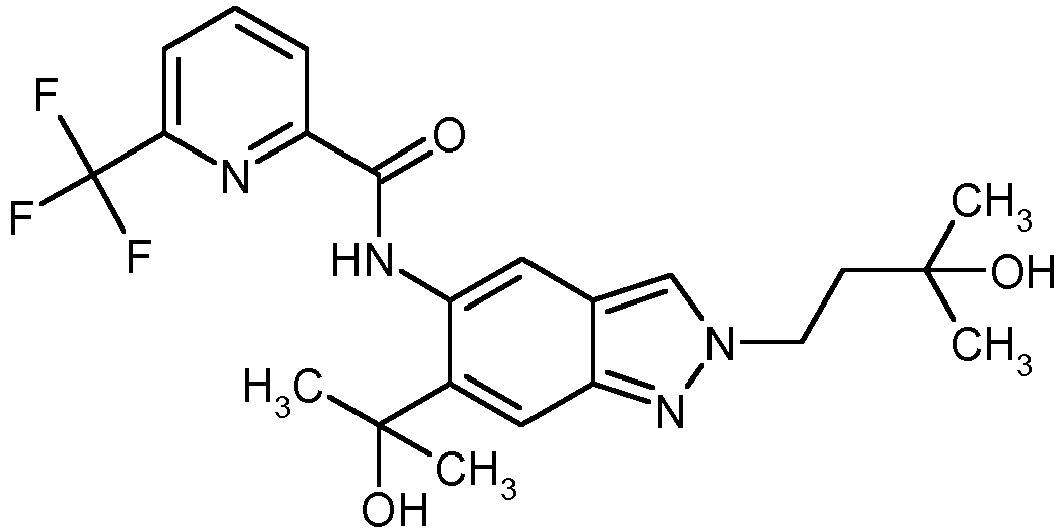
- 705 mg (1.57 mmol) Methyl-2-(3-hydroxy-3-methylbutyl)-5-({[6-(trifluormethyl)pyridin-2-yl]carbonyl}amino)-2H-indazol-6-carboxylat (Intermediat 4-4) wurden in 10 ml THF vorgelegt und im Eiswasser-Kältebad gekühlt. Man addierte 2.6 ml (5.0 Äquivalente) 3M Methylmagnesiumbromidlösung (in Diethylether) und ließ 1 h unter Eisbadkühlung und 4.5 h bei Raumtemperatur rühren. Man addierte erneut 1 Äquivalent der Methylmagnesiumbromidlösung und ließ 20.5 h bei Raumtemperatur rühren. Erneut addierte man 1 Äquivalent der Methylmagnesiumbromidlösung und ließ 22 h bei Raumtemperatur rühren. Das Reaktionsgemisch wurde mit gesättigter wässriger Ammoniumchloridlösung versetzt, gerührt und dreimal mit Ethylacetat extrahiert. Die vereinigten organischen Phasen wurden mit Kochsalzlösung gewaschen, über einen wasserabweisenden Filter filtriert und eingeengt. Man erhielt 790 mg eines Rückstandes, der durch präparative HPLC gereinigt wurde. Man erhielt 234 mg der Titelverbindung und 164 mg einer Produktfraktion, die mit Diethylether ausgerührt wurde. Nach Absaugen und anschließender Trocknung wurden weitere 146 mg der Titelverbindung erhalten.
UPLC-MS (Methode A1): Rt = 1.10 min (UV Detektor: TIC), gefundene Masse 450.00.
1H-NMR (400MHz, DMSO-d6): δ [ppm]= 1.14 (s, 6H), 1.61 (s, 6H), 1.99 - 2.08 (m, 2H), 4.42 - 4.55 (m, 3H), 5.93 (s, 1H), 7.56 (s, 1H), 8.15 (dd, 1H), 8.32 - 8.39 (m, 2H), 8.41 - 8.47 (m, 1H), 8.70 (s, 1H), 12.34 (s, 1H). - Eine Mischung aus 500 mg (1.37 mmol) N-[6-(2-Hydroxypropan-2-yl)-1H-indazol-5-yl]-6-(trifluormethyl)pyridin-2-carboxamid (Intermediat 5-1), 569 mg Kaliumcarbonat und 114 mg Kaliumiodid in 5 ml DMF wurde 15 min bei Raumtemperatur gerührt. Man addierte 344 mg (1.5 Äquivalente) 4-Brom-2-methylbutan-2-ol und erwärmte 2 h auf 100°C. Man addierte erneut 0.5 Äquivalente 4-Brom-2-methylbutan-2-ol und rührte bei Raumtemperatur für 16 h. Die Mischung wurde mit Wasser versetzt, zweimal mit Ethylacetat extrahiert, die vereinigten organischen Phasen wurden mit gesättigter Kochsalzlösung gewaschen und über einen wasserabweisenden Filter filtriert und eingeengt. Der Rückstand wurde durch säulenchromatographische Reinigung an Kieselgel (Hexan/Ethylacetat) gereinigt. Man erhielt 100 mg einer Produktfraktion, die mit Diethylether ausgerührt wurde. Nach Trocknen wurden 60 mg der Titelverbindung erhalten.
1H-NMR (400MHz, DMSO-d6): δ [ppm]= 1.14 (s, 6 H), 1.61 (s, 6H), 1.99 - 2.07 (m, 2 H), 4.43 - 4.52 (m, 3 H) 5.94 (s, 1 H) 7.57 (s, 1 H) 8.15 (dd, 1H) 8.33 - 8.40 (m, 2 H), 8.42 - 8.48 (m, 1 H), 8.71 (s, 1 H), 12.35 (s, 1 H) -

- 160 mg (0.44 mmol) N-[6-(2-Hydroxypropan-2-yl)-1H-indazol-5-yl]-6-(trifluormethyl)pyridin-2-carboxamid (Intermediat 5-1) wurden zusammen mit 182 mg Kaliumcarbonat und 36 mg Kaliumiodid in 1.0 ml DMF suspendiert und die Mischung wurde 15 min bei Raumtemperatur gerührt. Dann wurden 123 mg 2-Bromethyl-methylsulfon (0.66 mmol) zugegeben und über Nacht bei Raumtemperatur gerührt. Man addierte Wasser, extrahierte zweimal mit Ethylacetat, wusch mit gesättigter wässriger Natriumchloridlösung, filtrierte über einen wasserabweisenden Filter und engte ein. Nach Reinigung des Rückstandes durch präparative HPLC wurden 20 mg der Titelverbindung erhalten.
UPLC (Methode A2): Rt = 1.01 min;
MS (ESIpos): m/z = 471 (M+H)+
1H NMR (400 MHz, DMSO-d6 ): δ [ppm]= 1.63 (s, 6 H), 2.90 (s, 3 H), 3.85 (t, 2 H), 4.86 (t, 2 H), 5.97 (s, 1 H), 7.59 (s, 1 H), 8.13 - 8.19 (m, 1 H), 8.37 (s, 1 H), 8.41 - 8.48 (m, 2 H), 8.74 (s, 1 H), 12.37 (s, 1 H). -

- Ein Mischung aus 250 mg 6-(Difluormethyl)-N-[6-(2-hydroxypropan-2-yl)-1H-indazol-5-yl]pyridin-2-carboxamid (Rohprodukt Intermediat 5-2), 144 mg Kaliumiodid und 239 mg Kaliumcarbonat in 2.5 ml DMF wurde 15 min bei Raumtemperatur gerührt. Man addierte 145 mg (0.87 mmol) 4-Brom-2-methylbutan-2-ol, rührte bei 110°C 3 h, addierte erneut 96 mg 4-Brom-2-methylbutan-2-ol und rührte bei 110°C 4 h. Man versetzte mit Wasser, extrahierte zweimal mit Ethylacetat, wusch mit halbgesättigter wässriger Kochsalzlösung, filtrierte über einen wasserabweisenden Filter und engte ein. Man reinigte säulenchromatographisch an Kieselgel (Hexan/Ethylacetat). Es wurden 61 mg der Titelverbindung erhalten.
UPLC-MS (Methode A1): Rt = 1.00 min (UV Detektor: TIC), gefundene Masse 432.00.
1H-NMR (300MHz, DMSO-d6): δ [ppm]= 1.14 (s, 6H), 1.63 (s, 6H), 1.97 - 2.08 (m, 2H), 4.41 - 4.55 (m, 3H), 5.99 (s, 1H), 7.03 (t, 1H), 7.56 (s, 1H), 7.94 - 8.00 (m, 1H), 8.24 - 8.38 (m, 3H), 8.71 (s, 1H), 12.49 (s, 1H). - Analog zur Herstellung von Beispiel 11 (Herstellungsmethode 1) wurden 3.00 g Methyl-5-({[6-(difluormethyl)pyridin-2-yl]carbonyl}amino)-2-(3-hydroxy-3-methylbutyl)-2H-indazol-6-carboxylat (Intermediat 4-11) mit 3M Methylmagnesiumbromidlösung (in Diethylether) umgesetzt. Nach Reinigung des Rohproduktes durch Ausrühren aus Diethylether und nachfolgend durch präparative HPLC wurden 1.37 g der Titelverbindung erhalten.
-

- Ein Mischung aus 250 mg 6-(Difluormethyl)-N-[6-(2-hydroxypropan-2-yl)-1H-indazol-5-yl]pyridin-2-carboxamid (Rohprodukt Intermediat 5-2), 144 mg Kaliumiodid und 239 mg Kaliumcarbonat in 2.5 ml DMF wurde 15 min bei Raumtemperatur gerührt. Man addierte 162 mg (0.87 mmol) 2-Bromethyl-methylsulfon und rührte bei 110°C 3 h. Man versetzte mit Wasser, extrahierte zweimal mit Ethylacetat, wusch mit halbgesättigter wässriger Kochsalzlösung, filtrierte über einen wasserabweisenden Filter und engte ein. Der Rückstand wurde durch präparative HPLC gereinigt und die Produktfraktionen zusätzlich noch durch säulenchromatographische Reinigung an Kieselgel (Hexan-Ethylacetat) gereinigt. Es wurden 40 mg der Titelverbindung erhalten.
1H-NMR (400MHz, DMSO-d6): δ [ppm]= 1.65 (s, 6H), 2.90 (s, 3H), 3.85 (t, 2H), 4.85 (t, 2H), 6.03 (s, 1H), 7.04 (t, 1H), 7.59 (s, 1H), 7.98 (d, 1H), 8.25 - 8.36 (m, 2H), 8.43 (s, 1H), 8.75 (s, 1H), 12.52 (s, 1H). -

- Ein Mischung aus 250 mg 6-(Difluormethyl)-N-[6-(2-hydroxypropan-2-yl)-1H-indazol-5-yl]pyridin-2-carboxamid (Intermediat 5-2), 48 mg Kaliumiodid und 239 mg Kaliumcarbonat in 2.5 ml DMF wurde 15 min bei Raumtemperatur gerührt. Man addierte 219 mg (0.87 mmol, 1.5 Äquivalente) (3-Brompropoxy)(tert-butyl)dimethylsilan und rührte 3 h bei 110°C. Man gab erneut 1 Äquivalent (3-Brompropoxy)(tert-butyl)dimethylsilan zu und rührte 4 h bei 100°C. Man versetzte mit Wasser, extrahierte mit Ethylacetat, wusch mit wässriger Kochsalzlösung, filtrierte durch einen wasserabweisenden Filter und engte ein. Der Rückstand wurde säulenchromatographisch gereinigt (Hexan/Ethylacetat). Es wurden 92 mg der Titelverbindung erhalten.
-

- Analog zur Herstellung von Beispiel 6, Stufe B, wurden 92 mg N-[2-(3-{[tert-Butyl(dimethyl)silyl]oxy}propyl)-6-(2-hydroxypropan-2-yl)-2H-indazol-5-yl]-6-(difluormethyl)pyridin-2-carboxamid mit 0.53 ml einer 1 M Lösung Tetrabutylammoniumfluorid in THF innerhalb von 1 h umgesetzt. Nach wässriger Aufarbeitung wie bei Beispiel 6 und Reinigung durch präparative HPLC wurden 46 mg der Titelverbindung erhalten.
UPLC-MS (Methode A1): Rt = 0.92 min (UV Detektor: TIC), gefundene Masse 404.00.
1H-NMR (400MHz, DMSO-d6): δ [ppm]= 1.64 (s, 6H), 2.05 (quin, 2H), 3.35 - 3.46 (m, 2H), 4.45 (t, 2H), 4.64 (t, 1H), 5.99 (s, 1H), 7.04 (t, 1H), 7.57 (s, 1H), 7.95 - 7.99 (m, 1H), 8.25 - 8.36 (m, 3H), 8.73 (s, 1H), 12.50 (s, 1H). -
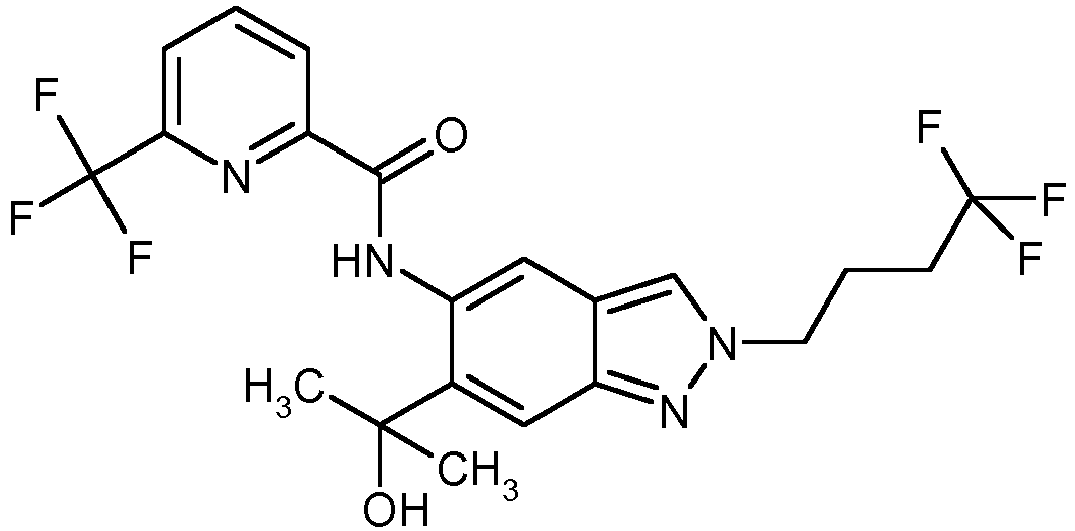
- Eine Mischung aus 210 mg (0.58 mmol) N-[6-(2-Hydroxypropan-2-yl)-1H-indazol-5-yl]-6-(trifluormethyl)pyridin-2-carboxamid (Intermediat 5-1) in 3 ml DMF wurde mit 0.11 ml (0.87 mmol) 1,1,1-Trifluor-4-iodbutan und 239 mg Kaliumcarbonat versetzt und die Mischung wurde 6 h bei 80°C gerührt. Nach Addition von Wasser wurde dreimal mit Ethylacetat extrahiert und die vereinigten organischen Phasen wurden mit gesättigter Kochsalzlösung durch einen wasserabweisenden Filter filtriert und eingeengt. Das Rohprodukt wurde durch präparative HPLC gereinigt. Es wurden 19 mg der Titelverbindung erhalten.
UPLC-MS (Methode A1): Rt = 1.27 min (UV Detektor: TIC), gefundene Masse 474.15.
1H-NMR (400MHz, DMSO-d6): δ [ppm]= 1.62 (s, 6H), 2.10 - 2.33 (m), 4.49 (t, 2H), 5.94 (s, 1H), 7.59 (s, 1H), 8.13 - 8.18 (m, 1H), 8.32 - 8.41 (m, 2H), 8.41 - 8.47 (m, 1H), 8.72 (s, 1H), 12.35 (s, 1H). -

- 150 mg (0.33 mmol) N-[6-(2-Hydroxypropan-2-yl)-1H-indazol-5-yl]-6-(trifluormethyl)pyridin-2-carboxamid (Intermediat 5-1) wurden in 2 ml THF vorgelegt. Man addierte 58 mg (0.40 mmol) 3-(Trifluormethoxy)propan-1-ol, 131 mg Triphenylphosphin und 71 µl Diisopropyl-azodicarboxylat (DIAD, CAS 2446-83-5) und rührte 19 h bei Raumtemperatur. Man versetzte mit 0.83 ml Natronlauge (2M) und rührte 5 h bei 40°C. Man verdünnte mit Wasser, extrahierte dreimal mit Ethylacetat, engte die vereinigten organischen Phasen ein und reinigte durch präparative HPLC. Es wurden 16 mg der Titelverbindung als Rohprodukt erhalten.
UPLC-MS (Methode A2): Rt = 1.26 min (UV Detektor: TIC), gefundene Masse 490.14.
1H-NMR (400MHz, DMSO-d6, ausgewählte Signale): δ [ppm]= 1.61 (s, 6H), 1.84 (d, 1H), 2.32 (quint., 2H), 4.08 (t, 2H), 4.51 (t, 2H), 7.58 (s, 1H), 8.15 (d, 1H), 8.31 - 8.39 (m, 2H), 8.44 (d, 1H), 8.72 (s, 1H), 12.35 (s, 1H). -

- Analog zur Herstellung von Beispiel 11 (Herstellungsmethode 1) wurden 52 mg (0.10 mmol) Methyl-2-[3-(2,2,2-trifluorethoxy)propyl]-5-({[6-(trifluormethyl)pyridin-2-yl]carbonyl}amino)-2H-indazol-6-carboxylat (Intermediat 4-10) in 3 ml THF mit 2 mal 171 µl 3M Magnesiumbromidlösung in Diethylether umgesetzt. Nach Reinigung durch präparative HPLC wurden 12 mg der Titelverbindung erhalten.
UPLC-MS (Methode A1): Rt = 1.25 min (UV Detektor: TIC), gefundene Masse 504.16.
1H-NMR (500 MHz, DMSO-d6): δ [ppm] = 1.63 (s, 6H), 2.20(quin, 2H), 3.58(t, 2H),4.05(q, 2H), 4.47(t, 2H),5.94(s, 1H), 7.58 (s, 1H), 8.15 (dd, 1H), 8.32 (s, 1H), 8.36 (t, 1H), 8.45(d, 1H), 8.73 (s, 1H), 12.36 (s,1H). -
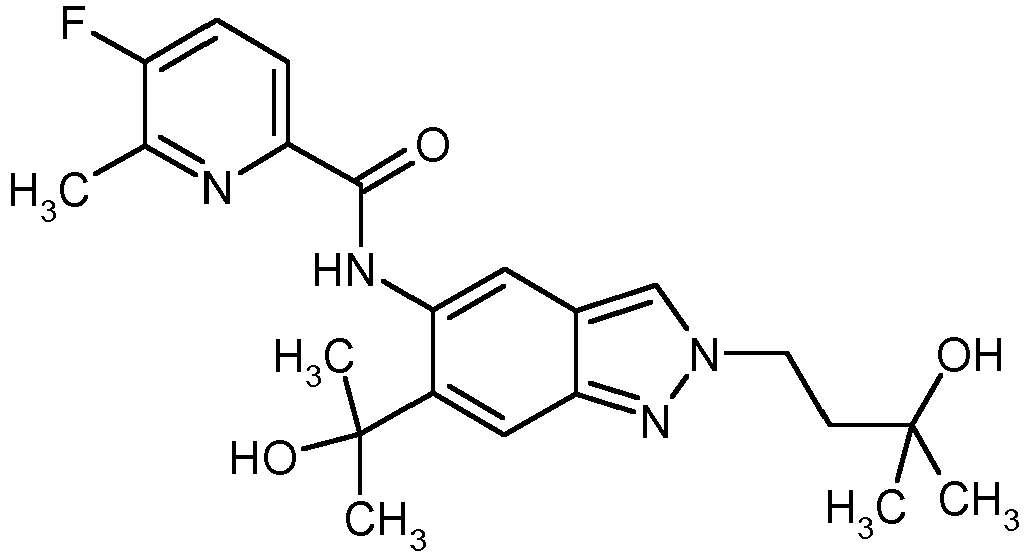
- 228 mg (0.31 mmol) Methyl-5-{[(5-fluor-6-methylpyridin-2-yl)carbonyl]amino}-2-(3-hydroxy-3-methylbutyl)-2H-indazol-6-carboxylat (Intermediat 4-8) wurden in 4.5 ml THF vorgelegt und mit einem Eiskältebad abgekühlt. Man addierte 0.63 ml 3M Methylmagnesiumbromidlösung (in Diethylether) und ließ 2 h unter Eisbadkühlung und 21 h bei Raumtemperatur rühren. Das Reaktionsgemisch wurde mit gesättigter wässriger Ammoniumchloridlösung versetzt und dreimal mit Ethylacetat extrahiert. Die vereinigten organischen Phasen wurden eingeengt. Der Rückstand wurde durch präparative HPLC gereinigt. Es wurden 82 mg der Titelverbindung erhalten.
UPLC-MS (Methode A2): Rt = 1.03 min (UV Detektor: TIC), gefundene Masse 414.21.
1H-NMR (400MHz, DMSO-d6): δ [ppm]= 1.13 (s, 6H), 1.63 (s, 6H), 1.99 - 2.05 (m, 2H), 2.55 - 2.59 (m, 3H), 4.42 - 4.50 (m, 3H), 5.95 (s, 1H), 7.54 (s, 1H), 7.83 (t, 1H), 8.05 (dd, 1H), 8.31 (s, 1H), 8.68 (s, 1H), 12.33 (s, 1H). -

- 278 mg (0.48 mmol) Methyl-2-(3-hydroxy-3-methylbutyl)-5-{[(6-methylpyridin-2-yl)carbonyl]amino}-2H-indazol-6-carboxylat (Intermediat 4-9) wurden in 5.0 ml THF vorgelegt und mit einem Eiskältebad abgekühlt. Man addierte 0.97 ml 3M Methylmagnesiumbromidlösung (in Diethylether) und ließ 2 h unter Eisbadkühlung und 20.5 h bei Raumtemperatur rühren. Man addierte erneut 0.48 ml 3M Methylmagnesiumbromidlösung und ließ 67 h bei Raumtemperatur rühren. Man versetzte mit gesättigter wässriger Ammoniumchloridlösung, extrahierte dreimal mit Ethylacetat, wusch mit Kochsalzlösung, filtrierte über einen wasserabweisenden Filter und engte ein. Der Rückstand wurde durch präparative HPLC gereinigt. Es wurden 111 mg der Titelverbindung erhalten.
UPLC-MS (Methode A2): Rt = 0.97 min (UV Detektor: TIC), gefundene Masse 396.22.
1H-NMR (400MHz, DMSO-d6): δ [ppm]= 1.15 (s, 6H), 1.64 (s, 6H), 2.00 - 2.08 (m, 2H), 2.61 (s, 3H), 4.41 - 4.59 (m, 3H), 5.92 (s, 1H), 7.50 (dd, 1H), 7.56 (s, 1H), 7.90 - 7.99 (m, 2H), 8.33 (s, 1H), 8.70 (s, 1H), 12.39 (s, 1H). -

- Eine Lösung aus 72 mg (0.16 mmol) Methyl-5-({[6-(2-hydroxypropan-2-yl)pyridin-2-yl]carbonyl}amino)-2-(4,4,4-trifluorbutyl)-2H-indazol-6-carboxylat (Intermediat 4-7) in 10 ml THF wurde in einem Eiswasser-Kältebad gekühlt. Man addierte 0.26 ml einer 3M Methylmagnesiumbromidlösung in Diethylether, rührte 2 h und danach 20 h bei Raumtemperatur. Man addierte erneut 1 Äquivalent der 3M Methylmagnesiumbromidlösung und rührte 24 h bei Raumtemperatur. Man addierte gesättigte wässrige Ammoniumchloridlösung, extrahierte dreimal mit Ethylacetat, wusch mit Kochsalzlösung und engte ein. Nach präparativer HPLC wurden 22 mg (31% d. Th.) der Titelverbindung erhalten.
UPLC-MS (Methode A2): Rt = 1.15 min (UV Detektor: TIC), gefundene Masse 464.20.
1H-NMR (400MHz, DMSO-d6): δ [ppm]= 1.56 (s, 6H), 1.64 (s, 6H), 2.07 - 2.34 (m, 4H), 4.49 (t, 2H), 5.32 (s, 1H), 6.05 (s, 1H), 7.60 (s, 1H), 7.87 (dd, 1H), 7.99 - 8.05 (m, 2H), 8.35 (s, 1H), 8.79 (s, 1H), 12.45 (s, 1H). -

- 250 mg (0.69 mmol) N-[6-(2-Hydroxypropan-2-yl)-1H-indazol-5-yl]-6-(trifluormethyl)pyridin-2-carboxamid (Intermediat 5-1) wurden in 5 ml DMSO vorgelegt. Es wurden 159 mg (0.96 mmol) 1-(2-Bromethyl)cyclopropanol, 285 mg Kaliumcarbonat und 171 mg Kaliumiodid zugegeben und die Mischung wurde 5 h bei 100°C gerührt. Es wurde Wasser zugegeben und dreimal mit Ethylacetat extrahiert. Die vereinigten, organischen Phasen wurden mit Kochsalzlösung filtriert durch einen wasserabweisenden Filter und eingeengt. Der Rückstand wurde durch präparative HPLC (Säule: Waters XBrigde C18 5µ 100x30mm, Eluent A: Wasser + 0.1 Volumen-% Ameisensäure (99%), Eluent B: Acetonitril) gereinigt. Nach einer Gefriertrocknung erhielt man 45 mg der Titelverbindung.
1H-NMR (500MHz, DMSO-d6): δ [ppm]= 0.18 - 0.22 (m, 2H), 0.48 - 0.52 (m, 2H), 1.62 (s, 6H), 2.08 (t, 2H), 4.54 - 4.60 (m, 2H), 5.36 (s, 1H), 5.96 (s, 1H), 7.57 (s, 1H), 8.16 (dd, 1H), 8.34 - 8.39 (m, 2H), 8.45 (d, 1H), 8.72 (s, 1H), 12.36 (s, 1H). - Die IRAK4-inhibitorische Aktivität der erfindungsgemäßen Substanzen wurde in dem nachfolgend beschriebenen IRAK4-TR-FRET-Assay gemessen (TR-FRET = Time Resolved Fluorescence Resonance Energy Transfer).
- Rekombinantes Fusionsprotein aus N-terminalem GST (Glutathion-S-Transferase) und humanem IRAK4, exprimiert in Bakulovirus-infizierten Insektenzellen (Hi5, BTI-TN-5B1-4, Zelllinie gekauft von Invitrogen, Katalog-Nr. B855-02) und gereinigt via Affinitätschromatographie, wurde als Enzym verwendet. Als Substrat für die Kinasereaktion wurde das biotinylierte Peptid Biotin-Ahx-KKARFSRFAGSSPSQASFAEPG (C-Terminus in Amid-Form) verwendet, das z.B. bei der Firma Biosyntan GmbH (Berlin-Buch) gekauft werden kann.
- Für den Assay wurden 11 verschiedene Konzentrationen im Bereich von 20 µM bis 0,073 nM aus einer 2 mM Lösung der Testsubstanz in DMSO hergestellt. 50 nl der jeweiligen Lösung wurden in eine schwarze low-volume 384well-Mikrotiterplatte (Greiner Bio-One, Frickenhausen, Deutschland) pipettiert, 2 µl einer Lösung von IRAK4 in Assaypuffer [50 mM HEPES pH 7.5, 5mM MgCl2, 1.0 mM Dithiothreitol, 30 µM aktiviertes Natriumorthovanadat, 0,1 % (w/v) bovines gamma-Globulin (BGG) 0,04% (v/v) Nonidet-P40 (Sigma)] hinzugegeben und die Mischung für 15 min inkubiert, um eine Vorbindung der Substanzen an das Enzym vor der Kinasereaktion zu ermöglichen. Dann wurde die Kinasereaktion gestartet durch Zugabe von 3 µl einer Lösung von Adenosinetriphosphat (ATP, 1,67 mM = Endkonzentration in 5 µl Assayvolumen ist 1 mM) und Peptidsubstrat (0,83 µM = Endkonzentration in 5 µl Assayvolumen ist 0,5 µM) in Assaypuffer und die resultierende Mischung für die Reaktionszeit von 45 min bei 22°C inkubiert. Die Konzentration des IRAK4 wurde an die jeweilige Aktivität des Enzyms angepasst und so eingestellt, dass der Assay im linearen Bereich arbeitete. Typische Konzentrationen lagen in der Größenordnung von etwa 0,2 nM. Die Reaktion wurde gestoppt durch Zugabe von 5 µl einer Lösung von TR-FRET-Detektionsreagenzien [0,1 µM Streptavidin-XL665 (Cisbio Bioassays; Frankreich, Katalog-Nr. 610SAXLG) und 1,5 nM Antiphosho-Serin Antikörper [Merck Millipore, "STK Antibody", Katalog-Nr. 35-002] und 0,6 nM LANCE EU-W1024-markierter anti-Maus-IgG-Antikörper (Perkin-Elmer, Produkt-Nr. AD0077. Alternativ kann ein Terbium-Kryptat-markierter anti-Maus-IgG-Antikörper von Cisbio Bioassays verwendet werden) in wässriger EDTA-Lösung (100 mM EDTA, 0.4 % [w/v] bovines Serumalbumin [BSA] in 25 mM HEPES pH 7,5].
- Die resultierende Mischung wurde 1 h bei 22°C inkubiert, um die Bildung eines Komplexes aus dem biotinylierten phosphorylierten Substrat und den Detektionsreagenzien zu ermöglichen. Anschließend wurde die Menge des phosphorylierten Substrates ausgewertet durch eine Messung des Resonanz-Energietransfers vom Europium-Chelat markierten anti-Maus-IgG-Antikörper zum Streptavidin-XL665. Hierzu wurden in einem TR-FRET-Messgerät, z.B. einem Rubystar (BMG Labtechnologies, Offenburg, Germany) oder einem Viewlux (Perkin-Elmer), die Fluoreszenz-Emissionen bei 620 nm and 665 nm nach Anregung bei 350 nm gemessen. Das Verhältnis der Emissionen bei 665 nm und 622 nm wurde als Maß für die Menge des phosphorylierten Substrates genommen. Die Daten wurden normalisiert (Enzymreaktion ohne Testsubstanz = 0 % Inhibition, alle anderen Assaykomponenten aber kein Enzym = 100 % Inhibition). Üblicherweise wurden die Testsubstanzen auf derselben Mikrotiterplatte bei 11 verschiedenen Konzentrationen im Bereich von 20 µM bis 0,073 nM getestet (20 µM, 5,7 µM, 1,6 µM, 0,47 µM, 0,13 µM, 38 nM, 11 nM, 3,1 nM, 0,89 nM, 0,25 nM und 0,073 nM). Die Verdünnungsreihen wurden vor dem Assay hergestellt (2 mM bis 7,3 nM in 100 % DMSO) durch serielle Verdünnungen. Die IC50-Werte wurden kalkuliert mit einem 4-Parameter-Fit.
Tabelle 1: IC50-Werte der Beispielverbindungen im IRAK4 Kinase Assay Beispiel IC50 [nM] 1 30.6 2 135.6 3 7.2 4 52.7 5 264.5 6 35.7 7 867.3 8 15.0 9 103.8 10 18.5 11 3.4 12 10.7 13 1.3 14 10.8 15 12.3 16 21.5 17 36.0 18 47.5 19 8.9 20 13.3 21 117.2 22 3.7 - Die inhibitorische Aktivität der erfindungsgemäßen Substanzen der allgemeinen Formel (III) an IRAK4 wurde ebenfalls in dem oben beschriebenen IRAK4-TR-FRET-Assay gemessen. Exemplarisch sind die Verbindung Intermediat 4-2 mit einem IC50 = 21.7 nM, Intermediat 4-3 mit einem IC50 = 13.0 nM und Intermediat 4-4 mit einem IC50 = 6.2 nM genannt.
- Mithilfe dieses Tests können Substanzen auf ihre Fähigkeit hin getestet werden, TNF-α (Tumornekrosefaktor-alpha) Ausschüttung in THP-1 Zellen (humane monozytische akute Leukämie-Zellinie) zu inhibieren. TNF-α ist ein Zytokin, welches in inflammatorischen Prozessen beteiligt ist. Die TNF-α Ausschüttung wird in diesem Test durch Inkubation mit bakteriellem Lipopolysaccharid (LPS) ausgelöst.
- THP-1 Zellen wurden in kontinuierlicher Suspensions-Zellkultur [RPMI 1460 Medium mit L-Glutamax (Gibco, Kat.-Nr. 61870-044) supplementiert mit foetalem Kälberserum (FCS) 10% (Invitrogen, Kat.-Nr. 10082-147), 1% Penicillin/Streptomycin (Gibco BRL, Kat.-Nr. 15140-114)] gehalten und sollten eine Zellkonzentration von 1x10⁶ Zellen/ml nicht überschreiten. Der Assay erfolgte im Zellkulturmedium (RPMI 1460 Medium mit L-Glutamax supplementiert mit FCS 10%).
- Jeweils 2-2.5 µl der Zellsuspension (entspricht 4000 Zellen) wurden pro well in eine 384-well Testplatte Greiner Kat.-Nr. 784076) dispensiert, in der sich jeweils 40-50 nl Substanz in 100% DMSO gelöst befanden. Hierbei wurden jeweils 10 verschiedene Konzentrationen im Bereich von 20 µM bis 0,073 nM je Substanz eingesetzt. Die Zellen wurden 15 min bei Raumtemperatur inkubiert. Anschließend wurden 2-2.5 µl pro well 0.1 µg/ml LPS (Sigma, Escherichia coli 055:B5, Kat.-Nr. L5418) gelöst in Zellkulturmedium dispensiert (finale Konzentration 0.05 µg/ml). Als Neutralkontrolle wurden Zellen mit 0.05 µg/ml LPS und 1% DMSO und als Inhibitorkontrolle nur mit 1% DMSO behandelt.
- Die Platten wurden 30 sec bei 80g zentrifugiert und 17 h bei 37°C, 5% CO2 und 95% Luftfeuchtigkeit inkubiert. Zur Bestimmung der Menge an TNF-α wurde der TNF-alpha HTRF Detection Kit (Cisbio, Kat.-Nr. 62TNFPEB/C) verwendet. Hierzu wurden jeweils 2 µl der Detektionslösung, bestehend aus Anti-TNF-α-XL665 Konjugat und Anti-TNF-α-Kryptat Konjugat gelöst nach Anweisung des Herstellers im Rekonstitutionspuffer, für den HTRF (Homogeneous Time-Resolved Fluorescence) Test zugegeben. Nach Zugabe wurde entweder 3 h bei Raumtemperatur oder über Nacht bei 4°C inkubiert. Anschließend wurden die Signale mit einem HTRF-fähigen Messgerät wie dem BMG PheraStar bei 620/665nm ausgelesen.
- Die Wirkung der Substanzen wird als Verhältnis zwischen Neutral- und Inhibitorkontrolle in Prozent ausgedrückt. Die IC50-Werte wurden mit einem 4-Parameter-Fit kalkuliert.
Tabelle 2: IC50-Werte der Beispielverbindungen bezüglich der TNF-α Ausschüttung in THP-1 Zellen Beispiel IC50 [µM] 1 1.0 2 15.1 3 0.7 4 5.6 5 5.4 6 0.9 7 16.4 8 1.0 9 6.5 10 1.0 11 0.2 12 0.3 13 0.1 14 0.2 15 0.2 16 0.2 17 0.5 18 0.3 19 0.1 20 0.2 21 1.8 - Die Wirkung der erfindungsgemäßen Verbindungen der allgemeinen Formel (I) auf die induzierte Zytokinproduktion in humanen PBMCs wurde untersucht. Hierbei erfolgte die Induktion der Zytokinproduktion durch LPS, einen TLR4 Liganden, welcher zur Aktivierung des IRAK4-vermittelten Signalweges führt.
- Die Gewinnung der humanen PBMCs erfolgte aus anti-koaguliertem humanem Vollblut. Hierzu wurde in Leucosep-Röhrchen 15 ml Ficoll-Paque (Biochrom, Kat.-Nr. L6115) vorgelegt und 20 ml Humanblut hinzugefügt. Nach Zentrifugation des Blutes bei 800g für 15 min bei Raumtemperatur wurde Plasma inklusive der Thrombozyten abgenommen und verworfen. Die PBMCs wurden in Zentrifugenröhrchen überführt und mit PBS (phosphatgepufferte Salzlösung) (Gibco, Kat.-Nr. 14190) aufgefüllt. Die Zellsuspension wurde bei 250g für 10 min bei Raumtemperatur zentrifugiert und der Überstand verworfen. Die Resuspension der PBMCs erfolgte in Komplettmedium (RPMI 1640, ohne L-Glutamin (PAA, Kat.-Nr. E15-039), 10% FCS; 50 U/ml Penicillin, 50 µg/ml Streptomycin (PAA, Kat.-Nr. P11-010) und 1% L-Glutamin (Sigma, Kat.-Nr. G7513)).
- Auch der Assay erfolgte in Komplettmedium. Die PBMCs wurden in 96-well Platten mit einer Zelldichte von 2.5x10⁵ Zellen/well ausgesät. Die erfindungsgemäßen Verbindungen wurden in einem konstanten Volumen von 100% DMSO seriell verdünnt und in dem Assay mit 8 verschiedenen Konzentrationen im Bereich von 10 µM bis 3 nM so eingesetzt, so dass die finale DMSO Konzentration 0.4% DMSO betrug. Die Zellen wurden damit für 30 min vor der eigentlichen Stimulation vorinkubiert. Zur Induktion der Zytokinsekretion erfolgte eine Stimulation mit 0.1 µg/ml LPS (Sigma, Escherichia coli 0128:B12, Kat.-Nr. L2887) für 24 Stunden. Die Bestimmung der Zellviabilität erfolgte unter Verwendung des CellTiter-Glo Luminescent Assay (Promega, Kat.-Nr. G7571 (G755/G756A)) nach Anweisung des Herstellers. Die Bestimmung der Menge an sekretiertem TNF-α im Zellkulturüberstand erfolgte mittels Human Prolnflammatory 9-Plex Tissue Culture Kit (MSD, Kat.-Nr. K15007B) nach Anweisung des Herstellers. Exemplarisch sind die Beispielverbindung 11 und die Beispielverbindung 12 mit einer Aktivität ≤ 1µM genannt.
- Die Wirkung der erfindungsgemäßen Verbindungen der allgemeinen Formel (I) auf die induzierte Produktion des pro-inflammatorischen Zytokins IL-23, welches eine essentielle Rolle für die Generation von TH-17 Zellen spielt, wurde in humanen DCs untersucht. Es wird beschrieben, dass TH-17 Zellen eine entscheidende Rolle in der Pathogenese von Erkrankungen wie Rheumatoide Arthritis, Psoriatrische Arthritis, Morbus Bechterew (Ankylosing Spondylitis) oder auch Multiple Skerose spielen (Lubberts, Nat. Rev. Rheumatol., 2015; Marinoni et al., Auto. Immun. Highlights, 2014; Isailovic et al., J. Autoimmun., 2015; Staschke et al., J Immunol., 2009). Zum Nachweis der Wirkung der erfindungsgemäßen Verbindungen auf die IL-23 Produktion wurden humane primäre Monozyten (isoliert aus humanen PBMCs mit Hilfe magnetischer Separation [Miltenyi Biotech, Monocyte Isolation Kit, Kat.-Nr. 130-091-153] unter Zusatz von Wachstumsfaktoren (rekombinantes humanes GM-CSF [PeproTech, Kat.-Nr. 300-03] und IL-4 [PeproTech, Kat.-Nr. 200-04]) in Komplettmedium (VLE (very low endotoxin) RPMI 1640 [Biochrom AG, Kat.-Nr. FG1415], 10% Fetal Bovine Serum (FBS) [Gibco, Kat.-Nr. 10493-106]; 50 µM β-Mercaptoethanol (Gibco, Kat.-Nr. 31350], 50 U/ml Penicillin und Streptomycin [Gibco, Kat.-Nr. 15140-114]) über 6 Tage in Kultur zu DCs differenziert. Nach erfolgter Ernte der DCs wurden diese im Komplettmedium resuspendiert und in einer Zelldichte von 2x10⁵ Zellen/well in einer 96-well Platten (Costar, Kat.-Nr. 3599) ausgesät. Die erfindungsgemäßen Verbindungen wurden in einem konstanten Volumen von 100% DMSO seriell verdünnt und in dem Assay mit 9 verschiedenen Konzentrationen im Bereich von 10 µM bis 1 nM eingesetzt. Hierbei wurde darauf geachtet, dass für jede der eingesetzten 9 Konzentrationen die enthaltene DMSO Konzentration immer 0.1% DMSO betrug. Es erfolgte eine 30minütige Vorinkubation der DCs mit den erfindungsgemäßen Verbindungen. Hiernach wurden dann die DCs mittels 10ng/ml LPS (Sigma, Escherichia coli Serotyp 0127:B8, Kat.-Nr. L3129) (TLR4 Ligand) und 2,5µg/ml des TLR-7/8-Ligand R848 (Invivogen, Kat.-Nr. tlrl-r848-5), welche beide die Aktivierung des IRAK4-vermittelten Signalweges bewirken, für 24 Stunden im Brutschrank (37°C, 95%rH, 5% CO2) zur IL-23 Produktion stimuliert. Nach dieser 24-stündigen Inkubationszeit wurden die Überstände abgenommen und mit Hilfe eines kommerziell erhältlichen hIL-23 ELISAs (eBiosciences, Kat.-Nr. 88-7237-88), der nach Herstellerangaben durchgeführt wurde, analysiert. Die Ergebnisse der Hemmung von IL-23 in humanen DCs sind beispielhaft für die Beispielverbindung 12 in
Abbildung 1 gezeigt. - Mit Hilfe dieses Tests kann die Wirkung der erfindungsgemäßen Verbindungen der allgemeinen Formel (I) auf die Produktion von IFNα (Interferon-alpha), ein Schlüsselzytokin in der Pathogenese des Systemischen Lupus Erythematodes (Mathian et al., Arthritis Rheum, 2009; Crow M.K., Rheum Dis Clin N Am, 2010), in humanen pDCs untersucht werden. Hierzu wurden wie oben beschrieben humane PBMCs aus Vollblut isoliert und nachfolgend die plasmazytoiden DCs (pDCs) aus diesen mit Hilfe eines kommerziell erhältlichen Zellseparations-Kits (Miltenyi Biotech, Plasmacytoid Dendritic Cell Isolation Kit II, Kat.-Nr. 130-097-415) isoliert. Die so erhaltenen pDCs wurden in Komplettmedium (RPMI 1640 + GlutaMax [Gibco, Kat.-Nr. 61870-010] supplementiert mit 10% FBS [Gibco, Kat.-Nr. 10493-106] und 50 U Penicillin/Streptomycin [Gibco, Kat.-Nr. 15140-114]) resuspendiert und in einer Zelldichte von 5x10⁴ Zellen/well in einer 96er-Mikrotiterplatte (Costar, Kat.-Nr. 3599) ausplattiert. Die erfindungsgemäßen Verbindungen wurden in einem konstanten Volumen von 100% DMSO seriell verdünnt und in dem Assay mit 9 verschiedenen Konzentrationen im Bereich von 10 µM bis 1 nM eingesetzt. Hierbei wurde darauf geachtet, dass für jede der eingesetzten 9 Konzentrationen die enthaltene DMSO Konzentration immer 0.1% DMSO betrug. Es erfolgte eine 30minütige Vorinkubation der pDCs mit den erfindungsgemäßen Verbindungen. Die Stimulation der pDCs erfolgte entweder mit einem TLR7/8 Liganden (Imiquimod, R837, Invivogen, Kat.-Nr. tlrl-imq) oder mit einem TLR-9 Liganden (CPG-A, ODN2216, Invivogen, Kat.-Nr. tlrl-2216-1) und führte zur Aktivierung der IRAK4-vermittelten Signalwege. Nach 24-stündiger Inkubation wurden die Zellkulturüberstände entnommen und mittels eines kommerziell erhältlichen humanen IFNα ELISAs (IFNalpha Multi-Subtype ELISA Kit, pbl Assay Science, Kat.-Nr. 41105-1) analysiert. Die Ergebnisse der Hemmung von IFNα in humanen plasmazytoiden DCs sind beispielhaft für die Beispielverbindung 12 in
Abbildung 2 gezeigt. - Die erfindungsgemäßen Verbindungen der allgemeinen Formel (I) wurden in einem in vivo TLR-vermittelten Inflammationsmodell bezüglich ihrer in vivo Wirksamkeit untersucht. Dieses mechanistische Modell zeigt insbesondere die potentielle Wirkung der erfindungsgemäßen Verbindungen auf TLR4-vermittelte Erkrankungen, da ein LPS-vermitteltes Inflammationsmodell verwendet wurde. Hierbei wurden weibliche Balb/c Mäuse (ca. 8 Wochen alt; Charles River Laboratories, Deutschland) in Gruppen von jeweils 5 Tieren aufgeteilt. Die Kontrollgruppe wurde mit dem Vehikel, in welchem die Substanz gelöst wurde (Substanzvehikel), als auch mit dem Vehikel, in welchem das LPS gelöst wurde, behandelt. Neben den Substanzbehandlungsgruppen wurde auch der Positivkontrollgruppe jeweils 0,2 mg LPS/kg Körpergewicht (Sigma, Kat.-Nr. L4391) (Lipopolysaccharides from E. coli 0111:B4) intraperitoneal (i.p.) verabreicht. Die Positivkontrollgruppe erhielt außerdem das oben beschriebene Substanzvehikel. Die Substanzgabe erfolgte oral 16 Stunden vor Induktion der Inflammation durch die Gabe von LPS. Zur Untersuchung der Wirkung der erfindungsgemäßen Verbindungen auf die Inflammation erfolgte bei den Tieren nach 1,5 Stunden die finale Blutentnahme. Die Bestimmung der Konzentration bestimmter Zytokine erfolgte im Plasma durch Verwendung des Mouse ProInflammatory 7-Plex Tissue Culture Kit (MSD, Kat.-Nr. K15012B) nach Anweisung des Herstellers. IRAK4 Inhibitoren sind effektiv im TLR-vermittelten Inflammationsmodel.
Abbildung 3 zeigt die Menge an TNF-α im Plasma, die im Vergleich zur LPS-induzierten Konzentration durch die Gabe von Beispielverbindung 11 Dosis-abhängig reduziert ist. - Zur Erfassung der potentiellen Wirksamkeit der erfindungsgemäßen Verbindungen der allgemeinen Formel (I) in IL-1β-vermittelten Erkrankungen, wurde weiblichen Balb/c Mäusen (ca. 8 Wochen, Charles River Laboratories, Deutschland) IL-1β i.p. appliziert und die Wirkung der erfindungsgemäßen Verbindungen auf die IL-1β-vermittelte Zytokinsekretion untersucht. Die Gruppengröße betrug jeweils 5 Tiere. Die Kontrollgruppe wurde mit den Vehikeln, welche zur Lösung der Substanz und des IL-1β eingesetzt wurden, behandelt. Den Substanzbehandlungsgruppen und der Positivkontrollgruppe wurde jeweils 90 µg IL-1β /kg Körpergewicht (R&D, Kat.-Nr. 401-ML/CF) i.p verabreicht. Die Substanz bzw. dessen Vehikel in der Positivkontrollgruppe wurde 6 Stunden vor der IL-1β Verabreichung appliziert. Die Bestimmung von TNF-α im Plasma nach finaler Blutentnahme erfolgte 2 Stunden nach Verabreichung des IL-1β mittels des Mouse ProInflammatory 7-Plex Tissue Culture Kit (MSD, Kat.-Nr. K15012B) nach Anweisung des Herstellers. Die Gabe von IL-1β führt zu einer erhöhten Konzentration an TNF-α im Plasma, welches durch die Behandlung mit den Beispielverbindungen 11 und 12 inhibiert wird. Dies wird durch
Abbildung 4 verdeutlicht. - Zur Ermittlung der anti-inflammatorischen Aktivität der erfindungsgemäßen Verbindungen der allgemeinen Formel (I) wurden diese in einem Arthritismodel hinsichtlich ihrer in vivo Wirksamkeit untersucht. Hierzu wurden männlichen Lewis-Ratten (ca. 100-125g, Charles River Laboratories, Deutschland) je 100µl einer Complete-Freund'schen Adjuvanz (CFA)-Lösung (M tuberculosis H37Ra [Difo Lab, Kat.-Nr. -231141] gelöst in Incomplete Freund'schen Adjuvanz [Difco Lab, Kat.-Nr. -263910]) subkutan in die Schwanzwurzel an Tag 0 appliziert. Die Gruppengröße betrug jeweils n= 8 Ratten. Es wurde sowohl eine gesunde Kontrollgruppe als auch eine Erkrankungs-Kontrollgruppe im Experiment mitgeführt. Beide Kontrollgruppen wurden jeweils nur mit dem Vehikel der Prüfsubstanz p.o. behandelt. Die Behandlung mit unterschiedlichen Dosierungen der Prüfsubstanz wurde präventiv, d.h. ab Tag 0, per oraler Gabe durchgeführt. An Tag 0 wurde zudem die Ausgangssituation der Tiere bezüglich des Disease Activity Scores (Bewertung des Schweregrads der Arthritis anhand eines Punktesystems) bestimmt. In diesem Punktesystem (Score) werden je nach Ausmaß der Gelenkentzündung Punkte von 0 bis 4 für das Vorhandensein eines Erythems inklusive einer Gelenkschwellung (0= keine; 1=leicht; 2= moderat; 3=deutlich; 4=massiv) für beide Hinterpfoten vergeben und addiert. Zur Ermittlung der anti-entzündlichen Wirksamkeit der Verbindungen wurde ab Tag 8, an dem die Tiere erstmals Zeichen einer Arthritis zeigen, und weiterfolgend 3 Mal in der Woche der Erkrankungsstatus der Tiere mittels Disease Activity Score bis zum Ende (Tag 20) bewertet. Die statistische Analyse erfolgte unter Verwendung der einfaktoriellen Varianzanalyse (ANOVA; Analysis of Variance) und dem Vergleich zur Kontrollgruppe mittels multipler Vergleichsanalyse (Dunnett-Test).
- Die s.c. Applikation von CFA in Ratten führt zu einer akuten Arthritis mit deutlicher Gelenkentzündung in Ratten. Diese induzierte Arthritis konnte durch die Behandlung mit der Beispielverbindung 11 inhibiert werden. Dies wird durch
Abbildung 5 verdeutlicht. - Die anti-inflammatorische Wirkung der erfindungsgemäßen Verbindungen der allgemeinen Formel (I) wurde in einem weiteren murinen Arthritismodell untersucht. Hierzu wurden weibliche Balb/c Mäuse (ca. 9 Wochen alt; Charles River Laboratories, Kingston, Kanada) an Tag 0 je 200µl eines Collagen-Antikörper-Cocktails (10mg/ml; ArthritoMab, MD Bioproducts) intravenös in die Schwanzvene injiziert (mit Ausnahme der mitgeführten gesunden Kontrollgruppe). An Tag 6 erhielten diese Mäuse dann eine weitere intraperitoneale Injektion mit je 200µl LPS. Die Gruppengröße betrug jeweils n= 10 Mäuse. Es wurde sowohl eine gesunde Kontrollgruppe als auch eine Erkrankungs-Kontrollgruppe im Experiment mitgeführt. Beide Kontrollgruppen wurden jeweils nur mit dem Vehikel der Prüfsubstanz p.o. behandelt. Die Behandlung mit unterschiedlichen Dosierungen der Prüfsubstanz wurde präventiv, d.h. ab Tag 0, per oraler Gabe durchgeführt. Im Verlauf des Experimentes wurde das Ausmaß der Erkrankung anhand des Punktevergabesystems für den Disease Activity Score an allen vier Pfoten bewertet. Diese Punktevergabe sieht vor, dass für eine gesunde Pfote keine Punkte vergeben werden, wohingegen für die jeweilige entstehende Ausdehnung der Gelenkentzündung von den Zehen über das Mittelfußgelenk bis hin zum Fußgelenk jeweils Punkte von 1 [milde Entzündung z.B. der Zehe(n)] bis 4 [starke Entzündung mit Ausdehnung über die gesamte Pfote] wie nachfolgend erklärt vergeben werden:
- 0 = normal
- 1 = Erythem und milde Schwellung begrenzt auf Mittelfuß (tarsal) oder Fußgelenk oder Zehen
- 2 = Erythem und milde Schwellung, welche sich vom Fußgelenk bis zum Mittelfuß (2 Segmente) ausdehnt
- 3 = Erythem und moderate Schwellung, welche sich vom Fußgelenk bis zu den metatarsal Gelenken ausdehnt
- 4 = Erythem und starke Schwellung, welche auf Fußgelenk, Fuß und Zehen übergreift
- Für diesen Parameter wurde zuvor die Ausgangssituation einen Tag vor Start des Experimentes (Tag -1) ermittelt und nachfolgend ab Tag 8 dreimal pro Woche dieser Disease Activity Score bewertet. Die statistische Analyse erfolgte unter Verwendung der einfaktoriellen Varianzanalyse ANOVA und dem Vergleich zur Kontrollgruppe mittels multipler Vergleichsanalyse (Dunnett-Test).
- Die i.v. Applikation eines Collagen-Antikörper-Cocktails inklusive der nachfolgenden i.p. Applikation von LPS in Mäusen führt zu einer akuten Arthritis mit deutlicher Gelenkentzündung in Mäusen. Diese induzierte Arthritis konnte durch die Behandlung mit der Beispielverbindung 12 inhibiert werden. Dies wird durch
Abbildung 6 verdeutlicht. - Zur experimentellen Induktion einer NASH wird 45 männlichen C57BL/6 Mäuse in einem Alter von 2 Tagen jeweils 200 µg Streptozotocin (STZ; Sigma-Aldrich, USA) subkutan injiziert. Ab einem Alter von 4 Wochen werden diese Tiere bis zum Versuchsende mit einer Hochfett-Diät (HFD; 57 kcal% Fett, Kat.-Nr. #HFD32 der Firma CLEA, Japan) ad libitum gefüttert. Mit einem Alter von 6 Wochen werden die Tiere randomisiert auf 3 Gruppen aufgeteilt (15 Tiere pro Gruppe). Während eine der Gruppen keine Behandlung erhält, werden die anderen 2 Gruppen entweder mit Vehikel oder der Prüfsubstanz über 4 Wochen täglich oral behandelt. Nach Abschluss der 4-wöchigen Behandlung werden alle Tiere unter Narkose schmerzfrei getötet, die Leber entnommen und für die histologische Untersuchung in Bouin's Lösung (H. Denk, "Fixierung histologischer Präparate". In: P. Böck (ed.): "Romeis Mikroskopische Technik", Urban & Schwarzenberg, München-Wien-Baltimore 1989, 17. Auflage, Seite 97, ISBN 3-541-11227-1) fixiert. Danach werden die Leberproben in Paraffin eingebettet und 5 µm dicke Paraffinschnitte hergestellt. Von jeder Leber werden histologische Schnitte a) für die Bestimmung des NAFLD Activity Scores (NAS) mit Hematoxylin-Eosin (HE), und b) für die Bestimmung der Leberfibrosierung mit Pikro-Sirusrot (Waldeck, Deutschland) gefärbt. Der NAFLD Activity Score wird modifiziert in Anlehnung an die empfohlenen Kriterien von D.E. Kleiner et al., Hepatology 41 (2005), 1313-1321 (Tabelle 1) an den Hematoxylin-Eosin Schnitten bestimmt. Für die histologische Quantifizierung von fibrotischen Flächen werden mikroskopisch bei 200facher Vergrößerung jeweils 5 digitale Fotos (DFC280; Leica, Deutschland) pro Schnitt angefertigt und mit Hilfe der ImageJ Software (National Institue of Health, USA) der prozentuale Anteil an Fibrose ermittelt.
- Es werden 30 männliche db/db Mäuse in einem Alter von 8 Wochen eingesetzt. Hierbei handelt es sich um ein anerkanntes Modell für Fettleibigkeit (Adipositas), Insulinresistenz und Diabetes Typ 2 (Aileen JF King; The use of animal models in diabetes research; British Journal of Pharmacology 166 (2012), 877-894). Während des Versuches erhalten die Tiere eine Standarddiät (RM1(E) 801492, SDS) und Leitungswasser ad libitum. Die Tiere werden randomisiert auf 3 Gruppen aufgeteilt (10 Tiere pro Gruppe) und über 6 Wochen oral mit der Prüfsubstanz behandelt. Den Tieren wird während des Untersuchungszeitraumes zu unterschiedlichen Zeitpunkten (vor Therapiebeginn, 3 Wochen nach Therapiebeginn und 2 Tage vor Therapieende) Blut zur Bestimmung von Parametern der Insulinsensitivität (z.B. HbA1c, Glucosegehalt, Insulingehalt) entnommen. Des Weiteren wird 1 Tag vor Therapiebeginn und 2 Tage vor Therapieende ein OGTT (oraler Glukosetoleranztest) durchgeführt, ebenfalls als Parameter zur Bestimmung der Insulinsensitivität. Zusätzlich wird der HOMA-IR Index (Nüchtern-Insulinspiegel (mU/l) * Nüchtern-Glukosespiegel (mmol/l) / 22,5) berechnet.
- Die Anti-Tumoraktivität der erfindungsgemäßen Verbindungen der allgemeinen Formel (I) wird in murinen Xenotransplantationsmodellen untersucht. Hierzu wird weiblichen C.B-17 SCID Mäusen subkutan Tumorzelllinien von humanen B-Zell-Lymphomen, z. B. TMD-8, implantiert. Bei einer mittleren Tumorgröße von 20-30 mm2 beginnt die orale monotherapeutische Behandlung mit einer erfindungsgemäßen Verbindung oder die Behandlung durch Verabreichung einer erfindungsgemäßen Verbindung in Kombination mit einer Standardtherapie, welche jeweils oral verabreicht werden. Zuvor erfolgt jedoch eine Randomisierung der Tiere. Die Behandlung wird beendet, sobald die unbehandelte Kontrollgruppe große Tumore aufweist. Die Tumorgröße als auch das Körpergewicht werden dreimal wöchentlich bestimmt. Abnahmen im Körpergewicht stellen ein Maß für eine behandlungsbedingte Toxizität dar (>10% = kritisch, Behandlungsstopp bis zur Genesung, >20% toxisch, Beendigung). Die Tumorfläche wird mittels elektronischer Messschieber erfasst [Länge (mm) x Breite (mm)]. Am Ende der Studie wird außerdem das Tumorgewicht bestimmt. Die Anti-Tumor-Wirksamkeit definiert das Verhältnis des Tumorgewichts von Behandlung vs. Kontrolle (T/C) [Tumorgewicht der Behandlungsgruppe am Tag x/Tumorgewicht der Kontrollgruppe am Tag x] oder das Verhältnis der Tumorfläche von Behandlung vs. Kontrolle [Tumorfläche der Behandlungsgruppe am Tag x/Tumorfläche der Kontrollgruppe am Tag x]. Eine Verbindung mit einem T/C größer gleich 0.5 wird als aktiv (wirksam) definiert. Die statistische Analyse erfolgt unter Verwendung der einfaktoriellen ANOVA und dem Vergleich zur Kontrollgruppe mittels paarweiser Vergleichsanalyse (Dunnett-Test).
-
Abbildung 1 : Hemmung von IL-23 in humanen Monozyten-generierten DCs für die Beispielverbindung 12. Daten sind als Mittelwerte mit Standardabweichungen dargestellt. -
Abbildung 2 : Inhibition von INF-α in (A) Imiquimod (R837)- bzw. (B) CpG-A-stimulierten humanen plasmazytoiden DCs für die Beispielverbindung 12. Daten sind als Mittelwerte mit Standardabweichungen dargestellt. -
Abbildung 3 : Die Behandlung von LPS-induzierter Entzündung mit Beispielverbindung 11 führt zu einer verringerten Menge an sekretiertem TNF-α. Daten sind als Mittelwerte mit Standardabweichungen dargestellt. -
Abbildung 4 : Die Behandlung einer IL-1β-induzierten Entzündung mit den Beispielverbindungen 11 (links) und 12 (rechts) führt zu einer dosisabhängigen Verringerung der Menge an sekretiertem TNF-α. Daten sind als Mittelwerte mit Standardabweichungen dargestellt. -
Abbildung 5 : Anti-entzündliche Effekte der Beispielverbindung 11 im Tiermodell der Rheumatoiden Arthritis (Adjuvanz-induziertes Rattenmodell). Signifikante und dosis-abhängige Hemmung der rheumatischen Gelenkentzündung gemessen anhand des Disease Activity Scores. Die Daten entsprechen den Mittelwerten + Standardabweichungen. Einfaktorielle Varianzanalyse ANOVA mit nachgeschalteter multipler Vergleichsanalyse zur CFA-Kontrollgruppe mittels Dunnet's Test; *p <0.05; **p <0.01;***p <0.001; ****p <0.0001. -
Abbildung 6 : Anti-entzündliche Effekte der Beispielverbindung 12 im Tiermodell der Rheumatoiden Arthritis (Collagen-Antikörper-induziertes Mausmodell). Signifikante und dosis-abhängige Hemmung der rheumatischen Gelenkentzündung gemessen anhand des Disease Activity Scores. Die Daten entsprechen den Mittelwerten + Standardabweichungen. Die statistischen Signifikanzen zwischen Collagen-Antikörper(AK)-Kontrolle und den Behandlungsgruppen wurde mittels einfaktorieller Varianzanalyse ANOVA mit nachgeschalteter multipler Vergleichsanalyse (Dunnet's Test) berechnet (*p <0.05; **p <0.01;***p <0.001; ****p <0.0001).
Claims (19)
- Verbindungen der allgemeinen Formel (I)
 R1 für C1-C6-Alkyl steht, wobei der C1-C6-Alkylrest unsubstituiert oder ein- oder mehrfach, gleich oder verschieden substituiert ist mit Halogen, Hydroxy, einem unsubstituierten oder ein- oder mehrfach mit Halogen substituierten C3-C6-Cycloalkyl, einem Rest R6 oder R8O oder für eine Gruppe steht, ausgewählt aus:
 R2 und R3 immer dieselbe Bedeutung haben und gleichzeitig entweder für Wasserstoff oder C1-C6-Alkyl stehen;R4 für Halogen, Cyano, ein unsubstituiertes oder ein- oder mehrfach, gleich oder verschieden voneinander substituiertes C1-C6-Alkyl oder ein unsubstituiertes oder ein- oder mehrfach, gleich oder verschieden voneinander substituiertes C3-C6-Cycloalkyl steht, und die Substituenten ausgewählt sind aus der Gruppe Halogen und Hydroxy;R5 für Wasserstoff, Halogen oder ein unsubstituiertes oder ein- oder mehrfach mit Halogen substituiertes C1-C6-Alkyl steht;R6 für einen unsubstituierten oder ein- oder zweifach mit Methyl substituierten monocyclischen, gesättigten Heterocyclus mit 4 bis 6 Ringatomen steht, der ein Heteroatom oder eine Heterogruppe aus der Reihe O, S, SO und SO2 enthält;R8 für C1-C6-Alkyl steht, wobei der C1-C6-Alkylrest unsubstituiert oder ein- oder mehrfach, gleich oder verschieden mit Halogen substituiert ist;und ihre Diastereomere, Enantiomere, ihre Salze, ihre Solvate oder die Solvate ihrer Salze.
 - Verbindungen gemäß Anspruch 1, wobeiR1 für C1-C6-Alkyl steht, wobei der C1-C6-Alkylrest unsubstituiert oder ein- oder mehrfach, gleich oder verschieden substituiert ist mit Fluor, Hydroxy, einem Rest R6 oder R8O,R2 und R3 immer dieselbe Bedeutung haben und gleichzeitig entweder für Wasserstoff oder C1-C3-Alkyl stehen;R4 für Halogen, Cyano oder C1-C3-Alkyl steht, wobei der C1-C3-Alkylrest unsubstituiert oder ein- oder mehrfach, gleich oder verschieden substituiert ist mit Halogen oder Hydroxy;R5 für Wasserstoff, Fluor, Chlor oder C1-C3 Alkyl steht;R6 für Oxetanyl oder Tetrahydrofuranyl stehtR8 für einen unsubstituierten C1-C4-Alkylrest oder einen dreifach mit Fluor substituierten C1-C4-Alkylrest steht.
- Verbindungen gemäß Anspruch 1 oder 2, wobei R4 für Difluormethyl, Trifluormethyl oder Methyl steht.
- Verbindungen gemäß einem Anspruch 1, 2 oder 3, wobei R5 Wasserstoff oder Fluor ist.
- Verbindungen gemäß Anspruch 1, 2, 3 oder 4, wobei R2 und R3 gleichzeitig entweder Wasserstoff oder Methyl bedeuten.
- Verbindungen gemäß Anspruch 2, wobeiR1 für C2-C6-Alkyl steht, wobei der C2-C6-Alkylrest unsubstituiert ist, oder der C2-C6-Alkylrest ein-, zwei- oder dreifach mit Fluor substituiert ist oder der C2-C6-Alkylrest einfach mit Hydroxy, R6 oder R8O substituiert ist, oder R1 für einen mit Oxetanyl subsituierter C1-C3 Alkylrest steht;R2 und R3 immer dieselbe Bedeutung haben und gleichzeitig entweder für Wasserstoff oder Methyl stehen;R4 für einen unsubstituierten oder einen ein- oder mehrfach mit Halogen substituierten C1-C3-Alkylrest oder einen mit einer Hydroxygruppe substituierten C1-C3-Alkyl-rest oder einen mit einer Hydroxygruppe und drei Fluoratomen substituierten C1-C3-Alkylrest stehtR5 für Wasserstoff, Fluor oder C1-C3 Alkyl steht;R8 für C1-C4-Alkyl steht, wobei der C1-C4-Alkylrest unsubstituiert oder ein-, zwei- oder dreifach mit Fluor substituiert ist.
- Verbindungen gemäß Anspruch 6, worinR1 für einen C2-C5-Alkylrest, der mit Hydroxy oder C1-C3-Alkoxy oder Trifluormethoxy oder 2,2,2-Trifluorethoxy oder Trifluormethyl substituiert ist oder für einen mit Oxetan-3-yl substituierter C1-C2 Alkylrest steht;R2 und R3 immer dieselbe Bedeutung haben und gleichzeitig für Wasserstoff oder Methyl stehen;R4 für Methyl, Ethyl, Trifluor-C1-C3-alkyl, Difluor-C1-C3-Alkyl, Hydroxymethyl, 1-Hydroxyethyl, 2-Hydroxypropan-2-yl und 2,2,2-Trifluor-1-hydroxyethyl steht;R5 für Wasserstoff, Fluor oder Methyl steht.
- Verbindungen gemäß Anspruch 7, worinR1 für 4,4,4-Trifluorbutyl, 3-Hydroxy-3-methylbutyl, 3-Hydroxybutyl, 3-Methoxypropyl, 3-Hydroxypropyl, 3-Hydroxy-2-methylpropyl, 3-Hydroxy-2,2-dimethylpropyl, 3-Trifluormethoxypropyl, 2-Methoxyethyl oder 2-Hydroxyethyl steht;R2 und R3 gleichzeitig für Methyl oder Wasserstoff stehen;R4 für Difluormethyl, Trifluormethyl oder Methyl steht;R5 für Wasserstoff oder Fluor steht.
- Verbindungen gemäß Anspruch 8, worinR1 für 3-Hydroxy-3-methylbutyl, 3-Hydroxybutyl, 3-Hydroxy-2-methylpropyl oder 3-Hydroxy-2,2-dimethylpropyl, steht;R2 und R3 gleichzeitig für Methyl stehen;R4 für Difluormethyl oder Trifluormethyl steht;R5 für Wasserstoff steht.
- Verbindungen gemäß Anspruch 8, worinR1 für 3-Hydroxy-3-methylbutyl, 3-Hydroxybutyl, 3-Hydroxy-2-methylpropyl oder 3-Hydroxy-2,2-dimethylpropyl, steht;R2 und R3 gleichzeitig für Methyl stehen;R4 für Methyl steht;R5 für Fluor steht, wobei sich R5 in ortho-Position zu R4 befindet.
- Verbindungen gemäß Anspruch 1-10 nämlich:1) N-[6-(2-Hydroxypropan-2-yl)-2-(2-methoxyethyl)-2H-indazol-5-yl]-6-(trifluormethyl)pyridin-2-carboxamid2) N-[6-(Hydroxymethyl)-2-(2-methoxyethyl)-2H-indazol-5-yl]-6-(trifluormethyl)pyridin-2-carboxamid3) N-[6-(2-Hydroxypropan-2-yl)-2-(3-methoxypropyl)-2H-indazol-5-yl]-6-(trifluormethyl)pyridin-2-carboxamid4) N-[6-(Hydroxymethyl)-2-(3-methoxypropyl)-2H-indazol-5-yl]-6-(trifluormethyl)pyridin-2-carboxamid5) N-[2-(2-Hydroxyethyl)-6-(2-hydroxypropan-2-yl)-2H-indazol-5-yl]-6-(trifluormethyl)pyridin-2-carboxamid6) N-[6-(2-Hydroxypropan-2-yl)-2-(3-hydroxypropyl)-2H-indazol-5-yl]-6-(trifluormethyl)pyridin-2-carboxamid7) N-[2-(2-Hydroxyethyl)-6-(hydroxymethyl)-2H-indazol-5-yl]-6-(trifluormethyl)pyridin-2-carboxamid8) N-[6-(2-Hydroxypropan-2-yl)-2-(oxetan-3-ylmethyl)-2H-indazol-5-yl]-6-(trifluormethyl)pyridin-2-carboxamid9) N-[6-(Hydroxymethyl)-2-(oxetan-3-ylmethyl)-2H-indazol-5-yl]-6-(trifluormethyl)pyridin-2-carboxamid10) N-[2-(3-Hydroxy-3-methylbutyl)-6-(2-hydroxypropan-2-yl)-2H-indazol-5-yl]-6-(trifluormethyl)pyridin-2-carboxamid11) 6-(Difluormethyl)-N-[2-(3 -hydroxy-3 -methylbutyl)-6-(2-hydroxypropan-2-yl)-2H-indazol-5-yl]pyridin-2-carboxamid12) 6-(Difluormethyl)-N-[6-(2-hydroxypropan-2-yl)-2-(3-hydroxypropyl)-2H-indazol-5-yl]pyridin-2-carboxamid13) N-[6-(2-Hydroxypropan-2-yl)-2-(4,4,4-trifluorbutyl)-2H-indazol-5-yl]-6-(trifluormethyl)pyridin-2-carboxamid14) N-{6-(2-Hydroxypropan-2-yl)-2-[3-(trifluormethoxy)propyl]-2H-indazol-5-yl}-6-(trifluormethyl)pyridin-2-carboxamid15) N-{6-(2-Hydroxypropan-2-yl)-2-[3-(2,2,2-trifluorethoxy)propyl]-2H-indazol-5-yl}-6-(trifluormethyl)pyridin-2-carboxamid16) 5-Fluor-N-[2-(3-hydroxy-3-methylbutyl)-6-(2-hydroxypropan-2-yl)-2H-indazol-5-yl]-6-methylpyridin-2-carboxamid17) N-[2-(3-Hydroxy-3-methylbutyl)-6-(2-hydroxypropan-2-yl)-2H-indazol-5-yl]-6-methylpyridin-2-carboxamid18) 6-(2-Hydroxypropan-2-yl)-N-[6-(2-hydroxypropan-2-yl)-2-(4,4,4-trifluorbutyl)-2H-indazol-5-yl]pyridin-2-carboxamid19) N-{2-[2-(1-Hydroxycyclopropyl)ethyl]-6-(2-hydroxypropan-2-yl)-2H-indazol-5-yl}-6-(trifluormethyl)pyridin-2-carboxamid
- Verbindung der allgemeinen Formel (I), wie in einem der Ansprüche 1 bis 11 definiert, zur Behandlung und/oder Prophylaxe von Krankheiten.
- Verbindung der allgemeinen Formel (I), wie in einem der Ansprüche 1 bis 11 definiert, zur Verwendung in einem Verfahren zur Behandlung und/oder Prophylaxe von Tumorerkrankungen, dermatologischen Erkrankungen, gynäkologischen Erkrankungen, kardiovaskulären Erkrankungen, pulmonalen Erkrankungen, ophthalmologischen Erkrankungen, neurologischen Erkrankungen, Stoffwechselerkrankungen, Lebererkrankungen, inflammatorischen Erkrankungen, Autoimmunerkrankungen und Schmerz.
- Verbindung der allgemeinen Formel (I), wie in einem der Ansprüche 1 bis 11 definiert, zur Verwendung in einem Verfahren zur Behandlung und/oder Prophylaxe von Lymphomen, Makuladegeneration, Psoriasis, Lupus erythematodes, Multipler Sklerosis, COPD, Gicht, NASH, Leberfibrose, Insulinresistenz, des metabolischen Syndroms, von Spondyloarthritiden und rheumatoider Arthritis, Endometriose sowie Endometriose-assoziierten Schmerzen und anderen Endometriose-assoziierten Symptomen wie Dysmenorrhoe, Dyspareunie, Dysurie und Dyschezie.
- Verbindung der allgemeinen Formel (I), wie in einem der Ansprüche 1 bis 11 definiert, zur Verwendung in einem Verfahren zur Behandlung und/oder Prophylaxe von Schmerz inklusive akutem, chronischem, entzündlichem und neuropathischem Schmerz, vorzugsweise von Hyperalgesie, Allodynie, Schmerz bei Arthritis (wie Osteoarthritis, rheumatoider Arthritis und Spondyloarthritis), prämenstruellem Schmerz, Endometrioseassoziiertem Schmerz, postoperativem Schmerz, Schmerz bei interstitieller Zystitis, CRPS (komplexes regionales Schmerzsyndrom), Trigeminusneuralgie, Schmerz bei Prostatitis, Schmerzen verursacht durch Rückenmarksverletzungen, entzündungsinduziertem Schmerz, Kreuzschmerzen, Krebsschmerzen, Chemotherapie-assoziiertem Schmerz, HIV behandlungsinduzierter Neuropathie, Verbrennungs-induziertem Schmerz und chronischem Schmerz.
- Arzneimittel enthaltend eine Verbindung der Formel (I), wie in einem der Ansprüche 1 bis 11 definiert, in Kombination mit einem inerten, nicht-toxischen, pharmazeutisch geeigneten Hilfsstoff.
- Verfahren zur Herstellung der Verbindungen der allgemeinen Formel (III) aus den Verbindungen der allgemeinen Formel (II)
 R1 4,4,4-Trifluorbutyl, 3-Hydroxy-3-methylbutyl, 3-Methoxypropyl, 3-Hydroxypropyl, 3-Hydroxy-2-methylpropyl, 3-Hydroxy-2,2-dimethylpropyl, 3-Trifluormethoxypropyl, 2-Methoxyethyl oder 2-Hydroxyethyl ist;R4 für Difluormethyl, Trifluormethyl oder Methyl steht;R5 für Wasserstoff oder Fluor steht;durch die Reaktion von (II) mit entsprechend substituierten Alkylhalogeniden oder Alkyl-4-methylbenzolsulfonaten in Gegenwart von Kaliumcarbonat.
 - Verbindungen der allgemeinen Formel (III),
 R1 für 4,4,4-Trifluorbutyl, 3-Hydroxy-3-methylbutyl, 3-Methoxypropyl, 3-Hydroxypropyl, 3-Hydroxybutyl, 3-Hydroxy-2-methylpropyl, 3-Hydroxy-2,2-dimethylpropyl, 3-Trifluormethoxypropyl, 2-Methoxyethyl, 2-Hydroxyethyl, oder 2-(1-Hydroxycyclopropyl)ethyl ist;R4 für Difluormethyl, Trifluormethyl oder Methyl steht; undR5 für Wasserstoff oder Fluor steht,sowie ihre Diastereomere, Enantiomere, ihre Salze, ihre Solvate oder die Solvate ihrer Salze.
 - Verbindungen der allgemeinen Formel (III), nämlich Methyl-5-{[(5-fluor-6-methylpyridin-2-yl)carbonyl]amino}-2-(3-hydroxy-3-methylbutyl)-2H-indazol-6-carboxylat und
Methyl-2-(3-hydroxy-3-methylbutyl)-5-({[6-(trifluormethyl)pyridin-2-yl]carbonyl}amino)-2H-indazol-6-carboxylat.
Priority Applications (8)
| Application Number | Priority Date | Filing Date | Title |
|---|---|---|---|
| EP23189515.2A EP4260909A3 (de) | 2014-11-26 | 2015-11-25 | Substituierte indazole, verfahren zu ihrer herstellung, pharmazeutische präparate, die diese enthalten, sowie deren verwendung zur herstellung von arzneimitteln |
| PL15800828T PL3224254T3 (pl) | 2014-11-26 | 2015-11-25 | Podstawione indazole, sposób ich wytwarzania, preparaty farmaceutyczne je zawierające, oraz ich zastosowanie do wytwarzania leków |
| MEP-2020-115A ME03745B (de) | 2014-11-26 | 2015-11-25 | Neue substituierte indazole, verfahren zu ihrer herstellung, pharmazeutische präparate, die diese enthalten sowie deren verwendung zur herstellung von arzneimitteln |
| RS20200564A RS60284B1 (sr) | 2014-11-26 | 2015-11-25 | Supstituisani indazoli, postupak za njihovo dobijanje, farmaceutski preparati, koji ih sadrže, kao i njihova upotreba za proizvodnju lekova |
| DK19191936.4T DK3674298T3 (da) | 2014-11-26 | 2015-11-25 | Substituerede indazoler, fremgangsmåde til deres fremstilling, farmaceutiske præparater, der indeholder disse, samt deres anvendelse til fremstilling af lægemidler |
| EP19191936.4A EP3674298B9 (de) | 2014-11-26 | 2015-11-25 | Substituierte indazole, verfahren zu ihrer herstellung, pharmazeutische präparate, die diese enthalten, sowie deren verwendung zur herstellung von arzneimitteln |
| SI201531182T SI3224254T1 (sl) | 2014-11-26 | 2015-11-25 | Substituirani indazoli, postopek njihove priprave, farmacevtske formulacije, ki jih vsebujejo in njihova uporaba za pripravo zdravil |
| HRP20200974TT HRP20200974T1 (hr) | 2014-11-26 | 2015-11-25 | Supstituirani indazoli, postupak za njihovu pripremu, farmaceutske formulacije koji ih sadrže i njihova upotreba za pripravu lijekova |
Applications Claiming Priority (2)
| Application Number | Priority Date | Filing Date | Title |
|---|---|---|---|
| EP14195032 | 2014-11-26 | ||
| PCT/EP2015/077596 WO2016083433A1 (de) | 2014-11-26 | 2015-11-25 | Neue substituierte indazole, verfahren zu ihrer herstellung, pharmazeutische präparate, die diese enthalten sowie deren verwendung zur herstellung von arzneimitteln |
Related Child Applications (3)
| Application Number | Title | Priority Date | Filing Date |
|---|---|---|---|
| EP23189515.2A Division EP4260909A3 (de) | 2014-11-26 | 2015-11-25 | Substituierte indazole, verfahren zu ihrer herstellung, pharmazeutische präparate, die diese enthalten, sowie deren verwendung zur herstellung von arzneimitteln |
| EP19191936.4A Division-Into EP3674298B9 (de) | 2014-11-26 | 2015-11-25 | Substituierte indazole, verfahren zu ihrer herstellung, pharmazeutische präparate, die diese enthalten, sowie deren verwendung zur herstellung von arzneimitteln |
| EP19191936.4A Division EP3674298B9 (de) | 2014-11-26 | 2015-11-25 | Substituierte indazole, verfahren zu ihrer herstellung, pharmazeutische präparate, die diese enthalten, sowie deren verwendung zur herstellung von arzneimitteln |
Publications (2)
| Publication Number | Publication Date |
|---|---|
| EP3224254A1 EP3224254A1 (de) | 2017-10-04 |
| EP3224254B1 true EP3224254B1 (de) | 2020-04-15 |
Family
ID=51982455
Family Applications (3)
| Application Number | Title | Priority Date | Filing Date |
|---|---|---|---|
| EP19191936.4A Active EP3674298B9 (de) | 2014-11-26 | 2015-11-25 | Substituierte indazole, verfahren zu ihrer herstellung, pharmazeutische präparate, die diese enthalten, sowie deren verwendung zur herstellung von arzneimitteln |
| EP15800828.4A Active EP3224254B1 (de) | 2014-11-26 | 2015-11-25 | Substituierte indazole, verfahren zu ihrer herstellung, pharmazeutische präparate, die diese enthalten sowie deren verwendung zur herstellung von arzneimitteln |
| EP23189515.2A Withdrawn EP4260909A3 (de) | 2014-11-26 | 2015-11-25 | Substituierte indazole, verfahren zu ihrer herstellung, pharmazeutische präparate, die diese enthalten, sowie deren verwendung zur herstellung von arzneimitteln |
Family Applications Before (1)
| Application Number | Title | Priority Date | Filing Date |
|---|---|---|---|
| EP19191936.4A Active EP3674298B9 (de) | 2014-11-26 | 2015-11-25 | Substituierte indazole, verfahren zu ihrer herstellung, pharmazeutische präparate, die diese enthalten, sowie deren verwendung zur herstellung von arzneimitteln |
Family Applications After (1)
| Application Number | Title | Priority Date | Filing Date |
|---|---|---|---|
| EP23189515.2A Withdrawn EP4260909A3 (de) | 2014-11-26 | 2015-11-25 | Substituierte indazole, verfahren zu ihrer herstellung, pharmazeutische präparate, die diese enthalten, sowie deren verwendung zur herstellung von arzneimitteln |
Country Status (42)
Families Citing this family (61)
| Publication number | Priority date | Publication date | Assignee | Title |
|---|---|---|---|---|
| BR112016015983A2 (pt) | 2014-01-10 | 2017-08-08 | Aurigene Discovery Tech Ltd | Compostos de indazol como inibidores de irak4, seus usos, e composição farmacêutica |
| SMT202400142T1 (it) | 2014-01-13 | 2024-05-14 | Aurigene Oncology Ltd | Enantiomeri (r) e (s) di n-(5-(3-idrossipirrolidin-1-il)-2-morfolinoossazolo[4,5-b]piridin-6-il)-2-(2-metilpiridin-4-il)ossazolo-carbossammide in qualità di inibitori di irak4 per il trattamento di un cancro |
| JO3705B1 (ar) | 2014-11-26 | 2021-01-31 | Bayer Pharma AG | إندازولات مستبدلة جديدة، عمليات لتحضيرها، مستحضرات دوائية تحتوي عليها واستخدامها في إنتاج أدوية |
| EP3195865A1 (de) * | 2016-01-25 | 2017-07-26 | Bayer Pharma Aktiengesellschaft | Kombinationen von irak4 inhibitoren und btk inhibitoren |
| TW201701879A (zh) * | 2015-04-30 | 2017-01-16 | 拜耳製藥公司 | Irak4抑制劑組合 |
| JP6871919B2 (ja) | 2015-06-16 | 2021-05-19 | ナノファギックス エルエルシー | 薬物送達及びイメージング化学コンジュゲート、製剤及びその使用方法 |
| JP6947743B2 (ja) | 2016-03-03 | 2021-10-13 | バイエル・ファルマ・アクティエンゲゼルシャフト | 新規な2−置換インダゾール、その製造方法、それを含有する医薬製剤、および薬物を製造するためのその使用 |
| EP3219329A1 (de) * | 2016-03-17 | 2017-09-20 | Bayer Pharma Aktiengesellschaft | Kombinationen von copanlisib |
| US10501437B2 (en) * | 2016-04-29 | 2019-12-10 | Bayer Pharma Aktiengesellschaft | Crystalline forms of N-[2-(3-Hydroxy-3-methylbutyl)-6-(2-hydroxypropan-2-yl)-2H-indazol-5-yl]-6-(trifluoromethyl)pyridine-2-carboxamide |
| EA035867B1 (ru) * | 2016-04-29 | 2020-08-24 | Байер Фарма Акциенгезельшафт | Синтез индазолов |
| HUE064389T2 (hu) | 2016-04-29 | 2024-03-28 | Bayer Pharma AG | Az N-{6-(2-hidroxipropán-2-il)-2-[2-(metilszulfonil)etil]-2h-indazol-5-il}-6- (trifluormetil)piridin-2-karboxamid polimorf formája |
| UA124237C2 (uk) | 2016-06-01 | 2021-08-11 | Байєр Енімал Хелс Гмбх | Заміщені індазоли, придатні для лікування і попередження алергійних і/або запальних захворювань у тварин |
| NZ748907A (en) * | 2016-06-01 | 2023-04-28 | Bayer Pharma AG | Use of 2-substituted indazoles for the treatment and prophylaxis of autoimmune diseases |
| AR109595A1 (es) | 2016-09-09 | 2018-12-26 | Incyte Corp | Compuestos de pirazolopirimidina y usos de estos como inhibidores de hpk1 |
| IL292977A (en) | 2016-09-09 | 2022-07-01 | Incyte Corp | Pyrazolopyridine derivatives as modulators of hpk1 and their use in cancer therapy |
| US20180072718A1 (en) | 2016-09-09 | 2018-03-15 | Incyte Corporation | Pyrazolopyridine compounds and uses thereof |
| WO2018060072A1 (de) | 2016-09-29 | 2018-04-05 | Bayer Pharma Aktiengesellschaft | Neue substituierte benzimidazole, verfahren zu ihrer herstellung, pharmazeutische präparate die diese enthalten, sowie deren verwendung zur herstellung von arzneimitteln |
| WO2018152220A1 (en) | 2017-02-15 | 2018-08-23 | Incyte Corporation | Pyrazolopyridine compounds and uses thereof |
| TWI733982B (zh) | 2017-02-16 | 2021-07-21 | 美商基利科學股份有限公司 | 吡咯并[1,2-b]嗒衍生物 |
| CN120267671A (zh) | 2017-03-31 | 2025-07-08 | 奥锐金肿瘤有限公司 | 用于治疗血液病的化合物和组合物 |
| US11957931B2 (en) | 2017-04-26 | 2024-04-16 | Yale University | Compositions and methods for treating vitiligo |
| PE20200756A1 (es) | 2017-08-16 | 2020-07-27 | Univ Vanderbilt | Compuestos de indazol como potenciadores alostericos mglur4, composiciones y metodos de tratamiento de la disfuncion neurologica |
| US10722495B2 (en) | 2017-09-08 | 2020-07-28 | Incyte Corporation | Cyanoindazole compounds and uses thereof |
| IL315310A (en) * | 2017-12-26 | 2024-10-01 | Kymera Therapeutics Inc | Irak degraders and uses thereof |
| CN111989137A (zh) | 2018-01-05 | 2020-11-24 | 赛博克萨1公司 | 用于治疗涉及酸性或缺氧性患病组织的疾病的化合物、组合物和方法 |
| US10752635B2 (en) | 2018-02-20 | 2020-08-25 | Incyte Corporation | Indazole compounds and uses thereof |
| US10745388B2 (en) | 2018-02-20 | 2020-08-18 | Incyte Corporation | Indazole compounds and uses thereof |
| JP7526673B2 (ja) | 2018-02-20 | 2024-08-01 | インサイト・コーポレイション | がんを治療するためのhpk1阻害剤としてのn-(フェニル)-2-(フェニル)ピリミジン-4-カルボキサミド誘導体及び関連化合物 |
| US11299473B2 (en) | 2018-04-13 | 2022-04-12 | Incyte Corporation | Benzimidazole and indole compounds and uses thereof |
| WO2020002280A1 (en) | 2018-06-27 | 2020-01-02 | F. Hoffmann-La Roche Ag | Novel azetidine-substituted pyridine and pyrazine compounds as inhibitors of cannabinoid receptor 2 |
| MA53002A (fr) | 2018-06-27 | 2021-05-05 | Eth Zuerich | Nouveaux composés de pyridine et de pyrazine en tant qu'inhibiteurs du récepteur cannabinoïde 2 |
| EP3813888B1 (de) | 2018-06-27 | 2025-11-26 | F. Hoffmann-La Roche AG | Radioaktiv markierter cannabinoidrezeptor-2-ligand |
| TWI721483B (zh) | 2018-07-13 | 2021-03-11 | 美商基利科學股份有限公司 | 吡咯并[1,2-b]嗒𠯤衍生物 |
| US10899755B2 (en) | 2018-08-08 | 2021-01-26 | Incyte Corporation | Benzothiazole compounds and uses thereof |
| CN110835338A (zh) * | 2018-08-17 | 2020-02-25 | 浙江海正药业股份有限公司 | 咪唑并吡啶类衍生物及其制备方法和其在医药上的用途 |
| US11897863B2 (en) | 2018-08-17 | 2024-02-13 | Zhejiang Hisun Pharmaceutical Co., Ltd. | Indazole amine derivative, preparation method therefor and medical use thereof |
| ES2973117T3 (es) | 2018-09-25 | 2024-06-18 | Incyte Corp | Compuestos de pirazolo[4,3-d]pirimidina como moduladores de ALK2 y/o FGFR |
| US20220204473A1 (en) * | 2018-12-25 | 2022-06-30 | Shanghai Meiyue Biotech Development Co., Ltd. | Compound as irak inhibitor |
| CN111362920B (zh) * | 2018-12-25 | 2024-06-07 | 上海美悦生物科技发展有限公司 | 一种作为irak抑制剂的化合物 |
| CN111499612B (zh) * | 2019-01-30 | 2022-12-30 | 上海美悦生物科技发展有限公司 | 一种作为irak抑制剂的化合物及其制备方法和用途 |
| CN111560012B (zh) * | 2019-02-14 | 2023-06-23 | 上海美悦生物科技发展有限公司 | 一种作为irak抑制剂的化合物 |
| CN111793064B (zh) * | 2019-04-02 | 2023-06-23 | 上海美悦生物科技发展有限公司 | 一种作为irak抑制剂的化合物及其制备方法和用途 |
| US20220227758A1 (en) * | 2019-06-26 | 2022-07-21 | Medshine Discovery Inc. | Imidazopyridine compound as irak4 inhibitor |
| WO2020263967A1 (en) * | 2019-06-27 | 2020-12-30 | Biogen Ma Inc. | 2h-indazole derivatives and their use in the treatment of disease |
| PH12022550037A1 (en) | 2019-07-10 | 2023-04-12 | Cybrexa 3 Inc | Peptide conjugates of microtubule-targeting agents as therapeutics |
| KR20220052918A (ko) | 2019-07-10 | 2022-04-28 | 싸이브렉사 2, 인크. | 치료제로서의 사이토톡신의 펩티드 접합체 |
| CN114450274A (zh) | 2019-07-11 | 2022-05-06 | 伊斯凯普生物公司 | 作为lrrk2抑制剂的吲唑及氮杂吲唑 |
| KR20220059480A (ko) | 2019-08-06 | 2022-05-10 | 인사이트 코포레이션 | 고체 형태의 hpk1 억제제 |
| CN114391013B (zh) * | 2019-09-24 | 2024-01-26 | 上海美悦生物科技发展有限公司 | 一种irak抑制剂及其制备方法和用途 |
| CN111072634B (zh) * | 2020-01-03 | 2022-07-22 | 中国医科大学 | 1-取代-3-取代-5-取代酰胺-1h-吲哚类化合物及其制备方法和应用 |
| CN113521079A (zh) * | 2020-04-20 | 2021-10-22 | 上海领泰生物医药科技有限公司 | Irak4抑制剂在治疗ali/ards中的应用 |
| US11866405B2 (en) | 2020-12-10 | 2024-01-09 | Astrazeneca Ab | Substituted indazoles as IRAK4 inhibitors |
| US12178821B2 (en) | 2021-04-08 | 2024-12-31 | Curis, Inc. | Combination therapies for the treatment of cancer |
| CN113278017B (zh) * | 2021-05-27 | 2023-03-28 | 上海应用技术大学 | 取代吲唑类化合物、制备方法、应用和包含其的组合物 |
| CN113402499B (zh) | 2021-06-21 | 2022-05-13 | 上海勋和医药科技有限公司 | 一种亚磺酰亚胺取代的吲唑类irak4激酶抑制剂、制备方法及用途 |
| JP2024525580A (ja) * | 2021-07-07 | 2024-07-12 | バイオジェン・エムエイ・インコーポレイテッド | Irak4タンパク質の分解をターゲティングするための化合物 |
| WO2023098857A1 (zh) * | 2021-12-03 | 2023-06-08 | 武汉人福创新药物研发中心有限公司 | Irak4抑制剂及其用途 |
| AU2023371864A1 (en) | 2022-11-04 | 2025-04-17 | Leadingtac Pharmaceutical (Shaoxing) Co., Ltd. | Irak4 degradation agent and use thereof |
| CN120344245A (zh) * | 2022-11-17 | 2025-07-18 | 礼蓝动物健康有限公司 | 用于控制疼痛和炎症的方法和组合物 |
| CN116120283B (zh) * | 2022-12-13 | 2025-01-28 | 药康众拓(北京)医药科技有限公司 | 一种氘代啶酰胺类irak-4抑制剂药物及用途 |
| KR20250004525A (ko) * | 2023-06-29 | 2025-01-08 | 동화약품주식회사 | 신규한 카르복사마이드 유도체 화합물 및 이를 포함하는 약학적 조성물 |
Family Cites Families (39)
| Publication number | Priority date | Publication date | Assignee | Title |
|---|---|---|---|---|
| ES2246606B1 (es) | 2002-07-23 | 2007-06-01 | Izar Construcciones Navales S.A. | Unidad semi-sumergible auto-propulsada para transporte y engorde de peces vivos. |
| CA2493026C (en) | 2002-07-31 | 2011-05-24 | Bayer Schering Pharma Aktiengesellschaft | Vegfr-2 and vegfr-3 inhibitory anthranilamide pyridines |
| EP1646608B1 (de) | 2003-06-25 | 2011-03-02 | JE IL Pharmaceutical Co., Ltd. | Tricyclische derivate oder pharmazeutisch unnbedenkliche salze davon, deren herstellung und pharmazeutische zusammensetzungen, die diese enthalten |
| WO2005082866A2 (en) | 2004-02-20 | 2005-09-09 | Pfizer Limited | Substituted 1, 2, 4- triazole derivatives as oxytocin antagonists |
| JP2008523046A (ja) | 2004-12-08 | 2008-07-03 | ワーナー−ランバート カンパニー リミテッド ライアビリティー カンパニー | メチレン誘導体 |
| TWI370820B (en) | 2005-04-27 | 2012-08-21 | Takeda Pharmaceutical | Fused heterocyclic compounds |
| GB0518671D0 (en) * | 2005-09-13 | 2005-10-19 | Novartis Ag | Organic compounds |
| GT200600411A (es) * | 2005-09-13 | 2007-05-21 | Novartis Ag | Combinaciones que comprenden un inhibidor del receptor del factor de crecimiento endotelial vascular |
| US7745477B2 (en) | 2006-02-07 | 2010-06-29 | Hoffman-La Roche Inc. | Heteroaryl and benzyl amide compounds |
| MX2008010193A (es) | 2006-02-10 | 2008-11-27 | Summit Corp Plc | Tratamiento de distrofia muscular de duchenne. |
| TWI435863B (zh) | 2006-03-20 | 2014-05-01 | Nihon Nohyaku Co Ltd | N-2-(雜)芳基乙基甲醯胺衍生物及含該衍生物之蟲害防治劑 |
| WO2008001883A1 (en) | 2006-06-29 | 2008-01-03 | Nissan Chemical Industries, Ltd. | α-AMINO ACID DERIVATIVE AND PHARMACEUTICAL COMPRISING THE SAME AS ACTIVE INGREDIENT |
| RU2459821C2 (ru) * | 2006-09-07 | 2012-08-27 | Байоджен Айдек Ма Инк. | Модуляторы киназы, ассоциированной с рецептором интерлейкина-1 |
| FR2917735B1 (fr) | 2007-06-21 | 2009-09-04 | Sanofi Aventis Sa | Nouveaux indazoles substitutes, leur preparation et leur utilisation en therapeutique |
| US20090069288A1 (en) * | 2007-07-16 | 2009-03-12 | Breinlinger Eric C | Novel therapeutic compounds |
| WO2009117421A2 (en) | 2008-03-17 | 2009-09-24 | Kalypsys, Inc. | Heterocyclic modulators of gpr119 for treatment of disease |
| US20100094000A1 (en) | 2008-09-03 | 2010-04-15 | Takeda Pharmaceutical Company Limited | Pyrazole compounds |
| JP2013512878A (ja) * | 2009-12-03 | 2013-04-18 | グラクソ グループ リミテッド | 新規化合物 |
| WO2011153588A1 (en) | 2010-06-10 | 2011-12-15 | Biota Scientific Management Pty Ltd | Viral polymerase inhibitors |
| US20140113898A1 (en) | 2010-11-08 | 2014-04-24 | Zalicus Pharmaceuticals Ltd. | Bisarylsulfone and dialkylarylsulfone compounds as calcium channel blockers |
| WO2012084704A1 (en) * | 2010-12-20 | 2012-06-28 | Merck Serono S.A. | Indazolyl triazole derivatives as irak inhibitors |
| WO2012107475A1 (en) | 2011-02-10 | 2012-08-16 | Syngenta Participations Ag | Microbiocidal pyrazole derivatives |
| EP2489663A1 (de) | 2011-02-16 | 2012-08-22 | Almirall, S.A. | Verbindungen als Syk-Kinasehemmer |
| CN103443105A (zh) | 2011-02-18 | 2013-12-11 | 沃泰克斯药物股份有限公司 | 作为离子通道调节剂的苯并二氢吡喃-螺环哌啶酰胺 |
| WO2013106254A1 (en) | 2012-01-11 | 2013-07-18 | Dow Agrosciences Llc | Pesticidal compositions and processes related thereto |
| EP2852596B1 (de) | 2012-05-21 | 2016-06-22 | Bayer Pharma Aktiengesellschaft | Thienopyrimidine |
| JP2015002717A (ja) | 2013-06-21 | 2015-01-08 | 住友ベークライト株式会社 | 蓋付き容器 |
| TWI667233B (zh) * | 2013-12-19 | 2019-08-01 | 德商拜耳製藥公司 | 新穎吲唑羧醯胺,其製備方法、含彼等之醫藥製劑及其製造醫藥之用途 |
| BR112016015983A2 (pt) | 2014-01-10 | 2017-08-08 | Aurigene Discovery Tech Ltd | Compostos de indazol como inibidores de irak4, seus usos, e composição farmacêutica |
| KR20170016500A (ko) | 2014-06-20 | 2017-02-13 | 오리진 디스커버리 테크놀로지스 리미티드 | Irak4 저해제로서의 치환된 인다졸 화합물 |
| JO3705B1 (ar) * | 2014-11-26 | 2021-01-31 | Bayer Pharma AG | إندازولات مستبدلة جديدة، عمليات لتحضيرها، مستحضرات دوائية تحتوي عليها واستخدامها في إنتاج أدوية |
| TW201701879A (zh) | 2015-04-30 | 2017-01-16 | 拜耳製藥公司 | Irak4抑制劑組合 |
| AU2016293441A1 (en) | 2015-07-15 | 2018-02-01 | Aurigene Discovery Technologies Limited | Indazole and azaindazole compounds as IRAK-4 inhibitors |
| JP6947743B2 (ja) | 2016-03-03 | 2021-10-13 | バイエル・ファルマ・アクティエンゲゼルシャフト | 新規な2−置換インダゾール、その製造方法、それを含有する医薬製剤、および薬物を製造するためのその使用 |
| EP3219329A1 (de) | 2016-03-17 | 2017-09-20 | Bayer Pharma Aktiengesellschaft | Kombinationen von copanlisib |
| US10501437B2 (en) | 2016-04-29 | 2019-12-10 | Bayer Pharma Aktiengesellschaft | Crystalline forms of N-[2-(3-Hydroxy-3-methylbutyl)-6-(2-hydroxypropan-2-yl)-2H-indazol-5-yl]-6-(trifluoromethyl)pyridine-2-carboxamide |
| HUE064389T2 (hu) | 2016-04-29 | 2024-03-28 | Bayer Pharma AG | Az N-{6-(2-hidroxipropán-2-il)-2-[2-(metilszulfonil)etil]-2h-indazol-5-il}-6- (trifluormetil)piridin-2-karboxamid polimorf formája |
| NZ748907A (en) | 2016-06-01 | 2023-04-28 | Bayer Pharma AG | Use of 2-substituted indazoles for the treatment and prophylaxis of autoimmune diseases |
| UA124237C2 (uk) | 2016-06-01 | 2021-08-11 | Байєр Енімал Хелс Гмбх | Заміщені індазоли, придатні для лікування і попередження алергійних і/або запальних захворювань у тварин |
-
2015
- 2015-11-23 JO JOP/2015/0287A patent/JO3705B1/ar active
- 2015-11-25 TN TN2017000226A patent/TN2017000226A1/en unknown
- 2015-11-25 MX MX2020010623A patent/MX390119B/es unknown
- 2015-11-25 PT PT158008284T patent/PT3224254T/pt unknown
- 2015-11-25 RS RS20200564A patent/RS60284B1/sr unknown
- 2015-11-25 WO PCT/EP2015/077596 patent/WO2016083433A1/de not_active Ceased
- 2015-11-25 NZ NZ732126A patent/NZ732126A/en unknown
- 2015-11-25 SG SG10201903475TA patent/SG10201903475TA/en unknown
- 2015-11-25 PE PE2017000922A patent/PE20171376A1/es unknown
- 2015-11-25 ME MEP-2020-115A patent/ME03745B/de unknown
- 2015-11-25 FI FIEP19191936.4T patent/FI3674298T3/fi active
- 2015-11-25 CN CN201580073989.1A patent/CN107406416B/zh active Active
- 2015-11-25 DK DK15800828.4T patent/DK3224254T3/da active
- 2015-11-25 US US15/529,996 patent/US10308634B2/en active Active
- 2015-11-25 CN CN201910670725.4A patent/CN110305109B/zh active Active
- 2015-11-25 SI SI201531182T patent/SI3224254T1/sl unknown
- 2015-11-25 ES ES19191936T patent/ES2976932T3/es active Active
- 2015-11-25 MX MX2017006910A patent/MX380150B/es unknown
- 2015-11-25 UA UAA201706382A patent/UA120948C2/uk unknown
- 2015-11-25 HR HRP20240414TT patent/HRP20240414T1/hr unknown
- 2015-11-25 JP JP2017528139A patent/JP6496823B2/ja active Active
- 2015-11-25 SG SG10201903474PA patent/SG10201903474PA/en unknown
- 2015-11-25 HU HUE15800828A patent/HUE049341T2/hu unknown
- 2015-11-25 SG SG11201704092YA patent/SG11201704092YA/en unknown
- 2015-11-25 LT LTEP19191936.4T patent/LT3674298T/lt unknown
- 2015-11-25 EP EP19191936.4A patent/EP3674298B9/de active Active
- 2015-11-25 BR BR112017011005-9A patent/BR112017011005B1/pt active IP Right Grant
- 2015-11-25 PL PL15800828T patent/PL3224254T3/pl unknown
- 2015-11-25 CR CR20170220A patent/CR20170220A/es unknown
- 2015-11-25 BR BR122021002613-0A patent/BR122021002613B1/pt active IP Right Grant
- 2015-11-25 EP EP15800828.4A patent/EP3224254B1/de active Active
- 2015-11-25 CU CU2017000073A patent/CU24448B1/es unknown
- 2015-11-25 KR KR1020177017079A patent/KR102083857B1/ko not_active Expired - Fee Related
- 2015-11-25 HU HUE19191936A patent/HUE065938T2/hu unknown
- 2015-11-25 LT LTEP15800828.4T patent/LT3224254T/lt unknown
- 2015-11-25 CA CA2968614A patent/CA2968614C/en active Active
- 2015-11-25 RS RS20240330A patent/RS65327B1/sr unknown
- 2015-11-25 AU AU2015352603A patent/AU2015352603B2/en active Active
- 2015-11-25 EP EP23189515.2A patent/EP4260909A3/de not_active Withdrawn
- 2015-11-25 PL PL19191936.4T patent/PL3674298T3/pl unknown
- 2015-11-25 PT PT191919364T patent/PT3674298T/pt unknown
- 2015-11-25 UA UAA201909772A patent/UA123813C2/uk unknown
- 2015-11-25 HR HRP20200974TT patent/HRP20200974T1/hr unknown
- 2015-11-25 ES ES15800828T patent/ES2796285T3/es active Active
- 2015-11-25 EA EA201791137A patent/EA032509B1/ru not_active IP Right Cessation
- 2015-11-25 SI SI201532005T patent/SI3674298T1/sl unknown
- 2015-11-25 MA MA41011A patent/MA41011B1/fr unknown
- 2015-11-25 DK DK19191936.4T patent/DK3674298T3/da active
- 2015-11-26 AR ARP150103876A patent/AR102827A1/es active IP Right Grant
- 2015-11-26 TW TW108137338A patent/TWI717061B/zh active
- 2015-11-26 UY UY0001036411A patent/UY36411A/es active IP Right Grant
- 2015-11-26 TW TW104139563A patent/TWI689502B/zh not_active IP Right Cessation
-
2017
- 2017-05-09 IL IL25218517A patent/IL252185B/en active IP Right Grant
- 2017-05-25 EC ECIEPI201732530A patent/ECSP17032530A/es unknown
- 2017-05-25 PH PH12017500972A patent/PH12017500972A1/en unknown
- 2017-05-26 NI NI201700063A patent/NI201700063A/es unknown
- 2017-05-26 CL CL2017001364A patent/CL2017001364A1/es unknown
- 2017-05-26 DO DO2017000127A patent/DOP2017000127A/es unknown
- 2017-06-26 CO CONC2017/0005374A patent/CO2017005374A2/es unknown
-
2019
- 2019-04-05 US US16/377,025 patent/US10793545B2/en active Active
- 2019-06-20 IL IL267537A patent/IL267537B/en active IP Right Grant
- 2019-09-19 IL IL269444A patent/IL269444B/en active IP Right Grant
-
2020
- 2020-02-11 AU AU2020200979A patent/AU2020200979B2/en active Active
- 2020-06-05 CY CY20201100506T patent/CY1123815T1/el unknown
- 2020-09-01 US US17/009,553 patent/US20210053941A1/en not_active Abandoned
-
2022
- 2022-07-20 US US17/869,674 patent/US12006304B2/en active Active
- 2022-07-20 US US17/869,673 patent/US12006303B2/en active Active
-
2024
- 2024-04-30 US US18/651,572 patent/US12559473B2/en active Active
Non-Patent Citations (1)
| Title |
|---|
| None * |
Also Published As
Similar Documents
| Publication | Publication Date | Title |
|---|---|---|
| EP3674298B1 (de) | Substituierte indazole, verfahren zu ihrer herstellung, pharmazeutische präparate, die diese enthalten, sowie deren verwendung zur herstellung von arzneimitteln | |
| EP3423446B1 (de) | Neue 2-substituierte indazole, verfahren zu ihrer herstellung, pharmazeutische präparate die diese enthalten, sowie deren verwendung zur herstellung von arzneimitteln | |
| WO2017207385A1 (de) | Substituierte 3-methylindazole, verfahren zu ihrer herstellung, pharmazeutische präparate, die diese enthalten, sowie deren verwendung zur herstellung von arzneimitteln | |
| WO2017108744A1 (de) | Neue substituierte indazole, verfahren zu ihrer herstellung, pharmazeutische präparate die diese enthalten, sowie deren verwendung zur herstellung von arzneimitteln | |
| WO2018060174A1 (de) | Substituierte benzimidazole, pharmazeutische präparate diese enthaltend, sowie deren verwendung zur herstellung von arzneimitteln | |
| WO2018060072A1 (de) | Neue substituierte benzimidazole, verfahren zu ihrer herstellung, pharmazeutische präparate die diese enthalten, sowie deren verwendung zur herstellung von arzneimitteln | |
| WO2017207340A1 (de) | Neue substituierte benzimidazole, verfahren zu ihrer herstellung, pharmazeutische präparate die diese enthalten, sowie deren verwendung zur herstellung von arzneimitteln | |
| HK1242324B (zh) | 新型取代的吲唑、其制备方法、包含其的药物制剂及其用於制备药物的用途 | |
| HK1261874B (zh) | 新的2-取代的吲唑、其制备方法、包含其的药物制剂及其用於制备药物的用途 |
Legal Events
| Date | Code | Title | Description |
|---|---|---|---|
| STAA | Information on the status of an ep patent application or granted ep patent |
Free format text: STATUS: THE INTERNATIONAL PUBLICATION HAS BEEN MADE |
|
| PUAI | Public reference made under article 153(3) epc to a published international application that has entered the european phase |
Free format text: ORIGINAL CODE: 0009012 |
|
| STAA | Information on the status of an ep patent application or granted ep patent |
Free format text: STATUS: REQUEST FOR EXAMINATION WAS MADE |
|
| 17P | Request for examination filed |
Effective date: 20170626 |
|
| AK | Designated contracting states |
Kind code of ref document: A1 Designated state(s): AL AT BE BG CH CY CZ DE DK EE ES FI FR GB GR HR HU IE IS IT LI LT LU LV MC MK MT NL NO PL PT RO RS SE SI SK SM TR |
|
| AX | Request for extension of the european patent |
Extension state: BA ME |
|
| RAV | Requested validation state of the european patent: fee paid |
Extension state: MA Effective date: 20170626 |
|
| GRAP | Despatch of communication of intention to grant a patent |
Free format text: ORIGINAL CODE: EPIDOSNIGR1 |
|
| STAA | Information on the status of an ep patent application or granted ep patent |
Free format text: STATUS: GRANT OF PATENT IS INTENDED |
|
| GRAJ | Information related to disapproval of communication of intention to grant by the applicant or resumption of examination proceedings by the epo deleted |
Free format text: ORIGINAL CODE: EPIDOSDIGR1 |
|
| INTG | Intention to grant announced |
Effective date: 20190716 |
|
| STAA | Information on the status of an ep patent application or granted ep patent |
Free format text: STATUS: REQUEST FOR EXAMINATION WAS MADE |
|
| INTC | Intention to grant announced (deleted) | ||
| GRAP | Despatch of communication of intention to grant a patent |
Free format text: ORIGINAL CODE: EPIDOSNIGR1 |
|
| STAA | Information on the status of an ep patent application or granted ep patent |
Free format text: STATUS: GRANT OF PATENT IS INTENDED |
|
| INTG | Intention to grant announced |
Effective date: 20191104 |
|
| GRAS | Grant fee paid |
Free format text: ORIGINAL CODE: EPIDOSNIGR3 |
|
| GRAA | (expected) grant |
Free format text: ORIGINAL CODE: 0009210 |
|
| STAA | Information on the status of an ep patent application or granted ep patent |
Free format text: STATUS: THE PATENT HAS BEEN GRANTED |
|
| AK | Designated contracting states |
Kind code of ref document: B1 Designated state(s): AL AT BE BG CH CY CZ DE DK EE ES FI FR GB GR HR HU IE IS IT LI LT LU LV MC MK MT NL NO PL PT RO RS SE SI SK SM TR |
|
| AX | Request for extension of the european patent |
Extension state: BA ME |
|
| REG | Reference to a national code |
Ref country code: CH Ref legal event code: EP |
|
| REG | Reference to a national code |
Ref country code: DE Ref legal event code: R096 Ref document number: 502015012316 Country of ref document: DE |
|
| REG | Reference to a national code |
Ref country code: IE Ref legal event code: FG4D Free format text: LANGUAGE OF EP DOCUMENT: GERMAN |
|
| REG | Reference to a national code |
Ref country code: AT Ref legal event code: REF Ref document number: 1257140 Country of ref document: AT Kind code of ref document: T Effective date: 20200515 |
|
| REG | Reference to a national code |
Ref country code: PT Ref legal event code: SC4A Ref document number: 3224254 Country of ref document: PT Date of ref document: 20200617 Kind code of ref document: T Free format text: AVAILABILITY OF NATIONAL TRANSLATION Effective date: 20200605 |
|
| REG | Reference to a national code |
Ref country code: FI Ref legal event code: FGE |
|
| REG | Reference to a national code |
Ref country code: DK Ref legal event code: T3 Effective date: 20200707 |
|
| REG | Reference to a national code |
Ref country code: SE Ref legal event code: TRGR |
|
| REG | Reference to a national code |
Ref country code: NL Ref legal event code: FP |
|
| REG | Reference to a national code |
Ref country code: SK Ref legal event code: T3 Ref document number: E 34378 Country of ref document: SK |
|
| REG | Reference to a national code |
Ref country code: EE Ref legal event code: FG4A Ref document number: E019335 Country of ref document: EE Effective date: 20200521 |
|
| REG | Reference to a national code |
Ref country code: MA Ref legal event code: VAGR Ref document number: 41011 Country of ref document: MA Kind code of ref document: B1 |
|
| REG | Reference to a national code |
Ref country code: NO Ref legal event code: T2 Effective date: 20200415 |
|
| REG | Reference to a national code |
Ref country code: HU Ref legal event code: AG4A Ref document number: E049341 Country of ref document: HU |
|
| REG | Reference to a national code |
Ref country code: HR Ref legal event code: T1PR Ref document number: P20200974 Country of ref document: HR |
|
| REG | Reference to a national code |
Ref country code: GR Ref legal event code: EP Ref document number: 20200401966 Country of ref document: GR Effective date: 20201014 |
|
| REG | Reference to a national code |
Ref country code: ES Ref legal event code: FG2A Ref document number: 2796285 Country of ref document: ES Kind code of ref document: T3 Effective date: 20201126 |
|
| REG | Reference to a national code |
Ref country code: HR Ref legal event code: ODRP Ref document number: P20200974 Country of ref document: HR Payment date: 20201112 Year of fee payment: 6 |
|
| REG | Reference to a national code |
Ref country code: DE Ref legal event code: R097 Ref document number: 502015012316 Country of ref document: DE |
|
| PG25 | Lapsed in a contracting state [announced via postgrant information from national office to epo] |
Ref country code: SM Free format text: LAPSE BECAUSE OF FAILURE TO SUBMIT A TRANSLATION OF THE DESCRIPTION OR TO PAY THE FEE WITHIN THE PRESCRIBED TIME-LIMIT Effective date: 20200415 |
|
| PLBE | No opposition filed within time limit |
Free format text: ORIGINAL CODE: 0009261 |
|
| STAA | Information on the status of an ep patent application or granted ep patent |
Free format text: STATUS: NO OPPOSITION FILED WITHIN TIME LIMIT |
|
| 26N | No opposition filed |
Effective date: 20210118 |
|
| REG | Reference to a national code |
Ref country code: HR Ref legal event code: ODRP Ref document number: P20200974 Country of ref document: HR Payment date: 20211122 Year of fee payment: 7 |
|
| REG | Reference to a national code |
Ref country code: FR Ref legal event code: PLFP Year of fee payment: 8 |
|
| REG | Reference to a national code |
Ref country code: HR Ref legal event code: ODRP Ref document number: P20200974 Country of ref document: HR Payment date: 20221122 Year of fee payment: 8 |
|
| P01 | Opt-out of the competence of the unified patent court (upc) registered |
Effective date: 20230607 |
|
| REG | Reference to a national code |
Ref country code: HR Ref legal event code: ODRP Ref document number: P20200974 Country of ref document: HR Payment date: 20231030 Year of fee payment: 9 |
|
| REG | Reference to a national code |
Ref country code: HR Ref legal event code: ODRP Ref document number: P20200974 Country of ref document: HR Payment date: 20241024 Year of fee payment: 10 |
|
| PGFP | Annual fee paid to national office [announced via postgrant information from national office to epo] |
Ref country code: PT Payment date: 20241125 Year of fee payment: 10 |
|
| PGFP | Annual fee paid to national office [announced via postgrant information from national office to epo] |
Ref country code: LU Payment date: 20241113 Year of fee payment: 10 |
|
| PGFP | Annual fee paid to national office [announced via postgrant information from national office to epo] |
Ref country code: HU Payment date: 20241112 Year of fee payment: 10 |
|
| PGFP | Annual fee paid to national office [announced via postgrant information from national office to epo] |
Ref country code: LT Payment date: 20241024 Year of fee payment: 10 |
|
| PGFP | Annual fee paid to national office [announced via postgrant information from national office to epo] |
Ref country code: NO Payment date: 20241111 Year of fee payment: 10 Ref country code: MC Payment date: 20241029 Year of fee payment: 10 |
|
| PGFP | Annual fee paid to national office [announced via postgrant information from national office to epo] |
Ref country code: DK Payment date: 20241118 Year of fee payment: 10 |
|
| PGFP | Annual fee paid to national office [announced via postgrant information from national office to epo] |
Ref country code: FI Payment date: 20241121 Year of fee payment: 10 Ref country code: GR Payment date: 20241029 Year of fee payment: 10 |
|
| PGFP | Annual fee paid to national office [announced via postgrant information from national office to epo] |
Ref country code: BG Payment date: 20241029 Year of fee payment: 10 |
|
| PGFP | Annual fee paid to national office [announced via postgrant information from national office to epo] |
Ref country code: EE Payment date: 20241021 Year of fee payment: 10 Ref country code: LV Payment date: 20241021 Year of fee payment: 10 |
|
| PGFP | Annual fee paid to national office [announced via postgrant information from national office to epo] |
Ref country code: IS Payment date: 20241023 Year of fee payment: 10 Ref country code: AT Payment date: 20241025 Year of fee payment: 10 |
|
| PGFP | Annual fee paid to national office [announced via postgrant information from national office to epo] |
Ref country code: IE Payment date: 20241023 Year of fee payment: 10 Ref country code: CZ Payment date: 20241115 Year of fee payment: 10 Ref country code: HR Payment date: 20241024 Year of fee payment: 10 |
|
| PGFP | Annual fee paid to national office [announced via postgrant information from national office to epo] |
Ref country code: RO Payment date: 20241031 Year of fee payment: 10 Ref country code: SK Payment date: 20241023 Year of fee payment: 10 |
|
| PGFP | Annual fee paid to national office [announced via postgrant information from national office to epo] |
Ref country code: RS Payment date: 20241104 Year of fee payment: 10 |
|
| PGFP | Annual fee paid to national office [announced via postgrant information from national office to epo] |
Ref country code: SE Payment date: 20241028 Year of fee payment: 10 |
|
| PGFP | Annual fee paid to national office [announced via postgrant information from national office to epo] |
Ref country code: MT Payment date: 20241120 Year of fee payment: 10 Ref country code: CH Payment date: 20241201 Year of fee payment: 10 |
|
| PGFP | Annual fee paid to national office [announced via postgrant information from national office to epo] |
Ref country code: AL Payment date: 20241113 Year of fee payment: 10 |
|
| PGFP | Annual fee paid to national office [announced via postgrant information from national office to epo] |
Ref country code: SI Payment date: 20241025 Year of fee payment: 10 |
|
| PGFP | Annual fee paid to national office [announced via postgrant information from national office to epo] |
Ref country code: CY Payment date: 20241125 Year of fee payment: 10 |
|
| VSFP | Annual fee paid to validation state [announced via postgrant information from national office to epo] |
Ref country code: MA Payment date: 20231110 Year of fee payment: 9 |
|
| VSFP | Annual fee paid to validation state [announced via postgrant information from national office to epo] |
Ref country code: MA Payment date: 20221021 Year of fee payment: 8 Ref country code: MA Payment date: 20211112 Year of fee payment: 7 Ref country code: MA Payment date: 20201120 Year of fee payment: 6 |
|
| PGFP | Annual fee paid to national office [announced via postgrant information from national office to epo] |
Ref country code: MK Payment date: 20241018 Year of fee payment: 10 |
|
| PGFP | Annual fee paid to national office [announced via postgrant information from national office to epo] |
Ref country code: NL Payment date: 20251024 Year of fee payment: 11 |
|
| VSFP | Annual fee paid to validation state [announced via postgrant information from national office to epo] |
Ref country code: MA Payment date: 20241113 Year of fee payment: 10 |
|
| PGFP | Annual fee paid to national office [announced via postgrant information from national office to epo] |
Ref country code: DE Payment date: 20251022 Year of fee payment: 11 |
|
| PGFP | Annual fee paid to national office [announced via postgrant information from national office to epo] |
Ref country code: GB Payment date: 20251016 Year of fee payment: 11 |
|
| PGFP | Annual fee paid to national office [announced via postgrant information from national office to epo] |
Ref country code: IT Payment date: 20251030 Year of fee payment: 11 |
|
| PGFP | Annual fee paid to national office [announced via postgrant information from national office to epo] |
Ref country code: FR Payment date: 20251023 Year of fee payment: 11 |
|
| PGFP | Annual fee paid to national office [announced via postgrant information from national office to epo] |
Ref country code: TR Payment date: 20251120 Year of fee payment: 11 Ref country code: BE Payment date: 20251024 Year of fee payment: 11 |
|
| PGFP | Annual fee paid to national office [announced via postgrant information from national office to epo] |
Ref country code: PL Payment date: 20251029 Year of fee payment: 11 |
|
| PGFP | Annual fee paid to national office [announced via postgrant information from national office to epo] |
Ref country code: ES Payment date: 20251211 Year of fee payment: 11 |