EP3228367B1 - Gerät zum trainieren von abduktoren und/oder adduktoren des hüftgelenks - Google Patents
Gerät zum trainieren von abduktoren und/oder adduktoren des hüftgelenks Download PDFInfo
- Publication number
- EP3228367B1 EP3228367B1 EP17164782.9A EP17164782A EP3228367B1 EP 3228367 B1 EP3228367 B1 EP 3228367B1 EP 17164782 A EP17164782 A EP 17164782A EP 3228367 B1 EP3228367 B1 EP 3228367B1
- Authority
- EP
- European Patent Office
- Prior art keywords
- rest
- seat
- seating part
- region
- guided
- Prior art date
- Legal status (The legal status is an assumption and is not a legal conclusion. Google has not performed a legal analysis and makes no representation as to the accuracy of the status listed.)
- Active
Links
Images



Classifications
-
- A—HUMAN NECESSITIES
- A63—SPORTS; GAMES; AMUSEMENTS
- A63B—APPARATUS FOR PHYSICAL TRAINING, GYMNASTICS, SWIMMING, CLIMBING, OR FENCING; BALL GAMES; TRAINING EQUIPMENT
- A63B23/00—Exercising apparatus specially adapted for particular parts of the body
- A63B23/035—Exercising apparatus specially adapted for particular parts of the body for limbs, i.e. upper or lower limbs, e.g. simultaneously
- A63B23/04—Exercising apparatus specially adapted for particular parts of the body for limbs, i.e. upper or lower limbs, e.g. simultaneously for lower limbs
- A63B23/0482—Exercising apparatus specially adapted for particular parts of the body for limbs, i.e. upper or lower limbs, e.g. simultaneously for lower limbs primarily by articulating the hip joints
- A63B23/0488—Exercising apparatus specially adapted for particular parts of the body for limbs, i.e. upper or lower limbs, e.g. simultaneously for lower limbs primarily by articulating the hip joints by spreading the legs
-
- A—HUMAN NECESSITIES
- A63—SPORTS; GAMES; AMUSEMENTS
- A63B—APPARATUS FOR PHYSICAL TRAINING, GYMNASTICS, SWIMMING, CLIMBING, OR FENCING; BALL GAMES; TRAINING EQUIPMENT
- A63B21/00—Exercising apparatus for developing or strengthening the muscles or joints of the body by working against a counterforce, with or without measuring devices
- A63B21/06—User-manipulated weights
- A63B21/068—User-manipulated weights using user's body weight
-
- A—HUMAN NECESSITIES
- A63—SPORTS; GAMES; AMUSEMENTS
- A63B—APPARATUS FOR PHYSICAL TRAINING, GYMNASTICS, SWIMMING, CLIMBING, OR FENCING; BALL GAMES; TRAINING EQUIPMENT
- A63B21/00—Exercising apparatus for developing or strengthening the muscles or joints of the body by working against a counterforce, with or without measuring devices
- A63B21/06—User-manipulated weights
- A63B21/062—User-manipulated weights including guide for vertical or non-vertical weights or array of weights to move against gravity forces
- A63B21/0622—User-manipulated weights including guide for vertical or non-vertical weights or array of weights to move against gravity forces with adjustable inclination angle of the guiding means
-
- A—HUMAN NECESSITIES
- A63—SPORTS; GAMES; AMUSEMENTS
- A63B—APPARATUS FOR PHYSICAL TRAINING, GYMNASTICS, SWIMMING, CLIMBING, OR FENCING; BALL GAMES; TRAINING EQUIPMENT
- A63B21/00—Exercising apparatus for developing or strengthening the muscles or joints of the body by working against a counterforce, with or without measuring devices
- A63B21/40—Interfaces with the user related to strength training; Details thereof
- A63B21/4027—Specific exercise interfaces
- A63B21/4033—Handles, pedals, bars or platforms
-
- A—HUMAN NECESSITIES
- A63—SPORTS; GAMES; AMUSEMENTS
- A63B—APPARATUS FOR PHYSICAL TRAINING, GYMNASTICS, SWIMMING, CLIMBING, OR FENCING; BALL GAMES; TRAINING EQUIPMENT
- A63B21/00—Exercising apparatus for developing or strengthening the muscles or joints of the body by working against a counterforce, with or without measuring devices
- A63B21/40—Interfaces with the user related to strength training; Details thereof
- A63B21/4027—Specific exercise interfaces
- A63B21/4033—Handles, pedals, bars or platforms
- A63B21/4034—Handles, pedals, bars or platforms for operation by feet
-
- A—HUMAN NECESSITIES
- A63—SPORTS; GAMES; AMUSEMENTS
- A63B—APPARATUS FOR PHYSICAL TRAINING, GYMNASTICS, SWIMMING, CLIMBING, OR FENCING; BALL GAMES; TRAINING EQUIPMENT
- A63B21/00—Exercising apparatus for developing or strengthening the muscles or joints of the body by working against a counterforce, with or without measuring devices
- A63B21/40—Interfaces with the user related to strength training; Details thereof
- A63B21/4041—Interfaces with the user related to strength training; Details thereof characterised by the movements of the interface
- A63B21/4045—Reciprocating movement along, in or on a guide
-
- A—HUMAN NECESSITIES
- A63—SPORTS; GAMES; AMUSEMENTS
- A63B—APPARATUS FOR PHYSICAL TRAINING, GYMNASTICS, SWIMMING, CLIMBING, OR FENCING; BALL GAMES; TRAINING EQUIPMENT
- A63B22/00—Exercising apparatus specially adapted for conditioning the cardio-vascular system, for training agility or co-ordination of movements
- A63B22/0015—Exercising apparatus specially adapted for conditioning the cardio-vascular system, for training agility or co-ordination of movements with an adjustable movement path of the support elements
- A63B22/0023—Exercising apparatus specially adapted for conditioning the cardio-vascular system, for training agility or co-ordination of movements with an adjustable movement path of the support elements the inclination of the main axis of the movement path being adjustable, e.g. the inclination of an endless band
-
- A—HUMAN NECESSITIES
- A63—SPORTS; GAMES; AMUSEMENTS
- A63B—APPARATUS FOR PHYSICAL TRAINING, GYMNASTICS, SWIMMING, CLIMBING, OR FENCING; BALL GAMES; TRAINING EQUIPMENT
- A63B23/00—Exercising apparatus specially adapted for particular parts of the body
- A63B23/035—Exercising apparatus specially adapted for particular parts of the body for limbs, i.e. upper or lower limbs, e.g. simultaneously
- A63B23/03508—For a single arm or leg
-
- A—HUMAN NECESSITIES
- A63—SPORTS; GAMES; AMUSEMENTS
- A63B—APPARATUS FOR PHYSICAL TRAINING, GYMNASTICS, SWIMMING, CLIMBING, OR FENCING; BALL GAMES; TRAINING EQUIPMENT
- A63B21/00—Exercising apparatus for developing or strengthening the muscles or joints of the body by working against a counterforce, with or without measuring devices
- A63B21/00058—Mechanical means for varying the resistance
- A63B21/00069—Setting or adjusting the resistance level; Compensating for a preload prior to use, e.g. changing length of resistance or adjusting a valve
-
- A—HUMAN NECESSITIES
- A63—SPORTS; GAMES; AMUSEMENTS
- A63B—APPARATUS FOR PHYSICAL TRAINING, GYMNASTICS, SWIMMING, CLIMBING, OR FENCING; BALL GAMES; TRAINING EQUIPMENT
- A63B21/00—Exercising apparatus for developing or strengthening the muscles or joints of the body by working against a counterforce, with or without measuring devices
- A63B21/40—Interfaces with the user related to strength training; Details thereof
- A63B21/4027—Specific exercise interfaces
- A63B21/4039—Specific exercise interfaces contoured to fit to specific body parts, e.g. back, knee or neck support
-
- A—HUMAN NECESSITIES
- A63—SPORTS; GAMES; AMUSEMENTS
- A63B—APPARATUS FOR PHYSICAL TRAINING, GYMNASTICS, SWIMMING, CLIMBING, OR FENCING; BALL GAMES; TRAINING EQUIPMENT
- A63B22/00—Exercising apparatus specially adapted for conditioning the cardio-vascular system, for training agility or co-ordination of movements
- A63B22/20—Exercising apparatus specially adapted for conditioning the cardio-vascular system, for training agility or co-ordination of movements using rollers, wheels, castors or the like, e.g. gliding means, to be moved over the floor or other surface, e.g. guide tracks, during exercising
- A63B22/201—Exercising apparatus specially adapted for conditioning the cardio-vascular system, for training agility or co-ordination of movements using rollers, wheels, castors or the like, e.g. gliding means, to be moved over the floor or other surface, e.g. guide tracks, during exercising for moving a support element in reciprocating translation, i.e. for sliding back and forth on a guide track
-
- A—HUMAN NECESSITIES
- A63—SPORTS; GAMES; AMUSEMENTS
- A63B—APPARATUS FOR PHYSICAL TRAINING, GYMNASTICS, SWIMMING, CLIMBING, OR FENCING; BALL GAMES; TRAINING EQUIPMENT
- A63B2225/00—Miscellaneous features of sport apparatus, devices or equipment
- A63B2225/09—Adjustable dimensions
-
- A—HUMAN NECESSITIES
- A63—SPORTS; GAMES; AMUSEMENTS
- A63B—APPARATUS FOR PHYSICAL TRAINING, GYMNASTICS, SWIMMING, CLIMBING, OR FENCING; BALL GAMES; TRAINING EQUIPMENT
- A63B2225/00—Miscellaneous features of sport apparatus, devices or equipment
- A63B2225/09—Adjustable dimensions
- A63B2225/093—Height
Definitions
- the invention relates to devices for exercising abductors and / or adductors of the hip joint with a frame and a seat that can be moved in a guided manner.
- a training device for the core muscles is through the publication DE 94 05 749 U1 known.
- the device consists of a construction with a floor frame, a holding frame, an air-filled ball and fixation devices for the legs and lower body.
- the air-filled ball supports the weight of the upper body in the person's back, stomach or side position.
- the fixing device arranged at the opposite end of the floor frame holds the feet, lower legs or knees of the person exercising, depending on the type of exercise. The knees, thighs or pelvis rest on the support in the middle.
- a training device for the trunk muscles is known, with the back extensor and the abdominal muscles in particular being trainable.
- a frame has a seat with a seat for free sitting without touching the floor, at least one backrest, a first fixing device for the pelvis and at least one second fixing device for an arm or a hand. With the first fixing device coupled, the seat can be moved in a guided manner relative to the backrest with the second fixing device.
- the backrest is a backrest, a side rest or a backrest for the front area of the upper body, so that the pelvis can be moved when the upper body is stationary.
- the pamphlet DE 197 37 441 A1 discloses a weight training device for strengthening the leg muscles.
- the trainee sits in the weight training machine on a seat that is inclined slightly backwards with a backrest that is also inclined backwards.
- the thighs of the two legs rest on two padded supports that are each connected to one of two load arms that are symmetrically arranged and rotatably mounted under the seat.
- the legs are compressed for adduction and spread apart for abduction.
- the necessary rotary movement of the load arms is converted into a linear movement, with which the training weight hanging in a frame is moved.
- the structure is very complex.
- the training performance is determined by the weights to be moved, whereby weights must be exchanged, supplemented or removed to change the training. Training the adductors or abductors on only one side is not easily possible.
- the invention specified in claim 1 is based on the object of creating a device for exercising abductors and / or adductors of the hip joint.
- the devices with a frame and a seat that can be moved in a guided manner are characterized in particular by the fact that abductors and / or adductors of the hip joint can be trained.
- the leading component of the seat which is connected to the frame and rotatable and can be locked in various positions, has a first backrest at least for lateral contact of the knee, at least one area of the lower leg and / or at least one area of the thigh of a leg.
- the guided component of the seating facility has a seat with a second backrest and a third backrest for laterally resting at least the upper area of the pelvis and / or at least one area of the upper body.
- the second backrest and / or the third backrest is or can be adjusted and locked in their position or positions for lateral fixation.
- the abductors of the hip joint serve as splitters for guiding the leg away from the median plane of the body.
- the adductors of the hip joint as a guide are the muscles for pulling the leg towards its starting position.
- the devices are thus advantageously characterized in that the muscles can be trained as abductors and / or as adductors of the hip joint. This is done by placing the respective knee on the first backrest and by pulling or pushing the knee in conjunction with the guided seat while the pelvis is fixed.
- the second backrest and the third backrest for fixing at least the pelvis and the position of the first backrest mean that only the respective muscles of the abductors or adductors of the hip joint can be specifically trained.
- the pelvis and the upper body remain in a resting position. This reduces the inhibition threshold for use, especially for untrained or older people. Of course, this does not exclude training for trained people.
- the training device can also be used in rehabilitation.
- the first backrest serves to push the knee, at least the area of the lower leg and / or at least the area of the thigh so that the abductors of the hip joint can be trained. In particular, these are the abductors coupled to this knee.
- the first backrest also serves to draw in the knee, at least the area of the lower leg and / or at least the area of the thigh, so that the adductors of the hip joint can be trained. These are especially the adductors attached to this knee.
- the first backrest can be moved in a guided manner and can be locked in various positions relative to the leading part of the seat.
- the training device can thus easily be adapted to the size of the user.
- the first backrest has an angled support for the knee, at least one area of the lower leg or the knee and at least one area of the lower leg. The user can thus place the knee or the knee and the area of the lower leg during training. Both increased comfort and relaxed use are provided during training.
- a support for at least one forearm is or are coupled to the second backrest and / or the third backrest. The user can support himself so that a comfortable use is given.
- the height of the second backrest and / or its distance from the third backrest can be adjusted relative to the seat and can be locked in various positions.
- the height of the third backrest and / or its distance from the second backrest can be adjusted with respect to the seat and can be locked in various positions.
- the device can easily be adapted to the dimensions of the user.
- the second backrest and at least one area of the seat are arranged in such a way that for training the abductors or the adductors of the hip joint, the thigh can be moved in a stretched or bent hip position.
- the leading component of the seat is connected to the frame via at least one swivel joint or is part of the frame. Furthermore, the leading component can be locked in different positions by means of a mechanism, so that the seat can be tilted relative to the standing surface and can be locked in the respective tilted position.
- the intensity of the training can be influenced by means of the angle, whereby the weight of the user to be moved can also be taken into account.
- the guided component as a seat with the seat, the second backrest and the third backrest consists as a straight guide of two guide elements arranged parallel to one another and at least two guided elements coupled therewith, the elements being sliding or roller-guided elements. This simply provides a stable seat with the second backrest, the third backrest and the steps.
- the guided part of the seat step for the foot of the other leg.
- the device advantageously has steps on both sides of the seat so that the user can exercise both sides with abductors and adductors of the hip joint. To change, the user only has to turn and position himself on the device. The steps are intended for the foot that is not connected to the knee on the first backrest. The kicks ensure that the device can be used to train the abductors and adductors of the hip joint on both sides. This enables comfortable training.
- a device for exercising abductors and / or adductors of the hip joint essentially consists of a frame 1 with a first backrest 2 and a movable seat 3 with a second backrest 4 and a third backrest 5.
- the frame 1 is a stand with standing elements on a base plate and at least one lockable swivel joint 6 for the leading component 7 of the seat 3.
- the angle of the leading component 7 with the attached first backrest 2 and the movable seat is guided 3 can be adjusted in different positions by tilting in relation to the standing surface and can be locked in different positions.
- This is done by means of at least one locking mechanism, a locking mechanism or a gear.
- a self-locking worm gear or a locking mechanism having a lock can be used for this.
- the first backrest 2 is arranged at an angle to this, at least for the lateral contact of the knee 10 of a leg when the hip is extended or the user is in a bent position.
- the angle between the first backrest 2 and the leading component 7 can, for example, be at right angles or adjustable and lockable to the leading component 7.
- the first backrest 2 can furthermore have an angled support for the knee 10, at least one area of the lower leg or the knee 10 and at least one area of the lower leg.
- the seat 3 consists essentially of a seat 8, the second backrest 4 and the third backrest 5 for laterally resting at least the upper area of the pelvis and / or at least one area of the upper body. Furthermore, steps 9 can be provided for the foot of the respective other leg. The latter is the leg with the knee that does not rest against the first backrest 2. To this end, the seat 8 is advantageously at the same time the part of the seat 3 movable with it, which is guided opposite the leading component 7.
- the second backrest 4 and / or the third backrest 5 is or are for lateral fixation in their position or their positions relative to the seat 8 and against each other - and detectable. For this purpose, at least one of these backrests can be moved and locked in a guided manner. This allows the device to be easily adjusted according to the user's dimensions.
- the respective other backrest 4, 5 can also be designed so that the lateral upper body can be placed under the arm. In addition, a shelf 11 for the arm can be coupled to this backrest 4, 5.
- the second backrest 4 and at least one area of the seat 8 are advantageously designed and arranged in such a way that the thighs and thus the seat 8 can be moved when the hip position is extended for training the abductors or the adductors of the hip joint.
- the seat 3 is connected to the frame 1 via at least one swivel joint 6 and can be locked in various positions, so that the seat 3 can be tilted with respect to the standing surface.
- the guidance of the seat 8 with the second backrest 4, the third backrest 5 and the possibly existing steps 9 can consist of two guide elements arranged parallel to one another and at least two guided elements coupled therewith.
- the guides are slide or rolling element guided guides.
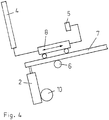
- the Fig. 4 shows a device with a setting for training the abductors in a basic representation.
- the first backrest 2 serves to push the knee 10 off, the seat 8 being moved away from this first backrest 2. This is supported by the leading component 7 of the guide, which points obliquely upwards in relation to the standing surface, so that the user has to move his body obliquely upwards when pressing the button.
- the Fig. 5 shows a device with a setting for training the adductors in a basic representation.
- the first backrest 2 When exercising the adductors of the hip joint, the first backrest 2 is used to pull the knee 10 in the direction of the starting position of the leg. This is supported by the leading component 7 of the guide, which points obliquely downwards in relation to the standing surface, so that the user has to move his body obliquely upwards when putting on.
Landscapes
- Health & Medical Sciences (AREA)
- Orthopedic Medicine & Surgery (AREA)
- General Health & Medical Sciences (AREA)
- Physical Education & Sports Medicine (AREA)
- Life Sciences & Earth Sciences (AREA)
- Biophysics (AREA)
- Cardiology (AREA)
- Vascular Medicine (AREA)
- Rehabilitation Tools (AREA)
Description
- Die Erfindung betrifft Geräte zum Trainieren von Abduktoren und/oder Adduktoren des Hüftgelenks mit einem Gestell und einer geführt bewegbaren Sitzgelegenheit.
- Trainingsgeräte für die unterschiedlichsten Bereiche und Muskulaturen des menschlichen Körpers sind durch die vielfältigsten Veröffentlichungen bekannt,wie zum Beispiel in Dokument
US 6340342 B1 - Ein Trainingsgerät für die Rumpfmuskulatur ist durch die Druckschrift
DE 94 05 749 U1 bekannt. Zum Training der Rumpfmuskulatur besteht das Gerät aus einer Konstruktion mit einem Bodengestell, einem Halterahmen, einem luftgefüllten Ball und Fixiereinrichtungen für die Beine und den Unterkörper. Der luftgefüllte Ball stützt das Gewicht des Oberkörpers in Rücken-, Bauch-oder Seitenlage der Person ab. Die am gegenüberliegenden Ende des Bodengestells angeordnete Fixiereinrichtung hält je nach Art der Übung die Füße, die Unterschenkel oder die Knie der trainierenden Person fest. Auf der in der Mitte angeordneten Auflage ruhen die Knie, die Oberschenkel oder das Becken. - Durch die Druckschrift
DE 10 2011 085 571 A1 ist ein Trainingsgerät für die Rumpfmuskulatur bekannt, wobei insbesondere der Rückenstrecker und die Bauchmuskeln trainierbar sind. Dazu weist ein Gestell eine Sitzgelegenheit mit einem Sitz für ein freies Sitzen ohne Bodenberührung, mindestens einer Lehne, einer ersten Fixiereinrichtung für das Becken und wenigstens einer zweiten Fixiereinrichtung für einen Arm oder eine Hand auf. Der Sitz ist mit gekoppelter erster Fixiereinrichtung gegenüber der Lehne mit der zweiten Fixiereinrichtung geführt verfahrbar. Darüber hinaus ist die Lehne eine Rückenlehne, eine Seitenlehne oder eine Lehne für den vorderen Bereich des Oberkörpers ist, so dass das Becken bei feststehendem Oberkörper bewegbar ist. - Die Druckschrift
DE 197 37 441 A1 offenbart ein Kraftsportgerät zur Stärkung der Beinmuskulatur. Der Trainierende sitzt in dem Kraftsportgerät auf einer etwas nach hinten geneigten Sitzfläche mit einer ebenfalls nach hinten geneigten Rückenlehne. Die Oberschenkel der beiden Beine liegen auf zwei abgepolsterten Stützen, die mit je einem von zwei symmetrisch zueinander angeordneten und unter der Sitzfläche drehbar gelagerten Lastarmen verbunden sind. Für die Adduktion werden die Beine zusammengedrückt und für die Abduktion auseinander gespreizt. Die dazu notwendige Drehbewegung der Lastarme wird in eine Linearbewegung umgewandelt, mit der das in einem Gestell hängende Trainingsgewicht bewegt wird. Der Aufbau ist sehr komplex. Die Trainingsleistung wird durch die zu bewegenden Gewichte bestimmt, wobei zur Änderung des Trainings Gewichte ausgetauscht, ergänzt oder entfernt werden müssen. Ein Training der Adduktoren oder Abduktoren nur einer Seite ist nicht ohne weiteres möglich. - Der im Patentanspruch 1 angegebenen Erfindung liegt die Aufgabe zugrunde, ein Gerät zum Trainieren von Abduktoren und/oder Adduktoren des Hüftgelenks zu schaffen.
- Diese Aufgabe wird mit den im Patentanspruch 1 aufgeführten Merkmalen gelöst.
- Die Geräte mit einem Gestell und einer geführt bewegbaren Sitzgelegenheit zeichnen sich insbesondere dadurch aus, dass Abduktoren und/oder Adduktoren des Hüftgelenks trainierbar sind.
- Dazu besitzt der mit dem Gestell verbundene drehbar und in verschiedenen Positionen feststellbare führende Bestandteil der Sitzgelegenheit eine erste Lehne wenigstens zur seitlichen Anlage des Knies, wenigstens eines Bereichs des Unterschenkels und/oder wenigstens eines Bereichs des Oberschenkels eines Beines. Weiterhin weist der geführte Bestandteil der Sitzgelegenheit einen Sitz mit einer zweiten Lehne und einer dritten Lehne zur seitlichen Anlage wenigstens des oberen Bereichs des Beckens und/oder mindestens eines Bereichs des Oberkörpers auf. Die zweite Lehne und/oder die dritte Lehne ist oder sind zur seitlichen Fixierung in ihrer Position oder ihren Positionen ein- und feststellbar.
- Bekannterweise dienen die Abduktoren des Hüftgelenks als Abspreizer zum Wegführen des Beines von der Medianebene des Körpers. Die Adduktoren des Hüftgelenks als Hinführer sind die Muskeln zum Heranziehen des Beines in dessen Ausgangslage. Die Geräte zeichnen sich damit vorteilhafterweise dadurch aus, dass die Muskeln als Abduktoren und/oder als Adduktoren des Hüftgelenks trainierbar sind. Das erfolgt über die Anlage des jeweiligen Knies an die erste Lehne und der durch Anziehen oder Abstoßen des Knies in Verbindung mit der geführten Sitzgelegenheit vollzogenen Bewegung bei fixiertem Becken. Die zweite Lehne und die dritte Lehne zur Fixierung wenigstens des Beckens und die Position der ersten Lehne führen dazu, dass gezielt nur die jeweiligen Muskeln der Abduktoren oder Adduktoren des Hüftgelenks trainierbar sind. Insbesondere das Becken und der Oberkörper verbleiben in einer Ruhelage. Damit sinkt die Hemmschwelle der Nutzung insbesondere auch für nicht trainierte oder ältere Personen. Natürlich schließt das ein Training für trainierte Personen nicht aus. Das Trainingsgerät ist auch in der Rehabilitation verwendbar.
- Vorteilhafte Ausgestaltungen der Erfindung sind in den Patentansprüchen 2 bis 13 angegeben. Die erste Lehne dient zum Abdrücken des Knies, wenigstens des Bereichs des Unterschenkels und/oder wenigstens des Bereichs des Oberschenkels so dass die Abduktoren des Hüftgelenks trainierbar sind. Das sind insbesondere die an dieses Knie angekoppelten Abduktoren.
- Die erste Lehne dient auch zum Anziehen des Knies, wenigstens des Bereichs des Unterschenkels und/oder wenigstens des Bereichs des Oberschenkels, so dass die Adduktoren des Hüftgelenks trainierbar sind. Das sind insbesondere die an dieses Knie angekoppelten Adduktoren.
- Die erste Lehne ist geführt verfahrbar und in verschiedenen Positionen zum führenden Bestandteil der Sitzgelegenheit feststellbar. Das Trainingsgerät kann damit leicht an die Größe des Nutzers angepasst werden.
- Die erste Lehne besitzt eine winklig angeordnete Auflage für das Knie, wenigstens einen Bereich des Unterschenkels oder das Knie und wenigstens einen Bereich des Unterschenkels. Der Nutzer kann somit das Knie oder das Knie und den Bereich des Unterschenkels während des Trainings auflegen. Sowohl eine erhöhte Bequemlichkeit als auch eine unverkrampfte Nutzung ist während des Trainings gegeben.
- An die zweite Lehne und/oder die dritte Lehne ist oder sind eine Auflage wenigstens für einen Unterarm angekoppelt. Der Nutzer kann sich abstützen, so dass eine bequeme Nutzung gegeben ist.
- Die zweite Lehne ist gegenüber dem Sitz in ihrer Höhe und/oder in ihrem Abstand zur dritten Lehne einstellbar und in verschiedenen Positionen feststellbar.
- Die dritte Lehne ist gegenüber dem Sitz in ihrer Höhe und/oder in ihrem Abstand zur zweiten Lehne einstellbar und in verschiedenen Positionen feststellbar.
- Das Gerät ist leicht an die Abmessungen an den Nutzer anpassbar.
- Die zweite Lehne und wenigstens ein Bereich des Sitzes sind so angeordnet, dass zum Training der Abduktoren oder der Adduktoren des Hüftgelenks der Oberschenkel bei gestreckter oder gebeugter Hüftposition bewegbar ist.
- Der führende Bestandteil der Sitzgelegenheit ist nach der Weiterbildung des Patentanspruchs 10 über mindestens ein Drehgelenk mit dem Gestell verbunden oder ist ein Bestandteil des Gestells. Weiterhin ist der führende Bestandteil ist mittels eines Mechanismus in verschiedenen Positionen feststellbar, so dass die Sitzgelegenheit gegenüber der Standfläche kippbar und in der jeweilig gekippten Position feststellbar ist. Die Intensität des Trainings kann mittels des Winkels beeinflusst werden, wobei auch das zu bewegende Gewicht des Nutzers einbeziehbar ist.
- Der geführte Bestandteil als Sitzgelegenheit mit dem Sitz, der zweiten Lehne und der dritten Lehne besteht als Geradführung aus zwei parallel zueinander angeordneten Führungselementen und wenigstens zwei damit gekoppelten geführten Elementen, wobei das gleit- oder wälzkörpergeführte Elemente sind. Damit ist einfach ein stabiler Sitz mit der zweiten Lehne, der dritten Lehne und den Tritten vorhanden.
- Der geführte Bestandteil der Sitzgelegenheit Tritte für den Fuß des jeweilig anderen Beines auf. Das Gerät besitzt vorteilhafterweise beidseitig des Sitzes Tritte, so dass der Nutzer beide Seiten mit Abduktoren und Adduktoren des Hüftgelenks trainieren kann. Zum Wechsel muss sich der Nutzer nur gedreht auf dem Gerät platzieren. Die Tritte sind für jeweils den Fuß vorgesehen, der nicht mit dem Knie an der ersten Lehne in Verbindung steht. Die Tritte gewährleisten damit auch die Nutzung des Geräts zum Trainieren von Abduktoren und Adduktoren des Hüftgelenks beider Seiten. Damit ist ein bequemes Trainieren gegeben.
- Ein Ausführungsbeispiel der Erfindung ist in den Zeichnungen jeweils prinzipiell dargestellt und wird im Folgenden näher beschrieben.
- Es zeigen:
- Fig. 1
- ein Gerät zum Trainieren von Abduktoren und/oder Adduktoren des Hüftgelenks in einer Seitenansicht,
- Fig. 2
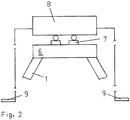
- ein Gerät zum Trainieren von Abduktoren und/oder Adduktoren des Hüftgelenks für die Rumpfmuskulatur in einer Vorderansicht,
- Fig. 3
- ein Gerät zum Trainieren von Abduktoren und/oder Adduktoren des Hüftgelenks in einer in einer Draufsicht,
- Fig. 4
- ein Gerät mit einer Einstellung zum Trainieren der Abduktoren und
- Fig. 5
- ein Gerät mit einer Einstellung zum Trainieren der Adduktoren.
- Ein Gerät zum Trainieren von Abduktoren und/oder Adduktoren des Hüftgelenks besteht im Wesentlichen aus einem Gestell 1 mit einer ersten Lehne 2 und einer bewegbaren Sitzgelegenheit 3 mit einer zweiten Lehne 4 und einer dritten Lehne 5.
-
- die
Fig. 1 ein Gerät zum Trainieren von Abduktoren und/oder Adduktoren des Hüftgelenks in einer prinzipiellen Seitenansicht, - die
Fig. 2 ein Gerät zum Trainieren von Abduktoren und/oder Adduktoren des Hüftgelenks für die Rumpfmuskulatur in einer prinzipiellen Vorderansicht und - die
Fig. 3 ein Gerät zum Trainieren von Abduktoren und/oder Adduktoren des Hüftgelenks in einer in einer prinzipiellen Draufsicht. - Das Gestell 1 ist ein Ständer mit Standelementen auf einer Grundplatte und wenigstens einem feststellbaren Drehgelenk 6 für den führenden Bestandteil 7 der Sitzgelegenheit 3. Mittels wenigstens eines Mechanismus ist damit der Winkel des führenden Bestandteils 7 mit der daran befestigten ersten Lehne 2 und der geführt bewegbaren Sitzgelegenheit 3 gegenüber der Standfläche in verschiedenen Positionen mittels Kippen einstellbar und in verschiedenen Positionen feststellbar. Das erfolgt mittels wenigstens einem Feststellmechanismus, einem Rastmechanismus oder einem Getriebe. Dafür kann ein selbstsperrendes Schneckengetriebe oder ein eine Sperre aufweisender Feststellmechanismus eingesetzt werden. Am führenden Bestandteil 7 der Sitzgelegenheit 3 ist winklig dazu die erste Lehne 2 wenigstens zur seitlichen Anlage des Knies 10 eines Beines bei gestreckter Hüftposition oder einer gebeugten Position des Nutzers angeordnet. Der Winkel zwischen der ersten Lehne 2 und dem führenden Bestandteil 7 kann beispielsweise rechtwinklig oder ein- und feststellbar zum führenden Bestandteil 7 sein. Die erste Lehne 2 kann weiterhin eine winklig angeordnete Auflage für das Knie 10, wenigstens einen Bereich des Unterschenkels oder das Knie 10 und wenigstens einen Bereich des Unterschenkels besitzen.
- Die Sitzgelegenheit 3 besteht im Wesentlichen aus einem Sitz 8, der zweiten Lehne 4 und der dritten Lehne 5 zur seitlichen Anlage wenigstens des oberen Bereichs des Beckens und/oder mindestens eines Bereichs des Oberkörpers. Weiterhin können Tritte 9 für den Fuß des jeweilig anderen Beines vorgesehen sein. Letzteres ist das Bein mit dem Knie, welches nicht an der ersten Lehne 2 anliegt. Der Sitz 8 ist dazu vorteilhafterweise gleichzeitig der gegenüber dem führenden Bestandteil 7 geführte Bestandteil der damit bewegbaren Sitzgelegenheit 3. Die zweite Lehne 4 und/oder die dritte Lehne 5 ist oder sind zur seitlichen Fixierung in ihrer Position oder ihren Positionen zum Sitz 8 und gegeneinander ein- und feststellbar. Dazu ist wenigstens eine dieser Lehnen geführt verfahrbar und feststellbar. Damit kann das Gerät entsprechend der Maße des Nutzers leicht eingestellt werden. Die jeweils andere Lehne 4, 5 kann dazu auch so ausgebildet sein, dass der seitliche Oberkörper bis unter den Arm anlegbar ist. Zusätzlich kann eine Ablage 11 für den Arm an diese Lehne 4, 5 angekoppelt sein.
- Die zweite Lehne 4 und wenigstens ein Bereich des Sitzes 8 sind vorteilhafterweise so ausgebildet und angeordnet, dass zum Training der Abduktoren oder der Adduktoren des Hüftgelenks der Oberschenkel und damit der Sitz 8 bei gestreckter Hüftposition bewegbar ist.
- Die Sitzgelegenheit 3 ist über mindestens das eine Drehgelenk 6 mit dem Gestell 1 verbunden und in verschiedenen Positionen feststellbar, so dass die Sitzgelegenheit 3 gegenüber der Standfläche kippbar ist. Die Führung des Sitzes 8 mit der zweiten Lehne 4, der dritten Lehne 5 und den eventuell vorhandenen Tritten 9 kann dazu als Geradführung aus zwei parallel zueinander angeordneten Führungselementen und wenigstens zwei damit gekoppelten geführten Elementen bestehen. Die Führungen sind gleit- oder wälzkörpergeführte Führungen.
- Damit können Abduktoren und Adduktoren des Hüftgelenks trainiert werden.
- Die
Fig. 4 zeigt ein Gerät mit einer Einstellung zum Trainieren der Abduktoren in einer prinzipiellen Darstellung. - Beim Trainieren von Abduktoren des Hüftgelenks dient die erste Lehne 2 zum Abdrücken des Knies 10, wobei der Sitz 8 von dieser ersten Lehne 2 weg bewegt wird. Das wird durch den gegenüber der Standfläche schräg nach oben weisenden führenden Bestandteil 7 der Führung unterstützt, so dass der Nutzer seinen Körper beim Abdrücken schräg nach oben bewegen muss.
- Die
Fig. 5 zeigt ein Gerät mit einer Einstellung zum Trainieren der Adduktoren in einer prinzipiellen Darstellung. - Beim Trainieren von Adduktoren des Hüftgelenks dient die erste Lehne 2 zum Anziehen des Knies 10 in Richtung der Ausgangslage des Beines. Das wird durch den gegenüber der Standfläche schräg nach unten weisenden führenden Bestandteil 7 der Führung unterstützt, so dass der Nutzer seinen Körper beim Anziehen schräg nach oben bewegen muss.
-
- 1
- Gestell
- 2
- erste Lehne
- 3
- Sitzgelegenheit
- 4
- zweite Lehne
- 5
- dritte Lehne
- 6
- Drehgelenk
- 7
- führender Bestandteil
- 8
- Sitz
- 9
- Tritt
- 10
- Knie
- 11
- Ablage
Claims (10)
- Gerät zum Trainieren von Abduktoren und/oder Z Adduktoren des Hüftgelenks mit einem Gestell (1) und einer mit dem Gestell (1) verbundenen geführt bewegbaren Sitzgelegenheit (3), wobei der geführte Bestandteil der Sitzgelegenheit (3) einen Sitz (8) mit einer zweiten Lehne (4) und/oder einer dritten Lehne (5) zur seitlichen Anlage wenigstens des oberen Bereichs des Beckens und/oder mindestens eines Bereichs des Oberkörpers aufweist, wobei die zweite Lehne (4) und/oder die dritte Lehne (5) zur seitlichen Fixierung in ihrer Position oder ihren Positionen ein- und feststellbar ist oder sind, dadurch gekennzeichnet, dass der drehbar und in verschiedenen Positionen feststellbare führende Bestandteil (7) der Sitzgelegenheit (3) eine erste Lehne (2) zur seitlichen Anlage und entweder zum Abdrücken eines Knies (10), wenigstens eines Bereichs des Unterschenkels und/oder wenigstens eines Bereichs des Oberschenkels, so dass in Verbindung mit der geführten Sitzgelegenheit vollzogenen Bewegung bei fixiertem Becken die Abduktoren des Hüftgelenks trainierbar sind, oder zum Anziehen eines Knies (10), wenigstens eines Bereichs des Unterschenkels und/oder wenigstens eines Bereichs des Oberschenkels, so dass in Verbindung mit der geführten Sitzgelegenheit vollzogenen Bewegung bei fixiertem Becken die Adduktoren des Hüftgelenks trainierbar sind, besitzt.
- Gerät nach Patentanspruch 1, dadurch gekennzeichnet, dass die erste Lehne (2) geführt verfahrbar und in verschiedenen Positionen zum führenden Bestandteil (7) der Sitzgelegenheit (3) feststellbar ist.
- Gerät nach Patentanspruch 1, dadurch gekennzeichnet, dass die erste Lehne (2) eine winklig angeordnete Auflage für das Knie (10), wenigstens einen Bereich des Unterschenkels oder das Knie (10) und wenigstens einen Bereich des Unterschenkels besitzt.
- Gerät nach Patentanspruch 1, dadurch gekennzeichnet, dass an die zweite Lehne (4) und/oder die dritte Lehne (5) eine Auflage (11) wenigstens für einen Unterarm angekoppelt ist oder sind.
- Gerät nach Patentanspruch 1, dadurch gekennzeichnet, dass die zweite Lehne (4) gegenüber dem Sitz (8) in ihrer Höhe und/oder in ihrem Abstand zur dritten Lehne (5) einstellbar und in verschiedenen Positionen feststellbar ist.
- Gerät nach Patentanspruch 1, dadurch gekennzeichnet, dass die dritte Lehne (5) gegenüber dem Sitz (8) in ihrer Höhe und/oder in ihrem Abstand zur zweiten Lehne (4) einstellbar und in verschiedenen Positionen feststellbar ist.
- Gerät nach Patentanspruch 1, dadurch gekennzeichnet, dass die zweite Lehne (4) und wenigstens ein Bereich des Sitzes (8) so angeordnet sind, dass zum Training der Abduktoren oder der Adduktoren des Hüftgelenks der Oberschenkel bei gestreckter oder gebeugter Hüftposition bewegbar ist.
- Gerät nach Patentanspruch 1, dadurch gekennzeichnet, dass der führende Bestandteil (7) der Sitzgelegenheit (3) über mindestens ein Drehgelenk (6) mit dem Gestell (1) verbunden oder ein Bestandteil des Gestells (1) ist und dass der führende Bestandteil (7) mittels eines Mechanismus in verschiedenen Positionen feststellbar ist, so dass die Sitzgelegenheit (3) gegenüber der Standfläche kippbar und in der jeweilig gekippten Position feststellbar ist.
- Gerät nach Patentanspruch 1, dadurch gekennzeichnet, dass der geführte Bestandteil als Sitzgelegenheit (3) mit dem Sitz (8), der zweiten Lehne (4) und der dritten Lehne (5) als Geradführung aus zwei parallel zueinander angeordneten Führungselementen und wenigstens zwei damit gekoppelten geführten Elementen besteht und dass das gleit- oder wälzkörpergeführte Elemente sind.
- Gerät nach Patentanspruch 1, dadurch gekennzeichnet, dass die Sitzgelegenheit (3) Tritte (9) für den Fuß des jeweilig anderen Beines aufweist.
Applications Claiming Priority (1)
| Application Number | Priority Date | Filing Date | Title |
|---|---|---|---|
| DE102016205596.8A DE102016205596B3 (de) | 2016-04-05 | 2016-04-05 | Gerät zum Trainieren von Abduktoren und/oder Addukturen des Hüftgelenks |
Publications (3)
| Publication Number | Publication Date |
|---|---|
| EP3228367A1 EP3228367A1 (de) | 2017-10-11 |
| EP3228367B1 true EP3228367B1 (de) | 2020-08-26 |
| EP3228367B8 EP3228367B8 (de) | 2020-10-28 |
Family
ID=58355922
Family Applications (1)
| Application Number | Title | Priority Date | Filing Date |
|---|---|---|---|
| EP17164782.9A Active EP3228367B8 (de) | 2016-04-05 | 2017-04-04 | Gerät zum trainieren von abduktoren und/oder adduktoren des hüftgelenks |
Country Status (3)
| Country | Link |
|---|---|
| US (1) | US9808669B2 (de) |
| EP (1) | EP3228367B8 (de) |
| DE (1) | DE102016205596B3 (de) |
Families Citing this family (3)
| Publication number | Priority date | Publication date | Assignee | Title |
|---|---|---|---|---|
| USD956991S1 (en) * | 2020-08-11 | 2022-07-05 | Youjun HU | Massager |
| USD967973S1 (en) * | 2020-12-28 | 2022-10-25 | Chen Yi | Sex toy |
| USD954286S1 (en) * | 2021-07-07 | 2022-06-07 | Bingchi Huang | Sex massager |
Family Cites Families (31)
| Publication number | Priority date | Publication date | Assignee | Title |
|---|---|---|---|---|
| US4858919A (en) * | 1987-06-11 | 1989-08-22 | Arthur Jones | Apparatus for testing or exercising muscles of the lower trunk of the human body |
| US4836536A (en) * | 1987-06-11 | 1989-06-06 | Arthur Jones | Apparatus for exercising muscles of the lower trunk of the human body |
| US5295936A (en) * | 1991-06-03 | 1994-03-22 | Perry Jr Leroy R | Adductor contraction exercise apparatus and method |
| US5163890A (en) * | 1991-06-03 | 1992-11-17 | Perry Jr Leroy R | Adductor contraction exercise apparatus and method |
| US5135459A (en) * | 1991-06-03 | 1992-08-04 | Perry Jr Leroy R | Adductor contraction exercise apparatus and method |
| DE9405749U1 (de) * | 1994-04-07 | 1994-06-01 | Germania Geraetebau Und Vertri | Trainingsgerät für die Rumpfmuskulatur |
| US5518482A (en) | 1994-10-06 | 1996-05-21 | Lifegear, Inc. | Multiple function exercise apparatus |
| US5722917A (en) * | 1996-09-18 | 1998-03-03 | Exerfun, Inc. | Displaceable seat exercise system |
| DE19737441C2 (de) * | 1997-08-22 | 2000-10-05 | Heiko Fiebig | Kraftstoffgerät zur Stärkung der Beinmuskulatur |
| TW386453U (en) | 1999-06-16 | 2000-04-01 | Li Jian Sheng | The fitness equipment |
| DE29911863U1 (de) * | 1999-07-08 | 1999-12-09 | Huang, Ming-Hui, Changhu | Übungsgerät |
| US6575884B1 (en) * | 1999-07-27 | 2003-06-10 | Robert C. Eazor | Abdominal exercise machine |
| US6743158B2 (en) * | 2000-03-01 | 2004-06-01 | Cybex Interational, Inc. | Leg press |
| US20040067830A1 (en) * | 2002-03-07 | 2004-04-08 | Rovere Michael V. | Exercise device |
| AU2003285047B2 (en) * | 2002-10-29 | 2008-06-05 | Djo, Llc | Therapeutic exercise device |
| US20040157712A1 (en) * | 2003-02-03 | 2004-08-12 | Edo Corporation. | Method and apparatus for stretching a hamstring |
| US7611445B2 (en) * | 2004-01-05 | 2009-11-03 | Ab Coaster Holdings, Inc. | Abdominal exercise machine |
| US8323157B2 (en) * | 2004-02-24 | 2012-12-04 | Total Gym Global Corp. | Method of using an exercise device having an adjustable incline |
| US7329213B1 (en) * | 2004-03-25 | 2008-02-12 | Farley Michael D | Exercise machine with compound abdominal movement |
| US7476188B2 (en) * | 2005-06-14 | 2009-01-13 | Integrity Partners, Inc. | Torso exercise device |
| ITRA20060009A1 (it) * | 2006-02-10 | 2007-08-11 | Technogym Spa | Macchina ginnica. |
| US20070259760A1 (en) * | 2006-05-03 | 2007-11-08 | Concepts To Retail, Llc | Abdominal exercise device with lateral arcuately slidable seat |
| US7485078B1 (en) * | 2008-03-03 | 2009-02-03 | Chih-Liang Chen | Waist and buttocks exerciser |
| US8016731B2 (en) * | 2009-01-06 | 2011-09-13 | Rael Vanterpool | Abdominal exercise machine |
| US8845560B1 (en) * | 2011-06-17 | 2014-09-30 | Antonio Hernandez | Physical therapy chair |
| WO2013064589A1 (de) * | 2011-11-02 | 2013-05-10 | Nikolai Letow | Trainingsgerät für die rumpfmuskulatur |
| DE102011085571B4 (de) * | 2011-11-02 | 2014-12-11 | Nikolai Letow | Trainingsgerät für die Rumpfmuskulatur |
| US9770623B2 (en) * | 2011-12-19 | 2017-09-26 | Joseph K. Ellis | Upper and lower body press exercise machine |
| US9943725B2 (en) * | 2012-11-27 | 2018-04-17 | Inertiacore Training Systems Llc | Exercise balance trainer |
| US9573019B2 (en) * | 2013-08-13 | 2017-02-21 | Megeriann Corp. | Mobility aid and rehabilitation device and related components |
| US9868025B2 (en) * | 2015-06-02 | 2018-01-16 | Gymbot, Llc | Contralateral hip and hamstring training device |
-
2016
- 2016-04-05 DE DE102016205596.8A patent/DE102016205596B3/de active Active
-
2017
- 2017-04-04 US US15/478,280 patent/US9808669B2/en not_active Expired - Fee Related
- 2017-04-04 EP EP17164782.9A patent/EP3228367B8/de active Active
Non-Patent Citations (1)
| Title |
|---|
| None * |
Also Published As
| Publication number | Publication date |
|---|---|
| EP3228367A1 (de) | 2017-10-11 |
| EP3228367B8 (de) | 2020-10-28 |
| US20170282009A1 (en) | 2017-10-05 |
| US9808669B2 (en) | 2017-11-07 |
| DE102016205596B3 (de) | 2017-04-06 |
Similar Documents
| Publication | Publication Date | Title |
|---|---|---|
| DE112018002470B4 (de) | Trainingsgerät zur durchführung einer gluteusbrückenbewegung | |
| DE202012104389U1 (de) | Abdomentrainingsmaschine | |
| DE102009022319A1 (de) | Rückentrainingsgerät | |
| DE102016205596B3 (de) | Gerät zum Trainieren von Abduktoren und/oder Addukturen des Hüftgelenks | |
| DE4407089A1 (de) | Mehrzweck-Trainingsgerät | |
| EP2773433B2 (de) | Trainingsgerät für die rumpfmuskulatur | |
| DE102011085571B4 (de) | Trainingsgerät für die Rumpfmuskulatur | |
| EP3380054B1 (de) | Vorrichtung und verfahren zum trainieren | |
| DE3532445A1 (de) | Vorrichtung zum trainieren | |
| DE3884960T2 (de) | Übungsgerät. | |
| DE202011051836U1 (de) | Trainingsgerät für die Rumpfmuskulatur | |
| EP3970811B1 (de) | Trainingsgerät zum trainieren einzelner muskelgruppen im oberkörper | |
| DE202012101188U1 (de) | Trainingsgerät für die Rumpfmuskulatur | |
| DE102016007087A1 (de) | Trainingsvorrichtung | |
| EP3856368A1 (de) | Trainingsgerät | |
| DE3732711A1 (de) | Rehabilitationsgeraet | |
| DE3640559A1 (de) | Vorrichtung zur staerkung der menschlichen armmuskeln | |
| DE60222398T2 (de) | Vorrichtung zum Muskeltraining einer Person | |
| DE102014004443B4 (de) | Trainingsgerät | |
| DE29912429U1 (de) | Trainingsgerät | |
| DE202005002380U1 (de) | Trainingsgerät | |
| DE29607170U1 (de) | Beinstrecker | |
| DE20104131U1 (de) | Gerät insbesondere für die Lumbarextension | |
| DE202013008008U1 (de) | Trainingsgerät | |
| DE29720303U1 (de) | Armtrainer, insbesondere für die Benutzung durch ältere und behinderte Personen |
Legal Events
| Date | Code | Title | Description |
|---|---|---|---|
| PUAI | Public reference made under article 153(3) epc to a published international application that has entered the european phase |
Free format text: ORIGINAL CODE: 0009012 |
|
| STAA | Information on the status of an ep patent application or granted ep patent |
Free format text: STATUS: THE APPLICATION HAS BEEN PUBLISHED |
|
| AK | Designated contracting states |
Kind code of ref document: A1 Designated state(s): AL AT BE BG CH CY CZ DE DK EE ES FI FR GB GR HR HU IE IS IT LI LT LU LV MC MK MT NL NO PL PT RO RS SE SI SK SM TR |
|
| AX | Request for extension of the european patent |
Extension state: BA ME |
|
| STAA | Information on the status of an ep patent application or granted ep patent |
Free format text: STATUS: REQUEST FOR EXAMINATION WAS MADE |
|
| 17P | Request for examination filed |
Effective date: 20180410 |
|
| RBV | Designated contracting states (corrected) |
Designated state(s): AL AT BE BG CH CY CZ DE DK EE ES FI FR GB GR HR HU IE IS IT LI LT LU LV MC MK MT NL NO PL PT RO RS SE SI SK SM TR |
|
| GRAP | Despatch of communication of intention to grant a patent |
Free format text: ORIGINAL CODE: EPIDOSNIGR1 |
|
| STAA | Information on the status of an ep patent application or granted ep patent |
Free format text: STATUS: GRANT OF PATENT IS INTENDED |
|
| RIC1 | Information provided on ipc code assigned before grant |
Ipc: A63B 22/20 20060101AFI20190926BHEP |
|
| INTG | Intention to grant announced |
Effective date: 20191030 |
|
| GRAJ | Information related to disapproval of communication of intention to grant by the applicant or resumption of examination proceedings by the epo deleted |
Free format text: ORIGINAL CODE: EPIDOSDIGR1 |
|
| STAA | Information on the status of an ep patent application or granted ep patent |
Free format text: STATUS: REQUEST FOR EXAMINATION WAS MADE |
|
| GRAP | Despatch of communication of intention to grant a patent |
Free format text: ORIGINAL CODE: EPIDOSNIGR1 |
|
| STAA | Information on the status of an ep patent application or granted ep patent |
Free format text: STATUS: GRANT OF PATENT IS INTENDED |
|
| INTC | Intention to grant announced (deleted) | ||
| INTG | Intention to grant announced |
Effective date: 20200323 |
|
| GRAS | Grant fee paid |
Free format text: ORIGINAL CODE: EPIDOSNIGR3 |
|
| GRAA | (expected) grant |
Free format text: ORIGINAL CODE: 0009210 |
|
| STAA | Information on the status of an ep patent application or granted ep patent |
Free format text: STATUS: THE PATENT HAS BEEN GRANTED |
|
| AK | Designated contracting states |
Kind code of ref document: B1 Designated state(s): AL AT BE BG CH CY CZ DE DK EE ES FI FR GB GR HR HU IE IS IT LI LT LU LV MC MK MT NL NO PL PT RO RS SE SI SK SM TR |
|
| REG | Reference to a national code |
Ref country code: GB Ref legal event code: FG4D Free format text: NOT ENGLISH |
|
| REG | Reference to a national code |
Ref country code: CH Ref legal event code: EP |
|
| REG | Reference to a national code |
Ref country code: AT Ref legal event code: REF Ref document number: 1305797 Country of ref document: AT Kind code of ref document: T Effective date: 20200915 |
|
| REG | Reference to a national code |
Ref country code: IE Ref legal event code: FG4D Free format text: LANGUAGE OF EP DOCUMENT: GERMAN |
|
| REG | Reference to a national code |
Ref country code: DE Ref legal event code: R096 Ref document number: 502017006883 Country of ref document: DE |
|
| REG | Reference to a national code |
Ref country code: CH Ref legal event code: PK Free format text: BERICHTIGUNG B8 |
|
| REG | Reference to a national code |
Ref country code: CH Ref legal event code: NV Representative=s name: VALIPAT S.A. C/O BOVARD SA NEUCHATEL, CH |
|
| REG | Reference to a national code |
Ref country code: LT Ref legal event code: MG4D |
|
| PG25 | Lapsed in a contracting state [announced via postgrant information from national office to epo] |
Ref country code: PT Free format text: LAPSE BECAUSE OF FAILURE TO SUBMIT A TRANSLATION OF THE DESCRIPTION OR TO PAY THE FEE WITHIN THE PRESCRIBED TIME-LIMIT Effective date: 20201228 Ref country code: NO Free format text: LAPSE BECAUSE OF FAILURE TO SUBMIT A TRANSLATION OF THE DESCRIPTION OR TO PAY THE FEE WITHIN THE PRESCRIBED TIME-LIMIT Effective date: 20201126 Ref country code: LT Free format text: LAPSE BECAUSE OF FAILURE TO SUBMIT A TRANSLATION OF THE DESCRIPTION OR TO PAY THE FEE WITHIN THE PRESCRIBED TIME-LIMIT Effective date: 20200826 Ref country code: BG Free format text: LAPSE BECAUSE OF FAILURE TO SUBMIT A TRANSLATION OF THE DESCRIPTION OR TO PAY THE FEE WITHIN THE PRESCRIBED TIME-LIMIT Effective date: 20201126 Ref country code: HR Free format text: LAPSE BECAUSE OF FAILURE TO SUBMIT A TRANSLATION OF THE DESCRIPTION OR TO PAY THE FEE WITHIN THE PRESCRIBED TIME-LIMIT Effective date: 20200826 Ref country code: SE Free format text: LAPSE BECAUSE OF FAILURE TO SUBMIT A TRANSLATION OF THE DESCRIPTION OR TO PAY THE FEE WITHIN THE PRESCRIBED TIME-LIMIT Effective date: 20200826 Ref country code: GR Free format text: LAPSE BECAUSE OF FAILURE TO SUBMIT A TRANSLATION OF THE DESCRIPTION OR TO PAY THE FEE WITHIN THE PRESCRIBED TIME-LIMIT Effective date: 20201127 Ref country code: FI Free format text: LAPSE BECAUSE OF FAILURE TO SUBMIT A TRANSLATION OF THE DESCRIPTION OR TO PAY THE FEE WITHIN THE PRESCRIBED TIME-LIMIT Effective date: 20200826 |
|
| REG | Reference to a national code |
Ref country code: NL Ref legal event code: MP Effective date: 20200826 |
|
| PG25 | Lapsed in a contracting state [announced via postgrant information from national office to epo] |
Ref country code: RS Free format text: LAPSE BECAUSE OF FAILURE TO SUBMIT A TRANSLATION OF THE DESCRIPTION OR TO PAY THE FEE WITHIN THE PRESCRIBED TIME-LIMIT Effective date: 20200826 Ref country code: PL Free format text: LAPSE BECAUSE OF FAILURE TO SUBMIT A TRANSLATION OF THE DESCRIPTION OR TO PAY THE FEE WITHIN THE PRESCRIBED TIME-LIMIT Effective date: 20200826 Ref country code: LV Free format text: LAPSE BECAUSE OF FAILURE TO SUBMIT A TRANSLATION OF THE DESCRIPTION OR TO PAY THE FEE WITHIN THE PRESCRIBED TIME-LIMIT Effective date: 20200826 Ref country code: NL Free format text: LAPSE BECAUSE OF FAILURE TO SUBMIT A TRANSLATION OF THE DESCRIPTION OR TO PAY THE FEE WITHIN THE PRESCRIBED TIME-LIMIT Effective date: 20200826 Ref country code: IS Free format text: LAPSE BECAUSE OF FAILURE TO SUBMIT A TRANSLATION OF THE DESCRIPTION OR TO PAY THE FEE WITHIN THE PRESCRIBED TIME-LIMIT Effective date: 20201226 |
|
| PG25 | Lapsed in a contracting state [announced via postgrant information from national office to epo] |
Ref country code: SM Free format text: LAPSE BECAUSE OF FAILURE TO SUBMIT A TRANSLATION OF THE DESCRIPTION OR TO PAY THE FEE WITHIN THE PRESCRIBED TIME-LIMIT Effective date: 20200826 Ref country code: EE Free format text: LAPSE BECAUSE OF FAILURE TO SUBMIT A TRANSLATION OF THE DESCRIPTION OR TO PAY THE FEE WITHIN THE PRESCRIBED TIME-LIMIT Effective date: 20200826 Ref country code: DK Free format text: LAPSE BECAUSE OF FAILURE TO SUBMIT A TRANSLATION OF THE DESCRIPTION OR TO PAY THE FEE WITHIN THE PRESCRIBED TIME-LIMIT Effective date: 20200826 Ref country code: CZ Free format text: LAPSE BECAUSE OF FAILURE TO SUBMIT A TRANSLATION OF THE DESCRIPTION OR TO PAY THE FEE WITHIN THE PRESCRIBED TIME-LIMIT Effective date: 20200826 Ref country code: RO Free format text: LAPSE BECAUSE OF FAILURE TO SUBMIT A TRANSLATION OF THE DESCRIPTION OR TO PAY THE FEE WITHIN THE PRESCRIBED TIME-LIMIT Effective date: 20200826 |
|
| REG | Reference to a national code |
Ref country code: DE Ref legal event code: R097 Ref document number: 502017006883 Country of ref document: DE |
|
| PG25 | Lapsed in a contracting state [announced via postgrant information from national office to epo] |
Ref country code: ES Free format text: LAPSE BECAUSE OF FAILURE TO SUBMIT A TRANSLATION OF THE DESCRIPTION OR TO PAY THE FEE WITHIN THE PRESCRIBED TIME-LIMIT Effective date: 20200826 Ref country code: AL Free format text: LAPSE BECAUSE OF FAILURE TO SUBMIT A TRANSLATION OF THE DESCRIPTION OR TO PAY THE FEE WITHIN THE PRESCRIBED TIME-LIMIT Effective date: 20200826 |
|
| PG25 | Lapsed in a contracting state [announced via postgrant information from national office to epo] |
Ref country code: SK Free format text: LAPSE BECAUSE OF FAILURE TO SUBMIT A TRANSLATION OF THE DESCRIPTION OR TO PAY THE FEE WITHIN THE PRESCRIBED TIME-LIMIT Effective date: 20200826 |
|
| PLBE | No opposition filed within time limit |
Free format text: ORIGINAL CODE: 0009261 |
|
| STAA | Information on the status of an ep patent application or granted ep patent |
Free format text: STATUS: NO OPPOSITION FILED WITHIN TIME LIMIT |
|
| PG25 | Lapsed in a contracting state [announced via postgrant information from national office to epo] |
Ref country code: IT Free format text: LAPSE BECAUSE OF FAILURE TO SUBMIT A TRANSLATION OF THE DESCRIPTION OR TO PAY THE FEE WITHIN THE PRESCRIBED TIME-LIMIT Effective date: 20200826 |
|
| 26N | No opposition filed |
Effective date: 20210527 |
|
| PG25 | Lapsed in a contracting state [announced via postgrant information from national office to epo] |
Ref country code: SI Free format text: LAPSE BECAUSE OF FAILURE TO SUBMIT A TRANSLATION OF THE DESCRIPTION OR TO PAY THE FEE WITHIN THE PRESCRIBED TIME-LIMIT Effective date: 20200826 |
|
| PG25 | Lapsed in a contracting state [announced via postgrant information from national office to epo] |
Ref country code: MC Free format text: LAPSE BECAUSE OF FAILURE TO SUBMIT A TRANSLATION OF THE DESCRIPTION OR TO PAY THE FEE WITHIN THE PRESCRIBED TIME-LIMIT Effective date: 20200826 |
|
| GBPC | Gb: european patent ceased through non-payment of renewal fee |
Effective date: 20210404 |
|
| PG25 | Lapsed in a contracting state [announced via postgrant information from national office to epo] |
Ref country code: LU Free format text: LAPSE BECAUSE OF NON-PAYMENT OF DUE FEES Effective date: 20210404 |
|
| REG | Reference to a national code |
Ref country code: BE Ref legal event code: MM Effective date: 20210430 |
|
| PG25 | Lapsed in a contracting state [announced via postgrant information from national office to epo] |
Ref country code: FR Free format text: LAPSE BECAUSE OF NON-PAYMENT OF DUE FEES Effective date: 20210430 Ref country code: GB Free format text: LAPSE BECAUSE OF NON-PAYMENT OF DUE FEES Effective date: 20210404 |
|
| PG25 | Lapsed in a contracting state [announced via postgrant information from national office to epo] |
Ref country code: IE Free format text: LAPSE BECAUSE OF NON-PAYMENT OF DUE FEES Effective date: 20210404 |
|
| PG25 | Lapsed in a contracting state [announced via postgrant information from national office to epo] |
Ref country code: IS Free format text: LAPSE BECAUSE OF FAILURE TO SUBMIT A TRANSLATION OF THE DESCRIPTION OR TO PAY THE FEE WITHIN THE PRESCRIBED TIME-LIMIT Effective date: 20201226 |
|
| PG25 | Lapsed in a contracting state [announced via postgrant information from national office to epo] |
Ref country code: BE Free format text: LAPSE BECAUSE OF NON-PAYMENT OF DUE FEES Effective date: 20210430 |
|
| PG25 | Lapsed in a contracting state [announced via postgrant information from national office to epo] |
Ref country code: HU Free format text: LAPSE BECAUSE OF FAILURE TO SUBMIT A TRANSLATION OF THE DESCRIPTION OR TO PAY THE FEE WITHIN THE PRESCRIBED TIME-LIMIT; INVALID AB INITIO Effective date: 20170404 |
|
| PG25 | Lapsed in a contracting state [announced via postgrant information from national office to epo] |
Ref country code: CY Free format text: LAPSE BECAUSE OF FAILURE TO SUBMIT A TRANSLATION OF THE DESCRIPTION OR TO PAY THE FEE WITHIN THE PRESCRIBED TIME-LIMIT Effective date: 20200826 |
|
| P01 | Opt-out of the competence of the unified patent court (upc) registered |
Effective date: 20230530 |
|
| PG25 | Lapsed in a contracting state [announced via postgrant information from national office to epo] |
Ref country code: MK Free format text: LAPSE BECAUSE OF FAILURE TO SUBMIT A TRANSLATION OF THE DESCRIPTION OR TO PAY THE FEE WITHIN THE PRESCRIBED TIME-LIMIT Effective date: 20200826 |
|
| PG25 | Lapsed in a contracting state [announced via postgrant information from national office to epo] |
Ref country code: MT Free format text: LAPSE BECAUSE OF FAILURE TO SUBMIT A TRANSLATION OF THE DESCRIPTION OR TO PAY THE FEE WITHIN THE PRESCRIBED TIME-LIMIT Effective date: 20200826 |
|
| PG25 | Lapsed in a contracting state [announced via postgrant information from national office to epo] |
Ref country code: TR Free format text: LAPSE BECAUSE OF FAILURE TO SUBMIT A TRANSLATION OF THE DESCRIPTION OR TO PAY THE FEE WITHIN THE PRESCRIBED TIME-LIMIT Effective date: 20200826 |
|
| REG | Reference to a national code |
Ref country code: CH Ref legal event code: U11 Free format text: ST27 STATUS EVENT CODE: U-0-0-U10-U11 (AS PROVIDED BY THE NATIONAL OFFICE) Effective date: 20260501 |
|
| PGFP | Annual fee paid to national office [announced via postgrant information from national office to epo] |
Ref country code: DE Payment date: 20260113 Year of fee payment: 10 |
|
| PGFP | Annual fee paid to national office [announced via postgrant information from national office to epo] |
Ref country code: AT Payment date: 20260420 Year of fee payment: 10 |
|
| PGFP | Annual fee paid to national office [announced via postgrant information from national office to epo] |
Ref country code: CH Payment date: 20260501 Year of fee payment: 10 |