EP3230796B1 - Poly- bzw. präpolymerzusammensetzung bzw. prägelack, umfassend eine derartige zusammensetzung und verwendung desselben - Google Patents
Poly- bzw. präpolymerzusammensetzung bzw. prägelack, umfassend eine derartige zusammensetzung und verwendung desselben Download PDFInfo
- Publication number
- EP3230796B1 EP3230796B1 EP15817054.8A EP15817054A EP3230796B1 EP 3230796 B1 EP3230796 B1 EP 3230796B1 EP 15817054 A EP15817054 A EP 15817054A EP 3230796 B1 EP3230796 B1 EP 3230796B1
- Authority
- EP
- European Patent Office
- Prior art keywords
- prepolymer composition
- composition according
- acrylates
- meth
- mol
- Prior art date
- Legal status (The legal status is an assumption and is not a legal conclusion. Google has not performed a legal analysis and makes no representation as to the accuracy of the status listed.)
- Active
Links
Images



Classifications
-
- C—CHEMISTRY; METALLURGY
- C08—ORGANIC MACROMOLECULAR COMPOUNDS; THEIR PREPARATION OR CHEMICAL WORKING-UP; COMPOSITIONS BASED THEREON
- C08G—MACROMOLECULAR COMPOUNDS OBTAINED OTHERWISE THAN BY REACTIONS ONLY INVOLVING UNSATURATED CARBON-TO-CARBON BONDS
- C08G75/00—Macromolecular compounds obtained by reactions forming a linkage containing sulfur with or without nitrogen, oxygen, or carbon in the main chain of the macromolecule
- C08G75/02—Polythioethers
- C08G75/04—Polythioethers from mercapto compounds or metallic derivatives thereof
- C08G75/045—Polythioethers from mercapto compounds or metallic derivatives thereof from mercapto compounds and unsaturated compounds
-
- G—PHYSICS
- G03—PHOTOGRAPHY; CINEMATOGRAPHY; ANALOGOUS TECHNIQUES USING WAVES OTHER THAN OPTICAL WAVES; ELECTROGRAPHY; HOLOGRAPHY
- G03F—PHOTOMECHANICAL PRODUCTION OF TEXTURED OR PATTERNED SURFACES, e.g. FOR PRINTING, FOR PROCESSING OF SEMICONDUCTOR DEVICES; MATERIALS THEREFOR; ORIGINALS THEREFOR; APPARATUS SPECIALLY ADAPTED THEREFOR
- G03F7/00—Photomechanical, e.g. photolithographic, production of textured or patterned surfaces, e.g. printing surfaces; Materials therefor, e.g. comprising photoresists; Apparatus specially adapted therefor
- G03F7/004—Photosensitive materials
- G03F7/027—Non-macromolecular photopolymerisable compounds having carbon-to-carbon double bonds, e.g. ethylenic compounds
-
- B—PERFORMING OPERATIONS; TRANSPORTING
- B82—NANOTECHNOLOGY
- B82Y—SPECIFIC USES OR APPLICATIONS OF NANOSTRUCTURES; MEASUREMENT OR ANALYSIS OF NANOSTRUCTURES; MANUFACTURE OR TREATMENT OF NANOSTRUCTURES
- B82Y40/00—Manufacture or treatment of nanostructures
-
- G—PHYSICS
- G03—PHOTOGRAPHY; CINEMATOGRAPHY; ANALOGOUS TECHNIQUES USING WAVES OTHER THAN OPTICAL WAVES; ELECTROGRAPHY; HOLOGRAPHY
- G03F—PHOTOMECHANICAL PRODUCTION OF TEXTURED OR PATTERNED SURFACES, e.g. FOR PRINTING, FOR PROCESSING OF SEMICONDUCTOR DEVICES; MATERIALS THEREFOR; ORIGINALS THEREFOR; APPARATUS SPECIALLY ADAPTED THEREFOR
- G03F7/00—Photomechanical, e.g. photolithographic, production of textured or patterned surfaces, e.g. printing surfaces; Materials therefor, e.g. comprising photoresists; Apparatus specially adapted therefor
- G03F7/0002—Lithographic processes using patterning methods other than those involving the exposure to radiation, e.g. by stamping
-
- G—PHYSICS
- G03—PHOTOGRAPHY; CINEMATOGRAPHY; ANALOGOUS TECHNIQUES USING WAVES OTHER THAN OPTICAL WAVES; ELECTROGRAPHY; HOLOGRAPHY
- G03F—PHOTOMECHANICAL PRODUCTION OF TEXTURED OR PATTERNED SURFACES, e.g. FOR PRINTING, FOR PROCESSING OF SEMICONDUCTOR DEVICES; MATERIALS THEREFOR; ORIGINALS THEREFOR; APPARATUS SPECIALLY ADAPTED THEREFOR
- G03F7/00—Photomechanical, e.g. photolithographic, production of textured or patterned surfaces, e.g. printing surfaces; Materials therefor, e.g. comprising photoresists; Apparatus specially adapted therefor
- G03F7/004—Photosensitive materials
- G03F7/0046—Photosensitive materials with perfluoro compounds, e.g. for dry lithography
-
- G—PHYSICS
- G03—PHOTOGRAPHY; CINEMATOGRAPHY; ANALOGOUS TECHNIQUES USING WAVES OTHER THAN OPTICAL WAVES; ELECTROGRAPHY; HOLOGRAPHY
- G03F—PHOTOMECHANICAL PRODUCTION OF TEXTURED OR PATTERNED SURFACES, e.g. FOR PRINTING, FOR PROCESSING OF SEMICONDUCTOR DEVICES; MATERIALS THEREFOR; ORIGINALS THEREFOR; APPARATUS SPECIALLY ADAPTED THEREFOR
- G03F7/00—Photomechanical, e.g. photolithographic, production of textured or patterned surfaces, e.g. printing surfaces; Materials therefor, e.g. comprising photoresists; Apparatus specially adapted therefor
- G03F7/004—Photosensitive materials
- G03F7/027—Non-macromolecular photopolymerisable compounds having carbon-to-carbon double bonds, e.g. ethylenic compounds
- G03F7/0275—Non-macromolecular photopolymerisable compounds having carbon-to-carbon double bonds, e.g. ethylenic compounds with dithiol or polysulfide compounds
-
- G—PHYSICS
- G03—PHOTOGRAPHY; CINEMATOGRAPHY; ANALOGOUS TECHNIQUES USING WAVES OTHER THAN OPTICAL WAVES; ELECTROGRAPHY; HOLOGRAPHY
- G03F—PHOTOMECHANICAL PRODUCTION OF TEXTURED OR PATTERNED SURFACES, e.g. FOR PRINTING, FOR PROCESSING OF SEMICONDUCTOR DEVICES; MATERIALS THEREFOR; ORIGINALS THEREFOR; APPARATUS SPECIALLY ADAPTED THEREFOR
- G03F7/00—Photomechanical, e.g. photolithographic, production of textured or patterned surfaces, e.g. printing surfaces; Materials therefor, e.g. comprising photoresists; Apparatus specially adapted therefor
- G03F7/004—Photosensitive materials
- G03F7/027—Non-macromolecular photopolymerisable compounds having carbon-to-carbon double bonds, e.g. ethylenic compounds
- G03F7/028—Non-macromolecular photopolymerisable compounds having carbon-to-carbon double bonds, e.g. ethylenic compounds with photosensitivity-increasing substances, e.g. photoinitiators
-
- G—PHYSICS
- G03—PHOTOGRAPHY; CINEMATOGRAPHY; ANALOGOUS TECHNIQUES USING WAVES OTHER THAN OPTICAL WAVES; ELECTROGRAPHY; HOLOGRAPHY
- G03F—PHOTOMECHANICAL PRODUCTION OF TEXTURED OR PATTERNED SURFACES, e.g. FOR PRINTING, FOR PROCESSING OF SEMICONDUCTOR DEVICES; MATERIALS THEREFOR; ORIGINALS THEREFOR; APPARATUS SPECIALLY ADAPTED THEREFOR
- G03F7/00—Photomechanical, e.g. photolithographic, production of textured or patterned surfaces, e.g. printing surfaces; Materials therefor, e.g. comprising photoresists; Apparatus specially adapted therefor
- G03F7/004—Photosensitive materials
- G03F7/027—Non-macromolecular photopolymerisable compounds having carbon-to-carbon double bonds, e.g. ethylenic compounds
- G03F7/028—Non-macromolecular photopolymerisable compounds having carbon-to-carbon double bonds, e.g. ethylenic compounds with photosensitivity-increasing substances, e.g. photoinitiators
- G03F7/029—Inorganic compounds; Onium compounds; Organic compounds having hetero atoms other than oxygen, nitrogen or sulfur
-
- G—PHYSICS
- G03—PHOTOGRAPHY; CINEMATOGRAPHY; ANALOGOUS TECHNIQUES USING WAVES OTHER THAN OPTICAL WAVES; ELECTROGRAPHY; HOLOGRAPHY
- G03F—PHOTOMECHANICAL PRODUCTION OF TEXTURED OR PATTERNED SURFACES, e.g. FOR PRINTING, FOR PROCESSING OF SEMICONDUCTOR DEVICES; MATERIALS THEREFOR; ORIGINALS THEREFOR; APPARATUS SPECIALLY ADAPTED THEREFOR
- G03F7/00—Photomechanical, e.g. photolithographic, production of textured or patterned surfaces, e.g. printing surfaces; Materials therefor, e.g. comprising photoresists; Apparatus specially adapted therefor
- G03F7/004—Photosensitive materials
- G03F7/027—Non-macromolecular photopolymerisable compounds having carbon-to-carbon double bonds, e.g. ethylenic compounds
- G03F7/028—Non-macromolecular photopolymerisable compounds having carbon-to-carbon double bonds, e.g. ethylenic compounds with photosensitivity-increasing substances, e.g. photoinitiators
- G03F7/031—Organic compounds not covered by group G03F7/029
-
- G—PHYSICS
- G03—PHOTOGRAPHY; CINEMATOGRAPHY; ANALOGOUS TECHNIQUES USING WAVES OTHER THAN OPTICAL WAVES; ELECTROGRAPHY; HOLOGRAPHY
- G03F—PHOTOMECHANICAL PRODUCTION OF TEXTURED OR PATTERNED SURFACES, e.g. FOR PRINTING, FOR PROCESSING OF SEMICONDUCTOR DEVICES; MATERIALS THEREFOR; ORIGINALS THEREFOR; APPARATUS SPECIALLY ADAPTED THEREFOR
- G03F7/00—Photomechanical, e.g. photolithographic, production of textured or patterned surfaces, e.g. printing surfaces; Materials therefor, e.g. comprising photoresists; Apparatus specially adapted therefor
- G03F7/004—Photosensitive materials
- G03F7/075—Silicon-containing compounds
- G03F7/0757—Macromolecular compounds containing Si-O, Si-C or Si-N bonds
Definitions
- the present invention relates to a prepolymer composition
- a prepolymer composition comprising at least one mono- or oligomer building block having at least one polymerizable double bond and at least one multifunctional monomer building block as well as to a use thereof.
- nanostructured components Due to the rapid growth of nanotechnology in recent years, the production of nanostructured components in industrial manufacturing is becoming increasingly important, such nanostructured components usually being produced from photopolymerizable prepolymer compositions.
- the decoration sector, product marketing, surface finishing of various materials and other areas increasingly fine structures are used to achieve certain additional functions, such as self-cleaning surfaces or to cause decorative optical effects or anti-reflection and the like.
- nanotechnologically prepared structures which are made of special Repolymerzusammen ammen isen used.
- micro- and nanostructured films An even more important application of such micro- and nanostructured films is in electronic, optical, sensory and magnetic devices, such as integrated circuits, displays, micro-optics and the like, since small feature sizes are the deciding factor for the functionality of these elements and therefore exist intensive efforts in the field of large-scale printed electronics to manufacture components on film substrates.
- Micro-and nano-structuring techniques such as roll-to-roll, roll-to-plate or sheet-to-sheet imprint technologies, therefore play an important role in industrial film production and are always requiring new and improved formable films or compositions from which films produced in this way can be produced are.
- Industrial film refinement covers a very wide range, ranging from the improvement of mechanical or decorative surface properties to the integration of optical, sensory and electronic functionalities in the material film.
- roll-to-roll (R2R), roll-to-plate (R2P), and sheet-to-sheet (S2S) manufacturing processes allow high production speed and high throughput due to the continuous mode of production and large film sizes achievable, thereby reducing costs can be lowered and larger quantities of product to Can be made available.
- Conventional mass printing methods such as gravure printing, flexographic printing, screen printing, offset printing and the like, although allow an extremely high throughput of several 100 m per minute, but do not usually provide the necessary structural resolution range available.
- NIL nanoimprint lithography
- Roll-to-roll nanoimprint lithography processes have hitherto been industrially used above all for the production of embossed holograms, for example as counterfeit protection for banknotes.
- similar processes are used in the nanoimprint lithography process, but the embossed structures consist of diffraction gratings, resulting in a superficial relief.
- Roll-to-roll nanoimprint lithography processes have recently been used, above all, in continuous processes, whereby the necessary embossing pressure is ensured by film drawing and contact pressure of the counter roll. Decisive in such methods is that adhesion of the paint is avoided on embossing tool to subsequently achieve a defect-free demolding of the embossed article can.
- embossing profile can be produced directly on an embossing roll, or on a thin flexible sheet or foil material which is subsequently secured about a roll.
- shims made of nickel, wherein the production of such Nickelshims is relatively complicated. Therefore, attempts are being made to replace the nickel shims with embossed stamps of polymeric materials, with polymer materials having potentially lower surface energies than nickel, which reduces paint adhesion during the embossing process.
- polymer stamps are significantly lower, but they have the disadvantage that they are usually relatively easily deformable, so that they can be used only very limited as a stamp in the submicron range.
- suitable materials can usually only be completely cross-linked under exclusion of oxygen, which appears problematic in a roll process, since they do not cure sufficiently fast enough to be used in a roll-imprinting process, and
- their fidelity is relatively low, and they are moreover subject to a slow curing process due to the usually high content by weight of urethane acrylate oligomers, so that a defect-free self-replication of the punch in a roller process does not seem possible.
- a mold made of a molded resin as well as a method for producing the same has been known, with which robust and at the same time fine structures can be formed on a surface.
- a photocurable resin composition employable for forming the mold contains a polymerization indicator as well as a corresponding photopolymerizable monomer.
- the present invention now aims to provide a prepolymer composition with which it is possible to form both embossing lacquers which can be prepared therefrom and also polymer embossing tools for roll-to-roll nanoimprint lithography, with which it is possible to reliably and reliably not only structures in the subnanometer range to form the film surface formed from the prepolymer, but to print or replicate them in a variety of times and in particular to replicate and print on the embossing tool without separate application of a release material.
- a prepolymer composition according to the invention is essentially characterized in that the multifunctional monomer unit a multifunctional monomer with at least two thiol groups selected from the group: 3-mercaptopropionates, 3-mercaptoacetates, thioglycolates and alkylthiols entält that the mono- or Oligomerbaustein with at least one polymerizable double bond from the group of acrylates, methyl acrylates, vinyl ethers, allyl ethers, propenyl ethers, alkenes, dienes, unsaturated esters, allyl triazines, allyl isocyanates and N-vinyl amides is selected and that at least one surface-active non-stick additive selected from the group alkyl (meth) acrylates, poly-siloxane (meth) acrylates, perfluoroalkyl (meth) acrylates, perfluoropolyether (meth) acrylates, alkyl vinyl
- the mono- or oligomer building block having at least one polymerizable double bond selected from the group of acrylates, methacrylates, vinyl ethers, allyl ethers, propenyl ethers, alkenes, dienes, unsaturated esters, allyl triazines, allyl isocyanates and N-vinyl amides is selected, a rapid reaction with free-radical oxygen molecules takes place during a radical polymerization initiated by the photoinitiator. The resulting in such a reaction peroxy radicals are very inert and do not react with carbon-carbon double bonds. For this reason, in the radical polymerization, each oxygen molecule leads to the termination of a polymerization chain reaction, which is undesirable.
- the peroxy radicals abstract hydrogen atoms from the thiol groups to form thionyl radicals, which in turn add to the carbon-carbon double bonds and start a polyaddition reaction.
- the thiol-induced polyaddition thus continues UV crosslinking.
- the simultaneous growth of many reaction centers leads to gelation only at very high conversions, e.g. in comparison to pure acrylate systems, whereby the growing molecules remain longer mobile, which leads to higher overall polymerization rates and higher conversion rates.
- the generation of many reaction centers achieves more uniform cross-linking and lower tensions within the polymer, as well as greatly reduced shrinkage of the material upon solidification.
- At least one mono- or oligomer component having at least one polymerizable double bond which is selected from the group of acrylates, methacrylates, vinyl ethers, allyl ethers, propyl ethers, alkenes, dienes, unsaturated esters, Allyltriazines, allyl isocyanates and N-vinyl amides, as well as adding a surface-active release agent to thereby reduce the adhesion energy, ie the adhesion between the embossing lacquer formed from the prepolymer composition and the shim or stamp, allowing a residue-free detachment of the two materials.
- at least one mono- or oligomer component having at least one polymerizable double bond which is selected from the group of acrylates, methacrylates, vinyl ethers, allyl ethers, propyl ethers, alkenes, dienes, unsaturated esters, Allyltriazines, allyl isocyanates and N
- the prepolymer composition is developed so that the multifunctional monomer with at least two thiol groups in an amount of 1 wt .-% to 50 wt .-%, in particular from 5 wt .-% to 30 wt is contained .-%, and that two of the at least one polymerizable double bond-containing mono- or Oligomerbausteine in a total amount of 1 wt .-% to 90 wt .-%, in particular from 10 wt .-% to 50 wt .-% are included ,
- the amount of at least two thiol multifunctional monomer unit which occurs during each polymerization shrinkage already effected in the liquid state, which in a subsequent UV embossing process the Abformtreue compared to conventional materials is significantly improved.
- the prepolymer compositions according to the invention in the fully crosslinked state have a significantly reduced shrinkage compared
- the polymerization rate can be selectively controlled become.
- the two mono- or oligomer building blocks having at least one polymerizable double bond differ in particular in their molecular weight.
- one of the two mono- or oligomer building blocks having at least one polymerizable double bond can be a reactive monomer and the other an oligomer building block, as a result of which the material properties of a cured polymer produced therefrom can be adjusted in a targeted manner.
- a mono- or oligomer component having at least one polymerizable double bond urethane acrylate oligomers With a molecular weight between about 300 g / mol and 2500 g / mol are used, it is possible to selectively provide a prepolymer composition which can achieve a uniform layer thickness in a subsequent application or application of the polymer layer compared to conventional layers, which free of irregularities.
- This prepolymer composition has readily processable viscosities.
- urethane acrylate oligomers or polyester oligomers have high viscosity and such viscosities make it difficult or prevent even application of a thin layer of the prepolymer composition by gravure or other coating methods such as inkjet and slit coating.
- the viscosity is not too high and on the other hand, the layer thicknesses are not too large or irregular in particular, therefore, according to the invention proceeds so that the urethane acrylate oligomers having a higher molecular weight z.
- acrylate monomers or vinyl ester monomers may be added as so-called reactive diluents in order to achieve uniform layer thicknesses and in particular not to raise the viscosity too much.
- the viscosity of the prepolymer composition as low as possible and to allow a uniform application of thin layers to proceed so that the mono- or Oligomerbausteine with at least one polymerizable double bond from the group the bifunctional urethane acrylate oligomers having a molecular weight between 300 g / mol and 1200 g / mol, trifunctional urethane acrylate oligomers having a molecular weight between 450 g / mol and 1750 g / mol and tetrafunctional urethane acrylate oligomers having a molecular weight between about 500 g / mol and 2500 g / mol are selected.
- the surface-active release agent contains an amount of 0.01 wt .-% to 10 wt .-%, in particular 0.1 wt .-% to 3 wt .-%, it is ensured that the surface energy of the prepolymer composition is reduced to such an extent that further generations of patterns can be repeatedly drawn without defects by embossing or molding.
- the surface energy of such embossing lacquers in this case is not negligible from the surface energy the lower the surface energy of the adjacent phase, the lower the surface energy of a polymer embossed from the prepolymer composition and the better the non-stick properties thereof.
- Such a low surface energy of the embossing master propagates in an embossing stamp thus formed and can also be maintained over several impressions.
- the photoinitiator from the group of thioxanthones, ketosulphone, (alkyl) - benzoyl-phenyl-phosphine oxides, 1-hydroxyalkylphenyl ketones or 2,2-dimethoxy-1,2-diphenylethane-1 contained in the prepolymer composition -one it is possible to initiate the polymerization effectively.
- the photoinitiator in an amount of 0.1 wt .-% to 10 wt .-%, in particular 0.5 wt .-% to 5 wt .-%, the polymerization rate the composition can be controlled.
- the concentration of the photoinitiator the greater the rate of polymerization in the thin films used, so that in particular an amount in the lower range of 0.5 wt .-% to 5 wt .-% of the photoinitiator has been found to be advantageous for a polymerization according to the invention.
- a reactive diluent wherein, as is preferred according to the invention, the reactive diluent from the group of aliphatic (meth) acrylates or polyether (meth) acrylates, especially HDDA, PEODA or TMP (EO) xTA is selected. It has been found that the arm length of the thinner has a significant influence on the hardness of the polymer composition.
- TMP (EO) 9 TA, TMP (EO) 6 TA, TMP (EO) 3 TA or TMPTA is, in addition to the viscosity of the prepolymer composition and the hardness of the polymer composition can be specifically influenced.
- the use leads TMP (EO) 9 TA greatly reduces the hardness of the polymer composition
- the use of TMP (EO) 3 TA leads to a significantly lower reduction in the hardness of the polymer composition, so that by targeted selection of the reactive diluent, the hardness of the end product is targeted can be controlled.
- trithiol is trimethylolpropane tris- (3-mercaptoproprionate).
- the prepolymer composition having a viscosity of from 0.01 Pas to 1 Pas, as is the case in accordance with a further development of the invention, a good flowability of the prepolymer composition is achieved, so that not only a uniform coating of surfaces to be molded is achieved but also ensures that the prepolymer composition flows sufficiently quickly to fill wells of very fine patterns sufficiently quickly and completely.
- the invention is developed such that additionally a silicone-containing or fluorine-containing additive selected from the group of monofunctional or polyfunctional polydimethylsiloxane is used.
- a silicone-containing or fluorine-containing additive selected from the group of monofunctional or polyfunctional polydimethylsiloxane is used.
- Silicone-containing or fluorine-containing additives contribute to the reduction of the adhesion and to facilitate the detachment of the polymer compositions formed from the prepolymer composition of the embossing tool, in particular the perfluorinated additives have proven to be particularly favorable and reliably enable a plurality of impressions of a pattern.
- the invention further aims at the use of the prepolymer composition according to the invention for the formation of an embossing lacquer.
- embossing lacquers are particularly well-suited for use in roll-to-roll, roll-to-plate or sheet-to-sheet processes and exhibit excellent impression properties so that they can be used on an industrial scale.
- a particularly high number of cycles in an embossing process can be achieved according to the invention by the use of the prepolymer composition, which is characterized in that the cured prepolymer composition has a modulus of elasticity between 50 MPa and 5 GPa and a surface energy of 10 to 60 mJ / cm 2 , Embossing lacquers which have a modulus of elasticity are between 50 MPa and 5 GPa, are sufficiently strong and sufficiently flexible and show sufficiently low adhesion energies to be repeatedly molded, without any impairment, in particular distortion, of the pattern is to be feared. Due to the possible extremely low surface energy and thus adhesion energy, it is still possible to carry out several generations of imprints and impressions without damaging it by adhering embossing lacquer.
- the invention is directed to a use of the prepolymer composition for continuous patterning and in situ UV curing in a roll-to-roll imprinting process, as well as for the production of self-moldable stamping dies for UV embossing of substantially similar polymers.
- embossing lacquers for a roll-to-roll imprinting process can be formed in situ from a prepolymer composition, with which a plurality of impressions can be formed without damaging the printing pattern and in particular faithful impressions of nanostructured topographies can be achieved.
- the prepolymer composition as a self-impressionable embossing punch for embossing substantially similar embossing lacquers.
- Example 1 shows the influence of the addition of a multifunctional monomer with at least two thiol groups on the polymerization kinetics.
- trithiol trimethylolpropane tris (3mercaptopropionate)
- UAO tetrafunctional urethane acrylate oligomer
- release agent polydimethylsiloxane
- EO reactive diluent
- a prepolymer composition must have the highest possible content of multifunctional monomer units with at least two thiol groups.
- prepolymer composition 20% trithiol, 35% ⁇ x ⁇ 60% UAO, (74.5-x)% TMP (EO) 3 TA, 5% photoinitiator and 0.5% non-stick additive, which prepolymer composition passes through characterized a complete implementation and thus produced coatings are characterized by a particularly high scratch resistance.
- a prepolymer mixture consisting of urethane acrylate oligomer, reactive diluent, photoinitiator, multifunctional monomer building block having at least two thiol groups, in particular trithiol and photoinitiator was investigated with respect to the change in viscosity by measuring the influence of the chain length of the oligomer building block with at least one polymerizable double bond on the viscosity, the concentration of the monomer with at least two thiol groups on the viscosity, and the reactive diluent on the viscosity examined.
- the dynamic viscosity increases depending on the chain length of the Oligomerbausteins with at least two polymerizable double bond.
- an optimum prepolymer composition for an imprint varnish has a proportion of less than 60% urethane acrylate oligomer with a molecular weight ⁇ 1000 g / mol and that the concentrations of the other components, such as non-stick additive, multifunctional monomer building blocks with at least two Thiol groups, photoinitiator and, as well as the nature of the reactive diluent have only a slight influence on the viscosity.
- Example 3 shows how the mechanical strength, ie the reduced Young's modulus E * of the tetrafunctional UAO at 600 g / mol after exposure, ie crosslinking with by 1 min. Pre-curing at 5 mW / cm 2 with the Waldmann UV source and final curing for 1 min. changed at 2.2 W / cm 2 depending on the composition.
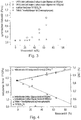
- Fig. 4 results in an increase in the modulus of elasticity, with an increase in the proportion of Oligomerbaustein with at least one polymerizable double bond, such as a tetrafunctional urethane acrylate oligomer with different molecular weights between 600 g / mol to 1000 g / mol, in a prepolymer matrix (96 , 5-x)% TMP (EO) 3 TA, where x is the amount of Oligomerbausteinen with at least one polymerizable double bond or TMP (EO) 9 TA or trithiol, and 3% 2-hydroxy-2-methyl-1-phenyl Propan-1-one can be used as a photoinitiator and 0.5% polydimethylsiloxane acrylate as a non-stick additive.
- Oligomerbaustein with at least one polymerizable double bond such as a tetrafunctional urethane acrylate oligomer with different molecular weights between 600 g / mol to 1000 g
- the maximum E * values are at 5 GPa at a concentration of 80% urethane acrylate oligomer, the increase in the modulus of elasticity resulting from the fact that the oligomers have a higher number of crosslinkable acrylate groups.
- the ideal composition of a prepolymer for an embossing punch with high hardness and 100% conversion by post-curing thus results in: 5% trithiol, 35 ⁇ x ⁇ 60% UOA, (89.5-x)% TMP (EO) 3 xTA, 5% Photoinitiator and 0.5% non-stick additive.
- Fast cross-linking is not so necessary for the production of the embossing stamp, as it can be stamped much slower and, in addition, post-hardening is possible.
- a second ideal composition for the almost complete conversion imprint varnish would be: 5% trithiol, 35 ⁇ x ⁇ 60% UAO, (89.5-x)% TMP (EO) 9 TA, 5% photoinitiator and 0.5% release agent, no postcuring is necessary.
- Example 4 shows the influence of the amount of a release agent on the surface energy of the prepolymer.
- a perfluoropolyether acrylate (HFPO-A) as an anti-stick additive of concentrations below 1%
- the surface energy of the prepolymer can be extremely reduced when it is cured against air / argon.
- HFPO-A perfluoropolyether acrylate
- nonstick additives to a prepolymer composition, of any composition in a concentration between 0.1% and 0.5%, results in a significant reduction in the surface energy when cured against a low-energy surface, so that a defect-free demolding of the cured Polymer is possible.
- the prepolymer compositions exhibit excellent self-replicability, especially in a roll-to-roll nanoimprint lithography process.
- the polymer stamping varnish must be completely cured, ie completely REPLACED.
- a urethane acrylate oligomer based polymer stamp has been molded from a nickel master ( Fig. 6a ) and then from this an R2R impression was performed. ( Fig. 6b ), from which it can be seen that Fig. 6b a reflection to Fig. 6a represents.
- Fig. 7 the replication of non-regular and undercut 3D structures is shown, the figures shown are diatom structures.
- Fig. 7a shows here the urethane acrylate master, Fig. 7b a molded urethane acrylate Oligomerstägest Zi on foil and Fig. 7c one with the stamp of Fig. 7b embossment made by a roll-to-roll process in a urethane acrylate oligomer embossing lacquer according to the invention.
- Fig. 8 It is also shown that the transfer of 3D structures with undercuts with a high aspect ratio, such as in silicon etched columnar structures in the urethane acrylate oligomer embossing in a roll-to-roll process possible is.
- Fig. 8a Here, the positive Si master is shown. From this Si master, a negative urethane acrylate oligomer embossing punch was prepared and coated in Fig. 8b For example, the imprint produced with this die in a roll-to-roll UV nanoimprint lithography (R2R-UV-NIL) process is shown.
- R2R-UV-NIL UV nanoimprint lithography
- FIGS. 6 to 8 are electron micrographs of line structures with 400 nm spacing and 600 nm width, which were transferred in an R2R process with 10 m / min web speed in the urethane acrylate oligomer embossing.
- the surface release agent Being highly efficiently adsorbed to the paint surface, the surface release agent forms a dense monolayer of high CF 3 content which makes it possible to make films which, when used simultaneously with a corresponding reduced surface energy embossing tool, such as nickel stamping surfaces or silicon or quartz surfaces as stamps, which are each covered with long-chain active perfluoroalkyl-phosphonic acids, such as 1H, 1H, 2H, 2H-tridecafluorooctyl-phosphonic acid, to provide a stamp material having an equally low surface energy of 12 mJ / m 2 .
- a corresponding reduced surface energy embossing tool such as nickel stamping surfaces or silicon or quartz surfaces as stamps
- long-chain active perfluoroalkyl-phosphonic acids such as 1H, 1H, 2H, 2H-tridecafluorooctyl-phosphonic acid
- the paint surface is subsequently microstructured or nanostructured, as a result of which the contact angle with water can be increased to more than 170 ° with one simultaneously very low contact angle hysteresis and the rolling angle of water droplets can be lowered to ⁇ 2 °.
- smooth surfaces of the embossing lacquer have a contact angle of about 115 ° with water, so that the water-repellent effect can be achieved only with strong inclination of the film itself, whereas in a structured film water can not adhere even on a nearly flat surface.
Landscapes
- Physics & Mathematics (AREA)
- General Physics & Mathematics (AREA)
- Spectroscopy & Molecular Physics (AREA)
- Chemical & Material Sciences (AREA)
- Inorganic Chemistry (AREA)
- Engineering & Computer Science (AREA)
- Nanotechnology (AREA)
- Medicinal Chemistry (AREA)
- Organic Chemistry (AREA)
- Polymers & Plastics (AREA)
- Health & Medical Sciences (AREA)
- Chemical Kinetics & Catalysis (AREA)
- Manufacturing & Machinery (AREA)
- Crystallography & Structural Chemistry (AREA)
- Condensed Matter Physics & Semiconductors (AREA)
- Macromonomer-Based Addition Polymer (AREA)
- Paints Or Removers (AREA)
- Polymers With Sulfur, Phosphorus Or Metals In The Main Chain (AREA)
- Adhesives Or Adhesive Processes (AREA)
- Polymerisation Methods In General (AREA)
- Shaping Of Tube Ends By Bending Or Straightening (AREA)
- Addition Polymer Or Copolymer, Post-Treatments, Or Chemical Modifications (AREA)
Applications Claiming Priority (2)
| Application Number | Priority Date | Filing Date | Title |
|---|---|---|---|
| ATA888/2014A AT516559B1 (de) | 2014-12-10 | 2014-12-10 | Poly- bzw. Präpolymerzusammensetzung bzw. Prägelack, umfassend eine derartige Zusammensetzung sowie Verwendung derselben |
| PCT/AT2015/000157 WO2016090395A1 (de) | 2014-12-10 | 2015-12-09 | Poly- bzw. präpolymerzusammensetzung bzw. prägelack, umfassend eine derartige zusammenstzung und verwendung desselben |
Publications (2)
| Publication Number | Publication Date |
|---|---|
| EP3230796A1 EP3230796A1 (de) | 2017-10-18 |
| EP3230796B1 true EP3230796B1 (de) | 2019-06-05 |
Family
ID=55066254
Family Applications (1)
| Application Number | Title | Priority Date | Filing Date |
|---|---|---|---|
| EP15817054.8A Active EP3230796B1 (de) | 2014-12-10 | 2015-12-09 | Poly- bzw. präpolymerzusammensetzung bzw. prägelack, umfassend eine derartige zusammensetzung und verwendung desselben |
Country Status (10)
| Country | Link |
|---|---|
| US (1) | US10308768B2 (da) |
| EP (1) | EP3230796B1 (da) |
| JP (1) | JP6640870B2 (da) |
| KR (1) | KR102423758B1 (da) |
| CN (1) | CN107533287B (da) |
| AT (1) | AT516559B1 (da) |
| DK (1) | DK3230796T3 (da) |
| ES (1) | ES2743812T3 (da) |
| HK (1) | HK1244068B (da) |
| WO (1) | WO2016090395A1 (da) |
Families Citing this family (19)
| Publication number | Priority date | Publication date | Assignee | Title |
|---|---|---|---|---|
| DE102017201991A1 (de) | 2017-02-08 | 2018-08-09 | Lufthansa Technik Ag | Prägelackzusammensetzung, daraus hergestellte mikrostrukturierte Oberfläche und Flugzeugbauteil mit einer solchen mikrostrukturierten Oberfläche |
| DE102017201990A1 (de) | 2017-02-08 | 2018-08-09 | Lufthansa Technik Ag | Aushärtbare Vorläuferbeschichtung, daraus hergestellte mikrostrukturierte Oberflächenbeschichtung und Verfahren zur Herstellung einer mikrostrukturierten Oberflächenbeschichtung |
| DE102017202675A1 (de) | 2017-02-20 | 2018-08-23 | Lufthansa Technik Ag | Prägelackzusammensetzung, daraus hergestellte mikrostrukturierte Oberfläche und Flugzeugbauteil mit einer solchen mikrostrukturierten Oberfläche |
| DE102017218543A1 (de) * | 2017-10-17 | 2019-04-18 | Lufthansa Technik Ag | Strömungsoptimierte Oberfläche und Fahrzeug mit einer derartigen strömungsoptimierten Oberfläche |
| KR102877919B1 (ko) * | 2018-03-28 | 2025-10-31 | 바스프 코팅스 게엠베하 | 엠보싱 구조를 코팅의 표면으로 전사시키는 방법 및 상기 코팅을 함유하는 화합물 구조 |
| CA3093719A1 (en) | 2018-03-28 | 2019-10-03 | Basf Coatings Gmbh | Method for transferring an embossed structure to the surface of a coating means and compound structure usable as an embossing die |
| CN108977048A (zh) * | 2018-06-08 | 2018-12-11 | 上海展辰涂料有限公司 | 一种uv耐磨高硬度地板漆 |
| JP7105171B2 (ja) * | 2018-10-30 | 2022-07-22 | 三菱電線工業株式会社 | シール材及びそれに用いるコーティング剤 |
| US20200207142A1 (en) * | 2019-01-02 | 2020-07-02 | Macdermid Graphics Solutions Llc | Liquid Photopolymer Resin Compositions for Flexographic Printing |
| ES2971522T3 (es) | 2019-09-25 | 2024-06-05 | Basf Coatings Gmbh | Método para transferir una estructura grabada a la superficie de un recubrimiento, y material compuesto empleable como molde de grabado |
| DE102020123252A1 (de) | 2019-12-12 | 2021-06-17 | Heliatek Gmbh | Beschichtung für ein optoelektronisches Bauelement, Verfahren zur Herstellung einer solchen Beschichtung, optoelektronisches Bauelement mit einer solchen Beschichtung |
| CN111077732A (zh) * | 2019-12-20 | 2020-04-28 | 深圳市华星光电半导体显示技术有限公司 | 光耦合输出透镜的材料组成物及制造方法 |
| EP3923072A1 (en) * | 2020-06-08 | 2021-12-15 | Joanneum Research Forschungsgesellschaft mbH | A method of preparing an embossed structure, embossed structure and use thereof |
| CN113050371B (zh) * | 2021-04-09 | 2025-02-11 | 深圳技术大学 | 基于丝网印刷的亚微米压印设备及其控制方法 |
| EP4160312A1 (en) | 2021-10-04 | 2023-04-05 | Joanneum Research Forschungsgesellschaft mbH | Elastic embossing lacquer having high optical dispersion |
| WO2023072369A1 (de) * | 2021-10-26 | 2023-05-04 | Joanneum Research Forschungsgesellschaft Mbh | Prägelacke mit aliphatischen photoinitiatoren und biobasierte mikrostruktursysteme |
| DE102021134562A1 (de) * | 2021-12-23 | 2023-06-29 | INM - Leibniz-Institut für Neue Materialien gemeinnützige Gesellschaft mit beschränkter Haftung | Härtbare Zusammensetzung und ihre Anwendung |
| JP7853179B2 (ja) * | 2022-09-07 | 2026-04-28 | キオクシア株式会社 | テンプレート、テンプレートの製造方法、テンプレートを用いたパターン付き基板の製造方法 |
| CN115894919B (zh) * | 2022-11-15 | 2024-02-09 | 中国科学院兰州化学物理研究所 | 一种交联梯度双晶相聚氨酯及其制备方法和应用 |
Family Cites Families (21)
| Publication number | Priority date | Publication date | Assignee | Title |
|---|---|---|---|---|
| DE2834768A1 (de) * | 1977-08-23 | 1979-03-08 | Grace W R & Co | Verfahren zur herstellung einer druckplatte und sie enthaltende haertbare polymerzusammensetzung |
| CA1172112A (en) * | 1980-12-12 | 1984-08-07 | Richard P. Plunkett | Process for making conductive coatings |
| US5744514A (en) * | 1996-10-31 | 1998-04-28 | Borden Chemical, Inc. | Coated optical fibers having a reduced content of extractable and volatile material |
| AU2003281616A1 (en) * | 2002-07-22 | 2004-02-09 | Mitsui Chemicals, Inc. | Resin composition containing ultrafine inorganic particle |
| US7521015B2 (en) * | 2005-07-22 | 2009-04-21 | 3M Innovative Properties Company | Curable thiol-ene compositions for optical articles |
| DE102007007914A1 (de) | 2007-02-14 | 2008-08-21 | Giesecke & Devrient Gmbh | Prägelack für mikrooptische Sicherheitselemente |
| US20090047531A1 (en) * | 2007-08-17 | 2009-02-19 | Ppg Industries Ohio, Inc. | Packages having radiation-curable coatings |
| WO2009148138A1 (ja) * | 2008-06-05 | 2009-12-10 | 旭硝子株式会社 | ナノインプリント用モールド、その製造方法および表面に微細凹凸構造を有する樹脂成形体ならびにワイヤグリッド型偏光子の製造方法 |
| JP2010000612A (ja) * | 2008-06-18 | 2010-01-07 | Fujifilm Corp | ナノインプリント用硬化性組成物、パターン形成方法 |
| KR20100031074A (ko) * | 2008-09-11 | 2010-03-19 | 후지필름 가부시키가이샤 | 감광성 조성물 및 기판의 가공 기판의 제조 방법 |
| JP2011240643A (ja) * | 2010-05-20 | 2011-12-01 | Bridgestone Corp | 樹脂製フィルムを用いた凹凸パターンの形成方法、その方法に使用する装置 |
| EP2445029A1 (en) * | 2010-10-25 | 2012-04-25 | Nederlandse Organisatie voor toegepast -natuurwetenschappelijk onderzoek TNO | Multilayered protective layer, organic opto-electric device and method of manufacturing the same |
| US20130277890A1 (en) * | 2010-11-04 | 2013-10-24 | The Regents Of The University Of Colorado, A Body Corporate | Dual-Cure Polymer Systems |
| WO2013002734A1 (en) * | 2011-06-28 | 2013-01-03 | Agency For Science, Technology And Research | Imprinting apparatus and method |
| CN103087087B (zh) * | 2011-10-27 | 2015-11-25 | 上海交通大学 | 含巯基多官能团的低倍多聚硅氧烷化合物及其组合物和压印的软模板 |
| US10005236B2 (en) * | 2012-03-01 | 2018-06-26 | Stratasys Ltd. | Cationic polymerizable compositions and methods of use thereof |
| JP2015096559A (ja) * | 2012-03-02 | 2015-05-21 | 電気化学工業株式会社 | 樹脂組成物 |
| EP2870209B1 (de) * | 2012-07-04 | 2018-02-21 | BASF Coatings GmbH | Uv- und thermisch härtende klarlackzusammensetzung für die kraftfahrzeug-reparaturlackierung |
| US10154881B2 (en) * | 2012-08-10 | 2018-12-18 | Arizona Board Of Regents For And On Behalf Of Arizona State University | Methods and compositions for tissue adhesives |
| JP6041740B2 (ja) * | 2012-09-28 | 2016-12-14 | 関西ペイント株式会社 | 水性塗料組成物及び塗膜形成方法 |
| JP6361862B2 (ja) * | 2014-03-28 | 2018-07-25 | 株式会社スリーボンド | 光硬化性樹脂組成物 |
-
2014
- 2014-12-10 AT ATA888/2014A patent/AT516559B1/de active
-
2015
- 2015-12-09 ES ES15817054T patent/ES2743812T3/es active Active
- 2015-12-09 WO PCT/AT2015/000157 patent/WO2016090395A1/de not_active Ceased
- 2015-12-09 EP EP15817054.8A patent/EP3230796B1/de active Active
- 2015-12-09 US US15/534,392 patent/US10308768B2/en active Active
- 2015-12-09 CN CN201580075848.3A patent/CN107533287B/zh active Active
- 2015-12-09 KR KR1020177018946A patent/KR102423758B1/ko active Active
- 2015-12-09 DK DK15817054.8T patent/DK3230796T3/da active
- 2015-12-09 JP JP2017549555A patent/JP6640870B2/ja active Active
- 2015-12-09 HK HK18103675.6A patent/HK1244068B/zh unknown
Non-Patent Citations (1)
| Title |
|---|
| None * |
Also Published As
| Publication number | Publication date |
|---|---|
| JP2018505288A (ja) | 2018-02-22 |
| US20170349707A1 (en) | 2017-12-07 |
| EP3230796A1 (de) | 2017-10-18 |
| KR102423758B1 (ko) | 2022-07-20 |
| CN107533287B (zh) | 2021-06-01 |
| WO2016090395A1 (de) | 2016-06-16 |
| JP6640870B2 (ja) | 2020-02-05 |
| US10308768B2 (en) | 2019-06-04 |
| AT516559A1 (de) | 2016-06-15 |
| CN107533287A (zh) | 2018-01-02 |
| KR20170093229A (ko) | 2017-08-14 |
| ES2743812T3 (es) | 2020-02-20 |
| WO2016090395A8 (de) | 2018-09-07 |
| HK1244068B (zh) | 2020-03-20 |
| DK3230796T3 (da) | 2019-07-15 |
| AT516559B1 (de) | 2017-12-15 |
Similar Documents
| Publication | Publication Date | Title |
|---|---|---|
| EP3230796B1 (de) | Poly- bzw. präpolymerzusammensetzung bzw. prägelack, umfassend eine derartige zusammensetzung und verwendung desselben | |
| EP3230795B1 (de) | Prägelack sowie verfahren zum prägen | |
| HK1244068A1 (en) | Poly- or prepolymer composition, or embossing lacquer comprising such a composition and use thereof | |
| DE602004013338T2 (de) | Stempel für die sanfte Lithographie, insbesondere für das Mikro-Kontaktdruckverfahren und Verfahren zu seiner Herstellung | |
| EP1796851B1 (en) | Polymerization technique to attenuate oxygen inhibition of solidification of liquids | |
| EP2856258B1 (en) | Process of production of a nanopatterned article using nanoimprint lithography, nanopatterned article and uses thereof | |
| WO2013036555A1 (en) | Block copolymers and lithographic patterning using same | |
| WO2019185441A1 (de) | Nanostrukturierte kompositmaterialien mit selbstheilenden eigenschaften | |
| EP3074819A1 (de) | Stempel mit einer stempelstruktur sowie verfahren zu dessen herstellung | |
| JP6442602B2 (ja) | ナノパターンを含む光学シート及びその製造方法 | |
| US10752718B2 (en) | Photocurable resin composition and method of forming patterns using the same | |
| KR20140023843A (ko) | 광경화성 폴리머 레진 복합체를 이용한 미세 패턴의 형성 방법 | |
| CN107664919B (zh) | 制备图案化固化产品的方法和由此获得的图案化固化产品 | |
| EP3173449A1 (de) | Verbund aus zwei festkörpern | |
| KR101607965B1 (ko) | 롤투롤 나노임프린트용 광중합성 조성물 및 이를 포함하는 선 격자 편광필름 | |
| KR102101344B1 (ko) | 롤투롤 나노 임프린트 복제 몰드 제작용 광중합성 조성물 및 이를 포함하는 복제 몰드 | |
| KR20160101311A (ko) | 마이크로-나노 계층 구조의 형성방법 | |
| KR20230024962A (ko) | 엠보싱된 구조의 제조 방법, 엠보싱된 구조 및 이의 용도 | |
| WO2023117656A1 (de) | Härtbare zusammensetzung und ihre anwendung | |
| TW201500438A (zh) | 用於複製奈米圖案之樹脂組成物及使用彼之複製方法 | |
| WO2022083889A1 (de) | HERSTELLUNG VON PIGMENTEN MIT DEFINIERTER GRÖßE UND FORM | |
| Comrie et al. | CROSSLINKING POLYMER BRUSHES FOR THE FABRICATION OF QUASI-2 D'MICRO-OBJECTS' | |
| AT506931A1 (de) | Verfahren zur herstellung einer dreidimensionalen micro- bzw. nanostruktur auf einem substrat |
Legal Events
| Date | Code | Title | Description |
|---|---|---|---|
| STAA | Information on the status of an ep patent application or granted ep patent |
Free format text: STATUS: THE INTERNATIONAL PUBLICATION HAS BEEN MADE |
|
| PUAI | Public reference made under article 153(3) epc to a published international application that has entered the european phase |
Free format text: ORIGINAL CODE: 0009012 |
|
| STAA | Information on the status of an ep patent application or granted ep patent |
Free format text: STATUS: REQUEST FOR EXAMINATION WAS MADE |
|
| 17P | Request for examination filed |
Effective date: 20170710 |
|
| AK | Designated contracting states |
Kind code of ref document: A1 Designated state(s): AL AT BE BG CH CY CZ DE DK EE ES FI FR GB GR HR HU IE IS IT LI LT LU LV MC MK MT NL NO PL PT RO RS SE SI SK SM TR |
|
| AX | Request for extension of the european patent |
Extension state: BA ME |
|
| DAV | Request for validation of the european patent (deleted) | ||
| DAX | Request for extension of the european patent (deleted) | ||
| RIN1 | Information on inventor provided before grant (corrected) |
Inventor name: LINTSCHNIG, ANDRE Inventor name: STADLOBER, BARBARA Inventor name: RUTTLOFF, STEPHAN Inventor name: NEES, DIETER Inventor name: LEITGEB, MARKUS Inventor name: SATZINGER, VALENTIN |
|
| REG | Reference to a national code |
Ref country code: HK Ref legal event code: DE Ref document number: 1244068 Country of ref document: HK |
|
| RIN1 | Information on inventor provided before grant (corrected) |
Inventor name: RUTTLOFF, STEPHAN Inventor name: STADLOBER, BARBARA Inventor name: SATZINGER, VALENTIN Inventor name: NEES, DIETER Inventor name: LEITGEB, MARKUS Inventor name: LINTSCHNIG, ANDRE |
|
| GRAP | Despatch of communication of intention to grant a patent |
Free format text: ORIGINAL CODE: EPIDOSNIGR1 |
|
| STAA | Information on the status of an ep patent application or granted ep patent |
Free format text: STATUS: GRANT OF PATENT IS INTENDED |
|
| INTG | Intention to grant announced |
Effective date: 20181212 |
|
| GRAS | Grant fee paid |
Free format text: ORIGINAL CODE: EPIDOSNIGR3 |
|
| GRAA | (expected) grant |
Free format text: ORIGINAL CODE: 0009210 |
|
| STAA | Information on the status of an ep patent application or granted ep patent |
Free format text: STATUS: THE PATENT HAS BEEN GRANTED |
|
| AK | Designated contracting states |
Kind code of ref document: B1 Designated state(s): AL AT BE BG CH CY CZ DE DK EE ES FI FR GB GR HR HU IE IS IT LI LT LU LV MC MK MT NL NO PL PT RO RS SE SI SK SM TR |
|
| REG | Reference to a national code |
Ref country code: GB Ref legal event code: FG4D Free format text: NOT ENGLISH |
|
| REG | Reference to a national code |
Ref country code: CH Ref legal event code: EP |
|
| REG | Reference to a national code |
Ref country code: AT Ref legal event code: REF Ref document number: 1140599 Country of ref document: AT Kind code of ref document: T Effective date: 20190615 |
|
| REG | Reference to a national code |
Ref country code: IE Ref legal event code: FG4D Free format text: LANGUAGE OF EP DOCUMENT: GERMAN |
|
| REG | Reference to a national code |
Ref country code: DE Ref legal event code: R096 Ref document number: 502015009265 Country of ref document: DE |
|
| REG | Reference to a national code |
Ref country code: DK Ref legal event code: T3 Effective date: 20190708 |
|
| REG | Reference to a national code |
Ref country code: NL Ref legal event code: FP |
|
| REG | Reference to a national code |
Ref country code: LT Ref legal event code: MG4D |
|
| PG25 | Lapsed in a contracting state [announced via postgrant information from national office to epo] |
Ref country code: NO Free format text: LAPSE BECAUSE OF FAILURE TO SUBMIT A TRANSLATION OF THE DESCRIPTION OR TO PAY THE FEE WITHIN THE PRESCRIBED TIME-LIMIT Effective date: 20190905 Ref country code: LT Free format text: LAPSE BECAUSE OF FAILURE TO SUBMIT A TRANSLATION OF THE DESCRIPTION OR TO PAY THE FEE WITHIN THE PRESCRIBED TIME-LIMIT Effective date: 20190605 Ref country code: HR Free format text: LAPSE BECAUSE OF FAILURE TO SUBMIT A TRANSLATION OF THE DESCRIPTION OR TO PAY THE FEE WITHIN THE PRESCRIBED TIME-LIMIT Effective date: 20190605 Ref country code: SE Free format text: LAPSE BECAUSE OF FAILURE TO SUBMIT A TRANSLATION OF THE DESCRIPTION OR TO PAY THE FEE WITHIN THE PRESCRIBED TIME-LIMIT Effective date: 20190605 Ref country code: AL Free format text: LAPSE BECAUSE OF FAILURE TO SUBMIT A TRANSLATION OF THE DESCRIPTION OR TO PAY THE FEE WITHIN THE PRESCRIBED TIME-LIMIT Effective date: 20190605 Ref country code: FI Free format text: LAPSE BECAUSE OF FAILURE TO SUBMIT A TRANSLATION OF THE DESCRIPTION OR TO PAY THE FEE WITHIN THE PRESCRIBED TIME-LIMIT Effective date: 20190605 |
|
| PG25 | Lapsed in a contracting state [announced via postgrant information from national office to epo] |
Ref country code: RS Free format text: LAPSE BECAUSE OF FAILURE TO SUBMIT A TRANSLATION OF THE DESCRIPTION OR TO PAY THE FEE WITHIN THE PRESCRIBED TIME-LIMIT Effective date: 20190605 Ref country code: LV Free format text: LAPSE BECAUSE OF FAILURE TO SUBMIT A TRANSLATION OF THE DESCRIPTION OR TO PAY THE FEE WITHIN THE PRESCRIBED TIME-LIMIT Effective date: 20190605 Ref country code: GR Free format text: LAPSE BECAUSE OF FAILURE TO SUBMIT A TRANSLATION OF THE DESCRIPTION OR TO PAY THE FEE WITHIN THE PRESCRIBED TIME-LIMIT Effective date: 20190906 Ref country code: BG Free format text: LAPSE BECAUSE OF FAILURE TO SUBMIT A TRANSLATION OF THE DESCRIPTION OR TO PAY THE FEE WITHIN THE PRESCRIBED TIME-LIMIT Effective date: 20190905 |
|
| PG25 | Lapsed in a contracting state [announced via postgrant information from national office to epo] |
Ref country code: CZ Free format text: LAPSE BECAUSE OF FAILURE TO SUBMIT A TRANSLATION OF THE DESCRIPTION OR TO PAY THE FEE WITHIN THE PRESCRIBED TIME-LIMIT Effective date: 20190605 Ref country code: PT Free format text: LAPSE BECAUSE OF FAILURE TO SUBMIT A TRANSLATION OF THE DESCRIPTION OR TO PAY THE FEE WITHIN THE PRESCRIBED TIME-LIMIT Effective date: 20191007 Ref country code: SK Free format text: LAPSE BECAUSE OF FAILURE TO SUBMIT A TRANSLATION OF THE DESCRIPTION OR TO PAY THE FEE WITHIN THE PRESCRIBED TIME-LIMIT Effective date: 20190605 Ref country code: RO Free format text: LAPSE BECAUSE OF FAILURE TO SUBMIT A TRANSLATION OF THE DESCRIPTION OR TO PAY THE FEE WITHIN THE PRESCRIBED TIME-LIMIT Effective date: 20190605 Ref country code: EE Free format text: LAPSE BECAUSE OF FAILURE TO SUBMIT A TRANSLATION OF THE DESCRIPTION OR TO PAY THE FEE WITHIN THE PRESCRIBED TIME-LIMIT Effective date: 20190605 |
|
| PG25 | Lapsed in a contracting state [announced via postgrant information from national office to epo] |
Ref country code: IS Free format text: LAPSE BECAUSE OF FAILURE TO SUBMIT A TRANSLATION OF THE DESCRIPTION OR TO PAY THE FEE WITHIN THE PRESCRIBED TIME-LIMIT Effective date: 20191005 Ref country code: SM Free format text: LAPSE BECAUSE OF FAILURE TO SUBMIT A TRANSLATION OF THE DESCRIPTION OR TO PAY THE FEE WITHIN THE PRESCRIBED TIME-LIMIT Effective date: 20190605 |
|
| REG | Reference to a national code |
Ref country code: DE Ref legal event code: R097 Ref document number: 502015009265 Country of ref document: DE |
|
| PG25 | Lapsed in a contracting state [announced via postgrant information from national office to epo] |
Ref country code: TR Free format text: LAPSE BECAUSE OF FAILURE TO SUBMIT A TRANSLATION OF THE DESCRIPTION OR TO PAY THE FEE WITHIN THE PRESCRIBED TIME-LIMIT Effective date: 20190605 |
|
| PLBE | No opposition filed within time limit |
Free format text: ORIGINAL CODE: 0009261 |
|
| STAA | Information on the status of an ep patent application or granted ep patent |
Free format text: STATUS: NO OPPOSITION FILED WITHIN TIME LIMIT |
|
| PG25 | Lapsed in a contracting state [announced via postgrant information from national office to epo] |
Ref country code: PL Free format text: LAPSE BECAUSE OF FAILURE TO SUBMIT A TRANSLATION OF THE DESCRIPTION OR TO PAY THE FEE WITHIN THE PRESCRIBED TIME-LIMIT Effective date: 20190605 |
|
| 26N | No opposition filed |
Effective date: 20200306 |
|
| PG25 | Lapsed in a contracting state [announced via postgrant information from national office to epo] |
Ref country code: SI Free format text: LAPSE BECAUSE OF FAILURE TO SUBMIT A TRANSLATION OF THE DESCRIPTION OR TO PAY THE FEE WITHIN THE PRESCRIBED TIME-LIMIT Effective date: 20190605 |
|
| REG | Reference to a national code |
Ref country code: CH Ref legal event code: PL |
|
| PG25 | Lapsed in a contracting state [announced via postgrant information from national office to epo] |
Ref country code: MC Free format text: LAPSE BECAUSE OF FAILURE TO SUBMIT A TRANSLATION OF THE DESCRIPTION OR TO PAY THE FEE WITHIN THE PRESCRIBED TIME-LIMIT Effective date: 20190605 |
|
| PG25 | Lapsed in a contracting state [announced via postgrant information from national office to epo] |
Ref country code: IE Free format text: LAPSE BECAUSE OF NON-PAYMENT OF DUE FEES Effective date: 20191209 Ref country code: LU Free format text: LAPSE BECAUSE OF NON-PAYMENT OF DUE FEES Effective date: 20191209 |
|
| PG25 | Lapsed in a contracting state [announced via postgrant information from national office to epo] |
Ref country code: CH Free format text: LAPSE BECAUSE OF NON-PAYMENT OF DUE FEES Effective date: 20191231 Ref country code: LI Free format text: LAPSE BECAUSE OF NON-PAYMENT OF DUE FEES Effective date: 20191231 |
|
| PG25 | Lapsed in a contracting state [announced via postgrant information from national office to epo] |
Ref country code: CY Free format text: LAPSE BECAUSE OF FAILURE TO SUBMIT A TRANSLATION OF THE DESCRIPTION OR TO PAY THE FEE WITHIN THE PRESCRIBED TIME-LIMIT Effective date: 20190605 |
|
| PG25 | Lapsed in a contracting state [announced via postgrant information from national office to epo] |
Ref country code: MT Free format text: LAPSE BECAUSE OF FAILURE TO SUBMIT A TRANSLATION OF THE DESCRIPTION OR TO PAY THE FEE WITHIN THE PRESCRIBED TIME-LIMIT Effective date: 20190605 Ref country code: HU Free format text: LAPSE BECAUSE OF FAILURE TO SUBMIT A TRANSLATION OF THE DESCRIPTION OR TO PAY THE FEE WITHIN THE PRESCRIBED TIME-LIMIT; INVALID AB INITIO Effective date: 20151209 |
|
| REG | Reference to a national code |
Ref country code: AT Ref legal event code: MM01 Ref document number: 1140599 Country of ref document: AT Kind code of ref document: T Effective date: 20201209 |
|
| PG25 | Lapsed in a contracting state [announced via postgrant information from national office to epo] |
Ref country code: AT Free format text: LAPSE BECAUSE OF NON-PAYMENT OF DUE FEES Effective date: 20201209 |
|
| PG25 | Lapsed in a contracting state [announced via postgrant information from national office to epo] |
Ref country code: MK Free format text: LAPSE BECAUSE OF FAILURE TO SUBMIT A TRANSLATION OF THE DESCRIPTION OR TO PAY THE FEE WITHIN THE PRESCRIBED TIME-LIMIT Effective date: 20190605 |
|
| P01 | Opt-out of the competence of the unified patent court (upc) registered |
Effective date: 20230320 |
|
| PGFP | Annual fee paid to national office [announced via postgrant information from national office to epo] |
Ref country code: GB Payment date: 20251223 Year of fee payment: 11 |
|
| PGFP | Annual fee paid to national office [announced via postgrant information from national office to epo] |
Ref country code: IT Payment date: 20251218 Year of fee payment: 11 Ref country code: DK Payment date: 20251222 Year of fee payment: 11 |
|
| PGFP | Annual fee paid to national office [announced via postgrant information from national office to epo] |
Ref country code: FR Payment date: 20251223 Year of fee payment: 11 Ref country code: NL Payment date: 20251222 Year of fee payment: 11 |
|
| PGFP | Annual fee paid to national office [announced via postgrant information from national office to epo] |
Ref country code: BE Payment date: 20251231 Year of fee payment: 11 |
|
| PGFP | Annual fee paid to national office [announced via postgrant information from national office to epo] |
Ref country code: ES Payment date: 20260122 Year of fee payment: 11 |
|
| PGFP | Annual fee paid to national office [announced via postgrant information from national office to epo] |
Ref country code: DE Payment date: 20251222 Year of fee payment: 11 |