EP3233933B1 - Polymerisation radicalaire d'alcoxyamines a basse temperature - Google Patents
Polymerisation radicalaire d'alcoxyamines a basse temperature Download PDFInfo
- Publication number
- EP3233933B1 EP3233933B1 EP15823675.2A EP15823675A EP3233933B1 EP 3233933 B1 EP3233933 B1 EP 3233933B1 EP 15823675 A EP15823675 A EP 15823675A EP 3233933 B1 EP3233933 B1 EP 3233933B1
- Authority
- EP
- European Patent Office
- Prior art keywords
- radical
- process according
- alkoxyamine
- polymerization
- nitroxide
- Prior art date
- Legal status (The legal status is an assumption and is not a legal conclusion. Google has not performed a legal analysis and makes no representation as to the accuracy of the status listed.)
- Active
Links
- 0 CCOP(*)(C(C(C)(C)*C)N(C(C)(C)*)O)=O Chemical compound CCOP(*)(C(C(C)(C)*C)N(C(C)(C)*)O)=O 0.000 description 3
Images

Classifications
-
- C—CHEMISTRY; METALLURGY
- C08—ORGANIC MACROMOLECULAR COMPOUNDS; THEIR PREPARATION OR CHEMICAL WORKING-UP; COMPOSITIONS BASED THEREON
- C08F—MACROMOLECULAR COMPOUNDS OBTAINED BY REACTIONS ONLY INVOLVING CARBON-TO-CARBON UNSATURATED BONDS
- C08F293/00—Macromolecular compounds obtained by polymerisation on to a macromolecule having groups capable of inducing the formation of new polymer chains bound exclusively at one or both ends of the starting macromolecule
- C08F293/005—Macromolecular compounds obtained by polymerisation on to a macromolecule having groups capable of inducing the formation of new polymer chains bound exclusively at one or both ends of the starting macromolecule using free radical "living" or "controlled" polymerisation, e.g. using a complexing agent
-
- C—CHEMISTRY; METALLURGY
- C08—ORGANIC MACROMOLECULAR COMPOUNDS; THEIR PREPARATION OR CHEMICAL WORKING-UP; COMPOSITIONS BASED THEREON
- C08F—MACROMOLECULAR COMPOUNDS OBTAINED BY REACTIONS ONLY INVOLVING CARBON-TO-CARBON UNSATURATED BONDS
- C08F220/00—Copolymers of compounds having one or more unsaturated aliphatic radicals, each having only one carbon-to-carbon double bond, and only one being terminated by only one carboxyl radical or a salt, anhydride ester, amide, imide or nitrile thereof
- C08F220/02—Monocarboxylic acids having less than ten carbon atoms; Derivatives thereof
- C08F220/10—Esters
- C08F220/12—Esters of monohydric alcohols or phenols
- C08F220/16—Esters of monohydric alcohols or phenols of phenols or of alcohols containing two or more carbon atoms
- C08F220/18—Esters of monohydric alcohols or phenols of phenols or of alcohols containing two or more carbon atoms with acrylic or methacrylic acids
-
- C—CHEMISTRY; METALLURGY
- C08—ORGANIC MACROMOLECULAR COMPOUNDS; THEIR PREPARATION OR CHEMICAL WORKING-UP; COMPOSITIONS BASED THEREON
- C08F—MACROMOLECULAR COMPOUNDS OBTAINED BY REACTIONS ONLY INVOLVING CARBON-TO-CARBON UNSATURATED BONDS
- C08F4/00—Polymerisation catalysts
- C08F4/28—Oxygen or compounds releasing free oxygen
- C08F4/32—Organic compounds
- C08F4/34—Per-compounds with one peroxy-radical
-
- C—CHEMISTRY; METALLURGY
- C09—DYES; PAINTS; POLISHES; NATURAL RESINS; ADHESIVES; COMPOSITIONS NOT OTHERWISE PROVIDED FOR; APPLICATIONS OF MATERIALS NOT OTHERWISE PROVIDED FOR
- C09D—COATING COMPOSITIONS, e.g. PAINTS, VARNISHES OR LACQUERS; FILLING PASTES; CHEMICAL PAINT OR INK REMOVERS; INKS; CORRECTING FLUIDS; WOODSTAINS; PASTES OR SOLIDS FOR COLOURING OR PRINTING; USE OF MATERIALS THEREFOR
- C09D153/00—Coating compositions based on block copolymers containing at least one sequence of a polymer obtained by reactions only involving carbon-to-carbon unsaturated bonds; Coating compositions based on derivatives of such polymers
-
- C—CHEMISTRY; METALLURGY
- C09—DYES; PAINTS; POLISHES; NATURAL RESINS; ADHESIVES; COMPOSITIONS NOT OTHERWISE PROVIDED FOR; APPLICATIONS OF MATERIALS NOT OTHERWISE PROVIDED FOR
- C09J—ADHESIVES; NON-MECHANICAL ASPECTS OF ADHESIVE PROCESSES IN GENERAL; ADHESIVE PROCESSES NOT PROVIDED FOR ELSEWHERE; USE OF MATERIALS AS ADHESIVES
- C09J153/00—Adhesives based on block copolymers containing at least one sequence of a polymer obtained by reactions only involving carbon-to-carbon unsaturated bonds; Adhesives based on derivatives of such polymers
-
- C—CHEMISTRY; METALLURGY
- C08—ORGANIC MACROMOLECULAR COMPOUNDS; THEIR PREPARATION OR CHEMICAL WORKING-UP; COMPOSITIONS BASED THEREON
- C08F—MACROMOLECULAR COMPOUNDS OBTAINED BY REACTIONS ONLY INVOLVING CARBON-TO-CARBON UNSATURATED BONDS
- C08F220/00—Copolymers of compounds having one or more unsaturated aliphatic radicals, each having only one carbon-to-carbon double bond, and only one being terminated by only one carboxyl radical or a salt, anhydride ester, amide, imide or nitrile thereof
- C08F220/02—Monocarboxylic acids having less than ten carbon atoms; Derivatives thereof
- C08F220/10—Esters
- C08F220/12—Esters of monohydric alcohols or phenols
- C08F220/16—Esters of monohydric alcohols or phenols of phenols or of alcohols containing two or more carbon atoms
- C08F220/18—Esters of monohydric alcohols or phenols of phenols or of alcohols containing two or more carbon atoms with acrylic or methacrylic acids
- C08F220/1804—C4-(meth)acrylate, e.g. butyl (meth)acrylate, isobutyl (meth)acrylate or tert-butyl (meth)acrylate
-
- C—CHEMISTRY; METALLURGY
- C08—ORGANIC MACROMOLECULAR COMPOUNDS; THEIR PREPARATION OR CHEMICAL WORKING-UP; COMPOSITIONS BASED THEREON
- C08F—MACROMOLECULAR COMPOUNDS OBTAINED BY REACTIONS ONLY INVOLVING CARBON-TO-CARBON UNSATURATED BONDS
- C08F2438/00—Living radical polymerisation
- C08F2438/02—Stable Free Radical Polymerisation [SFRP]; Nitroxide Mediated Polymerisation [NMP] for, e.g. using 2,2,6,6-tetramethylpiperidine-1-oxyl [TEMPO]
-
- C—CHEMISTRY; METALLURGY
- C08—ORGANIC MACROMOLECULAR COMPOUNDS; THEIR PREPARATION OR CHEMICAL WORKING-UP; COMPOSITIONS BASED THEREON
- C08L—COMPOSITIONS OF MACROMOLECULAR COMPOUNDS
- C08L2205/00—Polymer mixtures characterised by other features
- C08L2205/04—Polymer mixtures characterised by other features containing interpenetrating networks
Definitions
- the present invention relates to a process for the radical polymerization of alkoxyamines at low temperature, typically at temperatures as low as minus 50 ° C in the presence of a nitroxide reducing agent.
- the invention also relates to the use of the method of the invention for obtaining objects, as well as the objects obtained.
- Radical polymerization is a well-known polymerization technique.
- the use of alkoxyamines makes it possible to prepare block copolymers.
- this nitroxide has many advantages such as moderate polymerization temperatures, good control of many monomers, It does not allow to conduct low temperature polymerizations such as ambient see below the ambient in times compatible with industrial cycles when it is derived from alkoxyamines, these the latter can only generate the persistent radical at temperatures above 50 ° C.
- WO03 / 074572 describes the possibility of polymerizing in a controlled manner by the nitroxide route at temperatures between 50 ° C and 160 ° C, but preferably between 80 ° C and 100 ° C. The reaction is therefore not possible for example at room temperature.
- the low temperature polymerization has advantages (limitation of side reactions, no degradation of some temperature sensitive molecules) but also allows to consume less energy or to minimize the pressure in synthesis reactors .
- the process of the invention can be carried out with any type of alkoxyamine. It can also be a polyalkoxyamine, capable of generating several nitroxide radicals, or a macromolecular alkoxyamine or macromolecular polyalkoxyamine resulting from a polymerization step between at least one monomer and an alkoxyamine.
- alkoxyamines can also be a polyalkoxyamine, capable of generating several nitroxide radicals, or a macromolecular alkoxyamine or macromolecular polyalkoxyamine resulting from a polymerization step between at least one monomer and an alkoxyamine.
- at least one of the alkoxyamines is monofunctional.
- at least one of the alkoxyamines is multifunctional.
- the alkoxyamine or polyalkoxyamine is described by the general formula Z (-T) n in which Z denotes a multivalent group, T a nitroxide and n an integer greater than or equal to 1, preferably between 2 and 10, advantageously between 2 and 8 and more preferably between 2 and 4, terminals included.
- n represents the functionality of the alkoxyamine, that is to say the number of nitroxydes radicals T that can be released by the alkoxyamine according to the mechanism: Z (-T) n ⁇ Z + nT
- a nitroxide reducing agent which may be, for example, a radical resulting from the decomposition of a radical initiator either by temperature or by a redox reaction.
- the activated alkoxyamine initiates polymerization.
- the monomer M1 is first polymerized after activation of the alkoxyamine, then once the polyM1 block is complete, the monomer M2 is then polymerized: TZT ⁇ M 1 T- M 1 x -Z- M 1 x -T ⁇ M 2 T- M 2 there ⁇ POLYMER 2 - M 1 x -Z- M 1 x ⁇ POLYMER 1 - M 2 there -T ⁇ POLYMER 2
- the principle of the preparation of block copolymers remains valid for n greater than or equal to 1.
- Z denotes a multivalent group, that is to say a group capable of releasing several radical sites after activation. The activation in question occurs by covalent Z-T bond failure.
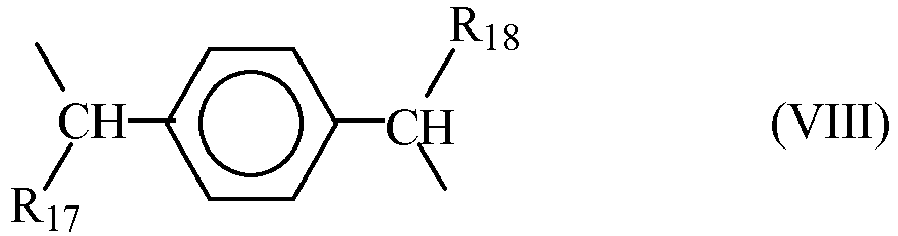
- Z may be chosen from the following groups (I) to (VIII): in which R 3 and R 4, which are identical or different, represent a linear or branched alkyl radical having a number of carbon atoms ranging from 1 to 10, phenyl or thienyl radicals optionally substituted by a halogen atom such as F, Cl, Br, or by a linear or branched alkyl radical having a number of carbon atoms ranging from 1 to 4, or alternatively by nitro, alkoxy, aryloxy, carbonyl or carboxy radicals; a benzyl radical, a cycloalkyl radical having a number of carbon atoms ranging from 3 to 12, a radical containing one or more unsaturations; B represents a linear or branched alkylene radical having a number of carbon atoms ranging from 1 to 20; m is an integer from 1 to 10; in which R 5 and R 6 , which are identical or different, represent aryl, pyridy
- stable free radical denotes a radical that is so persistent and non-reactive with respect to air and moisture in the ambient air that it can be handled and stored for a much longer period than the majority free radicals (see, Accounts of Chemical Research 1976, 9, 13-19 ).
- the stable free radical is thus distinguished from free radicals whose lifetime is ephemeral (from a few milliseconds to a few seconds) such as free radicals from conventional polymerization initiators such as peroxides, hydroperoxides or azo initiators. It can be said that a free radical is stable if it is not a polymerization initiator and if the average lifetime of the radical is at least one minute.
- R L is a phosphonate group of formula: in which R c and R d are two identical or different alkyl groups, optionally linked so as to form a ring, comprising from 1 to 40 carbon atoms, optionally substituted or not.
- the R L group may also comprise at least one aromatic ring such as the phenyl radical or the naphthyl radical, substituted for example by one or more alkyl radicals comprising from 1 to 10 carbon atoms.
- R L is a phosphonate group of formula:
- R c and R d are two identical or different alkyl groups, optionally linked so as to form a ring, comprising from 1 to 40 carbon atoms, optionally substituted or not.
- the R L group may also comprise at least one aromatic ring such as the phenyl radical or the naphthyl radical, substituted for example by one or more alkyl radicals comprising from 1 to 10 carbon atoms.
- nitroxide of formula (XIV) is particularly preferred:
- the alkoxyamine (I), and especially the alkoxyamine (XIII), can be prepared by recipes described for example in or in FR2791979 .
- Alkoxyamines that can be used in the context of the invention are represented below:
- the last two alkoxyamines are called DIAMINS and TRIAMINS respectively and are the preferred alkoxyamines.
- These mixtures could thus comprise, for example, an alkoxyamine having attached nitroxides and an alkoxyamine having n 2 nitroxides attached with n 1 other than n 2. It could also be a combination of alkoxyamines carrying different nitroxides.
- nitroxide reducer they can be of all types. It can be a mercaptan, a radical. Preferably, it acts of a radical resulting from the decomposition of a radical initiator either by temperature, or by a redox reaction, or another redox system that can generate radicals such as, for example, the methylene bis (diethyl malonate) -cerium IV pair , or the couple H 2 O 2 / Fe 2+ .
- nitroxide reducer any compound capable of reacting with a nitroxide.
- radical initiator it may be chosen from diacyl peroxides, peroxyesters, dialkyl peroxides, peroxyacetals and azo compounds.
- Suitable radical initiators are, for example, isopropyl carbonate, benzoyl peroxide, lauroyl, caproyl, dicumyl, tert-butyl perbenzoate, tert-butyl 2-ethyl perhexanoate, cumyl hydroperoxide, and the like.
- radical initiator is a peroxide, and more particularly benzoyl peroxide.
- the radical is generated by the reaction between a peroxide and an amine.
- any type of amine capable of reacting with a peroxide can be used.
- these are substituted amines, and more particularly tri-substituted amines, among which mention may be made of N, N-dimethyl aniline (DMA) and its para-substituted derivatives such as dimethyl-p-amine.
- toluidine (DMPT) p-hydroxymethyl-N, N-dimethyl aniline (HMDA), p-nitro-N, N, N-dimethyl aniline (NDMA) and p-dimethyl-amino benzaldehyde (DMAB). More particularly, it is dimethyl-p-toluidine.
- the conduct of the polymerization according to the process of the invention may be carried out in bulk, solution, suspension or emulsion.
- the alkoxyamine used may be prepared by a similar nitroxide-controlled radical polymerization process, but without the presence of the nitroxide reductant, at a temperature above 50 ° C.
- This is for example to make a first block comprising at least one monomer, which will subsequently be placed under the conditions of the present invention, that is to say at low temperature, typically at room temperature to generate the polymerization of other blocks.
- We will obtain a copolymer with several blocks.
- the synthesis of block copolymers, or block copolymers has been using several techniques for many years. In each of these techniques, the temperatures used for the synthesis are always very far from the ambient and therefore require special conditions of preparation, often incompatible with the manufacturing processes used in the applications.
- the polymerization temperatures are between -50 ° C. and + 80 ° C., advantageously between -20 ° C. and + 80 ° C., preferably between 0 ° C. and 80 ° C., more preferably between 0 ° C and 50 ° C, and most preferably between 10 and 35 ° C.
- the viscosity is no longer a problem because it appears only at the end of the process. . This opens up new opportunities in the fields where viscosity is a limiting factor such as coatings, resin injection or infusion processes, adhesives, etc.
- the present invention has the dual advantage of allowing the synthesis of the in situ block copolymer in the host material, so as to obtain a particular morphology more favorable to the application properties, and while maintaining a low initial viscosity which is particularly favorable for the implementation of the additive material.
- the host material may be a solvent, a polymer, an oligomer, a pigmentary or non-pigment filler of any size and any type of porous or non-porous form factor, short or long fibers, woven or non-woven fibers, nanotubes or combination of these host materials.
- the host material may also be a polymer precursor, for example any two-component system or not capable of polymerizing independently of the polymerization involving the alkoxyamine, for example without limitation an epoxy resin, polyurethane, polyester.
- the host material and the material resulting from the polymerization of the alkoxyamine can be polymerized either simultaneously or sequentially.
- the present invention is similar to the methods described in WO 03/062293 or WO 06/06152 but differs from these in that the synthesis temperature of the second block is very significantly lower than those described in the prior art, typically at room temperature, which is made possible by the combined use of a macromolecular alkoxyamine initiator previously prepared during a first step conventionally described in the prior art, in the presence of a nitroxide reductant and constituent monomers of the second block.
- monomers having one or more double bonds such as vinylaromatic monomers such as styrene or substituted styrenes, especially alpha-methylstyrene, and acrylic monomers such as acrylic acid or its salts, alkyl acrylates (having one or more acrylic functions), cycloalkyl or aryl such as methyl acrylate, ethyl acrylate, butyl acrylate, ethylhexyl acrylate or phenyl acrylate, hydroxyalkyl acrylates such as 2-hydroxyethyl acrylate, ether alkyl acrylates such as 2-methoxyethyl acrylate, alkoxy- or aryloxy-polyalkylene glycol acrylates such as methoxypolyethylene glycol acrylates, acryloyl acrylates and the like.
- vinylaromatic monomers such as styrene or substituted styrenes, especially alpha-methylstyrene
- ethoxypolyethylene glycol methoxypolypropylene glycol acrylates, methoxypolyethylene glycol acrylate-polypropylene glycol acrylates or mixtures thereof, aminoalkyl acrylates such as 2- (dimethylamino) ethyl acrylate (ADAME), fluorinated acrylates, silylated acrylates, phosphorus acrylates such as alkylene glycol phosphate acrylates, methacrylic monomers such as methacrylic acid or its salts, alkyl, cycloalkyl, alkenyl methacrylates or aryls such as methyl methacrylate (MMA), lauryl, cyclohexyl, allyl, phenyl or naphthyl, hydroxyalkyl methacrylates such as 2-hydroxyethyl methacrylate or 2-hydroxypropyl methacrylate, ether alkyl methacrylates such as 2-ethoxyethyl methacrylate, alk
- methacrylamides N-methylolmethacrylamide, methacrylamido-propyltrimethylammonium chloride (MAPTAC), itaconic acid, maleic acid or its salts, maleic anhydride, alkyl or alkoxy maleates or hemimaleates or aryloxy-polyalkylene glycol, vinylpyridine, vinylpyrrolidinone, (alkoxy) poly (alkylene glycol) vinyl ether or divinyl ether, such as methoxy poly (ethylene glycol) vinyl and her, poly (ethylene glycol) divinyl ether, olefinic monomers, among which mention may be made of ethylene, butene, hexene and 1-octene as well as fluorinated olefinic monomers, and vinylidene monomers, among which mention may be made of vinylidene fluoride, alone or as a mixture of at least two aforementioned monomers.
- MTAC methacrylamido-propyltrimethylammonium
- the present invention also relates to the applications of the use of this low temperature synthesis method. This process becomes compatible with many and varied applications for which the application temperature remains cold or moderate.
- the present invention is advantageously suitable for applications such as varnishes, coatings, adhesives and adhesives, mechanical reinforcement of plastics, 3D printing, composite materials because the polymerization temperature coincides with the temperature of the application. .
- the present invention also relates to the host materials comprising the polymers or copolymers resulting from the process of the invention because of their unique properties resulting from the use of the process of the invention, in particular allowing the incorporation of large quantities of copolymers of the invention to host materials using the method of the invention.
- the reaction mixture is degassed three times under vacuum / nitrogen.
- the reactor is then closed and stirring (50 rpm) and heating (temperature set point: 125 ° C) are started.
- the temperature of the reaction mixture reaches 113 ° C. in about 30 minutes.
- the pressure is 1.5 bar.
- the temperature of the reactor is maintained at 115 ° C. for 522 min.
- 740 g of a 70% solids content mixture are recovered.
- the excess butyl acrylate is then removed by evaporation at 70 ° C under reduced pressure for 3 h.
- the weight ratio of butyl acrylate to styrene of the obtained radical macro is 83:17.
- the polymerizations are carried out in bulk, without solvent, at ambient temperature 25 ° C. at atmospheric pressure. It is sought in these examples to polymerize methyl methacrylate on the polyalkoxyamine macro-initiator of Example 2.
- the peroxide selected is benzoyl peroxide (BPO), the amine is dimethyl para toluidine (DMPT).
- BPO benzoyl peroxide
- DMPT dimethyl para toluidine
- the solutions (without the peroxide) are prepared with magnetic stirring and then degassed under vacuum for 15 minutes to remove the dissolved gases which could hinder the polymerization.
- the solution (20 g of reaction mixture) is poured into a 30 ml glass vial. We add the peroxide and the bottle is closed with a waterproof capsule.
- a temperature probe introduced into the flask through the capsule records the evolution of the temperature so as to follow the polymerization in the sample. When the temperature profile has a maximum, the corresponding time is noted.
- the materials corresponding to the tests of the invention are all transparent, that is to say that they have a light transmission greater than 80% for a sample thickness of 3 mm.
- Representative photo 1 of the AFM images obtained from the sample of Run 9 shows typical nano-structuring of the block copolymers showing that the reaction occurred well between polyalkoxyamine and methyl methacrylate.
- a test is carried out using a PAbu / styrene copolymer of similar weight but not having alkoxyamine functionality, in the presence of peroxide and amine the resulting material is cloudy, ie that is, it has a transmission well below 80% for a sample thickness of 3 mm. In the latter case there is macro-phase separation between the PAbu / styrene copolymer and the PMMA. There was no lengthening of PAbu / styrene chain.
- the peroxide chosen is benzoyl peroxide (BPO)
- the amine is dimethyl para toluidine (DMPT).
- BPO benzoyl peroxide
- DMPT dimethyl para toluidine
- a hard material is obtained after 2 hours at room temperature.
- AFM images show a structure at the nanoscale (photo 2).
Landscapes
- Chemical & Material Sciences (AREA)
- Chemical Kinetics & Catalysis (AREA)
- Organic Chemistry (AREA)
- Health & Medical Sciences (AREA)
- Medicinal Chemistry (AREA)
- Polymers & Plastics (AREA)
- Materials Engineering (AREA)
- Engineering & Computer Science (AREA)
- Life Sciences & Earth Sciences (AREA)
- Wood Science & Technology (AREA)
- Polymerization Catalysts (AREA)
- Graft Or Block Polymers (AREA)
- Polymerisation Methods In General (AREA)
- Addition Polymer Or Copolymer, Post-Treatments, Or Chemical Modifications (AREA)
- Organic Low-Molecular-Weight Compounds And Preparation Thereof (AREA)
- Adhesives Or Adhesive Processes (AREA)
Description
- La présente invention concerne un procédé de polymérisation radicalaire d'alcoxyamines à basse température, typiquement à des températures aussi basses que moins 50°C en présence d'un réducteur de nitroxydes. L'invention concerne également l'utilisation du procédé de l'invention en vue d'obtenir des objets, ainsi que les objets obtenus.
- La polymérisation radicalaire est une technique de polymérisation bien connue. L'utilisation d'alcoxyamines permet de préparer des copolymères à blocs.
- Ces polymérisations sont presque toujours conduites à des températures au moins supérieures à 100 °C. Une exception concerne l'utilisation du nitroxyde de N-tertiobutyl-1-diéthylphosphono-2,2 diméthylpropyl aussi appelé SG1 car elle permet de démarrer la polymérisation dès 50°C. Ce nitroxyde dont on rappelle la formule ci dessous est plus particulièrement décrit dans
EP0760824 :
- Si ce nitroxyde présente de nombreux avantages tels que des températures de polymérisations modérées, un bon contrôle de nombreux monomères, Il ne permet pas de conduire des polymérisations à basse température telle que l'ambiante voir en dessous de l'ambiante dans des temps compatibles avec des cycles industriels lorsque qu'il est issu des alcoxyamines, ces dernières ne pouvant générer le radical persistant qu'à des températures supérieures à 50 °C.
-
WO03/074572 - Or il existe un réel besoin de pouvoir effectuer des polymérisations à d'aussi basses températures, voir à des températures négatives par exemple dans le cas de la polymérisation de pièces de très grandes dimensions (pâles d'éoliennes, coques de bateaux par exemple) pour lesquelles une installation de chauffage de type four est très coûteuse. Une polymérisation effectuée à température ambiante voir même à des températures négatives serait donc une avancée majeure sur le plan économique ou permettrait par exemple dans le cas de colles multi-composantes d'être utilisables en conditions sévères de températures négatives.
- D'autre part, dans une formulation comprenant des copolymères à blocs, l'introduction de copolymères à blocs synthétisés dans une étape préliminaire engendre le plus souvent une augmentation très importante de la viscosité du mélange ce qui constitue un obstacle majeur pour des procédés nécessitant une viscosité faible comme les procédés d'infusion pour la fabrication de matériaux composites, ou des procédés à cadence rapide pour lesquels le comportement rhéologique de la préparation est crucial. Il apparait alors judicieux de préparer le copolymère à bloc in-situ, c'est-à-dire durant la mise en forme du matériau et ce à basse température (>0°C), typiquement à l'ambiante, c'est-à-dire autour de 25°C.
- Dans d'autres situations, la polymérisation à basse température présente des avantages (limitation de réactions secondaires, non dégradation de certaines molécules sensibles à la température) mais aussi permet de moins consommer d'énergie ou encore de minimiser la pression dans les réacteurs de synthèse.
- En polymérisation radicalaire classique il est bien connu lorsque l'amorceur utilisé est un peroxyde que l'addition d'amines telles que la diméthyle para toluidine (QIU K. et al, polymer communications, N°1, 76-81, 1985) permet un amorçage à basse température. Ce système rédox est utile pour préparer des colles bi-composantes utilisables à l'ambiante par exemple.
- La demanderesse à maintenant découvert, contre toute attente, qu'une alcoxyamine, en présence d'un réducteur de nitroxyde, ré-amorce la polymérisation de monomères et ce même à des températures négatives, avec une cinétique rapide c'est-à-dire avec des temps compatibles avec des applications industrielles, typiquement de quelques minutes à quelques heures.
- L'invention concerne un procédé de polymérisation radicalaire comprenant les étapes suivantes :
- Mélange comprenant au moins un monomère en présence d'au moins un réducteur de nitroxyde et au moins une alcoxyamine,
- conduite de la polymérisation du mélange à une température comprise entre -50°C et 80 °C jusqu'à conversion complète des monomères.
- Le procédé de l'invention peut être mis en œuvre avec tout type d'alcoxyamine. Ce peut être également une poly-alcoxyamine, susceptible de générer plusieurs radicaux nitroxydes, ou encore une alcoxyamine macromoléculaire ou poly-alcoxyamine macromoléculaire issue d'une étape de polymérisation entre au moins un monomère et une alcoxyamine.
Ainsi selon une première forme de l'invention, au moins une des alcoxyamines est monofonctionnelle.
Selon une deuxième forme de l'invention, au moins une des alcoxyamines est multifonctionnelle. - L'alcoxyamine ou la polyalcoxyamine est décrite par la formule générale Z(-T)n dans laquelle Z désigne un groupement multivalent, T un nitroxyde et n un entier supérieur ou égal à 1, de préférence compris entre 2 et 10, avantageusement compris entre 2 et 8 et de façon encore préférée compris entre 2 et 4, bornes comprises.
- n représente la fonctionnalité de l'alcoxyamine, c'est-à-dire le nombre de radicaux nitroxydes T libérables par l'alcoxyamine selon le mécanisme :
Z(-T)n ⇄ Z + nT
Cette réaction est activée par la présence d'un réducteur de nitroxydes qui peut être par exemple un radical issu de la décomposition d'un amorceur radicalaire soit par la température, soit par une reaction redox. En présence de monomère(s), l'alcoxyamine activée amorce une polymérisation. Le schéma ci-dessous illustre la préparation d'un copolymère polyM2-polyM1-polyM2 à base d'une alcoxyamine pour laquelle n=2. Le monomère M1 est d'abord polymérisé après activation de l'alcoxyamine, puis une fois le bloc polyM1 terminé, le monomère M2 est ensuite polymérisé :
- Z désigne un groupement multivalent c'est-à-dire un groupement susceptible de libérer après activation plusieurs sites radicalaires. L'activation en question se produit par rupture de liaison covalente Z-T.
- A titre d'exemple, Z peut être choisi parmi les groupements (I) à (VIII) suivants :




- T désigne un nitroxyde qui est un radical libre stable présentant un groupement =N-O• c'est-à-dire un groupement sur lequel est présent un électron célibataire. On désigne par radical libre stable un radical tellement persistant et non réactif vis-à-vis de l'air et de l'humidité dans l'air ambiant, qu'il peut être manipulé et conservé pendant une durée bien plus longue que la majorité des radicaux libres (voir à ce propos, Accounts of Chemical Research 1976, 9, 13-19). Le radical libre stable se distingue ainsi des radicaux libres dont la durée de vie est éphémère (de quelques millisecondes à quelques secondes) comme les radicaux libres issus des amorceurs habituels de polymérisation comme les peroxydes, les hydroperoxydes ou les amorceurs azoïques. On peut dire qu'un radical libre est stable s'il n'est pas amorceur de polymérisation et si la durée de vie moyenne du radical est d'au moins une minute.
- T est représenté par la structure :

- alkyles linéaires ou branchés en C1-C20, de préférence en C1-C10 tels que méthyle, éthyle, propyle, butyle, isopropyle, isobutyle, tertiobutyle, néopentyle, substitués ou non,
- aryles en C6-C30 substitués ou non tels que benzyle, aryl (phényl)
- cycliques saturés en C1-C30
- A titre d'exemples, on pourra utiliser les nitroxydes suivants :

- De manière particulièrement préférée, les nitroxydes de formule (X) sont utilisés:

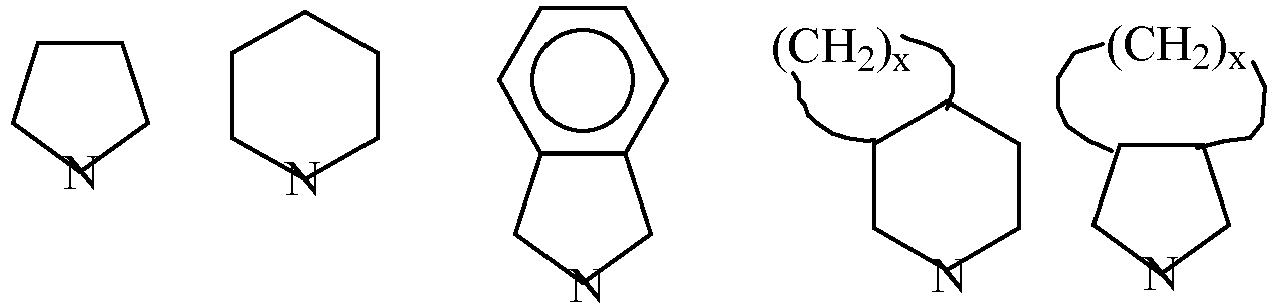
- Ra et Rb désignant des groupements alkyles identiques ou différents possédant de 1 à 40 atomes de carbone, éventuellement reliés entre eux de façon à former un cycle et éventuellement substitués par des groupements hydroxy, alcoxy ou amino,
- RL désignant un groupement monovalent de masse molaire supérieur à 15.42 g/mol, de préférence supérieur à 30 g/mol. Le groupement RL peut par exemple avoir une masse molaire comprise entre 40 et 450 g/mol. Il s'agit de préférence d'un groupement phosphoré de formule générale (XI) :

- De manière avantageuse, RL est un groupement phosphonate de formule :

- Le groupement RL peut également comprendre au moins un cycle aromatique tel que le radical phényle ou le radical naphtyle, substitué par exemple par un ou plusieurs radical(aux) alkyle comprenant de 1 à 10 atomes de carbone.
- Les nitroxydes de formule (X) sont préférés car ils permettent d'obtenir un bon contrôle de la polymérisation radicalaire des monomères (méth)acryliques comme cela est enseigné dans
WO 03/062293 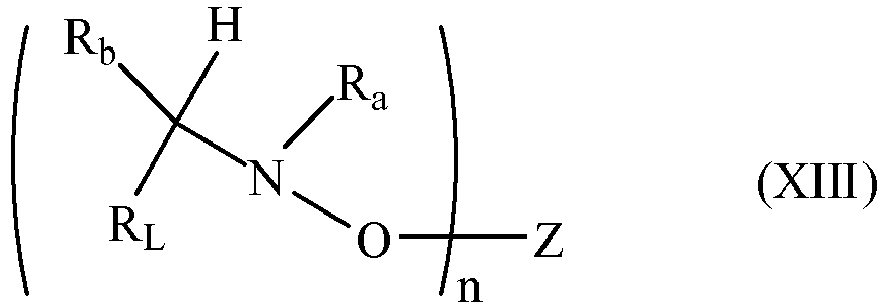
- Z désigne un groupement multivalent ;
- Ra et Rb désignent des groupements alkyles identiques ou différents possédant de 1 à 40 atomes de carbone, éventuellement reliés entre eux de façon à former un cycle et éventuellement substitués par des groupements hydroxy, alcoxy ou amino ;
- RL désigne un groupement monovalent de masse molaire supérieur à 15.042 g/mol, de préférence supérieur à 30 g/mol. Le groupement RL peut par exemple avoir une masse molaire comprise entre 40 et 450 g/mol. Il s'agit de préférence d'un groupement phosphoré de formule générale (XI) :

- De manière avantageuse, RL est un groupement phosphonate de formule :

- dans lequel Rc et Rd sont deux groupements alkyles identiques ou différents, éventuellement reliés de manière à former un cycle, comprenant de 1 à 40 atomes de carbone, éventuellement substitués ou non.
- Le groupement RL peut également comprendre au moins un cycle aromatique tel que le radical phényle ou le radical naphtyle, substitué par exemple par un ou plusieurs radical(aux) alkyle comprenant de 1 à 10 atomes de carbone.
- A titre d'exemple de nitroxyde de formule (X) pouvant être porté par l'alcoxyamine (XIII), on peut citer :
- le N-tertiobutyl-1-phényl-2-méthylpropyl nitroxyde,
- le N-(2-hydroxyméthylpropyl)-1-phényl-2-méthylpropyl nitroxyde,
- le N-tertiobutyl-1-dibenzylphosphono-2,2-diméthyl-propyl nitroxyde
- le N-tertiobutyl-1-di(2,2,2-trifluoroéthyl)phosphono-2,2-diméthylpropyl-nitroxyde,
- le N-tertiobutyl[(1-diéthylphosphono)-2-méthylpropyl]nitroxyde,
- le N-(1-méthyléthyl)-1-cyclohexyl-1-(diéthyl-phosphono)nitroxyde,
- le N-(1-phénylbenzyl)-[(1-diéthylphosphono)-1-méthyléthyl]nitroxyde,
- le N-phényl-1-diéthylphosphono-2,2-diméthylpropylnitroxyde,
- le N-phényl-1-diéthylphosphono-1-méthyléthylnitroxyde,
- le N-(1-phényl2-méthylpropyl)-1-diéthylphosphonométhyléthylnitroxyde,
- ou encore le nitroxyde de formule

- Le nitroxyde de formule (XIV) est particulièrement préféré :

- Il s'agit du N-tertiobutyl-1-diéthylphosphono-2,2-diméthylpropyl nitroxyde, couramment appelé SG1 pour simplifier.
- L'alcoxyamine (I), et notamment l'alcoxyamine (XIII), peuvent être préparées par des recettes décrites par exemple dans ou dans
FR2791979 
- Des alcoxyamines pouvant être utilisées dans le cadre de l'invention sont représentées ci-dessous :


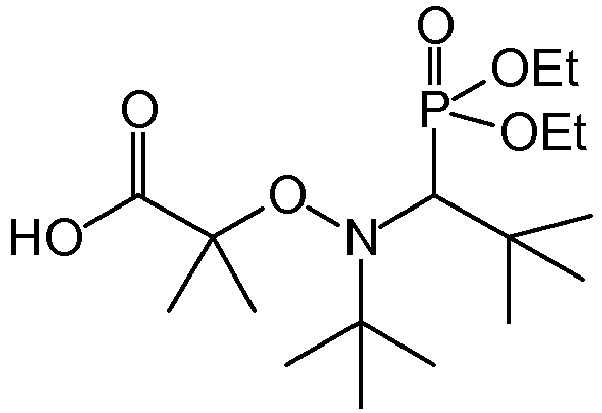


- Les deux dernières alcoxyamine sont appelées DIAMINS et TRIAMINS respectivement et sont les alcoxyamines préférées.
- On ne sortirait pas du cadre de la présente invention en combinant plusieurs alcoxyamines répondant à la formule (I), en particulier plusieurs alcoxyamines de formule (XIII). Ces mélanges pourraient comprendre ainsi par exemple une alcoxyamine ayant n1 nitroxydes attachés et une alcoxyamine ayant n2 nitroxydes attachés avec n1 différent de n2. Il pourrait s'agir aussi d'une combinaison d'alcoxyamines porteuses de nitroxydes différents.
- S'agissant du réducteur de nitroxydes ils peuvent être de tous type. Cela peut être un mercaptan , un radical. De préférence, il d'agit d'un radical issu de la décomposition d'un amorceur radicalaire soit par la température, soit par une reaction redox, ou autre système redox pouvant générer des radicaux comme par exemple le couple methylene bis (diethyl malonate)-cérium IV, ou encore le couple H2O2/Fe2+.
- Par réducteur de nitroxyde, on entend tout composé susceptible de réagir avec un nitroxyde.
- S'agissant de l'amorceur radicalaire, il peut être choisi parmi les peroxydes de diacyles, les peroxyesters, les peroxydes de dialkyle, les peroxyacétals, les composés azoïques. Des amorceurs radicalaires pouvant convenir sont par exemple le carbonate d'isopropyle, le peroxyde de benzoyle, de lauroyle, de caproyle, de dicumyle, le perbenzoate de tertiobutyle, le 2-éthyl perhexanoate de tertiobutyle, l'hydroperoxyde de cumyle, le 1,1-di(tert-butylperoxy)-3,3,5-trimethylcyclohexane, le peroxyisobutyrate de tertiobutyle, le peracétate de tertiobutyle, le perpivalate de tertiobutyle, le perpivalate d'amyle, le peroctoate de tertiobutyle. On ne sortirait pas du cadre de l'invention en utilisant un mélange d'amorceurs radicalaires choisis dans la liste ci-dessus. L'amorceur radicalaire préféré est un peroxyde, et plus particulièrement le peroxyde de benzoyle.
- Selon une forme préférée, le radical est généré par la réaction entre un peroxyde et une amine.
- S'agissant de l'amine, tout type d'amine susceptible de réagir avec un peroxyde peut être utilisé.
De façon préférée, il s'agit d'amines substituées, et plus particulièrement d'amines tri-substituées, parmi lesquelles on peut citer la N,N-diméthyle aniline (DMA) et ses dérivés para substitués telles que la diméthyle-p-toluidine (DMPT), la p-hydroxyméthyle-N,N-diméthyle aniline (HMDA), la p-nitro-N,N-N,N-diméthyle aniline (NDMA) et la p-diméthyle-amino benzaldéhyde (DMAB). Plus particulièrement, il s'agit de la diméthyle-p-toluidine. - La conduite de la polymérisation selon le procédé de l'invention peut être effectuée en masse, solution, suspension, ou encore émulsion.
- Selon une variante de l'invention, l'alcoxyamine utilisée peut être préparée par un procédé de polymérisation radicalaire contrôlée par les nitroxydes similaire mais sans présence du réducteur de nitroxyde, à une température supérieure à 50°C. Il s'agit par exemple de faire un premier bloc comprenant au moins un monomère, qui ultérieurement sera mis dans les conditions de la présente invention, c'est-à-dire à basse température, typiquement à la température ambiante pour générer la polymérisation des autres blocs. On obtiendra donc un copolymère avec plusieurs blocs.
- La synthèse de copolymères séquencés, ou copolymères à blocs utilise plusieurs techniques depuis de nombreuses années. Dans chacune de ces techniques, les températures utilisées pour la synthèse sont toujours très éloignées de l'ambiante et requièrent donc des conditions particulières de préparation, souvent incompatibles avec les procédés de fabrication utilisés dans les applications. Dans le procédé de l'invention, les températures de polymérisations sont comprisent entre -50°C et + 80°C, avantageusement entre -20°C et +80°C, de façon préférée entre 0°C et 80°C, de façon encore préférée entre 0°C et 50°C, et idéalement entre 10 et 35°C.
- De nombreux travaux ont par conséquent consisté à synthétiser le copolymère à bloc dans une première étape, puis à l'introduire sous forme d'additif dans des matériaux choisis selon l'application visée. Il a été démontré que l'utilisation de ces additifs permettait d'obtenir des compromis de propriétés améliorés par rapport aux techniques antérieures habituellement utilisées. Toutefois, l'introduction de copolymères à blocs dans un matériau hôte requiert des outils et techniques de mélange particulières (à chaud, en voie solvant) en raison de la très forte viscosité de ces additifs. Le même effet limite également la teneur en copolymères à blocs pouvant être introduite dans le matériau final. Pour ces applications, le taux de polymère utilisable en tant qu'additif est limité par la viscosité engendrée. Dans le cas où la synthèse du copolymère se déroule directement dans une résine hôte, ou le mélange résine/durcisseur, comme cela peut être le cas dans la présente invention, la viscosité n'est plus un problème car elle apparait uniquement en fin de procédé. Ceci ouvre des opportunités nouvelles dans les domaines ou la viscosité est un facteur limitant tels que les revêtements, les procédés d'injection ou d'infusion de résine, les adhésifs...
- La présente invention a le double avantage de permettre la synthèse du copolymère à blocs in situ dans le matériau hôte, de manière à obtenir une morphologie particulière plus favorable aux propriétés applicatives, et en conservant une viscosité initiale faible particulièrement favorable à la mise en œuvre du matériau additivé.
- Le matériau hôte peut être un solvant, un polymère, un oligomère, une charge pigmentaire ou non de toute dimension et de tout type de facteur de forme, poreuse ou non, des fibres courtes ou longues, tissées ou non tissées, des nanotubes ou une combinaison de ces matériaux hôtes. Le matériau hôte peut aussi être un précurseur de polymère, par exemple tout système bi-composant ou non susceptible de polymériser indépendamment de la polymérisation mettant en jeu l'alcoxyamine, par exemple de façon non limitative une résine epoxy, polyurethane, polyester. On peut par exemple polymériser soit simultanément soit de façon séquentielle le matériau hôte et le matériau issus de la polymérisation de l'alcoxyamine.
- En ce sens, la présente invention se rapproche des procédés décrits dans
WO 03/062293 WO 06/06152 - Parmi les monomères qui peuvent être utilisés dans le procédé de l'invention, on peut citer les monomères présentant une ou plusieurs doubles laisons tels que les monomères vinylaromatiques comme le styrène ou les styrènes substitués notamment l'alpha-méthylstyrène, les monomères acryliques tels que l'acide acrylique ou ses sels, les acrylates d'alkyle (présentant on non plusieurs fonctions acryliques), de cycloalkyle ou d'aryle tels que l'acrylate de méthyle, d'éthyle, de butyle, d'éthylhexyle ou de phényle, les acrylates d'hydroxyalkyle tels que l'acrylate de 2-hydroxyéthyle, les acrylates d'étheralkyle tels que l'acrylate de 2-méthoxyéthyle, les acrylates d'alcoxy- ou aryloxy-polyalkylèneglycol tels que les acrylates de méthoxypolyéthylèneglycol, les acrylates d'éthoxypolyéthylèneglycol, les acrylates de méthoxypolypropylèneglycol, les acrylates de méthoxypolyéthylèneglycol-polypropylèneglycol ou leurs mélanges, les acrylates d'aminoalkyle tels que l'acrylate de 2-(diméthylamino)éthyle (ADAME), les acrylates fluorés, les acrylates silylés, les acrylates phosphorés tels que les acrylates de phosphate d'alkylèneglycol, les monomères méthacryliques comme l'acide méthacrylique ou ses sels, les méthacrylates d'alkyle, de cycloalkyle, d'alcényle ou d'aryle tels que le méthacrylate de méthyle (MAM), de lauryle, de cyclohexyle, d'allyle, de phényle ou de naphtyle, les méthacrylates d'hydroxyalkyle tels que le méthacrylate de 2-hydroxyéthyle ou le méthacrylate de 2-hydroxypropyle, les méthacrylates d'étheralkyle tels que le méthacrylate de 2-éthoxyéthyle, les méthacrylates d'alcoxy- ou aryloxy-polyalkylèneglycol tels que les méthacrylates de méthoxypolyéthylèneglycol, les méthacrylates d'éthoxypolyéthylèneglycol, les méthacrylates de méthoxypolypropylèneglycol, les méthacrylates de méthoxypolyéthylèneglycol-polypropylèneglycol ou leurs mélanges, les méthacrylates d'aminoalkyle tels que le méthacrylate de 2-(diméthylamino)éthyle (MADAME), les méthacrylates fluorés tels que le méthacrylate de 2,2,2-trifluoroéthyle, les méthacrylates silylés tels que le 3-méthacryloylpropyltriméthylsilane, les méthacrylates phosphorés tels que les méthacrylates de phosphate d'alkylèneglycol, le méthacrylate d'hydroxy-éthylimidazolidone, le méthacrylate d'hydroxy-éthylimidazolidinone, le méthacrylate de 2-(2-oxo-1-imidazolidinyl)éthyle, l'acrylonitrile, l'acrylamide ou les acrylamides substitués, la 4-acryloylmorpholine, le N-méthylolacrylamide, le méthacrylamide ou les méthacrylamides substitués, le N-méthylolméthacrylamide, le chlorure de méthacrylamido-propyltriméthyl ammonium (MAPTAC), l'acide itaconique, l'acide maléique ou ses sels, l'anhydride maléique, les maléates ou hémimaléates d'alkyle ou d'alcoxy- ou aryloxy-polyalkylèneglycol, la vinylpyridine, la vinylpyrrolidinone, les (alcoxy) poly(alkylène glycol) vinyl éther ou divinyl éther, tels que le méthoxy poly(éthylène glycol) vinyl éther, le poly(éthylène glycol) divinyl éther, les monomères oléfiniques, parmi lesquels on peut citer l'éthylène, le butène, l'hexène et le 1-octène ainsi que les monomères oléfiniques fluorés, et les monomères vinylidéniques, parmi lesquels on peut citer le fluorure de vinylidène, seuls ou en mélange d'au moins deux monomères précités.
- La présente invention porte également sur les applications de l'utilisation de ce procédé de synthèse à basse température. Ce procédé devient compatible avec des applications nombreuses et variées pour lesquelles la température d'application reste froide ou modérée.
- En particulier la présente invention est avantageusement adaptée aux applications comme les vernis, les revêtements, les colles et adhésifs, le renforcement mécanique des matières plastiques, l'impression 3D, les matériaux composites car la température de polymérisation coïncide avec la température de l'application.
- La présente invention porte également sur les matériaux hôtes comprenant les polymères ou copolymères issus du procédé de l'invention en raison de leurs uniques propriétés résultants de l'utilisation du procédé de l'invention, permettant notamment d'incorporer des quantités importantes de copolymères objet de l'invention aux matériaux hôtes utilisant le procédé de l'invention.
- Dans un réacteur de 500 millilitre on introduit 206 g d'éthanol, 100 g de Blocbuider® (Arkema), 26.5 g de pentaeryhritol triacrylate (Sartomer SR444D). Le mélange est chauffé sous agitation à 80°C durant 4h. Le mélange réactionnel est ensuite soutiré puis l'éthanol est évaporé à l'aide d'un évaporateur rotatif. On obtient de façon quantitative 126 g de triamins.
- On introduit dans un réacteur métallique de 2 litres muni d'un agitateur à hélice, d'une double enveloppe de chauffage par circulation d'huile et d'une prise vide / azote :
- 643 g de d'acrylate de butyle
- 96 g de styrène
- 6 g de TRIAMINS.
- Après introduction des réactifs, le mélange réactionnel est dégazé à trois reprises sous vide / azote. Le réacteur est alors fermé puis l'agitation (50 tr/min) et le chauffage (consigne de température : 125 °C) sont mis en route. La température du mélange réactionnel atteint 113 °C en 30 min environ. La pression s'établit vers 1,5 bar. La température du réacteur est maintenue en palier à 115°C pendant 522 min. On récupère après refroidissement 740 g d'un mélange à 70% d'extrait sec. L'acrylate de butyle en excès est ensuite éliminé par évaporation à 70°C sous pression réduite pendant 3 h. Le rapport en poids acrylate de butyle : styrène du macro radical obtenu est 83 : 17. L'analyse par GPC calibrée à l'aide d'échantillons de polystyrène du macro-amorceur donne les résultats suivants : Mn : 129000 g/mol ; Mw : 510000 g/mol ; polymolécularité : 3,9.
- Dans un réacteur agité en inox communément utilisé par l'homme de l'art, on introduit un mélange composé de 500g d'acrylate de butyle, 70g de styrène,966g de toluène, 0.1854g d'AIBN (Vazo64 de Dupont), 0.6g de n-dodecyl mercaptan. Le réacteur est mis sous 2 bars de pression d'azote et chauffé à une température de 85°C pendant 3h. Le mélange est ensuite refroidi à température ambiante (20°C) puis séché sous vide dans une étuve pendant 16h à 125°C et 100mbar de pression absolue. On obtient alors le copolymère sec de polyacrylate de butyle-co-styrène non amorceur.
- Les polymérisations sont réalisées en masse, sans solvant, à température ambiante 25°C à pression atmosphérique.
On cherche dans ces exemples à polymériser le méthacrylate de méthyle sur la polyalcoxyamine macro-amorceur de l'exemple 2. Le peroxyde choisi est les peroxyde de benzoyle (BPO), l'amine est la diméthyle para toluidine (DMPT).
Les solutions (sans le peroxyde) sont préparées sous agitation magnétique, puis dégazées sous vide pendant 15 minutes ceci afin d'éliminer les gaz dissouts qui pourraient nuire à la polymérisation. La solution (20 g de mélange réactionnel) est coulée dans un flacon en verre de 30 ml. On rajoute le peroxyde puis le flacon est refermé à l'aide d'une capsule étanche.
Une sonde de température introduite dans le flacon au travers de la capsule enregistre l'évolution de la température de façon à suivre la polymérisation dans l'échantillon. Lorsque le profil de température présente un maximum on note le temps correspondant. - Les résultats sont donnés dans le tableau 1 ; les pourcentages indiqués sont massiques.
Tableau 1 Polyalcoxyamine de l'exemple 2 PABu/styrène radicalaire BPO DMPT MAM temps correspondant (min) essai référence 1 0% 0% 1% 0.1% 98.9% 316 référence 1 essai référence 2 0% 15% 1% 0.1% 83.9% 340 référence 2 essai 1 15% 0% 0% 0% 85% >1000 comparatif essai 2 15% 0% 1% 0% 84% >1000 comparatif essai 3 15% 0% 0% 0.1% 84.9% >1000 comparatif essai 4 15% 0% 1% 0.1% 83.9% 153 invention essai 5 7.5% 0% 1% 0.1% 91.4% 245 invention essai 6 15% 0% 1% 0.1% 83.9% 153 invention essai 7 15% 0% 1% 0.2% 83.8% 91 invention essai 8 15% 0% 1% 0.3% 83.7% 65 invention essai 9 25% 0% 1% 0.1% 73.9% 97 invention - Les matériaux correspondants aux essais de l'invention sont tous transparents c'est-à-dire qu'ils présentent une transmission lumineuse supérieure à 80 % pour une épaisseur d'échantillon de 3 mm. La photo 1 représentative des images AFM obtenues à partir de l'échantillon de l'essai 9 montre une nano-structuration typique des copolymères à blocs montrant que la réaction à bien eu lieu entre la polyalcoxyamine et le méthacrylate de méthyle. Lorsque qu'un essai est conduit à l'aide d'un copolymère PAbu/styrene de masse moléculaire en poids similaire mais ne présentant pas de fonctionnalité alcoxyamine, en présence de peroxyde et d'amine le matériau résultant est trouble, c'est-à-dire qu'il présente une transmission largement inférieure à 80 % pour une épaisseur d'échantillon de 3 mm. Dans ce dernier cas il y a macro-séparation de phase entre le copolymère PAbu/styrène et le PMMA. Il n'y a pas eu allongement de chaine du PAbu/styrène.
- Polymérisation du méthacrylate de méthyle en présence d'un macro-amorceur, dans un mélange de résine epoxy.
- Etape 1 : Les polymérisations sont réalisées en solution dans une résine epoxy DGEBA (Bis(4-(2,3-epoxypropoxy)phenyl)propane, Equivalent epoxy=186g/eq, nom commercial: LY556 HUNSTMAN), à température ambiante 25°C à pression atmosphérique.
- Le peroxyde choisi est le peroxyde de benzoyle (BPO), l'amine est la diméthyle para toluidine (DMPT). Les solutions sont préparées sous agitation magnétique, puis dégazées sous vide pendant 15 minutes ceci afin d'éliminer les gaz dissouts qui pourraient nuire à la polymérisation.
- On prépare dans une fiole en verre un mélange contenant
- 1.5g de la polyalcoxyamine macro-amorceur de l'exemple 2,
- 8.5g de méthacrylate de méthyle
- 0.1g de peroxyde de benzoyle
- 90g de résine DGEBA
- Une fois le mélange homogène, on ajoute 0.01g d'amine DMPT sous agitation pour obtenir un mélange homogène.
- La résine DGEBA est polymérisée à l'aide du durcisseur Jeffamine (Polyoxypropylenetriamine, M=400g/mol, nom commercial : T403 HUNSTMAN).
- 36.5g de durcisseur Jeffamine est ajouté au mélange issu de l'étape 1.
- On obtient un matériau dur au bout de 2h à température ambiante. Les images AFM montrent une structuration à l'échelle nanométrique (photo 2).
Claims (13)
- Procédé de polymérisation radicalaire comprenant les étapes suivantes :- Mélange comprenant au moins un monomère en présence d'au moins un réducteur de nitroxyde et au moins une alcoxyamine,- conduite de la polymérisation du mélange à une température comprise entre -50°C et 80 °C jusqu'à conversion complète des monomères.
- Procédé selon la revendication 1 dans lequel au moins une alcoxyamine est monofonctionnelle.
- Procédé selon la revendication 1 dans lequel au moins une alcoxyamine est multifonctionnelle.
- Procédé selon la revendication 1 dans lequel au moins une alcoxyamine est une alcoxyamine macromoléculaire.
- Procédé selon la revendication 1 dans lequel au moins un réducteur de nitroxyde est un radical.
- Procédé selon la revendication 1 dans lequel au moins un radical est issu de la décomposition d'un amorceur radicalaire.
- Procédé selon la revendication 1 dans lequel au moins un radical est issu de la décomposition d'un peroxyde en présence d'une amine.
- Procédé selon la revendication 7 dans lequel au moins un peroxyde est le peroxyde de benzoyle.
- Procédé selon la revendication 8 dans lequel l'amine est la diméthyle para toluidine.
- Procédé selon la revendication 1 dans lequel la polymérisation se fait en présence d'un matériau hôte.
- Procédé selon la revendication 10 dans lequel le matériau hôte est choisi parmi les fibres tissées ou non tissées, les résine époxy, polyuréthane, polyester.
- Utilisation du procédé selon l'une des revendications 1 à 11 pour la fabrication de colles, de pièces composites, de vernis, revêtements, l'impression 3D.
- Objet obtenu à l'aide d'une utilisation selon la revendication 12.
Applications Claiming Priority (2)
| Application Number | Priority Date | Filing Date | Title |
|---|---|---|---|
| FR1462678A FR3030525B1 (fr) | 2014-12-18 | 2014-12-18 | Polymerisation radicalaire d'alcoxyamines a basse temperature |
| PCT/FR2015/053625 WO2016097649A1 (fr) | 2014-12-18 | 2015-12-18 | Polymerisation radicalaire d'alcoxyamines a basse temperature |
Publications (2)
| Publication Number | Publication Date |
|---|---|
| EP3233933A1 EP3233933A1 (fr) | 2017-10-25 |
| EP3233933B1 true EP3233933B1 (fr) | 2019-11-06 |
Family
ID=53191757
Family Applications (1)
| Application Number | Title | Priority Date | Filing Date |
|---|---|---|---|
| EP15823675.2A Active EP3233933B1 (fr) | 2014-12-18 | 2015-12-18 | Polymerisation radicalaire d'alcoxyamines a basse temperature |
Country Status (9)
| Country | Link |
|---|---|
| US (1) | US10131734B2 (fr) |
| EP (1) | EP3233933B1 (fr) |
| JP (1) | JP6677731B2 (fr) |
| KR (1) | KR101922361B1 (fr) |
| CN (2) | CN107108823B (fr) |
| ES (1) | ES2767528T3 (fr) |
| FR (1) | FR3030525B1 (fr) |
| IL (1) | IL252950B (fr) |
| WO (1) | WO2016097649A1 (fr) |
Families Citing this family (4)
| Publication number | Priority date | Publication date | Assignee | Title |
|---|---|---|---|---|
| FR3075212B1 (fr) | 2017-12-18 | 2020-11-20 | Arkema France | Composition de polymere (meth)acrylique, son procede de preparation et utilisation |
| FR3075211B1 (fr) | 2017-12-18 | 2020-11-20 | Arkema France | Composition de polymere (meth)acrylique, son procede de preparation et utilisation |
| FR3088329B1 (fr) * | 2018-11-08 | 2022-01-07 | Arkema France | Compositions d'alcoxyamines |
| FR3117487B1 (fr) * | 2020-12-10 | 2022-12-23 | Arkema France | Polymérisation en suspension des alcoxyamines avec des monomères styréniques et (meth) acryliques. |
Family Cites Families (29)
| Publication number | Priority date | Publication date | Assignee | Title |
|---|---|---|---|---|
| US4666978A (en) * | 1985-11-27 | 1987-05-19 | First Chemical Corporation | Method of curing unsaturated polyester resins at low temperatures |
| FR2730240A1 (fr) | 1995-02-07 | 1996-08-09 | Atochem Elf Sa | Stabilisation d'un polymere par un radical libre stable |
| JPH11511202A (ja) * | 1996-06-04 | 1999-09-28 | エルフ アトケム ソシエテ アノニム | 安定な遊離ラジカル存在下での1,3−ジエンの制御されたラジカル重合によるテレケリックな1,3−ジエンオリゴマーの合成方法 |
| DE69829588T2 (de) * | 1997-01-10 | 2006-01-19 | E.I. Du Pont De Nemours And Co., Wilmington | Farblose wässrige Ammoniumsulfidlösung |
| WO1999003894A1 (fr) * | 1997-07-15 | 1999-01-28 | Ciba Specialty Chemicals Holding Inc. | Compositions polymerisables contenant des composes d'alkoxyamine derives de composes nitroses ou de nitrone |
| FR2791979B1 (fr) | 1999-04-08 | 2003-05-16 | Atochem Elf Sa | Procede de preparation d'alcoxyamines a partir de nitroxydes |
| JP4505698B2 (ja) * | 2000-01-17 | 2010-07-21 | 日油株式会社 | ビニル基含有アルコキシアミン、その用途および製造方法 |
| FR2804118B1 (fr) * | 2000-01-26 | 2003-08-22 | Atofina | Procede de polymerisation ou copolymerisation radicalaire controlee de l'ethylene sous haute pression en presence de radicaux libres amorceurs et de radicaux nitroxydes indoliniques controleurs |
| FR2807439B1 (fr) * | 2000-04-07 | 2003-06-13 | Atofina | Polymeres multimodaux par polymerisation radicalaire controlee en presence d'alcoxyamines |
| TWI236482B (en) * | 2000-11-13 | 2005-07-21 | Ciba Sc Holding Ag | Process for the (co)polymerization of vinyl chloride in the presence of a stable free nitroxyl radical |
| US8013062B2 (en) | 2002-01-22 | 2011-09-06 | Arkema France | Method of producing and using materials which are reinforced against impact and which contain block copolymers that are obtained by means of controlled radical polymerization in the presence of nitroxides |
| US6762263B2 (en) * | 2002-02-01 | 2004-07-13 | Atofina Chemicals, Inc. | High-solids coatings resins via controlled radical polymerization |
| US7297819B2 (en) | 2002-03-05 | 2007-11-20 | Ciba Specialty Chemicals Corp. | Open-chain alkoxyamines and their corresponding nitroxides for controlled low temperature radical polymerization |
| JP2004156005A (ja) * | 2002-03-28 | 2004-06-03 | Djk Kenkyusho:Kk | 常温硬化可能な樹脂組成物、該樹脂組成物の硬化方法及び該樹脂組成物の硬化物 |
| JP2004027172A (ja) * | 2002-05-08 | 2004-01-29 | Djk Kenkyusho:Kk | ラジカル硬化型樹脂組成物の硬化助促進化合物、該硬化助促進化合物を含むラジカル硬化型樹脂組成物、及び該樹脂組成物の硬化方法 |
| FR2859476B1 (fr) * | 2003-09-10 | 2005-11-11 | Specific Polymers | Copolymeres triblocs formes d'un bloc hydrophile encadre par deux blocs hydrophobes et structurants utilises a titre d'agents gelifiants ou epaississants de systemes aqueux |
| JP2005113058A (ja) * | 2003-10-09 | 2005-04-28 | Mitsubishi Rayon Co Ltd | 水溶性高分子開始剤を用いた乳化重合法 |
| WO2006006152A2 (fr) | 2004-07-08 | 2006-01-19 | Ramot At Tel-Aviv University Ltd | Traitement de troubles et de maladies du colon |
| JP4691986B2 (ja) | 2004-12-27 | 2011-06-01 | 住友化学株式会社 | 樹脂接着体の製造方法 |
| DE602006008453D1 (de) * | 2005-05-03 | 2009-09-24 | Basf Se | Verfahren zur herstellung von kammblockcopolymeren aus epoxidfunktionalisierten nitroxylethern und anionisch polymerisierbaren monomeren |
| FR2889703A1 (fr) * | 2005-08-09 | 2007-02-16 | Arkema Sa | Procede de preparation d'un materiau polymerique comprenant un copolymere multibloc obtenu par polymerisation radicalaire controlee |
| ATE465183T1 (de) * | 2005-08-30 | 2010-05-15 | Basf Se | Aus nitroxylradikalpolymerisation gewonnene polymere |
| US20090065737A1 (en) * | 2007-09-11 | 2009-03-12 | Arkema Inc. | Polymerization controllers for composites cured by organic peroxide initiators |
| JP5527036B2 (ja) * | 2010-04-15 | 2014-06-18 | Dic株式会社 | モルタル組成物、コンクリート構造体及び補修方法 |
| JP4821916B1 (ja) * | 2010-05-07 | 2011-11-24 | 横浜ゴム株式会社 | 変性ポリマーの製造法 |
| US9434837B2 (en) * | 2010-09-01 | 2016-09-06 | Arkema Inc. | Method of producing fluoropolymers using acid-functionalized monomers |
| FR2969633B1 (fr) * | 2010-12-23 | 2015-02-06 | Arkema France | Composition pour des plaques coulees nanostructurees reticulees |
| JP5333975B2 (ja) * | 2011-05-23 | 2013-11-06 | 電気化学工業株式会社 | (メタ)アクリル酸エステル共重合体およびこれを含んでなる粘着剤組成物ならびに(メタ)アクリル酸エステル共重合体の製造方法 |
| CN104105727B (zh) * | 2012-02-10 | 2017-06-06 | 阿科玛股份有限公司 | 在零或低voc涂料组合物中有用的胶乳粘合剂 |
-
2014
- 2014-12-18 FR FR1462678A patent/FR3030525B1/fr active Active
-
2015
- 2015-12-18 JP JP2017532745A patent/JP6677731B2/ja active Active
- 2015-12-18 US US15/536,449 patent/US10131734B2/en active Active
- 2015-12-18 KR KR1020177019698A patent/KR101922361B1/ko active Active
- 2015-12-18 ES ES15823675T patent/ES2767528T3/es active Active
- 2015-12-18 CN CN201580073742.XA patent/CN107108823B/zh active Active
- 2015-12-18 EP EP15823675.2A patent/EP3233933B1/fr active Active
- 2015-12-18 CN CN201910706082.4A patent/CN110396147B/zh active Active
- 2015-12-18 WO PCT/FR2015/053625 patent/WO2016097649A1/fr not_active Ceased
-
2017
- 2017-06-15 IL IL252950A patent/IL252950B/en unknown
Non-Patent Citations (1)
| Title |
|---|
| None * |
Also Published As
| Publication number | Publication date |
|---|---|
| IL252950B (en) | 2021-10-31 |
| KR20170096147A (ko) | 2017-08-23 |
| IL252950A0 (en) | 2017-08-31 |
| JP2017538831A (ja) | 2017-12-28 |
| CN110396147A (zh) | 2019-11-01 |
| JP6677731B2 (ja) | 2020-04-08 |
| CN110396147B (zh) | 2023-06-02 |
| FR3030525A1 (fr) | 2016-06-24 |
| FR3030525B1 (fr) | 2018-05-11 |
| CN107108823A (zh) | 2017-08-29 |
| WO2016097649A1 (fr) | 2016-06-23 |
| US10131734B2 (en) | 2018-11-20 |
| KR101922361B1 (ko) | 2018-11-26 |
| US20170362369A1 (en) | 2017-12-21 |
| ES2767528T3 (es) | 2020-06-17 |
| EP3233933A1 (fr) | 2017-10-25 |
| CN107108823B (zh) | 2019-09-03 |
Similar Documents
| Publication | Publication Date | Title |
|---|---|---|
| EP3233933B1 (fr) | Polymerisation radicalaire d'alcoxyamines a basse temperature | |
| Wang et al. | Synthesis of new bis (acyl) phosphane oxide photoinitiators for the surface functionalization of cellulose nanocrystals | |
| EP2655031B1 (fr) | Plaques coulées nanostructurées réticulées | |
| EP0524054A1 (fr) | Polymérisation de monomères (méth)acryliques | |
| WO2006106277A2 (fr) | Copolymere sequence a fonctions acides modulable et composition adhesive et thermoplastique le contenant | |
| US10563000B2 (en) | Low-temperature radical polymerisation of alkoxyamines | |
| EP3233932B1 (fr) | Polymérisation radicalaire d'alcoxyamines à basse température | |
| FR2893621A1 (fr) | Procede de preparation d'un polymere vivant comprenant des unites methacryliques et/ou methacrylates | |
| WO2017144819A1 (fr) | Composition polymérisable de faible viscosité précurseur de matériaux renforcés à l'impact | |
| JP6857111B2 (ja) | 重合体及びその製造方法 | |
| Erol et al. | Synthesis of fluorinated amphiphilic block copolymers based on PEGMA, HEMA, and MMA via ATRP and CuAAC click chemistry | |
| FR2918670A1 (fr) | Telomeres ou oligomeres (meth)acryliques et leur utilisation en tant que plastifiants de resines polyolefines halogenees | |
| US11814336B2 (en) | Oligomeric alkoxy amines | |
| EP3898736A1 (fr) | Composition comprenant des cyanoacrylates et au moins un copolymere a blocs | |
| Kim et al. | Nitroxide Mediated Polymerization of Styrene from Ladder‐Like Polysilsesquioxane: Synthesis and Characterization of Inorganic–Organic Hybrid Materials | |
| FR3117487A1 (fr) | Polymérisation en suspension des alcoxyamines avec des monomères styréniques et (meth) acryliques. | |
| JP2025077327A (ja) | ビニル重合体、重合性組成物、及びビニル重合体の製造方法 | |
| CA1298425C (fr) | Vernis de protection | |
| WO2010097561A2 (fr) | Nouveaux copolymères amphiphiles comprenant un groupe colorant, leur procédé de préparation et leurs utilisations comme pigments | |
| DE CYCLOADDITION | Guillaume TILLET |
Legal Events
| Date | Code | Title | Description |
|---|---|---|---|
| STAA | Information on the status of an ep patent application or granted ep patent |
Free format text: STATUS: THE INTERNATIONAL PUBLICATION HAS BEEN MADE |
|
| PUAI | Public reference made under article 153(3) epc to a published international application that has entered the european phase |
Free format text: ORIGINAL CODE: 0009012 |
|
| STAA | Information on the status of an ep patent application or granted ep patent |
Free format text: STATUS: REQUEST FOR EXAMINATION WAS MADE |
|
| 17P | Request for examination filed |
Effective date: 20170616 |
|
| AK | Designated contracting states |
Kind code of ref document: A1 Designated state(s): AL AT BE BG CH CY CZ DE DK EE ES FI FR GB GR HR HU IE IS IT LI LT LU LV MC MK MT NL NO PL PT RO RS SE SI SK SM TR |
|
| AX | Request for extension of the european patent |
Extension state: BA ME |
|
| RIN1 | Information on inventor provided before grant (corrected) |
Inventor name: INOUBLI, RABER Inventor name: CAZAUMAYOU, SYLVIE Inventor name: BOURRIGAUD, SYLVAIN |
|
| DAV | Request for validation of the european patent (deleted) | ||
| DAX | Request for extension of the european patent (deleted) | ||
| GRAP | Despatch of communication of intention to grant a patent |
Free format text: ORIGINAL CODE: EPIDOSNIGR1 |
|
| STAA | Information on the status of an ep patent application or granted ep patent |
Free format text: STATUS: GRANT OF PATENT IS INTENDED |
|
| INTG | Intention to grant announced |
Effective date: 20190531 |
|
| GRAS | Grant fee paid |
Free format text: ORIGINAL CODE: EPIDOSNIGR3 |
|
| GRAA | (expected) grant |
Free format text: ORIGINAL CODE: 0009210 |
|
| STAA | Information on the status of an ep patent application or granted ep patent |
Free format text: STATUS: THE PATENT HAS BEEN GRANTED |
|
| AK | Designated contracting states |
Kind code of ref document: B1 Designated state(s): AL AT BE BG CH CY CZ DE DK EE ES FI FR GB GR HR HU IE IS IT LI LT LU LV MC MK MT NL NO PL PT RO RS SE SI SK SM TR |
|
| REG | Reference to a national code |
Ref country code: GB Ref legal event code: FG4D Free format text: NOT ENGLISH |
|
| REG | Reference to a national code |
Ref country code: CH Ref legal event code: EP Ref country code: AT Ref legal event code: REF Ref document number: 1198620 Country of ref document: AT Kind code of ref document: T Effective date: 20191115 |
|
| REG | Reference to a national code |
Ref country code: IE Ref legal event code: FG4D Free format text: LANGUAGE OF EP DOCUMENT: FRENCH |
|
| REG | Reference to a national code |
Ref country code: DE Ref legal event code: R096 Ref document number: 602015041310 Country of ref document: DE |
|
| REG | Reference to a national code |
Ref country code: NL Ref legal event code: FP |
|
| REG | Reference to a national code |
Ref country code: CH Ref legal event code: NV Representative=s name: VALIPAT S.A. C/O BOVARD SA NEUCHATEL, CH |
|
| REG | Reference to a national code |
Ref country code: LT Ref legal event code: MG4D |
|
| PG25 | Lapsed in a contracting state [announced via postgrant information from national office to epo] |
Ref country code: BG Free format text: LAPSE BECAUSE OF FAILURE TO SUBMIT A TRANSLATION OF THE DESCRIPTION OR TO PAY THE FEE WITHIN THE PRESCRIBED TIME-LIMIT Effective date: 20200206 Ref country code: NO Free format text: LAPSE BECAUSE OF FAILURE TO SUBMIT A TRANSLATION OF THE DESCRIPTION OR TO PAY THE FEE WITHIN THE PRESCRIBED TIME-LIMIT Effective date: 20200206 Ref country code: GR Free format text: LAPSE BECAUSE OF FAILURE TO SUBMIT A TRANSLATION OF THE DESCRIPTION OR TO PAY THE FEE WITHIN THE PRESCRIBED TIME-LIMIT Effective date: 20200207 Ref country code: LT Free format text: LAPSE BECAUSE OF FAILURE TO SUBMIT A TRANSLATION OF THE DESCRIPTION OR TO PAY THE FEE WITHIN THE PRESCRIBED TIME-LIMIT Effective date: 20191106 Ref country code: FI Free format text: LAPSE BECAUSE OF FAILURE TO SUBMIT A TRANSLATION OF THE DESCRIPTION OR TO PAY THE FEE WITHIN THE PRESCRIBED TIME-LIMIT Effective date: 20191106 Ref country code: SE Free format text: LAPSE BECAUSE OF FAILURE TO SUBMIT A TRANSLATION OF THE DESCRIPTION OR TO PAY THE FEE WITHIN THE PRESCRIBED TIME-LIMIT Effective date: 20191106 Ref country code: PL Free format text: LAPSE BECAUSE OF FAILURE TO SUBMIT A TRANSLATION OF THE DESCRIPTION OR TO PAY THE FEE WITHIN THE PRESCRIBED TIME-LIMIT Effective date: 20191106 Ref country code: LV Free format text: LAPSE BECAUSE OF FAILURE TO SUBMIT A TRANSLATION OF THE DESCRIPTION OR TO PAY THE FEE WITHIN THE PRESCRIBED TIME-LIMIT Effective date: 20191106 Ref country code: PT Free format text: LAPSE BECAUSE OF FAILURE TO SUBMIT A TRANSLATION OF THE DESCRIPTION OR TO PAY THE FEE WITHIN THE PRESCRIBED TIME-LIMIT Effective date: 20200306 |
|
| PG25 | Lapsed in a contracting state [announced via postgrant information from national office to epo] |
Ref country code: HR Free format text: LAPSE BECAUSE OF FAILURE TO SUBMIT A TRANSLATION OF THE DESCRIPTION OR TO PAY THE FEE WITHIN THE PRESCRIBED TIME-LIMIT Effective date: 20191106 Ref country code: RS Free format text: LAPSE BECAUSE OF FAILURE TO SUBMIT A TRANSLATION OF THE DESCRIPTION OR TO PAY THE FEE WITHIN THE PRESCRIBED TIME-LIMIT Effective date: 20191106 Ref country code: IS Free format text: LAPSE BECAUSE OF FAILURE TO SUBMIT A TRANSLATION OF THE DESCRIPTION OR TO PAY THE FEE WITHIN THE PRESCRIBED TIME-LIMIT Effective date: 20200306 |
|
| REG | Reference to a national code |
Ref country code: ES Ref legal event code: FG2A Ref document number: 2767528 Country of ref document: ES Kind code of ref document: T3 Effective date: 20200617 |
|
| PG25 | Lapsed in a contracting state [announced via postgrant information from national office to epo] |
Ref country code: AL Free format text: LAPSE BECAUSE OF FAILURE TO SUBMIT A TRANSLATION OF THE DESCRIPTION OR TO PAY THE FEE WITHIN THE PRESCRIBED TIME-LIMIT Effective date: 20191106 |
|
| PG25 | Lapsed in a contracting state [announced via postgrant information from national office to epo] |
Ref country code: RO Free format text: LAPSE BECAUSE OF FAILURE TO SUBMIT A TRANSLATION OF THE DESCRIPTION OR TO PAY THE FEE WITHIN THE PRESCRIBED TIME-LIMIT Effective date: 20191106 Ref country code: CZ Free format text: LAPSE BECAUSE OF FAILURE TO SUBMIT A TRANSLATION OF THE DESCRIPTION OR TO PAY THE FEE WITHIN THE PRESCRIBED TIME-LIMIT Effective date: 20191106 Ref country code: DK Free format text: LAPSE BECAUSE OF FAILURE TO SUBMIT A TRANSLATION OF THE DESCRIPTION OR TO PAY THE FEE WITHIN THE PRESCRIBED TIME-LIMIT Effective date: 20191106 Ref country code: EE Free format text: LAPSE BECAUSE OF FAILURE TO SUBMIT A TRANSLATION OF THE DESCRIPTION OR TO PAY THE FEE WITHIN THE PRESCRIBED TIME-LIMIT Effective date: 20191106 |
|
| REG | Reference to a national code |
Ref country code: DE Ref legal event code: R097 Ref document number: 602015041310 Country of ref document: DE |
|
| REG | Reference to a national code |
Ref country code: AT Ref legal event code: MK05 Ref document number: 1198620 Country of ref document: AT Kind code of ref document: T Effective date: 20191106 |
|
| PG25 | Lapsed in a contracting state [announced via postgrant information from national office to epo] |
Ref country code: SK Free format text: LAPSE BECAUSE OF FAILURE TO SUBMIT A TRANSLATION OF THE DESCRIPTION OR TO PAY THE FEE WITHIN THE PRESCRIBED TIME-LIMIT Effective date: 20191106 Ref country code: MC Free format text: LAPSE BECAUSE OF FAILURE TO SUBMIT A TRANSLATION OF THE DESCRIPTION OR TO PAY THE FEE WITHIN THE PRESCRIBED TIME-LIMIT Effective date: 20191106 Ref country code: SM Free format text: LAPSE BECAUSE OF FAILURE TO SUBMIT A TRANSLATION OF THE DESCRIPTION OR TO PAY THE FEE WITHIN THE PRESCRIBED TIME-LIMIT Effective date: 20191106 |
|
| PLBE | No opposition filed within time limit |
Free format text: ORIGINAL CODE: 0009261 |
|
| STAA | Information on the status of an ep patent application or granted ep patent |
Free format text: STATUS: NO OPPOSITION FILED WITHIN TIME LIMIT |
|
| 26N | No opposition filed |
Effective date: 20200807 |
|
| PG25 | Lapsed in a contracting state [announced via postgrant information from national office to epo] |
Ref country code: LU Free format text: LAPSE BECAUSE OF NON-PAYMENT OF DUE FEES Effective date: 20191218 Ref country code: IE Free format text: LAPSE BECAUSE OF NON-PAYMENT OF DUE FEES Effective date: 20191218 |
|
| PG25 | Lapsed in a contracting state [announced via postgrant information from national office to epo] |
Ref country code: SI Free format text: LAPSE BECAUSE OF FAILURE TO SUBMIT A TRANSLATION OF THE DESCRIPTION OR TO PAY THE FEE WITHIN THE PRESCRIBED TIME-LIMIT Effective date: 20191106 Ref country code: AT Free format text: LAPSE BECAUSE OF FAILURE TO SUBMIT A TRANSLATION OF THE DESCRIPTION OR TO PAY THE FEE WITHIN THE PRESCRIBED TIME-LIMIT Effective date: 20191106 |
|
| PG25 | Lapsed in a contracting state [announced via postgrant information from national office to epo] |
Ref country code: CY Free format text: LAPSE BECAUSE OF FAILURE TO SUBMIT A TRANSLATION OF THE DESCRIPTION OR TO PAY THE FEE WITHIN THE PRESCRIBED TIME-LIMIT Effective date: 20191106 |
|
| PG25 | Lapsed in a contracting state [announced via postgrant information from national office to epo] |
Ref country code: HU Free format text: LAPSE BECAUSE OF FAILURE TO SUBMIT A TRANSLATION OF THE DESCRIPTION OR TO PAY THE FEE WITHIN THE PRESCRIBED TIME-LIMIT; INVALID AB INITIO Effective date: 20151218 Ref country code: MT Free format text: LAPSE BECAUSE OF FAILURE TO SUBMIT A TRANSLATION OF THE DESCRIPTION OR TO PAY THE FEE WITHIN THE PRESCRIBED TIME-LIMIT Effective date: 20191106 |
|
| PG25 | Lapsed in a contracting state [announced via postgrant information from national office to epo] |
Ref country code: TR Free format text: LAPSE BECAUSE OF FAILURE TO SUBMIT A TRANSLATION OF THE DESCRIPTION OR TO PAY THE FEE WITHIN THE PRESCRIBED TIME-LIMIT Effective date: 20191106 |
|
| PG25 | Lapsed in a contracting state [announced via postgrant information from national office to epo] |
Ref country code: MK Free format text: LAPSE BECAUSE OF FAILURE TO SUBMIT A TRANSLATION OF THE DESCRIPTION OR TO PAY THE FEE WITHIN THE PRESCRIBED TIME-LIMIT Effective date: 20191106 |
|
| REG | Reference to a national code |
Ref country code: CH Ref legal event code: R18 Free format text: ST27 STATUS EVENT CODE: U-0-0-R10-R18 (AS PROVIDED BY THE NATIONAL OFFICE) Effective date: 20251008 |
|
| PGFP | Annual fee paid to national office [announced via postgrant information from national office to epo] |
Ref country code: NL Payment date: 20251112 Year of fee payment: 11 |
|
| REG | Reference to a national code |
Ref country code: DE Ref legal event code: R081 Ref document number: 602015041310 Country of ref document: DE Owner name: ARKEMA FRANCE, FR Free format text: FORMER OWNER: ARKEMA FRANCE, COLOMBES, FR |
|
| REG | Reference to a national code |
Ref country code: CH Ref legal event code: U11 Free format text: ST27 STATUS EVENT CODE: U-0-0-U10-U11 (AS PROVIDED BY THE NATIONAL OFFICE) Effective date: 20260101 |
|
| PGFP | Annual fee paid to national office [announced via postgrant information from national office to epo] |
Ref country code: DE Payment date: 20251028 Year of fee payment: 11 |
|
| PGFP | Annual fee paid to national office [announced via postgrant information from national office to epo] |
Ref country code: GB Payment date: 20251030 Year of fee payment: 11 |
|
| PGFP | Annual fee paid to national office [announced via postgrant information from national office to epo] |
Ref country code: IT Payment date: 20251121 Year of fee payment: 11 |
|
| PGFP | Annual fee paid to national office [announced via postgrant information from national office to epo] |
Ref country code: FR Payment date: 20251110 Year of fee payment: 11 |
|
| PGFP | Annual fee paid to national office [announced via postgrant information from national office to epo] |
Ref country code: BE Payment date: 20251117 Year of fee payment: 11 |
|
| REG | Reference to a national code |
Ref country code: BE Ref legal event code: PD Owner name: ARKEMA FRANCE; FR Free format text: DETAILS ASSIGNMENT: CHANGE OF OWNER(S), OTHER; FORMER OWNER NAME: ARKEMA FRANCE Effective date: 20250919 |
|
| PGFP | Annual fee paid to national office [announced via postgrant information from national office to epo] |
Ref country code: ES Payment date: 20260115 Year of fee payment: 11 |
|
| PGFP | Annual fee paid to national office [announced via postgrant information from national office to epo] |
Ref country code: CH Payment date: 20260101 Year of fee payment: 11 |